Hubbry Logo
Proxy warProxy warMain
Open search
Proxy war
Community hub
Proxy war
logo
8 pages, 0 posts
0 subscribers
Be the first to start a discussion here.
Proxy war
Proxy war
from Wikipedia

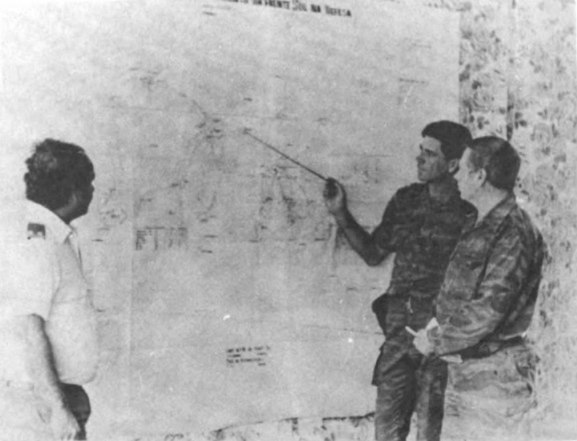
Soviet military advisers planning operations during the Angolan Civil War (1975–2002), a proxy conflict involving the USSR and United States

In political science, a proxy war is an armed conflict where at least one of the belligerents is directed or supported by an external third-party power. In the term proxy war, a belligerent with external support is the proxy; both belligerents in a proxy war can be considered proxies if both are receiving foreign military aid from a third-party country. Acting either as a nation-state government or as a conventional force, a proxy belligerent acts in behalf of a third-party state sponsor.[1]

A proxy war is characterised by a direct, long-term, geopolitical relationship between the third-party sponsor states and their client states or non-state clients,[2] thus the political sponsorship becomes military sponsorship when the third-party powers fund the soldiers and their materiel to equip the belligerent proxy-army to launch and fight and sustain a war to victory, and government power.[2] However, the relationship between sponsors and proxies can be characterized by principal-agent problems whereby the sponsor may be unable to control the actions of the proxy. A proxy war also can be a civil war, as in the Korean War and the Vietnam War during the Cold War.[3][4]

History

[edit]

During classical antiquity and the Middle Ages, many non-state proxies were external parties that were introduced into an internal conflict and aligned themselves with a belligerent to gain influence and to further their own interests in the region.[5][6] Proxies could be introduced by an external or local power and most commonly took the form of irregular armies which were used to achieve their sponsor's goals in a contested region.[6] Some medieval states like the Byzantine Empire used proxy warfare as a foreign-policy tool by deliberately cultivating intrigue among hostile rivals and then backing them when they went to war with each other.[2] Other states regarded proxy wars as merely a useful extension of a pre-existing conflict, such as France and England during the Hundred Years' War, both of which initiated a longstanding practice of supporting privateers, which targeted the other's merchant shipping.[7] France used England's turmoil of the Wars of the Roses from their victory as a proxy, siding with the Lancastrians against the Yorkists who were backed by the Burgundian State. The Ottoman Empire likewise used the Barbary pirates as proxies to harass Western European powers in the Mediterranean Sea.[8]

Frequent application of the term "proxy war" indicates its prominent place in academic research on international relations. Distinct implementations of soft power and hard power have proved to be unsuccessful in recent years. Accordingly, great failures in classic wars increased the tendency to use proxy wars.[9] Since the early twentieth century, proxy wars have most commonly taken the form of states assuming the role of sponsors to non-state proxies and essentially using them as fifth columns to undermine adversarial powers.[2] That type of proxy warfare includes external support for a faction engaged in a civil war, terrorists, national-liberation movements, and insurgent groups, or assistance to a national revolt against foreign occupation.[2] For example, the British government partially organized and instigated the Arab Revolt to undermine the Ottoman Empire during the First World War.[5] Many proxy wars began assuming a distinctive ideological dimension after the Spanish Civil War, which pitted the fascist political ideology of Italy and Nazi Germany against the communist ideology of the Soviet Union without involving these states in open warfare with each other.[10] Sponsors of both sides also used the Spanish conflict as a proving ground for their own weapons and battlefield tactics.[10]

During the Cold War, proxy warfare was motivated by fears that an armed conflict between the United States and the Soviet Union by conventional warfare would result in nuclear holocaust, which rendered the use of ideological proxies a safer way to conduct hostilities.[11] The Soviet government found that supporting parties antagonistic to the U.S. and other Western nations was a cost-effective way to combat NATO's influence compared to direct military engagement.[12] Additionally, the proliferation of televised media and its impact on public perception made the U.S. public especially susceptible to war-weariness and being skeptical of risking life abroad.[13] That encouraged the American practice of arming insurgent forces, such as the funnelling of supplies to the mujahideen during the Soviet–Afghan War.[14] Other examples of proxy war include the Korean War[15] and the Vietnam War.[16]

Abstract

[edit]

The governments of some nations, particularly liberal democracies, may choose to engage in proxy warfare (despite their military superiority) if most of their citizens oppose declaring or entering a conventional war.[17] That featured prominently in US strategy following the Vietnam War because of the so-called "Vietnam Syndrome" of extreme war weariness among the American population. That was also a significant factor in motivating the US to enter conflicts such as the Syrian Civil War by proxy actors after a series of costly drawn-out direct engagements in the Middle East spurred a recurrence of war weariness, the "War on Terror syndrome."[17]

Nations may also resort to proxy warfare to avoid potential negative international reactions from allied nations, profitable trading partners, or intergovernmental organizations such as the United Nations. That is especially significant when standing peace treaties, acts of the alliance or other international agreements ostensibly forbid direct warfare. Breaking such agreements could lead to a variety of negative consequences due to either negative international reaction (see above), punitive provisions listed in the prior agreement, or retaliatory action by the other parties and their allies.

In some cases, nations may be motivated to engage in proxy warfare because of financial concerns: supporting irregular troops, insurgents, non-state actors, or less-advanced allied militaries (often with obsolete or surplus equipment) can be significantly cheaper than deploying national armed forces, and the proxies usually bear the brunt of casualties and economic damage resulting from prolonged conflict.[18]

Another common motivating factor is the existence of a security dilemma. A nation may use military intervention to install a more favorable government in a third-party state. Rival nations may perceive the intervention as a weakened position to their own security and may respond by attempting to undermine such efforts, often by backing parties favorable to their own interests (such as those directly or indirectly under their control, sympathetic to their cause, or ideologically aligned). In that case, if one or both rivals come to believe that their favored faction is at a disadvantage, they will often respond by escalating military and/or financial support.[19] If their counterpart(s), perceiving a material threat or desiring to avoid the appearance of weakness or defeat, follow suit, a proxy war ensues between the two powers. That was a major factor in many of the proxy wars during the Cold War between the United States and the Soviet Union,[20] as well as in the ongoing series of conflicts between Saudi Arabia and Iran, especially in Yemen and Syria.[21][22][23]

Effects

[edit]

Proxy wars can have a huge impact, especially on the local area. A proxy war with significant effects occurred between the United States and the Soviet Union during the Vietnam War.[citation needed] Operation Rolling Thunder, a U.S bombing campaign in North Vietnam destroyed significant amounts of infrastructure. Many bombs were also dropped on North Vietnamese supply routes in Cambodia and Laos.[24] Equally, if not more, significant was the Soviet–Afghan War, which saw the U.S. fund the Afghan mujahideen against the invading Soviet forces (see Operation Cyclone). This war cost hundreds of thousands of lives and billions of dollars,[25] bankrupting the Soviet Union and contributing to its collapse.[12]

The conflict in the Middle East between Saudi Arabia and Iran is another example of the destructive impact of proxy wars. Since 2003, nearly 500,000 have died in the Iraqi conflict.[26] Since 2011, more than 500,000 have died in the Syrian Civil War.[27] Over 377,000 people had died in the Yemeni Civil War by early 2022.[28] In the war in Afghanistan, more than 176,000 were killed between 2001 and 2021.[29] In Pakistan, more than 57,000 have been killed since 2003.[30]

In general, lengths, intensities, and scales of armed conflicts are often greatly increased if belligerents' capabilities are augmented by external support. Belligerents are often less likely to engage in diplomatic negotiations, peace talks are less likely to bear fruit, and damage to infrastructure can be many times greater.[31][32]

See also

[edit]

References

[edit]

Further reading

[edit]
[edit]
Revisions and contributorsEdit on WikipediaRead on Wikipedia
from Grokipedia
A proxy war is an international conflict in which major powers instigate, support, and direct third-party state or non-state actors to fight on their behalf, typically to advance strategic interests while minimizing the risk of direct confrontation and escalation. This form of indirect warfare allows patrons to influence outcomes in distant theaters through material , , , and advisory roles, often prolonging local disputes without committing their own forces en masse. Proxy wars gained prominence during the , when the and backed opposing factions in dozens of regional conflicts to contain ideological expansion without triggering nuclear war. Key historical examples include the Korean War (1950–1953), where the Soviet Union and China supported North Korean forces against U.S.-backed South Korea, resulting in a stalemated armistice that preserved division along the 38th parallel. In the Angolan Civil War (1975–2002), Soviet and Cuban advisers directed Marxist MPLA fighters against U.S.- and South Africa-supported UNITA rebels, contributing to decades of instability and resource exploitation in the region. The Soviet-Afghan War (1979–1989) saw U.S., Saudi, and Pakistani assistance to mujahideen insurgents, which inflicted heavy losses on Soviet forces and accelerated the USSR's collapse, though it also empowered future extremist networks. Motivations for proxy engagement stem from cost asymmetry—proxies bear the brunt of casualties and expenses—enabling patrons to test adversaries, secure geopolitical footholds, and evade domestic political costs of full-scale war. However, such strategies often erode targeted states' , foster dependency in proxies, and risk blowback, as seen in the unintended proliferation of arms and tactics from proxies to contemporary insurgencies. In the post- era, proxy dynamics persist in rivalries like Iran-Saudi competition across and , where external sponsorship sustains amid great-power competition.

Definition and Core Characteristics

Fundamental Elements

A proxy war is an armed conflict in which an external third party, typically a major power or state actor, intervenes indirectly by supporting one or more local combatants—known as proxies—to advance its strategic interests without engaging its own forces in direct hostilities. This form of warfare allows patrons to influence outcomes in distant theaters, such as or interstate disputes, while minimizing risks to their own personnel and territory. The proxy acts as an intermediary, bearing the brunt of combat operations, while the patron exerts control through varying degrees of material and operational assistance. Central to proxy wars is the asymmetric patron-proxy dynamic, where the patron, possessing superior resources, delegates combat responsibilities to a weaker, politically aligned local entity to achieve deniability and cost efficiency. Patrons select proxies based on shared ideological, ethnic, or geopolitical alignments, providing them with arms, , , and to sustain fighting capacity. This relationship often involves transactional or exploitative models: in the former, support is for specific actions; in the latter, the patron exploits the proxy's independent motivations for broader gains. However, control remains imperfect, as proxies may pursue divergent agendas, leading to agency problems where local actors demand more aid or deviate from patron directives. Plausible deniability forms another foundational element, enabling patrons to obscure their involvement and avert escalation to direct confrontation between major powers. Support is channeled covertly, often via non-state intermediaries, private contractors, or ambiguous advisory roles, rather than overt troop deployments. This ambiguity in command structures and preserves strategic flexibility but heightens risks of miscalculation, as proxies may attribute unrelated attacks to patrons or vice versa. The strategic calculus underpinning proxy wars emphasizes indirect over decisive victory, with patrons calibrating to impose costs on adversaries without triggering full-scale . Objectives typically include containing rival influence, securing resources, or testing military technologies in low-stakes environments. Empirical patterns show proxies thriving in intrastate conflicts, where external prolongs fighting by offsetting local asymmetries, though success hinges on the patron's sustained commitment amid domestic political constraints. Unlike direct interventions, proxy wars exploit local grievances to mask external orchestration, fostering prolonged instability that serves patron goals of attrition.

Distinctions from Direct and Covert Wars

A proxy war fundamentally differs from a direct war in the level of involvement by the sponsoring powers, as it entails indirect support—typically through arms, funding, training, or advisors—to local combatants rather than deploying the sponsor's own uniformed forces in open combat against an adversary's military. In direct wars, such as the U.S.-led invasion of in 2003, belligerent states commit their national armies to overt engagements, risking escalation to broader conflict and incurring high costs in personnel and prestige if defeated. Proxy strategies, by contrast, enable patrons to pursue geopolitical objectives while limiting exposure to these risks, as the proxy bears the brunt of casualties and territorial losses; for instance, during the , the avoided direct confrontation with the U.S. by arming North Vietnamese forces rather than sending troops en masse. This indirection preserves and domestic political support but often results in prolonged, attritional conflicts due to reduced incentives for decisive outcomes. Relative to covert operations, proxy wars emphasize sustained, relational partnerships with autonomous local actors who conduct the bulk of fighting, whereas covert actions prioritize and short-term disruption without relying on proxy forces for sustained warfare. Covert operations, as defined in U.S. frameworks, involve clandestine activities like or targeted killings to influence foreign conditions while maintaining complete non-attributability to the sponsor, often executed by or assets without proxy intermediation. Proxy engagements, however, frequently transition from covert aid to semi-overt involvement, as seen in Iran's provisioning of with rockets and advisors since the 1980s, where the proxy's independence allows for strategic flexibility but complicates patron control and escalatory risks if support is exposed. The distinction hinges on agency: proxies retain operational latitude to align with local incentives, potentially diverging from sponsor goals, unlike the direct command structures in covert ops. These differences manifest in control challenges unique to proxies, where patrons exert influence through material leverage rather than command authority, leading to agency losses absent in direct or covert modes; empirical analyses of post-1945 conflicts show proxies succeeding in about 30% of cases compared to higher rates for overt interventions, due to such misalignments. Direct wars demand unified national strategy and rapid adaptation, while covert actions enable quick disavowal but limit scale; proxies bridge this by scaling indirect pressure but at the cost of unpredictability, as local actors may pursue ideological or opportunistic aims, exemplified by Afghan mujahideen's post-1989 evolution into transnational threats despite U.S. backing. Overall, proxy wars serve as a middle ground for great-power competition, balancing influence with restraint amid nuclear deterrence, though they risk blowback when proxies outlast or betray sponsors.

Historical Development

Pre-Modern and Early Modern Instances

In antiquity, great powers often employed client states, tribal allies, and mercenaries as proxies to extend influence and avoid direct imperial clashes. During the (431–404 BCE), and primarily conducted hostilities through allied city-states and proxy engagements rather than solely relying on their core forces; for instance, leveraged Corinthian proxies and indirect support in conflicts like the Corcyraean affair to pressure Athenian naval dominance without immediate full mobilization. This approach allowed resource conservation amid mutual deterrence, as both sides recognized the risks of total commitment leading to mutual exhaustion. In the late antique and early medieval periods, the and Sassanid Persia maintained a of Arab client kingdoms to wage proxy struggles along their frontiers. The Byzantines subsidized the Christian Ghassanid Arabs as from the early CE, enabling raids and defenses against the Sassanid-backed Lakhmid tribe, which served as a Persian proxy in southern and Arabia; this arrangement minimized direct Byzantine-Persian armies' exposure while contesting control over trade routes and nomadic incursions. Such federate systems, rooted in Roman traditions of auxiliary troops, persisted into the medieval , where empires outsourced frontier warfare to semi-autonomous groups for . Medieval European rivalries similarly featured proxy dynamics amid dynastic and territorial disputes. The (1337–1453) between and extended beyond direct battles to include interventions in peripheral conflicts, such as England's support for Castile against France's Portuguese allies during the 1383–1385 Portuguese interregnum, where rival claimants were backed to destabilize the opponent's continental flanks. These maneuvers reflected a pattern of using lesser powers to bleed adversaries indirectly, preserving royal armies for decisive campaigns while exploiting local divisions. During the , proxy warfare intensified with religious and balance-of-power motivations, as seen in the (1618–1648). , under , provided subsidies and arms to Protestant from 1630 onward—totaling millions of livres annually—to prosecute a proxy campaign against the Habsburg Empire, aiming to shatter Austrian dominance without France's armies bearing the primary brunt until 1635; Swedish forces under inflicted key defeats, such as at Breitenfeld in 1631, advancing French geopolitical interests. This strategy, prioritizing Habsburg encirclement over confessional loyalty, caused an estimated 4–8 million deaths in the Holy Roman Empire's territories, underscoring proxies' capacity for devastation when patron control faltered. European colonial expansion in the Americas further exemplified early modern proxies through alliances with indigenous groups. In , Britain and armed Native American confederacies as surrogates in their imperial rivalry; during (1689–1697), French colonists and allies like the raided English settlements, while English-backed conducted counterstrikes, resulting in over 1,600 colonial deaths and proxy-fueled frontier devastation equivalent to broader Anglo-French naval contests. Similarly, the (ca. 1640–1701) saw Dutch and later British traders supply the League with firearms to dismantle French-allied Huron and other tribes, securing monopolies and weakening rivals' colonial footholds without large-scale European troop deployments. These conflicts, blending economic incentives with proxy violence, depopulated regions and reshaped indigenous power structures to favor patron interests.

Emergence in the 20th Century

The practice of proxy warfare crystallized in the as great powers sought to advance ideological and strategic interests through third-party conflicts, avoiding direct military confrontation that risked broader escalation. A seminal instance occurred during the (1936–1939), where the Nationalist rebellion against the Republican government transformed into an arena for European powers to test military capabilities and export ideologies without formal declarations of war. and backed General Francisco Franco's Nationalists with troops, aircraft, and to counter Soviet influence, while the supplied the Republicans with arms and advisors to promote , effectively turning the internal strife into a rehearsal for transnational ideological battles. German intervention began almost immediately after the July 17, 1936, coup, with dispatching the —a unit of about 16,000 personnel equipped with advanced aircraft and tanks—to support Nationalist advances and experiment with tactics, including the aerial bombardment of on April 26, 1937. Italy contributed the , deploying tens of thousands of troops alongside aviation and naval assets to secure Mediterranean influence and combat perceived Bolshevik expansion. Soviet aid to the Republicans, channeled through the , included military advisors and substantial shipments of weaponry, though constrained by the Republican government's need to pay in gold and the policy of non-intervention adopted by Britain and , which inadvertently enabled the ' dominance. This asymmetric external involvement prolonged the war, resulting in approximately 500,000 deaths, and demonstrated how patrons could shape outcomes remotely while denying direct engagement. The Spanish precedent informed the proliferation of proxy strategies amid post-World War II bipolar tensions, where nuclear arsenals incentivized indirect competition between the United States and Soviet Union. The Korean War (1950–1953) exemplified this evolution: North Korean forces, invaded South Korea on June 25, 1950, with Soviet logistical support and later Chinese troop commitments totaling over 1 million, while U.S.-led United Nations forces defended the South to contain communism without provoking all-out war with Moscow or Beijing. Such conflicts underscored proxy warfare's utility in projecting power through client states or insurgents, minimizing risks to patron homelands while advancing geopolitical aims, a pattern that defined much of the Cold War era.

Strategic Motivations and Mechanics

Incentives for Patron States

Patron states pursue proxy warfare to achieve strategic objectives while minimizing the risks of direct confrontation, particularly in scenarios involving nuclear-armed adversaries or alliances that could trigger broader escalation. By delegating combat roles to local proxies, patrons avoid deploying their own troops en masse, thereby reducing domestic political costs from casualties and preserving military resources for core defenses. This approach stems from a of vulnerability to rival powers, prompting external support for factions to counter perceived threats without immediate reciprocity. For instance, during the , superpowers like the and backed proxies in distant theaters to contain ideological expansion, as direct intervention risked . Economic and operational efficiencies further incentivize proxy engagement, as indirect support—through arms, , and —incurs lower fiscal burdens than sustaining full-scale invasions or . Proxies absorb the human and logistical toll of ground operations, allowing patrons to test weapons systems, refine tactics, and gather on adversaries in real-world conditions without exposing national forces. States with limited power-projection capabilities, such as regional powers, leverage proxies to project influence beyond their borders, achieving deterrence or resource denial against opponents. This cost asymmetry is evident in analyses of post-Cold War conflicts, where patrons provide targeted to proxies rather than committing expeditionary armies, thereby sustaining pressure on rivals over extended periods. Plausible deniability represents a core , enabling patrons to advance goals while evading international condemnation, sanctions, or retaliatory strikes. By maintaining arms-length relationships, states can disavow responsibility for proxy atrocities or escalations, preserving diplomatic flexibility and alliances. This mechanism facilitates the export of ideologies or the weakening of enemy economies through prolonged attrition, as seen in great-power competitions where proxies serve as buffers against clashes. However, such s assume effective control over proxies, which principal-agent dynamics often undermine due to misaligned local agendas.

Operational Methods and Control Challenges

Proxy warfare operations generally rely on indirect support mechanisms, including the supply of arms, , , and to local non-state actors or client states engaged in conflicts, enabling patron states to shape battlefield outcomes while maintaining . This approach often involves embedding military advisors to provide tactical guidance and , as seen in the Soviet Union's deployment of approximately 1,500 advisors to during the 1970s and 1980s to assist MPLA forces against rebels backed by the and . programs, frequently conducted in third countries or remotely, equip proxies with skills in guerrilla tactics, weapons handling, and , such as Iran's providing instruction to Houthi fighters in on drone operations and since the mid-2010s. Arms transfers, often routed through intermediaries to obscure origins, sustain proxy capabilities; for instance, the supplied over 2,000 missiles to Afghan mujahideen between 1986 and 1989, altering the air war dynamics against Soviet forces without committing American troops. Control challenges stem primarily from the principal-agent dilemma, where patrons (principals) delegate authority to proxies (agents) whose local incentives, advantages, and autonomy can lead to misaligned actions, including unauthorized escalations or resource diversion. Proxies may exploit this asymmetry to pursue parochial goals, such as territorial expansion or ideological purity, over the patron's broader strategic aims, resulting in operational frictions; Iran's network of proxies, including , has at times initiated conflicts—like the —against Tehran's preferences for calibrated deterrence, highlighting limited veto power over client . Blowback risks further complicate control, as empowered proxies can turn against patrons or proliferate capabilities to adversaries; the U.S.-armed Afghan fighters of the 1980s later formed core elements of , which attacked American interests on , 2001, demonstrating how short-term tactical gains yield long-term security liabilities. Patrons attempt mitigation through conditional , intelligence oversight, and coercive incentives, yet enforcement remains imperfect due to proxies' operational and the deniability imperative that limits direct intervention. In , U.S. support to since 2015 included embedded advisors and precision strikes, but persistent proxy deviations—such as alliances with Kurdish separatists misaligned with Turkish partners—underscored ongoing agency losses. These dynamics often prolong conflicts, as proxies resist to maintain aid flows, exacerbating humanitarian costs and strategic uncertainty for all parties.

Major Historical Examples

Cold War Proxies in Asia

The Korean War (1950–1953) represented an early and pivotal proxy conflict in Asia, where U.S.-led United Nations forces defended South Korea against invasion by Soviet-armed North Korean troops, later reinforced by Chinese intervention. On June 25, 1950, approximately 223,000 North Korean soldiers, supported by 150 Soviet-supplied T-34 tanks, launched a coordinated assault across the 38th parallel, overwhelming South Korean defenses within days. The Soviet Union had furnished North Korea with extensive prewar aid, including artillery, trucks, and training for its forces, while authorizing the invasion but limiting its role to covert aerial operations using MiG-15 fighters piloted by Soviet aviators in "MiG Alley" to contest U.S. air superiority without formal declaration of war. This indirect involvement preserved superpower deniability, as Moscow supplied materiel worth hundreds of millions of rubles but deployed no ground troops, reflecting a calculated strategy to expand communist influence through client states amid mutual U.S.-Soviet nuclear deterrence. U.S. intervention, authorized by UN Security Council Resolution 83 on June 27, 1950, escalated into a multinational effort peaking at over 300,000 troops, which pushed North Korean forces to the by October before Chinese "" units—totaling up to 1.35 million—crossed the border, reversing gains and prolonging the stalemate. Beijing's entry stemmed from fears of U.S. encirclement, with committing divisions despite domestic opposition, resulting in heavy Chinese casualties estimated at 400,000–900,000 from combat and attrition. The signed on July 27, 1953, restored the prewar boundary but left Korea divided, with deaths exceeding 2 million, including 36,574 U.S. service members and hundreds of thousands of Korean civilians from bombings and massacres. Soviet restraint in escalating beyond air and logistical support underscored proxy mechanics, where patron states tested resolve through proxies to avoid direct confrontation that could trigger . The Vietnam War (1955–1975) extended this pattern into Southeast Asia, with the U.S. bolstering South Vietnam against North Vietnamese Army (NVA) and Viet Cong insurgents armed and advised by the Soviet Union and China, framing the struggle as containment of monolithic communism despite emerging Sino-Soviet tensions. U.S. advisory presence grew from 900 in 1960 to 543,000 combat troops by 1969, following Gulf of Tonkin Resolution escalation after NVA attacks on U.S. ships in August 1964, yet Washington avoided invading North Vietnam to prevent Chinese mass intervention akin to Korea. Moscow provided Hanoi with $600–950 million in annual military aid by the late 1960s, including SA-2 missiles that downed hundreds of U.S. aircraft, MiG fighters, and tanks, alongside 3,000 advisors who trained NVA units but suffered only 16 fatalities to minimize exposure. China, leveraging proximity, dispatched 320,000 engineering and anti-aircraft personnel from 1965–1969 to repair infrastructure and man defenses, supplying small arms and rice while coordinating via rail lines, though rivalry with the USSR limited unified bloc support and fueled Hanoi's independent maneuvering. North Vietnamese strategy exploited proxy dynamics through protracted and (January 1968), which inflicted 58,220 U.S. deaths and eroded domestic support, culminating in Paris Accords withdrawal by 1973 and Saigon's fall on April 30, 1975. Vietnamese casualties reached 1–3 million, predominantly civilian, from conventional battles, bombings like (1965–1968), and internal purges, while proxy aid enabled to outlast U.S. commitment without clash. These Asian theaters highlighted causal risks of proxy escalation—Korean near-misses in air combat and Vietnam's proxy —but also demonstrated how material support and deniable operations allowed ideological competition without thermonuclear exchange, influencing later U.S. doctrines like the emphasizing vital interests.

Cold War Proxies in Africa and Latin America

The Angolan Civil War, erupting after independence from Portugal in November 1975, exemplified Soviet and Cuban proxy support for the Marxist People's Movement for the Liberation of Angola (MPLA) against U.S.-backed factions including the National Liberation Front of Angola (FNLA) and National Union for the Total Independence of Angola (UNITA). Cuba deployed over 36,000 troops starting November 4, 1975, in response to South African incursions, with Soviet airlifts providing arms and logistics, enabling MPLA forces to secure Luanda and repel invaders by early 1976. The United States, under the Clark Amendment prohibiting aid until its 1985 repeal, initially funneled covert support via Zaire and South Africa to FNLA and UNITA, totaling around $32 million by 1976, though constrained by post-Vietnam domestic opposition. This conflict persisted until 2002, with Cuban troop numbers peaking at 65,000 by 1988, resulting in over 500,000 deaths and widespread devastation. In the of 1977-1978, Soviet and Cuban backing shifted to after 's invasion of the region, inverting prior U.S.- ties. , initially supported by the U.S. with arms deals worth $40 million annually until 1977, received Soviet aid before Moscow's pivot to 's regime, deploying 15,000 Cuban troops and 1,000 Soviet advisors alongside massive arms shipments exceeding 1 billion rubles. Ethiopian-Cuban counteroffensives from February 1978 recaptured key areas, expelling Somali forces by March and killing or capturing tens of thousands, with total casualties estimated at 40,000-60,000. This realignment underscored superpowers' opportunistic alliances, as the U.S. imposed sanctions on but provided limited aid to post-defeat. Mozambique's post-independence civil war from 1977 to 1992 pitted the Soviet- and Tanzanian-backed government against insurgents, funded and trained by and apartheid with U.S. acquiescence under the Reagan administration. supplied with $10-20 million annually in arms and logistics, enabling attacks that displaced millions and destroyed infrastructure, while Soviet aid to included 1,500 advisors and MiG fighters. The conflict claimed 1 million lives, with 's scorched-earth tactics exacerbating famine, before a 1992 peace accord amid Cold War's end. In , the Nicaraguan Civil War saw U.S. support for Contra rebels against the Soviet- and -backed Sandinista government from 1979 onward, formalized under the announced February 6, 1985, which pledged aid to anti-communist insurgents globally. approved $100 million in aid by 1986, including training in and arms, though the Iran-Contra affair revealed illegal diversions of $30-48 million from arms sales to . military advisors numbered up to 3,000, with Soviet shipments of $1 billion in weaponry by 1985, sustaining Sandinista defenses until 1990 elections. Casualties exceeded 30,000, with economic sabotage crippling Nicaragua's GDP. El Salvador's civil war (1980-1992) featured U.S. backing for the government against (FMLN) guerrillas, who received Soviet, Cuban, and Nicaraguan arms via pipelines supplying 10-20 tons monthly by the mid-1980s. The U.S. provided $6 billion in military and economic aid, training 10,000 troops and deploying advisors, countering FMLN offensives that briefly captured 90% of Salvadoran territory in 1989. Atrocities, including the 1980 killing 800-1,000 civilians by government forces, and FMLN bombings, contributed to 75,000 deaths before UN-brokered peace in 1992. Guatemala's 36-year civil war (1960-1996), intensifying in the , involved U.S. support for successive regimes against leftist insurgents backed by Soviet and Cuban supplies funneled through and . Aid totaled $300 million in the , including helicopters and , amid government scorched-earth campaigns displacing 1 million and killing 200,000, mostly Mayan civilians. Insurgent groups like the numbered 3,000 fighters at peak but fragmented without decisive external commitment. The conflict ended with 1996 accords, leaving deep ethnic divisions. These engagements highlighted proxy dynamics' asymmetry: Soviet-Cuban commitments often involved direct troop deployments exceeding 50,000 collectively, while U.S. efforts emphasized funding proxies and regional allies to avoid Vietnam-like quagmires, yet both fueled prolonged insurgencies with civilian tolls in the millions across regions.

Soviet-Afghan War as Archetype

The Soviet-Afghan War, spanning December 1979 to February 1989, exemplifies proxy warfare as the United States and allied states channeled extensive material support to Afghan mujahideen insurgents to counter Soviet occupation forces without committing their own troops to direct combat. The Soviet Union invaded on December 24, 1979, deploying approximately 100,000 troops to bolster the faltering People's Democratic Party of Afghanistan (PDPA) regime amid widespread rural rebellions against its Marxist reforms and land policies, which had ignited Islamist and tribal resistance by 1978. In response, the U.S. initiated Operation Cyclone in July 1979—initially with a modest $695,000 authorization that escalated post-invasion—coordinating with Pakistan's Inter-Services Intelligence (ISI), Saudi Arabia, China, Egypt, and the United Kingdom to supply arms, training, and funds totaling over $3 billion from the U.S. alone by 1989, marking the CIA's largest covert operation to date. This indirect strategy leveraged local fighters' knowledge of Afghanistan's rugged terrain for guerrilla ambushes, hit-and-run attacks, and supply line disruptions, inflicting unsustainable attrition on Soviet conventional forces. Key operational mechanics included Pakistan's ISI as the primary conduit for aid distribution to seven major parties based in , ensuring deniability for patrons while fostering factional rivalries that complicated unified command. Weapons shipments featured Chinese Type 56 rifles, Egyptian anti-tank launchers, and, crucially from 1986, U.S.-supplied man-portable air-defense systems, which downed over 270 Soviet aircraft and helicopters, severely hampering aerial dominance and forcing reliance on ground convoys vulnerable to mines and RPG ambushes. forces, numbering up to 200,000 at peak with 4,000-5,000 Arab foreign fighters including , operated in decentralized cells emphasizing mobility and ideological motivation drawn from jihadist rhetoric, which patrons tolerated to sustain recruitment despite long-term risks of . Soviet reached approximately 15,000 killed and 35,000 wounded, alongside over 1 million Afghan civilian deaths and 5 million refugees, underscoring the proxy model's capacity to impose asymmetric costs on the intervening power. As an , the conflict highlighted proxy warfare's strategic incentives—enabling great powers to contest rivals' expansions at low direct risk—while exposing control challenges, such as patrons' inability to dictate proxy behavior or prevent aid diversion to extremists. The 's success in forcing Soviet withdrawal on , 1989, via Geneva Accords, without concessions to insurgents, validated indirect bleeding tactics but yielded blowback: the PDPA regime collapsed in 1992, unleashing among mujahideen factions that birthed the and networks, demonstrating how proxy empowerment can engender uncontrolled non-state threats post-victory. This dynamic influenced subsequent U.S. and approaches to asymmetric conflicts, emphasizing the causal trade-offs between short-term gains and enduring instability from ideologically unvetted local allies.

Post-Cold War and 21st-Century Proxy Conflicts

Balkan and Post-Soviet Conflicts

In the of the 1990s, proxy elements emerged amid the breakup of the , though great-power involvement remained more diplomatic and indirect than in classical proxies. During the (1992–1995), which involved Bosniak, Croat, and Serb forces and resulted in over 100,000 deaths, provided political and material support to Serb forces aligned with , including arms shipments via remnants, while Western powers, particularly the , covertly facilitated Iranian and Saudi arms deliveries to Bosniak forces despite a UN embargo, aiming to balance the conflict without direct troop commitments. This dynamic prolonged the fighting, with Serb forces controlling 70% of Bosnian territory by 1994, until airstrikes in 1995 shifted momentum toward the Dayton Accords. The (1998–1999) further highlighted proxy tensions, as conducted a 78-day bombing campaign against Yugoslav targets to halt Serb operations against (KLA) insurgents, who received training and funding from networks and indirect Western tolerance. opposed the intervention, supplying intelligence and diplomatic backing to but refraining from military escalation to avoid direct confrontation, thus preserving as a regional foothold amid 's eastward expansion. These conflicts, while driven by ethnic , served proxy purposes by testing post-Cold War boundaries, with over 140,000 total Yugoslav War fatalities underscoring the human cost of such calibrated external meddling. Post-Soviet frozen conflicts exemplify Russia's strategic use of proxies to enforce a , deploying local separatist militias backed by Russian arms, advisors, and occasional troops to deter Western integration of former republics. In , following the 1992 after clashes between Moldovan forces and Russian-supported separatists, approximately 1,500 Russian troops remain stationed, sustaining the breakaway region's independence and blocking Moldova's aspirations as of 2025. Similarly, in Georgia's , Russian proxies—armed with tanks and Grad rockets from —secured secession in the early , with the 2008 (resulting in 850 Georgian military deaths) formalizing recognition of these entities, enabling to veto Georgia's and paths via ongoing military presence exceeding 5,000 personnel. The Nagorno-Karabakh disputes further illustrate proxy mechanics among regional powers, evolving from Soviet-era ethnic clashes into modern contests. In the (1988–1994), initially favored with arms while constraining , leading to Armenian control of the enclave and surrounding districts; however, the 2020 saw supply with Bayraktar TB2 drones and Syrian mercenaries (up to 2,000 fighters), enabling Azerbaijan's recapture of 90% of territories and over 6,000 combined fatalities, with mediating a and deploying 1,960 peacekeepers to maintain leverage without endorsing either side fully. This rivalry, compounded by 's 2022 commitments, exposed limits to its proxy control, as Azerbaijan's 2023 offensive dissolved the enclave's Armenian administration, displacing 100,000 civilians. These cases demonstrate how patron states like exploit local grievances for geopolitical denial, often entrenching instability over resolution.

Middle Eastern Proxy Networks

In the Middle East, proxy networks have proliferated amid the rivalry between and , with cultivating an informal coalition known as the Axis of Resistance to extend its influence without direct confrontation. This network includes Shia militias and allied groups such as in , established in 1982 during Israel's invasion, which receives Iranian funding, training, and weapons estimated at $700 million annually as of recent assessments. 's support extends to the Houthis in , who seized in September 2014 and have conducted cross-border attacks on Saudi targets, including drone strikes on oil facilities in on September 14, 2019, disrupting 5% of global oil supply. In , backs militias formed after 2014 ISIS advances, controlling key territories and political leverage post-2003 U.S. invasion. Despite doctrinal differences, provides and in Gaza with rockets and funding, enabling operations like the October 7, 2023, attack on that killed over 1,200 people. Saudi Arabia has countered with support for Sunni-aligned forces, leading a coalition intervention in Yemen on March 26, 2015, to restore the government against Houthi advances backed by Iran, resulting in over 377,000 deaths by 2021 per UN estimates. In Syria's civil war starting 2011, Saudi Arabia funneled hundreds of millions to Sunni rebels opposing Bashar al-Assad's regime, which Iran propped up with advisors and fighters from Hezbollah and Iraqi militias, sustaining Assad's hold despite over 500,000 casualties. Riyadh's efforts also included funding anti-Shia groups in Bahrain during 2011 unrest and backing Sunni factions in Iraq to offset Iranian gains. Other Gulf states like the UAE joined Yemen operations, targeting Iranian-supplied arms, while Qatar has supported Muslim Brotherhood affiliates, complicating alignments. These networks operate through deniable aid—financial transfers via systems, of precision-guided munitions, and ideological training—allowing patrons to escalate without full-scale , though control remains partial as proxies pursue local agendas. Hezbollah's arsenal of over 150,000 rockets targets , as demonstrated in the 2006 with 1,200 Lebanese and 160 Israeli deaths, while Houthis' 2023-2024 Red Sea attacks on shipping disrupted 12% of global trade. Saudi proxies faced setbacks, with Yemen's stalemating by 2022 despite $100 billion in coalition spending, highlighting proxy warfare's inefficiencies. A March 10, 2023, China-brokered deal restored Iran-Saudi ties, reducing overt hostilities, yet proxy activities persist, as seen in Houthi strikes post-October 2023. This dynamic has fueled sectarian tensions, displacing millions and enabling non-state actors to challenge state sovereignty across , , , and .

Ukraine-Russia War Dynamics

The Russo-Ukrainian War, marked by Russia's full-scale invasion of Ukraine on February 24, 2022, manifests proxy dynamics through Western provision of military materiel, intelligence, and training to Ukrainian forces, enabling sustained resistance against Russian advances without direct NATO combat involvement, which alliance leaders have explicitly ruled out to avert escalation to broader conflict. The United States alone has delivered approximately $66.9 billion in military assistance since the invasion's onset, including advanced systems such as HIMARS rocket artillery, Patriot air defenses, and Abrams tanks, alongside European allies contributing billions more in weaponry and munitions. This indirect support aligns with patron-state incentives to degrade Russia's conventional military capabilities—estimated to have suffered over 1 million total casualties by mid-2025—while imposing high attrition costs on Moscow through proxy attrition warfare, though control remains partial as Ukrainian operational decisions retain autonomy despite coordination via mechanisms like the Ukraine Defense Contact Group. Russia counters these dynamics by sourcing munitions and personnel from aligned states, including Iranian Shahed drones and ballistic missiles for long-range strikes, and North Korean artillery shells alongside reports of up to thousands of Pyongyang-deployed troops for frontline and combat by late 2025, compensating for domestic production shortfalls amid sanctions. Ukrainian casualties, estimated at around 400,000 killed or wounded as of early 2025 per official statements, underscore the proxy's human toll, with Western aid flows—totaling over $130 billion from the U.S. when including broader support—sustaining defensive lines in and regions but facing challenges from aid fatigue and political shifts, such as temporary U.S. funding pauses in early 2025. These mechanics highlight causal tensions: 's territorial aims, rooted in denying Western alignment, clash with patron objectives of containing revisionist expansion without risking direct confrontation, yielding a protracted where proxy sustainment tests both sides' resolve and resource depths. Analytical assessments frame the conflict's proxy elements as a NATO-Russia contest overlaid on the interstate Russo-Ukrainian clash, with Western strategy prioritizing Russia's military exhaustion over Ukrainian territorial restoration, evidenced by selective aid approvals tied to efficacy rather than unconditional commitment. Operational frictions arise from mismatched incentives—Ukraine's push for offensive capabilities like F-16 jets contrasts with patrons' escalation aversion—while Russia's hybrid adaptations, including electronic warfare dominance and fortified defenses, exploit proxy limitations in unified command. By October 2025, frontlines remain largely static, with Russian incremental gains in offset by Ukrainian incursions into , illustrating how proxy mechanics prolong attrition without decisive breakthroughs, as both principals calibrate support to avoid overcommitment amid nuclear shadows.

Geopolitical and Strategic Effects

Impacts on Global Power Balances

Proxy wars enable major powers to pursue strategic objectives and undermine rivals without risking direct military confrontation, thereby preserving the overall global balance of power while allowing incremental shifts in relative influence. During the , the and engaged in numerous proxy conflicts, such as those in Korea (1950–1953) and (1955–1975), to contain each other's ideological expansion and maintain bipolar stability, avoiding escalation to nuclear war through mutual deterrence. These engagements strained resources— the U.S. spent approximately $168 billion (in 2023 dollars) on the alone—but prevented direct clashes that could have destabilized the global order. In and , Soviet-backed proxies in (1975–2002) and (1979–1990) challenged U.S. dominance, prompting American countermeasures that redistributed influence over key resources like oil and strategic ports, subtly altering regional power dynamics without upending the central bipolar structure. The Soviet Union's overextension in these theaters, estimated to have cost up to 15% of its GDP by the , contributed to economic exhaustion and its eventual dissolution in , marking a decisive shift toward U.S. unipolarity. Post-Cold War, proxy strategies have facilitated multipolar competition, with the U.S. leveraging allies in Middle Eastern conflicts to counter Iranian influence, as seen in support for Saudi-led operations in since 2015, which aimed to limit Tehran's regional sway but exposed limits to American amid domestic fatigue. In the Russia-Ukraine (initiated February 24, 2022), Western aid exceeding $100 billion to has weakened Russian military capacity—inflicting over 600,000 casualties by mid-2024—while strengthening cohesion through and Sweden's 2023–2024 accessions, yet fostering deeper Russia-China alignment, evidenced by bilateral trade surpassing $240 billion in 2023. Such dynamics underscore how proxies can erode a rival's position regionally while prompting compensatory global realignments, challenging established hegemonies without immediate systemic collapse.

Military and Technological Innovations

Proxy wars have facilitated the testing and diffusion of military technologies that principals deploy through agents, often yielding innovations in asymmetric capabilities without direct great-power confrontation. During the Soviet-Afghan War (1979–1989), the introduced the (MANPADS) to fighters in September 1986, enabling effective countermeasures against Soviet air superiority. operators claimed 269 confirmed aircraft kills out of 340 engagements, achieving approximately a 70% hit rate, which compelled Soviet forces to fly higher altitudes and curtail low-level helicopter assaults, thereby degrading their operational tempo. This deployment demonstrated how portable, infrared-homing missiles could level the aerial playing field for non-state actors, influencing subsequent MANPADS proliferation in conflicts like and . In post-Cold War Middle Eastern proxy networks, such as the Iran-Saudi rivalry in and , precision-guided munitions (PGMs) and ballistic missiles have enhanced proxy forces' standoff strike capabilities. Iranian-supplied PGMs to Houthi rebels and allow mid-flight course corrections for targeting hardened , with 's estimated to include thousands of such systems by 2022, enabling saturation attacks on Israeli defenses. Similarly, U.S. transfers of PGMs to Saudi-led coalitions in since 2015 improved strike accuracy against Houthi positions, though proliferation to non-state actors has extended conflict durations by bolstering proxy resilience. These advancements underscore causal dynamics where principal states refine guidance technologies—incorporating GPS and homing—through proxy battlefields, reducing claims while escalating proxy firepower. The Ukraine-Russia conflict, framed by some analysts as a Western proxy engagement since 2014, has accelerated drone and AI integrations, adapting technologies for use. Ukrainian forces, bolstered by U.S. and supplies, deployed over 100,000 first-person-view (FPV) drones monthly by 2024, enabling real-time targeting and loitering munitions that neutralized Russian armor at low cost, with drone strikes contributing to thousands of vehicle losses. Innovations include AI-driven facial recognition identifying over 250,000 Russian personnel and autonomous swarm tactics, tested iteratively in proxy-like dynamics where Western principals provide tech without troops. This diffusion model reveals pitfalls, such as rapid enemy adaptation via electronic warfare, but affirms proxy wars as incubators for hybrid systems blending civilian drones with precision, reshaping toward persistent surveillance and attrition.

Societal and Humanitarian Consequences

Civilian and Economic Toll

Proxy wars inflict severe civilian casualties through indiscriminate tactics, prolonged engagements, and reduced incentives for restraint among external patrons who avoid direct accountability. In the Soviet-Afghan War from 1979 to 1989, over one million Afghan civilians perished, with most deaths attributed to Soviet aerial bombardments, scorched-earth policies, and reprisals. The conflict displaced an estimated five million Afghans, exacerbating and that compounded direct violence. Contemporary examples amplify this pattern. The , fueled by proxy support from and for the Assad regime alongside backing from the , , and Gulf states for various opposition factions, has resulted in over 219,000 documented civilian deaths as of recent tallies, alongside widespread use of barrel bombs and chemical weapons targeting populated areas. In Yemen's civil war since 2014, characterized as a Saudi-Iranian proxy , Saudi-led airstrikes and naval blockades have caused over 19,000 direct civilian casualties from coalition operations, while indirect effects like and account for the majority of an estimated 375,000 total deaths by 2024. Economic devastation in proxy conflicts stems from infrastructure destruction, disrupted , and sanctions that burden local populations without resolving underlying disputes. Afghanistan's post-Soviet collapsed, with GDP per capita stagnating amid warlordism and dependency that persists decades later. In , the war has halved pre-conflict GDP, with reconstruction costs exceeding $400 billion due to obliterated cities and industrial capacity. Yemen's conflict has contracted its economy by over 50% since 2015, triggering and aid dependency for 80% of the population. The Ukraine-Russia war, involving Western proxy-like aid dynamics, has generated $524 billion in reconstruction needs through 2033, including widespread damage to energy and agricultural sectors that once contributed 10% of global exports. These tolls often exceed those in direct great-power confrontations due to extended durations and fragmented frontlines, leading to chronic underinvestment in civilian protection. Post-9/11 wars with proxy elements in , , , and alone directly killed at least 408,000 civilians, per conservative estimates from aggregated data. Economic ripple effects, including global commodity shocks from Yemen's disruptions and Ukraine's grain blockade, further impose billions in indirect costs on unaffected regions.

Long-Term Instability and Blowback Risks

Proxy wars often engender prolonged regional instability by arming non-state actors whose capabilities persist beyond the sponsoring powers' immediate geopolitical aims, fostering cycles of violence that external patrons struggle to control. Analysis from the indicates that intrastate proxy conflicts, where external states provide material support to local factions, typically extend by an average of several years and elevate casualty rates due to sustained resource flows that incentivize continued fighting over negotiation. This dynamic erodes state institutions, displaces populations en masse, and creates power vacuums exploitable by extremist groups, as observed in multiple post-Cold War cases where proxy support inadvertently amplified jihadist networks. A paradigmatic instance of blowback occurred following the Soviet-Afghan War (1979–1989), where U.S. and Saudi funding exceeding $3 billion, channeled through Pakistan's to fighters, equipped insurgents with advanced weaponry including shoulder-fired missiles that downed over 270 Soviet aircraft. After the Soviet withdrawal in February 1989, these arms caches empowered forces to seize in September 1996, establishing a regime that sheltered , whose 2001 attacks on the U.S. killed nearly 3,000 and prompted a direct American —illustrating how proxy empowerment can rebound against sponsors through empowered adversaries. Similar proliferation risks materialized in Libya after the 2011 NATO-led intervention, which dismantled Gaddafi's government but scattered stockpiles of MANPADS and heavy weapons across , fueling insurgencies in by 2012 and contributing to over 20,000 deaths in subsequent conflicts by 2020. In Syria's civil war, initiated in 2011, multifaceted proxy involvement by the U.S., , , and prolonged the conflict beyond a decade, enabling the Islamic State's territorial declaration in 2014 across 100,000 square kilometers and attacks killing over 2,000 in between 2015 and 2018. This fragmentation has sustained low-level , with 13 million displaced by 2023 and cross-border extremism spilling into and . Yemen's Saudi-Iran proxy contest since 2015 has similarly entrenched famine-like conditions, with 377,000 excess deaths by 2021 attributable to war-induced and , alongside Houthi missile strikes on Saudi infrastructure persisting into 2024. Emerging risks in the conflict, framed as a NATO-Russia proxy since 2022, include the potential diversion of over $100 billion in Western-supplied arms to black markets, with documented instances of systems appearing in European crime rings by 2023, portending future terrorist acquisitions or regional spillover. Such blowback undermines humanitarian stability by perpetuating flows—over 6 million Syrians remain abroad—and economic ruination, with Libya's GDP contracting 60% post-2011 amid factional strife. Realist assessments caution that proxy strategies, while averting direct great-power clashes, amplify unintended escalations, as empowered proxies like 's militias in have conducted over 150 attacks on U.S. forces since October 2023, straining sponsor control. This pattern underscores causal linkages where initial tactical gains yield strategic liabilities, including exported and eroded deterrence credibility for intervening states.

Analytical Debates and Assessments

Effectiveness Versus Direct Confrontation

Proxy wars offer states a mechanism to pursue strategic objectives with reduced risk of escalation compared to direct military confrontation, primarily by providing , limiting troop commitments, and avoiding the mutual destruction potential of great-power clashes. In the nuclear era, this indirect approach has proven effective in preventing all-out wars between rivals, as evidenced by Cold War-era conflicts where the and supported opposing factions in over 70 proxy engagements without triggering direct superpower conflict. For instance, U.S. proxy support to Afghan mujahideen from 1979 to 1989 contributed to the Soviet withdrawal after a decade of direct invasion, achieving a key geopolitical goal at a fraction of the human cost of direct U.S. involvement, with American fatalities numbering in the dozens versus Soviet losses exceeding 14,000. However, such successes are context-dependent, often relying on the proxy's motivation alignment and sponsor's logistical sustainment rather than decisive control. Empirical analyses indicate mixed outcomes for proxy strategies, with effectiveness hinging on the sponsor's capabilities and the proxy's reliability, but generally falling short of direct intervention's potential for rapid resolution. studies of 188 intrastate proxy wars from to found that while proxies enable influence in civil conflicts—112 post-Cold War instances—they frequently result in prolonged stalemates due to principal-agent problems, where proxies pursue independent agendas, leading to operational divergences or betrayals. In contrast, direct confrontations, such as Israel's 1967 or the U.S.-led coalition's 1991 expulsion of Iraqi forces from , demonstrate higher decisiveness when technological and force superiority is applied, achieving objectives in weeks rather than years, though at elevated immediate risks and costs. Proxy failures, like Iran's support for proxies in yielding partial Houthi gains but entrenched regional instability since , underscore how indirect methods can bleed adversaries economically—U.S. aid to Saudi-led efforts exceeded $5 billion by 2019—yet rarely deliver unambiguous victories without supplemental . Direct confrontation, while riskier, often yields clearer attribution of victory or defeat, fostering deterrence or territorial gains that proxies struggle to secure amid attribution ambiguities and limited escalation control. Historical data from great-power rivalries show proxies succeeding in 40-50% of cases for short-term disruption, per qualitative assessments of proxies, but direct interventions like Russia's 2008 Georgia operation secured frozen conflicts more durably than proxy maneuvers in pre-2022. Proxies excel in asymmetric scenarios, enabling states like to project power through networks of approximately 200,000 fighters across six theaters by 2020 with minimal direct personnel (e.g., 5,000 IRGC-Quds Force), avoiding the quagmire of full invasions seen in U.S. experiences in (2003-2011, over 4,400 U.S. deaths). Yet, causal realism reveals proxies' tendency to generate blowback, as U.S.-backed Afghan proxies evolved into threats post-1989, contrasting direct wars' potential for imposed settlements, albeit with higher escalation ladders in peer competitions. Overall, proxies serve as a hedging tool in multipolar environments but prove less effective for existential goals requiring unambiguous dominance. Proxy wars have drawn ethical criticism for creating s, wherein sponsoring states can pursue aggressive objectives while externalizing the human and political costs onto proxies, thereby encouraging escalation and reducing incentives for restraint. This dynamic, akin to economic , allows sponsors to bear minimal direct consequences for risks that proxies must endure, often leading to prolonged conflicts and unnecessary prolongation of hostilities as proxies pursue maximalist goals misaligned with sponsor interests. For instance, sponsors may withhold full support to limit commitment, prompting proxies to adopt riskier tactics to compensate, which undermines ethical principles of proportionality and in warfare. Ethical analyses further contend that proxy warfare erodes , as sponsors evade the moral scrutiny applied to direct interventions, effectively violence without commensurate responsibility for jus in bello violations like excessive harm. Critics argue that proxy wars exploit weaker actors, treating non-state groups or smaller states as disposable instruments, which contravenes deontological imperatives against using humans as mere means to ends and fosters a of impunity. This instrumentalization raises justice-related concerns, as the philosophy of proxy engagement often prioritizes strategic gains over the intrinsic dignity of proxy fighters and affected populations, potentially violating by subordinating proxy agency to sponsor agendas. Moreover, the indirect nature of involvement can desensitize publics and decision-makers to the human toll, as evidenced in historical cases where proxy support has sustained insurgencies with high , negating utilitarian justifications if net exceeds that of direct or diplomatic alternatives. From a legal standpoint, proxy warfare frequently contravenes the UN Charter's on the threat or against or political independence under Article 2(4), as material support to armed groups within another state's borders constitutes unlawful intervention absent Security Council authorization or valid claims. Attribution doctrines under , including the International Law Commission's Articles on State Responsibility, hold sponsors accountable if they exercise effective control over proxies, rendering support tantamount to direct aggression; however, deliberate ambiguity in control thresholds enables deniability, complicating enforcement. Proxy engagements also heighten risks of (IHL) breaches, as non-state actors often lack the training or oversight to adhere to , with sponsor liability extending to if substantial contributions foreseeably enable violations like indiscriminate attacks. Legal critiques highlight gaps in regulating proxy support to rebels or militias, where customary rules on non-intervention clash with state practice, potentially eroding sovereign equality enshrined in the UN Charter. Courts and tribunals, such as the ICJ in cases involving state-sponsored groups, have set high bars for attribution (e.g., overall control rather than mere financing), allowing proxies to operate in gray zones that evade prohibitions on unlawful force. This regulatory shortfall not only incentivizes proxy strategies over transparent but also undermines mechanisms, as repeated violations normalize indirect aggression without proportionate countermeasures.

Realist Perspectives on Necessity

![Soviet advisers planning military operations in Angola][float-right] In realist international relations theory, proxy wars are viewed as a necessary strategy for great powers to pursue national interests and maintain security in an anarchic system without incurring the immense costs and risks of direct confrontation. Neorealists, building on Kenneth Waltz's structural framework, posit that the distribution of capabilities in bipolar or multipolar systems compels states to balance against threats through indirect means, as direct wars between nuclear-armed rivals could result in mutual assured destruction. This necessity arises from the primacy of survival: states must counter adversaries' expansions to prevent shifts in relative power, yet escalation control demands calibrated interventions via proxies, which allow deniability and limited commitment. Historical precedents underscore this logic, particularly during the , when the and channeled rivalry into proxy conflicts to avoid nuclear war. In from 1975 to 2002, the provided over 50,000 troops and advisors alongside Cuban forces to bolster the Marxist government, while the U.S. funneled approximately $250 million in aid to rebels between 1985 and 1991, effectively proxying a struggle over African influence without direct clashes. Realists argue such engagements were indispensable for preserving the bipolar balance, as they degraded opponents' resources and tested resolve at peripheral stakes, stabilizing the core deterrence. , a prominent offensive realist, extends this to contemporary cases, characterizing the conflict since 2022 as a U.S.- proxy where Western arms and intelligence support Ukrainian forces to constrain Moscow's , averting but not eliminating escalation risks inherent to great-power competition. Critics within realism caution that proxies, while necessary for power maximization, can entangle sponsors in protracted commitments or unintended escalations, yet the alternative—acquiescence to rivals' gains—threatens systemic instability more profoundly. Mearsheimer contends that in an era of intensifying U.S.- tensions, proxy dynamics in regions like the or will similarly prove essential to deter aggression without triggering global conflict, reflecting the tragic imperatives of statecraft in a world. This perspective prioritizes empirical patterns of state behavior over normative ideals, asserting proxy wars' endurance as a rational adaptation to enduring geopolitical realities.

References

Add your contribution
Related Hubs
User Avatar
No comments yet.