


Community hub
Recent from talks
Contribute something
Nothing was collected or created yet.
Differential operator
View on Wikipedia

In mathematics, a differential operator is an operator defined as a function of the differentiation operator. It is helpful, as a matter of notation first, to consider differentiation as an abstract operation that accepts a function and returns another function (in the style of a higher-order function in computer science).
This article considers mainly linear differential operators, which are the most common type. However, non-linear differential operators also exist, such as the Schwarzian derivative.
Definition
[edit]Given a nonnegative integer m, an order- linear differential operator is a map from a function space on to another function space that can be written as:


where is a multi-index of non-negative integers, , and for each , is a function on some open domain in n-dimensional space. The operator is interpreted as





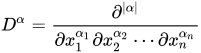
Thus for a function :

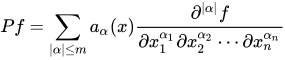
The notation is justified (i.e., independent of order of differentiation) because of the symmetry of second derivatives.
The polynomial p obtained by replacing partials by variables in P is called the total symbol of P; i.e., the total symbol of P above is: where The highest homogeneous component of the symbol, namely,


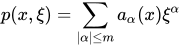

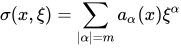
is called the principal symbol of P.[1] While the total symbol is not intrinsically defined, the principal symbol is intrinsically defined (i.e., it is a function on the cotangent bundle).[2]
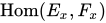
More generally, let E and F be vector bundles over a manifold X. Then the linear operator

is a differential operator of order if, in local coordinates on X, we have


where, for each multi-index α, is a bundle map, symmetric on the indices α.

The kth order coefficients of P transform as a symmetric tensor

whose domain is the tensor product of the kth symmetric power of the cotangent bundle of X with E, and whose codomain is F. This symmetric tensor is known as the principal symbol (or just the symbol) of P.
The coordinate system xi permits a local trivialization of the cotangent bundle by the coordinate differentials dxi, which determine fiber coordinates ξi. In terms of a basis of frames eμ, fν of E and F, respectively, the differential operator P decomposes into components
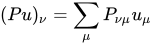
on each section u of E. Here Pνμ is the scalar differential operator defined by
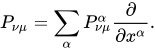
With this trivialization, the principal symbol can now be written

In the cotangent space over a fixed point x of X, the symbol defines a homogeneous polynomial of degree k in with values in .


Fourier interpretation
[edit]A differential operator P and its symbol appear naturally in connection with the Fourier transform as follows. Let ƒ be a Schwartz function. Then by the inverse Fourier transform,
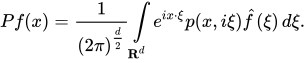
This exhibits P as a Fourier multiplier. A more general class of functions p(x,ξ) which satisfy at most polynomial growth conditions in ξ under which this integral is well-behaved comprises the pseudo-differential operators.
Examples
[edit]- The differential operator is elliptic if its symbol is invertible; that is for each nonzero the bundle map is invertible. On a compact manifold, it follows from the elliptic theory that P is a Fredholm operator: it has finite-dimensional kernel and cokernel.
- In the study of hyperbolic and parabolic partial differential equations, zeros of the principal symbol correspond to the characteristics of the partial differential equation.
- In applications to the physical sciences, operators such as the Laplace operator play a major role in setting up and solving partial differential equations.
- In differential topology, the exterior derivative and Lie derivative operators have intrinsic meaning.
- In abstract algebra, the concept of a derivation allows for generalizations of differential operators, which do not require the use of calculus. Frequently such generalizations are employed in algebraic geometry and commutative algebra. See also Jet (mathematics).
- In the development of holomorphic functions of a complex variable z = x + i y, sometimes a complex function is considered to be a function of two real variables x and y. Use is made of the Wirtinger derivatives, which are partial differential operators: This approach is also used to study functions of several complex variables and functions of a motor variable.
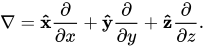
- The differential operator del, also called nabla, is an important vector differential operator. It appears frequently in physics in places like the differential form of Maxwell's equations. In three-dimensional Cartesian coordinates, del is defined as



- Del defines the gradient, and is used to calculate the curl, divergence, and Laplacian of various objects.
- A chiral differential operator. For now, see [1]
History
[edit]The conceptual step of writing a differential operator as something free-standing is attributed to Louis François Antoine Arbogast in 1800.[3]
Notations
[edit]The most common differential operator is the action of taking the derivative. Common notations for taking the first derivative with respect to a variable x include:
- , , and .


When taking higher, nth order derivatives, the operator may be written:
- , , , or .


The derivative of a function f of an argument x is sometimes given as either of the following:
![{\displaystyle [f(x)]'}](https://wikimedia.org/api/rest_v1/media/math/render/svg/edc02a83f2b3ff528f113faf1cc19000caff22a5)

The D notation's use and creation is credited to Oliver Heaviside, who considered differential operators of the form

in his study of differential equations.
One of the most frequently seen differential operators is the Laplacian operator, defined by
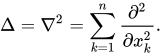
Another differential operator is the Θ operator, or theta operator, defined by[4]

This is sometimes also called the homogeneity operator, because its eigenfunctions are the monomials in z:

In n variables the homogeneity operator is given by
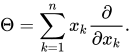
As in one variable, the eigenspaces of Θ are the spaces of homogeneous functions. (Euler's homogeneous function theorem)
In writing, following common mathematical convention, the argument of a differential operator is usually placed on the right side of the operator itself. Sometimes an alternative notation is used: The result of applying the operator to the function on the left side of the operator and on the right side of the operator, and the difference obtained when applying the differential operator to the functions on both sides, are denoted by arrows as follows:
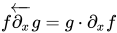
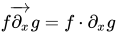

Such a bidirectional-arrow notation is frequently used for describing the probability current of quantum mechanics.
Adjoint of an operator
[edit]Given a linear differential operator the adjoint of this operator is defined as the operator such that where the notation is used for the scalar product or inner product. This definition therefore depends on the definition of the scalar product (or inner product).

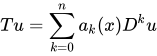



Formal adjoint in one variable
[edit]In the functional space of square-integrable functions on a real interval (a, b), the scalar product is defined by
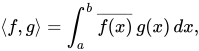
where the line over f(x) denotes the complex conjugate of f(x). If one moreover adds the condition that f or g vanishes as and , one can also define the adjoint of T by


![{\displaystyle T^{*}u=\sum _{k=0}^{n}(-1)^{k}D^{k}\left[{\overline {a_{k}(x)}}u\right].}](https://wikimedia.org/api/rest_v1/media/math/render/svg/786020c57d778a84ba7c17220f2f4fa8470eaa5a)
This formula does not explicitly depend on the definition of the scalar product. It is therefore sometimes chosen as a definition of the adjoint operator. When is defined according to this formula, it is called the formal adjoint of T.
A (formally) self-adjoint operator is an operator equal to its own (formal) adjoint.
Several variables
[edit]If Ω is a domain in Rn, and P a differential operator on Ω, then the adjoint of P is defined in L2(Ω) by duality in the analogous manner:

for all smooth L2 functions f, g. Since smooth functions are dense in L2, this defines the adjoint on a dense subset of L2: P* is a densely defined operator.
Example
[edit]The Sturm–Liouville operator is a well-known example of a formal self-adjoint operator. This second-order linear differential operator L can be written in the form

This property can be proven using the formal adjoint definition above.[5]
This operator is central to Sturm–Liouville theory where the eigenfunctions (analogues to eigenvectors) of this operator are considered.
Properties
[edit]Differentiation is linear, i.e.


where f and g are functions, and a is a constant.
Any polynomial in D with function coefficients is also a differential operator. We may also compose differential operators by the rule

Some care is then required: firstly any function coefficients in the operator D2 must be differentiable as many times as the application of D1 requires. To get a ring of such operators we must assume derivatives of all orders of the coefficients used. Secondly, this ring will not be commutative: an operator gD isn't the same in general as Dg. For example we have the relation basic in quantum mechanics:

The subring of operators that are polynomials in D with constant coefficients is, by contrast, commutative. It can be characterised another way: it consists of the translation-invariant operators.
The differential operators also obey the shift theorem.
Ring of polynomial differential operators
[edit]Ring of univariate polynomial differential operators
[edit]If R is a ring, let be the non-commutative polynomial ring over R in the variables D and X, and I the two-sided ideal generated by DX − XD − 1. Then the ring of univariate polynomial differential operators over R is the quotient ring . This is a non-commutative simple ring. Every element can be written in a unique way as a R-linear combination of monomials of the form . It supports an analogue of Euclidean division of polynomials.


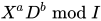
Differential modules[clarification needed] over (for the standard derivation) can be identified with modules over .
![{\displaystyle R[X]}](https://wikimedia.org/api/rest_v1/media/math/render/svg/afeccd52deabb878398a8485755c3ceea80caf9a)
Ring of multivariate polynomial differential operators
[edit]If R is a ring, let be the non-commutative polynomial ring over R in the variables , and I the two-sided ideal generated by the elements



for all where is Kronecker delta. Then the ring of multivariate polynomial differential operators over R is the quotient ring .



This is a non-commutative simple ring. Every element can be written in a unique way as a R-linear combination of monomials of the form .

Coordinate-independent description
[edit]In differential geometry and algebraic geometry it is often convenient to have a coordinate-independent description of differential operators between two vector bundles. Let E and F be two vector bundles over a differentiable manifold M. An R-linear mapping of sections P : Γ(E) → Γ(F) is said to be a kth-order linear differential operator if it factors through the jet bundle Jk(E). In other words, there exists a linear mapping of vector bundles

such that

where jk: Γ(E) → Γ(Jk(E)) is the prolongation that associates to any section of E its k-jet.
This just means that for a given section s of E, the value of P(s) at a point x ∈ M is fully determined by the kth-order infinitesimal behavior of s in x. In particular this implies that P(s)(x) is determined by the germ of s in x, which is expressed by saying that differential operators are local. A foundational result is the Peetre theorem showing that the converse is also true: any (linear) local operator is differential.
Relation to commutative algebra
[edit]An equivalent, but purely algebraic description of linear differential operators is as follows: an R-linear map P is a kth-order linear differential operator, if for any k + 1 smooth functions we have

![{\displaystyle [f_{k},[f_{k-1},[\cdots [f_{0},P]\cdots ]]=0.}](https://wikimedia.org/api/rest_v1/media/math/render/svg/24bb2111918496a5d3640a1b1c5f4e674b59b70d)
Here the bracket is defined as the commutator
![{\displaystyle [f,P]:\Gamma (E)\to \Gamma (F)}](https://wikimedia.org/api/rest_v1/media/math/render/svg/f37a30580cbc91e9277251ecf8d3fdcd2d78726d)
=P(f\cdot s)-f\cdot P(s).}](https://wikimedia.org/api/rest_v1/media/math/render/svg/ef1cfcf50fe7cfb77dde6bc9b4e2ae629ec3c2a0)
This characterization of linear differential operators shows that they are particular mappings between modules over a commutative algebra, allowing the concept to be seen as a part of commutative algebra.
Variants
[edit]A differential operator of infinite order
[edit]A differential operator of infinite order is (roughly) a differential operator whose total symbol is a power series instead of a polynomial.
Invariant differential operator
[edit]An invariant differential operator is a differential operator that is also an invariant operator (e.g., commutes with a group action).
Bidifferential operator
[edit]A differential operator acting on two functions is called a bidifferential operator. The notion appears, for instance, in an associative algebra structure on a deformation quantization of a Poisson algebra.[6]

Microdifferential operator
[edit]A microdifferential operator is a type of operator on an open subset of a cotangent bundle, as opposed to an open subset of a manifold. It is obtained by extending the notion of a differential operator to the cotangent bundle.[7]
See also
[edit]- Difference operator
- Delta operator
- Elliptic operator
- Curl (mathematics)
- Fractional calculus
- Differential calculus over commutative algebras
- Lagrangian system
- Spectral theory
- Energy operator
- Momentum operator
- Pseudo-differential operator
- Fundamental solution
- Atiyah–Singer index theorem (section on symbol of operator)
- Malgrange–Ehrenpreis theorem
- Hypoelliptic operator
Notes
[edit]- ^ Hörmander 1983, p. 151.
- ^ Schapira 1985, 1.1.7
- ^ James Gasser (editor), A Boole Anthology: Recent and classical studies in the logic of George Boole (2000), p. 169; Google Books.
- ^ E. W. Weisstein. "Theta Operator". Retrieved 2009-06-12.
- ^
- ^ Omori, Hideki; Maeda, Y.; Yoshioka, A. (1992). "Deformation quantization of Poisson algebras". Proceedings of the Japan Academy, Series A, Mathematical Sciences. 68 (5). doi:10.3792/PJAA.68.97. S2CID 119540529.
- ^ Schapira 1985, § 1.2. § 1.3.
![{\displaystyle {\begin{aligned}L^{*}u&{}=(-1)^{2}D^{2}[(-p)u]+(-1)^{1}D[(-p')u]+(-1)^{0}(qu)\\&{}=-D^{2}(pu)+D(p'u)+qu\\&{}=-(pu)''+(p'u)'+qu\\&{}=-p''u-2p'u'-pu''+p''u+p'u'+qu\\&{}=-p'u'-pu''+qu\\&{}=-(pu')'+qu\\&{}=Lu\end{aligned}}}](https://wikimedia.org/api/rest_v1/media/math/render/svg/6f14429d10c7b73597f1f385bbb6d50c8b3517d9)
References
[edit]- Freed, Daniel S. (1987), Geometry of Dirac operators, p. 8, CiteSeerX 10.1.1.186.8445
- Hörmander, L. (1983), The analysis of linear partial differential operators I, Grundl. Math. Wissenschaft., vol. 256, Springer, doi:10.1007/978-3-642-96750-4, ISBN 3-540-12104-8, MR 0717035.
- Schapira, Pierre (1985). Microdifferential Systems in the Complex Domain. Grundlehren der mathematischen Wissenschaften. Vol. 269. Springer. doi:10.1007/978-3-642-61665-5. ISBN 978-3-642-64904-2.
- Wells, R.O. (1973), Differential analysis on complex manifolds, Springer-Verlag, ISBN 0-387-90419-0.
Further reading
[edit]- Fedosov, Boris; Schulze, Bert-Wolfgang; Tarkhanov, Nikolai (2002). "Analytic index formulas for elliptic corner operators". Annales de l'Institut Fourier. 52 (3): 899–982. doi:10.5802/aif.1906. ISSN 1777-5310.
- https://mathoverflow.net/questions/451110/reference-request-inverse-of-differential-operators
External links
[edit] Media related to Differential operators at Wikimedia Commons
- "Differential operator", Encyclopedia of Mathematics, EMS Press, 2001 [1994]

| Spaces |
| ||||
|---|---|---|---|---|---|
| Theorems | |||||
| Operators | |||||
| Algebras | |||||
| Open problems | |||||
| Applications | |||||
| Advanced topics | |||||

| International | |
|---|---|
| National | |
| Other | |

Differential operator
View on GrokipediaBasic Concepts
Definition
A differential operator is a linear map , where is an open set and denotes the vector space of smooth real-valued functions on , that satisfies a generalized Leibniz rule characterizing its finite order.[8] Specifically, is a differential operator of order at most if, for every smooth function , the commutator (where denotes multiplication by ) is a differential operator of order at most , with order 0 operators being precisely the continuous linear maps (i.e., multiplication operators).[8] The order of is the minimal such nonnegative integer for which the -fold iterated commutator with multiplication operators vanishes identically.[8] This inductive definition via commutators ensures that locally behaves like a finite combination of partial derivatives, up to smooth multiplication factors. In local coordinates on , any differential operator of order at most admits the explicit expression where is a multi-index with , denotes the corresponding partial derivative operator of order , and the coefficients are smooth functions.[9] The highest-order terms (with ) determine the principal symbol of , which plays a key role in analyzing its global properties. More generally, differential operators extend to smooth manifolds of dimension , acting as linear maps that are locally of the above form in any coordinate chart.[9] On a manifold, the order is independent of the choice of coordinates, preserving the commutator characterization relative to multiplication by smooth functions on .[8] This framework captures extensions of classical differentiation while ensuring consistency across overlapping charts via the partition of unity theorem.Historical Development
The concept of differential operators traces its origins to the 18th century, amid the development of calculus, particularly in the calculus of variations. Leonhard Euler and Joseph-Louis Lagrange began treating higher-order derivatives as successive applications of a basic derivative operation acting on functions, facilitating the analysis of variational problems. Euler's foundational contributions in the 1740s, developed further through collaboration with Lagrange in the 1760s, marked an early recognition of derivatives as operator-like entities that could be composed and applied systematically to functionals.[10] This intuitive approach gained formal structure in the early 19th century with Louis François Antoine Arbogast's introduction of the standalone differential operator notation , which separated operational symbols from quantities and enabled algebraic manipulation of derivatives. Published in 1800 in Du calcul des dérivations et ses usages dans la théorie des suites et dans la géométrie, Arbogast's work represented a pivotal conceptual shift, allowing differential operators to be viewed independently of specific functions. Subsequent 19th-century advancements by Augustin-Louis Cauchy and Karl Weierstrass further embedded differential operators within the rigorous theory of partial differential equations (PDEs). Cauchy's 1827 analysis of the Cauchy-Riemann equations exemplified first-order differential operators in complex analysis, while his 1840 power series methods for nonlinear PDE initial value problems highlighted their role in solution existence and uniqueness. Weierstrass's mid-1870s emphasis on analytical rigor critiqued earlier informal approaches, influencing the study of elliptic operators and boundary value problems in PDEs.[11][12] In the early 20th century, Élie Cartan's development of exterior differential systems from 1899 onward provided a geometric framework for higher-order differential operators, integrating them with Lie groups and moving frames for solving systems of PDEs. The mid-20th century brought abstract generalizations: Laurent Schwartz's 1950-1951 theory of distributions extended differential operators to act on generalized functions, enabling solutions to PDEs beyond classical smoothness. Pseudodifferential operators, building on singular integral techniques, were advanced by Alberto Calderón in 1959 to address Cauchy problems for broad classes of PDEs. Algebraically, the ring of differential operators on smooth manifolds was formalized by Alexander Grothendieck in the 1960s, revealing deep ties to sheaf theory and D-modules. During the 1940s-1950s, connections to Lie algebras emerged, with the ring of constant-coefficient differential operators identified as the universal enveloping algebra of the translation Lie algebra, influencing representation theory and quantization. Quantum mechanics profoundly shaped this evolution, as Erwin Schrödinger in 1926 introduced differential operators like the momentum operator to represent observables in wave mechanics, bridging classical analysis with operator algebras.[12][13][14]Examples and Notation
Examples
A fundamental example of a first-order differential operator in one variable is the differentiation operator , which maps a smooth function to its derivative . This operator has order 1, as its principal symbol is the nonzero linear function in the cotangent variable . It satisfies the Leibniz rule for derivations: for smooth functions and , .[15] A typical second-order differential operator in one variable is , which arises in contexts such as the Airy differential equation. Its order is 2, determined by the highest-order term , with principal symbol . To verify it qualifies as a differential operator of order at most 2, consider its action under multiplication: for a smooth function and variable , compute . This remainder equals , which is a first-order differential operator in (order reduced by 1), confirming the Leibniz condition recursively.[15] In multiple variables, the divergence operator acts on a vector field by . This is a first-order differential operator, with principal symbol . It obeys the multivariable Leibniz rule: for a vector field and scalar function , . The Laplacian is a second-order operator on scalar functions, with principal symbol , and satisfies the corresponding higher-order Leibniz condition, such as , where the remainder is order at most 1 in .[15] On Riemannian manifolds, the covariant derivative provides a first-order differential operator that generalizes partial differentiation to tensor fields while respecting the manifold's geometry. For a vector field along a curve with tangent , measures the rate of change of parallel to the connection, satisfying as the Leibniz rule. Its order is 1, with the principal symbol determined by the metric and connection form.[16] Similarly, the Dirac operator on a spinor bundle over a Riemannian manifold is a first-order elliptic differential operator, locally expressed as for an orthonormal frame , where denotes Clifford multiplication. As a first-order differential operator, it satisfies the Leibniz rule for a smooth function and spinor section , where denotes Clifford multiplication. Its principal symbol is , which is invertible for .[17] An example of a differential operator with variable coefficients and mixed derivatives is the heat equation operator , acting on functions in . This has order 2, dominated by the second-order spatial Laplacian , with principal symbol in variables . It satisfies the Leibniz condition for order 2; for instance, in one spatial dimension, , and , so the difference is , which rearranges to multiplication by times plus multiplication by times , a first-order operator in .[18]Notations
In the univariate case, the differential operator corresponding to the first derivative is commonly denoted by , representing , with higher powers indicating the -th derivative .[19] In the multivariate setting, partial derivatives with respect to variables are denoted by for .[20] To compactly express higher-order partial derivatives, multi-index notation is standard: a multi-index is an -tuple of nonnegative integers, with denoting its order, and representing the corresponding mixed partial derivative.[20] This notation facilitates the summation over all partial derivatives of order at most , as in .[20] Polynomial differential operators are often symbolized as , where and is a polynomial in the variables and the formal symbols , such as with in some conventions to align with Fourier analysis.[21] On a smooth manifold , the space of differential operators of order at most acting on smooth sections of a vector bundle is denoted by , forming a filtered algebra under composition.[22] Notational conventions vary between mathematics and physics: mathematicians typically use italicized or script for formal differential operators and emphasize formal adjoints, while physicists often employ boldface or upright and prioritize Hermitian adjoints in Hilbert space contexts.[23] For instance, the Laplacian operator may appear as in mathematical texts but as in quantum mechanics, highlighting domain-specific adjustments.[19] Composition of differential operators can be left or right ordered, affecting the symbol in quantization schemes; in Weyl quantization, the symbol of the product corresponds to a symmetric (Weyl) ordering where multiplication operators act midway between left and right derivatives, given by the oscillatory integral formula for the composed symbol.[23]Fundamental Properties
General Properties
Differential operators are linear maps, meaning that for a differential operator of order , and functions and scalars , .[24] In appropriate function spaces, such as Sobolev spaces , these operators are continuous: a differential operator maps continuously to for all .[24] This continuity holds in the topology induced by the Sobolev norms, ensuring well-defined behavior on spaces of functions with controlled derivatives.[25] The composition of two differential operators exhibits a Leibniz-type structure. If has order and has order , then has order , and the leading terms in the composition arise from the product of the leading coefficients via a generalized Leibniz rule.[24] Specifically, for operators and , the highest-order part is simply the product of the principal parts.[26] Commutators with multiplication operators further illustrate this: for a first-order operator and smooth function , , which is a zero-order operator, and in general, reduces the order by at least one.[24] Each differential operator of order has a principal symbol , a homogeneous polynomial of degree in the cotangent variable .[24] This symbol captures the highest-order behavior and is independent of lower-order terms. An operator is elliptic if its principal symbol satisfies for some and all , ensuring the operator is "invertible" in the high-frequency regime and leading to improved regularity properties for solutions.[24] For systems, ellipticity requires the symbol matrix to be invertible for .[25]Fourier Interpretation
The Fourier transform provides a powerful interpretation of differential operators by transforming them into multiplication operators in the frequency domain. For a function on , the Fourier transform (up to normalization constants) converts partial derivatives into multiplications: the operator acts as . More generally, for a multi-index , corresponds to , so a linear differential operator with smooth coefficients has symbol , a polynomial in of degree at most . For constant coefficients, . For variable coefficients, is a pseudodifferential operator whose action involves an oscillatory integral with this symbol, but is not pointwise multiplication by .[27][28][29] A concrete example illustrates this correspondence: consider the first-order operator on , which is the momentum operator in quantum mechanics. Its Fourier transform yields , directly associating the operator with the frequency variable as a multiplier. This multiplier property extends to higher-order operators, such as the Laplacian , where , facilitating the solution of elliptic equations like via for . Such transformations underscore the role of differential operators as special cases of pseudodifferential operators, where the symbol is precisely a polynomial in .[27] Beyond basic multiplication, the Fourier interpretation connects to the propagation of singularities in solutions to partial differential equations. Singularities in the wavefront set of a distribution propagate along bicharacteristic curves defined by the Hamilton flow of the principal symbol , the homogeneous leading term of degree . This phenomenon is analyzed using Fourier integral operators, which generalize pseudodifferential operators to handle phase shifts and oscillatory integrals, ensuring that singularities neither appear nor disappear except along these flows for hyperbolic or properly supported operators. The propagation theorem, established through microlocal analysis, applies to solutions of , where the wavefront set of is contained in that of union the flow-out from characteristic sets.[30] Finally, the Fourier framework links differential operators to symbol quantization in Weyl calculus, a symmetric quantization scheme where the operator associated to a symbol is with adjusted via oscillatory integrals. For polynomial symbols of differential operators, Weyl quantization coincides with the standard left or right quantizations due to the exact polynomial structure, providing a bridge to semiclassical analysis and deformation quantization in phase space. This connection preserves the total symbol and enables precise control over operator composition via the Moyal product.[31][29]Adjoint Operators
Formal Adjoint in One Variable
In the context of linear differential operators acting on functions in one variable, the formal adjoint of an operator is defined such that for suitable test functions and with compact support, the integration by parts formula holds: where boundary terms vanish due to the compact support assumption.[3] This definition ensures that the adjoint captures the duality between the operator and its action under the inner product, up to boundary contributions that are controlled in appropriate function spaces.[3] For a polynomial differential operator with smooth coefficients , the explicit form of the formal adjoint is This formula arises from applying the product rule (Leibniz rule) repeatedly during integration by parts to transfer all derivatives from to .[3] The derivation begins with the first-order case and proceeds inductively: for the differentiation operator , integration by parts gives , so .[3] For higher orders, the Leibniz rule for adjoints follows: if with multiplication by , then , and the full operator sums these terms.[3] A key example is the first-order operator, where yields , as noted above. For a second-order operator , repeated integration by parts produces where denotes the derivative of with respect to .[32] This reflects the sign flip for odd-order terms and the adjustment for variable coefficients via the product rule. An operator is formally self-adjoint if , a condition that simplifies the analysis of symmetric problems in partial differential equations and ensures real eigenvalues under suitable boundary conditions.[3] For instance, the pure second derivative satisfies this property, as its adjoint is itself.[3]Formal Adjoint in Several Variables
In several variables, the formal adjoint of a linear partial differential operator extends the concept from the one-dimensional case by incorporating the multivariable integration by parts formula, often derived via the divergence theorem. For a domain with smooth boundary, consider smooth functions with appropriate support or boundary conditions such that boundary integrals vanish. The formal adjoint of a linear partial differential operator is defined by the relation where the integrals are taken with respect to the Lebesgue measure on . This definition ensures that is the unique differential operator satisfying the bilinear pairing identity for test functions, ignoring boundary terms in the formal sense.[3] For a general linear partial differential operator of order at most , where is a multi-index with , , and the coefficients are smooth functions on , the formal adjoint is given by This expression preserves the order of the operator and transforms the leading terms accordingly.[3] The formula for arises from repeated applications of the multivariable integration by parts rule, which leverages the product rule for derivatives and the divergence theorem. For a single first-order partial derivative, integration by parts yields where is the -th component of the outward unit normal, showing that the formal adjoint of is when boundary terms are neglected. For a term of higher order , integration by parts is applied successively to each factor , introducing a factor of per variable and pulling the coefficient inside the derivatives via the Leibniz rule: . The overall sign accounts for the total number of integrations by parts across all variables.[33] A fundamental illustration is the divergence operator , defined by for a vector field . Its formal adjoint is the negative gradient , satisfying This relation follows directly from applying integration by parts to each component, confirming the structure for vector-valued operators.[34] The distinction between the formal adjoint and the adjoint lies in their settings: the formal adjoint is a purely differential expression without specified domain, applicable to smooth functions, whereas the adjoint is the densely defined unbounded operator on the Hilbert space whose graph ensures the pairing holds for functions in its maximal domain, typically requiring . Under assumptions that smooth compactly supported functions are dense in and the coefficients are sufficiently regular (e.g., bounded and continuous), the adjoint coincides with the formal adjoint on this dense subspace, enabling extension by continuity.[35]Examples of Adjoints
A classic example in one variable is the Euler operator , acting on smooth functions on . Its formal adjoint with respect to the inner product is . To verify this, consider . Integration by parts yields , where denotes boundary terms that vanish for suitable test functions with compact support. Thus, , so .[32] In several variables, the gradient operator has formal adjoint , where . This follows from integration by parts: , with boundary terms for compactly supported functions. Consequently, the Laplacian is formally self-adjoint, , as by applying the adjoint twice.[34] In physics, the momentum operator on , restricted to the dense domain of smooth compactly supported functions, is essentially self-adjoint. This means its closure is self-adjoint, ensuring a unique self-adjoint extension used in quantum mechanics for the free particle Hamiltonian. Essential self-adjointness follows from the fact that the deficiency indices are zero, verified via solutions to , which lie outside .[36] For a variable coefficient operator in , consider . The formal adjoint is . Verification proceeds by integration by parts in the inner product , where the extra arises from . Thus, .[32] The formal adjoint ignores boundary terms and is defined locally on smooth functions, but the actual adjoint in a Hilbert space like depends on the domain, incorporating boundary conditions to ensure without boundary contributions. For instance, on a bounded interval , the operator requires boundary conditions (e.g., Dirichlet ) for self-adjointness, altering the domain of the adjoint relative to the formal version.[32]Algebraic Structures
Ring of Univariate Polynomial Differential Operators
The ring of univariate polynomial differential operators, often denoted for a commutative ring , is the associative algebra generated by the polynomials and the differentiation operator , where elements are finite sums with .[37] The multiplication in is defined via operator composition, incorporating the Leibniz rule: for , , where denotes the formal derivative of with respect to .[37] This structure ensures that acts naturally on as a ring of endomorphisms. admits an Ore extension presentation: , where is the standard derivation on given by and extended -linearly, with the multiplication rule for and .[38] This construction highlights the non-commutative nature of the ring, arising from the commutation relation .[37] The algebra is the first Weyl algebra when is a field of characteristic zero, generated by and (with corresponding to ) subject to the key relation .[37] This relation generates the entire non-commutative structure, distinguishing the Weyl algebra from commutative polynomial rings. For , the Weyl algebra is simple, possessing no nontrivial two-sided ideals.[39]Ring of Multivariate Polynomial Differential Operators
The ring of multivariate polynomial differential operators, often denoted as or , is the noncommutative associative algebra over (or ) generated by the coordinate multiplication operators and the partial differentiation operators , subject to the commutation relations , , and for all , where is the Kronecker delta.[40] These relations ensure that the algebra faithfully represents the action of linear partial differential operators with polynomial coefficients on the space of smooth functions on .[40] This algebra is known as the -th Weyl algebra, denoted , and can be formally constructed as the quotient where is the two-sided ideal generated by the specified commutators.[40] The multivariate structure generalizes the univariate case, introducing additional generators and relations that capture interactions across multiple variables.[40] The Weyl algebra carries a natural filtration by operator order, where the -th filtered component consists of elements of total degree at most in the 's (with 's having order 0).[40] The associated graded ring is isomorphic to the commutative polynomial ring in variables, reflecting the commutative approximation of the noncommutative structure.[40] In the global setting, acts on the entire space or , whereas local versions arise as stalks of the sheaf of differential operators on algebraic varieties, such as the sheaf over a smooth variety .[40] Over an algebraically closed field of characteristic zero, such as , the Weyl algebra is simple, possessing no nontrivial two-sided ideals.[40] A key application arises in quantum mechanics, where the commutation relations (up to scaling by ) encode the canonical commutation relations of the Heisenberg algebra, governing the position and momentum operators in -dimensional phase space.[41]Coordinate-Independent Description
In the coordinate-independent setting, differential operators on a smooth manifold act between smooth sections of vector bundles and . The space consists of all linear maps of order at most , defined such that for any point , there exists a neighborhood of where the iterated commutator vanishes for all smooth sections of , with denoting pointwise multiplication by the section .[42] This characterization ensures the operators satisfy a generalized Leibniz rule, extending the product rule to higher orders via tensor products of sections: for an order- operator, , where is a connection and are lower-order terms, though the precise form depends on the bundle structure.[42] Locally, in a trivialization of and over a chart on , such operators reduce to the classical coordinate form , where are smooth coefficient sections and are partial derivatives.[35] Globally, however, the coordinate-free description employs jet bundles , which parametrize the -th order jets of sections of —equivalence classes of sections agreeing up to -th order derivatives at a point—allowing differential operators to be viewed as morphisms between jet bundles and .[43] Covariant derivatives induced by a connection on provide prototypical order-one differential operators in , mapping sections to covector-valued sections while preserving the Leibniz rule for vector fields .[44] Higher-order operators arise naturally from compositions of such covariant derivatives, generating the full space in a manner independent of local coordinates.[43] The collection of all differential operators forms a filtered ring under composition, with the filtration preserved such that the product of order- and order- operators has order at most .[42] The associated graded ring is isomorphic to the ring of symbols via the principal symbol map , where denotes symmetric -th powers of the cotangent bundle, rendering the symbol sequence exact and facilitating algebraic analysis.[45] A canonical example is the de Rham complex on , a chain complex of differential forms where the exterior derivative serves as a first-order differential operator satisfying and the graded Leibniz rule .[35]Advanced Variants
Differential Operators of Infinite Order
Differential operators of infinite order generalize finite-order differential operators by allowing formal power series expansions in the differentiation operator, typically expressed in exponential form to ensure convergence on suitable function spaces. Specifically, such an operator on functions is defined as where the coefficients form a sequence with positive radius of convergence, making the series converge for analytic functions or in appropriate topologies. This form arises naturally from composing the operator with the exponential generating function , which is entire, ensuring the operator acts continuously on spaces beyond smooth functions.[46][47] The operator satisfies a Leibniz rule derived from that of the derivative: Prominent examples include the translation operator , which shifts functions via for , and the heat semigroup operator for , where is the Laplacian, generating solutions to the heat equation . These operators extend the finite-order case, where the series truncates, and are well-defined on entire functions of exponential type, preserving properties like reality of zeros under iteration.[46][48] In terms of topology, infinite-order differential operators are continuous when acting on Gevrey classes , spaces of functions where higher derivatives satisfy for some and , with analytic functions corresponding to . This continuity holds for symbols in Gevrey classes, ensuring boundedness in norms adapted to the growth of derivatives. The symbol of such an operator, obtained via Fourier transform, is an entire function in the frequency variable , extending the principal symbol concept from finite-order operators to , where is of exponential type.[49][50][48] Applications of infinite-order differential operators appear prominently in solving partial differential equations (PDEs) through formal power series methods, where they facilitate the construction of fundamental solutions or semigroups for evolution equations. For instance, operators like directly yield the Green's function for the heat equation, while more general solve Cauchy problems for second-order PDEs with variable coefficients, converging in spaces of entire functions to provide asymptotic behaviors or zero distributions of solutions.[46][48]Bidifferential Operators
A bidifferential operator is a bilinear map that acts as a differential operator in each argument separately, generalizing the notion of bilinear forms to incorporate differentiation. Locally, on an open set in , a bidifferential operator of total order at most takes the form where the coefficients are smooth functions and are multi-indices.[51] This expression ensures bilinearity and the property that, for fixed , is a differential operator of order at most in the first variable, and analogously for fixed .[52] The total order of is defined as the maximum of over all nonzero terms, measuring the highest combined degree of differentiation. Composition of bidifferential operators preserves this structure: if has order and has order , then has order at most , as derivatives compose additively.[53] The operators satisfy the standard Leibniz rule in each argument separately, arising from the product rule for derivatives.[52] Representative examples include the zeroth-order product operator , which is simply multiplication, and the first-order operator in one dimension, combining multiplication in the first argument with differentiation in the second. In number theory, Rankin–Cohen brackets provide higher-order examples, defined for modular forms of weights and order by a bidifferential operator of order that is invariant under the modular group.[54] In quantum field theory, Wick products, such as the normal-ordered bilinear form on fields , function as bidifferential operators by subtracting vacuum expectations to ensure proper renormalization. The formal adjoint of a bidifferential operator is defined such that integration by parts yields (up to boundary terms), resulting in after transposing arguments and applying signs from the adjoint of each derivative (). This introduces sign changes depending on the order in the second argument.[55] Bidifferential operators are closely related to tensor products of differential operators: the space of such operators of order at most corresponds to elements in the tensor product , where is the module of differential operators of order on , acting diagonally on pairs of functions via . This structure underlies their role in deformation quantization and representation theory.[55]Microdifferential Operators
Microdifferential operators arise in microlocal analysis as a refinement of differential operators, enabling precise localization of their action on the cotangent bundle of a smooth manifold . These operators act on Lagrangian distributions, which are distributions associated to Lagrangian submanifolds of and generalize smooth functions and their singularities in phase space. Formally, a microdifferential operator of order is defined via an oscillatory integral representation: where is a non-degenerate phase function whose graph is a Lagrangian submanifold , and the amplitude belongs to the symbol class , consisting of smooth functions satisfying estimates for multi-indices . This structure allows microdifferential operators to capture propagation phenomena in phase space, extending the classical Leibniz rule to infinite-order formal series while preserving algebraic properties like composition.[56] A central concept in the theory is microlocal ellipticity, which occurs when the principal symbol is invertible on away from the characteristic variety . Elliptic microdifferential operators propagate singularities along bicharacteristic strips in the cotangent bundle, ensuring that singularities of solutions to equations follow the Hamiltonian flow of the principal symbol. This propagation of singularities is crucial for analyzing hyperbolic and elliptic partial differential equations, where the operator dictates how wavefronts evolve microlocally. For instance, in wave equations, microlocal ellipticity guarantees finite propagation speed, with singularities confined to conical neighborhoods of the light cone in phase space. Pseudodifferential operators provide a key example of microdifferential operators of order zero, where the phase function is the standard bilinear form , and the Lagrangian is the conormal bundle to the diagonal in . In this case, the full symbol admits an asymptotic expansion with homogeneous of degree in , enabling the operator to be expressed as in local coordinates. This representation highlights their role in smoothing or amplifying singularities based on the symbol's behavior.[57] The relation to wavefront sets underscores the microlocal nature of these operators: the wavefront set measures the singular directions of a distribution , and a microdifferential operator smooths singularities outside its characteristic set, meaning that if , then is smooth microlocally near implies is smooth there. More precisely, , ensuring that does not introduce new singularities away from the characteristic variety. This property is foundational for proving local solvability and hypoellipticity in PDE theory. As an advanced generalization, Fourier integral operators extend microdifferential operators by allowing arbitrary clean canonical relations—Lagrangian immersions —rather than restricting to graph-like structures over the diagonal. These operators, also realized via oscillatory integrals with symbols in appropriate classes, model changes of variables and scattering processes, preserving microlocal ellipticity and wavefront set propagation in broader geometric settings.[58]References
- https://en.wikisource.org/wiki/A_History_of_Mathematics/Modern_Europe/Euler%2C_Lagrange%2C_and_Laplace