Sacred tree
Sacred tree
Main page
1782395

Sacred tree

logo
Community Hub0 subscribers
Read side by side
from Wikipedia
Sculpture of the Buddha meditating under the Maha Bodhi Tree of Bodh Gaya, India

A sacred tree or holy tree is a tree which is considered to be sacred, or worthy of spiritual respect or reverence. Such trees appear throughout world history in various cultures including the ancient Hindu mythology, Greek, Celtic and Germanic mythologies and is central to the beliefs of The Church of Jesus Christ of Latter-day Saints. They also continue to hold profound meaning in contemporary culture in places like Japan (shinboku), Korea (dangsan namu), India (bodhi tree), and the Philippines, among others. Tree worship is core part of religions which include aspects of animism as core elements of their belief, which is the belief that trees, forests, rivers, mountains, etc. have a life force ('anime', i.e., alive).

A woman stands next to a large sacred tree.
Tsukise no Osugi is a 1,800-year-old sacred tree in Japan's Nagano Prefecture.

An example of the continued importance of sacred trees in contemporary urban culture is the 700-year old camphor growing in the middle of Kayashima Station. Locals protested against moving the tree when the railway station had to be expanded, so the station was built around it.[1] The sacred Banyan tree is the national tree of India, and the Bodhi Tree under which the Buddha is said to have meditated in Bodh Gaya, is also revered as sacred.

Sacred trees are some times planted in sacred groves, which may also have other types of trees too.[2]

Sacred tree

Sacred trees in mythology

[edit]

Trees in mythology are the trees that appear in the folklore genre of myth.

Sacred trees and plants by religion and regions

[edit]

European pagan religions

[edit]

Celtic

[edit]

The sacred trees of Ireland were celebrated in early literature and could be found growing at inauguration sites. The Hewing or cutting down of an enemies sacred tree was considered as an act of war and symbolic conquest. References to sacred trees could be found in Irish Annals up to the 12th century.[3]

Germanic

[edit]

Serbian

[edit]

The zapis is the sacred tree in Serbian Orthodox tradition.

Christian religions

[edit]

Many trees, groves and gardens are considered sacred inside Christianity. In Ireland sacred trees were associated ecclesiastical sites, holy wells and specific saints.[4] Many Christians adopted the practise of celebrating Evergreen trees for winter festivals in December. This was a common practice due to the belief that Evergreens have long lives and would be cut down and decorated. Eventually this practice became a part of the Christmas festival of Christianity.

Most notably the Gethsemane, the location where Jesus was betrayed by Judas Iscariot (agony in the Garden) according to the bible. The garden thereby became a common pilgrimage site.[5] Saints associated with specific trees and locations also became pilgrimage sites in early Christianity.[6][7]

In the Book of Mormon, the prophet Lehi and his son Nephi described a vision concerning a sacred tree bearing fruit that reflects God's love for His children: "Yea, it is the love of God, which sheddeth itself abroad in the hearts of the children of men; wherefore, it is the most desirable above all things[8]

Indic religions

[edit]

The Mahabodhi tree in Bodhgaya.
Stone illustration dating to 1st century CE, of the "tree temple" at Bodh Gaya in India, around the sacred Bodhi tree.

In the Indian religions of Hinduism, Buddhism and Jainism, the ecology, such as trees, rivers, fauna, and mountains, is sacred and revered objects of worship. There are numerous sacred groves of India. In Hindu belief, the Kalpavriksha is a wish granting tree. In addition to the Panchvati trees described below, other sacred trees include species such as the Akshayavat (sacred fig tree), Banana leaf, Kadamba, Parijata, and Sandalwood. The Bodhi Tree (banyan) is specially revered, and there are numerous large banyan trees in India. Matsya Purana, a Hindu text, has a Sanskrit language shloka (hymn), which explains the importance of reverence of ecology in Hinduism. It states, "A pond equals ten wells, a reservoir equals ten ponds, while a son equals ten reservoirs, and a tree equals ten sons."[9] Many parts of plants and trees are prescribed in the Vedic rituals. Some of the most significant trees referred to in the Vedic literature in the context of śrauta rituals are these: Banyan (Ficus benghalensis), Peepul (Ficus religiosa), Bastard teak (Butea monosperma - flame of the forest), Pikhan (Ficus infectoria - Plaksha), Cluster fig tree (Ficus Glomerata - Indian fig or Goolar), Prickly pear (Ficus indica), Bilwa or Bael (Aegle marmalose), Khejri (Prosopis spicigera - Spunge tree), Silk cotton (Salmalia malabarica), Cutch tree (Acacia catechu), Myrobalan (Terminalia Ballerica), White teak (Gmelina Arborea) and Indian plum (Flacourtia sapida - Kangoo). [10]

Triveni groves

[edit]

Triveni is a grove of 3 specific trees sacred to Indian-origin religions (Hinduism, Buddhism and Jainism), which are the vata (Ficus benghalensis, banyan), ashvattha (ficus religiosa, Peepal) and Nimba (azadirachta indica, neem).

Panchavati groves

[edit]

During Vat Purnima festival married women tying threads around a banyan tree.

Panchavati, are groves of five trees sacred to Indian-origin religions, such as Hinduism, Buddhism and Jainism. Panchavati has five types of sacred trees, however there are more than five types of trees which are considered sacred and form the part of panchavati. Sacred trees used in panchavati are the Vata (ficus benghalensis, Banyan), Ashvattha (ficus religiosa, Peepal), Bilva (aegle marmelos, Bengal Quince), Amalaki (phyllanthus emblica, Indian Gooseberry, Amla), Ashoka (Saraca asoca, Ashok), Udumbara (ficus racemosa, Cluster Fig, Gular), Nimba (Azadirachta indica, Neem) and Shami (prosopis spicigera, Indian Mesquite).[11][12]

Forests Department, Haryana has initiated a state-wide program to plant panchavati groves in each village, which will be planted along the temples, ponds, and common land. From 2021, land was identified in villages for planting these groves which will be looked after by the villagers. Within each grove, peepal will be planted in the east, banyan in the north, bel in the centre, amla in the west and ashoka tree in the south.[12]

Sacred plants

[edit]

The sacred fruits and plants include the Bael, Kusha grass, Tulasi (see Tulasi chaura and Tulasi Vivaha), flowers such as Lotus, Champaka, coconut, paan (betal leaf), banana leaf, etc. are also sacred. Tulsi in India is cultivated for religious and traditional medicinal purposes, and also for its essential oil. It is widely used as a herbal tea, commonly used in Ayurveda, and has a place within the Vaishnava tradition of Hinduism, in which devotees perform worship involving holy basil plants or leaves. The sacred flowers include the Lotus, Champaka and Marigold.

Sikhism

[edit]

There are a number of trees considered sacred in Sikhism. Many of the sacred trees are associated with miraculous sakhis or historical events.[13] The Dukh Bhanjani Ber (meaning "the tree which removes sorrows") is a jujube tree located within the Harmandir Sahib complex in Amritsar. Sikhs believe a leper, who was the husband of Bibi Rajani, was cured after bathing in the small body of water near this tree and that the tree was named as Dukh Bhanjani by Guru Ram Das. The tree is commonly used as a prayer site for saying petitionary prayers to God, such as ones asking God for cures regarding severe, unknown, and untreatable diseases and infertility. The small body of water that once existed near the tree was believed to have existed since ancient times.[14] Another jujuba tree associated with Guru Nanak is at Gurdwara Ber Sahib in Sultanpur Lodhi. Sikhs believe that Guru Nanak revealed the Mul Mantar near the tree.[15]

Japan

[edit]
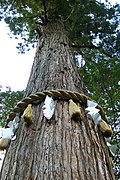
A 'shimenawa' rope is wrapped around a sacred guardian tree at one of Japan's Hachiman Shrines.

Sacred trees, called shinboku, are a deeply ingrained part of a Japanese culture that has historically viewed itself as being united with nature, rather than separate from nature; thus, recognizing the sacredness of trees, stones, mountains, forests, and the elements has been a relatively constant theme in Japanese culture for thousands of years.[16][14] In the present day Japan, shinboku are trees inhabited by kami (spirits or deities) and can readily be found in many of the 100,000 Shinto shrines existing in throughout the country.[17] Although any tree can technically become a shinboku through a Shinto ritual process of inviting a kami to inhabit it, most shinboku are particularly large or aesthetically interesting examples of endemic species such as camphor, ginkgo, or Japanese cedar. The oldest shinboku are estimated to be several thousands years in age. Because shinboku are viewed as being literal sanctuaries, inhabited by kami, they are protected as a physical and spiritual embodiment of the divine nature. In most cases, Shinboku can be easily identified by the straw or hemp rope called a shimenawa which is typically wrapped around the tree; the rope acts as both a sign of the tree's sacredness, and also as a protective barrier between the spirit world and the human world.[18]

In addition to individual shinboku, shrines and Buddhist temples are often surrounded by sacred forests called Chinju no Mori, which are considered sacred forests where kami, including spirits of ancestors, dwell.[14]

Korea

[edit]
A sacred "Dangsan Namu" tree of the Zelkova species, in Suhan Village, Korea.

In Korea, species such as Zelkova serrata, Pinus koraiensis, and Ginkgo biloba, have been considered a symbol of protection for villages since ancient times, and can still be found planted at central points in cities, towns and villages around the country.[19] The trees, referred to as dangsan namu (god tree) often stand next to small pavilions, serving both as shaded informal gathering points, and spaces for traditional rituals and ceremonies involving prayer and offerings to the tree.[20] The oldest of these trees are estimated to be in excess of 1,000 years in age, and are protected as natural monuments by Korean law.[21]

In 2013, the Korea Forest Research Institute announced a project to clone the sacred zelkova, pine, and ginkgo trees that are identified as natural monuments, so their lineage will not be lost in case of disaster or death due to age.[22]

Philippines

[edit]

Indigenous Philippine folk religions practiced in pre-colonial Philippines, are a group of similar indigenous faiths which centers on the community, nature, and the spirits, ancestors, and deities, collectively called anito. Indigenous Philippine shrines and sacred grounds host the sacred trees.

United States

[edit]
The General Grant Tree is the only living national shrine in the United States.

Giant sequoias, the most massive trees on earth, are viewed as sacred symbols in America.[23] Promoted by John Muir using biblical language after their discovery in the 19th century, these trees helped inspire the creation of the national park system.[24][25] The General Grant Tree was named the nations' christmas tree by Calvin Coolidge and later declared a national shrine by Dwight Eisenhower. It the only living national shrine in the United States.[26]

.

[edit]

See also

[edit]

References

[edit]

Further reading

[edit]
Revisions and contributorsEdit on WikipediaRead on Wikipedia
from Grokipedia
A sacred tree is a tree venerated as spiritually significant or holy across diverse religious and cultural traditions worldwide, often symbolizing immortality, renewal, the axis mundi connecting earthly and divine realms, and the life force itself. These trees frequently serve as sites for rituals, offerings, and pilgrimage, embodying deities, ancestors, or cosmic principles, and are protected through cultural taboos against cutting or harming them to avoid supernatural retribution.[1][2] In Abrahamic faiths, sacred trees hold profound symbolic roles; for instance, the Tree of Life in the Hebrew Bible's Genesis (2:9) and Book of Revelation (22:1-2) represents eternal life and paradise, watered by rivers symbolizing divine sustenance.[1] In Islam, the Tuba tree, mentioned in the Quran (e.g., Surah 13:29), is depicted as a celestial reward in paradise, providing endless fruit and shade for the faithful.[1][3] Christianity extends this motif by associating the wooden cross of crucifixion with the Tree of Life, portraying it as an instrument of redemption and resurrection in medieval iconography.[1] Ancient Mesopotamian depictions of a Tree of Life or Moon Tree, dating back 5,000 years, similarly link trees to elixirs of life and fertility through associations with water and lunar cycles.[1] Eastern religions emphasize enlightenment and cosmic order through sacred trees; Buddhism reveres the Bodhi tree (Ficus religiosa), under which Siddhartha Gautama achieved enlightenment in the 5th century BCE, with cuttings propagated as living relics since the 3rd century BCE, such as the sapling planted in Anuradhapura, Sri Lanka, in 288 BCE.[1][4] In Hinduism, the inverted Ashvattha or cosmic peepal tree, described in the Upanishads and Bhagavad Gita, functions as the eternal axis mundi with roots in heaven and branches encompassing the universe, symbolizing the interconnectedness of all existence.[1] Shinto tradition in Japan attributes sacred status to ancient trees over 100 years old, believed to house kodama spirits or kami deities, marked by sacred ropes (shimenawa) and integrated into shrine forests like those at Meiji Jingu, where they facilitate communion with ancestors and promote ecological harmony.[5] Regionally, sacred trees often intersect with local beliefs about protection and healing; in the Holy Land among Muslim and Druze communities, species like Ziziphus spina-christi are tied to saints' graves (wellis), possessing powers such as curing ailments, warding off evil, or punishing violators through fire or serpents, as documented in ethnographic studies of 118 informants across Galilee villages.[2] Such veneration extends to broader sacred groves worldwide, where spiritual taboos have preserved biodiversity, as seen in ancient practices from Mesopotamia to modern Shinto enclaves.[1][5]

Conceptual Foundations

Definition and Characteristics

A sacred tree is a tree or group of trees that is subjected to practical manifestations of worship, adoration, and/or veneration not extended to ordinary trees, often manifesting as single specimens, groves, or entire forests revered for their spiritual potency.[6] These trees are typically regarded as holy, divine, or spiritually significant across diverse cultures, deriving their status from attributes such as exceptional age, unique location, particular species, or perceived links to deities, ancestors, or supernatural forces.[6] Unlike other sacred plants, sacred trees are specifically woody perennial plants that achieve substantial height and longevity, excluding herbaceous or shrubby species unless they develop tree-like forms.[7] Physically, sacred trees commonly exhibit traits that evoke endurance and vitality, such as large stature, advanced age, evergreen foliage, or atypical shapes that set them apart in their environment.[6] For instance, species like oaks (Quercus spp.), particularly evergreen varieties such as Quercus ilex and Quercus suber, are frequently venerated for their impressive size and longevity, with some individuals exceeding 1,000 years in age, symbolizing unyielding strength and continuity.[8] Other examples include yews (Taxus baccata) and jujube trees (Ziziphus spina-christi), chosen for their resilience and evergreen nature, which reinforce perceptions of eternal life.[7] Locations play a key role, with sacred trees often situated near water sources, graves, shrines, or natural features like hilltops, enhancing their perceived connection to the divine or the afterlife.[6] Culturally, these trees are distinguished by protective taboos that prohibit harm, such as cutting or removing branches, underscoring their role as embodiments of life's sacred continuity across spiritual, cosmic, and physical realms.[6] Universally, sacred trees function as life-givers, offering shade, fruit, timber, and ecological sustenance that parallel human cycles of nourishment, renewal, and interdependence with nature.[8] This practical utility amplifies their spiritual reverence, positioning them as integral to communal identity and environmental stewardship in various societies.[6]

Symbolic Meanings

Sacred trees frequently embody the concept of the axis mundi, serving as a symbolic vertical axis that connects the earthly realm with the celestial, thereby representing the center of the cosmos and facilitating communication between different planes of existence.[9] This role underscores their function as mediators in human understanding of the universe, bridging the mundane and the divine without reference to specific narratives.[10] Evergreen sacred trees, in particular, symbolize immortality through their persistent foliage across seasons, evoking eternal life and regeneration amid cycles of decay.[11] Fruit-bearing varieties further represent fertility, as their productive capacity mirrors human reproduction and the abundance of life, often linked to vitality and generational continuity in anthropological studies.[11] Additionally, these trees act as protective emblems, perceived as barriers that ward off malevolent forces through associated cultural taboos and spiritual significance, providing a sanctuary-like presence in cultural interpretations.[12] In animistic perspectives, sacred trees are often viewed as embodiments of ancestral spirits, where the tree's form encapsulates the enduring essence of forebears, fostering a sense of lineage and communal identity.[13] Conversely, in dualistic philosophies, they symbolize the equilibrium between life and death, illustrating the interplay of opposing forces through their seasonal transformations or toxic properties that coexist with vitality.[14] From a psychological standpoint, Carl Jung interpreted the tree as an archetype of the Self, representing the integrated totality of the psyche and the process of individuation toward wholeness.[15] Anthropologically, sacred trees feature in rites of passage, marking transitions such as birth or maturity through their symbolic stability and growth, which guide participants toward personal transformation.[11] Specific trees carry distinct symbolic weights; the yew, with its regenerative growth from old wood and poisonous yet resilient nature, signifies death and rebirth, encapsulating cycles of ending and renewal. The oak, renowned for its robust structure and longevity, embodies strength and endurance, reflecting unyielding resilience in the face of adversity.[16]

Historical and Anthropological Context

Origins of Tree Veneration

The veneration of trees traces its roots to prehistoric animistic beliefs, where early humans attributed spiritual significance to natural elements, including trees, as evidenced by the recognition of human-like forms in natural objects during the Middle to Upper Paleolithic periods around 40,000 BCE.[17] This early animism, characterized by the belief in spirits inhabiting the natural world, likely encompassed tree-like motifs or symbolic representations in art and ritual, reflecting a worldview that saw trees as living entities connected to vital forces.[18] With the Neolithic Revolution around 10,000 BCE, the shift to agriculture intensified veneration of natural symbols of fertility and renewal in early farming societies. In regions like the Near East and Aegean, trees became integral to rituals ensuring bountiful harvests, embodying the life-giving cycles of growth and reproduction essential to agrarian life.[19] Iconographic evidence from this era depicts trees alongside fertility motifs, suggesting their role in communal ceremonies that celebrated the earth's productivity and the interdependence of human sustenance with natural abundance.[19] As urbanization emerged in Mesopotamian and Egyptian civilizations by 3000 BCE, sacred trees were incorporated into temple gardens, symbolizing divine order and cosmic harmony. In Mesopotamia, stylized sacred trees appeared in art and architecture, representing life, fertility, and the structured universe under godly patronage, often planted in temple precincts to invoke prosperity.[20] Similarly, Egyptian temple gardens featured trees like the sycamore fig and persea, associated with deities such as Hathor and Osiris, where they stood as emblems of eternal renewal and the pharaoh's divine legitimacy, blending ritual space with symbolic vegetation.[21] Anthropological theories posit that trees' vertical form inherently evoked transcendence, serving as an axis mundi—a cosmic pillar linking earth, sky, and underworld—facilitating human access to the sacred realm. This verticality, as articulated in comparative religious studies, mirrored aspirations for spiritual elevation, transforming trees into hierophanies that manifested the divine in the profane world and underscored humanity's quest for meaning beyond the material.[9]

Archaeological and Ethnographic Evidence

Archaeological excavations in the Indus Valley Civilization have uncovered seals and artifacts depicting tree motifs, particularly the pipal (Ficus religiosa), dating to approximately 2500 BCE, suggesting early veneration of trees as symbols of fertility and spiritual significance.[22] In ancient Gaul, Celtic sacred enclosures known as nemetons served as ritual sites, with archaeological evidence from sanctuaries revealing postholes, animal bones, and weapon deposits consistent with ceremonial activities in wooded or enclosed groves around the 1st century BCE.[23] Sites such as Gournay-sur-Aronde in northern France demonstrate structured enclosures where trees likely played a central role in druidic practices, as inferred from the etymology of "nemeton" meaning sacred grove and the presence of timber elements in ritual deposits.[23] Ethnographic studies of Australian Aboriginal communities document dendroglyphs—carved trees marking sacred sites, burial grounds, or ceremonial paths—with incisions depicting ancestral beings or totemic symbols, a practice observed in regions like New South Wales since at least the 19th century and continuing in living traditions.[24] These carvings, often on eucalyptus or boab trees, serve as enduring markers of cultural landscapes, recorded through oral histories and field surveys that highlight their role in initiation rites and territorial boundaries.[24] In Bali, sacred banyan trees (Ficus benjamina) hold significance in Hindu-Balinese practices, integrated into temple sites (pura) and community ceremonies to invoke spiritual protection, underscoring their role in harmonizing human activities with spiritual ecology, with banyans symbolizing ancestral spirits and communal governance.[25] Methodological advances in archaeology, such as dendrochronology, enable precise dating of wooden ritual structures associated with tree veneration. Pollen analysis from archaeological sites further identifies evidence of human-induced environments near ritual contexts.

Role in Mythology

Trees as Cosmic Symbols

In mythology, the axis mundi represents a central pillar or conduit connecting the three primary cosmic realms: the underworld, the earthly plane, and the heavens, often embodied by the sacred tree as a universal motif. This concept facilitates spiritual traversal, particularly in shamanic traditions where the tree serves as a ladder for ecstatic journeys between worlds, enabling communication with divine or ancestral forces.[26] The world tree archetype extends this symbolism, portraying the tree as the structural support of the cosmos itself, with its trunk anchoring the terrestrial world, branches extending into the celestial domain to uphold the skies, and roots delving into the subterranean underworld. This tripartite configuration underscores the tree's role as a mediator of cosmic order, independent of particular cultural expressions, and is evident in shamanic cosmologies where it marks the world's navel or center.[26][27] Trees also feature prominently in creation narratives as emergent forms from primordial chaos or as manifestations of divine seeds, symbolizing the transition from disorder to structured reality in proto-myths. In these archetypes, the tree arises as the initial axis of organization, its growth from a cosmic seed representing the unfolding of universal harmony and the hidden potential of divine essence within formless void.[28] Comparative mythology, as explored by Joseph Campbell, highlights the tree as a recurring symbol in universal narrative patterns of transformation and ascent through cosmic layers, akin to the shaman's climb along the axis mundi.[29]

Notable Mythological Examples

In Norse mythology, Yggdrasil stands as the immense ash tree that forms the axis mundi, its vast branches and roots interconnecting the nine worlds of the cosmos, from the divine realm of Asgard to the underworld of Hel. Described in ancient texts as a colossal tree with a crown piercing the heavens and roots delving into subterranean wells, it sustains the entire structure of existence, with dew from its leaves, carried by deer, nourishing the rivers and earth. Various creatures inhabit and interact with Yggdrasil, including the dragon Níðhöggr and serpents that gnaw at its roots in the underworld, an eagle perched atop its branches, a squirrel named Ratatoskr that scurries between them delivering messages, and four stags that browse its foliage.[30] Greek mythology features several sacred trees central to heroic and divine narratives, such as the tree bearing golden apples in the Garden of the Hesperides. This tree, a gift from the earth goddess Gaia to Hera upon her marriage to Zeus, grows in a secluded western garden and produces apples that grant immortality, symbolizing eternal youth and divine favor. Guarded by the nymphs known as the Hesperides and a vigilant hundred-headed dragon named Ladon, the tree plays a pivotal role in Heracles' eleventh labor, where he retrieves the apples to complete his trials. Another prominent example is the laurel tree into which the nymph Daphne transforms to escape the pursuit of the god Apollo; struck by an arrow of disdain from Cupid, Daphne flees until, at the point of capture, her father the river god Peneus answers her plea by changing her into a laurel, with her hair becoming leaves, arms branches, and feet roots—thus establishing the laurel as Apollo's sacred emblem for victory and poetic inspiration.[31][32] Among the Maya of Mesoamerica, the ceiba tree embodies the sacred axis connecting the three cosmic realms in their creation myths, often depicted as the world tree emerging from the underworld to pierce the heavens. In ancient Maya cosmology, as illustrated in codices and monumental art, the ceiba's roots anchor in Xibalba (the underworld), its trunk spans the earthly plane, and its branches reach the sky domain of the gods, facilitating passage for souls and deities alike; it is central to narratives of world formation, where the tree supports the structure of reality post-creation.[33] In various African traditions, the baobab tree features prominently in myths as a source of life and a home for ancestral spirits. Its massive trunk symbolizes enduring vitality and community in West African lore.[34] Cross-culturally, sacred trees appear in flood myths as harbingers of renewal and survival, transcending specific religious contexts in ancient comparative narratives. For instance, in Mesopotamian and Semitic traditions predating formalized Abrahamic texts, a bird returns with a branch—often interpreted as olive or similar foliage—signaling the recession of deluge waters and the restoration of land, echoing motifs of arboreal life persisting through cataclysm to repopulate the earth.[35]

Sacred Trees in European Pagan Traditions

Celtic Traditions

In Celtic traditions, particularly among the ancient Irish and Gaulish peoples, trees held profound spiritual significance, often serving as mediators between the human and divine realms. The Ogham alphabet, an early medieval Irish script dating from the 4th to 6th centuries CE, became associated with trees through later commentaries like the Bríatharogam conaíre, a 10th- or 11th-century text that links many of its 20 letters to specific tree names, reflecting a worldview where trees embodied natural cycles and cosmic forces. For instance, the letter B (beith) corresponds to the birch tree, symbolizing renewal and beginnings due to its early spring growth, while the letter D (dair) denotes the oak, revered for its strength and longevity. These associations, rooted in Middle Irish linguistic traditions, underscore the Celts' perception of trees as alphabetic keys to understanding the world's hidden knowledge.[36] Among sacred species, the oak (duir) stood paramount, closely tied to thunder gods like Taranis, the Celtic equivalent of Jupiter, as described in Roman accounts from the 1st century BCE. Julius Caesar noted in his Gallic Wars that the Gauls venerated Jupiter under oak trees, where druids harvested mistletoe for rituals, viewing the oak's resilience to lightning as a manifestation of divine power. Similarly, the hazel tree was emblematic of wisdom, featuring prominently in Irish mythology at sites like Connla's Well (or the Well of Segais), where nine hazel trees dropped nuts into the waters, imbuing a sacred salmon with profound knowledge upon consumption. This motif, preserved in medieval texts like the Dindshenchas, illustrates how hazelnuts symbolized poetic inspiration and intellectual insight, accessible only through ritual purity.[37] Druidic rituals centered on sacred groves known as nemetons, open woodland sanctuaries used for assemblies, judicial proceedings, and offerings from at least the 2nd century BCE. These sites, often dominated by oaks, hosted communal gatherings, such as the annual assembly of the Carnutes tribe in central Gaul around the 1st century BCE, as recorded by Caesar, where druids officiated over sacrifices to ensure tribal harmony and divine favor. Animal offerings, including oxen and horses, were common, with archaeological evidence from sites like Llyn Cerrig Bach in Anglesey revealing deposited weapons and cauldrons from the same period, indicating rituals of dedication rather than routine violence.[38] In Ireland, this veneration persists in clootie trees, typically hawthorns or hazels near holy wells, where strips of cloth or personal items are tied as votive offerings to transfer ailments or sins to the tree, drawing from pre-Christian Celtic practices of reciprocity with nature spirits. Historical accounts link these to ancient spring cults, where gifts honored water deities for healing and fertility, evolving post-conversion but retaining core elements of tree-mediated exchange. Sites like those associated with St. Brigid's wells exemplify this continuity, with rags symbolizing the depositor's burdens absorbed by the sacred tree.[39]

Germanic Traditions

In Germanic pagan traditions, the Irminsul stood as a prominent symbol of sacred tree veneration among the Saxon tribes, manifesting as a monumental ash tree or wooden pillar interpreted as the axis mundi supporting the world. This structure, located near what is now Obermarsberg in Westphalia, represented the cosmic pillar connecting earth and sky, embodying the collective spiritual identity of the Saxons. In 772 CE, during Charlemagne's campaigns to conquer and Christianize Saxony, Frankish forces under his command felled and destroyed the Irminsul, an act documented in contemporary annals as a deliberate assault on pagan religious centers, yielding treasures including gold and silver vessels used in rituals.[40] Rituals in early Germanic paganism often centered on sacred groves and trees, where offerings known as blóts—sacrifices of animals, food, or valuables—were made to deities, particularly to Mercury (identified with Odin/Woden) as the chief god. The Roman historian Tacitus, writing in the 1st century CE, described how Germanic tribes consecrated woods and groves to their gods, conducting ceremonies within these natural sanctuaries without temples or idols, viewing the divine presence as immanent in the landscape. Among these sites, oaks held particular reverence, associated with thunder gods like Donar (Thor), where blót offerings were performed to ensure fertility, protection, and victory, as evidenced by the tribal practices Tacitus observed among groups like the Semnones, who traced their origins to a central sacred grove.[41][42] Certain tree species carried specific cultural roles in Germanic society, with the linden (Tilia) emerging as a symbol of justice and communal harmony. Assemblies known as things—tribal gatherings for lawmaking, dispute resolution, and governance—were frequently held beneath ancient linden trees, believed to foster truthfulness and impartiality due to the tree's association with the goddess Freyja and its perceived protective aura. This practice, rooted in pre-Christian customs, persisted into later periods, underscoring the linden's enduring sacred status in continental Germanic legal and social traditions.[43] Regional variants of the cosmic ash tree appear in Germanic sagas, where local ash trees served as earthly embodiments of the world-supporting pillar akin to the mythological Yggdrasil. In Norse-influenced sagas, such as those recounting Scandinavian lore, these ash trees were venerated as vital links between realms, with rituals reinforcing their role in upholding the cosmos, though distinct from the grand archetypal tree described in broader mythology.[30]

Slavic Traditions

In Slavic paganism, the oak tree held profound significance as a symbol of divine power, particularly in association with Perun, the god of thunder, lightning, and storms. Oaks were revered because they were frequently struck by lightning, interpreted as a direct manifestation of Perun's might, rendering such trees holy sites for worship and offerings. This connection underscored the oak's role as a conduit between the earthly and celestial realms, embodying strength and protection against chaos.[44][45][46] Among Serbian customs, the badnjak ritual exemplifies the enduring pagan reverence for the oak, where a young oak log is selected, brought into the home, and ritually burned to invoke prosperity and ward off misfortune. This practice traces its origins to pre-Christian Slavic beliefs, in which the oak, as Perun's sacred tree, was central to fire and fertility rites that ensured communal well-being. The selection of the oak emphasizes its unyielding nature and capacity for sustained burning, mirroring the god's enduring authority.[47][48] Sacred groves, known as dubrava in Slavic languages—referring specifically to oak-dominated woodlands—served as protected ritual spaces in pagan traditions, where communities conducted sacrifices, divinations, and assemblies without human interference. These groves were taboo zones, believed to house ancestral spirits and deities, with folklore prohibiting their disturbance to avoid divine retribution. Archaeological and ethnographic records indicate dubrava were integral to maintaining cosmic harmony through seasonal ceremonies.[49][50] Beyond the oak, the willow emerged as a sacred species linked to water spirits and fertility in Slavic folklore, often planted near rivers to appease entities like rusalki, ethereal beings tied to drowned souls and seasonal floods. Willows symbolized resilience and renewal, with their flexible branches used in protective charms against malevolent waters. In East Slavic tales, the birch represented purity and feminine guardianship, embodying renewal and moral clarity through its white bark and association with benevolent spirits like bereginy. Birch rituals, including weaving garlands for rites of passage, reinforced themes of protection and life's continuity in communal narratives.[51]

Sacred Trees in Abrahamic Religions

Judaism and Early Influences

In ancient Near Eastern contexts, particularly among the Canaanites, sacred groves known as asherim were central to religious practices, often dedicated to the goddess Asherah, consort of the god El, and symbolizing fertility and divine presence. These groves, consisting of stylized trees or wooden poles, influenced early Israelite religion, as evidenced by archaeological inscriptions from sites like Kuntillet ‘Ajrud (9th–8th century BCE) that pair Yahweh with "his Asherah," suggesting syncretic worship in Israelite communities.[52][53] Biblical texts condemn these Asherah poles—wooden representations of the goddess or sacred trees—as idolatrous, prohibiting their erection near altars to Yahweh. Deuteronomy 16:21 explicitly states, "You shall not plant any tree as an Asherah beside the altar of the Lord your God," reflecting efforts to purge Canaanite influences during the 7th century BCE Deuteronomistic reforms under King Josiah. Similar prohibitions appear in Exodus 34:13 and Judges 6:25–26, where the poles are to be cut down and burned, underscoring the tension between monotheistic Yahwism and lingering polytheistic practices.[52][53][54] The Tree of Life (Etz Chaim) emerges positively in Jewish scripture as a symbol of divine blessing, wisdom, and immortality, contrasting with condemned idolatrous trees. In Genesis 2:9 and 3:22–24, it stands in the Garden of Eden, granting eternal life, but access is barred after humanity's expulsion to prevent perpetual sinfulness. Proverbs extends this imagery metaphorically, portraying wisdom as "a tree of life to those who lay hold of her" (Proverbs 3:18) and the fruit of the righteous as "a tree of life" (Proverbs 11:30), emphasizing ethical living and Torah study as paths to vitality.[55][56] In Kabbalistic mysticism, Etz Chaim evolves into a profound cosmological framework, depicting the universe's structure through ten sefirot—divine emanations interconnecting the infinite (Ein Sof) with the material world. This diagrammatic Tree of Life, elaborated in Rabbi Hayim Vital's 16th-century text Etz Chaim, maps spiritual ascent and the flow of divine energy, transforming biblical symbolism into a tool for meditative and theosophical insight.[57]

Christianity

In Christian tradition, the cross upon which Jesus Christ was crucified was often symbolized as a sacred tree, drawing parallels to pre-Christian motifs of cosmic world trees. Medieval Norse Christian texts drew analogies between Yggdrasil, the central ash tree of Germanic mythology that connects the nine worlds and sustains the cosmos, and the cross, portraying Christ's sacrifice as a salvific event mirroring the tree's role in cosmic renewal at Ragnarok and its opposition to destructive forces like the serpent Níðhöggr. This syncretism is evident in medieval Northern European Christian art and literature from the 13th to 15th centuries.[58] Similarly, medieval legends traced the wood of the cross to the Garden of Eden, claiming it derived from a tree grown from a branch or seed of the Tree of Knowledge or Tree of Life, planted by Seth at Adam's request to obtain the oil of mercy; this wood was later used for the cross, linking human sin and redemption through arboreal symbolism. These narratives, compiled in apocryphal works like the Vita Adae et Evae and popularized in Jacobus de Voragine's Golden Legend (13th century), emphasized the cross as a paradisiacal tree restoring access to eternal life. A prominent example of a sacred tree in Christian lore is the Glastonbury Thorn, a hawthorn (Crataegus monogyna) associated with Joseph of Arimathea, the biblical figure who provided Christ's tomb. According to the legend, first recorded in the 12th-century romance Joseph d'Arimathie by Robert de Boron and elaborated in 15th-century monastic chronicles, Joseph arrived in Britain after the Crucifixion, carrying the Holy Grail, and thrust his staff into Wearyall Hill near Glastonbury (ancient Avalon); it miraculously rooted and blossomed into the thorn tree. Promoted by Glastonbury Abbey abbots in the late 14th century as a pilgrimage draw, the tree was said to flower twice yearly—once at Christmas and again around Easter—symbolizing Christ's dual nature and the Incarnation. The original was felled by Puritans in 1649, but descendants propagated from cuttings continue to bloom anomalously in midwinter at the abbey site, reinforcing its status as a holy relic tied to early British Christianity. Despite such integrations, early medieval Christianity actively suppressed pagan sacred trees and groves to eradicate idolatry. During the Saxon Wars (772–804 CE), Charlemagne ordered the destruction of sacred sites, including the Irminsul, a monumental pillar or tree-like column revered by the Saxons as a cosmic axis, which his forces felled in 772 near Paderborn; treasures from the site funded church construction. Chronicler Eigil of Fulda, in his 9th-century Vita Sturm i, described how Charlemagne commissioned Abbot Sturm to raze additional Saxon temples and sacred groves, viewing them as demonic strongholds. These campaigns, documented in the Royal Frankish Annals, aimed to impose Christian orthodoxy but inadvertently influenced folk survivals. One such survival is the Christmas tree, which evolved from pagan Yule log traditions among Germanic peoples, where a large log was burned during midwinter solstice festivals to ward off darkness and honor forest spirits. By the 16th century in Renaissance Germany, this practice transformed into decorating evergreen trees indoors, symbolizing eternal life in Christ; the first documented Christmas tree appeared in Strasbourg in 1605, with lights evoking the yule fire's protective glow. Scholarly analysis traces this adaptation to medieval evergreens used in Nativity plays and Paradise tree customs, blending pagan reverence for trees with Christian symbolism of the Jesse Tree and Eden's redemption.

Islam

In Islamic theology, the Sidrat al-Muntaha, or Lote Tree of the Utmost Boundary, holds profound significance as a celestial landmark described in the Quran during the Prophet Muhammad's Night Journey (Isra and Mi'raj). Located at the boundary of the seventh heaven beneath Allah's Throne, it marks the limit beyond which neither angels nor prophets can ascend, serving as the endpoint for divine revelations descending to earth and human deeds ascending for judgment.[59] Another important sacred tree is the Tuba (or Ṭūbā), mentioned in the Quran (13:29) as a symbol of blessedness in paradise, providing endless shade, fruits, and rewards for the faithful, often described in hadith as a cosmic tree whose branches encompass the gardens of Jannah.[60] The Quran references it in Surah An-Najm (53:14), where the Prophet witnesses it covered in splendor, emphasizing its role as a symbol of divine mystery and the ultimate boundary of created knowledge. Certain tree species are highlighted in the Quran as emblems of divine blessings and sustenance, though Islam strictly prohibits their worship, viewing them instead as signs of Allah's providence. The olive tree is invoked in Surah At-Tin (95:1) alongside the fig, symbolizing purity, peace, and nourishment, with its oil praised in hadith for healing properties and as a blessed provision.[61] Similarly, the date palm is the most frequently mentioned plant in the Quran, appearing over 20 times to represent resilience, fertility, and essential sustenance, as in Surah Maryam (19:23-25), where it provides relief to Mary during labor, and Surah An-Nahl (16:11), underscoring its role in Allah's creation for human benefit.[62] Islamic practices emphasize respect and stewardship for trees as part of environmental responsibility (khalifah), without attributing divinity to them, aligning with the Quranic depiction of Paradise (Jannah) as lush gardens filled with fruit-bearing trees offering eternal shade and abundance. Planting trees is considered an ongoing charity (sadaqah jariyah), rewarding the planter even after death, as per hadith encouraging such acts to "increase your plantings in Paradise."[63] This reverence manifests in cultural traditions, such as using dates to break the fast during Ramadan and designing mosques with gardens echoing Jannah's paradisiacal imagery. In Sufi traditions, trees serve as metaphors for spiritual ascent and inner transformation, particularly in the poetry of Jalaluddin Rumi (d. 1273), where they illustrate the soul's journey toward divine union. Rumi often employs the cypress tree as a symbol of the steadfast lover of God—tall, unyielding to worldly winds, and rooted in eternal grace—representing the perfected human (insan al-kamil) who transcends ego through devotion.[64] His verses, such as those evoking nature's vitality as divine will anchoring the spirit against trials, draw on Quranic imagery to convey growth from base desires to enlightened unity with the Beloved.[65]

Sacred Trees in Indic Religions

Hinduism

In Hinduism, trees hold profound spiritual significance, often regarded as embodiments of divine energy and integral to rituals, mythology, and daily worship. They symbolize life, fertility, and cosmic order, with specific species venerated as abodes of deities. Sacred trees are mentioned in ancient texts like the Puranas and epics, where they facilitate communion between humans and the divine, promoting ecological harmony and moral conduct.[66] The Kalpavriksha, or wish-fulfilling tree, is a prominent mythological example in Hindu lore, representing abundance and the fulfillment of desires. Originating during the Samudra Manthana—the churning of the ocean of milk—this celestial tree emerged as one of the divine treasures, granting any wish to those who approach it with pure intent. It symbolizes divine generosity and is often depicted in temple iconography alongside deities like Indra, underscoring its role in cosmic prosperity. In scriptures such as the Bhagavata Purana, the Kalpavriksha resides in heavenly realms, serving as a metaphor for spiritual enlightenment and material well-being.[67][66] Sacred groves, known as devavanas or tapovanas, are forested areas preserved for religious purposes, including notable examples like Panchavati—comprising five holy trees: the Peepal (Ficus religiosa), Banyan (Ficus benghalensis), Bel (Aegle marmelos), Amla (Phyllanthus emblica), and Ashoka (Saraca asoca). These groves, referenced in texts like the Ramayana, were sites of ascetic meditation and divine encounters, such as Lord Rama's exile in Panchavati. Triveni sites, at confluences of three rivers like the Ganga, Yamuna, and Saraswati, often feature such groves with clustered sacred trees, enhancing their sanctity as pilgrimage centers for purification rituals. The Peepal tree, in particular, is dedicated to Vishnu, believed to house the god's presence in its roots, trunk, and branches, as per the Skanda Purana, where it is described as the site of Vishnu's manifestation. Similarly, the Tulsi (Ocimum tenuiflorum), though a shrub, is revered as a tree-like manifestation of Lakshmi, Vishnu's consort; its leaves are offered in worship, symbolizing devotion and prosperity, with legends in the Padma Purana portraying it as Lakshmi's incarnate form to atone for a curse.[68][69][70] Rituals involving sacred trees, such as Vriksha Puja, emphasize reverence and vows, often performed on full moon days like Jyeshtha Purnima during Vat Purnima. Married women fast and circumambulate the Banyan tree, applying vermilion and offering water to invoke longevity and marital harmony, drawing from the legend of Savitri who revived her husband under such a tree. A key practice is tying sacred threads (kalava or cotton cords) around tree trunks—typically Peepal or Banyan—to seal personal vows for health, prosperity, or protection; this act, rooted in Puranic traditions, is believed to infuse the tree with the devotee's intentions, channeling divine blessings while warding off negativity. These observances, conducted with mantras and lamps, reinforce trees' role as living witnesses to human piety.[71][72][73]

Buddhism and Jainism

In Buddhism, the Bodhi tree, a sacred fig (Ficus religiosa), holds profound significance as the site of Siddhartha Gautama's enlightenment. Around the 5th century BCE, Gautama meditated beneath this tree in Bodh Gaya, India, where he attained awakening after overcoming temptations from Mara, marking the founding of Buddhism.[74][75] The Mahabodhi Temple Complex in Bodh Gaya, a UNESCO World Heritage Site, preserves a descendant of this original tree, along with the Vajrasana (Diamond Throne), the precise spot of his enlightenment.[75] A notable descendant of the Bodhi tree thrives in Anuradhapura, Sri Lanka, known as the Jaya Sri Maha Bodhi. Planted in 288 BCE by King Devanampiyatissa from a cutting brought by Sanghamitta, daughter of Emperor Ashoka, it represents the oldest documented tree in the world at over 2,300 years old and serves as a major pilgrimage site within the Sacred City of Anuradhapura, another UNESCO World Heritage location.[76][77] In Jainism, sacred trees are intrinsically linked to the spiritual journeys of the 24 Tirthankaras, the enlightened ford-makers who exemplify liberation through meditation. Each Tirthankara is associated with a specific tree under which they attained kevala jnana (omniscience), symbolizing a natural refuge for ascetic practice; all 24 meditated beneath trees rather than caves or other structures.[78][79] For Mahavira, the 24th and final Tirthankara (c. 599–527 BCE), this was the sal tree (Shorea robusta), a semi-deciduous hardwood native to the Indian subcontinent, beneath which he achieved enlightenment near the River Rijupalika.[79] Trees in these traditions embody deeper ethical symbolism, particularly non-violence (ahimsa), as illustrated in Buddhist Jataka tales recounting the Buddha's past lives. These narratives often depict trees as refuges for sentient beings, reinforcing moral lessons against harm to nature and promoting compassion toward all life forms, aligning with ahimsa's core principle of harmlessness.[80][81] In Jain contexts, the protective shade of meditation trees underscores ahimsa by highlighting restraint and ecological harmony during ascetic pursuits.[79]

Sikhism

In Sikhism, trees are regarded as integral elements of divine creation, symbolizing humility and the interconnectedness of all life, rather than objects of worship or veneration. The faith's monotheistic emphasis on equality before the one Creator, Waheguru, extends to nature, where trees represent part of the balanced order (hukam) that humans are ethically bound to preserve through selfless service (seva). This respect aligns with broader teachings on environmental harmony, without attributing sacred or supernatural powers to trees themselves.[82] The Guru Granth Sahib, the central Sikh scripture, employs trees as metaphors to illustrate spiritual virtues, particularly humility. For instance, the silk-cotton tree (simbal) is depicted as tall and imposing yet barren and useless, contrasting with humble, fruit-bearing trees that bend low in service, underscoring that true worth lies in modesty and utility rather than outward grandeur.[83] Trees are also portrayed as manifestations of God's creative will, as in verses affirming that the Creator formed all vegetation alongside other elements of the universe, emphasizing divine sustenance of the natural world.[84][85] Sikh practices reflect this ethos through protection rather than ritual adoration; many gurdwaras (Sikh places of worship) incorporate tree preservation as an act of maintenance, ensuring green spaces around sacred sites to honor the natural environment. The ber tree (Ziziphus mauritiana, or Indian jujube) holds particular association with Guru Nanak, the faith's founder, as several historic gurdwaras feature ancient ber trees believed to have been planted or sheltered under during his lifetime, such as the Dukh Bhanjani Ber in the Golden Temple complex in Amritsar. These trees are cared for as living links to Sikh history, with devotees performing seva by watering and pruning them, though no devotional rites are conducted.[86][87] Ethically, Sikhism views trees as fellow creations deserving preservation to sustain life, aligning with the principle of seva that encompasses environmental stewardship. This stance promotes planting and protecting greenery as a moral duty, reflecting the Gurus' teachings on living in harmony with nature to fulfill human purpose. Historically, this commitment is exemplified by Guru Har Rai, the seventh Guru (1630–1661), who established botanical gardens and herbal reserves in Punjab, resisting unnecessary harm to flora and fauna even amid Mughal pressures, thereby modeling proactive conservation long before colonial influences.[88][89]

Sacred Trees in East Asian Traditions

Japan

In Shinto, Japan's indigenous religion, trees hold profound spiritual significance as embodiments of kami, the divine spirits inhabiting the natural world. Sacred trees, known as shinboku (神木, "divine trees"), are revered at shrines and temples, serving as focal points for worship and ritual. These trees are believed to house or attract kami, making them integral to Shinto practices that emphasize harmony with nature. Common species include cryptomeria (sugi), hinoki cypress, and camphor trees, often preserved for centuries within shrine precincts.[90][91] A prime example is the vast forest of ancient cryptomeria trees surrounding the Ise Grand Shrine in Mie Prefecture, Japan's most sacred Shinto site dedicated to Amaterasu, the sun goddess. These towering sugi, some over 1,000 years old, form a protective chinju no mori (sacred grove) that shields the shrine from worldly impurities and symbolizes eternal renewal, as the shrine itself is ritually rebuilt every 20 years using wood from similar trees. Shinboku are marked as holy through goshintai, temporary vessels or bodies for kami, where the divine essence descends during ceremonies; trees selected for this role are never felled but protected indefinitely. To denote their sanctity, thick straw or hemp ropes called shimenawa are draped around their trunks or bases, often adorned with white paper zigzags (shide), creating a boundary between the sacred and profane realms while warding off evil influences.[92][93] Japanese folklore further elevates trees as mystical entities intertwined with human fate. Cherry blossoms (sakura), while not always classified as shinboku, symbolize the transient beauty of life in both Shinto and Buddhist contexts, their brief bloom evoking mono no aware—a poignant awareness of impermanence—much like the fleeting existence of samurai in historical tales. Cedars, particularly sugi, appear in yokai lore as haunted abodes; in stories of the Yuki-onna (snow woman), a spectral spirit who lures travelers in winter blizzards, ancient cedar groves on snowy mountains serve as eerie backdrops where the yokai manifests, blending terror with the trees' enduring presence.[94][95] Communal practices reinforce this reverence through annual festivals honoring ancient cedars. The Goshinboku Festival, tied to Ise Jingu's 20-year renewal cycle, features rituals in 2025 where communities across Japan select and bless sacred timber, including sugi over 1,000 years old, with processions, prayers, and offerings to express gratitude for nature's bounty. Similarly, the Onbashira Festival at Suwa Taisha Shrine in Nagano Prefecture, held every six years, involves hauling massive fir logs—symbolizing sacred pillars—from mountains to the shrine, a perilous tradition dating back over 1,200 years that underscores the life-affirming bond between humans and revered trees. These events, blending Shinto rites with local customs, ensure the cultural legacy of sacred trees endures.[96][97]

Korea

In Korean folklore, the Dangun myth, which recounts the founding of the first Korean kingdom Gojoseon in 2333 BCE, prominently features a divine sandalwood tree as a site of prayer and transformation. According to the legend preserved in the 13th-century text Samguk Yusa, the bear-woman Ungnyeo prayed beneath this sacred sandalwood tree (known as Sindansu or divine altar tree) for 100 days to become human, ultimately leading to her union with Hwanung and the birth of Dangun, the mythical progenitor of the Korean people. This tree symbolizes divine intervention and national origins, embodying the animistic belief in trees as conduits between the earthly and spiritual realms.[98] Sacred trees hold central roles in Korean shamanism (musok), where mudang (female shamans) conduct rituals to invoke spirits and ensure longevity or immortality. The ginkgo (Ginkgo biloba) is revered for its exceptional lifespan—some specimens exceed 1,000 years—symbolizing resilience and eternal life, often planted near villages as protective guardians against misfortune. Similarly, the pine (Pinus densiflora), known as sonamu, represents immortality due to its evergreen nature and endurance in harsh conditions, frequently incorporated into mudang ceremonies as offerings or sites for spirit mediation to ward off evil and promote prosperity.[99][100] Jirisan Mountain, Korea's first national park established in 1967, hosts ancient dangsan groves—sacred forest clusters tied to shamanic traditions—where villagers historically gathered for rituals to communicate with mountain spirits (sansin). These groves, often featuring old pines and zelkovas marked with ritual straw ropes, serve as portals for mudang to perform gut ceremonies, seeking guidance from ancestral and nature deities amid the mountain's mist-shrouded peaks.[101] The integration of sacred trees into Buddhism reflects a syncretic blend with indigenous beliefs, particularly evident in temples from the Silla Kingdom (57 BCE–935 CE). Ancient zelkova trees (Zelkova serrata), such as the 1,300-year-old pair at Yonggungsa Temple in Incheon dating to the 7th century, stand as protective symbols at temple entrances, their longevity mirroring Buddhist ideals of impermanence and enlightenment while echoing shamanic reverence for arboreal spirits.[102]

Sacred Trees in Other Global Traditions

Philippine Indigenous Beliefs

In Philippine indigenous beliefs, sacred trees embody the animistic worldview prevalent across Austronesian cultures in Southeast Asia, where natural elements like trees are inhabited by ancestral spirits known as anitos or diwatas, serving as intermediaries between the human and supernatural realms.[103] These beliefs, preserved in oral traditions and rituals, emphasize harmony with nature, with trees often acting as portals for spiritual communication and protection. Pre-colonial communities revered specific trees for their roles in fertility, healing, and cosmic balance, integrating them into daily life and ceremonies without written doctrine.[104] The balete tree (Ficus benjamina, a strangler fig) holds profound significance as a dwelling for diwata spirits, particularly in Visayan and Mindanaoan traditions, where its expansive roots and canopy symbolize interconnected life forces.[103] Indigenous shamans, or babaylans, conducted rituals beneath or within balete trees, negotiating with resident diwatas for blessings, often tying offerings such as betel nut, tobacco, rice, and chicken to the roots to ensure agricultural abundance and avert misfortune.[104] Among the Mansaka people, the tagamaring diwata of the balete receives specific invocations during rice planting, with offerings placed on bamboo platforms to invoke crop growth and spiritual favor.[104] Disturbing a balete, such as cutting its roots without ritual, was believed to provoke diwata wrath, leading to illness or calamity, reinforcing taboos against deforestation in sacred groves.[103] In the Cordillera region, Ifugao communities integrate sacred trees into rice terrace rituals, particularly along rivers like the Amburayan, where forested woodlots (muyong) protect watersheds essential for terraced agriculture.[105] These private woodlots, containing timber and fruit trees such as Pinus kesiya, are spiritually managed to maintain ecological balance, with rituals like the nun-agang seeking ancestral spirits' permission before land alterations near riverine terraces.[105] In adjacent Besao areas historically linked to Amburayan subprovince, the batangan pine forest system designates patpatayan sacred trees as abodes for pinading spirits, where offerings appease entities guarding rivers and fields during harvest cycles.[106] Philippine myths further illustrate trees' cosmic roles, as seen in the Bakunawa legend, where the eclipse-causing dragon devours seven moons out of envy, but is deterred from the last by bamboos planted by Bathala on its surface, manifesting as the dark spots visible during lunar eclipses as a reminder of celestial order.[107] This Visayan tale, rooted in pre-colonial cosmology, portrays trees as instruments of balance against chaos, with the bamboo symbolizing divine intervention in lunar events.[107] Spanish colonization from the 16th century onward systematically suppressed anito tree worship to impose Christianity, targeting balete groves as sites of "idolatry" through burning and destruction.[103] Missionaries like Francisco Ignacio Alcina documented and enacted the felling of sacred trees, viewing them as strongholds of pagan spirits, while the reduccion policy relocated communities away from forests to church-centered towns.[103] The Inquisition, active until 1821, prosecuted babaylans for tree-related rituals, eroding indigenous authority and syncretizing anito veneration into Catholic iconography, though subterranean reverence persisted.[103]

African Traditions

In West African traditions, particularly among the Yoruba people of Nigeria, the baobab tree (Adansonia digitata) holds profound spiritual significance as the "tree of life," symbolizing sustenance, shelter, and divine presence. According to Yoruba mythology, the supreme deity Olorun and the orishas (deities) resided around a young baobab, which provided them with necessities such as clothing and food, underscoring its role as a primordial provider central to creation narratives.[108] The tree's massive trunk also serves practical and ritual purposes, such as storing water and grain during dry seasons, while its hollows are believed to house ancestral spirits or orishas, where offerings are made for protection and fertility.[109] In the Dogon cosmology of Mali, nommo myths portray ancestral water spirits as primordial beings who descended from the sky god Amma to impart knowledge of agriculture, weaving, and social order.[110]

Indigenous American Traditions

In Indigenous American traditions, trees often embody spiritual connections between the physical world, ancestors, and divine realms, serving as central elements in rituals, cosmology, and material culture across diverse cultures from the Pacific Northwest to the Amazon basin. Among the Haida people of the Pacific Northwest, the red cedar (Thuja plicata) holds profound sacred status as the "tree of life," providing versatile materials for cultural practices while symbolizing strength and spiritual continuity.[111] Haida artisans carve totem poles from mature cedar trunks to commemorate clan histories, crests, and supernatural beings, erecting them as visible memorials in villages.[112] The tree's wood also forms the backbone of canoes essential for seafaring and trade, with its bark used for clothing, ropes, and baskets, reinforcing cedar's role in sustaining both physical and spiritual Haida lifeways.[112] In Mesoamerican Maya cosmology, the ceiba tree (Ceiba pentandra), or ya'axche in Yucatec Maya, functions as the world tree, an axis mundi linking the underworld (Xibalba), the earthly realm (Kab), and the heavens.[113] This symbolism appears in the Popol Vuh, the ancient K'iche' Maya creation narrative, where ceiba trees mark the cardinal directions and facilitate cosmic order during the world's formation.[114] Maya sacred sites often feature ceiba trees at cenotes—natural sinkholes revered as portals to the underworld—where their extensive roots are believed to bridge realms and enable communication with deities and ancestors.[115] On the Great Plains, the Lakota regard the cottonwood tree (Populus deltoides) as a sacred embodiment of renewal and divine presence, particularly in the Sun Dance ceremony (Wiwáŋyaŋg Wačípi).[116] During this annual rite, elders select a sturdy cottonwood as the central pole, felling it through ritual songs and offerings to honor its role as the "Sacred Tree" or "Sun Pole," which represents the tree of life connecting participants to Wakan Tanka (the Great Spirit).[117] Dancers encircle the pole in acts of sacrifice and prayer, seeking communal healing and vision. In South American Amazonian indigenous traditions, the yopo tree (Anadenanthera peregrina) plays a key role in shamanic rituals among groups in the Orinoco and Amazon basins, where its seeds are ground into a hallucinogenic snuff for spiritual journeys.[118] Shamans prepare yopo by roasting and mixing the seeds with alkaline ashes, inhaling it to induce visions that facilitate healing, divination, and contact with spirits, a practice documented archaeologically back over 3,000 years.[119] This entheogenic use underscores yopo's status as a mediator between human and supernatural worlds in these communities.[118]

Modern Interpretations and Conservation

Revival in Contemporary Spirituality

In neo-pagan movements such as Wicca, which emerged in the mid-20th century, trees hold a central role in magical practices and rituals, often drawing inspiration from perceived ancient Celtic traditions. Practitioners engage in tree magic, utilizing trees for divination, protection spells, and energy work, viewing them as living embodiments of divine forces within nature. A key element is the Celtic Tree Calendar, a modern construct popularized by Robert Graves in his 1948 book The White Goddess, which assigns spiritual significances to 13 tree types aligned with lunar months, influencing contemporary Wiccan seasonal observances and personal attunement rituals. This calendar, though not historically authentic, has become integral to Wiccan cosmology, fostering a revived reverence for trees as conduits for magical and ecological harmony.[120][121] Within New Age spirituality, trees are incorporated into holistic healing modalities, including crystal practices where "crystal trees"—wire-formed structures adorned with gemstones—are used to channel energy for emotional balance and chakra alignment. These artifacts, rooted in 20th-century metaphysical traditions, symbolize growth and interconnectedness, with crystals like quartz or amethyst placed to amplify intentions during meditation or space cleansing. Arbor Day observances have also evolved to include spiritual dimensions in New Age contexts, emphasizing trees' role in fostering personal renewal and a deeper connection to the earth's vital energies, often through guided visualizations or communal plantings that blend environmental awareness with inner healing.[122][123] The 1970s Chipko movement in India exemplifies a global eco-spiritual revival, where villagers, predominantly women, hugged trees to prevent deforestation, infusing the act with spiritual undertones drawn from Hindu and indigenous traditions that view forests as sacred life-sustaining entities. Inspired by earlier Bishnoi spiritual practices from the 18th century, Chipko participants invoked religious ethics to protect Himalayan ecosystems, framing tree-hugging as a nonviolent devotion to divine nature and communal harmony. This movement's blend of activism and spirituality influenced worldwide eco-spiritual practices, highlighting trees as symbols of resistance and interconnected life forces.[124][125] Modern solstice gatherings in neo-pagan communities often center on sacred oaks, evoking their symbolic role as emblems of strength and seasonal transition during rituals like Litha (summer solstice) or Yule (winter solstice). Participants convene under ancient oaks for ceremonies involving bonfires, chants, and offerings to honor the sun's cycle and the tree's enduring presence, adapting European pagan roots to contemporary eco-conscious celebrations. These events, such as those organized by groups like the Order of Bards, Ovates and Druids, reinforce trees' spiritual potency in fostering community and cyclical renewal.[126][127] In India, the Ancient Monuments and Archaeological Sites and Remains Act of 1958 safeguards ancient trees, including sacred banyan trees (Ficus benghalensis), when they form part of protected historical monuments or archaeological sites, prohibiting unauthorized alteration or removal to preserve cultural heritage.[128] For instance, the iconic Great Banyan in Kolkata's Acharya Jagadish Chandra Bose Indian Botanic Garden, spanning over 14,500 square meters, receives such protection due to its historical and ecological significance.[129] In the United States, the Native American Graves Protection and Repatriation Act (NAGPRA) of 1990 requires federal agencies to consult with tribes on the protection and repatriation of Native American human remains, funerary objects, sacred objects, and cultural patrimony, which may include elements of tribal sacred sites on federal lands. This framework facilitates tribal consultation to avoid disturbance to cultural resources, though broader protections for living sacred natural features like trees often involve other laws such as the American Indian Religious Freedom Act.[130] International initiatives, such as UNESCO's recognition of sacred groves, underscore global efforts to conserve these ecosystems; for example, a 2010 UNESCO study highlighted the sacred groves of Meghalaya, India, as models for biodiversity preservation amid climate challenges in the 2010s.[131] Deforestation poses severe threats to sacred trees worldwide, particularly in the Amazon, where activities have destroyed approximately 60 million hectares of forest since 2000 as of 2023, directly impacting indigenous sites featuring ceiba trees (Ceiba pentandra), revered by groups like the Maya and Amazonian tribes for their spiritual role as world trees. As of 2025, Brazil's Amazon deforestation rate fell 11% in the year to July compared to the previous year, though fire-related losses increased significantly.[132][133] Sacred trees and associated groves function as critical biodiversity hotspots, harboring endemic species through community-enforced taboos that limit exploitation; a 2023 meta-analysis of 35 studies found that sacred forests harbor similar levels of biodiversity to nearby non-sacred forests, with higher plant diversity, and often act as refugia for rare endemics compared to surrounding managed lands.[134][135] This preservation role is evident in African and Asian contexts.

References

User Avatar
No comments yet.