


Community hub
Recent from talks
Contribute something
Nothing was collected or created yet.
Rogers Centre
View on Wikipedia
Rogers Centre (originally SkyDome) is a retractable roof stadium in downtown Toronto, Ontario, Canada, situated at the base of the CN Tower near the northern shore of Lake Ontario. Opened in 1989 on the former Railway Lands, it is home to the Toronto Blue Jays of Major League Baseball (MLB). As well as being improved over the decades, during the MLB offseasons of 2022–24, the stadium was renovated by upgrading the sports facilities and hospitality whilst reducing the capacity for baseball games. While it is primarily a sports venue, the stadium also hosts other large events such as conventions, trade fairs, concerts, travelling carnivals, circuses and monster truck shows.
Key Information


_-_Toronto,_ON.jpg)


Previously, the stadium was also home to the Toronto Argonauts of the Canadian Football League (CFL) and the Toronto Raptors of the National Basketball Association (NBA). The Buffalo Bills of the National Football League (NFL) played an annual game at the stadium as part of the Bills Toronto Series from 2008 to 2013. The stadium served as the site of both the opening and closing ceremonies of the 2015 Pan American Games (renamed the Pan-Am Dome or Pan-Am Ceremonies Venue due to sponsorship regulations).[4]
The stadium was renamed "Rogers Centre" following the 2005 purchase of the stadium by Rogers Communications, the corporation that also owns the Toronto Blue Jays.[5][6] Despite the name change, the stadium is still commonly referred to as SkyDome in informal contexts among fans. The venue is noted for being the first stadium to have a fully retractable motorized roof, as well as for the 348-room hotel attached to it with 70 rooms overlooking the field.[7] It is the last North American major-league stadium built to accommodate both football and baseball.
History
[edit]Background and design
[edit]The idea of building a domed stadium can be traced back to the bid that Toronto lost to Montreal as the Canadian candidate city for the 1976 Summer Olympics. In the proposal, an 80,000–100,000 seat complex would be part of the planned Harbour City development on the site of Maple Leaf Stadium.[8]
The contemporary impetus for building an enclosed sports venue in Toronto came following the Grey Cup game in November 1982, held at the outdoor Exhibition Stadium. The game, in which the hometown Toronto Argonauts (also known as the Argos) were making their first Grey Cup appearance since 1971, was played in a driving rainstorm that left most of the crowd drenched, leading the media to call it "the Rain Bowl". As many of the seats were completely exposed to the elements, thousands watched the game from the concession section. To make a bad experience even worse, the washrooms overflowed. In attendance that day was Bill Davis, the Premier of Ontario, and the poor conditions were seen by the largest television audience in Canada (over 7.862 million viewers) to that point.[9] The following day, at a rally for the Argos at Toronto City Hall, tens of thousands of people who attended the game began to chant, "We want a dome! We want a dome!"[10]
Seven months later, in June 1983, Davis formally announced a three-person committee would look into the feasibility of building a domed stadium at Exhibition Place. The committee consisted of Paul Godfrey, Larry Grossman and former Ontario Hydro chairman Hugh Macaulay.[11]
The committee examined various projects, including a large indoor stadium at Exhibition Place with an air-supported dome, similar to BC Place in Vancouver. In 1985, an international design competition was launched to design a new stadium, along with selection of a site. Some of the proposed sites included Exhibition Place, Downsview Airport, and York University. The final site was at the base of the CN Tower not far from Union Station, a major railway and transit hub. The Railway Lands were a major Canadian National Railway rail switching yard encompassing the CNR Spadina Roundhouse (the desolate downtown lands were part of a master plan for revitalizing the area, which includes CityPlace). Ultimately, the Robbie/Allen concept won because it provided the largest roof opening of all the finalists, and it was the most technically sound.
The stadium was designed by architect Rod Robbie and structural engineer Michael Allen and was constructed by the EllisDon Construction company of London, Ontario and the Dominion Bridge Company of Lachine, Quebec. The stadium's construction lasted about 2+1⁄2 years, from October 1986 to May 1989. The approximate cost of construction was C$570 million[12] ($1.2 billion in 2023 dollars[13]) which was paid for by the federal government, Ontario provincial government, the City of Toronto, and a large consortium of corporations.[14][15]
Financing
[edit]The stadium was funded by a public–private partnership, with the government paying the largest percentage of the cost. The initial cost of $150 million was greatly underestimated,[16] as the final cost was C$570 million ($1.2 billion in 2023 dollars[13]).[12] Two levels of government (Metro Toronto and provincial) each initially contributed $30 million ($63 million in 2023 dollars[13]).[12][16][17] This does not include the value of the land that the stadium sits on, which was owned by the Canada Lands Company (a Crown corporation of Canada) and the City of Toronto and was leased for $900,000 a year through 2088.[18] Canada's three main breweries (Labatt's, Molson, and Carling O'Keefe) and the Toronto Blue Jays each paid $5 million ($10.5 million in 2023 dollars[13]) to help fund the stadium.[17] An additional 26 other Canadian corporations (selected by invitation only) also contributed $5 million,[17] for which they received one of the 161 Skyboxes with four parking spaces (for ten years, with an opportunity for renewal) and a 99-year exclusive option on stadium advertising. The initial cost of leasing a Skybox ranged from $150,000 to $225,000 ($315,040 to $472,560 in 2023 dollars[13]) a year in 1989 – plus the cost of tickets for all events.
The then unusual financing structure created controversy. First of all, there was no public tender for supplies and equipment. Secondly, companies that paid the $5 million fee, such as Coca-Cola, TSN and CIBC, received 100 percent stadium exclusivity,[12] including advertising rights, for the life of their contract that could be extended up to 99 years. Third, the contracts were not put up for bid, meaning there was some doubt the contracts were made at a market rate: Pepsi stated at the time that had it known the terms of the contract it would have paid far more than $5 million for the rights. Local media like NOW Magazine called the amount charged to the companies "scandalously low".[19]
Construction
[edit] | This section needs additional citations for verification. (June 2025) |

Construction of the Ontario Stadium Project was spearheaded by lead contractor EllisDon. Several factors complicated the construction: The lands housed a functioning water pumping station that needed to be relocated, the soil was contaminated from a century of industrial use, railway buildings needed to be torn down or moved, and the site was rich with archaeological finds. One of the most complex issues was moving the John Street pumping station across the street to the south of the stadium. Foundations to the stadium were being poured even as the facility (in the infield area) continued to function, as construction on its new location had yet to be completed.
Because the stadium was the first of its kind in the world, the architects and engineers kept the design simple (by using a sturdy dome shape) and used proven technologies to move the roof. It was important the design would work and be reliable as to avoid the various problems that plagued Montreal's Olympic Stadium. The 31-storey-high roof consists of four panels: one (on the north end) is fixed in place and the other three are moved by electrically driven 'train' engines, that run on high-strength railway rails. The roof, which takes 20 minutes to open, was made out of steel trusses covered by corrugated steel cladding, which in turn is covered by a single-ply PVC membrane.
Because of its location south of the major railway corridor, new pedestrian connections had to be built; the infrastructure was part of the reason for the high cost of the stadium. The SkyWalk is an approximately 500-metre (1,600 ft) enclosed walkway that leads from the base of the CN Tower and via a bridge connects to Union Station (and is part of the Path network). The John Street cable-stayed bridge was built to provide north–south passage over the rail tracks, linking Front Street with the stadium.
Construction at the site, which at one time was south of the shoreline, unearthed over 1,500 artifacts. These included a 200-year-old French cannon used as ballast for a ship, cannonballs, pottery and a telescope.[20] The stadium was completed two months late, having been planned to open for the first regular season game of the 1989 Toronto Blue Jays season; the team played the first two months of its home schedule at Exhibition Stadium that year.
Naming
[edit]
The official name prior to and during construction was the 'Ontario Stadium Project' but was widely referred to in local media as simply 'the Dome' or 'Toronto Domed stadium'. As completion neared, the name "SkyDome" was chosen as part of a province-wide "name the stadium" contest in 1987. Sponsored by the Toronto Sun, ballots were offered for people to submit their suggested name, with lifetime seats behind home plate to all events at the stadium (including concerts) as the prize. Over 150,000 entries were received with 12,897 different names. The selection committee narrowed it down to four choices: "Towerdome", "Harbourdome", "SkyDome", and simply "the Dome". The judges' final selection was SkyDome. Premier David Peterson drew the prize-winning entry of Kellie Watson from a lottery barrel containing the over-2,000 entries that proposed "SkyDome". At the press conference announcing the name, Chuck Magwood, president of the Stadium Corporation of Ontario (Stadco), the crown corporation created to run SkyDome,[21][22] commented: "The sky is a huge part of the whole roof process. The name has a sense of the infinite and that's what this is all about." Kellie Watson received lifetime seating of choice at SkyDome, which is still honoured after the stadium was renamed to Rogers Centre, under new ownership.
Opening
[edit]
The stadium was intended to be ready in time for Opening Day of the 1989 Toronto Blue Jays season. However, due to construction delays caused in part by widespread construction worker strikes across Ontario, this was postponed and the Blue Jays began their season at Exhibition Stadium.[23] The stadium officially opened on June 3, 1989, and hosted an official grand opening show: "The Opening of SkyDome: A Celebration", broadcast on CBC Television the following evening hosted by Brian Williams. With a crowd of over 50,000 in attendance, the event included appearances by Alan Thicke, Oscar Peterson (no relation to David), Andrea Martin of SCTV, impressionist André-Philippe Gagnon and rock band Glass Tiger. The roof was ceremonially "opened" by Ontario Premier David Peterson with a laser pen. The roof's opening exposed the crowd to a downpour of rain. Despite audible chants of "close the roof", Magwood insisted the roof remain fully open.
Financial problems and fallout
[edit]The stadium became a thorn in the side of David Peterson's Ontario Liberal government for repeated cost overruns. After the Liberals were defeated by the NDP in the 1990 Ontario election, a review by the new Bob Rae government in October 1990 revealed Stadco's debt meant the Dome would have to be booked 600 days a year to turn a profit, almost twice as many days as there are days in a calendar year. The stadium income was only $17 million in its first year of operations, while debt service was $40 million. It was determined the abrupt late inclusion by Stadco of a hotel and health club added an additional $112 million to the cost of the building.
As the province slipped into a recession, Rae appointed University of Toronto professor Bruce Kidd and Canadian Auto Workers President Bob White to the Stadco board to help deal with the stadium's growing debt, but the original $165 million debt had increased to $400 million by 1993.[12][16] Stadco became a political liability, and in March 1994, the Ontario government paid off all outstanding Stadco debts from the government treasury and sold the stadium for $151 million to a private consortium that included Labatt Breweries, the Blue Jays' owner.[16][24]
In November 1998, the stadium, which Labatt then owned as 49 percent of total, filed for bankruptcy protection,[25] triggered after disastrous Skybox renewal numbers. Most of the 161 Skybox tenants had signed on for 10-year leases; a marked decrease in interest in the stadium's teams and the construction of the Air Canada Centre, which hosted the Toronto Maple Leafs and Toronto Raptors, resulted in few renewals for Skybox leases. That same month, the Blue Jays re-signed for an additional ten years in the facility.[16]
In April 1999, Sportsco International LP bought the stadium out of bankruptcy protection for $80 million.[24]
Purchase and renaming
[edit]
In November 2004, Rogers Communications, parent company of the Blue Jays, acquired SkyDome, excluding the attached SkyDome hotel, which had been sold to Renaissance for a reported $31 million in 1999, from Sportsco for about $25 million – roughly four percent of the cost of construction.[24]
On February 2, 2005, Ted Rogers, President and CEO of Rogers Communications, announced a three-year corporate contract to change the name of SkyDome to Rogers Centre. The name change remains controversial and is unpopular with many fans, most of whom continue to refer to it as SkyDome in opposition to increased commercialism from the purchase of naming rights. One example is a 25,000-name petition started by TTC bus driver Randy Rajmoolie.[26] A baseball diamond in Toronto's Trinity Bellwoods Park is officially named SkyDome after the stadium's former and popular name.[27]
After the purchase, Rogers refurbished the stadium by, among other things, replacing the Jumbotron with a Daktronics video display, and erecting other new monitors, including several built into the outfield wall. They also installed a new FieldTurf artificial playing surface.[28]
In May 2005, the Toronto Argonauts agreed to three five-year leases at Rogers Centre, which could have seen the Argonauts play out of Rogers Centre up to and including 2019. The team had the option to leave at the end of each of the three lease agreements.[29] Proposed plans to lock Rogers Centre into its baseball configuration permanently in order to install a natural grass surface forced the Argonauts to relocate to BMO Field before the 2016 season.[30][31][32]
In November 2005, Rogers Centre received a complete makeover to "open" the 100 Level concourse to the playing field and convert 43 luxury boxes to "party suites". This required some seats to be removed, which decreased overall capacity.[33]
In April 2006, Rogers Centre became one of the first buildings of its size to adopt a completely smoke-free policy in Canada, anticipating an act of provincial legislature that required all Ontario public places to go smoke-free by June 1, 2006.[citation needed]
Alcohol was not available to patrons of Rogers Centre on April 7, 2009, as the Alcohol and Gaming Commission of Ontario (AGCO) imposed the first of a three-day alcohol suspension at the stadium for "infractions (that) took place at certain past events", according to the press release.[34]
Major renovation in the 2020s
[edit]By 2020, with the Rogers Centre over 30 years old and one of the oldest active stadiums in MLB, Rogers had begun to explore options for the long-term home of the team. Rogers Communications and Brookfield Asset Management reportedly discussed replacing Rogers Centre with a smaller, baseball-specific stadium plus residential towers, office buildings, retail stores and public space. The new venue would be constructed on the southern end of the current stadium and adjacent parking lots, while the mixed-use development would be built on the northern portion of the site. An alternate site was also considered for a new baseball park at Quayside in Toronto's east end next to Lake Ontario.[35]
However, the Blue Jays instead decided to undertake a major $400 million renovation of the stadium's interior in two phases, during the 2022 – 2023 and 2023 – 2024 offseasons.[36] The objective of the renovations was to extend the ballpark's shelf life by another 10–15 years, while continuing to plan for a new stadium or more significant rebuild of the Rogers Centre within the next 10 to 12 years.[36][37]
2022–2023
[edit]_2024.jpg)
The first phase of the renovations was designed by Populous and involved re-orienting outfield seats to face home plate, raising bullpens, adjusting the outfield dimensions to be asymmetrical, adding social spaces with bars in the outfield sections of the 500 Level (the highest level), and removing some seats to widen all remaining seats, thereby reducing capacity to 41,500 attendees.[38][39] The 2023 Blue Jays home opener was moved a few days later to accommodate the first phase of the renovation.[40]
2023–2024
[edit]The second phase involved re-orienting the infield seats to face home plate, the addition of cupholders to the seats in the 100 Level, as well as reducing the size of foul territory, improving the dugouts for the Blue Jays and their opponents, and the addition of LED backstop advertising to cover the entire backstop, which is much more visible during television broadcasts.[41] Following the second phase, capacity of the stadium was reduced further to 39,150.[39] The 2024 Blue Jays home opener was also moved a few days later to accommodate the second phase of the renovation.
List of improvements
[edit] | This section needs additional citations for verification. (June 2015) |
Significant improvements to the facility since opening in 1989 include:
- Exterior roof lighting that can be programmed for themes and events.
- The Blue Jays clubhouse was substantially renovated, including a larger training room, an open concept lounge and personal lockers. In total, the clubhouse expanded from 12,000 to 24,000 square feet (1,100 to 2,200 m2).
- Main level concourse expansion, making the space brighter, more fan-friendly with expanded wheelchair seating.
- The FieldTurf was upgraded to AstroTurf Gameday Grass for 2010.
- The main video board was upgraded in 2005, from a JumboTron to a modern Daktronics video board, measuring 33 by 110 feet (10 by 34 m).
- Jays Shop – Stadium Edition, was expanded to an 8,000-square-foot (740 m2) retail space along the main concourse (2007).
- Two video boards were built into the outfield fence that each measure 10 by 65 feet (3 by 20 m). These boards provide player stats, out-of-town scores and other information related to the game and league.
- A continuous, ribbon-style video board was installed on the facing of the 300 Level, providing statistics and scores.
- Installation of 150 new 42-inch (1.07 m) flat-screen video monitors in the main- and second-level concourses, bringing the number of stadium monitors to around 300.
- Upgrade of the entire field lighting system in a two-month conversion process with all 840 of the 2,000-watt bowl lights replaced.
- A centre-field porch (later named the WestJet Flight Deck) in the 200 Level was added following the removal of the windows of the former Windows Restaurant (2013, $2 million).[42][43]
- The AstroTurf Gameday Grass was upgraded to AstroTurf Gameday Grass 3D Extreme for the 2015 season.
- A full dirt infield was installed for 2016;[44][45] for the previous six seasons, Rogers Centre was the only MLB ballpark with sliding pits.[46]
- A two-year, $10 million roof upgrade, completed for the 2017 season, updated the aging OT network and control system to speed up the opening and closing process, reduce monitoring staff requirements, and added a rooftop weather station to better predict incoming weather systems.[47]
- A new AstroTurf field was installed prior to the 2021 season. The new turf is attached to the floor, so the stands will no longer be able to be rolled and will be permanently locked into baseball configuration.[48]
- Further lighting and video board upgrades were made for the 2022 season.
- For the 2024 The Eras Tour by Taylor Swift, new antennas were installed in the Rogers Centre for 5G cellular service, at a cost of $8 million. The stadium street address was also renamed "1 Taylor Swift Way" specifically for the concerts.[49]
Stadium features
[edit]Retractable roof
[edit]

The venue was the first major team sports stadium in North America with a functional, fully retractable roof (Montreal's Olympic Stadium also had a retractable roof, but due to operational issues, it was replaced with a permanent fixed roof). The roof is composed of four panels and covers an area of 345,000 square feet (32,100 m2). The two middle panels slide laterally to stack over the north semi-circular panel, and then the south semi-circular panel rotates around the stadium and nests inside the stack. It takes 20 minutes for the roof to open or close.[50] It is not possible to move the roof in cold weather because the mechanism that closes the roof could fail in cooler weather.[51]
Field
[edit]The original AstroTurf installation was replaced with FieldTurf from 2005 to 2010. The FieldTurf took about 40 hours to remove for events such as concerts or trade shows, as it used 1,400 trays that needed to be stacked and transported off the field. Prior to the 2010 baseball season, to reduce the amount of time required to convert the playing field, a new, roll-based version of AstroTurf was installed. Similar to FieldTurf, the installation uses a sand- and rubber-based infill within the synthetic fibres.[52] Rogers Centre is one of five venues in Major League Baseball that use artificial turf (the others are Tropicana Field in St. Petersburg, Florida, LoanDepot Park in Miami, Globe Life Field in Arlington, Texas, and Chase Field[53] in Phoenix, Arizona) and was the last venue to use "sliding pits" before switching to a full dirt infield for the 2016 baseball season. Before the Argonauts moved out, the pitcher's mound could be lowered or raised hydraulically when converting from baseball to football (or vice versa).[54]
The use of natural grass was long thought to be unfeasible since the stadium was designed as a closed structure with a roof that opens, and as such, the interior was not intended or built to deal with weather, including low temperatures and drainage. As of the 2020 season, they are one of two teams to have never played a home game on grass at their main stadium[citation needed] (the Tampa Bay Rays played some home games in 2007 and 2008 at Champion Stadium in Walt Disney World in Bay Lake, Florida,[55][56][57] as well as during the 2025 season at George M. Steinbrenner Field; during the 2020 and much of the 2021 seasons, due to travel restrictions amid the COVID-19 pandemic, the Toronto Blue Jays played most of their home games at their AAA affiliate's home stadium of Sahlen Field in Buffalo, New York[58] with the Blue Jays also playing home games in TD Ballpark in Dunedin, Florida, during the first two months of the 2021 season). Along with Tropicana Field, the Rogers Centre warning track consists of brown turf, which does not provide any tactile differences from the rest of the field.
However, the Blue Jays have long explored the possibility of converting the Rogers Centre to a natural grass surface, and plans were examined in order to install a grass field by 2018 to allow enough time for research and growing of the sod.[59] Installing grass would require digging up the floor, adding a drainage system, and installing 30 cm (1 ft) of dirt. The stadium would need to be permanently locked into its baseball configuration; the lower stands, which roll into position for football, would be permanently fixed in position for baseball.[60][61][62] The plan became more definite when Rogers renewed the Argonauts' lease through 2017, but ruled out any further extensions; in May 2015, it was announced the Argonauts would move to BMO Field for the 2016 season.[30][31][32] The Blue Jays subsequently confirmed the Argonauts' early departure would not accelerate their own plans to install grass in 2018,[63] though it did allow for a dirt infield to be installed for the 2016 season.[64] However, it does not appear likely the field will be converted to natural grass, as no further announcements for replacing the surface have been made since, and the field continues to retain its artificial surface.[65]
Seating
[edit]There are a total of 5,700 club seats and 161 luxury suites at the Rogers Centre. The complex had a Hard Rock Café restaurant until December 2009 when the restaurant closed after its lease expired.[66] The Toronto Marriott City Centre Hotel is also within Rogers Centre with 70 rooms, and a restaurant and bar called the Sportsnet Grill overlooks the field.[67] The Blue Jays in partnership with theScore Bet announced plans in April 2022 to create a new premium branded flagship sports bar and restaurant that would be open 365 days a year at the Rogers Centre and provide sports betting lines, including for daily fantasy sports.[68]
Seating capacity
[edit]| Years | Capacity |
|---|---|
| 1989–1998 | 50,516[69] |
| 1999–2002 | 45,100[69] |
| 2003–2004 | 50,516[69] |
| 2005–2006 | 50,598[69] |
| 2007 | 48,900[70] |
| 2008–2010 | 49,539[71] |
| 2011–2012 | 49,260[72] |
| 2013–2022 | 49,282[73][74] |
| 2023 | 41,500[75] |
| 2024–present | 39,150[76] |
| Capacity |
|---|
| 53,506[77] |

Main video board
[edit]The Rogers Centre video board is 33 feet (10 m) high and 110 feet (34 m) across. The panel is made up of modular LED units that can be replaced unit by unit, and can be repaired immediately should it be damaged during an event. Originally, this screen was a Sony Jumbotron, which was the largest in North America at the time of the stadium's opening,[78] but it has since been replaced a few times. There are also two ribbon boards made up of LEDs that run along the east and west sides of the stadium interior. Each board is 434 feet (132 m) long by 3.5 feet (1.1 m) high. In addition, two video boards make up parts of the left and right outfield walls while the stadium is in baseball configuration. These are 65 feet (20 m) wide by nearly 10 feet (3.0 m) high.
The main video board was upgraded again for the 2022 Blue Jays season, this time by using more modern technology and adding four "wings", two on each side of the central part of the main video board with the lower wings on each side being wider, making the main video board no longer rectangular. This was to accommodate the windows of the hotel behind the main video board.
The video board and the stadium played host to several serial television events, including the series finales for Cheers and Star Trek: The Next Generation, along with live coverage of the funeral of Princess Diana in 1997.
Public art
[edit]Over $5 million of artwork was commissioned in 1989 ($10.5 million in 2023 dollars):
.jpg)
- The Audience – by Michael Snow, above the northeast and northwest entrances; it is a larger-than-life depiction of fans in various acts of celebration.
- A Tribute to Baseball – by Lutz Haufschild, above the southeast and southwest entrances of Gate 5.
- The Art of the Possible – by Mimi Gellman, inside along the north side of the concourse on the 100 Level. The glass and steel sculpture incorporates the signatures of 2,000 builders of SkyDome, and is a tribute to their work. Some of the artifacts found during excavation, such as musket balls and pottery, have also been included. The brightly illuminated sculpture became an issue to baseball players when the stadium first opened. The bright lights were considered a distraction to batters.
- Salmon Run – by Susan Schelle, outside by the southeast entrance in Bobbie Rosenfeld Park; it is a large fountain with various stainless steel salmon cutouts.
- Spiral Fountain – by Judith Schwarz.[79]
Parking
[edit]Rogers Centre's parking lot is located under the stadium itself. The underground parking lot is divided into four sections for stadium use (Sun, Moon, Star, and Cloud) and the ramps within the stadium correspond to these sections, while the fifth section, the Hotel Zone, being the northernmost section, is reserved for hotel uses by the Toronto Marriott City Centre Hotel directly above this section.[80]
Stadium usage
[edit]Baseball
[edit].jpg)
The Blue Jays have hosted three World Series at Rogers Centre. Games 3, 4, and 5 of the 1992 World Series and Games 1, 2, and 6 of the 1993 World Series were played at the stadium, then known as SkyDome, with the Jays winning the championship both years. Games 1 and 2 of the 2025 World Series were hosted at Rogers Centre, as will Game 6 and potentially Game 7 if necessary. The stadium also hosted the 1991 Major League Baseball All-Star Game.
Game 3 of the 1992 World Series was the first time a championship game was ever played outside of the United States. The 1991 American League Championship Series was the first Major League Baseball playoff series played entirely indoors, with the first two games at the Metrodome in Minneapolis and the final three at SkyDome.
Games in the first round of the 2009 World Baseball Classic were played at the Rogers Centre.[81]
Basketball
[edit]Besides baseball, Rogers Centre was the original home of the National Basketball Association's Toronto Raptors, who played at the venue from November 1995 to February 1999, while the Air Canada Centre (later renamed Scotiabank Arena) was being planned and built. It proved to be somewhat problematic as a basketball venue, even considering it was only a temporary facility. For instance, many seats theoretically in line with the court were so far away that fans needed binoculars to see the action. Other seats were so badly obstructed that fans sitting there could only watch the game on the replay boards. For most games, Rogers Centre seated 22,900 people. However, the Raptors sometimes opened the 500 Level, which is the stadium's uppermost level, when popular opponents came to town, such as the Chicago Bulls when Michael Jordan was a member of the team, expanding capacity to 29,000 and held over 36,000 attendees at one point.
Football
[edit]
Rogers Centre hosted Canadian football from opening in 1989 to 2015, as the Argonauts moved to BMO Field in 2016. In November 2007, it hosted the 95th Grey Cup, its first since 1992 and third all-time. It was the 56th Grey Cup hosted by the city of Toronto since the championship's inception in 1909.
From 1989 to 2003, SkyDome hosted the Vanier Cup championship of Canadian Interuniversity Sport (later renamed U Sports in 2016) football.
In 1994, then-part owner of SkyDome Labatt considered purchasing a National Football League and a Major League Soccer team to play at the stadium.[82]
The International Bowl, an NCAA college football game between two American schools – one from the Big East Conference and one from the Mid-American Conference – has been played at Rogers Centre four times. The Big East school has won all four bowl games. On January 6, 2007, the University of Cincinnati Bearcats defeated the Western Michigan University Broncos, 27–24. The Scarlet Knights of Rutgers University won the second bowl game in the series on January 5, 2008, by beating the Cardinals of Ball State University, 52–30. The Bulls of the University at Buffalo, a school within a ninety-minute drive of Rogers Centre, lost the third International Bowl to the University of Connecticut Huskies, 38–20. On January 2, 2010, the University of South Florida Bulls beat the Huskies of Northern Illinois University, 27–3.
Rogers Centre was also the venue for the 43rd Vanier Cup on Friday, November 23, 2007, just two days before Grey Cup Sunday. It was the 16th Vanier Cup hosted at the venue, returning after a three-year absence in which it was hosted by Hamilton, Ontario (2004 and 2005) and Saskatoon, Saskatchewan (2006). It was the 40th Vanier Cup hosted by Toronto since that championship's inception in 1965.
NFL
[edit]The National Football League's Buffalo Bills announced its intentions to play five "home" games (and three pre-season games) in Rogers Centre in October 2007, so beginning the Bills Toronto Series; the first of these regular-season games took place on December 7 of the 2008 season versus the Miami Dolphins.[83] It marked the first time an NFL team has established a "home" stadium outside the United States for regular-season games. The Bills played a preseason game against the Pittsburgh Steelers at Rogers Centre on August 14, 2008; the Toronto Series was played every year through the 2013 season.
Soccer
[edit].jpg)
The SkyDome Cup was held in late January 1995 between hosts Canada, then–European champions Denmark (specifically Denmark League XI), and Portugal. From the mid-2000s, soccer matches have been regularly held in SkyDome / Rogers Centre; they had been rarely played at the venue when its AstroTurf surface had been in place.[84] Examples of soccer (association football) matches:
- On June 8, 2005, an international soccer friendly between Serbia and Montenegro and Italy took place, ending in a 1–1 draw.[84]
- On May 25, 2010, the stadium hosted a friendly soccer match between Italy's ACF Fiorentina and Juventus FC with Fiorentina winning 1–0.[85]
- On July 16, 2010, the stadium hosted a friendly soccer match between England's Manchester United F.C. and Scotland's Celtic F.C. Manchester United F.C. defeated Celtic F.C. with a score of 3–1. The match was played on a temporary grass surface harvested from Burford, Ontario and transported via 18 tractor-trailers.[86]
- On July 21, 2012, the stadium hosted the friendly between Toronto FC and Liverpool F.C., a match that finished in a 1–1 draw.[87]
- On November 19, 2013, Rogers Centre hosted a friendly soccer match between Brazil and Chile, a match that finished in a 2–1 victory for the Brazilian side.[88]
| Date | Winning Team | Result | Losing Team | Competition | Spectators |
|---|---|---|---|---|---|
| January 24, 1995 |  Denmark League XI Denmark League XI |
1–0 |  Canada Canada |
SkyDome Cup | 10,024[89] |
| January 26, 1995 | Canada |
1–1 |  Portugal Portugal |
13,658[90] | |
| January 29, 1995 | Portugal |
1–0 | Denmark League XI |
23,723[91] | |
| July 30, 2004 | FC Porto |
1–0 |  Liverpool Liverpool |
Club Friendly | 40,078[92] |
| July 31, 2004 |  Roma Roma |
1–0 |  Celtic Celtic |
Club Friendly | 50,168[93] |
| June 8, 2005 |  Serbia and Montenegro Serbia and Montenegro |
1–1 | Italy |
International Friendly | 22,138[84] |
| July 12, 2005 |  Dinamo Zagreb Dinamo Zagreb |
1–0 | Rangers |
Club Friendly | 18,159[94] |
| July 7, 2006 |  United States United States |
2–1 | Canada |
International U20 Friendly | 5,325[95] |
| May 25, 2010 |  ACF Fiorentina ACF Fiorentina |
1–0 | Juventus |
Club Friendly | 21,122[85] |
| July 16, 2010 | Manchester United |
3–1 | Celtic |
Club Friendly | 39,193[86] |
| August 3, 2010 |  Panathinaikos Panathinaikos |
3–2 | Inter Milan |
Club Friendly | 17,169[96] |
| March 7, 2012 | Toronto FC |
2–2 | Los Angeles Galaxy |
CONCACAF Champions League quarterfinals | 47,658[97] |
| July 21, 2012 | Toronto FC |
1–1 | Liverpool |
Club Friendly | 33,087[87] |
| March 9, 2013 | Toronto FC |
2–1 | Sporting Kansas City |
MLS Regular Season | 25,991[98] |
| November 19, 2013 |  Brazil Brazil |
2–1 |  Chile Chile |
International Friendly | 38,154[88] |
Motorsports
[edit]Having originated in 1980 at Exhibition Stadium, the Toronto Supercross moved to the Rogers Centre upon its opening in 1989.[99] The event was held annually through 1996 before going on hiatus.[100] It was revived as a part of the FIM World Supercross GP series in 2004 and joined the AMA Supercross Championship after the two series fully merged in 2008.[101][102] The event ran until 2014 and returned for 2016 and 2017.[103][104] Then, on January 16, 1993, the stadium hosted the Skydome Grand Prix featuring the USAC National Midget Car Series.[105][106] The night of racing featured NASCAR stars John Andretti, Kenny Irwin Jr., Tony Stewart and Indianapolis 500 winner Tom Sneva racing on an 1/6 mile oval track and was broadcast across Canada on TSN.[107][108]
Other sports
[edit]
Rogers Centre has also hosted exhibition cricket, gaelic football, hurling, Australian rules football and tennis.
It hosted the 1993 IAAF World Indoor Track and Field Championships.
On May 31, 1997, the venue hosted a post-Olympic track and field event that pitted Olympic track champions Donovan Bailey and Michael Johnson, in a 150 m race billed as a competition for the title of the "World's Fastest Man", given media disputes over that title during the 1996 Summer Olympics in Atlanta. Bailey won the race, completing it in a time of 15 seconds and winning the $1.5 million prize. Johnson pulled up lame at the 110 m mark claiming a quadriceps injury.
Rogers Centre is the site of several major high school and collegiate sporting competitions, such as the Prentice Cup for high school baseball. Since 2008, the Rogers Centre is the host of the Greater Toronto high schools' Metro Bowl.[109] On April 30, 2011, UFC 129 was hosted at Rogers Centre, in the first major mixed martial arts event to ever be held in Ontario after the province lifted a ban on prizefighting. Due to overwhelming demand for tickets (with the initial slate of 42,000 selling in around half an hour), the UFC and Rogers Centre reconfigured the event for 55,000 tickets. The event broke a UFC attendance record set at UFC 124 in Montreal, and also set records for the largest single-day gate revenue in both UFC (surpassing UFC 66 by at least double) and Rogers Centre history.[110]
For the 2015 Pan American Games, the Rogers Centre was used for the opening and closing ceremonies.
Professional wrestling
[edit]
WWE has hosted WrestleMania at Rogers Centre twice. Under the former name of WWF, WrestleMania VI was held on April 1, 1990, with the main event being a title vs title match which saw WWF Intercontinental Champion The Ultimate Warrior defeat the World Heavyweight Champion Hulk Hogan, set the SkyDome attendance record of 67,678. The attendance record was broken when 68,237 attended WrestleMania X8 on March 17, 2002, the main event seeing Triple H win the Undisputed WWF Championship from Canadian Chris Jericho.[111]
In February 1999, the stadium hosted a taping for the February 13, 1999, episode of Raw (a special Saturday-night airing due to USA Network's coverage of the Westminster Kennel Club Dog Show), featuring Stone Cold Steve Austin being defeated by Mr. McMahon in a gauntlet match against The Corporation. It had the largest crowd in Raw history, with a reported attendance of 41,432.[112]
On March 1, 2025, WWE returned to the Rogers Centre to host Elimination Chamber.[113][114]
Music concerts
[edit]
The stadium has several concert configurations, including smaller Theatre (capacity 5,000 to 7,000) and Concert Hall (formerly SkyTent; capacity 10,000 to 25,000).[115] Due to the stadium's design and building materials, the acoustics are poor, and the loudness/quality can vary greatly around the stadium. Its popularity with artists and fans has diminished over the years, and the Scotiabank Arena and Rogers Stadium now host most major concerts. The SkyTent, a group of acoustical curtain sails hoisted on rigging above the floor, helps reduce sound distortion and improve sound quality by dampening reverberations around the stadium.[116]
Soon after its opening, the stadium became a popular venue for large-scale rock concerts and is the largest indoor concert venue in Toronto.[117] Artists have included:
- Bruce Springsteen, U2 with two concerts in 2009, as well as their concert in 2011, all part of their 360° Tour.[118][119][120]
- Bon Jovi performed two sellout shows on July 20 and 21, 2010, at Rogers Centre as part of The Circle Tour.[121]
- Bruce Springsteen performed on August 24, 2012, during his Wrecking Ball World Tour in front of 39,000 attendees.
- The Rolling Stones played two sold-out concerts at the stadium: on December 4, 1989, during the Steel Wheels Tour and on September 26, 2005, during their highest-grossing tour A Bigger Bang Tour.
- Madonna performed three shows from 27 May, 1990 at the Skydome, the shows were part of the Blond Ambition World Tour, and were Canada's only dates.[122][a] Later, she performed two concerts at the stadium again during The Girlie Show World Tour for October 11 & 12, 1993.[125]
- Rogers Centre has been a venue for large electronic dance music events. During 2013, the stadium hosted two electronic dance music events, including two sold-out shows on Swedish House Mafia's One Last Tour, and Sensation.
- Guns N' Roses performed at Rogers Centre on July 16, 2016, during their Not in This Lifetime... Tour in front of 48,016 attendees with Billy Talent.[126]
- Metallica also played a sold-out show at the stadium as part of their WorldWired Tour on July 16, 2017, with special guests Avenged Sevenfold and Volbeat.[127]
- Shawn Mendes headlined his first stadium show to a sold-out crowd on September 6, 2019, at Rogers Centre during his Shawn Mendes: The Tour.[128]
- Beyoncé opened the North American leg of her Renaissance World Tour at the Rogers Center on July 8 and 9 2023, for 56,577 people.[129]
- Taylor Swift, the American singer-songwriter performed at the Rogers Centre as part of The Eras Tour from November 14 to 16, 2024 and subsequently November 21 to 23rd, which made her the first artist to schedule six shows on a single tour at Rogers Centre.[130]
- Kendrick Lamar and SZA, the American rapper and singer-songwriter performed two sold-out shows back to back on June 12 and 13, 2025 during their Grand National World Tour.[131]
- Abel Tesfaye aka The Weeknd, the Toronto native singer-songwriter, performed at the Rogers Centre as part of the After Hours til Dawn Tour on September 22–23, 2022; July 27–28, and August 7–8, 2025, and was awarded the keys to the city of Toronto for his July 27–28, 2025 performances, officially recognized as "The Weeknd Weekend."[132]
Other uses
[edit]- Rogers Centre contains 143,000 sq ft (13,300 m2) of exhibition space, allowing it to host a variety of events year-round.
- Disney on Ice and circuses have used the venue.
- It is home to several annual auto shows, with the Canadian International AutoShow in February and Importfest in October.
- The Opening Ceremonies of the XVI International AIDS Conference were held at Rogers Centre on August 13, 2006.[133]
- It has also hosted many public speakers, including appearances by the Dalai Lama, Christian evangelist Billy Graham, Nelson Mandela, and for a book reading with J. K. Rowling and Margaret Atwood.[134]
- In addition to being a venue that hosts sports, concerts and other events, the Rogers Centre also houses the head offices of a number of businesses. The Toronto Blue Jays have its office headquarters in the building and until 2008, the Toronto Argonauts did as well. It is also the home of the head offices of Ticketmaster Canada and Zuffa Canada, the former also having the main Ticketmaster outlet (ticket centre) for eastern Canada, at the south end of the building beside Gate 9.[135][136][137]
- In addition, the building contains the Toronto Renaissance Hotel, a Premier Fitness/Health Club, (formerly) a Hard Rock Cafe (now John Street Terrace), and (formerly) Windows Restaurant (now WestJet Flight Deck). From 2006 until its closure in 2009, the Hard Rock Cafe only opened when there was a performance in the building.[66] On non-event days, there are daily tours of the Rogers Centre.
Attendance records
[edit]- World Wrestling Federation's WrestleMania X8 attracted the largest paid crowd to SkyDome. The March 17, 2002, event gathered 68,237 fans. WrestleMania VI held the previous record of 67,678 on April 1, 1990.
- Major League Baseball: The 1991 All-Star Game on July 9 attracted 52,383 spectators.
- Billy Graham Mission Ontario Youth Rally: This meeting, on June 10, 1995, is conceivably the most attended event in the stadium's history. The attendance of 72,500 was boosted by performances by several Christian music groups, and by extensive seating on the field. There were as many as 30,000 people outside, watching the event on screens around the stadium.[138]
- Toronto Blue Jays: A crowd of 52,268 attended game five of the 1992 World Series, which Toronto lost 7–2 to the Atlanta Braves. The smallest crowd for a Jays game occurred in April 2010, when 10,314 watched Toronto win 8–1 against the Kansas City Royals.[139]
- Canadian Football League: 54,088 packed the SkyDome to watch the 1989 Grey Cup Game between the Saskatchewan Roughriders and the Hamilton Tiger-Cats.
- Toronto Argonauts: The 1991 Eastern Division Final played against the Winnipeg Blue Bombers drew a crowd of 50,386. The smallest crowd for an Argonauts game occurred on July 13, 2001, when 11,041 people watched Toronto lose 30–16 against Winnipeg[140]
- National Football League: 55,799 fans filled the Rogers Centre to see the Buffalo Bills defeat the Dallas Cowboys 9–7 in an American Bowl exhibition game on August 12, 1995.[141]
- Toronto Raptors: A March 24, 1996, game against the Chicago Bulls drew a crowd of 36,131. For this game, the basketball venue was reconfigured to accommodate more fans due to the popularity of the visiting team, which basketball superstar Michael Jordan played for during this time. The expansion Raptors handed the record-setting Bulls one of their ten defeats that season, winning 109–108.
- Soccer: A July 31, 2004, soccer game between Celtic F.C. and AS Roma drew 50,158.
- Mixed martial arts: UFC 129 sold 55,000 tickets for the highest single-day event gate in the stadium's history and set new world records for the sport.[142]
Timeline
[edit]- 1986 – October 3 – SkyDome's ground is broken.
- 1987 – June 3 – The stadium is officially named "SkyDome".
- 1989 – June 2 – Dress rehearsal for opening ceremony, family/friends of volunteer performers invited to attend. First unofficial "wave" performed at SkyDome.
- 1989 – June 3 – SkyDome officially opens, hosting a live opening night gala.
- 1989 – June 5 – SkyDome plays host to its first Blue Jays game. The Blue Jays lose 5–3 to the Milwaukee Brewers.
- 1989 – June 5 – Fred McGriff hits the first home run at SkyDome.
- 1989 – June 7 – John Cerutti records the first Blue Jays win at SkyDome, beating the Brewers 4–2.
- 1989 – June 8 – Rod Stewart performs the first concert at SkyDome.
- 1989 – July 12 – The stadium plays host to its first Argonauts game, a 24–15 loss to the Hamilton Tiger-Cats.
- 1989 – July 17 – First Doubleheader at Skydome and the Jays win both games beating the Angels.
- 1989 – October 7 - Athletics' Jose Canseco hits a home run into the fifth deck of SkyDome, off Toronto Blue Jays' pitcher Mike Flanagan. It is an estimated 480-foot (150 m) shot, although one journalist estimated it to be at least 500 feet.[143]
- 1989 – November 5 – Rest of the World defeats West Indies by 11 runs in longest game (cricket) hosted by SkyDome
- 1989 – November 26 – The Saskatchewan Roughriders defeat the Hamilton Tiger-Cats 43–40 in the 77th Grey Cup.
- 1990 – April 1 – WrestleMania VI saw the then SkyDome attendance record of 67,678.
- 1990 – The MLB single-season attendance record is broken with 58 sellouts and a season total crowd of 3,885,284.
- 1991 – July 9 – The stadium is the host of the MLB All-Star Game.
- 1992 – The Calgary Stampeders defeat the Winnipeg Blue Bombers 24–10 in the 80th Grey Cup.
- 1992 – The first World Series game outside the United States is played at SkyDome, as the Blue Jays host the Atlanta Braves in game three of the 1992 World Series.
- 1993 – October 23 – The Blue Jays win their second straight World Series championship when Toronto outfielder Joe Carter hits a walk-off home run against Philadelphia Phillies pitcher Mitch Williams.
- 1995 – June 22 – During a game against the Milwaukee Brewers, two acoustic panels fall off the inner ceiling in the seventh inning, injuring seven fans. The game is not stopped.[144]
- 1995 – July 9 – A worker dies when installing lights for a computer show (falling 7.6 metres (25 ft))
- 1998 – November – Several dignitaries, including Prime Minister of Canada Jean Chrétien, honour the visiting South African president Nelson Mandela.
- 1998 – November – SkyDome files for bankruptcy protection.
- 1998 – SkyDome is purchased out of bankruptcy by Sportsco.
- 2001 – April 12 – A scheduled Blue Jays' game against the Kansas City Royals is cancelled due to the retractable roof jamming during a test run, damaging the roof and sending debris crashing to the field below.[145]
- 2001 – August 3 – The retractable roof is ordered closed in the third inning of a Toronto Blue Jays' game against the Baltimore Orioles at the request of home plate umpire Tim Welke, as a swarm of thousands of aphids descends on SkyDome.[146]
- 2001 – Oct 5 – The second doubleheader at SkyDome and the Jays win both games again beating the Cleveland Indians.
- 2002 – March 17 – WrestleMania X8 sets the SkyDome attendance record of 68,237.
- 2005 – February 2 – Rogers Communications buys the stadium and renames it Rogers Centre.
- 2007 – November 25 – Rogers Centre plays host to the 95th Grey Cup, the first in Toronto in 15 years. The Saskatchewan Roughriders defeat the Winnipeg Blue Bombers 23–19 in the game.
- 2008 – August 14 – Rogers Centre plays host to a pre-season National Football League game between the Buffalo Bills and Pittsburgh Steelers, the first of a five-year lease deal that sees the Bills playing occasional home games in Toronto.
- 2011 – April 30 – Rogers Centre holds its first UFC event, UFC 129. It is the first to be held in a stadium and was the biggest MMA event in North America at that time.
- 2011 – June 25 – Rogers Centre successfully holds the first International Indian Film Academy Awards event in North America.
- 2012 – November 25 – The Toronto Argonauts defeat the Calgary Stampeders in the 100th Grey Cup 35–22. Johnny Reid headlined a special Kick-Off Show, and half time performers include internationally renowned Canadian singers Justin Bieber, Carly Rae Jepsen, Marianas Trench, and Gordon Lightfoot.
- 2015 – July 10 – Rogers Centre holds the opening ceremony of the 2015 Pan American Games.

- 2015 – July 26 – Rogers Centre holds the closing ceremony of the 2015 Pan American Games.
- 2015 - November 6 - The last Argonauts game hosted at Rogers Centre before the team's move to BMO Field in the next season. The Argonauts won against the Winnipeg Blue Bombers with a score of 21–11.[147]
- 2016 – October 4 – Rogers Centre opens its roof for the first time in Blue Jays postseason history during the American League Wild Card Game against the Baltimore Orioles.[148]
- 2018 – April 16 – A scheduled Blue Jays' game against the Kansas City Royals is cancelled due to the retractable roof having a hole as a result of the mid-April 2018 ice storm.[149]
- 2018 – April 17 – The third doubleheader in Blue Jays history at Rogers Centre and the Blue Jays would remain unbeaten in doubleheaders at Rogers Centre as they beat Royals 11–3 in Game 1 and 5–4 in Game 2.
- 2020–21 – The Blue Jays are forced to relocate their home games to Sahlen Field in Buffalo, New York and TD Ballpark in Dunedin, Florida on a temporary basis for the 2020 season and the start of the following season as a result of the COVID-19 pandemic and the closure of the Canada–United States border.[150]
- 2021 – July 30 – The first Blue Jays game back at Rogers Centre since the beginning of the COVID-19 pandemic was against the Kansas City Royals.
- 2022 – July - The Blue Jays unveil plans for a major renovation of the Rogers Centre, with phase 1 focusing on outfield improvements.[38]
- 2023 – July - Phase 2 of the Rogers Centre renovation plans are unveiled.[41]
- 2024 – April - The two offseason renovations are completed, and the stadium was officially re-opened.[39]
- 2025 – March 1 - WWE hosted Elimination Chamber: Toronto, which had an attendance of 38,493. The event was also notable for the John Cena turning heel for the first time in 22 years, and was the highest-grossing WWE event ever held in Canada.[151][152]
Facts and figures
[edit]Baseball firsts
[edit]Opening day (June 5, 1989)
[edit]Reference: Retrosheet: Skydome firsts[153]
| Statistic | Details |
| Score | Milwaukee Brewers 5, Toronto Blue Jays 3 |
|---|---|
| Umpires | Rocky Roe (home) Mike Reilly (first base) Rich Garcia (second base) Dale Scott (third base) |
| Managers | Cito Gaston (Blue Jays) Tom Trebelhorn (Brewers) |
| Starting pitchers | Jimmy Key (Blue Jays) Don August (Brewers) |
| Attendance | 48,378[154] |
Batting
[edit]| Statistic | Details |
| Batter | Paul Molitor, Brewers[154] |
|---|---|
| Blue Jays Batter | Junior Félix |
| Hit | Paul Molitor, Brewers (double)[154] |
| Run | Paul Molitor, Brewers |
| Blue Jays Run | George Bell |
| RBI | Gary Sheffield, Brewers |
| Blue Jays RBI | Fred McGriff |
| Single | Kelly Gruber, Blue Jays |
| Double | Paul Molitor, Brewers |
| Triple | Jay Buhner, Mariners (June 18, 1989)[154] |
| Home run | Fred McGriff, Blue Jays (June 5, 1989) |
| Grand slam | Terry Steinbach, Athletics (July 16, 1989)[154] |
| Blue Jays grand slam | Glenallen Hill (September 1, 1989) |
| Inside-the-park home run | Rance Mulliniks, Blue Jays (July 11, 1991)[154] |
| Stolen base | Fred McGriff, Blue Jays (June 5, 1989) |
| Sacrifice hit | Robin Yount, Brewers (June 5, 1989) |
| Sacrifice fly | Robin Yount, Brewers (June 5, 1989) |
| Cycle | George Brett, Royals (July 25, 1990)[154] |
| Blue Jays cycle | Jeff Frye (August 17, 2001) |
Pitching
[edit]| Statistic | Details |
| Win | Don August |
|---|---|
| Blue Jays Win | John Cerutti (June 7, 1989) |
| Loss | Jimmy Key |
| Opposing Loss | Chris Bosio, Brewers (June 7, 1989) |
| Shutout | Bert Blyleven, Angels (July 18, 1989) |
| Blue Jays Shutout | John Cerutti (August 2, 1989) |
| Save | Dan Plesac, Brewers (June 5, 1989) |
| Blue Jays Save | David Wells (June 9, 1989) |
| Hit by pitch | Tony Fossas hit Lloyd Moseby, Brewers (June 7, 1989)[154] |
| Wild pitch | Jimmy Key, Blue Jays (June 5, 1989)[155] |
| Balk | Tony Fossas, Brewers (June 7, 1989)[154] |
| No-hitter | Dave Stewart, Athletics (June 29, 1990)[154] |
Stadium-related
[edit] | This section possibly contains original research. (August 2014) |

Right: Rogers Centre with roof opened

- The stadium roof had a patent, which prevented its design from being easily copied: U.S. Patent #4676033. The patent was filed on May 1, 1986, and published June 30, 1987, to dome designers, architect Rod Robbie and structural engineer Michael Allen.[156] The patent expired in 2006.
- The original mascot of the stadium was a turtle by the name of Domer. Domer has not been widely used since the mid-1990s, although he did make a return on June 6, 2014, to celebrate the 25th anniversary of the Rogers Centre.[157]
- When the retractable roof is open, people standing on the observation deck of the nearby CN Tower can look down on the field.
- Over 50 million people have visited SkyDome/Rogers Centre.[citation needed]
- When the roof is open, 91 percent of the seats and 100 percent of the field is open to the sky, covering an area of 3.2 hectares (7.9 acres).[citation needed]
- The roof weighs 10,000 tonnes (11,000 short tons)[158] and is held together by 250,000 bolts.[citation needed]
- The stadium's inward-looking hotel rooms have regular two-way windows, yielding instances of what some could consider indecent exposure and leading to nicknames such as "SexDome" and "Exhibitionist Stadium". When SkyDome first opened, a couple engaging in sexual intercourse was televised on the scoreboard Jumbotron during a baseball game, thanks to illumination from stadium lighting despite the room's lights being off. Days later, a man was caught masturbating during a game in full view of the packed stands. The man, later tracked down by a Sports Illustrated reporter, calmly said, "I thought they were one-way windows."[159] Patrons now have to sign contracts stipulating they will not perform any lewd acts within view of the stadium. The last reported such instance occurred in 1996.[160] Occasionally, broadcasts will zoom into humorous instances from these hotel rooms, such as a pillow fight during the 1992 World Series.[161]
- When the stadium first opened, the Toronto Transit Commission was worried about the challenge of moving the large crowds. As a way to streamline the entry to the subway and to encourage public transit use to the stadium, all tickets for the first 30 days also worked as a Metropass, which was the commission's monthly pass.[citation needed]
- The stadium corporation has been requested to help in the planning of other venues from the U.S., the Netherlands, England, Australia, New Zealand, to Singapore, China and Germany (Source: Rogers Centre Press release).
- It was the most expensive stadium in both the Canadian Football League and Major League Baseball, constructed at a price of C$570 million[12] (C$1.2 billion in 2023 dollars[13]). This record was passed by the New Yankee Stadium at a cost of US$1.5 billion. If Montreal's Olympic Stadium (which was formerly the home field of the Expos, only used for CFL playoff games since the late 2000s and MLS playoff games since the mid-2010s) were counted, it would take the title, with a 1976 cost of C$1.6 billion (C$3.36 billion in 2023 dollars[13]).
- Rogers Centre has hosted regular-season games of five of the six major professional sports leagues in the United States and Canada throughout the stadium's history; all but a National Hockey League (NHL) game, despite the Toronto Maple Leafs being in the NHL.
In popular culture
[edit]- The stadium is the setting of the climax in the 2022 Pixar animated film Turning Red, in which the fictional boy band 4*Town performs a large-scale concert during which the stadium is partially destroyed. As the Toronto-set film takes place in 2002, the stadium is referred to by its original name, SkyDome.[162]
- The exterior part of the venue was used in M. Night Shyamalan's 2024 film Trap[163] to portray the fictional "Tanaka Arena" as it hosts a concert for in-universe popstar Lady Raven.
Gallery
[edit]-
 Interior of the stadium in 2005. Rogers refurbished several parts of the stadium after its acquisition, including replacing the Jumbotron with a Daktronics video display.
 -
 The roof of the Rogers Centre illuminated during the night in 2008.
 -
 Exterior entrance to one of the two Jays Shop locations at Rogers Centre.
 -
 The stadium's video board in 2018, depicting the two Commissioner's Trophies won by the Blue Jays in 1992 and 1993
 -
 A soccer match between Toronto FC and the Los Angeles Galaxy in 2012
 -
 The 12th International Indian Film Academy Awards held at the Rogers Centre in June 2011
 -
 Members of the Toronto Argonauts run onto the field of the Rogers Centre, after winning the 100th Grey Cup in 2012
 -
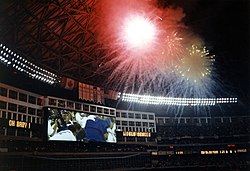 Fireworks at the stadium after the Toronto Blue Jays win the 1993 World Series
 -
 Scene from the 95th Grey Cup in 2007, the first Grey Cup to be held in the city since 1992
 -
 Marriott hotel connected to the stadium

.jpg)
.jpg)

.jpg)
.jpg)
.jpg)


See also
[edit]


.svg)

References
[edit]- ^ "Adjeleian Allen Rubeli – Skydome". Adjeleian Allen Rubeli Ltd. January 29, 2006. Retrieved August 10, 2012.
- ^ "Rogers Centre" (PDF). The Mitchell Partnership. Archived from the original (PDF) on March 3, 2012. Retrieved August 10, 2012.
- ^ "TSN". tsn.ca. Retrieved September 20, 2013.
- ^ "Rogers Centre Among Venues Proposed for 2015 Pan Am Games". Biz Bash Toronto. November 7, 2009. Archived from the original on July 31, 2012. Retrieved November 7, 2009.
Rogers Centre, Ontario Place Among Venues Proposed for 2015 Pan Am Games
- ^ "SkyDome, now Rogers Centre, turns 25". CBC News. Canadian Broadcasting Corporation. June 3, 2014.
When Rogers bought the building in 2005, the stadium's official name switched to Rogers Centre. Many still refer to it as SkyDome, a name that came through a fan-naming contest.
- ^ "Goodbye SkyDome, hello Rogers Centre". CBC Sports. February 2, 2005. Retrieved May 28, 2015.
- ^ John Ewen. "Power Ranking All 30 MLB Stadiums". Bleacher Report.
- ^ "Bidding for the Summer Olympics". Torontoist.com. July 29, 2015. Retrieved June 26, 2020.
- ^ Canadian Football League Archived October 16, 2015, at the Wayback Machine, Canada.
- ^ Paikin, Steve (October 22, 2016). Paikin on Ontario's Premiers 2-Book Bundle: Bill Davis / Paikin and the Premiers. Dundurn. ISBN 9781459738331.
- ^ Miller, David (October 7, 1984). Battle Is On for Right to Build Our Domed Stadium. Toronto Star. pg A1, A13.
- ^ a b c d e f "You win some, you lose some". CBC News. February 9, 2011. Retrieved December 27, 2013.
- ^ a b c d e f g 1688 to 1923: Geloso, Vincent, A Price Index for Canada, 1688 to 1850 (December 6, 2016). Afterwards, Canadian inflation numbers based on Statistics Canada tables 18-10-0005-01 (formerly CANSIM 326-0021) "Consumer Price Index, annual average, not seasonally adjusted". Statistics Canada. Retrieved April 17, 2021. and table 18-10-0004-13 "Consumer Price Index by product group, monthly, percentage change, not seasonally adjusted, Canada, provinces, Whitehorse, Yellowknife and Iqaluit". Statistics Canada. Retrieved May 8, 2024.
- ^ Romell, Rick. "Tax money for stadium site backed". Milwaukee Sentinel May 16, 1989: 1–6.
- ^ "Inside the venue: Toronto's Rogers Centre". ESPN. April 29, 2011. Retrieved December 28, 2013.
- ^ a b c d e Neil deMause. "DOME TO NOWHERE".
- ^ a b c "ROGERS CENTRE HISTORY". Toronto Blue Jays. Archived from the original on December 6, 2010. Retrieved December 28, 2013.
- ^ Grange, Michael (November 30, 2004). "Sold . . ". The Globe and Mail.
- ^ NOW Magazine, December 3–9, 1998.
- ^ Alamenciak, Tim (August 6, 2013). "Toronto's waterfront: Dredging up the past to build the future". Toronto Star. Retrieved March 7, 2019.
- ^ Anderson, M.E. "The Skydome a/k/a Rogers Centre, turns 25". Sporting News. Archived from the original on June 30, 2015. Retrieved November 19, 2014.
- ^ "SkyDome, then and now". Archived from the original on March 9, 2016. Retrieved April 8, 2014.
- ^ "Delays hit SkyDome, Jays at Ex for opener", Toronto Star, July 15, 1988, front page.
- ^ a b c "Rogers buys SkyDome for $25 million". The Sports Network. November 29, 2004. Archived from the original on December 28, 2013. Retrieved December 28, 2013.
- ^ "SkyDome seeks bankruptcy protection". CBC News. November 26, 1998. Retrieved December 28, 2013.
- ^ "12,000 people sign petition demanding Jays' stadium has name restored to 'SkyDome'". CTV News. April 8, 2016. Retrieved May 27, 2016.
- ^ "The Skydome in Trinity Bellwoods Park has finally been recognized".
- ^ "Goodbye Skydome, Hello Rogers Centre". CBC News. February 2, 2005. Retrieved June 13, 2008.
- ^ Girard, Daniel (February 8, 2012). "Toronto Argonauts May Soon Be Homeless". Toronto Star. Retrieved February 8, 2012.
- ^ a b "Bell Canada and Kilmer Group to acquire Argonauts". Toronto Argonauts. May 20, 2015. Archived from the original on May 22, 2015. Retrieved May 20, 2015.
- ^ a b "Argonauts announce sale, move to BMO Field". CBC News. Retrieved May 20, 2015.
- ^ a b "Bell, Larry Tanenbaum to purchase Argonauts". Toronto Star. May 19, 2015. Retrieved May 20, 2015.
- ^ "Blue Jays Continue Renovations to Rogers Centre; Changes Create a More Fan-Friendly Environment" (Press release). MLB Advanced Media. April 3, 2006. Archived from the original on February 24, 2012. Retrieved June 13, 2008.
- ^ "Rogers Centre Announces Dates for Alcohol Service Suspension" (Press release). Newswire.ca. April 3, 2009. Retrieved February 23, 2011.
- ^ "Rogers Centre faces demolition as Blue Jays owner plans new stadium". The Globe and Mail. Retrieved November 27, 2020.
- ^ a b "Blue Jays announce renovation plans for Rogers Centre". MLB.com. July 28, 2022. Retrieved October 8, 2024.
- ^ "Toronto Blue Jays reveal what Rogers Centre looks like ahead of 2024 home opener". torontoctvnews.ca. March 19, 2024.
- ^ a b "Blue Jays unveil details, renderings for 2023 Rogers Centre renovations". ballparkdigest.com. July 28, 2022. Retrieved October 8, 2024.
- ^ a b c "The Rogers Centre transformation is almost complete. Here's what Blue Jays fans should know about the renovations". thestar.com. April 4, 2024.
- ^ "New Fan Experiences Unveiled at Rogers Centre Ahead of Jays' Home Opener". urbantoronto.ca. April 6, 2023. Retrieved October 8, 2024.
- ^ a b "2024 Rogers Centre renovations unveiled by Blue Jays". ballparkdigest.com. July 27, 2023. Retrieved October 8, 2024.
- ^ "Windows Restaurant at Rogers Centre gets $2M renovation". Sportsnet. March 30, 2013. Retrieved January 6, 2014.
- ^ "$250-Million Renovations Coming To Rogers Centre". theScore Inc. Archived from the original on January 7, 2014. Retrieved January 6, 2014.
- ^ Chisholm, Gregor (February 10, 2016). "Work begins on dirt infield at Rogers Centre". MLB.com. Retrieved May 9, 2018.
- ^ Kennedy, Brendan (April 7, 2016). "Blue Jays debut Rogers Centre all-dirt infield on Friday". Toronto Star. Retrieved May 9, 2018.
- ^ DaSilva, Cameron (April 7, 2016). "The Blue Jays finally have a normal dirt infield like the rest of MLB". Fox Sports. Retrieved May 9, 2018.
- ^ "JMP Engineering and New Electric Partner to Retrofit Rogers Centre's Iconic Retractable Roof". March 20, 2017. Retrieved July 3, 2018.
- ^ Davidi, Shi (December 11, 2020). "Blue Jays getting new AstroTurf field amid hopes for full season in Toronto". Sportsnet. Retrieved November 28, 2021.
- ^ "Rogers Centre invests $8M to upgrade 5G network ahead of Taylor Swift concerts". toronto.citynews.ca. October 17, 2024.
- ^ "Rogers Centre – Facts". Rogerscentre.com. Rogers Stadium Limited Partnership. Archived from the original on October 6, 2015. Retrieved November 19, 2011.
- ^ "Rogers Centre roof shut for deciding Jays playoff game despite Open the Dome campaign". CBC News. Archived from the original on September 23, 2016.
- ^ Lott, John (February 3, 2010). "Blue Jays Hoping to Gain Some Level Footing". National Post. Toronto. Archived from the original on February 7, 2010. Retrieved February 8, 2010.
- ^ "Arizona Diamondbacks installing synthetic grass at Chase Field". azcentral.com. October 12, 2018. Retrieved October 13, 2018.
- ^ "Blue Jays begin work on all-dirt infield at Rogers Centre". Toronto Star. February 11, 2016.
- ^ "Young's two-run homer helps D-Rays stop Rangers' rally". ESPN. Associated Press. May 17, 2007. Archived from the original on August 8, 2014. Retrieved July 19, 2014.
- ^ "Balanced Rays complete three-game sweep of Blue Jays at Disney". ESPN. Associated Press. April 24, 2008. Archived from the original on July 27, 2014. Retrieved July 19, 2014.
- ^ Ballparks of Baseball. "Champion Stadium, Spring training ballpark of the Atlanta Braves". Ballparks of Baseball. Retrieved July 19, 2014.
- ^ Nightengale, Bob (July 24, 2020). "Toronto Blue Jays to play home games at Buffalo's Sahlen Field this season". USA Today.
- ^ Kennedy, Brendan (April 24, 2014). "Blue Jays pave way for grass at the Rogers Centre". Toronto Star.
- ^ Maloney, Tom (September 9, 2013). "Jays turf Argos in favour of grass playing surface at Rogers Centre". The Globe and Mail. Toronto. Retrieved November 7, 2013.
- ^ Perkins, Dave (February 9, 2012). "Perkins: Argos turfed if Toronto Blue Jays put grass in Rogers Centre". Toronto Star. Retrieved January 12, 2014.
- ^ Griffin, Richard (February 1, 2014). "Jays president Beeston insists 'baseball should be played on grass': Griffin". Toronto Star. Retrieved February 1, 2014.
- ^ "Blue Jays mulling installation of dirt infield - Sportsnet.ca". Archived from the original on March 15, 2016. Retrieved May 24, 2015.
- ^ Kennedy, Brendan (April 7, 2016). "Blue Jays debut Rogers Centre all-dirt infield on Friday". Toronto Star. Retrieved April 10, 2016.
- ^ "Real Grass is the Least Important Renovation Needed at Rogers Centre". October 27, 2017.
- ^ a b Edwards, Peter (June 17, 2009). "Hard Times Shut Down Hard Rock at the Dome". Toronto Star. Retrieved February 23, 2011.
- ^ "Toronto Marriott City Centre Hotel". Marriott International. July 1, 2005. Retrieved March 22, 2008.
- ^ Reichard, Kevin (April 8, 2022). "Blue Jays, theScore Bet announce 10-year sponsorship - Ballpark Digest". Retrieved April 11, 2022.
- ^ a b c d Lowry, Phil (2006). Green Cathedrals: The Ultimate Celebrations of All 273 Major League and Negro League Ballparks Past and Present. New York City: Addison Wesley Publishing Company. ISBN 978-0-201-62229-4.
- ^ "Rogers Centre". Mo Alleman. Retrieved August 10, 2012.
- ^ "Jays Want to Hear 49,539 People". Jays Journal. April 3, 2010. Retrieved August 10, 2012.
- ^ "Toronto Blue Jays Rogers Centre". The Ballpark Guide. Retrieved August 10, 2012.
- ^ "Fun Facts and Figures". Rogers Stadium Limited Partnership. October 9, 2015. Archived from the original on October 6, 2015. Retrieved October 9, 2015.
- ^ Brown, Maury (March 4, 2013). "2013 American League Attendance Projections". Baseball Prospectus. Retrieved April 4, 2013.
- ^ "New outfield in renovated Rogers Centre will play very differently for Blue Jays". January 17, 2023. Retrieved January 28, 2023.
- ^ "The Rogers Centre transformation is almost complete. Here's what Blue Jays fans should know about the renovations". Toronto Star. April 4, 2024.
- ^ "2011, 2013 Gold Cup". Bigsoccer.com. Retrieved August 10, 2012.
- ^ "June 5, 1989: Blue Jays play first game in SkyDome – Society for American Baseball Research".
- ^ "History". Rogers Centre. Archived from the original on June 25, 2014. Retrieved August 10, 2012.
- ^ "Where to park at Rogers Centre | Toronto Blue Jays". MLB.com.
- ^ "Rogers Centre to host WBC games in '09". Sportsnet. July 31, 2008. Retrieved February 23, 2011.
- ^ Peddie, Richard (2013). Dream Job. HarperCollins.
- ^ Gaughan, Mark; Sullivan, Jerry (January 30, 2008). "Bills Have Deal in Place for Toronto Games". The Buffalo News. Retrieved January 30, 2008.
- ^ a b c Molinaro, John F. (June 9, 2005). "Soccer friendly in Toronto ends in stalemate". CBC.ca. Retrieved April 22, 2020.
- ^ a b Molinaro, John F. (May 25, 2010). "Fiorentina blanks Juventus in Toronto friendly". CBC.ca. Retrieved December 9, 2017.
- ^ a b "Man U downs Celtic in Rogers Centre friendly". CBC.ca. The Canadian Press. July 16, 2010. Retrieved December 9, 2017.
- ^ a b Girard, Daniel (July 21, 2012). "Toronto FC and Liverpool draw 1-1 in friendly at Rogers Centre". Toronto Star. Retrieved December 9, 2017.
- ^ a b "WC hosts Brazil beat Chile 2-1 at Rogers Centre". The Canadian Press. Sportsnet. November 19, 2013. Retrieved July 17, 2021.
- ^ Denmark-Canada
- ^ Canada-Portugal
- ^ Da Costa, Norman (January 30, 1995). "Finishing kick ends Portugal's drought SkyDome Cup first trophy in team's history". The Toronto Star. ProQuest 437180152. Retrieved December 9, 2017.
- ^ "FC Porto beats Liverpool at SkyDome". CBC.ca. July 31, 2004. Retrieved December 9, 2017.
- ^ Molinaro, John F. (July 31, 2004). "Totti lifts Roma past Celtic at SkyDome". CBC.ca. Retrieved December 9, 2017.
- ^ Boyle, Robert (July 12, 2017). "On This Day: Dinamo In Toronto". Rangers F.C. Archived from the original on July 16, 2021. Retrieved July 16, 2021.
- ^ Terra, Lino (July 8, 2006). "USA Defeats Canada in U20 Friendly". Archived from the original on September 29, 2007. Retrieved April 4, 2020.
- ^ Molinaro, John F. (August 3, 2010). "Panathinaikos beats Inter in Toronto". CBC.ca. Retrieved July 17, 2021.
- ^ Girard, Daniel (March 8, 2012). "Toronto FC ties Los Angeles Galaxy before 47,658 at Rogers Centre". Toronto Star. Retrieved December 9, 2017.
- ^ "Toronto FC vs. Sporting Kansas City - Football Match Summary - March 9, 2013 - ESPN". ESPN. March 9, 2013. Retrieved July 21, 2019.
- ^ Pomeroy, Chris. "The Toronto Supercross Returns For 2016". Motocross Performance Magazine. Retrieved June 29, 2020.
- ^ McGil, Mike (May 2017). "Dome Sweet Dome". Motocross Performance Magazine. pp. 50–56. Retrieved June 29, 2020.
- ^ "AMA Supercross And FIM World Supercross GP Consolidate Into Single Championship". Roadracing World & Motorcycle Technology. December 28, 2007. Retrieved June 29, 2020.
- ^ Coombs, Davey (April 7, 2020). "The List: Supercross in the Fall". Racer X Magazine. Retrieved June 29, 2020.
- ^ 2015 AMA Supercross media guide Archived October 13, 2016, at the Wayback Machine
- ^ "AMA Supercross 2019 Series Guide - Wins by City: Toronto, ON, Canada - Rogers Centre" (PDF). amasupercross.com. p. 58. Retrieved June 29, 2020.
- ^ "USAC National Midget:1993-01". The Third Turn.
- ^ @USACNation (January 2, 2019). "USAC National Midgets haven't raced internationally since this 1993 stop at the SkyDome in Toronto, home of Major League Baseball's Blue Jays. On this night indoors, however, Kenny Irwin, Jr. made it his winter home" (Tweet) – via Twitter.
- ^ Murray, Richie (February 26, 2020). "USAC's indoor history goes back to the beginning". usacracing.com. Retrieved June 28, 2020.
- ^ "54 Teams entered in Saturday's USAC race here". Harrisburg Register. March 15, 2016. Retrieved June 28, 2020.
- ^ Grossman, David (November 7, 2008). "Metro Bowl to Have a U.S. Flavour". Toronto Star. Retrieved February 23, 2011.
- ^ "UFC 129 Sold Out, Shatters Records With 55,000 Tickets". MMAWeekly.com. February 12, 2011. Retrieved January 22, 2020.
- ^ "WrestleMania — The Venues and Attendance of Every WrestleMania". About.com. Archived from the original on February 28, 2008. Retrieved February 3, 2008.
- ^ The Notorious Eddie Mac (February 8, 2017). "On This Day in Wrestling History: Daniel Bryan Retires". Cageside Seats. Retrieved January 22, 2020.
- ^ Holder, James (March 7, 2025). "Dave Meltzer Match Ratings WWE Elimination Chamber 2025". TJR Wrestling. Retrieved March 10, 2025.
- ^ Thomas, Jeremy (November 8, 2024). "WWE Elimination Chamber 2025 Announced For Toronto". 411Mania. Archived from the original on November 8, 2024. Retrieved November 8, 2024.
- ^ "Theatre Concert". Rogers Centre. Retrieved August 10, 2012.
- ^ "The Rogers Centre: One Blue Jay Way, Toronto, Ontario". Glass Steel and Stone. Archived from the original on June 19, 2012. Retrieved August 10, 2012.
- ^ Rayner, Ben (November 6, 2011). "Deadmau5 Leaves Em' Raving". Toronto Star. Retrieved August 10, 2010.
- ^ Harper, Kate (September 16, 2009). "Rogers Centre Dome Opening For U2's Toronto Shows". Chart Communications Inc. Archived from the original on September 25, 2009. Retrieved October 2, 2009.
- ^ "Dome Open for 2nd Concert in History as 60K Fans Rock Out with U2". CTVglobemedia. September 17, 2009. Retrieved October 2, 2010.
- ^ "U2 360° TOUR: 2009: Toronto Thursday, September 17, 2009". U2.Com. U2 A De-Lux Excursion. 2009. Retrieved October 2, 2010.
- ^ "Events – Bon Jovi Welcomes Fans Into The Circle With 2010–2011 World Tour" (Press release). Rogers Centre. October 21, 2009. Archived from the original on March 13, 2014. Retrieved August 10, 2012.
- ^ "Today in Madonna History: May 27, 1990". todayinmadonnahistory.com. May 27, 2024. Retrieved December 5, 2024.
- ^ "Rogers Centre and Blue Jays Celebrate Anniversary" (Press release). Newswire.ca. June 5, 2009. Archived from the original on May 9, 2013. Retrieved August 10, 2012.
- ^ "The time Toronto Police nearly arrested Madonna". Torontosun. May 29, 2016. Retrieved December 5, 2024.
- ^ "Today in Madonna History: October 11, 1993". todayinmadonnahistory.com. October 11, 2015.
- ^ "Guns N' Roses Name The Cult, Billy Talent + More Openers for Summer 2016 Tour". Loudwire. June 16, 2016. Retrieved August 11, 2017.
- ^ "2017-07-16 Toronto, Ontario, Canada". Metallica.com. Retrieved August 11, 2017.
- ^ Brooks, Dave (December 17, 2018). "Shawn Mendes Sells Out First Ever Stadium Show in Minutes". Billboard.
- ^ Trapunski, Richard (July 9, 2023). "Beyoncé Rides Her Bedazzled Horse Into Canada for Triumphant Tour Kickoff". Rolling Stone. Retrieved November 23, 2024.
- ^ Mark Daniell (November 26, 2024). "Taylor Swift thanks Toronto fans in heartfelt Instagram post: 'It was awesome to play in Canada'". torontosun.com. Toronto Sun.
- ^ Tinsley, Justin (June 16, 2025). "Kendrick Lamar's Toronto shows were an all-time statement". Andscape. Retrieved June 17, 2025.
- ^ "Abel "The Weeknd" Tesfaye honoured with a Key to the City". City of Toronto. July 26, 2025. Retrieved August 1, 2025.
- ^ "In the Community". Rogers Centre. Retrieved August 10, 2012.
- ^ Wagner, Vit (March 5, 2011). "Atwood Lends Voice to World Book Night". Toronto Star. Retrieved August 13, 2011.
- ^ "Ticketmaster Canada Ltd.: Company Overview". Bloomberg Businessweek. Archived from the original on September 20, 2012. Retrieved July 15, 2009.
- ^ "Ticketmaster Canada Privacy Policy". Ticketmaster Canada. March 3, 2009. Retrieved July 15, 2009.
- ^ Deibert, Dave (May 25, 2010). "UFC Opening Canadian Office in Toronto". National Post. Toronto. Retrieved April 4, 2013.
- ^ Hollinger, Herb (June 10, 1995). "Graham recuperation won't derail Southern Baptist Convention date" (PDF). Baptist Press. Retrieved January 15, 2010.
- ^ "Jays pound Royals in front of smallest-ever crowd at Dome". TSN. Canadian Press. April 19, 2010. Retrieved April 19, 2010.
- ^ "Bombers finally win in SkyDome". Cbc.ca. July 13, 2001. Retrieved February 23, 2011.
- ^ "1995 Buffalo Bills". Retrieved April 23, 2011.
- ^ "UFC 129 Sold Out, Shatters Records With 55,000 Tickets". Yahoo Sports. February 12, 2011. Retrieved February 14, 2011.
- ^ Kepner, Tyler (March 8, 2009). "A Room With a View in Toronto". The New York Times. Retrieved August 10, 2012.
- ^ "Skydome is Falling! Skydome is Falling!". Spartanburg Herald-Journal. Associated Press. June 23, 1995. pp. B1, B5. Retrieved April 4, 2013.
- ^ "SkyDome Roof Shreds". CBC News. April 12, 2001. Retrieved April 4, 2013.
- ^ "Blue Jays Work the Bugs Out". Los Angeles Times. Associated Press. August 4, 2001. Retrieved April 4, 2013.
- ^ Davidson, Neil (November 6, 2015). "Toronto Argonauts win final game at Rogers Centre where they played 27 seasons". The Canadian Press. Retrieved July 31, 2022.
- ^ Johnston, Mike (October 4, 2016). "Rogers Centre dome will be open for Blue Jays-Orioles wild card game". Sportsnet.ca.
- ^ "Blue Jays game postponed due to ice-damaged dome | CBC Sports".
- ^ "Opening Day delayed at least 2 weeks; Spring Training games cancelled". March 12, 2020. Retrieved March 12, 2020.
- ^ "WWE ELIMINATION CHAMBER RESULTS (3/1): Keller's report on Men's and Women's Chamber matches, Sami Zayn vs. Kevin Owens, Cody Rhodes answering Rock's offer, more". Retrieved March 4, 2025.
- ^ "Triple H Says WWE Elimination Chamber Is Highest Grossing WWE Event In Canada History | Fightful News". www.fightful.com. Retrieved March 4, 2025.
- ^ "Skydome Firsts". www.retrosheet.org. Retrieved May 2, 2023.
- ^ a b c d e f g h i j Retrosheet: Skydome firsts
- ^ "August 2, 1989 Kansas City Royals at Toronto Blue Jays Box Score". Baseball Reference. Retrieved March 27, 2013.
- ^ "United States Patent 4,676,033". USPTO.gov. Retrieved April 14, 2015.
- ^ Kitching, Chris (June 3, 2014). "Toronto's SkyDome opened 25 years ago today". CP24. Retrieved October 11, 2021.
- ^ "History | Rogers Centre | Toronto Blue Jays". MLB.com.
- ^ "Fans distracted by sex during Blue Jays game".
- ^ "SkyDome Hotel scandals over the years". Toronto Star. September 16, 2012.
- ^ "Bird's eye view of Blue Jays from comfort of in-stadium hotel". Toronto Star. September 17, 2012.
- ^ Mele, Rick (March 11, 2022). "All the Toronto References We Could Spot in Pixar's 'Turning Red'". Complex Canada. Retrieved March 13, 2022.
- ^ Landau, Jack (April 18, 2024). "A new major movie was just filmed at Blue Jays' Rogers Centre". Daily Hive. Archived from the original on April 19, 2024. Retrieved April 19, 2024.
Notes
[edit]- ^ One of the more notable concerts, as shown in the documentary Truth or Dare.[123] The touring show had become extremely controversial due to the risqué visuals and performances. When the concert arrived in Toronto, police were alerted that the show might violate local obscenity laws. The police were on site for the concert and threatened charges without changes. The show went on as planned, however, without any legal action taken.[124]
External links
[edit]
| |||||||||||||||||||||||||||||||||||||||||||||||||||||||||||||||||||||||||||


Rogers Centre
View on GrokipediaHistory
Planning, Design, and Initial Concept
The concept for a domed stadium in Toronto originated in the early 1980s, spurred by the inclement weather during the 70th Grey Cup on November 28, 1982, at the open-air Exhibition Stadium, where heavy rain and cold conditions prompted Ontario Premier William Davis to pledge a new covered multi-purpose venue to host major events reliably.[7][8] This initiative addressed longstanding limitations of Exhibition Stadium, which had served as the temporary home for the Toronto Blue Jays since their 1977 inception and lacked weather protection, leading to frequent game disruptions and fan discomfort.[9] In response, the Ontario government established the Stadium Corporation of Ontario in 1985 to oversee development, secure private investment, and select a downtown site adjacent to the CN Tower on former railway lands, chosen for its central accessibility and urban regeneration potential.[10] An international design competition followed that year, emphasizing a retractable roof to enable open-air play while shielding against Toronto's variable climate, marking the first such feature in a major sports facility.[11] The winning design by Toronto-based firm Robbie Young + Wright Architects, led by Rod Robbie with structural engineer Michael Allen, envisioned a 50,000-seat multi-use arena integrating baseball, football, and concerts, with innovative toroidal geometry for structural efficiency and panoramic views via extensive glass panels.[1] Robbie, drawing from his Expo 67 pavilion experience, conceptualized the stadium as a "pleasure palace for the people," prioritizing spectator intimacy through tiered seating close to the field and natural light diffusion, while patenting the roof's four-panel mechanism driven by 25-horsepower motors to retract in 20 minutes.[12][10] This initial blueprint balanced functionality with spectacle, projecting a $300–400 million cost before escalations, though early proposals explored fixed-dome alternatives akin to Houston's Astrodome for simplicity.[11]Construction and Public Financing
The Stadium Corporation of Ontario (Stadco), established by the provincial government, oversaw construction of the SkyDome as a publicly funded project to replace the aging Exhibition Stadium and provide a modern multi-purpose venue for the Toronto Blue Jays and other events. Groundbreaking occurred on October 3, 1986, under Premier David Peterson's administration, with architectural design led by Rod Robbie and structural engineering by Michael H. Davies of Robbie & Kerr. The project incorporated innovative features like the world's first fully retractable roof, spanning 3.3 acres and supported by 23 massive steel trusses. Construction proceeded amid challenges, including labor disputes and design adjustments, completing in just over three years despite initial projections for a faster timeline.[9][13][7] Initial cost estimates in 1985 hovered around $225 million, but overruns from complex engineering, scope expansions—including integration of a 408-room luxury hotel—and inflation drove the final price to $570 million by the 1989 opening. These escalations reflected poor budget management, as noted in post-construction analyses, with total costs including interest estimated at $650 million over time. The province financed the bulk through government-issued bonds and public revenues, bypassing direct private equity commitments despite early discussions of mixed funding from federal, provincial, and municipal levels. Taxpayers bore the primary burden, with no dedicated revenue stream like lotteries fully offsetting expenditures at inception.[9][13][14] Upon opening on June 5, 1989—two months behind schedule—the SkyDome carried an immediate debt of about $165 million, exacerbated by the hotel addition and high-interest financing at rates near 13 percent, generating annual interest payments of roughly $34 million. By 1993, amid operational shortfalls, this had swelled to over $400 million, prompting the province to assume full liability before partial privatization. Critics, including fiscal watchdogs, attributed the debt trajectory to optimistic revenue projections and inadequate contingency planning, underscoring the hazards of government-backed megaprojects without robust private risk-sharing.[15][16][17]Opening and Early Operations
The SkyDome opened to the public on June 3, 1989, marking the debut of the world's first sports stadium with a fully operational retractable roof.[1] The opening featured a televised grand ceremony, "The Opening of SkyDome: A Celebration," attended by dignitaries including Queen Elizabeth II and Prince Philip, who activated the roof mechanism via a laser-pointed switch.[18] Constructed at a cost of $570 million Canadian dollars, primarily funded by public sources, the venue was designed to host major league baseball while accommodating diverse events year-round.[10] On June 5, 1989, the Toronto Blue Jays played their inaugural game at the stadium against the Milwaukee Brewers, drawing 48,378 fans but falling 5-3 in the contest.[18] The retractable roof made its operational debut shortly thereafter during a Blue Jays game on June 7, 1989, against the Los Angeles Dodgers, opening fully for the first time amid clear weather to demonstrate its engineering capabilities.[2] Early baseball operations emphasized the stadium's artificial turf surface and innovative features, though initial games highlighted logistical adjustments, including the roof's 20-minute closure time during unexpected rain.[9] In its first full seasons, the SkyDome rapidly established itself as a premier venue, hosting Toronto Argonauts Canadian Football League games starting in 1989 and drawing record crowds for Blue Jays contests.[9] The facility's multi-use design supported concerts by artists such as the Rolling Stones and U2, alongside wrestling events and exhibitions, contributing to attendance figures that exceeded American League records annually from 1990 to 1993.[19] These early operations underscored the stadium's role in revitalizing downtown Toronto's entertainment landscape, with seamless transitions between configurations for different sports and events.[10]Financial Crises and Debt Burden
The SkyDome, upon its opening in June 1989, faced immediate financial strain due to construction costs exceeding initial estimates, resulting in a debt of approximately $255 million by late 1990. This debt carried a floating interest rate around 13%, generating annual interest payments of about $34 million, which strained operational revenues despite high attendance in early years.[17] By 1993, the publicly owned Stadium Corporation had accumulated over $400 million in debt, prompting the Ontario provincial government to assume full financial responsibility amid ballooning public liabilities from the project's overruns. Efforts to alleviate the burden included privatizing the facility; in March 1994, the province sold SkyDome to a private consortium for $151 million, inclusive of $23 million in delayed interest charges, though this transaction failed to fully resolve underlying fiscal pressures.[10][20] Persistent operational losses and unfavorable lease agreements, described by management as "sweetheart deals" from the stadium's inception, culminated in a severe crisis by November 1998, when SkyDome Corporation sought bankruptcy protection under Canada's Companies' Creditors Arrangement Act. The filing revealed annual losses of roughly $3 million, alongside millions in unpaid property taxes and other creditors' claims, necessitating court approval for $3.5 million in emergency funding to sustain operations. Owners were required to submit a restructuring plan by December 23, 1998, highlighting the unsustainable debt service amid declining event revenues and high fixed costs.[21][22][23][24][9] The bankruptcy proceedings concluded in April 1999 with Sportsco International LP acquiring the stadium for $80 million, marking a shift from public to private hands but underscoring the long-term fiscal toll of the original public financing model, which had diverted hundreds of millions in taxpayer funds without proportional economic returns.[9][25]Ownership Transitions and Naming Rights Acquisition
The SkyDome Corporation, a crown corporation established by the Ontario provincial government, held initial ownership of the stadium following its completion in 1989. Amid ongoing financial losses exceeding initial projections, the corporation entered creditor protection in 1998 and was sold to Sportsco International LP, a private consortium led by Canadian investors including Telemedia Corporation and others, marking the shift from public to private ownership.[10][6] Under Sportsco ownership, the stadium continued to face operational deficits, prompting efforts to monetize assets such as naming rights; in 2003, negotiations advanced for a potential deal with Staples Inc., valued at around $2 million annually, though it remained contingent on the pending sale of the facility itself.[26][27] In November 2004, Rogers Stadium Limited Partnership—a subsidiary of Rogers Communications, which had acquired sole ownership of the Toronto Blue Jays in 2000—announced the purchase of the stadium from Sportsco for $25 million CAD, a fraction of its original $570 million construction cost.[4][28][16] The transaction closed on January 31, 2005, granting Rogers full control over the venue, including naming rights without a separate licensing agreement due to outright ownership.[29] On February 2, 2005, the stadium was officially renamed Rogers Centre, aligning it with the company's branding strategy for its sports assets.[1]Major Renovations (2020s)
In 2022, the Toronto Blue Jays initiated a multi-year, privately funded renovation of Rogers Centre aimed at transforming the multi-purpose stadium into a baseball-centric venue, with a total investment exceeding CA$300 million.[30] The project, executed in phases by PCL Construction and designed by Populous, focused on enhancing fan experience through improved sightlines, premium spaces, and player facilities while eliminating configurations for other sports like football.[31] Work began in October 2022, with initial phases targeting outfield areas and social districts completed ahead of the 2023 season.[32] The first major phase, unveiled in April 2023, introduced the Outfield District, featuring new social gathering spaces, adjusted outfield dimensions, and removal of the high outfield wall to bring fans closer to the action.[33] This included raised bullpens, expanded standing-room terraces, and enhanced food and beverage options integrated into communal areas.[34] Subsequent upgrades in 2023 added lower-level clubs and social decks, reducing traditional seating in favor of interactive zones to foster a more intimate atmosphere.[35] Phase two, spanning late 2023 to April 2024, reimagined the 100-level seating bowl with approximately 13,000 new seats oriented toward the infield for optimal baseball viewing, incorporating modern ergonomic designs with increased legroom, cupholders, and accessible field-level options.[36] This overhaul also delivered a state-of-the-art Blue Jays clubhouse, training facilities, and three new premium clubs offering exclusive amenities like lounge seating and private dining.[37] The renovations reduced overall capacity to around 41,000 for baseball while prioritizing proximity to the field, with construction minimizing disruptions during the 2024 season through off-season execution.[38] By mid-2024, the project had progressed to upper-level enhancements, including 500-level terraces replacing rows of seats with drink rails, standing areas, and open-air bars to improve circulation and premium offerings.[30] These changes, completed without public financing, addressed longstanding criticisms of the venue's dated multi-sport layout, resulting in a configuration better suited to Major League Baseball operations.[39] Ongoing refinements through 2025 focused on fine-tuning sightlines and integrating technology for enhanced spectator engagement.[40]Post-Renovation Enhancements (2025)
Following the multi-year renovation that transformed Rogers Centre into a baseball-specific venue, the Toronto Blue Jays introduced the Field Side Corner Club for the 2025 season, located at field level in right field adjacent to sections 110-113.[40][41] This exclusive space, accessible to quarter- and full-season ticket holders, offers unobstructed field-level views, a private bar with signature cocktails such as Club 328 Punch and Red Bull-pen Blast, dedicated food stalls featuring backyard barbecue options including smoked brisket, chicken, and pork ribs alongside ballpark staples like hot dogs and giant pretzels, and an open-air patio positioned beside the right field baseline for an immersive sports bar atmosphere.[40][42] Pricing for seats in the club starts at under $100 per game.[40] Additional amenities within the club include a baseball card wall display and dedicated merchandise areas, enhancing the premium experience for patrons.[43] Stadium-wide food enhancements complemented these upgrades, introducing items such as the Crunchy Pickle Hot Dog (topped with pretzel pieces, mustard, and shoestring pickles), Cotton Candy Fries, Mojo Hot Dog with mojo pork and pineapple pico, and the Plakata Skewer of chicken with ancho chipotle aioli available at the Corona Rooftop Patio.[42][43] New drink options included Mike’s Hard Purple Freeze and The Stop Slide cocktail, while the Grub Tub—a Jays-branded container—offered combinations like chicken tenders with fries or brisket sliders with kettle chips.[42] These enhancements contributed to strong fan reception, with the new premium spaces achieving a Net Promoter Score (NPS) of 70 in 2025, a significant improvement from prior offerings like the TD Clubhouse's score of 41 in 2023.[44] The additions built on the renovated outfield district's reimagined perches and entertainment zones, further personalizing the venue with features like private entrances and postgame access for premium members, including base running and DJ sets.[44] A new 200-level club with an open-air patio was also slated to open during the winter of 2025, expanding membership opportunities by 1,000 seats.[44]Architectural and Engineering Features
Retractable Roof System
The retractable roof system at Rogers Centre comprises three movable panels and one stationary panel, spanning 8 acres and rising to a maximum height of 282 feet at its apex.[45] The entire structure weighs approximately 11,000 tonnes, with the movable components powered by electric motors that enable full retraction to expose the field and seating areas to the open air.[9] Designed by architects Rod Robbie and Michael Allen, the system was engineered as the first fully motorized retractable roof on a North American stadium, operational since the venue's opening on June 5, 1989.[46] Operation begins with the two northern movable panels (sections 2 and 3) sliding northward along parallel steel tracks to nest beneath the fixed northern panel (section 4), positioned behind center field; the southernmost panel (section 1), initially aligned behind home plate, then advances over the nested sections to complete the retraction.[47] [48] The panels, varying in size, utilize a traction drive mechanism with wheeled carriers on rails, allowing the roof to open or close in 20 to 25 minutes under optimal conditions, accommodating up to 400 cycles annually.[1] [3] When fully retracted, the system provides 100% field exposure and 91% seating exposure to sunlight, though indoor grass maintenance remains necessary during closed periods.[49] The roof's engineering incorporates robust steel framing and a weatherproof membrane, but early operations revealed reliability challenges, including structural wear from repeated movements totaling over 11,000 tonnes of steel.[50] In 2017, a comprehensive retrofit addressed these issues through upgraded AC motors, a modern Allen-Bradley ControlLogix automation system, new operational technology networking, and enhanced safety interlocks, marking North America's first such modernization of a retractable roof to extend service life and prevent operational failures.[51] [3] Post-retrofit, the system maintains precise synchronization via redundant controls, ensuring safe operation even during high-wind or variable weather events common in Toronto.[45]Field Configuration and Surface
The Rogers Centre's baseball field measures 328 feet along both left and right field lines, 368 feet to left-center field, 359 feet to right-center field, and 400 feet to center field, following adjustments made during the 2023 renovations that shortened certain power alleys and raised outfield wall heights to enhance playability.[52][1] These dimensions maintain a relatively symmetrical layout compared to the pre-renovation setup, which featured longer distances of 375 feet in both left- and right-center, though the walls now vary in height—reaching 14 feet 4 inches in left field and 12 feet 7 inches in right field—to influence home run trajectories and defensive positioning.[52][53] The playing surface consists of artificial turf, specifically the AstroTurf Diamond Series RBI 60-ounce variant installed in 2021, covering the outfield and non-dirt areas while preserving the traditional clay infield for baseball.[54] This synthetic turf has been in use since the stadium's 1989 opening as SkyDome, initially with older AstroTurf models upgraded over time to improve durability and player safety amid multi-event scheduling.[54] Renovation plans announced in 2022 explicitly retained the artificial surface rather than converting to natural grass, citing logistical benefits for the venue's diverse programming, including concerts and non-baseball sports that would otherwise require field removal and reinstallation.[55] The turf facilitates reconfiguration for gridiron football, as demonstrated in past Canadian Football League seasons for the Toronto Argonauts (1989–1998) and exhibition NFL games, where end zones were marked in the outfield corners and goalposts positioned along the foul lines without permanent alterations.[38] This adaptability stems from the surface's resilience to overlaid markings and equipment, though post-2023 seating realignments have prioritized baseball sightlines over football accommodations.[38] For soccer and other events, the field supports temporary setups with minimal downtime, underscoring the stadium's original dual-sport design intent.[55]Seating Arrangement and Capacity
The Rogers Centre's seating for baseball is configured across three primary levels: the field-level 100 sections, the mid-tier 200 level, and the upper 500 level, with a total seated capacity of 39,150 following the 2023–2025 renovations that emphasized premium and social spaces over sheer volume.[56][57] This represents a reduction from the original 50,516 seats at opening in 1989, as sections were removed or repurposed to accommodate enhanced fan amenities, club lounges, and outfield districts.[57] The layout splits sections left and right of each field (e.g., first base side numbered sequentially from behind home plate), with rows typically starting at 1 and ascending numerically; optimal sightlines for baseball are found in lower 100-level sections like 113–130 along the baselines and behind home plate (127–131).[58] The 100 level forms the lower bowl, encircling the field closely with dugout-adjacent seats, premium club access points, and integrated concessions for immersive viewing; renovations modernized these areas with added cup holders and lounge options while preserving proximity to the action.[59] Above it, the 200 level serves as a mezzanine and club tier, offering shaded perspectives and exclusive amenities such as the new 200-level club behind home plate completed in late 2025, which provides elevated dining and lounge experiences for ticket holders.[44] The uppermost 500 level, reconfigured during renovations, features refreshed seating throughout, expanded social viewing areas with bars and entertainment zones, and value-oriented general admission spots farther from the field but with broad panoramas of the retractable roof and downtown Toronto skyline.[59][60] In addition to fixed seats, the arrangement incorporates dynamic outfield zones like the Corona Rooftop Patio and TD Park Social, which blend standing-room general admission (capped at around 5,500 for crowd control) with casual seating for a total attendance potential exceeding 41,000 when including non-ticketed roaming areas.[59] Approximately 120 luxury suites, historically positioned mid-tier, persist post-renovation for high-end corporate and VIP use, though exact locations shifted to integrate with the updated bowl design.[1] This tiered, adaptable setup supports baseball's asymmetric field demands while allowing reconfiguration for other events, though it prioritizes quality over maximum density in line with modern stadium trends.[38]Video Displays and Technology
The Rogers Centre's primary video display is a 10mm LED videoboard installed during 2022 upgrades, encompassing 8,076 square feet with a central screen measuring 47 feet in height and flanked by two lower wings extending 258 feet across.[1] This configuration replaced prior systems and integrates four auxiliary LED panels adjacent to the main board, each 15.5 feet high by 75.5 feet wide, enhancing visibility for replay footage, statistics, and promotional content during events.[61] The videoboard operates at 1080p resolution with HDR capabilities, supported by a renovated broadcast control room that processes high-dynamic-range feeds for improved color accuracy and contrast in variable lighting conditions under the retractable roof.[61] These core displays form part of a broader multi-phase audiovisual overhaul spanning 2020 to 2024, which added over 30 LED assets throughout the stadium, including auxiliary scoreboards, ribbon boards, and club-level screens.[62] Phase 2 enhancements alone incorporated more than two dozen displays totaling 1,859 square feet, such as 1.5mm-pixel-pitch panels in premium areas measuring 10 feet by 27.5 feet, flanked by 10mm video columns 15 feet tall, to deliver targeted fan engagement and wayfinding.[63] [64] Exterior-facing EMPIRE LED screens feature 3.9mm pixel pitch, spanning 10 inches high by over 68 feet long, visible from surrounding urban areas for advertising and event promotion.[65] The upgrades, executed by vendors including SNA Displays and Daktronics, emphasize energy efficiency and scalability, with consistent LED lighting integration that avoids hotspots compared to legacy fixtures, while maintaining brightness levels suitable for daytime games.[66] [67] Originally equipped upon its 1989 opening as SkyDome with a large cathode-ray tube-based JumboVision screen—one of the world's largest at the time—the venue has iteratively modernized to LED technology amid ongoing renovations, prioritizing durability in a multi-use environment handling baseball, concerts, and other high-traffic programming.[68]Amenities, Art, and Accessibility
Rogers Centre provides extensive amenities for visitors, including multiple levels of concessions offering diverse food and beverage options, such as in-suite catering with à la carte and pre-set menus featuring stadium favorites and premium selections in luxury suites.[69] Premium seating areas like In The Action seats grant access to the TD Clubhouse lounge, dedicated entrances, in-seat snack service, and a bar with wine lounge.[70] The TD Lounge offers an all-inclusive experience with high-end bar service connected to prime seating locations.[71] Additional facilities include drinking fountains and water bottle refill stations on each level, such as near sections 101, 115, 128, and 143 on the 100-level.[72] The venue features notable public art, most prominently "The Audience," a large-scale sculpture by Canadian artist Michael Snow commissioned in 1989 for the original SkyDome construction.[73] This installation consists of 15 golden humanoid figures in seated positions, perched along the stadium's exterior ledge overlooking the field, symbolizing engaged spectators in various poses of excitement and anticipation.[74] Positioned at the base of the CN Tower, the work integrates with the surrounding urban landscape and has become a landmark associated with the stadium's cultural identity.[75] Accessibility features at Rogers Centre include reserved seating exclusively for patrons with disabilities and their companions, primarily located in the lower level at the back of sections such as 108-115 and 121-127.[76][77] Designated accessible entry is available at Gate 7 on the south side, with wheelchair escorts provided from there or other gates, and all entry points accommodate mobility devices.[72] Restrooms feature multipurpose options in sections 142, 238, and 538, plus a universal washroom in section 119; recent enhancements as of 2024 include additional accessible drink rails in general-admission areas to support standing or mobility aid use.[78][79] Assistive listening devices and other accommodations like service animal relief areas are also provided.[80]Event Usage and Programming
Major League Baseball Operations
Rogers Centre has been the home ballpark of the Toronto Blue Jays of Major League Baseball since its inauguration on June 5, 1989, when the Blue Jays defeated the Milwaukee Brewers 5-3 in the first regular-season game under the retractable roof.[1] The venue hosts 81 regular-season home games each year, along with potential postseason contests, including the American League Championship Series and World Series games during the Blue Jays' 1992 and 1993 championship runs.[1] Its fully retractable roof enables uninterrupted play in inclement weather, a feature that distinguished it as the first such stadium in MLB upon opening.[1] Configured specifically for baseball, the field features symmetrical dimensions of 328 feet to the left and right field lines, 400 feet to center field, with adjusted power alleys post-renovation: 366 feet to left-center and 357 feet to right-center, accompanied by varying wall heights up to 14 feet to influence play dynamics.[52] [59] The surface consists of artificial turf with a dirt infield, a setup retained after 2022-2023 renovations that introduced a new turf installation, reduced foul territory by reconfiguring the lower bowl, and enhanced dugouts and lighting for improved visibility resembling daylight conditions.[5] [81] These modifications aimed to modernize the baseball experience while maintaining multi-purpose functionality, though the park factor remains neutral at 100 relative to league averages.[59] Seating capacity for baseball events stands at over 41,000 following the $289.5 million renovation, which prioritized baseball-oriented sightlines by demolishing and rebuilding the lower bowl with seats angled toward the infield and added legroom.[59] [81] Historical attendance peaked at 4,057,947 in 1993 during the World Series-winning season, but recent figures reflect variability: ninth in MLB in 2024 despite capacity reductions and subpar team performance, dropping to an average of over 33,500 per game in 2025, ranking tenth league-wide.[38] [82] Operations include standard MLB protocols for game-day preparations, such as roof adjustments based on weather forecasts and coordination with the league for broadcast and safety standards.[1]Gridiron Football Events
The Rogers Centre hosted Canadian Football League (CFL) games as the primary home of the Toronto Argonauts from 1989 through 2015, encompassing 27 seasons at the venue originally named SkyDome.[9] The Argonauts' inaugural regular-season contest there drew 32,527 attendees on July 12, 1989.[83] Their final matchup occurred on November 6, 2015, resulting in a victory against the Winnipeg Blue Bombers.[84] The stadium also accommodated Grey Cup championship games, including the 95th edition on November 25, 2007, featuring the Saskatchewan Roughriders versus the Winnipeg Blue Bombers,[85] and the 100th on November 25, 2012, where the Argonauts defeated the Calgary Stampeders 35-22 before 53,208 spectators.[86][87] From 2007 to 2010, Rogers Centre staged the International Bowl, an NCAA Division I Football Bowl Subdivision postseason contest pitting American universities against each other.[88] In the National Football League, the Buffalo Bills designated the venue for select home games under the Bills Toronto Series, spanning 2008 to 2013 with a total of eight contests, including preseason and regular-season tilts.[89] The series commenced with a preseason exhibition against the Pittsburgh Steelers on August 14, 2008,[90] and concluded after the 2014 season amid declining attendance and market challenges.[89]Soccer and International Sports
The Rogers Centre has hosted a limited number of soccer matches, primarily international exhibition games featuring European clubs during preseason tours. These events required temporary installation of natural turf over the stadium's baseball surface to accommodate play, as the venue's dimensions and sightlines are optimized for baseball rather than soccer.[91] On July 16, 2010, Manchester United defeated Celtic 3-1 in a preseason friendly attended by approximately 39,000 spectators; Dimitar Berbatov scored and assisted, highlighting the match's appeal to North American fans of Premier League teams.[92] Earlier that year, on May 26, 2010, Fiorentina beat Juventus 1-0 with a long-range goal from Adem Ljajić in the 17th minute, drawing a crowd of over 25,000 for the Serie A showdown.[93] In August 2010, Panathinaikos edged Inter Milan 3-2 on August 3, with Djibril Cissé scoring twice for the Greek side against the defending UEFA Champions League holders, though attendance was lower at around 20,000 amid a sparse crowd.[94] Additional exhibitions include a 2012 preseason match between Liverpool and Toronto FC at the stadium, part of a series of soccer events in Major League Baseball venues to promote the sport in North America.[95] Such events have been infrequent overall, with no regular-season MLS or international competitive fixtures hosted due to the venue's baseball-centric design and the availability of dedicated soccer facilities like BMO Field in Toronto. Post-2025 renovations emphasizing baseball operations have further reduced prospects for soccer, as confirmed by venue configurations prioritizing MLB standards over multi-sport adaptability.[96]Motorsports and Extreme Events
The Rogers Centre has hosted numerous motorsports events, leveraging its expansive indoor configuration with the retractable roof closed to accommodate dirt tracks and stunt arenas for high-speed competitions.[1] These events, including monster truck rallies and motocross/supercross races, have drawn significant crowds since the venue's opening as SkyDome in 1989, capitalizing on the stadium's 49,282-seat capacity for baseball but adaptable floor space exceeding 100,000 square feet when cleared.[97] Monster Jam, a premier monster truck series, has frequently utilized the venue for freestyle competitions and racing, with events featuring trucks like Grave Digger and Maximum Destruction performing jumps, backflips, and obstacle courses on temporary dirt setups. Notable instances include the January 13–14, 2017, shows, where drivers competed in two-round formats culminating in a grand national finale, and April 2019 events documented with on-site freestyle performances.[98][99] The series' Toronto stops at Rogers Centre have been part of annual North American tours, emphasizing vehicular stunts over traditional track racing, with safety barriers and elevated seating ensuring spectator proximity to action.[100] Supercross events under the Monster Energy AMA Supercross Championship have also been staples, transforming the field into a 15-lap supercross track with jumps up to 40 feet high and rhythms sections testing rider agility. The venue hosted Round 12 on March 23, 2013, with individual lap times recorded for 250SX and 450SX classes, and Round 10 on March 4, 2017, featuring entry lists of top professionals like Eli Tomac.[101][102] Earlier iterations trace to the SkyDome era, with motocross history spanning decades per specialized archives, while a 2014 FIM World Supercross GP marked an international milestone with Ricky Carmichael's involvement.[103][97] These races prioritize precision on artificial terrain, contrasting outdoor motocross by mitigating weather via the enclosed structure.[97] Other extreme motorsports, such as potential superbike exhibitions in the early 1990s, have occurred sporadically, though documentation is limited to participant recollections rather than official records.[104] The venue's events emphasize safety protocols, including reinforced flooring for heavy machinery and rapid track disassembly to revert to baseball configuration, underscoring its multi-use engineering without compromising core operations.[1]Concerts and Live Performances
The Rogers Centre, originally opened as SkyDome in 1989, has hosted concerts and live performances as a core component of its multi-purpose design, leveraging its retractable roof and adaptable field setup to facilitate major music events shortly after its debut. The inaugural concert occurred on June 8, 1989, featuring Rod Stewart, which drew significant crowds and established the venue's viability for entertainment beyond sports.[1][6] This early success paved the way for the stadium to become a staple for international touring acts, with configurations allowing seating on the field to boost capacity to around 50,000–55,000 for such events.[6] Over the decades, the venue has accommodated a wide array of prominent artists, including multiple residencies and tours by rock, pop, and hip-hop performers. U2 has played several sold-out shows there, such as the June 23, 2017, performance during The Joshua Tree Tour, which attracted 52,704 attendees and generated over $5 million in ticket sales.[105] The Rolling Stones also headlined notable dates, including December 3–4, 1989, during their Steel Wheels Tour, contributing to the stadium's reputation for hosting legacy acts with high production values.[106] More recently, Taylor Swift's Eras Tour in November 2024 averaged approximately 50,000 tickets sold per concert across multiple nights, underscoring the venue's draw for contemporary megastars.[107] Attendance records and milestones highlight the stadium's economic role in live music. In July 2024, Diljit Dosanjh's concert drew nearly 50,000 fans, reflecting growing demand from diverse genres like Punjabi pop.[108] The Weeknd set a benchmark in August 2025 with six headline performances on his After Hours Til Dawn Tour, marking the most shows by a male solo artist or any Canadian performer at the venue and achieving consistent sell-outs at its 39,000 baseball capacity plus field seating.[109] Kendrick Lamar became the first rapper to headline and sell out the stadium in June 2025.[110] These events demonstrate the Rogers Centre's ongoing adaptation for audio-visual spectacles, though field conversions require about 40 hours of labor.[1] Beyond music, the venue has featured hybrid live performances tied to sports, such as pre-game or World Series halftime shows by artists like Bebe Rexha and Alessia Cara in 2025, blending entertainment with its primary baseball function.[111] Its acoustics and scale have drawn criticism for favoring spectacle over sound quality in some reviews, yet it remains Toronto's premier indoor arena for large-scale tours unable to fit outdoor sites like the nearby Rogers Stadium.[112]Miscellaneous and Non-Sporting Uses
The Rogers Centre has hosted various conventions and trade shows, leveraging its expansive floor space for large-scale exhibitions. For instance, the Comdex/Canada trade show, one of the country's largest computer industry events, was held there in 1995, attracting tens of thousands of attendees across multiple halls.[113] Similarly, the venue has accommodated other trade fairs, utilizing its configurable layout to support booth setups and demonstrations beyond sporting configurations.[114] In addition to exhibitions, the stadium serves as a site for theatrical and cultural productions not classified as concerts. Notable examples include the opera Aida and a stage production of Les Misérables, which adapted the arena's main floor for performance staging in the 1990s and early 2000s.[9] These events highlight the facility's versatility for non-athletic entertainment requiring significant audience capacity and technical infrastructure. The Rogers Centre has also functioned as a filming location for film and television productions. Exterior shots for M. Night Shyamalan's 2024 thriller Trap were captured at the stadium, transforming its facade into the fictional Tanaka Arena, while interior concert scenes were shot elsewhere but tied to the venue's design in production notes.[115] Episodes of Law & Order Toronto: Criminal Intent have utilized the field and surrounding areas for on-site filming, integrating the stadium's iconic structure into narrative sequences.[116] Public tours provide another non-sporting function, offering guided access to behind-the-scenes areas such as the retractable roof mechanisms, luxury suites, and dugouts for visitors outside game days. These 60- to 90-minute experiences, available through the Toronto Blue Jays' official channels, emphasize engineering feats and historical milestones, though they were paused during 2024-2025 renovations.[117][118] Occasional indoor carnivals and family-oriented events further diversify usage, such as the Spring Fling Carnival, which featured rides and attractions across the main floor for general admission ticket holders.[119] These temporary setups capitalize on the venue's ability to host amusement-style gatherings during off-seasons.Economic and Operational Realities
Attendance and Revenue Metrics
The Toronto Blue Jays, primary tenants of Rogers Centre since its opening as SkyDome in 1989, have drawn varying attendance levels influenced by on-field performance, economic conditions, and stadium renovations. Peak attendance occurred in the early 1990s during consecutive World Series appearances, with season totals exceeding 4 million fans: 4,001,527 in 1991 (average 49,402 per game over 81 home games), 4,028,318 in 1992 (49,732 average), and a franchise-high 4,057,947 in 1993 (50,098 average).[120] Attendance declined sharply post-1993 amid labor disputes and competitive struggles, bottoming out at 1,637,900 in 2002 (20,221 average).[120] Renewed success in the mid-2010s drove a resurgence, peaking at 3,392,099 in 2016 (41,878 average), while recent seasons reflect volatility: 3,021,904 in 2023 (37,307 average), 2,681,236 in 2024 (33,102 average), and 2,849,935 in 2025 (35,184 average, ranking second in the American League).[120][121]| Year | Total Home Attendance | Home Games | Average per Game |
|---|---|---|---|
| 1993 | 4,057,947 | 81 | 50,098 |
| 2016 | 3,392,099 | 81 | 41,878 |
| 2023 | 3,021,904 | 81 | 37,307 |
| 2025 | 2,849,935 | 81 | 35,184 |
Public vs. Private Funding Outcomes
The SkyDome, originally constructed as a publicly funded multi-purpose stadium, incurred significant cost overruns during its development, with the final price tag reaching $570 million CAD upon opening in June 1989, far exceeding initial estimates due to delays and scope expansions managed by the Ontario government and City of Toronto.[16] By 1993, the venue carried a debt load of approximately $400 million CAD, contributing to ongoing operational deficits that required multiple taxpayer-supported interventions, including provincial bailouts to cover shortfalls and creditor protections filed in 1998 amid $58.1 million CAD in liabilities and annual losses exceeding $3.8 million CAD.[16][123] These public funding outcomes exemplified broader patterns of fiscal strain from government-led stadium projects, where overruns and revenue underperformance shifted hundreds of millions in costs to taxpayers without commensurate long-term returns.[13] In contrast, the 2005 acquisition by Rogers Communications for roughly $25 million CAD marked a shift to private ownership, allowing the company—which already controlled the Toronto Blue Jays—to integrate stadium operations with team interests and avoid further public subsidies.[124] Under private stewardship, Rogers has invested over $400 million CAD in renovations since the early 2010s, including a multi-year overhaul completed in 2024 that introduced premium seating, enhanced fan amenities, and revenue-generating features like expanded club areas, all funded without taxpayer contributions.[81] These upgrades have positioned the Rogers Centre to capture higher non-game-day revenues and support elevated team payrolls through improved monetization, demonstrating private incentives for asset preservation and modernization absent in the prior public model.[125][126] The divergence in outcomes underscores causal differences: public funding prioritized short-term construction amid political pressures, yielding persistent deficits and deferred maintenance, whereas private ownership has yielded targeted capital infusions that enhance economic viability, as evidenced by the venue's transition from bailout dependency to self-sustaining upgrades.[13][126]Criticisms, Controversies, and Debates
The SkyDome, as Rogers Centre was originally known, faced significant financial criticism due to its construction costs exceeding $570 million CAD in 1989, largely funded by public bonds and provincial guarantees amid a recession that hampered revenue projections.[127] By the mid-1990s, ongoing losses and high debt servicing—reaching $34 million annually in interest on $255 million debt—prompted multiple bailouts, including a $50 million provincial infusion in 1994, drawing accusations of subsidizing private sports franchises at taxpayer expense.[17] In 1998, the facility filed for bankruptcy protection with $58.1 million CAD in debts and $3.8 million in annual losses, underscoring mismanagement critiques from analysts who argued public funds propped up an unviable multi-purpose venue.[123] Its eventual $25 million sale to Rogers Communications in 2005—roughly 4% of original costs—intensified debates over value extraction, with commentators labeling it a cautionary tale of stadium economics where public risk yielded private gains.[127][13] Operational controversies centered on the retractable roof and playing surface. The roof's 2012 malfunction during a Blue Jays game allowed rain to infiltrate a 30-foot gap, soaking the field mid-inning despite partial closure, highlighting reliability issues tied to aging hydraulics and controls that required modernization.[128] Artificial turf, installed since 1989 and reinstalled in recent renovations, has drawn player safety concerns for increasing injury risks compared to natural grass, with studies and MLB data linking harder surfaces to higher strain on joints and muscles.[129] Attempts to transition to natural grass, including University of Guelph trials showing viability under simulated closed-roof conditions, faltered due to insufficient sunlight penetration—even with the roof open—and high maintenance demands, such as triple annual replacements and delayed openings until May, rendering it economically unfeasible per team executives.[130][131] Debates persist over renovations and long-term viability, with Rogers' $290–400 million private investment in upgrades—eschewing public funds—praised for efficiency but criticized for not addressing core flaws like the turf-roof incompatibility, potentially deferring a full replacement.[81] Critics argue the venue's multi-purpose design dilutes baseball-specific appeal, contributing to inconsistent attendance and questioning whether further private spending justifies avoiding taxpayer scrutiny seen in past bailouts.[132] Proposals for a new Blue Jays stadium emphasize private financing to evade historical pitfalls, though skeptics highlight risks of opportunity costs in urban land use and economic multipliers often overstated in stadium advocacy.[133]Broader Economic Impacts on Toronto
The Rogers Centre functions as a central hub for sports and entertainment events that drive visitor spending in Toronto's tourism economy, which generated over $12 billion in 2023.[134] By hosting major attractions, the venue draws out-of-province and international tourists, stimulating ancillary sectors such as hospitality, dining, and transportation.[135] This event-based activity contributes to localized economic multipliers through increased patronage of nearby businesses, though aggregate long-term effects remain tied to attendance and external factors like team performance. High-profile concerts exemplify these impacts; Taylor Swift's six Eras Tour performances from November 14 to 23, 2024, produced a projected $282 million in total economic output for Toronto, including $152 million in direct expenditures with 93% from non-local visitors.[136] [137] Associated spending surges included 64% higher hotel transactions and 90% greater restaurant activity near the venue among travelers.[138] Sports events yield comparable short-term gains; during Game 1 of the Toronto Blue Jays' 2025 ALDS against the New York Yankees on October 5, 2025, restaurant transaction volume rose 6% and average size increased 1% in the vicinity.[139] Ongoing $300 million-plus renovations completed in phases since 2023 have modernized facilities, broadening appeal to diverse demographics and enhancing revenue potential from premium experiences, which in turn amplify visitor draw and local economic activity.[140] The venue's retractable roof and multi-use design enable year-round programming, supporting seasonal employment in operations, concessions, and event services, with listings indicating dozens of gameday roles annually.[141] While event-specific boosts are empirically documented, broader net contributions depend on sustained utilization amid debates over public infrastructure returns in sports facilities.[142]Records and Milestones
Baseball-Specific Firsts and Achievements
The inaugural Major League Baseball game at SkyDome (now Rogers Centre) took place on June 5, 1989, as the Toronto Blue Jays hosted the Milwaukee Brewers, resulting in a 5-3 loss for the Blue Jays before an attendance of 48,378.[1] [18] Jimmy Key started on the mound for Toronto, delivering a complete game that lasted 2 hours and 43 minutes at a temperature of 18°C, while Rocky Roe served as the home plate umpire.[1] [143] The first pitch, a called strike fastball, was thrown to Milwaukee's Paul Molitor, who then recorded the venue's first hit with a double in the first inning, later scoring the first run on a Gary Sheffield RBI single.[1] Kelly Gruber notched the first single for Toronto in the bottom of the first, and Fred McGriff hit the first home run—a two-run shot in the second inning off Brewers pitcher Teddy Higuera.[1] [18] George Bell drew the first walk, McGriff stole the first base in the sixth, Nelson Liriano made the first putout, and Gruber recorded the first assist, all for the Blue Jays.[1] The Blue Jays earned their first victory at the stadium on June 7, 1989, defeating the Brewers 4-2, with John Cerutti as the winning pitcher.[1] Don August was the overall winning pitcher from the inaugural series for Milwaukee, while Key took the loss and Dan Plesac earned the save in the opener.[1] Rogers Centre holds distinction as the first MLB stadium equipped with a fully retractable roof, facilitating the first professional baseball game played beneath such a structure when it opened for the 1989 season.[9] It hosted the 1991 All-Star Game on July 9, where the American League defeated the National League 4-2.[5] The venue has witnessed multiple no-hitters, beginning with Oakland Athletics pitcher Dave Stewart's complete game against the Blue Jays on June 29, 1990; subsequent ones include Justin Verlander's two efforts for Detroit in 2011 and Houston in 2019, and James Paxton's for Seattle in 2018, though no perfect games have occurred there.[144] Among its most prominent achievements, Rogers Centre was the site of the Toronto Blue Jays' back-to-back World Series triumphs, including the clinching Game 6 victory over the Atlanta Braves in 1992 and Joe Carter's iconic walk-off home run in Game 6 against the Philadelphia Phillies on October 23, 1993, securing an 8-6 win and the franchise's second championship.[145] In 1990, the stadium became the first in MLB history to draw over 4 million spectators in a single season, reflecting its early draw for Blue Jays games.[9]Multi-Purpose Event Records
The highest attendance ever recorded at Rogers Centre occurred during WrestleMania X8, a professional wrestling event produced by World Wrestling Entertainment, drawing 68,237 spectators on March 17, 2002.[1] This figure remains the venue's all-time record for any event, surpassing capacities configured for baseball games and reflecting the stadium's ability to accommodate expansive floor seating and standing areas for non-sporting spectacles.[1] For concerts, Rogers Centre has hosted crowds approaching its maximum multi-purpose configuration of approximately 55,000, with floor seating supplementing fixed seats.[6] U2's performance on July 11, 2011, during their 360° Tour attracted 58,420 attendees, one of the largest single-night concert figures at the venue.[146] Earlier U2 shows on September 16 and 17, 2009, each drew 57,705 fans, underscoring the venue's draw for major rock acts with elaborate stage productions.[146] Other multi-purpose records include The Weeknd's six headline performances in 2025, setting marks for the most shows by a Canadian artist and by a male solo artist at the stadium, though individual nightly attendances aligned with standard concert capacities rather than exceeding prior highs.[109] Professional wrestling events have consistently tested the venue's upper limits, with WrestleMania VI on April 1, 1990, also drawing significant crowds shortly after the stadium's opening, though exact figures fell short of the 2002 benchmark.[147]| Event Type | Record Event | Date | Attendance |
|---|---|---|---|
| Wrestling | WrestleMania X8 | March 17, 2002 | 68,237[1] |
| Concert | U2 360° Tour | July 11, 2011 | 58,420[146] |
| Most Shows (Solo Artist) | The Weeknd After Hours Til Dawn Tour | 2025 | 6[109] |