



Community hub
Recent from talks
Contribute something
Nothing was collected or created yet.
| SQL (Structured Query Language) | |
|---|---|
| Paradigm | Declarative |
| Family | Query language |
| Designed by | Donald D. Chamberlin Raymond F. Boyce |
| Developer | ISO/IEC JTC 1 (Joint Technical Committee 1) / SC 32 (Subcommittee 32) / WG 3 (Working Group 3) |
| First appeared | 1973 |
| Stable release | SQL:2023
/ June 2023 |
| Typing discipline | Static, strong |
| OS | Cross-platform |
| Website | www |
| Major implementations | |
| Many | |
| Dialects | |
| Influenced by | |
| Datalog | |
| Influenced | |
| CQL, LINQ, SPARQL, SOQL, PowerShell,[1] JPQL, jOOQ, N1QL, GQL | |
| |

| SQL (file format) | |
|---|---|
| Filename extension |
.sql |
| Internet media type | |
| Developed by | ISO/IEC |
| Initial release | 1986 |
| Type of format | Database |
| Standard | ISO/IEC 9075 |
| Open format? | Yes |
| Website | www |
Structured Query Language (SQL) (pronounced /ˌɛsˌkjuˈɛl/ S-Q-L; or alternatively as /ˈsiːkwəl/ ⓘ "sequel") [4][5] is a domain-specific language used to manage data, especially in a relational database management system (RDBMS). It is particularly useful in handling structured data, i.e., data incorporating relations among entities and variables.
Introduced in the 1970s, SQL offered two main advantages over older read–write APIs such as ISAM or VSAM. Firstly, it introduced the concept of accessing many records with one single command. Secondly, it eliminates the need to specify how to reach a record, i.e., with or without an index.
Originally based upon relational algebra and tuple relational calculus, SQL consists of many types of statements,[6] which may be informally classed as sublanguages, commonly: data query language (DQL), data definition language (DDL), data control language (DCL), and data manipulation language (DML).[7]
The scope of SQL includes data query, data manipulation (insert, update, and delete), data definition (schema creation and modification), and data access control. Although SQL is essentially a declarative language (4GL), it also includes procedural elements.
SQL was one of the first commercial languages to use Edgar F. Codd's relational model. The model was described in his influential 1970 paper, "A Relational Model of Data for Large Shared Data Banks".[8] Despite not entirely adhering to the relational model as described by Codd, SQL became the most widely used database language.[9][10]
SQL became a standard of the American National Standards Institute (ANSI) in 1986 and of the International Organization for Standardization (ISO) in 1987.[11] Since then, the standard has been revised multiple times to include a larger set of features and incorporate common extensions. Despite the existence of standards, virtually no implementations in existence adhere to it fully, and most SQL code requires at least some changes before being ported to different database systems.
History
[edit]SQL was initially developed at IBM by Donald D. Chamberlin and Raymond F. Boyce after learning about the relational model from Edgar F. Codd[12] in the early 1970s.[13] This version, initially called SEQUEL (Structured English Query Language), was designed to manipulate and retrieve data stored in IBM's original quasirelational database management system, System R, which a group at IBM San Jose Research Laboratory had developed during the 1970s.[13]
Chamberlin and Boyce's first attempt at a relational database language was SQUARE (Specifying Queries in A Relational Environment), but it was difficult to use due to subscript/superscript notation. After moving to the San Jose Research Laboratory in 1973, they began work on a sequel to SQUARE.[12] The original name SEQUEL, which is widely regarded as a pun on QUEL, the query language of Ingres,[14] was later changed to SQL (dropping the vowels) because "SEQUEL" was a trademark of the UK-based Hawker Siddeley Dynamics Engineering Limited company.[15] The label SQL later became the acronym for Structured Query Language.[16]
After testing SQL at customer test sites to determine the usefulness and practicality of the system, IBM began developing commercial products based on their System R prototype, including System/38, SQL/DS, and IBM Db2, which were commercially available in 1979, 1981, and 1983, respectively.[17] IBM's endorsement caused the industry to move to SQL from alternatives like QUEL.[18]
In the late 1970s, Relational Software, Inc. (now Oracle Corporation) saw the potential of the concepts described by Codd, Chamberlin, and Boyce, and developed their own SQL-based RDBMS with aspirations of selling it to the U.S. Navy, Central Intelligence Agency, and other U.S. government agencies. In June 1979, Relational Software introduced one of the first commercially available implementations of SQL, Oracle V2 (Version2) for VAX computers.
By 1986, ANSI and ISO standard groups officially adopted the standard "Database Language SQL" language definition. New versions of the standard were published in 1989, 1992, 1996, 1999, 2003, 2006, 2008, 2011,[12] 2016 and, most recently, 2023.[19]
Interoperability and standardization
[edit]| SQL language revisions |
|---|
Overview
[edit]SQL implementations are incompatible between vendors and do not necessarily completely follow standards. In particular, date and time syntax, string concatenation, NULLs, and comparison case sensitivity vary from vendor to vendor. PostgreSQL[20] and Mimer SQL[21] strive for standards compliance, though PostgreSQL does not adhere to the standard in all cases. For example, the folding of unquoted names to lower case in PostgreSQL is incompatible with the SQL standard,[22] which says that unquoted names should be folded to upper case.[23] Thus, according to the standard, Foo should be equivalent to FOO, not foo.
Popular implementations of SQL commonly omit support for basic features of Standard SQL, such as the DATE or TIME data types. The most obvious such examples, and incidentally the most popular commercial and proprietary SQL DBMSs, are Oracle (whose DATE behaves as DATETIME,[24][25] and lacks a TIME type)[26] and MS SQL Server (before the 2008 version). As a result, SQL code can rarely be ported between database systems without modifications.
Reasons for incompatibility
[edit]Several reasons for the lack of portability between database systems include:
- The complexity and size of the SQL standard means that most implementers do not support the entire standard.
- The SQL standard does not specify the database behavior in some important areas (e.g., indices, file storage), leaving implementations to decide how to behave.
- The SQL standard defers some decisions to individual implementations, such as how to name a results column that was not named explicitly.[27]: 207
- The SQL standard precisely specifies the syntax that a conforming database system must implement. However, the standard's specification of the semantics of language constructs is less well-defined, leading to ambiguity.
- Many database vendors have large existing customer bases; where the newer version of the SQL standard conflicts with the prior behavior of the vendor's database, the vendor may be unwilling to break backward compatibility.
- Little commercial incentive exists for vendors to make changing database suppliers easier (see vendor lock-in).
- Users evaluating database software tend to place other factors such as performance higher in their priorities than standards conformance.
Standardization history
[edit]SQL was adopted as a standard by the ANSI in 1986 as SQL-86[28] and the ISO in 1987.[11] It is maintained by ISO/IEC JTC 1, Information technology, Subcommittee SC 32, Data management and interchange.
Until 1996, the National Institute of Standards and Technology (NIST) data-management standards program certified SQL DBMS compliance with the SQL standard. Vendors now self-certify the compliance of their products.[29]
The original standard declared that the official pronunciation for "SQL" was an initialism: /ˌɛsˌkjuːˈɛl/ ("ess cue el").[9] Regardless, many English-speaking database professionals (including Donald Chamberlin himself[30]) use the acronym-like pronunciation of /ˈsiːkwəl/ ("sequel"),[31] mirroring the language's prerelease development name, "SEQUEL".[13][15][30]
The SQL standard has gone through a number of revisions:
| Year | Official standard | Informal name |
Comments |
|---|---|---|---|
| 1986 1987 |
ANSI X3.135:1986 ISO/IEC 9075:1987 FIPS PUB 127 |
SQL-86 SQL-87 |
First formalized by ANSI, adopted as FIPS PUB 127 |
| 1989 | ANSI X3.135-1989 ISO/IEC 9075:1989 FIPS PUB 127-1 |
SQL-89 | Minor revision that added integrity constraints, adopted as FIPS PUB 127-1 |
| 1992 | ANSI X3.135-1992 ISO/IEC 9075:1992 FIPS PUB 127-2 |
SQL-92 SQL2 |
Major revision (ISO 9075), Entry Level SQL-92, adopted as FIPS PUB 127-2 |
| 1999 | ISO/IEC 9075:1999 | SQL:1999 SQL3 |
Added regular expression matching, recursive queries (e.g., transitive closure), triggers, support for procedural and control-of-flow statements, nonscalar types (arrays), and some object-oriented features (e.g., structured types), support for embedding SQL in Java (SQL/OLB) and vice versa (SQL/JRT) |
| 2003 | ISO/IEC 9075:2003 | SQL:2003 | Introduced XML-related features (SQL/XML), window functions, standardized sequences, and columns with autogenerated values (including identity columns) |
| 2006 | ISO/IEC 9075-14:2006 | SQL:2006 | Adds Part 14, defines ways that SQL can be used with XML. It defines ways of importing and storing XML data in an SQL database, manipulating it within the database, and publishing both XML and conventional SQL data in XML form. In addition, it lets applications integrate queries into their SQL code with XQuery, the XML Query Language published by the World Wide Web Consortium (W3C), to concurrently access ordinary SQL-data and XML documents.[32] |
| 2008 | ISO/IEC 9075:2008 | SQL:2008 | Legalizes ORDER BY outside cursor definitions. Adds INSTEAD OF triggers, TRUNCATE statement,[33] FETCH clause |
| 2011 | ISO/IEC 9075:2011 | SQL:2011 | Adds temporal data (PERIOD FOR)[34] (more information at Temporal database#History). Enhancements for window functions and FETCH clause.[35] |
| 2016 | ISO/IEC 9075:2016 | SQL:2016 | Adds row pattern matching, polymorphic table functions, operations on JSON data stored in character string fields |
| 2019 | ISO/IEC 9075-15:2019 | SQL:2019 | Adds Part 15, multidimensional arrays (MDarray type and operators) |
| 2023 | ISO/IEC 9075:2023 | SQL:2023 | Adds data type JSON (SQL/Foundation); Adds Part 16, Property Graph Queries (SQL/PGQ) |
Current standard
[edit]The standard is commonly denoted by the pattern: ISO/IEC 9075-n:yyyy Part n: title, or, as a shortcut, ISO/IEC 9075. Interested parties may purchase the standards documents from ISO,[36] IEC, or ANSI. Some old drafts are freely available.[37][38]
ISO/IEC 9075 is complemented by ISO/IEC 13249: SQL Multimedia and Application Packages and some Technical reports.
Syntax
[edit]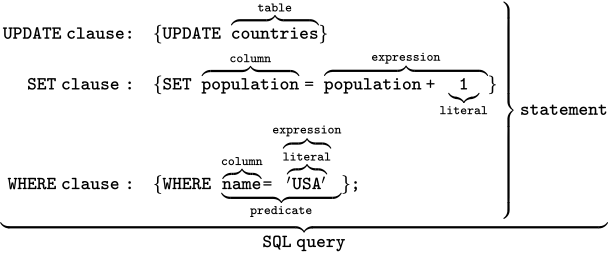
The SQL language is subdivided into several language elements, including:
- Clauses, which are constituent components of statements and queries. (In some cases, these are optional.)[39]
- Expressions, which can produce either scalar values, or tables consisting of columns and rows of data
- Predicates, which specify conditions that can be evaluated to SQL three-valued logic (3VL) (true/false/unknown) or Boolean truth values and are used to limit the effects of statements and queries, or to change program flow.
- Queries, which retrieve the data based on specific criteria. This is an important element of SQL.
- Statements, which may have a persistent effect on schemata and data, or may control transactions, program flow, connections, sessions, or diagnostics.
- SQL statements also include the semicolon (";") statement terminator. Though not required on every platform, it is defined as a standard part of the SQL grammar.
- Insignificant whitespace is generally ignored in SQL statements and queries, making it easier to format SQL code for readability.
Procedural extensions
[edit]SQL is designed for a specific purpose: to query data contained in a relational database. SQL is a set-based, declarative programming language, not an imperative programming language like C or BASIC. However, extensions to Standard SQL add procedural programming language functionality, such as control-of-flow constructs.
In addition to the standard SQL/PSM extensions and proprietary SQL extensions, procedural and object-oriented programmability is available on many SQL platforms via DBMS integration with other languages. The SQL standard defines SQL/JRT extensions (SQL Routines and Types for the Java Programming Language) to support Java code in SQL databases. Microsoft SQL Server 2005 uses the SQLCLR (SQL Server Common Language Runtime) to host managed .NET assemblies in the database, while prior versions of SQL Server were restricted to unmanaged extended stored procedures primarily written in C. PostgreSQL lets users write functions in a wide variety of languages—including Perl, Python, Tcl, JavaScript (PL/V8) and C.[40]
Alternatives
[edit]A distinction should be made between alternatives to SQL as a language, and alternatives to the relational model itself. Below are proposed relational alternatives to the SQL language. See navigational database and NoSQL for alternatives to the relational model.
- .QL: object-oriented Datalog
- 4D Query Language (4D QL)
- Datalog: critics suggest that Datalog has two advantages over SQL: it has cleaner semantics, which facilitates program understanding and maintenance, and it is more expressive, in particular for recursive queries.[41]
- HTSQL: URL based query method
- IBM Business System 12 (IBM BS12): one of the first fully relational database management systems, introduced in 1982
- ISBL
- jOOQ: SQL implemented in Java as an internal domain-specific language
- Java Persistence Query Language (JPQL): The query language used by the Java Persistence API and Hibernate persistence library
- JavaScript: MongoDB implements its query language in a JavaScript API.
- LINQ: Runs SQL statements written like language constructs to query collections directly from inside .Net code
- Object Query Language
- QBE (Query By Example) created by Moshè Zloof, IBM 1977
- QUEL introduced in 1974 by the U.C. Berkeley Ingres project, closer to tuple relational calculus than SQL
- XQuery
Distributed SQL processing
[edit]Distributed Relational Database Architecture (DRDA) was designed by a workgroup within IBM from 1988 to 1994. DRDA enables network-connected relational databases to cooperate to fulfill SQL requests.[42][43]
An interactive user or program can issue SQL statements to a local RDB and receive tables of data and status indicators in reply from remote RDBs. SQL statements can also be compiled and stored in remote RDBs as packages and then invoked by package name. This is important for the efficient operation of application programs that issue complex, high-frequency queries. It is especially important when the tables to be accessed are located in remote systems.
The messages, protocols, and structural components of DRDA are defined by the Distributed Data Management Architecture. Distributed SQL processing ala DRDA is distinctive from contemporary distributed SQL databases.
Criticisms
[edit]Design
[edit]SQL deviates in several ways from its theoretical foundation, the relational model and its tuple calculus. In that model, a table is a set of tuples, while in SQL, tables and query results are lists of rows; the same row may occur multiple times, and the order of rows can be employed in queries (e.g., in the LIMIT clause).
Critics argue that SQL should be replaced with a language that returns strictly to the original foundation: for example, see The Third Manifesto by Hugh Darwen and C.J. Date (2006, ISBN 0-321-39942-0).
Orthogonality and completeness
[edit]Early specifications did not support major features, such as primary keys. Result sets could not be named, and subqueries had not been defined. These were added in 1992.[12]
The lack of sum types has been described as a roadblock to full use of SQL's user-defined types. JSON support, for example, needed to be added by a new standard in 2016.[44]
Null
[edit]The concept of Null is the subject of some debate. The Null marker indicates the absence of a value, and is distinct from a value of 0 for an integer column or an empty string for a text column. The concept of Nulls enforces the 3-valued-logic in SQL, which is a concrete implementation of the general 3-valued logic.[12]
Duplicates
[edit]Another popular criticism is that it allows duplicate rows, making integration with languages such as Python, whose data types might make accurately representing the data difficult,[12] in terms of parsing and by the absence of modularity. This is usually avoided by declaring a primary key, or a unique constraint, with one or more columns that uniquely identify a row in the table.
Impedance mismatch
[edit]In a sense similar to object–relational impedance mismatch, a mismatch occurs between the declarative SQL language and the procedural languages in which SQL is typically embedded.[citation needed]
SQL data types
[edit]The SQL standard defines three kinds of data types (chapter 4.1.1 of SQL/Foundation):
- predefined data types
- constructed types
- user-defined types.
Constructed types are one of ARRAY, MULTISET, REF (reference), or ROW. User-defined types are comparable to classes in object-oriented language with their own constructors, observers, mutators, methods, inheritance, overloading, overwriting, interfaces, and so on. Predefined data types are intrinsically supported by the implementation.
Predefined data types
[edit]- Character types
- Character (
CHAR) - Character varying (
VARCHAR) - Character large object (
CLOB)
- Character (
- National character types
- National character (
NCHAR) - National character varying (
NCHAR VARYING) - National character large object (
NCLOB)
- National character (
- Binary types
- Binary (
BINARY) - Binary varying (
VARBINARY) - Binary large object (
BLOB)
- Binary (
- Numeric types
- Exact numeric types (
NUMERIC,DECIMAL,SMALLINT,INTEGER,BIGINT) - Approximate numeric types (
FLOAT,REAL,DOUBLE PRECISION) - Decimal floating-point type (
DECFLOAT)
- Exact numeric types (
- Datetime types (
DATE,TIME,TIMESTAMP) - Interval type (
INTERVAL) - Boolean
- XML (see SQL/XML)[45]
- JSON
See also
[edit]- Object database
- List of relational database management systems
- List of SQL software and tools
- List of SQL programming books
- Comparison of relational database management systems
- Comparison of object–relational database management systems
- Query by Example
- SQL reserved words
- SQL syntax
- Oracle PL/SQL
- Microsoft Transact-SQL (T-SQL)
- Online transaction processing (OLTP)
- Online analytical processing (OLAP)
- Data warehouse
- Relational data stream management system
- NoSQL
- MUMPS
- Hierarchical database model
- Star schema
- Snowflake schema
Notes
[edit]References
[edit]- ^ Paul, Ryan (24 October 2005). "A guided tour of the Microsoft Command Shell". Ars Technica. Retrieved 10 April 2011.
- ^ "Media Type registration for application/sql". Internet Assigned Numbers Authority. 10 April 2013. Archived from the original on 7 May 2013. Retrieved 10 April 2013.
- ^ Shafranovich, Y. (April 2013). "The application/sql Media Type, RFC 6922". Internet Engineering Task Force. p. 3. doi:10.17487/RFC6922. Archived from the original on 13 October 2014. Retrieved 10 April 2013.
- ^ Beaulieu, Alan (April 2009). Mary E Treseler (ed.). Learning SQL (2nd ed.). Sebastopol, CA, USA: O'Reilly. ISBN 978-0-596-52083-0.
- ^ Chamberlin, Donald D.; Frana, Philip L. (3 October 2001). "Oral history interview with Donald D. Chamberlin". University Digital Conservancy. hdl:11299/107215. Archived from the original on 24 February 2020. Retrieved 14 January 2020.
We changed the original name "SEQUEL" to SQL because we got a letter from somebody's lawyer that said the name "SEQUEL" belonged to them. We shortened it to SQL, for Structured Query Language, and the product was known as SQL/DS.
- ^ SQL-92, 4.22 SQL-statements, 4.22.1 Classes of SQL-statements "There are at least five ways of classifying SQL-statements:", 4.22.2, SQL statements classified by function "The following are the main classes of SQL-statements:"; SQL:2003 4.11 SQL-statements, and later revisions.
- ^ Chatham, Mark (2012). Structured Query Language By Example - Volume I: Data Query Language. Lulu.com. p. 8. ISBN 978-1-291-19951-2.
- ^ Codd, Edgar F. (June 1970). "A Relational Model of Data for Large Shared Data Banks". Communications of the ACM. 13 (6): 377–87. CiteSeerX 10.1.1.88.646. doi:10.1145/362384.362685. S2CID 207549016.
- ^ a b Chapple, Mike. "SQL Fundamentals". Databases. About.com. Archived from the original on 22 February 2009. Retrieved 28 January 2009.
- ^ "Structured Query Language (SQL)". International Business Machines. 27 October 2006. Retrieved 10 June 2007.
- ^ a b "ISO 9075:1987: Information technology – Database languages – SQL – Part 1: Framework (SQL/Framework)". 1 June 2023. Retrieved 24 June 2025.
- ^ a b c d e f Chamberlin, Donald (2012). "Early History of SQL". IEEE Annals of the History of Computing. 34 (4): 78–82. doi:10.1109/MAHC.2012.61. S2CID 1322572.
- ^ a b c Chamberlin, Donald D; Boyce, Raymond F (1974). "SEQUEL: A Structured English Query Language" (PDF). Proceedings of the 1974 ACM SIGFIDET Workshop on Data Description, Access and Control. Association for Computing Machinery: 249–64. Archived from the original (PDF) on 26 September 2007. Retrieved 9 June 2007.
- ^ Starkey, Jim. "Dynamic SQL, Plumbing, and the Internal API". www.ibphoenix.com. Archived from the original on 19 January 2023. Retrieved 19 January 2023.
- ^ a b Oppel, Andy (27 February 2004). Databases Demystified. San Francisco, CA: McGraw-Hill Osborne Media. pp. 90–1. ISBN 978-0-07-146960-9. Archived from the original on 14 January 2012. Retrieved 12 May 2011.
- ^ Yasar, Kinza; Loshin, Peter; Sirkin, Jessica. "What is Structured Query Language (SQL)? | Definition from TechTarget". Search Data Management. Informa TechTarget. Archived from the original on 10 March 2025. Retrieved 25 March 2025.
- ^ "History of IBM, 1978". IBM Archives. IBM. 23 January 2003. Archived from the original on 17 January 2005. Retrieved 9 June 2007.
- ^ Morgenthaler, Gary (8 December 2005). "Oral History of Gary Morgenthaler" (PDF) (Interview). Interviewed by Luann Johnson. Computer History Museum. p. 18. Retrieved 30 May 2025.
- ^ "ISO - ISO/IEC JTC 1/SC 32 - Data management and interchange". www.iso.org. Archived from the original on 16 March 2017. Retrieved 2 January 2021.
- ^ "About PostgreSQL". PostgreSQL 9.1 official website. PostgreSQL Global Development Group. 2012. Archived from the original on 9 March 2012. Retrieved 9 March 2012.
PostgreSQL prides itself in standards compliance. Its SQL implementation strongly conforms to the ANSI-SQL:2008 standard
- ^ "Mimer SQL, Built on Standards". Mimer SQL official website. Mimer Information Technology. 2009. Archived from the original on 3 May 2016. Retrieved 11 December 2018.
- ^ "4.1. Lexical Structure". PostgreSQL documentation. 2018. Archived from the original on 5 October 2018. Retrieved 11 December 2018.
- ^ "(Second Informal Review Draft) ISO/IEC 9075:1992, Database Language SQL, Section 5.2, syntax rule 11". 30 July 1992. Archived from the original on 21 June 2006. Retrieved 8 October 2009.
- ^ Lorentz, Diana; Roeser, Mary Beth; Abraham, Sundeep; Amor, Angela; Arora, Geeta; Arora, Vikas; Ashdown, Lance; Baer, Hermann; Bellamkonda, Shrikanth (October 2010) [1996]. "Basic Elements of Oracle SQL: Data Types". Oracle Database SQL Language Reference 11g Release 2 (11.2). Oracle Database Documentation Library. Redwood City, CA: Oracle USA, Inc. Archived from the original on 20 November 2010. Retrieved 29 December 2010.
For each
DATEvalue, Oracle stores the following information: century, year, month, date, hour, minute, and second - ^ Lorentz, Diana; Roeser, Mary Beth; Abraham, Sundeep; Amor, Angela; Arora, Geeta; Arora, Vikas; Ashdown, Lance; Baer, Hermann; Bellamkonda, Shrikanth (October 2010) [1996]. "Basic Elements of Oracle SQL: Data Types". Oracle Database SQL Language Reference 11g Release 2 (11.2). Oracle Database Documentation Library. Redwood City, CA: Oracle USA, Inc. Archived from the original on 20 November 2010. Retrieved 29 December 2010.
The datetime data types are
DATE... - ^ Lorentz, Diana; Roeser, Mary Beth; Abraham, Sundeep; Amor, Angela; Arora, Geeta; Arora, Vikas; Ashdown, Lance; Baer, Hermann; Bellamkonda, Shrikanth (October 2010) [1996]. "Basic Elements of Oracle SQL: Data Types". Oracle Database SQL Language Reference 11g Release 2 (11.2). Oracle Database Documentation Library. Redwood City, CA: Oracle USA, Inc. Archived from the original on 20 November 2010. Retrieved 29 December 2010.
Do not define columns with the following SQL/DS and DB2 data types, because they have no corresponding Oracle data type:...
TIME - ^ Date, Chris J. (2013). Relational Theory for Computer Professionals: What Relational Databases are Really All About (1. ed.). Sebastopol, Calif: O'Reilly Media. ISBN 978-1-449-36943-9.
- ^ "Finding Aid". X3H2 Records, 1978–95. American National Standards Institute. Archived from the original on 19 June 2010. Retrieved 26 April 2008.
- ^ Doll, Shelley (19 June 2002). "Is SQL a Standard Anymore?". TechRepublic's Builder.com. TechRepublic. Archived from the original on 5 July 2012. Retrieved 12 April 2016.
- ^ a b Gillespie, Patrick. "Pronouncing SQL: S-Q-L or Sequel?". Archived from the original on 27 May 2012. Retrieved 12 February 2012.
- ^ Melton, Jim; Alan R Simon (1993). "1.2. What is SQL?". Understanding the New SQL: A Complete Guide. Morgan Kaufmann. p. 536. ISBN 978-1-55860-245-8.
SQL (correctly pronounced "ess cue ell," instead of the somewhat common "sequel")...
- ^ Wagner, Michael (2010). SQL/XML:2006 - Evaluierung der Standardkonformität ausgewählter Datenbanksysteme. Diplomica Verlag. p. 100. ISBN 978-3-8366-9609-8.
- ^ "SQL:2008 now an approved ISO international standard". Sybase. July 2008. Archived from the original on 28 June 2011.
- ^ Krishna Kulkarni, Jan-Eike Michels (September 2012). "Temporal features in SQL:2011" (PDF). SIGMOD Record. 41 (3).
- ^ Fred Zemke (2012). "What's new in SQL:2011" (PDF). Oracle Corporation.
- ^ "ISO/IEC 9075". Archived from the original on 12 August 2022. Retrieved 9 August 2022.
- ^ SQL:1992 draft (text), archived from the original on 21 June 2006, retrieved 8 October 2009
- ^ SQL:2011 draft, Whitemarsh Information Systems Corporation, archived from the original (Zip) on 25 May 2023
- ^ ANSI/ISO/IEC International Standard (IS). Database Language SQL—Part 2: Foundation (SQL/Foundation). 1999.
- ^ "PostgreSQL server programming". PostgreSQL 9.1 official documentation. postgresql.org. 2011. Archived from the original on 2 March 2012. Retrieved 9 March 2012.
- ^ Fernando Saenz-Perez. "Outer Joins in a Deductive Database System" (PDF). Lbd.udc.es. Archived (PDF) from the original on 9 August 2016. Retrieved 16 January 2017.
- ^ Reinsch, R. (1988). "Distributed database for SAA". IBM Systems Journal. 27 (3): 362–389. doi:10.1147/sj.273.0362.
- ^ Distributed Relational Database Architecture Reference. IBM Corp. SC26-4651-0. 1990.
- ^ Brandon, Jamie (July 2021). "Against SQL". Retrieved 2 August 2021.
- ^ "SQL 2003 Standard Support in Oracle Database 10g" (PDF). Oracle. Oracle Corporation. November 2003. Archived (PDF) from the original on 27 March 2024. Retrieved 27 March 2024. XML supported was added in ANSI SQL 2003, part 14.
Sources
[edit]- Codd, Edgar F (June 1970). "A Relational Model of Data for Large Shared Data Banks". Communications of the ACM. 13 (6): 377–87. doi:10.1145/362384.362685. S2CID 207549016.
- Discussion on alleged SQL flaws (C2 wiki)
- C. J. Date with Hugh Darwen: A Guide to the SQL standard : a users guide to the standard database language SQL, 4th ed., Addison Wesley, USA 1997, ISBN 978-0-201-96426-4
External links
[edit]- 1995 SQL Reunion: People, Projects, and Politics, by Paul McJones (ed.): transcript of a reunion meeting devoted to the personal history of relational databases and SQL.
- American National Standards Institute. X3H2 Records, 1978–1995 Charles Babbage Institute Collection documents the H2 committee's development of the NDL and SQL standards.
- Oral history interview with Donald D. Chamberlin Charles Babbage Institute In this oral history Chamberlin recounts his early life, his education at Harvey Mudd College and Stanford University, and his work on relational database technology. Chamberlin was a member of the System R research team and, with Raymond F. Boyce, developed the SQL database language. Chamberlin also briefly discusses his more recent research on XML query languages.


| International | |
|---|---|
| National | |
| Other | |

History and Development
Origins in Relational Model
The origins of SQL trace back to Edgar F. Codd's seminal 1970 paper, "A Relational Model of Data for Large Shared Data Banks," which introduced the relational model as a framework for managing large-scale data storage and retrieval.[3] In this work, Codd proposed representing data as relations—essentially tables with rows and columns—drawing from mathematical set theory to ensure data independence, where changes to physical storage do not affect logical access. Central to the model was relational algebra, a procedural query language comprising operations like restriction (selection of rows based on conditions), projection (selection of specific columns while eliminating duplicates), and join (combining relations on common attributes). These operations provided a formal basis for manipulating relations without navigating physical pointers, addressing limitations in earlier hierarchical and network models.[3] Building directly on Codd's relational model, IBM initiated the System R project in 1974 at its San Jose Research Laboratory to prototype a full relational database management system (DBMS). The project team, including Donald D. Chamberlin and Raymond F. Boyce, developed SEQUEL (Structured English QUEry Language) as the query interface, aiming to translate relational algebra into an English-like, declarative syntax accessible to non-programmers. Unlike procedural languages that required specifying how to retrieve data, SEQUEL focused on what data was needed, allowing users to express queries without concern for storage details or execution paths. This approach supported ad hoc querying, programmed transactions, and dynamic environments with concurrency control and recovery mechanisms. The name SEQUEL was later shortened to SQL in 1974 due to a trademark conflict with the UK-based Hawker Siddeley aircraft company.[4] Key early features of SEQUEL/SQL directly mirrored relational algebra primitives, emphasizing simplicity and power for relational data manipulation. The SELECT statement implemented selection and projection, enabling users to filter rows by conditions and choose specific columns, as in retrieving employee names where salary exceeds a threshold. JOIN operations facilitated combining related tables, such as merging employee and department relations on a shared key, preserving Codd's emphasis on value-based associations over links. During System R's Phase Zero (1974–1975), an initial prototype supported basic SELECT with subqueries, while full JOIN capabilities emerged in subsequent phases by 1979, validating the language's viability for practical relational DBMS. These foundations established SQL as a user-friendly bridge between theoretical relational algebra and real-world database applications.Key Milestones and Implementations
The first commercial implementation of SQL arrived with Oracle Version 2 in 1979, marking the debut of a fully relational database management system (RDBMS) available to businesses. Developed by Relational Software, Inc. (later renamed Oracle Corporation), this release introduced SQL as a practical query language for structured data management, enabling efficient data retrieval and manipulation on minicomputers like the Digital Equipment Corporation's PDP-11.[5] Oracle's pioneering effort set the stage for SQL's transition from research prototype to enterprise tool, supporting early applications in inventory and financial systems.[6] IBM followed with DB2 in 1983, a pivotal enterprise RDBMS that integrated SQL into mainframe environments, particularly on the MVS operating system. Announced on June 7, 1983, and generally available in 1985, DB2 emphasized scalability and reliability for large-scale transaction processing, becoming a cornerstone for banking and government operations.[7] Its adoption accelerated SQL's use in mission-critical workloads, with features like data sharing and high availability driving compliance with emerging standards.[8] Microsoft entered the SQL landscape in 1989 with SQL Server 1.0, initially a joint venture with Sybase and Ashton-Tate to port SQL functionality to OS/2 and later Windows platforms. This release targeted mid-range servers, offering cost-effective alternatives to mainframe systems and facilitating SQL's penetration into personal computing and departmental applications.[9] By providing tools for developers to build client-server architectures, SQL Server boosted SQL's accessibility for small to medium enterprises, evolving into a dominant force in Windows ecosystems.[10] The open-source movement democratized SQL access in the mid-1990s, beginning with MySQL's founding in 1995 by David Axmark, Allan Larsson, and Michael "Monty" Widenius. The first stable release in May 1995 introduced a lightweight, multi-threaded RDBMS optimized for web applications, rapidly gaining traction among startups for its ease of deployment and zero-cost licensing. Similarly, PostgreSQL emerged in 1996 as an evolution of the academic Postgres project, with version 6.0 renaming it to highlight SQL compliance while retaining advanced features like extensible types.[11] These implementations lowered barriers to entry, enabling widespread experimentation and contributing to SQL's ubiquity in internet infrastructure.[12] Standardization efforts culminated in ANSI's SQL-86 approval in 1986, the first formal specification (ANSI X3.135) that defined core SQL syntax for data definition and manipulation, adopted internationally by ISO in 1987.[2] This standard spurred vendor compliance, with early adopters like Oracle and IBM aligning products to its entry-level requirements, reducing proprietary dialects and fostering interoperability.[13] Over time, growing adherence—evident in certifications for SQL-89 revisions—encouraged broader ecosystem integration, though full conformity varied by vendor.[14] SQL played a central role in the late 1990s dot-com boom, powering the rapid scaling of web databases for e-commerce and content management sites. As internet traffic surged, RDBMS like Oracle and MySQL handled dynamic queries for user sessions and transactions, supporting the era's "get big fast" strategies amid explosive venture funding.[15] This period solidified SQL's position in high-volume environments, with adoption rates accelerating as companies built data-driven platforms.[16] In the 2010s big data era, SQL adapted through integrations with distributed frameworks like Hadoop and Apache Spark, enabling queries over petabyte-scale datasets. Tools such as Apache Hive (introduced in 2008 but maturing in the 2010s) provided SQL interfaces on Hadoop's HDFS, while Spark SQL (released in 2014) offered in-memory processing for faster analytics on unstructured data.[17] These extensions preserved SQL's declarative paradigm, bridging traditional RDBMS with NoSQL systems and facilitating hybrid architectures in cloud environments.Evolution to Modern Standards
The SQL standards evolved iteratively through revisions managed by ANSI and ISO, incorporating enhancements to address growing data complexity and analytical needs. The inaugural SQL-86 standard, published by ANSI in 1986 and adopted by ISO in 1987, established core syntax for data definition (DDL) and manipulation (DML), including SELECT, INSERT, UPDATE, DELETE, and basic schema elements like tables and views.[2] SQL-89, a minor update in 1989, introduced integrity constraints such as primary keys, foreign keys, DEFAULT values, and CHECK conditions.[13] SQL-92, released in 1992, expanded query capabilities with explicit JOIN types (including outer joins), subqueries, set operations (UNION, INTERSECT, EXCEPT), and the CASE expression, while adding support for date/time data types and transaction isolation levels.[13] Subsequent standards built on this foundation with advanced features. SQL:1999 introduced common table expressions (CTEs) enabling recursive queries, along with OLAP extensions like ROLLUP, CUBE, and GROUPING SETS for multidimensional analysis.[13] SQL:2003 added window functions for row-based analytics, XML data type and querying support, and sequence generators.[13] SQL:2008 incorporated temporal data handling, the MERGE statement for upsert operations, and the TRUNCATE TABLE command.[18] SQL:2011 refined temporal features with period specifications and enhanced window framing options.[13] SQL:2016 introduced row pattern recognition via the MATCH_RECOGNIZE clause for identifying sequences in result sets, initial JSON functions for document handling, and polymorphic table functions for dynamic schemas.[19] The current SQL:2023 standard adds property graph queries (SQL/PGQ) as a new part for modeling and traversing graph data within relational tables, alongside a native JSON data type and expanded JSON operations.[20] The advent of big data frameworks prompted SQL adaptations for distributed environments. Apache Hive, developed at Facebook and open-sourced in 2008, introduced HiveQL—a SQL dialect for querying petabyte-scale data stored in Hadoop Distributed File System (HDFS)—bridging traditional SQL with MapReduce processing.[21] Spark SQL, integrated into Apache Spark and first released in 2014, enabled SQL queries over structured data with in-memory computation, supporting complex analytics across clusters far beyond traditional RDBMS limits.[22] Database vendors extended standards with proprietary innovations while pursuing compliance. PostgreSQL attained full SQL-92 conformance in version 7.2, released in 2001, incorporating features like primary keys, quoted identifiers, and enhanced type casting.[23] It later innovated with the JSONB type in version 9.4 (2014), a binary format for efficient JSON storage and indexing, predating native standard support. Cloud-native services further modernized SQL by emphasizing serverless execution. Google BigQuery, announced in 2010 and generally available in 2011, pioneered a serverless data warehouse using standard SQL to analyze terabytes of data without managing infrastructure.[24] AWS Athena, launched in 2016, extended this model by allowing ad-hoc SQL queries on data in Amazon S3, leveraging Presto for federated access and pay-per-query pricing.[25]Standardization and Interoperability
Standardization Process
The standardization of SQL began with the American National Standards Institute (ANSI), which published the first formal SQL standard in 1986 as ANSI X3.135, aiming to establish a common language for relational database management systems amid growing proprietary implementations by vendors.[2] This effort was adopted internationally by the International Organization for Standardization (ISO) and the International Electrotechnical Commission (IEC) in 1987 as ISO/IEC 9075, marking the start of ongoing global coordination.[13] The primary responsibility for developing and revising SQL standards now lies with the ISO/IEC Joint Technical Committee 1 (JTC1) Subcommittee 32 (SC32) on Data Management and Interchange, specifically its Working Group 3 (WG3) on Database Languages.[26] The standardization process is managed through collaborative drafting by WG3, which consists of representatives from national standards bodies, industry experts, and database vendors; this group convenes regular meetings—both in-person and virtual—to propose, debate, and refine technical specifications.[27] Drafts undergo rigorous public review and balloting phases, where national member bodies submit comments and votes, often requiring multiple editing meetings to resolve issues before final approval by ISO.[27] Major revisions typically occur in multi-year cycles of 3 to 5 years, though earlier intervals like the seven-year gap between SQL-92 and SQL:1999 reflect the complexity of achieving consensus on evolving features.[28] For instance, the development of SQL:2023 involved over 30 WG3 meetings spanning several years, culminating in the submission of final text to the ISO Central Secretariat in early 2023.[20] The core goals of this process are to promote portability and interoperability across database systems, thereby reducing vendor lock-in by defining a baseline of consistent behavior that implementations can rely upon without proprietary dependencies.[29] Standards distinguish between mandatory "Core SQL" features, which all conforming implementations must support, and optional "Enhanced SQL" features, allowing vendors flexibility for advanced capabilities while ensuring basic compatibility.[30] In the 1980s, the push for standardization arose directly from concerns over vendor-specific SQL dialects that locked users into particular systems, a problem addressed by ANSI's initial effort and amplified by the comprehensive SQL-92 revision, which achieved widespread adoption as vendors aligned their products with its entry-level requirements to demonstrate compliance.[31][32] In recent cycles, the process has incorporated deliberations on modern data management needs, such as enhanced support for JSON data handling and property graph queries, reflecting WG3's adaptation to contemporary applications like semi-structured data processing.[20] These updates maintain the standard's relevance by balancing backward compatibility with incremental innovations, ensuring SQL remains a foundational technology for database interoperability.[33]Current SQL Standard (SQL:2023)
The SQL:2023 standard, officially known as ISO/IEC 9075:2023, was published by the International Organization for Standardization (ISO) and the International Electrotechnical Commission (IEC) in June 2023.[34] This ninth edition of the SQL standard builds upon previous versions by introducing enhancements to support modern data models and querying paradigms. The standard is structured into 11 active parts, each addressing specific aspects of the language. For instance, Part 1 defines the framework, including grammar and processing rules; Part 2 covers the foundation, encompassing core data manipulation and JSON features; Part 9 addresses management of external data; and Part 11 provides information and definition schemas. A notable addition is Part 16, dedicated to property graph queries.[34][20] Key new features in SQL:2023 emphasize integration with contemporary data structures. The introduction of property graph queries in Part 16 allows users to model and traverse tabular data as property graphs using the MATCH clause, enabling efficient graph-based operations like path finding and pattern matching without requiring a separate graph database.[35] Additionally, Part 2 enhances JSON support with a native JSON data type (feature T801), simplified path accessors, and item methods for constructing and manipulating JSON values, including functions for dates and times that align with ISO 8601 formatting conventions. The MERGE statement receives further refinements under optional feature F313, supporting more flexible conditional inserts, updates, and deletes in scenarios involving complex data synchronization. These additions aim to bridge relational and non-relational paradigms while maintaining backward compatibility.[20][36] Adoption of SQL:2023 remains partial across major database systems, as many features are optional and full compliance is uncommon due to implementation choices and performance considerations. PostgreSQL 18, released in November 2025, builds on PostgreSQL 16's (September 2023) initial enhancements, such as improved JSON functions and greatest/least aggregates, incorporating additional core aspects of the standard. Oracle Database 23ai (updated as of October 2025), succeeding the 23c preview from 2023, supports a broader range, including the new property graph queries via SQL/PGQ and advanced JSON capabilities, positioning it as one of the more comprehensive implementations. However, no vendor achieves complete adherence to all optional features, leading to variations in supported syntax and behavior. Work on the next revision of the SQL standard is underway within ISO/IEC JTC1/SC32, expected in 3-5 years.[37][38][39][35]Compatibility Challenges Across Implementations
Despite efforts toward standardization, SQL implementations by major database vendors introduce compatibility challenges through proprietary extensions, selective adoption of optional features, and maintenance of legacy behaviors. Vendor extensions, such as Oracle's PL/SQL for procedural programming and MySQL's distinct stored routine syntax, enhance functionality but diverge from the core SQL standard, complicating cross-database portability.[40][41] Optional features in the SQL standard, like advanced window functions, are implemented inconsistently— for instance, some systems require specific syntax variations—while legacy support preserves older, non-standard behaviors to avoid breaking existing applications.[42] Specific incompatibilities arise in common operations, including date handling, where systems differ in default formats and conversion rules. SQL Server relies on vendor-specific datetime types with implicit conversions that may lose precision when ported to systems like PostgreSQL, which adheres more closely to ISO 8601 standards for dates.[43][44] Pagination syntax varies notably, with Microsoft SQL Server using the TOP clause (e.g., SELECT TOP 10 * FROM table) while MySQL and PostgreSQL employ LIMIT (e.g., SELECT * FROM table LIMIT 10), requiring query rewrites for interoperability.[45] Regular expression support also differs: Oracle uses REGEXP_LIKE with POSIX-like patterns, SQL Server 2025 introduced REGEXP functions with its own dialect, and MySQL applies REGEXP with simpler Perl-compatible extensions, leading to pattern mismatches across platforms.[46][47][48] To mitigate these issues, tools like SQLAlchemy provide an abstraction layer that generates dialect-specific SQL from neutral Python code, supporting over 20 databases since its initial release in 2005.[49] Database migration services, such as Azure Database Migration Service and Google Cloud's Database Migration Service, automate schema and query translations during transitions, handling dialect differences through built-in converters.[50][51] A representative case study involves porting queries from SQLite, an embedded database with non-standard SQL extensions like flexible typing, to IBM DB2, an enterprise system enforcing stricter type rules and lacking SQLite's PRAGMA statements. Developers must rewrite SQLite-specific date functions (e.g., strftime) to DB2's TIMESTAMP_FORMAT and adjust for DB2's absence of LIMIT, using FETCH FIRST instead, often requiring iterative testing to resolve syntax errors and performance discrepancies.[52] Recent trends show increasing convergence through cloud providers, where services like Google Cloud SQL for MySQL enable an ANSI SQL mode via the sql_mode flag (e.g., setting ANSI_QUOTES), reducing reliance on vendor-specific quirks and promoting standard-compliant queries across hybrid environments.[53]Core Syntax and Components
Declarative Query Structure
SQL employs a declarative paradigm, allowing users to specify the desired output data—what to retrieve—without prescribing the method of computation, leaving execution optimization to the database management system (DBMS). This non-procedural approach contrasts with imperative languages by focusing on set-oriented operations rather than row-by-row iteration, enabling concise expressions of complex queries. As introduced in the original SEQUEL design, this structure facilitates interaction by non-specialists through simple block-structured English keywords.[54] The foundational query in SQL is the SELECT statement, which follows the basic syntax:SELECT [DISTINCT] column_list FROM table_list [WHERE condition] [ORDER BY sort_expression] [GROUP BY grouping_expression]. This structure begins with selecting columns or expressions to include in the result (projection), identifies the source tables (relation), applies filtering conditions (restriction), and optionally sorts or groups the output. For instance, to retrieve names of employees earning more than $50,000 from an employees table, one might write:
SELECT name
FROM employees
WHERE salary > 50000
ORDER BY name;
SELECT name
FROM employees
WHERE salary > 50000
ORDER BY name;
Data Definition Language (DDL)
Data Definition Language (DDL) encompasses the subset of SQL commands responsible for defining, modifying, and deleting database schemas and structures, enabling the creation of foundational elements like tables and their associated components. These commands are integral to the ANSI/ISO SQL standard (ISO/IEC 9075), with core DDL features originating from SQL-86 and remaining largely consistent through subsequent revisions, including SQL:2023.[34][58] DDL's emphasis on schema management ensures that database objects adhere to relational principles, such as integrity constraints, without directly manipulating data content. Due to its high level of standardization, DDL statements exhibit strong portability across major RDBMS vendors like Oracle, PostgreSQL, and SQL Server, minimizing syntax variations for basic operations.[29] The CREATE TABLE statement is the cornerstone of DDL, allowing users to define a new table by specifying column names, data types, and optional constraints to enforce data integrity. For instance, to create a "Customers" table with an integer ID as the primary key, a variable-length string for the name, and an email field with a NOT NULL constraint, the following syntax can be used:CREATE TABLE Customers (
ID INT PRIMARY KEY,
Name VARCHAR(100),
Email VARCHAR(255) NOT NULL
);
CREATE TABLE Customers (
    ID INT PRIMARY KEY,
    Name VARCHAR(100),
    Email VARCHAR(255) NOT NULL
);
ALTER TABLE Customers ADD Phone [VARCHAR](/page/Varchar)(20);
ALTER TABLE Customers ADD Phone [VARCHAR](/page/Varchar)(20);
ALTER TABLE Customers DROP COLUMN Phone;) or adding a FOREIGN KEY constraint to reference another table. Such alterations align with ISO/IEC 9075-2 (Foundation) requirements for schema evolution, though complex changes may require temporary tables in some implementations to preserve data.[59] Conversely, the DROP TABLE command removes an entire table and its data irreversibly, as shown by:
DROP TABLE Customers;
DROP TABLE Customers;
DROP TABLE Customers CASCADE;), ensuring clean schema cleanup.
Beyond tables, DDL includes commands for schema elements that enhance structure and performance. The CREATE INDEX statement builds an index on one or more columns to accelerate query retrieval, particularly for frequently searched fields; for example:
CREATE INDEX idx_email ON Customers(Email);
CREATE INDEX idx_email ON Customers(Email);
CREATE VIEW ActiveCustomers AS
SELECT ID, Name FROM Customers WHERE Status = 'Active';
CREATE VIEW ActiveCustomers AS
SELECT ID, Name FROM Customers WHERE Status = 'Active';
Data Manipulation Language (DML)
Data Manipulation Language (DML) encompasses the SQL statements responsible for modifying data within relational database tables, including adding, altering, and removing records. These operations are essential for maintaining and updating database contents in a declarative manner, where the user specifies what changes to make without detailing how the database engine executes them. Defined in the core of the SQL standard (ISO/IEC 9075-2: Foundation), DML statements form a foundational component of the language, enabling efficient data handling across compliant systems.[60][34] The INSERT statement adds one or more new rows to a specified table, either by providing explicit values or by selecting data from another query. Its basic syntax follows the formINSERT INTO table_name (column_list) VALUES (value_list);, allowing insertion of single or multiple rows in a single operation. For instance, to add an employee record, one might use INSERT INTO Employees (id, name, salary) VALUES (101, 'Alice Johnson', 75000);. This statement conforms to the SQL standard, with extensions like RETURNING for retrieving inserted data available in some implementations but not part of the core specification.[61][34]
The UPDATE statement modifies existing rows in a table by changing the values of specified columns, typically conditioned on a WHERE clause to target specific records. The syntax is UPDATE table_name SET column1 = expression1, column2 = expression2, ... WHERE condition;, which updates only the rows matching the condition and leaves others unchanged. An example is UPDATE Employees SET salary = salary * 1.1 WHERE department = 'IT';, which increases salaries for IT department employees by 10%. UPDATE adheres to the SQL standard, supporting subqueries in the WHERE clause for complex conditional logic, such as referencing data from other tables.[62][34]
The DELETE statement removes rows from a table based on a specified condition, emptying the table if no WHERE clause is provided. Its syntax is DELETE FROM table_name WHERE condition;, which deletes matching rows and preserves the table structure. For example, DELETE FROM Employees WHERE status = 'inactive'; removes all inactive employee records. This operation aligns with the SQL standard, and like UPDATE, it integrates subqueries in the WHERE clause to enable deletions based on dynamic criteria from other sources.[63][34]
The MERGE statement, also known as UPSERT, combines INSERT, UPDATE, and optionally DELETE operations into a single atomic statement, conditionally applying changes based on a join between source and target data. Introduced as an optional feature in SQL:2003 (ISO/IEC 9075-2), its syntax involves MERGE INTO target_table USING source_table ON join_condition WHEN MATCHED THEN UPDATE ... WHEN NOT MATCHED THEN INSERT ...;. A practical example is synchronizing customer data: MERGE INTO Customers c USING NewCustomers n ON c.id = n.id WHEN MATCHED THEN UPDATE SET c.email = n.email WHEN NOT MATCHED THEN INSERT (id, email) VALUES (n.id, n.email);. MERGE enhances efficiency for bulk data synchronization tasks and supports subqueries in the source or conditions for refined matching.[64][65][34]
DML statements frequently integrate with SELECT through subqueries, allowing conditional modifications driven by queried data without needing separate transactions for reads and writes. For instance, an UPDATE might use a subquery like UPDATE Employees SET manager_id = (SELECT id FROM Managers WHERE location = 'HQ') WHERE department = 'Sales'; to assign a specific manager based on a dynamic selection. This capability, part of the SQL standard, promotes concise and powerful data manipulation while referencing schema elements defined elsewhere.[62][34]
Procedural and Control Features
Procedural Extensions (PL/SQL, T-SQL)
Procedural extensions to SQL introduce imperative programming constructs, enabling developers to write complex, reusable code within the database environment. These extensions augment SQL's declarative nature by incorporating control structures such as loops and conditionals, exception handling, and modular code organization through procedures and functions. Primarily vendor-specific, they facilitate tasks like data validation, business logic encapsulation, and batch processing directly in the database, reducing the need for external application code. Other databases offer similar extensions, such as PL/pgSQL in PostgreSQL, which implements much of the SQL/PSM standard.[66][67][68] PL/SQL, Oracle's procedural language extension, structures code into anonymous or named blocks that promote modularity and error management. A typical PL/SQL block consists of a DECLARE section for variable and exception declarations, a BEGIN section for executable statements, an optional EXCEPTION section for handling errors, and an END keyword to close the block. This structure supports conditional logic via IF-THEN-ELSE and CASE statements, as well as iterative control through LOOP, WHILE LOOP, and FOR LOOP constructs, allowing repetition based on conditions or predefined ranges. For instance, a simple FOR LOOP might iterate over a range to process records:DECLARE
counter NUMBER := 0;
BEGIN
FOR i IN 1..5 LOOP
counter := counter + i;
END LOOP;
END;
DECLARE
  counter NUMBER := 0;
BEGIN
  FOR i IN 1..5 LOOP
    counter := counter + i;
  END LOOP;
END;
BEGIN TRY
  -- Executable statements, e.g., a risky division
  SELECT 1 / 0;
END TRY
BEGIN CATCH
  SELECT ERROR_MESSAGE() AS ErrorDetails;
END CATCH;
BEGIN TRY
  -- Executable statements, e.g., a risky division
  SELECT 1 / 0;
END TRY
BEGIN CATCH
  SELECT ERROR_MESSAGE() AS ErrorDetails;
END CATCH;
CREATE PROCEDURE UpdateSalary @EmpID INT, @NewSalary DECIMAL(10,2)
AS
BEGIN
  UPDATE Employees SET Salary = @NewSalary WHERE EmployeeID = @EmpID;
END;
CREATE PROCEDURE UpdateSalary @EmpID INT, @NewSalary DECIMAL(10,2)
AS
BEGIN
  UPDATE Employees SET Salary = @NewSalary WHERE EmployeeID = @EmpID;
END;
EXEC UpdateSalary 123, 75000;. This modularity enhances maintainability and security by centralizing logic.[70]
Functions in procedural extensions return computed values, categorized as scalar or table-valued. Scalar functions return a single value, such as a string or number, and are often used in SELECT clauses for calculations like formatting dates. Table-valued functions, in contrast, return a result set resembling a table, enabling their use in JOINs or as data sources for further querying; they can be inline (single SELECT) or multi-statement for complex logic. In T-SQL, for instance:
CREATE FUNCTION GetEmployeeDetails (@DeptID INT)
RETURNS TABLE
AS
RETURN (SELECT * FROM Employees WHERE DepartmentID = @DeptID);
CREATE FUNCTION GetEmployeeDetails (@DeptID INT)
RETURNS TABLE
AS
RETURN (SELECT * FROM Employees WHERE DepartmentID = @DeptID);
SELECT * FROM GetEmployeeDetails(5);. Scalar functions, however, like one computing age from a birthdate, return one value per invocation: CREATE FUNCTION dbo.GetAge (@BirthDate DATE) RETURNS INT AS BEGIN RETURN DATEDIFF(YEAR, @BirthDate, GETDATE()); END;. These distinctions optimize performance, with table-valued functions generally preferred for set-based operations.[71]
Efforts to standardize procedural extensions culminated in SQL/PSM (Persistent Stored Modules), introduced in the SQL:1999 standard (ISO/IEC 9075-4:1999), which defines a portable syntax for stored procedures and functions using DECLARE for local variables, BEGIN...END for blocks, and control structures like IF and LOOP. SQL/PSM aims to enable cross-database compatibility by specifying parameter modes (IN, OUT, INOUT), cursors, and handlers, though adoption varies, with vendors like DB2 and PostgreSQL implementing subsets. This standard extends core SQL to support modular, procedural programming without proprietary dialects.[72][73]
Data Control Language (DCL) and Security
Data Control Language (DCL) encompasses SQL statements designed to manage access privileges and security within a database system, ensuring that users and roles can perform only authorized operations on database objects such as tables, views, and schemas. Introduced as part of the ANSI/ISO SQL standards, DCL commands like GRANT and REVOKE form the core mechanism for implementing fine-grained access control, preventing unauthorized data manipulation or exposure.[74] These features are essential for maintaining data integrity and compliance in multi-user environments, where different principals require varying levels of permission. The GRANT statement assigns specific privileges to users, roles, or the PUBLIC group, allowing operations such as SELECT, INSERT, UPDATE, DELETE, or EXECUTE on database objects. For instance, the syntaxGRANT SELECT ON employees TO user1; permits user1 to read data from the employees table without altering it. Privileges can be granted with the WITH GRANT OPTION clause, enabling the recipient to further delegate those permissions to others, which supports hierarchical access management in large systems. This command is compliant with ANSI/ISO SQL:2011, ensuring portability across conforming database management systems (DBMS).
Conversely, the REVOKE statement withdraws previously granted privileges, immediately restricting access to specified objects. An example is REVOKE INSERT ON employees FROM user1;, which removes user1's ability to add records to the table. If privileges were granted with CASCADE, revoking them propagates the removal to any dependent grantees; otherwise, RESTRICT prevents revocation if dependencies exist.[74] Like GRANT, REVOKE adheres to ANSI/ISO SQL:2011 standards, providing a standardized way to dynamically adjust permissions without altering underlying data structures.[74]
Roles in SQL serve as named groups of privileges, simplifying administration by allowing permissions to be bundled and assigned collectively to users. The CREATE ROLE statement defines a new role, such as CREATE [ROLE](/page/Role) analyst;, after which privileges can be granted to the role using GRANT. Users are then assigned roles via GRANT analyst TO user1;, activating the associated permissions upon login or via SET ROLE.[75] This mechanism, part of SQL:1999 (ISO/IEC 9075), reduces redundancy in privilege management and supports scalable security models in enterprise databases.[75] Roles can also be nested, where one role inherits privileges from another, enhancing flexibility for complex organizational hierarchies.
Database systems provide built-in security mechanisms beyond DCL, including authentication to verify user identity before privilege evaluation. In Microsoft SQL Server, Windows Authentication integrates with operating system credentials for seamless, secure logins without storing passwords in the database.[76] This mode leverages Kerberos or NTLM protocols to authenticate users, reducing exposure to credential compromise compared to SQL Server Authentication, which uses database-stored usernames and passwords.[76]
Row-level security (RLS) extends access control by restricting operations to specific rows based on user context, often implemented through policies rather than coarse object-level grants. In PostgreSQL, RLS is enabled on a table with ALTER TABLE employees ENABLE ROW LEVEL [SECURITY](/page/Security);, followed by policy definitions like CREATE [POLICY](/page/Policy) analyst_policy ON employees FOR SELECT USING (department = current_user);, which limits visibility to rows matching the user's department.[77] This feature, introduced in PostgreSQL 9.5, enforces security at the query execution layer, complementing DCL by preventing data leaks even if broader privileges are granted.[78] Policies can apply to SELECT, INSERT, UPDATE, or DELETE, with permissive or restrictive modes to combine multiple rules.[77]
In implementations like SQL Server, introduced in 2008, auditing capabilities allow tracking of database access and modifications to detect unauthorized activities or support compliance. Audit specifications define events to monitor, such as logins or data changes, with actions grouped for efficiency.[79] In implementations like SQL Server, database-level audit specifications target object-specific events, writing logs to files, the Windows Event Log, or security logs for review. This feature ensures comprehensive visibility into security-relevant operations without impacting query performance significantly.[79]
Transaction Management
Transaction management in SQL provides mechanisms to group multiple operations into atomic units, ensuring data integrity and reliability in multi-user environments. These mechanisms allow database systems to handle concurrent access while maintaining consistency, particularly during failures or errors. SQL's transaction model supports the ACID properties, which guarantee that transactions are processed reliably.[80] The ACID properties—Atomicity, Consistency, Isolation, and Durability—form the foundation of SQL transaction semantics. Atomicity ensures that a transaction is treated as a single, indivisible unit: either all operations succeed, or none are applied, preventing partial updates. Consistency requires that a transaction brings the database from one valid state to another, enforcing integrity constraints such as primary keys and foreign keys. Isolation prevents concurrent transactions from interfering with each other, allowing them to operate as if executed sequentially despite parallelism. Durability guarantees that once a transaction commits, its changes persist even in the event of system failures, typically achieved through logging and recovery protocols.[80][81] SQL defines standard commands to control transactions explicitly. TheBEGIN TRANSACTION (or START TRANSACTION) statement initiates a new transaction, grouping subsequent DML statements until termination. The COMMIT command finalizes the transaction, making all changes permanent and visible to other users. Conversely, ROLLBACK undoes all changes since the transaction began, reverting the database to its pre-transaction state. These commands are part of the core SQL standard and are implemented across major DBMSs to enforce atomicity and consistency.[82]
To manage concurrency, SQL specifies four isolation levels in the SQL:1992 standard, balancing performance and anomaly prevention. READ UNCOMMITTED permits dirty reads, where a transaction can view uncommitted changes from others, offering the lowest isolation but highest concurrency. READ COMMITTED prevents dirty reads by ensuring reads only see committed data, though it allows non-repeatable reads and phantoms. REPEATABLE READ avoids dirty and non-repeatable reads by locking read rows, but phantoms may still occur. SERIALIZABLE provides the strictest isolation, equivalent to serial execution, preventing all anomalies through full locking or equivalent mechanisms. Isolation levels are set via SET TRANSACTION ISOLATION LEVEL and help achieve the isolation property of ACID.[83]
For finer control within long transactions, SQL supports savepoints using the SAVEPOINT command, introduced as a standard feature to enable partial rollbacks. A savepoint marks a point in the transaction; ROLLBACK TO SAVEPOINT undoes changes only up to that point, preserving earlier work, while RELEASE SAVEPOINT removes the marker. This allows nested recovery without full transaction abortion, enhancing flexibility in complex operations.[84]
Deadlock handling in SQL is primarily DBMS-specific, as the standard does not mandate a uniform approach. Most systems detect deadlocks using wait-for graphs or periodic lock monitoring; upon detection, one transaction is chosen as the victim, rolled back, and an error is raised to the application. For example, SQL Server's deadlock monitor runs every 5 seconds by default, resolving cycles by terminating the transaction with the least cost estimated via a formula considering log space and undo work. Oracle employs similar graph-based detection during lock waits, prioritizing victim selection based on session age or resource usage to minimize impact. Applications must handle deadlock errors by retrying transactions, often with exponential backoff.[85]
Data Types and Storage
Predefined Data Types
SQL's predefined data types, as specified in the ISO/IEC 9075 standard, provide the fundamental building blocks for defining columns, variables, and literals in relational databases, ensuring portability across compliant implementations. These types are categorized into numeric, character string, binary string, datetime, interval, and boolean, with each designed to handle specific kinds of data while enforcing constraints on storage, precision, and operations. The standard mandates support for these types to promote interoperability, though exact storage sizes and additional behaviors may vary by implementation.Numeric Types
Numeric types in SQL store integer, decimal, or floating-point values, divided into exact and approximate categories to preserve precision or allow for efficient representation of real numbers. Exact numeric types include INTEGER, which represents whole numbers with no fractional part and is typically implemented as a 32-bit signed integer ranging from -2,147,483,648 to 2,147,483,647, though the standard focuses on semantic behavior rather than bit width. SMALLINT and BIGINT extend this for smaller and larger ranges, respectively, while DECIMAL(p,s) and NUMERIC(p,s) allow user-specified precision (p, total digits) and scale (s, digits after decimal point) for fixed-point arithmetic, such as DECIMAL(10,2) for currency values up to 99999999.99. Approximate numeric types like FLOAT(p) and REAL use binary floating-point representation for high-speed calculations, where p denotes the precision in bits, but they may introduce rounding errors unsuitable for financial applications.[86]Character String Types
Character string types manage textual data, supporting fixed-length, variable-length, and large-object storage to accommodate everything from short identifiers to extensive documents. CHAR(n) or CHARACTER(n) allocates a fixed n characters of storage, padding with spaces if needed, ideal for codes like country abbreviations where length is constant. VARCHAR(n) or CHARACTER VARYING(n) stores up to n characters without padding, conserving space for variable-length strings such as names or addresses, with n often limited to 65,535 in practice. For oversized text, CLOB (Character Large Object) handles binary large objects exceeding typical string limits, up to gigabytes, enabling storage of articles or logs without length constraints. National character variants like NCHAR and NVARCHAR support Unicode for international text.[86]Date and Time Types
Datetime types capture temporal information, aligning with the Gregorian calendar and 24-hour clock for consistent chronology across systems. DATE stores a year, month, and day (e.g., '2025-11-08'), spanning from 0001-01-01 to 9999-12-31. TIME(p) records hours, minutes, and seconds with optional fractional precision p (up to 6 digits for microseconds), such as '14:30:00.123456'. TIMESTAMP(p) combines DATE and TIME for full instants, like '2025-11-08 14:30:00.123456', and may include time zone offsets in extended forms. These types, introduced in earlier standards and refined in SQL:1999, support arithmetic and comparisons for querying temporal data. INTERVAL qualifiers duration between points, such as YEAR TO MONTH or DAY TO SECOND, for expressions like 'INTERVAL 1 DAY'.Binary String Types
Binary string types store sequences of bytes for non-textual data like images or encrypted content, distinct from character types by lacking encoding assumptions. BINARY(n) reserves fixed n bytes, similar to CHAR but without character interpretation. VARBINARY(n) holds variable-length binary data up to n bytes, efficient for hashes or keys. BLOB (Binary Large Object) accommodates massive binary payloads, such as files, without size limits in the standard, though implementations cap at terabytes. These types preserve exact byte sequences and support operations like concatenation.[86]Boolean Type
The BOOLEAN type, standardized in SQL:1999, represents logical values with literals TRUE, FALSE, or the null UNKNOWN, enabling conditional expressions in queries and procedural code. It occupies minimal storage, often a single bit or byte, and integrates with operators like AND, OR, and NOT for truth evaluation. Unlike numeric approximations, BOOLEAN enforces strict three-valued logic, crucial for decision-making in database constraints.[86] While the ISO standard defines these core types, vendors extend them for specialized needs; for instance, MySQL introduces TINYINT as a 1-byte integer for compact storage of small values from -128 to 127 (signed) or 0 to 255 (unsigned). Similarly, PostgreSQL provides UUID, a 128-bit type for universally unique identifiers formatted as 8-4-4-4-12 hexadecimal digits, enhancing distributed system uniqueness. These extensions are defined in Data Definition Language statements like CREATE TABLE.[87]User-Defined and Complex Types
SQL supports user-defined types (UDTs) to extend the predefined data types, allowing users to create custom types with specific behaviors and constraints tailored to application needs. These mechanisms, introduced in SQL:1999, enable the definition of domains as aliases for existing types with added constraints and distinct types that enforce type safety by preventing implicit conversions from their base types. TheCREATE TYPE statement is used to define these, either standalone or within a schema creation. For example, a domain for email addresses might be created as CREATE DOMAIN email AS VARCHAR(255) CHECK (VALUE LIKE '%@%.%');, ensuring validation at the type level.[86][88]
Distinct types, also defined via CREATE TYPE, are based on built-in types but treated as unique for operations, promoting strong typing; for instance, CREATE TYPE money AS DECIMAL(10,2); distinguishes monetary values from general decimals, requiring explicit casting for assignments. This feature enhances data integrity by avoiding unintended arithmetic or comparisons between incompatible values. Unlike domains, distinct types support method definitions and can be used in table columns, parameters, or routines.[86][72]
Structured types in SQL:1999 allow composite data representation through row types, which aggregate multiple fields into a single value. A row type can be named using CREATE TYPE address AS ROW (street VARCHAR(100), city VARCHAR(50), zip INTEGER);, enabling structured storage for entities like addresses in columns or variables. These types support constructor functions for instantiation, such as address('123 Main St', 'Anytown', 12345), and can be nested or used in table definitions for object-relational mapping. Row types facilitate hierarchical data modeling without flattening into multiple columns.[86][89]
Collection types, including arrays and multisets, were added in SQL:1999 and SQL:2003, respectively, to handle variable-sized groupings of values. Arrays are ordered and fixed-size collections, declared as column_name INTEGER ARRAY[5], and support indexing like array_column[1] or construction via ARRAY[1, 2, 3]. Multisets, unordered and allowing duplicates, extend this for bag semantics, useful in aggregate queries or data import scenarios. Both can be used in table columns and manipulated with functions like CARDINALITY for size or set operations.[86]
SQL:2003 introduced built-in support for XML types via CREATE TYPE xml_type AS XML;, storing well-formed XML documents with validation against schemas and methods for querying or serialization, such as XMLSerialize or XMLQuery. This integrates semi-structured data into relational schemas, allowing XML columns in tables and functions like EXISTS NODE for XPath-based predicates. The type ensures type safety for XML operations, bridging relational and document-oriented paradigms.[90][91]
The SQL:2023 standard added JSON as a distinct data type, supporting storage, validation, and manipulation of JSON documents. Functions like JSON_VALUE extract scalars, JSON_QUERY retrieves objects or arrays, and JSON_MODIFY updates content, enabling hybrid relational-JSON workflows. For example, a column data JSON can hold {"name": "Alice", "age": 30}, queried via JSON_VALUE(data, '$.name'). This facilitates NoSQL-like flexibility within SQL environments.[20]
In implementations like PostgreSQL, object-oriented extensions allow custom composite types via CREATE TYPE point AS (x FLOAT, y FLOAT);, which can include methods and operators for domain-specific behavior, such as geometric calculations. These types support inheritance and can be used in arrays or as table row types, enhancing extensibility beyond the standard.[92]
Handling Nulls and Duplicates
In SQL, null represents a special marker for unknown or missing data values, distinct from any actual value including zero or empty strings. This leads to a three-valued logic system in predicates and expressions, where results can be true, false, or unknown (often treated equivalently to false in WHERE clauses but distinct in other contexts). Null propagation occurs in comparisons, where any operation involving a null (e.g.,column = null) evaluates to unknown rather than true or false, preventing unintended matches. In aggregate functions, nulls are generally ignored: for instance, COUNT(expression) excludes nulls while counting non-null values, SUM treats nulls as zero by skipping them, and AVG computes over non-null inputs only. This behavior ensures aggregates reflect meaningful data without distortion from absences, though an empty input set (no rows) typically yields null for most aggregates except COUNT(*), which returns zero.
To explicitly test for nulls, SQL provides the IS NULL and IS NOT NULL operators, which return true or false without invoking three-valued logic—unlike equality checks. For substituting defaults, the standard COALESCE function returns the first non-null argument from a list, or null if all are null; for example, COALESCE(column1, column2, 'default') handles missing values in queries.[93]
Duplicates in query results arise from repeated row values and are managed using the DISTINCT keyword in SELECT statements, which eliminates identical rows from the output set. The GROUP BY clause further handles duplicates by partitioning rows into groups based on specified columns, often combined with aggregates to produce one row per unique combination. At the schema level, a UNIQUE constraint in Data Definition Language (DDL) enforces no duplicate values in specified columns during inserts or updates, rejecting violations to maintain data integrity, though it allows multiple nulls since nulls are not considered equal.
The following example illustrates null handling:
SELECT COALESCE(salary, 0) AS adjusted_salary
FROM employees
WHERE department IS NOT NULL;
SELECT COALESCE(salary, 0) AS adjusted_salary
FROM employees
WHERE department IS NOT NULL;
SELECT DISTINCT department
FROM employees;
SELECT DISTINCT department
FROM employees;
Advanced Querying Techniques
Joins and Subqueries
In SQL, joins are operations that combine rows from two or more tables based on related columns, enabling the retrieval of data across relational structures. The SQL-92 standard introduced explicit join syntax using the JOIN keyword and an ON clause to specify join conditions, replacing older implicit joins in the WHERE clause for better clarity and handling of outer joins. This syntax allows for precise control over which rows are included in the result set.[94] The primary join types defined in the SQL-92 standard are INNER JOIN, OUTER JOIN variants (LEFT, RIGHT, and FULL), and CROSS JOIN. An INNER JOIN returns only rows where there is a match in both tables based on the ON condition, such asSELECT e.name, d.department_name FROM Employees e INNER JOIN Departments d ON e.dept_id = d.id, which retrieves employee names and their department names only for matching department IDs.[94][95] LEFT OUTER JOIN includes all rows from the left table and matching rows from the right table, filling non-matches with NULLs in the right table's columns; for example, the above query with LEFT JOIN would show all employees, even those without assigned departments.[94][96] RIGHT OUTER JOIN mirrors this but prioritizes the right table, while FULL OUTER JOIN includes all rows from both tables with NULLs for non-matches, though support for FULL OUTER JOIN varies across implementations as it is not universally required by the standard.[94][95] CROSS JOIN produces a Cartesian product, pairing every row from the first table with every row from the second without a condition, resulting in m * n rows for tables of sizes m and n; it is useful for generating combinations but can produce large result sets.[94][96]
Subqueries, also known as nested queries, allow embedding one SELECT statement within another to perform complex filtering or computation. They are classified by their return value: scalar subqueries return a single value, row subqueries return a single row with multiple columns, and table subqueries return multiple rows and columns.[97][98] Subqueries can appear in the SELECT list for computed columns, such as SELECT name, (SELECT AVG(salary) FROM Employees) AS avg_salary FROM Employees, yielding the average salary alongside each employee's name; in the WHERE clause for filtering, like SELECT * FROM Employees WHERE salary > (SELECT AVG(salary) FROM Employees), which finds employees above average salary; or in the FROM clause as a derived table, e.g., SELECT * FROM (SELECT * FROM Employees WHERE dept_id = 1) AS dept1_employees.[97][99]
Correlated subqueries reference columns from the outer query, making them execute once per outer row and dependent on its context. For instance, SELECT name FROM Employees e WHERE salary > (SELECT AVG(salary) FROM Employees e2 WHERE e2.dept_id = e.dept_id) identifies employees with salaries above their department's average, as the inner query correlates on dept_id.[98][99] This differs from non-correlated subqueries, which run independently once.
For performance, indexes on join columns accelerate matching by reducing scan times, and the query optimizer selects algorithms like nested loops for indexed small-to-large joins, merge joins for sorted data, or hash joins for large unsorted sets.[96] Correlated subqueries may incur overhead from repeated execution, but optimizers often rewrite them as joins for efficiency.[100][98]
Window Functions and Aggregations
Window functions, also known as analytic functions, enable computations across a set of rows related to the current row without collapsing the result set into groups, allowing for advanced analytical queries such as ranking, running totals, and moving averages.[101] These functions were formally introduced in the SQL:2003 standard (ISO/IEC 9075-2:2003), with subsequent enhancements in SQL:2008 and later revisions to support more flexible window framing and grouping options.[102] Unlike traditional aggregate functions that require a GROUP BY clause to summarize data, window functions preserve all rows in the output while adding computed values, making them essential for data analysis in relational databases.[103] The core syntax for window functions involves an OVER clause that defines the window for the computation, typically structured asOVER (PARTITION BY column ORDER BY column [frame_specification]).[101] The PARTITION BY clause divides the result set into partitions (subsets of rows) based on one or more columns, similar to GROUP BY but without aggregation collapse; if omitted, the entire result set forms a single partition.[103] The ORDER BY clause within OVER sorts rows within each partition, which is required for ranking functions and influences the frame for ordered aggregates; it supports ascending or descending order, with options for handling nulls.[101] The optional frame specification, introduced and refined in SQL:2003 and SQL:2008, delimits the rows considered in the window using ROWS, RANGE, or GROUPS modes to specify boundaries like UNBOUNDED PRECEDING, CURRENT ROW, or value-based offsets.[102]
Ranking functions such as ROW_NUMBER() and RANK() assign sequential numbers or ranks to rows within a partition, ordered by specified criteria.[103] For example, to rank sales records by amount within each region, a query might use SELECT region, salesperson, sales_amount, ROW_NUMBER() OVER (PARTITION BY region ORDER BY sales_amount DESC) AS rank FROM sales_table;, which assigns unique numbers starting from 1 to each row per region, preserving all original rows.[101] RANK() behaves similarly but assigns the same rank to tied values and skips subsequent numbers (e.g., 1, 2, 2, 4), useful for identifying top performers without gaps.[103]
Aggregate window functions extend standard aggregates like SUM(), AVG(), and COUNT() over a window to compute values such as running totals or moving averages while retaining row-level detail.[101] For running totals, SUM(sales_amount) OVER (PARTITION BY region ORDER BY sale_date ROWS UNBOUNDED PRECEDING) calculates the cumulative sum from the partition start to the current row for each sale.[103] Moving averages can be computed using frame specifications, such as AVG(sales_amount) OVER (ORDER BY sale_date ROWS BETWEEN 2 PRECEDING AND CURRENT ROW) to average the current and two prior values, enabling trend analysis without subqueries.[101]
Frame specifications provide precise control over the window boundaries, with ROWS defining physical offsets (e.g., number of rows) and RANGE using logical offsets based on the ORDER BY values (e.g., values within a time range).[101] Common frames include ROWS BETWEEN UNBOUNDED PRECEDING AND CURRENT ROW for cumulative computations from the partition's start, or ROWS BETWEEN 1 PRECEDING AND 1 FOLLOWING for centered moving windows; the default frame is RANGE BETWEEN UNBOUNDED PRECEDING AND CURRENT ROW, which includes all rows from the start up to peers of the current row.[103] These options, expanded in SQL:2008, allow for efficient handling of time-series data, such as cumulative sums in financial reporting.[102]
A key distinction from GROUP BY is that window functions operate on the full result set post-filtering and joining, applying computations per row without reducing the output cardinality, whereas GROUP BY aggregates rows into summary groups, eliminating individual details.[101] This row-preserving behavior enables complex analytics in a single query, avoiding the need for multiple self-joins or subqueries that GROUP BY alone would require for similar results.[103]
Common Table Expressions (CTEs)
Common Table Expressions (CTEs) are temporary named result sets defined within the scope of a single SQL statement, allowing for more modular and readable query construction by breaking down complex logic into reusable components.[104] Introduced as part of the SQL:1999 standard, CTEs use the WITH clause to define one or more subqueries that can be referenced in the main query, improving maintainability without creating permanent objects in the database. The basic syntax for a CTE isWITH cte_name [(column_list)] AS (subquery) statement, where the statement is typically a SELECT, INSERT, UPDATE, or DELETE that references the CTE.
Non-recursive CTEs enhance query readability by substituting for subqueries or views in multi-step computations, such as generating reports that involve intermediate aggregations. For instance, a CTE can first compute total sales by region and then use that result to filter top-performing areas in the outer query, avoiding nested subqueries and making the logic easier to follow.[104] This approach is particularly useful in analytical queries where breaking down steps clarifies intent without impacting the overall execution plan in most database management systems (DBMS).[105]
Recursive CTEs, also standardized in SQL:1999, extend this capability to handle hierarchical or tree-structured data by allowing the CTE to reference itself through a UNION ALL construct, enabling iterative expansion until a termination condition is met. The structure typically includes an anchor member (initial query) followed by a recursive member that joins back to the CTE, as in WITH RECURSIVE cte_name (columns) AS (anchor_query UNION ALL recursive_query) SELECT ... FROM cte_name. A common application is traversing an employee reporting hierarchy: the anchor selects top-level managers, and the recursive part appends subordinates by joining on the manager ID column, producing a complete organizational tree.[104]
Another representative example is a bill of materials (BOM) explosion, where the anchor identifies root assemblies and the recursive member unfolds component subassemblies level by level, revealing the full dependency graph for manufacturing or inventory analysis.[106] This recursion supports basic graph traversal patterns, such as path finding in networks, by accumulating paths or levels in additional columns during iteration.
Despite their benefits, CTEs have limitations that vary by DBMS implementation. In some systems like PostgreSQL, non-recursive CTEs are materialized—computed once and stored temporarily—which can lead to unnecessary computation if the result is referenced multiple times without optimization, potentially degrading performance for large datasets. Recursive CTEs may also face depth limits (e.g., 100 levels in SQL Server) to prevent infinite loops, and their optimization relies on the query planner, which might not inline them as efficiently as equivalent subqueries in all cases.[104] Additionally, CTEs cannot have indexes or constraints applied directly, limiting their use in scenarios requiring temporary table-like persistence.[107]
Distributed and Extended SQL
Distributed Query Processing
Distributed query processing in SQL enables the execution of queries across multiple nodes or databases, facilitating scalability in large-scale relational systems by distributing data and computation. This approach addresses the limitations of single-node databases by partitioning workloads, allowing for parallel execution and improved throughput. In distributed SQL environments, query optimizers generate execution plans that involve data movement, local processing on shards, and result aggregation at a coordinator node. Systems like Apache Spark SQL and distributed RDBMS such as YugabyteDB or Oracle Sharding implement these mechanisms to handle high-volume queries efficiently.[108][109] Sharding, or horizontal partitioning, is a core technique in distributed SQL where large tables are divided into smaller, self-contained subsets called shards, each stored on separate servers to balance load and enhance scalability. Data is typically partitioned using a shard key—such as a hash of a column value or a range—to ensure even distribution across nodes; for instance, hash sharding in YugabyteDB maps keys to one of 64,000 tablets via a hash function ranging from 0x0000 to 0xFFFF. Queries targeting sharded data involve shard pruning, where the optimizer identifies relevant shards to minimize data scanned, followed by parallel execution on each shard and aggregation of results. This method improves performance by reducing contention and allowing linear scaling with added nodes, though it requires careful key selection to avoid hotspots. Oracle Sharding, for example, processes multi-shard queries by rewriting them into independent subqueries executed on each shard, maintaining consistency via a global system change number (SCN).[109][110][111] Distributed joins in SQL systems like Apache Spark extend traditional join operations across clusters by employing strategies that account for data locality and network costs. The sort-merge join, Spark's default for equi-joins on large datasets, involves shuffling both relations by join keys, sorting partitions on each node, and merging matching records in a distributed manner to produce the final result. For cases where one relation is small, the broadcast hash join replicates the smaller table to all nodes, building local hash tables for efficient probing against the larger, unshuffled table, thus avoiding costly shuffles. Shuffle hash joins, an adaptive alternative, partition data by keys and build in-memory hash tables post-shuffle, converting to sort-merge if partitions exceed size thresholds (e.g., viaspark.sql.adaptive.maxShuffledHashJoinLocalMapThreshold). These strategies optimize for cluster resources, with broadcast joins triggered automatically for tables under 10 MB by default.[108]
SQL standards and extensions support distributed querying through features like federated tables, which allow transparent access to remote data sources. In MySQL, the FEDERATED storage engine enables creation of local tables that proxy remote MySQL tables, executing queries by forwarding them over a network connection without storing data locally; for example, a CREATE TABLE statement includes a CONNECTION string specifying the remote host, user, and database. This facilitates distributed queries across heterogeneous or remote instances, though it requires enabling the engine via server startup options like --federated and incurs network overhead for each operation. Extensions to the SQL standard, such as the X/Open XA interface, incorporate two-phase commit (2PC) for coordinating distributed transactions, ensuring atomicity by dividing the process into a prepare phase—where participants vote on commit readiness—and a commit phase—where the coordinator broadcasts the decision, with all nodes logging outcomes to handle failures. 2PC, originally formalized in systems like Tandem NonStop SQL, guarantees that transactions either commit fully or abort entirely across nodes, though it introduces coordinator bottlenecks.[112][113]
Challenges in distributed SQL query processing stem primarily from network latency and fault tolerance requirements. Data movement across nodes, such as during shuffles or federated queries, amplifies latency, potentially degrading performance for latency-sensitive applications; mitigation involves optimizing join strategies to minimize transfers, like preferring broadcast over shuffle when feasible. Fault tolerance is achieved through replication, where data shards are duplicated across nodes (e.g., synchronous or asynchronous modes) to ensure availability during failures, but this trades off consistency and added overhead—synchronous replication reduces latency variance at the cost of throughput. Systems balance these via configurable consistency levels, such as Oracle's MULTISHARD_QUERY_DATA_CONSISTENCY parameter, which allows trading freshness for speed in read-heavy workloads.[109][110][114]
SQL in NoSQL and Hybrid Systems
In non-relational and hybrid database environments, SQL adaptations enable querying diverse data stores while leveraging familiar relational paradigms, bridging the gap between structured querying and scalable, schema-flexible architectures. These adaptations often involve query languages or engines that translate SQL-like constructs into underlying NoSQL or distributed processing operations, facilitating analytics on large-scale, heterogeneous data without full relational enforcement. SQL-on-Hadoop systems exemplify early efforts to apply SQL to non-relational big data frameworks. Apache Hive, introduced in 2008 by Facebook and later donated to the Apache Software Foundation, provides HiveQL, a SQL-like language that compiles queries into MapReduce jobs for processing structured data stored in Hadoop's HDFS. This approach allows users to perform data warehousing tasks, such as ETL and ad-hoc querying, on petabyte-scale datasets without rewriting applications in lower-level paradigms like Java MapReduce. Similarly, Presto, open-sourced in 2013 by Facebook, serves as a distributed SQL query engine optimized for interactive analytics across federated data sources, including Hadoop, supporting low-latency queries on diverse formats like ORC and Parquet without materializing intermediate results.[115][116][117] NewSQL systems extend SQL compatibility into distributed, non-relational contexts by combining ACID transactions with horizontal scalability. CockroachDB, launched as an open-source project in 2015, implements a distributed SQL database inspired by Google's Spanner, using a key-value store foundation to ensure serializable isolation and fault tolerance across clusters while supporting standard PostgreSQL wire protocol for seamless application migration. TiDB, released in 2016 by PingCAP, offers MySQL-compatible distributed SQL with strong consistency guarantees, separating compute and storage layers to handle both OLTP and OLAP workloads on commodity hardware. These systems prioritize relational semantics in hybrid setups, enabling geo-distributed deployments without sacrificing transactional integrity.[118][119][120][121] NoSQL databases incorporate SQL layers to enhance query expressiveness while retaining non-relational benefits like schema flexibility. Apache Cassandra's Cassandra Query Language (CQL), introduced in 2011, provides a SQL-inspired syntax for defining tables, inserting data, and executing SELECT statements on its wide-column store, though limited to partition-key-based access patterns to maintain eventual consistency. MongoDB's aggregation pipeline, added in version 2.2 in 2012, emulates SQL aggregation through a sequence of stages like$match (for filtering), $group (for grouping and aggregation), and $project (for projection), allowing complex data transformations on document collections without joins, thus mimicking GROUP BY and HAVING clauses in a denormalized environment.[122][123][124]
Hybrid systems yield benefits such as combining schema evolution from NoSQL with SQL's declarative querying, reducing developer friction in polyglot persistence scenarios. For instance, Amazon Redshift, launched in 2012 as a fully managed data warehouse, employs PostgreSQL-compatible SQL on columnar storage integrated with S3 for petabyte-scale analytics, enabling hybrid workloads that blend relational queries with unstructured data ingestion. This familiarity accelerates adoption in environments mixing OLAP with big data lakes.[125]
However, trade-offs persist between consistency models and performance. NoSQL SQL layers often embrace eventual consistency for availability and partition tolerance under CAP theorem constraints, potentially leading to stale reads during network partitions, whereas NewSQL hybrids like CockroachDB enforce ACID via consensus protocols like Raft, incurring higher latency for strict isolation. These choices balance scalability against reliability, with hybrid designs favoring tunable consistency to suit application needs.[126]
Object-Relational and Spatial Extensions
SQL:1999 introduced object-relational features to enhance the relational model with object-oriented capabilities, including user-defined types (UDTs) that allow structured types with attributes and methods, and reference (REF) types that act as pointers to rows in typed tables.[88][127] REF types enable the creation of relationships between objects by referencing instances in other tables, supporting dereferencing operations to access related data directly.[127] UDTs can define methods, such as observer methods like EQUAL and LESSTHAN, which operate on instances of the type to compare or manipulate object states.[128] Commercial implementations extended these concepts; for instance, Oracle's ANYDATA type, introduced in Oracle 9i, provides a self-describing container that can hold instances of any built-in or user-defined type along with its type descriptor, facilitating dynamic handling of heterogeneous data.[129] PostgreSQL implements table inheritance through the INHERITS clause in CREATE TABLE, allowing child tables to automatically include columns and constraints from a parent table, enabling hierarchical data modeling where queries on the parent can transparently access data from subtypes.[130] For spatial data, the SQL/MM Spatial standard (ISO/IEC 13249-3) defines a framework for managing geospatial information within SQL databases, introducing geometry types such as ST_Point, ST_LineString, and ST_Polygon to represent spatial objects.[131] It specifies routines like ST_Distance, which computes the shortest distance between two geometries, and ST_Intersects, which determines if two spatial objects overlap—essential for geographic information system (GIS) queries, such as identifying parcels intersecting a given boundary.[132] A prominent vendor extension is PostGIS, released in 2001 by Refractions Research as an add-on to PostgreSQL, which implements SQL/MM Spatial alongside Open Geospatial Consortium standards, adding support for spatial indexing via GiST and advanced functions for raster and vector data analysis.[133]Alternatives and Criticisms
Alternative Query Languages
Relational algebra provides the theoretical foundation for SQL, consisting of primitive operations such as selection (σ), projection (π), and join (⋈) that enable the manipulation and querying of relational data.[55] These operations form the mathematical basis upon which SQL queries are constructed, translating declarative statements into executable plans.[134] However, relational algebra expressions are often verbose and require explicit specification of intermediate results, making them less practical for direct user interaction compared to SQL's more concise syntax.[134] Query-by-Example (QBE) emerged as a visual alternative to textual query languages in the 1970s, developed by Moshe M. Zloof at IBM and first described in 1977.[135] QBE allows users to construct queries by filling in a skeletal table template with example values or conditions, facilitating intuitive pattern matching without writing code; for instance, entering a partial row like "Smith" under a "Name" column retrieves matching records.[136] This approach was later adopted in tools like Microsoft Access, where the query grid implements QBE principles to simplify database interactions for non-programmers.[137] In NoSQL environments, domain-specific languages have arisen to handle non-relational data structures more naturally. Cypher, introduced by Neo4j in 2011, is a declarative graph query language tailored for property graphs, using ASCII-art patterns likeMATCH (a:Person)-[:KNOWS]->(b:Person) RETURN a.name to traverse nodes and relationships efficiently.[138] Similarly, ArangoDB's AQL (ArangoDB Query Language), designed for multi-model databases supporting documents, graphs, and key-value stores, extends SQL-like syntax with operations for heterogeneous data, such as FOR doc IN documents FILTER doc.type == "graph" RETURN doc.[139]
Modern alternatives integrate query capabilities directly into programming languages. LINQ (Language Integrated Query), released by Microsoft in 2007 as part of C# 3.0 and .NET Framework 3.5, embeds SQL-like expressions within code using syntax like from p in products where p.Price > 10 select p, enabling type-safe queries over in-memory collections, databases, or XML without context switching.[140]
SQL's declarative nature, where users specify what data is desired without detailing how to retrieve it, contrasts with alternatives like Datalog, another declarative logic-based language that excels in recursive queries over deductive databases using rules such as ancestor(X,Y) :- parent(X,Y). ancestor(X,Z) :- parent(X,Y), ancestor(Y,Z).[141] While both avoid procedural steps, Datalog's rule-oriented approach offers greater expressiveness for inference-heavy tasks, though it lacks SQL's widespread optimization for large-scale relational storage and joins.[142] In visual or embedded contexts like QBE and LINQ, alternatives prioritize usability over SQL's standardized verbosity, whereas graph-focused languages like Cypher emphasize structural traversal beyond flat relations.[142]
Design and Theoretical Criticisms
SQL's design has been subject to theoretical criticisms since its early development, primarily for deviating from the principles of the relational model proposed by E.F. Codd and for introducing inconsistencies that hinder expressiveness and reliability. Critics argue that while SQL aimed to provide a user-friendly interface to relational databases, its ad hoc features and implementation compromises resulted in a language that is neither fully orthogonal nor complete, leading to unnecessary complexity in query formulation. These flaws stem from SQL's origins in the 1970s System R project at IBM, where practical usability often trumped theoretical purity.[143] A key issue is SQL's non-orthogonality, where features overlap redundantly or inconsistently, violating the principle that language constructs should be independent and composable without side effects. For instance, the FULL OUTER JOIN operation can be simulated using a UNION of LEFT OUTER JOIN and RIGHT OUTER JOIN results, rendering the dedicated FULL OUTER JOIN syntax superfluous and increasing the risk of inconsistent implementations across dialects. Similarly, table expressions lack recursive nesting; a query like SELECT EMP# FROM (NYC UNION SFO) must be rewritten as SELECT EMP# FROM NYC UNION SELECT EMP# FROM SFO, breaking the expected closure of relational operations. Built-in functions exacerbate this, as aggregates like SUM cannot directly nest over subqueries without awkward reformulations, limiting modularity. These redundancies stem from SQL's piecemeal evolution, making the language harder to learn and extend.[143][144] SQL also suffers from a lack of completeness in supporting core relational operations, requiring vendor-specific extensions for full expressiveness. It does not natively provide INTERSECT or EXCEPT set operators in early standards, forcing users to emulate them via subqueries or JOINs, which undermines relational algebra closure. Moreover, SQL lacks built-in support for certain relational concepts like explicit foreign keys or domain constraints beyond basic types, compelling extensions such as CHECK constraints or procedural code to enforce integrity. This incompleteness means simple relational tasks, like computing set differences without duplicates, demand verbose workarounds, deviating from the model's goal of universal operability on relations. Standardization efforts have added some operators in later versions (e.g., SQL:1999), but core gaps persist without full adherence to relational theory.[143][145] The verbosity of SQL queries represents another theoretical shortcoming, as even straightforward operations require excessive syntax that amplifies the potential for errors. Basic table retrieval mandates SELECT * FROM T rather than simply T, and aggregations demand repeating grouped attributes in both SELECT and GROUP BY clauses, such as SELECT r_regionkey, r_name, COUNT(*) FROM region GROUP BY r_regionkey, r_name. Window functions lack a direct filtering mechanism akin to HAVING for groups, necessitating subqueries for post-window filtering, as in SELECT o_custkey, rk FROM (SELECT o_custkey, RANK() OVER (ORDER BY o_totalprice) rk FROM orders) t WHERE rk < 4. This prolixity, driven by SQL's ambition for declarative readability, instead burdens users with boilerplate, increasing cognitive load and error rates in complex queries. With over 600 keywords in recent implementations like PostgreSQL (as of version 18), the language's bulk further complicates mastery.[145][146][144] Historical baggage in SQL manifests as reserved words and legacy syntax that conflict with user identifiers, reflecting compromises from its codename origins and early hardware constraints. Words like SELECT, ORDER, and GROUP are reserved, requiring delimiters (e.g., double quotes or brackets) for use as table or column names, such as CREATE TABLE "order" (...), which disrupts natural naming and portability across dialects. This issue arises from SQL's evolution without a clean slate, where keywords accumulated without deprecation, leading to conflicts in real-world schemas. The uppercase convention for keywords, a holdover from 1970s terminals lacking lowercase support, adds to the perception of an outdated design.[144][147] Finally, SQL deviates from Codd's relational rules, particularly Rule 5, which mandates a comprehensive data sublanguage supporting data definition, manipulation, view updating, integrity constraints, and authorization in both interactive and programmatic modes with linear syntax. While SQL provides DDL and DML via standalone and embedded forms, it falls short on uniform view updating—rules are ad hoc, allowing updates only for simple views and prohibiting them for aggregates without extensions—and lacks native enforcement of relational integrity like foreign keys. Codd himself viewed SQL as flawed for permitting duplicates and incomplete integrity support, compromising the model's logical foundation.[143][148]Practical Limitations and Impedance Mismatch
The object-relational impedance mismatch arises from fundamental differences between the relational model used in SQL databases and the object-oriented paradigm prevalent in modern application development languages. In relational databases, data is organized into tables with rows and columns, enforcing normalization to avoid redundancy, whereas object-oriented programs represent data as interconnected objects with inheritance, encapsulation, and polymorphism. This paradigm gap complicates the mapping of complex object hierarchies to flat table structures, often requiring manual conversions that increase development effort and introduce errors.[149][150] A prominent example of this mismatch is the handling of one-to-many relationships: an object might contain a collection of child objects, but in SQL, these must be queried separately from parent records, leading to fragmented data access patterns. Granularity differences further exacerbate the issue, as objects may aggregate data from multiple tables, while inheritance in OOP lacks direct equivalents in relational schemas without complex joins or single-table inheritance strategies. These discrepancies result in boilerplate code for serialization and deserialization, hindering productivity in applications built with languages like Java or C#.[150][151] The N+1 query problem exemplifies a practical performance bottleneck stemming from this mismatch, particularly in object-relational mapping (ORM) tools. When an application fetches a list of N parent entities and then iterates over them to load associated child entities lazily, it executes one initial query followed by N additional queries—one per parent—resulting in excessive database round-trips and degraded throughput. In Hibernate, for instance, default lazy loading of associations like@ManyToOne or @OneToMany triggers this issue unless explicitly mitigated, potentially multiplying query overhead in loops over result sets.[152][153]
SQL's emphasis on ACID (Atomicity, Consistency, Isolation, Durability) properties ensures transactional integrity but poses challenges for horizontal scalability in distributed environments. Traditional relational databases are optimized for vertical scaling via larger hardware, as ACID compliance relies on centralized locking and two-phase commits that become inefficient across multiple nodes without partitioning. Achieving horizontal scaling often requires manual sharding—dividing data across independent database instances—which complicates cross-shard transactions and can violate isolation guarantees unless using advanced techniques like distributed consensus protocols. For example, Oracle Sharding maintains ACID while enabling linear scalability, but it demands careful shard key selection to minimize inter-shard joins.[154][155]
Performance pitfalls in SQL queries frequently stem from unintended Cartesian products and index misuse, amplifying resource consumption. A Cartesian product occurs when joins lack proper conditions, producing the cross-product of row counts from involved tables—for instance, joining two tables with 1,000 rows each without an ON clause yields 1,000,000 rows, overwhelming memory and execution time. Missing explicit join predicates, such as omitting WHERE filters in multi-table queries, can inadvertently cause this explosion, as seen in legacy code or ad-hoc reports.[156]
Index misuse compounds these issues by failing to accelerate query paths effectively. Creating indexes on low-selectivity columns or neglecting composite indexes for frequent join conditions leads to full table scans, where the database reads unnecessary data rows. For example, indexing only a single column in a multi-column WHERE clause forces sequential scans instead of index seeks, inflating I/O costs; recommendations include analyzing query patterns with tools like execution plans to target high-cardinality columns.[157]
To mitigate these limitations, ORMs such as Entity Framework and Hibernate abstract the impedance mismatch by automating object-to-table mappings and providing mechanisms to optimize queries. Entity Framework reduces the paradigm gap through features like LINQ-to-SQL translation, which generates efficient parameterized queries and supports eager loading via Include() to preempt N+1 issues. Similarly, query planners in modern DBMS, such as PostgreSQL's genetic query optimizer, automatically select optimal execution paths, including hash joins to avoid Cartesian products and index-only scans for better performance. These tools, when configured with fetch strategies like JOIN FETCH in Hibernate, enable developers to balance usability and efficiency without raw SQL verbosity.[158][159]