


.svg/2000px-Flag_of_Victoria_(Australia).svg.png)

Community hub
Victoria (state)
View on Wikipedia
Victoria, commonly abbreviated as Vic,[9] is a state in southeastern Australia. It is the second-smallest state (after Tasmania), with a land area of 227,444 km2 (87,817 sq mi); the second-most-populous state (after New South Wales), with a population of over 7 million;[10] and the most densely populated state in Australia (30.6 per km2).[11] Victoria's economy is the second-largest among Australian states and is highly diversified, with service sectors predominating.
Key Information


Victoria is bordered by New South Wales to the north and South Australia to the west and is bounded by the Bass Strait to the south (with the exception of a small land border with Tasmania located along Boundary Islet), the Southern Ocean to the southwest, and the Tasman Sea (a marginal sea of the South Pacific Ocean) to the southeast. The state encompasses a range of climates and geographical features from its temperate coastal and central regions to the Victorian Alps in the northeast and the semi-arid northwest.
The majority of the Victorian population is concentrated in the central-south area surrounding Port Phillip, and in particular within the metropolitan area of Greater Melbourne, Victoria's state capital and largest city and also Australia's second-largest city,[12] where over three-quarters of the culturally diverse population live (35.1% of inhabitants being immigrants).[13] The state is also home to four of Australia's 20 largest cities: Melbourne, Geelong, Ballarat and Bendigo.
Victoria is home to numerous Aboriginal groups, including the Boonwurrung, the Bratauolung, the Djadjawurrung, the Gunai, the Gunditjmara, the Taungurung, the Wathaurong, the Wurundjeri, and the Yorta Yorta.[14] There were more than 30 Aboriginal languages spoken in the area prior to European colonisation. In 1770 James Cook claimed the east coast of the Australian continent for the Kingdom of Great Britain. The first European settlement in the area occurred in 1803 at Sullivan Bay. Much of Victoria was included in 1836 in the Port Phillip District of New South Wales.
Named in honour of Queen Victoria, Victoria was separated from New South Wales and established as a separate Crown colony in 1851, achieving responsible government in 1855.[15] The Victorian gold rush in the 1850s and 1860s significantly increased Victoria's population and wealth. By the time of Australian Federation in 1901, Melbourne had become the largest city in Australasia, and was the seat of Federal government until Canberra became the national capital in 1927. The state continued to grow strongly through various periods of the 20th and 21st centuries due to high levels of international and interstate migration. Melbourne hosts a number of museums, art galleries, and theatres; in 2016 a sports marketing company named it the world's sporting capital.[16]
Victoria has 38 seats in the Australian House of Representatives and 12 seats in the Australian Senate. At state level, the Parliament of Victoria consists of the Legislative Assembly and the Legislative Council. The Labor Party, led by Jacinta Allan as premier, has governed Victoria since 2014. The Governor of Victoria, the representative of the monarch in the state, is currently Margaret Gardner. Victoria is divided into 79 local government areas, as well as several unincorporated areas which the state administers directly.
History
[edit]Indigenous Victorians
[edit]The state of Victoria was home to many Aboriginal Australian nations that had occupied the land for tens of thousands of years before European settlement.[17] According to Gary Presland, Aboriginal people have lived in Victoria for about 40,000 years,[18] living a semi-nomadic existence of fishing, hunting and gathering, and farming eels.[19]
At the Keilor Archaeological Site, a human hearth excavated in 1971 was radiocarbon-dated to about 31,000 years BP, making Keilor one of the earliest sites of human habitation in Australia.[20] A cranium found at the site has been dated at between 12,000[21] and 14,700 years BP.[20]
Archaeological sites in Tasmania and on the Bass Strait Islands have been dated to between 20,000 and 35,000 years ago when sea levels were 130 metres below present level allowing First Nations Peoples to move across the region of southern Victoria and onto the land bridge of the Bassian plain to Tasmania by at least 35,000 years ago.[22][23]
During the Ice Age about 20,000 years BP, the area now the bay of Port Phillip would have been dry land, and the Yarra and Werribee rivers would have joined to flow through the heads then south and south west through the Bassian plain before meeting the ocean to the west. Tasmania and the Bass Strait islands became separated from mainland Australia around 12,000 BP, when the sea level was approximately 50m below present levels.[22] Port Phillip was flooded by post-glacial rising sea levels between 8,000 and 6,000 years ago.[22]
Oral history and creation stories from the Wada wurrung, Woiwurrung and Bun wurrung languages describe the flooding of the bay. Hobsons Bay was once a kangaroo hunting ground. Creation stories describe how Bunjil was responsible for the formation of the bay,[23] or the bay was flooded when the Yarra River was created.[24]
British colonisation
[edit]
Victoria, like Queensland, was named after Queen Victoria, who had been on the British throne for 14 years when the colony was established in 1851.[2] After the founding of the colony of New South Wales in 1788, Australia was divided into an eastern half named New South Wales and a western half named New Holland, under the administration of the colonial government in Sydney.
The first British settlement in the area later known as Victoria was established in October 1803 under Lieutenant-Governor David Collins at Sullivan Bay on Port Phillip. It consisted of 402 people (five government officials, nine officers of marines, two drummers, and 39 privates, five soldiers' wives and a child, 307 convicts, 17 convicts' wives, and seven children).[25] They had been sent from England in HMS Calcutta under the command of Captain Daniel Woodriff, principally out of fear that the French, who had been exploring the area, might establish their own settlement and thereby challenge British rights to the continent.
In 1826, Colonel Stewart, Captain Samuel Wright, and Lieutenant Burchell were sent in HMS Fly (Captain Wetherall) and the brigs Dragon and Amity, took a number of convicts and a small force composed of detachments of the 3rd and 93rd regiments. The expedition landed at Settlement Point (now Corinella), on the eastern side of Western Port Bay, which was the headquarters until the abandonment of Western Port at the insistence of Governor Darling about 12 months afterwards.[26][27] Victoria's next settlement was at Portland, on the south west coast of what is now Victoria. Edward Henty settled Portland Bay in 1834.[28]
Batman's treaty
[edit]Melbourne was founded in 1835 by John Batman, who set up a base in Indented Head, and John Pascoe Fawkner. From settlement, the region around Melbourne was known as the Port Phillip District, a separately administered part of New South Wales. Shortly after, the site now known as Geelong was surveyed by Assistant Surveyor W. H. Smythe, three weeks after Melbourne. And in 1838, Geelong was officially declared a town, despite earlier European settlements dating back to 1826. On 6 June 1835, just under two years before Melbourne was officially recognised as a settlement, John Batman, the leader of the Port Phillip Association presented Wurundjeri Elders with a land use agreement.
This document, now referred to as the Batman treaty, was later given to the British government to claim that local Aboriginal people had given Batman access to their land in exchange for goods and rations. The treaty itself was declared void as Batman did not have permission from the Crown to establish Melbourne. Today, the meaning and interpretation of this treaty is contested. Some argue it was a pretence for taking Aboriginal land in exchange for trinkets, while others argue it was significant in that it sought to recognise Aboriginal land rights. The exact location of the meeting between Batman and the Kulin men with whom he made the treaty is unknown, although it is believed to have been by the Merri Creek. According to historian Meyer Eidelson, it is generally believed to have occurred on the Merri near modern-day Rushall Station.[29]
Colonial Victoria
[edit]| Victoria Colony | |||||||||||
|---|---|---|---|---|---|---|---|---|---|---|---|
| British Crown Colony | |||||||||||
| 1851–1901 | |||||||||||
| Capital | Melbourne | ||||||||||
| Government | |||||||||||
| • Type | Self-governing colony | ||||||||||
| Monarch | |||||||||||
• 1851–1901 | Victoria | ||||||||||
| Governor | |||||||||||
• 1851–1854 | Charles La Trobe (first) | ||||||||||
• 1895–1900 | Thomas Brassey (last) | ||||||||||
| History | |||||||||||
• Independence from the New South Wales colony | 1851 | ||||||||||
| 1901 | |||||||||||
| |||||||||||
.svg)
.svg)


On 1 July 1851, writs were issued for the election of the first Victorian Legislative Council, and the absolute independence of Victoria from New South Wales was established proclaiming a new Colony of Victoria.[30] Days later, still in 1851 gold was discovered near Ballarat, and subsequently at Bendigo. Later discoveries occurred at many sites across Victoria. This triggered one of the largest gold rushes the world has ever seen. The colony grew rapidly in both population and economic power. In 10 years, the population of Victoria increased sevenfold from 76,000 to 540,000. All sorts of gold records were produced, including the "richest shallow alluvial goldfield in the world" and the largest gold nugget. In the decade 1851–1860 Victoria produced 20 million ounces of gold, one-third of the world's output.[31]
In 1855 the Geological Survey collected and determined the major ion chemistry for groundwater in Victoria.[32] Immigrants arrived from all over the world to search for gold, especially from Ireland and China.[33] By 1857, 26,000 Chinese miners worked in Victoria, and their legacy is particularly strong in Bendigo and its environs.
In 1854 at Ballarat, an armed rebellion against the government of Victoria was made by miners protesting against mining taxes (the "Eureka Stockade"). This was crushed by British troops, but the confrontation persuaded the colonial authorities to reform the administration of mining concessions (reducing the hated mining licence fees) and extend the electoral franchise. The following year, the Imperial Parliament granted Victoria responsible government with the passage of the Colony of Victoria Act 1855. Some of the leaders of the Eureka rebellion went on to become members of the Victorian Parliament.
In 1857, reflecting the growing presence of Irish Catholic immigrants, John O'Shanassy became the colony's second Premier with the former Young Irelander, Charles Gavan Duffy as his deputy. Melbourne's Protestant establishment was ill-prepared "to countenance so startling a novelty".[34] In 1858–59, Melbourne Punch cartoons linked Duffy and O'Shanassy to the terrors of the French Revolution.[35]
In 1862 Duffy's Land Act attempted, but failed, through a system of extended pastoral licences, to break the land-holding monopoly of the so-called "squatter" class.[36] In 1871, having led, on behalf of small farmers, opposition to Premier Sir James McCulloch's land tax, Duffy, himself, was briefly Premier.
In 1893 widespread bank failures brought to an end a sustained period of prosperity and of increasingly wild speculation in land and construction. Melbourne nonetheless retained, as the legacy of the gold rush, its status as Australia's primary financial centre and largest city. In 1901, Victoria became a state in the Commonwealth of Australia. While Canberra was being built, Melbourne served until 1927 as the country's first federal capital.[37]
Geography
[edit]Victoria's northern border follows a straight line (the Black–Allan Line) from Cape Howe to the start of the Murray River and then follows the Murray River as the remainder of the northern border. On the Murray River, the border is the southern bank of the river. This precise definition was not established until 1980, when a ruling by Justice Ninian Stephen of the High Court of Australia settled the question as to which state had jurisdiction in the unlawful death of a man on an island in the middle of the river. The ruling clarified that no part of the watercourse is in Victoria.[38][39] The border also rests at the southern end of the Great Dividing Range, which stretches along the east coast and terminates west of Ballarat. It is bordered by South Australia to the west and shares Australia's shortest land border with Tasmania. The official border between Victoria and Tasmania is at 39°12' S, which passes through Boundary Islet in the Bass Strait for 85 metres.[40][41][42]
Victoria contains many topographically, geologically and climatically diverse areas, ranging from the wet, temperate climate of Gippsland in the southeast to the snow-covered Victorian alpine areas which rise to almost 2,000 m (6,600 ft), with Mount Bogong the highest peak at 1,986 m (6,516 ft). There are extensive semi-arid plains to the west and northwest. There is an extensive series of river systems in Victoria. Most notable is the Murray River system. Other rivers include: Ovens River, Goulburn River, Patterson River, King River, Campaspe River, Loddon River, Wimmera River, Elgin River, Barwon River, Thomson River, Snowy River, Latrobe River, Yarra River, Maribyrnong River, Mitta Mitta River, Hopkins River, Merri River and Kiewa River. The state symbols include the pink heath (state flower), Leadbeater's possum (state animal) and the helmeted honeyeater (state bird). Ecological communities include Victorian Volcanic Plain grasslands, Northern Plains Grassland and Gippsland Plains Grassy Woodland, all of which are critically endangered.[43]
According to Geoscience Australia, the geographic centre of Victoria is located in Mandurang at 36° 51' 15"S, 144° 16' 52" E. The small rural locality is located 10 km (6 mi) south of Bendigo. Due to its central location and the region's historical ties to the gold rush, the town is widely regarded as the "Heart of Gold". The state's capital, Melbourne, contains about 70% of the state's population and dominates its economy, media, and culture. For other cities and towns, see list of localities (Victoria) and local government areas of Victoria.
-
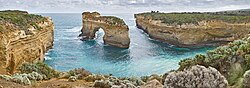 Island Archway on the Great Ocean Road in Victoria, Australia
 -
 Aireys Inlet
 -
 Victorian highway and road network, with significant cities and towns.


Regions
[edit]
Victoria is divided into distinct geographic regions, most commonly for the purposes of economic development, while others for land management (agriculture or conservation) and for censusing (statistical or meteorological) or electoral purposes. The most commonly used regions are those created by the state government for the purposes of economic development.
In addition to Greater Melbourne, the Victoria State Government has divided Victoria into five regions covering all parts of the state. The five regional Victoria divisions are:[44]
The Australian Bureau of Meteorology defines regions for its own purposes, some of which share names with the economic regions, even though the exact boundaries may not correlate.[45] As of November 2014, they are:
- Mallee
- Wimmera
- Northern Country
- North East Victoria
- East Gippsland
- West & South Gippsland
- Central Victoria
- North Central Victoria
- South West Victoria
- Alpine Victoria
- Melbourne
Cities and towns
[edit]This is a list of places in the Australian state of Victoria by population. Urban centres are defined by the Australian Bureau of Statistics as being a population cluster of 1,000 or more people. The below figures broadly represent the populations of the contiguous built-up areas of each city:
| Rank | Urban centre | Population | |||
|---|---|---|---|---|---|
| 2021 census | 2016 census | 2011 census | 2006 census | ||
| 1 | Melbourne | 4,917,750 | 4,196,201 | 3,707,530 | 3,375,341 |
| 2 | Geelong | 180,239[46] | 157,103 | 143,921 | 135,965 |
| 3 | Ballarat | 116,201 | 93,761 | 85,936 | 77,766 |
| 4 | Bendigo | 103,034 | 92,384 | 82,795 | 75,420 |
| – | Melton | N/A | 54,455 | 45,625 | 35,194 |
| 5 | Shepparton – Mooroopna | 68,409 | 46,194 | 42,742 | 38,247 |
| 6 | Mildura | 56,972 | 33,445 | 31,363 | 30,761 |
| – | Pakenham | 54,118 | 46,421 | 32,913 | 18,621 |
| 7 | Wodonga | 43,253 | 35,131 | 31,605 | 29,538 |
| 8 | Sunbury | 38,851 | 34,425 | 33,062 | 29,071 |
| 9 | Warrnambool | 35,406 | 30,707 | 29,286 | 28,015 |
| 10 | Wangaratta | 29,808 | 18,567 | 17,376 | 16,732 |
| 11 | Traralgon | 26,907 | 25,482 | 24,590 | 21,474 |
| 12 | Bacchus Marsh | 24,717 | 17,303 | 14,914 | 13,046 |
| 13 | Warragul | 23,051 | 14,274 | 13,081 | 11,333 |
| 14 | Horsham | 20,429 | 15,630 | 15,261 | 13,945 |
| 15 | Ocean Grove – Barwon Heads | 19,394 | 18,208 | 16,091 | 13,701 |
| 16 | Torquay – Jan Juc | 18,534 | 16,942 | 13,336 | 9,463[N 1] |
| 17 | Moe – Newborough | 16 844 | 15,062 | 15,293 | 15,159 |
| 18 | Sale | 15,472 | 13,507 | 12,764 | 13,090 |
| 19 | Morwell | 14,432 | 13,540 | 13,689 | 13,399 |
Climate
[edit]
| Month | Melbourne °C (°F) |
Mildura °C (°F) | ||
|---|---|---|---|---|
| January | 25.8 (78) | 32.8 (91) | ||
| February | 25.8 (78) | 32.7 (91) | ||
| March | 23.8 (75) | 29.3 (85) | ||
| April | 20.2 (68) | 24.1 (75) | ||
| May | 16.6 (62) | 19.6 (67) | ||
| June | 14.0 (57) | 16.0 (61) | ||
| July | 13.4 (56) | 15.4 (60) | ||
| August | 14.9 (59) | 17.7 (64) | ||
| September | 17.2 (63) | 21.1 (70) | ||
| October | 19.6 (67) | 25.0 (77) | ||
| November | 21.8 (71) | 29.0 (84) | ||
| December | 24.1 (75) | 31.7 (89) | ||
| Source: Bureau of Meteorology | ||||
Victoria has a varied climate that ranges from semi-arid temperate with hot summers in the north-west, to temperate and cool along the coast. Victoria's main land feature, the Great Dividing Range, produces a cooler, mountain climate in the centre of the state. Winters along the coast of the state, particularly around Melbourne, are relatively mild (see chart).
The coastal plain south of the Great Dividing Range has Victoria's mildest climate. Air from the Southern Ocean helps reduce the heat of summer and the cold of winter. Melbourne and other large cities are located in this temperate region.
The Mallee and upper Wimmera are Victoria's warmest regions with hot winds blowing from nearby semi-deserts. Average temperatures exceed 32 °C (90 °F) during summer and 15 °C (59 °F) in winter. Except at cool mountain elevations, the inland monthly temperatures are 2–7 °C (4–13 °F) warmer than around Melbourne (see chart). Victoria's highest maximum temperature of 48.8 °C (119.8 °F) was recorded in Hopetoun on 7 February 2009, during the 2009 southeastern Australia heat wave.[47]
The Victorian Alps in the northeast are the coldest part of Victoria. The Alps are part of the Great Dividing Range mountain system extending east–west through the centre of Victoria. Average temperatures are less than 9 °C (48 °F) in winter and below 0 °C (32 °F) in the highest parts of the ranges. The state's lowest minimum temperature of −11.7 °C (10.9 °F) was recorded at Omeo on 15 June 1965, and again at Falls Creek on 3 July 1970.[47] Temperature extremes for the state are listed in the table below:
| Climate data for Victoria | |||||||||||||
|---|---|---|---|---|---|---|---|---|---|---|---|---|---|
| Month | Jan | Feb | Mar | Apr | May | Jun | Jul | Aug | Sep | Oct | Nov | Dec | Year |
| Record high °C (°F) | 47.2 (117.0) |
48.8 (119.8) |
44.4 (111.9) |
39.3 (102.7) |
32.2 (90.0) |
25.7 (78.3) |
27.1 (80.8) |
29.9 (85.8) |
37.7 (99.9) |
40.2 (104.4) |
45.8 (114.4) |
46.6 (115.9) |
48.8 (119.8) |
| Record low °C (°F) | −3.9 (25.0) |
−3.9 (25.0) |
−4.3 (24.3) |
−8.2 (17.2) |
−8.3 (17.1) |
−11.7 (10.9) |
−11.7 (10.9) |
−10.5 (13.1) |
−9.4 (15.1) |
−8.4 (16.9) |
−7.0 (19.4) |
−5.2 (22.6) |
−11.7 (10.9) |
| Source: Bureau of Meteorology[48] | |||||||||||||
Rainfall
[edit]Rainfall in Victoria increases from south to the northeast, with higher averages in areas of high altitude. Mean annual rainfall exceeds 1,800 millimetres (71 inches) in some parts of the northeast but is less than 280 mm (11 in) in the Mallee. Rain is heaviest in the Otway Ranges and Gippsland in southern Victoria and in the mountainous northeast. Snow generally falls only in the mountains and hills in the centre of the state. Rain falls most frequently in winter, but summer precipitation is heavier. Rainfall is most reliable in Gippsland and the Western District, making them both leading farming areas. Victoria's highest recorded daily rainfall was 377.8 mm (14.87 in) at Tidal River in Wilsons Promontory National Park on 23 March 2011.[47]
- Average temperatures and precipitation for Victoria
-
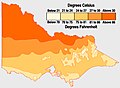 Average January maximum temperatures:
Victoria's north is almost always hotter than coastal and mountainous areas. -
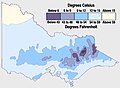 Average July maximum temperatures:
Victoria's hills and ranges are coolest during winter. Snow also falls there. -
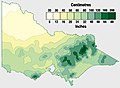 Average yearly precipitation:
Victoria's rainfall is concentrated in the mountainous north-east and coast.


Demographics
[edit]
| Year | Population estimate |
|---|---|
| 2001 | 4,763,615 |
| 2011 | 5,537,817 |
| 2021 | 6,547,822 |
| 2031 | 7,802,503 |
| 2041 | 9,057,948 |
| 2051 | 10,328,326 |
| Source: Dept of Transport and Planning | |

.jpg)
It is estimated that on 30 September 2024, Victoria had a population of 7,012,962.[10][49] The Australian Bureau of Statistics estimates that the population may well reach 10.3 million by 2051.
Victoria's founding Anglo-Celtic population has been supplemented by successive waves of migrants from Southern and Eastern Europe, Asia and, most recently, Africa and the Middle East. Victoria's population is ageing in proportion with the average of the remainder of the Australian population.
About 72% of Victorians are Australian-born. This figure falls to around 66% in Melbourne but rises to higher than 95% in some rural areas in the north west of the state. Less than 1% of Victorians identify themselves as Aboriginal.
More than 75% of Victorians live in Melbourne, located in the state's south. The greater Melbourne metropolitan area is home to an estimated 5,207,145 people.[50] Urban centres outside Melbourne include Geelong, Ballarat, Bendigo, Shepparton, Mildura, Warrnambool, Wodonga and the Latrobe Valley.
Victoria is Australia's most urbanised state: nearly 90% of residents living in cities and towns. State Government efforts to decentralise population have included an official campaign run since 2003 to encourage Victorians to settle in regional areas,[51] however Melbourne continues to rapidly outpace these areas in terms of population growth.[52]
Ancestry and immigration
[edit]| Birthplace[N 2] | Population |
|---|---|
| Australia | 3,845,493 |
| England | 171,443 |
| India | 169,802 |
| Mainland China | 160,652 |
| New Zealand | 93,253 |
| Vietnam | 80,253 |
| Italy | 70,527 |
| Sri Lanka | 55,830 |
| Philippines | 51,290 |
| Malaysia | 50,049 |
| Greece | 47,240 |
At the 2016 census, the most commonly nominated ancestries were:[N 3][13][53]
0.8% of the population, or 47,788 people, identified as Indigenous Australians (Aboriginal Australians and Torres Strait Islanders) in 2016.[N 5][13][53]
At the 2016 census, 64.9% of residents were born in Australia. The other most common countries of birth were England (2.9%), India (2.9%), mainland China (2.7%), New Zealand (1.6%) and Vietnam (1.4%).[13][53]
Language
[edit]As of the 2016 census, 72.2% of Victorians speak English at home. Speakers of other languages include Mandarin (3.2%), Italian (1.9%), Greek (1.9%), Vietnamese (1.7%), and Arabic (1.3%).[13][53]
Religion
[edit]In the 2016 Census, 47.9% of Victorians described themselves as Christian, 10.6% stated that they followed other religions and 32.1% stated that they had no religion or held secular or other spiritual beliefs.[55] In the survey, 31.7% of Victorians stated they had no religion, Roman Catholics were 23.2%, 9.4% did not answer the question, 9% were Anglican and 3.5% were Eastern Orthodox.[56] In 2017 the proportion of couples marrying in a civil ceremony in Victoria was 77.3%; the other 22.7% were married in a religious ceremony.[57]
Age structure and fertility
[edit]The government predicts that nearly a quarter of Victorians will be aged over 60 by 2021. The 2016 census revealed that Australian median age has crept upward from 35 to 37 since 2001, which reflects the population growth peak of 1969–72.[58] In 2017, Victoria recorded a TFR of 1.724.[59]
Average demographic
[edit]The "average Victorian" according to the demographic statistics may be described as follows:[60]
| Median age | 37 |
|---|---|
| Sex (mode) | Female |
| Country of birth of person (mode) | Australia |
| Country of birth of parents (mode) | At least one parent born overseas |
| Language spoken at home (mode) | English |
| Ancestry 1st response (mode) | English |
| Social marital status (mode) | Married in a registered marriage |
| Family composition (mode) | Couple family with children |
| Count of all children in family (mode) | Two children in family |
| Highest year of school completed (mode) | Year 12 or equivalent |
| Unpaid domestic work: number of hours (mode) | 5 to 14 hours |
| Number of motor vehicles (mode) | Two vehicles |
| Number of bedrooms in private dwelling (mode) | Three bedrooms |
| Tenure type (dwelling count) (mode) | Owned with a mortgage |
Crime
[edit]In the year ending September 2020, the statistics were skewed by the introduction of six new public safety offences relating to the COVID-19 pandemic in Australia.[61] Total offences numbered 551,710, with 32,713 of these being breaches of Chief Health Officer Directions. The total offences occurred at a rate of 8,227 per 100,000 people, up 4.4% on the previous year. While there have been some dips along the way, the rate of recorded offences have increased year on year since 2011, when the figure was 6,937.7 offences per 100,000 people.[62]
| 2010 | 2011 | 2012 | 2013 | 2014 | |
|---|---|---|---|---|---|
| Number of offences | 378,082 | 386,061 | 423,555 | 437,409 | 456,381 |
Government
[edit]


Parliament
[edit]Victoria has a parliamentary form of government based on the Westminster System. Legislative power resides in the Parliament consisting of the Governor (the representative of the King), the executive (the Government), and two legislative chambers. The Parliament of Victoria consists of the lower house Legislative Assembly, the upper house Legislative Council and the monarch. Eighty-eight members of the Legislative Assembly are elected to four-year terms from single-member electorates.
In November 2006, the Victorian Legislative Council elections were held under a new multi-member proportional representation system. The State of Victoria was divided into eight electorates with each electorate represented by five representatives elected by Single Transferable Vote. The total number of upper house members was reduced from 44 to 40 and their term of office is now the same as the lower house members—four years. Elections for the Victorian Parliament are now fixed and occur in November every four years. Prior to the 2006 election, the Legislative Council consisted of 44 members elected to eight-year terms from 22 two-member electorates.
| Party | Legislative Assembly | Legislative Council |
|---|---|---|
| Labor | 56 | 15 |
| Liberal | 19 | 12 |
| National | 9 | 2 |
| Greens | 4 | 4 |
| Others | 0 | 7 |
Premier and cabinet
[edit]The Premier of Victoria is the leader of the political party or coalition with the most seats in the Legislative Assembly. The Premier is the public face of government and, with cabinet, sets the legislative and political agenda. Cabinet consists of representatives elected to either house of parliament. It is responsible for managing areas of government that are not exclusively vested in the Commonwealth, by the Australian Constitution, such as education, health and law enforcement. The current Premier of Victoria is Jacinta Allan.
Governor
[edit]Executive authority is vested in the Governor of Victoria who represents and is appointed by the monarch. The post is usually filled by a retired prominent Victorian. The governor acts on the advice of the premier and cabinet. The current Governor of Victoria is Margaret Gardner.
Constitution
[edit]Victoria has a written constitution enacted in 1975,[64] but based on the 1855 colonial constitution, passed by the United Kingdom Parliament as the Victoria Constitution Act 1855, which establishes the Parliament as the state's law-making body for matters coming under state responsibility. The Victorian Constitution can be amended by the Parliament of Victoria, except for certain "entrenched" provisions that require either an absolute majority in both houses, a three-fifths majority in both houses, or the approval of the Victorian people in a referendum, depending on the provision. To this day, not a single referendum has been held to change the Victorian Constitution.
Politics
[edit]Victoria is considered by some analysts to be the most progressive state in the nation.[65][66] The state recorded the highest Yes votes of any state in the republic referendum, same-sex marriage survey and Indigenous Voice referendum. Victorians are said to be "generally socially progressive, supportive of multiculturalism, wary of extremes of any kind".[67] Premier Jacinta Allan leads the Victorian Labor Party who replaced Daniel Andrews after his resignation in September 2023. Labor has been in power since the November 2014 Victorian state election, and has been in power in 31 of the 42 years since 1982.
The centre-left Australian Labor Party (ALP), the centre-right Liberal Party of Australia, the rural-based National Party of Australia, and the left-wing environmentalist Australian Greens are Victoria's main political parties. Traditionally, Labor is strongest in Melbourne's working and middle class western, northern and inner-city suburbs, and the regional cities of Ballarat, Bendigo and Geelong. The Liberals' main support lies in Melbourne's more affluent eastern suburbs and outer suburbs, and some rural and regional centres. The Nationals are strongest in Victoria's North Western and Eastern rural regional areas. The Greens, who won their first lower house seats in 2014, are strongest in inner Melbourne.
Federal government
[edit]Victorian voters elect 50 representatives to the Parliament of Australia, including 38 members of the House of Representatives and 12 members of the Senate. Since 1 April 2023, the ALP hold 25 Victorian house seats, the Liberals 10, the Nationals three, the Greens one, and independents the remaining three. The ALP and the Liberals hold four senate seats each, while the Nationals, Greens, UAP and an independent hold one seat each.
Local government
[edit]Victoria is incorporated into 79 municipalities for the purposes of local government, including 39 shires, 32 cities, seven rural cities and one borough. Shire and city councils are responsible for functions delegated by the Victorian parliament, such as city planning, road infrastructure and waste management. Council revenue comes mostly from property taxes and government grants.[68]
Education
[edit]Primary and secondary
[edit]


Victoria's state school system dates back to 1872, when the colonial government legislated to make schooling both free and compulsory. The state's public secondary school system began in 1905. Before then, only private secondary schooling was available. Today, a Victorian school education consists of seven years of primary schooling (including one preparatory year) and six years of secondary schooling.
The final years of secondary school are optional for children aged over 17. Victorian children generally begin school at age five or six. On completing secondary school, students earn the Victorian Certificate of Education (VCE) or Victorian Certificate of Education - Vocational Major (VCE-VM). Students who successfully complete their VCE (not including VCE-VM students) also receive an ATAR, to determine university admittance (unless the student is 'going unscored'.
Victorian schools are either publicly or privately funded. Public schools, also known as state or government schools, are funded and run directly by the Victorian Department of Education.[71] Students do not pay tuition fees, but some extra costs are levied. Private fee-paying schools include parish schools run by the Roman Catholic Church and independent schools similar to British public schools. Independent schools are usually affiliated with Protestant churches. Victoria also has several private Jewish and Islamic primary and secondary schools. Private schools also receive some public funding. All schools must comply with government-set curriculum standards. In addition, Victoria has six government selective schools, Melbourne High School for boys, MacRobertson Girls' High School for girls, the coeducational schools John Monash Science School, Nossal High School and Suzanne Cory High School, and the Victorian College of the Arts Secondary School. Students at these schools are exclusively admitted on the basis of an academic selective entry test. Victoria also offers an online schooling system, called Virtual School Victoria, or VSV.
As of February 2019, Victoria had 1,529 public schools, 496 Catholic schools and 219 independent schools. Just under 631,500 students were enrolled in public schools, and just over 357,000 in private schools. Over 58 per cent of private students attend Catholic schools. More than 552,300 students were enrolled in primary schools and more than 418,600 in secondary schools. Retention rates for the final two years of secondary school were 84.3 per cent for public school students and 91.5 per cent for private school students. Victoria has about 46,523 full-time teachers.[72]
Tertiary education
[edit]Victoria has nine universities. The first to offer degrees, the University of Melbourne, enrolled its first student in 1855. The largest, Monash University, has an enrolment of over 83,000 students—more than any other Australian university.[73]
The number of students enrolled in Victorian universities was 418,447 in 2018, an increase of 5.3% on the previous year. International students made up 40% of enrolments and account for the highest percentage of pre-paid university tuition fees.[73] The largest number of enrolments were recorded in the fields of business, administration and economics, with nearly 30% of all students, followed by arts, humanities, and social science, with 18% of enrolments.[73]
Victoria has 12 government-run institutions of technical and further education (TAFE).[74] The first vocational institution in the state was the Melbourne Mechanics' Institute (established in 1839), which is now the Melbourne Athenaeum. More than 1,000 adult education organisations are registered to provide recognised TAFE programs. In 2014, there were 443,000 students enrolled in vocational education in the state. By 2018, the number of students in the sector had dropped by 40 per cent to 265,000—a five-year low which the education department attributed to withdrawal of funding to low-quality providers and a societal shift to university education.[75]
Libraries
[edit]The State Library Victoria is the State's research and reference library. It is responsible for collecting and preserving Victoria's documentary heritage and making it available through a range of services and programs. Material in the collection includes books, newspapers, magazines, journals, manuscripts, maps, pictures, objects, sound and video recordings and databases. The state has public libraries in most LGAs (typically with multiple branches in their respective municipal areas) and academic libraries in universities, and some special libraries.
Economy
[edit]| Victorian production and workers by economic activities | |||
|---|---|---|---|
| Economic sector |
GSP produced[76] |
Number of workers ('000s) |
Percentage of workers |
| Finance, insurance services |
12.8% | 115.5 | 3.8% |
| Professional, technical services |
9.1% | 274.3 | 9.0% |
| Manufacturing | 8.6% | 274.4 | 9.0% |
| Health Care, social services |
8.5% | 390.6 | 12.8% |
| Construction | 7.7% | 255.7 | 6.4% |
| Education | 6.7% | 257.7 | 8.5% |
| Retail Trade | 6.0% | 310.6 | 10.2% |
| Transport Services | 5.7% | 165.4 | 5.4% |
| Wholesale Trade | 5.6% | 113.4 | 3.7% |
| Public Administration |
5.0% | 146.5 | 4.8% |
| Communications and IT |
3.9% | 57.0 | 1.9% |
| Real Estate | 3.7% | 43.6 | 1.4% |
| Administrative services |
3.3% | 119.0 | 3.9% |
| Accommodation and food services |
2.9% | 209.9 | 6.9% |
| Agriculture, forestry and fishing |
2.8% | 86.1 | 2.8% |
| Utilities | 2.4% | 39.4 | 1.3% |
| Mining | 2.0% | 11.0 | 0.4% |
| Arts and recreation |
1.1% | 63.2 | 2.1% |
| Other Services | – | 115.1 | 3.8% |
| Source: Australian Bureau of Statistics. GSP as of June 2016. Employment as of Aug 2016. | |||
The state of Victoria is the second largest economy in Australia after New South Wales, accounting for a quarter of the nation's gross domestic product. The total gross state product (GSP) at current prices for Victoria was A$459 billion in June 2020, with a GSP per capita of A$68,996.[4]
Agriculture
[edit]
Victoria is Australia's second-largest agricultural producer in gross value of production, representing about 25 percent of Australia's total food production.[77] There are 67,600 people employed in the agricultural industry, making it the 6th largest employer in the state.[78] There are about 21,600 farms in the state, managing more than 11.4 million hectares or 50% of the state's total landmass, of which 40% was used for cropping and 50% for grazing.[79] Victorian farms produce nearly 90% of Australian pears and a third of apples. The main vegetable crops include asparagus, broccoli, carrots, potatoes, and tomatoes.[80]
More than 14 million sheep and 5 million lambs graze over 10% of Victorian farms, mostly in the state's north and west.[81] Pgt standard race 126 was the most common Stem Rust (Puccinia graminis f. sp. tritici) race here from 1929 to 1941, as it was for the whole of Australia.[82] First detected on Tasmania in 1954, standard race 21 was the most common race by the next year in this state, the southern part of NSW, and Tasmania.[82] Leaf Rust (P. triticina) is known to have been present here, and throughout the continent, at least since European colonization.[82] P. triticina pathotype 104-2,3,(6),(7),11 was first found here in 1984 and has contributed to populations ever since.[82] It is considered to be foreign to Australia due to a difference in pathogenicity and due to its unique Pgm2 c allele.[82]
Victorian farms produce nearly 90% of Australian pears and a third of apples. It is also a leader in stone fruit (Prunus) production. The main vegetable crops include asparagus, broccoli, carrots, potatoes and tomatoes. Last year, 121,200 metric tons (133,600 short tons) of pears and 270,000 metric tons (300,000 short tons) of tomatoes were produced. More than 14 million sheep and 5 million lambs graze over 10% of Victorian farms, mostly in the state's north and west. In 2004, nearly 10 million lambs and sheep were slaughtered for local consumption and export. Victoria also exports live sheep to the Middle East for meat and to the rest of the world for breeding. More than 108,000 metric tons (119,000 short tons) of wool clip was also produced—one-fifth of the Australian total.
Victoria is the centre of dairy farming in Australia. It is home to 60% of Australia's 3 million dairy cattle and produces nearly two-thirds of the nation's milk, almost 6.4 billion litres (1.7 billion US gallons). The state also has 2.4 million beef cattle, with more than 2.2 million cattle and calves slaughtered each year. In 2003–04, Victorian commercial fishing crews and aquaculture industry produced 11,634 metric tons (12,824 short tons) of seafood valued at nearly A$109 million. Blacklipped abalone is the mainstay of the catch, bringing in A$46 million, followed by southern rock lobster worth A$13.7 million. Most abalone and rock lobster is exported to Asia.
Most of Australia – including this state – imposed a moratorium on GM canola in 2003 to consider the positives and negatives.[83] After consideration the ban here was lifted in 2008 and the state's produced a review of the effects of the moratorium and the expected economic and other effects of adoption or failure to adopt GM canola.[83] The government finds a benefit of AUS$45 per hectare ($18/acre)/season over conventional.[83]
Late in 2019, the COVID-19 pandemic began, and Australian agriculture was heavily impacted by the resulting supply chain issues. The scarcity of freight space and disruption to Chinese New Year purchases was particularly painful, with China being Australia's largest export market and a particularly large buyer of live seafood.[84] As of 2022[update] there are almost 100 strawberry farms here, most close to Melbourne CBD in the Yarra Valley.[85] They are represented by the Victorian Strawberries organization,[85] who recommend varieties for production.[86]
Manufacturing
[edit]Victoria has a diverse range of manufacturing enterprises and Melbourne is considered Australia's most important industrial city. The post-World War II manufacturing boom was fuelled by international investment, attracted to the state by the availability of cheap land close to the city and inexpensive energy from the Latrobe Valley. Victoria produced 26.4% of total manufacturing output in Australia in 2015–16, behind New South Wales at 32.4%.
Machinery and equipment manufacturing is the state's most valuable manufacturing activity, followed by food and beverage products, petrochemicals and chemicals. Prominent manufacturing plants in the state include the Portland and Point Henry aluminium smelters, owned by Alcoa; Geelong and Altona oil refineries; a major petrochemical facility at Laverton; and Victorian-based CSL, a global biotechnology company that produces vaccines and plasma products, among others. Victoria also plays an important role in providing goods for the defence industry.
Victoria proportionally relies on manufacturing more than any other state in Australia, constituting 8.6% of total state product; slightly higher than South Australia at 8.0%. However, this proportion has been declining for three decades; in 1990 at the time of the early 1990s recession manufacturing constituted 20.3% of total state output. Manufacturing output peaked in absolute terms in 2008, reaching $28.8 billion and has slowly fallen over the decade to $26.8 billion in 2016 (−0.77% per annum). Since 1990, manufacturing employment has also fallen in both aggregate (367,700 to 274,400 workers) and proportional (17.8% to 9.0%) terms. The strong Australian dollar as a result of the 2000s mining boom, small population and isolation, high wage base and the general shift of manufacturing production towards developing countries have been cited as some of the reasons for this decline.
Historically, Victoria has been a hub for the manufacturing plants of the major car brands Ford, Toyota and Holden; however, closure announcements by all three companies in the 2010s has meant Australia will completely lose their car manufacturing industry by the end of 2017. Holden's announcement occurred in May 2013 following Ford's decision in December the previous year (Ford's Victorian plants, in Broadmeadows and Geelong, closed in October 2016).[87][88] Toyota followed suit in February 2014 with an expected announcement as without Holden or Ford, local supply chains would struggle to create the economics of scale required to supply one manufacturer.[89]
Land
[edit]Victoria adopted the Torrens system of land registration with the Real Property Act 1862.[90] The Torrens system did not replace the common law system but applied only to new land grants and to land that has been voluntarily registered under the Act, and its successors. The common law system continues to apply to all other private landholdings. Crown land held in Victoria is managed under the Crown Land (Reserves) Act 1978 and the Land Act 1958.
Mining
[edit]
Mining in Victoria contributes around A$6 billion to the gross state product (~2%) but employs less than 1% of workers. The Victorian mining industry is concentrated on energy producing minerals, with brown coal, petroleum and gas accounting for nearly 90% of local production. The oil and gas industries are centred off the coast of Gippsland in the state's east, while brown coal mining and power generation is based in the Latrobe Valley.
In 1985, oil production from the offshore Gippsland Basin peaked to an annual average of 450,000 barrels (72,000 m3) per day. In 2005–2006, the average daily oil production has declined to 83,000 bbl (13,200 m3)/d, but despite the decline Victoria still produces almost 19.5% of crude oil in Australia.[91] In the 2005–06 fiscal year, the average gas production was over 700 million cubic feet (20,000,000 m3) per day (M cuft/d) and represented 18% of the total national gas sales, with demand growing at 2% per year.[91] Campaigning resulted in a prohibition on onshore gas exploration and production in Victoria in 2014,. This was partially lifted in 2021 but the state retains a constitutional ban on fracking.[92]
Brown coal is Victoria's leading mineral, with 66 million tonnes mined each year for electricity generation in the Latrobe Valley, Gippsland.[93] The region is home to the world's largest known reserves of brown coal. Despite being the historic centre of Australia's gold rush, Victoria today contributes a mere 1% of national gold production. Victoria also produces limited amounts of gypsum and kaolin. Victoria's gold production is mostly derived from the Fosterville and Stawell Gold Mines.
Tourism
[edit]Tourism is a significant industry in the state of Victoria, Australia. The country's second most-populous city, Melbourne was visited by 2.7 million international overnight visitors and 9.3 million domestic overnight visitors during the year ending December 2017.[94] Named the world's most liveable city from 2011 to 2017, Melbourne's culture and lifestyle have been increasingly promoted internationally, leading to average year-on-year growth of international visitors of 10% in the five years to 2017.[94][95] Some major tourist destinations in Victoria are:
- The metropolis of Melbourne, particular its inner city suburbs (known also for shopping tourism) and the attractions of the city centre such as Melbourne Zoo, Melbourne Museum, the Melbourne Aquarium and Scienceworks, tourism precincts such as Melbourne Docklands, Southbank and St Kilda as well as cultural and sporting tourist icons such as Arts Centre Melbourne, the East End Theatre District, the National Gallery of Victoria, the Melbourne Cricket Ground, also known as the MCG, and the Eureka Tower, with the highest observation deck in the Southern Hemisphere, Skydeck 88.
- Victoria has more than 2000 kilometres of coastline with hundreds of beaches.[96]
- The Goldfields region featuring the historic cities of Ballarat, Beechworth, Bendigo, Castlemaine, Maldon and Daylesford.
- Natural attractions, such as The Twelve Apostles, Wilsons Promontory, The Grampians, the fairy penguins (particularly at Phillip Island and St Kilda), the Buchan Caves and the Gippsland Lakes.
- The Dandenong Ranges (in particular the Puffing Billy Railway).
- Healesville Sanctuary, which specialises in local Australian species.
- Towns along the Murray River and Riverina including Echuca and Mildura including waterskiing.
- Geelong and its famous Waterfront, Eastern Beach and Geelong West's Pakington Street.
- The Bellarine Peninsula which features vineyards and historic resort towns such as Queenscliff, Drysdale and Portarlington.
- The Werribee Park Mansion and Werribee Open Range Zoo.
- The Surf Coast which features famous beaches such as Bells Beach, Torquay and Lorne
- Mornington Peninsula, particularly for its wineries in Red Hill and secluded beaches in Mount Eliza and Mornington, The Pillars in Mount Martha, Arthur's Seat and the coastal attractions of Portsea, Sorrento and Flinders.
- Yarra Valley (in particular Healesville Sanctuary and wineries).
- Great Ocean Road, which features The Twelve Apostles, historic towns of Port Fairy and Portland, cliffs and whale watching and resort towns such as Lorne.
- The Victorian Alpine Region, part of the Australian Alps, particularly for skiing.
- The Central Victorian Highlands, "High country" are very well known for winter sports and bushwalking.
- Wine regions across the entire state.
Other popular tourism activities are gliding, hang-gliding, hot air ballooning and scuba diving. Major events that explore cultural diversity, music and sports play a big part in Victoria's tourism. The V8 Supercars and Australian Motorcycle Grand Prix at Phillip Island, the Grand Annual Steeplechase at Warrnambool and the Australian International Airshow at Avalon and numerous local festivals such as the popular Port Fairy Folk Festival, Queenscliff Music Festival, Pako Festa in Geelong West, Bells Beach Surf Classic and the Bright Autumn Festival amongst others.
-
 The Melbourne skyline at night
 -
 Brighton Beach bathing boxes
 -
 Mornington Mills Beach
 -
 Autumn in the Dandenong Ranges
 -

-

.jpg)
.jpg)


.jpg)
Transport
[edit]_in_Bourke_St_on_route_96,_2013.JPG)
Victoria has the highest population density in any state in Australia, with population centres spread out over most of the state; only the far northwest and the Victorian Alps lack permanent settlement. As of October 2013, smoking tobacco is prohibited in the sheltered areas of train stations, and tram and bus stops, as is the use of e-cigarettes. Between 2012 and 2013, 2002 people were issued with infringement notices. The state government announced a plan in October 2013 to prohibit smoking on all Victorian railway station platforms and raised tram stops.[97]
The Victorian road network services the population centres, with highways generally radiating from Melbourne and other major cities and rural centres with secondary roads interconnecting the highways to each other. Many of the highways are built to freeway standard ("M" freeways), while most are generally sealed and of reasonable quality.

Rail transport in Victoria is provided by several private and public railway operators who operate over government-owned lines. Major operators include: Metro Trains Melbourne which runs an extensive, electrified, passenger system throughout Melbourne and suburbs; V/Line which is now owned by the Victorian Government, operates a concentrated service to major regional centres, as well as long-distance services on other lines; Pacific National, CFCL Australia which operate freight services; Great Southern Rail which operates The Overland Melbourne—Adelaide; and NSW TrainLink which operates XPTs Melbourne—Sydney.
There are also several smaller freight operators and numerous tourist railways operating over lines which were once parts of a state-owned system. Victorian lines mainly use the 1,600 mm (5 ft 3 in) broad gauge. However, the interstate trunk routes, as well as a number of freight lines in the north and west of the state have been converted to 1,435 mm (4 ft 8+1⁄2 in) standard gauge. Two tourist railways operate over 760 mm (2 ft 6 in) narrow gauge lines, which are the remnants of five formerly government-owned lines which were built in mountainous areas.
Melbourne has the world's largest tram network,[98] currently operated by Yarra Trams. As well as being a popular form of public transport, over the last few decades trams have become one of Melbourne's major tourist attractions. There are also tourist trams operating over portions of the former Ballarat and Bendigo systems. There are also tramway museums at Bylands, Haddon and Hawthorn.
Melbourne Airport is the major domestic and international gateway for the state. Avalon Airport is the state's second busiest airport, which complements Essendon and Moorabbin Airports to see the remainder of Melbourne's air traffic. Hamilton Airport, Mildura Airport, Mount Hotham and Portland Airport are the remaining airports with scheduled domestic flights. There are no fewer than 27 other airports in the state with no scheduled flights. The Port of Melbourne is the largest port for containerised and general cargo in Australia,[99] and is located in Melbourne on the mouth of the Yarra River, which is at the head of Port Phillip. Additional seaports are at Westernport, Geelong, and Portland.
.jpg)
.jpg)
Utilities
[edit]Energy
[edit]Victoria's major utilities include a collection of brown-coal-fired power stations, particularly in the Latrobe Valley. One of these was the recently decommissioned Hazelwood Power Station, which was number 1 on the worldwide List of least carbon efficient power stations. The Victorian government is aiming to cut 40.6 megatonnes of greenhouse gas emissions by 2025.[100][101]
Water
[edit]Victoria's water infrastructure includes a series of dams and reservoirs, predominantly in Central Victoria, that hold and collect water for much of the state. The water collected is of a very high quality and requires little chlorination treatment, giving the water a taste more like water collected in a rainwater tank. In regional areas however, such as in the west of the state, chlorination levels are much higher. The Victorian Water Grid consists of a number of new connections and pipelines being built across the State. This allows water to be moved around Victoria to where it is needed most and reduces the impact of localised droughts in an era thought to be influenced by climate change. Major projects already completed as part of the Grid include the Wimmera Mallee Pipeline and the Goldfields Superpipe.[102]
Sport
[edit]

Victoria is the home of Australian rules football, with ten of the 18 Australian Football League (AFL) clubs based in the state. The AFL Grand Final is traditionally held at the Melbourne Cricket Ground on the last Saturday of September. The state has a public holiday the day before the Grand Final, which coincides with the AFL Grand Final parade. The MCG is sometimes called the spiritual home of Australian rules football.[103]
The Victorian cricket team play in the national Sheffield Shield cricket competition. Victoria is represented in the National Rugby League by the Melbourne Storm. Prior to their axing at the end of the 2024 season, Victoria was represented by the Melbourne Rebels in the Super Rugby. It is represented in the National Basketball League by Melbourne United and South East Melbourne Phoenix. It is also represented in soccer by Melbourne Victory, Melbourne City and Western United in the A-League. Melbourne has held the 1956 Summer Olympics, 2006 Commonwealth Games and the FINA World Swimming Championship.
Melbourne is also home to the Australian Open tennis tournament in January each year, which is the first of the world's four Grand Slam tennis tournaments, as well as the Formula One Australian Grand Prix, which is, on an annual basis, usually held in March or April. It hosted the Australian Masters golf tournament from 1979 to 2015. Victoria's Bells Beach hosts one of the world's longest-running surfing competition, the Bells Beach SurfClassic, which is part of The ASP World Tour. The Melbourne Vixens and Melbourne Mavericks represent Victoria in the Super Netball league.
Victoria's Phillip Island is home of the Phillip Island Grand Prix Circuit which hosts the Australian motorcycle Grand Prix which features MotoGP (the world's premier motorcycling class), as well as the Australian round of the World Superbike Championship and the domestic V8 Supercar racing, which also visits Sandown Raceway and the rural Winton Motor Raceway circuit. Australia's most prestigious footrace, the Stawell Gift, is an annual event. Victoria is also home to the Aussie Millions poker tournament, the tournament with the highest potential proceeds in the Southern Hemisphere.
The main horse racing tracks in Victoria are Caulfield Racecourse, Flemington Racecourse and Sandown Racecourse. The Melbourne Spring Racing Carnival is one of the biggest horse racing events in the world and is one of the world's largest sporting events. The main race is for the $6 million Melbourne Cup, and crowds for the carnival usually exceed 700,000. Victoria was due to host the 2026 Commonwealth Games but withdrew on 18 July 2023 as a result of increased costs of holding the event.[104][105]
Major professional teams include:
- Australian rules football (AFL): Carlton, Collingwood, Essendon, Geelong Cats, Hawthorn, Melbourne, North Melbourne, Richmond, St Kilda, Western Bulldogs
- Basketball (NBL): Melbourne United, South East Melbourne Phoenix
- Cricket (BBL): Melbourne Renegades, Melbourne Stars
- Cricket (Sheffield Shield and Marsh One-Day Cup): Victoria cricket team
- Netball (Super Netball): Melbourne Vixens, Collingwood Magpies
- Rugby league (NRL): Melbourne Storm
- Rugby union (Super Rugby): Melbourne Rebels
- Soccer (A-League): Melbourne City, Melbourne Victory, Western United
Sister states
[edit]Victoria has four sister states:[106]
See also
[edit]


Notes
[edit]- ^ This figure is for Torquay only.
- ^ In accordance with the Australian Bureau of Statistics source, England, Scotland, mainland China and the special administrative regions of Hong Kong and Macau are listed separately.
- ^ As a percentage of 5,533,099 persons who nominated their ancestry at the 2016 census.
- ^ The Australian Bureau of Statistics has stated that most who nominate "Australian" as their ancestry are part of the Anglo-Celtic group.[54]
- ^ Of any ancestry. Includes those identifying as Aboriginal Australians or Torres Strait Islanders. Indigenous identification is separate to the ancestry question on the Australian census and persons identifying as Aboriginal or Torres Strait Islander may identify any ancestry.
References
[edit]- ^ "Victoria, the garden state of Australia". Trove. Retrieved 10 May 2023.
- ^ a b House of Lords Record Office. "An Act for the better Government of Her Majesty's Australian Colonies (1850)". Archived from the original on 19 August 2016. Retrieved 23 August 2016.
- ^ "Area of Australia - States and Territories". 27 June 2014. Archived from the original on 18 January 2024. Retrieved 18 February 2024.
- ^ a b "5220.0 – Australian National Accounts: State Accounts, 2019–20". Australian Bureau of Statistics. 20 November 2020. Archived from the original on 17 June 2016. Retrieved 20 January 2021.
- ^ "Sub-national HDI – Area Database – Global Data Lab". hdi.globaldatalab.org. Archived from the original on 23 September 2018. Retrieved 18 February 2023.
- ^ "Floral Emblem of Victoria". anbg.gov.auhi. Archived from the original on 26 December 2018. Retrieved 26 March 2008.
- ^ "Victoria". Parliament@Work. Archived from the original on 10 March 2019. Retrieved 22 January 2013.
- ^ "Victorian Symbols and Emblems". Department of Premier and Cabinet. Archived from the original on 8 May 2013. Retrieved 11 May 2013.
- ^ "State and territory abbreviations". Biotext content manual. Retrieved 27 June 2025.
- ^ a b "National, state and territory population, September 2024 | Australian Bureau of Statistics". www.abs.gov.au. 20 March 2025. Retrieved 20 March 2025.
- ^ The ACT has a higher population density, but it is a territory rather than a state.
- ^ "Regional population". Australian Bureau of Statistics. 26 March 2024. Archived from the original on 10 October 2023. Retrieved 21 April 2024.
- ^ a b c d e f "2016 Census Community Profiles: Victoria". Archived from the original on 22 June 2019. Retrieved 22 June 2019.
- ^ "The Kulin People of Central Victoria" (PDF). Archived from the original (PDF) on 12 February 2018. Retrieved 11 February 2018.
- ^ "Parliament of Victoria – 54th Parliament Votes". parliament.vic.gov.au. Archived from the original on 9 March 2013.
- ^ "Melbourne named world's sporting capital". The Sydney Morning Herald. 21 April 2016. Archived from the original on 11 August 2017. Retrieved 22 July 2017.
- ^ Richard Broome, pp xviii–xxii, Aboriginal Victorians: A History Since 1800, Allen & Unwin, 2005, ISBN 1-74114-569-4, ISBN 978-1-74114-569-4
- ^ Gary Presland, The First Residents of Melbourne's Western Region, (revised edition), Harriland Press, 1997. ISBN 0-646-33150-7. Presland says on page 1: "There is some evidence to show that people were living in the Maribyrnong River valley, near present day Keilor, about 40,000 years ago".
- ^ Gary Presland, Aboriginal Melbourne: The Lost Land of the Kulin People, Harriland Press (1985), Second edition 1994, ISBN 0-9577004-2-3. This book describes in some detail the archaeological evidence regarding aboriginal life, culture, food gathering and land management
- ^ a b Presland, Gary (July 2008). "Keilor Archaeological Site". eMelbourne. Archived from the original on 3 July 2020. Retrieved 3 November 2008.
- ^ Brown, Peter. "The Keilor Cranium". Peter Brown's Australian and Asian Palaeoanthropology. Archived from the original on 17 December 2004. Retrieved 3 November 2008.
- ^ a b c Steyne, Hanna (23 May 2009). "Investigating the Submerged Landscapes of Port Phillip Bay, Victoria" (PDF). Heritage Victoria. Archived from the original (PDF) on 23 May 2009. Retrieved 3 November 2008. Citing Lambeck & Chappell 2001. Citing Bird 1993, Bowler 1966, Holdgate et al. 2001.
- ^ a b Rhodes, David (2003). Channel Deepening Existing Conditions Final Report – Aboriginal Heritage (PDF) (Report). Terra Culture Heritage Consultants. Archived from the original (PDF) on 1 October 2009. Retrieved 3 November 2008.
- ^ Hunter, Ian (2005). "Yarra Creation Story". Wurundjeri Dreaming. Archived from the original on 4 November 2008. Retrieved 3 November 2008.
- ^ "CORRESPONDENCE". The Advertiser. Adelaide. 14 October 1901. p. 7. Archived from the original on 14 May 2022. Retrieved 17 January 2012 – via National Library of Australia.
- ^ "ATTEMPTED COLONISATION AT WESTERN PORT". Mornington Standard (MORNING. ed.). Vic. 12 August 1905. p. 5. Archived from the original on 14 May 2022. Retrieved 24 January 2012 – via National Library of Australia.
- ^ "Corinella Victoria's Best Kept Secret !". 18 September 2008. Archived from the original on 18 September 2008.
- ^ James Boyce (2011). 1835: The Founding of Melbourne and the Conquest of Australia. Black Inc., p. 12.
- ^ "Treaty – The Aboriginal History of Yarra". aboriginalhistoryofyarra.com.au. Archived from the original on 10 August 2020. Retrieved 6 August 2020.
- ^ "Anniversary of the Week". The Argus. Melbourne. 4 July 1930. p. 2 Supplement: Saturday Camera Supplement. Archived from the original on 14 May 2022. Retrieved 26 January 2012 – via National Library of Australia.
- ^ "Parliament of Victoria - About the First Legislative Council". parliament.vic.gov.au. Archived from the original on 28 July 2020. Retrieved 7 August 2020.
- ^ Adam Porowski; Hussein Idris; James W. LaMoreaux; Werner Balderer, eds. (2014). Thermal and Mineral Waters: Origin, Properties and Applications. Springer Berlin Heidelberg. p. 97. ISBN 9783642288241.
- ^ "Chinese history, Goldfields, Victoria, Australia". Archived from the original on 11 July 2018. Retrieved 3 September 2018.
- ^ McCaughey, Victoria's Colonial Governors, p. 75
- ^ Punch, 7 January 1859, p. 5
- ^ George Gavan Duffy papers Archived 17 December 2014 at the Wayback Machine, historyireland.com. Retrieved 6 March 2016.
- ^ Ling, Ted. "Research Guide: Commonwealth Government records about Commonwealth Government records about the Australian Capital Territory" (PDF). National Archives of Australia. p. 7. Retrieved 30 October 2022.
- ^ "Stateless old Jack, beyond all borders", Sydney Morning Herald, 14 April 2012. Retrieved 15 April 2016
- ^ Ward v The Queen, 11 (High Court of Australia 1980).
- ^ "Victoria Tasmania border". Archived from the original on 2 January 2006. Retrieved 7 March 2006.
- ^ "Boundary Islet on". Street-directory.com.au. 4 December 1999. Archived from the original on 30 September 2007. Retrieved 17 July 2016.
- ^ Moore, Garry (April 2014). "The boundary between Tasmania and Victoria: Uncertainties and their possible resolution" (PDF). Traverse (294). The Institute of Surveyors Victoria. Archived from the original (PDF) on 16 August 2016. Retrieved 10 April 2015.
- ^ Central Gippsland Plains Grassland, Forest Red Gum Grassy Woodland, Northern Plains Grassland, South Gippsland Plains Grassland, Western (Basalt) Plains Grassland Archived 20 March 2022 at the Wayback Machine Action Statement, Flora and Fauna Guarantee Act 1988 No. 182, Department of Sustainability and Environment. Retrieved 6 September 2022.
- ^ "Victorian Regions and Regional Cities". Regional Development Victoria. Victorian Government. Archived from the original on 26 July 2014. Retrieved 10 August 2014.
- ^ "Victoria regions map". Bureau of Meteorology. Australian Government. Archived from the original on 31 August 2009.
- ^ "2021 Geelong, Census All persons QuickStats | Australian Bureau of Statistics". Archived from the original on 30 October 2023. Retrieved 19 February 2024.
- ^ a b c "Rainfall and Temperature Records: National" (PDF). Bureau of Meteorology. Archived (PDF) from the original on 27 March 2015. Retrieved 8 June 2018.
- ^ "Official records for Australia in January". Daily Extremes. Bureau of Meteorology. 31 July 2013. Archived from the original on 10 January 2019. Retrieved 8 June 2018.
- ^ "National, state and territory population, March 2024 | Australian Bureau of Statistics". Australian Bureau of Statistics. 19 September 2024. Archived from the original on 26 January 2021. Retrieved 29 September 2024.
- ^ "Regional population | Australian Bureau of Statistics". Australian Bureau of Statistics. 26 March 2024. Archived from the original on 10 October 2023. Retrieved 29 September 2024.
- ^ Provincial Victoria – About Archived 26 April 2010 at the Wayback Machine
- ^ Colebatch, Tim (24 April 2009). "Pressure grows as Melbourne rockets to 4 million". The Age. Australia. Archived from the original on 7 May 2010. Retrieved 14 April 2010.
- ^ a b c d "GCP_2". Archived from the original (ZIP) on 18 March 2020. Retrieved 30 March 2023.
- ^ Statistics, c=AU; o=Commonwealth of Australia; ou=Australian Bureau of (January 1995). "Feature Article – Ethnic and Cultural Diversity in Australia (Feature Article)". abs.gov.au. Archived from the original on 20 April 2016. Retrieved 22 June 2019.
{{cite web}}: CS1 maint: multiple names: authors list (link) - ^ "2071.0 – Census of Population and Housing: Reflecting Australia – Stories from the Census, 2016 # Religion in the States and Territories". Australian Bureau of Statistics. 2019. Archived from the original on 25 April 2019. Retrieved 25 April 2019.
- ^ "2016 Census QuickStats Victoria". Australian Bureau of Statistics. 2019. Archived from the original on 9 June 2019. Retrieved 25 April 2019.
- ^ "Australian Bureau of Statistics 3310.0 Marriages and Divorces, Australia, 2017". Australian Bureau of Statistics. 27 November 2018. Archived from the original on 25 April 2019. Retrieved 25 April 2019.
- ^ Australian Bureau of Statistics (31 October 2012). "Victoria". 2011 Census QuickStats. Retrieved 24 February 2013.
- ^ "3301.0 – Births, Australia, 2017". Australian Bureau of Statistics. Archived from the original on 21 July 2020. Retrieved 23 November 2019.
- ^ "Media Release – Census reveals the 'typical' Victorian". Australian Bureau of Statistics. 11 April 2017. Archived from the original on 24 September 2020. Retrieved 7 August 2020.
- ^ "Latest Victorian crime data". Crime Statistics Agency Victoria. 28 September 2020. Archived from the original on 13 February 2021. Retrieved 13 February 2021.
 Text may have been copied from this source, which is available under a Attribution 4.0 International (CC BY 4.0) "Deed - Attribution 4.0 International - Creative Commons". creativecommons.org. Archived from the original on 16 October 2017. Retrieved 13 January 2025.) licence.
- ^ "Recorded Offences". Crime Statistics Agency Victoria. 17 December 2020. Archived from the original on 13 February 2021. Retrieved 13 February 2021. Text may have been copied from this source, which is available under an Attribution 4.0 International (CC BY 4.0) ("Deed - Attribution 4.0 International - Creative Commons". Archived from the original on 16 October 2020. Retrieved 14 May 2022.
{{cite web}}: CS1 maint: bot: original URL status unknown (link)) licence. - ^ "Investigation into the rehabilitation and reintegration of prisoners in Victoria". Ombudsman Victoria. September 2015. Archived from the original on 4 March 2019. Retrieved 22 August 2018.
- ^ "Constitution Act 1975". Australasian Legal Information Institute. Archived from the original on 25 May 2016. Retrieved 17 July 2016.
- ^ Debbie Cuthbertson (17 November 2017). "Victoria's new age of enlightenment puts NSW in the shade". The Sydney Morning Herald. Archived from the original on 5 January 2022. Retrieved 30 November 2017.
Sunny Sydneysiders might consider themselves much more open-minded and free thinking than their archetypal black-clad Melbourne cousins. But taking the political temperature of the two states shows that supposedly dour Victorians are loosening their corsets and becoming much more progressive.
- ^ "Don't tell Mr Menzies: how Victoria became the progressive jewel in the national crown". michealwest.com.au. 26 March 2022. Archived from the original on 6 February 2024. Retrieved 6 February 2024.
- ^ Gay Alcorn (10 May 2013). "Welcome to Victoria, the progressive state". The Age. Archived from the original on 17 October 2013. Retrieved 2 October 2013.
- ^ Victorian Parliamentary Library, Department of Victorian Communities, Australian Electoral Commission
- ^ "State Library Victoria Vision 2020 Redevelopment". Victorian Premiers Design Awards. 2020. Archived from the original on 26 March 2023. Retrieved 26 March 2023.
- ^ "A bright new chapter opens for rejuvenated state library, thanks to the help of good friends". Archived from the original on 6 December 2022. Retrieved 26 March 2023.
- ^ "Department of Education". www.education.vic.gov.au. Archived from the original on 4 January 2025. Retrieved 13 January 2025.
- ^ "Snapshot: Victorian Schools Summary Statistics" (PDF). Victorian Department of Education and Training. Archived (PDF) from the original on 19 May 2020. Retrieved 23 November 2019.
- ^ a b c "Higher Education Statistics". uCube. Department of Education and Training. Archived from the original on 3 April 2022. Retrieved 20 November 2019.
- ^ "TAFE governance". Department of Education and Training. Archived from the original on 22 November 2019. Retrieved 22 November 2019.
- ^ Carey, Adam (31 October 2019). "State puts training wheels in motion with vocational education review". The Age. Archived from the original on 22 November 2019. Retrieved 22 November 2019.
- ^ The figures are taken as a proportion of total Victoria Gross State Product, Industry Value Added with the exclusion of Ownership of dwellings, Taxes Less Subsidiaries and the Statistical Discrepancy adjustment. "5220.0 – Australian National Accounts: State Accounts, 2015–16". 18 November 2016. Archived from the original on 25 August 2017. Retrieved 25 August 2017.
- ^ Day, Lesley M. (1 January 1999). "Farm work related fatalities among adults in Victoria, Australia: The human cost of agriculture". Accident Analysis & Prevention. 31 (1): 153–159. doi:10.1016/S0001-4575(98)00057-8. ISSN 0001-4575. PMID 10084630. Retrieved 1 December 2023.
- ^ "Industry sector of employment | Australia | Community profile". profile.id.com.au. Archived from the original on 25 September 2017. Retrieved 1 December 2023.
- ^ Department of Jobs, Precincts and Regions (28 September 2023). "Victoria's agriculture and food industries – Agriculture". Agriculture Victoria. Archived from the original on 1 December 2023. Retrieved 1 December 2023.
- ^ Murphy, Maureen; Carey, Rachel; Alexandra, Leila (2023). "Building the resilience of agri-food systems to compounding shocks and stresses: A case study from Melbourne, Australia". Frontiers in Sustainable Food Systems. 7 1130978. Bibcode:2023FrSFS...730978M. doi:10.3389/fsufs.2023.1130978. ISSN 2571-581X.
- ^ Rankin, Don; Shi, Lisa. "harvesting growth for victoria". Victorian Chamber of Commerce and Industry. Retrieved 1 December 2023.
- ^ a b c d e Park, Robert F.; Wellings, Colin R. (8 September 2012). "Somatic Hybridization in the Uredinales". Annual Review of Phytopathology. 50 (1). Annual Reviews: 219–239. Bibcode:2012AnRvP..50..219P. doi:10.1146/annurev-phyto-072910-095405. ISSN 0066-4286. PMID 22920559. S2CID 712909.
- ^ a b c
- • Biden, Scott; Smyth, Stuart J.; Hudson, David (2018). "The economic and environmental cost of delayed GM crop adoption: The case of Australia's GM canola moratorium". GM Crops & Food. 9 (1). Taylor & Francis: 13–20. Bibcode:2018GMCFB...9...13B. doi:10.1080/21645698.2018.1429876. ISSN 2164-5698. PMC 5927647. PMID 29359993.
- • Victoria GM Canola Review Panel Secretariat (2007). Review of the moratorium on genetically modified canola in Victoria. Melbourne: Victoria Department of Primary Industries. pp. xii + 144 + illustrations + tables. ISBN 9781741996753.
- ^ Pollard, Emma (3 February 2020). "Coronavirus devastates Australian export businesses". ABC News. Archived from the original on 4 February 2020. Retrieved 20 July 2023.
- ^ a b "Victorian Strawberries – Berry Delicious". Victorian Strawberries – Berry Delicious. Archived from the original on 27 May 2022. Retrieved 27 July 2022.
- ^ "varieties". Victorian Strawberries – Berry Delicious. Archived from the original on 27 September 2021. Retrieved 27 July 2022.
- ^ "South Australia stunned as GM announces Holden's closure in Adelaide in 2017". News.com.au. 12 December 2013. Archived from the original on 9 February 2014. Retrieved 12 February 2014.
- ^ "Ford closure sends shockwave through manufacturing industry". ABC News. 24 May 2013. Archived from the original on 6 February 2014. Retrieved 12 February 2014.
- ^ "Toyota to stop making cars in Australia, follows Ford and Holden". The Australian. 10 February 2014. Archived from the original on 23 August 2017. Retrieved 25 August 2017.
- ^ Real Property Act 1862 (Vic)
- ^ a b "Oil and Gas". Department of Primary Industries. Archived from the original on 19 July 2008. Retrieved 22 August 2013.
- ^ Rooney, Millie (1 June 2022). "'Always look up': Connecting Community for a Win against Gas". The Commons Social Change Library. Retrieved 12 August 2024.
- ^ "Year Book Australia, 2004 – Profile of major commodities". Australian Bureau of Statistics. 27 February 2004. Archived from the original on 27 July 2011. Retrieved 17 July 2016.
- ^ a b Victorian Government. "Melbourne Tourism Summary" (PDF). Destination Melbourne. Archived (PDF) from the original on 12 November 2018. Retrieved 12 November 2018.
- ^ "Melbourne loses title of most liveable city to Vienna". ABC News. 14 August 2018. Retrieved 12 November 2018.
- ^ "WA Today: Waves of fancy: Victoria's best beaches". Archived from the original on 3 February 2011.
- ^ "Vic transport smoking bans to be extended". The Australian. Australian Associated Press. 13 October 2013. Retrieved 12 January 2024.
- ^ DoI (2008). [1]. Retrieved 28 April 2008. [permanent dead link]
- ^ "DoI media release – 'Government outlines vision for Port of Melbourne Freight Hub' – 14 August 2006". Archived from the original on 17 September 2007. Retrieved 26 July 2007.
- ^ "About the Victorian Energy Upgrades program". Essential Services Commission. Archived from the original on 4 February 2020. Retrieved 23 January 2020.
- ^ "Victorian Energy Upgrades (VEU) Program". Ecofin Solutions. Archived from the original on 27 January 2020. Retrieved 23 January 2020.
- ^ "Department of Sustainability & Environment, "Expansion of the Water Grid", "Our Water, Our Future – Expansion of the Water Grid". Archived from the original on 19 February 2011. Retrieved 27 January 2011.. Retrieved 27 January 2011".
- ^ "Screen Australia Digital Learning – Rules of AFL (2009)". dl.nfsa.gov.au. Archived from the original on 11 August 2017. Retrieved 22 July 2017.
- ^ "Regional Victoria announced as host of 2026 Commonwealth Games | Victoria". The Guardian. 12 April 2022. Archived from the original on 12 April 2022. Retrieved 18 April 2022.
- ^ "Commonwealth Games: 2026 event in doubt after Victoria cancels". BBC News. 18 July 2023. Archived from the original on 18 July 2023. Retrieved 10 August 2023.
- ^ "International relations". Parliament of Victoria. Archived from the original on 25 August 2017. Retrieved 25 August 2017.
- ^ "35th Anniversary of Jiangsu's Sister-State Relationship with Victoria". Governor of Victoria. Archived from the original on 25 August 2017. Retrieved 25 August 2017.
- ^ "Aichi-Victoria 35th Anniversary of the Sister-State Relationship". Japan in Melbourne. Archived from the original on 25 August 2017. Retrieved 25 August 2017.
- ^ "Victoria's relationship with Japan". Trade Victoria. 3 January 2017. Archived from the original on 25 August 2017. Retrieved 25 August 2017.
- ^ "Victoria's relationship with Korea". Invest Victoria. 12 February 2015. Archived from the original on 25 August 2017. Retrieved 25 August 2017.
- ^ "Victoria And Sichuan Move To Become Sister States". Premier of Victoria. 26 September 2015. Archived from the original on 25 August 2017. Retrieved 25 August 2017.
- ^ "Victorian Jobs To Be Created With New Sister-State Sichuan". Premier of Victoria. 24 September 2016. Archived from the original on 25 August 2017. Retrieved 25 August 2017.


Further reading
[edit]Victorian frontier history
[edit]- Jan Critchett (1990), A distant field of murder: Western district frontiers, 1834–1848, Melbourne University Press (Carlton, Vic. and Portland, Or.) ISBN 0522843891.
- Ian D Clark (1990), Aboriginal languages and clans: An historical atlas of western and central Victoria, 1800–1900, Dept. of Geography & Environmental Science, Monash University (Melbourne), ISBN 0-909685-41-X.
- Ian D Clark (1995), Scars in the landscape: A register of massacre sites in western Victoria, 1803–1859, Australian Institute of Aboriginal and Torres Strait Islander Studies (Canberra), ISBN 0-85575-281-5.
- Ian D Clark (2003), "That's my country belonging to me": Aboriginal land tenure and dispossession in nineteenth century Western Victoria, Ballarat Heritage Services, Ballarat.
External links
[edit] Definitions from Wiktionary
 Media from Commons
 News from Wikinews
 Texts from Wikisource
 Travel information from Wikivoyage
 Data from Wikidata


Government
- Official website of the Victorian Government
- Parliament of Victoria
- Public Record Office Victoria
- Victorian Heritage Database
Travel
- Official website of Tourism Victoria
- Victorian Places website
- Tourism Victoria's Online Image Library
General information
 Wikimedia Atlas of Victoria, Australia
 Geographic data related to Victoria (state) at OpenStreetMap


| Topics | .svg) | ||||||||||||||||
|---|---|---|---|---|---|---|---|---|---|---|---|---|---|---|---|---|---|
| Regions and sub-regions / districts |
| ||||||||||||||||
| Cities and towns | |||||||||||||||||


| States |  | ||||||||
|---|---|---|---|---|---|---|---|---|---|
| Territories |
| ||||||||
(1) Sovereignty recognised only by France, New Zealand, Norway, and the United Kingdom. (2) Co-mandate with New Zealand and the United Kingdom. | |||||||||

Victoria (state)
View on GrokipediaHistory
Pre-Colonial Indigenous Societies
The indigenous societies of what is now Victoria comprised multiple Aboriginal language groups adapted to varied environments, with the Kulin alliance—encompassing the Woiwurrung (Wurundjeri), Boonwurrung, Wathaurong, Taungurung, and Dja Dja Wurrung—occupying central and western areas including Port Phillip Bay and the Yarra River catchment.[8] Eastern regions featured the Gunai/Kurnai peoples along the coast and Gippsland, while the Yorta Yorta held territories near the Murray River.[9] These groups maintained semi-nomadic lifestyles centered on foraging, with seasonal movements tracking resources like kangaroo, fish, eels, and yam daisies, supported by ethnographic accounts of tool use such as stone axes and woven traps.[10] Population densities remained low, consistent with hunter-gatherer constraints on carrying capacity, though precise pre-1788 figures for Victoria elude direct census data and rely on extrapolations from broader Australian estimates of 750,000 to over 1 million total indigenous inhabitants.[11] [12] Land management practices included deliberate fire use, termed fire-stick farming, where low-intensity burns cleared undergrowth, promoted grassland regrowth for herbivores, and reduced wildfire risks, as inferred from paleoenvironmental proxies like charcoal layers in sediment cores indicating human-influenced fire frequencies predating European arrival.[13] This approach shaped ecosystems, favoring species like grass trees and creating mosaics that enhanced foraging efficiency, though it also suppressed some fire-sensitive vegetation in favor of open woodlands.[14] Social structures revolved around patrilineal clans tied to specific estates, with moieties (such as eaglehawk or crow divisions) dictating kinship obligations, marriage prohibitions to avoid close relatives, and roles in ceremonies or dispute resolution.[8] [15] Alliances facilitated trade in ochre, tools, and rituals, but inter-group relations encompassed feuds and raids over resources or women, regulated by customary laws that emphasized payback or truce-making rather than total subjugation, as documented in reconstructed ethnographic rules.[16] [17] These societies exhibited resilience through oral knowledge transmission and adaptive subsistence, yet empirical evidence from archaeology reveals no large-scale agriculture or permanent settlements, underscoring reliance on wild resources amid environmental variability.[18] Kinship extended obligations beyond biology, fostering networks for survival, while conflicts—often small-scale and resource-driven—prevented unchecked population growth in a landscape of periodic droughts.[19] Overall, these pre-colonial systems prioritized ecological attunement and social reciprocity, calibrated to the continent's low-productivity soils and unpredictable climate.[10]European Exploration and Settlement
The first significant European overland exploration of the region that became Victoria occurred during the 1824 expedition led by Hamilton Hume and William Hilton Hovell, departing from Appin near Sydney on October 2. Traveling southward with a small party of six men, two bullocks, and packhorses, they crossed the Murray River on November 16 and traversed fertile plains and rivers, reaching the coast at Point Lillias near Geelong—part of Port Phillip Bay—on December 16. Despite misidentifying the inlet as Western Port due to navigational errors, their reports highlighted vast grazing lands suitable for settlement, though Governor Thomas Brisbane deemed the findings insufficiently promising to warrant immediate action.[20][21] Unauthorized settlement accelerated in 1835 when John Batman, acting for the Port Phillip Association—a syndicate of Van Diemen's Land investors seeking pastoral opportunities—arrived by schooner on May 29 and explored the Yarra River estuary. On June 6, Batman negotiated a deed with eight Wurundjeri elders, purporting to secure approximately 500,000 acres around the future site of Melbourne in exchange for annual payments of 234 pairs of blankets, 100 tomahawks, 100 knives, 100 pairs of scissors, 50 handkerchiefs, and 50 pounds of flour. This "treaty" reflected Batman's intent to preempt Crown claims through private arrangement, driven by the association's aim to establish a new colony amid limited land availability in Tasmania; however, the elders likely viewed the goods as gifts for temporary access rather than permanent alienation, lacking concepts of exclusive property in European terms.[22][23] Governor Richard Bourke of New South Wales invalidated Batman's treaty via proclamation on August 26, 1835, asserting Crown sovereignty and terra nullius—deeming the land unoccupied in legal terms—and branding association members as trespassers subject to eviction and land forfeiture. Despite this, squatters continued arriving, prompting Bourke to authorize regulated settlement; on September 9, 1836, the Port Phillip District was formally annexed to New South Wales, with surveys commencing and town lots auctioned from 1837, enforcing English common law for property rights and governance. This framework enabled orderly colonization by prioritizing Crown preemption over private deals, facilitating capital investment in pastoralism while curtailing speculative ventures that bypassed imperial oversight.[24][25] Early settlement involved sporadic frontier violence between Europeans and indigenous groups, particularly over resource competition; historical records, including protectorate reports and settler accounts, document at least 40-50 indigenous deaths from clashes and reprisals in the Port Phillip area between 1835 and 1840, such as the 1836 Indented Head incident where up to 20 were killed. These events stemmed from causal frictions like livestock depredation and territorial incursions, though disease and displacement inflicted greater demographic impacts; by the 1840s, enforcement of British law had stabilized relations in core areas, reducing overt hostilities as settlement consolidated.[9][26]Colonial Expansion and Gold Rushes
The discovery of payable gold in central Victoria in 1851, particularly at Ballarat and Bendigo, triggered the Victorian Gold Rush, drawing migrants from Britain, continental Europe, China, and other Australian colonies.[3] This influx caused Victoria's population to surge from 77,345 in 1851 to 538,628 by 1861, with over 500,000 immigrants arriving between 1850 and 1860, many disembarking at Melbourne's ports.[27][28] The rush transformed the colony's economy, with gold mining accounting for up to 35% of gross domestic product at its 1852 peak and exports expanding thirteen-fold alongside a three-fold population increase.[29][30] Melbourne emerged as the administrative and logistical hub, its population growing rapidly as gold revenues funded urban expansion and infrastructure. By 1861, the city's infrastructure strained under the migrant wave, but port facilities expanded to handle shipping volumes, while the first railway line opened in 1854 between Melbourne and Port Melbourne, followed by extensions to Geelong in 1857, Sunbury in 1859, Bendigo in 1862, and Echuca in 1864.[31][32] These developments, initially private but increasingly government-managed due to financial issues, connected goldfields to markets, facilitating export of over £87 million in gold from 1851 to 1860 and boosting per capita wealth relative to other colonies.[33] Social tensions arose from the diggers' license system, which imposed a 30-shilling monthly fee regardless of yields, enforced through arbitrary searches and lacking political representation for the largely male migrant population.[34] These grievances, compounded by economic inequality and administrative overreach, culminated in the Eureka Stockade on December 3, 1854, when about 150 armed miners at Ballarat defied authorities by constructing a stockade and raising the Southern Cross flag.[35] Troops stormed the site, killing at least 22 miners and wounding over 100, yet the event's fallout prompted swift reforms: the license was replaced by an affordable miner's right, taxation shifted to exports, and inquiries led to expanded male suffrage and more equitable electoral districts by 1857.[35] Causally, the rebellion exposed the unsustainability of extractive policies amid rapid demographic change, pressuring colonial governance toward broader democratic concessions without ideological glorification.[35]Path to Federation and Early Statehood
Victoria's path to federation was shaped by its economic ascendancy after separation from New South Wales on 1 July 1851, which positioned it as a leading advocate for colonial unity amid shared challenges like defense needs and trade barriers. The colony participated actively in the federation conventions of the 1890s, including hosting the 1898 Melbourne session where the final draft of the Australian Constitution was debated and refined. Prominent Victorian leaders, such as Alfred Deakin, pushed for a federal structure with sufficient central authority to enact uniform policies, influencing provisions for a bicameral parliament and high court.[4][36] A core tension in federation negotiations arose from intercolonial economic rivalries, particularly Victoria's protectionist stance against New South Wales' free-trade orientation, which had imposed tariffs on interstate goods and hindered national commerce. Victoria's advocacy for protective tariffs to nurture manufacturing—rooted in policies like the 1866 McCulloch Tariff—prevailed in the federal framework, culminating in the Commonwealth's 1902 Customs Tariff Act that established a uniform protectionist regime while eliminating internal barriers. This resolution integrated Victoria's industrial base into a national economy, boosting exports and resolving disputes that had previously escalated costs for goods crossing borders.[37][38] Federation took effect on 1 January 1901, transforming Victoria into a state within the Commonwealth of Australia, with the inaugural federal Parliament convening in Melbourne's Parliament House on 9 May 1901 and remaining there until 1927. Early statehood involved adapting to divided powers, including ceding customs revenue to the Commonwealth, which prompted fiscal reforms such as expanded irrigation infrastructure to sustain agricultural output. Building on 1880s initiatives, post-federation schemes like those in the Goulburn Valley increased irrigated land from approximately 100,000 acres in 1900 to over 500,000 acres by 1920, enhancing productivity in dairy and fruit sectors through state-engineered channels and water rights allocations.[36][39][40] These transitions mitigated rivalries by embedding federal mechanisms for dispute resolution, such as the High Court for interstate conflicts and uniform trade laws that neutralized protectionist frictions. Victoria's influence ensured economic policies favored manufacturing hubs like Melbourne, fostering integration without subsuming state autonomy, though debates over the national capital—provisionally favoring Melbourne—underscored lingering Sydney-Melbourne competition resolved only with Canberra's selection in 1908.[38][4]20th Century Developments and Industrialization
Following World War I, Victoria's manufacturing sector expanded significantly, particularly in Melbourne and regional centers like Geelong, fueled by federal protective tariffs and the wartime disruption of imports. The automotive industry emerged as a key driver, with Ford Motor Company of Australia establishing its first assembly plant in Geelong in 1925, producing the initial Australian-built Model T vehicles by July of that year.[41] General Motors Australia, formed in 1926 with headquarters and assembly operations in Melbourne, further bolstered vehicle production and parts manufacturing.[42] Textiles and clothing also grew, though their relative share declined amid broader diversification; national manufacturing employment rose from 368,500 in 1919–20, with Victoria accounting for a disproportionate share due to its industrial concentration.[43] The Great Depression severely contracted Victoria's economy, exacerbating reliance on export-dependent sectors and exposing manufacturing vulnerabilities to falling demand. Unemployment nationwide peaked at 32 percent in 1932, with Victoria's industrial workforce hit hard by factory closures and reduced output in consumer goods like automobiles and textiles.[44] Exports plummeted to $8.6 billion in 1930–31 amid global collapse, delaying recovery until policy responses like currency devaluation and heightened protectionism partially restored activity, though full rebound required wartime stimulus.[45] World War II mobilization reversed Depression-era stagnation through state-directed industrial gearing, achieving near-full employment and output surges in defense-related manufacturing. In Victoria, the Commonwealth Aircraft Corporation in Melbourne produced over 755 Wirraway trainers, 705 Beaufort bombers, and 250 Boomerang fighters, leveraging local engineering for Allied needs.[46] Shipbuilding at Williamstown Dockyard contributed corvettes and frigates, while automotive plants adapted for military vehicles; this war effort, combined with recovering exports reaching $13.8 billion by 1939–40, empirically drove economic revival via resource mobilization rather than organic demand.[45] From the 1950s to 1970s, Victoria pursued state-led industrialization under high tariff walls averaging over 30 percent on manufactures, promoting sectors like automobiles and appliances with government incentives and immigration-fueled labor supply. Manufacturing's share of national GDP stabilized around 28 percent and employment at similar levels through the 1960s, with Victoria's output dominating Australian factory production at over 85 percent of state totals.[47][48] However, this tariff dependence fostered inefficiencies, as evidenced by persistent deficits in manufactured trade—imports consistently outpaced exports in the sector, subsidized by resource surpluses—limiting competitiveness and exposing causal vulnerabilities when global pressures mounted, per analyses of pre-reform protectionism.[49][45]Post-War Growth and Contemporary Challenges
Following World War II, Victoria's economy expanded rapidly through manufacturing growth, bolstered by immigration that increased the population from 1.9 million in 1947 to over 3 million by 1971, fueling demand for goods like automobiles and appliances produced in Melbourne's industrial suburbs. Protective tariffs and government policies supported this sector, with manufacturing's share of gross state product peaking at around 25% in the 1960s before gradual erosion from global trade pressures.[50] [51] From the 1980s onward, economic liberalization, including tariff reductions under federal reforms, accelerated deindustrialization as manufacturing employment fell by over 40% between 1980 and 2000 due to competition from low-cost Asian producers and supply chain globalization, disrupting causal links between resource extraction and value-added processing that had defined earlier growth. The state shifted toward services, with financial and professional services output expanding at rates exceeding the economy-wide average from 1991 to 2009, while education exports—primarily international student fees—contributed up to 4% of GDP by the mid-2000s through universities in Melbourne.[52] [53] [54] Infrastructure initiatives in the 2000s and 2010s aimed to mitigate congestion from urban expansion, exemplified by the EastLink tollway, a 39 km motorway completed in 2008 for $2.5 billion, which reduced travel times by up to 30 minutes for eastern Melbourne commuters and supported logistics efficiency with an estimated benefit-cost ratio supporting its viability through toll revenues. Such projects reflected policy efforts to leverage services-led growth amid manufacturing decline, though empirical returns varied with traffic volumes and maintenance costs.[55] Contemporary challenges stem from fiscal imbalances, with net state debt surging $17.6 billion in 2024-25 alone—equivalent to over $2 million per hour—reaching projections of $194 billion by 2029, driven by persistent operating deficits and capital spending exceeding revenue growth. This trajectory, with debt exceeding 200% of operating revenue by 2026, arises from expansive public investments and service expansions without corresponding productivity gains, compounding vulnerabilities from deindustrialization's legacy of reduced tradable goods output and over-reliance on cyclical sectors like education and construction.[56] [57] [58]Geography
Landforms and Physical Features
Victoria's terrain spans from rugged highlands to expansive plains, shaped by ancient tectonic uplift, volcanic activity, and fluvial erosion. The eastern third of the state is dominated by the Australian Alps, a continuation of the Great Dividing Range resulting from Late Cretaceous tectonic movements, featuring steep escarpments, plateaus, and peaks with elevations exceeding 1,900 metres, including Mount Bogong at 1,986 metres as the state's highest point.[59] In the west, the Grampians (Gariwerd) form prominent sandstone ranges up to 1,100 metres high, characterized by jagged peaks and deep valleys sculpted through differential erosion of Proterozoic and Cambrian strata tilted during the Devonian Hall's Gap Orogeny. Adjacent to these are the Western Volcanic Plains, an extensive basaltic landscape formed by thin lava flows (typically under 50 metres thick) from around 400 volcanoes of the Quaternary Newer Volcanics Province, which blankets much of the region's undulating terrain and supports heavy clay soils derived from weathered basalt.[60][59] The southwest includes the Otway Ranges, composed of Mesozoic sandstones and shales deposited in rift basins during the breakup of Gondwana, rising to elevations around 600 metres with deeply incised valleys. Northern Victoria lies within the Murray Basin, a vast Cenozoic sedimentary depression filled with marine sands and clays, where the Murray River delineates the state's border over 1,100 kilometres, contributing to low-relief alluvial plains prone to inundation.[61][59] Southern coastal features exhibit dynamic erosion patterns, with the 240-kilometre Great Ocean Road showcasing limestone cliffs, sea stacks like the Twelve Apostles (remnants of Miocene dune systems eroded by wave action), and sandy barriers interspersed with rocky headlands. The state experiences moderate seismic risk from intraplate faulting, evidenced by 292 documented felt earthquakes from 1837 to 1956 and a 5.9-magnitude event near Mansfield in 2021, while flood vulnerability concentrates in northern riverine flats, as in the 2022 Murray overflows affecting thousands of square kilometres.[62][63][64]Climate Patterns and Environmental Risks
Victoria exhibits a temperate oceanic climate, predominantly classified as Cfb under the Köppen-Geiger system, with mild temperatures, moderate seasonality, and reliable precipitation influenced by westerly winds and topographic effects.[65] Statewide, average maximum temperatures vary from approximately 14°C in July to 26°C in January, though northern and inland regions experience hotter summers exceeding 30°C on occasion, while alpine areas remain cooler year-round.[66] Minimum temperatures average 6–10°C in winter and 12–15°C in summer, reflecting the moderating influence of the Southern Ocean along the coast.[66] Precipitation patterns show marked regional disparities, with annual totals ranging from under 300 mm in the arid northwest Mallee district to over 2,000 mm in the eastern highlands and Gippsland ranges.[67] In more populated central and southeastern areas, averages fall between 600 and 1,000 mm, concentrated in the cooler months of winter and spring due to frontal systems, while summers are relatively drier.[67] Long-term records indicate cyclical variability, including prolonged dry spells such as the Federation Drought (1895–1903), the World War II Drought (1937–1945), and the Millennium Drought (1997–2009), followed by periods of above-average rainfall.[68] Environmental risks stem primarily from this variability, with bushfires posing the most severe threat during hot, dry summers exacerbated by northerly winds and eucalypt-dominated vegetation. The 1939 Black Friday bushfires scorched about 2 million hectares across Victoria, destroying over 700 buildings and claiming 71 lives amid extreme heat and low humidity.[69] Similarly, the 2009 Black Saturday event burned 450,000 hectares, razed thousands of homes, and resulted in 173 fatalities under record-breaking temperatures above 46°C.[70] [71] Flooding represents another key hazard, particularly in riverine and coastal zones during intense winter-spring storms or easterly troughs. The 2022 floods, triggered by heavy rainfall on saturated catchments from October to December, inundated 81% of Victoria's local government areas, caused two deaths, displaced thousands, and inflicted widespread agricultural and infrastructural damage.[72] [73] Other risks include occasional alpine snowfalls and rare seismic activity, though the latter has historically caused minimal disruption.[74]Regional Divisions and Urban Centers
Victoria's administrative structure separates metropolitan Melbourne from regional areas, with the latter organized into five primary regions by Regional Development Victoria: Barwon South West, Gippsland, Grampians, Hume, and Loddon Mallee.[75] These regions encompass 48 local government areas outside Melbourne, focusing on rural and coastal zones from the state's southwest to northeast.[75] Metropolitan Melbourne, defined by its 31 municipalities, dominates as the state's core urban hub, housing approximately 75% of Victoria's total population of around 6.8 million as of recent estimates.[76] Melbourne's metropolitan area, spanning over 9,900 square kilometers, is projected to reach 5.39 million residents by 2025, reflecting sustained inward migration and natural increase driving density above 500 persons per square kilometer in inner suburbs.[77] Key regional urban centers include Geelong, with a population of 308,915 in the Barwon South West region, serving as a secondary hub for manufacturing and port activities; Ballarat in the Grampians region at 116,201 residents; and Bendigo in the Loddon Mallee at 122,647.[78][79] These cities anchor regional economies but exhibit lower densities, typically under 1,000 persons per square kilometer, compared to Melbourne's core.[79] State projections from Victoria in Future anticipate continued population concentration in Melbourne through 2051, with urban sprawl extending into fringe growth corridors amid housing pressures, while regional areas project a total increase to 2.28 million residents—a slower pace yielding net proportional decline relative to the capital.[80][81] Recent trends show modest regional migration gains, particularly post-2020, but overall growth metrics underscore urban dominance, with Melbourne absorbing over 80% of net state inflows since 2016.[82] This pattern highlights infrastructure strains in expanding metro zones versus stagnation in peripheral towns, where population densities have remained flat or declined in non-hub locales.[83]Demographics
Population Trends and Distribution
As of mid-2025, Victoria's estimated resident population exceeds 7.1 million, reflecting an annual growth rate of approximately 1.5% in recent years, driven predominantly by net overseas migration.[84] This marks a recovery from pandemic-related slowdowns, where quarterly growth dipped below 0.5% in 2020-2021 due to restricted international arrivals and domestic outflows, before rebounding with national net overseas migration exceeding 400,000 annually by 2023-24.[85] Natural increase (births minus deaths) contributes modestly, accounting for under 25% of growth, while interstate migration remains a net loss for Victoria amid competition from other states.[86] Population distribution exhibits a stark urban-rural divide, with roughly 75% of residents concentrated in Greater Melbourne, encompassing over 5 million people as of 2021, a proportion that has held steady despite fluctuations.[87] Regional Victoria, comprising the remaining 25%, experiences slower growth and occasional outflows, particularly post-COVID-19 lockdowns, which prompted temporary "tree-change" migrations from Melbourne to areas like the Mornington Peninsula and Gippsland, boosting regional populations by up to 2% in select locales during 2020-2022.[88] However, these shifts have largely reversed as urban employment and services drew residents back, sustaining metro dominance and exacerbating infrastructure strains in outer suburbs.[89] Projections indicate sustained expansion to between 9 and 10 million by 2050, contingent on medium migration scenarios, intensifying housing pressures amid supply constraints and rising densities in growth corridors like Melbourne's west and southeast.[80] State forecasts emphasize the need for targeted regional development to mitigate over-reliance on the capital, though historical patterns suggest persistent centralization unless offset by policy incentives for decentralized settlement.[90]Ethnic Composition and Immigration Patterns
In the 2021 Australian Census, 30.0% of Victoria's population was born overseas, exceeding the national average of 27.7%.[91] This figure reflects a diverse ethnic composition, with top countries of birth including India (approximately 2.7%), China (2.4%), and England (2.3%), followed by New Zealand, Vietnam, and Italy.[92] Ancestry data similarly highlights Anglo-Celtic roots alongside growing South and East Asian influences, with over 41% of residents having both parents born overseas.[92] Immigration to Victoria has seen significant surges post-2000, particularly from India and China, driven by international student visas and skilled migration programs targeting labor shortages in sectors like information technology, engineering, and healthcare.[93] Nationally, Indian-born residents increased by 373,000 between 2011 and 2021, outpacing Chinese-born growth, with Victoria absorbing a substantial share due to Melbourne's status as an education and employment hub.[93] These inflows correlate with economic demands, as migrants often arrive with qualifications matching high-skill vacancies, contributing to Victoria's GDP growth through innovation and workforce expansion.[94] Socioeconomic outcomes vary by cohort: skilled migrants from India and China exhibit high employment rates and median incomes above the state average, bolstering labor markets but straining housing affordability amid rapid population growth in Melbourne.[95] Settlement studies indicate that recent arrivals contribute to elevated rental demand and price pressures, with Victoria's housing vacancy rates dropping below 1% in peak migration years.[95] Welfare usage remains lower among prime-age migrants due to eligibility restrictions, though humanitarian entrants show higher initial reliance, averaging 20-30% uptake in income support within five years.[96] Debates on assimilation versus multiculturalism highlight data on integration challenges, including employment disparities where non-English-speaking migrants face 10-15% lower participation rates and enclave formation in suburbs like Dandenong.[95] Crime statistics reveal overrepresentation among certain groups, such as Sudanese-born individuals comprising 1% of alleged offenders despite being 0.1% of the population, suggesting causal links to socioeconomic factors like youth unemployment rather than policy alone.[97] Empirical evidence supports partial assimilation through intergenerational mobility, yet persistent disparities in intermarriage (under 20% for some Asian groups) and cultural retention underscore tensions between multicultural policies and cohesive social outcomes.[98]Linguistic and Religious Diversity
In the 2021 Australian Census, 67.2% of Victoria's population spoke only English at home, with the remainder using other languages reflecting migrant influences. The most common non-English languages were Mandarin (3.4%, or 221,798 people), Vietnamese (1.8%, or 118,801), Greek (1.6%), Punjabi (1.6%), and Italian (1.4%).[92] This distribution indicates that approximately 32.8% of residents spoke a language other than English at home, a rise from 26% in 2006, driven by immigration from Asia and continued use among established communities.[92] Religious affiliation in Victoria has shifted markedly toward secularism. The 2021 Census reported 38.8% (2,523,448 people) with no religion, surpassing the national average of 38.9% and up from 24% in 2006. Christianity, once a majority, stood at 43.6% (excluding not stated responses), down from 59% in 2006, with Catholicism at 20.5% and Anglicanism at 6.5%. Non-Christian faiths grew to 13.1%, including Islam (4.2%), Hinduism (3.3%), and Buddhism (3.2%), correlating with recent migration patterns from South Asia and the Middle East.[92] [99] These trends in linguistic and religious diversity coincide with stable social cohesion metrics. The Scanlon-Monash Index recorded a national score of 78 in 2024, steady from prior years despite rising diversity, with 85% of respondents endorsing multiculturalism as beneficial for national identity. Empirical data from annual surveys show no significant decline in generalized trust or sense of belonging linked to ethnic fractionalization in Victoria, though localized studies note occasional strains in high-diversity suburbs from rapid demographic change.[100]Age Demographics, Fertility Rates, and Family Structures
Victoria's population exhibits a median age of 38.0 years as of 2022, younger than the national average of 38.3 years in 2024, driven by concentrations of working-age migrants in urban areas like Melbourne, where the median age is 36.6 years compared to 43.2 years in regional Victoria.[90] [101] [102] Projections from the Australian Bureau of Statistics indicate this median will rise to between 43.7 and 47.7 years by 2071 under varying migration and fertility assumptions, reflecting structural aging from low birth rates and longer lifespans.[90] People aged 20 to 44 constitute a substantial 38% of capital city populations, including Melbourne, sustaining a youth bulge primarily through net overseas migration that introduces cohorts in peak reproductive and working years, thereby countering native-born declines.[102] [103] The state's total fertility rate of 1.52 births per woman in 2022-2023 falls below the 2.1 replacement threshold, mirroring national trends of 1.50 in 2023 and 1.48 in 2024, which signal persistent sub-replacement reproduction among native populations.[104] [105] [106] This contributes to rising dependency ratios, with Australia's total age dependency ratio at 55.21% in 2024 (dependents per 100 working-age individuals aged 15-64) and old-age component at 27.5%, pressures amplified in Victoria by urban concentration of elderly in non-metropolitan areas.[107] [108] Absent sustained migration, these dynamics would accelerate workforce shrinkage and elevate fiscal burdens on working-age taxpayers for pensions and health services, as evidenced by actuarial models projecting doubled over-85 populations nationally by 2042-2050.[109] Family structures in Victoria align with national patterns of diversification, with couple families comprising 82% of all families, one-parent families 16% (77% mother-led), and couples with dependent children forming 30.9% of households as of 2021 census data.[110] [111] Rising single-parent households, from delayed partnering and higher female workforce participation, correlate with intergenerational wealth concentration, as fewer offspring per family intensify per-child transfers amid aging baby boomers.[112] Projections anticipate family numbers growing from 7.2 million nationally to 9.5-9.7 million by 2046, but with persistent low fertility, migration-dependent youth inflows will shape family formation, potentially straining housing and support systems for emerging multi-generational or blended units.[113] [80]Government and Politics
Constitutional Framework and Institutions
The constitutional framework of Victoria derives from the Constitution Act 1855, which established responsible government and a bicameral legislature following the colony's separation from New South Wales in 1851, with subsequent consolidation in the Constitution Act 1975 that outlines the structure for democratic governance and separation of powers.[114][115] This framework divides governmental authority into three branches: the legislature vested in the Parliament of Victoria, the executive in the Governor acting on ministerial advice, and the judiciary headed by the Supreme Court of Victoria, ensuring checks and balances modeled on the Westminster system.[116][117] The Parliament consists of the Legislative Assembly, with 88 members elected from single-member districts for terms up to four years, and the Legislative Council, comprising 40 members elected from eight multi-member regions for fixed four-year terms since reforms in 2003, providing scrutiny over legislation originating in the lower house.[118][119] The Governor, appointed by the monarch on the advice of the Premier, performs ceremonial and constitutional roles including granting royal assent to bills, proroguing or dissolving the Legislative Assembly on advice, and presiding over the Executive Council, with rare reserve powers to maintain governmental stability, as exercised in historical dissolutions such as in 1935 amid economic crisis.[120][121] Judicial power resides independently in the Supreme Court, established in 1852 as the superior court of record with original jurisdiction in common law and equity, shielded from legislative interference to uphold the rule of law, with appeals ultimately to the High Court of Australia.[122] Constitutional amendments require passage by Parliament, but entrenched provisions—such as those altering the upper house or parliamentary terms—mandate approval by referendum with a double majority of total votes and participating electorates, while post-1901 federation subjects state powers to federal overrides in areas of concurrent legislative competence under the Commonwealth Constitution.[114][114]Parliamentary System and Electoral Processes
The Parliament of Victoria operates as a bicameral legislature consisting of the Legislative Assembly, with 88 members elected from single-member electorates, and the Legislative Council, with 40 members elected from multi-member regions using proportional representation.[118] Elections occur every four years on a fixed term basis, with the most recent held on 26 November 2022 and the next scheduled for 28 November 2026.[123] Voting in the Legislative Assembly employs the instant-runoff preferential system, requiring voters to rank candidates in order of preference to achieve an absolute majority for election.[124] The Legislative Council uses the single transferable vote form of proportional representation, introduced following reforms in 2006 that abolished the previous malapportioned regional structure favoring rural areas.[124] Compulsory voting applies to all enrolled citizens aged 18 and over, enforced by the Victorian Electoral Commission, resulting in turnout rates consistently exceeding 90% in state elections.[125] Historically, Victoria's electoral system featured significant malapportionment, with rural electorates often holding disproportionate influence due to lower population thresholds compared to urban areas, a legacy dating back to the colony's separation in 1851.[126] This rural dominance persisted through much of the 19th and 20th centuries, exemplified by systems allowing "rotten boroughs" with minimal voters alongside densely populated urban districts.[127] Progressive reforms, including the establishment of independent boundary commissions and adherence to "one vote, one value" principles by the late 20th century, shifted representation toward greater equality, reflecting urbanization and metropolitan population growth that amplified urban electoral influence.[126] Redistributions of electoral boundaries are conducted periodically by the Victorian Electoral Commission to account for demographic changes, maintaining enrolment variations within a 10% tolerance from the statewide quota to balance compactness, community interests, and population shifts.[128] These processes have addressed earlier urban underrepresentation, though debates persist on whether residual deviations still subtly favor non-metropolitan areas amid ongoing metro expansion.[129]Political Parties, Ideologies, and Governance Record
The primary political parties in Victoria are the Australian Labor Party (ALP), the Liberal Party, and the National Party of Australia (Victoria Division), with the latter two forming a coalition opposition.[130] The ALP, a center-left party, emphasizes government intervention in economic and social spheres to promote equity, including policies on public services, infrastructure investment, and worker protections as outlined in its state platform.[131] In contrast, the Liberal Party advocates for smaller government, reduced regulation, and market-driven approaches to foster efficiency and individual enterprise.[132] The Nationals prioritize rural and regional interests, aligning with conservative values and agrarian policies to support agricultural communities.[133] Ideological divides center on the role of state intervention versus free-market principles, with Labor favoring expansive public spending to address inequality, while the Liberal-National Coalition stresses fiscal restraint to avoid inefficiencies and debt accumulation. Empirical data on Victoria's income inequality, measured by the Gini coefficient, shows national trends around 0.307 in 2022-23, but state-specific attribution to party governance remains contested due to confounding factors like migration and federal policies.[134] Conservative critiques highlight that interventionist approaches have not demonstrably reduced disparities, pointing instead to sustained or rising inequality metrics alongside increased taxation and regulation.[130] Labor has maintained dominance in state elections since 2014, securing majorities in the 88-seat Legislative Assembly. In 2014, Labor won 47 seats, defeating the incumbent Coalition; by 2018, it expanded to 55 seats; and in 2022, it retained 55 seats amid a two-party-preferred vote share of approximately 55% against the Coalition's 45%.[135]| Election Year | Labor Seats | Coalition Seats | Others |
|---|---|---|---|
| 2014 | 47 | 28 | 13 |
| 2018 | 55 | 27 | 6 |
| 2022 | 55 | 28 | 5 |
Leadership, Policy Implementation, and Controversies
Daniel Andrews served as Premier of Victoria from 4 December 2014 to 27 September 2023, leading the Australian Labor Party to three consecutive election victories.[139] His administration implemented stringent COVID-19 suppression measures, including a cumulative 262 days of lockdowns in Melbourne from March 2020 to October 2021, the longest duration globally at the time.[140] These policies, justified by the government as necessary to curb transmission in a densely populated state, resulted in direct economic costs estimated at approximately $100 million per day of lockdown, with total zero-COVID expenditures reaching $107.5 billion by the 2022 financial year.[141] [142] Empirical data indicate adverse mental health effects from these restrictions, with studies showing a modest deterioration in population-level psychological distress and increased depressive symptoms by 23% among adults.[143] [144] General mental health in Victoria declined during 2020, particularly under prolonged stage 4 restrictions, though causation is confounded by pandemic-wide factors.[145] Despite these measures, Victoria recorded the highest COVID-19 mortality rates in Australia by case fatality and per capita as of early 2023, with over 5,735 deaths registered by January 2024, suggesting limited long-term protective efficacy against later variants like Omicron.[146] [147] Andrews' tenure drew criticisms of executive overreach, including expanded police powers during lockdowns and proposed pandemic legislation granting broad ministerial authority without parliamentary oversight, prompting protests and concerns from civil liberties groups.[148] [149] Opponents, including federal Liberal figures, argued these fostered a "police state" environment, with high frustration over curtailed freedoms, though supporters credited early suppression with averting higher initial fatalities.[149] Jacinta Allan succeeded Andrews as Premier on 27 September 2023, inheriting fiscal challenges exacerbated by prior spending.[139] The 2025-26 state budget forecasted net debt peaking at $155.5 billion by June 2025, rising to $185.2 billion by June 2028 and potentially $194 billion by 2029, with interest payments projected to increase 68% to $11.7 billion over forward estimates.[150] [151] [57] Allan has prioritized youth crime responses amid record highs in offenses, announcing potential sentencing reforms, a machete ban, and tougher bail laws for serious juvenile offenders, while a cabinet subcommittee reviews community safety.[152] [153] Critics, including opposition parties, contend that cuts to youth prevention grants have worsened the crisis, with bail policies potentially counterproductive per some criminologists.[154] [155]Federal Relations and Local Administration
Victoria maintains complex intergovernmental relations with the Australian federal government, primarily through fiscal transfers and policy coordination under the principles of horizontal fiscal equalization. The Goods and Services Tax (GST) distribution, determined annually by the Commonwealth Grants Commission, has increasingly favored Victoria in the post-2020 period due to its population growth outpacing revenue capacity from sources like mining. For the 2025–26 financial year, Victoria's GST allocation is estimated at $26 billion, a $3.7 billion increase from 2024–25, raising its share of the national pool from 24.8 percent to 27.5 percent.[156][157] This shift addresses long-standing state grievances over prior underfunding relative to population, though critics argue it perpetuates redistribution inefficiencies favoring less economically diverse jurisdictions.[158] Federal-state tensions have manifested in border control disputes, particularly during the COVID-19 pandemic, where the Morrison government accepted Victoria's internal closure measures but pursued High Court challenges against interstate restrictions imposed by other states, highlighting constitutional limits on federal overrides while underscoring national economic interdependencies.[159] Infrastructure funding disagreements persist, with Victoria protesting federal cuts to projects like the Suburban Rail Loop—where Canberra pledged only $2 billion against state estimates exceeding $100 billion—and transitions to 50:50 cost-sharing for roads and rail, seen as shifting burdens amid rising demands.[160][161] Federal immigration policies, setting annual intakes without proportional state input, intensify these strains by accelerating population growth—projected to add over 1 million residents by 2036—overloading Victorian housing, roads, and services without commensurate funding adjustments.[162] Local administration operates via 79 councils, classified as cities, shires, rural cities, or boroughs, which exercise delegated powers over municipal planning, zoning regulations, and property rate levies to finance core services like roads, waste management, and community facilities.[163][164] Rates, comprising municipal charges (capped at 20 percent of total revenue), general rates, and service-specific fees, are calculated from capital improved values of properties and generated $4.2 billion statewide in 2022–23, funding localized infrastructure amid federal and state grants.[165] Councils' zoning authority, implemented through local planning schemes, influences urban density and land use, but empirical evidence points to inefficiencies in Melbourne's sprawl: restrictive zoning has constrained inner-city supply, pushing development outward and exacerbating commute times (averaging 30 minutes metro-wide) and infrastructure costs exceeding $10 billion annually for road expansions.[166][167] These dynamics reveal vertical funding dependencies, as councils rely on state oversight for major rezonings and federal dollars for growth-related projects, often leading to delays in addressing population pressures.Economy
Primary Industries: Agriculture and Resources
Victoria's agriculture sector recorded a gross value of production (GVAP) of $20.2 billion in 2021–22, representing 23% of Australia's national total and marking a 15% increase from the prior year driven by higher commodity prices and favorable conditions.[168][169] The state leads Australia in dairy production, with approximately 1.3 million dairy cattle heads in 2021–22, supporting output that forms a core component of livestock products valued nationally at $9 billion that year.[170] Grains such as wheat and barley are prominent in the Wimmera and Mallee regions, contributing to Victoria's share of national wheat GVAP, which reached $13.1 billion in 2021–22 amid a 33% national rise.[171] Wine grape production adds value through the state's established vineyards, particularly in regions like the Yarra Valley and Mornington Peninsula, bolstering horticultural outputs.[172] Northern Victoria's irrigated agriculture heavily depends on the Murray-Darling Basin, where water allocations sustain dairy, horticulture, and broadacre crops, but scarcity from droughts and over-allocation has constrained yields and elevated water prices.[173][174] In 2023–24, food and fibre exports from these primary activities hit a record $20.1 billion, capturing 27% of Australia's total and targeting markets in Asia for dairy, meat, and grains, though volumes fluctuate with water availability.[175] Productivity enhancements via precision farming technologies, such as GPS-guided machinery and data analytics, have boosted efficiency by 10–20% in recent decades, yet persistent water limits from basin management reforms cap expansion.[176] The resources sector, smaller in scale, focuses on gold mining in central districts like Bendigo and Ballarat, yielding around 300,000 ounces annually in recent years, alongside minor metals and heavy mineral sands.[177] Brown coal extraction in the Latrobe Valley has declined, with production dropping over 6% in periods like 2016–17 to support electricity generation, reflecting a broader shift away from coal amid energy transitions.[178] Offshore gas fields in Bass Strait, shared with Tasmania, contribute to Victoria's energy resources, though national gas output dipped 0.4% recently, with potential for new developments limited by regulatory and environmental factors.[179] Overall, mining outputs have waned relative to agriculture, with gold and coal values not exceeding several hundred million dollars annually, underscoring agriculture's dominance in primary industries.[177]Secondary and Tertiary Sectors: Manufacturing and Services
Victoria's manufacturing sector has undergone significant restructuring since the closure of major automotive assembly plants in 2017, when Ford, Holden (General Motors), and Toyota ceased local production, ending over 70 years of vehicle manufacturing and resulting in approximately 20,000 direct job losses concentrated in Melbourne's northern and western suburbs.[180][181] These closures were driven by high labor costs, a strong Australian dollar during the mining boom, and insufficient scale for global competitiveness, rather than direct government policy failure alone, though subsidies had propped up the industry for decades without adapting to export-oriented models.[182][183] The sector has pivoted toward advanced manufacturing, particularly in pharmaceuticals, biotechnology, and medical technologies, where Victoria leads nationally by producing one-third of Australia's manufacturing output.[184] The health technologies industry generates $21.4 billion annually, with pharmaceutical exports reaching $3.5 billion, bolstered by facilities like Pfizer's upgraded Melbourne plant in 2024 for sterile injectables and Moderna's mRNA production site opened in late 2024, the first in the Southern Hemisphere.[185][186][187] This shift reflects causal factors like specialized R&D clusters in Melbourne and proximity to research institutions, though overall manufacturing's GDP share remains subdued at around 6-7% nationally, with Victoria's contribution aligned but elevated by high-value niches amid broader offshoring pressures that have eroded low-skill assembly jobs since the 1990s.[188][189] Services dominate Victoria's economy, employing over 80% of the workforce as of 2024, with professional, scientific, and technical services accounting for 9.6% of state employment, followed by health care and social assistance at around 10%.[190][191] Finance and insurance services, centered in Melbourne, contribute through institutions like the Australian Securities Exchange's trading floor, though exact shares hover at 4-5% of employment.[190] International education stands as the state's premier service export, valued at $15.9 billion in 2024 and supporting 64,000 jobs, driven by universities in Melbourne attracting over 200,000 students annually pre-COVID, with recovery to near-peak enrollments by 2025 despite visa caps.[192][193] Tourism, another key service pillar, generated a record $40 billion in visitor spending by early 2025, fueled by international arrivals recovering to 84% of pre-pandemic levels, though Victoria lags other states with a 10.6% shortfall in overseas visitors compared to 2019 baselines.[194][195] Attractions like the Great Ocean Road draw 2.5 million domestic and international visitors yearly, but empirical data indicate slower rebound due to high domestic airfares and competition from New South Wales and Queensland.[196] Offshoring in services remains limited, primarily affecting routine IT and call-center roles, with net job displacement studies showing minimal overall impact on skilled Victorian employment but contributing to wage stagnation in mid-tier positions.[197]Economic Performance, Debt, and Fiscal Policies
Victoria's gross state product (GSP) grew by 1.5% in real terms during the 2023-24 financial year, underperforming the national economy's 1.4% growth but lagging behind states like Western Australia at 4.6%.[198] [199] Per capita GSP has deteriorated significantly, falling from 1.7% above the national average in 1999-2000 to 11.5% below it by 2023-24, reflecting structural issues including prolonged COVID-19 lockdowns and subsequent policy responses that hindered recovery.[200] Unemployment stood at 4.4% in mid-2024, the highest among Australian states for six consecutive months, compared to the national rate of 4.1%, with regional areas at 4% but urban centers facing persistent softness tied to construction slowdowns and regulatory constraints.[201] [202] Net state debt reached $133.2 billion as of June 30, 2024, equivalent to approximately 25% of GSP, with forecasts projecting a peak of 25.2% in 2026-27 before a marginal decline.[203] [204] This burden stems from cumulative deficits, including a $2.6 billion operating shortfall in 2024-25, exacerbated by interest expenses consuming a rising share of revenue—projected at 219.7% of net fiscal position by 2027-28.[205] Debt accumulation accelerated post-2019, with growth exceeding $17.6 billion in 2024-25 alone, or over $48 million daily, driven by infrastructure commitments and pandemic-era spending without commensurate revenue reforms.[56] [206] Fiscal policies under the Labor government since 2014 emphasize expansive intervention, including subsidies for renewable energy transitions and large-scale projects like the $125 billion Suburban Rail Loop, which analysts critique for low return on investment due to optimistic demand projections and opportunity costs in a high-debt environment.[207] [208] These approaches contrast with market-oriented reforms in higher-performing states, where deregulation has boosted per capita growth; Victoria's ranking has slipped to second-worst nationally in metrics like wages growth and retail trade, attributable to elevated taxes (highest state burden) and planning regulations that deter investment.[207] [209] Empirical evidence links this interventionism—manifest in sector-specific mandates and fiscal multipliers below unity for many programs—to subdued productivity, with Victoria's real GSP per head contracting 1.2% in 2023-24 amid national headwinds.[210] Reforms prioritizing spending restraint and regulatory easing could enhance causality in growth outcomes, as seen in pre-2014 periods of stronger relative performance.[200]Innovation, Tourism, and Trade Dynamics
Melbourne functions as Victoria's central innovation hub, particularly in biotechnology and life sciences, where it hosts Australia's largest such ecosystem, responsible for 60 percent of national pharmaceutical exports.[211] This sector includes 41 percent of Australia's life sciences companies, positioning Melbourne among the top five hubs in the Asia-Pacific.[212] The concentration drives patent activity, with pharmaceuticals leading Melbourne's patent origins, supported by a robust startup ecosystem that links research institutions to commercialization.[213][214] These clusters causally enhance growth by channeling R&D into exportable technologies, though reliance on public funding—totaling over $722 million in biotechnology investments from 2001 to 2011—highlights ongoing needs for private sector scaling to sustain per-capita innovation rates.[215] Tourism bolsters Victoria's economy through high-volume visitation, achieving record $40 billion in spending for the year ending December 2024, reflecting post-2020 recovery.[216] Pre-pandemic benchmarks included over 2.8 million visitors to the Great Ocean Road from July 2018 to June 2019, with 2.6 million domestic and 251,000 international arrivals drawn to its coastal landmarks.[217] By mid-2025, sector expenditure has exceeded 2019 levels by 45 percent, reaching $43.7 billion as outlined in strategic forecasts, fueled by domestic day trips and international rebound.[218] Iconic draws like the Great Ocean Road not only generate direct revenue but causally stimulate ancillary services, amplifying GDP contributions through multiplier effects in regional economies. Victoria's trade dynamics reveal export dependencies that propel yet constrain growth, with China absorbing around 35 percent of Australia's merchandise exports by value in 2024, including key Victorian outputs in agriculture, minerals, and manufactures.[219] State-level goods exports to China rose by $2 billion over the five years to 2015, underscoring historical intensification, though national data for 2025 shows a positive balance of AUD 3.96 billion in mid-year trade.[220][221] Geopolitical tensions, echoing 2020-2023 tariff disruptions on coal, wine, and barley, expose imbalances where alternative markets have partially offset losses but not fully mitigated risks to Victorian suppliers.[222][223] These patterns causally link trade volumes to economic expansion, as diversified yet China-heavy exports sustain jobs and investment, tempered by vulnerabilities to policy shifts in bilateral relations.[224]Education and Healthcare
Primary, Secondary, and Vocational Education
Primary education in Victoria encompasses preparatory year through Year 6 for children aged approximately 5 to 11, while secondary education spans Years 7 to 12 for ages 12 to 18, following a three-tier model that emphasizes foundational skills before specialization.[225] Government schools dominate enrollment, accounting for roughly 70% of primary students and about 60% of secondary students, supplemented by Catholic and independent institutions that cater to the remainder through selective or faith-based admissions.[226] The Victorian Curriculum F–10, implemented across government and non-government schools, outlines achievement standards in eight learning areas including English, mathematics, and science, with levels structured to track progress from Foundation to Year 10, prioritizing measurable outcomes over progressive educational theories that have faced criticism for diluting core competencies.[227] Student performance metrics reveal strengths in basic literacy alongside persistent challenges in advanced proficiency and quantitative skills. In 2022, 96.4% of Year 10 students met the Victorian Literacy and Numeracy Standards in reading, with similar rates for writing and numeracy, though these benchmarks assess minimum competencies rather than international rigor.[228] Program for International Student Assessment (PISA) results from 2022 placed Australian 15-year-olds, including those from Victoria, at means of 487 in mathematics, 498 in reading, and 507 in science—below OECD averages and showing declines in math since 2018, with only 51% proficient in mathematics versus 57% in reading, indicating empirical gaps where humanities-adjacent skills outpace STEM domains potentially due to curriculum emphases favoring verbal over analytical rigor.[229][230] Year 12 completion rates reached 79.6% by age 19 in 2023, up from prior years but varying by demographics, with government data highlighting lower retention in regional and low-socioeconomic areas linked to causal factors like family mobility and early disengagement rather than systemic equity narratives.[231] Vocational education complements secondary schooling through the Technical and Further Education (TAFE) network, comprising 12 institutes and four dual-sector providers delivering practical, industry-aligned qualifications from certificates to diplomas.[232] In 2024, TAFE enrollment supported apprenticeships and traineeships, with Victoria recording commencements in trades like electro-technology and building, though individual completion rates lag national averages at 52.3% for 2017 starters versus 55.9% Australia-wide, attributable to workplace exploitation, wage disputes, and mismatched training demands rather than inherent program flaws.[233][234] These pathways emphasize hands-on skills acquisition, with over 100,000 apprentices active nationally but Victoria facing shortages in key sectors, underscoring the need for policies addressing retention through incentives over expanded subsidies that may inflate non-completions.[235]Higher Education Institutions and Research
Victoria hosts nine public universities, including the University of Melbourne and Monash University, which are members of the Group of Eight research-intensive alliance, alongside others such as Deakin University, La Trobe University, RMIT University, Swinburne University of Technology, Victoria University, Federation University Australia, and the Australian Catholic University.[236][237] These institutions collectively enroll approximately 399,000 students across undergraduate and postgraduate programs.[238] The University of Melbourne ranks 19th globally in the QS World University Rankings 2026 and 37th in the Times Higher Education World University Rankings 2026, positioning it as Australia's top-ranked university.[239][240] Monash University follows closely, at 36th in QS 2026, equal 58th in THE 2026, and 38th in U.S. News Best Global Universities.[241][242][243] These rankings reflect strong performance in research impact, citations per faculty, and international outlook, with both universities contributing significantly to Victoria's academic output. Victorian universities generate over $3.6 billion annually in research and development expenditure, supporting advancements in fields like medical technology, where hubs such as MedTechVic facilitate industry collaborations and commercialization.[238][244] This includes state investments like the $10.77 million Victorian Medtech Skills and Device Hub, aimed at training and innovation in assistive devices.[245] Funding models rely heavily on international student fees, which constitute up to 47% of revenue for Group of Eight institutions, effectively cross-subsidizing domestic education and research amid limited government grants.[246] Recent federal caps on international enrollments, implemented from mid-2025, have prompted fee increases for 2026 intakes to offset revenue shortfalls.[247][248]Healthcare System, Access, and Outcomes
Victoria's healthcare system integrates public and private providers under the national Medicare scheme, which funds universal access to hospital treatment and subsidizes out-of-hospital medical services through federal taxation. Public hospitals, managed by the state government, deliver the majority of inpatient care, with major facilities like the Royal Melbourne Hospital functioning as tertiary referral centers for specialized treatments, trauma, and clinical research.[249] Private hospitals supplement capacity, often offering shorter wait times for elective procedures, though they require additional insurance or out-of-pocket payments beyond Medicare rebates. This mixed model aims to balance equity with efficiency, yet persistent backlogs in public elective surgeries—exacerbated by COVID-19-related pauses—reveal strains in resource allocation and capacity planning.[250] Access varies markedly by geography, with metropolitan areas like Melbourne benefiting from dense networks of hospitals and specialists, while rural and regional residents encounter barriers such as extended travel distances, workforce shortages, and limited on-site services for complex care. For instance, rural Victorians often must relocate to urban hubs for advanced treatments, contributing to delayed interventions and higher reliance on telehealth, which has expanded but cannot fully substitute in-person diagnostics or surgery. These disparities correlate with elevated rates of preventable hospitalizations in non-metropolitan areas, underscoring causal links between remoteness and suboptimal preventive care uptake.[251] [252] Health outcomes reflect strengths in acute care alongside challenges from lifestyle-driven chronic conditions. Life expectancy at birth stands at 80.7 years for males and 84.9 years for females, placing Victoria above national averages but trailing select international benchmarks due to factors like cardiovascular disease. Infant mortality remains low at 2.5 deaths per 1,000 live births in 2022, attributable to robust maternal and neonatal services. However, obesity prevalence has climbed to 65.3% among adults in 2022, fueling rises in associated comorbidities such as type 2 diabetes and certain cancers; new cancer diagnoses reached 38,715 in 2023, with incidence rates steadily increasing since the 1980s amid aging demographics and environmental exposures. Five-year cancer survival has improved to 72%, yet empirical data on post-COVID surgical delays suggest inefficiencies in addressing non-urgent cases, potentially worsening long-term morbidity for conditions like joint replacements and cataracts.[253] [254] [255] [256]Crime and Public Safety
Historical and Current Crime Statistics
Victoria's recorded crime rates declined from elevated levels in the 1990s through the 2000s, reaching relative lows in the mid-2010s for many offence types, including property crimes like burglary, before surging post-2020.[257] Homicide rates followed a downward trajectory nationally since 1990, with Victoria maintaining consistently low figures.[258] By the 2010s, overall victimisation rates stabilised at lower levels compared to earlier decades, though assaults began rising.[259] In recent years, criminal incidents have escalated sharply. For the year ending June 2025, Victoria recorded 483,583 criminal incidents, yielding a rate of 6,814 per 100,000 population, up 16.3% from 5,859.7 the prior year.[260] The offence rate climbed 13.8% to approximately 8,000-9,000 per 100,000, with 2024 marking 8,691.6 offences per 100,000—the highest since 2016.[261] Property and deception offences drove much of the increase, rising 21.2% to 378,050 recorded instances, including a 40% jump in theft from motor vehicles.[262][263] Homicide victimisation remains among the lowest categories, at 0.79 per 100,000 in 2023-24.[264] In contrast, aggravated burglaries reached record levels, increasing 26.8% in the year to mid-2025, with residential aggravated burglaries up 13.9% to 30,545 incidents.[265][266] Urban concentrations dominate, with Melbourne local government area reporting the highest incident rate at 18,097.4 per 100,000 residents in 2025 data, far exceeding regional averages.[263] Regional Victoria experiences lower overall rates but shares in property crime upticks.[267]| Category | Rate per 100,000 (Year Ending June 2025) | Year-on-Year Change |
|---|---|---|
| Criminal Incidents | 6,814 | +16.3%[260] |
| Property/Deception Offences | ~5,800 (derived from total) | +21.2%[262] |
| Aggravated Burglary Incidents | ~470 (derived from totals) | +26.8%[265] |
| Homicide Victims (2023-24) | 0.79 | Stable low[264] |