


Community hub
Recent from talks
Contribute something
Nothing was collected or created yet.
3D printing
View on Wikipedia
| Part of a series on the |
| History of printing |
|---|
 |
3D printing, also called additive manufacturing, is the construction of a three-dimensional object from a CAD model or a digital 3D model.[1][2][3] It can be done in a variety of processes in which material is deposited, joined or solidified under computer control,[4] with the material being added together (e.g. plastics, liquids, or powder grains being fused), typically layer by layer.
In the 1980s, 3D printing techniques were considered suitable only for the production of functional or aesthetic prototypes, and a more appropriate term for it at the time was rapid prototyping.[5] As of 2019[update], the precision, repeatability, and material range of 3D printing have increased to the point that some 3D printing processes are considered viable as an industrial-production technology; in this context, the term additive manufacturing can be used synonymously with 3D printing.[6] One of the key advantages of 3D printing[7] is the ability to produce very complex shapes or geometries that would be otherwise infeasible to construct by hand, including hollow parts or parts with internal truss structures to reduce weight while creating less material waste. Fused deposition modeling (FDM), which uses a continuous filament of a thermoplastic material, is the most common 3D printing process in use as of 2020[update].[8]
Terminology
[edit]The umbrella term additive manufacturing (AM) gained popularity in the 2000s,[9] inspired by the theme of material being added together (in any of various ways). In contrast, the term subtractive manufacturing appeared as a retronym for the large family of machining processes with material removal as their common process. The term 3D printing still referred only to the polymer technologies in most minds, and the term AM was more likely to be used in metalworking and end-use part production contexts than among polymer, inkjet, or stereolithography enthusiasts.
By the early 2010s, the terms 3D printing and additive manufacturing evolved senses in which they were alternate umbrella terms for additive technologies, one being used in popular language by consumer-maker communities and the media, and the other used more formally by industrial end-use part producers, machine manufacturers, and global technical standards organizations. Until recently, the term 3D printing has been associated with machines low in price or capability.[10] 3D printing and additive manufacturing reflect that the technologies share the theme of material addition or joining throughout a 3D work envelope under automated control. Peter Zelinski, the editor-in-chief of Additive Manufacturing magazine, pointed out in 2017 that the terms are still often synonymous in casual usage,[11] but some manufacturing industry experts are trying to make a distinction whereby additive manufacturing comprises 3D printing plus other technologies or other aspects of a manufacturing process.[11]
Other terms that have been used as synonyms or hypernyms have included desktop manufacturing, rapid manufacturing (as the logical production-level successor to rapid prototyping), and on-demand manufacturing (which echoes on-demand printing in the 2D sense of printing). The fact that the application of the adjectives rapid and on-demand to the noun manufacturing was novel in the 2000s reveals the long-prevailing mental model of the previous industrial era during which almost all production manufacturing had involved long lead times for laborious tooling development. Today, the term subtractive has not replaced the term machining, instead complementing it when a term that covers any removal method is needed. Agile tooling is the use of modular means to design tooling that is produced by additive manufacturing or 3D printing methods to enable quick prototyping and responses to tooling and fixture needs. Agile tooling uses a cost-effective and high-quality method to quickly respond to customer and market needs, and it can be used in hydroforming, stamping, injection molding and other manufacturing processes.
History
[edit]1940s and 1950s
[edit]The general concept of and procedure to be used in 3D-printing was first described by Murray Leinster in his 1945 short story "Things Pass By": "But this constructor is both efficient and flexible. I feed magnetronic plastics — the stuff they make houses and ships of nowadays — into this moving arm. It makes drawings in the air following drawings it scans with photo-cells. But plastic comes out of the end of the drawing arm and hardens as it comes ... following drawings only"[12]
It was also described by Raymond F. Jones in his story, "Tools of the Trade", published in the November 1950 issue of Astounding Science Fiction magazine. He referred to it as a "molecular spray" in that story.
1970s
[edit]In 1971, Johannes F Gottwald patented the Liquid Metal Recorder, U.S. patent 3596285A,[13] a continuous inkjet metal material device to form a removable metal fabrication on a reusable surface for immediate use or salvaged for printing again by remelting. This appears to be the first patent describing 3D printing with rapid prototyping and controlled on-demand manufacturing of patterns.
The patent states:
As used herein the term printing is not intended in a limited sense but includes writing or other symbols, character or pattern formation with an ink. The term ink as used in is intended to include not only dye or pigment-containing materials, but any flowable substance or composition suited for application to the surface for forming symbols, characters, or patterns of intelligence by marking. The preferred ink is of a hot melt type. The range of commercially available ink compositions which could meet the requirements of the invention are not known at the present time. However, satisfactory printing according to the invention has been achieved with the conductive metal alloy as ink.
But in terms of material requirements for such large and continuous displays, if consumed at theretofore known rates, but increased in proportion to increase in size, the high cost would severely limit any widespread enjoyment of a process or apparatus satisfying the foregoing objects.
It is therefore an additional object of the invention to minimize use to materials in a process of the indicated class.
It is a further object of the invention that materials employed in such a process be salvaged for reuse.
According to another aspect of the invention, a combination for writing and the like comprises a carrier for displaying an intelligence pattern and an arrangement for removing the pattern from the carrier.
In 1974, David E. H. Jones laid out the concept of 3D printing in his regular column Ariadne in the journal New Scientist.[14][15]
1980s
[edit]Early additive manufacturing equipment and materials were developed in the 1980s.[16]
In April 1980, Hideo Kodama of Nagoya Municipal Industrial Research Institute invented two additive methods for fabricating three-dimensional plastic models with photo-hardening thermoset polymer, where the UV exposure area is controlled by a mask pattern or a scanning fiber transmitter.[17] He filed a patent for this XYZ plotter, which was published on 10 November 1981. (JP S56-144478).[18] His research results as journal papers were published in April and November 1981.[19][20] However, there was no reaction to the series of his publications. His device was not highly evaluated in the laboratory and his boss did not show any interest. His research budget was just 60,000 yen or $545 a year. Acquiring the patent rights for the XYZ plotter was abandoned, and the project was terminated.
A US 4323756 patent, method of fabricating articles by sequential deposition, granted on 6 April 1982 to Raytheon Technologies Corp describes using hundreds or thousands of "layers" of powdered metal and a laser energy source and represents an early reference to forming "layers" and the fabrication of articles on a substrate.
On 2 July 1984, American entrepreneur Bill Masters filed a patent for his computer automated manufacturing process and system (US 4665492).[21] This filing is on record at the USPTO as the first 3D printing patent in history; it was the first of three patents belonging to Masters that laid the foundation for the 3D printing systems used today.[22][23]
On 16 July 1984, Alain Le Méhauté, Olivier de Witte, and Jean Claude André filed their patent for the stereolithography process.[24] The application of the French inventors was abandoned by the French General Electric Company (now Alcatel-Alsthom) and CILAS (The Laser Consortium).[25] The claimed reason was "for lack of business perspective".[26]
In 1983, Robert Howard started R.H. Research, later named Howtek, Inc. in Feb 1984 to develop a color inkjet 2D printer, Pixelmaster, commercialized in 1986, using Thermoplastic (hot-melt) plastic ink.[27] A team was put together, 6 members[27] from Exxon Office Systems, Danbury Systems Division, an inkjet printer startup and some members of Howtek, Inc group who became popular figures in the 3D printing industry. One Howtek member, Richard Helinski (patent US5136515A, Method and Means for constructing three-dimensional articles by particle deposition, application 11/07/1989 granted 8/04/1992) formed a New Hampshire company C.A.D-Cast, Inc, name later changed to Visual Impact Corporation (VIC) on 8/22/1991. A prototype of the VIC 3D printer for this company is available with a video presentation showing a 3D model printed with a single nozzle inkjet. Another employee Herbert Menhennett formed a New Hampshire company HM Research in 1991 and introduced the Howtek, Inc, inkjet technology and thermoplastic materials to Royden Sanders of SDI and Bill Masters of Ballistic Particle Manufacturing (BPM) where he worked for a number of years. Both BPM 3D printers and SPI 3D printers use Howtek, Inc style Inkjets and Howtek, Inc style materials. Royden Sanders licensed the Helinksi patent prior to manufacturing the Modelmaker 6 Pro at Sanders prototype, Inc (SPI) in 1993. James K. McMahon who was hired by Howtek, Inc to help develop the inkjet, later worked at Sanders Prototype and now operates Layer Grown Model Technology, a 3D service provider specializing in Howtek single nozzle inkjet and SDI printer support. James K. McMahon worked with Steven Zoltan, 1972 drop-on-demand inkjet inventor, at Exxon and has a patent in 1978 that expanded the understanding of the single nozzle design inkjets (Alpha jets) and helped perfect the Howtek, Inc hot-melt inkjets. This Howtek hot-melt thermoplastic technology is popular with metal investment casting, especially in the 3D printing jewelry industry.[28] Sanders (SDI) first Modelmaker 6Pro customer was Hitchner Corporations, Metal Casting Technology, Inc in Milford, NH a mile from the SDI facility in late 1993–1995 casting golf clubs and auto engine parts.
On 8 August 1984 a patent, US4575330, assigned to UVP, Inc., later assigned to Chuck Hull of 3D Systems Corporation[29] was filed, his own patent for a stereolithography fabrication system, in which individual laminae or layers are added by curing photopolymers with impinging radiation, particle bombardment, chemical reaction or just ultraviolet light lasers. Hull defined the process as a "system for generating three-dimensional objects by creating a cross-sectional pattern of the object to be formed".[30][31] Hull's contribution was the STL (Stereolithography) file format and the digital slicing and infill strategies common to many processes today. In 1986, Charles "Chuck" Hull was granted a patent for this system, and his company, 3D Systems Corporation was formed and it released the first commercial 3D printer, the SLA-1,[32] later in 1987 or 1988.
The technology used by most 3D printers to date—especially hobbyist and consumer-oriented models—is fused deposition modeling, a special application of plastic extrusion, developed in 1988 by S. Scott Crump and commercialized by his company Stratasys, which marketed its first FDM machine in 1992.[28]
Owning a 3D printer in the 1980s cost upwards of $300,000 ($650,000 in 2016 dollars).[33]
1990s
[edit]AM processes for metal sintering or melting (such as selective laser sintering, direct metal laser sintering, and selective laser melting) usually went by their own individual names in the 1980s and 1990s. At the time, all metalworking was done by processes that are now called non-additive (casting, fabrication, stamping, and machining); although plenty of automation was applied to those technologies (such as by robot welding and CNC), the idea of a tool or head moving through a 3D work envelope transforming a mass of raw material into a desired shape with a toolpath was associated in metalworking only with processes that removed metal (rather than adding it), such as CNC milling, CNC EDM, and many others. However, the automated techniques that added metal, which would later be called additive manufacturing, were beginning to challenge that assumption. By the mid-1990s, new techniques for material deposition were developed at Stanford and Carnegie Mellon University, including microcasting[34] and sprayed materials.[35] Sacrificial and support materials had also become more common, enabling new object geometries.[36]
The term 3D printing originally referred to a powder bed process employing standard and custom inkjet print heads, developed at MIT by Emanuel Sachs in 1993 and commercialized by Soligen Technologies, Extrude Hone Corporation, and Z Corporation.[citation needed]
The year 1993 also saw the start of an inkjet 3D printer company initially named Sanders Prototype, Inc and later named Solidscape, introducing a high-precision polymer jet fabrication system with soluble support structures, (categorized as a "dot-on-dot" technique).[28]
In 1995 the Fraunhofer Society developed the selective laser melting process.
2000s
[edit]In the early 2000s 3D printers were still largely being used just in the manufacturing and research industries, as the technology was still relatively young and was too expensive for most consumers to be able to get their hands on. The 2000s was when larger scale use of the technology began being seen in industry, most often in the architecture and medical industries, though it was typically used for low accuracy modeling and testing, rather than the production of common manufactured goods or heavy prototyping.[37]
In 2005 users began to design and distribute plans for 3D printers that could print around 70% of their own parts, the original plans of which were designed by Adrian Bowyer at the University of Bath in 2004, with the name of the project being RepRap (Replicating Rapid-prototyper).[38]
Similarly, in 2006 the Fab@Home project was started by Evan Malone and Hod Lipson, another project whose purpose was to design a low-cost and open source fabrication system that users could develop on their own and post feedback on, making the project very collaborative.[39]
Much of the software for 3D printing available to the public at the time was open source, and as such was quickly distributed and improved upon by many individual users. In 2009 the Fused Deposition Modeling (FDM) printing process patents expired. This opened the door to a new wave of startup companies, many of which were established by major contributors of these open source initiatives, with the goal of many of them being to start developing commercial FDM 3D printers that were more accessible to the general public.[40]
2010s
[edit]As the various additive processes matured, it became clear that soon metal removal would no longer be the only metalworking process done through a tool or head moving through a 3D work envelope, transforming a mass of raw material into a desired shape layer by layer. The 2010s were the first decade in which metal end-use parts such as engine brackets[41] and large nuts[42] would be grown (either before or instead of machining) in job production rather than obligately being machined from bar stock or plate. It is still the case that casting, fabrication, stamping, and machining are more prevalent than additive manufacturing in metalworking, but AM is now beginning to make significant inroads, and with the advantages of design for additive manufacturing, it is clear to engineers that much more is to come.
One place that AM is making a significant inroad is in the aviation industry. With nearly 3.8 billion air travelers in 2016,[43] the demand for fuel efficient and easily produced jet engines has never been higher. For large OEMs (original equipment manufacturers) like Pratt and Whitney (PW) and General Electric (GE) this means looking towards AM as a way to reduce cost, reduce the number of nonconforming parts, reduce weight in the engines to increase fuel efficiency and find new, highly complex shapes that would not be feasible with the antiquated manufacturing methods. One example of AM integration with aerospace was in 2016 when Airbus delivered the first of GE's LEAP engines. This engine has integrated 3D-printed fuel nozzles, reducing parts from 20 to 1, a 25% weight reduction, and reduced assembly times.[44] A fuel nozzle is the perfect inroad for additive manufacturing in a jet engine since it allows for optimized design of the complex internals and it is a low-stress, non-rotating part. Similarly, in 2015, PW delivered their first AM parts in the PurePower PW1500G to Bombardier. Sticking to low-stress, non-rotating parts, PW selected the compressor stators and synch ring brackets[45] to roll out this new manufacturing technology for the first time. While AM is still playing a small role in the total number of parts in the jet engine manufacturing process, the return on investment can already be seen by the reduction in parts, the rapid production capabilities and the "optimized design in terms of performance and cost".[46]
As technology matured, several authors began to speculate that 3D printing could aid in sustainable development in the developing world.[47]
In 2012, Filabot developed a system for closing the loop[48] with plastic and allows for any FDM or FFF 3D printer to be able to print with a wider range of plastics.
In 2014, Benjamin S. Cook and Manos M. Tentzeris demonstrated the first multi-material, vertically integrated printed electronics additive manufacturing platform (VIPRE) which enabled 3D printing of functional electronics operating up to 40 GHz.[49]
As the price of printers started to drop people interested in this technology had more access and freedom to make what they wanted. As of 2014, the price for commercial printers was still high with the cost being over $2,000.[50]
The term "3D printing" originally referred to a process that deposits a binder material onto a powder bed with inkjet printer heads layer by layer. More recently, the popular vernacular has started using the term to encompass a wider variety of additive-manufacturing techniques such as electron-beam additive manufacturing and selective laser melting. The United States and global technical standards use the official term additive manufacturing for this broader sense.
The most commonly used 3D printing process (46% as of 2018[update]) is a material extrusion technique called fused deposition modeling, or FDM.[8] While FDM technology was invented after the other two most popular technologies, stereolithography (SLA) and selective laser sintering (SLS), FDM is typically the most inexpensive of the three by a large margin,[citation needed] which lends to the popularity of the process.
2020s
[edit]As of 2020, 3D printers have reached the level of quality and price that allows most people to enter the world of 3D printing. In 2020 decent quality printers can be found for less than US$200 for entry-level machines. These more affordable printers are usually fused deposition modeling (FDM) printers.[51]
In November 2021 a British patient named Steve Verze received the world's first fully 3D-printed prosthetic eye from the Moorfields Eye Hospital in London.[52][53]
In April 2024, the world's largest 3D printer, the Factory of the Future 1.0 was revealed at the University of Maine. It is able to make objects 96 feet long, or 29 meters.[54]
In 2024, researchers used machine learning to improve the construction of synthetic bone[55] and set a record for shock absorption.[56]
In July 2024, researchers published a paper in Advanced Materials Technologies describing the development of artificial blood vessels using 3D-printing technology, which are as strong and durable as natural blood vessels.[57] The process involved using a rotating spindle integrated into a 3D printer to create grafts from a water-based gel, which were then coated in biodegradable polyester molecules.[57]
Benefits of 3D printing
[edit]Additive manufacturing or 3D printing has rapidly gained importance in the field of engineering due to its many benefits. The vision of 3D printing is design freedom, individualization,[58] decentralization[59] and executing processes that were previously impossible through alternative methods.[60] Some of these benefits include enabling faster prototyping, reducing manufacturing costs, increasing product customization, and improving product quality.[61]
Furthermore, the capabilities of 3D printing have extended beyond traditional manufacturing, like lightweight construction,[62] or repair and maintenance[63] with applications in prosthetics,[64] bioprinting,[65] food industry,[66] rocket building,[67] design and art[68] and renewable energy systems.[69] 3D printing technology can be used to produce battery energy storage systems, which are essential for sustainable energy generation and distribution.
Another benefit of 3D printing is the technology's ability to produce complex geometries with high precision and accuracy.[70] This is particularly relevant in the field of microwave engineering, where 3D printing can be used to produce components with unique properties that are difficult to achieve using traditional manufacturing methods.[71]
Additive Manufacturing processes generate minimal waste by adding material only where needed, unlike traditional methods that cut away excess material.[72] This reduces both material costs and environmental impact.[73] This reduction in waste also lowers energy consumption for material production and disposal, contributing to a smaller carbon footprint.[74][75]
General principles
[edit]Modeling
[edit].jpg)

3D printable models may be created with a computer-aided design (CAD) package, via a 3D scanner, or by a plain digital camera and photogrammetry software. 3D printed models created with CAD result in relatively fewer errors than other methods. Errors in 3D printable models can be identified and corrected before printing.[76] The manual modeling process of preparing geometric data for 3D computer graphics is similar to plastic arts such as sculpting. 3D scanning is a process of collecting digital data on the shape and appearance of a real object, and creating a digital model based on it.
CAD models can be saved in the stereolithography file format (STL), a de facto CAD file format for additive manufacturing that stores data based on triangulations of the surface of CAD models. STL is not tailored for additive manufacturing because it generates large file sizes of topology-optimized parts and lattice structures due to the large number of surfaces involved. A newer CAD file format, the additive manufacturing file format (AMF), was introduced in 2011 to solve this problem. It stores information using curved triangulations.[77]
Printing
[edit]Before printing a 3D model from an STL file, it must first be examined for errors. Most CAD applications produce errors in output STL files,[78][79] of the following types:
A step in the STL generation known as "repair" fixes such problems in the original model.[82][83] Generally, STLs that have been produced from a model obtained through 3D scanning often have more of these errors[84] as 3D scanning is often achieved by point to point acquisition/mapping. 3D reconstruction often includes errors.[85]
Once completed, the STL file needs to be processed by a piece of software called a "slicer", which converts the model into a series of thin layers and produces a G-code file containing instructions tailored to a specific type of 3D printer (FDM printers).[86] This G-code file can then be printed with 3D printing client software (which loads the G-code and uses it to instruct the 3D printer during the 3D printing process).
Printer resolution describes layer thickness and X–Y resolution in dots per inch (dpi) or micrometers (μm). Typical layer thickness is around 100 μm (250 DPI), although some machines can print layers as thin as 16 μm (1,600 DPI).[87] X–Y resolution is comparable to that of laser printers. The particles (3D dots) are around 0.01 to 0.1 μm (2,540,000 to 250,000 DPI) in diameter.[88] For that printer resolution, specifying a mesh resolution of 0.01–0.03 mm and a chord length ≤ 0.016 mm generates an optimal STL output file for a given model input file.[89] Specifying higher resolution results in larger files without increase in print quality.
Construction of a model with contemporary methods can take anywhere from several hours to several days, depending on the method used and the size and complexity of the model. Additive systems can typically reduce this time to a few hours, although it varies widely depending on the type of machine used and the size and number of models being produced simultaneously.
Finishing
[edit]Though the printer-produced resolution and surface finish are sufficient for some applications, post-processing and finishing methods allow for benefits such as greater dimensional accuracy, smoother surfaces, and other modifications such as coloration.
The surface finish of a 3D-printed part can improved using subtractive methods such as sanding and bead blasting. When smoothing parts that require dimensional accuracy, it is important to take into account the volume of the material being removed.[90]
Some printable polymers, such as acrylonitrile butadiene styrene (ABS), allow the surface finish to be smoothed and improved using chemical vapor processes[91] based on acetone or similar solvents.
Some additive manufacturing techniques can benefit from annealing as a post-processing step. Annealing a 3D-printed part allows for better internal layer bonding due to recrystallization of the part. It allows for an increase in mechanical properties, some of which are fracture toughness,[92] flexural strength,[93] impact resistance,[94] and heat resistance.[94] Annealing a component may not be suitable for applications where dimensional accuracy is required, as it can introduce warpage or shrinkage due to heating and cooling.[95]
Additive or subtractive hybrid manufacturing (ASHM) is a method that involves producing a 3D printed part and using machining (subtractive manufacturing) to remove material.[96] Machining operations can be completed after each layer, or after the entire 3D print has been completed depending on the application requirements. These hybrid methods allow for 3D-printed parts to achieve better surface finishes and dimensional accuracy.[97]
The layered structure of traditional additive manufacturing processes leads to a stair-stepping effect on part-surfaces that are curved or tilted with respect to the building platform. The effect strongly depends on the layer height used, as well as the orientation of a part surface inside the building process.[98] This effect can be minimized using "variable layer heights" or "adaptive layer heights". These methods decrease the layer height in places where higher quality is needed.[99]
Painting a 3D-printed part offers a range of finishes and appearances that may not be achievable through most 3D printing techniques. The process typically involves several steps, such as surface preparation, priming, and painting.[100] These steps help prepare the surface of the part and ensuring the paint adheres properly.
Some additive manufacturing techniques are capable of using multiple materials simultaneously. These techniques are able to print in multiple colors and color combinations simultaneously and can produce parts that may not necessarily require painting.
Some printing techniques require internal supports to be built to support overhanging features during construction. These supports must be mechanically removed or dissolved if using a water-soluble support material such as PVA after completing a print.
Some commercial metal 3D printers involve cutting the metal component off the metal substrate after deposition. A new process for the GMAW 3D printing allows for substrate surface modifications to remove aluminium[101] or steel.[102]
Materials
[edit]
Traditionally, 3D printing focused on polymers for printing, due to the ease of manufacturing and handling polymeric materials. However, the method has rapidly evolved to not only print various polymers[104] but also metals,[105][106] chocolates,[107] and ceramics,[108] making 3D printing a versatile option for manufacturing. Layer-by-layer fabrication of three-dimensional physical models is a modern concept that "stems from the ever-growing CAD industry, more specifically the solid modeling side of CAD. Before solid modeling was introduced in the late 1980s, three-dimensional models were created with wire frames and surfaces."[109] but in all cases the layers of materials are controlled by the printer and the material properties. The three-dimensional material layer is controlled by the deposition rate as set by the printer operator and stored in a computer file. The earliest printed patented material was a hot melt type ink for printing patterns using a heated metal alloy.
Charles Hull filed the first patent on August 8, 1984, to use a UV-cured acrylic resin using a UV-masked light source at UVP Corp to build a simple model. The SLA-1 was the first SL product announced by 3D Systems at Autofact Exposition, Detroit, November 1978. The SLA-1 Beta shipped in Jan 1988 to Baxter Healthcare, Pratt and Whitney, General Motors and AMP. The first production SLA-1 shipped to Precision Castparts in April 1988. The UV resin material changed over quickly to an epoxy-based material resin. In both cases, SLA-1 models needed UV oven curing after being rinsed in a solvent cleaner to remove uncured boundary resin. A post cure apparatus (PCA) was sold with all systems. The early resin printers required a blade to move fresh resin over the model on each layer. The layer thickness was 0.006 inches and the HeCd laser model of the SLA-1 was 12 watts and swept across the surface at 30 inch per second. UVP was acquired by 3D Systems in January 1990.[110]
A review of the history shows that a number of materials (resins, plastic powder, plastic filament and hot-melt plastic ink) were used in the 1980s for patents in the rapid prototyping field. Masked lamp UV-cured resin was also introduced by Cubital's Itzchak Pomerantz in the Soldier 5600, Carl Deckard's (DTM) laser sintered thermoplastic powders, and adhesive-laser cut paper (LOM) stacked to form objects by Michael Feygin before 3D Systems made its first announcement. Scott Crump was also working with extruded "melted" plastic filament modeling (FDM) and drop deposition had been patented by William E Masters a week after Hull's patent in 1984, but he had to discover thermoplastic inkjets, introduced by Visual Impact Corporation 3D printer in 1992, using inkjets from Howtek, Inc., before he formed BPM to bring out his own 3D printer product in 1994.[110]
The most common polymers for personal 3D printers are polylactic acid (PLA) and PETG.
Multi-material 3D printing
[edit]
Efforts to achieve multi-material 3D printing range from enhanced FDM-like processes like VoxelJet to novel voxel-based printing technologies like layered assembly.[111]
A drawback of many existing 3D printing technologies is that they only allow one material to be printed at a time, limiting many potential applications that require the integration of different materials in the same object. Multi-material 3D printing solves this problem by allowing objects of complex and heterogeneous arrangements of materials to be manufactured using a single printer. Here, a material must be specified for each voxel (or 3D printing pixel element) inside the final object volume.
The process can be fraught with complications, however, due to the isolated and monolithic algorithms. Some commercial devices have sought to solve these issues, such as building a Spec2Fab translator, but the progress is still very limited.[112] Nonetheless, in the medical industry, a concept of 3D-printed pills and vaccines has been presented.[113] With this new concept, multiple medications can be combined, which is expected to decrease many risks. With more and more applications of multi-material 3D printing, the costs of daily life and high technology development will become inevitably lower.
Metallographic materials of 3D printing is also being researched.[114] By classifying each material, CIMP-3D can systematically perform 3D printing with multiple materials.[115]
4D printing
[edit]Using 3D printing and multi-material structures in additive manufacturing has allowed for the design and creation of what is called 4D printing. 4D printing is an additive manufacturing process in which the printed object changes shape with time, temperature, or some other type of stimulation. 4D printing allows for the creation of dynamic structures with adjustable shapes, properties or functionality. The smart/stimulus-responsive materials that are created using 4D printing can be activated to create calculated responses such as self-assembly, self-repair, multi-functionality, reconfiguration and shape-shifting. This allows for customized printing of shape-changing and shape-memory materials.[116]
4D printing has the potential to find new applications and uses for materials (plastics, composites, metals, etc.) and has the potential to create new alloys and composites that were not viable before. The versatility of this technology and materials can lead to advances in multiple fields of industry, including space, commercial and medical fields. The repeatability, precision, and material range for 4D printing must increase to allow the process to become more practical throughout these industries.
To become a viable industrial production option, there are a few challenges that 4D printing must overcome. The challenges of 4D printing include the fact that the microstructures of these printed smart materials must be close to or better than the parts obtained through traditional machining processes. New and customizable materials need to be developed that have the ability to consistently respond to varying external stimuli and change to their desired shape. There is also a need to design new software for the various technique types of 4D printing. The 4D printing software will need to take into consideration the base smart material, printing technique, and structural and geometric requirements of the design.[117]
Processes and printers
[edit] | This section should include only a brief summary of 3D printing processes. (August 2017) |
ISO/ASTM52900-15 defines seven categories of additive manufacturing (AM) processes within its meaning.[118][119] They are:
- Vat photopolymerization
- Material jetting
- Binder jetting
- Powder bed fusion
- Material extrusion
- Directed energy deposition
- Sheet lamination
The main differences between processes are in the way layers are deposited to create parts and in the materials that are used. Each method has its own advantages and drawbacks, which is why some companies offer a choice of powder and polymer for the material used to build the object.[120] Others sometimes use standard, off-the-shelf business paper as the build material to produce a durable prototype. The main considerations in choosing a machine are generally speed, costs of the 3D printer, of the printed prototype, choice and cost of the materials, and color capabilities.[121] Printers that work directly with metals are generally expensive. However, less expensive printers can be used to make a mold, which is then used to make metal parts.[122]
Material jetting
[edit]The first process where three-dimensional material is deposited to form an object was done with material jetting[28] or as it was originally called particle deposition. Particle deposition by inkjet first started with continuous inkjet technology (CIT) (1950s) and later with drop-on-demand inkjet technology (1970s) using hot-melt inks. Wax inks were the first three-dimensional materials jetted and later low-temperature alloy metal was jetted with CIT. Wax and thermoplastic hot melts were jetted next by DOD. Objects were very small and started with text characters and numerals for signage. An object must have form and can be handled. Wax characters tumbled off paper documents and inspired a liquid metal recorder patent to make metal characters for signage in 1971. Thermoplastic color inks (CMYK) were printed with layers of each color to form the first digitally formed layered objects in 1984. The idea of investment casting with Solid-Ink jetted images or patterns in 1984 led to the first patent to form articles from particle deposition in 1989, issued in 1992.
Material extrusion
[edit]
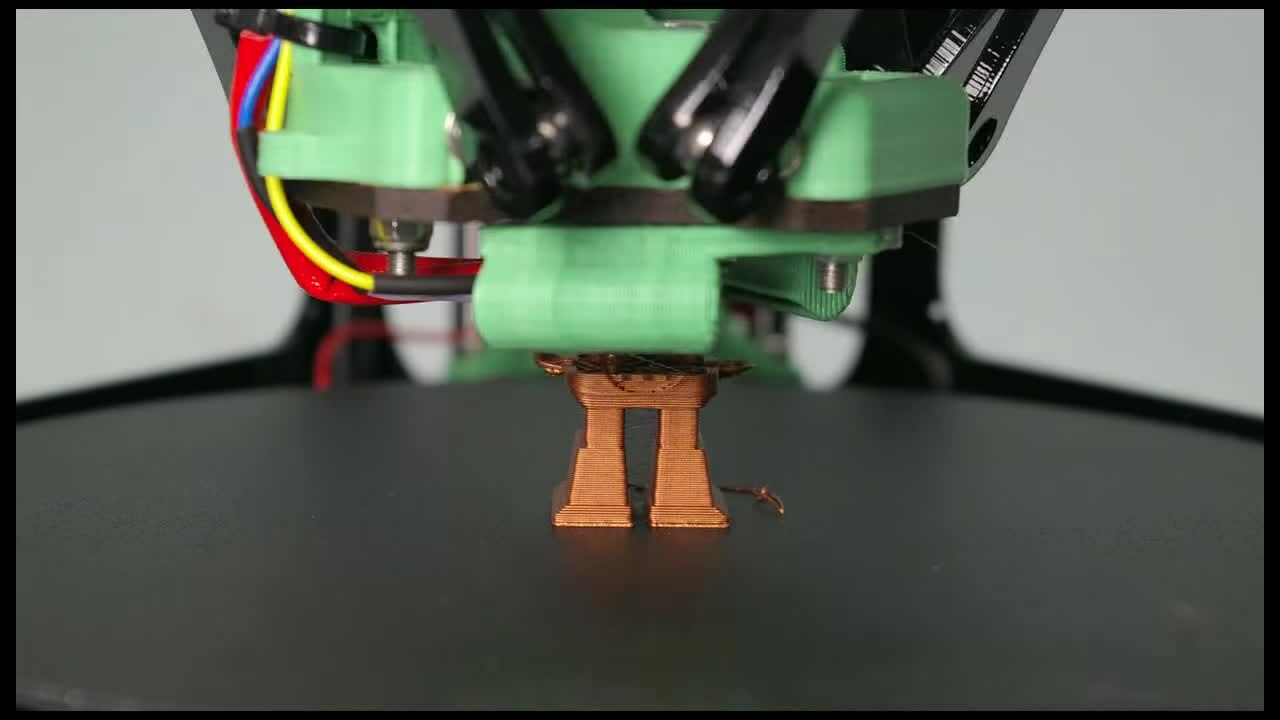
Some methods melt or soften the material to produce the layers. In fused filament fabrication, also known as fused deposition modeling (FDM), the model or part is produced by extruding small beads or streams of material that harden immediately to form layers. A filament of thermoplastic, metal wire, or other material is fed into an extrusion nozzle head (3D printer extruder), which heats the material and turns the flow on and off. FDM is somewhat restricted in the variation of shapes that may be fabricated. Another technique fuses parts of the layer and then moves upward in the working area, adding another layer of granules and repeating the process until the piece has built up. This process uses the unfused media to support overhangs and thin walls in the part being produced, which reduces the need for temporary auxiliary supports for the piece.[123] Recently, FFF/FDM has expanded to 3-D print directly from pellets to avoid the conversion to filament. This process is called fused particle fabrication (FPF) (or fused granular fabrication (FGF) and has the potential to use more recycled materials.[124]
Powder bed fusion
[edit]Powder bed fusion techniques, or PBF, include several processes such as DMLS, SLS, SLM, MJF and EBM. Powder bed fusion processes can be used with an array of materials and their flexibility allows for geometrically complex structures,[125] making it a good choice for many 3D printing projects. These techniques include selective laser sintering, with both metals and polymers and direct metal laser sintering.[126] Selective laser melting does not use sintering for the fusion of powder granules but will completely melt the powder using a high-energy laser to create fully dense materials in a layer-wise method that has mechanical properties similar to those of conventional manufactured metals. Electron beam melting is a similar type of additive manufacturing technology for metal parts (e.g. titanium alloys). EBM manufactures parts by melting metal powder layer by layer with an electron beam in a high vacuum.[127][128] Another method consists of an inkjet 3D printing system, which creates the model one layer at a time by spreading a layer of powder (plaster or resins) and printing a binder in the cross-section of the part using an inkjet-like process. With laminated object manufacturing, thin layers are cut to shape and joined. In addition to the previously mentioned methods, HP has developed the Multi Jet Fusion (MJF) which is a powder base technique, though no lasers are involved. An inkjet array applies fusing and detailing agents which are then combined by heating to create a solid layer.[129]
Binder jetting
[edit]The binder jetting 3D printing technique involves the deposition of a binding adhesive agent onto layers of material, usually powdered, and then this "green" state part may be cured and even sintered. The materials can be ceramic-based, metal or plastic. This method is also known as inkjet 3D printing. To produce a part, the printer builds the model using a head that moves over the platform base to spread or deposit alternating layers of powder (plaster and resins) and binder. Most modern binder jet printers also cure each layer of binder. These steps are repeated until all layers have been printed. This green part is usually cured in an oven to off-gas most of the binder before being sintered in a kiln with a specific time-temperature curve for the given material(s).
This technology allows the printing of full-color prototypes, overhangs, and elastomer parts. The strength of bonded powder prints can be enhanced by impregnating in the spaces between the necked or sintered matrix of powder with other compatible materials depending on the powder material, like wax, thermoset polymer, or even bronze.[130][131]

Stereolithography
[edit]Other methods cure liquid materials using different sophisticated technologies, such as stereolithography. Photopolymerization is primarily used in stereolithography to produce a solid part from a liquid. Inkjet printer systems like the Objet PolyJet system spray photopolymer materials onto a build tray in ultra-thin layers (between 16 and 30 μm) until the part is completed.[132] Each photopolymer layer is cured with UV light after it is jetted, producing fully cured models that can be handled and used immediately, without post-curing. Ultra-small features can be made with the 3D micro-fabrication technique used in multiphoton photopolymerisation. Due to the nonlinear nature of photo excitation, the gel is cured to a solid only in the places where the laser was focused while the remaining gel is then washed away. Feature sizes of under 100 nm are easily produced, as well as complex structures with moving and interlocked parts.[133] Yet another approach uses a synthetic resin that is solidified using LEDs.[134]
In Mask-image-projection-based stereolithography, a 3D digital model is sliced by a set of horizontal planes. Each slice is converted into a two-dimensional mask image. The mask image is then projected onto a photocurable liquid resin surface and light is projected onto the resin to cure it in the shape of the layer.[135] Continuous liquid interface production begins with a pool of liquid photopolymer resin. Part of the pool bottom is transparent to ultraviolet light (the "window"), which causes the resin to solidify. The object rises slowly enough to allow the resin to flow under and maintain contact with the bottom of the object.[136] In powder-fed directed-energy deposition, a high-power laser is used to melt metal powder supplied to the focus of the laser beam. The powder-fed directed energy process is similar to selective laser sintering, but the metal powder is applied only where material is being added to the part at that moment.[137][138]
Computed axial lithography
[edit]Computed axial lithography is a method for 3D printing based on computerised tomography scans to create prints in photo-curable resin. It was developed by a collaboration between the University of California, Berkeley with Lawrence Livermore National Laboratory.[139][140][141] Unlike other methods of 3D printing it does not build models through depositing layers of material like fused deposition modelling and stereolithography, instead it creates objects using a series of 2D images projected onto a cylinder of resin.[139][141] It is notable for its ability to build an object much more quickly than other methods using resins and the ability to embed objects within the prints.[140]
Liquid additive manufacturing
[edit]Liquid additive manufacturing (LAM) is a 3D printing technique that deposits a liquid or high viscosity material (e.g. liquid silicone rubber) onto a build surface to create an object which then is vulcanised using heat to harden the object.[142][143][144] The process was originally created by Adrian Bowyer and was then built upon by German RepRap.[142][145][146]
A technique called programmable tooling uses 3D printing to create a temporary mold, which is then filled via a conventional injection molding process and then immediately dissolved.[147]
Lamination
[edit]In some printers, paper can be used as the build material, resulting in a lower cost to print. During the 1990s some companies marketed printers that cut cross-sections out of special adhesive coated paper using a carbon dioxide laser and then laminated them together.
In 2005 Mcor Technologies Ltd developed a different process using ordinary sheets of office paper, a tungsten carbide blade to cut the shape, and selective deposition of adhesive and pressure to bond the prototype.[148]
Directed-energy deposition (DED)
[edit]Powder-fed directed-energy deposition
[edit]In powder-fed directed-energy deposition (also known as laser metal deposition), a high-power laser is used to melt metal powder supplied to the focus of the laser beam. The laser beam typically travels through the center of the deposition head and is focused on a small spot by one or more lenses. The build occurs on an X-Y table which is driven by a tool path created from a digital model to fabricate an object layer by layer. The deposition head is moved up vertically as each layer is completed. Some systems even make use of 5-axis[149][150] or 6-axis systems[151] (i.e. articulated arms) capable of delivering material on the substrate (a printing bed, or a pre-existing part[152]) with few to no spatial access restrictions. Metal powder is delivered and distributed around the circumference of the head or can be split by an internal manifold and delivered through nozzles arranged in various configurations around the deposition head. A hermetically sealed chamber filled with inert gas or a local inert shroud gas (sometimes both combined) is often used to shield the melt pool from atmospheric oxygen, to limit oxidation and to better control the material properties. The powder-fed directed-energy process is similar to selective laser sintering, but the metal powder is projected only where the material is being added to the part at that moment. The laser beam is used to heat up and create a "melt pool" on the substrate, in which the new powder is injected quasi-simultaneously. The process supports a wide range of materials including titanium, stainless steel, aluminium, tungsten, and other specialty materials as well as composites and functionally graded materials. The process can not only fully build new metal parts but can also add material to existing parts for example for coatings, repair, and hybrid manufacturing applications. Laser engineered net shaping (LENS), which was developed by Sandia National Labs, is one example of the powder-fed directed-energy deposition process for 3D printing or restoring metal parts.[153][154]
Metal wire processes
[edit]Laser-based wire-feed systems, such as laser metal deposition-wire (LMD-w), feed the wire through a nozzle that is melted by a laser using inert gas shielding in either an open environment (gas surrounding the laser) or in a sealed chamber. Electron beam freeform fabrication uses an electron beam heat source inside a vacuum chamber.
It is also possible to use conventional gas metal arc welding attached to a 3D stage to 3-D print metals such as steel, bronze and aluminium.[155][156] Low-cost open source RepRap-style 3-D printers have been outfitted with Arduino-based sensors and demonstrated reasonable metallurgical properties from conventional welding wire as feedstock.[157]
Selective powder deposition (SPD)
[edit]In selective powder deposition, build and support powders are selectively deposited into a crucible, such that the build powder takes the shape of the desired object and support powder fills the rest of the volume in the crucible. Then an infill material is applied, such that it comes in contact with the build powder. Then the crucible is fired up in a kiln at the temperature above the melting point of the infill but below the melting points of the powders. When the infill melts, it soaks the build powder. But it does not soak the support powder, because the support powder is chosen to be such that it is not wettable by the infill. If at the firing temperature, the atoms of the infill material and the build powder are mutually defusable, such as in the case of copper powder and zinc infill, then the resulting material will be a uniform mixture of those atoms, in this case, bronze. But if the atoms are not mutually defusable, such as in the case of tungsten and copper at 1100 °C, then the resulting material will be a composite. To prevent shape distortion, the firing temperature must be below the solidus temperature of the resulting alloy.[158]
Cryogenic 3D printing
[edit]Cryogenic 3D printing is a collection of techniques that forms solid structures by freezing liquid materials while they are deposited. As each liquid layer is applied, it is cooled by the low temperature of the previous layer and printing environment which results in solidification. Unlike other 3D printing techniques, cryogenic 3D printing requires a controlled printing environment. The ambient temperature must be below the material's freezing point to ensure the structure remains solid during manufacturing and the humidity must remain low to prevent frost formation between the application of layers.[159] Materials typically include water and water-based solutions, such as brine, slurry, and hydrogels.[160][161] Cryogenic 3D printing techniques include rapid freezing prototype (RFP),[160] low-temperature deposition manufacturing (LDM),[162] and freeze-form extrusion fabrication (FEF).[163]
Applications
[edit] | This section may benefit from being shortened by the use of summary style. |

3D printing or additive manufacturing has been used in manufacturing, medical, industry and sociocultural sectors (e.g. cultural heritage) to create successful commercial technology.[164] More recently, 3D printing has also been used in the humanitarian and development sector to produce a range of medical items, prosthetics, spares and repairs.[165] The earliest application of additive manufacturing was on the toolroom end of the manufacturing spectrum. For example, rapid prototyping was one of the earliest additive variants, and its mission was to reduce the lead time and cost of developing prototypes of new parts and devices, which was earlier only done with subtractive toolroom methods such as CNC milling, turning, and precision grinding.[166] In the 2010s, additive manufacturing entered production to a much greater extent.
Food
[edit]Additive manufacturing of food is being developed by squeezing out food, layer by layer, into three-dimensional objects. A large variety of foods are appropriate candidates, such as chocolate and candy, and flat foods such as crackers, pasta,[167] and pizza.[168][169] NASA is looking into the technology in order to create 3D-printed food to limit food waste and to make food that is designed to fit an astronaut's dietary needs.[170] In 2018, Italian bioengineer Giuseppe Scionti developed a technology allowing the production of fibrous plant-based meat analogues using a custom 3D bioprinter, mimicking meat texture and nutritional values.[171][172]
Fashion
[edit]
3D printing has entered the world of clothing, with fashion designers experimenting with 3D-printed bikinis, shoes, and dresses.[173] In commercial production, Nike used 3D printing to prototype and manufacture the 2012 Vapor Laser Talon football shoe for players of American football, and New Balance has 3D manufactured custom-fit shoes for athletes.[173][174] 3D printing has come to the point where companies are printing consumer-grade eyewear with on-demand custom fit and styling (although they cannot print the lenses). On-demand customization of glasses is possible with rapid prototyping.[175]
Transportation
[edit]
In cars, trucks, and aircraft, additive manufacturing is beginning to transform both unibody and fuselage design and production, and powertrain design and production. For example, General Electric uses high-end 3D printers to build parts for turbines.[176] Many of these systems are used for rapid prototyping before mass production methods are employed. Other prominent examples include:
- In early 2014, Swedish sports car manufacturer Koenigsegg announced the One:1, a sports car that utilizes many components that were 3D printed.[177] Urbee is the first car produced using 3D printing (the bodywork and car windows were "printed").[178][179][180]
- In 2014, Local Motors debuted Strati, a functioning vehicle that was entirely 3D printed using ABS plastic and carbon fiber, except the powertrain.[181]
- In May 2015 Airbus announced that its new Airbus A350 XWB included over 1000 components manufactured by 3D printing.[182]
- In 2015, a Royal Air Force Eurofighter Typhoon fighter jet flew with printed parts. The United States Air Force has begun to work with 3D printers, and the Israeli Air Force has also purchased a 3D printer to print spare parts.[183]
- In 2017, GE Aviation revealed that it had used design for additive manufacturing to create a helicopter engine with 16 parts instead of 900, with great potential impact on reducing the complexity of supply chains.[184]
Firearms
[edit]AM's impact on firearms involves two dimensions: new manufacturing methods for established companies, and new possibilities for the making of do-it-yourself firearms. In 2012, the US-based group Defense Distributed disclosed plans to design a working plastic 3D-printed firearm "that could be downloaded and reproduced by anybody with a 3D printer".[185][186] After Defense Distributed released their plans, questions were raised regarding the effects that 3D printing and widespread consumer-level CNC machining[187][188] may have on gun control effectiveness.[189][190][191][192] Moreover, armor-design strategies can be enhanced by taking inspiration from nature and prototyping those designs easily, using AM.[193]
Health
[edit]Surgical uses of 3D printing-centric therapies began in the mid-1990s with anatomical modeling for bony reconstructive surgery planning. Patient-matched implants were a natural extension of this work, leading to truly personalized implants that fit one unique individual.[194] Virtual planning of surgery and guidance using 3D printed, personalized instruments have been applied to many areas of surgery including total joint replacement and craniomaxillofacial reconstruction with great success.[195][196] One example of this is the bioresorbable trachial splint to treat newborns with tracheobronchomalacia[197] developed at the University of Michigan. The use of additive manufacturing for serialized production of orthopedic implants (metals) is also increasing due to the ability to efficiently create porous surface structures that facilitate osseointegration. The hearing aid and dental industries are expected to be the biggest areas of future development using custom 3D printing technology.[198]
3D printing is not just limited to inorganic materials; there have been a number of biomedical advancements made possible by 3D printing. As of 2012[update], 3D bio-printing technology has been studied by biotechnology firms and academia for possible use in tissue engineering applications in which organs and body parts are built using inkjet printing techniques. In this process, layers of living cells are deposited onto a gel medium or sugar matrix and slowly built up to form three-dimensional structures including vascular systems.[199] 3D printing has been considered as a method of implanting stem cells capable of generating new tissues and organs in living humans.[200] In 2018, 3D printing technology was used for the first time to create a matrix for cell immobilization in fermentation. Propionic acid production by Propionibacterium acidipropionici immobilized on 3D-printed nylon beads was chosen as a model study. It was shown that those 3D-printed beads were capable of promoting high-density cell attachment and propionic acid production, which could be adapted to other fermentation bioprocesses.[201]
3D printing has also been employed by researchers in the pharmaceutical field. During the last few years, there has been a surge in academic interest regarding drug delivery with the aid of AM techniques. This technology offers a unique way for materials to be utilized in novel formulations.[202] AM manufacturing allows for the usage of materials and compounds in the development of formulations, in ways that are not possible with conventional/traditional techniques in the pharmaceutical field, e.g. tableting, cast-molding, etc. Moreover, one of the major advantages of 3D printing, especially in the case of fused deposition modelling (FDM), is the personalization of the dosage form that can be achieved, thus, targeting the patient's specific needs.[203] In the not-so-distant future, 3D printers are expected to reach hospitals and pharmacies in order to provide on-demand production of personalized formulations according to the patients' needs.[204]
3D printing has also been used for medical equipment. During the COVID-19 pandemic 3D printers were used to supplement the strained supply of PPE through volunteers using their personally owned printers to produce various pieces of personal protective equipment (i.e. frames for face shields).
Education
[edit]3D printing, and open source 3D printers, in particular, are the latest technologies making inroads into the classroom.[205][206][207] Higher education has proven to be a major buyer of desktop and professional 3D printers which industry experts generally view as a positive indicator.[208] Some authors have claimed that 3D printers offer an unprecedented "revolution" in STEM education.[209][210] The evidence for such claims comes from both the low-cost ability for rapid prototyping in the classroom by students, but also the fabrication of low-cost high-quality scientific equipment from open hardware designs forming open-source labs.[211] Additionally, Libraries around the world have also become locations to house smaller 3D printers for educational and community access.[212] Future applications for 3D printing might include creating open-source scientific equipment.[211][213]

Replicating archeological artifacts
[edit]In the 2010s, 3D printing became intensively used in the cultural heritage field for preservation, restoration and dissemination purposes.[214] Many Europeans and North American Museums have purchased 3D printers and actively recreate missing pieces of their relics[215] and archaeological monuments such as Tiwanaku in Bolivia.[216] The Metropolitan Museum of Art and the British Museum have started using their 3D printers to create museum souvenirs that are available in the museum shops.[217] Other museums, like the National Museum of Military History and Varna Historical Museum, have gone further and sell through the online platform Threeding digital models of their artifacts, created using Artec 3D scanners, in 3D printing friendly file format, which everyone can 3D print at home.[218] Morehshin Allahyari, an Iranian-born U.S. artist, considers her use of 3D sculpting processes of re-constructing Iranian cultural treasures as feminist activism. Allahyari uses a 3D modeling software to reconstruct a series of cultural artifacts that were demolished by ISIS militants in 2014.[219]
Replicating historic buildings and architectural structures
[edit]
The application of 3D printing for the representation of architectural assets has many challenges. In 2018, the structure of Iran National Bank was traditionally surveyed and modeled in computer graphics software (specifically, Cinema4D) and was optimized for 3D printing. The team tested the technique for the construction of the part and it was successful. After testing the procedure, the modellers reconstructed the structure in Cinema4D and exported the front part of the model to Netfabb. The entrance of the building was chosen due to the 3D printing limitations and the budget of the project for producing the maquette. 3D printing was only one of the capabilities enabled by the produced 3D model of the bank, but due to the project's limited scope, the team did not continue modelling for the virtual representation or other applications.[220] In 2021, Parsinejad et al. comprehensively compared the hand surveying method for 3D reconstruction ready for 3D printing with digital recording (adoption of photogrammetry method).[220]
The world's first 3D-printed steel bridge was unveiled in Amsterdam in July 2021. Spanning 12 meters over the Oudezijds Achterburgwal canal, the bridge was created using robotic arms that printed over 4,500 kilograms of stainless steel. It took six months to complete.[221]
Soft actuators
[edit]3D printed soft actuators is a growing application of 3D printing technology that has found its place in the 3D printing applications. These soft actuators are being developed to deal with soft structures and organs, especially in biomedical sectors and where the interaction between humans and robots is inevitable. The majority of the existing soft actuators are fabricated by conventional methods that require manual fabrication of devices, post-processing/assembly, and lengthy iterations until the maturity of the fabrication is achieved. Instead of the tedious and time-consuming aspects of the current fabrication processes, researchers are exploring an appropriate manufacturing approach for the effective fabrication of soft actuators. Thus, 3D-printed soft actuators are introduced to revolutionize the design and fabrication of soft actuators with custom geometrical, functional, and control properties in a faster and inexpensive approach. They also enable incorporation of all actuator components into a single structure eliminating the need to use external joints, adhesives, and fasteners.
Circuit boards
[edit]Circuit board manufacturing involves multiple steps which include imaging, drilling, plating, solder mask coating, nomenclature printing and surface finishes. These steps include many chemicals such as harsh solvents and acids. 3D printing circuit boards remove the need for many of these steps while still producing complex designs.[222] Polymer ink is used to create the layers of the build while silver polymer is used for creating the traces and holes used to allow electricity to flow.[223] Current circuit board manufacturing can be a tedious process depending on the design. Specified materials are gathered and sent into inner layer processing where images are printed, developed and etched. The etch cores are typically punched to add lamination tooling. The cores are then prepared for lamination. The stack-up, the buildup of a circuit board, is built and sent into lamination where the layers are bonded. The boards are then measured and drilled. Many steps may differ from this stage however for simple designs, the material goes through a plating process to plate the holes and surface. The outer image is then printed, developed and etched. After the image is defined, the material must get coated with a solder mask for later soldering. Nomenclature is then added so components can be identified later. Then the surface finish is added. The boards are routed out of panel form into their singular or array form and then electrically tested. Aside from the paperwork that must be completed which proves the boards meet specifications, the boards are then packed and shipped. The benefits of 3D printing would be that the final outline is defined from the beginning, no imaging, punching or lamination is required and electrical connections are made with the silver polymer which eliminates drilling and plating. The final paperwork would also be greatly reduced due to the lack of materials required to build the circuit board. Complex designs which may take weeks to complete through normal processing can be 3D printed, greatly reducing manufacturing time.

Hobbyists
[edit]In 2005, academic journals began to report on the possible artistic applications of 3D printing technology.[224] Off-the-shelf machines were increasingly capable of producing practical household applications, for example, ornamental objects. Some practical examples include a working clock[225] and gears printed for home woodworking machines among other purposes.[226] Websites associated with home 3D printing tended to include backscratchers, coat hooks, door knobs, etc.[227] As of 2017, domestic 3D printing was reaching a consumer audience beyond hobbyists and enthusiasts. Several projects and companies are making efforts to develop affordable 3D printers for home desktop use. Much of this work has been driven by and targeted at DIY/maker/enthusiast/early adopter communities, with additional ties to the academic and hacker communities.
Sped on by decreases in price and increases in quality, As of 2019[update] an estimated 2 million people worldwide have purchased a 3D printer for hobby use.[228]
Legal aspects
[edit]Intellectual property
[edit]3D printing has existed for decades within certain manufacturing industries where many legal regimes, including patents, industrial design rights, copyrights, and trademarks may apply. However, there is not much jurisprudence to say how these laws will apply if 3D printers become mainstream and individuals or hobbyist communities begin manufacturing items for personal use, for non-profit distribution, or for sale.
Any of the mentioned legal regimes may prohibit the distribution of the designs used in 3D printing or the distribution or sale of the printed item. To be allowed to do these things, where active intellectual property was involved, a person would have to contact the owner and ask for a licence, which may come with conditions and a price. However, many patent, design and copyright laws contain a standard limitation or exception for "private" or "non-commercial" use of inventions, designs or works of art protected under intellectual property (IP). That standard limitation or exception may leave such private, non-commercial uses outside the scope of IP rights.
Patents cover inventions including processes, machines, manufacturing, and compositions of matter and have a finite duration which varies between countries, but generally 20 years from the date of application. Therefore, if a type of wheel is patented, printing, using, or selling such a wheel could be an infringement of the patent.[229]
Copyright covers an expression[230] in a tangible, fixed medium and often lasts for the life of the author plus 70 years thereafter.[231] For example, a sculptor retains copyright over a statue, such that other people cannot then legally distribute designs to print an identical or similar statue without paying royalties, waiting for the copyright to expire, or working within a fair use exception.
When a feature has both artistic (copyrightable) and functional (patentable) merits when the question has appeared in US court, the courts have often held the feature is not copyrightable unless it can be separated from the functional aspects of the item.[231] In other countries the law and the courts may apply a different approach allowing, for example, the design of a useful device to be registered (as a whole) as an industrial design on the understanding that, in case of unauthorized copying, only the non-functional features may be claimed under design law whereas any technical features could only be claimed if covered by a valid patent.
Gun legislation and administration
[edit]The US Department of Homeland Security and the Joint Regional Intelligence Center released a memo stating that "significant advances in three-dimensional (3D) printing capabilities, availability of free digital 3D printable files for firearms components, and difficulty regulating file sharing may present public safety risks from unqualified gun seekers who obtain or manufacture 3D printed guns" and that "proposed legislation to ban 3D printing of weapons may deter, but cannot completely prevent their production. Even if the practice is prohibited by new legislation, online distribution of these 3D printable files will be as difficult to control as any other illegally traded music, movie or software files."[232]
Attempting to restrict the distribution of gun plans via the Internet has been likened to the futility of preventing the widespread distribution of DeCSS, which enabled DVD ripping.[233][234][235][236] After the US government had Defense Distributed take down the plans, they were still widely available via the Pirate Bay and other file sharing sites.[237] Downloads of the plans from the UK, Germany, Spain, and Brazil were heavy.[238][239] Some US legislators have proposed regulations on 3D printers to prevent them from being used for printing guns.[240][241] 3D printing advocates have suggested that such regulations would be futile, could cripple the 3D printing industry and could infringe on free speech rights, with early pioneers of 3D printing professor Hod Lipson suggesting that gunpowder could be controlled instead.[242][243][244][245][246][247]
Internationally, where gun controls are generally stricter than in the United States, some commentators have said the impact may be more strongly felt since alternative firearms are not as easily obtainable.[248] Officials in the United Kingdom have noted that producing a 3D-printed gun would be illegal under their gun control laws.[249] Europol stated that criminals have access to other sources of weapons but noted that as technology improves, the risks of an effect would increase.[250][251]
Aerospace regulation
[edit]In the United States, the FAA has anticipated a desire to use additive manufacturing techniques and has been considering how best to regulate this process.[252] The FAA has jurisdiction over such fabrication because all aircraft parts must be made under FAA production approval or under other FAA regulatory categories.[253] In December 2016, the FAA approved the production of a 3D-printed fuel nozzle for the GE LEAP engine.[254] Aviation attorney Jason Dickstein has suggested that additive manufacturing is merely a production method, and should be regulated like any other production method.[255][256] He has suggested that the FAA's focus should be on guidance to explain compliance, rather than on changing the existing rules, and that existing regulations and guidance permit a company "to develop a robust quality system that adequately reflects regulatory needs for quality assurance".[255]
Quality assurance
[edit]In 2021, first standards were issued, e.g. ASTM ISO/ASTM52900-21 Additive manufacturing general principles, fundamentals and vocabulary, and the above mentioned ISO/ASTM52900-15.[118][119] In 2023, the ISO/ASTM 52920:2023[257] defined the requirements for industrial additive manufacturing processes and production sites using additive manufacturing to ensure required quality level. Aforetime in Germany there was a draft of DIN norm issued, DIN SPEC 17071:2019.
Health and safety
[edit]Polymer feedstock materials can release ultrafine particles and volatile organic compounds (VOCs) if sufficiently heated, which in combination have been associated with adverse respiratory and cardiovascular health effects. In addition, temperatures of 190 °C to 260 °C are typically reached by an FFF extrusion nozzle, which can cause skin burns. Vat photopolymerization stereolithography printers use high-powered lasers that present a skin and eye hazard, although they are considered nonhazardous during printing because the laser is enclosed within the printing chamber.[258]
3D printers also contain many moving parts that include stepper motors, pulleys, threaded rods, carriages, and small fans, which generally do not have enough power to cause serious injuries but can still trap a user's finger, long hair, or loose clothing. Most desktop FFF 3D printers do not have any added electrical safety features beyond regular internal fuses or external transformers, although the voltages in the exposed parts of 3D printers usually do not exceed 12V to 24V, which is generally considered safe.[258]
Research on the health and safety concerns of 3D printing is new and in development due to the recent proliferation of 3D printing devices. In 2017, the European Agency for Safety and Health at Work published a discussion paper on the processes and materials involved in 3D printing, the potential implications of this technology for occupational safety and health and avenues for controlling potential hazards.[259]
Noise level is measured in decibels (dB), and can vary greatly in home printers from 15 dB to 75 dB.[260] Some main sources of noise in filament printers are fans, motors and bearings, while in resin printers the fans usually are responsible for most of the noise.[260] Some methods for dampening the noise from a printer may be to install vibration isolation, use larger diameter fans, perform regular maintenance and lubrication, or use a soundproofing enclosure.[260]
Impact
[edit]Additive manufacturing, starting with today's infancy period, requires manufacturing firms to be flexible, ever-improving users of all available technologies to remain competitive. Advocates of additive manufacturing also predict that this arc of technological development will counter globalization, as end users will do much of their own manufacturing rather than engage in trade to buy products from other people and corporations.[16] The real integration of the newer additive technologies into commercial production, however, is more a matter of complementing traditional subtractive methods rather than displacing them entirely.[261]
The futurologist Jeremy Rifkin[262] claimed that 3D printing signals the beginning of a third industrial revolution,[263] succeeding the production line assembly that dominated manufacturing starting in the late 19th century.
Social change
[edit]
Since the 1950s, a number of writers and social commentators have speculated in some depth about the social and cultural changes that might result from the advent of commercially affordable additive manufacturing technology.[264] In recent years, 3D printing has created a significant impact in the humanitarian and development sector. Its potential to facilitate distributed manufacturing is resulting in supply chain and logistics benefits, by reducing the need for transportation, warehousing and wastage. Furthermore, social and economic development is being advanced through the creation of local production economies.[165]
Others have suggested that as more and more 3D printers start to enter people's homes, the conventional relationship between the home and the workplace might get further eroded.[265] Likewise, it has also been suggested that, as it becomes easier for businesses to transmit designs for new objects around the globe, so the need for high-speed freight services might also become less.[266] Finally, given the ease with which certain objects can now be replicated, it remains to be seen whether changes will be made to current copyright legislation so as to protect intellectual property rights with the new technology widely available.
Some call attention to the conjunction of commons-based peer production with 3D printing and other low-cost manufacturing techniques.[267][268][269] The self-reinforced fantasy of a system of eternal growth can be overcome with the development of economies of scope, and here, society can play an important role contributing to the raising of the whole productive structure to a higher plateau of more sustainable and customized productivity.[267] Further, it is true that many issues, problems, and threats arise due to the democratization of the means of production, and especially regarding the physical ones.[267] For instance, the recyclability of advanced nanomaterials is still questioned; weapons manufacturing could become easier; not to mention the implications for counterfeiting[270] and on intellectual property.[271] It might be maintained that in contrast to the industrial paradigm whose competitive dynamics were about economies of scale, commons-based peer production 3D printing could develop economies of scope. While the advantages of scale rest on cheap global transportation, the economies of scope share infrastructure costs (intangible and tangible productive resources), taking advantage of the capabilities of the fabrication tools.[267] And following Neil Gershenfeld[272] in that "some of the least developed parts of the world need some of the most advanced technologies", commons-based peer production and 3D printing may offer the necessary tools for thinking globally but acting locally in response to certain needs.
Larry Summers wrote about the "devastating consequences" of 3D printing and other technologies (robots, artificial intelligence, etc.) for those who perform routine tasks. In his view, "already there are more American men on disability insurance than doing production work in manufacturing. And the trends are all in the wrong direction, particularly for the less skilled, as the capacity of capital embodying artificial intelligence to replace white-collar as well as blue-collar work will increase rapidly in the years ahead." Summers recommends more vigorous cooperative efforts to address the "myriad devices" (e.g., tax havens, bank secrecy, money laundering, and regulatory arbitrage) enabling the holders of great wealth to "a paying" income and estate taxes, and to make it more difficult to accumulate great fortunes without requiring "great social contributions" in return, including: more vigorous enforcement of anti-monopoly laws, reductions in "excessive" protection for intellectual property, greater encouragement of profit-sharing schemes that may benefit workers and give them a stake in wealth accumulation, strengthening of collective bargaining arrangements, improvements in corporate governance, strengthening of financial regulation to eliminate subsidies to financial activity, easing of land-use restrictions that may cause the real estate of the rich to keep rising in value, better training for young people and retraining for displaced workers, and increased public and private investment in infrastructure development—e.g., in energy production and transportation.[273]
Michael Spence wrote that "Now comes a ... powerful, wave of digital technology that is replacing labor in increasingly complex tasks. This process of labor substitution and disintermediation has been underway for some time in service sectors—think of ATMs, online banking, enterprise resource planning, customer relationship management, mobile payment systems, and much more. This revolution is spreading to the production of goods, where robots and 3D printing are displacing labor." In his view, the vast majority of the cost of digital technologies comes at the start, in the design of hardware (e.g. 3D printers) and, more importantly, in creating the software that enables machines to carry out various tasks. "Once this is achieved, the marginal cost of the hardware is relatively low (and declines as scale rises), and the marginal cost of replicating the software is essentially zero. With a huge potential global market to amortize the upfront fixed costs of design and testing, the incentives to invest [in digital technologies] are compelling."[274]
Spence believes that, unlike prior digital technologies, which drove firms to deploy underutilized pools of valuable labor around the world, the motivating force in the current wave of digital technologies "is cost reduction via the replacement of labor". For example, as the cost of 3D printing technology declines, it is "easy to imagine" that production may become "extremely" local and customized. Moreover, production may occur in response to actual demand, not anticipated or forecast demand. Spence believes that labor, no matter how inexpensive, will become a less important asset for growth and employment expansion, with labor-intensive, process-oriented manufacturing becoming less effective, and that re-localization will appear in both developed and developing countries. In his view, production will not disappear, but it will be less labor-intensive, and all countries will eventually need to rebuild their growth models around digital technologies and the human capital supporting their deployment and expansion. Spence writes that "the world we are entering is one in which the most powerful global flows will be ideas and digital capital, not goods, services, and traditional capital. Adapting to this will require shifts in mindsets, policies, investments (especially in human capital), and quite possibly models of employment and distribution."[274]
Naomi Wu regards the usage of 3D printing in the Chinese classroom (where rote memorization is standard) to teach design principles and creativity as the most exciting recent development of the technology, and more generally regards 3D printing as being the next desktop publishing revolution.[275]
A printer was donated to the Juan Fernandez Women's Group in 2024, to support women in the remote community to be able to create parts to fix broken equipment, without having to wait for a ship to import the needed components.[276]
Environmental change
[edit]The growth of additive manufacturing could have a large impact on the environment. Traditional subtractive manufacturing methods such as CNC milling create products by cutting away material from a larger block. In contrast, additive manufacturing creates products layer-by layer, using the minimum required materials to create the product.[277] This has the benefit of reducing material waste, which further contributes to energy savings by avoiding raw material production.[278][279]
Life-cycle assessment of additive manufacturing has estimated that adopting the technology could further lower carbon dioxide emissions since 3D printing creates localized production, thus reducing the need to transport products and the emissions associated.[280] AM could also allow consumers to create their own replacement parts to fix purchased products to extend the lifespan of purchased products.[281]
By making only the bare structural necessities of products, additive manufacturing also has the potential to make profound contributions to lightweighting.[277] The use of these lightweight components would allow for reductions in the energy consumption and greenhouse gas emissions of vehicles and other forms of transportation.[282] A case study on an airplane component made using additive manufacturing, for example, found that the use of the component saves 63% of relevant energy and carbon dioxide emissions over the course of the product's lifetime.[283]
However, the adoption of additive manufacturing also has environmental disadvantages. Firstly, AM has a high energy consumption compared to traditional processes. This is due to its use of processes such as lasers and high temperatures for product creation.[284] Secondly, despite additive manufacturing reducing up to 90% of waste compared to subtractive manufacturing, AM can generate waste that is non-recyclable.[285] For example, there are issues with the recyclability of materials in metal AM as some highly regulated industries such as aerospace often insist on using virgin powder in the creation of safety critical components.[277] Additive manufacturing has not yet reached its theoretical material efficiency potential of 97%, but it may get closer as the technology continues to increase productivity.[286]
Despite the drawbacks, research and industry are making further strides to support AM's sustainability. Some large FDM printers that melt high-density polyethylene (HDPE) pellets may also accept sufficiently clean recycled material such as chipped milk bottles. In addition, these printers can use shredded material from faulty builds or unsuccessful prototype versions, thus reducing overall project wastage and materials handling and storage. The concept has been explored in the RecycleBot.[287] There are also industrial efforts to produce metal powder from recycled metals.[288]
See also
[edit]
- 3D bioprinting
- 3D food printing
- 3D Manufacturing Format
- 3D printing marketplace
- 3D printing speed
- 3D printing in India
- AstroPrint
- Bubblegram
- Cloud manufacturing
- Comparison of 3D printers
- Computer numeric control
- Delta robot
- Fraunhofer Competence Field Additive Manufacturing
- Fusion3
- Laser cutting
- Limbitless Solutions
- List of 3D printer manufacturers
- List of 3D printing software
- List of common 3D test models
- List of emerging technologies
- List of notable 3D printed weapons and parts
- Magnetically assisted slip casting
- MakerBot Industries
- Milling center
- Organ-on-a-chip
- Robocasting
- Self-replicating machine
- Ultimaker
- Volumetric printing
References
[edit]- ^ "3D printing scales up". The Economist. 5 September 2013. Archived from the original on 15 July 2019. Retrieved 15 July 2019.
- ^ Gao, Wei; Zhang, Yunbo; Ramanujan, Devarajan; Ramani, Karthik; Chen, Yong; Williams, Christopher B.; Wang, Charlie C. L.; Shin, Yung C.; Zhang, Song; Zavattieri, Pablo D. (2015). "The status, challenges, and future of additive manufacturing in engineering". Computer-Aided Design. 69: 65–89. doi:10.1016/j.cad.2015.04.001. ISSN 0010-4485. S2CID 33086357.
- ^ Ngo, Tuan D.; Kashani, Alireza; Imbalzano, Gabriele; Nguyen, Kate T. Q.; Hui, David (2018). "Additive manufacturing (3D printing): A review of materials, methods, applications and challenges". Composites Part B: Engineering. 143: 172–196. doi:10.1016/j.compositesb.2018.02.012. S2CID 139464688.
- ^ Excell, Jon (23 May 2010). "The rise of additive manufacturing". The Engineer. Archived from the original on 19 September 2015. Retrieved 30 October 2013.
- ^ "Learning Course: Additive Manufacturing – Additive Fertigung". tmg-muenchen.de. Archived from the original on 23 August 2019. Retrieved 23 August 2019.
- ^ Lam, Hugo K.S.; Ding, Li; Cheng, T.C.E.; Zhou, Honggeng (1 January 2019). "The impact of 3D printing implementation on stock returns: A contingent dynamic capabilities perspective". International Journal of Operations & Production Management. 39 (6/7/8): 935–961. doi:10.1108/IJOPM-01-2019-0075. ISSN 0144-3577. S2CID 211386031.
- ^ "3D Printing: All You Need To Know". explainedideas.com. Archived from the original on 20 August 2022. Retrieved 11 August 2022.
- ^ a b "Most used 3D printing technologies 2017–2018 | Statistic". Statista. Archived from the original on 2 March 2019. Retrieved 2 December 2018.
- ^ "Google Ngram Viewer". books.google.com. Archived from the original on 6 July 2024. Retrieved 23 August 2019.
- ^ "ISO/ASTM 52900:2015 – Additive manufacturing – General principles – Terminology". iso.org. Archived from the original on 10 July 2017. Retrieved 15 June 2017.
- ^ a b Zelinski, Peter (4 August 2017), "Additive manufacturing and 3D printing are two different things", Additive Manufacturing, archived from the original on 12 August 2017, retrieved 11 August 2017.
- ^ M. Leinster, Things Pass By, in The Earth In Peril (D. Wollheim ed.). Ace Books 1957, USA, List of Ace SF double titles D-205, p.25, story copyright 1945, by Standard Magazines Inc.
- ^ "US3596285A - Liquid metal recorder". Google Patents. Archived from the original on 5 March 2024.
- ^ "Ariadne". New Scientist. 64 (917): 80. 3 October 1974. ISSN 0262-4079. Archived from the original on 6 October 2023.
- ^ Ellam, Richard (26 February 2019). "3D printing: you read it here first". New Scientist. Archived from the original on 17 August 2019. Retrieved 23 August 2019.
- ^ a b Jane Bird (8 August 2012). "Exploring the 3D printing opportunity". Financial Times. Archived from the original on 16 January 2016. Retrieved 30 August 2012.
- ^ Hideo Kodama, " Background of my invention of 3D printer and its spread", Patent Magazine of Japan Patent Attorneys Association, vo.67, no.13, pp.109-118, November 2014.
- ^ JP-S56-144478, "JP Patent: S56-144478 - 3D figure production device", issued 10 November 1981
- ^ Hideo Kodama, "A Scheme for Three-Dimensional Display by Automatic Fabrication of Three-Dimensional Model", IEICE Transactions on Electronics (Japanese Edition), vol. J64-C, No. 4, pp. 237–41, April 1981
- ^ Hideo Kodama, "Automatic method for fabricating a three-dimensional plastic model with photo-hardening polymer", Review of Scientific Instruments, Vol. 52, No. 11, pp. 1770–73, November 1981
- ^ 4665492, Masters, William E., "United States Patent: 4665492 - Computer automated manufacturing process and system", issued 12 May 1987 Archived 12 April 2022 at the Wayback Machine
- ^ "3-D Printing Steps into the Spotlight". Upstate Business Journal. 11 April 2013. Archived from the original on 20 December 2019. Retrieved 20 December 2019.
- ^ Wang, Ben (27 January 1999). Concurrent Design of Products, Manufacturing Processes and Systems. CRC Press. ISBN 978-90-5699-628-4.
- ^ Jean-Claude, Andre. "Disdpositif pour realiser un modele de piece industrielle". National De La Propriete Industrielle. Archived from the original on 5 February 2016. Retrieved 5 February 2016.
- ^ Mendoza, Hannah Rose (15 May 2015). "Alain Le Méhauté, The Man Who Submitted Patent For SLA 3D Printing Before Chuck Hull". 3dprint.com. Archived from the original on 3 February 2016. Retrieved 5 February 2016.
- ^ Moussion, Alexandre (2014). "Interview d'Alain Le Méhauté, l'un des pères de l'impression (Interview of Alain Le Mehaute, one of the 3D printinf technologies fathers) 3D". Primante 3D.
- ^ a b Howard, Robert (2009). Connecting the dots: my life and inventions, from X-rays to death rays. New York, NY: Welcome Rain. pp. 195–197. ISBN 978-1-56649-957-6. OCLC 455879561.
- ^ a b c d Barnatt, Christopher (2013). 3D printing: the next industrial revolution. [Nottingham, England?]: ExplainingTheFuture.com. ISBN 978-1-4841-8176-8. OCLC 854672031.
- ^ "3D Printing: What You Need to Know". PCMag.com. Archived from the original on 18 October 2013. Retrieved 30 October 2013.
- ^ Apparatus for Production of Three-Dimensional Objects by Stereolithography (8 August 1984)
- ^ Freedman, David H (2012). "Layer By Layer". Technology Review. 115 (1): 50–53.
- ^ "History of 3D Printing: When Was 3D Printing Invented?". All3DP. 10 December 2018. Archived from the original on 3 July 2019. Retrieved 22 November 2019.
- ^ "The Evolution of 3D Printing: Past, Present and Future". 3D Printing Industry. 1 August 2016. Archived from the original on 17 March 2021. Retrieved 24 February 2021.
- ^ Amon, C. H.; Beuth, J. L.; Weiss, L. E.; Merz, R.; Prinz, F. B. (1998). "Shape Deposition Manufacturing With Microcasting: Processing, Thermal and Mechanical Issues". Journal of Manufacturing Science and Engineering. 120 (3): 656–665. doi:10.1115/1.2830171. Archived from the original (PDF) on 20 December 2014. Retrieved 20 December 2014.
- ^ Beck, J.E.; Fritz, B.; Siewiorek, Daniel; Weiss, Lee (1992). "Manufacturing Mechatronics Using Thermal Spray Shape Deposition" (PDF). Proceedings of the 1992 Solid Freeform Fabrication Symposium. Archived from the original (PDF) on 24 December 2014. Retrieved 20 December 2014.
- ^ Prinz, F. B.; Merz, R.; Weiss, Lee (1997). Ikawa, N. (ed.). Building Parts You Could Not Build Before. Proceedings of the 8th International Conference on Production Engineering. London, UK: Chapman & Hall. pp. 40–44.
- ^ Wu, Peng; Wang, Jun; Wang, Xiangyu (1 August 2016). "A critical review of the use of 3-D printing in the construction industry". Automation in Construction. 68: 21–31. doi:10.1016/j.autcon.2016.04.005. hdl:20.500.11937/7988. ISSN 0926-5805. S2CID 54037889.
- ^ "About - RepRap". reprap.org. Archived from the original on 27 December 2023. Retrieved 27 November 2023.
- ^ Malone, Evan; Lipson, Hod (1 January 2007). "Fab@Home: the personal desktop fabricator kit". Rapid Prototyping Journal. 13 (4): 245–255. doi:10.1108/13552540710776197. ISSN 1355-2546.
- ^ Matias, Elizabeth; Rao, Bharat (2015). "3D printing: On its historical evolution and the implications for business". 2015 Portland International Conference on Management of Engineering and Technology (PICMET). pp. 551–558. doi:10.1109/PICMET.2015.7273052. ISBN 978-1-8908-4331-1. S2CID 10569154.
- ^ GE jet engine bracket challenge, archived from the original on 7 November 2020, retrieved 7 June 2014
- ^ Zelinski, Peter (2 June 2014), "How do you make a howitzer less heavy?", Modern Machine Shop, archived from the original on 15 November 2020, retrieved 7 June 2014
- ^ "As Billions More Fly, Here's How Aviation Could Evolve". National Geographic. 22 June 2017. Archived from the original on 27 February 2021. Retrieved 20 November 2020.
- ^ "Aviation and Aerospace Industry". GE Additive. Archived from the original on 17 January 2021. Retrieved 20 November 2020.
- ^ "Pratt & Whitney to Deliver First Entry Into Service Engine Parts Using Additive Manufacturing". Additive Manufacturing. 6 April 2015. Archived from the original on 19 October 2020. Retrieved 20 December 2020.
- ^ Han, Pinlina (2017). "Additive Design and Manufacturing of Jet Engine Parts". Engineering. 3 (5): 648–652. Bibcode:2017Engin...3..648H. doi:10.1016/j.eng.2017.05.017.
- ^ b. Mtaho, Adam; r.Ishengoma, Fredrick (2014). "3D Printing: Developing Countries Perspectives". International Journal of Computer Applications. 104 (11): 30. arXiv:1410.5349. Bibcode:2014IJCA..104k..30R. doi:10.5120/18249-9329. S2CID 5381455.
- ^ "Filabot: Plastic Filament Maker". Kickstarter. 24 May 2012. Retrieved 1 December 2018.
- ^ Cook, Benjamin Stassen (26 March 2014). "VIPRE 3D Printed Electronics". Archived from the original on 2 April 2019. Retrieved 2 April 2019.
- ^ "3D Printer Price: How Much Does a 3D Printer Cost?". 3D Insider. 22 June 2017. Archived from the original on 27 January 2021. Retrieved 24 February 2021.
- ^ "How Much Does a 3D Printer Cost? Calculate the ROI Now". Formlabs. Archived from the original on 16 January 2021. Retrieved 24 February 2021.
- ^ "Patient receives the world's first fully 3D-printed prosthetic eye". Engadget. 30 November 2021. Archived from the original on 4 December 2021. Retrieved 4 December 2021.
- ^ "Vsak dan prvi - 24ur.com". www.24ur.com. Retrieved 4 December 2021.
- ^ "World's biggest 3D printer whirs into action". www.bbc.com. 26 April 2024. Archived from the original on 26 April 2024. Retrieved 26 April 2024.
- ^ University of Illinois at Urbana-Champaign (25 May 2024). "Synthetic Bones Designed by AI Set to Transform Orthopedic Surgery". SciTechDaily. Archived from the original on 26 May 2024. Retrieved 26 May 2024.
- ^ Salas, Joe (23 May 2024). "Autonomous robot invents the world's best shock absorber". New Atlas. Archived from the original on 26 May 2024. Retrieved 26 May 2024.
- ^ a b Fazal, Faraz; Melchels, Ferry P.W.; McCormack, Andrew; Silva, Andreia F.; Handley, Ella-Louise; Mazlan, Nurul Ain; Callanan, Anthony; Koutsos, Vasileios; Radacsi, Norbert (25 July 2024). "Fabrication of a Compliant Vascular Graft Using Extrusion Printing and Electrospinning Technique". Advanced Materials Technologies. 9 (23) 2400224. doi:10.1002/admt.202400224. ISSN 2365-709X.
- ^ Weller, Christian; Kleer, Robin; Piller, Frank T. (1 June 2015). "Economic implications of 3D printing: Market structure models in light of additive manufacturing revisited". International Journal of Production Economics. 164: 43–56. doi:10.1016/j.ijpe.2015.02.020. ISSN 0925-5273. Archived from the original on 9 July 2019. Retrieved 27 March 2024.
- ^ Ben-Ner, Avner; Siemsen, Enno (February 2017). "Decentralization and Localization of Production: The Organizational and Economic Consequences of Additive Manufacturing (3D Printing)". California Management Review. 59 (2): 5–23. doi:10.1177/0008125617695284. ISSN 0008-1256. Archived from the original on 27 March 2024. Retrieved 27 March 2024.
- ^ Li, Zhaolong; Wang, Qinghai; Liu, Guangdong (April 2022). "A Review of 3D Printed Bone Implants". Micromachines. 13 (4): 528. doi:10.3390/mi13040528. ISSN 2072-666X. PMC 9025296. PMID 35457833.
- ^ P. Sivasankaran and B. Radjaram, "3D Printing and Its Importance in Engineering - A Review", 2020 International Conference on System, Computation, Automation and Networking (ICSCAN), Pondicherry, India, 2020, pp. 1-3, doi:10.1109/ICSCAN49426.2020.9262378.
- ^ Zhang, Zhi; Zhang, Lei; Song, Bo; Yao, Yonggang; Shi, Yusheng (1 March 2022). "Bamboo-inspired, simulation-guided design and 3D printing of light-weight and high-strength mechanical metamaterials". Applied Materials Today. 26 101268. doi:10.1016/j.apmt.2021.101268. ISSN 2352-9407.
- ^ Westerweel, Bram; Basten, Rob; denBoer, Jelmar; vanHoutum, Geert-Jan (June 2021). "Printing Spare Parts at Remote Locations: Fulfilling the Promise of Additive Manufacturing". Production and Operations Management. 30 (6): 1615–1632. doi:10.1111/poms.13298. ISSN 1059-1478. Archived from the original on 27 March 2024. Retrieved 27 March 2024.
- ^ Manero, Albert; Smith, Peter; Sparkman, John; Dombrowski, Matt; Courbin, Dominique; Kester, Anna; Womack, Isaac; Chi, Albert (January 2019). "Implementation of 3D Printing Technology in the Field of Prosthetics: Past, Present, and Future". International Journal of Environmental Research and Public Health. 16 (9): 1641. doi:10.3390/ijerph16091641. ISSN 1660-4601. PMC 6540178. PMID 31083479.
- ^ Caprioli, Matteo; Roppolo, Ignazio; Chiappone, Annalisa; Larush, Liraz; Pirri, Candido Fabrizio; Magdassi, Shlomo (28 April 2021). "3D-printed self-healing hydrogels via Digital Light Processing". Nature Communications. 12 (1): 2462. Bibcode:2021NatCo..12.2462C. doi:10.1038/s41467-021-22802-z. ISSN 2041-1723. PMC 8080574. PMID 33911075.
- ^ Nachal, N.; Moses, J. A.; Karthik, P.; Anandharamakrishnan, C. (1 September 2019). "Applications of 3D Printing in Food Processing". Food Engineering Reviews. 11 (3): 123–141. doi:10.1007/s12393-019-09199-8. ISSN 1866-7929.
- ^ Zastrow, Mark (5 February 2020). "3D printing gets bigger, faster and stronger". Nature. 578 (7793): 20–23. Bibcode:2020Natur.578...20Z. doi:10.1038/d41586-020-00271-6. ISSN 0028-0836. PMID 32025009.
- ^ Schubert, Carl; Langeveld, Mark C. van; Donoso, Larry A. (1 February 2014). "Innovations in 3D printing: a 3D overview from optics to organs". British Journal of Ophthalmology. 98 (2): 159–161. doi:10.1136/bjophthalmol-2013-304446. ISSN 0007-1161. PMID 24288392. Archived from the original on 27 March 2024. Retrieved 27 March 2024.
- ^ K. J. A. Al Ahbabi, M. M. S. Alrashdi and W. K. Ahmed, "The Capabilities of 3D Printing Technology in the Production of Battery Energy Storage System", 2021 6th International Conference on Renewable Energy: Generation and Applications (ICREGA), Al Ain, United Arab Emirates, 2021, pp. 211–216, doi:10.1109/ICREGA50506.2021.9388302.
- ^ F. Auricchio, "The magic world of 3D printing", 2017 IEEE MTT-S International Microwave Workshop Series on Advanced Materials and Processes for RF and THz Applications (IMWS-AMP), Pavia, Italy, 2017, pp. 1-1, doi:10.1109/IMWS-AMP.2017.8247328.
- ^ Attaran, Mohsen (2017). "The rise of 3-D printing: The advantages of additive manufacturing over traditional manufacturing". Business Horizons. 60 (5): 677–688. doi:10.1016/j.bushor.2017.05.011.
- ^ Javaid, Mohd; Haleem, Abid (2021). "Role of additive manufacturing applications towards environmental sustainability". Advanced Industrial and Engineering Polymer Research. 4 (4): 312–322. doi:10.1016/j.aiepr.2021.07.005.
- ^ Trento, Chin (27 December 2023). "Additive Manufacturing vs Traditional Manufacturing". Stanford Advanced Materials. Retrieved 31 July 2024.
- ^ Elbadawi, Moe; Basit, A.W. (2023). "Energy consumption and carbon footprint of 3D printing in pharmaceutical manufacture". International Journal of Pharmaceutics. 639 122926. doi:10.1016/j.ijpharm.2023.122926. PMID 37030639.
- ^ Hegab, Hussain; Khanna, Navneet (2023). "Design for sustainable additive manufacturing: A review". Sustainable Materials and Technologies. 35 e00576. Bibcode:2023SusMT..3500576H. doi:10.1016/j.susmat.2023.e00576.
- ^ Jacobs, Paul Francis (1 January 1992). Rapid Prototyping & Manufacturing: Fundamentals of Stereolithography. Society of Manufacturing Engineers. ISBN 978-0-87263-425-1.
- ^ Azman, Abdul Hadi; Vignat, Frédéric; Villeneuve, François (29 April 2018). "Cad Tools and File Format Performance Evaluation in Designing Lattice Structures for Additive Manufacturing". Jurnal Teknologi. 80 (4). doi:10.11113/jt.v80.12058. ISSN 2180-3722.
- ^ "3D solid repair software – Fix STL polygon mesh files – LimitState:FIX". Print.limitstate.com. Archived from the original on 4 March 2016. Retrieved 4 January 2016.
- ^ "3D Printing Pens". yellowgurl.com. Archived from the original on 16 September 2016. Retrieved 9 August 2016.
- ^ "Model Repair Service". Modelrepair.azurewebsites.net. Archived from the original on 4 March 2016. Retrieved 4 January 2016.
- ^ "3D Printing Overhang: How to 3D Print Overhangs". All3DP. 16 June 2021. Archived from the original on 9 October 2021. Retrieved 11 October 2021.
- ^ "Magics, the Most Powerful 3D Printing Software | Software for additive manufacturing". Software.materialise.com. Archived from the original on 4 January 2016. Retrieved 4 January 2016.
- ^ "netfabb Cloud Services". Netfabb.com. 15 May 2009. Archived from the original on 30 December 2015. Retrieved 4 January 2016.
- ^ "How to repair a 3D scan for printing". Anamarva.com. Archived from the original on 24 January 2016. Retrieved 4 January 2016.
- ^ Fausto Bernardini, Holly E. Rushmeier (2002). "The 3D Model Acquisition Pipeline GAS" (PDF). Computer Graphics Forum. 21 (2): 149–72. doi:10.1111/1467-8659.00574. S2CID 15779281. Archived (PDF) from the original on 3 March 2016. Retrieved 4 January 2016.
- ^ Satyanarayana, B.; Prakash, Kode Jaya (2015). "Component Replication Using 3D Printing Technology". Procedia Materials Science. 10. Elsevier BV: 263–269. doi:10.1016/j.mspro.2015.06.049. ISSN 2211-8128.
- ^ "Objet Connex 3D Printers". Objet Printer Solutions. Archived from the original on 7 November 2011. Retrieved 31 January 2012.
- ^ Lee, Handol; Kwak, Dong-Bin; Choi, Chi Young; Ahn, Kang-Ho (2023). "Accurate measurements of particle emissions from a three-dimensional printer using a chamber test with a mixer-installed sampling system". Scientific Reports. 13 (1): 6495. Bibcode:2023NatSR..13.6495L. doi:10.1038/s41598-023-33538-9. PMC 10119104. PMID 37081153. 6495.
- ^ "Design Guide: Preparing a File for 3D Printing" (PDF). Xometry. Archived (PDF) from the original on 20 January 2018. Retrieved 19 January 2018.
- ^ "How to Smooth 3D-Printed Parts". Machine Design. 29 April 2014. Archived from the original on 29 November 2020. Retrieved 23 August 2019.
- ^ Kraft, Caleb. "Smoothing Out Your 3D Prints With Acetone Vapor". Make. Archived from the original on 24 March 2016. Retrieved 5 January 2016.
- ^ Hart, Kevin R.; Dunn, Ryan M.; Sietins, Jennifer M.; Hofmeister Mock, Clara M.; Mackay, Michael E.; Wetzel, Eric D. (2018). "Increased fracture toughness of additively manufactured amorphous thermoplastics via thermal annealing". Polymer. 144: 192–204. doi:10.1016/j.polymer.2018.04.024. ISSN 0032-3861.
- ^ Valvez, S.; Silva, A.P.; Reis, P.N.B.; Berto, F. (2022). "Annealing effect on mechanical properties of 3D printed composites". Procedia Structural Integrity. 37: 738–745. doi:10.1016/j.prostr.2022.02.004. ISSN 2452-3216.
- ^ a b Benwood, C.; Anstey, A.; Andrzejewski, J.; Misra, M.; Mohanty, A. K. (2018). "Improving the Impact Strength and Heat Resistance of 3D Printed Models: Structure, Property, and Processing Correlationships during Fused Deposition Modeling (FDM) of Poly(Lactic Acid)". ACS Omega. 3 (4): 4400–4411. doi:10.1021/acsomega.8b00129. PMC 6641607. PMID 31458666.
- ^ Wijnbergen, D.C.; van der Stelt, M.; Verhamme, L.M. (2021). "The effect of annealing on deformation and mechanical strength of tough PLA and its application in 3D printed prosthetic sockets". Rapid Prototyping Journal. 27 (11): 81–89. doi:10.1108/RPJ-04-2021-0090. S2CID 244259184.
- ^ Wei Du; Qian Bai; Bi Zhang (2016). "A Novel Method for Additive/Subtractive Hybrid Manufacturing of Metallic Parts". Procedia Manufacturing. 5: 1018–1030. doi:10.1016/j.promfg.2016.08.067. ISSN 2351-9789.
- ^ Li F, Chen S, Shi J, Tian H (2018). "Investigation on Surface Quality in a Hybrid Manufacturing System Combining Wire and Arc Additive Manufacturing and Machining". In Chen S, Zhang Y, Feng Z (eds.). Transactions on Intelligent Welding Manufacturing. Springer. pp. 127–137. doi:10.1007/978-981-10-7043-3_9. ISBN 978-981-10-7042-6.
- ^ Delfs, P.; T̈ows, M.; Schmid, H.-J. (October 2016). "Optimized build orientation of additive manufactured parts for improved surface quality and build time". Additive Manufacturing. 12: 314–320. doi:10.1016/j.addma.2016.06.003. ISSN 2214-8604.
- ^ O'Connell, Jackson (29 April 2022). "Cura Adaptive Layers – Simply Explained". All3DP. Archived from the original on 29 March 2023. Retrieved 29 March 2023.
- ^ Boissonneault, Tess (15 August 2022). "Your Guide to Painting PLA 3D Prints". Wevolver. Archived from the original on 29 March 2023. Retrieved 29 March 2023.
- ^ Haselhuhn, Amberlee S.; Gooding, Eli J.; Glover, Alexandra G.; Anzalone, Gerald C.; Wijnen, Bas; Sanders, Paul G.; Pearce, Joshua M. (2014). "Substrate Release Mechanisms for Gas Metal Arc Weld 3D Aluminum Metal Printing". 3D Printing and Additive Manufacturing. 1 (4): 204. doi:10.1089/3dp.2014.0015. S2CID 135499443.
- ^ Haselhuhn, Amberlee S.; Wijnen, Bas; Anzalone, Gerald C.; Sanders, Paul G.; Pearce, Joshua M. (2015). "In situ formation of substrate release mechanisms for gas metal arc weld metal 3-D printing". Journal of Materials Processing Technology. 226: 50. doi:10.1016/j.jmatprotec.2015.06.038. Archived from the original on 28 April 2019. Retrieved 19 July 2019.
- ^ a b Huet, Natalie (16 July 2021). "Amsterdam unveils the world's first 3D-printed steel bridge". euronews.
- ^ Wang, Xin; Jiang, Man; Zhou, Zuowan; Gou, Jihua; Hui, David (2017). "3D printing of polymer matrix composites: A review and prospective". Composites Part B: Engineering. 110: 442–458. doi:10.1016/j.compositesb.2016.11.034.
- ^ Rose, L. (2011). On the degradation of porous stainless steel (Thesis). University of British Columbia. pp. 104–143. doi:10.14288/1.0071732.
- ^ Zadi-Maad, Ahmad; Rohbib, Rohbib; Irawan, A (2018). "Additive manufacturing for steels: a review". IOP Conference Series: Materials Science and Engineering. 285 (1) 012028. Bibcode:2018MS&E..285a2028Z. doi:10.1088/1757-899X/285/1/012028.
- ^ Hollister, Sean (17 February 2024). "I printed chocolate on a 3D printer and ate it". The Verge. Retrieved 22 June 2025.
- ^ Galante, Raquel; G. Figueiredo-Pina, Celio; Serro, Ana Paula (2019). "Additive manufacturing of ceramics for dental applications". Dental Materials. 35 (6): 825–846. doi:10.1016/j.dental.2019.02.026. PMID 30948230. S2CID 96434269.
- ^ Cooper, Kenneth G. (2001). Rapid prototyping technology: selection and application. New York: Marcel Dekker. pp. 39–41. ISBN 0-8247-0261-1. OCLC 45873626.
- ^ a b Burns, Marshall (1993). Automated fabrication: improving productivity in manufacturing. Englewood Cliffs, N.J.: PTR Prentice Hall. pp. 8, 15, 49, 95, 97. ISBN 0-13-119462-3. OCLC 27810960.
- ^ Mici, Joni; Ko, Jang Won; West, Jared; Jaquith, Jeffrey; Lipson, Hod (2019). "Parallel electrostatic grippers for layered assembly". Additive Manufacturing. 27: 451–460. doi:10.1016/j.addma.2019.03.032. S2CID 141154762.
- ^ Spec2Fab: A reducer-tuner model for translating specifications to 3D prints. Spec2Fab. CiteSeerX 10.1.1.396.2985.
- ^ Researchers Turn to Multi-Material 3D Printing to Develop Responsive, Versatile Smart Composites. Archived from the original on 20 February 2019. Retrieved 19 February 2019.
- ^ CIMP-3D (in Chinese). Archived from the original on 20 February 2019. Retrieved 19 February 2019.
- ^ CIMP-3D. Archived from the original on 19 February 2019. Retrieved 18 February 2019.
- ^ Momeni, Farhang, Xun Liu, and Jun Ni. "A review of 4D printing". Materials & design 122 (2017): 42-79.
- ^ Joshi, Siddharth, et al. "4D printing of materials for the future: Opportunities and challenges." Applied Materials Today 18 (2020): 100490.
- ^ a b "Additive manufacturing – General Principles – Overview of process categories and feedstock". ISO/ASTM International Standard (17296–2:2015(E)). 2015.
- ^ a b "Standard Terminology for Additive Manufacturing – General Principles – Terminology". ASTM International – Standards Worldwide. 1 December 2015. Archived from the original on 9 February 2019. Retrieved 23 August 2019.
- ^ Sherman, Lilli Manolis (15 November 2007). "A whole new dimension – Rich homes can afford 3D printers". The Economist. Archived from the original on 27 March 2008. Retrieved 24 January 2008.
- ^ Wohlers, Terry. "Factors to Consider When Choosing a 3D Printer (WohlersAssociates.com, Nov/Dec 2005)". Archived from the original on 4 November 2020. Retrieved 6 January 2007.
- ^ "Casting aluminum parts directly from 3D printed PLA parts". 3ders.org. 25 September 2012. Retrieved 30 October 2013.
- ^ "How Selective Heat Sintering Works". THRE3D.com. Archived from the original on 3 February 2014. Retrieved 3 February 2014.
- ^ Woern, Aubrey; Byard, Dennis; Oakley, Robert; Fiedler, Matthew; Snabes, Samantha (12 August 2018). "Fused Particle Fabrication 3-D Printing: Recycled Materials' Optimization and Mechanical Properties". Materials. 11 (8): 1413. Bibcode:2018Mate...11.1413W. doi:10.3390/ma11081413. PMC 6120030. PMID 30103532.
- ^ "Powder bed fusion - DMLS, SLS, SLM, MJF, EBM". make.3dexperience.3ds.com. Archived from the original on 10 April 2019. Retrieved 10 April 2019.
- ^ "Aluminium-powder DMLS-printed part finishes race first". Machine Design. 3 March 2014. Archived from the original on 9 July 2023. Retrieved 13 April 2023.
- ^ Hiemenz, Joe. "Rapid prototypes move to metal components (EE Times, 3/9/2007)". Archived from the original on 2 November 2012. Retrieved 31 January 2012.
- ^ "Rapid Manufacturing by Electron Beam Melting". SMU.edu. Archived from the original on 20 July 2018. Retrieved 18 July 2017.
- ^ "Material extrusion - FDM". make.3dexperience.3ds.com. Archived from the original on 9 February 2019. Retrieved 13 March 2019.
- ^ "3DEXPERIENCE Platform". make.3dexperience.3ds.com. Archived from the original on 3 April 2023. Retrieved 3 April 2023.
- ^ Doyle, Michael; Agarwal, Kuldeep; Sealy, Winston; Schull, Kevin (2015). "Effect of Layer Thickness and Orientation on Mechanical Behavior of Binder Jet Stainless Steel 420 + Bronze Parts". Elsevier Procedia Manufacturing. 1: 251–262. doi:10.1016/j.promfg.2015.09.016. ISSN 2351-9789. S2CID 138624845.
- ^ Cameron Coward (7 April 2015). 3D Printing. DK Publishing. p. 74. ISBN 978-1-61564-745-3.
- ^ Johnson, R. Colin. "Cheaper avenue to 65 nm? (EE Times, 3/30/2007)".
- ^ "The World's Smallest 3D Printer". TU Wien. 12 September 2011. Archived from the original on 20 September 2011. Retrieved 15 September 2011.
- ^ "3D-printing multi-material objects in minutes instead of hours". Kurzweil Accelerating Intelligence. 22 November 2013. Archived from the original on 25 January 2021. Retrieved 26 November 2013.
- ^ St. Fleur, Nicholas (17 March 2015). "3-D Printing Just Got 100 Times Faster". The Atlantic. Archived from the original on 19 March 2015. Retrieved 19 March 2015.
- ^ Beese, Allison M.; Carroll, Beth E. (2015). "Review of Mechanical Properties of Ti-6Al-4V Made by Laser-Based Additive Manufacturing Using Powder Feedstock". JOM. 68 (3): 724. Bibcode:2016JOM....68c.724B. doi:10.1007/s11837-015-1759-z. S2CID 138250882.
- ^ Gibson, Ian; Rosen, David; Stucker, Brent (2015). Additive Manufacturing Technologies (PDF). doi:10.1007/978-1-4939-2113-3. ISBN 978-1-4939-2112-6. Archived from the original (PDF) on 29 August 2023. Retrieved 14 August 2023.
- ^ a b Kelly, Brett E.; Bhattacharya, Indrasen; Heidari, Hossein; Shusteff, Maxim; Spadaccini, Christopher M.; Taylor, Hayden K. (31 January 2019). "Volumetric additive manufacturing via tomographic reconstruction". Science. 363 (6431): 1075–1079. Bibcode:2019Sci...363.1075K. doi:10.1126/science.aau7114. ISSN 0036-8075. PMID 30705152. S2CID 72336143.
- ^ a b "Star Trek–like replicator creates entire objects in minutes". Science. 31 January 2019. Archived from the original on 19 May 2022. Retrieved 31 January 2019.
- ^ a b Kelly, Brett; Bhattacharya, Indrasen; Shusteff, Maxim; Panas, Robert M.; Taylor, Hayden K.; Spadaccini, Christopher M. (16 May 2017). "Computed Axial Lithography (CAL): Toward Single Step 3D Printing of Arbitrary Geometries". arXiv:1705.05893 [cs.GR].
- ^ a b "German RepRap introduces L280, first Liquid Additive Manufacturing (LAM) production-ready 3D printer". 3ders.org. Archived from the original on 13 April 2019. Retrieved 13 April 2019.
- ^ Davies, Sam (2 November 2018). "German RepRap to present series-ready Liquid Additive Manufacturing system at Formnext". TCT Magazine. Retrieved 13 April 2019.
- ^ "German RepRap presenting Liquid Additive Manufacturing technology at RAPID+TCT". TCT Magazine. 10 May 2017. Retrieved 13 April 2019.
- ^ Scott, Clare (2 November 2018). "German RepRap to Present Liquid Additive Manufacturing and L280 3D Printer at Formnext". 3DPrint.com | The Voice of 3D Printing / Additive Manufacturing. Archived from the original on 13 April 2019. Retrieved 13 April 2019.
- ^ "German RepRap develops new polyurethane material for Liquid Additive Manufacturing". TCT Magazine. 2 August 2017. Retrieved 13 April 2019.
- ^ "Essentium to acquire collider to advance DLP 3D printing technology". Make Parts Fast. 20 July 2021. Archived from the original on 3 April 2023. Retrieved 3 April 2023.
- ^ "3D Printer Uses Standard Paper". www.rapidtoday.com. Archived from the original on 9 November 2020. Retrieved 19 March 2013.
- ^ Yang, Y.; Gong, Y.; Qu, S. (2019). "Additive/subtractive hybrid manufacturing of 316L stainless steel powder: Densification, microhardness and residual stress". J Mech Sci Technol. 33 (12): 5797–5807. doi:10.1007/s12206-019-1126-z. S2CID 214298577.
- ^ Boisselier, D.; Sankaré, S.; Engel, T. (2014). "Improvement of the Laser Direct Metal Deposition Process in 5-axis Configuration". Physics Procedia. 56 (8th International Conference on Laser Assisted Net Shape Engineering LANE 2014): 239–249. Bibcode:2014PhPro..56..239B. doi:10.1016/j.phpro.2014.08.168. S2CID 109491084.
- ^ Li, L.; Haghighi, A.; Yang, Y. (2018). "A novel 6-axis hybrid additive-subtractive manufacturing process: Design and case studies". Journal of Manufacturing Processes. 33: 150–160. doi:10.1016/j.jmapro.2018.05.008. S2CID 139579311.
- ^ "Saving with Feature Additions". BeAM Machines. 17 July 2020. Archived from the original on 4 July 2022. Retrieved 29 April 2022.
- ^ Beese, Allison M.; Carroll, Beth E. (21 December 2015). "Review of Mechanical Properties of Ti-6Al-4V Made by Laser-Based Additive Manufacturing Using Powder Feedstock". JOM. 68 (3): 724–734. Bibcode:2016JOM....68c.724B. doi:10.1007/s11837-015-1759-z. ISSN 1047-4838. S2CID 138250882.
- ^ Gibson, Ian; Rosen, David; Stucker, Brent (2015). "Chapter 10". Additive Manufacturing Technologies - Springer (PDF). doi:10.1007/978-1-4939-2113-3. ISBN 978-1-4939-2112-6. S2CID 114833020. Archived (PDF) from the original on 29 August 2023. Retrieved 14 August 2023.
- ^ Surovi, Nowrin Akter; Hussain, Shaista; Soh, Gim Song (2022). A Study of Machine Learning Framework for Enabling Early Defect Detection in Wire Arc Additive Manufacturing Processes. International Design Engineering Technical Conferences and Computers and Information in Engineering Conference. Vol. 86229. pp. V03AT03A002.
- ^ Nilsiam, Yuenyong; Haselhuhn, Amberlee; Wijnen, Bas; Sanders, Paul; Pearce, Joshua M. (2015). "Integrated Voltage – Current Monitoring and Control of Gas Metal Arc Weld Magnetic Ball-Jointed Open Source 3-D Printer". Machines. 3 (4): 339–51. doi:10.3390/machines3040339.
- ^ Pinar, A.; Wijnen, B.; Anzalone, G. C.; Havens, T. C.; Sanders, P. G.; Pearce, J. M. (2015). "Low-cost Open-Source Voltage and Current Monitor for Gas Metal Arc Weld 3-D Printing". Journal of Sensors. 2015: 1–8. doi:10.1155/2015/876714.
- ^ Magalhães, Samuel; Sardinha, Manuel; Vicente, Carlos; Leite, Marco; Ribeiro, Relógio; Vaz, Maria; Reis, Luís (23 August 2021). "Validation of a low-cost selective powder deposition process through the characterization of tin bronze specimens". The Journal of Materials: Design and Applications. 235 (12): 2681–2691. doi:10.1177/14644207211031941. S2CID 238738655.
- ^ Li, Zongan; Xu, Mengjia; Wang, Jiahang; Zhang, Feng (October 2022). "Recent Advances in Cryogenic 3D Printing Technologies". Advanced Engineering Materials. 24 (10) 2200245. doi:10.1002/adem.202200245. ISSN 1438-1656. S2CID 248488161.
- ^ a b Zhang, Wei; Leu, Ming C; Ji, Zhiming; Yan, Yongnian (1 June 1999). "Rapid freezing prototyping with water". Materials & Design. 20 (2): 139–145. doi:10.1016/S0261-3069(99)00020-5. ISSN 0261-3069.
- ^ Tan, Zhengchu; Parisi, Cristian; Di Silvio, Lucy; Dini, Daniele; Forte, Antonio Elia (24 November 2017). "Cryogenic 3D Printing of Super Soft Hydrogels". Scientific Reports. 7 (1): 16293. Bibcode:2017NatSR...716293T. doi:10.1038/s41598-017-16668-9. ISSN 2045-2322. PMC 5701203. PMID 29176756.
- ^ Xiong, Zhuo; Yan, Yongnian; Wang, Shenguo; Zhang, Renji; Zhang, Chao (7 June 2002). "Fabrication of porous scaffolds for bone tissue engineering via low-temperature deposition". Scripta Materialia. 46 (11): 771–776. doi:10.1016/S1359-6462(02)00071-4. ISSN 1359-6462.
- ^ Huang, Tieshu; Mason, Michael S.; Hilmas, Gregory E.; Leu, Ming C. (1 June 2006). "Freeze-form extrusion fabrication of ceramic parts". Virtual and Physical Prototyping. 1 (2): 93–100. doi:10.1080/17452750600649609. ISSN 1745-2759. S2CID 135763440.
- ^ Taufik, Mohammad; Jain, Prashant K. (10 December 2016). "Additive Manufacturing: Current Scenario". Proceedings of International Conference on: Advanced Production and Industrial Engineering -ICAPIE 2016: 380–386. Archived from the original on 1 October 2020. Retrieved 31 May 2017.
- ^ a b Corsini, Lucia; Aranda-Jan, Clara B.; Moultrie, James (2019). "Using digital fabrication tools to provide humanitarian and development aid in low-resource settings". Technology in Society. 58 101117. doi:10.1016/j.techsoc.2019.02.003. ISSN 0160-791X. Archived from the original on 29 April 2023. Retrieved 23 August 2019.
- ^ Vincent (January–February 2011). "Origins: A 3D Vision Spawns Stratasys, Inc". Today's Machining World. Vol. 7, no. 1. pp. 24–25. Archived from the original on 6 October 2023. Retrieved 27 March 2023.
- ^ Wong, Venessa (28 January 2014). "A Guide to All the Food That's Fit to 3D Print (So Far)". Bloomberg.com. Archived from the original on 18 July 2019. Retrieved 4 March 2017.
- ^ "Did BeeHex Just Hit "Print" to Make Pizza at Home?". 27 May 2016. Archived from the original on 21 February 2023. Retrieved 28 May 2016.
- ^ "Foodini 3D Printer Cooks Up Meals Like the Star Trek Food Replicator". Archived from the original on 2 May 2020. Retrieved 27 January 2015.
- ^ "3D Printed Food System for Long Duration Space Missions". sbir.gsfc.nasa.gov. Archived from the original on 24 July 2020. Retrieved 24 April 2019.
- ^ Bejerano, Pablo G. (28 September 2018). "Barcelona researcher develops 3D printer that makes 'steaks'". El País. ISSN 1134-6582. Archived from the original on 25 December 2019. Retrieved 21 June 2019.
- ^ Lidia Montes; Ruqayyah Moynihan. "A researcher has developed a plant-based meat substitute that's made with a 3D printer". Business Insider. Archived from the original on 15 November 2023. Retrieved 21 June 2019.
- ^ a b "3D Printed Clothing Becoming a Reality". Resins Online. 17 June 2013. Archived from the original on 1 November 2013. Retrieved 30 October 2013.
- ^ Michael Fitzgerald (28 May 2013). "With 3-D Printing, the Shoe Really Fits". MIT Sloan Management Review. Archived from the original on 8 November 2020. Retrieved 30 October 2013.
- ^ Sharma, Rakesh (10 September 2013). "3D Custom Eyewear The Next Focal Point For 3D Printing". Forbes.com. Archived from the original on 13 September 2013. Retrieved 10 September 2013.
- ^ "3D Printing: Challenges and Opportunities for International Relations". Council on Foreign Relations. 23 October 2013. Archived from the original on 28 October 2013. Retrieved 30 October 2013.
- ^ "Koenigsegg One:1 Comes With 3D Printed Parts". Business Insider. Archived from the original on 9 December 2020. Retrieved 14 May 2014.
- ^ "Conheça o Urbee, primeiro carro a ser fabricado com uma impressora 3D". tecmundo.com.br. 3 November 2010.
- ^ Eternity, Max (23 November 2014). "The Urbee 3D-Printed Car: Coast to Coast on 10 Gallons?".
- ^ 3D Printed Car Creator Discusses Future of the Urbee on YouTube
- ^ "Local Motors shows Strati, the world's first 3D-printed car". 13 January 2015. Archived from the original on 29 June 2016. Retrieved 21 July 2016.
- ^ Simmons, Dan (6 May 2015). "Airbus had 1,000 parts 3D printed to meet deadline". BBC. Archived from the original on 4 November 2020. Retrieved 27 November 2015.
- ^ Zitun, Yoav (27 July 2015). "The 3D printer revolution comes to the IAF". Ynetnews. Ynet News. Archived from the original on 29 September 2015. Retrieved 29 September 2015.
- ^ Zelinski, Peter (31 March 2017), "GE team secretly printed a helicopter engine, replacing 900 parts with 16", Modern Machine Shop, retrieved 9 April 2017.
- ^ Greenberg, Andy (23 August 2012). "'Wiki Weapon Project' Aims To Create A Gun Anyone Can 3D-Print at Home". Forbes. Archived from the original on 25 August 2012. Retrieved 27 August 2012.
- ^ Poeter, Damon (24 August 2012). "Could a "Printable Gun" Change the World?". PC Magazine. Archived from the original on 27 August 2012. Retrieved 27 August 2012.
- ^ Samsel, Aaron (23 May 2013). "3D Printers, Meet Othermill: A CNC machine for your home office (VIDEO)". Guns.com. Archived from the original on 4 October 2018. Retrieved 30 October 2013.
- ^ "The Third Wave, CNC, Stereolithography, and the end of gun control". Popehat. 6 October 2011. Archived from the original on 12 December 2020. Retrieved 30 October 2013.
- ^ Rosenwald, Michael S. (25 February 2013). "Weapons made with 3-D printers could test gun-control efforts". Washington Post. Archived from the original on 20 October 2019. Retrieved 23 August 2017.
- ^ "Making guns at home: Ready, print, fire". The Economist. 16 February 2013. Archived from the original on 2 November 2013. Retrieved 30 October 2013.
- ^ Rayner, Alex (6 May 2013). "3D-printable guns are just the start, says Cody Wilson". The Guardian. London. Archived from the original on 31 July 2013. Retrieved 10 December 2016.
- ^ Manjoo, Farhad (8 May 2013). "3-D-printed gun: Yes, it will be possible to make weapons with 3-D printers. No, that doesn't make gun control futile". Slate.com. Archived from the original on 5 December 2018. Retrieved 30 October 2013.
- ^ Islam, Muhammed Kamrul; Hazell, Paul J.; Escobedo, Juan P.; Wang, Hongxu (July 2021). "Biomimetic armour design strategies for additive manufacturing: A review". Materials & Design. 205 109730. doi:10.1016/j.matdes.2021.109730.
- ^ Eppley, B. L.; Sadove, A. M. (1 November 1998). "Computer-generated patient models for reconstruction of cranial and facial deformities". J Craniofac Surg. 9 (6): 548–556. doi:10.1097/00001665-199811000-00011. PMID 10029769.
- ^ Poukens, Jules (1 February 2008). "A classification of cranial implants based on the degree of difficulty in computer design and manufacture". The International Journal of Medical Robotics and Computer Assisted Surgery. 4 (1): 46–50. doi:10.1002/rcs.171. PMID 18240335. S2CID 26121479.
- ^ Perry, Keith (12 March 2014). "Man makes surgical history after having his shattered face rebuilt using 3D printed parts". The Daily Telegraph. London. Archived from the original on 11 January 2022. Retrieved 12 March 2014.
- ^ Zopf, David A.; Hollister, Scott J.; Nelson, Marc E.; Ohye, Richard G.; Green, Glenn E. (2013). "Bioresorbable Airway Splint Created with a Three-Dimensional Printer". New England Journal of Medicine. 368 (21): 2043–5. doi:10.1056/NEJMc1206319. PMID 23697530.
- ^ Moore, Calen (11 February 2014). "Surgeons have implanted a 3-D-printed pelvis into a U.K. cancer patient". fiercemedicaldevices.com. Archived from the original on 14 June 2016. Retrieved 4 March 2014.
- ^ "3D-printed sugar network to help grow artificial liver". BBC News. 2 July 2012. Archived from the original on 13 September 2020. Retrieved 21 July 2018.
- ^ "RFA-HD-15-023: Use of 3-D Printers for the Production of Medical Devices (R43/R44)". NIH grants. Archived from the original on 31 March 2023. Retrieved 30 September 2015.
- ^ Belgrano, Fabricio dos Santos; Diegel, Olaf; Pereira, Nei; Hatti-Kaul, Rajni (2018). "Cell immobilization on 3D-printed matrices: A model study on propionic acid fermentation". Bioresource Technology. 249: 777–782. Bibcode:2018BiTec.249..777B. doi:10.1016/j.biortech.2017.10.087. PMID 29136932.
- ^ Melocchi, Alice; Uboldi, Marco; Cerea, Matteo; Foppoli, Anastasia; Maroni, Alessandra; Moutaharrik, Saliha; Palugan, Luca; Zema, Lucia; Gazzaniga, Andrea (1 October 2020). "A Graphical Review on the Escalation of Fused Deposition Modeling (FDM) 3D Printing in the Pharmaceutical Field". Journal of Pharmaceutical Sciences. 109 (10): 2943–2957. Bibcode:2020JPhmS.109.2943M. doi:10.1016/j.xphs.2020.07.011. hdl:2434/828138. ISSN 0022-3549. PMID 32679215. S2CID 220630295.
- ^ Afsana; Jain, Vineet; Haider, Nafis; Jain, Keerti (20 March 2019). "3D Printing in Personalized Drug Delivery". Current Pharmaceutical Design. 24 (42): 5062–5071. doi:10.2174/1381612825666190215122208. PMID 30767736. S2CID 73421860.
- ^ Trenfield, Sarah J; Awad, Atheer; Madla, Christine M; Hatton, Grace B; Firth, Jack; Goyanes, Alvaro; Gaisford, Simon; Basit, Abdul W (3 October 2019). "Shaping the future: recent advances of 3D printing in drug delivery and healthcare" (PDF). Expert Opinion on Drug Delivery. 16 (10): 1081–1094. doi:10.1080/17425247.2019.1660318. ISSN 1742-5247. PMID 31478752. S2CID 201805196. Archived (PDF) from the original on 7 November 2020. Retrieved 5 October 2020.
- ^ Schelly, C., Anzalone, G., Wijnen, B., & Pearce, J. M. (2015). "Open-source 3-D printing Technologies for education: Bringing Additive Manufacturing to the Classroom". Journal of Visual Languages & Computing.
- ^ Grujović, N., Radović, M., Kanjevac, V., Borota, J., Grujović, G., & Divac, D. (September 2011). "3D printing technology in education environment." In 34th International Conference on Production Engineering (pp. 29–30).
- ^ Mercuri, Rebecca; Meredith, Kevin (2014). "An educational venture into 3D Printing". 2014 IEEE Integrated STEM Education Conference. pp. 1–6. doi:10.1109/ISECon.2014.6891037. ISBN 978-1-4799-3229-0. S2CID 16555348.
- ^ "Despite Market Woes, 3D Printing Has a Future Thanks to Higher Education – Bold". 2 December 2015. Archived from the original on 30 March 2016. Retrieved 1 April 2016.
- ^ Oppliger, Douglas E.; Anzalone, Gerald; Pearce, Joshua M.; Irwin, John L. (15 June 2014). "The RepRap 3-D Printer Revolution in STEM Education". 2014 ASEE Annual Conference & Exposition: 24.1242.1–24.1242.13. ISSN 2153-5868. Archived from the original on 7 July 2023. Retrieved 23 August 2019.
- ^ Gillen, Andrew (2016). "Teacher's Toolkit: The New Standard in Technology Education: 3-D Design Class". Science Scope. 039 (9): 8–15. doi:10.2505/4/ss16_039_09_8. ISSN 0887-2376.
- ^ a b Zhang, Chenlong; Anzalone, Nicholas C.; Faria, Rodrigo P.; Pearce, Joshua M. (2013). "Open-Source 3D-Printable Optics Equipment". PLOS ONE. 8 (3) e59840. Bibcode:2013PLoSO...859840Z. doi:10.1371/journal.pone.0059840. PMC 3609802. PMID 23544104.
- ^ "UMass Amherst Library Opens 3-D Printing Innovation Center". Library Journal. 2 April 2015. Archived from the original on 2 April 2015. Retrieved 23 August 2019.
- ^ Pearce, Joshua M. (14 September 2012). "Building Research Equipment with Free, Open-Source Hardware". Science. 337 (6100): 1303–1304. Bibcode:2012Sci...337.1303P. doi:10.1126/science.1228183. ISSN 0036-8075. PMID 22984059. S2CID 44722829.
- ^ Scopigno, R.; Cignoni, P.; Pietroni, N.; Callieri, M.; Dellepiane, M. (2017). "Digital Fabrication Techniques for Cultural Heritage: A Survey]" (PDF). Computer Graphics Forum. 36 (1): 6–21. doi:10.1111/cgf.12781. S2CID 26690232. Archived (PDF) from the original on 12 April 2017. Retrieved 12 April 2017.
- ^ "Museum uses 3D printing to take fragile maquette by Thomas Hart Benton on tour through the States". Archived from the original on 17 November 2015.
- ^ Vranich, Alexei (December 2018). "Reconstructing ancient architecture at Tiwanaku, Bolivia: the potential and promise of 3D printing". Heritage Science. 6 (1) 65. doi:10.1186/s40494-018-0231-0. S2CID 139309556.
- ^ "British Museum releases 3D printer scans of artefacts". Independent.co.uk. 4 November 2014. Archived from the original on 7 November 2014.
- ^ "Threeding Uses Artec 3D Scanning Technology to Catalog 3D Models for Bulgaria's National Museum of Military History". 3dprint.com. 20 February 2015. Archived from the original on 17 November 2015. Retrieved 13 November 2015.
- ^ Soulellis, P. (2017). Material Speculation: ISIS. In M. Allahyari & D. Rourke (Eds.), The 3D Additivist Cookbook (pp. 129–131). Institute of Network Cultures.
- ^ a b Parsinejad, H.; Choi, I.; Yari, M. (2021). "Production of Iranian Architectural Assets for Representation in Museums: Theme of Museum-Based Digital Twin". Body, Space and Technology. 20 (1): 61–74. doi:10.16995/bst.364.
- ^ Franklin, Jonathan (27 August 2021). "First 3D Printed Footbridge In Amsterdam Revealed To The Public - NPR". npr.org. Retrieved 9 September 2024.
- ^ "3D Printed Circuit Boards are the Next Big Thing in Additive Manufacturing". 20 June 2018. Archived from the original on 24 April 2019. Retrieved 24 April 2019.
- ^ "Additive Manufacturing Inks & Materials for Custom 3D Printing Solutions". nano-di.com.
- ^ Séquin, Carlo H. (2005). "Rapid prototyping". Communications of the ACM. 48 (6): 66–73. doi:10.1145/1064830.1064860. S2CID 2216664. INIST 16817711.
- ^ "3D printed clock and gears". Instructables.com. Archived from the original on 26 July 2020. Retrieved 30 October 2013.
- ^ "Successful Sumpod 3D printing of a herringbone gear". 3d-printer-kit.com. 23 January 2012. Archived from the original on 2 November 2013. Retrieved 30 October 2013.
- ^ ""backscratcher" 3D Models to Print – yeggi". yeggi.com. Archived from the original on 28 November 2020. Retrieved 23 August 2019.
- ^ Congressional Research Service. "3D Printing: Overview, Impacts, and the Federal Role" (August 2, 2019) Fas.org
- ^ "3D Printing Technology Insight Report, 2014, patent activity involving 3D-Printing from 1990–2013" (PDF). Archived (PDF) from the original on 11 November 2020. Retrieved 10 June 2014.
- ^ Thompson, Clive (30 May 2012). "3-D Printing's Legal Morass". Wired. Archived from the original on 21 December 2020. Retrieved 4 March 2017.
- ^ a b Weinberg, Michael (January 2013). "What's the Deal with copyright and 3D printing?" (PDF). Institute for Emerging Innovation. Archived from the original (PDF) on 24 November 2020. Retrieved 30 October 2013.
- ^ "Homeland Security bulletin warns 3D-printed guns may be "impossible" to stop". Fox News. 23 May 2013. Archived from the original on 24 September 2015. Retrieved 30 October 2013.
- ^ "Controlled by Guns". Quiet Babylon. 7 May 2013. Archived from the original on 4 November 2020. Retrieved 30 October 2013.
- ^ "3dprinting". Joncamfield.com. Archived from the original on 28 November 2020. Retrieved 30 October 2013.
- ^ "State Dept Censors 3D Gun Plans, Citing "National Security"". News.antiwar.com. 10 May 2013. Archived from the original on 7 November 2020. Retrieved 30 October 2013.
- ^ "Wishful Thinking Is Control Freaks' Last Defense Against 3D-Printed Guns". Reason.com. 8 May 2013. Archived from the original on 17 January 2019. Retrieved 30 October 2013.
- ^ Lennard, Natasha (10 May 2013). "The Pirate Bay steps in to distribute 3-D gun designs". Salon.com. Archived from the original on 11 May 2013. Retrieved 30 October 2013.
- ^ "US demands removal of 3D printed gun blueprints". neurope.eu. Archived from the original on 30 October 2013. Retrieved 30 October 2013.
- ^ Economía, E. F. E. (9 May 2013). "España y EE.UU. lideran las descargas de los planos de la pistola de impresión casera". El País. ElPais.com. Archived from the original on 27 June 2017. Retrieved 30 October 2013.
- ^ "Sen. Leland Yee Proposes Regulating Guns From 3-D Printers". CBS Sacramento. 8 May 2013. Archived from the original on 31 December 2020. Retrieved 30 October 2013.
- ^ "Schumer Announces Support For Measure To Make 3D Printed Guns Illegal". 5 May 2013. Archived from the original on 10 December 2020. Retrieved 23 August 2019.
- ^ "Four Horsemen of the 3D Printing Apocalypse". Makezine.com. 30 June 2011. Archived from the original on 30 March 2013. Retrieved 30 October 2013.
- ^ Ball, James (10 May 2013). "US government attempts to stifle 3D-printer gun designs will ultimately fail". The Guardian. London. Archived from the original on 21 March 2022. Retrieved 10 December 2016.
- ^ "Like It Or Not, 3D Printing Will Probably Be Legislated". TechCrunch. 18 January 2013. Archived from the original on 17 November 2013. Retrieved 30 October 2013.
- ^ Beckhusen, Robert (15 February 2013). "3-D Printing Pioneer Wants Government to Restrict Gunpowder, Not Printable Guns". Wired. Archived from the original on 11 November 2013. Retrieved 30 October 2013.
- ^ Bump, Philip (10 May 2013). "How Defense Distributed Already Upended the World". The Atlantic Wire. Archived from the original on 7 June 2013. Retrieved 30 October 2013.
- ^ "News". European Plastics News. Archived from the original on 29 October 2013. Retrieved 30 October 2013.
- ^ Cochrane, Peter (21 May 2013). "Peter Cochrane's Blog: Beyond 3D Printed Guns". TechRepublic. Archived from the original on 6 July 2024. Retrieved 30 October 2013.
- ^ Gilani, Nadia (6 May 2013). "Gun factory fears as 3D blueprints put online by Defense Distributed". Metro.co.uk. Archived from the original on 8 November 2020. Retrieved 30 October 2013.
- ^ "Liberator: First 3D-printed gun sparks gun control controversy". Digitaljournal.com. 6 May 2013. Archived from the original on 4 November 2020. Retrieved 30 October 2013.
- ^ "First 3D Printed Gun "The Liberator" Successfully Fired". International Business Times UK. 7 May 2013. Archived from the original on 29 October 2013. Retrieved 30 October 2013.
- ^ "FAA prepares guidance for wave of 3D-printed aerospace parts". SpaceNews.com. 20 October 2017. Archived from the original on 6 July 2024. Retrieved 23 August 2019.
- ^ "eCFR – Code of Federal Regulations". ecfr.gov. Archived from the original on 4 August 2018. Retrieved 4 August 2018.
- ^ "FAA to launch eight-year additive manufacturing road map". 3D Printing Industry. 21 October 2017. Archived from the original on 19 January 2018. Retrieved 18 January 2018.
- ^ a b "2017 – Edition 4 – May 5, 2017 – ARSA". arsa.org. Archived from the original on 19 January 2018. Retrieved 18 January 2018.
- ^ "Embracing Drones and 3D Printing in the Regulatory Framework". MRO Network. 10 January 2018. Archived from the original on 23 August 2019. Retrieved 23 August 2019.
- ^ "ISO/ASTM 52920:2023(en) Additive manufacturing — Qualification principles — Requirements for industrial additive manufacturing processes and production sites". www.iso.org. Retrieved 6 March 2025.
- ^ a b Approaches to safe 3D printing: a guide for makerspace users, schools, libraries, and small businesses (Report). U.S. National Institute for Occupational Safety and Health. 1 November 2023. doi:10.26616/nioshpub2024103.
 This article incorporates text from this source, which is in the public domain.
- ^ "3D Printing and monitoring of workers: a new industrial revolution?". osha.europa.eu. 7 June 2017. Archived from the original on 24 September 2017. Retrieved 31 October 2017.
- ^ a b c "How Loud Are 3D Printers and Making Them Quiet". 21 July 2020. Archived from the original on 12 November 2022. Retrieved 12 November 2022.
- ^ Albert, Mark (17 January 2011). "Subtractive plus additive equals more than (– + + = >)". Modern Machine Shop. Vol. 83, no. 9. p. 14. Archived from the original on 9 December 2020. Retrieved 26 March 2012.
- ^ "Jeremy Rifkin and The Third Industrial Revolution Home Page". The third industrial revolution.com. Archived from the original on 25 February 2017. Retrieved 4 January 2016.
- ^ "A third industrial revolution". The Economist. 21 April 2012. Archived from the original on 16 June 2018. Retrieved 4 January 2016.
- ^ Hollow, Matthew. Confronting a New 'Era of Duplication'? 3D Printing, Replicating Technology and the Search for Authenticity in George O. Smith's Venus Equilateral Series (Thesis). Durham University. Archived from the original on 27 June 2021. Retrieved 21 July 2013.
- ^ Ratto, Matt; Ree, Robert (2012). "Materializing information: 3D printing and social change". First Monday. 17 (7). doi:10.5210/fm.v17i7.3968.
- ^ "Additive Manufacturing: A supply chain wide response to economic uncertainty and environmental sustainability" (PDF). Archived from the original (PDF) on 15 January 2014. Retrieved 11 January 2014.
- ^ a b c d Kostakis, Vasilis (12 January 2013). "At the Turning Point of the Current Techno-Economic Paradigm: Commons-Based Peer Production, Desktop Manufacturing and the Role of Civil Society in the Perezian Framework". TripleC: Communication, Capitalism & Critique. 11 (1): 173–190. doi:10.31269/triplec.v11i1.463. ISSN 1726-670X. Archived from the original on 23 August 2019. Retrieved 23 August 2019.
- ^ Kostakis, Vasilis; Papachristou, Marios (2014). "Commons-based peer production and digital fabrication: The case of a Rep Rap-based, Lego-built 3D printing-milling machine". Telematics and Informatics. 31 (3): 434–43. doi:10.1016/j.tele.2013.09.006. S2CID 2297267.
- ^ Kostakis, Vasilis; Fountouklis, Michail; Drechsler, Wolfgang (2013). "Peer Production and Desktop Manufacturing". Science, Technology, & Human Values. 38 (6): 773–800. doi:10.1177/0162243913493676. JSTOR 43671156. S2CID 43962759.
- ^ Thomas Campbell; Christopher Williams; Olga Ivanova; Banning Garrett (17 October 2011). "Could 3D Printing Change the World?". Atlantic Council. Archived from the original on 23 August 2019. Retrieved 23 August 2019.
- ^ Haufe, Patrick; Bowyer, Adrian; Bradshaw, Simon (2010). "The intellectual property implications of low-cost 3D printing". SCRIPTed. 7 (1): 5–31. ISSN 1744-2567.
- ^ Gershenfeld, Neil (2008). Fab: The Coming Revolution on Your Desktop—from Personal Computers to Personal Fabrication. Basic Books. pp. 13–14. ISBN 978-0-7867-2204-4. Archived from the original on 6 July 2024. Retrieved 23 August 2019.
- ^ "The Inequality Puzzle". Democracy Journal. 14 May 2014. Archived from the original on 23 August 2019. Retrieved 23 August 2019.
- ^ a b Spence, Michael (22 May 2014). "Labor's Digital Displacement | by Michael Spence". Project Syndicate. Archived from the original on 8 March 2022. Retrieved 23 August 2019.
- ^ Andre, Helene (29 November 2017). "Naomi Wu – "My visibility allows me to direct more attention to important issues and other deserving women"". Women in 3D Printing. Archived from the original on 4 December 2017. Retrieved 3 December 2017.
- ^ OnAllBands (15 March 2024). "DX Engineering-Sponsored CB0ZA Juan Fernandez Islands DXpedition a Big Success". OnAllBands. Retrieved 7 October 2024.
- ^ a b c Mohd Yusuf, Shahir; Cutler, Samuel; Gao, Nong (29 November 2019). "Review: The Impact of Metal Additive Manufacturing on the Aerospace Industry". Metals. 9 (12): 1286. doi:10.3390/met9121286. ISSN 2075-4701.
- ^ Ma, Junfeng; Harstvedt, James D.; Dunaway, Daniel; Bian, Linkan; Jaradat, Raed (10 August 2018). "An exploratory investigation of Additively Manufactured Product life cycle sustainability assessment". Journal of Cleaner Production. 192: 55–70. Bibcode:2018JCPro.192...55M. doi:10.1016/j.jclepro.2018.04.249. ISSN 0959-6526.
- ^ Lyons Hardcastle, Jessica (24 November 2015). "Is 3D Printing the Future of Sustainable Manufacturing?". Environmental Leader. Archived from the original on 22 January 2019. Retrieved 21 January 2019.
- ^ Gelber, Malte; Uiterkamp, Anton J.M. Schoot; Visser, Cindy (October 2015). "A Global Sustainability Perspective of 3D Printing Technologies". Energy Policy. 74 (1): 158–167. doi:10.1016/j.enpol.2014.08.033.
- ^ Attaran, Mohsen (1 September 2017). "The rise of 3-D printing: The advantages of additive manufacturing over traditional manufacturing". Business Horizons. 60 (5): 677–688. doi:10.1016/j.bushor.2017.05.011. ISSN 0007-6813.
- ^ Simpson, Timothy W. (31 January 2018). "Lightweighting with Lattices". Additive Manufacturing. Archived from the original on 22 January 2019. Retrieved 21 January 2019.
- ^ Reeves, P. (2012). "Example of Econolyst Research-Understanding the Benefits of AM on CO2" (PDF). The Econolyst. Archived (PDF) from the original on 19 August 2019. Retrieved 21 January 2019.
- ^ Liu, Zhichao; Jiang, Qiuhong; Ning, Fuda; Kim, Hoyeol; Cong, Weilong; Xu, Changxue; Zhang, Hong-chao (10 October 2018). "Investigation of Energy Requirements and Environmental Performance for Additive Manufacturing Processes". Sustainability. 10 (10): 3606. Bibcode:2018Sust...10.3606L. doi:10.3390/su10103606. hdl:2346/92286. ISSN 2071-1050.
- ^ "A third industrial revolution". The Economist. 21 April 2012. ISSN 0013-0613. Retrieved 23 October 2024.
- ^ Peng, Tao; Kellens, Karel; Tang, Renzhong; Chen, Chao; Chen, Gang (May 2018). "Sustainability of additive manufacturing: An overview on its energy demand and environmental impact". Additive Manufacturing. 21 (1): 694–704. doi:10.1016/j.addma.2018.04.022.
- ^ Daniele, Rigotti; Armoni, Davide; Dul, Sithiprumnea; Alessandro, Pegoretti (4 August 2023). "From Nautical Waste to Additive Manufacturing: Sustainable Recycling of High-Density Polyethylene for 3D Printing Applications". Journal of Composites Science. 7 (8): 320. doi:10.3390/jcs7080320. hdl:11572/399272. ISSN 2504-477X.
- ^ McMahon, Martin (2023). "Metal powders in Additive Manufacturing: An exploration of sustainable production, usage and recycling". Metal AM.

Further reading
[edit]
- Lipson, Hod; Kurman, Melba (2013). Fabricated: the new world of 3D printing. Indianapolis, Indiana: John Wiley & Sons. ISBN 978-1-118-35063-8. OCLC 806199735.
- Tran, Jasper (2017). "Reconstructionism, IP and 3D Printing". SSRN 2842345.
- Tran, Jasper (2016). "Press Clause and 3D Printing". Northwestern Journal of Technology and Intellectual Property. 14: 75–80. SSRN 2614606.
- Tran, Jasper (2016). "3D-Printed Food". Minnesota Journal of Law, Science and Technology. 17: 855–80. SSRN 2710071.
- Tran, Jasper (2015). "To Bioprint or Not to Bioprint". North Carolina Journal of Law and Technology. 17: 123–78. SSRN 2562952.
- Tran, Jasper (2015). "Patenting Bioprinting". Harvard Journal of Law and Technology Digest. SSRN 2603693.
- Tran, Jasper (2015). "The Law and 3D Printing". John Marshall Journal of Information Technology and Privacy Law. 31: 505–20.
- Lindenfeld, Eric; et al. (2015). "Strict Liability and 3D-Printed Medical Devices". Yale Journal of Law and Technology. SSRN 2697245.
- Dickel, Sascha; Schrape, Jan-Felix (2016). "Materializing Digital Futures". The Decentralized and Networked Future of Value Creation. Progress in IS. pp. 163–78. doi:10.1007/978-3-319-31686-4_9. ISBN 978-3-319-31684-0. S2CID 148483485.
- "Results of Make Magazine's 2015 3D Printer Shootout". Retrieved 1 June 2015.
- "Evaluation Protocol for Make Magazine's 2015 3D Printer Shootout". makezine.com. Retrieved 1 June 2015.
- "Heat Beds in 3D Printing – Advantages and Equipment". Boots Industries. Retrieved 7 September 2015.
- Stephens, B.; Azimi, P.; El Orch, Z.; Ramos, T. (2013). "Ultrafine particle emissions from desktop 3D printers". Atmospheric Environment. 79: 334–339. Bibcode:2013AtmEn..79..334S. doi:10.1016/j.atmosenv.2013.06.050.
- Easton, Thomas A. (November 2008). "The 3D Trainwreck: How 3D Printing Will Shake Up Manufacturing". Analog. 128 (11): 50–63.
- Wright, Paul K. (2001). 21st Century Manufacturing. New Jersey: Prentice-Hall Inc.
- "3D printing: a new industrial revolution – Safety and health at work – EU-OSHA". osha.europa.eu. Retrieved 28 July 2017.
External links
[edit] Definitions from Wiktionary
 Media from Commons
 Data from Wikidata


| Fields |
| ||||||
|---|---|---|---|---|---|---|---|
| Topics |
| ||||||

| International | |
|---|---|
| National | |
| Other | |

3D printing
View on GrokipediaTerminology
Core Definitions
Additive manufacturing refers to processes that fabricate three-dimensional objects by joining materials layer by layer, guided by data from a digital geometric model, in contrast to subtractive methods that remove material from a solid block or formative methods that reshape material through molding or casting.[10] This definition, established in ISO/ASTM 52900:2021, emphasizes the sequential deposition or consolidation of material, typically achieving resolutions from 0.025 to 0.5 millimeters per layer depending on the process.[11] The term "3D printing" emerged from Charles ("Chuck") Hull's 1984 U.S. patent application for stereolithography, an early additive process using ultraviolet laser to cure liquid photopolymer into solid layers, marking the first documented use of the phrase in technical literature.[3] Hull's invention, commercialized via 3D Systems in 1986, applied the concept to rapid prototyping, where objects are built from computer-aided design (CAD) files sliced into cross-sectional layers via software like STL format, introduced in 1987 for triangulated surface representation.[12] Although frequently synonymous in casual usage, "additive manufacturing" denotes industrial-scale applications with standardized quality controls under ISO/ASTM frameworks, while "3D printing" often highlights accessible, desktop-scale extrusion techniques like fused deposition modeling (FDM), which melt thermoplastic filament through a heated nozzle at rates of 50-300 mm/s.[13] This distinction arises from additive manufacturing's focus on end-use parts with mechanical properties comparable to traditional methods—such as tensile strengths exceeding 50 MPa in metal-printed components—versus 3D printing's prototyping emphasis, though overlaps exist in processes like selective laser sintering (SLS) for powder-based fusion.[14]Evolution of Terms
The terminology surrounding 3D printing originated with process-specific descriptors in the early 1980s, reflecting the nascent, technique-focused development of layer-by-layer fabrication methods. Charles Hull coined "stereolithography" in his 1984 patent application for an apparatus that cured liquid photopolymer layer by layer using ultraviolet light, marking the first commercializable additive process.[3] Concurrently, other inventors introduced terms like "selective laser sintering" for Carl Deckard's 1987 method of fusing powder with a laser and "fused deposition modeling" for S. Scott Crump's 1989 extrusion-based technique.[15] These names emphasized the mechanical and material mechanisms rather than a unified category, as the technologies were patented independently amid competing efforts to accelerate model creation.[16] By the mid-1980s, as multiple processes converged on similar goals of quick physical model generation from digital designs, the umbrella term "rapid prototyping" emerged to describe their primary application in iterative design and testing. The first commercial rapid prototyping systems, including Hull's SLA-1 machine released in 1988, solidified this phrasing, which highlighted speed over traditional subtractive machining or casting. This term dominated industry discourse through the 1990s, with events like the inaugural Rapid Prototyping & Manufacturing conference in 1993 institutionalizing it, though it implied limited scalability beyond prototypes.[17] The shift toward "additive manufacturing" gained momentum in the early 2000s as applications expanded to functional end-use parts, emphasizing material addition in contrast to subtractive or formative methods. This terminology addressed rapid prototyping's connotation of disposability, aligning with growing industrial adoption in aerospace and medical sectors.[18] Standardization efforts formalized it: ASTM International's F42 committee, formed in 2009, adopted "additive manufacturing" in early standards, culminating in the joint ISO/ASTM 52900:2015 specification defining it as "the process of joining materials to make parts from 3D model data, usually layer upon layer." Updates in 2021 refined classifications by application, process category, and material.[19] Parallel to this, "3D printing" evolved as a more accessible, consumer-oriented synonym, particularly post-2010 with open-source initiatives like RepRap (2005) and affordable desktop printers. While Hull's work is retrospectively linked to its inception, the term's widespread use surged with hobbyist and educational adoption, often interchangeably with additive manufacturing but critiqued in professional contexts for implying lower precision or scale.[20] By the 2010s, both terms coexisted as umbrellas—additive manufacturing favored in standards and engineering for its breadth across seven process categories (e.g., powder bed fusion, directed energy deposition), while 3D printing persisted in media and marketing.[21] This duality reflects causal distinctions: additive manufacturing underscores production viability, whereas 3D printing evokes democratized prototyping, with ASTM/ISO frameworks resolving ambiguities through hierarchical definitions.[22]History
Pre-1970 Concepts
Early efforts to conceptualize automated fabrication of three-dimensional objects through sequential layering predated modern additive manufacturing by nearly a century. In 1892, Joseph E. Blanther, an Austrian inventor residing in Chicago, received U.S. Patent 473,901 for a method to manufacture contour relief-maps.[23] This apparatus employed a mechanical system to deposit layers of material—such as wax or plaster—corresponding to topographic contours derived from drawn profiles, building up the model incrementally from base to peak.[24] The process relied on manual or semi-automated guidance via templates, producing scaled representations of terrain elevations accurate to the input data, though limited to simple geometries and requiring post-processing for cohesion.[25] Blanther's invention demonstrated the feasibility of additive layering for physical replication of two-dimensional data into three dimensions, a core principle echoed in later 3D printing techniques, albeit constrained by the era's mechanical precision and material brittleness. Literary foresight also anticipated layered object construction in the mid-20th century. Science fiction author Murray Leinster (pseudonym of William Fitzgerald Jenkins) described a rudimentary 3D printing analog in his 1945 short story "Things Pass By," published in Astounding Science Fiction. The narrative featured a "plastic constructor" device that interpreted blueprints to extrude and solidify "magnetronic plastics" layer by layer, fabricating complex structures like spaceship hulls or buildings from one end to the other without manual intervention.[26] Leinster's depiction involved a robotic arm or nozzle depositing molten material guided by electronic patterns, curing it via magnetic fields to form durable objects, presciently outlining digital-to-physical translation and automated deposition—elements central to contemporary extrusion-based processes.[27] While fictional and unaccompanied by engineering prototypes, this concept highlighted speculative causal pathways for scalable, blueprint-driven fabrication, influencing later inventors amid post-war interest in automation.[28] These pre-1970 ideas remained conceptual or niche applications, lacking integration with computing or advanced materials that would enable practical scalability. Blanther's topographic focus served cartographic and educational purposes, with no evident commercialization beyond prototypes, while Leinster's vision operated in imaginative realms detached from empirical testing.[29] Absent electrical controls or polymers, such methods could not achieve the resolution or speed of subsequent innovations, underscoring the dependence of additive fabrication on interdisciplinary advances in mechanization and chemistry.[30] No widespread adoption occurred, as subtractive techniques like milling dominated prototyping until digital modeling emerged in the 1970s.[15]1970s Foundations
In 1971, French inventor Pierre A. L. Ciraud filed a patent application describing a process for manufacturing three-dimensional objects of arbitrary geometry by successively projecting layers of particulate material—such as powder—onto a substrate using centrifugal force, followed by fusion through heat or other means to bind the layers.[31] This approach represented an early formalization of additive layer deposition, distinct from subtractive machining, though practical implementation was hindered by the era's limited precision in material handling and control systems.[32] Ciraud's method aimed at efficient production of complex shapes without molds, foreshadowing later extrusion-based techniques, but it did not result in commercial devices due to technological constraints.[33] That same year, another foundational patent emerged for the "Liquid Metal Recorder," developed by Johannes F. Gottwald, which utilized a continuous inkjet system to deposit molten metal droplets layer by layer, enabling the creation of topographic or three-dimensional metal models from digital data.[34] This inkjet precursor demonstrated the potential for automated, data-driven material extrusion in metals, aligning with emerging computer-aided design capabilities, yet it remained experimental as inkjet reliability and metal solidification control proved challenging without advanced nozzles and feedback mechanisms.[30] In 1974, British chemist and inventor David E. H. Jones further advanced the theoretical groundwork in his "Ariadne" column in New Scientist, outlining a conceptual system for constructing solid models by stacking ultra-thin layers of material—such as wax or resin—under computer guidance, using a modified plotter to trace and deposit each slice based on cross-sectional data from a digital model.[35] Jones emphasized the efficiency of this additive approach over traditional sculpting, predicting its utility for prototyping complex geometries, though he noted dependencies on precise automation not yet realized.[36] These 1970s contributions established core principles of layer-wise fabrication from digital instructions, setting the stage for 1980s prototypes despite lacking immediate hardware realization.[37]1980s Advancements
The 1980s saw the invention of core additive manufacturing technologies that transitioned conceptual layer-by-layer fabrication into patentable, commercializable processes, primarily for rapid prototyping in engineering. These advancements built on 1970s computational modeling by introducing precise material deposition methods, enabling physical objects from digital designs without subtractive waste.[38] In 1981, Japanese engineer Hideo Kodama developed an early photopolymerization technique using ultraviolet light to solidify layers of resin, filing a patent for a rapid prototyping system that layered objects from photosensitive material, though it remained uncommercialized due to funding limitations.[15] Charles "Chuck" Hull advanced this paradigm in 1983 by devising stereolithography (SLA), inspired by ultraviolet curing of tabletop coatings, where a laser selectively solidifies liquid photopolymer resin in a vat layer by layer to form solid parts. Hull filed the foundational patent on August 8, 1984 (issued March 11, 1986, as US Patent 4,575,330), coining "stereolithography" and describing an apparatus for producing three-dimensional objects via controlled photopolymerization. In 1986, Hull founded 3D Systems Inc. as the first dedicated 3D printing company, launching the SLA-1 commercial machine in 1987, which achieved resolutions down to 0.1 mm and build volumes of approximately 25 x 25 x 25 cm using epoxy-based resins.[12][39] Concurrently, S. Scott Crump invented fused deposition modeling (FDM) in 1988 while seeking to prototype a custom injection mold; he extruded a heated thermoplastic filament—initially a polyethylene-wax blend—through a nozzle to deposit material in controlled paths, fusing layers via thermal bonding. Crump filed the patent in 1989 (issued June 9, 1992, as US Patent 5,121,329), emphasizing thermoplastic extrusion for robust prototypes. He and his wife Lisa established Stratasys Inc. in 1989, releasing the first FDM machines in 1990, which operated at extrusion temperatures around 200–300°C and supported materials like ABS with layer thicknesses of 0.25 mm.[40][41] In 1989, Carl Deckard patented selective laser sintering (SLS), using a CO2 laser to fuse powdered materials—such as nylon or wax—layer by layer without supports, as unbound powder acts as scaffolding, broadening applications to metals and polymers. These inventions, protected by over a dozen early patents, spurred industrial adoption for functional prototypes, reducing design iteration times from weeks to hours in sectors like aerospace, where SLA and FDM enabled precise, isotropic parts for fit-testing.[39][17]1990s Commercialization
The 1990s represented a pivotal era for the commercialization of additive manufacturing, as pioneering technologies transitioned from laboratory prototypes to market-available industrial systems, primarily targeting rapid prototyping applications in engineering and design. Companies focused on scaling production, improving reliability, and expanding material options, though machines remained expensive and suited mainly for professional use in sectors like aerospace and automotive.[15][42] Stratasys, founded in 1989 by S. Scott Crump, advanced fused deposition modeling (FDM) by releasing its first commercial 3D printer in 1992, enabling the extrusion of thermoplastic filaments to build parts layer by layer for prototyping purposes. This system addressed limitations in earlier manual processes by automating deposition, though initial models were large and costly, with build volumes around 12 x 12 x 12 inches and prices exceeding $100,000. Concurrently, DTM Corporation, stemming from Carl Deckard's University of Texas research, launched the world's first selective laser sintering (SLS) machine in 1992, which fused powdered materials like nylon using a laser, offering stronger, non-brittle prototypes compared to liquid resin methods.[43][44][45] 3D Systems, established by Chuck Hull, built upon its 1988 SLA-1 stereolithography apparatus by iterating on vat photopolymerization systems throughout the decade, incorporating enhancements in laser precision and resin formulations to produce finer surface finishes and larger parts. By mid-decade, acquisitions like UVP in 1990 bolstered its portfolio, facilitating broader adoption for investment casting patterns and functional models. Emerging players further diversified the market: EOS introduced its Stereos SLS system in 1990, while Solidscape debuted wax-based inkjet printing in 1993, and Z Corporation licensed binder jetting technology from MIT in 1995 for color-capable prototypes.[12][38] Despite these advances, commercialization faced constraints including high equipment costs (often $200,000–$500,000 per unit), lengthy build times (hours to days for complex parts), and limited material durability, restricting widespread use to high-value industries where prototyping speed offset expenses—reducing design cycles from weeks to days. Industry growth was evident in the proliferation of service bureaus offering on-demand printing, yet the market remained niche, with annual revenues for leading firms like Stratasys climbing steadily but totaling under $50 million by decade's end.[46][15]2000s Expansion
The 2000s marked a phase of broadening accessibility and technological maturation for 3D printing, driven by the expiration of foundational patents from the 1980s and 1990s, which lowered entry barriers for new manufacturers and reduced equipment costs from hundreds of thousands to tens of thousands of dollars.[47] [48] This enabled wider adoption in prototyping for industries like aerospace and automotive, where rapid iteration on complex parts proved advantageous over subtractive methods.[26] By the mid-decade, commercial systems from companies such as Stratasys and 3D Systems incorporated improved materials like ABS plastics and supported larger build volumes, facilitating applications in functional testing rather than solely conceptual models.[15] A transformative event occurred on March 23, 2005, when Adrian Bowyer, a lecturer at the University of Bath in England, initiated the RepRap project to develop an open-source, self-replicating 3D printer affordable for widespread replication.[49] The initiative emphasized fused deposition modeling (FDM) with readily available components, targeting a printer cost under $500 that could produce 50-70% of its own plastic parts.[50] This effort galvanized a global community of hobbyists and developers, culminating in the 2008 release of the Darwin prototype, which demonstrated partial self-replication and spurred derivative designs like the Prusa Mendel.[51] RepRap's principles accelerated the shift toward desktop-scale printers, influencing subsequent commercial entrants by prioritizing modularity and community-driven improvements over proprietary hardware.[15] Applications diversified beyond manufacturing, with medical advancements including the 2000 fabrication of the first 3D-printed kidney model using layered deposition techniques, enabling precise anatomical replicas for surgical planning.[52] Early explorations in bioprinting emerged around 2003, involving extrusion of cellular hydrogels to form tissue scaffolds, though limited by material viability and resolution.[53] In research, institutions adopted the technology for custom tooling and small-batch production, while emerging consumer interest laid groundwork for later democratization, evidenced by growing online forums sharing STL files for printable objects by 2007.[54] These developments underscored 3D printing's potential for on-demand fabrication, though scalability and material limitations constrained industrial displacement of traditional methods.[26]2010s Democratization
The RepRap project, initiated in 2005 but gaining significant traction in the 2010s, promoted democratization through its open-source designs for self-replicating 3D printers capable of producing many of their own components from low-cost materials like plastic filament.[55] This approach reduced barriers to entry by enabling hobbyists and small-scale builders to assemble printers for under $500 using readily available parts, fostering a global community of contributors who iterated on designs via shared repositories.[17] By mid-decade, RepRap derivatives accounted for a substantial portion of entry-level printers, shifting the technology from industrial exclusivity to accessible prototyping for individuals and makerspaces.[56] MakerBot's launch of the Cupcake CNC in April 2009 represented a key early commercialization of RepRap principles. Founded by Zach "Hoeken" Smith, whose RepRap contributions included electronics designs, alongside Bre Pettis and Adam Mayer, the Cupcake was heavily based on RepRap architectures, offering DIY kits that further lowered entry barriers for hobbyists.[15] Commercial developments amplified this accessibility, exemplified by MakerBot's Replicator launched in 2012 at approximately $1,750 for the base model, which brought reliable fused deposition modeling (FDM) printers to desktops without requiring extensive technical expertise.[57] The expiration of key patents around 2009 spurred competition, driving average prices for consumer-grade FDM printers down from several thousand dollars in the early 2010s to under $400 by 2016, making ownership viable for educators, startups, and home users.[58] [59] This affordability enabled widespread experimentation, with printers integrated into classrooms and libraries by 2015, though print quality and material limitations persisted for non-professionals.[60] Online platforms further accelerated democratization by facilitating free design sharing; Thingiverse, launched in 2008, experienced explosive growth in the 2010s, reaching over 2.3 million registered users by 2018 with annual organic increases averaging 149%.[61] Users uploaded millions of STL files for printable objects ranging from tools to prosthetics, embodying open-source principles that bypassed traditional manufacturing gatekeepers and empowered non-experts to customize and iterate locally.[62] High-profile endorsements, such as President Barack Obama's 2013 speech highlighting 3D printing's potential for revitalizing American manufacturing, underscored its cultural shift toward grassroots innovation, though actual household penetration remained niche due to usability hurdles.[38]2020s Maturity and Integration
The 2020s represented a maturation phase for 3D printing, with the technology achieving deeper integration into industrial supply chains and production workflows, driven by demonstrated reliability in crisis response and economic scalability. Amid the COVID-19 pandemic, additive manufacturing enabled rapid fabrication of personal protective equipment (PPE), including face shields, masks, and ventilator parts, addressing global shortages through decentralized production capabilities.[63] [64] The U.S. Food and Drug Administration (FDA) supported this by issuing guidance for non-traditional manufacturers and authorizing emergency use of 3D printed medical products, highlighting the technology's agility in emergency contexts.[63] Market data underscored this maturity, with the global 3D printing industry valued at $15.39 billion in 2024 and projected to reach $16.16 billion in 2025, growing to $35.79 billion by 2030 at a compound annual growth rate (CAGR) of 17.2%.[65] In aerospace, adoption accelerated as firms certified complex, lightweight components for flight-critical use; GE Aerospace allocated $650 million in 2024 to expand 3D printed parts production for LEAP engines, incorporating intricate fuel nozzles and other assemblies.[66] Boeing integrated nearly 300 additively manufactured components per GE9X engine in the 777X aircraft, which achieved its maiden flight in 2020, while advancing 3D printed solar array substrates to shorten production cycles by up to six months as of 2025.[67] [68] Integration extended to civil infrastructure and space, exemplified by the MX3D stainless steel pedestrian bridge—a 12-meter span installed over an Amsterdam canal in July 2021, marking the first fully 3D printed metal bridge certified for public use.[69] Relativity Space launched Terran 1 in 2023, the first rocket predominantly constructed via large-scale additive manufacturing, which successfully reached Max-Q despite not achieving orbit, validating 3D printing for structural rocketry.[70] In medicine, FDA frameworks facilitated growth in 3D printed implants and devices, with significant investments from 2020 to 2025 enhancing precision applications like custom prosthetics.[71] [72] Indicators of industry maturity included surging mergers and acquisitions, process standardization, and regulatory certifications enabling serial production, shifting 3D printing from niche prototyping to core manufacturing paradigms across sectors.[73] This evolution supported supply chain resilience, as seen in automotive and defense integrations reducing lead times for bespoke parts.[74] Early 2026 developments further highlighted consumer accessibility, with CES 2026 recognizing Creality's SPARKX i7 as the top 3D printer for its AI-integrated multi-color capabilities.[75] Trends emphasized mainstream multi-material printing and swarm configurations deploying multiple printers for efficient large-scale production.[76][77]Fundamental Principles
Digital Design and Modeling
Digital design and modeling constitute the foundational step in additive manufacturing, where engineers or designers create a virtual representation of the intended physical object using specialized software. This process typically employs computer-aided design (CAD) tools to define geometry, dimensions, and features through parametric equations, direct manipulation, or subdivision surface modeling. Parametric modeling, common in professional applications, allows precise control via variables and constraints, enabling modifications without rebuilding the entire model, as seen in software like Autodesk Fusion 360 or SolidWorks.[78][79] Models must account for additive manufacturing constraints, such as layer adhesion and material flow, differing from traditional subtractive methods where internal voids are irrelevant. For instance, designs should minimize overhangs exceeding 45 degrees to reduce reliance on support structures, which add post-processing time and material waste; walls thinner than 0.8-1.2 mm for fused deposition modeling (FDM) risk fragility or printing failure due to insufficient extrusion coverage.[80][81] Manifold geometry—ensuring surfaces are watertight, non-self-intersecting, and oriented consistently—is essential to prevent slicing errors, as non-manifold edges can cause incomplete toolpaths or artifacts in the final print.[82] Upon completion, models are exported in formats optimized for 3D printing, with the Stereolithography (STL) format predominating since its development in the late 1980s for early stereolithography systems by 3D Systems. STL approximates curved surfaces as a mesh of triangular facets, facilitating compatibility across printers but introducing potential inaccuracies from tessellation resolution; finer meshes increase file size and processing demands without proportional print quality gains.[83][84] Alternatives like AMF or 3MF support color, materials, and textures, addressing STL's limitations for multi-material prints.[85] Preparation for fabrication involves slicing software, which interprets the mesh into layered G-code instructions specifying toolpaths, layer height (typically 0.1-0.3 mm for FDM), infill density (10-100% for strength versus weight), and supports. For enhanced load support and durability, prioritizing more perimeters or walls (4-6 or more) and thicker top and bottom solid layers contributes more to overall strength than increasing infill density alone.[86][87] Programs such as UltiMaker Cura or PrusaSlicer enable optimization for specific printers, simulating prints to predict issues like warping from uneven cooling.[88][89] This step bridges design intent with machine execution, where causal factors like thermal gradients influence success; empirical testing via prototypes refines models iteratively.[90] Standards like ASME Y14.46, updated in 2022, guide documentation of print-specific tolerances, such as surface roughness varying by orientation.[91]Layered Additive Fabrication
Layered additive fabrication constitutes the core mechanism of additive manufacturing, wherein three-dimensional objects are constructed by sequentially depositing and solidifying material in thin, contiguous layers derived from a digital geometric model. This process contrasts with subtractive manufacturing, which removes material from a solid block, and formative methods like casting, which deform or mold bulk material into shape; instead, it enables direct material addition with inherent efficiency in utilizing feedstock and accommodating intricate internal geometries without tooling.[2][92] The fabrication begins with computational slicing of the digital model—often represented in STL or similar triangulated formats—into a stack of two-dimensional cross-sectional layers, typically oriented perpendicular to the build direction. Each layer is then materialized through process-specific deposition, such as extrusion, fusion, or polymerization; key technologies include fused deposition modeling (FDM/FFF), which melts plastic filament (e.g., PLA, ABS) and extrudes it through a nozzle, stereolithography (SLA) or digital light processing (DLP), which uses UV light or laser to cure liquid resin layer by layer for high-detail parts, and powder bed fusion techniques like selective laser sintering (SLS) for plastics or direct metal laser sintering (DMLS) for metals, which fuse powder particles with a laser—ideal for strong, functional parts without supports.[93] followed by precise alignment and adhesion to the preceding layer, with the build platform incrementally lowering to accommodate subsequent additions. This iterative stacking inherently introduces directional dependencies, as material bonds form primarily at interfaces, potentially resulting in anisotropic mechanical properties where tensile strength and ductility are diminished along the vertical (Z-axis) relative to in-plane (XY) orientations due to incomplete fusion, thermal gradients, and microstructural alignments induced by layer-wise thermal cycling.[94][95] From a causal standpoint, the layer interfaces serve as planes of microstructural discontinuity, where rapid directional solidification during deposition can trap defects like voids or weak welds, exacerbating failure under perpendicular loads; empirical studies confirm that parts exhibit up to 50% lower elongation-to-failure in the build direction compared to horizontal orientations in processes like fused filament fabrication. To mitigate such limitations, designs often incorporate oriented build strategies or auxiliary supports for overhangs exceeding 45 degrees, preventing gravitational collapse during fabrication, while post-processing like annealing can enhance inter-layer diffusion and isotropy.[96][97] This layered paradigm, while enabling topological optimization, demands rigorous process parameter tuning—such as deposition speed, temperature, and layer height—to balance resolution, which governs surface finish and feature fidelity, against build time and structural integrity.[98]Material Science Basics
Materials in additive manufacturing encompass polymers, metals, ceramics, composites, and specialized feedstocks like sand, selected based on compatibility with specific deposition mechanisms such as extrusion, powder fusion, or photopolymerization.[99] Polymers, particularly thermoplastics and photopolymers, constitute the most accessible category, with acrylonitrile butadiene styrene (ABS) and polylactic acid (PLA) extruded as 1.75 mm or 2.85 mm diameter filaments in material extrusion processes, offering tensile strengths ranging from 20-50 MPa depending on print orientation.[100] Metals, including titanium alloy Ti-6Al-4V (density 4.43 g/cm³, yield strength ~880 MPa after heat treatment) and Inconel 718 (melting point ~1336°C), are processed as spherical powders with particle sizes of 15-45 μm to optimize laser absorption and layer density exceeding 99% in powder bed fusion.[101][102] Ceramics, such as alumina (Al₂O₃) or zirconia, enable high-temperature applications with compressive strengths up to 2000 MPa but require binders for initial forming and debinding steps to achieve near-full density.[103] Rheological properties govern material flow and deposition fidelity; for instance, thermoplastic melts must exhibit shear-thinning behavior with viscosities dropping from 10⁴-10⁶ Pa·s at rest to under 100 Pa·s under extrusion shear rates of 10²-10³ s⁻¹, preventing nozzle clogging while ensuring uniform layer extrusion widths of 0.4-0.6 mm.[104] Thermal characteristics, including conductivity (e.g., 0.2 W/m·K for PLA versus 21 W/m·K for Ti-6Al-4V) and coefficients of thermal expansion (typically 50-100 × 10⁻⁶/°C for polymers), critically influence residual stresses from rapid heating-cooling cycles, which can induce warping unless mitigated by controlled cooling rates below 1°C/min.[105] Photopolymers for vat processes demand low viscosity (<500 cP at 25°C) and rapid curing under UV wavelengths of 355-405 nm, yielding cross-linked networks with elongations at break of 5-20% but inherent brittleness due to volumetric shrinkage of 3-8% during polymerization.[100] Mechanical performance in printed parts arises from microstructural features distinct from wrought materials, such as anisotropic grain orientations from directional solidification, leading to interlayer shear strengths 20-50% lower than in-plane values without optimization.[106] Powder feedstocks require narrow size distributions (D50 ~30 μm, span <1.0) to minimize defects like keyhole porosity in directed energy deposition, where melt pool depths reach 0.5-2 mm at power densities of 10⁵-10⁶ W/m².[104] Composites, blending polymers with carbon fibers (moduli up to 50 GPa), enhance stiffness but demand precise fiber alignment to counter delamination risks from thermal mismatches exceeding 10⁻⁵/°C.[103] These properties necessitate empirical validation through standards like ASTM F3184 for biocompatibility or ISO 10993 for medical-grade materials, underscoring the empirical tuning required for functional equivalence to subtractive counterparts.[107]Post-Processing Requirements
Post-processing in additive manufacturing encompasses a series of operations performed after the initial build to refine surface finish, remove artifacts, enhance mechanical properties, and ensure part functionality, as as-printed components typically exhibit layer lines, support structures, residual powders or resins, and internal stresses that compromise aesthetics and performance.[108] These steps are essential because additive processes inherently produce anisotropic properties and rough surfaces, with surface roughness often exceeding 10-50 micrometers Ra depending on layer thickness, necessitating finishing to meet tolerances below 5 micrometers for high-precision applications.[109] Techniques are categorized into subtractive methods (e.g., sanding, machining), additive methods (e.g., coating, plating), and transformative methods (e.g., heat treatment, curing), with selection driven by material, process, and end-use requirements.[110] Support structure removal is a universal initial requirement, involving manual tools like pliers or automated cutting for fused deposition modeling (FDM) and stereolithography (SLA), while selective laser sintering (SLS) parts may require blasting to dislodge powder-embedded supports; incomplete removal can lead to stress concentrations and part failure under load.[111] [112] For SLA prints, excess uncured resin must be washed away using solvents like isopropyl alcohol, followed by ultraviolet post-curing for 10-60 minutes to achieve full polymerization and hardness up to 80-90 Shore D, preventing tackiness and improving tensile strength by 20-50%.[113] In SLS, unsintered nylon powder is removed via compressed air or sieving, often followed by infiltration with epoxy to seal porosity, which can reduce permeability by orders of magnitude and boost compressive strength.[114] Surface finishing addresses visible layer lines and roughness, with abrasive methods like manual wet sanding with progressively finer sandpaper grits—preferred for 3D printed plastic models to achieve smooth finishes while avoiding overheating and melting, unlike rotary tools which can generate excessive friction heat—progressing from coarse (80-120 grit) to fine (400+ grit) abrasives reducing FDM surface deviation from 0.2-0.5 mm to under 0.05 mm, though this is labor-intensive and risks warping if overheating occurs.[115][116] Chemical vapor smoothing, applicable to ABS in FDM, exposes parts to acetone vapor for 10-30 minutes to dissolve outer layers, achieving sub-10 micrometer smoothness but potentially shrinking dimensions by 1-2% and weakening interiors if overexposed.[117] Media blasting or tumbling smooths SLS parts by abrading with glass beads or walnut shells, improving aesthetics while preserving tolerances within 0.1 mm, whereas metal parts from powder bed fusion undergo heat treatment at 800-1100°C for stress relief, followed by CNC machining to remove 0.5-1 mm oversize allowances for final geometry.[118] [119] Property enhancement through post-processing mitigates printing-induced defects like residual stresses causing up to 0.5% distortion; annealing or hot isostatic pressing (HIP) in metal printing applies 100-200 MPa at 1100-1200°C for 2-4 hours, reducing porosity from 1-5% to below 0.5% and increasing fatigue life by 2-3 times.[120] Coatings such as electroplating add 10-50 micrometers of metal layers for conductivity or wear resistance, though adhesion challenges arise from print porosity, requiring pre-sealing.[121] These operations can extend production time by 20-50% and costs by 10-30%, underscoring the need for design optimization to minimize post-processing demands, such as orienting parts to reduce support volume by up to 70%.[122]Manufacturing Processes
Material Extrusion Methods
Material extrusion encompasses additive manufacturing techniques that selectively dispense material through a nozzle or orifice to form objects layer by layer, with fused filament fabrication (FFF), also known as fused deposition modeling (FDM), serving as the predominant method. In this process, a continuous filament of thermoplastic is fed into a heated extruder, melted, and extruded onto a build platform, where it solidifies upon cooling to create successive layers guided by a digital model. FDM represents a trademarked term owned by Stratasys, while FFF denotes the open-source equivalent, with no substantive technological differences between them beyond branding and occasional variations in industrial versus desktop implementations.[123][124][125][126] The foundational FDM technology originated in 1989 when S. Scott Crump invented the process, patenting it and establishing Stratasys to commercialize extrusion-based printing using thermoplastic filaments. Initial development aimed at rapid prototyping, with the first commercial machines released around 1990, enabling layer thicknesses typically ranging from 0.05 to 0.3 millimeters and nozzle diameters of 0.2 to 1.2 millimeters for precision control. Over time, the patent expiration facilitated widespread adoption in hobbyist and desktop printers, evolving from industrial systems to accessible devices capable of producing functional prototypes with build volumes up to several meters in large-format variants.[15][127][128][129] In operation, filament advances via drive gears into a liquefier zone heated to 180–280°C, depending on the polymer, where shear thinning reduces viscosity for extrusion; the nozzle traces the toolpath, depositing material that bonds via thermal fusion to prior layers, while the platform or head moves in X-Y axes and Z-axis adjustments occur between layers. Key parameters include extrusion temperature, speed (often 20–100 mm/s), layer height, and infill density, which influence mechanical properties such as tensile strength, often exhibiting anisotropy with interlayer shear strengths 20–80% lower than in-plane due to incomplete fusion and voids. Post-extrusion cooling, sometimes aided by fans, mitigates warping from thermal contraction, though materials like ABS require enclosed builds to minimize stresses.[130][131][123][132] Variants extend beyond filament-based FFF to include pellet extrusion, which feeds raw plastic granules directly into the extruder, bypassing filament production for cost savings in large-scale printing—reducing material expenses by up to 50%—and direct powder or paste extrusion for metals, ceramics, or biomaterials, though these demand higher temperatures and debinding/sintering post-processing. Direct-drive extruders position the motor at the hotend for improved control over flexible filaments, contrasting bowden systems where tubing introduces backlash, potentially enhancing precision in fine features. Common thermoplastics encompass polylactic acid (PLA) for low-temperature ease, acrylonitrile butadiene styrene (ABS) for durability, and polyethylene terephthalate glycol (PETG) for impact resistance, with filament diameters standardized at 1.75 or 2.85 mm.[125][133][134] Advantages of material extrusion include affordability, with entry-level printers under $300 and materials costing $20–50 per kilogram, alongside versatility for prototyping and functional parts using engineering polymers reinforced with carbon fiber for stiffness up to 1.5 GPa modulus. However, limitations persist: visible layer lines demand post-processing like sanding, dimensional accuracy hovers at ±0.1–0.5 mm, and parts achieve only 20–60% of bulk material strength due to porosity and poor interlayer adhesion, rendering them unsuitable for high-load applications without optimization. Toxic fumes from materials like ABS necessitate ventilation, and slower build rates compared to powder bed methods constrain throughput for complex geometries.[135][124][131][123]Powder Bed Fusion Techniques
Powder bed fusion (PBF) encompasses additive manufacturing processes that selectively consolidate powder particles into solid objects using a focused energy source, such as a laser or electron beam, applied layer by layer within a powder bed.[136] The process begins with a thin layer of powder—typically 20–100 micrometers thick—spread evenly across a build platform via a recoater blade or roller.[137] The energy source then scans the surface according to a digital model, fusing particles by sintering or full melting, after which the platform descends for the next layer; excess powder supports overhangs and is recycled post-build.[138] This enables the production of complex geometries with minimal material waste, achieving buy-to-fly ratios superior to subtractive methods.[137] Key variants include selective laser sintering (SLS), which uses a carbon dioxide laser to sinter polymer powders like nylon without full melting, resulting in porous parts suitable for functional prototypes but with mechanical properties inferior to fully dense components.[139] Selective laser melting (SLM), often termed direct metal laser sintering (DMLS) for marketing purposes, employs a high-power fiber laser (typically 200–1000 watts) to fully melt metal powders such as titanium alloys, stainless steel, or aluminum, achieving near-full density (>99%) under inert atmospheres to prevent oxidation.[140] Electron beam melting (EBM), operating in a vacuum at elevated temperatures (700–1000°C), uses an electron beam to melt metals like titanium or cobalt-chrome, promoting rapid solidification and reduced residual stresses but with coarser resolution (50–200 micrometers) compared to SLM's finer detail (20–50 micrometers).[141] Multi-jet fusion (MJF), a polymer-focused evolution, applies fusing agents to powder before infrared heating, enabling faster throughput and colored parts with good surface finish, though limited to non-metals.[139] Materials for PBF span thermoplastics (e.g., polyamide 12 for SLS/MJF) and metals (e.g., Ti6Al4V for SLM/EBM), selected for powder flowability (spherical particles <100 micrometers) and thermal properties to minimize defects like balling or porosity.[142] Advantages include design freedom for internal lattices and topology-optimized structures, reduced lead times for low-volume production, and material efficiency, with recyclability rates up to 95% for unused powder.[137] [143] Limitations encompass high equipment costs (often exceeding $500,000), anisotropic properties due to layer-wise build, and post-processing needs like heat treatment or surface machining to address roughness (Ra 5–20 micrometers as-built).[138] SLS originated in 1987 from Carl Deckard's patent at the University of Texas, while SLM and DMLS advanced in the 1990s through Fraunhofer and EOS innovations, driving metal applications in aerospace by the 2000s.[140]Vat Photopolymerization Processes
Vat photopolymerization encompasses additive manufacturing techniques that selectively cure liquid photopolymer resins into solid structures using light exposure, typically ultraviolet (UV) wavelengths, within a vat containing the uncured resin. The process builds objects layer by layer, with a build platform incrementally lowering or raising to form successive layers, achieving resolutions as fine as 25-50 micrometers depending on the system. This method, first commercialized in the 1980s, excels in producing intricate geometries with smooth surface finishes due to the isotropic curing properties of photopolymers.[144][145] The foundational variant, stereolithography (SLA), was invented by Charles Hull in 1983 and patented on March 11, 1986 (U.S. Patent No. 4,575,330), utilizing a UV laser to trace and solidify resin point by point across each layer's surface. Commercial SLA systems emerged in 1987 via 3D Systems, enabling rapid prototyping with high fidelity. Digital light processing (DLP), an evolution leveraging Texas Instruments' digital micromirror device technology developed by Larry Hornbeck in 1987, projects entire layer images simultaneously via a digital projector, accelerating cure times for flat surfaces compared to SLA's scanning approach; DLP-based 3D printing gained traction around 1999 for its efficiency in medium-sized parts.[26][39][146] Advanced iterations address traditional layer-by-layer limitations. Continuous liquid interface production (CLIP), introduced by Carbon3D on March 16, 2015, employs an oxygen-permeable window at the resin vat's base to create a "dead zone" inhibiting cure directly below the window, allowing continuous upward pulling of the build platform at speeds up to 100 times faster than conventional SLA while minimizing layer lines for smoother parts. Materials are predominantly acrylate- or epoxy-based photopolymers, offering properties from flexible elastomers to rigid engineering resins, though brittleness and UV sensitivity often necessitate post-exposure curing for full mechanical strength.[147][148] Key advantages include superior detail resolution and surface quality, ideal for applications in dentistry, jewelry, and microfluidics, with build volumes up to 150 x 150 x 200 mm in commercial systems. Drawbacks encompass limited material versatility—primarily to photocurable liquids—extensive post-processing like resin washing and secondary UV/thermal curing, and higher costs from specialized resins and equipment, restricting scalability for large-volume production. Emerging two-photon polymerization variants enable nanoscale features below 100 nm via nonlinear absorption, though at slower speeds suited for research rather than industrial throughput.[149][144][150]Binder Jetting Approaches
Binder jetting is an additive manufacturing process that selectively deposits a liquid binding agent, typically via an inkjet printhead, onto successive layers of powder material to form a solid object. The process begins with a thin layer of powder—spread evenly across a build platform—followed by the precise jetting of binder droplets, which adhere particles together in the desired cross-section. Unbound powder remains as support, enabling overhangs without additional structures. Layers are repeated until the part is complete, after which excess powder is removed, and the "green" part undergoes curing and post-processing such as sintering for metals to achieve density.[151][152][153] Developed at the Massachusetts Institute of Technology in 1993 by Emanuel Sachs and colleagues, binder jetting integrated inkjet technology with powder beds to enable rapid prototyping. Commercialization followed in 1998 with ExOne's launch of the first metal binder jetting system, licensed from MIT patents. The technology has since evolved to support high-volume production, with machines capable of build volumes up to 1,600 x 400 x 400 mm and layer thicknesses of 50-380 μm, depending on the system.[154][155][156] Materials for binder jetting include metal powders such as stainless steel 316L, titanium, and tool steels; ceramics like alumina or silica; sand for casting molds; and polymers including polyamide or ABS. Binders are often water- or polymer-based solutions that evaporate or burn off during post-processing. For metal parts, initial green density is around 60%, requiring sintering at temperatures up to 1,400°C to reach 95-99% density, though shrinkage of 15-20% must be accounted for in design. Sand binder jetting uses furan or phenolic binders for foundry applications, while ceramic variants enable high-temperature parts without melting.[157][158][159] Approaches vary by material and application: metal binder jetting emphasizes post-sintering for functional components, as in Desktop Metal's systems producing parts with tensile strengths meeting MPIF standards but potentially lower ductility than wrought materials. Sand binder jetting, as used by Voxeljet for aerospace castings, prioritizes speed for mold production, achieving surface roughness of 5-10 μm. Full-color binder jetting with polymer or gypsum powders supports visual models via multi-jet heads depositing colored binders. Post-processing is critical across variants, including infiltration for non-sintered parts to reduce porosity, which can otherwise limit mechanical performance to 80-90% of fully dense equivalents.[160][161][162] Advantages include operation at ambient temperatures, minimizing thermal stresses and warping; high throughput for batch production, with speeds up to 10-20 times faster than powder bed fusion for large volumes; and cost-effectiveness due to low material waste and no need for lasers or chambers. It supports complex geometries and multi-material printing in some setups. Disadvantages encompass resolution limits (typically 20-50 μm feature size), dependency on post-processing for strength—metal parts may exhibit 5-10% porosity post-sintering—affecting fatigue resistance, and challenges with fine powders leading to agglomeration. Industry adoption, led by firms like ExOne and HP's Multi Jet Fusion variant, targets sand molds and low-to-medium volume metal parts, though scaling to high-performance alloys remains constrained by binder-material interactions.[158][163][164]Directed Energy Deposition Systems
Directed energy deposition (DED) is an additive manufacturing process that builds components by directing focused thermal energy to melt and fuse feedstock material—typically metal powders or wires—onto a substrate or previously deposited layers, forming a melt pool where solidification occurs.[165] The energy source creates precise deposition, enabling near-net-shape fabrication, repairs, and feature addition to existing parts, with typical layer thicknesses ranging from 0.5 to 2 mm and deposition rates up to several kilograms per hour for large-scale systems.[166] This method contrasts with powder bed fusion by allowing material addition in open atmospheres or vacuum, often via robotic arms or CNC machines for multi-axis control.[167] Key variants of DED systems differ by energy source: laser-based systems, such as Laser Metal Deposition (LMD), use high-power fiber or CO2 lasers (typically 1-10 kW) to achieve fine resolution for intricate repairs; electron beam systems, like Electron Beam Additive Manufacturing (EBAM), operate in vacuum with beams up to 60 kW for high deposition rates and minimal oxidation in reactive metals; and plasma arc or wire arc systems (e.g., Wire Arc Additive Manufacturing or WAAM) employ electric arcs (currents of 100-500 A) for cost-effective, high-volume deposition of wires, suitable for aluminum and steel alloys.[168][169] Material feedstock is coaxially or off-axis fed, with powders enabling alloy blending for custom compositions, while wires reduce waste and support larger builds up to several meters in scale.[170] Process parameters, including beam power, scan speed (0.1-2 m/min), and standoff distance, critically influence melt pool dynamics, microstructure (e.g., columnar grains from epitaxial growth), and mechanical properties like tensile strength exceeding 1000 MPa in titanium alloys.[171] Development of DED traces to the late 1980s, with early laser cladding applications for surface enhancement, evolving into full volumetric deposition by the 1990s; Sandia National Laboratories licensed Laser Engineered Net Shaping (LENS) in 1997 as one of the first commercial DED platforms for titanium and nickel superalloys.[166] By the 2000s, systems integrated hybrid machining for in-situ finishing, and standards like ASTM F3187 (updated 2024) guide implementation across electron beam, laser, and arc variants for metals.[172] Advantages include site-specific repairs reducing downtime by up to 50% in aerospace components, multi-material gradients for functionally graded parts, and lower material waste compared to subtractive methods, with deposition efficiencies over 90% for wire feeds.[167][173] However, DED systems exhibit limitations such as anisotropic properties from directional solidification, leading to variable fatigue life; common defects include porosity (up to 1-2% void fraction if parameters are suboptimal), lack of fusion, and rough surfaces (Ra 10-50 µm) necessitating post-processing like CNC milling or heat treatment.[174] Resolution is coarser than powder bed processes (minimum feature size ~0.5 mm), restricting it to medium-to-large parts, and high energy inputs can induce residual stresses requiring support structures or controlled cooling.[175] Applications predominate in high-value metal sectors: aerospace for turbine blade repairs (e.g., adding Inconel overlays) and prototyping large structures like rocket nozzles; oil and gas for cladding wear-resistant coatings on valves; and defense for restoring military hardware, where DED's repair capabilities have demonstrated cost savings of 60-80% over full replacements.[176] Emerging uses include biomedical implants with gradient porosity and automotive tooling, supported by software for path planning to minimize defects.[177]Emerging and Hybrid Processes
Hybrid manufacturing processes integrate additive manufacturing (AM) with subtractive techniques, such as computer numerical control (CNC) milling or grinding, on a single platform to address limitations in surface finish, dimensional accuracy, and material waste inherent to standalone AM methods. In these systems, material deposition occurs layer-by-layer, followed by immediate or interleaved machining to refine features, enabling the production of complex geometries with tolerances as low as 0.01 mm and reduced post-processing needs.[178] This approach leverages the design freedom of AM while utilizing the precision of subtractive processes, resulting in parts that exhibit hybrid microstructures with enhanced mechanical properties, such as improved fatigue resistance in metal components.[179] Hybrid setups often employ directed energy deposition (DED) for metals, where laser or electron beam melting is paired with multi-axis machining, allowing for repair of high-value parts like turbine blades by adding material only where needed before finishing.[180] Recent advancements in hybrid systems include the Ambit Xtrude platform, introduced by Hybrid Manufacturing Technologies in October 2025, which focuses on large-scale polymer composite printing with integrated extrusion and subtractive capabilities for military applications, achieving deposition rates up to 10 kg/hour for structural components.[181] Similarly, Rapid Fusion's Medusa system, debuted in March 2025, merges high-speed material deposition with precision machining for industrial-scale production, supporting multi-material workflows and reducing cycle times by up to 50% compared to sequential AM-subtractive pipelines.[182] These platforms demonstrate causal advantages in efficiency, as in-situ processing minimizes fixturing errors and thermal distortions, though challenges persist in toolpath optimization and machine rigidity for hard materials like titanium alloys.[183] Emerging processes extend beyond traditional hybrids by incorporating novel energy sources or formative methods. The HyFAM technique, developed at Johns Hopkins University and detailed in May 2025, combines AM for detailed features with casting for bulk volume, using 3D-printed molds filled with molten metal to accelerate production of intricate castings by factors of 5-10 while achieving near-net-shape accuracy.[184] In parallel, dual-light 3D printing systems, advanced by University of Texas researchers in June 2025, employ ultraviolet and visible light in custom resins to enable stretchable electronics and medical devices with sub-micron resolution and biocompatibility, activating distinct polymerization reactions for multi-functional gradients.[185] Other developments include liquid metal AM hybrids, which integrate droplet-based deposition with electromagnetic forming for conductive structures, and 5-axis hybrid printing for non-planar layer paths, reducing support structures by up to 70% in curved geometries.[186] These innovations prioritize empirical validation through mechanical testing, revealing trade-offs like increased energy consumption in hybrids versus pure AM, but offering verifiable gains in part integrity under load-bearing conditions.[187]Applications
Industrial Prototyping and Production
![3D printed turbine component]float-right In industrial settings, 3D printing facilitates rapid prototyping by enabling the quick production of physical models from digital designs, allowing engineers to evaluate form, fit, and function iteratively without extensive tooling.[188] This process reduces development time compared to traditional methods like CNC machining or injection molding, as prototypes can be fabricated in hours or days rather than weeks.[189] Empirical data from industry applications show that fused deposition modeling (FDM), stereolithography (SLA), and selective laser sintering (SLS) are primary technologies for prototyping, supporting materials from plastics to metals for functional testing.[190] Beyond prototyping, 3D printing has transitioned to low-volume production of end-use parts, particularly for complex geometries unattainable or uneconomical via subtractive manufacturing.[191] For instance, GE Aviation employs direct metal laser melting to produce fuel nozzle tips for LEAP engines, consolidating 20 assembled components into a single printed part that is 25% lighter and fully dense, with over 100,000 units shipped by 2021 from its Auburn, Alabama facility.[192][193] Similarly, Boeing integrates more than 300 3D-printed parts in its 777X aircraft, including engine components, and has begun printing Apache helicopter rotor system parts for fatigue testing against forged alternatives.[194][195] The industrial additive manufacturing market, encompassing prototyping and production, was valued at approximately USD 13 billion in 2024, driven by adoption in aerospace and automotive sectors for customized, on-demand parts that minimize waste and inventory needs.[196] These applications leverage 3D printing's ability to create intricate internal structures, such as lattice supports in turbine blades, enhancing performance metrics like weight reduction and heat resistance without compromising structural integrity.[197] However, production-scale use remains limited to high-value, low-volume scenarios due to slower build times and material certification challenges compared to conventional mass production.[9]Medical and Bioprinting Uses
Custom orthopedic implants produced via 3D printing, such as porous titanium structures for bone integration, entered clinical use around 2007, enabling patient-specific designs that match anatomical contours derived from CT scans.[198] These implants promote osseointegration through lattice architectures that mimic trabecular bone, reducing rejection risks compared to off-the-shelf alternatives, with reported success rates exceeding 90% in hip and knee revisions by 2024.[199] Cranial implants, often fabricated from biocompatible polymers or metals, have been implanted in over 10,000 patients worldwide since the early 2010s, shortening surgery durations by up to 30% via precise fit.[200] Prosthetic devices represent a major application, with 3D printing enabling low-cost, customizable limbs for amputees, particularly in resource-limited settings. Open-source designs like the e-NABLE prosthetic hands, printable using consumer-grade FDM printers, have been distributed to thousands of users since 2013, costing under $50 per unit versus $5,000 for traditional models.[201] Clinical outcomes show improved functionality and patient satisfaction, though durability remains a limitation for high-load applications, with printed sockets requiring replacement every 6-12 months under regular use.[202] Surgical guides and tools, printed from sterilizable resins, assist in precise osteotomies and implant placements, reducing intraoperative errors by 20-40% in orthopedic and maxillofacial procedures as of 2024.[203] Bioprinting extends these capabilities by incorporating living cells into hydrogels or bioinks to construct tissue analogs. Techniques like extrusion-based bioprinting have produced viable skin equivalents for burn victims, with the first clinical trials for autologous skin grafts occurring in 2017, demonstrating vascular integration and wound closure comparable to conventional methods.[200] Cartilage and bone scaffolds printed with stem cells show promise for regenerative therapies, achieving 70-80% cell viability post-printing in lab settings by 2025.[204] Recent advances include functional blood vessel models printed in September 2025 using sacrificial inks for lumen formation, enabling nutrient perfusion in multi-layer tissues, though scalability limits production to centimeter-scale constructs.[205] Despite progress, bioprinting faces causal barriers to widespread adoption, including inadequate vascularization for thick tissues, which causes central necrosis due to diffusion limits beyond 200 micrometers, and regulatory hurdles requiring years of validation.[206] No fully functional organs have been bioprinted for transplantation as of 2025; applications remain confined to research and early-phase trials, with commercial scaffolds approved only for non-load-bearing uses like drug testing.[207] Material biocompatibility issues, such as immune responses to synthetic bioinks, further constrain clinical translation, underscoring the technology's empirical emphasis on iterative refinement over premature deployment.[208]Aerospace and Transportation
![HCC 3D printed turbine view][float-right] In aerospace, 3D printing enables the production of complex, lightweight components that enhance fuel efficiency and reduce assembly time, such as intricate engine parts and structural elements previously impossible with subtractive methods.[209] For instance, GE Aviation developed a 3D-printed fuel nozzle for the CFM International LEAP engine, consolidating 20 separate components into a single cobalt-chrome alloy part that is 25% lighter and five times more durable than its predecessor.[210] This nozzle, produced via direct metal laser melting, entered production in 2016, with GE shipping its 100,000th unit by August 2021; each LEAP engine incorporates 18 to 19 such nozzles.[211] Similarly, Boeing utilizes additive manufacturing for titanium parts on the 787 Dreamliner, including environmental control ducting, yielding cost savings of $2 to $3 million per aircraft through reduced material waste and simplified supply chains.[212] SpaceX employs metal 3D printing for Raptor engine components, leveraging design for additive manufacturing (DfAM) to integrate multiple parts into monolithic structures, as seen in the Raptor 3 engine announced in 2024, which features seamless manifolds and reduced interfaces for improved performance.[213] These applications extend to unmanned aerial vehicles (UAVs) and satellite components, where 3D printing facilitates rapid prototyping and customization of antennas, heat exchangers, and brackets, minimizing weight while maintaining structural integrity under extreme conditions.[214] In transportation sectors beyond aviation, 3D printing supports automotive manufacturing through quick iteration of prototypes, jigs, fixtures, and end-use parts like custom brackets and high-performance vehicle components, enabling automakers to test designs faster and incorporate complex geometries for better aerodynamics and weight reduction.[215] For rail systems, it addresses challenges with obsolete spare parts by on-demand printing of interiors such as armrests and seats, or structural elements, cutting lead times from months to days and reducing inventory costs.[216] Overall, these implementations demonstrate empirical gains in efficiency, with 3D-printed parts often achieving 10-20% weight reductions that directly correlate to lower fuel consumption in operational testing.[217]Construction and Architecture
3D printing in construction involves large-scale additive manufacturing techniques, primarily material extrusion of concrete or metal, to fabricate building components or entire structures layer by layer, enabling rapid assembly with reduced labor and waste.[218] Early precursors date to 1939, when William Urschel developed a machine that extruded concrete layers to form walls in Valparaiso, Indiana, marking the first documented concrete extrusion akin to modern 3D printing processes.[219] Contemporary applications emerged in the 2010s, with companies like Apis Cor demonstrating a 38-square-meter house printed in 24 hours in Reutov, Russia, in 2017 using mobile robotic arms and concrete mixtures.[220] ICON, a Texas-based firm, has advanced residential construction through its Vulcan printer, completing the East 17th Street Residences community in Austin in 2021, featuring two- and four-bedroom homes printed with Lavacrete material for enhanced durability.[221] In Europe, COBOD printed the BOD office building in Copenhagen in 2017, recognized as the continent's first 3D-printed structure, while Project Milestone in the Netherlands delivered Europe's first inhabited 3D concrete-printed house in 2021, followed by additional units emphasizing multi-story potential by 2025.[222] [223] Commercial milestones include Dubai's first 3D-printed office building in 2020, constructed onsite with a 6.15-meter-high printer using recycled materials.[224] Architectural applications extend to infrastructure, exemplified by MX3D's 12-meter stainless steel pedestrian bridge in Amsterdam, fabricated via wire arc additive manufacturing (WAAM) and installed in July 2021 over the Oudezijds Voorburgwal canal, though removed in 2023 after its two-year permit expired for further research.[69] [225] These projects highlight customization for complex geometries, such as curved facades or lightweight trusses, unattainable efficiently with traditional methods.[226] Despite progress, adoption faces barriers including high initial equipment costs exceeding millions per printer, limited material options primarily to specialized concretes lacking long-term performance data, and regulatory hurdles as building codes lag behind, requiring case-by-case approvals.[227] [228] Scalability remains constrained by printer size and speed for multi-story buildings, with empirical tests showing vulnerabilities in interlayer bonding and seismic resilience compared to cast concrete.[229] The global market for 3D-printed construction is projected to grow significantly, yet widespread use is tempered by these technical and economic realities, positioning it as a niche supplement rather than a full replacement for conventional techniques as of 2025.[230]Consumer and Hobbyist Domains
The consumer and hobbyist domains of 3D printing have expanded significantly due to the development of affordable fused deposition modeling (FDM) printers, enabling widespread personal fabrication. The RepRap project, initiated in 2005 by Adrian Bowyer at the University of Bath, pioneered open-source designs with the goal of self-replication, releasing the Darwin printer in 2008 capable of producing many of its own plastic components.[231] This initiative spurred a rapid decline in prices, with desktop FDM printers dropping from thousands of dollars in the early 2000s to $200–$500 by 2025, driven by commoditization and improved manufacturing.[60] In 2025, entry-level models dominate the market, such as the Creality Ender 3 V3 SE at $218, praised for reliability in basic printing, and the Bambu Lab A1 Combo at around $479–$559, offering faster speeds and multi-material capabilities suitable for hobbyists.[232][233] The personal 3D printers segment reached $6.17 billion in market value in 2025, projected to grow at a 6% CAGR to $10.47 billion by 2034, reflecting increased adoption for non-professional use.[234] Consumer-grade equipment specifically is valued at $2.5 billion in 2025, with over 60% of units sold under $500, facilitating entry for individuals without industrial needs.[235][236] Hobbyists commonly employ these printers for prototyping custom tools, replacement parts for household appliances—including on-demand production of discontinued items such as knobs, gears, or brackets that can be sold through online platforms with low inventory, capitalizing on the scarcity of such components—and personalized gadgets like organizers, cable clips, and succulent pots.[237][238] Other applications include toys for children, cosplay props, and home decor items such as intricate light fixtures or modular storage, leveraging free designs from repositories to enable rapid iteration without specialized skills.[239][240] Functional prints often address practical needs, such as custom phone stands or repair brackets, where traditional manufacturing would be cost-prohibitive for small quantities.[241] Online communities sustain this domain through platforms like Thingiverse, where users share and download parametric models, fostering collaborative design refinement based on real-world print feedback.[242] Slicing software such as Ultimaker Cura or PrusaSlicer, often free and open-source, democratizes preparation of models for printing, allowing hobbyists to experiment with materials like PLA for its ease and low warping.[15] This ecosystem emphasizes empirical testing, with popular benchmarks like 3DBenchy used to calibrate printers for consistent layer adhesion and dimensional accuracy.[243]Defense and Security Applications
Additive manufacturing enables the U.S. military to produce spare parts on-demand in forward operating environments, reducing reliance on lengthy supply chains vulnerable to disruption.[244][245] The Defense Logistics Agency has identified this capability as essential for contested logistics, allowing troops to fabricate components locally rather than awaiting shipments that can take weeks or months.[246] In 2023, the U.S. Army integrated additive manufacturing into sustainment operations, including 3D printing tools and brackets for vehicles like the Black Hawk helicopter during field exercises.[247][248] Naval forces have deployed portable 3D printers aboard ships and submarines to manufacture replacement parts, such as fittings and tools, minimizing downtime for vessels at sea.[249] The U.S. Navy's use of metal additive manufacturing for submarine components, initiated in programs like those at Naval Undersea Warfare Center Keyport, has produced over 100 unique parts by 2025, yielding cost savings and faster turnaround compared to traditional forging.[250][248] Similarly, the Air Force has printed obsolete components for B-52 bombers, addressing diminishing manufacturing sources for legacy aircraft maintained in active service.[249] In ground operations, the U.S. Marine Corps employs 3D printing for custom drones and buckles, enhancing tactical flexibility in austere locations.[248] The Army's 2025 initiatives include printing bunker modules and observation post elements, cutting construction time from days to hours and conserving manpower.[251] Protective applications extend to custom-fitted body armor and gear, where additive manufacturing allows personalization for improved mobility and coverage without excess weight.[252][253] Medical sustainment benefits from on-site printing of prosthetics and field devices, ensuring rapid response for injured personnel.[252] Beyond official programs, non-state actors have adapted 3D printing for improvised weaponry in asymmetric conflicts, such as Myanmar rebels producing functional firearms in 2024 to supplement captured arms against junta forces.[254] Ukrainian forces printed explosive "candy bombs" in 2024 to counter ammunition shortages amid Russian advances, demonstrating the technology's dual-use potential in irregular warfare.[255] These cases highlight security risks from unregulated proliferation, though military-grade applications prioritize certified materials and processes to meet durability standards unmet by consumer printers.[245][253] The U.S. Department of Defense's scaling efforts, including 2025 contracts for strategic readiness, focus on vetted additive systems to mitigate such vulnerabilities while enhancing operational autonomy.[256][246]Advantages
Customization and Innovation Benefits
3D printing facilitates customization by enabling the production of tailored components without incurring significant additional costs associated with retooling in subtractive manufacturing processes.[257] Unlike traditional methods that require expensive molds or dies for variations, additive techniques allow modifications directly in digital models, supporting mass customization where each item can differ based on user specifications.[258] This capability enhances customer satisfaction through personalized experiences, such as custom-fit prosthetics or consumer goods adapted to individual preferences, reducing the need for inventory of variants.[259] In innovation, 3D printing accelerates prototyping by converting CAD files into physical models in hours or days, rather than weeks, permitting rapid design iterations and functional testing.[260] [261] This speed fosters experimentation, as engineers can validate concepts and gather stakeholder feedback before committing to production, thereby shortening development cycles.[262] Moreover, the layer-by-layer construction supports complex internal geometries, lattices, and lightweight structures unattainable via conventional casting or machining, unlocking novel designs that improve performance in fields like aerospace and biomedicine.[263] [264] These benefits compound in hybrid approaches, where 3D printing integrates with other technologies to enable agile responses to market needs, enhancing organizational adaptability and competitive edges through iterative innovation.[265] Empirical studies indicate that such flexibility correlates with improved operational outcomes, as firms leverage customization for differentiated products and prototyping for risk-reduced advancements.[265]Economic and Supply Chain Efficiencies
3D printing enables on-demand production of parts, significantly reducing inventory holding costs, which can constitute 20-30% of a company's total inventory expenses for spare parts. By fabricating components locally as needed, firms minimize the need for large stockpiles of low-volume or custom items, potentially cutting supply chain costs by 50-90% for slow-moving parts according to an MIT analysis. This approach also lowers transportation expenses, with surveyed companies reporting up to 85% savings in shipping due to decentralized manufacturing and a 17% decrease in inventory costs overall.[266][267][268] In supply chain operations, additive manufacturing shortens lead times dramatically; for instance, on-site 3D printing can reduce spare parts manufacturing time by up to 95% compared to traditional methods reliant on external suppliers. This agility enhances responsiveness to disruptions, as distributed production capabilities—enabled by the technology's flexibility—mitigate risks from global dependencies, such as those exposed during the COVID-19 pandemic. Empirical studies indicate that integrating 3D printing simplifies supply chains by reducing resource use and lead times, fostering resilience through localized output rather than elongated international logistics.[269][270] Economic efficiencies extend to waste minimization and batch production optimization, where 3D printing generates near-zero material scrap and allows cost-effective small runs; one foundry application achieved 75% savings in sand casting by eliminating assembly steps for turbine cores. Overall, these factors contribute to lower labor and warehousing demands, with broader adoption projected to streamline value chains by avoiding outsourcing pitfalls and enabling just-in-time manufacturing.[271][272][273]Empirical Performance Gains
Additive manufacturing enables the production of complex geometries unattainable through subtractive or formative traditional methods, yielding empirical improvements in mechanical performance metrics such as strength-to-weight ratios and functional efficiency. Lattice structures, feasible primarily via 3D printing, achieve superior strength-to-weight ratios compared to solid counterparts, with designs optimizing load distribution to minimize material use while maintaining or exceeding structural integrity under stress.[274][275] In aerospace applications, 3D printed components demonstrate quantifiable gains in weight reduction and operational performance. For instance, General Electric's LEAP engine fuel nozzle, produced as a single integrated piece via additive manufacturing, achieves a 25% weight reduction relative to its traditionally assembled 20-part predecessor, contributing to the engine's overall 15% improvement in fuel efficiency over prior models like the CFM56.[276][277] Similarly, the GE9X engine incorporates over 300 additively manufactured parts, enabling a 12% enhancement in fuel consumption efficiency through optimized lightweight designs.[214] Component-level studies corroborate broader aircraft-level potential, with topology-optimized 3D printed parts reducing weights by 30% to 50% without compromising requisite strength, as evidenced in metal additive manufacturing for structural elements.[278][279] A Northwestern University analysis further quantifies that widespread adoption of such techniques could decrease total aircraft weight by 4% to 7%, directly translating to proportional fuel savings and emissions reductions.[280] Beyond aerospace, hydraulic system components redesigned via additive manufacturing have realized up to 80% weight savings by leveraging internal channel optimizations impossible with conventional casting or machining.[281] These gains stem from causal advantages in material deposition, allowing precise control over density and microstructure to enhance durability; for example, the LEAP nozzle exhibits extended service life under high-temperature conditions due to integrated cooling features.[276]| Application | Performance Metric | Gain | Source |
|---|---|---|---|
| LEAP Fuel Nozzle | Weight Reduction | 25% | [276] |
| LEAP Engine Overall | Fuel Efficiency | 15% | [277] |
| GE9X Engine | Fuel Consumption | 12% improvement | [214] |
| Hydraulic Components | Weight Savings | Up to 80% | [281] |
| Aircraft Components | Weight Reduction | 30-50% | [278] [279] |
Limitations and Challenges
Technical Constraints
3D printing processes impose fundamental limits on dimensional accuracy due to layer-by-layer deposition, with typical layer thicknesses ranging from 25 to 300 microns in stereolithography systems and 0.1 to 0.32 mm in fused deposition modeling (FDM) for a standard 0.4 mm nozzle diameter.[282][283] Layer height cannot exceed 75-80% of the nozzle diameter to ensure proper extrusion and adhesion, constraining vertical resolution (Z-axis) and often resulting in visible stair-stepping on curved surfaces.[284][285] Horizontal (XY) resolution is similarly bounded by nozzle or laser spot size, typically achieving features no finer than 0.4 mm in FDM without specialized adjustments.[286] Mechanical properties exhibit pronounced anisotropy from interlayer bonding weaknesses, with FDM-printed parts showing tensile strength reductions of up to 50% or more perpendicular to the build plane compared to parallel orientations due to incomplete fusion between layers.[287][288] This directional variability, inherent to extrusion-based methods, limits load-bearing applications, as voids and poor z-axis cohesion reduce overall density and fatigue resistance below those of traditionally manufactured equivalents.[289] Infill patterns and printing orientation can mitigate but not eliminate these effects, with studies confirming that anisotropy primarily impacts tensile strength rather than modulus.[290] Geometric constraints necessitate support structures for overhangs exceeding 45 degrees from vertical, as molten material cannot bridge unsupported spans without sagging or collapse, increasing material use by 20-50% and requiring post-print removal that risks surface damage.[291][292] Build volume remains a hard limit, with consumer FDM printers capped at approximately 200-300 mm per axis, while industrial systems extend to meters but at exponentially higher costs and slower speeds.[293][294] Material compatibility further restricts viability, as high-temperature metals or ceramics demand specialized powder-bed or binder-jet systems, excluding many polymers and composites from desktop processes due to thermal and rheological mismatches. Even with advancements, 3D printing cannot fully replicate the structural strength and integrated properties of traditional materials such as stone, wood, textiles, and certain composites, which often require processes beyond additive deposition.[295][296] Production speeds are inherently low, often 10-100 times slower than subtractive methods for equivalent volumes, exacerbated by sequential layering that precludes parallelization without multi-nozzle arrays.[297] These factors collectively hinder 3D printing's substitution for high-volume, isotropic, or precision-demanding manufacturing.[298]Scalability and Production Barriers
One primary barrier to scaling 3D printing for mass production is its inherently slow build rates compared to subtractive or formative manufacturing methods like injection molding or CNC machining, where production cycles can achieve thousands of units per hour.[299][300] In fused deposition modeling (FDM), for instance, layer-by-layer deposition limits throughput to volumes unsuitable for high-demand applications, often requiring dozens or hundreds of parallel printers to match traditional output, which inflates operational complexity and energy use.[189][301] Cost inefficiencies further hinder scalability, as per-unit expenses remain elevated for large runs due to high material waste rates—up to 90% in some powder-based processes—and prolonged machine occupancy per part.[302] Industrial systems, particularly metal additive manufacturing setups, can cost $500,000 to over $1 million upfront, with raw powders adding $50–$200 per kilogram, making economic viability threshold typically below 10,000 units annually before traditional methods prevail.[303][304] A 2023 industry survey identified material costs and production speed as top obstacles, cited by 23% of manufacturers struggling to integrate 3D printing into volume workflows.[305] Limited build envelopes exacerbate these issues, with most commercial printers constrained to volumes under 1 cubic meter, necessitating part segmentation and assembly for larger components, which introduces failure points and additional labor—particularly challenging for materials like textiles or composites that require complex, integrated assembly steps not replicable at scale by 3D printing even in the near future.[306] Achieving repeatability at scale demands rigorous parameter control across machines, yet variations in thermal management and powder recycling lead to defect rates of 5–20% in metal printing, undermining reliability for automotive or aerospace series production.[307][308] These factors collectively position 3D printing as complementary rather than substitutive for mass manufacturing, viable primarily for low-volume or customized runs where flexibility offsets throughput deficits.[309][310]Quality and Durability Shortfalls
3D printed parts, particularly those produced via fused deposition modeling (FDM), often exhibit inferior surface finishes compared to traditionally manufactured components, with visible layer lines and increased roughness attributable to the layer-by-layer deposition process—necessitating extensive post-processing for surface treatments like polishing or painting to approach the quality of traditional materials such as wood or metals.[311][306] Layer height emerges as the primary parameter influencing surface quality, where thinner layers (e.g., 0.1 mm) can reduce roughness but extend print times without achieving the smoothness of injection-molded surfaces.[312] This results in higher friction coefficients and potential tribological issues in functional applications, as surface anisotropy exacerbates uneven wear patterns.[313] A core durability shortfall stems from material anisotropy, where interlayer bonding weaknesses lead to reduced mechanical performance perpendicular to the build plane. In FDM-printed polymers like PLA or ABS, tensile strength in the Z-direction (vertical) can be 20-50% lower than in the XY-plane due to voids and poor adhesion between extruded strands, falling short of the structural strength achievable in traditional composites or metals.[314] Stereolithography (SLA) parts show similar directional variations, with studies reporting up to 30% differences in elastic modulus across orientations.[315] These properties fall short of isotropic traditional manufacturing methods, limiting 3D prints to non-critical loads unless post-processing like annealing is applied, which itself introduces risks of further distortion.[288] Thermal shrinkage during cooling causes warping and dimensional inaccuracies, particularly in larger FDM parts, with contraction rates of 0.5-2% in materials like ABS leading to interlayer delamination or curling at edges.[316] Empirical models predict warpage based on inhomogeneous shrinkage, exacerbated by rapid temperature gradients in uncontrolled environments, resulting in up to 1-3 mm deviations in 100 mm parts without enclosures or adhesion aids.[317] Such defects compromise structural integrity, as residual stresses propagate cracks under cyclic loading. Fatigue resistance in 3D prints lags behind conventional parts, with FDM polymers displaying crack initiation at layer interfaces after 10^3-10^5 cycles under moderate strains, influenced by raster angle and infill density.[318] For carbon fiber-reinforced PLA via FDM, fatigue life decreases by factors of 2-5 compared to unreinforced cast equivalents when loaded parallel to layers, due to void-induced stress concentrations.[319] Overall, while optimized parameters can yield tensile strengths approaching 40-60 MPa in select resins, these remain 20-40% below injection-molded benchmarks for equivalent geometries, underscoring inherent process limitations in achieving uniform durability.[306][320]Consumer Adoption Barriers
Widespread adoption of home 3D printers faces barriers including the requirement for specialized skills in digital design, debugging print failures, and hardware maintenance, which deter non-expert users.[321][322] Affordable consumer models primarily rely on thermoplastic extrusion, limiting materials to plastics like PLA and ABS that lack the durability or properties needed for diverse applications.[323] Print durations for practical objects often extend to hours or days, reducing accessibility for casual use. Additionally, the absence of compelling everyday necessity for most households confines home 3D printing to a niche domain for enthusiasts, makers, and professionals, akin to specialized tools such as those in woodworking.[321]Health and Safety Issues
Emission and Toxicity Risks
Fused deposition modeling (FDM) 3D printers, which extrude thermoplastic filaments such as acrylonitrile butadiene styrene (ABS) and polylactic acid (PLA), release ultrafine particles (UFPs) smaller than 100 nanometers and volatile organic compounds (VOCs) through thermal decomposition during printing.[324] [325] These emissions arise primarily from the heating of filaments to 200–250°C, generating particulate matter concentrations that can exceed 10^5–10^6 particles per cubic centimeter in unventilated spaces, depending on filament type and print duration.[326] ABS filaments produce higher VOC levels, including styrene—a known carcinogen—and other aromatics, aldehydes, and ketones, while PLA emits lower quantities of VOCs like methyl methacrylate but still significant UFPs.[327] [328] Inhalation of these emissions poses acute respiratory risks, such as irritation, headaches, and inflammation, as evidenced by human exposure studies linking FDM printing to elevated symptoms in poorly ventilated environments.[329] Chronic exposure may induce oxidative stress, cytotoxicity, and pro-inflammatory responses in lung cells, with rodent models showing impaired cardiovascular function from ABS emissions.[330] [327] UFPs, due to their small size, penetrate deep into the alveoli and potentially the bloodstream, amplifying toxicity compared to larger particulates, though long-term epidemiological data in 3D printing users remains limited.[326] Variability in emission profiles depends on factors like nozzle temperature, print speed, and enclosure use, with multiple printers or extended sessions (e.g., hours-long builds) exacerbating concentrations.[328] Mitigation strategies emphasize engineering controls over reliance on personal protective equipment, as masks may not fully capture UFPs. Recommendations include operating printers in areas with at least 6–10 air changes per hour or using enclosures with high-efficiency particulate air (HEPA) filtration, which can reduce UFP emissions by up to 97%.[331] [332] No mandatory emission standards exist for consumer 3D printers as of 2025, but agencies like the U.S. Environmental Protection Agency advise ventilation and monitoring to minimize risks, particularly in shared or occupational settings like schools and makerspaces.[324] [333] Selecting low-emission filaments like PLA over ABS and avoiding printing in occupied, unventilated rooms further limits exposure.[328]Mechanical and Operational Hazards
Mechanical hazards in 3D printing primarily arise from the dynamic components of printers, such as extruders, print heads, and build platforms, which can cause pinching, crushing, or entanglement injuries during operation. In fused filament fabrication (FFF) systems, the rapid movement of the print head—often at speeds exceeding 100 mm/s—and the reciprocating action of belts or lead screws create pinch points where fingers or loose clothing may become trapped, leading to lacerations or contusions.[334] [335] Heated components exacerbate these risks; nozzles typically operate at 200–300°C and heated beds at 60–110°C, posing severe burn hazards if contacted during filament loading, jam clearance, or maintenance.[336] [337] Operational hazards extend to user interactions with the printer, including manual interventions that bypass safety interlocks or enclosures. For instance, clearing filament jams or removing prints without powering down can expose operators to moving axes or sharp buildup edges on printed objects, resulting in cuts or abrasions.[335] [338] Post-processing steps, such as sanding or cutting supports with blades, introduce additional mechanical risks from handheld tools or automated cutters, where uncontrolled fragments may cause projectile injuries.[336] Electrical operational issues, including shocks from frayed power cords or exposed wiring in DIY assemblies, compound these dangers, particularly in non-commercial printers lacking UL certification.[336] [339] Data on injury incidence remains limited due to underreporting in consumer and small-scale settings, but institutional guidelines emphasize that unguarded moving parts violate general machine safety principles, analogous to those for industrial robotics.[340] In controlled environments like universities, reported incidents often involve minor cuts or burns from direct contact, underscoring the need for operational protocols that prohibit overrides of protective features.[334]Long-Term User Health Data
Long-term health data on 3D printing users remains limited, as widespread consumer and occupational adoption of the technology dates primarily from the 2010s, precluding extensive longitudinal epidemiological studies.[324] Cross-sectional surveys and exposure assessments indicate associations between prolonged printer operation and respiratory symptoms, but causal links to chronic conditions require further verification through cohort tracking.[342] A 2023 explorative study of workers at companies using 3D printers reported that operating printers more than 40 hours per week correlated significantly with self-reported respiratory issues, including irritation and shortness of breath, potentially linked to chronic inhalation of ultrafine particles (UFPs) and volatile organic compounds (VOCs) from filament materials like acrylonitrile butadiene styrene (ABS).[342] Styrene, a known carcinogen in ABS emissions, has been associated with genetic damage and elevated lung cancer risk in analogous industrial exposures, raising concerns for additive manufacturing users with sustained high-volume printing.[343] However, direct attribution in 3D printing contexts lacks confirmation from user-specific long-term tracking, with current evidence relying on emission modeling and short-term biomarkers.[330] For stereolithography (SLA) and resin-based printing, uncured photopolymer residues and VOCs pose risks of chronic sensitization and respiratory disorders upon repeated dermal or inhalational contact, as inferred from material safety data and acute exposure models, though multi-year user cohorts are absent.[344] Metal additive manufacturing surveys, such as a 2023 assessment of Swedish facilities, highlight elevated metal particle exposure during post-processing but report no overt chronic health deficits in participants, underscoring the need for extended monitoring to detect latent effects like pneumoconiosis.[345] Overall, while empirical parallels to established occupational hazards (e.g., welding fumes) suggest plausible long-term risks including asthma exacerbation and oncogenesis, definitive user data awaits maturation of the field.[325]Legal and Regulatory Aspects
Intellectual Property Enforcement
The advent of 3D printing has intensified intellectual property (IP) enforcement difficulties due to the technology's capacity for rapid digital replication of physical objects, often bypassing traditional manufacturing controls. Scanning proprietary designs to generate printable files constitutes potential infringement under copyright and patent laws, as it enables unauthorized reproduction without physical access to originals.[346][347] Enforcement is hampered by the decentralized nature of home and small-scale printing, where detection relies on online file sharing rather than observable production, rendering comprehensive monitoring impractical.[348] Copyright protection applies to original 3D model files and artistic elements of printed objects, but scanning a copyrighted item for replication—such as a branded toy or sculpture—may violate reproduction rights even for personal use, though prosecution typically targets commercial distribution.[347][349] The Digital Millennium Copyright Act (DMCA) facilitates takedown notices for infringing STL files hosted on platforms like Thingiverse, providing a primary tool for rights holders to curb online dissemination, yet it does not address privately printed copies or offline scans.[350] In a 2025 case, Pop Mart successfully sued unauthorized printers of its Labubu toy designs, securing a court victory that underscored vulnerabilities in digital toy replication but highlighted enforcement's dependence on visible commercial sales.[351] Patent enforcement predominates in disputes over additive manufacturing processes and hardware, with industrial litigants pursuing claims more aggressively than against individual users. For instance, in April 2024, a U.S. jury ordered Markforged to pay Continuous Composites $17.34 million for infringing patents related to continuous fiber reinforcement in 3D printing, stemming from a 2021 lawsuit.[352] Similarly, Stratasys initiated a patent infringement suit against Bambu Lab in August 2024 in the Eastern District of Texas, alleging violations in core printing technologies, which could influence hobbyist access if upheld.[353][354] These cases illustrate causal tensions between innovation incentives and open access, as overlapping patents in filament deposition and layering methods complicate licensing, yet empirical data shows litigation concentrated among established firms rather than diffuse consumer activity.[355] Trademarks face dilution risks from printed counterfeits mimicking brand identifiers, prompting brands like Nike to embed digital authentication in designs, though enforcement remains reactive via platform removals. Trade secrets, such as proprietary slicing algorithms, encounter leakage threats from reverse-engineering printed outputs, but legal recourse is limited without contractual nondisclosure.[356] Overall, while statutory frameworks exist, practical enforcement favors high-value commercial infringements over individual or open-source uses, reflecting the technology's causal disruption of scarcity-based IP models without viable technological countermeasures like embedded DRM in physical prints as of 2025.[357][358]Firearms and Weapon Regulations
In 2013, Cody Wilson of Defense Distributed successfully test-fired the Liberator, the first predominantly 3D-printed handgun, a single-shot .380 caliber pistol constructed from 16 printed polymer parts costing approximately $25 in materials, with its CAD files released for free download online.[359] [360] The U.S. State Department promptly ordered the files' removal under International Traffic in Arms Regulations (ITAR), citing unauthorized technical data export, leading Wilson to temporarily comply and file a lawsuit challenging the export controls on non-exported files.[361] Following a 2018 settlement with the U.S. government, Defense Distributed was permitted to resume distribution of 3D-printable firearm files through its website, Defcad, after paying $10,000 in fines, though subsequent payment processor restrictions limited commercial viability.[362] In response, the Bureau of Alcohol, Tobacco, Firearms and Explosives (ATF) in 2022 finalized a rule redefining "firearm frame or receiver" to encompass partially complete kits and 3D-printed components readily convertible to functional firearms, mandating serialization, background checks, and record-keeping for manufacturers and dealers of such items, effective August 24, 2022.[363] [364] This rule targets "ghost guns"—unserialized, privately made firearms including those produced via 3D printing—to enhance traceability, though it exempts unfinished frames not substantially complete and applies primarily to commercial sales rather than individual hobbyist printing from downloaded files.[363] At the state level, seven U.S. jurisdictions, including California, New York, and New Jersey, explicitly prohibit unserialized 3D-printed firearms as of 2025, often classifying them as illegal ghost guns requiring serial numbers and registration for any homemade weapons.[365] Federal law under the Gun Control Act of 1968 already bans undetectable firearms without metal components, per the Undetectable Firearms Act of 1988 (renewed through 2022), which 3D-printed plastic guns like early Liberator prototypes violate unless incorporating sufficient steel, such as a nail barrel liner.[365] [366] Legislative efforts, such as the 2023 3D Printed Gun Safety Act (S.1819), seek to criminalize online publication of 3D firearm blueprints, but these have stalled in committee without enactment.[367] Internationally, the European Union broadly prohibits manufacturing or possession of homemade firearms, including 3D-printed variants, under directives like the 2017 Firearms Directive requiring licensing and marking for all guns, rendering such production illegal across member states with penalties varying by nation.[368] In practice, enforcement relies on monitoring file downloads and printer purchases, but digital dissemination via peer-to-peer networks circumvents bans, with Europol noting 3D-printed guns as an emerging threat in criminal modifications of legal printers.[369] [369] Similar restrictions apply in Australia and Canada, where 3D-printed firearms are treated as prohibited weapons without exemptions for personal use. Empirical data indicate limited but increasing law enforcement encounters—186 globally from 2014 to 2023—primarily involving hybrid designs combining printed and commercial parts, underscoring that while regulations impose barriers, the technology's decentralization enables proliferation among determined actors despite traceability mandates.[370] [371]Certification and Standards Compliance
Additive manufacturing (AM), commonly known as 3D printing, relies on established standards from organizations such as ASTM International and the International Organization for Standardization (ISO) to ensure process reliability, material quality, and part performance. The joint ISO/ASTM 52900 standard, first published in 2015 and updated periodically, provides fundamental terminology and definitions for AM processes, facilitating consistent communication across the industry. Complementing this, ISO/ASTM 52920:2023 specifies quality assurance criteria for AM processes, including characteristics like feedstock quality, machine calibration, and post-processing, applicable to technologies outlined in ISO/ASTM 52900.[372] These standards aim to mitigate variability inherent in layer-by-layer fabrication, such as inconsistencies in fusion or porosity, through defined test methods and guidelines.[373] In regulated sectors, compliance extends to agency-specific certifications. For medical devices, the U.S. Food and Drug Administration (FDA) oversees 3D printed implants and instruments under its general device regulations, requiring demonstrations of safety and effectiveness via submissions like 510(k) clearances or premarket approvals; as of 2023, the FDA has cleared over 200 such devices, often referencing ASTM standards for material and process validation.[71] In aerospace, the Federal Aviation Administration (FAA) certifies AM parts through type certification processes, as seen in General Electric's Catalyst turboprop engine approved in 2020 with 3D printed fuel nozzles and other components, demanding process specifications per FAA Order 8110.4C to address anisotropic properties and fatigue risks.[374] [375] The FAA's Additive Manufacturing National Team collaborates with industry to adapt existing regulations, emphasizing non-destructive testing and equivalence to traditional manufacturing.[376] Emerging certification programs address broader compliance gaps. ASTM's Additive Manufacturing Center of Excellence launched the AM Quality Certification Program in June 2025, partnering with OEMs to verify manufacturer adherence to process controls and quality metrics, targeting sectors like automotive and defense.[377] Material certifications typically include chemical composition analysis and compliance with ASTM/ISO grades, ensuring traceability from powder to final part.[378] However, challenges persist due to AM's rapid evolution outpacing standardization; process variability, such as inconsistent layer adhesion, complicates uniform qualification, and sector-specific hurdles—like fire safety in 3D printed construction—lack tailored frameworks, often requiring case-by-case regulatory navigation.[379] [380] These issues underscore the need for ongoing empirical validation, as standards alone do not guarantee part integrity without rigorous, application-specific testing.[381]Economic Impact
Market Growth and Projections
The global additive manufacturing (AM) industry generated approximately $21.9 billion in revenue in 2024, reflecting a 9.1% year-over-year growth from $20.0 billion in 2023.[382][383] This steady expansion follows a decade-long compound annual growth rate (CAGR) of around 18%, driven primarily by industrial applications rather than widespread consumer adoption, which has lagged due to limitations in speed, scale, and material versatility compared to traditional manufacturing.[384] Key contributors include advancements in metal AM systems, with sales rising to over 3,800 units in 2023, and growing integration in sectors like aerospace and healthcare where customization and prototyping efficiencies justify premium costs.[383] Projections for future growth vary across analysts, reflecting uncertainties in technology maturation and market penetration, but consensus points to sustained double-digit CAGRs through 2030. The Wohlers Report anticipates an 18% CAGR over the next decade, potentially reaching $115 billion by 2034, emphasizing service bureaus and materials as high-growth areas.[385] MarketsandMarkets forecasts the market expanding from $16.2 billion in 2025 to $35.8 billion by 2030 at an 17.3% CAGR, while Grand View Research projects $88.3 billion by 2030 from a 2023 base of $20.4 billion, attributing momentum to cost reductions in hardware (now under $10,000 for entry-level industrial printers) and regulatory approvals for end-use parts.[65][386] These estimates, however, should be tempered by historical overoptimism; for instance, consumer desktop printing peaked in hype around 2012-2015 but has since stabilized at under 10% of total revenue, as practical barriers like print times exceeding hours for complex objects limit mass-market disruption.[387]| Source | 2024 Market Size (USD Billion) | Projected 2030 Size (USD Billion) | CAGR (%) |
|---|---|---|---|
| Wohlers Report | 21.9 | ~50 (extrapolated to 2030) | 18 (10-year) |
| MarketsandMarkets | 15.4 | 35.8 | 17.3 |
| Grand View Research | ~23.5 (2024 est.) | 88.3 | 23.5 |
Employment and Labor Market Effects
Additive manufacturing (AM), commonly known as 3D printing, has demonstrated a net positive association with employment at the industry level across 31 OECD countries from 2009 to 2017, according to econometric analysis using patent data as a proxy for AM innovation.[390] This relationship stems from market expansion effects and complementarity between AM technologies and labor inputs, with no significant evidence of labor-saving displacement in aggregate manufacturing sectors.[390] The estimated employment elasticity to AM adoption ranges from 0.06 (conditional on controls) to 0.12 (unconditional), indicating modest but statistically significant growth, particularly benefiting middle-educated workers while showing limited impact on low-skilled labor.[390] AM fosters job creation in high-skill domains such as design, engineering, and operation, with demand surging for roles like industrial designers, mechanical engineers, and applications engineers. Skilled 3D printing-related positions increased by 1,384 percent from 2010 to 2014 and by 103 percent from 2013 to 2014 alone.[391] Projections suggest AM could generate 2 to 3 million new jobs globally by 2027, primarily through process innovations enabling customization and rapid prototyping that expand market opportunities.[392] However, these gains require workforce upskilling, as AM shifts labor demand toward technical expertise in software, materials science, and machine maintenance, potentially exacerbating shortages in advanced manufacturing where over 2.1 million U.S. jobs may remain unfilled due to skill gaps.[393] In contrast, AM displaces routine, low-skill tasks in traditional manufacturing and assembly, particularly where mass production efficiencies are supplanted by on-demand printing. In construction, 3D printing reduces labor requirements substantially—potentially by solving shortages through fewer on-site workers—but at the cost of displacing manual roles like bricklaying and formwork, while creating needs for specialized operators and technicians.[394] Empirical studies confirm sectoral heterogeneity, with AM complementing rather than substituting labor in knowledge-intensive industries but pressuring unskilled segments vulnerable to automation synergies.[390] Overall, while aggregate employment holds steady or grows, labor market transitions demand policy focus on retraining to mitigate uneven distributional effects across education levels and regions.[395]Global Manufacturing Shifts
The advent of additive manufacturing has facilitated a transition from centralized, offshore-dominated production models to more decentralized and localized systems, enabling on-site fabrication of parts and reducing dependence on long-distance supply chains. This shift addresses vulnerabilities exposed by events such as the COVID-19 pandemic, where global disruptions in 2020 halted imports of critical components, prompting firms to adopt 3D printing for rapid, domestic prototyping and small-batch production of items like personal protective equipment.[396] By layering materials additively rather than subtractively, 3D printing minimizes tooling needs and inventory stockpiles, allowing manufacturers in high-wage economies like the United States to compete by focusing on complex, low-volume geometries unsuitable for traditional injection molding or casting.[397][398] Reshoring initiatives have gained momentum, with additive manufacturing cited as a key enabler for relocating production from Asia to North America and Europe, driven by tariff risks, geopolitical tensions, and logistics costs. For instance, U.S. firms leveraging 3D printing reported accelerated time-to-market for foundry and OEM parts, bypassing overseas tooling delays that previously extended lead times by months.[399] A 2020 MIT analysis indicated that integrating 3D printing into supply chains could yield up to 85% savings in logistics and transportation expenses through on-demand local printing, contrasting with centralized models reliant on container shipping.[268] Empirical models further show decentralized additive setups outperforming centralized ones in flexibility and suitability for variable demand, though they require upfront investment in printer fleets and skilled operators.[400] This decentralization exerts downward pressure on global trade volumes for commoditized goods, potentially diminishing offshoring incentives in labor-intensive sectors of developing economies. Projections from economic analyses suggest 3D printing adoption in prosperous, transport-cost-sensitive regions could erode comparative advantages in low-wage export hubs, with one study estimating a reversal in trade flows for printable components as local fabrication supplants imports.[401][402] However, countervailing evidence indicates additive manufacturing may augment rather than supplant trade in some cases, boosting overall volumes by 58% in sampled sectors over the 2010s through enhanced customization and niche exports, without fully inverting established advantages.[403] As of 2025, the technology remains constrained to 10-20% of viable manufacturing applications due to material limitations and scalability issues for high-volume runs, tempering its role in wholesale relocation while amplifying resilience in strategic industries like aerospace and medical devices.[404][405]Societal and Environmental Effects
Social Decentralization and Empowerment
3D printing facilitates social decentralization by enabling localized, on-demand production that bypasses traditional centralized manufacturing hubs and global supply chains. This technology allows individuals, small communities, and makerspaces to fabricate custom objects using digital designs, reducing dependence on large-scale factories and distributors. For instance, during supply chain disruptions such as those exacerbated by the COVID-19 pandemic in 2020, distributed 3D printing networks produced personal protective equipment and medical tools locally, demonstrating resilience and rapid adaptation without reliance on distant suppliers.[406] Similarly, in scenarios of geopolitical tensions or trade barriers, on-site printing of spare parts for machinery like aircraft or turbines minimizes downtime and logistical vulnerabilities.[273] The RepRap project, initiated in 2005 by Adrian Bowyer at the University of Bath, exemplifies this empowerment through its open-source design for self-replicating 3D printers capable of producing most of their own components. By 2010, RepRap derivatives had evolved into affordable consumer printers under $1,000, enabling hobbyists and inventors worldwide to iterate designs collaboratively via platforms like Thingiverse, which hosts millions of shared models. This model democratizes access to prototyping, allowing non-experts to create functional prototypes—such as tools, prosthetics, or educational aids—without institutional resources, fostering a shift from consumer passivity to active production.[55] Studies indicate that such distributed systems can lower energy use compared to conventional manufacturing for polymer parts, further supporting sustainable, individual-scale operations.[407] Makerspaces and DIY communities amplify this empowerment by providing shared access to printers and expertise, bridging skill gaps across demographics and promoting intergenerational knowledge transfer. Originating from hacker culture in the early 2010s, these spaces—numbering over 2,000 globally by 2020—encourage collaborative innovation, where participants from diverse backgrounds co-design solutions like assistive devices or community tools, enhancing social participation and economic self-reliance. In developing economies, 3D printing supports solidarity models by enabling micro-entrepreneurs to produce goods with minimal capital, potentially transforming local economies through reduced import needs.[408] However, empirical assessments suggest that while 3D printing lowers barriers to entry, widespread distributed manufacturing requires improvements in printer reliability and material costs to fully realize socioeconomic shifts.[409]Resource Use and Waste Analysis
Additive manufacturing processes, including fused deposition modeling (FDM), consume thermoplastic filaments such as polylactic acid (PLA) and acrylonitrile butadiene styrene (ABS), with global filament sales exceeding 180,000 tons annually as of recent estimates.[410] Material inefficiency arises from failed prints, support structures, and purging in multi-material setups, yielding a median waste rate of approximately 33% across user studies.[411] This translates to substantial plastic scrap, often destined for landfills or incineration, exacerbating environmental burdens from non-biodegradable polymers derived from petroleum or biomass feedstocks.[412] Energy demands vary by process and scale; desktop FDM printers typically draw 50-250 watts during operation, equating to 0.05-0.25 kWh per hour, with standby consumption between 0.03-0.17 kWh.[413] For producing small batches, such as 10 printlets, total energy ranges from 0.06 to 3.08 kWh, often lower than traditional subtractive methods due to the absence of tooling and reduced post-processing.[414] However, metal additive processes like laser powder bed fusion exhibit higher per-unit energy use, and high-volume production can amplify overall consumption compared to optimized conventional manufacturing, where economies of scale minimize inefficiencies.[415] Waste generation in FDM includes brim, raft, and stringing artifacts, compounded by print failures that can exceed 20-30% for novice users under realistic conditions.[416] Unlike subtractive techniques, which discard up to 90% of raw material as chips, additive methods theoretically achieve near-100% utilization, but practical losses from process variability negate much of this advantage, particularly in non-optimized setups.[417] Stereolithography and other resin-based techniques introduce additional chemical waste from uncured photopolymers, posing disposal challenges beyond simple mechanical recycling.[418] Recycling efforts focus on shredding and re-extruding failed prints into new filament, though mechanical degradation reduces mechanical properties after 2-3 cycles, limiting viability for high-performance applications.[412] Specialized programs, such as those processing PLA and ABS scraps, demonstrate potential cost reductions of 70-80% for FDM components via reuse, but widespread adoption is hindered by contamination risks and lack of standardized protocols.[419] Overall, while 3D printing enables resource-efficient on-demand production for low volumes—reducing inventory waste and transport emissions—its environmental footprint intensifies with scale due to elevated energy and reject rates, underscoring the need for process optimizations like improved failure prediction algorithms.[420][415]Controversies
IP Piracy and Economic Disruption
3D printing facilitates intellectual property (IP) infringement by enabling users to scan physical objects, reverse-engineer designs into digital files such as STL formats, and reproduce them without authorization, often shared via online repositories.[421] This process circumvents traditional manufacturing controls, allowing decentralized production of patented components, copyrighted models, and trademarked goods.[346] For instance, copyright protects the expressive elements of 3D model files like CAD designs as original works of authorship, while scanning and reprinting such files constitutes reproduction infringement unless the scan lacks sufficient originality.[421] Patents face particular risks, as 3D printers can fabricate articles embodying patented inventions, including utility patents for functional processes and design patents for ornamental aspects, without needing industrial-scale facilities.[421] A notable case involved Desktop Metal Inc. and Markforged Inc., where disputes arose over metal 3D printing technologies, highlighting conflicts in binder jetting and atomic diffusion additive manufacturing patents filed around 2017-2020.[422] Trademarks and trade dress are also vulnerable, as 3D printing can replicate branded product appearances, potentially misleading consumers, though functional features remain unprotected.[421] In one early instance, a 2014 Canadian lawsuit over unauthorized STL file use for 3D printing was settled out of court, marking one of the first such disputes involving digital model infringement.[423] Economically, 3D printing exacerbates counterfeiting in high-value sectors; the global trade in fake goods reached $461 billion annually, representing 2.5% of world trade, with additive manufacturing amplifying risks for parts in aerospace, automotive, and medical fields.[424] The automotive aftermarket alone, valued at $318.2 billion, is susceptible to replicated components that undermine genuine part sales.[424] Analysts predicted significant IP losses, with Gartner forecasting at least $100 billion annually by 2018 due to widespread unauthorized printing, though actual realized impacts remain lower amid slower consumer adoption and material limitations.[425] This piracy disrupts revenue streams for IP holders by enabling low-cost, on-demand production that erodes market exclusivity, particularly for spare parts where shipping from manufacturers becomes obsolete.[421] Enforcement challenges compound the disruption, as decentralized home or small-scale printing diffuses infringement across numerous users, inflating litigation costs against low-volume violators who may yield minimal damages like statutory copyright awards of 30,000 per work.[421] Manufacturers face shifted business models, investing in authentication technologies such as chemical fingerprinting via spectroscopy to verify printed parts, yet tracing digital file dissemination proves difficult without robust platform monitoring.[424] While private non-commercial printing often falls under limited exceptions like TRIPS Agreement Article 30, commercial-scale replication threatens industries reliant on IP-protected designs, potentially reducing incentives for innovation if protections erode.[346] Overall, these dynamics foster a tension between democratized access and sustained economic returns from proprietary technologies.[346]Weapon Accessibility Debates
The debate over 3D printing's impact on weapon accessibility intensified following the May 2013 release of digital files for the Liberator pistol by Defense Distributed, a group founded by Cody Wilson, enabling the production of a single-shot .380 caliber handgun almost entirely from ABS plastic using consumer-grade fused deposition modeling printers.[359][426] The files were downloaded over 100,000 times in the first two days before U.S. State Department intervention under ITAR export controls temporarily halted public distribution, highlighting concerns that widespread file sharing could bypass traditional manufacturing and sales regulations.[359] Proponents of unrestricted access, including Wilson and Second Amendment advocates, argue that 3D printing democratizes firearm production, aligning with constitutional rights to self-manufacture weapons for personal use without serialization or background checks, as affirmed in cases like District of Columbia v. Heller (2008), and protected under the First Amendment for digital designs as speech.[427] Critics, including gun safety organizations and security analysts, contend that "ghost guns"—untraceable, privately made firearms including 3D-printed models—facilitate proliferation to prohibited persons, criminals, and terrorists, evading detection in metal scanners if fully plastic and complicating law enforcement tracing.[428][370] Technical constraints temper the immediacy of these risks: fully plastic 3D-printed firearms like the Liberator exhibit low durability, often failing after one to eight shots due to material weaknesses under firing stresses, necessitating metal components such as barrels or bolts for functionality in hybrid designs, which require additional machining skills and non-plastic materials not universally printable at home.[429][430] Consumer printers, typically limited to thermoplastics like PLA or ABS, lack the precision and heat resistance for reliable, high-volume production, with costs for viable setups exceeding $1,000 plus expertise in CAD design and post-processing.[431] In response, U.S. federal regulations via the ATF's 2022 rule classify certain unfinished frames or receivers, including 3D-printed kits, as firearms requiring serialization and background checks when sold, upheld by the Supreme Court in Bondi v. VanDerStok (2025), though personal production for non-commercial use remains legal if compliant with the Undetectable Firearms Act mandating detectability.[432][433] Several states, including California and New York, prohibit unserialized ghost guns outright.[365] In the European Union, possession of 3D-printed firearms violates strict licensing laws, but distribution of blueprints faces uneven enforcement, with calls for harmonized bans on files to prevent circumvention of controls.[434][370] Empirical evidence of criminal use remains limited but rising: from 2013 to mid-2023, North American authorities recorded 166 arrests linked to 3D-printed firearms, primarily for possession or intent rather than discharge, with only eight global cases of firing confirmed, including a 2024 Des Moines shooting and the alleged 2024 assassination of UnitedHealthcare CEO Brian Thompson using a hybrid 3D-printed suppressor-equipped pistol.[435][436][437] Law enforcement in major U.S. cities reported surges in recoveries since 2020, often in hybrid forms evading serial tracking, fueling debates on whether advancing printer capabilities—such as metal filament extrusion—will escalate threats or if regulatory focus should prioritize verifiable proliferation over speculative fears.[438][439]Ethical Boundaries in Advanced Uses
3D bioprinting, an advanced extension of additive manufacturing that incorporates viable cells within bioinks to fabricate functional human tissues and organs, poses ethical challenges stemming from the integration of biological materials and the potential to replicate or enhance human physiology. Unlike inert 3D-printed objects, bioprinted constructs involve living components derived from human sources, such as induced pluripotent stem cells (iPSCs) or donor tissues, raising questions about the moral status of engineered life forms and the boundaries of human intervention in biology. As of 2020, over a dozen companies, including Organovo in the United States and EnvisionTEC in Germany, were actively developing these technologies, underscoring the proximity of clinical translation.[440] A primary concern is informed consent for cell sourcing and implantation, complicated by the irreversible nature of procedures once tissues integrate into the body, making withdrawal from trials infeasible and heightening risks for vulnerable patients, such as those in emergencies or with diminished capacity. The risk-benefit assessment is further strained in applications like artificial ovaries, where benefits for infertility treatment must be weighed against potential genetic or epigenetic harms to future offspring, demanding rigorous, personalized evaluations that current regulatory frameworks struggle to standardize. Clinical trials, such as NCT04399239 for bioprinted ear cartilage initiated around 2020, illustrate ongoing efforts to address safety, yet underscore the need for enhanced oversight to mitigate unproven risks.[440][441][442] Ownership and property rights over bioprinted organs remain ambiguous, with debates over whether pre-implantation constructs constitute personal property, intellectual property, or communal biological resources, potentially enabling commercialization that commodifies human tissue and fosters patents or monopolies. Justice issues arise from unequal access, as high costs—likely exceeding those of conventional transplants—could confine bioprinting to affluent individuals, perpetuating social stratification and diverting resources from public health needs, a causal outcome observed in other biotechnologies without equitable policies.[440][443] The distinction between therapeutic restoration and non-medical enhancement blurs ethical lines, as bioprinting could enable enhancements like superior organ function, prompting utilitarian arguments for permissibility in therapy but warnings of societal pressures for "upgrades" that undermine human dignity and identity by treating bodies as customizable machines. Regulatory gaps exacerbate these boundaries, with bioprinted products defying classification as drugs, devices, or biologics, as noted in 2022 analyses calling for responsible innovation frameworks to incorporate upstream stakeholder input and prevent black markets in custom tissues.[440][441][443]References
- https://drs.[illinois](/page/Illinois).edu/Page/SafetyLibrary/3DPrinterSafety