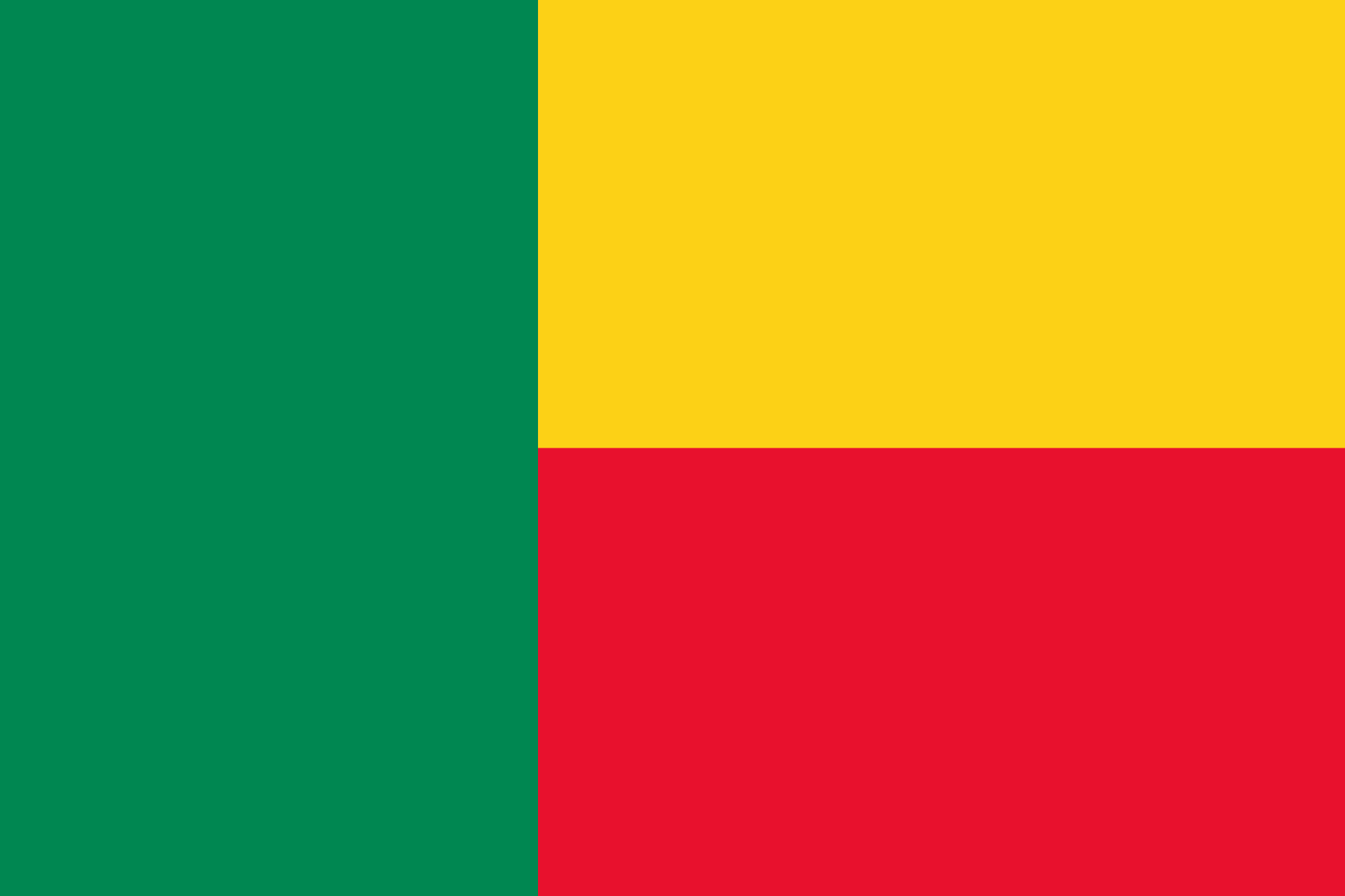

Benin
View on Wikipedia
Benin,[a] officially the Republic of Benin,[b] formerly known as Dahomey,[10] is a country in West Africa. Benin is bordered by Togo to the west, Nigeria to the east, Burkina Faso to the north-west, and Niger to the north-east. The majority of its population lives on the southern coastline of the Bight of Benin, part of the Gulf of Guinea in the northernmost tropical portion of the Atlantic Ocean.[11] The capital is Porto-Novo, and the seat of government is in Cotonou, the most populous city and economic capital.[12] Benin covers an area of 112,622 km2 (43,484 sq mi),[5] and its population in 2021 was estimated to be approximately 13 million.[13][14] It is a tropical country with an economy heavily dependent on agriculture and the exports of palm oil and cotton.[15][16]
Key Information


.svg)


From the 17th to the 19th century, political entities in the area included the Kingdom of Dahomey, the city-state of Porto Novo, and other states to the north. This region was referred to as the Slave Coast of West Africa from the early 17th century due to the high number of people who were sold and trafficked during the Atlantic slave trade to the New World. France took over the territory in 1894, incorporating it into French West Africa as French Dahomey. In 1960, Dahomey gained full independence from France. As a sovereign state, Benin has had democratic governments, military coups, and military governments. A self-described Marxist–Leninist state called the People's Republic of Benin existed between 1975 and 1990. In 1991, it was replaced by the multi-party Republic of Benin.[17]
The official language of Benin is French, with indigenous languages such as Fon, Bariba, Yoruba and Dendi also spoken. The largest religious group in Benin, as projected for 2020 by Pew Research Group based on 2010 statistics, is Christianity (52.2%), followed by Islam (24.6%) and African Traditional Religions (17.9%).[3] Benin is a member of the United Nations, the African Union, the Economic Community of West African States, the Organisation of Islamic Cooperation, the South Atlantic Peace and Cooperation Zone, Francophonie, the Community of Sahel–Saharan States, the African Petroleum Producers Association and the Niger Basin Authority.
Etymology
[edit]During French colonial rule and after independence on 1 August 1960, the country was named Dahomey, after the Kingdom of Dahomey. On 30 November 1975, following a Marxist–Leninist military coup, the country was renamed Benin, after the Bight of Benin, which borders the country, since the name Dahomey is exclusively associated with the Fon who inhabited the southern half of the country.[10] The bight takes its name from the Kingdom of Benin, located in present-day Nigeria.
History
[edit]Pre-colonial
[edit]
Prior to 1600, present-day Benin comprised a variety of areas with different political systems and ethnicities. These included city-states along the coast (primarily of the Aja ethnic group and also including Yoruba and Gbe peoples) and tribal regions inland (composed of Bariba, Mahi, Gedevi, and Kabye peoples). The Oyo Empire, located primarily to the east of Benin, was a military force in the region, conducting raids and exacting tribute from the coastal kingdoms and tribal regions.[18] The situation changed in the 17th and 18th centuries as the Kingdom of Dahomey, consisting mostly of Fon people, was founded on the Abomey plateau and began taking over areas along the coast.[19] By 1727, King Agaja of the Kingdom of Dahomey had conquered the coastal cities of Allada and Whydah. Dahomey had become a tributary of the Oyo Empire, and rivaled but did not directly attack the Oyo-allied city-state of Porto-Novo.[20] The rise of Dahomey, its rivalry with Porto-Novo, and tribal politics in the northern region persisted into the colonial and post-colonial periods.[21]
In the Dahomey, some younger people were apprenticed to older soldiers and taught the kingdom's military customs until they were old enough to join the army.[22] Dahomey instituted an elite female soldier corps variously called Ahosi (the king's wives), Mino ("our mothers" in Fongbe) or the "Dahomean Amazons". This emphasis on military preparation and achievement earned Dahomey the nickname of "Black Sparta", from European observers and 19th-century explorers such as Sir Richard Burton.[23]
.jpg)
The kings of Dahomey sold their war captives into transatlantic slavery[24] or killed them ritually in a ceremony known as the Annual Customs. By about 1750, the King of Dahomey was earning an estimated £250,000 per year by selling African captives to European slave-traders.[25] The area was named the "Slave Coast" because of a flourishing slave trade. Court protocols which demanded that a portion of war captives from the kingdom's battles be decapitated, decreased the number of enslaved people exported from the area. The number went from 102,000 people per decade in the 1780s to 24,000 per decade by the 1860s.[26]: 15–16 The decline was partly due to the Slave Trade Act 1807 banning the trans-Atlantic slave trade by Britain in 1808, followed by other countries.[25] This decline continued until 1885 when the last slave ship departed the modern Benin Republic for Brazil, which had yet to abolish slavery. The capital Porto-Novo ("New Port" in Portuguese) was originally developed as a port for the slave trade.

Among the goods the Portuguese sought were carved items of ivory made by Benin's artisans in the form of carved saltcellars, spoons, and hunting horns – pieces of African art produced for sale abroad as exotic objects.[27] Another major good sought by European settlers was palm oil. In 1856 approximately 2,500 tons of palm oil was exported by British companies which was valued at £112,500.[28]
Colonial
[edit]
By the middle of the 19th century, Dahomey had "begun to weaken and lose its status as the regional power". The French took over the area in 1892. In 1899, the French included the land called French Dahomey within the larger French West Africa colonial region.[citation needed]
France sought to benefit from Dahomey and the region "appeared to lack the necessary agricultural or mineral resources for large-scale capitalist development". As a result, France treated Dahomey as a sort of preserve in case future discoveries revealed resources worth developing.[26]: 15
The French government outlawed the capture and sale of slaves. Previous slaveowners sought to redefine their control over slaves as control over land, tenants, and lineage members. This provoked a struggle among Dahomeans, "concentrated in the period from 1895 to 1920, for the redistribution of control over land and labor. Villages sought to redefine boundaries of lands and fishing preserves. Religious disputes scarcely veiled the factional struggles over control of land and commerce which underlay them. Factions struggled for the leadership of great families".[26]: 15–16
In 1958, France granted autonomy to the Republic of Dahomey, and full independence on 1 August 1960 which is celebrated each year as Independence Day, a national holiday.[29] The president who led the country to independence was Hubert Maga.[30][31]
Post-colonial
[edit]After 1960, there were coups and regime changes, with the figures of Hubert Maga, Sourou Migan Apithy, Justin Ahomadégbé, and Émile Derlin Zinsou dominating; the first three each represented a different area and ethnicity of the country. These three agreed to form a Presidential Council after violence marred the 1970 elections.[citation needed]
On 7 May 1972, Maga ceded power to Ahomadégbé. On 26 October 1972, Lt. Col. Mathieu Kérékou overthrew the ruling triumvirate, becoming president and stating that the country would not "burden itself by copying foreign ideology, and wants neither Capitalism, Communism, nor Socialism". On 30 November 1974, he announced that the country was officially Marxist, under control of the Military Council of the Revolution (CMR), which nationalized the petroleum industry and banks. On 30 November 1975, he renamed the country the People's Republic of Benin.[32][33] The regime of the People's Republic of Benin underwent changes over the course of its existence: a nationalist period (1972–1974); a socialist phase (1974–1982); and a phase involving an opening to Western countries and economic liberalism (1982–1990).[34]
In 1974, the government embarked on a program to nationalize strategic sectors of the economy, reform the education system, establish agricultural cooperatives and new local government structures, and a campaign to eradicate "feudal forces" including tribalism. The regime banned opposition activities. Mathieu Kérékou was elected president by the National Revolutionary Assembly in 1980, re-elected in 1984. Establishing relations with China, North Korea, and Libya, he put "nearly all" businesses and economic activities under state control, causing foreign investment in Benin to dry up.[35] Kérékou attempted to reorganize education, pushing his own aphorisms such as "Poverty is not a fatality".[35] The regime financed itself by contracting to take nuclear waste, first from the Soviet Union and later from France.[35]
In the 1980s, Benin experienced higher economic growth rates (15.6% in 1982, 4.6% in 1983 and 8.2% in 1984), until the closure of the Nigerian border with Benin led to a drop in customs and tax revenues. The government was no longer able to pay civil servants' salaries.[34] In 1989, riots broke out when the regime did not have enough money to pay its army. The banking system collapsed. Eventually, Kérékou renounced Marxism, and a convention forced Kérékou to release political prisoners and arrange elections.[35] Marxism–Leninism was abolished as the country's form of government.[36]
The country's name was officially changed to the Republic of Benin on 1 March 1990, after the newly formed government's constitution was completed.[37] Kérékou lost to Nicéphore Soglo in a 1991 election and became the first president on the African mainland to lose power through an election.[38] Kérékou returned to power after winning the 1996 vote. In 2001, an election resulted in Kérékou winning another term, after which his opponents claimed election irregularities.[39] In 1999, Kérékou issued a national apology for the substantial role that Africans had played in the Atlantic slave trade.[40]
21st century
[edit]
Kérékou and former president Soglo did not run in the 2006 elections, as both were barred by the constitution's restrictions on age and total terms of candidates.[41] The Beninese presidential election, 2006 resulted in a runoff between Thomas Boni Yayi and Adrien Houngbédji. The runoff election was held on 19 March and was won by Boni,[42] who assumed office on 6 April.[43] Boni was reelected in 2011, taking 53.18% of the vote in the first round—enough to avoid a runoff election. He was the first president to win an election without a runoff since the restoration of democracy in 1991.[44]
In the March 2016 presidential elections in which Boni Yayi was barred by the constitution from running for a third term, businessman Patrice Talon won the second round with 65.37% of the vote, defeating investment banker and former Prime Minister Lionel Zinsou. Talon was sworn in on 6 April 2016.[45] Speaking on the same day that the Constitutional Court confirmed the results, Talon said that he would "first and foremost tackle constitutional reform", discussing his plan to limit presidents to a single term of 5 years to combat "complacency". He said that he planned to slash the size of the government from 28 to 16 members.[46] In April 2021, President Patrice Talon was re-elected, with more than 86.3% of the votes cast in the 2021 Beninese presidential election.[47] The change in election laws resulted in total control of parliament by president Talon's supporters.[48]
On 11 December 2020, Benin ratified the Treaty on the Prohibition of Nuclear Weapons, making the use of nuclear weapons in the country illegal. It officially entered into force for Benin on 22 January 2021.
In February 2022, Benin saw its largest terrorist attack in history, the W National Park massacre.[49] On 20 February 2022, President Talon inaugurated an exhibition with 26 pieces of sacred art returned to Benin by France, 129 years after they were looted by colonial forces.[50]
In March 2025, the government of Benin adopted a law, recognizing 16 kingdoms, 80 senior chiefs and 10 traditional chiefs through a new law. The pre-colonial period starting in 1894 for the south and 1897 for the north served as a historical reference for the bill, identifying traditional territories and rules to institutionalize chieftaincy.[51]
In July 2025, the My Afro Origins law went into effect, granting the right of provisional Beninese citizenship to members of the African diaspora whose ancestry was impact by the transatlantic slave trade.[52]
Geography
[edit]
The north–south strip of land in West Africa lies between latitudes 6° and 13°N, and longitudes 0° and 4°E. It is bounded by Togo to the west, Burkina Faso and Niger to the north, Nigeria to the east, and the Bight of Benin to the south. The distance from the Niger River in the north to the Atlantic Ocean in the south is about 650 km (404 mi). Although the coastline measures 121 km (75 mi), the country measures about 325 km (202 mi) at its widest point. Four terrestrial ecoregions lie within Benin's borders: Eastern Guinean forests, Nigerian lowland forests, Guinean forest-savanna mosaic, and West Sudanian savanna.[53] It had a 2018 Forest Landscape Integrity Index mean score of 5.86/10, ranking it 93rd globally out of 172 countries.[54]

Benin shows some variation in elevation and can be divided into four areas from the south to the north, starting with the lower-lying, sandy, coastal plain (highest elevation 10 m (32.8 ft)) which is, at most, 10 km (6.2 mi) wide. It is marshy and dotted with lakes and lagoons communicating with the ocean. Behind the coast lies the Guinean forest-savanna mosaic-covered plateaus of southern Benin (altitude between 20 and 200 m (66 and 656 ft)), which are split by valleys running north to south along the Couffo, Zou, and Ouémé Rivers.
This geography makes it vulnerable to climate change. With the majority of the country living near the coast in lower-lying areas, sea level rise could affect the economy and population.[55] Northern areas will see additional regions become deserts.[56] An area of flatter land dotted with rocky hills whose altitude reaches 400 m (1,312 ft) extends around Nikki and Save.[citation needed]
A range of mountains extends along the northwest border and into Togo; these are the Atacora. The highest point, Mont Sokbaro, is at 658 m (2,159 ft). Benin has fields, mangroves and remnants of forests. In the rest of the country, the savanna is covered with thorny scrub and dotted with baobab trees. Some forests line the banks of rivers. In the north and the northwest of Benin, the Reserve du W du Niger and Pendjari National Park has African bush elephants, lions, antelopes, hippopotamus and monkeys.[57][verification needed] Pendjari National Park together with the bordering Parks Arli and W National Park in Burkina Faso and Niger are among the strongholds of the lion in West Africa; with an estimated 246–466 lions, W-Arli-Pendjari harbors the largest remaining lion population in West Africa.[58] Historically Benin has served as habitat for the endangered African wild dog, Lycaon pictus;[59] this canid is thought to have been locally extinct.
Annual rainfall in the coastal area averages 1300 mm or about 51 inches. Benin has two rainy and two dry seasons per year. The principal rainy season is from April to late July, with a shorter less intense rainy period from September to November. The main dry season is from December to April, with a cooler dry season from July to September. Temperatures and humidity are higher along the tropical coast. In Cotonou, the average maximum temperature is 31 °C (87.8 °F); the minimum is 24 °C (75.2 °F).[57]
Variations in temperature increase when moving north through savanna and plateau toward the Sahel. A dry wind from the Sahara called the Harmattan blows from December to March, when the grass dries up, other vegetation turns reddish brown, and a veil of fine dust hangs over the country, causing the skies to be "overcast". It is also the season when farmers burn brush in the fields.[57]
In Benin forest cover is around 28% of the total land area, equivalent to 3,135,150 hectares (ha) of forest in 2020, down from 4,835,150 hectares (ha) in 1990. In 2020, naturally regenerating forests covered 3,112,150 hectares (ha), and planted forests covered 23,000 hectares (ha).[60][61]
Wildlife
[edit]Government and politics
[edit]Benin's politics take place in a framework of a presidential representative democratic republic in which the President of Benin is both head of state and head of government, within a multi-party system. Executive power is exercised by the government. Legislative power is vested in the government and the legislature. The judiciary is officially independent of the executive and the legislature, while in practice its independence has been gradually hollowed out by Talon, and the Constitutional Court is headed by his former personal lawyer.[62] The political system is derived from the 1990 Constitution of Benin and the subsequent transition to democracy in 1991.
It was ranked 18th out of 52 African countries and scored best in the categories of Safety & Rule of Law and Participation & Human Rights.[63] In its 2007 Worldwide Press Freedom Index, Reporters Without Borders ranked Benin 53rd out of 169 countries. That place had fallen to 78th by 2016, when Talon took office, and has fallen further to 113th.[62] Benin has been rated equal-88th out of 159 countries in a 2005 analysis of police, business, and political corruption.[64]
Its democratic system "has eroded" since President Talon took office.[62] In 2018, his government introduced new rules for fielding candidates and raised the cost of registering. The electoral commission, packed with Talon's allies, barred all opposition parties from the parliamentary election in 2019, resulting in a parliament made up entirely of supporters of Talon. That parliament subsequently changed election laws such that presidential candidates need to have the approval of at least 10% of Benin's MPs and mayors. As parliament and most mayors' offices are controlled by Talon, he has control over who can run for president. These changes have drawn condemnation from international observers and led to the United States government partially terminating development assistance to the country.[65][66][67][68]
Administrative divisions
[edit]
Benin is divided into twelve departments (French: départements) which are subdivided into 77 communes. In 1999, the previous six departments were each split into two-halves, forming the later twelve.[69]
| Map key | Department | Capital[70] | Population (2013) | Area (km2)[72] | Population density
(per km2 in 2013) |
Former Department |
Region | Sub-Region |
|---|---|---|---|---|---|---|---|---|
| 2 | Alibori | Kandi | 868,046 | 26,242 | 33.1 | Borgou | North | North East |
| 1 | Atakora | Natitingou | 769,337 | 20,499 | 37.5 | Atakora | North | North West |
| 10 | Atlantique | Allada | 1,396,548 | 3,233 | 432 | Atlantique | South | South Centre |
| 4 | Borgou | Parakou | 1,202,095 | 25,856 | 46.5 | Borgou | North | North East |
| 5 | Collines | Dassa-Zoumé | 716,558 | 13,931 | 51.4 | Zou | South | South Centre |
| 6 | Kouffo | Aplahoué | 741,895 | 2,404 | 308.6 | Mono | South | South West |
| 3 | Donga | Djougou | 542,605 | 11,126 | 48.8 | Atakora | North | North West |
| 11 | Littoral | Cotonou | 678,874 | 79 | 8,593.3 | Atlantique | South | South Centre |
| 9 | Mono | Lokossa | 495,307 | 1,605 | 308.6 | Mono | South | South West |
| 12 | Ouémé | Porto-Novo | 1,096,850 | 1,281 | 856.2 | Ouémé | South | South East |
| 8 | Plateau | Pobè | 624,146 | 3,264 | 191.2 | Ouémé | South | South East |
| 7 | Zou | Abomey | 851,623 | 5,243 | 162.4 | Zou | South | South Centre |
Military
[edit]Demographics
[edit]- Goun & Fon (38.4%)
- Adja & Mina (15.1%)
- Yoruba (12.0%)
- Bariba (9.60%)
- Fula (8.60%)
- Ottamari (6.10%)
- Yoa-Lokpa (4.30%)
- Dendi (2.90%)
- Other (2.80%)
The majority of Benin's 11,485,000 inhabitants live in the south of the country. The life expectancy is 62 years.[5] About 42 African ethnic groups live in this country, including the Yoruba in the southeast (migrated from Nigeria in the 12th century); the Dendi in the north-central area (who came from Mali in the 16th century); the Bariba and the Fula in the northeast; the Betammaribe and the Somba in the Atakora Mountains; the Fon in the area around Abomey in the South Central and the Mina, Xueda, and Aja (who came from Togo) on the coast.[57]
The personnel of European embassies and foreign aid missions and of nongovernmental organisations and missionary groups account for a part of the 5,500 European population.[57]
Non-Africans include Europeans, Lebanese people and South Asians.[73]
| Historical population | |||
|---|---|---|---|
| Year | 1950 | 2000 | 2021 |
| Population[13][14] | 2,200,000 | 6,800,000 | 13,000,000 |
| ±% | — | +209.1% | +91.2% |
| Rank | Name | Department | Pop. | ||||||
|---|---|---|---|---|---|---|---|---|---|
| 1 | Cotonou | Littoral | 679,012 | ||||||
| 2 | Porto-Novo | Ouémé | 264,320 | ||||||
| 3 | Parakou | Borgou | 255,478 | ||||||
| 4 | Godomey | Atlantique | 253,262 | ||||||
| 5 | Abomey-Calavi | Atlantique | 117,824 | ||||||
| 6 | Djougou | Donga | 94,773 | ||||||
| 7 | Bohicon | Zou | 93,744 | ||||||
| 8 | Ekpè | Ouémé | 75,313 | ||||||
| 9 | Abomey | Zou | 67,885 | ||||||
| 10 | Nikki | Borgou | 66,109 | ||||||
Language
[edit]Local languages are used as the many languages of instruction in elementary schools, with French introduced in later years. At the secondary school level, French is the sole language of instruction. Beninese languages are "generally transcribed" with a separate letter for each speech sound (phoneme), rather than using diacritics as in French or digraphs as in English. This includes Beninese Yoruba, which in Nigeria is written with both diacritics and digraphs. For instance, the mid vowels written é, è, ô, o in French are written e, ɛ, o, ɔ in Beninese languages, whereas the consonants that are written ng and sh or ch in English are written ŋ and c. Digraphs are used for nasal vowels and the labial-velar consonants kp and gb, as in the name of the Fon language Fon gbe /fõ ɡ͡be/, and diacritics are used as tone marks. In French-language publications, a mixture of French and Beninese orthographies may be seen.
Religion
[edit]
The two main religions in Benin are Christianity, followed mostly in the south and center, and Islam, brought by the Songhai Empire and Hausa merchants and followed in Alibori, Borgou, and Donga provinces, as well as among the Yoruba, who also practice Christianity.[76][77] Some continue to hold Vodun and Orisha beliefs and have incorporated the pantheon of Vodun and Orisha into Christianity. Ahmadiyya, a sect of Islam originating in the 19th century, also has a presence in the country.[78]
In the 2013 census, 48.5% of the population of Benin were Christian (25.5% Roman Catholic, 6.7% Celestial Church of Christ, 3.4% Methodist, and 12.9% other Christian denominations), 27.7% were Muslim, 11.6% practiced Vodun, 2.6% practiced other local traditional religions, 2.6% practiced other religions, and 5.8% claimed no religious affiliation.[2][79] A government survey conducted by the Demographic and Health Surveys Program in 2011–2012 indicated that followers of Christianity comprised 57.5% of the population (with Catholics making up 33.9%, Methodists 3.0%, Celestials 6.2% and other Christians 14.5%), while Muslims were 22.8%.[80]
According to the most recent (2020) estimate, the population of Benin was 52.2% Christian, 24.6% Muslim, 17.9% animist, and 5.3% followed other faiths or had no religion.[75][81][failed verification]
Traditional religions include local animistic religions in the Atakora region and Vodun and Orisha veneration among the Yoruba and Tado peoples in the center and south of the nation. The town of Ouidah on the central coast is the spiritual center of Beninese Vodun or Voodoo.[82]
Education
[edit]
The literacy rate in 2015 was estimated to be 38.4% (49.9% for males and 27.3% for females).[5] Benin has achieved universal primary education and half of the children (54%) were enrolled in secondary education in 2013, according to the UNESCO Institute for Statistics.
While at a time the education system was not free,[83] Benin has abolished school fees and is carrying out the recommendations of its 2007 Educational Forum.[84] The government has devoted more than 4% of GDP to education since 2009. In 2015, public expenditure on education (all levels) amounted to 4.4% of GDP, according to the UNESCO Institute for Statistics. Within this expenditure, Benin devoted a share to tertiary education: 0.97% of GDP.[85]
Between 2009 and 2011, the share of people enrolled at university rose from 10% to 12% of the 18–25-year age cohort. Student enrollment in tertiary education more than doubled between 2006 and 2011 from 50,225 to 110,181. These statistics encompass not only bachelor's, master's, and PhD programmes but also students enrolled in nondegree post-secondary diplomas.[85]
Health
[edit]The HIV/AIDS rate in Benin was estimated in 2013 at 1.13% of adults aged 15–49 years.[86] Malaria is a problem in Benin, being a leading cause of morbidity and mortality among children younger than 5 years.[87]
During the 1980s, less than 30% of the country's population had access to primary healthcare services. Benin's infant mortality rate stood at 203 deaths for every 1000 live births. One in three mothers had access to child health care services. The Bamako Initiative changed that by introducing community-based healthcare reform, resulting in a "more efficient and equitable" provision of services.[88] As of 2015[update], Benin had the 26th highest rate of maternal mortality in the world.[89] According to a 2013 UNICEF report, 13% of women had undergone female genital mutilation.[90] An approach strategy was extended to all areas of healthcare, with subsequent improvement in the health care indicators and improvement in health care efficiency and cost.[91] Demographic and Health Surveys has surveyed the issue in Benin since 1996.[92][better source needed] In the 2024 Global Hunger Index, Benin ranks 99th out of 127 countries.[93]
Economy
[edit]

The economy is dependent on subsistence agriculture, cotton production, and regional trade. Cotton accounts for 40% of the GDP and roughly 80% of official export receipts.[57]
Real GDP growth was estimated at 5.1% and 5.7% in 2008 and 2009, respectively. The main driver of growth is the agricultural sector, with cotton being the main export, while services continue to contribute the largest part of GDP mostly because of Benin's geographical location, enabling trade, transportation, transit and tourism activities with its neighboring states.[94] Benin's overall macroeconomic conditions were "positive" in 2017, with a growth rate of around 5.6%. Economic growth was mostly driven by the cotton industry and other cash crops, the Port of Cotonou, and telecommunications. A source of revenue is the Port of Cotonou, and the government is seeking to expand its revenue base. In 2017, Benin imported about $2.8 billion in goods such as rice, meat and poultry, alcoholic beverages, fuel plastic materials, specialized mining and excavating machinery, telecommunications equipment, passenger vehicles, and toiletries and cosmetics. Principal exports are ginned cotton, cotton cake and cotton seeds, cashew, shea butter, cooking oil, and lumber.[95]
Access to biocapacity is lower than world average. In 2016, Benin had 0.9 global hectares[96] of biocapacity per person within its territory, less than the world average of 1.6 global hectares per person.[97] In 2016 Benin used 1.4 global hectares of biocapacity per person - their ecological footprint of consumption. This means they use "slightly under double" as much biocapacity as Benin contains. As a result, Benin is running a biocapacity deficit.[96]

To raise growth still further, Benin plans to attract more foreign investment, place more emphasis on tourism, facilitate the development of new food processing systems and agricultural products, and encourage new information and communication technology. Projects to improve the business climate by reforms to the land tenure system, the commercial justice system, and the financial sector were included in Benin's US$307 million Millennium Challenge Account grant signed in February 2006.[98]
The Paris Club and bilateral creditors have eased the external debt situation, with Benin benefiting from a G8 debt reduction announced in July 2005, while pressing for more rapid structural reforms. An "insufficient" electrical supply continues to "adversely affect" Benin's economic growth and the government has taken steps to increase domestic power production.[5]
While trade unions in Benin represent up to 75% of the formal workforce, the informal economy has been noted by the International Trade Union Confederation (ITCU) to contain ongoing problems, including a lack of women's wage equality, the use of child labor, and the continuing issue of forced labor.[99] Benin is a member of the Organization for the Harmonization of Business Law in Africa (OHADA).[100]
Cotonou has the country's only seaport and international airport. Benin is connected by 2-lane asphalted roads to its neighboring countries (Togo, Burkina Faso, Niger, and Nigeria). Mobile telephone service is available across the country through operators. ADSL connections are available in some areas. Benin is connected to the Internet by way of satellite connections (since 1998) and a single submarine cable SAT-3/WASC (since 2001). Relief of "high price" is expected with the initiation of the Africa Coast to Europe cable in 2011.
With the GDP growth rate of 4%–5% remaining consistent over two decades, poverty has been increasing.[101] According to the National Institute of Statistics and Economic Analysis in Benin, those living under the poverty line have increased from 36.2% in 2011 to 40.1% in 2015.[102]
The growing Blaxit movement is starting to bring people of African heritage to Benin for cultural and economic growth reasons, with the Benin government currently working to grant citizenship to people of African descent.[103]
Science and technology
[edit]National policy framework
[edit]The Ministry of Higher Education and Scientific Research is responsible for implementing science policy. The National Directorate of Scientific and Technological Research handles planning and coordination, whereas the National Council for Scientific and Technical Research and National Academy of Sciences, Arts, and Letters each play an advisory role. Financial support comes from Benin's National Fund for Scientific Research and Technological Innovation. The Benin Agency for the Promotion of Research Results and Technological Innovation carries out technology transfer through the development and dissemination of research results.[85] Benin was ranked 119th in the Global Innovation Index in 2024,[104] but its rank advanced to 118th in 2025.[105]
The regulatory framework has evolved since 2006 when the science policy was prepared. This has been updated and complemented by new texts on science and innovation (the year of adoption is between brackets):[85]
- a manual for monitoring and evaluating research structures and organizations (2013);
- a manual on how to select research programmes and projects and apply to the National Fund for Scientific Research and Technological Innovation (2013) for competitive grants;
- a draft act for funding scientific research and innovation and a draft code of ethics for scientific research and innovation were both submitted to the Supreme Court in 2014;
- a strategic plan for scientific research and innovation (under development in 2015).
Equally important are Benin's efforts to integrate science into existing policy documents:
- Benin Development Strategies 2025: Benin 2025 Alafia (2000);
- Growth Strategy for Poverty Reduction 2011–2016 (2011);
- Phase 3 of the Ten-year Development Plan for the Education Sector, covering 2013–2015;
- Development Plan for Higher Education and Scientific Research 2013–2017 (2014).
In 2015, Benin's priority areas for scientific research were: health, education, construction and building materials, transportation and trade, culture, tourism and handicrafts, cotton/textiles, food, energy and climate change.[85]
Some so-called challenges facing research and development in Benin are:[85]
- the unfavorable organizational framework for research: weak governance, a lack of co-operation between research structures and the absence of an official document on the status of researchers;
- the inadequate use of human resources and the lack of any motivational policy for researchers; and
- the mismatch between research and development needs.
Human and financial investment in research
[edit]In 2007, Benin counted 1,000 researchers (in headcounts). This corresponds to 115 researchers per million inhabitants. The "main research structures" are the Centre for Scientific and Technical Research, National Institute of Agricultural Research, the National Institute for Training and Research in Education, Office of Geological and Mining Research, and the Centre for Entomological Research.[85]
The University of Abomey-Calavi was selected by the World Bank in 2014 to participate in its Centres of Excellence project, owing to its expertise in applied mathematics. Within this project, the World Bank has loaned $8 million to Benin. The Association of African Universities has received funds to enable it to co-ordinate knowledge-sharing among the 19 universities in West Africa involved in the project.[85]
There are "no available data" on Benin's level of investment in research and development.[85]
In 2013, the government devoted 2.5% of GDP to public health. In December 2014, 150 volunteer health professionals traveled to Guinea, Liberia and Sierra Leone from Benin, Côte d'Ivoire, Ghana, Mali, Niger, and Nigeria, as part of a joint initiative by the Economic Community of West African States (ECOWAS) and its specialized agency, the West African Health Organisation, to help combat the epidemic. The Ebola epidemic has been a reminder of the underinvestment in West African health systems.[85]
The Government of Benin devoted less than 5% of GDP to agricultural development in 2010, while the members of the African Union had agreed to commit at least 10% of GDP to this area in the Maputo Declaration of 2003. They reiterated this goal in the Malabo Declaration adopted in Equatorial Guinea in 2014. In the latter declaration, they reaffirmed their 'intention to devote 10% of their national budgets to agricultural development and agreed to targets such as doubling agricultural productivity, halving post-harvest loss and bringing stunting down to 10% across Africa'. African leaders meeting in Equatorial Guinea failed to resolve the debate on establishing a common standard of measurement for the 10% target.[106]
Research output
[edit]Benin has the third-highest publication intensity for scientific journals in West Africa, according to Thomson Reuters' Web of Science, Science Citation Index Expanded. There were 25.5 scientific articles per million inhabitants cataloged in this database in 2014. This compares with 65.0 for the Gambia, 49.6 for Cape Verde, 23.2 for Senegal, and 21.9 for Ghana. The volume of publications in this database tripled in Benin between 2005 and 2014 from 86 to 270. Between 2008 and 2014, Benin's "main scientific collaborators" were based in France (529 articles), the United States (261), United Kingdom (254), Belgium (198), and Germany (156).[85]
Transportation
[edit]Transport in Benin includes road, rail, water, and air transportation. Benin possesses a total of 6,787 km of highway, of which 1,357 km are paved. Of the paved highways in the country, there are 10 expressways. This leaves 5,430 km of unpaved road. The Trans-West African Coastal Highway crosses Benin, connecting it to Nigeria to the east, and Togo, Ghana and Ivory Coast to the west. When construction in Liberia and Sierra Leone is finished, the highway will continue west to 7 other Economic Community of West African States (ECOWAS) nations. A paved highway connects Benin northwards to Niger, and through that country to Burkina Faso and Mali to the north-west.[citation needed]
Rail transport in Benin consists of 578 km (359 mi) of single track, 1,000 mm (3 ft 3+3⁄8 in) metre gauge railway. Construction work has commenced on international lines connecting Benin with Niger and Nigeria, with outline plans announced for further connections to Togo and Burkina Faso. Benin will be a participant in the AfricaRail project.[citation needed]
Cadjehoun Airport, located at Cotonou, has direct international jet service to Accra, Niamey, Monrovia, Lagos, Ouagadougou, Lomé, and Douala, and other cities in Africa. Direct services link Cotonou to Paris, Brussels, and Istanbul.[citation needed]
Culture
[edit]Arts
[edit]

Beninese literature had an oral tradition before French became the dominant language.[107] Félix Couchoro wrote the first Beninese novel, L'Esclave (The Slave), in 1929.
Post-independence, native folk music was combined with Ghanaian highlife, French cabaret, American rock, funk and soul, and Congolese rumba.[108]
Biennale Benin, continuing the projects of some organizations and artists, started in the country in 2010 as a collaborative event called "Regard Benin". In 2012, the project became a biennial coordinated by a federation of local associations. The international exhibition and artistic program of the 2012 Biennale Benin were curated by Abdellah Karroum.[109][110]
Customary names
[edit]Some Beninese in the south of the country have Akan-based names indicating the day of the week on which they were born. This is due to influence of the Akan people such as the Akwamu and others.[111]
Traditional authorities
[edit]Benin has numerous non-sovereign monarchies within the country, many of them derivative of pre-colonial kingdoms (such as Arda). Non-sovereign monarchs do not have an official, constitutional role, and are largely ceremonial and subservient to political and civil authorities. Despite this, they play an influential role in local political matters within their particular realms and are often courted by Beninese politicians for electoral support. Advocacy groups, such as the High Council of Kings of Benin, represent the monarchs nationally.[112][113]
Cuisine
[edit]
Beninese cuisine involves fresh meals served with a variety of key sauces. In southern Beninese cuisine, an ingredient is corn which has been used to prepare dough which has been served with peanut- or tomato-based sauces. Fish and chicken, beef, goat, and bush rat are consumed. A staple in northern Benin is yams which has been served with sauces mentioned above. The population in the northern provinces use beef and pork meat which is fried in palm or peanut oil or cooked in sauces. Cheese is used in some dishes. Couscous, rice, and beans are eaten, along with fruits such as mangoes, oranges, avocados, bananas, kiwi fruit, and pineapples.
Meals are said to be generally light on meat and generous on vegetable fat. Frying in palm or peanut oil is a meat preparation, and smoked fish is prepared in Benin. Grinders are used to prepare corn flour, which is made into a dough and served with sauces. "Chicken on the spit" is a recipe in which chicken is roasted over a fire on wooden sticks. Palm roots are sometimes soaked in a jar with salt water and sliced garlic to tenderize them, then used in dishes. Some people have outdoor mud stoves for cooking.[citation needed][114][115]
Sports
[edit]The major sports in Benin are association football, basketball, golf, cycling, baseball, softball, tennis and rugby union.[116] In the early 21st century, baseball and teqball were introduced to the country.[117][118]
See also
[edit].svg)
Notes
[edit]References
[edit]- ^ "Benin". Archived from the original on 29 December 2023. Retrieved 7 July 2023.
- ^ a b "PRINCIPAUX INDICATEURS SOCIO DEMOGRAPHIQUES ET ECONOMIQUES" (PDF). www.insae-bj.org (in French). INSTITUT NATIONAL DE LA STATISTIQUE ET DE L'ANALYSE ECONOMIQUE. Archived (PDF) from the original on 18 September 2020. Retrieved 14 December 2019.
- ^ a b "Religions in Benin | PEW-GRF". Archived from the original on 17 October 2021. Retrieved 17 April 2021.
- ^ Annuaire statistique 2010 (PDF) (Report) (in French). INSAE. 2012. p. 49. Archived (PDF) from the original on 4 March 2016. Retrieved 17 December 2015.
- ^ a b c d e "Benin". The World Factbook (2025 ed.). Central Intelligence Agency. Retrieved 24 September 2022. (Archived 2022 edition.)
- ^ a b c d "World Economic Outlook Database, October 2023 Edition. (Benin)". IMF.org. International Monetary Fund. 10 October 2023. Archived from the original on 31 October 2023. Retrieved 16 October 2023.
- ^ "World Bank Open Data".
- ^ "Human Development Report 2023/2024". United Nations Development Programme. 26 May 2025. Retrieved 25 May 2025.
- ^ Jones, Daniel (2011). Roach, Peter; Setter, Jane; Esling, John (eds.). Cambridge English Pronouncing Dictionary (18th ed.). Cambridge University Press. ISBN 978-0-521-15255-6.
- ^ a b "Dahomey Announces Its Name Will Be Benin". The New York Times. 1 December 1975. ISSN 0362-4331. Archived from the original on 16 September 2020. Retrieved 16 September 2020.
- ^ Hughes, R. H.; Hughes, J. S. (1992). A Directory of African Wetlands. IUCN. p. 301. ISBN 978-2-88032-949-5. Archived from the original on 8 May 2016. Retrieved 12 October 2015.
- ^
- Dossou, Krystel M.R.; Gléhouenou-Dossou, Bernadette (2007). "The vulnerability to climate change of Cotonou (Benin): the rise in sea level". Environment and Urbanization. 19 (1): 65–79. Bibcode:2007EnUrb..19...65D. doi:10.1177/0956247807077149.
- Choplin, Armelle; Lozivit, Martin (2019). "Mapping a slum: learning from participatory mapping and digital innovation in Cotonou (Benin)" [Mettre un quartier sur la carte: Cartographie participative et innovation numérique à Cotonou (Bénin)]. Cybergeo 894. Translated by Alvin Harberts. doi:10.4000/cybergeo.32949.
- ^ a b "World Population Prospects 2022". United Nations Department of Economic and Social Affairs, Population Division. Retrieved 17 July 2022.
- ^ a b "World Population Prospects 2022: Demographic indicators by region, subregion and country, annually for 1950–2100" (XSLX) ("Total Population, as of 1 July (thousands)"). United Nations Department of Economic and Social Affairs, Population Division. Retrieved 17 July 2022.
- ^ "FAO Initiative on Soaring Food Prices". Food and Agriculture Organization of the United Nations. Archived from the original on 24 October 2012. Retrieved 29 June 2010.
- ^ "Major Industries in Benin". Arise IIP. Retrieved 23 June 2024.
- ^ Global Logistics Assessments Reports Handbook. Vol. 1: Strategic Transportation and Customs Information for Selected Countries. International Business Publications USA. 2008 [2015]. p. 85. ISBN 978-0-7397-6603-3.
- ^ Bay, Edna (1998). Wives of the Leopard: Gender, Politics, and Culture in the Kingdom of Dahomey. University of Virginia Press.
- ^ Akinjogbin, I.A. (1967). Dahomey and Its Neighbors: 1708–1818. Cambridge University Press. OCLC 469476592.
- ^ Law, Robin (1986). "Dahomey and the Slave Trade: Reflections on the Historiography of the Rise of Dahomey". The Journal of African History. 27 (2): 237–267. doi:10.1017/s0021853700036665. S2CID 165754199.
- ^ Creevey, Lucy; Ngomo, Paul; Vengroff, Richard (2005). "Party Politics and Different Paths to Democratic Transitions: A Comparison of Benin and Senegal". Party Politics. 11 (4): 471–493. doi:10.1177/1354068805053213. S2CID 145169455. Archived from the original on 2 December 2020. Retrieved 20 April 2018.
- ^ Harms, Robert W. (2002). The Diligent: A Voyage Through the Worlds of the Slave Trade. Basic Books. p. 172. ISBN 978-0-465-02872-6. Archived from the original on 9 May 2016. Retrieved 12 October 2015.
- ^ Alpern, Stanley B. (1998). Amazons of Black Sparta: The Women Warriors of Dahomey. C. Hurst & Co. Publishers. p. 37. ISBN 978-1-85065-362-2. Archived from the original on 6 May 2016. Retrieved 12 October 2015.
- ^ Miller, David Lee (10 July 2003). "African Ambassador Apologizes for Slavery Role". Fox News. Archived from the original on 22 May 2010.
- ^ a b "African Slave Owners". The story of South Africa: Slavery. BBC World Service. Archived from the original on 8 March 2013.
- ^ a b c Manning, Patrick (1982). Slavery, Colonialism and Economic Growth in Dahomey, 1640–1960. London: Cambridge University Press. ISBN 978-0-511-56307-2.
- ^ "This ivory relic reveals the colonial power dynamic between Benin and Portugal History Magazine, National Geographic, 09.02.2021". National Geographic Society. 9 February 2021. Archived from the original on 9 February 2021. Retrieved 9 February 2021.
- ^ Ryder, Alan (1969). Benin and the Europeans 1485–1897. New York, NY: Humanities Press. p. 239.
- ^ "President Sirleaf congratulates Benin on 57th Independence Anniversary". Agence de Presse Africane. 31 July 2017. Archived from the original on 30 July 2018. Retrieved 30 July 2018.
- ^ Stokes, Jamie, ed. (2009). Encyclopedia of the Peoples of Africa and the Middle East: L to Z. Infobase Publishing. p. 229. ISBN 978-0-8160-7158-6. Archived from the original on 3 May 2016. Retrieved 12 October 2015.
- ^ Araujo, Ana Lucia (2010). Public Memory of Slavery: Victims and Perpetrators in the South Atlantic. Cambria Press. p. 111. ISBN 978-1-60497-714-1. Archived from the original on 17 June 2016. Retrieved 12 October 2015.
- ^ Dickovick, J. T. (2012). Africa 2012. Stryker Post. p. 69. ISBN 978-1-61048-882-2. Retrieved 5 March 2013.
- ^ Houngnikpo, M. C.; Decalo, S. (14 December 2012). Historical Dictionary of Benin. Rowman & Littlefield. p. 33. ISBN 978-0-8108-7171-7. Archived from the original on 23 April 2014. Retrieved 5 March 2013.
- ^ a b "Bénin, analyse du pays de 1982 a 1997". Archived from the original on 4 March 2021. Retrieved 11 December 2021.
- ^ a b c d Kneib, M. (2007). Benin. Marshall Cavendish Benchmark. pp. 22–25. ISBN 978-0-7614-2328-7.
- ^ "A Short History of the People's Republic of Benin (1974–1990)". Socialist.net. 2008. Archived from the original on 23 April 2010. Retrieved 2 May 2010.
- ^ "Benin". Flagspot.net. Archived from the original on 12 June 2010. Retrieved 2 May 2010.
- ^ "Official Result in Benin Vote Shows Big Loss for Kerekou". The New York Times. 26 March 1991. Archived from the original on 1 June 2022. Retrieved 1 June 2022.
- ^ "President Kerekou re-elected in Benin". www.afrol.com. Archived from the original on 1 June 2022. Retrieved 1 June 2022.
- ^ Gates, H. L. (2010). "Ending the Slavery Blame-Game". The New York Times. Archived from the original on 7 March 2017. Retrieved 24 February 2017.
- ^ "President Mathieu Kerekou leaves after 29 years". The New Humanitarian (in French). 2006. Archived from the original on 1 June 2022. Retrieved 1 June 2022.
- ^ "Boni wins Benin presidential election: official". ABC News. 2006. Archived from the original on 1 June 2022. Retrieved 1 June 2022.
- ^ "Celebration As Boni Takes Over". Archived from the original on 18 April 2006. Retrieved 1 June 2022.
- ^ "Benin's Boni Yayi wins second term – court". Reuters. 21 March 2011. Archived from the original on 1 June 2022. Retrieved 1 June 2022.
- ^ "Businessman sworn in as Benin's president". Reuters. 2016. Archived from the original on 17 April 2016. Retrieved 1 May 2016.
- ^ "Newly-elected Benin president aims to reduce presidential terms". Reuters. 2016. Archived from the original on 3 May 2016. Retrieved 1 May 2016.
- ^ "Benin's president wins re-election in preliminary results". ABC News. Archived from the original on 14 April 2021. Retrieved 14 April 2021.
- ^ "Benin vote count begins after opposition groups boycott election". Al Jazeera. 2021. Archived from the original on 19 April 2021. Retrieved 19 April 2021.
- ^ "Five rangers, soldier killed in attack in Benin, park management says". Yahoo News. 2022. Archived from the original on 16 February 2022. Retrieved 16 February 2022.
- ^ "Le Bénin expose les vingt-six œuvres restituées par la France: " Regardez la puissance de ces objets ! "". Le Monde.fr. 21 February 2022. Archived from the original on 21 July 2023. Retrieved 22 July 2023.
- ^ "Il Benin riconosce i capi tradizionali". 29 April 2025.
- ^ "US Grammy winner Ciara becomes citizen of Benin under new slavery-descendants law". www.bbc.com. 29 July 2025. Retrieved 7 August 2025.
- ^ Dinerstein, Eric; Olson, David; Joshi, Anup; Vynne, Carly; Burgess, Neil D.; Wikramanayake, Eric; Hahn, Nathan; Palminteri, Suzanne; Hedao, Prashant; Noss, Reed; Hansen, Matt; Locke, Harvey; Ellis, Erle C; Jones, Benjamin; Barber, Charles Victor; Hayes, Randy; Kormos, Cyril; Martin, Vance; Crist, Eileen; Sechrest, Wes; Price, Lori; Baillie, Jonathan E. M.; Weeden, Don; Suckling, Kierán; Davis, Crystal; Sizer, Nigel; Moore, Rebecca; Thau, David; Birch, Tanya; Potapov, Peter; Turubanova, Svetlana; Tyukavina, Alexandra; de Souza, Nadia; Pintea, Lilian; Brito, José C.; Llewellyn, Othman A.; Miller, Anthony G.; Patzelt, Annette; Ghazanfar, Shahina A.; Timberlake, Jonathan; Klöser, Heinz; Shennan-Farpón, Yara; Kindt, Roeland; Lillesø, Jens-Peter Barnekow; van Breugel, Paulo; Graudal, Lars; Voge, Maianna; Al-Shammari, Khalaf F.; Saleem, Muhammad (2017). "An Ecoregion-Based Approach to Protecting Half the Terrestrial Realm". BioScience. 67 (6): 534–545. doi:10.1093/biosci/bix014. ISSN 0006-3568. PMC 5451287. PMID 28608869.
- ^ Grantham, H. S.; Duncan, A.; Evans, T. D.; Jones, K. R.; Beyer, H. L.; Schuster, R.; Walston, J.; Ray, J. C.; Robinson, J. G.; Callow, M.; Clements, T.; Costa, H. M.; DeGemmis, A.; Elsen, P. R.; Ervin, J.; Franco, P.; Goldman, E.; Goetz, S.; Hansen, A.; Hofsvang, E.; Jantz, P.; Jupiter, S.; Kang, A.; Langhammer, P.; Laurance, W. F.; Lieberman, S.; Linkie, M.; Malhi, Y.; Maxwell, S.; Mendez, M.; Mittermeier, R.; Murray, N. J.; Possingham, H.; Radachowsky, J.; Saatchi, S.; Samper, C.; Silverman, J.; Shapiro, A.; Strassburg, B.; Stevens, T.; Stokes, E.; Taylor, R.; Tear, T.; Tizard, R.; Venter, O.; Visconti, P.; Wang, S.; Watson, J. E. M. (2020). "Anthropogenic modification of forests means only 40% of remaining forests have high ecosystem integrity – Supplementary Material". Nature Communications. 11 (1): 5978. Bibcode:2020NatCo..11.5978G. doi:10.1038/s41467-020-19493-3. ISSN 2041-1723. PMC 7723057. PMID 33293507.
- ^ "Benin | UNDP Climate Change Adaptation". www.adaptation-undp.org. 14 August 2019. Archived from the original on 5 August 2020. Retrieved 22 April 2020.
- ^ "Climate Change Profile: Benin" (PDF). Netherlands Commission for Environmental Assessment. Archived (PDF) from the original on 9 March 2021. Retrieved 22 April 2020.
- ^ a b c d e f
 This article incorporates text from this source, which is in the public domain: "Background Note: Benin". U.S. Department of State. 12 December 2015. Archived from the original on 4 June 2019. Retrieved 22 May 2019..
- ^ Henschel, P.; Coad, L.; Burton, C.; Chataigner, B.; Dunn, A.; MacDonald, D.; Saidu, Y.; Hunter, L. T. B. (2014). "The Lion in West Africa is Critically Endangered". PLOS ONE. 9 (1) e83500. Bibcode:2014PLoSO...983500H. doi:10.1371/journal.pone.0083500. PMC 3885426. PMID 24421889.
- ^ Hogan, C. Michael (2008). N. Stromberg (ed.). "Painted Hunting Dog: Lycaon pictus". GlobalTwitcher. Archived from the original on 9 December 2010.
- ^ Terms and Definitions FRA 2025 Forest Resources Assessment, Working Paper 194. Food and Agriculture Organization of the United Nations. 2023.
- ^ "Global Forest Resources Assessment 2020, Benin". Food Agriculture Organization of the United Nations.
- ^ a b c "Benin's democratic beacon dims". The Economist. Archived from the original on 12 April 2021. Retrieved 12 April 2021.
- ^ "2014 Ibrahim Index of African Governance (IIAG)". Mo Ibrahim Foundation. 2014. Archived from the original on 30 May 2013. Retrieved 16 April 2015.
- ^ "Countries Compared by Government, Government corruption rating. International Statistics at NationMaster.com". nationmaster.com. Archived from the original on 8 February 2011. Retrieved 13 February 2011.
- ^ "Benin: Freedom in the World 2021 Country Report". Freedom House. Archived from the original on 16 December 2021. Retrieved 16 December 2021.
- ^ "Press Release: MCC's Board Selects Belize, Zambia for Grant Assistance". Millennium Challenge Corporation. Archived from the original on 15 December 2021. Retrieved 16 December 2021.
However, due to Benin's overall multi-year decline in its commitment to MCC's eligibility criteria and the principles of democratic governance, the Board discussed and endorsed MCC's determination to significantly reduce the portion of the planned regional investment that would be made in Benin through a concurrent compact.
- ^ "Recul de la démocratie: les Etats-Unis sanctionnent le Bénin à travers le MCC". La Nouvelle Tribune (in French). 16 December 2021. Archived from the original on 16 December 2021. Retrieved 16 December 2021.
- ^ Hirschel-Burns, Tim (8 April 2021). "Benin's King of Cotton Makes Its Democracy a Sham". Foreign Policy. Archived from the original on 16 December 2021. Retrieved 16 December 2021.
- ^ Statoids – Benin
- ^ Communiqué du Conseil des Ministres du 22 Juin 2016 | Portail Officiel du Gouvernement Béninois Archived 2019-01-25 at the Wayback Machine. Gouv.bj (22 June 2016). Retrieved on 2017-01-02.
- ^ Bénin : liste des 12 nouveaux préfets et des chefs-lieux de départements Archived 2016-11-20 at the Wayback Machine. Lanouvelletribune.info. Retrieved on 2017-01-02.
- ^ Benin Archived 2016-08-28 at the Wayback Machine. Geohive.com. Retrieved on 2017-01-02.
- ^ Law, Robin; Ronen, Dov; Adotevi, Stanislas Spero; The Editors of Encyclopaedia Britannica (5 June 2025). "Benin - People | Britannica". Britannica. Retrieved 15 July 2025.
- ^ "Benin: Departments, Major Cities & Towns – Population Statistics, Maps, Charts, Weather and Web Information". www.citypopulation.de. Archived from the original on 9 May 2019. Retrieved 7 December 2021.
- ^ a b "The World Factbook – Central Intelligence Agency". www.cia.gov. Archived from the original on 29 December 2023. Retrieved 20 August 2018.
- ^ "The Future of World Religions: Population Growth Projections, 2010–2050". Pew Research Center's Religion & Public Life Project. Pew Research Center. 2 April 2015. Archived from the original on 31 March 2022. Retrieved 18 March 2024.
- ^ "Global Religious Diversity". Pew Research Center's Religion & Public Life Project. Pew Research Center. 4 April 2014. Archived from the original on 28 March 2024. Retrieved 18 March 2024.
- ^ "Benin". Archived from the original on 31 October 2023. Retrieved 6 March 2024.
- ^ International Religious Freedom Report 2007: Benin Archived 29 July 2019 at the Wayback Machine . United States Bureau of Democracy, Human Rights and Labor (14 September 2007). This article incorporates text from this source, which is in the public domain.
- ^ "Enquête Démographique et de Santé (EDSB-IV) 2011–2012" (PDF) (in French). Ministère du Développement, de l'Analyse Économique et de la Prospective Institut National de la Statistique et de l'Analyse Économique (INSAE). p. 39. Archived (PDF) from the original on 23 June 2017. Retrieved 20 April 2018.
- ^ "Benin". United States Department of State. Archived from the original on 19 October 2022. Retrieved 11 November 2022.
- ^ "Off the Grid – Ouidah, Benin – Archaeology Magazine – September/October 2018". Archaeology Magazine. Retrieved 23 June 2024.
- ^ "Benin". Country Reports on Human Rights Practices. U. S. Department of State. 23 February 2001. Archived from the original on 5 June 2019. Retrieved 17 September 2010.
- ^ "Benin". U. N. Educational, Scientific and Cultural Organization. Archived from the original on 13 September 2010. Retrieved 17 September 2010.
- ^ a b c d e f g h i j k Essegbey, George; Diaby, Nouhou; Konté, Almamy (2015). West Africa. In: UNESCO Science Report: towards 2030 (PDF). Paris: UNESCO. pp. 471–497. ISBN 978-92-3-100129-1. Archived (PDF) from the original on 30 June 2017. Retrieved 12 June 2017.
- ^ "HIV/AIDS—Adult Prevalence Rate". The World Factbook. Central Intelligence Agency. Archived from the original on 21 December 2014. Retrieved 16 April 2015.
- ^ "Malaria in Benin". malaria.com. 24 February 2011. Archived from the original on 22 January 2015. Retrieved 16 April 2015.
- ^ "Bamako Initiative revitalizes primary health care in Benin". WHO.int. Archived from the original on 6 January 2007. Retrieved 28 December 2006.
- ^ "Maternal Mortality Rate". The World Factbook. Central Intelligence Agency. Archived from the original on 18 April 2015. Retrieved 16 April 2015.
- ^ Female Genital Mutilation/Cutting: A statistical overview and exploration of the dynamics of change (PDF) (Report). United Nations Children's Fund (UNICEF). July 2013. p. 27. ISBN 978-92-806-4703-7. Archived from the original (PDF) on 5 April 2015.
- ^ Knippenberg, R; Alihonou, E; Soucat, A; Oyegbite, K; Calivis, M; Hopwood, I; Niimi, R; Diallo, MP; Conde, M; Ofosu-Amaah, S (1997). "Implementation of the Bamako Initiative: strategies in Benin and Guinea". Int J Health Plann Manage. 12 Suppl 1 (S1): S29-47. doi:10.1002/(SICI)1099-1751(199706)12:1+<S29::AID-HPM465>3.0.CO;2-U. PMID 10173105.
- ^ "Benin". The DHS Program. USAID. Archived from the original on 27 August 2022. Retrieved 27 August 2022.
- ^ "Global Hunger Index Scores by 2024 GHI Rank". Global Hunger Index. 2024. Retrieved 11 December 2024.
- ^ "Benin: Financial Sector Overview". Making Finance Work for Africa. Archived from the original on 13 May 2011. Retrieved 30 November 2010.
- ^ This article incorporates text from this source, which is in the public domain: "Benin – Market Overview | Privacy Shield". www.privacyshield.gov. Archived from the original on 14 April 2021. Retrieved 29 December 2020.
- ^ a b "Country Trends". Global Footprint Network. Archived from the original on 8 August 2017. Retrieved 24 June 2020.
- ^ Lin, David; Hanscom, Laurel; Murthy, Adeline; Galli, Alessandro; Evans, Mikel; Neill, Evan; Mancini, MariaSerena; Martindill, Jon; Medouar, FatimeZahra; Huang, Shiyu; Wackernagel, Mathis (2018). "Ecological Footprint Accounting for Countries: Updates and Results of the National Footprint Accounts, 2012–2018". Resources. 7 (3): 58. Bibcode:2018Resou...7...58L. doi:10.3390/resources7030058.
- ^ "2006 Benin Compact Summary" (PDF). Millennium Challenge Corporation. 2006. Archived from the original (PDF) on 3 February 2016. Retrieved 16 April 2015.
- ^ "Serious violations of core labour standards in Benin, Burkina Faso and Mali". ICFTU Online. Archived from the original on 4 September 2022. Retrieved 30 July 2007.
- ^ "OHADA.com: The business law portal in Africa". Archived from the original on 26 March 2009. Retrieved 22 March 2009.
- ^ "The World Bank In Benin". The World Bank. 10 October 2017. Archived from the original on 9 March 2018. Retrieved 14 March 2018.
- ^ International Monetary Fund. African Dept. (2017). Benin: Request for a Three-year Arrangement Under the Extended Credit Facility-Press Release; Staff Report; and Statement by the Executive Director for Benin. International Monetary Fund. p. 5.
- ^ Abbas, A. (2024). "Benin Proposes Law to Grant Citizenship to African Descendants". IMI – Investment Migration Insider. Retrieved 9 November 2024.
- ^ World Intellectual Property Organization (2024). Global Innovation Index 2024. Unlocking the Promise of Social Entrepreneurship. Geneva: WIPO. p. 18. doi:10.34667/tind.50062. ISBN 978-92-805-3681-2. Retrieved 22 October 2024 – via www.wipo.int.
- ^ "Benin ranking in the Global Innovation Index 2025". www.wipo.int. Retrieved 22 October 2025.
- ^ "One Applauds AU Malabo Declaration's Recommitment to Agriculture Transformation". ONE.org. 2 July 2014. Archived from the original on 10 October 2017. Retrieved 12 June 2017.
- ^ "Benin". Archived from the original on 13 August 2011. Retrieved 30 July 2007.
- ^ Politz, Sarah (2023). Chapter 2. Making la Musique Moderne. University of Michigan Press. ISBN 978-0-472-90328-3.
- ^ Frankel, Eddy (30 September 2008). "Benin biennials begin with feuds over unethical behaviour". The Art Newspaper – International art news and events. Archived from the original on 18 May 2024. Retrieved 20 January 2024.
- ^ Bouwhuis, Jelle (12 January 2024). "Biennale Regard Benin 2012". Frieze (153). Archived from the original on 24 September 2023. Retrieved 20 January 2024.
- ^ Editors of Encyclopaedia Britannica (2000). "Akwamu: historical state, Africa". Encyclopaedia Britannica Online. Archived from the original on 29 April 2022. Retrieved 27 August 2022.
- ^ Research Directorate (4 May 2016). Benin: Kings in northern Benin, specifically in Borgou department; extent of their power in comparison with the power of political and civil authorities; a king's ability to force a woman to marry him; remedies available to a woman who refuses to marry a king (2014 – April 2016) (Response to Information Request). Ottawa: Immigration and Refugee Board of Canada. BEN105509.FE. Archived from the original on 6 May 2021. Retrieved 27 August 2022 – via European Country of Origin Information Network.
- ^ "Monde: Haïti veut punir les crimes vaudous comme au Benin". Anmwe News (in French). 10 October 2017. Archived from the original on 27 August 2022. Retrieved 27 August 2022.
- ^ Ekouedjen, Evrard Karol (December 2020). "Energy performance, safety and durability of charcoal cooking stoves commonly used in West Africa: Benin case study". AIMS Energy. 9 (1): 68–95. doi:10.3934/energy.2021005 – via ResearchGate.
- ^ The Generalissimo (April 2016). "THE HIRSHON BENINESE PEANUT SOUP". The food dictator.
- ^ "Sports in Benin | Global Sports Industry Data | Verlete Sports". Archived from the original on 26 March 2023. Retrieved 6 March 2024.
- ^ Mozey, Brian (22 June 2016). "Duo develops nonprofit organization, Baseball in Benin". Minnesota Sun Post. APG of East Central Minnesota. Archived from the original on 5 August 2016. Retrieved 27 August 2022.
- ^ "Beninese Teqball Federation targets nationwide engagement". FITEQ. 29 April 2022. Archived from the original on 3 January 2024. Retrieved 3 January 2024.

 This article incorporates text from a free content work. Licensed under CC BY-SA IGO 3.0. Text taken from UNESCO Science Report: towards 2030, 471–497, UNESCO, UNESCO Publishing.
Further reading
[edit]- Butler, S., Benin (Bradt Travel Guides) (Bradt Travel Guides, 2019)
- Caulfield, Annie, Show Me the Magic: Travels Round Benin by Taxi (Penguin Books Ltd, 2003)
- Kraus, Erika and Reid, Felice, Benin (Other Places Travel Guide) (Other Places Publishing, 2010)
- Seely, Jennifer, The Legacies of Transition Governments in Africa: The Cases of Benin and Togo (Palgrave Macmillan, 2009)
External links
[edit] Definitions from Wiktionary
 Media from Commons
 News from Wikinews
 Quotations from Wikiquote
 Texts from Wikisource
 Textbooks from Wikibooks
 Resources from Wikiversity
 Travel information from Wikivoyage


- Official website, Government of Benin (in French)
General information
- Country Profile from BBC News
- Benin profile from ECOWAS
- News headline links from Al Jazeera.
- BBC, Civilisations – BBC Two: "Western reactions to Benin bronzes" on YouTube, 10 April 2018.
 Wikimedia Atlas of Atlas of Benin


| International | |
|---|---|
| National | |
| Geographic | |
| Artists | |
| People | |
| Other | |

Benin
View on GrokipediaEtymology
Origin of the name


Geography
Physical features and borders
Benin's terrain consists primarily of flat to undulating coastal plains in the south, transitioning northward to savanna plateaus and hilly regions, with average elevations around 200 meters.[21] The northwest features the Atakora Mountains, characterized by rolling hills, gorges, and valleys.[22] The highest elevation is Mont Sokbaro at 658 meters, located along the Togo border within the Atakora range.[23] The country spans a narrow north-south axis, measuring approximately 675 kilometers from the Gulf of Guinea to its northern limits.[1] Benin shares land borders totaling 2,123 kilometers: 651 kilometers with Togo to the west, 809 kilometers with Nigeria to the east, 386 kilometers with Burkina Faso to the northwest, and 277 kilometers with Niger to the northeast.[4] Its southern boundary includes a 121-kilometer coastline along the Bight of Benin, encompassing key access points to the Atlantic Ocean.[4] Principal hydrological features include the Ouémé River, which extends 510 kilometers from its source in the Atakora Mountains southward to the Gulf of Guinea, discharging through a delta near Porto-Novo.[24] The Niger River forms part of the northeastern border with Niger, contributing to the regional drainage system.[25]Climate and environmental challenges
Benin's climate is predominantly tropical, with average annual temperatures ranging between 24°C and 31°C across the country, and minimal seasonal variation in temperature due to its equatorial proximity. Precipitation exhibits a marked north-south gradient, decreasing from approximately 1,200–1,500 mm per year in the southern coastal regions to 900–1,100 mm in the north. The south features a bimodal rainfall regime with wet seasons from March to July and September to November, driven by monsoon influences, while the north experiences a single unimodal rainy season from May to September, followed by an extended dry period of up to seven months.[26][27] Environmental pressures in Benin stem primarily from human land use practices exacerbating natural climatic variability. In the northern regions, desertification advances due to prolonged dry seasons combined with overgrazing and slash-and-burn agriculture, leading to reduced vegetation cover and soil degradation. Deforestation rates remain high, with 98% of tree cover loss from 2001 to 2024 resulting directly from agricultural expansion and fuelwood collection, contributing to habitat fragmentation and diminished water retention capacity. Soil erosion rates are particularly severe in upland areas, where nuclear tracer studies have quantified losses exceeding sustainable thresholds, often surpassing 20–50 tons per hectare annually in cultivated fields due to tillage on slopes without contour farming.[28][29]
Biodiversity and wildlife


History
Pre-colonial kingdoms
Archaeological evidence from southern Benin demonstrates iron smelting and forging activities dating to the end of the 2nd millennium BCE, signifying early technological adoption that facilitated agricultural and social organization among indigenous groups.[50] By AD 1000, central regions such as the Savè area supported settlements of iron-using agriculturalists, whose mound-based habitations and artifact distributions indicate stable communities reliant on farming and local trade networks.[51] In the north, Bariba polities coalesced into kingdoms like Nikki, integrated within the Borgu confederacy, where rulers exercised authority through cavalry-based military structures and tribute systems; these entities asserted independence from Yoruba Oyo overlords by 1782, reflecting prior patterns of tribute and resistance.[52] The Mahi groups, occupying areas north of Abomey, operated decentralized chiefdoms governed by animist rituals and lineage heads, emphasizing communal land use and ritual authority over centralized coercion.[53] Southern Aja-Fon societies developed proto-states such as Allada, drawing organizational influences from neighboring Yoruba models including divine kingship and stratified hierarchies, as preserved in oral genealogies tracing foundational migrations around the 12th–16th centuries CE.[14] Inter-kingdom rivalries, including incursions by Oyo forces into Bariba territories and disputes among Aja polities, propelled population displacements and the consolidation of defensive settlements, with warfare yielding captives integrated into victor societies or exchanged in regional networks.[54] These conflicts underscored causal dynamics of resource competition and power imbalances, substantiated by correlations between oral accounts of raids and archaeological indicators of fortified sites.[55]Kingdom of Dahomey and Atlantic slave trade
The Kingdom of Dahomey rose to prominence in the 17th and 18th centuries through militaristic expansion, particularly under King Agaja (r. 1718–1740), who conquered the coastal kingdoms of Allada in 1724 and Whydah (modern Ouidah) in 1727, securing direct access to European traders and the Atlantic slave trade.[56] These conquests shifted control of lucrative trade routes from intermediary states to Dahomey, enabling the kingdom to supply war captives in exchange for firearms, cowrie shells, and other goods that reinforced its military dominance.[57] Dahomey's rulers viewed the trade as an economic imperative, using proceeds to equip armies for further raids, which in turn generated more captives, establishing a self-reinforcing cycle of warfare and commerce that prioritized kingdom aggrandizement over regional stability.[58]

Colonial era under France
The French conquest of Dahomey culminated in the Second Franco-Dahomean War of 1892–1894, during which Colonel Alfred-Amédée Dodds led expeditions that defeated King Béhanzin's forces, resulting in the establishment of a French protectorate over the kingdom in 1894; Béhanzin was subsequently exiled to the French West Indies.[65] This followed earlier French footholds, including protectorates at Porto-Novo in 1863 and Cotonou from 1868, amid efforts to secure coastal trade routes.[66] By 1904, the protectorate transitioned to full colonial status as French Dahomey, integrated into the federation of French West Africa (Afrique Occidentale Française, AOF), governed from Dakar in Senegal, with local administration emphasizing resource extraction over development.[9] [67] The economy centered on export-oriented agriculture, particularly palm oil, enforced through taxation and corvée labor systems that compelled locals to cultivate and transport crops, often under duress to meet quotas benefiting French trading firms.[68] Infrastructure projects, such as the narrow-gauge Cotonou-Porto-Novo railway initiated around 1900 and later extensions toward the interior, prioritized commodity evacuation to ports rather than internal connectivity or local benefit.[69] Colonial governance imposed cultural policies aimed at assimilation, suppressing indigenous Vodun practices as superstitious and incompatible with French civilizing missions, while selectively promoting Christianity and Western education among a small elite; traditional kingship structures were dismantled, with puppet rulers like Agoli-agbo installed briefly before direct rule.[70] Economic hardships, exacerbated by forced labor and post-World War II inflation, fueled unrest in the 1940s, including widespread strikes by railway workers and agricultural laborers in 1946–1947 demanding wage increases and abolition of abusive practices, marking early challenges to colonial authority tied to material grievances rather than nationalist ideology.[71]Path to independence and early post-colonial instability

Marxist period and democratic transition
On October 26, 1972, Lieutenant Colonel Mathieu Kérékou led a military coup that ousted the tripartite presidential council governing Benin (then Dahomey), establishing himself as head of state and suspending the constitution.[79] Kérékou consolidated power by forming the People's Revolutionary Party of Benin (PRPB) as the sole legal party in 1975, declaring Benin a Marxist-Leninist state aligned with Soviet ideology and renaming the country the People's Republic of Benin in 1975 to reflect this orientation. Under Kérékou's regime, the government pursued aggressive nationalization policies, beginning with the oil distribution network and private education sector on November 30, 1974, followed by broader seizures of banks, insurance companies, and agricultural enterprises, which aimed to centralize control but resulted in widespread inefficiencies and reduced private investment.[80] These measures, coupled with state-directed planning and collectivization of agriculture, contributed to economic stagnation, with real per capita GDP growth effectively flat during the Marxist era from the mid-1970s through the 1980s, as state monopolies stifled productivity and innovation.[81] By the late 1980s, mounting external debt—exacerbated by falling commodity prices and fiscal mismanagement—reached crisis levels, with Benin's debt service consuming over 20% of export earnings and prompting structural adjustment demands from international lenders.[82] Facing student protests, labor strikes, and economic collapse in 1989–1990, Kérékou convened a National Conference on February 19, 1990, involving over 500 delegates from political parties, civil society, and the military, which voted to dismantle the one-party system, abolish Marxist ideology as state doctrine, and transition to multiparty democracy.[83] The conference's recommendations led to a sovereign national conference in December 1990 that drafted a new constitution, ratified by referendum on December 2, 1990, establishing a presidential system with term limits of two five-year mandates, separation of powers, and protections for multiparty elections.[84] In the March 1991 presidential election, Kérékou was defeated in a runoff by Nicéphore Soglo, a former World Bank official, marking Benin's first democratic transfer of power and the first such opposition victory in post-colonial Francophone Africa.[85] The democratic transition facilitated economic liberalization under Soglo, including privatization of state enterprises, deregulation of markets, and fiscal reforms tied to IMF and World Bank programs, which reversed prior stagnation by enabling private sector expansion in cotton processing, trade, and small-scale manufacturing.[86] Real per capita GDP growth accelerated to over 1% annually in the early 1990s, contrasting sharply with the Marxist period's inertia, as reduced state intervention improved resource allocation and attracted foreign investment, though challenges like corruption and uneven implementation persisted.[81] This shift underscored the causal link between centralized control and inefficiency, with liberalization policies demonstrably correlating to renewed output in export-oriented sectors by the mid-1990s.Contemporary developments and authoritarian trends
Following the tenure of Thomas Boni Yayi from 2006 to 2016, which capped a series of peaceful power alternations including Nicéphore Soglo's presidency (1991–1996) and Mathieu Kérékou's return (1996–2006), businessman Patrice Talon won the 2016 presidential election with 65% of the vote in the runoff against Lionel Zinsou, campaigning on anti-corruption reforms and economic modernization. Talon, previously a cotton magnate and financier to prior leaders, pledged institutional strengthening and a single-term limit, though he later pursued re-election.[87][7] Talon's 2021 re-election drew widespread criticism for eroding multiparty competition, as opposition figures like Reckya Madougou and Joël Nago were disqualified on technical grounds, prompting a boycott by major parties and protests that resulted in at least one death from security forces' gunfire in Save. Talon secured 86% of the vote amid low turnout of around 26%, with the Constitutional Court—led by his former lawyer—validating results despite allegations of judicial weaponization against rivals, including the arrest of former president Yayi on coup charges in 2019 (later dropped).[88][89][90] In March 2024, the National Assembly, dominated by Talon allies after 2019 reforms that imposed a 10% national vote threshold for parliamentary seats—excluding most opposition parties—passed electoral changes limiting presidential candidates to those endorsed by 10% of municipal councilors (up from 5%) and raising the first-round threshold for advancing to the runoff. These measures, alongside quadrupled filing fees to 250 million CFA francs, effectively sidelined independent and smaller-party challengers for the 2026 vote, prompting accusations of entrenching one-party dominance.[91][92][93] While infrastructure investments contributed to 7.5% GDP growth in 2024, Benin's democratic indicators have deteriorated, with Freedom House downgrading it to "Partly Free" status and a score of 60/100 in 2024 (down from 82/100 in 2017), citing judicial harassment of opponents and media restrictions as evidence of consolidation toward semi-authoritarianism. Analysts attribute this backsliding to Talon's co-optation of institutions, contrasting earlier stability but raising risks of unrest if term extension is pursued beyond 2026. On December 7, 2025, Benin's government reported foiling a coup attempt after soldiers seized state television in Cotonou and announced the overthrow of President Talon, but loyal forces quelled the mutiny.[1][94][95][96]Government and Politics
Constitutional framework and executive power
Benin's constitutional framework is defined by the 1990 Constitution, which establishes a semi-presidential republic characterized by a directly elected president as the central executive authority. The president, serving as both head of state and head of government, holds executive power, including the authority to appoint the prime minister and cabinet members, issue decrees with force of law in certain domains, and direct national policy. Elected by universal suffrage for a five-year term renewable only once, the presidency embodies a concentration of authority designed to ensure stability following prior instability, though this has enabled strong personal influence over governance.[84][7] Legislative power resides in the unicameral National Assembly, comprising 109 members elected for four-year terms, which approves laws, the budget, and international treaties but operates within constraints imposed by presidential vetoes and the executive's dominance over parliamentary majorities. The constitution mandates separation of powers, yet the president's role in nominating key officials and leveraging party alignments—particularly under incumbent Patrice Talon, who secured re-election in 2021 with 86% of the vote—has resulted in de facto executive preeminence, with pro-presidential forces controlling over 80 seats in the Assembly as of 2021 elections. This structure, while formally balanced, facilitates power concentration, as evidenced by Talon's orchestration of legislative reforms aligning institutions with executive priorities without altering core constitutional limits on his tenure ending in 2026.[97][94][95] Judicial independence, intended as a check via the Constitutional Court and Supreme Court, is structurally weakened by appointment mechanisms granting the president direct nomination of three of the seven Constitutional Court justices, alongside indirect influence over others through allied parliamentary and executive bodies. Talon has utilized these provisions to install loyalists, including appointing his personal lawyer to lead the court in 2018 and overseeing a controversial 2023 reconstitution criticized for lacking opposition input, thereby subordinating judicial oversight to executive preferences in electoral and constitutional disputes.[84][98][99] Decentralization features in the constitution through provisions for elected communal councils and departments handling local affairs like infrastructure and services, yet central fiscal dominance persists, with the national government allocating over 90% of subnational revenues via conditional grants that enforce policy alignment and limit autonomous taxation or spending. Reforms since the 2000s have devolved administrative roles but retained core budgetary control in Cotonou, constraining local autonomy and perpetuating executive leverage over regional dynamics despite nominal commitments to subsidiarity.[100][101]Electoral system and reforms


Democratic backsliding and controversies
Since his election in 2016, President Patrice Talon has overseen electoral reforms that critics argue have eroded democratic pluralism in Benin. In 2019, new laws required presidential candidates to secure sponsorship from a political party holding parliamentary seats, a threshold unmet by most opposition figures after their boycott of the 2019 legislative elections, effectively barring rivals like former presidents Thomas Boni Yayi and Lionel Zinsou from competing in the 2021 presidential vote.[109][110] Talon secured re-election with 86% of the vote amid low turnout and opposition abstention, prompting international observers to question the process's competitiveness.[111] Judicial actions against opponents have intensified perceptions of authoritarian consolidation. Opposition leader Joël Aïvo was sentenced to 20 years in prison in December 2021 for "complicity in terrorism" related to alleged election-day plots, while former justice minister Reckya Madougou received a similar term for unspecified terrorism links despite lacking direct evidence presented in court.[112][113] In April 2019, authorities arrested dozens of activists and journalists protesting electoral changes, with Amnesty International documenting over 100 detentions as arbitrary curbs on assembly rights.[114] Such cases, often tried in special anti-terrorism courts, have been decried by human rights groups for bypassing due process and leveraging vague charges to neutralize dissent.[94] Media freedoms have similarly contracted, with regulatory suspensions and prosecutions fostering self-censorship. Investigative journalist Ignace Sossou was sentenced to 18 months in December 2019 for "harassment" after criticizing Patrice Talon online, an outcome Amnesty International labeled as retaliation for expression.[115] The media regulator suspended outlets like Gazette du Golfe in mid-2023 for coverage deemed critical, while a 2017 digital law enables imprisonment for "false news," leading Reporters Without Borders to rank Benin's press freedom score at 78th globally in 2024 amid government interference in public broadcasting.[116][117] The Bertelsmann Transformation Index (BTI) 2024 assesses Benin's democracy as fragile, scoring low on separation of powers and association rights due to these trends, contrasting with earlier stability but noting opposition resilience in local gains.[118] Government defenders frame reforms as essential anti-corruption measures to stabilize institutions amid patronage networks and ethnic fragmentation, pointing to audits and revenue increases as evidence of governance strengthening rather than erosion.[119][120] Talon's administration maintains that prosecutions target proven graft and security threats, not political rivals, with some releases—like 30 opposition figures in July 2022—presented as pragmatic de-escalation.[121]Military and internal security


Administrative Divisions
Provinces, departments, and local governance
Benin is administratively divided into 12 departments—Alibori, Atakora, Atlantique, Borgou, Collines, Couffo, Donga, Littoral, Mono, Ouémé, Plateau, and Zou—each headed by a departmental council and prefect appointed by the central government.[130] These departments are further subdivided into 77 communes, which serve as the primary units of local governance, encompassing both urban and rural areas.[131] Communes are managed by elected mayors and municipal councils responsible for local services such as waste management, water supply, and basic infrastructure maintenance.[132] Decentralization reforms initiated in the late 1990s and formalized through laws in 1999 established communes as the key tier for local decision-making, with budgets approved by communal councils and executed by administrative secretaries.[133] However, fiscal decentralization remains limited, as communes rely heavily on transfers from the central government, which constitute the majority of their revenues and are often earmarked for specific projects, constraining local autonomy.[100] This structure has led to inefficiencies, particularly in rural communes where delivery of services like road maintenance and health facilities suffers from inadequate funding and capacity gaps.[134] Local elections for communal councils occur every six years, but post-2019 electoral reforms requiring party sponsorship for candidacies have resulted in many contests featuring limited competition, with incumbents or aligned candidates often facing no viable opponents in rural areas.[135] Departments frequently align with predominant ethnic groups—such as the Bariba in Borgou or the Fon in Ouémé—fostering patronage networks where local resource allocation favors kin-based affiliations over merit-based distribution.[136] These ethnic contours exacerbate inefficiencies in service delivery, as political loyalties prioritize group interests, undermining broader developmental goals in diverse or peripheral regions.[137]Economy
Macroeconomic overview and recent growth


Agricultural sector and cotton reliance


Industry, services, and infrastructure


Transportation and trade hubs


Science, technology, and innovation challenges
Benin ranks 122nd out of 133 economies in the Global Innovation Index (GII) 2025, with a score of 15.4, reflecting significant challenges in both innovation inputs and outputs according to World Intellectual Property Organization (WIPO) assessments.[184] The country performs relatively better in inputs such as institutions (67th) but lags in knowledge and technology outputs (102nd), where metrics like patent applications by origin reached only 25 in 2023—a 525% increase from the prior year but still indicative of minimal inventive activity.[185] Universities in Benin primarily emphasize foundational education over advanced research, contributing to low R&D outputs and a scarcity of domestically generated intellectual property.[186] Government efforts to bolster science and technology have included frameworks like the regional West African science, technology, and innovation (STI) policy adopted post-2010, alongside national strategies for higher education and research integration.[187] However, gross expenditure on R&D remains below 0.5% of GDP, severely limiting investment in laboratories, equipment, and skilled personnel compared to global benchmarks where leading innovators allocate 2-4%.[188] This underfunding constrains the translation of policy into tangible advancements, with public resources often diverted to immediate economic priorities over long-term innovation capacity-building.[189]
Demographics
Population dynamics and ethnic composition
Benin's population was estimated at 14.1 million in 2023, reflecting rapid expansion from prior decades.[193] The annual growth rate stood at approximately 2.5% that year, driven primarily by high fertility rather than net migration, which remains low due to limited inflows and outflows.[194] This growth exerts pressure on resources, infrastructure, and employment, compounded by a total fertility rate of 4.56 births per woman in 2023, well above replacement levels.[195]

Urbanization and migration patterns
Approximately 50.1% of Benin's population resided in urban areas as of 2023, with an annual urbanization rate of 3.74% projected through 2025, driven primarily by rural-to-urban migration in search of employment opportunities amid limited rural economic prospects.[3] Cotonou, the economic hub, anchors this trend with an agglomeration population exceeding 1.9 million, encompassing surrounding areas like Abomey-Calavi and experiencing rapid expansion that has led to informal settlements and overburdened infrastructure such as water supply and sanitation systems.[199] This rural exodus, fueled by declining agricultural viability in rural zones and the pull of port-related trade and services in southern cities, has intensified pressure on urban services, resulting in challenges like housing shortages and inadequate waste management despite ongoing government efforts to expand capacity.[200] Internal migration patterns include seasonal rural-to-rural movements, particularly northward to cotton-producing regions in the north-central areas, where laborers from southern or less arable zones seek temporary work during harvest seasons, supplementing household incomes tied to Benin's cotton-dependent agriculture.[201] Overall, however, net flows favor southbound rural-urban shifts, exacerbating regional disparities as northern areas lag in non-agricultural development. Internationally, Benin functions as a net emigration country, with principal destinations including neighboring Nigeria for informal trade and cross-border commerce, followed by Gabon, Côte d'Ivoire, and Togo; only a small fraction—about 0.7% of emigrants—head to Europe, primarily France, for skilled or semi-skilled jobs.[202] [203] Remittances from these emigrants, totaling around 2.2% of GDP in recent years, support poverty alleviation and consumption in origin households but remain modest relative to export revenues, highlighting migration's role as a coping mechanism rather than a transformative economic driver.[204] These patterns underscore economic imbalances, with urban growth outpacing infrastructure investment and international outflows reflecting persistent youth unemployment rates exceeding 20% in rural areas.[205]Society
Education system and literacy


Healthcare access and challenges


Religion and traditional beliefs


Human rights and social issues
Since the 2019 legislative elections, Benin has seen an increase in the detention of opposition figures and critics, often on charges related to electoral interference or unauthorized gatherings, leading to accusations of politically motivated arrests. Organizations such as Freedom House and Human Rights Without Frontiers have documented political prisoners in facilities including Cotonou and Parakou, with reports of over a dozen high-profile cases by 2022.[236][237] Detention conditions remain substandard, with Amnesty International reporting overcrowding exceeding 200% capacity in some prisons, inadequate sanitation, and denial of medical care, particularly during heatwaves in 2023, violating international standards on prisoner treatment.[238] The government has permitted some NGO and religious visits to prisons and ordered releases, such as 127 foreign detainees in August 2023, but independent monitors note persistent arbitrary detentions and limited accountability.[239] Forced evictions for tourism and infrastructure projects along the Cotonou-Ouidah coast have displaced thousands since 2017, with Amnesty International estimating nearly 10,000 residents affected by 2024, often without adequate compensation or resettlement.[240][241] These actions, justified by authorities as essential for economic development, have led to reports of property destruction and livelihood losses, contravening constitutional prohibitions on forced evictions without safeguards.[242] Gender-based violence remains prevalent, with a 2018 survey indicating 14.6% of women aged 15-49 experienced physical or sexual violence from intimate partners in the previous year, though underreporting is common due to social stigma.[243] Benin enacted a 2020 Criminal Code criminalizing spousal rape and domestic violence without gender specificity, alongside earlier laws against female genital mutilation, but enforcement is inconsistent, with rare prosecutions and cultural norms impeding access to justice.[239][244] The UN Committee on the Elimination of Discrimination Against Women has criticized gaps in comprehensive legislation and services for survivors as of 2024.[245] Press freedom, once a regional strength before President Patrice Talon's 2016 tenure, has deteriorated, with Reporters Without Borders ranking Benin 113th globally by 2023 amid sanctions on independent outlets under the 2018 Digital Code.[246][117] Amnesty International documented a 2025 wave of fines and suspensions against media for critical coverage, attributing restrictions to government efforts to curb dissent.[117] Child labor persists in agriculture, particularly cotton production, where the U.S. Department of Labor reported hazardous work by children under 14 in northern fields as of 2021, driven by poverty and weak inspection enforcement despite a legal minimum age of 14.[247] Government efforts include training for inspectors, but data on prosecutions remains limited, with NGOs highlighting seasonal surges in violations.[248]Culture
Languages and linguistic diversity
French is the official language of Benin, serving as the primary medium of administration, education, law, and media since the country's independence from France in 1960.[249] [250] Although introduced during colonial rule, it is spoken fluently by an estimated 35-40% of the population, mainly urban elites and the educated class, functioning as a unifying lingua franca across ethnic divides despite limited proficiency among rural and older demographics.[251] [252] Benin hosts substantial linguistic diversity, with over 50 indigenous languages documented, primarily from the Niger-Congo family, spoken by its 13 million inhabitants as of 2023 estimates.[253] [254] Fon, a Gbe language, is the most widely spoken vernacular, used by about 3.8 million people (roughly 24% of the population) and prevailing as a regional lingua franca in the densely populated south around Cotonou.[249] Yoruba predominates in the southeast, while northern and central areas feature Bariba (also known as Baatonum), Dendi, and Fulfulde, each tied to specific ethnic groups and reflecting historical migrations and kingdoms.[249] These languages often coexist in multilingual repertoires, with many Beninese individuals navigating two or three daily. Cross-border commerce, especially with neighboring Nigeria, incorporates Nigerian Pidgin English and standard English as practical trade vehicles, leveraging Nigeria's economic influence and shared borders.[255] Benin's national language policy emphasizes French for administrative cohesion and modernization, sidelining indigenous tongues in formal education and governance, which exacerbates preservation challenges amid predominant oral traditions and literacy rates below 45% in local languages.[250] [256] This approach prioritizes functional unity over ethnic-specific revitalization, contributing to the vulnerability of smaller languages despite sporadic bilingual initiatives in select schools.[256]Arts, music, and literature
Benin's visual arts draw heavily from the Fon people's traditions in the former Kingdom of Dahomey, centered in Abomey, where palace decorations featured appliqué bas-reliefs depicting royal histories, warfare, and Vodun symbolism, crafted from fabric and often incorporating iron or wood elements for durability.[257] These works, produced between the 17th and 19th centuries, emphasized power motifs such as leopard symbols for kingship and snake representations tied to Vodun deities, reflecting causal links between art, governance, and spiritual protection rather than mere decoration.[258] Vodun-inspired masks, used in rituals by ethnic groups like the Fon people and Yoruba minorities, often portray animal-human hybrids or spirits, serving functional roles in ceremonies to invoke ancestral forces and maintain social order, with empirical evidence from ethnographic records showing their persistence in rural communities despite colonial disruptions.[259] Performance arts include the Zangbeto masquerades, practiced by the Gun subgroup of the Fon in southern Benin, where performers don conical straw costumes representing night guardians in Vodun cosmology, executing rapid spins and trances to demonstrate supernatural vigilance and deter crime, a tradition documented in village patrols dating to pre-colonial eras.[260] These displays, observed in Ouidah and Porto-Novo as of the early 21st century, blend dance with ritual, underscoring arts' role in enforcing communal norms without reliance on state policing.

Cuisine and daily life


Traditional authorities and customs
In Benin, traditional authorities encompass a hierarchy of kings, superior chiefs, and customary chiefdoms that maintain influence in local governance and social order despite the dominance of the modern state apparatus. In March 2025, the government formalized the recognition of 16 kingdoms, 80 superior chiefdoms, and 10 customary chiefdoms through legislation that delineates their ceremonial and advisory roles without granting executive power.[274] Descendants of the historical Kingdom of Dahomey's rulers, centered in Abomey, continue to occupy the throne as symbolic figures, preserving lineage-based authority that traces back to the 17th century.[8] These authorities often mediate disputes at the community level, drawing on customary norms where state courts are inaccessible or distrusted, particularly in rural areas.[275]

Sports and recreation


Foreign Relations
Regional cooperation in West Africa

International partnerships and aid dependency

