Hubbry Logo
search
logo
Churro
Churro
current hub
2217691

Churro

logo
Community Hub0 Subscribers
Read side by side
from Wikipedia

Churro
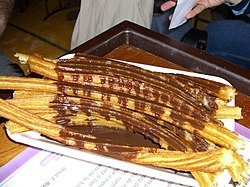
A plate of churros with a cup of chocolate
Alternative namesTejeringos
TypeFried dough
CourseBreakfast, lunch, dinner, snack
Place of originIberian Peninsula
Region or stateSouthern Europe
Serving temperatureHot
Main ingredientsDeep-fried choux pastry (flour, water, butter, eggs, salt)
  • Cookbook: Churro
  •   Media: Churro

A churro (Spanish pronunciation: [ˈtʃuro], Portuguese pronunciation: [ˈʃuʁu]) is a type of fried dough from Spanish and Portuguese cuisine, made with choux pastry dough piped into hot oil with a piping bag and large closed star tip or similar shape. They are also found in Latin American cuisine, Philippine cuisine and in other areas that have received immigration from Spanish and Portuguese-speaking countries, especially in France and the Southwestern United States.

In Spain, churros can either be thin (and sometimes knotted) or long and thick, where they are known as porras, jeringos, or tejeringos[1][2] in some regions. They are normally eaten for breakfast dipped in coffee, or in hot chocolate for an afternoon snack. There are also two slightly different snacks in Portugal, called porra and fartura, which are filled with jelly instead of the doce de leite traditional to Brazilian churros.[3]

History

[edit]

The origin of churros is unclear. But according to food historian Michael Krondl, "today's churro is not that different from a recipe for a flour and water fritter that you find in Apicius, a Roman cookbook dating from the 1st century AD. And there are recipes from the Ancient Greeks, but it's probably even older than that. In the Mediterranean basin it's basically been around forever".[4]

But there are also other theories: one of them is that the churro was made by Spanish shepherds to substitute for fresh baked goods. Churro paste was easy to make and fry in an open fire in the mountains, where shepherds spend most of their time,[5][6] but the nomadic lifestyle of the shepherds and the large quantities of oil or fat needed to fry churros make that unlikely.[2]

Another theory, considered a hoax by some people[2] suggests the concept was brought to Europe from China by the Portuguese.[7] The Portuguese sailed for the Orient; as they returned from Ming-dynasty China to Portugal, they brought along with them new culinary techniques. One included altering dough for youtiao, also known as yóuzháguǐ in southern China, which bears a resemblance to the churro.[citation needed] The new pastry was soon introduced to Spain, where it was modified to have the dough extruded through a star-shaped nozzle (compare a piping bag) rather than pulled.[8]

Etymology

[edit]

According to the Diccionario de la lengua española, churro is onomatopoeic, ultimately imitative of the sound of frying.[9]

Preparation

[edit]
Extruding dough for churros in Strasbourg
A street vendor in Colombia making churros

Churros are fried until they become crunchy, and may be sprinkled with sugar. The surface of a churro is ridged due to having been piped from a churrera, a syringe-like tool with a star-shaped nozzle. Churros are generally prisms in shape, and may be straight, curled or spirally twisted.

Like pretzels, churros are sold by street vendors, who may fry them freshly on the street stand and sell them hot. In Spain and much of Latin America, churros are available in cafes for breakfast, although they may be eaten throughout the day as a snack. Specialized churrerías, in the form of a shop or a trailer, can be found during the holiday period. In addition, countries like Colombia, Peru, Spain and Venezuela have churrerías throughout their streets. In Portugal, they are commonly eaten at carnivals, fairs and other celebrations, where they are made freshly at street stands.

The dough is a mixture of flour, water and salt. Some versions are made of potato dough. Depending on the recipe, it may not be vegan, as they can contain butter, milk or eggs.

Variations

[edit]

In Seville (Andalusia), the name "calientes" (meaning hot) or "calentitos de rueda" is sometimes used instead of the word churro. These tend to refer to the thicker variant, called porra. Calientes are usually fried in the shape of a continuous spiral and cut into portions afterwards. The center of the spiral is thicker and softer, and for many a delicacy in itself. The standard "churro" is also sold under the name "calentitos de papas", the name referring to the softer mashed potato-like texture.[10][11][12]

In parts of eastern Andalusia, a much thinner dough is used, which does not allow for the typical ridges to be formed on the surface of the churro. The final result therefore has a smooth surface, and is more pliable and of a slightly thinner diameter than standard Spanish churros. Another difference is that sugar is never sprinkled on them, because the flavour is not considered suitable.[citation needed]

Filled, straight churros are found in Cuba (with fruit, such as guava), Brazil (with chocolate, doce de leite, among others), and in Argentina, Bolivia, Peru, Chile, Mexico (usually filled with dulce de leche or cajeta but also with chocolate and vanilla), and in Colombia and Venezuela (with bocadillo, arequipe or sweetened condensed milk). In Spain, a considerably wider diameter is used to accommodate the filling.[citation needed]

In Uruguay, churros can also come in a savoury version, filled with melted cheese.[citation needed]

In the Philippines, churros are typically straight, or bent into U-shapes or circular shapes dusted with white sugar and are popular during Christmas.[13][14][15]

In Thailand, churros are commonly referred to as Patonggo Spain (Thai: ปาท่องโก๋สเปน, lit.'Spanish deep-fried dough stick'). The fried dough itself is originally called youtiao in Chinese, but it is known locally in Thailand as patonggo.[16]

Churros in American theme parks and street fairs are most often rolled in cinnamon sugar or other flavored sugars.[citation needed]

Similar dishes

[edit]

Karabeej Halab

[edit]

In the Middle East, a churro-like fried dough-based sweet is known as Karabeej Halab (Arabic: كرابيج حلب, lit.'Whips of Aleppo'). It is made using semolina flour, and is dipped into a sugar and rose water syrup after it is deep fried.[17][18][19] It originates from Syrian cuisine and is especially popular in the month of Ramadan.[20]

Youtiao

[edit]

Youtiao, a traditional Chinese fried dough with a long history. It is well known in Thailand as Patonggo.[16][21]

[edit]

The Mexican sitcom El Chavo del Ocho featured a 3-episode saga in 1978 titled La Venta de Churros with churros as the main theme. The popularity of this saga has led people to frequently associate churros with the series, to the point of even selling them using the characters' images to boost sales.[22]

See also

[edit]

References

[edit]
[edit]
Revisions and contributorsEdit on WikipediaRead on Wikipedia
from Grokipedia
A churro is a traditional fried-dough pastry originating from Spain, characterized by its elongated, ridged form created by extruding a simple dough through a star-shaped nozzle into hot oil, resulting in a crispy golden exterior and a soft, airy interior, typically coated in cinnamon sugar and served with thick hot chocolate for dipping.[1] The churro's dough is prepared by boiling water, butter or oil, salt, and flour to form a choux-like paste, which is then piped and fried at around 185°C (365°F) until golden brown.[1] Its name likely derives from the horns of the Churra sheep, a breed native to Spain, as early versions were shaped to mimic them for portability among shepherds cooking over open fires.[1] Historical accounts trace the churro's roots to the Moorish occupation of the Iberian Peninsula from the 8th to 15th centuries, where it evolved from Arabic fried pastries known as teules or similar dough-based fritters introduced during Islamic rule.[2] By the late 19th century, churros had become a documented street food in Spain, often sold at fairs and fiestas as an affordable treat made with basic ingredients like flour, water, and fat.[1] Spanish colonizers brought churros to the Americas in the 16th century, where they fused with indigenous traditions, particularly in Mexico, pairing the pastry with champurrado—a thick, spiced chocolate drink derived from Aztec recipes using cacao and corn.[3] This adaptation elevated churros to a breakfast staple and festive food across Latin America, symbolizing cultural blending and communal enjoyment during celebrations like Día de los Muertos.[3] In modern times, churros have achieved global popularity, with variations such as filled centers (e.g., dulce de leche or cream) in Argentina and shorter "churro bites" in the United States, where they became iconic at Disneyland since 1985.[3] They represent a versatile emblem of street food culture, evoking nostalgia and indulgence while highlighting centuries of culinary exchange between Europe, Africa, and the Americas.[2]

Origins

Historical Development

The origins of churros remain debated, with several theories tracing their roots to ancient fried dough traditions adapted in Iberia. One prominent hypothesis links churros to the Chinese youtiao, a long fried dough stick dating to the 12th-13th centuries, which Portuguese explorers may have encountered during trade voyages to China in the 1500s and adapted upon returning to the Iberian Peninsula.[4] Another theory attributes early influences to Arabic and Moorish culinary practices, where recipes for similar extruded fried pastries appear in 8th-9th century texts and 12th-century Moorish Spanish sources, introduced during the Islamic occupation of the region from the 8th to 15th centuries.[1][2] In Spain, churros are commonly associated with the ingenuity of shepherds in rural areas like Castilla y León and Andalusia, who crafted a simple dough from flour, water, and salt, extruding it through rudimentary tools such as animal horns or wooden molds before frying it over open fires as a portable substitute for bread during long mountain treks.[1] This pastoral adaptation likely evolved from earlier Moorish pastries like teules, a diamond-shaped fried dough, which Spanish cooks modified by the late Middle Ages into the ridged, elongated form resembling the horns of the native Churra sheep.[2] While specific references to "churros" by name emerge later, syringe-like fritters akin to modern churros are documented in European culinary records from the 16th century onward, aligning with the pastry's growing presence in Spanish street food culture.[4] Churros spread to Latin America during the Spanish colonization of the Americas in the late 15th and 16th centuries, carried by conquistadors and settlers who integrated the treat into New World diets.[3] In regions like Mexico, it adapted alongside indigenous ingredients, often paired with champurrado—a thick chocolate-based drink derived from Aztec atole traditions—to create enduring combinations that blended European and local flavors.[3] By the 1600s, churros had become embedded in colonial cuisine across Mexico, Argentina, and other territories, evolving into a staple of mestizo foodways through street vendors and religious festivals.[2] Commercialization accelerated in the 19th century as churros transitioned from rural homemade fare to urban street food in Spain, particularly in Madrid, where vendors known as churreros began selling them fresh from portable frying stations at markets and fairs.[1] The establishment of dedicated churrerías—specialized shops—marked this shift, with the first documented "churros factory" licensed in Madrid in 1887 by Mariano Atienza Montoya, enabling larger-scale production.[5] By the late 19th century, the pairing with hot chocolate gained prominence, exemplified by the opening of Chocolatería San Ginés in 1894, which popularized the treat as a breakfast and late-night snack amid Spain's industrializing cities.[1] In the 20th century, churros achieved global reach, particularly after World War II, as waves of Spanish and Latin American immigration to Europe, the United States, and beyond introduced the pastry to new markets through family recipes and street vending traditions.[2] This diaspora-driven export, combined with tourism and cultural exchanges, embedded churros in international cuisines, from fairground snacks in the Americas to fusion desserts worldwide.[3]

Etymology

The word churro originates from Spanish, where it derives from a dialectal term referring to a coarse-wooled sheep native to the Iberian Peninsula, likely alluding to the pastry's ridged, shaggy texture or its resemblance to the animal's spiral horns.[6] This etymology ties to pre-Roman linguistic roots, with related terms in Portuguese and other Iberian languages denoting something rough, dirty, or unkempt, reflecting the irregular appearance of the fried dough.[7] The term entered English directly from Spanish as churro or churros in the early 20th century, retaining its original form to describe the imported treat.[8] In Latin America, it is predominantly known as churros, with the core name persisting from colonial Spanish influence. Historical records show the first documented use of churro in Spanish texts dating to the late 19th century, with an 1887 reference to a "Fábrica de churros" in official paperwork, marking its emergence in print as a named food item.[5] Diminutive forms like churrito later appeared for smaller versions of the pastry, common in colloquial Spanish usage.[9]

Preparation

Ingredients

The traditional churro dough consists of a basic recipe featuring wheat flour, water, and salt, fried in oil, with toppings such as granulated sugar or cinnamon sugar applied afterward.[10][11][12] Wheat flour serves as the primary structural component, providing the gluten necessary for the dough's elasticity and the churro's crisp exterior upon frying.[13] Water hydrates the flour to form a smooth, pipeable paste without the need for eggs or yeast, which are absent in authentic versions to maintain simplicity and achieve the light, airy texture.[10] Salt balances the flavors and enhances the overall taste, ensuring the neutral base complements sweet coatings.[13][12] In the frying process, the dough is submerged in hot fat, where historical Spanish recipes often employed lard for its richness and ability to yield golden, flavorful results, though olive oil was also common due to regional availability.[14] Modern adaptations frequently substitute vegetable oils, such as sunflower or canola, to align with health-conscious preferences while preserving the frying characteristics.[15] Traditional churros present allergen considerations primarily from gluten in the wheat flour, making them unsuitable for those with celiac disease or gluten sensitivity.[10] Unfilled versions avoid dairy entirely, though some contemporary fillings may introduce it.[13] The reliance on these straightforward, pantry-staple ingredients underscores the churro's pastoral roots, originating among Spanish shepherds who crafted the treat from easily sourced materials as a bread substitute during long journeys.[11][10]

Cooking Process

The traditional cooking process for churros begins with preparing the dough, which resembles a choux pastry base. Water is brought to a boil with a pinch of salt. Once boiling, the heat is removed, and sifted flour—typically all-purpose—is quickly stirred in to form a smooth, elastic paste that pulls away from the sides of the saucepan. This mixture is then stirred vigorously by hand or beaten with a mixer for about 1-2 minutes to develop elasticity and ensure a cohesive dough that holds its shape during frying.[16][17][18] Next, the dough is extruded into shape using specialized equipment. In traditional Spanish methods, a churrera—a hand-operated metal or wooden syringe-like press with a star-shaped nozzle—is filled with the warm dough and used to pipe long, ridged strips directly into hot oil, creating the signature crispy exterior. Modern adaptations often employ a sturdy piping bag fitted with a large star tip (such as an 8mm nozzle) for similar results, though the churrera provides more consistent pressure for longer pieces. The dough is piped in lengths of about 6-8 inches to facilitate even cooking.[16][17][18][19] Frying follows immediately to achieve the churro's golden crispiness. Vegetable oil, such as sunflower or light olive oil, is heated to 180-190°C (356-374°F) in a deep pot or Dutch oven, a temperature range that ensures the exterior crisps quickly while the interior cooks through without absorbing excess oil. The extruded dough is carefully lowered into the oil in small batches of 3-4 pieces, frying for 2-4 minutes per side—flipping with a slotted spoon—until evenly golden brown. Maintaining precise oil temperature is crucial; if too low, the churros become soggy and greasy, while overheating can cause burning. Once fried, they are drained on paper towels to remove residual oil.[16][17][18] Post-frying, churros are finished and served hot to preserve their texture. While still warm, they are rolled in granulated sugar for a simple coating, or in some cases, a cinnamon-sugar mix for added flavor. In the classic Spanish style, they are dipped into thick, hot chocolate sauce, which complements the fried dough's neutrality. This immediate treatment prevents softening and enhances the contrast between the crunchy exterior and soft interior.[16][17][18]

Varieties

Traditional Forms

Traditional churros in Spain are typically formed into long, straight ridged sticks measuring 10 to 20 centimeters in length, piped from a churrera using a star-shaped nozzle to create distinctive ridges that enhance crispiness during frying. These plain dough sticks are fried until golden, drained, and then dusted with granulated sugar, emphasizing their simplicity without any fillings or additional flavors. This form is widespread across Spain, particularly in regions like Madrid, where they serve as a staple breakfast or snack item.[1][20] Another classic variation features looped or circular shapes, known as roscos or wheels, which are piped directly into hot oil in a spiral or teardrop loop to ensure even frying and prevent uneven cooking. Traditional in Castile, these forms allow for uniform heat distribution, resulting in a consistent texture throughout. The loops are similarly fried plain, sugared, and presented without fillings, maintaining the archetype of the unfilled fried dough.[21][22] Size and thickness vary to suit different serving styles, with standard Spanish churros being relatively thin—around 2 centimeters in width—to promote a balance of textures ideal for dipping, while thicker versions, such as porras, offer a softer, airier interior due to added leavening agents like baking powder. Porras, popular in Madrid and surrounding areas, are chunkier sticks or spirals that absorb less oil and yield a fluffier bite compared to the denser thin churros. All traditional forms aim for a crispy, golden exterior achieved through high-heat frying at approximately 185°C, paired invariably with thick, custard-like hot chocolate for dipping, which provides a rich contrast to the dough's subtle sweetness.[1][12]

Regional Adaptations

In Spain, churros exhibit regional distinctions in texture and preparation. In Madrid, they are typically thin and crisp, often enjoyed as a breakfast staple paired with thick hot chocolate at historic churrerías like Chocolatería San Ginés.[23] In contrast, Andalusian styles, such as porras, are thicker and softer, with a smoother surface lacking the ridged edges common elsewhere, and are similarly served with dense chocolate for dipping.[24][22] Mexican churros are dusted with a cinnamon-sugar coating and typically served with dipping sauces such as cajeta or hot chocolate. Modern variations may include fillings like cream or dulce de leche.[25] These variations emphasize a sweeter, more indulgent profile compared to the plain Spanish originals. Across Latin America, churros evolve further with country-specific fillings. In Argentina, churros rellenos are commonly stuffed with dulce de leche or chocolate, offering a caramelized contrast to the fried dough.[26] Peruvian versions feature sweeter churros filled with manjar blanco, a creamy dulce de leche analogue made from condensed milk, enhancing their dessert-like appeal.[27] In the United States, churros are reimagined as larger, dessert-focused treats, frequently paired with ice cream or toppings at commercial venues. Theme parks like Walt Disney World exemplify this, offering oversized churros in flavors such as salted caramel, often served with vanilla soft-serve for a fusion snack experience.[28] Asian adaptations remain rare but include fusions in the Philippines, where Spanish colonial influence persists in churros con tsokolate, now innovated with local fillings like coconut or ube (purple yam) for a tropical twist.[29][30]

Cultural Role

Culinary Significance

Churros serve as a staple street food and breakfast item in Spain and Latin America, providing a quick, affordable source of carbohydrates for daily energy needs. In Spain, they have been a favored morning meal since the 19th century, particularly among working-class individuals seeking filling, portable sustenance to start the day. Historically, their simple dough composition made them an ideal high-energy food for laborers and shepherds requiring sustenance during long hours in the fields or mountains. In Latin America, churros evolved into a ubiquitous street snack, often enjoyed hot from vendors in markets and plazas, reflecting their adaptation as an accessible treat across diverse urban and rural diets. Beyond everyday consumption, churros hold significant festive and social importance, especially at carnivals, fairs, and community gatherings where they are fried fresh and savored in large quantities. In Spain, they are a traditional offering at events like the Feria de Abril in Seville, symbolizing celebration and indulgence. Frequently paired with thick hot chocolate rather than coffee, churros foster social bonding in churrerías—specialized shops that act as communal hubs for locals to gather, chat, and enjoy this ritualistic pairing, particularly during winter mornings or post-nightlife hours. Economically, churros bolster small-scale vendors and local economies, with their low production costs enabling high profitability for street sellers and family-run operations in Spain and Latin America. The European churros market, heavily influenced by Spanish traditions, was valued at approximately US$350.5 million in 2024, underscoring their role in supporting artisanal food sectors and tourism-driven sales at fairs. Annual events like Madrid's San Isidro fair feature churros as a key attraction, contributing to vendor livelihoods through consistent demand. Nutritionally, churros offer about 400-450 calories per 100 grams, predominantly from carbohydrates (around 46 grams) and fats (25-28 grams), with minimal protein (about 2.8 grams), making them energy-dense but imbalanced for regular diets. Their deep-frying process leads to significant oil absorption, raising health concerns such as elevated trans fat intake from reused oils and contributions to obesity or diabetes when consumed frequently. Modern adaptations, like air-frying versions, aim to mitigate these issues by reducing fat content while preserving the traditional appeal. Churros have featured prominently in various films and television shows, often symbolizing indulgence or social bonding. In the 2024 film Challengers, directed by Luca Guadagnino, a pivotal scene depicts protagonists Art Donaldson and Patrick Zweig playfully arguing over churros during a match, underscoring themes of rivalry and intimacy.[31] On television, The Simpsons has referenced churros in multiple episodes, such as in "Special Edna" (2003), where Homer Simpson humorously attempts to purchase one at a theme park for $14, highlighting everyday absurdity.[32] In popular culture, churros embody comfort and communal joy, particularly within Mexican and Spanish diaspora communities. They represent togetherness during festivals and holidays, fostering shared memories and cultural continuity. In Spain, churros con chocolate serve as a symbol of indulgence, prominently featured in tourism marketing to promote Madrid's vibrant street food scene and festivals.[33] Modern trends have amplified churros' visibility through social media and celebrity influences, transforming them into a global fusion staple. Post-2010s viral recipes, such as those shared on platforms like TikTok, have popularized homemade variations, driving widespread experimentation at home.[34] Celebrities have endorsed churros in diverse ways; for instance, Food Network host Anne Burrell demonstrated a churros recipe with dark chocolate coconut ganache in 2025, emphasizing its dessert versatility.[35] In the U.S., food trucks like Churros Calientes have gained traction by offering Nutella-dipped versions, contributing to churros' role in urban street food culture.[36] Churros' commercialization extends to theme parks and innovative desserts, solidifying their pop culture status. At Disney parks, churro carts are iconic fixtures, serving cinnamon-sugar coated treats across locations like Disneyland's Hollywood Land and Walt Disney World's Magic Kingdom, often as a quick, nostalgic snack for visitors.[37] Fusion creations, such as churro ice cream sandwiches—where fried churro dough encases vanilla ice cream—have emerged as trendy hybrids in American cuisine, blending traditional texture with modern indulgence.[38] Events like ChurroFEST in Hillsboro, Texas, further celebrate this, featuring live music, games, and churro tastings to draw crowds annually.[39]

Global Analogues

The Chinese youtiao, also known as yu char kway, consists of long, golden-brown deep-fried strips of wheat flour dough, typically twisted together before frying to achieve a light, airy texture.[40] These savory snacks, which contain no added sugar, are commonly dipped in congee, soy milk, or porridge for breakfast, emphasizing their role as a neutral accompaniment rather than a standalone sweet.[40] Originating in China during the Southern Song dynasty (1127–1279 AD), youtiao's creation is tied to a legendary act of folk protest against corrupt officials, where the fried dough symbolized punishment by boiling oil.[41] In India, jalebi is a festive sweet made from a fermented batter of wheat or rice flour, piped into hot oil to form intricate spirals before being soaked in a sugar syrup flavored with saffron or cardamom.[42] This crispy, syrup-drenched treat traces its roots to West Asian influences, arriving in the Indian subcontinent around the 14th or 15th century via Persian and Turkish traders, where it evolved into a staple for celebrations and religious festivals.[42] Zalabia, a traditional fritter across the Middle East, involves deep-frying a simple yeast-leavened wheat batter into small, irregular shapes, then coating it in honey or sugar syrup for a sticky sweetness.[43] The earliest recorded recipe dates to a 10th-century Arabic cookbook, where the batter was poured through a perforated shell to create fritters enjoyed during holidays like Hanukkah.[43] In Levantine regions such as Lebanon and Palestine, versions like awameh are often extruded or spooned into oil, resulting in a softer, more pillowy texture compared to denser forms elsewhere.[44][45] French beignets, particularly the iconic New Orleans style, are square pastries made from a yeast-leavened dough enriched with eggs, milk, and butter, deep-fried until puffed and golden, then generously dusted with powdered sugar.[46] This preparation yields a pillowy interior with air pockets that contrasts with denser fried doughs, and while rooted in 16th-century French culinary traditions, beignets gained prominence in New Orleans through Acadian influences.[46] Unlike ridged extrusions, they are cut into uniform squares before frying, emphasizing a puffed rather than elongated form.[47] These global pastries share a core method of deep-frying wheat-based doughs to create crispy exteriors, often enjoyed as indulgent treats during meals or festivities.[42][46] However, they diverge in seasoning and presentation: youtiao remains savory and plain for dipping, while jalebi, zalabia, and beignets incorporate sweetness through syrups, honey, or sugar, adapting to regional preferences for either festive indulgence or simple comfort.[40][43]

Distinctions from Churros

While youtiao, a staple Chinese breakfast item, shares a superficial resemblance to churros as elongated fried dough sticks, key differences lie in their dough composition and culinary roles. Youtiao employs a leavened dough incorporating baking powder for an airy, puffed interior, whereas churros rely on an unleavened choux-style paste of flour, water, and minimal fat for a denser, pipeable consistency.[48][49] Furthermore, youtiao is typically served savory, paired with congee, soy milk, or pickled vegetables without added sweetness, contrasting churros' post-frying dusting in cinnamon sugar or dipping in thick hot chocolate.[48][1] Jalebi, an iconic South Asian confection, diverges from churros in both batter and finishing. Its batter, a blend of wheat and gram flours fermented overnight with yogurt, yields a tangy, bubbly mixture piped into intricate spirals before frying, unlike the boiled, unleavened churros dough extruded in straight ridges.[42][49] Post-frying, jalebi is immersed in warm sugar syrup, resulting in a sticky, syrup-saturated texture that permeates the crisp exterior, while churros receive only a dry coating to maintain their non-soggy crunch.[42] Beignets, emblematic of New Orleans Creole cuisine, feature a yeast-leavened dough that rises to create pronounced air pockets and a pillowy interior, differing from the unleavened churros paste that produces a uniform, chewy core.[50][49] Shaped into squares or rectangles and generously dusted with powdered sugar, beignets evoke French colonial influences adapted in the American South, in contrast to churros' cylindrical, ridged form tied to Spanish pastoral traditions among shepherds crafting portable sustenance from simple ingredients over open fires.[50][1] Zalabia, a Middle Eastern fried dough treat, often utilizes a yeast-raised batter enriched with spices like anise and sesame, fried into balls or twists and drizzled or soaked in honey or floral syrup for a glossy finish, setting it apart from churros' plain, unleavened extrusion and dry seasoning.[51][49] Culturally, zalabia holds ties to religious observances such as Hanukkah among Jewish communities or Ramadan iftars, emphasizing communal and celebratory consumption, whereas churros function as everyday street food in Spain and Latin America.[52] Overall, churros stand out among fried dough analogues due to their distinctive ridged surface, achieved by piping through a star-shaped nozzle that maximizes crispiness upon frying, a feature absent in smoother or pulled forms like youtiao or jalebi.[1] Additionally, the classic pairing of churros with thick hot chocolate—emerging in 19th-century Spain as a comforting duo—lacks direct equivalents in most global counterparts, underscoring churros' unique sweet, dunkable profile rooted in Iberian culinary heritage.[53]

References

User Avatar
No comments yet.