

Citroën Jumpy
View on Wikipedia
| Citroën Jumpy | |
|---|---|
 | |
| Overview | |
| Manufacturer | Sevel Nord Stellantis (2021–present) |
| Production | 1994–present |
| Body and chassis | |
| Class | Light commercial vehicle Large MPV |
| Body style | 4/5-door panel van 4/5-door minivan |
| Layout | Front-engine, front-wheel-drive |
| Chronology | |
| Predecessor |
|
| Successor | Fiat Talento (for Fiat Scudo) |
The Citroën Jumpy (badged Citroën Dispatch in some countries) is a light commercial van jointly developed by FCA Italy and PSA Group (currently Stellantis), and previously manufactured by Sevel, a joint venture between the two companies formed in 1994. The Jumpy is also sold as the Peugeot Expert, Fiat Scudo, Opel Vivaro, and Toyota ProAce.
All three models were facelifted in March 2004 before being replaced by new, second-generation models in 2007. The redesigned models again shared the same design and engineering, with subtle trim changes between each brand. The second generation received a small facelift in February 2012 and from July 2013, Toyota began sales of a rebadged version called the Toyota Proace.
In December 2015, Citroën, Peugeot and Toyota unveiled their new generation of these vehicles in people carrying-specifications called the Citroën SpaceTourer and Peugeot Traveller,[2] with Toyota retaining the Proace name. The commercial versions premiered later, retaining the Peugeot Expert and Citroën Jumpy names.
In May 2016, the Fiat Scudo was replaced by a second generation of the Fiat Talento, a rebadged Renault Trafic.[3] From the 2019 model year, the Jumpy has been rebadged as the Opel/Vauxhall Vivaro, replacing the previous Vivaro model, which, from 2001 to 2019, had been based on the Renault Trafic. From the 2022 model year, the Jumpy has also been rebadged as the Fiat Scudo, to replace the previous Talento model, which, from 2016 to 2020, had been based on the Renault Trafic.[4]
First generation (1994)
[edit]| First generation | |
|---|---|
 (1994–2004) Citroën Jumpy | |
| Overview | |
| Also called | Citroën Dispatch (UK and Ireland) Fiat Scudo Peugeot Expert |
| Production | June 1994 – January 2007 (Citroën) July 1995 – January 2007 (Peugeot) February 1996 – January 2007 (Fiat) |
| Assembly | France: Lieu-Saint-Amand (Sevel Nord) |
| Body and chassis | |
| Related | Eurovans |
| Powertrain | |
| Engine | |
| Dimensions | |
| Kerb weight | 1,380–1,450 kg (3,042–3,197 lb)[5] |
Citroën released the first-generation Jumpy in June 1994, naming the model "Dispatch" in English-speaking markets. Peugeot and Fiat followed with their rebadged models in July 1995 and February 1996 respectively. The vans differ little technically and visually, an example of badge engineering.
They share mechanicals and body structure with the Sevel Nord Eurovans minivans: the Citroën Evasion (Synergie), Fiat Ulysse, Lancia Zeta, and Peugeot 806. The engines available throughout the models do differ, with the Fiat getting its own engines distinct from those fitted to the Citroën and Peugeot. The Fiat Scudo replaced the first generation of the Fiat Talento.
-
 1995-2004 Citroën Dispatch
(Great Britain) -
 1995-2004 Citroën Jumpy
 -
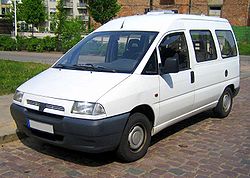 1995–2004 Peugeot Expert
 -
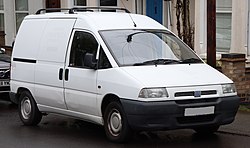 1996-2004 Fiat Scudo


Facelift
[edit]The model received a facelift in 2004, which changed most of the front end including the bumper and bonnet; for the first time, the headlamps were combined with the indicators rather than being a separate set of lights.
-
 Facelift Citroën Dispatch
2004-2006 (Great Britain) -
 2004–2006 Citroën Jumpy
 -
 2004–2006 Peugeot Expert
 -
 2004–2006 Fiat Scudo


Engines
[edit]| Model | Engine | Displacement | Valvetrain | Fuel system | Max. power at rpm | Max. torque at rpm | Years |
|---|---|---|---|---|---|---|---|
| Petrol engines | |||||||
| 1.6 i.e. | Fiat 220.A2.000 | 1,581 cc | SOHC 8v | Single-point fuel injection | 79 PS (58 kW; 78 hp) @ 5,750 rpm | 125 N⋅m (92 lb⋅ft) @ 2,750 rpm | 1996–2000 |
| 2.0 i.e. | PSA EW10 | 1,997 cc | DOHC 16v | Multi-point fuel injection | 136 PS (100 kW; 134 hp) @ 6,000 rpm | 190 N⋅m (140 lb⋅ft) @ 4,100 rpm | 2000–2006 |
| Diesel engines | |||||||
| 1.9 D | PSA XUD9 | 1,905 cc | SOHC 8v | Indirect injection | 69 PS (51 kW; 68 hp) @ 4,600 rpm | 120 N⋅m (89 lb⋅ft) @ 2,000 rpm | 1996–1999 |
| 1.9 D | PSA DW8 | 1,868 cc | SOHC 8v | Indirect injection | 69 PS (51 kW; 68 hp) @ 4,600 rpm | 125 N⋅m (92 lb⋅ft) @ 2,500 rpm | 1999–2006 |
| 1.9 TD | PSA XUD9TE | 1,905 cc | SOHC 8v | Indirect injection | 92 PS (68 kW; 91 hp)} @ 4,000 rpm | 196 N⋅m (145 lb⋅ft) @ 2,250 rpm | 1996–1999 |
| 2.0 JTD | PSA DW10 | 1,997 cc | SOHC 8v | Common rail direct injection | 94 PS (69 kW; 93 hp) @ 4,000 rpm | 215 N⋅m (159 lb⋅ft) @ 1,750 rpm | 1999–2006 |
| 2.0 JTD | PSA DW10 | 1,997 cc | SOHC 8v | Common rail direct injection | 109 PS (80 kW; 108 hp) @ 4,000 rpm | 250 N⋅m (184 lb⋅ft) @ 1,750 rpm | 1999–2006 |
| 2.0 JTD1 | PSA DW10 | 1,997 cc | DOHC 16v | Common rail direct injection | 109 PS (80 kW; 108 hp) @ 4,000 rpm | 270 N⋅m (199 lb⋅ft) @ 1,750 rpm | 2000–2006 |
1 Only for Scudo Combinato
Second generation (G9; 2007)
[edit]| Second generation | |
|---|---|
 Citroën Jumpy | |
| Overview | |
| Also called | Citroën Dispatch (UK and Ireland) Fiat Scudo Peugeot Expert Toyota Proace (since 2013) |
| Production | January 2007 – March 2016 (SWB) November 2006 – March 2016 (LWB) July 2013 – March 2016 (Toyota Proace) |
| Assembly | France: Lieu-Saint-Amand (Sevel Nord) |
| Body and chassis | |
| Body style | 4/5-door panel van 4/5-door minibus |
| Powertrain | |
| Engine | |
| Transmission | 5-speed Manual 6-speed manual 6-Speed Aisin AWTF-80SC automatic |
| Dimensions | |
| Kerb weight | 1,910 kg (4,211 lb)[6]-2,044 kg (4,506 lb)[7] |
The second generation offered increased cargo space and more body styles over the previous generation. It was launched in November 2006, with deliveries beginning in principal markets in January 2007.[8] The Citroën is available in 90 bhp, 120 bhp (89 kW; 122 PS) and 136 bhp (101 kW; 138 PS) versions with the option of four diesel engines or one petrol engine.
The Peugeot Expert II was launched in January 2007, with the addition of a people carrier model, the Tepee.[9] The PSA/Fiat joint venture ended in March 2016.[10]
-
 2007–2012 Citroën Jumpy
 -
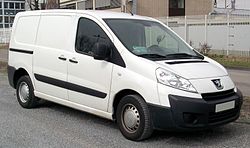 2007–2012 Peugeot Expert
 -
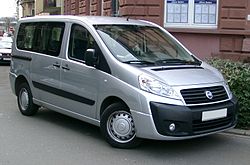 2007–2012 Fiat Scudo


Facelift
[edit]The model received a slight facelift in February 2012, which changed the grille and front bumper. From July 2013, Toyota began sales of a rebadged version called Toyota Proace.
The Fiat Scudo was discontinued in Summer 2012.
-
 2012–2016 Citroën Jumpy
 -
 2012–2016 Citroën Jumpy
 -
 2012–2016 Peugeot Expert
 -
 2013–2016 Toyota Proace
_%E2%80%93_Frontansicht,_5._September_2012,_Wuppertal.jpg)
_%E2%80%93_Heckansicht,_5._September_2012,_Wuppertal.jpg)


Engines
[edit]| Model | Engine | Displacement | Valvetrain | Fuel system | Max. power at rpm | Max. torque at rpm | Gearbox | Years |
|---|---|---|---|---|---|---|---|---|
| Petrol engines | ||||||||
| 2.0 i.e. | PSA EW10 | 1,997 cc | DOHC 16v | Multi-point fuel injection | 140 PS (103 kW; 138 hp) @ 6,000 rpm | 180 N⋅m (133 lb⋅ft) @ 2,500 rpm | 5-speed manual | 2007–2016 |
| Diesel engines | ||||||||
| 90 Multijet | Ford DLD-416 | 1,560 cc | DOHC 16v | Common rail direct injection | 90 PS (66 kW; 89 hp) @ 4,000 rpm | 180 N⋅m (133 lb⋅ft) @ 1,750 rpm | 5-speed manual | 2007–2016 |
| 120 Multijet | PSA DW10 | 1,997 cc | DOHC 16v | Common rail direct injection | 120 PS (88 kW; 118 hp) @ 4,000 rpm | 300 N⋅m (221 lb⋅ft) @ 2,000 rpm | 6-speed manual | 2007–2016 |
| 130 Multijet | PSA DW10 | 1,997 cc | DOHC 16v | Common rail direct injection | 130 PS (96 kW; 128 hp) @ 4,000 rpm | 320 N⋅m (236 lb⋅ft) @ 2,000 rpm | 6-speed manual | 2007–2016 |
| 140 Multijet | PSA DW10 | 1,997 cc | DOHC 16v | Common rail direct injection | 136 PS (100 kW; 134 hp) @ 4,000 rpm | 320 N⋅m (236 lb⋅ft) @ 2,000 rpm | 6-speed manual | 2007–2016 |
| 165 Multijet | PSA DW10 | 1,997 cc | DOHC 16v | Common rail direct injection | 163 PS (120 kW; 161 hp) @ 3,750 rpm | 340 N⋅m (251 lb⋅ft) @ 2,000 rpm | 6-speed manual | 2010–2016
2010–2016 |
Third generation (K0; 2016)
[edit]| Third generation | |
|---|---|
 2016 Citroën Dispatch (UK) | |
| Overview | |
| Also called |
|
| Production | December 2015 – present (Citroën SpaceTourer/Peugeot Traveller) March 2016 – present (Citroën Jumpy/Peugeot Expert/Toyota Proace) October 2019 – present (Opel/Vauxhall) 2022–present (Fiat) |
| Assembly |
|
| Body and chassis | |
| Body style | 4/5-door panel van 4/5-door minibus |
| Platform | PSA EMP2 |
| Powertrain | |
| Engine |
|
| Electric motor | 136 PS (100 kW; 134 hp) permanent-magnet synchronous motor (electric versions) |
| Transmission | 5-speed manual 6-speed manual 6-speed Aisin AWTF-80SC automatic |
| Electric range | 350km WLTP (eK0) |
| Dimensions | |
| Wheelbase |
|
| Length |
|
| Width |
|
| Height |
|
.jpg)
At the 2016 Geneva Motor Show, Citroën, Peugeot and Toyota revealed their latest generation of their respective vans. With this new generation the vans became more contemporary, and the Citroën and Peugeot models gained new names for the passenger versions: Citroën SpaceTourer and Peugeot Traveller. Toyota partially retained the Proace name, calling their version Proace Verso.
Commercial variants have been released in March 2016, under the Citroën Jumpy, Peugeot Expert and Toyota Proace names.[15][16] In 2019, Opel/Vauxhall switched to the PSA van platform for the Vivaro.
The Fiat Scudo and Ulysse nameplates were revived in 2022 using the PSA van platform, replacing the also Renault Trafic-based Talento.
In January 2022, Stellantis stopped marketing the internal combustion versions of its passenger vans in Europe (Switzerland and Balkan countries excepted).[17] This decision is mainly motivated by a decision to reduce the average CO2 emissions of vehicles marketed by the company in Europe in accordance with the CAFE (Corporate Average Fuel Economy) regulations set up by the European Union. As a result, the SpaceTourer, Traveller and Zafira Life are now only offered in their 100% electric and hydrogen versions. Panel van models are not affected by this change, nor are Toyota-badged models, as the Japanese manufacturer is in line with the objectives of the CAFE regulations.[18]
Production
[edit]Since 2017, both Citroën Jumpy and Peugeot Expert are assembled as CKD in Montevideo, Uruguay.[19] As of October 2019, Nordex S.A. has produced 13,000 units,[20] with most of them being exported to Brazil and Argentina.
In April 2018, PSA started the production of the Peugeot Expert and Citroën Jumpy in its Russian plant, in Kaluga.[21] The next month began the production of the Traveller and SpaceTourer in the same factory.[22] In December 2019, the Opel Zafira Life joined them on Kaluga assembly lines, followed by the Vivaro a few months later.[23]
In September 2018, PSA announced that the Luton plant would begin production of the third generation Citroën Jumpy/Dispatch/Spacetourer Peugeot Expert/Traveler ,but also the second generation of the Toyota ProAce and ProAce Verso from the end of 2019, which would also be badged as the Opel/Vauxhall Zafira Life/Vivaro Life/Vivaro to replace the Trafic-based Vivaro.[24]
In February 2022, Stellantis began exporting part of the production of the Russian plant in Kaluga to Western Europe, where Citroën, Peugeot, and Opel models are manufactured.[25] In March 2022, Stellantis halted exports from Russia following Moscow's invasion of Ukraine, putting an end to the short-lived export program from Kaluga.[26]
Special trims
[edit]GS
[edit]In October 2022, the Vauxhall Vivaro received a sporty GS trim option alongside a more powerful diesel engine.[27]
Electric versions
[edit]Electric "eK0" versions are badged and sold by multiple Stellantis brands and Toyota; they all share a common traction motor with the smaller Citroën e-Berlingo and its rebadged siblings, which has an output of 100 kW (130 hp) with 260 N⋅m (190 lbf⋅ft) torque;[28] the motor is also used for battery-electric PSA/Stellantis passenger cars such as the Peugeot e-208. While the e-Berlingo is fitted with a 50 kWh battery, the e-Jumpy (and its rebadged cousins) also offer a larger 75 kWh battery as an option. Quoted maximum driving range changes from 144 mi (232 km) under the WLTP cycle with the smaller battery to 205 mi (330 km) (WLTP) with the larger 75 kW-hr battery.[29] The vans are fitted with a 7.4 kW (AC) charger as standard, and an 11 kW (AC) charger is available as an option.[29]
| Marque | Light commercial vehicle (LCV) | Multi purpose vehicle (MPV) |
|---|---|---|
| Citroën | ë-Jumpy (EU) ë-Dispatch (UK) |
ë-SpaceTourer |
| Fiat | E-Scudo | E-Ulysse |
| Iveco | eJolly | - |
| Opel (EU) | Vivaro-e | Zafira-e Life |
| Peugeot | e-Expert | e-Traveller |
| Toyota | Proace Electric | Proace Verso Electric |
| Vauxhall (UK) | Vivaro Electric | Vivaro Life Electric |
Peugeot e-Expert/e-Traveller
[edit]In 2019, Peugeot introduced an electric version of their Expert van called e-Expert which shares the same platform as the Vivaro-e.[30] They later introduced an electric variant of the passenger Traveller called e-Traveller in June 2020.
Compared to the conventional diesel versions, there are some cosmetic changes such as blanked-off grille, instrument cluster which includes a battery charge-level gauge and new graphics for it infotainment system.[31][32]
Citroën ë-Jumpy/ë-Dispatch/ë-SpaceTourer
[edit]The Citroën ë-Jumpy (ë-Dispatch) is largely similar to the Peugeot e-Expert cargo van, while the Citroën ë-SpaceTourer is similar to the Peugeot e-Traveller passenger van.
Opel Vivaro-e/Zafira-e Life
[edit]In April 2020, Opel revealed the all-electric Vivaro-e. The Vivaro-e is available in three lengths and offers a payload capacity of up to 1,275 kg (2,811 lbs).[33] In the UK, the vehicle is sold under the Vauxhall brand.
The passenger model is called the Opel Zafira-e Life.
On 18 May 2021, Opel revealed the Vivaro-e Hydrogen. This new version has a payload of 1100 kg (compared to 1200 kg for the Vivaro-e and 1400 kg for the Vivaro). The Vivaro-e Hydrogen combines a 45 kW fuel cell with a 10.5 kW lithium-ion battery.[34] The hydrogen storage tanks are supplied by Symbio, a joint venture between Michelin and Faurecia. Peugeot then presented its e-Expert Hydrogen. These vans are manufactured at the Valenciennes plant and converted to hydrogen at the former Opel plant in Rüsselsheim.[35]
Toyota Proace Electric
[edit]The Proace Electric, available in passenger (Verso) and cargo versions, is a Toyota-badged twin of the electric vans from Groupe PSA described above.[36] The Proace Electric is the first all-electric passenger vehicle offered under the Toyota brand in Europe.
Fiat E-Scudo/E-Ulysse
[edit]
In March 2022, Fiat unveiled the E-Ulysse, a battery electric derivative of its passenger van.[37] The cargo version is called the E-Scudo.
Iveco eJolly
[edit]In June 2025, Iveco unveiled the eJolly alongside the larger eSuperJolly, slotting under the Daily and alongside the eMoovy as Iveco's smallest electric van offerings.[38]
Hydrogen
[edit]On May 18, 2021, Opel presented the Vivaro-e Hydrogen. This version has a payload of 1,100 kg (2,400 lb) (contrary to 1,200 kg (2,600 lb) for the electric version and 1,400 kg (3,100 lb) for the combustion version). The Vivaro-e Hydrogen combines a 45 kW fuel cell with a 10.5 kW lithium-ion battery.[39] The hydrogen cylinders are supplied by Symbio, a joint venture between Michelin and Faurecia. Peugeot presented its e-Expert Hydrogen a few days later and Citroën its ë-Jumpy Hydrogen.[40][41] These vehicles are manufactured at the Valenciennes plant then converted to hydrogen at the former Opel plant in Rüsselheim.[35]
H Van inspired derivatives
[edit]
In 2017, Italian company FC Automobili revealed a modern interpretation of the Citroën H Van based on the Citroën Relay. The coach built, retro inspired conversion was available either pre assembled, or as a body kit, with 70 examples to be built to mark the 70th anniversary of the Citroën Type H.[42] FC Automobili was later renamed Caselani Carrosserie, and expanded its range with a smaller 'Type HG', based on the Citroën Jumpy. Both vans are available with either internal combustion engines or electric motors.[43]
Type Holidays Concept
[edit]At the 2023 Caravan Salon in Germany, Citroën revealed the Type Holidays, a Spacetourer based campervan with bodywork referencing the classic Citroën H Van. Styled by Caselani, The concept vehicle featured a pop-up roof with sleeping accommodation, as well as an on board kitchenette and folding bench seat. Citroën stated that the Type Holidays previewed a new range of vehicles with 'Holidays' branding, which would be aimed at van lifers and holidaymakers.[44][45]
Engines
[edit]| Model | Engine | Displacement | Valvetrain | Fuel system | Max. power at rpm | Max. torque at rpm | Gearbox | Years |
|---|---|---|---|---|---|---|---|---|
| Diesel engines | ||||||||
| 95 Multijet | Ford DLD-416 | 1,560 cc | DOHC 16v | Common rail direct injection | 90 hp (67 kW; 91 PS) @ 3,750 rpm | 210 N⋅m (155 lb⋅ft) @ 1,750 rpm | 5 speed manual | 2016–2019 |
| 115 Multijet | Ford DLD-416 | 1,560 cc | DOHC 16v | Common rail direct injection | 115 hp (86 kW; 117 PS) @ 3,500 rpm | 300 N⋅m (221 lb⋅ft) @ 1,750 rpm | 6 speed manual | 2016–present |
| 120 Multijet | PSA DW10 | 1,997 cc | DOHC 16v | Common rail direct injection | 120 hp (89 kW; 122 PS) @ 3,750 rpm | 340 N⋅m (251 lb⋅ft) @ 2,000 rpm | 6 speed manual | 2016–present |
| 150 Multijet | PSA DW10 | 1,997 cc | DOHC 16v | Common rail direct injection | 150 hp (112 kW; 152 PS) @ 4,000 rpm | 370 N⋅m (273 lb⋅ft) @ 2,000 rpm | 6 speed manual | 2016–present |
| 180 Multijet | PSA DW10 | 1,997 cc | DOHC 16v | Common rail direct injection | 177 hp (132 kW; 179 PS) @ 3,750 rpm | 400 N⋅m (295 lb⋅ft) @ 2,000 rpm | 6 speed automatic | 2016–2019
2019–present |
| Electric | - | - | - | - | 134 hp (100 kW; 136 PS) | 260 N⋅m (192 lb⋅ft) | - | 2020–present |
Gallery
[edit]Commercial versions
[edit]-
 Citroën Dispatch (UK)
 -
 Citroën ë-Jumpy
 -
 Peugeot Expert
 -
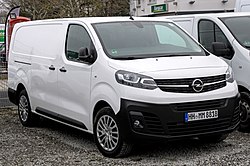 Opel Vivaro
 -
 Vauxhall Vivaro
 -
 Toyota Proace
 -
 Fiat Scudo
 -
 Caselani Citroën Jumpy Type HG
 -
 Fiat Scudo Pickup version


_1X7A0336.jpg)

.jpg)
Passenger versions
[edit]-
 Citroën SpaceTourer
 -
 Citroën SpaceTourer Hyphen Concept
 -
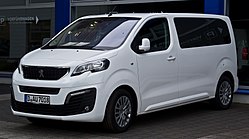 Peugeot Traveller
 -
 Opel Zafira Life
 -
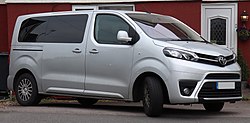 Toyota Proace Verso
 -
 Toyota Proace Verso
 -
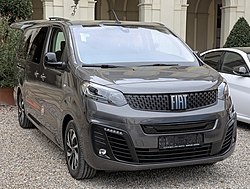 Fiat E-Ulysse


Facelift
[edit]Stellantis introduced facelifts for the vans on October 23, 2023. In all versions, the upper grill has been completely removed for reduced air resistance. Each van has been given a larger 10-inch infotainment display, and new driver-assistance systems including Level 2 autonomous driving capabilities. The Citroën, Peugeot, Opel, Vauxhall and Toyota vans had also been fitted with the brand's respective updated logo.[46]
-
 2024 Citroën Jumpy
 -
 2024 Citroën SpaceTourer
 -
 2024 Fiat Scudo
 -
 2024 Opel Vivaro
 -
 2024 Opel Zafira Life
 -
 2024 Peugeot Expert
 -
 2024 Peugeot Traveller
 -
 2024 Toyota Proace
 -
 2024 Toyota ProAce Verso
_DSC_7801.jpg)

_DSC_8323.jpg)
_IMG_2687.jpg)
_DSC_6023.jpg)
_Diesel_-_White_-_06-2024,_Front.jpg)
.jpg)


Sales and production
[edit] | This section needs to be updated. (September 2019) |
| Year | Worldwide production | Worldwide sales | Notes |
|---|---|---|---|
| 2009 | 20,000[47] | 22,800[47] | |
| 2010 | 27,900[47] | 27,700[47] | |
| 2011 | 29,625[9] | 29,015[9] | Total production reaches 441,700 units.[9] |
| 2012 | 23,600[8] | 24,900[8] | Total production reaches 465,300 units.[8] |
| Year | Worldwide production | Worldwide sales | Notes |
|---|---|---|---|
| 2009 | 19,000[47] | 24,300[47] | |
| 2010 | 28,900[47] | 28,500[47] | |
| 2011 | 33,260[9] | 32,337[9] | Total production reaches 477,699 units.[9] |
| 2012 | 28,200[8] | 29,500[8] | Total production reaches 505,900 units.[8] |


Fiat
| Year | Worldwide production |
|---|---|
| 2022 | 18,674[48] |
References
[edit]- ^ From 1997 to 2018, the Renault Trafic served as the basis for the Opel and Vauxhall Vivaro, before GM sold Opel and Vauxhall to the PSA Group; thereafter, the base for the Vivaro changed to the Citroën Jumpy.
- ^ Joseph, Noah (2 December 2015). "Toyota, PSA extend partnership with new European van". Autoblog. Retrieved 4 April 2016.
- ^ Rosamond, Chris (25 March 2016). "New Fiat Talento panel van replaces long-serving Scudo". Auto Express. Retrieved 4 April 2016.
- ^ Crooks, Alastair (27 October 2021). "New Fiat Scudo and Ulysse to offer electric powertrains". Auto Express. Retrieved 28 November 2021.
- ^ "Citroën Jumpy 1.9 TD 1st Generation 92ps, (1995 - 2003)". car.info. Retrieved 13 May 2022.
- ^ "Citroën Jumpy Van 2.0 HDi Manual, 120hp, 2007 6-speed". car.info. Retrieved 13 May 2022.
- ^ "Citroen > Jumpy Multispace L2 HDi (128 hp) WLTP, MPG, Fuel consumption". motoreu.com. Retrieved 13 May 2022.
- ^ a b c d e f g "PSA Annual Report 2013". Car manufacturers. PSA. Archived from the original on 20 April 2012. Retrieved 17 June 2013.
- ^ a b c d e f g "PSA Annual Report 2012" (PDF). Car manufacturers. PSA. Retrieved 16 April 2013. [dead link]
- ^ "PSA and Fiat begin to end joint venture in 2017". Reuters. 12 May 2011. Retrieved 12 May 2011.
- ^ Lethuillier, Yann (18 March 2025). "Pour faire face aux nouvelles normes européennes, Iveco va diversifier son offre grâce à Stellantis". l'Automobile (in French).
- ^ Porter, Gary (31 March 2025). "Vauxhall closes van-making plant as work transfers to Cheshire site". Cheshire Live. Retrieved 15 April 2025.
- ^ "Peugeot e-Expert Hydrogen: Premier utilitaire à pile à combustible de la marque". 27 May 2021.
- ^ a b Dimensions Citroën Space Tourer M 2016 Carsized.com
- ^ Karkafiris, Michael (31 March 2016). "New Citroen Jumpy & Peugeot Expert Detailed". Carscoops. Retrieved 22 April 2016.
- ^ "Les nouveaux Peugeot Expert et Citroën Jumpy passent à l'offensive". L'argus.
- ^ "Citroën concentre son offre de vehicules particuliers sur Ë-Berlingo et Ë-SpaceTourer pour accelerer l'electrification de sa gamme". www.media.stellantis.com (in French). Retrieved 12 January 2022.
- ^ Gaudy, Géraldine (6 January 2022). "Traveller, Spacetourer et Zafira. Arrêt des moteurs essence et Diesel". www.largus.fr. Archived from the original on 5 January 2022. Retrieved 6 January 2022.
- ^ "Así se producen los Citroën Jumpy y Peugeot Expert en Uruguay". Retrieved 10 May 2021.
- ^ "Nordex produjo la unidad 13.000 de los modelos Citröen Jumpy y Peugeot Expert". Nordex (in Spanish). 28 October 2019. Retrieved 10 May 2021.
- ^ "Kaluga PSA plant has started the production of Peugeot and Citroen LCVs". RusAutoNews.Com. 7 March 2018. Retrieved 10 May 2021.
- ^ "PSA Group has expanded production at its Kaluga plant". RusAutoNews.Com. 20 June 2018. Retrieved 10 May 2021.
- ^ "Opel est de retour en Russie: le Zafira Life et le Grandland X en concession dès aujourd'hui". Média OPEL France (in French). Retrieved 10 May 2021.
- ^ "Vauxhall's Luton plant to build the next Vivaro van". Auto Express.
- ^ Golubkova, Katya; Stolyarov, Gleb (25 January 2022). "Stellantis to start exporting Russia-made minivans to Western Europe". Reuters. Retrieved 13 March 2022.
- ^ Studer, Elisabeth (13 March 2022). "Stellantis:la Russie n'est plus plaque tournante d'exportations de vans". Leblogauto.com (in French). Retrieved 13 March 2022.
- ^ "Vauxhall Vivaro Gains Sporty GS Trim and More Powerful Diesel Engine". 5 October 2022.
- ^ Ashraf, Yousuf (10 January 2022). "2022 Citroen Berlingo and SpaceTourer MPVs go electric-only". Auto Express. Retrieved 22 November 2022.
- ^ a b Gibson, Dean (10 May 2021). "Citroen e-Dispatch review". Auto Express. Retrieved 22 November 2022.
- ^ "All-New PEUGEOT E-Expert: The Expert In Electric". www.peugeot.co.uk. 2019. Retrieved 24 July 2022.
- ^ Wilkinson, Luke (8 November 2019). "New electric 2020 Peugeot e-Expert van unveiled". Auto Express. Retrieved 5 June 2020.
- ^ Allan, Lawrence (4 June 2020). "New Peugeot e-Traveller launched as electric eight-seat MPV". Autocar. Retrieved 5 June 2020.
- ^ "New Opel Vivaro-e: "E" for Emissions-Free Deliveries | Media OPEL International". int-media.opel.com. Retrieved 6 June 2020.
- ^ "Opel Vivaro-e Hydrogen : l'utilitaire passe à la pile à combustible". Autonews Pro (in French). 18 May 2021. Retrieved 27 May 2021.
- ^ a b Mary, Hubert (27 May 2021). "Peugeot dévoile la future version hydrogène et made in France de son utilitaire e-Expert". L'Usine Nouvelle (in French).
- ^ "Toyota Proace Verso Electric (2021) mit PSA-Technik".
- ^ "2022 Fiat E-Ulysse Debuts As An Electric "Living Room" For Europe". Motor1.com. Retrieved 13 March 2022.
- ^ Middleton, Natalie (13 June 2025). "Iveco unveils eJolly and eSuperJolly electric vans". Fleet World. Retrieved 14 June 2025.
- ^ "Opel Vivaro-e Hydrogen : l'utilitaire passe à la pile à combustible". Autonews Pro. 18 May 2021.
- ^ "Peugeot e-Expert Hydrogen (2021) : l'utilitaire à hydrogène". 31 May 2021.
- ^ "Citroën ë-Jumpy Hydrogen (2021) : la famille des utilitaires à hydrogène s'agrandit". Autonews Pro. 4 June 2021.
- ^ Dobie, Stephen (3 April 2017). "You can buy a brand new Citroen H Van". Top Gear. Retrieved 10 January 2024.
- ^ Mills, James (12 October 2020). "Italian coachbuilder expands its range of retro Citroën Type H vans". Hagerty UK. Retrieved 10 January 2024.
- ^ Smith, Christopher (27 August 2023). "Citroen Type Holidays concept debuts as modern camper with retro style". Motor1.com. Retrieved 10 January 2024.
- ^ Hood, Bryan (28 September 2023). "Citroën's Stylish New Camper Van Brings Retro Cool to #Vanlife". Robb Report. Retrieved 10 January 2024.
- ^ "Stellantis upgrades electric van line-up".
- ^ a b c d e f g h "Engine specs from PSA Peugeot Citroën" (PDF). Creator and designer. PSA Peugeot Citroën. Archived from the original (PDF) on 5 June 2017. Retrieved 29 November 2012.
- ^ "Le top 20 des voitures les plus produites en France en 2022". www.largus.fr. Retrieved 21 July 2023.
External links
[edit]
A marque of Stellantis | ||||||||
| Current models |
|  | ||||||
| Historic models | ||||||||
| Concepts, prototypes |
| |||||||
| Motorsport |
| |||||||
| Regional operations | ||||||||


A brand of Stellantis | ||||||||||
| Current vehicles |
|  | ||||||||
| Historic vehicles |
| |||||||||
| Motorsport | ||||||||||
| Concept cars | ||||||||||
| Related topics | ||||||||||
Established 2007 – A marque of Stellantis | ||||||||||||
| Related companies |
|  | ||||||||||
| Current models |
| |||||||||||
| Historic models (List) |
| |||||||||||
| Concept models | ||||||||||||
| Racing cars | ||||||||||||
| Modified Racing cars | ||||||||||||
| Abarth cars | ||||||||||||
| Armored vehicles | ||||||||||||
| People | ||||||||||||
A marque of Stellantis | |||||||||||
| Vehicles |
| ||||||||||
| Concept cars | |||||||||||
| Divisions and subsidiaries | |||||||||||
| People | |||||||||||
| Facilities | |||||||||||
| Other | |||||||||||
A marque of Stellantis | |||||||||
| Vehicles |
| ||||||||
| Divisions and subsidiaries | |||||||||
| People | |||||||||
| Factories | |||||||||
| Other | |||||||||
Citroën Jumpy
View on GrokipediaModel Overview
Design Philosophy and Purpose
The Citroën Jumpy serves as a light commercial vehicle engineered primarily for professional and fleet applications, with an emphasis on practicality and adaptability to meet the demands of trades such as logistics, construction, and service operations. Its design intent centers on providing a reliable workhorse that balances load-carrying capability with operational efficiency, prioritizing real-world utility over aesthetic or regulatory-driven features. This approach stems from collaborative development under the Sevel joint venture, focusing on cost-effective solutions for businesses requiring frequent loading, unloading, and navigation in varied environments.[1] Modularity forms a cornerstone of the Jumpy's engineering, enabling configurations like enclosed cargo vans, chassis cabs for custom bodywork, and multi-seat passenger variants to suit diverse commercial needs, from urban deliveries to site-based transport. These options allow users to tailor the vehicle to specific payloads or personnel requirements without compromising structural integrity, reflecting a philosophy grounded in empirical observations of fleet operators' versatility demands rather than standardized templates.[2][7] Load capacities exemplify this user-centric design, with maximum payloads reaching 1,400 kg and cargo volumes up to 6.6 m³ in extended variants, engineered to handle typical commercial hauls while ensuring maneuverability through compact dimensions and low load floors for easier access. These specifications derive from practical testing and market feedback on weight distribution and volume efficiency, optimizing for economic viability in high-mileage scenarios.[8][1][3] The underlying rationale favors propulsion systems that deliver sustained range and quick refueling to support long-haul economics, underscoring diesel engines' role in minimizing total cost of ownership for operators focused on productivity over short-range electrification. This causal emphasis on fuel energy density and thermal efficiency aligns with the vehicle's purpose as a durable tool for revenue-generating activities, where downtime and operating expenses directly impact viability.[1]Platform Sharing and Rebadged Variants
The Citroën Jumpy originated from platform-sharing initiatives within the PSA Group and partnerships with Fiat, reflecting the automotive industry's emphasis on cost amortization through collaborative development. The first generation, launched in June 1994, was produced at the Sevel Nord facility in northern France as part of a joint venture between PSA and Fiat, sharing its core mechanicals, body structure, and underpinnings with the Peugeot Expert and Fiat Scudo.[9] This arrangement allowed for economies of scale in production and reduced research and development expenditures by distributing costs across multiple badge-engineered variants.[10] The second generation, introduced in 2007, maintained this collaborative framework, evolving the shared platform with the Peugeot Expert and Fiat Scudo to provide expanded cargo volumes and additional body configurations while preserving compatibility in key components.[11] Platform sharing in this era continued to leverage the Sevel Nord production synergies, enabling PSA and Fiat to compete more effectively in the mid-size van segment through shared engineering resources. From the third generation onward in 2016, the Jumpy transitioned to PSA's Efficient Modular Platform 2 (EMP2), a flexible architecture initially developed for passenger vehicles and adapted for commercial use, which it shares with the Peugeot Expert.[1] This platform-sharing extended via a 2012 cooperation agreement with Toyota, resulting in the rebadged Toyota ProAce, and later incorporated Fiat models under the PSA-FCA alliance formalized in 2021 as Stellantis.[12] The EMP2's modularity facilitated weight reductions of up to 150 kg and enhanced payload capacities, while the broader alliances further lowered per-unit development costs and improved market reach.[11] Overall, these strategies have underscored the economic imperatives of joint ventures in enabling competitive pricing without compromising essential functionality.[10]First Generation (1994–2007)
Initial Development and Launch
The first-generation Citroën Jumpy, known as Dispatch in markets like the United Kingdom, debuted in 1994 as a compact light commercial vehicle designed to meet the growing demand for versatile, load-carrying vans among small businesses and tradespeople in the 1990s.[13] This model succeeded the Citroën C25, addressing the need for improved ergonomics, payload capacity, and fuel efficiency in urban and regional delivery operations.[14] Developed through a collaboration between PSA Peugeot Citroën and Fiat to leverage shared platforms and reduce production costs, the Jumpy shared its core architecture with the Peugeot Expert (introduced in 1995) and Fiat Scudo (from 1996), enabling economies of scale across the partners' manufacturing facilities.[15] The front-wheel-drive configuration prioritized practicality over rear-drive traction, facilitating a lower load floor and better maneuverability in tight spaces typical of commercial use.[16] Initial powertrains emphasized diesel engines, including 1.9-liter and 2.0-liter naturally aspirated or turbocharged units tuned for high low-end torque to handle payloads up to approximately 1,000 kg, rather than outright speed.[17] Targeted at cost-conscious operators, the Jumpy offered straightforward maintenance via widespread PSA service networks, though early production examples reported persistent electrical problems, such as faulty wiring looms leading to failures in lighting and central locking systems.[18] These issues, documented in owner diagnostics, highlighted initial quality control challenges in the model's complex wiring harnesses amid the era's push for integrated electronics in vans.Facelift (2002)
The first-generation Citroën Jumpy received a mid-cycle facelift in early 2004, revising the front end with a new grille, bumper, bonnet, and integrated headlamps to modernize its appearance while retaining the core platform shared with the Peugeot Expert and Fiat Scudo.[19] These aesthetic updates addressed feedback on the dated styling from fleet operators using the model since its 1995 launch, without altering the overall body structure or load capacities.[19] Engine options were refined for Euro 3 emissions compliance, emphasizing diesel variants like the 2.0 HDi producing 109 hp, which delivered combined fuel economy of approximately 6.7 L/100 km under standard testing conditions.[20] Minor mechanical tweaks focused on emissions controls rather than performance gains, maintaining the diesel-centric lineup suited for commercial use with urban consumption around 8.4 L/100 km and extra-urban efficiency at 5.6 L/100 km.[20] Interior ergonomics saw enhancements, including expanded storage compartments to better serve professional users, though core dashboard and seating layouts remained similar to pre-facelift models.[21] The refresh extended production viability until 2007, bridging to the second generation, but service records indicate no substantial resolution to ongoing electrical faults, such as wiring loom failures causing central locking and instrument panel malfunctions, which continued to affect reliability in high-mileage fleet applications.[18]Engine Options and Performance
The first-generation Citroën Jumpy (1994–2007) featured a lineup dominated by diesel engines, optimized for torque delivery at low RPMs to handle commercial payloads effectively, with petrol variants available only in select markets and quickly phased out due to inferior fuel economy.[22] Primary options included the 1.9-liter naturally aspirated diesel (XUD9) producing 71 hp (52 kW) and 120 Nm of torque, suited for basic load-carrying but limited by sluggish acceleration (0–100 km/h in 22.3 seconds) and a top speed of 137 km/h.[23] Turbocharged upgrades, such as the 1.9 TD variant, boosted output to 92 hp (68 kW) with torque around 196 Nm, improving usability for heavier duties while maintaining a top speed of 157 km/h.[24] Post-2002 facelift models introduced the 2.0 HDi (DW10) common-rail diesel, delivering 90–94 hp (66–69 kW) initially and up to 109 hp (80 kW) in later tunes, with torque peaking at 250–270 Nm for better low-end pull essential in urban and highway hauling.[25] [26] These engines paired exclusively with a 5-speed manual transmission, emphasizing reliability over rapid shifts, with 0–100 km/h times ranging from 14–20 seconds and top speeds near 165 km/h, prioritizing sustained torque over outright acceleration.[25] Diesel configurations excelled in real-world efficiency, achieving combined consumption of 7.5–8.9 L/100 km from an 80-liter tank, yielding ranges exceeding 600 km per fill—far surpassing rare petrol 2.0-liter options (around 136 hp but 10+ L/100 km), which proved impractical for long-haul commercial use amid limited 1990s fueling infrastructure alternatives.[23] [27] This torque-focused diesel emphasis (180–250 Nm available from 1,500–2,000 RPM) enabled effective payload handling up to 1,000 kg without excessive strain, underscoring causal advantages in durability and economy for fleet operators over less torquey or thirstier alternatives.[22]| Engine | Power | Torque | 0–100 km/h | Top Speed | Combined Fuel Consumption |
|---|---|---|---|---|---|
| 1.9 D | 71 hp (52 kW) | 120 Nm | 22.3 s | 137 km/h | 8.0 L/100 km |
| 1.9 TD | 92 hp (68 kW) | 196 Nm | ~18 s | 157 km/h | 7.8 L/100 km |
| 2.0 HDi | 90–109 hp (66–80 kW) | 250–270 Nm | 14–16 s | 165 km/h | 7.5–8.9 L/100 km |
Second Generation (2007–2016)
Platform and Key Features
The second-generation Citroën Jumpy, introduced in 2007, was built on an evolved version of the PSA-Fiat collaborative light commercial vehicle platform, shared with the Peugeot Expert and Fiat Scudo, which prioritized front-wheel-drive layout and modular body configurations for cargo versatility.[28] This architecture incorporated wheelbase lengths of 3,000 mm for short-wheelbase (L1) variants and 3,122 mm for long-wheelbase (L2) models, enhancing stability and handling when fully loaded compared to shorter predecessors in the segment.[29] The design emphasized commercial durability through reinforced chassis components and suspension tuned for payload retention, with gross vehicle weights up to 2,920 kg allowing maximum payloads of 988 to 1,200 kg depending on configuration.[30] Key features included standard anti-lock braking system (ABS) with electronic brakeforce distribution (EBD) across the range, complemented by front and rear disc brakes on most models for reliable stopping power under laden conditions; electronic stability program (ESP) was available as an option in select markets.[31] [32] Interiors offered modular shelving and tie-down points optimized for tools and equipment, reflecting the van's focus on tradesman utility, while the diesel-centric powertrain lineup—dominating over 90% of European light commercial sales at the time—leveraged common-rail HDi injection for fuel efficiency gains of up to 15% over prior indirect-injection systems, lowering operational costs relative to petrol or competitor diesels.[33] [34]Facelift (2012)
 was offered to improve vehicle control during laden operations, mitigating risks from uneven weight distribution common in vans.[40] Subsequent integration of BlueHDi technology for Euro 6 compliance in later production runs added selective catalytic reduction (SCR) systems requiring AdBlue, which increased complexity and led to reported failures in injectors and sensors after 40,000-80,000 km, as noted in service data from European repair networks.[41] These issues highlighted trade-offs in emissions engineering, where added components for regulatory adherence sometimes compromised long-term durability in high-mileage fleet applications.[41]Engine Lineup and Transmissions
The second-generation Citroën Jumpy primarily utilized PSA Group's HDi diesel engines, with the 1.6 HDi offering outputs from 90 hp (66 kW) to 115 hp (85 kW) and the more common 2.0 HDi ranging from 136 hp (100 kW) to 163 hp (120 kW).[42] These common-rail diesels emphasized low-end torque for load-hauling, delivering 240–350 Nm across variants, which supported payload capacities up to 1,400 kg while achieving real-world fuel economy of 6–8 L/100 km in mixed commercial use.[29][43] A rare petrol option, the 1.6 VTi inline-four producing around 109 hp (80 kW), was available in select markets but saw limited adoption due to higher operating costs in fleet applications compared to diesels.[42]| Engine | Type | Power | Torque | Notes |
|---|---|---|---|---|
| 1.6 HDi | Diesel I4 | 90–115 hp | 240–270 Nm | Entry-level; suited for lighter duties but with noted higher maintenance frequency in high-mileage scenarios exceeding 200,000 km.[41] |
| 2.0 HDi | Diesel I4 | 136–163 hp | 300–350 Nm | Preferred for heavy commercial use; demonstrated superior longevity in fleet tests, often surpassing 300,000 km with routine servicing, though turbocharger lag was critiqued in urban stop-start cycles.[29][43] |
| 1.6 VTi | Petrol I4 | ~109 hp | ~180 Nm | Infrequent; less torque for loaded performance, averaging 9–11 L/100 km.[42] |
Third Generation (2016–present)
Launch and Production Sites
The third-generation Citroën Jumpy was introduced in 2016, utilizing the PSA Group's Efficient Modular Platform 2 (EMP2), which provided a lighter chassis design capable of supporting payloads up to 1,400 kg while offering three body lengths—XS, M, and L—for enhanced versatility in commercial applications.[47][48] This platform's modular architecture facilitated efficient production scaling and adaptation across variants, including passenger and cargo configurations.Primary manufacturing occurs at the Stellantis Vigo plant in Spain, which reached a milestone of 2 million units for the compact van family encompassing the Jumpy by October 2025, and at Sevel Nord in northern France, supporting high-volume output for European and export markets.[49][50] These sites leverage integrated supply chains for component sourcing, though global logistics have faced disruptions from trade tensions and regional demand fluctuations.
For South American markets, assembly by Nordex S.A. in Uruguay enabled exports to Brazil and Argentina, with over 13,000 units produced by October 2019 to meet local import needs amid protectionist policies. In response to Brazilian preferences for higher torque in diesel applications, the 2025 model update introduced a 2.2-liter turbodiesel engine delivering 150 horsepower and 370 Nm of torque, improving efficiency and performance over prior iterations without altering core platform elements.[51] This adaptation underscores market-specific engineering to optimize supply chain responsiveness in emerging regions.
2024 Facelift Updates
The 2024 facelift for the Citroën Jumpy, applicable to models produced from July 2024 onward, emphasized practical enhancements for commercial users, including a redesigned front end with an optimized bumper, LED headlamps, and an updated radiator grille featuring Citroën's revised visual signature. Redesigned rear-view mirrors improved aerodynamics, while a new Titanium Grey paint option was introduced to the color palette. These changes aimed to modernize the van's appearance without compromising its utilitarian form, retaining options like wide-opening rear doors for loading efficiency.[52] Interior updates focused on functionality, with a new dashboard incorporating additional storage for smartphones and tablets, an upgraded steering wheel with integrated controls, a 100% digital 10-inch instrument cluster, and a 10-inch HD central touchscreen enabling connected navigation and connectivity packs. These refinements enhance driver usability in daily operations, prioritizing accessible tech over luxury.[52] Safety systems were bolstered with the Dynamic Surround Vision setup, using rear and passenger-side cameras integrated into a digital rear-view mirror; Highway Driver Assist, which pairs adaptive cruise control with stop/go and lane centering; and expanded parking aids supported by 12 sensors. Standard features like autonomous emergency braking (AEB), forward collision warning, lane support, speed assistance via camera and mapping, seatbelt reminders, and fatigue detection contributed to a 4-star rating in Euro NCAP's 2025 commercial van assessment, reflecting improved protection across scenarios; the model also secured a Gold rating in the 2024 van protocol, driven by legislated aids.[53][52] The refresh maintained a diesel-centric powertrain with BlueHDi engines for fleet reliability, augmented by minor aerodynamic tweaks from the mirror redesign to support efficiency in real-world hauling. While electric variants gained up to 350 km WLTP range via battery and regen updates, the added electronic safety and infotainment layers introduce potential maintenance complexities in high-mileage commercial contexts, though long-term durability data remains pending.[52]Special Trims and Derivatives
![Citroën Jumpy Caselani Type HG][float-right] The Citroën Jumpy features special trims that emphasize comfort and heritage-inspired aesthetics alongside practical enhancements for professional users. The GS trim, available in select markets such as the United Kingdom under the Dispatch badge, prioritizes enhanced interior comfort with upgraded seating, improved ergonomics, and additional convenience features tailored for daily commercial operations. This configuration appeals to operators seeking a balance between functionality and driver well-being without altering core cargo capabilities. A prominent special edition is the Type-H Pack, launched on April 7, 2025, which integrates retro styling cues from the historic Citroën Type H van into the modern Jumpy platform, available in both diesel and electric variants.[54] This pack includes aesthetic modifications like corrugated side panels and a distinctive front grille homage, paired with the Driver Assistance Pack comprising a rearview camera, front and rear parking sensors, and blind spot monitoring to support craftsmen in urban environments.[55] While these elements evoke brand nostalgia, they introduce premium pricing that elevates costs beyond standard models, potentially limiting uptake to style-conscious buyers despite the added safety provisions. Derivatives extend the Jumpy's adaptability through third-party customizations, notably Italian coachbuilder Caselani's Type HG body kits, which transform the van's exterior to mimic the 1950s Type H design using bolt-on panels compatible with the Jumpy's structure.[56] These kits preserve underlying mechanical integrity while targeting niche markets for food trucks, promotional vehicles, and heritage enthusiasts, as seen in applications like the JouéClub variant. Such modifications highlight the platform's versatility for non-standard uses but require verification of structural compliance with local regulations, as they prioritize visual appeal over inherent payload or aerodynamic efficiencies. Camper-oriented derivatives, such as conceptual adaptations inspired by the Type Holidays lineup, leverage the Jumpy's modular interior for leisure conversions, including foldable beds, compact kitchens, and storage solutions to facilitate van life without permanent alterations.[57] These setups underscore the vehicle's potential beyond cargo hauling, appealing to dual-purpose owners in Europe, though official camper variants remain more closely tied to passenger-derived models like the SpaceTourer, with Jumpy-based options often handled by aftermarket specialists.[58] Overall, these trims and derivatives sustain Citroën's market position in light commercial vehicles by blending tradition with customization, contributing to sales growth in segments valuing distinctive identity over pure utility.[59]Engine Specifications
The third-generation Citroën Jumpy (2016–present) features a lineup of BlueHDi diesel engines designed for commercial applications, emphasizing high torque output and fuel efficiency suitable for extended duty cycles with heavy payloads. The primary options include the 1.5-liter BlueHDi producing 120 horsepower (88 kW) at 3,500 rpm with 270 Nm of torque available from low rpm, paired typically with a six-speed manual transmission.[60] Larger variants utilize the 2.0-liter BlueHDi engine in outputs ranging from 145 to 180 horsepower (106–132 kW), delivering peak torque of up to 400 Nm, which facilitates superior low-end pulling power for towing up to 2.5 tonnes or laden operations without the range limitations imposed by battery depletion in alternative powertrains.[61] [22] An eight-speed automatic transmission (EAT8) is available on higher-output 2.0 BlueHDi models, enhancing drivability in urban and highway scenarios while maintaining efficiency.[52] Fuel consumption metrics reflect diesel's empirical strengths in real-world endurance, with combined figures around 6–7 L/100 km under WLTP testing for the 2.0-liter variants, enabling ranges exceeding 1,000 km per tank—critical for minimizing refueling downtime in logistics compared to systems reliant on protracted recharging.[62] For emerging markets like Brazil, a 2.2-liter turbodiesel variant was introduced in the 2025 model year, rated at 150 horsepower with 370 Nm of torque, tailored to local fuel standards and payload demands while upholding similar economy levels.[63] These specifications underscore diesel's causal advantages in torque density and operational continuity for van operators, where uninterrupted cycles outweigh regulatory emissions priorities in practice.| Engine | Displacement | Power (hp) | Torque (Nm) | Transmission Options | Fuel Economy (L/100 km, combined WLTP) |
|---|---|---|---|---|---|
| 1.5 BlueHDi | 1.5 L | 120 | 270 | 6-speed manual | ~6.0–6.5 |
| 2.0 BlueHDi | 2.0 L | 145–180 | 340–400 | 6-speed manual or 8-speed auto | ~6.0–7.0 |
| 2.2 Turbodiesel (Brazil) | 2.2 L | 150 | 370 | Manual | ~6.5–7.5 |