Hubbry Logo
logo
Continental margin
Community hub

Continental margin

logo
0 subscribers
Read side by side
from Wikipedia
Profile illustrating the shelf, slope and rise

A continental margin is the outer edge of continental crust abutting oceanic crust under coastal waters. The continental margin consists of three different features: the continental rise, the continental slope, and the continental shelf.[1] It is one of the three major zones of the ocean floor, the other two being deep-ocean basins and mid-ocean ridges. Continental margins constitute about 28% of the oceanic area.[2]

Subzones

[edit]
The continental slope of Australia, which is proximate to the coasts of Newcastle and Sydney (bottom left)

The continental shelf is the relatively shallow water area found in proximity to continents; it is the portion of the continental margin that transitions from the shore out towards the ocean. Continental shelves are believed to make up 7% of the sea floor.[3] The width of continental shelves worldwide varies in the range of 0.03–1500 km.[4] The continental shelf is generally flat, and ends at the shelf break, where there is a drastic increase in slope angle: The mean angle of continental shelves worldwide is 0° 07′, and typically steeper closer to the coastline than it is near the shelf break.[5]

At the shelf break begins the continental slope, which can be 1–5 km above the deep-ocean floor. The continental slope often exhibits features called submarine canyons.[4] Submarine canyons often cut into the continental shelves deeply, with near-vertical sides, and continue to cut the morphology to the abyssal plain.[5]

These canyons are often V-shaped and can sometimes enlarge onto the continental shelf. At the base of the continental slope, there is a sudden decrease in slope angle, and the sea floor begins to level out towards the abyssal plain. This portion of the seafloor is called the continental rise, and marks the outermost zone of the continental margin.[1]

Types

[edit]

There are two types of continental margins: active and passive margins.[1]

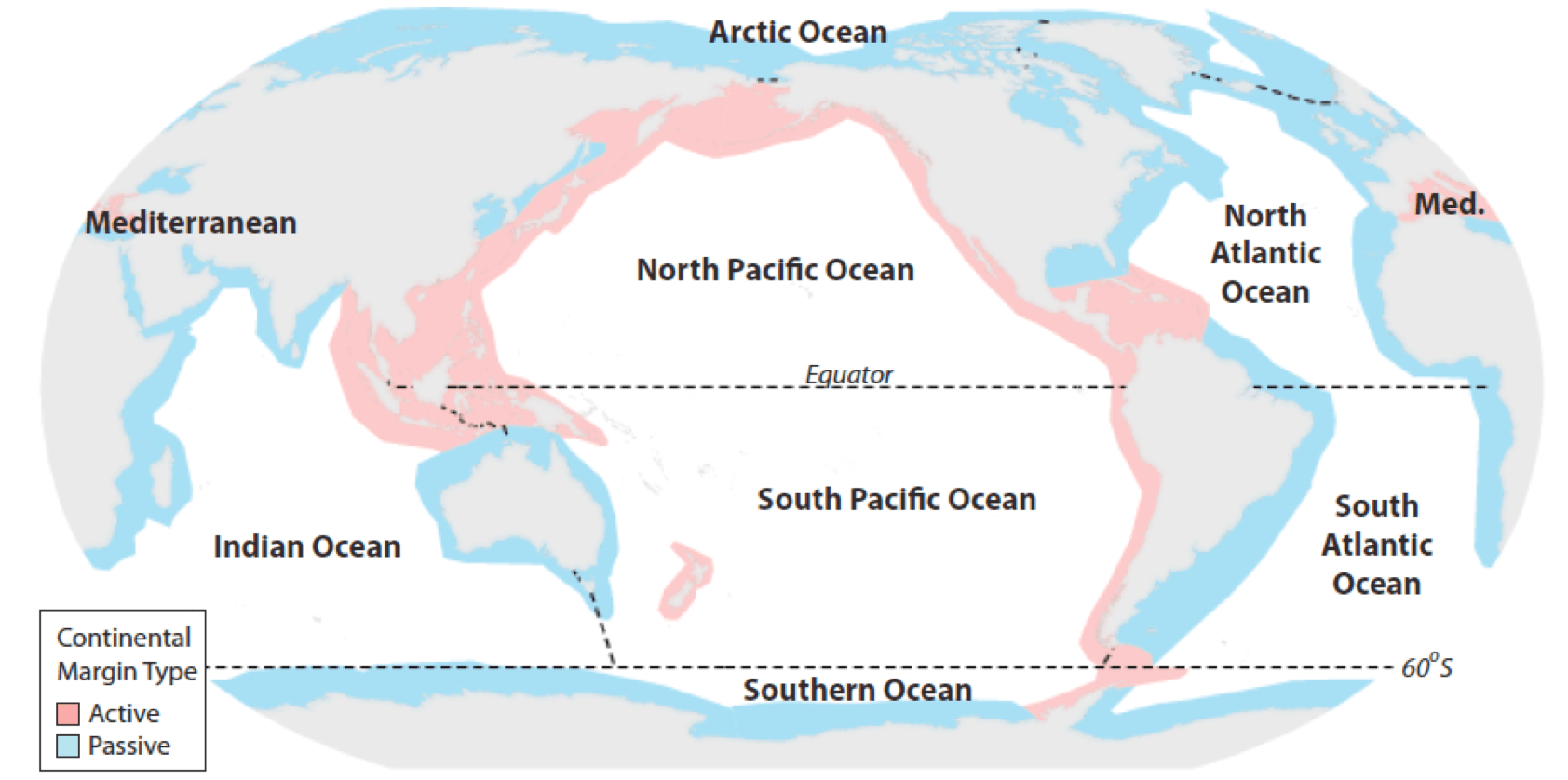
Active margins are typically associated with lithospheric plate boundaries. These active margins can be convergent or transform margins, and are also places of high tectonic activity, including volcanoes and earthquakes. The West Coast of North America and South America are active margins.[4] Active continental margins are typically narrow from coast to shelf break, with steep descents into trenches.[4] Convergent active margins occur where oceanic plates meet continental plates. The denser oceanic crust of one plate subducts below the less dense continental crust of another plate. Convergent active margins are the most common type of active margin. Transform active margins are rarer and occur when an oceanic plate and a continental plate are moving parallel to each other in opposite directions. These transform margins are often characterized by many offshore faults, which causes a high degree of relief offshore, marked by islands, shallow banks, and deep basins. This is known as the continental borderland.[1]

Passive margins are often located in the interior of lithospheric plates, away from the plate boundaries, and lack major tectonic activity. They often face mid-ocean ridges.[3] From this comes a wide variety of features, such as low-relief land extending miles away from the beach, long river systems, and piles of sediment accumulating on the continental shelf.[6] The East Coast of the United States is an example of a passive margin. These margins are much wider and less steep than active margins.

Sediment accumulation

[edit]

As continental crust weathers and erodes, it degrades into mainly sands and clays. Many of these particles end up in streams and rivers that then dump into the ocean. Of all the sediment in the stream load, 80% is then trapped and dispersed on continental margins.[3] While modern river sediment is often still preserved closer to shore, continental shelves show high levels of glacial and relict sediments, deposited when sea level was lower.[3] Often found on passive margins are several kilometres of sediment, consisting of terrigenous and carbonate (biogenous) deposits. These sediment reservoirs are often useful in the study of paleoceanography and the original formation of ocean basins.[3] These deposits are often not well preserved on active margin shelves due to tectonic activity.[4]

Economic significance

[edit]

The continental shelf is the most economically valuable part of the ocean. It often is the most productive portion of the continental margin, as well as the most studied portion, due to its relatively shallow, accessible depths.[4]

Due to the rise of offshore drilling, mining, and the limitations of fisheries off the continental shelf, the United Nations Convention on the Law of the Sea (UNCLOS) was established. The edge of the continental margin is one criterion for the boundary of the internationally recognized claims to underwater resources by countries in the definition of the "continental shelf" by the UNCLOS (although in the UN definition the "legal continental shelf" may extend beyond the geomorphological continental shelf and vice versa).[2] Such resources include fishing grounds, oil and gas accumulations, sand, gravel, and some heavy minerals in the shallower areas of the margin. Metallic mineral resources are thought to also be associated with certain active margins, and of great value.[3]

See also

[edit]

References

[edit]
[edit]
Revisions and contributorsEdit on WikipediaRead on Wikipedia
from Grokipedia
The continental margin is the submerged outer edge of a continent, marking the transition from continental to oceanic crust beneath coastal waters, and typically consists of the gently sloping continental shelf, the steeper continental slope, and the more gradual continental rise.[1][2][3] Continental margins are classified as active or passive based on their association with tectonic plate boundaries; active margins, often at convergent zones, exhibit frequent earthquakes, volcanism, and mountain-building due to ongoing subduction or collision, whereas passive margins, formed at divergent boundaries, feature subsidence and sediment accumulation without significant seismicity.[4][5] These margins host the majority of global marine sedimentation, support rich fisheries and biodiversity hotspots, and contain vast hydrocarbon reserves, making them economically vital while also serving as key sites for understanding Earth's crustal dynamics and evolutionary history.[2][6]

Definition and Overview

Core Definition

The continental margin is the transition zone of the seafloor extending from the coastline seaward to the deep ocean basins, demarcating the boundary between continental crust and oceanic crust. This zone underlies relatively shallow coastal waters and is characterized by continental-type sediments and lighter crustal materials that float higher isostatically compared to the denser oceanic crust beyond.[1][2] Structurally, the continental margin typically encompasses three main physiographic provinces: the continental shelf, continental slope, and continental rise (the latter absent in some margins). The shelf forms a gently sloping extension of the continental landmass, with an average global width of approximately 65 kilometers and water depths rarely exceeding 200 meters at the shelf break.[7] The slope then descends more abruptly from this break, averaging about 41 kilometers in width with gradients of 1 to 10 degrees, marking a sharper lithologic and topographic shift toward oceanic depths.[8] Where present, the rise accumulates as a wedge of submarine fan deposits at the slope's base, gradually merging into the abyssal plain at depths exceeding 3,000 meters. These features result from sedimentary processes, tectonic subsidence, and erosion, with margins classified as active (tectonically dynamic, e.g., subduction zones) or passive (relatively stable, e.g., trailing edges of continents) based on proximity to plate boundaries.[1][6]

Key Physical Features

The continental margin encompasses the continental shelf, slope, and rise, which form the submerged extension of continental crust transitioning to oceanic crust. The continental shelf is a shallow, gently sloping platform adjacent to the coastline, typically extending to depths of about 150 meters at the shelf break. Globally, shelves average 75-80 kilometers in width, though they vary significantly, from narrow bands less than 10 kilometers to expansive ones exceeding 1,000 kilometers, such as the Siberian Shelf.[9]/06:_Ocean_Basins/6.02:_Continental_Margins) The shelf surface is relatively flat, shaped by wave erosion and sediment deposition, with sediment thicknesses reaching 10-15 kilometers in places due to accumulation from terrestrial runoff and coastal processes.[9] The continental slope descends steeply from the shelf break, averaging a gradient of about 4 degrees and widths of around 20 kilometers, though it can steepen to 20 degrees near tectonically active regions.[9]/06:_Ocean_Basins/6.02:_Continental_Margins) Depths increase rapidly from 120-135 meters at the shelf edge to 3,000-5,000 meters at the base, over a total global length exceeding 300,000 kilometers.[10] This zone often features submarine canyons, incised by turbidity currents and sediment gravity flows, which channel materials downslope and can extend hundreds of kilometers seaward, as seen in the Monterey Canyon off California./06:_Ocean_Basins/6.02:_Continental_Margins) The continental rise, where present, forms a gentle apron of sediments at the slope's base, with gradients less than 1 degree and widths spanning several hundred kilometers.[9] It accumulates thick wedges of fine-grained sediments transported via turbidity currents, transitioning to the flat abyssal plains at depths of 4,500-6,000 meters./06:_Ocean_Basins/6.02:_Continental_Margins) On active margins, the rise may be absent, replaced by deep oceanic trenches due to subduction.[11] These features collectively host about 6% of the ocean's surface area on shelves alone, influencing sediment distribution, biodiversity, and resource potential through their bathymetric and sedimentary characteristics./06:_Ocean_Basins/6.02:_Continental_Margins)

Geological Formation and Tectonics

Origin Through Plate Tectonics

The theory of plate tectonics accounts for the origin of continental margins as transitional zones between continental and oceanic lithosphere, arising from the relative motions of tectonic plates driven by mantle convection. These margins form primarily at divergent and convergent plate boundaries, where processes of crustal extension or compression reshape the lithosphere over millions of years.[12] Passive continental margins originate at divergent plate boundaries through continental rifting, where tensile forces stretch and thin the continental lithosphere, producing normal faults and subsiding rift basins filled with sediments. Continued extension elevates the asthenosphere, inducing decompression melting that generates mafic magmas, which intrude the rift and eventually establish seafloor spreading to form adjacent oceanic crust. The rifted continental edges then cool, subside isostatically, and accumulate thick sedimentary wedges, delineating the shelf-slope-rise profile characteristic of passive margins. This process exemplifies the breakup of the supercontinent Pangaea, which initiated around 200 million years ago and produced the passive margins flanking the Atlantic Ocean, with spreading rates averaging about 2.5 centimeters per year along the Mid-Atlantic Ridge.[5][12] Active continental margins, in contrast, develop at convergent plate boundaries involving oceanic-continental subduction, where the denser oceanic plate descends into the mantle beneath the buoyant continental plate, driven by slab pull and ridge-push forces. Subduction erodes or deforms the forearc region, excavates deep trenches (such as the Peru-Chile Trench, reaching over 8 kilometers depth), and triggers partial melting in the mantle wedge to form magmatic arcs parallel to the margin. The overriding plate undergoes shortening via thrust faulting, resulting in orogenic belts with high seismicity and volcanism; for instance, the Nazca Plate's subduction beneath the South American Plate since at least the Cretaceous has uplifted the Andes Mountains to elevations exceeding 6 kilometers.[12][13] Unlike passive margins, active margins lack extensive rises due to trench sediment trapping and exhibit narrower shelves from ongoing tectonic disruption.[14]

Tectonic Evolution

The tectonic evolution of continental margins occurs primarily through the Wilson cycle, a sequence of geological processes involving the rifting, opening, maturation, contraction, and closure of ocean basins, driven by mantle convection and plate motions.[15] This cycle, spanning hundreds of millions of years, shapes margins from initial extension to potential convergence, with tectonic inheritance from prior orogenic events influencing crustal strength and subsequent deformation patterns.[16] Passive margins form during the early stages, while active margins characterize later convergence phases, though transitions between types can occur under specific stress conditions. Passive margins originate via intracontinental rifting, where extensional forces thin the lithosphere, induce faulting, and promote asthenospheric upwelling, often accompanied by syn-rift sedimentation and volcanism.[17] Post-rift thermal subsidence follows seafloor spreading initiation, leading to broad shelves and slopes with minimal seismicity, as seen in the North American Atlantic margin, where rifting exploited Paleozoic Appalachian weaknesses starting in the Late Triassic around 201 million years ago, with spreading in the Early Jurassic.[18] Similarly, the Gulf of Mexico margin reflects multiple Wilson cycles, with initial Paleozoic extension followed by Mesozoic breakup, resulting in exhumed mantle and thick sediment wedges.[17] Over time, these margins accumulate sediments from fluvial and erosional sources, subsiding under their load while remaining tectonically quiescent unless external forces intervene. Active margins evolve at convergent plate boundaries, where oceanic lithosphere subducts beneath continental crust, fostering arc magmatism, forearc basins, and either accretionary growth or tectonic erosion.[19] Subduction zones along these margins, such as the circum-North Pacific during the Phanerozoic, have incorporated island arcs and continental fragments, building orogenic belts through episodic deformation spanning from passive to active phases.[19] Tectonic processes include underplating of sediments, slab rollback inducing extension, and advance causing compression, with margins like California's exhibiting submarine canyon development tied to uplift and faulting over millions of years.[20] Transitions from passive to active states occur rarely, often requiring subduction initiation (SI) at weakened margins, driven by mechanisms such as lateral propagation from adjacent slabs or externally forced convergence overcoming lithospheric resistance.[21] Numerical models indicate SI feasibility at young passive margins with thin oceanic lithosphere, needing horizontal forces of 3-5 × 10^12 N/m to overcome bending resistance.[22] Ancient examples include relict SI in the northwest Indian Ocean's Laxmi Basin during the Late Cretaceous-Early Cenozoic, marked by ophiolite obduction and inverted basins.[23] Such events highlight how inherited heterogeneities, like pre-existing faults, can localize deformation, perpetuating cycles of margin reactivation across supercontinent assemblies.[24]

Morphological Subdivisions

Continental Shelf

The continental shelf constitutes the shallow, submerged extension of continental crust, typically extending from the coastline to the shelf break where water depths reach approximately 200 meters.[7] This zone is characterized by a gentle seaward incline, averaging 0.1 degrees, with water depths generally ranging from near zero at the shore to 150-200 meters at the edge.[25] Sediments accumulating on the shelf primarily derive from terrestrial sources transported by rivers, forming broad plains of sand, silt, and gravel that do not exhibit a consistent fining trend offshore.[26] [7] Average shelf widths vary globally, measuring about 65 kilometers, though they can span from a few kilometers on tectonically active margins to over 1,500 kilometers on passive margins like the Siberian Shelf.[7] [27] The shelf break marks the transition to the steeper continental slope, often featuring submarine canyons incised by turbidity currents that channel sediments basinward.[11] Geological features include relict sediments from lower sea levels, exposed during glacial maxima when shelves formed coastal plains, and modern deposits influenced by wave action and tidal currents.[28] Biologically, the shelf supports high productivity due to sunlight penetration fostering phytoplankton growth, which sustains diverse benthic and pelagic communities, though productivity gradients correlate with nutrient inputs rather than depth alone.[29] Morphologically, shelves on stable cratons exhibit uniform, low-relief surfaces, contrasting with irregular terrains on tectonically disrupted margins where faulting and volcanism disrupt sedimentation patterns.[30] These variations reflect underlying crustal composition, with continental shelves underlain by granitic and metamorphic rocks thinning toward the edge.[31]

Continental Slope and Rise

The continental slope marks the seaward extension from the shelf break, typically at depths of around 200 meters, to the base where it transitions to the continental rise or abyssal plain at approximately 3,000 meters, forming a relatively steep incline between continental and oceanic crust.[32][33] Its average gradient ranges from 2° to 5°, with open slopes often around 4°, though it varies regionally—steeper than 5° on active Pacific margins and about 3° on passive Atlantic margins—due to tectonic influences like rifting or subduction.[32][33] Submarine canyons incise the slope surface, channeling sediments via turbidity currents and facilitating erosion through gravity flows and landslides, which contribute to sediment bypass or localized deposition up to 10 kilometers thick in tectonically active areas.[32][33] The continental rise develops as a low-relief sedimentary apron at the slope's foot, accumulating continental-derived debris through mass wasting, turbidity currents, and hemipelagic settling, merging gradually into abyssal plains.[34] Its gentle gradients, typically from 1:50 to 1:500 (equivalent to about 1.1° to 0.1°), result from depositional processes on passive margins, where submarine fans and channels—often kilometers wide and tens to hundreds of meters deep—distribute sands via turbidity flows to distal lobes, with finer overbank silts and muds forming levees.[34] Examples include the Bengal Fan, extending 3,000 kilometers, and wedges off the U.S. East Coast reaching 0.1 to 2.4 kilometers thick during the Cenozoic, driven by sea-level fluctuations, slope erosion, and turbidite deposition rather than direct tectonic uplift.[34][35] These features exhibit subdued topography with irregularities from debris flows and sediment drifts shaped by bottom currents, contrasting the slope's erosional dominance.[34][35]

Classification by Tectonic Activity

Passive Continental Margins

Passive continental margins occur where the transition from continental to oceanic crust takes place distant from active plate boundaries, lacking ongoing subduction, rifting, or transform faulting.[1] These margins feature minimal tectonic activity, with infrequent earthquakes and negligible volcanism, distinguishing them from active margins characterized by frequent seismic events and volcanic arcs.[5] The underlying lithosphere thins gradually without sharp boundaries, supporting broad sedimentary basins.[36] Geologically, passive margins exhibit wide continental shelves, often exceeding 200 kilometers in width, overlying progressively thinning continental crust that grades into oceanic crust.[37] Subsidence primarily results from post-rift thermal cooling of the lithosphere following initial extension, leading to isostatic adjustment and accommodation of thick sediment layers, which can reach up to 12 kilometers in thickness.[38] Sediment accumulation derives from erosion of adjacent continental interiors, transported via rivers and coastal processes, forming progradational sequences over millions of years.[39] This subsidence pattern contrasts with the rapid, fault-driven tectonics of active margins, enabling stable, long-term depositional environments.[40] Formation of passive margins typically follows continental rifting and breakup, as seen in the opening of the Atlantic Ocean around 180 million years ago during the Jurassic period, where Pangea fragmented into Laurasia and Gondwana.[4] Initial extension thins the crust and mantle, followed by seafloor spreading that creates oceanic lithosphere adjacent to the relict rift zone, now buried under sediments.[2] Examples include the eastern North American margin, from Newfoundland to the Gulf of Mexico, with features like the wide shelves off Florida and the sediment-laden Mississippi Delta.[37] Similarly, the conjugate margins of West Africa and Brazil display matching geological histories, evidenced by correlated stratigraphic records and magnetic anomaly patterns.[4] These margins host significant hydrocarbon reservoirs due to their sedimentary thickness and thermal maturity.[39]

Active Continental Margins

Active continental margins occur at convergent plate boundaries where an oceanic plate subducts beneath a continental plate, resulting in intense tectonic deformation.[4] These margins feature narrow continental shelves, steep slopes often exceeding 5 degrees, and the absence of a well-developed continental rise due to sediment subduction or scraping into accretionary wedges.[41] Unlike passive margins, active margins exhibit ongoing lithospheric interactions that drive crustal shortening and thickening.[2] Subduction at these margins generates deep oceanic trenches, such as the Peru-Chile Trench reaching depths of over 8,000 meters, and volcanic arcs formed by partial melting of the subducting slab.[13] The process releases fluids that lower the mantle wedge's melting point, leading to magma ascent and andesitic volcanism, as observed in the Cascade Range where the Juan de Fuca Plate subducts beneath North America at rates of 4-5 cm per year.[42] Seismic activity is pronounced, with megathrust earthquakes occurring along the interface; for instance, the 1960 Valdivia earthquake in Chile, magnitude 9.5, originated at such a boundary.[43] Prominent examples encircle the Pacific Ocean in the Ring of Fire, including the western margins of South America where the Nazca Plate subducts under the South American Plate at 6-10 cm/year, fueling the Andes' uplift to elevations over 6,000 meters.[44] This zone accounts for about 90% of global earthquakes and 75% of active volcanoes, underscoring the causal link between plate convergence and geohazards.[45] Sediment supply is disrupted by erosion and subduction, limiting thick depositional sequences compared to passive margins.[4]

Sedimentation and Geological Processes

Sediment Sources and Mechanisms

Terrigenous sediments, derived from the mechanical and chemical weathering of continental rocks, constitute the primary source of clastic material to continental margins, with global riverine flux estimated at approximately 14-20 billion metric tons per year, predominantly fine-grained silts and clays suitable for offshore transport.[46] These inputs are concentrated at river mouths, where deltas form progradational sequences onto the inner shelf, as observed in systems like the Eel River margin where episodic flood discharges deliver hyperpycnal plumes that bypass the shelf to the slope.[47] Coastal erosion, including wave undercutting of cliffs and glacial inputs in polar regions, supplements fluvial delivery, filtering terrigenous particles through nearshore sorting before offshore dispersal.[48] On the continental shelf, sediment redistribution occurs via wave- and tide-driven currents, which rework fluvial deposits into sand sheets and elongate the shelf through lateral accretion, particularly during sea-level highstands when subsidence accommodates thickening wedges.[5] Storms and internal waves resuspend shelf muds, facilitating along-shelf transport and periodic bypass to the slope via density-driven flows. Downslope mechanisms dominate steep gradients, where slumping of unstable shelf-edge accumulations triggers debris flows and turbidity currents—underwater density flows laden with suspended sediment—that incise submarine canyons and deposit graded turbidites across the slope and rise, accounting for much of the hemipelagic drape in deep-margin basins.[49] Contour currents along the slope further sculpt these deposits through winnowing and lateral redistribution, enhancing stratigraphic complexity in tectonically passive settings.[50] Biogenic and chemical sources contribute secondarily, with shelf carbonate platforms exporting skeletal debris via platform-edge reefs and evaporative precipitates, while authigenic glauconite and phosphates form in situ under low-oxygen conditions at the shelf break.[51] These marine inputs integrate with terrigenous fluxes during transgressions, fostering hybrid stratigraphies that record eustatic and climatic forcings.[52]

Patterns of Accumulation and Stratigraphy

Sediment accumulation on continental margins primarily occurs through episodic deposition during high-energy events such as storms and floods, leading to the formation of stratigraphic sequences that record variations in sediment supply, sea-level position, and tectonic subsidence.[53] These sequences are bounded by unconformities and exhibit stacking patterns of parasequences—conformable successions of genetically related beds bounded by marine-flooding surfaces—that reflect relative changes in accommodation space.[54] Progradational patterns dominate where sediment supply exceeds accommodation, resulting in seaward-shifting facies and shoreline advance, as seen in passive margin wedges where rivers deliver terrigenous clastics to build thick prisms exceeding 10 km in places like the Gulf of Mexico.[55][56] Aggradational stacking arises when sediment input balances subsidence and eustatic rise, producing vertical facies thickening without significant lateral migration, often during stable sea-level highstands that maintain coastal positions.[57] Retrogradational patterns form under rapid transgression, with landward facies shift and deepening-upward successions, typically on margins experiencing low sediment flux relative to rising sea levels, such as during post-glacial meltwater pulses around 14,000–11,700 years ago.[58] On passive margins, long-term progradation overlays these shorter cycles, creating sigmoid or oblique clinoform geometries in seismic profiles, with Pliocene regressions accumulating up to 1 km of sediment in subsiding depocenters.[59] In contrast, active margins show thinner, disrupted accumulations due to tectonic uplift, subduction erosion, and infrequent progradation, with stratigraphic records dominated by trench-fill turbidites rather than shelfal parasequences.[60] Stratigraphic architecture integrates these patterns into depositional sequences controlled by eustasy, where lowstands promote shelf-edge deltas and bypass to slope fans, while highstands favor retrogradational shelf muds.[61] On the U.S. Atlantic passive margin, Neogene sequences reveal anomalous shelf accumulation linked to seaward loading-induced subsidence, with sediment volumes exceeding 10^6 km³ partitioned into prograding clinoforms.[62] Mud-dominated systems, like the Waiapu shelf off New Zealand, exhibit fine-scale cm-thick laminae from multiple reworking processes, yielding net accumulation rates of 1–5 mm/year despite frequent erosion.[63] These patterns deviate from simple fill-and-spill models in tectonically quiescent margins, where unreciprocated mud dispersal creates off-shelf bypass without reciprocal shelf-slope coupling.[64] Overall, margin stratigraphy preserves a hierarchy from parasequences (10^4–10^5 years) to composite sequences (10^7 years), enabling reconstruction of paleoenvironmental dynamics through seismic and core data.[65]

Resource Extraction and Economic Value

Hydrocarbon Reserves and Production

Continental margins host the majority of the world's offshore hydrocarbon reserves, with oil and natural gas accumulations primarily occurring in sedimentary basins on the continental shelf and slope, where organic-rich source rocks generate hydrocarbons trapped in structural and stratigraphic features. Passive margins, such as those in the Gulf of Mexico and offshore northwest Europe, exhibit thicker sediment sequences and more stable tectonic conditions conducive to preservation of reservoirs compared to active margins, which often experience deformation that disrupts traps.[66][2] Global undiscovered, technically recoverable oil resources in continental margin settings are substantial, as assessed by the U.S. Geological Survey (USGS) in regional evaluations; for instance, the USGS estimated mean undiscovered resources of 34.3 billion barrels of oil and 320 trillion cubic feet of natural gas in the U.S. Gulf of Mexico Outer Continental Shelf as of 2025. Similarly, in the Arctic continental shelves of North America, the USGS projected 1.8 billion barrels of oil and 119.9 trillion cubic feet of gas in undiscovered fields.[67] These estimates derive from geology-based probabilistic models incorporating sediment thickness, source rock quality, and migration pathways, though actual recovery depends on technological and economic factors.[68] Offshore production from continental margins accounted for nearly 30 percent of global crude oil output as of 2015, with key contributors including Saudi Arabia, Brazil, Mexico, Norway, and the United States, which together supplied 43 percent of that offshore total.[69] By 2023, hydrocarbons from offshore fields in over 50 countries contributed about one-quarter of world production, with crude oil slightly higher, reflecting advancements in deepwater drilling on slopes and rises.[70] In the United States, the Outer Continental Shelf provided 15 percent of domestic oil production in 2020, primarily from the Gulf of Mexico shelf and slope.[71] Production trends indicate a shift toward deeper waters on continental slopes, enabled by subsea completions and floating production systems, as seen in Brazil's pre-salt fields off the Santos Basin margin, which added significant volumes since the 2010s.[72] However, reserve growth and new discoveries remain critical, with USGS assessments highlighting potential in underexplored margins like East and Southeast Asia, where mean estimates include 3.3 billion barrels of oil offshore East Asia. Economic viability hinges on oil prices above $40-50 per barrel for deepwater projects, influencing development pace amid fluctuating global demand.[73]

Minerals, Fisheries, and Other Resources

Continental shelves serve as primary sources for marine sand and gravel aggregates, extracted for coastal nourishment, construction, and beach replenishment. In the United States Outer Continental Shelf, agreements allow noncompetitive leasing of these resources, with deposits identified off states like New Hampshire, Texas, and Virginia for potential extraction volumes supporting erosion control projects.[74][75] Globally, extraction occurs in regions such as the North Sea and Belgian continental shelf, where designated areas yield materials monitored for environmental impact, with annual dredging activities confined to specific zones to minimize habitat disruption.[76][77] Heavy mineral sands, containing economically viable concentrations of ilmenite, rutile, zircon, and monazite (a rare earth element source), accumulate on continental shelves through wave and current sorting along passive margins. Deposits average 0.54–0.85 weight percent heavy minerals in vibracore samples from U.S. East Coast shelves, such as Virginia's Sandbridge Shoal, with potential for critical mineral recovery including titanium and rare earths.[78][79] Similar assemblages occur on the Portuguese continental margin and Australian coasts, where Pleistocene erosion enhances placer concentrations suitable for mining.[80][81] Phosphorite nodules and pavements form on continental shelves under conditions of high organic productivity and low oxygen, serving as phosphate resources for fertilizers. Major deposits lie off the U.S. coasts of Florida, California, Georgia, and South Carolina, with concentrations up to 13.5% P₂O₅ in Gulf of Mexico shelf sediments, though less rich than terrestrial analogs.[31][82] Continental margins, particularly shelves, underpin global fisheries through elevated primary productivity driven by nutrient upwelling and shallow bathymetry, supporting over 90% of marine fish production and sustaining approximately three billion people dependent on seafood.[83][84] Bottom trawling on these shelves accounts for about 19 million metric tons of annual landings, representing nearly one-quarter of global wild marine capture fisheries.[85] Other extractable resources include sulfur from salt dome cap rocks on the Gulf of Mexico shelf off Louisiana, where shallow drilling has identified recoverable deposits in 18 of 230 domes, and submerged coal and iron ore beds, such as Nova Scotia's Sydney field (estimated 2 billion tons) and Newfoundland's Wabana deposit (3.5 billion tons), accessed via onshore-extended mining.[31] These non-hydrocarbon minerals highlight the margins' role beyond energy, though extraction remains limited by technological and regulatory constraints compared to terrestrial sources.[31]

Environmental Dynamics and Human Impacts

Natural Ecosystems and Biodiversity

Continental margins host diverse ecosystems transitioning from shallow, light-dependent communities on the shelf to chemosynthesis-based assemblages in deeper slope and rise regions. The shelf, typically extending to depths of 200 meters, supports high primary productivity through phytoplankton blooms fueled by nutrient upwelling and terrestrial runoff, sustaining fisheries that contribute over 90% of global marine fish catch.[11] Benthic habitats here include seagrass meadows, kelp forests, and coral reefs, which harbor thousands of species; for instance, shelf sediments and hardgrounds foster epifaunal communities with densities exceeding 1,000 individuals per square meter in productive areas.[86] Slopes, from 200 to 3,000 meters, exhibit peak biodiversity gradients, with submarine canyons acting as hotspots that enhance species richness by channeling organic matter and creating heterogeneous habitats. Studies indicate slope communities, including sponges, corals, and echinoderms, display elevated alpha diversity compared to adjacent plains, potentially serving as larval sources for shelf and abyssal populations.[86] [87] Cold-water corals and chemosynthetic tubeworms thrive in these zones, supported by particulate organic flux and localized methane seeps, where bacterial mats enable symbiotic nutrition independent of sunlight.[88] Deep margin ecosystems, encompassing the rise and beyond, feature low-energy environments punctuated by cold seeps where hydrocarbons and sulfides vent, fostering endemic fauna like vesicomyid clams and siboglinid worms in densities up to 500 per square meter. These seeps, prevalent along tectonically active and passive margins, host over 700 described species globally, with viral and microbial diversity amplifying trophic complexity.[89] [88] Overall, margins cover 11% of the seafloor yet underpin disproportionate ecological services, including carbon sequestration and nutrient cycling, though sampling biases toward accessible sites may underestimate true diversity.[90][91]

Effects of Extraction and Pollution

Offshore oil and gas extraction on continental margins involves activities such as seismic surveying, drilling, and production, which can release contaminants including drilling muds, cuttings, and produced waters into shelf and slope environments. These discharges primarily affect benthic communities through smothering and chemical toxicity, with empirical studies showing elevated hydrocarbon levels in sediments near platforms, leading to reduced infaunal diversity within 100-500 meters of discharge points.[92] In deeper slope settings exceeding 200 meters, synthetic-based muds used in drilling persist longer in anoxic conditions, inhibiting microbial degradation and prolonging exposure to polychlorinated biphenyls and metals for deep-sea organisms.[93] Seismic airgun arrays generate underwater noise pulses up to 260 decibels, temporarily displacing marine mammals and fish from shelf habitats, though long-term population-level effects remain debated due to natural variability in migration patterns.[94] Catastrophic spills exemplify acute extraction risks, as seen in the 2010 Deepwater Horizon incident in the Gulf of Mexico, where approximately 4.9 million barrels of oil reached the continental slope and rise. Seven years post-spill, deep-sea megafaunal densities remained 20-50% lower in impacted areas compared to controls, indicating persistent disruption to food webs reliant on chemosynthetic bacteria.[95] Coral communities on hard substrates suffered tissue necrosis and partial mortality, with recovery projections extending 20-30 years due to sub-lethal effects on reproduction and recruitment.[96] Fisheries yields for species like red snapper declined by up to 40% in oiled zones through 2019, linked to bioaccumulation of polycyclic aromatic hydrocarbons in tissues, though some shelf fish populations showed resilience via dispersal from unaffected areas.[97] These outcomes highlight causal links between dispersant use and subsurface plume formation, which amplified benthic exposure but mitigated surface fouling.[98] Pollution from land-based sources, including agricultural runoff, sewage, and industrial effluents, accumulates on continental shelves via rivers and coastal currents, contributing 75-80% of nearshore debris and nutrient loads. Empirical sediment core analyses reveal microplastic concentrations averaging 1-10 particles per kilogram in European shelf muds, correlating with reduced bioturbation by polychaetes and impaired carbon cycling.[99] Eutrophication from nitrogen/phosphorus inputs fosters hypoxic "dead zones" on margins like the northern Gulf of Mexico, where oxygen levels below 2 mg/L since the 1980s have halved demersal fish biomass and shifted communities toward jellyfish dominance.[100] In Arctic shelves, oil extraction exacerbates atmospheric deposition of black carbon, darkening snow and accelerating sea ice melt, which indirectly boosts terrigenous organic matter inputs and alters shelf stratification.[101] While acute toxicity drives localized mortality, chronic low-level exposures select for contaminant-tolerant species, potentially reducing overall biodiversity without ecosystem collapse, as evidenced by stable gross primary production metrics in polluted shelves.[102]

Historical Exploration and Modern Research

Early Discoveries and Mapping

The compilation of bathymetric data began in earnest during the mid-19th century through the efforts of Matthew Fontaine Maury, who, as head of the U.S. Naval Observatory's Depot of Charts and Instruments from 1844, aggregated sounding records from naval vessels worldwide.[103] By 1855, Maury published the first comprehensive bathymetric chart of the North Atlantic in The Physical Geography of the Sea, depicting the continental shelf as a gently sloping submarine extension of the landmass, typically shallow (under 100 fathoms or 183 meters) and widening off major continents like North America.[104] These maps, derived from over 1,000 sounding lines using weighted lines dropped from ships, challenged earlier assumptions of uniform oceanic shallowness and highlighted the shelf's role as a transitional zone, informed by empirical data from transatlantic voyages.[105] The HMS Challenger expedition (1872–1876), the first dedicated global oceanographic survey commissioned by the Royal Society and British Admiralty, advanced margin mapping through systematic deep-water soundings and temperature profiles across approximately 127,000 nautical miles.[106] Over 360 deep soundings, often exceeding 2,000 fathoms (3,658 meters), revealed the continental slope's steep gradient—typically 3 to 6 degrees or 70 to 200 from horizontal in profiles off Europe and the Americas—dropping abruptly from the shelf break to abyssal plains, with maximum recorded depths reaching 4,475 fathoms in the Mariana region.[107][108] Dredging operations along slopes recovered basaltic rocks and sediments distinct from continental types, providing initial evidence of the margin's geological discontinuity from oceanic crust.[109] These efforts established the basic morphology of continental margins, with Maury's compilations emphasizing shelf extent (averaging 50–100 nautical miles offshore) and Challenger's data quantifying slope steepness and depth transitions, laying groundwork for later seismic profiling.[110] Pre-expedition soundings, reliant on hemp lines and cannonballs, yielded accuracies within 10–20 fathoms, sufficient to delineate shelf edges but limited by sparse coverage in remote areas.[111] By the expedition's end in 1876, 50 volumes of reports synthesized findings, confirming margins as dynamic boundaries rather than mere coastal shallows, though interpretations remained descriptive without modern plate tectonics context.[112]

Recent Technological and Scientific Advances

Advances in seafloor mapping technologies, including multibeam echosounders and autonomous underwater vehicles (AUVs), have enabled higher-resolution bathymetric surveys of continental margins, revealing detailed morphologies such as submarine canyons controlled by seafloor slopes.[113] [114] In 2024, the United States utilized these techniques to delineate its extended continental shelf, extending sovereign rights over approximately 1 million square kilometers of seafloor beyond 200 nautical miles from its coasts, based on data collection initiated in 2003.[115] [116] The International Ocean Discovery Program (IODP) has driven key drilling expeditions targeting continental margins, such as Expedition 396 in 2021, which recovered basaltic samples from the mid-Norwegian margin to investigate magmatism during continental breakup. [117] Expedition 402 in 2024 focused on the Tyrrhenian continent-ocean transition, accessing uplifted mantle rocks via fault systems to study rifting processes.[118] [119] These efforts incorporate advanced logging-while-drilling tools and piston coring capable of depths exceeding 5,000 meters, enhancing subseafloor sampling precision.[120] Scientific insights from integrated datasets, including high-resolution sub-bottom seismic profiling, have elucidated mixed turbidite-contourite systems and late Quaternary evolution on modern margins.[121] Isotopic analyses of interstitial waters from Miocene-Quaternary carbonates offshore Taiwan in 2025 traced fluid origins, informing hydrological dynamics beneath shelves.[122] Semi-analytical models developed in 2025 simulate tidal energy conversion into vertical modes at slopes and shelves, improving predictions of internal wave generation.[123] Such methodologies, supported by public bathymetry and temperature data, extend to European margins for bottom water mass reconstructions.[124]

References

User Avatar
No comments yet.