Hubbry Logo
EtchingEtchingMain
Open search
Etching
Community hub
Etching
logo
8 pages, 0 posts
0 subscribers
Be the first to start a discussion here.
Etching
Etching
from Wikipedia
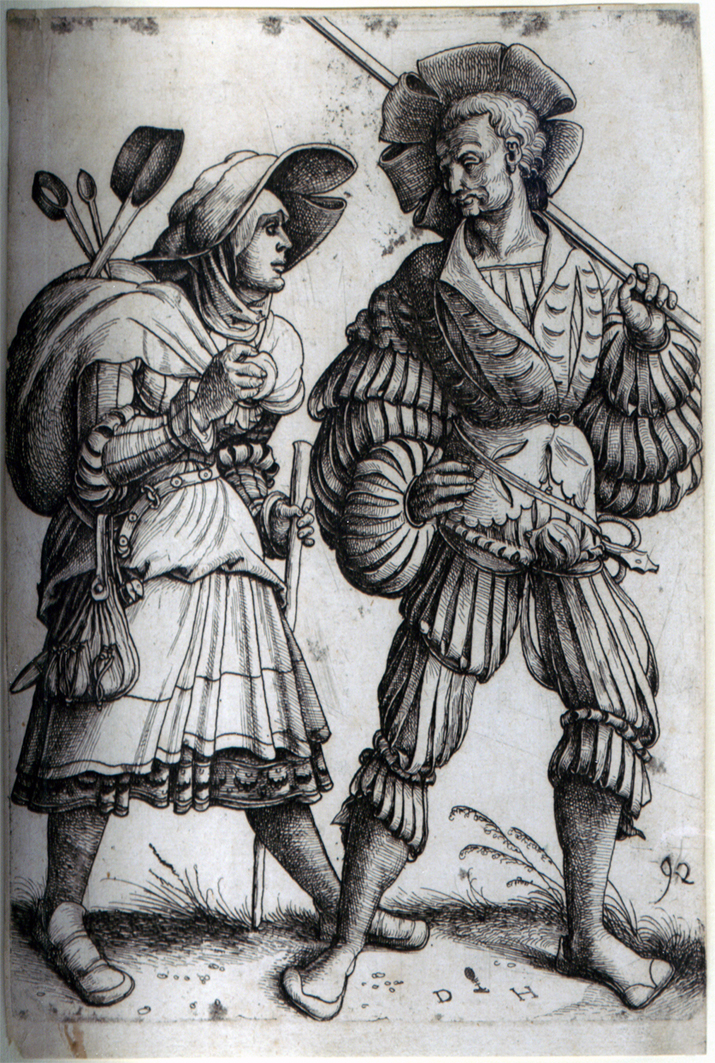
The Soldier and his Wife. Etching by Daniel Hopfer, who is believed to have been the first to apply the technique to printmaking.

Etching is traditionally the process of using strong acid or mordant to cut into the unprotected parts of a metal surface to create a design in intaglio (incised) in the metal.[1] In modern manufacturing, other chemicals may be used on other types of material. As a method of printmaking, it is, along with engraving, the most important technique for old master prints, and remains in wide use today. In a number of modern variants such as microfabrication etching and photochemical milling, it is a crucial technique in modern technology, including circuit boards.

In traditional pure etching, a metal plate (usually of copper, zinc or steel) is covered with a waxy ground which is resistant to acid.[2] The artist then scratches off the ground with a pointed etching needle[3] where the artist wants a line to appear in the finished piece, exposing the bare metal. The échoppe, a tool with a slanted oval section, is also used for "swelling" lines.[4] The plate is then dipped in a bath of acid, known as the mordant (French for "biting") or etchant, or has acid washed over it.[5] The acid "bites" into the metal (it undergoes a redox reaction) to a depth depending on time and acid strength, leaving behind the drawing (as carved into the wax) on the metal plate. The remaining ground is then cleaned off the plate. For first and renewed uses the plate is inked in any chosen non-corrosive ink all over and the surface ink drained and wiped clean, leaving ink in the etched forms.

The plate is then put through a high-pressure printing press together with a sheet of paper (often moistened to soften it).[6] The paper picks up the ink from the etched lines, making a print. The process can be repeated many times; typically several hundred impressions (copies) could be printed before the plate shows much sign of wear. The work on the plate can be added to or repaired by re-waxing and further etching; such an etching (plate) may have been used in more than one state.[7]

Etching has often been combined with other intaglio techniques such as engraving (e.g., Rembrandt) or aquatint (e.g., Francisco Goya). The French name "eau forte" (lit. "strong water") for the technique and the resulting prints was sometimes used in English.

History

[edit]

Origin

[edit]
The etched carnelian beads in this necklace from the Royal Cemetery of Ur dating to the First Dynasty of Ur (2600-2500 BCE) were probably imported from the Indus Valley.[8]

Etching in antiquity

[edit]

Etching was already used in antiquity for decorative purposes. Etched carnelian beads are a type of ancient decorative beads made from carnelian with an etched design in white, which were probably manufactured by the Indus Valley civilization during the 3rd millennium BCE. They were made according to a technique of alkaline etching developed by the Harappans, and vast quantities of these beads were found in the archaeological sites of the Indus Valley civilization.[9][8][10] They are considered as an important marker of ancient trade between the Indus Valley, Mesopotamia and even Ancient Egypt, as these precious and unique manufactured items circulated in great numbers between these geographical areas during the 3rd millennium BCE, and have been found in numerous tomb deposits.[11] Sumerian kings, such as Shulgi c. 2000 BCE, also created etched carnelian beads for dedication purposes.[12]

Early etching

[edit]

Etching by goldsmiths and other metal-workers in order to decorate metal items such as guns, armour, cups and plates has been known in Europe since the Middle Ages at least, and may go back to antiquity. The elaborate decoration of armour, in Germany at least, was an art probably imported from Italy around the end of the 15th century—little earlier than the birth of etching as a printmaking technique. Printmakers from the German-speaking lands and Central Europe perfected the art and transmitted their skills over the Alps and across Europe.

Self-portrait etched by Wenceslaus Hollar
Selection of early etched printing plates from the British Museum

The process as applied to printmaking is believed to have been invented by Daniel Hopfer (c. 1470–1536) of Augsburg, Germany. Hopfer was a craftsman who decorated armour in this way, and applied the method to printmaking, using iron plates (many of which still exist). Apart from his prints, there are two proven examples of his work on armour: a shield from 1536 now in the Real Armeria of Madrid and a sword in the Germanisches Nationalmuseum of Nuremberg. An Augsburg horse armour in the German Historical Museum, Berlin, dating to between 1512 and 1515, is decorated with motifs from Hopfer's etchings and woodcuts, but this is no evidence that Hopfer himself worked on it, as his decorative prints were largely produced as patterns for other craftsmen in various media. The oldest dated etching is by Albrecht Dürer in 1515, although he returned to engraving after six etchings instead of developing the craft.[13]

The switch to copper plates was probably made in Italy,[14] and thereafter etching soon came to challenge engraving as the most popular medium for artists in printmaking. Its great advantage was that, unlike engraving where the difficult technique for using the burin requires special skill in metalworking, the basic technique for creating the image on the plate in etching is relatively easy to learn for an artist trained in drawing. On the other hand, the handling of the ground and acid need skill and experience, and are not without health and safety risks, as well as the risk of a ruined plate.

Callot's innovations: échoppe, hard ground, stopping-out

[edit]

Jacques Callot (1592–1635) from Nancy in Lorraine (now part of France) made important technical advances in etching technique.

Etching by Jacques Bellange, Gardener with basket c. 1612

Callot also appears to have been responsible for an improved, harder, recipe for the etching ground, using lute-makers' varnish rather than a wax-based formula. This enabled lines to be more deeply bitten, prolonging the life of the plate in printing, and also greatly reducing the risk of "foul-biting", where acid gets through the ground to the plate where it is not intended to, producing spots or blotches on the image. Previously the risk of foul-biting had always been at the back of an etcher's mind, preventing too much time on a single plate that risked being ruined in the biting process. Now etchers could do the highly detailed work that was previously the monopoly of engravers, and Callot made full use of the new possibilities.

Callot also made more extensive and sophisticated use of multiple "stoppings-out" than previous etchers had done. This is the technique of letting the acid bite lightly over the whole plate, then stopping-out those parts of the work which the artist wishes to keep light in tone by covering them with ground before bathing the plate in acid again. He achieved unprecedented subtlety in effects of distance and light and shade by careful control of this process. Most of his prints were relatively small—up to about six inches or 15 cm on their longest dimension, but packed with detail.

One of his followers, the Parisian Abraham Bosse, spread Callot's innovations all over Europe with the first published manual of etching, which was translated into Italian, Dutch, German and English.

The 17th century was the great age of etching, with Rembrandt, Giovanni Benedetto Castiglione and many other masters. In the 18th century, Piranesi, Tiepolo and Daniel Chodowiecki were the best of a smaller number of fine etchers. In the 19th and early 20th century, the Etching revival produced a host of lesser artists, but no really major figures. Etching is still widely practiced today.

Variants

[edit]

Aquatint uses acid-resistant resin to achieve tonal effects.

Soft-ground etching uses a special softer ground. The artist places a piece of paper (or cloth etc. in modern uses) over the ground and draws on it. The print resembles a drawing. Soft ground can also be used to capture the texture or pattern of fabrics or furs pressed into the soft surface.

Other materials that are not manufactured specifically for etching can be used as grounds or resists. Examples including printing ink, paint, spray paint, oil pastels, candle or bees wax, tacky vinyl or stickers, and permanent markers.

There are some new non-toxic grounds on the market that work differently than typical hard or soft grounds.[15]

Relief etching was invented by William Blake in about 1788, and he has been almost the only artist to use it in its original form.[16] However, from 1880 to 1950 a photo-mechanical ("line-block") variant was the dominant form of commercial printing for images. A similar process to etching, but printed as a relief print, so it is the "white" background areas which are exposed to the acid, and the areas to print "black" which are covered with ground. Blake's exact technique remains controversial. He used the technique to print texts and images together, writing the text and drawing lines with an acid-resistant medium.

Carborundum etching (sometimes called carbograph printing) was invented in the mid-20th century by American artists who worked for the WPA.[17] In this technique, a metal plate is first covered with silicon carbide grit and run through an etching press; then a design is drawn on the roughened plate using an acid-resistant medium. After immersion in an acid bath, the resulting plate is printed as a relief print. The roughened surface of the relief permits considerable tonal range, and it is possible to attain a high relief that results in strongly embossed prints.[17]

Printmaking technique in detail

[edit]
Steps in the typical technique

A waxy acid-resist, known as a ground, is applied to a metal plate, most often copper or zinc but steel plate is another medium with different qualities. There are two common types of ground: hard ground and soft ground.

Hard ground can be applied in two ways. Solid hard ground comes in a hard waxy block. To apply hard ground of this variety, the plate to be etched is placed upon a hot-plate (set at 70 °C, 158 °F), a kind of metal worktop that is heated up. The plate heats up and the ground is applied by hand, melting onto the plate as it is applied. The ground is spread over the plate as evenly as possible using a roller. Once applied the etching plate is removed from the hot-plate and allowed to cool which hardens the ground.

After the ground has hardened the artist "smokes" the plate, classically with 3 beeswax tapers, applying the flame to the plate to darken the ground and make it easier to see what parts of the plate are exposed. Smoking not only darkens the plate but adds a small amount of wax. Afterwards the artist uses a sharp tool to scratch into the ground, exposing the metal.

Relief etching by William Blake, frontispiece to America a Prophecy (Copy A, printed 1795)
Landscape under Trees, etching by Paula Modersohn-Becker, c. 1902

The second way to apply hard ground is by liquid hard ground. This comes in a can and is applied with a brush upon the plate to be etched. Exposed to air the hard ground will harden. Some printmakers use oil/tar based asphaltum[18] or bitumen as hard ground, although often bitumen is used to protect steel plates from rust and copper plates from aging.

Soft ground also comes in liquid form and is allowed to dry but it does not dry hard like hard ground and is impressionable. After the soft ground has dried the printmaker may apply materials such as leaves, objects, hand prints and so on which will penetrate the soft ground and expose the plate underneath.

The ground can also be applied in a fine mist, using powdered rosin or spraypaint. This process is called aquatint, and allows for the creation of tones, shadows, and solid areas of color.

The design is then drawn (in reverse) with an etching-needle or échoppe. An "echoppe" point can be made from an ordinary tempered steel etching needle, by grinding the point back on a carborundum stone, at a 45–60 degree angle. The "echoppe" works on the same principle that makes a fountain pen's line more attractive than a ballpoint's: The slight swelling variation caused by the natural movement of the hand "warms up" the line, and although hardly noticeable in any individual line, has a very attractive overall effect on the finished plate. It can be drawn with in the same way as an ordinary needle.

The plate is then completely submerged in a solution that eats away at the exposed metal. ferric chloride may be used for etching copper or zinc plates, whereas nitric acid may be used for etching zinc or steel plates. Typical solutions are 1 part FeCl3 to 1 part water and 1 part nitric to 3 parts water. The strength of the acid determines the speed of the etching process.

  • The etching process is known as biting (see also spit-biting below).
  • The waxy resist prevents the acid from biting the parts of the plate which have been covered.
  • The longer the plate remains in the acid the deeper the "bites" become.
Example of etching

During the etching process the printmaker uses a bird feather or similar item to wave away bubbles and detritus produced by the dissolving process, from the surface of the plate, or the plate may be periodically lifted from the acid bath. If a bubble is allowed to remain on the plate then it will stop the acid biting into the plate where the bubble touches it. Zinc produces more bubbles much more rapidly than copper and steel and some artists use this to produce interesting round bubble-like circles within their prints for a Milky Way effect.

The detritus is powdery dissolved metal that fills the etched grooves and can also block the acid from biting evenly into the exposed plate surfaces. Another way to remove detritus from a plate is to place the plate to be etched face down within the acid upon plasticine balls or marbles, although the drawback of this technique is the exposure to bubbles and the inability to remove them readily.

For aquatinting a printmaker will often use a test strip of metal about a centimetre to three centimetres wide. The strip will be dipped into the acid for a specific number of minutes or seconds. The metal strip will then be removed and the acid washed off with water. Part of the strip will be covered in ground and then the strip is redipped into the acid and the process repeated. The ground will then be removed from the strip and the strip inked up and printed. This will show the printmaker the different degrees or depths of the etch, and therefore the strength of the ink color, based upon how long the plate is left in the acid.

The plate is removed from the acid and washed over with water to remove the acid. The ground is removed with a solvent such as turpentine. Turpentine is often removed from the plate using methylated spirits since turpentine is greasy and can affect the application of ink and the printing of the plate.

Spit-biting is a process whereby the printmaker will apply acid to a plate with a brush in certain areas of the plate. The plate may be aquatinted for this purpose or exposed directly to the acid. The process is known as "spit"-biting due to the use of saliva once used as a medium to dilute the acid, although gum arabic or water are now commonly used.

Pornocrates by Félicien Rops. Etching and aquatint

A piece of matte board, a plastic "card", or a wad of cloth is often used to push the ink into the incised lines. The surface is wiped clean with a piece of stiff fabric known as tarlatan and then wiped with newsprint paper; some printmakers prefer to use the blade part of their hand or palm at the base of their thumb. The wiping leaves ink in the incisions. You may also use a folded piece of organza silk to do the final wipe. If copper or zinc plates are used, then the plate surface is left very clean and therefore white in the print. If steel plate is used, then the plate's natural tooth gives the print a grey background similar to the effects of aquatinting. As a result, steel plates do not need aquatinting as gradual exposure of the plate via successive dips into acid will produce the same result.

Colored etching and aquatint on paper

A damp piece of paper is placed over the plate and it is run through the press.

Nontoxic etching

[edit]

Growing concerns about the health effects of acids and solvents[19][20] led to the development of less toxic etching methods[21] in the late 20th century. An early innovation was the use of floor wax as a hard ground for coating the plate. Others, such as printmakers Mark Zaffron and Keith Howard, developed systems using acrylic polymers as a ground and ferric chloride for etching. The polymers are removed with sodium carbonate (washing soda) solution, rather than solvents. When used for etching, ferric chloride does not produce a corrosive gas, as acids do, thus eliminating another danger of traditional etching.

The traditional aquatint, which uses either powdered rosin or enamel spray paint, is replaced with an airbrush application of the acrylic polymer hard ground. Again, no solvents are needed beyond the soda ash solution, though a ventilation hood is needed due to acrylic particulates from the air brush spray.

The traditional soft ground, requiring solvents for removal from the plate, is replaced with water-based relief printing ink. The ink receives impressions like traditional soft ground, resists the ferric chloride etchant, yet can be cleaned up with warm water and either soda ash solution or ammonia.

Anodic etching has been used in industrial processes for over a century. The etching power is a source of direct current. The item to be etched (anode) is connected to its positive pole. A receiver plate (cathode) is connected to its negative pole. Both, spaced slightly apart, are immersed in a suitable aqueous solution of a suitable electrolyte. The current pushes the metal out from the anode into solution and deposits it as metal on the cathode. Shortly before 1990, two groups working independently[22][23] developed different ways of applying it to creating intaglio printing plates.

In the patented[24][25] Electroetch system, invented by Marion and Omri Behr, in contrast to certain nontoxic etching methods, an etched plate can be reworked as often as the artist desires[26][27][28][29] The system uses voltages below 2 volts which exposes the uneven metal crystals in the etched areas resulting in superior ink retention and printed image appearance of quality equivalent to traditional acid methods. With polarity reversed the low voltage provides a simpler method of making mezzotint plates as well as the "steel facing"[30] copper plates.

Some of the earliest printmaking workshops experimenting with, developing and promoting nontoxic techniques include Grafisk Eksperimentarium, in Copenhagen, Denmark, Edinburgh Printmakers, in Scotland, and New Grounds Print Workshop, in Albuquerque, New Mexico.

Photo-etching

[edit]

Light sensitive polymer plates allow for photorealistic etchings. A photo-sensitive coating is applied to the plate by either the plate supplier or the artist. Light is projected onto the plate as a negative image to expose it. Photopolymer plates are either washed in hot water or under other chemicals according to the plate manufacturers' instructions. Areas of the photo-etch image may be stopped-out before etching to exclude them from the final image on the plate, or removed or lightened by scraping and burnishing once the plate has been etched. Once the photo-etching process is complete, the plate can be worked further as a normal intaglio plate, using drypoint, further etching, engraving, etc. The final result is an intaglio plate which is printed like any other.

Types of metal plates

[edit]

Copper is a traditional metal, and is still preferred, for etching, as it bites evenly, holds texture well, and does not distort the color of the ink when wiped. Zinc is cheaper than copper, so preferable for beginners, but it does not bite as cleanly as copper does, and it alters some colors of ink. Steel is growing in popularity as an etching substrate. Increases in the prices of copper and zinc have steered steel to an acceptable alternative. The line quality of steel is less fine than copper, but finer than zinc. Steel has a natural and rich aquatint.

The type of metal used for the plate impacts the number of prints the plate will produce. The firm pressure of the printing press slowly rubs out the finer details of the image with every pass-through. With relatively soft copper, for example, the etching details will begin to wear very quickly, some copper plates show extreme wear after only ten prints. Steel, on the other hand, is incredibly durable. This wearing out of the image over time is one of the reasons etched prints created early in a numbered series tend to be valued more highly. An artist thus takes the total number of prints he or she wishes to produce into account whenever choosing the metal.

Industrial uses

[edit]

Etching is also used in the manufacturing of printed circuit boards and semiconductor devices, and in the preparation of metallic specimens for microscopic observation.

Prior to 1100 AD, the New World Hohokam culture independently utilized the technique of acid etching in marine shell designs.[31] The shells were daubed in pitch and then bathed in acid probably made from fermented cactus juice.[32]

Metallographic etching

[edit]

Metallographic etching is a method of preparing samples of metal for analysis. It can be applied after polishing to further reveal microstructural features (such as grain size, distribution of phases, and inclusions), along with other aspects such as prior mechanical deformation or thermal treatments. Metal can be etched using chemicals, electrolysis, or heat (thermal etching).[33]

Controlling the acid's effects

[edit]
Young Girl in cafe with street-view, etching by Lesser Ury, 1924

There are many ways for the printmaker to control the acid's effects.

Hard grounds

[edit]

Most typically, the surface of the plate is covered in a hard, waxy 'ground' that resists acid. The printmaker then scratches through the ground with a sharp point, exposing lines of metal which the mordant acid attacks.

Example of sugar lift and spit bite effect

Aquatint

[edit]

Aquatint is a variation giving only tone rather than lines when printed. Particulate resin is evenly distributed on all or parts of the plate, then heated to form a screen ground of uniform, but less than perfect, density. After etching, any exposed surface will result in a roughened (i.e., darkened) surface. Areas that are to be light in the final print are protected by varnishing between acid baths. Successive turns of varnishing and placing the plate in acid create areas of tone difficult or impossible to achieve by drawing through a wax ground.

Sugar lift

[edit]

Designs in a syrupy solution of sugar or Camp Coffee are painted onto the metal surface prior to it being coated in a liquid etching ground or 'stop out' varnish. When the plate is placed in hot water the sugar dissolves, leaving the image. The plate can then be etched.

Spit bite

[edit]

A mixture of nitric acid and gum arabic (or, very rarely, saliva) which can be dripped, spattered or painted onto a metal surface giving interesting results. A mixture of nitric acid and rosin may also be used.

Printing

[edit]
Cylinder press for printing etchings

Printing the plate is done by covering the surface with printing ink, then rubbing the ink off the surface with tarlatan cloth or newsprint, leaving ink in the roughened areas and lines. Damp paper is placed on the plate, and both are run through a printing press; the pressure forces the paper into contact with the ink, transferring the image (cf., chine-collé). The pressure subtly degrades the image in the plate, smoothing the roughened areas and closing the lines; a copper plate is good for, at most, a few hundred printings of a strongly etched imaged before the degradation is considered too great by the artist. At that point, the artist can manually restore the plate by re-etching it, essentially putting ground back on and retracing their lines; alternatively, plates can be electro-plated before printing with a harder metal to preserve the surface. Zinc is also used, because as a softer metal, etching times are shorter; however, that softness also leads to faster degradation of the image in the press.

Faults

[edit]
Example of foul bite in acid etching

Foul-bite or "over-biting" is common in etching, and is the effect of minuscule amounts of acid leaking through the ground to create minor pitting and burning on the surface. This incidental roughening may be removed by smoothing and polishing the surface, but artists often leave faux-bite, or deliberately court it by handling the plate roughly, because it is viewed as a desirable mark of the process.

"Etchings" euphemism

[edit]

The phrase "Want to come up and see my etchings?" is a romantic euphemism by which a person entices someone to come back to their place with an offer to look at something artistic, but with ulterior motives. The phrase is a corruption of some phrases in a novel by Horatio Alger Jr. called The Erie Train Boy, which was first published in 1891. Alger was an immensely popular author in the 19th century—especially with young people—and his books were widely quoted. In chapter XXII of the book, a woman writes to her boyfriend, "I have a new collection of etchings that I want to show you. Won't you name an evening when you will call, as I want to be certain to be at home when you really do come." The boyfriend then writes back "I shall no doubt find pleasure in examining the etchings which you hold out as an inducement to call."

This was referenced in a 1929 James Thurber cartoon in which a man tells a woman in a building lobby: "You wait here and I'll bring the etchings down".[34] It was also referenced in Dashiell Hammett's 1934 novel The Thin Man, in which the narrator answers his wife asking him about a lady he had wandered off with by saying: "She just wanted to show me some French etchings."[35]

The phrase was given new popularity in 1937: in a well publicized case, violinist David Rubinoff was accused of inviting a young woman to his hotel room to view some French etchings, but instead seducing her.

As early as 1895, Hjalmar Söderberg used the reference in his "decadent" début novel Delusions (swe: Förvillelser), when he lets the dandy Johannes Hall lure the main character's younger sister Greta into his room under the pretence that they browse through his etchings and engravings (e.g., Die Sünde by Franz Stuck).[36]

See also

[edit]

References

[edit]
[edit]
Revisions and contributorsEdit on WikipediaRead on Wikipedia
from Grokipedia
Etching is an intaglio printmaking process in which lines or areas are incised using acid into a metal plate, typically copper, iron, or zinc, to create recessed areas that hold ink for printing. The technique allows artists to produce fluid, expressive lines ranging from delicate and serpentine to bold and scratchy, enabling nuanced tonal effects and detailed imagery in multiples. Originating from 14th-century methods of decorating armor with acid-resistant resists, etching was adapted for artistic printmaking around 1500 in southern Germany, where early practitioners used iron plates despite their tendency to rust. The process begins with polishing the metal plate to a smooth surface, followed by coating it with an acid-resistant ground such as or . The then uses an etching needle to scratch away the ground, exposing the metal along the desired lines of the design. The plate is immersed in (mordant), which bites into the exposed areas; the depth and width of the lines depend on the duration of exposure, with longer times producing deeper recesses for richer ink retention. After etching, the ground is removed with , the plate is inked—filling the incised lines while wiping the surface clean—and passed through a rolling press with damp to transfer the , resulting in a print with a distinctive plate mark. Variations like soft-ground etching, which captures textures by pressing paper or fabric into the ground, and , which uses powdered for tonal areas, expanded the medium's capabilities for shading and color. Etching flourished in the 16th and 17th centuries, with masters like experimenting early and van Rijn producing around 300 etchings between 1626 and 1665, innovating with burrs and deep bites for dramatic textures and lighting effects. In the 19th century, an etching revival in and America, led by artists such as , emphasized its painterly qualities and spontaneity over mechanical precision. Today, etching remains a vital technique in , valued for its versatility in creating both black-and-white and colored works, though modern adaptations often incorporate safer mordants and digital aids.

History

Ancient Origins

The technique, a precursor to later etching methods, involved mechanically incising designs into metal surfaces—such as , , or —and filling the grooves with a black composed of , , , and lead to create high-contrast decoration. This method originated in the and , with archaeological evidence dating to approximately 3000 BCE, where it was used to adorn jewelry, vessels, and ritual objects. In , appears on artifacts from the Old Kingdom (c. 2686–2181 BCE), including and items featuring intricate inlaid patterns that highlighted the dark alloy against the metal base. The practice spread to and , where enhanced bronze statuettes, armor components, and tableware from the BCE onward. Greek artisans applied it to geometric and figural motifs on vessels and weapons, while Roman metalworkers extended its use to silver plates and jewelry, often combining it with for luxurious effects. Notable examples include inlaid attachments from Greek sanctuaries and Roman sword fittings, demonstrating the technique's role in achieving fine detailing without modern acids. These mechanical approaches, distinct from later chemical etching, laid groundwork for incising skills that influenced techniques. Nitric acid, first isolated by the Islamic alchemist around 800 CE, was used in alchemical processes for metal purification and dissolution, representing an early advancement in chemical treatments of metals.

Early Modern Developments

Etching emerged as a distinct technique in Europe during the early , primarily through the innovations of German artists adapting methods from . Daniel Hopfer, an armorer based in , is credited with introducing etching to print production around 1510–1515. He transferred the process used for decorating armor—applying a resist ground to iron plates and exposing them to nitric acid—to create flat prints, producing ornamental designs, figures, and biblical scenes that marked the first known etched prints. The technique quickly gained traction among German artists in the 1520s, with adopting it for a small body of work. Between 1515 and 1520, Dürer created six etchings on iron plates, including landscapes like The Cannon (1518) and The Great Horse (1515), which demonstrated etching's potential for loose, expressive lines but highlighted its coarseness compared to . Other early adopters, such as Urs Graf, produced dated etchings as early as 1513, focusing on genre scenes and portraits that showcased the medium's spontaneity. Hopfer's own iron etchings, numbering over 100, often featured intricate motifs adapted from his armor designs, influencing the style's ornamental quality. By the mid-16th century, etching spread to and , where artists refined its application on plates for greater durability and precision. In , Parmigianino (Francesco Mazzola) became the pioneering etcher around 1527–1530, producing approximately 18 works such as The Entombment (c. 1525–1530), which exploited etching's fluid lines to capture Mannerist elegance. In , the technique arrived via Italian expatriates at the Fontainebleau school, with Antonio Fantuzzi creating decorative etchings in the 1540s; began his early etched works around 1610, initially employing basic acid-biting methods on before developing advanced tonal effects. Early etching faced significant technical challenges due to rudimentary materials and methods, limiting its reliability. Primitive grounds, typically mixtures of pitch, beeswax, and oils, often cracked or adhered unevenly, causing irregular biting that produced fuzzy or unintended lines in the prints. Moreover, the use of iron plates led to rapid during , restricting runs to roughly 50–100 impressions before the plate degraded, necessitating a shift to for longer editions.

Key Technical Innovations

In the early 17th century, French printmaker (1592–1635) introduced several key innovations that enhanced the precision and versatility of etching, building on the technique's adoption by early modern pioneers like Daniel Hopfer. Around 1610–1620, while working in and , Callot developed the échoppe, a specialized etching needle with an oval or lozenge-shaped tip resembling a burin, which allowed artists to create lines of varying thickness and subtle swells similar to those in . He also refined the hard ground by mixing with , producing a more durable and transparent resist that facilitated intricate designs without cracking under repeated needle work. Additionally, Callot pioneered the stopping-out technique, applying varnish to areas of the plate after initial acid bites to protect them from further etching, enabling progressive deepening of lines and the achievement of tonal gradations through multiple immersions in acid. These advancements, detailed in contemporary accounts of his workshop practices, significantly expanded etching's expressive potential beyond simple line work. During the mid-17th century, (1606–1669) elevated etching through his masterful integration of with traditional etching methods, particularly in the 1630s–1660s. In works such as Christ Healing the Sick (commonly known as , ca. 1647–1649), combined etched lines bitten by with burrs—raised metal edges created by scratching the plate directly—to produce rich, velvety textures and deep shadows that captured dramatic light effects and human expression. This hybrid approach, executed on copper plates, allowed for softer, more organic forms and tonal depth unattainable with etching alone, influencing subsequent generations of printmakers. The plate's complexity, involving up to nine states of revision, demonstrated 's innovative control over the medium, as analyzed in technical examinations of his prints. A major breakthrough in tonal etching occurred in 1760 with the development of by French artist Jean-Baptiste Le Prince (1734–1781), who dusted finely powdered onto the plate to create a porous ground that, when etched, produced even areas of tone resembling watercolor washes. This method addressed etching's limitation to linear marks by allowing broad shaded passages, achieved through selective stopping-out and varying bite depths in diluted acid baths. Le Prince's innovation, initially kept secret but disseminated through his prints and teachings, rapidly gained popularity for and scenes, marking a shift toward painterly effects in . By the , etchers further refined usage to achieve greater depth and consistency, increasingly employing dilutions of —typically one part to several parts —to control the bite rate and minimize undercutting of lines. Longer immersion times in these milder solutions enabled deeper incisions on plates, extending their durability for larger editions while reducing the risk of foul biting, where penetrated unintended areas. These adjustments, documented in period treatises on print techniques, supported the era's growing demand for detailed reproductive prints and etchings.

Printmaking Fundamentals

Basic Process Overview

The basic process of etching in traditional printmaking is an intaglio technique that uses acid to incise designs into a metal plate, creating recessed lines that hold ink for printing. This workflow focuses on preparing the plate, exposing areas for corrosion, and controlling the acid's action to form grooves, providing the foundation for artistic expression through line work. The process begins with degreasing the metal plate, usually copper or zinc, to remove oils and contaminants that could prevent proper adhesion of the protective ground; this is typically done using a paste of whiting (calcium carbonate) and water or a mild scouring powder scrubbed onto the surface, followed by thorough rinsing. Next, an acid-resistant ground, such as a waxy or resinous substance, is applied evenly across the plate to protect it from the mordant during etching. The artist then draws the desired design directly on the grounded plate using a fine etching needle, which scratches through the ground to expose the underlying metal without damaging the plate itself. The plate is immersed in a bath, commonly a diluted solution, where the selectively corrodes the exposed metal lines; the biting time is controlled in stages of 10-30 minutes to achieve varying depths, with the plate periodically removed, rinsed, and inspected to monitor progress and prevent over-etching. After sufficient biting, the ground is removed using a solvent like , the plate is cleaned to eliminate residues, and the resulting grooves are inspected for uniformity and depth. At its core, the etching reaction involves the oxidation of the metal by the , dissolving the exposed surface to form soluble compounds and release gases; for in dilute , this can be represented as 3Cu + 8HNO₃ → 3Cu(NO₃)₂ + 2NO + 4H₂O, where the acid oxidizes the copper while producing byproducts that aid in the etching process.

Materials and Plate Preparation

In traditional etching, metal plates serve as the foundational surface for creating intaglio prints. Copper plates are preferred for their softness, which allows for the creation of fine, detailed lines, and they are commonly available in sizes up to 12 by 16 inches. Zinc plates offer a more affordable alternative but produce coarser lines due to the metal's harder texture. Iron plates, while durable and suitable for repeated use, can result in uneven etching because of their rougher surface. Before applying any etching ground, the plate must undergo thorough to ensure a clean, even surface. This begins with to remove scratches and imperfections: the edges are beveled using a metal file, followed by sanding with progressively finer grits (from #220 to #600) in circular motions, and finishing with #0000 or a polishing compound like putz applied with felt for a mirror-like finish. follows to eliminate oils and residues that could cause the ground to adhere unevenly; this is achieved by scrubbing the plate with a paste of whiting () and using a felt pad, rinsing thoroughly, and optionally applying a mild de-oxidizing solution or vinegar-based mix before a final whiting scrub, ensuring water sheets off the surface without beading. Etching grounds, which protect areas of the plate from the , are applied immediately after preparation. Soft grounds, ideal for capturing textures, consist of a mixture of softened with or , providing a pliable surface that can be impressed with materials like or fabric. These are typically applied by rolling the warmed mixture onto the heated plate using a (similar to a ) for even coverage, or in liquid form via spray for hard grounds, though soft grounds are often brushed or rolled to maintain their tackiness. Mordants, the etching solutions that bite into exposed metal, vary by plate type. For copper plates, ferric chloride is the traditional and preferred mordant due to its relative safety and effectiveness in creating consistent depths. For zinc plates, nitric acid is commonly used, typically diluted at a 1:5 ratio with water to control the etching rate and produce finer lines. Handling s requires strict protocols to mitigate risks from fumes and spills. Work must be conducted in a to ventilate toxic vapors, with protective gloves, goggles, and aprons worn at all times; spent mordant solutions are neutralized by adding baking soda () until the pH reaches neutral before disposal.

Artistic Techniques

Line Etching and Grounds

Line etching is a foundational technique in intaglio printmaking, where artists draw precise lines through an acid-resistant ground on a metal plate, typically copper or zinc, to expose areas for selective corrosion by a mordant such as nitric acid. This method allows for clean, controlled incisions that mimic the fluidity of drawing, producing sharp, varied lines in the final print. The protective ground ensures that only the drawn areas are etched, enabling artists to achieve intricate details and tonal variations through line depth and width. The application of hard ground, a traditional mixture of and asphaltum, is critical for line etching as it provides a durable, waxy barrier that can be incised without cracking. To apply it, the metal plate is first degreased and then heated on a to approximately 100-120°C to melt the ground evenly. The wax-asphaltum composition is rolled onto the warmed plate using a hard rubber roller until a thin, uniform layer forms, achieving a golden tone indicative of proper coverage. The plate is then removed from the heat and allowed to cool completely, hardening the ground to a state suitable for with an etching needle. This process, dating back to the , ensures the ground adheres firmly while permitting fine scratches that expose the metal beneath. Once the design is drawn, the plate undergoes etching in multiple short dips of 5-10 minutes each to achieve uniform line depths and prevent undercutting, where erodes the sides of lines unevenly. After each dip, the plate is rinsed, inked lightly, and proofed on to test the bite depth and line clarity, allowing adjustments before further immersion. To vary depths for tonal contrast, stopping-out is employed: a protective is painted over areas that have reached the desired depth, shielding them from additional exposure during subsequent bites. This iterative builds cumulative etching, with deeper lines holding more for richer prints. For enhancing line variation mid-process, the échoppe—a tapered etching needle with an oval tip—serves as a specialized tool, allowing artists to widen or swell lines by applying varying pressure while drawing through the ground. Unlike a standard needle, the échoppe's slanted profile creates broader, engraving-like tapers, adding expressiveness to linear forms without additional etching steps. Pioneered effectively by in the early 17th century, this tool bridges etching and engraving techniques, enabling dynamic line modulation directly on the plate.

Tonal and Textural Methods

Aquatint is an intaglio printmaking technique developed to achieve tonal effects in etching, allowing artists to create areas of uniform shade rather than isolated lines. The process begins with dusting a metal plate, typically copper or zinc, with fine rosin powder, which is then fused to the surface by gently heating the plate to make the particles adhere without melting completely into a solid layer. This creates a porous resist composed of tiny, irregularly spaced dots that protect most of the plate while exposing minute gaps to the acid. The artist draws through the rosin using a needle or etching tool to remove the powder in desired areas, defining highlights or shapes, before immersing the plate in an acid bath. The acid bites into the unprotected metal, forming a network of fine, interconnected channels that hold ink and print as a soft, velvety tone resembling watercolor washes. To build graduated tones from light to dark, the aquatint process is iterative: after the initial bite produces a tone, the artist stops out (applies additional resist) to protected areas, then repeats the immersion for deeper etching in the remaining exposed sections. This stepwise method allows for precise control over tonal range, with multiple short dips preventing over-etching and maintaining evenness across large areas. The resulting prints exhibit a granular texture that enhances depth and atmosphere, making particularly suited for landscapes, portraits, and dramatic scenes requiring subtle gradations. Soft ground etching complements by introducing textured effects through a more pliable resist, enabling the capture of organic or patterned impressions directly onto the plate. The soft ground, a mixture of standard etching softened with , , or grease, is applied evenly to the warmed plate and allowed to cool into a tacky layer. Textured materials such as , fabric, leaves, or paper are then pressed into the ground under moderate , often using a rolling press, causing the soft resist to adhere to and lift from the metal in the pattern of the material, exposing those areas to . After removing the textured object, the plate is etched in , with the depth of bite controlled by immersion time to produce varied line widths and surface textures that translate to rich, tactile prints. This method excels in replicating natural forms or fabrics, adding dimensionality beyond flat tones. A notable historical application of appears in Francisco Goya's series (1810–1820), where the artist combined etching lines with aquatint tones to depict the horrors of the , achieving haunting contrasts of light and shadow in scenes of violence and suffering. Goya's innovative use of progressive stopping-out created dramatic mid-tones that heightened the emotional impact, influencing later printmakers in expressive tonal rendering. Variations on traditional rosin aquatint include sugar aquatint, or sugar lift, which offers finer control for intricate tonal areas by incorporating a soluble ground. In this technique, a of syrup and or is painted or drawn onto the plate over a hard ground, then allowed to dry before the entire surface is coated with a standard resist. Submerging the plate in dissolves the sugar, lifting the overlying resist to expose the drawn areas precisely, which are then etched to form clean, variable tones without the granularity of . This method allows for painterly effects and is valued for its precision in modern workshops.

Additive and Lift Techniques

Additive and lift techniques in etching expand the medium's expressive range by selectively removing or weakening the resist ground to reveal organic, painterly effects that contrast with the precision of line etching. These methods allow artists to create broad tonal areas and soft-edged forms by manipulating the resist during or after the initial drawing phase, often integrating seamlessly with other intaglio processes like for enhanced texture. Sugar lift, also known as lift-ground, involves drawing directly on a plate covered with an acid-resistant ground using a water-soluble mixture of and sugar syrup, which adheres to the resist without penetrating it. After the drawing dries, the plate is submerged in water, dissolving the sugar and lifting away sections of the ground to expose underlying metal for etching, resulting in irregular, broad areas of tone that mimic brushstrokes. This technique, developed in the , enables spontaneous, fluid compositions and is particularly valued for its ability to produce velvety blacks and subtle gradients without the uniformity of traditional . Spit bite offers a direct method for achieving soft, diffused edges by applying a diluted acid solution—often mixed with , , or —straight onto the plate's ground using a or splash. The moisture weakens the resist locally, allowing the acid to bite unevenly and create feathery, atmospheric effects that evoke watercolor or smoke. Popularized in the , this approach bypasses immersion in acid baths, granting artists precise control over localized etching depths and integrating well with grounds for layered tonality. Drypoint integration enhances etched plates post-acid biting by scratching fine lines into the metal surface with a sharp needle, raising a soft burr that holds ink for rich, velvety lines in printing. This additive step, often combined with lift techniques, adds tactile depth and immediacy, as the burr's subtle swelling creates tonal variations without further chemical intervention. Artists like Rembrandt employed this hybrid method in the 17th century to blend etched precision with drypoint's expressive richness, a practice that persists in modern printmaking. Pablo Picasso exemplified these techniques in his 1930s etchings, such as those from the Suite Vollard, where sugar lift and spit bite produced painterly qualities with fluid forms and atmospheric depth, expanding etching's traditional linearity into sculptural, Cubist-inspired compositions. Introduced to these methods by printer Roger Lacourière around 1930–1937, Picasso used them to achieve tonal variations that blurred the boundaries between drawing and painting.

Modern Variants

Photo-Etching

Photo-etching integrates photographic techniques into the intaglio etching process to achieve precise and reproducible image transfer onto metal plates. The method relies on light-sensitive materials that allow photographic positives or negatives to control the etching pattern, enabling fine details and tonal variations unattainable through manual drawing alone. Developed as a bridge between photography and printmaking, it has been particularly valued for its ability to reproduce complex images with mechanical accuracy. The historical roots of photo-etching trace back to early 19th-century innovations in photomechanical reproduction. In 1839, Scottish inventor Mungo Ponton discovered the light-sensitive properties of potassium bichromate, a compound that hardens when exposed to light and became foundational for creating resist layers in etching processes. Building on earlier experiments, such as Joseph Nicéphore Niépce's 1820s work with sensitized plates for photomechanical etching, the technique evolved through the mid-19th century with patents like Hippolyte Fizeau's 1843 method for etching daguerreotypes. It gained widespread popularity in the , especially after the introduction of films in the 1970s and 1980s, which simplified the process for commercial reproduction in book illustrations and prints. In the modern process, a metal plate, typically or , is coated with a film or a bichromate-sensitized ground in a subdued light environment to prevent premature exposure. A high-contrast photographic transparency—either a positive for line work or a negative for tonal s—is placed in direct contact with the coated plate and exposed to (UV) light from an exposure unit. The UV light polymerizes the exposed areas, rendering them insoluble and resistant to etching, while unexposed regions remain soft and developable. The plate is then immersed in an aqueous developer, such as solution, which washes away the unhardened material, exposing the underlying metal in the areas. Finally, the plate undergoes etching in a bath, like ferric , where the etchant bites into the exposed metal to form incised lines and tones proportional to the original density. This step-by-step transfer ensures the etched plate mirrors the photographic source with exceptional fidelity. Key advantages of photo-etching include its capacity for high-resolution detail, particularly in rendering halftones and subtle gradations, which traditional line etching struggles to achieve. This precision made it ideal for commercial applications, such as reproducing illustrations in books and periodicals, where multiple identical prints were needed without loss of quality. Unlike manual techniques, photo-etching minimizes artist intervention in image creation, democratizing complex reproductions while preserving the tactile depth of intaglio . Essential equipment for photo-etching includes UV exposure units, often vacuum frames to maintain tight contact between the film and plate for sharp edges, and aqueous developers for non-toxic processing. These tools, combined with readily available films like ImagOn introduced in the , have made the technique accessible to contemporary artists and printers.

Non-Toxic and Sustainable Methods

Traditional etching processes often rely on hazardous acids like , which release toxic fumes and pose significant health risks to artists. In contrast, ferric chloride has emerged as a safer alternative for etching and plates, producing no harmful gas emissions while effectively biting into the metal at a controlled rate. This method, when paired with dry film or acrylic resists, eliminates the need for solvent-based grounds, further reducing exposure to volatile organic compounds (VOCs). Another innovative approach is the Etch, a metal salt system utilizing ferric chloride and to etch , , and mild without generating fumes or requiring aggressive ventilation. This solution maintains a neutral pH and allows for precise control over etch depth, making it suitable for both and experimental . Dry film resists can also be applied here to create detailed line work, enhancing safety by avoiding traditional asphaltum or wax grounds that contain derivatives. Introduced in the late and popularized throughout the by printmaker Dan Welden, Solarplate photopolymer offers a light-based alternative to chemical etching, where plates are exposed to UV light through a transparency to harden the polymer surface, followed by a simple rinse in lukewarm water to reveal the image. This process builds on photo-etching principles but emphasizes water-based development, eliminating acids entirely and producing durable intaglio plates suitable for traditional printing presses. Recent developments from 2020 to 2025 have focused on fully biodegradable etching grounds derived from plant resins, such as BioBLac Hard Ground, which uses 100% bio-based film-forming ingredients to resist mordants like without synthetic polymers. Complementary low-VOC mordants, including refined formulations in saline systems, further minimize environmental impact by breaking down naturally post-use. As of 2025, further refinements include enzyme-based developers for even lower environmental impact, promoted by organizations like the College Art Association. These advances enable artists to achieve professional results while adhering to stricter ecological standards. The adoption of these non-toxic methods yields substantial benefits, including reduced hazardous waste generation through recyclable etching solutions and simpler cleanup with water, fostering safer studio environments free from respiratory irritants. Contemporary artists affiliated with the California Society of Printmakers, such as Kate Deak, exemplify this shift by employing Solarplate techniques to create intricate etchings that prioritize sustainability without compromising artistic expression.

Digital and Contemporary Adaptations

In the , hybrid digital-etching techniques have emerged as a bridge between traditional intaglio processes and computational design, allowing artists to create intricate compositions using software such as or similar tools to develop images that are then transferred to metal plates via etching or inkjet printing of resists. This workflow enables precise control over line quality and tonal gradients, with digital files processed to generate screens or vector paths before application, followed by chemical or electrolytic etching to incise the plate. For instance, in architectural representation, digital models are rendered and etched onto plates to produce hybrid drawings that blend algorithmic precision with the organic variability of acid bites. Polymer gravure represents another key adaptation, utilizing photopolymer films derived from digital positives to form intaglio plates on flexible plastic substrates, which are exposed to UV light and developed in aqueous solutions rather than acids. Gaining prominence in the as a non-toxic alternative to metal etching, this method allows for the production of editioned prints with rich, velvety ink tones akin to traditional , but with shorter preparation times and reduced environmental impact. Artists like JuliAnne Jonker employ polymer gravure to translate photographic imagery into tactile prints, layering digital manipulations with the plate's inherent for subtle depth effects. Similarly, Greg Brophy uses it to explore motifs, combining scanned elements with hand-applied textures in limited editions. From 2020 to 2025, etching has seen a notable revival through sustainable workshops emphasizing eco-friendly workflows, such as those at Zea Mays , where participants learn non-toxic etching integrated with digital pre-press tools. This resurgence incorporates to fabricate custom plate textures, enabling artists to prototype raised or recessed patterns on substrates before etching, thus expanding possibilities for mixed-media hybrids. Exhibitions like The Contemporary Print 2025 at Austin Community College's Art Galleries highlight this evolution, featuring 48 artists who merge etching with digital and sustainable innovations in juried works. Master printer Jacob Samuel exemplifies this trend, collaborating with contemporary figures like on etched portfolios that blend digital ideation with traditional inking for limited-edition books and suites. These adaptations underscore etching's adaptability, often combined briefly with non-toxic chemistries to produce multifaceted prints that integrate etching with or elements.

Applications Beyond Art

Metallographic and Scientific Uses

In metallographic analysis, etching serves as a critical step to reveal the microstructure of metals and alloys after initial . The process begins with the metal sample to a mirror-like finish through successive grinding and polishing stages using media, which removes surface deformations and ensures a flat, reflective surface for accurate microscopic examination. Etching is then performed by applying chemical solutions, known as etchants, to the polished surface, which selectively corrode different microstructural features such as grain boundaries, phases, and inclusions, thereby enhancing contrast under optical or . The primary purpose of metallographic etching is to facilitate the detailed analysis of alloy compositions and the effects of processing conditions like heat treatment, allowing researchers to assess material properties, homogeneity, and potential defects. Common etchants include nital, a solution of 2-5% nitric acid in ethanol, which effectively exposes grain boundaries in ferritic and martensitic steels by preferentially attacking ferrite phases. For structures rich in pearlite, picral—comprising 4% picric acid in ethanol—is preferred, as it provides clearer delineation of cementite lamellae without over-etching the surrounding ferrite. In the case of stainless steels, electrolytic etching with 10% oxalic acid in water at 3-6 volts reveals austenitic grain structures and carbide distributions, offering insights into sensitization and corrosion resistance. These practices are standardized in ASTM E407, which outlines procedures and reagent compositions for microetching a wide range of metals and alloys to ensure reproducible results. Beyond quality control in modern materials, metallographic etching finds significant application in within , where it uncovers root causes such as improper , inclusions, or fatigue cracks that led to component breakdowns in , automotive, and structural applications. In scientific contexts, particularly and conservation, etching enables the examination of ancient metals to determine alloying elements, working techniques, and thermal histories, aiding in the and of artifacts like tools or iron weapons by correlating microstructures with known historical metallurgical practices.

Industrial Etching in Manufacturing

Industrial etching in manufacturing involves the controlled removal of material from substrates to create precise patterns, structures, or features at scale, primarily through chemical or plasma-based processes. This technique is essential for producing components in electronics, aerospace, and display technologies, enabling high-volume fabrication with tolerances down to the nanoscale. Unlike artistic etching, industrial applications prioritize uniformity, speed, and minimal defects to meet production demands. In (PCB) production, etching forms conductive traces by selectively removing from clad laminates using a wet chemical process. The workflow begins with coating the board in a layer, followed by UV light exposure through a to harden the resist in desired areas, leaving unprotected exposed. The board is then immersed in an etchant solution, typically ferric (FeCl₃), which dissolves the exposed via a reaction while the resist protects the traces. This subtractive method is the dominant approach in PCB manufacturing due to its cost-effectiveness and ability to handle complex multilayer designs. Semiconductor microfabrication relies on both dry and wet etching to define nanoscale features in wafers and other materials. , particularly (RIE), uses plasma generated in a with reactive gases such as (SF₆) to achieve anisotropic removal, enabling high-aspect-ratio structures critical for transistors and interconnects. The plasma's ions and radicals chemically react with the surface while physical bombardment enhances directionality, allowing features below 10 nm. Complementing this, wet etching employs (HF), often mixed with (HNO₃), for isotropic removal of or its oxides, producing smooth surfaces for applications like wafer thinning and sensors. These techniques ensure precise control in fabrication. Beyond electronics, etching supports specialized manufacturing in and displays. Chemical , a variant of wet etching, thins metal sheets like aluminum or for components such as fuselage , creating weight-reducing pockets without introducing stress or burrs through masked immersion in controlled etchants. This process adheres to stringent aerospace tolerances and scales efficiently for prototypes to production runs. In display manufacturing, chemical etching with HF-based solutions removes thin layers from flat panels, enhancing strength by eliminating micro-cracks and producing matte finishes for anti-glare surfaces while preserving optical clarity. Recent advances from 2020 to 2025 have focused on atomic layer etching (ALE), a cyclical process that removes material one atomic layer at a time using sequential plasma exposure and ligand exchange, enabling defect-free patterning for 2 nm logic chips. This technique reduces undercuts and variability compared to traditional RIE, supporting denser integration in leading-edge nodes by and , with etch rates tunable to below 0.1 nm per cycle. ALE's precision has minimized sidewall roughness, improving yield in high-volume production.

Production and Challenges

Printing the Etched Plate

Once the etched plate has been cleaned of any remaining grounds or residues, the printing process commences with inking the incised grooves. Etching ink, an oil-based formulation often incorporating or asphalt for its viscous, properties that ensure retention in the etched lines, is applied using a dabber—a spherical pad made from bound cloth, felt, or . The plate is typically warmed slightly to facilitate ink flow, and the dabber is pressed and rolled firmly across the surface to drive the deep into the grooves without filling the plate's flat areas excessively. Following inking, excess ink must be meticulously removed from the plate's surface to reveal the through the retained in the grooves alone. This wiping stage employs tarlatan, a coarse, starched fabric, or the printer's hand for precision. A hard wipe involves vigorous, circular motions with clean tarlatan to polish the surface thoroughly, yielding crisp, defined lines ideal for line etchings. In contrast, a soft wipe uses lighter and sometimes a palm or newsprint overlay to retain subtle burr—fine metal edges raised during etching or working—for velvety tones and richer depth, particularly in or soft-ground techniques. With the plate prepared, printing occurs on an intaglio press, where a sheet of dampened, high-rag-content is laid over the inked plate and covered with felts to cushion and distribute force evenly. The press's rollers apply immense uniform pressure, often exceeding several thousand pounds per (psi), with manual etching presses capable of upwards of 6000 psi, forcing the into the grooves to absorb the while the plate's surface repels it. This high-pressure mechanism ensures sharp transfers without distortion, distinguishing intaglio from methods. To produce an edition, printers first create working proofs to assess ink distribution, wiping consistency, and overall fidelity to the artist's intent, adjusting techniques as needed. Once satisfied, the full edition is printed, with each impression numbered (e.g., 5/50 for the fifth of fifty) and often signed for authenticity. plates, common for etching, generally limit high-quality editions to 100-300 impressions before groove wear diminishes line sharpness, after which the plate may require re-etching, steel plating, or retirement.

Common Faults and Solutions

One common fault in the etching process is , also known as foul biting, which occurs when acid penetrates through weaknesses in the acid-resistant ground, creating unintended pits or irregular marks on the plate surface. This issue typically arises from improper of the metal plate prior to applying the ground, leaving residues like grease or dust that prevent even , or from uneven application of the ground itself. To prevent fouling, artists must thoroughly degrease and polish the plate using whiting or fine abrasives before grounding, ensuring the surface repels water evenly and allows for a secure bond. If fouling occurs, the affected areas can be corrected by scraping away the damaged metal with a scraper and burnishing smooth with a burnisher, though severe cases may require re-grounding and partial re-etching. Over-etching represents another frequent problem, where lines or areas intended for shallow bites become excessively deepened due to prolonged immersion in the etching solution, resulting in weak, blurred, or fragile lines during . The primary cause is inadequate monitoring of the bite time, as continues to the metal beyond the desired depth, especially in softer metals like . Solutions involve implementing timed dips—typically 10-30 minutes per session depending on the metal and —followed by rinsing and under to assess progress. Applying stop-out to protect completed areas between dips further prevents over-etching, allowing controlled deepening only where needed. Ink-related issues during printing often stem from poor wiping techniques, leading to excess remaining on the plate surface and causing filled or muddy prints where lines appear clogged. This fault is commonly due to insufficient removal of surface after inking the grooves, particularly if the wiping cloth is too soft or not progressively stiffened. Effective remedies include using a structured wiping sequence: first, a coarse tarlatan cloth to remove bulk in circular motions, followed by a finer tarlatan for even distribution, and finishing with newsprint or palm for a clean surface tone. This progressive method ensures adheres only in the etched lines, complementing the inking and pressing steps for crisp results. Plate defects such as pinholes are particularly prevalent with plates, manifesting as tiny surface imperfections that etch into unwanted dots or pimples during the bite. These arise from impurities, scratches, or inadequate pre-etch preparation, allowing acid to exploit microscopic flaws. The solution lies in pre-etch polishing: scouring the zinc with or 0000 , followed by thorough degreasing with a like cleaner, to create a smooth, uniform surface resistant to localized etching. For minor pinholes post-etching, they can be filled with stop-out or burnished flat before .

Cultural Context

Etchings in Art History

Etching emerged as a pivotal medium in art, particularly through the innovative works of van Rijn, who produced over 300 etchings between 1626 and 1665, masterfully exploring the interplay of light and shadow to achieve dramatic effects reminiscent of Caravaggio's influence. These etchings, often featuring intimate biblical scenes, portraits, and landscapes, elevated the technique beyond mere reproduction, allowing to convey emotional depth and atmospheric richness that paralleled his painted oeuvre. Building on earlier innovations like those of , who refined etching tools for greater line variation in the early 17th century, 's contributions solidified etching's status as a staple for expressive . In the , etching experienced a significant revival, with at its forefront, producing tonal etchings such as the Thames Set in 1860 that emphasized subtle atmospheric effects and mood over precise detail. 's approach, characterized by soft, painterly lines and a focus on harmony, influenced the development of by prioritizing the evocative qualities of light and tone, bridging traditional with emerging modernist sensibilities. This revival, spanning Britain, , and America, repositioned etching as an original artistic medium rather than a reproductive one, inspiring a generation of artists to experiment with its expressive potential. The 20th century saw etching's continued evolution through experimental suites by and , who pushed the medium's boundaries in line with movements. Picasso's , comprising 100 etchings created between 1930 and 1937, explored neoclassical and surreal themes with bold, fluid lines and dynamic compositions, demonstrating his mastery in adapting etching to personal and political narratives. Similarly, Miró produced innovative etching suites, such as the 17-etching series of 1939, incorporating and abstract forms derived from dream-like imagery and folk influences to challenge conventional representation. These works exemplified etching's versatility in modernist experimentation, allowing both artists to produce intricate, psychologically charged series that expanded the medium's role in . Etching's capacity for producing multiples profoundly impacted the by democratizing access to original works, enabling broader dissemination of images from the onward and fostering public engagement with beyond . In the and 19th-century periods, this reproducibility allowed artists like and Whistler to reach wider audiences, while 20th-century suites by Picasso and Miró further amplified etching's influence through affordable editions that shaped and artistic discourse.

The "Etchings" Euphemism

The phrase "come up and see my etchings" is a well-known originating in the early , used to invite someone, typically in a romantic context, to a private residence under the pretense of viewing , but implying a sexual advance. It gained popularity in the , associated with the art scene and artists like Louis Icart, whose erotic etchings contributed to its suggestive connotation. By the mid-20th century, the expression had become a in English-speaking cultures, often referenced in literature and media to denote . In the context of , the highlights the cultural allure of etchings as intimate, collectible works that could serve as a sophisticated cover for personal encounters. While forgeries of etchings, particularly of old masters like , were common in the —often using techniques like to mimic originals—the term "etchings" itself was not euphemistically applied to fakes in the . Authentication advancements, such as ink analysis and microscopic examination of plate marks, helped distinguish genuine etchings from reproductions after the late .

References

Add your contribution
Related Hubs
User Avatar
No comments yet.