


Community hub
Recent from talks
Contribute something
Nothing was collected or created yet.
Nintendo Entertainment System
View on Wikipedia
  | |
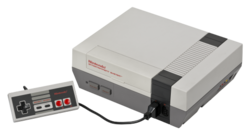
Top: NES Control Deck with detachable controller Bottom: Family Computer ("Famicom") main unit with hardwired controllers | |
| Also known as | |
|---|---|
| Developer | Nintendo R&D2 |
| Manufacturer | Nintendo |
| Type | Home video game console |
| Generation | Third |
| Release date | |
| Introductory price | ¥14,800 (equivalent to ¥18,365 in 2019) US$180 (equivalent to $530 in 2024)[5] |
| Discontinued | |
| Units sold | 61.91 million[8] |
| Media | Nintendo Entertainment System Game Pak |
| CPU |
|
| Memory | 2 KB work RAM 2 KB video RAM 256 bytes sprite RAM |
| Display | 256 × 240 px |
| Graphics | PPU (Ricoh 2C02) |
| Sound | APU, 5 channels: 2 pulse wave, triangle wave, white noise, DPCM |
| Controller input | 2 controller ports[f] |
| Best-selling game |
|
| Predecessor | Color TV-Game |
| Successor | Super Nintendo Entertainment System |
| Related | Famicom Disk System Famicom 3D System |


The Nintendo Entertainment System (NES) is an 8-bit home video game console developed and marketed by Nintendo. It was released in Japan on July 15, 1983, as the Family Computer (Famicom),[note 1] and released as the redesigned NES in test markets in the United States on October 18, 1985, followed by a nationwide launch on September 27, 1986. The NES was distributed in Europe, Australia, and parts of Asia throughout the 1980s under various names. As a third-generation console, it mainly competed with Sega's Master System.
Nintendo president Hiroshi Yamauchi called for a simple, cheap console that could run arcade games on cartridges. The Famicom was designed by Masayuki Uemura, with its controller design reused from Nintendo's portable Game & Watch hardware. The western NES model was designed by Lance Barr and Don James to resemble a video cassette recorder. To aid the console's acceptance in stores, Nintendo released add-ons such as the Zapper, a light gun for shooting games, and R.O.B., a toy robot.
The NES is regarded as one of the most influential gaming consoles. It helped revitalize the American gaming industry following the video game crash of 1983, and pioneered a now-standard business model of licensing third-party developers to produce and distribute games.[11] Several games released for the NES, including Super Mario Bros. (1985), The Legend of Zelda (1986), Metroid (1986), and Mega Man (1987), became major franchises.
While the NES dominated Japanese and North American markets, it performed less well in Europe,[g] where it faced strong competition from the Master System, as well as the Commodore 64 and ZX Spectrum home computers. With 61.91 million units sold, it is the 14th-best-selling console of all time. Nintendo ceased production of the NES in 1995 and the Famicom in 2003. It was succeeded in 1990 by the Super Nintendo Entertainment System.
History
[edit]Background
[edit]
The video game industry experienced rapid growth and popularity from the late 1970s to the early 1980s, marked by the golden age of arcade games and the second generation of consoles. Games like Space Invaders (1978) became a phenomenon across arcades worldwide, while home consoles such as the Atari 2600, alongside home computers such as the Commodore 64 and the Intellivision acquired footholds in the American market. Many companies emerged to capitalize on the growing industry, including the card and toy company Nintendo.[13]
Nintendo president Hiroshi Yamauchi realized that breakthroughs in the electronics industry meant that entertainment products could be produced at lower prices. Companies such as Atari and Magnavox were already selling gaming devices for use with television sets to moderate success. Yamauchi negotiated a license with Magnavox for the patents on the technology used in the Magnavox Odyssey. Since Nintendo's operation was not yet sophisticated enough to design its own hardware, Yamauchi forged an alliance with Mitsubishi Electric and hired several Sharp Electronics employees to assist in developing the Color TV-Game 6 and the Color TV-Game 15 in Japan.[14][15] This was followed the handheld Game & Watch series.[16][17] The successes of these consoles gave Yamauchi the confidence to expand Nintendo's influence in the fledgling video game industry.[18]
In 1978, Yamauchi split Nintendo into separate research and development divisions. He appointed Masayuki Uemura as head of Nintendo Research & Development 2.[19][20][21][22][23] Yamauchi, through extensive discussions with Uemura and other engineers, recognized the potential of the developing console beyond gaming. He envisioned a home computer system disguised as a toy, which could significantly expand Nintendo's reach if it became popular with children. This popularity would drive demand for games, with Nintendo as the sole provider. Indeed, by 1980 several systems had already been released in Japan by both American and Japanese companies. Yamauchi tasked Uemura with developing a system that would be superior to its competitors and difficult to replicate for at least a year. Uemura's main challenge was economic rather than technological; Yamauchi wanted the system to be affordable enough for widespread household adoption, aiming for a price of ¥9,800 (less than $75) compared to existing machines priced at ¥30,000 to ¥50,000 ($200 to $350). The new system had to outperform other systems, both Japanese and American, while being significantly more affordable.[24][21]
Inception
[edit]As development progressed on the new video game system, engineers sought Yamauchi's guidance on its features. They questioned whether to include a disk drive, keyboard, data port, as well as the potential for a modem, expanded memory, and other computer-like capabilities. Yamauchi ultimately instructed Uemura to prioritize simplicity and affordability, omitting these peripherals entirely. Game cartridges, which Uemura saw as "less intimidating" to consumers, were chosen as the format.[25] The team designed the system with 2,000 bytes of random-access memory (RAM).[26]
The console's hardware was largely based on arcade video games, particularly the hardware for Namco's Galaxian (1979) and Nintendo's own Donkey Kong (1981), with the goal of matching their powerful sprite and scrolling capabilities in a home system.[13] A test model was constructed in October 1982 to verify the functionality of the hardware, and work began on programming tools. Because 65xx CPUs had not been manufactured or sold in Japan by that time, no cross-development software was available, and had to be developed from scratch. Early Famicom games were written on a PC-8001 computer. LEDs on a grid were used with a digitizer to design graphics, as no such software design tools existed at the time.[27]
The codename for the project was GameCom, but Masayuki Uemura's wife proposed the name Famicom, arguing that "In Japan, 'pasokon' is used to mean a personal computer, but it is neither a home nor personal computer. Perhaps we could say it is a family computer."[h] Meanwhile, Yamauchi decided that the console should use a red and white color scheme after seeing a hoarding for DX Antenna (a Japanese antenna manufacturer) that used those colors.[27]
Development
[edit]The Famicom was influenced by the ColecoVision, Coleco's competition against the Atari 2600 in the United States;[29] the ColecoVision's top-seller was a port of Nintendo's Donkey Kong.[30] The project's chief manager Takao Sawano brought a ColecoVision home to his family, who was impressed by its smooth graphics,[31] which contrasted with the flicker and slowdown commonly seen on Atari 2600 games. Uemura said the ColecoVision set the bar for the Famicom. The team, wanting to surpass the ColecoVision and match the more powerful Donkey Kong arcade hardware, took a Donkey Kong arcade cabinet to chip manufacturer Ricoh for analysis, which led to Ricoh producing the Picture Processing Unit (PPU) chip for the Famicom.[29]
During development, Yamauchi directed engineers to reduce costs by removing non-essential components. However, he insisted on including a low-cost circuit and connector that allowed the CPU to send or receive unmodified signals, enabling future hardware expansions such as modems or keyboards.[32] This built-in capability led some within Nintendo to refer to the console as "Yamauchi's Trojan Horse": it entered homes as a simple gaming device with two controllers, and yet contained features far beyond its apparent function. A 1989 corporate report later acknowledged, "In the initial stages of [the system's] development, we foresaw these possibilities... we built a data communications function into the system."[33] Lead engineer Masayuki Uemura credited luck for this foresight, while colleague Genyo Takeda remarked that Uemura's lack of experience allowed him to attempt what others might have deemed unfeasible. Design decisions were also carefully considered. Yamauchi took a hands-on role in determining the controller layout, casing shape, and overall aesthetic. The final design featured a directional pad and two buttons on the right controller, a microphone on the left controller, rounded edges, and a red and white color scheme deliberately made to appear more like a toy than a computer.[34]
Original plans called for the Famicom's cartridges to be the size of a cassette tape, but they ultimately ended up being twice as large. Careful design attention was paid to the cartridge connectors, as loose and faulty connections often plagued arcade machines. Because it necessitated 60 connection lines for the memory and expansion, Nintendo decided to produce their own connectors.[27] Each cartridge typically contained two primary chips: one for the game’s program code (up to 32 kilobytes), and another for graphical data used to render on-screen characters (up to 8 kilobytes). Nintendo's R&D3 team designed the "UNROM" cartridge, which enabled larger memory capacities and the use of bank switching. This technique involved storing additional data in RAM and dynamically accessing it as needed, thereby significantly expanding gameplay possibilities.[35] At Gunpei Yokoi's suggestion, a cartridge eject lever was also added, not for functionality, but to amuse children.
The Famicom design team initially considered arcade-style joysticks, and even dismantled existing models from American consoles, but ultimately rejected them due to concerns about durability and the risk of children stepping on them. Instead, they adopted the D-pad and two action button layout developed by R&D1 for their handheld Game & Watch series. As an early prototype, Katsuya Nakagawa attached a Game & Watch D-pad to the Famicom and found it comfortable and easy to use. To reduce costs, the controllers were hardwired to the console and stored in molded pockets on the case. A 15-pin expansion port was added to the front of the console so that an optional arcade-style joystick could be used.[27] The second controller also included a microphone, which Uemura envisioned being used to make players' voices come through the TV speaker.[36][27]
Japanese launch
[edit]On July 15, 1983, the console was released in Japan as the Home Cassette Type Video Game: Family Computer,[note 2] priced at ¥14,800 (¥20,718 in 2025) with three launch games, all of which were ports of popular Nintendo arcade games: Donkey Kong (1981), Donkey Kong Jr. (1982), and Popeye (1982). Although it was priced higher than originally intended, the Famicom remained less than half the cost of rival consoles. Backed by a robust marketing campaign, 500,000 units were sold within the first two months. However, a major fault emerged ahead of the critical Japanese New Year season, as reports began surfacing of consoles crashing during gameplay. Uemura and engineer Gunpei Yokoi traced the issue to a defective integrated circuit that could lock under specific data conditions. Upon reporting the issue to Yamauchi, staff proposed selectively replacing affected units. However, they were warned that a partial response could damage consumer trust and jeopardize Nintendo's first-mover advantage before competitors could respond. Yamauchi considered their input, then issued a decisive directive: "Recall them all."[37]
After a product recall and the release of a revised model with a new motherboard, the system's popularity soared. By the end of 1984, the Famicom had become the best-selling game console in Japan in what came to be called the "Famicom Boom".[38]: 279, 285 Following the sale of the first million units, demand showed no signs of slowing. Japanese retailers inundated Nintendo with urgent requests for stock. Anticipation for new game releases reached unprecedented levels, with children lining up outside shops and games selling out almost immediately. This phenomenon, soon dubbed "Nintendomania", overwhelmed the supply chain and further increased demand.[39] The Famicom's success quickly cleared the field of competition in Japan. Fourteen rival console manufacturers exited the market, and Sega's SG-1000, launched in Japan on the same day as the Famicom, failed to gain traction.[40][41]
At launch, Nintendo released only first-party games for the Famicom. However, in 1984, after being approached by Namco and Hudson Soft, the company agreed to allow third-party titles. Developers paid a 30% fee to cover console licensing and production costs, a revenue model that would later influence the video game industry for decades.[42]
Venture into North America
[edit].jpg)
Nintendo initially planned for the console to enter the North American market through a distribution agreement with Atari. The agreement was expected to be finalized at the Summer Consumer Electronics Show (CES) in June 1983. However, during the show, Atari discovered that Coleco was demonstrating an unlicensed port of Nintendo's Donkey Kong on its Adam computer system. Atari, believing this violated its exclusive license for the game, delayed the deal. Shortly afterward, Atari CEO Ray Kassar was fired, the deal fell apart, and Nintendo decided to market its system on its own.[38]: 283–286
Nintendo believed that the Famicom name might not resonate with American consumers, and initially rebranded the console as the Advanced Video System (AVS). The AVS resembled a home computer rather than a "toy",[43] featuring a built-in keyboard, a cassette-based data drive, and infrared wireless controllers.[38]: 287 By positioning the console as a more "sophisticated" consumer electronics product, Nintendo aimed to distance themselves from the recent failures of companies such as Atari, Coleco, and Mattel.[44] The AVS was publicly demonstrated at the Winter CES in January 1985, but the reaction was lukewarm. While the hardware and games were praised, there was deep skepticism that the console could succeed in the United States, as the industry there was still recovering from the video game crash of 1983. Electronic Games magazine reported in March 1985 that the video game market in America "[had] virtually disappeared", and believed "[it] could be a miscalculation on Nintendo's part".[45][46]
With American retailers still wary of stocking game consoles after the 1983 crash, Yamauchi saw an opportunity to introduce the Famicom's hardware to North America through arcades. In 1984, Nintendo launched the VS. System, an arcade conversion system that featured ports of select Famicom games, with a focus on two-player competitive play.[47][48] The VS. System became a major success, selling nearly 100,000 cabinets and becoming the highest-grossing arcade machine of 1985 in the United States.[49][50] This success gave Nintendo the confidence to pursue a home console launch in North America, and provided a platform to test new titles to help shape the launch line-up.[47]

Nintendo of America designers Lance Barr and Don James were disappointed with the prototype console they received from Japan, which they nicknamed "the lunchbox". For the console's western redesign, they added a two-tone gray color scheme with a black stripe and red lettering, as well as a front-loading, zero insertion force slot modeled after a videocassette recorder which concealed the game cartridge once inserted. The redesigned console, now called the Nintendo Entertainment System (NES), was unveiled by Nintendo at the June 1985 Summer CES, and dropped the home computer features of the earlier AVS prototype while retaining its gray color scheme and boxy form factor. It also replaced the Famicom's hardwired controllers and the AVS's wireless ones with detachable wired controllers using proprietary 7-pin connectors. To avoid the language used by earlier game consoles, marketing manager Gail Tilden coined alternative terms for the NES's hardware, calling the cartridges "Game Paks" and the console itself the "Control Deck",[51][52] which would later aid its acceptance in toy stores.[53][54] To further distance the NES from previous consoles, Nintendo heavily promoted optional accessories, such as the Zapper light gun and the Robotic Operating Buddy (R.O.B.), to position the system as cutting-edge and sophisticated. While initial consumer interest in the console was limited, its peripherals drew significant attention.[55]
The NES launched in a limited test market in New York City on October 18, 1985,[56] followed by Los Angeles in February 1986, and finally a full North American release on September 27, 1986.[57][58] The launch line-up included 17 games: 10-Yard Fight, Baseball, Clu Clu Land, Duck Hunt, Excitebike, Golf, Gyromite, Hogan's Alley, Ice Climber, Kung Fu, Pinball, Soccer, Stack-Up, Super Mario Bros., Tennis, Wild Gunman, and Wrecking Crew.[59][60][i] Nintendo contracted with toy company Worlds of Wonder (WoW) to get the NES distributed in stores. WoW's aggressive sales tactics, which included requiring retailers to carry the NES in order to sell WoW's other popular toys, helped secure shelf space for the console. WoW salesman Jim Whims distinctly recalled delivering an ultimatum: "if you want to sell Teddy Ruxpin and you want to sell Lazer Tag, you're gonna sell Nintendo as well." WoW's efforts led to a successful first year for the NES; afterwards, Nintendo of America ended the distribution deal and hired WoW's sales team, taking over distribution directly.[38][61]
With the launch of the NES, Nintendo redefined the home video game market in North America. The 1983 crash had been fueled by misleading marketing, lack of quality control, and hardware fragmentation. In contrast, Nintendo introduced strict standards for software approval, packaging, and quality. It used consistent branding with genre icons, box art that reflected in-game graphics, and the "Official Nintendo Seal of Quality".[62] To enforce its standards, the company used the 10NES lock-out chip to deter production of unlicensed games.[63]
Other markets
[edit]In Europe and Oceania, the NES was released in two separate marketing regions. The first consisted of mainland Europe (excluding Italy), where distribution was handled by several different companies, with Nintendo responsible for manufacturing. The NES saw an early launch in Europe in 1986, although most European countries received the console in 1987.[64] In Scandinavia, it was released on September 1, 1986, and was distributed by Bergsala.[65][66] In the Netherlands, it was released in the last quarter of 1987, and was distributed by Bandai BV.[67] In France, it was released in October 1987,[68] and in Spain most likely in 1988 through distributor Spaco.[69][70] In 1987, Mattel handled distribution for the second region, consisting of the British Isles, Italy, Australia and New Zealand.[71] In other European countries, distribution was handled by smaller companies like Bienengräber in Germany, ASD in France, Concentra in Portugal,[72] Itochu in Greece and Cyprus,[73] and Stadlbauer in Austria, Switzerland, and the former Eastern Bloc.[74][75] In Poland, the NES had its release on October 6, 1994, along with the SNES and the Game Boy.[76][77] In November 1994, Nintendo signed an agreement with Steepler to permit the continued sale of the Dendy, an unauthorized hardware clone of the Famicom, in Russia in exchange for also distributing the SNES.[78][79]
Nintendo anticipated that the NES would have a 25 percent market share in Europe, and saw particular potential in the United Kingdom.[80] The console struggled to gain a foothold in the region, however, in part due to the widespread popularity of the ZX Spectrum, which had already established a strong home computing and gaming culture.[81] The affordability, local software support, and versatility of the Spectrum also made it a dominant choice among British consumers, which severely limited the NES's market penetration.[82] The console would see an increase in share in 1990 with the release of the Teenage Mutant Hero Turtles bundle, which was released against Nintendo of America's wishes but ultimately allowed the console's European sales to overtake those of the Master System.[83]
In Brazil, the console was officially released in late 1993 by Playtronic. However, the Brazilian market had been dominated by unlicensed NES clones that were either locally made and smuggled from Taiwan.[84] One of the most successful Brazillian NES clones was the Phantom System by Gradiente, which licensed Nintendo products in the country for the following decade.[85] The sales of officially licensed products in the region were low due to the abundance of clones, the console's official launch coming after the SNES, and the high prices of Nintendo's licensed products.[86]
Outside of Japan, regions of Bangladesh, Indonesia, Malaysia, Nepal, Pakistan, Singapore, Sri Lanka and Thailand received an "Asian version" of the front-loader NES, although imported Famicom systems were still prevalent.[87][88] Due to import restrictions, NES consoles in India and South Korea were rebranded and distributed by local licenses.[89] The Korean version is known as the Hyundai Comboy, and the Indian version is known as the Samurai Electronic TV Game System.[j][87][90] India was the third region outside of North America and Japan to officially receive the NES. It was produced locally by Samurai Electronics in North India, and was released to strong initial sales in the region, selling 3,000 units per month. However, in the early 1990s, when retailers began promoting bootleg consoles, the console saw a significant drop in sales, selling 300 units per month.[91][89]
Bundles and redesigns
[edit]The NES was released in several retail bundles throughout its commercial life. For its 1985 American test launch, the initial offering was the Deluxe Set, which retailed for US$179.99 (equivalent to $530 in 2024) and included the Control Deck, two controllers, the NES Zapper light gun, the R.O.B. robotic accessory, and two Game Paks: Gyromite and Duck Hunt.[5] Ahead of the console's nationwide launch in 1986, Nintendo introduced a basic Control Deck set with two controllers, bundled with Super Mario Bros. for US$99.99 (equivalent to $280 in 2024).[92][93]
In 1988, the Deluxe Set was replaced by the Action Set, which retailed for US$99.99 (equivalent to $270 in 2024) and bundled the Control Deck with two controllers, the NES Zapper, and a dual Game Pak containing Super Mario Bros. and Duck Hunt.[94][95] 1988 also saw the introduction of the Power Set, which added the Power Pad floor mat game controller and replaced the dual cartridge with a triple Game Pak featuring Super Mario Bros., Duck Hunt, and World Class Track Meet.[96][97]
In 1990, Nintendo released the Sports Set, which included the Control Deck, four controllers, an NES Satellite infrared wireless multitap adapter, and a dual Game Pak containing Super Spike V'Ball and Nintendo World Cup.[94] In 1992, the Challenge Set debuted at US$89.99 (equivalent to $200 in 2024), featuring the Control Deck and two controllers, bundled with Super Mario Bros. 3.[94]
Finally, in October 1993, Nintendo released a redesigned version of the console, known as the New-Style NES or NES-101, in North America, Australia, and Japan. This version included a single redesigned "dogbone" shape controller, and retailed for US$49.99 (equivalent to $110 in 2024) in North America before its discontinuation in 1995.[98] In Australia, the console was bundled with a triple Game Pak featuring Super Mario Bros., Tetris, and Nintendo World Cup, and sold for A$79.99, or A$69.99 without the bundled Game Pak.[6]
Discontinuation
[edit]On August 14, 1995, Nintendo discontinued the Nintendo Entertainment System in both North America and Europe.[62] In North America, replacements for the original front-loading NES were available for $25 in exchange for a broken system until at least December 1996, under Nintendo's Power Swap program.[99]
In September 2003, Nintendo discontinued the Famicom in Japan, alongside the Super Famicom and disk rewriting services for the Famicom Disk System.[100] The last Famicom model, serial number HN11033309, was manufactured on September 25, 2003;[101][102] it was kept by Nintendo and subsequently loaned to the organizers of Level X, a video game exhibition held from December 4, 2003, to February 8, 2004, at the Tokyo Metropolitan Museum of Photography, for a Famicom retrospective in commemoration of the console's 20th anniversary.[103][104] Nintendo offered repair services for the Famicom in Japan until 2007, when it was discontinued due to a shortage of available parts.[62]
Hardware
[edit]Configurations
[edit]


Although all versions of the Famicom and NES include essentially similar hardware, they vary in physical characteristics. The original Famicom's design is predominantly white plastic with a dark red trim; it featured a top-loading cartridge slot, grooves on both sides of the deck in which the hardwired game controllers could be placed when not in use, and a 15-pin expansion port located on the unit's front panel for accessories.[105] In contrast, the design of the original NES features a more subdued gray, black, and red color scheme, with a front-loading cartridge slot covered by a small, hinged door that can be opened to insert or remove a cartridge and closed at other times, and an expansion port on the bottom of the unit.[106] The NES also includes the 10NES lock-out chip, and incorporates a matching chip validation check in its cartridge connector.[107]
In late 1993, Nintendo introduced a redesigned version of the Famicom and NES (known officially as the New Famicom in Japan[108] and the New-Style NES in the US)[109] to complement the Super Famicom and SNES, to prolong interest in the console, and to reduce costs.[110][111] The redesigned NES features a top-loading cartridge slot and omits the 10NES lock-out chip to avoid reliability issues with the original console; the redesign also omits AV output.[62][111] Conversely, the redesigned Famicom features AV output, and introduces detachable game controllers, which ultimately omitted microphone functionality as a result. The redesigned Famicom and NES models are cosmetically similar, aside from the presence of a cartridge "bump" on the NES model, which the Famicom model lacks to accommodate its shorter cartridges and the RAM Adapter for the Famicom Disk System.[112]
Sharp Corporation produced three licensed variants of the Famicom in Japan, all of which prominently display the shortened moniker rather than the official name, Family Computer.[h] One variant was a television set with an integrated Famicom; originally released in 1983 as the My Computer TV in 14-inch (36 cm) and 19-inch (48 cm) models,[113] it was later released in the United States in 1989 as a 19-inch model named the Video Game Television.[114][115] Another variant is the Twin Famicom console, which was released in 1986 and combines a Famicom with a Famicom Disk System.[116] Sharp then produced the Famicom Titler in 1989; intended for video capture and production, it features internal RGB video generation and video output via S-Video, as well as inputs for adding subtitles and voice-overs.[117]
Hardware clones
[edit]
A thriving market of unlicensed NES hardware clones emerged during the climax of the console's popularity. Initially, such clones were popular in markets with weak copyright laws and countries in which Nintendo issued its systems after "famiclones" became well-known, making legal products difficult to market or create brand awareness for. In particular, the Dendy (Russian: Де́нди), an unlicensed hardware clone produced in Taiwan and sold in the former Soviet Union by Steepler, emerged as the most popular console of its time, eventually selling six million units.[118] In Poland, the Pegasus clone, distributed by Bobmark International, sold more than a million units.[119] In China, a reported 30 million units were sold until late 1995.[120] A range of Famicom clones was marketed in Latin America during the late 1980s and 1990s under the name "Family Game", resembling the original hardware design. The Ending-Man Terminator clone enjoyed popularity in the Eastern Bloc, as well as in parts of Africa, Asia, and Latin America.[85][121][86]

The unlicensed clone market flourished following Nintendo's discontinuation of the NES. Some of these surpass the functionality of the original hardware, such as PocketFami, a portable system with a color LCD screen. Others have been produced for certain specialized markets, such as a personal computer with a keyboard and basic word processing software.[122] These unauthorised clones have been helped by the invention of the so-called NES-on-a-chip.[123]
Design flaws
[edit]
Nintendo's design styling for the NES's North American release was made deliberately different from that of other game consoles. The company wished to distinguish their product from those of competitors and avoid the generally poor reputation that game consoles had acquired following the video game crash of 1983. One result of this philosophy was to disguise the cartridge slot design as a front-loading zero-insertion force (ZIF) cartridge socket, designed to resemble the front-loading mechanism of a videocassette recorder. However, when a user inserts the cartridge, the force of pressing it into place bends the contact pins slightly and presses the cartridge's ROM board back into the cartridge. Frequent insertion and removal of cartridges can wear out the pins, and the ZIF design has proven to be more prone to interference by dirt and dust than an industry-standard card edge connector.[124]
The design problems were exacerbated by Nintendo's choice of materials. The console slot nickel connector springs wear out due to their design, and the game cartridge's brass plated nickel connectors are also prone to tarnishing and oxidation. Nintendo sought to fix these problems by redesigning the next generation Super Nintendo Entertainment System (SNES) as a top loader similar to the Famicom.[125] Many users reportedly tried to alleviate issues caused by corrosion by blowing into the cartridges and then reinserting them, which conversely sped up the tarnishing due to moisture.[126][127]
Lockout
[edit]
The Famicom as released in Japan contains no lock-out hardware, which led to unlicensed cartridges (both legitimate and bootleg) becoming extremely common in Japan and East Asia.[128] To combat bootlegs, Nintendo attempted to promote its "Seal of Quality" in these regions to identify licensed games, but bootleg Famicom games continued to be produced even after Nintendo moved production onto the Super Famicom, effectively extending the lifetime of the original Famicom.[129]
The original NES, released for western countries in 1985, contains the 10NES lock-out chip, which prevents the console from running cartridges unapproved by Nintendo. The inclusion of the 10NES chip was a result of the 1983 North American video game crash, which was partially caused by a market flooded with uncontrolled publishing of poor-quality home console games.[130] Nintendo sought to use the lock-out chip to restrict games to only those they licensed for the system. This means of protection worked in combination with Nintendo's "Seal of Quality", which a developer had to acquire before they would be able to have access to the required 10NES information prior to publication of a game.[129]
Original NES consoles sold in different regions have different lock-out chips, thereby enforcing regional lock-out regardless of TV signal compatibility.[131] Such regions include North America; most of continental Europe (PAL-B);[132] Asia; and the British Isles, Italy, and Australasia (PAL-A).[133][134]
Problems with the 10NES lock-out chip frequently result in one of the console's most common issues: the blinking, red power light, in which the system appears to turn itself on and off repeatedly because the 10NES would reset the console once per second. The lock-out chip requires constant communication with the chip in the game to work.[12]: 247
Technical specifications
[edit]
The console's main central processing unit (CPU) was produced by Ricoh, which manufactured different versions for NTSC and PAL regions; NTSC consoles have a 2A03 clocked at 1.79 MHz, and PAL consoles have a 2A07 clocked at 1.66 MHz.[135] Both CPUs are unlicensed variants of the MOS Technology 6502, an 8-bit microprocessor prevalent in contemporary home computers and consoles. Nintendo ostensibly disabled the 6502's binary-coded decimal mode on them to avoid patent infringement against or licensing fees towards MOS Technology, which was owned by then-rival Commodore International.[136] The CPU has access to 2 KB of onboard work RAM.[137][62]
The console's graphics are handled by a Ricoh 2C02,[136] a processor known as the Picture Processing Unit (PPU) that is clocked at 5.37 MHz.[62][138] A derivative of the Texas Instruments TMS9918 (a video display controller used in the ColecoVision),[136] the PPU features 2 KB of video RAM, 256 bytes of on-die "object attribute memory" (OAM) to store sprite display information on up to 64 sprites, and 28 bytes of RAM to store information on the YIQ-based[139] color palette; the console can display up to 25 colors simultaneously out of 54 usable colors.[62]
The console's standard display resolution is 256 × 240 pixels,[62] though video output options vary between models. The original Famicom features only radio frequency (RF) modulator output, and the NES additionally supports composite video via RCA connectors.[140][k] The redesigned Famicom omits the RF modulator entirely, only outputting composite video via a proprietary "multi-out" connector first introduced on the Super Famicom/SNES; conversely, the redesigned NES features RF modulator output only, though a version of the model including the "multi-out" connector was produced in rare quantities.[112][142]
The console produces sound via an audio processing unit (APU) integrated into the processor.[143] It supports a total of five sound channels: two pulse wave channels, one triangle wave channel, one white noise channel, and one DPCM channel for sample playback.[144] Audio playback speed is dependent on the CPU clock rate, which is set by a crystal oscillator.[143]
Accessories
[edit]Controllers
[edit]


The game controller for both the NES and the Famicom has an oblong brick-like design with a simple four button layout: two round buttons labelled "A" and "B", a "START" button, and a "SELECT" button.[145] Additionally, the controllers use the cross-shaped D-pad, designed by Nintendo employee Gunpei Yokoi for Game & Watch systems, to replace the bulkier joysticks of controllers used by earlier gaming consoles.[38]: 279
The original model Famicom features two game controllers, both of which are hardwired to the back of the console.[l] The second controller lacks the Start and Select buttons, and instead features a small microphone; however, few games use this feature.[147] The earliest produced Famicom units have square A and B buttons;[140] issues with them getting stuck when pressed down led Nintendo to change their shape to a circular design in subsequent units following the console's recall.[148][149]
In contrast to the Famicom's hardwired controllers, the NES has two proprietary seven-pin ports on the front of the console to support detachable controllers and third-party peripherals.[150][151] The controllers bundled with the NES are identical and include the Start and Select buttons, lacking the microphone on the original Famicom's second controller.[105][152] The cables for NES controllers are also generally three times longer than their Famicom counterparts.[146][153][154]
Several special controllers are intended for use with specific games but not commonly used. Such peripherals include the NES Zapper (a light gun), R.O.B. (a toy robot),[38]: 297 and the Power Pad (a dance pad).[12]: 226 [155] The original Famicom has a deepened DA-15 expansion port on the front of the unit to accommodate them.[105]
Two official advanced controllers were produced for the NES: the NES Advantage, an arcade controller produced by Asciiware and licensed by Nintendo of America;[156] and the NES Max, a controller with grip handles and a "cycloid" sliding-disc D-pad in place of the traditional one.[157][158] Both controllers have a "Turbo" feature that simulates multiple rapid presses for the A and B buttons; the NES Max has manually pressed Turbo buttons, and the NES Advantage offers toggle buttons for Turbo functionality, along with knobs that adjust the firing rate of each button.[159][160] The latter also includes a "Slow" button that rapidly pauses games; however, this function is not intended for games that invoke a pause menu or screen.[157][160]
The standard controller was redesigned for the introduction of the New-Style NES in 1993. This version retained detachable controller ports and the original button layout, but the shape was changed to loosely resemble that of the Super Famicom/SNES controller;[161] its shape has led to it being nicknamed the "dog bone" controller.
Nintendo created a knitting machine that interfaced with the NES and showed it at CES in 1987 for "business feedback", although the accessory was ultimately not released as a product.[162][163] Nintendo spokesperson Howard Phillips demoed it for Toys "R" Us in the late 1980s, and an advertisement used the headline "Now you're knitting with power!" in reference to the slogan used by Nintendo at the time.[164]
Japanese peripherals
[edit]
Few of the numerous peripheral devices and software packages for the Famicom were released outside Japan.
The Famicom 3D System, an active shutter 3D headset peripheral released in 1987, enabled the ability to play stereoscopic video games. It was a commercial failure and never released outside Japan; users described the headset as bulky and uncomfortable. Seven games are compatible with the glasses, with three of them developed by Square; two titles received worldwide releases as Rad Racer and The 3-D Battles of WorldRunner.[165]
Family BASIC is an implementation of BASIC for the Famicom, packaged with a keyboard. Similar in concept to the Atari 2600's BASIC Progamming cartridge, it allows the user to write programs, especially games, which can be saved on an included cassette recorder.[166] Nintendo of America rejected releasing Famicom BASIC in the US, due to the NES's primary marketing demographic being children.[12]: 162
The Family Computer Network System connected a Famicom to a now-defunct proprietary network in Japan which provided content such as financial services. A dial-up modem was reportedly being produced for the NES in a partnership with Fidelity Investments,[167] but was ultimately not released.
Famicom Disk System
[edit]

By 1986, the cost and size limitations of ROM chips used in the Famicom's ROM cartridges were apparent, with no new advancements present to address them.[105][168] With this in mind, Nintendo looked at the personal computer (PC) market, where the floppy disk was gaining wide adoption as a computer data storage medium.[169] Partnering with Mitsumi to develop a floppy disk add-on for the Famicom based on the latter's Quick Disk format,[170] Nintendo officially released it as the Family Computer Disk System (or Famicom Disk System) in Japan on February 21, 1986, at a retail price of ¥15,000.[171][172]
The advantages of the format (called "Disk Card") were apparent on launch. It has more than triple the data storage capacity of the then-largest cartridge (used for Super Mario Bros.), introduced game save capability, and had lower production costs compared to cartridges, which resulted in lower retail prices.[169][173] The add-on also has a new wavetable synthesis sound channel and more data storage for the Famicom's audio sample channel.[173] Taking advantage of the disk's re-writability, Nintendo set up Disk Writer interactive kiosks at retail stores throughout Japan; at each kiosk, consumers could buy new games to rewrite onto their old disks or onto new disks.[12]: 75 [174] Disk Fax kiosks allowed players to submit their high scores on special blue disks for contests and rankings, predating online leaderboards by several years.[169][171]
Although Nintendo committed to exclusively releasing games on the Disk System after its release, numerous external issues plagued its long-term viability. Just four months after launch, Capcom released a Famicom port of Makaimura (known as Ghosts 'n Goblins in the US) on a cartridge with more data storage capacity than what was possible on Disk Cards, nullifying one of the Disk System's major advantages by using discrete logic chips to perform bank switching.[174][175] Nintendo also demanded half of the copyright ownership for each game it selected for release on the Disk System, resulting in developers electing to remain on cartridge instead as the latter gained functionality previously considered unique to the former. Developers disliked the lower profit margin of the Disk Writer kiosks, and retailers complained of their use of valuable space as demand for the format waned.[12]: 78 [169]
Usage of a floppy disk-based medium brought about further complications; Disk Cards were more fragile than cartridges and were prone to data corruption from magnetic exposure.[173] Their unreliability was exacerbated by their lack of a shutter, which Nintendo substituted with a wax sleeve and clear keep case to reduce costs; blue disks[171] and later Disk Cards included shutters.[169][174] The rubber belt-based disk drives were also unreliable, with cryptic error codes complicating troubleshooting;[169] even when fully functional, players accustomed to cartridges were annoyed with the introduction of loading times and disk flipping.[170][172] Furthermore, the rewritable nature of the format resulted in rampant software piracy, with Nintendo's attempts at anti-piracy measures quickly defeated.[169]
Despite selling close to two million Disk System units in 1986, Nintendo only managed to increase the total to 4.4 million units by 1990, falling well short of internal projections.[12]: 76 By then, the Disk System was rendered obsolete due to advancements in ROM cartridge production, such as memory mapping chips[m] for expanded data storage capacity, battery-backed SRAM for game saving, and declining overall production costs.[169][174] Nintendo alluded to a western release for the Disk System, going so far as to successfully file a US patent for it and having the Famicom's cartridge pins used by its RAM Adapter for enhanced audio rerouted to the NES's seldom-used bottom expansion port. However, such a release never materialized due to the Disk System's lackluster reception in Japan.[174][177] Most of its games were re-released with workarounds on cartridge for both the Famicom and NES, without the enhanced audio.[173][174] Although the last game for the Disk System was released in December 1992, Nintendo continued offering repair and rewrite services for it until September 2003.[171][174]
NES Test Station
[edit]
The NES Test Station diagnostics machine, an NES-based unit designed for testing NES hardware, components, and games, was introduced in 1988. It was only provided for use in World of Nintendo boutiques as part of the Nintendo World Class Service program. Visitors were to bring items to test with the station, and could be assisted by a store technician or employee.
The NES Test Station's front has a Game Pak slot and connectors for testing various components (AC adapter, RF switch, Audio/Video cable, NES Control Deck, accessories and games), with a centrally located selector knob to choose which component to test. The unit itself weighs approximately 5.3 kilograms (11.7 lb) and connects to a television via a combined A/V and RF Switch cable. By actuating the green button, a user can toggle between an A/V Cable or RF Switch connection. The television it is connected to (typically 11" to 14") is meant to be placed atop it.[178]
Games
[edit]Game Pak
[edit]
The NES uses a 72-pin design, compared to 60 pins on the Famicom. To reduce costs and inventory, some early games released in North America are simply Famicom cartridges attached to an adapter to fit inside the NES hardware.[179] Early NES cartridges are held together with five small slotted screws. Games released after 1987 were redesigned slightly to incorporate two plastic clips moulded into the plastic itself, removing the need for the top two screws.[180]
The back of the cartridge bears a label with handling instructions. Production and software revision codes were imprinted as stamps on the back label to correspond with the software version and producer. All licensed NTSC and PAL cartridges are a standard shade of gray plastic, with the exceptions of The Legend of Zelda and Zelda II: The Adventure of Link, which were manufactured in gold plastic cartridges. Unlicensed cartridges were produced in black, robin egg blue, and gold, and are all slightly different shapes than standard NES cartridges. Nintendo also produced yellow plastic cartridges for internal use at Nintendo Service Centers, although these "test carts" were never made available for purchase. All licensed US cartridges were manufactured by Nintendo, Konami, and Acclaim.[citation needed]
Famicom cartridges are shaped slightly differently. Unlike NES games, official Famicom cartridges were produced in many colors of plastic. Adapters, similar in design to the popular accessory Game Genie, are available that allow Famicom games to be played on an NES. In Japan, several companies manufactured the cartridges for the Famicom.[12]: 61 This allowed these companies to develop customized chips designed for specific purposes, such as superior sound and graphics.
Third-party licensing
[edit]
Nintendo's near-monopoly on the home video game market left it with a dominant influence over the industry. Unlike Atari, which never actively pursued third-party developers (and even went to court in an attempt to force Activision to cease production of Atari 2600 games), Nintendo had anticipated and encouraged the involvement of third-party software developers, albeit strictly on its own terms.[181]
To this end, a 10NES authentication chip is in every console and licensed cartridge. If the console's chip can not detect a counterpart chip inside the cartridge, the game does not load.[12]: 247 Nintendo portrayed these measures as intended to protect consumers from what it saw as poor-quality games,[182] and placed a golden seal of approval on all licensed games released for the system.
Nintendo was not as restrictive as Sega, which did not permit third-party publishers until Mediagenic in late summer 1988.[183] Nintendo's intention was to reserve a large part of NES game revenue for itself. The company required that it be the sole manufacturer of all cartridges, and that the publisher had to pay in full before the cartridges for that game be produced. Cartridges could not be returned to Nintendo, so publishers assumed all the risk. As a result, some publishers lost more money due to distress sales of remaining inventory at the end of the NES era than they ever earned in profits from sales of the games. Because Nintendo controlled the production of all cartridges, it was able to enforce strict rules on its third-party developers, who were required to sign a contract that would obligate them to develop exclusively for the system, order at least 10,000 cartridges, and only make five games per year.[12]: 214–215 The global 1988 shortage of DRAM and ROM chips reportedly caused Nintendo to only permit an average of 25% of publishers' requests for cartridges, with some receiving much higher amounts and others receiving almost none.[182] GameSpy noted that Nintendo's "iron-clad terms" made the company many enemies during the 1980s. Some developers tried to circumvent the five game limit by creating additional company brands like Konami's Ultra Games label; others tried circumventing the 10NES chip.[181]
Due to its strict licensing requirements, Nintendo was accused of antitrust violations.[184] The United States Department of Justice and several states began probing the company's business practices, leading to the involvement of Congress and the Federal Trade Commission (FTC). The FTC conducted an extensive investigation which included interviewing hundreds of retailers. During the FTC probe, Nintendo changed the terms of its publisher licensing agreements to eliminate the two-year rule and other restrictive terms. Nintendo and the FTC settled the case in April 1991, with Nintendo being required to send vouchers giving a $5 discount off to a new game, to every person that had purchased an NES game between June 1988 and December 1990. GameSpy remarked that Nintendo's punishment was particularly weak given the case's findings, although it has been speculated that the FTC did not want to damage the video game industry in the United States.[181]
With the NES near the end of its life, many third-party publishers such as Electronic Arts supported upstart competing consoles with less strict licensing terms, such as the Sega Genesis and the PlayStation, which respectively eroded and took over Nintendo's dominance in the home console market. Consoles from Nintendo's rivals in the post-SNES era had always enjoyed much stronger third-party support than Nintendo, which relied more heavily on first-party games.
Unlicensed games
[edit]Companies that refused to pay the licensing fee or were rejected by Nintendo found ways to circumvent the console's authentication system. Most of these companies created circuits that use a voltage spike to temporarily disable the 10NES chip.[12]: 286 A few unlicensed games released in Europe and Australia are in the form of a dongle to connect to a licensed game and use its 10NES chip for authentication. To combat this, Nintendo of America threatened to revoke the supply of licensed games from retailers who sold unlicensed games, and multiple revisions were made to the NES PCBs to prevent unlicensed cartridges from working.
Atari Games took a different approach with its console game subsidiary Tengen, who attempted to reverse engineer the lock-out chip to develop its own "Rabbit" chip. Tengen also obtained a description of the lock-out chip from the United States Patent and Trademark Office by falsely claiming that it was required to defend against present infringement claims. Nintendo successfully sued Tengen for copyright infringement; however, Tengen's antitrust claims against Nintendo were never decided.[184]
Color Dreams made Christian video games under the subsidiary name Wisdom Tree. Historian Steven Kent wrote that "Wisdom Tree presented Nintendo with a prickly situation. The general public did not seem to pay close attention to the court battle with Atari Games, and industry analysts were impressed with Nintendo's legal acumen; but going after a tiny company that published innocuous religious games was another story."[38]: 400
Game rentals
[edit]As the NES grew in popularity and entered millions of American homes, some small video rental shops began buying their own copies of NES games and renting them out to customers for around the same price as a video cassette rental for a few days. Nintendo received no profit from the practice, beyond the initial cost of their game; unlike movie rentals, a newly released game could circulate and be available for rent on the same day. Nintendo took steps to stop game rentals, but did not take any formal legal action until Blockbuster Video began to make game rentals a large-scale service. Nintendo claimed that allowing customers to rent games would significantly hurt sales and drive up the cost of games.[185] Nintendo notably lost the lawsuit,[186] but did win on a claim of copyright infringement.[187] Blockbuster was banned from including photocopies of original, copyrighted instruction booklets with its rented games. In compliance with the ruling, Blockbuster printed its own short instructions, usually in the form of a small booklet, card, or label on the back of the rental box, which explained a game's basic premise and controls. Other video rental shops, however, continued the practice of renting video games.
Reception
[edit]By 1988, industry observers stated that the NES's popularity had grown so quickly that the market for Nintendo cartridges was larger than all home computer software combined.[188][38]: 347 Compute! reported in 1989 that Nintendo had sold seven million NES systems in 1988 alone, almost as many as the number of Commodore 64s sold in that system's first five years on the market.[189] "Computer game makers [are] scared stiff", the magazine said, stating that Nintendo's popularity caused most competitors to have poor sales during the previous holiday season, and resulted in serious financial problems for some.[190]

In June 1989, Peter Main, Nintendo of America's vice president of marketing, said that the Famicom was present in 37% of households in Japan.[191] By 1990, the NES was present in 30% of households in the United States, compared to 23% for all personal computers.[192] By 1990, the NES had outsold all previously released consoles worldwide.[98]
In the early 1990s, some predicted that competition from technologically superior systems such as the 16-bit Mega Drive would mean the immediate end of the NES's dominance. Instead, during the first year of the Famicom's successor, the Super Famicom (named Super Nintendo Entertainment System outside Japan), the Famicom was the second highest-selling video game console in Japan, outselling the newer and more powerful PC Engine and Mega Drive by a wide margin.[193] The console remained popular in Japan and North America until late 1993, when the demand for new NES software abruptly plummeted.[193] The final licensed games for the console were Adventure Island IV in Japan (released on June 24, 1994), Wario's Woods in North America (December 10, 1994), and The Lion King in Europe (May 25, 1995).[194] In the wake of ever decreasing sales and the lack of new games, Nintendo of America officially discontinued the NES in 1995.[6][195] Nintendo produced new Famicom units in Japan until September 25, 2003,[196] and continued to repair Famicom consoles until October 31, 2007, attributing the discontinuation of support to insufficient supplies of parts.[197][198]
The NES was initially not as successful in Europe during the late 1980s, when it was outsold by the Master System and ZX Spectrum in the United Kingdom.[82][199] By 1990, the Master System was the highest-selling console in Europe, even as the NES was beginning to have a fast-growing user base in the UK.[200] During the early 1990s, NES sales caught up with and narrowly overtook the Master System overall in Western Europe; however, the Master System maintained its lead in several markets such as the UK, Belgium, and Spain.[201]
Legacy
[edit]
The NES was released two years after the video game crash of 1983, when many retailers and adult consumers regarded electronic games as a passing fad,[38]: 280 so many believed at first that the NES would soon fade.[190] Before the NES and Famicom, Nintendo was known as a moderately successful Japanese toy and playing card manufacturer, but the console's popularity helped the company grow into an internationally recognized name almost synonymous with video games as Atari had been,[202] and also set the stage for Japanese dominance of the video game industry in the 1980s and 1990s.[203] With the NES, Nintendo also changed the relationship between console manufacturers and third-party software developers by restricting developers from publishing and distributing software without licensed approval. This led to higher-quality games, which helped change the attitude of a public that had grown weary from poorly produced games for earlier systems.[38]: 306–307
The hardware design of the NES is also very influential. Nintendo chose the name "Nintendo Entertainment System" for the US market and redesigned the system so it would not give the appearance of a child's toy. The front-loading cartridge input allowed it to be used more easily in a TV stand with other entertainment devices such as a videocassette recorder.[204][205][206]
The system's hardware limitations led to design principles that still influence the development of modern video games. Many prominent game franchises originated on the NES, including Nintendo's own Super Mario Bros.,[207]|: 57 The Legend of Zelda,[38]: 353 and Metroid,[38]: 357 as well as Capcom's Mega Man,[208] Konami's Castlevania,[38]: 358 Square's Final Fantasy,[207]|: 95 and Enix's Dragon Quest.[207]|: 222
The imagery of the NES, especially its controller, has become a popular motif for a variety of products,[209][210] including Nintendo's Game Boy Advance.[211] The original NES controller has become one of the most recognizable symbols of the console. Nintendo has mimicked the look of the controller in several other products, from promotional merchandise to limited edition versions of the Game Boy Advance.[211]
At the Tokyo Game Show in 2023, the Famicom was bestowed "The Minister of Economy, Trade and Industry Award" in honor of the console's influence and for laying down the foundations for the game industry.[212][213]
In 2011, IGN named the NES the greatest video game console of all time.[214]
Emulation
[edit]The NES can be emulated on many other systems. The earliest known NES emulator was known simply as the Family Computer Emulator. Developed by Haruhisa Udagawa, it was made available in 1990 for the FM Towns computer.[215] The earliest emulator for IBM PC compatibles was the Japanese-only Pasofami. It was soon followed by iNES, which is available in English and is cross-platform, in 1996. It was described as being the first NES emulation software that could be used by a non-expert.[216] The first version of NESticle, an unofficial MS-DOS-based emulator, was released on April 3, 1997. Nintendo offers licensed emulation of select NES games via its Virtual Console service for the Wii, Nintendo 3DS, and Wii U, and via its Nintendo Classics service for Nintendo Switch and Nintendo Switch 2.[217]
Re-release
[edit]On July 14, 2016, Nintendo announced the November 2016 launch of a miniature replica of the NES, known as the Nintendo Entertainment System: NES Classic Edition in the United States and as the Nintendo Classic Mini: Nintendo Entertainment System in Europe and Australia.[218] The emulation-based console, released on November 10, 2016, includes 30 pre-installed games from the NES library, including the Super Mario Bros. and The Legend of Zelda series. The system has HDMI display output and a new replica controller, which can also connect to the Wii Remote for use with Virtual Console games.[219][220] It was discontinued in North America on April 13, 2017, followed by the rest of the world on April 15, 2017. However, Nintendo announced in September 2017 that the NES Classic Mini would return to production on June 29, 2018, only to be discontinued again permanently by December of that year.[221][222]
See also
[edit]Notes
[edit]- ^ First released in New York City test markets on October 18, 1985, followed by Los Angeles in February 1986 and the rest of North America on September 27, 1986.
- ^ For distribution purposes, most of Europe and Australasia were divided into two regions by Nintendo. The first of these regions consisted of mainland Europe (excluding Italy) and Scandinavia, which saw the NES released from 1986 to 1988, depending on the country. The console was released in the second region, consisting of the United Kingdom, Ireland, Italy, Australia, and New Zealand, in 1987.
- ^ For distribution purposes, most of Europe and Australasia were divided into two regions by Nintendo. The first of these regions consisted of mainland Europe (excluding Italy) and Scandinavia, which saw the NES released from 1986 to 1988, depending on the country. The console was released in the second region, consisting of the United Kingdom, Ireland, Italy, Australia, and New Zealand, in 1987.
- ^ The NES began being imported to Brazil on October 25, 1985.
- ^ The 2A03 is in NTSC consoles, and the 2A07 is in PAL consoles. Both CPUs are based on the MOS Technology 6502; see technical specifications section.
- ^ The original Famicom has two hardwired game controllers and a single port for additional input devices. See game controllers section.
- ^ The NES was the overall bestselling system worldwide of its time. In Japan and the United States, it controlled 85–90% of the market.[12]: 349 In Europe, it was at most in 10–12% of households.[12]: 413–414 Nintendo sold 61.91 million NES units worldwide: 19.35 million in Japan, 34 million in the Americas, and 8.56 million in other regions.[8]
- ^ a b The "Famicom" name was prevalent among the general public in Japan, but Nintendo solely used the "Family Computer" moniker there because Sharp Corporation held the similarly-pronounced "Famicon" trademark for its Family Convection Oven, a microwave oven released in 1979 that was classified as a "consumer electronic device". As such, Nintendo could not reuse the trademark under Japanese law due to the overlap in classification between the two products. Sharp eventually transferred the trademark to Nintendo on October 17, 1985, but the latter retained the "Family Computer" moniker until the console's discontinuation; the former used the "Famicom" name for all of its licensed console variants.[28]
- ^ Donkey Kong Jr. Math and Mach Rider are often erroneously listed as launch games. Neither was available until later in 1986.[60] Also, some modern sources question if Super Mario Bros. was available on launch day, though contemporaneous sources such as Computer Entertainer and The Milwaukee Journal state that the system launched with 17 titles, and the Journal references Super Mario Bros. by name.[59][60]
- ^ Korean: 현대 컴보이; RR: Hyeondae Keomboi
- ^ French NES consoles include an AV port that outputs RGB video via a SCART connector; however, it is not true RGB video output as the PPU natively outputs composite video in consumer home console models.[132][141]
- ^ The original Famicom's controller cables extend into the console itself, connecting to the front of the motherboard. Nintendo considered the idea of detachable controllers, but ultimately scrapped it to reduce production costs.[146]
- ^ Nintendo officially referred to such chips as "memory management controllers" (MMC); they were originally described as "multi-memory controllers" in their patents.[176]
Transliterations
[edit]References
[edit]Citations
[edit]- ^ "Nintendo's Wii will be priced at Rs 19,900 in India". Rediff.com. September 16, 2008. Retrieved August 27, 2025.
- ^ Top Hat Gaming Man (April 28, 2019). Hyundai Super Comboy – The Story of The Super Nintendo Console in South Korea!. Event occurs at 7:48. Archived from the original on June 26, 2023 – via YouTube. [unreliable source]
- ^ "La NES cumple 40 años: La historia de la icónica consola ochentera de Nintendo que revolucionó al mundo" [The NES Turns 40: The Story of Nintendo's Iconic 80s Console That Revolutionized the World]. The Clinic (in Spanish). July 14, 2023. Retrieved February 14, 2025.
A Chile llegó apenas el año 1991.
[It didn't reach Chile until 1991.] - ^ "Video Games Around the World: South Africa". Archived from the original on September 25, 2022. Retrieved September 25, 2022.
- ^ a b Levin, Martin (November 20, 1985). "New components add some Zap to video games". San Bernardino County Sun. p. A-4.
- ^ a b c "Nintendo Entertainment System (NES) – 1985–1995". Classic Gaming. GameSpy. Archived from the original on October 29, 2012. Retrieved December 20, 2019.
- ^ "編集者の目/企業者からのメッセージ". 任天堂株式会社. Archived from the original on April 13, 2004. Retrieved January 11, 2025.
- ^ a b "Consolidated Sales Transition by Region" (PDF). Nintendo. March 2016. Archived (PDF) from the original on April 27, 2016. Retrieved September 12, 2022.
- ^ Stuart, Keith (September 13, 2010). "Super Mario Bros: 25 Mario facts for the 25th anniversary". The Guardian. Archived from the original on August 9, 2017. Retrieved November 2, 2018.
- ^ "All Time Top 20 Best Selling Games". May 21, 2003. Archived from the original on February 21, 2006. Retrieved January 31, 2008.
- ^ Sanchez-Crespo, Daniel (September 8, 2003). Core Techniques and Algorithms in Game Programming. New Riders Games. p. 14. ISBN 0-13-102009-9.
- ^ a b c d e f g h i j k l Sheff, David (1993). Game Over. New York: Random House. ISBN 0-679-40469-4. Retrieved July 2, 2019.
- ^ a b Sachiko 1994, p. 16.
- ^ Sheff & Eddy 1999, p. 27.
- ^ Sachiko 1994, p. 17.
- ^ Sheff & Eddy 1999, p. 27–28.
- ^ "Nintendo History". Nintendo of Europe. Archived from the original on January 24, 2023. Retrieved January 11, 2023.
- ^ Sheff & Eddy 1999, p. 28.
- ^ "Iwata Asks – Game & Watch 2: Using a Calculator Chip". Nintendo. April 2010. Archived from the original on October 9, 2020. Retrieved May 25, 2020.
- ^ Robinson, Martin (March 15, 2020). "The man who made the NES". Eurogamer. Retrieved May 1, 2021.
- ^ a b "The Famicom's creator reflects on 30 years of 8-bit bliss". Polygon. July 10, 2013. Retrieved May 1, 2021.
- ^ "How Nintendo Made The NES (And Why They Gave It A Gun)". Kotaku. October 16, 2015. Archived from the original on October 16, 2015.
- ^ "7 things I learned from the designer of the NES". The Verge. October 18, 2015. Archived from the original on October 19, 2015.
- ^ Sheff & Eddy 1999, p. 28–29.
- ^ Sheff & Eddy 1999, p. 31–32.
- ^ Sheff & Eddy 1999, p. 32.
- ^ a b c d e 高野, 雅晴 (January 16, 1995). "ファミコン開発物語". 日経エレクトロニクス (in Japanese). Nikkei Business Publications. OCLC 5530170. Archived from the original on June 6, 2019. Retrieved June 6, 2019 – via Nikkei Trendy Net.
- ^ McClain, K.J. (July 5, 2018). "How Sharp Accidentally Copyright Trolled Nintendo Almost 40 Years Ago". Nintendo Life. Archived from the original on September 30, 2021. Retrieved June 7, 2021.
- ^ a b "【任天堂「ファミコン」はこうして生まれた】 第7回:業務用機の仕様を家庭用に、LSIの開発から着手" [How the Famicom Was Born – Part 7: Deciding on the Specs]. Nikkei Electronics (in Japanese). Nikkei Business Publications. December 19, 1994. Archived from the original on October 12, 2008. Retrieved April 13, 2021.
- "Deciding on the Specs". GlitterBerri's Game Translations. April 21, 2012. Archived from the original on April 27, 2012.
- ^ McFerran, Damien (September 18, 2010). "Feature: How ColecoVision Became the King of Kong". Nintendo Life. Archived from the original on January 6, 2012. Retrieved April 13, 2021.
- ^ 高野, 雅晴 (January 16, 1995). "ファミコン開発物語". 日経エレクトロニクス (in Japanese). Nikkei Business Publications. OCLC 5530170. Archived from the original on June 6, 2019. Retrieved June 7, 2019 – via Nikkei Trendy Net.
- ^ Sheff & Eddy 1999, p. 33.
- ^ Sheff & Eddy 1999, p. 34.
- ^ Sheff & Eddy 1999, pp. 34–35.
- ^ Sheff & Eddy 1999, pp. 42.
- ^ GlitterBerri's Game Translations » Synonymous With the Domestic Game Console Archived March 29, 2013, at the Wayback Machine. Glitterberri.com (April 21, 2012). Retrieved on August 23, 2013.
- ^ Sheff & Eddy 1999, p. 35.
- ^ a b c d e f g h i j k l m Kent, Steven L. (2001). The Ultimate History of Video Games: The Story Behind the Craze that Touched our Lives and Changed the World. Roseville, California: Prima Publishing. ISBN 0-7615-3643-4.
- ^ Sheff & Eddy 1999, pp. 35–36.
- ^ Sheff & Eddy 1999, p. 36.
- ^ Leigh 2018, p. 94.
- ^ Mochizuki, Takahashi; Savov, Vlad (August 25, 2020). "Epic's Battle With Apple and Google Actually Dates Back to Pac-Man". Bloomberg News. Archived from the original on November 6, 2021. Retrieved August 25, 2020.(Subscription required.)
- ^ Sheff & Eddy 1999, p. 160.
- ^ Sheff & Eddy 1999, pp. 159–160.
- ^ "Nintendo's Final Solution". Electronic Games. Vol. 4, no. 36. March 1985. p. 8. Retrieved February 5, 2012.
- ^ Consalvo, Mia (2006). "Console video games and global corporations: Creating a hybrid culture". New Media & Society. 8 (1): 117–137. doi:10.1177/1461444806059921. ISSN 1461-4448. S2CID 32331292.(Subscription required.)
- ^ a b Horowitz, Ken (July 30, 2020). "Nintendo "VS." the World". Beyond Donkey Kong: A History of Nintendo Arcade Games. McFarland & Company. pp. 115–28. ISBN 978-1-4766-4176-8. Archived from the original on February 7, 2023. Retrieved April 13, 2021.
- ^ Stark, Chelsea (October 19, 2015). "30 years later, Nintendo looks back at when NES came to America". Mashable. Archived from the original on April 14, 2021. Retrieved April 13, 2021.
- ^ Horowitz, Ken (July 30, 2020). Beyond Donkey Kong: A History of Nintendo Arcade Games. McFarland & Company. p. 155. ISBN 978-1-4766-4176-8. Archived from the original on February 7, 2023. Retrieved April 13, 2021.
- ^ "Springsteen Sweeps JB Awards" (PDF). Cash Box. November 23, 1985. p. 39. Archived (PDF) from the original on August 19, 2020.
- ^ Chad Margetts & M. Noah Ward (May 31, 2005). "Lance Barr Interview". Nintendojo. Archived from the original on July 22, 2016. Retrieved June 19, 2016.
- ^ O'Kane, Sean (October 18, 2015). "7 things I learned from the designer of the NES". The Verge. Archived from the original on October 19, 2015. Retrieved September 21, 2018.
- ^ "NES". Icons. Season 4. Episode 5010. December 1, 2005. G4. Archived from the original on October 16, 2012.
- ^ "25 Smartest Moments in Gaming". GameSpy. July 21–25, 2003. p. 22. Archived from the original on September 2, 2012.
- ^ Boyer, Steven. "A Virtual Failure: Evaluating the Success of Nintendos Virtual Boy." Velvet Light Trap.64 (2009): 23–33. ProQuest Research Library. Web. May 24, 2012.
- ^ Kohler, Chris (October 18, 2010). "Oct. 18, 1985: Nintendo Entertainment System Launches". WIRED. Archived from the original on November 26, 2020. Retrieved June 11, 2015.
- ^ Pollack, Andrew (September 27, 1986). "Video Games, Once Zapped, In Comeback". The New York Times. Archived from the original on June 6, 2021. Retrieved June 6, 2021.
- ^ Burnham, Van (2001). Supercade: A Visual History of the Videogame Age, 1971–1984. Cambridge, Massachusetts: MIT Press. p. 375. ISBN 0-262-52420-1.
- ^ a b Semrad, Edward J. (October 5, 1985). "New Nintendo system way ahead of the field". The Milwaukee Journal. Retrieved September 12, 2024.
- ^ a b c Dayton, David (October 18, 2010). "Super Mario's Release Date is Missing!". The Mushroom Kingdom. Archived from the original on July 7, 2013. Retrieved October 8, 2011.
- ^ Sheff & Eddy 1999, p. 312.
- ^ a b c d e f g h Cunningham, Andrew (July 15, 2013). "The NES turns 30: How it began, worked, and saved an industry". Ars Technica. Archived from the original on July 16, 2013. Retrieved October 17, 2015.
- ^ US patent 5004232, Wong, John J. & Lui, Paul S., "Computer game cartridge security circuit", assigned to Macronix, Inc.
- ^ Welch, Oli (February 24, 2017). "A complete history of Nintendo console launches". Eurogamer. Archived from the original on November 13, 2019. Retrieved June 5, 2021.
- ^ Skrebels, Joe (December 9, 2019). "The Lie That Helped Build Nintendo". IGN. Archived from the original on December 21, 2019. Retrieved December 13, 2021.
- ^ Bjarneby, Tobias (September 29, 2006). "Historien om Bergsala – 20 år med Nintendo". idg.se (in Swedish). Archived from the original on December 13, 2021. Retrieved December 13, 2021.
- ^ "Computerspel komt terug". Krantenbankzeeland.nl. November 11, 1988. Archived from the original on October 26, 2017. Retrieved October 26, 2017.
- ^ L'Histoire de Nintendo Volume 3 (in French). Pix'N Love. 2011. p. 133.
- ^ Luna, José Antonio (February 3, 2019). "Videojuegos a 10.000 pesetas y NASA en lugar de NES: así fue la llegada de las consolas a España". eldiario.es (in Spanish). Archived from the original on December 13, 2021. Retrieved December 13, 2021.
- ^ "NES, la caja magica de 8-bits" [NES, the 8-bit magic box]. HobbyConsolas Extra (in Spanish). Axel Springer SE. July 14, 2017. pp. 10–15. Archived from the original on February 7, 2023. Retrieved September 20, 2021 – via PressReader.
- ^ Sheff & Eddy 1999, p. 413.
- ^ "A Discussion on the European Gaming Market in the 80s the Genesis Temple". April 30, 2022.
- ^ "NINTENDO O KOSMOS TOU 2.000". Pixel (80): 34–39.
- ^ "Nintendo-Erfolg beschert Spielwarenspezialist Stadlbauer Umsatzplus".
- ^ "Nintendo und Stadlbauer beenden Partnerschaft". February 10, 2014.
- ^ Bajtek 1994 11. November 1994.
- ^ Secret Service Magazine (November 1994) (in Polish). November 1994.
- ^ Пичугин, Игорь (November 1, 1994). "Соглашение Steepler и Nintendo". Коммерсантъ [Kommersant] (in Russian). Archived from the original on April 27, 2019. Retrieved June 4, 2024.
- ^ "Легенда о слоне: как IT-компания Steepler создала Dendy и основала российский консольный рынок — Игры на DTF". December 14, 2021.
- ^ Sheff & Eddy 1999, p. 413-414.
- ^ Lawton 1990, p. 20.
- ^ a b Leigh 2018, p. 70.
- ^ "Mike Hayes on life after Sega". Edge Magazine. August 17, 2012. Archived from the original on November 24, 2012.
- ^ Barboni, Flavio (July 13, 2013). "Master System x NES" (in Portuguese). TechTudo. Archived from the original on July 9, 2018. Retrieved July 8, 2018.
- ^ a b "Playtronic, a história" [Playtronic, the history] (in Portuguese). Nintendopedia Brasilis. 2018. Archived from the original on June 12, 2018. Retrieved July 8, 2018.
- ^ a b Noviello, Renato (2000). "O NES no Brasil" [The NES in Brazil] (in Portuguese). The Nes Archive. Archived from the original on September 22, 2018. Retrieved July 8, 2018.
- ^ a b "Korea's NES, N64 and Super Comboy". Siliconera. Enthusiast Gaming. February 9, 2008. Archived from the original on September 21, 2021. Retrieved September 20, 2021.
- ^ "Front cover of NINTENDO NES : ASIAN VERSION / NES-S-CD-ASI-1". May 4, 2017.
- ^ a b Alwani, Rishi (March 20, 2015). "Tracing the Origins of Gaming in India: 8-Bit Cricket, Sega, and Cloning". Gadgets360.com. NDTV. Archived from the original on November 12, 2022. Retrieved November 12, 2022.
- ^ India Today. Vol. 13, part 4. Thomson Living Media India Limited (1988). Advertisement on page 129.
- ^ "Video Game History Around The World: An Essay".
- ^ Kosek, Steven; Lynch, Dennis (June 27, 1986). "Video machines increase power to hold market". Chicago Tribune. pp. 7–72. ProQuest 290939013 – via Newspapers.com.
- ^ Dodd, Randall (April 13, 1986). "Nintendo system tried to walk line between game and computer". The Seattle Times. p. K6 – via NewsBank.
- ^ a b c Brooks, Andree (May 4, 1991). "Picking Out a Home Video Game System". The New York Times. Archived from the original on May 2, 2013. Retrieved June 29, 2010.
- ^ Lynch, Dennis (October 21, 1988). "Hottest titles for the toy of the late '80s". Chicago Tribune. pp. 7–87. ProQuest 282496761 – via Newspapers.com.
- ^ Fellman, Bruce (April 16, 1989). "Games People Play". Sun Sentinel. Entertainment News Service. p. 9F. ProQuest 389299164. Retrieved May 16, 2025.
- ^ Linder, Richard; Powell, Bonnie (October 28, 1988). "Nintendo announces FY88 results". Business Wire. ProQuest 444886448. Retrieved May 16, 2025.
- ^ a b Leigh 2018, p. 86.
- ^ "Nintendo Power". Nintendo Power. Vol. 91. December 1996. p. 107.[full citation needed]
- ^ Niizumi, Hirohiko (May 30, 2003). "Nintendo to end Famicom and Super Famicom production". GameSpot. Archived from the original on March 29, 2014. Retrieved August 23, 2013.
- ^ 川島, 圭太 (February 18, 2004). "写真で綴るレベルX~完全保存版!". All About (in Japanese). Archived from the original on February 23, 2011. Retrieved September 14, 2022.
- ^ "編集長の目/企画者からのメッセージ". Nintendo Online Magazine (in Japanese). No. 66. Nintendo. January 2004. Archived from the original on January 6, 2004. Retrieved September 14, 2022.
- ^ Tochen, Dan (December 2, 2003) [Date mislabeled as February 26, 2004]. "Spot On: Famicom makes history in Japan". GameSpot. CNET Networks. Archived from the original on December 9, 2003. Retrieved September 14, 2022.
- ^ "テレビゲームの展覧会「レベルX」本日から開催!". Softbank Games (in Japanese). Softbank Publishing. December 4, 2003. Archived from the original on September 14, 2022. Retrieved September 14, 2022.
- ^ a b c d Edwards, Benj (August 7, 2008). "Inside Nintendo's Classic Game Console". PC World. IDG. Archived from the original on August 31, 2008. Retrieved June 23, 2010.
- ^ Edwards, Benj (October 14, 2010). "Inside the Nintendo Entertainment System". PC World. IDG. Archived from the original on October 4, 2018. Retrieved June 7, 2021.
- ^ Parish, Jeremy (July 13, 2013). "The Famicom Legacy". USgamer. Archived from the original on December 26, 2022. Retrieved February 1, 2025 – via VG247.
- ^ "修理の受付が終了した商品 サポート情報" [List of Products That Are No Longer Accepted for Repairs]. Nintendo Support (in Japanese). Nintendo Co., Ltd. Archived from the original on October 23, 2017. Retrieved September 20, 2022.
- ^ "NES Game Pak Troubleshooting". Nintendo Customer Service. Nintendo of America, Inc. Archived from the original on September 14, 2021. Retrieved September 20, 2022.
- ^ "International News". Electronic Gaming Monthly. Vol. 6, no. 12 No. 53. Sendai Publishing. December 1993. p. 96.
- ^ a b "The New NES". Nintendo Power. No. 53. Redmond, Washington: Nintendo of America. October 1993. Retrieved December 12, 2018.
- ^ a b McFerran, Damien (February 18, 2013). "Hardware Classics: Nintendo AV Famicom". Nintendo Life. Archived from the original on July 12, 2021. Retrieved August 20, 2021.
- ^ Sharp Corporation [@SHARP_JP] (October 25, 2013). "ファミコン内蔵テレビ 19C-C1Fは1983年10月25日に発売(14型は一足はやく10/4発売)当初は「8ビットマイコン内蔵 マイコンピュータテレビ」という名でデビュー。今年でちょうど、30周年です。" (Tweet) (in Japanese). Archived from the original on September 18, 2022. Retrieved September 20, 2022 – via Twitter.
- ^ Plunkett, Luke (April 1, 2011). "This Nintendo Was Inside A Television Set". Kotaku. Archived from the original on November 2, 2016. Retrieved September 20, 2022.
- ^ Gutman, Dan (June 17, 1985). "Show gives gadget-lover glimpse of future". Miami Herald. p. 16B. Archived from the original on March 21, 2022 – via Newspapers.com.
- ^ ウワーマン (July 1, 2021). "ツインファミコンが発売35周年。シャープから発売されたファミコンとディスクシステムが一体化したゲームキッズ羨望の豪華マシン【今日は何の日?】". Famitsu (in Japanese). Archived from the original on August 30, 2021. Retrieved September 20, 2022.
- ^ "Famicom Titler". Retro Gamer. No. 198. Future Publishing. September 5, 2019. p. 70. ISSN 1742-3155. Archived from the original on August 9, 2022 – via PressReader.
- ^ "Приставка Dendy: Как Виктор Савюк придумал первый в России поп-гаджет". Archived from the original on June 12, 2018.
- ^ "Ponad milion sprzedanych egzemplarzy. Poznajcie historię Pegasusa – najpopularniejszej konsoli w Polsce". May 15, 2015.
- ^ "中国软件行业协会电子游戏机分会秘书长", Game Software, no. 9/1996, p. 2
- ^ "Para Llegar Al Final, Hay Que Tener Muchas Vidas Y Ser Los Mejores". Action Games (12): 32–33.
- ^ Phillips, Ashley (August 7, 2008). "Researchers Propose $12 Computer for Developing Countries". ABC News. Archived from the original on June 24, 2010. Retrieved July 19, 2010.
- ^ Edwards, Benj (August 7, 2007). "VC&G Interview: Brian Parker on RetroZone and the PowerPak NES Flash Cart". Vintage Computing and Gaming. Archived from the original on July 6, 2010. Retrieved July 21, 2010.
- ^ Edwards, Benj (November 7, 2005). "No More Blinkies: Replacing the NES's 72-Pin Cartridge Connector". Vintage Computing and Gaming. Archived from the original on September 2, 2011. Retrieved June 3, 2007.
- ^ Nelson, Rob (February 12, 2003). "Nintendo Redivivus: how to resuscitate an old friend". Ars Technica. Archived from the original on October 15, 2012. Retrieved June 3, 2007.
- ^ Higgins, Chris (September 24, 2012). "Did Blowing into Nintendo Cartridges Really Help?". Mental Floss, Inc. Archived from the original on August 4, 2014. Retrieved August 6, 2014.
- ^ Hill, Kyle (July 1, 2014). "We Blow Into Video Game Cartridges Because of Weird Psychology". Archived from the original on December 31, 2014. Retrieved August 6, 2014.
- ^ Ramirez, Anthony (December 21, 1989). "The Games Played For Nintendo's Sales". The New York Times. Archived from the original on August 20, 2016. Retrieved June 28, 2010.
- ^ a b O'Donnell, Casey (2011). "The Nintendo Entertainment System and the 10NES Chip: Carving the Video Game Industry in Silicon". Games and Culture. 6 (1): 83–100. doi:10.1177/1555412010377319. S2CID 53358125.
- ^ Sheff & Eddy 1999, p. 248.
- ^ Altice 2015, p. 94
- ^ a b Mortal (April 23, 2014). "Standard d'images, télévision et jeux vidéo (partie 3)". NintendojoFR (in French). Archived from the original on May 15, 2014. Retrieved August 20, 2022.
- ^ Scullion, Chris (2019). "Licensed Games". The NES Encyclopedia: Every Game Released for the Nintendo Entertainment System. Yorkshire: Pen and Sword Books. p. 12. ISBN 978-1-5267-3780-9. Archived from the original on February 7, 2023. Retrieved August 30, 2022 – via Google Books.
- ^ Hatfield, Daemon (February 23, 2010). "New NES Cartridge Released, Sells Out Immediately". IGN. Archived from the original on February 26, 2010. Retrieved August 29, 2022.
- ^ Altice 2015, p. 49
- ^ a b c Altice 2015, pp. 27–30, Scraped to the Die
- ^ Hongo, Jun (July 15, 2013). "Nintendo brought arcade games into homes 30 years ago". The Japan Times Online. ISSN 0447-5763. Archived from the original on August 1, 2018. Retrieved August 1, 2018.
- ^ US 4949298, Nakanishi, Yoshiaki & Nakagawa, Katsuya, "Memory cartridge having a multi-memory controller with memory bank switching capabilities and data processing apparatus", issued August 14, 1990
- ^ Altice 2015, p. 35
- ^ a b Nutt, Christian; Turner, Benjamin (2003). "Metal Storm: All About the Hardware". GameSpy. Nintendo Famicom—20 years of fun. p. 5. Archived from the original on December 23, 2005. Retrieved May 21, 2006.
- ^ Sketcz (December 11, 2009). "French NES – with RGB output". Hardcore Gaming 101. Archived from the original on December 14, 2009. Retrieved August 20, 2022.
- ^ Lane, Gavin (July 12, 2021). "Nintendo Hardware Refreshes Through The Ages". Nintendo Life. Archived from the original on May 31, 2022. Retrieved August 20, 2022.
- ^ a b Altice 2015, pp. 250–253, Crystal Heartbeat
- ^ Urrea, Sebastian (July 29, 2015). "NES Sounds as Instruments". Original Sound Version. Archived from the original on August 1, 2015. Retrieved August 20, 2022.
- ^ Nintendo Entertainment System Instruction Booklet. Nintendo of America. 1989. p. 5.
- ^ a b Altice 2015, p. 356
- ^ Bertoli, Ben (February 9, 2020). "The Famicom's Built-In Microphone Was Wonderfully Weird". Kotaku. Archived from the original on February 11, 2020. Retrieved August 26, 2022.
- ^ Uemura, Masayuki; Imanishi, Hiroshi. "The Troubled Early Days of Famicom". Iwata Asks (Interview). Super Mario 25th Anniversary. Vol. 2, no. 3. Interviewed by Satoru Iwata. Nintendo. Archived from the original on August 26, 2022. Retrieved August 26, 2022.
- ^ Kohler, Chris (October 2005). "Buy a Famicom from Japan". Retro Gaming Hacks: Tips & Tools for Playing the Classics. Cambridge, Massachusetts: O'Reilly Media. ISBN 978-0-596-00917-5. Archived from the original on May 31, 2022. Retrieved August 26, 2022.
- ^ Gallagher, Danny (April 26, 2016). "Old-school gaming meets new-school tech with wireless NES adapter". CNET. Archived from the original on April 26, 2016. Retrieved August 28, 2022.
- ^ Eglowstein, Howard (July 1990). "Reach Out and Touch Your Data" (PDF). Byte. Vol. 15, no. 7. McGraw-Hill. p. 283. ISSN 0360-5280. Archived (PDF) from the original on April 20, 2017 – via Microsoft.
- ^ Scotti, Nicholas (June 16, 2022). "Every Nintendo Controller Generation, Ranked". Screen Rant. Archived from the original on June 17, 2022. Retrieved August 29, 2022.
- ^ Edwards, Benj (February 26, 2006). "Why American NES Controllers Can Kill You & Other Famicom Thoughts". Vintage Computing and Gaming. Archived from the original on August 19, 2013. Retrieved August 29, 2022.
- ^ Frank, Allegra; Sarkar, Samit (November 4, 2016). "The mini NES Classic Edition controller's cable is much, much shorter than the original's". Polygon. Archived from the original on November 5, 2016. Retrieved August 29, 2022.
- ^ Nutt, Christian; Turner, Benjamin (2003). "Enter the NES". GameSpy. Nintendo Famicom—20 years of fun. p. 8. Archived from the original on May 20, 2009. Retrieved July 23, 2010.
- ^ "Take Control". Nintendo Power. No. 49. Nintendo of America. June 1993. p. 60 – via the Internet Archive.
- ^ a b Kuchera, Ben (January 17, 2011). "Masterpiece: The NES Advantage—God's own controller". Ars Technica. Archived from the original on July 21, 2012. Retrieved August 25, 2022.
- ^ Lane, Gavin (December 26, 2019). "30 Weird And Wonderful Peripherals From Nintendo's History". Nintendo Life. Archived from the original on January 26, 2020. Retrieved August 25, 2022.
- ^ NES Max Instruction Manual. Nintendo of America. 1988.
- ^ a b NES Advantage Instruction Manual. Nintendo of America. 1987.
- ^ Edwards, Benj (February 23, 2006). "Gotta Love That Fresh "AV Famicom Smell"". Vintage Computing and Gaming. Archived from the original on March 21, 2006. Retrieved July 1, 2010.
- ^ Sam Byford (August 31, 2012). "Nintendo's plans for a NES knitting machine accessory revealed". The Verge.
- ^ Martha Groves (January 12, 1987). "Reporter's Notebook : Atari, Nintendo Strut New Stuff at Electronics Show". LA Times.
- ^ Kate Cox (August 30, 2012). "This Long-Lost Nintendo Knitting Machine Would Have Let You Make Sweaters With Your NES". Kotaku. Retrieved September 14, 2025.
- ^ Markley, John (July 15, 2015). "Five Famicom Peripherals That Never Escaped Japan". The Escapist. Archived from the original on May 10, 2020. Retrieved February 25, 2020.
- ^ Kohler, Chris (March 11, 2007). "VGL: Koji Kondo Interview". Wired. Archived from the original on May 12, 2009. Retrieved July 19, 2010.
- ^ "Stock Link by Nintendo". The New York Times. October 3, 1989. p. D5. Archived from the original on May 2, 2013. Retrieved June 30, 2010.
- ^ Linneman, John (July 27, 2019). "Revisiting the Famicom Disk System: mass storage on console in 1986". Eurogamer. Archived from the original on July 27, 2019. Retrieved September 4, 2022.
- ^ a b c d e f g h "Retroinspection: Famicom Disk System". Retro Gamer. No. 75. Imagine Publishing. April 2010. p. 62. ISSN 1742-3155. Archived from the original on November 23, 2010. Retrieved July 12, 2018 – via Nintendo Life.
- ^ a b Altice 2015, pp. 164–167, "PLEASE SET DISK CARD"
- ^ a b c d "ディスクシステムとは?". Nintendo Online Magazine (in Japanese). No. 73. Nintendo. August 2004. Archived from the original on August 29, 2004. Retrieved September 6, 2022.
- ^ a b ウワーマン (February 21, 2022). "ファミコン ディスクシステムが発売された日。500円の書き換えサービスが安価で便利だった【今日は何の日?】". Famitsu (in Japanese). Archived from the original on February 20, 2022. Retrieved September 6, 2022.
- ^ a b c d Parish, Jeremy (February 19, 2016). "On Discovering the Famicom Disk System: Nintendo's Alternate Reality Version of the NES". USgamer. Archived from the original on February 21, 2016. Retrieved September 5, 2022.
- ^ a b c d e f g Bivens, Danny (October 26, 2011). "Famicom Disk System". Nintendo World Report. Nintendo's Expansion Ports. Archived from the original on June 19, 2014. Retrieved September 6, 2022.
- ^ Altice 2015, pp. 209–212, New Maps
- ^ Altice 2015, p. 347
- ^ Altice 2015, p. 194
- ^ Mike. "Nintendo World Class Service | Nintendo Player". NintendoPlayer. Archived from the original on September 7, 2013. Retrieved September 5, 2013.
- ^ Edwards, Benj (November 14, 2005). "How to Tell if a Copy of Gyromite has a Famicom Adapter in it". Vintage Computing and Gaming. Archived from the original on December 11, 2008. Retrieved October 20, 2008.
- ^ "eBay Guides – What's a Five Screw Nintendo NES game 5 screw huh". Reviews.ebay.com. Archived from the original on December 26, 2011. Retrieved October 20, 2008.
- ^ a b c GameSpy.com – Article. Web.archive.org (March 20, 2008). Retrieved on August 23, 2013.
- ^ a b Keizer, Gregg (September 1988). "Games Hot, but Cartridges Cool". Compute!. p. 8. Retrieved November 10, 2013.
- ^ Kunkel, Bill; Worley, Joyce; Katz, Arnie (November 1988). "Video Gaming World". Computer Gaming World. p. 54.
- ^ a b U.S. Court of Appeals; Federal Circuit (1992). "Atari Games Corp. v. Nintendo of America Inc". Digital Law Online. Archived from the original on August 8, 2011. Retrieved March 30, 2005.
- ^ The Morning Call – Article Archived October 17, 2013, at the Wayback Machine. Retrieved on August 26, 2013.
- ^ 1UP.com – Article Archived October 17, 2013, at the Wayback Machine. Retrieved on August 26, 2013.
- ^ SunSentinel – Article Archived May 9, 2013, at the Wayback Machine. Retrieved on August 26, 2013.
- ^ "The Nintendo Threat?". Computer Gaming World. June 1988. p. 50.
- ^ Ferrell, Keith (July 1989). "Just Kids' Play or Computer in Disguise?". Compute!. p. 28. Retrieved November 11, 2013.
- ^ a b Keizer, Gregg (July 1989). "Editorial License". Compute!. p. 4. Retrieved November 11, 2013.
- ^ Freitag, Michael (June 8, 1989). "Talking Deals; How Nintendo Can Help A.T.&T". International New York Times. ISSN 0362-4331. Archived from the original on February 8, 2015. Retrieved February 7, 2015.
- ^ "Fusion, Transfusion or Confusion / Future Directions In Computer Entertainment". Computer Gaming World. December 1990. p. 26. Archived from the original on January 10, 2020. Retrieved November 17, 2013.
- ^ a b "International Outlook". Electronic Gaming Monthly. No. 53. Sendai Publishing. December 1993. pp. 96–98.
- ^ Turner, Benjamin; Christian Nutt (July 18, 2003). "8-Bit Memories, 1988–1994". GameSpy.com. p. 27. Archived from the original on May 20, 2009. Retrieved June 30, 2010.
- ^ "CES ProNews Flashes!". GamePro. No. 68. IDG. March 1995. p. 156.
[Nintendo vice president of marketing Peter] Main also officially announced that the die-hard NES platform has 'retired.'
- ^ Niizumi, Hirohiko (May 30, 2003). "Nintendo to end Famicom and Super Famicom production". GameSpot. Archived from the original on June 19, 2012. Retrieved January 4, 2009.
- ^ "Nintendo's classic Famicom faces end of road". AFP. October 31, 2007. Archived from the original on November 5, 2007. Retrieved November 9, 2007.
- ^ 初代「ファミコン」など公式修理サポート終了. ITmedia News (in Japanese). ITmedia. October 16, 2007. Archived from the original on October 23, 2007. Retrieved January 20, 2008.
- ^ "The rise and rise of Nintendo". New Computer Express. No. 39 (August 5, 1989). August 3, 1989. p. 2.
- ^ "The Complete Machine Guide". Computer + Video Games: Complete Guide to Consoles. Vol. 4. November 1990. pp. 7–23.
- ^ "Finance & Business". Screen Digest. March 1995. pp. 56–62. Archived from the original on November 24, 2021. Retrieved May 23, 2021.
- ^ McGill, Douglas C. (December 4, 1988). "Nintendo Scores Big". The New York Times. Archived from the original on July 15, 2021. Retrieved July 1, 2010.
- ^ "Smart Bomb: Inside the Video Game Industry". Talk of the Nation. November 14, 2005. National Public Radio. Archived from the original on November 8, 2018. Retrieved April 4, 2018.
- ^ "Nintendo Wins Emmy Award" (Press release). Nintendo. July 16, 2007. Archived from the original on February 7, 2023. Retrieved October 24, 2007.
- ^ National Academy of Television Arts And Sciences. "Outstanding Achievement in Technical/Engineering Development Awards" (PDF). Archived from the original (PDF) on February 28, 2008.
- ^ "Nintendo Wins Emmy For DS And Wii Engineering". Sky News. News.sky.com. Archived from the original on October 11, 2012. Retrieved October 2, 2012.
- ^ a b c Kohler, Chris (2004). Power-Up: How Japanese Video Games Gave the World an Extra Life. Indianapolis, Indiana: Brady Games. ISBN 0-7440-0424-1.
- ^ Turner, Benjamin; Christian Nutt (July 18, 2003). "8-Bit Memories, 1988–1994". GameSpy.com. p. 20. Archived from the original on May 20, 2009. Retrieved June 30, 2010.
- ^ Edwards, Benj (August 19, 2007). "VC&G Review: Nintendo Power Mints". Vintage Computing and Gaming. Archived from the original on September 27, 2011. Retrieved July 1, 2010.
- ^ "Special edition Nintendo Vans prove your inner nerd never died". June 2016. Archived from the original on July 3, 2016. Retrieved July 24, 2016.
- ^ a b Totilo, Stephen (June 3, 2004). "Revenge of Pac-Man: Vintage Games Are Back". The New York Times. p. G5. Archived from the original on February 14, 2011. Retrieved July 24, 2016.
- ^ Hagues, Alana (September 21, 2023). "The Famicom Just Won An Award At The Tokyo Game Awards 2023". Nintendo Life. Archived from the original on September 21, 2023. Retrieved September 21, 2023.
- ^ Robinson, Andy (September 21, 2023). "Monster Hunter Rise: Sunbreak named 2023's best game at Japan Game Awards". Video Games Chronicle. Archived from the original on September 21, 2023. Retrieved September 21, 2023.
- ^ "Nintendo Entertainment System (NES) is number 1 – IGN". IGN. 2011. Archived from the original on July 10, 2022. Retrieved July 10, 2022.
- ^ "The History of NES Emulation". Retroreversing.com. Retrieved April 29, 2025.
- ^ Fayzullin, Marat "iNES" Archived December 11, 2014, at the Wayback Machine. Retrieved on January 10, 2015.
- ^ Knezevic, Kevin (September 6, 2019). "Switch Won't Be Adding New NES And SNES Games In Monthly Batches Anymore". GameSpot. Retrieved September 6, 2019.
- ^ Biggs, Tim (July 15, 2016). "Nintendo announces mini NES console with 30 games included". The Sydney Morning Herald. Archived from the original on July 17, 2016. Retrieved July 15, 2016.
- ^ Kamen, Matt (July 14, 2016). "Nintendo unveils the Classic Mini loaded with 30 NES games". Archived from the original on June 23, 2018. Retrieved July 14, 2016.
- ^ Paul, Ian (July 14, 2016). "Nintendo's releasing a miniature NES console packed with 30 classic games". Archived from the original on July 15, 2016. Retrieved July 14, 2016.
- ^ Ashcraft, Brian (September 12, 2017). "Nintendo Bringing Back The NES Classic In 2018". Kotaku.com. Archived from the original on August 8, 2018. Retrieved August 8, 2018.
- ^ Shanley, Patrick (December 11, 2018). "Nintendo of America President on Switch's Big Risk, 'Smash Bros.' Success and Classic Consoles' Future". The Hollywood Reporter. Archived from the original on December 12, 2018. Retrieved December 13, 2018.
Sources
[edit]- Lawton, Ross (September 1990). "Completely console mad?". Amstrad Action (60). Bath: Future plc: 20–21. Retrieved June 18, 2025.
- Leigh, Peter (2018). The Nostalgia Nerd's Retro Tech. London: Lagardère Publishing. ISBN 978-1781575703.
- Sachiko, Sugai (September 12, 1994). "【任天堂「ファミコン」はこうして生まれた】 第6回:業務用ゲーム機の挫折をバネにファミコンの実現に挑む" [How the Famicom Was Born – Making the Famicom a Reality]. Nikkei Electronics (in Japanese). Nikkei Business Publications.
- Sheff, David; Eddy, Andy (April 1, 1999). Game Over, Press Start to Continue: How Nintendo Conquered the World. Cyber Active. ISBN 0-9669617-0-6.
Bibliography
[edit]- Altice, Nathan (2015). I Am Error: The Nintendo Family Computer/Entertainment System Platform. MIT Press. ISBN 978-0-262-02877-6. Archived from the original on January 11, 2020. Retrieved September 2, 2021 – via Google Books.
External links
[edit]

- Famicom – Nintendo's Family Computer (video). FamicomDojo.TV. March 18, 2015. Retrieved November 19, 2021.
- "Nintendo Entertainment System". Nintendo. Archived from the original on October 20, 2007.
- "NES game list" (PDF). March 17, 2007. Archived from the original (PDF) on March 17, 2007.
- NES Classic Edition official website Archived August 12, 2020, at the Wayback Machine
- Famicom official website (Japanese)


Nintendo Entertainment System
View on GrokipediaHistorical Development
Industry Context and the 1983 Video Game Crash
The North American video game console industry underwent explosive growth in the late 1970s and early 1980s, fueled by the success of second-generation hardware like the Atari 2600, which dominated with cartridge-based games and captured an estimated 80% market share by 1982.[9] This boom encouraged numerous competitors, including Coleco, Mattel, and Imagic, to flood the market with new consoles and software, leading to oversaturation as consumers faced dozens of incompatible systems and titles lacking innovation or reliability.[10] The absence of robust quality controls exacerbated the issue, with publishers prioritizing rapid production over playtesting or differentiation, resulting in widespread consumer fatigue from repetitive, low-effort games often derided as "shovelware."[11] Market revenues, which reached a peak of $3.2 billion in 1982, collapsed to roughly $100 million by 1983—a decline of nearly 97%—as retailers slashed prices and returned unsold inventory amid eroding demand.[12] Atari, the industry leader, bore much of the brunt, having licensed its technology to third parties without enforcing standards, which allowed an influx of poorly designed cartridges that tarnished the medium's reputation and contributed to widespread skepticism toward home consoles.[13] This unregulated expansion, driven by short-term profit motives rather than sustainable development, exposed the fragility of a market reliant on novelty without barriers to entry or mechanisms for maintaining value. A stark emblem of these production excesses was Atari's E.T. the Extra-Terrestrial game, developed in just five weeks to capitalize on the 1982 film tie-in; despite heavy promotion, it received critical backlash for frustrating gameplay and sold only about 1.5 million units against production of over 4 million, leading Atari to bury millions of unsold cartridges, along with other hardware, in an Alamogordo, New Mexico, landfill in September 1983 to recoup tax benefits and dispose of excess stock.[14] This incident, later verified through 2014 excavations uncovering sealed E.T. copies, underscored the causal link between hasty, low-quality releases and inventory gluts that overwhelmed distribution channels.[15] The crash's aftermath left the console sector in ruins, with bankruptcies and exits by key players like Atari (acquired by Tramiel Technologies in 1984) and a shift toward home computers, creating an opportunity for entrants willing to impose rigorous licensing and quality assurance to rebuild trust without repeating the cycle of unchecked proliferation.[16]Famicom Inception and Japanese Launch
Development of the Family Computer, commonly known as the Famicom, began in late 1981 under the leadership of Masayuki Uemura, head of Nintendo's R&D2 division, with supervision from Gunpei Yokoi.[17] The project aimed to create an affordable home console leveraging Nintendo's arcade successes, such as Donkey Kong, by adapting arcade technology for television-based play, establishing the Famicom as the original console in the NES lineage.[18] The hardware featured a cost-effective 8-bit architecture centered on the Ricoh 2A03 microprocessor, a customized variant of the MOS Technology 6502 running at 1.79 MHz, integrated with audio processing capabilities to minimize component costs.[19] The Famicom launched in Japan on July 15, 1983, priced at ¥14,800, positioning it as a family-oriented entertainment device rather than a direct arcade emulator.[17] Initial production was constrained by global semiconductor shortages, limiting availability and contributing to rapid sell-outs despite strong demand. Launch titles included ports like Donkey Kong and Popeye, bundled in some packages to encourage home use, with the console's red-and-white design and hardwired controllers emphasizing durability and shared family play. The design incorporated top-loading 60-pin cartridges, the second player controller with a built-in microphone for interactive features in select titles, native AV output, and the absence of a lockout chip like the later NES's 10NES.[20] It also supported Japan-centric peripherals, including the Famicom Disk System for rewritable media and enhanced audio, the Family Computer Network System modem for early online services such as stock quotes, and the Family BASIC keyboard for programming.[21][22] Sales accelerated post-launch, reaching approximately 2.5 million units in Japan by 1984 amid growing software library.[23] The 1985 release of Super Mario Bros. on September 13 marked a pivotal adoption driver, selling over 40 million copies globally and boosting Famicom ownership to nearly one per household in Japan, culminating in total domestic sales of about 19.35 million units and establishing its dominance as a cultural household icon, as recognized in 2023's 40th anniversary celebrations.[24][25][18][26] This success stemmed from Nintendo's focus on original platforming experiences tailored for television, differentiating from arcade-centric competitors.[18]Adaptation and North American Market Entry
Following the 1983 video game crash, Nintendo of America president Minoru Arakawa oversaw the adaptation of the Japanese Famicom into the Nintendo Entertainment System (NES), rebranding it to emphasize "entertainment" over video gaming to mitigate retailer and consumer skepticism toward consoles.[27] The design shifted to a more subdued, boxy aesthetic resembling a VCR rather than a toy, and marketing avoided explicit "video game" terminology.[28] To further position the NES as a hybrid toy-computer system, initial bundles included the Robotic Operating Buddy (R.O.B.), a peripheral robot compatible with only two games, Gyromite and Duck Hunt, serving primarily as a demonstrative accessory to appeal to toy aisles.[6] Nintendo initiated a cautious rollout with limited test markets, launching in New York City on October 18, 1985, at select retailers like FAO Schwarz, where it sold nearly 90,000 units in nine weeks, providing empirical evidence of demand.[29] This success prompted expansion to Los Angeles in February 1986, allowing Nintendo to refine distribution and marketing based on retail data before committing to broader availability.[30] The national U.S. launch occurred in September 1986, supported by stringent quality controls including the Official Nintendo Seal of Quality, which licensed third-party developers under limits such as a maximum of five titles per year to prevent market saturation and low-quality output reminiscent of the crash era.[31] These measures, combined with selective retailer partnerships and controlled supply, fostered a premium perception, culminating in 1.1 million NES units sold in North America during 1986.[32]Global Expansion and Regional Launches
The Nintendo Entertainment System expanded into Europe beginning in September 1986, with a PAL-optimized variant adapted for the region's 50 Hz television standard, contrasting the original NTSC's 60 Hz and resulting in slower gameplay speeds for unoptimized titles unless developers adjusted frame rates or content.[33] Launches occurred progressively across countries, reaching most of Western Europe by 1987 amid competition from entrenched home computers like the ZX Spectrum and Commodore 64, which initially limited adoption through higher software availability for those platforms.[33] Nintendo countered resistance with region-specific marketing emphasizing family entertainment and bundling localized versions of core franchises, such as Super Mario Bros., to build consumer familiarity. In Eastern Europe, particularly Russia and former Soviet states, official distribution was absent during the late 1980s, leading to widespread proliferation of unlicensed Famicom clones like the Dendy, introduced around 1992 by Steepler and manufactured in Taiwan, which flooded the market with affordable hardware and pirated cartridges amid economic constraints and import barriers.[34] These clones, often featuring modified casings and multilingual labels, achieved massive penetration by the mid-1990s, introducing millions to 8-bit gaming through gray-market channels before Nintendo pursued licensing deals later in the decade. Southeast Asian markets relied heavily on gray imports of the Japanese Famicom during the late 1980s, with unofficial distribution in countries like Singapore, Malaysia, and Indonesia via variants marked "Asian Version" that retained NTSC compatibility but adapted power supplies for local voltages.[35] In Brazil, the market was dominated by domestic clones from the mid-1980s onward due to high import tariffs, prompting Nintendo's delayed official entry in late 1993 through local partner Playtronic and licensed production like the Gradiente Phantom System, which mirrored NES hardware to comply with manufacturing mandates while incorporating regional modifications for NTSC-P broadcasts.[36] These regional strategies, including hardware adaptations for broadcast standards and localization of flagship titles like The Legend of Zelda, sustained momentum post-North American success, contributing to cumulative worldwide hardware sales of 61.91 million units for the Family Computer/NES family by the early 2000s.[5]Hardware Revisions, Bundles, and Discontinuation
The original front-loading Nintendo Entertainment System (model NES-001), introduced in 1985 for North American markets, experienced widespread user complaints regarding cartridge insertion reliability, often manifesting as intermittent connection failures and the characteristic "blinking red light" due to wear on the 72-pin edge connector from the forceful downward mechanism.[37] In response, Nintendo released the redesigned New-Style NES (model NES-101), a top-loading variant, on October 15, 1993, which eliminated the problematic front-loader by allowing vertical cartridge insertion without bending force, thereby improving long-term durability and reducing such hardware faults.[38] This revision also incorporated direct composite AV video output, a sleeker cabinet mimicking the Super Nintendo Entertainment System's aesthetics, and manufacturing cost reductions to sustain sales amid the successor console's dominance.[39] Promotional bundles played a key role in NES distribution, particularly the Deluxe Set and later Action Set packages, which typically included the console, two controllers, the NES Zapper light gun, and a combination game cartridge featuring Super Mario Bros. and Duck Hunt.[40] These bundles, emphasizing family-friendly content and peripherals, addressed early market skepticism post-video game crash by offering immediate value and demonstrating the system's versatility beyond standalone purchases, contributing to broader adoption without relying on unsubstantiated hype.[41] Nintendo halted NES production in Japan for the Family Computer equivalent by September 2003 due to component scarcity, though primary manufacturing had shifted earlier with the Super Famicom's 1990 launch.[42] In North America and Europe, official discontinuation occurred on August 14, 1995, after approximately 61.91 million units sold globally, reflecting market saturation and the Super Nintendo Entertainment System's established position as the ecosystem transitioned to 16-bit hardware.[5] [43] The revisions and bundles effectively prolonged the original model's viability by remedying documented engineering shortcomings and incentivizing late-cycle purchases, though they could not indefinitely counter technological obsolescence.Technical Specifications
Core Architecture and Components
The Nintendo Entertainment System (NES) employs the Ricoh 2A03 as its central processing unit, a customized 8-bit MOS Technology 6502 derivative manufactured by Ricoh that integrates audio processing functions to minimize component count and costs. The CPU runs at 1.79 MHz for NTSC models and 1.66 MHz for PAL variants, reflecting adaptations to regional television standards while maintaining compatibility with the 6502 instruction set, excluding binary-coded decimal mode for further simplification.[19][44][45] System memory consists of 2 KB of work RAM accessible by the CPU for program execution and data storage, paired with 2 KB of video RAM dedicated to the Ricoh 2C02 Picture Processing Unit (PPU). The PPU handles graphics rendering at a native resolution of 256 × 240 pixels, supporting up to 52 colors from a 54-color palette and managing sprite-based visuals through 256 bytes of object attribute memory. This architecture derives from cost-effective engineering, leveraging dedicated hardware for video tasks separate from the CPU to optimize performance without excess general-purpose RAM.[46][19][44] The 2A03's integrated Audio Processing Unit (APU) provides programmable sound generation akin to a PSG, featuring two pulse-width-modulated square wave channels, one triangle wave channel, a noise generator, and a delta pulse-code modulation (DPCM) channel for sampled audio, enabling the distinctive chiptune compositions of NES titles. Audio output is mixed with video signals for RF transmission or separate AV composite, prioritizing compatibility with standard televisions over high-fidelity features to align with affordable home entertainment goals.[45][19] Program and character data reside in cartridge-based ROM chips, with the base system addressing up to 40 KB directly but extended via memory mapper circuits like the MMC1, which supports PRG-ROM banking up to 256 KB and CHR-ROM up to 128 KB through register-configured switching. This mapper facilitated larger, more complex games by dynamically swapping code and graphics banks, a pragmatic solution to address the 6502's 16-bit address limitations without redesigning the core hardware.[47][19]Regional Variants and Design Adjustments
The Japanese Family Computer (Famicom), released on July 15, 1983, featured hardwired controllers, a top-loading cartridge mechanism, and a distinctive red-and-white color scheme.[48] In contrast, the North American Nintendo Entertainment System (NES), introduced in 1985, adopted detachable controllers connected via rear ports, a front-loading slot to mimic VCR aesthetics, and a neutral gray exterior to distance it from toy-like perceptions amid post-crash market caution.[49] These modifications addressed regional manufacturing standards, user habits, and consumer psychology, with the front-loader enabling easier cartridge insertion without direct visibility of game media, though it introduced long-term reliability issues from slot wear.[50] For PAL regions including Europe and Australia, the NES incorporated a modified Picture Processing Unit (PPU) variant, the RP2A07, operating at 50 Hz compared to the NTSC's 60 Hz RP2C07, resulting in a CPU clock speed of 1.66 MHz versus 1.79 MHz.[19] This adjustment for broadcast standards caused approximately 17% slower gameplay in unoptimized titles, such as the PAL version of Super Mario Bros., where animation frames and music pitch were reduced without full developer compensation, leading to perceptible sluggishness.[51] Some publishers mitigated this by retiming assets for 50 Hz, but many ports retained NTSC-derived code, prioritizing compatibility over fluid performance.[52] Later revisions included the New Famicom (HVC-101), launched in Japan on November 27, 1993, which retained top-loading but added an eject button mechanism, improved AV output ports replacing RF modulation, and a more compact form factor based on accumulated durability testing.[50] Similarly, the North American NES-101 model, released in 1993, reverted to top-loading design akin to the original Famicom, eliminating the front-loader's jamming vulnerabilities while maintaining regional NTSC standards and lockout chip for cartridge authentication.[50] These pragmatic updates reflected empirical feedback on wear patterns and signal quality, extending hardware viability into the mid-1990s without altering core architecture.[50]Identified Hardware Limitations and Flaws
The front-loading Nintendo Entertainment System employed a zero-insertion force 72-pin edge connector for cartridge insertion, which degraded over time from mechanical wear, oxidation, and debris accumulation, resulting in unreliable electrical contacts that caused blinking screens, intermittent audio glitches, or complete failure to initialize games.[53][54] This flaw stemmed from the connector's design relying on spring-loaded pins that lost tension after repeated insertions, affecting a significant portion of original units after years of use; the 1993 NES-101 top-loading revision mitigated it via a friction-fit connector with greater durability and no need for downward force on cartridges.[55] The Picture Processing Unit (PPU) supported a palette of 54 colors derived from five-bit RGB values, but simultaneous on-screen display was constrained to 25 unique shades across background and sprites, with sprites limited to three colors plus transparency and a maximum of eight per horizontal scanline to avoid overflow.[56] Exceeding these thresholds triggered hardware prioritization, causing affected sprites to flicker or vanish temporarily during intensive scenes, as seen in games like Contra or Battletoads; developers countered this via software optimizations such as sprite multiplexing or off-screen culling, though it remained a visible artifact of the era's processing limits.[57][58] Controller D-pads utilized a rubber dome membrane over carbon contacts, which eroded from friction and sweat exposure, leading to imprecise or non-responsive directional inputs—analogous to modern analog stick drift but in digital form—after thousands of actuations, with failure manifesting as diagonal misreads or total unresponsiveness.[59][60] Replacement of the membrane and cleaning restored functionality, but the design's lack of sealing accelerated wear in humid environments. The console lacked integrated non-volatile storage, forcing reliance on cartridge-embedded SRAM backed by disposable batteries (typically CR2032), whose depletion after 5–10 years erased save data without warning, as batteries corroded or voltage dropped below operational thresholds.[61] The 10NES authentication chip, intended to verify cartridges, proved susceptible to internal logic failures from heat cycling or manufacturing variances, occasionally locking out valid games and mimicking connector faults, though overall NES hardware exhibited low initial defect rates with capacitors and ICs enduring decades in most units absent abuse.[62][63] Empirical data from repair communities indicate connector and controller issues dominated returns rather than systemic board failures, with aggregate malfunction rates under 10% for surviving originals after 30+ years.[64][65]Peripherals and Accessories
Controllers and Input Devices
The standard controller for the Nintendo Entertainment System, designated NES-001, adopted a rectangular "dogbone" ergonomic profile to mitigate thumb and hand strain during prolonged gameplay. It incorporated an eight-way directional pad for navigation, two primary action buttons labeled A and B for jumping and firing, and dedicated Select and Start buttons for menu and pause functions. This design emphasized simplicity and digital precision, aligning with the system's focus on accessible platforming and action titles.[66][67] In the Japanese Family Computer variant, the first controller mirrored core functionalities but featured hardwired connections directly to the console, while the second controller substituted Select and Start buttons with an integrated microphone equipped with a volume slider. This microphone facilitated interactive voice features in select titles, such as detecting proximity or commands in Takarajim, where blowing into the mic simulated wind or cleared obstacles, though its implementation remained niche due to hardware constraints.[68][69] To accommodate demands for rapid repetitive inputs in fast-paced shooters like Gradius, Nintendo introduced the NES Max controller, which enhanced ergonomics with contoured side grips and integrated turbo switches for the A and B buttons at a fixed firing rate. Similarly, the NES Advantage controller shifted to a joystick for eight-directional control, offering adjustable turbo dials for customizable firing speeds and a slow-motion toggle to aid precision in demanding sequences. These variants addressed limitations of the standard D-pad in sustained high-intensity play.[70][71] Empirical evidence from user reports and repair analyses indicates durability challenges, particularly with the D-pad's rubber membrane degrading over time, resulting in inconsistent registration and requiring cleaning of contacts or full membrane replacement after thousands of hours of use. Controller production scaled alongside the NES's 61.91 million units shipped worldwide, with bundled pairs and optional purchases yielding tens of millions in total output, though exact figures remain proprietary.[5][59][60]Specialized Japanese and Western Peripherals
The NES Zapper, a gray light gun peripheral released in North America in 1985 as part of the console's initial bundles, allowed players to aim at and "shoot" targets on CRT screens by detecting bright flashes emitted during gameplay, primarily in titles like Duck Hunt, Hogan's Alley, and Wild Gunman.[72] Its functionality relied on the television's phosphor glow, rendering it incompatible with modern LCD displays without emulation adaptations.[72] R.O.B. (Robotic Operating Buddy), launched on October 18, 1985, in North America, consisted of a motorized robot accessory that responded to optical signals from the television screen—such as rotating its head or stacking accessories—in two dedicated games: Stack-Up and Gyromite.[73] Marketed to emphasize educational and toy-like appeal amid concerns over video game addiction, R.O.B. featured limited articulation, including 300-degree arm movement, but saw low adoption due to its narrow compatibility and mechanical unreliability.[74][73] The Power Pad, introduced in 1988 alongside World Class Track Meet (a rebranded version of the rare Stadium Events), was an octagonal floor mat equipped with eight pressure-sensitive sensors arranged in a grid, enabling foot-based controls for simulated running, jumping, and directional inputs in exercise-oriented games.[75] It supported rudimentary motion detection by registering steps on specific zones, predating advanced sensor mats, though its durability issues and limited game library constrained widespread use.[75] In Japan, the Famicom Disk System peripheral, released on February 21, 1986, attached to the console's underside and employed Mitsumi Quick Disk 3-inch floppy drives to deliver higher-capacity storage than early cartridges, built-in RAM for save data, and rewritable media for user-generated content.[76] This add-on facilitated over 200 titles, including initial versions of The Legend of Zelda and Metroid, which benefited from disk-side swapping for extended play and lower production costs before Nintendo shifted back to cartridges amid reliability concerns like disk rot and drive failures.[76][77] The system's infrastructure also included disk-writing kiosks in stores, enabling affordable game distribution until its support ended in 2003.[76]Unofficial Clones and Compatibility Add-ons
Famiclones, unauthorized hardware replicas of the Nintendo Entertainment System (NES) and Family Computer (Famicom), proliferated in regions with limited official distribution, such as Eastern Europe and the former Soviet Union, where economic barriers and import restrictions hindered access to genuine consoles. These clones often replicated the core 6502-based architecture and PPU graphics processing but employed cheaper components, leading to variable compatibility with original game cartridges, including issues with lockout chips like the 10NES. Manufacturers evaded Nintendo's per-game licensing by using EPROM chips to embed multiple titles directly onto the hardware, bypassing the need for individual ROM carts.[78] In Russia and the Commonwealth of Independent States (CIS), the Dendy clone, introduced by Steepler in 1992, became emblematic of this trend, achieving sales of 1.5 to 2 million units by the mid-1990s and dominating the nascent video game market where official NES units were scarce. By 1994, over one million Dendys had sold, enabling price reductions to approximately $35 per unit, which fueled widespread adoption despite lacking Nintendo's quality controls and resulting in frequent hardware failures or imprecise emulation of original timings. The Dendy's success pressured Nintendo's intellectual property enforcement in unregulated markets but offered consumers affordable entry without the original system's regional variant constraints.[79] Western examples included the Power Player Super Joy III, a late-1990s to early-2000s Famiclone marketed informally at flea markets and malls, featuring built-in games via EPROM and a controller design blending NES, Nintendo 64, and Sega Genesis elements, alongside a light gun peripheral. This device supported NTSC, PAL, and SECAM signals but exhibited compatibility trade-offs, such as inconsistent game performance due to non-standard mappers and absent official firmware updates, prioritizing cost over fidelity to NES specifications.[78] Compatibility add-ons, such as flash carts like the EverDrive N8 series, emerged for legitimate backup purposes, allowing users to load ROM images from SD cards onto NES-compatible hardware to preserve cartridge data amid aging contacts and pin corrosion. However, many such devices suffer reliability issues, including improper voltage regulation that can overload console pins or cause data corruption, as well as SD card formatting incompatibilities requiring specific FAT32 setups for stable operation. These add-ons enable broad game access without physical carts but introduce risks like hardware degradation from multigame implementations lacking original circuit protections, underscoring the causal trade-off between convenience and long-term system integrity.[80][81]Game Ecosystem
Game Pak Technology and Development
The Nintendo Entertainment System utilized Game Paks, plastic cartridges housing read-only memory (ROM) chips connected via a 72-pin edge connector to interface with the console's CPU and PPU.[82] These cartridges contained program ROM (PRG-ROM) for executable code and character ROM (CHR-ROM) for graphical tiles, initially produced as mask ROMs for mass manufacturing but prototyped using erasable programmable ROM (EPROM) chips such as the 27C256 (32 KB) or 27C512 (64 KB) during development.[83] PRG-ROM capacities ranged from 8 KB in early titles like Galaxian to 512 KB in advanced games such as Kirby's Adventure, while CHR-ROM typically spanned 8 KB to 256 KB, enabling storage for code, data, and assets within the system's 2 KB RAM and 16 KB addressable ROM limits.[84] [85] To overcome the NES's fixed 32 KB addressable PRG space and 8 KB CHR space, developers incorporated memory management controller (MMC) chips, or mappers, which facilitated bank switching to swap segments of larger ROM banks into active memory.[19] Mappers like Nintendo's MMC1 supported rudimentary compression and horizontal/vertical mirroring for scrolling, while the more sophisticated MMC3 enabled scanline-based IRQ interrupts and finer-grained banking for effects like smooth multi-directional scrolling in games such as Super Mario Bros. 3.[86] These custom ASICs, often from third-party suppliers like Konami or Namco, allowed non-linear gameplay and larger worlds by dynamically remapping ROM sections, though they increased cartridge costs and complexity. Certain Game Paks integrated battery-backed static RAM (SRAM) for persistent saves, powered by a CR2032 lithium battery to retain data without console power, as seen in RPGs like the Dragon Warrior series where players could preserve progress across sessions.[87] SRAM sizes varied from 2 KB to 8 KB, sufficient for game states but prone to failure after 10-20 years due to battery leakage or depletion.[88] Development of Game Paks evolved with Nintendo's licensee program, which distributed hardware kits including EPROM programmers and cycle-accurate test consoles starting around 1986 to approved third-party developers.[89] These kits enforced precise timing emulation to match the NES's 1.79 MHz CPU clock, ensuring compatibility; modern verification relies on cycle-accurate software emulators cross-referenced against original hardware behaviors.[90] Constraints like the lack of built-in division instructions or limited palette (52 colors from 54) forced developers to optimize assembly code for bank switches and tile reuse, prioritizing hardware-software synergy over raw capacity.[19]Nintendo's Licensing and Quality Control Policies
Nintendo introduced the Seal of Quality in 1985 as a certification mark for approved NES games, mandating comprehensive review processes including playtesting to verify functionality, originality, and adherence to technical standards.[91] This framework required third-party developers to submit prototypes for evaluation, rejecting those exhibiting glitches, poor design, or insufficient innovation, thereby establishing a baseline for reliability absent in the preceding console generation.[92] The policy directly addressed the oversaturation of unvetted, low-effort titles that eroded consumer trust during the 1983 crash, enforcing a causal link between controlled output and sustained market viability through empirical enforcement rather than mere volume.[93] Under licensing contracts, third-party publishers faced strict quotas, initially capped at five titles per year per developer, to deter mass production of marginal content and prioritize depth in development.[94] [95] Agreements also stipulated royalties on cartridge sales, typically 25-30 percent, alongside manufacturing oversight where Nintendo often controlled production to integrate lockout chips and maintain uniformity.[96] [97] These financial mechanisms generated revenue streams for Nintendo's ongoing R&D, while incentivizing licensees to focus resources on fewer, rigorously vetted releases over speculative floods.[98] The outcomes manifested in a curated library of approximately 677 licensed North American titles by the system's lifecycle end, a figure that empirically supported quality perception by avoiding the pre-crash deluge exceeding 1,000 often defective games across platforms like the Atari 2600.[99] This selective approach, grounded in systematic validation over unchecked proliferation, correlated with restored industry stability, as evidenced by the NES's role in averting recurrence of market collapse through heightened buyer confidence in endorsed products.[92]Third-Party Development Dynamics
Third-party developers played a pivotal role in expanding the NES library through licensed titles that adhered to Nintendo's stringent policies. Capcom released Mega Man on December 29, 1987, introducing a platforming series defined by precise level design and boss mechanics, while Konami followed with Contra on February 20, 1988, a run-and-gun shooter featuring co-operative play and intense action sequences.[100][101] Taito contributed arcade ports like Bubble Bobble in 1988, adapting cooperative puzzle-shooter elements to the console's capabilities. These efforts balanced innovation with compliance, as developers navigated rules prohibiting unauthorized hardware enhancements in cartridges.[102] Nintendo's licensing agreements capped third-party publishers at five NES titles per year to enforce quality standards and prevent market saturation, a restriction that Konami circumvented by establishing the Ultra Games label as a separate entity for additional releases.[95][103] This framework encouraged focused development, with publishers prioritizing polished experiences over volume. The policy's intent, rooted in post-1983 crash recovery, aimed to avoid oversupply of low-quality games, though it drew criticism for limiting output from capable studios.[104] Hardware constraints further shaped dynamics, as the NES provided just 2 KB of CPU-accessible RAM, alongside fixed PPU memory for graphics, forcing developers to optimize code rigorously through techniques like memory banking, procedural sprite generation, and minimalistic data structures.[19] Disassembly of titles such as Contra reveals such efficiencies, where enemy behaviors and level data were compressed into tight routines to fit within RAM limits without additional cartridge chips, fostering creative problem-solving verifiable in technical analyses.[105][106] These limitations, while challenging, promoted reusable code modules and algorithmic ingenuity over brute-force resources. Rental practices via chains like Blockbuster in the late 1980s amplified third-party reach, allowing consumers to sample titles like Capcom and Konami hits before purchase, which extended game lifecycles amid high cartridge costs.[107] Nintendo contested rentals through lawsuits, including a 1989 suit against Blockbuster for manual photocopying, but failed to halt the practice, which inadvertently boosted visibility for licensed developers' output despite the company's preference for direct sales.[108] This dynamic underscored tensions between control and market expansion, with rentals serving as a de facto distribution channel for constrained third-party innovation.Unlicensed Games and Distribution Challenges
Color Dreams and Tengen bypassed Nintendo's 10NES lockout chip to release unlicensed NES titles in North America, enabling distribution without official approval. Tengen employed its proprietary MIMIC-1 chip, which emulated the authentication handshake required by the console's security mechanism, allowing games to boot despite the restriction.[8] This approach facilitated Tengen's 1989 release of Tetris, a port derived from their earlier arcade version, which featured enhanced modes not present in Nintendo's competing edition.[8] [109] Color Dreams similarly circumvented the lockout without relying on the 10NES protocol, producing budget-oriented games such as Bible Adventures (1989) and Bible Buffet (1990), later rebranded under the Christian-focused Wisdom Tree label after Color Dreams' restructuring.[110] [111] These titles often prioritized low development costs over polish, resulting in simplified graphics, repetitive gameplay, and frequent bugs—contrasting with the more rigorously tested licensed library and contributing to unlicensed software's reputation for inconsistent quality.[112] Empirical analysis of preserved cartridges shows unlicensed releases comprising around 90 distinct North American titles amid roughly 677 licensed ones, or about 12% of the regional catalog, yet exhibiting elevated defect rates from cost-cutting in manufacturing and programming.[113] [114] In Asian markets, bootleg NES games flooded informal distribution networks, often as multicarts or poorly adapted ports bundled with Famicom clones, exploiting lax enforcement to meet demand unmet by official imports. Taiwanese and Singaporean operations, for example, produced variants like those from NTDEC, featuring degraded audio-visual fidelity and unauthorized content mashups that deviated from original designs.[115] These copies, while enabling broader access, amplified quality issues through reverse-engineering shortcuts, such as unstable code leading to crashes or graphical glitches not seen in verified originals.[116] Video rental outlets inadvertently boosted unlicensed proliferation by stocking both legitimate and non-compliant cartridges, allowing trial without ownership and circumventing Nintendo's purchase-based controls. This practice exposed latent consumer interest in diverse titles, pressuring Nintendo's ecosystem while highlighting how rentals served as a vector for substandard software to reach households, often without retailer scrutiny of authenticity.[108] Such dynamics underscored market inefficiencies under restrictive policies, where unlicensed options filled voids but at the cost of reliability and innovation depth.[117]Business Practices and Controversies
Lockout Mechanisms and Market Control
The Nintendo Entertainment System (NES) incorporated the 10NES lockout mechanism, consisting of paired Checking Integrated Circuit (CIC) chips—one in the console and a matching variant in licensed game cartridges—to verify authenticity and block unlicensed software.[118] This system, implemented upon the NES's North American launch in October 1985, required the console's CIC to engage in a proprietary handshake with the cartridge's chip, exchanging encrypted codes to confirm compatibility.[119] Failure to match triggered the console CIC to repeatedly reset the CPU via the /RES line or disrupt operations, preventing the game from running.[120] The 10NES operated through continuous monitoring, with the chips exchanging streams of 1s and 0s in a specific pattern; any deviation halted execution, making simple pass-through bypasses ineffective without risking hardware wear from methods like voltage spikes employed by some unlicensed developers.[121] Nintendo designed this barrier to enforce strict licensing post-1983 video game crash, where oversaturation of low-quality titles had devastated the industry, aiming to sustain consumer trust and platform viability by curbing unauthorized carts that evaded quality vetting.[122] By restricting software distribution to approved developers, the lockout facilitated Nintendo's quality control policies, correlating with the company's capture of over 80% of the U.S. video game hardware and software market by 1989, as unlicensed proliferation was minimized and consistent standards bolstered long-term adoption.[123] This mechanism prioritized ecosystem stability over open access, enabling Nintendo to achieve approximately $2.7 billion in annual sales that year while mitigating risks of market dilution akin to prior industry collapses.[124]Legal Disputes with Competitors
In December 1988, Atari Games Corporation and its subsidiary Tengen, Inc., initiated antitrust litigation against Nintendo of America, Inc., claiming that Nintendo's Seal of Quality licensing program and the 10NES lockout chip constituted unfair competition and monopolistic restraints by limiting third-party cartridge production and enforcing restrictive development agreements.[125] Nintendo countersued, alleging patent infringement on the 10NES system, copyright violations, and trade secret misappropriation, as Tengen had developed the RABBIT chip to circumvent the lockout mechanism after obtaining Nintendo's 10NES source code from the U.S. Copyright Office under false pretenses.[126] The U.S. District Court for the Northern District of California dismissed Atari's antitrust claims in 1990, ruling that Nintendo's practices stemmed from valid intellectual property enforcement rather than illegal market dominance, while granting summary judgment to Nintendo on patent validity and infringement by Tengen's 72-pin cartridges.[125] In a related copyright action, the court found Tengen liable for reproducing protected elements of the 10NES program code beyond mere ideas or functionality, including extraneous instructions unnecessary for compatibility. The Federal Circuit affirmed these holdings in September 1992, upholding Nintendo's copyrights and patents while rejecting Atari's fair use defenses for reverse engineering, thereby validating the lockout chip's role in preventing unauthorized games.[126] Nintendo also secured a separate victory in its 1989 copyright infringement suit against Tengen over an unauthorized NES port of Tetris, obtained via a disputed licensing deal with mirror-image ROMs to evade detection; Tengen settled by withdrawing the game and paying damages, reinforcing Nintendo's control over licensed titles.[127] These rulings established judicial precedents that deterred hardware cloning and unlicensed production by competitors like Atari, without evidence of broader anticompetitive harm, as subsequent market entrants adhered to Nintendo's terms or exited the NES space.[128]Criticisms of Monopoly-Like Restrictions
Nintendo faced accusations of monopolistic practices during the NES era, including a 1989 inquiry by Congressman Dennis Eckart that urged the U.S. Department of Justice to investigate potential antitrust violations related to its market control over video game distribution and licensing.[129][130] These claims centered on Nintendo's requirement that third-party developers purchase proprietary cartridges and pay royalties, which critics argued inflated costs and limited competition, potentially delaying entrants like Sega Enterprises, whose Master System struggled against the NES's dominance despite an earlier North American launch in 1986.[131] However, no formal DOJ antitrust charges materialized from the probe, and separate Federal Trade Commission scrutiny in 1989 focused instead on price coordination, resulting in Nintendo issuing consumer coupons rather than structural remedies.[132] Third-party developers frequently complained that Nintendo's licensing terms—capping releases at a maximum of five NES titles per year per licensee and enforcing exclusive supply of hardware components—squeezed profit margins by forcing reliance on Nintendo's high-cost manufacturing.[95][104] These restrictions, intended for quality assurance via the Seal of Quality program, were said to hinder rapid iteration and innovation, as developers could not freely produce or distribute without approval. Yet empirical outcomes contradict claims of widespread suppression: the NES ecosystem spurred industry revenue growth from near-collapse post-1983 crash to billions annually by 1990, with compliant third parties like Capcom achieving blockbuster success through titles such as Mega Man and Contra, contributing to their expansion despite cartridge economics favoring Nintendo's steady margins.[133] Unlicensed productions underscored the rationale for Nintendo's controls, as efforts bypassing restrictions often yielded substandard results; for instance, the 1991 Action 52 cartridge, an unauthorized compilation of 52 games, suffered pervasive bugs, crashes, and unplayable segments due to rushed, unchecked coding.[134][135] Such failures, including glitches in games like Atmos Quake that rendered levels inaccessible, empirically validated the causal role of licensing in maintaining baseline quality amid the post-crash revival, where lax oversight in prior generations had flooded markets with low-effort titles contributing to consumer fatigue. Critics' assertions of stifled innovation overlook this context, as NES-era restrictions correlated with a surge in diverse, high-selling software that rebuilt trust and scaled the market, rather than entrenching stagnation.[98]Commercial Performance and Reception
Sales Figures and Economic Impact
The Nintendo Entertainment System sold 61.91 million units worldwide from its initial release as the Family Computer in Japan in 1983 through the end of production. Approximately 34 million units were sold in North America, where the console played a pivotal role in market penetration following a cautious test-market rollout. These sales volumes represented a cornerstone of Nintendo's hardware revenue during the period, with the console's pricing—initially $199.99 in the U.S.—and bundling strategies driving accessibility and volume. The NES's commercial performance catalyzed the recovery of the North American video game industry after the 1983 crash, during which sector revenues had collapsed from $3.2 billion in 1982 to roughly $100 million annually by 1985 due to market saturation and quality issues with prior-generation consoles. By 1988, U.S. video game revenues had rebounded to levels surpassing pre-crash peaks, with the NES accounting for the majority of console hardware and software sales amid limited competition. Nintendo's rigorous quality control and licensing requirements minimized defective products and oversupply, enabling sustained production scales that supported this growth without repeating the crash's excesses. Economically, the NES generated multiplier effects through expanded third-party software development—over 700 licensed titles—and ancillary manufacturing for cartridges and peripherals, fostering employment in assembly, logistics, and retail sectors. Exports of Famicom/NES hardware and games from Japan bolstered Nintendo's parent company's finances, contributing to broader GDP impacts via intellectual property licensing that extended franchise value beyond hardware sales. This structured approach to market control ensured profitability margins that funded subsequent innovations, distinguishing the NES era from the unregulated expansion preceding the crash.Critical and Consumer Evaluations
The NES garnered predominantly positive critical evaluations for its flagship titles, which were lauded for innovative gameplay and technical achievements relative to contemporaries. Magazines such as Nintendo Power, Nintendo's official publication starting in July 1988, consistently ranked core games highly; for instance, The Legend of Zelda (1986) topped reader and editorial lists as the premier NES title, ahead of Super Mario Bros. (1985) and Metroid (1986), emphasizing its non-linear exploration and puzzle-solving depth.[136] Such assessments, while promotional in nature due to the magazine's affiliation, aligned with broader reviewer sentiments on the system's ability to deliver engaging, controller-responsive experiences in action-adventure and platforming genres. Consumer evaluations echoed this praise for reliability and enjoyment, with anecdotal reports from 1980s users highlighting durable hardware and satisfying play sessions, though era-specific satisfaction polls remain limited in archival data. Flagship platformers like Super Mario Bros. demonstrated verifiable replay value through community-documented play patterns, where level memorization and speedrunning extended engagement beyond initial completions, as noted in contemporaneous discussions of high-score submissions to outlets like Nintendo Power.[137] Criticisms centered on inconsistencies in the software library, where the volume of over 700 licensed titles by 1995 included numerous third-party releases of varying quality, diluting overall standards despite Nintendo's seal-of-approval program. In PAL territories, including Europe and Australia, games suffered inherent performance drawbacks from the console's 50 Hz output, causing approximately 17% slower execution speeds, altered audio pitch, and added black borders compared to NTSC versions, which reviewers cited as compromising responsiveness in fast-paced titles.[52][138] These regional variances fueled debates on Nintendo's adaptation efforts, though few PAL-optimized titles mitigated the issues comprehensively.Achievements in Reviving the Gaming Industry
The Nintendo Entertainment System (NES), launched in the United States on October 18, 1985, emerged amid the aftermath of the 1983 video game crash, during which industry revenues had collapsed from roughly $3.2 billion in 1982 to about $100 million by 1985 due to market oversaturation and poor-quality software. Nintendo's entry, initially bundled with the Robotic Operating Buddy (R.O.B.) accessory to reposition the console as a toy rather than a game system, gradually rebuilt consumer trust through rigorous developer oversight and hardware reliability. By 1987, Nintendo commanded approximately 70 percent of the U.S. video game market, with annual sales reaching $750 million, a dominance that propelled the sector's recovery as competing systems like the Atari 7800 struggled for traction.[139][140] Central to this revival was the Official Nintendo Seal of Quality, a certification requiring third-party developers to submit games for testing, adhere to technical standards, and limit annual releases to five titles per publisher, thereby curbing the flood of buggy, low-effort "shovelware" that had plagued the prior generation. This system yielded around 677 licensed NES titles in North America, a finite library that prioritized playability and innovation over volume, contrasting sharply with the Atari 2600's era of over 500 often defective cartridges that alienated buyers. The seal's enforcement fostered sustainable expansion, as evidenced by the U.S. industry's rebound to over $2 billion in video game hardware and software sales by 1988, with Nintendo's controlled ecosystem enabling consistent profitability absent the boom-bust cycles of the early 1980s.[99][141][139] Technological advancements in NES cartridges further supported genre diversification and market growth, notably battery-backed static RAM for persistent saving, implemented in early titles like The Legend of Zelda (released February 21, 1986), which allowed non-linear exploration and extended play sessions previously infeasible on consoles. Such features underpinned the RPG surge, with ports and originals like Dragon Warrior (May 1989) achieving sales exceeding 1.5 million units in the U.S., verifiable through retailer data and contributing to spikes in software revenue as complex narratives drew sustained engagement. Similarly, Metroid (August 6, 1986) pioneered action-adventure mechanics with interconnected worlds and hidden elements, spawning subgenres that boosted library diversity and cemented the NES's role in elevating gaming from arcade novelties to viable home entertainment.[88][142]Enduring Legacy
Influence on Gaming Hardware and Software Evolution
The Nintendo Entertainment System (NES), released in 1985 in North America, laid foundational engineering precedents for subsequent console hardware by demonstrating the viability of cartridge-based systems with integrated lockout chips to enforce quality control, a model directly iterated upon in its successor, the Super Nintendo Entertainment System (SNES), launched in Japan on November 21, 1990. The SNES advanced the NES's 8-bit architecture to 16-bit processing via the Ricoh 5A22 CPU running at 3.58 MHz, while incorporating enhanced graphics capabilities such as multiple scrolling backgrounds, Mode 7 scaling and rotation effects, and true stereo sound—doubling the NES's built-in memory to support larger game cartridges up to 6 megabits.[143][144] These upgrades preserved the NES's modular cartridge design for proprietary content delivery, influencing Nintendo's hardware philosophy of balancing cost-effective silicon with expandable peripherals, as seen in later systems.[145] The NES controller's ergonomic rectangular form with a directional pad (D-pad) and action buttons established de facto standards for console input devices, directly shaping the evolution toward dual-analog designs in competitors. Its D-pad, introduced for precise 2D navigation, became ubiquitous, with the SNES controller's four-face-button layout (retaining the NES's core asymmetry) serving as a template for Sony's original PlayStation controller released in 1994, which mirrored the button clustering to accommodate fighting games and platformers while adding twin analogs for 3D movement.[146][147] Sony engineers explicitly referenced the SNES controller's popularity to avoid alienating Nintendo's user base, embedding these conventions into PlayStation's DNA and, by extension, modern controllers across Xbox and subsequent Nintendo hardware.[148] On the software side, Super Mario Bros. (1985) codified side-scrolling platformer mechanics, including momentum-based physics, level progression through pipes and power-ups, and enemy patterns that emphasized tight controls and environmental interaction—paradigms replicated in over 80% of subsequent 2D platformers.[149] The game's North American sales exceeded 40 million units, spawning a franchise that by 2025 had surpassed 800 million units across iterations, embedding these design norms into industry toolsets like Unity and Unreal Engine for procedural level generation.[150] Similarly, The Legend of Zelda (1986) pioneered non-linear exploration in action-adventure games through interconnected overworlds, item-gated dungeons, and player-driven sequencing, using tricks like hidden pathways and backtracking to simulate openness within hardware constraints—techniques influencing titles from Metroid sequels to modern open-world blueprints.[151] Nintendo's NES-era enforcement of intellectual property control via mandatory licensing fees, content approval, and hardware lockouts—requiring third-party developers to adhere to the Seal of Quality program—set a precedent for console makers to treat software ecosystems as closed IP fortresses, a strategy adopted by Sega, Sony, and Microsoft to mitigate quality dilution post-1983 crash and maximize royalties, as evidenced by industry analyses of cartridge-era revenue models.[152] This causal shift from open arcade ports to vetted exclusives enabled sustained hardware-software bundling, with analysts noting its role in elevating average game prices and developer accountability across generations.[153]Emulation, Preservation, and Legal Battles
Emulation of the Nintendo Entertainment System (NES) emerged in the early 1990s, with initial efforts like the 1990 Family Computer Emulator for the FM Towns system marking rudimentary reverse-engineering attempts.[154] By the late 1990s and early 2000s, the scene advanced through open-source projects such as FCE Ultra, which evolved into FCEUX around 2006 as a cross-platform emulator emphasizing cycle-accurate replication of NES hardware behaviors, including NTSC and PAL timings for Famicom Disk System support.[155][156][157] These tools enable precise simulation of the NES's 6502 CPU, PPU graphics, and memory mapping, facilitating technical analysis and gameplay replication without physical hardware degradation.[158] Preservation efforts rely heavily on community-driven ROM dumping, where enthusiasts extract cartridge data using hardware like INL-ROM readers or custom bit-bangers to create archival images.[159] Groups such as No-Intro have systematically verified and standardized dumps, achieving comprehensive coverage of commercially released NES titles by the 2020s through iterative improvements in dumping accuracy and error correction.[160] This process mitigates risks from aging hardware, such as battery failure in save-bearing carts or oxide degradation in ROM chips, ensuring software availability for study; however, prototypes and unlicensed variants remain less uniformly archived, with ongoing live-dumping events for rarities like Taito prototypes in 2025.[161] Emulation supports these archives by providing verifiable playback environments, empirically demonstrating fidelity through tools like FCEUX's debugger for hardware-level validation.[162] Nintendo has vigorously enforced its copyrights against emulation facilitators, issuing DMCA takedowns and pursuing lawsuits where circumvention of lockout mechanisms or ROM distribution occurs, as evidenced by the 2024 Yuzu emulator settlement requiring a $2.4 million payment and project shutdown for enabling unauthorized Switch gameplay— a stance extending principles to older systems like the NES.[163][164] Such actions uphold legal precedents favoring IP holders over unlicensed replication, even as clean-room emulators avoid direct code infringement; critics argue this prioritizes control over empirical preservation needs, given official ROM scarcity heightens data loss risks from unmaintained physical media.[165][166] Despite enforcement, NES homebrew development has surged underground since 2023, with nesdev.org hosting active projects yielding new titles in genres like platformers and shmups, often funded via Kickstarter and playable via emulators or flash carts.[167][168] Releases in 2024-2025, such as modern takes on NES constraints, demonstrate the platform's enduring programmability, thriving in communities evading takedowns through decentralized sharing.[169] This persistence highlights a causal tension: emulation's accessibility fosters innovation and archival study, yet Nintendo's IP defenses limit official pathways, potentially isolating verifiable originals as hardware obsolesces without broad dumps.[170]Modern Re-releases, Homebrew, and Cultural Resonance
Nintendo reintroduced the NES through the NES Classic Edition, a compact replica console launched on November 14, 2016, featuring 30 pre-installed original games including Super Mario Bros. and The Legend of Zelda. This hardware sold approximately 2.3 million units worldwide before production ended in 2018, demonstrating sustained demand for authentic NES emulation in a plug-and-play format.[171] The Nintendo Switch Online subscription service, introduced on October 1, 2018, expanded access to the NES library via cloud-based emulation, starting with core titles like Super Mario Bros. and growing to over 70 unique NES games by 2025, available to subscribers alongside save states and online multiplayer for select multiplayer games.[172][173] This ongoing addition of verified ROMs underscores Nintendo's strategy to monetize the platform's enduring appeal without new hardware production. The homebrew development scene for NES thrives independently, with enthusiasts creating and releasing original games in 2024 and 2025, such as platformers and puzzle-adventure titles, often playable via flash carts like the EverDrive N8 Pro for authentic hardware execution. Notable examples include cyberpunk-themed action games blending hacking mechanics and retro sneaking elements, distributed through small-scale physical runs or digital dumps. These fan-made works expand the system's creative potential but operate outside Nintendo's licensing, lacking official endorsement or integration into canonical libraries.[169][168][174] Culturally, the NES symbolizes 1980s childhood gaming, referenced in media evoking that era's nostalgia, including Netflix's Stranger Things, set in 1986 during the console's U.S. rollout, where it represents period-specific technology and play. Economic viability persists through collectibility, with rare or sealed NES cartridges routinely auctioned for $100 or more, and high-grade copies of titles like early Mike Tyson's Punch-Out!! variants exceeding $900, driven by verified sales data from marketplaces tracking completed transactions.[175][176][177]References
- https://www.[engadget](/page/Engadget).com/the-nes-at-40-seven-ways-it-changed-the-gaming-world-forever-130033026.html