
.jpg/250px-Salzburg_(48489551981).jpg)


.jpg/2000px-Salzburg_(48489551981).jpg)
Community hub
Recent from talks
Contribute something
Nothing was collected or created yet.
Salzburg
View on Wikipedia | This article needs additional citations for verification. (June 2023) |
Key Information

.jpg)


.jpg)
.svg)
.svg)
_COA.svg)


| UNESCO World Heritage Site | |
|---|---|
 | |
| Criteria | Cultural: ii, iv, vi |
| Reference | 784 |
| Inscription | 1996 (20th Session) |
| Area | 236 ha (580 acres) |
| Buffer zone | 467 ha (1,150 acres) |
Salzburg[a] is the fourth-largest city in Austria. In 2020 its population was 156,852.[7] The city lies on the Salzach River, near the border with Germany and at the foot of the Alps mountains.
The town occupies the site of the Roman settlement of Iuvavum. Founded as an episcopal see in 696, it became a seat of the archbishop in 798. Its main sources of income were salt extraction, trade, as well as gold mining. The fortress of Hohensalzburg, one of the largest medieval fortresses in Europe, dates from the 11th century. In the 17th century, Salzburg became a centre of the Counter-Reformation, with monasteries and numerous Baroque churches built. Salzburg has an extensive cultural and educational history, being the birthplace of Wolfgang Amadeus Mozart and being home to three universities and a large student population. Today, along with Vienna and the Tyrol, Salzburg is one of Austria's most popular tourist destinations.[8]
Salzburg's historic center (German: Altstadt) is renowned for its Baroque architecture and is one of the best-preserved city centres north of the Alps. The historic center was listed as a UNESCO World Heritage Site in 1996.[9]
Etymology
[edit]The name "Salzburg" was first recorded in the late 8th century.[b] It is composed of two parts; the first being "Salz-" (German for "salt"), and the second being "-burg" from Proto-West-Germanic: *burg "settlement, city" and not that of the New High German: Burg, lit. 'fortress'.[10]
History
[edit]Antiquity
[edit]
The area of the city has been inhabited continuously since the Neolithic Age until the present. In the La Tène period, it was an administrative centre of the Celtic Alums in the Kingdom of Noricum.
After the Roman invasion in 15 BC, the various settlements on the Salzburg hills were abandoned, following the construction of the Roman city in the area of the old town. The recently created Municipium Claudium Iuvavum was awarded the status of a Roman municipium in 45 CE and has become one of the most important cities of the now Roman province of Noricum.
Middle Ages
[edit]When the province of Noricum collapsed in 488 at the beginning of the migration period, part of the Romano-Celtic population remained in the country. In the 6th century, they came under the rule of the Baiuvarii. The Life of Saint Rupert credits the 8th-century saint with the city's rebirth, when around 696 CE, Bishop Rupert of Salzburg received the remains of the Roman town from Duke Theodo II of Bavaria as well as a castrum superius (upper castle) on the Nonnberg Terrace as a gift.[11] In return, he was to evangelize the east and south-east of the country of Bavaria.
Rupert reconnoitred the river for the site of his basilica and chose Iuvavum. He ordained priests and annexed the manor of Piding. Rupert built a church at St. Peter on the site of today's cathedral and probably also founded the associated monastery and the Benedictine nunnery on Nonnberg for his relative Erentrude.[12] Salzburg has been the seat of a diocesan bishop since 739 CE[13] and an archbishopric since 798 CE. The first cathedral was built under Archbishop Virgil. The Franciscan Church existed since the beginning of the 9th century at the latest.[14] The Marienkirche dates from 1139.

The first use of the German name Salzburg, meaning Salt-Castle, can be traced back to 739 CE when the name was used in Willibald's report on the organization of the Bavarian dioceses by Saint Boniface.[15] The name derives from the barges carrying salt on the River Salzach, which were subject to a toll in the 8th century as was customary for many communities and cities on European rivers. Hohensalzburg Fortress, the city's fortress was built on the site of a Roman fort[16] in 1077 by Archbishop Gebhard, who made it his residence.[17] It was greatly expanded during the following centuries. This site is not the site of the Roman castrum superius, which was located on the Nonnberg nearby.
The state of Salzburg and its counties soon gained more and more influence and power within Bavaria due to the flourishing salt mining and the wide-ranging missionary activities.[18] In 996 Otto III, Holy Roman Emperor rented Archbishop Hartwig the market rights and minting rights (probably also the toll law). The first part of Hohensalzburg Fortress was built in 1077. A city judge was first mentioned in a document in 1120/30. On the left bank of the Salzach, an extensive spiritual district was created with the cathedral, the bishop's residence north-west of the cathedral, the cathedral monastery on its south side, St Peter's monastery, and the Frauengarten (probably after a former women's convent that was dissolved in 1583). Only during the 12th century did the civil settlement begin to spread into the Getreidegasse, the Abtsgasse (Sigmund Haffner-Gasse), and along the quay. Around 1280, the first city fortifications were created.[19] The oldest known city law document dates from the year 1287.[20]
Under the prince-bishopric's rule
[edit]Independence from Bavaria was secured in the late 14th century. Salzburg was the seat of the Archbishopric of Salzburg, a prince-bishopric of the Holy Roman Empire. As the Reformation movement gained momentum, riots broke out among peasants in the areas surrounding Salzburg. The city was occupied during the German Peasants' War, and the Archbishop had to flee to the safety of the fortress.[17] It was besieged for three months in 1525.
Eventually, tensions were quelled, and the city's independence led to an increase in wealth and prosperity, culminating in the late 16th to 18th centuries under the Prince Archbishops Wolf Dietrich von Raitenau, Markus Sittikus, and Paris Lodron. It was in the 17th century that Italian architects (and Austrians who had studied the Baroque style) rebuilt the city center as it is today, along with many palaces.[21]
Modern era
[edit]Religious conflict
[edit]On 31 October 1731, the 214th anniversary of the 95 Theses, Archbishop Count Leopold Anton von Firmian signed an Edict of Expulsion, the Emigrationspatent, directing all Protestant citizens to recant their non-Catholic beliefs. 21,475 citizens refused to recant their beliefs and were expelled from Salzburg. Most of them accepted an offer by King Friedrich Wilhelm I of Prussia, travelling the length and breadth of Germany to their new homes in East Prussia.[22] The rest settled in other Protestant states in Europe and the British colonies in America.
Illuminism
[edit]In 1772–1803, under archbishop Hieronymus Graf von Colloredo, Salzburg was a center of late Illuminism. Colloredo is known for being one of the main employers of Wolfgang Amadeus Mozart. Colloredo often had arguments with Mozart, and he dismissed him by saying, Soll er doch gehen, ich brauche ihn nicht! (He should go; I don't need him!). Mozart left Salzburg for Vienna in 1781 with his family, although his father Leopold stayed behind, as he had a close relationship with Colloredo.
Electorate of Salzburg
[edit]In 1803, the archbishopric was secularised by Emperor Napoleon; he transferred the territory to Ferdinando III of Tuscany, former Grand Duke of Tuscany, as the Electorate of Salzburg.
Austrian and Bavarian rule
[edit]In 1805, Salzburg was annexed to the Austrian Empire, along with the Berchtesgaden Provostry. In 1809, the territory of Salzburg was transferred to the Kingdom of Bavaria after Austria's defeat at Wagram. After the Congress of Vienna with the Treaty of Munich (1816), Salzburg was definitively returned to Austria, but without Rupertigau and Berchtesgaden, which remained with Bavaria. Salzburg was integrated into the Province of Salzach, and Salzburgerland was ruled from Linz.[23]
In 1850, Salzburg's status was restored as the capital of the Duchy of Salzburg, a crownland of the Austrian Empire. The city became part of Austria-Hungary in 1866 as the capital of a crownland of the Austrian Empire. The nostalgia of the Romantic Era led to increased tourism. In 1892, a funicular was installed to facilitate tourism to Hohensalzburg Fortress.[24]

20th century
[edit]First Republic
[edit]Following World War I and the dissolution of the Austro-Hungarian Empire, Salzburg, as the capital of one of the Austro-Hungarian territories, became part of the new German Austria. In 1918, it represented the residual German-speaking territories of the Austrian heartlands. This was replaced by the First Austrian Republic in 1919, after the Treaty of Saint-Germain-en-Laye (1919).
Annexation by Nazi Germany
[edit]
The Anschluss (the occupation and annexation of Austria, including Salzburg, into Nazi Germany) took place on 12 March 1938, one day before a scheduled referendum on Austria's independence. German troops moved into the city. Political opponents, Jewish citizens and other minorities were subsequently arrested and deported to concentration camps. The synagogue was destroyed.
World War II
[edit]After Germany invaded the Soviet Union, several POW camps for prisoners from the Soviet Union and other enemy nations were arranged in the city.
During the Nazi occupation, a Romani camp was built in Salzburg-Maxglan. It was an Arbeitserziehungslager (work 'education' camp), which provided slave labor to local industry. It also operated as a Zwischenlager (transit camp), holding Roma before their deportation to German camps or ghettos in German-occupied territories in Eastern Europe.[25]
Salzburg was also the location of five subcamps of the Dachau concentration camp.[26]
Allied bombing destroyed 7,600 houses and killed 550 inhabitants. Fifteen air strikes destroyed 46 percent of the city's buildings, especially those around Salzburg railway station. Although the town's bridges and the dome of the cathedral were destroyed, much of its Baroque architecture remained intact. As a result, Salzburg is one of the few remaining examples of a town of its style. American troops entered the city on 5 May 1945, and it became the centre of the American-occupied area in Austria. Several displaced persons camps were established in Salzburg—, among them Riedenburg, Camp Herzl (Franz-Josefs-Kaserne), Camp Mülln, Bet Bialik, Bet Trumpeldor, and New Palestine.
Today
[edit]After World War II, Salzburg became the capital city of the Federal State of Salzburg (Land Salzburg) and saw the Americans leave the area once Austria had signed a 1955 treaty re-establishing the country as a democratic and independent nation and subsequently declared its perpetual neutrality. In the 1960s, the city became the shooting location and setting of the family musical film The Sound of Music. On 27 January 2006, the 250th anniversary of the birth of Wolfgang Amadeus Mozart, all 35 churches of Salzburg rang their bells after 8:00 p.m. (local time) to celebrate the occasion. Major celebrations took place throughout the year.
As of 2017 Salzburg had a GDP per capita of €46,100, which was greater than the average for Austria and most European countries.[27]
Geography
[edit]
Salzburg is on the banks of the River Salzach, at the northern boundary of the Alps. The mountains to Salzburg's south contrast with the rolling plains to the north. The closest alpine peak, the 1,972-metre-high (6,470 ft) Untersberg, is less than 16 km (10 mi) from the city center. The Altstadt, or "old town", is dominated by its baroque towers and churches and the massive Hohensalzburg Fortress. This area is flanked by two smaller hills, the Mönchsberg and Kapuzinerberg, which offer green relief within the city. Salzburg is approximately 150 km (93 mi) east of Munich, 281 km (175 mi) northwest of Ljubljana, Slovenia, and 300 km (186 mi) west of Vienna. Salzburg has about the same latitude as Seattle.
Due to its proximity to the Austrian-German border, the greater Salzburg urban area has sometimes (unofficially) been thought of as if it included contiguous parts of Germany: Freilassing (until 1923 known as Salzburghofen), Ainring, and Piding. Public transport planning and multiple public transport lines stretch across the border.
Climate
[edit]
The Köppen climate classification specifies Salzburg's climate as a warm-summer humid continental climate (Dfb). However, with the −3 °C (27 °F) isotherm for the coldest month, Salzburg can be classified as having a four-season oceanic climate (Cfb) with significant temperature differences between seasons. Due to the location at the northern rim of the Alps, the amount of precipitation is comparatively high, mainly in the summer months. The specific drizzle is called Schnürlregen in the local dialect. In winter and spring, pronounced foehn winds regularly occur.
| Climate data for Salzburg-Flughafen (LOWS) 1991–2020, extremes 1874–present | |||||||||||||
|---|---|---|---|---|---|---|---|---|---|---|---|---|---|
| Month | Jan | Feb | Mar | Apr | May | Jun | Jul | Aug | Sep | Oct | Nov | Dec | Year |
| Record high °C (°F) | 20.8 (69.4) |
21.7 (71.1) |
24.9 (76.8) |
30.3 (86.5) |
34.1 (93.4) |
35.7 (96.3) |
37.7 (99.9) |
36.6 (97.9) |
33.3 (91.9) |
28.2 (82.8) |
24.1 (75.4) |
19.1 (66.4) |
37.7 (99.9) |
| Mean daily maximum °C (°F) | 3.4 (38.1) |
6.2 (43.2) |
10.2 (50.4) |
15.7 (60.3) |
19.3 (66.7) |
23.2 (73.8) |
24.3 (75.7) |
24.0 (75.2) |
19.9 (67.8) |
14.4 (57.9) |
8.5 (47.3) |
4.0 (39.2) |
14.4 (57.9) |
| Daily mean °C (°F) | 0.0 (32.0) |
1.6 (34.9) |
5.7 (42.3) |
10.1 (50.2) |
14.4 (57.9) |
17.9 (64.2) |
19.6 (67.3) |
19.4 (66.9) |
15.0 (59.0) |
10.4 (50.7) |
4.8 (40.6) |
0.9 (33.6) |
10.0 (50.0) |
| Mean daily minimum °C (°F) | −3.6 (25.5) |
−2.8 (27.0) |
0.7 (33.3) |
4.3 (39.7) |
8.3 (46.9) |
12.5 (54.5) |
13.8 (56.8) |
13.6 (56.5) |
10.1 (50.2) |
5.6 (42.1) |
0.9 (33.6) |
−2.5 (27.5) |
5.1 (41.2) |
| Record low °C (°F) | −30.4 (−22.7) |
−30.6 (−23.1) |
−21.6 (−6.9) |
−9.2 (15.4) |
−3.4 (25.9) |
−0.1 (31.8) |
3.7 (38.7) |
2.0 (35.6) |
−3.0 (26.6) |
−8.3 (17.1) |
−18.0 (−0.4) |
−27.7 (−17.9) |
−30.6 (−23.1) |
| Average precipitation mm (inches) | 59 (2.3) |
53 (2.1) |
87 (3.4) |
78 (3.1) |
115 (4.5) |
151 (5.9) |
158 (6.2) |
164 (6.5) |
112 (4.4) |
73 (2.9) |
72 (2.8) |
72 (2.8) |
1,195 (47.0) |
| Average snowfall cm (inches) | 20.0 (7.9) |
19.5 (7.7) |
11.5 (4.5) |
1.4 (0.6) |
0.0 (0.0) |
0.0 (0.0) |
0.0 (0.0) |
0.0 (0.0) |
0.0 (0.0) |
0.6 (0.2) |
6.5 (2.6) |
18.8 (7.4) |
78.3 (30.8) |
| Average snowy days (≥ 1.0 cm) | 14.6 | 12.2 | 5.6 | 0.8 | 0.0 | 0.0 | 0.0 | 0.0 | 0.0 | 0.2 | 3.8 | 10.0 | 47.2 |
| Average relative humidity (%) (at 14:00) | 71.7 | 63.5 | 56.1 | 50.5 | 53.0 | 54.6 | 53.2 | 55.0 | 59.3 | 62.9 | 71.1 | 73.9 | 60.4 |
| Mean monthly sunshine hours | 67.0 | 91.9 | 130.0 | 152.6 | 196.4 | 193.9 | 221.1 | 202.8 | 167.7 | 129.7 | 81.2 | 62.8 | 1,697.1 |
| Percentage possible sunshine | 26.9 | 34.4 | 37.9 | 39.4 | 44.3 | 43.7 | 48.8 | 48.3 | 47.4 | 42.9 | 30.8 | 26.7 | 39.3 |
| Source 1: Central Institute for Meteorology and Geodynamics (precipitation 1981–2010, sun 1971–2000)[28][29][30] | |||||||||||||
| Source 2: Meteo Climat (record highs and lows)[31] | |||||||||||||
| Climate data for Salzburg-Flughafen (LOWS) 1961–1990[i] | |||||||||||||
|---|---|---|---|---|---|---|---|---|---|---|---|---|---|
| Month | Jan | Feb | Mar | Apr | May | Jun | Jul | Aug | Sep | Oct | Nov | Dec | Year |
| Mean maximum °C (°F) | 10.5 (50.9) |
13.2 (55.8) |
19.6 (67.3) |
23.2 (73.8) |
26.8 (80.2) |
30.1 (86.2) |
31.4 (88.5) |
31.3 (88.3) |
27.9 (82.2) |
23.4 (74.1) |
18.0 (64.4) |
11.5 (52.7) |
31.4 (88.5) |
| Mean daily maximum °C (°F) | 2.4 (36.3) |
4.9 (40.8) |
9.5 (49.1) |
14.1 (57.4) |
18.9 (66.0) |
21.8 (71.2) |
23.8 (74.8) |
23.4 (74.1) |
20.1 (68.2) |
15.1 (59.2) |
8.0 (46.4) |
3.2 (37.8) |
13.8 (56.8) |
| Daily mean °C (°F) | −1.3 (29.7) |
0.7 (33.3) |
4.7 (40.5) |
8.9 (48.0) |
13.3 (55.9) |
16.4 (61.5) |
18.3 (64.9) |
18.0 (64.4) |
15.0 (59.0) |
10.0 (50.0) |
4.2 (39.6) |
−0.3 (31.5) |
9.0 (48.2) |
| Mean daily minimum °C (°F) | −5.0 (23.0) |
−3.4 (25.9) |
−0.1 (31.8) |
3.7 (38.7) |
7.7 (45.9) |
11.1 (52.0) |
12.9 (55.2) |
12.7 (54.9) |
9.9 (49.8) |
5.0 (41.0) |
0.4 (32.7) |
−3.7 (25.3) |
4.3 (39.7) |
| Mean minimum °C (°F) | −15.1 (4.8) |
−11.9 (10.6) |
−7.5 (18.5) |
−1.9 (28.6) |
1.5 (34.7) |
5.3 (41.5) |
7.8 (46.0) |
7.1 (44.8) |
3.8 (38.8) |
−1.6 (29.1) |
−7.5 (18.5) |
−14.0 (6.8) |
−15.1 (4.8) |
| Average precipitation mm (inches) | 63.4 (2.50) |
59.1 (2.33) |
66.1 (2.60) |
82.9 (3.26) |
128.6 (5.06) |
154.3 (6.07) |
160.0 (6.30) |
152.8 (6.02) |
89.9 (3.54) |
68.0 (2.68) |
73.9 (2.91) |
71.4 (2.81) |
1,170.4 (46.08) |
| Average precipitation days (≥ 1.0 mm) | 10.7 | 10 | 11.1 | 12.3 | 13.3 | 15.1 | 14.5 | 13.8 | 10 | 8.6 | 10.2 | 11.6 | 141.2 |
| Average relative humidity (%) | 82 | 79 | 74 | 70 | 69 | 71 | 71 | 75 | 78 | 80 | 81 | 82 | 76 |
| Average afternoon relative humidity (%) | 74 | 67 | 58 | 54 | 53 | 56 | 55 | 57 | 60 | 63 | 70 | 76 | 62 |
| Average dew point °C (°F) | −3.7 (25.3) |
−2.9 (26.8) |
−0.6 (30.9) |
2.8 (37.0) |
7.2 (45.0) |
10.6 (51.1) |
12.5 (54.5) |
12.7 (54.9) |
10.5 (50.9) |
6.0 (42.8) |
0.7 (33.3) |
−2.7 (27.1) |
4.4 (40.0) |
| Mean monthly sunshine hours | 68.2 | 90.4 | 130.2 | 153 | 189.1 | 201 | 223.2 | 201.5 | 174 | 139.5 | 78 | 62 | 1,710.1 |
| Mean daily sunshine hours | 2.2 | 3.2 | 4.2 | 5.1 | 6.1 | 6.7 | 7.2 | 6.5 | 5.8 | 4.5 | 2.6 | 2 | 4.7 |
| Source 1: Deutscher Wetterdienst[32] | |||||||||||||
| Source 2: NOAA(mean monthly max/min-Dew Point)[33] | |||||||||||||
- ^ afternnon humidity measured at 14:00 local time
Demography
[edit]History
[edit]| Year | Pop. | ±% |
|---|---|---|
| 1869 | 27,858 | — |
| 1880 | 33,241 | +19.3% |
| 1890 | 38,081 | +14.6% |
| 1900 | 48,945 | +28.5% |
| 1910 | 56,423 | +15.3% |
| 1923 | 60,026 | +6.4% |
| 1934 | 69,447 | +15.7% |
| 1939 | 77,170 | +11.1% |
| 1951 | 102,927 | +33.4% |
| 1961 | 108,114 | +5.0% |
| 1971 | 129,919 | +20.2% |
| 1981 | 139,426 | +7.3% |
| 1991 | 143,978 | +3.3% |
| 2001 | 142,662 | −0.9% |
| 2011 | 145,270 | +1.8% |
| 2021 | 154,604 | +6.4% |
| 2025 | 157,659 | +2.0% |
| Source: Statistik Austria[34] | ||
Salzburg's official population significantly increased in 1935 when the city absorbed adjacent municipalities. After World War II, numerous refugees found a new home in the city. New residential space was constructed for American soldiers of the postwar occupation and could be used for refugees when they left. Around 1950, Salzburg passed the mark of 100,000 citizens, and in 2016, it reached the mark of 150,000 citizens.
Migrant communities
[edit]Salzburg is home to large German, Bosnian, Serbian, and Romanian communities.
Largest groups of immigrants as of 1 January 2021:
 Germany Germany |
7,816 |
 Bosnia and Herzegovina Bosnia and Herzegovina |
5,189 |
 Serbia Serbia |
4,805 |
 Romania Romania |
2,914 |
 Croatia Croatia |
2,521 |
 Turkey Turkey |
2,457 |
 Syria Syria |
1,947 |
 Afghanistan Afghanistan |
1,686 |
 Hungary Hungary |
1,595 |
 Italy Italy |
1,197 |
Architecture
[edit]2.jpg)

Romanesque and Gothic
[edit]The Romanesque and Gothic churches, the monasteries and the early carcass houses dominated the medieval city for a long time. The Cathedral of Archbishop Conrad of Wittelsbach was the largest basilica north of the Alps. The choir of the Franciscan Church, initiated Hans von Burghausen and completed by Stephan Krumenauer, is one of the most prestigious religious Gothic constructions of southern Germany. At the end of the Gothic era, Nonnberg Abbey, the Margaret Chapel in St Peter's Abbey, St George's Chapel, and the stately halls of the "Hoher Stock" in Hohensalzburg Fortress were constructed.
Renaissance and baroque
[edit]Inspired by Vincenzo Scamozzi, Prince-Archbishop Wolf Dietrich von Raitenau began to transform the medieval town into the architectural ideals of the late Renaissance. Plans for a massive cathedral by Scamozzi failed to materialize upon the fall of the archbishop. A second cathedral planned by Santino Solari rose as the first early Baroque church in Salzburg. It served as an example for many other churches in Southern Germany and Austria. Markus Sittikus and Paris von Lodron continued to rebuild the city with major projects such as Hellbrunn Palace, the prince archbishop's residence, the university buildings, fortifications, and many other buildings. Giovanni Antonio Daria managed, by order of Prince Archbishop Guido von Thun, the construction of the residential well. Giovanni Gaspare Zuccalli, by order of the same archbishop, created the Erhard and the Kajetan church in the south of the town. The city's redesign was completed with buildings designed by Johann Bernhard Fischer von Erlach, donated by Prince Archbishop Johann Ernst von Thun.
After the era of Ernst von Thun, the city's expansion came to a halt, which is the reason why there are no churches built in the Rococo style. Sigismund von Schrattenbach continued with the construction of "Sigmundstor" and the statue of holy Maria on the cathedral square. With the fall and division of the former "Fürsterzbistum Salzburg" (Archbishopric) to Upper Austria, Bavaria (Rupertigau), and Tyrol (Zillertal Matrei) began a long period of urban stagnation. This era didn't end before the period of promoterism (Gründerzeit) brought new life into urban development. The builder dynasty Jakob Ceconi and Carl Freiherr von Schwarz filled major positions in shaping the city in this era.[35]
Classical modernism and post-war modernism
[edit]Buildings of classical modernism and in particular, post-war modernism are frequently encountered in Salzburg. Examples are the Zahnwurzen house (a house in the Linzergasse 22 in the right center of the old town), the "Lepi" (public baths in Leopoldskron) (built 1964), and the original 1957 constructed congress-center of Salzburg, which was replaced by a new building in 2001. An important and famous example of the architecture of this era is the 1960 opening of the Großes Festspielhaus by Clemens Holzmeister.
Contemporary architecture
[edit]Adding contemporary architecture to Salzburg's old town without risking its UNESCO World Heritage status is problematic. Nevertheless, some new structures have been added: the Mozarteum at the Baroque Mirabell Garden (Architecture Robert Rechenauer),[36] the 2001 Congress House (Architecture: Freemasons), the 2011 Unipark Nonntal (Architecture: Storch Ehlers Partners), the 2001 "Makartsteg" bridge (Architecture: HALLE1), and the "Residential and Studio House" of the architects Christine and Horst Lechner in the middle of Salzburg's old town (winner of the architecture award of Salzburg 2010).[37][38] Other examples of contemporary architecture lie outside the old town: the Faculty of Science building (Universität Salzburg – Architecture Willhelm Holzbauer) built on the edge of free green space, the blob architecture of Red Bull Hangar-7 (Architecture: Volkmar Burgstaller[39]) at Salzburg Airport, home to Dietrich Mateschitz's Flying Bulls and the Europark Shopping Centre. (Architecture: Massimiliano Fuksas)
Districts
[edit]
Salzburg has twenty-four urban districts and three extra-urban populations. Urban districts (Stadtteile):
Extra-urban populations (Landschaftsräume):
- Gaisberg
- Hellbrunn
- Heuberg
Main sights
[edit]


Salzburg is a tourist favourite, with the number of visitors outnumbering locals by a large margin in peak times. In addition to Mozart's birthplace noted above, other notable places include:
Old Town
- Historic centre of the city of Salzburg, a World Heritage Site
- Baroque architecture, including many churches
- Felsenreitschule, an open-air theatre built in the quarry used for the construction of Salzburg Cathedral
- Franziskanerkirche, one of Salzburg's oldest buildings, dating from 1208 and used by the Franciscans since 1642
- Getreidegasse, a busy, narrow shopping street characterised by numerous high townhouses
- Großes Festspielhaus, an opera house and concert hall dating from 1960 and built for the annual Salzburg Festival
- Haus für Mozart, formerly the Kleines Festspielhaus, an opera house and concert hall dating from 1925
- Hohensalzburg Fortress (Festung Hohensalzburg), overlooking the Old Town, is one of the largest castles in Europe
- Holy Trinity Church (Dreifaltigkeitskirche), dating from 1694
- Hotel Goldener Hirsch, a five-star hotel located in a building on Getreidegasse dating back to at least 1407
- Kollegienkirche, the Baroque style church of the University of Salzburg
- Mirabell Palace (Schloss Mirabell), a pleasure palace built in 1606 with wide gardens and a marble hall
- Museum der Moderne Salzburg, a modern art museum with locations in the old city and on the Mönchsberg
- Mozartplatz, a historic square with monument to Wolfgang Amadeus Mozart
- Mozart's birthplace (Mozarts Geburtshaus), a house in Getreidegasse that is now a museum dedicated to Mozart
- Nonnberg Abbey (Stift Nonnberg), a Benedictine monastery founded c.712/715
- Residenz, the former residence of the Prince-Archbishops
- Residenzgalerie, an art museum in the Residenz
- Residenzplatz, a large square outside the Residenz with a large and ornate fountain
- Salzburg Cathedral (Salzburger Dom)
- Salzburger Landestheater, a theatre and venue for opera, theatre, and dance, with resident companies of actors, singers, and dancers
- Salzburger Marionettentheater, a marionette theatre established in 1912
- Salzburg Museum, a museum of the artistic and cultural history of the city and region of Salzburg
- Sigmundstor, an eighteenth-century tunnel connecting the Altstadt with the Riedenburg quarter through the Mönchsberg
- Sphaera, a sculpture of a man on a golden sphere (Stephan Balkenhol, 2007)
- St Peter's Abbey (Stift Sankt Peter), a Benedictine monastery founded 696 with a well-known cemetery
- St Sebastian's Church (Sebastianskirche), a church consecrated in 1511
Outside the Old Town
- Schloss Leopoldskron, a rococo palace and national historic monument in Leopoldskron-Moos, a southern district of Salzburg
- Hellbrunn with its parks and castles
- The Sound of Music tour companies who operate tours of film locations
- Hangar-7, a multifunctional building owned by Red Bull, with a collection of historical aeroplanes, helicopters, and Formula One racing cars
- Haslachmühle, historic flour mill in the Gnigl district
Greater Salzburg area
- Anif Castle, located south of the city in Anif
- Shrine of Our Lady of Maria Plain, a late Baroque church on the northern edge of Salzburg
- Salzburger Freilichtmuseum Großgmain, an open-air museum containing old farmhouses from all over the state assembled in a historic setting
- Schloss Klessheim, a palace and casino, formerly used by Adolf Hitler
- Berghof, Hitler's mountain retreat near Berchtesgaden
- Kehlsteinhaus, the only remnant of Hitler's Berghof
- Salzkammergut, an area of lakes east of the city
- Untersberg mountain, next to the city on the Austria–Germany border, with panoramic views of Salzburg and the surrounding Alps
- Skiing is an attraction during winter. Salzburg has no skiing facilities, but it is a gateway to skiing areas to the south. During the winter, its airport receives charter flights from around Europe.
- Salzburg Zoo, located south of the city in Anif
Education
[edit]Salzburg is a center of education and home to three universities, as well as several professional colleges and gymnasiums (high schools).
Universities and higher education institutions
[edit]- University of Salzburg, a federal public university
- Paracelsus Medical University
- Mozarteum University Salzburg, a public music and dramatic arts university
- Fachhochschule Salzburg[40]
- Alma Mater Europaea, a private university
- SEAD Salzburg Experimental Academy of Dance
Notable citizens
[edit]


- Saint Liutberga (died c. 870), an influential nun in Saxony in the 9th century
- Paracelsus (ca 1493 – 1541), Swiss physician, alchemist, and astrologer of the German Renaissance.[41]
- Barbara Thenn (1519–1579), merchant and Münzmeister
- Heinrich Biber (ca 1644-1704), violinist and composer in Salzburg from the early 1670s.[42]
- Joseph Leutgeb (1732–1811), virtuoso horn player, was part of the archbishop's court.
- Johann Michael Haydn (1737–1806), composer and younger brother of the composer Joseph Haydn. His works were admired by Mozart and Schubert. He was also the teacher of Carl Maria von Weber and Anton Diabelli. He is known for his sacred music.[43]
- Wolfgang Amadeus Mozart (1756–1791), composer, was born and raised in Salzburg when it was part of the Prince-Archbishopric of Salzburg within the Holy Roman Empire; he was employed as a musician at the archbishopal court from 1773 to 1781. His house of birth and residence are tourist attractions. His family is buried in a small church graveyard in the old town, and there are many monuments to "Wolferl" in the city.[44]
- Ignaz Assmayer (1790–1862), Austrian composer of liturgical music.[45]
- Joseph Mohr (1792–1848), Roman Catholic priest and writer, born in Salzburg. He wrote the text to "Silent Night", music by Franz Xaver Gruber, and they performed it for the first time on Christmas Eve 1818.[46]
- Christian Doppler (1803–1853), expert on acoustic theory, born in Salzburg; discovered the Doppler effect.
- Marko Feingold (1913-2019), President of the synagogue in Salzburg.
- King Otto of Greece (1815–1867), was born Prince Otto Friedrich Ludwig of Bavaria at Mirabell Palace, a few days before the city reverted from Bavarian to Austrian rule.[47]
- Hans Makart (1840–1884), influential Austrian painter-decorator, was born locally. Makartplatz (Makart Square) is named in his honour.[48]
- Irma von Troll-Borostyani (1847–1912), Austrian writer, journalist, and campaigner for women's rights
- Ludwig Hans Fischer (1848–1915), landscape painter, copper engraver, etcher, and ethnologist.[49]
- Theodor Herzl (1860–1904), an Austro-Hungarian Jewish journalist and political activist who was the father of modern political Zionism. He worked in the courts in Salzburg after he earned his law degree in 1884.[50]
- Georg Trakl (1887–1914), an important voice in German Expressionism literature, was born in Salzburg.
- Georg von Trapp (1880–1947), Maria von Trapp (1905–1987), and their children made up the Trapp Family and lived in Salzburg until they fled to the United States following the Nazi takeover.
- Stefan Zweig (1881–1942), writer, lived in Salzburg for about 15 years, until 1934.
- Hilda Crozzoli (1900–1972), Austria's first female architect and civil engineer
- Herbert von Karajan (1908–1989), notable orchestral conductor, was born in Salzburg and died locally in Anif.
- Franz Krieger (1914–1993), businessman and photographer, born in Salzburg
- Thomas Bernhard (1931–1989), novelist, playwright, and poet, was raised in Salzburg, spent part of his life there.
- Alex Jesaulenko (born 1945), famous former Australian rules football-player
- Klaus Ager (born 1946), the distinguished contemporary composer and Mozarteum professor
- Roland Ratzenberger (1960–1994), Formula One racing driver, was born in Salzburg. He died practicing for the 1994 San Marino Grand Prix.
- Felix Baumgartner (1967-2025), record-setting skydiver and BASE jumper
- Ferdinand Habsburg (born 1997), racing driver, was born locally; he is heir apparent to the headship of the House of Habsburg-Lorraine
Events
[edit]- The Salzburg Festival is a famous music and theatre festival that attracts visitors during July and August each year. A Salzburg Easter Festival and a Salzburg Whitsun Festival are also held each year over a shorter period.
- The Europrix multimedia award takes place in Salzburg.
- Electric Love Festival takes place in Salzburg.
Transport
[edit]

Salzburg Hauptbahnhof is served by comprehensive rail connections, with frequent east–west trains serving Vienna, Munich, Innsbruck, and Zürich, including daily high-speed ICE services. North–south rail connections also serve popular destinations such as Venice and Prague. The city acts as a hub for southbound trains through the Alps into Italy.
Salzburg Airport has scheduled flights to European cities such as Frankfurt, Vienna, London, Rotterdam, Amsterdam, Brussels, Düsseldorf, and Zürich, as well as Naples, Hamburg, Edinburgh and Dublin. In addition to these, there are numerous charter flights.
In the main city, there is the Salzburg trolleybus system and bus system with a total of more than 20 lines, and service every 10 minutes. Salzburg has an S-Bahn system with four Lines (S1, S2, S3, S11), trains depart from the main station every 30 minutes, and they are part of the ÖBB network. Suburb line number S1 reaches the world-famous Silent Night chapel in Oberndorf in about 25 minutes.
Popular culture
[edit]In the 1960s, The Sound of Music, based on the true story of Maria von Trapp, who took up with an aristocratic family and fled the German Anschluss, used locations in Salzburg and Salzburg State as filming location.
The city briefly appears on the map when Indiana Jones travels through the city in the 1989 film Indiana Jones and the Last Crusade.
Salzburg is the setting for the Austrian crime series Stockinger and an Austrian-German television crime drama series Der Pass.
In the 2010 film Knight & Day, Salzburg serves as the backdrop for a large portion of the film.
Salzburg was featured as one of the mystery destinations on the NBC reality competition series Destination X in 2025.
Language
[edit]Austrian German is widely written and differs from Germany's standard variation only in some vocabulary and a few grammar points. Salzburg belongs to the region of Austro-Bavarian dialects, in particular Central Bavarian.[51] It is widely spoken by young and old alike although professors of linguistics from the Universität Salzburg, Irmgard Kaiser, and Hannes Scheutz, have seen over the past few years a reduction in the number of dialect speakers in the city.[52][53] Although more and more school children are speaking standard German, Scheutz feels it has less to do with parental influence and more to do with media consumption.[54]
Sports
[edit]Football
[edit]
The former SV Austria Salzburg reached the UEFA Cup final in 1994. On 6 April 2005, Red Bull bought the club and changed its name to FC Red Bull Salzburg. The home stadium of Red Bull Salzburg is the Wals Siezenheim Stadium in a suburb in the agglomeration of Salzburg and was one of the venues for the 2008 European Football Championship. FC Red Bull Salzburg plays in the Austrian Bundesliga.
After Red Bull had bought the SV Austria Salzburg and changed its name and team colors, some supporters of the club decided to leave and form a new club with the old name and old colors, wanting to preserve the traditions of their club. The reformed SV Austria Salzburg was founded in 2005 and at one point played in the Erste Liga, only one tier below the Bundesliga. However, in recent years, they have struggled to climb back up to the Austrian second tier, and since 2019, they have competed in the Regionalliga Salzburg in the Austrian Football third tier.
Ice hockey
[edit]Red Bull also sponsors the local ice hockey team, the EC Salzburg Red Bulls. The team plays in the Erste Bank Eishockey Liga, an Austria-headquartered cross-border league featuring the best teams from Austria, Hungary, Slovenia, Croatia, and Italy, as well as one Czech team.
Other sports
[edit]Salzburg was a candidate city for the 2010 and 2014 Winter Olympics, but lost to Vancouver and Sochi respectively.
International relations
[edit]Twin towns—sister cities
[edit]Salzburg is twinned with:[55]
- Reims, Marne, Grand Est, France, since 1964
- Verona, Verona, Veneto, Italy, since 1973
- León, Nicaragua, since 1984
- Singida, Tanzania, since 1984
- Busseto, Parma, Emilia-Romagna, Italy, since 1988
- Vilnius, Lithuania, since 1989
- Dresden, Saxony, Germany, since 1991[56]
- Supovsky, Russia, since 2016
- Kawasaki, Japan, since 1992
- Meran, South Tyrol, Trentino-Alto Adige/Südtirol, Italy, since 2000
- Shanghai, China, since 2004
- Jahrom, Iran, since 2019
- Leeds, England, since 2022
Gallery
[edit]-
 Mozart's birthplace at Getreidegasse 9
 -
 View from Mirabellgarten at night
 -
 The famous fountain in Mirabell Gardens (seen in the "Do-Re-Me" song from The Sound of Music)
 -
 The Sunset at the Staatsbrücke
 -
 Sigmund Haffner Gasse – Rathaus
 -
 Residential and studio house Lechner in the old town
 -
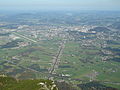 The Salzburg basin
 -
 The fortress (background), Salzburg Cathedral (middle), and the Salzach (foreground)
 -
 ÖBB rail connection to Salzburg in Innsbruck
 -
 Mozart monument
 -
 Fountain in the Residenzplatz
 -
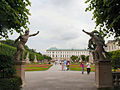
-
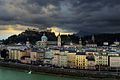 View of the old town and fortress, seen from Kapuzinerberg
 -
 Salzburg at night
.JPG)
_-_Mirabellgarten.jpg)


.JPG)
.JPG)


_cropped.jpg)


See also
[edit]Notes
[edit]- ^ English: /ˈsɔːltsbɜːrɡ/ SAWLTS-burg, also UK: /ˈsælts-/ SALTS-, US: /ˈsɔːlz-, ˈsɑːlz-, ˈsælz-/ SAWLZ-, SA(H)LZ-;[3][4][5][6] Austrian German: [ˈsaltsbʊrɡ], elsewhere [ˈzaltsbʊʁk] ⓘ.
- ^ Spelled "Salzpurch" in the earliest vita of Saint Boniface
References
[edit]- ^ "Dauersiedlungsraum der Gemeinden Politischen Bezirke und Bundesländer - Gebietsstand 1.1.2018" (in German). Statistics Austria. Retrieved 10 March 2019.
- ^ "Salzburg in Zahlen". Archived from the original on 24 June 2020. Retrieved 23 June 2020.
- ^ "Salzburg". Lexico UK English Dictionary. Oxford University Press. Archived from the original on 8 January 2020.
- ^ "Salzburg". Collins English Dictionary. HarperCollins. Archived from the original on 29 May 2019. Retrieved 29 May 2019.
- ^ "Salzburg". The American Heritage Dictionary of the English Language (5th ed.). HarperCollins. Retrieved 29 May 2019.
- ^ "Salzburg". Merriam-Webster.com Dictionary. Merriam-Webster. Retrieved 29 May 2019.
- ^ "Österreich – Größte Städte 2019". Statista (in German). Archived from the original on 3 March 2024. Retrieved 1 December 2019.
- ^ "National data". Federal Ministry Economy, Energy and Tourism, Republic of Austria. Retrieved 13 June 2025.
- ^ "Historisches Zentrum der Stadt Salzburg". Archived from the original on 14 June 2021. Retrieved 10 July 2021.
- ^ Hörburger, Franz (1982). Reiffenstein, Ingo; Ziller, Leopold (eds.). Salzburger Ortsnamenbuch [Toponyms of Salzburg] (in German) (Ingo ed.). Salzburg: Gesellschaft für Salzburger Landeskunde. pp. 32, 55.
- ^ Delehaye, Hippolyte (1911). . Encyclopædia Britannica. Vol. 23 (11th ed.). p. 856.
- ^ "St. Erentrude, Virgin, of Austria". Englewood, New Jersey: Antiochian Orthodox Christian Archdiocese of North America. Archived from the original on 19 August 2023. Retrieved 19 August 2023.
- ^ "Chronology of Catholic Dioceses: Austria". Norway: Roman Catholic Diocese of Oslo. Archived from the original on 19 August 2023. Retrieved 19 August 2023.
- ^ Euler, Bernd; Gobiet, Ronald; Huber, Horst R.; Juffinger, Roswitha (1986). Dehio Salzburg. Stadt und Land. Vienna: Verlag Anton Schroll & Co. p. 516.
- ^ Ingo Reiffenstein (1990). "Der Name Salzburgs Entstehung und Frühgeschichte" (PDF). Retrieved 17 April 2023.
- ^ "Salzburg Museum: Fortress Museum: Hohensalzburg Fortress". Retrieved 17 April 2023.
- ^ a b de Fabianis 2013, p. 167.
- ^ Heinz Dopsch; Hans Spatzenegger (1984). Geschichte Salzburgs (in German). Vol. I/1. Salzburg: Universitäts-Verlag Pustet. pp. 437–462. ISBN 3-7025-0197-5.
- ^ Euler et al. 1986, pp. 516f.
- ^ Peter Kramml; et al. (2002). Stadt Salzburg, Geschichte in Bildern und Dokumenten. Salzburg: Municipality of Salzburg. pp. 12–14. ISBN 3-901014-76-4.
- ^ Visit Salzburg, Salzburg's History: Coming a long Way Archived 11 November 2022 at the Wayback Machine.
- ^ Frank L. Perry Jr., Catholics Cleanse Salzburg of Protestants Archived 4 March 2016 at the Wayback Machine, The Georgia Salzburger Society.
- ^ Times Atlas of European History, 3rd ed., 2002
- ^ de Fabianis, Valeria, ed. (2013). Castles of the World. Metro Books. p. 168. ISBN 978-1-4351-4845-1.
- ^ "AEIOU Österreich-Lexikon – Konzentrationslager, KZ". Austria-Forum.org. Retrieved 24 June 2013.
- ^ Megargee, Geoffrey P. (2009). The United States Holocaust Memorial Museum Encyclopedia of Camps and Ghettos 1933–1945. Volume I. Indiana University Press, United States Holocaust Memorial Museum. pp. 538–539. ISBN 978-0-253-35328-3.
- ^ E.B. (26 September 2017). "The Salzburg Festival is a boon to the local economy". The Economist.
- ^ "Klimamittelwerte 1991–2020" (in German). Central Institute for Meteorology and Geodynamics. Archived from the original on 5 June 2023. Retrieved 5 June 2023.
- ^ "Klimamittel 1981–2010: Niederschlag" (in German). Central Institute for Meteorology and Geodynamics. Archived from the original on 29 December 2014. Retrieved 29 October 2019.
- ^ "Klimadaten von Österreich 1971–2000–Salzburg-Flughafen" (in German). Central Institute for Meteorology and Geodynamics. Archived from the original on 5 June 2023. Retrieved 5 June 2023.
- ^ "Station Salzburg" (in French). Météo Climat. Archived from the original on 9 August 2020. Retrieved 29 October 2019.
- ^ "Klimatafel von Salzburg (Flugh.), Salzburg / Österreich" (PDF). dwd (PDF file) (in German). Deutscher Wetterdienst. p. 1. Retrieved 16 February 2024.
- ^ "Salzburg Climate Normals for 1961-1990". ncei.noaa.gov (TXT). National Oceanic and Atmosoheric Administration. Retrieved 16 February 2024.
WMO Station Number: 11150
- ^ "Historic Censuses - STATISTICS AUSTRIA". Statistics Austria. Archived from the original on 2 August 2024. Retrieved 2 August 2024.
- ^ "Architecture : Salzburg Sights by Period". Visit-salzburg.net. Retrieved 12 March 2013.
- ^ [1] Archived 6 May 2012 at the Wayback Machine
- ^ "Preisträger Salzburg". Archived from the original on 30 June 2013.
- ^ "flow – der VERBUND Blog". Verbund.com. 15 October 2012. Archived from the original on 9 February 2013. Retrieved 12 March 2013.
- ^ "Red Bull's Hangar-7 at Salzburg Airport". Visit Salzburg. Retrieved 12 March 2013.
- ^ "fh-salzburg". Retrieved 13 August 2018.
- ^ . Encyclopædia Britannica. Vol. 20 (11th ed.). 1911.
- ^ . Encyclopædia Britannica. Vol. 3 (11th ed.). 1911. p. 849.
- ^ Otten, Joseph (1910). . Catholic Encyclopedia. Vol. 7.
- ^ Rockstro, W. S.; Tovey, Donald (1911). . Encyclopædia Britannica. Vol. 18 (11th ed.). pp. 949–953.
- ^ Völker, J. A. (1907). . Catholic Encyclopedia. Vol. 2.
- ^ "Joseph Mohr (1792–1848) Priest and author of Silent Night". stillenacht.com. Retrieved 20 June 2024.
- ^ . Encyclopædia Britannica. Vol. 20 (11th ed.). 1911.
- ^ . Encyclopædia Britannica. Vol. 17 (11th ed.). 1911. pp. 451–452.
- ^ . The New International Encyclopedia. Vol. VII. 1905.
- ^ "Theodor Herzl (1860–1904)". Jewish Agency for Israel. Archived from the original on 30 September 2009. Retrieved 8 August 2009.
He received a doctorate in law in 1884 and worked for a short while in courts in Vienna and Salzburg.
- ^ Klaaß, Daniel (2009). Untersuchungen zu ausgewählten Aspekten des Konsonantismus bei österreichischen Nachrichtensprechern. Frankfurt am Main: Peter Lang. p. 38. ISBN 9783631585399. Retrieved 27 June 2020.
- ^ Reitmeier, Simone. "Salzburg Mundart: Stirbt der Dialekt in naher Zukunft aus?". weekend.at. Weekend Online GmbH. Archived from the original on 24 September 2021. Retrieved 26 June 2020.
- ^ Winkler, Jacqueline (18 June 2020). "Dialekte in ihrer heutigen Form sterben aus". salzburg24. Salzburg Digital GmbH. Archived from the original on 28 June 2020. Retrieved 26 June 2020.
- ^ Pumhösel, Alois. "Germanist: 'Kinder vor Dialekt bewahren zu wollen ist absurd'". Der Standard. Vienna. Archived from the original on 26 June 2020. Retrieved 26 June 2020.
- ^ "Salzburger Städtepartnerschaften" (in German). Stadt Salzburg. Archived from the original on 29 May 2015. Retrieved 29 May 2015.
- ^ "Dresden — Partner Cities". Landeshauptstadt Dresden. Archived from the original on 16 October 2008. Retrieved 29 December 2008.
Bibliography
[edit]External links
[edit]
- Official website
 (in German)
 - Salzburg, Austria – Travel guide at salzburg.info
- Salzburg, Austria – Travel guide by locals at visit-salzburg.net
 Salzburg travel guide from Wikivoyage
- Tipping in Salzburg


 Cities and districts (Bezirke) of Salzburg State Cities and districts (Bezirke) of Salzburg State | ||
|---|---|---|
| Cities |  | |
| Districts | ||
 |  | ||
Salzburg
View on GrokipediaSalzburg is the capital city of the federal state of Salzburg in north-central Austria, located in a basin on both banks of the Salzach River near the border with Germany.[1] With a population of approximately 158,400 as of 2024, it ranks as the fourth-largest city in Austria by population.[1] Originally settled as the Roman town of Iuvavum, Salzburg developed into a powerful ecclesiastical principality under its prince-archbishops from the 8th century until secularization in 1803.[2]
The city is the birthplace of composer Wolfgang Amadeus Mozart, born there in 1756, and remains deeply associated with his legacy through museums and annual musical events.[3] Its historic center, exemplifying outstanding Baroque architecture and urban planning, along with the adjacent Hohensalzburg Fortress—the largest fully preserved castle in Central Europe, constructed starting in 1077—earned UNESCO World Heritage status in 1997.[4][5] Salzburg's economy relies heavily on tourism, bolstered by its preserved medieval and Baroque landmarks, and it hosts the prestigious Salzburg Festival, founded in 1920 by Hugo von Hofmannsthal, Max Reinhardt, and Richard Strauss as a leading international platform for opera, music, and drama.[6] The city's strategic location and cultural prominence have sustained its role as a hub for artistic exchange between northern and southern Europe throughout history.[7]
Etymology
Name derivation and historical usage
The name Salzburg derives from the Old High German terms salza ("salt") and burg ("fortress" or "castle"), literally meaning "salt fortress," in reference to the region's ancient salt deposits and the strategic fortifications overlooking the salt trade routes along the Salzach River, where barges transported the commodity from nearby mines.[8][9] The etymology underscores the economic centrality of salt extraction and commerce, which fueled the area's prosperity from prehistoric times through the early medieval period, with evidence of salt production dating back to Celtic settlements before Roman occupation.[10] The earliest documented reference to the name Salzburg appears in 755 AD, during the consolidation of the Bavarian March of the East under Carolingian rule.[8] Prior to this, the site was known as the Roman municipium Iuvavum, founded circa 15 BC as a key Noricum province center for trade, including salt, and abandoned after the empire's decline around 488 AD.[8][11] Saint Rupert of Salzburg (c. 660–710 AD), who established the bishopric and Benedictine Abbey of St. Peter around 696–700 AD at the ruins of Iuvavum, contributed to the site's revival as a Christian center, though the Germanic name Salzburg—first attested in hagiographic texts like an 8th-century biography possibly linked to Bishop Virgil—emerged amid the transition from Latin to vernacular usage in the post-Roman era.[11][9] In medieval Latin documents, variations such as Salsburgum or Salczburc appear, reflecting phonetic adaptations while retaining the salt-fortress connotation, with consistent usage by the 9th century in Carolingian charters denoting the emerging ecclesiastical principality.[8] The name persisted unchanged through the Holy Roman Empire, symbolizing the archbishops' control over salt revenues that funded fortifications like Hohensalzburg, begun in 1077, despite the fortress postdating the name's origin.[8] Modern German spelling standardized Salzburg by the early modern period, with no significant alterations in official records.[10]Geography
Physical setting and topography
Salzburg lies at coordinates 47°48′N 13°03′E in northern Austria, adjacent to the German border and within the Salzburg Basin at the northern fringe of the Eastern Alps.[12] The city encompasses 65.7 km² and sits at an average elevation of 430 meters above sea level along the Salzach River, a 225 km-long waterway originating in the High Tauern range and flowing northward through the urban area, dividing it into western (left-bank) and eastern (right-bank) districts.[1][13][14] The topography consists of a constricted valley floor in the Salzach Valley, hemmed in by precipitous limestone formations of the Northern Limestone Alps, with abrupt rises to forested hills that define the city's silhouette. Key features include the Mönchsberg, a sheer cliffed plateau ascending to roughly 500 meters that borders the old town to the south, the opposing Kapuzinerberg reaching 640 meters on the right bank, and the Festungsberg spur at 542 meters, which supports the Hohensalzburg Fortress and protrudes into the river plain.[15][16][17] These Stadtberge, or city mountains, create a rugged, compartmentalized terrain that has historically channeled development along the river and onto terraced slopes, while providing natural defenses and panoramic vistas over the basin.[18]Climate patterns and environmental factors
Salzburg features a warm-summer humid continental climate (Köppen Dfb), marked by distinct seasons with cold, snowy winters and mild to warm summers, influenced by its position in the Alpine foothills.[19] The city's average annual temperature is approximately 8°C (46°F), with July as the warmest month averaging highs of 24°C (75°F) and lows of 14°C (57°F), while January sees average highs of 2°C (36°F) and lows of -4°C (25°F).[20] Monthly averages are summarized in the following table:[20]| Month | Avg. Max. Temp. (°C) | Avg. Temp. (°C) | Avg. Min. Temp. (°C) | Precipitation (mm) | Snowfall (cm) |
|---|---|---|---|---|---|
| January | 2 | -1 | -4 | 46 | 9 |
| February | 5 | 1 | -3 | 43 | 8 |
| March | 10 | 5 | 1 | 61 | 4 |
| April | 14 | 9 | 4 | 64 | 1 |
| May | 19 | 14 | 9 | 99 | 0 |
| June | 22 | 17 | 12 | 132 | 0 |
| July | 24 | 19 | 14 | 137 | 0 |
| August | 23 | 19 | 14 | 127 | 0 |
| September | 19 | 15 | 10 | 97 | 0 |
| October | 14 | 10 | 6 | 66 | 1 |
| November | 8 | 4 | 1 | 53 | 4 |
| December | 3 | 1 | -2 | 48 | 7 |
History
Pre-Roman and Roman periods
The Salzburg region exhibits evidence of human settlement dating back to the Mesolithic period, with more substantial prehistoric activity during the Neolithic and Bronze Ages, including mining and burial sites.[27] By the Iron Age, specifically the Hallstatt and La Tène cultures from approximately 800 BC onward, Celtic tribes dominated the area, establishing it as part of the Kingdom of Noricum, a confederation of Celtic groups controlling much of modern Austria.[28] Archaeological findings, such as fortified hill settlements (oppida) and extensive salt extraction tunnels at Dürrnberg near Hallein—reaching depths of 280 meters and lengths up to 4.5 kilometers—demonstrate Celtic economic reliance on salt production, which facilitated trade across Europe as early as 600 BC.[29] The specific site of modern Salzburg served as an administrative center for the Celtic Alums tribe within Noricum, featuring smaller settlements rather than a unified urban center prior to Roman influence.[28] Roman expansion into Noricum began peacefully through alliances but culminated in conquest in 15 BC under generals Tiberius and Drusus, incorporating the region as a Roman province.[2] The Romans established the settlement of Iuvavum on the left bank of the Salzach River, overlaying and expanding existing Celtic sites into a structured municipality by around 45 AD, when it was granted the status of Municipium Claudium Iuvavum with significant self-governance and jurisdiction over surrounding territories larger than modern Salzburg Province.[30] Iuvavum functioned as a key provincial center, benefiting from its strategic position on trade routes and the Salzach waterway, with infrastructure including forums, baths, and a peripteral temple identified through postwar excavations in the old city area.[31] Archaeological evidence underscores Iuvavum's prosperity during the 1st to 4th centuries AD, revealing dense Roman occupation with villas, mosaics, and artifacts indicative of a population blending Roman settlers, veterans, and locals; recent digs have uncovered a 2nd- or 3rd-century villa and a rare bronze ship's prow decoration from circa 225 AD, the largest such Roman artifact found in Salzburg since systematic excavations began.[32][33] The settlement endured barbarian incursions but declined sharply after the Roman withdrawal from Noricum around 488 AD, with many structures abandoned or repurposed amid the collapse of provincial administration.[34]Medieval foundations and ecclesiastical rule
Salzburg's medieval foundations originated in 696, when Bishop Rupert of Worms, dispatched by Bavarian Duke Theodo II, established a Benedictine monastery on the ruins of the Roman city Juvavum, initiating Christian settlement and exploiting local salt deposits for economic sustenance. Rupert, serving as the inaugural bishop until his death in 718, also founded Nonnberg Abbey, the world's oldest continuously operating nunnery, thereby embedding ecclesiastical institutions at the city's core.[35][2] The bishopric gained formal diocesan status in 739 under St. Boniface's reorganization of Bavarian sees, with Bishop Virgil (consecrated circa 749) overseeing expansion, including the construction of an early cathedral and missionary outreach to Carantania (modern Carinthia). By the late 8th century, the see's influence prompted its elevation: in 798, Pope Leo III consecrated Bishop Arno as the first archbishop, conferring metropolitan jurisdiction over eastern Bavaria, Pannonia, and Noricum, which solidified Salzburg's role in Carolingian ecclesiastical administration.[30][36] Ecclesiastical rule evolved into a hybrid spiritual-temporal principality, where archbishops wielded sovereign authority over territories granted by dukes and emperors, managing justice, taxation, and defense independent of secular nobility. This dual power intensified during the 11th-century Investiture Controversy; Archbishop Gebhard I (r. 1060–1088), aligning with papal reformers against Emperor Henry IV, initiated construction of Hohensalzburg Fortress in 1077 as a bulwark against imperial incursions, fortifying the archbishops' military autonomy despite Gebhard's temporary exile.[37][35] Throughout the High Middle Ages, successive prince-archbishops expanded the city's fortifications, monasteries, and trade networks, leveraging Salzburg's strategic Alpine position and salt revenues to assert influence within the Holy Roman Empire, often mediating between imperial and papal interests while suppressing local heresies and pagan remnants. By the 13th century, archbishops like Eberhard II secured formal imperial prince status in 1213, entrenching the ecclesiastical state's autonomy until secularization centuries later.[35][30]Prince-archbishopric and absolutist governance
![Festung Hohensalzburg von Nordost.jpg][float-right] The Prince-Archbishopric of Salzburg functioned as an ecclesiastical principality within the Holy Roman Empire, where the archbishops wielded supreme spiritual and secular authority, achieving imperial immediacy by the late 13th century and consolidating absolutist control over the territory by the 16th century.[38] The state was administratively divided into five districts, or Gaue—Flachgau, Tennengau, Pinzgau, Pongau, and Lungau—facilitating centralized oversight of taxation, mining, and judicial matters, with the archbishop's court serving as the primary employer and enforcer of policy.[38] This structure enabled direct rule from the Hohensalzburg Fortress, initially constructed in 1077, which symbolized and buttressed the prince-archbishops' autocratic dominion.[30] Absolutist tendencies intensified under Cardinal Matthäus Lang (r. 1519–1540), who promulgated the Municipal and Police Regulations in 1524, codifying comprehensive control over urban life, economy, and order that persisted until secularization in 1803; these edicts curtailed prior municipal autonomy granted in 1481 and revoked in 1511 by his predecessor Leonhard von Keutschach.[30] Lang's tenure faced challenges, including the 1525 Peasants' War siege of the fortress, yet reinforced ecclesiastical sovereignty amid emerging Protestant threats, exemplified by his introduction of Saxon miners to bolster salt production, the economic backbone derived from the Salzkammergut deposits.[30] [38] Wolf Dietrich von Raitenau (r. 1587–1612) epitomized despotic rule, expelling Protestants in 1588 to enforce Counter-Reformation orthodoxy and initiating ambitious Baroque urban renewal, including the construction of Mirabell Palace (as Altenau) in 1606 and cathedral reconstruction, often razing civilian structures to impose princely visions aligned with emerging absolutist principles.[30] [39] His tenure, marked by nepotism and conflict with Bavaria, ended in excommunication and imprisonment by his successor, underscoring the unchecked personal authority of the office.[39] Successors like Paris Lodron (r. 1619–1653) sustained absolutism through defensive fortifications amid the Thirty Years' War, preserving neutrality and founding the Benedictine University in 1622–1623 to cultivate loyal elites, while later rulers such as Leopold Anton von Firmian (r. 1738–1744) exemplified confessional absolutism by expelling approximately 30,000 Lutheran subjects in 1731–1732, depopulating rural areas to uphold Catholic uniformity.[30] [38] This era's governance prioritized ecclesiastical ideology over local autonomies, with the prince-archbishops maintaining private armies, independent courts, and monopolies on salt and gold, fostering a resilient clerical state until Napoleonic secularization dismantled it in 1803.[38] ![Palatul Mirabell1.jpg][center]Napoleonic secularization and 19th-century transformations
In 1803, amid the Napoleonic reconfiguration of German states through the Reichsdeputationshauptschluss, the Prince-Archbishopric of Salzburg was secularized, terminating centuries of ecclesiastical sovereignty. Prince-Archbishop Hieronymus von Colloredo, who had fled to Vienna, formally resigned on February 11, yielding temporal authority over the territory, which was reconstituted as the Electorate of Salzburg under Ferdinand III, the displaced Grand Duke of Tuscany and brother to Holy Roman Emperor Francis II.[38][35] This process dismantled the archbishops' dual spiritual and secular rule, redistributing church lands and assets while aligning Salzburg with broader secular reforms across former ecclesiastical principalities.[8] The electorate proved ephemeral, annexed by Bavaria following Napoleon's victory at Austerlitz in December 1805, which prompted Austria's concessions in the Peace of Pressburg. Salzburg briefly reverted to Austrian control in 1809 after the Tyrolean Rebellion and Austrian advances, but Bavarian restoration occurred post-Wagram, with the territory oscillating amid wartime diplomacy until the Congress of Vienna. On May 1, 1816, the Treaty of Munich definitively transferred Salzburg to the Austrian Empire, excluding Rupertigau and Berchtesgaden, which remained Bavarian, integrating it as a district initially under Upper Austria before elevation to duchy status in 1849.[40][2] Under Habsburg administration from 1816, Salzburg experienced initial economic stagnation and depopulation, exacerbated by postwar disruptions and the 1816 "Year Without a Summer" famine, which halved agricultural yields and prompted emigration. The city's Baroque grandeur, emblematic of its princely past, faded as monastic institutions declined and administrative centralization from Vienna curtailed local autonomy, fostering a shift toward bourgeois norms over ecclesiastical pomp. Religious tolerances expanded post-secularization, enabling Protestant worship; the Lutheran Christuskirche was constructed in the 1860s, reflecting eased confessional restrictions absent under prior archiepiscopal rule.[41][8][42] Revitalization accelerated late in the century, with salt extraction, timber trade, and agriculture sustaining the economy alongside nascent tourism drawn to Mozart's legacy and Alpine scenery. Infrastructure advancements, including rail links to Vienna and Munich by the 1860s, enhanced connectivity, spurring modest industrialization in textiles and metalworking while preserving Salzburg's role as a cultural hub within the Austro-Hungarian framework. Population stabilized around 30,000 by 1900, underscoring gradual recovery without the prosperity of its independent era.[2][41]World Wars, annexation, and mid-20th-century upheavals
During World War I, Salzburg endured economic hardships and food shortages characteristic of Austria-Hungary's home front. In September 1918, amid acute hunger, riots erupted as crowds attacked the government palace, leading to clashes with authorities where strikers were bayoneted and several shot, prompting a state of siege.[43][44] These events reflected broader unrest from wartime privations, with looting reported shortly before the war's end.[45] The interwar period saw political instability in the new Austrian republic, culminating in the Anschluss on March 12, 1938, when German troops entered Austria unopposed, incorporating Salzburg into the Third Reich as the Reichsgau Salzburg.[46] Local Nazi supporters greeted the arrival enthusiastically, aligning the city with Nazi governance and ideology.[47] In World War II, Salzburg served as a regional administrative center under Nazi control, with its Jewish population targeted after the 1938 annexation, including synagogue destruction and deportations. From October 1944, Allied air raids intensified, with fifteen strikes primarily targeting rail yards and infrastructure, killing 547 civilians, damaging or destroying 46% of buildings—including the cathedral—and affecting over 7,600 houses.[48][47] On May 4, 1945, city officials surrendered Salzburg intact to advancing U.S. forces without combat, with many residents viewing them as liberators.[49] Postwar upheavals under U.S. occupation (1945–1955) included denazification, where over 33,000 former NSDAP members in Salzburg province—nearly 13,000 in the city—were registered and processed, with higher-ranking officials interned at Camp Glasenbach.[49] The city hosted over 66,000 displaced persons across more than 15 camps, straining resources amid housing shortages from over 1,000 damaged or destroyed structures.[49] American aid provided over 50% of food rations in 1947, supporting reconstruction efforts bolstered by the Marshall Plan.[49][8] The Salzburg Festival resumed in August 1945, signaling cultural revival, while November 1945 elections saw 90% turnout among 40,932 voters, with the Social Democrats securing 51.1% amid Austria's path to the 1955 State Treaty restoring sovereignty.[49]Postwar reconstruction and late 20th-century growth
Following the unconditional surrender of Nazi Germany on May 8, 1945, Salzburg was transferred to U.S. forces on May 4 without resistance, marking the end of hostilities in the city and its incorporation into the American occupation zone alongside Upper Austria and parts of Carinthia.[49] The city experienced relatively limited physical destruction compared to industrial centers like Vienna or Linz, with the historic core largely spared from bombing; reconstruction efforts thus prioritized infrastructure repair, housing shortages exacerbated by refugees, and economic stabilization under Allied oversight.[50] U.S. military administration facilitated initial aid distribution, including food and medical supplies, while implementing denazification processes that screened over 10,000 local officials and led to the removal of Nazi sympathizers from public roles.[50] The presence of displaced persons (DPs) camps, concentrated heavily in the Salzburg province—the highest density in former Nazi-occupied Austria—shaped early postwar demographics and labor dynamics, with facilities housing up to 20,000 individuals, including Jewish survivors who reestablished communities and institutions between 1945 and 1951.[51] American aid programs, complemented by the European Recovery Program (Marshall Plan) from 1948, injected approximately $1 billion into Austria overall, enabling Salzburg to restore utilities, roads, and cultural venues; the Salzburg Festival, interrupted by the war, resumed in 1945 under U.S. auspices, signaling a return to prewar traditions.[52] By the Austrian State Treaty of 1955, which ended occupation and restored full sovereignty, basic reconstruction was complete, with the U.S. forces withdrawing after investing in local governance and vocational training to foster self-sufficiency.[50] Post-independence economic expansion propelled Salzburg's growth, aligning with Austria's national average annual GDP increase exceeding 5% in the 1950s, driven by export-oriented industries and service sectors.[53] Tourism emerged as a cornerstone, bolstered by the city's UNESCO-listed Altstadt and events like the expanded Salzburg Festival, which constructed the Grosses Festspielhaus in 1960 to accommodate surging attendance.[54] The 1965 release of The Sound of Music, filmed in Salzburg locations, catalyzed international visitor numbers, rising from under 1 million annually in the early 1960s to over 5 million by the 1980s, generating substantial revenue and employment in hospitality.[55] Into the late 20th century, Salzburg's population in the surrounding Land grew dynamically—from 257,000 in 1939 to approximately 326,000 by 1951 (+27%) and 482,000 by the 1980s—fueled by internal migration and tourism-related jobs, though the city proper stabilized around 140,000 residents by 1991 amid suburban expansion.[56] Infrastructure investments, including airport modernization in the 1970s and university enrollment tripling to over 15,000 students by 1990, supported diversification beyond tourism into education and light manufacturing.[54] By the 1990s, per capita GDP in Salzburg reached about €46,100 (adjusted), surpassing national averages and reflecting sustained prosperity, though strains from overtourism prompted early zoning measures to preserve heritage sites.[53]21st-century developments and challenges
In the early 21st century, Salzburg experienced robust economic expansion driven primarily by tourism, which accounts for a significant portion of the local GDP and attracts millions of visitors annually to events like the Salzburg Festival. The city's regional economy grew at the highest rate in Austria in 2022, fueled by post-pandemic recovery in services and tourism, with catch-up effects leading to strong performance in hospitality and cultural sectors.[57] Infrastructure developments included the modernization of Salzburg Central Station as part of a major national rail investment program, enhancing connectivity and urban mobility.[58] By 2025, the city adopted a Sustainable Urban Mobility Plan 2040 aimed at reducing emissions through efficient transport systems and promoting greener commuting options.[59] Population growth remained modest, rising from approximately 143,000 in 1991 to an estimated 152,675 in 2025, reflecting steady urbanization amid regional migration patterns.[60] Key challenges emerged from overtourism, which generates about one billion euros annually but strains residential areas through visitor overcrowding, noise, and intrusions into private spaces, positioning Salzburg among Europe's most affected destinations.[61][62] Efforts to manage this include visitor management strategies to balance economic benefits with livability, though platform economies like Airbnb have exacerbated housing pressures by favoring short-term rentals.[63][64] High housing costs pose a barrier to business retention and affordability, with rapid population increases projected to widen demand-supply gaps, particularly in urban densification projects over the past 25 years.[65][66] Migration presents ongoing integration hurdles, with Austria's federal integration report highlighting difficulties in refugee assimilation, including labor market access and social cohesion, amid over 59,000 asylum applications nationally in recent years.[67] In Salzburg, local authorities have advocated for stricter policies in response to perceived strains on infrastructure and community relations, as four in ten residents report coexistence issues linked to demographic shifts.[68] Environmental pressures compound these, with climate change ranked as a top national concern after cost-of-living and migration, prompting initiatives for sustainable tourism and adaptation measures.[69] Investments in green projects, such as Salzburg AG's 1.7 billion euro commitment to renewables and efficiency, aim to mitigate these while supporting long-term resilience.[70]Demographics
Historical population dynamics
The population of Salzburg exhibited modest growth during the 19th century, rising from 9,416 in 1800 to 34,400 by 1900, driven by gradual industrialization and integration into the Austrian Empire following the end of ecclesiastical rule.[71] This period saw limited expansion compared to larger industrial centers, constrained by the city's reliance on trade, salt extraction, and emerging tourism rather than heavy manufacturing. By 1910, the figure reached 41,707, reflecting incremental urbanization and infrastructure improvements.[71] Significant acceleration occurred in the interwar and immediate postwar eras. Annexations of surrounding municipalities in 1935 and 1939 substantially enlarged the city's administrative boundaries, boosting the population to approximately 77,000 by 1939.[60] From 1939 to 1951, numbers surged 33.4% to nearly 103,000, primarily attributable to wartime displacements, refugee inflows, and postwar resettlement in Austria, which was relatively spared direct combat but hosted displaced persons camps.[60] Subsequent decades featured steadier increases, supported by economic recovery, tourism expansion, and net positive migration. The population stood at 143,978 in 1991 and grew to 154,604 by 2021, with estimates reaching 157,659 in 2025.[60][72][73] Growth rates moderated after the 1950s, influenced by a shift toward service sectors and balanced by out-migration to larger economic hubs, though inbound labor migration sustained modest gains.[60]| Year | Population |
|---|---|
| 1800 | 9,416 |
| 1900 | 34,400 |
| 1910 | 41,707 |
| 1920 | 45,109 |
| 1939 | ~77,000 |
| 1951 | ~103,000 |
| 1991 | 143,978 |
| 2021 | 154,604 |
| 2025 (est.) | 157,659 |
Current composition and migration patterns
As of 1 October 2025, Salzburg's resident population totaled 158,767 individuals, comprising 76,473 males and 82,294 females.[74] This reflects modest annual growth, primarily driven by net positive international migration rather than natural increase, consistent with broader Austrian trends where immigration accounts for over 90% of population expansion in recent years.[75] Citizenship composition shows Austrians forming the majority at approximately 72.2%, followed by 12.1% from EU/EEA countries and Switzerland, and 15.7% holding other nationalities.[60] The foreign national share in Salzburg aligns closely with the state level of 20.8% reported for 2024, though urban centers like the city exhibit slightly higher concentrations due to economic pull factors.[76] Among non-Austrians, Germans constitute the largest group nationally and regionally, drawn by proximity and labor mobility under EU rules, while significant cohorts originate from Bosnia and Herzegovina, Serbia, and Romania, reflecting historical Balkan ties and post-2004 EU eastward enlargement effects.[67] Migration patterns feature sustained inflows for work in tourism, hospitality, and services—sectors employing over 20% of the local workforce—alongside student enrollment at institutions like the University of Salzburg, which hosts thousands of international enrollees annually.[77] Net migration rates in the Salzburg region reached 13.2 per mille in recent assessments, the highest among Austrian states, fueled by EU free movement and non-EU labor permits, though outflows include skilled Austrians relocating to larger metros like Vienna or abroad.[78] The share of foreign-born residents has risen by 2.5 percentage points over the past five years, with over half of this group arriving from EU states, underscoring economic integration over asylum-driven migration in the post-2015 period.[79]Religious affiliations and cultural shifts
Salzburg's religious landscape has long been shaped by Roman Catholicism, established as a bishopric in 739 and elevated to an archbishopric in 798, with the prince-archbishops wielding temporal power until secularization in 1803.[80] This ecclesiastical rule enforced Catholic uniformity, suppressing Protestantism during the Reformation and culminating in the expulsion of approximately 20,000 to 21,000 Lutheran adherents between 1731 and 1732 under Archbishop Leopold Anton von Firmian, who issued an edict on October 31, 1731, mandating recantation or exile.[81][82] The deportations, primarily affecting peasants from the Pongau region, represented the largest religious expulsion in early modern Europe, dispersing exiles to Prussia, Georgia, and beyond, thereby reinforcing Salzburg's Catholic homogeneity.[83] In the contemporary era, Catholicism remains the predominant affiliation within the Archdiocese of Salzburg, encompassing the city and surrounding areas, where 430,108 Catholics comprised about 55.9% of the 769,823 residents as of December 31, 2023.[84] This figure reflects a national pattern of decline, with Austria's Catholic share falling from 87.4% in 1971 to 55.2% in 2021, driven by formal exits and non-renewal of church taxes. Protestant communities, historically marginalized, constitute around 3.8% nationally, with minimal presence in Salzburg beyond small evangelical groups. Jewish affiliation is negligible post-Holocaust, though a revived community maintains facilities like a mikveh.[85] Migration since the 1990s has introduced Eastern Orthodoxy and Islam as growing minorities, mirroring national figures of 4.9% Orthodox and 8.3% Muslim adherents in 2021. In Salzburg, Balkan inflows from Bosnia, Serbia, and Romania—evident in the presence of flags representing these origins—have bolstered Orthodox congregations, including the Russian Orthodox Church of Maria Schutz, while Turkish and other Muslim communities support centers like the Al-Noor Mosque and Islamic Cultural Center.[86] These developments signify diversification, with new places of worship accommodating non-Catholic rituals amid a traditionally Catholic-built environment. Cultural shifts toward secularism are pronounced, evidenced by low church engagement: nationally, Sunday Mass attendance hovered at 4.1% of the population in 2023, with 85,163 formal exits recorded that year.[87] In Salzburg, prosperity, higher education, and clerical abuse scandals have accelerated disaffiliation, transforming religious identity from obligatory practice to nominal or cultural heritage—manifest in Baroque churches, processions, and festivals rather than doctrinal adherence. Concurrently, immigration fosters pluralism, introducing halal markets, Orthodox liturgies, and interfaith dialogues, though integration challenges persist in a city where Catholic architectural dominance visually underscores historical continuity amid demographic flux.[88]Economy
Industrial base and employment sectors
Salzburg's employment landscape is characterized by a high concentration in the tertiary sector, which accounts for approximately 80% of jobs in the Salzburg region, encompassing tourism, trade, and other services, while the secondary sector, including manufacturing and construction, comprises about 20%. The overall employment rate in Salzburg reached 78.1% in 2023, among the highest in Austria, reflecting a robust labor market despite national economic challenges. Number of jobs in the region grew by 1.4% in 2023, driven partly by service expansions but with manufacturing contributing to diversification.[89][90][91] The industrial base focuses on manufacturing in mechanical engineering, automotive components, electronics, and food processing, supporting regional value chains integrated with Austria's export-oriented economy. Notable firms include PALFINGER AG, headquartered near Salzburg, which specializes in hydraulic cranes and lifting equipment, employing thousands in production and assembly. Red Bull GmbH, based in the Salzburg area, drives beverage manufacturing and logistics, contributing to food industry output. Other sectors involve metalworking and electrotechnical production, with companies like Porsche Holding engaging in automotive distribution and related manufacturing activities. These industries benefit from proximity to Central European supply networks but face pressures from global competition and energy costs.[92][93][94] Employment in manufacturing has shown resilience, with growth noted in 2022 amid broader industrial slowdowns, though it remains secondary to services in scale. The sector employs skilled labor in engineering and assembly, often linked to vocational training programs, and contributes to Salzburg's GDP through exports, particularly in machinery and vehicles. Challenges include a shrinking national manufacturing base, with Austria's industrial employment at 25.72% overall in 2023, but Salzburg's niche strengths in high-value goods sustain competitiveness.[57][95][96]Tourism dominance, contributions, and strains
![View from Getreidegasse, a major tourist street in Salzburg][float-right] Tourism constitutes a dominant sector in Salzburg's economy, generating substantial value through visitor expenditures on accommodations, festivals, and cultural sites. In recent analyses, the total value-added effects of tourism account for 15.9% of the regional economic output, encompassing direct and indirect contributions from hospitality, retail, and related services.[97] This sector supported approximately 34,000 full-time equivalent jobs in Salzburg, representing a significant portion of local employment amid a regional labor force of around 48,600 workers.[97][98] The influx of tourists underscores Salzburg's appeal as a cultural hub, with the city recording 3.201.328 overnight stays and 1.776.539 arrivals in 2023, figures approaching pre-pandemic levels from 2019.[99] Key draws include the UNESCO-listed Old Town, Mozart heritage sites, and annual events like the Salzburg Festival, which amplify seasonal peaks and sustain year-round activity. The Salzburg Card, a pass offering free entry to numerous attractions and museums as well as free public transport, facilitates exploration for tourists.[100] Post-COVID recovery has been robust, with tourism driving 7.7% growth in accommodation and food services in 2023, bolstering overall regional GDP expansion.[90] These contributions extend to infrastructure investments and tax revenues that fund public services, though they remain concentrated in service-oriented industries rather than diversified manufacturing. Despite economic benefits, tourism imposes strains on local resources and quality of life. Overcrowding in the historic core has led to resident complaints about congested streets, noise, and diminished livability, prompting the mayor to declare "Enough!" in response to infrastructure overload.[101] Mass visitation exacerbates traffic pressures and challenges preservation efforts at the UNESCO site, where urban development and mobility demands conflict with heritage integrity.[102] The proliferation of short-term rentals, including Airbnb listings often managed by local commercial operators, has inflated housing costs and displaced long-term residents from central areas.[64] These dynamics highlight tensions between economic reliance on visitors—outnumbering locals during peaks—and sustainable urban management, with calls for regulatory measures to mitigate resident-tourist frictions.Government and administration
Local governance structure
Salzburg functions as a statutory city (Statutarstadt) within Austria's federal system, granting it enhanced administrative autonomy comparable to that of a district while adhering to the principles of municipal self-governance outlined in the Salzburg Municipal Code of 1994. The legislative authority resides with the Gemeinderat, the city council composed of 40 members directly elected by proportional representation for five-year terms, with the most recent election held on 10 March 2024. This body holds sessions to enact local ordinances, approve the annual budget—totaling approximately €1.2 billion in 2024—and supervise executive actions, ensuring accountability in areas such as urban planning, public services, and fiscal policy.[103][104] Executive leadership is provided by the Bürgermeister, elected separately by popular vote in a direct runoff system if no candidate secures a majority in the initial round, serving as the head of both the political executive and the administrative apparatus. Bernhard Auinger of the Social Democratic Party of Austria (SPÖ) assumed office on 8 May 2024 following his victory in the mayoral runoff against Kay-Michael Dankl of the Communist Party of Austria (KPÖ). The Bürgermeister presides over the Kollegium des Stadtrats, an executive collegium comprising the mayor and up to seven Stadträte (city councilors), each assigned to oversee specialized departments including culture and education (led by a Stadtrat), social affairs, finance, and infrastructure. These officials are elected by the Gemeinderat and manage policy implementation while remaining answerable to it.[105][106][107] The operational administration, known as the Magistrat, supports this structure through the Magistratsdirektion (executive directorate) and 20 specialized Magistratsabteilungen (departments), handling routine functions such as public utilities, waste management, and civil registry. For instance, Magistratsabteilung 1 addresses general and district administration, while Abteilung 4 focuses on finances. The city is subdivided into six Bürgerbezirke (citizen districts)—Altstadt-Leopoldskron, Maxglan-Gneis, Morzg, Parsch, Riedenburg, and Nonntal—each with advisory district committees that provide input on local issues but lack binding legislative power. This tiered setup balances centralized decision-making with community representation, though coordination with the state government (Land Salzburg) occurs for overlapping competencies like regional transport.[108][109][110]Political orientation and policies
The municipal government of Salzburg is headed by Mayor Bernhard Auinger of the Social Democratic Party of Austria (SPÖ), who assumed office following a runoff election victory on March 24, 2024, with 52.3% of the vote against the Communist Party of Austria (KPÖ) candidate Kay-Michael Dankl.[105] Auinger's election marked a shift from decades of center-right Austrian People's Party (ÖVP) dominance under predecessor Harald Preuner, who retired in 2024 after serving since 2004.[111] The 40-seat city council, elected on March 10, 2024, reflects a left-leaning orientation, with SPÖ securing 11 seats (28.2% vote share), KPÖ Plus 10 seats (25.5%), ÖVP 8 seats (20.4%), the Citizens' List 5 seats, Freedom Party (FPÖ) 4 seats, NEOS 1 seat, and Salzburg List (SALZ) 1 seat; a SPÖ-KPÖ coalition governs, prioritizing social welfare amid voter frustration with housing affordability.[112][113] This configuration contrasts with the state-level ÖVP-FPÖ coalition, highlighting urban-rural divides where city voters, facing high living costs, favored anti-establishment left-wing platforms over traditional conservatism.[114] Key policies under the Auinger administration emphasize resolving the housing crisis, which fueled the KPÖ's surge as a protest vote against soaring rents and property prices driven by tourism and limited supply; Auinger has pledged expanded social housing initiatives and regulatory measures to curb speculation, building on pre-election SPÖ proposals for 1,000 new affordable units annually.[115][116] In tourism management—a sector generating over 20% of local GDP but straining infrastructure—the city continues efforts to limit day-trippers (who comprise two-thirds of visitors) through incentives for overnight stays, caps on coach arrivals, and sustainable strategies outlined in the 2030 Tourism Plan, aiming to balance economic benefits with resident quality of life.[117][118] Environmental policies focus on achieving climate neutrality by 2040, formalized in a May 2023 council decision and reinforced post-election with commitments to expand green spaces, promote electric mobility, and reduce emissions from tourism traffic, though implementation faces challenges from heritage preservation constraints in the UNESCO-listed old town.[119] Urban development policies integrate these goals with cultural preservation, including visitor management systems to mitigate overtourism impacts on landmarks, while fiscal conservatism tempers expansive spending amid Austria's broader economic pressures.[63] Overall, the orientation prioritizes social equity and sustainability over deregulation, reflecting empirical voter priorities in a high-cost alpine hub rather than ideological dogma.[120]Architecture and urban development
Romanesque, Gothic, and Renaissance elements
Salzburg's Romanesque architecture dates primarily to the 11th and 12th centuries, reflecting the city's role as an ecclesiastical center under the Prince-Archbishops. The Fortress Hohensalzburg, initiated in 1077 by Archbishop Gebhard amid conflicts with Emperor Henry IV, exemplifies early Romanesque fortifications with its robust stone walls and strategic hilltop placement for defense.[37] St. Peter's Abbey Church, constructed between 1130 and 1143, features characteristic Romanesque elements such as rounded arches and a basilica plan, serving as a foundational monastic structure in the medieval city.[121] Nonnberg Abbey, founded around 714 but with surviving Romanesque wall paintings from circa 1100 and a chapel from 1170, preserves early medieval ecclesiastical forms amid later alterations.[122] [123] Gothic influences emerged from the 13th century, blending with Romanesque bases in many structures due to Salzburg's gradual architectural evolution rather than wholesale replacements. The Franciscan Church, established in 1223, incorporates a Romanesque basilica nave with a late Gothic hall choir, demonstrating transitional styles adapted for urban worship spaces.[124] Hohensalzburg saw Gothic expansions in the 15th century under Archbishops like Burkhard II von Weisspriach, adding taller towers and refined defensive features to counter advancing artillery.[37] St. Peter's Abbey integrates Gothic vaults and chapels overlaid on its Romanesque core, with remodelings continuing into later periods.[125] Nonnberg Abbey's church received Gothic modifications around 1420, including ribbed vaults that enhanced interior height and light.[123] These elements contributed to Salzburg's dense medieval urban fabric, as noted in UNESCO assessments of the historic center's Gothic-era buildings forming a cohesive townscape.[4] Renaissance architecture in Salzburg remains sparse and transitional, overshadowed by the dominant Baroque developments under the Prince-Archbishops from the late 17th century. While some early 16th-century additions to Hohensalzburg, such as refined residential quarters, hint at Renaissance symmetry and proportion, these were limited and soon eclipsed by Italianate Baroque influences from Rome.[37] No major standalone Renaissance edifices survive prominently, as the city's architectural focus shifted toward opulent princely commissions rather than classical revivals, with Gothic persistences in ecclesiastical contexts until Baroque overhauls.[126] This scarcity underscores Salzburg's causal trajectory as a Catholic stronghold prioritizing Counter-Reformation grandeur over humanistic Renaissance ideals prevalent in Italian city-states.[4]Baroque prominence and princely legacy
Salzburg's Baroque architectural prominence emerged during the late 16th to 18th centuries under the rule of Prince-Archbishops, who wielded combined spiritual and temporal authority as independent princes within the Holy Roman Empire.[35] These rulers, drawing revenue from the lucrative salt trade, financed extensive urban transformations to assert Catholic orthodoxy amid the Counter-Reformation, modeling the city after Roman ideals of grandeur and piety.[126] The style's introduction reflected causal influences from Italian precedents, imported by archbishops educated in Rome and employing Lombard and Roman architects, resulting in a cohesive Baroque skyline of domes, palaces, and churches that symbolized princely absolutism.[127] Prince-Archbishop Wolf Dietrich von Raitenau (r. 1587–1612) initiated this era, commissioning early Baroque projects inspired by his Roman training and Counter-Reformation zeal, including the expulsion of Protestants in 1589 to enforce Catholic dominance.[39] He constructed Mirabell Palace (originally Altenau) in 1606 as a residence for his longtime companion Salome Alt, incorporating Italianate gardens and features that foreshadowed full Baroque opulence.[128] Expansions to the Residenz Palace under his oversight, begun in 1597, further centralized princely power through lavish state rooms and courtyards.[129] Successor Markus Sittikus von Hohenems (r. 1612–1619) advanced the agenda by appointing Italian architect Santino Solari in 1612, who rebuilt Salzburg Cathedral between 1614 and 1628 in early Baroque style, marking the first such sacred structure north of the Alps with its octagonal dome and Il Gesù-inspired facade.[130] Solari's designs, blending Lombard robustness with Roman dynamism, influenced subsequent Austrian Baroque, while city walls and monasteries reinforced the fortified clerical state.[131] Later Prince-Archbishops, such as those employing Johann Bernhard Fischer von Erlach for the University Church (construction begun 1694), sustained this legacy through commissions yielding fountains, refashioned houses, and Hellbrunn Palace with its hydraulic features, all emblematic of the archbishops' role in perpetuating Salzburg as a Baroque ecclesiastical stronghold until secularization in 1803.[127] This princely patronage not only elevated architecture but embedded a visual narrative of divine-right rule, sustained by salt-derived wealth exceeding 1 million thalers annually in peak periods.[2]20th-century modernism and postwar rebuilding
During World War II, Salzburg sustained significant damage from Allied bombing raids, particularly targeting the railway district and industrial areas. On October 16, 1944, a major air raid struck the city center, severely damaging Salzburg Cathedral and destroying or damaging over 1,000 residential and commercial buildings across the city, with the railway area experiencing the heaviest impacts in late 1944 and early 1945.[49][132][133] The city capitulated without resistance to advancing U.S. forces on May 4, 1945, avoiding further destruction, after which American occupation authorities requisitioned undamaged structures for administrative use while initiating basic repair works amid resource shortages.[49] Postwar reconstruction prioritized restoring the historic core while addressing housing and infrastructure needs, influenced by Austria's broader recovery under Allied occupation and Marshall Plan aid. The Salzburg Cathedral underwent extensive repairs, reopening on August 30, 1959, after structural reinforcement and interior restoration that preserved its Baroque character despite the loss of some elements.[132] Urban planning emphasized functional rebuilding in peripheral zones, with federal and state investments focusing on utilities, roads, and modest residential blocks rather than wholesale redesign, reflecting a pragmatic approach to stabilizing the economy as Salzburg became the capital of the newly formed State of Salzburg in 1945.[50] This era saw limited integration of modernist principles, constrained by preservation laws and public preference for the city's Baroque heritage, though some efficiency-driven designs emerged in public works. Twentieth-century modernism in Salzburg developed modestly, often overshadowed by the dominant historic fabric, with early influences from the Vienna Secession transitioning to interwar functionalism. Key examples include the Villa Schall (1900), an early Secessionist residence blending ornament with simplified forms, and the Kiesel Building (1924–1926), a landmark of local modernism featuring reinforced concrete framing, flat roofs, and stripped classical motifs for the Kiesel publishing house.[134] Architects like Lois Welzenbacher introduced provincial modernism in the 1920s–1930s, adapting clean lines and new materials to Salzburg's topography, as seen in utilitarian structures avoiding the radicalism of Vienna or Berlin schools.[135] Postwar, modernism gained traction in cultural and infrastructural projects, exemplified by Clemens Holzmeister's design for the Großes Festspielhaus (1957–1960), a reinforced concrete auditorium with geometric massing that expanded the Salzburg Festival complex while respecting the landscape.[136] These developments balanced innovation with heritage constraints, as zoning restricted high-density modern builds in the old town, fostering a hybrid urbanism where functionalist elements supported tourism recovery without eclipsing princely-era landmarks.[137]Contemporary designs and preservation tensions
Salzburg's contemporary architectural landscape features structures that integrate modern materials and forms while navigating the constraints imposed by the city's UNESCO World Heritage status for its historic center. Notable examples include the Museum der Moderne Salzburg (MdM), completed in 2004 atop the Mönchsberg cliff, designed by Friedrich Hoffinger with a minimalist cubic form clad in glass and white marble, emphasizing transparency and integration with the natural topography.[138][139] Another prominent project is Hangar-7, opened in 2003 adjacent to Salzburg Airport, a 100-meter by 70-meter steel-and-glass enclosure engineered by Waagner Biro to resemble an aircraft wing, housing historic planes and vehicles in a seamless, aerodynamic envelope.[140][141] Recent additions encompass the steel-and-glass foyers extension to the Mozarteum University, completed in the 2010s by local architects, which links existing structures with luminous, open volumes to enhance functionality without dominating the skyline.[142] These designs reflect a shift toward functional modernism, often employing glass, concrete, and steel to prioritize light, openness, and adaptability, as seen in projects like the Gusswerk cultural extension and Stadt Park Lehen urban park developments in the 2010s and 2020s, which incorporate sustainable elements such as green roofs and energy-efficient facades.[139] However, Salzburg's UNESCO designation since 1996 mandates strict oversight of alterations within and around the historic core, including buffer zones, to safeguard the medieval-to-Baroque urban fabric and mountain-backed skyline characterized by spires and domes.[4] This has engendered tensions, particularly with visible interventions like the MdM, whose construction sparked public and expert criticism for potentially disrupting sightlines from the old town, though the International Council on Monuments and Sites (ICOMOS) ultimately deemed it compatible after review, preserving the site's status.[143] Ongoing debates center on densification in peripheral areas, where 21st-century projects have faced scrutiny for exceeding perceived urban quality thresholds, prompting calls for balanced growth amid housing pressures and tourism-driven expansion.[144] City planning authorities enforce height limits and visual impact assessments to prevent modern high-rises from eclipsing historic silhouettes, as evidenced by rejected proposals in the 2000s that threatened the UNESCO-protected panorama.[145] While these measures have maintained Salzburg's heritage integrity—evidenced by sustained World Heritage listing—critics argue they constrain economic development, with urban renewal programs prioritizing adaptive reuse over bold new builds to reconcile preservation with contemporary needs.[4] Empirical data from municipal reports indicate that such policies have limited new construction within the core to under 5% of total urban projects since 2000, fostering a cautious approach that favors peripheral innovation like the proposed Snøhetta-designed Biogena Headquarters, oriented toward sustainability and low visual intrusion.[146][147]Cultural heritage
UNESCO sites and key landmarks
The Historic Centre of the City of Salzburg was inscribed on the UNESCO World Heritage List in 1996 as an outstanding example of a European ecclesiastical city-state that preserved a rich urban fabric from the Middle Ages to the 19th century.[4] It meets criteria (ii) for facilitating crucial interchanges between Italian and German cultures, (iv) as an exceptional exemplar of ecclesiastical city-state architecture, and (vi) for its notable associations with the arts, particularly Wolfgang Amadeus Mozart.[4] The site encompasses the old town on both banks of the Salzach River, including Inner Nonntal, Inner Mülln, and surrounding elevations such as Mönchsberg, Festungsberg, and Kapuzinerberg, featuring a Baroque townscape with spires, domes, and the dominating Hohensalzburg Fortress against a mountainous backdrop.[4][148] Key landmarks within the site include the Hohensalzburg Fortress, the largest fully preserved castle in Central Europe, with construction beginning in 1077 under Archbishop Gebhard von Helfenstein as initial fortifications that expanded in phases through the medieval and Renaissance periods.[37] The Salzburg Cathedral, dedicated to Saint Rupert, traces its origins to a foundation in 774 by Bishop Virgil on Roman ruins, with the current Baroque structure erected between 1614 and 1628 under Prince-Archbishop Markus Sittikus and completed by Santino Solari after a 1598 fire, marking it as one of the first early Baroque churches north of the Alps.[149] The Salzburg Residence, constructed starting around 1600 by Prince-Archbishop Wolf Dietrich von Raitenau as a symbol of princely power, served as the archbishops' seat with opulent state rooms and now houses the Residenzgalerie art collection.[150] Other significant features are the Abbey of St. Peter, founded in 696 and among the oldest monasteries in the German-speaking world, and the Franciscan Church (Franziskanerkirche), dating to 1208 with Flamboyant Gothic elements.[4] The Nonnberg Convent, established in 714, stands as the oldest nunnery north of the Alps and contributes to the site's ecclesiastical dominance.[4] Public spaces like Domplatz and Residenzplatz, flanked by these monuments, exemplify the urban planning reflecting the archbishops' political and economic influence from the late Middle Ages onward.[4]Musical legacy: Mozart and the Salzburg Festival
Wolfgang Amadeus Mozart was born on January 27, 1756, at Getreidegasse 9 in Salzburg, in a house owned by the Hagenauer family where his parents resided.[3] His father, Leopold Mozart, a composer and violinist employed at the Salzburg court, recognized and nurtured Wolfgang's prodigious talent from age three, leading to early compositions such as his first pieces for keyboard and violin by age five.[151] Employed as concertmaster and organist at the Archbishopric of Salzburg's court from 1769 onward, Mozart produced a substantial body of work during his time there, including over 20 symphonies, numerous violin concertos, and sacred music like the Mass in C minor, though tensions with the archbishop prompted his departure in 1781 for Vienna.[151] Salzburg preserves Mozart's legacy through dedicated institutions and sites, notably the Mozart Birthplace museum at his natal home, which houses period instruments, manuscripts, and exhibits on his early life, attracting over 400,000 visitors annually as one of Austria's most frequented cultural venues.[152] The Mozart Residence on Makartplatz, his family's home from 1773 to 1787, serves as another museum displaying original furnishings and documents, while the International Mozarteum Foundation, established in 1880, maintains archives of his autographs, correspondence, and artifacts, including his childhood violin, to support scholarly research and public dissemination of his oeuvre.[153] These efforts underscore Salzburg's role as the epicenter of Mozart studies, with annual commemorations and performances reinforcing the city's identity tied to his genius, despite his limited financial success locally during his lifetime.[154] The Salzburg Festival, inaugurated on August 22, 1920, amplifies this musical heritage by centering Mozart's operas and symphonies amid a broader program of classical music, theater, and drama, drawing over 250,000 attendees yearly to venues like the Grosses Festspielhaus and Salzburg Cathedral.[155] Conceived by poet Hugo von Hofmannsthal, director Max Reinhardt, and composer Richard Strauss as a postwar cultural revival in the "Mozart City," the festival opened with Hofmannsthal's Jedermann but quickly emphasized Mozart premieres and interpretations, such as period-informed stagings of The Magic Flute and Don Giovanni, establishing it as a global benchmark for operatic excellence and innovation.[156] Its enduring significance lies in bridging historical authenticity with contemporary artistry, fostering collaborations with conductors like Herbert von Karajan and institutions worldwide, while economically contributing approximately €100 million annually to Salzburg through tourism and related sectors.[157]Traditional customs, events, and popular media portrayals
Salzburg preserves several Alpine customs rooted in Catholic traditions and rural heritage. The raising of the maypole (Maibaumaufstellen) in spring marks communal celebrations in surrounding villages, symbolizing renewal and involving decorated trees erected by groups competing in strength and artistry.[158] Similarly, the Perchtenlauf features masked processions during the winter solstice period, where participants in elaborate wooden masks and fur costumes representing mythical beings parade to ward off evil spirits, a practice tied to pre-Christian pagan rites adapted into Christian feast days like Saint Nicholas on December 6.[158] The Rupertikirtag, honoring the city's patron saint Rupert on September 24, includes fairs with brass bands, folk dances, and market stalls offering local crafts and foods such as Salzburger Nockerl.[158] Annual events emphasize seasonal harvests and religious observances. The Bauernherbst harvest festivals span August to November, featuring village gatherings with traditional music, artisan demonstrations, and tastings of regional products like pumpkin seed oil and Speck, reflecting Salzburg's agrarian past.[159] In autumn, the Almabtrieb sees decorated cattle driven from high pastures to valleys amid brass bands and floral crowns on livestock, a ritual dating to medieval transhumance practices.[160] Winter culminates in the Christkindlmarkt, one of Europe's oldest Christmas markets, originating as the 15th-century Tandlmarkt at Dom- and Residenzplatz for selling trinkets and evolving into wooden stalls with handicrafts, mulled wine (Glühwein), festive lights, and Advent wreaths; it draws over 200,000 visitors annually from late November to December 26.[161][162] Krampus runs precede this, with costumed figures frightening children on December 5 to enforce moral behavior, complementing Saint Nicholas visits.[163] In popular media, Salzburg is prominently portrayed through the 1965 film The Sound of Music, a dramatized depiction of the von Trapp family's pre-World War II life and escape from Nazi annexation, filmed at sites including Mirabell Gardens, Schloss Leopoldskron, and Nonnberg Abbey.[164] The movie, which grossed over $286 million worldwide upon release, has fueled tourism with guided tours retracing scenes, contributing an estimated €100 million annually to the local economy but sparking local debates over overtourism and cultural overshadowing of Salzburg's broader heritage.[61] While the film romanticizes the city's Baroque landscapes and emphasizes themes of family and resistance, it fictionalizes historical events, such as the von Trapps' flight method, diverging from their actual train escape via Italy.[165] Fewer portrayals appear in other media, though Salzburg's settings have featured in occasional documentaries on Mozart and Austrian history.[166]Education and research
Higher education institutions
The Paris Lodron University of Salzburg (PLUS), the city's primary public research university, was founded in 1622 by Prince-Archbishop Paris Lodron and re-established in 1962 after closure during the Napoleonic era; it enrolls approximately 18,000 students across six faculties covering humanities, social sciences, law, natural sciences, theology, and digital/analytical fields, with around 90 degree programs offered.[167][168] The institution emphasizes interdisciplinary research, including centers for European integration studies and materials science, while maintaining campuses in the historic old town and modern facilities on the outskirts.[167] The Mozarteum University Salzburg, a specialized public university for the arts, traces its origins to the 1841 Mozarteum Foundation honoring Wolfgang Amadeus Mozart and offers over 40 programs in music, drama, and visual arts to more than 2,000 students from 70 countries; it features departments for instrumental/vocal performance, composition, conducting, and theater, supported by renowned concert halls and faculty collaborations with the Salzburg Festival.[169][170] Salzburg University of Applied Sciences (FH Salzburg), established in 1995 as part of Austria's Fachhochschule system, provides practice-oriented bachelor's and master's degrees in fields such as information technology, business/tourism, health sciences, and creative technologies to about 3,200 students across four campuses; it prioritizes industry partnerships and innovation, with six English-taught programs enhancing its international profile.[171][172] Paracelsus Medical Private University, founded in 2003, focuses on medicine, biomedical sciences, and health management with a curriculum integrating clinical training at affiliated hospitals; as a tuition-based institution, it serves a smaller cohort emphasizing evidence-based practices and research in areas like molecular biology.[173]Scientific contributions and innovation hubs
Christian Doppler, born in Salzburg on November 29, 1803, formulated the principle known as the Doppler effect in 1842, describing the change in frequency or wavelength of waves, such as sound or light, observed from a source moving relative to an observer; this discovery, experimentally verified in 1845 using brass instruments on a moving train, underpins applications in astronomy, radar, and medical ultrasound.[174] Doppler's work, initially presented to the Royal Bohemian Scientific Society, advanced wave theory by linking perceived pitch shifts to relative motion, influencing fields from stellar spectroscopy to weather monitoring.[175] The University of Salzburg, re-established in 1962, maintains active research in natural and life sciences, including biosciences labs focused on molecular biology, ecology, and cognitive neuroscience, with interdisciplinary projects at the Science and Technology Hub Itzling launched in recent years to integrate training, innovation, and application-oriented studies.[176] [177] Paracelsus Medical University, founded in 2003, emphasizes clinical and translational research in areas like oncology, neurology, and regenerative medicine, contributing to over 200 peer-reviewed publications annually and collaborations with international consortia.[178] The Ludwig Boltzmann Institute for Digital Health and Prevention, established in Salzburg in 2019, develops data-driven interventions for mental health and lifestyle diseases using AI and wearable technologies.[179] Salzburg Research, an independent institute owned by the State of Salzburg since 1991, specializes in applied information technologies, including smart mobility, ambient assisted living, and data analytics, with projects yielding practical outcomes like AI-based traffic optimization systems.[180] Innovation hubs such as the European Digital Innovation Hub "Crowd in Motion," operational since 2023, target SMEs in alpine regions with services in AI, IoT, and motion data analytics, offering up to €60,000 in subsidized consulting for digital transformation.[181] The Pioniergarage incubator, managed by Innovation Salzburg GmbH, supports startups across phases from ideation to scaling, fostering over 100 ventures in tech and bioeconomy sectors as of 2025.[182] These efforts position Salzburg as a regional node for digital and health innovations, bolstered by six higher education institutions and non-university centers driving knowledge transfer.[183]Transportation and connectivity
Airport and rail infrastructure
Salzburg Airport, officially named Wolfgang Amadeus Mozart Airport (IATA: SZG, ICAO: LOWS), is situated approximately 6 kilometers west of the city center and serves as the primary aviation gateway for the region, handling around 1.8 million passengers annually at full capacity across its two terminals.[184] In the first five months of 2024, the airport recorded 836,606 passengers, marking a 6.6% increase compared to the prior year, with full-year estimates reaching about 1.79 million amid seasonal tourism peaks driven by winter ski traffic and summer cultural events.[185][186] Operated by Salzburg Airport AG, the facility supports over 40 destinations, primarily low-cost carriers like Eurowings and Ryanair, with infrastructure including a 2,700-meter runway capable of accommodating Boeing 767-class aircraft and recent investments of €8 million in 2024 for security enhancements and photovoltaic expansions generating up to 1.13 megawatt-peak from parking garage roofs.[187][188] Future developments include terminal renewal planning commencing in 2025 and construction starting in 2026, targeting completion by 2033 with expansions to Departure Terminal 2, a new Arrival Terminal 1, check-in hall renovations, and additional food and beverage outlets to address growing demand.[189][190] Salzburg Hauptbahnhof, the city's central railway station, functions as a critical junction in the Austrian Federal Railways (ÖBB) network, facilitating east-west connectivity across Europe and serving as the endpoint for transalpine routes like the Tauern Line to Villach.[191] Reconstructed between 2008 and 2014 at a cost exceeding €270 million, the station features 10 platforms, an east-side entrance for urban integration, and enhanced intermodal links to local buses and the planned 15-kilometer S-LINK commuter line aimed at alleviating city congestion through branches to the exhibition center and surrounding areas.[192][193][194] ÖBB-Infrastruktur AG maintains the surrounding tracks as part of Austria's 5,000-kilometer network, with Salzburg benefiting from broader investments under the 2024-2029 framework plan totaling €21.1 billion for capacity upgrades, electrification, and punctuality improvements on key corridors to Munich, Vienna, and Innsbruck.[195][196] High-speed Railjet services operate frequently from the station, connecting Salzburg to major hubs in under 2.5 hours to Vienna and 1.5 hours to Munich, supporting daily commuter and tourist volumes integrated with the regional S-Bahn Salzburg system.[197]Road networks and urban mobility initiatives
Salzburg's road network integrates with Austria's national autobahn system, primarily via the A1 West Autobahn, which connects the city eastward to Vienna and westward toward Germany, facilitating significant cross-border traffic flows.[198] Local infrastructure includes managed urban arterials and bridges spanning the Salzach River, with ongoing rehabilitation efforts by ASFINAG targeting roadways, bridges, and noise barriers on key motorway sections as of December 2024 to enhance durability and safety.[199] The city's Traffic Management Centre employs Cooperative Intelligent Transport Systems (C-ITS) to disseminate real-time data on events like congestion or incidents, as part of the C-Roads Austria pilot integrating roadside units and vehicle onboard technology.[200][201] Urban mobility initiatives emphasize sustainability amid tourism pressures and geographic constraints, with the city adopting a Sustainable Urban Mobility Plan targeting 2040 that prioritizes reduced car dependency through expanded public transit and active modes.[59] A redesigned trolleybus network and enhanced bus services are slated for rollout in a new public transport plan by 2026, complementing existing electrified routes to lower emissions.[59] From May 1, 2025, the Guest Mobility Ticket provides free access to local public transport for tourists, aiming to curb road congestion and promote eco-friendly travel during peak seasons like summer.[202][203] Cycling infrastructure spans over 180 kilometers of paths, predominantly along the Salzach River, parks, and avenues, supporting modal shift from vehicles in a compact urban layout.[204] Safety enhancements include C-ITS applications for cyclist detection via infrastructure sensors and AI, reducing collision risks in mixed-traffic zones, as tested in Salzburg pilots.[205] Pedestrian-friendly measures reinforce the Altstadt's car-restricted zones, with broader efforts under national mobility transitions fostering walkable paths to integrate with transit hubs.[206] Digital nudging and data-driven simulations further guide sustainable behaviors, such as agent-based modeling of bicycle flows to optimize network capacity without expanding roadways.[207][208]Sports and recreation
Association football and Red Bull Salzburg
FC Red Bull Salzburg is the dominant force in association football in Salzburg and the surrounding region, competing in the Austrian Bundesliga since its promotion to the top flight in 1953. Originally founded in 1933 as SV Austria Salzburg through the merger of local clubs FC Hertha and FC Rapid, the team experienced early success in the 1990s with three Bundesliga titles but faced financial difficulties leading to Red Bull GmbH's acquisition in 2005, which included rebranding and significant investment in infrastructure and youth development.[209][210] The club's home matches are held at Red Bull Arena in Wals-Siezenheim, a suburb of Salzburg, which opened on March 8, 2003, with an initial capacity expanded to 30,188 seats to host UEFA Euro 2008 games and subsequent European fixtures. Under Red Bull ownership, FC Red Bull Salzburg has achieved unparalleled domestic dominance, securing 17 Austrian Bundesliga titles—including ten consecutive from the 2013–14 to 2022–23 seasons—and 9 Austrian Cup wins, primarily since 2012. In the 2024–25 season, the club finished second in the Bundesliga with a record of 16 wins, 9 draws, and 7 losses, accumulating 57 points.[209][211][212][213] Internationally, Red Bull Salzburg has qualified for the UEFA Champions League group stage multiple times, advancing to the round of 16 in the 2021–22 season, and reached the Europa League semi-finals in 2018, outcomes attributed to strategic player development and scouting rather than inflated transfer spending compared to larger European leagues. The club's Red Bull Football Academy, established in 2014, has produced talents exported to top clubs worldwide, enhancing Salzburg's reputation as a talent hub while contributing economically through matchday revenue and tourism. The 2005 takeover, however, prompted a schism, with traditionalist fans forming SV Austria Salzburg in 2005 to preserve the original identity, a club that now competes in the Austrian second division.[209][214]Ice hockey and winter sports
EC Red Bull Salzburg, the city's premier professional ice hockey club, competes in the multinational ICE Hockey League and has been sponsored by Red Bull since 2000, marking a revival from earlier iterations dating back to the late 1970s.[215] The team has achieved ten league championships, with victories in the 2006–07 and 2007–08 seasons establishing early dominance, followed by the 2023–24 title, making it the first club to win consecutive playoff finals in league history.[216] [217] Home games are held at the Eisarena Salzburg, an indoor facility originally opened in 1960 with a capacity of 3,600 spectators and a rink measuring 60 by 30 meters.[218] The arena supports the team's operations during the ice season from early fall to spring, while also accommodating international tournaments like the Euro Hockey Tour.[219] The Eisarena extends beyond elite competition to public recreation, offering ice skating daily from mid-October to late March on its 3,600-square-meter surface, with sessions priced at €6 for adults and drawing families for casual winter activity.[220] In the broader urban context, Salzburg promotes accessible winter pursuits such as cross-country skiing and winter hiking on trails at the city's periphery, leveraging its alpine foothills for low-elevation snow sports without requiring extensive travel.[221] Proximity to the Salzburger Sportwelt region enables residents and visitors to engage in alpine skiing and snowboarding at nearby lifts, though city-specific facilities emphasize ice-based and trail-oriented options over high-mountain infrastructure.[222]Other athletic pursuits and facilities
The Olympia-Zentrum Salzburg-Rif, situated in Hallein adjacent to Salzburg, functions as the region's largest training hub for elite, youth, and recreational athletes, encompassing athletics pursuits such as track and field events on its illuminated floodlit running track and dedicated athletics facilities.[223][224] Additional amenities include tennis courts, four beach volleyball courts, street basketball areas, a climbing tower, slackline park, and cross-fit zones, supporting diverse non-team athletic activities.[225] The center received renewed Olympic certification in March 2025, affirming its role in preparing athletes for international competition, with prior support for events like the 2022 Beijing Olympics.[226][227] Tennis enjoys widespread participation through dedicated clubs and courts in and around Salzburg, including the Salzburger Tennis-Club, which maintains eight outdoor and three indoor courts available year-round, complemented by a restaurant and garden area.[228] Other facilities, such as those at Sportzentrum Rif, provide further outdoor hard and sand courts for matches and training, often utilized by local clubs for competitive play.[229] Golf courses dot the Salzburg landscape, offering 18-hole championship layouts like the Gut Altentann Golf & Country Club, designed by Jack Nicklaus and emphasizing alpine precision play.[230] The Golf & Country Club Salzburg-Klessheim features a 9-hole course amid historic palace grounds, suitable for varied skill levels.[231] These venues, integrated into the broader Salzburg golf network exceeding 16 courses, cater to recreational and tournament pursuits with practice ranges and scenic terrain.[232][233] Team sports like basketball and volleyball are facilitated through multi-purpose halls such as Sportzentrum Mitte, which hosts local club rentals for indoor matches, and public parks including Hans-Donnenberg Park equipped for outdoor play.[234][235] Organizations like the Basketballunion Salzburg compete in national leagues, while ASV Salzburg fields volleyball teams across multiple seasons.[236][237] Street variants of these sports are accessible at Rif's dedicated courts, promoting community-level athletic engagement.[224]Notable individuals
Born in Salzburg
Wolfgang Amadeus Mozart (1756–1791), one of the most influential composers in Western music history, was born on 27 January 1756 at Getreidegasse 9 in Salzburg to Leopold Mozart, a musician and composer, and Anna Maria Pertl.[3] The house, known as the Hagenauer Haus, remains preserved as a museum dedicated to his early life and works, where he composed his first pieces as a child prodigy.[152] Maria Anna Mozart (1751–1829), known as Nannerl, Wolfgang's elder sister and a skilled musician in her own right, was born on 30 July 1751 in Salzburg, preceding her brother's fame by touring Europe as a performer alongside him and their father under the patronage of the Archbishopric. Though her musical career diminished after marriage, surviving letters document her compositional talents and influence on Wolfgang's development. Christian Andreas Doppler (1803–1853), the physicist and mathematician who formulated the Doppler effect explaining observed frequency changes in waves from moving sources, was born on 29 November 1803 in Salzburg to a stonemason family.[174] He presented his principle in 1842, initially applied to sound and later extended to light, impacting fields from astronomy to radar technology, though his career faced obstacles due to limited academic positions in Austria.[238] Herbert von Karajan (1908–1989), prominent conductor and director of the Berlin Philharmonic for over three decades, was born on 5 April 1908 in Salzburg to parents of Slovenian and Greek descent. His recordings and interpretations shaped 20th-century orchestral standards, with over 800 albums produced, emphasizing precision and innovative recording techniques.[239] In contemporary times, Felix Baumgartner (born 20 July 1969), extreme athlete and skydiver, achieved global recognition for his 2012 Red Bull Stratos jump from 39 kilometers altitude, breaking the sound barrier in freefall and testing high-altitude survival data. Born in Salzburg, his feats advanced aerospace knowledge through physiological and equipment experiments.Associated figures and influences
Salzburg's historical development was profoundly shaped by its Prince-Archbishops, who ruled as semi-independent sovereigns within the Holy Roman Empire from the 8th century until secularization in 1803, commissioning much of the city's Baroque architecture and fortifying its ecclesiastical power. Wolf Dietrich von Raitenau, archbishop from 1587 to 1612, exemplifies this influence through his patronage of Italian architects like Santino Solari, leading to the construction of the Salzburg Cathedral (consecrated 1628) and the expansion of the Residenz palace, which centralized administrative and cultural authority.[35] His policies emphasized absolutist rule, blending religious piety with secular ambition to elevate Salzburg as a northern European cultural center.[38] Markus Sittikus von Hohenems (r. 1612–1619) continued this legacy by introducing early Baroque elements and fostering artistic patronage, while Paris Lodron (r. 1619–1653) navigated the Thirty Years' War (1618–1648) to preserve Salzburg's neutrality and prosperity, fortifying defenses like the city's walls and avoiding the devastation that afflicted neighboring regions.[240] These rulers' temporal authority, often exceeding papal oversight after 1027, embedded Salzburg's identity in Catholic resilience and architectural grandeur, influencing its transition to a modern cultural hub.[241] Wolfgang Amadeus Mozart's formative years in Salzburg (1756–1781) under the employ of Archbishop Hieronymus Colloredo cemented the city's association with classical music, despite tensions that prompted his departure; his compositions, including early symphonies and masses performed locally, underpin Salzburg's enduring reputation as a musical epicenter.[242] The Salzburg Festival, established in 1920 by Hugo von Hofmannsthal, Max Reinhardt, and Richard Strauss as a venue for Austrian dramatic heritage, amplified this legacy by premiering works like Hofmannsthal's Everyman annually and hosting Mozart operas, drawing global audiences and establishing Salzburg as a pilgrimage site for classical performers.[6] Herbert von Karajan, artistic director from 1957 to 1960 and frequent conductor thereafter, further internationalized the festival through innovative productions and recordings, solidifying its prestige amid post-World War II cultural revival.[239] Twentieth-century literary figures like Stefan Zweig, who resided in Salzburg during his exile phase in the 1930s before fleeing Nazi persecution, drew inspiration from the city's Austro-Hungarian ambiance for works critiquing nationalism, while Georg Trakl's expressionist poetry reflected Salzburg's pre-war introspection before his 1914 death.[239] These associations underscore Salzburg's role as a nexus for artistic innovation, though historical sources note the archbishops' authoritarianism and Mozart's frustrations as counterpoints to romanticized narratives.[80]International relations
Twin cities and partnerships
Salzburg maintains a network of eleven active international partnerships, encompassing formal twin city agreements (Städtepartnerschaften) and city friendships (Städtefreundschaften), aimed at promoting cultural exchange, economic cooperation, tourism, and development aid. These relationships, coordinated by the city's international office, facilitate events such as musical collaborations, youth programs, and business delegations, with a focus on shared historical or thematic interests like Baroque heritage or industrial innovation.[243][244] The partnerships are as follows:| Partner City | Country | Established | Key Focus Areas |
|---|---|---|---|
| Reims | France | 1964 | Cultural and champagne-related tourism exchanges.[245][243] |
| Verona | Italy | 1973 | Roman heritage and opera festivals.[245][243] |
| León | Nicaragua | 1984 | Development cooperation and colonial history.[245][243] |
| Singida | Tanzania | 1986 | Regional development in arid zones and salt lake economies.[245][243] |
| Busseto | Italy | 1988 | Musical ties linked to Giuseppe Verdi.[243] |
| Vilnius | Lithuania | 1989 | Baroque architecture and economic partnerships.[245][243] |
| Kawasaki | Japan | 1992 | Industrial and musical exchange programs.[243] |
| Shanghai | China | 1994 | Business, tourism, and economic growth initiatives.[243][244] |
| Dresden | Germany | N/A | Baroque music and museum collaborations.[243] |
| Meran | Italy | N/A | Alpine spa culture and Tyrolean influences.[243] |
| Mühldorf am Inn | Germany | 2025 | Recent cross-border cultural and traditional events, formalized in April and celebrated in September.[245][243] |