Hubbry Logo
KarakoramKarakoramMain
Open search
Karakoram
Community hub
Karakoram
logo
8 pages, 0 posts
0 subscribers
Be the first to start a discussion here.
Karakoram
Karakoram
from Wikipedia

Key Information

Karakoram
Chinese name
Chinese
Hanyu PinyinKālǎ Kūnlún shānmài
Literal meaning"Kara-Kunlun mountain range"
Transcriptions
Standard Mandarin
Hanyu PinyinKālǎ Kūnlún shānmài
Tibetan name
Tibetanཁར་ཁོ་རུམ་རི
Transcriptions
Wyliekha ra kho rum ri
Uyghur name
Uyghurقاراقورام

The Karakoram (/ˌkɑːrəˈkɔːrəm, ˌkær-/)[1] is a mountain range in the Kashmir region spanning the border of Pakistan, China, and India, with the northwestern extremity of the range extending to Afghanistan and Tajikistan. Most of the Karakoram mountain range is located within Pakistan's Gilgit-Baltistan region, the northern subdivision of Kashmir.

The mountain range begins in the Wakhan Corridor in Afghanistan in the west, encompasses the majority of Gilgit-Baltistan, controlled by Pakistan, and then extends into Ladakh, controlled by India, and Aksai Chin, controlled by China. It is part of the larger Trans-Himalayan mountain ranges.

The Karakoram is the second-highest mountain range on Earth and part of a complex of ranges that includes the Pamir Mountains, Hindu Kush, and the Indian Himalayas.[2][3] The range contains eighteen summits higher than 7,500 m (24,600 ft) in elevation, with four above 8,000 m (26,000 ft):[4][5][6] K2 (8,611 m (28,251 ft) AMSL) (the highest peak in the Karakorum and second-highest on Earth), Gasherbrum I, Broad Peak, and Gasherbrum II.

The range is about 500 km (311 mi) in length and is the most glaciated place on Earth outside the polar regions. The Siachen Glacier (76 km (47 mi) long) and Biafo Glacier (63 km (39 mi) long) are the second- and third-longest glaciers outside the polar regions.[7]

The Karakoram is bounded on the east by the Aksai Chin plateau, on the northeast by the edge of the Tibetan Plateau, and on the north by the river valleys of the Yarkand and Karakash rivers, beyond which lie the Kunlun Mountains. At the northwest corner are the Pamir Mountains. The southern boundary of the Karakoram is formed, west to east, by the Gilgit, Indus, and Shyok rivers, which separate the range from the northwestern end of the Himalaya range proper. These rivers flow northwest before making an abrupt turn southwestward towards the plains of Pakistan. Roughly in the middle of the Karakoram range is the Karakoram Pass, which was part of a historic trade route between Ladakh and Yarkand that is now inactive.

The Tashkurghan National Nature Reserve and the Pamir Wetlands National Nature Reserve in the Karalorun and Pamir mountains were nominated for inclusion in UNESCO in 2010 by the National Commission of the People's Republic of China for UNESCO and have been tentatively added to the list.[8]

Name

[edit]
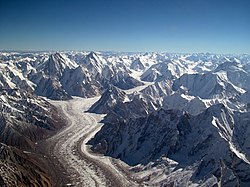
The black gravel of the Karakoram mountains, as seen near Pakistan's Biafo Glacier

Karakoram is a Turkic term meaning black gravel. The Central Asian traders originally applied the name to the Karakoram Pass.[9] Early European travelers, including William Moorcroft and George Hayward, started using the term for the range of mountains west of the pass, although they also used the term Muztagh (meaning, "Ice Mountain") for the range now known as Karakoram.[9][10] Later terminology was influenced by the Survey of India, whose surveyor, Thomas Montgomerie, in the 1850s, gave the labels K1 to K6 (K for Karakoram) to six high mountains visible from his station at Mount Haramukh in Kashmir Valley, codes extended further up to more than thirty.

In traditional Indian geography, the mountains were known as Krishnagiri (black mountains), Kanhagiri, and Kanheri.[11]

Exploration

[edit]

Due to its altitude and ruggedness, the Karakoram is much less inhabited than parts of the Himalayas further east. European explorers first visited in the early 19th century, followed by British surveyors starting in 1856.

The Muztagh Pass was crossed in 1887 by the expedition of Colonel Francis Younghusband,[12] and the valleys above the Hunza River were explored by General Sir George K. Cockerill in 1892. Explorations in the 1910s and 1920s established most of the geography of the region.

The name Karakoram was used in the early 20th century, for example by Kenneth Mason,[9] for the range now known as the Baltoro Muztagh. The term is now used to refer to the entire range from the Batura Muztagh above Hunza in the west to the Saser Muztagh in the bend of the Shyok River in the east.

Hunza Valley in the Gilgit-Baltistan region, administered by Pakistan

Floral surveys were carried out in the Shyok River catchment and from Panamik to Turtuk village by Chandra Prakash Kala during 1999 and 2000.[13][14]

Geology and glaciers

[edit]

The Karakoram is in one of the world's most geologically active areas, at the plate boundary between the Indo-Australian plate and the Eurasian plate.[15] A significant part, somewhere between 28 and 50 percent, of the Karakoram Range is glaciated, covering an area of more than 15,000 square kilometres or 5,800 square miles,[16] compared to between 8 and 12 percent of the Himalaya and 2.2 percent of the Alps.[17] Mountain glaciers may serve as an indicator of climate change, advancing and receding with long-term changes in temperature and precipitation. The Karakoram glaciers are slightly retreating,[18][19][20] unlike the Himalayas, where glaciers are losing mass at a significantly higher rate, many Karakoram glaciers are covered in a layer of rubble which insulates the ice from the warmth of the sun.[21] Where there is no such insulation, the rate of retreat is high.[22]

Ice Age

[edit]

In the last ice age, a connected series of glaciers stretched from western Tibet to Nanga Parbat, and from the Tarim basin to the Gilgit District.[23][24][25] To the south, the Indus glacier was the main valley glacier, which flowed 120 kilometres (75 mi) down from the Nanga Parbat massif to 870 metres (2,850 ft) elevation.[23][26] In the north, the Karakoram glaciers joined those from the Kunlun Mountains and flowed down to 2,000 metres (6,600 ft) in the Tarim basin.[25][27]

While the current valley glaciers in the Karakoram reach a maximum length of 76 kilometres (47 mi), several of the ice-age valley glacier branches and main valley glaciers, had lengths up to 700 kilometres (430 mi). During the Ice Age, the glacier snowline was about 1,300 metres (4,300 ft) lower than today.[25][26]

Highest peaks

[edit]
Highest Karakoram peaks in the Baltoro region as seen from the International Space Station
Map
About OpenStreetMaps
Maps: terms of use
60km
37miles
Pakistan
India
China
Gasherbrum V
48
Gasherbrum V
Gasherbrum V
Rimo III
Rimo III
Rimo III
Apsarasas Kangri I
Apsarasas Kangri I
Apsarasas Kangri I
Diran
Diran
Diran
Muztagh Tower
Muztagh Tower
Muztagh Tower
K6
K6
K6
Yutmaru Sar
Yutmaru Sar
Yutmaru Sar
Baintha Brakk
Baintha Brakk
Baintha Brakk
Crown Peak
Crown Peak
Crown Peak
Baltoro Kangri
Baltoro Kangri
Baltoro Kangri
Yazghil Dome South
Yazghil Dome South
Yazghil Dome South
Sherpi Kangri
Sherpi Kangri
Sherpi Kangri
Rimo I, Rimo massif
Rimo I, Rimo massif
Rimo I, Rimo massif
Ultar, Ultar Peak, Ultar Sar
Ghent Kangri
Ghent Kangri
Ghent Kangri
Haramosh Peak
Haramosh Peak
Haramosh Peak
Skil Brum
Skil Brum
Skil Brum
Momhil Sar
Momhil Sar
Momhil Sar
Sia Kangri
Sia Kangri
Sia Kangri
K12
K12
K12
Malubiting
Malubiting
Malubiting
Teram Kangri I
Teram Kangri I
Teram Kangri I
Yukshin Gardan Sar
Yukshin Gardan Sar
Yukshin Gardan Sar
Passu Sar
Passu Sar
Passu Sar
Pumari Chhish
Pumari Chhish
Pumari Chhish
Saser Kangri III
Saser Kangri III
Saser Kangri III
Saser Kangri II
Saser Kangri II
Saser Kangri II
Mamostong Kangri K35
Skyang Kangri
Skyang Kangri
Skyang Kangri
Trivor Sar
Trivor Sar
Trivor Sar
Shispare or Shispare Sar
Chogolisa
Chogolisa
Chogolisa
Saser Kangri I, K22
Saser Kangri I, K22
Saser Kangri I, K22
Batura III
Batura III
Batura III
Saltoro Kangri, K10
Saltoro Kangri, K10
Saltoro Kangri, K10
Kanjut Sar
Kanjut Sar
Kanjut Sar
Batura II
Batura II
Batura II
Rakaposhi
Rakaposhi
Rakaposhi
Batura Sar, Batura I
Masherbrum, K1
Masherbrum, K1
Masherbrum, K1
Kunyang Chhish (Kunyang Kish, Khunyang Chhish, Khinyang Chhish)
Distaghil Sar
Distaghil Sar
Distaghil Sar
Gasherbrum IV, K3
Gasherbrum IV, K3
Gasherbrum IV, K3
Gasherbrum III, K3a
Gasherbrum III, K3a
Gasherbrum III, K3a
Gasherbrum II, K4
Gasherbrum II, K4
Gasherbrum II, K4
Broad Peak
Broad Peak
Broad Peak
Gasherbrum I, K5
Gasherbrum I, K5
Gasherbrum I, K5
K2
K2
K2

Here is a list for the highest peaks of the Karakoram. Included are some of the mountains named with a K code, the most famous of which is the K2 (mountain).

Mountain Height[28] Ranked K code Remark
K2 8,611 metres (28,251 ft) 2 K2  China Pakistan at the head of the Godwin-Austen Glacier
Gasherbrum I 8,080 metres (26,510 ft) 11 K5  China Pakistan
Broad Peak 8,051 metres (26,414 ft) 12  China Pakistan
Gasherbrum II 8,034 metres (26,358 ft) 13 K4  China Pakistan
Gasherbrum III 7,952 metres (26,089 ft) K3a  Pakistan, not on world highest list
Gasherbrum IV 7,925 metres (26,001 ft) 17 K3  Pakistan
Distaghil Sar 7,885 metres (25,869 ft) 19  Pakistan
Kunyang Chhish 7,852 metres (25,761 ft) 21  Pakistan
Masherbrum I 7,821 metres (25,659 ft) 22 K1  Pakistan
Batura I 7,795 metres (25,574 ft) 25  Pakistan
Rakaposhi 7,788 metres (25,551 ft) 26  Pakistan
Batura II 7,762 metres (25,466 ft)  Pakistan, not on world highest list
Kanjut Sar 7,760 metres (25,460 ft) 28  Pakistan
Saltoro Kangri I 7,742 metres (25,400 ft) 31 K10  India Pakistan
Batura III 7,729 metres (25,358 ft)  Pakistan, not on world highest list
Saltoro Kangri II 7,705 metres (25,279 ft) K11  India Pakistan
Saser Kangri I 7,672 metres (25,171 ft) 35 K22  India
Chogolisa 7,665 metres (25,148 ft) 36  Pakistan
Shispare Sar 7,611 metres (24,970 ft) 38  Pakistan
Trivor Sar 7,577 metres (24,859 ft) 39  Pakistan
Skyang Kangri 7,545 metres (24,754 ft) 43  China Pakistan
Mamostong Kangri 7,516 metres (24,659 ft) 47 K35  India
Saser Kangri II 7,513 metres (24,649 ft) 48  India
Saser Kangri III 7,495 metres (24,590 ft) 51  India
Pumari Chhish 7,492 metres (24,580 ft) 53  Pakistan
Passu Sar 7,478 metres (24,534 ft) 54  Pakistan
Yukshin Gardan Sar 7,469 metres (24,505 ft) 55  Pakistan
Teram Kangri I 7,462 metres (24,482 ft) 56  China India
Malubiting 7,458 metres (24,469 ft) 58  Pakistan
K12 or Saitang Peak 7,428 metres (24,370 ft) 61 K12  India Pakistan subsidiary of Saltoro Kangri
Sia Kangri 7,422 metres (24,350 ft) 63  China Pakistan
Skilma Gangri or Ghursay Kangri II 7,422 metres (24,350 ft) K8  Pakistan on the western flank of the Siachen Glacier
Momhil Sar 7,414 metres (24,324 ft) 64  Pakistan
Skil Brum 7,410 metres (24,310 ft) 66  China Pakistan
Haramosh Peak 7,409 metres (24,308 ft) 67  Pakistan
Ghent Kangri 7,401 metres (24,281 ft) 69  India Pakistan
Ultar Peak 7,388 metres (24,239 ft) 70  Pakistan
Rimo I 7,385 metres (24,229 ft) 71  India
Sherpi Kangri 7,380 metres (24,210 ft) 74  Pakistan
Bojohagur Duanasir 7,329 metres (24,045 ft)  Pakistan, not on world highest list
Yazghil Dome South 7,324 metres (24,029 ft)  Pakistan, not on world highest list
Baltoro Kangri 7,312 metres (23,990 ft) 81  Pakistan
Crown Peak 7,295 metres (23,934 ft) 83  China
Baintha Brakk 7,285 metres (23,901 ft) 86  Pakistan
Yutmaru Sar 7,283 metres (23,894 ft) 87  Pakistan
Baltistan Peak 7,282 metres (23,891 ft) 88 K6  Pakistan
Muztagh Tower 7,273 metres (23,862 ft) 90  China Pakistan
Diran 7,266 metres (23,839 ft) 92  Pakistan
Apsarasas Kangri I 7,243 metres (23,763 ft) 95  China India
Rimo III 7,233 metres (23,730 ft) 97  India
Gasherbrum V 7,147 metres (23,448 ft)  Pakistan
Link Sar 7,041 metres (23,100 ft)  Pakistan
Gamba Gangri 7,000 metres (23,000 ft) (approx) K9  Pakistan near Trango Towers
Gomgma Gangri 6,934 metres (22,749 ft) K7  Pakistan at the head of the Charakusa Valley
Dansam Peak 6,666 metres (21,870 ft) K13  Pakistan south west of Saltoro Kangri
Paiju Peak 6,610 metres (21,686 ft)  Pakistan
Pastan Kangri 6,523 metres (21,401 ft) K25  India south of Saltoro Kangri

The majority of the highest peaks are in the Gilgit–Baltistan region administered by Pakistan. Baltistan has more than 100 mountain peaks exceeding 6,100 metres (20,000 ft) height from sea level.

Subranges

[edit]
View of the Moon over Karakoram Range in Pakistan

The naming and division of the various subranges of the Karakoram is not universally agreed upon. However, the following is a list of the most important subranges, following Jerzy Wala.[29] The ranges are listed roughly west to east.

Passes

[edit]
Map
About OpenStreetMaps
Maps: terms of use
60km
37miles
Republic of Tajikistan
Islamic Emirate of Afghanistan
Islamic Republic of Pakistan
Pakistan
Islamic Republic of Pakistan
Republic of India
India
Republic of India
Republic of India
People's Republic of China
China
People's Republic of China
Kilik Pass
18
Kilik Pass
Kilik Pass
Mintaka Pass
17
Mintaka Pass
Mintaka Pass
Mutsjliga Pass
16
Mutsjliga Pass
Mutsjliga Pass
Khunjerab Pass
15
Khunjerab Pass
Khunjerab Pass
Sarpo Laggo Pass
14
Sarpo Laggo Pass
Sarpo Laggo Pass
Mustagh Pass
13
Mustagh Pass
Mustagh Pass
Windy Gap
12
Windy Gap
Windy Gap
Turkistan La Pass
11
Turkistan La Pass
Turkistan La Pass
Karakoram Pass
10
Karakoram Pass
Karakoram Pass
Shimshal Pass
9
Shimshal Pass
Shimshal Pass
Hispar Pass
8
Hispar Pass
Hispar Pass
Naltar Pass
7
Naltar Pass
Naltar Pass
Machulo La
6
Machulo La
Machulo La
Burji La
5
Burji La
Burji La
Sasser Pass
4
Sasser Pass
Sasser Pass
Gyong La
3
Gyong La
Gyong La
Bilafond La
2
Bilafond La
Bilafond La
Sia La
1
Sia La
Sia La
Location of the passes in Karakoram
Legend:

1Sia La, 2Bilafond La, 3Gyong La, 4Sasser Pass, 5Burji La, 6Machulo La, 7Naltar Pass, 8Hispar Pass, 9Shimshal Pass, 10Karakoram Pass, 11Turkistan La Pass, 12Windy Gap, 13Mustagh Pass, 14Sarpo Laggo Pass, 15Khunjerab Pass, 16Mutsjliga Pass, 17Mintaka Pass, 18Kilik Pass


Passes from west to east are:

The Khunjerab Pass is the only motorable pass across the range. The Shimshal Pass (which does not cross an international border) is the only other pass still in regular use.

Cultural references

[edit]

See also

[edit]

References

[edit]

Further reading

[edit]
[edit]
Revisions and contributorsEdit on WikipediaRead on Wikipedia
from Grokipedia
The Karakoram is a rugged mountain range in Central Asia spanning the borders of Pakistan's Gilgit-Baltistan region, India's Ladakh union territory, and China's Xinjiang Uyghur Autonomous Region, with its peaks forming a formidable barrier in the greater Himalayan orogenic system. Renowned for extreme topography, the range hosts K2 at 8,611 meters (28,251 feet), the world's second-highest peak, alongside three other eight-thousanders—Gasherbrum I, Gasherbrum II, and Broad Peak—concentrating four of Earth's fourteen such summits in a compact area. It exhibits intense glaciation, with over 16,500 square kilometers of ice cover including the non-polar world's second-longest glacier, Siachen at 76 kilometers, followed closely by Biafo and Baltoro glaciers at 63 and 62 kilometers respectively, rendering it the most heavily glaciated terrain outside polar zones. Mountaineering history underscores its peril and allure, exemplified by K2's first ascent in 1954 amid high fatality rates persisting to modern expeditions, while recent glaciological observations reveal the "Karakoram Anomaly," wherein many glaciers remain stable or advance despite regional warming, defying broader Himalayan retreat patterns documented in empirical surveys. The eastern Karakoram encompasses the Siachen Glacier, a 76-kilometer ice mass in contested Kashmir territory under Indian military control since 1984 operations, though claimed by Pakistan, highlighting geopolitical tensions over undefined borders beyond the Line of Control.

Etymology

Name and Historical Designations

The name Karakoram originates from , where it literally translates to "black gravel," a reference to the dark and morainal deposits characteristic of the region's passes and valleys. Central Asian traders, including Uyghur and other Turkic-speaking groups traversing the , first applied the term specifically to the , a high-altitude route connecting the in present-day , , to the Upper Indus Valley in , used for commerce and migration as early as the CE. By the , European surveyors and explorers extended the designation from the pass to the broader during systematic mapping efforts. British surveyor Thomas George Montgomerie, working from the Great of in the 1850s and 1860s, labeled prominent peaks visible from his stations as "K1," "K2," and so on, explicitly denoting the "K" for Karakoram to distinguish them from Himalayan features. This nomenclature formalized the range's identity separate from adjacent systems like the , though earlier designations in Persian or Indic texts often subsumed it under vague terms for northern barriers without distinct naming. No specific pre-Turkic or ancient designations for the full range appear in surviving records, reflecting its relative isolation from lowland civilizations until modern exploration.

Geography

Location and Political Boundaries

The Karakoram mountain range lies in , forming the northwestern extension of the greater Himalayan system and situated between the to the northwest and the to the southeast. It primarily spans the border regions of , and , with its northwestern extremities extending into and , where the borders of these five countries converge. The range measures approximately 500 km in length and covers an area of about 207,000 square kilometers. The majority of the Karakoram, including major features such as the and , falls within Pakistan-administered , a region under federal control since 1947. Northern sections align with China's Xinjiang Uyghur Autonomous Region, facilitating connectivity via the and the China-Pakistan Economic Corridor infrastructure, including the completed in 1979. Southeastern portions, encompassing the Saltoro Range and , are administered by as part of the union territory of , following India's during on April 13, 1984, which preempted Pakistani advances in the area. This control remains contested by as part of the unresolved originating from the 1947 partition. Minor western segments intrude into Afghanistan's narrow , a strip ceded in the to buffer British from , and Tajikistan's Autonomous Region, though these areas involve limited territorial overlap and minimal human settlement due to extreme altitude and isolation. The convergence of international boundaries in the Karakoram underscores its geopolitical sensitivity, with no formal delineation in some high-altitude zones beyond the established post-1984 in the Siachen sector.

Physical Extent and Subranges

The Karakoram mountain range spans the borders of Pakistan, India, and China, with extremities extending into Afghanistan and Tajikistan. It forms the northwestern continuation of the Himalayan system, extending from the Pakistan-Afghanistan border region westward into the Tibetan Plateau eastward. The range lies between the Indus River valley to the south and the Tarim Basin to the north, separating the upper Indus watershed from the high Tibetan Plateau. The Karakoram is subdivided into multiple subranges, each characterized by distinct clusters of high peaks and glacial systems. Key subranges include the Baltoro Muztagh, which hosts and several other eight-thousanders along the Pakistan-China border; the in the southwestern sector, notable for peaks like ; and the Siachen Muztagh, encompassing the area. Eastern extensions feature the Rimo Muztagh and South Ghujerab Mountains, while central areas comprise the Panmah Muztagh, Mountains, and Biafo Group. These divisions reflect variations in , with the central and eastern subranges generally exhibiting the highest elevations and densest glaciation.

Highest Peaks and Topography

The Karakoram Range hosts four of the fourteen mountains exceeding 8,000 meters worldwide: at 8,611 meters, at 8,080 meters, at 8,051 meters, and at 8,035 meters. , the second-highest peak on , rises dramatically over 3,000 meters above the surrounding glacial valleys on the Pakistan-China border. These summits, along with over 60 peaks above 7,000 meters, cluster primarily in the central subranges like the Baltoro Muztagh and Gasherbrum groups.
PeakHeight (m)Prominence (m)First Ascent Year
8,6114,0201954
8,0802,1551958
8,0511,7011957
8,0351,5231956
7,9252,3251958
The table above lists the five highest peaks, with heights and prominences derived from surveys and expeditions; Gasherbrum IV stands out for its technical difficulty despite lower elevation. Topographically, the Karakoram features jagged, craggy peaks with steep, precipitous slopes, particularly short and abrupt on the northern flanks and longer on the southern. Deep valleys, often U-shaped from glacial , dissect the range, flanked by sheer cliffs and glaciers that contribute to frequent . The landscape includes vast talus fields and moraines, with an average elevation around 6,100 meters, making it one of the highest ranges globally. Heavy glaciation covers 28-50% of the area, including long valley glaciers like the Baltoro (over 60 km) that shape the terrain through continuous and deposition. This rugged configuration, combined with extreme relief, renders the Karakoram sparsely vegetated above 3,000 meters and highly challenging for traversal.

Key Passes and Routes

The , situated at an elevation of 5,575 meters, served as a primary conduit for ancient caravan trade between in and Yarkand in China's , forming a branch of the . Trade caravans transported , , and precious stones northward, while returning with , spices, , and from the south; estimates indicate approximately 10,000 horses traversed the route annually during its peak in the mid-19th century. The pass remained in use for centuries until its closure following China's 1949 , after which it has been restricted to military access due to geopolitical tensions, rendering it non-motorable and inactive for civilian trade. In contrast, the modern at 4,693 meters marks the - border along the , the highest paved international border crossing open seasonally from May to November. This 1,300-kilometer route, constructed between 1959 and 1979 by and , links to in , facilitating contemporary trade and tourism through the rugged Karakoram terrain while bypassing higher traditional passes like Kilik and to the north. Among trekking routes, the Hispar Pass (Hispar La) at 5,151 meters connects the Biafo and Hispar Glaciers, enabling the longest non-polar glacier traverse of approximately 125 kilometers between Hunza-Nagar and valleys. This high-altitude, non-technical pass supports multi-week expeditions across Snow Lake, a vast ice expanse, primarily used by mountaineers and trekkers rather than for sustained trade.

Geology

Tectonic Origins and Formation

The Karakoram Range formed as a consequence of the Cenozoic convergence between the Indian and Eurasian tectonic plates, with initial collision occurring approximately 50 million years ago in the Eocene, following the closure of the Neo-Tethys Ocean. This event involved the northward drift of the Indian Plate at rates exceeding 150 mm per year prior to impact, leading to continental subduction and subsequent underthrusting beneath the Eurasian margin, including the Kohistan-Ladakh island arc that had accreted to Eurasia earlier around 100-90 million years ago. The Karakoram terrane, comprising primarily Paleozoic-Mesozoic sedimentary and volcanic sequences deformed against the Eurasian continent, experienced intense crustal shortening exceeding 200 km, which thickened the lithosphere and initiated orogenic uplift distinct from the southern Himalayan thrust wedge on Indian Plate crust. The Main Karakoram Thrust (MKT), a major north-dipping structure, delineates the southern margin of the range, juxtaposing the Karakoram Batholith—dominated by to granites—against the southern Kohistan arc terranes, with deformation propagating northward post-Eocene collision. High-pressure metamorphism in the Karakoram Metamorphic Complex, reaching eclogite facies conditions up to 2.5 GPa and 700°C around 60-40 million years ago, reflects early subduction-related burial followed by mid-crustal heating and during crustal thickening. Granitic plutonism peaked from 26 to 13 million years ago ( to mid-), driven by of hot asthenospheric mantle and radiogenic heating in a thickened crust averaging 60-70 km, producing the Baltoro and Siachen plutonic units that constitute much of the range's backbone. Ongoing tectonic activity is modulated by the dextral Karakoram Fault system, a 1,200-km-long strike-slip structure accommodating 10-15 mm/year of oblique convergence through lateral escape of Tibetan crust eastward, while maintaining rapid uplift rates of 4-6 mm/year in the central Karakoram due to persistent India-Eurasia shortening at 40-50 mm/year. This fault offsets leucogranites and facilitates radial expansion of the orogen, with incision and exhumation rates reaching 2-5 mm/year in major valleys like the Hunza, reflecting coupled tectonic and erosional feedbacks. Unlike the Himalaya's southward younging of thrust sheets, the Karakoram's northward-directed deformation highlights its role as the Asian plate's retro-wedge in this asymmetric collision.

Rock Composition and Structure

The Karakoram Range exhibits a diverse dominated by metamorphic and igneous rocks, with subordinate sedimentary sequences, reflecting its evolution as part of the Asian prior to and during the India-Asia collision. High-grade metamorphic rocks, including es and schists, form extensive basement units, such as the Shengus and Iskere in the Nanga Parbat-Haramosh Massif, which underwent multiple episodes of deformation and from the latest through the Tertiary due to postcollisional crustal thickening. These units often reach sillimanite-grade conditions, indicating burial depths exceeding 20-30 km before exhumation along major shear zones. Igneous rocks are prominent, particularly the Karakoram Batholith, a composite granitic intrusion extending approximately 700 km along the range's axis, comprising pre-collisional I-type granodiorites and granites that were subsequently metamorphosed to amphibolite facies. This batholith intrudes Paleozoic-Triassic sedimentary series, including massive limestones, dolostones, and volcanic flows in units like the Tash Kupruk Formation, which are thrust-bound and exhibit low- to medium-grade in peripheral zones. Metavolcanic and metasedimentary rocks, such as in the Chalt Greenschist Zone, contribute to the range's weathering-prone slopes, supplying debris to glacial and fluvial systems. Structurally, the Karakoram is defined by polyphase deformation, with the Main Karakoram Thrust (MKT) marking a major boundary separating low-grade sedimentary-metasedimentary assemblages to the south from high-grade metamorphic and plutonic rocks to the north. The Karakoram Fault, a dextral strike-slip system extending over 800 km, accommodates lateral extrusion and offsets tectonic elements, including the , while high-angle thrusts juxtapose platforms against metamorphic cores. and lineations generally trend northeast-southwest, with ductile shear zones facilitating and granite emplacement during crustal flow. This tectonic framework underscores the range's role in ongoing convergence, with neotectonic thrusts exposing basement gneisses over sediments in localized basins.

Glacial Systems and Quaternary History

The Karakoram region contains approximately 10,500 glaciers spanning a total area of 22,510 km², constituting one of the most extensive non-polar glacial concentrations globally. This inventory includes a high proportion of debris-covered and surge-type glaciers, with 221 identified surge-type or surge-like glaciers occupying about 7,734 km², or roughly 43% of the glaciated area. In the Central Karakoram National Park alone, 608 glaciers cover 3,680 km², equivalent to 35% of the park's area, with an estimated ice volume of 532 km³. These systems are characterized by interconnected glacial networks, such as the Biafo-Hispar system, which forms the longest continuous glacial expanse outside polar regions at over 100 km when combined. Prominent individual glaciers include the , measuring 76 km in length and ranking as the second-longest non-polar glacier, the at 67 km, the at 63 km, and the Hispar Glacier, which merges with Biafo to facilitate rare trans-glacial crossings. These features exhibit dynamic behaviors influenced by , loading, and subglacial , with surging events periodically advancing glacier fronts by kilometers over short timescales. cover, increasing by 17.63% in recent inventories, modulates melt rates and contributes to the persistence of lower-elevation tongues despite regional warming trends. Quaternary glacial history in the Karakoram reflects repeated expansions tied to , monsoon variability, and westerly influences, with geomorphic mapping revealing extensive past ice covers. In the , moraine sequences and associated landforms document at least eight late advances, constrained by cosmogenic 10Be and 26Al surface-exposure of boulders to intervals spanning the last glacial cycle. Central Karakoram evidence indicates former ice caps and valley glaciers far exceeding modern extents during the , with subsequent readvances linked to neoglacial cooling phases. These records underscore the Karakoram's sensitivity to hemispheric climate shifts, preserved in erratics, U-shaped valleys, and nested belts.

Climate and Glacial Dynamics

Regional Climate Patterns

The Karakoram range features a temperate dominated by , which deliver the majority of as winter snowfall from disturbances originating in the Mediterranean and . These account for most annual moisture, with occurring primarily from to April, often exceeding 500 mm in elevated central areas but falling as low as 100-200 mm in rain-shadowed lower valleys influenced by the Himalayan barrier. Summer incursions from the provide limited additional rainfall, typically less than 20% of the total, due to the range's position north of the main Himalayan front, which blocks moist southerly flows and enforces relative compared to adjacent eastern ranges. Temperature patterns reflect extreme and continentality, with mean annual values decreasing by approximately 6-7°C per 1,000 m rise in elevation. In lower valleys such as or , summer maxima can exceed 30°C, while winter minima plummet below -15°C; higher slopes and peaks maintain sub-zero averages year-round, fostering perennial ice accumulation above 5,000 m. Anti-cyclonic conditions prevail in summer, suppressing convective activity and enhancing diurnal ranges, whereas winter introduce frequent cloud cover and storms that moderate extremes but amplify snowfall variability. Spatially, western sectors near the receive higher winter precipitation (up to 1,000 mm water equivalent at glaciers) from intensified westerly tracks, while eastern extensions toward the exhibit greater aridity and reliance on sporadic remnants. This west-east gradient, compounded by topographic barriers, results in heterogeneous microclimates, with central Karakoram cores sustaining denser glacial cover through balanced snow inputs despite regional warming trends.

The Karakoram Glacier Anomaly

The Karakoram Anomaly describes the unusual stability or slight mass gain exhibited by glaciers in the Karakoram range since the late 20th century, contrasting with the retreat observed in most other High Mountain Asia glaciers amid global warming. This phenomenon was first systematically documented by glaciologist Kenneth Hewitt, who noted glacier expansion and surging activity in satellite imagery from the 1990s, attributing it to an "elevation effect" where higher-altitude accumulation zones receive increased winter precipitation. Empirical measurements confirm near-zero or positive mass balances, such as +0.06 ± 0.08 Gt/year across the Karakoram from 2003 to 2023, with central Karakoram showing +120 ± 140 kg/m²/year from 2008 to 2016. Key manifestations include stable or advancing glacier termini, elevated ice flow velocities increasing by +3.6 ± 1.2% per from 2000 to 2016, and widespread surging events potentially rising post-1990. Unlike regional averages of -0.21 ± 0.07 m w.e./year loss in High Mountain Asia (2000-2016), Karakoram glaciers have maintained equilibrium through enhanced accumulation outweighing . The anomaly extends partially to adjacent Western Kunlun and Pamir ranges, where modest gains of +0.19 ± 0.06 Gt/year were recorded until recently. Causal factors emphasize regional climatic variability over uniform global warming trends. Increased winter snowfall, driven by strengthened westerlies transporting moisture from the North Atlantic, has boosted accumulation rates, with Hushe ice core data showing snow accumulation rising significantly (r=0.63, p<0.01) from 664 to 1,960 mm w.e./year (average 1,342 mm w.e.) between 1998 and 2018. Summer cooling, cloudiness reducing solar radiation, and debris-mantled surfaces insulating against melt further suppress , while steep topography facilitates avalanche-fed nourishment. These dynamics reflect local atmospheric blocking by extreme elevations, weakening westerlies to deliver colder, moister air masses. Recent observations indicate the anomaly may be weakening or terminating, with Karakoram mass deficits of -2.23 ± 1.52 Gt/year from 2018 to 2023 signaling a shift toward loss amid rising temperatures (+0.23 ± 0.06 °C/decade). Broader Pamir-Karakoram-Western Kunlun losses totaled -0.72 ± 0.21 Gt/year (2003-2023), and studies from 2025 confirm accelerated thinning in eastern Pamir and Karakoram, potentially ending the regional resistance to climate-driven retreat. This transition underscores temperature as the dominant driver, eroding prior precipitation advantages, with implications for downstream water security.

Recent Observations and Causal Factors

Satellite observations from 2000 to 2021 indicate that the Karakoram Glacier Anomaly has persisted, with glaciers in the western and central Karakoram exhibiting mass gains driven by increasing , while eastern sectors show losses. Overall in the Karakoram remains near-balanced or slightly negative at −0.04 ± 0.15 m equivalent per year, contrasting with widespread elsewhere. From 2003 to 2023, the broader Pamir-Karakoram-Western Kunlun region experienced a net mass loss of −0.72 ± 0.21 Gt/year, though interannual variability persists due to surging events and declines in 65% of the glaciated area. Causal factors include enhanced winter snowfall from strengthened westerly disturbances, which have increased contributions to total by up to 65% in the Karakoram, offsetting . Debris cover on many glaciers reduces summer melt sensitivity to rising temperatures by insulating , while topographic shading and nourishment further stabilize mass balances. Hydrological and thermal mechanisms trigger periodic surges, contributing to observed advances without net retreat. Climate variability, including North Atlantic anomalies, influences interannual fluctuations, but regional trends dominate over uniform warming signals.

Exploration and Mountaineering

Early Surveys and Local Knowledge

Godfrey Thomas Vigne, an English traveler, conducted the earliest documented European explorations into the Karakoram region between 1835 and 1838, becoming the first known Westerner to enter and document routes through , , and Iskardo (). Vigne relied heavily on local Balti and Ladakhi guides who provided knowledge of high passes such as the and , which facilitated seasonal trade in goods like salt, wool, and borax between Central Asia and the Indian subcontinent. These indigenous communities, including the in and Wakhi herders in Hunza, possessed empirical understanding of glacial paths and risks accumulated over generations of and raiding, which Vigne noted enabled navigation where maps were absent. Systematic surveying began in the mid-19th century under the , with Lieutenant Thomas George Montgomerie leading efforts from 1856 onward to triangulate peaks and valleys using theodolites from distant observation points. Montgomerie's team mapped major features like the and assigned provisional labels such as "K2" to the second-highest Karakoram peak, drawing on plane-table surveys conducted by assistants who traversed valleys inaccessible to Europeans due to altitude and terrain. These surveys, completed in phases through 1871, incorporated local nomenclature and route intelligence from indigenous porters and traders, who identified passes like the Muztagh (crossed by Europeans only in 1887) long used for connectivity between Yarkand and . Local knowledge proved indispensable for early surveyors, as indigenous groups maintained oral traditions of glacial dynamics and pass viability, informed by centuries of transhumance and conflict-driven migrations across the range's borders. For instance, Balti villagers guided survey parties through the Biafo-Hispar traverse, a route Vigne reported as routinely employed for diplomatic and mercantile purposes by Skardu rulers, highlighting pre-colonial expertise in ice-bridge crossings that predated European instruments. This reliance underscored the limitations of remote triangulation, where ground-level validation from locals corrected errors in elevation and hydrology estimates derived from optical sightings alone.

19th-20th Century Expeditions

In the , Captain of the conducted pioneering explorations in the Karakoram as part of the , venturing into the region and mapping valleys such as and Hushe. He became the first European to enter the , traverse the Saltoro region, and reach Paiju at the snout of the , while also identifying and naming the beneath what was later designated K2. These efforts provided initial topographic data on the range's southern approaches, though access was limited by local rulers and harsh terrain. A landmark expedition occurred in 1892 under Sir William Martin Conway, who led a multidisciplinary team supported by scientific societies to survey approximately 2,000 square miles (5,180 square kilometers) of the Karakoram-Himalayas, focusing on the and surrounding peaks. Conway's party ascended Pioneer Peak (also known as Golden Throne) to over 22,000 feet (6,700 meters), establishing it as a model for future large-scale ventures with combined , cartographic, and objectives. The expedition documented geological features, , and local cultures, producing detailed maps that corrected earlier inaccuracies from plane-table surveys. Early 20th-century efforts shifted toward targeted mountaineering amid ongoing surveys. In 1909, Prince Luigi Amedeo, Duke of the Abruzzi, mounted the first major assault on (8,611 meters), approaching via the and establishing a route up the Abruzzi Spur to an altitude of about 6,250 meters before deeming further progress untenable due to steep ice and rock barriers. His team, including alpinists like Albert F. Mummery's former guides, also reconnoitered and other peaks, contributing photographic and barometric records that informed subsequent attempts. Complementary scientific work followed, such as Filippo de Filippi's 1913–1914 expedition, which extended surveys into the eastern Karakoram, mapping glaciers like Siachen and integrating them with prior data from explorers like Godwin-Austen. By the 1930s, expeditions combined exploration with altitude records, as seen in Eric Shipton's 1937 and 1939 ventures, which mapped over 2,000 square miles around the Snow Lake basin and Panmah Glacier, revealing previously uncharted icefields and peaks while testing lightweight tactics suited to the range's remoteness. These pre-World War II efforts, often British-led, faced logistical challenges from political restrictions in princely states but advanced knowledge of the Karakoram's glaciated core, setting the stage for postwar ascents. American participation emerged with the 1938 attempt by Charles Houston's team, which scouted routes and reached 8,000 meters but retreated due to weather, highlighting the peak's technical demands.

Modern Climbs, Records, and Human Achievements

The four principal 8,000-meter peaks of the Karakoram—K2 (8,611 m), Gasherbrum I (8,080 m), Gasherbrum II (8,035 m), and Broad Peak (8,051 m)—saw their first ascents during the mid-1950s, marking pivotal advances in high-altitude mountaineering amid technical difficulties surpassing those of many Himalayan routes. K2's summit was first reached on July 31, 1954, by Achille Compagnoni and Lino Lacedelli on the Italian expedition led by Ardito Desio, via the Abruzzi Spur route, though the climb involved controversies over logistics and team decisions that contributed to the death of companion Walter Bonatti from exposure during a supply carry. Gasherbrum II was ascended on July 7, 1956, by Austrians Fritz Moravec, Josef Larch, and Hans Willenpart, following the southwest ridge from the Gasherbrum La glacier. Broad Peak followed on June 9, 1957, with an Austrian team—Hermann Buhl, Kurt Diemberger, Marcus Schmuck, and Fritz Wintersteller—completing the ascent without supplemental oxygen in alpine style over multiple days from advanced base camp. Gasherbrum I's first ascent occurred on July 5, 1958, by Americans Pete Schoening and Andy Kauffman, who pioneered an alpine-style push from Camp VIII at 7,900 meters after the main team's retreat. Notable subsequent records emphasized endurance without aids. and achieved the first oxygenless ascent of on August 10, 1975, via the southwest ridge, validating physiological feasibility at extreme altitudes despite skepticism from peers reliant on bottled oxygen. and also completed an alpine-style ascent of in 1975, forgoing fixed ropes and large support teams to traverse from base camp. Winter ascents, hampered by sub-zero temperatures averaging -40°C and intensified jet stream winds, proved rarer and more perilous. Poles Adam Bielecki and Janusz Gołąb made the first winter ascent of Gasherbrum I on March 9, 2012, via the Japanese Buttress in 13 days from base camp, enduring avalanches and frostbite. Broad Peak's inaugural winter summit came on March 5, 2013, by Poles Maciej Berbeka, Adam Bielecki, Tomasz Kowalski, and Artur Małek, but Berbeka and Kowalski died during descent amid whiteout conditions and exhaustion, highlighting risks of unroped high-altitude travel in darkness. K2's first winter ascent, attempted unsuccessfully since 1987-88, succeeded on January 16, 2021, when ten Nepalese climbers—Nirmal Purja, Mingma David Sherpa, Mingma Gyalje Sherpa, Sagarmatha, Pem Chhiri Sherpa, Dawa Tashi Sherpa, Matrika Sherpa, Nawang Dorje Sherpa, Gelje Sherpa, and Kilu Sherpa—reached the summit via the Bottleneck, with Purja forgoing oxygen; their fixed ropes facilitated three additional winter summits that season. Beyond 8,000ers, achievements include speed records and new routes on spires like Latok I (7,145 m), first summited July 19, 1979, by Japanese climbers via its north ridge, and ongoing first ascents of sub-6,000-meter towers, such as the 6,232 m peak in Ghujerab by a Czech-Polish-Slovak team in October 2025, reflecting persistent exploration amid glacial hazards and permitting logistics. Pakistani mountaineers have also excelled, with Sirbaz Khan becoming the first from the country to summit all 14 global 8,000ers by 2023, often guiding international teams on Karakoram routes. These feats underscore the range's role in pushing limits of , fixed-line efficiency, and navigation, though with a death-to-summit ratio exceeding 20% on due to objective dangers like icefalls and cornices.

Geopolitical Context

Territorial Claims and Disputes

The Karakoram mountain range encompasses territories administered by , and , with overlapping claims rooted in the partition of Jammu and Kashmir in 1947 and subsequent bilateral agreements. asserts sovereignty over the entire former of Jammu and Kashmir, including Pakistani-administered (where much of the central Karakoram lies) and areas under Chinese control in the north. administers as part of its Northern Areas and contests Indian holdings in , while exercises control over the and , regions includes in its constitutional map of . These claims have resulted in restricted access, militarized borders, and periodic standoffs, exacerbated by the lack of a mutually recognized (LoC) beyond NJ9842 as per the 1972 . A primary flashpoint is the in the eastern Karakoram, where gained control of the 76 km glacier and the strategic Saltoro Ridge through on April 13, 1984, deploying troops via helicopter to preempt Pakistani surveys and potential incursions. , which claims the glacier based on interpretations of pre-1947 maps and the undefined LoC extension, maintains positions west of the ridge, leading to a protracted presence at altitudes exceeding 6,000 meters, where avalanches and harsh weather have caused over 2,000 fatalities, far outnumbering combat deaths. No formal peace agreement has been reached, despite ceasefires since , with both sides incurring annual costs estimated at hundreds of millions of dollars for logistics in extreme conditions. Further north, the Shaksgam Valley (also known as the ), spanning approximately 5,180 square kilometers north of the Karakoram watershed, became disputed when signed the Sino- Boundary Agreement on March 2, 1963, demarcating its northern frontier and transferring administrative control to . rejects this agreement as null and void, arguing lacked legal title to the territory—historically part of the of Jammu and Kashmir under the Johnson Line—and that it compromises 's northern frontier along the Kunlun Range. has since integrated the valley into its Uyghur Autonomous Region, constructing roads and military outposts, including a 2024 extension linking to the , which protested as a violation of its . In January 2026, China's Foreign Ministry spokesperson Mao Ning rejected India's claims over the valley, asserting it belongs to China and justifying infrastructure construction there under the 1963 agreement; India countered that the valley is an integral part of Jammu and Kashmir and Ladakh, deeming the agreement illegal and invalid as it involves Indian territory under Pakistani occupation, with Indian Army Chief Gen Upendra Dwivedi and Ladakh Lieutenant Governor Kavinder Gupta reiterating opposition to activities in the area and India's non-recognition of the China-Pakistan Economic Corridor passing through it. India-China tensions extend to the and in eastern , where undefined sections of the (LAC) have seen incursions and infrastructure buildup, culminating in the 2020 Galwan Valley clash that killed 20 Indian and an undisclosed number of Chinese soldiers. These disputes, intertwined with water resources from Karakoram glaciers feeding the system, underscore strategic competition over high-altitude passes and surveillance routes. The northwestern Karakoram fringes adjoin Afghanistan's and Tajikistan's , but these segments feature settled boundaries with minimal contestation, primarily managed through the and post-Soviet delimitations.

Strategic Military Role

The Karakoram range's strategic military role stems from its position astride contested borders among , and , controlling key passes that facilitate or deny overland access between and . The range includes the and Saltoro Ridge, which overlook vital routes linking Pakistan-occupied to China's region, making dominance here essential for preventing adversarial alliances and securing supply lines. Indian military analysts emphasize that control of these heights provides oversight of the Nubra Valley and acts as a buffer against potential Pakistan-China coordination, while Pakistan views the area as critical for defending its northern flanks. Central to this role is the ongoing , initiated by India's on April 13, 1984, which secured approximately two-thirds of the 76-kilometer and the dominating Saltoro Ridge heights up to 6,000 meters elevation. This preemptive move countered Pakistan's expeditions and claims, establishing the world's highest battlefield where extreme altitudes exacerbate logistical challenges, with avalanches and harsh weather causing more casualties than combat—over 2,000 Indian soldiers lost since 1984, primarily to environment. Pakistan maintains positions lower on the but lacks control of the ridgeline, rendering its forces vulnerable to Indian artillery and surveillance; the stalemate underscores the terrain's vertical dimension as a force multiplier for the defender holding the heights. The (KKH), spanning 1,300 kilometers from Pakistan's to 's through the range's rugged passes, amplifies Sino-Pakistani military cooperation by enabling rapid translocation of Chinese units and materiel to Pakistan's northern borders. Constructed between 1959 and 1979 with joint engineering, the highway has facilitated Pakistan's access to Chinese weaponry and logistics, particularly post-1960s border shifts ceding territory to , and recent upgrades under the include realignments funded 85% by as of 2025 to enhance all-weather connectivity. Indian assessments highlight risks of , as the KKH bypasses Indian-held positions and supports Pakistan's defense of , where forces maintain outposts amid seismic vulnerabilities like the 2010 Attabad landslide. Sino-Indian tensions further elevate the range's military stakes, with the Karakoram Pass and adjacent Ladakh sectors forming part of the Line of Actual Control (LAC), where Chinese infrastructure buildup and incursions have persisted since the 2020 Galwan Valley clashes that killed 20 Indian and an undisclosed number of Chinese troops. By December 2024, over 100,000 troops remained deployed along the eastern Ladakh front, including Karakoram-adjacent areas, amid stalled disengagements and China's administrative assertions like new counties in Hotan prefecture overlapping disputed claims. These dynamics position the Karakoram as a tri-junction flashpoint, where Indian forward deployments in Ladakh counter potential Chinese advances toward the Shyok River valley, while Pakistan's alliances complicate multilateral resolutions.

Contemporary Conflicts and Access Restrictions

The Siachen Glacier, located in the eastern Karakoram range, has been the site of a protracted standoff between and since April 13, 1984, when Indian forces launched to seize control of the glacier and surrounding peaks, preempting a similar Pakistani move. This conflict, often termed the world's highest battlefield, involves permanent deployments at altitudes exceeding 6,000 meters, resulting in over 2,000 soldier deaths primarily from , , and harsh weather rather than direct combat, with from waste and infrastructure exacerbating glacial retreat. efforts, including proposals for demilitarization of an uninhabited zone, have repeatedly stalled due to mutual distrust over verification mechanisms and strategic concessions, maintaining the area as a heavily restricted zone inaccessible to civilians. In Pakistan-administered , which encompasses much of the central Karakoram, access for and trekking requires permits from the Ministry of Tourism, with applications processed in at least 30-45 days and fees varying by peak royalty (e.g., $50 per person for restricted treks); closed areas near borders remain off-limits due to security concerns. Similarly, India's East Karakoram region in mandates permits through the Indian Foundation, capping expeditions at six foreigners and six Indians per team to minimize environmental impact and security risks, with many zones closed amid ongoing border tensions. China's northern Karakoram slopes impose individualized permits with numerical limits to control access, further complicated by disputes. Escalating India-Pakistan hostilities, including cross-border skirmishes, have disrupted climbing seasons, as seen in 2025 when permit uncertainties and airspace restrictions threatened summer expeditions in the range. Terrorism and sectarian violence in Gilgit-Baltistan pose additional barriers, with the Karakoram Highway—a vital artery linking Pakistan to China—frequently targeted by militants, including a December 6, 2023, suicide bombing killing nine Chinese nationals and an August 29, 2025, attack in Diamer district slaying two security personnel at a checkpoint. Government advisories highlight a high terrorism threat in northern Pakistan, with operations against groups like Tehrik-i-Taliban Pakistan ongoing but insufficient to eliminate risks to travelers and infrastructure, leading to convoy escorts and intermittent closures along the highway. These incidents, coupled with local nationalist unrest, have heightened scrutiny on foreign visitors, often requiring no-objection certificates and limiting independent access to sensitive valleys.

Human Activity and Infrastructure

Indigenous Communities and Settlement Patterns

The indigenous communities of the Karakoram range are predominantly found in Pakistan's region, encompassing ethnic groups such as the , Burusho, and Wakhi, who have inhabited the area for centuries adapting to extreme altitudes through agro-pastoral economies. The , of Tibetan origin, reside mainly in , speaking an archaic dialect of Tibetan and practicing , with cultural elements including folk literature and music preserved despite Islamic influences. The Burusho, speakers of a linguistic isolate, occupy valleys like and Nagar, while Wakhi communities, akin to Pamiri groups, settle in upper (Gojal) and adjacent areas, often engaging in transhumant herding. Nomadic Kyrgyz also utilize high pastures seasonally. In China's Uyghur Autonomous Region, adjacent to the Karakoram, Tajik subgroups including Wakhi and Sarikoli, alongside Kyrgyz, maintain semi-nomadic lifestyles focused on livestock rearing. Settlement patterns reflect the constraining of steep valleys and glacial constraints, with permanent villages clustered in narrow, fertile basins along rivers such as the Hunza, , and Indus, where terraced fields enable cultivation of , , and fruits like apricots. Traditional Burusho settlements, as in Altit, feature compact, fortified structures on river terraces for defense and resource access. Wakhi villages exhibit similar clustering, integrated with seasonal migrations to alpine meadows for yaks and goats. division typically includes private arable plots, communal orchards, and shared pastures, supporting subsistence amid low densities. Gilgit-Baltistan, encompassing much of the Pakistani Karakoram, spans 72,496 km² with a 2017 population of 1,492,924, yielding a density of about 20.6 persons per km²; around 230 settlements with approximately 115,000 residents border the Central Karakoram National Park, underscoring sparse habitation outside valley oases. These patterns prioritize proximity to water and arable land, with historical expansions limited by glacial advances and seismic activity, fostering resilient, self-sufficient communities reliant on local resources and trade routes.

Karakoram Highway and Economic Connectivity

The Karakoram Highway (KKH), spanning approximately 1,300 kilometers from Pakistan's Havelian near Islamabad to China's Kashgar via the Khunjerab Pass at 4,693 meters elevation, was constructed jointly by Pakistan and China starting in 1959 and completed in 1979, with public access opening in 1986. This engineering feat, often called the "Eighth Wonder of the World," traverses the Karakoram Mountains, incorporating over 24 tunnels and 90 bridges to navigate extreme terrain, altitudes exceeding 4,000 meters in sections, and seismic activity. It modernizes ancient Silk Road caravan routes, facilitating vehicular transport where pack animals once dominated. As the backbone of the China-Pakistan Economic Corridor (CPEC), initiated in 2013 with investments totaling around $62 billion by 2020, the KKH enhances economic connectivity by linking Pakistan's to China's region, shortening trade routes to , the , and by up to 75% compared to sea alternatives via the . through the Khunjerab border crossing, which handled over 100,000 tons of cargo annually in recent years, has surged, with year-round operations commencing in December 2024 to mitigate winter closures and boost volumes further. In Pakistan's province, the highway has spurred local economic growth through improved access to markets, generating jobs in transport, logistics, and ancillary services, while enabling resource exports like minerals and gems from the Karakoram region. CPEC upgrades to the KKH, including widening to four lanes in segments and constructing landslide-resistant tunnels, aim to increase annual freight capacity to 20,000 containers by enhancing reliability and reducing transit times from 10-15 days to under a week for overland shipments. These improvements support 's integration into regional supply chains, with Chinese firms investing in and along the route, contributing to a reported 2-3% uplift in provincial GDP through multiplier effects on and . However, economic benefits are uneven, concentrated in urban nodes like and , with rural Karakoram communities facing limited spillover due to inadequate secondary roads and skill gaps. Persistent challenges undermine connectivity, including frequent landslides—exemplified by the 2010 Hunza Valley event that formed and displaced 6,000 people—necessitating ongoing costing millions annually and causing seasonal closures. risks from insurgent activity and cross-border tensions, including and Canadian advisories against travel on northern sections due to threats, further disrupt commerce, with convoys requiring armed escorts. A new 62-kilometer CPEC-engineered bypass, set for completion in 2026, incorporates elevated viaducts to bypass avalanche-prone areas, potentially reducing downtime by 50%. Despite these, environmental degradation from construction, such as and , poses long-term risks to sustained economic viability.

Tourism, Resource Extraction, and Development Trade-offs

Tourism in the Karakoram region, primarily concentrated in Pakistan's province, generates significant economic revenue through , trekking, and cultural visits to areas like the and . In 2024, approximately 25,000 foreign tourists visited , contributing to local livelihoods via guiding, lodging, and porter services, though this represents a modest fraction of Pakistan's overall 97,500 international arrivals in 2023. Central Karakoram National Park recorded 5,377 and trekking visitors in 2024, down from 5,742 in 2023, highlighting vulnerability to geopolitical tensions and seasonal access restrictions. However, tourism exerts environmental pressures, including solid waste accumulation, , and degradation from unmanaged campsites and trails in high-altitude ecosystems. Studies in link increased visitor footfall to elevated pollution levels in rivers and lakes near popular sites, exacerbating glacier retreat and amid . These impacts threaten long-term viability, as unchecked waste and trampling degrade fragile alpine meadows and contribute to on steep slopes. Resource extraction, dominated by artisanal gemstone mining for emeralds, aquamarines, and rubies in , provides income to thousands of locals but inflicts severe ecological damage through open-pit operations lacking regulation. Mining activities cause , , and of water sources with sediments and chemicals, leading to habitat loss for endemic and reduced downstream. Chinese-led projects under the (CPEC) have intensified extraction of minerals like and , resulting in air and , aquifer depletion, and irreversible ecosystem alterations, often prioritizing export revenues over local . Development initiatives, such as expansions to the and proposed hydropower dams, enhance connectivity and energy access but amplify trade-offs with environmental integrity. Highway upgrades facilitate trade and tourism but trigger landslides, river siltation, and fragmentation, as evidenced by increased rates post-construction. potential in Karakoram tributaries promises to meet Pakistan's demands, yet projects disrupt , inundate valleys, and alter seasonal water flows, straining the water-energy-food for downstream communities. These pursuits often favor short-term economic gains—such as job creation and infrastructure—over mitigating cumulative effects like decline and glacial lake outburst risks, underscoring the need for integrated assessments to balance growth with ecological preservation.

Cultural and Scientific Legacy

Mythology, Art, and Literature

Local among the Karakoram’s indigenous groups, including the Burusho of Hunza and the Balti of , encompasses oral traditions of shamans, mountain spirits, fairies, witches, and demons, often tied to the region’s rugged terrain and spiritual practices. In Hunza, shamanistic rituals historically involved invoking entities such as "vanishing fairies" and spirits for healing and , with ethnographic accounts describing psychoactive use to facilitate contact with these beings. Balti , preserved through epics, folk songs, and proverbs in an archaic Tibetan dialect, emphasizes themes of endurance against environmental hardships, , and communal harmony, as analyzed in studies of 18th- and 19th-century . Wakhi communities in upper valleys maintain a of songs and tales transmitting cultural values and orally, reflecting Ismaili influences and pastoral life in the high Pamirs-Karakoram borderlands. Mythical creatures feature prominently, such as the Shei'shol-kisc'h, an envious evil spirit in lore that disrupts human social bonds out of jealousy, embodying tensions between the natural and worlds. Hunza tales also reference deities like Youdhaini, a war goddess inspiring music, , and tribal rituals among certain clans. Artistic expressions include extensive prehistoric petroglyphs along the from Shatial to upper Hunza, numbering over 50,000 carvings and 5,000 inscriptions spanning the (6th/5th millennium BCE) to medieval eras. These depict ibex hunts, stupas, Buddhist Jataka scenes, and symbolic figures, suggesting ritualistic or mythological significance in and early societies, with sites like Shatial preserving Buddhist traveler inscriptions and motifs. In literature, the Karakoram inspires works like Nemrah Ahmed’s 2015 novel Karakoram Ka Taj Mahal, a romance-adventure set amid the peaks of and Hunza, blending emotional drama with regional landscapes. Earlier English fables, such as James Ramsey Ullman’s The Sands of (1955), evoke mythical quests and desolation in the range’s arid fringes. Poetry, including verses on ’s 7,788-meter prominence, celebrates the mountains’ majesty in modern South Asian verse.

Contributions to Science and Ongoing Research

The Karakoram range has advanced glaciological understanding through extensive studies of glacier dynamics, particularly the "Karakoram Anomaly," characterized by glacier stability or modest mass gains in contrast to widespread retreat in other high-mountain regions. This phenomenon, observed via satellite altimetry and DEM differencing, shows mass balances near equilibrium or slightly positive from 2000 to 2023, driven by enhanced winter precipitation outweighing summer melt losses. Debris-covered glaciers, prevalent in the region, exhibit reduced sensitivity to air temperature rises due to insulating supraglacial debris, as modeled in energy-mass balance simulations for . Geological research has illuminated the range's tectonic history, revealing Neoproterozoic basement overlain by to Andean-type magmatic arcs formed during along the southern Asian margin. Structural analyses of the Karakoram metamorphic complex, including spiral garnets via , indicate multiphase deformation tied to India-Asia collision phases from the Eocene onward. Seismogenic fault studies, such as the 1996 earthquake (Mw 5.8), map secondary faults within the Karakoram fault zone, striking N96°E with high-angle dips, contributing to models of ongoing transpressional . Ongoing investigations integrate multi-source , including TanDEM-X for high-resolution geodetic mass balances (2011–2019) yielding rates of -0.10 ± 0.28 m w.e. a⁻¹, and data to assess topographic influences on surge-type glaciers. Recent analyses link Karakoram glacier variability to North Atlantic oscillations, with positive phases correlating to increased western disturbances enhancing snowfall. Hazard-focused research quantifies risks along the , using DEMs to model surge propagation and indirect debris flows from 2000–2020 events. These efforts underscore the range's role in probing climate-tectonic interactions amid regional geopolitical constraints limiting fieldwork.

References

Add your contribution
Related Hubs
User Avatar
No comments yet.