


Community hub
Recent from talks
Contribute something
Nothing was collected or created yet.
Battle of the Dnieper
View on Wikipedia | This article needs additional citations for verification. (May 2016) |
| Battle of the Dnieper | |||||||||
|---|---|---|---|---|---|---|---|---|---|
| Part of the Eastern Front of World War II | |||||||||
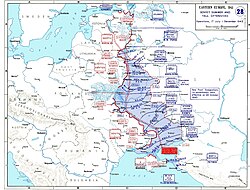
 Map of the battle of the Dnieper and linked operations | |||||||||
| |||||||||
| Belligerents | |||||||||
 Soviet Union Soviet Union |
 Germany Germany Romania Romania | ||||||||
| Commanders and leaders | |||||||||
|
Georgy Zhukov Aleksandr Vasilevsky Nikolai Vatutin Ivan Konev Rodion Malinovsky Fyodor Tolbukhin Konstantin Rokossovsky |
Erich von Manstein Ewald von Kleist Günther von Kluge | ||||||||
| Units involved | |||||||||
|
1st Ukrainian Front 2nd Ukrainian Front 3rd Ukrainian Front 4th Ukrainian Front 1st Belorussian Front |
| ||||||||
| Strength | |||||||||
|
26 August: 2,633,000 men (1,450,000 reinforcements)[3] 51,200 guns and mortars[3] 2,400 tanks and assault guns[3] 2,850 combat aircraft[3] |
On 1 November 1943:[7]- 85,564 personnel. | ||||||||
| Casualties and losses | |||||||||
|
Krivosheev: 1,285,977 men[8]
Frieser: 1,687,164 men[9]
- 290,000 killed or missing - 1,000,000+ in total |
Germany Forczyk:[11] - 102,000 killed or missing - 372,000+ in total RomaniaUnknown | ||||||||
The Battle of the Dnieper, known on the German side as the Defensive battles on the Dnieper[12] (German: Abwehrschlachten am Dnepr), was a military campaign that took place in 1943 on the Eastern Front of World War II. Being one of the largest operations of the war, it involved almost four million troops at one point and stretched over a 1,400 kilometres (870 mi) front. Over four months, the eastern bank of the Dnieper was recovered from German forces by five of the Red Army's fronts, which conducted several assault river crossings to establish several lodgements on the western bank. Kiev was later liberated in the Second Battle of Kiev. 2,438 Red Army soldiers were awarded the title Hero of the Soviet Union for their involvement.[13]
Strategic situation
[edit]Following the Battle of Kursk, the Wehrmacht's Heer and supporting Luftwaffe forces in the southern Soviet Union were on the defensive in southern Ukraine. By mid-August, Adolf Hitler understood that the forthcoming Soviet offensive could not be contained on the open steppe and ordered construction of a series of fortifications along the line of the Dnieper river.
On the Soviet side, Joseph Stalin was determined to launch a major offensive in Ukraine. The main thrust of the offensive was in a southwesterly direction; the northern flank being largely stabilized, the southern flank rested on the Sea of Azov.
Planning
[edit]Soviet planning
[edit] |


The operation began on 26 August 1943. Divisions started to move on a 1,400-kilometer front that stretched between Smolensk and the Sea of Azov. Overall, the operation would be executed by 36 Combined Arms, four Tank and five Air Armies. 2,650,000 personnel were brought into the ranks for this massive operation. The operation would use 51,000 guns and mortars, 2,400 tanks and 2,850 planes.
The Dnieper is the third largest river in Europe, behind only the Volga and the Danube. In its lower part, its width can easily reach three kilometres, and being dammed in several places made it even larger. Moreover, its western shore—the one still to be retaken—was much higher and steeper than the eastern, complicating the offensive even further. In addition, the opposite shore was transformed into a vast complex of defenses and fortifications held by the Wehrmacht.
Faced with such a situation, the Soviet commanders had two options. The first would be to give themselves time to regroup their forces, find a weak point or two to exploit (not necessarily in the lower part of the Dnieper), stage a breakthrough and encircle the German defenders far in the rear, rendering the defence line unsupplied and next to useless (very much like the German Panzers bypassed the Maginot line in 1940). This option was supported by Marshal Georgy Zhukov and Deputy Chief of Staff Aleksei Antonov, who considered the substantial losses after the Battle of Kursk. The second option would be to stage a massive assault without waiting, and force the Dnieper on a broad front. This option left no additional time for the German defenders, but would lead to much larger casualties than would a successful deep operation breakthrough. This second option was backed by Stalin due to the concern that the German "scorched earth" policy might devastate this region if the Red Army did not advance fast enough.
Stavka (the Soviet high command) chose the second option. Instead of deep penetration and encirclement, the Soviet intended to make full use of partisan activities to intervene and disrupt Germany's supply route so that the Germans could not effectively send reinforcements or take away Soviet industrial facilities in the region. Stavka also paid high attention to the possible scorched earth activities of German forces with a view to preventing them by a rapid advance.
The assault was staged on a 300-kilometer front almost simultaneously. All available means of transport were to be used to transport the attackers to the opposite shore, including small fishing boats and improvised rafts of barrels and trees (like the one in the photograph). The preparation of the crossing equipment was further complicated by the German scorched earth strategy with the total destruction of all boats and raft building material in the area. The crucial issue would obviously be heavy equipment. Without it, the bridgeheads would not stand for long.
Soviet organisation
[edit]- Central Front (known as the Belorussian Front after 20 October 1943), commanded by Konstantin Rokossovsky and accounted for 579,600 soldiers (took no part in the Dnieper battle after 3 October)
- 2nd Tank Army, led by Aleksei Rodin / Semyon Bogdanov (since September)
- 9th Tank Corps, led by Hryhoriy Rudchenko (KIA), Boris Bakharov
- 60th Army, led by Ivan Chernyakhovsky
- 13th Army, led by Nikolay Pukhov
- 65th Army, led by Pavel Batov
- 61st Army, led by Pavel Belov
- 48th Army, led by Prokofy Romanenko
- 70th Army, led by Ivan Galanin / Vladimir Sharapov (September – October) / Aleksei Grechkin (since October)
- 16th Air Army, led by Sergei Rudenko
- Voronezh Front (known as the 1st Ukrainian Front after 20 October 1943), commanded by Nikolai Vatutin and accounted for 665,500 soldiers
- 3rd Guards Tank Army, led by Pavel Rybalko
- 1st Tank Army, led by Mikhail Katukov
- 4th Guards Tank Corps, led by Pavel Poluboyarov
- 1st Guard Cavalry Corps, led by Viktor Baranov
- 5th Guards Army, led by Aleksei Zhadov
- 4th Guards Army, led by Grigory Kulik / Aleksei Zygin (KIA) / Ivan Galanin
- 6th Guards Army, led by Ivan Chistyakov
- 38th Army, led by Nikandr Chibisov / Kirill Moskalenko (since October)
- 47th Army, led by Pavel Korzun / Filipp Zhmachenko (September – October) / Vitaliy Polenov (since October)
- 27th Army, led by Sergei Trofimenko
- 52nd Army, led by Konstantin Koroteev
- 2nd Air Army, led by Stepan Krasovsky
- Steppe Front (known as the 2nd Ukrainian Front after 20 October 1943), commanded by Ivan Konev
- Southwestern Front (known as the 3rd Ukrainian Front after 20 October 1943), commanded by Rodion Malinovsky
- Southern Front (known as the 4th Ukrainian Front after 20 October 1943), commanded by Fyodor Tolbukhin
German planning
[edit]
The order to construct the Dnieper defence complex, known as "Ostwall" or "Eastern Wall", was issued on 11 August 1943 and immediately began to be executed.
Fortifications were erected along the length of the Dnieper. However, there was no hope of completing such an extensive defensive line in the short time available. Therefore, the completion of the "Eastern Wall" was not uniform in its density and depth of fortifications. Instead, they were concentrated in areas where a Soviet assault-crossing were most likely to be attempted, such as near Kremenchuk, Zaporizhia and Nikopol.
Additionally, on 7 September 1943, the SS forces and the Wehrmacht received orders to implement a scorched earth policy, by stripping the areas they had to abandon of anything that could be used by the Soviet war effort.
German organisation
[edit]- Luftflotte 2 (selected units) – Wolfram Freiherr von Richthofen
- (in Ukraine) Army Group South – Erich von Manstein
- 4th Panzer Army – Hermann Hoth
- 1st Panzer Army – Eberhard von Mackensen
- 8th Army – Otto Wohler
- 6th Army – Karl-Adolf Hollidt (transferred to Army Group A control)
- Luftflotte 4 – Wolfram Freiherr von Richthofen / Otto Deßloch (since September)
- (in Crimea) Army Group A – Ewald von Kleist
- Army Group Center – Günther von Kluge
- 2nd Army – Walter Weiß (took no part in the Dnieper battle after 3 October)
Description of the strategic operation
[edit]Initial attack
[edit]

Despite a great superiority in numbers, the offensive was by no means easy. German opposition was ferocious and the fighting raged for every town and city. The Wehrmacht made extensive use of rear guards, leaving some troops in each city and on each hill, slowing the Soviet offensive.
Progress of the offensive
[edit]
Three weeks after the start of the offensive, and despite heavy losses on the Soviet side, it became clear that the Germans could not hope to contain the Soviet offensive in the flat, open terrain of the steppes, where the Red Army's numerical strength would prevail. Manstein asked for as many as 12 new divisions in the hope of containing the Soviet offensive – but German reserves were perilously thin.
On 15 September 1943, Hitler ordered Army Group South to retreat to the Dnieper defence line. The battle for Poltava was especially bitter. The city was heavily fortified and its garrison well prepared. After a few inconclusive days that greatly slowed down the Soviet offensive, Marshal Konev decided to bypass the city and rush towards the Dnieper. After two days of violent urban warfare, the Poltava garrison was overcome. Towards the end of September 1943, Soviet forces reached the lower part of the Dnieper.
Dnieper airborne operation
[edit] | This section includes a list of references, related reading, or external links, but its sources remain unclear because it lacks inline citations. (September 2022) |

(The following is, largely, a synopsis of an account by Glantz[14] with support from an account by Staskov.[15])[verification needed]
Stavka detached the Central Front's 3rd Tank Army to the Voronezh Front to race the weakening Germans to the Dnieper, to save the wheat crop from the German scorched earth policy, and to achieve strategic or operational river bridgeheads before a German defence could stabilize there. The 3rd Tank Army, plunging headlong, reached the river on the night of 21–22 September and, on 23 September, Soviet infantry forces crossed by swimming and by using makeshift rafts to secure small, fragile bridgeheads, opposed only by 120 German Cherkassy flak academy NCO candidates and the hard-pressed 19th Panzer Division Reconnaissance Battalion. Those forces were the only Germans within 60 km of the Dnieper loop. Only a heavy German air attack and a lack of bridging equipment kept Soviet heavy weaponry from crossing and expanding the bridgehead.
The Soviets, sensing a critical juncture, ordered a hasty airborne corps assault to increase the size of the bridgehead before the Germans could counterattack. On 21 September, the Voronezh Front's 1st, 3rd and 5th Guards Airborne Brigades got the urgent call to secure, on 23 September, a bridgehead perimeter 15 to 20 km wide and 30 km deep on the Dnieper loop between Kaniv and Rzhishchev, while Front elements forced the river.
The arrival of personnel at the airfields was slow, necessitating, on 23 September, a one-day delay and omission of 1st Brigade from the plan; consequent mission changes caused near chaos in command channels. Mission change orders finally got down to company commanders, on the 24 September, just 15 minutes before their units, not yet provisioned with spades, anti-tank mines, or ponchos for the autumn night frosts, assembled on airfields. Owing to the weather, not all assigned aircraft had arrived at airfields on time (if at all). Further, most flight safety officers disallowed maximum loading of their aircraft. Given fewer aircraft (and lower than expected capacities), the master loading plan, ruined, was abandoned. Many radios and supplies got left behind. In the best case, it would take three lifts to deliver the two brigades. Units (still arriving by the overtaxed rail system), were loaded piecemeal onto returned aircraft, which were slow to refuel owing to the less-than-expected capacities of fuel trucks. Meanwhile, already-arrived troops changed planes, seeking earlier flights. Urgency and the fuel shortage prevented aerial assembly aloft. Most aircraft, as soon as they were loaded and fueled, flew in single file, instead of line abreast, to the dropping points. Assault waves became as intermingled as the units they carried.
As corps elements made their flights, troops (half of whom had never jumped, except from training towers) were briefed on drop zones, assembly areas and objectives only poorly understood by platoon commanders still studying new orders. Meanwhile, Soviet aerial photography, suspended for several days by bad weather, had missed the strong reinforcement of the area, early that afternoon. Non-combat cargo pilots ferrying 3rd Brigade through drizzle expected no resistance beyond river pickets but, instead, were met by anti-aircraft fire and flares from the 19th Panzer Division (only coincidentally transiting the drop zone, and just one of six divisions and other formations ordered, on the 21st, to fill the gap in front of the 3rd Tank Army). Lead aircraft, disgorging paratroopers over Dubari at 1930h, came under fire from elements of the 73rd Panzer Grenadier Regiment and division staff of 19th Panzer Division. Some paratroopers began returning fire and throwing grenades even before landing; trailing aircraft accelerated, climbed and evaded, dropping wide. Through the night, some pilots avoided flare-lit drop points entirely, and 13 aircraft returned to airfields without having dropped at all. Intending a 10 by 14 km drop over largely undefended terrain, the Soviets instead achieved a 30 by 90 km drop over the fastest mobile elements of two German corps.
On the ground, the Germans used white parachutes as beacons to hunt down and kill disorganized groups and to gather and destroy airdropped supplies. Supply bonfires, glowing embers, and multi-color starshells illuminated the battlefield. Captured documents gave the Germans enough knowledge of Soviet objectives to arrive at most of them before the disorganized paratroopers.
Back at the Soviet airfields, the fuel shortage allowed only 298 of 500 planned sorties, leaving corps anti-tank guns and 2,017 paratroops undelivered. Of 4,575 men dropped (seventy percent of the planned number, and just 1,525 from 5th Brigade), some 2,300 eventually assembled into 43 ad hoc groups, with missions abandoned as hopeless, and spent most of their time seeking supplies not yet destroyed by the Germans. Others joined with the nine partisan groups operating in the area. About 230 made it over (or out of) the Dnieper to Front units (or were originally dropped there). Most of the rest were captured that first night or killed the next day (although, on that first night, the 3rd Co, 73rd Panzer Grenadier Regiment, suffered heavy losses while annihilating about 150 paratroopers near Grushevo, some 3 km west of Dubari).
The Germans underestimated that 1,500 to 2,000 had dropped; they recorded 901 paratroops captured and killed in the first 24 hours. Thereafter, they largely ignored the Soviet paratroopers, to counterattack and truncate the Dnieper bridgeheads. The Germans deemed their anti-paratrooper operations completed by the 26th, although a modicum of opportunistic actions against garrisons, rail lines, and columns were conducted by remnants up to early November. For a lack of manpower to clear all areas, fighters in the area's forests would remain a minor threat.
The Germans called the operation a fundamentally sound idea ruined by the dilettantism of planners lacking expert knowledge (but praised individual paratroopers for their tenacity, bayonet skills, and deft use of broken ground in the sparsely wooded northern region). Stavka deemed this second (and, ultimately, last) corps drop a complete failure; lessons they knew they had already learned from their winter offensive corps drop at Viazma had not stuck. They would never trust themselves to try it again.
Soviet 5th Guards Airborne Brigade commander Sidorchuk, withdrawing to the forests south, eventually amassed a brigade-size command, half paratroops, half partisans; he obtained air supply, and assisted the 2nd Ukrainian Front over the Dnieper near Cherkassy to finally link up with Front forces on 15 November. After 13 more days of combat, the airborne element was evacuated, ending a harrowing two months. More than sixty percent never returned.
Assaulting the Dnieper
[edit]

The first bridgehead on the Dnieper's western shore was established on 22 September 1943 at the confluence of the Dnieper and Pripyat rivers, in the northern part of the front. On 24 September, another bridgehead was created near Dniprodzerzhynsk, another on 25 September near Dnipropetrovsk and yet another on 28 September near Kremenchuk. By the end of the month, 23 bridgeheads were created on the western side, some of them 10 kilometers wide and 1–2 kilometres deep.
The crossing of the Dnieper was extremely difficult. Soldiers used every available floating device to cross the river, under heavy German fire and taking heavy losses. Once across, Soviet troops had to dig themselves into the clay ravines composing the Dnieper's western bank.
Securing the lodgements
[edit]
German troops soon launched heavy counterattacks on almost every bridgehead, hoping to annihilate them before heavy equipment could be transported across the river.
For instance, the Borodaevsk lodgement, mentioned by Marshal Konev in his memoirs, came under heavy armored attack and air assault. Bombers attacked both the lodgement and the reinforcements crossing the river. Konev complained at once about a lack of organization of Soviet air support, set up air patrols to prevent bombers from approaching the lodgements and ordered forward more artillery to counter tank attacks from the opposite shore. When Soviet aviation became more organized and hundreds of guns and Katyusha rocket launchers began firing, the situation started to improve and the bridgehead was eventually preserved.
Such battles were commonplace on every lodgement. Although all the lodgements were held, losses were terrible – at the beginning of October, most divisions were at only 25 to 50% of their nominal strength.
Lower Dnieper offensive
[edit]By mid-October, the forces accumulated on the lower Dnieper bridgeheads were strong enough to stage a first massive attack to definitely secure the river's western shore in the southern part of the front. Therefore, a vigorous attack was staged on the Kremenchuk-Dnipropetrovsk line. Simultaneously, a major diversion was conducted in the south to draw German forces away both from the Lower Dnieper and from Kiev.
At the end of the offensive, Soviet forces controlled a bridgehead 300 kilometers wide and up to 80 kilometers deep in some places. In the south, the Crimea was now cut off from the rest of the German forces. Any hope of stopping the Red Army on the Dnieper's east bank was lost.
Outcomes
[edit]The Battle of the Dnieper was another defeat for the Wehrmacht that required it to restabilize the front further west. The Red Army, which Hitler hoped to contain at the Dnieper, forced the Wehrmacht's defences. Kiev was recaptured and German troops lacked the forces to annihilate Soviet troops on the Lower Dnieper bridgeheads. The west bank was still in German hands for the most part, but both sides knew that it would not last for long.
Additionally, the Battle of the Dnieper demonstrated the strength of the Soviet partisan movement. The Rail War operation staged during September and October 1943 struck German logistics very hard, creating heavy supply issues.
Incidentally, between 28 November and 1 December 1943 the Tehran Conference was held between Winston Churchill, Franklin D. Roosevelt, and Stalin. The Battle of the Dnieper, along with other major offensives staged in 1943, certainly gave Stalin a dominant position for negotiating with his Allies.
The Soviet success during this battle created the conditions for the follow-up Dnieper-Carpathian Offensive on the right-bank Ukraine, which was launched on 24 December 1943 from a bridgehead west of Kiev that was secured during this battle.[16] The offensive brought the Red Army from the Dnieper all the way to Galicia (Poland), Carpathian Mountains and Romania, with Army Group South being split into two parts- north and south of Carpathians.
Soviet operational phases
[edit]From a Soviet operational point of view, the battle was broken down into a number of different phases and offensives.
The first phase of the battle :
- Chernigov-Poltava Strategic Offensive 26 August 1943 – 30 September 1943 (Central, Voronezh and Steppe fronts)
- Chernigov-Pripyat Offensive 26 August – 30 September 1943
- Sumy–Priluky Offensive 26 August – 30 September 1943
- Poltava-Kremenchug Offensive 26 August – 30 September 1943
- Donbass Strategic Offensive 13 August – 22 September 1943 (Southwestern and Southern fronts)
- Dnieper airborne assault 24 September – 24 November 1943
The second phase of the operation includes :
- Lower Dnieper Offensive 26 September – 20 December 1943
- Melitopol Offensive 26 September – 5 November 1943
- Zaporizhia Offensive 10–14 October 1943
- Kremenchug-Pyatikhatki Offensive 15 October – 3 November 1943
- Dnepropetrovsk Offensive 23 October – 23 December 1943
- Krivoi Rog Offensive 14–21 November 1943
- Apostolovo Offensive 14 November – 23 December 1943
- Nikopol Offensive 14 November – 31 December 1943
- Aleksandriia-Znamenka Offensive 22 November – 9 December 1943
- Krivoi Rog Offensive 10–19 December 1943
- Kiev Strategic Offensive Operation (October) (1–24 October 1943)
- Chernobyl-Radomysl Offensive Operation (1–4 October 1943)
- Chernobyl-Gornostaipol Defensive Operation (3–8 October 1943)
- Lyutezh Offensive Operation (11–24 October 1943)
- Bukrin Offensive Operation (12–15 October 1943)
- Bukrin Offensive Operation (21–24 October 1943)
- Kiev Strategic Offensive 3–13 November 1943
- Rauss' November 1943 counterattack
- Kiev Strategic Defensive 13 November – 22 December 1943
References
[edit]Citations
[edit]- ^ Edwards, Robert (15 August 2018). The Eastern Front: The Germans and Soviets at War in World War II. Rowman & Littlefield. ISBN 978-0-8117-6784-2.
- ^ Frieser, Karl-Heinz. The Eastern Front 1943-1944: The War in the East and on the Neighbouring Fronts. Oxford University Press, 2017, p. 356.
- ^ a b c d Frieser et al. 2007, p. 343.
- ^ OKH Org.Abt. I Nr. I/5645/43 g.Kdos. Iststärke des Feldheeres Stand 1.11.43. NARA T78, R528, F768.
- ^ Oberkommando des Heeres. Geheime Kommandosache. Panzerlage der Heeresgruppe Süd. Stand am 10 November 1943. Bundesarchiv-Militärarchiv (BA-MA) RH 10/52, fol. 80.
- ^ Frieser, Karl-Heinz. Germany and the Second World War: Volume VIII: The Eastern Front 1943-1944: The War in the East and on the Neighbouring Fronts. Oxford University Press, 2017, p. 364.
- ^ OKH Org.Abt. I Nr. I/5645/43 g.Kdos. Iststärke des Feldheeres Stand 1.11.43. NARA T78, R528, F770.
- ^ Кривошеев, Г.Ф. (2001). "Россия и СССР в войнах XX века: Потери вооруженных сил". ОЛМА-ПРЕСС.
- ^ Frieser et al. 2007, p. 379.
- ^ Forczyk, Robert. The Dnepr 1943: Hitler's Eastern Rampart Crumbles. Osprey Publishing 2016, p. 91.
- ^ Forczyk, Robert. The Dnepr 1943: Hitler's Eastern Rampart Crumbles. Osprey Publishing 2016, p. 91.
- ^ Personalverwaltende Stellen der Wehrmacht. Schlacht- und Gefechtsbezeichnungen im Zweiten Weltkrieg 1933 - 1945. Verordnungen des Oberkommando des Heeres. Bundesarchiv-Militärarchiv (BA-MA) RW 59/132, fol. 58.
- ^ Military Review. Command and General Staff School. 1993. p. 2-PA75.
- ^ The History of Soviet Airborne Forces, Chapter 8, Across The Dnieper (September 1943), by David M. Glantz, Cass, 1994. (portions online)
- ^ 1943 Dnepr airborne operation: lessons and conclusions Military Thought, July 2003, by Nikolai Viktorovich Staskov. (online) See ref at Army (Soviet Army) under 40th Army entry.
- ^ Грылев А.Н. Днепр-Карпаты-Крым. Освобождение Правобережной Украины и Крыма в 1944 году. Москва: Наука, 1970, p. 19.
Bibliography
[edit] | This article includes a list of general references, but it lacks sufficient corresponding inline citations. (February 2008) |
- Frieser, Karl-Heinz; Schmider, Klaus; Schönherr, Klaus; Schreiber, Gerhard; Ungváry, Kristián; Wegner, Bernd (2007). Die Ostfront 1943/44 – Der Krieg im Osten und an den Nebenfronten [The Eastern Front 1943–1944: The War in the East and on the Neighbouring Fronts]. Das Deutsche Reich und der Zweite Weltkrieg (Germany and the Second World War) (in German). Vol. VIII. München: Deutsche Verlags-Anstalt. ISBN 978-3-421-06235-2.
- David M. Glantz, Jonathan M. House, When Titans Clashed: How the Red Army stopped Hitler, University Press of Kansas, 1995
- Nikolai Shefov, Russian fights, Lib. Military History, Moscow, 2002
- History of Great Patriotic War, 1941–1945. Moscow, 1963
- John Erickson, Barbarossa: The Axis and the Allies, Edinburgh University Press, 1994
- Harrison, Richard. (2018) The Battle of the Dnepr: The Red Army's Forcing of the East Wall, September–December 1943. Helion and Company. ISBN 978-1912174171
- Marshal Konev, Notes of a front commander, Science, Moscow, 1972.
- Erich von Manstein, Lost Victories, Moscow, 1957.

Battle of the Dnieper
View on GrokipediaBackground
Strategic Situation After Kursk
The Battle of Kursk concluded on 23 August 1943 with a decisive Soviet victory, marking the permanent loss of the strategic initiative by German forces on the Eastern Front.[4] Despite heavy casualties—estimated at over 800,000 Soviet dead, wounded, or missing during the broader operation—the Red Army's successful defense and immediate counterattacks shattered the Wehrmacht's offensive capabilities in the sector, depleting elite panzer units and exposing the overstretched German lines to exploitation.[4] Soviet intelligence and Stavka planning had anticipated the German thrust, enabling prepared ripostes that transitioned seamlessly into pursuit operations. Three days later, on 26 August 1943, the Soviets unleashed a massive counteroffensive across a 750-kilometer front stretching from Smolensk in the north to the Sea of Azov in the south, involving multiple fronts under commanders such as Vatutin, Konev, and Malinovsky.[4] This broad-front strategy, favored by Stavka over concentrated breakthroughs, aimed to overwhelm German defenses through sheer numerical superiority—Soviet forces outnumbered the Axis by roughly 2:1 in manpower and artillery—and rapid mechanized advances that prevented the enemy from forming coherent reserves. Key early successes included the continuation of Operation Polkovodets Rumyantsev, which had already recaptured Kharkov on 23 August, and the onset of the Donbass Offensive, pushing Army Group South westward and southward while liberating industrial areas and disrupting German logistics. By mid-September, Soviet spearheads had advanced up to 200 kilometers in places, forcing the Germans into a series of fighting withdrawals amid fuel shortages and mounting attrition. Facing relentless pressure, Field Marshal Erich von Manstein's Army Group South—comprising some 1.2 million troops but suffering irreplaceable losses of over 130,000 men in the three months post-Kursk—advocated elastic defense and timely retreats to preserve combat effectiveness, but Adolf Hitler initially resisted, insisting on holding forward positions to buy time for fortifications. On 15 September 1943, however, Hitler relented and ordered a phased withdrawal to the Dnieper River line, envisioned as a natural barrier with prepared defenses like the Panther-Wotan position, though incomplete due to resource constraints and Allied bombing of synthetic fuel plants.[1] This retreat covered approximately 300-500 kilometers in southern sectors, but came too late to avert encirclements; German units arrived at the Dnieper fatigued, with minimal reinforcements—only about 32,000 arrivals for Army Group South—and vulnerable flanks exposed by the collapse of adjacent Army Group A in the Caucasus. The river, while offering defensive depth, could not fully compensate for the Wehrmacht's strategic exhaustion, as Soviet forces began probing crossings almost immediately, setting the stage for the ensuing battle.[4]The Dnieper Line and German Defensive Posture
Following the Soviet victory at the Battle of Kursk in late July and early August 1943, German Army Group South, under Field Marshal Erich von Manstein, executed a series of delaying actions during its retreat toward the Dnieper River, which Adolf Hitler identified as the primary natural obstacle and defensive line in the sector.[1] Hitler viewed the Dnieper's 2,290-kilometer length, broad floodplains, and limited crossing points—primarily via 14 major bridges and numerous fords—as inherently defensible, supplemented by scorched-earth tactics including the destruction of bridges, roads, and industrial sites to deny resources to pursuing Soviet forces.[5] By mid-September 1943, the bulk of German forces in Ukraine had reached the river's western bank, though their lines stretched thinly across a front exceeding 700 kilometers due to manpower shortages, with many divisions at 30-50% strength after Kursk losses exceeding 200,000 casualties.[1] In early August 1943, shortly after Kursk, Hitler authorized the rapid fortification of the Dnieper positions as part of the broader Panther-Wotan Line (also termed the Ostwall or Eastern Wall), a continuous defensive network planned to extend from Narva on the Baltic Sea southward along the Dnieper to the Black Sea, incorporating anti-tank ditches, minefields, concrete bunkers, and artillery emplacements manned by fortress divisions.[5] Construction began immediately using Organization Todt labor battalions, local conscripts, and rear-area troops, focusing on key sectors like Zaporizhzhia and the Dnieper bend near Kherson, but progressed unevenly; by September, only about 20% of planned works were complete, hampered by material shortages, Soviet air interdiction, and the need to divert engineering resources to immediate field improvisations such as flooded marshes and barbed-wire obstacles on the eastern bank.[4] On 15 September 1943, Hitler explicitly ordered Army Group South to consolidate behind the Dnieper, prohibiting further withdrawals and mandating a rigid defense to exploit the river's barrier effect, despite reconnaissance reports indicating multiple viable Soviet crossing sites.[1] German defensive doctrine emphasized depth and firepower over static holdings, with Manstein pressing for an elastic strategy of trading space for time through mobile reserves and counterattacks to pinch off Soviet bridgeheads, drawing on successes like the Third Battle of Kharkov earlier in 1943.[6] However, Hitler's "no step back" directive—reiterated in Führer Orders from late August—overrode such flexibility, committing under-equipped panzer groups like the 8th Army's remnants to fixed positions and dispersing armored assets to cover the extended line, which diluted their counteroffensive potential.[7] Allied Axis contingents, including Romanian 3rd and 4th Armies totaling around 150,000 men, were integrated into the posture but suffered from poor equipment and morale, often relegated to secondary sectors prone to breakthroughs. Overall, the Wehrmacht allocated approximately 800,000 troops to the Dnieper front by early October, supported by 2,000 artillery pieces and 500 tanks, yet logistical strains from overextended supply lines—exacerbated by partisan activity destroying rail capacity—limited sustained operations, setting the stage for Soviet exploitation of gaps.[8]Forces and Organization
Soviet Forces and Command Structure
The Soviet military effort in the Battle of the Dnieper, spanning August to December 1943, was directed by the Stavka VGK under Supreme Commander Joseph Stalin, which coordinated sequential offensives to seize bridgeheads across the river and exploit German withdrawals. Operational planning emphasized massed infantry assaults supported by deep battle tactics, incorporating artillery barrages, tank armies for breakthroughs, and airborne forces for seizure of key terrain, though the latter suffered heavy losses due to inadequate resupply and German countermeasures. Stavka representatives, including Marshal Georgy Zhukov, were dispatched to oversee critical sectors, such as the Kiev offensive, to ensure alignment with broader objectives of encircling Army Group South remnants. The primary Soviet formations comprised four fronts arrayed along a 1,400-kilometer front from the Pripyat Marshes to the Black Sea delta. In the north, General of the Army Konstantin Rokossovsky's Central Front conducted the Chernigov-Pripyat Offensive (26 August–28 September), employing the 48th, 50th, 60th, 65th, and 70th Armies alongside the 1st Guards Tank Army to overrun German defenses and reach the Dnieper near Chernigov.[9] Further south, General of the Army Nikolai Vatutin's Voronezh Front, which included the 38th, 40th, and 27th Armies with mobile groups like the 3rd Guards Tank Army, drove toward the middle Dnieper, capturing bridgeheads amid intense urban fighting at Bukrin.[2] The Steppe Front under General of the Army Ivan Konev and the Southwestern Front commanded by General of the Army Rodion Malinovsky handled the central and southern sectors, respectively, with the former featuring the 53rd, 5th Guards, and 7th Guards Armies for thrusts toward Kremenchug, and the latter deploying the 46th and 8th Guards Armies to force crossings in the lower Dnieper bend.[10] These fronts integrated cavalry-mechanized groups for rapid exploitation, reflecting Soviet adaptation to fluid maneuver warfare following Kursk. On 20 October 1943, in response to territorial gains, Stavka redesignated the Voronezh Front as the 1st Ukrainian Front, the Steppe Front as the 2nd Ukrainian Front, and the Southwestern Front as the 3rd Ukrainian Front, while the Central Front became the Belorussian Front to reflect operational shifts eastward.[11] Command at the army level emphasized aggressive river crossings, often improvised with pontoons and fording under fire, supported by NKVD border troops for securing initial lodgments. Force compositions varied by sector but typically included rifle divisions reinforced by NKVD divisions for reliability in high-casualty assaults, with overall Soviet strength exceeding 2 million personnel by late 1943, bolstered by Lend-Lease equipment and mobilized reserves from the rear. This structure enabled parallel offensives but strained logistics, contributing to uneven bridgehead expansions.[12]German and Allied Forces
The Axis defense of the Dnieper River in 1943 was primarily conducted by Army Group South, under the command of Field Marshal Erich von Manstein, which bore the brunt of the Soviet offensives across the central and eastern sectors of the front.[13][14] By early October 1943, the army group fielded approximately 37 divisions, though these units were heavily understrength due to prior losses at Kursk and subsequent attritional fighting.[13] Frontline infantry averaged around 1,000 men per division, reflecting severe manpower shortages and reliance on improvised defenses rather than fortified positions.[13] Key formations included the First Panzer Army, commanded by Generaloberst Eberhard von Mackensen and repositioned from the Donbas region, and the Fourth Panzer Army under Generaloberst Hermann Hoth, both tasked with mobile counterattacks to disrupt Soviet bridgeheads.[13][14] In the southern sector, adjacent to Army Group South, Army Group A—commanded by Field Marshal Ewald von Kleist—defended the lower Dnieper approaches and Crimean flanks with the Sixth Army (13 German divisions plus 2 Romanian divisions) and the Seventeenth Army (1 German division plus 7 Romanian divisions).[13] The Sixth Army, for instance, possessed only 83 tanks and 98 assault guns by late 1943, underscoring the logistical strain on armored elements across the Axis forces.[13] Romanian contingents, drawn from reformed units following the Stalingrad debacle, were assigned to static defense roles on exposed flanks, where their equipment and training deficiencies limited effectiveness against major Soviet thrusts.[13] Hungarian forces, while committed earlier in the year to sectors north of the main Dnieper battle, played a marginal role in the river defense itself, with primary Axis allied contributions concentrated in Romanian units under German operational control.[13] Overall, the Axis forces emphasized elastic defense and counteroffensives by panzer reserves, but persistent shortages in infantry replacements and fuel hampered sustained operations along the 1,200-kilometer front.[14]Planning and Preparations
Soviet Offensive Planning
The Soviet High Command, or Stavka VGK, conceived the Dnieper offensive as an urgent exploitation of the victory at Kursk, ordering relentless pursuit operations to forestall German fortification of the river line. Directives issued in early August 1943 tasked the Voronezh, Steppe, Southwestern, and Central Fronts with advancing southward and eastward to the Dnieper, emphasizing speed over concentrated maneuvers to cover a front exceeding 1,400 kilometers from the Smolensk region to the Sea of Azov.[5] This broad-front strategy aimed to seize multiple crossing points simultaneously, preventing the Wehrmacht from shifting reserves effectively and enabling the establishment of bridgeheads for further advances into right-bank Ukraine.[15] Key commanders included General Nikolai Vatutin (Voronezh Front), General Ivan Konev (Steppe Front), General Konstantin Rokossovsky (Central Front), and General Fyodor Malinovsky (Southwestern Front), who coordinated under Stavka representatives Marshals Georgy Zhukov and Alexander Vasilevsky. Stavka reallocated assets, such as detaching the Central Front's 3rd Tank Army to reinforce Vatutin's forces for a rapid dash to the river, while stockpiling artillery and engineer units for assault crossings. Preparations incorporated airborne elements for seizing key sectors, though initial plans focused on ground thrusts to reach the Dnieper by late August or early September 1943.[5][13] To spur initiative amid the hasty timeline, Stalin's Order No. H/0013 of 12 September 1943 promised the Hero of the Soviet Union title to frontline troops and leaders achieving the first verified crossings and holding western-bank positions, incentivizing decentralized actions that resulted in dozens of small-scale fords starting in late September. This measure reflected Stavka's recognition of the operation's scale—mobilizing over 2.6 million troops, 51,000 guns, and 2,400 tanks—but also its logistical strains, as fronts operated with limited reserves and extended supply lines.[13] Overall, the planning prioritized operational momentum over detailed reconnaissance, accepting high attrition to capitalize on German disarray post-Kursk.German Defensive Measures and Expectations
Following the Battle of Kursk in July 1943, Adolf Hitler issued a directive on 11 August ordering the construction of the Panther-Wotan Line, also known as the Eastern Wall (Ostwall), as a fortified defensive barrier extending from the Baltic Sea to the Black Sea, with the Dnieper River serving as its central obstacle in the southern sector.[2] This system aimed to create a series of defensive positions, including trenches, anti-tank ditches, minefields, and concrete bunkers, to impede Soviet advances and enable German forces to conduct elastic defense.[1] However, construction progressed slowly due to material shortages, labor constraints, and the rapid Soviet pursuit, leaving the Dnieper line largely unfortified by September; arriving German troops often encountered only rudimentary field works rather than the promised "impregnable" barrier.[13] On 15 September 1943, Hitler reluctantly authorized Army Group South, under Field Marshal Erich von Manstein, to withdraw to the Dnieper line after heated debates, intending it as a natural stronghold where the river's width—up to 1,000 meters in places—and marshy floodplains would frustrate amphibious crossings.[13] Defensive measures emphasized holding critical bridgeheads, such as those at Zaporozhye and Nikopol, to safeguard industrial resources like manganese ore and protect the Crimea flank; on 8 October, Hitler explicitly forbade evacuation of the Zaporozhye position despite Manstein's requests for flexibility.[13] Additional tactics included scorched-earth policies, with orders issued on 7 September for SS and Wehrmacht units to destroy infrastructure, floodplains, and settlements in retreat paths to deny Soviets logistical support and crossing points.[10] Manstein deployed available panzer reserves for localized counterattacks, such as those planned for early November, but ammunition and fuel shortages limited their effectiveness, with Army Group South's 37 divisions averaging only about 1,000 infantrymen each by early October—roughly 80 men per mile of front.[13] German high command expectations centered on the Dnieper as a decisive halt line, anticipating that Soviet forces, depleted from prior offensives, would struggle with forced river crossings under fire, allowing time to reinforce and stabilize the front before a anticipated winter push.[13] Hitler viewed the position as strategically defensible if manned adequately, prioritizing rigid stands to preserve occupied territory and industrial assets, while rejecting Manstein's proposals for deeper withdrawals to shorten lines and build reserves.[13] Yet, Manstein and field commanders recognized the fragility, warning on 27 November of insufficient reserves against an expected Soviet offensive involving 33 rifle divisions and multiple tank corps; troop conditions were dire, with infantry strengths at "lowest tolerable levels" and reliance on under-equipped Romanian and other allied units exposing flanks.[13] Despite these measures, the incomplete fortifications and manpower deficits undermined confidence in a prolonged hold, foreshadowing the line's collapse under multi-front Soviet assaults.[13]Course of the Battle
Launch of the Soviet Offensive
The launch of the Soviet offensive in the Battle of the Dnieper occurred on 26 August 1943, marking the beginning of the Chernigov-Poltava Strategic Offensive Operation conducted by the Central, Voronezh, and Steppe Fronts. This coordinated effort followed the Soviet victories at Kursk and subsequent counteroffensives, aiming to exploit German disarray and advance to the Dnieper River to establish bridgeheads on its western bank as directed by Stavka. The Central Front, commanded by General Konstantin Rokossovsky, delivered the main strike in the Sevsk direction against elements of German Army Group Center, including the 2nd Panzer Army.[16][1][11] Rokossovsky's forces, comprising the 60th, 65th, and 70th Armies along with supporting tank and artillery units, initiated the assault after preparatory bombardments, rapidly penetrating German defenses weakened by prior retreats. The 60th Army achieved particular success in breaking through, advancing towards the Desna River and creating gaps in the German lines that allowed mobile groups to exploit the breakthroughs. Concurrently, the Voronezh Front under General Nikolai Vatutin and the Steppe Front under General Ivan Konev pressed southward, tying down German reserves and preventing reinforcements from stabilizing the front. These initial assaults involved over 2.6 million Soviet troops across the broader operation, supported by extensive artillery and air forces.[11][1][11] German forces, primarily from Army Groups Center and South, attempted to conduct fighting withdrawals to the Dnieper line, but the speed and scale of the Soviet attacks disrupted these efforts, leading to localized encirclements and heavy losses in the opening days. By early September, Soviet vanguard units had reached the Dnieper in multiple sectors, setting the stage for crossing attempts despite logistical strains and incomplete preparations. The offensive's momentum stemmed from superior numbers and the Germans' overstretched supply lines, though it imposed high costs on Soviet infantry in assaulting fortified positions.[1][16]Attempts to Cross the Dnieper
Following the Soviet victories at Kursk and in the subsequent offensives, the Red Army's fronts reached the east bank of the Dnieper River in late August and early September 1943, prompting immediate crossing attempts despite incomplete logistical preparations and reconnaissance.[13] Stalin's directive emphasized haste, with promises of the Hero of the Soviet Union title to the first unit to establish a bridgehead on the west bank, leading to improvised assaults using available boats, rafts, and even soldiers swimming across under fire.[1] These efforts spanned over 700 kilometers from the Pripyat Marshes in the north to the Black Sea in the south, involving multiple army groups but lacking coordinated artillery or engineer support in many sectors.[13] The Central Front, under General Konstantin Rokossovsky, achieved the earliest success on September 15, 1943, when elements of the 65th Army forded the Dnieper near the village of Loyev, approximately 100 kilometers north of Kiev, securing a narrow bridgehead amid marshy terrain that hindered German counterattacks.[13] By September 22, this expanded slightly at the Dnieper-Pripyat confluence, marking the first confirmed lodgment on the western bank, though German forces from Army Group Center quickly reinforced with infantry and limited armor to contain it.[1] Further north, the Western Front's 5th Army crossed northeast of Dorogobuzh on August 26 but struggled to hold due to exposed flanks and inadequate bridging, resulting in partial liquidation of the gains by early September.[9] In the central sector near Kiev, the Voronezh Front (later 1st Ukrainian Front) under General Nikolai Vatutin attempted crossings in the Bukrin bend starting September 21, deploying the 40th and 27th Armies with assault boats against fortified German positions of the 8th Army.[13] These efforts faltered due to swampy floodplains, ravines, and intense German artillery fire, with initial bridgeheads measuring only 2-3 kilometers deep repeatedly repelled; by late September, over 20 such small-scale attempts had been launched but most collapsed under counterassaults from SS and panzer divisions.[10] The Steppe Front (2nd Ukrainian Front) under General Ivan Konev faced similar setbacks south of the bend, where the 37th Army's crossings near Kanev incurred heavy casualties from mined approaches and Luftwaffe interdiction, though isolated pockets persisted.[17] Southern attempts by the Southwestern Front near the lower Dnieper, including the 12th Army's probes toward Zaporozhye in late September, relied on captured ferries and engineer pontoons but encountered stronger defenses from Army Group South's entrenched divisions, leading to fragmented successes amid high losses from enfilading fire.[13] Overall, while approximately 23 bridgeheads were eventually noted—many minute and vulnerable—the initial crossings highlighted Soviet numerical superiority overwhelming local German shortages, yet exposed deficiencies in planning, with failure rates exceeding 70% in contested sectors due to terrain and enemy responsiveness.[10] German records indicate these probes forced resource diversions but did not yet threaten a breakthrough, as Manstein's Army Group South prioritized containing rather than eliminating all footholds.[13]Dnieper Airborne Operation
The Dnieper Airborne Operation, conducted from 24 September to 13 October 1943 as part of the Soviet Voronezh Front's efforts to expand bridgeheads across the Dnieper River, aimed to seize and secure key terrain on the western bank to facilitate the advance of ground forces and disrupt German reinforcements.[18] Ordered on 21 September, the operation targeted a bridgehead approximately 9 to 12.5 miles wide and 18.5 miles deep between Kanev and Rzhishchev, near Velikyi Bukrin, with specific objectives including the capture of Lipovyi Rog, Makedony, and Stepantsy to prevent enemy counterattacks and enable bridge construction for armored units. The strategic intent, as directed by Stavka, was to deploy the 1st, 3rd, and 5th Guards Airborne Brigades to the Bukrin Bend area to disrupt German reinforcements and facilitate the river crossing by Soviet ground forces.[19][18] Soviet forces consisted of an ad hoc airborne corps of roughly 10,000 men under Major General I. I. Zatevakhin, comprising the 1st Guards Airborne Brigade (Colonel P. I. Krasovsky), 3rd Guards Airborne Brigade (Colonel P. A. Goncharov), and 5th Guards Airborne Brigade (Lieutenant Colonel P. M. Sidorchuk); the 1st Brigade was ultimately excluded from the drop due to delays.[18] Planning called for 6,592 paratroopers to be inserted via 298 sorties, but logistical delays in assembling units at airfields, combined with poor weather, reduced the actual drop to 4,575 men on the night of 24-25 September, with drops scattered over an area of 30 by 90 kilometers due to inadequate navigation and reconnaissance. The operation was plagued by operational chaos, including poor reconnaissance that led to troops dropping directly onto German armored concentrations, navigational errors that scattered paratroopers over a vast area, and a total breakdown in radio communications that hindered coordination among units and with ground forces. Initial assembly yielded about 2,300 paratroopers organized into 43 combat groups, supported sporadically by ground forces crossing the Dnieper and limited airdropped supplies including 45mm anti-tank guns.[19][18] German forces, including elements of the 19th Panzer Division and 24th Panzer Corps reinforced by the 57th and 112th Infantry Divisions, responded rapidly with mobile detachments that hunted isolated Soviet groups, exploiting the paratroopers' dispersion and lack of heavy support.[18] By 26 September, German commanders assessed the airborne threat as neutralized, though pockets of resistance persisted; for instance, the 5th Guards Brigade assembled nearly 1,200 men in the Cherkassy woods, with another 1,000 scattered nearby, engaging in guerrilla-style actions against supply lines and reserves. Surviving paratroopers consolidated into small partisan units to conduct sabotage behind enemy lines until they eventually linked up with advancing Soviet ground forces.[19][2] The operation failed to achieve its objectives, with Soviet paratroopers unable to consolidate the targeted bridgehead or significantly impede German counteroffensives, marking the last major Soviet airborne assault of World War II due to systemic issues in planning, coordination, and air-ground integration.[18] Casualties exceeded 60% of the dropped force, with approximately 2,300 survivors initially, many of whom suffered further attrition over subsequent weeks until remnants linked with the 2nd Ukrainian Front on 15 November.[19][18] German after-action reports noted the paratroopers' tenacity but highlighted Soviet clumsiness in execution as decisive to the operation's collapse.[19]Expansion of Bridgeheads and Lower Dnieper Fighting
Soviet forces initiated crossings of the Dnieper River in late September 1943, establishing initial bridgeheads that required rapid expansion to support armored advances and disrupt German defenses. In the central sector south of Kiev, the 1st Ukrainian Front's 3rd Guards Tank Army crossed on the night of 21-22 September at Bukrin, securing a narrow foothold amid intense fighting. German counterattacks, leveraging superior local armor and air support, contained expansion, inflicting heavy Soviet losses and preventing the deployment of heavy artillery or tanks across inadequate pontoon bridges.[17][13] Subsequent breakout attempts from the Bukrin bridgehead on 12-15 October and 21-23 October faltered due to marshy terrain restricting maneuver, insufficient bridging materials, and entrenched German positions held by the 8th Army. These failures prompted a strategic shift northward to the Lyutezh bridgehead, where secrecy allowed the redeployment of the 3rd Guards Tank Army and 38th Army. On 3 November, coordinated assaults pierced German lines, expanding the bridgehead and enabling the capture of Kiev on 6 November, which compelled German forces to abandon parts of the Dnieper line in the center.[13] In the lower Dnieper region, the Southwestern Front and 3rd Ukrainian Front conducted crossings near Zaporozhye and Nikopol from early October, exploiting German overextension. At Zaporozhye, initial Soviet gains prompted a German counterattack on 1 October that temporarily succeeded, but field marshal Manstein ordered evacuation by 14 October to avoid encirclement, yielding the bridgehead to expanding Soviet forces. The Nikopol salient was designated by Hitler as a defensive anchor and potential offensive base, with orders to hold despite risks; Soviet probes mounted pressure but did not fully collapse it during this phase.[13][20] Further south toward Melitopol, the Soviet 6th Army assaulted German positions with 45 rifle divisions and approximately 800 tanks against 13 German divisions equipped with 83 tanks and 98 assault guns. By 25 October, Soviet advances split the German 6th Army, forcing its retreat by 30 October and solidifying bridgeheads that facilitated subsequent encirclements. These expansions across multiple points strained German Army Group South, which committed panzer reserves piecemeal, unable to eliminate the footholds despite local successes.[13]German Counteroffensives
German Army Group South, facing multiple Soviet bridgeheads established in September 1943, prioritized counterattacks to liquidate these positions before they could be expanded. Initial responses targeted smaller crossings, with the 6th Army deploying available panzer and infantry elements to contain and assault nascent footholds on the Dnieper's west bank, aiming to restore the pre-river defensive line. These localized operations succeeded in limiting some Soviet penetrations but strained German reserves already depleted from prior retreats following Kursk. The most intense efforts focused on the Bukrin bridgehead south of Kiev, secured by the Soviet 3rd Guards Tank Army during the night of 21–22 September. Elements of the German 8th Army, supported by panzer divisions from nearby sectors, launched rapid counterthrusts within days, committing reinforcements to encircle and compress the position. By late September, these attacks placed the bridgehead under heavy pressure, inflicting significant casualties and preventing immediate Soviet breakthroughs, though full elimination proved elusive amid Soviet reinforcements and marshy terrain complicating maneuver.[21][13] Heavy counterattacks extended to nearly all major bridgeheads, involving ad hoc panzer groups and infantry divisions under Field Marshal Erich von Manstein's direction. Despite tactical successes in containing expansions—such as repulsing assaults from the Voyskovoye area in the Third Ukrainian Front sector—strategic limitations, including Hitler's insistence on holding forward positions and inadequate mobile reserves, prevented comprehensive clearance. German forces reported destroying Soviet bridging equipment and sinking vessels but could not overcome the cumulative Soviet momentum across 20 bridgeheads by month's end.[11][13] Following the Soviet capture of Kiev on 6 November, Manstein orchestrated a larger-scale counteroffensive in December to collapse the Kiev salient and push toward the Dnieper. The 4th Panzer Army, commanded by General Erhard Raus, spearheaded the effort with the XXXXVI and XXXXVIII Panzer Corps, launching attacks southward from the Zhitomir region starting around 6 December. German armored spearheads recaptured Zhitomir by 20 December, advancing up to 60 kilometers and encircling isolated Soviet units, which resulted in approximately 10,000 Soviet prisoners and destruction of over 600 tanks in the initial phases. Harsh winter conditions, fuel shortages, and rapid Soviet reinforcements from the 1st Ukrainian Front ultimately stalled the operation short of the river, preserving key Soviet lodgments.[22][13] These counteroffensives demonstrated German tactical proficiency in mobile defense but underscored systemic constraints: infantry divisions often reduced to 2,000–3,000 effectives, limited panzer availability (fewer than 500 operational tanks across Army Group South by late 1943), and Hitler's reluctance to authorize full withdrawals, which fragmented reserves and prolonged exposure to Soviet artillery and air superiority. While inflicting disproportionate casualties—estimates suggest German forces destroyed over 1,000 Soviet tanks in bridgehead fighting alone—the operations failed to reverse the Dnieper crossings, contributing to the eventual German retreat to the Panther–Wotan Line.[13][23]Outcomes
Territorial Gains and Strategic Results
The Soviet offensive resulted in substantial territorial gains, with forces reaching the Dnieper River by late September 1943 and establishing 23 bridgeheads on its western bank across a front approximately 1,400 kilometers wide.[1] These included initial crossings at the Dnieper-Pripyat confluence on 22 September, near Dneprodzerzhinsk on 24 September, and at Kremenchug on 28 September, with bridgeheads varying from 10 kilometers wide and 1-2 kilometers deep initially.[5] Key positions north of Kiev encompassed the Lutezh and Bukrin bridgeheads, which facilitated subsequent expansions southward toward Cherkassy.[13] Expansion of these lodgments in October and November enabled the capture of Zaporozhye by the Eighth and Third Guards Armies on 14 October, Melitopol by the Fourth Ukrainian Front on 23 October, and Krivoi Rog by the Second Ukrainian Front on 25 October.[13] The First Ukrainian Front's breakthrough from the Lutezh bridgehead on 3 November culminated in the liberation of Kiev on 6 November.[13] [5] By December, Soviet advances had driven German forces back roughly 150 miles (240 km) over a 650-mile (1,050 km) sector, securing the eastern Dnieper bank and western bank positions up to 80 km deep in the south.[5] [1] Strategically, the battle inflicted a defeat on German Army Group South, compelling retreats west of the Dnieper and creating a 60-mile gap between Army Groups Center and South by late 1943.[13] The loss of Ukraine's economically vital regions undermined German logistics and reserves, while the fortified bridgeheads positioned Soviet forces for the Dnieper-Carpathian Offensive, shifting the initiative decisively eastward.[5] This momentum facilitated Red Army advances into right-bank Ukraine and presaged broader penetrations into Eastern Europe.[1]Casualties and Material Losses
Soviet forces suffered approximately 1.6 million casualties in the Battle of the Dnieper, including over 417,000 killed or missing in action, reflecting the high cost of Stalin's directive for immediate, unprepared crossings against entrenched German defenses.[1] These losses stemmed primarily from infantry assaults on fortified positions along the river, exacerbated by inadequate artillery preparation, logistical strains, and the failure of supporting operations like the Dnieper Airborne, where paratrooper units faced near annihilation due to insufficient supply drops and rapid German counterattacks.[2] Alternative estimates place total Soviet casualties between 1.3 million and 1.8 million, with 300,000 to 550,000 killed, underscoring the variability in archival data but consistent high toll from attritional tactics.[24] Axis casualties, encompassing German and allied Romanian forces, were markedly lower, totaling around 280,000 to 300,000 personnel, with approximately 47,000 to 50,000 killed; these figures derive from Wehrmacht records for the period spanning late August to mid-December 1943. Army Group South bore the brunt, with 20 divisions destroyed outright and 68 others reduced below 50% strength through encirclements and sustained defensive fighting, though incomplete retreats mitigated some potential for higher losses.[25] Material losses amplified the human toll, particularly for the Soviets, who abandoned thousands of tanks, assault guns, artillery pieces, and trucks amid muddy terrain, overextended supply lines, and mechanical breakdowns during forced marches to the Dnieper. German forces, operating from prepared positions, inflicted disproportionate equipment damage via anti-tank guns and air interdiction, further straining Red Army reserves post-Kursk; precise tallies remain elusive, but the campaign's scale suggests Soviet armored losses in the low thousands, contributing to reliance on infantry-heavy assaults thereafter.[1]| Side | Total Casualties | Killed/Missing | Material Losses (Approximate) |
|---|---|---|---|
| Soviet | 1.6 million | 417,000+ | Thousands of tanks, artillery, vehicles abandoned |
| Axis (primarily German) | 280,000–300,000 | 47,000–50,000 | Multiple divisions decimated; fewer quantifiable equipment losses due to defensive posture[25] |