Respect all members: no insults, harassment, or hate speech.
Be tolerant of different viewpoints, cultures, and beliefs. If you do not agree with others, just create separate note, article or collection.
Clearly distinguish between personal opinion and fact.
Verify facts before posting, especially when writing about history, science, or statistics.
Promotional content must be published on the “Related Services and Products” page—no more than one paragraph per service. You can also create subpages under the “Related Services and Products” page and publish longer promotional text there.
Do not post materials that infringe on copyright without permission.
Always credit sources when sharing information, quotes, or media.
Be respectful of the work of others when making changes.
Discuss major edits instead of removing others' contributions without reason.
If you notice rule-breaking, notify community about it in talks.
Do not share personal data of others without their consent.
The Chinook was originally designed by Vertol, which had begun work in 1957 on a new tandem-rotor helicopter, designated as the Vertol Model 107 or V-107. Around the same time, the United States Department of the Army announced its intention to replace the piston-engine–powered Sikorsky CH-37 Mojave with a new, gas turbine–powered helicopter. During June 1958, the U.S. Army ordered a small number of V-107s from Vertol under the YHC-1A designation; following testing, some Army officials considered it to be too heavy for the assault missions and too light for transport purposes. While the YHC-1A would be improved and adopted by the U.S. Marine Corps as the CH-46 Sea Knight, the Army sought a heavier transport helicopter and ordered an enlarged derivative of the V-107 with the Vertol designation Model 114. Initially designated as the YCH-1B, on 21 September 1961, the preproduction rotorcraft performed its maiden flight. In 1962, the HC-1B was redesignated CH-47A under the 1962 United States Tri-Service aircraft designation system.
The Chinook possesses several means of loading various cargoes, including multiple doors across the fuselage, a wide loading ramp located at the rear of the fuselage, and three external ventral cargo hooks to carry underslung loads. Capable of a top speed of 170 knots (200 mph; 310 km/h), upon its introduction to service in 1962, the helicopter was considerably faster than contemporary 1960s utility helicopters and attack helicopters, and is still one of the fastest helicopters in the US inventory. Improved and more powerful versions of the Chinook have also been developed since its introduction; one of the most substantial variants to be produced was the CH-47D, which first entered service in 1982; improvements from the CH-47C standard included upgraded engines, composite rotor blades, a redesigned cockpit to reduce workload, improved and redundant electrical systems and avionics, and the adoption of an advanced flight control system. It remains one of the few aircraft to be developed during the early 1960s – along with the fixed-wing Lockheed C-130 Hercules cargo aircraft – that has remained in both production and frontline service for over 60 years.
The military version of the helicopter has been exported to nations; the U.S. Army and the Royal Air Force (see Boeing Chinook (UK variants)) have been its two largest users. The civilian version of the Chinook is the Boeing Vertol 234. It has been used by civil operators not only for passenger and cargo transport, but also for aerial firefighting and to support logging, construction, and oil-extraction industries.
During late 1956, the U.S. Department of the Army announced its intention to replace the Sikorsky CH-37 Mojave, which was powered by piston engines, with a new, gas turbine-powered helicopter.[2] Turbine engines were also a key design feature of the smaller UH-1 "Huey" utility helicopter. Following a design competition, in September 1958, a joint Army–Air Force source selection board recommended that the Army procure the Vertol-built medium-transport helicopter. Funding for full-scale development was not then available, though, and the Army vacillated on its design requirements. Some officials in Army Aviation thought that the new helicopter should be operated as a light tactical transport aimed at taking over the missions of the old piston-engined Piasecki H-21 and Sikorsky H-34 helicopters, and be consequently capable of carrying about 15 troops (one squad). Another faction in Army Aviation thought that the new helicopter should be much larger, enabling it to airlift large artillery pieces and possess enough internal space to carry the new MGM-31 "Pershing" missile system.[2]
HC-1B during in-flight evaluation
During 1957, Vertol commenced work upon a new tandem-rotor helicopter, designated as the Vertol Model 107 or V-107.[3][4] During June 1958, the U.S. Army awarded a contract to Vertol for the acquisition of a small number of the rotorcraft, giving it the YHC-1A designation.[5] As ordered, the YHC-1A possessed the capacity to carry a maximum of 20 troops.[2] Three underwent testing by the Army for deriving engineering and operational data. However, the YHC-1A was considered by many figures within the Army users to be too heavy for the assault role, while too light for the more general transport role.[2] Accordingly, a decision was made to procure a heavier transport helicopter, and at the same time, upgrade the UH-1 "Huey" to serve as the needed tactical troop transport. The YHC-1A would be improved and adopted by the Marines as the CH-46 Sea Knight in 1962.[6] As a result, the Army issued a new order to Vertol for an enlarged derivative of the V-107, known by internal company designation as the Model 114, which it gave the designation of HC-1B.[7] On 21 September 1961, the preproduction Boeing Vertol YCH-1B made its initial hovering flight. During 1962, the HC-1B was redesignated the CH-47A under the 1962 United States Tri-Service aircraft designation system; it was also named "Chinook" after the Chinook people of the Pacific Northwest.[8]
The CH-47 is powered by two turboshaft engines, mounted on each side of the helicopter's rear pylon and connected to the rotors by drive shafts. Initial models were fitted with Lycoming T55 engines rated at 2,200 hp (1,600 kW) each. The counter-rotating rotors eliminate the need for an antitorque vertical rotor, allowing all power to be used for lift and thrust. The ability to adjust lift in either rotor makes it less sensitive to changes in the center of gravity, important for the cargo lifting and dropping. While hovering over a specific location, a twin-rotor helicopter has increased stability over a single rotor when weight is added or removed, for example, when troops drop from or begin climbing up ropes to the aircraft, or when other cargo is dropped. If one engine fails, the other can drive both rotors.[9] The "sizing" of the Chinook was directly related to the growth of the Huey and the Army's tacticians' insistence that initial air assaults be built around the squad. The Army pushed for both the Huey and the Chinook, and this focus was responsible for the acceleration of its air mobility effort.[2]
Improved and more powerful versions of the CH-47 have been developed since the helicopter entered service. Often, the same airframe was upgraded to later standards, or sometimes the airframes were built to the newer upgrade. The U.S. Army's first major design leap was the now-common CH-47D, which entered service in 1982. Improvements from the CH-47C included upgraded engines, composite rotor blades, a redesigned cockpit to reduce pilot workload, improved and redundant electrical systems, an advanced flight control system, and improved avionics.[10] The latest (2009) mainstream generation is the CH-47F, which features several major upgrades to reduce maintenance, digitized flight controls, and is powered by two 4,733-horsepower (3,529 kW) Honeywell engines.[11]
CH-47F cockpit view, 2022
An example of a British upgraded version is the HC.4, which first flew on 9 December 2010.[12]
A commercial model of the Chinook, the Boeing-Vertol Model 234, is used worldwide for logging, construction, forest fire suppresion, and petroleum-extraction operations. In December 2006, Columbia Helicopters Inc purchased the type certificate of the Model 234 from Boeing.[13] The Chinook has also been licensed to be built by companies outside the United States, such as Agusta (later AgustaWestland, now Leonardo) in Italy and Kawasaki in Japan.[14][15]
In February 2007, the Royal Netherlands Air Force became the first international customer of the CH-47F model, expanding their Chinook fleet to 17.[16] On 10 August 2009, Canada signed a contract for 15 extensively modified and upgraded CH-47Fs for the Canadian Forces, later delivered in 2013–2014 with the Canadian designation CH-147F.[11][17] On 15 December 2009, Britain announced its Future Helicopter Strategy, including the purchase of 24 new CH-47Fs to be delivered from 2012.[18] Australia ordered seven CH-47Fs in March 2010 to replace its six CH-47Ds between 2014 and 2017.[19][20] In September 2015, India approved purchase of 15 CH-47F Chinooks.[21] On 7 November 2016, Singapore announced that the CH-47F would replace its older Chinooks, which had been in service since 1994, enabling the Republic of Singapore Air Force to meet its requirements for various operations, including search-and-rescue, aeromedical evacuation, and humanitarian assistance and disaster relief operations.[22] The German government announced in June 2022 that the CH-47F Block 2 was selected as the winner of its heavy helicopter program to replace its Sikorsky CH-53G Sea Stallion fleet.[23][24] Germany is planning to buy sixty airframes to boost heavy lift capability.[25]
Spain had 17 CH-47s, which it is planning to upgrade to CH-47F standards.[26] By 2023, 13 CH-47Ds were upgraded to CH-47Fs, and additionally, four newly built CH-47Fs were acquired.[27]
The Army finally settled on the larger Chinook as its standard medium-transport helicopter, and by February 1966, 161 aircraft had been delivered to the Army. The 1st Cavalry Division had brought its organic Chinook battalion (three Chinook companies) when it arrived in 1965 and a separate aviation medium helicopter company, the 147th, had arrived in Vietnam on 29 November 1965.[28] This latter company was initially placed in direct support of the 1st Infantry Division. CH-47 crews quickly learned to mount an M60 machine gun in each of the forward doors. Sometimes, they also installed an M2 machine gun to fire from the rear cargo door.[29]
The most spectacular mission in Vietnam for the Chinook was the placing of artillery batteries in perilous mountain positions inaccessible by any other means, and then keeping them resupplied with large quantities of ammunition.[2] The 1st Cavalry Division found that its CH-47s were limited to a 7,000-pound (3,200 kg) payload when operating in the mountains, but could carry an additional 1,000 pounds (450 kg) when operating near the coast.[2]
A CH-47A delivers a water trailer, 1967.
As with any new piece of equipment, the Chinook presented a major problem of "customer education". Commanders and crew chiefs had to be constantly alert that eager soldiers did not overload the temptingly large cargo compartment. Quite some time was needed before troops would be experts at using sling loads.[2] The Chinook soon proved to be such an invaluable aircraft for artillery movement and heavy logistics that it was seldom used as an assault troop carrier. Some of the Chinook fleet was used for casualty evacuation, and due to the very heavy demand for the helicopters, they were usually overburdened with wounded.[30] Perhaps the most cost effective use of the Chinook was the recovery of other downed aircraft.[31]
At the war's peak, the US Army had 21 Chinook companies in Vietnam.[citation needed] Pilots discovered the CH-47A's transmission system could not handle the two gas turbines running at full power, and high humidity and heat reduced the maximum lift by more than 20% in the lowlands and 30% in mountain areas. More powerful, improved transmissions and strengthened fuselages arrived in 1968 with the CH-47B, followed a few months later by the CH-47C. The CH-47s in Vietnam were generally armed with a single 0.308 in (7.62 mm) M60 machine gun on a pintle mount on either side of the aircraft for self-defense, with stops fitted to keep the gunners from firing into the rotor blades. Dust filters were also added to improve engine reliability. Of the nearly 750 Chinook helicopters in the U.S. and South Vietnam fleets, about 200 were lost in combat or wartime operational accidents.[32] The U.S. Army CH-47s supported the 1st Australian Task Force as required.
Troops unload from a CH-47 in the Cay Giep Mountains, Vietnam, 1967.
Four CH-47s were converted into ACH-47As by adding armor and improved engines. Its armament included two fixed, forward-firing M24A1 20 mm cannons, one turret with 40 mm automatic grenade launcher on the nose, five .50 in machine guns, and two weapon pods on the sides that could carry either XM159B/XM159C 70 mm rocket launchers or 7.62 mm miniguns. They arrived in Vietnam in 1966, and they engaged in six months of operational testing at An Khê Army Airfield. They performed well in combat, but their high maintenance costs and demand for use in troop and cargo transport was stronger. Three ACH-47s were lost. One collided with a CH-47 while taxiing. Another had a retention pin shake loose on a 20 mm cannon and was brought down when its own gun fired through the forward rotor blades. The third was grounded by enemy fire and destroyed by enemy mortar rounds after the crew escaped.[33]
During the 1970s, the U.S. and Iran had a strong relationship, in which the Iranian armed forces began to use many American military aircraft, most notably the F-14 Tomcat, as part of a modernization program.[34] After an agreement signed between Boeing and Agusta, the Imperial Iranian Air Force purchased 20 Agusta-built CH-47Cs in 1971.[35] The Imperial Iranian Army Aviation purchased 70 CH-47Cs from Agusta between 1972 and 1976. In late 1978, Iran placed an order for an additional 50 helicopters with Elicotteri Meridionali, but that order was canceled immediately after the revolution;[36] 11 of them were delivered after multiple requests by Iran.[37]
Imperial Iranian Air Force CH-47C in France before delivery in 1971
In the 1978 Iranian Chinook shootdown, four Iranian CH-47Cs penetrated 15–20 km (9–12 mi) into Soviet airspace in the Turkmenistan Military District. They were intercepted by a MiG-23M, which shot down one CH-47, killing eight crew members, and forced a second helicopter to land.[citation needed] Chinook helicopters were used in efforts by the Iranian against Kurdish rebels in 1979.[38]
During the Iran–Iraq War, Iran made heavy use of its US-bought equipment, and lost at least eight CH-47s during the 1980–1988 period, most notably during a clash on 15 July 1983, when an Iraqi Mirage F1 destroyed three Iranian Chinooks transporting troops to the front line, and on 25–26 February 1984, when Iraqi MiG-21 fighters shot down two examples.[39] On 22 March 1982, in Operation Fath ol-Mobin, a key operation of the war, Iranian Chinooks were landed behind Iraqi lines, deployed troops that silenced their artillery, and captured an Iraqi headquarters; the attack took the Iraqi forces by surprise.[40]
Despite the arms embargo in place upon Iran,[41][42] it has managed to keep its Chinook fleet operational.[43][44] Some of the Chinooks have been rebuilt by Panha. As of 2015, 20 to 45 Chinooks were operational in Iran.[45]
In 1976, the Libyan Air Force purchased 24 Italian-built CH-47C helicopters, 14 of which were transferred to the Libyan Army during the 1990s. The Libyan Air Force recruited Western pilots and technicians to operate the CH-47 fleet.[46] The Libyan Chinooks flew transport and support missions into Chad to supply Libyan ground forces operating there in the 1980s. Chinooks were occasionally used to transport Libyan special forces in assault missions in northern Chad.
In 2002, Libya sold 16 helicopters to the United Arab Emirates, as maintaining them was difficult due to the Western embargo and lack of funds. The sale to UAE was a $939 million package that included equipment, parts, and training.[47] The number of CH-47s still in existence or operational during the ongoing Libyan civil wars that started in 2011 is not known.
The Chinook was used both by Argentina and the United Kingdom during the Falklands War in 1982.[48]
The Argentine Air Force and the Argentine Army each deployed two CH-47C helicopters, which were widely used in general transport duties. Of the Army's aircraft, one was destroyed on the ground by 30 mm cannon fire from an RAF GR3 Harrier, while the other was captured by the British and reused after the war.[49][50] Both Argentine Air Force helicopters returned to Argentina[51] and remained in service until 2002.
The CH-47D saw wide use in Operation Enduring Freedom in Afghanistan and Operation Iraqi Freedom in Iraq. The Chinook was used in air assault missions, inserting troops into fire bases, and later bringing food, water, and ammunition. It was also the casualty evacuation aircraft of choice in the British Armed Forces.[58] In combat theaters, it is typically escorted by attack helicopters such as the AH-64 Apache for protection.[59][60] Its lift capacity had been found of particular value in the mountainous terrain of Afghanistan, where high altitudes and temperatures limit the use of helicopters such as the UH-60 Black Hawk; reportedly, one Chinook could replace up to five UH-60s in the air assault transport role.[61]
Soldiers wait for pickup by two CH-47s in Afghanistan, 2008.
The Chinook helicopters of several nations have participated in the Afghanistan War, including aircraft from Britain, Italy, the Netherlands, Spain, Canada, and Australia. Despite the age of the Chinook, it was still in heavy demand, in part due its proven versatility and ability to operate in demanding environments such as Afghanistan.[11][62]
In May 2011, an Australian Army CH-47D crashed during a resupply mission in Zabul Province, resulting in one fatality and five survivors. The helicopter was unable to be recovered and was destroyed in place.[63][64] To compensate for the loss, the ADF added two ex-U.S. Army CH-47Ds to the fleet which are expected to be in service until the introduction of the CH-47Fs in 2016.[65]
On 6 August 2011, a Chinook crashed near Kabul, killing all of the 38 aboard. The Chinook was reportedly shot down with a rocket-propelled grenade by the Taliban while attempting to assist a group of U.S. Navy SEALs. The 38 were members of NATO and allied forces, including 22 Naval Special Warfare operators, five U.S. Army Aviation soldiers, three U.S. Air Force special operations personnel, and seven Afghan National Army commandos. A civilian translator and a U.S. military working dog were also killed in the crash, which was the single deadliest during the entire Operation Enduring Freedom campaign. The previous biggest single-day loss for American forces in Afghanistan involved a Chinook that was shot down near Kabul in Kunar Province in June 2005 with all aboard killed, including a 16-member U.S. Special Operations team.[66][67]
Chinook helicopters participated in the 2021 Kabul airlift at the close of military operations in Afghanistan.[68]
The Chinook's ability to carry large, underslung loads has been of significant value in relief operations in the aftermath of natural disasters.[69] Numerous operators have chosen to deploy their Chinook fleets to support humanitarian efforts in stricken nations overseas. Following the 2004 Asian tsunami, the Republic of Singapore Air Force assisted in the relief operations in neighboring Indonesia using its Chinooks; similarly, after the 2005 Kashmir earthquake, the Royal Air Force dispatched several Chinooks to northern Pakistan to assist in recovery efforts.[69]
A CH-47F practicing the pinnacle maneuver whereby soldiers are deposited without the helicopter landing completely
In August 1992, six CH-47Ds were deployed from Fort Bragg in North Carolina to provide relief in the wake of Hurricane Andrew in what was one of the first major helicopter disaster relief operations on US soil.[70] Then President George H. W. Bush ordered the military to assist. The Chinooks arrived at Miami-Opa Locka Executive Airport, just outside of the disaster zone, one day after the President's order; early on, they performed a wide loop over Homestead and Florida City to publicly display their presence, helping to curtail lawlessness and looting.[71][72] The Chinooks initially flew 12 sorties per day out of Opa Locka, which expanded over time, often supporting distribution operations at Homestead AFB and Opa Locka, as well as delivering relief payloads via internal storage, not using sling loads, supplementing the 24 distribution centers and trucks, proving essential as trucks could not reach the worst-hit areas due to downed trees and power lines. They flew every day for about three weeks, moving supplies and personnel around the disaster zone and carrying media and government officials, including then-Congressman Bill Nelson. Ultimately, the Chinooks supplied 64 distribution sites throughout the zone and transported 1.2 million pounds of supplies before the urgent relief phase ended.[71]
Humanitarian assistance being delivered by a Chinook after an earthquake
Three of Japan's CH-47s were used to cool Reactors 3 and 4 of the Fukushima nuclear power plant following the 9.0 earthquake in 2011; they were used to collect sea water from the nearby ocean and drop it over the affected areas.[73][74] In order to protect the crew from the heightened radiation levels present, a number of lead plates were attached to the floor of each Chinook;[75][76] even with such measures, pilots had to keep their distance from the reactors while also limiting flight times in the vicinity to a maximum of 45 minutes to avoid excessive radiation exposure.[77]
In August 2025, the Indian Air Force, from its Northern Sector, deployed five of its Mi-17 helicopters along with a Chinook and C-130J transport aircraft each for the flood relief operations following the Uttarakhand and Kishtwar district flash floods. The C-130J aircraft boarded by an NDRF team reached Jammu to supply rescue materials, supplies and trained personnel. So far, 50 Army personnel, 21 BSF personnel and over 40 civilians have been rescued by the fleet from regions including Akhnoor, Pathankot and Dera Baba Nanak. Additionally, over 750 kg of relief materials were also air dropped into Pathankot as part of the operation. Additional helicopters and transport aircraft also remained on standby to join the operations if deemed necessary.[78]
This section needs expansion. You can help by adding to it. (May 2013)
In April 2023, multiple Chinooks conducted the evacuation of the US Embassy in Khartoum, Sudan, with Special Forces.[79] (see also Sudanese civil war (2023–present)) Chinooks have been deployed to Mali for MINUSMA.
Since the type's inception, the Chinook has carried out various secondary missions, including medical evacuation, disaster relief, search and rescue, aircraft recovery, firefighting, and heavy construction assistance.[80]
In February 2020, the Indian Air Force started using Chinooks at theatres such as Ladakh and Siachen Glacier to assist Indian forces deployed at the Indian borders with China and Pakistan.[81] The Indian Space Research Organisation has also enlisted Indian Air Force Chinooks during the development of its Reusable Launch Vehicle Technology Demonstration Program, with Chinook helicopters air-dropping two test vehicles during the RLV-LEX-01 and RLV-LEX-02 conducted on April 2, 2023, and March 22, 2024, respectively.[82][83][84][85][86]
A Dutch CH-47D hauls slung light vehicles and another load on exercises, 2015.
US parachutists jump from a Chinook over Germany in 2019.
Many versions of the Chinook have been produced over the decades, including variants that involve major upgrades such as engines and avionics, ones for certain tasks, such as Special Operation missions, and finally for certain countries, such as the J model built by and for Japan.
The all-weather, medium-lift CH-47A Chinook was powered initially by Lycoming T55-L-5 engines rated at 2,200 horsepower (1,640 kW), which were replaced by the T55-L-7 rated at 2,650 hp (1,980 kW) engines or T55-L-7C engines rated at 2,850 hp (2,130 kW). The CH-47A had a maximum gross weight of 33,000 lb (15,000 kg), with a maximum payload about 10,000 lb (4,500 kg)[88] Delivery of the CH-47A Chinook to the U.S. Army began in August 1962. A total of 354 were built.[89]
XM34 armament system on ACH-47A "Birth Control" at Vung Tau Air Base
The ACH-47A was known as the Armed/Armored CH-47A (or A/ACH-47A) before being designated ACH-47A[90] as a U.S. Army Attack Cargo Helicopter, and unofficially referred to as "Guns A Go-Go". Four CH-47A helicopters were converted to gunships by Boeing Vertol in late 1965. Three were assigned to the 53rd Aviation Detachment in South Vietnam for testing, with the remaining one retained in the U.S. for weapons testing. By 1966, the 53rd was redesignated the 1st Aviation Detachment (Provisional) and attached to the 228th Assault Support Helicopter Battalion of the 1st Cavalry Division (Airmobile). One was lost to ground accident, one to self-inflicted damage and one to enemy action leaving, by 1968, only one. Since transport demands prevented more conversions, the survivor was returned to the United States, and the program stopped.[91]
The ACH-47A carried five 7.62 × 51 mm M60D machine guns or .50-caliber (12.7 mm) M2HB heavy machine guns, provided by the XM32 and XM33 armament subsystems, two 20 mm M24A1 cannons, two 19-tube 2.75-inch (70 mm) Folding Fin Aerial Rocket launchers (XM159B/XM159) or sometimes two M18/M18A1 7.62 × 51 mm gun pods, and a single 40 mm M75 grenade launcher in the XM5/M5 armament subsystem (more commonly seen on the UH-1 series of helicopters). Rare newsreel footage shows one of the aircraft in action supporting the 8th Cavalry Regiment during an ambush at Bông Son, South Vietnam.[92] The surviving aircraft, Easy Money, has been restored and is on display at Redstone Arsenal, Alabama.[93][94]
The CH-47B was an interim upgrade while Boeing worked on a more substantially improved CH-47C. The CH-47B was powered by two Lycoming T55-L-7C 2,850 hp (2,130 kW) engines. It had a blunted rear rotor pylon, redesigned asymmetrical rotor blades, and strakes along the rear ramp and fuselage to improve flying characteristics. It could be equipped with two door-mounted M60D 7.62 mm NATOmachine guns on the M24 armament subsystem and a ramp-mounted M60D using the M41 armament subsystem. Some CH-47 "bombers" were equipped to drop tear gas or napalm from the rear cargo ramp onto Viet Cong bunkers. The CH-47B could be equipped with a hoist and cargo hook. The Chinook proved especially valuable in "Pipe Smoke" aircraft recovery missions. The "Hook" recovered about 12,000 aircraft valued at over $3.6 billion during the war; 108 were built.[citation needed]
The CH-47C featured more powerful engines and transmissions.[95] Three sub-versions were built, the first with Lycoming T55-L-7C engines delivering 2,850 shp (2,130 kW). The "Super C" had Lycoming T55-L-11 engines delivering 3,750 shp (2,800 kW), an upgraded maximum gross weight of 46,000 lb (21,000 kg), and pitch stability augmentation. The T55-L-11 engines were less reliable, as they had been hurriedly introduced to increase payload; thus, they were temporarily replaced by the more reliable Lycoming T55-L-7C. The Super C was distinguishable from the standard "C" by the uprated maximum gross weight.
The type was not approved by the FAA for civil aviation due to the nonredundant hydraulic flight boost system drive. The hydraulic system was redesigned for the succeeding CH-47D, allowing it to achieve certification as the Boeing Model 234. A total of 233 CH-47Cs were built. Canada bought eight CH-47Cs; deliveries of the type began in 1974. Receiving the Canadian designation "CH-147", these were fitted with a power hoist above the crew door; other changes included a flight engineer station in the rear cabin: operators referred to the configuration as the "Super C".[96] The CH-47C was used widely during the Vietnam War, eventually replacing the older Piasecki H-21 Shawnee in the combat assault support role.[citation needed]
The CH-47D shares the same airframe as earlier models, with more powerful engines. Early CH-47Ds were powered by two T55-L-712 engines. The most common engine is the later T55-GA-714A. With its triple-hook cargo system, the CH-47D can carry heavy payloads internally and up to 26,000 lb (12,000 kg) (such as 40-foot or 12-meter containers) externally. It was introduced into service in 1979. In air assault operations, it often serves as the principal mover of the 155 mm M198 howitzer, plus 30 rounds of ammunition, and an 11-man crew. The CH-47D has advanced avionics, including Global Positioning System. Nearly all US Army CH-47Ds were converted from previous A, B, and C models, a total of 472 being converted. The last U.S. Army CH-47D built was delivered to the U.S. Army Reserve, located at Fort Hood, Texas, in 2002.[97]
In 1993, the Netherlands signed an agreement with Canada to acquire seven CH-147Cs that were no longer in use with the RCAF. These airframes where upgraded by Boeing to CH-47D standard and delivery took place between August 1995 and February 1996. Six more new CH-47Ds were delivered by Boeing in 1998 for a total of 13,[98] of which two where lost in 2005 while on duty in Afghanistan. The Dutch CH-47Ds are improved over U.S. Army CH-47Ds, including a long nose for a Bendix weather radar, a "glass cockpit", and improved T55-L-714 engines. Between 2015 and 2023, the Netherlands replaced all 11 remaining CH-47Ds with 14 newly built CH-47Fs. The six CH-47Fs that where already in service have been upgraded to the same "MYII CAAS" standard as the newly built helicopters.[99]
As of 2011, Singapore has 18 CH-47D/SDs, which includes twelve "Super D" Chinooks, in service.[100]
In 2008, Canada purchased 6 CH-47Ds from the U.S. for the Canadian Helicopter Force Afghanistan for $252 million.[101][102] With 1 CH-47D lost to an accident,[103] the remaining five were sold in 2011 after the end of Canada's Afghanistan mission and replaced with seven CH-147Fs.[104]
The U.S. Army is surplusing many of its CH-47Ds for use in FAA restricted category.[citation needed]
The MH-47D was developed for special forces operations and has inflight refueling capability, a fast rope-rappelling system, and other upgrades. The MH-47D was used by U.S. Army 160th Special Operations Aviation Regiment. Twelve MH-47D helicopters were produced. Six were converted from CH-47As and six were converted from CH-47C models.[105]
A US Army MH-47E Chinook with in-flight refuelling probe lands aboard USS Kearsarge.
The MH-47E has been used by U.S. Army Special Operations. Beginning with the E-model prototype manufactured in 1991, a total of 26 Special Operations Aircraft were produced. All aircraft were assigned to 2–160th SOAR(A) "Nightstalkers", home based at Fort Campbell, Kentucky. E models were converted from CH-47C airframes. The MH-47E has similar capabilities as the MH-47D, but with increased fuel capacity similar to the CH-47SD and terrain following/terrain avoidance radar.[106]
In 1995, the Royal Air Force ordered eight Chinook HC3s, effectively a lower cost MH-47E for special operations. They were delivered in 2001, but never became operational due to technical issues with their avionics fit, unique to the HC3. In 2008, work started to revert the HC3s to HC2 standard, to enable them to enter service.[107] As of 2017[update] they were upgraded to HC5 standard with a digital automated flight control system.[108]
In 2001, the CH-47F, an upgraded CH-47D, made its maiden flight. The first production model rolled out at Boeing's facility in Ridley Park, Pennsylvania, and first flew on 23 October 2006.[109] Upgrades included 4,868-shaft-horsepower (3,630 kW) Honeywell engines and airframe with better integrated construction for lower maintenance requirements.[110] The milled construction reduces vibration, as well as inspection and repair needs, and eliminates flexing points to increase service life.[111] The CH-47F can fly at speeds of over 175 mph (282 km/h) with a payload of more than 21,000 lb (9,500 kg).[112] New avionics include a Rockwell Collins Common Avionics Architecture System (CAAS) cockpit, and BAE Systems' Digital Advanced Flight Control System (DAFCS).[110]AgustaWestland assembles the CH-47F under license, known as the Chinook ICH-47F, for several customers.[113] Boeing delivered 48 CH-47Fs to the U.S. Army through August 2008; at that time Boeing announced a $4.8 billion (~$6.85 billion in 2024) contract with the Army for 191 Chinooks.[112]
A CH-47F Block 2 is being implemented as of 2020[update]. The Block 2 aims for a payload of 22,000 lb (10,000 kg) with 4,000 ft (1,200 m) and 95 °F (35 °C) high and hot hover performance, eventually increased up to 6,000 ft (1,800 m), to carry the Joint Light Tactical Vehicle; maximum takeoff weight would be raised to 54,000 lb (24,500 kg). It has 20% more powerful Honeywell T55-715 engines along with an active parallel actuator system (APAS) to enhance the digital advanced flight-control system, providing an exact torque split between the rotors for greater efficiency. A new fuel system combines the three fuel cells in each sponson into one larger fuel cell and eliminates intracell fuel transfer hardware, reducing weight by 90 kg (200 lb) and increasing fuel capacity. Electrical capacity is increased by three 60 kVA generators.[114][115] The Advanced Chinook Rotor Blades (ACRB), derived from the cancelled RAH-66 Comanche, were intended to improve lift performance in hot/high altitude conditions by 900 kg (2,000 lb); however, the US Army ultimately decided against implementing the ACRB due to persistent vibration during testing, Boeing denied the assertion that the vibration was a safety risk and believed it could be solved with dampeners. In addition, the aft rotor blade was stalling when in a swept back position.[116]
The U.S. Army plans for a Block 3 upgrade after 2025, which could include a new 6,000 hp (4,500 kW) class engine with boosted power capacity of the transmission and drive train developed under the future affordable turbine engine (FATE) program and a lengthened fuselage. The Future Vertical Lift program is planned to begin replacing the Army's rotorcraft fleet in the mid-2030s, initially focusing on medium-lift helicopters, thus the CH-47 is planned to be in service beyond 2060, over 100 years after the first entered service.[115]
The MH-47G Special Operations Aviation (SOA) version is similar to the MH-47E, but features more sophisticated avionics including a digital Common Avionics Architecture System (CAAS). The CAAS is a common glass cockpit used by helicopters such as MH-60K/Ls and CH-53E/Ks.[117] The MH-47G also incorporates all of the new sections of the CH-47F.[118]
The modernization program improves MH-47D and MH-47E Special Operations Chinooks to the MH-47G design specs. A total of 25 MH-47E and 11 MH-47D aircraft were upgraded by the end of 2003.[citation needed] The final MH-47G was delivered to the U.S. Army Special Operations Command (USASOC) on 10 February 2011. Modernization of MH-47D/Es to the MH-47G standard is due by 2015.[119] On 1 September 2020, Boeing announced the delivery of the first MH-47G Block II to USASOC of an initial order of 24, with a stated ultimate requirement for 69. The MH-47G Block II includes all of the improvements from the CH-47F Block II, as well as inflight refueling capability, a comprehensive defensive aids suite and low-level/adverse weather piloting aids, such as forward-looking infrared and multi-mode/terrain-following radar. It is armed with two 7.62 mm M134 Miniguns and two M240 7.62 mm machine guns.[120]
The British MOD confirmed that while the U.S. does not export the model, the two countries were in discussion regarding the MH-47G as of 2017[update].[121] On 19 October 2018, the Defense Security Cooperation Agency notified Congress of a possible sale of 16 H-47 Chinooks (Extended Range) to the UK.[122]
The CH-47J is a medium-transport helicopter for the Japan Ground Self-Defense Force (JGSDF), and the Japan Air Self-Defense Force (JASDF).[123] The differences between the CH-47J and the CH-47D are the engine, rotor brake and avionics, for use for general transportation, SAR and disaster activity like U.S. forces.[124] The CH-47JA, introduced in 1993, is a long-range version of the CH-47J, fitted with an enlarged fuel tank, an AAQ-16 FLIR in a turret under the nose, and a partial glass cockpit.[124][125] Both versions are built under license in Japan by Kawasaki Heavy Industries, who produced 61 aircraft by April 2001.[126]
The Japan Defense Agency ordered 54 aircraft of which 39 were for the JGSDF and 15 were for the JASDF. Boeing supplied flyable aircraft, to which Kawasaki added full avionics, interior, and final paint.[127] The CH-47J model Chinook (N7425H) made its first flight in January 1986, and it was sent to Kawasaki in April.[128] Boeing began delivering five CH-47J kits in September 1985 for assembly at Kawasaki.[127]
On 9 November 2006, the HH-47, a new variant of the Chinook based on the MH-47G, was selected by the U.S. Air Force as the winner of the Combat Search and Rescue (CSAR-X) competition. Four development HH-47s were to be built, with the first of 141 production aircraft planned to enter service in 2012.[130] However, in February 2007 the contract award was protested and the GAO ordered the CSAR-X project to be re-bid.[131] The CSAR-X program was again terminated in 2009. In February 2010, the USAF announced plans to replace aging HH-60G helicopters, and deferred secondary combat search and rescue requirements calling for a larger helicopter.[132][133] In a long process the Air Force did not choose the larger Chinook, and the HH-60W entered service by 2020 to replace the older helicopters.[134]
For years the U.S. Navy has been operating different versions of the single-rotor CH-53 helicopter as its heavy-lift helicopter. CH-47s regularly conduct ship-based operations for U.S. Special Forces and other international operators.[135] Due to budget issues, technical problems and delays with CH-53K, the director of the Pentagon's cost assessment office directed US Navy to consider maritime versions of CH-47. Naval versions must be protected against the corrosive seaborne environment and be able to operate from aircraft carriers and amphibious ships.[136][137]
Specific British variants of the Chinook serving with the Royal Air Force are designated Chinook HC1 (based on CH-47C but later upgraded), Chinook HC2 and HC2A (the upgraded CH-47C and new CH-47D respectively). Additional types in RAF service include HC3 (intended as low cost MH-47E for special forces use but converted to HC.2 after years of delay in achieving airworthiness) HC.4 and HC.5 (upgraded HC.2 and HC.3) and HC.6/HC.6A (based on CH-47F).
The export version of the CH-47C Chinook for the Italian Army was designated "CH-47C Plus".
The CH-47DG is an upgraded version of the CH-47C for Greece.
While the CH-47SD (also known as the "Super D") is a modified variant for Singapore of the CH-47D, with extended range fuel tanks and higher payload carrying capacity; the CH-47SD is in use by the Republic of Singapore Air Force, Hellenic Army and the Republic of China Army.
British Airways Helicopters 234LR at Aberdeen Airport in 1985Model 234LR (long range): Commercial transport helicopter. The Model 234LR can be fitted out as an all-passenger, all-cargo, or cargo/passenger transport helicopter.[138]
Model 234ER (extended range): Commercial transport version.
Model MLR (multi-purpose long range): Commercial transport version.
Model 234UT (utility transport): Utility transport helicopter.[138]
Model 414: The Model 414 is the international export version of the CH-47D. It is also known as the CH-47D International Chinook.
CU-47: Built by Unical from parts from ex-Canadian Forces CH-47D/CH-147D for Coulson Aviation to be used for aerial firefighting.[139]
In 1969, work on the experimental BV-347 was begun. It was a CH-47A with a lengthened fuselage, four-blade rotors, detachable wings mounted on top of the fuselage and other changes. It first flew on 27 May 1970 and was evaluated for a few years.[140]
In 1973, the Army contracted with Boeing to design a "Heavy Lift Helicopter" (HLH), designated XCH-62A. It appeared to be a scaled-up CH-47 without a conventional body, in a configuration similar to the S-64 Skycrane (CH-54 Tarhe), but the project was canceled in 1975. The program was restarted for test flights in the 1980s and was again not funded by Congress.[140] The scaled-up model of the HLH was scrapped in late 2005 at Fort Rucker, Alabama.[141]
On 26 December 1967, a CH-47A carrying 33 military passengers and crew crashed in a landing descent at Phu Cat AFB, Binh Dinh Province, South Vietnam killing 8 of those on board.[167]
On 6 May 1969 a CH-47 carrying 83 people crashed 3 miles (4.8 km) southwest of Phước Vĩnh Base Camp, South Vietnam, killing 40 of those on board.[168]
On 18 August 1971, CH-47A airframe 66-19023[169] was operated by the 4th Aviation Company, 15th Aviation Group. The helicopter was transporting 33 soldiers of the Heavy Mortar Platoon, 2nd Battalion, 4th Infantry Regiment, 56th Field Artillery Brigade from battalion headquarters in Ludwigsburg to Grafenwöhr Training Area for live fire training exercises. Fatigue failure of the rear rotor blade led to its separation causing structural damage resulting in the crash and explosion that killed all 37 on board, including four crew members. A memorial plaque that was placed near the crash site in the forest outside Pegnitz was stolen in 2009.[170][171]
On 28 November 1971, a CH-47C carrying five crew and 28 soldiers from the 101st Airborne Division on a flight from Da Nang to Phu Bai Combat Base, South Vietnam crashed into high ground killing all on board.[172]
On 18 October 1974, a CH-47C, US serial 74-22058 assigned 147001 but was never marked with Canadian Forces. The aircraft was lost on its delivery flight to Canada following gear failure in main combining gear box, caused by undetected metal infraction in gear blank before machining. This failure led to drive shaft failure and loss of synchronization and resulted in five fatalities. After a lengthy litigation, it was replaced by 147009.[citation needed]
On 11 September 1982 at an airshow in Mannheim, Germany, a U.S. Army Chinook (serial number 74-22292) carrying parachutists crashed, killing 46 people. The crash was later found to have been caused by an accumulation of ground walnut shell grit used for cleaning machinery, which blocked lubrication from reaching transmission bearings.[173][174] The accident resulted in the eventual discontinuation of the use of walnut grit as a cleaning agent.
On 1 March 1991, Major Marie Therese Rossi Cayton was killed when her U.S. Army Chinook helicopter crashed into an unlit microwave tower during a dust storm. She was the first American woman to fly in combat, during Desert Storm in 1991.[177]
On 2 June 1994, an RAF CH-47 carrying 25 British MI5, police, and military intelligence experts and 4 crew, flown from Northern Ireland to Scotland for a conference, crashed on the Mull of Kintyre
On 30 October 1997, a civilian BV234UT operated by Columbia Helicopters (registration C-FHFH) engaged in logging operations crashed on Vancouver Island, Canada, killing both of the pilots. The investigation determined that the helicopter lost yaw control due to failure of flight control computer.
On 29 May 2001, a Republic of Korea Army (ROK Army) CH-47D installing a sculpture onto Olympic Bridge in Seoul, South Korea failed to unlatch the sculpture. The helicopter's rotors struck the monument; then the fuselage hit and broke into two. One section crashed onto the bridge in flames and the other fell into the river. All three crew members on board died.[178][179]
On 22 February 2002, a U.S. Army special forces MH-47E crashed at sea in the Philippines, killing all ten U.S. soldiers on board.[180]
On 6 April 2005, the U.S. Army CH-47D known as "Big Windy 25" crashed during a sandstorm near Ghazni, Afghanistan, killing all eighteen aboard (fifteen soldiers and three contractors).[182] The pilots had been disoriented by the dust storm.[183]
On 20 June 2023, a Royal Canadian Air Force CH-147F crashed in the Ottawa River near CFB Petawawa. The helicopter belonged to the 450 Tactical Helicopter Squadron. Two crew members died while the other two were hospitalized with non-life-threatening injuries. Accident Investigators revealed that the cause of the crash was the crew suffering from ‘spacial disorientation’ causing the aircraft to hit the water.[185]
Up to 3 pintle-mounted medium machine guns (1 on loading ramp and 2 at shoulder windows), generally 7.62 mm (0.300 in) M240/FN MAG machine guns, and can be armed with the 7.62 mm M134 Minigun rotary machine gun.
Avionics
Rockwell Collins Common Avionics Architecture System (CAAS) (MH-47G/CH-47F)
^Scannell-Desch, Elizabeth A.; Marion Anderson (2000). "Hardships and Personal Strategies of Vietnam War Nurses". Western Journal of Nursing Research. 22 (5): 526–550. doi:10.1177/01939450022044584. PMID10943170. S2CID41787367.
^ abResearch Paper: Disaster Relief, World Vision and the Hurricane Andrew Relief Project. Published by World Vision Relief and Development, California. 1993.
^ abGunner, Jerry (November 2011). "Chinook at 50 - World Wokka Operators - Republic of Singapore Air Force". AirForces Monthly. 284: 88. ISSN0955-7091.
^"Headquarters MACV Monthly Summary May 1969"(PDF). Headquarters United States Military Assistance Command, Vietnam. 1 October 1969. p. 18. Retrieved 25 February 2020. This article incorporates text from this source, which is in the public domain.
^United States of America. Naval Training Equipment Center. Department of the Navy. Recognition Study Cards – US and Foreign Aircraft. Device 5E14H. LSN 6910-LL-C006462. Orlando, Florida. 1982. 55 Cards. Annotation: 2252 kilometers.
The Boeing CH-47 Chinook is a tandem-rotor heavy-lift helicopter developed for the United States Army by Vertol, a Boeing subsidiary, featuring two counter-rotating three-bladed main rotors mounted on pylons on either end of the fuselage for enhanced stability and payload capacity in multi-mission roles including cargo and troop transport, search and rescue, medical evacuation, special operations, and disaster relief.[1][2]Originally designed in the late 1950s to transport tactical missiles such as the Honest John, the Chinook achieved its first flight on September 21, 1961, and entered U.S. Army service as the CH-47A model in August 1962, marking the beginning of over six decades of continuous operation and upgrades.[3] By 2025, over 1,200 Chinooks have been produced and delivered to operators in over 20 countries, with the U.S. Army maintaining it as its sole heavy-lift helicopter platform; recent developments include the first deliveries of the CH-47F Block II variant in 2024 and a November 2025 contract for 60 aircraft to Germany.[4][1][2][5]The Chinook's design emphasizes ruggedness and versatility, with a maximum gross weight of 50,000 pounds (22,680 kg) in its modern CH-47F configuration, enabling it to carry up to 36 troops or 24 litters, sling-load 26,000 pounds (11,793 kg) via its center hook, and operate at altitudes exceeding 20,000 feet (6,096 m) in hot/high environments while cruising at 160 knots (296 km/h).[2][2][2] Key features include a rear loading ramp for rapid cargo access, air-to-air refueling capability, and advanced avionics such as the Common Avionics Architecture System (CAAS) digital cockpit and Digital Automatic Flight Control System (DAFCS) for improved situational awareness and survivability.[1][2]Notable variants include the baseline CH-47F for general heavy-lift duties and the MH-47G for special operations, both powered by two Honeywell T55-GA-714A turboshaft engines producing 4,777 shaft horsepower each.[1][2] The latest CH-47F Block II upgrade, incorporating redesigned fuel tanks, a strengthened fuselage, and an improved drivetrain, boosts payload by up to 4,000 pounds (1,814 kg) and extends range, ensuring the platform's relevance through at least the mid-21st century.[1][6]
Development
Origins and initial development
Following the Korean War, the U.S. Army identified a critical need for advanced heavy-lift helicopters to enhance airmobile operations and replace aging piston-engine models like the H-37 Mojave, which struggled with reliability and power in demanding environments.[7] This led to the initiation of the Medium Transport Army Rotorcraft (MTA) program in late 1956, aimed at developing a turbine-powered medium transport capable of carrying up to 20 troops or equivalent cargo.[7] In response, Vertol Aircraft Corporation—formed in 1955 from the helicopter division of Frank Piasecki's Piasecki Helicopter Corporation—proposed the Model 114, building on Piasecki's pioneering work in tandem-rotor configurations that provided superior lift without the torque issues of single rotors.[8] Piasecki's innovations, including early intermeshing rotor designs on models like the H-21, laid the groundwork for Vertol's non-intermeshing tandem approach, which allowed for larger payloads through dual counter-rotating rotors connected by a synchronizing driveshaft.[9]In June 1958, the U.S. Army awarded Vertol a contract for three YHC-1A prototypes under the Model 114 designation to evaluate the tandem-rotor design for battlefield transport, including the ability to airlift Pershing missiles.[10] These prototypes, powered by two General Electric T58-GE-6 turboshaft engines, underwent initial testing to assess stability and lift, but the program expanded in March 1959 with a contract for five improved YHC-1B (later YCH-47A) prototypes featuring refined rotor synchronization to prevent blade collisions via rigid gearbox linkages and powered by Lycoming T55-L-5 turboshaft engines.[8] Key engineering challenges included achieving precise rotor phasing and balancing the tandem system's aerodynamics, as the forward and aft rotors needed to operate in each other's downwash without inducing excessive vibration or loss of control.[8] The first YCH-1B prototype achieved its maiden hovering flight on September 21, 1961, in Philadelphia, demonstrating stable tandem operation and validating Vertol's design against competitors like Sikorsky's S-60.[11]Transitioning to production, the YCH-1B prototypes informed the CH-47A model, with the U.S. Army redesignating the HC-1B as CH-47A in 1962 under the Tri-Service system and placing an initial order for 349 units starting in August of that year.[12] Early testing of the CH-47A confirmed its heavy-lift potential, with a maximum payload of approximately 10,000 pounds (4,536 kg), enabling transport of artillery pieces, vehicles, or up to 33 troops internally, far surpassing prior Army helicopters.[7] Deliveries began in late 1962 to units like the 11th Air Assault Division, marking the Chinook's entry as a cornerstone of Army aviation logistics.[13]
Major upgrades and model evolutions
The CH-47B, introduced in 1967, represented the first major upgrade to the Chinook series, featuring Lycoming T55-L-7C turboshaft engines rated at 2,650 shaft horsepower (shp) each in military power configuration.[14] These engines provided increased power over the earlier T55-L-5 models, enabling improved payload and performance capabilities.[15] Structural modifications included a redesigned rear rotor pylon and asymmetrical rotor blades with a cambered leading edge, which enhanced stability and reduced drag, while the fuselage was slightly modified for better load distribution and operational efficiency.[13] A total of 108 CH-47B helicopters were produced for the U.S. Army.[16]The CH-47C, developed in 1970, built upon the B model's foundation with further enhancements to address operational demands in diverse environments. Key improvements included the adoption of composite (fiberglass) rotor blades, which offered greater durability, reduced weight, and improved resistance to battle damage compared to metal blades.[17] These blades were initially tested and retrofitted on existing airframes starting around 1969, with full integration on new production units.[13] The model also incorporated the Automatic Rotor Blade Folding (ARCS) system, facilitating easier maintenance and storage by allowing blades to be folded without manual intervention. Powered by upgraded T55-L-11 engines, the CH-47C achieved higher lift capacities and hot-and-high performance. A total of 270 new CH-47C units were produced for the U.S. Army, supplementing conversions from earlier models.[18]Initiated in 1979, the CH-47D upgrade program transformed the Chinook into a more advanced heavy-lift platform through extensive modernization of existing A, B, and C airframes. Central to the upgrade were fiberglass composite rotor blades, which further enhanced lift efficiency and blade life, paired with Lycoming T55-L-712 engines delivering 3,750 shp each for substantially greater power output.[13] The program introduced digital flight control systems, including an automated flight control system (AFCS) that improved stability, reduced pilot workload, and enabled precise handling in adverse conditions.[19] By the 1990s, a total of 472 CH-47D conversions had been completed, significantly extending the fleet's service life. These enhancements resulted in key performance gains, including a maximum speed of 180 knots and a range of 370 miles, allowing for more effective troop and cargo transport over extended distances.[20]
Modern enhancements and recent procurements
The CH-47F Chinook program was initiated in 2001 as an upgrade to the CH-47D, with the first engineering and manufacturing development prototype achieving its maiden flight on June 25, 2001.[21] The production variant featured significant enhancements, including the Rockwell Collins Common Avionics Architecture System (CAAS) glass cockpit and BAE Systems' Digital Advanced Flight Control System (DAFCS), alongside Honeywell T55-GA-714A engines rated at approximately 4,733 shaft horsepower each, which contributed to reduced vibration levels through improved rotor and drivetrain designs.[22][23] The first production CH-47F flew on October 23, 2006, and initial deliveries to the U.S. Army began in 2007, with the service ultimately procuring over 460 units by the mid-2010s to modernize its heavy-lift fleet.[24]Building on the CH-47F baseline, the Block II upgrade program entered engineering and manufacturing development in July 2017, focusing on payload enhancements through a strengthened airframe capable of supporting a 50,000-pound gross weight—an increase of 4,000 pounds over prior models—along with redesigned fuel tanks for better capacity and an upgraded drivetrain for higher performance.[25] These modifications enable greater transport of troops, equipment, and fuel in demanding environments. The first production Block II aircraft was delivered to the U.S. Army in July 2024, following full-rate production approval in February 2024.[26][27]Recent U.S. Army procurement efforts underscore ongoing investment in the Chinook platform, including a $793 million contract awarded in July 2023 for the final 19 Block I CH-47F aircraft under foreign military sales, though primarily supporting allied sustainment while transitioning to Block II.[28] In October 2025, the Army awarded Boeing two contracts totaling $461 million for nine additional Block II helicopters, bringing the total under contract to 18 units and incorporating advancements in autonomy features and open systems architecture for future interoperability.[29][23]Internationally, the CH-47F has seen sustained demand, with the Royal Netherlands Air Force becoming the first export customer in 2007 and receiving deliveries of 20 units through 2022 to replace older models.[30] India finalized an order for 15 CH-47F(I) helicopters in September 2015 under a $1.2 billion deal, with all deliveries completed by 2020 to bolster high-altitude operations.[31] By late 2024, Spain had received 17 CH-47F units as part of a modernization program that has remanufactured and added to its fleet since 2019, with further deliveries ongoing as of 2025.[32][33] In November 2025, the U.S. approved a foreign military sale to Germany for up to 60 CH-47F Block II helicopters valued at $876 million.[5]
Design
Configuration and structure
The Boeing CH-47 Chinook features a tandem-rotor configuration, consisting of two counter-rotating, three-bladed main rotors mounted on non-intermeshing pylons at the front and rear of the fuselage. This design eliminates the need for a tail rotor by canceling torque through opposing rotation directions, while an interconnecting drive shaft synchronizes rotor speed to maintain balance and stability. The forward pylon is vertical, but the aft pylon is tilted 4 degrees forward to offset lift and reduce stress on the synchronization shaft during forward flight, enabling zero net torque and enhanced maneuverability in heavy-lift operations.[1][34][35]Each rotor has a diameter of 60 feet (18.29 meters), contributing to the aircraft's overall length of 98 feet 10 inches (30.14 meters) with rotors operating. The fuselage measures 52 feet 1 inch (15.88 meters) in length, 12 feet 5 inches (3.78 meters) in width, and stands 18 feet 8 inches (5.68 meters) high overall, with a rear loading ramp that lowers to facilitate rapid vehicle and cargo ingress on varied terrain. Early models primarily utilized aluminum alloys for the fuselage structure, but later variants, such as the CH-47F, incorporate composite materials in components like rotor blades and fairings to reduce weight and improve durability, alongside strengthened aluminum sections in the main airframe for extended service life.[1][1]The cargo hold offers a volume of approximately 42 cubic meters (1,482 cubic feet), providing flexible configurations for up to 33 troops in bench seating or 24 litter patients with medical attendants, alongside provisions for sling-loading vehicles or equipment via multiple access points including side doors and the aft ramp. An external center cargo hook supports loads up to 26,000 pounds (11,793 kilograms), with auxiliary forward and aft hooks rated at 17,000 pounds each, enabling tandem operations for balanced heavy external payloads.[36][2][2]Key structural innovations include the synchromesh combining transmission, which merges power from dual engines to both rotors while maintaining precise synchronization, and dual redundant hydraulic flight control systems that ensure continued operation even if one system fails, enhancing fault tolerance in demanding environments. These features, combined with modular electrical and hydraulic components, support the Chinook's reliability in troop transport and logistics roles.[37][38][37]
Propulsion and performance
The Boeing CH-47 Chinook has evolved through several powerplant configurations, beginning with the CH-47A model equipped with two Lycoming T55-L-5 turboshaft engines, each rated at 2,200 shaft horsepower (shp), mounted in over-wing nacelles to optimize airflow and reduce noise.[13] Subsequent upgrades increased power output significantly; for instance, the CH-47D incorporated T55-L-712 engines at 3,750 shp each, while the modern CH-47F utilizes two Honeywell T55-GA-714A engines, each delivering 4,733 shp for enhanced lift in demanding environments.[22][22]The Chinook's transmission system features a main gearbox capable of handling a combined approximately 10,000 shp, distributing power to the tandem rotors via a combining transmission and drive shafts.[39] A cross-shaft interconnects the engines, enabling continued flight on a single engine for up to 30 minutes during emergencies, which enhances operational reliability in combat or remote areas.[22]In the CH-47F variant, key performance specifications include a maximum takeoff weight of 50,000 pounds, a cruise speed of 160 knots, a service ceiling of 20,000 feet, and an endurance of approximately 3 hours under standard conditions.[1] The fuel system supports 1,080 gallons (4,088 liters) of internal capacity in self-sealing tanks to protect against battle damage, contributing to the helicopter's ability to hover with a 24,000-pound external load at sea level and 95°F.[22][1]
Avionics and systems
The CH-47F Chinook features an upgraded digital cockpit designed for enhanced pilot situational awareness and operational efficiency, incorporating a glass cockpit layout with multiple multifunction displays that integrate flight, navigation, and mission data.[2] This setup includes four primary multifunction screens in the pilot and copilot stations, supporting real-time data presentation and reducing workload during complex missions.[1] The cockpit also employs fly-by-wire controls through the Active Parallel Actuator Subsystem (APAS), which provides precise stability augmentation and redundancy for tandem-rotor operations.[40] Additionally, NVG-compatible lighting ensures compatibility with night vision goggles, enabling low-light operations without compromising visibility or instrument readability.[41]The avionics suite in the CH-47F is centered on the Rockwell Collins Common Avionics Architecture System (CAAS), a fully integrated digital platform that standardizes flight and mission management across U.S. military rotorcraft for improved interoperability.[1] CAAS includes advanced navigation and communication systems, along with Traffic Collision Avoidance System (TCAS) for mid-air threat detection and weather radar for all-weather operations, enhancing safety in degraded visual environments.[42] Complementing this is the Digital Automatic Flight Control System (DAFCS), which automates stability and control inputs, providing coupled modes for hover, low-speed maneuvers, and adverse weather conditions such as brownouts or high winds.[2]Military variants of the Chinook incorporate defensive systems to counter infrared-guided threats, including the AN/ALQ-144 infrared jammer, which disrupts missile seekers by emitting modulated IR energy.[43] These are paired with chaff and flare dispensers, such as the AN/ALE-47, which deploy decoys to divert radar- and heat-seeking missiles during tactical operations.[22] The fuel system adheres to crashworthiness standards outlined in MIL-STD-1290, featuring self-sealing tanks and rupture-resistant components tested in full-scale impacts to minimize post-crash fire risks.[44]Maintenance efficiency is supported by the Health and Usage Monitoring System (HUMS), which collects real-time data on critical components like rotors and engines to enable predictive maintenance and fault isolation.[45] HUMS integration has been shown to reduce aircraft downtime by monitoring usage trends and alerting operators to potential issues before failures occur, as demonstrated in fleet-wide implementations that save significant maintenance hours annually.[46]
Operational history
Vietnam War and early conflicts
The CH-47 Chinook entered combat service in Vietnam in September 1965, when the 1st Cavalry Division (Airmobile) deployed three dedicated Chinook companies for operational use in rugged terrain. These early deployments focused on assessing the helicopter's heavy-lift capabilities, with initial missions emphasizing troop transport and the rapid relocation of artillery pieces to support ground forces.[47] By 1965, the Chinook had proven its value, leading to its integration into the 1st Cavalry Division (Airmobile). Throughout the conflict's early years, the aircraft logged thousands of flight hours in resupply and mobility roles that enhanced U.S. Army maneuverability in dense jungle environments.[48][49]A pivotal demonstration of the Chinook's effectiveness came during the Battle of Ia Drang Valley in November 1965, the first major engagement between U.S. forces and North Vietnamese regulars in the Central Highlands. Amid intense fighting, CH-47A helicopters from the 1st Cavalry Division conducted critical medical evacuations, airlifting more than 70 wounded soldiers from landing zones under heavy fire while also delivering urgently needed ammunition to beleaguered troops. This operation underscored the Chinook's tandem-rotor design, which provided stable hovering and payload capacity even in hot, high-altitude conditions typical of Vietnam's interior, allowing it to outperform single-rotor helicopters in such demanding scenarios. Over the course of the war, the Chinook fleet suffered significant attrition, with approximately 200 aircraft destroyed—most due to small-arms ground fire during low-level resupply missions—highlighting the risks of its logistical role in contested airspace.[50][51][52]The Chinook's logistical contributions were indispensable, as it transported the majority of heavy Army supplies by air, including artillery, fuel, and ammunition, to forward bases inaccessible by road. This capability, enabled by its ability to carry up to 10 tons internally or via sling load, accounted for a substantial portion of aerial logistics in Vietnam, freeing ground convoys for other priorities and proving the tandem rotor's reliability in the region's extreme heat and humidity. Early international adoption followed suit, with other nations beginning to acquire Chinooks for regional operations, such as Morocco's purchase of 12 CH-47Cs in the 1970s for use by the Royal Moroccan Air Force in desert and mountainous terrain.[37][48][53]
Middle East and post-9/11 operations
The Imperial Iranian Army Aviation (IIAA) received over 70 CH-47C Chinooks between 1972 and 1976, with deliveries handled by the Italian firm Elicotteri Meridionali on behalf of Boeing.[54] These helicopters formed a key part of Iran's pre-revolution military buildup, intended for heavy-lift transport roles. Following the 1979 Islamic Revolution and subsequent U.S. arms embargo, Iran continued to operate the fleet despite maintenance challenges and sanctions. During the Iran-Iraq War (1980–1988), the CH-47Cs were heavily employed for troop insertions, equipment transport, and special operations, including marine deployments and constructing snow bridges in the Zagros Mountains to support ground forces. At least eight were lost to enemy action, such as Iraqi air strikes, highlighting their vulnerability in contested airspace but also their critical utility in sustaining operations amid logistical isolation.[54]In the 1991 Gulf War, U.S. Army CH-47D Chinooks played a pivotal role in Operation Desert Storm, particularly with the 101st Airborne Division (Air Assault). On G-Day, February 24, 1991, approximately 30 CH-47Ds supported the division's massive air assault into Iraq, alongside UH-60 Black Hawks, lifting artillery, supplies, and troops across about 90 miles of enemy territory to establish forward operating bases and disrupt Iraqi defenses.[55] This operation demonstrated the Chinook's capacity for rapid, large-scale insertions in desert conditions. Following the ground campaign, CH-47s contributed to Operation Provide Comfort, a humanitarian effort to aid Kurdish refugees in northern Iraq. From bases in Silopi, Turkey, they conducted regular flights to Zakho, Iraq, delivering food, medical supplies, and construction materials to create safe havens and deter Iraqi reprisals against the Kurds.[56]The CH-47 saw extensive deployment in Afghanistan from 2001 to 2021 during Operation Enduring Freedom and subsequent NATO missions, serving as a primary heavy-lift asset for logistics, troop movements, and special operations. MH-47E variants, operated by U.S. Army Special Operations Aviation Regiment units, were particularly vital for high-risk raids in rugged terrain, including the 2011 Operation Neptune Spear that targeted Osama bin Laden in Pakistan; these stealth-modified Chinooks provided contingency support, including potential extraction and refueling capabilities from a forward site.[57] Over the two decades, CH-47s flew thousands of missions, transporting coalition forces, equipment, and humanitarian aid while operating in extreme hot-and-high environments that challenged performance. The fleet suffered notable losses to insurgent threats, with numerous Chinooks downed by enemy fire, including the 2011 Extortion 17 incident that killed 30 U.S. personnel, contributing to over 80 fatalities across all Chinook incidents in the conflict.In the Iraq War (2003–2011), CH-47s formed the logistical backbone for U.S. and coalition forces, enabling rapid resupply in urban and desert environments where ground convoys faced ambushes. They routinely slung heavy loads, including vehicles and armored assets like Mine Resistant Ambush Protected (MRAP) units, to bypass IED-threatened roads and support forward units. The introduction of the CH-47F model in 2009 enhanced these capabilities, with initial combat deployments by the 4th Infantry Division providing superior hot-and-high performance and increased payload for missions across Multi-National Division areas. By 2011, as U.S. drawdown accelerated, Chinooks continued facilitating equipment retrograde and base closures, underscoring their adaptability in prolonged counterinsurgency operations.[58]
Other international conflicts
During the 1982 Falklands War, the Royal Air Force deployed CH-47C Chinooks to support British forces in recapturing the islands from Argentine occupation. Four aircraft were initially transported aboard the container ship MV Atlantic Conveyor, but three were lost when the vessel was sunk by an Exocet missile on 25 May. The sole surviving Chinook, callsign Bravo November (ZA718), was transferred to the assault ship HMS Intrepid, where it performed critical logistics tasks, including the transport of supplies, ammunition, and casualties between ships and forward positions. Operations were constrained by the helicopter's size and the limitations of shipboard handling in rough South Atlantic weather, requiring deck storage and manual securing that reduced availability.[59][60][61]In the 2011 Libyan Civil War, CH-47 Chinooks played a key role in NATO-supported evacuation efforts amid the uprising against Muammar Gaddafi. The United Kingdom employed the helicopters under Operation Enticer to extract over 170 British nationals, including oil workers from remote desert sites near the borders with Tunisia and Egypt. These missions highlighted the Chinook's capacity for rapid, long-range insertions in unsecured environments, with aircraft flying from RAF Akrotiri in Cyprus to conduct night extractions under threat of ground fire. Italian forces also contributed Chinooks to NATO's Operation Unified Protector, supporting logistics and potential special operations near Misrata, though details remain limited due to operational security.[62][63]The Royal Netherlands Air Force operated CH-47D Chinooks in support of the United Nations Multidimensional Integrated Stabilization Mission in Mali (MINUSMA) from 2013 to 2017. Three aircraft from 298 Squadron were deployed to Gao, conducting over 3,000 flight hours for troop rotations, medical evacuations, and resupply of UN bases across the vast Sahel region amid ongoing insurgencies by Tuareg rebels and Islamist groups. The Chinooks' tandem-rotor design proved essential for carrying heavy loads over long distances in high temperatures and dust, enhancing the mission's mobility despite occasional maintenance challenges from the austere environment. The detachment withdrew in April 2017 as the Netherlands shifted priorities, having significantly bolstered MINUSMA's operational tempo.[64][65]By 2025, discussions on providing CH-47 Chinooks to Ukraine as part of Western military aid had intensified following Russia's 2022 invasion, focusing on bolstering Kyiv's heavy-lift capabilities for logistics and troop movements. The United Kingdom considered donating up to eight retired Chinook HC6A models in early 2025, while the Netherlands evaluated transferring ex-MINUSMA CH-47Ds but ultimately opted to sell them commercially due to compatibility issues with Ukrainian training and maintenance infrastructure. No confirmed transfers occurred by November 2025, though NATO allies continued exploring options to integrate the type into Ukraine's fleet without direct combat deployment. As of November 2025, Chinooks remain in active service across multiple theaters, including ongoing support in the Middle East and Indo-Pacific regions.[66][67]
Humanitarian and disaster relief
The CH-47 Chinook has played a vital role in humanitarian and disaster relief operations since its early deployment, leveraging its heavy-lift capabilities for medical evacuations and supply delivery in non-combat scenarios. During the Vietnam War, CH-47A models were integrated into Dustoff medevac missions, transporting wounded personnel between casualty staging areas and hospitals, often with medical corpsmen providing en route care including IV fluids and first aid. These helicopters supported large-scale operations like the Tet Offensive in 1968 and Operation Lam Son 719 in 1970, where they backhauled routine cases from forward facilities to major medical centers such as Da Nang.[68]In natural disaster responses, the Chinook has facilitated rapid personnel insertion and evacuation. Following the 1980 eruption of Mount St. Helens, U.S. Army National Guard helicopters were among the first deployed for search and rescue, helping evacuate survivors amid ashfall and flooding; overall, helicopters in the operation rescued approximately 137 people during the initial effort involving over 2,000 personnel.[69] For the 2004 Indian Ocean tsunami, U.S. Army CH-47s from units in Korea delivered critical supplies including water, food, and medical equipment to affected regions in Thailand and Indonesia, contributing to a cumulative airlift of over 5,000 tons of relief goods by early 2005.[70] In the 2010 Haiti earthquake response under Operation Unified Response, the U.S. Army deployed nine CH-47 Chinooks from the 244th Aviation Brigade to airlift troops, aid workers, and humanitarian cargo to devastated areas, supporting the rapid insertion of forces like the 82nd Airborne Division.[71]More recent missions underscore the Chinook's ongoing utility in crisis zones. During the 2023 earthquakes in Turkey and Syria, U.S. CH-47F models from the 1st Armored Division's Combat Aviation Brigade conducted over 10 aerial missions, slinging and delivering 40,000 pounds of aid—including tents, hygiene kits, and diapers—to Turkish relief agencies in Elbistan and Pazarcik, accumulating more than 60 flight hours in coordination with USAID. In civilian applications, CH-47 variants have supported U.S. wildfire suppression efforts, particularly in California; during the 2020 fire season, National Guard and contracted Chinooks operated as helitankers, dropping up to 3,000 gallons of water or retardant per sortie to combat blazes like the Caldor Fire, with their sling-load flexibility enabling efficient transport of firefighting personnel and equipment to remote areas. This adaptability, rooted in the aircraft's tandem-rotor design and payload capacity of around 24,000 pounds, makes it ideal for accessing rugged terrain in disaster zones.[72][73]
Variants
Early variants
The initial production model of the Chinook, designated HC-1B, emerged from the 1961 prototype and entered series production from 1962 to 1967, with 354 units produced primarily for the U.S. Army. Powered by Lycoming T55-L-5 engines each rated at 2,200 shaft horsepower, the HC-1B had a maximum gross weight of 33,000 pounds and was designed as a medium-lift tandem-rotor helicopter for troop and cargo transport. In 1962, under the Tri-Service aircraft designation system, the HC-1B was redesignated CH-47A, marking the start of formal operational service.[74][34]The CH-47A incorporated minor refinements to the HC-1B's airframe and systems for improved reliability in field conditions. However, early CH-47A aircraft suffered from excessive vibrations caused by rotor dynamics, prompting redesigns of the main rotor blades to incorporate better damping and balance, which mitigated fatigue on components and enhanced overall stability. These changes addressed operational limitations observed during initial testing and deployment, ensuring the variant's suitability for demanding environments like Vietnam.[13]Building on the CH-47A, the CH-47B variant was introduced with 108 units produced between 1967 and 1969. It featured uprated Lycoming T55-L-7C engines delivering 2,850 shaft horsepower each, along with a strengthened fuselage and transmission to accommodate higher payloads and speeds. The CH-47B was the first Chinook model to use composite material spars in its rotor blades, reducing weight while increasing strength and resistance to battle damage.[75][13]The CH-47C represented a significant evolution, with 233 units built from 1968 to 1973, including production shared between Boeing in the United States and Elicotteri Meridionali in Italy under license. Equipped with more powerful Lycoming T55-L-11 engines rated at 3,750 shaft horsepower, the CH-47C had longer rotor blades that boosted lift capacity by about 10 percent, enabling it to carry heavier external loads such as artillery pieces up to 36,000 pounds gross weight. This variant also included auxiliary fuel tanks for extended range, making it self-deployable over long distances.[76][13]
Armed and special operations variants
The ACH-47A, also known as the "A-Model" gunship or "Guns-A-Go-Go," represented an experimental armed variant of the CH-47A Chinook developed by Boeing Vertol in late 1965 specifically for evaluation in the Vietnam War.[77] Four CH-47A airframes were converted, with three deployed to Vietnam as part of the U.S. Army's 53rd Aviation Detachment (Provisional) for a six-month temporary duty test period starting in April 1966, operating from bases such as Vung Tau and An Khe while attached to the 1st Cavalry Division.[78] These helicopters were equipped with extensive armament, including two fixed XM34 M24A1 20mm autocannons mounted on sponsons, a chin-mounted M5 40mm automatic grenade launcher, up to five M60D 7.62mm machine guns or M2 .50-caliber machine guns at door and ramp positions, and underwing XM159 pods carrying either M18 minigun pods or 19-tube 2.75-inch rocket launchers, allowing for over 3,000 pounds of ordnance.[77] The ACH-47A proved effective in close air support and escort roles, destroying all assigned targets during its evaluation and flying numerous combat sorties in support of ground operations.[78]In addition to the dedicated ACH-47A, standard CH-47A Chinooks in Vietnam were often fitted with ad-hoc armaments for self-defense and convoy escort missions. Crews mounted M60D 7.62mm machine guns on the forward doors using the M24 armament subsystem, with some configurations including a ramp-mounted M60D via the M41 subsystem, to provide suppressive fire against enemy ambushes during troop and supply transports in contested areas.[74] These improvised setups were common given the high threat environment, where Chinooks frequently encountered ground fire while operating in dense jungle terrain.[79]Early concepts for special operations adaptations of the Chinook included the HH-47 proposal submitted by Boeing for the U.S. Air Force's 2006 CSAR-X (Combat Search and Rescue) program, which aimed to replace the HH-60G Pave Hawk with a more capable platform for personnel recovery in hostile environments.[80] Based on the MH-47 special operations variant, the HH-47 featured enhanced avionics, aerial refueling, and terrain-following radar. The HH-47 was selected as the winner in 2006 but the program was canceled in 2009 due to budget constraints and protests.[81] In the 1970s, Boeing also explored a navalized "Sea Chinook" variant for potential U.S. Navy use, incorporating corrosion-resistant materials and folding rotors for carrier operations, but the concept was canceled due to prohibitive development costs and shifting priorities toward other platforms like the CH-53 Sea Stallion.[13]The armed variants faced significant operational challenges, including high maintenance demands for the gun pods and added armor, which increased weight and reduced reliability in the harsh Vietnam conditions, leading to the ACH-47A program's phase-out by late 1967 after three of the four aircraft were lost—one to a taxiing accident in 1966, one to a cannon malfunction crash in 1967, and one to enemy mortar fire in 1968.[77]
CH-47D and MH-47 series
The CH-47D Chinook represented a major upgrade program for the U.S. Army, converting older CH-47A, B, and C models to enhance performance and survivability. A total of 472 aircraft were rebuilt between 1980 and 1998, with the first production model delivered in September 1982.[20] Key improvements included the installation of two Lycoming T55-L-712 turboshaft engines, each providing 3,750 shaft horsepower for a 40% increase in payload capacity over predecessors, along with upgraded rotor transmissions, composite rotor blades, and a redesigned cockpit layout.[82] Additional enhancements encompassed an analog flight control system, improved avionics, infrared exhaust suppressors, and missile warning receivers to bolster survivability in combat environments.[20] The CH-47D also featured anti-skid braking systems for the landing gear and electronic countermeasures integration for threat detection and evasion.Exports of the CH-47D extended its global reach, with four units delivered to the Egyptian Air Force in 1998 under a $92 million foreign military sales contract, equipped with engine air particle separators for desert operations.[83] Spain acquired 17 CH-47D helicopters, which formed the backbone of its heavy-lift fleet before subsequent upgrades.[84]The MH-47D variant, developed specifically for special operations, saw 12 conversions from existing CH-47A and CH-47C airframes in the 1980s for the U.S. Army's 160th Special Operations Aviation Regiment (SOAR).[85] These aircraft incorporated advanced features such as terrain-following/terrain-avoidance radar for low-level night operations, a retractable aerial refueling probe for extended range, and provisions for door-mounted 7.62mm machine guns to support armed infiltration missions. The MH-47D's design emphasized long-range penetration, carrying up to 33 troops or equivalent cargo while maintaining the core CH-47D airframe for reliability.[86]Building on the MH-47D, the MH-47E further advanced special operations capabilities with 26 units produced between 2006 and 2015, including a prototype and 25 production models delivered to the 160th SOAR.[87] Notable upgrades included extended-range internal auxiliary fuel tanks enabling a maximum range of 1,725 miles, fully integrated digital avionics, and enhanced terrain-following radar such as the forward-looking AN/APQ-174 system for all-weather operations.[86] The MH-47E supported high-profile missions, including providing backup transport during the 2011 raid on Osama bin Laden's compound in Pakistan, where MH-47 variants ferried additional SEAL teams and equipment from Jalalabad.[88]Both the CH-47D and MH-47 series incorporated a triple-hook cargo system at the fuselage centerline, allowing stable sling-loading of large external payloads or simultaneous multiple loads for improved logistical efficiency.[82] Crashworthy troop seats, designed to withstand up to 12G impacts, were standard across these variants, enhancing occupant protection during hard landings or combat damage.[89]
CH-47F and Block II
The CH-47F Chinook represents the latest baseline model in the U.S. Army's heavy-lift helicopter fleet, entering production in 2006 with enhancements focused on improved reliability, reduced operating costs, and extended service life. The airframe design achieves a service life of up to 10,000 flight hours, significantly extending operational longevity compared to prior variants. Advanced digital avionics, including the Common Avionics Architecture System (CAAS) cockpit, enable operation by a reduced crew of two pilots, eliminating the need for a dedicated flight engineer. The first CH-47F units saw combat deployment in early 2009 during Operation Enduring Freedom in Afghanistan. To date, more than 470 CH-47F helicopters have been delivered to the U.S. Army through a combination of new production and upgrades from earlier D-model aircraft.[1][90][91]The CH-47F Block II upgrade program, approved for low-rate initial production in 2023, modernizes existing Block I aircraft to address evolving heavy-lift demands in contested environments. The U.S. Army plans to recapitalize up to 465 CH-47F helicopters to the Block II configuration, enhancing payload capacity and range while maintaining compatibility with the MH-47G special operations variant. Key structural improvements include a reinforced airframe incorporating advanced composites and an upgraded drivetrain, increasing the maximum gross weight by 4,000 pounds to 54,000 pounds and providing margin for future growth to 67,000 pounds. These modifications enable the Block II to carry 33% more external load over a 250 nautical mile radius compared to the baseline CH-47F.[92][93][29][94]Block II enhancements emphasize modularity and future-proofing through open mission systems architecture, which facilitates rapid software updates and integration of new capabilities without major hardware changes. Autonomy features are being incorporated, including trials for manned-unmanned teaming conducted in 2024 to enable collaborative operations with drones for reconnaissance and logistics. The first production Block II helicopter was delivered to the U.S. Army in June 2024, with full-rate production slated to begin in late fiscal year 2025.[95][1][96][97]
Export and international variants
The CH-47 Chinook has been exported to numerous international operators, with several nations developing customized variants to meet specific operational requirements, including enhanced engines, avionics, and structural modifications for regional environments.[98] These adaptations build on the core CH-47D design while incorporating local manufacturing and unique features for improved performance in diverse theaters.[99]The CH-47J, developed for the Japan Ground Self-Defense Force (JGSDF), is produced under license by Kawasaki Heavy Industries and features two Ishikawajima-Harima TF7-117A turboshaft engines, which are license-built versions of the General Electric T64-GE-16, providing enhanced power for Japan's mountainous terrain and disaster response missions.[100] It also includes folding main rotor blades for compact storage on maritime vessels and upgraded avionics tailored to JGSDF needs. Kawasaki has manufactured over 70 CH-47J and CH-47JA units between 1997 and 2010, with total deliveries exceeding 100 when including earlier models and recent co-productions with Boeing; in 2025, Japan contracted for 17 additional CH-47JA Block II helicopters to modernize the fleet.[101][102]The CH-47SD, known as the "Super D," represents an export-optimized upgrade with composite rotor blades for reduced weight and improved durability, along with the Enhanced Container Attachment System (ECAS) for safer external load handling and integrated collision avoidance systems.[98] Approximately 46 units were produced from the late 1990s to early 2000s, primarily for Asian operators; the Republic of Singapore Air Force (RSAF) acquired 16 CH-47SD helicopters equipped with Honeywell T55-GA-714A engines and a digital glass cockpit, using them for heavy-lift and special operations before transitioning some to training roles in Australia.[103][104] While initial plans considered the CH-47SD for India and Australia, both nations ultimately selected later CH-47F models, though Singapore's variants influenced regional adoption through shared training and technology transfer.[105]Canada operates 15 CH-147F Chinooks, delivered between 2013 and 2014, which incorporate extended-range fuel tanks for doubled endurance and advanced communications including the ARC-210 VHF/UHF radio system for secure tactical interoperability.[106][107] These helicopters support multi-mission roles in the Royal Canadian Air Force, emphasizing Arctic and deployed operations.[108]Egypt received 15 CH-47C Chinooks in the early 1980s, supplemented by four CH-47D models in 1998, with modifications including desert camouflage kits and sand-resistant filters to operate in arid conditions.[109] These adaptations enhance reliability in Egypt's hot, dusty environment for transport and logistics in the Egyptian Air Force.[22]Australia's CH-47F fleet includes maritime enhancements for interoperability with the Royal Australian Navy (RAN), such as reinforced landing gear for shipboard operations and external load configurations for amphibious support, enabling rapid deployment from vessels like the Canberra-class landing helicopter docks during humanitarian and regional exercises.[110][111]
Civilian and derivative models
The Boeing Model 234, also known as the commercial Chinook, represents the primary civilian adaptation of the CH-47 design, certified by the FAA in 1981 for non-military operations such as heavy-lift transport and utility missions.[112] Developed as a derivative of the CH-47C, it features enhanced civil avionics and structural reinforcements to meet commercial standards, with a maximum gross weight of 51,000 pounds (23,133 kg).[112] Boeing produced a total of 13 Model 234 helicopters between 1980 and the mid-1980s, including six utility transport (UT) variants delivered to British Airways Helicopters for shuttling workers to North Sea oil platforms.[113] These aircraft were configured for sling-load operations, with a typical external payload capacity of up to 26,000 pounds (11,793 kg) for precision heavy-lift tasks like equipment transport and construction support.[114] One of these Model 234LR examples, registration G-BWFC operated by British International Helicopters, was destroyed in a crash on November 6, 1986, during approach to Sumburgh Airport in the North Sea, claiming 45 lives due to a mechanical failure in the transmission system.[115]Columbia Helicopters has played a pivotal role in adapting surplus military CH-47 airframes for civilian firefighting, converting more than 10 ex-U.S. Army CH-47B and CH-47C models to Model 234 standards since the 1990s. These conversions include installation of FAA-certified firefighting systems, such as external water buckets with a capacity of up to 2,600 gallons (9,842 liters) for aerial water drops in wildfire suppression. The modified aircraft retain the Chinook's robust cargo capabilities while adding quick-fill snorkels and foam injection systems, enabling effective operations in rugged terrain for logging, disaster response, and forest fire control. Columbia currently operates a fleet of 11 such converted Chinooks, including recent upgrades to CH-47D derivatives, supporting global firefighting contracts.[116]Among experimental derivatives, the Boeing Vertol BV-347 from the 1970s stands out as a one-off testbed for advanced heavy-lift concepts, converted from a CH-47A airframe and fitted with fixed wings and a fly-by-wire system to evaluate compound helicopter configurations. Tested between 1970 and 1972 with over 350 flight hours, the BV-347 aimed to improve speed, stability, and payload efficiency for future designs but did not advance to production due to program cancellation. No new civilian or derivative Chinook models have entered active production since 2000, though ongoing conversions of surplus military units continue to sustain commercial applications.[117]
Operators
Current military operators
The Boeing CH-47 Chinook continues to serve as a cornerstone heavy-lift helicopter for military forces globally as of 2025, with the United States maintaining the largest operator status. The U.S. Army fields more than 450 Chinooks, primarily CH-47F models, supporting a wide array of missions from troop transport to logistics in combat zones. Additionally, the 160th Special Operations Aviation Regiment (SOAR) operates over 70 MH-47G variants, specialized for special operations with enhanced avionics, aerial refueling, and terrain-following radar capabilities. The U.S. Marine Corps occasionally employs Chinooks for support roles, drawing from Army assets during joint operations. Germany has contracted for up to 60 CH-47F Block II in November 2025, with deliveries expected through 2035.[118][119][1][120]Internationally, more than 20 nations operate active Chinook fleets, totaling approximately 1,200 aircraft worldwide, reflecting the platform's enduring reliability and adaptability across diverse environments. Recent modernization efforts include upgrades to Block II configurations for improved range and payload. Key operators include allies in the Indo-Pacific, Europe, and beyond, with acquisitions emphasizing interoperability with U.S. forces.[1][4][121]
Country
Branch
Variant(s)
Fleet Size
Acquisition/Notes
Australia
Royal Australian Air Force/Australian Army Aviation
CH-47F
14
Fleet modernized with deliveries completed by 2022; supports tactical airlift and disaster response.[122][123]
Canada
Royal Canadian Air Force
CH-147F
14
Full fleet delivered by 2018; integrated with common avionics for NATO interoperability. As of September 2025.[124][125]
India
Indian Air Force
CH-47F(I)
15
Acquired in 2015 deal; deployed for high-altitude operations along borders.[126][127]
Japan
Japan Ground Self-Defense Force/Japan Air Self-Defense Force
CH-47J/JA
83 active (total built >110)
Ongoing modernization with 17 CH-47 Block II ordered in 2025 for extended range; replaces older units.[128][99][102]
Netherlands
Royal Netherlands Air Force
CH-47F
20
Complete upgrade to F-model finalized in 2022; focused on expeditionary operations.[30][129]
Spain
Spanish Army
CH-47F
17
Remanufactured fleet fully delivered by April 2025; enhances heavy-lift capacity after 30-year gap.[130][131]
United Kingdom
Royal Air Force
Chinook HC6/HC6A/HC7 (CH-47F equivalent)
51
Fleet sustained at current size with 14 new H-47ER ordered in 2024 for replacement; critical for special forces and logistics.[132][133][134]
Former military operators
Several nations have phased out their Boeing CH-47 Chinook fleets due to combat losses, upgrades to newer variants, maintenance challenges, or transfers to other operators. These retirements often stemmed from operational demands, sanctions limiting spare parts, or strategic shifts in military aviation capabilities. In total, approximately 300 CH-47 airframes have been retired globally, with many upgraded or repurposed rather than fully decommissioned.[4]Argentina acquired two CH-47C Chinooks in 1978 for heavy-lift roles with the Argentine Air Force. Both aircraft saw service until the early 2000s, but one, tail number AE-521, was destroyed on May 21, 1982, during the Falklands War when it was struck by British cannon fire while on the ground at Mount Kent.[135] The surviving airframe, H-91, was retired from active duty and preserved at the Museo Nacional de Aeronáutica in Buenos Aires as of 2001.[135]Iran received over 70 CH-47C models in the 1970s through U.S. military sales to the Imperial Iranian Army Aviation, forming a significant portion of its heavy transport capability before the 1979 revolution.[136] Following the Iran-Iraq War (1980-1988) and subsequent U.S. sanctions, the fleet suffered heavy attrition from combat and maintenance issues, with about 40 airframes believed operational as of 2025 despite persistent parts shortages.[136][137][138] The remaining helicopters have been largely grounded or used sporadically, marking the effective retirement of the program from full-scale military operations.Libya ordered four CH-47C Chinooks in the 1970s as part of its buildup under Muammar Gaddafi, assigning them to the Libyan Arab Air Force for transport duties.[139] These aircraft suffered during the Libyan Civil Wars starting in 2011, with two overhauled in 2016 but efforts failing amid instability. As of 2025, the operational status of a pair of CH-47Cs remains unknown, with no confirmed current military use.[140][138]Spain's older CH-47C models, initially acquired in the 1970s with 10 units delivered by 1973, were retired in the late 1980s and 1990s during upgrades to the CH-47D standard.[131] The transition accelerated around 2019 as the Spanish Army began remanufacturing its 17 CH-47D helicopters to the advanced CH-47F configuration under a U.S. Foreign Military Sales agreement, effectively retiring pre-D era airframes to modernize the fleet.[141][142]In the 1980s, Thailand transferred several of its early CH-47A models to Malaysia as part of regional military cooperation, supplementing Malaysia's own acquisitions and leading to the retirement of Thailand's oldest Chinooks from active service.[143]
Civilian operators
The Boeing CH-47 Chinook has seen limited but specialized civilian use, primarily in heavy-lift applications such as logging, oil and gas support, infrastructure construction, and aerial firefighting, where its tandem-rotor design enables exceptional payload capacity in demanding environments. Civilian operations are governed by the Federal Aviation Administration (FAA), which issued the original Type Certificate for the Boeing Vertol Model 107 (civilian precursor to the CH-47) on August 27, 1963, allowing certification under standard or restricted categories for non-military roles.[144] These aircraft, often conversions of surplus military models or dedicated civilian variants like the Model 234, are operated by private companies under FAA oversight, focusing on commercial missions without military armament.In the United States, key operators include Columbia Helicopters, which holds the FAA Type Certificates for the Model 107-II and Model 234 Chinook variants and maintains a fleet for heavy-lift tasks in logging and oilfield support.[145] The company operates multiple Model 107-II helicopters, capable of external loads up to 22,000 pounds, alongside Model 234 units equipped for utility and energy sector missions.[146] For firefighting, the U.S. Forest Service relies on contracted CH-47D Chinooks from private firms, with operators like Billings Flying Service deploying up to 14 such aircraft—many converted ex-military models—for water bucket drops and fire suppression, supporting federal wildfire response efforts.[147][148]Internationally, civilian Chinook operations emphasize mining, offshore transport, and disaster response. In Alaska, Era Helicopters historically operated the Boeing 234 variant for offshore oil support in the Bering Sea, leveraging the helicopter's range and load capacity for remote logistics.[149] In Chile, the National Forestry Corporation (CONAF) utilizes CH-47D Chinooks for firefighting and heavy-lift tasks in mining regions, basing aircraft at facilities like Bernardo O'Higgins airfield for rapid deployment.[150]Recent civilian activities highlight the Chinook's adaptability in crisis response, such as private conversions deployed for Australia's 2024 bushfire season, where operators like Coulson Aviation—under contract with the New South Wales Rural Fire Service—used CH-47D models equipped with 11,000-liter internal tanks for night operations and high-volume water drops.[151][152] The global civilian fleet numbers approximately 20 active aircraft, concentrated among a handful of specialized providers like Columbia, Billings, and Coulson, underscoring the type's niche but enduring commercial viability.[153][147]
Accidents and incidents
Pre-2000 accidents
During the Vietnam War, the CH-47 Chinook experienced significant losses, with approximately 200 helicopters destroyed in combat or operational accidents out of nearly 750 in U.S. and South Vietnamese fleets.[52] Many of these were attributed to enemy action, including small arms fire, anti-aircraft artillery, and surface-to-air missiles, while others resulted from operational hazards in challenging terrain and weather. One notable incident occurred on 3 October 1968 near Camp Evans, when CH-47A Chinook 66-19041 collided mid-air with a de Havilland Canada C-7 Caribou transport aircraft during approach, killing all 11 aboard the Chinook and 13 on the Caribou; the crash highlighted risks of congested airspace and lack of standardized procedures for mixed fixed- and rotary-wing operations.[154] These losses underscored the need for enhanced defensive measures and tactical adjustments, contributing to improvements in armor plating and infrared countermeasures in later models.Outside of Vietnam, mechanical failures posed recurring risks in pre-2000 operations. On 11 September 1982, U.S. Army CH-47C Chinook 74-22292 crashed during a demonstration flight at Mannheim, Germany, due to clogged oil jets in the forward transmission leading to pinion gear failure and loss of control, resulting in 46 fatalities—the deadliest Chinook accident in history at the time.[155] The incident prompted immediate grounding of the fleet and mandatory inspections of transmission systems, including cleaning procedures to prevent debris contamination, which influenced global maintenance protocols for tandem-rotor helicopters.[156]Another high-profile case was the 2 June 1994 crash of RAF Chinook HC.2 ZD576 on the Mull of Kintyre in Scotland, where the helicopter struck a hillside in poor visibility, killing all 29 aboard, including 25 intelligence personnel. Initially attributed to pilot error by the Board of Inquiry for flying too low, the verdict was disputed due to lack of definitive evidence of mechanical issues in the aircraft's digital engine control system; a 2002 review and the 2011 Mull of Kintyre Review chaired by Lord Philip cleared the pilots of gross negligence, citing possible technical faults and recommending against such attributions without proof.[157] This event led to reforms in RAF accident investigation processes, emphasizing caution in assigning blame and improved flight data recording for Chinooks.From 1962 to 2000, the CH-47 fleet recorded numerous accidents, with the Aviation Safety Network database listing at least 81 incidents, including fatal ones involving mechanical issues, human factors, and combat damage.[158] Early design vulnerabilities, such as transmission limitations under high loads, were addressed through upgrades, reducing overall mishap rates in subsequent decades. These pre-2000 events collectively informed safety enhancements, including better component redundancy and pilot training, that have sustained the Chinook's operational reliability.
2000s and later military incidents
The post-9/11 era saw the CH-47 Chinook, particularly its MH-47 special operations variants, face heightened risks in combat environments like Afghanistan, where small arms fire and rocket-propelled grenades (RPGs) posed significant threats to low-level insertions and extractions. These incidents highlighted vulnerabilities in tactical operations, prompting enhancements in defensive systems and flight profiles for the MH-47E, which features advanced avionics and terrain-following radar for night operations.[159]A notable early combat loss occurred on March 4, 2002, during Operation Anaconda in the Shah-i-Kot Valley, Afghanistan, when an MH-47E Chinook (tail number 92-00475) was struck by RPGs and small arms fire while attempting to insert special forces on Takur Ghar mountain. The helicopter crashed shortly after takeoff, killing two crew members and injuring several passengers; the incident contributed to seven total U.S. fatalities in the ensuing battle.[160][159]The deadliest single incident involving a Chinook came on August 6, 2011, when MH-47D callsign Extortion 17 was shot down by an RPG in Wardak Province, Afghanistan, while transporting reinforcements to a troop engagement. The crash killed all 38 aboard, including 30 Americans—17 Navy SEALs from SEAL Team Six, five Army National Guard crewmen, and eight other U.S. Army personnel—along with seven Afghan commandos and a military working dog; it marked the largest loss of U.S. special operations forces in the War in Afghanistan.[161]In August 2009, a Royal Air Force Chinook HC3 (tail number ZA709) suffered an engine fire during operations in Helmand Province, Afghanistan, forcing an emergency landing with no fatalities among the four crew and 15 troops on board. The aircraft was subsequently destroyed by British forces to prevent capture, and the incident underscored ongoing reliability challenges with the HC3 variant in dusty conditions.[162][163]From 2000 to 2025, CH-47 variants experienced more than 70 incidents worldwide, many linked to operational missions in combat theaters like Afghanistan and Iraq, according to aviation safety databases.[158] The adoption of the Helicopter Health and Usage Monitoring System (HUMS) has significantly mitigated risks by enabling predictive maintenance and early fault detection, contributing to accident rate reductions of up to 50 percent in monitored fleets through reduced mechanical failures.[164]
Civilian and recent accidents
One notable civilian incident involving a Boeing Model 234 Chinook occurred on January 7, 2013, when N241CH, operated by Columbia Helicopters for petroleum exploration support in Peru, broke up in mid-air and crashed into the Amazon jungle shortly after takeoff from Pucallpa, killing all seven crew members on board.[165] The National Transportation Safety Board determined the probable cause as a maintenance failure related to defective components, leading Columbia Helicopters to ground its remaining six Chinook helicopters for inspections and contributing to subsequent lawsuits alleging inadequate maintenance practices.[166][167]In a 2022 firefighting operation, a CH-47D Chinook (N388RA), contracted by the U.S. Forest Service and flown by Columbia Helicopters, crashed on July 21 near North Fork, Idaho, after an unsecured iPad belonging to the copilot jammed the left anti-torque pedal, resulting in loss of tail rotor control and the death of the copilot while the pilot sustained serious injuries.[168] The National Transportation Safety Board's final report, released in June 2024, cited the failure to properly secure the iPad as the probable cause and recommended enhanced procedures for managing loose items in the cockpit across rotary-wing operations.[168][169]A recent accident on June 20, 2023, involved a Canadian Armed Forces CH-147F Chinook (147310) during a training flight near Garrison Petawawa, Ontario, where the helicopter crashed into the Ottawa River after an unrecognized descent during a low-level turn, exacerbated by environmental factors such as visual illusions and spatial disorientation, killing the two pilots while the flight engineers survived with minor injuries.[170] The final investigation report, released by the Department of National Defence in December 2024, highlighted the crew's failure to detect the imperceptible descent and recommended improvements in training for low-altitude operations and environmental awareness.[170][171]In 2024, a U.S. Army CH-47F experienced an in-flight incident on February 1 near Hastings, Nebraska, with no fatalities reported, and a UK RAF Chinook HC6 sustained substantial damage during initial climb on October 4 near RAF Odiham, also without fatalities.[172][173]Civilian operations of the CH-47 and Model 234 variants have maintained a relatively low accident rate compared to general rotary-wing aviation, with heavy-lift helicopters like the Chinook demonstrating improved safety through rigorous maintenance and operational protocols, though specific rates for civilian use remain below 1 per 100,000 flight hours based on aggregated U.S. civil helicopter data.[174] Following these incidents, particularly the 2022 and 2023 events, modifications such as enhanced cockpit avionics with visual and aural warning systems have been implemented in upgraded models, including the CH-47F Block II, to improve pilot situational awareness and alert for potential control issues or descents.[175][176]
Preservation
United States
The U.S. preserves numerous Boeing CH-47 Chinook helicopters in museums and military bases, emphasizing early production models, combat variants from the Vietnam War era, and upgraded D-model examples that highlight the aircraft's evolution from transport to heavy-lift workhorse. These displays serve to educate on the Chinook's role in U.S. Army aviation history, including its tandem-rotor design innovations and service in major conflicts.[78]A notable early example is the CH-47A (serial number 60-3451), an initial production model delivered in 1963, on display at the U.S. Army Aviation Museum in Fort Novosel, Alabama. This airframe represents the Chinook's origins as a medium-lift transport capable of carrying up to 44 troops or sling-loading artillery pieces, and it underscores the type's rapid deployment during the early 1960s buildup for Vietnam.[177]The sole surviving ACH-47A gunship variant (serial number 64-13149, "Easy Money"), a heavily armed conversion from the CH-47A prototype series built in 1965 for experimental close air support roles in Vietnam, is on display at the United States Army Aviation and Missile Command, Redstone Arsenal, Huntsville, Alabama. Equipped with multiple machine guns, cannons, and rocket pods, it exemplifies short-lived but innovative efforts to adapt the Chinook for gunship duties before the program's cancellation after losses in combat. Restored in the 1990s, it highlights the aircraft's adaptability during the war's escalation.[78]Vietnam War-veteran Chinooks are prominently featured at active and former Army bases, with over 10 examples on static display across installations such as Fort Campbell, Kentucky, home to the 101st Airborne Division. One such airframe, a CH-47A that served in troop transport and resupply missions during the conflict, now stands as a memorial at the Sabalauski Air Assault Museum, symbolizing the Chinook's critical contributions to air mobility operations like the 1965 Ia Drang Valley campaign.[178]Later combat and upgrade variants include the CH-47D (serial number 85-24346) at the Combat Air Museum in Topeka, Kansas, which participated in operations from the 1980s onward, including deployments to Honduras in 1990. Similarly, a CH-47D (serial number 91-00261, "My Old Lady") from recent Middle East deployments is preserved at the Museum of Flight in Seattle, Washington, illustrating the model's extended service life through avionics and engine upgrades that extended its operational ceiling and payload. Overall, preservation efforts focus on roughly 25 airframes, prioritizing those with combat provenance to convey the Chinook's enduring impact on U.S. rotary-wing doctrine. As of 2025, these efforts continue with ongoing restorations but no major new additions reported.[36][179]
International displays
Outside the United States, several Boeing CH-47 Chinook helicopters have been preserved in museums and historical sites, showcasing their roles in international military operations. These displays highlight variants operated by various nations, often emphasizing combat history and logistical contributions.In Australia, a CH-47D Chinook (serial A15-106) is preserved at the RAAF Museum in Point Cook, Victoria. This aircraft, which served in Afghanistan, was withdrawn from service in April 2015 and transferred to the museum in 2016 for static display, representing the Royal Australian Air Force's heavy-lift capabilities.[180]Canada preserves a CH-147D Chinook (serial 147201), originally a CH-47C model converted in 2008, at the National Air Force Museum of Canada located at CFB Trenton, Ontario. This example underscores the Royal Canadian Air Force's use of the Chinook for transport missions since the 1970s.[181]In the United Kingdom, more than five Chinooks are preserved across sites, including notable Falklands War veterans. The HC6A variant ZA718, callsign "Bravo November"—the sole surviving Chinook from the 1982 conflict after an Exocet missile strike on the Atlantic Conveyor—is on display at the RAF Museum Cosford since 2022. This aircraft, which completed over 11,000 flying hours in operations from the Falklands to Iraq, symbolizes RAF resilience. Additionally, a forward fuselage section of a former USAF CH-47D has been restored to represent another Falklands HC1 Chinook at the RAF Museum in London. The Imperial War Museum at Duxford houses a CH-47D Chinook, focusing on its role in modern conflicts.[182][183][184]Argentina displays a CH-47C Chinook (serial H-91) at the Museo Nacional de Aeronáutica in Morón, Buenos Aires. Acquired in 1980 for Antarctic logistics and transport by the Argentine Air Force, it was retired and preserved to illustrate regional heavy-lift operations.[185]Italy preserves a CH-47C Chinook (serial MM80840) at the Volandia Park of Flight museum near Milan-Malpensa Airport. Built under license by Elicotteri Meridionali, this example served the Italian Army from the 1970s and now educates on tandem-rotor technology in European service.[186]In Vietnam, a captured U.S. CH-47A Chinook (serial 66-19082), seized from South Vietnamese forces at Tan Son Nhut Air Base in 1975, is exhibited at the Vietnam Military History Museum in Hanoi. This aircraft represents wartime captures and is displayed outdoors to commemorate the Vietnam War's end.These international displays, totaling around 15 examples, provide insights into the Chinook's global operational legacy beyond U.S. forces. As of 2025, preservation sites remain stable with no significant changes.
Specifications
General characteristics (CH-47F Block II)
The Boeing CH-47F Block II represents an advanced iteration of the Chinook tandem-rotor helicopter, incorporating structural reinforcements and drivetrain improvements to expand operational capabilities while maintaining core design principles.[1] These upgrades enable greater payload handling in demanding environments, supporting the U.S. Army's tactical lift requirements.[94]Key general characteristics include a standard crew of three: two pilots and one flight engineer.[187] The helicopter accommodates up to 44 combat-equipped troops in a troop transport configuration or 24,000 pounds (10,886 kg) of internal cargo, such as vehicles or equipment, within its spacious cabin.[188][189]Dimensional specifications are as follows: rotor diameter of 60 feet (18.29 m), overall length with rotors operating of 98 feet 10 inches (30.14 m), and height of 18 feet 8 inches (5.68 m).[1] Fuel capacity is 1,080 US gallons (4,088 L).[1]Weight parameters consist of an empty weight of approximately 26,300 pounds (11,948 kg), a maximum takeoff weight of 54,000 pounds (24,494 kg) due to airframe enhancements, and a useful load of 27,700 pounds (12,565 kg).[1][190]Optional armament includes two M240 7.62 mm machine guns mounted at the crew doors for defensive fire, with MH-47 variants additionally equipped with missile pylons for special operations.[191][192]
As of 2025, the CH-47F Block II is in low-rate initial production with deliveries commencing to the U.S. Army.[94]
Performance (CH-47F Block II)
The CH-47F Block II is powered by two Honeywell T55-GA-714A turboshaft engines, each rated at 4,777 shaft horsepower (shp).[1] These engines provide the enhanced power necessary for the Block II's increased payload and range capabilities compared to earlier variants.[193]The helicopter achieves a maximum speed of 170 knots true airspeed (KTAS) and a cruise speed of 157 KTAS (at sea level, standard day).[1] Its operational range supports a mission radius of 165 nautical miles (nm) under standard loading conditions, enabling transport of up to 33 troops over approximately 300 nautical miles round trip in a typical tactical scenario.[1][189] The ferry range extends to 1,260 nm with a 30-minute fuel reserve, allowing for extended self-deployment missions.[189]The service ceiling is 20,000 feet (at sea level, standard day).[1] The rate of climb is 1,522 feet per minute at sea level.[194] Fuel consumption during cruise operations is approximately 350 gallons per hour, supporting an endurance of up to 3 hours for a standard mission profile.[195]


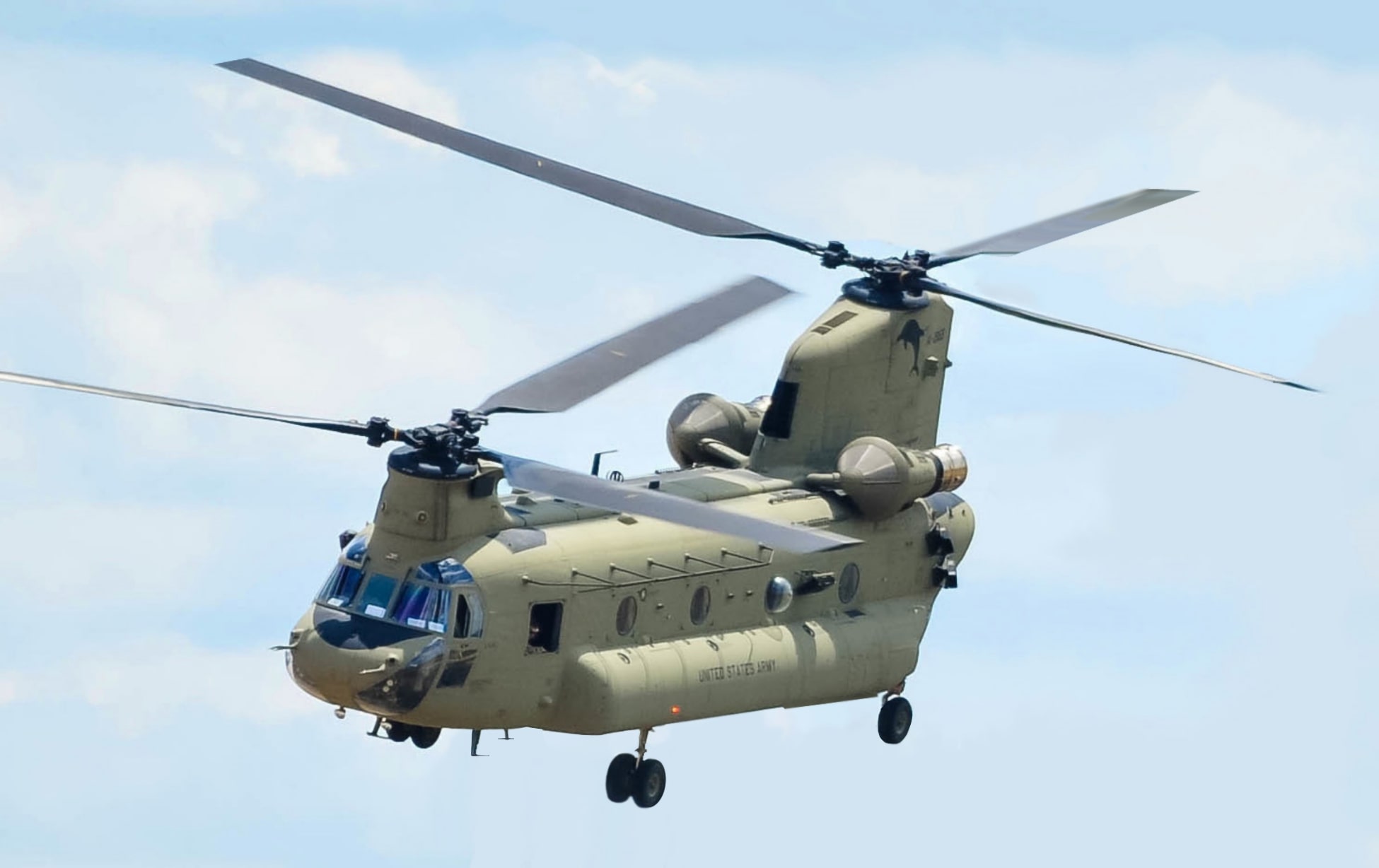


.jpg)


![[icon]](https://en.wikipedia.org/wiki/File:Wiki_letter_w_cropped.svg)
 A Dutch CH-47D hauls slung light vehicles and another load on exercises, 2015.
 US parachutists jump from a Chinook over Germany in 2019.
 A Chinook on exercises in Japan
.jpg)
.jpg)

.jpg)
_CH-47C_Chinook_(219)_Bidini-1.jpg)

.jpg)


.jpg)
.jpg)


_(10508872726).jpg)


_at_the_National_Day_celebration_ceremony_2021-10-10.jpg)


_helicopters_in_Indian_Air_Force.jpg)


.jpg)

.jpg)


.jpg)


 This article incorporates text from this source, which is in the public domain.


.jpg)