Hubbry Logo
search
logo
Mendut
Mendut
current hub
1430435

Mendut

logo
Community Hub0 Subscribers
Read side by side
from Wikipedia

Mendut is a ninth-century Buddhist temple, located in Mendut village, Mungkid sub-district, Magelang Regency, Central Java, Indonesia. It is located about 3 kilometres (1.9 mi) east of another temple, Borobudur, and along with Pawon forms a straight line of three temples. There is a mutual religious relationship between the three temples, although the exact ritual process is unknown.[1]

Key Information

History

[edit]
The ruins of Mendut temple before restoration, 1880.

Built around the early ninth century AD, Mendut is the oldest of the three temples including Pawon and Borobudur. According to the Karangtengah inscription, the temple was built and finished during the reign of King Indra of the Shailendra dynasty. The inscription, dated 824 AD, mention that he constructed a sacred building named Venuvana, which means "bamboo forest". The Dutch archaeologist JG de Casparis has connected this description with Mendut.[2]

In 1836 it was discovered as a ruins covered with bushes. The temple's restoration began in 1897 and was finished in 1925. The archaeologists who researched the temple included JG de Casparis, Theodoor van Erp [nl], and Arisatya Yogaswara.

Architecture

[edit]
The statue of Dhyani Buddha Vairocana, Avalokitesvara, and Vajrapani inside the Mendut temple

The plan of the temple's base is square, and measures 13.7 metres (45 ft) on each side, with the base level 3.7 metres (12 ft) above the ground.[3] The 26.4 metres (87 ft) tall temple faces northwest. The stairs projecting from the northwest side square elevated base are adorned with a Makara statue on each side. The side of the stairwell is carved with a bas-relief of a Jataka fable narrating the animal story of Buddhist teaching. The square terrace surrounding the body of the temple was meant for pradakshina, a circumambulation ritual that involves walking clockwise around the temple. The outer walls are adorned with bas-reliefs of Boddhisattvas (Buddhist divinities), including Avalokiteśvara, Maitreya, Cunda, Kṣitigarbha, Samantabhadra, Mahakarunika Avalokitesvara, Vajrapani, Manjushri, Ākāśagarbha, and Boddhisattvadevi Prajnaparamita.

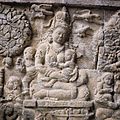
Originally the temple had two chambers: a small chamber in the front, and a large main chamber in the center. The roof and some parts of the front chamber walls are missing. The uppermost part of the roof is missing; it is supposed to have a stupa pinnacle of a size and style probably similar to the one in Sojiwan temple. The inner wall of the front chamber is adorned with a bas-relief of Hariti surrounded by children, Atavaka on the other side, Kalpataru, and groups of devata divinities flying in heaven.

Location three Buddhist temples, Borobudur-Pawon-Mendut, in one straight line across Progo River.

The main room has three carved large stone statues. The 3 metres (9.8 ft) tall statue of Dhyani Buddha Vairocana was meant to liberate the devotees from bodily karma. At the left is a statue of Boddhisatva Avalokiteśvara to liberate them from the karma of speech, and at the right is Boddhisatva Vajrapani to liberate from the karma of thought.[4]

Rituals

[edit]

During the full moon in May or June, Buddhists in Indonesia observe the annual Vesak ritual by walking from Mendut through Pawon to Borobudur.[5] The ritual takes the form of a mass Buddhist prayer and pradakshina (circumambulation) around the temple.

Both Buddhists and followers of traditional Kejawèn (Javanese mysticism) worshipped in the temple, which is believed to be able to fulfil wishes, such as deliverance from sickness.[3] Childless couples, for example, pray at the bas-relief of Hariti for a child, since in traditional Javanese beliefs, Hariti is a symbol of fertility, patroness of motherhood, and protector of children.[6]

[edit]

See also

[edit]

References

[edit]
[edit]
Revisions and contributorsEdit on WikipediaRead on Wikipedia
from Grokipedia
Mendut Temple (Indonesian: Candi Mendut) is a ninth-century Mahayana Buddhist temple situated in the Magelang Regency of Central Java, Indonesia, approximately 3 kilometers east of the larger Borobudur Temple. Built during the Sailendra dynasty, it features a prominent rectangular structure on a high platform, housing monumental stone statues of the cosmic Buddha Vairocana flanked by the bodhisattvas Avalokiteshvara and Vajrapani, and is recognized as part of the Borobudur Temple Compounds, a UNESCO World Heritage Site symbolizing stages toward enlightenment.[1][2] The temple's construction is dated to around 824 CE, based on the nearby Karangtengah inscription, which records that King Indra of the Sailendra dynasty established a sacred site named Venuvana, meaning "bamboo forest," likely referring to Mendut as a center for Buddhist worship and rituals.[3] It was actively used until its abandonment between the 10th and 15th centuries amid shifting political and religious landscapes in Java, before being rediscovered in the early 19th century and restored between 1897 and 1925, with ongoing preservation efforts as part of the UNESCO World Heritage Site.[1] Architecturally, Mendut stands about 26.4 meters tall with a square base and pyramid-shaped roof, its exterior walls adorned with intricate bas-reliefs depicting Jataka tales—stories of the Buddha's previous lives—as well as figures like the yaksha king Kubera and the goddess Hariti, who symbolizes fertility and is a focal point for prayers related to motherhood.[4] The temple faces westward toward Borobudur, forming a sacred axis with the smaller Pawon Temple in between, along which Buddhist processions, such as those during Vesak celebrations, traditionally proceed to evoke the path to Nirvana.[2]

Background

Overview

Candi Mendut, also known as Candi Mendut, is a Mahayana Buddhist temple built in the early 9th century during the Sailendra Dynasty in Central Java, Indonesia.[1] This structure exemplifies the architectural and religious achievements of the period, serving as a key monument in the region's ancient Buddhist heritage.[1] The temple's primary function was as a site for worship and meditation, facilitating spiritual practices central to Mahayana Buddhism and representing a phase in the path to attaining Nirvana.[1] Its design includes a square base measuring 13.7 meters by 13.7 meters and a total height of 26.4 meters, with the entrance oriented northwest.[5] As part of the Borobudur Temple Compounds, Candi Mendut was inscribed on the UNESCO World Heritage List in 1991, recognizing its outstanding universal value alongside nearby temples such as Borobudur and Pawon.[1]

Location and Setting

Mendut Temple is situated in Magelang Regency, Central Java, Indonesia, approximately 3 kilometers east of the renowned Borobudur Temple.[6][7] This positioning places it within the broader Central Javanese temple landscape, accessible via major roadways connecting Yogyakarta and Borobudur.[8] The temple is nestled in the fertile Kedu Plain, also known as the Progo Valley, a lush volcanic basin characterized by expansive rice fields and swaying coconut palms that create a serene, verdant backdrop.[9][10] From the site, visitors enjoy panoramic views of prominent volcanoes, including the active Mount Merapi to the northeast and Mount Sindoro to the west, which frame the temple against a dramatic natural horizon.[9][11] Mendut aligns in a precise east-west straight line with the nearby Pawon Temple and Borobudur, a configuration that archaeological studies interpret as evidence of deliberate ancient site planning, potentially linking the monuments as a unified sacred complex.[12][13] This strategic placement enhances its integration into regional temple circuits, where it serves as a key stop for pilgrims and tourists traveling between major Buddhist heritage sites along well-maintained roads.[14][15]

History

Construction and Historical Context

The Mendut Temple was constructed during the early 9th century AD, approximately between 800 and 825 AD, at the height of the Sailendra Dynasty's influence in Central Java.[16] This period marked a significant era of cultural and religious patronage under the Sailendras, who ruled the region from the late 8th century onward and established Central Java as a major center for Mahayana Buddhism.[17] The dynasty's rise is evidenced by their control over the fertile Kedu Plain, where Mendut is located, facilitating large-scale architectural projects amid a socio-political landscape of maritime trade and agricultural prosperity.[16] The temple's construction is closely associated with King Indra of the Sailendra Dynasty, as documented in the Karangtengah inscription dated 824 AD. This Old Javanese inscription, discovered near the temple site, records that King Indra established a sacred Buddhist monastery known as Venuvana, or "Bamboo Forest," which Dutch archaeologist J.G. de Casparis identified with Mendut based on its location and dedication to Mahayana practices.[16] The inscription highlights the royal initiative in temple-building as a means of legitimizing rule and fostering religious devotion during a time when the Sailendras navigated alliances and rivalries with neighboring Hindu dynasties like the Sanjayas.[16] In the broader historical context, Mendut's erection formed part of the Sailendra Dynasty's concerted efforts to propagate Mahayana Buddhism across Java, evidenced by contemporaneous monuments like Kalasan and Borobudur that served as centers for esoteric rituals and monastic education.[16] This royal sponsorship not only elevated Buddhism's status in a multi-religious society but also symbolized the dynasty's cosmopolitan ambitions, drawing pilgrims and scholars to Central Java as a hub of Buddhist learning in Southeast Asia.[17]

Rediscovery and Restoration

The Mendut Temple was abandoned sometime between the 10th and 15th centuries, amid the decline of Buddhist kingdoms in Java and the rise of Hinduism and later Islam, gradually becoming buried under layers of volcanic ash from nearby Mount Merapi and overgrown with dense jungle vegetation.[1][18] The temple was rediscovered in 1836 during surveys under Dutch colonial administration in Java, at which time it appeared as extensive ruins largely intact except for its collapsed roof and surrounding overgrowth.[19][3] Restoration efforts began in 1897 under Dutch colonial administration and continued until 1925, with major efforts from 1907 onward; this work focused on reconstructing the temple's base, stabilizing its walls, and partially rebuilding the upper structure using anastylosis techniques to reassemble original stone elements.[18][19][3] Additional conservation work was carried out in the 1970s with UNESCO support as part of preserving the Borobudur Temple Compounds.[1] Key contributors to the scholarly understanding during this period included J.G. de Casparis, who analyzed the site's inscriptions such as the Karangtengah inscription to link them to the temple's founding, and later Indonesian archaeologist Arisatya Yogaswara, who conducted studies on its structural and iconographic features in the mid-20th century.[20][19]

Architecture

Structural Design

The Mendut temple is erected on a three-tiered square platform elevated 3.7 meters above the ground, measuring approximately 13.5 meters per side. Access to the upper levels is provided by stairways on the entrance facade, facilitating ascent to the temple body while integrating with the surrounding landscape.[21] The temple body consists of rectangular upper levels that transition to a cubic main chamber, forming a single enclosed space accessible via a vestibule. The overall structure reaches a height of about 26.4 meters, with the roof designed as a multi-tiered stepped pyramid originally crowned by a stupa pinnacle that has since been lost; modern efforts have included partial reconstruction of the roof to stabilize the superstructure.[21] The layout orients the main entrance to the northwest, with a single primary chamber at the core surrounded by ambulatory paths enabling circumambulation around the structure. This arrangement emphasizes axial symmetry within a courtyard measuring roughly 110 meters north-south by 50 meters east-west.[21] Engineering features include the use of precisely cut andesite stone blocks for the walls and structural elements, ensuring durability against seismic activity common in the region. The temple's components demonstrate meticulous alignment to cardinal directions, likely serving ritual procession purposes in conjunction with nearby sites.[2][21]

Sculptural Elements

The interior of Mendut Temple features three monumental statues carved from single blocks of andesite stone, each approximately 3 meters tall and seated in a western-style posture with feet resting on the ground. The central figure represents Vairocana, the cosmic Buddha, depicted in the dharmachakra mudra symbolizing the turning of the wheel of dharma, seated on a double-lotus pedestal.[2] To the left is Avalokitesvara (also known as Padmapani), the bodhisattva of compassion, portrayed as a serene, handsome figure adorned with an elaborate crown and jewelry.[2] On the right stands Vajrapani, the bodhisattva of power and protector of the Buddha, similarly depicted with refined features, crown, and ornate jewelry, emphasizing guardianship.[22] These ninth-century Sailendran sculptures exemplify Central Javanese craftsmanship, with their serene expressions and detailed ornamentation influencing later Southeast Asian Buddhist art.[2] The temple's lower walls are adorned with intricate bas-reliefs that narrate Buddhist moral tales and symbolic motifs. Panels on the stairways and surrounding terrace depict scenes from Jataka tales, illustrating the previous lives of the Buddha through animal fables that convey ethical teachings, such as the story of the monkey king offering himself for his troop. Additional reliefs portray celestial beings, including apsaras and devas presenting offerings, often integrated with floral and volute patterns that evoke abundance and divine presence.[2] These carvings, executed in a narrative style, blend Indian-derived iconography with local Javanese elements, such as stylized vegetation motifs symbolizing cosmic harmony.[2] Exterior sculptural features include protective motifs framing the entrance and symbolic panels on the facade. Above the northwest entrance, a Kala-Makara motif serves as a guardian element, with the Kala head warding off malevolent forces in traditional Javanese temple architecture.[23] In the vestibule, on the inner northern wall, a prominent bas-relief depicts Hariti, the yakshini associated with fertility and protection of children, shown seated on a bench with children climbing on her, surrounded by playing figures, fruit trees, and a bowl of mangoes symbolizing abundance and maternal care.[24] This eighth-to-ninth-century panel reflects Mahayana Buddhist themes of redemption, as Hariti transformed from a child-devouring ogress into a benevolent guardian after her encounter with the Buddha.[24] Overall, Mendut's sculptural elements embody intricate Mahayana iconography adapted to Javanese aesthetics, featuring dynamic compositions of deities, narratives, and symbolic flora that prioritize spiritual enlightenment over mere decoration.[2] The reliefs and statues, carved in high relief for dramatic effect, draw from tantric influences while incorporating indigenous motifs like intertwined vines and mythical guardians, creating a cohesive visual theology unique to Sailendra-era Java.[2]

Religious and Cultural Significance

Buddhist Rituals

Mendut Temple serves as a central site for Buddhist rituals in Central Java, particularly as the starting point for the annual Vesak ceremony, which commemorates the birth, enlightenment, and parinirvana of the Buddha on the full moon of May or June. The ceremony begins with mass prayers and meditation sessions inside the temple's main chamber, where devotees gather before the large Vairocana Buddha statue to chant mantras and perform pradakshina, a clockwise circumambulation around the temple structure. This is followed by a solemn procession carrying holy water from the Jumprit springs in Temanggung and a Vesak torch lit from the eternal flames of Mrapen in Grobogan, proceeding from Mendut to Pawon Temple and culminating at Borobudur for lantern releases symbolizing enlightenment.[4][25] Local Kejawen-Buddhist practices at Mendut blend Javanese syncretism with Mahayana traditions, emphasizing personal devotion and communal offerings. Devotees, particularly those following Kejawen mysticism, pray before the Hariti relief on the temple's inner walls, a depiction of the yakshini goddess surrounded by children, seeking blessings for fertility, motherhood, and the fulfillment of wishes through simple offerings of flowers and incense. Meditation remains a core practice, often conducted in the dimly lit main chamber by candlelight, where participants sit in silence or join monks in chanting, fostering a sense of spiritual serenity and connection to the site's ancient energies.[4] Historically, during the Sailendra dynasty in the 9th century, Mendut—identified as Venuvana or "bamboo forest" in the 824 CE Karangtengah inscription—functioned as a sacred vihara-like site for Buddhist monastic activities, including teachings and possibly royal commemorative rites such as the placement of cremated ashes. The temple's iconography, featuring a tantric-influenced Vairocana Buddha in the central niche, suggests it may have hosted initiatory practices aligned with esoteric Mahayana traditions prevalent in the region, though specific ritual details remain undocumented beyond its role in pilgrim progressions to Borobudur.[20] In modern times, rituals at Mendut incorporate Javanese syncretic elements, such as Kejawen-infused prayers that merge Buddhist doctrines with local animist beliefs, evident in the Vesak observances where traditional gamelan music accompanies chants and offerings. These adaptations maintain the temple's relevance as a living center for spiritual practice, with ongoing meditation retreats led by resident monks enhancing accessibility for contemporary devotees.[4]

Connection to the Borobudur Complex

Mendut, Pawon, and Borobudur form a sacred triad aligned along a near-straight east-west axis spanning approximately 2.9 kilometers, with Pawon positioned 1.15 kilometers west of Mendut and 1.75 kilometers east of Borobudur.[13] This alignment, oriented at an azimuth of 263° (deviating slightly by 7° from true east-west), suggests intentional planning during the Sailendra dynasty's construction in the 8th-9th centuries CE, likely facilitating a ritual processional pathway that pilgrims traversed from east to west.[13][26] The physical configuration indicates a deliberate symbolic progression, with evidence of a paved path connecting the sites to enable circumambulation (pradakshina) and other Buddhist rites.[26] Religiously, the temples exhibit complementarity within Mahayana Buddhism, where Mendut serves as a preparatory or teaching site focused on consecration rituals like Buddhabhiseka, Pawon acts as an intermediary for confirmation ceremonies such as rajasuya, and Borobudur represents the culminating mandala embodying the king's ritual apotheosis as Buddha.[26] This functional triad reflects a unified doctrinal program tied to dynastic legitimacy, with Mendut and Borobudur potentially forming a "twin-mandala" symbolizing the non-duality of the Buddha's Truth Body and Form Body.[27] Shared iconography reinforces this cohesion, including depictions of Bodhisattvas such as Maitreya, Manjushri, and Samantabhadra across the sites, alongside Mahayana narrative reliefs inspired by Jatakas and Gandavyuha themes that illustrate karmic paths and enlightenment stages.[26] Scholars hypothesize that the triad's purpose involved a pilgrimage procession route mimicking the sun's daily path—from Mendut at "dawn" (preparatory enlightenment), through Pawon at "zenith" (intermediary wisdom), to Borobudur at "sunset" (ultimate realization)—possibly aligned with astronomical events like zenith solar passages on October 11 and February 28.[13] This setup may have supported royal consecration rituals symbolizing the monarch's "magical birth" as a divine ruler-Buddha, though the exact processes remain subject to ongoing debate due to limited epigraphic evidence.[13][26] Modern Vesak processions from Mendut to Borobudur via Pawon echo this ancient pathway.[12]

Preservation and Modern Relevance

Conservation Efforts

Following the initial restoration efforts completed in 1925, conservation of the Mendut Temple has focused on long-term preservation as part of the Borobudur Temple Compounds, managed by Indonesia's Balai Pelestarian Candi Borobudur (BPCB), established in 1971 to oversee maintenance and protection of the site.[1] The BPCB conducts regular monitoring, structural assessments, and vegetation control to prevent overgrowth that could damage the andesite stonework, ensuring the temple's stability amid its tropical environment.[1] A major international project from 1973 to 1983, coordinated by UNESCO and the Indonesian government, addressed stabilization against earthquakes and erosion for the entire Borobudur Temple Compounds, including Mendut, by reconstructing elements with original materials and improving drainage systems to mitigate water-induced deterioration.[1] This effort involved experts from multiple countries and emphasized seismic reinforcement, given the region's tectonic activity, while preserving the temple's authenticity.[12] Key challenges include threats from nearby volcanic activity, such as the 2010 eruption of Mount Merapi, which deposited acidic ash on Mendut and adjacent temples, necessitating immediate cleaning to prevent corrosion of sculptures and stone surfaces.[28] Ongoing issues encompass erosion from rainfall and potential climate change impacts, like increased acidity in precipitation, which accelerate weathering of the temple's facade.[1] In the 2010s, the BPCB implemented laser scanning and photogrammetry for detailed 3D monitoring of the Borobudur Temple Compounds, enabling precise documentation of Mendut's structural changes and aiding in predictive maintenance.[29] Initiatives guided by UNESCO's 2021 Management Plan for the site emphasize digital archiving, sustainable vegetation management, and community training to enhance resilience against environmental threats, with a joint World Heritage Centre-ICOMOS reactive monitoring mission conducted in December 2024 to assess ongoing conservation.[30][31]

Tourism and Cultural Impact

Mendut Temple serves as a key attraction within the Borobudur Temple Compounds, drawing visitors interested in ancient Buddhist heritage and integrating seamlessly into day trips from the more prominent Borobudur site. The temple experiences annual footfall around 100,000, significantly lower than Borobudur's millions but bolstered by its proximity, with peaks during Vesak celebrations when thousands participate in processions from Mendut to Borobudur.[32][33] As of 2025, entry to the temple costs approximately IDR 20,000 for domestic visitors and IDR 30,000 for international visitors, including access to adjacent sites like the Mendut Buddhist Monastery, while guided tours—often bundled with Borobudur visits—are widely available through operators offering historical and cultural insights for around $10–$15 per participant.[14][34][35][15] Tourism infrastructure around Mendut has evolved to support visitor flow, particularly through integration with Borobudur excursions, facilitated by the Indonesian government's priority destination initiatives since the early 2000s. Developments include enhanced pedestrian pathways, urban parks, and greenery in the Mendut tourism area, alongside improvements to roads like the 6 km Mendut-Ngawen route and non-motorized transport options to promote accessibility and reduce environmental strain.[36][37] Additional facilities, such as site museums and information centers, were added to the Borobudur-Mendut-Pawon axis, enabling better interpretation of the temples' interconnected spiritual landscape while accommodating growing domestic and international arrivals.[38] Mendut's cultural influence extends beyond its physical presence, inspiring elements in Indonesian art and literature that reflect Buddhist-Javanese syncretism, where ancient motifs from the temple's reliefs echo in modern visual narratives and storytelling traditions.[39] It plays a vital role in national heritage education, with guided programs and school curricula highlighting its architectural and symbolic contributions to Indonesia's multicultural identity, fostering appreciation for pre-Islamic spiritual legacies.[40] In contemporary contexts, Mendut supports modern relevance through eco-tourism practices emphasizing sustainable access and conservation, aligning with broader efforts to balance visitor growth with environmental protection in the Magelang region.[41] The site hosts interfaith dialogues during events like Vesak, promoting harmony among Indonesia's diverse religious communities. Tourism at Mendut contributes substantially to the local economy in Magelang, generating jobs in hospitality, guiding, and crafts—part of the Borobudur area's overall boost to regional GDP through increased expenditures.[42][36]

References

User Avatar
No comments yet.