Hubbry Logo
Pope Callixtus IIIPope Callixtus IIIMain
Open search
Pope Callixtus III
Community hub
Pope Callixtus III
logo
8 pages, 0 posts
0 subscribers
Be the first to start a discussion here.
Pope Callixtus III
Pope Callixtus III
from Wikipedia

Key Information

Papal styles of
Pope Callixtus III
Reference styleHis Holiness
Spoken styleYour Holiness
Religious styleHoly Father
Posthumous styleNone

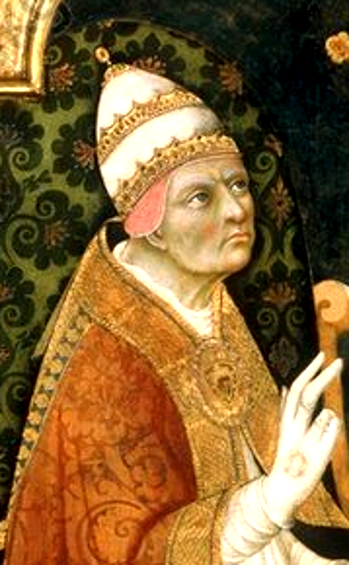
Pope Callixtus III (Italian: Callisto III, Valencian: Calixt III, Spanish: Calixto III; 31 December 1378 – 6 August 1458), born Alonso de Borja, but referred to in English-language accounts as Alfonso de Borgia as a member of the House of Borgia, was head of the Catholic Church and ruler of the Papal States from 8 April 1455 to his death, in August 1458.

Borgia spent his early career as a professor of law at the University of Lleida; he later served as a diplomat for the kings of Aragon. He became a tutor for King Alfonso V's illegitimate son Ferdinand. After arranging a reconciliation between Alfonso and Pope Martin V, Borgia was made Bishop of Valencia.

In 1444, Pope Eugene IV named him a cardinal, and Borgia became a member of the Roman Curia. During the siege of Belgrade (1456), Callixtus initiated the custom that bells be rung at midday to remind the faithful to pray for the crusaders. The tradition of the Angelus noon bell still exists in most Catholic churches to this day. He was also responsible for the retrial of Joan of Arc that saw her vindicated. He appointed two nephews as cardinals, one of whom became Pope Alexander VI. He is the last pope to date to take on the pontifical name "Callixtus".

Family

[edit]

Alfonso de Borgia was born in La Torreta in 1378. La Torreta was at the time in the Señorío de Torre de Canals (but is now a neighborhood of Novetlè).[1] At the time he was born in the Kingdom of Valencia under the Crown of Aragon. He was the eldest child of Juan Domingo de Borja y Doncel and Francina Llançol. His sister Isabel married Jofré Llançol i Escrivà (son of Rodrigo Gil de Borja y Fennolet), and become the mother of Pedro Luis de Borja and Pope Alexander VI. His other sister Catalina became of the mother of Luis de Milà y de Borja.

Alfonso was baptized at Saint Mary's Basilica in Xativa, where he is honored with a statue in his memory.[2][3]

Early church career

[edit]

Borgia studied grammar, logic and the arts in Valencia and went in 1392 to the University of Lleida where he obtained a doctorate in both canon law and civil law. His early career was spent as a professor of law at the University of Lleida. Around 1411, he attended a sermon by Vincent Ferrer. Afterward, the Dominican said to the future pope: "My son, you one day will be called to be the ornament of your house and of your country. You will be invested with the highest dignity that can fall to the lot of man. After my death, I shall be the object of your special honour. Endeavor to persevere in a life of virtue."[4] Later, as pope, Borgia canonized Ferrer on 3 June 1455.[5]

Borgia was chosen as a delegate of the Diocese of Lerida to the Council of Constance in 1416, but did not partake in the proceedings as King Alfonso V of Aragon was opposed to the council. Because of this he went to Barcelona as a representative of his diocese in a synod. Borgia cared strongly for the reestablishment of the unity of the church; his influence with the Aragonese monarch was the factor that allowed for the conclusion of the accord between the king and the new pope.

In 1418, he was named as the rector of San Nicolas of Valencia. He was also the vice-chancellor of the University of Lleida from 1420 to 1423. In 1424, he resigned his position and dedicated his service to the Aragonese king. In 1424, he was named as the apostolic administrator of the see of Mallorca. It was at that time that the king desired that he be made a cardinal; Pope Martin V refused the request. During the Great Western Schism he supported Antipope Benedict XIII and was also the driving force behind Antipope Clement VIII's submission to Pope Martin V in 1429.[6] He then served as a diplomat to the kings of Aragon, especially during the Council of Basel (1431–1439).

Episcopate and cardinalate

[edit]
Cardinal Borgia

Borgia was appointed Bishop of Valencia by Pope Martin V on 20 August 1429 and was consecrated on 31 August 1429. He authorized Pedro Llorens to take possession of the see in his name.[7] Borgia also tutored Alfonso V's illegitimate son Ferrante.

Pope Eugene IV elevated him to the cardinalate on 2 May 1444 after he managed to reconcile the pope and King Alfonso V of Aragon. He was elevated as the Cardinal-Priest of Santi Quattro Coronati. He took up his official residence in Rome and was a member of the Roman Curia. He participated in the papal conclave of 1447 that saw the election of Pope Nicholas V. He was known for an austere and charitable life.

Borgia's coat of arms after he was consecrated featured a grazing ox. As pope it remained the same.

Pontificate

[edit]

Borgia was elected pope at an advanced age as a "compromise candidate" in the conclave of 8 April 1455. He took the pontifical name Callixtus III.[7] He was crowned on 20 April 1455 by Cardinal Protodeacon Prospero Colonna. After his coronation, he rode a white horse through the streets of the city and followed the ancient custom, known as Monte Giordano, where representatives of the Jews met with the pope and presented him with the roll of the law. Callixtus III then read from the law and stated "We ratify the law, but condemn your interpretation", which instigated a riot at the ceremony that endangered the pope's life.[8]

Not quite two years after the Fall of Constantinople in 1453, Callixtus was chiefly concerned with the organization of Christian Europe against an invasion by the Ottoman Empire. At the time, it was said that Callixtus III "speaks and thinks of nothing but the crusade", spending hours discussing the topic with a warlike zeal.[9] An extensive building program underway in Rome was cancelled and the money funneled toward a crusade. Papal nuncios were dispatched to all the countries of Europe to beseech the princes to join once more in an effort to check the danger of a Turkish invasion. Missionaries were sent to England, France, Germany, Hungary, Portugal, and Aragon to preach the Crusade, and to engage the prayers of the faithful for the success of the enterprise. It was by order of Callixtus III that the bells were rung at midday to remind the faithful that they should pray for the welfare of the crusaders.[7]

The princes of Europe were slow in responding to the call of the pope, largely due to national rivalries. England and France's Hundred Years' War had just ended in 1453. Forces led by John Hunyadi (Hungarian: Hunyadi János), Captain-General of Hungary, met the Turks and defeated them at Belgrade on 22 July 1456. Shortly after his victory, Hunyadi himself died of a fever.[7] On 29 June 1456, Callixtus III ordered the church bells to be rung at noon (see noon bell) as a call to prayer for the welfare of those defending Belgrade. To commemorate this victory, Callixtus III ordered the Feast of the Transfiguration to be held annually on 6 August.

A bull of Callixtus III

In 1456 the pope issued the papal bull Inter Caetera (not to be confused with Inter Caetera of 1493), reaffirming the earlier bulls Dum Diversas and Romanus Pontifex which recognized Portugal's trade rights in territories it had discovered along the West African coast. This confirmation of Romanus Pontifex also gave the Portuguese the military Order of Christ under Henry the Navigator.[10]

Callixtus III ordered a new trial for Joan of Arc (c. 1412–1431), at which she was posthumously vindicated.[11] Callixtus III canonized the following four saints during his pontificate: Vincent Ferrer (3 June 1455), Osmund (1 January 1457), Albert of Trapani (15 October 1457), and Rose of Viterbo (1457).

Callixtus III elevated nine new cardinals into the cardinalate in two consistories on 20 February 1456 and 17 December 1456,[12] two of whom were cardinal nephews. The first of them was Rodrigo de Borgia who later became Pope Alexander VI (1492–1503), infamous for his corruption and immorality.[13] The second was Luis Julian de Milà.

The pope approved of the establishment of the University of Greifswald in 1456.

According to one story that first appeared in a 1475 posthumous biography and was subsequently embellished and popularized by Pierre-Simon Laplace, Callixtus III excommunicated the 1456 appearance of Halley's Comet, believing it to be an ill omen for the Christian defenders of Belgrade from the besieging armies of the Ottoman Empire.[14] No known primary source supports the authenticity of this account. The 29 June 1456 papal bull of Callixtus III calling for a public prayer for the success of the crusade makes no mention of the comet. By 6 August, when the Turkish siege was broken, the comet had not been visible in either Europe or Turkey for several weeks.[15]

Death

[edit]
Tomb of Callixtus III and Alexander VI in Santa Maria in Monserrato degli Spagnoli.

Callixtus III died on 6 August 1458.[16] His remains were transferred in 1586 and again in 1610 with the remains of his nephew Alexander VI to Santa Maria in Monserrato. His remains were transferred once more on 21 August 1889 in the Chapel of San Diego de Alcalá in the Rome's Church of Santa Maria in Monserrato degli Spagnoli. In his will he left 5000 ducats to establish a hospital.

Legacy

[edit]

Catholic historian Ludwig von Pastor opined:

"Except for his nepotism, Calixtus III deserves high praise, more especially for the energy, constancy and purpose which he displayed in dealing with the burning question of the day – the protection of Western civilization from the Turkish power. In this matter he gave a grand example to Christendom, and it is to be observed that in the midst of the military and political interest which claimed so large a share of his time and attention, he did not neglect the internal affairs of the Church, and vigorously opposed heresies."[17]

See also

[edit]

References

[edit]
[edit]
Revisions and contributorsEdit on WikipediaRead on Wikipedia
from Grokipedia
Pope Callixtus III (31 December 1378 – 6 August 1458), born Alfonso de Borja near Játiva in the Kingdom of Aragon, served as head of the and sovereign of the from his election on 8 April 1455 until his death. A trained canon lawyer who rose through diplomacy and ecclesiastical service, including as Bishop of Valencia and cardinal under , he became the first pope from the Aragonese crown and the progenitor of the Borgia family's papal influence by elevating relatives such as his nephew Borgia to cardinal. His brief pontificate prioritized rallying for a crusade against the in response to the 1453 , issuing calls for military aid, naval expeditions, and penitential practices to counter the Turkish advance into , though material support from secular rulers proved insufficient. Callixtus also reformed the to address administrative inefficiencies inherited from prior popes and advanced Spanish interests in the Church, amid criticisms of nepotism that filled key positions with compatriots.

Origins and Early Career

Family and Upbringing

Alfonso de Borja, who would become Pope Callixtus III, was born on 31 1378 in La Torreta, a hamlet near Canals in the Kingdom of Valencia under the Crown of Aragon. He was the eldest child of Juan Domingo de Borja y Doncel, a minor nobleman and local landowner of Aragonese descent, and Francina Llançol i Fenollet (also recorded as Francina Martí Llançol), whose family intermarried with the Borjas to strengthen regional ties. The Borja lineage traced its roots to settlers from , holding modest estates and knightly status but lacking vast wealth or high aristocracy, with some contemporary accounts questioning exaggerated claims to greater nobility. Borja's siblings included sisters such as Isabel de Borja y Llançol, who married Jofré Llançol i Escrivà—parents of the future (Rodrigo Borgia)—as well as Joana, Francisca, and possibly Catalina de Borja. Raised in a devout Catholic household amid the , the family espoused loyalty to of the Avignon line, a position that shaped young Alfonso's early worldview and ecclesiastical inclinations. Their resources sufficed for a solid upbringing focused on piety and learning, though without the extravagance later associated with Borgia lore.

Education and Diaconate

Alfonso de Borja, born on 31 December 1378 in Canals near in the Kingdom of , pursued initial studies in grammar, logic, and the arts at schools in . He advanced to the University of , where he specialized in civil and , earning a doctorate in utroque iure (in both laws) in 1406 at approximately age 28. Following his studies, Borja taught as a at the University of , establishing a reputation for legal scholarship that later informed his diplomatic and ecclesiastical roles. Borja's entry into the diaconate occurred amid his service to the Aragonese crown, after supporting the Avignon antipope Benedict XIII during the Western Schism and subsequently aligning with King Alfonso V of Aragon following Benedict's deposition in 1419. Incorporated into the royal entourage around 1420, he received clerical benefices including the archdeaconship of Xàtiva and the rectory of L'Alghero in Sardinia, positions that required ordination to the diaconate. This marked his formal transition from secular legal practice to the ecclesiastical hierarchy, leveraging his canon law expertise; he advanced to the priesthood and episcopate by 1429 upon appointment as Bishop of Valencia by Pope Martin V.

Ecclesiastical Rise

Diplomatic Service and Episcopate

In the service of the Crown of , Alfonso de Borja undertook diplomatic roles, including tutoring the illegitimate son of King Alfonso V, Ferdinand (later King ), and acting as administrator of the Diocese of from 1424. His most significant mission involved mediating the reconciliation between Alfonso V and , convincing the (Benedict XIII) to abdicate and facilitating Aragon's submission to the Roman pontiff after prolonged adherence to the . In recognition of these efforts, Martin V appointed Borja Bishop of Valencia on August 20, 1429. He received episcopal ordination on August 31, 1429, in . As bishop, Borja administered one of Spain's wealthiest sees, retaining the position even after his elevation to the cardinalate in 1444 and papal election in 1455, until his death. His tenure emphasized canonical rigor and administrative competence, though specific pastoral initiatives remain sparsely documented in contemporary records.

Cardinalate Under Eugenius IV

Alfonso de Borja was elevated to the cardinalate by Pope Eugenius IV on May 2, 1444, in recognition of his diplomatic services, particularly his role in reconciling the pontiff with King amid tensions over Neapolitan affairs and lingering schismatic influences. Created a cardinal , he received the of upon entering on July 12, 1444, and took up residence in a palace near the . During the remainder of Eugenius IV's pontificate, until the pope's death on February 23, 1447, Borja shifted his focus from prior royal counsel to curial responsibilities, earning the informal title of cardinal of due to his . He integrated into Roman ecclesiastical life, inscribing himself in the Brotherhood of the —a lay dedicated to charitable works—on April 10, 1446, and appearing in curial records as early as February 21, 1447. His tenure emphasized legal and administrative expertise honed from years as a canonist, though specific assignments under Eugenius remain sparsely documented beyond his participation in routine consistorial matters. Borja joined the conclave immediately following Eugenius IV's death, contributing to the of Nicholas V on March 6, 1447, which marked the transition from his initial cardinalate phase. Throughout this period, he maintained a reputation for personal and scholarly rigor, aligning with the pontiff's efforts to stabilize the Church amid conciliar controversies and Italian political strife.

Papal Election

Conclave of 1455

Following the death of Pope Nicholas V on 24 March 1455, the papal conclave to elect his successor began on 4 April 1455 in the Apostolic Palace. This was the first conclave conducted entirely within the palace's confines. Of the 21 living cardinals at the time, 16 were eligible to vote, but one was absent due to distance, resulting in 15 participants. The electors divided into factions, chiefly between the Colonna and Orsini families, which influenced support for Italian candidates such as Pietro Barbo (backed by Colonna allies), Ludovico Trevisan, Domenico Capranica (Orsini faction), and Latino Orsini. Cardinal Basilios Bessarion, a Greek scholar and recent convert from Orthodoxy, emerged as a potential compromise but faced rejection, particularly from French cardinals Alain de Coëtivy and Guillaume d'Estouteville, who objected to his Eastern origins, beard, and perceived ties to recent schism. "Alain de Coëtivy now addressed the cardinals, reminding them that Bessarion was a recent schismatic," highlighting the national and cultural tensions. Deadlock persisted over several days, prompting a shift to a neutral figure outside the primary rivalries. On 8 April 1455, the cardinals elected Alfonso de Borja, Cardinal-Bishop of Valencia and a canon lawyer known for diplomatic service under Eugenius IV, via accessus—a procedure allowing votes to shift en masse after scrutiny ballots. He secured the required two-thirds majority with endorsements from Trevisan, the Orsini, Barbo, the French and Spanish cardinals, and even Bessarion. De Borja, aged approximately 76 and hailing from the Kingdom of Valencia under the Aragonese crown, became the first pope of Iberian origin since the 8th century, adopting the name Callixtus III.

Compromise Candidacy

The papal conclave of 1455, convened following the death of on March 24, 1455, initially pitted major Italian factions against each other, with the Orsini supporting Venetian Cardinal Pietro Barbo and the Colonna backing Cardinal Domenico Capranica, leading to a prolonged deadlock among the 15 participating cardinals. Efforts to select a neutral figure, such as Greek Cardinal Basilios —who received eight votes on the second day but was rejected due to prejudice against his Eastern origins and physical appearance—failed to resolve the impasse. With Italian ambitions stalled, attention shifted to non-Italian cardinals, particularly the four , as a means to bypass factional rivalries; Alfonso de Borja, aged 76 and elevated to the cardinalate only in 1444, emerged as the consensus choice due to his perceived neutrality, advanced age suggesting a short as a "caretaker" , and lack of entanglement in Roman power struggles. Support coalesced from French cardinals like Alain de Coëtivy and Venetian Ludovico Trevisan, who viewed Borja's election as a stabilizing interim measure amid broader European concerns, including the recent Ottoman of . On , 1455, Borja secured the required two-thirds majority through the innovative use of accessus—a procedure allowing cardinals to publicly shift their preferences during scrutiny, marking its first recorded application in conclave history—which enabled rapid endorsement and elevated him as Pope Callixtus III without further ballots. This compromise reflected the multinational composition of the conclave (seven , four , two French, and two ) and the cardinals' prioritization of political expediency over ideological purity, averting a potentially divisive prolongation.

Pontificate

Administrative Reforms and Canonical Expertise

Alfonso de Borja, prior to his election, established a reputation as a leading canonist through his academic career, earning doctorates in both canon and civil law at the University of , where he served as a professor of law and cathedral canon. His expertise informed early diplomatic roles, including successful interventions in resolving lingering schismatic claims, such as the antipope line at in 1429. As pope, Callixtus III leveraged this background to issue authoritative bulls addressing jurisdictional and matters, such as the 1456 bull , which reaffirmed prior papal grants to concerning Atlantic exploration and the subjugation of non-Christians, grounding decisions in established precedents. Another key decree, Cum his superioribus annis on June 29, 1456, mandated liturgical prayers across against Ottoman advances, invoking papal authority to unify clerical responses under canonical norms for collective defense. These actions demonstrated precise application of legal principles to contemporary crises, prioritizing doctrinal and territorial integrity over expansive reinterpretations. On the administrative front, Callixtus III enacted austerity protocols for the shortly after his April 8, 1455, election, prohibiting luxuries such as jewelry, fine artworks, and elaborate banquets for papal officials to redirect funds toward crusade preparations; this included simplified attire and reduced court expenditures, marking a deliberate fiscal restraint amid resource scarcity. Such measures aimed to curb perceived extravagance inherited from prior pontificates, though their scope remained limited by the brevity of his reign and competing priorities like familial appointments. No sweeping structural overhauls of curial offices occurred, with efforts focused instead on operational efficiencies tied to external threats.

Nepotism and Familial Appointments

Callixtus III's pontificate was marked by extensive favoritism toward his relatives, particularly those from family and allied Spanish lineages, which manifested in promotions and secular commands. Shortly after his on April 8, 1455, he appointed his nephew Pedro Luis de Borja as captain-general of the papal forces and granted him feudal lordships, including the vice-royalty of distracting territories in the . This move centralized military authority under familial control, with Pedro Luis receiving castles such as and by mid-1455. In the consistory of February 20, 1456, Callixtus elevated two nephews to the : Rodrigo de Borja, then 25 years old and destined to become , and Luis Juan del Milà y Borja, a canon educated in who pursued a career primarily in . These appointments, made in pectore initially and publicized later, bolstered the family's influence in curial affairs, with Rodrigo receiving the diaconate of San Nicola in Carcere and additional benefices yielding annual incomes exceeding 10,000 ducats. Beyond the cardinalate, Callixtus distributed bishoprics, abbeys, and administrative posts disproportionately to Spaniards and kin; by 1456, key fortresses across the , including Civita Castellana and , were commanded by Borgia relatives or allies, effectively creating a network of familial garrisons. Such preferences aroused widespread resentment among Italian clergy and nobles, who viewed them as eroding traditional Roman curial autonomy and prioritizing Aragonese interests. Critics, including contemporary diarists like Stefano Infessura, accused Callixtus of simony-adjacent , alleging that these elevations bypassed merit for blood ties and generated revenues funneled to family estates in . While defenders argued the appointments ensured loyalty amid Ottoman threats, the scale—encompassing over a dozen major posts within his first year—intensified charges of dynastic overreach, setting precedents for later Borgia popes.

Crusade Against the Ottoman Empire

Upon his election on April 8, 1455, Callixtus III prioritized organizing a crusade against the , motivated by the recent on May 29, 1453, to Sultan , which threatened further Christian territories in the . On May 15, 1455, he issued a proclaiming a crusade to recapture the city, granting plenary indulgences to participants, authorizing tithes on clerical incomes for funding, and setting March 1, 1456, as the mobilization date for a combined Christian fleet and army. To finance these efforts, he imposed taxes across Europe, sold papal treasures, and established a commission of cardinals, including Ludovico Trevisan and Basil Bessarion, to oversee preparations. Callixtus dispatched nuncios and legates, such as Juan Carvajal to and , and Alan de Coëtivy to France in 1455, to preach the crusade and solicit troops and ships, though responses were inconsistent: King Alfonso V of pledged 15 galleys but failed to deliver, while promised 30 warships before withdrawing support amid internal rivalries. He reformed the by purchasing vessels and appointed Trevisan as admiral of a fleet comprising 27 galleys with 1,000 sailors and 5,000 soldiers, which departed on May 31, 1456, for operations in the Adriatic and Aegean. In support of Hungarian leader John Hunyadi's defense against Ottoman advances, Callixtus sent the Franciscan preacher , who rallied irregular forces and participated in the fighting. A notable success occurred at the Siege of , where Hunyadi's forces repelled II's army on July 22, 1456, halting Ottoman expansion temporarily and attributed in part to the pope's spiritual mobilization. To sustain prayers for this campaign, Callixtus issued the Bulla Turcorum on June 29, 1456, mandating church bells to ring daily at noon across to invoke divine aid against the Turks, a practice that persisted beyond his pontificate. The papal fleet under Trevisan achieved minor victories, including the capture of 25 Turkish ships off in August 1457, but broader coordination faltered after Hunyadi's death from plague on August 11, 1456, and Capistrano's on October 23, 1456. Despite summoning European princes to a 1457 assembly for unified strategy, Callixtus's crusade yielded no recapture of Constantinople or decisive campaign, undermined by Christian disunity, ongoing Italian conflicts, and insufficient mobilization; provided some naval aid, but overall participation remained limited. The Ottomans resumed offensives post-Belgrade, and Callixtus died on August 6, 1458, without achieving his primary goal, though his efforts temporarily checked Turkish momentum in the .

Rehabilitation of Joan of Arc and Other Judicial Actions

In response to a petition submitted by 's mother, , on May 15, 1455, Pope Callixtus III issued a authorizing a retrial to nullify her 1431 condemnation for by an under English influence during the . The pope appointed a panel of judges, including theologians and canon lawyers, to investigate procedural flaws, witness testimonies, and potential biases in the original trial, which had resulted in Joan's execution by burning on May 30, 1431. Proceedings formally opened in on November 7, 1455, with additional sessions in , gathering over 100 witnesses who attested to Joan's and the political pressures—such as Burgundian and English occupation—that had compromised judicial integrity. The retrial culminated in a papal verdict on July 7, 1456, which declared the original sentence null and void due to "calumny, fraud, malice, and conspiracy," posthumously exonerating Joan of all charges and affirming her as a martyr whose actions had aided France's cause. This rehabilitation, while restoring Joan's ecclesiastical standing, stopped short of validating her claims of divine visions as infallible, reflecting Callixtus's cautious approach to mystical assertions amid ongoing debates over prophecy and authority in the post-Schism Church. The decision aligned with broader efforts under Charles VII to legitimize French victories, yet it demonstrated the pope's commitment to canonical due process over secular revisionism. Beyond the Joan case, Callixtus III's judicial oversight included advancing saint s through rigorous inquiries into virtues and miracles, such as the equipollent of Dominican preacher on June 3, 1455, recognizing his role in averting and converting thousands in and between 1399 and 1419. He also confirmed the cult of Osmund of via papal decree in 1456, based on evaluations of his episcopal reforms and miracles attributed post-mortem. These actions involved appellate review of local diocesan processes, underscoring Callixtus's emphasis on evidentiary standards in hagiographic judgments, though his short pontificate limited further major trials.

Death and Immediate Aftermath

Final Months and Succession

In the final months of his pontificate, Callixtus III, aged nearly 80, experienced declining health, with reports from the Milanese ambassador in noting his illness as early as , 1458. Despite this, he persisted in administrative oversight amid ongoing criticisms of and limited crusade progress against the Ottomans, though no major new bulls or reforms are recorded from this period. Callixtus III died on August 6, 1458, after a reign of three years and 120 days, likely from natural causes related to advanced age. The customary novendiales period of mourning and governance by the followed, during which leading candidate Cardinal Domenico Capranica died suddenly on August 14, reducing the number of electors. The conclave convened on August 14, 1458, with 18 cardinal electors participating in a process marked by factional tensions between pro-French supporters of Guillaume d’Estouteville and Italian interests seeking to counter foreign influence. Enea Silvio , elevated to cardinal by Callixtus III in 1456, emerged as a compromise candidate after initial scrutinies yielded no majority; he received nine votes in the second ballot, with additional accessus securing his unanimous election on August 18. took the name Pius II, continuing aspects of Callixtus III's anti-Ottoman agenda despite family's diminished influence post-election.

Burial Arrangements

Pope Callixtus III died on 6 August 1458 in following a brief illness. His body was initially interred in the chapel of Santa Maria della Febbre adjacent to the . His nephew, Cardinal Rodrigo Borgia (later ), commissioned a lavish monument for the site, featuring a recumbent of the . During the reconstruction of in the 17th century under , the remains of Callixtus III were relocated alongside those of Alexander VI to the church of Santa Maria in Monserrato degli Spagnoli, the for in , where a joint was established. The original monument's fragments were preserved as an in the Vatican Grottoes.

Legacy and Historical Evaluation

Achievements in Defense of Christendom

Upon ascending to the papacy on April 8, 1455, Callixtus III directed his initial efforts toward countering the Ottoman advance in , prompted by the recent on May 29, 1453, which he viewed as an existential threat to Christian territories. On May 15, 1455, he issued a proclaiming an imminent crusade, designating March 1, 1456, as the mobilization date and urging European monarchs to contribute forces and funds. In this and subsequent documents, such as the Bulla Turcorum, he announced the Turkish conquests and solicited revenues from sources, including a twentieth on clerical incomes, to finance naval and military operations against . He further vowed to employ "war, maledictions, interdicts, excommunications, and all other means" at his disposal to the "heathen invaders," framing the conflict as a sacred duty to preserve . To bolster naval capabilities, Callixtus III established a along the River in , constructing a fleet comprising fighting galleys and transport vessels—estimated at around 16 galleys by the time of his death—which his successor, Pius II, inherited for anti-Ottoman campaigns. This initiative marked an early papal attempt to build an independent maritime force capable of challenging Ottoman dominance in the Mediterranean and Aegean, though deployments were limited by insufficient allied support from powers like and . In direct response to the Ottoman siege of beginning July 4, 1456, Callixtus III dispatched legates and financial subsidies to aid Hungarian commander , while commissioning preachers across , including the Franciscan , to rally recruits and donations. On June 29, 1456—amid the ongoing siege—he promulgated a mandating that church bells ring daily at noon throughout , calling the faithful to recite prayers, notably the , for the defenders' victory; this practice endured as a lasting tradition, initially tied to the successful repulsion of the Turks on July 22, 1456, which temporarily halted II's European expansion. Though princely participation remained sporadic—exacerbated by conflicts like those in —Callixtus III's mobilization of spiritual and material resources underscored a resolute, if ultimately constrained, commitment to coordinated Christian resistance.

Criticisms of Governance and Nepotism

Callixtus III's pontificate was marked by extensive , as he rapidly elevated family members to influential positions within the Church hierarchy. Shortly after his election on April 8, 1455, he appointed his nephew Borgia, then aged 25 and not yet ordained, as vice-chancellor of the Holy Roman Church—a role granting substantial administrative power and revenue—and later created him a cardinal on June 20, 1456, assigning him the deaconry of San Nicola in Carcere Tulliano. Another nephew, Luis Juan de Mila y Borja, was similarly elevated to the cardinalate at the same consistory, despite his youth and limited qualifications. These appointments exemplified a pattern of favoring relatives, including granting them lucrative benefices and bishoprics, which contemporaries viewed as prioritizing familial loyalty over merit. This favoritism extended beyond the to a broader preference for , filling the with Iberian officials and clerics at the expense of established Italian networks. Such actions provoked widespread resentment among Romans and other Italians, who perceived the influx of Spanish appointees as displacing locals and undermining traditional curial balance. Critics, including figures like the future (Aeneas Sylvius Piccolomini), highlighted how these placements enriched the Borgia clan through ecclesiastical revenues, often via the sale or reservation of offices, fostering accusations of . Historical assessments note that this not only consolidated Borgia influence—paving the way for Rodrigo's future papacy as Alexander VI—but also diverted resources from pressing papal duties, such as the proclaimed crusade against the Ottomans following the 1453 . Governance under Callixtus III suffered from perceptions of inefficiency and self-interest, as administrative energies were channeled toward securing Borgia holdings rather than systemic reforms or military mobilization. Despite his canonical expertise, the pope's short reign (1455–1458) saw limited progress on broader Church administration, with funds raised for the anti-Ottoman crusade allegedly siphoned toward family estates and appointments in Spain and Italy. Roman chroniclers and envoys reported disorder in papal finances, exacerbated by the rapid conferral of revenues to kin, which strained the Apostolic Camera and fueled claims of corruption. While nepotism was not unprecedented in the papacy, Callixtus's overt and accelerated implementation—creating cardinals from family at unprecedented speed—intensified scrutiny, portraying his rule as emblematic of Renaissance papal dynasticism over spiritual leadership.

Long-Term Impact and Reassessments

Callixtus III's directive on June 29, 1456, mandating the ringing of church bells at noon across Christendom to invoke prayers for deliverance from the Ottoman threat—specifically supporting John Hunyadi's campaigns—evolved into the enduring tradition of the midday bell, a practice that persists in worldwide as a daily reminder of intercession against peril. This liturgical innovation, rooted in his response to the 1453 , outlasted his brief pontificate and symbolized sustained papal vigilance against Islamic expansion, influencing devotional rhythms in Europe for centuries. His initiation of the rehabilitation trial for in November 1455, culminating in a 1456 declaration nullifying her 1431 heresy conviction as procedurally flawed and politically motivated, preserved her legacy as a defender of rather than a heretic. This judicial action, prompted by petitions from her family and King Charles VII, facilitated her eventual in 1909 and in 1920, reinforcing her status as a national symbol of martial piety and ecclesiastical correction of past injustices. The precedent underscored papal authority in overturning secular-influenced verdicts, impacting later views of medieval trials amid Reformation-era scrutiny of church courts. The elevation of Borgia relatives, including nephews Rodrigo and Pedro Luis to cardinalates in 1456, positioned the family for subsequent dominance, culminating in Rodrigo's election as Alexander VI in 1492 and amplifying perceptions of Renaissance papal dynasticism. This nepotism, while enabling Borgia patronage of arts and diplomacy, contributed to long-term critiques of curial corruption, fueling the "black legend" of moral decay that shadowed the Holy See into the Counter-Reformation and informed secular histories of ecclesiastical power abuses. Modern reassessments portray Callixtus less as a nepotistic and more as a product of era-specific survival strategies amid fragmented Italian politics and Ottoman incursions, with his anti-Turkish bulls and fleet dispatches—though militarily ineffective—highlighting principled over pragmatic compromise. Historians note his canonical rigor and charitable impulses mitigated nepotistic excesses, reframing his legacy as foundational to Borgia while emphasizing overlooked defenses of , countering earlier dismissals centered on familial favoritism. Such reevaluations, informed by contextual analysis of 15th-century power dynamics, attribute limited structural reforms to his advanced age and short tenure (April 8, 1455–August 6, 1458), yet credit enduring symbolic acts like the for bolstering papal .

References

Add your contribution
Related Hubs
User Avatar
No comments yet.