


Community hub
Recent from talks
Contribute something
Nothing was collected or created yet.
Revolutions of 1848
View on Wikipedia | This article has an unclear citation style. (October 2025) |
| Part of the Age of Revolution | |
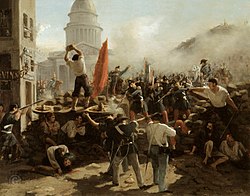
 Barricade on the rue Soufflot,[1] an 1848 painting by Horace Vernet depicting the June Days uprising. A red flag, symbolizing the workers, is visible in opposition to the tricolour of the French Second Republic. | |
| Date | 12 January 1848 – 4 October 1849 |
|---|---|
| Location | Europe |
| Also known as | Springtime of the peoples |
| Participants | People and governments of France, the German Confederation, the Austrian Empire, Italian states, Denmark, Ireland, Moldavia, Wallachia, Poland, and others |
| Outcome | See Events by country or region
|
| Part of a series on |
| Revolution |
|---|
 |
 Politics portal Politics portal |
The revolutions of 1848, also known as the springtime of the peoples,[2] were a series of revolutions throughout Europe over the course of more than one year, from 1848 to 1849. It remains the most widespread revolutionary wave in European history to date.[3]
The revolutions varied widely in their aims but generally opposed conservative systems, such as absolute monarchy and feudalism, and sought to establish nation states, founded on constitutionalism and popular sovereignty. The revolutionary wave began with the Sicilian revolution in January and spread across Europe after the French revolution in February 1848.[4][5] Over 50 countries were affected, but with no significant coordination or cooperation among their respective revolutionaries. Some of the major political contributing factors were widespread dissatisfaction with political leadership, demands for more participation in government and democracy, for freedom of the press, and by the working class for economic rights, and the rise of nationalism.[6] Other economic factors, such as the European potato failure, triggered mass starvation, migration, and civil unrest.[7]
The uprisings were led by temporary coalitions of workers and reformers, including figures from the middle and upper classes (the bourgeoisie); however these coalitions did not hold together for long. Many of the revolutions were quickly suppressed, as tens of thousands of people were killed, and even more were forced into exile. Despite this, significant lasting reforms included the abolition of serfdom in Austria and Hungary, the end of absolute monarchy in Denmark, and the introduction of representative democracy in the Netherlands. The revolutions were most important in France, the Netherlands, Italy, the Austrian Empire, and the states of the German Confederation that would make up the German Empire in the late 19th and early 20th centuries. The wave of uprisings ended in October 1849.
Background
[edit]The revolutions arose from a wide variety of causes, which were linked to the socioeconomic transformations brought about by industrialization and the political legacy of the French Revolution.[8] Eric Hobsbawm considered the revolutionary wave of 1848 to have been the result of the "crisis in the development of the new society" which had begun with the previous revolutions of 1830. This crisis arose from the confluence of processes from both the Industrial Revolution and the French Revolution (the "dual revolution"), including the intensification of industrialization and urbanization, the spread of oppositional ideologies, namely liberalism and radicalism, the emergence of the bourgeoisie over the aristocracy as the most powerful class in Europe, and its rivalry with the growing working class.[9] In addition, an acute economic crisis between 1845 and 1847, resulting from the combination of a food crisis and an industrial recession, led to significant civil unrest and revolutionary agitation.[10][11] According to Jonathan Sperber, the failure of governments to adjust to popular demands for reform in the wake of these crises provided the immediate trigger for the revolutions, with the conditions for their outbreak having already been met by the end of 1847.[5]
Social discontent and conflict
[edit]In Western and Central Europe, discontent was widely felt against the existing political and economic regimes as living standards declined essentially uniformly among the poorer classes. Much of this discontent stemmed from the "decorporation" of society through the decline of the traditional systems of guilds and feudal relations in favor of capitalist enterprise and private land ownership. Other factors resulting from this transition, specifically overpopulation, the exploitation of labourers and the competitive "race to the bottom" to reduce wages, also played a major role.[12][13] The most visible fault lines resulting from the decline of the traditional economy were the conflicts between peasants and landowners (both feudal and private) and employers and workers.
In rural areas
[edit]
According to Jonathan Sperber, conflict over agricultural land rights was the most prevalent form of social conflict in the pre-revolutionary period.[15] The abolition of feudalism in parts of Western and Central Europe (especially in France) in the wake of the French Revolutionary and Napoleonic Wars had major ramifications for the rural populace. Customary rights that peasants had once held on common land, especially to acquire wood from communal forests, were increasingly lost with the enclosure and privatization of the commons.[16] These processes were often aided by modernizing states, such as France, which, with the enactment of the Forest Code of 1827, legally abolished peasants' rights to forests and the wood within them.[17]
Peasants resorted to both legal and violent means to reclaim their land rights. Lawsuits were frequently filed by peasants against landowners, and could remain active for decades;[18] one such lawsuit in Sicily was first brought in 1829 and not settled until 1896.[19] Peasants also stole wood from privatized forests or occupied them to reassert their land rights by force.[18] Wood theft in particular was widespread in parts of Germany. Between the 1820s and 1840s, the number of those convicted of wood theft in the Bavarian Palatinate increased from 100,000 in 1829–30 to 185,000 in 1846–47, accounting for a third of the population, and attempts to suppress wood theft in the same period by Prussia led to what Sperber called a "minor civil war"[18] in the province of Westphalia.[20] Unrest among the peasantry was also widespread in regions that retained feudalism, as in parts of Central Europe and most of Eastern Europe, though this had been commonplace for several centuries.[21] Disputes and revolts were directed variously at oppressive lords, taxation and military conscription by the state, and religious authorities.[22] The largest pre-revolutionary peasant uprising against feudal lords occurred in Austrian Galicia in 1846, which put an end to the Kraków Uprising by the Polish nobility.[22]
Among urban workers
[edit]
In towns and cities, social conflict centered on conflicts between employers and workers. The most persistent conflicts were between master tradesmen and journeymen, who had long struggled for influence within the guild system.[25] New disputes were also emerging between merchants and outworkers, or contracted workers as part of the putting-out system;[24] these workers were often also artisans, including both master tradesmen and the journeymen and apprentices they hired.[26] As with the peasantry, discontent among urban workers largely stemmed from the transition away from traditional modes of production and toward a capitalist economy. Workers protested for the right to work and freedom of association, which had been lost with the decline of the guilds,[27] as they underwent proletarianization and felt their status in society deteriorate.[28]
Rapid population growth was the most serious issue affecting urban workers, as migration into the cities due to poor conditions in the countryside led to a major oversaturation of labour markets and a decline in real wages among workers, while the cost of living continued to increase.[29] Poor workers became more vulnerable to economic shocks, and the inability to afford foodstuffs other than potatoes and bread proved catastrophic amid a major food crisis affecting both between 1845 and 1847.[30] Artisans, especially journeymen, were particularly affected, becoming increasingly alienated from their labour and proletarianized as the trades became overfilled and work was unavailable, turning to revolutionary agitation to regain their status.[31][32] Although much of this agitation was directed at master tradesmen, in some cases the two classes found common cause against the capitalist merchants who contracted them.[33][34] Conflict between merchants and outworkers, especially in the textile industry, was primarily over payment disputes, as merchants frequently underpaid outworkers for their finished products to maximize profit.[35] There was also a growing sense of insecurity among artisans as their trades mechanized, undercutting their handicrafts and leading to unemployment, further threatening their economic agency.[36][37] These disputes led to civil unrest, including uprisings by weavers in Lyon in 1831 and 1834, and in Prague and in Silesia in 1844.[38][24]
Among the educated
[edit]The educated middle class were also affected by the decline in living standards. Across Western Europe, industrialization had increased the demand for professionals to support the new industries.[39] Societal expectations also began to favor education and careerism as means to achieve upward mobility, especially after the French Revolution. As a result, more young men across Europe enrolled in universities, expecting, according to Lenore O'Boyle, that "the diploma might do what a title of nobility had once done"[40] and they would achieve positions of leadership in society.[41] In the more industrialized economies of Britain and United States, more educated men were able to find work in private businesses, and consequently there was little to no revolutionary agitation among them in 1848. In Europe, however, where the pace of industrialization lagged, the only available professional careers were in the civil service, which could not open enough positions to meet demand.[41]
The lack of work led to dissatisfaction among the educated, who felt that they were unable to live as their status demanded.[42] This issue was most pronounced in Germany, where overcrowding in professional careers was so severe that it gave rise to what sociologist Wilhelm Heinrich Riehl termed an "intellectual proletariat" of "underpaid and aspiring lower civil servants, journalists, and schoolteachers". The intellectual proletariat was so numerous in Germany that, according to Riehl, they, not manual labourers, comprised "the real proletariat".[43] Similar issues were reported in France, with politician Saint-Marc Girardin remarking that the educated constituted a "floating mass of unemployed and inconstant [persons] who form an army always available to the ambitious and the instigators of revolt", although contemporary records showed that the issue was exaggerated.[44] Mass underemployment among journalists was particularly pressing. Journalism was seen as "the last refuge" for those who could not find work elsewhere, especially in Germany, and journalists were seen as politically dangerous, having been major organizers of the July Revolution in 1830, and later of the revolutions of 1848.[45][46]
Revolutionary politics
[edit]Ideology
[edit].jpg)
New political ideologies were emerging in the 1840s that would go on to influence the revolutions in 1848, with liberalism, radicalism, and nationalism being the principal opposition movements to European governments.
Liberals formed a distinct political force in the 19th century but varied widely in their beliefs.[48] Generally, liberals supported equality before the law and the protection of civil liberties, such as the freedoms of speech, the press, association, religion, and especially to own property,[49] and favoured constitutions to achieve such. They opposed both absolute monarchies and radical republics, which they viewed as equally despotic, and favoured constitutional monarchies as a balance between the two extremes.[50][51] They favoured popular sovereignty, but made a distinction between "the people" and "the rabble". To that end, liberalism generally sought a restriction of the franchise to male property-owners, as, according to Jonathan Sperber, "[o]nly people capable of forming an independent judgment, liberals felt, should be eligible to vote."[52] As an opposition movement, liberals were reluctant to engage in revolution or seek popular support due to their fears of a radical takeover and violent mob rule, as they had experienced during the French Revolution under the Jacobins and the Reign of Terror.[53] Liberals saw gradual, political reforms and economic development through free markets, industrialization, and public education as means by which more men could become property-owners and enter into political life.[54][55]
Radicalism was even more loosely defined than liberalism, generally representing the coalition of democrats and socialists.[56][57] Radicals differed from moderate liberals in their support for democracy and universal manhood suffrage, extending the franchise to all adult men.[56] Both liberals and radicals shared in their opposition to "backwards" institutions, and especially in their anti-clericalism, which was considered synonymous with liberal and left-wing thought, though radicals were notably more violent in their opposition.[58] While liberals were generally more concerned with political and legal reform and the expansion of civil liberties as the best means to achieve societal equality,[59] radicals placed greater weight on social reform, especially the "social question", or the question of how to address the growth and precarity of the working poor.[56] Radicals were opposed to capitalist competition, which they considered responsible for various social ills, but were divided as to how to address it.[60] Radical democrats generally sought, as Sperber writes, "to rectify the disproportion between capital and labour" through regulation and state intervention, whereas socialists sought the abolition of capitalism and economic redistribution.[61] Both democrats and socialists were, however, united in their desire to overthrow the existing regimes through revolution.[57]
"Nationalism" promoted the unity and primacy of people bound by some mix of common language, culture, religion, shared history and destiny, and immediate geography.[62] There were also irredentist movements. Nationalism had developed a broader appeal during the pre-1848 period, as seen in the František Palacký's 1836 History of the Czech Nation, which emphasized a national lineage of conflict with the Germans, or the popular patriotic Liederkranz (song-circles) that were held across Germany: patriotic and belligerent songs about Schleswig had dominated the Würzburg national song festival in 1845.[63]
Expression and participation
[edit]
Political participation was increasing in the pre-revolutionary period, though it was limited in scope and what forms existed were heavily restricted by state authorities.[65] The most basic form of political participation and expression, and the means by which political awareness as a whole was expanding, was in the reading, writing, and publishing of newspapers.[65] Papers such as the Rheinische Zeitung (edited by Karl Marx) and Deutsche Zeitung in Germany and La Réforme in France became outlets for oppositional thought, and their editorial staff became leaders of oppositional movements in lieu of political parties and organizations, which were largely banned.[66] Informal political organizations existed to a degree in informal social circles, such as reading clubs, coffeehouses, and Masonic lodges.[67] Formal political organizations existed as illegal secret societies, many of which attempted to organize unsuccessful uprisings in the pre-revolutionary period, such as the Young Europe organizations of Giuseppe Mazzini and the several Carbonarist societies led by Louis Auguste Blanqui.[68][69] Mass politics was carried out through public celebrations, such as festivals and banquets, which were organized as de facto political rallies to circumvent state restrictions on them.[66]
Although it was becoming more accessible, "politics" was still practised only by the educated.[70] Most people were entirely disconnected from politics before 1848,[71] and discontented peasants and workers who engaged in social conflict largely sought immediate economic remediation over political change.[70][72] Attempts to organize them by politically-minded agitators likewise failed;[73] rebel weavers during the second Canut revolt in 1834 were "generally reluctant" to accept the leadership of republicans,[74] and, during the revolutions in 1848, Viennese radical Hans Kudlich remarked that his attempts to mobilize the Austrian peasantry had "disappeared in the great sea of indifference and phlegm."[75] However, though they did not seek political change, their demands were often revolutionary in nature, and their unrest could be implicitly political, as with the Canut revolts, or have political undertones, as with the Galician uprising in 1846.[76] As Jonathan Sperber writes, "peasants trying to murder a tax-collector or outworking weavers screaming curses at the merchant who employed them [...] were implicitly suggesting a different way of running things."[70]
Economic crisis
[edit]
According to economic historians Helge Berger and Mark Spoerer, the most immediate cause of the revolutions of 1848 was the multitudinal economic crisis between 1845 and 1847.[10] The crisis began with a major food crisis in Europe in 1845. Phytophthora infestans, the microorganism responsible for potato blight, arrived in Europe from North America around 1840 and spread rapidly during a period of unusually wet weather in 1845, devastating harvests across Northern Europe.[11] Potatoes had become a staple food due to their high nutritional value and affordability, and were being grown on a large scale to feed growing populations, especially in Northern Europe.[77][78] The effects of the potato blight were most severe in Ireland, where the Great Famine directly killed over an eighth of the population, or over 1 million people out of a population of 8 million. Other countries, including Scotland, Belgium, and the Netherlands saw similar damage to crops, with 60,000 deaths in the Netherlands due to the potato blight.[79] Drought conditions in 1846 stopped the spread of the potato blight but damaged grain harvests, resulting in a sharp increase in food prices across the continent, and consequently virtually all foodstuffs became unaffordable for the poor.[80] Food riots erupted across Europe as the poor attempted by force to ward off starvation, with over 400 such riots in France between 1846 and 1847 and 164 riots in the German states in 1847.[77][a]
Although famine was averted in most countries through strong government intervention,[b] the rising cost of food, coupled with poor cotton harvests from the Southern United States necessary for textile manufacture, led to a major industrial recession in 1847.[82][83] Unemployment and pauperism spread rampantly among urban communities: according to Christopher Clark, by 1847 a fifth of the population in Friesland in the Netherlands were receiving relief from the state, or 47,482 out of 245,000 people; and in the same period, "the number of residents officially classified as poor in German towns could swell to two thirds or even three fourths of the population".[84] Berger and Spoerer found a strong correlation among the countries that were most deeply affected by the industrial shock of 1847 and those that underwent a revolution in 1848.[85][c]
Chronology
[edit]Spring 1848: Large scale success
[edit]
The worldwide revolutions appeared in so many places, and were in large part successful in a great number of cases. Agitators who had been exiled by the old governments rushed home to seize the moment. In France, the monarchy was once again overthrown and replaced by a republic. In a number of major German and Italian states, and in Austria, the old leaders were forced to grant liberal constitutions. The Italian and German states seemed to be rapidly forming unified nations. Austria gave Hungarians and Czechs liberal grants of autonomy and national status.[87]
Summer 1848: Divisions among reformers
[edit]In France, bloody street battles exploded between middle class reformers and working class radicals. German reformers argued frequently without coming to solid conclusions.[88]
Autumn 1848: Reactionaries organize for a counter-revolution
[edit]Caught off guard at first, the aristocracy and their allies plotted a return to power.[88][further explanation needed]
1849–1851: Overthrow of revolutionary regimes
[edit]Some revolutions suffered defeats in summer 1849. Reactionaries returned to power and many leaders of the revolution went into exile. Some social reforms proved permanent, and years later nationalists in Germany, Italy, and Hungary gained their objectives.[89][further explanation needed]
Events by country or region
[edit]Italian states
[edit].jpg)
The first of the numerous revolutions to occur in 1848 in Italy came in Palermo, Sicily, starting in January 1848.[90] There had been several previous revolts against Bourbon rule; this one produced an independent state that lasted only 16 months before the Bourbons were restored to the throne. During those months, the constitution was quite advanced for its time in liberal democratic terms, as was the proposal of a unified Italian confederation of states.[91] The revolt's failure was reversed 12 years later as the Bourbon Kingdom of the Two Sicilies collapsed in 1860–61 with the unification of Italy.[92]
On 11 February 1848, Leopold II of Tuscany, first cousin of Emperor Ferdinand I of Austria, granted the Constitution, with the general approval of his subjects. The Habsburg example was followed by Charles Albert of Sardinia (Albertine Statute; later became the constitution of the unified Kingdom of Italy and remained in force, with changes, until 1948[93]) and by Pope Pius IX (Fundamental Statute). However, only King Charles Albert maintained the statute even after the end of the riots. Revolts broke out throughout the Kingdom of Lombardy–Venetia, such as the Five Days of Milan which marked the beginning of the First Italian War of Independence.
After declaring independence from the Habsburg Austrian Empire, the Republic of San Marco later joined the Kingdom of Sardinia in an attempt, led by the latter, to unite northern Italy against foreign (mainly Austrian but also French) domination. However, the First Italian War of Independence ended in the defeat of Sardinia, and Austrian forces reconquered the Republic of San Marco on 28 August 1849 following a long siege. Based on the Venetian Lagoon, the Republic of San Marco extended into most of Venetia, or the Terraferma territory of the Republic of Venice, suppressed 51 years earlier in the French Revolutionary Wars.
In the Duchy of Modena and Reggio, Duke Francis V attempted to respond militarily to the first attempts at armed revolt, but faced with the approach of Bolognese volunteers to support the insurgents, in order to avoid bloodshed he preferred to leave the city promising a constitution and amnesties. On 21 March 1848 he left for Bolzano. A provisional government was established in Modena. In the Papal States, an internal revolt ousted Pope Pius IX from his temporal powers and led to the establishment of the Roman Republic.
The municipalities of Menton and Roquebrune united and obtained independence from the Principality of Monaco, becoming a protectorate of the Kingdom of Sardinia, and would eventually join Sardinia in 1861.[94]
France
[edit]The "February Revolution" against France's July Monarchy began with riots that followed the successful campagne des banquets, which had been organized by the French opposition to circumvent the ban on public assemblies.[95] This revolution was driven by nationalist and republican ideals among the French general public, who believed the people should rule themselves. It ended the constitutional monarchy of Louis-Philippe, and led to the creation of the French Second Republic. After an interim period, Louis-Napoleon, the nephew of Napoleon Bonaparte, was elected as president. In 1851, he staged a coup d'état and established himself as a dictatorial emperor of the Second French Empire.[96]
Alexis de Tocqueville remarked in his Recollections of the period: "society was cut in two: those who had nothing united in common envy, and those who had anything united in common terror."[97]
German states
[edit]
The "March Revolution" in the German states took place in the south and the west of Germany, with large popular assemblies and mass demonstrations. Led by well-educated students and intellectuals,[98] they demanded German national unity, freedom of the press, and freedom of assembly. The uprisings were poorly coordinated, but had in common a rejection of traditional, autocratic political structures in the 39 independent states of the German Confederation. The middle-class and working-class components of the Revolution split, and in the end, the conservative aristocracy defeated it, forcing many liberal Forty-Eighters into exile.[99]
Denmark
[edit]
Denmark had been governed by a system of absolute monarchy (King's Law) since the 17th century. King Christian VIII, a moderate reformer but still an absolutist, died in January 1848 during a period of rising opposition from farmers and liberals. The demands for constitutional monarchy, led by the National Liberals, ended with a popular march to Christiansborg on 21 March. The new king, Frederick VII, met the liberals' demands and installed a new Cabinet that included prominent leaders of the National Liberal Party.[100]
The national-liberal movement wanted to abolish absolutism, but retain a strongly centralized state. The king accepted a new constitution agreeing to share power with a bicameral parliament called the Rigsdag. It is said that the Danish king's first words after signing away his absolute power were, "that was nice, now I can sleep in the mornings".[101] Although army officers were dissatisfied, they accepted the new arrangement. In contrast to the rest of Europe, this was not overturned by reactionaries.[100] The liberal constitution did not extend to Schleswig, leaving the Schleswig-Holstein Question unanswered.
Schleswig
[edit]The Duchy of Schleswig, a region containing both Danes (a North Germanic population) and Germans (a West Germanic population), was a part of the Danish monarchy, but remained a duchy separate from the Kingdom of Denmark. Spurred by pan-Germanist sentiment, the Germans of Schleswig took up arms against a proposal from the National Liberal government in Copenhagen which would have fully integrated the duchy into Denmark.
The German population in Schleswig and Holstein revolted, inspired by the Protestant clergy. The German states sent in an army, but Danish victories in 1849 led to the Treaty of Berlin (1850) and the London Protocol (1852). They reaffirmed the sovereignty of the King of Denmark, while prohibiting union with Denmark. The violation of the latter provision led to renewed warfare in 1863 and the Prussian victory in 1864.
Habsburg monarchy
[edit]
From March 1848 through July 1849, the Habsburg Austrian Empire was threatened by revolutionary movements, which often had a nationalist character. The empire, ruled from Vienna, included German-speaking Austrians, Hungarians, Czechs, Poles, Croats, Ukrainians, Romanians, Rusyns, Slovaks, Slovenes, Serbs and Italians, all of whom attempted in the course of the revolution to achieve either autonomy, independence, or even hegemony over other nationalities.[citation needed] The nationalist picture was further complicated by the simultaneous events in the German states, which moved toward greater German national unity.
On 15 April, Emperor Ferdinand I declared himself a "constitutional monarch", despite there not yet being a constitution. He charged Baron Franz von Pillersdorf with drafting one, and it was passed on 25 April 1848. This constitution, called the Pillersdorf Constitution, applied to the whole of the Habsburg monarchy, except for Hungary. The constitution established the Reichstag, a short-lived unicameral parliamentary body. The Reichstag had two goals: to reform the feudal system, and to draft a new constitution. It succeeded in its first goal, abolishing serfdom by a patent issued together with the Emperor on 7 September 1848. In the midst of its work, the Reichstag was relocated to Kroměříž (German: Kremsier) in Moravia due to the Vienna Uprising in October 1848. The Reichstag was due to present its liberal constitution, the Kremsier Constitution, on the anniversary of the revolution in 1849, but the abdication of Ferdinand I in favor of his more conservative nephew Franz Joseph I in December 1848 prevented such. As the revolutions came to an end in Europe, the Austrian army dissolved the Reichstag on 7 March 1849, and the imperial government promulgated the March Constitution, which strengthened the powers of the emperor.[102]
Hungary
[edit]
The Hungarian Revolution of 1848 was the longest in Europe, crushed in August 1849 by the Austrian and Russian armies. Nevertheless, it had a major effect in freeing the serfs.[103] It began on 15 March 1848, when Hungarian patriots organized mass demonstrations in Pest and Buda (today Budapest) which forced the imperial governor to accept their 12 points of demands. The 12 points included demands for freedom of the press, an independent Hungarian ministry residing in Buda–Pest and responsible to a popularly elected parliament, the formation of a National Guard, complete civil and religious equality, trial by jury, a national bank, a Hungarian army, the withdrawal of foreign (Austrian) troops from Hungary, the freeing of political prisoners, and union with Transylvania.[104] On that morning, the demands were read aloud along with poetry by Sándor Petőfi with the simple lines of "We swear by the God of the Hungarians; we swear, we shall be slaves no more".[105] Lajos Kossuth and other liberal nobles in the Hungarian Diet appealed to the Habsburg court with demands for representative government and civil liberties.[106] These events resulted in Klemens von Metternich, the Austrian chancellor and foreign minister, resigning. The demands of the Diet were agreed upon on 18 March by Emperor Ferdinand I. Although Hungary would remain part of the monarchy through personal union with the emperor, a constitutional government would be founded. The Diet then passed the April laws that established equality before the law, a legislature, a hereditary constitutional monarchy, and an end to the transfer and restrictions of land use.[106]
The revolution grew into a war for independence from the Habsburg monarchy when Josip Jelačić, Ban of Croatia, crossed the border to restore their control.[107] The new government, led by Lajos Kossuth, was initially successful against the Habsburg forces. Although Hungary took a national united stand for its freedom, some minorities of the Kingdom of Hungary, including the Serbs of Vojvodina, the Romanians of Transylvania and some Slovaks of Upper Hungary supported the Habsburg Emperor and fought against the Hungarian Revolutionary Army. Eventually, after one and a half years of fighting, the revolution was crushed when Russian Tsar Nicholas I marched into Hungary with over 300,000 troops.[108] As result of the defeat, Hungary was thus placed under brutal martial law. The leading rebels like Kossuth went into exile or were executed, the latter including former prime minister Batthyány and the Thirteen Martyrs of Arad. In the long run, the passive resistance following the revolution, along with the crushing Austrian defeat in the 1866 Austro-Prussian War, led to the Austro-Hungarian Compromise (1867), which marked the birth of the Austro-Hungarian Empire.
Galicia
[edit]The center of the Ukrainian national movement was in Galicia, which is today divided between Ukraine and Poland. On 19 April 1848, a group of representatives led by the Greek Catholic clergy launched a petition to the Austrian Emperor. It expressed wishes that in those regions of Galicia where the Ruthenian (Ukrainian) population represented the majority, the Ukrainian language should be taught at schools and used to announce official decrees for the peasantry; local officials were expected to understand it and the Ruthenian clergy was to be equalized in their rights with the clergy of all other denominations.[109]
On 2 May 1848, the Supreme Ruthenian Council was established. The council (1848–1851) was headed by the Greek-Catholic Bishop Gregory Yakhimovich and consisted of 30 permanent members. Its main goal was the administrative division of Galicia into Western (Polish) and Eastern (Ruthenian/Ukrainian) parts within the borders of the Habsburg Empire, and formation of a separate region with a political self-governance.[110]
Though both Polish and Ruthenian Galicians had nationalist aspirations, the two groups' interests diverged, with Polish nobles in Ruthenia often having dominion over Ruthenian serfs. Emperor Ferdinand responded to Galician agitation in 1848 by freeing the predominantly Ruthenian serfs, thereby dampening the revolutionary ardor of both groups.[111]
Czech lands
[edit]_p2.0833_Angriff_auf_den_Altst%C3%A4dter_Br%C3%BCckenthurm_zu_Prag.jpg)
The revolution of 1848 in Bohemia began with the drafting of a list of liberal demands of the Czech population of the Czech lands at the St. Wenceslas Spa in Prague by the wealthier inhabitants of the city in March. These were spurred by the more violent events in Vienna and the news of revolutions sweeping across the continent.[112]
The revolution in the Czech lands was complicated by the friction between German Bohemians, who were interested in becoming a part of Germany and representation in the Frankfurt National Assembly, the first all-German parliament, and between Czechs in Bohemia and Moravia, who sought Czech nationality. Austroslavism emerged during the revolutions, propagated by František Palacký, which sought to achiever greater autonomy for the Czech lands, and potentially even a federation, within the Habsburg monarchy, as opposed to potentially all of the Czech lands joining a unified greater Germany.[113]
Sweden
[edit]During 18–19 March, a series of riots known as the March Unrest (Marsoroligheterna) took place in the Swedish capital of Stockholm. Declarations with demands of political reform were spread in the city and a barricade at Norra Smedjegatan was stormed by the military. In the end, there were 18–30 casualties in total.
Switzerland
[edit]Switzerland, already an alliance of republics, also saw an internal struggle. The attempted secession of seven Catholic cantons to form an alliance known as the Sonderbund ("separate alliance") in 1845 led to a short civil conflict in November 1847 in which around 100 people were killed. The Sonderbund was decisively defeated by the Protestant cantons, which had a larger population.[114] A new constitution of 1848 ended the almost-complete independence of the cantons, transforming Switzerland into a federal state.
Greater Poland
[edit]Polish people mounted a military insurrection against the Prussians in the Grand Duchy of Posen (or the Greater Poland region), a part of Prussia since its annexation in 1815. The Poles tried to establish a Polish political entity, but refused to cooperate with the Germans and the Jews. The Germans decided they were better off with the status quo, so they assisted the Prussian governments in recapturing control. In the long-term, the uprising stimulated nationalism among both the Poles and the Germans and brought civil equality to the Jews.[115]
Romanian Principalities
[edit]
A Romanian liberal and Romantic nationalist uprising began in June in the principality of Wallachia. Its goals were administrative autonomy, abolition of serfdom, and popular self-determination. It was closely connected with the 1848 unsuccessful revolt in Moldavia, it sought to overturn the administration imposed by Imperial Russian authorities under the Regulamentul Organic regime, and, through many of its leaders, demanded the abolition of boyar privilege. Led by a group of young intellectuals and officers in the Wallachian military forces, the movement succeeded in toppling the ruling Prince Gheorghe Bibescu, whom it replaced with a provisional government and a regency, and in passing a series of major liberal reforms, first announced in the Proclamation of Islaz.
Despite its rapid gains and popular backing, the new administration was marked by conflicts between the radical wing and more conservative forces, especially over the issue of land reform. Two successive abortive coups weakened the new government, and its international status was always contested by Russia. After managing to rally a degree of sympathy from Ottoman political leaders, the Revolution was ultimately isolated by the intervention of Russian diplomats. In September 1848 by agreement with the Ottomans, Russia invaded and put down the revolution. According to Vasile Maciu, the failures were attributable in Wallachia to foreign intervention, in Moldavia to the opposition of the feudalists, and in Transylvania to the failure of the campaigns of General Józef Bem (who led a very successful campaign of liberation in the Hungarian Revolution), and later to Austrian repression.[116] In later decades, the rebels returned and gained their goals.
Belgium
[edit]_(14740791186).jpg)
Belgium did not see major unrest in 1848; it had already undergone a liberal reform after the Revolution of 1830 and thus its constitutional system and its monarchy survived.[117]
A number of small local riots broke out, concentrated in the sillon industriel industrial region of the provinces of Liège and Hainaut.
The most serious threat of revolutionary contagion, however, was posed by Belgian émigré groups from France. In 1830 the Belgian Revolution had broken out inspired by the revolution occurring in France, and Belgian authorities feared that a similar 'copycat' phenomenon might occur in 1848. Shortly after the revolution in France, Belgian migrant workers living in Paris were encouraged to return to Belgium to overthrow the monarchy and establish a republic.[118] Belgian authorities expelled Karl Marx himself from Brussels in early March on accusations of having used part of his inheritance to arm Belgian revolutionaries.
Around 6,000 armed émigrés of the "Belgian Legion" attempted to cross the Belgian frontier. There were two divisions which were formed. The first group, travelling by train, were stopped and quickly disarmed at Quiévrain on 26 March 1848.[119] The second group crossed the border on 29 March and headed for Brussels. They were confronted by Belgian troops at the hamlet of Risquons-Tout and defeated. Several smaller groups managed to infiltrate Belgium, but the reinforced Belgian border troops succeeded and the defeat at Risquons-Tout effectively ended the revolutionary threat to Belgium.
The situation in Belgium began to recover that summer after a good harvest, and fresh elections returned a strong majority to the governing party.[118]
United Kingdom of Great Britain and Ireland
[edit]
A tendency common in the revolutionary movements of 1848 was a perception that the liberal monarchies set up in the 1830s, despite formally being representative parliamentary democracies, were too oligarchical and/or corrupt to respond to the urgent needs of the people, and were therefore in need of drastic democratic overhaul or, failing that, separatism to build a democratic state from scratch.[citation needed] This was the process that occurred in Ireland between 1801 and 1848.[citation needed]
Previously a separate kingdom, Ireland was united with Great Britain to form the United Kingdom of Great Britain and Ireland on 1 January 1801. Although the Irish population was made up largely of Catholic agricultural workers, tensions arose from the political over-representation, in positions of power, of landowners of Protestant background who were loyal to the union. From the 1810s onward, an Irish conservative-liberal movement led by Daniel O'Connell had sought to secure equal political rights for Catholics within the British political system, succeeding with the Roman Catholic Relief Act 1829. But as in other European states, a current inspired by Radicalism criticized Irish conservative-liberals for pursuing the aim of democratic equality with excessive compromise and gradualism.
In Ireland, a current of nationalist, egalitarian and radicalist republicanism, inspired by the French Revolution, had been present since the 1790s – being expressed initially in the Irish Rebellion of 1798. This tendency grew into a movement for social, cultural and political reform during the 1830s, and in 1839 was realized into a political association called Young Ireland. It was initially not well received, but grew more popular with the Great Famine of 1845–1849, an event that brought catastrophic social effects and which threw into light the inadequate response of authorities. The spark for the Young Ireland rebellion came in 1848 when the British Parliament passed the Prevention of Crime (Ireland) Act 1848, which gave the Lord Lieutenant of Ireland the power to organise Ireland into districts and bring policemen of the Irish Constabulary into them at the districts' expense. The act also limited who could own guns and, under penalty, coerced all Irish men between the ages of 16 and 60 to join in a type of posse comitatus in each district to assist in apprehending suspected murderers when killings took place, or else be guilty of a misdemeanour themselves.[120]
In response, the Young Ireland Party launched a rebellion in July 1848, gathering landlords and tenants to its cause. But its first major engagement against police, in the village of Ballingarry, South Tipperary, was a failure. A long gunfight with around 50 policemen ended when police reinforcements arrived. After the arrest of the Young Ireland leaders, the rebellion collapsed, though intermittent fighting continued for the next year, It is sometimes called the Famine Rebellion (since it took place during the Great Famine).[citation needed]
Spain
[edit]While no revolution occurred in Spain in the year 1848, a similar phenomenon occurred. During this year, the country was going through the Second Carlist War. The European revolutions erupted at a moment when the political regime in Spain faced great criticism from within one of its two main parties, and by 1854 a radical-liberal revolution and a conservative-liberal counter-revolution had both occurred.
Since 1833, Spain had been governed by a conservative-liberal parliamentary monarchy similar to and modelled on the July Monarchy in France. In order to exclude absolute monarchists from government, power had alternated between two liberal parties: the center-left Progressive Party, and the center-right Moderate Party. But a decade of rule by the center-right Moderates had recently produced a constitutional reform (1845), prompting fears that the Moderates sought to reach out to Absolutists and permanently exclude the Progressives. The left-wing of the Progressive Party, which had historical links to Jacobinism and Radicalism, began to push for root-and-branch reforms to the constitutional monarchy, notably universal male suffrage and parliamentary sovereignty.
The European Revolutions of 1848 and particularly the French Second Republic prompted the Spanish radical movement to adopt positions incompatible with the existing constitutional regime, notably republicanism. This ultimately led the Radicals to exit the Progressive Party to form the Democratic Party in 1849.
Over the next years, two revolutions occurred. In 1854, the conservatives of the Moderate Party were ousted after a decade in power by an alliance of Radicals, Liberals and liberal Conservatives led by Generals Espartero and O'Donnell. In 1856, the more conservative half of this alliance launched a second revolution to oust the republican Radicals, leading to a new 10-year period of government by conservative-liberal monarchists.
Taken together, the two revolutions can be thought of as echoing aspects of the French Second Republic: the Spanish Revolution of 1854, as a revolt by Radicals and Liberals against the oligarchical, conservative-liberal parliamentary monarchy of the 1830s, mirrored the French Revolution of 1848; while the Spanish Revolution of 1856, as a counter-revolution of conservative-liberals under a military strongman, Leopoldo O'Donnell, had echoes of Louis-Napoléon Bonaparte's coup against the French Second Republic.
Other European states
[edit]
The United Kingdom, Belgium, the Netherlands, Portugal, the Russian Empire (including Poland and Finland), and the Ottoman Empire did not encounter major national or Radical revolutions in 1848. Sweden and Norway were also little affected. Serbia, though formally unaffected by the revolt as it was a part of the Ottoman state, actively supported Serbian revolutionaries in the Habsburg Empire.[121]
In some countries, uprisings had already occurred demanding reforms similar to those sought in the Revolutions of 1848, but with little success. This was the case for the Kingdom of Poland and the Grand Duchy of Lithuania, which had seen a series of uprisings before or after but not during 1848: the November Uprising of 1830–1831; the Kraków Uprising of 1846 (notable for being quelled by the anti-revolutionary Galician slaughter), and later on the January Uprising of 1863–1865.
In other countries, the relative calm could be attributed to the fact that they had already gone through revolutions or civil wars in the preceding years, and therefore already enjoyed many of the reforms which Radicals elsewhere were demanding in 1848. This was largely the case for Belgium (the Belgian Revolution in 1830–1831); Portugal (the large Liberal Wars of 1828–1834, and the minor civil war of Patuleia in 1846–1847); and Switzerland (the Sonderbund War of 1847)
In yet other countries, the absence of unrest was partly due to governments taking action to prevent revolutionary unrest, and pre-emptively grant some of the reforms demanded by revolutionaries elsewhere. This was notably the case for the Netherlands, where King William II decided to alter the Dutch constitution to reform elections and voluntarily reduce the power of the monarchy. The same might be said of Switzerland, where a new constitutional regime was introduced in 1848: the Swiss Federal Constitution was a revolution of sorts, laying the foundation of Swiss society as it is today.
While no major political upheavals occurred in the Ottoman Empire as such, political unrest did occur in some of its vassal states. In Serbia, feudalism was abolished and the power of the Serbian prince was reduced with the Constitution of Serbia in 1838.
Other English-speaking countries
[edit]
In the United Kingdom, while the middle classes had been pacified by their inclusion in the extension of the franchise in the Reform Act 1832, the consequential agitations, violence, and petitions of the Chartist movement came to a head with their peaceful petition to Parliament of 1848. The repeal in 1846 of the protectionist agricultural tariffs – called the "Corn Laws" – had defused some proletarian fervour.[122]
In the Isle of Man, there were ongoing efforts to reform the self-elected House of Keys, but no revolution took place. Some of the reformers were encouraged by events in France in particular.[123]
In the United States, opinions were polarized, with Democrats and reformers in favour, although they were distressed at the degree of violence involved. Opposition came from conservative elements, especially Whigs, southern slaveholders, orthodox Calvinists, and Catholics. About 4,000 German exiles arrived and some became fervent Republicans in the 1850s, such as Carl Schurz. Kossuth toured America and won great applause, but no volunteers or diplomatic or financial help.[124]
Following rebellions in 1837 and 1838, 1848 in Canada saw the establishment of responsible government in Nova Scotia and The Canadas, the first such governments in the British Empire outside the United Kingdom. John Ralston Saul has argued that this development is tied to the revolutions in Europe, but described the Canadian approach to the revolutionary year of 1848 as "talking their way ... out of the empire's control system and into a new democratic model", a stable democratic system which has lasted to the present day. Tory and Orange Order in Canada opposition to responsible government came to a head in riots triggered by the Rebellion Losses Bill in 1849. They succeeded in the burning of the Parliament Buildings in Montreal, but, unlike their counterrevolutionary counterparts in Europe, they were ultimately unsuccessful.[125]
Latin America
[edit]In Spanish Latin America, the Revolution of 1848 appeared in New Granada, where Colombian students, liberals, and intellectuals demanded the election of General José Hilario López. He took power in 1849 and launched major reforms, abolishing slavery and the death penalty, and providing freedom of the press and of religion. The resulting turmoil in Colombia lasted three decades; from 1851 to 1885, the country was ravaged by four general civil wars and 50 local revolutions.[126]
In Chile, the 1848 revolutions inspired the 1851 Chilean revolution.[127]
In Brazil, the Praieira Revolt, a movement in Pernambuco, lasted from November 1848 to 1852.[citation needed] Unresolved conflicts from the period of the regency and local resistance to the consolidation of the Empire of Brazil that had been proclaimed in 1822 helped to plant the seeds of the revolution.
In Mexico, the Centralist Republic led by Antonio López de Santa Anna lost half of its territory to the United States, including California and Texas, in the Mexican–American War of 1845–1848. Derived from this catastrophe and chronic stability problems, the Liberal Party started a reformist movement. This movement, via elections, led liberals to formulate the Plan of Ayutla. The Plan written in 1854 aimed at removing president Santa Anna from control of Mexico during the Second Federal Republic of Mexico period. Initially, it seemed little different from other political plans of the era, but it is considered the first act of the Liberal Reform in Mexico.[128] It was the catalyst for revolts in many parts of Mexico, which led to the resignation of Santa Anna from the presidency, never to vie for office again.[129] The next Presidents of Mexico were the liberals, Juan Álvarez, Ignacio Comonfort, and Benito Juárez. The new regime would then proclaim the 1857 Mexican Constitution, which implemented a variety of liberal reforms. Among other things, these reforms confiscated religious property, aimed to promote economic development and to stabilize a nascent republican government.[130] The reforms led directly to the so-called Three Years War or Reform War of 1857. The liberals won this war but the conservatives solicited the French Government of Napoleon III for a European, conservative Monarch, deriving into the Second French intervention in Mexico. Under the puppet Habsburg government of Maximilian I of Mexico, the country became a client state of France (1863–1867).
Aftermath and legacy
[edit]We have been beaten and humiliated ... scattered, imprisoned, disarmed and gagged. The fate of European democracy has slipped from our hands.
Liberal democrats looked to 1848 as a democratic revolution, which in the long run ensured liberty, equality, and fraternity. For nationalists, 1848 was the springtime of hope, when newly emerging nationalities rejected the old multinational empires, but the end results were not as comprehensive as many had hoped. Communists denounced 1848 as a betrayal of working-class ideals by a bourgeoisie indifferent to the legitimate demands of the proletariat.[132] The view of the revolutions of 1848 as a bourgeois revolution is also common in non-Marxist scholarship.[133][134][135] Tensions over differing approaches between bourgeois revolutionaries and radicals played a major role in the failure of the revolutions.[136] Many governments engaged in a partial reversal of the revolutionary reforms of 1848–1849 as well as heightened repression and censorship. The Hanoverian nobility successfully appealed to the Confederal Diet in 1851 over the loss of their noble privileges, while the Prussian Junkers recovered their manorial police powers from 1852 to 1855.[137][138] In the Austrian Empire, the Sylvester Patents (1851) discarded Franz Stadion's constitution and the Statute of Basic Rights, while the number of arrests in Habsburg territories increased from 70,000 in 1850 to one million by 1854.[139] Nicholas I's rule in Russia after 1848 was particularly repressive, marked by an expansion of the secret police (the Tretiye Otdeleniye) and stricter censorship; there were more Russians working for censorship organs than actual books published in the period immediately after 1848.[140][141] In France, the works of Charles Baudelaire, Victor Hugo, Alexandre Ledru-Rollin, and Pierre-Joseph Proudhon were confiscated.[142]
In the post-revolutionary decade after 1848, little had visibly changed, and many historians considered the revolutions a failure, given the seeming lack of permanent structural changes. More recently, Christopher Clark has characterized the period that followed 1848 as one dominated by a revolution in government. Governments after 1848 were forced into managing the public sphere and popular sphere with more effectiveness, resulting in the increased prominence of, for example, the Prussian Zentralstelle für Pressangelegenheiten (Central Press Agency, established 1850), the Austrian Zensur-und polizeihofstelle (Censorship and Police Office), and the French Direction Générale de la Librairie (1856).[143] The conservative Prussian prime minister Otto von Manteuffel declared that the state could no longer be run like the landed estate of a nobleman.[144] Meanwhile, centrist coalitions, consisting of liberals and conservatives united in their anxiety toward working-class socialism, also took power after the revolutions, such as the Connubio coalition led by Camillo Benso, Count of Cavour in Piedmont–Sardinia.[145][146] Priscilla Robertson considered many of the revolutionaries' goals to have been achieved by the 1870s, though largely by the enemies of the revolutions. Austria and Prussia eliminated feudalism by 1850 and Russia abolished serfdom in 1861, improving conditions for the peasants. The European middle classes made political and economic gains over the next 20 years, with France retaining the universal male suffrage that had been established by the Second Republic. The Austrian Empire was reorganized into the Dual Monarchy, according Hungary more self-determination as part of the Ausgleich of 1867, a process that was spearheaded by the former revolutionaries Gyula Andrássy and Ferenc Deák.[147][148]

Karl Marx expressed disappointment at the bourgeois character of the revolutions.[149][150] Marx elaborated in his 1850 "Address of the Central Committee to the Communist League" a theory of permanent revolution according to which the proletariat should strengthen democratic bourgeois revolutionary forces until the proletariat itself is ready to seize power.[151]
German historian Reinhard Rürup described the 1848 revolutions as a turning point in the development of modern antisemitism. This was expressed through the development of conspiracies that presented Jews as representative of both the forces of social revolution (apparently typified in Joseph Goldmark and Adolf Fischhof of Vienna) and of international capital, as seen in the 1848 report from Eduard von Müller-Tellering, the Viennese correspondent of Marx's Neue Rheinische Zeitung, which declared that "tyranny comes from money and the money belongs to the Jews".[152]
About 4,000 exiles went to the United States fleeing the reactionary purges. Of these, 100 went to the Texas Hill Country as German Texans.[153] More widely, many disillusioned and persecuted revolutionaries, in particular (though not exclusively) those from Germany and the Austrian Empire, left their homelands for foreign exile in the New World or in the more liberal European nations; these emigrants were known as the Forty-Eighters.
-
 Louis Blenker (Germany)
 -
 Alexander Schimmelfennig (Germany)
 -
 Carl Schurz (Germany)
 -
 Franz Sigel (Germany)
 -
 August Willich (Germany)
 -
 Alexander Asboth (Hungary)
 -
 Lajos Kossuth (Hungary)
 -
 Albin Francisco Schoepf (Poland, Hungary)
 -
 Julius Stahel (Hungary)
 -
 Charles Zagonyi (Hungary)
 -
 Thomas Francis Meagher (Ireland)
 -
 Carlo Cattaneo (Italy)
 -
 Giuseppe Garibaldi (Italy)
 -
 Goffredo Mameli (Italy)
 -
 Giuseppe Mazzini (Italy)
 -
 Włodzimierz Krzyżanowski (Poland)


In popular culture
[edit]Steven Brust and Emma Bull's 1997 epistolary novel Freedom & Necessity is set in England in the aftermath of the Revolutions of 1848.[154]
See also
[edit]Notes
[edit]- ^ Counts in Germany differ between sources: Clark 2023, p. 47 counts 158 riots in Prussia between April–May 1847, while Siemann 1998, p. 39 counts 103 protests between 1840 and 1847.
- ^ Except Ireland, which did experience a famine due to government inaction and free market policies which prioritized food exports over relief.[81]
- ^ The sole exception is the Netherlands, which Berger and Spoerer argue experienced a revolution (through its preemptive enactment of the Constitutional Reform of 1848) without having experienced an industrial shock.[86]
References
[edit]- ^ Rapport 2009, p. 201.
- ^ Clark 2023, p. 7.
- ^ Sperber 2005, p. 2.
- ^ Haupt & Langewiesche 2008, p. 3.
- ^ a b Sperber 2005, p. 116.
- ^ Pogge von Strandmann 2002, p. 5.
- ^ Ó Gráda, Vanhaute & Paping 2006.
- ^ Sperber 2005, pp. 258–59.
- ^ Hobsbawm 1962, pp. 111–12.
- ^ a b Berger & Spoerer 2001, p. 295: "We propose that it is precisely these economic crises that are most helpful in explaining the simultaneity and regional distribution of the European turmoil of 1848. In other words, even though ideas and institutions undoubtedly shaped the events in question, it was economic misery and the fear thereof that triggered them."
- ^ a b Clark 2023, p. 44.
- ^ Sperber 2005, pp. 24–26.
- ^ Clark 2023, p. 37.
- ^ Clark 2023, p. 81.
- ^ Sperber 2005, p. 40.
- ^ Sperber 2005, pp. 40–41.
- ^ Clark 2023, p. 43.
- ^ a b c Sperber 2005, p. 41.
- ^ Clark 2023, p. 40.
- ^ Sperber 1991, p. 140.
- ^ Blum 1978, p. 332.
- ^ a b Blum 1978, p. 340.
- ^ Clark 2023, p. 52.
- ^ a b c Sperber 2005, p. 45.
- ^ Sperber 2005, pp. 43–44.
- ^ Clark 2023, p. 54–55.
- ^ Clark 2023, p. 53.
- ^ Clark 2023, pp. 35, 53.
- ^ Sperber 2005, pp. 24–25.
- ^ Clark 2023, pp. 44–48.
- ^ Gouldner 1983, pp. 522–23.
- ^ Clark 2023, pp. 35–38, 90.
- ^ Clark 2023, p. 54.
- ^ Sperber 2005, pp. 45–46.
- ^ Clark 2023, p. 38.
- ^ Merriman 1996, p. 724.
- ^ Shorter 1969, p. 206.
- ^ Clark 2023, p. 64.
- ^ O'Boyle 1970, pp. 471–72.
- ^ O'Boyle 1970, p. 472.
- ^ a b O'Boyle 1966, pp. 833–34.
- ^ Gouldner 1983, p. 526.
- ^ O'Boyle 1961, p. 377.
- ^ O'Boyle 1970, pp. 489–90.
- ^ O'Boyle 1970, p. 492.
- ^ Gouldner 1983, p. 527.
- ^ "Eyes Open!!!". German History in Documents and Images. Archived from the original on 9 August 2025.
- ^ Clark 2023, pp. 109–110.
- ^ Sperber 2005, p. 66.
- ^ Clark 2023, pp. 111–13.
- ^ Sperber 2005, pp. 65–66.
- ^ Sperber 2005, p. 67.
- ^ Sperber 2005, p. 71.
- ^ Clark 2023, p. 112.
- ^ Sperber 2005, pp. 67–71.
- ^ a b c Clark 2023, p. 117.
- ^ a b Sperber 2005, p. 89.
- ^ Sperber 2005, p. 81.
- ^ Clark 2023, p. 114.
- ^ Clark 2023, pp. 119–120.
- ^ Sperber 2005, pp. 82–83.
- ^ Sperber 2005, p. 90.
- ^ Stanley Z. Pech, The Czech Revolution of 1848 (1969), p. 25, Wolfram Siemann, The German Revolution of 1848–1849 (London, 1998), p. 47
- ^ Sperber 2005, pp. 59–60.
- ^ a b Sperber 2005, p. 59.
- ^ a b Sperber 2005, pp. 60–61.
- ^ Sperber 2005, pp. 63–64.
- ^ Hobsbawm 1962, pp. 120, 122.
- ^ Sperber 2005, pp. 62–63.
- ^ a b c Sperber 2005, p. 39.
- ^ Sperber 2005, p. 151.
- ^ Clark 2023, pp. 87–88.
- ^ Clark 2023, p. 88.
- ^ Clark 2023, p. 59.
- ^ Sperber 2005, p. 232.
- ^ Clark 2023, pp. 54–55, 90–92.
- ^ a b Sperber 2005, p. 110.
- ^ Ó Gráda, Vanhaute & Paping 2006, pp. 5–7.
- ^ Clark 2023, p. 45.
- ^ Clark 2023, pp. 44–47.
- ^ Sperber 2005, p. 111.
- ^ Sperber 2005, pp. 110–11.
- ^ Clark 2023, p. 46.
- ^ Clark 2023, p. 47.
- ^ Berger & Spoerer 2001, p. 315.
- ^ Berger & Spoerer 2001, p. 312.
- ^ Melvin Kranzberg, 1848: A Turning Point? (1962) pp. xi, xvii–xviii.
- ^ a b Kranzberg, 1848: A Turning Point? (1962) pp. xii, xvii–xviii.
- ^ Kranzberg, 1848: A Turning Point? (1962) p. xii.
- ^ La primavera dei popoli. La rivoluzione siciliana del 1848 (in Italian). Retrieved 16 September 2023.
- ^ "Autonomismo e Unità" (in Italian). Archived from the original on 22 July 2024. Retrieved 16 September 2023.
- ^ Collier, Martin (2003). Italian unification, 1820–71. Heinemann Advanced History (First ed.). Oxford: Heinemann. p. 2. ISBN 978-0-435-32754-5.
- ^ Smith, Denis Mack (1997). Modern Italy: A Political History. Yale University Press.
- ^ Monaco, Gouvernement Princier. "Secession of Menton and Roquebrune / Times of Trouble (1793-1861) / Periods / History and Heritage / Government & Institutions / Portail Du Gouvernement - Monaco." Portail Officiel Du Gouvernement Princier - Monaco, https://en.gouv.mc/Government-Institutions/History-and-Heritage/Periods/Times-of-trouble-1793-1861/Secession-of-Menton-and-Roquebrune
- ^ Sperber 2005, p. 60, 116.
- ^ William Roberts, Encyclopedia of Modern Dictators (2006) pp 209–211.
- ^ Tocqueville, Alexis de. "Recollections," 1893
- ^ Louis Namier, 1848: The Revolution of the Intellectuals (1964)
- ^ Theodote S. Hamerow, Restoration, Revolution, Reaction: Economics and Politics in Germany, 1825–1870 (1958) focuses mainly on artisans and peasants
- ^ a b Weibull, Jörgen. "Scandinavia, History of." Encyclopædia Britannica 15th ed., Vol. 16, 324.
- ^ Olaf Søndberg; den danske revolution 1830–1866: p. 70, line 47–48
- ^ Pánek & Tuma 2019, p. 347–52.
- ^ Gábor Gángó, "1848–1849 in Hungary," Hungarian Studies (2001) 15#1 pp. 39–47. online Archived 19 October 2017 at the Wayback Machine
- ^ Deák 1971, p. 70–71.
- ^ Deák 1971, p. 71.
- ^ a b "The US and the 1848 Hungarian Revolution." The Hungarian Initiatives Foundation. Accessed 26 March 2015. http://www.hungaryfoundation.org/history/20140707_US_HUN_1848 Archived 14 March 2016 at the Wayback Machine.
- ^ The Making of the West: Volume C, Lynn Hunt, pp. 683–684
- ^ W.B. Lincoln, "Russia and the European Revolutions of 1848" History Today (Jan 1973), Vol. 23 Issue 1, pp 53–59 online.
- ^ Kost' Levytskyi, The History of the Political Thought of the Galician Ukrainians, 1848–1914, (Lviv, 1926), 17.
- ^ Kost' Levytskyi, The History of the Political Thought of the Galician Ukrainians, 1848–1914, (Lviv, 1926), 26.
- ^ Mike Rapport, 1848: Year of Revolution, pp.137-140 (Little, Brown, 2008) (retrieved Feb.16, 2025).
- ^ Pánek & Tuma 2019, p. 344–45.
- ^ Pánek & Tuma 2019, p. 346–47.
- ^ Joachim Remak, Very Civil War: The Swiss Sonderbund War of 1847 (1993)
- ^ Krzysztof Makowski, "Poles, Germans and Jews in the Grand Duchy of Poznan in 1848: From coexistence to conflict." East European Quarterly 33.3 (1999): 385.
- ^ Vasile Maciu, "Le caractère unitaire de la révolution de 1848 dans les pays roumains." Revue Roumaine d'Histoire 7 (1968): 679–707.
- ^ Stefan Huygebaert, "Unshakeable Foundations," Journal of Belgian History 45.4 (2015).
- ^ a b Chastain, James. "Belgium in 1848". Encyclopedia of 1848 Revolutions. Ohio University. Archived from the original on 11 August 2011.
- ^ Ascherson, Neal (1999). The King Incorporated: Leopold the Second and the Congo (New ed.). London: Granta. pp. 20–21. ISBN 978-1862072909.
- ^ Woodham-Smith, Cecil, The Great Hunger: Ireland, 1845–1849, Harper and Row, New York, pages 326–327
- ^ "Serbia's Role in the Conflict in Vojvodina, 1848–49". Ohiou.edu. 25 October 2004. Archived from the original on 25 September 2008. Retrieved 1 October 2013.
- ^ Weisser, Henry (1981). "Chartism in 1848: Reflections on a Non-Revolution". Albion: A Quarterly Journal Concerned with British Studies. 13 (1): 12–26. doi:10.2307/4049111. JSTOR 4049111.
- ^ Fyson, Robert (2016). The Struggle for Manx Democracy. Douglas: Culture Vannin. ISBN 9780993157837.
- ^ Timothy Mason Roberts, Distant Revolutions: 1848 and the Challenge to American Exceptionalism (2009)
- ^ Saul, J.R. (2012). Louis-Hippolyte LaFontaine & Robert Baldwin. Penguin Group (Canada).
- ^ J. Fred Rippy, Latin America: A Modern History (1958) pp. 253–254
- ^ Gazmuri, Cristián (1999). El "1849" chileno: Igualitarios, reformistas, radicales, masones y bomberos (PDF) (in Spanish). Santiago, Chile: Editorial Universitaria. p. 104. Archived (PDF) from the original on 19 October 2017. Retrieved 1 June 2014.
- ^ Robert J. Knowlton, "Plan of Ayutla" in Encyclopedia of Latin American History and Culture, vol. 4, p. 420. New York: Charles Scribner's Sons 1996.
- ^ Erika Pani, "Revolution of Ayutla" in Encyclopedia of Mexico, vol. 1, p. 119. Chicago: Fitzroy Dearborn 1997.
- ^ Pani, Ibid. p. 120.
- ^ Breunig, Charles (1977), The Age of Revolution and Reaction, 1789–1850 (ISBN 0-393-09143-0)
- ^ Evans & Pogge von Strandmann 2000, pp. 207–235.
- ^ History Today (1960). p. 668. "... the rising tide of revolutionary bourgeois liberalism in Austrian political life, as demonstrated by students' activities, the March riots of 1848, the rising in Hungary, the open revolt in Vienna itself in October 1848, and the course of the revolution."
- ^ Clark, T. J. (1982). The Absolute Bourgeois: Artists and Politics in France 1848–51 (paperback ed.). Princeton, New Jersey: Princeton University Press. ISBN 9780691003382.
- ^ Csizmadia, Andor (1983). "Hungarian Customary Law Before the Bourgeois Rebellion of 1848". The Journal of Legal History. 4 (2): 3–37. doi:10.1080/01440368308530781.
- ^ Columbia Encyclopedia (2020). "The discrepancy of aims between bourgeois revolutionaries such as Alphonse de Lamartine and A. T. Marie and the radicals, led by Louis Blanc, contributed to the eventual failure of the revolution."
- ^ Green, Abigail, Fatherlands: State-Building and Nationhood in Nineteenth-Century Germany (Cambridge, 2001), p. 75
- ^ Barclay, David, Friedrich Wilhelm IV and the Prussian Monarchy 1840–1861 (Oxford, 1995), pp. 190, 231
- ^ Deak, John. Forging a Multinational State: State Making in Imperial Austria from the Enlightenment to the First World War (Stanford, 2015), p. 105
- ^ Westwood, J. N. Endurance and Endeavour: Russian History, 1812–1980. Oxford (2002), p. 32
- ^ Goldfrank, David M. The Origins of the Crimean War. London: Longman, (1994), p. 21
- ^ Price, Roger. The French Second Empire: An Anatomy of Political Power (Cambridge, 2001), p. 327.
- ^ Clark 2023, p. 184.
- ^ Brophy, James M. Capitalism, Politics and Railroads in Prussia 1830–1870 (Columbus, 1998), p. 1
- ^ Ferguson, Niall (2000). "The European economy, 1815–1914". In Blanning, T. C. W. (ed.). The Nineteenth Century: Europe 1789-1914. Oxford University Press. pp. 121–22. ISBN 9780198731351.
- ^ Mack Smith, Denis (1985). Cavour: A Biography. Knopf. p. 91. ISBN 9780394538853.
- ^ Robertson, Priscilla (1952). Revolutions of 1848: A Social History. Princeton University Press. p. 412. ISBN 9780691007564.
{{cite book}}: ISBN / Date incompatibility (help) - ^ Rapport 2009, p. 359.
- ^ Gildea 2002, pp. 216.
- ^ See also
- Beer, Max (July 1923). "Selection from the Literary Remains of Karl Marx". Labour Monthly (III: England and Revolution): 30–36. Archived from the original on 1 April 2022. Retrieved 9 September 2021 – via Marxists Internet Archive.
- Marx, Karl (August 2018). The Class Struggle in France, 1848–1850 (PDF). Translated by Kuhn, Henry. Socialist Labor Party of America. p. 13. Retrieved 9 September 2021.
And if then, as shown in the third article of Marx, in the spring of 1850 developments had concentrated the real ruling power in the bourgeois republic that had emanated from the 'social' revolution of 1848 in the hands of the big bourgeoisie ... .
- ^ Kamenka, Eugene; Smith, Francis Barrymore, eds. (1980). Intellectuals and Revolution: Socialism and the Experience of 1848 (1st hardcover ed.). New York: St. Martin's Press. p. 131. ISBN 9780312418939.
- ^ "Progress and Its Limits: The Revolution of 1848 and European Jewry". Reinhard Rürup in Dowe, Dieter ed., Europe in 1848: Revolution and Reform (Oxford, 2001), pp. 758, 761
- ^ Forty-Eighters from the Handbook of Texas Online
- ^ Brust, Steven; Bull, Emma (1997). Freedom and Necessity. New York: Tor Books. ISBN 9780812562613. Retrieved 2 August 2017.
Works cited
[edit]- Blum, Jerome (1978). The End of the Old Order in Rural Europe. Princeton University Press. ISBN 978-1-4008-8577-0.
- Breunig, Charles (1977). Gilbert, Felix (ed.). The Age of Revolution and Reaction, 1789-1850. The Norton history of modern Europe (2. ed.). New York: Norton Publishing. ISBN 978-0-393-09143-4.
- Berger, Helge; Spoerer, Mark (2001). "Economic Crises and the European Revolutions of 1848". The Journal of Economic History. 61 (2): 293–326. doi:10.1017/S0022050701028029. JSTOR 2698022 – via JSTOR.
- Clark, Christopher (2023). Revolutionary Spring: Europe Aflame and the Fight for a New World, 1848-1849. New York: Crown Publishing. ISBN 978-0-525-57520-7.
- Chastain, James (2005). "Encyclopedia of 1848 Revolutions". Ohio State University.
- Deák, István (1979). The Lawful Revolution: Louis Kossuth and the Hungarians, 1848-1849. New York: Columbia University Press. ISBN 978-0-231-04602-2.
- Gildea, Robert (2002). "1848 in European Collective Memory". In Evans, Robert; Pogge von Strandmann, Hartmut (eds.). The Revolutions in Europe, 1848–1849: From Reform to Reaction. Oxford University Press. pp. 207–36. ISBN 978-0199249978.
- Gouldner, Alvin (1983). "Artisans and Intellectuals in the German Revolution of 1848". Theory and Society. 12 (4): 521–532. doi:10.1007/BF00187755. JSTOR 657388 – via JSTOR.
- Haupt, Heinz-Gerhard; Langewiesche, Dieter (2008). "The European Revolution of 1848: Its Political and Social Reforms, its Politics of Nationalism, and its Short- and Long-Term Consequences". In Dowe, Dieter; Haupt, Heinz-Gerhard; Langewische, Dieter; Sperber, Jonathan (eds.). Europe in 1848: Revolution and Reform. Berghahn. pp. 1–23. ISBN 978-1-57181-164-6.
- Hobsbawm, Eric (1962). The Age of Revolution: Europe 1789–1848 (Trade Paperback ed.). Vintage Books (published 1998). ISBN 978-0679772538.
{{cite book}}: ISBN / Date incompatibility (help) - Pánek, Jaroslav; Tuma, Oldrich (2019). A History of the Czech Lands (2nd ed.). Karolinum Press. ISBN 978-8024622279.
- Pogge von Strandmann, Hartmut (2002). "1848–1849: A European Revolution?". In Evans, Robert; Pogge von Strandmann, Hartmut (eds.). The Revolutions in Europe, 1848–1849: From Reform to Reaction. Oxford University Press. pp. 1–8. ISBN 978-0199249978.
- Merriman, John (1996). A History of Modern Europe: From the Renaissance to the Present. New York: W. W. Norton. ISBN 9780393968859.
- Namier, Lewis (1944). 1848; The Revolution Of The Intellectuals. London: Oxford University Press.
- O'Boyle, Lenore (1961). "The Democratic Left in Germany, 1848". The Journal of Modern History. 33 (4): 374–383. doi:10.1086/238910. JSTOR 1877214 – via JSTOR.
- O'Boyle, Lenore (1966). "The Middle Class in Western Europe, 1815–1848". The American Historical Review. 71 (3): 825–845. doi:10.2307/1846024. JSTOR 1846024 – via JSTOR.
- O'Boyle, Lenore (1970). "The Problem of an Excess of Educated Men in Western Europe, 1800–1850". The Journal of Modern History. 42 (4): 471–495. doi:10.1086/244035. JSTOR 1905825 – via JSTOR.
- Ó Gráda, Cormac; Vanhaute, Eric; Paping, Richard (2006). The European subsistence crisis of 1845-1850: a comparative perspective (PDF). XIV International Economic History Congress. Helsinki. Archived from the original (PDF) on 17 April 2017.
- Rapport, Mike (2009). 1848: Year of Revolution. New York: Basic Books. ISBN 978-0-465-01436-1.
- Robertson, Priscilla (1971). Revolutions of 1848: a social history (2. print ed.). Princeton, NJ: Princeton Univ. Pr. ISBN 978-0-691-00756-4.
- Shorter, Edward (1969). "Middle-Class Anxiety in the German Revolution of 1848". The Journal of Social History. 2 (3): 189–215. doi:10.1353/jsh/2.3.189. JSTOR 3786483 – via JSTOR.
- Siemann, Wolfram (1998). The German Revolution of 1848-49. Macmillan Publishers. ISBN 978-0-333-71255-9.
- Smith, Denis Mack (2002). "The Revolutions of 1848–1849 in Italy". The Revolutions in Europe, 1848–1849. Oxford Academic. pp. 55–82. doi:10.1093/acprof:oso/9780199249978.003.0004. ISBN 978-0-19-924997-8. Archived from the original on 15 November 2023. Retrieved 19 November 2023.
- Sperber, Jonathan (1991). Rhineland Radicals: The Democratic Movement and the Revolution of 1848-1849. Princeton University Press. ISBN 978-0-691-23321-5.
- Sperber, Jonathan (2005). The European Revolutions, 1848–1851 (2nd ed.). Cambridge University Press. ISBN 978-1-139-44590-0.
Further reading
[edit]Surveys
[edit]- Pouthas, Charles (1971). "The Revolutions of 1848". In Bury, J. P. T. (ed.). The New Cambridge Modern History. Vol. X. The Zenith of European Power, 1830–70 (Repr. ed.). Cambridge University Press. pp. 389–415. ISBN 978-0-521-04548-3.
- Langer, William L. (1969). Political and social upheaval, 1832-1852. New York: Harper & Row.
- Langer, William L. (1971). The revolutions of 1848: chapters from political and social upheaval. Harper torchbooks (1. ed.). New York: Harper & Row. ISBN 978-0-06-131582-4. Ch 10–14 of his 1969 book
- Stearns, Peter N. (1974). The revolutions of 1848. Revolutions in the modern world. London: Weidenfeld and Nicolson. ISBN 978-0-297-76813-5.
- Weyland, Kurt (July 2009). "The Diffusion of Revolution: '1848' in Europe and Latin America". International Organization. 63 (3): 391–423. doi:10.1017/S0020818309090146. ISSN 0020-8183. JSTOR 40345942.
France
[edit]- Clark, Timothy James (1999). Image of the people: Gustave Courbet and the 1848 revolution. Berkeley: University of California Press. ISBN 978-0-520-21745-4.
- Duveau, Georges (1967). 1848: The Making of a Revolution. Translated by Carter, Anne. Introduction by George Rudé. New York: Vintage Books. ISBN 978-0-394-70471-5.
- Fasel, George (Autumn 1974). "The Wrong Revolution: French Republicanism in 1848". French Historical Studies. 8 (4): 654–677. doi:10.2307/285857. JSTOR 285857.
- Loubere, Leo A. (April 1968). "The Emergence of the Extreme Left in Lower Languedoc, 1848-1851: Social and Economic Factors in Politics". The American Historical Review. 73 (4): 1019–1051. doi:10.2307/1847387. JSTOR 1847387.
- Merriman, John M. (1978). The agony of the Republic: the repression of the left in revolutionary France, 1848-1851. New Haven: Yale University Press. ISBN 978-0-300-02151-6.
Germany and Austria
[edit]- Hahn, Hans Joachim (2001). The 1848 revolutions in German-speaking Europe. Themes in modern German history series (1. ed.). Harlow; Munich: Longman. ISBN 978-0-582-35765-5.
- Hamerow, Theodore S. (October 1954). "History and the German Revolution of 1848". The American Historical Review. 60 (1): 27–44. doi:10.2307/1842744. JSTOR 1842744.
- Hewitson, M. (October 2010). "'The Old Forms are Breaking Up, ... Our New Germany is Rebuilding Itself': Constitutionalism, Nationalism and the Creation of a German Polity during the Revolutions of 1848-49". The English Historical Review. CXXV (516): 1173–1214. doi:10.1093/ehr/ceq276. ISSN 0013-8266.
- Macartney, C.A. (July 1977). "1848 in the Habsburg Monarchy". European Studies Review. 7 (3): 285–309. doi:10.1177/026569147700700303. ISSN 0014-3111.
- Robertson, Priscilla Smith (1967). Revolutions of 1848: A Social History. Princeton University Press. pp. 105–286. ISBN 978-0-691-00756-4.
- Sked, Alan (1979). The Survival of the Habsburg empire: Radetzky, the imperial army and the class war, 1848. London; New York: Longman. ISBN 978-0-582-50711-1.
- Vick, Brian E. (2002). Defining Germany: the 1848 Frankfurt parliamentarians and national identity. Harvard historical studies. Cambridge, Mass: Harvard University Press. ISBN 978-0-674-00911-0.
Italy
[edit]- Ginsborg, Paul (September 1974). "Peasants and Revolutionaries in Venice and the Veneto, 1848". The Historical Journal. 17 (3): 503–550. doi:10.1017/S0018246X00005276. ISSN 0018-246X. JSTOR 2638387.
- Ginsborg, Paul (1979). Daniele Manin and the Venitian revolution of 1848-1849. London; New York; Melbourne: Cambridge University Press. ISBN 978-0-521-22077-4.
- Robertson, Priscilla (1971). Revolutions of 1848: a social history (2. ed.). Princeton, NJ: Princeton University Press. pp. 309–381. ISBN 978-0-691-00756-4.
Other
[edit]- Kilich-Cafer Güler, Selda; Sezer Feyzioğlu, Hamiyet (2009). "Revolutions of 1848 and the Ottoman Empire". Bulgarian Historical Review. 37 (3–4): 196–205.
Historiography
[edit]- Dénes, Iván Zoltán (2010). "Reinterpreting a 'Founding Father': Kossuth Images and Their Contexts, 1848-2009" (PDF). East Central Europe. 37 (1): 90–117. doi:10.1163/187633010X489299. hdl:2437/103081. ISSN 0094-3037.
- Hamerow, Theodore S. (December 1954). "History and the German Revolution of 1848". The American Historical Review. 60 (1): 27–44. doi:10.2307/1842744. JSTOR 1842744.
- Jones, Peter (1991). The 1848 Revolutions. Seminar studies in history (2nd ed.). London : New York: Longman. ISBN 978-0-582-06106-4.
- Mattheisen, Donald J. (December 1983). "History as Current Events: Recent Works on the German Revolution of 1848". The American Historical Review. 88 (5): 1219–1237. doi:10.2307/1904890. JSTOR 1904890.
- Rothfels, Hans (December 1948). "1848-One Hundred Years After". The Journal of Modern History. 20 (4): 291–319. doi:10.1086/237220. ISSN 0022-2801. JSTOR 1871060.
External links
[edit]
- "Encyclopedia of 1848 Revolutions" new articles by scholars
- The Revolutions of 1848 begin
- Maps of Europe showing the Revolutions of 1848–1849 at omniatlas.com
| Belligerents | |
|---|---|
| Pretext | |
| Major battles | |
| Other events | |
| Influence | |
 Leaders for Austria Leaders for Austria | |
 Leaders for Hungary Leaders for Hungary | |
.svg) Leaders for Russia Leaders for Russia | |
| Precursors |  | |
|---|---|---|
| Variants | ||
| Economics | ||
| Organisations |
| |
| People | ||
| Related topics | ||


| International | |
|---|---|
| National | |
| Other | |
