
Tilde
View on Wikipedia
| ~ ◌̃ | |
|---|---|
Tilde (symbol) Combining tilde (diacritic) | |
| In Unicode | U+007E ~ TILDE U+0303 ◌̃ COMBINING TILDE |
The tilde (/ˈtɪldə/, also /ˈtɪld, -di, -deɪ/)[1] is a grapheme ⟨˜⟩ or ⟨~⟩ with a number of uses. The name of the character came into English from Spanish tilde, which, in turn, came from the Latin titulus, meaning 'title' or 'superscription'.[2] Its primary use is as a diacritic (accent) in combination with a base letter. Its freestanding form is used in modern texts mainly to indicate approximation.
History
[edit]Use by medieval scribes
[edit]The tilde was originally one of a variety of marks written over an omitted letter or several letters as a scribal abbreviation (a "mark of contraction").[3] Thus, the commonly used words Anno Domini were frequently abbreviated to Ao Dñi, with an elevated terminal with a contraction mark placed over the "n", such a mark could denote the omission of one letter or several letters. This saved on the expense of the scribe's labor and the cost of vellum and ink. Medieval European charters written in Latin are largely made up of such abbreviated words with contraction marks and other abbreviations; only uncommon words were given in full.
The text of the Domesday Book of 1086, relating for example, to the manor of Molland in Devon (see adjacent picture), is highly abbreviated as indicated by numerous tildes.

The text with abbreviations expanded is as follows:
Mollande tempore regis Eduardi geldabat pro quattuor hidis et uno ferling. Terra est quadraginta carucae. In dominio sunt tres carucae et decem servi et triginta villani et viginti bordarii cum sedecim carucis. Ibi duodecim acrae prati et quindecim acrae silvae. Pastura tres leugae in longitudine et latitudine. Reddit quattuor et viginti libras ad pensam. Huic manerio est adjuncta Blachepole. Elwardus tenebat tempore regis Edwardi pro manerio et geldabat pro dimidia hida. Terra est duae carucae. Ibi sunt quinque villani cum uno servo. Valet viginti solidos ad pensam et arsuram. Eidem manerio est injuste adjuncta Nimete et valet quindecim solidos. Ipsi manerio pertinet tercius denarius de Hundredis Nortmoltone et Badentone et Brantone et tercium animal pasturae morarum.
- Translation: In the time of King Edward Mollande gelded for four hides and one ferling. The land is forty carucates. In the domain there are three barons and ten serfs and thirty peasants and twenty bordars with sixteen barons. There are twelve acres of meadow and fifteen acres of wood. A pasture three leagues in length and breadth. It should weigh four and twenty pounds. Blachepole is attached to this manor. Elward held it in the time of King Edward for a manor and gelded for half a hide. The earth is two carucas. There are five peasants with one servant. It is worth twenty shillings for weighing and burning. The same manor is unjustly attached to Nimes and is worth fifteen shillings. To the manor belongs a third of the penny of the Hundred of Nortmolton and Badenton and Branton, and a third of the cattle of the pasture.
Role of mechanical typewriters
[edit]

On typewriters designed for languages that routinely use diacritics (accent marks), there are two possible solutions. Keys can be dedicated to precomposed characters or alternatively a dead key mechanism can be provided. With the latter, a mark is made when a dead key is typed, but unlike normal keys, the paper carriage does not move on and thus the next letter to be typed is printed under that accent. Typewriters for Spanish typically have a dedicated key for Ñ/ñ but, as Portuguese uses Ã/ã and Õ/õ, a single dead-key (rather than take two keys to dedicate) is the most practical solution.
The tilde symbol did not exist independently as a movable type or hot-lead printing character since the type cases for Spanish or Portuguese would include sorts for the accented forms.
The centralized ASCII tilde
[edit]| Serif: | —~— |
| Sans-serif: | —~— |
| Monospace: | —~— |
| A free-standing tilde between two em dashes in three font families | |
The first ASCII standard (X3.64-1963) did not have a tilde.[4]: 246 Like Portuguese and Spanish, the French, German and Scandinavian languages also needed symbols in excess of the basic 26 needed for English. The ASA worked with and through the CCITT to internationalize the code-set, to meet the basic needs of at least the Western European languages.
It appears to have been at their May 13–15, 1963 meeting that the CCITT decided that the proposed ISO 7-bit code standard would be suitable for their needs if a lower case alphabet and five diacritical marks [...] were added to it.[5] At the October 29–31 meeting, then, the ISO subcommittee altered the ISO draft to meet the CCITT requirements, replacing the up-arrow and left-arrow with diacriticals, adding diacritical meanings to the apostrophe and quotation mark, and making the number sign a dual[a] for the tilde.[6]
— Yucca's free information site (which cites the original sources).[7]
Thus ISO 646 was born (and the ASCII standard updated to X3.64-1967), providing the tilde and other symbols as optional characters.[4]: 247 [b]
ISO 646 and ASCII incorporated many of the overprinting lower-case diacritics from typewriters, including tilde. Overprinting was intended to work by putting a backspace code between the codes for letter and diacritic.[8] However even at that time, mechanisms that could do this or any other overprinting were not widely available, did not work for capital letters, and were impossible on video displays, with the result that this concept failed to gain significant acceptance. Consequently, many of these free-standing diacritics (and the underscore) were quickly reused by software as additional syntax, basically becoming new types of syntactic symbols that a programming language could use. As this usage became predominant, type design gradually evolved so these diacritic characters became larger and more vertically centered, making them useless as overprinted diacritics but much easier to read as free-standing characters that had come to be used for entirely different and novel purposes. Most modern fonts align the plain ASCII "spacing" (free-standing) tilde at the same level as dashes, or only slightly higher.
The free-standing tilde is at code 126 in ASCII, where it was inherited into Unicode as U+007E.
A similar shaped mark (⁓) is known in typography and lexicography as a swung dash: these are used in dictionaries to indicate the omission of the entry word.[9]
Connection to Spanish
[edit]
.svg)
As indicated by the etymological origin of the word "tilde" in English, this symbol has been closely associated with the Spanish language. The connection stems from the use of the tilde above the letter ⟨n⟩ to form the (different) letter ⟨ñ⟩ in Spanish, a feature shared by only a few other languages, most of which are historically connected to Spanish. This peculiarity can help non-native speakers quickly identify a text as being written in Spanish with little chance of error. Particularly during the 1990s, Spanish-speaking intellectuals and news outlets demonstrated support for the language and the culture by defending this letter against globalisation and computerisation trends that threatened to remove it from keyboards and other standardised products and codes.[10][11] The Instituto Cervantes, founded by Spain's government to promote the Spanish language internationally, chose as its logo a highly stylised Ñ with a large tilde. The 24-hour news channel CNN in the US later adopted a similar strategy on its existing logo for the launch of its Spanish-language version, therefore being written as CN͠N. And similarly to the National Basketball Association (NBA), the Spain men's national basketball team is nicknamed "ÑBA".
In Spanish itself the word tilde is used more generally for diacritics, including the stress-marking acute accent.[12] The diacritic ~ is more commonly called virgulilla or la tilde de la eñe, and is not considered an accent mark in Spanish, but rather simply a part of the letter ñ (much like the dot over ı makes an i character that is familiar to readers of English).
Usage
[edit]Common use in English
[edit]The English language does not use the tilde as a diacritic, though it is used in some loanwords. The standalone form of the symbol is used more widely. Informally,[13] it means "approximately", "about", or "around", such as "~30 minutes before", meaning "approximately 30 minutes before".[14][15] It may also mean "similar to",[16] including "of the same order of magnitude as",[13] such as "x ~ y" meaning that x and y are of the same order of magnitude. Another approximation symbol is the double tilde ≈, meaning "approximately/almost equal to".[14][16][17] The tilde is also used to indicate congruence of shapes by placing it over an = symbol, thus ≅.
In more recent digital usage, tildes on either side of a word or phrase have sometimes come to convey a particular tone that "let[s] the enclosed words perform both sincerity and irony", which can pre-emptively defuse a negative reaction.[18] For example, BuzzFeed journalist Joseph Bernstein interprets the tildes in the following tweet:
in the ~ spirit of the season ~ will now link to some of the (imho) #Bestof2014 sports reads. if you hate nice things, mute that hashtag.
as a way of making it clear that both the author and reader are aware that the enclosed phrase – "spirit of the season" – "is cliche and we know this quality is beneath our author, and we don't want you to think our author is a cliche person generally".[18][c]
Among other uses, the symbol has been used on social media to indicate sarcasm.[19] It may also be used online, especially in informal writing such as fanfiction, to convey a cutesy, playful, or flirtatious tone.[20]
Diacritical use
[edit]In some languages, the tilde is a diacritic mark placed over a letter to indicate a change in its pronunciation:
Pitch
[edit]The tilde was firstly used in the polytonic orthography of Ancient Greek, as a variant of the circumflex, representing a rise in pitch followed by a return to standard pitch.[21]
Abbreviation
[edit]
Later, it was used to make abbreviations in medieval Latin documents. When an ⟨n⟩ or ⟨m⟩ followed a vowel, it was often omitted, and a tilde (physically, a small ⟨N⟩) was placed over the preceding vowel to indicate the missing letter; this is the origin of the use of tilde to indicate nasalization (compare the development of the umlaut as an abbreviation of ⟨e⟩.)[citation needed] A tilde represented an omitted ⟨a⟩ or a syllable containing it.[22] The practice of using the tilde over a vowel to indicate omission of an ⟨n⟩ or ⟨m⟩ continued in printed books in French as a means of reducing text length until the 17th century. It was also used in Portuguese and Spanish.[citation needed]
The tilde was also used occasionally to make other abbreviations, such as over the letter ⟨q⟩, making q̃, to signify the word que ("that").[citation needed] It also appears for qua and together with the letter ⟨p⟩ to form p̃ for pra.[22]
Nasalization
[edit]It is also as a small ⟨n⟩ that the tilde originated when written above other letters, marking a Latin ⟨n⟩ which had been elided in old Galician-Portuguese. In modern Portuguese it indicates nasalization of the base vowel: mão "hand", from Lat. manu-; razões "reasons", from Lat. rationes.[citation needed] This usage has been adopted in the orthographies of several native languages of South America, such as Guarani and Nheengatu, as well as in the International Phonetic Alphabet (IPA) and many other phonetic alphabets. For example, [ljɔ̃] is the IPA transcription of the pronunciation of the French place-name Lyon.
In Breton, the symbol ⟨ñ⟩ after a vowel means that the letter ⟨n⟩ serves only to give the vowel a nasalised pronunciation, without being itself pronounced, as it normally is. For example, ⟨an⟩ gives the pronunciation [ãn] whereas ⟨añ⟩ gives [ã].
In the DMG romanization of Tunisian Arabic, the tilde is used for nasal vowels õ and ṏ.
Palatal n
[edit]The tilded ⟨n⟩ (⟨ñ⟩, ⟨Ñ⟩) developed from the digraph ⟨nn⟩ in Spanish. In this language, ⟨ñ⟩ is considered a separate letter called eñe (IPA: [ˈeɲe]), rather than a letter-diacritic combination; it is placed in Spanish dictionaries between the letters ⟨n⟩ and ⟨o⟩. In Spanish, the word tilde actually refers to diacritics in general, e.g. the acute accent in José,[23] while the diacritic in ⟨ñ⟩ is called "virgulilla" (IPA: [birɣuˈliʝa]) (yeísta) or (IPA: [birɣuˈliʎa]) (non-yeísta).[24] Current languages in which the tilded ⟨n⟩ (⟨ñ⟩) is used for the palatal nasal consonant /ɲ/ include
Tone
[edit]In Vietnamese, a tilde over a vowel represents a creaky rising tone (ngã). Letters with the tilde are not considered separate letters of the Vietnamese alphabet.
International Phonetic Alphabet
[edit] |
In phonetics, a tilde is used as a diacritic that is placed above a letter, below it or superimposed onto the middle of it:
- A tilde above a letter indicates nasalization, e.g. [ã], [ṽ].
- A tilde superimposed onto the middle of a letter indicates velarization or pharyngealization, e.g. [ɫ], [z̴]. If no precomposed Unicode character exists, the Unicode character U+0334 ◌̴ COMBINING TILDE OVERLAY can be used to generate one.
- A tilde below a letter indicates laryngealisation, e.g. [d̰]. If no precomposed Unicode character exists, the Unicode character U+0330 ◌̰ COMBINING TILDE BELOW can be used to generate one.
A tilde between two phonemes indicates optionality, or "alternates with". E.g. ⟨ɕ ~ ʃ⟩ could indicate that the sounds may alternate depending on context (free variation), or that they vary based on region or speaker, or some other variation.
Letter extension
[edit]In Estonian, the symbol ⟨õ⟩ stands for the close-mid back unrounded vowel, and it is considered an independent letter.
Other uses
[edit]Some languages and alphabets use the tilde for other purposes, such as:
- Arabic script: A symbol resembling the tilde (U+0653 ـٓ ARABIC MADDAH ABOVE) is used over the letter ⟨ا⟩ (/a/) to become ⟨آ⟩, denoting a long /ʔaː/ sound.
- Guaraní: The tilded ⟨G̃⟩ (note that ⟨G/g⟩ with tilde is not available as a precomposed glyph in Unicode) stands for the velar nasal consonant. Also, the tilded ⟨y⟩ (⟨Ỹ⟩) stands for the nasalized upper central rounded vowel [ɨ̃]. Munduruku, Parintintín, and two older spellings of Filipino words also use ⟨g̃⟩.
- Syriac script: A tilde (~) under the letter Kaph represents a [t͡ʃ] sound, transliterated as ch or č.[25]
- Estonian and Võro use the tilde above the letter o (õ) to indicate the vowel [ɤ], a rare sound among languages.
- Unicode has a combining vertical tilde character: U+033E ◌̾ COMBINING VERTICAL TILDE. It is used to indicate middle tone in linguistic transcription of certain dialects of the Lithuanian language,[26] and was also used historically in the letter х̾, which was part of the Polish Cyrillic alphabet of the late 19th century.
- Resurrección María de Azkue's 1906 Basque dictionary used an idiosyncratic spelling including ⟨ã d̃ ẽ ĩ l̃ ñ õ s̃ t̃ ũ x̃⟩.[27]
Punctuation
[edit]The tilde is used in various ways in punctuation, including:
In some languages (such as in French),[citation needed] a tilde or a tilde-like wave dash (Unicode: U+301C 〜 WAVE DASH) may be used as a punctuation mark (instead of an unspaced hyphen, en dash or em dash) between two numbers, to indicate a range. Doing so avoids the risk of confusion with subtraction or a hyphenated number (such as a part number or model number). For example, "12~15" means "12 to 15", "~3" means "up to three", and "100~" means "100 and greater".[citation needed] East Asian languages almost always use this convention, but it is sometimes done for clarity in some other languages as well. Chinese uses the wave dash and full-width em dash interchangeably for this purpose. In English, the tilde is often used to express ranges and model numbers in electronics, but rarely in formal grammar or in type-set documents, as a wavy dash preceding a number sometimes represents an approximation (see below).
The range tilde is used for various purposes in French, but only to denote ranges of numbers (e.g., « 21~32 degrés Celsius »" means "21 to 32 degrees Celsius").[citation needed]
(The symbol U+2248 ≈ ALMOST EQUAL TO (a double tilde) is also used in French, for example, « ≈400 mètres » means "approximately 400 meters".[citation needed])
Approximation
[edit]Before a number, the tilde can mean "approximately": e.g., "~42" means "approximately 42".[28] Such usage goes against ISO/IEC 80000-2 and should be avoided. When used with currency symbols that precede the number (national conventions differ), the tilde precedes the symbol, thus for example "~$10" means "about ten dollars".[29][better source needed]
The symbols ≈ (almost equal to) and ≅ (approximately equal to) are among the other symbols used to express approximation.
Japanese
[edit]The wave dash (波ダッシュ, nami dasshu) is used for various purposes in Japanese, including to denote ranges of numbers (e.g., 5〜10 means between 5 and 10) in place of dashes or brackets, and to indicate origin. The wave dash is also used to separate a title and a subtitle in the same line, as a colon is used in English.
When used in conversations via email or instant messenger it may be used as a sarcasm mark.[citation needed]
The sign is used as a replacement for the chōon, katakana character, in Japanese, extending the final syllable.
Chinese
[edit]WeChat users frequently replace final punctuation with tildes in messages. An analysis of such "innovative uses" of tildes found that final tildes are most used to make the message friendlier and polite. They make expressives more sincere and directives less abrupt. Less commonly, final tildes imply sounds such as onomatopoeia and sound extensions. This use is compared to sajiao (Chinese: 撒娇), a child-like acting seen in East Asian cultures that are also vocalized by raising or extending tone.[30]
Mathematics
[edit]As a unary operator
[edit]A tilde in front of a single quantity can mean "approximately", "about"[14] or "of the same order of magnitude as."
As a relational operator
[edit]In mathematics, the tilde operator (which can be represented by a tilde or the dedicated character U+223C ∼ TILDE OPERATOR), sometimes called "twiddle", is often used to denote an equivalence relation between two objects. Thus "x ~ y" means "x is equivalent to y". It is a weaker statement than stating that x equals y. The expression "x ~ y" is sometimes read aloud as "x twiddles y", perhaps as an analogue to the verbal expression of "x = y".[31]
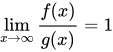
The tilde can indicate approximate equality in a variety of ways. It can be used to denote the asymptotic equality of two functions. For example, f (x) ~ g(x) means that .[13]
In physics and astronomy, a tilde can be used between two expressions (e.g. h ~ 10−34 J s) to state that the two are of the same order of magnitude.[13]
In statistics and probability theory, the tilde means "is distributed as";[13] see random variable (e.g. X ~ B(n, p) for a binomial distribution).
A tilde can also be used to represent geometric similarity (e.g. ∆ABC ~ ∆DEF, meaning triangle ABC is similar to DEF). A triple tilde (≋) is often used to show congruence, an equivalence relation in geometry.[citation needed]
In graph theory, the tilde can be used to represent adjacency between vertices. The edge connects vertices and which can be said to be adjacent, and this adjacency can be denoted .


As a diacritic
[edit]The symbol "" is pronounced as "eff tilde" or, informally, as "eff twiddle".[32][33] This can be used to denote the Fourier transform of f, or a lift of f, and can have a variety of other meanings depending on the context.

A tilde placed below a letter in mathematics can represent a vector quantity (e.g. ).

In statistics and probability theory, a tilde placed on top of a variable is sometimes used to represent the median of that variable; thus would indicate the median of the variable . A tilde over the letter n () is sometimes used to indicate the harmonic mean.


In machine learning, a tilde may represent a candidate value for a cell state in GRUs or LSTM units. (e.g. c̃)
Physics
[edit]Often in physics, one can consider an equilibrium solution to an equation, and then a perturbation to that equilibrium. For the variables in the original equation (for instance ) a substitution can be made, where is the equilibrium part and is the perturbed part.


A tilde is also used in particle physics to denote the hypothetical supersymmetric partner. For example, an electron is referred to by the letter e, and its superpartner the selectron is written ẽ.
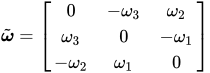
In multibody mechanics, the tilde operator maps three-dimensional vectors to skew-symmetrical matrices (see [34] or [35]).

Economics
[edit]For relations involving preference, economists sometimes use the tilde to represent indifference between two or more bundles of goods. For example, to say that a consumer is indifferent between bundles x and y, an economist would write x ~ y.
Electronics
[edit]It can approximate the sine wave symbol (∿, U+223F), which is used in electronics to indicate alternating current, in place of +, −, or ⎓ for direct current.
Linguistics
[edit]The tilde may indicate alternating allomorphs or morphological alternation, as in //ˈniː~ɛl+t// for kneel~knelt (the plus sign '+' indicates a morpheme boundary).[36][37]
The tilde may represent some sort of phonetic or phonemic variation between two sounds, which might be allophones or in free variation. For example, [χ ~ x] can represent "either [χ] or [x]".
In formal semantics, it is also used as a notation for the squiggle operator which plays a key role in many theories of focus.[38]
In interlinear gloss, a tilde sets off an element added to a word by reduplication; were a hyphen or double hyphen used instead, confusion would arise because that element would be notated in the same way as an independent morpheme requiring an independent gloss.
Computing
[edit]Computer programmers use the tilde in various ways and sometimes call the symbol (as opposed to the diacritic) a squiggle, squiggly, swiggle, or twiddle. According to the Jargon File, other synonyms sometimes used in programming include not, approx, wiggle, enyay (after eñe) and (humorously) sqiggle /ˈskɪɡəl/.[39]
Directories and URLs
[edit]On Unix-like operating systems (including AIX, BSD, Linux and macOS), tilde normally indicates the current user's home directory. For example, if the current user's home directory is /home/user, then the command cd ~ is equivalent to cd /home/user, cd $HOME, or cd.[39] This convention derives from the Lear-Siegler ADM-3A terminal in common use during the 1970s, which happened to have the tilde symbol and the word "Home" (for moving the cursor to the upper left) on the same key.[40] When prepended to a particular username, the tilde indicates that user's home directory (e.g., ~janedoe for the home directory of user janedoe, such as /home/janedoe).[41]
Used in URLs on the World Wide Web, it often denotes a personal website on a Unix-based server. For example, http://www.example.com/~johndoe/ might be the personal website of John Doe. This mimics the Unix shell usage of the tilde. However, when accessed from the web, file access is usually directed to a subdirectory in the user's home directory, such as /home/username/public_html or /home/username/www.[42]
In URLs, the characters %7E (or %7e) may substitute for a tilde if an input device lacks a tilde key.[43] Thus, http://www.example.com/~johndoe/ and http://www.example.com/%7Ejohndoe/ will behave in the same manner.
Computer languages
[edit]Regex
[edit]The tilde is used in the AWK programming language as part of the pattern match operators for regular expressions:[44]
variable ~ /regex/returns true if the variable is matched.variable !~ /regex/returns false if the variable is matched.
The operators are also used in the SQL variant of the database PostgreSQL.[45]
A variant of this, with the plain tilde replaced with =~, was adopted in Perl[46]. Ruby also uses this variant without the negated operator.[47]
Negation
[edit]In APL[48]: 68 and MATLAB,[49] tilde represents the monadic logical function NOT. and in APL it additionally represents the dyadic multiset function without (set difference).[48]: 258
In C the tilde character is used as bitwise NOT unary operator, following the notation in logic (an ! causes a logical NOT, instead).[50] This is also used by many languages based on or influenced by C, such as C++, C#, D, Java, JavaScript, Perl, PHP, and Python.[51] The MySQL database also use tilde as bitwise invert[52] as does Microsoft's SQL Server Transact-SQL (T-SQL) language.
~~ cast
[edit]JavaScript also uses tilde as bitwise NOT. Because bitwise operators work on integers, and numbers in JavaScript are 64 bit floating point numbers, the operator converts numbers to a 32-bit signed integer before it performing the negation.[53] The conversion truncates the fractional part and most significant bits. This lets two tildes ~~x to be used as a short syntax to cast to integer. However, it is not recommended as use for truncation. In contrast, it does not truncate BigInts, which are arbitrarily large integers.[54]
Other uses
[edit]In C++[55] and C#,[56] the tilde is also used as the first character in a class's method name (where the rest of the name must be the same name as the class) to indicate a destructor – a special method which is called at the end of the object's life.
In ASP.NET applications, tilde ('~') is used as a shortcut to the root of the application's virtual directory.[57]
In the CSS stylesheet language, the tilde finds the element selected by the right-hand side that shares the parent with an element selected by the left-hand side.[58]
In the D programming language, the tilde is used as bitwise not operator, concatenation operator such as those of arrays,[59] and to indicate an object destructor.[60][61] Tilde operator can be overloaded for user types,[62] and binary tilde operator is mostly used to merging two objects, or adding some objects to set of objects. It was introduced because plus operator can have different meaning in many situations. For example, "120" + "14" may produce "134" (addition of two numbers), "12014" (concatenation of strings), or something else.[63] D disallows + operator for arrays (and strings), and provides separate operator for concatenation (similarly PHP programming language solved this problem by using dot operator for concatenation, and + for number addition, which will also work on strings containing numbers).
In Eiffel, the tilde is used for object comparison. If a and b denote objects, the Boolean expression a ~ b has value true if and only if these objects are equal, as defined by the applicable version of the library routine is_equal, which by default denotes field-by-field object equality but can be redefined in any class to support a specific notion of equality.[64]: 114–115 If a and b are references, the object equality expression a ~ b is to be contrasted with a = b which denotes reference equality. Unlike the call a.is_equal (b), the expression a ~ b is type-safe even in the presence of covariance.
In the Apache Groovy programming language the tilde character overloaded as a bitwise binary negation operation, and as the "pattern operator" that creates a regular expression pattern object. =~ and ==~ can in Groovy be used to match a regular expression.[65]
In Haskell, the tilde is used in type constraints to indicate type equality.[66] Also, in pattern-matching, the tilde is used to indicate a lazy pattern match.[67]
In the Inform 6 programming language, the tilde is used to indicate a quotation mark inside a quoted string. Tilde itself is created by @@126.[68]
In "text mode" of the LaTeX typesetting language a tilde diacritic can be obtained using, e.g., \~{n}, yielding "ñ". A stand-alone tilde can be obtained by using \textasciitilde or \string~. In "math mode" a tilde diacritic can be written as, e.g., \tilde{x}. For a wider tilde \widetilde can be used. The \sim command produce a tilde-like binary relation symbol that is often used in mathematical expressions, and the double-tilde ≈ is obtained with \approx.In both text and math mode, a tilde on its own (~) renders a white space with no line breaking.In both text and math mode, a tilde on its own (~) renders a white space with no line breaking.[69] The url package also supports entering tildes directly, e.g., \url{http://server/~name}.[citation needed]
In MediaWiki syntax, four tildes are a shortcut for a user's signature. Three and five tildes puts the signature without timestamp and only the timestamp, respectively.[70]
In Common Lisp, the tilde is used as the prefix for format specifiers in format strings.[71]
In Max/MSP, MSP objects have names ending with a tilde. MSP objects process at the computer's sampling rate and mainly deal with sound.[72]
In Standard ML, the tilde is used as the prefix for negative numbers and as the unary negation operator.[73]
In OCaml, the tilde is used to specify the label for a labeled parameter.[74]
In R, the tilde operator is used to separate the left- and right-hand sides in a model formula.[75]
In Object REXX, the twiddle is used as a "message send" symbol. For example, Employee.name~lower() would cause the lower() method to act on the object Employee's name attribute, returning the result of the operation. ~~ returns the object that received the method rather than the result produced. Thus, it can be used when the result need not be returned or when cascading methods are to be used. team~~insert("Jane")~~insert("Joe")~~insert("Steve") would send multiple concurrent insert messages, thus invoking the insert method three consecutive times on the team object.[76]
In Raku, a prefixing tilde converts a value to a string. An infix tilde concatenates strings,[77] taking place of the dot operator in Perl, as the dot is used for member access instead of ->.[78] ~~ is called "the smartmatch operator" and its semantics depend on the type of the right-side argument. Namely, it checks numeric and string equalities, performs regular expression match tests (as opposed to =~ in Perl[78]), and type checking.[77]
my $concatResult = "Hello " ~ "world!";
$concatResult ~~ /<|w><[A..Z]><[a..z]>*<|w>/;

say $/; # outputs "Hello"
# the $/ variable holds the last regex match result
In YAML, the "Core schema," a set of aliases that processors are recommended to use, resolves a tilde as null.[79]
Keyboards
[edit]The presence (or absence) of a tilde engraved on the keyboard depends on the territory where it was sold. In either case, computer's system settings determine the keyboard mapping and the default setting will match the engravings on the keys. Even so, it certainly possible to configure a keyboard for a different locale than that supplied by the retailer. On American and British keyboards, the tilde is a standard keytop and pressing it produces a free-standing "ASCII Tilde". To generate a letter with a tilde diacritic requires the US international or UK extended keyboard setting.
- With US-international, the ~ key is a dead key: pressing that key and then a letter produces the tilde-accented form of that letter. (For example, ~ a produces ã.) With this setting active, an ASCII tilde can be inserted with the dead key followed by the space bar, or alternatively by striking the dead key twice in a row.
- With UK-extended, the key works normally but becomes a 'dead key' when combined with AltGr. Thus AltGr+# followed by a letter produces the accented form of that letter.
- With a Mac either of the Alt/Option keys function similarly.
- With Linux, the compose key facility is used.
Instructions for other national languages and keyboards are beyond the scope of this article.
Backup filenames
[edit]The dominant Unix convention for naming backup copies of files is appending a tilde to the original file name. It originated with the Emacs text editor[80] and was adopted by many other editors and some command-line tools.
Emacs also introduced an elaborate numbered backup scheme, with files named filename.~1~, filename.~2~ and so on.[81] It didn't catch on, as the rise of version control software eliminates the need for this usage.[citation needed]
Microsoft filenames
[edit]The tilde was part of Microsoft's filename mangling scheme when it extended the FAT file system standard to support long filenames for Microsoft Windows. Programs written prior to this development could only access filenames in the so-called 8.3 format—the filenames consisted of a maximum of eight characters from a restricted character set (e.g. no spaces), followed by a period, followed by three more characters. In order to permit these legacy programs to access files in the FAT file system, each file had to be given two names—one long, more descriptive one, and one that conformed to the 8.3 format. This was accomplished with a name-mangling scheme in which the first six characters of the filename are followed by a tilde and a digit. For example, "Program Files" might become "PROGRA~1".[82]
The tilde symbol is also often used to prefix hidden temporary files that are created when a document is opened in Windows.[citation needed] For example, when a document "Document1.doc" is opened in Word, a file called "~$cument1.doc" is created in the same directory. This file contains information about which user has the file open, to prevent multiple users from attempting to change a document at the same time.[83]
Juggling notation
[edit]In the juggling notation system Beatmap, tilde can be added to either "hand" in a pair of fields to say "cross the arms with this hand on top". Mills' Mess is thus represented as (~2x,1)(1,2x)(2x,~1)*.[84]
Unicode encoding
[edit]Letters with tilde
[edit]Unicode encodes a number of cases of "letter with tilde" as precomposed characters and these are displayed below. In addition, many more symbols may be composed using the combining character facility (U+0303 ◌̃ COMBINING TILDE, U+0330 ◌̰ COMBINING TILDE BELOW and others) that may be used with any letter or other diacritic to create a customised symbol but this does not mean that the result has any real-world application and are not shown in the table.
A tilde diacritic can be added to almost any character by using a combining tilde. Greek and Cyrillic letters with tilde (Α͂ ᾶ, Η͂ ῆ, Ι͂ ῖ, ῗ, Υ͂ ῦ, ῧ and А̃ а̃, Ә̃ ә̃, Е̃ е̃, И̃ и̃, О̃ о̃, У̃ у̃, Ј̃ j̃) are formed using this method.
Unicode and Shift JIS encoding of wave dash
[edit]

In practice the full-width tilde (全角チルダ, zenkaku chiruda) (Unicode U+FF5E ~ FULLWIDTH TILDE), is often used instead of the wave dash (波ダッシュ, nami dasshu) (Unicode U+301C 〜 WAVE DASH), because the Shift JIS code for the wave dash, 0x8160, which should be mapped to U+301C,[85][86] is instead mapped to U+FF5E[87] in Windows code page 932 (Microsoft's code page for Japanese), a widely used extension of Shift JIS.
This decision avoided a shape definition error in the original (6.2) Unicode code charts:[88] the wave dash reference glyph in JIS / Shift JIS[89][90] matches the Unicode reference glyph for U+FF5E FULLWIDTH TILDE,[91] while the original reference glyph for U+301C[88] was reflected, incorrectly,[92] when Unicode imported the JIS wave dash. In other platforms such as the classic Mac OS and macOS, 0x8160 is correctly mapped to U+301C. It is generally difficult, if not impossible, for users of Japanese Windows to type U+301C, especially in legacy, non-Unicode applications.
A similar situation exists regarding the Korean KS X 1001 character set, in which Microsoft maps the EUC-KR or UHC code for the wave dash (0xA1AD) to U+223C ∼ TILDE OPERATOR,[93][94] while IBM and Apple map it to U+301C.[95][96][97] Microsoft also uses U+FF5E to map the KS X 1001 raised tilde (0xA2A6),[94] while Apple uses U+02DC ˜ SMALL TILDE.[97]
The current Unicode reference glyph for U+301C has been corrected[92] to match the JIS standard[98] in response to a 2014 proposal, which noted that while the existing Unicode reference glyph had been matched by fonts from the discontinued Windows XP, all other major platforms including later versions of Microsoft Windows shipped with fonts matching the JIS reference glyph for U+301C.[99]
The JIS / Shift JIS wave dash is still formally mapped to U+301C as of JIS X 0213,[100] whereas the WHATWG Encoding Standard used by HTML5 follows Microsoft in mapping 0x8160 to U+FF5E.[101] These two code points have a similar or identical glyph in several computer fonts, reducing the confusion and incompatibility.
See also
[edit]- Backtick – Typographical mark (`) (Freestanding grave accent)
- Circumflex – Diacritic (◌̂) in European scripts
- Caret (computing) – Typographical mark (^)
- Double tilde (disambiguation)
- Tittle – Diacritical mark, the dot of the letters i and j
- Wave dash – East Asian character primarily used to represent a range
Notes
[edit]- ^ alternative association for the same code point
- ^ ISO 646 (and ASCII, which it includes) is a standard for 7-bit encoding, providing just 96 printable characters (and 32 control characters). This was insufficient to meet the needs of Western European languages and so the standard specifies certain code points that are available for national variation. With the arrival of 8-bit "extended ASCII", this issue was largely mitigated, though not fully resolved until Unicode was established.
- ^ See also Air quotes.
References
[edit]- ^ "tilde". The Chambers Dictionary (9th ed.). Chambers. 2003. ISBN 0-550-10105-5.
- ^ "tilde". The American Heritage Dictionary of the English Language (5th ed.). HarperCollins.
- ^ Martin, Charles Trice (1910). The record interpreter : a collection of abbreviations, Latin words and names used in English historical manuscripts and records (2nd ed.). London, preface, p.5 [1]
- ^ a b Mackenzie, Charles E. (1980). Coded Character Sets, History and Development (PDF). The Systems Programming Series (1 ed.). Addison-Wesley Publishing Company, Inc. ISBN 978-0-201-14460-4. LCCN 77-90165. Archived (PDF) from the original on May 26, 2016. Retrieved August 25, 2019.
- ^ "Meeting of CCITT Working Party on the New Telegraph Alphabet". CCITT. 15 May 1963. See Paragraph 3.
- ^ L. L. Griffin, Chairman, X3.2 (29 November 1963). "Memorandum to Members, Alternates, and Consultants of A.S.A. X3.2 and task groups". US Department of the Navy. p. 8.
- ^ "Character histories: notes on some ASCII code positions".
- ^ "Second ISO draft proposal | 6 and 6 bit character codes for information processing interchange". ISO. December 1963. See paragraph 2
- ^ "Swung dash", WordNet (search) (3.0 ed.)
- ^ "26 argumentos para seguir defendiendo la Ñ". La Razón. 11 January 2011. Retrieved 31 January 2016.
- ^ AFP (18 November 2004). "Batalla de la Ñ: Una aventura quijotesca para defender el alma de la lengua". Periódico ABC Paraguay. Retrieved 31 January 2016.
- ^ Diccionario de la lengua española, Real Academia Española
- ^ a b c d e "Tilde". Wolfram/MathWorld. 3 November 2011. Retrieved 11 November 2011.
- ^ a b c "All Elementary Mathematics – Mathematical symbols dictionary". Bymath. Archived from the original on 2 May 2015. Retrieved 25 September 2014.
- ^ "Character design standards – Maths". Microsoft.
- ^ a b Quinn, Liam. "HTML 4.0 Entities for Symbols and Greek Letters". HTML help. Retrieved 11 November 2011.
- ^ "Math Symbols... Those Most Valuable and Important: Approximately Equal Symbol". Solving Math problems. 20 September 2010. Archived from the original on 9 November 2011. Retrieved 11 November 2011.
- ^ a b Bernstein, Joseph (5 January 2015). "The Hidden Language of The ~Tilde~". BuzzFeed News.
- ^ Jess Kimball Leslie (5 June 2017). "The Internet Tilde Perfectly Conveys Something We Don't Have the Words to Explain". The Cut.
- ^ "What Are Tildes ( ~ ) And How Do You Use Them?". Thesaurus.com. 12 April 2022.
- ^ Peek, Philip S. (19 October 2021). Ancient Greek I: A 21st Century Approach; Module 3 - Accents and Accenting Verbs I. Open Book Publishers. pp. 19–26. doi:10.11647/OBP.0264.03. ISBN 978-1-80064-655-1. OCLC 1277513901.
- ^ a b Reimer, Stephen R. (30 May 2015). "IV.vi. Paleography: Scribal Abbreviations". Manuscript Studies: Medieval and Early Modern. Archived from the original on 29 November 2024. Retrieved 5 December 2024.
- ^ Ortografía de la lengua española. Madrid: Real Academia Española. 2010. p. 279. ISBN 978-84-670-3426-4.
- ^ "Lema en la RAE". Real Academia Española. Retrieved 10 October 2015.
- ^ Nestle, Eberhard (1888). Syrische Grammatik mit Litteratur, Chrestomathie und Glossar. Berlin: H. Reuther's Verlagsbuchhandlung. [translated to English as Syriac grammar with bibliography, chrestomathy and glossary, by R. S. Kennedy. London: Williams & Norgate 1889. p. 5].
- ^ Lithuanian Standards Board (LST), proposal for a zigzag diacritic
- ^ "R. M. de Azkue: "Euskara-Gaztelania-Frantsesa Hiztegia" / "Diccionario Vasco-Español-Francés" online -Tutorial de uso" (PDF) (in Spanish). Aurten Bai Fundazioa. p. 6. Retrieved 12 February 2024.
El autor usaba fuentes propias para representar fenómenos propios de algunos de los dialectos del euskera. Estos son los caracteres especiales utilizados en el diccionario: ã d̃ ẽ ĩ l̃ ñ õ s̃ t̃ ũ x̃.
- ^ "Tilde Definition". linfo.org. The Linux Information Project. 24 June 2005. Retrieved 27 January 2020.
- ^ "Using a tilde with currency". Stackexchange.
- ^ Xu, Huan; Xia, Dengshan (1 September 2023). "Digital tildes ("∼") may convey more: analyzing innovative uses of tildes in Chinese WeChat messages". Language and Semiotic Studies. 9 (3): 443–460. doi:10.1515/lass-2023-0009. ISSN 2751-7160.
- ^ Derbyshire, J (2004), "Prime Obsession: Bernhard Riemann and the Greatest Unsolved Problem in Mathematics", Physics Today, 57 (6), New York: Penguin: 63, Bibcode:2004PhT....57R..63D, doi:10.1063/1.1784281.
- ^ "Tilde". Wolfram Research. Retrieved 4 June 2018.
- ^ Choy, Stephen TL; Jesudason, Judith Packer; Lee, Peng Yee (1988). Proceedings of the Analysis Conference, Singapore 1986. Elsevier. ISBN 9780080872612.
- ^ Wallrapp (1994). "Standardization of flexible body modeling in multibody system codes, Part I: Definition of Standard Input Data". Mechanics of Structures and Machines. 22 (3): 283–304. doi:10.1080/08905459408905214.
- ^ Valembois, R. E.; Fisette, P.; Samin, J. C. (1997). "Comparison of Various Techniques for Modelling Flexible Beams in Multibody Dynamics". Nonlinear Dynamics. 12 (4): 367–397. Bibcode:1997NonDy..12..367V. doi:10.1023/A:1008204330035. S2CID 122487067.
- ^ Collinge (2002) An Encyclopedia of Language, §4.2.
- ^ Hayes, Bruce (2011). Introductory Phonology. John Wiley & Sons. pp. 87–88. ISBN 9781444360134.
- ^ Buring, Daniel (2016). Intonation and Meaning. Oxford University Press. pp. 36–41. doi:10.1093/acprof:oso/9780199226269.003.0003. ISBN 978-0-19-922627-6.
- ^ a b "Jargon File 5.0.1". 5 January 2012. Archived from the original on 27 August 2013.
- ^ Hogan, Brian (2019). Small, Sharp Software Tools. Pragmatic Programmers. p. 3. ISBN 978-1-68050-296-1.
- ^ "Tilde expansion", C Library Manual, The GNU project, retrieved 4 July 2010.
- ^ "Module mod_userdir", HTTP Server Documentation (version 2.0 ed.), The Apache foundation, retrieved 4 July 2010.
- ^ T. Berners-Lee; R. Fielding; L. Masinter (January 2005). Uniform Resource Identifier (URI): Generic Syntax. Network Working Group. doi:10.17487/RFC3986. STD 66. RFC 3986. Internet Standard 66. p. 12. Obsoletes RFC 2732, 2396 and 1808. Updated by RFC 6874, 7320 and 8820. Updates RFC 1738.
- ^ "The GNU Awk User's Guide". GNU Manuals Online. Free Software Foundation, Inc. 3.1 How to Use Regular Expressions. Retrieved 20 October 2024.
- ^ The PostgreSQL Global Development Group (26 September 2024). "PostgreSQL 17.0 Documentation". 9.7.3. POSIX Regular Expressions. Retrieved 20 October 2024.
- ^ "Perl expressions: operators, precedence, string literals". Perldoc Browser. Binding Operators. Retrieved 20 October 2024.
- ^ "class Regexp". Documentation for Ruby 3.3. Retrieved 20 October 2024.
- ^ a b "APL2 Programming: Language Reference" (2nd ed.). IBM. February 1994. Retrieved 22 October 2024.
- ^ "MATLAB Operators and Special Characters - MATLAB & Simulink". MathWorks. Retrieved 22 October 2024.
- ^ ISO/IEC. "Programming languages—C" (PDF). p. 64. Retrieved 19 October 2024.
- ^ "syntax across languages (One Big Page)". rigaux.org. Archived from the original on 23 August 2024. Retrieved 28 November 2024.
- ^ "MySQL :: Reference Manual :: Bit Functions and Operators". dev.mysql.com. Retrieved 20 December 2019.
- ^ "JavaScript Bitwise Operations". W3Schools. Archived from the original on 28 November 2024. Retrieved 28 November 2024.
- ^ "Bitwise NOT (~) - JavaScript". MDN. 15 August 2023. Archived from the original on 28 November 2024. Retrieved 28 November 2024.
- ^ "Destructors (C++)". Microsoft Learn. Microsoft. 1 December 2023. Archived from the original on 28 November 2024. Retrieved 28 November 2024.
- ^ "Finalizers (C# Programming Guide)". Microsoft Learn. Microsoft. 14 March 2023. Archived from the original on 17 November 2024. Retrieved 28 November 2024.
- ^ "ASP.NET Core built-in Tag Helpers". Microsoft Learn. Microsoft. 3 June 2022. Archived from the original on 28 November 2024. Retrieved 28 November 2024.
- ^ "Selectors Level 4" (W3C Working Draft). CSS Working Group. 11 November 2022. 15.4. Subsequent-sibling combinator (~). Archived from the original on 22 November 2024. Retrieved 28 November 2024.
- ^ "Expressions". dlang.org. Archived from the original on 28 November 2024. Retrieved 28 November 2024.
- ^ "Structs, Unions". dlang.org. Archived from the original on 28 November 2024. Retrieved 28 November 2024.
- ^ "Classes". dlang.org. Archived from the original on 28 November 2024. Retrieved 28 November 2024.
- ^ "Operator Overloading". dlang.org. Archived from the original on 28 November 2024. Retrieved 28 November 2024.
- ^ "Arrays". dlang.org. Archived from the original on 28 November 2024. Retrieved 28 November 2024.
- ^ "Eiffel: Analysis, Design and Programming Language" (PDF) (2nd ed.). ECMA International. June 2006. ECMA-367. Archived from the original (PDF) on 28 November 2024. Retrieved 28 November 2024.
- ^ "The Groovy programming language – Operators".
- ^ "Type Families", Haskell Wiki.
- ^ "Lazy pattern match".
- ^ Nelson, Graham (July 2001). "§1 Routines". The Inform Designer's Manual (4th ed.). Interactive Fiction Library. ISBN 0-9713119-0-0. Archived from the original on 7 June 2024. Retrieved 28 November 2024.
- ^ Doob, Michael (21 January 2002). "A Gentle Introduction to TeX". texdoc.org. Winnipeg, Manitoba. p. 11,12,15,32,36,37. Retrieved 6 April 2025.
- ^ "Help:Signatures". MediaWiki. 20 July 2024. Archived from the original on 28 November 2024. Retrieved 28 November 2024.
- ^ "CLHS: Section 22.3". Lispworks.com. 11 April 2005. Retrieved 30 July 2010.
- ^ "MSP Basics Tutorial 1: Test Tone". Cycling '74 Documentation. Archived from the original on 6 December 2024. Retrieved 6 December 2024.
- ^ Fisher, Kathleen. "Learning Standard ML". www.cs.tufts.edu. Expressions II: Minus signs. Retrieved 6 December 2024.
- ^ "Labelled and Optional Arguments". OCaml. Archived from the original on 6 December 2024. Retrieved 6 December 2024.
- ^ The R Reference Index
- ^ Ashley, W. David; Flatscher, Rony G.; Hessling, Mark; McGuire, Rick; Miesfeld, Mark; Peedin, Lee; Tammer, Rainer; Wolfers, Jon (14 August 2009). "Terms, Expressions, and Operators". Open Object Rexx™: Reference. Version 4.0.0 Edition. Archived from the original on 16 January 2021. Retrieved 6 December 2024.
- ^ a b "Operators". Raku documentation. 13 September 2024. Archived from the original on 30 November 2024. Retrieved 6 December 2024.
- ^ a b "Perl to Raku guide - in a nutshell". Raku documentation. 1 August 2024. Archived from the original on 3 December 2024. Retrieved 6 December 2024.
- ^ "YAML Ain't Markup Language (YAML™) revision 1.2.2". 1 October 2021. 10.3.2. Tag Resolution. Archived from the original on 24 November 2024. Retrieved 28 November 2024.
- ^ "GNU Emacs Lisp Reference Manual". Free Software Foundation, Inc. 27.1.4 Naming Backup Files - Function: make-backup-file-name filename. Retrieved 6 December 2024.
- ^ "GNU Emacs Lisp Reference Manual". Free Software Foundation, Inc. 27.1.3 Making and Deleting Numbered Backup Files. Retrieved 6 December 2024.
- ^ "How Windows Generates 8.3 File Names from Long File Names". Microsoft.
- ^ "Description of how Word creates temporary files". Microsoft Support. Archived from the original on 19 September 2024. Retrieved 3 October 2024.
- ^ "The Internet Juggling Database". Archived from the original on 28 July 2005. Retrieved 6 November 2009.
- ^ "Appendix 1: Shift_JIS-2004 vs Unicode mapping table", JIS X 0213:2004, X 0213.
- ^ Shift-JIS to Unicode, Unicode.
- ^ "Windows 932_81". Microsoft. Retrieved 30 July 2010.
- ^ a b CJK Symbols and Punctuation (Unicode 6.2) (PDF) (chart), Unicode, archived from the original (PDF) on 27 August 2013.
- ^ Japanese National Committee on ISO/TC97/SC2. ISO-IR-87: Japanese Graphic Character Set for Information Interchange (PDF). ITSCJ/IPSJ.
- ^ Japanese Industrial Standards Committee. ISO-IR-233: Japanese Graphic Character Set for Information Interchange, Plane 1 (Update of ISO-IR 228) (PDF). ITSCJ/IPSJ.
- ^ Halfwidth and Fullwidth Forms (PDF) (chart), Unicode.
- ^ a b Errata Fixed in Unicode 8.0.0, Unicode
- ^ "windows-949-2000 (lead byte A1)". ICU Demonstration – Converter Explorer. International Components for Unicode.
- ^ a b "Lead Byte A1-A2 (Code page 949)". MSDN. Microsoft. 6 February 2008.
- ^ "ibm-1363_P110-1997 (lead byte A1)". ICU Demonstration – Converter Explorer. International Components for Unicode.
- ^ "euc-kr (lead byte A1)". ICU Demonstration – Converter Explorer. International Components for Unicode.
- ^ a b "Map (external version) from Mac OS Korean encoding to Unicode 3.2 and later". Apple.
- ^ CJK Symbols and Punctuation (PDF) (chart), Unicode
- ^ Komatsu, Hiroyuki, L2/14-198: Proposal for the modification of the sample character layout of WAVE_DASH (U+301C) (PDF)
- ^ Shift_JIS-2004 (JIS X 0213:2004 Appendix 1) vs Unicode mapping table, x0213.org
- ^ "Shift_JIS visualization", Encoding Standard, WHATWG


Tilde
View on GrokipediaHistory
Medieval Scribal Use
The tilde originated as a scribal suspension mark in medieval Latin manuscripts, primarily during the 8th to 11th centuries, where it served to indicate omitted letters such as -m, -n, or -r at the end of words, thereby expediting the writing process in an era when parchment was scarce and scribes aimed for efficiency.[5] This practice was widespread in Insular scripts, including those used in Anglo-Saxon England and Ireland, as a form of abbreviation that allowed scribes to suspend the final consonants after vowels without losing readability.[6] For instance, a tilde over the letter q, rendered as q̃, commonly abbreviated the conjunction -que ("and"), while similar marks over vowels denoted nasal omissions like -n in words such as "ho[min]es" (men).[7] Examples of such abbreviations include "omne[m]" for "omnem" (all, accusative) and "locutio[n]is" for "locutionis" (of speech), reflecting the mark's role in condensing repetitive phrases in Latin texts.[8] These abbreviations were essential for voluminous documents, enabling rapid transcription while maintaining the text's interpretability.[9] Over time, the tilde evolved from simpler straight or horizontal strokes, which could be confused with other diacritics, to a more distinctive curved shape in handwriting, enhancing clarity amid the fluidity of medieval scripts.[10] This development distinguished it from the macron, a straight bar primarily used to indicate vowel length or certain contractions, whereas the tilde specifically signaled nasal or consonantal suspensions.[5] The tilde's adoption influenced early European vernacular scripts, spreading through monastic copying traditions and laying groundwork for its later typographic forms in printed texts.[7]Evolution in Printing and Typewriters
With the advent of movable type printing in the mid-15th century, pioneered by Johannes Gutenberg around 1450, the tilde transitioned from a scribal abbreviation mark to a typographic element in printed books, particularly for representing nasal sounds in vernacular languages such as Spanish and Portuguese.[1] Early printers faced significant challenges in reproducing the tilde, as it was often overprinted onto base letters using separate type pieces or achieved through ligatures combining the tilde with vowels or consonants like n to form characters such as ñ. This method allowed for the inclusion of diacritics in texts like the 1492 Spanish grammar by Antonio de Nebrija, where the tilde marked abbreviations and phonetic nuances, but it required precise alignment to avoid misalignment in hot-metal casting.[11] By the 19th century, as mechanical typewriters emerged, the tilde's role expanded to facilitate the production of accented characters in multilingual documents, addressing the limitations of limited keysets. Dead-key mechanisms, introduced in the late 19th century on international typewriter models and refined in subsequent designs, enabled users to strike the tilde key without advancing the carriage, allowing it to overlay letters such as n to compose ñ for Spanish and Portuguese texts. This innovation was crucial for professional typists handling international correspondence, as it compensated for the absence of dedicated keys for every diacritic. The Underwood Typewriter Company, a dominant manufacturer from the late 19th century onward, played a key role in standardizing the tilde through its international keyboard variants, which featured dead keys for accents including the tilde. These layouts, common by the 1910s, promoted the tilde as a standalone symbol on typewriter keyboards, influencing global typing practices and paving the way for its inclusion in later mechanical and electric models.[12] In the early 20th century, typographers debated the tilde's glyph design, particularly its curvature and width, to ensure harmony with non-Latin scripts and extended Latin alphabets, such as in Portuguese orthography where J-shaped tildes were proposed for aesthetic integration in hot-metal printing. These discussions, documented in works on diacritic evolution, highlighted tensions between traditional swung-dash forms and more angular variants to improve legibility in multilingual typesetting, influencing standards for scripts like Vietnamese that adopted the tilde for tones.[13]Standardization in ASCII
The American Standard Code for Information Interchange (ASCII) was developed from 1963 to 1967 by the X3.2 subcommittee of the American Standards Association (ASA) X3 committee, with the initial standard published as X3.4-1963 on June 17, 1963, and revised to X3.4-1967 to incorporate international feedback.[14] This 7-bit encoding scheme allocated 128 code points, with the upper 32 positions (95–126 decimal) designated for printable graphic characters beyond basic letters, digits, and common punctuation. The tilde (~) was specifically assigned to code point 126 (hexadecimal 7E, or column 7/row 14 in the ASCII table), marking it as one of the high-order symbols to fill out the character repertoire for data processing and transmission needs.[14] The inclusion of the tilde stemmed from its legacy in teletype and telegraph equipment, where it appeared as a non-letter symbol on keyboards like the Teletype Wheatstone Perforator models from 1937 and 1945, providing a versatile graphic for signaling and markup without conflicting with alphanumeric codes.[14] This choice addressed the demand for additional punctuation-like symbols in computing, distinct from letters or numbers, while drawing briefly from typewriter influences that had already popularized the glyph for diacritical and approximation uses. In parallel developments, the ASCII design aligned closely with emerging international standards; the tilde's position was confirmed during 1966 ISO and CCITT meetings, influencing variants of ISO 646 (finalized in 1967), which adopted a similar 7-bit structure but allowed national substitutions in some positions, ensuring the tilde's portability across systems.[14][15] On early computers such as the PDP-11 series from Digital Equipment Corporation, introduced in 1970, the tilde's standardization in ASCII facilitated text handling, file naming, and operator interfaces, as the architecture natively supported 7-bit ASCII for I/O and memory operations.[16] Its role extended to distinguishing it from typographic variants like the swung dash (⁓, Unicode U+2053), a more wavy mark used in dictionaries for word omission; the ASCII tilde employed a simpler, straight waveform suitable for low-resolution terminals and printers, avoiding ambiguity in digital rendering.[17] As computing shifted to 8-bit systems, the tilde evolved through extensions like IBM's EBCDIC, where it was remapped to code point 175 (hexadecimal AF) to accommodate mainframe-specific ordering, diverging from ASCII's layout while retaining the glyph for compatibility in data conversion.[18] In contrast, ISO 8859 standards (starting with ISO 8859-1 in 1987) preserved the tilde at 0x7E in the lower 128 positions, centralizing its form as an extension of ASCII for Western European languages and reinforcing its status as a universal symbol in multibyte environments.[14]Ties to Spanish Orthography
The word "tilde," referring to the diacritical mark (~) used over the letter n to form ñ, derives from the Spanish term rooted in Medieval Latin titulus, meaning "superscript" or "title," which denoted a small stroke or mark added above a letter to indicate abbreviation or emphasis.[19] This etymological connection reflects its medieval scribal origins, where the tilde served as a superscript to shorten the digraph nn into ñ, representing the palatal nasal sound /ɲ/ absent in classical Latin, as seen in words like año from Latin annus. The tilde's adoption in Castilian Spanish emerged in the 12th century as a scribal abbreviation to distinguish the /ɲ/ sound from the geminate nn, streamlining medieval manuscripts amid the language's evolution from Vulgar Latin.[20] By the 13th century, King Alfonso X el Sabio formalized its use in Castilian orthography through his scholarly works, establishing ñ as the standard grapheme for /ɲ/ and promoting linguistic unification in the Iberian Peninsula.[21] This development solidified around the 15th century with the advent of printing, which perpetuated ñ as a distinct character in printed texts, differentiating it definitively from nn in evolving Spanish phonology.[22] The Real Academia Española (RAE), founded in 1713, played a pivotal role in standardizing the tilde's use in the 18th century, officially recognizing ñ as the 15th letter of the Spanish alphabet in its early dictionaries and orthographic guidelines to preserve phonetic accuracy.[23] This codification, detailed in the RAE's 1803 dictionary, ensured ñ's integration into formal Spanish orthography, countering inconsistencies from earlier regional variations.[23] Culturally, the tilde holds profound significance as an emblem of Spanish identity, symbolizing linguistic heritage and resistance to assimilation under global English influence. In the late 20th century, particularly during the 1990s, the European Economic Community proposed eliminating ñ and accents to standardize computer keyboards for broader European integration, prompting vehement defenses from the RAE and figures like Gabriel García Márquez, who argued that ñ uniquely distinguished Spanish speakers worldwide.[23] These preservation efforts, including RAE campaigns, underscored ñ's role in maintaining cultural autonomy amid technological and anglophone pressures.[24] The tilde's influence extends to other Iberian languages, notably Galician, where ñ represents the same /ɲ/ sound, reflecting shared medieval roots in the Ibero-Romance family and mutual orthographic borrowing from Castilian.[20] Through Spanish colonial expansion starting in the 15th century, the tilde-embedded ñ spread across Latin America via Castilian missionaries, administrators, and settlers, embedding it in the orthography of over 20 nations and fostering a pan-Hispanic linguistic unity that endures today.Uses in Writing and Linguistics
Everyday English Applications
In informal English writing, the tilde (~) serves as a symbol for approximation, particularly when paired with numbers to denote "about" or "approximately" without using full words. This usage is common in casual notes, quick messages, and journalism, where brevity is valued; for instance, "~5-10 minutes" might indicate an estimated travel time rather than a precise range.[3] Such applications emerged in the 20th century as part of broader typographic shorthand practices, evolving from the tilde's historical role as a Latin abbreviation mark for omitted letters or sounds.[1] In digital communication, the tilde has taken on expressive roles to convey sarcasm, playfulness, or irony, often through bracketing words or phrases like "Diacritical Functions
The tilde serves as a diacritic primarily to indicate nasalization of vowels in several languages. In Portuguese, it appears over the vowels a and o to denote nasal vowels, such as in mão (hand, pronounced [mɐ̃w̃]) and pão (bread, pronounced [pɐ̃w̃]), distinguishing them from their oral counterparts and altering pronunciation through velum lowering for airflow through the nose.[29] Historically in French, the tilde marked nasalization during the Old French period (circa 900–1300 CE), where vowels before nasal consonants were nasalized, as seen in scribal notations like bẽ for bien (well); this usage faded by the Middle French era as nasal vowels became phonemic without consistent diacritic representation.[30] In Spanish, the tilde over n forms the letter ñ, representing the palatal nasal consonant /ɲ/, as in niño (child, pronounced [ˈni.ɲo]), evolving from medieval abbreviations of Latin nn or ni.[31] Beyond nasalization, the tilde functions in tone marking for certain languages. In Vietnamese, it indicates the ngã tone, a creaky rising contour (starting mid-low with glottal constriction and rising sharply), as in mã (horse, pronounced with a broken, rising pitch [ma̰˥]).[32] In transliterations of Ancient Greek, the tilde sometimes approximates the circumflex pitch accent (a high-low pitch fall on a long vowel or diphthong), distinguishing it from the acute (rising) accent in scholarly notations, such as rendering phōnḗ (voice) to reflect the melodic contour of classical pronunciation systems.[33] The tilde also extends letters to represent specific phonetic qualities. In Estonian, õ denotes an unrounded mid-central vowel /ɤ/, a unique phoneme in the language's nine-vowel system, as in kõrv (ear, pronounced [kɤrv]), contrasting with rounded vowels like ö /ø/.[34] In the International Phonetic Alphabet (IPA), the combining tilde ◌̃ signifies nasalization over vowels (e.g., [ã] for nasalized /a/), but it can also overlay for velarization/pharyngealization (◌̴, though distinct in some notations) or rhoticity in extensions, allowing precise transcription of phonetic nuances across languages.[35] In digital representation, the tilde exists in both precomposed forms (e.g., ã as Unicode U+00E3) and combining forms (U+0303 ◌̃, a non-spacing mark applied above a base character like a to form ã), facilitating compatibility in text encoding for languages with diacritics; the combining variant is preferred in systems supporting normalization to handle stacking or script variations. African languages like Yoruba employ the tilde in phonetic representations (IPA) for nasal vowels, marking phonemic nasalization (e.g., [ã] for the nasalized /a/, though often realized via following nasals like an in standard writing), where it distinguishes nasal from oral vowels in the seven-oral-five-nasal system without altering consonant pronunciation.[36]Punctuation and Typographic Roles
In French typography, the tilde (Phonetic and Dialectal Notations
In phonetic transcription, particularly within extensions to the International Phonetic Alphabet (IPA), the tilde serves as a combining diacritic for advanced articulatory features. The superimposed tilde (̴, IPA number 428, Unicode U+0334) overlays a base symbol to denote velarization or pharyngealization, indicating guttural or emphatic consonants produced with retraction of the tongue root toward the velum or pharynx; for example, [n̴] represents a pharyngealized nasal consonant, common in languages like Arabic or Berber.[45] Similarly, the combining tilde below (̰, IPA number 430, Unicode U+0330) marks creaky voice or laryngealization, where the vocal folds vibrate irregularly for a glottalized or harsh quality, as in certain African or Native American languages.[46] These notations extend beyond standard nasalization (briefly, the tilde above a vowel like [ã] for basic nasal airflow, as defined in core IPA diacritics).[45] In descriptive linguistics, the freestanding tilde (Uses in Mathematics and Sciences
Mathematical Operations
In propositional logic, the tilde serves as a unary operator denoting negation, where ~P represents the negation of the proposition P, meaning "not P."[50] This notation, also called the tilde or negation symbol, applies to the entire proposition it precedes and is one of several conventions for unary negation, alongside ¬ and -.[51] Its use in logical expressions emphasizes the inversion of truth value, with ~P being true if P is false and vice versa.[50] The tilde also appears in relational contexts within mathematics. In geometry, ~ denotes similarity between figures, such as triangles, where corresponding angles are equal and sides are proportional, as in ΔABC ~ ΔDEF.[52] This usage traces back to Gottfried Wilhelm Leibniz in an unpublished manuscript, with its first printed appearance in 1710, distinguishing it from congruence (denoted ≅, an equals sign with a tilde above).[52] In set theory and algebra, ~ indicates an equivalence relation, where x ~ y means x and y are related under a reflexive, symmetric, and transitive binary relation, often extending to isomorphism between structures, such as groups or vector spaces, where the tilde signifies structural equivalence without identity.[53] This relational role underscores approximate or structural parity, separate from exact equality (=) or mere approximation (≈).[53] A prominent application of the tilde is in asymptotic analysis, where f(x) ~ g(x) as x → ∞ denotes asymptotic equivalence, meaning the limit of f(x)/g(x) approaches 1, indicating the functions share the same leading-order behavior.[54]Applications in Physics
In perturbation theory, particularly in quantum mechanics, the tilde notation is commonly used to denote the wave function in the interaction picture, which simplifies the analysis of small deviations from an unperturbed Hamiltonian $ H = H_0 + \lambda V $, where $ \lambda $ is an infinitesimal parameter characterizing the strength of the perturbation $ V $.[58] This auxiliary state, written as $ |\tilde{\Psi}(t)\rangle = e^{i H_0 t / \hbar} |\Psi(t)\rangle $, evolves under the transformed perturbation $ \tilde{\delta H}(t) = e^{i H_0 t / \hbar} \delta H(t) e^{-i H_0 t / \hbar} $, enabling perturbative expansions to first or higher orders in $ \lambda $.[58] Such notation is essential for calculating transition probabilities and energy corrections in systems like atomic spectra under weak external fields. In supersymmetry, a theoretical framework extending the Standard Model of particle physics, the tilde serves as a conventional marker for superpartners, which are bosonic or fermionic counterparts to ordinary particles predicted by the symmetry. For instance, the selectron $ \tilde{e} $ is the scalar superpartner of the electron, transforming under the same gauge representations but with spin differing by 1/2.[59] This notation highlights the pairing of matter fields with their supersymmetric partners, such as $ \tilde{q} $ for squarks, and is ubiquitous in model-building for phenomena like electroweak symmetry breaking and dark matter candidates.[60] The tilde also appears in quantum mechanics for denoting complex conjugates of wave functions in contexts involving symmetry operations, such as time reversal, where the operator $ \tilde{T} $ effectively applies complex conjugation to $ \psi $, yielding $ \tilde{\psi} = \psi^* $ alongside spatial inversion. This usage underscores the role of complex conjugation in preserving probabilities and ensuring unitarity in time-reversal invariant systems, as seen in scattering theory and CPT symmetry analyses. In relativistic physics, the tilde between quantities, as in $ v \sim c $, signifies approximations where velocities approach the speed of light, invoking significant Lorentz contractions and time dilations central to special relativity. Similarly, in fluid dynamics, the tilde denotes normalized or filtered variables in approximation schemes, such as $ \tilde{v} $ for the filtered velocity in large eddy simulations of turbulent flows, capturing large-scale motions while modeling small-scale effects statistically.[61] These applications emphasize the tilde's role in scaling analyses and asymptotic behaviors specific to physical regimes.Economic and Symbolic Representations
In economics, the tilde symbol (~) serves as a notation for indifference in consumer preference theory, particularly in the context of indifference curves. An indifference curve represents all combinations of goods that provide a consumer with the same level of utility, and the relation $ x \sim y $ indicates that bundles $ x $ and $ y $ yield equivalent satisfaction, such that $ U(x) \sim U(y) $, where $ U $ is the utility function.[62] This notation underscores the ordinal nature of preferences, allowing economists to model consumer behavior without assuming cardinal measurability of utility. The adoption of the tilde for indifference relations became widespread in 20th-century microeconomics textbooks, reflecting a shift toward formalized preference structures following the ordinalist revolution in the early 20th century. Seminal texts, such as those developing general equilibrium theory, integrated this symbol to precisely capture equivalence in consumer choices, facilitating graphical and analytical representations of budget constraints and optimal consumption. For instance, in advanced treatments, it distinguishes indifference from strict preference ($ \succ \succeq $), ensuring consistency with axioms like completeness and transitivity.[62] In econometric modeling, the tilde denotes approximation or distributional assumptions, often in the context of statistical inference for economic variables. For example, in linear regression frameworks, the model is specified as $ y_i \sim N(x_i' \beta, \sigma^2) $, indicating that the dependent variable (such as GDP growth) is approximately normally distributed conditional on regressors like inflation rates, with parameters $ \beta $ capturing the relationship. This usage highlights asymptotic properties in large-sample econometrics, where estimates converge in distribution, providing a probabilistic approximation rather than exact equality. Within game theory, a branch of economic analysis, the tilde symbolizes indifference between strategies, crucial for characterizing mixed strategy Nash equilibria. In such equilibria, a player randomizes over pure strategies in the support of the mixed strategy because they yield equivalent expected payoffs; thus, a mixed strategy $ \sigma $ satisfies $ u(i, \sigma) \sim u(i, s) $ for pure strategies $ s $ in the support, where $ u $ is the payoff function. This notation emphasizes strategic equivalence, enabling the analysis of non-degenerate equilibria in games like matching pennies, where pure strategies alone fail to stabilize outcomes.Electronics and Engineering Contexts
In electrical engineering, the tilde symbol (Uses in Computing
File Systems and Navigation
In Unix-like operating systems, the tilde character (~) functions as a symbolic shortcut representing the current user's home directory within file paths, facilitating concise navigation. For instance, the path ~/Documents expands to the full absolute path /home/username/Documents, where username is the logged-in user. This expansion is a standard feature defined in POSIX shell specifications, allowing seamless reference to user-specific locations without specifying the complete directory structure.[66] Tilde expansion is handled by command-line shells such as Bash and Zsh through predefined rules that process the tilde at the beginning of a word, replacing it with the value of the $HOME environment variable or the specified user's home directory if followed by a username (e.g., ~otheruser expands to /home/otheruser). These rules prioritize unquoted tildes followed by a slash or end-of-word, ensuring predictable behavior in commands like cd ~/Downloads or ls ~otheruser/Pictures. The mechanism originated in the C shell (csh), developed by Bill Joy at the University of California, Berkeley, in the late 1970s as part of the Berkeley Software Distribution (BSD); Joy's implementation introduced tilde as a filename expansion for home directories to simplify user interactions in early Unix environments.[67] This convention extends across platforms, with macOS—built on a Unix foundation—supporting tilde expansion natively in its default Zsh shell, mirroring Linux behaviors for file system navigation. On Windows, Unix-like environments such as Cygwin emulate the feature by providing a POSIX-compliant Bash shell, where ~ resolves to the user's home directory (typically C:\cygwin\home\username), enabling cross-platform scripting and tool compatibility. Similarly, in web contexts, many HTTP servers like Apache use ~username in URLs to denote a user's personal web space, such as http://[example.com](/page/Example.com)/~username pointing to /home/username/public_html for hosting user pages—a practice rooted in early Unix web serving conventions. Despite its utility, tilde expansion has limitations and does not occur universally; for example, it fails in quoted strings (e.g., echo "~/file" outputs the literal tilde) or when the tilde appears in plain filenames without path context (e.g., a file named ~ remains unexpanded as a literal name). Expansion also depends on shell context, such as interactive versus non-interactive modes, and may not apply in variable assignments or embedded positions without proper word boundaries, requiring explicit handling in scripts to avoid unexpected literal interpretations.[66]Programming and Software Conventions
In programming languages derived from C, such as C, C++, and Java, the tilde (~) serves as the unary bitwise NOT operator, which inverts all bits in the binary representation of its integer operand. For example, applying ~x to an integer x flips each 0 to 1 and each 1 to 0, effectively computing the one's complement; in two's complement systems, this results in -x - 1.[68][69] This operator is defined only for integral types (e.g., int, long) and promotes the operand to the appropriate integer type before inversion, producing a result of the same type. It is commonly used in low-level bit manipulation tasks, such as masking flags or implementing efficient arithmetic operations, though care must be taken with signed integers due to sign extension. The same semantics apply in Python, where ~ performs bitwise inversion on integers, treating them as unlimited-precision but aligning with C-like behavior for positive values.
In Perl, the tilde appears in the binding operators =~ and !~, which test a scalar against a regular expression pattern for matching or non-matching (negation), respectively. The operator =~ returns true if the string matches the regex (e.g., $string =~ /pattern/), enabling pattern-based conditional logic, while !~ negates this, succeeding only if no match occurs. These operators integrate regex directly into expressions without needing explicit function calls, a convention that distinguishes Perl's idiomatic style for text processing. Unlike standalone metacharacters, the tilde here functions as part of the binding syntax rather than a wildcard; negation is achieved via the explicit ! prefix rather than the tilde alone.[70]
Within numerical computing libraries like NumPy in Python, the tilde (~) acts as an alias for numpy.invert or np.bitwise_not, performing element-wise bitwise NOT on integer arrays or logical NOT on boolean arrays. For instance, ~bool_array flips each True to False and vice versa, facilitating efficient array-based conditional operations such as inverting masks in data filtering (e.g., selecting non-matching elements). This unary operator supports broadcasting and works seamlessly with multidimensional arrays, but it is restricted to integer or boolean dtypes and does not handle floating-point values directly. While NumPy provides separate functions like np.isclose for approximate equality comparisons, the tilde itself remains tied to bitwise and logical inversion, underscoring its role in vectorized bit-level computations.[71]
These usages highlight the tilde's adaptation across language paradigms, from low-level bit operations to higher-level pattern and numerical handling.