


Community hub
Recent from talks
Contribute something
Nothing was collected or created yet.
Tulsa, Oklahoma
View on Wikipedia
Tulsa (/ˈtʌlsə/ ⓘ TUL-sə) is the second-most-populous city in the U.S. state of Oklahoma and the 48th-most populous city in the United States. The population was 413,066 as of the 2020 census.[5] It is the principal municipality of the Tulsa metropolitan area, a region with 1.06 million residents. The city serves as the county seat of Tulsa County, the most densely populated county in Oklahoma,[6] with urban development extending into Osage, Rogers and Wagoner counties.[7]
Key Information


.svg)


Tulsa was settled between 1828 and 1836 by the Lochapoka band of Creek Native Americans, and was formally incorporated in 1898. Most of Tulsa is still part of the territory of the Muscogee (Creek) Nation. Northwest Tulsa lies in the Osage Nation whereas North Tulsa is within the Cherokee Nation.[8][a][9]
Historically, a robust energy sector fueled Tulsa's economy; however, today the city has diversified and leading sectors include finance, aviation, telecommunications and technology.[10] Two institutions of higher education within the city have sports teams at the NCAA Division I level: the University of Tulsa and Oral Roberts University. As well, the University of Oklahoma has a secondary campus at the Tulsa Schusterman Center, and Oklahoma State University has a secondary campus located in downtown Tulsa. For most of the 20th century, the city held the nickname "Oil Capital of the World" and played a major role as one of the most important hubs for the American oil industry.[11]
It is situated on the Arkansas River in the western foothills of the Ozark Mountains, south of the Osage Hills (which extend into Northwest Tulsa[12][13]) in northeast Oklahoma, a region of the state known as "Green Country".[14] Considered the cultural and arts center of Oklahoma,[15] Tulsa houses two accredited art museums, full-time professional opera and ballet companies, and one of the nation's largest concentrations of art deco architecture.[16]
History
[edit]
The area where Tulsa now exists is considered Indian Territory, on the land of the Kiikaapoi (Kickapoo), Wahzhazhe Ma zha (Osage), Muscogee (Creek), and Caddo tribes, among others.[17][18] It was initially named after a Muscogee settlement in the southeastern United States called Tvlahasse with the short form Tallasi in the Muscogee language, which became Tullahassee or Tallise in Spanish. Etvlwv ahassee means "old town" in the Muscogean language.[19] In 1540, Hernando de Soto became the first European to visit and document the original Tulsa in the southeast.[20][21] Tvlahasse was a member of the Creek Confederacy and had a strong relationship with the town of Locvpokv[b] and members of the two towns largely settled together after Indian Removal and the Trail of Tears in modern-day Tulsa.[22]
Muscogee founding
[edit]On March 28, 1836, Opothleyahola and the Muscogee (Creek) Nation established a small settlement called Lochapoka ("place of turtles" in Creek) under the Creek Council Oak Tree at the present-day intersection of Cheyenne Avenue and 18th Street.[23][24][25] The area around Tulsa was also settled by members of the other so-called "Five Civilized Tribes" who had been relocated to Oklahoma from the Southern United States.[26][27] Most of modern Tulsa is located in the Creek Nation, with parts located in the Cherokee and Osage Nations.[8][9]
Although Oklahoma was not yet a state during the Civil War, Indian Territory saw its share of fighting.[28] The Battle of Chusto-Talasah took place on Bird Creek, and several battles and skirmishes took place in nearby counties.[29] After the War, the tribes signed Reconstruction treaties with the federal government that in some cases required substantial land concessions.[30] In the years after the Civil War and around the turn of the century, the area along the Arkansas River that is now Tulsa was periodically home to or visited by a series of colorful outlaws, including the legendary Wild Bunch and the Dalton Gang.[31]
Incorporation and "Oil Capital" prosperity
[edit]On August 7, 1882, the town was almost centered at a location just north of the current Whittier Square, when a construction crew laying out the line of the St. Louis-San Francisco Railroad chose that spot for a sidetrack serving ranchers.[32][33][34] However, an area merchant persuaded them to move the site further west into the Muscogee Nation, which had friendlier laws for white business owners.[32][35] On January 18, 1898, Tulsa was officially incorporated and elected Edward E. Calkins as the city's first mayor.[36]
Tulsa was still a micro town near the banks of the Arkansas River when P.L. Crossman and his crew successfully drilled oil on land near Red Fork on the late night of June 24, 1901.[37] Much of the oil was discovered on land whose mineral rights were owned by members of the Osage Nation under a system of headrights. By 1905, the discovery of the grand Glenn Pool Oil Reserve (located approximately 15 miles or 24 kilometers south of downtown Tulsa and site of the present-day town of Glenpool) prompted a rush of entrepreneurs to the area's growing number of oil fields, such as Andrew Mellon, John D. Rockefeller, and Harry Ford Sinclair.[38] Oil companies like Texaco and Rockefeller's Prairie Oil and Gas Company moved their headquarters to Tulsa starting in 1909.[39] Tulsa's population swelled to over 140,000 between 1901 and 1930.[40]

Known as the "Oil Capital of the World" for most of the 20th century, the city's success in the energy industry prompted construction booms in the popular Art Deco style of the time.[11] Profits from the oil industry continued through the Great Depression, helping the city's economy fare better than most in the United States during the 1930s.[41] During the Depression, oil prices in Tulsa were usually between $1.00 and $1.18 per barrel from 1934 to 1940.[42]
1921 race massacre
[edit]In the early 20th century, Tulsa was home to the "Black Wall Street", one of the most prosperous Black communities in the United States at the time.[43] Located in the Greenwood neighborhood, it was the site of the Tulsa Race Massacre, said to be "the single worst incident of racial violence in American history",[44] in which mobs of White Tulsans killed Black Tulsans, looted and robbed the Black community, and burned down homes and businesses.[43] Sixteen hours of massacring on May 31 and June 1, 1921, ended only when National Guardsmen were brought in by the governor. An official report later claimed that 23 Black and 16 White citizens were killed, but other estimates suggest as many as 300 people died, most of them Black.[43] Over 800 people were admitted to local hospitals with injuries, and an estimated 1,000 Black people were left homeless as 35 city blocks, composed of 1,256 residences, were destroyed by fire. Property damage was estimated at $1.8 million.[43] Efforts to obtain reparations for survivors of the violence have been unsuccessful, but the events were re-examined by the city and state in the early 21st century, acknowledging the terrible actions that had taken place.[45]
20th century
[edit]
In 1922, Tulsa city voters approved nearly $7 million in bonds to construct the Spavinaw Dam, in response to oil drilling causing pollution in the Arkansas River.[47] Completed in 1924, the dam was then the third most expensive municipal works project in the U.S.[48]
In 1925, Tulsa businessman Cyrus Avery began his campaign to create a road linking Chicago to Los Angeles by establishing the U.S. Highway 66 Association in Tulsa, earning the city the nickname the "Birthplace of Route 66".[49][50] Avery also influenced the construction of U.S. routes 64 and 75 through Tulsa.[48]
Known for popularizing western swing music, Bob Wills and his group, The Texas Playboys, began their long performing stint in Tulsa in the 1930s. Radio station KVOO began broadcasting Wills and the Playboys' concerts in 1934.[51] In 1935, Cain's Ballroom became the base for the group.[46][51] The venue continued to attract famous musicians through its history, and is still in operation today.[46]
During World War II, the economy in Tulsa expanded beyond oil to aircraft. In 1941, Tulsa voters overwhelmingly approved, by nearly 80 percentage points, a $750,000 bond to finance a 1,000-acre Douglas Aircraft Company plant near the Tulsa Municipal Airport. The plant opened in 1942.[52] Skelly Oil president J. Paul Getty also began living in a concrete bunker in 1942 to supervise his Spartan Aircraft Company.[53] Having done millions in business during World War II, the Douglas and Spartan Aircraft plants remained active after the war thanks to continuing U.S. government contracts, which would reach the billions by the end of the Cold War.[54] American Airlines took over a former Douglas facility in 1946 and moved its entire fleet to Tulsa by 1950.[55] The 1950s also saw Texaco and other oil companies move their headquarters from Tulsa to Houston, which Danney Goble described as "Tulsa's rightful heir as the oil capital".[56]
In an article in the June 1957 issue of Reader's Digest, Daniel Longwell named Tulsa "America's Most Beautiful City" for, as Goble described in 1997, "its landscaped airport" and "gaily decorated public buildings" among other architecture.[57]
For the rest of the mid-20th century, the city had a master plan to construct parks, churches, museums, rose gardens, improved infrastructure, and increased national advertising.[11][58] In 1962, Tulsa County voters approved expansions of the county's libraries and a 1.9-mill library levy.[59] Thanks to companies providing supplies ranging from paper clips to heavy machinery to aircraft manufacturers, Tulsa had the most manufacturing jobs in Oklahoma by the early 1970s.[60]
A national recession greatly affected the city's economy in 1982, as areas of Texas and Oklahoma heavily dependent on oil suffered the freefall in gas prices due to a glut, and a mass exodus of oil industries.[61] Tulsa, heavily dependent on the oil industry, was one of the hardest-hit cities by the fall of oil prices.[61] By 1992, the state's economy had fully recovered,[61] but leaders worked to expand into sectors unrelated to oil and energy.
21st century
[edit]In 2003, the "Vision 2025" program was approved by voters, to enhance and revitalize Tulsa's infrastructure and tourism industry. The keystone project of the initiative, the BOK Center, was designed to be a home for the city's minor league hockey and arena football teams, as well as a venue for major concerts and conventions. The multi-purpose arena, designed by famed architect Cesar Pelli, broke ground in 2005[62] and was opened on August 30, 2008.[63]
In July 2020 the Supreme Court ruled in McGirt v. Oklahoma that as it pertains to criminal law much of eastern Oklahoma, including Tulsa, remains as Native American lands.[64] Specifically, prosecution of crimes by Native Americans on these lands falls into the jurisdiction of the tribal courts and federal judiciary under the Major Crimes Act, rather than Oklahoma's courts.[65] The Supreme Court further clarified the scope of tribal jurisdiction in Oklahoma v. Castro-Huerta, finding that regarding crimes committed by non-Native Americans on native lands, federal and state courts would hold joint jurisdiction.[66]
Geography
[edit]Tulsa is located in the northeastern corner of Oklahoma between the edge of the Great Plains and the foot of the Ozarks in a generally forested region of rolling hills. The city touches the eastern extent of the Cross Timbers, an ecoregion of forest and prairie transitioning from the drier plains of the west to the wetter forests of the east.[67] With a wetter climate than points westward, Tulsa serves as a gateway to "Green Country", a popular and official designation for northeast Oklahoma that stems from the region's green vegetation and relatively large number of hills and lakes compared to central and western areas of Oklahoma,[68] which lie largely in the drier Great Plains region of the Central United States. Located near the western edge of the U.S. Interior Highlands, northeastern Oklahoma is the most topographically diverse part of the state, containing seven of Oklahoma's 11 eco-regions[69] and more than half of its state parks.[70] The region encompasses 30 lakes or reservoirs[71] and borders the neighboring states of Kansas, Missouri, and Arkansas.
Topography
[edit]The city developed on both sides of the prominent Arkansas River, which flows in a wide, sandy-bottomed channel. Its flow through Tulsa is controlled by reservoirs at Keystone Lake, and a low-water dam was built at Zink Lake in downtown Tulsa to maintain a full channel at all times. This dam deteriorated and eventually failed, and was repaired and reopened in 2014.[72][73][74]
Heavily wooded and with abundant parks and water areas, the city has several prominent hills, such as "Shadow Mountain" and "Turkey Mountain", which create varied terrain, especially in its southern portions. While its central and northern sections are generally flat to gently undulating, the Osage Hills extension into the northwestern part of the city further varies the landscape. Holmes Peak, north of the city, is the tallest point in the Tulsa Metro area at 1,360 ft (415 m)[75] According to the United States Census Bureau, the city has a total area of 186.8 square miles (484 km2), of which 182.6 square miles (473 km2) is land and 4.2 square miles (11 km2) (2.24%) is water.
Cityscape
[edit]
Architecture
[edit]
A building boom in Tulsa in the early 20th century coincided with the rise of art deco architecture in the United States.[41] Most commonly in the zigzag and streamline styles,[41] the city's art deco is dotted throughout its older neighborhoods, primarily in downtown and midtown. A collection of large art deco structures such as the Mid-Continent Tower, the Boston Avenue Methodist Church, Will Rogers High School, and the Philtower, have attracted events promoting the preservation and architectural interest.[citation needed]
In addition, the city's early prosperity funded the construction of many elegant Craftsmen, Georgian, storybook, Tudor, Greek Revival, Italianate, Spanish revival, and colonial revival homes (many of which can be found in Tulsa's uptown and Midtown neighborhoods). Noted architects and firms working in Tulsa during this period include Charles Dilbeck,[76] John Duncan Forsyth, and Nelle Peters.
Growth in the twentieth century gave the city a larger base of contemporary architectural styles, including several buildings by famed Tulsa architects Bruce Goff and Adah Robinson. The Prairie School was very influential in Tulsa: Barry Byrne designed Tulsa's Christ the King Church and, in 1927, Frank Lloyd Wright's midtown Tulsa residential project Westhope was completed. In particular, the middle of the 20th century brought a wealth of modern architecture to Tulsa. Tulsa's Mies-trained modernist Robert Lawton Jones designed many buildings in the region, including the Tulsa International Airport.[77] Other noted modernists working in Tulsa include the pioneering Texas architect O'Neil Ford[78] and Joseph R. Koberling Jr., who had also been active during the art deco period. South, East, and Midtown Tulsa are home to a number of the ranch and Mid-Century Modern homes that reflect Tulsa's prosperous post-war period.
The BOK Tower, built during this period, is the second tallest building in Oklahoma and the surrounding states of Missouri, New Mexico, Arkansas, and Kansas.[79] Tulsa also has the third-, and fourth-tallest buildings in the state, including the Cityplex Tower, which is located in South Tulsa across from Oral Roberts University, far from downtown.[80] One of the area's unique architectural complexes, Oral Roberts University, is built in a Post-Modern Futuristic style, incorporating bright gold structures with sharp, jetting edges and clear geometric shapes. The BOK Center, Tulsa's new arena, incorporates many of the city's most prominent themes, including Native American, art deco, and contemporary architectural styles.[81] Intended to be an architectural icon,[82] the building was designed by César Pelli, the architect of the Petronas Towers in Malaysia.
Neighborhoods
[edit]Downtown Tulsa is an area of approximately 1.4 square miles (3.6 km2) surrounded by an inner-dispersal loop created by Interstate 244, Highway 64, and Highway 75.[83] The area serves as Tulsa's financial and business district, and is the focus of a large initiative to draw tourism, which includes plans to capitalize on the area's historic architecture.[84] Much of Tulsa's convention space is located in downtown, such as the Tulsa Performing Arts Center, the Arvest Convention Center, and the BOK Center. Prominent downtown neighborhoods include the Oil Capital Historic District, the Blue Dome, the Tulsa Arts district, and Greenwood, the site of ONEOK Field, a baseball stadium for the Tulsa Drillers opened in 2010.[85][86][87] Neighborhoods surrounding downtown include Owen Park, The Pearl, The Heights, and Kendall-Whittier.

The city's historical residential core lies in an area known as Midtown, containing upscale neighborhoods built in the early 20th century with architecture ranging from art deco to Greek Revival. Midtown includes the neighborhoods of Maple Ridge, Swan Lake, Cherry Street, Brookside and Lortondale. The University of Tulsa, Philbrook Museum, the Gathering Place and Utica Square are located in this region.
A large portion of the city's southern half has developed since the 1970s, containing low-density housing and retail developments. This region, marked by secluded homes and suburban neighborhoods, contains one of the state's largest shopping malls, Woodland Hills Mall, as well as Southern Hills Country Club, and Oral Roberts University. East of Highway 169 and north of 61st street, a diverse racial makeup marks the eastern portions of the city, with large Asian and Mexican communities and much of the city's manufacturing industry.
Areas of Tulsa west of the Arkansas River are called West Tulsa and are marked by large parks, wilderness reserves, and large oil refineries. The northern tier of the city is home to OSU-Tulsa, Gilcrease Museum, Tulsa International Airport, the Tulsa Zoo, the Tulsa Air and Space Museum, and the nation's third-largest municipal park, Mohawk Park.[88]
Climate
[edit]_-_Tulsa_Area,_OK(ThreadEx).svg)
Tulsa has a temperate climate of the humid subtropical variety (Köppen: Cfa) with a yearly average temperature of 61.3 °F (16.3 °C) and average precipitation of just under 41 inches (1,000 mm) per year. Average monthly precipitation is lowest from December to February, and peaks dramatically in May, which averages 5.9 inches (150 mm) of rainfall. Early June can still be wet, but late June through the end of August is frequently dry. On average, Tulsa experiences a secondary rainfall peak in September and early October. As is typical of temperate zones, weather patterns vary by season with occasional extremes in temperature and rainfall.[89]
Primarily in the spring and early summer months, the city is subjected to severe thunderstorms containing large hail, damaging winds, and, occasionally, tornadoes,[89] providing the area with a disproportionate share of its annual rainfall.[90] Severe weather is not limited to this season, however. For instance, on December 5, 1975, and on December 24, 1982, Tulsa experienced tornadoes.[89] Due to its potential for major flooding events, the city has developed one of the most extensive flood control systems in the nation.[91] A comprehensive flood management plan was developed in 1984 following a severe flood caused by a stalled weather front that dropped 15 in (380 mm) of rain overnight, killing 14, injuring 288, and destroying 7,000 buildings totaling $180 million in damage.[91] In the early 1990s[91] and again in 2000,[92] the Federal Emergency Management Agency honored Tulsa as leading the nation in flood plain management. Triple-digit temperatures (>100 °F (38 °C)) are observed on average 11 days per year, most of which occur from July to early September,[93] and are usually accompanied by high humidity brought in by southerly winds.[89] The highest recorded temperature was 115 °F (46 °C) on August 10, 1936.[94] Lack of air circulation due to heat and humidity during the summer months leads to higher concentrations of ozone, prompting the city to release "Ozone Alerts", encouraging all parties to do their part in complying with the Clean Air Act and United States Environmental Protection Agency standards.[95] The autumn season is usually short, consisting of pleasant, sunny days followed by cool nights.[93] Winter temperatures, while generally mild, dip below 10 °F (−12 °C) on average three nights per year, and occasionally below 0 °F (−18 °C), the most recent such occurrence being a −2 °F (−19 °C) reading on January 16, 2024.[96] The average seasonal snowfall is 8.7 inches (22.1 cm) with the record highest seasonal snowfall of 26.1 inches (66.3 cm) occurring in the winter of 2010–2011. Only three winters on record have officially recorded trace amounts or no snowfall, the most recent being 1910–11.[96] The lowest recorded temperature was −16 °F (−27 °C) on January 22, 1930.
| Climate data for Tulsa, Oklahoma (Tulsa Int'l), 1991–2020 normals, extremes 1893–present[c] | |||||||||||||
|---|---|---|---|---|---|---|---|---|---|---|---|---|---|
| Month | Jan | Feb | Mar | Apr | May | Jun | Jul | Aug | Sep | Oct | Nov | Dec | Year |
| Record high °F (°C) | 82 (28) |
90 (32) |
99 (37) |
102 (39) |
100 (38) |
108 (42) |
113 (45) |
115 (46) |
109 (43) |
98 (37) |
89 (32) |
80 (27) |
115 (46) |
| Mean maximum °F (°C) | 70.1 (21.2) |
74.9 (23.8) |
83.4 (28.6) |
86.8 (30.4) |
91.3 (32.9) |
95.4 (35.2) |
101.9 (38.8) |
102.2 (39.0) |
96.2 (35.7) |
88.2 (31.2) |
79.0 (26.1) |
70.1 (21.2) |
103.9 (39.9) |
| Mean daily maximum °F (°C) | 48.9 (9.4) |
54.0 (12.2) |
63.3 (17.4) |
72.1 (22.3) |
79.7 (26.5) |
88.4 (31.3) |
93.6 (34.2) |
93.0 (33.9) |
84.8 (29.3) |
73.6 (23.1) |
61.4 (16.3) |
50.9 (10.5) |
72.0 (22.2) |
| Daily mean °F (°C) | 38.5 (3.6) |
42.8 (6.0) |
52.0 (11.1) |
60.8 (16.0) |
69.6 (20.9) |
78.6 (25.9) |
83.4 (28.6) |
82.2 (27.9) |
73.8 (23.2) |
62.3 (16.8) |
50.4 (10.2) |
41.0 (5.0) |
61.3 (16.3) |
| Mean daily minimum °F (°C) | 28.0 (−2.2) |
31.7 (−0.2) |
40.7 (4.8) |
49.5 (9.7) |
59.5 (15.3) |
68.7 (20.4) |
73.1 (22.8) |
71.5 (21.9) |
62.8 (17.1) |
50.9 (10.5) |
39.4 (4.1) |
31.1 (−0.5) |
50.6 (10.3) |
| Mean minimum °F (°C) | 10.4 (−12.0) |
13.5 (−10.3) |
22.9 (−5.1) |
33.5 (0.8) |
44.8 (7.1) |
56.4 (13.6) |
63.4 (17.4) |
60.5 (15.8) |
46.0 (7.8) |
34.5 (1.4) |
23.4 (−4.8) |
12.6 (−10.8) |
4.6 (−15.2) |
| Record low °F (°C) | −16 (−27) |
−15 (−26) |
−3 (−19) |
22 (−6) |
32 (0) |
49 (9) |
51 (11) |
48 (9) |
35 (2) |
15 (−9) |
10 (−12) |
−8 (−22) |
−16 (−27) |
| Average precipitation inches (mm) | 1.63 (41) |
1.62 (41) |
3.10 (79) |
4.37 (111) |
5.73 (146) |
4.65 (118) |
3.76 (96) |
3.38 (86) |
3.85 (98) |
3.78 (96) |
2.66 (68) |
2.43 (62) |
40.96 (1,042) |
| Average snowfall inches (cm) | 1.9 (4.8) |
2.4 (6.1) |
1.9 (4.8) |
0.0 (0.0) |
0.0 (0.0) |
0.0 (0.0) |
0.0 (0.0) |
0.0 (0.0) |
0.0 (0.0) |
0.0 (0.0) |
0.8 (2.0) |
1.7 (4.3) |
8.7 (22) |
| Average precipitation days (≥ 0.01 in) | 6.0 | 6.6 | 8.6 | 9.1 | 11.1 | 9.1 | 7.3 | 6.9 | 7.8 | 8.4 | 6.7 | 6.7 | 94.3 |
| Average snowy days (≥ 0.1 in) | 1.8 | 1.3 | 0.6 | 0.1 | 0.0 | 0.0 | 0.0 | 0.0 | 0.0 | 0.0 | 0.4 | 1.2 | 5.4 |
| Average relative humidity (%) | 66.7 | 65.2 | 61.6 | 61.2 | 69.1 | 69.3 | 63.6 | 64.5 | 70.1 | 66.4 | 67.4 | 68.5 | 66.1 |
| Average dew point °F (°C) | 23.5 (−4.7) |
27.7 (−2.4) |
35.6 (2.0) |
45.9 (7.7) |
57.4 (14.1) |
65.7 (18.7) |
67.8 (19.9) |
66.6 (19.2) |
61.2 (16.2) |
48.7 (9.3) |
37.8 (3.2) |
27.9 (−2.3) |
47.2 (8.4) |
| Mean monthly sunshine hours | 175.8 | 171.7 | 219.6 | 244.4 | 266.7 | 294.8 | 334.7 | 305.3 | 232.5 | 218.6 | 161.1 | 160.8 | 2,786 |
| Percentage possible sunshine | 57 | 56 | 59 | 62 | 61 | 67 | 75 | 73 | 63 | 63 | 52 | 53 | 63 |
| Source: NOAA (relative humidity, dew point and sun 1961–1990)[96][97][98] | |||||||||||||
 | This graph was using the legacy Graph extension, which is no longer supported. It needs to be converted to the new Chart extension. |
See or edit raw graph data.
August 6, 2017 tornado
[edit]An EF2 tornado struck Tulsa early on the morning of Sunday, August 6, 2017.[99][100] The funnel touched down just after 1 A.M. near 36th Street and Harvard Avenue, then traveled in an easterly direction for about six minutes. The heaviest property damage occurred along 41st Street between Yale Avenue and Sheridan Road. Two restaurants, TGI Friday's and Whataburger, were particularly hard hit, with several people being sent to hospitals for treatment.[101] The Whataburger was later bulldozed, and rebuilt in 2019.[102]
Demographics
[edit]| Census | Pop. | Note | %± |
|---|---|---|---|
| 1900 | 1,390 | — | |
| 1910 | 18,182 | 1,208.1% | |
| 1920 | 72,075 | 296.4% | |
| 1930 | 141,258 | 96.0% | |
| 1940 | 142,157 | 0.6% | |
| 1950 | 182,740 | 28.5% | |
| 1960 | 261,685 | 43.2% | |
| 1970 | 331,638 | 26.7% | |
| 1980 | 360,919 | 8.8% | |
| 1990 | 367,302 | 1.8% | |
| 2000 | 393,049 | 7.0% | |
| 2010 | 391,906 | −0.3% | |
| 2020 | 413,066 | 5.4% | |
| 2024 (est.) | 415,154 | 0.5% | |
| U.S. Decennial Census[103][5] | |||
.png)
2020 census
[edit]| Race / Ethnicity (NH = Non-Hispanic) | Pop 2000[104] | Pop 2010[105] | Pop 2020[106] | % 2000 | % 2010 | % 2020 |
|---|---|---|---|---|---|---|
| White alone (NH) | 263,782 | 227,021 | 200,257 | 67.11% | 57.93% | 48.48% |
| Black or African American alone (NH) | 60,297 | 61,230 | 60,505 | 15.34% | 15.62% | 14.65% |
| Native American or Alaska Native alone (NH) | 18,005 | 19,473 | 18,975 | 4.58% | 4.97% | 4.59% |
| Asian alone (NH) | 7,096 | 8,926 | 14,157 | 1.81% | 2.28% | 3.43% |
| Native Hawaiian or Pacific Islander alone (NH) | 165 | 278 | 857 | 0.04% | 0.07% | 0.21% |
| Other race alone (NH) | 458 | 473 | 1,548 | 0.12% | 0.12% | 0.37% |
| Mixed race or Multiracial (NH) | 15,135 | 19,239 | 37,710 | 3.85% | 4.91% | 9.13% |
| Hispanic or Latino (any race) | 28,111 | 55,266 | 79,057 | 7.15% | 14.10% | 19.14% |
| Total | 393,049 | 391,906 | 413,066 | 100.00% | 100.00% | 100.00% |
The most reported ancestries in 2020 were:[107]
- English (15.4%)
- Mexican (14.3%)
- German (11.6%)
- Irish (11.1%)
- African American (10.4%)
- Cherokee (4.8%)
- Scottish (3.1%)
- Italian (1.9%)
- French (1.9%)
- The Muscogee (Creek) Nation (1.8%)
2010 census
[edit]According to the 2010 census, Tulsa had a population of 391,906 and the racial and ethnic composition was as follows:[108] White American: 62.6% (57.9% Non-Hispanic Whites);[109] Black, 15.6%; Hispanic or Latino (of any race), 14.1% (11.5% Mexican, 0.4% Puerto Rican, 0.3% Guatemalan, 0.2% Spanish, 0.2% Honduran, 0.2% Salvadoran); some other race, 8.0%; Two or more races, 5.9%; Native American, 5.3%; Asian American, 2.3% (0.5% Hmong, 0.4% Vietnamese, 0.3% Chinese, 0.2% Indian, 0.2% Korean, 0.2% Burmese); and Native Hawaiian and Other Pacific Islander: 0.1%. In the 2020 census, its population increased to 413,066.
As of the 2010 census, there were 391,906 people, 163,975 households, and 95,246 families residing in the city, with a population density of 2,033.4 inhabitants per square mile (785.1/km2) There were 185,127 housing units at an average density of 982.3 per square mile (379.3/km2). Of 163,975 households, 27% had children under the age of 18 living with them, 38.2% were married couples living together, 14.6% had a female householder with no husband present, and 41.9% were non-families. Of all households, 34.5% are made up of only one person, and 10% had someone living alone who was 65 years of age or older. The average household size was 2.34 people and the average family size was 3.04.[108]
In the city proper, the age distribution was 24.8% of the population under the age of 18, 10.9% from 18 to 24, 29.9% from 25 to 44, 21.5% from 45 to 64, and 12.9% who were 65 years of age or older, while the median age was 34 years. For every 100 females, there were 93.5 males, while for every 100 females over the age of 17 there were 90.4 males. In 2011, the median income for a household in the city was $40,268 and the median income for a family was $51,977. The per capita income for the city was $26,727. About 19.4% of the population were below the poverty line.[108] Of the city's population over the age of 25, 29.8% holds a bachelor's degree or higher, and 86.5% have a high school diploma or equivalent.[108][110]
Metropolitan area
[edit]
The Tulsa metropolitan area, or the region immediately surrounding Tulsa with strong social and economic ties to the city,[111] occupies a large portion of the state's northeastern quadrant. It is informally known as "Green Country", a longstanding name adopted by the state's official tourism designation for all of northeastern Oklahoma (its usage concerning the Tulsa Metropolitan Area can be traced to the early part of the 20th century).[112]
The U.S. Census Bureau defines the sphere of the city's influence as the Tulsa metropolitan statistical area (MSA), spanning seven counties: Tulsa, Rogers, Osage, Wagoner, Okmulgee, Pawnee, and Creek. The 2020 U.S. census shows the Tulsa MSA to have 1,015,331 residents[113] The 2020 U.S. census shows the Tulsa-Muscogee-Bartlesville CSA to have 1,134,125 residents.[114][115]
Religion
[edit]Tulsa has a large conservative following, with the majority of Tulsans being Christians. The second-largest religion in Tulsa is Islam, followed by Buddhism and Judaism.[116]
Tulsa is part of the Southern region demographers and commentators[who?] refer to as the "Bible Belt", where Protestant and, in particular, Southern Baptist and other evangelical Christian traditions are very prominent. In fact, Tulsa, home to Oral Roberts University, Phillips Theological Seminary, and RHEMA Bible Training College (in the suburb of Broken Arrow), is sometimes called the "buckle of the Bible Belt".[117][118] Tulsa is also home to a number of vibrant Mainline Protestant congregations. Some of these congregations were founded during the oil boom of the early twentieth century and are noted for striking architecture, such as the art deco Boston Avenue Methodist Church and First Presbyterian Church of Tulsa. The metropolitan area has at least four religious radio stations (KCFO, KNYD, KXOJ, & KPIM), and at least two religious TV stations (KWHB & KGEB).
While the state of Oklahoma has fewer Roman Catholics than the national average,[119] Holy Family Cathedral serves as the Cathedral for the Diocese of Tulsa.
Tulsa is also home to the largest Jewish community in Oklahoma, with active Reform, Conservative and Orthodox congregations.[120] Tulsa's Sherwin Miller Museum of Jewish Art offers the largest collection of Judaica in the South-Central and Southwestern United States.
Tulsa is also home to the progressive All Souls Unitarian Church, reportedly the largest Unitarian Universalist congregation in the United States.[121][122][123]
Chùa Tam Bào (Vietnamese: "Three Jewels Temple"), then Oklahoma's only Buddhist temple, was established in east Tulsa in 1993 by Vietnamese refugees. A 57-foot-tall (17 m) granite statue of Quan Âm (commonly known by her Chinese name, Guanyin) is located in the grounds.[124]
Crime rate
[edit]| Tulsa | |
|---|---|
| Crime rates* (2017) | |
| Violent crimes | |
| Homicide | 17.29 |
| Rape | 104.48 |
| Robbery | 238.10 |
| Aggravated assault | 680.96 |
| Total violent crime | 1,040.83 |
| Property crimes | |
| Burglary | 1,376.75 |
| Larceny-theft | 3,224.26 |
| Motor vehicle theft | 854.60 |
| Arson | 35.57 |
| Total property crime | 5,455.61 |
Notes *Number of reported crimes per 100,000 population. 2017 population: 404,868 Source: 2017 FBI UCR Data | |
Tulsa experienced elevated levels of gang violence in the late 1980s and early 1990s, when crack cocaine flooded neighborhoods in North Tulsa. Tulsa gang problems became noticeable after an outbreak of gang-related crime between 1980 and 1983, which was traced to the Crips, a local gang which had been founded by two brothers whose family had recently moved to Oklahoma from Compton.[125] In 1986, gang graffiti started to show up on walls and drive-by shootings started occurring on late nights.[126] In 1990 the city hit a record of 60 homicides, the highest since the 1981 peak.[127] North Tulsa has the highest crime rate in the city, with public housing projects being the most heavily affected areas.,[128][129] the Broken Arrow murders took place on July 22, 2015, when five members of the Bever family were murdered in Broken Arrow, Oklahoma.[130] the attackers were identified as 18 year-old Robert Bever and 16 year-old Michael Bever.[131] On June 1, 2022, a mass shooting occurred in a medical center, killing at least 4 people, including the perpetrator.[132]
Economy
[edit]
Energy industry's legacy and resurgence
[edit]The United States Oil and Gas Association was founded in Tulsa on October 13, 1917.[133] Over the city's history many large oil companies have been headquartered in the city, including Warren Petroleum (which merged with Gulf Oil in what was then the largest merger in the energy industry), Skelly Oil, Getty Oil and CITGO. In addition, ConocoPhillips was headquartered in nearby Bartlesville. Industry consolidation and increased offshore drilling threatened Tulsa's status as an oil capital, but new drilling techniques and the rise of natural gas have buoyed the growth of the city's energy sector.
Today, Tulsa is again home to the headquarters of many international oil- and gas-related companies, including Williams Companies, ONE Gas, Syntroleum, ONEOK, Laredo Petroleum, Samson Resources, Helmerich & Payne, Magellan Midstream Partners, and Excel Energy.
Diversification and emerging industries
[edit]Tulsa has diversified to capitalize on its status as a regional hub with substantial innovation assets. Products from Tulsa manufacturers account for about sixty percent of Oklahoma's exports,[134] and in 2001, the city's total gross product was in the top one-third of metropolitan areas, states, and countries, with more than $29 billion in total goods, growing at a rate of $250 million each year.[135]
Tulsa's primary employers are small and medium-sized businesses: there are 30 companies in Tulsa that employ more than 1,000 people locally,[136] and small businesses make up more than 80% of the city's companies.[137]
During a national recession from 2001 to 2003, the city lost 28,000 jobs.[134] In response, a development initiative, Vision 2025, promised to incite economic growth and recreate lost jobs. Projects spurred by the initiative promised urban revitalization, infrastructure improvement, tourism development, riverfront retail development, and further diversification of the economy. By 2007, employment levels had surpassed pre-recession heights[134][138] and the city was in a significant economic development and investment surge.[139] This economic improvement is also seen in Tulsa's housing trends which show an average of a 6% increase in rent in 2010.[140] Since 2006, more than 28,000 jobs have been added to the city. The unemployment rate of Tulsa in August 2014 was 4.5%.[141][142]
Though the oil industry has historically dominated Tulsa's economy, efforts in economic diversification have created a base in the sectors of aerospace, finance, technology, telecommunications, high tech, and manufacturing.[10] A number of substantial financial corporations are headquartered in Tulsa, the largest being the BOK Financial Corporation. Among these financial services firms are energy trading operations, asset management firms, investment funds, and a range of commercial banks. The national convenience store chain QuikTrip, fast-casual restaurant chain Camille's Sidewalk Cafe, and pizza chain Mazzio's are all headquartered in Tulsa, as is Southern regional BBQ restaurant Rib Crib. Tulsa is also home to the Marshall Brewing Company.
Tulsa is also home to a burgeoning media industry, including PennWell, consumer review website ConsumerAffairs, Stephens Media Group, This Land Press, Educational Development Corporation (the parent publisher of Kane/Miller), GEB America, Blooming Twig Books, and a full range of local media outlets, including Tulsa World and local magazines, radio and television. Tulsa is also a hub for national construction and engineering companies including Manhattan Construction Company and Flintco. A number of the Cherokee Nation Businesses are also headquartered or have substantial operations in Tulsa.
Tulsa's aerospace industry is substantial and growing. An American Airlines maintenance base at Tulsa International Airport is the city's largest employer and the largest maintenance facility in the world, serving as the airline's global maintenance and engineering headquarters.[143] American Airlines announced in February, 2020 that it will pour $550 million over seven years into its maintenance base, this being the largest single economic development investment in city history.[144] The Tulsa Port of Catoosa and the Tulsa International Airport house extensive transit-focused industrial parks.[145][146] Tulsa is also home to a division of Lufthansa, the headquarters of Omni Air International, and the Spartan College of Aeronautics and Technology.
Tulsa is also part of the Oklahoma-South Kansas Unmanned Aerial Systems (drone) industry cluster, a region which awarded funding by the U.S. Small Business Administration to build on its progress as a hub this emerging industry.[147]
As the second largest metropolitan area in Oklahoma and a hub for the growing Northeastern Oklahoma-Northwest Arkansas-Southwestern Missouri corridor, the city is also home to a number of the region's most sophisticated law, accounting, and medical practices. Its location in the center of the nation also makes it a hub for logistics businesses; the Tulsa International Airport (TUL) and the Tulsa Port of Catoosa, connect the region with international trade and transportation.
Amazon recently announced plans to build a more than 600,000-square-foot fulfillment center near Tulsa International Airport. The company will invest an estimated $130 million for this state-of-the-art facility, which will employ around 1,500 people with an annual payroll of roughly $50 million.[148]
Arts and culture
[edit]Tulsa culture is influenced by the nearby Southwest, Midwest, and Southern cultural regions, as well as a historical Native American presence. These influences are expressed in the city's museums, cultural centers, performing arts venues, ethnic festivals, park systems, zoos, wildlife preserves, and large and growing collections of public sculptures, monuments, and artwork.[149]
Museums, archives and visual culture
[edit]Tulsa is home to several museums. Located in the former villa of oil pioneer Waite Phillips in Midtown Tulsa, the Philbrook Museum of Art is considered one of the top 50 fine art museums in the United States and is one of only five to offer a combination of a historic home, formal gardens, and an art collection.[150] The museum's expansive collection includes work by a diverse group of artists including Pablo Picasso, Andrew Wyeth, Giovanni Bellini, Domenico di Pace Beccafumi, Willem de Kooning, William Merritt Chase, Auguste Rodin and Georgia O'Keeffe. Philbrook also maintains a satellite campus in downtown Tulsa.

In the Osage Hills of Northwest Tulsa, the Gilcrease Museum holds the world's largest, most comprehensive collection of art and artifacts of the American West.[151] The museum includes the extensive collection of Native American oilman and famed art collector Thomas Gilcrease with numerous works by Frederic Remington, Thomas Moran, Albert Bierstadt and John James Audubon among the many displayed.
The 170-acre Tulsa Botanic Garden is a public flower garden and arboretum with art works and water features, also dedicated to preserving the native environment of the Cross Timbers forest and prairie.[152]
On the west bank of the Arkansas River in the suburb of Jenks, the Oklahoma Aquarium is the state's only freestanding aquarium, containing over 200 exhibits, including a shark tank.[153]
In addition, the city hosts a number of galleries, experimental art-spaces, smaller museums, and display spaces located throughout the city (clustered mostly in downtown, Brookside, and the Pearl District). Living Arts of Tulsa, in downtown Tulsa, is among the organizations dedicated to promoting and sustaining an active arts scene in the city.
Cultural and historical archives
[edit]Opened in April 2013, the Woody Guthrie Center in the Tulsa Arts District is Tulsa's newest museum and archive. In addition to interactive state-of-the-art museum displays, the Woody Guthrie Center also houses the Woody Guthrie Archives, containing thousands of Guthrie's personal items, sheet music, manuscripts, books, photos, periodicals, and other items associated with the iconic Oklahoma native.[154] The archives of Guthrie-protégé, singer-songwriter Bob Dylan are also displayed at the Bob Dylan Center which opened May 10, 2022 and houses The Bob Dylan Archive.[155]
The Church Studio is a recording studio and tourist attraction with an archive of more than 5,000 pieces. Constructed in 1915, the church was listed on the National Register of Historic Places due to musician Leon Russell, who turned the old church into a recording studio and office for Shelter Records in 1972.
With remnants of the Holocaust and artifacts relevant to Judaism in Oklahoma, the Sherwin Miller Museum of Jewish Art preserves the largest collection of Judaica in the Southwestern and South-Central United States.[156] Other museums, such as the Tulsa Historical Society, the Tulsa Air and Space Museum & Planetarium, the Oklahoma Jazz Hall of Fame, and the Tulsa Geosciences Center, document histories of the region, while the Greenwood Cultural Center preserves the culture of the city's African American heritage, housing a collection of artifacts and photography that document the history of the Black Wall Street before the Tulsa Race Massacre of 1921.
Public art
[edit]
Since 1969, public displays of artwork in Tulsa have been funded by one percent of its annual city budget.[149] Each year, a sculpture from a local artist is installed along the Arkansas River trail system, while other sculptures stand at local parks, such as an enlarged version of Cyrus Dallin's Appeal to the Great Spirit sculpture at Woodward Park.[149] At the entrance to Oral Roberts University stands a large statue of praying hands, which, at 60 feet (18 m) high, is the largest bronze sculpture in the world.[157] As a testament to the city's oil heritage, the 76-foot (23 m) Golden Driller guards the front entrance to the Tulsa County Fairgrounds. Tulsa has a number of exhibits related to U.S. Route 66, including The Cyrus Avery Centennial Plaza, located next to the east entrance of the historic 11th Street Bridge. The Plaza contains a giant sculpture weighing 20,000 pounds (9,100 kg) and costing $1.178 million[158] called "East Meets West" of the Avery family riding west in a Ford Model T meeting an eastbound horse-drawn carriage.[159] At the west end of the bridge, Avery Plaza Southwest, includes replicas of three prominent neon signs from Tulsa-area Route 66 motels from the era, being the Will Rogers Motor Court, Tulsa Auto Court, and the Oil Capital Motel.[160] Tulsa has also installed "Route 66 Rising", a 70 by 30 ft (21 by 9 m) sculpture on the road's eastern approach to town at East Admiral Place and Mingo Road.[161] In addition, Tulsa has constructed twenty-nine historical markers scattered along the 26-mile (42 km) route of the highway through Tulsa, containing tourist-oriented stories, historical photos, and a map showing the location of historical sites and the other markers.[162] The markers are mostly along the highway's post-1932 alignment down 11th Street, with some along the road's 1926 path down Admiral Place.[162]

The largest augmented reality mural in the world, "The Majestic", a 15,000-square-foot (1,400 m2) work which adorns two sides of the Main Park Plaza at 410 S. Main downtown, was completed in October 2021.[164] The $230,000 project was created by Los Angeles-based artists Ryan "Yanoe" Sarfati and Eric "Zoueh" Skotnes.[164] The mural becomes animated when viewed through a smartphone camera.[164]
Flag
[edit]The flag of Tulsa is considered one of the most attractive city flags in the United States. In 2023, it became one of two city flags to receive an A+ rating from the North American Vexillological Association.[165]
The Tulsa City Council voted to adopt the new city flag in 2018 following a campaign from local community.[166] The design incorporates a dreamcatcher to represent the Tulsa settlement under the Council Oak Tree. The color red is meant to represent the people who died in the Tulsa race massacre, the color blue represents the Arkansas River, the gold represents the discovery of "black gold", or oil.[166]
Performing arts, film and cultural venues
[edit]Tulsa contains several permanent dance, theater, and concert groups, including the Tulsa Ballet, the Tulsa Opera, the Tulsa Symphony Orchestra, Light Opera Oklahoma, Signature Symphony at TCC, the Tulsa Youth Symphony, the Heller Theatre, American Theatre Company, which is a member of the Theatre Communications Group and Oklahoma's oldest resident professional theatre, and Theatre Tulsa, the oldest continuously operating community theatre company west of the Mississippi River.[167] Tulsa also houses the Tulsa Spotlight Theater at Riverside Studio, which shows the longest-running play in America (The Drunkard) every Saturday night. Many of the world's best choreographers have worked with Tulsa Ballet including: Leonide Massine, Antony Tudor, Jerome Robbins, George Balanchine, Paul Taylor, Kurt Jooss, Nacho Duato (ten works), Val Caniparoli who is its resident choreographer (with seven works and four world premieres), Stanton Welch, Young Soon Hue, Ma Cong, Twyla Tharp and many others. In April 2008, Tulsa Ballet completed an ambitious $17.3 million integrated campaign, which was celebrated at the opening of the brand new Studio K, an on-site, three-hundred-seat performance space dedicated to the creation of new works.
Several concert venues, dance halls, and bars gave rise to the Tulsa music scene, most notably Cain's Ballroom, a world-renounded concert venue considered the birthplace of Western Swing,[168] housed the performance headquarters of Bob Wills and the Texas Playboys during the 1930s. The centerpiece of the downtown Brady Arts District, the Brady Theater, is the largest of the city's five operating performing arts venues that are listed on the National Register of Historic Places.[169] Its design features extensive contributions by American architect Bruce Goff.
Tulsa Sound is a musical genre that blends rockabilly, country, rock 'n' roll, and blues and has inspired local artists like J.J. Cale and Leon Russell as well as Eric Clapton and Jesse Ed Davis. The Church Studio, located in the Pearl District, is the cultural center for the Tulsa Sound.[citation needed]
Large performing arts complexes include the Tulsa Performing Arts Center, which was designed by World Trade Center architect Minoru Yamasaki, the Cox Business Center, the art deco Expo Square Pavilion, the Mabee Center, the Tulsa Performing Arts Center for Education, and the River Parks Amphitheater and Tulsa's largest venue, the BOK Center. Ten miles west of the city, an outdoor amphitheater called "Discoveryland!" holds the official title of the world performance headquarters for the musical Oklahoma!.[170]
Tulsa's only non-profit arthouse, Circle Cinema, stands as the central hub for the city's film community. It supports the annual Circle Cinema Film Festival and has served as a Satellite Screen for the 2021 Sundance Film Festival. It's walk of fame features famous actors and filmmakers such as Ron Howard, Bill Hader, Kristin Chenoweth, and Sterlin Harjo.
Outdoor attractions
[edit]
Tulsa Zoo encompasses a total of 84 acres (34 ha) with over 2,600 animals representing 400 species.[171] The zoo is located in 2,820-acre (1,140 ha) Mohawk Park (the third largest municipal park in the United States) which also contains the 745-acre (301 ha) Oxley Nature Center.[88][172]
The Tulsa State Fair, operating in late September and early October, attracts over one million people during its 10-day run.[173] A number of other cultural heritage festivals are held in the city throughout the year, including the Intertribal Indian Club Powwow of Champions in August; Scotfest, India Fest, Greek Festival, and Festival Viva Mexico in September; ShalomFest in October; Dia de Los Muertos Art Festival in November; and the Asian-American Festival in May. The annual Mayfest arts and crafts festival held downtown was estimated to have drawn more than 365,000 people in its four-day run in 2012.[174] On a smaller scale, the city hosts block parties during a citywide "Block Party Day" each year, with festivals varying in size throughout city neighborhoods.[175] Tulsa has one major amusement park attraction, Paradise Beach Waterpark[176] (formerly Safari Joe's H2O Water Park, formerly Big Splash Water Park), featuring multi-story water slides and large wave pools. Until 2006, the city also hosted Bell's Amusement Park, which closed after Tulsa County officials declined to renew its lease agreement.[177]
Music
[edit]Western Swing, a musical genre with roots in country music, was made popular at Tulsa's Cain's Ballroom. The Tulsa Sound, a variation of country, blues, rockabilly, blues rock, swamp rock and rock 'n' roll, was started and largely developed by local musicians J. J. Cale and Leon Russell[178] in the 1960s and 1970s.[179] Musicians from Tulsa or who started their musical careers in Tulsa include Elvin Bishop,[180] Jim Keltner, David Gates, Dwight Twilley, Jesse Ed Davis, Garth Brooks, The Gap Band, St. Vincent, Clyde Stacy, Flash Terry, Hanson, Gus Hardin, Jeff Carson, Ronnie Dunn, Jamie Oldaker, Bob Wills,[181] David Cook,[182] Broncho, Jacob Sartorius, Tyson Meade, John Moreland, John Calvin Abney, Kristin Chenoweth, JD McPherson,[183] and Wilderado.[184] The heart of the Tulsa Sound can be found at The Church Studio. AleXa a representative from Tulsa won American Song Contest.
Public libraries
[edit]The largest library system in the Tulsa Metropolitan Area, the Tulsa City-County Library, contains over 1.7 million volumes in 25 library facilities.[185] The library is active in the community, holding events and programs at most branches, including free computer classes, children's storytimes, business and job assistance, and scholarly databases with information on a variety of topics.[186] The McFarlin Library at the University of Tulsa is a federal depository library holding over three million items.[187] Founded in 1930, the library is known for its collection of Native American works and the original works of Irish author James Joyce.[187] The Tulsa City-County Library and the University of Tulsa's Law Library are also federal depository libraries, making Tulsa the only city in Oklahoma with more than two federal depository libraries.[188] The Tulsa City County Library's Downtown branch was massively renovated and opened to the public on Saturday, October 1, 2016.
Cuisine
[edit]Tulsa restaurants and food trucks offer a number of cuisines, but several cuisines are particularly prominent in its culinary landscape because of its distinctive history.
BBQ
[edit]Tulsa is known nationally for its barbecue offerings; its barbecue reflects its midpoint location "between pig country and cow country", that is, in the transition zone between the South and the West.[189] The city's barbecue is also helped by its geography; the wood used in barbecuing is abundant in Northeastern Oklahoma (including pecan, oak, hickory, mesquite and maple). The region's ethnic diversity is felt, too: its BBQ traditions bear the influences of white, African-American and American Indian foodways.[190] Tulsa is also home to the nationally acclaimed premium smoker manufacturer Hasty-Bake Company. Some Tulsa based barbecue joints have expanded even beyond the state's borders, including Leon's Smoke Shack, Rib Crib and Billy Sims Barbecue. The prize-winning Oklahoma Joe's was founded by Oklahoman Joe Davidson, who mastered his craft at Tulsa's T-Town BBQ Cook-Off.[191]
Oklahoma barbecue is also unique in its emphasis on hickory-smoked barbecue bologna, nicknamed "Oklahoma tenderloin", and its fried okra.[192]
Lebanese steakhouses
[edit]Lebanese steakhouses were once numerous in the region stretching from Bristow, Oklahoma to Tulsa, but now mostly exist in the Tulsa region.[193] These restaurants were founded by Syrian and Lebanese families who immigrated to Oklahoma before statehood.[194] Traditionally, many of these restaurants had live entertainment (including performers like Ella Fitzgerald and the Ink Spots) and featured Mediterranean dishes like tabbouleh, rice pilaf and hummus alongside local favorites like smoked BBQ bologna.
Chili and Coney Island hot dogs
[edit]Oklahomans have been consuming chili since well before statehood, owing to the influence of Mexican-American culture on the state.[195] In 1910, iconic Tulsa restaurant Ike's Chili Parlor opened and Ivan "Ike" Johnson is purported to have acquired his recipe from a Latino-Texan named Alex Garcia.
Greek immigrants to Tulsa who came by way of Brooklyn, Pennsylvania and Michigan brought with them the tradition of Coney Island-style hot dogs with chili on a bun.[196] Today, a related group of Greek-American families operate Coney restaurants around the city, including Coney I-Lander which opened in 1926 and was described by food writers Jane and Michael Stern as perfectly delivering "the cheap-eats ecstasy that is the Coney's soul".[197] Many of these restaurants sell Greek food, either year round or at Tulsa's annual Greek Holiday, sponsored by Holy Trinity Greek Orthodox Church (which dates to 1925).[198]
Southern "homestyle" food
[edit]By and large, Tulsa's traditional cuisine reflects the influence of Southern foodways, particularly "upland South and... Texas where many of Oklahoma's nineteenth-century population originated."[199] The prominence of certain foods reflects the agricultural heritage of the surrounding regions. For instance, at the suggestion of experts at what is now Oklahoma State University, peanuts became a major crop in now eastern Oklahoma as a means for lessening the reliance on cotton cultivation.[200] Chicken-fried steak is part of the state meal of Oklahoma and is the signature dish at a number of Tulsa restaurants.[201][202]
Wild onion dinner
[edit]The wild onion dinner is a festive gathering that originated with the Southeastern tribes which call Eastern Oklahoma home. The meals often feature wild onion, pork, frybread, corn bread, Poke salad and a unique dish known as grape biscuits.[203] The Tulsa Indian Women's Club has been holding annual Wild Onion Dinners since at least 1932.[204]
Baking and confectionery
[edit]Tulsa is home to the Oklahoma Sugar Arts Show, a premier sugar craft competition hosted by Tulsa-based Food Network personality Kerry Vincent.[205] Tulsa is also home to the nationally renowned Pancho Anaya Mexican bakery, recognized by Food & Wine as one of America's 100 best bakeries.[206] Tulsa is home to several national dessert companies: Daylight Donuts was founded in Tulsa and remains headquartered there, as is the Bama Pie Company. In 2025, Country Bird Bakery received the James Beard Award for Outstanding Pastry Chef/Baker.[207]
Breweries
[edit]Brewing in Tulsa dates back to at least the late 1930s with the Ahrens Brewing Company and their Ranger Beer line. The Ahrens Brewing Company opened in May 1938.[208] Tulsa's craft beer scene has boomed since legislation passed allowing for microbreweries to serve the public directly (Tulsa's first microbrewery in the post-World War II era was Marshall Brewing Company in 2008).[209]
Sports
[edit]
Tulsa supports a wide array of sports at the professional and collegiate levels. The city hosts two NCAA Division I colleges and multiple professional minor league sports teams in baseball, football, hockey, and soccer.[210] From 2010 to 2015, Tulsa had a WNBA team called the Tulsa Shock.
Professional sports
[edit]| Club | Sport | League | Venue |
|---|---|---|---|
| FC Tulsa | Men's Soccer | USL Championship | ONEOK Field |
| Tulsa Oilers | Ice hockey | ECHL | BOK Center |
| Tulsa Oilers | Indoor football | IFL | BOK Center |
| Tulsa Drillers | Baseball | Texas League | ONEOK Field |
| Tulsa Athletic | Men's soccer | National Premier Soccer League | Hicks Park |
| Tulsa Rugby Football Club | Rugby Union | Division III Rugby | 37th Riverside Field |
Tulsa's Class AA Texas League baseball team is called the Tulsa Drillers; famous former Drillers include Sammy Sosa, Matt Holliday, and Iván Rodríguez.
In 2008, Tulsa funded $39.2 million to build a new ballpark in the Greenwood District near downtown for the Drillers. The ground breaking was held on December 19, 2008. ONEOK bought the naming rights for $10 million for the next 25 years. The first game at ONEOK Field was held on April 8, 2010. Country music star Tim McGraw threw out the first pitch.[211]
The 19,199-seat BOK Center is the centerpiece of the Vision 2025 projects and was completed in August 2008; the BOK Center was in the top ten among indoor arenas worldwide in ticket sales for the first quarter of 2009 when it was the home for the city's Tulsa Shock WNBA, Tulsa Talons arena football, and Tulsa Oilers ice hockey teams; as of 2022, the Oilers are the sole remaining tenant.[212]
College sports
[edit]| School | Nickname | Colors | Association | Conference |
|---|---|---|---|---|
| University of Tulsa | Golden Hurricane | Old Gold, Royal Blue and Crimson | NCAA Division I | American |
| Oral Roberts University | Golden Eagles | Vegas Gold and Navy Blue | NCAA Division I | Summit |
Two Tulsa universities compete at the NCAA Division I level: the University of Tulsa Golden Hurricane, and the Oral Roberts University Golden Eagles. The University of Tulsa's men's basketball program has reached the Sweet Sixteen three times, made an appearance in the Elite Eight in 2000, won the NIT championship in 1981 and 2001, and won the inaugural College Basketball Invitational in 2008.[213][214] The Tulsa football team has played in 16 bowl games, including the Sugar Bowl (twice) and the Orange Bowl.[215] Oral Roberts University's men's basketball team reached the Elite Eight in 1974, the Sweet Sixteen in 2021, and won the Mid-Continent Conference title three straight years, from 2005 to 2007.[216]
The University of Tulsa also boasts one of the nation's top tennis facilities, the Michael D. Case Tennis Center, which hosted the 2004 and 2008 NCAA tennis championships. The Golden Hurricane Tennis program has a string of success, including men's Missouri Valley championships in 1995 and 1996, men's Conference USA championships in 2006, 2007, 2008, 2009, and 2011 and women's Conference USA championships in 2007, 2008, 2010, and 2011. In 2007, Tulsa's top-ranked player Arnau Brugués-Davi ranked as high as #1 in the nation and a four time All-American, advanced to the quarterfinals of the singles competition at the NCAA Men's Tennis Championship, improving on his 2006 round of sixteen appearances.
Golf
[edit]Tulsa is home to the Southern Hills Country Club, which is one of only two courses that have hosted seven men's major championships: three U.S. Opens and five PGA Championships, the most recent in 2022.[217] The course has held five amateur championships[217] and from 2001 to 2008 the LPGA had a regular tour stop, latterly known as the SemGroup Championship at Cedar Ridge Country Club.[218]
Tulsa also hosts two golf courses designed by famed golf course architect A.W. Tillinghast: the Oaks Country Club and Tulsa Country Club. The Tom Fazio-designed Golf Club of Oklahoma is located just outside of Tulsa.
Professional soccer
[edit]Tulsa is home to FC Tulsa, which competes in the USL Championship.
From 1978 to 1984, the city hosted the Tulsa Roughnecks, who played in the now-defunct North American Soccer League and won that league's championship in 1983.
Professional football
[edit]In 1984, the city hosted the Oklahoma Outlaws of the now-defunct United States Football League for a single season.[219]
Running, biking and trails
[edit]The city's running and cycling communities support events such as the Tulsa Tough cycling race, the Hurtland cyclocross, the Route 66 Marathon,[220] and the Tulsa Run, which features over 8000 participants annually.[221] Another popular gambling draw, horse racing events are housed by the Fair Meadows Race Track and Will Rogers Downs in nearby Claremore.
Saint Francis Tulsa Tough Ride and Race is a three-day cycling festival in Tulsa, Oklahoma. It features both non-competitive riding through scenic areas around the Tulsa Metropolitan Area and professional level races. It is held each year on Friday, Saturday, and Sunday, the second weekend in June. Just as popular as the biking itself is the weekend-long festivities at Crybaby Hill, for it is held in the Riverview District.[222][223] The Blue Dome District hosts its race on the first night and takes riders down East 2nd Street. The race has participants riding at fast speeds through crowded streets lined with cheering spectators, live music, and several vendors. Events include the Men's Cat 3, Women's Pro 1/2, Men's 1/2 and Men's Pro 1.[224]

Motorsports
[edit]In motorsports, Tulsa annually hosts the Chili Bowl indoor race at the Tulsa Expo Center. The race was initially sponsored by the Chili Bowl food company of Bob Berryhill. The race has since accommodated "over two hundred race rigs, bleachers for thousands of people and an ever-growing trade show".[225]
Parks and recreation
[edit]As of 2016[update], the city of Tulsa manages 134 parks spread over 8,278 acres (3,350 ha).[226][227] Woodward Park, a 45-acre (18 ha) tract located in midtown Tulsa, doubles as a botanical garden, featuring the Tulsa Municipal Rose Garden, with more than 6,000 rose plants in 250 varieties, and the Linnaeus Teaching Gardens, which demonstrate the latest and most successful techniques for growing vegetables, annuals, perennials, woody plants and groundcovers.[228]
Some Tulsa-area parks are run by Tulsa County Parks. These include the 270-acre (110 ha) LaFortune Park in Midtown Tulsa,[229] and the 192-acre (78 ha) Chandler Park.[230]
Some parks are under the Tulsa River Parks Authority. These include a series of linear parks that run adjacent to the Arkansas River for about 10 miles (16 km) from downtown to the Jenks bridge. Since 2007 a significant portion of the River Parks area has been renovated with new trails, landscaping, and playground equipment. The River Parks Turkey Mountain Urban Wilderness Area on the west side of the Arkansas River in south Tulsa is a 300-acre (120 ha) area that contains over 45 miles (72 km) of dirt trails available for hiking, trail running, mountain biking and horseback riding.
Gathering Place is a 66-acre (27 ha) park which features a playground, lodge, boathouse, splash playground, sports courts, skate park, wetland pond and garden, trails, classrooms, and amphitheatre.[231][232][233][234]
Bicycling
[edit]Tulsa has a number of cycling trails,[235] and has installed protected bike lanes in parts of the downtown area.[236] Additional efforts to expand this infrastructure have been included as part of the city's "GoPlan".[237][238]
Government
[edit]
A mayor-council government has been in place in Tulsa since 1989, when the city converted from a city commission government deemed wasteful and less efficient.[239] Since the change, Tulsa mayors have been given more power in accordance with a strong mayoral system and have greater control of a more consolidated array of governmental branches.[239] Plurality voting is used to elect mayors, who serve a term in office of four years. The present mayor of Tulsa is Democrat Monroe Nichols, who won the 2024 mayoral election and took office on December 2, 2024.[240] Another Tulsa political figure, Jim Inhofe, who represented Oklahoma in the United States Senate for 30 years, served as the mayor of Tulsa early in his political career.[241]
A city councilor from each of the city's nine council districts is elected every two years, each serving a term of two years. Councilors are elected from their own respective districts based on a plurality voting system, and serve on the Tulsa City Council. As a whole, the council acts as the legislative body of the city government, which aims to pass laws, approve the city budget, and manage efficiency in the city government. In accordance with the mayor-council form of government, the Tulsa City Council and the office of the Mayor coordinate in city government operations. A third body of the government, the city auditor, is elected independently of the city council and mayor to ensure that the auditor can act in an objective manner. The auditor is elected for a term of two years.[239] Phil Wood, a Democrat, held the position for 21 years before being defeated by Republican Preston Doerflinger in the 2009 election.[242] The city serves as the seat of county government for Tulsa County, and lies mostly within Oklahoma's 1st congressional district, with its far northwestern areas in southern Osage County in Oklahoma's 3rd congressional district. Municipal and state laws are enforced in Tulsa by the Tulsa Police Department, an organization of 781 officers as of 2012[update].[243][244]
Education
[edit]
K–12 education
[edit]Tulsa Public Schools, with nine high schools and over 41,000 students, is the second-largest school district in Oklahoma.[245] In 2006, there were more than 90,000 students attending Tulsa County's public schools.[186]
Portions of Tulsa within Tulsa County are in the following school districts: Tulsa, Berryhill, Bixby, Broken Arrow, Jenks, Owosso, and Union.[246] Portions within Osage County are in Tulsa Public Schools.[247] Portions within Wagoner County are in the following districts: Tulsa, Broken Arrow, and Catoosa.[248] The Allen-Bowden School District facility in Creek County has a Tulsa postal address,[249] but none of its area is in the Tulsa city limits.[250]
A variety of independent and sectarian schools exist in Tulsa, also. Most, but not all, of the private schools have religious affiliations with various Christian, Jewish[251] or Muslim[252] denominations. The Catholic Diocese of Tulsa supports a system of parochial and diocesan schools, including Bishop Kelley High School, administered by the LaSallians (French Christian Brothers). Another Catholic high school, Cascia Hall Preparatory School, is administered by Augustinians.[253] Holland Hall School is independent but historically affiliated with the Episcopal Church. Riverfield Country Day School is non-sectarian.
History of K-12 education
[edit]The Presbyterian Church (PCUSA) established the Presbyterian Mission Day School, a one-story building at what would become the intersection of 4th Street and Boston Avenue in 1884. A second story was soon added to accommodate the number of children who were to attend. This school operated until 1889.[254] When Tulsa incorporated in 1899, it took over the school, which became the first public school. James M. Hall and three other men bought the property with their own funds and held the title until the city could reimburse them.[254][255]
Tulsa built its first two public schools in 1905. The construction of more schools began accelerating in 1906. In December 1907, control of the public schools passed from the city government to the Tulsa Board of Education.[254]
Tulsa High School opened in 1906 on the same block formerly occupied by the Presbyterian mission school, which had been razed. The new school was a three-story cream colored brick building with a dome. The school was accredited by the North Central Association of Schools and Colleges in 1913. It proved too small by 1916, when Tulsa voters approved a bond issue to construct a new high school at Sixth Street and Cincinnati Avenue, which was renamed Central High School. The north half of this facility opened in 1917, while the south half opened in 1922.[256] The building remained in this service until 1976, when it was replaced by a new building on West Edison Street. The old building was taken over by the Public Service Company of Oklahoma.[254]
Higher education
[edit]The first institute of higher education was established in Tulsa when Kendall College, a Presbyterian school, moved from Muskogee to Tulsa in 1907. In 1920, the school merged with a proposed McFarlin College to become the University of Tulsa (abbreviated as TU). The McFarlin Library of TU was named for the principal donor of the proposed college, oilman Robert M. McFarlin.[citation needed]

Tulsa has 15 institutions of higher education, including two private universities: the University of Tulsa, a school founded in 1894, and Oral Roberts University, a school founded by evangelist Oral Roberts in 1963.[citation needed]
The University of Tulsa has an enrollment of 3,832 undergraduate and graduate students as of 2021.[257] In addition to doctoral and masters programs, TU is home to the University of Tulsa College of Law and the Collins College of Business. TU also manages the famous Gilcrease Museum in northwest Tulsa and hosts the Alexandre Hogue Gallery on its main campus.[citation needed]
Oral Roberts University is a charismatic Christian institution with an enrollment of 5,109 undergraduate and graduate students.[258]
Both of the state's flagship research universities have campuses in Tulsa:[citation needed]
- Oklahoma State University houses three campuses in the city, the OSU Center for Health Sciences, the OSU College of Osteopathic Medicine, and OSU – Tulsa, accommodating upper-level undergraduate and graduate courses. OSU-Tulsa has an advanced materials research facility and is home to the Oklahoma Center for Poets and Writers.[citation needed]
- The University of Oklahoma operates what is known as the OU-Tulsa Schusterman Center, offering bachelors, master's, and doctoral degree programs in conjunction with the main campus in Norman and the OU Health Sciences Center in Oklahoma City. The OU-Tulsa Schusterman Center also houses the OU School of Community Medicine, the first medical school of its kind in the United States.[citation needed]
Rogers State University in Claremore, Oklahoma, is the Tulsa area's original public, undergraduate-focused, four-year university. Tulsa Community College (TCC), the largest community college in Oklahoma, operates four campuses spread across the area as well as a conference center in Midtown,[259] and has a partnership allowing students to complete four-year bachelor's degrees through OU-Tulsa, OSU-Tulsa, LU-Tulsa and NSU-Broken Arrow.[260] Tulsa also has a Tulsa branch of Langston University, the only historically black college or university in the state, founded in 1897. Tulsa previously had a branch campus of St. Gregory's University, a Catholic university with its main campus in Shawnee, Oklahoma; however, that school went into bankruptcy in 2017. New York University operates a study away center in Tulsa for its students.
The Spartan School of Aeronautics enrolls 1,500 students at its flight programs near Tulsa International Airport[261] and the city's vocational education is headed by Tulsa Technology Center, the oldest and largest vocational technology institution in the state.[262]
Among trade schools located in Tulsa are Community Care College (including branches Oklahoma Technical College and Clary Sage College),[263] Holberton School Tulsa, Tulsa Welding School (Tulsa Campus) and Tulsa Tech.[264]
Media
[edit]
Tulsa's leading newspaper is the daily Tulsa World, the second-most widely circulated newspaper in Oklahoma with a Sunday circulation of 189,789.[265]
The Tulsa Voice is an Alt-Weekly newspaper covering entertainment and cultural events. Covering primarily economic events and stocks, the Tulsa Business Journal caters to Tulsa's business sector. Other publications include the Oklahoma Indian Times, the Tulsa Daily Commerce and Legal News, the Tulsa Beacon, This Land Press, and the Tulsa Free Press. The first black-owned newspaper was the Tulsa Star, which ceased publication when its office burned during the Tulsa race massacre. It was succeeded by the Oklahoma Eagle, which began publishing using the press salvaged from the Star's office.[266]
Until 1992, the Tulsa Tribune served as a daily afternoon newspaper competing with the Tulsa World. The paper was acquired by the Tulsa World that year. Urban Tulsa Weekly served as the city's alt-weekly paper from 1991 until its closure in 2013.[267]
Television and radio
[edit]Tulsa is also served by television and radio broadcasting networks. All major U.S. television networks are represented in Tulsa through local affiliates in the designated market area (a region covering a 22-county area serving the northeastern and east-central portions of Oklahoma, and far southeastern Kansas); these include NBC affiliate KJRH-TV (channel 2), CBS affiliate KOTV-DT (channel 6), ABC affiliate KTUL (channel 8), PBS station KOED-TV (channel 11, a satellite of the state-run OETA member network), CW affiliate KQCW-DT (channel 19), Fox affiliate KOKI-TV (channel 23), MyNetworkTV affiliate KMYT-TV (channel 41), Ion Television owned-and-operated station KTPX-TV (channel 44). The market is also home to several religious stations including TBN owned-and-operated station KDOR-TV (channel 17), religious/secular independent station KWHB (channel 47), and Oral Roberts University-owned KGEB (channel 53, which is distributed nationwide via satellite as GEB America).
Cable television service in the area is provided by Cox Communications, which acquired Tele-Communications Inc. (TCI)'s franchise rights to the area in a $2.85 billion deal (which also included the purchase of AT&T Broadband's Louisiana cable systems, minority ownership of TCA Cable TV systems in Texas, Louisiana and New Mexico, and TCI's Peak Cablevision systems in four other Oklahoma cities, and select markets in Arkansas, Utah and Nevada) in July 1999; Cox assumed control of TCI's Tulsa-area systems on March 15, 2000.[268][269]
Infrastructure
[edit]Transportation
[edit]
Transportation in Tulsa is aided by MetroLink's bus network of 97 vehicles[270][needs update] and two primary airports, while the Tulsa Port of Catoosa provides transportation of goods and industry through international trade routes.
Highways
[edit]Tulsa has an extensive highway system that connects many cities in the region such as Joplin, Missouri on the Will Rogers Turnpike and Oklahoma City on the Turner Turnpike. Most commuters use the highway system in Tulsa to get to and from work. Highways that run through Tulsa are I-44, I-244, I-444 (unsigned), US-412, US-169, OK-66, US-64, US-75, OK-11, OK-51, OK-364/Creek Turnpike, and OK-344/Gilcrease Expressway.
In 2011, the Oklahoma Department of Transportation (ODOT) reported that Tulsa's busiest freeway was US-169 with about 121,500 vehicles daily between 51st and 61st Streets, and its second busiest freeway was OK-51 with about 104,200 vehicles between Memorial and I-44.[271] Surrounding Downtown is the Inner Dispersal Loop (sometimes called the "I-D-L"), which connects Downtown with almost all the highways in Tulsa.
In 2023, ODOT and the American Association of State Highway and Transportation Officials (AASHTO) approved applying the Interstate 42 designation to US-412, contingent on upgrades. This includes the segment of I-244 in Tulsa.

Buses
[edit]MetroLink (formerly Tulsa Transit), the city's transit bus operator, runs buses on 18 different routes across Tulsa and in surrounding suburbs such as Broken Arrow, Sand Springs and Jenks. Tulsa Transit has two stations: the Memorial Midtown Station at 7952 East 33rd Street in Midtown Tulsa, and the Denver Avenue Station at 319 South Denver, across from the BOK Center in Downtown. Most routes go through one or both of the stations, facilitating the commute to work and events in Downtown or Midtown. Buses stop at specific stops such as Tulsa Community College, Oklahoma State University-Tulsa, CityPlex Towers, Cox Communications, the various medical facilities in Tulsa, and many shopping destinations, hotels, and schools. The bus schedules are periodically changed; votes are taken by Tulsa Transit to help decide the particulars of certain routes.[272] Tulsa debuted its first bus rapid transit line, Aero on Peoria Avenue, in November 2019.[273] The service has more frequent buses, upgraded stations, and faster travel times.[274]
Intercity bus service is provided by both Greyhound Lines and Jefferson Lines. The station for both is at 317 South Detroit, five blocks from Tulsa Transit's Downtown bus terminal. As to private chartered bus companies, Red Carpet Charters[275] (also known as Red Carpet Trailways of Tulsa) is an independent member of the Trailways Charter Bus Network.[276]
Airports
[edit]_at_TUL.jpg)
Tulsa International Airport, which has service on twelve commercial airlines (eight passenger and four cargo ones), serves more than three million travelers annually, with almost 80 departures every day.[146] In 2007, the airport completed most of an expansion project, which included larger terminal sizes and the addition of restaurants and shops. In 2011, the airport opened the newly renovated Concourse B, complete with skylights, open gate holds, an average of 76 ways to charge a device per gate, and much more. Concourse A is under renovation.[146] Richard L. Jones Jr. Airport (also known as Jones-Riverside Airport) a general aviation airport in West Tulsa, saw 335,826 takeoffs and landings in 2008, making it the busiest airport in Oklahoma and the fifth-busiest general aviation airport in the nation.[277] Its operations contribute over $3.2 million to the economy annually.[277] The Tulsa Airports Improvement Trust also manages the Okmulgee Regional Airport in Okmulgee, Oklahoma, further to the south of Tulsa.[278][279]
Railways
[edit]Freight railways bisect the city in every direction; the state's chief freight rail transporter is BNSF, operator of the Cherokee Rail Yard in Tulsa, which facility includes a freight terminal, diesel shop and hump yard for railcar sorting.[280] Other Class I transporters are Union Pacific Railroad, as well as the CPKC (formerly the Kansas City Southern Railway) via a short-line switch on the South Kansas and Oklahoma Railroad.[281]
Tulsa Union Depot served Frisco, M-K-T and Santa Fe passenger trains until the 1960s. The Santa Fe continued service through use of its own station until 1971.[282] There are no mass transit rail lines in Tulsa, but the prospect of passenger rail lines from Downtown Tulsa to the suburb of Broken Arrow has been studied.[283]
Long-distance passenger rail transportation today serves Tulsa only through Greyhound bus lines, which provide bus connections to nearby cities with Amtrak stations.[284] A private proposal to re-establish passenger service between Oklahoma City and Tulsa via a train called the Eastern Flyer fell through in 2019.[285] However, in early 2024, the Federal Railroad Administration released an interim report on its ongoing Amtrak Daily Long-Distance Service Study regarding fifteen new or previously discontinued rail routes under consideration for federal funding, which included a proposed route from Oklahoma City to Tulsa, and on from Tulsa to St. Louis in one direction and Kansas City in another.[286]
Tulsa has two static displays of antique steam railroad locomotives for free public viewing: the 1917 wood-burning Dierks Forest 207, a Baldwin 2-6-2 Prairie-type located at the Tulsa State Fairgrounds;[287] and, the 1942 oil-burning Frisco Meteor 4500, a Baldwin 4-8-4 Northern-type at the Route 66 Historical Village at 3770 Southwest Boulevard.[288]
Port of Catoosa
[edit]
At the head of the McClellan-Kerr Arkansas River Navigation System, the Tulsa Port of Catoosa is an inland port in the United States and connects barge traffic from Tulsa to the Mississippi River via the Verdigris River and the Arkansas River. The facility is one of the largest riverports in the United States[289] and contributes to one of the busiest waterways in the world via its course to the Gulf of Mexico.[290]
Medical facilities
[edit]
The Saint Francis Health System owns several hospitals with a central location at Saint Francis Hospital in the southern part of the city. The facility contains 700 doctors and 918 beds,[291] and with more than 7,000 employees, the network is the second-largest healthcare employer in the state.[292] The health system also operates a heart hospital, which was named by General Electric in 2004 one of the most advanced heart hospitals in the nation.[293] St. John Medical Center, located in an 11-story midtown center, employs nearly 700 doctors.[294] Other networks, such as Hillcrest Health System, operate a number of facilities of various sizes.[295] Beginning in 2007, the city elected to renew a five-year contract with EMSA for ambulance service after a period spent contemplating a switch to the Tulsa Fire Department for the provision of such services.[296]
Notable people
[edit]In popular culture
[edit]- Several films starring Brat Pack actors and written by S.E. Hinton were filmed in Tulsa in the early 1980s; among them were Tex (1982), The Outsiders (1983), Rumble Fish (1983), That Was Then... This Is Now (1985) and Fandango (1985).[297]
- The FX television shows Reservation Dogs and The Lowdown prominently feature Tulsa
- "Tulsa Time" song by Don Williams
- "Tampa to Tulsa" song by The Jayhawks[298]
- Most of the HBO TV series Watchmen (2019) takes place in Tulsa.
- "Twenty Four Hours from Tulsa" song by Gene Pitney
- "Tulsa County" song by The Byrds
- "Tulsa Telephone Book" song by Tom T. Hall
- "Tulsa Jesus Freak" song by Lana Del Rey
- Tulsa King TV series starring Sylvester Stallone is primarily set in Tulsa
- Three of S.E. Hinton's novels, The Outsiders, That Was Then, This is Now, and Rumble Fish, take place in Tulsa.
- The 2020 drama film Minari is filmed in Tulsa.[299]
Sister cities
[edit]In accordance with the Tulsa Global Alliance, which operates in conjunction with Sister Cities International, an organization that began under President Dwight Eisenhower in 1956, Tulsa has nine international sister cities in an attempt to foster cross-cultural understanding:[300]
- Amiens, France
- Beihai, China
- Celle, Germany
- Kaohsiung, Taiwan
- Mwanza, Tanzania
- San Luis Potosí, Mexico
- Tiberias, Israel
- Utsunomiya, Japan
- Zelenograd, Russia
See also
[edit]Notes
[edit]- ^ According to the July 2020 US Supreme Court ruling McGirt v. Oklahoma, much of eastern Oklahoma, including most of Tulsa, are part of various Indian reservations for the purpose of federal criminal prosecutions. Tribe members may also be exempt from certain regulations issued by non-tribal governments.[8]
- ^ also spelled Loachapoka.
- ^ Official records for Tulsa kept August 1893 to December 1930 at downtown and at Tulsa Int'l since January 1931. For more information, see Threadex.
References
[edit]- Sources
- Cobb, Russell (2020). The Great Oklahoma Swindle: Race, Religion, and Lies in America's Weirdest State. Lincoln: University of Nebraska Press. ISBN 9781496230409.
- Goble, Danney (1998) [1997]. Tulsa! Biography of the American City. Tulsa: Council Oak Books. ISBN 1-57178-051-3.
- Citations
- ^ "ArcGIS REST Services Directory". United States Census Bureau. Retrieved September 20, 2022.
- ^ "2020 Population and Housing State Data". United States Census Bureau. Retrieved August 22, 2021.
- ^ "ZIP Code Lookup". USPS. Archived from the original on January 1, 2008. Retrieved August 30, 2014.
- ^ U.S. Geological Survey Geographic Names Information System: Tulsa, Oklahoma
- ^ a b "QuickFacts: Tulsa city, Oklahoma". United States Census Bureau. Retrieved September 11, 2021.
- ^ "Tulsa County". Oklahoma Historical Society. Retrieved July 31, 2010.
- ^ "Tulsa (city) QuickFacts from the US Census Bureau". United States Census Bureau, Population Division. June 28, 2007. Retrieved September 23, 2013.
- ^ a b c "U.S. Supreme Court deems half of Oklahoma a Native American reservation". Reuters. July 9, 2020.
- ^ a b "ArcGIS Web Application". vmgis4.cherokee.org. Retrieved April 3, 2025.
- ^ a b "Business Opportunities". Tulsa Metro Chamber of Commerce. Archived from the original on September 1, 2006. Retrieved April 14, 2006.
- ^ a b c Everly-Douze, Susan (August 27, 1989). "What's Doing in Tulsa?". The New York Times. Archived from the original on July 30, 2018. Retrieved July 4, 2025.
- ^ "Tulsa Botanic Garden | Tulsa, Oklahoma |". Tulsa Botanic Garden. Retrieved April 1, 2025.
- ^ "City of Tulsa". www.cityoftulsa.org. Retrieved April 1, 2025.
- ^ "Green Country Tourism". TravelOK.com - Oklahoma's Official Travel & Tourism Site. Retrieved April 1, 2025.
- ^ Kapoor, Tarun (April 19, 2007). "Business Viewpoint: Private sector plays big downtown role". Tulsa World. Archived from the original on October 8, 2007. Retrieved July 4, 2025.
- ^ "Quality of Life – Fun and Play". Oklahoma Department of Commerce. 2006. Archived from the original on June 27, 2007. Retrieved July 15, 2006.
- ^ "NativeLand.ca". Native-land.ca - Our home on native land. Retrieved September 28, 2020.
- ^ Goble 1998, p. 13.
- ^ Cobb 2020, p. 47.
- ^ Goble 1998, p. 22.
- ^ Cobb 2020, pp. 46–47.
- ^ Cobb 2020, pp. 47–48.
- ^ "Creek Nation Council Oak" (PDF). American Memory - Library of Congress. Historic American Landscapes Survey.
- ^ "Tulsa Area History". Tulsa County Library. Archived from the original on January 8, 2007. Retrieved April 25, 2007.
- ^ Goble 1998, pp. 14, 17.
- ^ "Native Americans (1836-1907)". Tulsa Preservation Commission. May 19, 2015. Retrieved July 4, 2025.
- ^ "Tulsa's History". Tulsa Web. Archived from the original on February 21, 2007. Retrieved May 7, 2007.
- ^ Cobb 2020, p. 49.
- ^ Hughes, Michael A. (2010). "Chusto-Talasah, Battle of". The Encyclopedia of Oklahoma History and Culture. Archived from the original on May 23, 2011. Retrieved July 4, 2025.
- ^ Goble 1998, p. 29.
- ^ Goble 1998, pp. 38–40.
- ^ a b Overall, Michael (October 16, 2022). "How Whittier Square could have been the middle of downtown Tulsa". Tulsa World. Archived from the original on November 6, 2022. Retrieved November 6, 2022.
- ^ Goble 1998, pp. 30–31.
- ^ Gregory, Carl E. (2024) [2010]. "Tulsa". The Encyclopedia of Oklahoma History and Culture. Retrieved July 4, 2025.
- ^ Goble 1998, p. 33.
- ^ Goble 1998, p. 46.
- ^ Goble 1998, p. 67.
- ^ Goble 1998, pp. 68, 88–89.
- ^ Goble 1998, p. 89.
- ^ Gibson, Campbell (June 1998). "Population of the 100 Largest Cities and Other Urban Places in the United States: 1790 to 1990". United States Census. Archived from the original on March 14, 2007. Retrieved April 29, 2007.
- ^ a b c Ball, Rex; Jennifer Young. "What's Doing in Tulsa?". Tulsa City-County Library. Archived from the original on December 2, 2006. Retrieved April 25, 2007.
- ^ Goble 1998, p. 151.
- ^ a b c d Ellsworth, Scott. "The Tulsa Race Riot". Tulsa Reparations. Archived from the original on December 10, 2013. Retrieved April 20, 2007.
- ^ Ellsworth, Scott (2009). "Tulsa Race Riot". The Encyclopedia of Oklahoma History and Culture. Retrieved December 31, 2016.
- ^ Sulzberger, A.G. (June 20, 2011). "As Survivors Dwindle, Tulsa Confronts Past". The New York Times. Archived from the original on May 15, 2012. Retrieved July 4, 2025.
- ^ a b c Elliott, Matt (March 25, 2007). "Cain's Ballroom: A Music Icon: Venue is a landmark for Western swing, punk fans". Tulsa World. Archived from the original on October 10, 2007. Retrieved July 4, 2025.
- ^ Goble 1998, pp. 103–104.
- ^ a b Goble 1998, p. 107.
- ^ "Birthplace of Route 66: Tulsa, OK". June 22, 2009. Archived from the original on July 24, 2012. Retrieved July 28, 2010.
- ^ "The Father of Route 66". University of Virginia. Archived from the original on August 23, 2001. Retrieved April 20, 2007.
- ^ a b Goble 1998, p. 193.
- ^ Goble 1998, pp. 174–175.
- ^ Goble 1998, pp. 168–169.
- ^ Goble 1998, pp. 240–243.
- ^ Goble 1998, p. 244.
- ^ Goble 1998, p. 246.
- ^ Goble 1998, pp. 162, 164.
- ^ Goble 1998, pp. 195–196.
- ^ Goble 1998, pp. 196–197.
- ^ Goble 1998, pp. 244–245.
- ^ a b c "Oil and Gas Briefing" (PDF). Oklahoma Department of Commerce. January 23, 2006. Archived from the original (PDF) on June 14, 2007. Retrieved April 27, 2007.
- ^ "BOK Center". Tulsa Convention and Visitors Bureau. Archived from the original on May 9, 2007. Retrieved April 20, 2007.
- ^ "Tulsa World: Updated: Opening of BOK Center draws thousands downtown". January 7, 2009. Archived from the original on January 7, 2009. Retrieved October 15, 2021.
- ^ "Half of Oklahoma ruled to be Native American land". BBC News. July 10, 2020. Retrieved July 10, 2020.
- ^ Murphy, Sean; Gresko, Jessica (July 9, 2020). "Supreme Court hands Oklahoma a loss on tribal lands fight". Tulsa World. Associated Press. Retrieved October 2, 2020.
- ^ "Supreme Court Narrows Ruling for Native American Tribes in Oklahoma". June 22, 2022.
- ^ "The Ancient Cross Timbers". University of Arkansas. Archived from the original on September 8, 2006. Retrieved May 3, 2007.
- ^ Clapman, Leah (September 24, 2004). "Key Races: Oklahoma Senate". PBS. Archived from the original on June 21, 2008. Retrieved April 30, 2007.
- ^ "Oklahoma, The All-Terrain Vacation". Oklahoma Department of Tourism. Archived from the original on July 9, 2006. Retrieved April 20, 2007.
- ^ "Northeast Oklahoma's Green Country". Oklahoma Department of Tourism. Archived from the original on September 30, 2007. Retrieved April 30, 2007.
- ^ "Northeast Oklahoma Lakes". Green Country Marketing Association. Archived from the original on September 27, 2007. Retrieved April 30, 2007.
- ^ "Low-water dam lake to honor Zinks". Cdm15020.contentdm.oclo.org. Archived from the original on October 29, 2014. Retrieved May 8, 2021.
- ^ Collins, Gretchen. "River Parks Proves Practical Need for Visionary Ideas". Urban Tulsa Weekly. Archived from the original on September 28, 2007. Retrieved April 30, 2007.
- ^ "Zink Lake and Zinc Dam". Retrieved September 7, 2024.
- ^ "Osage County High Point". Peakbagger.com. November 1, 2004. Retrieved June 4, 2013.
- ^ "Charles Dilbeck". preservationdallas.org. Retrieved May 22, 2019.
- ^ Sisson, Patrick (August 24, 2017). "Robert Lawton Jones: Tulsa's ambassador of International Style". Curbed. Retrieved May 10, 2019.
- ^ "O'Neil Ford". larryspeck.com. Retrieved May 22, 2019.
- ^ Gill, Richie (October 6, 2006). "Tallest Buildings by U.S. State". All About Skyscrapers. Archived from the original on January 11, 2007. Retrieved April 14, 2007.
- ^ "About Oklahoma". Oklahoma Department of Tourism and Recreation. 2007. Archived from the original on May 17, 2007. Retrieved April 29, 2007.
- ^ Barber, Brian (September 28, 2004). "Leaders praise arena design". Tulsa World. Retrieved May 7, 2007.
- ^ "Arena Schematic Design Presented". Vision 2025. 2006. Archived from the original on September 28, 2007. Retrieved May 7, 2007.
- ^ "Quick Facts". Downtown Tulsa Unlimited. Archived from the original on May 2, 2007. Retrieved April 14, 2007.
- ^ "Walk to tie city's projects together". Land Legacy. December 25, 2005. Archived from the original on March 9, 2007. Retrieved April 14, 2007.
- ^ Lassek, PJ (June 25, 2008). "Tulsa Drillers stadium coming downtown to Greenwood District". Tulsa World. Retrieved September 19, 2008.
- ^ Lassek, PJ (December 19, 2008). "City breaks ground on downtown ballpark". Tulsa World. Retrieved December 19, 2008.
- ^ Lassek, PJ (January 13, 2009). "Baseball park named Oneok Field". Tulsa World. Retrieved January 13, 2009.
- ^ a b "Zoo History". Tulsa Zoo and Living Museum. Archived from the original on September 28, 2006. Retrieved April 15, 2006.
- ^ a b c d "Climate of Tulsa County" (PDF). Oklahoma Climatological Survey. p. 1. Archived from the original (PDF) on September 2, 2006. Retrieved April 26, 2006.
- ^ "Historical Weather for Tulsa, Oklahoma, United States of America". Weatherbase. 2007. Retrieved April 26, 2007.
- ^ a b c "Flooding History". City of Tulsa. 2005. Retrieved May 8, 2007.
- ^ "FEMA Honors Tulsa, Oklahoma As Nation's Leading Floodplain Management Community". Federal Emergency Management Agency. September 13, 2000. Archived from the original on September 26, 2007. Retrieved April 28, 2007.
- ^ a b "Autumn Climatology for Eastern Oklahoma and Northwest Arkansas". National Weather Service. Retrieved April 30, 2006.
- ^ Tulsa World. "Tulsa's temperatures, water usage continue to soar".
- ^ "Ozone Alert! Program Data and Monitoring". Tulsa Ozone Alert. Archived from the original on May 28, 2006. Retrieved April 30, 2006.
- ^ a b c "Station Name: Tulsa INTL AP, OK". National Oceanic and Atmospheric Administration. Archived from the original on February 4, 2024. Retrieved December 30, 2023.
- ^ "NowData – NOAA Online Weather Data". National Oceanic and Atmospheric Administration. Retrieved February 1, 2012.
- ^ "WMO Climate Normals for TULSA/WSO AP OK 1961–1990". National Oceanic and Atmospheric Administration. Archived from the original on February 4, 2024. Retrieved March 11, 2014.
- ^ Dekker, Michael (April 12, 2020). "Squall lines and supercells: It's worth knowing the difference in storm season". Tulsa World. Retrieved April 14, 2020.
The tornado that hit midtown Tulsa on Aug. 6, 2017 — an EF2...
- ^ "NWS confirms EF-2 tornado damage in midtown Tulsa". KTUL. August 6, 2017. Retrieved April 14, 2020.
- ^ Miller, Ken (August 6, 2017). "Rare August tornado sends 30 to hospital in Tulsa; no deaths". Fox23 News. Archived from the original on November 6, 2018. Retrieved April 14, 2020.
- ^ Gammon, Josh (July 29, 2019). "Whataburger reopens nearly 2 years after Tulsa tornado". KOKI. Retrieved April 14, 2020.
- ^ "QuickFacts: Tulsa city, Oklahoma - 2019". July 1, 2019.
- ^ "P004: Hispanic or Latino, and Not Hispanic or Latino by Race – 2000: DEC Summary File 1 – Tulsa city, Oklahoma". United States Census Bureau.
- ^ "P2: Hispanic or Latino, and Not Hispanic or Latino by Race – 2010: DEC Redistricting Data (PL 94-171) – Tulsa city, Oklahoma". United States Census Bureau.
- ^ "P2: Hispanic or Latino, and Not Hispanic or Latino by Race – 2020: DEC Redistricting Data (PL 94-171) – Tulsa city, Oklahoma". United States Census Bureau.
- ^ "TOTAL POPULATION". data.census.gov. U.S. Census Bureau.
- ^ a b c d "U.S. Census website". United States Census Bureau. Retrieved July 21, 2015.
- ^ "Archived copy" (PDF). www.census.gov. Archived from the original (PDF) on September 18, 2011. Retrieved January 15, 2022.
{{cite web}}: CS1 maint: archived copy as title (link) - ^ "Tulsa (city) QuickFacts from the US Census Bureau". Quickfacts.census.gov. Archived from the original on March 22, 2009. Retrieved June 4, 2013.
- ^ "State and County Quickfacts – Metropolitan Statistical Area". United States Census Bureau. Archived from the original on July 11, 2007. Retrieved July 15, 2007.
- ^ Arnett, David (September 15, 2003). "Vision of the Future Now, Part 3". Tulsa Today. Retrieved April 21, 2007.
- ^ "Metropolitan and Micropolitan Statistical Areas". United States Census Bureau. June 24, 2016. Retrieved June 24, 2016.
- ^ "Oklahoma Apartments in Oklahoma". Oklahoma Apartments. Archived from the original on April 28, 2012. Retrieved April 29, 2012.
- ^ Bell, Leigh (April 5, 2007). "Metro Area growth nearing 7 digits". Tulsa World. Retrieved April 13, 2007.
- ^ Sherman, Bill (August 3, 2014). "Islam is Largest non-Christian Religion in Tulsa County".
- ^ Bram, Thursday. "Jewish Life in the Bible Belt". New Voices Magazine. Archived from the original on January 21, 2007. Retrieved August 5, 2007.
- ^ Sherman, Bill (April 29, 2007). "Minister's book plunges into cultural issues". Tulsa World. Archived from the original on September 10, 2016. Retrieved July 2, 2016.
- ^ "U.S. Religious Landscapes Survey". The Pew Forum on Religion and Life. Retrieved January 30, 2019.
- ^ Shevitz, Amy Hill. "Jews". Encyclopedia of Oklahoma History. Oklahoma Historical Society. Retrieved August 14, 2016.
- ^ Kimberly French, "The gospel of inclusion: A black Pentecostal bishop embraces Universalism, befriends a Unitarian minister, and shakes up the largest congregation in the UUA." UU World, Fall 2009.
- ^ "Biggest in the U.S.: That Now Describes The First Unitarian Society Of Madison, And In 15 Years It Has Doubled To 1,300 Members", Wisconsin State Journal, December 26, 2003.
- ^ "A Brief History of the Southwestern Unitarian Universalist Conference" Archived August 21, 2016, at the Wayback Machine at Southwestern Unitarian Universalist Conference website (retrieved July 17, 2009).
- ^ "Tulsa's Temple of the Three Jewels | This Land Press - Made by You and Me". thislandpress.com. Retrieved January 1, 2020.
- ^ "Wider Pattern Of Gang Violence Seen". The New York Times. November 5, 1986. Retrieved March 8, 2019.
- ^ Griff Palmer (August 17, 1986). "Street Gang Rumors Surface in Tulsa". The Oklahoman. Retrieved June 7, 2022.
- ^ Tim Barker (January 2, 1991). "City Homicide Mark Lives On". tulsaworld.com. Retrieved March 8, 2019.
- ^ Chris Casteel (July 7, 1991). "Tulsa Housing Projects Symbols of Scandals". The Oklahoman. Retrieved June 7, 2022.
- ^ Anthony Thornton (December 11, 1988). "Tenants of Tulsa Complex Fear Thought of Relocating". The Oklahoman. Retrieved June 7, 2022.
- ^ Smith, Alexander (July 23, 2015). "Five Found Dead in Broken Arrow, Oklahoma; Two Teen Relatives Detained". NBC News.
- ^ Jones, Vicent; Corey, Samantha (July 25, 2015). "Girl, 13, who survived Broken Arrow stabbings named brothers as assailants in quintuple homicide". Tulsa World. Retrieved July 25, 2015.
- ^ "4 killed in shooting at medical building in Tulsa, Oklahoma; suspected shooter dead, police say". MSN. Retrieved June 2, 2022.
- ^ "A Brief History". usoga.org. Archived from the original on May 28, 2014. Retrieved May 26, 2014.
- ^ a b c Winslow, Laurie (January 25, 2007). "Job gains make 2006 record year". Tulsa World. Retrieved June 30, 2007.
- ^ "About Tulsa". Tulsa Metro Chamber. 2007. Archived from the original on July 20, 2007. Retrieved April 27, 2007.
- ^ "Tulsa's Largest Employers". Tulsa Metro Chamber. pp. 3–5. Archived from the original (DOC) on November 16, 2006. Retrieved April 27, 2006.
- ^ "Small Business Awards to honor Tulsa area business leaders". Tulsa Metro Chamber. May 14, 2006. Archived from the original on November 16, 2006. Retrieved April 27, 2006.
- ^ "2006 Oklahoma Economic Outlook" (PDF). Oklahoma State University. Center for Applied Economic Research. 2006. p. 1. Retrieved April 14, 2007.
- ^ Gore, Connie (June 11, 2006). "Cap Rates Turning More Investors Onto Tulsa". Globest.com. Archived from the original on September 28, 2007. Retrieved July 23, 2006.
- ^ "Tulsa Today: Average Tulsa Apartment Rents Improve". Retrieved October 27, 2010.
- ^ "GrowMetroTulsa.com". GrowMetroTulsa.com. Archived from the original on July 30, 2013. Retrieved June 4, 2013.
- ^ "Tulsa's Future program announces near-record 907 jobs in January". Tulsa World. February 4, 2013. Retrieved June 4, 2013.
- ^ "American's TUL Maintenance & Engineering Base Sets Goal to Achieve $500 Million in Revenue, Cost Savings By End of 2006". American Airlines. Archived from the original on October 1, 2005. Retrieved July 14, 2007.
- ^ "American Airlines to invest $550 million to improve, expand Tulsa maintenance facility". Rhett Morgan, Tulsa World, February 28, 2020. Retrieved February 28, 2020.
- ^ "Tulsa Port of Catoosa". Catoosa Chamber of Commerce. Archived from the original on November 19, 2007. Retrieved July 14, 2007.
- ^ a b c "Case Study:Tulsa International Airport" (PDF). Johnson Controls. 2007. Archived from the original (PDF) on August 8, 2007. Retrieved July 18, 2007.
- ^ "Oklahoma South Kansas UAS cluster". Retrieved July 11, 2016.
- ^ "Amazon announces Tulsa fulfillment center | Grow Metro Tulsa". www.growmetrotulsa.com. Archived from the original on August 8, 2018. Retrieved August 8, 2018.
- ^ a b c "Tulsa's Public Art". Tulsa Metro Chamber of Commerce. Archived from the original on March 29, 2006. Retrieved May 11, 2006.
- ^ "Philbrook Museum of Art". Tulsa Metro Chamber of Commerce. Archived from the original on March 29, 2006. Retrieved April 15, 2006.
- ^ "The All-Terrain Vacation". Travelok.com. Archived from the original on April 10, 2006. Retrieved April 12, 2006.
- ^ "Explore the Garden". Tulsa Botanic Garden. Retrieved April 26, 2025.
- ^ "Oklahoma Aquarium". Tulsa Convention and Visitors Bureau. 2007. Archived from the original on March 29, 2006. Retrieved April 20, 2006.
- ^ "Woody Guthrie Center".
- ^ "How does it f-e-e-e-e-l? Bob Dylan museum opening in Tulsa". Associated Press News. May 6, 2022.
- ^ "Sherwin Miller Museum of Judaism". Sherwin Miller Museum of Jewish Art. Archived from the original on February 26, 2010. Retrieved April 20, 2006.
- ^ "World's Largest Praying Hands". Roadside America. Retrieved May 11, 2007.
- ^ "Sculpture dedicated to Cyrus Avery, the 'Father of Route 66'" Archived July 14, 2015, at the Wayback Machine, KJRH. November 9, 2012. Accessed July 6, 2015.
- ^ Barber, Brian (May 18, 2008), "Cyrus Avery plaza's construction nearly finished", Tulsa World. Accessed July 6, 2015.
- ^ "It's a big part of our history: City should resurrect 11th Street bridge over Arkansas River, preservationists say". Kevin Canfield, Tulsa World, January 30, 2019. January 29, 2019. Retrieved January 30, 2019.
- ^ John Klein, "Landmark Rises on Route 66", Tulsa World, November 27, 2018.
- ^ a b "Sign seeing: Route 66 historical markers were 'a long time coming'". Michael Overall, Tulsa World, October 15, 2019. October 15, 2019. Retrieved October 15, 2019.
- ^ "Tulsa Landmarks". Best of Tulsa. Archived from the original on April 27, 2007. Retrieved April 26, 2007.
- ^ a b c "Watch Now: 'Majestic' augmented reality mural unveiled in downtown Tulsa, 'pushes the boundaries' of public art". Tim Stanley, Tulsa World, October 19, 2021. October 19, 2021.
- ^ Staff, Savannah Sinclair & Jennifer Maupin, KTUL (January 8, 2023). "Tulsa flag ranks No. 1 in survey by North American Vexillological Association". KTUL. Retrieved August 22, 2023.
{{cite web}}: CS1 maint: multiple names: authors list (link) - ^ a b Adams, Saundra (October 3, 2018). "Tulsa City Council approves vote to adopt new city flag". KTUL. Retrieved August 22, 2023.
- ^ "History of Theatre Tulsa". Theatre Tulsa. Archived from the original on June 30, 2007. Retrieved April 26, 2007.
- ^ Stancavage, John (July 15, 2006). "Selling Tulsa: Branded". Tulsa World. Archived from the original on August 11, 2007. Retrieved April 26, 2007.
- ^ "National Register of Historic Places – Oklahoma, Tulsa". National Register of Historic Places. Retrieved July 14, 2007.
- ^ "Honors and Awards". Discoveryland!. Archived from the original on April 5, 2007. Retrieved April 26, 2007.
- ^ "Zoo History". Tulsa Zoo and Living Museum. 2007. Archived from the original on September 28, 2006. Retrieved April 25, 2006.
- ^ "December 2005 Revision to Master Plan Proposal". Tulsa Audubon Society. April 7, 2007. Archived from the original on January 12, 2006. Retrieved April 25, 2006.
- ^ "2005 Tulsa State Fair Stats Preliminary Numbers". Tulsa State Fair. 2006. Archived from the original on October 23, 2006. Retrieved April 15, 2006.
- ^ Bell, Leigh (May 21, 2007). "Weather, crowd holds up until end of Mayfest". Tulsa World. Retrieved September 4, 2012.
- ^ "Mayor's Office for Neighborhood". City of Tulsa. 2005. Retrieved May 21, 2007.
- ^ Rivas, Kaitlyn (January 24, 2023). "Safari Joe's H20 under new ownership". www.kjrh.com. Archived from the original on January 25, 2023.
- ^ "Rides disappearing at Bells". KOTV. January 27, 2007. Archived from the original on July 15, 2007. Retrieved April 15, 2006.
- ^ "Leon Russell". AllMusic. Retrieved November 22, 2022.
- ^ Downing, Jim (January 2006). "Tulsa Rocks Part Two: The Tulsa Sound". Tulsa Today. Archived from the original on April 17, 2008. Retrieved June 23, 2008.
- ^ Deming, Mark. "Elvin Bishop Biography". AllMusic. Retrieved November 21, 2022.
- ^ "Tulsa Musicians". Tulsa City-County Library. Archived from the original on March 14, 2007. Retrieved April 29, 2007.
- ^ Cary Aspinwall (May 10, 2008). "David Cook: Back in Blue Springs". Tulsa World. Archived from the original on May 14, 2008. Retrieved May 25, 2008.
- ^ Chancellor, Jennifer (December 23, 2012). "2012 good for Oklahoma's musicians". Tulsa World. Archived from the original on December 23, 2012. Retrieved June 4, 2013.
- ^ Poppe, Nathan (March 2, 2018). "Tulsa-born St. Vincent performed solo at Brady Theater but she's far from alone". The Oklahoman.
- ^ "About the Library". Tulsa City-County Library. Retrieved April 15, 2006.
- ^ a b "About the Tulsa City-County Library". Tulsa Metro Chamber. 2007. Archived from the original on June 3, 2006. Retrieved April 28, 2006.
- ^ a b "McFarlin Library". University of Tulsa. 2007. Archived from the original on September 6, 2006. Retrieved April 28, 2006.
- ^ "Depository Libraries". Oklahoma State University. June 6, 2005. Archived from the original on May 3, 2006. Retrieved April 28, 2006.
- ^ Martino, Justin (May 26, 2016). "The Heartland of BBQ". Oklahoma Magazine. Archived from the original on August 7, 2016. Retrieved August 14, 2016.
We're right in the heartland," says Nick Corcoran, pit master at Burn Co. Barbeque in Tulsa. "We're right between pig country and cow country, so we get the best of both worlds. We're also right between Kansas and Texas, two known barbecue meccas as well, so we get a melding of those two pots.
- ^ Wilson, Linda D. "Barbecue". Oklahoma Historical Society. Retrieved August 14, 2016.
- ^ Vaughn, Daniel (May 28, 2014). "Texas Monthly BBQ". Retrieved August 14, 2016.
- ^ Davis, Ardie (January 23, 2014). "Barbecue 'Oklahoma Tenderloin' hard to find in KC — that's no baloney". The Kansas City Star. Retrieved August 17, 2016.
- ^ Schallner, Nancy. "Lebanese Steakhouses". Tulsa Gal. Retrieved August 14, 2016.
- ^ Gainey, Spencer Livingston (December 8, 2015). "BBQ bologna: Oklahoma's legendary Lebanese steakhouses". NON DOC. Retrieved August 14, 2016.
- ^ Everett, Dianna. "Chili". Oklahoma Historical Society. Retrieved August 14, 2016.
- ^ Cauthron, Matt. "One Hot Dog: How Tulsa Became a Coney Town". Retrieved July 26, 2015.
- ^ Stern, Jane; Stern, Michael (2009). 500 Things to Eat Before it's Too Late:and the Very Best Places to Eat Them. Houghton Mifflin Harcourt. ISBN 978-0-547-05907-5.
- ^ Everett, Dianna. "HOLY TRINITY GREEK ORTHODOX CHURCH (Tulsa)". Oklahoma Historical Society. Retrieved August 14, 2016.
- ^ Everett, Dianna. "State Meal". Oklahoma Historical Society. Retrieved August 14, 2016.
- ^ Everett, Dianna. "Peanuts". Oklahoma Historical Society. Retrieved August 14, 2016.
- ^ Cherry, Scott; Watts, James (May 5, 2013). "Where, why and how: 5 great chicken-fried steaks at area eateries". Tulsa World. Retrieved August 14, 2016.
- ^ Weaver, Bobby. "Chicken-Fried Steak". Oklahoma Historical Society. Retrieved August 14, 2016.
- ^ Middleton, Nicole Marshall. "Grape Dumplings Make Unique Dessert with American Indian Influence." Tulsa World. March 14, 2012. Retrieved March 15, 2012.
- ^ Zanger, Mark (2008). The American Ethnic Cookbook for Students. Phoenix, AZ: Oryx Press. p. 61. ISBN 978-1573563451. Retrieved August 14, 2016.
- ^ Dino-Ray, Ramos (January 3, 2021). "Kerry Vincent Dies: Food Network Star And Oklahoma State Sugar Art Show Co-Founder Was 75". Deadline Hollywood. Retrieved January 5, 2021.
- ^ "The 100 Best Bakeries in America". Foodandwine.com. Retrieved May 8, 2021.
- ^ "Tulsa Baker on a Mission Wins 2025 James Beard Award". forbes.com. Retrieved September 10, 2025.
- ^ "Tulsa Brew History". marshallbrewing.com. Archived from the original on November 30, 2017. Retrieved January 23, 2021.
- ^ "The Craft Beer Guide to Oklahoma". Paste Magazine. July 14, 2014.
- ^ Hibdon, Glenn (July 29, 2007). "Pro soccer: Soccer comes to Tulsa". Tulsa World. Retrieved July 29, 2007.
- ^ Writer, P.J. LASSEK World Staff. "Country music star is on deck". Tulsa World. Retrieved April 26, 2018.
- ^ "In The Loop, 2nd Quarter 2007" (PDF). Tulsa Downtown Unlimited. 2007. p. 3. Archived from the original (PDF) on June 14, 2007. Retrieved May 3, 2007.
- ^ "History of Basketball in Oklahoma". Oklahoma Historical Society. Archived from the original on December 8, 2006. Retrieved April 20, 2006.
- ^ "Tulsa Wins First CBI Title". Associated Press. Archived from the original on May 31, 2008. Retrieved April 22, 2008.
- ^ "University of Tulsa CFB Data Warehouse". CFB Data Warehouse. 2009. Archived from the original on March 30, 2009. Retrieved August 14, 2009.
- ^ "Oral Roberts University (NCAA) Men". USBASKET. 2007. Retrieved April 25, 2006.
- ^ a b "Southern Hills Country Club is rich in History". PGA. 2007. Retrieved April 20, 2006.
- ^ Tramel, Jimmie (November 19, 2008). "Lack of sponsor ends LPGA tourney's run". Tulsa World. Retrieved November 19, 2008.
- ^ "The Story of the Oklahoma/Arizona Outlaws". usfl.info. p. 3. Archived from the original on July 6, 2008. Retrieved June 27, 2008.
- ^ "2008 Route 66 Marathon". 2008 Route 66 Marathon. 2009. Archived from the original on July 15, 2011. Retrieved January 8, 2009.
- ^ "Tulsa Run. The History of a Fall Classic". Tulsa Run. 2007. Retrieved June 8, 2007.
- ^ "Saint Francis Tulsa Tough | River Parks Criterium | Cry Baby Hill". Tulsa Tough. Retrieved October 1, 2020.
- ^ "Way: West 13th Street (349595342)". OpenStreetMap. Retrieved October 1, 2020.
- ^ "Top Biking Events in Oklahoma". TravelOK.com - Oklahoma's Official Travel & Tourism Site. Retrieved October 1, 2020.
- ^ "Chili Bowl Nationals | The Official Website for the Lucas Oil Chili Bowl Nationals presented by General Tire". www.chilibowl.com. Retrieved October 1, 2020.
- ^ "2016 Annual Report – Tulsa Park and Recreation Department." 2016. Accessed May 25, 2017.
- ^ "Tulsa: Home to Black Wall Street". 1888articles.com. 2010. Archived from the original on July 7, 2011. Retrieved August 6, 2010.
- ^ "History of Woodward Park". Tulsa Garden Center. 2005. Archived from the original on April 14, 2006. Retrieved April 25, 2006.
- ^ "LaFortune Park". Tulsa County Parks Department. Retrieved August 23, 2019.
- ^ "Chandler Park". Tulsa County Parks Department. Retrieved February 1, 2019.
- ^ "Donors". www.gatheringplace.org. Gathering Place. Retrieved November 8, 2018.
- ^ "Gathering Place Story". www.gatheringplace.org. Gathering Place. Retrieved November 8, 2018.
- ^ "Attractions". www.gatheringplace.org. Gathering Place. Retrieved November 8, 2018.
- ^ "Discovery Lab opens new space to the public". KJRH.com. January 24, 2022. Retrieved January 24, 2022.
- ^ "Tulsa Area Trails Guide". INCOG. Archived from the original on February 1, 2019. Retrieved January 31, 2019.
- ^ Slanchik, Amy. ""Protected bike lanes" Coming to Downtown Tulsa for First Time". Amy Slanchik, Newson6.com, March 10, 2017. Retrieved January 31, 2019.
- ^ Slanchik, Amy. "'Protected Bike Lanes' Coming To Downtown Tulsa For First Time". Retrieved May 4, 2017.
- ^ "Go Plan | Tulsa Transportation Resource Center". tulsatrc.org. Archived from the original on October 28, 2016. Retrieved May 4, 2017.
- ^ a b c "About the Tulsa City Council". The Tulsa City Council. Archived from the original on July 6, 2007. Retrieved April 17, 2007.
- ^ "Tulsa To Swear In Monroe Nichols As New Mayor Monday". News 9. December 1, 2024. Retrieved January 23, 2025.
- ^ Krehbiel, Randy (May 4, 2007). "Vice President Visits Tulsa: Cheney, Inhofe blast Democrats' plan for Iraq". Tulsa World. Retrieved May 6, 2007.
- ^ "Wood concedes race for city auditor to Doerflinger". Tulsa World. November 10, 2009. Retrieved November 11, 2009.
- ^ "39 new Tulsa police officers bring department to full force". Tulsa World. December 22, 2012. Retrieved June 4, 2013.
- ^ "New Tulsa Police Officers Ready To Serve". NewsOn6.com. Retrieved June 4, 2013.
- ^ "(OKC) District's enrollment growth a tale of demographic shifts" (ASP). The Oklahoman. November 6, 2009. Retrieved June 7, 2022.
- ^ "2020 CENSUS - SCHOOL DISTRICT REFERENCE MAP: Tulsa County, OK" (PDF). U.S. Census Bureau. Retrieved January 28, 2024.
- ^ "2020 CENSUS - SCHOOL DISTRICT REFERENCE MAP: Osage County, OK" (PDF). U.S. Census Bureau. Retrieved January 28, 2024.
- ^ "2020 CENSUS - SCHOOL DISTRICT REFERENCE MAP: Wagoner County, OK" (PDF). U.S. Census Bureau. Retrieved January 28, 2024.
- ^ "Home". Allen-Bowden School District. Retrieved September 19, 2025.
7049 Frankoma Road, Tulsa, Oklahoma 74131
- The postal address city name is "Tulsa, OK" but this does not have bearing on what municipality a place is located in or whether it is in a municipality. The City of Houston stated: "The U.S. Postal Service establishes ZIP codes and mailing addresses in order to maximize the efficiency of their system, not to recognize jurisdictional boundaries." - ^ Geography Division (December 22, 2020). 2020 CENSUS - SCHOOL DISTRICT REFERENCE MAP: Creek County, OK (PDF) (Map). U.S. Census Bureau. Retrieved September 19, 2025. - Text list
- ^ "Mizel Jewish Country Day School". Retrieved August 14, 2016.
- ^ "Peace Academy". Retrieved August 14, 2016.
- ^ "Catholic Schools". Tulsa Metro Chamber. Archived from the original on February 8, 2007. Retrieved May 3, 2006.
- ^ a b c d Tulsa Preservation Commission Website. "Tulsa History – Education.(1880–1941)". Retrieved December 28, 2010. [1]
- ^ "J. M. Hall, Father of Tulsa, Obituary 1935". Angelfire.com. Retrieved May 8, 2021.
- ^ "Tulsa Central History". tulsacentralalumni.org. Archived from the original on September 21, 2003.
- ^ "University of Tulsa". U.S. News and World Report. Retrieved February 11, 2023.
- ^ "About ORU". Oral Roberts University. 2007. Archived from the original on December 31, 2006. Retrieved April 28, 2006.
- ^ "TCC/OSU-Tulsa Admissions". OSU-Tulsa. 2007. Archived from the original on March 10, 2007. Retrieved May 4, 2007.
- ^ "TCC & OSU-Tulsa: The Home Advantage". OSU-Tulsa. 2007. Archived from the original on May 5, 2006. Retrieved April 29, 2006.
- ^ "Spartan School of Aeronautics FAQ". Spartan School of Aeronautics. 2006. Archived from the original on May 18, 2007. Retrieved May 7, 2007.
- ^ "About Tulsa Tech". Tulsa Technology Center. 2007. Archived from the original on May 4, 2006. Retrieved May 7, 2006.
- ^ "History of Oklahoma Technical College". Retrieved February 18, 2019.
- ^ "About Tulsa Tech". Archived from the original on April 2, 2015. Retrieved April 6, 2015.
- ^ BurrellesLuce (2006). "2006 Top 100 Daily Newspapers in the U.S. by Circulation" (PDF). Archived from the original (PDF) on July 22, 2015. Retrieved March 2, 2007.
- ^ Lee, Kurtis (May 22, 2020). "This newspaper has never forgotten the 1921 Tulsa Race Massacre - and its fight continues". The Los Angeles Times. Retrieved May 23, 2020.
- ^ "Urban Tulsa Weekly, alternative publication, reportedly closes its doors after more than 20 years". KJRH. November 5, 2013. Archived from the original on April 27, 2018. Retrieved April 26, 2018.
- ^ D.R. Stewart (July 8, 1999). "TCI cable traded". Tulsa World. World Publishing Company. Retrieved July 10, 2017.
- ^ D.R. Stewart (March 22, 2000). "Cox takes over TCI". Tulsa World. World Publishing Company. Retrieved July 10, 2017.
- ^ "Oklahoma Publicly Funded Transportation Systems". Oklahoma Department of Transportation. Archived from the original on January 11, 2006. Retrieved April 29, 2006.
- ^ "2005 Annual Average Daily Traffic" (PDF). Oklahoma Department of Transportation. 2005. Archived from the original (PDF) on June 5, 2007. Retrieved April 15, 2006.
- ^ Route 117 and 118 Proposed Changes Archived June 25, 2013, at the Wayback Machine. Tulsa Transit (June 3, 2013). Retrieved on August 17, 2013.
- ^ Canfield, Kevin (November 17, 2019). "Tulsa's Bus Rapid Transit service along Peoria Avenue begins Sunday". Tulsa World. Retrieved April 14, 2020.
- ^ Canfield, Kevin (January 16, 2019). "City unveils Bus Rapid Transit stop that 'will open the entire city' from downtown, official says". Tulsa World. Retrieved January 16, 2019.
- ^ "Red Carpet Charters website". Red Carpet Charters. Retrieved January 9, 2019.
- ^ "Our Charter Bus Network". www.Trailways.com. Archived from the original on January 10, 2019. Retrieved January 9, 2019.
- ^ a b "Riverside Jones Airport". Tulsa Airport Authority. Archived from the original on August 22, 2011. Retrieved October 7, 2011.
- ^ Casey Smith, "Tulsa Airport board approves operation deal with Okmulgee Regional Airport," Tulsa World, May 15, 2015.
- ^ Larry Levy, "Contract awarded for airport control tower," Tulsa Business & Legal News, May 18, 2016.
- ^ "Here for the long haul: BNSF Railway investments mirror footprint in Oklahoma". Tulsa World. Retrieved December 4, 2018.
- ^ "Shipping". Tulsa Port of Catoosa. Archived from the original on December 5, 2018. Retrieved December 4, 2018.
- ^ "Santa Fe Depot". Tulsa Foundation for Architecture. Retrieved January 25, 2019.
- ^ Barber, Brian (May 1, 2007). "Tulsa Commuters: Rail, Buss Mass Transit Studied: Take the BA train". The Tulsa World. Archived from the original on August 11, 2007. Retrieved May 9, 2007.
- ^ "Amtrak's Thruway Bus Service". Ribbon Rail Productions. Retrieved May 25, 2008.
- ^ "OKC-to-Tulsa passenger rail service falls through". Randy Ellis, Tulsa World, August 6, 2019. August 6, 2019. Retrieved August 6, 2019.
- ^ "FRA releases long-distance study interim report, invites comments". Trains.com, February 21, 2024. February 27, 2024. Retrieved March 13, 2024.
- ^ "Steam Locomotive on the Tulsa Fairgrounds". Archived from the original on July 7, 2015.
- ^ "Route 66 Historical Village". TravelOK.com. Archived from the original on September 15, 2020. Retrieved January 16, 2019.
- ^ "Port of Catoosa Profile". Tulsa Port of Catoosa. Archived from the original on March 3, 2006. Retrieved April 22, 2006.
- ^ "What's new at the port?". Tulsa Port Authority. Archived from the original on July 14, 2007. Retrieved July 30, 2007.
- ^ "Saint Francis Hospital". Saint Francis Health System. 2006. Retrieved May 7, 2006.
- ^ "Saint Francis Health System". Health Executive. Archived from the original on September 28, 2007. Retrieved May 7, 2007.
- ^ "GE Healthcare Announces Preview of Latest Advanced All-Digital Heart Hospital". The Healthcare Sales and Marketing Network. January 13, 2007. Retrieved May 7, 2007.
- ^ "About St. John". Saint John Healthcare System. Archived from the original on July 16, 2007. Retrieved May 7, 2007.
- ^ "Southwestern Regional Medical Center". Cancer Treatment Centers of America. Archived from the original on May 7, 2007. Retrieved May 7, 2007.
- ^ Lassek, P.J (January 12, 2007). "Tulsa mayor chooses to stick with EMSA". Tulsa World. Retrieved May 7, 2007.
- ^ Barth, Jack (1991). Roadside Hollywood: The Movie Lover's State-By-State Guide to Film Locations, Celebrity Hangouts, Celluloid Tourist Attractions, and More. Contemporary Books. Page 134. ISBN 9780809243266.
- ^ Cridlin, Jay (June 10, 2020). "When song lyrics mention Tampa Bay, what are we really singing about?". Tampa Bay Times. Retrieved June 13, 2020.
- ^ "Production Designer Yong Ok Lee on her Sundance films MINARI and THE FAREWELL". American Film Institute. February 4, 2020. Retrieved August 4, 2025.
- ^ "Tulsa's Sister Cities". tulsaglobalalliance.org. Tulsa Global Alliance. Retrieved May 5, 2021.
External links
[edit] Definitions from Wiktionary
 Media from Commons
 News from Wikinews
 Quotations from Wikiquote
 Texts from Wikisource
 Textbooks from Wikibooks
 Resources from Wikiversity
 Travel information from Wikivoyage


Articles Relating to Tulsa and Tulsa County | |||||||||||||||||||||||||||||||||||||||||||||||||||||||||||||||||||||||||||||||||||||||||||||||||||||||||||||||||||
|---|---|---|---|---|---|---|---|---|---|---|---|---|---|---|---|---|---|---|---|---|---|---|---|---|---|---|---|---|---|---|---|---|---|---|---|---|---|---|---|---|---|---|---|---|---|---|---|---|---|---|---|---|---|---|---|---|---|---|---|---|---|---|---|---|---|---|---|---|---|---|---|---|---|---|---|---|---|---|---|---|---|---|---|---|---|---|---|---|---|---|---|---|---|---|---|---|---|---|---|---|---|---|---|---|---|---|---|---|---|---|---|---|---|---|---|
| |||||||||||||||||||||||||||||||||||||||||||||||||||||||||||||||||||||||||||||||||||||||||||||||||||||||||||||||||||


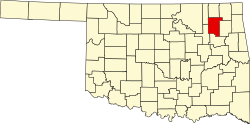


.svg)


| International | |
|---|---|
| National | |
| Geographic | |
| Other | |

Tulsa, Oklahoma
View on GrokipediaHistory
Native American Settlement and Early Development
The area encompassing present-day Tulsa was part of the Muscogee (Creek) Nation's territory in Indian Territory, following the forced relocation of southeastern tribes under the Indian Removal Act of 1830. Lower Creek bands, displaced from Alabama and Georgia via the Trail of Tears, began settling along the Arkansas River and its tributaries starting in 1833, with the Lochapoka band establishing communities in the Tulsa vicinity by the late 1830s. These settlements formed a network of villages and trading centers, including Tulsey Town, which functioned as a hub for commerce and ceremonies among the Creeks.[7][8] The name Tulsa originates from the Creek word "Tallasi" or "Tulsey," denoting a tribal town or ancient clan associated with ceremonial grounds rather than a literal geographic feature.[9] Early infrastructure consisted of log structures for trade in goods like furs, livestock, and agricultural products, often managed by mixed-blood Creek families who bridged Native and incoming settler economies. In 1846, Lewis Perryman, a part-Creek merchant, constructed a log cabin trading post near the modern intersection of 33rd Street and South Rockford Avenue, exemplifying this hybrid development amid ongoing tribal governance.[10] Non-Native American presence remained limited and regulated under Creek sovereignty until the 1880s, when the arrival of the St. Louis and San Francisco Railroad in 1882 spurred a pony mail route and small-scale cattle trading, transforming Tulsey Town into a nascent prairie outpost. By 1879, the site supported basic postal services and mercantile activity, setting the stage for population growth without formal incorporation, which occurred in 1898. This period reflected causal tensions between tribal land tenure and encroaching federal policies eroding Native autonomy through allotments and rail expansion.[11][7]Incorporation, Oil Discovery, and Economic Rise
Tulsa was formally incorporated as a city on January 18, 1898, after decades of settlement by Creek Native Americans and the establishment of a post office in 1879.[7] By incorporation, the town supported essential institutions including churches, hotels, an ice plant, a Masonic lodge, and its first bank, with a population of 1,390 recorded in the 1900 federal census.[7] The arrival of railroads in 1882 had already facilitated trade and migration, laying groundwork for expansion in Indian Territory prior to Oklahoma statehood in 1907.[7] The petroleum industry's emergence began with the Red Fork oil discovery in 1901, but the transformative event was the November 22, 1905, strike at the Glenn Pool field on land owned by Ida E. Glenn, approximately 12 miles south of Tulsa.[12] This field yielded high volumes of light, sweet crude from depths of around 2,500 feet, marking Oklahoma's first major oil play and drawing independent wildcatters amid early overproduction challenges.[13] Tulsa's central location and rail infrastructure positioned it as the operational hub, with companies establishing headquarters there rather than at remote field sites.[12] The oil boom propelled rapid economic ascent, as Tulsa's population escalated from 1,390 in 1900 to 18,182 by 1910 and 72,451 in 1920, reflecting an influx of laborers, engineers, and executives.[14] By 1920, over 400 petroleum firms operated from the city, alongside seven banks, two daily newspapers, and 10,000 telephone lines, cementing its status as the "Oil Capital of the World."[14][12] This prosperity funded skyscraper construction, diversified services, and infrastructure, though it also intensified resource strains and social tensions amid unchecked growth.[12]1921 Tulsa Race Riot: Events, Causes, and Immediate Aftermath
The 1921 Tulsa Race Riot arose amid deep-seated racial animosities in a segregated city where the Greenwood District—a self-contained African American community—had flourished into a hub of Black-owned businesses, theaters, and professional services, earning it the moniker "Black Wall Street" due to oil boom prosperity and exclusionary Jim Crow policies that fostered economic autonomy.[15] Post-World War I influxes of Black migrants from the South and assertive attitudes among returning Black veterans heightened white resentments toward perceived challenges to racial order, with Tulsa's white establishment viewing Greenwood's success as a threat to dominance.[16] Local Ku Klux Klan activity and prior lynchings in Oklahoma amplified fears of mob violence, while sensationalized media coverage of crime involving Blacks stoked paranoia.[17] The precipitating incident occurred on May 30, 1921, when 19-year-old Black shoe shiner Dick Rowland entered a downtown elevator operated by 17-year-old white elevator attendant Sarah Page; Rowland stumbled, grabbed her arm to steady himself, and fled after she screamed, leading to his arrest the next day on suspicion of assault—no charges of rape were formally filed, and Page later declined to prosecute.[16] That afternoon, the Tulsa Tribune published an article headlined "Nab Negro for Attacking Girl & Jailer Firebaug Has Him Under Heavy Guard," accompanied by an editorial (later alleged but copies destroyed) urging Rowland's lynching, which spread rumors of an impending white mob at the courthouse. By evening, hundreds of armed whites gathered demanding Rowland; a group of roughly two dozen armed Black residents, many World War I veterans, arrived to prevent a lynching, reflecting distrust in white authorities after historical failures to protect Black suspects.[15] Violence erupted around 9 p.m. on May 31 when a scuffle over a Black man's gun led to the first shot—accounts differ on who fired, but whites quickly outnumbered and disarmed the Black group, pursuing them into Greenwood and initiating widespread looting and arson starting near midnight.[16] Overnight into June 1, white mobs—deputized by authorities and numbering up to 3,000—systematically torched over 35 square blocks, destroying 1,256 homes, 215 businesses, a hospital, schools, and churches using gasoline and incendiary devices; private airplanes provided reconnaissance and, per eyewitnesses, dropped burning turpentine balls or fired shots, though official denials persisted.[15] The Oklahoma National Guard, deployed around 1 a.m. on June 1, focused on disarming Black defenders and herding residents into detention rather than quelling white aggression; by afternoon, after martial law was declared, the fires ceased, leaving Greenwood in ruins.[16] Casualties included an official count of 36 deaths—26 Black and 10 white—based on Red Cross and coroner records, though contemporary newspaper estimates ranged from 80 to 175, and the 2001 Oklahoma Commission to Study the Tulsa Race Riot of 1921 assessed likely totals of 100 to 300, predominantly Black, with evidence of mass graves and unrecovered bodies supporting higher figures amid hasty burials and suppressed reporting.[18][15] Injuries numbered in the hundreds, mostly gunshot wounds among Blacks fleeing or defending homes.[16] In the immediate aftermath, approximately 6,000 Black survivors—roughly half of Greenwood's population—were interned in makeshift camps like the fairgrounds and Convention Hall under guard, released only upon white sponsorship or proof of employment, while looted goods flooded white pawnshops with no restitution. Property damage exceeded $1.8 million (equivalent to over $30 million today), but insurance claims were denied under "riot" clauses, and the city billed Black owners for demolition debris removal, imposing further financial burdens.[15] No whites faced prosecution despite thousands of rounds fired and clear instigation, as grand juries blamed Black residents for the confrontation; Rowland was quietly released and fled Tulsa.[16] Thousands of displaced residents sheltered in tents from Red Cross aid, with the organization documenting the scale but underreporting deaths to avoid inflaming tensions; local authorities imposed curfews and suppressed photography, burying the event in official silence for decades.[18]Mid-20th Century Expansion and Challenges
Following World War II, Tulsa underwent substantial expansion driven by economic recovery and migration. The city's population grew from 182,740 in 1950 to 258,271 by 1960, reflecting influxes from rural areas and returning veterans seeking opportunities in manufacturing and services.[7] Manufacturing employment expanded from 65,600 workers in 1950 to 86,600 in 1960, diversifying beyond oil while the petroleum sector remained a cornerstone, with refineries and pipelines supporting steady job growth.[19] Infrastructure developments included the extension of controlled-access highways converging on downtown, facilitating suburbanization and accommodating the baby boom's housing demands. In 1959, Tulsa became the first major Oklahoma city to establish an urban renewal authority, approved by city commissioners to address perceived blight through demolition and redevelopment.[20] This initiative spurred projects like the construction of Interstate 244 in the early 1960s, which connected Tulsa to broader interstate networks and promoted commuter access to new suburbs.[21] However, these efforts prioritized white suburban expansion, enabling easier commutes while imposing costs on inner-city neighborhoods.[22] Challenges emerged from the uneven impacts of urban renewal, particularly in the Greenwood district, where highway construction razed homes and businesses rebuilt after the 1921 riot, displacing thousands of Black residents and eroding community wealth.[23] [24] By the mid-1960s, this "second destruction" of Greenwood fragmented Black economic networks, contributing to persistent racial wealth gaps without commensurate benefits for affected areas.[22] Economic diversification proved difficult amid oil price volatility, limiting long-term resilience, while civil rights tensions simmered amid school desegregation efforts starting in the late 1950s.[19] These developments highlighted causal trade-offs in policy-driven growth, where infrastructure gains for the majority exacerbated minority disenfranchisement.Late 20th and Early 21st Century Revitalization
Following the oil bust of the early 1980s, Tulsa experienced significant economic contraction, with unemployment rates climbing and reliance on petroleum-related industries exacerbating the downturn. The city's population grew modestly from 360,919 in 1980 to 367,302 in 1990, reflecting stabilization amid diversification efforts into aerospace, manufacturing, and service sectors. Local leaders prioritized economic broadening beyond energy, leveraging existing infrastructure like aviation facilities to attract non-oil employers, which helped mitigate further decline by the decade's end.[25][7][26] In the 1990s, urban renewal initiatives focused on preserving historic districts and fostering cultural hubs, particularly in the Brady area, which transitioned from industrial warehouses to an arts-centric zone with venues like Cain's Ballroom drawing performers and residents. This period laid groundwork for downtown reinvestment, though growth accelerated in the early 2000s as rising oil prices provided fiscal relief for public-private partnerships. Investments in art and culture, including renovations of landmarks like the Mayo Hotel into lofts, spurred residential and commercial activity, transforming underutilized spaces into mixed-use developments.[27][28][29] The passage of Vision 2025 in 2006, via a voter-approved one-cent sales tax extension through 2025, funded key infrastructure projects central to revitalization. The BOK Center, a 19,199-seat arena opened on August 1, 2008, served as a pivotal catalyst, anchoring the Arena District and generating over $1 billion in subsequent downtown investments, including hotels, offices, and entertainment options. These developments increased downtown occupancy rates and foot traffic, positioning Tulsa as a regional hub for events and tourism while complementing ongoing diversification into finance and healthcare. By 2010, the metro population reached approximately 950,000, underscoring sustained recovery.[30][31][32][33]Recent Developments (2010s–2025)
Tulsa's economy experienced targeted growth initiatives in the 2010s through Vision 2025, a 13-year penny sales tax approved by voters in 2012 to fund regional economic development and capital projects exceeding $648 million in expenditures by August 2025.[30][34] Allocated funds supported infrastructure such as Arkansas River corridor enhancements, Zink Dam replacement with recreational features, a new pedestrian bridge, and safety upgrades at over 100 public school sites across Tulsa and surrounding districts.[35] These efforts aimed to bolster economic competitiveness amid Oklahoma's statewide GDP growth averaging 1.5% annually from 2012 to 2022, lagging the national rate of 2.1%.[36] In the early 2020s, public-private partnerships accelerated development, with PartnerTulsa reporting $1.3 billion in direct economic impact from 2021 to 2024, including contracts for nearly 500 affordable housing units and business expansions.[37] The Tulsa Regional Chamber documented an 8.1% increase in new business formations between 2021 and 2022, surpassing state and national averages during post-pandemic recovery.[38] Despite these gains, Tulsa's median household income stood at $49,474 in 2020, below the state figure of $53,840 and the U.S. median of $64,994, reflecting persistent challenges in income parity.[39] The city's population dynamics shifted positively in the late 2010s and 2020s, with the metro area reaching an estimated 807,000 residents in 2025, up 1% from 2024, driven by net migration from higher-cost states including California and Texas.[33][40] Tulsa County saw annual population increases in all years from 2010 to 2022, with the metro gaining over 8,700 residents in recent cycles amid broader Oklahoma growth of 0.85% in 2023.[41][42] During the COVID-19 pandemic, Tulsa issued one of the region's first safer-at-home orders and mask mandates in 2020, facilitating a managed response while positioning the city to attract remote workers amid national relocations.[43]Geography
Topography and Environmental Features
Tulsa lies in northeastern Oklahoma within Tulsa County, positioned along the Arkansas River at an average elevation of approximately 700 feet (213 meters) above sea level.[11] The city's topography consists of gently rolling hills and valleys, reflecting its location in the transitional zone between the flatter Osage Plains to the west and the more rugged foothills of the Ozark Mountains to the east.[44] Elevations within the city limits vary from around 500 feet in the river floodplain to over 1,000 feet on surrounding hills such as Turkey Mountain and Shadow Mountain, contributing to a diverse urban-rural interface with wooded ridges and open lowlands.[45] The Arkansas River, a major tributary of the Mississippi, flows eastward through the southern portion of Tulsa, forming a broad alluvial valley that has historically influenced settlement patterns and flood dynamics.[46] This river corridor drains a basin exceeding 74,000 square miles upstream of the city, supporting riparian habitats amid the otherwise upland terrain.[47] Surrounding the river valley, the landscape transitions into the Cross Timbers region, characterized by savanna-like woodlands of post oak, blackjack oak, and hickory trees over clay-rich soils that retain moisture and nutrients but pose drainage challenges.[48] Environmental features include scattered forested areas and grasslands adapted to the region's loamy clay soils, which derive from weathered Pennsylvanian-era sandstones and shales.[49] Native vegetation historically comprised oak-hickory woodlands interspersed with tallgrass prairie remnants, though urban expansion has fragmented these into parks and greenbelts like the Keystone Ancient Forest, preserving elements of the pre-settlement ecosystem.[50] The predominance of heavy clay soils, formed from local geological deposits, supports resilient but erosion-prone landforms, with human modifications such as levees and dams altering natural hydrology for navigation and flood mitigation.[51]Urban Layout and Neighborhoods
Tulsa's urban layout adheres to a grid system, with streets numbered sequentially from Main Street, which serves as the primary east-west divider, facilitating navigation across the city.[52] This numbering convention assigns block numbers to streets, where addresses increase northward from downtown and eastward/westward from Main Street, reflecting early 20th-century planning adapted to the city's rapid growth following oil discoveries.[52] The downtown core, encompassing roughly 1.4 square miles, is encircled by Interstate 244, forming an inner loop that delineates the central business district from surrounding areas.[53] Within downtown, distinct districts contribute to the city's functional and aesthetic organization, including the Tulsa Arts District focused on cultural venues, the Deco District featuring Art Deco architecture from the 1920s oil boom, and the Blue Dome District known for entertainment and historic masonry buildings.[53] The Pearl District emphasizes mixed-use development with residential and retail spaces, while the East Village supports office and residential growth.[53] Further north, the Historic Greenwood District, redeveloped after the 1921 race riot, preserves elements of its pre-riot commercial vibrancy amid ongoing revitalization efforts.[54] Beyond downtown, neighborhoods radiate outward in a somewhat concentric pattern, blending historic residential areas with post-World War II suburbs. Midtown includes upscale enclaves like Cherry Street, characterized by boutique shops and early 20th-century homes, and Brookside, a southside area with tree-lined streets and local commerce dating to the 1920s streetcar era.[55] North Tulsa features working-class neighborhoods such as Riverside and Whittier Heights, while south and east extensions incorporate suburban developments influenced by automobile-centric planning since the 1950s.[56] Preservation efforts target historic districts like Riverview and Maple Ridge, which retain diverse architectural styles from Tulsa's boom years, supported by the city's comprehensive plan to maintain grid integrity and prevent superblock disruptions.[57][58]Climate and Weather Patterns
Tulsa, Oklahoma, features a humid subtropical climate (Köppen Cfa), marked by hot, humid summers, mild winters, and significant precipitation throughout the year. The city experiences four distinct seasons, with continental air masses driving temperature variability and severe weather risks, particularly in spring. Average annual temperatures range from a high of 72°F to a low of 51°F, yielding a mean of about 61°F, based on 1991–2020 normals from the National Weather Service.[59][60] Annual precipitation averages 41 inches, with spring and early summer thunderstorms contributing the bulk, often leading to flash flooding; snowfall totals around 7 inches annually, mostly in January and February.[59][61] Monthly climate normals illustrate the seasonal patterns:| Month | Avg High (°F) | Avg Low (°F) | Precipitation (in) |
|---|---|---|---|
| January | 49 | 28 | 1.7 |
| February | 54 | 32 | 2.0 |
| March | 63 | 40 | 2.9 |
| April | 72 | 49 | 3.9 |
| May | 80 | 59 | 4.7 |
| June | 88 | 68 | 4.0 |
| July | 93 | 72 | 2.8 |
| August | 92 | 71 | 2.7 |
| September | 84 | 63 | 3.3 |
| October | 73 | 51 | 3.2 |
| November | 60 | 39 | 2.3 |
| December | 51 | 31 | 1.9 |
Natural Disasters and Resilience
Tulsa, Oklahoma, lies in Tornado Alley, exposing it to frequent severe thunderstorms and tornadoes, with 143 historical tornado events of magnitude 2 or greater recorded in or near the city since records began.[66] The June 8, 1974, outbreak produced an F4 tornado that struck Tulsa, killing several residents, injuring dozens, and causing widespread structural damage across neighborhoods.[67] Another significant event occurred on April 13, 1986, when an F2 tornado inflicted $37 million in damages, including $24 million to vehicles, amid broader severe weather.[64] More recently, on August 6, 2017, a bow echo spawned four tornadoes that damaged homes, businesses, and infrastructure in Tulsa, highlighting ongoing vulnerability despite advanced warning systems.[68] Flooding along the Arkansas River has repeatedly threatened Tulsa, with major events including the 1923 flood that submerged low-lying areas and prompted early levee construction, and the catastrophic Memorial Day flood of May 26-27, 1984, which caused $180 million in damages from 14 inches of rain in hours, overwhelming tributaries like Joe Creek and Mingo Creek.[69] [70] The September-October 1986 flood saw the Arkansas River crest at 25.21 feet near Tulsa, flooding communities in Sand Springs, Jenks, and Bixby after over 20 inches of rain in some areas, leading to evacuations and property losses.[71] These events, exacerbated by urban development on floodplains, drove post-1984 infrastructure reforms, including channelization and detention basins, reducing recurrence frequency.[72] Induced seismicity, primarily from wastewater injection tied to oil and gas operations, has increased earthquake risks in Oklahoma since 2009, with rates of magnitude 3+ events surpassing historical norms and evidence of activity dating back decades in areas like Tulsa County.[73] [74] While epicenters cluster elsewhere in the state, shaking affects Tulsa, contributing to structural concerns and secondary risks like increased vehicle crashes during events.[75] Regulatory responses by the Oklahoma Corporation Commission, including injection volume limits since 2015, have reduced seismicity by over 90% in peak years, demonstrating causal links between operations and quakes.[76] To enhance resilience, the Tulsa Area Emergency Management Agency coordinates responses for approximately 1 million residents, integrating planning, mitigation, and recovery across jurisdictions.[77] The city's Hazard Mitigation Plan identifies tornadoes, floods, and earthquakes as top threats, advocating stormwater infrastructure upgrades, storm shelters, and public education to minimize long-term risks.[78] Post-disaster adaptations, such as U.S. Army Corps of Engineers levees and the Keystone Dam on the Arkansas River, have curtailed flood peaks, while state-level protocols from the Oklahoma Department of Emergency Management emphasize early warnings via NOAA systems, reducing fatalities compared to early 20th-century events.[79] Community initiatives, including the Disaster Resilience Network's preparedness training, further bolster adaptive capacity against recurrent hazards.[80]Demographics
Population Growth and Census Data
Tulsa's population expanded rapidly in the early 20th century, driven by the discovery of oil fields in the region, reaching 72,421 by the 1920 census from just 1,390 in 1900.[7] This growth continued through the mid-century, peaking at relative rates before stabilizing amid broader economic shifts in the U.S. energy sector. The city's population stood at 413,066 according to the 2020 decennial census, reflecting a 5.5% increase from 391,906 in 2010.| Census Year | Population | Percent Change from Prior Decade |
|---|---|---|
| 1900 | 1,390 | — |
| 1910 | 18,385 | +1,222% |
| 1920 | 72,421 | +294% |
| 1930 | 141,683 | +96% |
| 1940 | 142,157 | +0.3% |
| 1950 | 182,740 | +29% |
| 1960 | 261,685 | +43% |
| 1970 | 330,350 | +26% |
| 1980 | 360,919 | +9% |
| 1990 | 367,302 | +2% |
| 2000 | 393,049 | +7% |
| 2010 | 391,906 | -0.3% |
| 2020 | 413,066 | +5.5% |
Racial and Ethnic Composition
As of the 2020 United States Census, Tulsa's population stood at 413,066, with non-Hispanic Whites comprising 51.4% (approximately 212,300 individuals), marking a plurality but not a majority.[83] Black or African Americans accounted for 14.0% (about 57,800), Hispanics or Latinos of any race for 19.2% (around 79,300), American Indians and Alaska Natives for 4.3% (roughly 17,700), Asians for 3.5% (about 14,400), Native Hawaiians and Pacific Islanders for 0.2% (around 800), and individuals identifying with two or more races for 8.6% (approximately 35,500).[84] [85] These figures reflect the Census Bureau's methodology, which saw a notable increase in multiracial identifications due to expanded self-reporting options, contributing to Tulsa's status as a majority-minority city where non-White groups collectively exceed 50% of the population.[86]| Racial/Ethnic Group | Percentage (2020) | Approximate Population |
|---|---|---|
| White (non-Hispanic) | 51.4% | 212,300 |
| Hispanic or Latino (any race) | 19.2% | 79,300 |
| Black or African American | 14.0% | 57,800 |
| Two or more races | 8.6% | 35,500 |
| American Indian/Alaska Native | 4.3% | 17,700 |
| Asian | 3.5% | 14,400 |
| Native Hawaiian/Pacific Islander | 0.2% | 800 |
Religious Affiliations and Community Values
Tulsa's religious affiliations are dominated by Christianity, particularly Protestant denominations, reflecting the city's location in the Bible Belt region of the United States. According to data compiled by BestPlaces, approximately 56.8% of Tulsa residents affiliate with a religious group, lower than the national average of 70.6% but comparable to Oklahoma's 60.6%.[87] Within this, Baptist adherents constitute 20.1%, Methodist 9.4%, other Christian groups 12.9%, and Catholic 6.1%, with non-Christian faiths such as Judaism (0.3%), Islam (0.2%), and Eastern religions (0.4%) representing minimal shares.[87] In Tulsa County, which encompasses the city and its suburbs, the 2020 U.S. Religion Census reports 428,450 religious adherents out of a population of 669,279, equating to a 64% adherence rate.[88] Among adherents, non-denominational Christian churches lead with 32.7% (140,164 individuals across 233 congregations), followed by the Southern Baptist Convention at 17.7% (75,759 adherents, 125 congregations), United Methodist Church at 13.4% (57,418 adherents, 42 congregations), and the Catholic Church at 12.3% (52,881 adherents, 23 congregations).[89] Other notable groups include Assemblies of God (3.4%, Pentecostal evangelical) and Churches of Christ (2.0%). This distribution underscores the prominence of evangelical and mainline Protestant traditions, supported by over 700 congregations in the Tulsa area.[90] These affiliations shape Tulsa's community values toward traditional moral frameworks, family-centric priorities, and civic engagement through faith-based initiatives. The strong evangelical presence, exemplified by institutions like Oral Roberts University, promotes emphases on personal faith, biblical literalism, and charitable outreach, influencing local norms around marriage, child-rearing, and social welfare.[90] Protestant dominance correlates with conservative social attitudes, including support for limited government intervention in moral matters and community-driven philanthropy, as churches serve as hubs for volunteerism and mutual aid.[87] While diversification introduces smaller Muslim, Hindu, and Jewish communities, the overarching Christian majority sustains a culture prioritizing religious liberty, patriotism, and ethical individualism over secular collectivism, evident in resistance to progressive educational mandates perceived as undermining faith-based principles.[89]Socioeconomic Indicators
As of 2023, the median household income in Tulsa was $58,407, reflecting a modest 0.06% increase from 2020 levels and standing at approximately 74% of the national median.[91] This figure lags behind the Tulsa metropolitan area's $67,823 and Tulsa County's $67,300 for the same period, highlighting disparities between urban core and suburban areas.[92] [93] The city's poverty rate stood at 18.6% in 2023, up 2.57% from the prior year, exceeding the metro area's 13.7% and contributing to Oklahoma's ranking among the nation's higher-poverty states.[94] [92] Educational attainment in Tulsa shows 89.8% of county residents aged 25 and older holding at least a high school diploma or equivalent in 2023, with bachelor's degrees or higher achieved by 33.7%—a figure that has risen gradually from 31.8% in 2019.[95] [96] Unemployment in the Tulsa metropolitan statistical area averaged around 3.1% in 2024, below the national rate of 4.0%, supported by diversification beyond energy into sectors like aerospace and healthcare.[97] [98] Homeownership rates in Tulsa city proper were 52% in 2023, lower than the metro area's 65.4% and county's 63.1%, amid median property values of $189,600 that rose 8.84% year-over-year.[99] [92] [100] The city's cost of living index hovered at 85.3 in recent assessments, about 15% below the U.S. average, driven by lower housing and utility costs relative to coastal metros, though grocery and healthcare expenses align closer to national norms.[101] Income inequality in Tulsa is pronounced, with a Gini coefficient of 0.5116 in 2023, indicating significant disparities where the top income quintile earns substantially more than the bottom, a pattern exacerbated by historical oil wealth concentration and uneven post-recession recovery.[91]| Indicator | Tulsa City (2023) | Tulsa Metro/County Comparison | National Context |
|---|---|---|---|
| Median Household Income | $58,407 | Metro: $67,823; County: $67,300 | ~$74,000 (U.S. median)[91][92][93] |
| Poverty Rate | 18.6% | Metro: 13.7% | ~11.5% (U.S.)[94][92] |
| Bachelor's Degree or Higher (25+) | ~33% (county proxy) | Consistent with metro | ~34% (U.S.)[96] |
| Homeownership Rate | 52% | Metro: 65.4% | ~65% (U.S.)[99][92] |
| Gini Coefficient | 0.5116 | Higher than state average (0.452) | 0.41 (U.S.)[91][92] |
Crime Statistics and Trends
In 2024, Tulsa recorded 50 homicides, marking a slight increase from 48 in 2023 but a decline from the peak of 68 in 2022 and 62 in 2021.[102] [103] This equates to a homicide rate of approximately 12.0 per 100,000 residents, based on a population of 415,154, which remains elevated relative to the national average of around 5-6 per 100,000 but reflects an overall 20% reduction in homicides over the prior four years from post-2020 peaks.[102] [104] The Tulsa Police Department (TPD) attributes part of the decline to targeted enforcement against gang activity and narcotics trafficking, which have historically driven much of the violence, alongside a 100% clearance rate for 2024 homicide cases—higher than the typical 90% annual solve rate.[103] [105]| Year | Homicides |
|---|---|
| 2021 | 62 |
| 2022 | 68 |
| 2023 | 48 |
| 2024 | 50 |