Hubbry Logo
Sufi whirlingSufi whirlingMain
Open search
Sufi whirling
Community hub
Sufi whirling
logo
8 pages, 0 posts
0 subscribers
Be the first to start a discussion here.
Contribute something
Sufi whirling
Sufi whirling
from Wikipedia

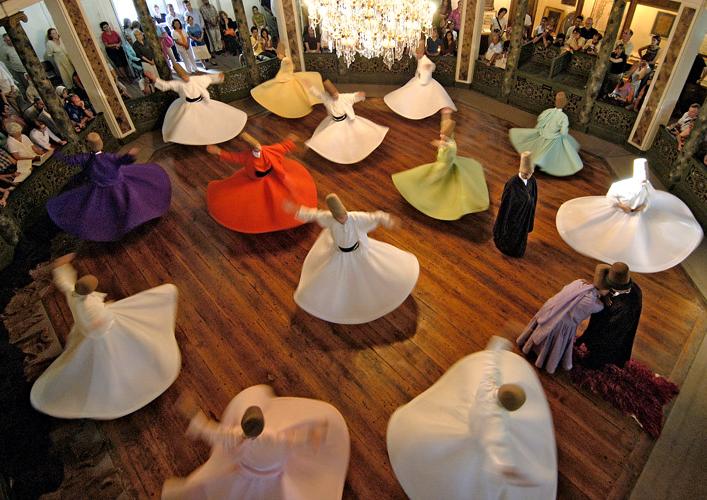
Whirling Dervishes in Istanbul, Turkey
Whirling Dervishes, at Rumi Fest 2007

Sufi whirling (or Sufi turning) (Turkish: Semazen borrowed from Persian Sama-zan, Sama, meaning listening, from Arabic, and zan, meaning doer, from Persian) is a form of physically active meditation which originated among certain Sufi groups, and which is still practiced by the Sufi Dervishes of the Mevlevi order and other orders such as the Rifa'i-Marufi. It is a customary meditation practice performed within the sema, or worship ceremony, through which dervishes (from the persian Darvish Persian درویش also called semazens, from Persian سماعزن) aim to reach greater connection with Allah. This is sought through abandoning one's nafs, ego or personal desires, by listening to the music, focusing on God, and spinning one's body in repetitive circles, which has been seen as a symbolic imitation of planets in the Solar System orbiting the Sun.[1]

The Mevlevi practice gave rise to an Egyptian form, tanoura, distinguished by the use of a multicolored skirt. This has also developed into a performance dance by non-Sufis, including dancers outside the Islamic world.

Origin

[edit]
Mevlevi dervishes whirling in Pera by Jean-Baptiste van Mour

As an order, the whirling Dervishes were founded by mystic poet Rumi in the 13th century.[2] Initially, Sufi fraternities (Arabic: طرائق, romanizedṭarāʾiq) were organized as leaderships where members followed prescribed disciplines in service to a sheikh or master to establish trust with him.[3] A member of such a fraternity is referred to as a Persian darwish. These turuk were responsible for organizing an Islamic expression of religious life, often founded by independent saints or resulted from the division of existing orders.[4] Each Sufi tariqa stems from a unique silsila, or "chain of order" in which a member must learn, as the silsila binds each member to Allah through one's chain of order.[4] One's silsila extends through the member's individual teacher, to their teacher and so on, through time until one is connected to the Prophet and thus Allah.[4] The Prophet himself is revered as the originator of Sufism, which has in turn been traced down through a series of saints.[4]

Practice

[edit]

A dervish practices multiple rituals, the primary of which is the dhikr, a remembering of Allah.[3] The dhikr involves recitation of devotional Islamic prayer. This dhikr is coupled with physical exertions of movement, specifically dancing and whirling, in order to reach a state assumed by outsiders to be one of "ecstatic trances".[3] As explained by Sufis:[5]

In the symbolism of the Sema ritual, the semazen's camel's hair hat (sikke) represents the tombstone of the ego; his wide, white skirt (tennure) represents the ego's shroud. By removing his black cloak (hırka), he is spiritually reborn to the truth. At the beginning of the Sema, by holding his arms crosswise, the semazen appears to represent the number one, thus testifying to god's unity. While whirling, his arms are open: his right arm is directed to the sky, ready to receive god's beneficence; his left hand, upon which his eyes are fastened, is turned toward the earth. The semazen conveys god's spiritual gift to those who are witnessing the Sema. Revolving from right to left around the heart, the semazen embraces all humanity with love. The human being has been created with love in order to love. Mevlâna Jalâluddîn Rumi says, "All loves are a bridge to Divine love. Yet, those who have not had a taste of it do not know!"

Among the Mevlevi order, the practice of dhikr is performed in a traditional dress: a tennure, a sleeveless white frock, the destegul, a long sleeved jacket, a belt, and a black overcoat or khirqa to be removed before the whirling begins.[6] As the ritual dance begins, the dervish dons a felt cap, a sikke, in addition to a turban wrapped around the head, a trademark of the Mevlevi order.[6] The sheikh leads the ritual with strict regulations. To begin,

The sheikh stands in the most honored corner of the dancing place, and the dervishes pass by him three times, each time exchanging greetings, until the circling movement starts. The rotation itself is on the left foot, the center of the rotation being the ball of the left foot and the whole surface of the foot staying in contact with the floor. The impetus for the rotation is provided by the right foot, in a full 360-degree step. If a dervish should become too enraptured, another Sufi, who is in charge of the orderly performance, will gently touch his frock in order to curb his movement, The dance of the dervishes is one of the most impressive features of the mystical life in Islam, and the music accompanying it is of exquisite beauty, beginning with the great hymn in honor of the Prophet (na't-i sharif, written by Jalaluddin himself) and ending with short, enthusiastic songs, some things sung in Turkish.[6]

Turkish whirling dervishes of Mevlevi Order, bowing in unison during the Sema ceremony

The Western world, having witnessed Sufi whirling through tourism, have described the various forms of dhikr as "barking, howling, dancing, etc."[4] The practice of each tariqa is unique to its individual order, specific traditions and customs may differ across countries. The same tariqa in one country will not mirror that of another country as each order's ritual stresses "emotional religious life" in various forms.[4] The Mevleviyah order, like many others, practice the dhikr by performing a whirling meditation. Accompanying the dhikr practices of whirling and prayer, the custom of sama serves to further one's "nourishment of the soul" through devotional "hearing" of the "'subtle' sounds of the hidden world or of the cosmos."[7] In contrast to the use of sama, whirling and devotional prayer in the practice of dhikr, the tariqa orders perform Sufi whirling in addition to playing musical instruments, consuming glowing embers, live scorpions and glass, puncturing body parts with needles and spikes, or practicing clairvoyance and levitation.[4] The dervish practice can be performed by community residents or lay members, members have typically been those of lower classes.[3] Women were received into a tariqa order by a male sheikh, but traditionally were instructed to practice the dhikr alone or with an established branch of females within a specific order.[4]

Semâ ceremony at the Dervishes Culture Center at Avanos, Turkey

The custom of sama among Sufi orders has a history of controversy within the Islamic faith. In one argument, the use of the term sama is considered to suggest physically "listening" in a spiritual context.[7] A differing opinion argues that sama is in fact "hearing", as "to hear" can pertain to any sound in addition to any "subtle" sounds of the spiritual realm.[7] Those in support of sama further claim that the term is actually synonymous with "understanding" and therefore recognition and application of the Revelation as well as the act of "attaining higher knowledge."[7] Sama can also refer to considerate listening to an honest temporal leader who ensures social justice and makes word of God mainstream. The spread of sama among Sufi orders began some time around the mid third/ninth century C.E. in Baghdad, eventually finding acceptance and favor in Persian, Turkish and Indian Islam.[7] The custom of sama evolved in practice over time as it complemented Sufi dhkir, whirling and among some orders dancing and a meal.[7] Rules of propriety and conditions were adopted upon the widespread concern surrounding the necessity of sama with the dhikr; in order to distinguish between entertainment and valuable spiritual practice, the sama was distinguished as heard from the ego, heart or spirit.[7] Despite the application of rules, some sheikhs continued to limit or disapprove the practice of sama. While controversy continuously questioned the place of sama in Sufi orders, the music itself was not affected.[7] More recently, the custom of sama is most commonly performed within a dhikr ceremony. Those in support of sama continue to argue that "according to that which it is not sama and dance which induce ecstasy, but ecstasy which arouses dance, or furthermore, that sama is only a revealing instrument and that it only supplies that which is brought to it by the hearer."[7]

In 2005, UNESCO proclaimed the "Mevlevi Sema Ceremony" of Turkey as one of the Masterpieces of the Oral and Intangible Heritage of Humanity.[8]

Today

[edit]
Sema ceremony at Sirkeci Railway Station, Istanbul

Dervish communities, in the Middle Ages, served a central role in social, religious and political life throughout "central Islamic lands."[3] Dervish orders were at one time much larger in size than they are today, as the government has taken control over most Dervish monasteries throughout this area.[4] In 1925, Turkey ordered the dissolution of all Sufi fraternities by decree, the Mevlevi managed to survive among small villages throughout the Middle East.[9] In 1954, the Turkish government granted the Mevlevi order a special permission to perform ritual whirling practices for tourists during two weeks each year.[9] Outside of tourist entertainment, Orthodox theologians have now vocally discounted the Dervish practice resulting in faqirs, or wandering, mendicant dervishes throughout central Islamic regions.[3] Despite strict government control over Dervish practices, the Mevleviyah order continued its existence in Turkey to this day.[9]

While only men have historically been permitted to take part in the ceremony, some communities now allow women to participate.[10]

Regional and secular forms

[edit]

Egyptian tanoura

[edit]
Egyptian tanoura dancers
Tanoura dancer

In Egypt, the practice of whirling has been adapted as tanoura (Arabic: التنورة, romanizedel-tanoura). The word tanoura or tannoura refers to the colorful skirt worn by the whirler, with a color representing each Sufi order.[11] The word may also refer to the dancer, traditionally a Sufi man.[11] Tanoura is associated with Sufism and is performed at Sufi festivals, but it is also performed by non-Sufis as a folk dance or concert dance.

Although it is mainly used for visual effects, the dancers also augment their balance with the tanoura, through a dynamic centrifugal effect.[citation needed]

Pakistan

[edit]

In Sufi shrines in Pakistan, such as the Lal shrine in Sehwan, Sindh,[12][13] the practice of Sufi whirling is called Dhamaal and is performed to honor Sufi saints, or qalandars.[citation needed] Unlike the Turkish practice, Dhamaal may be practiced by any devotee – priests as well as pilgrims. Dhamaal is usually preceded by the beating of a drum (naghara) and ringing of bells, as pilgrims raise their hands, start to skip steps standing at one place and gradually work into a trance as the beats get faster. As the beats get faster, rhythms change and the drum beats are accompanies by the playing of shehnai.

Practitioners associate the dance with Lal Shahbaz Qalandar and with protests following the Battle of Karbala. They regard the rhythm of the drum to evoke the rhythm of the creation of the universe, as illustrated in the concept of Kun Fyakun.[citation needed]

In the West

[edit]
Whirling dancer, performing in a modern costume

The tanoura tradition has attracted some interest from Westerners in the belly dancing community. These performers include both men and women, solo and in groups. Such performances may be augmented with pyrotechnics or props, such as veils, wings and ribbons.[14][non-primary source needed] The techniques used in Egyptian Tanoura can also be adopted by belly dancers to help with their balance and control dizziness.[citation needed]

Sufi whirling has also been promoted by actor and memoirist Annabelle Gurwitch as a form of stress relief.[15]

Physiology

[edit]

A defining feature of whirling is continuous rotation (clockwise or counterclockwise) around a central radical axis while avoiding vertigo. In untrained dancers, this sustained rotation causes dizziness or motion-induced vertigo. Training for whirling targets the inner ear, which is responsible for balance functions in humans. To counteract this effect, whirling dance performers practice various balancing and psychological techniques.[example needed]

Records

[edit]

Guinness World Records for "most Sufi whirls in one hour" were awarded in London in 2012, to Shafik Ibrahim Abd El Hamed in the male category with 2,905 rotations, and Tara Lee Oakley in the female category with 2,191.[16] These records were surpassed in Zurich in 2015 by Nicole McLaren, with 3,552 rotations.[17]

The longest continuous whirling performance has been recorded at more than four hours.[citation needed] The record for the most people simultaneously whirling is 755, set in Taiwan in 2011.[18]

See also

[edit]

References

[edit]
[edit]
Revisions and contributorsEdit on WikipediaRead on Wikipedia
from Grokipedia
Sufi whirling, or sema, constitutes a form of dhikr—a devotional remembrance of God—practiced through continuous rotation by dervishes of the Mevlevi Order to induce spiritual ecstasy and transcend ego. The ritual integrates music, poetry recitation, and precise turning movements, symbolizing the cosmic order and the seeker's ascent toward divine union. Originating in 13th-century Konya under the influence of the Persian Sufi mystic Jalal al-Din Rumi (1207–1273), the practice emerged from his ecstatic responses to divine inspiration, particularly following the departure of his spiritual companion Shams-i Tabrizi, and was formalized as a disciplined ceremony by Rumi's son, Sultan Veled. Dervishes, clad in symbolic attire such as the sieve-like cap (sikke) representing the tomb of the ego and flowing skirts evoking shrouds, perform selam—stages of whirling—each denoting phases of spiritual maturation from worldly attachment to eternal harmony with the creator. The Mevlevi tariqa's sema served as both meditative discipline and communal rite within Ottoman Sufi lodges (tekkes), fostering virtues of humility and love amid rigorous training regimens lasting up to 1,001 days. Though suppressed in 1925 by the secular Turkish Republic as part of broader anti-Sufi reforms, the ceremony persists in controlled performances, recognized for its cultural preservation while debates persist over its authenticity versus commodified tourism. Empirical observations note the physiological effects of prolonged rotation, including vestibular-induced trance states akin to other ecstatic traditions, underscoring causal mechanisms beyond purely mystical claims.

Historical Development

Origins in Early Sufism

Sufi , the ritual remembrance of through repetitive invocation, emerged in the among early Muslim ascetics as a means of spiritual purification and focus on divine unity (), often incorporating physical elements such as swaying or rhythmic postures to intensify concentration and induce states of ecstasy (wajd). These practices, documented in biographical accounts of figures like Rabi'a al-Adawiyya (d. circa 801) and Abu Yazid al-Bistami (d. 874), emphasized inner discipline over external spectacle, with bodily movements serving as extensions of vocal or silent recitation rather than formalized dance. By the 9th-10th centuries, as organized into loose confraternities, communal dhikr sessions began integrating sama'—spiritual audition to poetry or music—which could precipitate involuntary motions resembling trance-like activity, though explicit spinning remains undocumented in primary sources from this era. The 10th-12th centuries saw evolve further in regions like and , where Sufi missionaries adapted repetitive physical rituals amid nomadic lifestyles, potentially drawing causal parallels to local meditative traditions without syncretism into non-Islamic . Influences from Shia Imams, including (d. 765), contributed conceptual foundations for mystical introspection in , stressing ethical purification and divine love, though direct attributions of movement-based practices to him rely on later hagiographies rather than contemporaneous texts. This period's oral transmission of teachings, preserved in chains of initiation (), prioritized experiential transmission over written records, limiting verifiable evidence of proto-whirling forms to anecdotal reports of ecstatic bodily repetition during group sessions. Pre-13th century documentation of sustained spinning as is scarce, with most historical analyses attributing the codified whirling technique to later developments, underscoring reliance on interpretive traditions rather than empirical artifacts. Unlike pre-Islamic Central Asian rituals involving for (e.g., among Tengriist shamans), early Sufi movements grounded physical repetition in Qur'anic imperatives for remembrance (e.g., 33:41), aiming at ego dissolution (fana') through disciplined Islamic , not animistic . This distinction highlights causal realism in Sufi : environmental and cultural pressures in frontier zones may have amplified motion in , yet the core intent remained fidelity to prophetic over innovation ().

Association with Rumi and the Mevlevi Order

Jalaluddin (1207–1273), a Persian poet and Sufi mystic residing in , , underwent a profound spiritual transformation following his encounter with the wandering in 1244, which ignited ecstatic devotional practices including elements that evolved into whirling. This meeting, documented in Rumi's —a collection of over 40,000 verses composed in Shams' honor—shifted Rumi from scholarly pursuits to mystical expression, with accounts attributing the inception of rotational movement to Rumi's inspired response to rhythmic sounds, such as goldsmiths' hammering, symbolizing cosmic harmony. Following Shams' mysterious disappearance around 1248 and Rumi's death on December 17, 1273, his disciples in began formalizing these practices, with the earliest records of organized whirling emerging among followers seeking to emulate Rumi's state of divine intoxication (wajd). Rumi's son, Sultan Walad (born circa 1226), founded the in 1273 immediately after his father's passing, institutionalizing the sema—a incorporating whirling—as a disciplined path toward fana, the annihilation of the ego in union with the divine, drawing directly from Rumi's poetic emphases on love and surrender. Under Sultan Walad's leadership, the order established its first lodge (tekke) in , compiling Rumi's teachings into structured disciplines that integrated music, , and rotation to induce spiritual ecstasy, as evidenced in Mevlevi hagiographies like Ahmad Aflaki's Manāqib al-ʿĀrifīn (completed circa 1350), which credits Rumi's influence for the practice's crystallization. From the late , the Ottoman sultans provided patronage to the Mevlevi, enabling expansion across and the empire, with the first documented state-supported lodge constructed in 1387 under Sultan Murad I. This support, rooted in the order's alignment with Ottoman cultural and administrative ethos, facilitated the proliferation of tekke—over 100 by the —and annual sema commemorations of Rumi's death (Şeb-i Arus), preserved in Ottoman archival records and traveler accounts confirming the ritual's al role in fostering mystical discipline amid imperial governance. Such backing underscores the Mevlevi's evolution from a localized post-Rumi circle into a formalized Sufi by the , distinct from earlier unstructured ecstatic traditions.

Ritual Practice and Symbolism

Components of the Sema Ceremony

The ceremony unfolds in a structured sequence within a semahane hall, commencing with the naat-ı şerif, a choral praising the Prophet Muhammad, typically performed to compositions by the 17th-century Ottoman musician Itri. This is succeeded by a ney taksim, a solo improvisation on the reed flute (), evoking the soul's separation from the divine, accompanied initially by the kudum, a pair of kettledrums symbolizing rhythmic divine order. A prelude in the style of Itri's peşrev introduces the entry of the semazen, who arrive cloaked in hırka over tennure skirts and sikke headdresses, removing the cloaks to signify readiness for . Led by the postnişin from a central red post, they execute the devr-i veledi, a circling around the hall. The core music then commences, featuring four selam segments played by the mutrip ensemble—including neyzen flutist, kudum drummer, singer, and instrumentalists on instruments like the ut —each segment lasting from 10 to 15 minutes in traditional performances, totaling 40 to 60 minutes for the whirling phases. Participation is hierarchical, with the sheikh overseeing proceedings and semazen comprising trained dervishes who undergo at least 1,001 days of involving , music, and discipline in mevlevihane lodges before full involvement. Postulants observe and learn progressively, prioritizing ritual precision over improvisation. The ceremony concludes with collective recitation of the Fatiha for prophets, martyrs, and believers.

Whirling Technique and Spiritual Intent

The whirling technique in the Mevlevi Sema involves counterclockwise rotation, with dervishes pivoting primarily on the left foot while using the right foot for short twists to maintain balance and momentum. During the spin, the arms are extended horizontally: the right arm points upward with the palm facing skyward to symbolize receiving divine influx or grace from , while the left arm extends downward with the palm facing earthward to represent dispensing that grace to creation. The head is tilted to the right, directing the inward toward the left hand or heart, fostering concentration on the body's center to counteract disorientation from prolonged motion. This physical form serves a metaphysical purpose, enacting a symbolic journey from self-annihilation (fana) through ego dissolution to union (fana fi Allah) with the divine, where the aims to achieve hal, an involuntary ecstatic state of spiritual intoxication induced by rhythmic turning. The centrifugal dynamics of whirling, centered on the heart as the locus of divine love per Rumi's teachings, purportedly bypass discursive intellect, enabling direct by synchronizing bodily rhythm with cosmic order and overwhelming rational faculties through vestibular overload. Participation requires ascetic prerequisites, including extended and spiritual —often a 1,000-day training regimen emphasizing ethical conduct, , and detachment—along with for several hours prior to the rite to heighten receptivity and purify intent. These preparations causally support the technique's efficacy by cultivating mental focus and physical endurance, ensuring the motion's repetitive nature can evoke transcendence rather than mere dizziness, as untrained spinning yields vertigo without spiritual elevation.

Physiological and Neurological Effects

Vestibular Adaptation and Vertigo Resistance

Sufi whirling practitioners, known as semazen in the Mevlevi tradition, demonstrate remarkable resistance to vertigo through long-term habituation of the , enabling continuous rotation for over one hour without perceptual disorientation or collapse. This adaptation primarily involves desensitization of the to sustained , where repeated exposure diminishes the disruptive shearing forces on the fluid and cupula, thereby reducing reflexive and associated imbalance. organs, which detect linear and static tilt, play a lesser role in vertical-axis spinning but contribute to overall spatial orientation; chronic practice likely calibrates their input to prevent conflicts with canal signals, as evidenced by the absence of typical post-rotational vertigo in trained individuals. Structural studies reveal underlying neural plasticity supporting this endurance, with (MRI) of 10 experienced whirling dervishes showing cortical thinning in regions implicated in vestibular-visual integration, such as the right and left , compared to controls. These changes, observed via voxel-based morphometry, suggest adaptive remodeling in cortical networks that modulates vertigo thresholds, potentially involving cerebellar pathways for fine-tuning motor-vestibular reflexes, though direct cerebellar volumetric data remains limited. Such plasticity arises from years of deliberate training, beginning with short sessions and progressing gradually to full ceremonies, which fosters central suppression of signals akin to mechanisms in other repetitive rotational activities. While authentic training mitigates risks, untrained individuals attempting prolonged spinning face acute challenges, including intense vertigo, from mismatched vestibular-proprioceptive inputs, and secondary issues like from or cardiovascular strain from elevated heart rates during imbalance recovery. In semazen practice, these are counterbalanced by preparatory protocols, such as controlled posture, gaze fixation on a point to stabilize vision, and incremental exposure, which build tolerance without precipitating collapse; however, even experts report transient mild effects post-ceremony, underscoring the adaptation's specificity to conditioned states.

Scientific Studies on Mental and Physical Impacts

A cross-sectional study of 10 experienced Sufi whirling dervishes (SWDs) and 10 matched controls revealed structural cortical differences, including thinner cortices in regions such as the and , attributed to prolonged vestibular stimulation from whirling practice spanning hours without inducing vertigo. These adaptations suggest neuroplastic changes in networks involved in spatial orientation and self-other distinction, potentially enhancing attentional focus by modulating vestibular inputs to parietal and temporal lobes, though the study's small sample limits generalizability and requires longitudinal designs to disentangle practice from selection effects. Similar vestibular training models in non-Sufi contexts, like , show comparable resistance to , supporting a mechanistic role of repeated stimulation over spiritual attribution. Comparative analysis of 17 male SWDs versus 16 controls indicated lower serum levels of (BDNF), (VEGF), glial cell-derived neurotrophic factor (GDNF), and phoenixin, alongside reduced anxiety scores on the and improved sleep quality per the . These neurotrophic markers, typically elevated under to promote , appear downregulated in SWDs, implying sema practice mitigates stress-induced hyperactivity rather than boosting repair mechanisms, with correlations to better ; however, the cross-sectional design confounds lifelong cultural immersion with whirling-specific effects, and self-reported outcomes risk bias in devout participants. During sema sessions, real-time monitoring of SWDs demonstrated shifts in (HRV) toward increased high-frequency power and reduced low-frequency-to-high-frequency ratios, indicative of enhanced parasympathetic tone and cardiorespiratory coherence, contrasting baseline states and non-practitioner controls. This pattern aligns with aerobic exercise-induced autonomic balance, potentially lowering cardiovascular risk via synchronized respiration and , though for sustained post-session benefits remains preliminary due to small cohorts (n<20) and lack of randomized controls isolating whirling from accompanying music or . Trance-like states reported in qualitative accounts show electroencephalographic similarities to meditative , but quantitative links to whirling's are sparse, with methodological critiques highlighting influences and insufficient blinding in culturally embedded trials. Overall, while physiological data point to adaptive responses via sensory-motor entrainment, broader claims of therapeutic efficacy await larger, controlled trials to rule out confounders like expectancy and factors.

Theological Perspectives and Islamic Debates

Affirmative Sufi Views on Ecstasy and Union

Sufis affirm whirling, or sema, as a legitimate embodied form of (remembrance of ), physically manifesting the Quranic command in Surah Al-Baqarah 2:152: "So remember Me; I will remember you." This practice extends prophetic traditions on heart purification, where sustained rotation induces trance-like states facilitating fana (ego annihilation) and the experiential realization of ('s oneness), transcending verbal recitation to engage the body in divine invocation. In Mevlevi teachings, sema represents the soul's journey from multiplicity to unity, with the dervish's outstretched arms symbolizing reception of divine influx while the inward-facing heart centers on , purportedly yielding direct mystical union over rote intellectualism. Jalaluddin , foundational to Mevlevi thought, depicts whirling in his as emulating celestial orbits, where planets revolve around the divine sun in ecstatic attraction, mirroring the seeker's love-driven ascent to God rather than adherence to juridical . This cosmic analogy underscores sema's role in fostering wajd (ecstatic finding), prioritizing relational intimacy with the Divine—evident in Rumi's verses on lovers whirling in abandonment to beloved's pull—over analytical , as the motion dissolves self-boundaries for unmediated ittihad (union). Practitioners in orders like the Mevlevi report verifiable moral transformations through persistent sema, including heightened ethical discernment and detachment from worldly vices, attributed to the ritual's purification of the (lower soul) via prolonged ecstasy. These accounts, drawn from testimonies, emphasize observable shifts in conduct—such as increased and sobriety—as fruits of sustained practice, aligning with Sufi precedents where embodied yields enduring spiritual maturation beyond transient visions.

Orthodox Criticisms and Accusations of Bid'ah

Orthodox Sunni scholars, particularly those adhering to Salafi and Athari creeds, regard Sufi whirling as hasanah at best or outright misguidance, since it lacks precedent in the practices of the Muhammad or his Companions, introducing ritualized and into absent from the . This critique emphasizes that true (remembrance of God) should follow verbal recitation or quiet contemplation as exemplified in authentic s, without physical gyrations or accompaniments that could foster emotional excess over doctrinal precision. The ritual's reliance on flutes and percussion is seen as violating narrations prohibiting musical instruments, such as the hadith in where the foretold people indulging in stringed instruments amid moral decay. Salafi and Wahhabi jurists further accuse whirling of bordering on shirk () when states are interpreted as direct divine union (fana), potentially deluding participants into attributing experiences to human effort rather than God's will alone, akin to pre-Islamic ecstatic rites. Influenced by Ibn Taymiyyah's fatwas against innovated devotions, these views portray the sema ceremony as a causal deviation that prioritizes sensory over scriptural (monotheism), with historical enforcement seen in Wahhabi suppression of Sufi orders in Arabia since the 18th century. Such objections manifested violently in events like the November 24, 2017, attack on a Sufi mosque in Egypt's , where 305 worshippers were killed partly for alleged practices including devotional gatherings. Empirically, critics highlight physiological risks of prolonged spinning without rigorous training, including vestibular imbalance leading to vertigo, , and potential falls or cardiovascular strain, which underscore the ritual's unsuitability as universal worship and its promotion of bodily extremes over moderated piety. Historical state interventions, such as Mustafa Kemal Atatürk's September 30, 1925, decree banning all Sufi tekkes and zawiyas in to eradicate perceived superstitious excesses, reflect orthodox-aligned efforts to realign practice with purified , closing over 1,000 such lodges amid broader secular reforms. These closures aimed to curb cultural dilutions where whirling devolved into public spectacles, detached from any claimed spiritual intent.

Regional and Derivative Forms

Core Mevlevi Tradition in

The , founded in 1273 in by disciples of Jalal ad-Din Rumi, maintains its core practices centered in despite historical suppressions. Following the 1925 ban on Sufi orders under the early , which closed all tekkes (lodges) and prohibited rituals, Mevlevi activities persisted underground through private transmission. Restrictions began easing in the 1950s, with sema ceremonies officially permitted again in 1953, initially framed as cultural performances to align with secular policies. Konya remains the spiritual epicenter, hosting annual Şeb-i Arûs commemorations from December 7 to 17, marking Rumi's death in 1273 as his "" with the divine. These events, centered at the Mevlana Museum, attract approximately 100,000 visitors annually, including sema rituals performed by trained dervishes. Training adheres to rigorous traditions in surviving or reconstituted tekkes, requiring up to 1,001 days of for initiates to master ethics, , music, , and the physical sema technique. This continuity draws from Ottoman-era institutional structures, where Mevlevi lodges influenced state administration and arts, countering modernization's secular pressures by emphasizing religious exclusivity and ascetic discipline. In 2008, inscribed the Mevlevi Sema Ceremony on the Representative List of the of Humanity, recognizing its role in preserving Sufi through ritual and music in . This status underscores the tradition's resilience, with active sheikhs overseeing transmission amid limited formal institutions.

Egyptian Tanoura Adaptations

The tanoura represents a performative of Sufi whirling practices, diverging from the Turkish Mevlevi sema through its emphasis on folkloric spectacle rather than ritual meditation. Originating from Sufi zikr rituals associated with orders like the Rifai, tanoura evolved in during the and gained prominence as a male-only involving rapid spinning to , often including religious tawasheeh chants. In the , tanoura shifted toward commercialization, particularly for , with troupes like Al Tannoura performing in venues such as Cairo's Wekalet El Ghouri, featuring ensemble formations of multiple dancers in contrast to the more solitary or structured whirling in original Sufi contexts. This evolution incorporated elements like multicolored, heavy skirts that expand during spins to create visual effects, detaching the practice from the dhikr-focused intent of spiritual ecstasy toward value. While preserving core physical techniques of sustained rotation and induction, Egyptian tanoura has faced observations of superficiality, prioritizing theatrical flair over the meditative union with the divine central to traditional , as performances cater to audiences with faster tempos and synchronized group dynamics rather than introspective solitude.

Practices in Pakistan and South Asia

In and , Sufi whirling practices diverge from the formalized Turkish Mevlevi sema, manifesting instead through dhamaal, a vigorous ecstatic dance incorporating rapid head-spinning, jumping, and circular movements to intense drum rhythms, often during qawwali musical sessions or annual Urs festivals commemorating saints. This form is particularly associated with the Chishti and Qadiri orders, which emphasize sama (spiritual audition through music) as a path to divine union, blending Persianate Sufi ecstatic traditions with indigenous South Asian folk rhythms and communal rituals. At prominent shrines such as Data Ganj Bakhsh (Ali Hujwiri) in Lahore, qawwali performances on Thursdays and during the August Urs—drawing millions of devotees—frequently induce trance-like states where participants engage in milder spinning or swaying, reflecting the Chishti focus on love (ishq) and breath control amid devotional singing. Similarly, the Qalandari-influenced shrine of Lal Shahbaz Qalandar in Sehwan, Sindh, hosts massive dhamaal gatherings every Thursday and during its February Urs, where thousands whirl collectively to dhol beats, symbolizing ego dissolution and syncretic fusion of Sufi mysticism with local tribal and devotional elements derived from pre-Islamic South Asian customs. These practices, rooted in 12th-13th century arrivals of orders like Chishti via Persian migrants, adapt whirling to communal, less choreographed expressions suited to the region's devotional culture. Orthodox Salafi and Deobandi critiques, viewing dhamaal as innovation (bid'ah) and polytheistic shrine veneration, have intensified since the 1980s Afghan jihad influx of Wahhabi-influenced militants, prompting violent suppression. Notable incidents include the February 16, 2017, ISIS-K suicide bombing at shrine during a dhamaal session, killing 88 and injuring over 250, explicitly targeting Sufi rituals as un-Islamic. Such attacks, alongside and sectarian assaults on shrines like in 2019 (10 killed), have forced some dhamaal into smaller, secured venues or underground persistence among rural Barelvi communities, sustaining the practice despite causal risks from puritanical ideologies imported via Saudi funding and networks.

Contemporary Practice and Global Spread

Revivals in Muslim Societies Post-20th Century

In , the Mevlevi Order's sema ceremonies faced suppression after the 1925 abolition of Sufi lodges under Mustafa Kemal Atatürk's secular reforms, but underground preservation allowed a mid-20th-century resurgence. By 1956, despite ongoing legal bans on Sufi sects, the government permitted whirling dervish performances as cultural rituals, facilitating state-sponsored events that integrated the practice into national and identity formation. These revivals drew on anti-colonial sentiments to reclaim Ottoman-era traditions amid modernization pressures, with annual performances in attracting growing audiences by the late . In , the Al-Kharrat family of has sustained Sufi whirling (sema) traditions for decades, training up to 20 dancers who perform publicly, particularly during . Amid the civil war's disruptions since 2011, including regime instability and conflict zones, the family maintained continuity into 2025, with young performers like four-year-old Anas al-Kharrat exemplifying generational transmission despite security threats. Pakistan's shrine-based Sufi practices, including whirling integrated with ecstatic dhamal dances at sites like the Data Ganj Bakhsh shrine in , persisted post-independence despite Deobandi-influenced extremism and attacks on Sufi centers. Annual festivals at these shrines, drawing millions, underscore resilience against Wahhabi-style puritanism, with 2025 events highlighting cultural continuity via music and ritual motion. In , whirling endures at select shrines despite post-1979 restrictions on Sufi orders like the Nimatullahi Gonabadi, where state suppression of gatherings coexists with underground persistence, fueled by devotional networks countering official Shi'a . Across these societies, media and digital platforms have empirically expanded participation, with social media videos of sema rituals in and garnering widespread views, countering by embedding practices in everyday . This growth, tied to identity assertions against both Western and Islamist rigidity, risks politicization, as shrine custodians in navigate alliances with amid declining traditional influence.

Secular Western Adaptations and Cultural Commodification

In Western contexts, Sufi whirling has undergone secular adaptations, primarily through integration into therapeutic practices, performance arts, and spirituality, often detached from its foundational role as a of for divine union in the Mevlevi tradition. These adaptations emphasize physical and psychological benefits, such as enhanced body-mind focus and emotional , without requiring adherence to Islamic . For instance, a 2021 qualitative study of whirling experiences proposed its application in to promote self-regulation, positive affect, and a sense of wholeness, framing it as an embodied tool for clients navigating duality and separation. Similarly, early 2000s accounts documented Sufi-inspired whirling in holistic circles, where rotational movements were employed for therapeutic release, drawing on perceived ancient effects but recontextualized in secular wellness frameworks. Cultural manifests in the repackaging of whirling as marketable or meditative workshops, frequently stripped of specificity to appeal to broader audiences seeking exotic self-improvement. In , particularly , the practice has shifted toward "artification," evolving from communal religious observance into professionalized stage performances that prioritize aesthetic appeal over spiritual discipline, as analyzed in a 2023 sociological study of Sufi transformations. In , Sufi orders have restructured around secular influences, incorporating whirling into hybrid spiritual events that blend it with local therapeutic modalities and public commemorations, diluting doctrinal elements in favor of accessible, formats. This trend aligns with broader Western appropriations of Rumi's legacy, where sema-inspired whirling appears in festivals and retreats as a decontextualized "universal ," often marketed commercially despite originating as a prescribed Sufi rite. Such adaptations have sparked debates on authenticity, with performance practitioners since the adapting whirling for theater and , negotiating East-West exchanges that prioritize over to Mevlevi protocols. While proponents argue these forms democratize access to whirling's purported benefits—evidenced by ongoing workshops in the U.S. and —critics highlight a causal disconnect from empirical roots in , where rotation symbolized cosmic orbit and ego dissolution, now reduced to individualistic wellness commodities amid market-driven spiritual . This commodification parallels secular reinterpretations of Rumi's poetry, amplifying visibility but risking misrepresentation of the practice's integral ties to Islamic mysticism.

References

Add your contribution
Related Hubs
Contribute something
User Avatar
No comments yet.