


Community hub
Recent from talks
Contribute something
Nothing was collected or created yet.
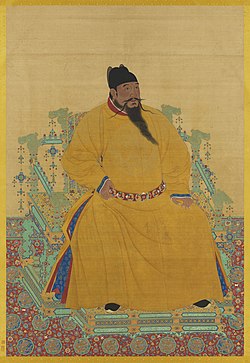
Yongle Emperor
View on Wikipedia
The Yongle Emperor (2 May 1360 – 12 August 1424), personal name Zhu Di,[vi] was the third emperor of the Ming dynasty, reigning from 1402 to 1424. He was the fourth son of the Hongwu Emperor, the founder of the dynasty.
Key Information


In 1370, Zhu Di was granted the title of Prince of Yan. By 1380, he had relocated to Beijing and was responsible for protecting the northeastern borderlands. In the 1380s and 1390s, he proved himself to be a skilled military leader, gaining popularity among soldiers[3] and achieving success as a statesman. In 1399, he rebelled against his nephew, the Jianwen Emperor, and launched a civil war known as the Jingnan campaign, or the "campaign to clear away disorders". After three years of intense fighting, he emerged victorious and declared himself emperor in 1402.
The Yongle Emperor's reign is often referred to as the "second founding" of the Ming dynasty, as he made significant changes to his father's political policies.[4] Upon ascending the throne, he faced the aftermath of a civil war that had devastated the rural areas of northern China and weakened the economy due to a lack of manpower. In order to stabilize and strengthen the economy, the Emperor first had to suppress any resistance. He purged the state administration of supporters of the Jianwen Emperor as well as corrupt and disloyal officials. The government also took action against secret societies and bandits. To boost the economy, the Emperor promoted food and textile production and utilized uncultivated land, particularly in the prosperous Yangtze Delta region. Additionally, he made the decision to elevate Beijing to a second capital in 1403, reducing the significance of Nanjing. The construction of the new capital, which took place from 1407 to 1420, employed hundreds of thousands of workers daily. At the heart of Beijing was the official Imperial City, with the Forbidden City serving as the palace residence for the Emperor and his family.[5] The Emperor also oversaw the reconstruction of the Grand Canal, which was crucial for supplying the capital and the armies in the north.
The Emperor was a strong supporter of both Confucianism and Buddhism. He supported the compilation of the massive Yongle Encyclopedia by employing two thousand scholars. This encyclopedia surpassed all previous ones, including the Four Great Books of Song from the 11th century. He also ordered the texts of the Neo-Confucians to be organized and used as textbooks for training future officials. The civil service examinations, held in a three-year cycle, produced qualified graduates who filled positions in the state apparatus. While the Emperor was known for his strict punishments for failures, he was also quick to promote successful servants.[6] Unlike his father, he did not engage in frequent purges. This led to longer tenures for ministers and a more professional and stable state administration. The Emperor primarily ruled "from horseback", traveling between the two capitals, similar to the Yuan emperors. He also frequently led military campaigns into Mongolia.[7] However, this behavior was opposed by officials who felt threatened by the growing influence of eunuchs and military elites, who relied on imperial favor for their power.[7]
The Emperor also made significant efforts to strengthen and consolidate the empire's hegemonic position in East Asia through foreign policy. Diplomatic messages and military expeditions were sent to "all four corners of the world". Missions were sent to countries near and far, including Manchuria, Korea, Japan, the Philippines, and the Timurid Empire in Central Asia. Zheng He's voyages even reached the shores of Southeast Asia, India, Persia, and East Africa. A major threat to the security of the empire was posed by the Mongols, who were divided into three groups—the Uriankhai in the southeast were mostly loyal, while the eastern Mongols and western Oirats were problematic. Ming China alternately supported and opposed them. The Emperor personally led five campaigns into Mongolia, and the decision to move the government from Nanjing to Beijing was motivated by the need to keep a close eye on the restless northern neighbors.
The Yongle Emperor was a skilled military leader and placed great emphasis on the strength of his army, but his wars were ultimately unsuccessful. The war in Jiaozhi (present-day northern Vietnam), which began with an invasion in 1407, lasted until the end of his reign. Four years after his death, the Ming army was forced to retreat back to China. Despite his efforts, the campaigns against the Mongols did not significantly alter the balance of power or ensure the security of the northern border.[8]
Early years
[edit]Childhood
[edit]

Zhu Di, the future Yongle Emperor, was born on 2 May 1360 as the fourth son of Zhu Yuanzhang. At the time, Zhu Yuanzhang was based in Nanjing and was a prominent leader in the Red Turban Rebellion, an uprising against the Mongol-led Yuan dynasty that controlled China. The rebellion aimed to restore Han Chinese rule after decades of Mongol domination. In the 1360s, Zhu Yuanzhang conquered China, established the Ming dynasty, and declared himself emperor.[9] He is commonly known by his era name as the Hongwu Emperor.[10]
After taking the throne, Zhu Di claimed to be the son of Zhu Yuanzhang's primary wife, Lady Ma, who had been empress since 1368, but other sources suggest that his real mother was a concubine of the Hongwu Emperor with the title Consort Gong, who was either Mongolian (from the Khongirad tribe)[11] or possibly Korean.[12] Zhu Di attempted to present himself as the Hongwu Emperor's legitimate successor by declaring himself and the Hongwu Emperor's fifth son, Zhu Su, as the only sons of Empress Ma in the 1403 edition of the official Veritable Records of Emperor Taizu.[vii] This was preposterous, as it was unlikely that a son of the empress would not be named as successor during the Hongwu Emperor's lifetime. Therefore, in the later version of 1418, all of the Hongwu Emperor's eldest five sons were recognized as her children.[14]
Zhu Di spent his childhood in Nanjing, where he and his siblings were raised with a strong emphasis on discipline and modesty. Out of all his siblings, he had a special fondness for Princess Ningguo, Zhu Fu and Zhu Su. Zhu Su was only 15 months younger than Zhu Di, and they became close friends despite their contrasting personalities. While Zhu Di enjoyed activities such as archery and horseback riding, Zhu Su preferred studying literature and tending to plants.[15]
The Hongwu Emperor took great care in the education of his sons, appointing leading scholars of the empire as their tutors. Initially, Song Lian was appointed as the teacher for the heir to the throne, and also gave lectures to the other princes. Song Lian's successor, Kong Keren (孔克仁), who taught the Emperor's sons philosophy and ethics, had a significant influence on Zhu Di. His favorite subject was the history of the Han dynasty, particularly the emperors Gaozu and Wu of Han, but he later often referenced examples from the life of Qin Shi Huang in his decrees.[16]
Youth
[edit]On 22 April 1370, the Emperor's sons, with the exception of the heir to the throne, were granted princely titles. Zhu Di was given the title of Prince of Yan, with his fief located in Beiping (present-day Beijing).[17] During the Mongol-led Yuan dynasty, Beiping served as the capital of China. After being conquered by the Ming dynasty in 1368, it became a crucial stronghold for the troops guarding the northern border and was also designated as the capital of the province with the same name.[18]
At that time, Zhu Di was given his own household, with advisor Hua Yunlong[viii] and tutor Gao Xian at its head. Gao Xian spent the next four to five years lecturing him on Confucian classics, history, agriculture, and irrigation. He also trained the prince in poetry and prose writing, and explained the rules of governance and the selection of subordinates. After Hua's death and Gao's dismissal, Fei Yu, Qiu Guang, Wang Wuban, and Zhu Fu took over Zhu Di's education.[19][ix] Despite receiving a comprehensive education from esteemed teachers, Zhu Di's true passion always lay in military pursuits rather than scholarly pursuits and palace discussions.[21]

In early 1376, Zhu Di married Lady Xu, the daughter of Xu Da, who was ranked first among all of the early Ming generals. She was two years younger than him.[21] Lady Xu was known for her intelligence, decisiveness, and energy. Their first son, Zhu Gaochi, was born on 16 August 1378.[22] The couple had two more sons, Zhu Gaoxu and Zhu Gaosui.[23]
A few weeks after his wedding, Zhu Di traveled to Fengyang (then known as Zhongdu—the Central Capital) where he underwent seven months of military training alongside his elder brothers Zhu Shuang and Zhu Gang. Two years later, he returned to Fengyang with his younger brothers Zhu Su, Zhu Zhen and Zhu Fu, and stayed for an additional two years. During this time, he not only trained in command and combat, but also gained knowledge in logistics and the acquisition and transportation of materials and supplies for warfare. It was during this period that his organizational skills began to emerge, which he later utilized effectively in his battles. He also took the opportunity to disguise himself as a regular soldier and immerse himself in the lives of ordinary people. Looking back, he considered his time in Fengyang to be the happiest days of his life.[24]
In 1376, Li Wenzhong, the nephew and adopted son of the Hongwu Emperor, who was responsible for defending the north, was given the responsibility of preparing Zhu Di's palace in Beiping. He utilized the former palaces of the Yuan emperors, providing Zhu Di with a larger and more fortified residence compared to his brothers, some of whom resided in converted temples or county offices. General Li also focused on fortifying the city, a decision that would have consequences during the civil war when his son, Li Jinglong, unsuccessfully attempted to besiege Beiping in 1399.[25]
Prince of Yan in Beiping
[edit]In April 1380,[26] at the age of twenty, Zhu Di moved to Beiping. He encountered a strong Mongolian influence, which the government tried to suppress by banning Mongolian customs, clothing, and names.[27] The city had recovered from the famine and wars of the 1350s and 1360s and was experiencing growth. Along with the hundreds of thousands of soldiers stationed in the region, the city was also home to officials administering the province, as well as artisans and laborers from all over the country. The main concern of the local authorities was providing enough food for the population. Peasants were relocated to the north, soldiers and convicts were sent to cultivate the land, and merchants were granted licenses to trade salt in exchange for bringing grain to the region.[18][x] The government also transported food supplies to the city.[27]
Zhu Di's interest in the military was put into practice when he personally trained his own guard.[27] He used his detachments as a means of balancing the power of the provincial commander, who was unable to mobilize troops without authorization from the emperor and approval from the prince. Meanwhile, Zhu Di had the freedom to train and deploy his own guard.[28][29] In 1381, he had his first experience in the field when he joined his father-in-law Xu Da's campaign against the Mongols, led by Nayur Buqa.[27]
In the 1380s, Zhu Di served in border defense under the leadership of Xu Da. After Xu Da died in 1385, his deputy Fu Youde took over leadership. In 1387, Zhu Di participated in a successful attack on the Mongols in Liaodong, led by Feng Sheng. The following year, a Ming army led by Lan Yu made a foray into eastern Mongolia and defeated the Mongol khan Tögüs Temür, capturing many prisoners and horses, but both generals were accused of mistreating captives and misappropriating booty, which the prince reported to the Emperor.[30]
In January 1390, the Emperor entrusted his sons with independent command for the first time. He gave the princes of Jin (Zhu Gang), Yan (Zhu Di), and Qi (Zhu Fu) the task of leading a punitive expedition against the Mongol commanders Nayur Buqa and Alu Temür, who were threatening Shanxi and Gansu. Zhu Di demonstrated excellent command skills when he defeated and captured both Mongol commanders in battle. They then served under him with their troops.[31] The Emperor appreciated Zhu Di's success, which contrasted with the hesitancy of Zhu Gang. Zhu Di continued to lead armies into battle against the Mongols repeatedly and with great success.[32]

In 1392, the Emperor's eldest son and heir to the throne, Zhu Biao, died, and the court then discussed who would succeed Zhu Biao. The primogeniture viewpoint advocated by scholars from the Hanlin Academy and high officials prevailed, and the Emperor appointed Zhu Biao's son, Zhu Yunwen, as the new successor. Generals Feng Sheng, Fu Youde, and Lan Yu (who were related to the successor by blood) were chosen as his tutors and teachers,[33] but due to a recommendation from Zhu Di, the Hongwu Emperor began to suspect the three generals of treason.[34] Zhu Di did not have a good relationship with Lan Yu, and according to historian Wang Shizhen (王世貞; 1526–1590), he was responsible for Lan's execution in March 1393. The other two generals also died under unclear circumstances at the turn of 1394 and 1395. In their place, princes were appointed. For example, in 1393, Zhu Gang was given command of all the troops in Shanxi province, and Zhu Di was given command in Beiping province.[34] Additionally, Zhu Shuang, Prince of Qin, was in charge of Shaanxi, but he died in 1395.[35]
The Hongwu Emperor, who was deeply affected by the death of his two eldest sons and the strained relations between his remaining sons and his heir, made the decision to revise the rules governing the imperial family for the fourth time.[36] The new edition significantly limited the rights of the princes.[xi] These changes had little impact on Zhu Di's status as they did not affect his main area of expertise—the military.[38] Furthermore, Zhu Di was cautious not to give any reason for criticism. For example, he did not object to the execution of his generals Nayur Buqa and Alu Temür, who were accused of treason. He also exercised caution in diplomatic relations, such as when he welcomed Korean delegations passing through Beiping, to avoid any indication of disrespect towards the emperor's authority.[38]
Out of the six princes[xii] responsible for guarding the northern border, Zhu Di was the second oldest but also the most capable. He had operated in a vast territory, stretching from Liaodong to the bend of the Yellow River. He was not afraid to take risks, as demonstrated by his defeat of the Mongols led by Polin Temür at Daning in the summer of 1396.[39] He also went on a raid with his brother Zhu Gang several hundred kilometers north of the Great Wall, which earned them a sharp reprimand from their father.[40] In April 1398, Zhu Gang died, leaving Zhu Di as the undisputed leader of the northern border defense.[41] Two months later, Zhu Di's father also died.[42]
Rise to power
[edit]Conflict with the Jianwen Emperor
[edit]After the death of the Hongwu Emperor, Zhu Yunwen ascended the throne as the Jianwen Emperor.[43] His closest advisors immediately began reviewing the Hongwu Emperor's reforms, with the most significant change being an attempt to limit and eventually eliminate the princes who were the sons of the Hongwu Emperor and controlled a significant portion of the empire's military power.[44] The government employed various methods to remove five of the princes,[xiii] including exile, house arrest, and even driving them to suicide.[45]
Zhu Di was considered the most dangerous of all the princes.[46] As an experienced military leader and the oldest surviving son of the Hongwu Emperor, he posed a significant threat to the government. As a result, they treated him with caution and limited his power. They replaced military commanders in the northeast with generals loyal to the Jianwen Emperor and transferred 15,000 men under Zhu Di's command outside of Beiping.[47] Despite this, Zhu Di managed to convince the Emperor of his loyalty. He even asked for mercy for his brother Zhu Su[45] and begged for permission to have his sons, who had been staying in Nanjing since the funeral of the Hongwu Emperor, returned to him. The government had been holding them as hostages as a precautionary measure.[12] In June 1399, the Emperor's advisor, Huang Zicheng, convinced him that releasing Zhu Di's sons would help to ease tensions.[47]
In early August 1399, Zhu Di used the arrest of two of his officials as a pretext for rebellion.[48] He claimed that he was rising up to protect the Emperor from the corrupt court officials. With the support of Beijing dignitaries,[xiv] he gained control of the city's garrison and occupied the surrounding prefectures and counties.[49] He attempted to justify his actions through letters sent to the court in August and December 1399, as well as through a public statement.[48]
In his letters and statements, Zhu Di repeatedly asserted that he had no desire for the throne, but as the eldest living son of the deceased emperor, he felt a duty to restore the laws and order that had been dismantled by the new government. He explained that this was out of respect for his late father. He also accused the current emperor and his advisors of withholding information about his father's illness and preventing him from attending the funeral. Furthermore, he condemned their unjust treatment of the Emperor's uncles, who were his own younger brothers. He justified his actions as necessary self-defense, not against the Emperor himself, but against his corrupt ministers. He referred to these actions as the Jingnan campaign, a campaign to clear away disorders.[48]
Civil war
[edit]
At the start of the war, Zhu Di commanded a force of 100,000 soldiers and only held control over the immediate area surrounding Beiping. Despite the Nanjing government's larger number of armies and greater material resources, Zhu Di's soldiers were of higher quality and he possessed a strong Mongol cavalry. Most importantly, his military leadership skills were superior to the indecisiveness and lack of coordination displayed by the government's generals.[50]
In September 1399, a government army of 130,000 soldiers, led by the experienced veteran general Geng Bingwen, marched towards Zhending, a city located southwest of Beiping, but by the end of the month, they were defeated. In response, the court appointed a new commander, Li Jinglong, who then led a new army to besiege Beiping on 12 November.[50] Zhu Di, who had been gathering troops in the northeast, swiftly returned and defeated the surprised Li army. The soldiers from the south, who were not accustomed to the cold weather, were forced to retreat to Dezhou in Shandong.[51]
In 1400, Zhu Di's army fought in the southern part of Beiping province and northwestern Shandong, with varying levels of success. In the spring, he led a successful attack into Datong, defeating Li Jinglong near Baoding in May and outside Dezhou in June, but due to concerns about potential enemy reinforcements, Zhu Di ended the siege of Jinan in September and retreated to Beiping. Li Jinglong's lackluster performance led the government to appoint Sheng Yong as the new commander of the counterinsurgency army.[51]
In 1401, Zhu Di attempted to weaken the enemy by attacking smaller units, which disrupted the supply of government troops. Both sides then focused on breaking through along the Grand Canal. In January, Zhu Di suffered a defeat at Dongchang, but in April he was victorious at Jia River. The front continued to move back and forth for the rest of the year.[52]

In 1402, instead of launching another attack along the Grand Canal, Zhu Di advanced further west and bypassed Dezhou. He then conquered Xuzhou in early March. The government troops retreated south to Zhili and were repeatedly defeated. In July, the rebels reached the north bank of the Yangtze River. The commander of the government fleet defected to Zhu Di's side, allowing the rebel army to cross the river without resistance and advance on Nanjing.[53] Due to the betrayal of Li Jinglong and Zhu Hui, Zhu Di's younger brother, the capital city was captured on 13 July 1402, with little resistance. During the clashes, the palace was set on fire, resulting in the deaths of the Emperor, his empress, and his son.[54]
Accession to the throne
[edit]On 17 July 1402, Zhu Di ascended the throne, officially succeeding his father. Even as late as the summer of 1402, the new emperor was still dealing with the Jianwen Emperor's followers, who denied the legitimacy of Zhu Di's rule. He responded by erasing the Jianwen Emperor's reign from history. This included abolishing the Jianwen era and extending the Hongwu era until the end of 1402.[54] He then adopted Yongle ("perpetual happiness") as his own era name.[55] He abolished the reforms and laws implemented by the Jianwen government, restored the titles and privileges of the princes, and destroyed government archives (with the exception of financial and military records).[56] He also attempted to involve respected supporters of the Jianwen Emperor, such as Fang Xiaoru and Liu Jing (劉璟), in his administration, but they refused and were subsequently executed.[57] Similarly, officials Huang Zicheng and Qi Tai were executed, along with their family members, teachers, students, and followers. Many others were imprisoned or deported to the border, resulting in a purge that affected tens of thousands of people.[58]
After the Yongle Emperor ascended to the imperial throne, the Veritable Records of Emperor Taizu were rewritten. The original version, created in 1402 at the court of the Jianwen Emperor, was deemed unacceptable by the new regime. In late 1402, the authors of the original version began to revise their work, completing it in July 1403, but the Emperor was dissatisfied with the revised version and in 1411, he ordered a new version to be prepared. This new version was completed in June 1418, and changes focused primarily on his claim to the throne. It included claims that he was the son of Empress Ma, that the Hongwu Emperor had considered appointing him as successor, that he was to be the regent of the Jianwen Emperor, and that he was an exceptionally talented military leader who was highly favored by his father.[59]
Administration
[edit].jpg)
In contrast to the frequent changes in offices during the Hongwu Emperor's reign, the high levels of the Yongle Emperor's administration remained stable.[60] While the Emperor did occasionally imprison ministers, the mass purges seen in the Hongwu era did not occur again. Eunuchs and generals oversaw the most significant political matters, while officials were responsible for managing finances, the judiciary, and routine tasks. As a result, the atomization of administration that was characteristic of the Hongwu Emperor's rule diminished, allowing the Emperor to focus less on routine details.[61][xv]
The political influence of the bureaucratic apparatus gradually increased, and under the Yongle Emperor's rule, ministers were able to challenge the emperor, even at the cost of their freedom or lives. The most significant change was the emergence of the Grand Secretariat, which played a crucial role in the politics of the Yongle Emperor's successors. Led by the grand secretaries, officials gained control of the government.[64]
Princes and generals
[edit]The Emperor restored the titles of the princes of Zhou, Qi, and Min, which had been abolished by the Jianwen Emperor, but these titles did not come with the same power and authority as before.[65] During the latter half of his reign, the Yongle Emperor accused many of these princes of committing crimes and punished them by removing their personal guards. He had previously condemned the same actions when they were carried out by the Jianwen Emperor.[66] In order to reduce political threats, the Yongle Emperor relocated several border princes from the north to central and southern China.[xvi] By the end of his reign, the princes had lost much of their political influence.[65]
One of the Yongle Emperor's first actions upon assuming the throne was to reorganize the military command. He promoted loyal generals and granted them titles and ranks. In October 1402, he appointed two dukes (gong; 公)—Qiu Fu and Zhu Neng (朱能), thirteen marquises (hou; 侯), and nine counts (bo; 伯). Among these appointments were one duke and three counts from the dignitaries who had defected to his side before the fall of Nanjing—Li Jinglong, Chen Xuan (陳瑄), Ru Chang (茹瑺), and Wang Zuo (王佐). In June 1403, an additional nine generals from the civil war were appointed as marquises or counts. In the following years, meritorious military leaders from the campaign against the Mongols were also granted titles of dukes, marquises, and counts, including those of Mongolian origin.[67]
The Emperor established a new hereditary military nobility. While their income from the state treasury (2200–2500 dan of grain for dukes, 1500–800 for marquises, and 1000 for counts; with 1 dan being equivalent to 107 liters) was not particularly high, the prestige associated with their titles was more significant. They commanded armies in the emperor's name, without competition from the princes who had been stripped of their influence. The nobility also held immunity from punishment by local authorities, but there were notable differences from the Hongwu era. During that time, the generals, who were former comrades-in-arms of the emperor, held a higher status, had their own followers, and wielded considerable power in their assigned areas. This eventually posed a threat to the emperor, leading to their elimination. Under the Yongle Emperor, members of the nobility did not participate in regional or civil administration, nor were they assigned permanent military units. Instead, they were given ad hoc assembled armies. Additionally, the Emperor often personally led campaigns accompanied by the nobility, strengthening their personal relationships.[68] As a result, the military nobility was closely tied to the Emperor and remained loyal. There was no need for purges, and any isolated cases of punishment were due to the failures and shortcomings of those involved. Overall, the nobility elevated the Emperor's prestige and contributed to the military successes of his reign.[69]
Officials and authorities
[edit]The grand secretaries during the reign of the Yongle Emperor, from 1402 to 1424. The first two were appointed in August and September 1402, while the rest were appointed shortly thereafter.[63]
- Xie Jin, to 1407 (transferred to Guangxi);
- Huang Huai, to 1414 (imprisoned);
- Hu Guang, to 1418 (died in office);
- Yang Rong, to 1440 (died in office);
- Yang Shiqi, to 1444 (died in office);
- Jin Youzi, to 1431 (died in office);
- Hu Yan, to 1404 (transferred to the head of the Imperial University).
The Grand Secretariat was headed by Huang Huai briefly in 1402, followed by Xie Jin, and then by Hu Guang from 1407 until his death in 1418. Yang Rong then took over until the end of the Yongle Emperor's reign.[70]
The Emperor reorganized the civilian administration, gaining the support of officials who had often served under the previous government. He restored the administrative structure of the Hongwu era, while also making some changes. First and foremost, in 1402, the Grand Secretariat was created to act as an intermediary between the emperor and the government, partially replacing the Central Secretariat that had been abolished in 1380. Despite their informal position, the grand secretaries quickly gained dominance in the civil administration.[69]
The Grand Secretariat was established in August 1402, when the Emperor began to address current administrative issues during a working dinner with Huang Huai and Xie Jin after the evening audience. In September 1402, he appointed five additional grand secretaries.[71] These grand secretaries were all from the south or southeast[xvii] and were highly educated and skilled in administration, having previously served in lower positions in the Jianwen administration. Despite their relatively low status (at most fifth rank), they were given high titles in the household of the heir apparent. Over time, they evolved from subordinate assistants responsible for organizing correspondence and formulating responses to becoming influential politicians who proposed solutions to problems. Their close proximity to the emperor gave them an advantage over the ministers. The Emperor kept his grand secretaries with him, and some even accompanied him on his Mongol campaigns. During this period, the empire was governed by the heir to the throne with the assistance of other grand secretaries and selected ministers.[73] The heir developed a close relationship with the grand secretaries and became the de facto representative of the officials.[64]
The Yongle Emperor was meticulous in his selection of the top officials for the state apparatus, including the members of the Grand Secretariat and the ministers. He placed particular trust in those who had served him during the civil war, such as Jin Zhong (金忠), Guo Zi, Lü Zhen (呂震), and Wu Zhong (吳中).[74] These ministers came from all over China, but were all highly educated and capable administrators. Among them, Minister of Revenue Xia Yuanji was the most trusted by the Emperor. Xia advocated for moderation in spending and using resources for the benefit of the population, which earned him the Emperor's respect for his honesty and transparency.[75] Xia held this position for nineteen years until 1421, when he, along with Minister of Justice Wu Zhong and Minister of War Fang Bin, protested against the costly campaign into Mongolia. Despite their objections, the Emperor ultimately prevailed and Fang committed suicide, while Wu and Xia were imprisoned. After the Yongle Emperor's death, they were exonerated and returned to their positions of authority. Other long-serving ministers overseeing various ministries included Jian Yi (蹇義), Song Li (宋禮), and Liu Quan (劉觀).[76]
Throughout most of the Yongle Emperor's reign, the leadership of four out of the Six Ministries (Personnel, Revenue, Rites, and Works) showed remarkable stability, with the same individual ministers typically heading each respective office for extended periods. Continuity in the highest offices persisted even after the Emperor's death, as many ministers continued to serve in their positions.[76]
The regular cycle of civil service examinations also contributed to the improvement and stabilization of administration at lower levels. In the second decade of the Yongle Emperor's reign, the examinations were held every three years.[64] A total of 1,833 individuals passed the examinations in the capital,[77] and the majority of these graduates were appointed to government positions. The Imperial University, which was previously responsible for selecting officials, lost its significance and became a place for candidates to study for the palace examinations.[78] By the end of the Yongle Emperor's reign, the Ministry of Personnel had a sufficient number of examination graduates to fill important positions at the county level and above. Overall, the administration became more qualified and stable.[77]
Eunuchs
[edit]The Yongle Emperor relied heavily on eunuchs, more so than his father did. He even recruited eunuchs from the Jianwen era, with whom he had been associated during the civil war. These eunuchs came from various backgrounds, including Mongolian, Central Asian, Jurchen, and Korean. In addition to their duties within the Forbidden City, the Yongle Emperor trusted their unwavering loyalty and often assigned them tasks outside the palace's walls, such as surveillance and intelligence gathering.[77]
Eunuchs also held positions of military command and led diplomatic missions, but their role as the emperor's secret agents, responsible for monitoring both civilian and military officials, was well-known but also unpopular and feared. While they were known for exposing corrupt officials, they also had a reputation for abusing their power and succumbing to corruption themselves. In 1420, a special investigation office was established, informally known as the "Eastern Depot" due to its location in the palace. This office was responsible for overseeing the judiciary, but it became infamous for its role in the disappearance of individuals. Stories of innocent imprisonment, torture, and unexplained deaths involving the office circulated until the end of the dynasty.[79]
Succession disputes
[edit]The Yongle Emperor had four sons, the first three by Empress Xu, while the fourth, Zhu Gaoxi, died in infancy. The eldest son, Zhu Gaochi, was not physically fit and instead of warfare, he focused on literature and poetry. The second son, Zhu Gaoxu, was tall and strong, a successful warrior, but the third son, Zhu Gaosui, was mediocre in character and ability.[23]
Many influential officials, including General Qiu Fu, suggested that Zhu Gaoxu should be the heir to the throne. They argued for his prowess and military skills, citing his past actions of saving his father from danger and turning the tide of battles during the civil war. Grand Secretary Xie Jin disagreed and argued that the people would admire Zhu Gaochi for his humanity. He also reminded the Emperor of the future accession of Zhu Zhanji, the Emperor's favorite grandson and Zhu Gaochi's eldest son. Ultimately, the Emperor designated Zhu Gaochi as heir to the throne on 9 May 1404, and appointed Qiu Fu as his tutor the following day.[23]
At the same time, the Emperor appointed Zhu Gaoxu as the Prince of Han and entrusted him with control of Yunnan. Zhu Gaosui became the Prince of Zhao, based in Beijing. Zhu Gaoxu refused to go to Yunnan, and his father gave in to his wishes, which allowed him to provoke conflicts with his older brother. In the spring of 1407, Zhu Gaoxu succeeded in slandering Xie Jin, who was accused of showing favoritism towards Jiangxi natives in the examinations. As a result, Xie was transferred to the province and later imprisoned.[80] In 1414, Grand Secretaries Huang Huai and Yang Shiqi were accused of not observing proper court ceremony, and both were imprisoned for their support of the Heir Apparent. Yang was soon released, but Huang remained in prison until the end of the Yongle era. In 1416, Zhu Gaoxu was given a new fief in Qingzhou Prefecture in Shandong. Once again, he refused to leave, which led his father to reprimand him. He then began to raise his own army and even had an army officer killed. As a result, his father stripped him of his titles, demoted him to a common subject, and later imprisoned him. The following year, he was deported to Shandong.[81]
Military
[edit].jpg)
During the Yongle Emperor's reign, the military underwent significant changes. He implemented four major reforms, including the abolition of the princely guards (huwei; 護衛), the relocation of the majority of the capital guards (jingwei; 京衛) from Nanjing to Beijing, the establishment of the capital training camps (jingying; 京營), and the reorganization of the defenses along the northern border.[82]
The Emperor reorganized the Embroidered Uniform Guard (Jinyiwei), which was responsible for carrying out secret police duties. Its main focus was handling politically sensitive cases, such as investigating members of the imperial family, but there were instances of corruption and abuse of power within the organization, most notably the case of Ji Gang (紀綱). Ji Gang, who had been the Emperor's favorite during the civil war, was eventually accused of plotting against the throne and executed in 1416. By 1420, the Embroidered Uniform Guard had been overshadowed by the Eastern Depot, which also conducted investigations on its officers.[79]
The abolition of the princes' armies was a logical decision. The Yongle Emperor's military strength as the Prince of Yan played a crucial role in his rise to the throne, and he was determined to prevent history from repeating itself. The existing princely guards were mostly integrated into the regular army, and although the Yongle Emperor's sons had played an active and successful role in the civil war, they were not given command of the armies after it ended. Instead, the Emperor himself or dependable generals led campaigns.[66]
One significant and permanent step taken during this time was the relocation of a large portion of the army to the Beijing area. As the capital moved to Beijing, the majority of the 41 guard units[xviii] of the Nanjing garrison also made the move.[66] Among the troops stationed in Beijing were 22 guard units of the Imperial Guard (qinjun; 親軍), totaling 190,800 men.[83] This included the original three guard units of Zhu Di's princely guard.[66] Overall, approximately 25–30% of the Ming army (74 guard units in the mid-1430s) was now concentrated in and around Beijing, with a total strength of over two million men under the Yongle Emperor's reign.[84] As a result, soldiers and their families made up a significant portion of the population in the Beijing area.[xix] To oversee the remaining guard units in and around Nanjing, a military commander position was established, often filled by eunuchs.[85]
After the second campaign in Mongolia, the Emperor made the decision to enhance the training of his soldiers. He established the capital training camps, known as the Three Great Camps (Sandaying), in the vicinity of Beijing. In 1415, he issued a decree requiring all guards in the northern provinces and the southern metropolitan area to send a portion of their troops to these camps for training. The camps were specifically designed for the training of infantry, cavalry, and units equipped with firearms. Each camp was under the leadership of a eunuch and two generals.[84] The Emperor placed great emphasis on the importance of cavalry in successful combat in the steppe. As a result, the number of horses in the army significantly increased from 37,993 in 1403 to 1,585,322 in 1423.[86]
At the beginning of the Yongle Emperor's reign, the defense system on the northern border was reorganized. Under the Hongwu Emperor, the defense of the north was organized in two lines. The first, the outer line, consisted of eight garrisons located in the steppe close to the border. These garrisons served as bases for forays into Mongolian territory. The second line of defense was along the later Great Wall.[87] This strategic placement allowed for the prevention of Mongol raids even in the steppe. In the Yongle era, the outer line was abandoned[88][87][xx] with the exception of the garrison in Kaiping.[87][xxi] The Emperor then resettled loyal Uriankhai Mongols on the vacated territory.[89]
The border troops along the northern borders were placed under the authority of nine newly established border regional commands.[88] These commands were under the control of provincial military commanders (zongbing guan; 總兵官) and were located in Liaodong, Jizhou, Xuanfu, Datong, Shanxi, Yansui, Guyuan (in Shaanxi), Ningxia, and Gansu. Unlike in the Hongwu era, the soldiers stationed on the border were not from nearby guards, but were instead from the three capital training camps. The commanders of these areas were chosen from officers of the inland garrisons or higher commands.[90][xxii] By the end of the Yongle era, there were 863,000 soldiers stationed in garrisons along the northern border.[86]
The withdrawal to the Great Wall was a significant decline in security, as evidenced by later Ming officials debating the occupation of Ordos. The main fortress of the inner line, Xuanfu, was vulnerable to Mongol attacks after the withdrawal. Under the Yongle Emperor, however, the negative effects of the withdrawal were overshadowed by Ming power and strength. After his death, the Chinese did not make any attempts to reclaim the steppe for the rest of the Ming dynasty.[87]
The navy was not a separate branch of the army; only the coastal guards had ships. By 1420, there were approximately 1,350 small patrol ships and an equal number of large warships scattered among the coastal garrisons. The Nanjing fleet consisted of 400 warships, 400 cargo ships manned by soldiers from Nanjing garrison guards, who were trained for naval combat (four of the ten Nanjing guards had "naval" names), and 250 treasure ships and other ships used for long-distance voyages.[91]
Economy
[edit]Population, agriculture, and crafts
[edit]Around 1400, the Ming dynasty had a population of 90 million.[92] During the early 15th century, the weather was more stable and warmer compared to before and after. This favorable climate allowed for rich harvests, making agriculture the foundation of the country's prosperity. Although there were occasional local disasters such as epidemics or floods, they did not significantly alter the overall situation.[4] The government provided assistance to affected regions from state reserves.[92]
The Yongle Emperor recognized that the most effective way to ensure his own rule and that of his descendants was by supporting the peasants. For example, in 1403, when the crops were destroyed by a locust invasion in Henan, he took the initiative to organize relief efforts for the affected population. He also punished negligent officials and rejected the suggestion of Minister of Revenue Yu Xin (郁新) to punish officials who were unable to collect taxes in full. The Emperor argued that the root of the problem was the natural disaster, not the officials.[93] In 1404, when he was informed of the increase in silk production in Shandong, he responded that he would not be satisfied until there was enough food and clothing for everyone in the empire, ensuring that no one suffered from hunger or cold.[94]
The northern provinces were impoverished and unproductive, and their local army and administration had become reliant on importing rice from the south during the Hongwu era. The relocation of the capital to Beijing resulted in an increase in the number of soldiers, officials, artisans, and laborers, exacerbating the issue.[95] In response, the government attempted to resettle people from the densely populated south to the north, but the southerners struggled to adapt to the harsh northern climate and many returned to their homes.[96] By 1416, the government had abandoned this forced resettlement policy and instead implemented a strategy of supporting local development.[97] As part of this, the government began selling salt trading licenses to merchants in exchange for rice deliveries to the north.[95][xxiii] On the other hand, the influx of impoverished immigrants from other parts of north China resulted in an increase in cultivated land and the production of agricultural and textile goods. This also led to the establishment of foundries in Zunhua, located in Hebei.[96]
Finance and currency
[edit]The Yongle Emperor was less frugal than his father, as his reign saw significant spending on foreign expansion (such as wars in Jiaozhi and Mongolia, and naval voyages) and internal politics (such as the construction of a new capital and the restoration of the Grand Canal).[99][100] This resulted in a significant increase in state spending, which doubled or even tripled compared to the Hongwu era,[100] but the exact size of this spending is difficult to determine as there was no official state budget and each source of income was allocated to cover specific expenses.[101] The government attempted to generate revenue by issuing paper money and demanding more grain from hereditary soldiers, but these measures were not enough to solve the fiscal problems. In some areas, taxes were even reduced, but the state still managed to meet its needs through requisitions and an increase in the work obligation.[100] As a result of these financial challenges, the state's reserves, which were typically equivalent to one year's income during the Ming period, reached a record low under the Yongle Emperor's rule.[102]

The economic growth was supported by the government's expansion of precious metal mining, particularly copper and silver, in southern China and Jiaozhi.[103] The government also increased the emission of paper money (banknotes, baochao). Revenues from silver mining, which previously accounted for only 30% of output, rose significantly from 1.1 tons in 1390 to over 10 tons in 1409, and remained at this level for the rest of the Yongle Emperor's reign.[104] The government also produced coins from the mined copper, which were stored in state treasuries and given as gifts to foreign embassies, but these coins continued to circulate on the domestic market alongside the baochao, in contrast to the Xuande and Zhengtong eras (1425–1447) when they were removed from circulation under government pressure.[105]
Like his father, the Yongle Emperor believed that banknotes were the foundation of currency. In order to cover the deficit caused by expensive foreign policies and the relocation of the capital, he printed large volumes of these banknotes,[105] but this excessive printing led to inflation, the most severe in the Ming period.[106] By 1425, paper money was only worth 2% of its nominal value, causing the population to reject it. In an attempt to encourage its circulation, the government required fees to be paid with these banknotes, but this had little impact.[105] Additionally, the repeated bans on the use of silver in commercial transactions (in 1403, 1404, 1419, and 1425) were also unsuccessful.[106]
Officials and title holders were no longer solely compensated with grain, as the Hongwu Emperor's rules had originally intended. Instead, senior officials received only 60% of their salary in grain, while lower officials received a mere 20%. The remaining portion was paid in bills and coins. However, this method of payment using devalued banknotes resulted in a significant decrease in the already low salaries of these officials. As a result, many officials and officers resorted to seeking illegal sources of income.[95]
The Yongle Emperor, in particular, sought to increase income from military farms (juntun; 軍屯),[95] but the northern borderlands, home to most of the military units, were largely barren. In order to make up for the lack of resources, officers resorted to becoming landowners and using the labor of their soldiers, leading to desertion among the ranks.[99] Despite the government's efforts to control and increase production, the hereditary soldiers consistently delivered less each year. For example, their production dropped from 23 million dan of grain in 1403 to 14 million in 1407 and eventually to 5 million in 1423.[107]
Taxation and levies
[edit]Under the Yongle Emperor's reign, the amount of land tax collected was significantly higher than in previous decades, with a yield of 31–34 million dan of grain. In comparison, the land tax in 1393 was only 29.4 million dan.[108] The actual burden of the tax was also influenced by transportation costs and additional fees that were collected to cover them. In some cases, the tax was not collected in grain, but rather in silk and other commodities, based on calculations determined by the state. These calculations often did not reflect the current market prices, resulting in the tax being increased multiple times.[108]
The taxation in Jiangnan remained exceptionally high, with Suzhou and Songjiang prefectures supplying 14% of the empire's land taxes.[108] The residents of Jiangnan were not able to pay these high taxes, leading to a significant amount of arrears in the early 1430s. For example, Suzhou Prefecture alone had 8 million dan of grain in arrears. In response to this issue, the Xuande Emperor eventually reduced their taxes.[109]
Part of the materials and labor required for government construction projects were purchased using surpluses collected in state granaries, but these purchases were made at prices set by the state, which were lower than market prices.[110] As a result, the increased demands of the state had a significant impact on the population, primarily through the implementation of more and more extraordinary levies and the growth of compulsory work for the state. For example, the work duty of artisans, which was typically 30 days a year, was often extended for periods longer than a year.[100] Additionally, the cost of importing rice to Beijing fell on the peasants of the Yangtze River Delta. These taxpayers were responsible for supplying rice to southern port cities, from where it was then transported north by the army.[111] To cover these costs, a tax surcharge was imposed,[100][111] which had to be paid in money.[111] Both the sea route to the north and the inland route were expensive and inefficient, but the opening of the Grand Canal in 1415 greatly improved transportation conditions.[98] By 1418, taxpayers themselves were responsible for transporting rice all the way to Beijing. In 1431, the government relieved them of this duty and soldiers once again began to transport grain along the Grand Canal.[108]
In an effort to reduce the government's demands on its subjects and limit government spending, the Yongle Emperor's successors implemented reforms.[110] Despite these efforts, maintaining a large army and supplying Beijing continued to be a difficult task.[102]
Construction projects
[edit]New capital city
[edit]
The Yongle Emperor's most significant accomplishment was the relocation of the capital to Beijing. The idea of moving the capital from Nanjing (then known as Yingtian)[xxiv] to the north was first considered by the Hongwu Emperor in the early 1390s. Despite Nanjing's proximity to the empire's economic center in the Yangtze Delta, both the Hongwu and Yongle emperors faced the challenge of governing from a great distance from the empire's northern and western borders, which required a significant amount of attention. Additionally, as a foreigner in Nanjng, the Yongle Emperor likely felt more at home in Beijng, which served as his political base. Beijing was strategically located on the northern border,[113] accessible by the Grand Canal and in close proximity to the sea, making it a convenient location for supplies. Its history as the capital of the Liao, Jin, and Yuan dynasties also added to its significance.[114]
The relocation of the capital was a highly challenging undertaking that demanded a significant mobilization of both people and resources from all corners of the country to be transferred to the outskirts of the empire. The Emperor initiated the move of the capital in February 1403 by elevating Beijing to a secondary capital[114] and renaming it from Beiping (Pacified North) to Shuntian (Obedient to Heaven), but it was still commonly referred to as Beijing (Northern Capital).[115] He appointed his eldest son, Zhu Gaochi, to administer the city and province, and established branches of ministries and chief military commissions in Beijing. In 1404, he relocated 10,000 families from Shanxi to the city[114] and exempted it and the surrounding area from taxes for two years. The following year, over 120,000 landless households from the Yangtze Delta were relocated to the north,[116] and construction of government buildings began.[114] The government also began felling trees in the forests of Jiangxi, Huguang, Zhejiang, Shanxi, and Sichuan to provide wood for the palaces in Beijing. Artisans and laborers were sent from all over the country, but the work was slowed by supply issues.[117]
In March 1409, the Emperor arrived in the north for the first time in seven years,[56] following the end of the first Mongol campaign, but upon his arrival in Nanjing the following year, officials protested the excessive spending on construction in Beijing. As a result, spending was reduced and the pace of construction slowed for several years.[117]
_-_panorama.jpg)
From 1414 to the end of 1416, the Emperor remained in Beijing during the campaign in Mongolia. The reconstruction of the Grand Canal was completed in 1415, which greatly aided in the supply of the north. Construction then resumed at a faster pace.[117] The exact number of workers involved in building the city is unknown, but it is estimated to have been several hundred thousand.[118][xxv] The chief architects and engineers include Cai Xin (蔡信),[121][122] Nguyễn An (a Viet eunuch),[123] Kuai Xiang and Lu Xiang (陸祥).[121] By the end of 1417, most of the palaces were completed, but construction on the walls continued. In 1420, the city was deemed ready for the relocation of the government. On 28 October 1420, Beijing was officially declared the principal capital of the empire, and by February 1421, ministries and other government agencies had relocated to Beijing.[118]
In 1421, a famine broke out in the northern provinces.[124] At the same time, three major audience halls in the newly built Forbidden City were destroyed by fire. This event shook the Emperor, who saw it as a sign of displeasure from Heaven. In response, he called upon government officials to critique the mistakes of the government. One of the officials, a junior secretary named Xiao Yi, strongly criticized the decision to build the capital in the north and was subsequently executed. This effectively silenced any further discussion on the matter.[118]
The empire was administered by the Beijing authorities from 1421, although some ministries remained in Nanjing, but their powers were limited to the southern metropolitan area and held little political significance.[118] The cost of supplying Beijing, which was located far from the economically developed regions of the country, was a constant burden on the state treasury.[82]
Grand Canal
[edit]
During the centuries leading up to the Yongle Emperor's reign, the Grand Canal was neglected and partially disappeared.[xxvi] In the early years of the Yongle Emperor's rule, there were two routes for transporting rice to Beijing to feed the city's inhabitants and northern troops. The first route began at Liujiagang in the Yangtze Delta and went through the East China Sea to Tianjin, but this route was risky due to weather and pirates.[27] The second route, which went through the rivers and canals of Anhui, Shandong, and Hubei, was problematic because cargo had to be transferred multiple times.[125] Every year, 480,000 to 800,000 dan of rice were transported by sea, and even more was transported by inland waterways, with a total of 2 to 2.5 million dan delivered to the north in 1410–1414.[98] This slow and difficult transportation of rice put a heavy burden on the population. Local officials in Shandong petitioned the Emperor to improve transportation by restoring a continuous waterway from south to north, and the Emperor approved.[125] The government then sent 165,000 workers to reconstruct the waterway, and they built a system of fifteen locks in western Shandong.[5][125] After the reconstruction was completed in 1415, transportation became faster and cheaper.[98] In 1417 and 1418, the amount of rice shipped increased to 5 and 4.7 million dan, respectively, due to the Emperor's projects, before falling again to 2–3 million per year.[126] The transportation was provided by 160,000 soldiers with 15,000 ships,[119] and maintenance was carried out by 47,000 workers.[127] The opening of the Grand Canal led to the economic growth of the regions it passed through.[127][xxvii] It also resulted in the end of sea transportation of rice to the north, which caused a decline in naval shipbuilding.[128][xxviii]
The reopening of the Grand Canal had a positive impact on Suzhou. Its strategic location in the middle of the canal network south of the Yangtze (which was reconstructed after 1403)[129] allowed the city to regain its status as a major commercial hub and experience a return to prosperity after being deprived of it during the reign of the Hongwu Emperor. Meanwhile, Nanjing's political and economic influence declined, relegating it to a regional center, but it remained the foremost cultural center of the empire.[130]
Other projects
[edit]The Yongle Emperor completed the Xiao Mausoleum, where his father was buried. A grand Sifangcheng pavilion was constructed, featuring an eight-meter stele carried by a bixi turtle. The stele bore an inscription honoring the virtues and accomplishments of the Hongwu Emperor. Originally planned to be 73 meters tall, the stele was ultimately left unfinished at the Yangshan Quarry due to difficulties in transportation and erection.[131]
When the capital was relocated to Beijing, the Yongle Emperor also decided to establish new dynastic burial grounds. After consulting with feng shui experts, a site was chosen on the southern slopes of the Tianshou Mountains, approximately 50 km north of downtown Beijing. This became the final resting place for the Yongle Emperor and his twelve successors.[132]
In Huguang, the Yongle Emperor undertook a large-scale construction project, employing twenty thousand workers over a period of twelve years to build a complex of Taoist temples and monasteries on the Wudang Mountains. The result was a grand structure consisting of 9 palaces, 81 temples, and 36 monasteries, all connected by over 100 bridges.[133]
Another notable construction project during this time was the Porcelain Tower in Nanjing, which was built between 1412 and 1422 by over a hundred thousand soldiers and workers.[134] This impressive structure, made entirely of white "porcelain" bricks, stood at over 70 meters tall[xxix] and served as a prominent landmark in Nanjing until its destruction during the Taiping Rebellion.[137]
Culture
[edit]The Emperor portrayed himself as a patron of education and a model Confucian leader in order to solidify his legitimacy. He actively promoted traditional education, commissioned the compilation of Confucian classics, and declared Confucianism as the official state ideology.[138] In 1414, he tasked scholars from the Hanlin Academy with creating a comprehensive collection of commentaries on the Four Books and Five Classics by Zhu Xi and other prominent Confucian thinkers of his school. This project was completed by October 1415 and became the official guide for teaching and examinations.[139]

The Yongle Encyclopedia was the most significant and extensive collection of encyclopedias during the Yongle era. The Emperor commissioned Grand Secretary Xie Jin to compile a collection that included all known books, either partially or completely. This project involved 2,169 scholars from the Hanlin Academy and the Imperial University and took four years to complete, finishing in December 1407.[140] The scope of the encyclopedia was vast, consisting of 22,277 juan (chapters), with the contents alone spanning 60 juan.[xxx] but it was not published and only a few manuscripts were kept in the imperial libraries. Currently, only 700 juan have survived. This encyclopedia covered a wide range of topics and included materials from all fields of Chinese literature. Its significance lies in its contribution to the preservation of Chinese literature, as it was used by compilers in the 17th century.[142]
The Emperor was impressed by the lamas invited from Tibet. In Beijing, there were several monasteries staffed by Tibetans, with a population of no less than two thousand,[143] but his reverence for Buddhism had its boundaries. He only allowed his subjects to become monks to a limited extent, following the Hongwu Emperor's decree that only one man out of forty could do so.[144] On the other hand, he promoted the spread of Buddhism among the non-Chinese peoples of the empire, but with purely political motives—to pacify conflicts and maintain peaceful rule over them.[145]
Foreign policy
[edit]General characteristics
[edit]During the Yongle era, Ming China was considered the strongest, wealthiest, and most populous country in the world.[146] The Yongle Emperor, along with the Xuande Emperor to a large extent, stood out from their predecessors and successors due to their active and expensive military and diplomatic efforts.[109] Their main goal was to expand the influence of the Ming dynasty beyond the borders of China. During the Yongle Emperor's reign, his envoys visited numerous nearby and distant countries, seeking to establish at least a symbolic recognition of the Ming emperor's supremacy and sovereignty.[147] Similar to his father, the Yongle Emperor had hoped to conquer Mongolia in order to resolve security concerns in the north. To the east and south, the Ming dynasty controlled the seas from Japan to the Strait of Malacca.[146] Chinese naval forces maintained peace on trade routes in Southeast Asia and regularly visited the Indian Ocean, a region that had previously been rarely explored by the Chinese.[148] In addition to Mongolia, Ming missions also traveled to Manchuria in the north[149] and reached as far as the Timurid Empire in the west.[150]
In an effort to incorporate countries from around the world into the tributary system of subordination to the Ming dynasty, the Emperor utilized a combination of military force, diplomatic contacts, trade exchange, and the spread of Chinese culture.[89][xxxi] According to Confucian political thought, China was to be seen as the center of civilization by other nations and states. These missions not only demonstrated the power of the Ming dynasty, but also enforced recognition of the Yongle Emperor's supremacy and brought valuable local products.[152] The strength of the Ming dynasty is evident in the number of rulers from Asian states who made the journey to China. It was rare for monarchs to leave their own country, highlighting the immense pressure they were under.[153]
Foreign trade
[edit]
One of the main reasons the Ming sought to engage in foreign activities during the Yongle era was to revive the declining foreign trade, which had suffered under the isolationist policies of the Hongwu Emperor.[154] Foreign trade was seen as a valuable source of additional income for the imperial treasury, which was necessary given the high government expenditures at the time, but the Ming emperor maintained a monopoly on foreign trade and entrusted it to his personal servants—eunuchs. He also strictly prohibited his subjects from engaging in overseas trade and only allowed foreigners to enter China for tributary missions. Any violation of this state monopoly, known as the Haijin policy, was considered a serious offense and was punished by the government as piracy or smuggling.[155]
During the Yongle era, there was a significant increase in foreign trade. Large quantities of porcelain were exported to traditional markets in East and Southeast Asia, Central Asia, and the Ottoman Empire.[104] The export of silk and silk clothing was even more significant, having a major impact on economies throughout Asia. For example, Bengali textile mills imported Chinese silk for processing and re-export, while Egyptian textile manufacturers suffered from competition from the East.[104]
The revival of trade in East Asia was accompanied by an outflow of copper coins from China to other regions such as Korea, Japan, Southeast Asia, and India.[92] This led to the growth of Malacca and ports in northern Java, which became more important than older trading centers. The influx of Chinese coins also boosted local trade. Chinese copper coins were the standard currency in Brunei, Sumbawa, and the Moluccas until the early 16th century.[156]
China's prosperity also had a positive impact on other regions such as Central and Western Asia, Korea, Japan, Southeast Asia, India, the Middle East, and East Africa.[157] In more distant countries, where silver was the only valuable commodity for trade, its outflow to China's economy became a concern. In the first decades of the 15th century, governments from London to Cairo complained about the outflow of silver to the East.[158]
Tibet and Nepal
[edit]In Tibet, the Hongwu Emperor did not establish contacts with the kings of the Phagmodrupa dynasty, but instead with the Karmapa, who ruled southeastern Tibet (Kham), which was adjacent to China. The first envoy from the Karmapa arrived in Nanjing in late 1372. The 5th Karmapa, Deshin Shekpa, was known for his reputation as a miracle worker and had already caught the Yongle Emperor's attention while he was the Prince of Yan.[159] After ascending the throne, he sent a mission led by the eunuch Hou Xian (侯顯) and the monk Zhiguang (智光) to request a visit from Deshin Shekpa.[160] In 1407, Deshin Shekpa finally arrived in Nanjing,[159] where he was gifted and admired by the Yongle Emperor. He also took the opportunity to visit Mount Wutai.[161] According to Tibetan records,[159] the Emperor even offered to provide an army to help secure Deshin Shekpa's rule over Tibet, but the Karmapa declined.[160][162] Missions from the Karmapas continued to come to China until the late 1540s.[161]
After the Karmapa's visit, the Yongle Emperor sent several delegations to other religious leaders in Tibet.[161] These delegations were led by Yang Sanbao (楊三保), who visited multiple monasteries and convinced several princes to pledge their allegiance to the Ming dynasty. Yang even traveled as far as Nepal, where delegations from Hou Xian and Deng Cheng also visited.[163] In response to an invitation from the Ming government, representatives from the Tibetan Buddhist schools of Sakya and Gelug also journeyed to Nanjing.[161] This strategy of maintaining relationships with various religious schools while ignoring the Tibetan kings ultimately contributed to the fragmentation of Tibet, which was likely a deliberate policy.[164]
Central Asia
[edit]In the western regions, the Yongle Emperor sent embassies to various cities and states in Central Asia, ranging from the Chinese border to the Timurid Empire. His goal was to establish his superiority and receive tribute by offering Chinese titles and goods in exchange. This tactic proved successful as local rulers, such as Engke Temür of Hami, accepted the title of king (wang) in 1404. Even the three leaders of the Oirats, who were the dominant Western Mongols in Dzungaria, submitted to Ming demands in 1409. However, not all rulers were as receptive. In Samarkand, the Emperor's embassies were unsuccessful and were executed by Emir Timur, who controlled Central Asia. This was similar to the fate of the Hongwu Emperor's embassies before.[150] Timur then gathered an army of 200,000 in Otrar, with the intention of conquering China. He died in February 1405 before he could carry out his plans.[165] His descendants were too preoccupied with internal conflicts and had no interest in waging war against China.[150]
The most significant aspect of the Ming dynasty's relations with Central Asian states was the lucrative trade that existed between them. This trade was so profitable that local states were willing to acknowledge their formal subordination to the Ming emperor.[166] Between the years 1402 and 1424, a total of 20 missions were sent from the Timurid capitals of Samarkand and Herat, 44 from Hami, 13 from Turpan, and 32 from other Central Asian states. These missions brought tribute to China in the form of precious metals, jade, horses, camels, sheep, and even lions. In return, they received silk and other luxury goods, as well as paper money which they could use to purchase goods in Chinese markets.[167]
In Central Asia, Hami maintained close relations with the government of the Yongle Emperor. He sent envoys multiple times a year, but the Ming government attempted to control trade and discourage independent private activities.[166] Trade with Turpan and Oirats occurred with less frequency. The Ming government also opposed the ongoing conflicts between Central Asian states, although their efforts were not always successful. They were unable to influence the internal affairs of these states.[168]
Timur's successors, Khalil Sultan and Shah Rukh, maintained positive relations with the Ming court.[85] The Yongle Emperor even sent his chief experts on foreign affairs, Chen Cheng, Li Xian (李暹), and the eunuch Li Da (李達), to Samarkand and Herat.[169] Furthermore, in his correspondence with Shah Rukh, the Emperor gradually stopped insisting on his subordination, showing a shift towards a more equal relationship. This was likely due to a shared interest in trade, which was prioritized over maintaining prestige.[165]
Mongolia
[edit]The Ming government attempted to incorporate the Mongols into the tributary trade system. In this system, the Mongols would provide horses and other domestic animals in exchange for paper money, silver, silk, cloth, and titles and ranks for their leaders, but the Ming government placed restrictions on the amount of trade allowed. If the nomads were unable to obtain enough goods through peaceful means, they resorted to raiding.[170] As a result, many Mongols migrated to China and often served in the military instead of being conscripted into the declining Weisuo system.[89]
The Mongols were divided into two main groups: the Western (Oirats) and Eastern Mongols. In addition, the Uriankhai formed a separate group.[170] The Ming dynasty had a strong relationship with the Uriankhai, who aided the Yongle Emperor during the civil war and earned his trust. As a result, the Emperor resettled them in the territory that had been vacated by Ming troops in 1403.[89]

During the early years of the Yongle Emperor's reign, the Mongols of eastern Mongolia remained persistently hostile,[150] but the Ming government was able to establish relations with the weaker Oirats and their envoys began to visit China regularly from 1408.[171] In 1409, the Oirats, encouraged by the Ming, launched an attack on the Eastern Mongols.[172] In response, the Ming army also attacked the Eastern Mongols, but suffered a defeat in September of that year, resulting in the death of their commander Qiu Fu.[173] This prompted the Emperor to personally take action against the Mongols. In March 1410, he led an army of hundreds of thousands from Beijing[xxxii] and after a three-month campaign, he was able to defeat Öljei Temür Khan Bunyashiri and his chancellor Arughtai.[172] Following this victory, the Emperor returned to China. As a result, the Ming dynasty enjoyed peaceful relations with the Eastern Mongols, who were now led by Arughtai, for the next ten years.[175]
The period of peace in the north was short-lived. In April 1414, the Yongle Emperor launched a second campaign into Mongolia, this time against the formidable Oirats.[174] The Oirat cavalry suffered heavy losses in a battle along the upper Tuul River due to the superior firepower of the Ming artillery. By August, the Emperor was content with the situation and returned to Beijing.[176]
The period of peace in the north came to an end in 1421 when the Eastern Mongols began to launch raids across the border. Despite facing opposition from his ministers, the Yongle Emperor decided to march against them in 1422, 1423, and 1424, but his efforts were ultimately unsuccessful. The large amount of money spent on equipping the armies proved to be a waste when the Mongols refused to engage in battle.[177] The Emperor died while returning from his fifth campaign in Mongolia.[178]
Despite his best efforts, the Yongle Emperor was unable to subdue the Mongols. The campaign into Mongolia did not result in any lasting changes and proved to be extremely costly.[178] Although the Chinese had larger troops, more resources, and better weaponry, the nomads' mobility and the vastness of the battlefield negated these advantages.[179] The constant feuding among the Mongol leaders eventually led them to become hostile towards China. In the end, the Yongle Emperor's policies, particularly the decision to withdraw to the Great Wall, weakened the Ming dynasty's position in the steppe.[178]
Manchuria, Korea, and Japan
[edit]Among the Jurchens living in Manchuria, the Ming government aimed to maintain peace on the borders, counter Korean influence, acquire horses and other local products such as furs, and promote Chinese culture and values among them.[180] In 1403, the Yongle Emperor sent the first mission to Manchuria, offering Chinese goods and titles in exchange for the Jurchens' recognition of their subordination.[149] From 1411 onwards, the Yongle Emperor dispatched expeditions led by the eunuch Yishiha to the distant hunting tribes of northern Manchuria.[149] Yishiha's squadron sailed down the Amur River, reaching as far as its mouth at Tyr, and declared the local Jurchens as subjects of the Ming dynasty.[181]
By acknowledging their subordination to the Ming emperors, the Koreans were able to secure their northern border. This not only brought stability to the border, but also strengthened the legitimacy of the Korean government through official recognition from China. The ruling Joseon dynasty only came into power in 1392.[182] The exchange of envoys, which had been frequent under previous emperors, continued during the Yongle Emperor's reign. The Yongle Emperor's first ambassadors arrived in Korea in 1402 to announce the new emperor's ascension. In the years that followed, there were regular contacts between the two countries, with the Koreans sending two to three delegations per year. Some of the Ming's demands were seen as excessive and difficult by the Koreans, but they still fulfilled them. These demands included providing horses and oxen for military purposes,[xxxiii] bronze Buddha statues, relics, paper for printing Buddhist literature, and even sending girls to serve in the imperial harem.[182]
During the Hongwu era, relations with the Ashikaga government of Japan were at a standstill. Hu Weiyong, who was executed in 1380, was accused of conspiring with Japanese assistance.[183] In 1399, Shōgun Yoshimitsu (r. 1369–1408) took the initiative to restore contacts in order to make profit from trade with China.[184] This led to another mission being sent in 1403, during which the Yongle Emperor's sovereignty was recognized. In the same year, the Ming government opened maritime trade offices in Ningbo, Quanzhou, and Guangzhou, which allowed Japanese merchants with government licenses to trade. In 1411, Shōgun Yoshimochi (r. 1408–1428) implemented an isolationist policy and interrupted official relations. He also rejected the Ming's attempt to re-establish relations in 1417.[183] Despite this, the allure of Chinese coins and goods was too strong for the Japanese to resist,[184] and illegal private trade continued from the ports of southern Japan.[183]
Đại Việt
[edit]In the late 14th century, Đại Việt (present-day northern Vietnam) was facing internal weakness. In 1400, Lê Quý Ly overthrew the Trần dynasty and changed the name of the state to Đại Ngu. Despite pleas from Viet refugees to the Ming government to restore the fallen dynasty, the Yongle Emperor recognized the new Viet government and confirmed Lê Quý Ly's son as the ruler of Đại Ngu in the winter of 1403, but relations between the two countries were strained due to escalating border disputes. Lê Quý Ly prepared for the impending conflict and continued to engage in border skirmishes. In the spring of 1406, his soldiers even ambushed a Ming diplomatic envoys accompanying the Trần pretender.[185] In response, the Yongle Emperor ordered an invasion. By late 1406, the Ming army had attacked Đại Ngu from two directions, quelling resistance by mid-1407. In July, the country was officially annexed to the Ming dynasty as Jiaozhi Province.[186]
In 1408, a rebellion led by supporters of the Trần dynasty broke out and was eventually suppressed by the Ming army in 1409.[187] However, this was not the end of unrest as another rebellion erupted shortly after and was only fully crushed in 1414 when the Chinese captured the rebel leader, Trần Quý Khoáng. Despite this, the majority of the Ming army was unable to withdraw until 1416.[187] By the end of 1417, the Viet people rose up in rebellion once again.[188] This time, they were led by Lê Lợi, a skilled military leader who gained widespread support from the population. Despite their efforts, the Ming generals were unable to suppress the rebellion until the end of the Yongle Emperor's reign.[189][xxxiv]
Other Southeast Asian countries
[edit]
In Southeast Asia, the Ming dynasty had a strong presence during the Yongle era. From 1402 to 1424, the Ming government sent 62 missions to Southeast Asian countries and states (excluding Đại Việt), and received 95 in return.[192] These included important countries such as Champa (in modern-day Vietnam), Malacca, Ayutthaya (in present-day Thailand), Majapahit (centered in Java), Samudera in Sumatra, Khmer, and Brunei, all of which paid tribute to the Yongle Emperor. These local rulers sent precious metals, spices, and rare animals to China, and in return received Chinese goods and coins.[193] The Ming government showed a strong interest in trade and left a lasting impression of their naval power in Southeast Asia, although their focus shifted to northern affairs after 1413.[194]
The ruler of Brunei was the first foreign ruler to sail to Nanjing and visit the Yongle Emperor's court. This visit resulted in more favorable terms of trade relations for Brunei compared to other countries,[194] but tributary exchange with the Philippines was limited.[155] Champa was a significant ally against insurgents in Jiaozhi, as they were traditional enemies, but relations cooled in 1414 when the Yongle Emperor refused to return territories previously conquered by the Viets. Despite this, official missions between the two countries continued. The Ming dynasty viewed Ayutthaya positively and had a peaceful relationship with them. In exchange for Ming protection of Malacca, Ayutthaya provided tribute and received profits from the trade.[193]
The rise of Malacca as a significant trading center can be attributed to the support of the Ming dynasty.[195] This support was crucial for the Chinese as it provided them with a strategic foothold in the Strait of Malacca and a reliable vassal. In fact, three successive rulers of Malacca made visits to the imperial court to pledge their loyalty to the Yongle Emperor.[193] As a result, the Ming dynasty established a fortified trading post in Malacca,[196] which served as a supply base for their missions to the Indian Ocean.[197] Additionally, during the early 15th century, the sultan of Samudera had a close association with the Ming dynasty, with the Ming fleet stationed on a nearby island to support him in times of war.[195]
The Javanese Majapahit Empire weakened in the early 15th century due to the division of Java and civil war. The presence of the Ming dynasty suppressed its influence in Sumatra, the Malay Peninsula, Borneo, and the southern Philippines.[198] In Java itself, the Ming fleet forcibly subdued the local rulers.[193] In 1407, the Ming expedition became involved in the local conflicts, resulting in the loss of 170 Chinese soldiers. Ming envoys then coerced the Javanese king into paying an indemnity of 60,000 liang (2,238 kg) of gold, threatening that Java would suffer the same fate as Đại Việt if they did not comply.[199]
Indian Ocean
[edit]
In 1405, the Yongle Emperor appointed his favorite commander, the eunuch Zheng He, as admiral of a fleet with the purpose of expanding China's influence and collecting tribute from various nations. A total of two thousand ships were constructed to aid Zheng He in his seven voyages, including numerous large "treasure ships".[200][201]
In the early years of the Yongle Emperor's reign, Timur's campaigns disrupted traditional trade connections with Central Asia. As a result, one of the initial goals of sending emissaries by sea to the Indian Ocean may have been to find potential allies against the Timurid Empire of Timur, but this goal became less relevant when Timur died in 1405, at the beginning of the campaign to China. The Ming dynasty then established proper relations with his successors.[202]
From 1405 to 1421, Zheng He embarked on six voyages to the Indian Ocean. The first voyage took place from 1405 to 1407 and consisted of 250[203] or 317[204][205] ships, including 62 large "treasure ships".[203] A total of 27,800 people were on board.[206] The final voyage was made during the reign of the Xuande Emperor from 1431 to 1433. Chinese sailors followed the main trade routes of Southeast and South Asia, sailing into the Indian Ocean. During the first three expeditions, they sailed to South India, with their main destination being Calicut, the commercial center of the region. In the following four voyages, they reached Hormuz in Persia, while separate squadrons visited various ports in the Arabian Peninsula and East Africa.[207]

In addition to foreign policy and trade goals, Zheng He's expeditions also had the task of mapping the countries visited and had an educational aspect as well.[208] The Chinese were interested in bringing back exotic animals and plants for medicinal purposes.[209]
After the deaths of the Xuande Emperor and Zheng He, the practice of large-scale expeditions was discontinued. The loss of key supporters of long-distance sailing was just one factor in the decision to abandon an active maritime policy. In the eyes of the bureaucracy, the high costs of maintaining the fleet primarily meant an undue increase in the power of eunuchs, who controlled these funds. By this logic, cutting naval expenditures also reduced the eunuchs' influence at court.[210]
Death and legacy
[edit]
On 1 April 1424, the Emperor embarked on his final campaign into Mongolia, but the campaign was unsuccessful and he fell into a deep depression. He died on 12 August 1424 in Yumuchuan, located north of Duolun.[114] While official annals do not provide a specific cause of death, private records suggest that he suffered from multiple strokes in his final years, with the last one ultimately proving to be fatal.[194] He was buried in the Chang Mausoleum (長陵), the first of the Ming tombs located north of Beijing.[211]
The Yongle Emperor was given the posthumous name Emperor Wen (Cultured Emperor) and the temple name Taizong (Grand Ancestor), which was customary for second emperors of the dynasty.[xxxv] In 1538, the Jiajing Emperor changed the temple name to Chengzu (Accomplished Progenitor) in order to strengthen the legitimacy of his decision to elevate his father to imperial status after his death. The use of the character cheng, which means perfection, completion, or accomplishment, shows a high level of respect for the Yongle Emperor and his accomplishments.[213]
For Chinese historians in the following centuries, the Yongle Emperor represented the ideal ruler—an energetic and capable general who led China to power, while also being a Confucian and a restorer of traditional institutions. They credited him with unifying northern and southern China, but also criticized his violent overthrow of his predecessor and the subsequent purges. His high spending on foreign expansion and domestic projects, particularly the relocation of the capital, was met with sharp disapproval even during his lifetime. Late Ming historians, however, justified the negative effects of his rule as necessary for building a powerful empire. They also strongly condemned the Yongle Emperror's interventions in education, as his promotion of neo-Confucian orthodoxy led to a decline in scholarship and intellectual development.[214]
Modern historians such as Chan Hok-lam and Wang Yuan-kang[101][215] argue that the Yongle Emperor's desire for a unified China and domination over the world ultimately led to decisions that proved problematic in the long run.[101] They believe that abandoning the outer defense line north of the Great Wall was a strategic mistake, making the country more vulnerable to attacks. Additionally, the economic downturn at the time made it difficult to support large military operations, while the strict control over trade with the Mongols only worsened relations between the two.[215] The invasion of Đại Việt was also a mistake, as the Ming defeat weakened the empire's reputation in Southeast Asia.[216]
Consorts and issue
[edit]- Empress Renxiaowen of the Xu clan (1362–1407)[217]
- Princess Yong'an (d. 1417), personal name Yuying, first daughter[218]
- Married Yuan Rong (袁容), Marquis of Guangping (廣平侯) in 1395, and had issue (one son, three daughters)
- Zhu Gaochi, the Hongxi Emperor (1378–1425), first son[219]
- Princess Yongping (永平公主; d. 1444), personal name Yuegui, second daughter[220]
- Married Li Rang (李讓), Marquis of Fuyang (富陽侯) in 1395, and had issue (one son)
- Zhu Gaoxu, Prince of Han (1380–1426), second son[221]
- Zhu Gaosui, Prince Jian of Zhao (1383–1431), third son[222]
- Princess Ancheng (安成公主; d. 1443), third daughter[220]
- Married Song Hu (宋琥), son of Song Sheng, Marquis of Xining, in 1402, and had issue (one son)
- Princess Xianning (咸寧公主; d. 1440), fourth daughter[220]
- Married Song Ying (宋瑛), son of Song Sheng, Marquis of Xining, in 1403, and had issue (one son)
- Princess Yong'an (d. 1417), personal name Yuying, first daughter[218]
- Noble Consort Zhaoxian, of the Wang clan (d. 1420)[223]
- Noble Consort Zhaoyi (昭懿貴妃) of the Zhang clan (張氏)[223]
- Consort Gongxianxian of the Korean Andong Gwon clan (1391–1410)[224]
- Consort Zhongjingzhaoshunxian of the Yu clan (d. 1421)[225]
- Consort Kangmuyigonghui (康穆懿恭惠妃) of the Wu clan (吳氏)[226]
- Zhu Gaoxi (朱高爔), fourth son[227]
- Consort Gongshunrongmuli (恭順榮穆麗妃) of the Chen clan (陳氏; d. 1424)[225]
- Consort Duanjinggonghuishu (端靜恭惠淑妃) of the Yang clan (楊氏)[226]
- Consort Gongherongshunxian (恭和榮順賢妃) of the Wang clan (王氏)[226]
- Consort Zhaosujinghuixian (昭肅靖惠賢妃) of the Wang clan (王氏)[226]
- Consort Zhaohuigongyishun (昭惠恭懿順妃) of the Wang clan (王氏)[226]
- Consort Huimuzhaojingshun (惠穆昭敬順妃) of the Qian clan (錢氏)[226]
- Consort Kanghuizhuangshuli, of the Korean Cheongju Han clan (d. 1424)[228]
- Consort Kangjingzhuanghehui (康靖莊和惠妃) of the Korean Choi clan (崔氏; 1395–1424)[229]
- Consort Anshunhui (安順惠妃) of the Long clan (龍氏)[226]
- Consort Zhaoshunde (昭順德妃) of the Liu clan (劉氏)[230]
- Consort Kangyishun (康懿順妃) of the Li clan (李氏)[226]
- Consort Huimushun (惠穆順妃) of the Guo clan (郭氏)[226]
- Consort Zhenjingshun (貞靜順妃) of the Zhang clan (張氏)[230]
- Consort Shun (順妃) of the Korean Im clan (任氏; 1392–1421)[231]
- Consort of the Korean Hwang clan (1401–1421)[232]
- Consort of the Korean Jeong clan (1392–1421)[232]
- Lady of Bright Deportment of the Korean Yi clan (1392–1421)[233]
- Lady of Handsome Fairness of the Korean Ryeo clan (1393–1413)[234]
- Beauty Gongrong (恭榮美人) of the Wang clan (王氏)[226]
- Beauty Jinghui (景惠美人) of the Lu clan (盧氏)[226]
- Beauty Zhuanghui (莊惠美人) of the Wang clan (王氏)[226]
- Unknown
See also
[edit]


Notes
[edit]- ^ simplified Chinese: 永乐; traditional Chinese: 永樂; pinyin: Yǒnglè
- ^ simplified Chinese: 体天弘道高明广运圣武神功纯仁至孝文皇帝; traditional Chinese: 體天弘道高明廣運聖武神功純仁至孝文皇帝 (conferred by the Hongxi Emperor in 1424)[2]
- ^ simplified Chinese: 启天弘道高明肇运圣武神功纯仁至孝文皇帝; traditional Chinese: 啓天弘道高明肇運聖武神功純仁至孝文皇帝 (changed by the Jiajing Emperor in 1538)[2]
- ^ Chinese: 太宗; pinyin: Tàizōng (conferred by the Hongxi Emperor in 1424)[2]
- ^ Chinese: 成祖; pinyin: Chéngzǔ (changed by the Jiajing Emperor in 1538)[2]
- ^ Chinese: 朱棣; pinyin: Zhū Dì
- ^ The Hongwu Emperor's Ancestral Instructions stipulated that imperial succession must follow primogeniture through the empress's direct male lineage, explicitly excluding sons born to concubines from eligibility for the throne.[13]
- ^ He held the second highest rank and served as the commissioner-in-chief of a military commission. For his participation in the campaign of 1370, he was appointed the Marquis of Huaian in June 1370. From February 1371, he governed the Beiping province; he was dismissed in 1374 and died on his way to Nanjing in the same year.[19]
- ^ Zhu Fu served under the prince from 1373 to 1388, becoming his chief tutor in 1377. He was diligent and honorable, and had a great influence on the prince, becoming his confidant. In 1416, Zhu Di posthumously awarded him the title of minister.[20]
- ^ Salt was then purchased from producers and sold to the population with a large profit.
- ^ The prince's right to visit his brothers after three or five years was lost. The government now appointed not only the highest but all officials of the princely households. The judicial authority of the princes was limited.[36] The maximum stipend for princes was reduced from 50,000 dan of grain to 10,000 in order to relieve the state treasury.[37]
- ^ They were, listed by age: Zhu Gang, Prince of Jin in Taiyuan; Zhu Di, Prince of Yan in Beiping; Zhu Gui, Prince of Dai in Datong; Zhu Zhi, Prince of Liao in Guangning; Zhu Quan, Prince of Ning in Daning; and Zhu Hui, Prince of Gu in Xuanfu.
- ^ Zhu Su, Zhu Gui, Zhu Bo, Zhu Fu and Zhu Bian.[45]
- ^ Li Youzhi, Beiping surveillance commissioner, and Zhang Xin (張信), Beiping regional military commissioner.[49]
- ^ The Hongwu Emperor abolished the Central Secretariat in 1380 and centralized authority entirely in his own hands, personally overseeing even minor administrative matters.[62] In contrast, the Yongle Emperor, while equally autocratic, recognized the impracticality of such an approach. He established the Grand Secretariat, delegating routine tasks to its members and institutionalizing their role in drafting documents and managing daily governance.[63]
- ^ For example, Zhu Hui, Prince of Gu, was relocated from Xuanfu to Changsha, while Zhu Quan, Prince of Ning, was moved from Daning to Nanchang.[65]
- ^ Huang Huai was from Zhejiang, Yang Rong from Fujian, and the remaining officials from Jiangxi. Jiangxi was known for its high level of education, with sixteen out of the top thirty students in the palace examination of 1400 coming from this province. However, many officials from Jiangxi, particularly Huang Zicheng, were associated with the Jianwen government and responsible for the civil war. After 1402, they refused to acknowledge the legitimacy of the Yongle Emperor. In an attempt to appease this resistance, the Emperor welcomed local elites into his court, but the young Hanlin scholars remained steadfast in their loyalty.[72]
- ^ One guard unit typically consisted of 1,200 soldiers.[83]
- ^ In 1393, Beiping province had a population of 1,926,595 inhabitants.[84]
- ^ Chan Hok-lam in The Cambridge History of China Volume 7 states that the withdrawal occurred due to financial reasons,[88] while Wang Yuan-Kang in Harmony and War: Confucian Culture and Chinese Power Politics writes about the "withdrawal for unclear reasons".[87]
- ^ The isolated Kaiping was difficult to defend, leading to its abandonment by the Ming army in 1430.[87]
- ^ Later, during the reign of the Xuande Emperor (r. 1425–1435), these commands became more stable and evolved from a temporary structure into a regular part of the army, becoming more professional than the typical inland units.[90]
- ^ These merchants also supplied rice to armies in the southwest and Jiaozhi.[98]
- ^ During the Ming dynasty, Nanjing was known as Yingtian, while Nanjing (unofficially Nanzhili) referred to the metropolitan area governed by Nanjing authorities since 1421. This area encompassed the present-day Anhui and Jiangsu provinces.
- ^ According to American historian Patricia Ebrey, hundreds of thousands of workers were involved in the construction of Beijing.[119] Historian Ray Huang estimates that there were 100,000 artisans and 1 million laborers involved in the project.[120]
- ^ During the Yuan dynasty, rice was supplied to Beijing from the south via sea routes.
- ^ Northern Nanzhili, Henan and Shandong.[127]
- ^ Later, officials opposed the resumption of rice transportation by sea in order to prevent the development of the naval fleet.[128]
- ^ It was either 72 meters (236 feet)[135][136] or 79 meters (260 feet)[137] tall.
- ^ According to other sources, the Yongle Encyclopedia consisted of seven thousand volumes, 22,938 juan, and 50 million words,[141]
- ^ The Ming tributary system functioned as a carefully balanced exchange of legitimacy for benefits. Foreign rulers sent tribute missions to the Ming court, formally recognizing China's supremacy through ceremonial submissions. In return, the Ming emperor granted them valuable gifts, trade privileges, and political recognition. This system allowed China to maintain diplomatic dominance while strictly controlling foreign trade through official channels. Beyond material exchanges, it served as a powerful vehicle for spreading Chinese cultural and political influence across East Asia.[151]
- ^ The Yongle Emperor's army was said to have had either 300,000[174] or 500,000[172] soldiers.
- ^ In 1403, the king of Korea sent over 1,000 horses and 10,000 oxen. In 1404, 3,000 more horses were sent, and in 1407, before the first Mongolian campaign, another large number of horses was sent.[182]
- ^ The war finally came to an end in late 1427 when the Xuande Emperor made the decision to withdraw from Jiaozhi. This withdrawal was carried out in the first few months of the following year.[190] By 1431, the newly established Viet state of the Lê dynasty was recognized as a tributary state, although it remained independent in all other aspects.[191]
- ^ The Yongle Emperor did not recognize his nephew, the Jianwen Emperor, as a legitimate emperor and abolished his era name in 1402.[212]
References
[edit]Citations
[edit]- ^ Goodrich & Fang (1976), p. xxi.
- ^ a b c d Moule (1957), p. 107.
- ^ Tsai (2002), p. 64.
- ^ a b Atwell (2002), p. 84.
- ^ a b Ebrey (1999), p. 194.
- ^ Tsai (1996), p. 157.
- ^ a b Chang (2007), pp. 66–67.
- ^ Lorge (2005), p. 116.
- ^ Tsai (2002), pp. 20–21.
- ^ Chan, David B. "Hongwu". Encyclopædia Britannica. Retrieved 19 June 2011.
- ^ Chan 2007, p. 46.
- ^ a b Chan (1988), p. 194.
- ^ Huang (1997), p. 189.
- ^ Chan (1988), p. 216.
- ^ Tsai (2002), p. 23.
- ^ Tsai (2002), p. 25.
- ^ Tsai (2002), p. 26.
- ^ a b Tsai (2002), p. 32.
- ^ a b Tsai (2002), p. 27.
- ^ Tsai (2002), pp. 27–28.
- ^ a b Tsai (2002), p. 28.
- ^ Tsai (2002), p. 30.
- ^ a b c Tsai (2002), p. 98.
- ^ Tsai (2002), pp. 28–29.
- ^ Tsai (2002), p. 29.
- ^ Chan (2005), p. 59.
- ^ a b c d e Tsai (2002), p. 33.
- ^ Tsai (2002), p. 46.
- ^ Langlois (1988), p. 177.
- ^ Tsai (2002), pp. 47–48.
- ^ Tsai (2002), p. 48.
- ^ Tsai (2002), p. 49.
- ^ Tsai (2002), p. 50.
- ^ a b Tsai (2002), p. 51.
- ^ Tsai (2002), pp. 51–52.
- ^ a b Tsai (2002), p. 52.
- ^ Langlois (1988), p. 175.
- ^ a b Tsai (2002), p. 53.
- ^ Langlois (1988), p. 178.
- ^ Tsai (2002), p. 55.
- ^ Langlois (1988), pp. 178, 181.
- ^ Langlois (1988), p. 181.
- ^ Chan (1988), p. 185.
- ^ Chan (1988), pp. 191–193.
- ^ a b c Tsai (2002), p. 61.
- ^ Chan (1988), p. 192.
- ^ a b Tsai (2002), p. 62.
- ^ a b c Chan (1988), p. 195.
- ^ a b Tsai (2002), p. 63.
- ^ a b Chan (1988), p. 196.
- ^ a b Chan (1988), p. 198.
- ^ Chan (1988), p. 199.
- ^ Chan (1988), p. 200.
- ^ a b Chan (1988), p. 201.
- ^ Tsai (2002), p. 70.
- ^ a b Chan (2007), p. 94.
- ^ Tsai (2002), p. 71.
- ^ Chan (1988), pp. 201–202.
- ^ Chan (1988), p. 217.
- ^ Chan (1988), pp. 211–212.
- ^ Dreyer (1982), p. 212.
- ^ Langlois (1988), p. 142.
- ^ a b Chan (1988), pp. 208–209.
- ^ a b c Dreyer (1982), pp. 213–214.
- ^ a b c Tsai (2002), p. 76.
- ^ a b c d Chan (1988), p. 245.
- ^ Chan (1988), p. 206.
- ^ Chan (1988), p. 207.
- ^ a b Chan (1988), p. 208.
- ^ Chan (1988), p. 210.
- ^ Tsai (2002), p. 95.
- ^ Tsai (2002), p. 97.
- ^ Chan (1988), p. 209.
- ^ Tsai (2002), p. 93.
- ^ Tsai (2002), p. 94.
- ^ a b Chan (1988), p. 211.
- ^ a b c Chan (1988), p. 212.
- ^ Wang (2011), p. 103.
- ^ a b Chan (1988), p. 213.
- ^ Tsai (2002), p. 99.
- ^ Tsai (2002), p. 100.
- ^ a b Chan (1988), p. 244.
- ^ a b Chan (1988), p. 246.
- ^ a b c Chan (1988), p. 247.
- ^ a b Dreyer (1982), p. 203.
- ^ a b Wang (2011), p. 110.
- ^ a b c d e f Wang (2011), p. 116.
- ^ a b c Chan (1988), p. 248.
- ^ a b c d Chan (1988), p. 222.
- ^ a b Chan (1988), p. 249.
- ^ Dreyer (1982), p. 2002.
- ^ a b c Atwell (2002), p. 86.
- ^ Tsai (2002), p. 78.
- ^ Tsai (2002), pp. 78–79.
- ^ a b c d Chan (1988), p. 250.
- ^ a b Tsai (2002), p. 112.
- ^ Brook (1998), p. 29.
- ^ a b c d Chan (1988), p. 252.
- ^ a b Wang (2011), p. 118.
- ^ a b c d e Huang (1998), p. 108.
- ^ a b c Chan (1988), p. 275.
- ^ a b Chan (1988), p. 276.
- ^ Brook (1998), p. 68.
- ^ a b c Atwell (2002), p. 87.
- ^ a b c Von Glahn (1996), p. 74.
- ^ a b Von Glahn (1996), p. 73.
- ^ Wang (2011), p. 112.
- ^ a b c d Chan (1988), p. 254.
- ^ a b Chan (1988), p. 256.
- ^ a b Huang (1998), p. 109.
- ^ a b c Chan (1988), p. 251.
- ^ "Chinese architecture | The Ming dynasty (1368–1644)". Encyclopædia Britannica.
- ^ Chan (1988), p. 237.
- ^ a b c d e Chan (1988), p. 238.
- ^ Mote (2003), p. 598.
- ^ Dreyer (1982), p. 184.
- ^ a b c Chan (1988), p. 239.
- ^ a b c d Chan (1988), p. 241.
- ^ a b Ebrey (2006), p. 224.
- ^ Huang (1997), p. 175.
- ^ a b "Vatican City and the Forbidden City; St. Peter's Square and Tiananmen Square: A Comparative Analysis. Page 5" (PDF). Asia-Pacific: Perspectives and the University of San Francisco. Archived from the original (PDF) on 27 June 2010.
- ^ Stefan Czernecki; reviewed by Dave Jenkinson. "The Cricket's Cage". CM Magazine. University of Manitoba. Archived from the original on 4 March 2016. Retrieved 11 December 2008.
- ^ Tsai (2002), p. 126.
- ^ Brook (1998), p. 30.
- ^ a b c Brook (1998), p. 47.
- ^ Chan (1988), p. 255.
- ^ a b c Brook (1998), p. 48.
- ^ a b Dreyer (1982), p. 202.
- ^ Brook (1998), p. 56.
- ^ Brook (1998), p. 75.
- ^ Yang & Lu (2001), pp. 595–599, 616–617.
- ^ Tsai (2002), pp. 211–212.
- ^ "Ancient Building Complex in the Wudang Mountains : Description". UNESCO World Heritage Centre. Retrieved 24 May 2012.
- ^ "Ruins of Glazed Pagoda at Grand Bao'en Temple in Nanjing of Jiangsu Province". China Internet Information Center. Retrieved 24 July 2011.
- ^ Fergusson (1867), p. 743.
- ^ Soni (1991), p. 60.
- ^ a b "Porcelain Tower of Nanjing, China". Valencia, Spain: Seven Wonders, 7wonders.org (Internet Studios Spain S.L.). 2009. Archived from the original on 8 June 2012. Retrieved 1 July 2012.
- ^ Wang (2011), p. 109.
- ^ Chan (1988), p. 219.
- ^ Chan (1988), p. 220.
- ^ Ebrey (2006), p. 272.
- ^ Chan (1988), p. 221.
- ^ Chen (2008), p. 3.
- ^ Tsai (2002), p. 84.
- ^ Tsai (2002), p. 85.
- ^ a b Wang (2011), p. 111.
- ^ Needham (1971), p. 491.
- ^ Tsai (1996), p. 151.
- ^ a b c Chan (1988), p. 267.
- ^ a b c d Chan (1988), p. 223.
- ^ Dreyer (1982), p. 115.
- ^ Wade (2004), pp. 7, 10.
- ^ Wade (2004), p. 13.
- ^ Levathes (1994), p. 88.
- ^ a b Tsai (1996), p. 153.
- ^ Wade (2004), p. 33.
- ^ Atwell (2002), p. 98.
- ^ Atwell (2002), p. 90.
- ^ a b c Chan (1988), p. 262.
- ^ a b Brown (2004), pp. 33–34.
- ^ a b c d Chan (1988), p. 263.
- ^ Levathes (1994), pp. 128–131.
- ^ Tsai (1996), p. 127.
- ^ Chan (1988), pp. 263–264.
- ^ a b Chan (1988), p. 259.
- ^ a b Chan (1988), p. 257.
- ^ Chan (1988), p. 261.
- ^ Chan (1988), p. 258.
- ^ Chan (1988), p. 260.
- ^ a b Chan (1988), p. 264.
- ^ Chan (1988), p. 266.
- ^ a b c Wang (2011), p. 114.
- ^ Jaques (2007), p. 521.
- ^ a b Chan (1988), p. 226.
- ^ Chan (1988), p. 265.
- ^ Chan (1988), p. 227.
- ^ Chan (1988), pp. 227–228.
- ^ a b c Chan (1988), p. 228.
- ^ Wang (2011), p. 113.
- ^ Chan (1988), pp. 266–267.
- ^ Levathes (1994), pp. 124–126.
- ^ a b c Chan (1988), pp. 268–269.
- ^ a b c Chan (1988), pp. 269–270.
- ^ a b Von Glahn (1996), p. 90.
- ^ Tsai (2002), p. 179.
- ^ Chan (1988), p. 230.
- ^ a b Chan (1988), p. 231.
- ^ Wade (2006), p. 80.
- ^ Tsai (2002), pp. 184–186.
- ^ Wade (2006), p. 82–83.
- ^ Fairbank & Goldman (2006), p. 138.
- ^ Chan (1988), p. 270.
- ^ a b c d Chan (1988), p. 271.
- ^ a b c Chan (1988), p. 272.
- ^ a b Wade (2004), p. 31.
- ^ Chase (2003), p. 51.
- ^ Tsai (2002), p. 151.
- ^ Wade (2004), p. 32.
- ^ Wade (2004), pp. 11–12.
- ^ Fairbank & Goldman (2006), p. 137.
- ^ Church (2005), pp. 155–176.
- ^ Dreyer (2007), pp. 60–61.
- ^ a b Dreyer (2007), pp. 51, 123.
- ^ Fairbank & Goldman (2006), pp. 137–138.
- ^ Levathes (1994), p. 82.
- ^ Tsai (2002), p. 203.
- ^ Tsai (2002), pp. 206–207.
- ^ Needham (1971), p. 489.
- ^ Levathes (1994), p. 83.
- ^ Fairbank & Goldman (2006), pp. 138–139.
- ^ a b Cheng (2009), p. 298.
- ^ Goodrich & Fang (1976), p. 397.
- ^ Chan (1988), p. 273.
- ^ Chan (1988), p. 274.
- ^ a b Wang (2011), pp. 115–116.
- ^ Wang (1998), p. 317.
- ^ History of Ming, vol. 113, p. 3509.
- ^ History of Ming, vol. 121, p. 3669.
- ^ History of Ming, vol. 8, p. 107.
- ^ a b c d History of Ming, vol. 121, p. 3670.
- ^ History of Ming, vol. 118, p. 3616.
- ^ History of Ming, vol. 118, p. 3620.
- ^ a b Wong (1997), p. 47.
- ^ Wong (1997), p. 48.
- ^ a b Wong (1997), p. 51.
- ^ a b c d e f g h i j k l Wong (1997), p. 61.
- ^ History of Ming, vol. 118, p. 3616; Mingshu, vol. 20.
- ^ Wong (1997), p. 52.
- ^ Wong (1997), p. 54.
- ^ a b Guoque, preface 1, p. 4.
- ^ Wong (1997), p. 55.
- ^ a b Wong (1997), p. 57.
- ^ Wong (1997), p. 56.
- ^ Wong (1997), p. 59.
Works cited
[edit]- Atwell, William S (2002). "Time, Money, and the Weather: Ming China and the "Great Depression" of the Mid-Fifteenth Century". The Journal of Asian Studies. 61 (1): 83–113. doi:10.2307/2700190. ISSN 0021-9118. JSTOR 2700190.
- Brook, Timothy (1998). The Confusions of Pleasure: Commerce and Culture in Ming China. Berkeley: University of California Press. ISBN 0-520-22154-0.
- Brown, Mick (2004). The Dance of 17 Lives: The Incredible True Story of Tibet's 17th Karmapa (1st U.S. ed.). New York; London: Bloomsbury Publishing. ISBN 158234177X.
- Chang, Michael G (2007). A Court on Horseback: Imperial Touring & the Construction of Qing Rule, 1680–1785. Cambridge: Harvard University Asia Center. Harvard University Press. ISBN 978-0-674-02454-0.
- Chan, Hok-lam (1988). "The Chien-wen, Yung-lo, Hung-hsi, and Hsüan-te reigns". In Mote, Frederick W.; Twitchett, Denis C (eds.). The Cambridge History of China Volume 7: The Ming Dynasty, 1368–1644, Part 1. Cambridge: Cambridge University Press. pp. 184–304. ISBN 0521243327.
- Chan, Hok-lam (2005). "Xie Jin (1369-1415) as Imperial Propagandist: His Role in the Revisions of the "Ming Taizu Shilu"". T'oung Pao. 91 (Second Series) (1/3): 58–124. doi:10.1163/1568532054905142.
- Chan, Hok-lam (2007). "Ming Taizu's Problem with His Sons: Prince Qin's Criminality and Early-Ming Politics" (PDF). Asia Major. 20 (1). Archived from the original (PDF) on 13 May 2012. Retrieved 8 November 2024.
- Chan, Hok-lam (2007). "Legitimating Usurpation: Historical revisions under the Ming Yongle Emperor (r. 1402–1424)". In Leung, Philip Yuen-sang (ed.). The Legitimation of New Orders: Case Studies in World History. Hong Kong: The Chinese University of Hong Kong. pp. 75–158. ISBN 978-962-996-239-5.
- Chase, Kenneth Warren (2003). Firearms: A Global History to 1700. Cambridge: Cambridge University Press. ISBN 0521822742.
- Church, Sally K (2005). "The Colossal Ships of Zheng He – Image or Reality?". In Salmon, Claudine (ed.). Zheng He – Images & Perceptions. South China and Maritime Asia. Wiesbaden: Harrassowitz. ISBN 3-447-05114-0. ISSN 0945-9286.
- Cheng, Linsun (2009). Berkshire Encyclopedia of China (5-volume set, 2,800 pages). Berkshire Publishing Group. ISBN 9780977015948.
- Chen, Nan (September 2008). "Mingdai Zangchuan Fojiao dui Neidi de yingxiang" 明代藏传佛教对内地的影响 [Influence of Tibetan Buddhism on the Hinterland in the Ming Dynasty]. China Tibetology (2).
- Dreyer, Edward L. (1982). Early Ming China: a political history, 1355-1435. Stanford: Stanford University Press. ISBN 0-8047-1105-4.
- Dreyer, Edward L (2007). Zheng He: China and the Oceans in the Early Ming Dynasty, 1405-1433. Library of World Biography Series. New York: Pearson Longman. ISBN 978-0321084439.
- Ebrey, Patricia Buckley (1999). The Cambridge Illustrated History of China (Cambridge Illustrated Histories ed.). Cambridge: Cambridge University Press. ISBN 052166991X.
- Ebrey, Patricia Buckley; Walthall, Anne; Palais, James B (2006). East Asia: A Cultural, Social, and Political History. Boston: Houghton Mifflin Company. ISBN 0-618-13384-4.
- Fairbank, John King; Goldman, Merle (2006). China: A New History (Second Enlarged ed.). Cambridge (Massachusetts): Belknap Press. ISBN 0-674-01828-1.
- Fergusson, James (1867). A history of architecture in all countries. Vol. II. London: John Murray.
- Fu, Weilin. Mingshu 明書 [Book of the Ming dynasty] (in Literary Chinese).
- Goodrich, L. Carington; Fang, Chaoying (1976). Dictionary of Ming Biography, 1368-1644. New York: Columbia University Press. ISBN 0-231-03801-1.
- Huang, Ray (1997). China: a macro history. Armonk, NY: M. E. Sharpe. ISBN 1-56324-730-5.
- Huang, Ray (1998). "The Ming fiscal administration". In Twitchett, Denis C; Mote, Frederick W. (eds.). The Cambridge History of China 8: The Ming Dynasty, 1368 — 1644, Part 2. Cambridge: Cambridge University Press. pp. 106–171. ISBN 0521243335.
- Jaques, Tony (2007). Dictionary of Battles and Sieges : A Guide to 8,500 Battles from Antiquity Through the Twenty-first Century : F-O (volume 2). Westport, CT: Greenwood Press. ISBN 9780313335389.
- Langlois, John D (1988). "The Hung-wu reign, 1368–1398". In Mote, Frederick W.; Twitchett, Denis C (eds.). The Cambridge History of China Volume 7: The Ming Dynasty, 1368–1644, Part 1. Cambridge: Cambridge University Press. pp. 107–181. ISBN 0521243327.
- Lorge, Peter Allan (2005). War, politics and society in early modern China, 900-1795. London; New York: Routledge. ISBN 9780415316903.
- Levathes, Louise (1994). When China ruled the seas: the treasure fleet of the Dragon Throne, 1405-1433 (1st ed.). New York: Simon & Schuster. ISBN 0671701584.
- Mote, Frederick W (2003). Imperial China 900-1800. Cambridge, Massachusetts: Harvard University Press. ISBN 0-674-01212-7.
- Needham, Joseph (1971). Science and civilisation in China: Physics and physical technology. Vol. 4. Cambridge: Cambridge University Press. ISBN 0521070600.
- Moule, Arthur Christopher (1957). The rulers of China, 221 B.C. – A.D. 1949; chronological tables. New York: F. A. Praeger.
- Soni, Sujata (1991). Evolution of Stupas in Burma: Pagan Period, 11th to 13th Centuries A.D. Varanasi: Motilal Banarsidass. ISBN 81-208-0626-3.
- Tsai, Shih-shan Henry (1996). The eunuchs in the Ming dynasty. Albany: State University of New York Press. ISBN 0-7914-2687-4.
- Tsai, Shih-Shan Henry (2002). Perpetual Happiness: The Ming Emperor Yongle. Seattle, Wash.; Chesham: University of Washington Press; Combined Academic. ISBN 0295981245.
- Tan, Qian (1958) [1647]. Guoque 國榷 [Discussions about the state] (in Literary Chinese). Beijing: Zhonghua Book. ISBN 7-101-00372-9.
{{cite book}}: ISBN / Date incompatibility (help) - Von Glahn, Richard (1996). Fountain of Fortune: money and monetary policy in China, 1000–1700. Berkeley, California: University of California Press. ISBN 0-520-20408-5.
- Wang, Yuan-Kang (2011). Harmony and War: Confucian Culture and Chinese Power Politics. New York; Chichester, West Sussex: Columbia University Press. ISBN 978-0-231-15140-5.
- Wade, Geoffrey (July 2004). "Ming China and Southeast Asia in the 15th Century: A Reappraisal". Working Paper Series (28). Archived from the original on 9 January 2014. Retrieved 19 August 2011.
- Wade, Geoff (2006). "Ming Chinese colonial armies in Southeast Asia". In Hack, Karl; Rettig, Tobias (eds.). Colonial armies in Southeast Asia. Oxon; New York: Routledge. ISBN 9780415334136.
- Wang, Gungwu (1998), "Ming Foreign Relations: Southeast Asia", in Twitchett, Denis; Mote, Frederick W. (eds.), The Cambridge History of China: Volume 8, The Ming Dynasty, 1368–1644, Part 2, Cambridge and New York: Cambridge University Press, pp. 301–332, ISBN 978-0-521-24333-9
- Wong, Nai-kwan (1997). Ming dai huang shi yan jiu 明代皇室研究 [A Study of the Imperial Family of the Ming Dynasty] (MPhil thesis) (in Chinese). Pokfulam, Hong Kong: The University of Hong Kong. doi:10.5353/th_b3122010.
- Yang, Xinhua; Lu, Haiming (2001). Nanjing Ming Qing jianzhu 南京明清建筑 [Ming and Qing architecture of Nanjing] (in Chinese). 南京大学出版社. ISBN 7-305-03669-2.
- Zhang, Tingyu (1974) [1739]. Ming Shi 明史 [History of Ming] (in Literary Chinese). Beijing: Zhonghua Book. ISBN 7101003273.
Further reading
[edit]- Rozario, Paul (2005). Zheng He and the Treasure Fleet 1405-1433 : A Modern Day Traveller's Guide from Antiquity to the Present. Singapore: SNP Editions. ISBN 9789812480903.
External links
[edit]- Defining Yongle: Imperial Art in Early Fifteenth-Century China 2005 exhibition at the Metropolitan Museum of Art
 Media related to Yongle Emperor at Wikimedia Commons


Yongle Emperor
View on GrokipediaEarly Life
Birth and Family Background
Zhu Di (朱棣), later known as the Yongle Emperor, was born on May 2, 1360, in Yingtian (present-day Nanjing), Jiangsu province, during the final years of Yuan dynasty rule.[9] [1] He was the fourth surviving son of Zhu Yuanzhang, a peasant-born military leader who rose through the Red Turban Rebellion to overthrow Mongol overlords and establish the Ming dynasty in 1368 as the Hongwu Emperor.[10] [11] Zhu Yuanzhang originated from a destitute family in Haozhou (modern Anhui province), orphaned by famine and plague in his youth, and initially survived as a beggar and Buddhist novice before joining anti-Yuan forces in 1352.[12] Zhu Di's mother is officially recorded as Empress Ma (馬皇后, 1332–1382), Zhu Yuanzhang's principal consort since 1360 and a stabilizing influence who advised against his purges and promoted merit-based governance; she hailed from a modest military lineage, her father having served in local forces before dying in battle.[1] However, contemporary and later historical analyses question this attribution, suggesting Zhu Di may have been born to a secondary consort, possibly of Korean origin, as official Ming records post-usurpation aimed to legitimize his imperial lineage by linking him to the revered Empress Ma amid disputes over succession.[1] [13] Zhu Yuanzhang fathered at least 26 children, including multiple sons enfeoffed as princes to secure dynastic control, with Zhu Di designated early for martial roles due to the family's emphasis on military preparedness against northern threats.[4] This upbringing in a regime forged from rebellion instilled in Zhu Di a pragmatic worldview shaped by his father's autocratic reforms, land redistribution, and campaigns to eradicate Yuan remnants.[12]Education and Early Military Experience
Zhu Di, born on May 2, 1360, as the fourth son of the Hongwu Emperor Zhu Yuanzhang, received a traditional princely education focused on Confucian classics, poetry, history, and moral philosophy, supplemented by instruction in administrative and military arts deemed essential for imperial heirs.[10] This curriculum, delivered by court-appointed scholars, aimed to instill loyalty to the dynasty and competence in governance, aligning with the Hongwu Emperor's policies to prepare sons for frontier defense roles.[1] From childhood, Zhu Di participated in rigorous physical and martial training, including archery, equestrian skills, and tactical exercises, as the Ming founder prioritized military readiness among his progeny to counter ongoing threats from Mongol remnants. At around age 7, he joined his brothers in systematic drills that emphasized discipline and combat proficiency.[14] Enfeoffed as Prince of Yan in 1370 at age 10, with a nominal fief centered on the Beijing region to guard against northern invasions, Zhu Di relocated to Beiping (present-day Beijing) in 1382, assuming command of frontier garrisons.[1] There, he directed defensive operations and punitive raids against Oirat and other Mongol tribes encroaching on Ming borders, accumulating experience in steppe warfare, supply management, and cavalry maneuvers during skirmishes in the 1380s and 1390s. These engagements, though not large-scale invasions, solidified his reputation as a capable commander adept at exploiting terrain and intelligence for victories over nomadic forces.[15]Enfeoffment as Prince of Yan
Zhu Yuanzhang, the Hongwu Emperor, established a system of enfeoffing his sons as princes to fortify the Ming dynasty's borders, assigning them to key frontier regions with large military garrisons to deter Mongol incursions and maintain imperial control over distant territories. This policy reflected Zhu Yuanzhang's experiences during the Yuan dynasty's collapse, where weak central authority had enabled regional warlords to fragment the realm; by 1398, he had enfeoffed 24 surviving sons across principalities, each equipped with hereditary lands, stipends, and troops numbering up to 20,000 in some cases.[16][17] As the fourth son, born on 2 May 1360, Zhu Di received the title of Prince of Yan (燕王, Yān wáng) in May 1370, when he was ten years old. The Yan fief encompassed Beiping Commandery (present-day Beijing and surrounding areas), a region historically linked to the ancient Yan state and positioned as a critical northern bastion against nomadic threats from the steppes. This enfeoffment aligned with the emperor's strategy of placing elder sons along the vulnerable northern and northwestern frontiers, granting Zhu Di nominal authority over civil and military administration in Yan, though actual relocation and governance would follow years later after his upbringing in the capital.[9][16] The formal investiture ceremony, conducted in Nanjing, included imperial edicts outlining the prince's duties to defend the realm, collect taxes within the fief, and uphold Confucian rituals, while prohibiting interference in central politics. Zhu Di's selection for Yan underscored his early demonstrated aptitude in martial studies, as Hongwu prioritized capable sons for high-risk postings; the fief's proximity to Mongol territories necessitated princes with proven loyalty and vigor to command hybrid forces of Han Chinese and hereditary guards.[9]Governorship in Beiping
Administrative Role in the North
Zhu Di was enfeoffed as Prince of Yan in May 1370, with Beiping designated as the capital of his fief in the northern frontier region.[18] In 1380, at age 20, he took up residence in Beiping to fulfill his duties, overseeing a territory critical for defending against Mongol threats.[19] As prince, Zhu Di exercised administrative authority over civil matters in Beiping and surrounding areas, including coordination with centrally appointed officials for local governance, taxation, and judicial administration.[20] [21] The role emphasized stabilizing the economy to support military garrisons, with Zhu Di's oversight extending to resource management in a region recovering from Yuan-Ming conflicts.[21] His administration integrated civil functions with defense needs, as evidenced by his leadership in operations like the 1390 campaign against the Mongol leader Nayir Bukha alongside the Prince of Jin, which demonstrated effective mobilization of northern resources.[18] This governance model granted frontier princes like Yan considerable practical autonomy, allowing Zhu Di to build a robust administrative framework that fortified Beiping as a strategic base.[20]Military Preparations Against Mongols
As Prince of Yan, Zhu Di was enfeoffed in 1370 and tasked with guarding the northeastern frontiers against the remnants of the Northern Yuan Mongols, relocating to Beiping (modern Beijing) by 1380 to assume command of the northern defenses.[4] His role involved maintaining vigilance over nomadic threats that frequently raided Ming borderlands, leveraging his position to build a robust military apparatus suited to steppe warfare.[22] Zhu Di organized comprehensive defenses along the northern marches, including the construction of walls and fortresses to fortify key positions in the Beiping commandery. He personally led sorties and expeditions into the steppe to preempt Mongol incursions, disrupting their cohesion and demonstrating tactical prowess that earned imperial commendation. These proactive measures not only repelled threats but also honed the effectiveness of Ming frontier forces under his command.[23][24] The prince's preparations emphasized mobility and intelligence, integrating cavalry units adept at countering Mongol horse archers while establishing supply lines to sustain prolonged engagements. By cultivating loyalty among border garrisons and incorporating defectors, Zhu Di strengthened the wei-so military-agricultural colonies, ensuring a steady supply of troops and resources for sustained defense against the fragmented but persistent Mongol khanates.[25]Usurpation and Civil War
Initial Conflict with Jianwen Emperor
Upon the death of the Hongwu Emperor on 24 June 1398, his grandson Zhu Yunwen ascended the throne as the Jianwen Emperor, adopting the reign title in February 1399. Influenced by scholar-officials including Qi Tai and Huang Zicheng, Jianwen initiated a policy of xianfan ("reducing the feudatories") aimed at dismantling the extensive military establishments and political influence held by his uncles, the Ming princes enfeoffed by his grandfather to secure border regions. This strategy sought to avert potential warlordism by centralizing power, beginning with probes into alleged misconduct among the less strategically vital princes.[26][27] The first target was the Prince of Zhou (Zhu Wen), whose fief in Kaifeng was seized by imperial forces under General Li Jinglong in early autumn 1398; convicted on fabricated charges of rebellion and corruption, he was imprisoned and died under suspicious circumstances, effectively marking his elimination. Subsequent actions in late 1398 and early 1399 extended to the Princes of Qi, Dai, and Xiang, who faced investigations leading to forced suicides, executions, or depositions on similar pretexts of disloyalty or extravagance. These purges, while consolidating central control over interior regions, alarmed the more militarily robust frontier princes, particularly Zhu Di, the Prince of Yan, whose Beiping command guarded against Mongol incursions and commanded over 100,000 troops.[27][28] Anticipating his turn, Zhu Di feigned insanity from late 1398 to mid-1399 while quietly reinforcing his garrisons and securing loyalties among northern officers. When the Jianwen court dispatched envoys in spring 1399 demanding he relinquish elite troops, send heirs to Nanjing as nominal hostages, or submit to investigation, Zhu Di refused, detaining the emissaries. On 13 July 1399, he executed two imperial officers sent to enforce compliance, publicly declaring rebellion under the banner of "Jingnan" ("pacifying the disorders"), accusing Jianwen's advisors of usurping power and misleading the throne through treacherous counsel. This preemptive strike, justified as loyal intervention to safeguard the dynasty from inner corruption, ignited the civil war, with Yan forces promptly capturing nearby counties like Xiong and Ding. Official Ming histories compiled under Yongle later portrayed Jianwen's reductions as tyrannical overreach, though contemporary rationales emphasized preventive stabilization against princely autonomy.[1][29][30]Jingnan Campaign: Key Battles and Strategies
The Jingnan Campaign (1399–1402) pitted Zhu Di's numerically inferior Yan forces, estimated at around 100,000 troops hardened by northern border service against Mongol threats, against the Jianwen Emperor's larger armies, which could field up to 600,000 men through mass conscription. Zhu Di's overarching strategy relied on defensive consolidation in Beiping followed by opportunistic offensives, exploiting superior mobility via cavalry units, feigned retreats, and strikes on enemy supply lines to compensate for disadvantages in manpower and resources. He avoided prolonged sieges of major imperial strongholds when possible, instead using rapid maneuvers to bypass them and target weaker points, often advancing in winter to leverage frozen terrain for faster movement while imperial forces struggled with logistics. Personal leadership in battle and the administrative support from his son Zhu Gaochi, who managed reinforcements and supplies from the rear, proved crucial to sustaining momentum.[30][27][31] The campaign's initial phase centered on the defense of Beiping. In July 1399, following Zhu Di's declaration of rebellion on the pretext of rectifying the Jianwen Emperor's purges of imperial princes, imperial forces under General Li Jinglong launched a siege of the city with over 100,000 troops. Yan defenders repelled assaults through sorties and use of the city's fortifications, inflicting heavy casualties and forcing the attackers to withdraw by late August amid supply shortages and low morale. This victory preserved Zhu Di's base and allowed him to transition to counteroffensives.[30] A pivotal engagement occurred at Zhengcunba in December 1399, where Zhu Di's forces ambushed Li Jinglong's pursuing army of approximately 200,000 near present-day Shandong. Employing terrain for concealment and coordinated strikes, the Yan army routed the imperials, capturing significant artillery and banners; imperial losses exceeded 100,000 men, compelling Li Jinglong's retreat to Dezhou and marking the first major field victory for the rebels. This battle demonstrated Zhu Di's tactic of luring overconfident enemies into unfavorable positions.[30][32] Subsequent key battles in 1400 further eroded imperial control in the north. At the Baigou River in June, Zhu Di feigned a retreat to draw Li Jinglong's forces into a trap, then counterattacked with cavalry flanks, shattering the imperial center and securing Shandong province. The conquest of Dezhou followed, where Yan troops overwhelmed isolated garrisons through encirclement rather than direct assault. Efforts to besiege Jinan faltered due to its defenses, prompting Zhu Di to bypass it via guile and speed, capturing Cangzhou and defeating reinforcements under Sheng Yong. These actions highlighted Zhu Di's preference for maneuver warfare over attrition, gradually isolating Nanjing.[33][34] By 1402, with northern China largely under Yan control, Zhu Di launched the decisive southern advance. Avoiding fortified positions like Jinan through flanking routes, his army of about 150,000 reached the Yangtze in June, using boats for river crossings despite naval inferiority. A final confrontation near Nanjing saw defections and panic among imperial defenders, enabling Zhu Di's entry into the capital on July 13, 1402, after three years of intermittent clashes totaling dozens of engagements. Imperial strategy, focused on overwhelming numbers and blockades, ultimately failed due to poor coordination, unreliable conscripts, and underestimation of Yan resilience.[30][35]Fall of Nanjing and Seizure of the Throne
By early 1402, Zhu Di's Yan forces had gained the upper hand in the Jingnan Campaign, bypassing key loyalist strongholds and advancing directly toward the Ming capital of Nanjing.[27] In June 1402, the Yan army reached the outskirts of the city, prompting desperate defenses from Jianwen Emperor loyalists.[18] On July 13, 1402, Yan troops breached Nanjing's gates after intense fighting, overwhelming the imperial guards and entering the city amid widespread panic.[36] The imperial palace subsequently erupted in flames during the chaos, with official accounts claiming the Jianwen Emperor perished in the fire alongside family members, though only charred remains—possibly including three bodies—were recovered.[36][37] Zhu Di's forces quickly secured control, quelling remaining resistance and arresting key officials.[27] The Jianwen Emperor's death remains contested; while Ming records under Zhu Di asserted suicide or fiery demise to legitimize the usurpation, no definitive identification of his body occurred, fueling contemporary rumors of escape in disguise as a monk.[37][38] These uncertainties persisted, prompting later searches ordered by Zhu Di, but official historiography suppressed alternative narratives to affirm dynastic continuity.[37] Zhu Di proclaimed himself emperor shortly thereafter, initially as the rightful successor to the Hongwu Emperor before adopting the reign name Yongle in 1403, marking the formal seizure of the throne and end of the civil war.[21] This transition involved immediate purges of Jianwen supporters, consolidating power in Nanjing before eventual relocation to Beijing.[27]Legitimacy and Power Consolidation
Historical Revisions and Record Alterations
Following his seizure of the throne in July 1402, the Yongle Emperor initiated systematic alterations to Ming dynasty historical records to retroactively legitimize his rule and diminish the legitimacy of his nephew, the Jianwen Emperor. Central to these efforts was the abolition of the Jianwen reign era (1399–1402), which was redesignated as the continuation of his father Hongwu Emperor's reign, specifically years 31 through 35 (1399–1402), thereby erasing Jianwen's independent imperial status from official chronology. This re-dating extended to calendars, edicts, and annals, ensuring that Yongle's ascension appeared as a seamless restoration rather than a usurpation.[39] Official documents from the Jianwen administration, including court protocols and policy records, were ordered destroyed or suppressed to prevent dissemination of narratives portraying Yongle as a rebel.[38] Surviving private accounts sympathetic to Jianwen were proscribed, contributing to a scarcity of primary sources on his reign and fostering reliance on Yongle-era interpretations.[38] The Veritable Records (Shilu) of the Hongwu Emperor, originally compiled in 1402, underwent revision under Yongle's direction to excise or modify entries that could undermine his claim, such as those emphasizing primogeniture or critiquing princely ambitions.[39] These changes, overseen by imperial historians, transformed the annals into tools for dynastic propaganda, with Yongle's own Shilu—completed posthumously but influenced by his court—further embedding this revised narrative.[40] Such revisions extended beyond annals to broader historiographical projects, including the commissioning of the Yongle Dadian (1403–1408), a massive encyclopedia that selectively compiled pre-Ming texts while omitting or reframing materials conflicting with the new orthodoxy.[41] Yongle's motivations stemmed from the need to counter Confucian scholars' adherence to legitimate succession, as evidenced by the purge of officials who resisted these changes, ensuring that subsequent Ming historiography prioritized his portrayal as a stabilizing force against alleged Jianwen misrule.[39] Despite these efforts, fragmentary evidence from non-official sources, such as later Qing dynasty discoveries, indicates that some Jianwen-era records survived in hidden caches, revealing discrepancies with the official Ming account.[38]Suppression of Opponents and Purges
Following the capture of Nanjing on 13 July 1402, Zhu Di, who proclaimed himself emperor, launched a methodical campaign to eliminate supporters of the Jianwen Emperor, targeting officials, scholars, and their networks to eradicate potential challenges to his legitimacy. Chief among the victims were Jianwen's key advisors, including Huang Zicheng, executed by lingchi (death by a thousand cuts) for treason, and Qi Tai, the Minister of War, both put to death along with their extended families, teachers, students, and followers.[18][42][43] The purges extended to branding approximately 900 to 1,000 officials as "evil" or "treacherous," resulting in their execution and the punishment of hundreds of thousands of associates, encompassing kinsmen, neighbors, and household members through beheading, exile, or whipping.[43] Notable cases included the scholar Fang Xiaoru, who refused to draft a legitimizing edict and was executed in 1402 along with 70 to 870 associates, and chains of guilt affecting groups such as the 183 members of Chen Di's family or the 217 in Hu Run's household.[43] Many officials, confronting inevitable reprisal, chose suicide over submission, further depleting the ranks of Jianwen loyalists.[22] These actions, which implicated tens of thousands in total executions and affected broader networks, relied on institutions like the Embroidered-Uniform Guard for investigations and torture, fostering an atmosphere of terror that deterred dissent but entrenched imperial absolutism.[44][43] While necessary for regime stability given the widespread refusal of Nanjing's scholarly elite to recognize the usurpation, the purges' scale reflected Zhu Di's prioritization of unyielding control over administrative continuity.[27]Adoption of Yongle Era Name and Rituals
Following the capture of Nanjing on July 13, 1402, Zhu Di, previously the Prince of Yan, ascended the throne as emperor on July 17, 1402, at the Respect Heaven Hall, marking the beginning of his rule and the adoption of the era name Yongle (永樂), meaning "perpetual happiness" or "eternal joy."[43] This name evoked aspirations for stability and prosperity after the civil strife of the Jingnan Campaign, retroactively reclassifying the period from the fourth year of the Jianwen era to the thirty-fifth year of the Hongwu era under his father, the Hongwu Emperor.[43] The Yongle era officially commenced on January 23, 1403, corresponding to the first day of the first lunar month, as recorded in the Ming Taizong shilu.[43] To legitimize his ascension amid the contested succession, the new emperor promptly engaged in traditional rituals affirming the Mandate of Heaven. Prior to enthronement, he visited his father's tomb at Mount Zhong in July 1402, underscoring filial piety and dynastic continuity.[43] On July 30, 1402, following a state sacrificial ceremony in Nanjing's southern suburb, he issued an inauguration decree granting amnesties and tax relief to stabilize the realm.[43] The formal enthronement occurred on January 23, 1403, at the Fengtian Hall (Fengtiandian), involving imperial rites documented in official annals.[43] Further rituals reinforced Confucian orthodoxy and imperial authority. In March 1403, at the Temple of Confucius in Nanjing, the emperor donned a dragon robe, performed four bows before Confucius's portrait, and oversaw ritual music played on hand drums and flutes, positioning himself as a sage-ruler.[43] These ceremonies, drawn from Ming precedents, extended to announcements of his mandate via eunuch envoys dispatched in 1403 to regions including Tibet and Southeast Asia, integrating ritual proclamation with diplomatic outreach.[43] Such acts collectively transitioned the dynasty from upheaval to a renewed imperial order under the Yongle designation.[18]Domestic Governance
Central Administration and Bureaucratic Reforms
Upon ascending the throne in 1402, the Yongle Emperor revoked the legal and administrative modifications enacted by the Jianwen Emperor (r. 1398–1402), restoring the centralized bureaucratic structure inherited from his father, the Hongwu Emperor (r. 1368–1398), which featured direct imperial oversight of the Six Ministries (Personnel, Revenue, Rites, War, Punishments, and Works) and the Five Chief Military Commissions without a prime ministerial office.[18][43] This restoration emphasized the emperor's personal authority, with ministries handling routine governance while requiring imperial approval for major decisions, including judicial reviews that mandated up to five layers of scrutiny before permitting torture in capital cases.[43] In August 1402, shortly after his accession, Yongle established the Grand Secretariat (Neige), drawing from Hanlin Academy scholars to create an informal advisory council housed in the Hall of Literary Profundity; these officials, typically of rank 5 or below without institutional seals, reviewed memorials, drafted edicts, and advised on policies ranging from military strategy to personnel appointments, functioning as a buffer to streamline paperwork without diluting imperial control.[45][43] Key early members included Xie Jin, who oversaw major projects like the Yongle Dadian encyclopedia (compiled 1403–1408), and others such as Huang Huai and Yang Shiqi, who processed first-class documents and counseled the emperor during northern campaigns.[43] This body regularized the Hanlin scholars' role, which had sporadically assisted prior emperors, and set precedents for its expansion into a de facto executive institution by the Xuande era (r. 1425–1435).[45] Yongle further integrated eunuchs into central administration, appointing them to supervisory roles over turncoat officials, palace agencies like the Directorate of Ceremonial, and special tasks such as intelligence gathering via the Eastern Depot (established 1420), which enhanced imperial surveillance but sowed seeds for later bureaucratic tensions.[43][18] He sustained the meritocratic civil service by upholding triennial metropolitan examinations, yielding 473 jinshi graduates in 1404, including 28 Hanlin bachelors who bolstered the scholarly bureaucracy.[43] The 1421 relocation of the capital to Beijing prompted administrative duplication, with parallel ministries and commissions established in the north alongside Nanjing's retention as a secondary hub, facilitating governance over frontier defenses while centralizing fiscal and personnel controls under the Ministry of Revenue and Personnel, led by figures like Xia Yuanji.[18][43] These measures reinforced Yongle's "second founding" of the Ming by aligning bureaucracy with imperial priorities, though they preserved the Hongwu-era imbalance favoring autocratic rule over ministerial autonomy.[43]Management of Princes and Internal Security
To prevent the imperial princes from amassing autonomous military power akin to that which enabled his own rebellion against the Jianwen Emperor, the Yongle Emperor adhered to and expanded upon his father Hongwu's Ancestor's Instructions, revising them in ways that curtailed princely autonomy. He reduced stipends for princes to 10,000 piculs of rice annually, limited their administrative counselors to low-ranking officials appointed by the central court, and prohibited visits between princes to minimize alliances.[43] Enfeoffing over twenty of his own sons as princes in strategic locations, he nonetheless stripped military commands from key figures such as the princes of Dai, Liao, and Shu, rendering their roles largely ceremonial and dependent on Beijing for defense.[43] A core strategy involved relocating northern princedoms southward to dilute frontier influence and enhance central oversight; for instance, the Prince of Gu's domain shifted from Xuanfu to Changsha, while the Prince of Ning moved from Daning to Nanchang.[43] The Imperial Clan Court was tasked with monitoring clan members' conduct, enforcing filial piety and discipline under threat of severe punishment, though titles were seldom revoked outright.[43] These measures transformed princes into salaried nobles with nominal fiefs, prioritizing dynastic stability over regional potentates.[43] For internal security, the Yongle Emperor relied on expanded surveillance apparatuses, including the pre-existing Embroidered Uniform Guard (Jinyiwei) for eliciting confessions via the Bureau of Suppression and Soothing, and eunuchs dispatched for espionage against potential threats.[43] In 1420, he established the Eastern Depot (Dongchang), a eunuch-led agency focused on intelligence gathering, silencing dissent, and investigating treason, which operated independently to counterbalance military elements within the Jinyiwei.[43] Eunuchs, numbering in the thousands and appointed to roles like grand defenders on northern borders from 1411, spied on military commanders, literati, and even princely estates, embedding surveillance into court and frontier administration to preempt disloyalty.[43]Influence of Eunuchs in Court Affairs
The Yongle Emperor markedly increased the deployment of eunuchs in court administration compared to his predecessors, entrusting them with oversight of key government functions to bypass potential disloyalty among Confucian-trained scholar-officials who prioritized institutional norms over personal allegiance to the throne.[46] Eunuchs, lacking family lineages and thus dependent solely on imperial favor for status and survival, provided Yongle with reliable agents for executing sensitive tasks, including audits of the five military commissions and six ministries, where they monitored bureaucratic performance and reported directly to the emperor.[47] This shift reflected Yongle's strategic preference for eunuchs' undivided loyalty, honed through their roles in palace management and intelligence gathering, over the ideologically rigid civil service.[48] A pivotal development occurred in 1420 with the establishment of the Eastern Depot (Dongchang), a eunuch-led secret police agency headquartered in Beijing, tasked with investigating treason, corruption, and dissent among officials and princes to consolidate Yongle's rule after his usurpation.[49] The Depot's operatives, drawn from trusted eunuchs, conducted surveillance and interrogations, often employing intimidation and torture, which enabled rapid suppression of perceived threats but also sowed fear in the bureaucracy.[46] This institution exemplified Yongle's use of eunuchs to enforce centralized control, as their lack of external affiliations minimized risks of factional alliances that plagued earlier dynasties.[49] Eunuchs further influenced court affairs through military and diplomatic roles, with appointments as regional commanders beginning in 1411 to bolster defenses against Mongol incursions and oversee frontier garrisons.[50] Figures like Zheng He, a Muslim eunuch captured in youth and assigned to Yongle's Yan princely household around 1385, rose to prominence by aiding the emperor's 1399–1402 rebellion and later advising on naval policy, illustrating how eunuchs bridged domestic intrigue with external projection of Ming power.[3] While this expansion empowered eunuchs in policy execution and intelligence, Yongle maintained oversight to prevent the autonomous cliques that later undermined the dynasty, prioritizing their utility in sustaining his absolutist governance.[48]Economic Management
Agricultural Expansion and Population Policies
The Yongle Emperor prioritized agricultural reclamation to bolster economic recovery following the civil war of his ascension. In July 1402, he decreed a one-year waiver of land taxes in war-affected regions including Fengyang, Huai'an, Xuzhou, and Yangzhou, alongside a half-year nationwide remission to encourage cultivation of desolate lands. Officials were instructed to survey and reclaim wasteland, distributing tools, seeds, draft animals, and up to five years of tax exemptions to settlers, which facilitated rapid expansion of arable land in underdeveloped areas.[51] By 1403, these measures extended to Beiping (modern Beijing), where thousands of landless peasants from Shanxi were resettled on homesteads to reclaim farmlands and support the growing urban population.[51] A core component of expansion involved enhancing the tuntian agro-military colony system, where soldiers farmed to achieve self-sufficiency. Yongle vigorously improved this framework, establishing new colonies between the Great Wall and the Liao River, as well as seven beyond the western Great Wall, to secure northern frontiers while producing grain for garrisons. In Liaodong, reclaimed tuntian land reached 25,300 qing (approximately 154,710 hectares) by 1419, integrating local Jurchen communities into agricultural and defensive roles in the Liao River valley as early as 1404. Soldier-peasants in these units paid fixed grain taxes—12 piculs annually to the state and 6 to their units—with surpluses incentivized through rewards, ensuring sustained output amid military demands.[51][52] Population policies emphasized resettlement to redistribute labor, counter regional imbalances, and underpin agricultural growth, often blending incentives with coercion. In 1402, landless peasants were forcibly moved to Beiping for farming, while 3,000 families were transferred from Nanjing and Zhejiang to Beijing, though many fled en route due to hardships. Similar programs targeted Mongols, relocating hundreds of thousands of Uriyangqad tribespeople from Jehol and Liaoning to southern provinces like Yunnan, Guangdong, Guangxi, and Fujian for integration into lijia (community) systems alongside Han settlers. These efforts aimed to populate frontiers and boost taxable households, but empire-wide population declined approximately 21% during Yongle's reign, from 66.59 million in 1403 to around 52 million by 1424, attributable in part to the costs of northern campaigns and disaster relief measures like 1423 flood waivers in Nanjing, Beijing, Shandong, and Henan.[51] In conquered Annam (Jiaozhi), post-1407 policies managed over 3 million "pacified" people and 2.5 million indigenous residents through agricultural registration and reduced taxes on grain and salt to foster compliance and productivity.[51]Taxation Systems and Fiscal Pressures
The Ming dynasty's taxation framework under the Yongle Emperor (r. 1402–1424) primarily relied on land taxes as the core revenue source, administered through the lijia system inherited from the Hongwu era, which organized rural households into self-monitoring groups of ten (jia) and one hundred ten (li) for collective tax assessment and corvée obligations.[53] This structure, formalized after the abolition of tax captains in 1382, emphasized in-kind payments of grain and labor, with periodic censuses via the Yellow Registers (huangce) every decade starting in 1381 to update household classifications and arable land assessments.[54] Land was categorized by fertility—superior, medium, or inferior—to determine quotas, typically yielding a low effective rate of 3–4% of agricultural output or household income, reflecting the dynasty's agrarian focus and aversion to excessive Yuan-era burdens.[55] Supplementary revenues included salt monopolies and commercial levies, but these played minor roles compared to land taxes, which constituted the bulk of state income in early Ming fiscal records.[56] Yongle maintained this system without major reforms, such as the later Single-Whip consolidation of taxes into silver payments, instead prioritizing agricultural expansion to broaden the tax base amid population recovery from prior wars.[57] Policies encouraged reclamation of wasteland, especially in fertile regions like the Yangtze Delta, through incentives for food and cash crop cultivation, aiming to increase taxable acreage without raising rates.[58] However, fiscal pressures mounted due to unprecedented expenditures: five costly northern expeditions against Mongol forces from 1409 to 1424, each mobilizing hundreds of thousands of troops and draining grain reserves; the 1406–1407 invasion and occupation of Annam, requiring sustained garrisons; and seven Zheng He maritime voyages (1405–1433), involving massive shipbuilding and provisioning that diverted resources from core budgets.[59] These initiatives compounded strains from domestic megaprojects, including the capital's relocation to Beijing from 1406 onward, which entailed constructing the Forbidden City, imperial tombs, city walls spanning 24 kilometers, and ancillary infrastructure like the Temple of Heaven, relying heavily on corvée levies that disrupted rural economies.[59] Canal dredging and palace expansions further escalated demands, prompting local officials—underfunded for routine administration—to impose unauthorized surcharges on peasants, exacerbating evasion and underreporting in tax rolls.[60] While official quotas remained stable, the aggregate burden shifted toward labor drafts and irregular exactions, contributing to localized hardships without triggering systemic revolt, as economic growth from expanded trade and agriculture partially offset deficits.[58] Periodic tax remissions for disasters or imperial events provided temporary relief, but the era's expansionism ultimately prioritized prestige over fiscal sustainability, foreshadowing later Ming budgetary woes.[56]Currency Reforms and Trade Promotion
During the Yongle Emperor's reign, the Ming dynasty began minting copper coins after an earlier prohibition under the Hongwu Emperor, with production of the Yongle Tongbao cash coins commencing in 1408, the sixth year of the era.[61] These coins, primarily in the small denomination of one cash (xiaoping), were enabled by the discovery of new copper mines and reflected economic recovery that allowed for expanded issuance of both copper currency and paper treasure notes (baochao).[62] The treasure notes, inherited from the founding of the dynasty in 1375, continued to circulate but faced ongoing challenges from counterfeiting and depreciation, though Yongle's policies temporarily bolstered their production alongside the new coins to support monetary stability.[63] To promote trade, the Yongle Emperor authorized large-scale maritime expeditions led by the eunuch admiral Zheng He, beginning in 1405, which traversed the South China Sea, Indian Ocean, and Arabian Sea to establish tributary relations and secure diplomatic ties with foreign states.[7] These voyages, conducted under official state auspices, facilitated the influx of tribute goods such as spices, gems, and exotic animals while exporting Chinese silks, porcelain, and technologies, thereby enhancing economic exchanges within the tribute system despite restrictions on private overseas commerce.[6] Additionally, the emperor negotiated agreements, such as with Japan's Ashikaga shogunate after 1403, to curb piracy and restore regulated tribute trade, which contributed to regional stability and indirect economic benefits for Ming ports.[64] These initiatives, spanning seven major fleets until 1433, underscored a state-driven approach to trade promotion, prioritizing imperial prestige and controlled commerce over unrestricted merchant activity.[65]Construction and Infrastructure
Capital Relocation to Beijing
Following his ascension in 1402, the Yongle Emperor decided as early as 1403 to relocate the Ming capital northward from Nanjing to Beijing (then Beiping), initially designating it as a secondary capital to facilitate administrative dualism.[51] This move addressed the dynasty's vulnerability to Mongol incursions along the northern frontier, enabling more rapid mobilization of imperial forces and resources for defense and offensive campaigns against the Oirats and other steppe nomads.[66] Beijing's location, inherited from the Yuan dynasty's Dadu, offered established fortifications and logistical advantages for sustaining prolonged military engagements, a priority given Yongle's five personal expeditions northward between 1409 and 1424.[3] Politically, the relocation served to consolidate Yongle's authority by shifting the seat of power away from Nanjing, where loyalties to his deposed nephew, the Jianwen Emperor, persisted among southern elites and officials, potentially harboring opposition to his usurpation during the Jingnan Campaign (1399–1402).[67] As former Prince of Yan with Beiping as his fief, Yongle leveraged his established regional networks and military infrastructure there, transforming his rebellion base into the empire's nerve center to mitigate risks of internal revolt.[68] Construction of the new imperial palace complex, later known as the Forbidden City, commenced in 1406 under the supervision of eunuch overseers like Chengzu's trusted aides, mobilizing over 1 million laborers, artisans, and soldiers who quarried stone from afar and dredged canals for supply lines.[69] The project, spanning 14 years until substantial completion in 1420, encompassed not only the palace but also city walls, temples, and granaries, costing immense fiscal resources amid concurrent naval and northern expenditures.[70] The official transfer of the capital occurred in 1421, with Yongle establishing residence there, though Nanjing retained ceremonial status as the southern capital until later dynastic shifts.[71] This relocation reshaped Ming governance, prioritizing northern security but straining southern agricultural tax bases and exacerbating logistical challenges for a vast bureaucracy.[51]Imperial Palaces and Defensive Works
The Yongle Emperor initiated the construction of a new imperial palace complex in Beijing in 1406, as part of his decision to relocate the capital from Nanjing to his former power base in the north.[72] This project, centered on what became known as the Forbidden City, served as the primary residence for the emperor and his court, encompassing over 980 buildings on 72 hectares of land.[73] Construction mobilized vast resources, including timber from southwestern forests and stones from distant provinces, reflecting the era's logistical capabilities.[74] The complex was completed in 1420, with official inauguration ceremonies marking its role as the political heart of the Ming Empire.[4] The palace's design incorporated defensive elements, such as high walls enclosing the Imperial City—measuring approximately 24 kilometers in perimeter and up to 20 meters thick at the base—and moats that enhanced security against potential threats.[5] These fortifications were integral to protecting the emperor amid ongoing northern frontier tensions, aligning with Yongle's emphasis on centralized control and imperial security.[31] Beyond the capital, the emperor oversaw extensions and repairs to northern defensive lines, including segments of the Great Wall, to bolster defenses following his campaigns against Mongol forces.[75] These efforts involved establishing military forts and passes, prioritizing strategic positioning over continuous barriers in vulnerable border regions.[76]Canal Dredging and Other Public Projects
The Yongle Emperor ordered the comprehensive renovation of the Grand Canal from 1411 to 1415, addressing silting and decay to restore its functionality for transporting grain tribute from southern provinces to the relocated capital in Beijing.[77] This effort included extensive dredging, particularly of the summit section in Shandong Province, where official Song Li collaborated with artisan Bai Ying in 1411 to clear blockages and improve navigation.[78] The reconstruction enabled reliable inland waterway supply lines, reducing dependence on coastal sea routes vulnerable to piracy and weather disruptions.[79] These canal works mobilized thousands of laborers and engineers, integrating repairs across the canal's length from Hangzhou to Beijing, and incorporated hydraulic innovations to manage water levels and flow.[80] Beyond dredging, Yongle sponsored complementary infrastructure such as the expansion of postal relay stations and road networks to support military logistics and administrative efficiency in the northern frontiers.[3] Additional public projects under Yongle encompassed the restoration of reservoirs and dikes along the Yellow River basin to mitigate flooding and bolster agricultural output, though these efforts often required ongoing maintenance due to natural sedimentation.[81] Such initiatives underscored the emperor's emphasis on hydraulic engineering to sustain imperial control and economic stability amid territorial expansions.[82]Military Campaigns
Northern Expeditions Against Mongols
The Yongle Emperor personally led five major military expeditions northward against Mongol tribes from 1409 to 1424, aiming to dismantle potential threats from the Oirats and Eastern Mongols who had been raiding Ming borders and refusing tributary submission.[51] These campaigns involved armies numbering over 100,000 troops, supported by advanced gunpowder weapons including cannons and handguns, which proved decisive in countering the superior mobility of Mongol cavalry. The expeditions reflected Yongle's aggressive frontier policy, prioritizing deterrence through repeated punitive strikes rather than permanent occupation, given the logistical challenges of sustaining control over vast steppe territories. The first expedition in 1409 targeted Bunyashiri, the Oirat khan who had allied with Arughtai of the Eastern Mongols to defy Ming authority; Ming forces advanced deep into Mongolia, defeating the allies near the Kerulen River and forcing Bunyashiri's retreat, though without capturing him. In 1410, Yongle launched a second campaign against the same foes, achieving a decisive victory that shattered their coalition and led to Bunyashiri's execution by his own subordinates in 1412, weakening Oirat leadership temporarily.[83] The 1414 expedition focused on the resurgent Oirats under new leaders, where Ming artillery inflicted heavy casualties on encircling horsemen, compelling their dispersal without a pitched final battle. Subsequent campaigns in 1422 and 1423 addressed renewed threats from Arughtai's Eastern Mongols, who had evaded earlier pursuits; the Ming armies pursued them across the Gobi, securing victories that fragmented Mongol unity further but at increasing cost due to harsh terrain and supply strains.[51] The fifth and final expedition in 1424 ended prematurely with Yongle's death from illness on August 12 near the Ying River, after which the army withdrew under orders from his successor, marking the close of these offensives.[9] Overall, the expeditions succeeded in preventing large-scale Mongol incursions during Yongle's reign by exploiting inter-tribal divisions and Ming technological superiority, though they failed to eradicate the nomadic threat entirely and imposed significant fiscal burdens on the empire.Southern Campaigns and Annexation of Annam
The Yongle Emperor launched the invasion of Đại Việt in response to the Hồ dynasty's seizure of power from the tributary Trần dynasty in 1400, which Ming China viewed as a violation of the established order. Efforts to reinstall a Trần claimant culminated in the Hồ execution of the pretender and massacre of a 5,000-strong Ming escort in early 1406, providing direct provocation for war.[84] Yongle framed the campaign as restoration of the legitimate vassal but pursued outright annexation to reassert historical claims over the region, formerly known as Jiaozhi under prior Chinese dynasties.[85] Preparations involved mobilizing approximately 215,000 troops under the command of Marquis Zhang Fu, with Marquis Mu Sheng as co-commander, launching a pincer offensive from Guangxi and Yunnan provinces in autumn 1406.[84] Ming forces, equipped with superior gunpowder weapons and cavalry, quickly overran Hồ defenses despite the latter's fortifications and naval resistance. By winter 1406, key cities including the capitals Thăng Long and Tây Đô fell, leading to the capture of Hồ Quý Ly, his son Hồ Hán Thương, and 17,000 other prisoners who were deported to China.[85] [84] The swift victory enabled formal annexation on 5 July 1407, reorganizing Đại Việt into Jiaozhi Province divided into 39 circuits and citadels garrisoned by 87,000 troops.[84] Initial administration blended Ming officials with co-opted Vietnamese elites, enforcing Confucian curricula, land surveys, and resource extraction to integrate the territory economically and culturally into the empire. Yongle reinforced the occupation against sporadic revolts, dispatching Zhang Fu in 1409 to suppress uprisings, thereby consolidating control until his death in 1424.[84] This expansion extended Ming borders southward, facilitating tribute flows and strategic oversight of maritime routes, though sustained resistance ultimately strained imperial resources.[85]Suppression of Rebellions and Frontier Defense
Following his ascension in July 1402, the Yongle Emperor launched purges targeting supporters of the Jianwen Emperor, executing or banishing thousands of officials, their families, and associates to eliminate potential sources of resistance and stabilize the regime.[51] A prominent case involved the Confucian scholar Fang Xiaoru, who refused to draft legitimacy documents for the new emperor; he and 870 associates faced execution under the "ten familial exterminations," extending punishment to extended kin, students, and colleagues in an exceptionally severe application of the penalty.[51] These measures, affecting hundreds of thousands overall through executions, imprisonments, and deportations, extended to military figures like Tie Xuan and Geng Bingwen, who had opposed the Jingnan Campaign, thereby dismantling networks of dissent and centralizing authority.[51] Smaller internal uprisings were also quelled decisively. In 1409, Li Faliang's insurrection in Tanxiang County, Huguang, disrupted local order and spread to Jishui County, Jiangxi, but was suppressed by imperial forces.[51] Similarly, in early 1420, Tang Saier's rebellion in Shandong mobilized over 10,000 followers, who ambushed a regional commander; the uprising was crushed, though Tang's fate remained unknown, prompting orders to disband unauthorized Buddhist nunneries linked to the unrest.[51] Banditry in Luling Subprefecture, Jiangxi, in September 1402, was pacified without major combat, reinforced by deploying 3,000 additional troops to prevent recurrence.[51] Such actions, combined with administrative tools like circuit censors to curb rumors and the Embroidered-Uniform Guard for surveillance, maintained domestic order amid fiscal strains from prior civil war.[51] Frontier defense relied on an expanded network of garrisons and agro-military colonies to deter incursions without sole dependence on expeditions. By 1405, Yongle standardized tuntian colonies, allocating plots to 1.8–2 million soldiers who farmed while fulfilling duties, yielding 12 piculs of grain per soldier annually to achieve self-sufficiency in remote areas.[51] In Liaodong, cultivation reached 25,300 qing (about 154,710 hectares) by 1419 across 115 units, supporting troops between the Great Wall and Liao River.[51] Key installations included the Nuerkan garrison in 1409 for northeastern security against Jurchens and the Nine Frontier Fortresses, fortified with brick walls, 44 watchtowers at Datong, and 129 defended passes along the Great Wall.[51] Cavalry forces grew to 1.5 million horses by 1424, enabling rapid response, while Tea-Horse Trade Bureaus from 1407 secured mounts through frontier exchanges.[51] Coastal defenses repelled Japanese pirate raids in 1419, killing 742 and capturing 857, aided by a fleet of 8,600 ships repurposed from Annamese captures.[51] In southwestern Guangxi, 1423 unrest among aboriginal groups prompted repressive captures of leaders while sparing commoners, alongside road-building and posts toward Tibet for logistical control.[51] These static measures, integrating eunuch overseers and firearms production, complemented offensive strategies by sustaining long-term border stability.[51]Cultural and Intellectual Initiatives
Compilation of the Yongle Encyclopedia
The Yongle Dadian, also known as the Yongle Encyclopedia, was commissioned in 1403 by the Yongle Emperor of the Ming dynasty to compile a comprehensive collection of all significant Chinese writings from antiquity to the early Ming period.[86] This imperial project aimed to preserve literary heritage and serve as an authoritative reference, drawing excerpts from classical texts, histories, philosophies, and technical treatises without original interpretations.[87] The work was directed by chief editors Xie Jin, a Hanlin scholar, and Yao Guangxiao, a Buddhist monk who advised the emperor, with contributions from over 2,000 scholars selected from the Hanlin Academy and provincial examinations.[86] [88] Compilation proceeded rapidly from 1403 to 1408, involving the transcription of source materials into a structured leishu format that emphasized categorization by themes rather than linear narrative.[8] The resulting corpus spanned 11,095 juan (volumes) bound into 22,937 chapters, encompassing approximately 370 million characters and occupying about 40 cubic meters of space.[86] Organization followed phonetic principles, arranging entries under 32,000 key phrases derived from the Qieyun rhyme dictionary, with an index facilitating access to diverse topics from astronomy to poetry.[86] Initial plans titled it Leiyao or Wenxian Gangmu, but it was renamed Yongle Dadian upon completion and presentation to the throne in 1408.[86] Scholars worked under strict imperial oversight, sourcing texts from imperial libraries and private collections, often copying verbatim passages to ensure fidelity to originals.[8] The encyclopedia's scope was unprecedented, incorporating lost works and providing the sole surviving excerpts for hundreds of texts later used in projects like the Qing dynasty's Siku Quanshu.[86] Despite its monumental scale, the compilation prioritized utility for governance and scholarship over exhaustive novelty, reflecting the Yongle Emperor's emphasis on consolidating cultural authority amid his military and administrative expansions.[87] No printed edition was produced; copies remained in manuscript form, primarily housed in the imperial palace.[8]Patronage of Confucianism and Scholarship
The Yongle Emperor positioned himself as a devout adherent to Confucian principles to legitimize his rule after usurping the throne from his nephew in 1402, portraying his reign as a restoration of moral order in line with classical ideals. He actively patronized Confucian scholarship by reinstating the ancestral tablet of Mencius in the imperial Confucian temple, a move that elevated the philosopher's standing within orthodox ritual practice and signaled imperial endorsement of key pre-Qin thinkers. This act, undertaken amid efforts to consolidate scholarly support, reflected a strategic alignment with Neo-Confucian orthodoxy as articulated by Song dynasty figures like Zhu Xi. To standardize interpretations of core texts, the emperor in 1414 directed scholars of the Hanlin Academy to produce extensive commentaries expanding on Zhu Xi's annotations to the Four Books and Five Classics, resulting in authoritative compendia that reinforced Zhu Xi's dominance in Ming intellectual life.[89] These works, involving hundreds of academicians, aimed to resolve interpretive disputes and provide a unified doctrinal foundation for bureaucratic education and governance. The initiative underscored Yongle's reliance on the Hanlin Academy as a cadre of elite literati, whose roles he expanded to include drafting edicts and policy advice, foreshadowing the formalization of the Grand Secretariat as a key advisory body.[43] Yongle's patronage extended to broader scholarly endeavors, including the sponsorship of textual compilations and academies that promoted ethical governance and historical study, though these efforts coexisted with strict oversight to align outputs with imperial priorities. By employing over 2,000 scholars in related projects, he fostered an environment where Confucian learning served state stability, yet prioritized interpretations that affirmed dynastic legitimacy over heterodox views.[89] This blend of support and control helped entrench Neo-Confucianism as the Ming state's ideological core during his reign from 1402 to 1424.Censorship and Control of Dissenting Views
Upon ascending the throne in 1402 following his usurpation from the Jianwen Emperor (r. 1399–1402), Zhu Di, the Yongle Emperor, systematically purged historical records to delegitimize his nephew's reign and affirm his own legitimacy. He voided the Jianwen era entirely, retroactively extending his father Hongwu Emperor's reign (r. 1368–1398) through 1402 and reclassifying Jianwen's years as the thirty-first to thirty-fifth of Hongwu, thereby expunging Jianwen from official historiography.[43] This involved destroying government archives—except those on finance and military matters—and ordering Hanlin Academy scholars to falsify timelines, such as designating the fifth year of Jianwen as Hongwu's thirty-fifth.[43] To enforce narrative control, Yongle commissioned works like Records of Obeying Heaven to Suppress Trouble (1407), which justified his 1399 rebellion as obedience to ancestral will against Jianwen's "trouble," and oversaw revisions to the Hongwu Veritable Record, completed in 1418 under Dao Yan's supervision.[43] The resulting Yongle Veritable Record, finalized posthumously in 1430, portrayed him favorably as excelling in literary and military prowess while omitting or distorting dissenting accounts.[43] These efforts extended to editing texts like Memorials Submitted by Famous Ministers (1416) to align with his policies and restricting civil service exam content to approved memorized works, thereby limiting intellectual divergence.[43] Suppression of dissent complemented historiographical control through brutal purges targeting Jianwen loyalists. Immediately after seizing Nanjing in July 1402, Yongle executed prominent critics, including advisor Huang Zicheng via lingchi (death by a thousand cuts) and scholar Fang Xiaoru similarly, implicating over 870 associates in collective punishment.[43] An estimated 900–1,000 officials and hundreds of thousands of their kin were killed, banished, or stripped of rank, including military figures like Tie Xuan and turncoats such as Li Jinglong (arrested 1404 for embezzlement).[43] Dissenters like ministers Jian Yi, Xia Yuanji, and Wu Zhong faced imprisonment around 1423, while others, such as Fang Bin, committed suicide under pressure.[43] Institutional mechanisms reinforced this control. Yongle appointed censors like Chen Ying (August 1402) to root out loyalists and established the Eastern Depot in 1420—a eunuch-led secret police—for surveillance and torture of opponents, alongside the Embroidered-Uniform Guard for arrests and intimidation.[43] These purges extended to impeachments, such as Marquis Wu Gao's in 1410, ensuring bureaucratic compliance and quelling challenges to his rule, though they eroded trust among scholar-officials.[43]Foreign Relations
Tribute Diplomacy and Envoys
The Yongle Emperor employed tribute diplomacy to project Ming supremacy and consolidate legitimacy after usurping the throne in 1402, dispatching envoys to foreign courts to solicit missions that acknowledged Chinese centrality. In early autumn 1403, eunuch-led missions reached 38 states, prompting exchanges where tribute bearers offered pearls, crystals, and incense in return for silks, porcelain, and other imperial gifts, thereby embedding economic incentives within ritual hierarchies.[43] Over his reign (1402–1424), these efforts yielded over 75 documented tribute missions from polities spanning East Asia to the Indian Ocean, with eunuchs overseeing at least an equivalent number of outbound diplomatic ventures to sustain the system.[43] Tribute missions varied in frequency by region, reflecting Yongle's targeted outreach to Southeast Asian kingdoms, Central Asian khanates, and Northeast Asian neighbors. The following table enumerates select mission counts received during his rule: These influxes included exotic fauna like elephants from Champa and tigers, alongside staples such as pepper from Java (historically 75,000 catties in a single pre-reign shipment, with continued flows).[43] In 1414, Bengal's envoy presented a giraffe, hailed as a qilin—a mythical auspicious beast validating Yongle's mandate—amid rituals emphasizing the emperor's virtue in attracting distant submission.[43] Outbound envoys reinforced these ties through investitures and alliances. In 1404, missions to Japan under Zhao Juren and Dao Cheng secured Ashikaga Yoshimitsu's commitment to the tributary framework, curbing piracy and formalizing trade protocols despite initial disputes over etiquette.[43] To Central Asia, Chen Cheng led delegations to Samarkand and Herat in 1414, 1416, and 1420, fostering exchanges with Timurid ruler Shahrukh, who reciprocated with a major embassy (1419–1422) bearing horses and diplomatic overtures, though tensions arose over religious invitations to Islam.[43] Northern efforts included nine missions by Yishiha to Jurchen territories (e.g., 1411, 1413) and Hai Tong's overtures to Oirats in 1417, aiming to divide Mongol foes via tribute incentives like horses from Hami (194 in 1403).[43] Such diplomacy extended to Tibet, where envoys like Hou Xian and Zhi Guang escorted lama Halima to Nanjing in spring 1403, culminating in 1407 ceremonies at Respect Heaven Hall that intertwined Buddhist patronage with imperial authority.[43] While providing material benefits and intelligence, the system prioritized symbolic deference, with Yongle rewarding compliant rulers—e.g., 10,000 horses from Korea in summer 1423—to bind vassals amid military pressures, though overextension strained resources by reign's end.[43]Zheng He's Maritime Expeditions
The Yongle Emperor initiated the maritime expeditions led by Admiral Zheng He in 1405 to assert Ming dominance, revive the tributary system, and establish diplomatic ties across the Indian Ocean.[6] These voyages, spanning the first six during Yongle's reign until 1422, involved massive fleets departing from Nanjing, showcasing advanced Chinese shipbuilding with multi-masted treasure ships among hundreds of vessels carrying tens of thousands of sailors, soldiers, and officials.[6] The expeditions prioritized diplomacy and tribute collection over conquest or sustained trade, distributing lavish gifts to foreign rulers while receiving symbolic acknowledgments of Ming superiority.[6] The fleets reached Southeast Asia, South Asia, the Arabian Peninsula, and East Africa, with archaeological evidence such as Ming porcelain shards on Hormuz Island confirming interactions at Persian Gulf ports during the fourth voyage.[90] Key interventions included suppressing piracy in Sumatra and installing favorable rulers, as in Malacca, while returning foreign envoys and exotic tribute like giraffes from Africa, interpreted as auspicious qilin.[6] Primary accounts, including those from Ming annals and participant Ma Huan, detail routes and encounters, underscoring the voyages' role in projecting imperial prestige without establishing colonies.[6]| Voyage | Dates | Fleet Size | Key Destinations | Notable Events |
|---|---|---|---|---|
| First | 1405–1407 | 317 ships, ~28,000 men | Champa, Siam, Java, Malacca, Cochin, Calicut | Suppressed pirate Chen Zuyi in Sumatra.[6] |
| Second | 1407–1409 | 68 ships | Calicut | Strengthened ties with Indian states.[6] |
| Third | 1409–1411 | 48 large ships, ~30,000 troops | Malacca, Ceylon | Captured and later released Ceylon's king Alakeshvara.[6] |
| Fourth | 1413–1415 | 63 ships, >28,000 men | Hormuz, Sumatra | Supported Sumatra's deposed sultan; reached Persian Gulf.[6][90] |
| Fifth | 1417–1419 | Unspecified | Aden, Mogadishu, Brawa, Malindi | Explored East African coast; repatriated envoys.[6] |
| Sixth | 1421–1422 | 41 ships | Southeast Asia, India, Persian Gulf, East Africa | Final major expedition under Yongle, including Sofala.[6] |