


Community hub
Recent from talks
Contribute something
Nothing was collected or created yet.
Capsicum
View on Wikipedia
| Capsicum | |
|---|---|

| |
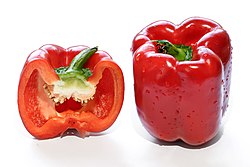
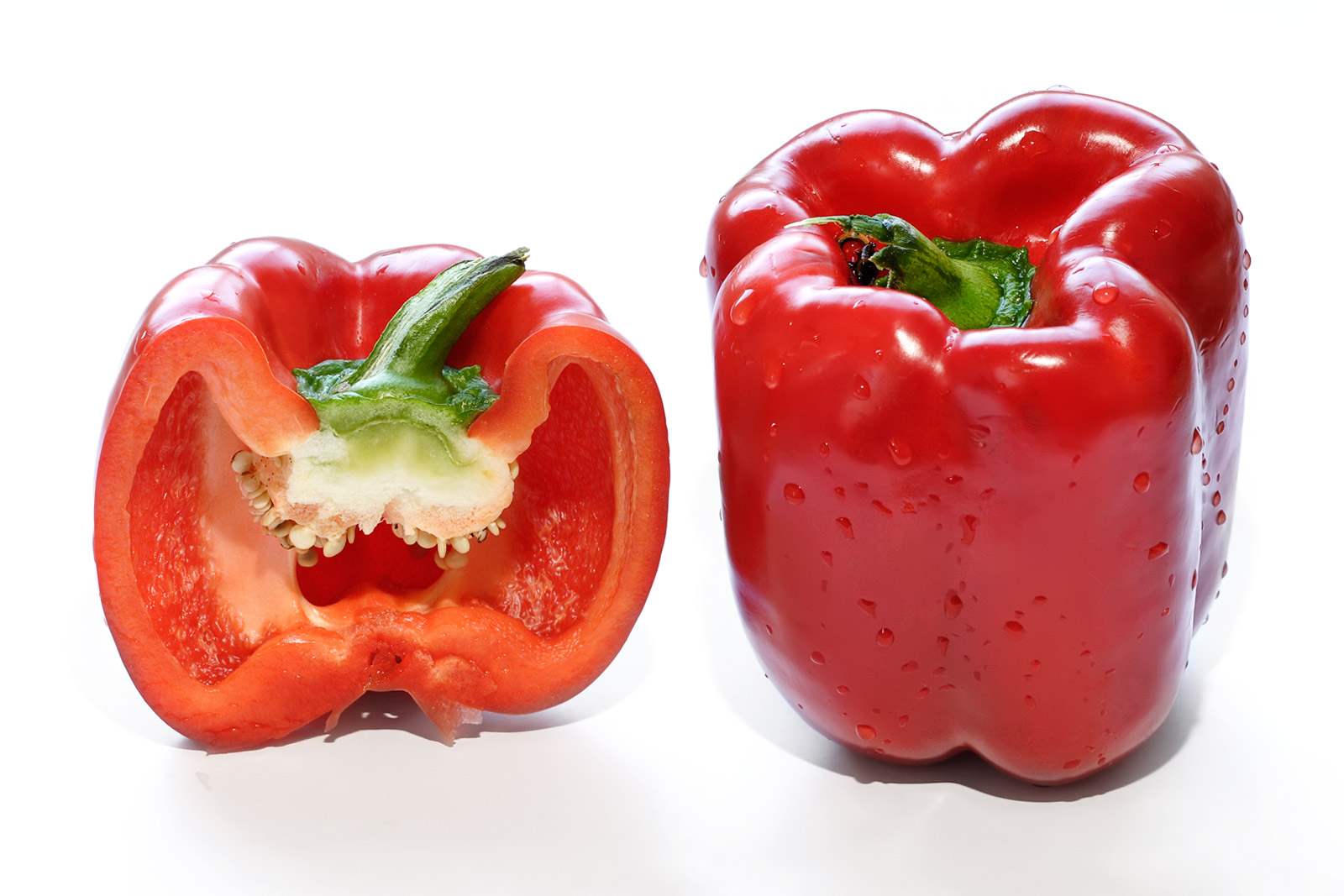
| Capsicum fruit and longitudinal section | |
Scientific classification 
| |
| Kingdom: | Plantae |
| Clade: | Tracheophytes |
| Clade: | Angiosperms |
| Clade: | Eudicots |
| Clade: | Asterids |
| Order: | Solanales |
| Family: | Solanaceae |
| Subfamily: | Solanoideae |
| Tribe: | Capsiceae |
| Genus: | Capsicum L.[1] |
| Species | |
Capsicum (/ˈkæpsɪkəm/[3]) is a genus of flowering plants in the nightshade family Solanaceae, native to the Americas, cultivated worldwide for their edible fruit, which are generally known as "peppers" or "capsicum". Chili peppers grow on five species of Capsicum. Sweet or bell peppers and some chili peppers are Capsicum annuum, making it the most cultivated species in the genus.[4]
History
[edit]Capsicum is native to South America and Central America.[5] These plants have been evolving for 17 million years.[6] It was domesticated and cultivated at least since 3000 BC, as evidenced by remains of chili peppers found in pottery from Puebla and Oaxaca.[7]
Etymology and names
[edit]The generic name may come from Latin capsa, meaning 'box', presumably alluding to the pods;[8][9] or possibly from the Greek word κάπτω, kapto, 'to gulp'.[10] The name pepper comes from the similarity of piquance (spiciness or "heat") of the flavor to that of black pepper, Piper nigrum, although there is no botanical relationship with it or with Sichuan pepper. The original term chilli came from the Nahuatl word chīlli, denoting a larger Capsicum variety cultivated at least since 3000 BC.[7] Different varieties were cultivated in South America, where they are known as ajíes (singular ají), from the Quechua term for Capsicum.
The fruit (botanically a berry) of Capsicum plants has a variety of names depending on place and type. The more piquant varieties are called chili peppers, or simply chilis. The large, mild form is called bell pepper, or is named by color (green pepper, green bell pepper, red bell pepper, etc.) in North America. In South Africa and some other countries, it is called sweet pepper. The name is simply pepper in the United Kingdom and Ireland.[11] The name capsicum is used in Australia, India, Malaysia, and New Zealand.[12]
Phylogeny
[edit]Capsicums are solanaceous plants within the tribe Capsiceae, and are closely related to Lycianthes.[13]
A 2020 study using ribosomal DNA provided the following phylogenetic tree. It can be seen that in two of the clades, the species C. frutescens is intermingled with C. eximium in one subclade and C. chinense in another subclade; and that C. chacoense is intermingled with C. baccatum.[14]
| Capsicum |
| ||||||||||||||||||||||||||||||||||||||||||||||||||||||
Growing conditions
[edit]Ideal growing conditions for peppers include a sunny position with warm, loamy soil, ideally 21 to 29 °C (70 to 84 °F), that is moist but not waterlogged.[15] Extremely moist soils can cause seedlings to "damp-off" and reduce germination.[citation needed]
The plants will tolerate (but do not like) temperatures down to 12 °C (54 °F) and they are sensitive to cold.[16][17] For flowering, Capsicum is a non-photoperiod-sensitive crop.[18] The flowers can self-pollinate. However, at extremely high temperature, 30 to 38 °C (86 to 100 °F), pollen loses viability, and flowers are much less likely to result in fruit.[19]
Species and varieties
[edit]

Capsicum consists of 20–27 species,[20] five of which are widely cultivated: C. annuum, C. baccatum, C. chinense, C. frutescens, and C. pubescens.[21] Phylogenetic relationships between species have been investigated using biogeographical,[22] morphological,[23] chemosystematic,[24] hybridization,[25] and genetic[20] data. Fruits of Capsicum can vary tremendously in color, shape, and size both between and within species, which has led to confusion over the relationships among taxa.[26] Chemosystematic studies helped distinguish the difference between varieties and species. For example, C. baccatum var. baccatum had the same flavonoids as C. baccatum var. pendulum, which led researchers to believe the two groups belonged to the same species.[24]
Many varieties of the same species can be used in many different ways; for example, C. annuum includes the "bell pepper" variety, which is sold in both its immature green state and in its red, yellow, or orange ripe state. This same species has other varieties, as well, such as the Anaheim chiles often used for stuffing, the dried ancho (before being dried it is called a poblano) chile used to make chili powder, the mild-to-hot, ripe jalapeno used to make smoked jalapeno, known as chipotle.[27]
Peru is thought to be the country with the highest cultivated Capsicum diversity since varieties of all five domesticates are commonly sold in markets in contrast to other countries. Bolivia is considered to be the country where the largest diversity of wild Capsicum peppers are consumed. Bolivian consumers distinguish two basic forms: ulupicas, species with small round fruits including C. eximium, C. cardenasii, C. eshbaughii, and C. caballeroi landraces; and arivivis, with small elongated fruits including C. baccatum var. baccatum and C. chacoense varieties.[28]
The amount of capsaicin is measured in Scoville heat units (SHU) and this value varies significantly among Capsicum varieties. For example, a typical Bell pepper has a value of zero SHU and a Jalapeño has a value of 4000–8000 SHU. In 2017, the Guinness Book of World Records listed the Carolina Reaper as the world's hottest pepper at 1,641,183 SHU, according to tests conducted by Winthrop University in South Carolina, United States. In 2023, the Guinness Book of Records recognized Pepper X as the world's hottest pepper.[29]
Species list
[edit]- Capsicum annuum L.
- Capsicum baccatum L.
- Capsicum benoistii Hunz. ex Barboza
- Capsicum buforum Hunz.
- Capsicum caatingae Barboza & Agra
- Capsicum caballeroi M. Nee
- Capsicum campylopodium Sendtn.
- Capsicum carassense Barboza & Bianch.
- Capsicum cardenasii Heiser & P. G. Sm.
- Capsicum ceratocalyx M. Nee
- Capsicum chacoense Hunz.
- Capsicum chinense Jacq.
- Capsicum coccineum (Rusby) Hunz.
- Capsicum cornutum (Hiern) Hunz.
- Capsicum dimorphum (Miers) Kuntze
- Capsicum dusenii Bitter
- Capsicum eshbaughii Barboza
- Capsicum eximium Hunz.
- Capsicum flexuosum Sendtn.
- Capsicum friburgense Bianch. & Barboza
- Capsicum frutescens L.
- Capsicum galapagoense Hunz.
- Capsicum geminifolium (Dammer) Hunz.
- Capsicum havanense Kunth
- Capsicum hookerianum (Miers) Kuntze
- Capsicum hunzikerianum Bianch. & Barboza
- Capsicum lanceolatum (Greenm.) C.V.Morton & Standl.
- Capsicum leptopodum (Dunal) Kuntze
- Capsicum longidentatum Agra & Barboza
- Capsicum longifolium Barboza & S. Leiva
- Capsicum lycianthoides Bitter
- Capsicum minutiflorum (Rusby) Hunz.
- Capsicum mirabile Mart. ex Sendtn.
- Capsicum mositicum Toledo
- Capsicum neei Barboza & X. Reyes
- Capsicum parvifolium Sendtn.
- Capsicum pereirae Bianch. & Barboza
- Capsicum pubescens Ruiz & Pav.
- Capsicum piuranum S. Leiva & Barboza
- Capsicum praetermissum Heiser & Smith
- Capsicum ramosissimum Witasek
- Capsicum recurvatum Witasek
- Capsicum regale Barboza & Bohs
- Capsicum rhomboideum (Dunal) Kuntze
- Capsicum schottianum Sendtn.
- Capsicum scolnikianum Hunz.
- Capsicum spina-alba (Dunal) Kuntze
- Capsicum stramoniifolium (Kunth) Standl.
- Capsicum tovarii Eshbaugh et al.
- Capsicum villosum Sendtn.
According to Adepoju et al. (2021), the most commonly occurring Capsicum cultivars in Nigeria (and West Africa) are: C. fructescens var. fructescens L.; C. fructescens var. baccatum (L.) Irish; C. annuum var annuum L; C. annuum var. grossum (L.) Sendtn. and C. chinense Jacq.[32]
Formerly placed here
[edit]- Tubocapsicum anomalum (Franch. & Sav.) Makino (as C. anomalum Franch. & Sav.)
- Vassobia fasciculata (Miers) Hunz. (as C. grandiflorum Kuntze)
- Witheringia stramoniifolia Kunth (as C. stramoniifolium (Kunth) Kuntze)[2]
Genetics
[edit]Most Capsicum species are 2n=2x=24. A few of the non-domesticated species are 2n=2x=26.[33] All are diploid. The Capsicum annuum and Capsicum chinense genomes were completed in 2014. The Capsicum annuum genome is approximately 3.48 Gb, making it larger than the human genome. Over 75% of the pepper genome is composed of transposable elements, mostly Gypsy elements, distributed widely throughout the genome. The distribution of transposable elements is inversely correlated with gene density. Pepper is predicted to have 34,903 genes, approximately the same number as both tomato and potato, two related species within the family Solanaceae.[34]
Breeding
[edit]Many types of peppers have been bred for heat, size, and yield. Along with selection of specific fruit traits such as flavor and color, specific pest, disease and abiotic stress resistances are continually being selected. Breeding occurs in several environments dependent on the use of the final variety including but not limited to: conventional, organic, hydroponic, green house and shade house production environments.
Several breeding programs are being conducted by corporations and universities. In the United States, New Mexico State University has released several varieties in the last few years.[35] Cornell University has worked to develop regionally adapted varieties that work better in cooler, damper climates. Other universities such as UC Davis, University of Wisconsin-Madison, and Oregon State University have smaller breeding programs. Many vegetable seed companies breed different types of peppers as well.
Capsaicin
[edit]
The fruit of most species of Capsicum contains capsaicin (methyl-n-vanillyl nonenamide), a lipophilic chemical that can produce a burning sensation (pungency or spiciness) in the mouth of the eater. Most mammals find this unpleasant, whereas birds are unaffected.[36][37] The secretion of capsaicin protects the fruit from consumption by insects.[38]
Capsaicin is present in large quantities in the placental tissue (which holds the seeds), the internal membranes, and to a lesser extent, the other fleshy parts of the fruits of plants in this genus. The seeds themselves do not produce any capsaicin, although the highest concentration of capsaicin can be found in the white pith around the seeds.[39] Most of the capsaicin in a pungent (hot) pepper is concentrated in blisters on the epidermis of the interior ribs (septa) that divide the chambers, or locules, of the fruit to which the seeds are attached.[40]
A study on capsaicin production in fruits of C. chinense showed that capsaicinoids are produced only in the epidermal cells of the interlocular septa of pungent fruits, that blister formation only occurs as a result of capsaicinoid accumulation, and that pungency and blister formation are controlled by a single locus, Pun1, for which there exist at least two recessive alleles that result in non-pungency of C. chinense fruits.[41]
The amount of capsaicin per fruit is highly variable, depending on genetics and the environment. The most recognized Capsicum without capsaicin is the bell pepper,[42] a cultivar of Capsicum annuum, which has a zero rating on the Scoville scale. The lack of capsaicin in bell peppers is due to a recessive gene that eliminates capsaicin and, consequently, the hot taste usually associated with the rest of the genus Capsicum.[43] There are also other peppers without capsaicin, mostly within the Capsicum annuum species, such as the cultivars Giant Marconi,[44] Yummy Sweets,[45] Jimmy Nardello,[46] and Italian Frying peppers (Cubanelles).[47]
Chili peppers are important in the medicine of Indigenous peoples, and capsaicin is used in modern medicine mainly in topical medications as a circulatory stimulant and analgesic. In more recent times, an aerosol extract of capsaicin, known as capsicum or pepper spray, has become used by law enforcement as a nonlethal means of incapacitating a person, and in a more widely dispersed form for riot control, or by individuals for personal defense. Capsaicin in vegetable oils or horticultural products can be used in gardening as a natural insecticide.[48]
Cuisine
[edit] | This section needs additional citations for verification. (February 2021) |
 | This section should specify the language of its non-English content using {{lang}} or {{langx}}, {{transliteration}} for transliterated languages, and {{IPA}} for phonetic transcriptions, with an appropriate ISO 639 code. Wikipedia's multilingual support templates may also be used. (November 2024) |

Capsicum fruits can be eaten raw or cooked. Those used in cooking are generally varieties of the C. annuum and C. frutescens species, though a few others are used, as well. They are suitable for stuffing with fillings such as cheese, meat, or rice.
They are frequently used both chopped and raw in salads, or cooked in stir-fries or other mixed dishes. They can be sliced into strips and fried, roasted whole or in pieces, or chopped and incorporated into salsas or other sauces, of which they are often a main ingredient.
They can be preserved in the form of a jam,[49] or by drying, pickling, or freezing. Dried Capsicum may be reconstituted whole, or processed into flakes or powders. Pickled or marinated Capsicum are frequently added to sandwiches or salads. Frozen Capsicum are used in stews, soups, and salsas. Extracts can be made and incorporated into hot sauces.
The Spanish conquistadores soon became aware of their culinary properties, and brought them back to Europe, together with cocoa, potatoes, sweet potatoes, tobacco, maize, beans, and turkeys. They also brought it to the Spanish Philippines colonies, whence it spread to Asia. The Portuguese brought them to their African and Asiatic possessions such as India. All varieties were appreciated but the hot ones were particularly appreciated, because they could enliven an otherwise monotonous diet during times of dietary restriction, such as during religious observances.
Spanish cuisine soon benefited from the discovery of chiles in the New World, and it would become very difficult to untangle Spanish cooking from chiles. Ground chiles, or paprika, hot or otherwise, are a key ingredient in chorizo, which is then called picante (if hot chile is added) or dulce (if otherwise). Paprika is an important ingredient in rice dishes, and plays a definitive role in squid Galician style (polbo á feira). Chopped chiles are used in fish or lamb dishes such as ajoarriero or chilindrón. Pisto is a vegetarian stew with chilies and zucchini as main ingredients. They can also be added, finely chopped, to gazpacho as a garnish. In some regions, bacon is salted and dusted in paprika for preservation. Cheese can also be rubbed with paprika to lend it flavor and colour. Dried round chiles called ñoras are used for arroz a banda.
After being introduced by the Portuguese, chile peppers saw widespread adoption throughout South, Southeast, and East Asia, especially in India, Thailand, Vietnam, China, and Korea. Several new cultivars were developed in these countries, and their use in combination with (or as a substitute for) existing 'hot' culinary spices such as black pepper and Sichuan pepper spread rapidly, giving rise to the modern forms a number of staple dishes such as Channa masala, Tom yum, Laziji, and Kimchi. This in turn influenced Anglo-Indian and American Chinese cuisine, most notably with the development of British and American forms of curry powder (based on Indian spice preparations such as garam masala), and dishes such as General Tso's chicken and chicken tikka masala.


According to Richard Pankhurst, C. frutescens (known as barbaré) was so important to the national cuisine of Ethiopia, at least as early as the 19th century, "that it was cultivated extensively in the warmer areas wherever the soil was suitable." Although it was grown in every province, barbaré was especially extensive in Yejju, "which supplied much of Showa, as well as other neighbouring provinces." He mentions the upper Golima River valley as being almost entirely devoted to the cultivation of this plant, where it was harvested year-round.[50]
In 2005, a poll of 2,000 people revealed the capsicum to be Britain's fourth-favourite culinary vegetable.[51]
In Hungary, sweet yellow capsicum – along with tomatoes – is the main ingredient of lecsó.
In Bulgaria, South Serbia, and North Macedonia, capsicum are very popular, too. They can be eaten in salads, like shopska salata; fried and then covered with a dip of tomato paste, onions, garlic, and parsley; or stuffed with a variety of products, such as minced meat and rice, beans, or cottage cheese and eggs. Capsicum are the main ingredient in the traditional tomato and capsicum dip lyutenitsa and ajvar. They are in the base of different kinds of pickled vegetables dishes, turshiya.
Capsicum is also used widely in Italian cuisine, and the hot species are used all around the southern part of Italy as a common spice (sometimes served with olive oil). Capsicums are used in many dishes; they can be cooked by themselves in a variety of ways (roasted, fried, deep-fried) and are a fundamental ingredient for some delicatessen specialities, such as nduja.
Capsicums are also used extensively in Sri Lanka cuisine as side dishes.[52]
The Maya and Aztec people of Mesoamerica used Capsicum fruit in cocoa drinks as a flavouring.[53]
In New Mexico, there is a Capsicum annuum cultivar group called the New Mexico chile which is a mainstay of the state's New Mexican cuisine.
GRAS
[edit]Only Capsicum frutescens L. and Capsicum annuum L. are Generally recognized as safe.[54][55]
Synonyms and common names
[edit]
The name given to the Capsicum fruits varies between English-speaking countries.
In Australia, New Zealand and Indian English, heatless varieties are called "capsicums", while hot ones are called "chilli"/"chillies" (double L). The term "bell peppers" is never used, although in Australia C. annuum and other varieties which have a bell shape and are fairly hot, are often called "bell chillies".
In Canada, Ireland, South Africa and the United Kingdom, the heatless varieties are known simply as "peppers" (or more specifically "green peppers", "red peppers", etc.), while the hot ones are "chilli"/"chillies" (double L) or "chilli peppers".
In the United States, the common heatless varieties are referred to as "bell peppers", "sweet peppers", "red/green/etc. peppers", or simply "peppers", while the hot varieties are collectively called "chile"/"chiles", "chili"/"chilies", or "chili"/"chile peppers" (one L only), "hot peppers", or named as a specific variety (e.g., banana pepper).
The ground spice made from hot capsicums is called paprika in both U.S. English and Commonwealth English. The name derives from Central Europe; in Polish and in Hungarian, the term papryka and paprika (respectively) is used for all kinds of capsicums and the spice made from them.
Pictures of common cultivars
[edit]-
 Capsicum annum L. var. fasciculatum Irish.
 -
 Capsicum annum L. var. fasciculatum Irish.
 -
 C. annuum cultivars
 -
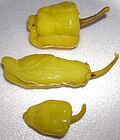 Peperoncini (C. annuum)
 -
 Peperoncini in kebab restaurant
 -
 Cayenne pepper (C. annuum)
 -
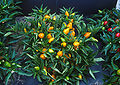 Compact plant of orange Capsicum
 -
 Habanero chili (C. chinense Jacquin)- plant with flower and fruit
 -
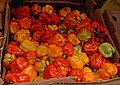 Scotch bonnet (C. chinense) in a Caribbean market
 -

-
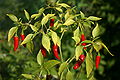 Thai peppers (C. annuum)
 -
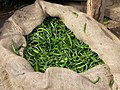 Fresh Indian green chillies in Bangalore market
 -
 Piri piri (C. frutescens 'African Devil')
 -
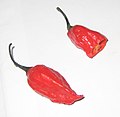 Naga jolokia Chilli (bhut jolokia) (C. chinense x C. frutescens)
 -
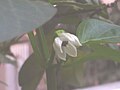 C. annuum flower
 -
 C. annum flower close up
 -
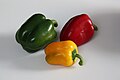 Green, yellow, and red capsicum
 -
 The flower of red hot bangi pepper, Malaysia
 -
 A small but very hot Capsicum in Malaysia
 -
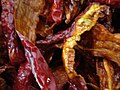 Peperoni cruschi, dried and crispy Capsicum from Basilicata
 -
 Capsicum in Bangladesh
 -
 Naga Morich in Bangladesh


.jpg)


See also
[edit]References
[edit]- ^ "Capsicum L." Germplasm Resources Information Network. United States Department of Agriculture. 1 September 2009. Archived from the original on 18 January 2010. Retrieved 1 February 2010.
- ^ a b "Species records of Capsicum". Germplasm Resources Information Network. United States Department of Agriculture. Archived from the original on 20 January 2009. Retrieved 23 June 2010.
- ^ Wells, John C. (2008), Longman Pronunciation Dictionary (3rd ed.), Longman, p. 123, ISBN 978-1-4058-8118-0
- ^ Jo, Yeonhwa; Choi, Hoseong; Lee, Jeong Hun; Moh, Sang Hyun; Cho, Won Kyong (10 September 2022). "Viromes of 15 Pepper (Capsicum annuum L.) Cultivars". International Journal of Molecular Sciences. 23 (18) 10507. doi:10.3390/ijms231810507. PMC 9504177. PMID 36142418.
- ^ Carrizo García, Carolina; Barfuss, Michael H. J.; Sehr, Eva M.; Barboza, Gloria E.; Samuel, Rosabelle; Moscone, Eduardo A.; Ehrendorfer, Friedrich (2016). "Phylogenetic relationships, diversification and expansion of chili peppers (Capsicum, Solanaceae)". Annals of Botany. 118 (1): 35–51. doi:10.1093/aob/mcw079. ISSN 0305-7364. PMC 4934398. PMID 27245634.
- ^ "Feel the Burn--New World Chilies Traced Back Nearly 17 Million Years". Scientific American.
- ^ a b Gil-Jurado, A.T. (2006). "Il senso del chile e del piccante: dalla traduzione culturale alla rappresentazione visiva". In Manetti, G. (ed.). Semiofood : communicazione e cultura del cibo. XXXI convegno dell'Associazione Italiana di Studi Semiotici, Castello Pasquini, Castiglioncello, 3–5 ottobre 2003 (in Italian). Torino: Centro Scientifico Ed. pp. 34–58. ISBN 88-7640-757-X. OCLC 255660829.
- ^ Oxford English Dictionary, 1st edition, 1888, s.v.
- ^ Online Etymology Dictionary, s.v.
- ^ Quattrocchi, Umberto (2000). CRC World Dictionary of Plant Names. Vol. 1, A–C. CRC Press. p. 431. ISBN 978-0-8493-2675-2.
- ^ OxfordDictionaries.com, s.v.
- ^ Latham, Elizabeth (8 February 2013). "Capsicums at your table". The Nelson Mail. Retrieved 19 April 2013.
- ^ Spalink, Daniel; Stoffel, Kevin; Walden, Genevieve K.; Hulse-Kemp, Amanda M.; Hill, Theresa A.; Van Deynze, Allen; Bohs, Lynn (2018). "Comparative transcriptomics and genomic patterns of discordance in Capsiceae (Solanaceae)". Molecular Phylogenetics and Evolution. 126: 293–302. Bibcode:2018MolPE.126..293S. doi:10.1016/j.ympev.2018.04.030. PMID 29702214.
- ^ Shiragaki, Kumpei; Yokoi, Shuji; Tezuka, Takahiro (20 November 2020). "Phylogenetic Analysis and Molecular Diversity of Capsicum Based on rDNA-ITS Region". Horticulturae. 6 (4): 87. doi:10.3390/horticulturae6040087. ISSN 2311-7524.
- ^ "Growing Peppers: The Important Facts". GardenersGardening.com. Archived from the original on 27 January 2013. Retrieved 10 January 2013.
- ^ "How to grow chilli pepper / RHS Gardening".
- ^ "Peppers and chillies/RHS Gardening".
- ^ Y. H. Hui, ed. (2005). Handbook of Food Science, Technology, and Engineering. 4 Volume Set. United States: Taylor & Francis Group, LLC (Version date:20131106). pp. 20–13. ISBN 978-1-4665-0787-6.
- ^ "The Effect of Extreme Temperatures on the Tomato and Pepper Crop". King's Printer for Ontario, 2012–24, Canada.
- ^ a b Walsh, B.M.; Hoot, S.B. (2001). "Phylogenetic Relationships of Capsicum (Solanaceae) Using DNA Sequences from Two Noncoding Regions: The Chloroplast atpB-rbcL Spacer Region and Nuclear waxy Introns". International Journal of Plant Sciences. 162 (6): 1409–18. doi:10.1086/323273. S2CID 3233466. Archived from the original on 12 December 2012.
- ^ Heiser Jr, C.B.; Pickersgill, B. (1969). "Names for the Cultivated Capsicum Species (Solanaceae)". Taxon. 18 (3): 277–283. doi:10.2307/1218828. JSTOR 1218828.
- ^ Tewksbury, J.J.; Manchego, C.; Haak, D.C.; Levey, D.J. (2006). "Where did the Chili Get its Spice? Biogeography of Capsaicinoid Production in Ancestral Wild Chili Species". Journal of Chemical Ecology. 32 (3): 547–564. Bibcode:2006JCEco..32..547T. doi:10.1007/s10886-005-9017-4. PMID 16572297. S2CID 1426476.
- ^ Eshbaugh, W.H. (1970). "A Biosystematic and Evolutionary Study of Capsicum baccatum (Solanaceae)". Brittonia. 22 (1): 31–43. Bibcode:1970Britt..22...31E. doi:10.2307/2805720. JSTOR 2805720. S2CID 3570027.
- ^ a b Ballard, R.E.; McClure, J.W.; Eshbaugh, W.H.; Wilson, K.G. (1970). "A Chemosystematic Study of Selected Taxa of Capsicum". American Journal of Botany. 57 (2): 225–233. doi:10.2307/2440517. JSTOR 2440517.
- ^ Pickersgill, B. (1971). "Relationships Between Weedy and Cultivated Forms in Some Species of Chili Peppers (Genus capsicum)". Evolution. 25 (4): 683–691. doi:10.2307/2406949. JSTOR 2406949. PMID 28564789.
- ^ Eshbaugh, W.H. (1975). "Genetic and Biochemical Systematic Studies of Chili Peppers (Capsicum-Solanaceae)". Bulletin of the Torrey Botanical Club. 102 (6): 396–403. doi:10.2307/2484766. JSTOR 2484766.
- ^ Zhigila, Daniel Andrawus; AbdulRahaman, Abdullahi Alanamu; Kolawole, Opeyemi Saheed; Oladele, Felix A. (17 February 2014). "Fruit Morphology as Taxonomic Features in Five Varieties of Capsicum annuum L. Solanaceae". Journal of Botany. 2014 e540868. doi:10.1155/2014/540868. ISSN 2090-0120.
- ^ van Zonneveld, Maarten; Ramirez, Marleni; Williams, David E.; Petz, Michael; Meckelmann, Sven; Avila, Teresa; Bejarano, Carlos; Ríos, Llermé; Peña, Karla; Jäger, Matthias; Libreros, Dimary; Amaya, Karen; Scheldeman, Xavier (24 September 2015). "Screening Genetic Resources of Capsicum Peppers in Their Primary Center of Diversity in Bolivia and Peru". PLOS ONE. 10 (9) e0134663. Bibcode:2015PLoSO..1034663V. doi:10.1371/journal.pone.0134663. ISSN 1932-6203. PMC 4581705. PMID 26402618.
- ^ "Hottest chili pepper". Guinness World Records.
- ^ "Search results – The Plant List". www.theplantlist.org.
- ^ "Tropicos". www.tropicos.org.
- ^ Adepoju, A.O.; Ogunkunle, T.J.; Femi-Adepoju, A.G. (2021). "Taxonomic Revision of Nigerian Species of Capsicum L. Based on Some Morphological Characters" (PDF). Acta Scientifica Malaysia. 5 (2): 43–46. doi:10.26480/asm.02.2021.43.46. SSRN 4467384.
- ^ Wang, D.; Bosland, P.W. (2006). "The genes of Capsicum" (PDF). HortScience. 41 (5): 1169–87. doi:10.21273/HORTSCI.41.5.1169.
- ^ Kim, Seungill; Park, Minkyu; Yeom, Seon-In; Kim, Yong-Min; Lee, Je Min; Lee, Hyun-Ah; Seo, Eunyoung; Choi, Jaeyoung; Cheong, Kyeongchae (1 March 2014). "Genome sequence of the hot pepper provides insights into the evolution of pungency in Capsicum species". Nature Genetics. 46 (3): 270–8. doi:10.1038/ng.2877. ISSN 1061-4036. PMID 24441736.
- ^ Institute, The Chile Pepper. "NMSU Cultivars – The Chile Pepper Institute". www.chilepepperinstitute.org. Archived from the original on 2 April 2016. Retrieved 28 January 2016.
- ^ Mason, J. R.; N. J. Bean; P. S. Shah; L. Clark Shah (December 1991). "Taxon-specific differences in responsiveness to capsaicin and several analogues: Correlates between chemical structure and behavioral aversiveness". Journal of Chemical Ecology. 17 (12): 2539–51. Bibcode:1991JCEco..17.2539M. doi:10.1007/BF00994601. PMID 24258646. S2CID 23135946.
- ^ Norman, D.M.; Mason, J.R.; Clark, L. (1992). "Capsaicin effects on consumption of food by Cedar Waxwings and House Finches" (PDF). The Wilson Journal of Ornithology. 104 (3): 549–551. JSTOR 4163197.
- ^ "Active Ingredient Fact Sheets" (PDF). npic.orst.edu.
- ^ New Mexico State University – College of Agriculture and Home Economics (2005). "Chile Information – Frequently Asked Questions". Archived from the original on 4 May 2007. Retrieved 17 May 2007.
- ^ Zamski, E.; Shoham, O.; Palevitch, D.; Levy, A. (1987). "Ultrastructure of Capsaicinoid-Secreting Cells in Pungent and Nonpungent Red Pepper (Capsicum annuum L.) Cultivars". Botanical Gazette. 148 (1): 1–6. doi:10.1086/337620. JSTOR 2995376. S2CID 83791254.
- ^ Stewart Jr, C.; Mazourek, M.; Stellari, G.M.; O'Connell, M.; Jahn, M. (2007). "Genetic control of pungency in C. chinense via the Pun1 locus". Journal of Experimental Botany. 58 (5): 979–991. doi:10.1093/jxb/erl243. PMID 17339653.
- ^ "The Scoville Scale of Hotness – Capsaicin Level". Chiliwonders.com. Archived from the original on 29 August 2013. Retrieved 27 November 2013.
- ^ "The World's Healthies Foods". Archived from the original on 28 August 2018. Retrieved 23 February 2010.
- ^ "Giant Marconi Pepper: Smoky Sweet Flavor, Large Fruit". Archived from the original on 3 July 2014. Retrieved 14 July 2014.
- ^ "Yummy Snacking Pepper – Peppers – Vegetables". Archived from the original on 13 July 2014. Retrieved 14 July 2014.
- ^ "- Jimmy Nardello's Pepper". www.territorialseed.com.
- ^ "Italian Frying peppers – Produce Express of Sacramento, California". produceexpress.net. Archived from the original on 15 July 2017. Retrieved 14 July 2014.
- ^ "Capsaicin as an Insecticide".
- ^ "Ask Garden – Simple Gardening Tips". Ask Garden.
- ^ Pankhurst, Richard (1968). Economic History of Ethiopia, 1800–1935. Addis Ababa: Haile Selassie I University Press. pp. 193–4. OCLC 586053361.
- ^ Wainwright, Martin (23 May 2005). "Onions come top for British palates". The Guardian. London. Retrieved 30 October 2007.
- ^ Unknown, Unknown. "Sri Lankan Cuisine". SBS Food. SBS. Archived from the original on 15 June 2013. Retrieved 7 May 2011.
- ^ Mitzewich, John. "10 Foods America Gave to the World". The Spruce. Archived from the original on 4 July 2017. Retrieved 7 May 2011.
- ^ GRAS FDA
- ^ "eCFR – Code of Federal Regulations". Ecfr.gov. Archived from the original on 9 February 2018. Retrieved 17 May 2019.
External links
[edit]


- Capsicum pepper factsheet from Purdue Guide to Medicinal and Aromatic Plants
- Capsicums: Innovative Uses of an Ancient Crop History, Botany, Breeding, and Pungency. Purdue University, Indiana, U.S.A.
- Capsicum and Chillies: Commercial Cultivation DPI&F Queensland, Australia.


| International | |
|---|---|
| National | |
| Other | |
