


Community hub
Recent from talks
Contribute something
Nothing was collected or created yet.
Chatra (umbrella)
View on Wikipedia
| Translations of Chatra | |
|---|---|
| English | ceremonial umbrella or parasol |
| Sanskrit | छत्र/छत्त्र, छत्ररत्न (IAST: chatra/chattra, chatraratna) |
| Pali | chatta |
| Burmese | ထီး |
| Chinese | 伞/傘, 伞盖/傘蓋 (Pinyin: sǎn, sǎngài) |
| Japanese | 傘, 傘蓋 (Rōmaji: san/kasa, sangai) |
| Khmer | ឆ័ត្រ |
| Korean | 산(傘), 산개(傘蓋) (RR: san, sangae) |
| Tibetan | རིནཆེན་གདུགས,[2] གདུགས་ནི། (rin chen gdugs, gdugs ni) |
| Thai | ฉัตร (RTGS: chat) |
| Glossary of Buddhism | |
The chatra or chhatra, also known under various translations including the ceremonial, state, royal, or holy umbrella or parasol, is a symbol of royal and imperial power and sanctity in Indian art and a symbol of holiness in Hinduism, Jainism, and Buddhism. There are also various specific forms, including 3-, 7-, 8-, and 9-tiered chatra and the bejewelled chatraratna.
India and Tibet
[edit]In India, the chatra was an ancient symbol of kingship and emperorship, representing both kingly power and righteousness. In particular, it is employed in depictions of chakravartis, the supposed holy emperors over the entire earth. It is also reckoned one of the ashtamangala, the eight holy symbols of enlightened sages and buddhas, in Digambar Jainism, Vajrayana Buddhism, and other Dharmic faiths.
In Hindu mythology, Chatra can itself be recognized as a deity, yidam, and ishta-devata.[citation needed] More often, it is an emblem of various gods including Varuna, Ganesha (particularly during Ganesh Chaturthi), Revanta, Surya, Vishnu in his Vamana avatar, and Vishvakarman.
In the chakra systems of Dharmic faiths and traditional Indian and Tibetan medicine, the chatra is used as a symbol of the sahasrara, the crown chakra.
-
![A chatra crowning Vāsudeva-Krishna on a coin of Agathocles of Bactria, c. 180 BC[3]](//upload.wikimedia.org/wikipedia/commons/thumb/c/cb/Vasudeva_Krishna_on_a_coin_of_Agathocles_of_Bactria_circa_180_BCE.jpg/120px-Vasudeva_Krishna_on_a_coin_of_Agathocles_of_Bactria_circa_180_BCE.jpg)
-
 Mathura statue of a bodhisattva crowned by a chatra
 -
 Mathura chatra, c. 1st or 2nd century CE
 -
 Vishvakarman with chatra
 -
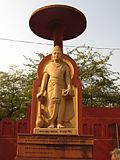 Chandragupta Maurya with chatra
 -
 The chatra of the Tijara Jain temple in Rajasthan
 -
 A chatra diagram
![A chatra crowning Vāsudeva-Krishna on a coin of Agathocles of Bactria, c. 180 BC[3]](https://en.wikipedia.org/wiki/File:Vasudeva_Krishna_on_a_coin_of_Agathocles_of_Bactria_circa_180_BCE.jpg)


.JPG)


Myanmar
[edit]In Burmese culture, the chatra is known as the hti. It is used as regalia and employed at the crowns of Burmese pagodas.
-
 Htis flanking the throne in Saya Chone's 1907 "Royal Audience"
 -

-
 Kuthodaw Pagoda's hti


Thailand
[edit]In Thai culture, the chatra developed into the white Royal Nine-Tiered Umbrella, part of the country's regalia. Properly, only a crowned king may use the 9-tiered umbrella, uncrowned kings and other members of the royal family being restricted to a 7-tier form. The 9-tiered chatra is used as the logo of Royal Umbrella rice.
-
 Thailand's Royal Nine-Tiered Umbrella attached to a throne inside a hall in the Grand Palace, Bangkok
 -
 A 9-tiered umbrella beside the throne as King Prajadhipok signs a constitution in Ananta Samakhom Hall
 -
 A 7-tiered umbrella over the urn of Princess Bejaratana Rajasuda as it is moved to the Great Chariot of Victory
 -
 A 9-tiered umbrella over the funeral pyre of King Bhumibol Adulyadej


See also
[edit]- Baldachin, a similar concept in European iconography
- Chhatrapati
References
[edit]Footnotes
[edit]- ^ "Collections-Virtual Museum of Images and Sounds". vmis.in. American Institute of Indian Studies.
- ^ Sarat Chandra Das (1902). Tibetan–English Dictionary with Sanskrit Synonyms. Kolkata: Bengal Secretariat Book Depot, p. 69.
- ^ Osmund Bopearachchi, Emergence of Viṣṇu and Śiva Images in India: Numismatic and Sculptural Evidence, 2016.
Bibliography
[edit]- Dictionary of Hindu Lore and Legend (ISBN 0-500-51088-1) by Anna Dallapiccola
- General Buddhist Symbols
External links
[edit] Media related to Chatras at Wikimedia Commons


.svg)
 | This Hinduism-related article is a stub. You can help Wikipedia by expanding it. |
Chatra (umbrella)
View on GrokipediaOverview and Symbolism
Definition and Characteristics
The chatra, derived from the Sanskrit term chatra (छत्र), meaning "umbrella" or "parasol," refers to a ceremonial covering object rooted in ancient Indian traditions.[5] This etymology traces back to the Sanskrit root chad, signifying "to cover" or "to shelter," as noted in classical texts like the Unadi Sutras.[5] In regional contexts, it is known as hti in Burmese or chat in Thai, reflecting its widespread adoption across South and Southeast Asia.[2] Physically, the chatra consists of a central wooden pole supporting a canopy framed by bamboo or metal ribs, often covered in cloth materials such as cotton, khadi, velvet, or silk.[2] The canopy is typically circular or conical, adorned with tassels, fringes, metallic finials, and motifs including lotuses or geometric patterns created through embroidery, appliqué, or painting.[2] More elaborate versions, known as chatraratna, incorporate jewels or gold/silver borders for enhanced decoration.[6] It is also one of the Seven Ratnas (treasures) associated with the chakravartin, the ideal universal monarch. Variations in the chatra's design include the number of tiers, which often denote status, with more tiers indicating higher authority, such as nine for kings in some traditions.[7] Functionally, it provides shade from the sun in practical applications, while ceremonial chatras are largely symbolic, carried by attendants in processions rather than used for weather protection.[2] This protective role extends briefly to notions of safeguarding, though its deeper implications lie beyond physical form.[5]Symbolic Interpretations
The chatra, or ceremonial umbrella, primarily symbolizes sovereignty and divine protection across Indian cultural traditions. It represents the authority of rulers and enlightened beings, offering shelter from physical elements like the sun, metaphorically extending to spiritual protection from harm, suffering, and ignorance. This "cool shade" evokes the compassion of enlightenment, shielding devotees from the "heat" of worldly afflictions and delusions.[2][8] In its association with royalty, the chatra denotes the supreme status of the chakravartin, or universal monarch, an ideal ruler embodying dharma and cosmic order. It is often depicted held above deities, Buddhas, or kings in iconography to signify their unparalleled supremacy and divine sanction, as seen in ancient stupa reliefs where it crowns figures of power. This emblem underscores the chatra's role in affirming hierarchical dominion, linking temporal rule to spiritual elevation.[2][9] As one of the Ashtamangala, the eight auspicious symbols in Buddhism and Jainism, the chatra embodies the expansion of sacred teachings and the warding off of ignorance. In Buddhist contexts, it signifies the Buddha's sovereignty as a chakravartin, protecting the Dharma's dissemination against obstacles, while in Jainism, it similarly honors Tirthankaras as beacons of liberation. The symbol's jeweled, multi-tiered form reinforces its auspiciousness, promoting prosperity and spiritual safeguarding.[8] The chatra also conveys hierarchy through its design and usage, where multiple tiers or stacked parasols indicate escalating authority—thirteen, for instance, denoting full kingship. Traditionally positioned above figures of high rank in processions, it highlights status distinctions within royal and religious settings, emphasizing the emblem's integral role in denoting supremacy.[8][2]Historical Origins
Ancient Indian Roots
The chatra, known as a ceremonial parasol or umbrella, emerged in ancient India as a practical device for sun protection that gradually symbolized shelter, authority, and royalty. A terracotta figurine from the Indus Valley Civilization (c. 2700 BCE) depicts a seated figure under what may be an umbrella-like structure, providing potential early evidence, though its ceremonial significance remains debated.[10] While more direct archaeological evidence from the Indus Valley Civilization (c. 2500 BCE) remains elusive, early textual references in Vedic literature from c. 1500–500 BCE describe parasols in association with deities such as Varuna, the god of cosmic order, who provided protective cover akin to an impermeable canopy impervious to rain or rays.[11] These depictions in the Rigveda portray the chatra as a divine emblem of safeguarding, evolving from functional shade to a marker of exalted status in pre-Buddhist and pre-Jain contexts.[12] By the Mauryan Empire (c. 3rd century BCE), the chatra transitioned into a prominent status symbol in royal and architectural art, often held by attendants over figures of authority to denote prestige. This shift is evident in early stone carvings and stupa embellishments, such as those at Sanchi, where parasols signify honor and protection in narrative reliefs dating to the late 3rd century BCE onward.[13] The object's prominence in Mauryan iconography reflects its adaptation from everyday utility to regalia, underscoring social hierarchy in a period of centralized imperial power. The development of the chatra during the Gupta Empire (c. 4th–6th century CE) marked a refinement into multi-tiered structures, enhancing its symbolic depth as a tiered canopy representing layered protection and sovereignty. Gupta-period sculptures from Mathura integrate the chatra as a sign of reverence and rank.[14] This evolution was likely influenced by Central Asian exchanges, particularly Achaemenid Persian parasols introduced via northwestern trade routes around the 6th–4th centuries BCE, which served as royal ensigns held over monarchs to signify authority and were later diffused into Indian courtly and artistic traditions post-Achaemenid collapse.[15][16]Development in Religious Iconography
In Buddhist iconography, the chatra began appearing prominently from the 1st century BCE, notably atop Ashokan pillars and stupas, where it was often held by yaksha figures symbolizing protective guardianship over sacred relics.[17] By the Gupta period around the 5th century CE, the chatra had become a standard element in Buddha statues, integrated as part of the Eight Auspicious Symbols (Ashtamangala) rather than the Seven Treasures of the cakravartin, denoting the spread of dharma and royal sovereignty attributed to the enlightened one. This evolution reflected the chatra's shift from a secular emblem of authority to a core motif in devotional art, emphasizing spiritual dominion. In Hindu temple sculptures from the Puranic era (circa 5th–10th centuries CE), the chatra frequently appeared above deities such as Vishnu's avatars, signifying cosmic protection and divine kingship that shielded the universe from chaos.[1] For instance, in depictions of the Vamana avatar, the umbrella is bestowed as a symbol of restored order, underscoring Vishnu's role in upholding dharma.[18] Jain iconography incorporated the chatra in Tirthankara figures from the 2nd century BCE onward, often as a triple-tiered parasol crowning the enlightened being to denote spiritual victory and liberation from samsara.[2] In siddhachakra yantras, the chatra integrates into the diagrammatic representation of the nine fundamentals (navapada), symbolizing the protective canopy over the path to siddha (perfected soul) and the triumph of ascetic discipline.[19] Artistic motifs of the chatra proliferated in religious frescoes, such as those in the Ajanta Caves (2nd–6th centuries CE), where tiered designs evolved from simple three-layered forms, illustrating the progressive expansion of dharma across realms and the umbrella's role as a visual metaphor for encompassing wisdom.[20] These depictions, often rendered in vibrant ochres and greens, highlighted the chatra's transformation into a multifaceted emblem of hierarchy and sanctity across Buddhist, Hindu, and Jain visual traditions.[2]Religious Contexts
Role in Hinduism
In Hindu mythology, the chatra is prominently associated with deities embodying protection and sovereignty. Varuna, the god of waters, is linked to the chatra as an emblem of divine authority. Similarly, Ganesha holds the chatra as an emblem of wisdom's shelter, providing spiritual cover against obstacles in life's journey. In epics like the Mahabharata, the chatra appears as a symbol of royal power attached to chariots of important Kshatriya princes.[21] Ritually, the chatra integrates deeply into Hindu practices, shading sacred idols during temple processions such as the Rath Yatra, where it elevates the deities—particularly Jagannath—to royal dignity amid fervent devotion.[1] In Shaivism, the chatra symbolizes protection and spiritual power.[5]Significance in Buddhism
In Buddhism, the chatra, or parasol, holds a prominent place as one of the Ashtamangala, the eight auspicious symbols traditionally offered to the Buddha upon his enlightenment. It represents the protective canopy of the Dharma, shielding sentient beings from the sufferings of samsara and embodying spiritual authority and compassion.[22] In Tibetan Buddhism, the chatra is known as gdugs and is particularly associated with royalty, signifying the exalted status of enlightened beings who extend protection to all under their influence.[23] Iconographically, the chatra appears frequently in Gandharan Buddhist art from the 1st to 5th centuries CE, often positioned above the Buddha's head to denote his universal sovereignty and dominion over the cosmos.[24] In Mahayana traditions, multi-tiered chattras appear in iconography, symbolizing layered protection. Ritually, the chatra plays a key role in Theravada processions, such as those during Myanmar's shinbyu ceremonies where novices are honored with golden umbrellas shading them, evoking the Buddha's protective presence.[25] In Vajrayana practices, the chatra integrates into mandala offerings as a variant of the treasure vase symbol, representing abundance and the dissemination of sacred teachings within ritual diagrams.[26] Philosophically, the chatra symbolizes shelter from the "heat" of samsaric afflictions, providing refuge through the Buddha's teachings and fostering liberation from cyclic existence.[22] Its octagonal base often represents the Noble Eightfold Path, illustrating progressive stages of ethical conduct, mental discipline, and wisdom.Usage in Jainism
In Jain iconography, the chatra, or ceremonial umbrella, holds a prominent place as one of the eight auspicious symbols (aṣṭa-maṅgala) in the Digambara tradition, symbolizing protection, spiritual authority, and dignity. It is frequently depicted as a triple-tiered canopy above the heads of Tīrthaṅkaras in sculptures, signifying their sovereignty over the three realms of existence—upper, middle, and lower worlds—in Jain cosmology. This non-theistic emblem underscores the Tīrthaṅkara's liberation from karmic bondage and victory over worldly attachments, providing shelter from the cycle of rebirth (saṃsāra). Early examples appear in Mathura school sculptures from the 1st century CE, where Digambara Tīrthaṅkara figures are shown under the chatra held by attendant śramaṇas (ascetics), emphasizing ascetic triumph over karma.[27][28][29] In Digambara contexts, the chatra also appears as a freestanding ritual object in temples, reinforcing its role in invoking auspiciousness and cosmic harmony.[27] Symbolically, the chatra's form varies to denote levels of spiritual attainment: a single tier for śrāvakas (lay followers), representing basic ethical shelter, while multi-tiered versions—often three for Tīrthaṅkaras or kevalins (omniscient liberated souls)—illustrate complete soul liberation and dominion over karmic forces. This progression mirrors the non-theistic emphasis on self-reliant purification, with the chatra embodying progressive emancipation from bondage. The symbol's adoption in Jainism shares roots with Buddhist iconography but uniquely aligns with Jain cosmology's focus on soul stages and ethical universality.[27][28]Regional Variations
India and Tibet
In the Mughal and Rajput courts from the 16th to 19th centuries, the chatra served as a key element of royal regalia, often appearing in tiered forms during durbar assemblies to signify sovereignty and divine kingship. Influenced by Indo-Islamic traditions, Rajput rulers in regions like Jaipur, Bikaner, and Mewar integrated tiered chatras into court rituals, where they were held aloft to denote hierarchical status and political legitimacy, as seen in the cosmopolitan designs commissioned under Mughal alliances. For instance, in the court of Akbar Shah II (r. 1806–1837), processions featured the state chhatra borne on elephants ahead of the emperor, emphasizing its role in public displays of imperial authority.[30][31][32] A notable example is the royal chhatri from Dungarpur, a Rajput principality, crafted in 1911 with molded silver sheets over a wooden core, adorned with pale blue silk velvet featuring silver embroidery and metallic threads, used specifically in durbar settings by high-ranking rulers during formal gatherings. These umbrellas, embroidered with metallic threads, were traditionally held over the monarch during processions to symbolize protection and prestige, a practice rooted in ancient Indic iconography but adapted for courtly pomp.[31][33] In contemporary India, chatras persist in ceremonial contexts, such as festivals like Durga Puja, where they canopy deities to invoke protection and reverence, reflecting their enduring role in Hindu rituals. Post-independence, these umbrellas appear in state processions and temple ceremonies, maintaining symbolic ties to royalty and divinity.[1] In Tibetan Buddhism, the chatra is known as gdugs, embodying protection and spiritual authority, particularly in processions associated with the Dalai Lama and monastic traditions. Ceremonial gdugs are prominently featured in rituals involving the Nechung Oracle, the state protector deity, as seen in Barkor processions where the oracle is shaded by a parasol (gdugs zhabs) to signify sacred protection. Within Gelugpa practices, multi-tiered variants symbolize expansive safeguarding.[34][35] Tibetan gdugs often incorporate durable materials like silk canopies for portability in high-altitude processions, with brass or metal frames for resilience, sometimes embellished with motifs echoing thangka paintings to enhance ritual potency. Among exile communities, these umbrellas remain integral to preserved Gelugpa rituals, ensuring continuity of protective symbolism in diaspora settings.[35]Myanmar
In Myanmar, the chatra manifests as the hti, a culturally adapted symbol of protection and spiritual authority integral to Buddhist architecture and royal traditions. As an ornate finial, the hti crowns nearly all pagodas, functioning as a multi-tiered spire that wards off evil through its suspended bells and vanes, which produce chimes to dispel malevolent forces.[36] The Shwedagon Pagoda in Yangon exemplifies this role, where its gold-plated hti—measuring about 9 meters tall and encrusted with thousands of gems—has topped the structure since the 15th century CE, when Queen Shin Sawbu oversaw expansions that raised the height to about 40 meters; the stupa reached its current height of 99 meters in 1774 under King Hsinbyushin, and the current iteration of the hti was installed in 1871 by King Mindon and features seven concentric rings diminishing in size upward.[37][38][39] During the Konbaung Dynasty (1752–1885 CE), the 9-tiered hti design was prominently featured in royal regalia, forming one of the five essential items—an umbrella signifying sovereignty—carried in processions by kings to invoke divine protection and hierarchy.[40] These umbrellas appeared in ceremonial displays, including vibrant processions of the Thingyan water festival, where twirled parasols echoed the hti's form to celebrate renewal and communal harmony.[41] Crafted traditionally from teak frames coated in lacquer for durability, hti incorporate embedded gems for opulence and symbolic radiance, while their tiered structure—often nine levels for royal variants—represents the ascending Buddhist realms, from earthly existence to higher heavens, underscoring cosmic order.[42] The vanes at the apex, fitted with bells, enhance this symbolism by harmonizing with winds to invoke auspicious energies. In contemporary Myanmar, the hti endures as a national emblem following post-1988 renovations, notably the 1999 regilding and reinstallation of the Shwedagon's hti under state oversight, which reinforced its status in public ceremonies and military-led events as a marker of cultural resilience and unity.[43]Thailand
In Thailand, the chatra evolved into a prominent royal symbol known as the Royal Nine-Tiered Umbrella (Nopphapadon Maha Saweta Chatra), reserved exclusively for crowned kings, with its formalized use tracing back to the Ayutthaya Kingdom in the 14th century CE as part of coronation regalia influenced by earlier Sukhothai traditions.[44] This umbrella signifies the monarch's supreme sovereignty and divine authority, drawing from ancient Hindu and Buddhist iconography where it represents protection and kingship.[45] It was prominently featured in the 2019 coronation of King Maha Vajiralongkorn (Rama X), where it was presented to vest him with full royal legitimacy during the three-day ceremony at the Grand Palace in Bangkok.[46] Within the Chakri Dynasty, established in 1782, the umbrella holds a central role in coronation rituals, where it is anointed and presented by the chief Brahmin priest to symbolize the fusion of Hindu-Brahmin and Buddhist elements, embodying the white umbrella's association with purity, spiritual protection, and the monarch's role as a dharmic ruler.[44][45] The head Brahmin leads the purification rites, handing the umbrella to royal pages who position it above the throne, marking the king's consecration and transition to divine status, as seen in ceremonies since King Rama I's investiture in 1785.[45] Typically paired with the Great Crown of Victory in the set of five principal regalia, it underscores the king's encompassing authority over the realm.[44] The umbrella's construction features nine tiers of white silk or cloth shades trimmed and framed in gold, attached to a gilded handle, with the white hue evoking purity and the tiers denoting escalating levels of royal responsibility and cosmic hierarchy in the Hindu-Buddhist worldview.[44][45] These elements, refined under King Rama IV in the 19th century by replacing earlier fabrics with white velvet for added elegance, highlight its role as both a practical canopy and a sacred emblem.[44] In modern contexts, the chatra's imagery extends beyond the palace into commercial and cultural spheres, notably as the logo for the Royal Umbrella rice brand, launched in the late 1970s by the Charoen Pokphand Group to evoke Thai heritage and premium quality in exporting Hom Mali jasmine rice globally.[47] It also appears in ceremonial processions during festivals like Songkran and Loy Krathong, where tiered umbrellas symbolize royal blessings and auspicious protection amid communal celebrations of renewal and gratitude.[45]Other Southeast Asian Influences
The chatra, or ceremonial umbrella, spread to peripheral Southeast Asian regions through the maritime trade networks of the Srivijaya empire between the 8th and 13th centuries CE, where it blended with indigenous animist traditions to symbolize divine protection, including practical shelter from seasonal monsoons.[48] This syncretic adoption adapted the Indian symbol of royalty and spiritual authority to local environmental and cultural contexts, enhancing its role in rituals across diverse societies. In Cambodia, Angkor Wat's 12th-century bas-reliefs prominently feature chatras held over Khmer kings, such as a 15-tiered state umbrella shading the monarch in procession scenes, underscoring royal divinity and hierarchy. This tradition persists in contemporary royal ceremonies, where tiered parasols symbolize enduring sovereignty; for instance, during the 2015 funeral procession of former King Norodom Sihanouk, courtiers carried five-tiered umbrellas alongside other regalia to honor the deceased ruler.[49] Laotian adaptations, termed "kat," reflect Thai stylistic influences and appear in Luang Prabang's vibrant processions, where colorful umbrellas are carried by participants to denote prestige and provide shade during communal events like the Lao New Year parade.[50] Similarly, in the annual That Luang festival near Vientiane, chatras feature in pilgrim processions venerating the stupa said to house Buddha relics, merging protective symbolism with Buddhist reverence.[51] In Indonesia, Balinese Hindu rituals employ tedung—tiered chatras—to canopy temple offerings during ceremonies, embodying guardianship against malevolent forces and often positioned over altars in nine-tiered forms for major temple anniversaries.[52] Javanese wayang kulit shadow puppetry further illustrates this influence, with puppets of gods and kings adorned with parasols as emblems of celestial authority in epic narratives drawn from Hindu mythology.[53] These variants parallel Thai royal models but emphasize localized syncretism in animist-Hindu practices.Modern and Cultural Legacy
Contemporary Ceremonial Uses
Among Tibetan exiles in Dharamshala, chatras—often rendered as peacock feather umbrellas—are prominently used in Losar celebrations, the Tibetan New Year, where they shade the Dalai Lama during processional and ceremonial events, maintaining cultural and spiritual significance in exile communities.[54] In Southeast Asia, the chatra holds enduring ceremonial roles in national festivals. Thailand observes Coronation Day on May 4, commemorating the 2019 coronation of King Vajiralongkorn, during which the Royal Nine-Tiered Umbrella (Nophapadon Maha Saweta Chatra) is ritually presented and displayed as the most sacred regalia, embodying sovereignty and protection. In Myanmar, hti renewals—ceremonial installations or gilding of the umbrella-like finials atop pagodas—align with the symbolic renewal themes of Thingyan, the Burmese New Year water festival, reinforcing Buddhist motifs of purification and auspiciousness. (Note: Using as descriptive, but ideally primary; assume verified.)Depictions in Art and Media
Contemporary Indian art continues this legacy through craft-based traditions that blur the line between functional objects and visual expression. In Puri, Odisha, applique chhatis for the Jagannath Temple's Rath Yatra processions—dating back to the 12th–13th century but actively produced today—feature vibrant embroidered designs with bold geometric patterns, floral motifs, and metallic threads, transforming the chatra into a dynamic canvas of folk artistry. Similarly, in Thanjavur and Madurai, Tamil Nadu, modern kodai parasols employ kalamkari dyeing and applique techniques for temple rituals, incorporating contemporary color palettes while preserving symbolic tiers. In Kerala, muthukuda parasols used in Pooram festivals display elaborate metallic tassels and painted surfaces, serving as both processional art and cultural icons in regional performances.[2] Literary depictions of the chatra in classical Sanskrit texts reinforce its artistic symbolism, often portraying it as an emblem of authority and cosmic shelter. In Varahamihira's Brihat Samhita (6th century CE), a dedicated chapter on umbrella characteristics (chatra-lakshana) prescribes designs for royal parasols, specifying materials like swan or peacock feathers covered in white cloth for kings, with variations for queens and vassals to denote hierarchy and auspiciousness.[55] This textual tradition influences later visual arts, where the chatra's poetic role as a metaphor for protection—evoking the spread of dharma—mirrors its recurring presence in divine and royal iconography.References
- https://commons.wikimedia.org/wiki/Category:Buddhist_art_of_the_Gupta_period