Hubbry Logo
CimmeriansCimmeriansMain
Open search
Cimmerians
Community hub
Cimmerians
logo
8 pages, 0 posts
0 subscribers
Be the first to start a discussion here.
Cimmerians
Cimmerians
from Wikipedia

Key Information

The Cimmerians were an ancient Eastern Iranic equestrian nomadic people originating in the Pontic–Caspian steppe, part of whom subsequently migrated into West Asia. Although the Cimmerians were culturally Scythian, they formed an ethnic unit separate from the Scythians proper, to whom the Cimmerians were related and who displaced and replaced the Cimmerians.[1]

The Cimmerians themselves left no written records, and most information about them is largely derived from Neo-Assyrian records of the 8th to 7th centuries BC and from Graeco-Roman authors from the 5th century BC and later.

Name

[edit]

Etymology

[edit]

The English name Cimmerians is derived from Latin Cimmerii, itself derived from the Ancient Greek Kimmerioi (Κιμμέριοι),[2] of an ultimately uncertain origin for which there have been various proposals:

  • according to János Harmatta, it was derived from Old Iranic *Gayamira, meaning "union of clans."[3]
  • Sergey Tokhtasyev [ru] and Igor Diakonoff derived it from an Old Iranic term *Gāmīra or *Gmīra, meaning "mobile unit."[2][4]
  • Askold Ivantchik derives the name of the Cimmerians from an original form *Gimĕr- or *Gimĭr-, of uncertain meaning.[5]
    • Igor Diakonoff later abandoned his own etymology to support Ivantchik's proposed etymology of the name of the Cimmerians.[6]
    • According to Ivantchik, the Greek form of the name Κιμμέριοι started with /k/ rather than with /g/ as in the original name due to its transmission to the Greek language through the intermediary of the Lydian language, which did not distinguish between the voiced and non-voiced velar stops.[5]

The name of the Cimmerians is attested in:

Broader usage

[edit]

The Late Babylonian scribes of the Achaemenid Empire used the name "Cimmerians" to designate all the nomad peoples of the steppe, including the Scythians and Saka.[15][16][8]

However, while the Cimmerians were an Iranic people[17] sharing a common language, origins and culture with the Scythians[18] and are archaeologically indistinguishable from the Scythians, all sources contemporary to their activities clearly distinguished the Cimmerians and the Scythians as being two separate political entities.[19]

In 1966, the archaeologist Maurits Nanning van Loon described the Cimmerians as Western Scythians, and referred to the Scythians proper as the Eastern Scythians.[20]

History

[edit]

There are three main sources of information on the historical Cimmerians:[21]

  • Akkadian cuneiform texts from Mesopotamia;
  • Graeco-Roman sources;
  • archaeological data from the Pontic-Caspian Steppes, Caucasia, and West Asia.

Origins

[edit]

The arrival of the Cimmerians in Europe was part of the larger process of westwards movement of Central Asian Iranic nomads towards Southeast and Central Europe which lasted from the 1st millennium BC to the 1st millennium AD. Other Iranic nomads, such as the Scythians, Sauromatians, Sarmatians, and Alans, would later follow.[22]

Beginning of steppe nomadism

[edit]

The formation of genuine nomadic pastoralism itself happened in the early 1st millennium BC due to climatic changes which caused the environment in the Central Asian and Siberian steppes to become cooler and drier than before.[23] These changes caused the sedentary mixed farmers of the Bronze Age to become nomadic pastoralists, so that by the 9th century BC all the steppe settlements of the sedentary Bronze Age populations had disappeared,[24] and therefore led to the development of population mobility and the formation of warrior units necessary to protect herds and take over new areas.[25]

These climatic conditions in turn caused the nomadic groups to become transhumant pastoralists constantly moving their herds from one pasture to another in the steppe,[24] and to search for better pastures to the west, in Ciscaucasia and the forest steppe regions of western Eurasia.[23]

The Chernogorovka-Novocherkassk complex

[edit]

The Cimmerians originated as a section of the first wave[26] of the nomadic populations who originated in the parts of Central Asia corresponding to eastern Kazakhstan or the Altai-Sayan region,[27] and who had, beginning in the 10th century BC and lasting until the 9th to 8th centuries BC,[28] migrated westwards into the Pontic-Caspian Steppe regions, where they formed new tribal confederations which constituted the Chernogorovka-Novocherkassk complex.[29]

Among these tribal confederations were the Cimmerians in the Caspian Steppe, as well as the Agathyrsi in the Pontic Steppe,[29][30][31] and possibly the Sigynnae in the Pannonian Steppe.[32] The archaeological and historical records regarding these migrations are however scarce, and permit to sketch only a very broad outline of this complex development.[33]

The Cimmerians corresponded to a part of the Chernogorovka-Novocherkassk complex,[29] to whose development three main cultural influences contributed to:

  • present in the development of the Chernogorovka-Novocherkassk complex is a strong impact of the native Bilozerka culture, especially in the form of pottery styles and burial traditions;[34]
  • the two other influences were of foreign origin:
    • attesting of the Inner Asian origin, a strong material influence from the Altai, Aržan and Karasuk cultures from Central Asia and Siberia is visible in the Chernogorovka-Novocherkassk complex[29] of Inner Asian origin were especially dagger and arrowhead types, horse gear such as bits with stirrup-shaped terminals, deer stone-like carved stelae and Animal Style art;[35]
    • in addition to this Central Asian influence, the Kuban culture of Ciscaucasia also played an important contribution in the development of the Chernogorovka-Novocherkassk complex,[29] especially regarding the adoption of Kuban culture-types of mace heads and bimetallic daggers.[35]

The Chernogorovka-Novocherkassk complex thus developed natively in the North Pontic region over the course of the 9th to mid-7th centuries BC from elements which had earlier arrived from Central Asia, due to which it itself exhibited similarities with the other early nomadic cultures of the Eurasian steppe and forest steppe which existed before the 7th century BC, such as the Aržan culture, so that these various pre-Scythian early nomadic cultures were thus part of a unified Aržan-Chernogorovka cultural layer originating from Central Asia.[36]

Thanks to their development of highly mobile mounted nomadic pastoralism and the creation of effective weapons suited to equestrian warfare, all based on equestrianism, these nomads from the Pontic-Caspian Steppes were able to gradually infiltrate into Central and Southeast Europe and therefore expand deep into this region over a very long period of time,[37][30] so that the Chernogorovka-Novocherkassk complex covered a wide territory ranging from Central Europe and the Pannonian Plain in the west to Caucasia in the east, including present-day Southern Russia.[2][29]

This in turn allowed the Chernogorovka-Novocherkassk complex itself to strongly influence the Hallstatt culture of Central Europe:[37] among these influences was the adoption of trousers, which were not used by the native populations of Central Europe before the arrival of the Central Asian steppe nomads.[32]

In the Caspian and Ciscaucasian Steppes

[edit]

Within the western sections of the Eurasian Steppe, the Cimmerians lived in the Caspian[29][38] and Ciscaucasian Steppes,[39][15][40] situated on the northern and western shores of the Caspian Sea[41][42][29] and along the Araxes river, i.e., the Volga river,[43] which acted as their eastern border separating them from the Scythians;[44][45] to the west, the territory of the Cimmerians extended until the Bosporus, i.e. the Kerch Strait).[46][43]

The Cimmerians were thus the first large nomadic confederation to have inhabited the Ciscaucasian Steppe,[40] and they never formed the basic mass of the population of the Pontic Steppe,[47][29] with neither Hesiod nor Aristeas of Proconnesus ever recording them living in this area;[47] moreover the groups of the Chernogorovka-Novocherkassk complex from the Pontic Steppe and Central Europe have so far not been identifiable with the historical Cimmerians.[42] Instead, the main grouping of Iranic nomads of Central Asian origin belonging to the Chernogorovka-Novocherkassk complex in the eastern parts of the Pontic Steppe were the Agathyrsi to the north of the Lake Maeotis.[37][30]

Some later place names mentioned by the ancient Greeks in the 5th century BC as existing in the Bosporan (Kerch Strait) region,[48] might have owed their origin to the historical presence of the Cimmerians in this area,[49][46] such as:

However, a derivation of these names from the historical Cimmerian presence is still very uncertain.[43]

The displacement of the Cimmerians

[edit]

Arrival of the Scythians

[edit]

A second wave of migration of Iranic nomads corresponded with the arrival of the early Scythians from Central Asia into the Caucasian Steppe,[37][50] which started in the 9th century BC,[51] when a significant movement of the nomadic peoples of the Eurasian Steppe started after the early Scythians were expelled out of Central Asia by either the Massagetae, who were a powerful nomadic Iranic tribe from Central Asia closely related to the Scythians,[52][53][54] or by another Central Asian people called the Issedones,[48][41] thus forcing the early Scythians to the west, across the Araxes river and into the Caspian and Ciscaucasian Steppes.[55]

Like the nomads of the Chernogorovka-Novocherkassk complex, the Scythians originated in Central Asia[56][45] in the steppes corresponding to either present-day eastern Kazakhstan or the Altai-Sayan region, which is attested by the continuity of Scythian burial rites and weaponry types with the Karasuk culture, as well as by the origin of the typically Scythian Animal Style art in the Mongolo-Siberian region.[57]

Therefore, the Scythians and the nomads of the Chernogorovka-Novocherkassk complex were closely related populations who shared a common origin, culture, and language,[18] and the earliest Scythians were therefore part of a common Aržan-Chernogorovka cultural layer originating from Central Asia, with the early Scythian culture being materially indistinguishable from the Chernogorovka-Novocherkassk complex.[58]

This western migration of the early Scythians lasted through the middle 8th century BC,[33] and archaeologically corresponded to the movement of a population originating from Tuva in southern Siberia in the late 9th century BC towards the west, and arriving in the 8th to 7th centuries BC into Europe, especially into Ciscaucasia, which it reached some time between c. 750 and c. 700 BC,[37][2] thus following the same general migration path as the first wave of Central Asian Iranic nomads who had formed the Chernogorovka-Novocherkassk complex.[50]

Migration of the Cimmerians

[edit]

The westward migration of the Scythians brought them around c. 750 BC[59][60] to the lands of the Cimmerians,[61][45] who around this time were leaving their homelands in the Caspian Steppe to move into West Asia.[29]

The reasons for the departure of the Cimmerians are unknown,[62] although they might possibly have migrated under the pressure from the Scythians, similarly to how various nomadic peoples drove each other into the peripheries of the steppes in Europe, West Asia and the Iranian Plateau during Late Antiquity and afterwards.[40][42][62]

Ancient West Asia sources are however lacking for any such pressure on the Cimmerians by the Scythians or of any conflict between these two peoples at this early period.[63] Moreover, the arrival of the Scythians in West Asia about 40 years after the Cimmerians did so suggests that there is no available evidence to the later Graeco-Roman account that it was under pressure from the Scythians migrating into their territories that the Cimmerians crossed the Caucasus and moved south into West Asia.[64][65]

The remnants of the Cimmerians in the Caspian Steppe were assimilated by the Scythians,[61] with this absorption being facilitated by their similar ethnic backgrounds and lifestyles,[66] thus transferring the dominance of this region from the Cimmerians to the Scythians who were assimilating them,[43][30] after which the Scythians settled between the Araxes river to the east, the Caucasus mountains to the south, and the Maeotian Sea to the west,[67][37] in the Ciscaucasian Steppe where were located the Scythian kingdom's headquarters.[53]

The arrival of the Scythians and their establishment in this region in the 7th century BC[18] corresponded to a disturbance of the development of the Cimmerian peoples' Chernogorovka-Novocherkassk complex,[37] which was thus replaced through a continuous process[58] over the course of c. 750 to c. 600 BC by the early Scythian culture in southern Europe, which itself nevertheless still showed links to the Chernogorovka-Novocherkassk complex.[68]

In West Asia

[edit]

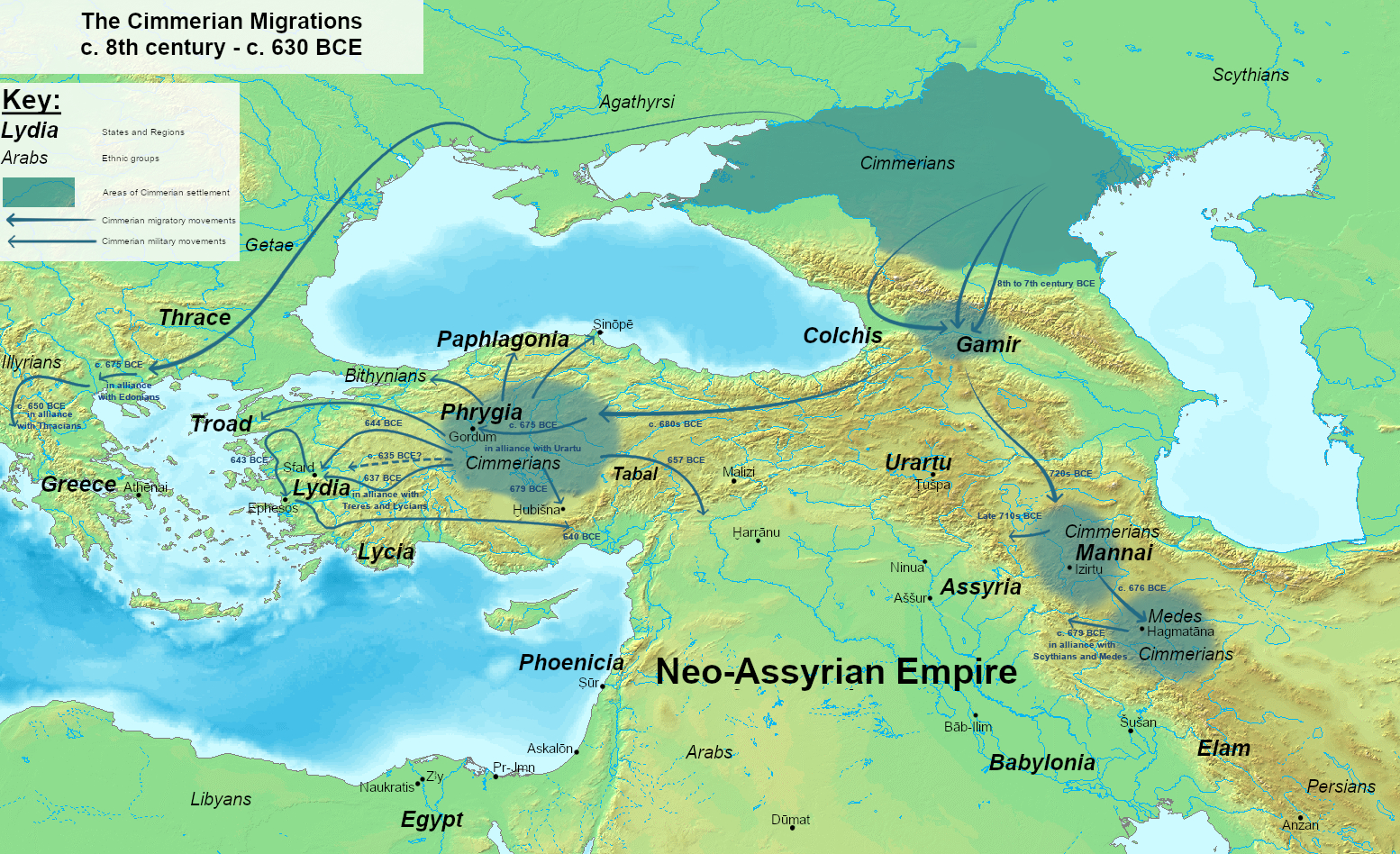
Over the course of the second half of the 8th century BC and the 7th century BC, the equestrian steppe nomads from Ciscaucasia expanded to the south,[69][63] beginning with the Cimmerians, who migrated from the Caspian Steppe into West Asia,[64][70][29] following the same dynamic of the steppe nomads like the Scythians, Alans and Huns who would later invade West Asia via Caucasia.[71] The Cimmerians entered West Asia by crossing the Caucasus Mountains[72][64][29] through the Alagir, Darial, and Klukhor [ru] Passes,[73] which was the same route that Sarmatian detachments would later take to invade the Arsacid Parthian Empire,[71] after which Cimmerians eventually became active in the West Asian regions of Transcaucasia, the Iranian Plateau and Anatolia.[69][74]

Reasons for southwards nomad expansion

[edit]

The involvement of the steppe nomads in West Asia happened in the context of the then growth of the Neo-Assyrian Empire, which under its kings Sargon II and Sennacherib had expanded from its core region of the Tigris and Euphrates valleys to rule and dominate a large territory ranging from Que (Plain Cilicia) and the Central and Eastern Anatolian mountains in the north to the Syrian Desert in the south, and from the Taurus Mountains and North Syria and the coast of the Mediterranean Sea in the west to the Iranian Plateau in the east.[75][76]

Surrounding the Neo-Assyrian Empire were several smaller polities:[77][76]

  • in Anatolia to the northwest, were the kingdoms of:
    • Phrygia, with its capital at Gordion, held hegemony over Central and Midwest Anatolia and parts of Cilicia;
    • and Lydia;
  • Babylon, conquered several times by the Assyrians, in the south;
  • Egypt in the southwest;
  • Elam, whose capital was Susa, in the southeast of West Asia and the southwest of the Iranian plateau, where they were the main power, with their ruling classes being divided into pro-Assyrian and pro-Babylonian factions;
  • and to the immediate north laid the powerful kingdom of Urartu (centred around Ṭušpa), which had established several installations including a system of fortresses and provincial centres over regional communities in eastern Anatolia and the northwest Iranian Plateau, was contesting its southern borderlands with the Neo-Assyrian Empire;
  • in the eastern mountains were several weaker polities:
    • Ellipi;
    • Mannai;
    • the city-states of the Medes, who were an Iranic people of West Asia to whom the Scythians and Cimmerians were distantly related.

Beyond the territories under the direct Assyrian rule, especially in its frontiers in Anatolia and the Iranian Plateau, were local rulers who negotiated for their own interests by vacillating between the various rival great powers.[75]

This state of permanent social disruption caused by the rivalries of the great powers of West Asia thus proved to be a very attractive source of opportunities and wealth for the steppe nomads.[78][79] And, as the populations of the nomads of the Ciscaucasian Steppe continued to grow, their aristocrats would lead their followers southwards across the Caucasus Mountains in search of adventure and plunder in the volatile status quo then prevailing in West Asia,[80] not unlike the later Ossetian tradition of the ritual plunder called the balc (балц),[81][82] with the occasional raids eventually leading to longer expeditions, in turn leading to groups of nomads choosing to remain in West Asia in search of opportunities as mercenaries or freebooters.[83]

Thus, the Cimmerians and Scythians became active in West Asia in the 7th century BC,[61] where they would vacillate between supporting either the Neo-Assyrian Empire or other local powers, and serve them as mercenaries, depending on what they considered to be in their interests.[78][84][85] Their activities would over the course of the late-8th to late-7th centuries BC disrupt the balance of power which had prevailed between the states of Elam, Mannai, the Neo-Assyrian Empire and Urartu on one side and the mountaineer and tribal peoples on the other, eventually leading to significant geopolitical changes in this region.[39][86]

Nevertheless, a 9th or 8th century BC barrow grave, belonging from Paphlagonia to a warrior, and containing typical steppe nomad equipment, suggests that nomadic warriors had already been arriving in West Asia since the 9th century BC.[19][76] Such burials imply that some small groups of steppe nomads from Ciscaucasia might have acted as mercenaries, adventurers and settler groups in West Asia, which laid the ground for the later large scale movement of the Cimmerians and Scythians into West Asia.[19]

There appears to have been very little direct connection between the Cimmerians' migration into West Asia and the Scythians' later expansion into this same region.[60] Thus, the arrival of the Scythians in West Asia about 40 years after the Cimmerians did so suggests that there is no available evidence to the later Graeco-Roman account that it was under pressure from the Scythians migrating into their territories that the Cimmerians crossed the Caucasus and moved south into West Asia.[64][65][63]

In Transcaucasia

[edit]

During the early phase of their presence in West Asia until the early 660s BC, the Cimmerians moved into Transcaucasia, which acted as their initial centre of operations:[2] after having passed through Colchis and western Caucasia and Georgia,[72][87] during the 8th century BC, the Cimmerians settled in a region located to the east of Colchis, in the areas of central Transcaucasia[88] to the immediate south of the Darial and Klukhor passes[89] and on the Cyrus river,[71] which corresponds to territory of Gori in modern-day central and southern Georgia.[90] Archaeologically, this Cimmerian presence is attested by remains associated to nomadic populations dating from between c. 750 to c. 700 BC.[71]

The presence of the Cimmerians in this area led Mesopotamian sources to call it lit.'the Land of the Cimmerians' (𒆳𒂵𒂆, māt Gamir).[2][91][92][93]

The territory of the Cimmerians at this time was separated from the kingdom of Urartu by a Urartian vassal country named Quriani, itself located near the countries of Kulḫa and Diaueḫi, to the east and northeast of the Lake Çıldır and the north and northwest of Lake Sevan.[94][95][96]

Conflict with Urartu
[edit]
Cimmerian invasions of Colchis, Urartu and Assyria in 715–713 BC.

The Cimmerians appeared to have first become active in the territories to the south of the Caucasus in the c. 720s BC, where they helped the inhabitants of Colchis and of the nearby regions defeat attacks by the kingdom of Urartu.[97]

The oldest known activities of the Cimmerians in West Asia date from the mid-710s BC,[98][99] when they launched a sudden attack on Urartu's province of Uišini (whose capital was Waysi) through the territory of the kingdom of Mannai,[100] after the Mannaean king Ullusunu had invited them to attack Urartu through his kingdom's territory.[101] This attack therefore took the Urartians by surprise[102] and forced the governor of Uišini to ask for support from the king of the neighbouring small state of Muṣaṣir located on the Assyro-Urartian border region.[103]

The first recorded mentions of the Cimmerians date from spring or early summer[104] of 714 BC[105] and are from the intelligence reports of the then superpower of West Asia, the Neo-Assyrian Empire, sent by the crown prince Sennacherib to his father the Neo-Assyrian king Sargon II, recording that the Urartian king Rusa I (r.c. 735 – 714 BC) had launched a counter-attack against the Cimmerians:[106] Rusa I had gathered almost all of the Urartian armed forces to campaign against the Cimmerians, with Rusa I himself as well as his commander in chief and thirteen governors personally participating in this campaign.[107] Rusa I's counter-attack was heavily defeated, and the governor of the Urartian province of Uišini was killed while the commander in chief and two governors were captured by the Cimmerian forces, attesting of the significant military power of the Cimmerians.[108]

After this defeat, the Urartian forces retreated to Quriani, while Rusa I left for the Urartian province of Wazaun.[109][96] Although Neo-Assyrian intelligence reports claimed that the Urartians were fearing an attack by the Neo-Assyrian Empire and that panic spread had among them following this defeat,[110] the situation within Urartu remained calm,[104] and the king Urzana of Muṣaṣir personally,[111] as well as a messenger from the kingdom of Ḫubuškia,[112] went to meet Rusa I to reaffirm his allegiance to Urartu.[112]

This defeat against the Cimmerians had nonetheless weakened Urartu significantly enough[89] that, when Sargon II campaigned against Urartu in 714 BC itself,[113] in the month of Tamūzu,[104] he was able to defeat the Urartians[89][114] in the region of mount Wauš, and annex Muṣaṣir,[115][116] while Rusa I consequently committed suicide[117] and his son Melarṭua was crowned as the new king of Urartu.[118] Although Urartu's power was so shaken by these defeats[119] that it stopped harassing Mannai and the Neo-Assyrian provinces on the Iranian Plateau,[101] it nevertheless remained a major power in West Asia under Melarṭua's successor, Argišti II (r. 714 – c. 685 BC).[120]

According to Neo-Assyrian reports from the reign of Sargon II itself, the king of the Cimmerians, whose name was not mentioned in these reports, had set up his camp in a region named Uṣunali. At another point, this Cimmerian king had departed from Mannai to attack Urartu, where he plundered several regions, including the district of Arḫi, and reached the city of Ḫuʾdiadae near the core territory of Urartu, forcing the governor of Uišini to request military aid for the people of Pulia and Suriana from Urzana of Muṣaṣir.[121]

Urartu mobilised its armed forces to fight against this Cimmerian invasion, although the Urartians preferred to wait until it was snowing to attack the Cimmerians, due to how snow could block roads and hinder the mobility of the horses that the Cimmerians depended on to carry on their attacks.[101][121]

Thus, the Cimmerians were attacking Urartu by passing through the routes in Mannai, thanks to which they were able to establish areas of influence on the northeastern borders of Urartu, which also provided them with access to the Anatolian Plateau and allowed them to replace Urartu as the dominant power in some parts of the western Iranian Plateau and Transcaucasia.[121]

Death of Sargon II
[edit]

Possibly out of fear from the danger of the Cimmerians, the Phrygian king Midas, who had previously been a bitter opponent of the Neo-Assyrian Empire, ended hostilities with the Neo-Assyrians in 709 BC and sent a delegation to Sargon II to attempt to form an anti-Cimmerian alliance.[122]

In 705 BC, Sargon II led a campaign against a rebellious Neo-Assyrian vassal, the Neo-Hittite kingdom of Tabal in Anatolia, during which he probably also fought the Cimmerians, and was killed in battle against the Tabalian ruler Gurdî of Kulummu.[123]

The Assyrian king Sargon II (left) and the crown prince Sennacherib (right).

After Sargon II's death, Gurdî's kingdom grew in power while the Neo-Assyrian Empire lost control of Tabal, which largely came under Gurdî's rule;[121] although Sargon II's son and successor Sennacherib (r. 705 – 681 BC) attacked Gurdî at Til-Garimmu in 695 BC, he was able to evade capture by the Neo-Assyrian forces.[124][121]

Nonetheless, although the Neo-Assyrian Empire stopped intervening in Anatolia, Sennacherib was able to secure the new northwestern Neo-Assyrian borders running from Cilicia to Melid to Ḫarran[119][121] due to which the Cimmerians ceased being mentioned in Neo-Assyrian records under his reign and would re-start being mentioned by the Assyrians only under the reign of Sennacherib's own son and successor Esarhaddon.[125][126][127]

The Cimmerians might however have possibly ended their hostilities with Urartu and acted as mercenaries in the Urartian army during this period,[127] under the reign of Argišti II.[125][128][120] Some of these Cimmerians serving in the Urartian army might have been responsible for the creation of several human funerary statues in the region of Muṣaṣir which resemble the funerary statues of steppe nomads.[129]

Cimmerians in the Assyrian army
[edit]

By 680 and 679 BC, Cimmerian detachments composed of individual soldiers were serving in the Neo-Assyrian army. These might have been Cimmerian captives or Cimmerians recruited into the Neo-Assyrian military or merely Assyrian soldiers equipped in the "Cimmerian style," that is using Cimmerian bows and arrows.[130]

Division of the Cimmerians
[edit]

During the period corresponding to the rule of the Neo-Assyrian king Esarhaddon (r. 681 – 669 BC), the Cimmerians split into two major divisions:[131]

  • the bulk of the Cimmerians migrated from Transcaucasia into Anatolia under the leadership of the king Teušpâ, becoming the western division of the Cimmerians;
  • a smaller group of the Cimmerians, called the Indaraeans (𒇽𒅔𒁕𒊒𒀀𒀀, Indaruāya[132]) in Neo-Assyrian sources, remained on the Iranian Plateau in the area near Mannai, where they had been settled since the time of Sargon II, thus forming the eastern division of the Cimmerians.

The two groups of the Cimmerians might themselves have continued to remain part of the same steppe nomad polity, which was itself nevertheless organised along various divisions depending on political changes. Such a structure was also present among:[133]

  • the ancient Xiongnu, whose princes and nobles were divided into Eastern and Western groups;[134]
  • the mediaeval Turkic Oguz people, who were organised into a single kingdom ruled through two divisions, each of which was composed of several tribes and was ruled by a member of the same dynasty.[135]

The Cimmerian and Scythians movements into Anatolia and the Iranian Plateau would act as catalysts for the adoption of Eurasian nomadic military and equestrian equipments by various West Asian states:[84] it was during the 7th and 6th centuries BC that "Scythian-type" socketed arrowheads and sigmoid bows ideal for use by mounted warriors, which were the most advanced shooting weapon of their time and were both technically and ballistically superior to native West Asian archery equipment, were adopted throughout West Asia.[136][84][68]

Cimmerian and Scythian trading posts and settlements on the borders of the various West Asian states at this time also supplied them with goods such as animal husbandry products, not unlike the trade relations which existed the mediaeval period between the eastern steppe nomads and the Chinese Tang Empire.[137]

On the Iranian Plateau

[edit]

The eastern group of Cimmerians would remain on the northwestern Iranian plateau, where they were initially active in Mannai before later moving southwards into Media.[138]

In Mannai
[edit]
Scythian expansion into West Asia
[edit]

After having settled into Ciscaucasia, the Scythians became the second wave of steppe nomads to expand southwards from there, following the western shore of the Caspian Sea[47] and bypassing the Caucasus Mountains to the east through the Caspian Gates,[139] with the Scythians first arriving in Transcaucasia around c. 700 BC,[140] after which they consequently became active in West Asia.[141] This Scythian expansion into West Asia, nonetheless, never lost contact with the core Scythian kingdom located in the Ciscaucasian Steppe and was merely an extension of it, as was the concurrently occurring westward Scythian expansion into the Pontic Steppe.[68]

Once they had finally crossed into West Asia, the Scythians settled in eastern Transcaucasia and the northwest Iranian plateau,[142] between the middle course of the Cyrus and Araxes rivers before expanding into the regions corresponding to present-day Gəncə, Mingəçevir and the Muğan plain[16] in the steppes of what is presently Azerbaijan, which became their centre operations until c. 600 BC,[143][144] and this part of Transcaucasia settled by the Scythians consequently became known in the Akkadian sources from Mesopotamia as māt Iškuzaya (𒆳𒅖𒆪𒍝𒀀𒀀, 'land of the Scythians') after them.[92]

The arrival of the Scythians in West Asia about 40 years after that of the Cimmerians suggests that there is no available evidence to the later Graeco-Roman account of the Cimmerians crossing the Caucasus and moving south into West Asia under pressure from the Scythians migrating into their territories.[64][65][63]

Attacks against the Neo-Assyrian Empire
[edit]
An Assyrian relief depicting Cimmerian mounted warriors

With the Cimmerian victory on Urartu and Sargon II's successful campaign there in 714 BC having eliminated it as a threat against the Neo-Assyrian Empire, Mannai had ceased being useful as a buffer zone for Neo-Assyrian power, while the Mannaeans themselves saw the Neo-Assyrian imperial demands as a now unneeded burden. Therefore, the Mannaean king Aḫšēri (r.c. 675 – c. 650 BC) welcomed the Cimmerians and the Scythians as useful allies who could offer both protection and favourable new opportunities to his kingdom, which in turn allowed him to become an opponent of the Neo-Assyrian Empire, with him subsequently remaining an enemy of Sennacherib and his successors Esarhaddon and Ashurbanipal.[145]

The first ever recorded mention of the Scythians is from the records of the Neo-Assyrian Empire[61][146] of c. 680 BC, which detail the first Scythian activities in West Asia and refer to the first recorded Scythian king, Išpakāya, as an ally of the Mannaeans.[147]

Around this time, Aḫšēri was hindering operations by the Neo-Assyrian Empire between its own territory and Mannai,[148] while the Scythians were recorded by the Neo-Assyrians along with the eastern Cimmerians, Mannaeans and Urartians as possibly menacing communication between the Neo-Assyrian Empire and its vassal of Ḫubuškia, with messengers travelling between the Neo-Assyrian Empire and Hubuskia being at risk of being captured by hostile Cimmerian, Mannaean, Scythian or Urartian forces.[149] Neo-Assyrian records also referred to these joint Cimmerian-Scythian forces, along with the Medes and Mannaeans, as a possible threat against the collection of tribute from Media.[150]

During these attacks, the Scythians, along with the eastern Cimmerians who were located on the border of Mannai,[151][2] were able to reach far beyond the core territories of the Iranian Plateau and attack the Neo-Assyrian provinces of Parsuwaš and Bīt-Ḫambān and even until as far as Yašuḫ, Šamaš-naṣir and Zamuā in the valley of the Diyala river.[152] One Scytho-Cimmerian attack which had invaded Ḫubuškia from Mannai was even able to threaten the core Neo-Assyrian territories by passing through Anisus and Ḫarrāniya on the Lower Zab river and sack the small city of Milqiya near Arbaʾil, close the capital cities of the Neo-Assyrian Empire, where they destroyed the Bīt-Akītī (House of the New Year Festival) of this city, which later had to be rebuilt by Esarhaddon.[153][154] These attacks into their heartlands shocked the Assyrians, who sought to know if they were to face more such invasions through divination.[148]

Meanwhile, Mannai, which had been able to grow in power under Aḫšēri, possibly thanks to its adaptation and incorporation of steppe nomad fighting technologies borrowed from its Cimmerian and Scythian allies,[155] was able to capture the territories including the fortresses of Šarru-iqbi and Dūr-Illil from the Neo-Assyrian Empire and retain them until the c. 650s BC.[156][145]

Under Argišti II, Urartu attempted to restore its power by expanding to the east towards the region of Mount Sabalan, possibly to relieve the pressure on the trade routes across the Iranian Plateau and the steppes from the Scythians, Cimmerians, and Medes.[157] Urartu remained a major power under Argišti II's successor Rusa II (r.c. 685 – c. 645 BC), the latter of whom carried out major fortification construction projects around Lake Van, such as at Rusāipatari, and at Teišebaini near what is presently Yerevan;[124] other fortifications built by Rusa II were Qale Bordjy and Qale Sangar north of Lake Urmia, as well as the fortresses of Pir Chavush, Qale Gavur and Qiz Qale around the administrative centre of Haftavan Tepe to the northwest of the Lake, all intended to monitor the activities of the allied forces of the Scythians, Mannaeans and Medes.[158]

These allied forces of the Cimmerians, Mannaeans and Scythians were defeated some time between c. 680 and c. 677 BC by Sennacherib's son Esarhaddon (r. 681 – 669 BC), who had succeeded him as the king of the Neo-Assyrian Empire[159][160][68] and carried out a retaliatory campaign which reached deep into Median territory until Mount Bikni and the country of Patušarra (Patischoria) on the limits of the Great Salt Desert.[161][162] Išpakāya was killed in battle against Esarhaddon's forces during this campaign, and he was succeeded as king of the Scythians by Bartatua,[163] with whom Esarhaddon might have immediately initiated negotiations.[164]

Since the Cimmerians had left their Ciscausian homelands and moved into West Asia to seek booty, they had no interest in the local affairs of the West Asian states and therefore fought for whoever was capable of paying them the most: therefore Esarhaddon took advantage of this and, at some point before c. 675 BC, he started secret negotiations with the eastern Cimmerians, who confirmed to the Assyrians that they would remain neutral and promised not to interfere when Esarhaddon invaded Mannai again in c. 675 BC. Nonetheless, since the Cimmerians were distant foreigners with a very different culture, and therefore did not fear the Mesopotamian gods, Esarhaddon's diviner and advisor Bēl-ušēzib referred to these eastern Cimmerians instead of the Scythians as possible allies of the Mannaeans and advised Esarhaddon to spy on both them and the Mannaeans.[165]

This second Assyrian invasion of Mannai however met little success because the Cimmerians with whom Esarhaddon had negotiated had deceived him by accepting his offer only to attack his invasion force,[166] and the relations between Mannai and the Neo-Assyrian Empire remained hostile while the Cimmerians remained allied to Mannai[167] until the period lasting from 671 to 657 BC.[168] As a result of this failure, the Neo-Assyrian Empire resigned itself to waiting until the Cimmerians were no longer a threat before mounting any further expedition in Mannai.[166]

Around this same time, the Indaraeans were also active around the northern boundary of Elam,[169] and some of them might have moved to the southern Iranian Plateau, where they possibly introduced Bronze articles from the Koban culture into the Luristan bronze culture.[170]

Alliance with the Medes
[edit]

The Neo-Assyrian Empire did not remain on a defensive footing in response to the activities of the allied Cimmerian, Mannaean and Scythian forces, and it soon undertook diplomatic initiatives to separate Aḫšēri from his allies: by 672 BC, the Scythians had become the allies of the Neo-Assyrian Empire after Išpakāya's successor, Bartatua, had asked for the hand of the eldest daughter of Esarhaddon, the Neo-Assyrian princess Šērūʾa-ēṭirat, and promised to form an alliance treaty with the Neo-Assyrian Empire in an act of careful diplomacy.[171]

The marriage between Bartatua and the Šērūʾa-ēṭirat likely took place,[172] in consequence of which[68] the Scythians ceased to be referred to as an enemy force in the Neo-Assyrian records[173] and the alliance between the Scythian kingdom and the Neo-Assyrian Empire was concluded,[174][68] following which the Scythian kingdom therefore remained on friendly terms with the Neo-Assyrian Empire and maintained peaceful relations with it.[127]

The eastern Cimmerians meanwhile remained hostile to Assyria,[175] and, along with the Medes, were the allies of Ellipi against an invasion by the Neo-Assyrian Empire between c. 672 and c. 669 BC.[176] The eastern Cimmerians also attacked the Assyrian province of Šubria during this time.[151][2]

It consequently became more difficult for the Neo-Assyrian Empire to control the Median city-states and the various polities in the Zagros Mountains at this point.[160] Soon, the Median chieftains Kaštaritu of Kār-Kaššî and Dusanni of Šaparda became powerful enough that their respective polities were seen by the Neo-Assyrian Empire as major forces in Media.[177] And when Kaštaritu rebelled against the Neo-Assyrian Empire and founded the first independent kingdom of the Medes after successfully liberating them from Neo-Assyrian overlordship in c. 671 to c. 669 BC,[178] the eastern Cimmerians were allied to him.[179]

Around c. 669 BC, the eastern Cimmerians experienced a defeat by the Neo-Assyrian army and were forced to retreat into their own territory,[180] and they were still on the territory of Mannai by c. 667 BC.[2]

However, some time in the late 660s or early 650s BC, the eastern Cimmerians left the Iranian Plateau and retreated to the west into Anatolia to join the western Cimmerians operating there: since Aḫšēri had depended on his alliance with the Cimmerians and Scythians to protect his kingdom from attacks by the Neo-Assyrian Empire, their departure provided Esarhaddon's successor to the Neo-Assyrian kingship, Ashurbanipal (r. 669 – 631 BC), with the opportunity to attack Mannai and recover some of the settlements which the Mannaeans had previously captured. And although Aḫšēri himself was able to withstand the Neo-Assyrian invasion, he had depended on the Cimmerians to suppress internal opposition to his rule, and their absence weakened him enough that he was soon deposed and killed by a popular rebellion which his son Uallî repressed before ascending to the throne of Mannai and submitting to the Neo-Assyrian Empire.[181]

Thus, Ashurbanipal's situation improved once he was finally re-establish Neo-Assyrian overlordship over Mannai thanks to the retreat of the Cimmerians from the Iranian Plateau.[182]

In Anatolia

[edit]

At an unknown time,[62] the western Cimmerian group moved into Anatolia,[183] where it would be particularly active in the regions of Tabal, Phrygia and Lydia[184][185] and would be involved in wars against these latter two states as well as against the Neo-Assyrian Empire,[71] which itself avoided confrontations with the Cimmerians unless doing so was necessary.[186]

This Cimmerian movement into Anatolia consisted of a large scale migration, with Cimmerian families taking their mobile possessions, animals, as well as conquered booty, along with them.[185] This migration is archaeologically attested in the form of the expansion of the Scythian culture into this region,[2] although the further details of the exact time and trajectory through which the Cimmerians moved into Anatolia, and whether these movements consisted of a single group or of disparate divisions, are however unknown.[62]

Defeat by Esarhaddon
[edit]

Around the same time, the rulers of the Neo-Hittite kingdom of Ḫubišna, which occupied a strategic position containing many settlements and routes linking the Konya Plain with Cilicia, might have demanded help from the Cimmerians against possible Neo-Assyrian attempts to take control of their region following the death of Warpalawas II of Tuwana, or the Cimmerians might have attempted to invade this region on their own.[160] The Neo-Assyrian Empire reacted to maintain its control of Cilicia by conducting a campaign in 679 BC during which Esarhaddon killed the Cimmerian king Teušpâ and annexed a part of the territory of the kingdom of Ḫilakku and of the kingdom of Kundi and Sissû in the region of Que.[187]

Despite this victory, and although Esarhaddon had managed to stop the advance of Cimmerians in the Neo-Assyrian province of Que so that this latter region remained under Neo-Assyrian control,[160] the military operations were not successful enough for the Assyrians to firmly occupy the areas around of Ḫubišna, nor were they able to secure the borders of the Neo-Assyrian Empire, leaving Que vulnerable to incursions from Tabal, Kuzzurak and Ḫilakku,[188][189] who were allied to the western Cimmerians who were establishing themselves in Anatolia at this time[190] and might still have maintained connections with them even after Esarhaddon's victory at Ḫubišna.[177]

Invasion of Phrygia
[edit]

With Urartu incapable of stopping the Cimmerian advance,[124] some time around c. 675 BC,[191] under their king Dugdammî[192][183][127] (the Lygdamis of the Greek authors[183][127][177]), the western Cimmerians invaded and destroyed the empire of Phrygia, whose king Midas committed suicide, and sacked its capital of Gordion,[193] although they appear to have neither settled within the city nor destroyed its fortifications.[194]

The western Cimmerians consequently settled in Phrygia[183] and subdued part of the Phrygians[195][196] so that they controlled a large area consisting of Phrygia from its western limits which bordered on Lydia to its eastern boundaries neighbouring the Neo-Assyrian Empire,[197] after which they made Cappadocia into their centre of operations.[198]

These western Cimmerians soon became sedentary, and by c. 670 BC, they had established their rule over native Anatolian settlements as well as formed their own settlements in Central Anatolia, with the city of Ḫarzallē or Ḫarṣallē being the capital city of the Cimmerian king Dugdammî. Each of these settlements had rulers referred to by Neo-Assyrian sources as lit.'city-lords' (Neo-Assyrian Akkadian: 𒇽𒂗𒌷𒈨𒌍, romanized: bēl ālāni): these administrators consisted of both Cimmerians and members of other ethnic groups who lived within Dugdammî's kingdom.[199]

According to a tradition later recorded by Stephanus of Byzantium, the Cimmerians found several tens of thousands of medimnoi of wheat in the underground granaries of the Phrygian village of Syassos that they used as food for a long time.[197][186]

Activities in Anatolia
[edit]

When Esarhaddon conquered the nearby state of Šubria in 673 BC, Rusa II supported him, attesting of a period of non-aggression between Urartu and Assyria under the reigns of Rusa II and Esarhaddon.[124]

Assyrian sources from around this same time also recorded a Cimmerian presence in the area of the Neo-Hittite state of Tabal.[200]

And between c. 672 and c. 669 BC, an Assyrian oracular text recorded that the Cimmerians, together with the Phrygians and the Cilicians, were threatening the Neo-Assyrian Empire's newly conquered territory of Melid.[201]

The western Cimmerians were thus active in Tabal, Ḫilakku and Phrygia in the 670s BC,[195] and, in alliance with these former two states, were attacking the western Neo-Assyrian provinces.[190][202] At unknown dates, the western Cimmerians also invaded Bithynia and Paphlagonia.[203]

In the early 660s BC, the power of the Cimmerians grew drastically and they became the masters of Anatolia,[204] where they controlled a large territory[205] bordering Lydia in the west, covering Phrygia around Gordion and the Sangarios river, and reaching the Taurus Mountains in Cilicia and the borders of Urartu in the east, and encompassing the area bounded by the Black Sea in the north and the Mediterranean Sea in the south.[206]

The core territories of the western Cimmerians were in Central Anatolia between the Konya Plain and the Neo-Assyrian province of Que, but also extended to parts of the Konya Plain itself, including its western parts, and to Cappadocia, as well as to the west of Tabal,[186][207] implying that some of the Neo-Hittite states in and near the Konya Plain had become subjected to the Cimmerians.[185]

The disturbances experienced by the Neo-Assyrian Empire as result of the activities of the Cimmerians in Anatolia led to many of the rulers of this region to try to break away from Neo-Assyrian overlordship,[192] with Ḫilakku having become an independent polity again under the king Sandašarme[160] by the time that Esarhaddon had been succeeded as king of the Neo-Assyrian Empire by Ashurbanipal, so that by then the Cimmerians had effectively ended Neo-Assyrian control in Anatolia.[208]

Reunification of the Cimmerians
[edit]

Soon, in the late 660s or early 650s BC, the western Cimmerians were reinforced by the eastern Cimmerians who had left the western Iranian plateau to move to the west into Anatolia.[182]

First contacts with the Greeks
[edit]
Reproduction of a depiction of Cimmerian mounted archers from a Greek vase.

Beginning in the 8th century BC, the ancient Greeks were first starting to make expeditions in the Black Sea, and encounters with friendly native populations quickly stimulated trade relations and the development of more regular commercial transits, which in turn led to the formation of trading settlements.[209] The first Greek colony in the Black Sea, founded by settlers from Miletus around c. 750 BC, was that of Sinope,[54] in whose region the Cimmerians were active at this time.[2][210][184]

The Cimmerians destroyed Sinope during the 7th century BC and killed its founder, Habrōn, after they had invaded Paphlagonia.[211] The Greek colony of Cyzicus might also have been destroyed by the Cimmerians so that it had to be re-founded at a later date.[212] Thus, it was at this time that the Cimmerians first came into contact with the Greeks in Anatolia,[46] constituting the first encounter between the ancient Greeks and steppe nomads.[71][68][213]

In 671 to 670 BC, Cimmerian contingents were serving in the Assyrian army,[2][177] and Neo-Assyrian sources were referring to the spread of military technology and animal husbandry products referred to in Assyrian sources as "Cimmerian leather straps" and "Cimmerian bows" into the Neo-Assyrian Empire from c. 700 to c. 650 BC.[84]

First attack on Lydia
[edit]

With their eastern and southeastern borders abutting the Neo-Assyrian, which had been powerful enough to defeat their king Teuspa some years earlier,[214] in the late c. 670s and early c. 660s BC, the Cimmerians under Dugdammî instead redirected their activities towards western Anatolia, where they attacked the kingdom of Lydia,[215] which under its king Gyges had been filling the power vacuum in Anatolia created by the destruction of the Phrygian Empire and was establishing itself as a new rising regional power.[216][217][218]

However, the Lydian forces were initially not able to resist this invasion,[219] and Gyges sought to find help to face the Cimmerian invasions by initiating diplomatic relations with the Neo-Assyrian Empire in 666 BC:[220] without accepting Assyrian overlordship, Gyges started to send regular embassies and diplomatic gifts to Ashurbanipal, with another Lydian embassy to the Neo-Assyrian Empire being attested from c. 665 BC.[221]

Since it was due to the threat of the Cimmerians that Gyges had made friendly overtures to the Neo-Assyrian Empire, Ashurbanipal considered the Cimmerian presence in Anatolia more useful than fighting them. Therefore, he adopted a policy of accepting whatever gifts and praise that Gyges would offer him, in exchange of which Ashurbanipa promised him support from the gods Aššur and Marduk while keeping him waiting and abstaining from providing any military support to Lydia.[182]

These Cimmerian attacks also destroyed the relations between Lydia and Phrygia, and archaeological evidence from the Lydian site of Daskyleion shows that the Cimmerian invasion ended the development of trade and economic production in the early 7th century BC which had contributed to integrating both Lydia and Ionia into the Mediterranean economy.[222] Lower class Ionian Greeks and Carians affected by this Cimmerian invasion appear to have formed a significant part of the colonists who went to set up new settlements throughout the shore of the Black Sea in the 7th century BC, such as the colonies of Borysthenēs, Histria, Apollonia Pontica, Kallatis, and Karōn Limēn.[223]

Gyges's struggle against the Cimmerians soon turned in his favour without Neo-Assyrian support, so that he was able to defeat them between c. 665 and c. 660 BC,[224] possibly through campaigns in western Central Anatolia to the east of Sardis and the south of the core Phrygian territory,[225] after which he sent captured Cimmerian city-lords as diplomatic gifts to Ashurbanipal.[226]

Gyges then stationed Carian and Ionian mercenaries at Abydos,[227] which provided an impetus for the formation of new Greek colonies in the Propontis and therefore made the Black Sea accessible to Greeks from Ionia.[228]

The defeat of the Cimmerians by Gyges in turn weakened their allies, Mugallu of Tabal and Sandašarme of Ḫilakku, enough that they were left with no choice but to submit to the authority of the Neo-Assyrian Empire in c. 662 BC.[229]

Hegemony in the Levant
[edit]

Facing resistance from the Lydians in the west, the Cimmerians moved eastwards, against the Neo-Assyrian Empire:[230] despite their defeat by Gyges in the c. 660s BC, the Cimmerians' power soon grew much so that by c. 657 BC they were not only in control of a large territory in Anatolia and were one of the main political forces operating in this region, but were also able conquer part of what had previously been secure western possessions of the Neo-Assyrian Empire, such as the province of Que or even part of the Levant.[231]

These Cimmerian aggressions worried Ashurbanipal about the security of the northwest border of the Neo-Assyrian Empire enough that he sought answers concerning this situation through divination.[232] And, as a result of these Cimmerian conquests, by 657 BC, the Assyrian astrologer Akkullanu was calling the Cimmerian king Dugdammî by the title of šar-kiššati (lit.'King of the Universe'),[183][155] which in the Mesopotamian worldview was a title that could belong only a single ruler in the world at any given time, and was normally held by the King of the Neo-Assyrian Empire. This attribution of the title of šar-kiššati to a foreign ruler was an unprecedented situation of which there is no other known occurrence throughout the duration of the Neo-Assyrian Empire.[233][207][234]

Akkullanu nevertheless also assured to Ashurbanipal that he would eventually regain the kiššūtu, that is the world hegemony which rightfully belonged to him, from the Cimmerians who had usurped it.[233]

This extraordinary situation meant that, under Dugdammî, who was their most powerful king,[183] the Cimmerians had become a force feared by Ashurbanipal, and the Cimmerians' successes against the Neo-Assyrian Empire meant that they had become recognised in ancient West Asia as equally powerful as Ashurbanipal himself.[233]

This situation remained unchanged throughout the rest of the 650s and the early 640s BC,[235] with the Cimmerian aggressions worrying Ashurbanipal regarding the security of his northwestern border so much that he often sought answers regarding this situation through divination.[236]

These setbacks, along with Ashurbanipal's refusal to provide military support to Lydia, discredited Neo-Assyrian power enough that Gyges understood that he could not rely on Assyrian support against the Cimmerians, and, once the Cimmerians had moved to the east and their attacks on his kingdom decreased, he therefore ended diplomacy with the Neo-Assyrian Empire and instead sent troops to help the Egyptian kinglet Psamtik I of Sais,[237] who had himself been a Neo-Assyrian vassal who was then eliminating the other Neo-Assyrian vassal kinglets in Lower Egypt to unite the whole of Egypt under his own rule.[238][239] Ashurbanipal responded to Gyges's disengagement with the Neo-Assyrian Empire by cursing him.[240][239][214]

Exhaustion of Assyria
[edit]

Neo-Assyrian power experienced another significant blow in 652 BC, when Esarhaddon's eldest son, Šamaš-šuma-ukin, who had succeeded him as king of Babylon, rebelled against his younger brother Ashurbanipal: it took Ashurbanipal four years to fully suppress the Babylonian rebellion by 648 BC, and another year to destroy the power of Elam, who had supported Šamaš-šuma-ukin,[155] and, although Ashurbanipal would nevertheless be able to maintain control over Babylonia for the rest of his reign, the Neo-Assyrian Empire finally emerged from this crisis severely worn out.[241]

One of the oracular responses received by Ashurbanipal in 652 BC itself claimed that the goddess Ishtar had promised to him that the Cimmerians would be defeated similarly to how Ashurbanipal himself had defeated the Elamites and killed their king Teumman in 653 BC.[242]

Meanwhile, Dugdammî might have taken advantage of the civil war within the Neo-Assyrian Empire caused by Samas-suma-ukin's rebellion to attack northwestern Neo-Assyrian provinces.[243]

Attack on Šubria
[edit]

In the 650s BC, the Cimmerians were allied to Urartu[202][129] and were serving as auxiliaries in the service of its king Rusa II, who was then attempting to attack the newly conquered Assyrian province of Šubria near the Urartian border.[244] Urartu was thus integrating steppe nomad mercenaries into its armed forces, and was also trying to borrow the military technology of these peoples.[121]

Alliance with the Treres
[edit]
A Thracian mounted warrior followed by a warrior on foot.

Around the c. 660s BC, the Thracian tribe of the Treres migrated across the Thracian Bosporus and invaded Anatolia from the north-west,[204][245][246] after which they allied with the Cimmerians,[2] and, from around the c. 650s BC, the Cimmerians were nomadising in Anatolia along with the Treres.[202][247]

Second attack on Lydia
[edit]

The Cimmerians and Treres under Lygdamis and the Treran king Kōbos,[248] and in alliance with the Lycians or Lycaonians, attacked Lydia for a second time in 644 BC:[249] this time they defeated the Lydians and captured their capital city of Sardis except for its citadel, and Gyges was killed during this attack.[250] The Neo-Assyrian sources blamed Gyges's death on his own hubris, that is on his own independent actions, by claiming that the Cimmerians invaded Lydia and killed him as punishment for him providing Psamtik I with the troops he used to eliminate the other pro-Assyrian Egyptian kinglets and unify Egypt under his sole rule.[251][214]

After this attack, Gyges's son Ardys succeeded him as king of Lydia and resumed diplomatic activity with the Neo-Assyrian Empire with the hope of military support which Ashurbanipal again did not provide.[252] As a result, Ardys might possibly have been forced to submit to the Cimmerians,[214] although the Cimmerians themselves never ruled Lydia.[253]

Attack on Ionia and Aeolia
[edit]

After sacking Sardis, Lydgamis and Kobos led the Cimmerians and the Treres into invading the Greek city-states of the Troad,[128][2] Aeolia and Ionia on the western coast of Anatolia,[254] where they destroyed the city of Magnesia on the Meander as well as the Artemision of Ephesus.[255] The city of Colophon joined Ephesus and Magnesia in resisting the Cimmerian invasion.[256]

Painting depicting Cimmerian mounted warriors from a Klazomenian sarcophagus.
Reproduction of a depiction of a Cimmerian archer from a Greek vase.

The Cimmerians and Treres remained on the western coast of Anatolia inhabited by the Greeks for three years, from c. 644 to c. 641 BC, where later Greek tradition claimed that Lygdamis had occupied Antandros and Priene, which forced a large number of the inhabitants of the coastal region called Batinētis to flee to the islands of the Aegean Sea.[257]

Activities in Cilicia
[edit]

Sensing the exhaustion of Neo-Assyrian power following the suppression of the revolt of Šamaš-šuma-ukin, the Cimmerians and Treres moved to Cilicia on the north-west border of the Neo-Assyrian Empire in c. 640 BC itself, immediately after their third invasion of Lydia and the attack on the Asian Greek cities. There, Dugdammî allied with Mugallu's son and successor as king of the then rebellious Assyrian vassal state of Tabal, Mussi, to attack the Neo-Assyrian Empire.[258]

Although the Urartians had sent tribute to the Neo-Assyrian Empire in 643 BC, the Urartian king Sarduri III (r.c. 645 – c. 625 BC), who had been a Neo-Assyrian vassal, was at this time also forced to accept the suzerainty of the Cimmerians.[259][155][243]

However, Mussi died before the planned attack on Neo-Assyrian Empire and his kingdom collapsed when its elite fled or was deported to Assyria, while Dugdammî carried it out but failed because, according to Neo-Assyrian sources, he became ill and fire broke out in his camp.[260] Following this, Dugdammî was faced with a revolt against himself, after which ended his hostilities against the Neo-Assyrian Empire and sent tribute to Ashurbanipal to form an alliance with him, while Ashurbanipal forced Dugdammi to swear an oath to not attack the Neo-Assyrian Empire.[248][261][262]

Death of Dugdammî
[edit]

Dugdammî soon broke his oath and attacked the Neo-Assyrian Empire again, but during his military campaign he contracted a grave illness whose symptoms included paralysis of half of his body and vomiting of blood as well as gangrene of the genitals, and he consequently committed suicide in 640 BC[263] in Cilicia itself.[264]

Dugdammî was succeeded as king of the Cimmerians in Cilicia by his son Sandakšatru,[265] who continued Dugdammî's attacks against the Neo-Assyrian Empire[266] but failed just like his father.[128][267]

The power of the Cimmerians dwindled quickly after the death of Dugdammî,[268][269] although the Lydian kings Ardys and Sadyattes might however have either died fighting the Cimmerians or were deposed for being incapable of efficiently fighting them, respectively in c. 637 and c. 635 BC.[270]

Final defeat
[edit]
A relief depicting mounted Lydian warriors on slab of marble from a tomb.

Despite these setbacks, the Lydian kingdom was able to grow in power, and the Lydians themselves appear to have adopted Cimmerian military practices such as the use of mounted cavalry, with the Lydians fighting using long spears and archers, both on horseback.[271]

Around c. 635 BC,[272] and with Neo-Assyrian approval,[273] the Scythians under their king Madyes conquered Urartu,[274][275] entered Central Anatolia,[39] and defeated the Cimmerians and Treres.[276] This final defeat of the Cimmerians was carried out by the joint forces of Madyes's Scythians, whom Strabo of Amasia credits with expelling the Treres from Asia Minor, and of the Lydians led by their king Alyattes,[277] who was himself the son of Sadyattes as well as the grandson of Ardys and the great-grandson of Gyges, whom Herodotus of Halicarnassus and Polyaenus of Bithynia claim permanently defeated the Cimmerians so that they no longer constituted a threat.[278]

In an inscription from after c. 638 BC, Ashurbanipal thanked the god Marduk for the fate which had struck Sandakšatru, suggesting that he had experienced a horrifying death not unlike his father's.[279]

The Cimmerians completely disappeared from history following this final defeat,[128][68] and they were soon assimilated by the various populations and polities of Anatolia, such as Lydia, Media, and Pteria.[202] It was also around this time that the last still-existing Syro-Hittite and Aramaean states in Anatolia, which had been either independent or vassals of the Neo-Assyrian Empire, Phrygia, Urartu, or of the Cimmerians, also disappeared, although the exact circumstances of their end are still very uncertain.[241]

Scythian power in West Asia thus reached its peak under Madyes, with the West Asian territories ruled by the Scythian kingdom extending from the Halys river in Anatolia in the west to the Caspian Sea and the eastern borders of Media in the east, and from Transcaucasia in the north to the northern borders of the Neo-Assyrian Empire in the south.[280][272][281] And, following the defeat of the Cimmerians and the disappearance of these states, it was the new Lydian Empire of Alyattes which became the dominant power of Anatolia,[204][282] while the city of Sinope was re-founded[275][283] by the Milesian Greek colonists Kōos and Krētinēs.[284][285]

Impact in West Asia

[edit]

The inroads of the Cimmerians and the Scythians into West Asia over the course of the 8th to 7th centuries BC had destabilised the political balance which had prevailed in the region between the dominant great powers of Assyria, Urartu, and Phrygia,[286] and also caused the decline and destruction of several of these states' power, consequently led to the rise of multiple new powers such as the empires of the Medes and Lydians,[287] thus irreversibly changing the geopolitical situation of West Asia.[39][288]

The Cimmerian and Scythian activities in West Asia also hampered the development of trade, and overland trade routes in the region such as the Great Khorasan Road likely became dangerous to use, while also preventing the formation of new trade routes.[227]

These Cimmerian and Scythian activities also influenced the developments in West Asia through the spread of the steppe nomad military technology brought by them into this region, and which were disseminated during the periods of their respective hegemonies in West Asia.[286]

Possible migration in Europe

[edit]

It has been hypothesised that some Cimmerians might have migrated into Eastern, Southeast and Central Europe,[289] although this identification is presently considered very uncertain.[290]

Proponents of a Cimmerian migration into southeastern Europe suggest that it affected as far as Thrace, where between 700 and 650 BC the Edoni allied with the Cimmerians to expand their territories by occupying Mygdonia and the area up to the Axios river at the expense of the Sintians and the Siropaiones.[291]

The proponents of this hypothesis of a Cimmerian invasion also suggest that it would have also affected south-eastern Illyria, where raids by Cimmerians allied to Thracians ended the hegemony of Illyrian tribes around 650 BC, and possibly into Epirus as well, where distinctive Cimmerian horse trappings were found offered in dedication at the temple of Dodona.[292]

Legacy

[edit]

Ancient

[edit]
In Europe
[edit]

The peoples of the Chernogorovka-Novocherkassk complex of which the Cimmerians were part of introduced the use of trousers into Central Europe, whose local native populations did not wear trousers before the arrival of the first wave of steppe nomads of Central Asian origin into Europe.[32]

In West Asia
[edit]

The inroads of the Cimmerians and the Scythians into West Asia over the course of the 8th to 7th centuries BC, which were early precursors of the later invasions of West Asia by steppe nomads such as the Huns, various Turkic peoples, and the Mongols, in Late Antiquity and the Mediaeval Period,[293] had destabilised the political balance which had prevailed in the region between the dominant great powers of Assyria, Urartu, and Phrygia,[286] and also caused the decline and destruction of several of these states' power, consequently to the rise of multiple new powers such as the empires of the Medes and Lydians,[287] thus irreversibly changing the geopolitical situation of West Asia.[294]

These Cimmerians and Scythians also influenced the developments in West Asia through the spread of the steppe nomad military technology brought by them into this region, and which were disseminated during the periods of their respective hegemonies in West Asia.[286]

After the end of the Neo-Assyrian Empire, and following the conquest of the Neo-Babylonian Empire which had succeeded it by the Persian Achaemenids, the Babylonian scribes of the Achaemenid Persian Empire used the name of the Cimmerians (Gimirri: 𒆳𒄀𒈪𒅕[10] and 𒆳𒄀𒂆𒊑[11]) in Neo-Babylonian Akkadian to indiscriminately and anachronistically refer to all of the nomads of the steppes, including both the Pontic Scythians and the Central Asian Saka, because of their similar nomadic lifestyles.[12] The Achaemenid Babylonian scribes therefore designated the bows used by Saka mounted archers as lit.'Cimmerian bows' (𒄑𒉼 𒄀𒂆𒊒𒄿𒋾, qaštu Gimirrîti and 𒄑𒉼𒈨 𒄀𒂆𒊒𒀪, qašātu Gimirruʾ).[96] The Greeks similarly used the name of the Scythians as a generalising term for all stepp nomads, and the Byzantines later also similarly used it as an archaising term to designate the Huns, Slavs and other eastern peoples centuries after the actual Scythians had disappeared.[295][92]

The Cimmerians appear in the Hebrew Bible under the name of Gōmer (Hebrew: גֹּמֶר; Ancient Greek: Γαμὲρ, romanizedGamèr), where Gōmer is closely linked to ʾAškənāz (אשכנז), that is to the Scythians.[296]

Due to the fear that the Cimmerian invasions caused among the Greeks of Ionia, they were remembered in Greek tradition, and an inscription from 283 BC mentioned that the Greek city-states of Samos and Priene were still engaging in a lawsuit disputing the territory of Batinetis which had been abandoned during the Cimmerian invasion of Ionia and Aeolia.[297]

In the mediaeval period, Armenian tradition assigned the name of the Biblical Gōmer to the Konya Plain and to Cappadocia, which was therefore called Gamirkʻ (Գամիրք) in the Armenian language.[183]

In Graeco-Roman literature
[edit]
In Homer's Odyssey
[edit]

The first mention of the Cimmerians in Graeco-Roman literature dates from the 8th century BC in Homer's Odyssey,[298] which describes them as a people living in a city located at the entrance of Hades beyond the western shore of the Oceanus river which encircles the world, in a land towards which Odysseus sailed to obtain an oracle from the soul of the seer Tiresias, and which was covered with mists and clouds and therefore remained permanently deprived of sunlight although the Sun-god Helios sets there.[299]

This mention of the Cimmerians in the Odyssey was purely poetic and combined fantasy with records of real events, and naturalism with supernatural elements, and therefore contained no reliable information about the real Cimmerian people.[300] This image was created as a poetic opposite of the Laestrygonians and Aethiopians who, in ancient Greek mythology, lived in a permanently sunlit land on the eastern borders of the world.[301][302] Due to this location, the Ancient Greek name of the Cimmerians was identified with the word for mist, kemmeros (κέμμερος).[302]

Homer's passage relating to the Cimmerians had however used as its source the Argonautic myth, which dealt with the region of the Black Sea and the country of Colchis, on whose eastern borders the Cimmerians were still living in the 8th century BC.[303] Thus, Homer's source on the Cimmerians was the Argonautic myth, which itself recorded of their existence when they were still living in northern Transcaucasia:[304][42] the location of the Cimmerians as recorded by the Argonautic myth corresponds to the same one recorded by the late 7th century BC poem Arimaspeia by Aristeas of Proconessus and the later writings of Herodotus of Halicarnassus,[305] who both described the Cimmerians as having once dwelt in the steppe to the immediate north of the Caspian Sea,[305] with the Araxes (Volga) river forming their eastern border separating them from the Scythians.[45]

In the 6th century BC
[edit]

The Greeks living in Anatolia in the 6th century BC still evoked the memory of the Cimmerians with fear a century after their disappearance.[87]

The Greek historian Hecataeus of Miletus, drawing from information acquired by the Persian army during its invasion of Scythia in 513 BC, later started the tradition of locating Homer's Cimmerians and "Cimmerian" places (such as a "Cimmerian city") in the Scythian-dominated Pontic Steppe[306] between the Araxes and the Bosporus.[43]

According to Herodotus of Halicarnassus
[edit]

Herodotus of Halicarnassus wrote a legendary account, partly based on Hecataeus's narrative,[43] of the arrival of the Scythians into the lands of the Cimmerians:[307]

  1. after the Scythians were expelled from Central Asia by the Massagetae, they moved to the west across the Araxes, and took possession of the Cimmerians' lands after chasing them away;
  2. the approach of the Scythians led to a civil war among the Cimmerians because the "royal tribe" wanted to remain in their lands and defend themselves from the invaders, while the rest of the people saw no use in fighting and preferred to flee;
  3. since neither side could be persuaded by the other, the "royal tribe" divided themselves into two equally numerous sides that fought each other till death, after which the commoners buried them by the Tyras river.

Basing himself on Greek folk tales from the city of Tyras, Herodotus claimed the tombs of the Cimmerian princes could still be seen in his days near the Tyras river.[210]

Herodotus also referred to the presence of several "Cimmerian" toponyms as existing in the Bosporan region, such as:[47][48][54]

Herodotus likely used Bosporan Greek folk tales as source for these claims, although some of the "Cimmerian" toponyms in the Bosporan region might have originated from a genuine Cimmerian presence in this area.[308][47][46]

The story of the fratricidal war of the Cimmerian "royal tribe," that is of the defeat and destruction of its ruling class, is contradicted by how powerful the Cimmerians were according to the Assyrian records contemporaneous with their presence in West Asia. Another inconsistency in Herodotus's description of the flight of the Cimmerians is the direction through which they retreated: according to this narrative, the Cimmerians moved from the Pontic Steppe to the east into Caucasia to flee from the Scythians, who were themselves moving from the east into the Pontic Steppe.[44]

These inconsistencies suggest that Herodotus's narrative of an eastern flight of the Cimmerians was a later folk tale invented by Greek colonists on the north shore of the Black Sea to explain the existence of ancient tombs, reflecting the motif of assigning old tombs and buildings with mythical heroes or with lost ancient valiant peoples, similarly to how the Greeks within Greece proper claimed similar remains had been built by the Pelasgi and the Cyclops,[47][44][184] or how later Ossetian tradition recounted the death of the Narts.[309]

Herodotus's account of the Cimmerians' flight contracted the actual events into a more condensed story where they moved south by following the shore of the Black Sea under the leadership of Lygdamis, while their Scythian pursuers followed the Caspian Sea's coast, thus leading the Cimmerians into Anatolia and the Scythians into Media.[79][74][310] While Cimmerian activities in Anatolia and Scythian activities in Media are attested, the claim that the Scythians arrived in Media while pursuing the Cimmerians is unsupported by evidence,[79] and the arrival of the Scythians in West Asia about 40 years after that of the Cimmerians suggests that there is no available evidence to the later Graeco-Roman account of the Cimmerians crossing the Caucasus and moving south into West Asia under pressure from the Scythians migrating into their territories.[64][65]

Moreover, Herodotus's account also ignored the earlier Cimmerian activities in West Asia during the reigns of Sargon II to the ascension of Ashurbanipal, including the two separate invasions of Lydia, and instead contracted them into a single event during which Lydgamis led the Cimmerians from the steppes into Anatolia to sack Sardis under the reign of Ardys.[310][311]

In later Graeco-Roman literature
[edit]

Drawing on similar older Graeco-Roman sources, Strabo of Amasia claimed that the Cimmerian Bosporus had been named after the Cimmerians,[312] who were once powerful in that region, and that the city of "Kimmerikon" (Ancient Greek: Κιμμερικόν; Latin: Cimmericum) used a trench and a mount to close the isthmus.[67] According to Strabo, there was in Crimea a mountain called Kimmerios (Ancient Greek: Κιμμέριος; Latin: Cimmerius), which had also been named because the Cimmerians had once ruled the region of the Bosporus.[313]

In the 4th century BC, a town called Cimmeris was established in the Sindic Chersonese.[313]

Homer's description of the Cimmerians as living deprived from sunlight and close to the entrance of Hades influenced later Graeco-Roman authors who, writing centuries after the disappearance of the historical Cimmerians, conceptualised of this people as the one described by Homer,[314] and therefore assigned to them various fantastical locations and histories:[42]

  • some Classical writers considered the western Mediterranean Sea as having been the setting of the Odyssey, and therefore located the Cimmerians in this region:[314]
    • Ephorus of Cyme in the 4th century BC located the Cimmerians near the Campanian city of Cumae in Magna Graecia in southern Italy, where
      • following Ephorus's narrative, Strabo and Pliny claimed that a "Cimmerian city" (Latin: Cimmerium oppidum) was located near the Lake Avernus in Italy:[46][285]
        • Strabo, himself citing Ephorus, claimed that, because the inhabitants of Magna Graecia placed the setting of the Odyssey's Nekyia around Lake Arvernus, they also depicted the Cimmerians as a people living in this area in underground houses tunnels around the nearby Ploutonion (oracle of the dead) where was believed to be the entrance to Hades; these "underground Cimmerians" visited each other using tunnels through which they would also admit strangers to the also underground oracle: according to this legend, these "underground Cimmerians" had an ancestral custom according to which they should never see the sun and were allowed to go out only at night;[314][315]
  • Hecataeus of Abdera claimed that the Cimmerians lived in a "Cimmerian city" (Ancient Greek: Κιμμερὶς πόλις, romanizedKimmerìs pólis) located in Hyperborea in the north;[67][314][315]
  • Aeschylus mentioned a "Cimmerian isthmus"[67] and a "Cimmerian land" in his work, Prometheus Bound;[220]
  • Posidonius of Apamea, while trying to explain where the Cimbri came from, elaborated some speculative interpretations of their origins:[2][316][315]
    • drawing on the similarity of the names of the Cimmerians and Cimbri, Posidonius equated these two peoples with each other, and then claimed that the Cimmerians who passed into West Asia were merely a small body of exiles, while the bulk of the Cimmerians lived in the thickly wooded and sun-less far north, between the shores of the Oceanus and the Hercynian Forest, and were the same people known as the Cimbri;[317]
      • Since the Cimmerians and Cimbri had similar names, and they were also both perceived by the Graeco-Romans as ferocious and barbarian peoples who caused death and destruction, the ancient Greek literary traditions progressively equated and identified them with each other.[315]
    • Posidonius then, in turn, argued that the Cimmerian Bosporus (Kerch Strait) had been named after the Cimbri, whom he claimed the Greeks called "Cimmerians."[64]
      • Plutarch criticised Posidonius's theories as being based on conjecture rather than on concrete historical evidence.[318]
      • Strabo and Diodorus of Sicily, using Posidonius as their sources, also equated the Cimmerians and the Cimbri.[318]
  • Crates of Mallos, in the 2nd century BC, wrote a commentary on the Iliad and the Odyssey in which he assumed that Homer did not know of the Cimmerians and therefore renamed them in his text as the "Cerberians" (Ancient Greek: Κερβέριοι, romanizedKerbérioi) because of the Homeric location of this people at the entrance of Hades where dwelt Cerberus.[97]
  • According to the Etymologicum Magnum, Proteas of Zeugma renamed the Cimmerians the Kheimerioi (Ancient Greek: Χειμέριοι), lit.'winter people'.[97]

The eastern Greeks living on the north shore of the Black Sea, who were familiar with the Cimmerian activities in Asia, nevertheless criticised these western locations assigned to the Cimmerians.[46]

Modern

[edit]

Basing themselves on the location of the Cimmerians in the Odyssey as living on the western shore of the Oceanus, some earlier modern interpretations tried to locate them in the far north of Europe, such as in Britain and Jutland.[319]

In the 18th to 20th centuries, the racialist British Israelist movement developed a pseudohistory according to which, after population of the historical kingdom of Israel had been deported by the Neo-Assyrian Empire in 721 BC and became the Ten Lost Tribes, they fled north to the region near Sinope, from where they migrated into East and Central Europe and became the Scythians and Cimmerians, who themselves moved to north-west Europe and became the supposed ancestors of the white Protestant peoples of North Europe, with the Cymry being the supposed descendants of those among them who maintained their Cimmerian identity. Being an antisemitic movement, British Israelists claim to be the most authentic heirs of the ancient Israelites while rejecting Jews as being "contaminated" through intermarriage with Edomites; or, they adhere to the antisemitic conspiracy theory claiming that Jews descend from the Khazars.[320][321] According to the scholar Tudor Parfitt, the proof cited by adherents of British Israelism is "of a feeble composition even by the low standards of the genre."[322]

Research in the late 20th century AD eventually concluded that the various "Cimmerian" toponymies from the Pontic Steppe were invented during the 6th century BC, that is when the Pontic Steppe was under Scythian rule, long after the historical Cimmerians had disappeared.[313]

[edit]

The character of Conan the Barbarian, created by Robert E. Howard in a series of fantasy stories published in Weird Tales from 1932, is canonically a Cimmerian: in Howard's fictional Hyborian Age, the Cimmerians are a pre-Celtic people who were the ancestors of the Irish and Scots (Gaels). Moreover, a miscegenation of Cimmerians and Turanians was given as the origin of the Scyths.

The Amazing Adventures of Kavalier and Clay, a novel by Michael Chabon, includes a chapter describing the (fictional) oldest book in the world, The Book of Lo, created by ancient Cimmerians.

Isaac Asimov attempted to trace various place names to Cimmerian origins. He suggested that Cimmerium gave rise to the Turkic toponym Qırım, which in turn gave rise to the name Crimea.[323] The derivation of the name of Crimea from that of the Cimmerians is however no longer accepted, and it is now thought to have originated from the Crimean Tatar word qırım, which means "fortress."[324]

Manau's song La Tribu de Dana recounts an imaginary battle between Celts and enemies identified by the narrator as Cimmerians.

Culture and society

[edit]

Location

[edit]

In the Caspian Steppe

[edit]

The original homeland of the Cimmerians before they migrated into West Asia was in the steppe situated to the north of the Caspian Sea and to the west of the Araxēs river until the Cimmerian Bosporus (the Ketch Strait) and some Cimmerians might have nomadised in the Kuban steppe; the Cimmerians thus originally lived in the Caspian and Caucasian steppes, in the area corresponding to present-day Southern Russia.[325][326][327]

The region of the Pontic Steppe to the north of the Lake Maeotis was instead inhabited by the Agathyrsi, who were another nomadic Iranic tribe related to the Cimmerians, and the claim in earlier scholarship that the Cimmerians lived in the Pontic Steppe appears to be erroneous and lacks evidence to support it.[328]

The later claim by Greek authors that the Cimmerians lived in the Pontic Steppe around the Tyras river was a retroactive invention dating from after the disappearance of the Cimmerians.[325]

In West Asia

[edit]
In Transcaucasia
[edit]

During the initial phase of their presence in West Asia, the Cimmerians lived in a country which Mesopotamian sources called māt Gamir (𒆳𒂵𒂆) or māt Gamirra (𒆳𒂵𒂆𒊏), that is the Land of the Cimmerians, located around the Kuros river, to the north and north-west of Lake Sevan and the south of the Darial or Klukhor passes, in a region of Transcaucasia to the east of Colchis corresponding to the modern-day Gori, in southern Georgia.[140][325][329]

In Anatolia and on the Iranian Plateau
[edit]

The Cimmerians later split into two groups, with a western horde located in Anatolia, and an eastern horde which moved into Mannai and later Media.[330]

Ethnicity

[edit]

The Cimmerians were an Iranic people[331] sharing a common language, origins and culture with the Scythians,[18][332] although they may have been an ethnically heterogeneous tribal confederation living under an Iranic aristocracy, not unlike how the polity of the Scythians consisted of various peoples living under the dominance of the Iranic Royal Scythians.[8]

And, while the Cimmerians are archaeologically, culturally and linguistically indistinguishable from the Scythians, all Mesopotamian and Greek sources contemporary to their activities sources both nevertheless clearly distinguished between the Cimmerians and the Scythians as separate political entities,[333] suggesting that the Scythians and Cimmerians were merely two member tribes of a single cultural group.[334]

Other suggestions for the ethnicity of the Cimmerians include the possibility of them being Thracian.[202] However the proposal of a Thracian origin of the Cimmerians is untenable and arose from a confusion by Strabo of Amasia between the Cimmerians and their allies, the Thracian tribe of the Treres.[335] According to the scholar Igor Diakonoff, the possibility of the Cimmerians being Thracian-speakers is less likely than that of them being Iranic-speakers.[336]

Language

[edit]
Cimmerian
Native toRussia
RegionCaspian Steppe, North Caucasus, West Asia
EthnicityCimmerians
Eralate 7th-early 6th centuries BC[337]
Language codes
ISO 639-3None (mis)
08i
GlottologNone

According to the historian Muhammad Dandamayev and the linguist János Harmatta, Cimmerian was a dialect belonging to the Scythian group of Iranic languages and Cimmerians had the ability to communicate with Scythians proper without needing interpreters.[338][339][66]

The Iranologist Ľubomír Novák considers Cimmerian to be a relative of Scythian which exhibited similar features as Scythian, such as the evolution of the sound /d/ into /ð/.[340]

According to Igor Diakonoff, the Cimmerians spoke a Scythian language[341] belonging to the eastern branch[15] of the Iranic language.[336] The Scythologist Askold Ivantchik also considers the Cimmerians to have been linguistically very close to the Scythians.[332]

The recorded personal names of the Cimmerians were either Iranic, reflecting their origins, or Anatolian, reflecting the cultural influence of the native populations of Asia Minor on them after their migration there.[15] Only a few personal names in the Cimmerian language have survived in Assyrian inscriptions:

  • Teušpâ (Neo-Assyrian Akkadian: 𒁹𒋼𒍑𒉺) or Teušpâ (𒁹𒋼𒍑𒉺𒀀):
    • According to the linguist János Harmatta, it goes back to Old Iranic *Tavispaya, meaning "swelling with strength",[3] although Askold Ivantchik has criticised this proposal on phonetic grounds.[330]
    • Askold Ivantchik instead posits three alternative suggestions for an Old Iranic origin of Teušpâ:[330]
      • *Taiu-aspa "abductor of horses"
      • *Taiu-spā "abductor dog"
      • *Daiva-spā "divine dog"
  • Dugdammî or Tugdammî (Neo-Assyrian Akkadian: 𒁹𒌇𒁮𒈨𒄿), and recorded as Lugdamis (Λύγδαμις) and Dugdamis (Δύγδαμις) by Greek authors
    • Krzysztof Tomasz Witczak has proposed that it was derived from an Old Iranic form *Duγδamaiši, meaning "owner of milk-producing sheep."[342]
    • According to the Scythologist Sergey Tokhtas'ev [ru], the original form of this name was likely *Dugdamiya, formed from the word *dugda, meaning "milk."[343]
    • The Iranologist Ľubomír Novák has noted that the attestation of this name in the forms Dugdammî and Tugdammî in Akkadian and the forms Lugdamis and Dugdamis in Greek shows that its first consonant had experienced the change of the sound /d/ to /l/, which is consistent with the phonetic changes attested in the Scythian languages.[344]
  • Sandakšatru (Neo-Assyrian Akkadian: 𒁹𒊓𒀭𒁖𒆳𒊒, romanized: Sandakšatru): this is an Iranic reading of the name, and Manfred Mayrhofer (1981) points out that the name may also be read as Sandakurru.
    • According to János Harmatta, it goes back to Old Iranic *Sandakuru "splendid son."[3]
    • Askold Ivantchik derives the name Sandakšatru from a compound term consisting of the name of the Anatolian deity Šanta, and of the Iranic term -xšaθra.[345][241][282]

Social organisation

[edit]

Tribal structure

[edit]

The Cimmerians might have been a confederation composed of several tribes spread across Anatolia and the western Iranian Plateau,[77] and which was in turn divided into larger groups depending on political changes. A similar structure is attested in mediaeval times among the Oguz Turks, whose single kingdom was divided into two wings each ruled by a member of the same dynasty and each made up of several tribes.[133]

Administrative structure

[edit]

The Cimmerians, like the Scythians, were organised into a tribal nomadic state with its own territorial boundaries, and comprising both pastoralist and urban elements.[77]

Such nomadic states were managed by institutions of authority presided over by the rulers of the tribes, the warrior aristocracy, and ruling dynasty.[77]

Kingship
[edit]

The Cimmerians were ruled by a supreme king whose power was passed down in a single dynasty. The names of three Cimmerian kings have been recorded: Teušpâ, Dugdammî, and Sandakšatru.[183]

Assemblies
[edit]

The Cimmerians had military assemblies composed of their troops, which the king had the power to convene to assist him.[77][177] Cimmerian warlords were also capable of rebelling against the king.[77]

Once the Cimmerians in Anatolia had become sedentary, they formed settlements which were ruled by city-lords not unlike those who ruled the city-states of the Medes.[77]

Lifestyle

[edit]

Nomadism and sedentarisation

[edit]

The Cimmerians shared a common culture and origin with the Scythians[18][346] and lived an equestrian nomadic pastoralist way of life similar to that of the Scythians,[15][8][66] which is reflected by how West Asian sources mentioned Cimmerian arrows, bows and horse equipment, which are typical of steppe nomads.[8]

After the Cimmerians who had migrated into West Asia had divided into two groups, the western horde living in Anatolia had become sedentary and were living in settlements, some of which were fortified, and which had either been founded by them or were native Anatolian settlements over whom the Cimmerians had established their rule. The capital of these Anatolian Cimmerians was a city by the name of Ḫarzallē.[347][134][207]

These settlements were administered by leaders who were part of a hierarchical system, and who were either Cimmerians themselves or belonged to the various ethnic groups living within the Cimmerian kingdom in Anatolia. The Neo-Assyrian Empire considered these leaders to be equivalents of the rulers of the contemporary Median city-states, due to which they referred to the leaders of these Cimmerian rulers as lit.'city-lords' (Neo-Assyrian Akkadian: 𒇽𒂗𒌷𒈨𒌍, romanized: bēl ālāni), which was the same designation that they had used for the Median petty-rulers as well.[347][134][207]

Equestrianism

[edit]

The "mare-milkers" (Ancient Greek: ἱππημολγοί, romanizedhippēmolgoí) and "milk consumers" (Ancient Greek: γαλακτοφάγοι, romanizedgalaktophágoi) from Homer's Odyssey might have been a reference to the Cimmerians, who had this lifestyle in common with the Scythians, as attested by Hesiod's description of the Scythians as living in the same way.[136][18]

The Cimmerians used the same types of horse harness as the Scythians.[339]

Art

[edit]

The Cimmerians used the same type of "Animal-style" art as the Scythians.[339]

Religion

[edit]

The western group of the Cimmerians who migrated into West Asia appeared to have adopted the worship of the Anatolian deity Šanta from the local inhabitants of Ḫilakku and Tabal. The name of the god Šanta might possibly appear as a theophoric element in the name of the Cimmerian king Sandakšatru.[348]

Warfare

[edit]

The Cimmerians used the same types of weapons as the Scythians,[339] and practised mounted warfare just like them.[66][269]

The Cimmerians who moved in Anatolia also adopted the use of chariot warfare and unmounted infantry.[87]

Genetics

[edit]

A genetic study published in Science Advances in October 2018 examined the remains of three Cimmerians buried between around 1000 and 800 BC. The two samples of Y-DNA extracted belonged to haplogroups R1b1a and Q1a1, while the three samples of mtDNA extracted belonged to haplogroups H9a, C5c and R.[349]

Another genetic study published in Current Biology in July 2019 examined the remains of three Cimmerians. The two samples of Y-DNA extracted belonged to haplogroups R1a-Z645 and R1a2c-B111, while the three samples of mtDNA extracted belonged to haplogroups H35, U5a1b1 and U2e2.[350]

Archaeology

[edit]

In the Eurasian Steppe

[edit]

The Cimmerians were part of the Scytho-Siberian horizon, and they produced a Scythian-like material culture. Archaeological remains typical of Iron Age steppe nomads found in Caucasia and Transcaucasia, consisting of kurgans, weapons, horse harness parts, horses, stirrups, arrowheads, and Animal Style ornaments, might have belonged to the Cimmerians.[351]

The Cimmerians before their migration into West Asia archaeologically corresponded to a part of the Chernogorovka-Novocherkassk complex of the northern Pontic steppe regions over the course of the 9th to 7th centuries BC.[61]

The Chernogorovka-Novocherkassk complex thus developed natively in the North Pontic region over the course of the 9th to mid-7th centuries BC from elements which had earlier arrived from Central Asia, due to which the Chernogorovka-Novocherkassk complex itself exhibited similarities with the other early nomadic cultures of the Eurasian steppe and forest-steppe which existed before the 7th century BC, such as the Aržan culture, so that these various pre-Scythian early nomadic cultures were thus part of a unified Aržan-Chernogorovka cultural layer originating from Central Asia.[36]

Both the Cimmerians and the early Scythians thus belonged to pre-Scythian archaeological cultures,[136] and the material culture of the Cimmerians was therefore similar enough to that of the later Scythians who followed them[18] that the Chernogorovka-Novocherkassk and Proto-Scythian cultures are archaeologically indistinguishable from each other.[47][19]

In West Asia

[edit]

The movement of the Cimmerians and Scythians into West Asia archaeologically corresponds to the movement of these pre-Scythian archaeological cultures into this region,[86] where both groups used identical arrowheads, thus making it difficult to distinguish the Cimmerians from the early Scythians.[352]

By the time the Cimmerians had moved into West Asia, their culture along with the pre-Scythian culture of the Scythians had evolved into the Early Scythian culture:[353] several "Early Scythian" remains are known from West Asia which correspond to the activities of the Cimmerians in this region,[354][355] with "Scythian" arrowheads have been found among the weapons of besieging armies of ruined cities in parts of Anatolia where Cimmerians are attested have operated but where Scythians were not active.[136]

Despite textual sources attesting of Cimmerian activities in Anatolia which strongly affected the polities in that region, their presence there has largely still not been identified in the archaeology of Iron Age Anatolia.[218][62][185]

The few known Cimmerian archaeological remains from the period of their presence in Anatolia include a burial from the village of İmirler in the Amasya Province of Turkey which contains typically Early Scythian weapons and horse harnesses. Another Cimmerian burial, located at about 100 km to the east of İmirler and 50 km from Samsun, contained 250 Scythian-type arrowheads.[356]

The site of Büklükale, where was discovered Scythian-type animal style ornaments, might have been the location of a Cimmerian settlement, although this identification is still uncertain.[357]

Rulers

[edit]

See also

[edit]

References

[edit]
Revisions and contributorsEdit on WikipediaRead on Wikipedia
from Grokipedia
The Cimmerians were an ancient nomadic equestrian people of likely Eastern Iranian linguistic affiliation who originated in the Pontic-Caspian steppe, particularly around and , and flourished during the 8th and 7th centuries BCE. Driven southward, possibly by encroaching , they migrated through the into and adjacent regions, conducting raids that disrupted established powers including , , and . Archaeologically associated with cultures such as (ca. 750–700 BCE) and Chernaya Gora (ca. 900–750 BCE) in the zone, the Cimmerians left no indigenous written records and are known chiefly through external accounts, including Assyrian annals referring to them as Gimirri and Greek historians like . Their prowess, centered on and mobility, enabled significant incursions: they defeated Urartian forces around 720–714 BCE, contributed to the downfall of Phrygian King in 696/695 BCE, and under leaders like Lygdamis (Dugdammê), sacked and killed Lydian King Gyges in 644 BCE, though they suffered a decisive defeat by Assyrians near Hubušnu in 679 BCE under Teušpa. Genetic analyses of steppe remains indicate Cimmerian populations shared ancestry with Bronze Age steppe groups like Srubnaya but exhibited eastern affinities, including Central Asian and western Siberian components, distinguishing them somewhat from later while reflecting broader nomadic heterogeneity in the region. By the late 7th century BCE, following defeats by Lydian King around 600–560 BCE, Cimmerian incursions ceased, and they faded from historical records, possibly assimilating into local populations or retreating northward. Their movements exemplify the disruptive impact of steppe nomads on sedentary Near Eastern civilizations during the late Bronze to early transition.

Name and Terminology

Etymology

The English term "Cimmerians" derives from the Latin Cimmerii, which in turn comes from the Ancient Greek Κιμμέριοι (Kimmérioi). This Greek form first appears in Homer's Odyssey (ca. 8th century BCE), portraying the Cimmerians as inhabitants of a remote, fog-shrouded land beyond the northern Oceanus where the sun never shines. In cuneiform records from the Assyrian Empire, the name emerges historically around 720–714 BCE as Gimirri or variants including Ga-mir, Gamir-ra, and Gi-mir-ra-a-a, often denoting nomadic raiders from the northern periphery. The Assyrian Gi-mir-a-a has been glossed as "people traveling back and forth," a descriptor aligning with their equestrian nomadic incursions across the Caucasus and Anatolia. Proposed etymologies link the name to an Iranian linguistic substrate, given evidence of Eastern Iranian elements in Cimmerian and ; I. M. D'yakonov suggested derivation from Old Iranian gāmīra- or gmīra-, connoting a "mobile unit" or tribal formation suited to warfare. shifts (a/i) in the attested forms may reflect phonetic gradation in the source language. No indigenous self-designation survives, and alternative derivations—such as Thracian influences proposed by —remain speculative and unconnected to the core -Assyrian attestations. The name's opacity underscores the challenges in reconstructing pre-Scythian steppe ethnonyms from exonymous records.

References in Ancient Sources

The earliest surviving reference to the Cimmerians occurs in Homer's Odyssey (11.14), composed around the 8th century BC, portraying them as inhabitants of a perpetually misty land at the western edge of the world, beyond Oceanus and near the entrance to Hades, where the sun never shines brightly. This depiction aligns with a mythical geography rather than historical ethnography, associating the Cimmerians with remote, shadowy realms rather than specific geopolitical actions. The first historical attestations of the Cimmerians appear in Neo-Assyrian royal annals under the name Gimirri or Umman-Manda, beginning in 714 BC during the reign of (r. 722–705 BC), who recorded their assistance in defeating the kingdom of near after allying with local forces against Urartian king Rusa I. Subsequent annals under (r. 681–669 BC) and (r. 668–627 BC) describe Gimirri raids into and around 679–676 BC, including the defeat of Assyrian vassals and incursions toward Tabal, with leaders like Teushpa (Tugdamme in Greek sources) noted for mobilizing large forces estimated in the tens of thousands. These inscriptions portray the Gimirri as nomadic warriors from the north, equipped with horses and bows, whose movements disrupted Assyrian frontiers but were eventually countered through tribute and military campaigns. Herodotus, in his Histories (ca. 440 BC), provides the most extensive Greek account, situating the Cimmerians originally north of the and before their displacement southward by Scythian incursions around the mid-7th century BC (Hist. 1.73–104, 4.11–12). He recounts a divided migration: one faction fleeing westward into Minor, sacking in twice (ca. 696 BC and 652 BC under kings Lygdamis and another unnamed leader), while another probed but returned; this narrative frames their invasions as vengeful responses to Scythian pressure, culminating in settlements in (Gamir in Assyrian terms). Herodotus attributes to them the destruction of Phrygian power and threats to , though his chronology conflates events and relies on oral traditions from Lydian and Scythian informants. Later Greek sources corroborate and expand on these raids. The poet Callinus of (mid-7th century BC) laments Cimmerian devastation in Asia Minor, while (ca. 570–488 BC) references King Lygdamis (Tugdamme) as leading assaults on . (Geography, 1st century BC–1st century AD) echoes on their expulsion and Anatolian settlements, naming a mountain Kimmerios in as a remnant of their sway and noting their earlier presence near the Cimmerian (7.3.18, 11.2.1). These accounts, drawn from periploi and local histories, emphasize the Cimmerians' role as disruptive nomads whose activities faded by the amid and Lydian consolidations.

Origins

Archaeological Associations

Archaeological evidence associating the Cimmerians with specific material cultures remains tentative due to their nomadic lifestyle and lack of indigenous writing, relying instead on chronological correlations with historical invasions recorded in Assyrian and Urartian sources, as well as artifact distributions indicative of horse-riding warriors from the Pontic-Caspian steppe. In the northern Pontic steppe, Cimmerian presence is linked to the early transition around the 10th century BCE, marked by burials featuring horse sacrifices, iron weapons, and fittings consistent with equestrian nomadism; these align with the Srubnaya (Timber-Grave) culture's late phases and early precursors, though definitive attribution is debated. The emphasized nomadic breeding, with settlements scarce and focused in forest-steppe zones like the left bank of the River and Vorskla River basin, where bronze plaques depicting animal motifs and weaponry date to circa 900–700 BCE. Further associations appear in Transcaucasia and Anatolia, where eastward-influenced artifacts—such as stag-stelae, socketed daggers, and mace-heads with figural engravings—emerged during the 8th–7th centuries BCE, coinciding with documented Cimmerian raids; these items exhibit steppe-style metallurgy and iconography, including griffin and deer motifs, bridging Pontic origins to local Phrygian and Lydian contexts. Recent excavations at Büklükale fortress in central Anatolia, dated to the late 8th century BCE, uncover the earliest confirmed Cimmerian settlement beyond the steppe, including fortified structures with burn layers evidencing warfare, iron arrowheads, and horse gear suggesting prolonged occupation and conflict with local powers like Phrygia. In the , the Thraco-Cimmerian horizon features early iron implements, including horse bits and weapons, dated to circa 1200–800 BCE, interpreted as evidence of westward Cimmerian incursions influencing Thracian groups, though some scholars attribute these to broader Indo-European movements rather than exclusively Cimmerian agency. Gaps in occupation, such as depopulation along the and lower from the 10th century BCE, support migration narratives, with reoccupation by post-Cimmerian exodus around 700 BCE. Overall, while no singular "Cimmerian" pottery or defines the group, the convergence of types, equine , and destruction layers at sites like Urartian fortresses reinforces their role as mobile aggressors disrupting settled regions.

Genetic Profile

Ancient DNA analysis has provided limited but direct insights into the Cimmerian genetic profile through the sequencing of three individuals radiocarbon-dated to 1000–800 BCE from the western Pontic-Caspian steppe. These samples display heterogeneous autosomal ancestry, combining West Eurasian components (proximal to earlier steppe groups like Yamnaya) with elevated Northeast Asian and Southeast Asian admixture, alongside an increasing Near Eastern signal compared to contemporaneous Srubnaya-Alakulskaya populations. f4-statistics indicate greater genetic drift sharing between Cimmerians and the eastern than with the more proximal cis-Uralic Srubnaya-Alakulskaya, suggesting influxes from farther east. Y-chromosome haplogroups among nomads in the region, encompassing Cimmerians, are dominated by R1b lineages characteristic of Yamnaya-related steppe ancestry, reflecting patrilineal continuity from expansions. However, one Cimmerian (sample cim358) carried Q1*, a haplogroup linked to Altai Mountain populations and broader East Asian affiliations, highlighting potential -mediated eastern atypical for core western groups. Mitochondrial DNA profiles in these samples feature haplogroups (e.g., A, C, D, M lineages) more aligned with Central Asian and Far Eastern sources, contrasting with the predominantly European-derived mtDNA (H, U, T2) of Srubnaya-Alakulskaya. Overall, Cimmerians exhibit no direct genetic continuity as ancestors to later in the Pontic-Caspian region but share a stable admixed substrate tracing to the eastern Pontic-Caspian , with Srubnaya-Alakulskaya, , and forming a broader nomadic continuum influenced by recurrent eastern migrations. The small sample size limits definitive population-level inferences, underscoring the need for expanded sequencing from securely attributed Cimmerian contexts.

Linguistic and Ethnic Hypotheses

The predominant linguistic hypothesis identifies the Cimmerians as speakers of an Eastern Iranic language within the Indo-European family, closely related to dialects. This view draws on onomastic evidence from Assyrian records, where royal names like Teušpâ (Teushpa) and Tugdammi (Tugdamme) exhibit features consistent with Iranic morphology, such as possible derivations from denoting elevation or growth (ušpa "high" or rauda- "grow"). The ethnonym "Cimmerian" (Assyrian Gimirri) has been etymologized by scholars like János Harmatta as Old Iranic gaya-mira- ("union of clans"), aligning with nomadic tribal structures observed in societies. Their ethnic profile as equestrian nomads from the Pontic-Caspian , displaced southward around the 8th-7th centuries BCE, further supports parallels with Iranic groups like the , based on shared archaeological markers of horse-riding and weapon styles. Alternative ethnic and linguistic hypotheses propose origins, citing supposed name resemblances (e.g., to Thracian Kimmer- forms) and early presence near the , potentially linking them to Balkan Indo-European branches. This idea, rooted in Strabo's accounts of Cimmerian migrations through , suggests a possible satemized Indo-European bridging Thracian and Iranic traits. However, such proposals are undermined by Strabo's of distinct groups and lack of corroborating inscriptions, rendering the Thracian affiliation untenable in favor of the Iranic model, which better accounts for their nomadic lifestyle and interactions with Near Eastern powers. Some fringe theories associate Cimmerians with pre-Indo-European or Central Asian ethnicities, such as carriers of the (circa 1300-1000 BCE), based on metallurgical and migration patterns, but these lack linguistic substantiation and contradict the steppe-nomad consensus. Overall, the Iranic hypothesis prevails due to cumulative historical and comparative evidence, though the paucity of native texts—limited to foreign transcriptions—necessitates caution, with potential for elite multilingualism or substrate influences unresolvable without further epigraphic finds.

Historical Movements

Early Presence in the Pontic-Caspian Steppe

The Cimmerians established a presence in the western Pontic-Caspian steppe during the transition from the Late to the Early , around the 10th century BCE, as the region's first documented nomadic equestrian groups preceding the . This period corresponds to archaeological phases dated approximately 1000–650 BCE, during which nomadic cattle-breeding economies predominated, supported by horse domestication and mobility across the grasslands north of the and . Their arrival coincided with technological shifts, including the adoption of iron tools and weapons, which facilitated expansion in the steppe environment previously occupied by Srubnaya-related cultures. Archaeological evidence associates the Cimmerians with the Chernogorovka-Novocherkassk complex, spanning from the Prut River to the lower Don in modern Ukraine and southern Russia, featuring kurgan (tumulus) burials with horse sacrifices, bronze weaponry, and early iron implements indicative of a warrior-nomad society. These sites, concentrated between circa 900 and 650 BCE, reveal a material culture emphasizing mobility, with artifacts showing influences from both local steppe traditions and distant eastern motifs, such as geometric ornaments rather than the later Scythian animal styles. No evidence of large-scale sedentary settlements exists; instead, their lifestyle relied on pastoralism, raiding, and seasonal transhumance, enabling control over vast territories without fixed urban centers. Ancient DNA analyses of individuals from western steppe burials attributed to Cimmerians indicate a genetic profile with substantial eastern Eurasian steppe ancestry, clustering closer to populations from the Altai region and than to preceding local groups like the Srubnaya. This suggests their early presence in the Pontic-Caspian area resulted from migrations or influxes from the eastern around 1000 BCE, rather than indigenous development, challenging earlier assumptions of purely local origins and highlighting transcontinental nomadic networks. Such genetic discontinuities underscore the dynamic population replacements in the , with Cimmerians representing an intermediate phase before dominance circa 700 BCE displaced them southward.

Displacement by Scythians

The displacement of the Cimmerians by the in the Pontic-Caspian occurred during the late 8th to early BCE, as groups expanded westward from their eastern origins, exerting migratory and military pressure on established Cimmerian territories between the and Don rivers. This event is detailed in ' Histories (4.11-12), where the cross the (modern Don) River, prompting a Cimmerian council that results in internal division: one faction remains to fight and is annihilated, while the other flees southward, with the subsequently occupying the vacated lands. dates the invasion variably to circa 700 BCE or 630 BCE, aligning it with king ' campaigns, though the narrative reflects a simplified rather than precise chronology. Archaeological records corroborate this replacement through shifts in North Pontic kurgan burials and artifacts, where pre-Scythian nomadic assemblages linked to Cimmerians—characterized by earlier bronze weaponry and pottery—give way to Scythian "animal style" motifs, horse gear, and composite bows by the 7th century BCE. Genetic analyses of steppe burials further indicate an influx of eastern steppe ancestry associated with Scythians, overlaying prior western nomadic profiles attributed to Cimmerians, without evidence of large-scale admixture, suggesting displacement via conquest or expulsion rather than assimilation. Assyrian annals provide indirect confirmation, recording Cimmerian (Gimirri) incursions into Transcaucasia as early as 714 BCE—predating major Scythian (Ashkuzai) appearances in the region around 652 BCE—implying the steppe displacement initiated southward movements that destabilized Near Eastern frontiers. The causal dynamics likely involved ecological competition for pasturelands and resources in the steppe, compounded by Scythian technological advantages in archery and mobility, forcing Cimmerian fragmentation and exile without a singular cataclysmic battle, as no mass grave sites or synchronized destruction layers attest to total annihilation. This transition marked the end of Cimmerian dominance in their core homeland, redirecting their energies toward peripheral raids while Scythians consolidated control over the western steppe until Sarmatian advances centuries later.

Southward Migrations to West Asia

The Cimmerians initiated their southward expansion into around 715–713 BC, crossing the from the Ciscaucasian steppes and launching invasions into , , and Assyrian frontier territories. Assyrian royal inscriptions under record these early incursions, noting Cimmerian forces—referred to as Gimirri—operating near the borders of Mannae and , prompting Assyrian interventions to curb their advance. In response to the threat, Urartian king Rusa I (r. c. 735–714 BC) mounted a preemptive campaign against the Cimmerians but suffered a decisive defeat, enabling the nomads to ravage Urartian lands and extend their plunder southward to the vicinity of Lake Urmia. This incursion weakened Urartu significantly, as evidenced by the destruction of key fortresses and the disruption of regional trade routes, with Cimmerian warbands exploiting the power vacuum left by Assyrian-Urartian conflicts. By the late 8th century BC, Cimmerian groups had penetrated deeper into Anatolia, targeting the Phrygian kingdom. Around 696–695 BC, they sacked the Phrygian capital Gordium, leading to the suicide of King Midas amid the collapse of his realm. Archaeological evidence from Gordion, including burn layers dated to this period via dendrochronology, corroborates the destruction attributed to Cimmerian raids, marked by hasty fortifications and abandoned elite structures. These migrations continued into the , with Cimmerians under leaders like Teushpa raiding and Tabal in 679 BC, as documented in Esarhaddon's annals, before Assyrian forces under the same king repelled them near Halys River. Further incursions into and followed, pressuring local kingdoms and facilitating temporary Cimmerian settlements in western until their eventual dispersal by Lydian countermeasures around 625 BC.

Interactions in West Asia and Anatolia

Invasions of Transcaucasia and the Iranian Plateau

The earliest recorded Cimmerian incursions into Transcaucasia occurred around 715–713 BC, when nomadic groups raided the kingdom of Urartu and adjacent areas, including possibly Colchis, as documented in the annals of Assyrian king Sargon II. These invasions followed Assyrian military campaigns in the region and capitalized on Urartian vulnerabilities, with Cimmerian forces defeating Urartian king Rusa I in battle near the southeastern frontiers and subsequently looting settlements as far south as the basin of Lake Urmia. The raids disrupted Urartu's defensive networks and highlighted the mobility of Cimmerian horse-archers in mountainous terrain, though they did not lead to permanent settlements in Transcaucasia at this stage. By the mid-8th century BC, Cimmerian activity extended into the northwestern through alliances or opportunistic bases in the kingdom of Mannai, located south of and bordering . Mannaean records and Assyrian reports indicate Cimmerians used Mannai as a staging ground for further raids, exacerbating local instability amid Assyrian-Mannaean tensions. A major escalation came in 679 BC, when Cimmerian leader Teušpa mobilized forces from Mannai to besiege the fortress of Hubušnu and advance into Assyrian-controlled Šubria, posing a direct threat to Median-influenced zones on the plateau. Assyrian king responded decisively, defeating the Cimmerians, killing Teušpa, and scattering their remnants, which temporarily curtailed their plateau incursions but underscored their capacity to coordinate across ethnic boundaries with local actors like Mannaean rulers. These events, preserved in Esarhaddon's prisms, reveal Cimmerian tactics of rapid strikes and , contributing to the fragmentation of buffer states between and emerging Iranian powers.

Conflicts with Anatolian Kingdoms

The Cimmerians launched major incursions into the Phrygian kingdom in western during the late , with Assyrian records attesting to their presence in the region as early as 714 BC following raids on . By approximately 696–695 BC, these invasions culminated in the sack of the Phrygian capital Gordium, which precipitated the collapse of the centralized Phrygian state and of its last king, , to avoid capture. Greek sources, including , describe the Cimmerians' destructive path through , though they provide limited chronological detail and attribute the Phrygian downfall to broader nomadic pressures rather than a single leader. Following the Phrygian collapse, Cimmerian forces redirected their efforts toward , where King Gyges (r. circa 680–644 BC) initially repelled an invasion around 679 BC, securing his eastern frontiers. Facing renewed threats, Gyges appealed for Assyrian assistance in the 660s BC, forging an alliance with Emperor , who documented the Lydian king's submission and tribute in exchange for support against the Gimirri (Assyrian term for Cimmerians). This partnership temporarily stemmed Cimmerian advances, but discrepancies between Assyrian annals—emphasizing imperial victories—and Greek accounts highlight interpretive challenges, with the former portraying Gyges as a tributary . A decisive Cimmerian offensive in the 640s BC, led by Lygdamis (identified with Assyrian Tugdamme or Dugdammî), overwhelmed Lydian defenses, resulting in Gyges' death and the partial sack of around 644 BC. Assyrian records under note the defeat of Cimmerian remnants after this campaign, crediting divine favor for halting further incursions into and , though the Lydian kingdom endured under Gyges' successors. These conflicts, corroborated by tablets and later Hellenistic historians like , underscore the Cimmerians' role as disruptors of Anatolian polities, exploiting power vacuums amid Assyrian expansion.

Engagements with Assyrian Empire

The earliest recorded interactions between the Cimmerians and the Assyrian Empire occurred during the reign of Sargon II (r. 722–705 BCE), when Assyrian annals noted Cimmerian raids in the Lake Urmia region and against Urartu around 715–713 BCE, encroaching on Assyrian spheres of influence in eastern Anatolia and the Zagros Mountains. These nomadic incursions prompted Assyrian military responses, including campaigns in Tabal and Mannaea, where Sargon II engaged local kings allied with or threatened by Cimmerian movements; his death in 705 BCE during such a campaign in western Iran has been linked by some sources to clashes involving Cimmerian forces or their proxies. Phrygian king Midas appealed to Sargon for aid against the Cimmerians circa 710 BCE, highlighting the growing peril to Assyrian vassals in Anatolia. Under (r. 681–669 BCE), direct confrontations escalated. In 679 BCE, Cimmerian king Teušpa invaded Assyrian-controlled territories in and Tabal, besieging Hubušnu (modern Hupisna in ). decisively defeated the invaders, claiming in his inscriptions to have personally killed Teušpa and his nobles, while taking thousands of captives who were resettled and integrated into Assyrian military service. Earlier in his reign, Cimmerians allied with rebels, raiding Assyrian provinces like Parsua and Ellipi between 674 and 672 BCE, though Assyrian countermeasures contained these threats. By 671–670 BCE, some Cimmerian contingents had shifted to serving as auxiliaries in the Assyrian army during campaigns against . During Ashurbanipal's rule (r. 669–631 BCE), Cimmerian activity persisted as a peripheral challenge to Assyrian western frontiers. In 665 BCE, they raided , prompting Lydian king Gyges to seek Assyrian , which contributed to their repulsion. A more severe threat emerged under Cimmerian leader Tugdamme (Lygdamis), who around 644 BCE overran , capturing and forcing Gyges's suicide, before allying with Tabal and Treres forces to launch incursions into Assyrian territories in and Tabal circa 640 BCE. Assyrian records indicate Tugdamme planned broader invasions exploiting Assyrian exhaustion from Babylonian wars, but he was defeated and killed in battle, succeeded briefly by Sandakurru, after which Cimmerian raids on Assyrian domains subsided. These engagements demonstrated Assyrian capacity to repel Cimmerian nomadic warfare through superior organization and fortifications, though the nomads' mobility strained imperial resources in .

Society and Culture

Ethnicity and Language

The Cimmerians constituted a nomadic ethnic group indigenous to the , emerging prominently in the BCE prior to their southward displacements. Ethnically, they are classified as Indo-European speakers, with scholarly consensus aligning them to the Iranic branch based on onomastic, cultural, and archaeological parallels to contemporaneous steppe nomads like early , though distinct in tribal identity and material markers such as horse gear and weaponry. Genetic analyses of skeletal remains linked to Cimmerian-influenced sites, including those from the cis-Uralic Srubnaya-Alakulskaya horizon (circa 2200–1800 BCE, predating but ancestral to Cimmerian populations), reveal Y-chromosome haplogroups like R1a-Z93, characteristic of steppe pastoralists, alongside minor admixtures of Q1a suggestive of eastern Eurasian contacts but not dominant. This genetic profile underscores their steppe origins without direct descent from or into later Scythian groups, emphasizing a shared Indo-European substrate shaped by mobility rather than sedentary or non-steppe ancestries. Fringe hypotheses positing Turkic ethnicity, derived from selective interpretations of later medieval sources, lack support from primary linguistic or genomic data and contradict the Iranic onomastic evidence. The Cimmerian language remains unattested in native inscriptions or texts, rendering direct classification reliant on indirect evidence from foreign records, primarily Assyrian annals from the 8th–7th centuries BCE. Surviving personal names, such as Te-ush-pa (Tushpa), Sandakšatru, and Gayamara (etymologized as Old Iranian Gaya-mira "union of clans"), exhibit phonological and morphological traits aligning with Eastern Iranian dialects, including satemization and stem formations typical of . These features, preserved in Akkadian transliterations of interactions during incursions into and (e.g., 714 BCE under Rusas I), indicate a centum-satem transitional or early satem Indo-European form, distinct yet akin to Scytho-Sarmatian. Alternative Thraco-Cimmerian hypotheses, proposing links to Balkan via shared kw > p shifts in place names, find limited traction due to insufficient lexical matches and chronological mismatches with migrations. Absent corpus precludes grammatical reconstruction, but the Iranic attribution coheres with causal patterns of linguistic diffusion among equestrian nomads, where shared facilitated but did not erase tribal divergences.

Social and Tribal Organization

The Cimmerians maintained a tribal typical of early steppe nomads, characterized by decentralized leadership under kings or chieftains who coordinated raids and migrations rather than ruling a centralized state. Assyrian annals record Teušpa as a prominent Cimmerian leader defeated near Ḫubušsnu (likely in ) in 679 BCE during an incursion into Assyrian territory. Similarly, Dugdammē (Greek Lygdamis), active in the 640s BCE, directed large-scale attacks on Ionian and Aeolian settlements, allying with Thracian Treres under their king Kobos before perishing in around 640 BCE; he was succeeded by Sandakšatru (Sa-an-dak-KUR-ru). These figures indicate chieftains emerging from warrior elites to unite tribes for opportunistic warfare, with no evidence of hereditary dynasties or fixed administrative structures. Ancient Greek sources, particularly (Histories 4.11-12), describe an internal schism among the Cimmerians during their displacement by circa 8th-7th centuries BCE: the aristocratic faction, numbering in the thousands and buried in a collective after mutual slaughter, opposed mass exodus, while the common populace—estimated by at around 1,000,000 individuals—opted for southward migration into Asia Minor. This account, corroborated in outline by (1.3.21), points to between a mobile invested in defending pastoral territories and broader tribal masses prioritizing survival through relocation, though ' population figures likely exaggerate for narrative effect. Archaeological and textual evidence yields no named clans or subtribes, but the Cimmerians' coordination in cross-regional campaigns—spanning the to —suggests flexible confederations formed ad hoc under charismatic leaders, akin to contemporaneous polities without enduring imperial frameworks. Their governance emphasized martial consensus among equestrian warriors, with authority derived from prowess in horse-based raiding economies rather than sedentary institutions. Assyrian depictions portray them as Gimirri hordes, reinforcing a perception of tribal aggregates capable of but prone to fragmentation post-leadership vacuum.

Nomadic Lifestyle and Economy

The Cimmerians maintained a fully nomadic in the Pontic-Caspian during the early first millennium BCE, characterized by seasonal migrations to exploit varying pastures and avoid environmental hardships. This mobility arose amid climatic shifts in the Final , transitioning preceding mixed pastoral-agricultural communities toward specialized nomadism, with groups following herd routes across the North steppes and adjacent regions. Archaeological evidence from this epoch, including burials and settlement patterns, indicates portable dwellings such as felt tents supported by wooden frames, enabling rapid relocation without fixed structures. Their economy centered on herding of , with as the cornerstone species for transport, breeding, and sustenance, supplemented by and sheep for , , , and hides. This horse-dependent system facilitated high mobility and underpinned social organization around tribal herds, distinguishing Cimmerians as among the earliest equestrian nomads in . Innovations in horse-riding and technology, evident in artifacts circa 900–700 BCE, enhanced herding efficiency and extended grazing ranges, though pressures likely contributed to southward displacements. Raiding sedentary societies formed a critical supplement to , providing plunder, captives, and tribute to offset resource scarcity. Assyrian annals and Greek accounts record Cimmerian incursions into Transcaucasia and from the 8th century BCE onward, culminating in assaults on (circa 714 BCE), , and Assyrian frontiers in the BCE, which yielded economic gains through booty extraction. Such predatory expeditions, leveraging and speed, integrated warfare into economic survival, though they provoked counter-campaigns that fragmented Cimmerian groups.

Warfare Tactics and Technology

The Cimmerians, as nomadic equestrians of the Eurasian steppes, revolutionized warfare through the widespread adoption of and during the 8th and 7th centuries BCE. Their military strategy emphasized mobility, surprise raids, and hit-and-run engagements, allowing small forces to harass and disrupt larger sedentary armies across and . Assyrian annals, such as those recording Sargon II's campaigns against Cimmerian leader of the around 715 BCE, depict them as swift horsemen capable of rapid incursions into and Tabal, evading fortified positions and supply lines. Central to their tactics was the composite , a powerful weapon constructed from wood, horn, and sinew, enabling archers to fire volleys of from horseback at high speeds. This technology, evidenced by "Cimmerian bows" referenced in Assyrian trade records and archaeological arrowheads from burials, provided superior range and penetration compared to contemporary arms. Cimmerian horse archers operated in loose formations, feigning retreats to lure enemies into ambushes—a maneuver akin to later tactics—before unleashing arrow barrages to break cohesion. In close quarters, Cimmerians wielded iron short swords (akinakes), daggers, and javelins, with evidence from East European sites like the yielding socketed spearheads and trilobate tips dated to circa 700 BCE. Their equipment included metal bits, cheekpieces, and saddles for stability during maneuvers, facilitating endurance rides over vast distances. While lacking heavy armor to maintain speed, elite warriors may have used scale protection, as inferred from belt fittings and harness ornaments in graves. These innovations, shared with neighboring nomads, pressured settled empires to adapt, prompting Assyrian shifts toward integration by the late BCE.

Art, Crafts, and Material Culture

The Cimmerians' , adapted to a nomadic equestrian lifestyle, centered on durable metalwork for weapons, gear, and personal adornments, as revealed by kurgan burials in the Pontic-Caspian dating to the 9th–7th centuries BCE. dominated early artifacts, including daggers, socketed arrowheads, and mace-heads with figural motifs, often interred with deceased warriors to signify martial prowess. tools such as knives and scrapers accompanied these, alongside ceramics of the Koptyaki type in South Caucasian graves, indicating practical crafts for daily and funerary use. Decorative elements featured geometric motifs—circles, semicircles, spirals, squares, rhombuses, and crosses—etched or cast onto weapons, fasteners, utensils, and using techniques like , forging, stamping, and . Gold jewelry and plaques from graves, occasionally inlaid with glass, provided elite status markers, though less ornate than later goldwork, reflecting a focus on functional portability over lavish display. In , post-migration artifacts from sites like Büklükale ( BCE) include nearly seven combat-bent arrowheads, a small horse-rider , and items with proto-Scythian animal motifs, evidencing warfare and cultural continuity. Horse-bits adorned with bird or griffin heads, found alongside over 250 socketed arrowheads from 7th– contexts, underscore equestrian craftsmanship linking to traditions. Gold rosettes parallel late Cimmerian steppe objects, suggesting syncretic influences in conquered regions. This corpus portrays a proto-nomadic aesthetic, prioritizing utility in mobility and combat over monumental or figurative excess.

Religious Practices

The religious practices of the Cimmerians remain largely obscure, as they left no indigenous written records, with inferences drawn primarily from archaeological findings in the Pontic-Caspian steppe and comparisons to related Iranic nomadic groups like the Scythians. Excavations of Cimmerian-associated kurgans from the 8th to 7th centuries BCE reveal burial rites featuring tumuli with stratified grave goods, including weapons, jewelry, and animal remains, pointing to rituals emphasizing social hierarchy and preparation for an afterlife. Horse burials and potential sacrifices figure prominently in these sites, reflecting a of the horse integral to steppe nomad spirituality, where equines symbolized mobility, warfare prowess, and possibly divine favor or conveyance to the —a practice shared with broader Indo-Iranian traditions. Symbolic artifacts, such as cross-shaped ornaments found in graves, likely represented cosmological motifs like the Center of the World or a tiered , akin to shamanic worldviews documented among Siberian and peoples. Shamanistic elements appear in the ritual use of grave construction materials and orientations, suggesting ecstatic mediation between human and supernatural realms, though no specific deities are attested in Cimmerian contexts from Assyrian or Greek sources. These practices underscore a pragmatic, warrior-oriented cosmology focused on ancestral and natural forces rather than temple-based , consistent with the nomadic of early equestrian societies.

Archaeological and Genetic Evidence

Sites in the Eurasian Steppe

Archaeological evidence for the Cimmerians in the Eurasian Steppe centers on barrow cemeteries (kurgans) from the early Iron Age, roughly 1000–700 BCE, concentrated in the Pontic-Caspian region encompassing modern Ukraine, Crimea, and the lower Don River basin in southern Russia. These sites reveal inhumation burials of nomadic warriors, often with flexed skeletons oriented south, accompanied by grave goods such as bronze daggers, horse bits, ceramics (including hand-made beakers, jars, and bowls), and rare ornaments like golden spirals or bronze armlets, reflecting a semi-nomadic economy reliant on pastoralism and raiding. Such assemblages are grouped under the "Cimmerian culture" or linked to the Novocherkassk culture (circa 900–650 BCE), characterized by influences from both local steppe traditions and Caucasian metalworking. The Suvorovo barrow cemetery, located on the eastern bank of Katlabukh Lake in Ukraine's region, exemplifies early Cimmerian presence with seven mounds yielding eight graves dated to the late 10th–9th centuries BCE. Burials featured rectangular or oval pit-graves with log-wall linings, contracted skeletons, and artifacts including bimetallic daggers, pottery tied to the contemporaneous Belozersk culture, and jewelry indicative of elite status. Similar barrows at Petrodolinskoe, , and Cotiujeni in the North-Western area show secondary inhumations and transitional features between the earlier Chemogorovsk (9th–mid-8th century BCE) and later stages. In the lower Don River steppes, Novocherkassk culture sites include burials and limited settlements with horse gear and weapons, supporting identification with Cimmerian groups displaced southward by Scythian incursions around 700 BCE. Crimean steppe kurgans, such as those around the lower Don and Kerch Peninsula, contain comparable early Iron Age layers with olenniye kamni (deer stones) and bronze bits, predating dominant Scythian overlays. Genetic studies from these steppe contexts, including three individuals dated 1000–800 BCE from western Pontic-Caspian kurgans like those near Glinoe village in Moldova's District, reveal haplogroups (e.g., A, C, D, M) with East Asian affinities alongside Y-chromosome Q1*, pointing to admixture from eastern sources and distinguishing Cimmerians as pre-Scythian nomads. Broader sampling across 38 genomes indicates a stable eastern Pontic-Caspian genetic profile as the origin for western nomadic expansions, including Cimmerian migrations, with continuity from Srubnaya groups but increased diversity by the . Over 60 such sites between the South Bug, , and rivers underscore the Cimmerians' initial base before westward and southward movements.

Evidence from West Asia

Excavations at Büklükale, located near the Kızılrmak River in central (modern ), have revealed structures and artifacts dated to the late BCE, proposed as the earliest known Cimmerian settlement in the region following their migration from the Pontic-Caspian steppe. Discoveries include horse bits, iron weapons, and fragments consistent with nomadic equestrian cultures, distinguishing them from local Anatolian assemblages through stylistic affinities to steppe-derived material. These finds, uncovered since 2017 by Japanese-Turkish teams, suggest a semi-permanent base used during incursions into and , though definitive attribution remains tentative due to overlaps with contemporaneous influences. In western , chronological analyses of sites like Bayindir Höyük indicate Cimmerian activity around the BCE, evidenced by s and fibulae exhibiting hybrid steppe- traits amid destruction layers at Phrygian centers such as , dated circa 695 BCE. Assyrian annals corroborate these raids, reporting Cimmerian forces under leaders like Teushpa clashing with Phrygian king (Midas) around 715-709 BCE, with archaeological correlates including burned s and imported steppe weaponry at affected settlements. Further east, in the Kingdom of (encompassing parts of modern and eastern ), sites like Teishebaini show fortification enhancements and scatters from the mid-8th century BCE, aligned with Cimmerian incursions documented in Urartian inscriptions as "Gimirri" attacks circa 714 BCE under Rusa I. Direct genetic evidence from n contexts remains scarce, with no samples unequivocally tied to Cimmerians recovered from or Near Eastern sites as of 2023. Preliminary analyses of steppe-adjacent remains suggest diverse haplogroups including R1b and , reflecting eastern steppe admixtures, but these predate or originate outside and lack regional confirmation. Broader Southern Arc genomic surveys (ca. 3000-1000 BCE) highlight Iranic nomadic influxes into via vectors, potentially ancestral to Cimmerian movements, yet without specific markers distinguishing Cimmerian incursions from later or ones. This paucity underscores the challenges of sampling nomadic transients, prioritizing textual and artefactual proxies over for evidence.

Key Genetic Studies and Findings

A pivotal genetic investigation into nomads from the Pontic-Caspian steppe, published in 2018, sequenced low- to medium-coverage genomes from 35 individuals, including three attributed to Cimmerian cultural contexts dated approximately 1000–800 BCE. These Cimmerian samples exhibited autosomal DNA profiles with predominant West Eurasian ancestry, incorporating Western Hunter-Gatherer (WHG) and (CHG) components characteristic of earlier steppe populations like Srubnaya-Alakulskaya, alongside minor Siberian (Northeast Asian, NEA) and Southeast Asian (SEA) admixtures. Pairwise mismatch analysis indicated slightly elevated in these Cimmerians relative to the preceding Srubnaya-Alakulskaya group, suggesting possible heterogeneous origins or admixture events. Principal component analysis (PCA) and f4-statistics revealed that the Cimmerians shared drift with eastern populations from the Altai region and western , as well as western Siberian groups like Karasuk, rather than forming a direct continuation of local Pontic-Caspian lineages. One individual clustered closely with the broader continuum (SC), while the group as a whole displayed affinities leaning eastward, supporting a of migration or from farther east into the western . This pattern aligns with a stable genetic signature linking eastern Pontic-Caspian sources to subsequent western nomadic expansions, though Cimmerians did not appear as direct progenitors of later , who showed greater eastern admixture. Uniparental markers further underscored eastern influences: among the three male samples with Y-chromosome data, two carried R1b haplogroups, common in western Bronze Age contexts, while the third bore Q1*, a lineage associated with East Asian origins near the . Mitochondrial DNA haplogroups included both West Eurasian types and East/Central Asian-derived lineages such as A, C, , and , indicating maternal from the east. Overall, these findings point to Cimmerians as a genetically diverse group with roots potentially extending beyond the core Pontic-Caspian region toward Central or eastern , consistent with archaeological of nomadic mobility, though the small sample size limits definitive conclusions on population-wide structure. Subsequent studies on related steppe nomads have not substantially expanded Cimmerian-specific ancient DNA datasets, leaving this 2018 analysis as the primary genetic benchmark.

Debates and Controversies

Migration Narratives and Herodotus' Account

Herodotus, in his Histories (4.11–12), describes the Cimmerians as inhabitants of the region north of the Black Sea who were displaced by Scythian invaders driven westward from behind the Aral Sea by the Massagetae. The Cimmerian aristocracy opted for collective suicide and burial near the Tyras River (modern Dniester), while the populace divided into two contingents: one fleeing across Europe toward the pillars of Heracles, the other migrating southward into Asia along the Black Sea's eastern coast, passing through Colchis and the Caucasus to reach Sinope. This account frames the subsequent Cimmerian incursions into Anatolia, including raids on Phrygia, Lydia (sacking Sardis circa 652 BCE under king Gyges), and Tabal, as consequences of this mass displacement. Assyrian royal annals, however, document interactions with the Gimirri (Cimmerians) earlier than ' implied timeline for the Scythian expulsion, with intelligence reports to noting their alliance with in Transcaucasia between 720 and 714 BCE, and a major defeat of their forces under Lygdamis near in 679 BCE. These records suggest initial Cimmerian movements into via a southern route through the Caspian Gates rather than Herodotus' coastal path, which scholars deem logistically unfeasible due to the impassable terrain of the eastern littoral. ' narrative, likely drawn from Ionian Greek and oral traditions encountered during his travels, may reflect a later rationalization or folkloric elaboration, possibly influenced by Homeric depictions of Cimmerians as denizens of a foggy, underworld-adjacent realm ( 11.14). Archaeological discrepancies further challenge Herodotus' portrayal of a wholesale Cimmerian exodus supplanted by in the Pontic , as "Thraco-Cimmerian" artifacts (e.g., from , 750–700 BCE) show continuity rather than abrupt replacement, and no distinct Cimmerian material traces appear south of the matching northern finds. Instead, southern Transcaucasian and Anatolian sites yield artifacts stylistically akin to early animal art from (circa 900 BCE), implying the Gimirri encountered by Assyrians were part of a broader Iranic nomadic continuum, potentially overlapping with or indistinguishable from (Ishkuza) groups. Earlier poetic sources like ' Arimaspea (circa 550 BCE) corroborate the -driven flight from but provide no independent verification, underscoring ' reliance on unverified hearsay for causal sequences. The chronological misalignment—Assyrian Gimirri active by 714 BCE versus ' Scythian dominance post-653 BCE (dated from their 28-year rule ending circa 625 BCE)—prompts theories of multiple Cimmerian waves or Herodotus' compression of events to fit ethnographic symmetries between and Cimmerians as archetypal nomad invaders. While influential in shaping classical perceptions, Herodotus' account prioritizes dramatic over synchrony with evidence, highlighting the limitations of fifth-century BCE in reconciling migrations with Near Eastern .

Alternative Ethnic Identifications

Some scholars have contested the mainstream identification of the Cimmerians as an Eastern Iranian nomadic group akin to the , proposing instead affiliations with populations based on their documented incursions into the western littoral and during the 8th–7th centuries BCE. This view posits that the Cimmerians may have originated from or intermixed with Thracian-speaking groups in the or northwestern Pontic region, evidenced by the "Thraco-Cimmerian" archaeological horizon—characterized by Hallstatt-influenced weaponry and gear found in sites like the Carpathian Basin and from circa 750–550 BCE—which some interpret as reflecting a Thracian core with nomadic overlays rather than purely Iranian origins. However, this hypothesis struggles against linguistic evidence, as no Thracian loanwords appear in Cimmerian-linked from Assyrian records (e.g., Gimirri leaders like Tugdamme and Sandakhshatra, bearing Iranian-style names), and the cultural continuity with Pontic burials favors an eastern provenance. A separate, largely theory traces Cimmerian ethnicity to Celtic or proto-Celtic groups, stemming from Poseidonius of Apamea (c. 135–51 BCE), who equated them with the Cimbri tribe encountered by Romans in the 2nd century BCE Jutland campaigns, citing phonetic resemblance between Greek Kimmerioi and Latin Cimbri. This identification persisted in medieval traditions, where some Celtic and Germanic lore claimed descent from Cimmerian exiles, potentially linking them to C/D cultures in via hypothetical Danube migrations around 1200–800 BCE. Modern critiques dismiss this as unsupported by or artifacts; Y-DNA from Pontic Cimmerian-era burials aligns more with R1a-Z93 Iranian lineages than Celtic R1b, and no shared material motifs (e.g., Cimmerian geometric bronzework vs. Celtic curvilinear art) substantiate trans-European kinship. Such views often derive from biblical genealogies in Genesis 10, interpreting as a Cimmerian-Celtic , but lack empirical corroboration beyond name speculation. Debates also question whether the Cimmerians constituted a discrete ethnic entity or merely a proto-Scythian vanguard, with Assyrian annals (e.g., Esarhaddon's 679 BCE campaigns) and Herodotus (Histories 1.15, c. 440 BCE) distinguishing them by nomenclature and territory north of the Caucasus, yet archaeological indistinguishability—shared Novokubansk-type burials with akinakes daggers and scale armor from 750–650 BCE—suggests cultural synonymy rather than ethnic divergence. Proponents of merger argue that Scythian irruptions c. 650 BCE displaced rather than supplanted a homogeneous Iranian nomadic continuum, rendering "Cimmerian" a Greek/Assyrian exonym for early eastern nomads without implying separate ethnolinguistic stock. This perspective aligns with Neo-Assyrian texts conflating Gimirri with later Aškuzai (Scythians), though differentiation in Urartian inscriptions (e.g., Rusa II's 714–685 BCE records) preserves nominal autonomy. Empirical resolution favors distinction, as Cimmerian incursions peaked 722–695 BCE per Sargon II's prisms, predating Scythian hegemony.

Extent of Cultural Influence

The Cimmerians exerted influence primarily through the diffusion of associated with , including horse gear, weaponry, and burial practices, which prefigured elements of later in the Pontic-Caspian . Archaeological evidence from the North Pontic region identifies a "Cimmerian culture" phase dating to the 9th-8th centuries BCE, characterized by burials with bronze and iron artifacts such as akinakes daggers and socketed axes, which transitioned into the Early horizon around the BCE without sharp discontinuity. This suggests the Cimmerians as bearers of proto-Scythian traditions, with their displacement by incoming leading to partial assimilation rather than erasure, as indicated by shared motifs in horse harnesses and animal-style ornamentation persisting into Scythian assemblages. In the and Eastern , the Thraco-Cimmerian horizon of the 8th-7th centuries BCE reflects the spread of Cimmerian-derived artifacts, including Gáva-type urns, socketed sickles, and ornate bronze fittings, found in hoards from to , signaling technological and stylistic exchanges with Thracian groups rather than . These items, often linked to elite warrior burials, introduced advanced ironworking techniques and nomadic equestrian elements that influenced local C-D cultures, though the extent remains debated as diffusion via or elite emulation rather than wholesale cultural dominance. Further south in , Cimmerian incursions from circa 714-695 BCE left syncretic traces in nomadic complexes, blending steppe-style arrowheads, quivers, and stag motifs with Phrygian and Lydian bronze work, as seen in finds from sites like Büklükale, but without evidence of deep assimilation into sedentary societies. In the , their impact on Assyrian and Urartian polities was predominantly disruptive—raids weakening defenses and prompting fortifications—yet prompted limited adoption of tactics, with Assyrian annals recording Cimmerian forces employing composite bows and by 679 BCE, influencing military adaptations under . Overall, Cimmerian cultural reach was confined to elite warrior spheres and zones, yielding no transformative legacies in urban art or governance but seeding nomadic motifs that echoed in successor steppe cultures up to the .

Legacy

Impact on Successor Nomadic Groups

The Scythians displaced the Cimmerians from the Pontic-Caspian steppe around the late 8th century BCE, assuming dominance as the preeminent nomadic power in the region by circa 700 BCE. This transition involved the Scythians adopting and amplifying core Cimmerian elements of equestrian warfare, including the use of composite recurve bows and light cavalry tactics suited to open terrain, which enabled rapid raids and sustained mobility across vast distances. Assyrian annals record Cimmerian cavalry engagements as early as 715 BCE, setting a precedent for the mounted archery that defined Scythian military success against settled empires like Media and Persia in the 7th–6th centuries BCE. Genetic evidence from , however, indicates no direct paternal continuity between Cimmerians and , with Cimmerian samples (dated 1000–800 BCE) showing heterogeneous profiles including East Asian mitochondrial haplogroups (e.g., A, C, D) and Y-haplogroup Q1*, distinct from the predominant eastern Pontic-Caspian ancestry in early (800–100 BCE). Instead, parallels in reflect a broader Iranian nomadic rather than inheritance, as both groups shared pastoralist economies reliant on and kurgan burials with sacrifices. The Cimmerians' earlier migrations southward may have opened pathways for expansion into , indirectly facilitating their cultural imprint on successor groups through shared networks. By the BCE, began supplanting in the western , exhibiting genetic similarities to Cimmerians in eastern variants, such as elevated Central Asian affinities, suggesting localized persistence of pre-Scythian nomadic lineages amid waves of replacement. Sarmatian artifacts, including akinakes daggers and scale armor adaptations, evolved from Scythian prototypes that traced roots to Cimmerian weapon styles documented in Anatolian contexts around 700 BCE. This sequence underscores the Cimmerians' role in pioneering the archetype of expansive, horse-centric confederations that shaped steppe dynamics for centuries, though without verifiable ethnic absorption or unidirectional transmission.

Representations in Later Histories

In the Odyssey attributed to (ca. BCE), the Cimmerians are depicted as inhabitants of a fog-shrouded land at the world's edge, where perpetual darkness prevails and the sun's rays never penetrate, positioning them near the entrance to as symbolic guardians of the underworld. This mythological representation, echoed in later Greek imagination as realms of otherness and obscurity, likely drew from early encounters with northern nomads but served to exoticize them as liminal figures beyond civilized ken. Strabo, in his Geography (ca. 7 BCE–23 CE), reconciled such mythic elements with historical migrations, describing Cimmerian incursions into and post-Trojan War alongside the Treres, and attributing their underworld association to their origins in the dismal northern territories near the Cimmerian Bosphorus. He critiqued earlier confusions, such as Thracian attributions, while affirming their role as equestrian raiders expelled southward, drawing on prior accounts like those of Hecataeus to map their path from the Pontic steppe to and beyond. Roman geographers perpetuated these portrayals with less emphasis on events and more on nomenclature; (ca. 77–79 CE) referenced the Cimmerian as a linking the of Azotus to Lake Maeotis, implying enduring toponymic traces without elaborating on the people's fate. Later Roman and Byzantine texts, such as those of (ca. 4th century CE), occasionally invoked Cimmerians in ethnographic digressions on peoples but subordinated them to successors, reflecting a historiographical shift where their invasions were subsumed under broader narratives of mobility. By medieval European chronicles, Cimmerian mentions virtually vanish, supplanted by accounts of Hunnic, Avar, and Turkic migrations; isolated references in Byzantine sources treat them as archaic precursors to nomads, underscoring how their 8th–7th century BCE disruptions faded from amid recurrent invasions. This obscurity highlights the limits of ancient in preserving ephemeral nomadic legacies absent from Latin or Greek institutional records.

References

Add your contribution
Related Hubs
User Avatar
No comments yet.