


Community hub
Recent from talks
Contribute something
Nothing was collected or created yet.
Bread
View on Wikipedia
 Various leavened breads | |
| Main ingredients | Flour, water |
|---|---|


Bread is a baked food product made from water, flour, and often yeast. It is a staple food across the world, particularly in Europe and the Middle East. Throughout recorded history and around the world, it has been an important part of many cultures' diets. It is one of the oldest human-made foods, having been of significance since the dawn of agriculture, and plays an essential role in both religious rituals and secular culture.
Bread may be leavened by naturally occurring microbes (e.g. sourdough), chemicals (e.g. baking soda), industrially produced yeast, or high-pressure aeration, which creates the gas bubbles that fluff up bread. Bread may also be unleavened. In many countries, mass-produced bread often contains additives to improve flavor, texture, color, shelf life, nutrition, and ease of production.
Etymology
[edit]The Old English word for bread was hlaf (hlaifs in Gothic: modern English loaf) which appears to be the oldest Teutonic name.[1] Old High German hleib[2] and modern German Laib derive from this Proto-Germanic word, which was borrowed into some Slavic (Czech: chléb, Polish: bochen chleba, Russian: khleb) and Finnic (Finnish: leipä, Estonian: leib) languages as well.
The Middle and Modern English word bread appears in other Germanic languages, such as West Frisian: brea, Dutch: brood, German: Brot, Swedish: bröd, and Norwegian and Danish: brød; it may be related to brew or perhaps to break, originally meaning "broken piece", "morsel".[3][better source needed]
Fraud
[edit]Bread has been subject to food fraud and adulteration with fillers. In medieval times, sand was used as a filler.[4] The Russo-Ukrainian War has made sourcing wheat flour more challenging and raised concerns of bread flour fraud.[5]
History
[edit]Bread is one of the oldest prepared foods.[citation needed] Evidence from 30,000 years ago in Europe and Australia revealed starch residue on rocks used for pounding plants.[6][7] It is possible that during this time, starch extract from the roots of plants, such as cattails and ferns, was spread on a flat rock, placed over a fire and cooked into a primitive form of flatbread. The oldest evidence of bread-making has been found in a 14,500-year-old Natufian site in Jordan's northeastern desert.[8][9] Around 10,000 BC, with the dawn of the Neolithic age and the spread of agriculture, grains became the mainstay of making bread. Yeast spores are ubiquitous, including on the surface of cereal grains, so any dough left to rest leavens naturally.[10]

An early leavened bread was baked as early as 6000 BC in southern Mesopotamia, cradle of the Sumerian civilization, who may have passed on the knowledge to the Egyptians around 3000 BC. The Egyptians refined the process and started adding yeast to the flour. The Sumerians were already using ash to supplement the dough as it was baked.[11]
There were multiple sources of leavening available for early bread. Airborne yeasts could be harnessed by leaving uncooked dough exposed to air for some time before cooking. Pliny the Elder reported that the Gauls and Iberians used the foam skimmed from beer, called barm, to produce "a lighter kind of bread than other peoples" such as barm cake. Parts of the ancient world that drank wine instead of beer used a paste composed of grape juice and flour that was allowed to begin fermenting, or wheat bran steeped in wine, as a source for yeast. The most common source of leavening was to retain a piece of dough from the previous day to use as a form of sourdough starter, as Pliny also reported.[12][13]
The ancient Egyptians, Greeks, and Romans all considered the degree of refinement in the bakery arts as a sign of civilization.[11]
The Chorleywood bread process was developed in 1961; it uses the intense mechanical working of dough to dramatically reduce the fermentation period and the time taken to produce a loaf. The process, whose high-energy mixing allows for the use of grain with a lower protein content, is now widely used around the world in large factories. As a result, bread can be produced very quickly and at low costs to the manufacturer and the consumer. However, there has been some criticism of the effect on nutritional value.[14][15][16]
Types
[edit]


Bread is the staple food of the Middle East, Central Asia, North Africa, Europe, and in European-derived cultures such as those in the Americas, Australia, and Southern Africa. This is in contrast to parts of South and East Asia, where rice or noodles are the staple. Bread is usually made from a wheat-flour dough that is cultured with yeast, allowed to rise, and baked in an oven. Carbon dioxide and ethanol vapors produced during yeast fermentation result in bread's air pockets.[17] Owing to its high levels of gluten (which give the dough sponginess and elasticity), common or bread wheat is the most common grain used for the preparation of bread, which makes the largest single contribution to the world's food supply of any food.[18]
Bread is also made from the flour of other wheat species (including spelt, emmer, einkorn and kamut).[19] Non-wheat cereals including rye, barley, maize (corn), oats, sorghum, millet and rice have been used to make bread, but, with the exception of rye, usually in combination with wheat flour as they have less gluten.[20]
Gluten-free breads are made using flours from a variety of ingredients such as almonds, rice, sorghum, corn, legumes such as beans, and tubers such as cassava. Since these foods lack gluten, dough made from them may not hold its shape as the loaves rise, and their crumb may be dense with little aeration. Additives such as xanthan gum, guar gum, hydroxypropyl methylcellulose (HPMC), corn starch, or eggs are used to compensate for the lack of gluten.[21][better source needed][22][23][24]
-
 Sangak, an Iranian flatbread
 -
 Strucia — a type of European sweet bread


Properties
[edit]Physical-chemical composition
[edit]In wheat, phenolic compounds are mainly found in hulls in the form of insoluble bound ferulic acid, where it is relevant to wheat resistance to fungal diseases.[25]
Rye bread contains phenolic acids and ferulic acid dehydrodimers.[26]
Three natural phenolic glucosides, secoisolariciresinol diglucoside, p-coumaric acid glucoside and ferulic acid glucoside, can be found in commercial breads containing flaxseed.[27]

Glutenin and gliadin are functional proteins found in wheat bread that contribute to the structure of bread. Glutenin forms interconnected gluten networks within bread through interchain disulfide bonds.[28] Gliadin binds weakly to the gluten network established by glutenin via intrachain disulfide bonds.[28] Structurally, bread can be defined as an elastic-plastic foam (same as styrofoam). The glutenin protein contributes to its elastic nature, as it is able to regain its initial shape after deformation. The gliadin protein contributes to its plastic nature, because it demonstrates non-reversible structural change after a certain amount of applied force. Because air pockets within this gluten network result from carbon dioxide production during leavening, bread can be defined as a foam, or a gas-in-solid solution.[29]
Acrylamide, like in other starchy foods that have been heated higher than 120 °C (248 °F), has been found in recent years to occur in bread. Acrylamide is neurotoxic, has adverse effects on male reproduction and developmental toxicity and is carcinogenic. A study has found that more than 99 percent of the acrylamide in bread is found in the crust.[30]
A study by the University of Hohenheim found that industrially produced bread typically has a high proportion of FODMAP carbohydrates due to a short rising time (often only one hour). The high proportion of FODMAP carbohydrates in such bread then causes flatulence. This is particularly problematic in intestinal diseases such as irritable bowel syndrome. While in traditional bread making the dough rises for several hours, industrial breads rise for a much shorter time, usually only one hour. However, a sufficiently long rising time is important to break down the indigestible FODMAP carbohydrates. Some flours (for example, spelt, emmer and einkorn) contain fewer FODMAPs, but the difference between grain types is relatively small (between 1 and 2 percent by weight). Instead, 90% of the FODMAPs that cause discomfort can be broken down during a rising time of four hours. In the study, whole-grain yeast doughs were examined after different rising times; the highest level of FODMAPs was present after one hour in each case and decreased thereafter. The study thus shows that it is essentially the baking technique and not the type of grain that determines whether a bread is well tolerated or not. A better tolerance of bread made from original cereals can therefore not be explained by the original cereal itself, but rather by the fact that traditional, artisanal baking techniques are generally used when baking original cereals, which include a long dough process. The study also showed that a long rising time also breaks down undesirable phytates more effectively, flavors develop better, and the finished bread contains more biologically accessible trace elements.[31][32]
Culinary uses
[edit]
Bread can be served at many temperatures; once baked, it can subsequently be toasted. It is most commonly eaten with the hands, either by itself or as a carrier for other foods. Bread can be spread with butter, dipped into liquids such as gravy, olive oil, or soup;[33] it can be topped with various sweet and savory spreads, or used to make sandwiches containing meats, cheeses, vegetables, and condiments.[34]
Bread is used as an ingredient in other culinary preparations, such as the use of breadcrumbs to provide crunchy crusts or thicken sauces; toasted cubes of bread, called croutons, are used as a salad topping; seasoned bread is used as stuffing inside roasted turkey; sweet or savoury bread puddings are made with bread and various liquids; egg and milk-soaked bread is fried as French toast; and bread is used as a binding agent in sausages, meatballs and other ground meat products.[35]
Nutritional significance
[edit]Bread is a good source of carbohydrates and micronutrients such as magnesium, iron, selenium, and B vitamins. Whole grain bread is a good source of dietary fiber and all breads are a common source of protein in the diet, though not a rich one.[36][37]
Crust and crumb
[edit]
The mass of bread consists of two primary components: the crust and crumb.[38]
Bread crust is formed from surface dough during the cooking process. It is hardened and browned through the Maillard reaction using the sugars and amino acids due to the intense heat at the bread surface. The crust of most breads is harder, and more complexly and intensely flavored, than the rest. Old wives' tales suggest that eating the bread crust makes a person's hair curlier.[39] Additionally, the crust is rumored to be healthier than the remainder of the bread. Some studies have shown that this is true as the crust has more dietary fiber and antioxidants such as pronyl-lysine.[40]
Bread crumb is the internal porous material consisting of bubbles with elastic walls. As the bread ages (becomes stale), the crumb becomes more firm.[38]
Preparation
[edit]

Doughs are usually baked, but in some cuisines breads are steamed (e.g., mantou), fried (e.g., puri), or baked on an unoiled frying pan (e.g., tortillas). It may be leavened or unleavened (e.g. matzo). Salt, fat and leavening agents such as yeast and baking soda are common ingredients, though bread may contain other ingredients, such as milk, egg, sugar, spice, fruit (such as raisins), vegetables (such as onion), nuts (such as walnut) or seeds (such as poppy).[41]
Methods of processing dough into bread include the straight dough process, the sourdough process, the Chorleywood bread process and the sponge and dough process.
Formulation
[edit]
Professional bread recipes are stated using the baker's percentage notation. The amount of flour is denoted to be 100%, and the other ingredients are expressed as a percentage of that amount by weight. Measurement by weight is more accurate and consistent than measurement by volume, particularly for dry ingredients. The proportion of water to flour is the most important measurement in a bread recipe, as it affects texture and crumb the most. Hard wheat flours absorb about 62% water, while softer wheat flours absorb about 56%.[42] Common table breads made from these doughs result in a finely textured, light bread. Most artisan bread formulas contain anywhere from 60 to 75% water. In yeast breads, the higher water percentages result in more CO2 bubbles and a coarser crumb.
Dough recipes commonly call for 500 grams (about 1.1 pounds) of flour, which yields a single loaf of bread or two baguettes.
Calcium propanoate is commonly added by commercial bakeries to retard the growth of molds.[43]
Flour
[edit]Flour is grain ground into a powder. Flour provides the primary structure, starch and protein to the final baked bread. The protein content of the flour is the best indicator of the quality of the bread dough and the finished bread. While bread can be made from all-purpose wheat flour, a specialty bread flour, containing more protein (12–14%), is recommended for high-quality bread. If one uses a flour with a lower protein content (9–11%) to produce bread, a shorter mixing time is required to develop gluten strength properly. An extended mixing time leads to oxidization of the dough, which gives the finished product a whiter crumb, instead of the cream color preferred by most artisan bakers.[44]
Wheat flour, in addition to its starch, contains three water-soluble protein groups (albumin, globulin, and proteoses) and two water-insoluble protein groups (glutenin and gliadin). When flour is mixed with water, the water-soluble proteins dissolve, leaving the glutenin and gliadin to form the structure of the resulting bread. When relatively dry dough is worked by kneading, or wet dough is allowed to rise for a long time (see no-knead bread), the glutenin forms strands of long, thin, chainlike molecules, while the shorter gliadin forms bridges between the strands of glutenin. The resulting networks of strands produced by these two proteins are known as gluten. Gluten development improves if the dough is allowed to autolyse.[45]
Fortification
[edit]Processing of flours usually involves removal of the outer layers, which contain important nutrients. Such flours, and bread made from them, may be fortified by adding nutrients. Fortification with added calcium, iron, thiamine (Vitamin B1) and niacin (Vitamin B3) is a legal requirement in the UK (wholemeal flours, from which the nutrients have not been stripped, are exempt).[46] The unregulated term "wheatmeal" is used to describe flour containing some but not all of the outer covering and central part of the wheat grain.[47]
Liquids
[edit]Water, or some other liquid, is used to form the flour into a paste or dough. The weight or ratio of liquid required varies between recipes, but a ratio of three parts liquid to five parts flour is common for yeast breads.[48] Recipes that use steam as the primary leavening method may have a liquid content in excess of one part liquid to one part flour. Instead of water, recipes may use liquids such as milk or other dairy products (including buttermilk or yogurt), fruit juice, or eggs. These contribute additional sweeteners, fats, or leavening components, as well as water.[49]
Fats or shortenings
[edit]Fats, such as butter, vegetable oils, lard, or that contained in eggs, affect the development of gluten in breads by coating and lubricating the individual strands of protein. They also help to hold the structure together. If too much fat is included in a bread dough, the lubrication effect causes the protein structures to divide. A fat content of approximately 3% by weight is the concentration that produces the greatest leavening action.[50] In addition to their effects on leavening, fats also serve to tenderize breads and preserve freshness.
Bread improvers
[edit]Bread improvers and dough conditioners are often used in producing commercial breads to reduce the time needed for rising and to improve texture and volume and to give antistaling effects. The substances used may be oxidising agents to strengthen the dough or reducing agents to develop gluten and reduce mixing time, emulsifiers to strengthen the dough or to provide other properties such as making slicing easier, or enzymes to increase gas production.[51]
Salt
[edit]Salt (sodium chloride) is very often added to enhance flavor and restrict yeast activity. It also affects the crumb and the overall texture by stabilizing and strengthening[52] the gluten. Some artisan bakers forego early addition of salt to the dough, whether wholemeal or refined, and wait until after a 20-minute rest to allow the dough to autolyse.[53]
Mixtures of salts are sometimes employed, such as employing potassium chloride to reduce the sodium level, and monosodium glutamate to give flavor (umami).
Leavening
[edit]
Leavening is the process of adding gas to a dough before or during baking to produce a lighter, more easily chewed bread. Most bread eaten in the West is leavened.[54]
Chemicals
[edit]A simple technique for leavening bread is the use of gas-producing chemicals. There are two common methods. The first is to use baking powder or a self-raising flour that includes baking powder. The second is to include an acidic ingredient such as buttermilk and add baking soda; the reaction of the acid with the soda produces gas.[54] Chemically leavened breads are called quick breads and soda breads. This method is commonly used to make muffins, pancakes, American-style biscuits, and quick breads such as banana bread.
Yeast
[edit]
Many breads are leavened by yeast. The yeast most commonly used for leavening bread is Saccharomyces cerevisiae, the same species used for brewing cereal-based alcoholic beverages. This yeast ferments some of the sugars producing carbon dioxide. Commercial bakers often leaven their dough with commercially produced baker's yeast. Baker's yeast has the advantage of producing uniform, quick, and reliable results, because it is obtained from a pure culture.[54] Many artisan bakers produce their own yeast with a growth culture. If kept in the right conditions, it provides leavening for many years.[55]
The baker's yeast and sourdough methods follow the same pattern. Water is mixed with flour, salt and the leavening agent. Other additions (spices, herbs, fats, seeds, fruit, etc.) are not needed to bake bread, but are often used. The mixed dough is then allowed to rise one or more times (a longer rising time results in more flavor, so bakers often "punch down" the dough and let it rise again), loaves are formed, and (after an optional final rising time) the bread is baked in an oven.[54]
Many breads are made from a "straight dough", which means that all of the ingredients are combined in one step, and the dough is baked after the rising time;[54] others are made from a "pre-ferment" in which the leavening agent is combined with some of the flour and water a day or so ahead of baking and allowed to ferment overnight. On the day of baking, the rest of the ingredients are added, and the process continues as with straight dough. This produces a more flavorful bread with better texture. Many bakers see the starter method as a compromise between the reliable results of baker's yeast and the flavor and complexity of a longer fermentation. It also allows the baker to use only a minimal amount of baker's yeast, which was scarce and expensive when it first became available. Most yeasted pre-ferments fall into one of three categories: "poolish" or "pouliche", a loose-textured mixture composed of roughly equal amounts of flour and water (by weight); "biga", a stiff mixture with a higher proportion of flour; and "pâte fermentée", which is a portion of dough reserved from a previous batch.[56][57]
-
 Before first rising
 -
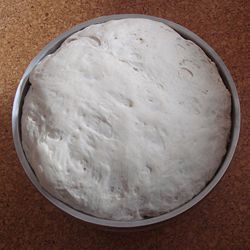 After first rising
 -
 After proofing, ready to bake


Sourdough
[edit]
Sourdough is a type of bread produced by a long fermentation of dough using naturally occurring yeasts and lactobacilli. It usually has a mildly sour taste because of the lactic acid produced during anaerobic fermentation by the lactobacilli. Longer fermented sourdoughs can also contain acetic acid, the main non-water component of vinegar.[58][59][60]
Sourdough breads are made with a sourdough starter. The starter cultivates yeast and lactobacilli in a mixture of flour and water, making use of the microorganisms already present on flour; it does not need any added yeast. A starter may be maintained indefinitely by regular additions of flour and water. Some bakers have starters many generations old, which are said to have a special taste or texture.[58] At one time, all yeast-leavened breads were sourdoughs. Recently there has been a revival of sourdough bread in artisan bakeries.[61]
Traditionally, peasant families throughout Europe baked on a fixed schedule, perhaps once a week. The starter was saved from the previous week's dough. The starter was mixed with the new ingredients, the dough was left to rise, and then a piece of it was saved to be the starter for next week's bread.[54]
Steam
[edit]The rapid expansion of steam produced during baking leavens the bread, which is as simple as it is unpredictable. Steam-leavening is unpredictable since the steam is not produced until the bread is baked. Steam leavening happens regardless of the raising agents (baking soda, yeast, baking powder, sour dough, beaten egg white) included in the mix. The leavening agent either contains air bubbles or generates carbon dioxide. The heat vaporises the water from the inner surface of the bubbles within the dough. The steam expands and makes the bread rise. This is the main factor in the rising of bread once it has been put in the oven.[62] CO2 generation, on its own, is too small to account for the rise. Heat kills bacteria or yeast at an early stage, so the CO2 generation is stopped.
Bacteria
[edit]Salt-rising bread does not use yeast. Instead, it is leavened by Clostridium perfringens, one of the most common sources of food-borne illness.[63][64]
Aeration
[edit]Aerated bread is leavened by carbon dioxide being forced into dough under pressure. From the mid-19th to mid-20th centuries, bread made this way was somewhat popular in the United Kingdom, made by the Aerated Bread Company and sold in its high-street tearooms. The company was founded in 1862, and ceased independent operations in 1955.[65]
The Pressure-Vacuum mixer was later developed by the Flour Milling and Baking Research Association for the Chorleywood bread process. It manipulates the gas bubble size and optionally the composition of gases in the dough via the gas applied to the headspace.[66]
Cultural significance
[edit]
Bread has a significance beyond mere nutrition in many cultures because of its history and contemporary importance. Bread is also significant in Christianity as one of the elements (alongside wine) of the Eucharist,[67] and in other religions including Paganism.[68]
In many cultures, bread is a metaphor for basic necessities and living conditions in general. For example, a "bread-winner" is a household's main economic contributor and has little to do with actual bread-provision. This is also seen in the phrase "putting bread on the table". The Roman poet Juvenal satirized superficial politicians and the public as caring only for "panem et circenses" (bread and circuses).[69] In Russia in 1917, the Bolsheviks promised "peace, land, and bread."[70][71] The term "breadbasket" denotes an agriculturally productive region. In parts of Northern, Central, Southern and Eastern Europe bread and salt is offered as a welcome to guests.[72] In India, life's basic necessities are often referred to as "roti, kapra aur makan" (bread, clothes, and house).[73]
Words for bread, including "dough" and "bread" itself, are used in English-speaking countries as synonyms for money.[1] A remarkable or revolutionary innovation may be called the best thing since "sliced bread".[74] The expression "to break bread with someone" means "to share a meal with someone".[75] The English word "lord" comes from the Anglo-Saxon hlāfweard, meaning "bread keeper."[76]
Bread is sometimes referred to as "the staff of life", although this term can refer to other staple foods in different cultures: the Oxford English Dictionary defines it as "bread (or similar staple food)".[77][78] This is sometimes thought to be a biblical reference, but the nearest wording is in Leviticus 26 "when I have broken the staff of your bread".[79] The term has been adopted in the names of bakery firms.[80]
See also
[edit]
- Bark bread – Scandinavian bread used as famine food
- Bread bowl – Bowl made of bread
- Bread clip – Closure device for plastic bags
- Breading – Residue of dried bread
- Bread machine – Type of home appliance for baking bread
- Bread pan – Kitchen utensil
- Crouton – Rebaked bread used as toppings
- List of breads
- List of bread dishes – Dishes using bread as a main ingredient, listed by category
- List of toast dishes
- Quick bread – Bread leavened with agents other than yeast
- Sliced bread – Loaf of bread pre-sliced with a machine
- Slow Bread – Type of bread made using very little yeast
- Sop – Bread soaked in liquid and eaten
- Stuffing – Edible mixture filling a food's cavity
- White bread – Type of bread made from white wheat flour
References
[edit]- ^ a b Harper, Douglas. "bread". Online Etymology Dictionary.
- ^ Diakonov, Igor M. (1999). The Paths of History. Cambridge University Press. p. 79. ISBN 978-0-521-64398-6.
Slavic langues retain many Gothic words, reflecting cultural borrowings: thus khleb, (bread) from an earlier khleiba from Gothic hlaifs, or, rather, from the more ancient form hlaibhaz, which meant bread baked in an oven (and, probably, made with yeast), as different from a l-iepekha, which was a flat cake moulded (liepiti) from paste, and baked on charcoal. [the same nominal stem *hlaibh- has been preserved in modern English as loaf; cf. Lord, from ancient hlafweard bread-keeper]
- ^ Dean, Sam (2 August 2013). "The Etymology of the Word 'Bread'". Bon Appetit. Archived from the original on 1 October 2016. Retrieved 30 September 2016.
- ^ "Chapter 9. Toward the Common Good: Punishing Fraud among the Victualers of Medieval London". Truth and Tales: Cultural Mobility and Medieval Media. The Ohio State University Press. 2015. ISBN 9780814273739.
- ^ "Looking for fraud in wheat flour". foodmanufacture.co.uk. 21 September 2023. Archived from the original on 20 May 2024. Retrieved 19 May 2024.
- ^ "Prehistoric man ate flatbread 30,000 years ago: study". phys.org. Science X. Agence France-Presse. 19 October 2010. Archived from the original on 5 August 2011. Retrieved 19 October 2010.
- ^ Behrendt, Larissa (22 September 2016). "Indigenous Australians know we're the oldest living culture – it's in our Dreamtime". The Guardian. ISSN 0261-3077. Archived from the original on 24 September 2024. Retrieved 8 February 2020.
- ^ Briggs, Helen (17 July 2018). "Prehistoric bake-off: Scientists discover oldest evidence of bread". BBC News. Archived from the original on 16 July 2018. Retrieved 17 July 2018.
- ^ Amaia Arranz-Otaegui, Lara Gonzalez Carretero, Monica N. Ramsey, Dorian Q. Fuller, and Tobias Richter: Archaeobotanical evidence reveals the origins of bread 14,400 years ago in northeastern Jordan. PNAS, 11 July 2018 (online Archived 19 October 2018 at the Wayback Machine)
- ^ McGee, Harold (2004). On food and cooking. Scribner. p. 517. ISBN 978-0-684-80001-1.
- ^ a b Arzani A.: Emmer (Triticum turgidum spp. dicoccum) flour and breads. In Preedy V.R., Watson R.R., Patel V.B. (Eds. 2011), Flour and Breads and their Fortification in Health and Disease Prevention, Academic Press, California, pp. 69–78.
- ^ Tannahill, Reay (1973). Food in History. Stein and Day. pp. 68–69. ISBN 978-0-8128-1437-8.
- ^ Pliny the Elder (1938). Natural History. Loeb Classics. p. 1.255. Archived from the original on 30 May 2023. Retrieved 30 September 2016.
Generally however they do not heat it up at all, but only use the dough kept over from the day before; manifestly it is natural for sourness to make the dough ferment
- ^ Chorleywood Industrial Bread Making Process. allotment.org.uk
- ^ bbc.com: "Chorleywood: The bread that changed Britain" Archived 13 June 2018 at the Wayback Machine, 7 June 2011
- ^ "fob.co.uk: "History of bread – 20th century"". Archived from the original on 19 April 2019. Retrieved 14 May 2018.
- ^ Mietton, Lauriane; Samson, Marie-Françoise; Marlin, Thérèse; Godet, Teddy; Nolleau, Valérie; Guezenec, Stéphane; Segond, Diego; Nidelet, Thibault; Desclaux, Dominique; Sicard, Delphine (July 2022). "Impact of Leavening Agent and Wheat Variety on Bread Organoleptic and Nutritional Quality". Microorganisms. 10 (7): 1416. doi:10.3390/microorganisms10071416. ISSN 2076-2607. PMC 9317705. PMID 35889135.
- ^ Peña, R. J. "Wheat for bread and other foods". Food and Agriculture Organization. Archived from the original on 27 January 2019. Retrieved 1 October 2016.
Wheat, in the form of bread, provides more nutrients to the world population than any other single food source.
- ^ "Wheat". Grains & Legumes Nutrition Council. Archived from the original on 5 October 2016. Retrieved 1 October 2016.
Aside from bread wheat and durum, other types of wheat include spelt, emmer, einkorn and kamut. These wheat varieties are commonly referred to as 'ancient' grains and are increasingly being used in the manufacture of niche wheat-based food products.
- ^ Cauvain, Stanley (2015). Technology of Breadmaking. Springer. p. 377. ISBN 978-3-319-14687-4.
In the past, maize (corn), barley, oats, sorghum, millet and rice have all found their way into bread products at some time, usually when wheat and rye have been in short supply.
- ^ Lamacchia C, Camarca A, Picascia S, Di Luccia A, Gianfrani C (2014). "Cereal-based gluten-free food: how to reconcile nutritional and technological properties of wheat proteins with safety for celiac disease patients". Nutrients (Review). 6 (2): 575–90. doi:10.3390/nu6020575. ISSN 2072-6643. PMC 3942718. PMID 24481131.
- ^ Volta U, Caio G, De Giorgio R, Henriksen C, Skodje G, Lundin KE (June 2015). "Non-celiac gluten sensitivity: a work-in-progress entity in the spectrum of wheat-related disorders". Best Pract Res Clin Gastroenterol. 29 (3): 477–91. doi:10.1016/j.bpg.2015.04.006. PMID 26060112.
After the confirmation of NCGS diagnosis, according to the previously mentioned work-up, patients are advized to start with a GFD [49]. (...) NCGS patients can experience more symptoms than CD patients following a short gluten challenge [77]. (NCGS=non-celiac gluten sensitivity; CD=coeliac disease; GFD=gluten-free diet)
- ^ Mulder CJ, van Wanrooij RL, Bakker SF, Wierdsma N, Bouma G (2013). "Gluten-free diet in gluten-related disorders". Dig. Dis. (Review). 31 (1): 57–62. doi:10.1159/000347180. PMID 23797124. S2CID 14124370.
The only treatment for CD, dermatitis herpetiformis (DH) and gluten ataxia is lifelong adherence to a GFD.
- ^ Hischenhuber C, Crevel R, Jarry B, Mäki M, Moneret-Vautrin DA, Romano A, Troncone R, Ward R (1 March 2006). "Review article: safe amounts of gluten for patients with wheat allergy or coeliac disease". Aliment Pharmacol Ther. 23 (5): 559–75. doi:10.1111/j.1365-2036.2006.02768.x. PMID 16480395. S2CID 9970042.
For both wheat allergy and coeliac disease the dietary avoidance of wheat and other gluten-containing cereals is the only effective treatment.
- ^ Gelinas, Pierre; McKinnon, Carole M. (2006). "Effect of wheat variety, farming site, and bread-baking on total phenolics". International Journal of Food Science and Technology. 41 (3): 329. doi:10.1111/j.1365-2621.2005.01057.x.
- ^ Boskov Hansen, H.; Andreasen, M.F.; Nielsen, M.M.; Melchior Larsen, L.; Bach Knudsen, K.E.; Meyer, A.S.; Christensen, L.P. & Hansen, Å. (2002). "Changes in dietary fibre, phenolic acids and activity of endogenous enzymes during rye bread-making". European Food Research and Technology. 214: 33. doi:10.1007/s00217-001-0417-6. S2CID 85239461.
- ^ Strandås, C.; Kamal-Eldin, A.; Andersson, R.; Åman, P. (2008). "Phenolic glucosides in bread containing flaxseed". Food Chemistry. 110 (4): 997–99. doi:10.1016/j.foodchem.2008.02.088. PMID 26047292.
- ^ a b Wieser, Herbert (April 2007). "Chemistry of gluten proteins". Food Microbiology. 24 (2): 115–119. doi:10.1016/j.fm.2006.07.004. PMID 17008153.
- ^ McGee, Harold (2004). On Food and Cooking: The Science and Lore of the Kitchen. New York: Scribner. pp. 515–80.
- ^ Surdyk, Nicolas; Rosén, Johan; Andersson, Roger; Åman, Per (April 2004). "Effects of Asparagine, Fructose, and Baking Conditions on Acrylamide Content in Yeast-Leavened Wheat Bread". Journal of Agricultural and Food Chemistry. 52 (7): 2047–2051. Bibcode:2004JAFC...52.2047S. doi:10.1021/jf034999w. PMID 15053550.
- ^ "Lange Teigführung ? Besser verträgliches Brot". dhz.net (in German). 6 September 2016. Archived from the original on 13 August 2022. Retrieved 16 June 2022.
- ^ Jochen U. Ziegler, Deborah Steiner, C. Friedrich H. Longin, Tobias Würschum, Ralf M. Schweiggert (August 2016), "Wheat and the irritable bowel syndrome – FODMAP levels of modern and ancient species and their retention during bread making", Journal of Functional Foods (in German), vol. 25, pp. 257–266, doi:10.1016/j.jff.2016.05.019, retrieved 16 June 2022
{{citation}}: CS1 maint: multiple names: authors list (link) - ^ Grotts, Lisa Mirza (21 June 2011). "Bread and Butter Etiquette". Huffington Post. Archived from the original on 5 October 2016. Retrieved 2 October 2016.
- ^ "Sandwich Recipes". Simply Recipes. Archived from the original on 30 September 2016. Retrieved 2 October 2016.
- ^ "Our 10 best bread recipes". The Guardian. 6 September 2014. Retrieved 2 October 2016.
Our most dutiful mealtime companion becomes the main ingredient in this inventive array of recipes, from a hearty clam chowder to a luxurious take on a pudding favourite...
- ^ Dietary Guidelines for Americans 2010 Archived 1 September 2016 at the Wayback Machine. U.S. Department of Agriculture, U.S. Department of Health and Human Services
- ^ Shewry, Peter R.; Hey, Sandra J. (October 2015). "The contribution of wheat to human diet and health". Food and Energy Security. 4 (3): 178–202. doi:10.1002/fes3.64. PMC 4998136. PMID 27610232.
- ^ a b Wrigley, C.W.; Corke, H.; Seetharaman, K.; Faubion, J. (2015). Encyclopedia of Food Grains. Elsevier Science. p. 404. ISBN 978-0-12-394786-4.
- ^ The Longevity List: Myth Busting the Top Ways to Live a Long and Healthy Life ISBN 978-1-921966-73-6 p. 156
- ^ Winkler, Sarah (29 July 2009). "Discovery Health "Is eating bread crust really good for you?"". Health.howstuffworks.com. Archived from the original on 24 October 2012. Retrieved 26 October 2012.
- ^ "Bread recipes (45 results found)". British Broadcasting Corporation. Archived from the original on 24 September 2016. Retrieved 2 October 2016.
- ^ Finley, John H.; Phillips, R. O. (1989). Protein quality and the effects of processing. New York: M. Dekker. p. See Figure 2. ISBN 978-0-8247-7984-9.
- ^ "NYSAES|FST|FVC|Venture 3| Chemical Food Preservatives". Archived from the original on 12 April 2010. Retrieved 28 February 2010.
- ^ Hamelman, Jeffrey (2004). Bread: a baker's book of techniques and recipes. New York: John Wiley. pp. 7–13. ISBN 978-0-471-16857-7.
A high gluten white flour will require more mix time than a white flour with a lower gluten content,...
- ^ Hunter, Gary; Carey, Patrick; Tinton, Terry; Walpole, Steven (2007). Professional Chef: Level 2 Diploma. Cengage Learning EMEA. pp. 10–11. ISBN 978-1-84480-706-2.
- ^ "Bread and Flour Regulations". UK Flour Millers. October 2023. Retrieved 5 January 2025.
- ^ "wheatmeal". Cambridge Dictionary.
- ^ Hydration ratio for breads Archived 14 January 2013 at the Wayback Machine. Food.laurieashton.com (5 June 2009). Retrieved 21 March 2013.
- ^ "Yeast & Baking Lessongs. Liquids". Red Star Yeast. Archived from the original on 5 October 2016. Retrieved 2 October 2016.
- ^ Young, Linda; Cauvain, Stanley P. (2007). Technology of Breadmaking. Berlin: Springer. p. 54. ISBN 978-0-387-38563-1.
- ^ Tenbergen, Klaus (1999). "Dough and Bread Conditioners". Food and Product Design Magazine. Retrieved 2 October 2016.
- ^ Silverton, Nancy (1996) Breads From The La Brea Bakery, Villard, ISBN 0-679-40907-6
- ^ Reinhart, Peter (2001) The Bread Baker's Apprentice: Mastering the Art of Extraordinary Bread, Ten Speed Press, ISBN 1-58008-268-8
- ^ a b c d e f "The Bread Leavening Process". Becoming a Chef. 15 August 2016. Retrieved 2 October 2016.
- ^ Young, Linda; Cauvain, Stanley P. (2007). Technology of Breadmaking. Berlin: Springer. p. 79. ISBN 978-0-387-38563-1.
- ^ "Artisan bread baking tips: Poolish & biga". Weekend Bakery. Retrieved 2 October 2016.
- ^ "Preferments". King Arthur Flour.
{{cite web}}: Missing or empty|url=(help) - ^ a b Davidson, Alan (1999). The Oxford Companion to Food. Oxford University Press. pp. 756–57. ISBN 978-0-19-211579-9.
- ^ Gobbetti, Marco; Gänzle, Michael, eds. (2012). Handbook on Sourdough Biotechnology. Springer. ISBN 978-1-4899-9189-8.
- ^ Ng, Henry (June 1972). "Factors Affecting Organic Acid Production by Sourdough (San Francisco) Bacteria". Applied Microbiology. 23 (6): 1153–1159. doi:10.1128/am.23.6.1153-1159.1972. ISSN 0003-6919. PMC 380523. PMID 5042265.
- ^ Mesure, Susie (30 January 2016). "Supermarkets cash in on sourdough bread craze as popularity surges". The Independent. Retrieved 2 October 2016.
- ^ Edwards, W.P. (2007). The science of bakery products. Cambridge: Royal Society of Chemistry. p. 68. ISBN 978-0-85404-486-3. Retrieved 8 December 2012.
When bread expands in the oven the resulting expansion is known as oven spring. It has been calculated that water expansion was responsible for some 60% of the expansion.
- ^ "Susan R. Brown's Salt Rising Bread Project". Home.comcast.net. Archived from the original on 30 June 2012. Retrieved 3 June 2010.
- ^ Juckett, Gregory; Bardwell, Genevieve; McClane, Bruce; Brown, Susan (2008). "Microbiology of salt rising bread". The West Virginia Medical Journal. 104 (4): 26–27. ISSN 0043-3284. PMID 18646681.
- ^ Richardson MD FRS, Benjanmin Ward. On the Healthy Manufacture of Bread: A Memoir on the System of Dr. Dauglish. Baillière, Tindall, & Cox, 1884. pp. 18, 20–21, 34, 62–63, 67–70, 74.
- ^ Kilcast, D.; McKenna, B. M., eds. (2003). Texture in food. Woodhead. p. 448. ISBN 978-1-85573-724-2.
- ^ "Eucharist (Christianity) – Encyclopædia Britannica". Archived from the original on 19 May 2008. Retrieved 2 June 2022.
- ^ Sabrina, Lady (2006). Exploring Wicca: The Beliefs, Rites, and Rituals of the Wiccan Religion. Career Press. pp. 100–. ISBN 978-1-56414-884-1.
- ^ Juvenal's literary and cultural influence (Book IV: Satire 10.81)
- ^ "Russia". Encyclopædia Britannica. Retrieved 3 June 2010.
- ^ "Vladimir Lenin: From March to October. SparkNotes". Sparknotes.com. Archived from the original on 31 December 2017. Retrieved 3 June 2010.
- ^ Hayward, Tim (2020). Loaf Story. Hardie Grant Publishing. ISBN 9781787134782. Retrieved 25 January 2021.
- ^ Patel, K.V. (2014). The Foundation Pillars for Change. Partridge. p. 54. ISBN 978-1-4828-1563-4.
- ^ Molella, Art (8 February 2012). "How the Phrase 'The Best Thing Since Sliced Bread' Originated". The Atlantic. Archived from the original on 29 September 2016. Retrieved 30 September 2016.
- ^ "Break bread with". The Free Dictionary. Retrieved 1 January 2017.
- ^ "Lord". Merriam-Webster. Archived from the original on 3 January 2017. Retrieved 1 January 2017.
- ^ "The staff of life". Cambridge Dictionary. Archived from the original on 20 April 2018. Retrieved 20 April 2018.
- ^ "Staff". Oxford English Dictionary (Online ed.). Oxford University Press. (Subscription or participating institution membership required.) OED cites 1638 "Bread is worth all, being the Staffe of life" but also 1901 "Broad beans form one of the staves of life in Sicily".
- ^ "Leviticus 26:26". Bible Study Tools. Archived from the original on 20 April 2018. Retrieved 20 April 2018.
- ^ "Home page". Staff of Life Bakery. Archived from the original on 20 April 2018. Retrieved 20 April 2018. An example
Further reading
[edit]- Kaplan, Steven Laurence: Good Bread Is Back: A Contemporary History of French Bread, the Way It Is Made, and the People Who Make It. Durham/ London: Duke University Press, 2006. ISBN 978-0-8223-3833-8
- Jacob, Heinrich Eduard: Six Thousand Years of Bread: Its Holy and Unholy History. Garden City / New York: Doubleday, Doran and Comp., 1944. New 1997: New York: Lyons & Burford, Publishers (Foreword by Lynn Alley), ISBN 1-55821-575-1 <
- Spiekermann, Uwe: "Brown Bread for Victory: German and British Wholemeal Politics in the Inter-War Period", in: Trentmann, Frank and Just, Flemming (ed.): Food and Conflict in Europe in the Age of the Two World Wars. Basingstoke / New York: Palgrave, 2006, pp. 143–71, ISBN 1-4039-8684-3
- Cunningham, Marion (1990). The Fannie Farmer cookbook. illustrated by Lauren Jarrett (13th ed.). New York: Alfred A. Knopf. ISBN 978-0-394-56788-4.
- Trager, James (1995). The food chronology: a food lover's compendium of events and anecdotes from prehistory to the present. Henry Holt. ISBN 978-0-8050-3389-2.
- Davidson, Alan (1999). The Oxford Companion to Food. Oxford University Press. ISBN 978-0-19-211579-9.
- D. Samuel (2000). "Brewing and baking". In P. T. Nicholson; I. Shaw (eds.). Ancient Egyptian materials and technology. Cambridge: Cambridge University Press. pp. 537–76. ISBN 0-521-45257-0.
- Pyler, E. J. (1988). Baking Science & Technology 3rd Ed. vols. I & II. Sosland Publishing Company. ISBN 978-1-882005-02-4.
External links
[edit]

 Bread and confectionery travel guide from Wikivoyage

| Types |  | |
|---|---|---|
| Ingredients | ||
| Equipment | ||
| Processes and techniques | ||
| Uses | ||
| Other | ||
| List articles | ||

| Types |  | |
|---|---|---|
| Agronomy | ||
| Trade | ||
| Plant parts and their uses | ||
| Basic preparation | ||
| As an ingredient | ||
| Associated human diseases | ||
| Related concepts | ||

| International | |
|---|---|
| National | |
| Other | |

Bread
View on GrokipediaEtymology
Origins and evolution of the term
The English word "bread" derives from Old English brēad, denoting a "bit, crumb, or morsel" of food prepared from flour dough and baked, evolving by the late 12th century to signify sustenance in general.[6] This term traces to Proto-Germanic braudą, meaning "fragment, crumb, or bread," which is linked to the Proto-Indo-European root bhreu-, connoting "to boil, bubble, effervesce, or burn," a reference to the fermentation and rising process in leavened dough akin to brewing.[6] In other Germanic languages, cognates reflect similar semantic development from fragments of baked goods to the staple product itself, such as Old High German brôt (modern German Brot), Old Saxon brad, and Dutch brood, all sharing the Proto-Germanic base and emphasizing bread's role as broken or portioned food.[6] These terms highlight a consistent linguistic evolution within the Germanic family, where the word's original connotation of a "piece" expanded to encompass the whole loaf as dietary foundation. Beyond Indo-European branches, the Latin panis for bread influenced Romance languages (e.g., French pain, Italian pane, Spanish pan), though its precise etymology remains debated among scholars, possibly tied to ancient Italic roots denoting nourishment without direct Germanic parallels.[7] In Semitic languages, semantic shifts underscore bread's staple equivalence to "food" broadly; Hebrew lechem (לָחֶם) primarily means bread but extends to general provisions, as in biblical contexts where it represents essential sustenance earned through labor, reflecting its cultural primacy over other edibles.[8] This broadening illustrates how, in agrarian societies, the term for bread often generalized to denote victuals due to its ubiquity, distinct from the process-oriented roots in Indo-European etymologies.[9]History
Ancient and prehistoric origins
The earliest archaeological evidence of bread production dates to approximately 14,400 years ago at Shubayqa 1, a Natufian hunter-gatherer site in northeastern Jordan, where analysis of 24 charred plant remains revealed flatbreads made from wild cereals such as club rush tubers, wild barley, and einkorn wheat.[4] These proto-breads were prepared by parching and grinding the grains into flour, then mixing with water and cooking on heated stones or hearths, demonstrating an early form of starch processing without reliance on domesticated crops or formal agriculture.[4] This predates the Neolithic agricultural revolution by about 4,000 years, indicating that bread-like foods emerged among foraging societies as a means to enhance caloric density from abundant wild grasses during seasonal gatherings.[10] The transition to agriculture in the Fertile Crescent around 10,000 BCE facilitated more reliable bread production through the domestication of emmer and einkorn wheats, which provided higher yields and easier processing compared to wild varieties.[11] Early farmers used saddle querns and grinding stones to mill these grains into coarse flours for unleavened flatbreads, as evidenced by starch residues and tool wear patterns at sites like Göbekli Tepe and Çayönü in modern-day Turkey and southeastern Anatolia.[12] Such methods marked a shift from opportunistic wild harvesting to systematic cultivation, enabling surplus production that supported sedentary communities and population growth in the region.[13] By circa 3000 BCE, bread-making had evolved in ancient Egypt, where organized bakeries in urban centers like Memphis produced leavened varieties by incorporating wild yeasts from beer brewing residues into doughs of emmer wheat flour.[14] Tomb depictions and residue analyses from baking ovens confirm the use of fermentation to create risen loaves baked in clay molds or on hot surfaces, distinguishing Egyptian bread from earlier flatbreads through improved texture and digestibility.[15] This innovation spread via trade routes along the Nile and into the Levant, integrating bread as a staple in hierarchical societies where specialized bakers supplied temples, elites, and laborers.[16]Development through antiquity and Middle Ages
In ancient Rome, the adoption and scaling of water-powered mills for grinding grain marked a significant technological advancement, enabling efficient production to feed vast urban centers like the city of Rome, which required over 150,000 tons of grain annually by the 1st century CE. Descriptions by Vitruvius in the late 1st century BCE outline watermill mechanisms, building on Hellenistic precedents but integrated into Roman infrastructure to process wheat into finer flours, reducing labor costs and improving bread consistency compared to manual querns.[17] This hydraulic innovation, exemplified by complexes like Barbegal in the 2nd century CE with up to 16 wheels producing an estimated 4.5 tons of flour daily, causally linked imperial engineering to sustained bread supply for legions and civilians, minimizing famine risks in densely populated provinces.[18] Roman bakers standardized loaves such as panis quadratus, a dense, wheel-marked bread unearthed in carbonized form from Pompeii's bakeries following the 79 CE eruption of Vesuvius, typically made from whole spelt or wheat flour hydrated to a stiff dough with salt and natural leavening for lower-class consumption.[19] These uniform loaves, often baked in large communal ovens and distributed via state-subsidized annona systems, reflected empire-wide quality controls to prevent shortages, with archaeological evidence showing divided segments for portioning among soldiers and plebeians.[20] Following the fall of the Western Roman Empire, monastic communities from the 6th to 15th centuries preserved and refined sourdough fermentation techniques, using wild yeast cultures maintained across generations to leaven rye and wheat doughs in stone ovens, often supplying bread to feudal estates amid fragmented grain supplies.[21] In feudal systems, lords enforced monopolies on milling through ban mills, requiring peasants to grind grain at seigniorial facilities for fees equivalent to 10-20% of the flour yield, which concentrated control over bread production and limited household baking to preserve manorial revenues.[22] The Black Death pandemic of 1347-1351, killing 30-60% of Europe's population, disrupted labor-intensive baking and milling, initially spiking grain prices due to harvest shortfalls before depopulation halved demand and drove real wheat prices down by up to 50% in England by the 1370s.[23] This scarcity prompted stricter enforcement of pre-existing assizes, such as England's 1266 regulations updated post-plague, mandating fixed loaf weights tied to grain costs and fining bakers for adulteration with fillers like beans or chalk to combat fraud amid heightened scrutiny from surviving urban authorities.[24]Industrial Revolution and mass production
The Industrial Revolution marked a shift from labor-intensive artisanal baking to mechanized factory production, enabling scalability through innovations like steam-powered ovens and automated dough mixers that reduced production times and costs. By the mid-19th century, these technologies allowed urban bakeries to meet rising demand from growing populations, with output increasing from handmade batches to continuous operations capable of thousands of loaves daily. For example, large-scale mills adopted gradual reduction systems, boosting flour yields and supporting centralized baking facilities that supplanted small-scale producers.[25][26] A pivotal advancement came with roller mills developed in the 1870s, which used chilled steel rollers to crush wheat kernels progressively, separating the endosperm from bran and germ to produce finer, whiter flour on an industrial scale. This method displaced stone milling's coarser whole-grain outputs, yielding uniform flour that facilitated consistent bread quality and extended shelf life, while enabling mills to process harder wheat varieties efficiently for mass distribution. The result was a surge in white bread production, as refiners prioritized the endosperm's higher market value, though this reduced nutritional content compared to unrefined grains.[27][28] Louis Pasteur's experiments in the 1850s established yeast as the causal agent in fermentation, enabling the isolation and standardization of Saccharomyces cerevisiae for reliable leavening, which by the late 19th century supported commercial yeast cakes and shortened proofing times in factories. Complementing this, Otto Frederick Rohwedder's 1928 bread-slicing machine, first deployed commercially in Chillicothe, Missouri, automated uniform slicing and wrapping, reducing waste and enhancing convenience to drive per capita consumption upward by making bread easier to portion and store. These efficiencies amplified production scalability, with factories outputting standardized loaves at rates unattainable by hand.[29][30] World War supply constraints exposed fragilities in mechanized chains reliant on imported grains, prompting adaptations like the UK's National Loaf in April 1942—a coarse, wholemeal bread mandated to retain bran and extend wheat supplies while providing higher fiber and vitamins than refined wartime alternatives. Though not formally rationed until 1946, this grayish, dense loaf underscored how industrial uniformity could pivot to nutritional imperatives under scarcity, yet its unpopularity highlighted trade-offs in taste and texture from scaled processing.[31][32]Contemporary developments and trends
The Chorleywood Bread Process, introduced in the United Kingdom in July 1961, revolutionized industrial bread production by employing high-speed mixing, mechanical energy, and chemical oxidants to develop dough rapidly, reducing fermentation time from hours to minutes and enabling the use of lower-protein domestic wheat varieties for affordable, uniform loaves.[33] This method achieved widespread adoption, accounting for over 80% of UK bread by the 1970s, due to its efficiency in yielding soft, voluminous bread at scale, though critics argue it results in denser textures, nutritional deficiencies from shortened fermentation, and reliance on additives that may impair digestibility.[34] [35] During the COVID-19 lockdowns beginning in March 2020, home baking surged globally, with sourdough experiencing particular demand as consumers sought long-fermentation alternatives amid flour and yeast shortages; in the US, some cottage bakery sourdough sales doubled compared to pre-pandemic levels, while artisan bread categories saw up to 40% year-over-year growth in take-and-bake segments.[36] [37] This trend reflected a shift toward perceived healthier, artisanal methods, with web searches for sourdough starters rising over 1,000% in early 2020, sustaining interest into subsequent years.[38] From 2023 to 2025, bread innovation has emphasized health-oriented formulations, including protein-fortified loaves incorporating pea or whey proteins to meet rising consumer demand for higher satiety and muscle support, alongside reduced-sugar variants using natural sweeteners or fiber bulking to align with blood sugar management preferences evidenced in market surveys.[39] [40] Sustainable practices have gained traction, with bakers integrating ancient grains like spelt and einkorn for their nutrient density and lower environmental footprint from heritage farming, driven by data showing 2024 consumer priorities for clean labels and gut health benefits over extended shelf life.[41] [42] These shifts are quantified in industry reports projecting continued growth in high-fiber, low-glycemic breads through 2025, reflecting empirical correlations between ingredient profiles and health metrics like glycemic index reductions.[43]Ingredients
Grains and flours
Wheat serves as the predominant grain in bread production due to its unique protein composition that facilitates gluten development, essential for dough structure and elasticity. Hard wheat varieties, such as hard red spring wheat with protein contents ranging from 12% to 15%, yield flours suitable for bread because higher protein levels—typically 10% to 14%—enable robust gluten formation upon hydration and kneading.[44][45] In contrast, soft wheat varieties possess lower protein (under 10%) and produce weaker gluten networks, rendering them less ideal for leavened breads and more appropriate for tender doughs.[45] Gluten arises from the interaction of gliadin, which imparts extensibility, and glutenin, which provides strength, as these proteins unfold and bond in the presence of water to form a viscoelastic matrix capable of trapping fermentation gases.[46] Ancient wheat species, including einkorn, emmer, and spelt, represent hulled varieties predating modern hybrids and exhibit distinct dough behaviors due to variations in protein quality and quantity. Einkorn and emmer often display superior protein and gluten indices compared to modern bread wheat, though their gluten-forming capacity is generally weaker, necessitating blends with higher-gluten flours for optimal bread dough handling and structure.[47][48] Spelt, while sharing genetic lineage with bread wheat, yields flours with intermediate protein levels that support adequate but less extensible doughs, influenced by its higher starch-to-protein ratio affecting hydration limits.[49] Rye flour, derived from Secale cereale, diverges from wheat by relying less on gluten and more on non-starch polysaccharides known as pentosans for dough properties. Rye contains approximately 2.4% water-soluble pentosans and 3.15% total pentosans, which swell upon hydration to increase viscosity and water-binding capacity—up to 8-10 times their weight—yielding a sticky, batter-like dough that retains gases through gelation rather than elastic networks.[50] This pentosan-driven viscosity enhances loaf volume in rye breads but limits extensibility compared to wheat-based doughs.[51] Milling techniques profoundly influence flour granularity, nutrient retention, and dough performance by altering starch damage, ash content, and particle size. Stone milling grinds the entire kernel into coarser flours that retain bran and germ, promoting higher extraction rates near 100% for wholemeal varieties, which introduce fiber that can disrupt gluten aggregation and increase dough toughness.[52] Roller milling, employing sequential steel rollers, separates endosperm from bran and germ, enabling refined white flours with extraction rates of 70-80%, where finer particles and reduced bran enhance gluten development and dough extensibility through minimized interference from outer kernel layers.[53][52] Compositional equivalence holds between stone- and roller-milled flours when all fractions are recombined, but selective extraction in roller processes yields flours with optimized protein-starch ratios for consistent bread dough rheology.[52]Liquids and hydration
In bread dough, liquids such as water serve as the primary hydrating agent, enabling flour proteins to absorb moisture and form a cohesive gluten network essential for structure.[54] Hydration levels, calculated as the weight of liquid relative to flour (typically 50-80%), directly influence dough extensibility; lower ratios yield firmer doughs with tighter gas retention, while higher ones promote elasticity and openness.[55] For instance, bagels employ 52-58% hydration to achieve dense chewiness through minimal expansion, contrasting with ciabatta's 70-80% hydration, which facilitates irregular hole formation via enhanced extensibility and carbon dioxide trapping.[55][56] Water also activates flour-borne enzymes, such as amylase, by providing the medium for their mobility and starch hydrolysis into sugars, with higher hydration accelerating this process through improved diffusion.[57][58] Initial absorption by starch granules and proteins sets the stage for subsequent swelling, though full gelatinization occurs under baking heat; inadequate hydration limits enzyme efficacy and dough workability.[59] Beyond water, milk contributes hydration alongside milkfat (3-4%) and lactose, which tenderize the dough by coating gluten strands and reducing cross-linking, resulting in softer textures without altering base absorption ratios.[60] Eggs, containing approximately 75% liquid, hydrate similarly while introducing lecithin and yolk fats that emulsify and inhibit excessive gluten strength, yielding lighter crumb structure in enriched breads.[61] These alternatives maintain overall hydration targets but modulate protein-water interactions for specific outcomes.[62]Leavening and fermentation agents
Saccharomyces cerevisiae, the predominant yeast in commercial baking, generates carbon dioxide (CO₂) gas essential for dough leavening through anaerobic alcoholic fermentation of hexose sugars. Glucose undergoes glycolysis to form two molecules of pyruvate, which are decarboxylated by pyruvate decarboxylase to acetaldehyde and CO₂; acetaldehyde is then reduced to ethanol by alcohol dehydrogenase, yielding a net of two CO₂ molecules per glucose. This process thrives in the low-oxygen environment of dough, where ethanol evaporates during baking, leaving trapped CO₂ to expand the gluten matrix.[63][64]
Industrial strains of S. cerevisiae optimized for baking emerged prominently in the 1920s, with patents for enhanced gassing power and fermentation efficiency filed starting around 1927, enabling reliable mass production over earlier variable brewer's yeasts.[65] In sourdough fermentation, wild yeasts combine with lactic acid bacteria such as Lactobacillus sanfranciscensis to produce CO₂ alongside organic acids. These heterofermentative bacteria metabolize available sugars via the phosphoketolase pathway, yielding lactic acid, acetic acid, and ethanol with CO₂ release, which contributes to tangy flavors and antimicrobial effects by dropping dough pH from an initial 4.5–5.5 to 3.5–4.5. Acetic acid production predominates under aerobic conditions or with higher dough yields, enhancing preservation and taste complexity.[66][67][68] Artisanal bakers increasingly capture wild yeasts from natural environments in 2024, seeking terroir-specific flavors and authenticity, though this contrasts with commercial strains' predictability; sourdough-related markets reflect this shift, with global demand for such ferments driving sector growth amid preferences for non-industrial leavening.[69][70][71] Chemical leavening agents provide rapid, temperature-activated gas production without microbial activity. Baking soda (sodium bicarbonate, NaHCO₃) decomposes in the presence of moisture, heat, and acid: NaHCO₃ + H⁺ → Na⁺ + H₂O + CO₂, often sourced from buttermilk or yogurt in recipes. Baking powder integrates NaHCO₃ with dry acids (e.g., monocalcium phosphate) and a starch filler, releasing ~40% CO₂ upon wetting and the balance during heating for double-action leavening; Alfred Bird patented the first formulation in 1843 to aid egg-intolerant baking.[72][73][74]
Additives, fats, and improvers
Emulsifiers, such as DATEM (diacetyl tartaric acid esters of mono- and diglycerides), function in bread dough by strengthening the gluten network and enhancing gas retention during proofing and baking, which results in greater loaf volume and improved crumb structure.[75] [76] These compounds are typically added at dosages of 0.5% to 2% based on flour weight to achieve optimal dough stability without excessive stickiness.[77] Enzymatic improvers, including amylases, catalyze the hydrolysis of starch molecules in flour into dextrins and simple sugars, supplying fermentable substrates that boost yeast activity and contribute to better dough extensibility and bread volume. In US commercial bread, these added enzymes are typically derived from microbial sources such as fungi or bacteria, with animal-derived versions rare and limited to some older or niche products; artisanal, homemade, or specialty breads may use no added enzymes.[78] [79] Alpha-amylases specifically target amylopectin, preventing excessive liquefaction while promoting consistent fermentation.[80] [81] [57] Fats and shortenings tenderize bread by coating flour particles and gluten strands, thereby inhibiting the development of long, elastic gluten networks and yielding a softer crumb with reduced chewiness.[82] [83] Incorporation levels typically range from 2% to 5% of flour weight in enriched doughs to balance richness and structure.[84] Butter provides distinct flavor depth and aroma compounds that enhance perceived richness, whereas hydrogenated oils or shortenings offer neutral taste profiles and superior shelf-life extension through minimized oxidation.[85] [86] Fortification agents like iron, thiamin, riboflavin, and niacin address micronutrient shortfalls in refined flours by restoring or supplementing lost vitamins and minerals, a practice that gained traction in the United States during the 1940s following pellagra outbreaks linked to niacin deficiency in maize-heavy diets.[87] By 1942, approximately 75% of white bread was enriched with these compounds, correlating with sharp declines in deficiency-related diseases.[88][89]Preparation Methods
Dough formulation and mixing
Dough formulation begins with determining the hydration level, typically expressed as the ratio of water to flour weight, which influences the dough's workability and final bread structure. Bread flour with protein content of 12-14% absorbs approximately 60-65% water by flour weight, enabling robust gluten formation essential for gas retention during later stages.[90][91] Higher protein flours bind more water through gliadin and glutenin interactions, yielding doughs with greater extensibility and strength.[92] An optional autolyse step involves mixing flour and water alone, allowing a rest period of 20-60 minutes to hydrate proteins and initiate gluten bonds without mechanical stress. This process partially develops the gluten network, resulting in a smoother, more extensible dough that requires less subsequent mixing.[93][94] Mixing follows, where mechanical action aligns and strengthens gluten strands through shear and extension forces. In home settings, hand kneading or low-speed mixers for 10-15 minutes achieves the windowpane test, where a small dough piece stretches thinly to transmit light without tearing, confirming sufficient gluten development.[95] Industrial high-shear mixers, by contrast, apply intense energy input to reduce mixing time significantly compared to manual methods, often completing gluten development in minutes while minimizing oxidation that could degrade dough quality.[96][97]Fermentation processes
Fermentation in bread dough involves the metabolic activity of yeasts and bacteria, which produce carbon dioxide (CO₂) gas that becomes entrapped within the gluten network, leading to volume expansion, alongside the generation of organic acids, alcohols, and esters that contribute to flavor complexity.[98] This phase, occurring after initial mixing, focuses on controlled gas production and retention to achieve structural development without excessive proofing, typically monitored via dough temperature and visual cues like a 50-100% increase in volume for optimal gluten strengthening and even CO₂ distribution.[99] In yeast-leavened doughs, bulk fermentation is commonly conducted at 24–26°C (75–78°F) for 1–3 hours, accelerating yeast activity to generate CO₂ and initial flavors through enzymatic breakdown of starches into fermentable sugars. During this stage, bakers frequently perform gentle stretch-and-folds, such as every 30 minutes for the first hour, to strengthen the gluten network, equalize temperature, and trap air. The dough rises until it becomes pillowy and light, with significant volume increase (often 50–100% or more), a smooth and elastic surface, and a bubbly internal texture.[98] [99] In contrast, retarded fermentation—also known as cold fermentation—involves mixing the dough to approximately 24–25°C, often with reduced yeast (around 1% of flour weight), and immediately refrigerating it at 4–10°C for 12–24 hours or longer. This slows microbial activity, allowing extended development of complex flavor compounds such as diacetyl (imparting buttery notes), while improving dough structure, handling, crumb tenderness, and shelf life by reducing over-fermentation risks.[100] [101] [102] During these processes, periodic manipulations such as stretch-and-folds or punch-downs expel excess CO₂, redistribute yeast cells evenly, and relax the gluten structure to prevent uneven gas pockets, ensuring consistent volume rise before final shaping.[103] After division and shaping, the dough undergoes proofing (the final fermentation stage), during which it is allowed to rise until nearly doubled in volume or until it feels airy and light. Proofing may occur at room temperature or be retarded in the refrigerator for enhanced flavor and structure. Readiness is commonly assessed using the finger poke test: a gentle indent should recover slowly without fully filling in.[104] [105] In sourdough systems, fermentation extends to 12-24 hours at ambient or controlled temperatures, where lactic acid bacteria (LAB) dominate, producing phytase enzymes that hydrolyze phytic acid—the primary storage form of phosphorus in grains—reducing it by up to 70% at pH levels of 4.3-5.5, thereby improving mineral bioavailability (e.g., iron, zinc) and overall digestibility by mitigating anti-nutritional effects.[106] [107] This prolonged LAB-yeast interaction also yields tangy acids and volatiles, distinguishing sourdough's nuanced profile from shorter yeast-only ferments, with cooler temperatures further amplifying these enzymatic breakdowns for superior nutrient accessibility.[108]Baking and finishing techniques
Baking bread involves controlled heat transfer through conduction, convection, and radiation, which gelatinizes starches in the crumb, denatures proteins for structure setting, and triggers Maillard reactions on the surface above approximately 130°C to produce browning and flavor compounds.[109][110] Deck ovens, common in commercial settings, provide radiant heat from stone or ceramic decks for even crust development and moisture retention in artisan loaves.[111] Initial baking at 220–250°C with steam injection or generation for the first 10–15 minutes maximizes oven spring by delaying crust formation, allowing gases to expand the dough up to 30–50% before the structure sets.[112][113] Steam condenses on the surface, maintaining elasticity and promoting a thin, glossy initial crust.[114] Baking continues without steam to dry the crust and achieve Maillard-driven coloration, with internal temperatures reaching 93–99°C to fully gelatinize starches and evaporate excess moisture from the crumb; checking the internal temperature with a thermometer confirms the crumb is set and starches gelatinized, minimizing risks of gummy or underbaked centers, especially in enriched doughs prone to collapse or dense varieties like rye, and is particularly useful for beginners or pan-baked loaves, though it should be combined with visual cues such as a deep golden-brown crust for optimal flavor and texture; recommended doneness temperatures vary by bread type, including 180–190°F (82–88°C) for enriched breads such as brioche and challah, 190–200°F (88–93°C) for standard yeast loaves, 200–210°F (93–99°C) for lean or crusty breads such as baguettes and sourdough, 200–205°F (93–96°C) for quick breads, and 205–210°F (96–99°C) for dense, rye, whole grain, or high-hydration varieties, with an optional increase of 5–10°F (3–6°C) for drier crumb preference.[115][116][117][118][119] Finishing techniques include rapid cooling on wire racks to prevent sogginess, where the crumb contracts faster than the rigid crust, producing audible crackling from micro-fractures and steam escape.[120][121] Par-baking, halting at 80–90% completion and freezing, extends shelf life by reducing initial microbial load and staling precursors, allowing full baking later with minimal quality loss when stored below -18°C.[122][123] Regional variations employ specialized ovens for distinct textures; clay tandoors reach 480°C via convective heat from walls, enabling rapid baking of flatbreads like naan in 1–2 minutes for blistered, chewy results, contrasting deck ovens' slower, conductive heat for denser, crackly European-style crusts.[124][111]Types of Bread
Unleavened and flatbreads
Unleavened breads, also known as flatbreads, are prepared without leavening agents such as yeast or baking powder, relying solely on flour, water, and minimal additives like salt or fat. These breads undergo rapid cooking on hot surfaces to prevent any natural fermentation from occurring. Archaeological findings place their origins in ancient civilizations of Mesopotamia, Egypt, and the Indus Valley, with evidence dating to approximately 6000 years ago, predating leavened breads as a staple for early agrarian and nomadic populations.[125][126] Their simplicity facilitates quick production, often within minutes of dough formation, making them ideal for daily consumption or ritual use where fermentation must be strictly avoided. In Jewish tradition, matzo exemplifies this, consisting of wheat flour and water baked in under 18 minutes from mixing to oven entry during Passover to ensure no chametz—any leavened product—forbidden by religious law.[127][128] Various cultures feature distinct unleavened flatbreads tied to local grains and customs. In India, chapati (or roti) is a thin, whole wheat disk cooked on a griddle, serving as a ubiquitous accompaniment to meals in North Indian households since ancient times.[129][130] Mesoamerican tortillas, thin rounds of nixtamalized corn masa or wheat flour, originated pre-Columbian eras and remain foundational in Mexican cuisine, cooked on comal griddles without rising.[131] Some unleavened flatbreads develop internal pockets via steam from inherent dough moisture when exposed to intense heat, as seen in thin-rolled varieties akin to pita, where rapid vapor expansion separates layers without chemical or biological leavening.[132][133] Frequently crafted from whole or minimally refined grains, these breads maintain greater dietary fiber density per serving compared to leavened counterparts often using refined flours, contributing to their nutritional profile in traditional diets.[134]Leavened breads: yeast and sourdough
Leavened breads rely on yeast or sourdough starters to generate carbon dioxide through fermentation, creating a gluten-trapped gas network that yields expanded loaves with irregular or uniform air pockets in the crumb, distinct from the compact density of flatbreads. Commercial yeast breads typically use Saccharomyces cerevisiae strains for rapid, controlled rising, while sourdough employs wild yeasts alongside lactic acid bacteria, extending fermentation for complex flavors. These processes enhance extensibility and volume, enabling shapes like slender rods or rectangular tins unsuitable for unleavened doughs. The French baguette exemplifies yeast-leavened artisan bread, emerging in its modern form during the early 20th century amid Paris bakery innovations and legal shifts permitting longer loaves by the 1920s. Often prepared with a poolish pre-ferment—a wet mixture of flour, water, and minimal yeast fermented 10-18 hours—it promotes an open, irregular crumb structure through improved dough extensibility and subtle nutty notes. This contrasts with denser flatbreads by allowing steam expansion during high-heat baking, forming a crisp crust via Maillard reactions.[135][136] Pan breads, or sandwich loaves, represent industrialized yeast-leavened varieties optimized for uniform slicing, following the 1928 invention of the bread-slicing machine by Otto Frederick Rohwedder, with commercial debut on July 7 in Chillicothe, Missouri. Baked in lidded tins, they develop a fine, even crumb ideal for machine cutting without crumbling, prioritizing consistency over artisanal irregularity. This post-1928 adaptation facilitated mass production and portability, diverging from flatbreads' pliability by emphasizing structural integrity for stacked sandwiches.[30] Sourdough breads derive their characteristic tangy profile from lactic acid produced by symbiotic bacteria like Lactobacillus species during prolonged natural fermentation, yielding deeper acidity and flavor complexity absent in commercial yeast loaves. Unlike faster-rising yeast doughs, sourdough's wild microbial culture partially hydrolyzes gluten, often resulting in chewier textures and varied crumb openness depending on hydration and proofing. Global market demand surged in the 2020s, valued at approximately USD 3.3 billion in 2023 and projected to exceed USD 5 billion by 2030, driven by artisanal appeal and perceived digestibility.[137][138]Quick breads and chemically leavened
Quick breads represent a class of baked goods leavened through chemical reactions rather than biological fermentation, enabling preparation in under an hour without proofing. These products typically feature a batter consistency, incorporating leavening agents such as baking soda or baking powder that generate carbon dioxide via acid-base interactions upon mixing and heating.[139] The advent of baking powder in 1843, patented by British chemist Alfred Bird as a single-acting formulation combining bicarbonate of soda with tartaric acid, marked a pivotal advancement, allowing consistent lift independent of ambient conditions.[140] Double-acting variants, which release gas in both the wet mixing phase and during oven heat via multiple acid components, emerged in the 1850s through Eben Norton Horsford's work with monocalcium phosphate, enhancing reliability for home bakers by the late 19th century.[141][74] Prominent examples include muffins and cornbread, both batter-based staples emphasizing tenderness from minimal gluten development. Muffins, popularized in the United States during the 19th century, rely on baking powder for uniform rise in individual portions, often incorporating fruits or nuts for flavor variation. Cornbread, a Southern American tradition with roots in Native American cornmeal preparations dating to pre-colonial times, uses coarse cornmeal combined with wheat flour, buttermilk for acidity to activate baking soda, and fat for moist crumb; recipes typically yield a dense, slightly crumbly texture baked in a cast-iron skillet at around 425°F (218°C) for 20-25 minutes.[142][143] The buttermilk-cornmeal pairing not only drives leavening but also contributes to the bread's characteristic tangy profile and structural integrity, distinguishing it from finer-grained quick breads. From 2023 to 2025, vegan adaptations of quick breads have proliferated amid rising demand for plant-based alternatives, substituting dairy buttermilk with acidified plant milks like almond, oat, or soy varieties to replicate the necessary acidity for leavening and tenderness. These modifications, often involving vinegar or lemon juice added to neutral plant milks, maintain the chemical reaction's efficacy while aligning with vegan dietary restrictions and sustainability preferences; market analyses project continued growth in vegan baking ingredients, including such milk proxies, at a compound annual rate exceeding 10% through 2030.[144][145] This trend reflects empirical shifts in consumer behavior, with sales of plant-based dairy analogs sustaining momentum despite broader category fluctuations.[146]Specialty and regional varieties
Injera, a staple in Ethiopia and Eritrea, consists of a fermented batter primarily made from teff flour, an ancient grain native to the region that is naturally gluten-free and rich in minerals. The batter undergoes natural fermentation for 2-3 days, producing a sour, spongy flatbread with bubble-like textures formed during cooking on a hot griddle.[147][148] Sangak, a traditional Iranian whole wheat flatbread, is baked on a bed of hot pebbles or stones, imparting a distinctive bumpy texture and sesame seed topping in some variants. This leavened bread, dating back centuries, uses whole meal flour and is stretched triangularly before baking to achieve its characteristic form.[149][150] Northern European rye breads, prevalent in countries like Denmark, Finland, and Iceland, utilize dense, whole grain rye flour for hearty loaves such as rugbrød in Denmark and ruisreikäleipä in Finland, the latter featuring holes for drying and storage. Pumpernickel, originating from Westphalia in Germany, is a dark, moist sourdough rye bread baked slowly at low temperatures using coarsely ground rye, resulting in a sweet, earthy flavor without added sweeteners in traditional recipes.[151][152] Gluten-free specialty breads have proliferated since the 2010s, driven by increased celiac disease diagnoses, with formulations relying on rice flour for lightness or almond flour for nutty moisture and binding, often combined with gums like xanthan to mimic gluten structure.[153][154] By 2025, fusion varieties incorporating upcycled ingredients, such as brewery spent grains, and novel flavors like matcha-infused doughs reflect sustainability and global taste experimentation in artisan baking.[41][155]Physical and Chemical Properties
Composition and structure
The crumb structure of baked bread features a porous network of gas cells embedded in a viscoelastic matrix primarily composed of gelatinized starch and gluten proteins. Scanning electron microscopy reveals this crumb as an open-cell foam with pore sizes ranging from 0 to 475 μm and porosity typically between 55% and 82%, resulting from the expansion of CO2 bubbles during proofing and baking, followed by fixation upon cooling.[156] [157] The gluten network, formed by hydration and shearing of wheat flour proteins (gliadin and glutenin), constitutes the primary structural scaffold, trapping and stabilizing these gas cells against coalescence through surface tension and viscoelastic resistance.[46] [158] Flour proteins account for 8-15% of dry flour weight in bread formulations, with gluten representing 70-80% of this protein fraction, enabling the matrix to expand biaxially under internal gas pressures exceeding 100% strain during oven spring.[159] [91] [160] Post-baking, the starch component—predominantly amylose (linear) and amylopectin (branched)—undergoes gelatinization above 60°C, where granules swell and leach solubilized polymers that interpenetrate the gluten phase, enhancing cohesion.[158] Staling initiates rapidly after baking through starch retrogradation, a recrystallization process where amylose chains reassociate into crystalline domains within several hours, primarily driving crumb firming independent of moisture loss.[161] [162] This molecular ordering, observable via differential scanning calorimetry as endothermic melting peaks, contrasts with slower amylopectin retrogradation over days, and is exacerbated at refrigeration temperatures (0-4°C).[163] Fresh bread maintains a water activity of 0.90-0.95, sufficient for structural plasticity yet low enough to limit initial bacterial proliferation, though permitting eventual mold growth if uncooled.[164]Sensory attributes: crust, crumb, flavor
The crust of baked bread forms a brittle, flavorful outer layer primarily through the Maillard reaction, where reducing sugars react with amino acids from proteins at temperatures of 150–200°C, generating melanoidins for browned coloration and volatile compounds imparting nutty, roasted aromas such as pyrazines and furans.[165][166] This reaction intensifies with oven conditions like steam injection, which delays crust hardening to promote even expansion before sealing the loaf's surface. Crispness in the crust arises from low moisture content post-baking (around 10–15%), creating a glassy starch matrix prone to fracture under shear, as measured by texture analyzers via peak force during puncture tests quantifying crunch as rapid sound-emitting breaks.[167] The crumb, or interior matrix, exhibits alveolation—a foam-like structure of gas cells formed by leavening gases expanding during baking—yielding sensory qualities of softness and elasticity; open-cell configurations with interconnected pores (mean cell diameter 1–3 mm) result from high hydration (65–75% water relative to flour), fostering irregular, voluminous voids for enhanced springiness, while closed cells from lower hydration produce uniform, compact textures with reduced airiness.[168][169] Texture analyzers evaluate crumb via texture profile analysis, compressing samples to 25–40% strain and deriving parameters like springiness (ratio of recovery height to deformation, often 0.8–0.95 for fresh loaves) and cohesiveness, correlating with perceived tenderness independent of density.[170][167] Bread flavor emerges from thermally generated volatiles concentrated in the crust, including 2-acetyl-1-pyrroline at trace levels (nanograms per kilogram) responsible for the hallmark roasty, popcorn-like note via Maillard-derived cyclization of proline and sugars, alongside aldehydes like (E)-2-nonenal for fatty-green undertones and 3-methylbutanal for malty hues.[171][172] Crumb volatiles, less intense due to milder internal temperatures (peaking at 100°C), include fermentation byproducts such as ethyl acetate (fruity) and isoamyl alcohol (fusel), but overall profile balances crust-dominant heterocyclics with subtle wheat-derived notes, diminishing rapidly post-baking via oxidation and staling.[172][173] Off-flavors such as bitterness typically arise from excess baking soda or powder imparting a strong alkaline taste, rancid or moldy flour, overbaking causing charring, or spoiled yeast, whereas excess active yeast more commonly leads to sour or yeasty notes rather than bitterness.[174][175] Sensory panels confirm these attributes through aroma extraction techniques like headspace gas chromatography, linking specific compounds to hedonic preferences for freshness.[176]Nutritional Profile
Macronutrients, vitamins, and minerals
Bread derives most of its energy from carbohydrates, providing 45 to 50 grams per 100 grams, predominantly as starch from ground wheat endosperm.[177] Protein contributes 8 to 10 grams per 100 grams, primarily from gluten formed during dough mixing.[177] Fat content remains low at around 3 grams per 100 grams, while dietary fiber averages 2 grams in refined varieties but reaches 6 grams in whole grain types due to retention of bran.[178] These macronutrients yield 250 to 300 kilocalories per 100 grams.[179] Enrichment practices in many nations add B vitamins to refined flour-based bread, supplying thiamin at 0.2 to 0.5 milligrams per 100 grams and niacin at approximately 2 milligrams per 100 grams.[88] Such fortification, implemented widely by the 1940s, addressed thiamin shortages that historically caused beriberi by restoring nutrients lost in milling.[180] Minerals include iron at 2 to 4 milligrams per 100 grams from added ferrous compounds and selenium at levels inherent to wheat, typically 10 to 30 micrograms per 100 grams depending on soil conditions.[88]Variations by type and processing
Whole-grain breads preserve the bran and germ layers of the wheat kernel, retaining higher concentrations of dietary fiber, polyphenols, and micronutrients such as magnesium and B vitamins, whereas refining through milling removes these components, leading to a loss of up to 98% of the kernel's dietary fiber and substantial reductions in phenolic compounds concentrated in the bran.[181][182] Lab assays confirm that finer particle sizes from milling can increase extractable phenolics in whole grains but diminish overall antioxidant activity in refined fractions due to the exclusion of bran-bound compounds.[183] Sourdough fermentation processes alter nutrient profiles by enzymatic hydrolysis, notably reducing fructan levels—a key FODMAP—by 70-92% in wheat breads compared to yeast-leavened equivalents, as demonstrated in controlled studies measuring residual oligosaccharides post-fermentation.[184] This microbial breakdown enhances mineral bioavailability by degrading phytates, with assays showing decreased phytic acid in sourdough products relative to straight dough methods.[185] Fortification of refined flours with synthetic nutrients compensates for milling losses; in the United States, mandatory folic acid addition to enriched grain products since 1998 has reduced neural tube defect incidence by approximately 20-35%, based on national birth defect surveillance data tracking pre- and post-fortification rates.[186][187] Similar interventions with iron and B vitamins, initiated post-World War II, addressed deficiencies but primarily targeted macronutrient stability rather than broad polyphenolic retention.[88]Health Effects
Evidence-based benefits
Consumption of whole grain bread has been associated with a reduced risk of cardiovascular disease in multiple meta-analyses of prospective cohort studies. For instance, higher intake averaging 2.5 servings per day compared to 0.2 servings was linked to a 21% lower risk of CVD events.[188] Recent reviews up to 2025 confirm that elevated whole grain consumption correlates with decreased CVD incidence, attributing this to components like fiber and phytochemicals that improve lipid profiles and endothelial function.[189] The dietary fiber in whole grain bread promotes satiety by slowing gastric emptying and enhancing feelings of fullness, which supports weight management in controlled feeding studies.[190] Additionally, this fiber is fermented by gut microbiota into short-chain fatty acids, fostering beneficial microbial diversity and reducing inflammation markers.[191] Meta-analyses indicate no significant association between bread consumption and increased risk of site-specific cancers, with odds ratios approximating 1.0 across prospective cohorts involving over 550,000 participants.[192] Some evidence suggests whole grain varieties may confer a modest protective effect against colorectal cancer.[193] Higher whole grain intake is also tied to lower all-cause mortality, with inverse associations persisting after adjustments for confounders in large-scale reviews.[194] Historically, bread served as a calorie-dense staple for labor-intensive populations, providing 70-80% of daily energy in medieval Europe through efficient grain conversion into digestible carbohydrates that sustained physical work.[195] In modern contexts, emerging protein-enriched bread formulations, incorporating pulses or whey to boost content by up to 45%, align with 2025 trends emphasizing muscle maintenance alongside traditional benefits.[196][197]Potential risks and drawbacks
Refined white bread, with a glycemic index often exceeding 70, promotes rapid postprandial spikes in blood glucose and insulin, contributing to insulin resistance over time. Longitudinal analyses from large prospective cohorts, such as the Nurses' Health Study and Health Professionals Follow-up Study, indicate that higher intake of refined grains like white bread is associated with a 10-20% increased relative risk of type 2 diabetes per additional daily serving, independent of total energy intake and adjusted for confounders like physical activity.[198][199] Prospective cohort studies have linked frequent consumption of white bread to longitudinal weight gain and unfavorable BMI changes. In a 2025 analysis of middle-aged adults tracked into late adulthood, individuals consuming two or more portions of white bread daily exhibited steeper BMI increases compared to those consuming one or fewer portions, with associations persisting after adjustment for whole-grain intake and lifestyle factors.[200] In areas with environmental contamination of wheat crops, bread can serve as a vector for heavy metal exposure, such as lead and cadmium, elevating cardiovascular disease risks. A 2025 study using generalized additive models found that bread contaminated with these metals mediates the pathway from heavy metal intake to CVD incidence, with per-unit increases in exposure via bread correlating to heightened odds of disease onset in exposed populations.[201][202]Allergies, intolerances, and sensitivities
Celiac disease, an autoimmune disorder triggered by gluten proteins such as gliadin in wheat-based bread, affects approximately 1% of the global population and leads to small intestinal villous atrophy in genetically susceptible individuals carrying HLA-DQ2 or HLA-DQ8 alleles.[203][204] Diagnosis requires positive serology for IgA tissue transglutaminase (anti-tTG) antibodies, typically at levels exceeding 10 times the upper limit of normal for high specificity, confirmed by duodenal biopsy showing Marsh 3 lesions with villous blunting, crypt hyperplasia, and intraepithelial lymphocytosis.[205][206] The mechanism involves deamidated gliadin peptides binding to HLA-DQ molecules, provoking a T-cell mediated immune response that cross-reacts with tissue transglutaminase, causing chronic inflammation and nutrient malabsorption upon bread consumption.[204][206] Wheat allergy, distinct from celiac disease, is an IgE-mediated hypersensitivity to wheat proteins like omega-5 gliadin, occurring primarily in children but persisting into adulthood in some cases, with symptoms ranging from urticaria and gastrointestinal distress to rare anaphylaxis upon ingesting bread or wheat products.[207][208] Prevalence is low, estimated at under 1% in general populations, though higher in regions like parts of Asia and Northern Europe where it manifests as wheat-dependent exercise-induced anaphylaxis.[209][210] Diagnosis involves skin prick testing, serum-specific IgE measurement to wheat components, and confirmatory oral food challenges, as cross-reactivity with other grains is limited but possible.[207][211] Non-celiac gluten sensitivity (NCGS) describes intestinal and extraintestinal symptoms—such as bloating, fatigue, and headache—triggered by gluten in bread without celiac villous damage or wheat allergy IgE response, diagnosed by exclusion after negative celiac serology/biopsy and allergy tests, followed by symptom resolution on gluten avoidance and recurrence on blinded rechallenge.[212][213] Prevalence estimates vary widely from 0.6% to 13% due to reliance on self-reported symptoms and lack of biomarkers, with debate over whether gluten itself or co-factors like amylase-trypsin inhibitors cause the response, as double-blind trials show inconsistent gluten-specific effects.[212] Beyond gluten-related issues, wheat bread contains high levels of fructans—a fermentable oligosaccharide subclass of FODMAPs—that can induce irritable bowel syndrome (IBS) symptoms like abdominal pain and distension in up to 10-15% of adults worldwide via rapid colonic fermentation and osmotic effects, independent of immune mechanisms.[214][215] Low-FODMAP bread variants, achieved through sourdough fermentation or enzyme treatment reducing fructans by 70-90%, alleviate these symptoms in IBS patients without necessitating gluten elimination, distinguishing this intolerance from true gluten pathologies.[216][217]Controversies
Historical fraud and adulteration
In ancient Rome, bakers faced legal penalties for producing short-weight loaves, as bread was a staple subsidized by the state under the annona system, with regulations enforced to prevent fraud against the populace. Around 100 CE, during the reign of Emperor Trajan, edicts reinforced accountability, requiring bakers to mark loaves with personal stamps to trace violations, with punishments including fines or exile for repeated short-weight offenses.[218] Medieval European bakers' guilds, such as the Worshipful Company of Bakers in England, rigorously enforced the Assize of Bread and Ale from the 13th century onward, mandating specific weights and qualities to curb fraud like underweight loaves or inferior grains. Violations, often detected through public weigh-ins and guild inspections, resulted in public shaming via the pillory, forfeiture of tools, or fines, reflecting the guilds' role in maintaining trade standards amid grain shortages.[219][220] In the early 19th century, chemical analyses revealed widespread bread adulteration in Britain, including substitutions with potato flour to increase bulk and reduce costs, as identified by Frederick Accum's 1820 tests using reagents like iodine to detect starches foreign to wheat.[221][222] By the mid-19th century, British bakers commonly added alum to whiten bread and improve its appearance, a practice exposed by the Analytical Sanitary Commission's 1850s investigations, which found the compound in over half of tested samples from London vendors. Alum, while not acutely lethal, inhibited nutrient absorption and caused gastrointestinal distress in chronic consumers, prompting parliamentary inquiries into its toxicity despite bakers' claims of necessity for texture. Chalk and plaster of Paris were also detected as whiteners, diluting nutritional value and risking lead contamination from impure sources.[223][224][225]Modern debates on additives and processing
Potassium bromate, an oxidizing agent used to strengthen dough and improve bread volume, has sparked regulatory disputes due to its potential carcinogenic effects. The European Union prohibited its use in food products in 1990 following evidence of tumor formation in animal studies, classifying it as a category 1B carcinogen under EU regulations.[226][227] In contrast, the U.S. Food and Drug Administration permits residues up to 75 parts per million in flour, deeming it safe when fully reacted during baking, though the International Agency for Research on Cancer lists it as a group 2B possible human carcinogen based on limited evidence in humans and sufficient evidence in animals.[228][229] Debates over genetically modified organisms (GMOs) in wheat supply chains often involve misconceptions about U.S. production, where no commercially grown GMO wheat varieties exist as of 2025, despite approvals for limited drought-tolerant strains like HB4 pending field trials.[230][231] Claims of widespread GMO wheat persist, but regulatory data confirm non-GMO status for domestic and exported U.S. wheat, with scientific reviews from 2023 indicating that approved GM crops, including experimental wheat, show no substantiated health differences compared to non-GM counterparts and potential yield benefits under stress conditions without increased risks.[232][233][234] The Chorleywood Bread Process (CBP), introduced in the UK in 1961 for high-speed mechanical mixing and shorter fermentation, enables efficient mass production but faces criticism for relying on enzymes and additives that may reduce nutrient retention, such as vitamins and minerals degraded by intense mechanical action.[235] Advocates argue it improves consistency and shelf life, yet 2025 discussions amid ultra-processed food scrutiny highlight calls for mandatory labeling of processing methods and additives to enhance consumer transparency, with campaigns pushing for "Real Bread" standards excluding undisclosed enzymes.[236][237][35]Nutritional myths and public perceptions
A persistent myth holds that bread consumption inherently leads to weight gain, regardless of type or quantity. Empirical evidence from prospective cohort studies contradicts this, demonstrating that moderate intake of whole-grain bread is not associated with increased body weight or obesity risk. For instance, analysis of data from over 120,000 participants in the Nurses' Health Study, Health Professionals Follow-up Study, and UK Biobank showed no link between whole-grain bread consumption and weight gain from middle age onward, attributing any potential issues to refined varieties' lower satiety rather than bread itself.[200] Similarly, a review of dietary patterns incorporating whole-grain bread found it beneficial for maintaining ponderal status, as the fiber content promotes fullness and reduces overall calorie intake compared to refined alternatives.[238] Excess refined bread may contribute to overeating due to its rapid digestion and glycemic response, but causal factors like total energy balance and physical activity determine fat accumulation, not bread per se.[239] Another common perception portrays bread as consisting of "empty calories" with negligible nutritional value. Whole-grain bread, however, delivers substantial macronutrients and micronutrients; a typical 43-gram slice provides approximately 3 grams of dietary fiber (contributing 10-12% of the daily value), 4-5 grams of protein, and key B vitamins including thiamin (up to 10% DV), niacin (15% DV), and folate (10% DV), alongside minerals like iron, magnesium, and zinc.[240][241] These components stem from the intact bran and germ layers, which refined processing removes, leading to the misconception when applied indiscriminately. Anti-grain narratives, often amplified in low-carbohydrate diet advocacy, overlook bread's historical role in averting malnutrition; transitions from whole to refined grains in the 20th century correlated with micronutrient deficiencies like beriberi and pellagra until fortification, while whole grains have sustained populations by providing bioavailable essentials in staple diets.[242] Claims that gluten in bread causes widespread inflammation or digestive harm beyond diagnosed conditions like celiac disease lack substantiation for the general population. Reviews of blinded trials indicate no causal link between gluten and symptoms in non-celiac individuals, with perceived non-celiac gluten sensitivity (NCGS) frequently attributable to fermentable oligosaccharides (FODMAPs) in wheat or nocebo effects rather than gluten itself; a 2025 Lancet analysis of existing evidence found gluten provocation rarely reproduces symptoms independently.[243][244] For those without allergies or intolerances, whole-grain bread's fiber enhances satiety and gut health without inflammatory repercussions, countering biases in popular low-carb literature that extrapolate rare sensitivities to universal harm.[245] Unnecessarily avoiding grains may even elevate risks like cardiovascular disease by displacing nutrient-dense whole foods.[245]Cultural, Economic, and Social Significance
Role in diets and traditions worldwide
Bread serves as a dietary staple in numerous cultures, particularly in Europe and the Middle East, where it forms the basis of daily meals alongside vegetables, cheeses, and proteins. In Turkey, annual per capita consumption reaches 199.6 kilograms, reflecting its central role in everyday eating habits such as pairing with yogurt or kebabs.[246] By contrast, in rice-dominant Asian societies like China, consumption averages only 5.83 kilograms per capita annually, underscoring regional preferences for grain-based staples beyond wheat derivatives.[247] In France, bread accompanies most meals, often consumed fresh from local bakeries in quantities exceeding 50 kilograms per person yearly, integrated into routines like breakfast tartines or sopping up stews.[248] In Mediterranean traditions, bread functions as a versatile utensil and communal element, frequently torn and used to absorb olive oil, sauces, or broths during shared family meals, as seen in Italian practices where it pairs with antipasti or secondi but not pasta to avoid mixing starches.[249] [250] Greek variations like paximadia, a hardened barley rusk, exemplify enduring ethnographic patterns of preserving bread for prolonged use in rural diets.[251] Religiously, bread holds ritual prominence across Abrahamic faiths. In Christianity, the Eucharist employs unleavened bread or wafers symbolizing the body of Christ, consumed during Mass as a core sacramental act tracing to the Last Supper.[252] Judaism features challah, a braided egg-enriched loaf blessed and shared on Shabbat and holidays, with its plaited form evoking biblical manna or divine provision in ethnographic interpretations.[253] Unleavened matzah commemorates the hasty Exodus in Passover seders, prohibiting fermentation to recall haste.[252] These practices embed bread in cycles of observance, reinforcing communal identity through shared preparation and consumption.Economic importance and global trade
The global bread market is projected to reach a value of US$533.38 billion in 2025, driven primarily by wheat as the staple ingredient, with annual international wheat trade facilitating supply chains essential for production worldwide.[254] Wheat production totaled nearly 793 million metric tons in the 2024/25 marketing year, underscoring bread's dependence on this commodity for scalability.[255] Geopolitical disruptions, such as the 2022 Russian invasion of Ukraine—a major wheat exporter—led to wheat price surges of up to 40% by May 2022, amplifying vulnerabilities in global bread supply and contributing to broader food inflation.[256] These events highlighted the fragility of trade routes, where even partial export halts from key producers can propagate cost increases through milling and baking stages. Industrial production dominates the sector, enabling mass-scale output to meet daily demand, while artisanal bread—characterized by handmade processes and premium ingredients—represents a smaller but expanding niche. The artisan bakery market, encompassing specialized bread variants, is growing at a compound annual rate exceeding 5%, fueled by consumer preferences for perceived quality and natural methods amid rising health awareness.[257] This shift contrasts with the efficiency of automated facilities, which handle the bulk of volume but face pressures from input volatility, as evidenced by the 2022 price shocks that elevated operational costs globally. Sustainability initiatives are increasingly addressing resource strains in bread production, including the adoption of drought-resistant grains like millet, which require less water than traditional wheat varieties, to mitigate environmental impacts and enhance supply resilience.[258] Such trends respond to water scarcity challenges in wheat cultivation, promoting lower-input alternatives without compromising yield in arid regions, though widespread implementation remains limited by varietal adaptation and market acceptance.[259]Symbolism and societal impacts
Bread has long symbolized essential sustenance and communal provision, epitomized by the phrase "staff of life," which traces to biblical and proverbial traditions denoting its role as the foundational food sustaining human existence across civilizations.[260] This metaphor underscores bread's causal link to survival, where its availability or absence directly influences societal stability, as scarcity historically triggered collective action grounded in immediate physiological needs rather than abstract ideology. Episodes of bread shortages have repeatedly catalyzed political upheaval, demonstrating causal chains from resource deprivation to regime change. In France, poor harvests in 1788-1789 drove wheat prices to unprecedented levels, sparking riots in Paris and culminating in the October 5, 1789, Women's March on Versailles, where demands for affordable bread pressured the monarchy and accelerated revolutionary momentum.[261] [262] Analogously, in Russia, wartime disruptions and hoarding caused acute bread deficits in Petrograd by early 1917, igniting mass protests on February 23 (Julian calendar) that evolved into the February Revolution, toppling Tsar Nicholas II amid broader grievances.[263] [264] These events illustrate bread's role not as mere commodity but as a flashpoint for unrest when supply failures expose systemic fragilities in provisioning. In modern societies, bread embodies tensions between equity and excess. Egypt's baladi bread subsidy program, consuming a significant portion of the national budget, delivers loaves at nominal cost to over 70 million citizens, supplying roughly 40% of caloric needs for low-income households and averting riots that have historically toppled governments.[265] [266] This contrasts with Western contexts, where refined bread abundance—coupled with sedentary lifestyles—correlates with obesity epidemics; studies link high white bread intake to weight gain, as its rapid glycemic impact promotes overconsumption without satiety, contributing to rates exceeding 30% in nations like the United States.[200] Additionally, global wheat monocultures, criticized in anti-globalization discourse for heightening vulnerability to shocks like the 2022 Ukraine conflict disruptions, amplify dependency risks, challenging narratives of agricultural progress by revealing ecological and geopolitical brittleness.[267]References
- https://en.wiktionary.org/wiki/panis