
Division of Korea
View on Wikipedia


| History of Korea |
|---|
 |
| Timeline |
 North Korea portal North Korea portal  South Korea portal South Korea portal |
The division of Korea began at the end of World War II on 2 September 1945, with the establishment of a Soviet occupation zone and a US occupation zone. These zones developed into separate governments, named the Democratic People's Republic of Korea (North Korea) and the Republic of Korea (South Korea), which fought a war from 1950 to 1953. Since then the division has continued.
By the early 20th century, both countries were one single nation: the Korean Empire. During World War II, the Allied leaders had already been considering the question of Korea's future following Japan's eventual surrender in the war. The leaders reached an understanding that Korea would be removed from Japanese control but would be placed under an international trusteeship until the Koreans would be deemed ready for self-rule.[1] In the last days of the war, the United States proposed dividing the Korean peninsula into two occupation zones (a U.S. and Soviet one) with the 38th parallel as the dividing line. The Soviets accepted their proposal and agreed to divide Korea, which led to the declaration of General Order No. 1.[2]
It was understood that this division was only a temporary arrangement until the trusteeship could be implemented. In December 1945, the Moscow Conference of Foreign Ministers resulted in an agreement on a five-year, four-power Korean trusteeship.[3] However, with the onset of the Cold War and other factors both international and domestic, including Korean opposition to the trusteeship, negotiations between the United States and the Soviet Union over the next two years regarding the implementation of the trusteeship failed, thus effectively nullifying the only agreed-upon framework for the re-establishment of an independent and unified Korean state.[1]: 45–154 With this, the Korean question was referred to the United Nations. In 1948, after the UN failed to produce an outcome acceptable to the Soviet Union, UN-supervised elections were held in the US-occupied south only. Syngman Rhee won the election, while Kim Il Sung consolidated his position as the leader of Soviet-occupied northern Korea. This led to the establishment of the Republic of Korea in southern Korea on 15 August 1948, promptly followed by the establishment of the Democratic People's Republic of Korea in northern Korea on 9 September 1948. The United States supported the South, the Soviet Union supported the North, and each government claimed sovereignty over the whole Korean peninsula.
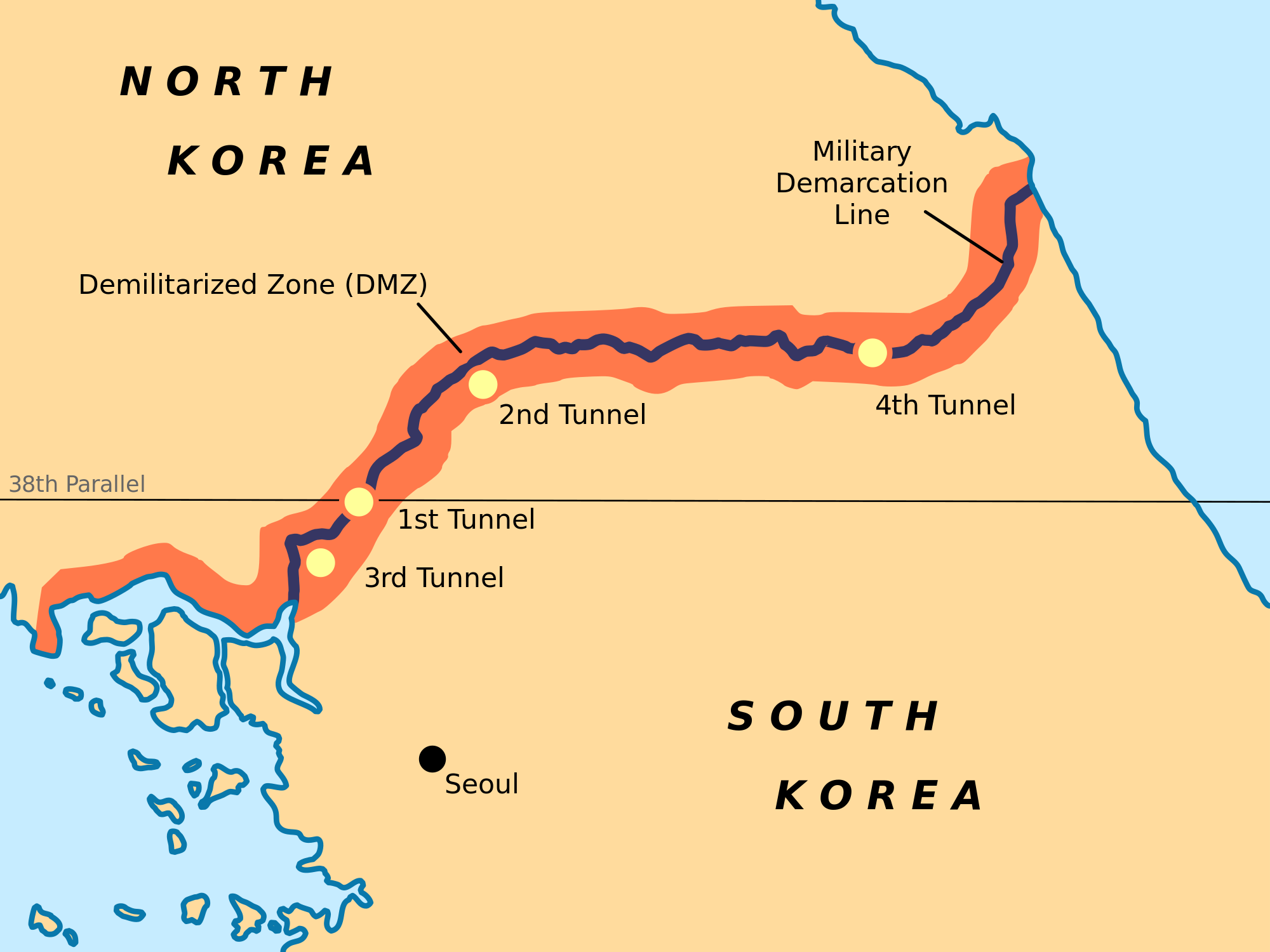
On 25 June 1950, North Korea invaded South Korea in an attempt to re-unify the peninsula under its communist rule. The subsequent Korean War, which lasted from 1950 to 1953, ended with a stalemate and has left Korea divided by the Korean Demilitarized Zone (DMZ) up to the present day.
During the April 2018 inter-Korean summit, the Panmunjom Declaration for Peace, Prosperity and Reunification of the Korean Peninsula was adopted between Kim Jong Un, the Supreme Leader of North Korea, and Moon Jae-in, then President of South Korea. During the September 2018 inter-Korean summit, several actions were taken toward reunification along the border, such as the dismantling of guard posts and the creation of buffer zones to prevent clashes. On 12 December 2018, soldiers from both Koreas crossed the Military Demarcation Line (MDL) into the opposition countries for the first time in history.[4][5] In following years, dialogue broke down and hostilities resumed.
Historical background
[edit]Japanese rule (1910–1945)
[edit]When the Russo-Japanese War ended in 1905, Korea (then the Korean Empire) became a nominal protectorate of Japan and was annexed by Japan in 1910. Emperor Gojong was removed. In the following decades, nationalist and radical groups emerged to struggle for independence. Divergent in their outlooks and approaches, these groups failed to come together in one national movement.[6][7]: 156–160 The Korean Provisional Government (KPG) in exile in China failed to obtain widespread recognition.[7]: 159–160
World War II
[edit]
At the Cairo Conference in November 1943, in the middle of World War II, Franklin D. Roosevelt, Winston Churchill and Chiang Kai-shek agreed that Japan should lose all the territories it had conquered by force. At the end of the conference, the three powers declared that they were "mindful of the enslavement of the people of Korea, ... determined that in due course Korea shall become free and independent."[8][9] Roosevelt floated the idea of a trusteeship over Korea but did not obtain agreement from the other powers. Roosevelt raised the idea with Joseph Stalin at the Tehran Conference in November 1943 and the Yalta Conference in February 1945. Stalin did not disagree but advocated that the period of trusteeship be short.[7]: 187–188 [10]
At the Tehran and Yalta Conferences, Stalin promised to join his allies in the Pacific War in two to three months after victory in Europe. On 8 August 1945, two days after the first atomic bomb was dropped on Hiroshima, but before the second bomb was dropped at Nagasaki, the USSR declared war on Japan.[11] As war began, the Commander-in-Chief of Soviet Forces in the Far East, Marshal Aleksandr Vasilevsky, called on Koreans to rise up against Japan, saying "a banner of liberty and independence is rising in Seoul".[12]
Soviet troops advanced rapidly, and the U.S. government became anxious that they would occupy the whole of Korea. On 10 August 1945 two young officers – Dean Rusk and Charles Bonesteel – were assigned to define an American occupation zone. Working on extremely short notice and completely unprepared, they used a National Geographic map to decide on the 38th parallel as the dividing line. They chose it because it divided the country approximately in half but would place the capital Seoul under American control. No experts on Korea were consulted. The two men were unaware that forty years before, Japan and pre-revolutionary Russia had discussed sharing Korea along the same parallel. Rusk later said that had he known, he "almost surely" would have chosen a different line.[13][14] The division placed sixteen million Koreans in the American zone and nine million in the Soviet zone.[15] Rusk observed, "even though it was further north than could be realistically reached by US forces, in the event of Soviet disagreement ... we felt it important to include the capital of Korea in the area of responsibility of American troops". He noted that he was "faced with the scarcity of US forces immediately available, and time and space factors, which would make it difficult to reach very far north, before Soviet troops could enter the area".[16] To the surprise of the Americans, the Soviet Union immediately accepted the division.[12][17] The agreement was incorporated into General Order No. 1 (approved on 17 August 1945) for the surrender of Japan.[17]
Liberation, confusion, and conflict
[edit]On 10 August, Soviet forces entered northern Korea.[18]: 82 Soviet forces began amphibious landings in Korea by 14 August and rapidly took over the northeast of the country, and on 16 August they landed at Wonsan.[19] Japanese resistance was light, and Soviet forces secured most major cities in the north by 24 August[18]: 82 (including Pyongyang, the second largest city in the Korean Peninsula after Seoul).[17] Having fought Japan on Korean soil, the Soviet forces were well-received by Koreans.[18]: 82
Throughout August, there was a mix of celebration, confusion, and conflict, mainly caused by the lack of information provided to the Koreans by the Allies. The general public did not become aware of the division of Korea until around when the Soviets entered Pyongyang.[20]
Meanwhile in Seoul, beginning in early to mid August, General Nobuyuki Abe, the last Japanese Governor-General of Korea, began contacting Koreans to offer them a leading role in the hand-over of power. He first offered the position to Song Jin-woo, the former head of The Dong-A Ilbo newspaper, who was seen as a champion of Korean independence activism within the peninsula. Song refused the position, which he saw as equivalent to the role of Wang Jingwei, the ruler of the Japanese puppet state in China. He instead preferred to wait until, as many expected and hoped, the KPG returned to the peninsula and established a fully domestic Korean government. On 15 August, Abe instead offered the position to Lyuh Woon-hyung, who accepted it, to the chagrin of Song. That day, Lyuh announced to the public that Japan had accepted the terms of surrender laid out in the Potsdam Declaration, to the jubilation of the Koreans and the horror of the around 777,000 Japanese residents of the peninsula. With a budget of 20,000,000 yen from the colonial government, Lyuh set about organizing the Committee for the Preparation of Korean Independence (CPKI). The CPKI began taking over the security situation in the city and coordinating with local governments throughout the peninsula. However, the organization ended up being composed of mostly leftists, which infuriated Song even more. Lyuh attempted on multiple occasions to convince Song to join or support the CPKI, but their meetings reportedly ended in angry arguments each time.[20]
For the weeks before the American arrival in Seoul, the capital was awash with waves of rumors, some of which may have been spread by Japanese soldiers to distract the public while they prepared to leave the peninsula. On multiple occasions, rumors that Soviet soldiers were about to arrive via rail to Seoul caused either mass panic or, for some left-leaning Koreans, celebration. Even the Soviet Ambassador in Seoul was confused and phoned around to check whether Soviet soldiers were coming. Another rumor, spread both by fliers and a pirate radio broadcast, alleged the creation of a "Dongjin Republic" (동진공화국; 東震共和國), with Syngman Rhee as president, Kim Ku as prime minister, Kim Il Sung as minister of military affairs, and Lyuh as foreign minister.[20]
On 16 August, young officers of the Japanese military in Seoul fiercely protested the decisions of the colonial government. Despite assurances from the colonial government to the CPKI of minimal interference from the Japanese in their affairs, the military declared that they would firmly punish any unrest, to the protest of the CPKI.[20]
On 6 September a congress of representatives was convened in Seoul and founded the short-lived People's Republic of Korea (PRK).[21][22] In the spirit of consensus, conservative elder statesman Syngman Rhee, who was living in exile in the U.S., was nominated as president.[23] Song announced his own National Foundation Preparation Committee (NFPC) on 7 September to directly counter the PRK. However, the NFPC had a minimal role in Korean politics and ended up aligning itself with the KPG after its return.[24]
Post–World War II
[edit]Division (since 2 September 1945)
[edit]Soviet occupation of northern Korea
[edit]
The Soviets received little resistance from the Japanese during their advance across northern Korea and were aided by various Korean groups.[25] When Soviet troops entered Pyongyang on August 24, they found a local branch of the Committee for the Preparation of Korean Independence operating under the leadership of veteran nationalist Cho Man-sik.[26] The Soviet Army allowed these "People's Committees" (which were of varying political composition) to function. In September 1945, the Soviet administration issued its own currency, the "Red Army won".[12]
As a result of the destruction caused to the Soviet Union during the Second World War, the Soviets lacked the resources and will to create a full satellite state in Korea and Koreans enjoyed a higher level of autonomy than Soviet-controlled Eastern European states. The Soviets had brought with them a number of Koreans who had been living in the Soviet Union, some of whom were members of the Soviet Communist Party, with the intention of creating a socialist state.[25] Unlike in the south, the former Japanese occupying authorities offered virtually no assistance to the Soviets, and even destroyed factories, mines and official records.[25]
After the massive loss of troops in Europe, the Soviet army recruited new soldiers, who were badly equipped when they landed in Korea, some even lacking shoes and uniforms. During the Soviet occupation, they lived off the Korean land, and looted Japanese colonials and Korean capitalists, sending part of the loot back home. In addition to looting, Soviet soldiers were accused of rape, although the accusations were inflated in the south by fleeing Japanese colonials. Korean peasants sometimes joined the looting, indicating that the looting was based in class disparities, rather than racial disparities. These abuses lessened after the arrival of military police in January 1946.[27]
In 1946, Colonel-General Terentii Shtykov took charge of the administration and began to lobby the Soviet government for funds to support the ailing economy.[12] Shtykov's strong support of Kim Il Sung, who had spent the last years of the war training with Soviet troops in Manchuria, was decisive in his rise to power.[28] In February 1946 a provisional government called the Provisional People's Committee of North Korea was formed under Kim Il Sung. Conflicts and power struggles ensued at the top levels of government in Pyongyang as different aspirants manoeuvred to gain positions of power in the new government.[29]
In December 1946, Shtykov and two other generals designed the election results of the Assembly for the Provisional Committee without any Korean input. The generals decided "exact distribution of seats among the parties, the number of women members, and, more broadly, the precise social composition of the legislature."[28] The original 1948 North Korean constitution was primarily written by Stalin and Shtykov.[28]
In March 1946 the provisional government instituted a sweeping land-reform program: land belonging to Japanese and collaborator landowners was divided and redistributed to poor farmers.[29] Organizing the many poor civilians and agricultural labourers under the people's committees, a nationwide mass campaign broke the control of the old landed classes. Landlords were allowed to keep only the same amount of land as poor civilians who had once rented their land, thereby making for a far more equal distribution of land. The North Korean land reform was achieved in a less violent way than in China or in Vietnam. Official American sources stated: "From all accounts, the former village leaders were eliminated as a political force without resort to bloodshed, but extreme care was taken to preclude their return to power."[27] The farmers responded positively; many collaborators, former landowners and Christians fled to the south, where some of them obtained positions in the new South Korean government. According to the U.S. military government, 400,000 northern Koreans went south as refugees.[30]
Key industries were nationalized. The economic situation was nearly as difficult in the north as it was in the south, as the Japanese had concentrated agriculture and service industries in the south and heavy industry in the north.[clarification needed]
Soviet forces were withdrawn on 10 December 1948.[31]
US occupation of southern Korea
[edit]
With the American government fearing Soviet expansion, and the Japanese authorities in Korea warning of a power vacuum, the embarkation date of the US occupation force was brought forward three times.[7] On 7 September 1945, General Douglas MacArthur issued Proclamation No. 1 to the people of Korea, announcing U.S. military control over Korea south of the 38th parallel and establishing English as the official language during military control.[32] That same day, he announced that Lieutenant General John R. Hodge was to administer Korean affairs. Hodge landed in Incheon with his troops on 8 September 1945, marking the beginning of the United States Army Military Government in Korea (USAMGIK). American soldiers committed rape and looting, on a smaller scale than the Soviets. The racism amongst Americans against Koreans was widespread.[27]
MacArthur as Supreme Commander for the Allied Powers ended up being in charge of southern Korea from 1945 to 1948 due to the lack of clear orders or initiative from Washington, D.C. There was no plan or guideline given to MacArthur from the Joint Chiefs of Staff or the State Department on how to rule Korea. Hodge directly reported to MacArthur and GHQ (General Headquarters) in Tokyo, not to Washington, D.C., during the military occupation. The three year period of the U.S. Army occupation was chaotic and tumultuous compared to the very peaceful and stable U.S. occupation of Japan from 1945 to 1952. Hodge and his XXIV Corps were trained for combat, not for diplomacy and negotiating with the many diverse political groups that emerged in post-colonial southern Korea: former Japanese collaborators, pro-Soviet communists, anti-Soviet communists, right wing groups, and Korean nationalists. None of the Americans in the military or the State Department in the Far East in late 1945 even spoke Korean, leading to jokes among Koreans that Korean translators were really running southern Korea.[33][34] The Provisional Government of the Republic of Korea, which had operated from China, sent a delegation with three interpreters to Hodge, but he refused to meet with them.[35] Likewise, Hodge refused to recognize the newly formed People's Republic of Korea and its People's Committees, and outlawed it on 12 December.[36]
Japanese civilians were repatriated, including nearly all industrial managers and technicians; over 500,000 by December 1945 and 786,000 by August 1946. Severe price inflation occurred in the disrupted economy, until in summer 1946 rationing and price controls were imposed.[3]
In September 1946, thousands of laborers and peasants rose up against the military government. This uprising was quickly defeated, and failed to prevent scheduled October elections for the South Korean Interim Legislative Assembly. The opening of the Assembly was delayed to December to investigate widespread allegations of electoral fraud.[3]
Ardent anti-communist Syngman Rhee, who had been the first president of the Provisional Government and later worked as a pro-Korean lobbyist in the US, became the most prominent politician in the South. Rhee pressured the American government to abandon negotiations for a trusteeship and create an independent Republic of Korea in the south.[37]
USAMGIK and later the newly formed South Korean government faced a number of left-wing insurgencies, some supported by North Korea, that were eventually suppressed. Over the course of the next few years, between 30,000[38] and 100,000 people were killed. Most casualties resulted from the Jeju uprising.[39]
US–Soviet Joint Commission
[edit]
In December 1945, at the Moscow Conference, the Allies agreed that the Soviet Union, the US, the Republic of China, and Britain would take part in a trusteeship over Korea for up to five years in the lead-up to independence. This invigorated the Anti-trusteeship Movement, which demanded the immediate independence of the peninsula. However, the Korean Communist Party, which was closely aligned with the Soviet Communist party, supported the trusteeship.[40][41] According to historian Fyodor Tertitskiy, documentation from 1945 suggests the Soviet government initially had no plans for a permanent division.[23]
A Soviet-US Joint Commission met in 1946 and 1947 to work towards a unified administration, but failed to make progress due to increasing Cold War antagonism and to Korean opposition to the trusteeship.[42] In 1946, the Soviet Union proposed Lyuh Woon-hyung as the leader of a unified Korea, but this was rejected by the US.[23] On 19 July 1947, Lyuh, the last senior politician committed to left-right dialogue, was assassinated by a 19-year-old man named Han Chigeun, a recent refugee from North Korea and an active member of the nationalist right-wing group, the White Shirts Society.[43]
Meanwhile, the division between the two zones deepened. The difference in policy between the occupying powers led to a polarization of politics, and a transfer of population between North and South.[44] In May 1946 it was made illegal to cross the 38th parallel without a permit.[45] At the final meeting of the Joint Commission in September 1947, Soviet delegate Terentii Shtykov proposed that both Soviet and US troops withdraw and give the Korean people the opportunity to form their own government. This was rejected by the US.[46]
UN intervention and the formation of separate governments
[edit]


With the failure of the Joint Commission to make progress, the US brought the problem before the United Nations in September 1947. The Soviet Union opposed UN involvement.[47] The UN passed a resolution on 14 November 1947, declaring that free elections should be held, foreign troops should be withdrawn, and a UN commission for Korea, the United Nations Temporary Commission on Korea (UNTCOK), should be created. The Soviet Union boycotted the voting and did not consider the resolution to be binding, arguing that the UN could not guarantee fair elections. In the absence of Soviet co-operation, it was decided to hold UN-supervised elections in the south only.[48][49] This was in defiance of the report of the chairman of the commission, K. P. S. Menon, who had argued against a separate election.[50] Some UNTCOK delegates felt that the conditions in the south gave unfair advantage to right-wing candidates, but they were overruled.[7]: 211–212
The decision to proceed with separate elections was unpopular among many Koreans, who rightly saw it as a prelude to a permanent division of the country. General strikes in protest against the decision began in February 1948.[45] In April, Jeju islanders rose up against the looming division of the country and full-scale rebellion developed. South Korean troops were sent to repress the rebellion. The repression of the uprising escalated from August 1948, following South Korean independence. The rebellion was largely defeated by May 1949 and 25,000 to 30,000 people had been killed in the conflict,[51] and 70% of the villages were burned by the South Korean troops.[52] The uprising flared up again with the outbreak of the Korean War.[53]
In April 1948, a conference of organizations from the north and the south met in Pyongyang. The southern politicians Kim Koo and Kim Kyu-sik attended the conference and boycotted the elections in the south, as did other politicians and parties.[7]: 211, 507 [54] The conference called for a united government and the withdrawal of foreign troops.[55] Syngman Rhee and General Hodge denounced the conference.[55] Kim Koo was assassinated the following year.[56]
On 10 May 1948 the south held a general election. It took place amid widespread violence and intimidation, as well as a boycott by opponents of Syngman Rhee.[57] On 15 August, the "Republic of Korea" (Daehan Minguk) formally took over power from the U.S. military, with Syngman Rhee as the first president. USAMGIK was formally dissolved and the Korean Military Advisory Group was formed to train and provide support for the South Korean army. U.S forces started to withdraw in a process that was completed by 1949. In the North, the "Democratic People's Republic of Korea" (Chosŏn Minjujuŭi Inmin Konghwaguk) was declared on 9 September, with Kim Il Sung as prime minister.
On 12 December 1948, the United Nations General Assembly accepted the report of UNTCOK and declared the Republic of Korea to be the "only lawful government in Korea".[58] However, none of the members of UNTCOK considered that the election had established a legitimate national parliament. The Australian government, which had a representative on the commission declared that it was "far from satisfied" with the election.[57]
Unrest continued in the South. In October 1948, the Yeosu–Suncheon rebellion took place, in which some regiments rejected the suppression of the Jeju uprising and rebelled against the government.[59] In 1949, the Syngman Rhee government established the Bodo League in order to keep an eye on its political opponents. The majority of the Bodo League's members were innocent farmers and civilians who were forced into membership.[60] The registered members or their families were executed at the beginning of the Korean War. On 24 December 1949, South Korean Army massacred Mungyeong citizens who were suspected communist sympathizers or their family and affixed blame to communists.[61]
Korean War
[edit]This division of Korea, after more than a millennium of being unified, was seen as controversial and temporary by both regimes. From 1948 until the start of the civil war on 25 June 1950, the armed forces of each side engaged in a series of bloody conflicts along the border. In 1950, these conflicts escalated dramatically when North Korean forces invaded South Korea, triggering the Korean War. The United Nations intervened to protect the South, sending a US-led force. As it occupied the south, the Democratic People's Republic of Korea attempted to unify Korea under its regime, initiating the nationalisation of industry, land reform, and the restoration of the People's Committees.[62]

While UN intervention was conceived as restoring the border at the 38th parallel, Syngman Rhee argued that the attack of the North had obliterated the boundary. Similarly UN Commander in Chief, General Douglas MacArthur stated that he intended to unify Korea, not just drive the North Korean forces back behind the border.[63] However, the North overran 90% of the south until a counter-attack by US-led forces. As the North Korean forces were driven from the south, South Korean forces crossed the 38th parallel on 1 October, and American and other UN forces followed a week later. This was despite warnings from the People's Republic of China that it would intervene if American troops crossed the parallel.[64] As it occupied the north, the Republic of Korea, in turn, attempted to unify the country under its regime, with the Korean National Police enforcing political indoctrination.[7]: 281–282 As US-led forces pushed into the north, China unleashed a counter-attack which drove them back into the south.
In 1951, the front line stabilized near the 38th parallel, and both sides began to consider an armistice. Rhee, however, demanded the war continue until Korea was unified under his leadership.[65] The Communist side supported an armistice line being based on the 38th parallel, but the United Nations supported a line based on the territory held by each side, which was militarily defensible.[66] The UN position, formulated by the Americans, went against the consensus leading up to the negotiations.[67] Initially, the Americans proposed a line that passed through Pyongyang, far to the north of the front line.[68] The Chinese and North Koreans eventually agreed to a border on the military line of contact rather than the 38th parallel, but this disagreement led to a tortuous and drawn-out negotiating process.[69]
Armistice
[edit]
The Korean Armistice Agreement was signed after three years of war. The two sides agreed to create a 4-kilometre-wide (2.5-mile) buffer zone between the states, known as the Korean Demilitarized Zone (DMZ). This new border, reflecting the territory held by each side at the end of the war, crossed the 38th parallel diagonally. Rhee refused to accept the armistice and continued to urge the reunification of the country by force.[70] Despite attempts by both sides to reunify the country, the war perpetuated the division of Korea and led to a permanent alliance between South Korea and the U.S., and a permanent U.S. garrison in the South.[71]
As dictated by the terms of the Korean Armistice, a Geneva Conference was held in 1954 on the Korean question. Despite efforts by many of the nations involved, the conference ended without a declaration for a unified Korea.
The Armistice established a Neutral Nations Supervisory Commission (NNSC) which was tasked to monitor the Armistice. Since 1953, members of the Swiss[72] and Swedish[73] armed forces have been members of the NNSC stationed near the DMZ. Poland and Czechoslovakia were the neutral nations chosen by North Korea, but North Korea expelled their observers after those countries embraced capitalism.[74]
Post-armistice relations
[edit]
Since the war, Korea has remained divided along the DMZ. North and South have remained in a state of conflict, with the opposing regimes both claiming to be the legitimate government of the whole country. Sporadic negotiations have failed to produce lasting progress towards reunification.[75]
On 27 April 2018 North Korean leader Kim Jong Un and South Korean President Moon Jae-in met in the Demilitarized Zone (DMZ). The Panmunjom Declaration signed by both leaders called for the end of longstanding military activities near the border and the reunification of Korea.[76]
On 1 November 2018, buffer zones were established across the DMZ to help ensure the end of hostility on land, sea and air.[77][78] The buffer zones stretch from the north of Deokjeok Island to the south of Cho Island in the West Sea and the north of Sokcho city and south of Tongchon County in the East (Yellow) Sea.[78][77] In addition, no fly zones were established.[77][78]
In October 2024, the North Korean constitution was amended to remove references to reunification and labelled South Korea a "hostile state".[79] This was preceded by the destruction of roads connecting the north to the south in a bid to "completely separate" the two states.[80]
In popular culture
[edit]Period dramas
[edit]- Eyes of Dawn (1991–1992 MBC television series)
- Rustic Period (2002–2003 SBS television series)
- Seoul 1945 (2006 KBS1 television series)
See also
[edit]


References
[edit]- ^ a b Lee, Jongsoo (2006). The Partition of Korea After World War II: A Global History. New York: Palgrave Macmillan. ISBN 978-1-4039-6982-8.
- ^ Fry, Michael (5 August 2013). "National Geographic, Korea, and the 38th Parallel". National Geographic. Archived from the original on 25 February 2021. Retrieved 15 May 2021.
- ^ a b c George M. McCune (March 1947). "Korea: The First Year of Liberation". Pacific Affairs. 20 (1). University of British Columbia: 3–17. doi:10.2307/2752411. JSTOR 2752411. Retrieved 5 January 2022.
- ^ "Troops cross North-South Korea Demilitarized Zone in peace for 1st time ever". Cbsnews.com. 12 December 2018. Retrieved 30 December 2018.
- ^ "North and South Korean soldiers enter each other's territory". The Economic Times. Archived from the original on 16 December 2018. Retrieved 30 December 2018.
- ^ Buzo, Adrian (2002). The Making of Modern Korea. London: Routledge. pp. 31–37. ISBN 978-0-415-23749-9.
- ^ a b c d e f g Cumings, Bruce (2005). Korea's Place in the Sun: A Modern History. New York: W. W. Norton & Company. ISBN 978-0-393-32702-1.
- ^ "Cairo Communique, December 1, 1943". Japan National Diet Library. 1 December 1943. Archived from the original on 6 December 2010. Retrieved 10 November 2012.
- ^ Savada, Andrea Matles; Shaw, William, eds. (1990). "World War II and Korea". South Korea: A Country Study. GPO. Washington, DC: Library of Congress. Archived from the original on 29 June 2011. Retrieved 16 May 2006.
- ^ Stueck, William W. (2002). Rethinking the Korean War: A New Diplomatic and Strategic History. Princeton, NJ: Princeton University Press. p. 20. ISBN 978-0-691-11847-5.
- ^ Walker, J Samuel (1997). Prompt and Utter Destruction: Truman and the Use of Atomic Bombs Against Japan. Chapel Hill: The University of North Carolina Press. p. 82. ISBN 978-0-8078-2361-3.
- ^ a b c d Tertitskiy, Fyodor (6 November 2018). "How Kim Il Sung became North Korea's Great Leader". NK News. Archived from the original on 15 November 2018. Retrieved 15 November 2018.
- ^ Oberdorfer, Don; Carlin, Robert (2014). The Two Koreas: A Contemporary History. Basic Books. p. 5. ISBN 9780465031238.
- ^ Seth, Michael J. (16 October 2010). A History of Korea: From Antiquity to the Present. Rowman & Littlefield Publishers (published 2010). p. 306. ISBN 9780742567177. Archived from the original on 1 January 2016. Retrieved 16 November 2015.
- ^ Buzo, Adrian (2002). The Making of Modern Korea. London: Routledge. p. 53. ISBN 978-0-415-23749-9.
- ^ Goulden, Joseph C (1983). Korea: the Untold Story of the War. New York: McGraw-Hill. p. 17. ISBN 978-0070235809.
- ^ a b c Hyung Gu Lynn (2007). Bipolar Orders: The Two Koreas since 1989. Zed Books. p. 18.
- ^ a b c Li, Xiaobing (2018). The Cold War in East Asia. Abingdon, Oxon: Routledge. ISBN 978-1-138-65179-1.
- ^ Seth, Michael J. (2010). A Concise History of Modern Korea: From the Late Nineteenth Century to the Present. Hawaìi studies on Korea. Rowman & Littlefield. p. 86. ISBN 9780742567139. Archived from the original on 19 May 2016. Retrieved 16 November 2015.
- ^ a b c d Son, Sae-il (29 March 2010). "孫世一의 비교 評傳 (73)" [Son Sae-il's Comparative Critical Biography]. Monthly Chosun (in Korean). Retrieved 25 July 2023.
- ^ Buzo, Adrian (2002). The Making of Modern Korea. London: Routledge. pp. 53–57. ISBN 978-0-415-23749-9.
- ^ Robinson, Michael E (2007). Korea's Twentieth-Century Odyssey. Honolulu: University of Hawaii Press. pp. 105–106. ISBN 978-0-8248-3174-5.
- ^ a b c Tertitskiy, Fyodor (8 August 2018). "Why Soviet plans for Austria-style unification in Korea did not become a reality". NK News. Archived from the original on 15 November 2018. Retrieved 15 November 2018.
- ^ 송, 남헌. "송진우 (宋鎭禹)" [Song Jin-woo]. Encyclopedia of Korean Culture. Retrieved 24 July 2023.
- ^ a b c Cumings, Bruce. "The North Wind: The Origins of the Korean War" (PDF).
- ^ Buzo, Adrian (2002). The Making of Modern Korea. London: Routledge. pp. 54–55. ISBN 978-0-415-23749-9.
- ^ a b c Cumings, Bruce (1981). The Origins of the Korean War: Liberation and the Emergence of Separate Regimes, 1945–1947. Princeton University Press. p. 390. ISBN 0-691-09383-0.
- ^ a b c Lankov, Andrei (10 April 2013). The Real North Korea: Life and Politics in the Failed Stalinist Utopia. Oxford University Press. p. 7.
- ^ a b Robinson, Michael E (2007). Korea's Twentieth-Century Odyssey. Honolulu: University of Hawaii Press. p. 106. ISBN 978-0-8248-3174-5.
- ^ Millet, Allan R. (2005). The War for Korea: 1945–1950. p. 59.
- ^ Gbosoe, Gbingba T. (September 2006). Modernization of Japan. iUniverse (published 2006). p. 212. ISBN 9780595411900. Archived from the original on 28 April 2016. Retrieved 6 October 2015.
Although Soviet occupation forces were withdrawn on December 10, 1948, [...] the Soviets had maintained ties with the Democratic People's Republic of Korea [...]
- ^ "Foreign Relations of the United States: Diplomatic Papers, 1945, The British Commonwealth, The Far East, Volume VI - Office of the Historian". history.state.gov. Retrieved 23 June 2022.
- ^ Reports of General MacArthur: MacArthur in Japan: The Occupation: Military Phase: Volume 1 Supplement. Chapter III. Archived from the original on 28 February 2011. Retrieved 26 March 2021.
- ^ "CHAPTER II:The House Divided". history.army.mil. Archived from the original on 12 January 2021. Retrieved 26 March 2021.
- ^ Hart-Landsberg, Martin (1998). Korea: Division, Reunification, & U.S. Foreign Policy. Monthly Review Press. pp. 71–77.
- ^ Buzo, Adrian (2002). The Making of Modern Korea. London: Routledge. p. 57. ISBN 978-0-415-23749-9.
- ^ Stueck, William W. (2002). Rethinking the Korean War: A New Diplomatic and Strategic History. Princeton, NJ: Princeton University Press. pp. 49, 55–57. ISBN 978-0-691-11847-5.
- ^ Millet, Arthur (2005). The War for Korea, 1945–1950.
- ^ Halliday, Jon; Cumings, Bruce (1988). Korea: The Unknown War. Viking Press. ISBN 0-670-81903-4.
- ^ Buzo, Adrian (2002). The Making of Modern Korea. London: Routledge. p. 59. ISBN 978-0-415-23749-9.
- ^ Bluth, Christoph (2008). Korea. Cambridge: Polity Press. p. 12. ISBN 978-07456-3357-2.
- ^ Buzo, Adrian (2002). The Making of Modern Korea. London: Routledge. pp. 59–60, 65. ISBN 978-0-415-23749-9.
- ^ Buzo, Adrian (2002). The Making of Modern Korea. London: Routledge. p. 65. ISBN 978-0-415-23749-9.
- ^ Robinson, Michael E (2007). Korea's Twentieth-Century Odyssey. Honolulu: University of Hawaii Press. pp. 108–109. ISBN 978-0-8248-3174-5.
- ^ a b Hyung Gu Lynn (2007). Bipolar Orders: The Two Koreas since 1989. Zed Books. p. 20.
- ^ Pembroke, Michael (2018). Korea: Where the American Century Began. Melbourne: Hardie Grant. p. 43. ISBN 978-1-74379-393-0.
- ^ Lone, Stewart; McCormack, Gavan (1993). Korea since 1850. Melbourne: Longman Cheshire. pp. 100–101.
- ^ Buzo, Adrian (2002). The Making of Modern Korea. London: Routledge. p. 66. ISBN 978-0-415-23749-9.
- ^ Jager, Sheila Miyoshi (2013). Brothers at War – The Unending Conflict in Korea. London: Profile Books. p. 47. ISBN 978-1-84668-067-0.
- ^ Pembroke, Michael (2018). Korea: Where the American Century Began. Melbourne: Hardie Grant. p. 45. ISBN 978-1-74379-393-0.
- ^ Kim, Hun Joon (2014). The Massacre at Mt. Halla: Sixty Years of Truth Seeking in South Korea. Cornell University Press. pp. 13–41. ISBN 9780801452390.
- ^ "Ghosts of Cheju". Newsweek. 19 June 2000. Archived from the original on 15 June 2011. Retrieved 2 September 2012.
- ^ Robinson, Michael E (2007). Korea's Twentieth-Century Odyssey. Honolulu: University of Hawaii Press. pp. 112. ISBN 978-0-8248-3174-5.
- ^ Jager, Sheila Miyoshi (2013). Brothers at War – The Unending Conflict in Korea. London: Profile Books. pp. 47–48. ISBN 978-1-84668-067-0.
- ^ a b Pembroke, Michael (2018). Korea: Where the American Century Began. Melbourne: Hardie Grant. p. 46. ISBN 978-1-74379-393-0.
- ^ Jager, Sheila Miyoshi (2013). Brothers at War – The Unending Conflict in Korea. London: Profile Books. pp. 48, 496. ISBN 978-1-84668-067-0.
- ^ a b Pembroke, Michael (2018). Korea: Where the American Century Began. Melbourne: Hardie Grant. p. 47. ISBN 978-1-74379-393-0.
- ^ Buzo, Adrian (2002). The Making of Modern Korea. London: Routledge. p. 67. ISBN 978-0-415-23749-9.
- ^ "439 civilians confirmed dead in Yeosu-Suncheon Uprising of 1948 New report by the Truth Commission places blame on Syngman Rhee and the Defense Ministry, advises government apology". The Hankyoreh. 8 January 2009. Archived from the original on 11 May 2011. Retrieved 2 September 2012.
- ^ "Gov't Killed 3,400 Civilians During War". The Korea Times. 2 March 2009. Archived from the original on 4 October 2012. Retrieved 19 October 2014.
- ^ 두 민간인 학살 사건, 상반된 판결 왜 나왔나?'울산보도연맹' – '문경학살사건' 판결문 비교분석해 봤더니.... OhmyNews (in Korean). 17 February 2009. Archived from the original on 3 May 2011. Retrieved 2 September 2012.
- ^ Lone, Stewart; McCormack, Gavan (1993). Korea since 1850. Melbourne: Longman Cheshire. p. 112.
- ^ Stueck, William W. (2002). Rethinking the Korean War: A New Diplomatic and Strategic History. Princeton, NJ: Princeton University Press. pp. 87–88. ISBN 978-0-691-11847-5.
- ^ Stueck, William W. (2002). Rethinking the Korean War: A New Diplomatic and Strategic History. Princeton, NJ: Princeton University Press. p. 89. ISBN 978-0-691-11847-5.
- ^ Stueck, William W. (2002). Rethinking the Korean War: A New Diplomatic and Strategic History. Princeton, NJ: Princeton University Press. p. 141. ISBN 978-0-691-11847-5.
- ^ Stueck, William W. (2002). Rethinking the Korean War: A New Diplomatic and Strategic History. Princeton, NJ: Princeton University Press. pp. 139, 180. ISBN 978-0-691-11847-5.
- ^ Pembroke, Michael (2018). Korea: Where the American Century Began. Hardie Grant Books. pp. 187–188.
- ^ Pembroke, Michael (2018). Korea: Where the American Century Began. Hardie Grant Books. p. 188.
- ^ Pembroke, Michael (2018). Korea: Where the American Century Began. Hardie Grant Books. pp. 188–189.
- ^ Stueck, William W. (2002). Rethinking the Korean War: A New Diplomatic and Strategic History. Princeton, NJ: Princeton University Press. pp. 189–193. ISBN 978-0-691-11847-5.
- ^ Stueck, William W. (2002). Rethinking the Korean War: A New Diplomatic and Strategic History. Princeton, NJ: Princeton University Press. pp. 188–189. ISBN 978-0-691-11847-5.
- ^ "NNSC in Korea" (PDF). Swiss Army. Archived from the original (PDF) on 29 August 2011.
- ^ "Korea". Swedish Armed Forces. Archived from the original on 25 August 2010.
- ^ Winchester, Simon (2015). Pacific: The Ocean of the Future. William Collins. p. 185.
- ^ Feffer, John (9 June 2005). "Korea's slow-motion reunification". Boston Globe. Archived from the original on 23 August 2007. Retrieved 13 August 2007.
- ^ Taylor, Adam (27 April 2018). "The full text of North and South Korea's agreement, annotated". Archived from the original on 12 June 2018. Retrieved 16 May 2018 – via www.washingtonpost.com.
- ^ a b c 이, 치동 (1 November 2018). "Koreas halt all 'hostile' military acts near border". Yonhap News Agency. Archived from the original on 20 February 2019. Retrieved 28 February 2019.
- ^ a b c "Two Koreas end military drills, begin operation of no-fly zone near MDL: MND - NK News - North Korea News". 31 October 2018. Archived from the original on 1 March 2019. Retrieved 28 February 2019.
- ^ Ng, Kelly (17 October 2024). "N Korean constitution now calls South 'hostile state'". BBC News. Retrieved 25 October 2024.
- ^ "Moment North Korea blows up roads connecting to South Korea". BBC News. 15 October 2024. Retrieved 25 October 2024.
Further reading
[edit]- Fields, David. Foreign Friends: Syngman Rhee, American Exceptionalism, and the Division of Korea. University Press of Kentucky, 2019, 264 pages, ISBN 978-0813177199
- Hoare, James; Daniels, Gordon (February 2004). "The Korean Armistice North and South: The Low-Key Victory [Hoare]; The British Press and the Korean Armistice: Antecedents, Opinions and Prognostications [Daniels]". The Korean Armistice of 1953 and its Consequences: Part I (PDF) (Discussion Paper No. IS/04/467 ed.). London: The Suntory Centre (London School of Economics).
- Lee, Jongsoo. The Partition of Korea After World War II: A Global History. Palgrave Macmillan, 2006, 220 pages, ISBN 978-1-4039-6982-8
- Oberdorfer, Don. The Two Koreas : A Contemporary History. Addison-Wesley, 1997, 472 pages, ISBN 0-201-40927-5
External links
[edit]- South Korean Ministry of Unification (Korean and English)
- North Korean News Agency Archived 6 October 2004 at the Wayback Machine (Korean and English)
- Korea Web Weekly (English)
- NDFSK (Mostly Korean; some English)
- Koreascope (Korean and English)
- Rulers.org, has list of Post-World War II US and Soviet administrators (English)
- Korean Unification Studies

Division of Korea
View on GrokipediaHistorical Prelude
Japanese Colonial Rule (1910–1945)
Japan formally annexed Korea through the Japan-Korea Annexation Treaty signed on August 22, 1910, which dissolved the Korean Empire and established the peninsula as the Japanese colony of Chōsen under the administration of a Governor-General headquartered in Seoul.[9] The treaty followed a series of unequal agreements, including the 1905 protectorate treaty after Japan's victory in the Russo-Japanese War, enabling Japanese dominance over Korean sovereignty and leading to the resignation of Emperor Gojong in 1907.[10] Initial governance was militaristic, with the first Governor-General, Terauchi Masatake, imposing martial law and suppressing dissent through the Japanese colonial police and gendarmerie. Widespread resistance erupted in the March 1st Movement of 1919, triggered by the death of Gojong and demands for independence amid global Wilsonian ideals post-World War I.[11] On March 1, 33 intellectuals in Seoul proclaimed a Declaration of Independence, sparking nationwide protests involving an estimated 2 million participants across 1,500 demonstrations.[12] Japanese authorities responded with brutal suppression, resulting in approximately 7,500 Koreans killed, 16,000 wounded, and 46,000 arrested, including torture and village burnings.[13] The movement's failure prompted minor concessions, such as relaxing press controls and establishing advisory councils with limited Korean representation, but reinforced Japanese commitment to assimilation policies.[14] Colonial economic policies prioritized Japan's resource extraction and industrialization needs, conducting a 1910-1918 land survey that reclassified much Korean-owned farmland as state property, displacing peasants and facilitating rice exports to Japan which doubled from 1912 to 1930.[15] Infrastructure like railways and ports expanded primarily for military and export purposes, while Korean wages remained suppressed and land tenancy rates rose to 65% by the 1930s, exacerbating rural poverty.[16] Forced labor corvées built roads and dams, with coercion intensifying during the 1930s Manchurian expansion. Cultural and educational suppression aimed at Japanization, banning Korean-language instruction in public schools after 1938 and requiring Shinto rituals, while Korean history curricula were minimized to portray the peninsula as historically subordinate to Japan.[17] By 1945, only 20% of Korean children attended primary school, with higher education access severely limited and discriminatory against Koreans compared to Japanese settlers.[18] Name changes to Japanese-style were mandated from 1939, and publications in Korean were curtailed, fostering underground nationalist movements. As World War II escalated, mobilization peaked with over 5 million Koreans conscripted for labor in Japan and Manchuria from 1939-1945, under "voluntary" recruitment that devolved into forced deportation amid wartime shortages.[19] An estimated 50,000 to 200,000 Korean women were coerced into sexual slavery as "comfort women" for Japanese troops between 1932 and 1945, recruited through deception or abduction and subjected to systematic exploitation across Asia.[20] These policies, driven by imperial expansionism, left Korea economically integrated into Japan's war machine but socially fractured, setting conditions for postwar division.[21]World War II and Korean Liberation (1945)
Korea had been under Japanese colonial rule since 1910, during which it provided extensive resources, labor, and military conscripts for Japan's imperial expansion in World War II.[22] The peninsula's strategic position and industrial output supported Japan's war machine, including forced labor of millions of Koreans in mines, factories, and military roles.[23] As the war neared its end, the United States dropped atomic bombs on Hiroshima on August 6, 1945, and Nagasaki on August 9, 1945, devastating Japanese cities and accelerating Japan's capitulation.[3] On August 8, 1945, the Soviet Union declared war on Japan, fulfilling its Yalta Agreement commitment, and launched an invasion of Japanese-held Manchuria and northern Korea on August 9, with Soviet forces rapidly advancing southward.[24] [25] Faced with the Soviet advance and lacking ground forces immediately available in the Pacific, U.S. military planners, on the night of August 10–11, 1945, proposed dividing the Korean Peninsula at the 38th parallel for the purpose of accepting Japanese surrenders: Soviet forces north of the line and U.S. forces south.[26] [27] This hasty demarcation, drawn by Dean Rusk and Charles Bonesteel using a National Geographic map, aimed to secure a U.S. zone before Soviet occupation of the entire peninsula; the Soviets accepted the proposal on August 16, 1945.[28] [29] Japan formally announced its surrender on August 15, 1945, ending 35 years of colonial rule and sparking widespread celebrations of liberation across Korea, known as Gwangbokjeol or Liberation Day.[30] [31] [22] In the ensuing power vacuum, local Korean people's committees emerged to fill administrative gaps left by departing Japanese authorities, reflecting both nationalist aspirations and emerging ideological factions influenced by wartime exile groups.[32] Soviet troops reached the 38th parallel by mid-August, disarming Japanese forces in the north, while U.S. forces, under the XXIV Corps, landed at Incheon on September 8, 1945, to accept surrenders in the south and establish military government control.[24] Although the Potsdam Conference in July 1945 had envisioned a temporary Allied trusteeship for Korean independence, the provisional division prioritized military logistics over unified trusteeship, setting the stage for prolonged separation.[33] [34]Establishment of the Division
Provisional Division at the 38th Parallel
Following Japan's announcement of surrender on August 15, 1945, after the atomic bombings of Hiroshima and Nagasaki, the United States and Soviet Union required a mechanism to coordinate the acceptance of Japanese capitulation across the Korean Peninsula, which Japan had occupied since 1910.[3] The division at the 38th parallel north was established as a provisional measure to demarcate zones where Soviet forces would accept surrenders north of the line and U.S. forces south of it, facilitating the disarmament and repatriation of approximately 700,000 Japanese troops stationed in Korea.[2][3] The line was proposed on August 10, 1945, by U.S. Army colonels Dean Rusk and Charles Bonesteel III, who, under urgent orders from Assistant Secretary of War John J. McCloy, consulted a National Geographic Society map to select a boundary that placed Seoul—located at 37.57° N latitude—within the U.S. zone while ceding northern areas with heavier industry to the Soviets.[1][35] This arbitrary selection, completed in about 30 minutes, disregarded Korea's geographic and economic unity, as Rusk later noted it "made no sense" but was necessary to prevent Soviet occupation of the southern capital.[35] The Soviet Union concurred with the proposal shortly thereafter, and it was formalized in General Order No. 1 issued by General Douglas MacArthur on September 2, 1945, as part of Japan's overall surrender terms.[3] Intended strictly as a temporary administrative expedient, the 38th parallel division was not envisioned as a permanent political boundary; both powers anticipated a swift transition to a unified, independent Korean government under Allied oversight.[3] Soviet forces began advancing into northern Korea on August 24, 1945, reaching Pyongyang by early September, while U.S. troops under XXIV Corps landed at Incheon on September 8, 1945, to enforce the surrender south of the parallel.[2] This arrangement, however, entrenched occupational zones that exacerbated emerging Cold War distrust, setting the stage for prolonged separation despite initial unification pledges at the Moscow Conference in December 1945.[36]Soviet Occupation of Northern Korea
Soviet forces entered northern Korea on August 9, 1945, immediately following the USSR's declaration of war on Japan on August 8, as part of the broader Soviet offensive in Manchuria and the Pacific theater. The Red Army's 25th Army advanced rapidly southward, capturing key cities including Pyongyang by mid-August, with amphibious landings commencing around August 14 and full control of the region north of the 38th parallel achieved shortly after Japan's surrender on August 15. This occupation was coordinated with the provisional division agreed upon by U.S. and Soviet military planners, limiting Soviet advances to the northern zone to avoid direct confrontation with incoming American forces in the south.[24][37] The Soviet Civil Administration (SCA), established under the 25th Army, exercised de facto control over governance, security, and economic policy in northern Korea from 1945 to 1948, prioritizing the installation of a communist-aligned regime. Local Korean People's Committees, initially formed spontaneously by anti-Japanese activists and communists in the wake of liberation, were co-opted and centralized by Soviet authorities to administer local affairs, evolving into the Provisional People's Committee of North Korea by February 8, 1946. Kim Il-sung, a Soviet-trained Korean guerrilla leader who had served as a major in the Red Army, arrived in Wonsan on September 19, 1945, aboard a Soviet vessel and was positioned as a key figurehead, gradually consolidating power with SCA backing despite initial Soviet reservations about his limited domestic recognition.[38][39] Major reforms under Soviet oversight included the March 5, 1946, land reform law, which confiscated approximately 1.2 million hectares of land from Japanese owners, Korean landlords, and collaborators without compensation and redistributed it to over 700,000 tenant farmer households, effectively dismantling the traditional landlord class amid reports of violent class struggle and executions. Industrial nationalization targeted Japanese-owned enterprises, while labor laws enforced an eight-hour workday and suppressed strikes not aligned with regime goals; these measures, modeled on Soviet precedents, aimed to build a proletarian base but exacerbated food shortages and economic disruption in the agrarian north. Political opposition, including nationalists and rightists, faced purges, with the SCA authorizing arrests and executions to eliminate perceived threats, fostering a one-party structure under the North Korean Workers' Party by 1946.[40][41] By September 9, 1948, the Democratic People's Republic of Korea (DPRK) was proclaimed in Pyongyang under Kim Il-sung's leadership, claiming sovereignty over the entire peninsula while maintaining Soviet military advisory presence. Soviet troops completed withdrawal by December 25, 1948, following the establishment of the DPRK's Korean People's Army, which had been trained and equipped with Soviet armaments numbering around 100,000 personnel by late 1948, setting the stage for heightened cross-border tensions.[42][43]United States Occupation of Southern Korea
The United States occupation of southern Korea began on September 8, 1945, when American forces under Lieutenant General John R. Hodge landed at Incheon to accept the surrender of Japanese troops south of the 38th parallel, as part of Operation Blacklist Forty. The United States Army Military Government in Korea (USAMGIK) was promptly established as the provisional governing authority, tasked with administering the region amid the power vacuum left by Japan's defeat. Hodge, reporting to General Douglas MacArthur in Tokyo, initially relied on retained Japanese civil servants and police due to the scarcity of trained Korean administrators, a decision driven by logistical necessities but which fueled Korean resentment toward both Japanese remnants and the American occupiers.[24][44][8] USAMGIK faced immediate challenges from indigenous Korean governance efforts, including the formation of people's committees by local Korean groups, many of which leaned leftist and sought rapid independence. In December 1945, American authorities dissolved the Korean People's Republic, a short-lived leftist provisional government, prioritizing anti-communist stability in response to Soviet consolidation in the north. Policies emphasized suppressing communist and socialist activities, supporting right-wing nationalists like the Korean Democratic Party, and fostering economic stabilization through measures against inflation and black markets, though hyperinflation persisted, reaching rates over 1,000% by 1946. Land reform initiatives, initiated in 1947, redistributed approximately 20% of arable land from Japanese and absentee owners to tenants but were partial and compromised by alliances with conservative Korean elites, limiting broader redistribution to avoid alienating potential anti-communist allies.[44][45][46] Political developments under USAMGIK shifted toward establishing a separate southern government after failed unification talks with the Soviets. Opposition to a proposed four-power trusteeship, announced in December 1945, sparked widespread protests from Korean nationalists who viewed it as prolonged foreign control, leading Hodge to publicly disavow it in early 1946. By 1947, amid stalled Moscow Conference negotiations, the US referred the Korean question to the United Nations, paving the way for UN-supervised elections. On May 10, 1948, elections were held in the south, resulting in the formation of the National Assembly, which elected Syngman Rhee as president and proclaimed the Republic of Korea on August 15, 1948; USAMGIK formally ended on August 15, with American troops withdrawing by June 1949. These steps entrenched division but were motivated by the imperative to counter Soviet-backed communism, as evidenced by northern purges and militarization.[3][24]Failed Unification Efforts
U.S.–Soviet Joint Commission Negotiations
The U.S.–Soviet Joint Commission was established following the Moscow Conference of Foreign Ministers on December 27, 1945, where the United States, United Kingdom, and Soviet Union agreed to a provisional democratic government for Korea under a four-power trusteeship lasting up to five years to facilitate independence.[47] The commission, comprising representatives from the U.S. and Soviet occupation commands, was tasked with consulting Korean democratic parties and social organizations to formulate proposals for this government, which would then be submitted for approval by the respective powers.[47] This arrangement aimed to overcome the provisional division at the 38th parallel implemented on September 2, 1945, for Japanese surrender administration.[25] Meetings commenced on March 20, 1946, in Seoul, with the first session lasting until May 8, 1946, but adjourning without consensus.[48] A core dispute emerged over the scope of consultations: the Soviet delegation insisted on limiting discussions to Korean groups explicitly accepting the trusteeship, thereby excluding prominent southern organizations like the Korean Democratic Party and nationalists who opposed foreign oversight as a delay to immediate independence.[36] [48] The U.S. delegation, led by General John R. Hodge, advocated for broader consultations with all democratic entities irrespective of their trusteeship stance, arguing that exclusion violated the Moscow agreement's emphasis on representative Korean input and risked entrenching division by sidelining anti-communist voices in the south.[36] [49] Efforts resumed in August 1946 after a recess, with sessions alternating between Seoul and Pyongyang, but Soviet insistence on vetting consultative bodies for trusteeship loyalty persisted, leading to further impasse.[50] By May 1947, after the second round of negotiations yielded no progress, the commission dissolved amid mutual recriminations; U.S. reports highlighted Soviet obstructionism as rooted in a desire to consolidate communist control in the north under Kim Il-sung, while Soviet accounts blamed U.S. refusal to curb right-wing influences in the south.[50] [51] The failure exacerbated north-south polarization, as the Soviets had already empowered provisional people's committees dominated by communists, contrasting with U.S. efforts to foster moderate governance amid southern unrest.[52] In the commission's aftermath, widespread demonstrations erupted in southern Korea against trusteeship, reflecting nationalist opposition that the U.S. had underestimated, while northern Soviet-backed structures solidified.[49] The deadlock prompted the U.S. to refer the Korean question to the United Nations General Assembly in September 1947, seeking an alternative path to unification via supervised elections, which the Soviets rejected.[53] This outcome effectively entrenched the provisional division, paving the way for separate government formations in 1948.[51]United Nations Intervention and Government Formations
Following the deadlock in the U.S.-Soviet Joint Commission, the United States referred the Korean independence issue to the United Nations General Assembly in September 1947.[54] On November 14, 1947, the General Assembly adopted Resolution 112 (II) at its 112th plenary meeting, creating the United Nations Temporary Commission on Korea (UNTCOK) to consult Korean representatives, supervise elections for a national assembly, and establish a provisional government for the entire peninsula.[54] The resolution emphasized free political activity and elections without military interference, aiming for Korean self-determination.[55] The Soviet Union opposed the UN's involvement, denouncing it as interference in its sphere and refusing UNTCOK entry into northern Korea, effectively limiting the commission's operations to the U.S. zone.[56] UNTCOK arrived in Seoul in January 1948 and, after verifying conditions, proceeded with elections in southern Korea on May 10, 1948, where voter turnout reached 75.5% among eligible adults despite leftist boycotts and unrest.[57] The elections produced a National Assembly dominated by moderate nationalists, which drafted and adopted a constitution on July 12, 1948, establishing a presidential system.[58] On August 15, 1948, the Republic of Korea (ROK) was proclaimed in Seoul, with Syngman Rhee elected provisional president by the Assembly; the government assumed authority from the U.S. military administration the same day.[58] In northern Korea, Soviet authorities had conducted non-competitive elections in November 1946 and August 1948, installing a communist-led Supreme People's Assembly that proclaimed the Democratic People's Republic of Korea (DPRK) on September 9, 1948, with Kim Il-sung as premier; the DPRK claimed sovereignty over the entire peninsula.[59] The UN General Assembly, through Resolution 195 (III) on December 12, 1948, recognized the ROK as the only lawful government in Korea and called for the withdrawal of occupying forces, rejecting the DPRK's legitimacy due to the absence of UN-supervised elections in the north.[60] This intervention formalized the division, as Soviet non-cooperation prevented peninsula-wide unification under democratic processes.Korean War and Its Origins
Pre-War Tensions and North Korean Aggression (1948–1950)
Following the formal establishment of the Republic of Korea (ROK) on May 10, 1948, and the Democratic People's Republic of Korea (DPRK) on September 9, 1948, both regimes asserted sovereignty over the entire Korean Peninsula, exacerbating ideological and territorial disputes along the 38th parallel.[61] The DPRK, led by Kim Il-sung and backed by Soviet occupation authorities until their withdrawal in December 1948, pursued forcible unification under communist rule, rejecting United Nations-supervised elections and unification proposals as interference.[43] Meanwhile, the ROK under Syngman Rhee faced internal communist insurgencies, such as the Jeju Uprising (1948–1949), which diverted resources from border defense, but Rhee's government maintained a defensive posture without plans for northern invasion.[62] Soviet military advisors continued training DPRK forces post-withdrawal, providing substantial arms including T-34 tanks, artillery, and aircraft, enabling the Korean People's Army (KPA) to expand to approximately 135,000 troops by mid-1950—far outmatching the ROK's 98,000 under-equipped soldiers focused on counter-guerrilla operations.[63] Border tensions escalated into armed clashes throughout 1949, with DPRK forces initiating most incursions to probe southern defenses and seize strategic points. In May 1949, KPA units invaded the Ongjin Peninsula enclave, sparking skirmishes with ROK defenders.[64] By June 1949, intensified fighting erupted in the same region, involving thousands of North Korean troops against southern positions.[65] Further clashes occurred near Kaesong and on the Ongjin Peninsula through late 1949, where DPRK forces captured key peaks in October after five days of combat, demonstrating aggressive probing rather than isolated provocations.[62] [66] These incidents, part of a pattern of DPRK raids, contrasted with ROK responses limited by U.S. restrictions on offensive actions and reduced American military aid after 1948, which prioritized internal security over border fortification.[67] DPRK claims of southern aggression served as propaganda to justify expansion, but declassified records indicate northern initiative in most violations.[68] Kim Il-sung repeatedly lobbied Soviet leader Joseph Stalin for approval to invade the South, receiving initial hesitance due to risks of U.S. intervention but securing tentative backing by late 1949 amid Soviet arms transfers.[43] Stalin's strategy emphasized deniability, conditioning full support on Chinese Communist alignment after Mao Zedong's 1949 victory; by January 1950, following Kim's Moscow visit and Mao's endorsement, Stalin greenlit the offensive, calculating U.S. commitments elsewhere would limit response.[69] [8] DPRK troop concentrations along the parallel intensified in spring 1950, with a three-phase plan: massing forces, feigned unification diplomacy, and a surprise "counterattack" to portray the assault as defensive.[70] U.S. signals, including Secretary of State Dean Acheson's January 1950 perimeter speech excluding Korea from primary defense priorities, further emboldened Pyongyang.[67] These preparations culminated in the KPA's full-scale crossing of the 38th parallel on June 25, 1950, initiating the war with artillery barrages and rapid advances toward Seoul.[61]Outbreak and International Response (1950)
On June 25, 1950, the Korean People's Army of the Democratic People's Republic of Korea (North Korea) initiated a coordinated invasion across the 38th parallel, launching an unprovoked full-scale assault on the Republic of Korea (South Korea) with approximately 135,000 troops, artillery, and Soviet-supplied T-34 tanks, exploiting the South's military unpreparedness following the withdrawal of most U.S. forces in 1949.[71][2] This aggression, planned by North Korean leader Kim Il-sung and explicitly approved by Soviet Premier Joseph Stalin after months of consultations documented in declassified Soviet archives, aimed at rapid unification under communist control and caught South Korean defenses by surprise, leading to the collapse of forward positions within hours.[72][52] North Korean forces advanced swiftly, capturing Seoul on June 28 amid minimal organized resistance, pushing Republic of Korea troops southward toward the Nakdong River line.[73] The United Nations Security Council responded immediately, adopting Resolution 82 on the day of the invasion, which determined the North Korean actions as a breach of peace and demanded cessation of hostilities and withdrawal to the 38th parallel; this passed 9-0 with one abstention due to the Soviet Union's boycott of the Council over the Republic of China's retention of the China seat, preventing a veto.) Two days later, Resolution 83 declared the invasion a breach of the peace and recommended that member states furnish assistance to the Republic of Korea to repel the attack and restore international peace.[74] Resolution 84 followed on July 7, establishing a unified command under the United States to coordinate the multinational response.[4] U.S. President Harry S. Truman, viewing the invasion as a test of containment against communist expansion akin to the recent fall of China, directed the U.S. Air Force and Navy to provide air cover and naval gunfire support to South Korean forces on June 27, followed by authorization for ground troops on July 8, committing American forces without prior congressional declaration of war under the UN framework.[2][75] Truman's decision, informed by intelligence confirming North Korean initiative with Soviet backing but no direct Soviet combat involvement at the outset, mobilized the U.S. Eighth Army remnants and rapidly deployed reinforcements, with General Douglas MacArthur appointed as UN Commander.[76] By late July, a U.S.-led coalition of 15 other UN member states had begun contributing forces, including ground troops from the United Kingdom, Canada, and Australia, though the United States provided the bulk of combat power, framing the intervention as collective defense against aggression rather than unilateral action.[4] The Soviet Union, while supplying North Korea logistically, publicly denied involvement and criticized the UN response as imperialist, adhering to its boycott strategy.[76]Course of the War and Key Battles
The Korean War began on June 25, 1950, when approximately 75,000 North Korean People's Army (KPA) troops, supported by Soviet-supplied T-34 tanks, launched a coordinated invasion across the 38th parallel, overwhelming poorly equipped South Korean forces and advancing southward in multiple prongs.[4] By June 28, KPA units had captured Seoul after fierce urban fighting, with South Korean casualties exceeding 70,000 in the initial weeks, forcing United Nations Command (UNC) troops—primarily U.S. Eighth Army elements—to conduct a fighting retreat to the southeastern port of Pusan.[73] The Pusan Perimeter, a defensive arc spanning about 140 miles around the city, became the focal point of UNC resistance from early August to mid-September 1950, where U.S. and South Korean forces repelled repeated KPA assaults, including the critical Battle of the Nakdong Bulge (August 1–19), inflicting heavy North Korean losses estimated at over 60,000 while holding the line with around 4,000 U.S. casualties.[77] This defense bought time for UNC reinforcements and set the stage for a counteroffensive. On September 15, 1950, General Douglas MacArthur orchestrated the amphibious landing at Inchon (Operation Chromite), involving 75,000 UNC personnel—primarily U.S. Marines of X Corps—against minimally defended North Korean positions, exploiting the port's extreme tidal range and narrow approaches.[78] The operation succeeded with minimal UNC losses (about 566 killed or wounded in the initial assault) and over 13,000 KPA casualties or captures, severing North Korean supply lines to the Pusan front and enabling the rapid recapture of Seoul by September 28 after house-to-house combat that cost UNC around 1,300 casualties.[79] Emboldened, UNC forces launched a general offensive northward, crossing the 38th parallel on October 1 and pushing toward the Yalu River border with China, capturing Pyongyang on October 19 and nearing the Manchurian frontier by late November, with KPA remnants disintegrating and total North Korean military deaths approaching 200,000 by this phase.[73] Chinese intervention decisively altered the war's trajectory, as the People's Volunteer Army (PVA)—numbering over 200,000 troops—crossed the Yalu River starting October 19, 1950, launching surprise attacks on October 25 that initially overwhelmed isolated UNC units in northern Korea.[80] The PVA's Second Phase Offensive (November 25–December 24) encircled and inflicted severe defeats on UNC forces, notably at the Battle of Chosin Reservoir (November 27–December 13), where U.S. Marines and Army units fought a grueling 78-mile withdrawal against 120,000 Chinese troops in subzero conditions, suffering 17,843 casualties (including frostbite cases) but inflicting an estimated 60,000 PVA losses through disciplined firepower and air support.[81] UNC forces retreated south of the 38th parallel by January 1951, but subsequent counteroffensives—such as Operation Killer (February 1951) and the Fourth Battle of Seoul (April 1951)—stabilized the front, recapturing the capital and pushing PVA/KPA lines back, with UNC air superiority destroying much of the enemy's logistics.[73] The war devolved into a stalemate of attritional fighting along rugged terrain near the 38th parallel from mid-1951 onward, marked by key engagements like the Battle of Heartbreak Ridge (September–October 1951), where U.S. 2nd Infantry Division troops seized fortified hills after 30 days of combat, enduring 3,700 casualties to dislodge 20,000 entrenched PVA forces at a cost of over 25,000 Chinese casualties.[73] Chinese Spring Offensives in April–May 1951, involving up to 700,000 PVA troops, aimed to shatter UNC lines but faltered against prepared defenses and massive artillery barrages, resulting in PVA losses exceeding 100,000 and UNC casualties around 12,000, after which both sides dug in for trench warfare reminiscent of World War I.[73] By July 1953, cumulative UNC casualties totaled about 178,000 (U.S. alone: 36,574 killed), while communist forces suffered 1.5–2 million dead or wounded, underscoring the intervention's role in prolonging the conflict without achieving decisive gains for either side.[82]Armistice Agreement (1953)
The armistice negotiations commenced on July 10, 1951, at Kaesong in North Korea before relocating to the neutral site of Panmunjom in October 1951, amid ongoing combat that claimed hundreds of thousands of lives on both sides.[5] [83] The talks, the longest in history for an armistice, spanned over two years and focused on ceasefire terms, prisoner exchanges, and border delineation, with major impasses over voluntary repatriation of prisoners of war, which the communist side insisted upon full return while the United Nations Command advocated screening to allow choice.[5] Progress accelerated in early 1953 following the death of Soviet leader Joseph Stalin in March, enabling concessions from North Korean and Chinese negotiators, though South Korean President Syngman Rhee vehemently opposed any agreement short of total unification and unilaterally released approximately 25,000 anti-communist North Korean prisoners in June 1953, prompting a temporary suspension of talks by the communists.[84] [85] The agreement was signed at 10:00 a.m. on July 27, 1953, by representatives of the United Nations Command (Lt. Gen. William K. Harrison Jr. for the U.S.-led forces), the Korean People's Army (Nam Il for North Korea), and the Chinese People's Volunteer Army (Peng Dehuai), with hostilities ceasing twelve hours later.[86] [6] South Korea refused to endorse or sign the document, as Rhee rejected the preservation of division along a demarcation line, viewing it as a capitulation that entrenched the communist regime in the North.[85] The United Nations General Assembly formally adopted the armistice on August 28, 1953, affirming its role in halting aggression initiated by North Korea in June 1950.[5] Key provisions included an immediate ceasefire and withdrawal of all armed forces and equipment from a demilitarized zone approximately four kilometers wide, centered on a Military Demarcation Line that largely reverted to positions held before major 1950 offensives, roughly paralleling the 38th parallel but adjusted eastward in some sectors to reflect battlefield realities.[86] [85] The accord mandated the repatriation of about 70,000 communist prisoners and 12,700 anti-communist holdouts who chose non-return after screening by a Neutral Nations Repatriation Commission involving India, Switzerland, and others; it also established the Military Armistice Commission for supervision and prohibited fortifications or reinforcements within the zone without mutual consent.[86] [87] The armistice suspended active combat, which had resulted in over 2.5 million military and civilian deaths, but explicitly deferred a political settlement, stipulating that it would remain in force until replaced by a peace agreement—a condition unmet to date, leaving the Korean Peninsula in a technical state of war.[6] [87] Post-signing violations, including North Korean incursions and tunnel constructions under the DMZ, underscored its fragility as a military rather than diplomatic resolution, with enforcement reliant on U.S.-South Korean deterrence rather than mutual trust.[5]Post-War Entrenchment
Demilitarized Zone and Ongoing Military Confrontations
The Korean Demilitarized Zone (DMZ) was created by the Military Armistice Agreement signed on July 27, 1953, which halted active combat in the Korean War without a peace treaty.[88] This buffer strip spans approximately 250 kilometers in length and 4 kilometers in width, dividing the Korean Peninsula roughly along the 38th parallel from the Yellow Sea to the Sea of Japan.[89] Despite its "demilitarized" designation, the zone features intense military buildup, including over one million landmines, extensive anti-tank barriers, and thousands of artillery pieces positioned within firing range on both sides.[90] Within the DMZ lies the Joint Security Area (JSA) at Panmunjom, a small enclave where North Korean, South Korean, and United Nations Command forces maintain a tense face-to-face presence, facilitating rare diplomatic exchanges under strict protocols.[91] South Korean and U.S. forces patrol their side with heavy armament, while North Korea deploys elite guards and constructs propaganda structures like the unpopulated Kijong-dong village, visible from the south.[92] The area remains littered with unexploded ordnance and booby traps from the war, contributing to accidental casualties among defectors and patrols.[93] Post-armistice military confrontations have persisted, with North Korea initiating numerous incursions and provocations. Infiltration tunnels, dug by North Korean forces for potential sabotage or invasion, were discovered by South Korea starting in 1974, with four confirmed by 1990 extending up to 3.5 kilometers into southern territory.[88] The Axe Murder Incident on August 18, 1976, saw North Korean soldiers axe two U.S. officers attempting to trim a tree in the JSA, prompting Operation Paul Bunyan—a rapid U.S.-South Korean show of force that peacefully resolved the standoff but underscored the volatility.[90] Other significant clashes include naval skirmishes in the Yellow Sea, such as the 1999 Battle of Yeonpyeong where North Korean patrol boats attacked South Korean vessels, killing several sailors, and the 2010 bombardment of Yeonpyeong Island, which killed four South Koreans including civilians.[94] From 1953 to the 1990s, U.S. forces alone recorded dozens of hostile actions resulting in 60 fatalities, often from ambushes, shootings, or mines.[93] These incidents reflect North Korea's pattern of asymmetric aggression, including commando raids and aerial shootdowns, aimed at testing resolve without escalating to full war.[90] Ongoing tensions manifest in North Korea's nuclear and missile programs, with tests like the 2022 Hwasong-17 ICBM launch heightening alerts along the DMZ, alongside frequent artillery drills near the Northern Limit Line.[95] Border violations continue sporadically, including North Korean drones overflying Seoul in 2022 and trash balloon launches in 2024 prompting South Korean propaganda broadcasts, maintaining a state of armed standoff without formal resolution.[94] The absence of a peace treaty leaves the armistice enforced by the United Nations Command, with over 28,000 U.S. troops bolstering South Korea's defenses against potential northern aggression.[88]North Korea: Juche Ideology and Totalitarian Regime
The Juche ideology, formally articulated by Kim Il-sung in a December 1955 speech titled "On Eliminating Dogmatism and Formalism and Establishing Juche in Our Ideological Work," posits that humans are the masters of their destiny and must achieve self-reliance in political, economic, and military spheres to resist external influences.[96] This philosophy emerged as a response to perceived over-reliance on Soviet and Chinese models during North Korea's early state-building phase, emphasizing national independence over orthodox Marxism-Leninism. By the 1970s, under Kim Jong-il, Juche was elevated as the state's independent guiding doctrine, supplanting foreign ideological imports and justifying centralized control under the Korean Workers' Party.[97] Juche's implementation has prioritized ideological autonomy, fostering a cult of personality around the Kim family as embodiments of the nation's self-reliant will. The regime's propaganda apparatus portrays Kim Il-sung (ruling 1948–1994), Kim Jong-il (1994–2011), and Kim Jong-un (2011–present) as infallible leaders whose guidance ensures sovereignty, with mandatory study sessions and monuments like the Juche Tower in Pyongyang reinforcing this narrative.[98] Economically, Juche's self-reliance doctrine has manifested in policies rejecting international division of labor and foreign investment, leading to chronic shortages; for instance, the emphasis on domestic production contributed to the Arduous March famine of the mid-1990s, which killed an estimated 240,000 to 3.5 million people due to agricultural collapse and aid isolation.[99] [100] North Korea operates as a hereditary totalitarian dictatorship, with power concentrated in the Kim dynasty through the Korean Workers' Party, military elites, and surveillance networks that enforce absolute loyalty. The State Security Department and Ministry of Social Security maintain a network of political prison camps holding up to 120,000 inmates, where forced labor, torture, and public executions deter dissent, constituting systematic crimes against humanity as documented in UN inquiries.[101] [102] Freedom of expression, movement, and information is virtually nonexistent, with foreign media banned and internal access to unapproved content punishable by death or imprisonment; defectors report that even private criticism of the leadership triggers "three generations of punishment," extending guilt to family members.[103] [104] This apparatus sustains regime stability amid economic failure, as Juche frames hardships as tests of revolutionary resolve rather than policy flaws, enabling the Kims' unchallenged rule despite GDP per capita lagging far behind South Korea's by factors exceeding 20:1 as of 2023.[98]South Korea: Authoritarian Beginnings to Democratic Capitalism
Following the establishment of the Republic of Korea in 1948, Syngman Rhee served as its first president from 1948 to 1960, governing through an authoritarian system that prioritized anti-communist suppression and centralized power. Rhee's regime suppressed political opposition, manipulated elections, and relied on U.S. support amid economic stagnation and corruption, with per capita income remaining below $100 in the late 1950s.[105] [106] Widespread discontent culminated in the April Revolution of 1960, triggered by fraudulent presidential elections in March, where student-led protests in Seoul and other cities demanded Rhee's ouster; security forces killed over 100 demonstrators on April 19, but mass mobilization forced Rhee's resignation on April 26.[107] [108] The ensuing Second Republic under Prime Minister Chang Myon attempted democratic reforms but faced instability, including labor unrest and North Korean infiltration threats, paving the way for military intervention. On May 16, 1961, General Park Chung-hee led a coup that installed a military junta, transitioning to his presidency in 1963 after a referendum; Park's rule, lasting until his assassination in 1979, combined authoritarian control—such as the 1972 Yushin Constitution granting indefinite emergency powers—with state-directed economic policies.[109] Implementing Five-Year Economic Development Plans from 1962, Park shifted to export-oriented industrialization, targeting sectors like textiles, steel, and shipbuilding through chaebol conglomerates, subsidized loans, and suppressed wages, achieving annual GDP growth averaging 8-10% from the 1960s to 1970s.[110] [111] After Park's death, General Chun Doo-hwan seized power via the December 1979 coup and May 1980 martial law expansion, ruling until 1988 amid severe repression, including the brutal suppression of the Gwangju Uprising in May 1980 where hundreds were killed. Chun's regime sustained economic liberalization and growth, with per capita GDP rising from about $1,700 in 1980 to over $6,000 by 1988, but at the cost of political freedoms and human rights abuses.[112] [113] The June Democratic Struggle of 1987, sparked by the death of student activist Park Jong-chol under torture and Roh Moo-hyun's candidacy nomination delay, saw millions protest nationwide from June 10-29, compelling President Chun to accept constitutional revisions for direct presidential elections and restoring civil liberties.[114] This transition marked the end of overt military rule, with Roh Tae-woo elected in December 1987, leading to consolidated democracy by the 1990s alongside the "Miracle on the Han River"—South Korea's transformation from a war-devastated agrarian economy in 1960 (GDP per capita ~$158) to a high-income capitalist powerhouse by 1990 (GDP per capita ~$6,700), validating export-led growth and market-oriented reforms under disciplined governance.[115] [111]Inter-Korean Dynamics
Cycles of Hostility and Dialogue (1953–2000)
Following the 1953 armistice, North and South Korea entered a pattern of intermittent armed confrontations and failed reconciliation efforts, with no formal peace treaty ending the state of war. North Korea conducted over 100 infiltration attempts into South Korea between 1953 and 1965, including commando raids and guerrilla operations aimed at subversion and assassination, resulting in hundreds of South Korean military and civilian deaths.[116] These actions, often launched from the Demilitarized Zone (DMZ), reflected Pyongyang's persistent goal of forcible unification, exploiting the armistice's lack of enforcement mechanisms.[117] Tensions escalated in the late 1960s amid North Korea's alignment with China's Cultural Revolution and rejection of Soviet revisionism. On January 21, 1968, a 31-member North Korean commando unit infiltrated Seoul in a failed assassination attempt on President Park Chung-hee, known as the Blue House raid, killing 26 South Koreans and three commandos before the survivors escaped north.[117] Two days later, on January 23, 1968, North Korean forces seized the USS Pueblo, a U.S. intelligence ship in international waters, killing one sailor, capturing 82 crew members, and holding them for 11 months until a coerced U.S. apology was extracted. On April 15, 1969, North Korean MiG-21 fighters shot down a U.S. EC-121 reconnaissance aircraft over the Sea of Japan, killing all 31 aboard in an unprovoked attack. These provocations prompted South Korea to declare martial law and bolster DMZ defenses, while U.S. forces reinforced the region, deterring escalation to full war.[90] The 1970s saw continued DMZ violence alongside initial dialogue overtures. South Korea discovered four North Korean infiltration tunnels under the DMZ between 1974 and 1978, capable of accommodating thousands of troops, confirming Pyongyang's preparations for surprise attacks.[117] The most notorious incident occurred on August 18, 1976, when North Korean soldiers axed two U.S. officers to death at Panmunjom during a tree-trimming operation, prompting Operation Paul Bunyan, a large-scale U.S.-South Korean show of force that compelled North Korea to concede. Diplomatically, a July 4, 1972, joint communiqué proposed peaceful unification without foreign interference, leading to Red Cross family reunion talks in 1972–1973, but these collapsed amid mutual accusations of bad faith and North Korea's refusal to address human rights or power-sharing.[117] In the 1980s, North Korea's external terrorism overshadowed border clashes. On October 9, 1983, North Korean agents bombed South Korea's Martyrs' Mausoleum in Rangoon, Myanmar, during President Chun Doo-hwan's visit, killing 21, including four South Korean cabinet members, in a bid to destabilize Seoul's regime.[117] Four years later, on November 29, 1987, North Korea bombed Korean Air Flight 858 over the Andaman Sea, killing all 115 aboard to disrupt South Korea's hosting of the 1988 Seoul Olympics; agent Kim Hyon-hui confessed under interrogation, implicating Kim Jong-il.[117] Inter-Korean talks resumed sporadically, including 1985 prime ministerial meetings, but yielded no breakthroughs as North Korea demanded recognition as an equal state while pursuing self-reliance under Juche. The 1990s shifted focus to North Korea's nuclear ambitions, culminating in crisis and temporary détente. Revelations in 1992 of plutonium reprocessing at Yongbyon prompted International Atomic Energy Agency inspections, which North Korea obstructed, leading to its March 1993 threat to withdraw from the Nuclear Non-Proliferation Treaty.[118] A 1994 standoff, including Pyongyang's removal of fuel rods and U.S. contingency plans for strikes, ended with the October 21 Agreed Framework, under which North Korea froze its graphite-moderated reactors and reprocessing in exchange for U.S.-led provision of light-water reactors, 500,000 tons of heavy fuel oil annually, and normalized relations pledges.[118] While averting immediate war, the deal faced implementation delays and suspicions of North Korean cheating, as evidenced by later intelligence on covert uranium enrichment. High-level talks in 1998–2000, including South Korean President Kim Dae-jung's overtures, hinted at thawing but were undermined by North Korea's missile tests and internal purges, perpetuating the cycle of provocation and fragile engagement.[117]Engagement Policies and Their Outcomes (2000–2025)
South Korea's engagement policies toward North Korea from 2000 onward, building on the Sunshine Policy framework established in the late 1990s, emphasized economic cooperation, humanitarian aid, and dialogue to foster reconciliation and reduce tensions without preconditions for denuclearization. Under President Kim Dae-jung and successor Roh Moo-hyun, initiatives included the June 2000 Pyongyang summit between Kim Dae-jung and Kim Jong-il, which resulted in agreements for family reunions, the Mount Kumgang tourism project generating over $500 million in revenue for North Korea by 2008, and the establishment of the Kaesong Industrial Complex in 2004, where South Korean firms invested approximately $3 billion by 2016 while North Korea earned around $500 million in worker wages, funds largely controlled by the regime.[119][120] These efforts provided North Korea with economic lifelines post-famine, contributing to GDP recovery starting in 1999, yet yielded no verifiable steps toward abandoning its nuclear program, as evidenced by the regime's first nuclear test in October 2006.[121] Subsequent administrations alternated between conditional engagement and renewed overtures amid persistent North Korean provocations. President Lee Myung-bak's 2008-2013 policy conditioned aid on denuclearization, prompting North Korean artillery attacks on Yeonpyeong Island in November 2010 and the sinking of the Cheonan corvette in March 2010, killing 46 South Korean sailors, while nuclear tests occurred in 2009 and 2013.[122] Park Geun-hye's trust-building approach from 2013-2017 faced similar setbacks, including North Korea's 2016 nuclear and multiple missile tests. President Moon Jae-in revived proactive engagement from 2017-2022, facilitating three summits in 2018—Panmunjom in April, Pyongyang in September, and a border meeting—alongside inter-Korean projects like joint liaison offices and railway reconnection efforts, but these coincided with North Korea's sixth nuclear test in September 2017 and failure of the U.S.-North Korea Hanoi summit in February 2019, after which Pyongyang resumed missile launches and rejected verifiable denuclearization.[123][124] Total South Korean humanitarian and economic assistance to North Korea reached about 3.05 billion USD by the early 2020s, yet analysts attribute much of it to bolstering the regime's military capabilities rather than inducing systemic reform or economic liberalization.[125][126] Under President Yoon Suk-yeol from 2022-2025, policy shifted toward strengthened deterrence, U.S. alliance reinforcement, and trilateral cooperation with Japan, de-emphasizing unconditional engagement in favor of pressuring North Korea through sanctions enforcement and military exercises. This approach elicited no reciprocal dialogue from Pyongyang, which intensified missile tests—over 100 launches in 2022 alone—and declared South Korea a "hostile state" in 2024, abandoning unification rhetoric.[127][128] Overall, two decades of engagement failed to curb North Korea's nuclear arsenal, estimated at over 50 warheads by 2025 with ICBM capabilities, as economic incentives were diverted to weapons programs without eliciting concessions, validating critiques that such policies prolonged the regime's survival at the expense of denuclearization progress.[129][130]Long-Term Consequences
Human and Demographic Impacts
The Korean War (1950–1953) resulted in approximately 2–3 million total deaths, including over 1 million military casualties and at least 1 million civilian fatalities across both Koreas, with North Korean civilian deaths estimated at around 900,000 and South Korean at 700,000.[61][131] The conflict displaced millions, including hundreds of thousands of North Koreans who fled south during the fighting and remained separated from families post-armistice, exacerbating familial divisions that persist due to restricted cross-border contact.[132] Post-division, North Korea's demographic trajectory has been marked by severe shocks, notably the mid-1990s famine (known as the Arduous March), which caused an estimated 600,000 to 1 million excess deaths amid economic collapse, flooding, and policy failures in collectivized agriculture.[133] This event, affecting a population then around 22 million, led to sharp declines in birth rates and increased malnutrition, with long-term effects including stunted growth in survivors.[134] In contrast, South Korea experienced no comparable mass starvation but faced displacement from land reforms and political purges in the 1950s, though these were offset by rapid urbanization and economic incentives for internal migration. As of 2023, North Korea's population stands at approximately 26.4 million, while South Korea's exceeds 51.7 million, reflecting divergent growth paths: North Korea's slower expansion due to emigration controls and fertility declines, versus South Korea's earlier boom followed by stagnation.[135][136] Life expectancy in North Korea reached about 73.6 years in 2023, hampered by chronic food shortages and limited healthcare access, compared to South Korea's 83 years, bolstered by advanced medical infrastructure and nutrition.[137][138] Fertility rates underscore systemic differences: North Korea's total fertility rate hovered around 1.8 children per woman in 2023, above replacement level but declining amid resource constraints and state pronatalist policies, while South Korea's plummeted to 0.72, the world's lowest, driven by high living costs, work pressures, and cultural shifts delaying marriage and childbearing.[139][140] Both nations face aging populations, but South Korea's is more acute, with projections of population decline to 45 million by 2050 absent immigration reforms.[141] Human movement reflects regime disparities: Since 1953, over 34,000 North Koreans have defected to South Korea, primarily via China, enduring risks of repatriation, torture, or execution under North Korea's border policies, with defectors citing famine, political repression, and economic hardship as drivers.[142] South-to-North migration remains negligible due to ideological indoctrination and penalties for dissent. These flows highlight the division's causal role in perpetuating isolation, with North Korean refugees in China—estimated in tens of thousands—facing deportation and further demographic strain on the North through brain drain.[143]| Demographic Indicator (2023) | North Korea | South Korea |
|---|---|---|
| Population | 26.4 million[135] | 51.7 million[136] |
| Life Expectancy | 73.6 years[137] | 83 years[138] |
| Total Fertility Rate | 1.8[139] | 0.72[140] |
Economic Divergence and Systemic Validation
Following the Korean War, both Koreas started from comparable low bases of economic development, with per capita incomes estimated around $100–$200 in 1953, devastated by conflict and colonial legacies. By the 1970s, North Korea's state-directed heavy industry, bolstered by Soviet and Chinese aid, briefly yielded higher per capita output than South Korea's agrarian and import-substitution economy. However, sustained divergence emerged as South Korea pivoted to export-led industrialization under Park Chung-hee from 1961, achieving average annual GDP growth of over 8% through the 1960s–1980s via private enterprise incentives, foreign investment, and U.S. alliance support.[145][146] In contrast, North Korea's adherence to Juche self-reliance isolated it from global markets, prioritizing military spending and central planning that stifled innovation and efficiency, leading to stagnation after Soviet aid collapsed in 1991. The 1994–1998 Arduous March famine, triggered by floods but exacerbated by systemic rigidities in agriculture and distribution, resulted in 600,000–1 million deaths, or 3–5% of the population, underscoring the vulnerabilities of command economies to shocks without adaptive mechanisms.[147][134] By 2023, South Korea's real GDP per capita reached $50,400, driven by conglomerates like Samsung in semiconductors and automobiles, while North Korea's languished at approximately $600, reliant on illicit trade and limited reforms.[148]| Year | South Korea GDP per Capita (Nominal USD) | North Korea GDP per Capita (Est. USD) |
|---|---|---|
| 1953 | ~150 | ~150 |
| 1970 | ~280 | ~450 |
| 1990 | ~6,500 | ~1,000 |
| 2023 | ~35,000 | ~600 |