


Community hub
Recent from talks
Contribute something
Nothing was collected or created yet.
Optical fiber
View on Wikipedia


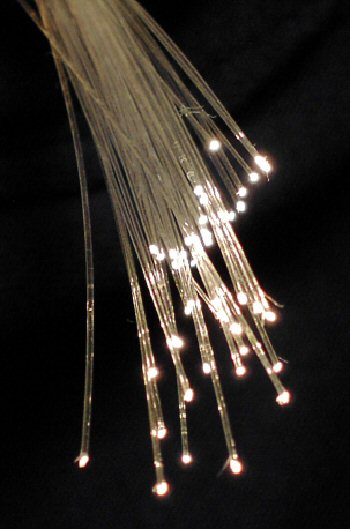
An optical fiber, or optical fibre, is a flexible glass or plastic fiber that can transmit light[a] from one end to the other. Such fibers find wide usage in fiber-optic communications, where they permit transmission over longer distances and at higher bandwidths (data transfer rates) than electrical cables. Fibers are used instead of metal wires because signals travel along them with less loss and are immune to electromagnetic interference.[1] Fibers are also used for illumination and imaging, and are often wrapped in bundles so they may be used to carry light into, or images out of confined spaces, as in the case of a fiberscope.[2] Specially designed fibers are also used for a variety of other applications, such as fiber optic sensors and fiber lasers.[3]
Glass optical fibers are typically made by drawing, while plastic fibers can be made either by drawing or by extrusion.[4][5] Optical fibers typically include a core surrounded by a transparent cladding material with a lower index of refraction. Light is kept in the core by the phenomenon of total internal reflection which causes the fiber to act as a waveguide.[6] Fibers that support many propagation paths or transverse modes are called multi-mode fibers, while those that support a single mode are called single-mode fibers (SMF).[7] Multi-mode fibers generally have a wider core diameter[8] and are used for short-distance communication links and for applications where high power must be transmitted.[9] Single-mode fibers are used for most communication links longer than 1,050 meters (3,440 ft).[10]
Being able to join optical fibers with low loss is important in fiber optic communication.[11] This is more complex than joining electrical wire or cable and involves careful cleaving of the fibers, precise alignment of the fiber cores, and the coupling of these aligned cores. For applications that demand a permanent connection a fusion splice is common. In this technique, an electric arc is used to melt the ends of the fibers together. Another common technique is a mechanical splice, where the ends of the fibers are held in contact by mechanical force. Temporary or semi-permanent connections are made by means of specialized optical fiber connectors.[12] The field of applied science and engineering concerned with the design and application of optical fibers is known as fiber optics. The term was coined by Indian-American physicist Narinder Singh Kapany.[13]
History
[edit],1884.JPG)
Daniel Colladon and Jacques Babinet first demonstrated the guiding of light by refraction, the principle that makes fiber optics possible, in Paris in the early 1840s.[14] John Tyndall included a demonstration of it in his public lectures in London, 12 years later.[15] Tyndall also wrote about the property of total internal reflection in an introductory book about the nature of light in 1870:[16][17]
When the light passes from air into water, the refracted ray is bent towards the perpendicular... When the ray passes from water to air it is bent from the perpendicular... If the angle which the ray in water encloses with the perpendicular to the surface be greater than 48 degrees, the ray will not quit the water at all: it will be totally reflected at the surface... The angle which marks the limit where total reflection begins is called the limiting angle of the medium. For water this angle is 48°27′, for flint glass it is 38°41′, while for a diamond it is 23°42′.
In the late 19th century, a team of Viennese doctors guided light through bent glass rods to illuminate body cavities.[18] Practical applications such as close internal illumination during dentistry followed, early in the twentieth century. Image transmission through tubes was demonstrated independently by the radio experimenter Clarence Hansell and the television pioneer John Logie Baird in the 1920s. In the 1930s, Heinrich Lamm showed that one could transmit images through a bundle of unclad optical fibers and used it for internal medical examinations, but his work was largely forgotten.[15][19]
In 1953, Dutch scientist Bram van Heel first demonstrated image transmission through bundles of optical fibers with a transparent cladding.[19] Later that same year, Harold Hopkins and Narinder Singh Kapany at Imperial College in London succeeded in making image-transmitting bundles with over 10,000 fibers, and subsequently achieved image transmission through a 75 cm long bundle which combined several thousand fibers.[19][20][21] The first practical fiber optic semi-flexible gastroscope was patented by Basil Hirschowitz, C. Wilbur Peters, and Lawrence E. Curtiss, researchers at the University of Michigan, in 1956. In the process of developing the gastroscope, Curtiss produced the first glass-clad fibers; previous optical fibers had relied on air or impractical oils and waxes as the low-index cladding material.[19] Kapany coined the term fiber optics after writing a 1960 article in Scientific American that introduced the topic to a wide audience. He subsequently wrote the first book about the new field.[19][22]
The first working fiber-optic data transmission system was demonstrated by German physicist Manfred Börner at Telefunken Research Labs in Ulm in 1965, followed by the first patent application for this technology in 1966.[23][24] In 1968, NASA used fiber optics in the television cameras that were sent to the moon. At the time, the use in the cameras was classified confidential, and employees handling the cameras had to be supervised by someone with an appropriate security clearance.[25]
Charles K. Kao and George A. Hockham of the British company Standard Telephones and Cables (STC) were the first to promote the idea that the attenuation in optical fibers could be reduced below 20 decibels per kilometer (dB/km), making fibers a practical communication medium, in 1965.[26] They proposed that the attenuation in fibers available at the time was caused by impurities that could be removed, rather than by fundamental physical effects such as scattering. They correctly and systematically theorized the light-loss properties for optical fiber and pointed out the right material to use for such fibers—silica glass with high purity. This discovery earned Kao the Nobel Prize in Physics in 2009.[27] The crucial attenuation limit of 20 dB/km was first achieved in 1970 by researchers Robert D. Maurer, Donald Keck, Peter C. Schultz, and Frank Zimar working for American glass maker Corning Glass Works.[28] They demonstrated a fiber with 17 dB/km attenuation by doping silica glass with titanium. A few years later they produced a fiber with only 4 dB/km attenuation using germanium dioxide as the core dopant. In 1981, General Electric produced fused quartz ingots that could be drawn into strands 25 miles (40 km) long.[29]
Initially, high-quality optical fibers could only be manufactured at two meters per second. Chemical engineer Thomas Mensah joined Corning in 1983 and increased the speed of manufacture to over 50 meters per second, making optical fiber cables cheaper than traditional copper ones.[30][self-published source][31][32] These innovations ushered in the era of optical fiber telecommunication. The Italian research center CSELT worked with Corning to develop practical optical fiber cables, resulting in the first metropolitan fiber optic cable being deployed in Turin in 1977.[33][34] CSELT also developed an early technique for splicing optical fibers, called Springroove.[35]
Attenuation in modern optical cables is far less than in electrical copper cables, leading to long-haul fiber connections with repeater distances of 70–150 kilometers (43–93 mi). Two teams, led by David N. Payne of the University of Southampton and Emmanuel Desurvire at Bell Labs, developed the erbium-doped fiber amplifier, which reduced the cost of long-distance fiber systems by reducing or eliminating optical-electrical-optical repeaters, in 1986 and 1987 respectively.[36][37][38]
The emerging field of photonic crystals led to the development in 1991 of photonic-crystal fiber,[39] which guides light by diffraction from a periodic structure, rather than by total internal reflection. The first photonic crystal fibers became commercially available in 2000.[40] Photonic crystal fibers can carry higher power than conventional fibers and their wavelength-dependent properties can be manipulated to improve performance. These fibers can have hollow cores.[41]
Uses
[edit]Communication
[edit]
Optical fiber is used as a medium for telecommunication and computer networking because it is flexible and can be bundled as cables. It is especially advantageous for long-distance communications, because infrared light propagates through the fiber with much lower attenuation compared to electricity in electrical cables. This allows long distances to be spanned with few repeaters.
10 or 40 Gbit/s is typical in deployed systems.[42][43]
Using wavelength-division multiplexing (WDM) enables each fiber to carry many independent channels, each using a different wavelength of light. The net data rate (data rate without overhead bytes) per fiber is the per-channel data rate reduced by the forward error correction (FEC) overhead, multiplied by the number of channels (usually up to 80 in commercial dense WDM systems as of 2008[update]).
| Date | Milestone |
|---|---|
| 2006 | 111 Gbit/s by NTT.[44][45] |
| 2009 | 100 Pbit/s·km (15.5 Tbit/s over a single 7000 km fiber) by Bell Labs.[46] |
| 2011 | 101 Tbit/s (370 channels at 273 Gbit/s each) on a single core.[47] |
| January 2013 | 1.05 Pbit/s transmission through a multi-core (lightpath) fiber cable.[48] |
| June 2013 | 400 Gbit/s over a single channel using 4-mode orbital angular momentum multiplexing.[49] |
| October 2022 | 1.84 Pbit/s using a photonic chip[50][51] |
| October 2023 | 22.9 Pbit/s by NICT[52] |
For short-distance applications, such as a network in an office building (see fiber to the office), fiber-optic cabling can save space in cable ducts. This is because a single fiber can carry much more data than electrical cables such as standard category 5 cable, which typically runs at 100 Mbit/s or 1 Gbit/s speeds. Fibers are often also used for short-distance connections between devices. For example, most high-definition televisions offer a digital audio optical connection. This allows the streaming of audio over light, using the S/PDIF protocol over an optical TOSLINK connection.
Military
[edit]Fiber optic drones have been used in the Russo-Ukrainian War since March 2024.[53][54] This type of drones are immune to electromagnetic interference and are not affected by electronic warfare systems.[54]
Sensors
[edit]Fibers have many uses in remote sensing. In some applications, the fiber itself is the sensor (the fibers channel optical light to a processing device that analyzes changes in the light's characteristics). In other cases, fiber is used to connect a sensor to a measurement system. Optical fibers can be used as sensors to measure strain, temperature, pressure, and other quantities by modifying a fiber so that the property being measured modulates the intensity, phase, polarization, wavelength, or transit time of light in the fiber. Sensors that vary the intensity of light are the simplest since only a simple source and detector are required. A particularly useful feature of such fiber optic sensors is that they can, if required, provide distributed sensing over distances of up to one meter. Distributed acoustic sensing is one example of this.
In contrast, highly localized measurements can be provided by integrating miniaturized sensing elements with the tip of the fiber.[55] These can be implemented by various micro- and nanofabrication technologies, such that they do not exceed the microscopic boundary of the fiber tip, allowing for such applications as insertion into blood vessels via hypodermic needle.
Extrinsic fiber optic sensors use an optical fiber cable, normally a multi-mode one, to transmit modulated light from either a non-fiber optical sensor—or an electronic sensor connected to an optical transmitter. A major benefit of extrinsic sensors is their ability to reach otherwise inaccessible places. An example is the measurement of temperature inside jet engines by using a fiber to transmit radiation into a pyrometer outside the engine. Extrinsic sensors can be used in the same way to measure the internal temperature of electrical transformers, where the extreme electromagnetic fields present make other measurement techniques impossible. Extrinsic sensors measure vibration, rotation, displacement, velocity, acceleration, torque, and torsion. A solid-state version of the gyroscope, using the interference of light, has been developed. The fiber optic gyroscope (FOG) has no moving parts and exploits the Sagnac effect to detect mechanical rotation.
Common uses for fiber optic sensors include advanced intrusion detection security systems. The light is transmitted along a fiber optic sensor cable placed on a fence, pipeline, or communication cabling, and the returned signal is monitored and analyzed for disturbances. This return signal is digitally processed to detect disturbances and trip an alarm if an intrusion has occurred. Optical fibers are widely used as components of optical chemical sensors and optical biosensors.[56]
Power transmission
[edit]Optical fiber can be used to transmit power using a photovoltaic cell to convert the light into electricity.[57] While this method of power transmission is not as efficient as conventional ones, it is especially useful in situations where it is desirable not to have a metallic conductor as in the case of use near MRI machines, which produce strong magnetic fields.[58] Other examples are for powering electronics in high-powered antenna elements and measurement devices used in high-voltage transmission equipment.
Other uses
[edit]


Optical fibers are used as light guides in medical and other applications where bright light needs to be shone on a target without a clear line-of-sight path. Many microscopes use fiber-optic light sources to provide intense illumination of samples being studied.
Optical fiber is also used in imaging optics. A coherent bundle of fibers is used, sometimes along with lenses, for a long, thin imaging device called an endoscope, which is used to view objects through a small hole. Medical endoscopes are used for minimally invasive exploratory or surgical procedures. Industrial endoscopes (see fiberscope or borescope) are used for inspecting anything hard to reach, such as jet engine interiors.
In some buildings, optical fibers route sunlight from the roof to other parts of the building (see nonimaging optics). Optical-fiber lamps are used for illumination in decorative applications, including signs, art, toys and artificial Christmas trees. Optical fiber is an intrinsic part of the light-transmitting concrete building product LiTraCon. Optical fiber can also be used in structural health monitoring. This type of sensor can detect stresses that may have a lasting impact on structures. It is based on the principle of measuring analog attenuation.
In spectroscopy, optical fiber bundles transmit light from a spectrometer to a substance that cannot be placed inside the spectrometer itself, in order to analyze its composition. A spectrometer analyzes substances by bouncing light off and through them. By using fibers, a spectrometer can be used to study objects remotely.[59][60][61]
An optical fiber doped with certain rare-earth elements such as erbium can be used as the gain medium of a fiber laser or optical amplifier. Rare-earth-doped optical fibers can be used to provide signal amplification by splicing a short section of doped fiber into a regular (undoped) optical fiber line. The doped fiber is optically pumped with a second laser wavelength that is coupled into the line in addition to the signal wave. Both wavelengths of light are transmitted through the doped fiber, which transfers energy from the second pump wavelength to the signal wave. The process that causes the amplification is stimulated emission.
Optical fiber is also widely exploited as a nonlinear medium. The glass medium supports a host of nonlinear optical interactions, and the long interaction lengths possible in fiber facilitate a variety of phenomena, which are harnessed for applications and fundamental investigation.[62] Conversely, fiber nonlinearity can have deleterious effects on optical signals, and measures are often required to minimize such unwanted effects. Optical fibers doped with a wavelength shifter collect scintillation light in physics experiments. Fiber-optic sights for handguns, rifles, and shotguns use pieces of optical fiber to improve the visibility of markings on the sight.
Optical fibers are used as components in e-textiles. This was first done by Harry Wainwright in the 1980s.[63] He used fiber optics to create "a sweatshirt with a dragon spitting flames morphing into a bird."
Principle of operation
[edit]
An optical fiber is a cylindrical dielectric waveguide (nonconducting waveguide) that transmits light along its axis through the process of total internal reflection. The fiber consists of a core surrounded by a cladding layer, both of which are made of dielectric materials.[64] To confine the optical signal in the core, the refractive index of the core must be greater than that of the cladding. The boundary between the core and cladding may either be abrupt, in step-index fiber, or gradual, in graded-index fiber. Light can be fed into optical fibers using lasers or LEDs.
Optical fibers are immune to electrical interference as there is no cross-talk between signals in different cables and no pickup of environmental noise. Information traveling inside the optical fiber is even immune to electromagnetic pulses generated by nuclear devices.[b][65]
Fiber cables do not conduct electricity, which makes them useful for protecting communications equipment in high voltage environments such as power generation facilities or applications prone to lightning strikes. The electrical isolation also prevents problems with ground loops. Because there is no electricity in optical cables that could potentially generate sparks, they can be used in environments where explosive fumes are present. Wiretapping (in this case, fiber tapping) is more difficult compared to electrical connections. Fiber cables are not targeted for metal theft. In contrast, copper cable systems use large amounts of copper and have been targeted since the 2000s commodities boom.
Refractive index
[edit]The refractive index is a way of measuring the speed of light in a material. Light travels fastest in a vacuum, such as in outer space. The speed of light in vacuum is about 300,000 kilometers (186,000 miles) per second. The refractive index of a medium is calculated by dividing the speed of light in vacuum by the speed of light in that medium. The refractive index of vacuum is therefore 1, by definition. A typical single-mode fiber used for telecommunications has a cladding made of pure silica, with an index of 1.444 at 1500 nm, and a core of doped silica with an index around 1.4475.[64] The larger the index of refraction, the slower light travels in that medium. From this information, a simple rule of thumb is that a signal using optical fiber for communication will travel at around 200,000 kilometers per second. Thus a phone call carried by fiber between Sydney and New York, a 16,000-kilometer distance, means that there is a minimum delay of 80 milliseconds (about of a second) between when one caller speaks and the other hears.[c]

Total internal reflection
[edit]When light traveling in an optically dense medium hits a boundary at a steep angle of incidence (larger than the critical angle for the boundary), the light is completely reflected. This is called total internal reflection. This effect is used in optical fibers to confine light in the core. Most modern optical fiber is weakly guiding, meaning that the difference in refractive index between the core and the cladding is very small (typically less than 1%).[66] Light travels through the fiber core, bouncing back and forth off the boundary between the core and cladding.
Because the light must strike the boundary with an angle greater than the critical angle, only light that enters the fiber within a certain range of angles can travel down the fiber without leaking out. This range of angles is called the acceptance cone of the fiber. There is a maximum angle from the fiber axis at which light may enter the fiber so that it will propagate, or travel, in the core of the fiber. The sine of this maximum angle is the numerical aperture (NA) of the fiber. Fiber with a larger NA requires less precision to splice and work with than fiber with a smaller NA. The size of this acceptance cone is a function of the refractive index difference between the fiber's core and cladding. Single-mode fiber has a small NA.
Multi-mode fiber
[edit]

Optical fibers with a large core diameter (greater than 10 micrometers) may be analyzed by geometrical optics. Such fibers are called multi-mode fibers, from the electromagnetic analysis (see below). In a step-index multi-mode fiber, rays of light are guided along the fiber core by total internal reflection. Rays that meet the core-cladding boundary at an angle (measured relative to a line normal to the boundary) greater than the critical angle for this boundary, are completely reflected. The critical angle is determined by the difference in the index of refraction between the core and cladding materials. Rays that meet the boundary at a low angle are refracted from the core into the cladding where they terminate. The critical angle determines the acceptance angle of the fiber, often reported as a numerical aperture. A high numerical aperture allows light to propagate down the fiber in rays both close to the axis and at various angles, allowing efficient coupling of light into the fiber. However, this high numerical aperture increases the amount of dispersion as rays at different angles have different path lengths and therefore take different amounts of time to traverse the fiber.
In graded-index fiber, the index of refraction in the core decreases continuously between the axis and the cladding. This causes light rays to bend smoothly as they approach the cladding, rather than reflecting abruptly from the core-cladding boundary. The resulting curved paths reduce multi-path dispersion because high-angle rays pass more through the lower-index periphery of the core, rather than the high-index center. The index profile is chosen to minimize the difference in axial propagation speeds of the various rays in the fiber. This ideal index profile is very close to a parabolic relationship between the index and the distance from the axis.[citation needed]
Single-mode fiber
[edit]
1. Core: 8 μm diameter
2. Cladding: 125 μm dia.
3. Buffer: 250 μm dia.
4. Jacket: 400 μm dia.
Fibers with a core diameter less than about ten times the wavelength of the propagating light cannot be modeled using geometric optics. Instead, they must be analyzed as an electromagnetic waveguide structure, according to Maxwell's equations as reduced to the electromagnetic wave equation.[d] As an optical waveguide, the fiber supports one or more confined transverse modes by which light can propagate along the fiber. Fiber supporting only one mode is called single-mode.[e] The waveguide analysis shows that the light energy in the fiber is not completely confined in the core. Instead, especially in single-mode fibers, a significant fraction of the energy in the bound mode travels in the cladding as an evanescent wave. The most common type of single-mode fiber has a core diameter of 8–10 micrometers and is designed for use in the near infrared. Multi-mode fiber, by comparison, is manufactured with core diameters as small as 50 micrometers and as large as hundreds of micrometers.
Special-purpose fiber
[edit]Some special-purpose optical fiber is constructed with a non-cylindrical core or cladding layer, usually with an elliptical or rectangular cross-section. These include polarization-maintaining fiber used in fiber optic sensors and fiber designed to suppress whispering gallery mode propagation.
Photonic-crystal fiber is made with a regular pattern of index variation (often in the form of cylindrical holes that run along the length of the fiber). Such fiber uses diffraction effects instead of or in addition to total internal reflection, to confine light to the fiber's core. The properties of the fiber can be tailored to a wide variety of applications.
Mechanisms of attenuation
[edit]

Attenuation in fiber optics, also known as transmission loss, is the reduction in the intensity of the light signal as it travels through the transmission medium. Attenuation coefficients in fiber optics are usually expressed in units of dB/km. The medium is usually a fiber of silica glass[f] that confines the incident light beam within. Attenuation is an important factor limiting the transmission of a digital signal across large distances. Thus, much research has gone into both limiting the attenuation and maximizing the amplification of the optical signal. The four orders of magnitude reduction in the attenuation of silica optical fibers over four decades was the result of constant improvement of manufacturing processes, raw material purity, preform, and fiber designs, which allowed for these fibers to approach the theoretical lower limit of attenuation.[67]
Single-mode optical fibers can be made with extremely low loss. Corning's Vascade® EX2500 fiber, a low loss single-mode fiber for telecommunications wavelengths, has a nominal attenuation of 0.148 dB/km at 1550 nm.[68] A 10 km length of such fiber transmits nearly 71% of optical energy at 1550 nm.
Attenuation in optical fiber is caused primarily by both scattering and absorption. In fibers based on fluoride glasses such as ZBLAN, minimum attenuation is limited by impurity absorption. Vast majority of optical fibers are based on silica glass, where impurity absorption is negligible. In silica fibers attenuation is determined by intrinsic mechanisms: Rayleigh scattering in the glasses through which the light is propagating, and infrared absorption in the same glasses. Absorption in silica increases steeply at wavelengths above 1570 nm. At wavelengths most useful for telecommunications, Rayleigh scattering is the dominant loss mechanism. At 1550 nm attenuation components for a record low loss fiber are given as follows: Rayleigh scattering loss: 0.1200 dB/km, infrared absorption loss: 0.0150 dB/km, impurity absorption loss: 0.0047 dB/km, waveguide imperfection loss: 0.0010 dB/km.
Light scattering
[edit]
The propagation of light through the core of an optical fiber is based on the total internal reflection of the lightwave, in terms of geometric optics, or guided modes, in terms of electromagnetic waveguide. In a typical single mode optical fiber about 75% of light is propagating through the core material, having higher refractive index, and about 25% of light is propagating through the cladding, having lower refractive index. The interface between the core and cladding glasses is exceptionally smooth and does not give rise to a significant scattering loss or a waveguide imperfection loss. The scattering loss originates primarily from the Rayleigh scattering in the bulk of the glasses composing the fiber core and cladding.
The scattering of light in optical quality glass fiber is caused by molecular level irregularities (compositional fluctuations) in the glass structure. Indeed, one emerging school of thought is that glass is simply the limiting case of a polycrystalline solid. Within this framework, domains exhibiting various degrees of short-range order become the building blocks of metals as well as glasses and ceramics. Distributed both between and within these domains are micro-structural defects that provide the most ideal locations for light scattering.
Scattering depends on the wavelength of the light being scattered and on the size of the scattering centers. Angular dependence of the light intensity scattered from an optical fiber matched that of Rayleigh scattering, indicating that the scattering centers are much smaller than the wavelength of propagating light. It originates from the density fluctuations driven by fictive temperature of the glass, and from the concentration fluctuations of dopants in both the core and the cladding. Rayleigh scattering coefficient, R, can be presented as :where Rd represents Rayleigh scattering on density fluctuations and Rc represents Rayleigh scattering on dopant concentration fluctuations. Dopants, such as germanium dioxide or fluorine, are used to create the refractive index difference between the core and the cladding, to form a waveguide structure. where λ is wavelength, n is refractive index, p is photo-elastic coefficient, βc is isothermal compressibility, kB is the Boltzmann constant, Tf is fictive temperature. The only physically significant variable affecting scattering on density fluctuations is the fictive temperature of the glass, lower fictive temperature results in a more homogeneous glass and lower Rayleigh scattering. Fictive temperature may be dramatically reduced by about 100 wt. ppm of alkali oxide dopant in the fiber core, as well as slower cooling of the fiber during the fiber draw process. These approaches are used to produce optical fibers with the lowest attenuation, especially those for submarine telecom cables.


For small dopant concentrations, Rc is proportional to x(dn/dx)2, where x is the mole fraction of the dopant in SiO2-based glass and n is the refractive index of the glass. When GeO2 dopant is used to increase the refractive index of the fiber core, it increases the concentration fluctuation component of Rayleigh scattering, and attenuation of the fiber. This is why the lowest attenuation fibers do not use GeO2 in the core, and use fluorine in the cladding, to reduce the refractive index of the cladding. Rc in pure silica core fiber is proportional to the overlap integral between LP01 mode and fluorine-induced concentration fluctuation component in the cladding.
In the core of potassium-doped pure silica-core (KPSC) fiber only density fluctuations play a significant role, as the concentrations of K2O, fluorine and chlorine are very low. The density fluctuations in the core are moderated by lower fictive temperature resulting from potassium doping, and are further reduced by annealing during the fiber draw process. This differs from the cladding, where higher fluorine dopant levels and the resulting concentration fluctuations add to the loss. In such fibers the light travelling through the core experiences lower scattering and lower attenuation compared to the light propagating through the cladding segment of the fiber.
At high optical powers, scattering can also be caused by nonlinear optical processes in the fiber.[69][70]
UV-Vis-IR absorption
[edit]In addition to light scattering, attenuation or signal loss can also occur due to selective absorption of specific wavelengths. Primary material considerations include both electrons and molecules as follows:
- At the electronic level, it depends on whether the electron orbitals are spaced (or "quantized") such that they can absorb a quantum of light (or photon) of a specific wavelength or frequency in the ultraviolet (UV) or visible ranges. This is what gives rise to color.
- At the atomic or molecular level, it depends on the frequencies of atomic or molecular vibrations or chemical bonds, how closely packed its atoms or molecules are, and whether or not the atoms or molecules exhibit long-range order. These factors will determine the capacity of the material to transmit longer wavelengths in the infrared (IR), far IR, radio, and microwave ranges.
The design of any optically transparent device requires the selection of materials based upon knowledge of its properties and limitations. The crystal structure absorption characteristics observed at the lower frequency regions (mid- to far-IR wavelength range) define the long-wavelength transparency limit of the material. They are the result of the interactive coupling between the motions of thermally induced vibrations of the constituent atoms and molecules of the solid lattice and the incident light wave radiation. Hence, all materials are bounded by limiting regions of absorption caused by atomic and molecular vibrations (bond-stretching) in the far-infrared (>10 μm).
In other words, the selective absorption of IR light by a particular material occurs because the selected frequency of the light wave matches the frequency (or an integer multiple of the frequency, i.e. harmonic) at which the particles of that material vibrate. Since different atoms and molecules have different natural frequencies of vibration, they will selectively absorb different frequencies (or portions of the spectrum) of IR light.
Reflection and transmission of light waves occur because the frequencies of the light waves do not match the natural resonant frequencies of vibration of the objects. When IR light of these frequencies strikes an object, the energy is either reflected or transmitted.
Loss budget
[edit]Attenuation over a cable run is significantly increased by the inclusion of connectors and splices. When computing the acceptable attenuation (loss budget) between a transmitter and a receiver one includes:
- dB loss due to the type and length of fiber optic cable,
- dB loss introduced by connectors, and
- dB loss introduced by splices.
Connectors typically introduce 0.3 dB per connector on well-polished connectors. Splices typically introduce less than 0.2 dB per splice.[citation needed]
The total loss can be calculated by:
- Loss = dB loss per connector × number of connectors + dB loss per splice × number of splices + dB loss per kilometer × kilometers of fiber,
where the dB loss per kilometer is a function of the type of fiber and can be found in the manufacturer's specifications. For example, a typical 1550 nm single-mode fiber has a loss of 0.3 dB per kilometer.[citation needed]
The calculated loss budget is used when testing to confirm that the measured loss is within the normal operating parameters.
Manufacturing
[edit]Materials
[edit]Glass optical fibers are almost always made from silica, but some other materials, such as fluorozirconate, fluoroaluminate, and chalcogenide glasses as well as crystalline materials like sapphire, are used for longer-wavelength infrared or other specialized applications. Silica and fluoride glasses usually have refractive indices of about 1.5, but some materials such as the chalcogenides can have indices as high as 3. Typically the index difference between core and cladding is less than one percent.
Plastic optical fibers (POF) are commonly step-index multi-mode fibers with a core diameter of 0.5 millimeters or larger. POF typically have higher attenuation coefficients than glass fibers, 1 dB/m or higher, and this high attenuation limits the range of POF-based systems.
Silica
[edit]Silica exhibits fairly good optical transmission over a wide range of wavelengths. In the near-infrared (near IR) portion of the spectrum, particularly around 1.5 μm, silica can have extremely low absorption and scattering losses of the order of 0.2 dB/km. Such low losses depend on using ultra-pure silica. A high transparency in the 1.4-μm region is achieved by maintaining a low concentration of hydroxyl groups (OH). Alternatively, a high OH concentration is better for transmission in the ultraviolet (UV) region.[71]
Silica can be drawn into fibers at reasonably high temperatures and has a fairly broad glass transformation range. One other advantage is that fusion splicing and cleaving of silica fibers is relatively effective. Silica fiber also has high mechanical strength against both pulling and even bending, provided that the fiber is not too thick and that the surfaces have been well prepared during processing. Even simple cleaving of the ends of the fiber can provide nicely flat surfaces with acceptable optical quality. Silica is also relatively chemically inert. In particular, it is not hygroscopic (does not absorb water).
Silica glass can be doped with various materials. One purpose of doping is to raise the refractive index (e.g. with germanium dioxide (GeO2) or aluminium oxide (Al2O3)) or to lower it (e.g. with fluorine or boron trioxide (B2O3)). Doping is also possible with laser-active ions (for example, rare-earth-doped fibers) in order to obtain active fibers to be used, for example, in fiber amplifiers or laser applications. Both the fiber core and cladding are typically doped, so that the entire assembly (core and cladding) is effectively the same compound (e.g. an aluminosilicate, germanosilicate, phosphosilicate or borosilicate glass).
Particularly for active fibers, pure silica is usually not a very suitable host glass, because it exhibits a low solubility for rare-earth ions. This can lead to quenching effects due to the clustering of dopant ions. Aluminosilicates are much more effective in this respect. Silica fiber also exhibits a high threshold for optical damage. This property ensures a low tendency for laser-induced breakdown. This is important for fiber amplifiers when utilized for the amplification of short pulses.
Because of these properties, silica fibers are the material of choice in many optical applications, such as communications (except for very short distances with plastic optical fiber), fiber lasers, fiber amplifiers, and fiber-optic sensors. Large efforts put forth in the development of various types of silica fibers have further increased the performance of such fibers over other materials.[72][73][74][75][76][77][78][79]
Fluoride glass
[edit]Fluoride glass is a class of non-oxide optical quality glasses composed of fluorides of various metals. Because of the low viscosity of these glasses, it is very difficult to completely avoid crystallization while processing it through the glass transition (or drawing the fiber from the melt). Thus, although heavy metal fluoride glasses (HMFG) exhibit very low optical attenuation, they are not only difficult to manufacture, but are quite fragile, and have poor resistance to moisture and other environmental attacks. Their best attribute is that they lack the absorption band associated with the hydroxyl (OH) group (3,200–3,600 cm−1; i.e., 2,777–3,125 nm or 2.78–3.13 μm), which is present in nearly all oxide-based glasses. Such low losses were never realized in practice, and the fragility and high cost of fluoride fibers made them less than ideal as primary candidates.
Fluoride fibers are used in mid-IR spectroscopy, fiber optic sensors, thermometry, and imaging. Fluoride fibers can be used for guided lightwave transmission in media such as YAG (yttrium aluminium garnet) lasers at 2.9 μm, as required for medical applications (e.g. ophthalmology and dentistry).[80][81]
An example of a heavy metal fluoride glass is the ZBLAN glass group, composed of zirconium, barium, lanthanum, aluminium, and sodium fluorides. Their main technological application is as optical waveguides in both planar and fiber forms. They are advantageous especially in the mid-infrared (2,000–5,000 nm) range.
Phosphate glass
[edit]
Phosphate glass is a class of optical glasses composed of metaphosphates of various metals. Instead of the SiO4 tetrahedra in the network solid structure of silicate glasses, the building block for this glass is phosphorus pentoxide (P2O5), which crystallizes in at least four different forms. The most familiar polymorph is the cagelike structure of P4O10.
Phosphate glasses can be advantageous over silica glasses for optical fibers with a high concentration of doping rare-earth ions. A mix of fluoride glass and phosphate glass is fluorophosphate glass.[82][83]
Chalcogenide glass
[edit]The chalcogens—the elements in group 16 of the periodic table—particularly sulfur (S), selenium (Se) and tellurium (Te)—react with more electropositive elements, such as silver, to form chalcogenides. These are extremely versatile compounds, in that they can be crystalline or amorphous, metallic or semiconducting, and conductors of ions or electrons. chalcogenide glass can be used to make fibers for far infrared transmission.[84]
Process
[edit] | This section needs additional citations for verification. (April 2016) |

Preform
[edit]Standard optical fibers are made by first constructing a large-diameter preform with a carefully controlled refractive index profile, and then pulling the preform to form the long, thin optical fiber. The preform is commonly made by three chemical vapor deposition methods: inside vapor deposition, outside vapor deposition, and vapor axial deposition.[85] With inside vapor deposition, the preform starts as a hollow glass tube approximately 40 centimeters (16 in) long, which is placed horizontally and rotated slowly on a lathe. Gases such as silicon tetrachloride (SiCl4) or germanium tetrachloride (GeCl4) are injected with oxygen in the end of the tube. The gases are then heated by means of an external hydrogen burner, bringing the temperature of the gas up to 1,900 K (1,600 °C, 3,000 °F), where the tetrachlorides react with oxygen to produce silica or germanium dioxide particles. When the reaction conditions are chosen to allow this reaction to occur in the gas phase throughout the tube volume, in contrast to earlier techniques where the reaction occurred only on the glass surface, this technique is called modified chemical vapor deposition.[86] The oxide particles then agglomerate to form large particle chains, which subsequently deposit on the walls of the tube as soot. The deposition is due to the large difference in temperature between the gas core and the wall causing the gas to push the particles outward in a process known as thermophoresis. The torch is then traversed up and down the length of the tube to deposit the material evenly. After the torch has reached the end of the tube, it is then brought back to the beginning of the tube and the deposited particles are then melted to form a solid layer. This process is repeated until a sufficient amount of material has been deposited. For each layer the composition can be modified by varying the gas composition, resulting in precise control of the finished fiber's optical properties. In outside vapor deposition or vapor axial deposition, the glass is formed by flame hydrolysis, a reaction in which silicon tetrachloride and germanium tetrachloride are oxidized by reaction with water in an oxyhydrogen flame. In outside vapor deposition, the glass is deposited onto a solid rod, which is removed before further processing. In vapor axial deposition, a short seed rod is used, and a porous preform, whose length is not limited by the size of the source rod, is built up on its end. The porous preform is consolidated into a transparent, solid preform by heating to about 1,800 K (1,500 °C, 2,800 °F).

Typical communications fiber uses a circular preform. For some applications such as double-clad fibers another form is preferred.[87] In fiber lasers based on double-clad fiber, an asymmetric shape improves the filling factor for laser pumping.
Because of the surface tension, the shape is smoothed during the drawing process, and the shape of the resulting fiber does not reproduce the sharp edges of the preform. Nevertheless, careful polishing of the preform is important, since any defects of the preform surface affect the optical and mechanical properties of the resulting fiber.
Drawing
[edit]The preform, regardless of construction, is placed in a device known as a drawing tower, where the preform tip is heated and the optical fiber is pulled out as a string. The tension on the fiber can be controlled to maintain the desired fiber thickness.
Cladding
[edit]The light is guided down the core of the fiber by an optical cladding with a lower refractive index that traps light in the core through total internal reflection. For some types of fiber, the cladding is made of glass and is drawn along with the core from a preform with radially varying index of refraction. For other types of fiber, the cladding made of plastic and is applied like a coating (see below).
Coatings
[edit]The cladding is coated by a buffer, (not to be confused with an actual buffer tube), that protects it from moisture and physical damage.[73] These coatings are UV-cured urethane acrylate composite or polyimide materials applied to the outside of the fiber during the drawing process. The coatings protect the very delicate strands of glass fiber—about the size of a human hair—and allow it to survive the rigors of manufacturing, proof testing, cabling, and installation. The buffer coating must be stripped off the fiber for termination or splicing.
Today's glass optical fiber draw processes employ a dual-layer coating approach. An inner primary coating is designed to act as a shock absorber to minimize attenuation caused by microbending. An outer secondary coating protects the primary coating against mechanical damage and acts as a barrier to lateral forces, and may be colored to differentiate strands in bundled cable constructions. These fiber optic coating layers are applied during the fiber draw, at speeds approaching 100 kilometers per hour (60 mph). Fiber optic coatings are applied using one of two methods: wet-on-dry and wet-on-wet. In wet-on-dry, the fiber passes through a primary coating application, which is then UV cured, then through the secondary coating application, which is subsequently cured. In wet-on-wet, the fiber passes through both the primary and secondary coating applications, then goes to UV curing.[88]
The thickness of the coating is taken into account when calculating the stress that the fiber experiences under different bend configurations.[89] When a coated fiber is wrapped around a mandrel, the stress experienced by the fiber is given by[89]: 45 where E is the fiber's Young's modulus, dm is the diameter of the mandrel, df is the diameter of the cladding and dc is the diameter of the coating.

In a two-point bend configuration, a coated fiber is bent in a U-shape and placed between the grooves of two faceplates, which are brought together until the fiber breaks. The stress in the fiber in this configuration is given by[89]: 47 where d is the distance between the faceplates. The coefficient 1.198 is a geometric constant associated with this configuration.

Fiber optic coatings protect the glass fibers from scratches that could lead to strength degradation. The combination of moisture and scratches accelerates the aging and deterioration of fiber strength. When fiber is subjected to low stresses over a long period, fiber fatigue can occur. Over time or in extreme conditions, these factors combine to cause microscopic flaws in the glass fiber to propagate, which can ultimately result in fiber failure.
Three key characteristics of fiber optic waveguides can be affected by environmental conditions: strength, attenuation, and resistance to losses caused by microbending. External optical fiber cable jackets and buffer tubes protect glass optical fiber from environmental conditions that can affect the fiber's performance and long-term durability. On the inside, coatings ensure the reliability of the signal being carried and help minimize attenuation due to microbending.
Cable construction
[edit]
In practical fibers, the cladding is usually coated with a tough resin and features an additional buffer layer, which may be further surrounded by a jacket layer, usually plastic. These layers add strength to the fiber but do not affect its optical properties. Rigid fiber assemblies sometimes put light-absorbing glass between the fibers, to prevent light that leaks out of one fiber from entering another. This reduces crosstalk between the fibers, or reduces flare in fiber bundle imaging applications.[90][91] Multi-fiber cable usually uses colored buffers to identify each strand.
Modern cables come in a wide variety of sheathings and armor, designed for applications such as direct burial in trenches, high voltage isolation, dual use as power lines,[92][failed verification] installation in conduit, lashing to aerial telephone poles, submarine installation, and insertion in paved streets.
Some fiber optic cable versions are reinforced with aramid yarns or glass yarns as an intermediary strength member. In commercial terms, usage of the glass yarns are more cost-effective with no loss of mechanical durability. Glass yarns also protect the cable core against rodents and termites.
Practical issues
[edit] | This section needs additional citations for verification. (April 2016) |
Installation
[edit]Fiber cable can be very flexible, but traditional fiber's loss increases greatly if the fiber is bent with a radius smaller than around 30 mm. This creates a problem when the cable is bent around corners. Bendable fibers, targeted toward easier installation in home environments, have been standardized as ITU-T G.657. This type of fiber can be bent with a radius as low as 7.5 mm without adverse impact. Even more bendable fibers have been developed.[93] Bendable fiber may also be resistant to fiber hacking, in which the signal in a fiber is surreptitiously monitored by bending the fiber and detecting the leakage.[94]
Another important feature of cable is cable's ability to withstand tension which determines how much force can be applied to the cable during installation.
Termination and splicing
[edit]
Optical fibers are connected to terminal equipment by optical fiber connectors. These connectors are usually of a standard type such as FC, SC, ST, LC, MTRJ, MPO or SMA. Optical fibers may be connected by connectors typically on a patch panel, or permanently by splicing, that is, joining two fibers together to form a continuous optical waveguide. The generally accepted splicing method is fusion splicing, which melts the fiber ends together. For quicker fastening jobs, a mechanical splice is used. All splicing techniques involve installing an enclosure that protects the splice.
Fusion splicing is done with a specialized instrument. The fiber ends are first stripped of their protective polymer coating (as well as the more sturdy outer jacket, if present). The ends are cleaved with a precision cleaver to make them perpendicular, and are placed into special holders in the fusion splicer. The splice is usually inspected via a magnified viewing screen to check the cleaves before and fusion after the splice. The splicer uses small motors to align the end faces together, and emits a small spark between electrodes at the gap to burn off dust and moisture. Then the splicer generates a larger spark that raises the temperature above the melting point of the glass, fusing the ends permanently. The location and energy of the spark is carefully controlled so that the molten core and cladding do not mix, and this minimizes optical loss. A splice loss estimate is measured by the splicer by directing light through the cladding on one side and measuring the light leaking from the cladding on the other side. A splice loss under 0.1 dB is typical. The complexity of this process makes fiber splicing much more difficult than splicing copper wire.

Mechanical fiber splices are designed to be quicker and easier to install, but there is still the need for stripping, careful cleaning, and precision cleaving. The fiber ends are aligned and held together by a precision sleeve, often using a clear index-matching gel that enhances the transmission of light across the joint. Mechanical splices typically have a higher optical loss and are less robust than fusion splices, especially if the gel is used.
Fibers are terminated in connectors that hold the fiber end precisely and securely. An optical fiber connector is a rigid cylindrical barrel surrounded by a sleeve that holds the barrel in its mating socket. The mating mechanism can be push and click, turn and latch (bayonet mount), or screw-in (threaded). The barrel is typically free to move within the sleeve and may have a key that prevents the barrel and fiber from rotating as the connectors are mated.
A typical connector is installed by preparing the fiber end and inserting it into the rear of the connector body. Quick-set adhesive is usually used to hold the fiber securely, and a strain relief is secured to the rear. Once the adhesive sets, the fiber's end is polished. Various polish profiles are used, depending on the type of fiber and the application. The resulting signal strength loss is called gap loss. For single-mode fiber, fiber ends are typically polished with a slight curvature that makes the mated connectors touch only at their cores. This is called a physical contact (PC) polish. The curved surface may be polished at an angle, to make an angled physical contact (APC) connection. Such connections have higher loss than PC connections but greatly reduced back reflection because light that reflects from the angled surface leaks out of the fiber core. APC fiber ends have low back reflection even when disconnected.
In the 1990s, the number of parts per connector, polishing of the fibers, and the need to oven-bake the epoxy in each connector made terminating fiber optic cables difficult. Today, connector types on the market offer easier, less labor-intensive ways of terminating cables. Some of the most popular connectors are pre-polished at the factory and include a gel inside the connector. A cleave is made at a required length, to get as close to the polished piece already inside the connector. The gel surrounds the point where the two pieces meet inside the connector for very little light loss.[95] For the most demanding installations, factory pre-polished pigtails of sufficient length to reach the first fusion splice enclosure assures good performance and minimizes on-site labor.
Free-space coupling
[edit]It is often necessary to align an optical fiber with another optical fiber or with an optoelectronic device such as a light-emitting diode, a laser diode, or a modulator. This can involve either carefully aligning the fiber and placing it in contact with the device, or can use a lens to allow coupling over an air gap. Typically the size of the fiber mode is much larger than the size of the mode in a laser diode or a silicon optical chip. In this case, a tapered or lensed fiber is used to match the fiber mode field distribution to that of the other element. The lens on the end of the fiber can be formed using polishing, laser cutting[96] or fusion splicing.
In a laboratory environment, a bare fiber end is coupled using a fiber launch system, which uses a microscope objective lens to focus the light down to a fine point. A precision translation stage (micro-positioning table) is used to move the lens, fiber, or device to allow the coupling efficiency to be optimized. Fibers with a connector on the end make this process much simpler: the connector is simply plugged into a pre-aligned fiber-optic collimator, which contains a lens that is either accurately positioned to the fiber or is adjustable. To achieve the best injection efficiency into a single-mode fiber, the direction, position, size, and divergence of the beam must all be optimized. With good optimization, 70 to 90% coupling efficiency can be achieved.
With properly polished single-mode fibers, the emitted beam has an almost perfect Gaussian shape—even in the far field—if a good lens is used. The lens needs to be large enough to support the full numerical aperture of the fiber, and must not introduce aberrations in the beam. Aspheric lenses are typically used.
Fiber fuse
[edit]At optical intensities above two megawatts per square centimeter, when a fiber is subjected to a shock or is otherwise suddenly damaged, a fiber fuse can occur. The reflection from the damage vaporizes the fiber immediately before the break, and this new defect remains reflective so that the damage propagates back toward the transmitter at 1–3 meters per second (4–11 km/h, 2–8 mph).[97][98] The open fiber control system, which ensures laser eye safety in the event of a broken fiber, can also effectively halt propagation of the fiber fuse.[99] In situations, such as undersea cables, where high power levels might be used without the need for open fiber control, a fiber fuse protection device at the transmitter can break the circuit to minimize damage.
Chromatic dispersion
[edit]
The refractive index of fibers varies slightly with the frequency of light, and light sources are not perfectly monochromatic. Chromatic dispersion arises from both the waveguide structure of the fiber and the dispersive properties of the glass itself, with the latter contribution typically being dominant. Modulation of the light source to transmit a signal also slightly widens the frequency band of the transmitted light. This has the effect that, over long distances and at high modulation speeds, different portions of light can take different times to arrive at the receiver, ultimately making the signal impossible to discern.[102] This problem can be overcome in several ways, including the use of extra repeaters and the use of a relatively short length of fiber that has the opposite refractive index gradient.
See also
[edit]
Notes
[edit]- ^ Including infrared and ultraviolet radiation.
- ^ This feature is offset by the fiber's susceptibility to the gamma radiation from the weapon. The gamma radiation causes the optical attenuation to increase considerably during the gamma-ray burst due to the darkening of the material, followed by the fiber itself emitting a bright light flash as it anneals. How long the annealing takes and the level of the residual attenuation depends on the fiber material and its temperature. See Radiation effects on optical fibers
- ^ The fiber, in this case, will probably travel a longer route, and there will be additional delays due to communication equipment switching and the process of encoding and decoding the voice onto the fiber.
- ^ The electromagnetic analysis may also be required to understand behaviors such as speckle that occur when coherent light propagates in multi-mode fiber.
- ^ The behavior of larger-core multi-mode fiber can also be modeled using the wave equation, which shows that such fiber supports more than one mode of propagation (hence the name). The results of such modeling of multi-mode fiber approximately agree with the predictions of geometric optics, if the fiber core is large enough to support more than a few modes.
- ^ For applications requiring spectral wavelengths, especially in the mid-infrared wavelengths (~ 2–7 μm), a better alternative is represented by fluoride glasses such as ZBLAN and InF3.
References
[edit]- ^ Senior, John M.; Jamro, M. Yousif (2009). Optical fiber communications: principles and practice. Pearson Education. pp. 7–9. ISBN 978-0130326812.
- ^ "Birth of Fiberscopes". www.olympus-global.com. Olympus Corporation. Retrieved 17 April 2015.
- ^ Lee, Byoungho (2003). "Review of the present status of optical fiber sensors". Optical Fiber Technology. 9 (2): 57–79. Bibcode:2003OptFT...9...57L. doi:10.1016/s1068-5200(02)00527-8.
- ^ "Optical Fiber". www.thefoa.org. The Fiber Optic Association. Retrieved 17 April 2015.
- ^ "Manufacture of Perfluorinated Plastic Optical Fibers" (PDF). chromisfiber.com. 2004. Retrieved 2023-09-11.
- ^ Senior, pp. 12–14
- ^ Pearsall, Thomas (2010). Photonics Essentials (2nd ed.). McGraw-Hill. ISBN 978-0-07-162935-5. Archived from the original on 2021-08-17. Retrieved 2021-02-24.
- ^ The Optical Industry & Systems Purchasing Directory. Optical Publishing Company. 1984.
- ^ Hunsperger (2017-10-19). Photonic Devices and Systems. Routledge. ISBN 9781351424844.
- ^ Fennelly, Lawrence J. (26 November 2012). Effective Physical Security (4th ed.). Elsevier Science. p. 355. ISBN 9780124159815.
- ^ Senior, p. 218
- ^ Senior, pp. 234–235
- ^ "Narinder Singh Kapany Chair in Opto-electronics". ucsc.edu. Archived from the original on 2017-05-21. Retrieved 2016-11-01.
- ^ Colladon, Jean-Daniel (1842). "On the reflections of a ray of light inside a parabolic liquid stream". Comptes Rendus.
- ^ a b Bates, Regis J (2001). Optical Switching and Networking Handbook. New York: McGraw-Hill. p. 10. ISBN 978-0-07-137356-2.
- ^ Tyndall, John (1870). "Total Reflexion". Notes about Light.
- ^ Tyndall, John (1873). Six Lectures on Light. New York: D. Appleton.
- ^ Mary Bellis. "How Fiber Optics Was Invented". Archived from the original on 2012-07-12. Retrieved 2020-01-20.
- ^ a b c d e Hecht, Jeff (2004). City of Light: The Story of Fiber Optics (revised ed.). Oxford University. pp. 55–70. ISBN 9780195162554.
- ^ Hopkins, H. H.; Kapany, N. S. (1954). "A flexible fiberscope, using static scanning". Nature. 173 (4392): 39–41. Bibcode:1954Natur.173...39H. doi:10.1038/173039b0. S2CID 4275331.
- ^ Two Revolutionary Optical Technologies. Scientific Background on the Nobel Prize in Physics 2009. Nobelprize.org. 6 October 2009
- ^ Kanavi, Shivanand. "How India missed another Nobel Prize". Rediff. Retrieved 2025-05-12.
- ^ DE patent 1254513, Börner, Manfred, "Mehrstufiges Übertragungssystem für Pulscodemodulation dargestellte Nachrichten.", issued 1967-11-16, assigned to Telefunken Patentverwertungsgesellschaft m.b.H.
- ^ US patent 3845293, Börner, Manfred, "Electro-optical transmission system utilizing lasers"
- ^ Lunar Television Camera. Pre-installation Acceptance Test Plan. NASA. 12 March 1968
- ^ Hecht, Jeff (1999). City of Light, The Story of Fiber Optics. New York: Oxford University Press. p. 114. ISBN 978-0-19-510818-7.
- ^ "Press Release – Nobel Prize in Physics 2009". The Nobel Foundation. Retrieved 2009-10-07.
- ^ Hecht, Jeff (1999). City of Light, The Story of Fiber Optics. New York: Oxford University Press. p. 271. ISBN 978-0-19-510818-7.
- ^ "1971–1985 Continuing the Tradition". GE Innovation Timeline. General Electric Company. Retrieved 2012-09-28.
- ^ "About the Author – Thomas Mensah". The Right Stuff Comes in Black. Archived from the original on 2 January 2015. Retrieved 29 March 2015.
- ^ "Executive Profile: Thomas O. Mensah". Bloomberg. Archived from the original on 10 February 2015. Retrieved 31 March 2015.
- ^ "Thomas O. Mensah". AIChE. 20 November 2015. Retrieved 30 July 2024.
- ^ Catania, B.; Michetti, L.; Tosco, F.; Occhini, E.; Silvestri, L. (September 1976). "First Italian Experiment with a Buried Optical Cable" (PDF). Proceedings of 2nd European Conference on Optical Communication (II ECOC). pp. 315–322. Retrieved 2022-08-18.
- ^ "15 settembre 1977, Torino, prima stesura al mondo di una fibra ottica in esercizio". Archivio storico Telecom Italia. Archived from the original on 2017-09-17. Retrieved 2017-02-15.
- ^ "Springroove, il giunto per fibre ottiche brevettato nel 1977". Archivio storico Telecom Italia. Archived from the original on 2016-08-16. Retrieved 2017-02-08.
- ^ Mears, R.J.; Reekie, L.; Poole, S.B.; Payne, D.N. (30 January 1986). "Low-threshold tunable CW and Q-switched fibre laser operating at 1.55 μm" (PDF). Electronics Letters. 22 (3): 159–160. Bibcode:1986ElL....22..159M. doi:10.1049/el:19860111.
- ^ Mears, R.J.; Reekie, L.; Jauncey, I.M.; Payne, D.N. (10 September 1987). "Low-noise erbium-doped fibre amplifier operating at 1.54 μm" (PDF). Electronics Letters. 23 (19): 1026–1028. Bibcode:1987ElL....23.1026M. doi:10.1049/el:19870719.
- ^ Desurvire, E.; Simpson, J.; Becker, P.C. (1987). "High-gain erbium-doped traveling-wave fiber amplifier". Optics Letters. 12 (11): 888–890. Bibcode:1987OptL...12..888D. doi:10.1364/OL.12.000888. PMID 19741905.
- ^ Russell, Philip (2003). "Photonic Crystal Fibers". Science. 299 (5605): 358–62. Bibcode:2003Sci...299..358R. doi:10.1126/science.1079280. PMID 12532007. S2CID 136470113.
- ^ "The History of Crystal fiber A/S". Crystal Fiber A/S. Archived from the original on 2001-07-23. Retrieved 2008-10-22.
- ^ Knight, J. C.; Broeng, J.; Birks, T. A.; Russell, P. St. J. (1998). "Photonic Band Gap Guidance in Optical Fibers". Science. 282 (5393): 1476–1478. doi:10.1126/science.282.5393.1476. PMID 9822375.
- ^ Yao, S. (2003). "Polarization in Fiber Systems: Squeezing Out More Bandwidth" (PDF). The Photonics Handbook. Laurin Publishing. p. 1. Archived from the original (PDF) on July 11, 2011.
- ^ "JANET Delivers Europe's First 40 Gbps Wavelength Service". Ciena (Press release). 2007-07-09. Archived from the original on 2010-01-14. Retrieved 29 October 2009.
- ^ NTT (September 29, 2006). "14 Tbps over a Single Optical Fiber: Successful Demonstration of World's Largest Capacity" (Press release). Nippon Telegraph and Telephone. Archived from the original on 2017-09-21. Retrieved 2017-02-08.
- ^ Alfiad, M. S.; et al. (2008). "111 Gb/s POLMUX-RZ-DQPSK Transmission over 1140 km of SSMF with 10.7 Gb/s NRZ-OOK Neighbours" (PDF). Proceedings ECOC 2008. pp. Mo.4.E.2. Archived from the original (PDF) on 2013-12-04. Retrieved 2013-09-17.
- ^ Alcatel-Lucent (September 29, 2009). "Bell Labs breaks optical transmission record, 100 Petabit per second kilometer barrier". Phys.org (Press release). Archived from the original on October 9, 2009.
- ^ Hecht, Jeff (2011-04-29). "Ultrafast fibre optics set new speed record". New Scientist. Vol. 210, no. 2809. p. 24. Bibcode:2011NewSc.210R..24H. doi:10.1016/S0262-4079(11)60912-3. Retrieved 2012-02-26.
- ^ "NEC and Corning achieve petabit optical transmission". Optics.org. 2013-01-22. Retrieved 2013-01-23.
- ^ Bozinovic, N.; Yue, Y.; Ren, Y.; Tur, M.; Kristensen, P.; Huang, H.; Willner, A. E.; Ramachandran, S. (2013). "Terabit-Scale Orbital Angular Momentum Mode Division Multiplexing in Fibers" (PDF). Science. 340 (6140): 1545–1548. Bibcode:2013Sci...340.1545B. doi:10.1126/science.1237861. PMID 23812709. S2CID 206548907. Archived from the original (PDF) on 2019-02-20.
- ^ "Petabit per second data transmission speeds from a single chip-scale light source - DTU Electro" (Press release). Technical University of Denmark. 31 October 2022. Archived from the original on 2023-01-12.
- ^ Krull, Lotte (20 October 2022). "New data transmission record" (Press release). Technical University of Denmark. Retrieved 2024-06-17.
- ^ "World Record Optical Fiber Transmission Capacity Doubles to 22.9 Petabits per Second | 2023". NICT - National Institute of Information and Communications Technology.
- ^ "How Do Fiber Optic Drones Work? Everything You Need To Know". 2025-01-09. Archived from the original on 2025-05-04. Retrieved 2025-05-04.
- ^ a b Hambling, David. "Russian Fiber Optic Drone Beats Any Jammer (UPDATE: Ukraine Version)". Forbes. Archived from the original on 2025-05-04. Retrieved 2025-05-04.
- ^ Kostovski, G.; Stoddart, P. R.; Mitchell, A (2014). "The optical fiber tip: An inherently light-coupled microscopic platform for micro- and nanotechnologies". Advanced Materials. 26 (23): 3798–820. Bibcode:2014AdM....26.3798K. doi:10.1002/adma.201304605. PMID 24599822. S2CID 32093488.
- ^ Bănică, Florinel-Gabriel (2012). Chemical Sensors and Biosensors: Fundamentals and Applications. Chichester: John Wiley and Sons. Ch. 18–20. ISBN 978-0-470-71066-1.
- ^ Anna Basanskaya (1 October 2005). "Electricity Over Glass". IEEE Spectrum.
- ^ "Photovoltaic feat advances power over optical fiber". Electronic Products. 2006-06-01. Archived from the original on 2011-07-18. Retrieved 2020-09-26.
- ^ Al Mosheky, Zaid; Melling, Peter J.; Thomson, Mary A. (June 2001). "In situ real-time monitoring of a fermentation reaction using a fiber-optic FT-IR probe" (PDF). Spectroscopy. 16 (6): 15.
- ^ Melling, Peter; Thomson, Mary (October 2002). "Reaction monitoring in small reactors and tight spaces" (PDF). American Laboratory News.
- ^ Melling, Peter J.; Thomson, Mary (2002). "Fiber-optic probes for mid-infrared spectrometry" (PDF). In Chalmers, John M.; Griffiths, Peter R. (eds.). Handbook of Vibrational Spectroscopy. Wiley.
- ^ Govind, Agrawal (10 October 2012). Nonlinear Fiber Optics (5th ed.). Academic Press. ISBN 978-0-12-397023-7.
- ^ Butkovic, Marija (8 April 2018). "Interview with H. Lee Wainwright, the grandfather of e-textiles". womenofwearables.
- ^ a b Paschotta, Rüdiger (9 December 2006). "Fibers". Encyclopedia of Laser Physics and Technology. RP Photonics. Retrieved Feb 22, 2015.
- ^ "EFFECTS OF ELECTROMAGNETIC PULSES ON COMMUNICATION INFRASTRUCTURE" (PDF). January 2024.
Generally, fiberoptic cables, which make up most longdistance telephone lines in the United States, are more resistant to EMPs than metallic line networks. However, these wired infrastructures depend on repeaters in order to amplify the optical signal; in the case of undersea cables, this means that repeaters are placed every 60 to 70 km on the ocean floor.
- ^ Gloge, D. (1 October 1971). "Weakly Guiding Fibers". Applied Optics. 10 (10): 2252–8. Bibcode:1971ApOpt..10.2252G. doi:10.1364/AO.10.002252. PMID 20111311. Retrieved 2023-12-21.
- ^ a b Khrapko, R.; Logunov, S. L.; Li, M.; Matthews, H. B.; Tandon, P.; Zhou, C. (2024-04-15). "Quasi Single-Mode Fiber With Record-Low Attenuation of 0.1400 dB/km". IEEE Photonics Technology Letters. 36 (8): 539–542. Bibcode:2024IPTL...36..539K. doi:10.1109/LPT.2024.3372786. ISSN 1041-1135.
- ^ "Corning Submarine Optical Fibers". Corning.com. Corning Incorporated. Retrieved 28 March 2024.
- ^ Smith, R. G. (1972). "Optical Power Handling Capacity of Low Loss Optical Fibers as Determined by Stimulated Raman and Brillouin Scattering". Applied Optics. 11 (11): 2489–94. Bibcode:1972ApOpt..11.2489S. doi:10.1364/AO.11.002489. PMID 20119362.
- ^ Paschotta, Rüdiger (27 September 2008). "Brillouin Scattering". Encyclopedia of Laser Physics and Technology. RP Photonics.
- ^ Skuja, L.; Hirano, M.; Hosono, H.; Kajihara, K. (2005). "Defects in oxide glasses". Physica Status Solidi C. 2 (1): 15–24. Bibcode:2005PSSCR...2...15S. doi:10.1002/pssc.200460102.
- ^ Glaesemann, G. S. (1999). "Advancements in Mechanical Strength and Reliability of Optical Fibers". Proc. SPIE. CR73: 1. Bibcode:1999SPIE.CR73....3G.
- ^ a b Kurkjian, Charles R.; Simpkins, Peter G.; Inniss, Daryl (1993). "Strength, Degradation, and Coating of Silica Lightguides". Journal of the American Ceramic Society. 76 (5): 1106–1112. doi:10.1111/j.1151-2916.1993.tb03727.x.
- ^ Kurkjian, C (1988). "Mechanical stability of oxide glasses". Journal of Non-Crystalline Solids. 102 (1–3): 71–81. Bibcode:1988JNCS..102...71K. doi:10.1016/0022-3093(88)90114-7.
- ^ Kurkjian, C. R.; Krause, J. T.; Matthewson, M. J. (1989). "Strength and fatigue of silica optical fibers". Journal of Lightwave Technology. 7 (9): 1360–1370. Bibcode:1989JLwT....7.1360K. doi:10.1109/50.50715.
- ^ Kurkjian, Charles R.; Gebizlioglu, Osman S.; Camlibel, Irfan (1999). "Strength variations in silica fibers". In Matthewson, M. John (ed.). Optical Fiber Reliability and Testing. Photonics '99. Proceedings of SPIE. Society of Photo-Optical Instrumentation Engineers (SPIE) Conference Series. Vol. 3848. p. 77. Bibcode:1999SPIE.3848...77K. doi:10.1117/12.372757. S2CID 119534094.
- ^ Skontorp, Arne (2000). Gobin, Pierre F; Friend, Clifford M (eds.). Nonlinear mechanical properties of silica-based optical fibers. Fifth European Conference on Smart Structures and Materials. Proceedings of SPIE. Vol. 4073. p. 278. Bibcode:2000SPIE.4073..278S. doi:10.1117/12.396408. S2CID 135912790.
- ^ Proctor, B. A.; Whitney, I.; Johnson, J. W. (1967). "The Strength of Fused Silica". Proceedings of the Royal Society A. 297 (1451): 534–557. Bibcode:1967RSPSA.297..534P. doi:10.1098/rspa.1967.0085. S2CID 137896322.
- ^ Bartenev, G (1968). "The structure and strength of glass fibers". Journal of Non-Crystalline Solids. 1 (1): 69–90. Bibcode:1968JNCS....1...69B. doi:10.1016/0022-3093(68)90007-0.
- ^ Tran, D.; Sigel, G.; Bendow, B. (1984). "Heavy metal fluoride glasses and fibers: A review". Journal of Lightwave Technology. 2 (5): 566–586. Bibcode:1984JLwT....2..566T. doi:10.1109/JLT.1984.1073661.
- ^ Nee, Soe-Mie F.; Johnson, Linda F.; Moran, Mark B.; Pentony, Joni M.; Daigneault, Steven M.; Tran, Danh C.; Billman, Kenneth W.; Siahatgar, Sadegh (2000). "Optical and surface properties of oxyfluoride glass". Inorganic Optical Materials II. International Symposium on Optical Science and Technology. Proceedings of SPIE. Vol. 4102. p. 122. Bibcode:2000SPIE.4102..122N. doi:10.1117/12.405276. S2CID 137381989.
- ^ Karabulut, M.; Melnik, E.; Stefan, R; Marasinghe, G. K.; Ray, C. S.; Kurkjian, C. R.; Day, D. E. (2001). "Mechanical and structural properties of phosphate glasses". Journal of Non-Crystalline Solids. 288 (1–3): 8–17. Bibcode:2001JNCS..288....8K. doi:10.1016/S0022-3093(01)00615-9.
- ^ Kurkjian, C. (2000). "Mechanical properties of phosphate glasses". Journal of Non-Crystalline Solids. 263–264 (1–2): 207–212. Bibcode:2000JNCS..263..207K. doi:10.1016/S0022-3093(99)00637-7.
- ^ Shiryaev, V.S.; Churbanov, M.F. (2013). "Trends and prospects for development of chalcogenide fibers for mid-infrared transmission". Journal of Non-Crystalline Solids. 377: 225–230. Bibcode:2013JNCS..377..225S. doi:10.1016/j.jnoncrysol.2012.12.048.
- ^ Gowar, John (1993). Optical communication systems (2nd ed.). Hempstead, UK: Prentice-Hall. p. 209. ISBN 978-0-13-638727-5.
- ^ Mangala, Eliaquim (2022-05-15). "Cáp quang". Retrieved 2025-05-12.
- ^ Kouznetsov, D.; Moloney, J.V. (2003). "Highly efficient, high-gain, short-length, and power-scalable incoherent diode slab-pumped fiber amplifier/laser". IEEE Journal of Quantum Electronics. 39 (11): 1452–1461. Bibcode:2003IJQE...39.1452K. CiteSeerX 10.1.1.196.6031. doi:10.1109/JQE.2003.818311.
- ^ Khan, Zeeshan; Islam, Saeed; Shah, Rehan Ali; Khan, Muhammad Altaf; Bonyah, Ebenezer; Jan, Bilal; Khan, Aurangzeb (2017-01-01). "Double-layer optical fiber coating analysis in MHD flow of an elastico-viscous fluid using wet-on-wet coating process". Results in Physics. 7: 107–118. Bibcode:2017ResPh...7..107K. doi:10.1016/j.rinp.2016.11.062. ISSN 2211-3797.
- ^ a b c Matthewson, M. (1994). "Optical Fiber Mechanical Testing Techniques" (PDF). Fiber Optics Reliability and Testing. Fiber Optics Reliability and Testing, September 8–9, 1993, Boston, Massachusetts. Critical Reviews of Optical Science and Technology. Vol. CR50. Society of Photo-Optical Instrumentation Engineers. pp. 32–59. Bibcode:1993SPIE10272E..05M. doi:10.1117/12.181373. S2CID 136377895. Archived from the original (PDF) on 2019-05-02. Retrieved 2019-05-02.
- ^ "Light collection and propagation". National Instruments' Developer Zone. National Instruments Corporation. Archived from the original on January 25, 2007. Retrieved 2007-03-19.
- ^ Hecht, Jeff (2002). Understanding Fiber Optics (4th ed.). Prentice Hall. ISBN 978-0-13-027828-9.
- ^ "Screening report for Alaska rural energy plan" (PDF). Alaska Division of Community and Regional Affairs. Archived from the original (PDF) on May 8, 2006. Retrieved April 11, 2006.
- ^ "Corning announces breakthrough optical fiber technology" (Press release). Corning Incorporated. 2007-07-23. Archived from the original on June 13, 2011. Retrieved 2013-09-09.
- ^ Olzak, Tom (2007-05-03). "Protect your network against fiber hacks". Techrepublic. CNET. Archived from the original on 2010-02-17. Retrieved 2007-12-10.
- ^ "Optical gels improve fiber-optic connectors and splices". Lightwave. 1999-10-01. Retrieved 2025-05-12.
- ^ "Laser Lensing". OpTek Systems Inc. Archived from the original on 2012-01-27. Retrieved 2012-07-17.
- ^ Atkins, R. M.; Simpkins, P. G.; Yablon, A. D. (2003). "Track of a fiber fuse: a Rayleigh instability in optical waveguides". Optics Letters. 28 (12): 974–976. Bibcode:2003OptL...28..974A. doi:10.1364/OL.28.000974. PMID 12836750.
- ^ Hitz, Breck (August 2003). "Origin of 'fiber fuse' is revealed". Photonics Spectra. Archived from the original on 2012-05-10. Retrieved 2011-01-23.
- ^ Seo, Koji; et al. (October 2003). "Evaluation of high-power endurance in optical fiber links" (PDF). Furukawa Review (24): 17–22. ISSN 1348-1797. Retrieved 2008-07-05.
- ^ Popmintchev, Dimitar; Popmintchev, Tenio; Stoev, Ventzislav; Wang, Siyang; Zhang, Xiaoshi (2022). "Dataset for Analytical Lah–Laguerre optical formalism for perturbative chromatic dispersion". Figshare. doi:10.6084/m9.figshare.19236792. Retrieved 2025-07-15.
- ^ Popmintchev, Dimitar; Zhang, Xin; Stoev, Ventsislav; Popmintchev, Tenio; Wang, Shaowei (2022). "Analytical Lah–Laguerre optical formalism for perturbative chromatic dispersion". Optics Express. 30 (22): 40779–40808. Bibcode:2022OExpr..3040779P. doi:10.1364/OE.457139. PMID 36299007.
- ^ G. P. Agrawal, Fiber Optic Communication Systems, Wiley-Interscience, 1997.
Further reading
[edit]- Agrawal, Govind (2010). Fiber-Optic Communication Systems (PDF) (4th ed.). Wiley. doi:10.1002/9780470918524. ISBN 978-0-470-50511-3.
- Gambling, W. A. (2000). "The Rise and Rise of Optical Fibers". IEEE Journal of Selected Topics in Quantum Electronics. 6 (6): 1084–1093. Bibcode:2000IJSTQ...6.1084G. doi:10.1109/2944.902157. S2CID 23158230.
- Mirabito, Michael M. A.; and Morgenstern, Barbara L., The New Communications Technologies: Applications, Policy, and Impact, 5th Edition. Focal Press, 2004. (ISBN 0-240-80586-0).
- Mitschke F., Fiber Optics: Physics and Technology, Springer, 2009 (ISBN 978-3-642-03702-3)
- Nagel, S. R.; MacChesney, J. B.; Walker, K. L. (1982). "An Overview of the Modified Chemical Vapor Deposition (MCVD) Process and Performance". IEEE Journal of Quantum Electronics. 30 (4): 305–322. Bibcode:1982ITMTT..30..305N. doi:10.1109/TMTT.1982.1131071. S2CID 33979233.
- Rajiv Ramaswami; Kumar Sivarajan; Galen Sasaki (27 November 2009). Optical Networks: A Practical Perspective. Morgan Kaufmann. ISBN 978-0-08-092072-6.
- Friedman, Thomas L. (2007). The World is Flat. Picador. ISBN 978-0-312-42507-4. The book discusses how fiber optics has contributed to globalization, and has revolutionized communications, business, and even the distribution of capital among countries.
- GR-771, Generic Requirements for Fiber Optic Splice Closures, Telcordia Technologies, Issue 2, July 2008. Discusses fiber optic splice closures and the associated hardware intended to restore the mechanical and environmental integrity of one or more fiber cables entering the enclosure.
External links
[edit]
- Lennie Lightwave's Guide to Fiber Optics, The Fiber Optic Association, 2016.
- Paschotta, Rüdiger (25 September 2013). "Tutorial on Passive Fiber optics". RP Photonics Encyclopedia. RP Photonics. Retrieved 17 October 2013.
- "Fibers", article in RP Photonics' Encyclopedia of Laser Physics and Technology
- "Fibre optic technologies", Mercury Communications Ltd, August 1992.
- "Photonics & the future of fibre", Mercury Communications Ltd, March 1993.
- Fiber Optics - The Basics of Fiber Optic Cable at the Wayback Machine (archived 2018-10-23) Educational site from Arc Electronics
- MIT Video Lecture: Understanding Lasers and Fiberoptics
- Ajoy Ghatak and K. Thyagarajan, "Optical Waveguides and Fibers" (PDF), Fundamentals of Photonics, Indian Institute of Technology, archived from the original (PDF) on 2013-04-24
- Webdemo for chromatic dispersion at the Institute of Telecommunicatons, University of Stuttgart
| Basic | |
|---|---|
| Advanced | |
| Technologies | |


| International | |
|---|---|
| National | |
| Other | |

Optical fiber
View on GrokipediaPhysical Principles
Refractive Index and Total Internal Reflection
The refractive index of an optical material is defined as the ratio of the speed of light in vacuum to its speed in the medium, quantifying how much the material slows electromagnetic waves. In silica-based optical fibers, typical refractive indices around 1.46–1.47 at telecommunications wavelengths reduce the speed of light in the core to approximately m/s, or about 67% of its speed in vacuum ( m/s) and nearly the same in air (where ).[10] In optical fibers, this property determines light propagation, with the core exhibiting a higher refractive index than the surrounding cladding , typically achieved through doping pure silica (pure fused silica has at 633 nm).[11] For standard silica-based single-mode fibers, is approximately 1.468 and about 1.462 at 1550 nm, yielding a relative index difference (0.3%), while multimode fibers may have up to 0.02 (2%) for larger core diameters.[12] This index contrast, often on the order of 0.1% to 2%, ensures light confinement without significant leakage.[13] Total internal reflection (TIR) occurs at the core-cladding interface when a light ray propagating in the higher-index core strikes the boundary at an incidence angle greater than the critical angle , causing 100% reflection back into the core with no transmission into the cladding, assuming ideal interfaces.[14] This phenomenon, derived from Snell's law (), sets at the critical condition, beyond which no real refracted ray exists and evanescent waves decay rapidly in the cladding.[15] For typical silica fibers with and , is around 80° to 85° relative to the interface normal, meaning rays launched near the fiber axis (within a small acceptance cone) undergo repeated TIR, enabling low-loss guidance over kilometers.[14] [16] In step-index fibers, TIR forms the basis of meridional and skew ray propagation, where discrete reflections at the boundary trap light modes, with the numerical aperture defining the maximum launch angle for guided rays (e.g., NA ≈ 0.1–0.2 for telecom fibers).[10] Graded-index fibers, however, primarily rely on continuous refraction due to a parabolic index profile decreasing from core center to cladding, curving ray paths to minimize dispersion without invoking frequent TIR events at the boundary; confinement still depends on the overall index step to the cladding.[17] Imperfect surfaces or index mismatches can lead to partial leakage, but TIR efficiency exceeds 99.9% in high-quality fibers under design conditions.[18] This principle, first demonstrated with water jets by Daniel Colladon in 1841 and later formalized for fibers, underpins the waveguide behavior essential for signal transmission.[14]Waveguiding in Optical Fibers
Optical fibers function as dielectric waveguides by confining electromagnetic waves through total internal reflection at the core-cladding interface, where the core exhibits a higher refractive index than the surrounding cladding.[14] This confinement occurs when light rays incident on the interface at angles greater than the critical angle undergo complete reflection back into the core, as dictated by Snell's law: , with total internal reflection ensuing for .[14] For typical silica-based fibers with and , the critical angle is approximately 83.2°, limiting guided rays to those within a narrow acceptance cone of about 14° half-angle.[14] The numerical aperture (NA), defined as , quantifies the light-gathering capacity and determines the maximum entrance angle for guided propagation via .[19] In the ray-optic approximation, valid for multimode fibers with large cores, light follows discrete zigzag paths reflecting off the core boundaries.[19] However, precise waveguiding is described by solutions to Maxwell's equations in cylindrical coordinates, yielding guided modes—self-consistent transverse field distributions that propagate with a constant profile and axial phase factor , where is the propagation constant.[20] The number of guided modes depends on the normalized frequency parameter , with as core radius and as wavelength.[19] For step-index fibers, single-mode operation occurs when , supporting only the fundamental LP mode per polarization, beyond which higher-order modes like LP emerge, leading to multimode propagation.[21][19] Single-mode fibers exhibit mode cutoff wavelengths above which guidance fails for higher modes, restricting multimode behavior to shorter wavelengths.[19] In multimode fibers, the approximate number of modes scales as , enabling higher capacity but introducing intermodal dispersion.[20] The weakly guiding approximation, valid for small index contrasts typical in telecommunications fibers (), simplifies mode analysis to linearly polarized (LP) modes.[20]Modal Propagation and Fiber Types
In optical fibers, light propagates via discrete electromagnetic modes that satisfy the boundary conditions of the cylindrical core-cladding waveguide structure, derived from solving Maxwell's equations. These modes include linearly polarized (LP) modes, with the fundamental LP01 (HE11) mode possessing no cutoff frequency and a non-zero field at the axis. The number of guided modes is governed by the V-parameter, defined as V = (2πa/λ)√(n12 - n22), where a is the core radius, λ the wavelength, and n1, n2 the core and cladding refractive indices, respectively; for V < 2.405 at operating wavelengths like 1310 nm or 1550 nm, only the fundamental mode propagates.[13][22] Single-mode fibers (SMF) are designed with a small core diameter of approximately 8–10 μm to ensure V < 2.405, supporting propagation of only the fundamental mode and thereby eliminating modal (intermodal) dispersion, which enables high-bandwidth transmission over distances exceeding 100 km without repeaters. These fibers typically operate at wavelengths of 1310 nm or 1550 nm, where attenuation is minimized, and are standard for telecommunications backbones per ITU-T G.652 specifications. Single-mode fibers are predominantly used for long-haul telecommunications, metropolitan (metro) networks over shorter spans than long-haul, and fiber-to-the-home (FTTH) applications, with bend-insensitive variants standardized as ITU-T G.657 commonly employed in FTTH and premises installations to accommodate tighter bend radii.[23][24] Multimode fibers (MMF), with larger core diameters of 50 μm or 62.5 μm (cladding 125 μm), support numerous modes (hundreds to thousands depending on V), leading to modal dispersion as different modes follow paths of varying optical lengths, limiting bandwidth-length product to around 500 MHz·km for step-index types but up to 5000 MHz·km for advanced graded-index variants like OM5. Multimode fibers commonly operate at 850 nm and 1300 nm, making them suitable for short-reach applications such as data centers, premises networks, and short metro links.[25][23][26] Multimode fibers are classified into step-index and graded-index subtypes based on refractive index profile. Step-index MMF features a uniform core index with an abrupt step to the cladding, resulting in ray paths that are meridional or skew, with higher-order modes experiencing longer effective paths and thus greater delay, exacerbating pulse broadening.[25] Graded-index MMF employs a parabolic refractive index profile decreasing from the core center, compensating for path length differences by slowing axial rays and speeding peripheral ones, which reduces differential mode delay and increases bandwidth by factors of 10–100 over step-index equivalents.[25][27]| Fiber Type | Core Diameter (μm) | Typical Operating Wavelengths (nm) | Typical Bandwidth-Length Product (MHz·km) | Application Range |
|---|---|---|---|---|
| Step-Index MMF | 50 or 62.5 | 850/1300 | ~200–500 | Short links (<100 m), premises, industrial |
| Graded-Index MMF (e.g., OM3/OM4/OM5) | 50 | 850/1300 | 2000–4700 | Data centers, enterprise networks (up to 550 m at 10 Gbps) |
| Single-Mode | 8–10 | 1310/1550 | >100,000 (limited by chromatic dispersion) | Long-haul, metro, FTTH (tens to hundreds of km) |
Materials and Manufacturing
Core and Cladding Materials
In silica-based optical fibers, which dominate telecommunications applications, the core and cladding are fabricated from high-purity synthetic fused silica (SiO₂). The core material is doped with germanium dioxide (GeO₂) to elevate its refractive index relative to the cladding, enabling light confinement via total internal reflection. Typical GeO₂ doping concentrations range from 3 to 20 mol%, producing a relative refractive index difference (Δ = (n_core - n_cladding)/n_cladding) of 0.2% to 1%, with single-mode fibers often at the lower end for minimal dispersion.[29][30] The cladding is generally undoped silica, with a refractive index of approximately 1.45 at near-infrared wavelengths.[12] Alternative configurations include all-silica fibers, where the core consists of undoped silica and the cladding is doped with fluorine to reduce its refractive index. Fluorine incorporation lowers the refractive index of silica by altering its electronic polarizability, achieving index reductions suitable for matching core-cladding contrasts without germanium's potential photosensitivity drawbacks. Boron oxide (B₂O₃) serves as another depressant dopant for cladding in some designs, though it increases dispersion compared to fluorine.[31][32] For short-distance or specialty applications, plastic optical fibers (POF) employ polymer materials, with polymethyl methacrylate (PMMA) as the common core due to its high refractive index (≈1.49) and transparency in visible light. The cladding uses fluorinated polymers, such as perfluoro polymers, with lower refractive indices (≈1.40) to ensure waveguiding, though POF exhibits higher attenuation (>>100 dB/km) than silica fibers.[33] Exotic alternatives like fluoride glasses (e.g., ZBLAN, composed of ZrF₄-BaF₂-LaF₃-AlF₃-NaF) offer potential for mid-infrared transmission with theoretically lower losses than silica, but practical fibers suffer from crystallization issues and mechanical fragility, limiting commercial adoption. Chalcogenide glasses provide another option for infrared, yet silica remains predominant due to its balance of low optical loss (minimum ≈0.2 dB/km at 1550 nm), high mechanical strength, and manufacturability.[34]Preform Preparation and Fiber Drawing
The optical fiber preform is a cylindrical glass rod that incorporates the core and cladding structure on a reduced scale, typically 1-2 meters long and several centimeters in diameter, serving as the starting material for fiber drawing.[35] Preform preparation primarily employs vapor-phase deposition techniques to achieve high-purity silica glass with precise refractive index profiles.[36] The three dominant methods are modified chemical vapor deposition (MCVD), outside vapor deposition (OVD), and vapor-phase axial deposition (VAD), each involving the chemical reaction of gaseous precursors like silicon tetrachloride (SiCl₄) and oxygen to form silica soot, which is then consolidated into transparent glass.[37] In the MCVD process, developed in the 1970s by researchers at the University of Southampton, Bell Labs, and Corning, a mixture of SiCl₄, dopant gases such as germanium tetrachloride (GeCl₄) for index raising, and oxygen flows through a rotating fused silica tube that forms the initial cladding.[35] An external oxyhydrogen burner traverses the tube, heating it to approximately 1500°C to induce reactions that deposit fine soot particles (SiO₂ and GeO₂) on the inner walls, building up core layers progressively.[38] The soot is sintered into clear glass in multiple passes, after which the tube is collapsed at higher temperatures into a solid preform rod.[37] This inside-deposition method allows precise control over layer composition and is widely used for single-mode telecom fibers.[35] OVD involves external deposition of soot onto a rotating cylindrical bait rod using a similar burner setup, starting with core materials followed by cladding layers.[37] After deposition, the bait rod is chemically removed, and the porous preform is consolidated in a furnace at around 1800°C under a drying gas atmosphere to form a dense glass structure.[35] This technique suits multimode fibers with pure silica cores and fluorine-doped claddings for index depression.[35] VAD, invented in 1977 by Tatsuo Izawa at NTT for enabling mass production of long preforms, uses a vertical rotating seed rod with multiple burners positioned axially.[39] Soot is deposited at the rod's growing tip—one burner for the core, others for cladding—while the preform is slowly pulled upward, allowing continuous extension up to several meters.[37] Consolidation occurs via zone refining or sintering to yield a tapered preform with customizable doping via burner geometry.[35] Fiber drawing transforms the preform into a continuous filament in a tall draw tower, typically 20-40 meters high to allow controlled cooling.[38] The preform's tip is softened in a graphite resistance furnace at approximately 1900-2000°C, where silica viscosity reaches about 10^7 Poise, enabling drawing under tension.[38] A capstan or tractor belt pulls the molten glass strand at speeds of 10-20 meters per second, reducing the diameter from centimeters to 125 micrometers with a tolerance of ±1 micrometer, monitored by laser gauges sampling over 750 times per second.[38] Draw tension is optimized to prevent defects like microbubbles or crystallization, ensuring the refractive index profile scales uniformly from preform to fiber.[35] Optical fiber production is concentrated among major manufacturers, with significant operations in China, the United States, Japan, and Europe (notably Italy). Key producers include Prysmian Group (Italy-based, with global operations), Hengtong Optic-Electric (HTGD) (China), Furukawa Electric (including OFS) (Japan/USA), Corning Incorporated (USA), Yangtze Optical Fibre and Cable (YOFC) (China), Sumitomo Electric (Japan), Futong Group (China), and FiberHome (China).[40]Protective Coatings and Cable Assembly
Bare optical fibers, consisting of a glass core and cladding, are highly susceptible to mechanical damage, moisture ingress, and surface flaws that can drastically reduce tensile strength from over 5 GPa in pristine condition to below 100 MPa without protection.[41] Immediately after drawing, fibers receive dual-layer polymeric coatings applied via liquid applicators and cured using ultraviolet (UV) light, typically in wet-on-wet or wet-on-dry processes to achieve thicknesses of 62.5 μm total for standard telecom fibers.[42] The inner primary coating, often a soft urethane acrylate oligomer with modulus around 0.1-1 MPa, cushions the fiber against microbending and absorbs stresses, while the outer secondary coating, a harder acrylate with modulus 1-2 GPa, provides abrasion resistance and environmental protection, enabling coated fibers to withstand handling and installation forces up to 0.7% strain.[43] These UV-curable acrylates dominate due to rapid curing speeds exceeding 20 m/s, compatibility with high-speed drawing towers, and operational temperature ranges from -20°C to +130°C, though specialty variants like polyimides or silicones extend performance to 300°C or harsh chemical environments.[42] [44] Coatings must minimize hydrogen ingress, which exacerbates attenuation at 1.38 μm, and maintain hermeticity; defects like bubbles or delamination can induce microbending losses exceeding 0.1 dB/km.[41] Colorants are added to secondary coatings for fiber identification in multi-fiber assemblies, using pigments stable under UV exposure.[45] For high-reliability applications, such as submarine or aerospace, carbon or hermetic glass overcoatings precede polymer layers to block diffusion, preserving strength over decades.[46] In cable assembly, coated fibers are bundled into protective structures incorporating tensile strength members like aramid yarns (e.g., Kevlar) rated for loads up to 600 N, water-blocking gels or tapes, and extruded thermoplastic jackets such as polyethylene for outdoor durability or low-smoke zero-halogen (LSZH) for indoor fire safety.[47] Loose-tube cables, prevalent for aerial, duct, and direct-buried installations, encase fibers in gel-filled polymeric tubes (typically 2-4 mm diameter) stranded around a central fiberglass rod, isolating fibers from thermal expansion/contraction differentials that could cause microbending losses under temperature swings of -40°C to +70°C.[48] Tight-buffered cables, suited for indoor risers or plenum spaces, apply a direct secondary buffer (900 μm diameter) over the coating, offering simpler termination but higher sensitivity to crush and temperature-induced shrinkage, with jackets engineered for flame retardancy per standards like UL 1666.[49] Assembly processes involve precision stranding machines to achieve controlled lay lengths, followed by longitudinal water-blocking tapes and corrugated steel armoring for rodent-resistant variants, ensuring attenuation penalties below 0.05 dB per splice in deployed systems.[50] Ribbon cables stack flat fiber arrays for high-density parallel splicing, while hybrid designs integrate copper conductors for power-over-fiber applications.[51] Overall, cable designs balance attenuation, weight (e.g., 100-300 kg/km for armored types), and bend radius (minimum 10-20 times diameter) to support deployment lifespans exceeding 25 years.[47]Propagation Characteristics
Attenuation Mechanisms
Attenuation in optical fibers quantifies the reduction in optical power per unit length, typically expressed in decibels per kilometer (dB/km), arising primarily from absorption and scattering processes during light propagation.[52] These mechanisms determine the fundamental transmission limits, with modern silica-based single-mode fibers achieving losses as low as 0.15 dB/km at 1550 nm.[53] Intrinsic attenuation stems from inherent material properties of silica glass. Rayleigh scattering, the dominant intrinsic scattering mechanism, results from elastic backscattering of light by microscopic refractive index fluctuations due to frozen-in density variations during glass formation; its loss coefficient scales inversely with the fourth power of wavelength (∝ 1/λ⁴), contributing approximately 90% of total attenuation in low-loss fibers at telecommunication wavelengths.[54][52] Intrinsic absorption includes ultraviolet (UV) losses from electronic transitions in silica's Si-O bonds (peaking below 1000 nm) and infrared (IR) losses from multi-phonon interactions with lattice vibrations (rising sharply beyond 2000 nm), with their exponential tails intersecting Rayleigh scattering to yield a theoretical minimum loss of about 0.16–0.20 dB/km near 1550 nm in pure silica.[55][52] Extrinsic attenuation arises from manufacturing imperfections and impurities. Absorption by residual contaminants, such as hydroxyl (OH) ions introduced during fiber drawing, creates distinct peaks at wavelengths like 1240 nm, 1380 nm, and 950–980 nm (water bands), though optimized processes reduce these to negligible levels (<0.001 dB/km) in high-purity fibers.[55] Other extrinsic factors include scattering from core-cladding interface roughness or waveguide imperfections, and microbending induced by external pressures, which couple light to cladding modes; these are minimized through precise drawing and cabling but can add 0.01–0.1 dB/km in practice.[56] Macrobending losses, where tight cable bends exceed the critical radius (typically >10–20 mm for standard fibers at 1550 nm), cause radiation of light out of the core but are distinct from linear propagation attenuation.[57] The wavelength dependence of total attenuation follows a characteristic spectral curve, with Rayleigh scattering dominating shorter wavelengths (e.g., ~3 dB/km at 850 nm in multimode fibers used for short-distance applications) and IR absorption limiting longer ones, enabling low-loss windows at common operating wavelengths: 850 nm (~3 dB/km, primarily for multimode short-haul links), 1310 nm (≈0.35 dB/km, near zero dispersion in standard single-mode fibers), and 1550 nm (~0.2 dB/km, the wavelength of minimal loss due to the balance between decreasing Rayleigh scattering and increasing infrared absorption, preferred for long-haul transmission as it allows signals to travel the longest distances with minimal attenuation) for dense wavelength-division multiplexing systems.[55][25] Advances in vapor-phase deposition techniques have approached the intrinsic limit, with record losses of 0.151 dB/km reported at 1560 nm in 1986, sustained in production fibers today.[53]Dispersion and Signal Degradation
In optical fibers, dispersion manifests as the temporal spreading of light pulses during propagation, arising from variations in the group velocity of different light components, which distorts signal waveforms and induces intersymbol interference in digital communications. This broadening limits the product of bit rate and transmission distance, degrading bit error rates beyond acceptable thresholds without compensation. The primary mechanisms include modal, chromatic, and polarization-mode dispersion, each dominant in specific fiber types and wavelength regimes.[58] Modal dispersion predominates in multimode fibers, where multiple spatial modes follow distinct paths with varying effective lengths, causing rays to arrive at the receiver at different times. The differential group delay per unit length scales with the numerical aperture and core diameter, typically yielding bandwidth-length products of 200–500 MHz·km for graded-index multimode fibers at 850 nm, far below single-mode capabilities. This mechanism confines multimode applications to short-haul links under 500 meters at gigabit rates, as pulse spreads exceed quarter-bit-period tolerances, rendering higher speeds infeasible without mode-selective launch conditions.[59][60] Chromatic dispersion governs single-mode fibers and combines material and waveguide contributions. Material dispersion stems from the wavelength-dependent refractive index of silica, causing different wavelengths to experience varying group velocities and leading to pulse broadening as spectral components travel at slightly different speeds. In silica, the group velocity reaches a minimum near the zero-dispersion wavelength of approximately 1.3 μm; the dispersion parameter is negative below this wavelength (shorter wavelengths propagate faster) and positive above it (longer wavelengths propagate faster). For example, at 850 nm (commonly used in multimode systems), is significantly negative, approximately -100 ps/(nm·km), resulting in higher dispersion. At 1310 nm, is near zero in standard single-mode fibers (ITU-T G.652), minimizing chromatic broadening, while at 1550 nm—the primary telecom band— is positive, about 17 ps/(nm·km). Waveguide dispersion, induced by core-cladding geometry, partially offsets material effects, tailoring the total to near-zero at 1310 nm and approximately 17 ps/(nm·km) at 1550 nm. These differences in dispersion with wavelength influence the choice of operating wavelength for different applications, balancing dispersion limits with other factors such as attenuation.[61][62][63][64] For a source spectral width of 0.1–1 nm, pulse broadening accumulates linearly with length , limiting uncompensated 10 Gb/s links to roughly 60–100 km before approaches the 25–100 ps bit slot, necessitating dispersion-compensating fibers or digital equalization.[62][63][64] Polarization-mode dispersion (PMD) arises from fiber birefringence, where orthogonal polarization states experience differential group delays due to manufacturing asymmetries and environmental stresses, modeled statistically as with PMD coefficients under 0.1 ps/√km for modern fibers. Unlike deterministic chromatic dispersion, PMD's random walk nature yields fluctuating degradations, critically impacting high-bit-rate systems above 40 Gb/s over transoceanic distances, where first-order PMD alone can broaden pulses by tens of picoseconds, compounded by higher-order effects. Mitigation relies on polarization-maintaining fibers or adaptive optics, as unmitigated PMD halves the dispersion length (with the pulse width and the group-velocity dispersion parameter, approximately -22 ps²/km at 1550 nm for standard fibers). Overall, these dispersions enforce causal limits on fiber capacity, with total degradation scaling as the root-mean-square sum of individual , driving innovations in dispersion-engineered fibers like nonzero-dispersion-shifted types for dense wavelength-division multiplexing.[65][62][66]Nonlinear Optical Effects
Nonlinear optical effects in optical fibers stem from the third-order nonlinear susceptibility χ^(3) of silica, which induces an intensity-dependent refractive index change Δn = n₂ I, where n₂ ≈ 2.2 × 10^{-20} m²/W at 1550 nm and I is the optical intensity.[67] [68] These effects become prominent in high-power or long-distance transmissions due to the confinement of light in the core, enabling accumulation over kilometers despite silica's intrinsically weak nonlinearity.[69] They manifest as parametric processes via the Kerr nonlinearity and inelastic scattering, potentially degrading signal integrity through distortion, crosstalk, and power limitations, though they also enable applications like wavelength conversion.[70] The Kerr effect primarily drives self-phase modulation (SPM), where a pulse's leading edge experiences less phase shift than its trailing edge due to varying intensity, imparting a frequency chirp that broadens the spectrum.[72] For a Gaussian pulse propagating over distance L, the nonlinear phase shift φ_NL = γ P_0 L_eff, with γ = (2π n₂)/(λ A_eff) the nonlinear parameter (typically 1-2 W^{-1} km^{-1} for standard single-mode fibers at 1550 nm), and L_eff the effective length accounting for loss.[73] Cross-phase modulation (XPM) occurs between co-propagating channels, where one channel's intensity modulates another's phase, inducing crosstalk in wavelength-division multiplexing (WDM) systems.[74] Four-wave mixing (FWM) generates new frequencies when phase-matching conditions are met (Δβ ≈ 0), particularly in dispersion-shifted fibers with low chromatic dispersion, leading to interchannel interference; efficiency peaks when channel spacings satisfy ω₄ = ω₁ + ω₂ - ω₃.[75] [76] Inelastic scattering effects include stimulated Brillouin scattering (SBS), an acoustic-optic interaction where a forward pump wave scatters backward into a Stokes wave and phonon, with gain bandwidth ~50-100 MHz and threshold power P_th ≈ 21 A_eff /(g_B L_eff), where g_B ≈ 5 × 10^{-11} m/W is the Brillouin gain coefficient; thresholds reach ~1 W peak for narrow-linewidth sources in standard fibers, limiting amplifier output.[77] [78] Stimulated Raman scattering (SRS) involves vibrational modes, transferring power from shorter to longer wavelengths over ~100 nm bandwidth, with Raman gain g_R peaking at 13.2 THz offset and threshold scaling inversely with fiber length; in WDM, it causes gain tilt and crosstalk over tens of kilometers at powers exceeding ~1 W.[79] [74] Mitigation strategies include dispersion management, power reduction, or specialized fibers with reduced nonlinearity, such as those with larger effective areas or alternative glasses. [80]Historical Development
Early Concepts and Theoretical Breakthroughs
The foundational concept of guiding light within a confined medium through total internal reflection emerged in the 19th century. In 1841, Swiss physicist Jean-Daniel Colladon demonstrated this principle by directing lamplight into a high-pressure jet of water curving under gravity, producing a glowing stream that retained light despite bends, as the water's higher refractive index prevented escape into air. This "light pipe" or "light fountain" was showcased at the Paris Industrial Exposition and published in Comptes rendus in 1842, illustrating confinement via refraction angles exceeding the critical angle.[81][82] In 1854, British physicist John Tyndall independently replicated the experiment at the Royal Institution, pouring water from a perforated container and illuminating the parabolic stream with sunlight focused by a lens, vividly demonstrating light following the curve without diffusion. Tyndall attributed the effect to total internal reflection, where rays incident at angles greater than the critical value (approximately 48.6 degrees for water-air) underwent repeated internal reflections, a phenomenon rooted in Snell's law formalized by Willebrord Snell in 1621 and René Descartes in 1637. His popular lectures and books, such as Notes of a Course of Seven Lectures on Light (1869), disseminated the idea widely, inspiring later applications in illumination and imaging.[82][83] Early 20th-century efforts shifted to solid media for practical light transport. At the turn of the century, inventors patented bent quartz rods exploiting total internal reflection for dental and surgical illuminators, enabling flexible light delivery over short distances. In 1927, American engineer Clarence Hansell filed a U.S. patent (granted 1930 as US1751584A) for image transmission using aligned bundles of transparent rods or hollow pipes coated to minimize leakage, aimed at facsimile and television systems; a similar British patent preceded it, blocking foreign claims. German student Heinrich Lamm achieved the first known image transmission through an unclad glass fiber bundle in 1930, projecting a light bulb filament, though scattering and crosstalk limited fidelity due to absent cladding.[82][84] Theoretical foundations drew from electromagnetic waveguide theory. Lord Rayleigh's 1897 analysis of hollow metallic waveguides for acoustic and electromagnetic waves provided early mathematical models adaptable to dielectric structures at optical frequencies, emphasizing mode propagation and cutoff conditions. By the 1920s, researchers like Rayleigh and others explored dielectric waveguides, analyzing light confinement in cylindrical geometries via solutions to Maxwell's equations, which predicted discrete modes analogous to microwave guides but scaled to visible wavelengths. These insights, though initially overlooked for communication due to high glass attenuation, established the viability of light piping in low-loss media.[85]Achievement of Low-Loss Fibers
In 1966, Charles K. Kao and George A. Hockham published theoretical calculations demonstrating that optical attenuation in silica glass fibers could be reduced below 20 dB/km through the use of ultra-pure materials, limited primarily by intrinsic Rayleigh scattering and infrared absorption rather than extrinsic impurities.[3] Kao's analysis identified hydroxyl (OH) ions and transition metal contaminants as major loss contributors in existing glasses, predicting that purification to parts-per-billion impurity levels would enable long-distance light transmission, with a theoretical minimum loss of approximately 0.2 dB/km near 1.55 μm wavelength.[86] This work shifted focus from metallic or high-loss glass waveguides to silica-based fibers, laying the groundwork for practical optical communications despite initial skepticism regarding manufacturability.[6] Experimental realization occurred in 1970 at Corning Glass Works, where Robert D. Maurer, Donald B. Keck, and Peter C. Schultz developed the first viable low-loss multimode fiber using an inside vapor-phase axial deposition process to create a preform with a titania-doped silica core (refractive index ~1.457) and pure fused silica cladding. On August 20, 1970, they achieved an attenuation of 20 dB/km at 632.8 nm (helium-neon laser wavelength), surpassing Kao's threshold and proving impurity reduction feasible via chemical vapor deposition of high-purity precursors like silicon tetrachloride.[87] This fiber, drawn to 125 μm diameter, exhibited losses dominated by residual scattering rather than absorption, marking the transition from theoretical prediction to engineered reality.[88] Corning filed patents for the fused silica waveguide on May 11, 1970, prior to the breakthrough demonstration.[89] Subsequent refinements by the Corning team and others rapidly lowered losses: by 1972, attenuation reached 4 dB/km at 820 nm through optimized doping and dehydration techniques to minimize OH absorption peaks.[90] These achievements relied on causal control of material purity—removing water vapor and metallic oxides during synthesis—and precise control of refractive index profiles via dopant gradients, enabling total internal reflection with minimal bend-induced losses. The Maurer-Keck-Schultz trio received the National Medal of Technology in 2000 for this innovation, while Kao was awarded the 2009 Nobel Prize in Physics for foundational insights.[91][3] By the mid-1970s, single-mode fibers achieved <1 dB/km at telecommunication windows (1.3–1.55 μm), confirming scalability for commercial systems.[5]Commercial Deployment and Key Milestones
In April 1977, AT&T deployed the first fiber-optic telecommunications system for customer use in the coal tunnels under downtown Chicago, Illinois, covering about 1.5 miles (2.4 km) and initially transmitting at 6 Mbit/s using multimode fiber. [92] This installation marked the transition from laboratory demonstrations to operational service, carrying live telephone traffic despite early limitations in fiber quality and light sources.[93] Subsequent early deployments included GTE's 1977 test system in Long Beach, California, which operated over 10 km at 44.7 Mbit/s, paving the way for broader adoption.[94] By 1981, commercial systems expanded, with installations like the one between Long Beach and a relay station demonstrating reliable short-haul performance.[95] In 1983, MCI launched a significant long-haul commercial link using single-mode fiber at 1.3 μm wavelength, spanning 86 miles (139 km) between New York City and Washington, D.C., at 90 Mbit/s, which underscored the viability of fiber for intercity trunk lines.[94] A landmark in international connectivity arrived on November 14, 1988, with the commissioning of TAT-8, the first transoceanic fiber-optic submarine cable, linking Tuckerton, New Jersey, to Widemouth Bay, United Kingdom, and Penmarch, France, over 6,700 km with an initial capacity of 40,000 voice circuits (280 Mbit/s per pair).[96] This system, jointly owned by AT&T, British Telecom, and France Télécom, reduced latency and increased reliability compared to contemporaneous satellite links, accelerating global data exchange.[97] The 1990s brought standardization and scale-up, including the 1993 deployment of FDDI (Fiber Distributed Data Interface) as the first commercial 100 Mbit/s fiber LAN standard using dual-ring topology for fault tolerance.[93] By the early 2000s, dense wavelength-division multiplexing (DWDM) enabled terabit-scale capacities, driving widespread undersea and terrestrial backbone deployments essential to the internet's expansion.[98]Applications
Telecommunications and Data Networks
Optical fibers form the backbone of modern telecommunications infrastructure, transmitting data over vast distances with minimal signal loss and exceptionally high bandwidth capacities. Unlike traditional copper cables, which suffer from electromagnetic interference and bandwidth limitations, optical fibers utilize light pulses to carry information, enabling terabit-per-second transmission rates across continents and oceans. Initial commercial deployments occurred in the late 1970s, with General Telephone and Electronics installing the first non-experimental fiber-optic telephone system in Long Beach, California, in April 1977, spanning 1.1 miles at 6 Mbps.[99] This marked the shift toward practical, revenue-generating applications, replacing copper for trunk lines and interoffice connections due to fibers' superior attenuation characteristics—typically below 0.2 dB/km at 1550 nm wavelengths.[93] Advancements in wavelength-division multiplexing (WDM) dramatically expanded network capacities, allowing multiple data streams on distinct light wavelengths within a single fiber. Dense WDM (DWDM) systems, commercialized in the 1990s, routinely achieve 40–100 channels per fiber, yielding aggregate capacities exceeding 10 Tbps in deployed long-haul networks. Submarine fiber-optic cables, essential for intercontinental connectivity, exemplify this scalability; the TAT-8 transatlantic cable, activated in 1988, provided 40,000 telephone circuits, while modern systems like the Pacific Light Cable Network deliver 144 Tbps bidirectional capacity across the Pacific Ocean.[100] These undersea links carry over 99% of international data traffic, with recent deployments incorporating coherent optics and spatial-division multiplexing to push per-fiber capacities toward 1 Pbps in laboratory settings as of 2025.[101][102] In data networks, optical fibers support high-speed local area networks (LANs), metropolitan area networks (MANs), and data center interconnects, where short-reach multimode fibers handle Ethernet speeds up to 400 Gbps over distances of hundreds of meters. The explosive growth of artificial intelligence applications has dramatically increased demand for high-density optical fiber solutions in hyperscale data centers. As of February 2026, expansions by hyperscalers and AI-driven growth have created extremely high demand for optical cables, resulting in supply constraints, soaring prices, and fully utilized manufacturing capacities worldwide. Notable examples include Corning's January 2026 announcement of a multiyear agreement with Meta valued at up to $6 billion to supply advanced optical fiber, cable, and connectivity solutions for Meta's AI data centers, along with expansions in U.S. manufacturing facilities.[103][104] In mid-February 2026, South Korean manufacturer Daehan Kwangtongsin secured initial orders worth approximately $3.78 million for 864-core high-density optical cables from a U.S.-based global AI and XR platform, with further contracts anticipated.[105] These developments underscore the critical role of optical fiber in enabling the infrastructure required for AI computing growth.[106] Fiber-to-the-home (FTTH) deployments, accelerating since the early 2000s, deliver symmetrical gigabit-per-second speeds to end-users, far surpassing DSL or cable alternatives, with typical consumer plans offering 1 Gbps downloads and upload speeds exceeding 500 Mbps.[107][108] By 2025, FTTH networks cover millions of households globally, driven by demand for bandwidth-intensive applications like 8K video streaming and cloud computing, though deployment costs and last-mile trenching remain barriers in rural areas.[109] Network reliability in telecommunications relies on redundant fiber rings and optical amplifiers, such as erbium-doped fiber amplifiers (EDFAs), which boost signals every 80–100 km without electrical conversion, minimizing latency to microseconds per kilometer. However, real-world capacities are constrained by dispersion, nonlinear effects, and amplifier noise, necessitating advanced modulation formats like quadrature amplitude modulation (QAM) to approach theoretical Shannon limits. Submarine cables, prone to faults from fishing trawlers or earthquakes, incorporate multiple fiber pairs for protection, ensuring 99.999% uptime in core networks.[110] Overall, optical fibers' dominance in telecom stems from their scalability—projected to underpin exabyte-scale global data flows by 2030—rooted in physical principles of total internal reflection and low-loss silica propagation.[111]Sensing, Imaging, and Medical Uses
Optical fiber sensing exploits the interaction of light with the fiber material or structure to detect changes in environmental parameters such as temperature, strain, pressure, and chemical composition.[112] Intrinsic sensors modify light propagation within the fiber itself, while extrinsic types use the fiber to transmit light to and from an external sensing element.[112] Fiber Bragg gratings (FBGs), which consist of periodic refractive index variations in the fiber core, enable wavelength-encoded measurements of strain and temperature by shifting reflected light spectra, with sensitivities up to 1.2 pm/°C for temperature and 1.2 pm/µε for strain.[9] Distributed fiber optic sensing (DFOS) techniques leverage scattering phenomena along the entire fiber length to provide continuous monitoring over distances exceeding 50 km.[113] Rayleigh scattering-based methods, such as distributed acoustic sensing (DAS), detect vibrations and strain via phase changes in backscattered light, achieving spatial resolutions of 1-10 meters.[113] Brillouin scattering enables strain and temperature profiling through frequency shifts in scattered light, with resolutions around 1°C and 20 µε, while Raman scattering primarily measures temperature via the ratio of Stokes and anti-Stokes intensities, offering accuracy of 0.1-1°C over tens of kilometers.[113] These systems have been applied in structural health monitoring, pipeline integrity assessment, and geophysical exploration since the 1990s.[114] In imaging applications, coherent bundles of optical fibers, typically comprising 3,000 or more fibers arranged in a hexagonal array, transmit images by maintaining spatial correspondence between input and output ends.[115] Developed from early experiments in the 1930s, these bundles enabled flexible endoscopes for internal visualization, with the first clinical use occurring in 1957 by Basil Hirschowitz for gastroscopy.[116] Such systems provide high-resolution views in constrained spaces, though susceptibility to fiber damage can degrade image clarity, prompting transitions to digital video endoscopes in later decades.[117] Medical uses extend beyond imaging to include laser delivery for precise tissue ablation and coagulation. Silica-based multimode fibers transmit wavelengths like 2.1 µm from holmium:YAG lasers in urological procedures, such as lithotripsy, where energy densities up to 1 kW/cm² enable stone fragmentation with minimal thermal spread.[118] Specialty fibers with high-OH cores support UV-Vis transmission for photodynamic therapy and spectroscopy, facilitating drug activation and disease diagnostics via light delivery to internal sites.[119] In vivo fiber optic sensors, including FBG arrays, monitor physiological parameters like intracranial pressure with resolutions of 0.1 mmHg, integrated into implantable devices for real-time feedback during neurosurgery.[120] These applications leverage fibers' biocompatibility, electromagnetic immunity, and miniaturization potential, though challenges like biofouling and long-term stability persist.[121]Power Delivery and Illumination
Optical fibers facilitate the delivery of high optical power from laser sources to remote applicators, enabling precise energy deposition in industrial and medical contexts without electrical transmission risks. In industrial applications, multimode fibers with core diameters up to several hundred microns transmit kilowatt-level continuous-wave or pulsed laser beams for processes such as welding, cutting, and micromachining, where the fiber's flexibility allows access to confined spaces.[122] [123] Pure silica core step-index fibers, supporting wavelengths from visible to 2.2 μm, achieve damage thresholds exceeding 1 GW/cm² for short pulses, though limits arise from nonlinear effects like stimulated Brillouin scattering and thermal lensing at intensities above 10 kW/mm².[124] [125] In medicine, these fibers deliver laser energy for procedures including tumor ablation, vein treatments, and lithotripsy, with specialized designs minimizing bend losses to maintain beam quality during endoscopic delivery.[126] For instance, fused-end bundles of hundreds of fibers have demonstrated flexible transmission of nanosecond Nd:YAG pulses at 532 nm with peak powers suitable for precise tissue interaction.[127] Power-over-fiber systems extend this capability by converting optical power to electrical output via photovoltaic receivers, supplying over 1 W remotely across 10 km in single-mode fibers as of 2023, ideal for powering sensors in explosive environments or electromagnetic interference zones.[128] [125] For illumination, optical fibers act as flexible light guides, transporting visible spectrum light from a central source to distributed endpoints, avoiding heat generation and electrical hazards at the output. Side-emitting or end-emitting multimode fibers, often with polymer cladding, enable applications in architectural lighting, signage, and automotive displays, where light piping dates to early 20th-century demonstrations but gained practicality in the 1970s with low-loss silica.[129] In medical settings, fiber bundles provide cold illumination for endoscopes and surgical fields, transmitting broadband white light over meters without line-of-sight constraints.[130] Attenuation in visible wavelengths limits transmission to tens of meters for adequate brightness, but cladding modes can be engineered for uniform side glow in decorative uses like pool or landscape lighting.[125]Military and Specialized Industrial Applications
Optical fibers are employed in military systems for secure data transmission due to their immunity to electromagnetic interference (EMI) and resistance to eavesdropping, enabling reliable communications over long distances without repeaters.[131] In naval applications, fiber optic networks support shipboard backbones, sensor integration for pressure and temperature monitoring, and interfaces with commercial and military equipment, as demonstrated in U.S. Navy implementations.[132][133] Airborne systems utilize fibers for avionics and weapon guidance, leveraging their lightweight properties and EMI resistance in high-vibration environments.[134] Advanced developments include hollow-core fibers for high-power laser delivery in directed-energy weapons, achieving single-spatial-mode propagation with low loss, as pursued by DARPA since 2013.[135] Fiber optic sensors enhance military surveillance and structural health monitoring, with distributed sensing enabling predictive maintenance and threat detection in vehicles and infrastructure.[136] Emerging uses involve spool-fed drones for intelligence, surveillance, and reconnaissance (ISR), where tethered fibers provide jam-resistant, high-bandwidth links extending operational range without radio emissions.[137] RF-over-fiber techniques further support radar and electronic warfare systems by maintaining signal integrity in EMI-prone battlefield conditions.[138] In specialized industrial settings, optical fibers withstand extreme conditions such as high temperatures, pressures, and corrosive chemicals, facilitating applications in oil and gas extraction, mining, and aerospace.[139] Specialty fibers like those in the Verrillon VHS100 series operate in low- to mid-temperature harsh environments, supporting distributed sensing for strain, vibration, and acoustic monitoring in pipelines and downhole tools.[140] Fiber Bragg grating sensors measure parameters including temperature up to 1000°C, pressure, and chemical composition in nuclear and cryogenic facilities, offering advantages over electronic sensors in radiation-heavy or explosive atmospheres.[141] Industrial IoT deployments in factory automation and wastewater treatment rely on ruggedized cables for real-time data networks immune to environmental degradation.[142] NASA's studies confirm fiber assemblies endure space-like harshness, informing designs for terrestrial high-radiation and vacuum applications.[143]Deployment and Practical Engineering
Installation and Infrastructure Methods
Optical fiber installation encompasses aerial, underground, and submarine deployment methods, each tailored to environmental and logistical constraints. Aerial installations suspend cables between utility poles or towers, commonly applied in urban and rural settings where existing infrastructure minimizes excavation needs.[144] Underground methods involve burying cables in trenches or ducts, with micro-trenching techniques creating narrow pathways 1-4 inches wide to reduce surface disruption and accelerate deployment compared to traditional deeper trenching.[145] Submarine cables, laid on the ocean floor using specialized vessels, span over 1.48 million kilometers globally and support capacities exceeding multiple terabits per second.[146][147] Cable deployment techniques prioritize mechanical integrity to prevent damage from excessive tension or bending. Pulling methods involve gripping strength members rather than the jacket, adhering to manufacturer-specified maximum tensile loads, typically rolling cable off spools from the midpoint to avoid twists.[148] Air-assisted blowing propels lightweight cables through pre-installed ducts or microducts, enabling longer runs—up to several kilometers—without intermediate pulls and accommodating future upgrades via duct pathways.[149] Infrastructure components include conduits for protection, junction boxes for access points, and splice enclosures to facilitate interconnections, with microducts organizing multiple fibers for scalable networks.[150][151] Standards from the International Telecommunication Union (ITU-T) and International Electrotechnical Commission (IEC) govern cable specifications and installation practices to ensure performance and safety. ITU-T L.103 outlines requirements for outdoor optical fiber cables, including mechanical and environmental tests, while IEC 60794 series details generic cable constructions aligned with ITU specifications for harmonized global deployment.[152][153] IEC 60793 covers optical fiber parameters such as attenuation and geometry, complementing cable standards to mitigate signal loss during installation-induced stresses.[154] These frameworks emphasize pre-installation planning, including site surveys and permit acquisition, to align with local regulations and minimize operational risks.[151]Splicing, Termination, and Interconnection
Splicing connects the ends of optical fibers to form a continuous link, minimizing signal attenuation and preserving mechanical integrity. Fusion splicing, the predominant method for permanent installations, precisely aligns stripped fiber ends using a fusion splicer and melts them together with an electric arc, typically yielding insertion losses below 0.1 dB and often as low as 0.02-0.05 dB per splice.[155][156] This technique ensures a strong, low-reflectance joint suitable for long-haul telecommunications, with splice performance governed by factors such as fiber cleave quality, alignment precision, and environmental controls during the process.[157] Mechanical splicing, by contrast, employs V-groove alignment sleeves and index-matching gel to butt-join fibers without heat, offering quicker field deployment but higher typical losses of 0.1-0.5 dB and reduced long-term reliability due to potential degradation from vibration or temperature variations.[158][159] Standards such as ITU-T L.400 specify requirements for splice optical performance, including attenuation limits and tensile strength testing per IEC 61300-2-9.[160] Termination prepares fiber ends for connection to equipment or networks, typically by affixing polished connectors that mate via adapters. Common single-fiber connector types include SC (subscriber connector), with push-pull latching and insertion losses under 0.3 dB, widely used in central offices for its simplicity and low back-reflection; LC (Lucent connector), a smaller form factor half the size of SC, achieving standard losses of 0.3 dB or ultra-low 0.12 dB variants, favored in high-density data centers for both single-mode and multimode applications; and ST (straight tip), a bayonet-style connector primarily for multimode fibers with losses around 0.5 dB, though increasingly supplanted by more compact alternatives.[161][162][163] Polishing configurations like UPC (ultra-physical contact) or APC (angled physical contact) reduce reflections, with APC minimizing backscatter to over 60 dB return loss for high-power systems.[164] Termination processes, often factory-prepolished or field-polishable, must adhere to IEC standards for ferrule geometry and cleanliness to avoid modal noise or signal degradation.[165] Interconnection facilitates flexible signal routing between terminated fibers using patch cords, panels, and cross-connect systems. Patch panels serve as centralized termination points, housing adapters for splicing incoming cables to short jumper cords that extend to equipment ports, supporting up to hundreds of fibers in rack-mount units for organized maintenance.[166] Cross-connects employ dual patch panels to mirror equipment ports, allowing short patch cords to link disparate systems without direct cabling, enhancing scalability in data centers where interconnections between servers, switches, and carriers reduce latency and enable reconfiguration without disrupting backbone fibers.[167][168] These setups, compliant with ITU-T and IEC guidelines for optical interfaces, prioritize low-loss adapters (typically <0.2 dB) and color-coding for polarity management in multi-fiber arrays, though improper handling can introduce contamination-induced losses exceeding 1 dB.[152] Splice enclosures protect outdoor or underground joints from moisture and strain, often incorporating heat-shrink sleeves or trays for mass fusion of ribbon fibers in high-capacity deployments.[169]Operational Hazards and Failure Mitigation
Optical fiber systems present operational hazards to personnel and infrastructure, primarily from mechanical fragility and optical signal transmission. Personnel face risks from microscopic glass shards generated during cutting, stripping, or cleaving, which can cause skin punctures or internal bleeding if ingested or inhaled, akin to glass splinters.[170] High-power lasers used for signal transmission, often in the invisible infrared spectrum (e.g., 1550 nm wavelength), pose severe eye damage risks, including retinal burns, even from low-energy reflections off connector faces.[171] Infrastructure hazards include mechanical breakage from external forces such as excavation or rodent damage, with buried cables historically accounting for significant network outages; for instance, between 1990 and 1992, optical fiber cable failures were the leading cause of disruptions in some telecommunications networks. Excessive bending beyond the minimum radius (typically 10-20 times the cable diameter, depending on type) induces macrobend losses or fractures, while connector contamination by dust, oils, or residues can increase insertion loss by up to 1-2 dB.[172] Environmental factors like moisture ingress exacerbate attenuation through hydrolysis or ice expansion-induced ruptures in silica fibers.[173] Failure mitigation emphasizes preventive protocols and diagnostic tools. For personnel safety, mandatory use of personal protective equipment (PPE) includes ANSI Z87.1-rated safety glasses with side shields, cut-resistant gloves, and ventilation to minimize airborne particles; work areas must exclude food and beverages to prevent shard ingestion.[170] Laser safety protocols require disabling sources before handling, using visible light sources for testing, and avoiding direct viewing of fiber ends, with Class 1M or higher lasers necessitating certified eyewear.[171] Infrastructure reliability is enhanced by adhering to bend radius specifications during installation and routing, employing armored or gel-filled cables for rodent or crush resistance, and implementing routine connector cleaning with one-click cleaners or isopropyl alcohol wipes to reduce contamination-induced failures.[174] Optical time-domain reflectometry (OTDR) devices enable fault localization by measuring backscatter and reflections, detecting breaks or bends with resolutions down to 1 meter over spans exceeding 100 km.[175] Redundant ring topologies and automated protection switching in networks can restore service in under 50 ms following detected failures, while proof-testing fibers to 100 kpsi during manufacturing minimizes latent defects from coating breaches.[176] Long-term monitoring via distributed acoustic sensing integrates Raman or Brillouin scattering to preemptively identify stress points, reducing unplanned downtime.Limitations and Critical Assessment
Technical Fragility and Performance Constraints
Optical fibers, primarily constructed from silica glass, demonstrate high intrinsic tensile strength, with proof-tested fibers typically rated to withstand stresses of 50-100 kpsi (approximately 345-690 MPa) to eliminate flaws larger than a few micrometers, yet they remain vulnerable to static fatigue under prolonged loading due to environmentally assisted crack propagation, particularly in humid conditions where water molecules catalyze subcritical crack growth according to the reaction-limited kinetics model.[177][178] This fragility necessitates protective coatings, such as dual-layer acrylate polymers, which provide mechanical buffering but can delaminate under extreme temperature cycling or abrasion, leading to microbending losses exceeding 0.1 dB/m in unprotected segments.[176] Bending represents a primary mechanical constraint, as radii below the minimum threshold—often 10-30 mm for standard single-mode fibers at 1550 nm—induce macrobend losses via radiation mode coupling, with losses scaling exponentially as , where is the bend radius and is a fiber-specific critical radius around 5-10 mm for G.652 fibers.[179] During installation, the dynamic bend radius is conservatively set to 20 times the cable diameter (e.g., 300-600 mm for 15 mm cables) to prevent microcracks, while long-term static bends must exceed 15 times the diameter to maintain reliability over 20-30 years, as tighter curvatures accelerate flaw growth per the Griffith criterion adapted for fatigue.[180] Performance is further constrained by intrinsic optical losses, with Rayleigh scattering dominating attenuation at 0.15-0.2 dB/km near 1550 nm in optimized silica-core fibers, limiting unamplified transmission spans to approximately 50-100 km before requiring erbium-doped amplifiers, while material absorption from OH impurities can add 0.01-0.1 dB/km if not minimized during manufacturing.[181] Dispersion imposes bandwidth-distance limits, where chromatic dispersion in standard single-mode fibers averages 17 ps/(nm·km) at 1550 nm, broadening pulses and capping the product of bit rate and distance at roughly 80-100 Gb/s·km without dispersion compensation, as pulse spread exceeds symbol periods for high-rate systems.[58] Modal dispersion in multimode fibers further restricts short-haul links to 1-10 Gb/s over 300-500 m, depending on graded-index profiles.[58] Nonlinear effects emerge as power scales, with Kerr-induced self-phase modulation generating spectral broadening and four-wave mixing causing crosstalk in wavelength-division multiplexed systems, constraining per-channel launch powers to below 0-5 dBm to keep nonlinear phase shift radian, where is the nonlinearity coefficient (2-10 W^{-1} km^{-1} for silica).[182][74] Stimulated Brillouin and Raman scattering impose additional thresholds, backscattering >10-20 mW inputs and limiting dense packing of channels, thus bounding capacity in long-haul links to levels mitigated only by advanced modulation formats or dispersion-managed fibers.[181] These constraints collectively necessitate hybrid electronic-optical processing for capacities beyond 100 Tb/s per fiber, underscoring silica's fundamental trade-offs between low loss and manageable nonlinearity.[182]Economic and Installation Challenges
The deployment of optical fiber infrastructure entails substantial upfront capital expenditures, often exceeding those of legacy copper or hybrid fiber-coax systems due to the specialized materials and engineering required. In the United States, average installation costs range from $60,000 to $80,000 per mile for new fiber optic cabling, with underground trenching accounting for $15 to $35 per linear foot, while aerial overlashing is comparatively lower at $8 to $12 per foot. [183] Civil works, including ducts and trenching, constitute 60% to 80% of total project capital costs, amplifying economic pressures in regions lacking existing conduits. [184] Rising labor and material expenses have driven fiber deployment costs upward, with underground installations increasing by 12% in 2024 amid persistent supply chain disruptions and wage inflation. [185] High interest rates and subdued demand for connections further strain return on investment, particularly as providers grapple with workforce shortages unable to match expansion needs. [186] [187] In rural areas, low population density exacerbates these issues, as sparse households yield insufficient revenue to offset per-mile expenses, often necessitating subsidies or alternative technologies to achieve viability. [188] [189] Installation challenges stem from the inherent fragility of glass-based fibers, which can fracture under sharp bends, excessive tension, or mechanical stress during handling and burial, demanding precise techniques and specialized equipment. [190] Terrain obstacles in rural and remote locales, such as mountains, forests, and uneven ground, complicate trenching and aerial deployments, prolonging timelines and elevating risks from weather exposure or access limitations. [191] [192] Regulatory approvals for rights-of-way and environmental permits add further delays, while the scarcity of skilled technicians hinders scalable rollout, underscoring the need for innovative methods like micro-trenching to mitigate these barriers without compromising fiber integrity. [191] [193]Environmental Impacts and Sustainability Concerns
The production of optical fiber involves energy-intensive processes, particularly the purification of silica and the drawing of glass preforms, which account for 70-80% of the manufacturing carbon footprint due to high electricity consumption.[194] A gate-to-gate life cycle assessment estimates emissions at 4.81 tonnes of CO2 equivalent per tonne of fiber produced, primarily from fossil fuel-dependent electricity generation, though raw material extraction for silica has a comparatively low impact relative to metals like copper.[195] Process water and thermal energy contribute negligibly to overall impacts.[196] Deployment of fiber optic cables requires trenching or aerial installation, leading to localized environmental disruptions such as soil erosion, habitat fragmentation, and potential contamination from construction materials.[197] Underwater cables pose risks of marine ecosystem disturbance during laying.[197] Initial embodied carbon for fiber networks exceeds that of existing copper infrastructure due to these activities and material inputs, though fiber's higher upfront costs in resources are offset over time by operational efficiencies.[198] In operation, optical fiber networks exhibit lower energy demands for data transmission than copper alternatives, consuming up to 12 times less power for equivalent bandwidth, which reduces greenhouse gas emissions during use.[199] For instance, at 50 Mbps, fiber connections emit approximately 1.7 tonnes of CO2 annually per subscriber, compared to 2.7 tonnes for copper.[200] This efficiency stems from the passive nature of light-based signaling, minimizing heat loss and electrical resistance issues inherent in metallic conductors, with fiber cables lasting 25-30 years under typical conditions, thereby deferring replacement cycles.[201] End-of-life management presents sustainability challenges, as fiber optic cables combine glass fibers with plastics, metals, and polymers that are difficult to separate for recycling, often resulting in landfill disposal or incineration.[201] Specialized processes are required to recover components without degrading the brittle glass, exacerbating e-waste volumes amid network expansions.[202] While fiber's longevity mitigates frequent waste generation relative to shorter-lived copper systems, the lack of standardized recycling infrastructure limits circular economy potential.[203] Long-term assessments indicate fiber's net environmental advantage over copper when factoring full lifecycles, driven by reduced operational emissions despite higher initial burdens.[204]Emerging Technologies
Advanced Fiber Architectures
Photonic crystal fibers (PCFs) represent a class of microstructured optical fibers with periodic arrays of air holes along the length, enabling light guidance via photonic bandgap effects or modified total internal reflection, which allows precise control over dispersion, birefringence, and nonlinearity beyond conventional fibers.[205] These architectures, first realized in silica glass in 1996, support applications such as supercontinuum generation for broadband sources and high-sensitivity sensing for biomedical diagnostics, including glucose and protein detection.[206] Recent developments include PCF-based sensors optimized for refractive index measurement, achieving resolutions down to 10^{-6} RIU through selective filling of air holes with analytes.[207] Multi-core fibers (MCFs) incorporate multiple parallel cores within a shared cladding to enable space-division multiplexing (SDM), addressing capacity limits in single-core fibers by parallelizing spatial channels without excessive diameter increase.[208] Uncoupled MCFs minimize inter-core crosstalk via isolated cores, supporting terabit-per-second transmissions over hundreds of kilometers, as demonstrated in 2021 experiments achieving 319 Tb/s over 3,001 km using 4-core fibers.[208] Coupled MCFs leverage mode mixing for simpler amplification but require digital signal processing to mitigate crosstalk, with 2025 advancements fabricating 19-core fibers in standard 125 μm cladding diameters for peak SDM capacity.[209] These designs reduce footprint and power consumption in data centers, though fabrication challenges like core uniformity persist.[210] Hollow-core fibers (HCFs) guide light predominantly in an air-filled core surrounded by microstructures, drastically cutting latency by ~30% compared to solid silica due to reduced group velocity mismatch and minimizing nonlinear distortions for high-power handling.[211] Antiresonant reflecting optical waveguide (ARROW) and nested antiresonant nodeless fibers (NANFs) achieve losses as low as 0.174 dB/km at 1550 nm, enabling 2025 demonstrations of 2 kW laser delivery over 2.45 km with 85.4% efficiency.[212] Microsoft's 2025 HCF deployment in Azure infrastructure supports AI workloads by extending transmission distances while preserving signal integrity, outperforming solid-core fibers in latency-sensitive applications.[213] Despite progress, HCFs face hurdles in splicing to standard fibers and modal dispersion, limiting widespread adoption beyond niche high-power and low-latency uses.[214]Integration with High-Capacity Systems
Dense wavelength-division multiplexing (DWDM) enables optical fibers to support high-capacity systems by transmitting multiple independent data streams on distinct wavelengths within the same fiber, effectively multiplying bandwidth without additional physical fibers.[215] This technique operates primarily in the C-band (1530–1565 nm) and extends to the L-band (1565–1625 nm) for expanded capacity, with modern systems achieving up to 100 terabits per second (Tbps) per fiber through combined C+L band utilization and advanced amplifiers.[216] DWDM integration involves multiplexers/demultiplexers at endpoints and optical amplifiers, such as erbium-doped fiber amplifiers (EDFAs), spaced every 80–120 km to compensate for attenuation, supporting long-haul and metro networks.[217] Coherent optics further enhances integration by modulating light's amplitude, phase, and polarization states, allowing higher spectral efficiency and data rates per wavelength, typically from 100 gigabits per second (Gbps) to 800 Gbps or more.[218] [219] Digital signal processing (DSP) in coherent transceivers compensates for impairments like chromatic dispersion and polarization-mode dispersion, enabling transmission over thousands of kilometers without intermediate regeneration.[220] Pluggable coherent modules, such as those for 400G or 800G DWDM, facilitate seamless integration with IP routers and switches in data centers and cloud interconnects, reducing latency and power consumption compared to traditional gray optics.[221] [222] Laboratory demonstrations underscore the potential: in June 2024, researchers achieved 402 Tbps aggregate capacity over standard single-mode fiber using multi-band WDM across 37.6 terahertz of spectrum, leveraging 223 wavelength channels.[223] Earlier, in 2023, multi-core fibers enabled 22.9 petabits per second (Pbps) transmission, approaching spatial multiplexing limits for petabit-scale systems.[224] These integrate with flexible grid technologies, allowing dynamic wavelength allocation to match traffic demands in software-defined networks.[225] By early 2026, commercial deployments routinely exceed 10 Tbps per fiber pair in submarine and terrestrial backbones, driven by sustained extremely high demand from 5G, AI workloads, and hyperscale data centers. This demand, fueled by hyperscaler expansions and AI growth, has resulted in supply constraints and major procurement agreements. For example, in January 2026, Meta announced a multiyear agreement with Corning valued at up to $6 billion to supply advanced optical fiber, cable, and connectivity solutions for its AI data centers. In February 2026, Korean manufacturer Daehan Kwangtongsin secured initial orders worth approximately $3.78 million for 864-core high-density optical cables destined for global AI platforms.[103][104][105] These developments highlight the critical role of high-capacity optical fiber systems in enabling the continued scaling of AI infrastructure amid growing capacity pressures.[226]References
- https://www.[researchgate](/page/ResearchGate).net/publication/3243154_Optical_nonlinearities_in_fibers_Review_recent_examples_and_systems_applications