


Community hub
Recent from talks
Contribute something
Nothing was collected or created yet.
Mountain Jews
View on WikipediaKey Information


| Part of a series on |
| Jews and Judaism |
|---|
Mountain Jews[a] are the Mizrahi Jewish subgroup of the eastern and northern Caucasus, mainly Azerbaijan, and various republics in the Russian Federation: Chechnya, Ingushetia, Dagestan, Karachay-Cherkessia, and Kabardino-Balkaria.[8][9] Mountain Jews took shape as a community after Qajar Iran ceded the areas in which they lived to the Russian Empire as part of the Treaty of Gulistan of 1813.[10]
The forerunners of the Mountain Jewish community have inhabited Ancient Persia since the 5th century BCE. The language spoken by Mountain Jews, called Judeo-Tat, is an ancient Southwest Iranian language which integrates many elements of Ancient Hebrew.[11]
It is believed that Mountain Jews in Persia, as early as the 8th century BCE, continued to migrate east, settling in mountainous areas of the Caucasus. Mountain Jews survived numerous historical vicissitudes by settling in extremely remote and mountainous areas. They were known to be accomplished warriors and horseback riders.[12]
Mountain Jews are distinct from Georgian Jews of the Caucasus Mountains. The two groups are culturally differentiated; they speak different languages and have differences in customs.[13]
History
[edit]Early history
[edit]
Mountain Jews, or Jews of the Caucasus, have inhabited the Caucasus since the fifth century CE. Being the descendants of the Persian Jews of Iran, their migration from Persia proper to the Caucasus took place in the Sasanian era (224–651).[8] It is believed that they arrived in Persia from ancient Israel as early as the 8th century BCE.[14] Other sources attest that Mountain Jews were present in the region of Azerbaijan at least since 457 BCE.[15][16] However, Mountain Jews only took shape as a community after Qajar Iran ceded the areas in which they lived to the Russian Empire per the Treaty of Gulistan of 1813.[10]
Mountain Jews have an oral tradition, passed down from generation to generation, that they are descended from the Ten Lost Tribes exiled by the king of Assyria (Ashur), who ruled over northern Iraq from Mosul (across the Tigris River from the ancient city of Nineveh). The reference most likely is to Shalmaneser, the King of Assyria mentioned in II Kings 18:9–12.[17] According to local Jewish tradition, some 19,000 Jews departed Jerusalem (used here as a generic term for the Land of Israel) and passed through Syria, Babylonia, and Persia and then, heading north, entered into Media.[citation needed]
Mountain Jews maintained a strong military tradition. For this reason, some historians[18] believe they may be descended from Jewish military colonists, settled by Parthian and Sassanid rulers in the Caucasus as frontier guards against nomadic incursions from the Pontic steppe.
A 2002 study by geneticist Dror Rosengarten found that the paternal haplotypes of Mountain Jews "were shared with other Jewish communities and were consistent with a Mediterranean origin."[18] In addition, Y-DNA testing of Mountain Jews has shown they have Y-DNA haplotypes related to those of other Jewish communities.[18] The Semitic origin of Mountain Jews is also evident in their culture and language.[18]
1600s–1800s: "The Jewish Valley"
[edit]By the early 17th century, Mountain Jews formed many small settlements throughout the mountain valleys of Dagestan.[19][unreliable source?] One valley, located 10 km south of Derbent, close to the shore of the Caspian Sea, was predominantly populated by Mountain Jews. Their Muslim neighbors called this area "Jewish Valley". The Jewish Valley grew to be a semi-independent Jewish state, with its spiritual and political center located in its largest settlement of Aba-Sava (1630–1800).[19] The valley prospered until the end of the 18th century, when its settlements were brutally destroyed in the war between Sheikh-Ali-Khan, who swore loyalty to the Russian Empire, and Surkhai-Khan, the ruler of Kumukh.[citation needed] Many Mountain Jews were slaughtered, with survivors escaping to Derbent where they received the protection of Fatali Khan, the ruler of Quba Khanate. [citation needed]
In Chechnya, Mountain Jews partially assimilated into Chechen society by forming a Jewish teip, the Zhugtii.[20] In Chechen society, ethnic minorities residing in areas demographically dominated by Chechens have the option of forming a teip in order to properly participate in the developments of Chechen society such as making alliances and gaining representation in the Mekhk Khell, a supreme ethnonational council that is occasionally compared to a parliament.[21] Teips of minority-origin have also been made by ethnic Poles, Germans, Georgians, Armenians, Kumyks, Russians, Kalmyks, Circassians, Andis, Avars, Dargins, Laks, Persians, Arabs, Ukrainians and Nogais,[20][22] with the German teip having been formed as recently as the 1940s when Germans in Siberian exile living among Chechens assimilated.[21]
Mountain Jews have also settled in the territory of modern Azerbaijan. The main Mountain Jewish settlement in Azerbaijan was and remains Qırmızı Qəsəbə, also called Jerusalem of the Caucasus.[23][24] In Russian, Qırmızı Qəsəbə was once called Еврейская Слобода (translit. Yevreyskaya Sloboda), "Jewish Village"; but during Soviet times it was renamed Красная Слобода (translit. Krasnaya Sloboda), "Red Village".[25]
In the 18th–19th centuries, Mountain Jews resettled from the highland to the coastal lowlands but carried the name "Mountain Jews" with them. In the villages (aouls), the Mountain Jews had settled in separate sections. In the lowland towns, they also lived in concentrated neighborhoods, but their dwellings did not differ from those of their neighbors. Mountain Jews retained the dress of the highlanders. They have continued to follow Jewish dietary laws and affirm their faith in family life.[citation needed]
In 1902, The New York Times reported that clans of Jewish origin, who maintain many of the customs and the principal forms of religious worship of their ancestors, were discovered in the remote regions of the Eastern Caucasus.[26]
Soviet times, Holocaust and modern history
[edit]
By 1926, more than 85% of Mountain Jews in Dagestan were already classed as urban. Mountain Jews were mainly concentrated in the cities of Makhachkala, Buynaksk, Derbent, Nalchik and Grozny in North Caucasus; and Quba and Baku in Azerbaijan.[27]
In the Second World War, some Mountain Jews settlements in North Caucasus, including parts of their area in Kabardino-Balkaria were occupied by the German Wehrmacht at the end of 1942. During this period, they killed several hundreds of Mountain Jews until the Germans retreated early 1943. On 19 August 1942, Germans killed 472 Mountain Jews near the village of Bogdanovka, and on September 20 the Germans killed 378 Jews in the village of Menzhinskoe.[28][29] A total of some 1000–1500 Mountain Jews were murdered during the Holocaust by bullets. Many Mountain Jews survived, however, because German troops did not reach all their areas; in addition, attempts succeeded to convince local German authorities that this group were "religious" but not "racial" Jews.[30][31]
The Soviet Army's advances in the area brought the Nalchik community under its protection.[32] The Mountain Jewish community of Nalchik was the largest Mountain Jewish community occupied by Nazis,[32] and the vast majority of the population has survived. With the help of their Kabardian neighbors, Mountain Jews of Nalchik convinced the local German authorities that they were Tats, the native people similar to other Caucasus Mountain peoples, not related to the ethnic Jews, who merely adopted Judaism.[32] The annihilation of the Mountain Jews was suspended, contingent on racial investigation.[30] Although the Nazis watched the village carefully, Rabbi Nachamil ben Hizkiyahu hid Sefer Torahs by burying them in a fake burial ceremony.[33] The city was liberated a few months later.[citation needed]
In 1944, the NKVD deported the entire Chechen populace that surrounded the Mountain Jews in Chechnya, and moved other ethnic groups into their homes; Mountain Jews mostly refused to take the homes of deported Chechens[34] while there are some reports of deported Chechens entrusting their homes to Jews in order to keep them safe.[35]
Given the marked changes in the 1990s following the dissolution of the Soviet Union and rise of nationalism in the region, many Mountain Jews permanently left their hometowns in the Caucasus and relocated to Moscow or abroad.[36] During the First Chechen War, many Mountain Jews left due to the Russian invasion and indiscriminate bombardment of civilian population by the Russian military.[37] Despite historically close relations between Jews and Chechens, many also suffered high rate of kidnappings and violence at the hands of armed ethnic Chechen gangs who ransomed their freedom to "Israel and the international Jewish community".[35] The majority of Mountain Jews emigrated to Israel with a considerable amount emigrating to the United States after the fall of the Soviet Union.[38][39][40][41][42]
Today, Qırmızı Qəsəbə in Azerbaijan remains the biggest settlement of Mountain Jews in the world, with the current population over 3,000.[43]
Economy
[edit]While elsewhere in the Russian Empire, Jews were prohibited from owning land (excluding the Jews of Siberia and Central Asia), at the end of the 19th and the beginning of the 20th century, Mountain Jews owned land and were farmers and gardeners, growing mainly grain. Their oldest occupation was rice-growing, but they also raised silkworms and cultivated tobacco and vineyards. Mountain Jews and their Christian Armenian neighbors were the main producers of wine, as Muslims were prohibited by their religion from producing or consuming alcohol. Judaism limited some types of meat consumption. Unlike their neighbors, the Jews raised few domestic animals, although tanning was their third most important economic activity after farming and gardening. At the end of the 19th century, 6% of Jews were engaged in this trade. Handicrafts and commerce were mostly practiced by Jews in towns.
The Soviet authorities bound the Mountain Jews to collective farms, but allowed them to continue their traditional cultivation of grapes, tobacco, and vegetables; and making wine. In practical terms, the Jews are no longer isolated from other ethnic groups.
With increasing urbanization and sovietization in progress, by the 1930s, a layer of intelligentsia began to form. By the late 1960s, academic professionals, such as pharmacists, medical doctors, and engineers, were common in the community. Mountain Jews worked in more professional positions than did Georgian Jews, though less than the Soviet Ashkenazi community, who were based in larger cities of Russia. A sizable number of Mountain Jews worked in the entertainment industry in Dagestan.[44] The republic's dancing ensemble "Lezginka" was led by Tankho Israilov, a Mountain Jew, from 1958 to 1979.[45][46]
Religion
[edit]
Mountain Jews are not Sephardim (from the Iberian Peninsula) nor Ashkenazim (from Central Europe) but rather of Persian Jewish origin, and most of them follow Edot HaMizrach customs. Mountain Jews tenaciously held to their religion throughout the centuries, developing their own unique traditions and religious practices.[47] Mountain Jewish traditions are infused with teachings of Kabbalah and Jewish mysticism.[48] Mountain Jews have also developed and retained unique customs different from other Jews, such as govgil, an end-of-Passover picnic celebration involving the whole community.
Mountain Jews have traditionally maintained a two-tiered rabbinate, distinguishing between a rabbi and a dayan. "Rabbi" was a title given to religious leaders performing the functions of liturgical preachers (maggids) and cantors (hazzans) in synagogues ("nimaz"), teachers in Jewish schools (cheders), and shochets. The dayan was a chief rabbi of a town, presiding over beit dins and representing the highest religious authority for the town and nearby smaller settlements.[49] Dayans were elected democratically by community leaders.
The religious survival of the community was not without difficulties. In the prosperous days of the Jewish valley (roughly 1600-1800 CE), the spiritual center of Mountain Jews centered on the settlement of Aba-Sava.[19] Many works of religious significance were written in Aba-Sava. Here, Elisha ben Schmuel Ha-Katan wrote several of his piyyuts.[19] Theologian Gershon Lala ben Moshke Nakdi, who lived in Aba-Sava in 18th century, wrote a commentary on the Mishneh Torah of Maimonides. Rabbi Mattathia ben Shmuel ha-Kohen wrote his kabbalistic essay "Kol Hamevaser" in Aba-Sava.[19] With the brutal destruction of Aba-Sava in roughly 1800 CE, however, the religious center of Mountain Jews moved to Derbent.
Prominent rabbis of Mountain Jews in the nineteenth century included: Rabbi Gershom son of Rabbi Reuven of Qırmızı Qəsəbə, Shalom ben Melek of Temir-Khan-Shura (today known as Buynaksk), Chief Rabbi of Dagestan Jacob ben Isaac, and Rabbi Hizkiyahu ben Avraam of Nalchik, whose son, Rabbi Nahamiil ben Hizkiyahu, later played a crucial role in saving Nalchik's Jewish community from the Nazis.[24][50][51] In the early decades of the Soviet Union, the government took steps to suppress religion. Thus, in the 1930s, the Soviet Union closed synagogues belonging to Mountain Jews. The same procedures were implemented among other ethnicities and religions. Soviet authorities propagated the myth that Mountain Jews were not part of the world's Jewish people at all, but rather members of the Tat community that settled in the region.[48] Soviet antisemitic rhetoric was intensified during Khrushchev's rule. Some of the synagogues were later reopened in the 1940s. The closing of the synagogues in the 1930s was part of a communist ideology that resisted religion of any kind.[23]

At the beginning of the 1950s, there were synagogues in all major Mountain Jewish communities. By 1966, reportedly six synagogues remained;[27] some were confiscated by the Soviet authorities.[52] While Mountain Jews observed the rituals of circumcision, marriage and burial, as well as Jewish holidays,[53] other precepts of Jewish faith were observed less carefully.[27] Yet, the community's ethnic identity remained unshaken despite the Soviet efforts.[54] Cases of intermarriage with Muslims in Azerbaijan or Dagestan were rare as both groups practice endogamy.[55][56] After the fall of the Soviet Union, Mountain Jews experienced a significant religious revival, with increasing religious observance by members of the younger generation.[57]
Educational institutions, language, literature
[edit]
Mountain Jews speak Judeo-Tat, also called Juhuri, a form of Persian; it belongs to the southwestern group of the Iranian division of the Indo-European languages. Judeo-Tat has Semitic (Hebrew/Aramaic/Arabic) elements on all linguistic levels.[58] Among other Semitic elements, Judeo-Tat has the Hebrew sound "ayin" (ע), whereas no neighboring languages have it. Until the early Soviet period, the language was written with semi-cursive Hebrew alphabet. Later, Judeo-Tat books, newspapers, textbooks, and other materials were printed with a Latin alphabet and finally in Cyrillic, which is still most common today.[58] The first Judeo-Tat-language newspaper, Zakhmetkesh (Working People), was published in 1928 and operated until the second half of the twentieth century.[59]
Originally, only boys were educated through synagogue schools. Starting from the 1860s, many well-off families switched to home-schooling, hiring private tutors, who taught their sons not only Hebrew, but also Russian.[60] In the early 20th century, with advance of sovietization, Judeo-Tat became the language of instruction at newly founded elementary schools attended by both Mountain Jewish boys and girls. This policy continued until the beginning of World War II, when schools switched to Russian as the central government emphasized acquisition of Russian as the official language of the Soviet Union.
Mountain Jewish community has had notable figures in public health, education, culture, and art.[61]
In the 21st century, the Russian government started encouraging the revival of cultural life of minorities. In Dagestan and Kabardino-Balkaria, Judeo-Tat and Hebrew courses have been introduced in traditionally Mountain Jewish schools. In Dagestan, there is support for the revival of the Judeo-Tat-language theater and the publication of newspapers in that language.[61]
Culture
[edit]
Military tradition
[edit]
"And we, the Tats
We, Samson warriors,
Bar Kochba's heirs...
we went into battles
and bitterly, heroically
struggled for our freedom
-"The Song of the Mountain Jews"[62]
Mountain Jews have a military tradition and have been historically viewed as fierce warriors. Some historians suggest that the group traces its beginnings to Persian-Jewish soldiers who were stationed in the Caucasus by the Sasanian kings in the fifth or sixth century to protect the area from the onslaughts of the Huns and other nomadic invaders from the east.[63] Men were typically heavily armed and some slept without removing their weapons.[50]
Dress
[edit]
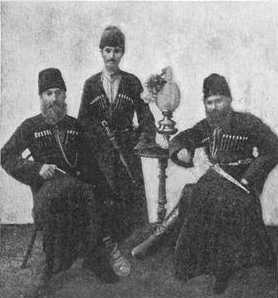
Over time the Mountain Jews adopted the dress of their Muslim neighbors. Men typically wore chokhas and covered their head with papakhas, many variations of which could symbolize the men's social status. Wealthier men's dress was adorned with many pieces of jewelry, including silver and gold-decorated weaponry, pins, chains, belts, or kisets (small purse used to hold tobacco or coins).[64] Women's dress was typically of simpler design in dark tones, made from silk, brocade, velvet, satin and later wool. They decorated the fabric with beads, gold pins or buttons, and silver gold-plated belts. Outside the house, both single and married women covered their hair with headscarves.[64]
Cuisine
[edit] | This section needs additional citations for verification. (September 2022) |
Mountain Jewish cuisine absorbed typical dishes from various peoples of the Caucasus, Azerbaijani and Persian cuisine, adjusting some recipes to conform to the laws of kashrut, with a great emphasis on using rice (osh) to accompany many of their dishes. Typical Mountain Jewish dishes include:
- Chudu – A type of meat pie.
- Shashlik – skewered meat chunks, such as lamb chops or chicken wings.
- Dolma – vegetables such as grape leaves, onions, peppers, tomatoes and eggplants that are stuffed with minced meat, then boiled.
- Kurze or Dushpare – Dumplings that are boiled and then fried in oil on both sides until golden brown and crispy.
- Yarpagi – Cabbage leaves stuffed with meat and cooked with quince, lamb riblets and a sauce made of dried sour plums (alcha).
- Gitob
- Ingar – Square shaped dumpling soup with Meat (Chicken/Beef/Lamb), sometimes with tamarind paste added to the soup.
- Ingarpoli – Dumplings served with tomato paste flavored minced meat on top.
- Dem Turshi – Rice soup flavoured with garlic, dried mint and dried cherry plums.
- Tara – Mallow stew with pieces of meat, dried cherry plum, garlic, dill and clintaro. In Baku sometimes its made vegan with chestnuts instead of meat.
- Nermov or Gendumadush – Chicken or other meat stew with wheat and beans, traditionally cooked overnight from Friday to Saturday.
- Dapchunda Osh – Rice pilaf with lamb chunks, qazmaq and dried fruits such as raisin, apricots and golden plums.
- Osh Lobeyi – Rice pilaf with cowpeas and smoked fish.
- Osh Kyudu – Pumpkin Rice pilaf with carrots, pumpkin, qazmaq and dried fruits, traditionally served for Hannukah.
- Osh Mast – White rice with Mast, a variety of yogurt, on top.
- Shomo-Kofte bebeyi – Meatballs made from minced meat and onions cooked alongside potatoes, sometimes served on rice (osh).
- Buglame – (curry like stew of fish or chicken eaten with rice (osh).[65]
- Eshkene – Persian soup, made of Lamb, potatoes, onions, eggs, dried cherry plums, cinnamon and herbs such as cilantro, green onions, parsley and spinach, prepared for Passover.
- Yakhni Nisonui – The Derbendi variation of eshkene consist on lamb, potatoes, onions, eggs, dried cherry plums, cinnamon but without herbs, made on the first day of Passover.
- Yakhni Nakhuti – A soup made of lamb, chickpeas, potatoes and dried plums cooked in a tomato paste based soup. served with rice.
- Hoshalevo – (honey-based treats made with sunflower seeds or walnuts) typically prepared for Purim.
- Bischi – Fried dough topped with hot honey syrup, typically prepared for Purim.
- Hallegh – made with mixture of apples, walnuts, honey, raisins, cinnamon and wine, a ritual dish prepared for Passover.
- Pakhlava
- Fadi-shiri – A milk cake made of flour, eggs, butter, milk, sugar, turmeric, raisins, walnuts, sesame seeds and poppy seeds, served during Shavuot.
- Pertesh – A dish consist of a Lavash bread that is soaked in honey based syrup and filled with a milk porridge inside, served for Shavuot.
- Khashil – Sweet porridge made of flour, butter, honey, cinnamon and turmeric with a crunchy crust.
- Lovush Roghani
- Khashlama – Boiled chunks of meat, usually beef, veal, or lamb, as well as vegetables such as bell peppers, potatoes, tomatoes and onions, in hot water.
- Khoyagusht – Meat pie made of eggs, turmeric, slow cooked meat (usually sheep or goat) and its broth, often considered to be the "national dish" of the Mountain Jews.
- Khoyaghusht Kyargi – Khoyagusht with chicken instead of red meat.
- Khoyahusht Bodimjon – Khoyagusht with eggplants instead of meat, without turmeric.
- Nukhorush – Beef or Lamb cooked with quince, raisins, dried golden prunes, dried apricots, chestnuts and flavoured with turmeric, sometimes served alongside rice (osh).
- Nukhorush marjumeki – Lentil stew with potatoes, zucchini, onions, and carrots flavoured with cilantro, dill, cumin and turmeric.
- Gayle or Khayle – A dish made of herbs, onion and eggs.
- Dugovo – A soup made by cooking yogurt, with a little bit of rice, a variety of fresh herbs such as dill, mint, and coriander.
- Aragh – a strong alcoholic drink made of distilled fermented mulberry juice. It can be made from both black and white mulberries.
- Asido
- Harissa – A dish of Mountain Jews from the northern regions in Dagestan made of Meat, Potatoes and dried cherry plums cooked in tomato sauce, traditionally used in weddings.
Music
[edit]The music of Mountain Jews is mostly based in the standard liturgy, for prayer and the celebration of holidays. Celebratory music played during weddings and similar events is typically upbeat with various instruments to add layers to the sound.[66]
Notable Mountain Jews
[edit]- Omer Adam, Israeli singer
- Udi Adam, Israeli general[67]
- Yekutiel Adam (1927–1982), Former Deputy Chief of Staff of the Israeli Defense Forces[67]
- Albert Agarunov (1969–1992), Azerbaijani soldier[67]
- Yakov Agarunov (1907–1992), Soviet poet and playwright
- Efrem Amiramov (1956–2025), Soviet/Russian singer and poet[68]
- Ilya Anisimov (1862–1928), Russian ethnographer, ethnologist and engineer
- Astrix, producer of trance music
- Djumshud Ashurov (1913–1980), a Soviet composer
- Yuno Avshalumov (1934–1981), a Soviet composer, conductor, and teacher
- Daniil Atnilov (1913–1968), Soviet poet
- Hizgil Avshalumov (1913–2001), novelist, poet and playwright[69]
- Mishi Bakhshiev (1910–1972), Soviet writer and poet
- Manuvakh Dadashev (1913–1943), Soviet poet
- Mikhail Dadashev (1936), a Soviet and Russian writer
- Gyulboor Davydova (1892–1983), Soviet winegrower
- Mikhail Gavrilov (1926–2014), Soviet writer and poet
- Sarit Hadad, Israeli singer[70]
- Zarakh Iliev (born 1966) Russian businessman
- Gavril Abramovich Ilizarov (1921–1992), Soviet physician (Mountain Jewish father, Ashkenazi Jewish mother)[67]
- Telman Ismailov, businessman[71]
- Tankho Israelov (1917–1981), dancer, choreographer
- Sergey Izgiyayev (1922–1972), author, translator, and songwriter[72]
- Mozol Izrailova (1955), actress
- Amaldan Kukullu (1935–2000), Soviet/Russian poet, storyteller, folklorist
- Lev Manakhimov (1950–2021), choreographer and director
- Bikel Matatova (1928–2013), Soviet, and Israeli actress of the Judeo-Tat Theatre
- Tamara Musakhanov (1924–2014), Soviet sculptor and ceramist
- Mushail Mushailov (1941–2007), Soviet/Russian artist and teacher
- God Nisanov, Russian businessman[73]
- Gennady Simeonovich Osipov (1948–2020), Russian scientist and professor
- Iosif Prigozhin, Russian music producer
- Lior Refaelov, Israeli football player[67]
- Akhso Shalumova (1907–1985), first Soviet stage actress of the Judeo-Tat Theatre
- Zoya Semenduyeva (1929–2020), Soviet and Israeli poet
- Robert Tiviaev, Israeli politician, former member of the Knesset[74][75]
- Israel Tsvaygenbaum, Russian-American artist (Ashkenazi Jewish father, Mountain Jewish mother)
- Anatoly Yagudaev (1935–2014), sculptor
- Yaffa Yarkoni (1925–2012), Israeli singer, winner of the Israel Prize in 1998 for Hebrew song [76]
- German Zakharyayev (born 1971) – businessman, Vice-President of the Russian Jewish Congress[77]
- Zhasmin (née Sara Manakimova), Russian pop singer (2005)[78]
Gallery
[edit]-
 Mountain Jewish delegates with Theodor Herzl at the First Zionist Congress, held in Basel, Switzerland (1897)
 -
 Mountain Jew c. 1898
 -
 Mountain Jewish woman from Dagestan. 1870–1880.
 -
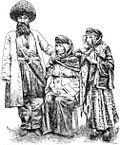 Mountain Jews of the Caucasus c. 1900


See also
[edit]- Mountain Jews in Israel
- Qırmızı Qəsəbə, the primary settlement of Azerbaijan's population of Mountain Jews (3600)
- History of the Jews in Azerbaijan
- History of the Jews in Buynaksk
- History of the Jews in Derbent
- Jewish Quarter of Grozny
- History of the Jews in Khasavyurt
- History of the Jews in Kislovodsk
- History of the Jews in Kizlyar
- History of the Jews in Makhachkala
- History of the Jews in Nalchik
- History of the Jews in Pyatigorsk
- World Congress of Mountain Jews
- Museum of Mountain Jews
- Judaism in Dagestan
Notes
[edit]- ^ Also known as Caucasus Jews, Juhuro, Juvuro, Juhuri, Juwuri, Juhurim, Kavkazi Jews, or Gorsky Jews (Hebrew: יְהוּדֵי־קַוְקָז Yehudey Kavkaz or יְהוּדֵי־הֶהָרִים Yehudey he-Harim;[7] Azerbaijani: Dağ Yəhudiləri).
References
[edit]- ^ "The Red Book of the Peoples of the Russian Empire". www.eki.ee. Archived from the original on 2 December 2009. Retrieved 20 September 2017.
- ^ Zulfugarli, Maharram Pasha (2016). "The History of Azerbaijan Jewish Community (The 20th Century and the Beginning of the 21st Century)". Kwartalnik Historii Żydów. 259 (3): 761–769. ISSN 1899-3044.
- ^ Habib Borjian and Daniel Kaufman, “Juhuri: from the Caucasus to New York City”, Special Issue: Middle Eastern Languages in Diasporic USA communities, in International Journal of Sociology of Language, issue edited by Maryam Borjian and Charles Häberl, issue 237, 2016, pp. 51-74. [1].
- ^ Shragge, Ben. "Canada's Mountain Jews". Hamilton Jewish News.
- ^ "All-Russian population census 2020". rosstat.gov.ru. Retrieved January 16, 2023.
- ^ "In Wien leben rund 220 kaukasische Juden" (in German).
- ^ Brook, Kevin Alan (2006). The Jews of Khazaria (2 ed.). Rowman & Littlefield Publishers, Inc. p. 223. ISBN 978-1442203020.
The traditional language of the Mountain Jews, is part of the Iranian language family and contains many Hebrew elements. In Juhuri, they call themselves Juhuri (Derbent dialect) or Juwuri (Kuba dialect), and in Russian they are known as Gorskie Yevrey.
- ^ a b Brook, Kevin Alan (2006). The Jews of Khazaria (2 ed.). Rowman & Littlefield Publishers, Inc. p. 223. ISBN 978-1442203020.
The traditional language of the Mountain Jews, Juhuri, is part of the Iranian language family and contains many Hebrew elements. (...) In reality, the Mountain Jews primarily descend from Persian Jews who came to the Caucasus during the fifth and sixth centuries.
- ^ "Mountain Jews - Tablet Magazine – Jewish News and Politics, Jewish Arts and Culture, Jewish Life and Religion". Tablet Magazine. 26 August 2010. Retrieved 2015-12-27.
- ^ a b Shapira, Dan D.Y. (2010). "Caucasus (Mountain Jews)". In Norman A. Stillman (ed.). Encyclopedia of Jews in the Islamic World. Brill Online.
The Mountain Jews are an Iranian-speaking community that took shape in the eastern and northern Caucasus after the areas in which they lived were annexed by Russia from Qajar Iran in 1812 and 1813.
- ^ "Mountain Jews: customs and daily life in the Caucasus, Leʼah Miḳdash-Shema", Liya Mikdash-Shamailov, Muzeʼon Yiśraʼel (Jerusalem), UPNE, 2002, page 17
- ^ Goluboff, Sascha (Mar 6, 2012). Jewish Russians: Upheavals in a Moscow Synagogue. University of Pennsylvania. p. 125. ISBN 978-0812202038.
- ^ Mountain Jews: customs and daily life in the Caucasus, Leʼah Miḳdash-Shemaʻʼilov, Liya Mikdash-Shamailov, Muzeʼon Yiśraʼel (Jerusalem), UPNE, 2002, page 9
- ^ Mountain Jews: customs and daily life in the Caucasus, Leʼah Miḳdash-Shemaʻʼilov, Liya Mikdash-Shamailov, Muzeʼon Yiśraʼel (Jerusalem), UPNE, 2002, page 19
- ^ Ezra 8:17
- ^ Grelot, “Notes d'onomastique sur les textes araméens d'Egypte,” Semitica 21, 1971, esp. pp. 101-17, noted by Rüdiger.
- ^ Jews in Eastern Europe. European Jewish Publications. 1959.
- ^ a b c d Rosengarten, D (2002). "Y Chromosome Haplotypes among Members of the Caucasus Jewish Communities". Ancient Biomolecules.
- ^ a b c d e "Еврейское поселение Аба-Сава, Блоги на сайте СТМЭГИ". Stmegi.com. Archived from the original on 2014-10-17. Retrieved 2015-05-22.
- ^ a b Jaimoukha, Amjad. The Chechens: A Handbook. Page 276
- ^ a b Usmanov, Lyoma. "The Chechen Nation: A Portrait of Ethnical Features". 9 January 1999.
- ^ The Vainakh Taips: Yesterday and Today Archived 2017-08-07 at the Wayback Machine. 25 January 2005
- ^ a b "Visions of Azerbaijan Magazine ::: Islam and Secularism – the Azerbaijani Experience". Retrieved 20 September 2017.
- ^ a b "Рабби Гершон Мизрахи – праведный раввин общины горских евреев". Archived from the original on 28 March 2016. Retrieved 20 September 2017.
- ^ Schwartz, Bryan, Scattered Among the Nations, Visual Anthropology Press, 2015
- ^ "Jewish Colony Found in the Caucasus.; Strange Discovery Made by a Traveler in Remote Region of the Mountains -- Ancient Religious Customs Which Are Faithfully Followed -- The Customary Temperance in the Use of Liquor One Trait Which Is Missing". The New York Times. September 14, 1902. Retrieved February 1, 2020.
- ^ a b c Pinkus, B., & Frankel, J. (1984). The Soviet Government and the Jews, 1948-1967: A Documented Study. Cambridge: Cambridge University Press.
- ^ "Bogdanovka". Yad Vashem. Retrieved 30 October 2023.
- ^ "The Holocaust of the Mountain Jews". Yad Vashem. Retrieved 30 October 2023.
- ^ a b Yitzhak Arad, The Holocaust in the Soviet Union, Section "Mountain Jews", pp. 294-297
- ^ Kiril Feferman: "Nazi Germany and the Mountain Jews: Was There a Policy?", in: Richard D. Breitman (ed.): Holocaust and Genocide Studies, Volume 21 Spring 2007, Oxford University Press, pp. 96-114.
- ^ a b c "Горские евреи — жертвы Холокоста - Горские евреи. История, этнография, культура". Istok.ru. Archived from the original on 2015-04-06. Retrieved 2015-05-22.
- ^ Дима Мордэхай Раханаев (2012-09-19). "Рабби Нахамиль, Автор статьи Дима Мордэхай Раханаев, Новости горских евреев". Stmegi.com. Archived from the original on 2015-07-12. Retrieved 2015-05-22.
- ^ Rouslan Isacov, Kavkaz Center 01.02.2005
- ^ a b JTA. (2000). Around the Jewish World: "Russia’s Mountain Jews Support War in Chechnya, but Are Eager to Get Out." Accessed November 12, 2013.
- ^ Gorodetsky, L. (2001). "Jews from the Caucasus: A dying breed?" Accessed November 12, 2013.
- ^ American Jewish Year Book, 1998, page 14.
- ^ Sarah Marcus, "Mountain Jews: A New Read on Jewish Life", Tablet Magazine, Accessed November 12, 2013.
- ^ Brown, F. (2002). "Mountain Jews struggle to keep culture intact", Chicago Tribune, 22 November 2002. Accessed November 12, 2013
- ^ Shapira, Dan D. Y., "Caucasus (Mountain Jews)", Encyclopedia of Jews in the Islamic World Online, Brill, retrieved 2025-02-23
- ^ "Israel's Mountain Jews help absorb Ukrainian and Russian refugees". JNS.org. Retrieved 2025-02-23.
- ^ "Judeo-Tat language resources | Joshua Project". joshuaproject.net. Retrieved 2025-02-23.
- ^ "It's an all-Jewish town, but no, it's not in Israel". The Jewish Chronicle. 2011-07-14. Retrieved 2025-03-02.
- ^ Pinkus, B., & Frankel, J. (1984). The Soviet Government and the Jews, 1948-1967: A Documented Study. Cambridge: Cambridge University Press. Chicago
- ^ "Еврейский архитектор ЛЕЗГИНКИ". Горские Евреи JUHURO.COM. Archived from the original on 10 June 2015. Retrieved 15 September 2014.
- ^ "ИЗРАИЛОВ Танхо Селимович". Словари и энциклопедии на Академике. Retrieved 15 September 2014.
- ^ Cnaan Liphshiz. (2013). "Jewish shtetl in Azerbaijan survives amid Muslim majority." Accessed at November 12, 2013.
- ^ a b Miḳdash-Shemaʻʼilov, L. (2002). Mountain Jews: Customs and Daily Life in the Caucasus (Vol. 474). UPNE. Chicago
- ^ "горские евреи. Электронная еврейская энциклопедия". Eleven.co.il. 2006-07-04. Retrieved 2015-05-22.
- ^ a b "DAGHESTAN - JewishEncyclopedia.com". Retrieved 15 September 2014.
- ^ "Рабби Нахамиль, Автор статьи Дима Мордэхай Раханаев, Новости горских евреев". Archived from the original on 17 October 2014. Retrieved 15 September 2014.
- ^ Jewish Virtual History Library, Azerbaijan, Accessed November 11, 2013.
- ^ Cnaan Liphshiz. (2013). "Jewish shtetl in Azerbaijan survives amid Muslim majority." Accessed November 12, 2013
- ^ Headapohl, Jackie (15 August 2012). "Jews Who Cruise | The Detroit Jewish News".
- ^ Alexander Murinson. "Jews in Azerbaijan: a History Spanning Three Millennia." Accessed November 12, 2012.[permanent dead link]
- ^ Behar, D. M., Metspalu, E., Kivisild, T., Rosset, S., Tzur, S., Hadid, Y., ... & Skorecki, K. (2008). "Counting the Founders: The Matrilineal Genetic Ancestry of the Jewish Diaspora", PLOS One, 3(4), e2062.
- ^ BRYAN SCHWARTZ. "Teens lead Azerbaijan Jews up the spiritual mountain.", JWeekly Accessed November 12, 2013.
- ^ a b "Juhuri - Endangered Language Alliance". Retrieved 15 September 2014.
- ^ "Горско-еврейские газеты советского периода, Автор статьи Хана Рафаэль, Новости горских евреев". Archived from the original on 19 April 2014. Retrieved 15 September 2014.
- ^ "Горские евреи в русской школе - Горские евреи. История, этнография, культура". Archived from the original on 10 November 2014. Retrieved 15 September 2014.
- ^ a b "Mountain Jews". Retrieved 15 September 2014.
- ^ p. 158 The Mountain Jews of Daghestan, Jewish Communities in Exotic Places by Ken Blady (Northvale, NJ: Jason Aronson Inc., 2000)
- ^ Blady (2000), The Mountain Jews of Daghestan, pp. 158-159
- ^ a b "Национальная одежда и украшения горских евреев". DataLife Engine. Retrieved 15 September 2014.
- ^ "Чуду - горские пироги - The Jewish Times". The Jewish Times. Archived from the original on 19 October 2014. Retrieved 15 September 2014.
- ^ "The Music of the Mountain Jews - Jewish Music Research Centre". www.jewish-music.huji.ac.il. Retrieved 20 September 2017.
- ^ a b c d e "Mountain Jews of Azerbaijan and Dagestan, Новости горских евреев". Archived from the original on 17 October 2014. Retrieved 15 September 2014.
- ^ Rebrova, Irina (2020). Re-Constructing Grassroots Holocaust Memory: The Case of the North Caucasus. Berlin: De Gruyter. p. 178. ISBN 9783110688993.
- ^ "Good name is very valuable thing." From interview of his daughter Lyudmila Hizgilovna Avshalumov. Retrieved 08.06.2011.
- ^ "Сарит Хадад". Горские Евреи JUHURO.COM. Archived from the original on 25 October 2014. Retrieved 15 September 2014.
- ^ "It's an all-Jewish town, but no, it's not in Israel - The Jewish Chronicle". Retrieved 15 September 2014.
- ^ "Воспоминания об отце". Горские Евреи JUHURO.COM. Archived from the original on 19 October 2014. Retrieved 15 September 2014.
- ^ "Официальное опубликование правовых актов в электронном виде". Pravo.gov.ru:8080. 2014-01-14. Archived from the original on 2016-01-07. Retrieved 2015-05-22.
- ^ "Knesset Members - Robert Tiviaev". www.knesset.gov.il. Retrieved 2022-09-22.
- ^ "Knesset Members". www.knesset.gov.il. Retrieved 2022-09-22.
- ^ "Yaffa Yarkoni - Jewish Women's Archive". Retrieved 15 September 2014.
- ^ "German Zakharyaev: "I overcome obstacles and sadness in life over praying to God"". Jewish Business News. 24 December 2015. Retrieved 29 April 2017.
- ^ "Zhasmin". IMDb. Retrieved 20 September 2017.
Further reading
[edit]- Shapira, Dan D.Y. (2010). "Caucasus (Mountain Jews)". In Norman A. Stillman (ed.). Encyclopedia of Jews in the Islamic World. Brill Online.
External links
[edit]- juhuro.com, website created by Vadim Alhasov in 2001. Daily updates reflect the life of Mountain Jewish (juhuro) community around the globe.
- newfront.us, New Frontier is a monthly Mountain Jewish newspaper, founded in 2003. International circulation via its web site.
- keshev-k.com, Israeli website of Mountain Jews
- gorskie.ru, Mountain Jews, website in Russian language
- "Judæo-Tat", Ethnologue


| Caucasian (areal) |
|  | ||||||||||||||||
|---|---|---|---|---|---|---|---|---|---|---|---|---|---|---|---|---|---|---|
| Indo- European |
| |||||||||||||||||
| Turkic |
| |||||||||||||||||
| Others | ||||||||||||||||||

| History | |||||||
|---|---|---|---|---|---|---|---|
| Groups |
| ||||||
| Synagogues | |||||||
| Mausoleums | |||||||
| Schools |
| ||||||


Mountain Jews
View on GrokipediaThe Mountain Jews, also known as Gorsky Jews or Kavkazi Jews, designated as Juhuro by their community and Gorskie Yevrei (Горские евреи) in Russian nomenclature, form a distinctive Mizrahi Jewish ethnoreligious group historically concentrated in the eastern Caucasus highlands, spanning contemporary Azerbaijan, Dagestan in Russia, and bordering territories. Their vernacular tongue, Juhuri—alternatively termed Judeo-Tat—comprises a Southwestern Iranian dialect enriched with Hebrew and Aramaic lexical elements, reflecting prolonged linguistic convergence amid geographic isolation.[1][2] Emerging in the early medieval period through the settlement of Persian Jewish traders along Silk Road conduits to the Caspian periphery, their ethnogenesis embodies a synthesis of ancient Israelite lineage—per oral traditions linking to post-exilic migrations—and adaptive integration with Iranian and indigenous Caucasian substrates, yielding a resilient communal identity unyielding to proselytism or dilution.[2][3] Renowned for martial acumen, equestrian mastery, and artisanal proficiency forged in perennial tribal skirmishes and mercantile pursuits, they upheld Rabbinic observance alongside localized rites, such as fortified village synagogues and self-reliant defense corps, which buffered against invasions from Persians, Mongols, and Ottomans.[3] In the Soviet epoch, notwithstanding Russification impositions and demographic displacements, they evinced notable allegiance in conflicts, including World War II, where thousands enlisted against Nazi incursions into the Caucasus, suffering targeted pogroms yet preserving core traditions.[2][3] Post-independence upheavals and repatriation incentives have dispersed them globally, with approximately 30,000 sustaining presence in Azerbaijan—predominantly in Baku and Quba—amid larger enclaves in Israel, Russia, and North America, where revitalization initiatives safeguard Juhuri patrimony against endangerment.[4] This tenacity underscores their causal adaptation to exigencies of terrain, polity, and diaspora, prioritizing empirical continuity over assimilationist vectors.[3]
History
Ancient Origins and Early Settlement
The origins of the Mountain Jews trace to Jewish communities within the ancient Persian Empire, likely stemming from Judean exiles deported to Babylon in 586 BCE by Nebuchadnezzar II, with subsequent integration into Persian society after Cyrus the Great's conquest of Babylon in 539 BCE permitted their partial return but left many in the region. Some of these Persian Jews migrated eastward into the Caucasus over subsequent centuries, speaking Iranian dialects that evolved into Juhuri, their distinctive Judeo-Tat language.[3][5] Historical records indicate an increase in Jewish settlement in the Caucasus during the Sassanid Empire (224–651 CE), when Iranian authorities dispatched Jewish groups as military colonists to fortify frontiers against nomadic incursions from the north, leveraging their martial skills honed in Persian service. These colonists established autonomous communities in rugged highland enclaves across what is now Dagestan, Azerbaijan, and adjacent areas, maintaining distinct religious practices amid a polyglot environment of Dagestani and Iranian-speaking peoples.[5][6] Genetic analyses of Jewish Diaspora populations, including those from Persian and Caucasian contexts, reveal shared Middle Eastern ancestry markers—such as elevated frequencies of Y-chromosome haplogroups J1 and J2 associated with ancient Levantine origins—distinguishing Mountain Jews from surrounding non-Jewish groups while aligning them with other Jewish clusters. Autosomal DNA studies further support minimal admixture with local Caucasians until later periods, underscoring continuity from Persian Jewish forebears rather than local conversion or lost-tribe myths.[7][8] From early settlement, these communities adapted to isolation by organizing into fortified villages (known as juga in local parlance), where armed male householders formed self-reliant militias to repel raids, preserving endogamy and Torah observance in defiance of geographic and cultural pressures. This martial highland ethos, devoid of centralized rabbinic authority, enabled survival through the 5th–7th centuries CE amid Sassanid decline and Arab conquests.[9]Medieval Period and Isolation in the Caucasus
During the 11th to 18th centuries, Mountain Jewish communities consolidated in the remote highlands of Dagestan and northern Azerbaijan, forming compact settlements amid predominantly Muslim surroundings. These groups, descendants of earlier Persian Jewish migrants, inhabited isolated mountain valleys that provided natural barriers against external threats, fostering a degree of autonomy.[2][10] By the early 17th century, one such concentration in the "Jewish Valley" (Juhud-Qata), located south of Derbent in Dagestan, emerged as a semi-independent entity, with numerous small villages under collective self-governance. The largest settlement, Aba-Sava, served as the spiritual and political center from approximately 1630 to 1800, where community leaders managed internal affairs, including dispute resolution and defense.[3] This structure allowed for endogamous marriages and the maintenance of Hebrew literacy for religious study, preserving Rabbinic Jewish practices such as Torah observance and synagogue-based worship despite geographic seclusion.[11][12] Relations with local Muslim khans involved periodic tribute payments, often framed as protection taxes (jizya equivalents), in exchange for nominal overlordship and security against raids by neighboring tribes. Historical accounts indicate occasional alliances, where Mountain Jews provided military support or intelligence to khans in regional conflicts, leveraging their highland vantage points.[11] Unlike later periods under Russian administration, this era saw no documented widespread pressures for conversion to Islam, attributable to the communities' martial traditions—many Jews bore arms as warriors—and the khans' pragmatic tolerance of productive minorities.[3][10] The Quba region's highlands in Azerbaijan similarly hosted autonomous Jewish villages by the mid-18th century, following disruptions from Nadir Shah's campaigns, where self-reliant communities replicated the Dagestani model of internal cohesion and limited external dependencies. This isolationist pattern reinforced cultural continuity, with oral and liturgical traditions sustaining identity until the valley's destruction around 1800 amid Russo-Persian warfare.[13][3]19th Century Expansion and Russian Influence
The Russian Empire's conquest of the Caucasus, beginning in the late 18th century and formalized by the Treaty of Gulistan in 1813, integrated Mountain Jewish communities into imperial administration, prompting the official adoption of the term "Mountain Jews" in Russian documentation during the first half of the 19th century.[9][14] This period marked a shift from relative isolation under Persian and local Muslim rule to partial incorporation, with communities retaining customary autonomy in civil matters while contributing auxiliary forces to Russian military efforts against persistent regional resistance.[15] Population growth occurred amid improved stability, as administrative records reflect expansion driven by natural increase and reduced inter-communal conflicts compared to prior eras.[2] Economic opportunities spurred migration from highland villages to urban hubs like Derbent and emerging Baku, where Mountain Jews engaged in commerce involving silk, grains, wool, and tanning, leveraging established trade networks along historic routes.[16][12] Highland enclaves, such as those in Quba and Shirvan, evolved into semi-autonomous settlements with internal governance, fostering agricultural production of grains and livestock alongside artisan crafts that supported broader market integration under Tsarist policies promoting modernization.[3] Periodic tensions arose from local blood libels and sporadic violence, though less severe than in the European Pale of Settlement; communities relied on longstanding traditions of armed self-defense through communal militias, maintaining personal weaponry and horsemanship skills honed from prior necessities rather than seeking imperial intervention.[11] This martial readiness, rooted in Caucasian highland norms, enabled effective deterrence against raids without disrupting economic expansion.[17]Soviet Era, World War II Survival, and Repression
During the 1920s and 1930s, Soviet authorities imposed collectivization on Mountain Jewish communities in the Caucasus, compelling hundreds to join kolkhozes for grape, tobacco, and vegetable cultivation while curtailing religious observances in favor of secular identity.[2] [18] Education systems incorporated the Juhuri language, standardized by Soviet linguists with a Cyrillic alphabet, fostering literacy rates that rose markedly from near-zero pre-revolution levels through mandatory schooling and industrialization drives.[19] Unlike Chechens, Ingush, and other Caucasian peoples subjected to Stalin's 1944 deportations—totaling over 500,000 to Central Asia amid accusations of wartime disloyalty—Mountain Jews escaped mass relocation, attributable to their dispersed highland enclaves and absence of comparable collaboration claims.[2] World War II saw an estimated 35,000 Mountain Jews in the USSR on the eve of invasion, with thousands mobilizing into the Red Army amid broader Soviet Jewish enlistment exceeding 350,000, reflecting communal martial traditions and minimal defection rates under Axis advances.[2] [20] Nazi occupation of parts of Dagestan and Azerbaijan in 1942 resulted in targeted killings, including machine-gun massacres of entire villages on August 19 and September 20, claiming roughly 1,500 lives in Dagestan alone; communities countered by concealing Torah scrolls, sheltering fugitives, and joining partisan units, limiting total losses to 1,000–2,000 despite Einsatzgruppen operations.[2] [21] Postwar repression intensified under Stalin's anti-cosmopolitan campaigns, shuttering synagogues, banning Hebrew texts, and prosecuting rabbis, though clandestine minyans and ritual observance endured in rural pockets.[18] Population stabilized near 35,000 by the 1970s, buoyed by urban professional gains in medicine and engineering despite pervasive antisemitism and Russification pressures.[2] [5]Post-Soviet Migration and Revival
Following the dissolution of the Soviet Union in 1991, regional conflicts such as the Nagorno-Karabakh War (1991–1994) and the Chechen Wars (1994–1996 and 1999–2009) prompted significant emigration among Mountain Jews from Azerbaijan and the North Caucasus. These instabilities accelerated relocation primarily to Israel, where tens of thousands arrived via aliyah programs, alongside destinations including Russia and the United States for economic opportunities and security. In Azerbaijan, approximately 12,000 Mountain Jews remained, supported by government policies that emphasized protection against antisemitism and integration without coercion, contrasting with higher emigration rates from conflict zones in Dagestan and Chechnya.[22][23][24] From the 2000s onward, communities in Azerbaijan experienced a cultural and religious revival, particularly in Qırmızı Qəsəbə, where synagogues like the Six-Domed Synagogue, originally built in 1888, underwent renovations around 2000 to restore functionality and host communal events. Local initiatives preserved traditions through festivals and educational programs, fostering continuity amid demographic pressures from prior outflows. Genetic analyses, including Y-chromosome studies, have substantiated the community's ancient Jewish lineage, tracing paternal markers to Levantine origins consistent with other Jewish groups and affirming endogenous continuity rather than recent admixture.[25][7] In the 2020s, stable communities persisted in Azerbaijan, bolstered by strengthened bilateral ties with Israel established in 1992, which include economic cooperation and mutual recognition of Jewish heritage, aiding preservation efforts without reliance on external persecution narratives. This pragmatic alliance has contributed to low emigration rates and sustained institutional support, enabling Mountain Jews to maintain highland settlements like Qırmızı Qəsəbə as centers of Juhuri language and Sephardic-rite practices.[26][27]Demographics and Geography
Traditional Highland Communities
The Mountain Jews historically inhabited remote highland villages in the eastern Caucasus, primarily in the Quba-Qusar region of present-day Azerbaijan and the mountainous districts of Dagestan, such as Kaitag and areas near Makhachkala.[3][28] These settlements, often structured as fortified auls typical of Caucasian highland communities, were situated in rugged terrain that offered natural defenses against incursions from lowland tribes and empires.[10] The isolation imposed by steep elevations and narrow valleys enabled these groups to maintain autonomy for centuries, predating Russian imperial control in the early 19th century.[23] Subsistence relied on adapted agrarian practices suited to the mountainous environment, including terraced cultivation of crops like grains and fruits on slopes, alongside pastoral herding of sheep and goats.[3] This self-reliant economy buffered communities against external disruptions, such as raids or trade blockades from the plains, reinforcing their independence through local resource management rather than dependence on lowland markets.[29] Governance in these highland auls operated through informal communal structures led by village elders and rabbis, who adjudicated disputes, allocated land, and upheld religious law in the absence of centralized authority.[30] Rabbinical councils, drawing on Sephardic traditions, coexisted with elder assemblies to enforce social cohesion and defense protocols, systems that evolved organically amid the pre-modern fragmentation of the Caucasus.[3] This decentralized model persisted until the imposition of imperial and Soviet administrations disrupted traditional self-rule.[30]Current Global Distribution and Population Trends
The global population of Mountain Jews is estimated at 100,000 to 150,000 as of the 2020s, reflecting dispersion following post-Soviet migrations while sustaining community cohesion.[31][32] Israel hosts the largest concentration, with approximately 70,000 to 80,000 individuals, many residing in southern suburbs like Sderot and contributing to broader Jewish demographic vitality.[32] Azerbaijan maintains a core community of 11,000 to 15,000, primarily in Qırmızı Qəsəbə and surrounding rural districts, where traditional highland ties endure.[32][4] Smaller populations persist in Russia (5,000 to 11,000, mainly in Dagestan and other North Caucasus regions) and the United States (around 10,000, concentrated in New York metropolitan areas).[33][34][35] Fertility trends support population resilience, particularly in Israel, where Jewish total fertility rates average 2.9 to 3.0 children per woman—above the 2.1 replacement threshold—and align with Mountain Jewish patterns of family-oriented continuity.[36] Linguistic shifts toward Hebrew in Israel and Russian elsewhere mark assimilation pressures, yet Juhuri usage endures among older generations and families, bolstered by revitalization initiatives including modern textbooks and cultural programs developed since 2019.[37][38][39] These efforts, alongside low historical intermarriage rates rooted in endogamous traditions, facilitate identity preservation amid global scattering.[40]Language and Literature
The Juhuri Language: Structure and Evolution
Juhuri, also known as Judeo-Tat, constitutes a Southwest Iranian language of the Tat subgroup, spoken traditionally by Mountain Jews in the eastern Caucasus regions of Azerbaijan and Dagestan. Its core structure aligns closely with medieval Iranian dialects, featuring subject-object-verb word order, ergative alignment in past tenses, and phonological traits such as the retention of initial /w-/ sounds and fricative consonants akin to those in classical Persian. This Iranian foundation incorporates a significant substrate of Hebrew and Aramaic loanwords—particularly in kinship, ritual, and abstract concepts—alongside Arabic influences from Islamic-era contacts, forming a hybrid lexicon that philologically evidences prolonged Jewish-Iranian linguistic convergence dating to the Achaemenid period.[1][41][42] The language's dialects, notably the Quba variant centered in northeastern Azerbaijan and the Dagestani forms like Derbenti spoken near the Caspian coast, exhibit high mutual intelligibility among themselves but diverge from Muslim Tat dialects through a distinctively Jewish vocabulary, including terms for religious observance and communal identity not shared with non-Jewish speakers. These dialects historically employed the Hebrew script, adapted with Rashi-style annotations for early printed texts from the late 19th century, transitioning to Cyrillic under Soviet standardization in the 1930s while retaining Hebrew for liturgical purposes. Isolation in highland enclaves fostered retention of archaic features, such as conservative vowel systems and verb conjugations, absent in standardized modern Persian or Tajik.[1][43][41] Juhuri's evolution traces to post-Babylonian Exile migrations, when Judean exiles adopted and adapted Old Persian as a vernacular base, evolving into localized Tat forms by the early medieval era amid Caucasian settlement. This trajectory, evidenced by comparative philology showing shared innovations with Judeo-Persian varieties yet unique Caucasian retentions, underscores endogenous development rather than recent imposition, with the Hebrew-Aramaic component—comprising ritual calques and core borrowings—serving as a marker of unbroken Jewish ethnolinguistic continuity from Persian imperial times. Approximately 100,000 to 200,000 individuals maintain proficiency, predominantly as heritage speakers in Israel and the United States following post-Soviet emigration, rendering it definitely endangered per UNESCO assessment due to intergenerational shift toward dominant languages like Hebrew, Russian, and English.[1][44][42][45]Literary Traditions and Modern Usage
The written literary traditions of Mountain Jews, primarily in Juhuri (Judeo-Tat), developed relatively late compared to oral forms, with the first printed books appearing in 1908 and 1909—a prayer book and a work on Zionism, both using a Hebrew-based script similar to Rashi script.[41] These early publications marked the transition from manuscript religious texts to secular and poetic output in the vernacular, often blending Hebrew influences with local themes of identity and resilience.[1] In the 19th and early 20th centuries, poets and playwrights like Yuno Semenov emerged, producing works in Juhuri that documented communal life and challenges, contributing to a nascent canon focused on empirical preservation of traditions amid Russian imperial expansion.[1] Semenov's plays and verses, alongside those of contemporaries such as Manuvakh Dadashev, emphasized cultural continuity through narrative prose and drama.[46] The Soviet period saw a proliferation of Juhuri literature initially in Latin script (1929–1939), shifting to Cyrillic, with poetry collections edited by figures like Daniil Atnilov in 1947, though increasing Russification led to prose and verse in Russian and Yiddish by mid-century, as seen in works by Mishi Bakhshiev and Sergei Izgiyaev depicting wartime and collectivization hardships.[47] Publishing constraints limited output, but these efforts empirically captured socioeconomic shifts.[46] Post-Soviet, following mass emigration after 1991, literary usage has incorporated bilingual formats in Hebrew, Russian, and Juhuri, with digital initiatives retrieving and archiving manuscripts hidden during repression, as exhibited publicly from 2016 onward to counter language attrition.[48] Modern media, including planned literary revivals via apps and online platforms, aim to sustain Juhuri's status against endangerment, prioritizing vernacular texts for diaspora communities in Israel and Azerbaijan.[42]Religion
Core Beliefs and Sephardic Rite
Mountain Jews adhere to Rabbinic Judaism, upholding the core tenets of Orthodox belief, including monotheism, the divine origin of the Written and Oral Torah, the immutability of halakha, and anticipation of the Messiah and resurrection of the dead.[49] Their doctrinal framework rejects non-Rabbinic movements such as Karaism, which denies the authority of the Oral Law, and Reform Judaism, emphasizing instead strict fidelity to traditional halakhic observance without modernist dilutions.[50] This orthodoxy manifests in rigorous practices like complete kosher dietary laws, prohibiting mixing of milk and meat and requiring ritual slaughter (shechita), as well as full Shabbat observance, including cessation of work from Friday sunset to Saturday nightfall.[49] The Sephardic rite (nusach Sephard) forms the liturgical backbone of their worship, adopted as the standard prayer order distinct from Ashkenazi customs yet aligned with broader Sephardic-Mizrahi traditions.[50] This includes specific textual variants in the siddur, such as the order of prayers during Amidah and unique piyyutim (liturgical poems) recited on holidays, with melodies reflecting Persian-influenced intonations rather than European ones. Torah readings occur exclusively in Hebrew during services, underscoring scriptural primacy, while everyday prayers may incorporate elements of Juhuri for comprehension among congregants. Synagogues serve as communal anchors, with minyans (quorums of ten adult males) assembled daily in traditional villages for morning (Shacharit), afternoon (Mincha), and evening (Maariv) services, fostering collective ritual discipline.[50] [49] Regarding Zionism, Mountain Jews exhibited pre-state sympathy, evidenced by delegate participation at the First Zionist Congress in 1897, viewing Jewish return to the Land of Israel as aligned with messianic redemption.[51] Post-1948, this evolved into widespread endorsement through mass aliyah, with over 100,000 emigrating from the Caucasus since the Soviet collapse in 1991, interpreting Israel's establishment and ingathering of exiles as prophetic fulfillment rather than secular nationalism.[50][51]Customs, Synagogues, and Community Institutions
Mountain Jewish customs center on halakhic life-cycle rituals, including brit milah, the circumcision of male infants on the eighth day after birth, as regulated by Jewish law.[52] Weddings feature multi-day observances, transitioning from solemn family-specific preparations to joyous joint ceremonies under the chuppah, distinguishing them through extended communal involvement compared to more streamlined Ashkenazi or standard Sephardic formats.[3][53] Holidays such as Purim, locally termed Omunu, hold particular significance, with observances underscoring communal resilience amid historical isolation.[54] These practices, preserved through oral and ritual transmission, reflect adaptations to highland environments while prioritizing core Jewish precepts over variant liturgical nuances found in Ashkenazi or Sephardic communities elsewhere. Synagogues function as pivotal community institutions, often rebuilt post-Soviet era to sustain prayer and study. In Qırmızı Qəsəbə, two active synagogues support daily services, complemented by a yeshiva focused on Torah, Hebrew, and customary instruction for youth.[55][56] The Mountain Jews' Synagogue in Baku, established in 1945, underwent restoration after Azerbaijan's independence and reopened in 2011, exemplifying revival efforts that emphasize Talmudic learning within Sephardic frameworks adapted to Caucasian contexts.[57]Culture and Social Structure
Family, Marriage, and Community Organization
The traditional family structure among Mountain Jews was patrilineal and extended, typically encompassing two to three generations living together in highland auls (villages). The eldest male, often the grandfather, served as the formal head, while the youngest married son and his family remained in the parental home, eventually assuming practical leadership responsibilities after the elders' passing. This arrangement ensured continuity of property and labor in resource-scarce mountainous regions, with women, particularly the grandmother or mother, overseeing household management, child-rearing, and domestic production.[53][58] Marriage practices were arranged through matchmakers, emphasizing endogamy within the community to preserve religious and cultural cohesion, a norm persisting until the early 20th century amid Soviet influences. Customs included formal betrothal, negotiation of the ketubah (marriage contract), and payment of a bride-price in gifts, often followed by consanguineous unions such as cousin marriages or levirate/sororate arrangements to maintain family alliances. Weddings, historically separate at each family's home and later combined, spanned several days with rituals like processions bearing trays of gifts (tabakho), melancholic songs invoking ancestors (benigoru), and lavish feasts featuring music, dance, and reciprocal monetary gifts from guests, reinforcing social bonds.[53][3][59] Gender roles were distinctly divided, with men positioned as primary providers through trade, craftsmanship, or protection in the volatile Caucasus, while women focused on homemaking, caregiving, and upholding ritual purity, reflecting adaptations to environmental and security demands. Community organization centered on mutual support networks, including kunaks—ritual friends who provided aid during life crises—and hospitality norms with dedicated guest rooms, fostering resilience without formalized councils but through informal elder mediation in disputes. Divorce was rare, governed by rituals like khalitse for levirate release, with communal pressures enforcing stability to safeguard lineage and resources in tight-knit auls.[53][58]Traditional Attire, Cuisine, and Daily Life
Mountain Jewish men traditionally wore the chokha, a woolen coat with a high neck and cartridge holders across the chest, often paired with a dagger (khanjali) tucked into a belt for self-defense in the rugged Caucasian highlands.[60][61] This attire, practical for the cold mountain climate and warrior lifestyle, was adopted from surrounding Caucasian ethnic groups while maintaining Jewish distinctiveness.[62] Women favored layered dresses made from silk, cotton, or wool, featuring embroidery and colorful patterns suited to local weaving traditions and highland durability.[63] Cuisine emphasized kosher adaptations of Caucasian staples, utilizing lamb, rice, and seasonal produce from highland farming and herding. Key dishes included dolma—grape leaves stuffed with ground lamb, rice, mint, and olive oil—and pilaf variations like osh kyudu, a Hanukkah rice dish with pumpkin, carrots, dried fruits, turmeric, and cumin.[64][65] Shashlik (skewered grilled lamb) and dairy products from goats provided sustenance, reflecting resourcefulness in isolated villages where pork was strictly avoided per Jewish law.[66] Daily life in highland communities centered on herding livestock, small-scale agriculture, and strict hospitality codes that offered protection to any guest entering a home, fostering alliances amid tribal rivalries and geographic isolation.[16] These practices ensured survival in mountainous terrains, with families organizing around seasonal labor and communal self-reliance.[10]Music, Dance, and Oral Traditions
The folk music of Mountain Jews incorporates Caucasian instruments such as the tar (a long-necked lute with eleven strings) and komoncha (a four-string spike fiddle capable of glissandi and microtones), alongside others like the balaban (a double-reed oboe for drones) and ghovol (a cylindrical drum), to perform songs in Juhuri and liturgical chants in Hebrew.[67][68] These traditions blend regional performative techniques with Jewish religious and secular themes, as evidenced by field recordings of prayers and folksongs from Daghestan and Azerbaijan, preserving core Jewish elements amid local stylistic influences.[69] Dances among Mountain Jews feature variants of the Lezginka, a vigorous Caucasian dance characterized by rapid footwork and expressive arm movements, often performed at weddings and communal celebrations to mark joyous occasions like marriages.[70] Group circle dances also occur during these events, fostering community participation while adhering to kosher and ritual boundaries, as seen in ensembles like the "Lezginka" group led by Mountain Jewish artists in Azerbaijan. This syncretic adaptation highlights self-reliant cultural expression without supplanting Jewish identity. Oral traditions encompass a rich repertoire of folk tales recounting ancient heroes and communal resilience, alongside proverbs that stress self-reliance and moral fortitude, transmitted generationally in Juhuri before widespread literacy.[1] These narratives, including epics studied by researchers like Amaldan Kukullu, interweave themes of exile and endurance—echoing claims of descent from the Ten Lost Tribes—with practical wisdom, maintaining causal continuity from pre-modern Caucasian isolation to modern diasporic contexts. Wedding songs and lullabies further embed these elements, evidencing undiluted fidelity to Jewish historical memory amid regional folklore influences.[1]Military Tradition and Contributions
Historical Warrior Culture and Self-Defense
The Mountain Jews, inhabiting the rugged Caucasus amid frequent inter-ethnic raids and territorial disputes, developed a pronounced culture of self-defense and martial skill to ensure communal survival. Their settlements in remote, elevated villages—often akin to the fortified auls of the region—facilitated defensive strategies against aggressors, including local Muslim khanates. This geographic imperative fostered an ethos of armed autonomy, where vulnerability was countered through proactive readiness rather than passive reliance on external protection.[71] From medieval times, Mountain Jewish males were immersed in martial training, becoming proficient horsemen and marksmen, skills essential for repelling incursions in the lawless highlands. Historical accounts describe men as habitually heavily armed, carrying daggers and firearms routinely, even sleeping without disarming, underscoring a perpetual vigilance shaped by the Caucasus's volatile tribal dynamics. Possible origins as descendants of Persian-Jewish soldiers dispatched to the region in the fifth or sixth century CE further reinforced this warrior orientation, with communities valuing weaponry as integral to identity and security.[71][29] In the 19th century, as the Russian Empire expanded into the Caucasus following the Russo-Persian War and the Treaty of Gulistan (1813), Mountain Jews forged pragmatic alliances with Russian forces against lingering Persian influence and Dagestani opponents, leveraging their local knowledge and combat prowess. Unlike Ashkenazi Jews in the Pale of Settlement, who faced disarmament edicts, Mountain Jews retained their arms under Russian administration, recognized for their fierce loyalty and utility as irregular fighters in frontier pacification efforts. This policy preserved their self-defense capacities, affirming a tradition where armament was deemed indispensable for Jewish endurance in contested terrains.[11]Service in 20th-Century Wars and Conflicts
During World War I, Mountain Jews served in the Imperial Russian Army, with individuals such as Mushoil Iagudaiev from Derbent enlisting in 1915 and participating in frontline combat.[72] In World War II, Mountain Jews demonstrated strong loyalty to the Soviet Union by volunteering in large numbers for the Red Army despite their small population of approximately 35,000 in 1941. In the village of Krasnaya Sloboda alone, around 500 young men enlisted to fight Nazi Germany, suffering heavy losses with only about 50 returning alive, reflecting casualty rates far exceeding their demographic share. Several hundred from the North Caucasus and Azerbaijan communities received military decorations for valor, underscoring their disproportionate contributions relative to group size. Notable figures included Khaskil Pinkhasov, a fighter from the Nalchik region whose actions in the January 1943 Battle of Nalchik earned legendary status among Mountain Jews for bravery against German forces.[25][73][74] In the First Nagorno-Karabakh War (1988–1994), Mountain Jews served in the Azerbaijani armed forces, with tank commander Albert Agarunov exemplifying their commitment. Born in 1969 near Baku to a Mountain Jewish family originally from Qırmızı Qəsəbə, Agarunov was killed on April 20, 1990, during operations to defend Azerbaijani territory, earning posthumous designation as a National Hero of Azerbaijan—the first non-Muslim recipient of the title. His funeral in Baku drew interfaith attendance, including rabbis and imams, highlighting communal respect for his sacrifice.[75][25][76]Role in Israeli Defense Forces
Mountain Jews and their descendants have demonstrated notable integration into the Israel Defense Forces (IDF), channeling a historical tradition of self-defense and martial prowess into modern military service. Yekutiel Adam, born in 1927 to parents of Mountain Jewish origin from the Caucasus region, rose to become Deputy Chief of Staff of the IDF, overseeing operations during critical periods including the Yom Kippur War. He was killed in action on June 10, 1982, during the First Lebanon War at Beaufort Castle, exemplifying the community's commitment to frontline leadership.[77][78] Adam's son, Udi Adam (born 1958), continued this legacy, attaining the rank of Major General and commanding northern forces during the 2006 Second Lebanon War, where he led key armored and infantry operations against Hezbollah targets.[79][80] Born in Tel Aviv to a Mountain Jewish family, Udi Adam's career reflects the adaptation of ancestral resilience—rooted in centuries of armed self-protection in the rugged Caucasus—to Israel's defense needs, with emphasis on tactical command and unit cohesion.[81] Immigrants from the 1990s aliyah waves, primarily from Azerbaijan and Dagestan, have contributed disproportionately to combat roles, leveraging physical conditioning from traditional lifestyles to meet IDF merit-based standards. This service has helped dispel early perceptions of Soviet-origin Jews as less disciplined, evidenced by sustained enlistment in infantry and reserve units amid operations in Gaza and Lebanon, though specific casualty figures remain undocumented in public records. Their ethos of communal defense has fostered low desertion rates and high operational reliability, aligning with broader IDF integration through proven performance rather than ethnic quotas.[16]Economy and Occupations
Pre-Modern Subsistence and Trade
Mountain Jews sustained themselves through agriculture adapted to the varied topography of the Caucasus, cultivating wheat, rice, tobacco, and madder in fertile valleys, while specializing in viticulture with vineyards yielding grapes for wine production.[82][11] These efforts were supplemented by fruit orchards featuring mulberry, fig, pomegranate, almond, and apricot trees, enabling pragmatic exploitation of local soil and climate for both subsistence and surplus.[82] In higher elevations, they practiced herding of sheep, cattle, and poultry, providing meat, dairy, and wool to complement crop yields.[82][83][11] Artisanal crafts formed a key economic pillar, with communities excelling in leather tanning—producing morocco leather and rawhide—and dyeing using madder roots for red pigments, skills honed under Muslim rule where tanned goods were sometimes rendered as protection tribute.[82][11] They also manufactured high-quality weapons, reflecting martial traditions intertwined with economic necessity.[83][11] Commerce involved small-scale peddling by itinerant traders, exchanging manufactured items, Persian and Caucasian carpets, wine, and leather with Muslim neighbors, while leveraging Judeo-Persian linguistic and kinship networks to extend trade routes toward Persia and Mediterranean ports like Venice and Cairo as early as the 15th century.[82][11] Economic activities emphasized direct production over financial intermediation, with large extended family units (tukhum) coordinating land use, labor, and resource distribution communally under elected leaders, fostering resilience amid periodic oppression.[11][82]Soviet Industrialization and Post-Soviet Shifts
During the Soviet era, Mountain Jews underwent significant occupational shifts driven by state-led industrialization and urbanization policies, transitioning from agrarian and artisanal roles to industrial labor in urban centers like Baku and Derbent.[5] By the mid-20th century, access to Soviet technical education had produced a cadre of professionals, including engineers, who contributed to manufacturing and infrastructure projects in the Caucasus region.[84] Following the Soviet Union's dissolution in 1991, economic liberalization enabled Mountain Jews to pivot toward private enterprise, capitalizing on privatization opportunities in real estate, commodities, and energy sectors, particularly in Azerbaijan and Russia.[85] Prominent figures from Qırmızı Qəsəbə, such as God Nisanov (born 1972) and Zarakh Iliev (born 1966), built vast commercial real estate empires in Moscow, including the Evropeyskiy Shopping Center and multiple Radisson hotels, with individual net worths reaching $4.9 billion by 2015.[85] German Zakharyayev (born 1971), another Quba native, expanded into development via the Sezar Group while supporting community initiatives through the STMEGI foundation.[85] This village alone yielded four billionaires and 12–18 multimillionaires by the 2010s, reflecting broader entrepreneurial success in oil/gas trading, imports, and construction.[85][86] In Azerbaijan, government policies have safeguarded Jewish economic activities, viewing the community as loyal and integrated, which has sustained business growth amid regional stability.[24] Concurrently, emigration of skilled professionals—engineers, traders, and technicians—has bolstered host economies through high-value contributions in technology, trade, and services, often via established diaspora networks.[87]Contemporary Business and Professional Success
In the post-Soviet era, Mountain Jews from Azerbaijan's Qırmızı Qəsəbə enclave have produced several of the region's wealthiest individuals through real estate development and trade networks, particularly in Russia. God Nisanov and Zarakh Iliev, both originating from this community, co-founded Kievskaya Ploshchad, Moscow's largest commercial property developer, owning assets such as the Evropeyskiy shopping center and Radisson Royal Hotel.[85][88] As of October 2025, Iliev's net worth stands at $4.3 billion, reflecting sustained growth in their portfolio amid Russia's market expansions.[88] Similarly, Nisanov, a prominent philanthropist within the Mountain Jewish community, has channeled wealth into cultural preservation efforts, including funding synagogues and community centers in Azerbaijan.[85][89] German Zakharyayev, another Quba native, exemplifies this trajectory as founder of the Sezar Group real estate firm and STMEGI, a charity supporting Mountain Jewish initiatives globally.[85] These figures, alongside 12 to 18 others from the same locale worth hundreds of millions, trace success to family-based enterprises in importing, construction, and resource management, often extending Azerbaijani oil sector ties into diversified holdings.[85] Their philanthropy includes establishing the Museum of Mountain Jews in Qırmızı Qəsəbə and advocating for community holidays recognized in Israel, underscoring a pattern of reinvesting profits into ethnic continuity rather than state dependency.[85][90] This entrepreneurial model persists among diaspora branches, including in Israel, where post-1990s immigrants have integrated into competitive sectors, building on communal networks for business resilience.[27] While specific metrics for Israeli-based tycoons remain less publicized, the community's emphasis on self-reliance mirrors low welfare reliance observed in tight-knit immigrant groups, prioritizing family enterprises over public assistance.[27]Modern Integration and Challenges
Adaptation in Israel: Successes and Socioeconomic Realities
Mountain Jews, arriving in Israel primarily during the 1990s aliyah wave with approximately 60,000 immigrants from the Caucasus, initially encountered socioeconomic hardships, including widespread poverty where 23% of households earned below half the national average wage and 16% of employed households fell under the poverty line as of 1997.[87] This stemmed from high concentrations in unskilled labor (49% of workers), limited professional credentials transferable to the Israeli economy, and slower Hebrew acquisition among older adults, rather than institutional barriers, as evidenced by the broader absorption of over 900,000 former Soviet Union Jews during the same period through standardized policies like absorption centers and vocational training.[87] Younger cohorts, however, demonstrated rapid upward mobility, with employment rates stabilizing and entrepreneurship emerging, as 75 community-initiated businesses were established by 2001, leveraging familial networks over state dependency.[87] High rates of intended IDF service among youth—90% for males and 50% for females by 2002—correlated with enhanced social integration and economic opportunities, as military service provides stipends, training, and networks facilitating post-discharge employment in security-related fields.[87] Despite early dropout rates of around 70% for male enlistees, often attributable to cultural adjustment rather than exclusion, participation in specialized IDF programs supported retention and contributed to community cohesion in peripheral areas like Hadera and Beersheva, where significant populations (7,000 and 8,000 respectively) formed self-sustaining enclaves.[87] This military engagement, rooted in historical self-defense traditions, contrasted with lower female enlistment influenced by traditional gender norms, highlighting self-inflicted gaps addressable through internal leadership initiatives rather than external discrimination.[87] Educational attainment advanced notably, with high school dropout rates declining from 25% to 14% between 1997 and 2002 via targeted interventions like the PELE program serving 2,400 youths, and higher education enrollment surging to 700 students by 2002 from mere dozens pre-1998.[87] By 2002, 75% of secondary students were in full matriculation tracks, exceeding initial projections and approaching general Jewish population eligibility rates of 52%, with Hebrew proficiency reaching 84% in reading among youth.[87] These gains reflect policy-responsive adaptations, including community leadership courses starting in 1996, rather than reliance on affirmative action, enabling intergenerational mobility as second-generation members outpaced elders limited by pre-migration emphasis on trade over academics.[87] Persistent challenges, such as 31% of youth reporting poor family finances in 2002, trace to single-parent households (26%, elevated post-immigration) and early workforce entry, underscoring cultural priorities over prolonged schooling as key causal factors.[87]Persistence in Azerbaijan and Russia
Mountain Jews in Azerbaijan have persisted amid low levels of antisemitism, with community members reporting greater safety compared to Europe due to longstanding interethnic coexistence and government policies promoting tolerance.[91][26] The Azerbaijani state supports Jewish institutions, including synagogues that operate without security measures typical in other regions, reflecting empirical religious freedom rather than ideological mandates.[26] This stability is bolstered by Azerbaijan's strategic alliance with Israel, which fosters positive bilateral ties and indirectly enhances the security and cultural confidence of the local Jewish population.[92][93] In Russia, Mountain Jewish communities exhibit varied persistence, with urban assimilation predominant in Moscow through secularization and acculturation processes accelerated post-Soviet era.[2] However, in Dagestan, where a historically significant population resides, ethnic tensions have risen following the Chechen wars and associated Islamist radicalization, including incidents like the 2023 airport riot targeting perceived Israeli flights, prompting emigration and population decline.[94][95] Community members in both countries leverage multilingualism—encompassing Juhuri, Russian, Azerbaijani, and other languages—to facilitate intercultural dialogue and roles in interreligious initiatives, aiding diplomatic and societal integration.[25][96] This linguistic adaptability underscores causal factors in their endurance, enabling navigation of multiethnic environments without reliance on isolation.[97]Cultural Preservation vs. Assimilation Pressures
Mountain Jews have faced substantial pressures to shift from their traditional Juhuri language—a Judeo-Persian dialect—to dominant tongues such as Hebrew in Israel and Russian or Azerbaijani in the Caucasus, accelerated by Soviet-era Russification policies and post-migration urbanization. Surveys of Mountain Jewish immigrants indicate that proficiency in Juhuri declines sharply across generations, with older speakers maintaining fluency while younger cohorts in Israel and the US prioritize Hebrew and English for socioeconomic integration, reflecting voluntary adaptation to local contexts.[98][42] Despite this loss, community-led heritage schools and cultural programs in Israel and New York have emerged to transmit Juhuri vocabulary tied to rituals and identity, fostering partial revival among motivated families.[99][100] Intermarriage rates among Mountain Jews remain low compared to broader Jewish diaspora trends, estimated at under 20% in post-Soviet communities, sustained by endogamous preferences and rigorous religious education that emphasizes halachic boundaries.[5] This resistance stems from historical warrior ethos and communal solidarity, though rates have ticked upward in urban settings like Israel due to expanded social networks, prompting internal debates on maintaining ethnic cohesion without isolation. Religious institutions counter secular drift by promoting early marriage and Torah study, viewing voluntary endogamy as a rational safeguard for continuity amid assimilation incentives.[25] Orthodox circles have scrutinized the halachic status of Mountain Jews from heavily Russified backgrounds, questioning maternal lineage purity amid Soviet-era secularization, though their pre-modern adherence to rabbinic law generally affirms communal validity over assimilated Ashkenazi or "Russian" Jews.[101] Revival movements, including synagogue-based identity programs in Azerbaijan and Israel, actively combat secular assimilation by integrating Juhuri folklore with Orthodox practice, prioritizing empirical transmission of traditions over passive drift. These efforts highlight a pragmatic trade-off: selective adaptation enhances resilience, as evidenced by sustained ethnic self-identification in surveys, without forsaking core causal ties to ancestral norms.[100][5]Notable Figures
Military and Political Leaders
Khaskil Pinkhasov, a Mountain Jew from Nalchik, served as a political commissar in the Red Army during World War II, where he played a pivotal role in protecting the local Jewish population from Nazi extermination by leveraging his authority to classify them as ethnic Tats rather than Jews, averting mass deportations in January 1943 following the battle for Nalchik; he was wounded twice and awarded three military orders for his service.[73] Albert Agarunov, born in 1969 near Baku to a Mountain Jewish family originally from Qırmızı Qəsəbə, volunteered as a tank commander in the Azerbaijani armed forces during the First Nagorno-Karabakh War and was killed in action on May 7, 1992, near Aghdam; posthumously designated a National Hero of Azerbaijan in 1992, his funeral drew interfaith attendance including rabbis and imams, symbolizing communal unity.[75] Yekutiel Adam (1927–1982), a Mountain Jew who immigrated to Israel, rose to deputy chief of staff of the Israel Defense Forces, commanding forces in the 1967 Six-Day War and serving as military attaché to the United States before his death in combat during the 1982 Lebanon War. His son, Udi Adam, also a Mountain Jew, attained the rank of major general in the IDF reserves, overseeing operations in the Gaza Strip as head of the Southern Command. Yevda Abramov (1942–2019), a Mountain Jew and longtime member of Azerbaijan's Milli Majlis (parliament) from 1990 until his death, advocated for Jewish community interests and interethnic harmony in a Muslim-majority nation, earning recognition for bridging religious divides through legislative roles focused on minority protections.[102]Cultural and Intellectual Contributors
In the realm of literature, Mountain Jewish writers emerged prominently during the Soviet period, often chronicling communal resilience amid adversity. Playwright Yuno Semenov contributed dramatic works reflecting the era's challenges, alongside poets such as Manuvakh Dadashev, Mishi Bakhshiev, Daniil Atnilov, and Sergei Izgiyaev, whose verses addressed wartime hardships and cultural identity.[46][12] Zoya Yunoevna Semenduyeva (1929–2020), a Soviet and later Israeli poet composing in Juhuri, gained recognition as a member of the Dagestan Writers' Union for her collections evoking traditional motifs and personal exile.[103] Musical contributions include Sara Lvovna Shor (born 1977), professionally known as Jasmin, a Russian pop singer, actress, and designer of Mountain Jewish descent whose career spans over two decades, marked by albums blending Eastern and Western influences.[104] Similarly, Israeli singer Omer Adam (born 1996), whose paternal lineage traces to Mountain Jewish roots, has achieved commercial success with hits fusing Mizrahi, pop, and traditional Caucasian elements, selling millions of records since his 2014 debut.[105] Intellectual preservation efforts center on Juhuri documentation, with community linguists compiling thesauri and ethnographic recordings to sustain the endangered Judeo-Tat dialect spoken historically by up to 200,000 Mountain Jews.[19] Philanthropy bolsters these initiatives; German Rashbilovich Zakharyayev (born 1971), a Moscow-based businessman and vice-president of the Russian Jewish Congress, leads the STMEGI foundation, funding the 2020 Museum of Mountain Jews in Guba, Azerbaijan, which houses artifacts, ritual objects, and exhibits on communal history to foster cultural continuity.[106][107][108]References
- https://commons.wikimedia.org/wiki/Category:Zoya_Semenduyeva