Hubbry Logo
LynxLynxMain
Open search
Lynx
Community hub
Lynx
logo
8 pages, 0 posts
0 subscribers
Be the first to start a discussion here.
Lynx
Lynx
from Wikipedia

Lynx[1]
Temporal range: Pliocene–Recent
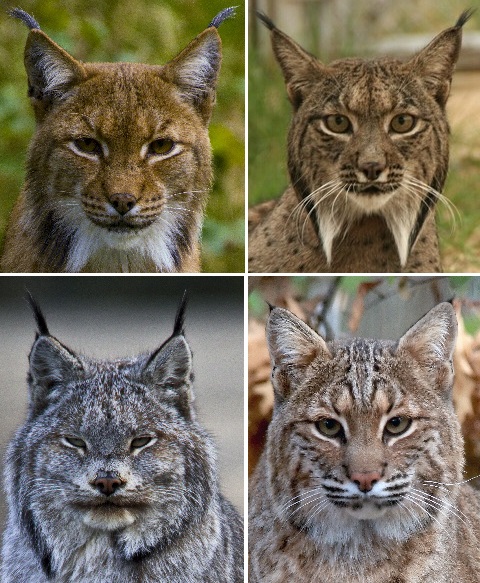
The four species of lynx. From top-left, clockwise: Eurasian lynx (L. lynx), Iberian lynx (L. pardinus), bobcat (L. rufus), Canada lynx (L. canadensis)
Scientific classification Edit this classification
Kingdom: Animalia
Phylum: Chordata
Class: Mammalia
Order: Carnivora
Family: Felidae
Subfamily: Felinae
Genus: Lynx
Kerr, 1792
Type species
Felis lynx[3]
Species
Lynx ranges:
  Eurasian lynx (Lynx lynx)
  Canadian lynx (Lynx canadensis)
  Iberian lynx (Lynx pardinus)
  Bobcat (Lynx rufus)

A lynx (/lɪŋks/ links;[4] pl.: lynx or lynxes[5]) is any of the four extant species (the Canada lynx, Iberian lynx, Eurasian lynx and the bobcat) within the medium-sized wild cat genus Lynx. The name originated in Middle English via Latin from the Greek word lynx (λύγξ),[4] derived from the Indo-European root *leuk- ('light', 'brightness'), in reference to the luminescence of its reflective eyes.[citation needed]

Appearance

[edit]
Profile view of a lynx

Lynx have a short tail, characteristic tufts of black hair on the tips of their ears, large, padded paws for walking on snow and long whiskers on the face. Under their neck, they have a ruff, which has black bars resembling a bow tie, although this is often not visible.

Body colour varies from medium brown to goldish to beige-white, and is occasionally marked with dark brown spots, especially on the limbs. All species of lynx have white fur on their chests, bellies and on the insides of their legs, fur which is an extension of the chest and belly fur. The lynx's colouring, fur length and paw size vary according to the climate in their range. In the Southwestern United States, they are short-haired, dark in colour and their paws are smaller and less padded. In colder northern climates lynx have thicker and lighter fur as well as larger and more padded paws that are well-adapted to snow.

The smallest species are the bobcat and the Canada lynx, while the largest is the Eurasian lynx, with considerable variations within species.

Physical characteristics of Lynx species
Species Sex Weight Length Height (standing at shoulders)
Eurasian lynx
males 18 to 30 kg (40 to 66 lb) 81 to 129 cm (32 to 51 in) 70 cm (27+12 in)[6]
females 18 kg (40 lb)
Canada lynx
Both 8 to 14 kg (18 to 31 lb) 90 cm (35+12 in) 48 to 56 cm (19 to 22 in)[7]
Iberian lynx
males 12.9 kg (28 lb) 85 to 110 cm (33+12 to 43+12 in) 60 to 70 cm (23+12 to 27+12 in)[8][9]
females 9.4 kg (20+34 lb)
Bobcat
males 7.3 to 14 kg (16 to 30+34 lb)[10] 71 to 100 cm (28 to 39+12 in)[10] 51 to 61 cm (20 to 24 in)[11]
females 9.1 kg (20 lb)

Species

[edit]

All living species of Lynx are thought to descend from Lynx issiodorensis, which first appeared during the early Pliocene in Africa, around 4 million years ago, shortly afterwards dispersing into Eurasia. The bobcat is thought to have arisen from a dispersal across the Bering Land Bridge during the Early Pleistocene, around 2.5-2.4 million years ago, with the Iberian lynx suggested to have speciated around 1 million years ago, at the end of the Early Pleistocene, the Eurasian lynx is thought to have evolved from Asian populations of Lynx issidorensis. The Canada lynx is thought to descend from a separate later migration of Eurasian lynx over the Bering Land Bridge around 200,000 years ago.[12]

The Pliocene felid Felis rexroadensis from North America has been proposed as an even earlier ancestor; however, this was larger than any living species, and is not currently classified as a true lynx.[13][14] Another extinct species of Lynx, L. shansius, inhabited what is now northern China during the Early Pleistocene,[15] though this species is considered by some researchers to be a junior synonym of L. issiodorensis.[16][17]

Eurasian lynx

[edit]
Eurasian lynx

Of the four lynx species, the Eurasian lynx (Lynx lynx) is the largest in size. It is native to European, Central Asian, and Siberian forests. While its conservation status has been classified as "least concern", populations of Eurasian lynx have been reduced or extirpated from much of Europe, where it is now being reintroduced. During the summer, the Eurasian lynx has a relatively short, reddish or brown coat which is replaced by a much thicker silver-grey to greyish-brown coat during winter. The lynx hunts by stalking and jumping on its prey, helped by the rugged, forested country in which it resides. A favorite prey for the lynx in its woodland habitat is roe deer. It will feed however on whatever animal appears easiest, as it is an opportunistic predator much like its cousins.[13]

Canada lynx

[edit]
Canada lynx

The Canada lynx (Lynx canadensis), or Canadian lynx, is a North American felid that ranges in forest and tundra regions[18] across Canada and into Alaska, as well as some parts of the northern United States. Historically, the Canadian lynx ranged from Alaska across Canada and into many of the northern U.S. states. In the eastern states, it resided in the transition zone in which boreal coniferous forests yielded to deciduous forests.[19] By 2010, after an 11-year effort, it had been successfully reintroduced into Colorado, where it had become extirpated in the 1970s.[20][21][22] In 2000, the U.S. Fish and Wildlife Service designated the Canada lynx a threatened species in the lower 48 states.[23]

The Canada lynx is a good climber and swimmer; it constructs rough shelters under fallen trees or rock ledges. It has a thick coat and broad paws, and is twice as effective as the bobcat at supporting its weight on the snow. The Canada lynx feeds almost exclusively on snowshoe hares; its population is highly dependent on the population of this prey animal. It will also hunt medium-sized mammals and birds if hare numbers fall.[18]

Iberian lynx

[edit]
Iberian lynx

The Iberian lynx (Lynx pardinus) is a vulnerable species native to the Iberian Peninsula in Southern Europe. It was the most endangered cat species in the world,[24] but conservation efforts have changed its status from critical to endangered to vulnerable. The loss of the species would have been the first feline extinction since the Smilodon 10,000 years ago.[25] The species used to be classified as a subspecies of the Eurasian lynx, but is now considered a separate species. Both species occurred together in central Europe in the Pleistocene epoch, being separated by habitat choice.[26] The Iberian lynx is believed to have evolved from Lynx issiodorensis.[27]

Bobcat

[edit]
Bobcat

The bobcat (Lynx rufus) is a North American wild cat. With 13 recognized subspecies, the bobcat is common throughout southern Canada, the continental United States, and northern Mexico.[28] Like the Eurasian lynx, its conservation status is "least concern."[29] The bobcat is an adaptable predator that inhabits deciduous, coniferous, or mixed woodlands, but unlike other Lynx, does not depend exclusively on the deep forest, and ranges from swamps and desert lands to mountainous and agricultural areas, its spotted coat serving as camouflage.[30] The population of the bobcat depends primarily on the population of its prey.[31] Nonetheless, the bobcat is often killed by larger predators such as coyotes.[32]

The bobcat resembles other species of the genus Lynx, but is on average the smallest of the four. Its coat is variable, though generally tan to grayish brown, with black streaks on the body and dark bars on the forelegs and tail. The ears are black-tipped and pointed, with short, black tufts. There is generally an off-white color on the lips, chin, and underparts. Bobcats in the desert regions of the southwest have the lightest-colored coats, while those in the northern, forested regions have the darkest.[11]

Behavior and diet

[edit]

The lynx is usually solitary, although a small group of lynx may travel and hunt together occasionally. Mating takes place in the late winter and once a year the female gives birth to between one and four kittens. The gestation time of the lynx is about 70 days. The young stay with the mother for one more winter, a total of around nine months, before moving out to live on their own as young adults. The lynx creates its den in crevices or under ledges. It feeds on a wide range of animals from white-tailed deer, reindeer, roe deer, small red deer, and chamois, to smaller, more usual prey: snowshoe hares, fish, foxes, sheep, squirrels, mice, turkeys and other birds, and goats. It also eats ptarmigans, voles, and grouse.

Distribution and habitat

[edit]
A lynx stalking prey

The lynx inhabits high altitude forests with dense cover of shrubs, reeds, and tall grass. Although this cat hunts on the ground, it can climb trees and can swim swiftly, catching fish.

Europe and Asia

[edit]

The Eurasian lynx ranges from central and northern Europe across Asia up to Northern Pakistan and India. In Iran, they live in Mount Damavand area.[33] Since the beginning of the 20th century, the Eurasian lynx was considered extinct in the wild in Slovenia and Croatia. A resettlement project, begun in 1973, has successfully reintroduced lynx to the Slovenian Alps and the Croatian regions of Gorski Kotar and Velebit, including Croatia's Plitvice Lakes National Park and Risnjak National Park. In both countries, the lynx is listed as an endangered species and protected by law. The lynx was distributed throughout Japan during Jōmon period; with no paleontological evidence thereafter suggesting extinction at that time.[34]

Several lynx resettlement projects begun in the 1970s have been successful in various regions of Switzerland. Since the 1990s, there have been numerous efforts to resettle the Eurasian lynx in Germany, and since 2000, a small population can now be found in the Harz mountains near Bad Lauterberg.

The lynx is found in the Białowieża Forest in northeastern Poland, and in the northern and western parts of China, particularly the Tibetan Plateau. In Romania, the numbers exceed 2,000, the largest population in Europe outside of Russia, although most experts consider the official population numbers to be overestimated.[35]

The lynx is more common in northern Europe, especially in Norway, Sweden, Estonia, Finland, and the northern parts of Russia. The Swedish population is estimated to be 1200–1500 individuals, spread all over the country, but more common in middle Sweden and in the mountain range. The lynx population in Finland was 1900–2100 individuals in 2008, and the numbers have been increasing every year since 1992. The lynx population in Finland is estimated currently to be larger than ever before.[36] Lynx in Britain were wiped out in the 17th century, but there have been calls to reintroduce them to curb the numbers of deer.[37]

The endangered Iberian lynx lives in southern Spain and formerly in eastern Portugal.[needs update] There is an Iberian lynx reproduction center outside Silves in the Algarve in southern Portugal.

North America

[edit]
A mother and cub, Kenai National Wildlife Refuge, Alaska

The two Lynx species in North America, Canada lynx and bobcats, are both found in the temperate zone. While the bobcat is common throughout southern Canada, the continental United States and northern Mexico, the Canada lynx is present mainly in boreal forests of Canada and Alaska.[28]

See also

[edit]

References

[edit]
[edit]
Revisions and contributorsEdit on WikipediaRead on Wikipedia
from Grokipedia
The lynx (genus Lynx) is a group of four extant of medium-sized wild cats in the family , characterized by short tails, prominent black ear tufts, spotted or streaked coats for , and large, furry paws adapted for traversing and soft terrain. These solitary carnivores, native to boreal forests, , and mountainous regions across the , primarily hunt small mammals like hares and , with diets and behaviors varying by to suit their habitats. The genus includes the (Lynx lynx), the largest with a wide distribution from to ; the (Lynx canadensis), specialized for deep in North American boreal forests; the (Lynx pardinus), vulnerable and restricted to the ; and the (Lynx rufus), the most adaptable and widespread in . Lynxes exhibit a uniform morphology across , including dense ranging from grayish-brown to reddish hues, a ruff of longer around the , and exceptional hearing and vision for nocturnal hunting, though they are generally crepuscular or diurnal depending on prey availability. Their territorial ranges can span up to 1,100 square kilometers in northern populations, marked by and scratches, and they communicate through vocalizations like meows, hisses, and purrs. occurs seasonally, with females giving birth to 1–5 kittens after a of about 60–70 days, and cubs remain dependent for up to a year while learning hunting skills. Conservation challenges vary: while the and are relatively stable, the is threatened in the , and the faces severe threats from habitat loss and low , with populations bolstered by reintroduction programs and exceeding 2,400 individuals as of 2025. Overall, lynx populations fluctuate with prey cycles, such as snowshoe hare abundances in the case of the , underscoring their role as keystone predators in forest ecosystems.

Taxonomy and Classification

Genus Overview

The is classified within the subfamily of the family and encompasses four extant species: the (Lynx lynx), the (Lynx canadensis), the (Lynx pardinus), and the (Lynx rufus). These medium-sized wild cats are distinguished by shared morphological traits such as tufted ears and short tails, adapted for forested and mountainous environments. The name "lynx" originates from the ancient Greek term λύγξ (lyngx), derived from the Indo-European root leuk- meaning "" or "brightness," alluding to the animal's reflective eyes that enhance . In Greek mythology, the lynx was associated with , symbolizing keen sight and mystery, which influenced its cultural depiction as an elusive creature. Phylogenetically, the Lynx genus forms a monophyletic closely related to other small felids within , with genetic analyses supporting its unity despite morphological variations. A key study revealed that the divergence among the species occurred approximately 1.5–1.7 million years ago, during the , following an earlier split from other lineages around 7–8 million years ago. Historically, taxonomic classification of the faced debates, particularly concerning the (L. rufus), which was occasionally placed in the genus Felis or proposed as a separate genus due to its distinct North American distribution and adaptations. Modern genetic evidence has resolved these uncertainties, affirming the bobcat's inclusion in Lynx based on shared ancestry and molecular markers.

Species Recognition

The four extant species within the genus Lynx—Eurasian lynx (L. lynx), (L. canadensis), (L. pardinus), and (L. rufus)—are distinguished primarily through morphological, genetic, and ecological traits, as recognized by the International Union for Conservation of Nature (IUCN). These criteria enable reliable species identification in field surveys, genetic analyses, and conservation assessments, reflecting their evolutionary divergence within the family. Morphological features provide key visual and structural markers for differentiation. The Eurasian lynx is the largest species, with adults weighing 18–36 kg and exhibiting a thick, spotted coat adapted to temperate forests across Eurasia. In contrast, the Canada lynx possesses oversized, furred paws resembling snowshoes, which facilitate movement over deep snow in boreal habitats of North America. The Iberian lynx is notable for its prominent facial ruff of elongated fur around the cheeks and neck, a trait more pronounced in adults and aiding in social signaling within Mediterranean scrublands. The bobcat, the smallest and most adaptable, features a distinctly short, bobbed tail (typically 7–18 cm) with a white underside and black upper tip, allowing it to thrive in diverse environments from deserts to woodlands across North and Central America. Genetic analyses, particularly of , confirm these as distinct through variations in the and other markers. Sequence divergences in and control region fragments reveal clear phylogenetic separation, with the forming a monophyletic apart from the , while North American (L. canadensis and L. rufus) show basal splits supported by ATPase-8, 16S rRNA, and NADH-5 genes. The IUCN endorses this delineation, listing each as a separate based on these molecular and morphological , emphasizing their conservation as independent units. Subspecies variation further refines recognition within species, often tied to geographic isolation. The has several recognized by the IUCN (six as of the 2017 Felidae taxonomy revision), such as L. l. lynx in and L. l. carpathicus in the Carpathians, differentiated by pelage density and cranial morphology. The includes two : the widespread L. c. canadensis and the insular L. c. vancouverensis on , distinguished by slight size and coat differences. The is monotypic with no recognized , while the has up to 12 proposed based on morphology, though genetic studies support recognition of two main clades (east and west of the ), reflecting its broad adaptability across varied ecoregions. Interspecies hybridization is rare, occurring primarily in overlap zones between the and in southern boreal edges, where only 15 genetically confirmed cases have been documented despite sampling efforts. These hybrids exhibit intermediate traits like partial ear tufting and paw size but pose limited risk due to spatial segregation and low encounter rates, as evidenced by genome-wide SNP analyses showing minimal admixture.

Physical Characteristics

Morphology and Size

Lynx species exhibit a robust, compact body structure adapted for agile movement in forested and snowy habitats. Adults across the typically measure 60–130 cm in head-body length (excluding the short tail of 5–25 cm) and weigh between 4 and 30 kg, with the (Lynx lynx) representing the upper end of this range at up to 30 kg and the (Lynx rufus) the lower at around 4–15 kg; the (Lynx pardinus) weighs 9–15 kg. Males are generally larger than females, showing where males are 20–30% heavier and possess more robust builds, aiding in territorial defense and mating competition. The build features relatively long legs proportional to body length, with powerful hindquarters enabling leaps of up to 3–4 meters for ambushing prey. Forelegs are shorter than hind legs, contributing to a slightly stooped posture, while broad, furred paws—up to 10 cm across in some —act as snowshoes to distribute weight and facilitate travel over deep . This skeletal configuration supports bursts of speed and climbing, essential for their predatory lifestyle in varied terrains. The is characteristically rounded with a short rostrum and prominent for attachment of strong jaw muscles, measuring 12–16 cm in length depending on and . consists of 28 teeth in the permanent (I 3/3, C 1/1, P 2/2, M 1/1), reduced from the typical felid count of 30 due to the absence of the upper second ; the pair (P4 and m1) is specialized for shearing flesh, reflecting their carnivorous diet focused on small to medium-sized vertebrates. extends to the cranium, with males exhibiting larger dimensions in key features like condylar breadth and height.

Sensory Adaptations

Lynx possess specialized visual adaptations that optimize their performance as nocturnal ambush predators. The presence of a , a reflective layer behind the , enhances low-light vision by reflecting photons back through the photoreceptor cells, increasing sensitivity in dim conditions typical of their forested habitats. Additionally, their vertical slit s allow for precise during hunting, as the shape aligns the pupil to maximize the for vertical prey contours, reducing blur in near-range targeting. Auditory adaptations in lynx enable effective prey detection in dense vegetation and under snow cover. The large, mobile pinnae funnel and amplify high-frequency sounds, contributing to a of approximately 48 Hz to 85 kHz, which surpasses capabilities and facilitates localization of small mammals producing ultrasonic vocalizations. Prominent ear tufts, composed of elongated hairs, are believed to further enhance sound reception by directing subtle noises toward the , aiding in the detection of concealed prey movements. Olfactory capabilities in lynx support territorial maintenance and reproductive behaviors through specialized structures. The , also known as Jacobson's organ, detects pheromones via ducts connecting the nasal and oral cavities, allowing analysis of chemical cues from scent marks for identifying conspecifics and assessing reproductive status. Both male and female lynx employ this system during scent marking, with males visiting and overmarking sites more frequently to communicate dominance and attract mates during breeding seasons. Tactile senses complement other modalities for in obstructed environments. Long vibrissae, or , embedded with mechanoreceptors at their follicles, provide feedback on spatial obstacles and airflow changes, enabling lynx to maneuver through thick undergrowth without visual reliance. These sensory hairs are particularly vital in low-visibility conditions, such as dense or snowy terrains where lynx hunt.

Species Profiles

Eurasian Lynx

The (Lynx lynx) is the largest species within the genus Lynx, distinguished by its robust build adapted to forested environments across . It features dense, soft fur that is typically grayish-brown with dark spots, providing in settings, and prominent black ear tufts measuring up to 5 cm in length, which may aid in auditory perception or signaling. Adults exhibit , with males generally larger than females; body length ranges from 70 to 130 cm, shoulder height from 60 to 70 cm, and weight from 18 to 32 kg, though exceptional individuals in Siberian populations can exceed this. These traits enable the Eurasian lynx to navigate dense undergrowth and ambush prey effectively. The occupies a broad native range spanning temperate and boreal forests from through , the , and eastward to and parts of . It prefers mixed coniferous-deciduous woodlands with rocky outcrops and ample cover, avoiding open plains or heavily human-modified landscapes. Several exist, reflecting regional variations; notable among them is the (L. l. balcanicus), a critically endangered form restricted to fragmented habitats in , , , and . In terms of diet, the Eurasian lynx is a specialized predator primarily targeting medium-sized ungulates such as and , which can constitute over 50% of its prey biomass in suitable habitats. It also relies heavily on hares, particularly mountain hares in northern regions where deer are scarce, and opportunistically consumes birds, foxes, marmots, and occasionally larger game like or even young . This carnivorous diet supports its solitary, territorial lifestyle, with hunting strategies emphasizing stealth and short bursts of speed in forested terrain. Population estimates for the indicate stability across much of its range, classified as Least Concern globally by the IUCN due to its extensive distribution. In , the 2023 estimate totals approximately 9,400 individuals, reflecting a 12% increase since 2016 and encompassing key subpopulations in , the , Carpathians, and Baltics. While mature individuals are not separately quantified in recent assessments, the overall figure suggests around 10,000 breeding adults continent-wide when including Asian portions, though isolated groups like the number around 35-50 mature individuals as of 2022-2024 and face ongoing threats from habitat loss and .

Canada Lynx

The (Lynx canadensis) is a medium-sized felid adapted to boreal environments, weighing 6–14 kg with males averaging 10–12.5 kg and females 8.5–10 kg. It features long legs and large, well-furred paws up to 10 cm wide, which act as snowshoes to distribute weight and facilitate movement across deep snow, enabling efficient pursuit of prey in cold climates. The coat is typically silvery-gray to grayish-brown with black streaks and spots, providing in snowy and forested settings, complemented by prominent black ear tufts and a short, black-tipped . This species ranges across the boreal forests of and , extending south into northern , including parts of states like , , and Washington, where its distribution is closely tied to the availability of snowshoe hares (Lepus americanus), its primary prey. Populations exhibit pronounced cyclic fluctuations synchronized with 8–11-year snowshoe hare cycles, as lynx reproduction and survival depend heavily on hare abundance. As a keystone predator, the plays a critical role in regulating populations, which in turn influences vegetation dynamics in boreal ecosystems. Lynx densities can fluctuate 10–30 fold in response to prey cycles, rising sharply during hare peaks (when hare densities reach 20–45 individuals per 100 ha) and crashing during lows due to starvation and increased mortality. These dynamics underscore its position as a specialist predator, with home ranges expanding or contracting based on food availability. Globally, the is classified as Least Concern by the IUCN due to its wide distribution and stable overall populations, though the contiguous U.S. distinct population segment is listed as threatened under the Endangered Species Act owing to and climate-induced vulnerabilities in southern ranges. Recent 2024 assessments highlight ongoing recovery efforts, including habitat protection, to mitigate risks to peripheral populations.

Iberian Lynx

The (Lynx pardinus) is the smallest species within the , typically weighing between 9 and 15 kg, with males averaging 12-13 kg and females slightly lighter at 9-10 kg. It possesses a tawny coat marked by dark spots and rosettes, a characteristic facial "beard" of elongated hairs, prominent black ear tufts, and a short, black-tipped tail. These features aid in within its Mediterranean scrubland and enhance its sensory capabilities for hunting. Native to the , the species' range is primarily confined to southwestern , encompassing fragmented areas in regions such as and , with a total occupied area exceeding 3,300 km² as of 2024. Reintroduction efforts began in in late 2014, with the first captive-bred individuals released into the Guadiana Valley Natural Park, marking the first expansion beyond in centuries and contributing to connectivity across the border. The exhibits a specialized , with the (Oryctolagus cuniculus) comprising 80-99% of its diet, making it highly vulnerable to fluctuations in rabbit populations due to disease and habitat loss. This dietary dependence underscores its role as a keystone predator in maintaining balance within open Mediterranean woodlands and scrublands. Additionally, severe historical population bottlenecks have resulted in critically low , the lowest recorded among felids, increasing risks of ; however, ongoing translocations and ex-situ breeding programs have begun to mitigate this through enhanced . Conservation initiatives, including habitat restoration, rabbit population enhancement, and a robust program, have driven a remarkable recovery. The total population grew from approximately 62 mature individuals in 2002 to 2,401 (1,557 mature) as of 2024. This led to the ' downlisting from Critically Endangered to Endangered in 2015 and further to Vulnerable on the in 2024, representing one of the most rapid recoveries for a large .

Bobcat

The bobcat (Lynx rufus), also known as the red lynx, is a medium-sized felid distinguished from other lynx species by its relatively smaller size, shorter facial ruffs, and more pronounced spotted coat pattern. Adults typically weigh between 6 and 18 kg, with males averaging larger than females at around 9-13 kg and females at 6-9 kg. The body measures 47-79 cm in length, with a short, "bobbed" of 9-13 cm that gives the species its common name. Its coat varies regionally from grayish-brown in northern populations to reddish-brown in southern ones, often featuring black spots, bars, or streaks on the body, legs, and , along with white underparts and tufts. Native to , the has the broadest distribution of any lynx species, ranging from southern through the to central , inhabiting diverse environments from deserts to forests. Its population is estimated at over 2 million individuals across its range, with stable or increasing numbers in most areas due to adaptability and legal protections. Primarily carnivorous, bobcats prey on small mammals like rabbits and but occasionally consume fruits and other matter, particularly in arid regions such as the . This dietary flexibility, combined with opportunistic foraging, allows them to thrive in fragmented and human-modified habitats, including urban edges and agricultural lands. Bobcats feature prominently in Indigenous North American folklore, such as Desert stories where they symbolize cunning and spiritual significance in oral traditions. They occasionally prey on , including , lambs, and small goats, leading to localized conflicts with ranchers, though such incidents are infrequent compared to other predators like coyotes.

Behavioral Ecology

Social and Territorial Behavior

Lynx species exhibit a predominantly solitary , interacting minimally with conspecifics outside of brief encounters and familial bonds. Adults maintain exclusive territories to minimize for resources, with home ranges varying widely by , , , and prey availability—typically spanning 10–100 km² for females and up to several hundred km² for males in forested environments, though sizes can exceed 1,000 km² in northern or low-prey areas. This asocial reduces conflict and energy expenditure, allowing individuals to focus on individual needs. Territorial boundaries are actively defended through scent marking and vocal communication. Lynx frequently spray urine on vertical surfaces like tree trunks and rocks, often preceded by cheek or head rubbing to deposit glandular scents, signaling ownership and reproductive status to intruders. These marks are renewed regularly, with males marking more intensively along range peripheries. Vocalizations complement this, including yowls and growls for long-distance territorial warnings, purrs during affiliative mother-offspring contact, and hisses or spits during close encounters to deter rivals. Such behaviors ensure spatial separation, as overlapping ranges between same-sex adults are minimal (often <10%). Social interactions are limited primarily to maternal care, where females raise litters of 1–4 kittens for 9–12 months, teaching hunting and navigation before juveniles disperse to establish independent territories. Offspring bonds dissolve as young reach around 1–2 years, with females tolerating less overlap than males. Adult males remain highly solitary. Activity patterns reinforce territoriality, with lynx being largely nocturnal or crepuscular to avoid disturbance and align with prey activity. Daily rhythms feature peaks at dawn and dusk, but winter months often see heightened movement, as individuals expand ranges or increase travel distances (up to 20–30 km per night) to exploit snow-adapted prey like hares amid reduced cover. This seasonal intensification supports survival in harsh conditions without altering core solitary habits.

Foraging and Predation Strategies

Lynx employ ambush predation as their primary , relying on stealthy followed by a sudden pounce to capture prey. This stalk-pounce method allows them to approach within a few meters before leaping, to overtake surprised quarry. Hunting success rates for lynx typically hover around 20%, reflecting the challenges of this energy-efficient but low-yield approach that minimizes prolonged chases. Their prey spectrum varies by species and habitat, including small to medium-sized ungulates such as and for the , snowshoe hares for the , European rabbits for the , and a variety of small mammals for the , alongside , birds, and occasionally larger prey when available. To manage excess kills, lynx exhibit food caching behavior, covering large prey carcasses with , leaves, or soil to deter and preserve meat for later consumption, a strategy particularly vital for solitary individuals. This practice enhances survival by reducing the need for frequent hunts and aligns with their role as opportunistic yet specialized carnivores. Seasonal shifts in reflect prey availability, with lynx targeting prey that is more abundant or accessible in different seasons, such as increased focus on smaller game like and hares during periods of higher alternative prey density. budgets drive these adaptations, as lynx require approximately 1-2 kg of per day to meet metabolic demands, influenced by body , activity levels, and cold climates that elevate expenditure. As purely ambush-oriented predators, lynx lack tool use and operate without strategies, solitarily to conserve and avoid , though their acute sensory adaptations briefly enhance detection during stalks. This solitary absence underscores their reliance on individual prowess over group dynamics in securing resources.

Reproduction and Life History

Mating Systems

Lynx exhibit a polygynous mating system in which territorial males court and mate with multiple females whose home ranges overlap with theirs, while females typically mate with a single male per breeding season. This system is facilitated by induced ovulation in females, triggered by copulation, which ensures fertilization only after mating occurs. Courtship involves males following receptive females, vocalizing, and engaging in brief chases or mounts, often lasting several days until copulation. Breeding seasons vary slightly by species but generally occur in winter to early spring, aligning with peak prey availability to support reproduction. For the Canada lynx (Lynx canadensis), mating takes place from late February to early April, followed by a gestation period of 63-70 days, with births in May to June. In the Iberian lynx (Lynx pardinus), the season spans December to April, with a peak in January to March and a similar 63-70 day gestation, resulting in births from March to May. As of 2024, there are 470 breeding females, an increase of 64 from 2023, indicating improved reproductive success. The Eurasian lynx (Lynx lynx) breeds from February to March, with gestation of 67-74 days and litters born in May. Bobcats (Lynx rufus), the most adaptable, breed from late winter through summer but most commonly February to April, with a 60-70 day gestation. Litter sizes typically range from 2 to 4 kittens across lynx , though they can vary with maternal age, nutritional status, and prey density; for instance, averages are around 2.3-2.4 for and 2-3 for . Sex ratios at birth are approximately 1:1, as observed in populations. is primarily maternal, with females solely responsible for , denning, nursing, and initial protection of kittens, while males provide no post-copulatory care. Paternity uncertainty exists due to potential multiple matings, but territorial defense by males minimizes extra-territorial sires, ensuring high paternity success. Genetic studies show multiple sires are possible but rare; for example, in , territorial males sired 93% of genotyped kittens with single paternity per litter predominant, and in , only one of eight litters had multiple fathers.

Development and Lifespan

Lynx kittens are altricial, born blind, helpless, and fully dependent on maternal care, typically weighing 200-250 grams at birth and covered in fine fur but with closed eyes and ears. In species such as the , , and , eyes open between 10 and 14 days postpartum, marking the onset of basic sensory development, though vision remains impaired initially due to temporary cataracts. During this neonatal phase, kittens remain in concealed dens, relying on the female's and , with strong maternal bonds facilitating survival through the first vulnerable weeks. The juvenile phase begins as kittens emerge from the den around 4-6 weeks, starting to explore and consume solid food while still nursing. Weaning occurs gradually between 3 and 5 months across lynx species, with fully weaned by about 4-5 months and around 12 weeks, transitioning to a carnivorous diet of small prey provided by the mother. Independence is achieved at approximately 10 months, when family groups dissolve in late winter or early spring, allowing subadults to hunt solo; females typically reach and first reproduce at 2 years, though yearlings may breed opportunistically during prey abundance in populations. Juvenile dispersal follows independence, with subadults traveling 50-200 km on average to establish , though distances can exceed 600 km in during exploratory movements driven by prey availability and competition. Males generally disperse farther than females, reducing risks. In the wild, lynx lifespan averages 10-15 years, with most individuals surviving 5-10 years due to high juvenile mortality; in captivity, longevity reaches up to 25 years. Primary mortality factors include , which intensifies during prey shortages and accounts for a significant portion of deaths in (alongside predation by larger carnivores like cougars and wolves), and predation, which causes over 90% of kitten losses in some populations.

Distribution and Habitats

Eurasian and Asian Ranges

The (Lynx lynx) has a historical distribution that originated in during the early and expanded across , reaching as far west as the . evidence confirms its presence throughout Pleistocene into , where it occupied diverse forested and environments. In Britain, the species was extirpated by approximately 600 AD, likely due to habitat loss and human persecution, with the last securely dated remains from that period. Today, populations maintain continuous distributions in , including (, ), the (, , , , ), and extensive areas of extending into . In Asia, the range spans and the , forming a broad boreal corridor to the Pacific. However, populations are more fragmented in regions like , where they persist in isolated pockets in the Anatolian mountains and , and in the , including the , due to and human activity. The species primarily inhabits boreal forests and taiga across its range, favoring dense coniferous and mixed woodlands that provide cover for ambushing prey. These habitats extend from lowlands to high elevations, with records up to 5,500 m in the and , where lynx adapt to rocky, alpine terrain. In mountainous areas such as the and , exhibit seasonal altitudinal shifts, descending to lower elevations in winter to follow prey migrations and avoid deep snow accumulation. This movement pattern enhances access to ungulates like deer and during periods of resource scarcity at higher altitudes.

North American Ranges

The (Lynx canadensis) is primarily distributed across the boreal forests of , spanning from the Territory in northwestern eastward through the continent to in the northeastern United States. This core range aligns closely with the extent of North American boreal ecosystems, including transition zones to northern hardwoods and lower montane forests, where lynx rely on dense coniferous cover and deep snow for hunting snowshoe hares. In the , the lynx's distribution becomes discontinuous with southern extensions limited to higher-elevation boreal and subalpine forests in the northern (from to ), the and in Washington, the in northern , the in northeastern , and the White Mountains in . These peripheral populations are small and isolated, often numbering in the dozens to low hundreds per area, and are vulnerable to fluctuations in prey availability. In contrast, the (Lynx rufus) exhibits a far broader and more continuous distribution across , occurring ubiquitously from southern through the contiguous United States to central , encompassing all lower 48 states except . This adaptability allows bobcats to inhabit diverse environments, ranging from arid deserts and scrublands in the to and mixed forests in the Midwest, swamps in the Southeast, and even suburban and semi-urban fringes near human development. Following European settlement, bobcat populations initially declined in the Northeast and Midwest due to widespread , agricultural conversion, and unregulated , but they subsequently expanded their range and abundance as second-growth forests regenerated and legal protections were enacted in the mid-20th century. By the early 21st century, assessments indicated a wider distribution and higher densities compared to the , reflecting the ' resilience to changes. Habitat overlap between and s occurs primarily at the southern edges of the lynx's range, such as in the of , , and Washington, where both species exploit similar prey like hares but partition resources through fine-scale habitat selection. Lynx favor homogeneous coniferous forests with persistent deep snow, while s prefer heterogeneous, human-disturbed landscapes with greater prey diversity; this segregation minimizes direct competition but can break down during prey irruptions. exacerbates these dynamics by reducing snow depth and duration, potentially favoring bobcat expansion into lynx territories and prompting northern range shifts for lynx, though fragmented habitats may hinder such movements. Since 1900, populations in the have contracted significantly, with resident breeding groups extirpated from at least 13 states, including New York, , , , , , and parts of , , and , due to loss, overharvest, and prey declines. Today, viable populations persist in only about seven states, concentrated in the northern boreal fringes, underscoring the species' reliance on intact forest connectivity for persistence.

Conservation and Threats

Population Status

The Eurasian lynx (Lynx lynx) is classified as Least Concern on the , with a stable overall population across its vast Eurasian range. In , including , the population is estimated at 17,000–18,000 individuals based on recent assessments. Asian populations are also considered stable, though precise global totals remain challenging to quantify due to the species' extensive distribution; estimates suggest tens of thousands in central and eastern , contributing to a secure status without major declines. The (Lynx canadensis) is likewise rated Least Concern by the IUCN, reflecting its wide distribution in , though populations exhibit cyclic fluctuations tied to prey availability, such as snowshoe hares. No comprehensive global population estimate exists, but numbers in are approximated at around 200,000 individuals during peak cycles, with southern extensions in the United States remaining smaller and more vulnerable to variability. These cycles typically span 8–11 years, with densities varying from 1–30 per 100 km² depending on regional abundance. In contrast, the (Lynx pardinus) holds Vulnerable status on the , an improvement from Endangered in 2024 due to successful conservation interventions. The population has rebounded significantly, reaching 2,401 individuals total (including 1,557 adults) in the 2024 census (published 2025) across and , up from fewer than 100 in 2002. This growth, driven by reintroduction and habitat programs, represents one of the most notable feline recoveries, though the species remains confined to fragmented Iberian habitats. The (Lynx rufus), the most widespread lynx species, is assessed as Least Concern by the IUCN, with abundant populations exceeding 1 million across and no significant threats to its subspecies. In the United States alone, estimates range from 2.3 to 3.6 million individuals, supported by adaptable habitats and stable trends since the late . Densities vary regionally, from 3–20 per 100 km² in optimal areas, underscoring its resilience. Lynx populations worldwide are monitored primarily through non-invasive techniques to minimize disturbance. Camera traps, deployed in systematic grids or targeted arrays, enable density estimates, individual identification via pelage patterns, and trend tracking, as demonstrated in multi-year studies across and . Complementary genetic sampling, using hair snares or scat analysis, provides data on structure, connectivity, and without direct capture, enhancing accuracy for elusive like lynx. These methods are integrated in programs such as those by the IUCN Cat Specialist Group to inform conservation priorities.

Human Impacts and Recovery Efforts

Human activities have profoundly impacted lynx populations through habitat fragmentation, primarily driven by logging, agriculture, and urban expansion, which isolate suitable forest and shrubland habitats essential for their survival. For instance, in the Iberian Peninsula, these developments have confined the Iberian lynx to fragmented patches, exacerbating vulnerability to local extinctions. Poaching remains a significant threat, accounting for up to 33.8% of documented mortality in Eurasian lynx populations across Europe, often undetected and compounded by snares and illegal hunting. Roadkill is another major anthropogenic factor, responsible for 59-80% of deaths in some Iberian lynx subpopulations due to increasing infrastructure like roads and dams. Climate change further alters lynx habitats by reducing snow cover and boreal forest extent for Canada lynx, while intensifying droughts that diminish prey availability, such as European rabbits for the Iberian lynx. Recovery efforts have shown promise, particularly for the Iberian lynx, where reintroduction programs since 2010 have released over 400 individuals into Spain and Portugal, boosting the mature population from 62 in 2001 to 1,557 adults in 2024 and expanding occupied habitat to over 3,320 km². In Portugal, reintroductions of 17 lynx resulted in 12 establishing territories, yielding a 70% success rate by 2023. For the Canada lynx, listing as threatened under the U.S. Endangered Species Act in 2000 prompted habitat protections and monitoring, with status reaffirmed in 2003 and 2009, and ongoing protections including a finalized recovery plan in November 2024. These initiatives, supported by prey enhancement, habitat restoration, and reduced human-caused mortality, have contributed to overall population rebounds. All lynx species receive international protection under Appendix II, regulating trade to prevent overexploitation since the 1970s. In Europe, the Eurasian and benefit from the EU , listed in Annexes II and IV, which mandates strict protection against killing, disturbance, and habitat degradation, alongside funded projects for coexistence and restoration. Without further intervention, climate models project significant range contractions for lynx by 2050, with Iberian lynx habitats in Spain becoming unsuitable within 35 years due to aridification, potentially leading to severe population declines or extinction in current strongholds. Canada lynx populations are expected to become smaller and more fragmented, with loss of suitable habitat cores in southern peripheries like Washington State by the 2050s. These projections underscore the need for adaptive strategies, such as assisted migration and enhanced connectivity corridors.

References

Add your contribution
Related Hubs
User Avatar
No comments yet.