Hubbry Logo
Prayer flagPrayer flagMain
Open search
Prayer flag
Community hub
Prayer flag
logo
8 pages, 0 posts
0 subscribers
Be the first to start a discussion here.
Prayer flag
Prayer flag
from Wikipedia
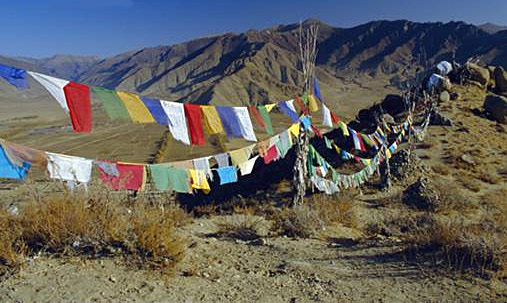
Lung ta prayer flags hang along a mountain path in Nepal.
Close-up of a Lung ta ("Wind Horse") prayer flag, Ladakh, India

A Tibetan prayer flag is a colorful rectangular cloth, often found strung along trails and peaks high in the Himalayas. They are used to bless the surrounding countryside and for other purposes.

Prayer flags are believed to have originated within the religious tradition of Bon.[1] In Bon, shamanistic Bonpo used primary-colored plain flags in Tibet.[2] Traditional prayer flags include woodblock-printed text and images.

History

[edit]

Nepal Sutras, originally written on cloth banners, were transmitted to other regions of the world as prayer flags.[3] Legend ascribes the origin of the prayer flag to the Gautama Buddha, whose prayers were written on battle flags used by the devas against their adversaries, the asuras.[4] The legend may have given the Indian Bhikṣu a reason for carrying the heavenly banner as a way of signifying his commitment to ahimsa.[5] This knowledge was carried into Tibet by 800 CE, and the actual flags were introduced no later than 1040 CE, where they were further modified.[5] The Indian monk Atisha (980–1054 CE) introduced the Indian practice of printing on cloth prayer flags to Tibet and Nepal.[4]

During the Cultural Revolution, prayer flags were discouraged but not entirely eliminated. Many traditional designs may have been lost.[citation needed] Currently, different styles of prayer flags can be seen all across the Tibetan region.

Lung ta/Darchog styles

[edit]
A Darchog prayer flag in northern India

There are two kinds of prayer flags: horizontal ones, called Lung ta (Wylie: rlung-rta, meaning "Wind Horse" in Tibetan), and vertical ones, called Darchog (Wylie: dar-lcog, meaning "flagstaff").

Lung ta (horizontal) prayer flags are of square or rectangular shape, and are connected along their top edges to a long string or thread. They are commonly hung on a diagonal line from high to low between two objects (e.g., a rock and the top of a pole) in high places such as the tops of temples, monasteries, stupas, and mountain passes.

Darchog (vertical) prayer flags are usually large single rectangles attached to poles along their vertical edge. Darchog are commonly planted in the ground, mountains, cairns, and on rooftops, and are iconographically and symbolically related to the Dhvaja.

Color and order

[edit]
Five colors of prayer flag on a mountain in Sikkim

Traditionally, prayer flags come in sets of five. The five colors represent the five elements[2] and the Five Pure Lights. Different elements are associated with different colors for specific traditions, purposes and sadhana. Blue symbolizes the sky and space, white symbolizes the air and wind, red symbolizes fire, green symbolizes water, and yellow symbolizes earth.[2] According to Traditional Tibetan medicine, health and harmony are produced through the balance of the five elements.[2]

Symbols and prayers

[edit]
A Tibetan "lung ta" or "wind horse" from an 1895 book by Laurence Austine Waddell

The center of a prayer flag traditionally features a lung ta (powerful or strong horse) bearing three flaming jewels (specifically ratna) on its back. The ta is a symbol of speed and the transformation of bad fortune to good fortune. The three flaming jewels symbolize the Buddha, the Dharma (Buddhist teachings) and the Sangha (Buddhist community)—the three cornerstones of Tibetan philosophical tradition.

Surrounding the lung ta are various versions of approximately 400 traditional mantras, each dedicated to a particular deity. These writings include mantras from three of the great Buddhist Bodhisattvas: Padmasambhava (Guru Rinpoche), Avalokiteśvara (Chenrezig, the bodhisattva of compassion and the patron of the Tibetan people) and Manjusri.

In addition to mantras, prayers for a long life of good fortune are often included for the person who mounts the flags.

Images or the names of four powerful animals, also known as the Four Dignities, adorn each corner of a flag: the dragon, the garuda, the tiger, and the snow lion. The prayer tag Om mani padme hum is based on four symbolic terms: om (which symbolizes one's impure body speech and mind), mani (which means jewel and symbolizes the factors of method—the altruistic intention to become enlightened, compassion and love, padme (which means lotus and symbolizes wisdom), and hum (the seed syllable of Akshobhya—the immovable and the unfluctuating that which cannot be disturbed by anything).

Wishes are also written on them.[6]

Symbolism and tradition

[edit]

Traditionally, prayer flags are used to promote peace, compassion, strength, and wisdom. The flags do not carry prayers to gods, which is a common misconception; rather, the Tibetans believe the prayers and mantras will be blown by the wind to spread the good will and compassion into all pervading space. Therefore, prayer flags are thought to bring benefit to all.

Faded prayer flags in the wind between the two peaks of the Peak of Victory over Leh, Ladakh, India. The Namgyal Tsemo Gompa can be seen on the peak.

By hanging flags in high places the Lung ta will carry the blessings depicted on the flags to all beings. As wind passes over the surface of the flags, which are sensitive to the slightest movement of the wind, the air is purified and sanctified by the mantras.

The prayers of a flag become a permanent part of the universe as the images fade from exposure to the elements. Just as life moves on and is replaced by new life, Tibetans renew their hopes for the world by continually mounting new flags alongside the old. This act symbolizes a welcoming of life's changes and an acknowledgment that all beings are part of a greater ongoing cycle.

According to traditional belief, because the symbols and mantras on prayer flags are sacred, they should be treated with respect. They should not be placed on the ground or used on clothing. Old prayer flags should be burned.

Timing of hanging and taking down

[edit]

Some believe that if the flags are hung on inauspicious astrological dates, they may bring negative results for as long as they are flying. The best time to put up new prayer flags is in the morning on sunny, windy days.

In Tibet, old prayer flags are replaced with new ones annually on the Tibetan New Year.

See also

[edit]

Notes

[edit]

References

[edit]
[edit]
Revisions and contributorsEdit on WikipediaRead on Wikipedia
from Grokipedia
Prayer flags, known in Tibetan as lung ta (wind horse), are colorful rectangular cloths inscribed with Buddhist mantras, sacred texts, and auspicious symbols, traditionally hung in strings from high mountain passes, temples, and rooftops in the regions of , , , and to disseminate spiritual blessings as the wind carries the printed invocations across the landscape. The flags typically feature five distinct colors—blue for sky and space, white for air and wind, red for fire, green for , and yellow for —corresponding to the five elements in Tibetan cosmology, with each color positioned in a specific order to harmonize these forces. The tradition traces its roots to the pre-Buddhist Bon shamanistic practices of ancient Tibet and elements of early Indian Buddhism, evolving over millennia into a core ritual element of Tibetan Vajrayana Buddhism, where flags are believed to promote peace, compassion, longevity, and protection for all sentient beings by transforming negative energies through the dynamic interplay of wind and inscribed intentions. Historical accounts link the practice to at least the 8th century during the reign of Tibetan Emperor Trisong Detsen, when the Indian master Padmasambhava (Guru Rinpoche) incorporated prayer rites to subdue local spirits and establish Buddhist dominance, though earlier Bonpo influences suggest origins exceeding two thousand years. At the center of many flags stands the lung ta, a mythical wind horse bearing the three jewels of Buddhism (Buddha, Dharma, Sangha), symbolizing the swift propagation of positive karma and the circumvention of obstacles. Prayer flags exist in two primary forms: horizontal lung ta strung between poles for broad dispersal of prayers, and vertical darchog or prayer pole flags erected on tall masts for focused elevation of invocations, often renewed during auspicious occasions like (Tibetan New Year) to maintain their potency as they fade. While culturally revered for fostering communal harmony and environmental attunement in high-altitude ecosystems, the practice has drawn modern scrutiny for ecological concerns, such as nylon flags contributing to microplastic in fragile Himalayan watersheds, prompting calls among some practitioners for biodegradable alternatives.

Origins and History

Pre-Buddhist Roots in Bon Shamanism

The religion, Tibet's pre-Buddhist indigenous spiritual tradition characterized by practices, is credited with the earliest use of flags in contexts predating the 7th-century introduction of . Bonpo priests employed plain flags dyed in primary colors to facilitate healing ceremonies, purification rites, and invocations directed at nature spirits and elemental forces. These flags, lacking inscribed texts, were hung in high places such as mountain passes or sacred sites to harness wind as a medium for transmitting intentions, aiming to dispel negative influences and promote harmony with the environment. The colors of these Bon flags corresponded to the five elements central to Tibetan cosmology: blue for or , white for air, red for fire, green for water, and yellow for earth, reflecting a causal framework where visual symbols influenced spiritual and physical equilibria. In shamanism, such flags formed part of broader practices involving spirit propitiation, where priests manipulated supernatural entities through offerings and symbolic acts to avert misfortune or enhance vitality, underscoring a prioritizing empirical efficacy over doctrinal abstraction. Traditional accounts, transmitted orally by practitioners and corroborated by later lamas, attribute these origins to practices extending thousands of years, though direct archaeological corroboration is limited, with reliance on ethnographic and textual reconstructions from reformed sources post-10th century. A key pre-Buddhist element retained in later traditions is the lung ta (wind horse), a mythical steed symbolizing swift transmission of positive forces, rooted in lore as a carrier of life essence (bla) between earthly and spiritual realms. rituals deployed flag-like banners bearing such motifs to amplify personal fortune (lungta as vital energy), aligning with shamanic techniques for balancing internal energies against external perils, distinct from later Buddhist scriptural overlays. This foundational role of flags in underscores their evolution from pragmatic tools for causal intervention in a spirit-inhabited landscape to syncretic Buddhist artifacts.

Adoption and Evolution in Tibetan Buddhism

Prayer flags, known as lung ta in Tibetan, transitioned from pre-Buddhist Bon shamanistic uses—where plain colored flags served for healing and protection—into Buddhist practice as Indian tantric Buddhism integrated with local traditions during the 7th and 8th centuries CE. This syncretism occurred amid the establishment of Buddhism as Tibet's dominant faith, beginning with King Songtsen Gampo's alliances in the 7th century and accelerating under King Trisong Detsen (r. 742–797 CE), who invited Indian masters to counter Bon influences. Monks adapted the flags by imprinting them with Buddhist mantras, invocations, and symbols, transforming their function from shamanic rituals to disseminating dharma teachings via wind dispersal. A pivotal moment in this adoption came during the construction of Samye Monastery, Tibet's first , completed in the late under Trisong Detsen's and with the aid of Guru Rinpoche (). Guru Rinpoche, invited to subdue local deities obstructing the project, performed extensive purification rites and peace invocations, after which lung ta flags were hoisted to invoke world harmony, marking the Zamling Chisang (universal peace prayer) tradition. These flags incorporated Bon-derived elements, such as guardian animals ( for confidence, for fearlessness, for wisdom, for power), alongside Buddhist motifs like the central (lung ta) bearing the three jewels representing , , and . Over subsequent centuries, prayer flags evolved within , with standardized sets of five colors symbolizing the elements (blue for space, white for air, red for fire, green for water, yellow for earth) and bearing repetitive mantras such as for compassion. By the medieval period, they became integral to rituals on auspicious days like (Tibetan New Year), hoisted to amplify personal and communal fortune by harmonizing elemental forces and invoking protective deities, reflecting Tibetan Buddhism's emphasis on interdependence between human actions, natural winds, and spiritual propagation. This evolution maintained causal mechanisms rooted in belief that wind activates inscribed aspirations, purportedly extending blessings without requiring individual recitation, though efficacy remains unverified by empirical standards.

Regional Variations and Historical Spread

Prayer flags spread from their Tibetan origins with the expansion of Buddhism across the and , beginning in the 8th century during the reign of King , when figures like Guru Rinpoche integrated practices into Buddhist rituals. The tradition disseminated to neighboring regions such as and through monastic exchanges and trade routes, with Indian monk Atisha credited in some accounts for introducing inscribed prayers on flags around the , facilitating their adoption in border areas. By the 16th century, Tibetan Buddhism's influence under leaders like extended the practice to , where flags became associated with ovoos—sacred cairns blending shamanic and Buddhist elements. In Bhutan, prayer flags exhibit distinct typologies beyond standard Tibetan lung ta and darchog, including lungdhar (horizontal strings for general blessings), dachog (vertical poles for longevity and prosperity), manidhar (for long life and merit accumulation), lhadhar (invoking deities), goendhar (for hundred gods), and gyeltshen tsemo (victory flags for protection). These variations maintain the five-color elemental symbolism—blue for sky, white for air, red for fire, green for water, yellow for earth—but emphasize national rituals like hoisting at high passes during festivals to amplify collective merit. Bhutanese styles often feature taller vertical flags without streamers, differing from Tibetan designs by prioritizing endurance in windy altitudes. Nepal's Himalayan districts, influenced by Tibetan refugees since the 1960s, produce flags with minor adaptations, such as incorporating Newari Buddhist motifs alongside Tibetan mantras, though core practices remain aligned with lung ta strung across passes like those in . In , part of India's Jammu and Kashmir, flags known as dar-cog emphasize "dar" for growth and prosperity, hung vertically on poles or horizontally in monasteries, reflecting Indo-Tibetan syncretism with local Lamaism. Mongolian usage integrates flags at ovoos for wind-activated prayers, combining pre-Buddhist with Tibetan icons like the wind horse, often in remote steppes rather than solely mountainous terrains. These regional adaptations preserve the causal mechanism of wind dispersing mantras for environmental harmony, with production shifting post-1959 Chinese occupation to exile communities in and , sustaining the tradition globally.

Physical Characteristics and Types

Horizontal Lung ta Flags

Horizontal lung ta flags, known as rlung rta in Tibetan, are rectangular or square cloths typically measuring around 6 to 12 inches in height and strung together along their top edges on a single cord or , forming sets of five to dozens of flags that can span several meters. These flags are designed for horizontal suspension between poles, trees, rooftops, or across mountain passes to , distinguishing them from vertical darchog flags that hang from single poles. Traditionally crafted from or using techniques, where artisans carve mantras, symbols, and images into wooden blocks inked and pressed onto fabric, modern versions often employ durable for longevity in harsh weather. Each flag in a standard set features one of five colors—blue, white, red, green, and yellow—arranged in that sequence from one end of the string, symbolizing the sky, air, fire, water, and earth elements, respectively, with the colors printed as solid backgrounds for the printed content. At the center of each flag is typically an image of the lung ta, a swift horse carrying three flaming jewels representing , , and , flanked by guardian animals in the corners: a tiger for confidence, for fearlessness, for wisdom, and for power. Surrounding these motifs are printed Tibetan mantras, such as , and auspicious symbols like the or interlocked loros (good luck knots), all oriented to be readable when the flags flap in the wind from left to right. The construction emphasizes precision in printing to ensure legibility and symbolic integrity, with flags produced in monasteries or by specialized artisans using non-toxic, natural inks derived from minerals and , though contemporary mass production may use synthetic dyes. Sets are often sold or distributed in standardized lengths, such as 20- or 30-foot strings containing 10 to 20 flags each, allowing for easy hoisting in high-altitude environments where wind dispersal is maximized. Unlike vertical flags, horizontal lung ta prioritize dispersion of prayers via collective fluttering, requiring secure knotting at intervals along the cord to prevent tangling during strong gusts.

Vertical Darchog Poles

Vertical darchog prayer flags differ from horizontal lung ta varieties by their orientation and installation method, consisting of large rectangular banners attached along one vertical edge to tall poles or masts. These structures, often erected independently rather than strung between fixed points, enable placement in elevated or isolated positions to enhance wind exposure and symbolic prominence. The term "darchog" derives from Tibetan, denoting the flagstaff or pole-mounted vertical form, distinguishing it from the wind horse-associated lung ta. Typically featuring a single expansive per pole—unlike the multi-panel sequences of horizontal flags—darchog are constructed from durable fabric printed with mantras, auspicious symbols, and deities, mirroring the spiritual intent of their counterparts but adapted for upright display. Poles, often wooden or and reaching heights of several meters, are planted firmly in ground, rock cairns, mountaintops, or rooftops to withstand harsh Himalayan conditions. In practice, darchog poles serve ceremonial purposes, such as marking sacred sites or commemorating events, with their enduring vertical stance believed to propagate prayers more persistently through constant wind interaction. This configuration aligns with the broader dar cho tradition, where "dar" signifies augmentation of life, health, fortune, and wealth, and "cho" encompasses all sentient beings, invoking blessings via elemental forces. Installation often occurs during auspicious times, with the flags renewed when faded to maintain efficacy, emphasizing their role in Tibetan Buddhist environmental .

Materials and Construction

Traditional Tibetan prayer flags, known as lung ta for horizontal variants and darchog for vertical ones, are primarily constructed from rectangular panels of fabric, selected for its durability in high-altitude winds and natural biodegradability upon weathering. The fabric is often hand-block printed using centuries-old woodblock techniques, where intricately carved wooden blocks—typically made from dense woods like or local hardwoods—are inked with natural or mineral-based pigments and pressed onto the cloth to imprint mantras, deities, and symbolic motifs in reverse for legibility when viewed from the front. This method, preserved by Tibetan artisans and nuns in exile communities in and , ensures precise replication of sacred texts without modern machinery, with each block potentially used for generations. For assembly, individual flags—commonly measuring around 12 inches by 8 inches for standard lung ta sets—are sewn or tied along their top edges to a continuous cord of twisted thread or , forming strings of five to twenty-five panels in a fixed sequence of colors representing the elements (, , , , ). Darchog flags differ slightly in scale, often larger (up to several feet long) and hung vertically from tall poles or cliffs, but employ the same base and block-printing process, sometimes reinforced with additional stitching to withstand suspension without horizontal stringing. Natural fibers predominate in authentic productions to align with beliefs in environmental harmony, as synthetic alternatives degrade slowly and are avoided in contexts. Printing occurs on one side only, with the reverse left plain or lightly textured, emphasizing the flags' role in dispersing blessings via wind exposure rather than bidirectional visibility.

Design and Iconography

Color Sequences and Elemental Symbolism

Tibetan prayer flags, known as lung ta in horizontal form, feature a standardized sequence of five colors arranged from left to right: , , , , and . This order reflects the progression of the five elemental forces in Tibetan , intended to invoke balance and when the flags are strung and exposed to wind. Each color corresponds to a specific element, drawing from ancient Indic and influences adapted into : blue symbolizes the sky or space (nam mkha), representing vastness and the foundational expanse; white denotes air or wind (rlung), embodying movement and purity; red signifies fire (me), associated with energy, transformation, and vitality; green represents water (chu), evoking fluidity, growth, and purification; and yellow stands for earth (sa), grounding stability, nourishment, and material form. These associations align with the elements' roles in composing both the physical and the , as outlined in texts like the Kalachakra Tantra, where their equilibrium is seen as essential for health and spiritual progress. The deliberate sequencing promotes the cyclical interaction of elements, mirroring natural processes such as the or seasonal changes, with acting as the medium to activate and propagate their symbolic energies. Deviations from this order are rare in traditional practice, as they are believed to disrupt , though modern commercial variants occasionally alter colors for aesthetic reasons without preserving the original intent. In vertical darchog flags, the colors may stack from top to bottom in the same progression, emphasizing vertical ascent akin to spiritual elevation.

Mantras, Prayers, and Visual Symbols

Prayer flags typically feature printed containing s, aspirational prayers, and auspicious invocations intended to propagate positive intentions via wind dispersal. The most prevalent is , a six-syllable invocation associated with Avalokiteshvara, the of , believed to embody the essence of enlightened mind and promote qualities like and when recited or visualized. This often appears repeatedly across the flags, sometimes segmented by color to align with elemental correspondences. Additional prayers include dedications for longevity, prosperity, and protection, such as those invoking the Long Life Prayer or blessings for harmony among sentient beings, drawn from traditional Tibetan . These inscriptions are not mere decorations but are empowered through rituals, with the expectation that atmospheric agitation carries their spiritual potency outward. Visually, the central icon is the lung ta or wind horse, depicted as a swift steed bearing three flaming jewels symbolizing the Buddha's teachings on the Dharma, Sangha, and enlightened qualities like the wish-fulfilling gem. Surrounding the wind horse are the four dignities—fierce animals representing harmonious virtues: the tiger for confidence and unpredictability, the snow lion for fearlessness and joy, the garuda for wisdom and transcendence, and the dragon for power and vitality—positioned in the corners to invoke protective energies. Other recurrent symbols include the eight auspicious emblems (ashtamangala), such as the dharma wheel denoting the turning of the wheel of doctrine, and images of deities or protectors, enhancing the flags' role in warding off obstacles and fostering merit.

Traditional Beliefs and Practices

Intended Spiritual and Causal Mechanisms

In Tibetan Buddhist tradition, prayer flags, known as lung ta or "," are believed to function through the wind's activation of inscribed s and symbols, which purportedly generates and disperses spiritual vibrations carrying blessings to all sentient beings. As the flags flutter, the wind is thought to embody the prayers—such as invocations to deities like Tara or the Om Mani Padme Hum—transforming them into a propagating force that promotes , , strength, and wisdom while purifying the surrounding environment of negative energies. This process is intended to accumulate merit () for the hoister and others, fostering karmic benefits that extend to future lives and enlightenment. The causal mechanism centers on lung ta as a vital energy or life force, where hoisting flags raises this force to dispel obstacles, subdue malevolent influences, and enhance prosperity, health, and good fortune for individuals and communities. Practitioners hold that the flags' placement in elevated or windy locations amplifies this effect, as the wind horse symbol—often depicted centrally—serves as a vehicle for auspicious conditions, harmonizing elemental forces and countering adversity through ritual intention rather than direct physical action. The five colors of the flags, representing space (blue), air (white), (red), water (green), and (yellow), are believed to invoke balance among these elements, theoretically mitigating environmental disharmony and invoking protective deities to sustain the blessings' propagation. These mechanisms rely on the doctrinal premise of interdependent arising (), wherein the flags' exposure to wind creates a chain of spiritual causality: the physical motion activates subtle energies, which influence gross and subtle realms to yield tangible outcomes like averted calamities or heightened well-being, though such effects are attributed solely to and purity rather than verifiable empirical processes. Sources from Tibetan Buddhist institutions emphasize this as a non-theistic yet devotional practice, distinct from to gods, focusing instead on self-generated positive karma diffused impersonally via natural elements.

Rituals for Hanging, Renewal, and Disposal

In Tibetan Buddhist tradition, prayer flags known as lung ta are hung on auspicious days determined by the Tibetan lunar calendar to maximize their spiritual efficacy, such as the 10th and 22nd days of the first, fifth, and ninth months, or the 7th and 19th of the second, sixth, and tenth months. These timings are selected to align with favorable astrological conditions, often in consultation with lamas or astrologers, particularly during festivals like (Tibetan New Year), when the flags are believed to amplify merit and positive outcomes. Hanging occurs preferably in the morning on clear, windy days to facilitate the dispersion of inscribed mantras and prayers by the wind, which practitioners hold disperses blessings to all sentient beings. The involves reciting prayers or mantras while stringing the flags in the traditional color sequence—blue (sky), white (air), red (fire), green (water), and yellow (earth)—typically facing south or in the direction of prevailing winds, with an explicit intention for universal peace and . Flags must be placed outdoors at elevated sites like mountain passes, rooftops, or bridges, never on the ground or indoors, to honor their sacred status and avoid contamination. Renewal follows when flags fade or tear due to exposure, signaling that their prayers have been fully released into the environment; practitioners then hang new sets over or adjacent to the old ones to sustain continuous blessings without immediate removal of the worn flags. This practice, rooted in the belief that faded flags retain residual merit, occurs on similarly auspicious dates to reinforce the causal chain of positive dispersal, often three days after or other key observances in monastic traditions. The process emphasizes non-disruption, allowing natural degradation to symbolize the impermanence of form while perpetuating the enduring nature of the inscribed intentions. Disposal of irreparably damaged flags requires respectful methods to prevent of the sacred texts; traditional protocols mandate burning them in a clean while reciting mantras, ensuring are scattered in flowing water or wind-swept areas to symbolically return the prayers to the elements. Alternatively, flags may be left to disintegrate fully if feasible, avoiding landfills or casual discard, as contact with refuse is deemed disrespectful to the lung ta's holy content. In regions without access, in clean follows the same preparatory recitations, maintaining the ritual's focus on mindful transition rather than abrupt termination.

Auspicious Timing and Environmental Placement

In Tibetan Buddhist tradition, the hanging of lung ta prayer flags is timed to coincide with astrologically favorable days in the to enhance the dissemination of positive energies and avoid obstacles. Specific auspicious dates include the 10th and 22nd of the first, fifth, and ninth lunar months; the 7th and 19th of the second, sixth, and tenth months; and the 4th and 16th of the third, seventh, and eleventh months. Hanging on these days is believed to multiply merit, as the alignment of cosmic forces purportedly amplifies the flags' efficacy in propagating mantras via wind. Additionally, the , Losar, is regarded as an optimal period for installation, with selections guided by astrological consultations rather than arbitrary choice. Mondays and Fridays are generally favored weekdays, provided they do not overlap with inauspicious lunar alignments, while clear, windy conditions are preferred over stormy or overcast weather to facilitate the physical activation of inscribed prayers. Environmental placement emphasizes elevated, exposed locations to maximize exposure, which traditionally activates the flags' spiritual function by carrying mantras outward. Horizontal lung ta flags are strung diagonally from high to low points—such as between mountain peaks, ridge poles, trees, or rooftops—to ensure they remain airborne and visible, never touching the ground, as contact with earth is deemed disrespectful and diminishes potency. Vertical darchog variants are mounted on tall poles in open, high-altitude sites like passes or summits, where from multiple directions can interact with them. Such positions, often at altitudes exceeding 3,000 meters in Himalayan regions, align with the symbolic intent of elevating blessings over landscapes for the benefit of sentient beings, while avoiding enclosed or low-lying areas that hinder aeration. Traditionally, placements occur outdoors exclusively, as indoor settings prevent elemental interaction essential to the practice's causal mechanism of wind-dispersed intentions.

Modern Production and Global Dissemination

Shift to Synthetic Materials and Mass Production

In the mid-20th century, traditional prayer flags were primarily handcrafted from natural fibers such as or , using labor-intensive techniques that preserved intricate mantras and icons but limited output to small-scale production in Tibetan monasteries and villages. This began shifting in the as mass-produced prayer flags made from synthetic materials like and blends gained prevalence, driven by the need for cost-effective replication amid growing demand from Tibetan exile communities and international interest following the 1959 Chinese invasion of . These synthetics offered greater resistance to weathering and degradation compared to natural fabrics, enabling longer outdoor display times of up to several years before fading, though they introduced non-biodegradable waste upon disposal. By the 1980s, screen-printing technology supplanted traditional woodblock methods in factories across and , where most contemporary flags are manufactured, allowing for high-volume output at reduced costs—often dropping prices to fractions of handmade equivalents—and facilitating export to global markets. This transition increased accessibility, with synthetic flags comprising the majority of those strung in Himalayan regions and sold worldwide, though it diluted artisanal craftsmanship as standardized designs prioritized efficiency over variation in ink quality or fabric texture. The adoption of synthetics aligned with broader industrialization in Buddhist , where mechanical reproduction enabled dissemination of spiritual symbols without reliance on skilled monks, yet it raised concerns over authenticity, as mass-produced items lacked the individualized blessings imbued in traditional processes. Empirical observations in high-altitude sites like Everest Base Camp reveal accumulations of faded synthetic flags contributing to microplastic , underscoring a between and environmental persistence.

Commercialization and Tourism Influences

The demand for prayer flags has surged with the growth of Himalayan tourism, particularly in and northern , where they are mass-produced as affordable souvenirs for trekkers and visitors. Since the , traditional cotton or paper flags have been supplanted by synthetic versions, which are cheaper to produce, more durable against weather, and easier to distribute globally, catering to the influx of tourists seeking cultural artifacts. In , where much production occurs among Tibetan exile communities in areas like , monasteries alone consume an estimated 2.5 million prayer flags annually, many sourced from commercial printers to meet both ritual and tourist needs. This commercialization supports local economies by providing income to artisans and small manufacturers, though it prioritizes volume over traditional hand-block printing methods. Tourism has amplified the visibility and dissemination of prayer flags, transforming them from localized spiritual tools into ubiquitous decorative items hung by visitors along trekking routes such as those near . Over-tourism in these regions has led to widespread deployment of synthetic flags, contributing to microplastic pollution documented as high as five miles above in 2020, as discarded or weathered synthetics shed particles into alpine ecosystems. Efforts to counter this include initiatives like Utpala Craft, established in 2020, which produces biodegradable and alternatives at higher costs, with demonstrations such as flag raisings at in March 2020 and Boudhanath Stupa in 2021. While these sales bolster household incomes in production hubs, the shift underscores a tension between economic gains from tourist-driven demand and the erosion of traditional material practices, as synthetics persist longer but fail to biodegrade as intended in rituals requiring periodic renewal.

Cultural Reception and Controversies

Western Adoption and Secular Interpretations

In the West, prayer flags gained traction during the late amid growing interest in Eastern spirituality, , and holistic practices, often introduced through tourism, expatriate communities, and cultural exchanges following the after 1959. By the , examples of their use appeared in Western events, such as the Mountainfilm Festival in , which began incorporating prayer flags in 1994 to symbolize aspiration and environmental harmony. Their adoption accelerated in the wellness industry, appearing in studios, spaces, and outdoor retreats as emblems of tranquility and interconnectedness, detached from traditional ritual requirements like auspicious placement or renewal. Secular interpretations reframe prayer flags primarily as aesthetic or decor, emphasizing visual appeal over spiritual mechanisms like wind-dispersed mantras or balancing. In non-religious contexts, they represent broad ideals of , , and positive energy diffusion, with users hanging them in gardens, homes, or public installations to evoke serenity without invoking or Bön origins. Adaptations include "secular prayer flags" crafted with personal affirmations or intentions—such as wishes for or —mirroring the traditional form but substituting individualized messages for sacred texts like the lung ta . This shift prioritizes experiential or psychological benefits, such as mood enhancement through (e.g., for sky and space, for air and purity), over empirical claims of causal in averting misfortune. Commercial availability via online retailers and home decor outlets has normalized their use among non-practitioners, with sales driven by perceived universality rather than doctrinal adherence, though this often overlooks traditional protocols against indoor display or indefinite retention.

Debates on Cultural Appropriation

Critics of Western adoption of Tibetan prayer flags have labeled such uses as cultural appropriation when the items are treated primarily as aesthetic decorations rather than sacred objects containing mantras intended to invoke peace, compassion, strength, and wisdom through wind dispersal. For instance, displays in non-religious settings like backyards or weddings, without adherence to traditions such as avoiding ground contact or ritual disposal by burning faded flags, are seen as stripping the flags of their religious context and reducing them to commodified symbols of bohemian style. These arguments frame the practice as an extension of broader patterns in which Buddhist elements are tokenized for personal or commercial gain, potentially diluting the tradition's integrity amid historical Western engagements with Eastern spirituality since the 1960s counterculture era. Opposing views emphasize that Tibetan Buddhist principles encourage the dissemination of positive aspirations to all beings, rendering exclusive use by practitioners unnecessary and the flags' universal intent compatible with non-Buddhist adoption when motivated by goodwill. Organizations affiliated with Tibetan nuns affirm that non-Buddhists may display prayer flags respectfully, prioritizing ethical intention over strict ritual observance, such as hanging sets of five colors representing elemental balance outdoors on auspicious days like the Tibetan New Year. This perspective aligns with the tradition's origins in 11th-century India and Tibet, where flags function not as prayers to deities but as media for broadcasting merit, supporting their export and global production in Nepal, which sustains local economies through tourism-driven demand without documented cultural erosion. Empirical evidence for harm from Western use remains anecdotal and unquantified, contrasting with substantiated threats to Tibetan practices, such as Chinese authorities' campaigns to remove flags in occupied regions as of January 2022 to suppress cultural expression. Debates thus highlight tensions between preservationist concerns and pragmatic dissemination, with no peer-reviewed studies demonstrating causal diminishment of Tibetan Buddhist adherence due to flags' decorative applications abroad.

Environmental Consequences and Sustainability Efforts

The widespread adoption of synthetic materials such as and in modern prayer flags has contributed to in Himalayan regions, where faded or torn flags accumulate as non-biodegradable litter on sacred mountain paths and trails. Traditionally crafted from natural fibers like or , these flags were biodegradable and aligned with environmental cycles, but mass-produced versions prioritize durability against harsh weather, exacerbating waste in high-altitude ecosystems. Disposal practices compound the issue: while Buddhist tradition recommends burning worn flags to release blessings via smoke, incinerating synthetics emits and toxins into the air, particularly in densely populated sites like Kathmandu's or Base Camp areas. In regions like southwest and , plastic residues from prayer flags have been observed piling up alongside trails, clashing with the spiritual intent of and drawing criticism from environmentalists and local communities. Sustainability efforts include initiatives to revive natural materials, such as or hemp-based flags produced in , which biodegrade without requiring burning and reduce microplastic release. Entrepreneurs like Ang Dolma Sherpa have developed biodegradable prayer flags and related ritual items to promote environmental sensitivity within Buddhist practice. Workshops and projects, such as those at Yale and UBC, encourage handmade biodegradable flags using Indigenous Himalayan techniques, fostering awareness of waste and materiality in religious contexts. In 2025, organizations in launched programs featuring 99% cotton flags for events like , emphasizing cultural preservation alongside reduced . Some producers adopt water-based, low-impact and solar-powered facilities to minimize . Alternative disposal for natural flags, such as , has been proposed to avoid while honoring traditions.

Skeptical Perspectives on Efficacy

Skeptics contend that the purported efficacy of prayer flags in disseminating spiritual blessings, harmonizing elements, or averting misfortune lacks substantiation from empirical investigation, as no controlled studies have demonstrated causal effects attributable to the flags or their mantras. Claims of benefits, such as purification of wind-touched beings or promotion of peace and wisdom, derive from Tibetan Buddhist doctrine rather than verifiable mechanisms, with wind serving merely as a physical dispersant of ink and fabric rather than a conduit for metaphysical influence. Analogous research on intercessory prayer, which shares conceptual parallels with the passive invocation of prayer flags, consistently reveals null results, where outcomes match placebo controls or random variation, underscoring the absence of detectable supernatural intervention. Perceived advantages from displaying prayer flags are often ascribed to psychological factors, including the placebo effect, wherein the ritualistic act engenders subjective well-being, stress reduction, or heightened optimism without requiring actual spiritual agency. Clinical reviews indicate that such belief-driven responses can account for 50-70% of therapeutic gains in certain interventions, but these dissipate under blinded conditions devoid of expectation. Some prayer studies even report adverse effects, such as marginally poorer recovery rates among subjects aware of remote prayers, potentially from performance anxiety or undue reliance on unproven aids over medical care. From a causal realist viewpoint, the physical properties of prayer flags—cotton or synthetic fabric imprinted with text—offer no plausible pathway to influence distant events, karma, or natural phenomena beyond negligible aerodynamic or aesthetic impacts. Anecdotal endorsements, prevalent in cultural narratives, are prone to , wherein favorable coincidences reinforce faith while contradictions are overlooked or rationalized. Absent rigorous, replicable experiments isolating flag-specific variables, assertions of efficacy remain faith-based assertions, unamenable to falsification and thus outside scientific purview.

References

Add your contribution
Related Hubs
User Avatar
No comments yet.