


Community hub
Recent from talks
Contribute something
Nothing was collected or created yet.
Repoussé and chasing
View on Wikipedia


Repoussé (French: [ʁəpuse] ⓘ) or repoussage ([ʁəpusaʒ] ⓘ) is a metalworking technique in which a malleable metal is shaped by hammering from the reverse side to create a design in low relief. Chasing (French: ciselure) or embossing is a similar technique in which the piece is hammered on the front side, sinking the metal. The two techniques are often used in conjunction.
Many metals can be used for chasing and repoussé work, including gold, silver, copper, and alloys such as steel, bronze, and pewter.
These techniques are very ancient and have been extensively used all over the world, as they require only the simplest tools and materials, and yet allow great diversity of expression. They are also relatively economical, since there is no loss or waste of metal, which mostly retains its original size and thickness. Toolmarks are often intentionally left visible in the result.
A few among many famous examples of repoussé and chasing are the Gundestrup cauldron, the mask on the mummy of Tutankhamun, the body armours of the Bronze Age, the copper ornaments made by the Native Americans in the Southeastern United States, and the Statue of Liberty in New York City.
Etymology
[edit]The word repoussé is French and means "pushed up", ultimately from Latin pulsare, which means "to push". Repoussage is the noun to refer to the technique, with repoussé being an adjective referring to a piece to which the technique has been applied (e.g. "repoussé work", "repoussé piece").
Chasing comes from the French word, chasser meaning to drive out, or to chase around which is what the artists are doing as they "chase" the forms on their metal in order to create their final design.
History
[edit]The techniques of repoussé and chasing date from Antiquity and have been used widely with gold and silver for fine detailed work and with copper, tin, and bronze for larger sculptures.
European prehistory and Bronze Age
[edit]During the 3rd millennium BC, in the Middle East, a variety of semi-mass production methods were introduced to avoid repetitive free-hand work. With the simplest technique, sheet gold could be pressed into designs carved in intaglio in stone, bone, metal or even materials such as jet. The gold could be worked into the designs with wood tools or, more commonly, by hammering a wax or lead "force" over it.
The alternative to pressing gold sheet into a die is to work it over a design in cameo relief. Here the detail would be greater on the back of the final design, so some final chasing from the front was often carried out to sharpen the detail.
The use of patterned punches dates back to the first half of the 2nd millennium BC, if not far earlier. The simplest patterned punches were produced by loops or scrolls of wire.
The Gundestrup cauldron (a product of the Celtic culture, made between 150 BC and 1 AD) had originally thirteen separate silver panels, with repoussé relief, lining the inside and outside of the vessel.
Ancient Egypt
[edit]In 1400 BC, the Egyptian Amarna period, resin and mud for repoussé backing was in use.
A fine example of Egyptian repoussé is the mummy mask of Tutankhamun, a Pharaoh of the late Eighteenth Dynasty. The majority of the mask was formed using the technique of repoussé from what appears to be a single sheet of gold. The lapis lazuli and other stones were inlaid in chased areas after the height of the form was completed. The ceremonial beard, Nekhbet vulture, and Uraeus were attached separately.
Classical antiquity
[edit]
By Hellenistic times, combined punches and dies were in use. In 400 BC, the Greeks were using beeswax for filler in repoussé.
Classical pieces using repoussage and chasing include the bronze Greek armour plates from the 3rd century BC.
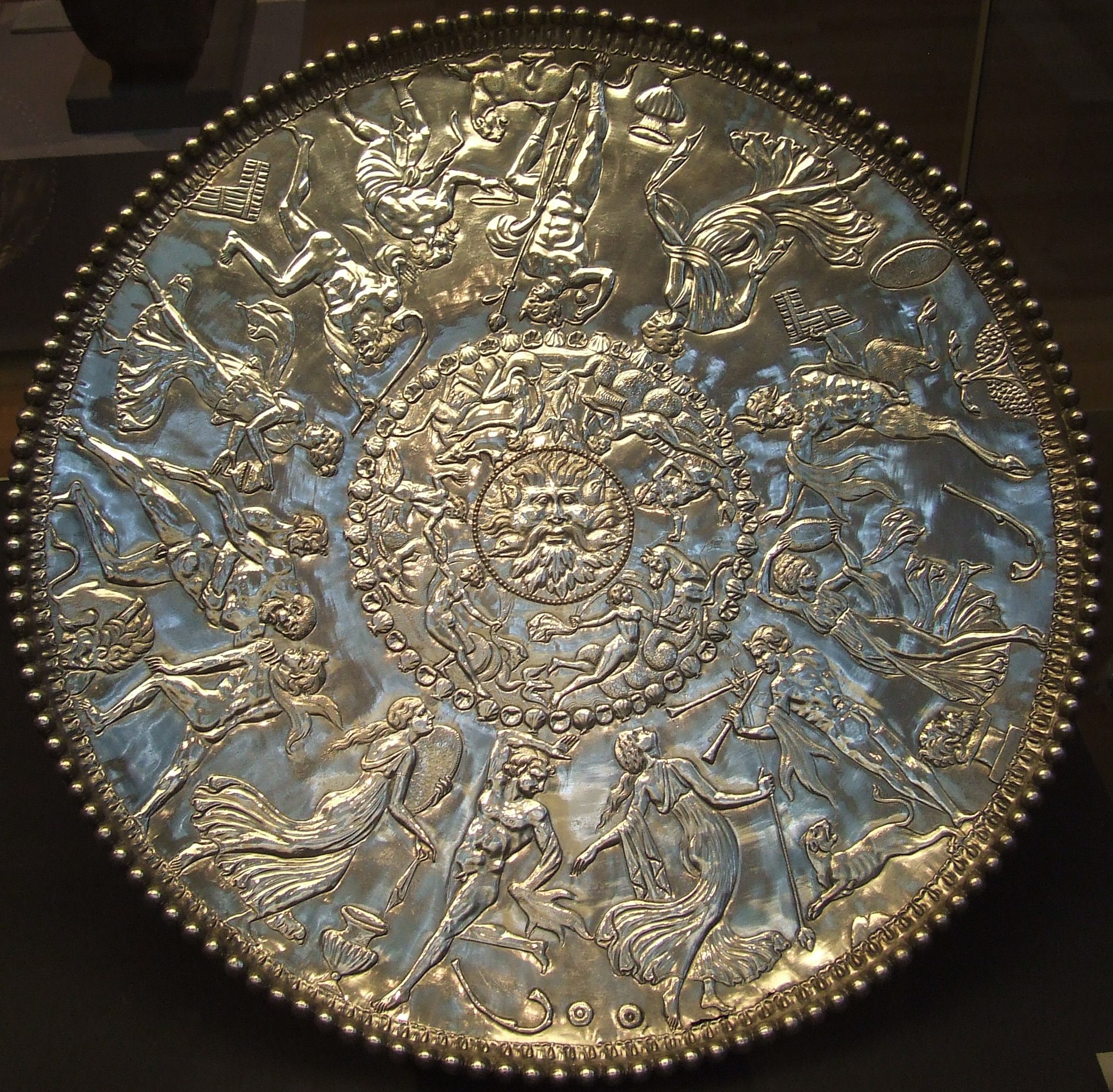
The Warren Cup is a Roman silver cup, and the Mildenhall Treasure, the Hoxne Hoard, the Water Newton Treasure and the Berthouville Treasure are examples of hoards of Roman silver found in England and northern France with many pieces using these techniques. Another example piece using this technique is The Stag’s Head Rhyton, dating to around 400 BCE, which is made from a silver sheet and features three scenes of warriors battling, each scene with two warriors.[2][3][4]
India
[edit]Repoussé and chasing are commonly used in India to create objects such as water vessels. These vessels are generally made using sheets of copper or silver.
Pre-Columbian America
[edit]Repoussage and chasing were used by many Pre-Columbian civilizations in the Americas, such as the Chavín culture of Peru (about 900 to 200 BC), to make ornaments of gold and other metals.
During the Hopewell and Mississippian periods of the American Southeast and Midwest goods of repoussé copper were fashioned as ritual regalia and eventually used in prestige burials.[5] Examples have been found with many S.E.C.C. designs such as Bi-lobed arrow motif headdresses and falcon dancer plaques. Although examples have been found in a widely scattered area (Spiro, Oklahoma, Etowah, Georgia, and Moundville, Alabama), most are in what is known as the Braden Style, thought to have originated at the Cahokia Site in Collinsville, Illinois.[6][7] Several copper workshops discovered during excavations of Mound 34 at Cahokia are the only known Mississippian culture copper workshops.[8][9]
Modern works
[edit]The largest known sculpture created with this technique is the Statue of Liberty, properly Liberté éclairant le monde, ("Liberty Enlightening The World"), in Upper New York Bay. The statue was formed by copper repoussé in sections using wooden structures to shape each piece during the hammering process.
-
 Arts and Crafts repousse shield made by Keswick School of Industrial Art, UK, 1895
 -
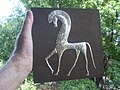 Repoussé on tin sheet – "Greek horse" by Mexican artist Manolo Vega, 2011
 -
 The Statue of Liberty, New York (NY)
 -
 Construction of The Statue of Liberty


Methods
[edit]
The process of chasing and repoussé requires a number of steps.
Annealing
[edit]The metal plate should usually be annealed—that is, heated for some time at a temperature sufficient to reduce its internal stresses—to make it as malleable as possible. This process may have to be repeated several times, as many metals harden and become brittle as they are deformed by the hammering.
Pitch backing
[edit]The plate must then be fixed on a suitable support. A commonly used technique is to place the metal over a layer of chasers pitch. The pitch is heated until it is soft enough to make good contact with the metal, filling all its crevices, and then allowed to cool. At room temperature, the pitch must be hard enough to adhere to the metal and hold it in place, but still soft and plastic enough to "give" as the metal is hammered into it.
The pitch is often cast as a thick layer over some softer backing material that can absorb larger deformations.
The metal plate will have to be released from the pitch several times, for turning it over and/or for re-annealing. Pitch residues stuck to the plate must be removed with an appropriate solvent.
Lining
[edit]Once the plate is firmly held by the pitch, front side up, the outline of the desired design is lightly chased ("lined") on it by a special tool (a "liner"), that creates narrow raised lines on the other side.
Repoussé and chasing
[edit]The metal is turned over, and firmed again over the pitch, with the back side up. The main repoussé work is then performed, using a variety of punches.
Once the main repoussé is done, the piece is again released by heating. The cavities on the back side, created by the repoussé work, are filled with melted pitch. Once that filling has hardened, the plate is again turned over and placed on top of a layer of softened pitch. Once the pitch has hardened, the design is then refined by chasing. These procedures can be repeated several times, alternating between repoussé and chasing.
Hot forming
[edit]Repoussé and chasing can also be done on materials, like steel, that are too hard to be cold-formed by hammering. That is accomplished by heating the piece to a high enough temperature to make it malleable, as in forging. In this case pitch must be dispensed with, or replaced by some material (like sand) that can withstand the heat and provide the right kind of "giving" support.
Tools
[edit]
The tools needed for these techniques are [10]
- A container for the pitch, such as a "pitch tray" for larger plates, or a heavy hemispherical cast iron "pitch bowl" for smaller ones. The bowl can be placed over a sand bag or leather ring, and tilted to whatever angle is most convenient.
- A heat gun or blow torch to soften the pitch in order to fix the plate, or to release it.
- A set of "punches", that is, chisels with smooth tips that are used to push the metal:
- A "liner" has a flattened tip with a slightly curved blunt edge. It is used to chase narrow grooves in the metal, or to repoussé narrow ridges from the back side; both for outlining the work, and to refine edges in the final object.
- A "planisher" has a smooth, flat tip meant for pushing out large, flat areas of metal.
- A "doming" or "dotting" tool has a round or oval tip of small to moderate diameter, and can be used to chase dimples or grooves, or repoussé bumps and ridges, of various widths.
- A "matting" tool has a pattern cut into the tip, and is used (mainly in chasing) to create textured areas.
- A "hollow-faced" punch has a raised contour (circular, or with some other shape) with a hollowed-out middle, and is used to stamp that contour, usually on the front face.
- A lightweight "chasing hammer", to drive the punches.
- An oxyacetylene torch, blowtorch, or a forge for annealing or hot-working.
Other tools are usually handy, such as tweezers or tongs to hold the hot plates.
The punches are usually made of steel, especially tool steel—a hard alloy that can keep its shape even after years of use—and are forged and tempered at the tip. They usually have a beveled rear end, to better handle the hammer blows. They can be purchased and used as such, modified by the user to suit the needs of a specific work, or made by the user from bar stock.[11] To make or reform the punches, one needs a saw or other cutting device, as well as a grinder and abrasives to shape and polish the tip.
Gallery
[edit]Face masks
[edit]-
 Princess. Gold; Chen Kingdom of Liao Dynasty, 1018 CE.
 -
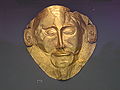 "Mask of Agamemnon". Gold; Mycenae, ca. 1600 BCE.
 -
 Woman or goddess, Gundestrup Cauldron. Silver; Celtic, ca. 100 BCE.
 -
 Man or god, Gundestrup Cauldron. Silver; Celtic, ca. 100 BCE.
 -

-
 Helmet. Gold; Roman.


,_found_on_the_bed_of_the_Corbulo_Canal_(Fossa_Corbulonis)_near_the_Roman_fort_of_Matilo_(modern_Leiden),_Rijksmuseum_van_Oudheden,_Leiden,_Netherlands_(9570875526).jpg)
See also
[edit]- Embossing (manufacturing) – rolling sheet metal through dies to produce a raised or sunk relief design.
- Metal spinning
References
[edit]- ^ "Chalice with Apostles Venerating the Cross". The Walters Art Museum.
- ^ Alberge, Dalya (December 7, 2021). "US billionaire surrenders $70m of stolen art". www.theguardian.com. Retrieved December 7, 2021.
- ^ "152. Rhyton (stag's head) - Classical". www.georgeortiz.com. Retrieved December 7, 2021.
- ^ Mangan, Dan; Forkin, Jim (December 6, 2021). "Hedge-fund pioneer Michael Steinhardt surrenders 180 stolen antiquities valued at $70 million, Manhattan DA Vance says". CNBC. Retrieved December 7, 2021.
- ^ Power, Susan (2004). Early Art of the Southeastern Indians-Feathered Serpents and Winged Beings. University of Georgia Press. ISBN 0-8203-2501-5.
- ^ F. Kent Reilly; James Garber, eds. (2004). Ancient Objects and Sacred Realms. University of Texas Press. ISBN 978-0-292-71347-5.
- ^ Townsend, Richard F. (2004). Hero, Hawk, and Open Hand. Yale University Press. ISBN 0-300-10601-7.
- ^ Pawlaczyk, George (Feb 16, 2010), Copper men: Archaeologists uncover Stone Age copper workshop near Monk's Mound, retrieved 2010-11-08
- ^ Kelly, John E.; Kelly, Lucretia S.; Brown, James (2009). Summary of 2008 Field Excavations to Locate the Copper Workshop in the Mound 34 Area (PDF) (Technical report). Central Mississippi Valley Archaeological Research Institute.
- ^ Oppi Untracht (2011): Jewelry Concepts & Technology. Doubleday; 864 pages. ISBN 9780307784117
- ^ Bowie, Hamish (1977). Jewelry Making. Chicago: Henry Regnery Company. p. 36. ISBN 0-8092-8084-1.
Further reading
[edit]- Coatsworth, Elizabeth & Pinder, Michael (2002). Hines, John & Cubitt, Catherine (eds.). The Art of the Anglo-Saxon Goldsmith: Fine Metalwork in Anglo-Saxon England, its Practice and Practitioners. Anglo-Saxon Studies. Vol. 2. Woodbridge: The Boydell Press. ISBN 0-85115-883-8.
- Corwin, Nancy Megan (2009). Chasing & Repoussé. Brynmorgen Press. ISBN 978-1-929565-32-0.
- Googerty, Thomas Francis (1911). Hand-forging and Wrought-iron Ornamental Work. Popular mechanics Company. p. 134.
- Maryon, Herbert (1971). "Repoussé Work". Metalwork and Enamelling (5th ed.). New York: Dover. ISBN 0-486-22702-2.
External links
[edit]
- . New International Encyclopedia. 1905.
- . Encyclopædia Britannica (11th ed.). 1911.

Repoussé and chasing
View on GrokipediaIntroduction
Definition and Principles
Repoussé is a metalworking technique that involves hammering malleable sheet metal from the reverse side to form raised designs in relief, displacing the metal through controlled force to create three-dimensional shapes without significantly altering the sheet's overall thickness.[6] This process relies on the physics of metal displacement, where the applied force pushes material outward and sideways, stretching it evenly into the desired form.[7] Chasing serves as a complementary refinement method, executed by hammering the front side of the metal to sharpen contours, add intricate details, or compress areas for definition, often building upon the initial repoussé structure.[8] Unlike repoussé, chasing primarily compacts adjacent metal regions to lower them relative to raised elements, enhancing precision through targeted deformation rather than broad elevation.[6] At the core of both techniques lies the ductility of metals, such as gold, silver, and copper, which enables plastic deformation—permanent reshaping under stress without fracture—allowing the material to flow like clay when hammered incrementally.[7] This incremental approach, starting with broader strikes and progressing to finer ones as the metal work-hardens, prevents cracking by distributing stress gradually and maintaining structural integrity.[6] Outcomes vary by emphasis: chasing-dominant work yields low-relief effects with subtle surface modulation, while repoussé-dominant applications produce high-relief sculptural forms with pronounced projections.[7] Together, repoussé and chasing transform flat sheets into intricate, three-dimensional artworks by integrating rearward elevation with frontward detailing, achieving balanced depth and clarity in the final relief.[8] This interplay exploits the metal's compressive and tensile properties to model forms that mimic sculptural volume on a planar surface.[6]Etymology and Terminology
The term repoussé derives from the French repoussé, the past participle of the verb repousser, meaning "to push back" or "to thrust back," reflecting the action of hammering metal from the reverse side to form raised designs on the obverse.[9] This terminology emerged in European metalworking descriptions during the 18th century but was formally adopted into English around 1851, as recorded in technical journals on arts and manufacturing.[10] The companion term chasing originates from the Old French chaser or enchasser, meaning "to engrave" or "to set in," which evolved from medieval practices of decorative incising and outlining on metal surfaces.[11] In metalworking contexts, it specifically denotes the refinement of designs by hammering from the front side using specialized punches, a usage that parallels the "chasing" of forms or lines in the material.[6] Key terminology in repoussé and chasing includes pitch, a viscous resin-based substance that serves as a supportive backing to hold the metal sheet during hammering without distortion.[6] Lining, also known as tracing, refers to the initial outlining of the design's contours, typically executed with a tracer—a chisel-like punch that creates linear grooves.[12] Matting describes the use of texturing punches to add granular or patterned surface details, enhancing the overall relief.[6] These terms distinguish repoussé, which emphasizes hand-hammered raising of forms, from embossing, a similar relief technique often achieved through mechanical stamping or die-pressing rather than manual chasing tools.[6] The adoption of repoussé and chasing into English-speaking metalworking practices solidified during the 19th century, disseminated through instructional art manuals and craft treatises that popularized these French-derived methods among artisans and hobbyists.Historical Development
Prehistoric and Bronze Age Origins
By the Early Bronze Age, around 3000 BCE, repoussé techniques advanced in the Near East with Sumerian goldsmiths employing hammered sheet metal for elite artifacts, exemplified by the ceremonial helmet of Meskalamdug from the Royal Cemetery at Ur (c. 2600–2350 BCE), where a single sheet of 18-carat gold was raised from the reverse to form curled hair and facial features, refined by front-side engraving for sharp contours.[13] This helmet, intended for ritual rather than combat use, demonstrates the integration of repoussé for volumetric shaping and chasing for linear detailing, applied to symbolize authority in burial contexts.[14] In contemporaneous Minoan Crete (c. 3000–2000 BCE), repoussé appeared on gold sheets and beads for jewelry and vessels, as seen in Early Minoan pendants where thin gold foil was hammered over molds to produce floral motifs, then chased to define petal edges and add granulation attachments.[15] Chased bronze shields and ritual items from sites like Knossos further show low-relief animal figures incised from the front on pre-hammered sheets, evidencing the technique's adaptation for defensive and ceremonial bronze objects in Aegean Bronze Age society.[16] Bronze Age advancements peaked in Mycenaean Greece (c. 1600–1100 BCE), where chasing refined intricate patterns on armor, shields, and jewelry, often featuring spirals and animals as seen in gold signet rings and diadems from Grave Circle A at Mycenae, where front hammering detailed coiled motifs and beast figures post-repoussé forming.[17] These techniques, applied to bronze hilt plates and gold overlays, created narrative scenes of hunting and myth, underscoring the cultural emphasis on heroic iconography in funerary and warrior contexts.[1]Ancient Civilizations
In ancient Egypt, spanning from approximately 3000 to 30 BCE, repoussé techniques were employed to create intricate gold pectorals that formed part of pharaonic regalia, often featuring raised motifs of deities and protective symbols suspended on chains for ceremonial wear.[18] Chased silver inlays complemented these, detailing edges and surfaces with fine engravings on items like jewelry and ritual vessels recovered from royal tombs.[19] Exemplifying this craftsmanship, artifacts from Tutankhamun's tomb (c. 1323 BCE) include gold pectorals worked in repoussé with chased details, highlighting the integration of hammering from the reverse to form low-relief scenes of the king and gods, often inlaid with semiprecious stones for enhanced symbolism.[20] In Mesopotamia and Persia, metalworking advanced to produce narrative and decorative pieces using similar methods. The bronze gates of Balawat, commissioned by Assyrian king Shalmaneser III around 850 BCE, incorporated repoussé bronze bands depicting military campaigns, tributes, and conquests in sequential friezes, with designs first engraved and then hammered into relief over a bitumen bed for structural support.[21] These gates, sheathing cedar doors on temples and palaces, served as monumental propaganda, their chased accents refining the hammered forms to emphasize figures and inscriptions.[22] In Achaemenid Persia (c. 550–330 BCE), repoussé adorned gold bowls from the Oxus Treasure, such as shallow vessels hammered from sheet gold with embossed inner zones of lions and floral lobes, demonstrating adaptations for luxury tableware that echoed earlier Mesopotamian influences while incorporating Persian symmetrical motifs.[23] Classical antiquity saw repoussé and chasing refined for both utilitarian and symbolic silverware in Greece, with phialai (libation bowls) from around 500 BCE featuring raised figural friezes of mythological scenes, achieved by hammering thin silver sheets over pitch and detailing with chasing tools for depth and texture.[24] These vessels, often gilded for elite use in rituals, built on Bronze Age hammering traditions but emphasized naturalistic forms and narrative clarity. In Rome, chasing techniques detailed imperial portraits on armor, such as embossed cuirasses portraying emperors in profile or heroic poses, where fine punches created symmetrical facial features and drapery folds on bronze or silver plates fitted to leather backing, symbolizing authority in military contexts from the 1st century BCE onward.[25] Across these civilizations, repoussé and chasing held profound cultural roles, particularly in religious and funerary contexts, where they transformed base metals into divine emblems of power and eternity. Excavations from the Royal Tombs of Ur (c. 2600–2400 BCE) reveal gold headdresses and vessels with repoussé animal motifs and chased inlays, intended to equip elites for the afterlife and reflect societal hierarchies through opulent grave goods.[26] Such practices, evolving from prehistoric hammered ornaments, underscored the techniques' adaptability in conveying spiritual protection and royal prestige in temple dedications and burial rites.[27]Medieval and Renaissance Periods
In medieval Europe, particularly during the high and late periods (c. 1000–1500 CE), repoussé and chasing techniques flourished in the production of ecclesiastical metalwork, particularly for reliquaries and altar pieces that embodied the ornate Gothic style with its emphasis on verticality, intricate detailing, and symbolic depth, following a period of lesser use in the early Middle Ages (c. 500–1000 CE). Repoussé was employed to raise relief designs from the reverse side of thin gold or silver sheets, creating three-dimensional figures of saints and biblical scenes, while chasing refined these forms from the front with punches to add fine lines, textures, and shading. This combination allowed artisans to produce objects that not only housed sacred relics but also served as focal points for worship, blending functionality with aesthetic splendor. A prominent example of 12th-century German goldwork utilizing these methods is evident in the treasury of Aachen Cathedral, where chased silver reliquaries and repoussé elements in liturgical items reflect the era's high level of craftsmanship in northern European workshops.[28][29] Byzantine influences significantly shaped European repoussé and chasing practices from c. 800–1400 CE, introducing sophisticated applications in chased icons and repoussé book covers adorned with religious iconography. These techniques were used to depict Christ, the Virgin Mary, and apostles in hammered silver or copper sheets, often mercury-gilt for a luminous effect, emphasizing hierarchical compositions and symbolic gestures central to Orthodox theology. Byzantine artisans hammered designs from the back for bold reliefs and chased from the front for delicate facial expressions and drapery folds, influencing western European metalworkers through trade and pilgrimage routes. Surviving examples, such as repoussé silver book covers worked back and front with elaborate chasing, demonstrate how these methods enhanced the spiritual aura of liturgical texts and icons.[30] The Renaissance (c. 1400–1600 CE) marked a period of innovation in repoussé and chasing, with Italian masters like Benvenuto Cellini elevating the techniques for both secular and ceremonial objects, including portrait medals and armor decorations that prioritized realism and anatomical precision. Cellini, working in Florence and Rome, combined repoussé to form dynamic figures from gold or silver sheets with intricate chasing to articulate muscles, expressions, and narrative details, as seen in his gold repoussé medal of Hercules and the Nemean Lion (c. 1537), where the hero's straining form exemplifies the era's interest in classical mythology and human form. Similarly, his chased decorations on ceremonial armor, such as the morion helmet and shield for Cosimo I de' Medici (c. 1540s), featured repoussé scenes of gods and battles refined with fine chasing for lifelike depth. These advancements reflected a shift toward individualized patronage and humanistic themes, distinct from medieval religious focus.[31][32] Technical developments during the Renaissance included the more widespread adoption of pitch backing— a mixture of resins and fillers—to support metal sheets during repoussé forming, enabling the creation of complex curves and deeper reliefs without distortion. Florentine workshops, centers of goldsmithing excellence, routinely embedded sheets in softened pitch bowls for stability while hammering from the reverse, allowing for ambitious designs in vases, ewers, and decorative panels that survive in collections today. This method, refined from earlier practices, facilitated the production of larger, more sculptural pieces and underscored the period's emphasis on technical mastery and innovation in metalwork.[33][34]Global Traditions
Repoussé and chasing techniques have been integral to Indian metalworking traditions since around 1000 BCE, particularly in the crafting of temple bells from bronze alloys, where hammering from the reverse side creates raised motifs of deities and symbolic patterns essential for ritual sound and visual devotion.[35] During the Mughal era (16th–19th centuries CE), chased silverware flourished, featuring intricate floral and figural motifs such as lotuses, peacocks, and human figures, often refined through chasing to embed fine details before polishing or inlay, drawing from Bidriware methods originating in the Deccan region where zinc-copper alloys were engraved and damascened for decorative ware.[36] These objects served as status symbols among nobility and in temple ceremonies, embodying spiritual and social prestige through their labor-intensive craftsmanship.[37] In East Asia, chased bronze vessels from China's Warring States period (c. 475–221 BCE) exemplify early mastery, with artisans hammering and chasing intricate patterns of dragons, clouds, and geometric motifs onto high-tin bronze surfaces to evoke cosmological themes in ritual banquets and ancestral worship.[38] Japanese repoussé work reached notable heights in the Edo period (1603–1868 CE), particularly through the Myōchin school, where iron plates for samurai armor were hammered into raised forms depicting fierce faces, dragons, and floral elements, chased for sharp detailing to symbolize warrior prowess and clan heritage in ceremonial displays.[39] These pieces, often gilded or lacquered, underscored the wearer's elite status in feudal society and ritual contexts.[40] Pre-Columbian American cultures adapted repoussé and chasing to local alloys, as seen in the Moche civilization of Peru (c. 100–700 CE), where gold or gilded copper sheets were hammered into life-size masks with raised facial features, ear spools, and symbolic eyes inlaid with shell, used in elite burials to represent divine rulers and facilitate afterlife transitions.[41] In North America, Mississippian peoples (c. 800–1600 CE) produced chased copper plaques, such as those from Cahokia and Spiro sites, by annealing and repoussé-forming native copper into avian motifs like the Birdman figure, combining human and raptor elements to denote chiefly authority in rituals tied to warfare and cosmology.[42] Unique regional alloys like tumbaga—a gold-copper mix—enabled depletion gilding for a golden sheen in these works, amplifying their role as potent status symbols in funerary and ceremonial practices across the Americas. In Southern Africa, repoussé techniques were employed during the Iron Age at the site of Mapungubwe (c. 1050–1270 CE), where thin gold foil was hammered into raised forms to create decorative artifacts such as the iconic golden rhinoceros figurine—shaped over a wire armature—and intricately pleated bowls with embossed motifs, serving as symbols of elite status and royal authority in this early complex society.[5]Modern and Contemporary Practices
In the 19th century, the Industrial Revolution influenced repoussé and chasing techniques in jewelry production, particularly during the Victorian era, where mechanized processes like stamping and rolling mills facilitated the creation of intricate chased designs on silver and gold pieces, enabling mass production while retaining hand-finished details.[43] Tiffany & Co., under Louis Comfort Tiffany, incorporated repoussé in Art Nouveau-style metalwork, such as floral motifs on bronze lamp bases and silver objects from circa 1890 to 1910, blending organic forms with hammered relief for decorative lighting fixtures.[44] During the 20th century, artists adapted these methods for sculptural innovation; Alexander Calder employed chasing and repoussé-like hammering on sheet metal for his jewelry and early mobiles in the 1930s, creating undulating silver and brass forms that emphasized movement and abstraction.[45] Contemporary silversmiths, such as Miriam Hanid, have since integrated hybrid techniques combining traditional repoussé with modern raising and piercing to produce sculptural silverware, like her "Birds in Flight" series, which features dynamic relief patterns.[46][47] In current practices, repoussé and chasing enjoy a revival in custom jewelry, where artisans like those at Wyld Jewelry use the techniques to craft personalized silver pieces with three-dimensional motifs, and in architectural panels, such as copper repoussé installations for doors and walls that draw on historical relief for contemporary interiors.[48][49] Post-2000, digital design tools like CAD software have integrated with these methods for prototyping, allowing jewelers to model relief patterns virtually before hand-hammering, as seen in CAD-assisted fabrication workflows that enhance precision in complex chasing.[50][51] Amid industrialization's environmental impacts, modern practitioners face challenges in sourcing sustainable metals, shifting toward recycled silver and ethically mined gold to reduce ecological footprints; guilds like the Goldsmiths' Company promote these adaptations through initiatives supporting responsible precious metal use in repoussé and chasing, including funding for alloy research and fairtrade certifications.[52][53]Techniques and Processes
Material Preparation
The preparation of materials is a foundational step in repoussé and chasing, ensuring the metal sheet is suitable for deformation without cracking or excessive resistance. Metals are selected based on their malleability and ductility, with soft, pure forms preferred to allow for intricate forming. Common choices include copper, fine silver (99.9%), and gold (various karats), typically in thicknesses ranging from 0.5 to 2 mm, as thinner sheets (e.g., 20-22 gauge or 0.8-0.6 mm) suit jewelry and shallow reliefs, while thicker ones (e.g., 18 gauge or 1 mm) support vessels or deeper designs. These metals resist tearing during hammering due to their low work-hardening rates compared to alloys like brass or steel, which may require more frequent annealing.[54][55][56] Annealing restores the metal's ductility by relieving internal stresses from prior working, preventing brittleness and cracks. The process involves heating the sheet evenly with a torch or kiln to specific temperatures—approximately 700–1200°F (371–649°C) for copper until dark red, 440–800°F (204–426°C) for fine silver to low cherry red, and 392–1300°F (200–704°C) depending on karat for gold—followed by controlled cooling. Quenching in water is common for copper and some golds immediately after reaching temperature to maximize softness, while silver often air-cools briefly before quenching to avoid oxidation; slow cooling in vermiculite may be used for certain alloys to minimize fire scale. Flux or boric acid coating is applied beforehand to protect against oxidation, especially for silver and gold. Annealing is performed every 1–3 hours of intensive hammering or when the metal begins to resist deformation, as work-hardening occurs progressively with each strike.[56][57][54][58] Once annealed, the sheet is prepared by cutting to size with shears or a jeweler's saw, leaving a 0.5-inch margin beyond the design outline for handling and securing in pitch during forming. Cleaning follows using scotch-brite pads, acetone, or lacquer thinner to remove oils, fingerprints, and residues that could cause uneven hammering or defects like pitting. Initial planishing—light hammering on a flat surface with a planishing hammer or mallet—flattens any irregularities and ensures a smooth starting surface, while avoiding impurities such as sulfur or dirt that might embed and create weak points. This step promotes uniform deformation in subsequent processes.[54][59][60] Safety is paramount during preparation, particularly annealing, which generates heat and potential fumes from flux decomposition. Adequate ventilation, such as a fume hood or exhaust fan, is required to disperse vapors and prevent inhalation of metal oxides or chemicals, reducing risks of respiratory irritation or metal fume fever. Hot metals must be handled with tongs or insulated gloves to avoid burns, and eye protection is essential when using torches to shield against sparks and splashes. These measures ensure a controlled environment before the metal is secured in pitch for forming.[61][62][54][63]Pitch and Support Methods
In repoussé and chasing, pitch provides a resilient yet firm support that secures the metal sheet, absorbing impacts during hammering while minimizing distortion of the emerging design. This backing system is essential for maintaining the sheet's position and shape, particularly for intricate relief work. Prior to application, the metal sheet is typically annealed to increase its malleability.[64] Chaser's pitch is composed of natural resins, such as pine rosin or Burgundy pitch, combined with binders like beeswax or tallow for elasticity, and inert fillers including brick dust, plaster of Paris, or fine powders like flint to enhance hardness and stability. These ingredients are melted together at low temperatures, generally between 121°C and 149°C (250°F to 300°F), to form a homogeneous, viscous mass suitable for use; the exact ratio varies by desired firmness, with softer formulations for deeper forming and harder ones for detailed refinement.[65][64] For application, the molten pitch is poured into a heat-resistant container, such as a wooden stump, leather-lined bowl, or metal pitch pan, where it is allowed to cool to a pliable, putty-like consistency. The prepared metal sheet is then embedded face-up by pressing it firmly into the pitch surface, starting from one edge to exclude air pockets and ensure even adhesion; the edges of the sheet are overlapped by the pitch (about 1-2 cm) for secure hold. Gentle reheating with a heat gun or low flame softens the pitch as needed during adjustments, allowing the work to be rotated or repositioned without compromising the setup.[64][65] Alternatives to pitch include simpler supports like leather cushions or sand-filled bags, which suffice for basic or large-scale forming but offer less precision for fine details, as they can shift under repeated blows and allow greater metal deformation. Pitch excels in these scenarios by providing a semi-rigid matrix that holds contours firmly, preventing unwanted spreading or collapse of raised elements while transmitting just enough give to avoid cracking the metal.[65] Once forming and refinement are complete, pitch removal involves reheating the assembly to 100-120°C to soften the material, followed by careful scraping with a wooden or plastic tool to lift it away from the metal; this process requires caution to shield fragile raised areas from abrasion or heat stress. For resin-based pitches, solvents such as mineral spirits or alcohol can dissolve residues if scraping alone is insufficient, ensuring a clean finish without damaging the artwork.[65][64]Repoussé Forming
Repoussé forming is the foundational technique in metalworking where malleable sheet metal is shaped from the reverse side using controlled hammering to raise designs in relief. The process begins with transferring the design to the back of the annealed metal sheet, often by drawing it directly with permanent ink or tracing a ghost image using a liner tool. The sheet is then secured face-down on a supportive medium to allow precise strikes. From there, artisans employ ball-ended or rounded repoussé punches held against the reverse surface, striking them incrementally with a hammer to push the metal outward and form domed areas. This doming starts at the center of each motif and progresses radially outward in successive layers, gradually stretching the metal to create the desired three-dimensional form.[6] Force application is critical to avoid damaging the metal, beginning with light, controlled taps from a chasing hammer to initiate stretching without tearing. As the form develops, strikes increase in intensity to achieve relief depths typically ranging from 5 to 10 mm, depending on the design's scale and metal thickness. To ensure even deformation and prevent localized thinning, the sheet is frequently rotated during hammering, allowing access to all angles and promoting uniform expansion. The metal is annealed periodically—heated and quenched—to restore malleability as work-hardening occurs from repeated impacts.[6][66][67] Common challenges in repoussé forming include wrinkling, which arises from uneven stretching and can be prevented or corrected by using a lining tool to smooth and realign the metal surface between passes. Achieving symmetry requires multiple iterative passes over the design, with artisans adjusting punch placement to balance protrusions and refine contours progressively. These fixes demand patience, as over-hammering can exacerbate distortions, necessitating careful monitoring throughout the process.[6][68] Design considerations in repoussé forming favor organic forms, such as floral or figurative motifs, which adapt well to the fluid stretching of low-relief patterns up to high-relief sculptures exceeding 10 mm. Geometric designs, like interlocking shapes or architectural elements, also suit the technique but require precise punch control to maintain sharp edges during the incremental doming. The method's versatility stems from its ability to build complex reliefs layer by layer, though intricate details are limited by the metal's ductility and the punch's reach from the reverse side.[6][66]Chasing Refinement
Chasing refinement serves as the secondary phase in repoussé and chasing metalwork, where the front side of the softened metal sheet, supported on pitch, is hammered using specialized tools to enhance and detail the initial raised forms. This process employs liners and tracers to incise precise lines and contours, while matting punches introduce textured patterns for added depth and visual interest.[2] The metal is worked gently to avoid distorting the underlying repoussé structure, ensuring the refinement builds upon the base relief without compromising its integrity.[69] Detail levels in chasing are achieved through controlled hammering that sharpens edges and refines motifs, often incorporating cross-hatching techniques with matting punches to create shading and subtle gradients. Liners, available in straight or curved forms, are dragged across the surface to define outlines and throw excess material aside, allowing for intricate detailing down to fine scales.[2] Depth is managed by adjusting the pitch's temperature—warmer for broader impressions and cooler for precise, shallow refinements—preventing piercing while maintaining structural stability.[2] In applications like gold artifacts, chasing adds punched textures to amplify the dimensionality of figures and scenes.[70] The sequence typically begins with outlining major motifs using tracers or liners to establish clean boundaries, followed by filling interiors with matting or forming punches to build texture and volume. Subsequent passes refine these elements, progressing from coarse to fine tools for progressive detail enhancement.[2] Integration with final polishing occurs last, smoothing high points and highlighting chased patterns to achieve a cohesive, lustrous finish.[2] Artistically, chasing refinement elevates the work's dimensionality by leveraging shadow play within incised lines and textured surfaces, creating illusions of greater depth and movement in the relief. This technique, evident in Renaissance armour where front-side punches crisp intricate designs, transforms flat metal into dynamic, light-responsive forms.[69] In Sasanian gold plates, chased patterns contribute to a sparkling, multifaceted aesthetic through combined punching and texturing.[70]Alternative Forming Approaches
Hot forming represents a variation on traditional repoussé and chasing processes, where the metal sheet is heated to approximately 400–600°C to increase malleability and enable deeper relief formation in thicker materials that would otherwise resist cold working. This approach is particularly suited for applications requiring substantial depth, such as shaping brass for armor elements, where the elevated temperature facilitates hammering over stakes or supports without excessive work hardening. However, hot forming introduces risks like surface oxidation, necessitating controlled atmospheres or immediate post-process cleaning to preserve finish quality, and it is more commonly employed in industrial settings for scale rather than artisanal fine work due to the need for heating equipment.[6] Hybrid methods integrate repoussé and chasing with complementary techniques to achieve complex mixed-media effects, such as combining hammered relief with casting to form base structures followed by surface detailing, or incorporating engraving for enhanced line work on raised areas. In modern contexts, laser-assisted pre-forming uses focused laser beams to locally heat and bend metal sheets, creating initial contours that are then refined via traditional repoussé hammering; this non-contact method reduces tooling costs and enables precise prototyping for intricate designs like curved jewelry components. These hybrids offer flexibility for larger or more detailed pieces but may require specialized equipment, limiting their use to workshops with advanced capabilities.[6][71] A notable 20th-century application of repoussé principles appears in paintless dent repair (PDR) for automotive panels, where technicians hammer from the reverse side to restore sheet metal contours without refinishing, adapting the technique for efficient industrial repair of vehicle bodies damaged by impacts. This method leverages the same pushing mechanics as repoussé but emphasizes speed and minimal alteration, highlighting its evolution into practical, large-scale forming. Compared to standard cold processes, these alternatives expand possibilities for scale and material versatility while introducing trade-offs in precision and material integrity.Tools and Materials
Specialized Tools
Specialized tools for repoussé and chasing are hand-forged implements designed for precision striking and shaping, typically made from high-carbon tool steel to withstand repeated impacts while allowing customization for specific design needs.[6][72] Hammers form the core of these tools, with varieties tailored to distinct functions: raising hammers feature a round or bowl-shaped face for creating domed elevations, while chasing hammers have a flat or slightly domed face for detailed surface work. Weights generally range from 200g to 1kg, balancing lightness for prolonged use with sufficient mass for effective force transmission; handles, often pistol-shaped and made from springy wood like hickory, enhance control through a whiplash effect.[6][72] Punches are elongated steel rods, typically 10-15 cm long with hardened and tempered tips, featuring beveled tops to concentrate hammer strikes. Ball-headed punches, with rounded ends, facilitate smooth modeling in repoussé; tracers or liners produce sharp lines and outlines; matting tools, with textured tips like diamond or round patterns, create decorative surfaces; tips may be steel or carbide for enhanced durability on harder metals.[6][73][72] Supports provide stable backing to accommodate curved forms during work: pitch bowls are cast iron vessels, often 5-8 inches in diameter, filled with a mixture like red German pitch for secure metal holding; stumps, such as hardwood tree sections placed on padded floors, offer resilient cushioning; anvils or stakes with contoured surfaces allow for targeted flattening and shaping on varied curvatures.[6][73][72][74] Maintenance ensures tool longevity and precision, involving regular sharpening of punch tips on sandpaper or polishing stones to maintain clean edges, and custom forging—often hot-forged for broader blades or shapes adapted to unique project requirements. These tools are integral to the forming processes in repoussé and chasing, enabling controlled metal manipulation.[6][72]Common Materials and Their Properties
Repoussé and chasing primarily utilize malleable non-ferrous metals that can withstand repeated hammering without fracturing, with silver, gold, and copper serving as the foundational materials due to their inherent ductility and formability. Silver exhibits exceptional ductility, allowing it to be shaped into intricate reliefs, but it readily tarnishes when exposed to sulfur-containing compounds in the air, forming a black silver sulfide layer that requires periodic polishing.[75][76] Gold, prized for its supreme malleability—capable of being hammered into gold leaf approximately 0.1 micrometers thick (about 0.000004 inches)—remains untarnished and corrosion-resistant, though its high cost limits use to high-value pieces.[77][6] Copper, an economical option, offers high ductility and malleability similar to silver, enabling deep forming, but it oxidizes to form a green patina over time, which can enhance aesthetic appeal or necessitate protective coatings.[6] Alloys enhance these base metals' performance by balancing strength and workability, with brass—a copper-zinc alloy—providing greater rigidity to prevent distortion during chasing while maintaining sufficient ductility.[60] Gilding metal, a low-zinc red brass (typically 95% copper and 5% zinc), is particularly suited for jewelry applications in repoussé due to its golden hue and ease of cold-working.[60][78] Common mechanical properties for these alloys include yield strengths ranging from 100 to 345 MPa and elongation at break of 25% to 55%, which allow for substantial deformation before failure.[79][80] Sheet thickness plays a critical role in workability, with 18 to 24 gauge (approximately 1.2 to 0.5 mm) preferred for fine repoussé and chasing to balance detail resolution and structural integrity without excessive thinning.[55][81] Impurities such as inclusions or inconsistent alloy composition can induce cracking under the stresses of hammering by creating stress concentrations that propagate fractures.[82][83] To add visual contrast in chased designs, non-metal inlays like niello—a black sulfur-based compound of silver, copper, and lead—are incorporated into engraved areas, filling recesses for a striking inlaid effect.[84][85] Annealing periodically restores these metals' ductility by relieving internal stresses from prior working.[48]| Material | Key Properties | Yield Strength (MPa) | Elongation (%) | Notable Behaviors |
|---|---|---|---|---|
| Silver (fine) | High ductility, malleable | 50–100 | 40–50 | Tarnishes readily |
| Gold (high karat) | Extreme malleability | 20–80 | 40–60 | Does not tarnish; expensive |
| Copper (pure) | Good ductility, affordable | 50–70 (annealed) | 45–50 | Oxidizes to patina |
| Brass (Cu-Zn) | Added strength, workable | 100–345 | 25–55 | Corrosion-resistant |
| Gilding Metal (95Cu-5Zn) | Golden color, formable | 103–317 | 15–50 | Suitable for jewelry |