


Community hub
Recent from talks
Contribute something
Nothing was collected or created yet.
Schenectady, New York
View on Wikipedia | This article needs additional citations for verification. (February 2023) |
Schenectady (/skəˈnɛktədi/ skə-NEKT-ə-dee)[2][3] is a city in Schenectady County, New York, United States, of which it is the county seat. As of the 2020 census, the city's population of 67,047 made it the state's ninth-most populous city and the 25th-most populous municipality.[4] The city is in eastern New York, near the confluence of the Mohawk and Hudson Rivers. It is in the same metropolitan area as the state capital, Albany, which is about 15 miles (24 km) southeast.[5]
Key Information


Schenectady was founded on the south side of the Mohawk River by Dutch colonists in the 17th century, many of whom came from the Albany area. The name "Schenectady" is derived from the Mohawk word skahnéhtati, meaning "beyond the pines" and used for the area around Albany, New York.[6] Residents of the new village developed farms on strip plots along the river.
Union College, the first nondenominational institution of higher education in the United States, and the second college established in the New York, was chartered in 1795.[7]
Connected to the west by the Mohawk River and Erie Canal, Schenectady developed rapidly in the 19th century as part of the Mohawk Valley trade, manufacturing, and transportation corridor. By 1824, more people worked in manufacturing than agriculture or trade; like many New York cities, it had a cotton mill that processed cotton from the Deep South. In the 19th century, nationally influential companies and industries developed in Schenectady, including General Electric (GE) and American Locomotive Company, which were powers into the mid-20th century. Schenectady was part of emerging technologies, with GE collaborating in the production of nuclear-powered submarines and, in the 21st century, working on other forms of renewable energy.
History
[edit]When first encountered by Europeans, the Mohawk Valley was the territory of the Mohawk nation, one of the Five Nations of the Iroquois Confederacy, or Haudenosaunee. They had occupied territory in the region since at least 1100 AD. Starting in the early 1600s, the Mohawks moved their settlements closer to the river, and by 1629, they had also taken over territories on the Hudson River's west bank that were formerly held by the Algonquian-speaking Mahican people.[8]

In the 1640s, the Mohawk had three major villages, all on the Mohawk River's south side. The easternmost one was Ossernenon, about 9 miles west of present-day Auriesville, New York. When Dutch settlers developed Fort Orange (present-day Albany, New York) in the Hudson Valley beginning in 1614, the Mohawk called their settlement skahnéhtati, also transiliterated to Sche-negh-ta-da, meaning "beyond the pines", referring to a large area of pine barrens between the Mohawk settlements and the Hudson River. About 3,200 acres of this unique ecosystem are now protected as the Albany Pine Bush.[9][10] Eventually, the word entered the lexicon of the Dutch settlers. The settlers in Fort Orange used skahnéhtati to refer to the new village at the Mohawk flats (see below), which became known as Schenectady (with a variety of spellings).[11][12]
In 1661, Arendt van Corlaer (later Van Curler), a Dutch immigrant, bought a large piece of land on the Mohawk River's south side. The colonial government gave other colonists grants of land in this portion of the flat, fertile river valley, as part of New Netherland.[citation needed] The settlers recognized the Mohawk had cultivated these bottomlands for maize for centuries.[13] Van Curler took the largest piece of land; the remainder was divided into 50-acre plots for the other first 14 proprietors, Alexander Lindsey Glen, Philip Hendrickse Brouwer, Simon Volkertse Veeder, Pieter Adrianne Van Wogglelum, Teunize Cornelise Swart, Bastia De Winter atty for Catalyn De Vos, Gerrit Bancker, William Teller, Pieter Jacobse Borsboom, Pieter Danielle Van Olinda, Jan Barentse Wemp(le), Jacques Cornelize Van Slyck, Marten Cornelize Van Esselstyn, and Harmen Albertse Vedder. As most early colonists were from the Fort Orange area, they may have anticipated working as fur traders, but the Beverwijck (later Albany) traders kept a monopoly of legal control. The settlers here turned to farming. Their 50-acre lots were unique for the colony and were "laid out in strips along the Mohawk River," with the narrow edges fronting the river, as in French colonial style.[14] They relied on rearing livestock and wheat.[14] The proprietors and their descendants controlled all the land of the town for generations,[13][14] essentially acting as government until after the Revolutionary War, when representative government was established.
Beginning from the first decades of European colonization, Dutch colonists formed relationships with Mohawk women, though they did not usually result in marriage. Their children were raised within Mohawk communities, as the tribe had a matrilineal kinship system, and these multiracial offspring were considered to be born into the mother's clan. During the colonial era, the fur trade formed one of the important trading relationships between Indigenous groups and colonists. In response to labor shortages among Dutch colonists, enslaved Africans were imported to work on farmsteads in Schenectady.[15]
Some Euro-Indian descendants, such as Jacques Cornelissen Van Slyck and his sister Hilletie van Olinda, who were of Dutch, French, and Mohawk ancestry, became interpreters and intermarried with Dutch colonists. They also gained land in the Schenectady settlement.[16] They were among the few métis who seemed to move from Mohawk to Dutch society, as they were described as "former Indians", although they did not always have an easy time of it.[17] In 1661, Jacques inherited what became known as Van Slyck's Island from his brother Marten, who had been given it by the Mohawk. Van Slyck family descendants retained ownership through the 19th century.[18]
In 1664, an English fleet conquered the colony of New Netherland and renamed it New York. They confirmed the monopoly on the fur trade by Albany, and issued orders to prohibit Schenectady from the trade through 1670 and later.[19] Settlers purchased additional land from the Mohawk in 1670 and 1672. (Jacques and Hilletie Van Slyck each received portions of land in the Mohawk 1672 deed for Schenectady.)[20] Twenty years later (1684) Governor Thomas Dongan granted letters patent for Schenectady to five additional trustees.[21]
On February 8, 1690, during King William's War, French forces and their Indian allies, mostly Ojibwe and Algonquin warriors, attacked Schenectady by surprise, leaving 62 dead, 11 of them enslaved Africans.[22] American history notes it as the Schenectady massacre. In total, 27 persons were taken captive, including five enslaved Africans; the raiders took their captives overland about 200 miles to Montreal and its associated Mohawk mission village of Kahnawake.[22] Typically, the younger captives were adopted by Mohawk families to replace people who had died.[23] Through the early 18th century in the raiding between Quebec and the northern British colonies, some captives were ransomed by their communities. Colonial governments got involved only for high-ranking officers or other officials.[23] In 1748, during King George's War, the French and Indigenous attacked Schenectady again, killing 70 residents.
In 1765, Schenectady was incorporated as a borough. During the American Revolutionary War, the local militia unit, the 2nd Albany County Militia Regiment, fought in the Battle of Saratoga and against Loyalist troops. Most of the wars in the Mohawk Valley were fought further west on the frontier in the areas of the German Palatine settlement, which was west of Little Falls. Because of their close business and other relationships with the British, some settlers from the city were Loyalists and moved to Canada in the late stages of the revolution. The British crown granted them land in what became known as Upper Canada and later Ontario.
After the revolution
[edit]After the Revolutionary War, the village residents reduced the power of the descendants of the early trustees and gained representative government. Long interested in supporting higher education and morals, the members of the city's three oldest churches—the Dutch First Reformed Church, St. Georges Episcopal Church, and First Presbyterian Church—formed a "union" and founded Union College in 1795 under a charter from the state. The school had started in 1785 as Schenectady Academy. This founding was part of the expansion of higher education in upstate New York in the postwar years.
Schenectady was chartered as a city in 1798. In 1819, Schenectady suffered a fire that destroyed more than 170 buildings and most of its historic, distinctively Dutch-style architecture.[24] The Erie Canal was dug along the Mohawk River in the 1820s. During this period, migrants poured into upstate and western New York from New England, but new immigrants also arrived from England and Europe. Many traveled west along the Mohawk, settling in the western part of the state, where they developed more agriculture on former Iroquois lands. A dairy industry developed in the central part of the state. New settlers were predominantly of English and Scotch-Irish descent.
New York had passed a law for gradual abolition of slavery in 1799,[25] but in 1824, 102 enslaved individuals were still in Schenectady County, with nearly half residing in the city. That year, the city of Schenectady had a total population of 3939, which included 240 free Blacks, 47 enslaved, and 91 foreigners.[26]
In the 19th century, after completion of the Erie Canal in 1825, Schenectady became an important transportation, manufacturing, and trade center. By 1824, more of its population worked in manufacturing than agriculture or trade.[26] Among the industries was a cotton mill,[26] which processed cotton from the Deep South. It was one of many such mills in upstate New York whose products were part of the exports shipped out of New York City. The city and state had many economic ties to the South at the same time that some residents became active in the abolitionist movement.
Schenectady benefited by increased traffic connecting the Hudson River to the Mohawk Valley and the Great Lakes to the west and New York City to the south. The Albany and Schenectady Turnpike (now State Street) was constructed in 1797 to connect Albany to settlements in the Mohawk Valley. The Mohawk and Hudson Railroad started operations in 1831 as one of the first railway lines in the United States, connecting the city and Albany by a route through the pine barrens between them. Developers in Schenectady quickly founded the Utica and Schenectady Railroad, chartered in 1833; Schenectady and Susquehanna Railroad, chartered May 5, 1836; and Schenectady and Troy Railroad, chartered in 1836, making Schenectady "the rail hub of America at the time" and competing with the Erie Canal.[27] Commodities from the Great Lakes areas and commercial products were shipped to the East and New York City through the Mohawk Valley and Schenectady.
The last enslaved individuals in Schenectady gained freedom in 1827, under the state's gradual abolition law. The law first gave freedom to children born to enslaved mothers, but they were indentured to the mother's master for a period into their early 20s. Union College established a school for Black children in 1805, but discontinued it two years later. Methodists helped educate the children for a time, but public schools did not accept them.[28]
In the 1830s, the abolitionist movement grew in Schenectady. In 1836, Rev. Isaac Groot Duryee (also recorded as Duryea) co-founded the interracial Anti-Slavery Society at Union College and the Anti-Slavery Society of Schenectady in 1837. Freedom seekers were supported via the Underground Railroad route that ran through the area, passing to the west and north to Canada, which had abolished slavery.[29]
In 1837, Duryee, together with others who were free people of color, co-founded the First Free Church of Schenectady (now the Duryee Memorial AME Zion Church). He also started a school for students of color. Abolitionist Theodore S. Wright, an African-American minister based in New York City, spoke at the church's dedication and praised the school.[28][30]
Through the late 19th century, new industries were established in the Mohawk Valley and powered by the river. Industrial jobs attracted many new immigrants, first from Ireland, and later in the century from Italy and Poland. In 1887, Thomas Edison moved his Edison Machine Works to Schenectady. In 1892, Schenectady became the headquarters of General Electric. This business became a major industrial and economic force and helped establish the city and region as a national manufacturing center.[citation needed] GE became important nationally as a creative company, expanding into many different fields. American Locomotive Company also developed here, from a Schenectady company, and merging several smaller companies in 1901; it was second in the United States in the manufacture of steam locomotives before developing diesel technology.
20th century to present
[edit]Like other industrial cities in the Mohawk Valley, in the early 20th century, Schenectady attracted many new immigrants from eastern and southern Europe, as they could fill many of the new industrial jobs. It also attracted African Americans as part of the Great Migration out of the rural South to northern cities for work.[31] General Electric and American Locomotive Company (ALCO) were industrial powerhouses, influencing innovation in a variety of fields across the country.
Schenectady is home to WGY, the second commercial radio station in the United States, (after WBZ in Springfield, Massachusetts, named for Westinghouse). WGY was named for its owner, General Electric (the G), and the city of Schenectady (the Y).[32] In 1928, General Electric produced the first regular television broadcasts in the United States, when the experimental station W2XB began regular broadcasts on Thursday and Friday afternoons. This television station is now WRGB; for many years, it was the Capital District's NBC affiliate. It has been the area's CBS affiliate since 1981.
The city reached its peak of population in 1930, around 95,000. The Great Depression caused a loss of jobs and population in its wake. In the period after World War II, some residents moved to newer housing in suburban locations outside the city. In addition, GE established some high-tech facilities in the neighboring town of Niskayuna, which contributed to continuing population growth in the county. In the latter part of the 20th century, Schenectady suffered from the massive industrial and corporate restructuring that affected much of the US, including in the railroads. It lost many jobs and population to other locations, including offshore. Since the late 20th century, it has been shaping a new economy, based in part on renewable energy. Its population increased from 2000 to 2010, from over 61,000 to over 66,000 - albeit still some 15,000 below its 1960 level.[33]
Geography
[edit]According to the United States Census Bureau, the city has a total area of 11.0 square miles (28.49 km2), of which 0.1 sq mi (0.26 km2) (1.27%) is covered by water.
It is part of the Capital District, the metropolitan area surrounding Albany], the New York's state capital. Along with Albany and Troy, it is one of the three principal population and industrial centers in the region.
Interstate 890 runs through Schenectady, and the New York State Thruway (Interstate 90) is nearby. Amtrak has a station in Schenectady. The nearest airport is Schenectady County Airport; the nearest commercial airport is Albany International Airport.
ZIP code 12345, which is used by the GE plant in Schenectady, has attracted media attention on account of its simplicity.[34] Thousands of letters and Christmas lists addressed to Santa Claus are mailed to the ZIP code every year.[35]
Schenectady has a humid continental climate that is hot-summer (Dfa) bordering upon warm-summer (Dfb.) Average monthly temperatures range from 22.9 °F (−5.1 °C) in January to 71.8 °F (22.1 °C) in July.[36] These are estimates made by local amateur observers and are not official, as Schenectady does not have a weather station of its own (its "official" temperatures come from nearby Albany).
Places adjacent to Schenectady, New York | ||||||||||||||||
|---|---|---|---|---|---|---|---|---|---|---|---|---|---|---|---|---|
| ||||||||||||||||


Economy
[edit]
Schenectady was a manufacturing center known as "the City that Lights and Hauls the World"—a reference to two prominent businesses in the city, the Edison Electric Company (now known as General Electric), and the American Locomotive Company (ALCO).
GE retains its steam-turbine manufacturing facilities in Schenectady and its global research facility in nearby Niskayuna. Thousands of manufacturing jobs have been relocated from Schenectady to the Sun Belt and abroad. Corporate headquarters for GE Vernova are now in Cambridge, Massachusetts.[37]
ALCO produced steam locomotives for railroads for years. Later, it became renowned for its "Superpower" line of high-pressure locomotives, such as those for the Union Pacific Railroad in the 1930s and 1940s. During World War II, it converted to support the war, making tanks for the US Army. As diesel locomotives began to be manufactured, ALCO joined with GE to develop diesel locomotives to compete with GM's EMD division, but corporate restructuring to cope with the changing locomotive procurement environment led to ALCO's slow downward spiral. Its operations fizzled as it went through acquisitions and restructuring in the late 1960s. Its Schenectady plant closed in 1969.
In the late 20th century, due to industrial restructuring, the city lost many jobs and suffered difficult financial times, as did many former manufacturing cities in upstate New York. The loss of employment caused Schenectady's population to decline by nearly one-third from 1950 into the late 20th century. The early industries had left many sites contaminated with hazardous wastes. Such environmental brownfields have needed technical approaches for redevelopment.
In the 21st century, Schenectady began revitalization. GE established a renewable energy center that brought hundreds of employees to the area. The city is part of a metropolitan area with improving economic health, and a number of buildings have been renovated for new uses. Numerous small businesses, retail stores, and restaurants have developed on State Street downtown.[38]
Price Chopper Supermarkets and the New York Lottery are based in Schenectady.
In December 2014, the state announced that the city was one of three sites selected for development of off-reservation casino gambling, under terms of a 2013 state constitutional amendment. The project would redevelop an ALCO brownfield site in the city along the waterfront, with hotels, housing, and a marina in addition to the casino.[39]
In February 2017, the Rivers Casino and Resort opened with 66 table games and 1,150 slot machines on a 50,000-square-foot gambling floor with a steakhouse and a restaurant lounge.[40] The $480 million (~$602 million in 2024) residential-retail project on 60 acres includes a marina, two hotels, condominiums, apartments, and retail and office space for technology firms.[40]
Demographics
[edit]| Census | Pop. | Note | %± |
|---|---|---|---|
| 1800 | 5,289 | — | |
| 1810 | 5,903 | 11.6% | |
| 1820 | 3,939 | −33.3% | |
| 1830 | 4,268 | 8.4% | |
| 1840 | 6,784 | 59.0% | |
| 1850 | 8,921 | 31.5% | |
| 1860 | 9,579 | 7.4% | |
| 1870 | 11,026 | 15.1% | |
| 1880 | 13,655 | 23.8% | |
| 1890 | 19,902 | 45.7% | |
| 1900 | 31,682 | 59.2% | |
| 1910 | 72,826 | 129.9% | |
| 1920 | 88,723 | 21.8% | |
| 1930 | 95,692 | 7.9% | |
| 1940 | 87,549 | −8.5% | |
| 1950 | 91,785 | 4.8% | |
| 1960 | 81,070 | −11.7% | |
| 1970 | 77,958 | −3.8% | |
| 1980 | 67,972 | −12.8% | |
| 1990 | 65,566 | −3.5% | |
| 2000 | 61,821 | −5.7% | |
| 2010 | 66,135 | 7.0% | |
| 2020 | 67,047 | 1.4% | |
| U.S. Decennial Census[33] | |||
| Race (NH = Non-Hispanic) | 2020[41] | 2010[42] | 2000[43] | 1990[44] | 1980[45] |
|---|---|---|---|---|---|
| White alone (NH) | 43.5% (29,147) |
57.5% (38,006) |
74.5% (46,069) |
87.4% (57,278) |
92% (62,503) |
| Black alone (NH) | 20.2% (13,541) |
18.5% (12,258) |
14% (8,651) |
8.4% (5,502) |
5.9% (3,982) |
| American Indian alone (NH) | 1.2% (805) |
0.5% (343) |
0.3% (204) |
0.3% (176) |
0.4% (244) |
| Asian alone (NH) | 6.5% (4,352) |
3.6% (2,360) |
2% (1,222) |
1% (666) |
0.4% (288) |
| Pacific Islander alone (NH) | 0.1% (93) |
0.1% (68) |
0% (20) | ||
| Other race alone (NH) | 6% (3,999) |
3.8% (2,512) |
0.3% (210) |
0.3% (183) |
0.1% (79) |
| Multiracial (NH) | 9.5% (6,352) |
5.5% (3,666) |
2.9% (1,813) |
— | — |
| Hispanic/Latino (any race) | 13.1% (8,758) |
10.5% (6,922) |
5.9% (3,632) |
2.7% (1,761) |
1.3% (876) |
The most reported ancestries in 2020 were:[46]
- African American (13.8%)
- Irish (10.8%)
- Italian (9.9%)
- Puerto Rican (8.2%)
- German (7.8%)
- Guyanese (7.7%)
- English (7.3%)
- Indian (4.7%)
- Polish (3.2%)
- French (3.1%)
In the census of 2010, 66,135 people, 26,265 (2000 data) households, and 14,051 (2000 data) families were residing in the city. The population density was 6,096.7 inhabitants per square mile (2,353.9/km2). The racial makeup of the city was 59.38% (52.31% non-Hispanic - NH) White, 24.19% African American, 14.47% Hispanic or Latino of any race, 8.24% from other races, 5.74% from two or more races, 2.62% Asian American, 0.69% Native American, and 0.14% Pacific Islander. The Guyanese population in the area is growing[citation needed]. The top ancestries self-identified by people on the census are Italian (13.6%), Guyanese (12.3%), Irish (12.1%), Puerto Rican (10.1%), German (8.7%), English (6.0%), Polish (5.4%), and French (4.4%). These reflect historic and early 20th-century immigration, as well as that since the late 20th century.[47]
The Schenectady City School District is very diverse; (71%- 2011)(80%–2013) of district students receive free or reduced lunch. The student population of the school district is majority minority: 35% Black (48% graduate), 32% White (71% graduate), 18% Hispanic (51% graduate), 15% Asian (68% graduate). As of 2016, the graduation rate for the high school was 56%.[48]
Of the 28,264 households in 2010, 31.2% had children under 18 living with them, 28.0% were married couples living together, 24.7% had a female householder with no husband present, and 45.5% were not families. About 38.6% of all households were made up of individuals, and 10.8% had someone living alone who was 65 or older. The average household size was 2.23 and the average family size was 2.98. In the city, the age distribution was 26.3% under 18, 13.6% from 18 to 24, 30.7% from 25 to 44, 21.1% from 45 to 64, and 7.2% who were 65 or older. The median age was 32. For every 100 females, there were 92.5 males. For every 100 females 18 and over, there were 88.4 males.
The median income for a household in the city in 2000 was $29,378 (2010–$37,436), and the median income for a family was $41,158. Males had a median income of $32,929 versus $26,856 for females. The per capita income for the city was $17,076. About 20.2% of families and 25.9% of the population were below the poverty line, including 41.5% of those under age 18 and 5.6% of those age 65 or over. The 30,272 (2000 data) housing units at an average density of 2,790.6 units per square mile (1,077.5 units/km2).
Religion
[edit]The largest religious body is the Catholic church, with 44,000 adherents, followed by Islam, with 6,000 followers. The third-largest religious body is the Reformed Church in America, with 3,600 members. The fourth is the United Methodist denomination, with 2,800 members.[49]
Notable congregations are the First Presbyterian Church (Schenectady, New York), which is affiliated with the PCA. First Reformed Church RCA, formed in the 17th century, is one of the oldest churches in the town. St George's Episcopal Church dates back to 1735; it shared facilities with the Presbyterians for more than 30 years.[50]
Government
[edit]Schenectady has a mayor-council government. The mayor is elected for a four-year term with no term limits.[51] The Schenectady City Council has seven seats (councilors), who serve four-year terms and are elected alternately.[52]
Transportation
[edit]
Amtrak, the national passenger rail system, provides regular service to Schenectady, with Schenectady Station at 322 Erie Boulevard. Trains include the Ethan Allen, Adirondack, Lake Shore Limited, Maple Leaf, and Empire Service. Schenectady also has freight rail service from Canadian Pacific Railway and Norfolk Southern Railway.
The Capital District Transportation Authority provides bus service throughout Schenectady, along with connections to the surrounding cities of Albany, Saratoga Springs, and Troy.[53]
In the early 20th century, Schenectady had an extensive streetcar system that provided both local and interurban passenger service. The Schenectady Railway Co. had local lines and interurban lines serving Albany, Ballston Spa, Saratoga Springs, and Troy. Also, a line ran from Gloversville, Johnstown, Amsterdam, and Scotia into downtown Schenectady operated by the Fonda, Johnstown, and Gloversville Railroad (FJ&G). The nearly 200 leather and glove companies in the Gloversville region generated considerable traffic for the line. Sales representatives carrying product sample cases began their sales campaigns throughout the rest of the country by taking the interurban to reach Schenectady's New York Central Railroad station, where they connected to trains to New York City, Chicago, and points between.
The bright orange FJ&G interurbans were scheduled to meet every daylight New York Central train that stopped at Schenectady. Through the 1900s and into the early 1930s, the line was quite prosperous. In 1932, the FJ&G purchased five lightweight "bullet cars" (#125 through 129) from the J. G. Brill Company. These interurbans represented state-of-the-art design: the "bullet" description referred to the unusual front roof that was designed to slope down to the windshield in an aerodynamically sleek way. FJ&G bought the cars believing that strong passenger business from a prosperous glove and leather industry would continue, as well as legacy tourism traffic to Lake Sacandaga north of Gloversville. Instead, roads were improved, automobiles became cheaper and were purchased more widely, tourists traveled greater distances by car, and the Great Depression decreased business overall.
FJ&G ridership continued to decline, and in 1938, the state condemned the line's bridge over the Mohawk River at Schenectady. The bridge had once carried cars, pedestrians, and the interurban, but ice flow damage in 1928 prompted the state to restrict its use to the interurban. When the state condemned the bridge for interurban use, the line abandoned passenger service, and the bullet cars were sold. Freight business had also been important to the FJ&G, and it continued over the risky bridge into Schenectady a few more years.
The Mohawk River at Schenectady is crossed by the Western Gateway Bridge, originally built in 1923–25, and replaced in 1971.[54] From 1874 to 1925 the Mohawk River had been crossed by a bridge running from the foot of Washington Ave., Schenectady to Washington Ave., Scotia, a steel bridge built upon the seven piers of a former wooden bridge, built in 1808, called the Burr Bridge.[55][56]
Places of interest
[edit]


- Proctors Theatre is an arts center. Built in 1926 as a vaudeville/movie theater, it has been refurbished in the 21st century. It is home to "Goldie", a Wurlitzer theater pipe organ. Proctor's was also the site of one of the first public demonstrations of television, projecting an image from a studio at the GE plant a mile [1.6 km] away. A 2007 renovation added two theaters: Proctors is home to three theaters, including the historic Mainstage, the GE Theatre, and 440 Upstairs.
- The Stockade Historic District features dozens of Dutch and English Colonial houses from the 18th and 19th centuries. It is the state of New York's first historic district, designated in 1965 by the Department of Interior and named after the historic stockade that originally surrounded the colonial settlement.[57]
- The Schenectady County Historical Society has a History Museum and the Grems-Doolittle research library, both at 32 Washington Avenue in the Stockade District. It has adapted a house originally built in 1895 for the Jackson family. It was used by the GE Women's Club from 1915 until 1957, when it was donated to the Historical Society. The History Museum tells of the history of Schenectady, the Yates Doll House, the Erie Canal, the Glen-Sanders Collection, etc. The research library has many collections of papers, photographs, and books. It welcomes people doing local and genealogical research.
- The General Electric Realty Plot, abutting Union College, was one of the first planned residential neighborhoods in the U.S., and was designed to attract GE executives in the late 19th and early 20th centuries. It features an eclectic collection of grand homes in a variety of architectural styles, including Tudor, Dutch Colonial, Queen Anne, and Spanish Colonial. The plot is home to the first all-electric home in the United States. It hosts an annual House and Garden Tour.
- Union College, adjacent to the GE Realty Plot, is the oldest planned college campus in the United States. It features the unique 16-sided Nott Memorial building, built in 1875, and Jackson's Garden, 8 acres (32,000 m2) of formal gardens and woodlands.
- Central Park is the crown jewel of Schenectady's parks. It occupies the highest elevation point in the city. The Common Council voted in 1913 to purchase the land for the present site of the park. The park features an acclaimed rose garden and Iroquois Lake. Its stadium tennis court was the former home to the New York Buzz of the World Team Tennis league (as of 2008). Central Park was named after New York City's Central Park.[citation needed]
- The Schenectady Museum features exhibits on the development of science and technology. It contains the Suits-Bueche Planetarium.
- Schenectady City Hall is the focal point of city government. Designed by McKim, Mead and White, it was built in 1933 during the Great Depression.
- Schenectady's Municipal Golf Course is an 18-hole championship facility sited among oaks and pines. Designed in 1935 by Jim Thompson under the WPA, the course was ranked by Golf Digest among "Best Places to Play in 2004" and received a three-star rating.
- Jay Street, between Proctor's and City Hall, is a short street partially closed to motor traffic. It features a number of small, independently operated businesses and eateries, and is a popular destination. Just past the pedestrian section of Jay Street is Schenectady's Little Italy on North Jay Street.
- Schenectady Light Opera Company is a community theater group on Franklin Street in downtown Schenectady.
- The Edison Tech Center exhibits and promotes the physical development of engineering and technology from Schenectady and elsewhere. It provides online and onsite displays that promote learning about electricity and its applications in technology.[58]
- Upper Union Street Business Improvement District, near the Niskayuna boundary, is home to almost 100 independently owned businesses, including a score of restaurants, upscale retail, specialty shops, salons and services.
- Vale Cemetery, listed on the National Register of Historic Places, includes more than 30,000 burials of noted and ordinary residents of the city. It includes the historic African-American Burying Ground, where city residents annually celebrate anniversaries of Juneteenth and Emancipation.
Education
[edit]The city is served by the Schenectady City School District, which operates 16 elementary schools, three middle schools, and the main high school, Schenectady High School. Brown School is a private, nonsectarian kindergarten-through-eighth grade school. Catholic schools are administered by the Diocese of Albany.
Wildwood School is a special education, all-ages school.[59]
Schenectady's tertiary educational institutions are Union College, a private liberal arts college, and Schenectady County Community College, a public community college.[60][61]
Sports
[edit]Schenectady is currently home to the New York Phoenix of The Basketball League, which have played their home games at Armory Studios NY since 2025.[62] The city formerly hosted the Schenectady Legends of the Independent Basketball Association from 2014 to 2017.
It was previously home to baseball teams including the Schenectady Electricians (1895–1909), Schenectady Mohawk Giants (1913–1914), and Schenectady Blue Jays (1946–1957).
The Schenectady Chiefs hockey team called the city home from 1981 to 1982.
From 2003 to 2010, the city was home to the Albany BWP Highlanders soccer team.
Representation in popular culture
[edit]Due to its early importance in national history and the economy, Schenectady figured in popular culture.
Fiction
[edit]- In author Jacqueline Woodson's memoir Brown Girl Dreaming, the main character's friend Maria travels to Schenectady.[63]
- Author Henry James gave his lead character Daisy Miller, in his 1878 novella of the same name, an origin in Schenectady.
- Schenectady is referred to or the setting for several of Kurt Vonnegut's books, most notably Hocus Pocus and Player Piano.
- Doctor Octopus, a Marvel Comics supervillain, was born in Schenectady.
- Joseph S. Pulver, Sr.'s Lovecraftian serial killer novel, Nightmare's Disciple (Chaosium, 1999) is set in Schenectady.
- Science-fiction writer Isaac Asimov placed the corporate headquarters and factory of U.S. Robots and Mechanical Men, Inc. (fictional 21st-century manufacturer of robots) in Schenectady.
- Science-fiction writer Harlan Ellison said that anytime a fan or interviewer asked him, "Where do you get your ideas?", he would reply "Schenectady".[64] Science fiction writer Barry Longyear subsequently titled a collection of his short stories It Came From Schenectady.[65]
Film and TV
[edit]- In Objective, Burma! (1945), Sid Jacobs (William Prince) tells Mark Williams (Henry Hull) about his house at 791 Crane Street in Schenectady. He had taught at Pleasant Valley school before the war.
- In the 1952 Looney Tunes short Fool Coverage, Daffy Duck plays an insurance salesman from the Hotfoot Casualty Underwriters Insurance Company of Schenectady.
- In the 1950s television series The Honeymooners, Trixie's mother is from Schenectady.
- The Way We Were (1973) was filmed on location at Union College, and in nearby Ballston Spa.
- The 1980s film Heart Like a Wheel is mostly set in Schenectady.
- The 1996 made-for-TV film Unabomber: The True Story starring Robert Hays as David Kaczynski, brother of Unabomber Ted Kaczynski, refers to Schenectady, where David and his wife were living when they figured out his brother's involvement in the bombings.
- The Time Machine (2002), the remake starring Guy Pearce, features Schenectady's Central Park in the ice-skating scenes, standing in for New York City's Central Park.
- Synecdoche, New York (2008) is a film partially set in Schenectady, where some scenes were shot. It plays on the aural similarity between the city's name and the figure of speech synecdoche.
- In the ABC-TV series Ugly Betty, Marc St. James (played by Michael Urie) is said to be from Schenectady.
- Winter of Frozen Dreams (2009) was entirely filmed in Schenectady County, but is set in Wisconsin, where the historic events took place. It features the Schenectady, the Town of Rotterdam, and the Village of Scotia, all in New York. The film stars Thora Birch as Barbara Hoffman, the historic Wisconsin murderer, and Keith Carradine as a detective determined to catch her.
- The Place Beyond the Pines (2013), starring Bradley Cooper and Ryan Gosling, was filmed locally in 2011 near the Schenectady Police Headquarters and other areas of Schenectady.
- In the NBC sitcom Will & Grace, Schenectady is the hometown of character Grace Adler (played by Debra Messing).
Music
[edit]- The music video for the song "Hero" by Mariah Carey was filmed at Proctors Theatre in Schenectady.[66]
- The song "Someone to Love" by Fountains of Wayne, refers to fictional character Seth Shapiro moving from Schenectady in 1993 to Brooklyn.
- The song "Join the Circus", the last major number in Cy Coleman's musical Barnum, mentions the city in its lyric.
Notable people
[edit]- Stephen Alexander (1806–1883), astronomer, mathematician, and educator[67]
- Horatio Allen (1802–1889), railroad engineer and inventor[67]
- Ralph Alpher (1921–2007), cosmologist, won National Medal of Science for seminal work on the Big Bang theory
- Chester Arthur (1829–1886), U.S. president, lived in Schenectady while attending Union College
- Kumar Barve (born 1958), Majority Leader and first Indian-American legislator in the Maryland House of Delegates
- Suzanne Basso, murderer
- Katharine Burr Blodgett (1898 – 1979), physicist, chemist, and first woman awarded PhD in physics from University of Cambridge
- Andy Bloom (born 1973), Olympic shot putter
- Jim Barbieri (born 1941), MLB outfielder who played for Schenectady's 1954 Little League World Series championship team
- Maria Brink (born 1977), lead singer of band In This Moment, was born in Schenectady
- Pat Cadigan (born 1953), science-fiction author, was born in Schenectady
- Greg Capullo (born 1962), comic-book artist, was born in Schenectady
- Bruce W. Carter (1950–1969), USMC, Medal of Honor recipient, was born in Schenectady
- Jimmy Carter (1924–2024), U.S. president, studied briefly at Union College
- Billy Connors (1941–2018), MLB pitcher, coach and executive who played for Schenectady's 1954 Little League World Series championship team
- Jackie Craven, architectural writer
- Dexter Curtis (1828–1898), Wisconsin state assemblyman, was born in Schenectady[68]
- Mary Daly (1928–2010), feminist theologian
- Ann B. Davis (1926–2014), actress (Schultzy on The Bob Cummings Show and Alice Nelson on The Brady Bunch), was born in Schenectady
- Antonio Delgado (born 1977), Lieutenant Governor of New York, and former U.S. representative
- Amir Derakh (born 1963), guitarist for rock band Orgy, was born in Schenectady
- Paul "Legs" DiCocco (1924–1989), gambler and racketeer
- John Owen Dominis (1832–1891), prince consort of Queen Liliuokalani of Hawaii
- Jamie Dukes (born 1964), football player, born in Schenectady
- Harry J. Flynn (1933–2019), Roman Catholic archbishop of Minneapolis and St. Paul, was born in Schenectady
- Henry Glen (1739–1814), Continental army officer, U.S. representative
- Harold Gould (1923–2010), actor (The Golden Girls, The Sting), was born in Schenectady
- Harold J. Greene (1959–2014), United States Army general[69]
- Kevin Greene (1962–2020), football linebacker, coach
- Joseph E. Grosberg (1883–1970), pioneer in supermarket and wholesale foods industries
- John E. Hart (1824–1863), Union Navy officer
- Keith Hitchins (1931–2020), American historian
- Gilbert Hyatt (ca. 1761–1823), loyalist, founder of Sherbrooke, Quebec
- Fred Isabella (1917–2007), dentist, businessman, and politician
- Patricia Kalember (born 1957), actress, born in Schenectady
- Steve Katz (born 1945), guitarist (Blood, Sweat & Tears)
- Barry Kramer (born 1942), basketball player, jurist
- Irving Langmuir (1881–1957), 1932 Nobel laureate in chemistry
- Wayne LaPierre (born 1949), CEO of the National Rifle Association of America
- Arnold Lobel (1933–1987), author and illustrator of children's books, was born in Los Angeles and raised in Schenectady
- George R. Lunn, (1873–1948), mayor, U.S. representative, lieutenant governor
- Ranald MacDougall (1915–1973), screenwriter and director
- Sir Charles Mackerras (1925–2010), Australian conductor, was born in Schenectady.
- John Van Antwerp MacMurray (1881–1960), U.S. China expert
- Donald Martiny (born 1953), artist
- Arnold Mindell (1940–2024), writer and psychotherapist
- Tom Moulton (born 1940), record producer
- Shirley Muldowney (born 1940), auto racer in International Motorsports Hall of Fame, born and raised in Schenectady
- Mordecai Myers (1776–1871), mayor of Schenectady
- Ray Nelson (1931-2022), science-fiction author and cartoonist, born in Schenectady
- Sterling Newberry, inventor, worked at General Electric in Schenectady
- Eliphalet Nott (1773–1866), president of Union College
- David Opdyke (born 1969), visual artist
- John Palasik (1954–2022), Vermont state legislator, born in Schenectady
- Jean-Hervé Peron (born 1949), German rock musician, lived in Schenectady in 1967–1968 as an exchange student
- Jacob Van Vechten Platto (1822–1898), Wisconsin state assemblyman
- Joseph S. Pulver (1955–2020), novelist, poet, editor, born in Schenectady
- Pat Riley (born 1945), NBA player, executive and Hall of Fame coach, was born in Rome, NY, and lived in Schenectady
- Don Rittner, author and historian, lived in Schenectady
- Ron Rivest (born 1947), cryptographer, co-inventor of RSA cryptography
- Lewis K. Rockefeller (1875–1948), U.S. representative, born in Schenectady
- Al Romano (born 1954), football player
- Margaret Rotundo (born 1949), Maine legislator
- Mickey Rourke (born 1952), Academy Award-nominated actor, born in Schenectady
- R. Tom Sawyer (1901–1986), engineer, writer and inventor of the first successful gas turbine locomotive, born in Schenectady[70]
- John Sayles (born 1950), film director and Academy Award-nominated screenwriter, born and raised in Schenectady
- Vincent J. Schaefer (1906–1993), chemist, meteorologist
- Amalie Schoppe (1791–1858), German writer
- Michael H. Schill (born 1958), president of Northwestern University
- Ben Schwartz (born 1981), actor, (Jean-Ralphio Saperstein on Parks and Recreation), graduated from Union College in 2003
- William H. Seward (1801–1872), Abolitionist Republican Governor of New York, U.S. Senator, U.S. Secretary of State during and after the Civil War
- Nehemiah Shumway (1761–1843), teacher and musical composer, lived in Schenectady
- Kenneth Schermerhorn (1929–2005), conductor of Nashville Symphony, born in Schenectady
- Simon J. Schermerhorn (1827–1901), U.S. Representative
- Lawrence W. Sherman (born 1949), experimental criminologist and police educator
- Gerald Stano (1951–1998), serial killer
- Charles Proteus Steinmetz (1865–1923), mathematician, electrical engineer, developer of alternating current[71]
- Brian U. Stratton (born 1957), mayor, director of the New York State Canal Corporation
- Samuel S. Stratton (1916–1990), mayor, U.S. representative, father of Brian Stratton
- John Sykes (born 1955), co-founder of MTV: Music Television, Chairman of The Rock & Roll Hall of Fame, raised in Schenectady
- Frank Taberski (1889–1941), billiards champion; born in Schenectady
- Lynne Talley (born 1954), oceanographer, born in Schenectady
- Marybeth Tinning (born 1942), serial killer
- John Tudor (born 1954), MLB pitcher
- Deborah Van Valkenburgh (born 1952), actress (The Warriors), was born in Schenectady
- Kurt Vonnegut (1922–2007), author, lived in Schenectady while working for GE in the early 1950s
- Lee Wallard (1910–1963), race car driver
- George H. Wells (1833–1905), Confederate officer, attorney and member of the Louisiana State Senate
- Casper Wells (born 1984), MLB outfielder
- George Westinghouse (1846–1914), engineer and inventor, grew up in Schenectady[71]
- Andrew Yang (born 1975), entrepreneur, 2020 Democratic presidential candidate, 2021 New York City mayor candidate
- Charles Yates (1808–1870), Union Army brigadier general during the American Civil War, nephew of Joseph Christopher Yates
- Joseph Christopher Yates (1768–1837), governor of New York
- Clifton Young (1917–1951), actor
References
[edit]- ^ "ArcGIS REST Services Directory". United States Census Bureau. Retrieved September 20, 2022.
- ^ "Schenectady". Oxford Dictionaries UK English Dictionary. Oxford University Press.[dead link]
- ^ "Schenectady". Merriam-Webster.com Dictionary. Merriam-Webster. Retrieved January 22, 2016.
- ^ U.S. Census, 2020, 'Schenectady, New York'
- ^ "Mileage Map", NY Department of Transportation
- ^ Mohawk Frontier, Second Edition: The Dutch Community of Schenectady, New York, 1661-1710. Suny Press. February 5, 2009. ISBN 9781438427072. Retrieved November 7, 2018.
- ^ Fortenbaugh, Samuel B. Jr. (1978). In Order to Form a More Perfect Union: An Inquiry into the Origins of a College. Schenectady: Union College Press. ISBN 0-912756-06-3.
- ^ Burke Jr, T. E., & Starna, W. A. (1991). Mohawk Frontier: The Dutch Community of Schenectady, New York, 1661–1710, SUNY Press. p. 26
- ^ "Bi-centennial History of County of Albany, 1609-1886". 1886.
- ^ Mithun, Marianne (1999), The Languages of Native North America, Cambridge: Cambridge University Press, p. viii, ISBN 978-0-521-23228-9, OCLC 40467402
- ^ Pearson, Jonathan (1883). J.W. MacMurray (ed.). A History of the Schenectady Patent in the Dutch and English Times. J. Munsells, Sons.
- ^ Lorna Czarnota. 2008. Native American & Pioneer Sites of Upstate New York: Westward Trails from Albany to Buffalo. The History Press, p. 23
- ^ a b Prof. John Pearson, "Chap 6: Division of Lands", A History of the Schenectady Patent in the Dutch and English Times (1883), Schenectady Digital History Archive
- ^ a b c Robert V. Wells, "Review: 'Mohawk Frontier: The Dutch Community of Schenectady, New York, 1661–1710' by Thomas E. Burke, Jr.", The William and Mary Quarterly, Vol. 50, No. 1, Law and Society in Early America (Jan. 1993), pp. 214–216(subscription required)
- ^ McManus, Edgar J. (2001), A History of Negro Slavery in New York, Syracuse University Press, p. 139, ISBN 978-0815628941
- ^ Burke Jr, T. E., & Starna, W. A. (1991). Mohawk Frontier: The Dutch Community of Schenectady, New York, 1661–1710. SUNY Press, p. 93
- ^ Midtrød, Tom Arne. "The Flemish Bastard and the Former Indians: Métis and Identity in Seventeenth-Century New York", The American Indian Quarterly, Volume 34 (Winter 2010): 86. Project Muse
- ^ George Rogers Howells and John Munsell, History of the County of Schenectady, 1662–1886, New York: W.W. Munsell & Co., 1886, pp. 14–15
- ^ Burke (1991), Mohawk Frontier, p. 116
- ^ Burke (1991), Mohawk Frontier, p. 183
- ^ Robert G. Sullivan, Schenectady County Public Library. "A History of the Schenectady Patent in the Dutch and English Times 5: Introduction". schenectadyhistory.org. Retrieved September 8, 2015.
- ^ a b Jonathan Pearson, Chap. 9, "Burning of Schenectady", History of the Schenectady Patent in the Dutch and English Times, 1883, pp. 244–270
- ^ a b John Demos, The Unredeemed Captive: A Family Story from Early America, ISBN 978-0679759614
- ^ Prof. John Pearson, "Preface", p. xii, History of the Schenectady Patent in the Dutch and English Times (1883), Library of Congress, full scanned text at Internet Archive
- ^ Douglas Harper, "Emancipation in New York", Slavery in the North, 2003, accessed January 1, 2015
- ^ a b c Horatio Gates Spafford, LL.D. A Gazetteer of the State of New-York, Embracing an Ample Survey and Description of Its Counties, Towns, Cities, Villages, Canals, Mountains, Lakes, Rivers, Creeks and Natural Topography. Arranged in One Series, Alphabetically: With an Appendix… (1824), at Schenectady Digital History Archives, selected extracts, accessed December 28, 2014
- ^ Don Rittner, "American Railroading Began Here", Schenectady county and city history, accessed January 3, 2015
- ^ a b Theodore Sedgwick Wright, "Speech given during the dedication of the First Free Church of Schenectady, 28 December 1837", Emancipator, at University of Detroit Mercy, accessed May 31, 2012
- ^ "Underground Railroad and Anti-Slavery Movement in Schenectady", Schenectady Historical Society, July 2010
- ^ Neisuler, J. G. (1964). The History of Education in Schenectady, 1661–1962, Schenectady: Board of Education, City School District
- ^ Gregory, James N. (2009) "The Second Great Migration: An Historical Overview", African American Urban History: The Dynamics of Race, Class and Gender since World War II, eds. Joe W. Trotter Jr. and Kenneth L. Kusmer. Chicago: University of Chicago Press, p. 22.
- ^ Brian Belanger,Radio & Television Museum News, "Radio Station WGY", Radio History, February 2006. Retrieved on December 1, 2008 Archived March 26, 2009, at the Wayback Machine
- ^ a b "Census of Population and Housing". Census.gov. Retrieved June 4, 2015.
- ^ Eastman, Katie (September 18, 2015). "12345: The Easiest ZIP Code in the Country, Toughest to Sort Mail in Schenectady". Spectrum News. Retrieved April 3, 2021.
- ^ Cook, Steven (December 16, 2015). "Santa letters find a good home at 12345". The Daily Gazette. Retrieved May 1, 2024.
- ^ "PRISM Climate Group at Oregon State University".
- ^ Egan, Matt (February 15, 2019). "Even GE's Boston headquarters is shrinking". cnn.com. CNN. Retrieved December 11, 2019.
- ^ Foderaro, Lisa W. (February 28, 2010). "Union College Finally Admits Where It Is". The New York Times.
- ^ Rick Karlin, Kenneth C. Crowe II and Paul Nelson, "Fortune smiles on Schenectady casino proposal", Times Union, December 18, 2014, accessed December 18, 2014
- ^ a b Nelson, Paul. Rivers Casino & Resort opens in Schenectady Times Union. February 8, 2017.
- ^ "HISPANIC OR LATINO, AND NOT HISPANIC OR LATINO BY RACE (2020)". data.census.gov. U.S. Census Bureau.
- ^ "HISPANIC OR LATINO, AND NOT HISPANIC OR LATINO BY RACE (2010)". data.census.gov. U.S. Census Bureau.
- ^ New York: 2000 (PDF). U.S. Census Bureau. pp. 134–135.
- ^ New York: 1990, Part 1 (PDF). p. 182.
- ^ General Social and Economic Characteristics: New York (PDF). p. 96.
- ^ "TOTAL POPULATION". data.census.gov. U.S. Census Bureau.
- ^ "U.S. Census website". United States Census Bureau. Retrieved January 31, 2008.
- ^ "State high school graduation rates rise". Times Union. Retrieved April 27, 2017.
- ^ "ARDA stats".
- ^ "St george' Episcopal Church history page".
- ^ "McCarthy captures 4th term as Schenectady mayor". spectrumlocalnews.com. Retrieved April 23, 2025.
- ^ "More Candidates Enter Contest For Schenectady City Council". WAMC. March 10, 2021. Retrieved April 23, 2025.
- ^ "Routes and Schedules | www.cdta.org". www.cdta.org. Retrieved February 9, 2024.
- ^ Union College.edu: Bridging the Mohawk River by Gara and Garver
- ^ Schenectady and the Great Western Gateway Past and Present, 1926, Schenectady Chamber of Commerce, page 61.
- ^ "Western Gateway Bridge has roots in early 1800s". November 3, 2013.
- ^ Scheltema, Gajus and Westerhuijs, Heleen (eds.),Exploring Historic Dutch New York, New York: Museum of the City of New York/Dover Publications, (2011) ISBN 978-0-486-48637-6
- ^ "Edison Tech Center". edisontechcenter.org. Retrieved September 8, 2015.
- ^ "Day/Residential Schools – Eastern Region: Special Education : EMSC : NYSED". nysed.gov. Retrieved September 8, 2015.
- ^ Lisa W. Foderaro (February 28, 2010). "Union College Finally Admits Where It Is". The New York Times. Retrieved September 8, 2015.
- ^ Shawn G. Kennedy (October 18, 1987). "The Clouds Burn Off in Schenectady". The New York Times. Retrieved September 8, 2015.
...the city's two major educational institutions, Schenectady County Community College and Union College.
- ^ Singelais, Mark (February 27, 2025). "The Basketball League teams open Friday in Albany, Schenectady". Times Union. Retrieved February 27, 2025.
- ^ "Brown Girl Dreaming" (PDF). lgnavigators.weebly.com. Retrieved October 15, 2024.
- ^ Interview with Harlan Ellison Archived September 3, 2012, at the Wayback Machine, Doorly
- ^ "It Came From Schenectady", Science Fiction Fans
- ^ "Proctors Theatre Near Albany, NY". albany.com. Retrieved December 11, 2019.
- ^ a b Who Was Who in America, Historical Volume, 1607–1896. Marquis Who's Who. 1967.
- ^ 'Wisconsin Blue Book 1883, Biographical Sketch of Dexter Curtis, pg. 487
- ^ Air Force Mortuary Affairs (August 7, 2014). "Army Maj. Gen. Harold J. Greene honored in dignified transfer Aug. 7". United States Air Force. United States Department of the Air Force. Archived from the original on August 12, 2014. Retrieved August 7, 2014.
- ^ ASME News (Vol.5, No. 9, March 1986)
- ^ a b "Great Inventors of New York's Capital District".
Further reading
[edit]- The Fonda, Johnstown, and Gloversville RR: The Sacandaga Route to the Adirondacks. Randy Decker, Arcadia Publishing.
- Our Railroad: The Fonda, Johnstown, and Gloversville RR 1867 to 1893. Paul Larner, St. Albans, VT.
- The Steam Locomotive in America. Alfred W. Bruce, 1952, Bonanza Books division of Crown Publishers, Inc., New York, NY.
- Morse, J. (1797). "Skenectady". The American Gazetteer. Boston, Massachusetts: S. Hall, and Thomas & Andrews. OL 23272543M.
- Yates, Austin A. Schenectady County, New York: Its History to the Close of the Nineteenth Century, New York: New York History Company, 1902, full scanned text online at Allen Public Library, at Internet Archive.
External links
[edit]


Places adjacent to Schenectady, New York | ||||||||||||||||
|---|---|---|---|---|---|---|---|---|---|---|---|---|---|---|---|---|
| ||||||||||||||||



Municipalities and communities of Schenectady County, New York, United States | ||
|---|---|---|
| City | 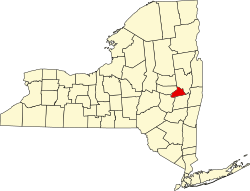 | |
| Towns | ||
| Villages | ||
| CDPs | ||
| Other hamlets | ||
Albany (capital) | |
| Topics | |
| Politics | |
| Regions |
|
| Metro areas | |
| Counties |
|
| Places | |
| History | |

| International | |
|---|---|
| National | |
| Geographic | |
| Other | |


Schenectady, New York
View on GrokipediaHistory
Founding and Colonial Period
Schenectady was established in 1661 when Dutch fur traders, led by Arent van Curler, purchased land from the Mohawk people and began settlement on the south bank of the Mohawk River, with formal founding recognized in 1662 as part of New Netherland.[10][11] The site's selection leveraged proximity to Mohawk trading partners for fur exchange, marking an extension of Dutch colonial expansion from Albany into the Mohawk Valley.[7] The name "Schenectady" originates from the Mohawk term skahnéhtati, translating to "beyond the pines" or "on the other side of the pines," reflecting the area's pine-covered terrain relative to Albany.[12][13] Following the English conquest of New Netherland in 1664, Schenectady integrated into the British Province of New York, though Dutch settlers retained significant cultural and economic influence.[3] The local economy centered on the fur trade, with colonists acting as intermediaries between Mohawk hunters and Albany markets, supplemented by small-scale agriculture to support the growing community of farms and trading posts.[14] This period saw gradual population growth, with Dutch patroons granting land patents that encouraged family-based farming alongside commerce.[10] The settlement faced severe disruption during the Schenectady Massacre on February 8, 1690, when a raiding party of approximately 200 French troops and allied Native warriors from Canada attacked under cover of a blizzard, killing about 60 residents—including women and children—and taking 27 captives while burning most structures.[3][15] The raid, part of King William's War, stemmed from Anglo-French rivalries and aimed to disrupt Iroquois-Dutch alliances, exposing vulnerabilities like inadequate defenses and an unlocked gate.[16] In response, survivors rebuilt with a fortified stockade, enhancing palisades and watch systems, which solidified Schenectady's role as a frontier outpost and prompted stronger colonial military coordination.[17][3]19th Century Industrial Beginnings
The completion of the Erie Canal in 1825 provided Schenectady with direct water access to the Hudson River and Great Lakes, transforming the city from a primarily agrarian outpost into a key node for trade and transportation along the Mohawk Valley corridor.[18] The canal's path skirted the city's eastern edge, enabling efficient shipment of goods like lumber, grain, and manufactured items, which spurred local commerce and attracted merchants and laborers. This connectivity reduced transportation costs dramatically, fostering the initial shift toward diversified economic activity beyond farming and small-scale milling.[18] In the mid-19th century, the rise of railroads further accelerated industrialization, with Schenectady emerging as a center for locomotive production. The Schenectady Locomotive Works began operations in 1848, initially as the McQueen Locomotive Works before reorganizing in 1851 under new ownership that acquired the facilities at reduced cost following financial difficulties.[19] This enterprise capitalized on the expanding rail network, including early lines like the Mohawk and Hudson Railroad (chartered 1826 and operational by 1831), producing steam engines that supported regional freight and passenger services. Early factories also included iron foundries and machine shops, laying the groundwork for metalworking expertise that drew skilled workers and investment.[19] These developments drove rapid population expansion, fueled by domestic migration and European immigration seeking factory employment. The city's population grew from approximately 6,800 in 1850 to 31,682 by 1900, reflecting the influx of laborers to support rail-related industries and ancillary manufacturing.[3] Immigrants, particularly from Ireland and Germany in the earlier decades, filled roles in construction and operations, contributing to Schenectady's evolution into an early industrial hub while straining housing and infrastructure.[20]20th Century Boom and GE Dominance
In 1886, Thomas Edison relocated his Edison Machine Works to Schenectady, establishing a foundational manufacturing site for electrical equipment that attracted engineers and workers to the area.[4] This facility expanded rapidly, and by 1892, it merged with the Thomson-Houston Electric Company to form the General Electric Company (GE), which centralized much of its early production in Schenectady.[5] GE's focus on dynamos, motors, and incandescent lighting systems propelled the city's industrial growth, with the company soon employing thousands in research, development, and assembly of electrical technologies that powered urban electrification worldwide.[21] Schenectady earned the moniker "The City that Lights and Hauls the World" in the early 1900s, reflecting GE's dominance in electrical generation and illumination alongside the American Locomotive Company's (Alco) production of steam and diesel locomotives at nearby facilities.[22] By the 1920s and 1930s, GE's innovations in turbines, transformers, and high-voltage transmission lines solidified the city's role as a hub for electrical engineering, drawing immigrants and skilled labor that boosted the population to a peak of 95,692 residents in 1930.[23] The workforce at GE's Schenectady works expanded to support these advancements, fostering a dense cluster of patents and prototypes that advanced global power infrastructure. During World War I, GE's Schenectady operations contributed to Allied efforts through production of electrical components for military applications, including generators and signaling equipment.[4] In World War II, the facility reached its employment zenith with approximately 45,000 workers, manufacturing critical war materials such as ship propulsion systems, searchlights, turbines, and advanced polymers like silicone for harsh combat conditions.[24] These outputs, from the world's largest electrical workshop at the time, underscored Schenectady's strategic importance in wartime industrialization, with innovations in high-performance materials enhancing equipment durability under extreme operational demands.[25]Post-World War II Decline
Following World War II, Schenectady experienced a sharp economic downturn driven by the onset of deindustrialization, as the local economy, heavily reliant on manufacturing, confronted national trends of automation, rising labor costs, and increased foreign competition. General Electric (GE), the city's dominant employer, began significant layoffs in the 1950s amid post-war restructuring, with the company shedding tens of thousands of jobs in Schenectady over the subsequent decades as production processes automated and facilities consolidated elsewhere.[26][27] This contraction mirrored broader Rust Belt patterns, where manufacturing employment in the Albany-Schenectady-Troy area fell from 24.7% of total jobs in 1970 to lower shares by the 1980s, hastened by technological efficiencies that reduced workforce needs.[28] The population decline reflected these losses, dropping from 91,785 residents in 1950 to 67,972 by 1980—a nearly one-third reduction—as workers relocated for opportunities amid factory slowdowns.[3] Key closures exacerbated the trend, including the American Locomotive Company (ALCO) plant shuttering in 1969 after decades of locomotive production, eliminating hundreds of jobs and underscoring the vulnerability of rail-related manufacturing to market shifts.[29] GE's continued downsizing, totaling around 40,000 positions in Schenectady from the mid-century onward, accelerated the exodus, with the local economy struggling to pivot to service-sector roles that offered fewer high-wage opportunities.[27] Unemployment spiked during the 1970s and 1980s, coinciding with recessions and intensified deindustrialization; regional manufacturing employment plummeted, contributing to elevated joblessness in Schenectady as federal data later showed persistent gaps compared to state averages.[30] These factors—rooted in competitive pressures and productivity gains rather than isolated policy failures—left the city with underutilized infrastructure and a shrinking tax base, setting the stage for prolonged stagnation.[28][31]Urban Renewal and Mid-Century Challenges
In 1947, Schenectady adopted a comprehensive redevelopment plan through the Town of Tomorrow Committee, targeting slum clearance and modernization in the central city, particularly the 22-block area east of City Hall spanning approximately 22 acres of residential neighborhoods with buildings dating from the 1870s to early 1900s.[32] This initiative, formalized with a federal application in October 1946, involved razing substandard tenements and other structures to make way for widened streets, off-street parking, commercial developments, and initially some housing, though plans shifted toward business-only uses due to funding restrictions.[33] Demolitions accelerated in the 1950s, clearing the area for projects like a proposed civic auditorium and secondary business district, but often at the expense of historic fabric and community cohesion, as residents lost longstanding neighborhood ties.[34] Federal urban renewal funding under Title I of the 1949 Housing Act covered about two-thirds of costs, with local contributions meeting the balance, enabling Schenectady as one of New York's first recipients of such aid; a 1956 pilot project approved on June 2 added $600,000 in state-aided property to a $3.16 million effort targeting five acres near City Hall for slum clearance and resale to private developers.[35] [32] These efforts displaced hundreds of families, many relocated to distant public housing like Yates Village over two miles away, severing access to jobs and downtown amenities and exacerbating social isolation for low-income households with limited relocation options.[33] Tactics such as "planned blight"—deliberately allowing properties to deteriorate to depress values for acquisition—facilitated takings but drew opposition from affected residents who viewed the process as disruptive to established communities.[32] By the 1960s, the projects yielded mixed results, with partial developments like a Holiday Inn and scattered office buildings emerging, but key plans such as the Lewis Empire Plaza collapsed in 1963 due to developer default, leaving vast parking lots and underutilized land that fostered vacancy and reduced pedestrian vitality.[34] [32] The clearance's causal emphasis on commercial priorities over residential needs contributed to persistent blight, as failed redevelopments created empty spaces that deterred further investment and amplified urban decay, underscoring how demolition without assured replacement eroded the city's social and economic fabric.[33] Historical analyses attribute heightened vacancy rates and community fragmentation directly to these interventions, where the removal of viable—if imperfect—neighborhoods outpaced effective rebuilding.[32]Late 20th to Early 21st Century Revitalization
The Schenectady Metroplex Development Authority was established in 1998 as a public benefit corporation by the State of New York to foster economic revitalization through coordinated development initiatives.[36] This entity has facilitated over $1.4 billion in investments across Schenectady County by leveraging sales tax revenues and public-private partnerships, targeting infrastructure improvements and business attraction to counter prior industrial stagnation.[37] A significant boost came with the 2017 opening of Rivers Casino & Resort, which has driven substantial economic activity by attracting tourism and generating tax revenues.[38] In 2024, Schenectady County visitor spending exceeded $580 million, more than doubling since the casino's inception, underscoring its role in stimulating local commerce and hospitality sectors.[39] The facility's gross gaming revenue has consistently ranked high among upstate New York casinos, contributing to municipal and county fiscal stability.[40] Corporate reinvestments have further propelled recovery, exemplified by GE Vernova's August 2025 announcement of a $41 million expansion at its Schenectady gas power facility, projected to create 50 high-tech positions over two years.[41] These efforts align with broader trends, including Schenectady County's GDP rising 11% from 2022 to 2023, reaching $11.3 billion, and its second-place ranking in statewide productivity growth for that year.[9] Demographically, the county has stabilized its population while ranking third in New York for growth in the 18-35 age group between 2020 and 2024, signaling renewed appeal to younger workers.[42][43]Geography
Location and Topography
Schenectady occupies a position in the Capital District of Upstate New York, within the Mohawk Valley region, at the confluence of the Mohawk and Hudson rivers.[44] The city center is located at approximately 42°49′N latitude and 73°56′W longitude, placing it about 145 miles north of New York City by straight-line distance.[45][46] This strategic riverside location facilitated early transportation and trade routes along the waterways.[44] The municipality covers a total land area of 10.79 square miles, with minimal water coverage primarily from river segments.[47] Elevations in the city average around 240 feet above sea level, reflecting its placement on relatively level ground suited to urban grid development.[48] Schenectady's topography features flat valley floor terrain, part of the broader Mohawk lowland extending eastward from the Appalachian frontier.[49] To the north, the Adirondack Mountains rise, while the Catskill Mountains influence the southern horizon, creating a corridor defined by these elevated physiographic provinces.[50] The Mohawk River forms a key natural boundary along the northern edge, shaping the city's compact footprint and providing floodplain characteristics that have directed spatial expansion.[44]Climate
Schenectady experiences a humid continental climate (Köppen Dfb), characterized by cold, snowy winters and warm, humid summers.| Month | Avg. Max (°F) | Mean (°F) | Avg. Min (°F) | Precip. (in) | Snow (in) |
|---|---|---|---|---|---|
| January | 31 | 24 | 17 | 2.1 | 15 |
| February | 35 | 26 | 18 | 2.0 | 12 |
| March | 44 | 35 | 26 | 2.5 | 9 |
| April | 57 | 47 | 37 | 3.0 | 1 |
| May | 69 | 59 | 49 | 3.5 | 0 |
| June | 78 | 68 | 58 | 3.7 | 0 |
| July | 81 | 72 | 63 | 3.5 | 0 |
| August | 79 | 70 | 61 | 3.4 | 0 |
| September | 72 | 63 | 54 | 3.2 | 0 |
| October | 60 | 51 | 42 | 3.0 | 0.5 |
| November | 48 | 40 | 32 | 2.8 | 4 |
| December | 36 | 29 | 22 | 2.5 | 13 |
| Annual | 57 | 49 | 41 | 34 | 54 |
Demographics
Population Trends and Projections
Schenectady's population expanded rapidly in the early 20th century due to industrialization, reaching a historical peak of 95,692 residents in the 1930 U.S. Decennial Census before entering a multi-decade decline linked to manufacturing job losses and suburban flight. By the 2000 census, the figure had dropped to 61,821, reflecting broader Rust Belt patterns of urban depopulation. The decline moderated in the early 21st century, with the population rising to 66,135 in the 2010 census and further to 67,047 in 2020, signaling initial stabilization amid local revitalization initiatives.[2] Recent U.S. Census Bureau estimates indicate accelerated growth, with the population estimated at 69,495 as of July 1, 2024—a 3.7% increase from the 2020 base—attributable primarily to positive net domestic migration outweighing natural decrease.[47] Schenectady County's population has grown steadily in parallel, expanding from 154,867 in 2010 to 160,093 in 2022 and an estimated 162,261 in 2024, buoyed by in-migration of working-age residents including young professionals drawn to emerging employment in healthcare, education, and technology sectors adjacent to the city.[55][56] This regional uptrend has helped offset historical city losses by supporting spillover economic activity and housing demand. Population projections for Schenectady remain modest, with demographic models forecasting potential growth to approximately 70,000 by the late 2020s contingent on sustained economic incentives, infrastructure improvements, and continued in-migration; however, vulnerability to regional manufacturing fluctuations could limit rebound if broader Upstate New York stagnation persists.[57][58]Racial and Ethnic Composition
According to the 2020 United States Census, Schenectady had a population of 66,954 with the following racial breakdown: 48.5% White alone, 21.9% Black or African American alone, 4.7% Asian alone, 0.3% American Indian and Alaska Native alone, 0.0% Native Hawaiian and Other Pacific Islander alone, and 8.7% two or more races; separately, 17.9% identified as Hispanic or Latino of any race, while non-Hispanic Whites comprised 38.6%.[47] This composition shows higher diversity relative to mid-20th-century censuses, when European-ancestry groups predominated at over 90% of the total.[47]| Race/Ethnicity | Percentage (2020) |
|---|---|
| White alone | 48.5% |
| Black or African American alone | 21.9% |
| Hispanic or Latino (any race) | 17.9% |
| Two or more races | 8.7% |
| Asian alone | 4.7% |
| American Indian and Alaska Native alone | 0.3% |
| Native Hawaiian and Other Pacific Islander alone | 0.0% |
| Non-Hispanic White | 38.6% |