


Community hub
Recent from talks
Contribute something
Nothing was collected or created yet.
Fishing vessel
View on Wikipedia

A fishing vessel is a boat or ship used to catch fish and other valuable nektonic aquatic animals (e.g. shrimps/prawns, krills, coleoids, etc.) in the sea, lake or river. Humans have used different kinds of surface vessels in commercial, artisanal and recreational fishing.
Prior to the 1950s there was little standardisation of fishing boats. Designs could vary between localities and even different boatyards. Traditional fishing boats were built of wood, which is not often used nowadays because of higher maintenance costs and lower durability. Fibreglass is used increasingly in smaller fishing vessels up to 25 metres (100-tonne displacement), while steel is usually used on vessels above 25 metres.
It is difficult to estimate the number of recreational fishing boats. They range in size from small dinghies, sailboats and motorboats to large superyachts and chartered cruiseliners. Unlike commercial fishing vessels, recreational fishing vessels are often more for leisurely cruising other than dedicated just to fishing.
History
[edit]Traditional fishing boats
[edit]
Early fishing vessels included rafts, dugout canoes, and boats constructed from a frame covered with hide or tree bark, along the lines of a coracle.[1] The oldest boats found by archaeological excavation are dugout canoes dating back to the Neolithic Period around 7,000-9,000 years ago. These canoes were often cut from coniferous tree logs, using simple stone tools.[1][2] A 7,000-year-old seagoing boat made from reeds and tar has been found in Kuwait.[3] These early vessels had limited capability; they could float and move on water, but were not suitable for use any great distance from the shoreline. They were used mainly for fishing and hunting.
The development of fishing boats took place in parallel with the development of boats for trade and war. Early navigators began to use animal skins or woven fabrics for sails. Affixed to a pole set upright in the boat, these sails gave early boats more range, allowing voyages of exploration.
Around 4000 B.C., Egyptians were building long narrow boats powered by many oarsmen. Over the next 1,000 years, they made a series of remarkable advances in boat design. They developed cotton-made sails to help their boats go faster with less work. Then they built boats large enough to cross the oceans. These boats had sails and oarsmen, and were used for travel and trade. By 3000 BC, the Egyptians knew how to assemble planks of wood into a ship hull.[4] They used woven straps to lash planks together,[4] and reeds or grass stuffed between the planks to seal the seams.[4] An example of their skill is the Khufu ship, a vessel 143 feet (44 m) in length entombed at the foot of the Great Pyramid of Giza around 2,500 BC and found intact in 1954.
At about the same time, the Scandinavians were also building innovative boats. People living near Kongens Lyngby in Denmark, came up with the idea of segregated hull compartments, which allowed the size of boats to gradually be increased. A crew of some two dozen paddled the wooden Hjortspring boat across the Baltic Sea long before the rise of the Roman Empire. Scandinavians continued to develop better ships, incorporating iron and other metal into the design and developing oars for propulsion.
By 1000 A.D. the Norsemen were pre-eminent on the oceans. They were skilled seamen and boat builders, with clinker-built boat designs that varied according to the type of boat. Trading boats, such as the knarrs, were wide to allow large cargo storage. Raiding boats, such as the longship, were long and narrow and very fast. The vessels they used for fishing were scaled down versions of their cargo boats. The Scandinavian innovations influenced fishing boat design long after the Viking period came to an end. For example, yoles from the Orkney Island of Stroma were built in the same way as the Norse boats.
Early modern designs
[edit]
In the 15th century, the Dutch developed a type of seagoing herring drifter that became a blueprint for European fishing boats. This was the Herring Buss, used by Dutch herring fishermen until the early 19th centuries. The ship type buss has a long history. It was known around 1000 AD in Scandinavia as a bǘza, a robust variant of the Viking longship. The first herring buss was probably built in Hoorn around 1415. The ship was about 20 metres long and displaced between 60 and 100 tons. It was a massive round-bilged keel ship with a bluff bow and stern, the latter relatively high, and with a gallery. The busses used long drifting gill nets to catch the herring. The nets would be retrieved at night and the crews of eighteen to thirty men[5] would set to gibbing, salting and barrelling the catch on the broad deck.
.jpg)
During the 17th century, the British developed the dogger, an early type of sailing trawler or longliner, which commonly operated in the North Sea.[6] Doggers were slow but sturdy, capable of fishing in the rough conditions of the North Sea.[7] Like the herring buss, they were wide-beamed and bluff-bowed, but considerably smaller, about 15 metres long, a maximum beam of 4.5 metres, a draught of 1.5 metres, and displacing about 13 tonnes. They could carry a tonne of bait, three tonnes of salt, half a tonne each of food and firewood for the crew, and return with six tonnes of fish.[7] Decked areas forward and aft probably provided accommodation, storage and a cooking area. An anchor would have allowed extended periods fishing in the same spot, in waters up to 18 metres deep. The dogger would also have carried a small open boat for maintaining lines and rowing ashore.[7]
A precursor to the dory type was the early French bateau type, a flat bottom boat with straight sides used as early as 1671 on the Saint Lawrence River.[8] The common coastal boat of the time was the wherry and the merging of the wherry design with the simplified flat bottom of the bateau resulted in the birth of the dory. England, France, Italy, and Belgium have small boats from medieval periods that could reasonably be construed as predecessors of the Dory.[9]
Dories appeared in New England fishing towns sometime after the early 18th century.[10] They were small, shallow-draft boats, usually about five to seven metres (15 to 22 feet) long. Lightweight and versatile, with high sides, a flat bottom and sharp bows, they were easy and cheap to build. The Banks dories appeared in the 1830s. They were designed to be carried on mother ships and used for fishing cod at the Grand Banks.[10] Adapted almost directly from the low freeboard, French river bateaus, with their straight sides and removable thwarts, bank dories could be nested inside each other and stored on the decks of fishing schooners, such as the Gazela Primeiro, for their trip to the Grand Banks fishing grounds.
Modern fishing trawler
[edit]


The Portuguese muletta and the British dogger were early types of sailing trawler in use before the 17th century and onward, but the modern fishing trawler was developed in the 19th century.
By the early 19th century, the fishermen at Brixham needed to expand their fishing area further than ever before due to the ongoing depletion of stocks that was occurring in the overfished waters of South Devon. The Brixham trawler that evolved there was of a sleek build and had a tall gaff rig, which gave the vessel sufficient speed to make long-distance trips out to the fishing grounds in the ocean. They were also sufficiently robust to be able to tow large trawls in deep water. The great trawling fleet that built up at Brixham earned the village the title of 'Mother of Deep-Sea Fisheries'.
This revolutionary design made large-scale trawling in the ocean possible for the first time, resulting in a massive migration of fishermen from the ports in the South of England to villages further north, such as Scarborough, Hull, Grimsby, Harwich and Yarmouth, that were points of access to the large fishing grounds in the Atlantic Ocean.
The small village of Grimsby grew to become the largest fishing port in the world by the mid 19th century.[11][12] With the tremendous expansion in the fishing industry, the Grimsby Dock Company was formed in 1846. The dock covered 25 acres (10 ha) and was formally opened by Queen Victoria in 1854 as the first modern fishing port. The facilities incorporated many innovations of the time - the dock gates and cranes were operated by hydraulic power, and the 300-foot (91 m) Grimsby Dock Tower was built to provide a head of water with sufficient pressure by William Armstrong.[13]
The elegant Brixham trawler spread across the world, influencing fishing fleets everywhere. Their distinctive sails inspired the song 'Red Sails in the Sunset', written aboard a Brixham sailing trawler called the Torbay Lass.[14][15] By the end of the 19th century, there were over 3,000 fishing trawlers in commission in Britain, with almost 1,000 at Grimsby. These trawlers were sold to fishermen around Europe, including from the Netherlands and Scandinavia. Twelve trawlers went on to form the nucleus of the German fishing fleet.[16]
Although fishing vessel design increasingly began to converge around the world, local conditions still often led the development of different types of fishing boats. The Lancashire nobby was used down the north west coast of England as a shrimp trawler from 1840 until World War II. The Manx nobby was used around the Isle of Man as a herring drifter. The fifie was also used as a herring drifter along the east coast of Scotland from the 1850s until well into the 20th century.
Advent of steam power
[edit]The earliest steam-powered fishing boats first appeared in the 1870s and used the trawl system of fishing as well as lines and drift nets. These were large boats, usually 80–90 feet (24–27 m) in length with a beam of around 20 feet (6.1 m). They weighed 40-50 tons and travelled at 9–11 knots (17–20 km/h; 10–13 mph).
The earliest purpose-built fishing vessels were designed and made by David Allan in Leith in March 1875, when he converted a drifter to steam power. In 1877, he built the first screw propelled steam trawler in the world. This vessel was Pioneer LH854. She was of wooden construction with two masts and carried a gaff rigged main and mizzen using booms, and a single foresail. Pioneer is mentioned in The Shetland Times of 4 May 1877. In 1878 he completed Forward and Onward, steam-powered trawlers for sale. Allan built a total of ten boats at Leith between 1877 and 1881. Twenty-one boats were completed at Granton, his last vessel being Degrave in 1886. Most of these were sold to foreign owners in France, Belgium, Spain and the West Indies.[17]

The first steam boats were made of wood, but steel hulls were soon introduced and were divided into watertight compartments. They were well designed for the crew with a large building that contained the wheelhouse and the deckhouse. The boats built in the 20th century only had a mizzen sail, which was used to help steady the boat when its nets were out. The main function of the mast was now as a crane for lifting the catch ashore. It also had a steam capstan on the foredeck near the mast for hauling nets. The boats had narrow, high funnels so that the steam and thick coal smoke was released high above the deck and away from the fishermen. These funnels were nicknamed woodbines because they looked like the popular brand of cigarette. These boats had a crew of twelve made up of a skipper, driver, fireman (to look after the boiler) and nine deck hands.[17]
Steam fishing boats had many advantages. They were usually about 20 ft longer (6.1 m) than the sailing vessels so they could carry more nets and catch more fish. This was important, as the market was growing quickly at the beginning of the 20th century. They could travel faster and further and with greater freedom from weather, wind and tide. Because less time was spent travelling to and from the fishing grounds, more time could be spent fishing. The steam boats also gained the highest prices for their fish, as they could return quickly to harbour with their fresh catch. The main disadvantage of the steam boats, though, was their high operating costs. Their engines were mechanically inefficient and took up much space, while fuel and fitting out costs were very high. Before the First World War, building costs were between 3,000 and £4,000, at least three times the cost of the sail boats. To cover these high costs, they needed to fish for longer seasons. The higher expenses meant that more steam drifters were company-owned or jointly owned. As the herring fishing industry declined, steam boats became too expensive.[17] Steam trawlers were introduced at Grimsby and Hull in the 1880s. In 1890 it was estimated that there were 20,000 men on the North Sea. The steam drifter was not used in the herring fishery until 1897. The last sailing fishing trawler was built in 1925 in Grimsby.
Further development
[edit]
Trawler designs adapted as the way they were powered changed from sail to coal-fired steam by World War I to diesel and turbines by the end of World War II.
The first trawlers fished over the side, rather than over the stern. In 1947, the company Christian Salvesen, based in Leith, Scotland, refitted a surplus Algerine-class minesweeper (HMS Felicity) with refrigeration equipment and a factory ship stern ramp, to produce the first combined freezer/stern trawler in 1947.[18]
The first purpose-built stern trawler was Fairtry, built in 1953 at Aberdeen. The ship was much larger than any other trawlers then in operation and inaugurated the era of the 'super trawler'. As the ship pulled its nets over the stern, it could lift out a much greater haul of up to 60 tons.[19] Lord Nelson followed in 1961, installed with vertical plate freezers that had been researched and built at the Torry Research Station. These ships served as a basis for the expansion of 'super trawlers' around the world in the following decades.[18]
In recent decades, commercial fishing vessels have been increasingly equipped with electronic aids, such as radio navigation aids and fish finders. During the Cold War, some countries fitted fishing trawlers with additional electronic gear so they could be used as spy ships to monitor the activities of other countries.
Global trends
[edit]

About 1.3 million of these are decked vessels with enclosed areas. Nearly all of these decked vessels are mechanised, and 40,000 of them are over 100 tons. At the other extreme, two-thirds (1.8 million) of the undecked boats are traditional craft of various types, powered only by sail and oars.[20] These boats are used by artisan fishers.
The Cape Town Agreement is an international International Maritime Organization legal instrument established in 2012, that sets out minimum safety requirements for fishing vessels of 24 metres in length and over or equivalent in gross tons.[21]
In 2022 the world fishing fleet was estimated at 4.9 million vessels in 2022, down from a peak of 5.3 million in 2019, two-thirds of which were motorized. The largest part of the global fishing fleet is found in upper-middle-income (41%) and lower-middle-income (39%) countries, followed by high-income (11%) and low-income countries (8%).[22] Asia hosts the world’s largest fishing fleet (71% of the total), followed by Africa (19%), Latin America and the Caribbean (5%), Northern America and Europe (2%), and Oceania (less than 1%). Asia hosts the largest fleets of motorized (80%) and non-motorized (54%) vessels and Africa hosts the second-largest non-motorized fishing fleet. Many fishing nations (e.g. China, Japan and European Union Member States) have continued their strategy of reducing the number of fishing vessels.[23]
Commercial vessels
[edit]_-Deutsche_Fischfang_Union-_Cuxhaven_2008_by-RaBoe_01.jpg)
The 200-mile fishing limit has changed fishing patterns and, in recent times, fishing boats are becoming more specialised and standardised. In the United States and Canada more use is made of large factory trawlers, while the huge blue water fleets operated by Japan and the Soviet-bloc countries have contracted. In western Europe, fishing vessel design is focused on compact boats with high catching power.
Commercial fishing is a high risk industry, and countries are introducing regulations governing the construction and operation of fishing vessels. The International Maritime Organization, convened in 1959 by the United Nations, is responsible for devising measures aimed at the prevention of accidents, including standards for ship design, construction, equipment, operation and manning.
According to the FAO, in 2004 the world's fishing fleet consisted of 4 million vessels. Of these, 1.3 million were decked vessels with enclosed areas. The rest were open vessels, of which two-thirds were traditional craft propelled by sails and oars.[20] By contrast, nearly all decked vessels were mechanized. Of the decked vessels, 86 percent are found in Asia, 7.8 percent in Europe, 3.8 percent in North and Central America, 1.3 percent in Africa, 0.6 percent in South America and 0.4 percent in Oceania.[20] Most commercial fishing boats are small, usually less than 30 metres (98 ft) but up to 100 metres (330 ft) for a large purse seiner or factory ship.
Commercial fishing vessels can be classified by architecture, the type of fish they catch, the fishing method used, or geographical origin. The following classification follows the FAO,[24] who classify commercial fishing vessels by the gear they use.
Fishing gear
[edit]-
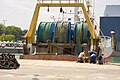 Drum winches mounted at the stern of an Irish trawler
 -
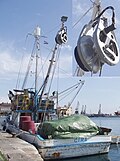


Trawlers
[edit]
A trawler is a fishing vessel designed to use trawl nets in order to catch large volumes of fish.[25]
- Outrigger trawlers – use outriggers to tow the trawl. These are commonly used to catch shrimp. One or two otter trawls can be towed from each side. Beam trawlers, employed in the North sea for catching flatfish, are another form of outrigger trawler. Medium-sized and high powered vessels, these tow a beam trawl on each side at speeds up to 8 knots.[26]
- Beam trawlers – use sturdy outrigger booms for towing a beam trawl, one warp on each side. Double-rig beam trawlers can tow a separate trawl on each side of the trawler. Beam trawling is used in the flatfish and shrimp fisheries in the North Sea. They are medium-sized and high powered vessels, towing gear at speeds up to 8 knots. To avoid the boat capsizing if the trawl snags on the sea floor, winch brakes can be installed, along with safety release systems in the boom stays. The engine power of bottom trawlers is also restricted to 2000 HP (1472 KW) for further safety.[27]
- Otter trawlers – deploy one or more parallel trawls kept apart horizontally using otter boards. These trawls can be towed in midwater or along the bottom.[28]
- Pair trawlers – are trawlers which operate together towing a single trawl. They keep the trawl open horizontally by keeping their distance when towing. Otter boards are not used. Pair trawlers operate both midwater and bottom trawls.[29]
- Side trawlers – have the trawl set over the side with the trawl warps passing through blocks which hang from two gallows, one forward and one aft. Until the late sixties, side trawlers were the most familiar vessel in the North Atlantic deep sea fisheries. They evolved over a longer period than other trawler types, but are now being replaced by stern trawlers.[30]
- Stern trawlers – have trawls which are deployed and retrieved from the stern. Larger stern trawlers often have a ramp, though pelagic and small stern trawlers are often designed without a ramp. Stern trawlers are designed to operate in most weather conditions. They can work alone when midwater or bottom trawling, or two can work together as pair trawlers.[31]
- Freezer trawlers – The majority of trawlers operating on high sea waters are freezer trawlers. They have facilities for preserving fish by freezing, allowing them to stay at sea for extended periods of time. They are medium to large size trawlers, with the same general arrangement as stern or side trawlers.[32]
- Wet fish trawlers – are trawlers where the fish is kept in the hold in a fresh/wet condition. They must operate in areas not far distant from their landing place, and the fishing time of such vessels is limited.[33]
Seiners
[edit]
Seiners use surrounding and seine nets. This is a large group ranging from open boats as small as 10 metres (33 ft) in length to ocean-going vessels. There are also specialised gears that can target demersal species.[34][35]
- Purse seiners are very effective at targeting aggregating pelagic species near the surface. The seiner circles the shoal with a deep curtain of netting, possibly using bow thrusters for better manoeuvrability. Then the bottom of the net is pursed (closed) underneath the fish shoal by hauling a wire running from the vessel through rings along the bottom of the net and then back to the vessel. The most important part of the fishing operation is searching for the fish shoals and assessing their size and direction of movement. Sophisticated electronics, such as echosounders, sonar, and track plotters, may be used are used to search for and track schools; assessing their size and movement and keeping in touch with the school while it is surrounded with the seine net. Crows nests may be built on the masts for further visual support. Large vessels can have observation towers and helicopter landing decks. Helicopters and spotter planes are used for detecting fish schools. The main types of purse seiners are the American seiners, the European seiners and the Drum seiners.[36]
- American seiners have their bridge and accommodation placed forward with the working deck aft. American seiners are most common on both coasts of North America and in other areas of Oceania. The net is stowed at the stern and is set over the stern. The power block is usually attached to a boom from a mast located behind the superstructure. American seiners use Triplerollers.[37] A purse line winch is located amidships near the hauling station, near the side where the rings are taken on board.[35]
- European seiners have their bridge and accommodation located more to the after part of the vessel with the working deck amidships. European seiners are most common in waters fished by European nations. The net is stowed in a net bin at the stern, and is set over the stern from this position. The pursing winch is normally positioned at the forward part of the working deck.[38]
- Drum seiners have the same layout as American seiners except a drum is mounted on the stern and used instead of the power block. They are mainly used in Canada and USA.[39]
- Tuna purse seiners are large purse seiners, normally over 45 metres, equipped to handle large and heavy purse seines for tuna. They have the same general arrangement as the American seiner, with the bridge and accommodation placed forward. A crows nest or tuna tower is positioned at the top of the mast, outfitted with the control and manoeuvre devices. A very heavy boom which carries the power block is fitted at the mast. They often carry a helicopter to search for tuna schools. On the deck are three drum purse seine winches and a power block, with other specific winches to handle the heavy boom and net. They are usually equipped with a skiff.[40]
- Seine netters - the basic types of seine netters are the anchor seiners and Scottish seiner in northern Europe and the Asian seiners in Asia.[41]
- Anchor seiners have the wheelhouse and accommodation aft and the working deck amidships, thus resembling side trawlers. The seine net is stored and shot from the stern, and they may carry a power block. Anchor seiners have the coiler and winch mounted transversally amidships.[41]
- Scottish seiners are basically configured the same as anchor seiners. The only difference is that, whereas the anchor seiner has the coiler and winch mounted transversally amidships, the Scottish seiner has them mounted transversally in the forward part of the vessel.[41]
- Asian seiners – In Asia, the seine netter usually has the wheelhouse forward and the working deck aft, in the manner of a stern trawler. However, in regions where the fishing effort is a labour-intensive, low-technology approach, they are often undecked and may be powered by outboards motors, or even by sail.[41]
-
 Purse seiner
 -
 Large purse seiner
 -
 Spanish tuna purse seiner, Albatun Dos, near Victoria, Seychelles


Line vessels
[edit]Line vessels –
- Longliners – use one or more long heavy fishing lines with a series of hundreds or even thousands of baited hooks hanging from the main line by means of branch lines called "snoods". Hand operated longlining can be operated from boats of any size. The number of hooks and lines handled depends on the size of vessel, the number of crew, and the level of mechanisation. Large purpose built longliners can be designed for single species fisheries such as tuna. On such larger vessels the bridge is usually placed aft, and the gear is hauled from the bow or from the side with mechanical or hydraulic line haulers. The lines are set over the stern. Automatic or semi-automatic systems are used to bait hooks and shoot and haul lines. These systems include rail rollers, line haulers, hook separators, dehookers and hook cleaners, and storage racks or drums. To avoid incidental catches of seabirds, an outboard setting funnel is used to guide the line from the setting position on the stern down to a depth of one or two metres. Small scale longliners handle the gear by hand. The line is stored into baskets or tubs, perhaps using a hand cranked line drum.[42]
- Bottom longliners – [43]
- Midwater longliners – are usually medium-sized vessels which operate worldwide, purpose built to catch large pelagics. The line hauler is usually forward starboard, where the fish are hauled through a gate in the rail. The lines are set from the stern where a baiting table and chute are located. These boats need adequate speed to reach distant fishing grounds, enough endurance for continued fishing, adequate freezing storage, suitable mechanisms for shooting and hauling longlines quickly, and proper storage for fishing gears and accessories.[44]
- Freezer longliners – are outfitted with freezing equipment. The holds are insulated and refrigerated. Freezer longliners are medium to large with the same general characteristics of other longliners. Most longliners operating on the high seas are freezer longliners.[45]
- Factory longliners – are generally equipped with processing plant, including mechanical gutting and filleting equipment accompanied by freezing facilities, as well as fish oil, fish meal and sometimes canning plants. These vessels have a large buffer capacity. Thus, caught fish can be stored in refrigerated sea water tanks and peaks in the catch can also be used. Freezer longliners are large ships, working the high seas with the same general characteristics of other large longliners.[46]
- Wet-fish longliners – keep the caught fish in the hold in the fresh/wet condition. The fish is stored in boxes and covered with ice, or stored with ice in the fish hold. The fishing time of such vessels is limited, so they operate close to the landing place.[47]
| External image | |
|---|---|
 Tuna Fishing – South Pacific – BBC Documentary Tuna Fishing – South Pacific – BBC Documentary |
- Pole and line vessels – are used mainly to catch tuna and skipjack. The fishers stand at the railing or on special platforms and fish with poles and lines. The lines have hooks which are baited, preferably with live bait. Caught tuna are swung on board, by two to three fishermen if the tuna is big, or with an automated swinging mechanism. The tuna usually release themselves from the barbless hook when they hit the deck. Tanks with live bait are placed round the decks, and water spray systems are used to attract the fish. The vessels are 15 to 45 metres o/a. On smaller vessels fishers fish from the main deck right around the boat. With larger vessels, there are two different deck styles: the American style and the Japanese style.[48]
- American style – fishers stand on platforms arranged over the side abaft amidships and around the stern. The vessel moves ahead during fishing operation.[48]"Drawing". FAO. Archived from the original on 2015-09-24. Retrieved 2009-01-31.
- Japanese style – fishers stand at the rail in the forepart of the vessel. The vessel drifts during fishing operations.[48]"Drawing". FAO. Archived from the original on 2015-09-24. Retrieved 2009-01-31.

- Trollers – catch fish by towing astern one of more trolling lines. A trolling line is a fishing line with natural or artificial baited hooks trailed by a vessel near the surface or at a certain depth. Several lines can be towed at the same time using outriggers to keep the lines apart. The lines can be hauled in manually or by small winches. A length of rubber is often included in each line as a shock absorber. The trolling line is towed at a speed depending on the target species, from 2.3 knots up to at least 7 knots. Trollers range from small open boats to large refrigerated vessels 30 metres long. In many tropical artisanal fisheries, trolling is done with sailing canoes with outriggers for stability. With properly designed vessels, trolling is an economical and efficient way of catching tuna, mackerel and other pelagic fish swimming close to the surface. Purpose-built trollers are usually equipped with two or four trolling booms raised and lowered by topping lifts, held in position by adjustable stays. Electrically powered or hydraulic reels can be used to haul in the lines.[49]


- Jiggers – there are two types of jiggers: specialised squid jiggers which work mostly in the southern hemisphere and smaller vessels using jigging techniques in the northern hemisphere mainly for catching cod.[50]
- Squid jiggers – have single or double drum jigger winches lined along the rails around the vessel. Strong lamps, up to 5000 W each, are used to attract the squid. These are arranged 50–60 centimetres apart, either as one row in the centre of the vessel, or two rows, one on each side. As the squid are caught they are transferred by chutes to the processing plant of the vessel. The jigging motion can be produced mechanically by the shape of the drum or electronically by adjustment to the winch motor. Squid jiggers are often used during the day as midwater trawlers and during the night as jiggers.[50]
- Cod jiggers – use single jigger machines and do not use lights to attract the fish. The fish are attracted by the jigging motion and artificial bait.[50]
Other vessels
[edit]- Dredgers – use a dredge for collecting molluscs from the seafloor. There are three types of dredges: (a) The dredge can be dragged along the seabed, scooping the shellfish from the ground. These dredges are towed in a manner similar to beam trawlers, and large dredgers can work three or more dredges on each side. (b) Heavy mechanical dredging units are operated by special gallows from the bow of the vessel. (c) The dredger employs a hydraulic dredge which uses a powerful water pump to operates water jets which flush the molluscs from the bottom. Dredgers don't have a typical deck arrangement, the bridge and accommodation can be aft or forward. Derricks and winches may be installed for lowering and lifting the dredge. Echosounders are used for determining depths.[51]


- Gillnetters – On inland waters and inshore, gillnets can be operated from open boats and canoes. In coastal waters, they are operated by small decked vessels which can have their wheelhouse either aft or forward. In coastal waters, gillnetting is often used as a second fishing method by trawlers or beam trawlers, depending on fishing seasons and targeted species. For offshore fishing, or fishing on the high seas, medium-sized vessels using drifting gillnets are called drifters, and the bridge is usually located aft. The nets are set and hauled by hand on small open boats. Larger boats use hydraulic or occasionally mechanical net haulers, or net drums. These vessels can be equipped with an echosounder, although locating fish is more a matter of the fishermen's personal knowledge of the fishing grounds rather than depending on special detection equipment.[52]
- Set netters – also operate gillnets. However, during fishing operations the vessel is not attached to the nets. The size of the vessels varies from open boats to large specialised drifters operating on the high seas. The wheelhouse is usually located aft, and the front deck is used for handling gear. Normally the nets are set at the stern by steaming ahead. Hauling is done over the side at the forepart of the deck, usually using hydraulic driven net haulers. Wet fish is packed in containers chilled with ice. Larger vessels might freeze the catch.[53]
- Lift netters – are equipped to operate lift nets, which are held from the vessel's side and raised and lowered by means of outriggers. Lift netters range from open boats about 10 metres long to larger vessels with open ocean capability. Decked vessels usually have the bridge amidships. Larger vessels are often equipped with winches and derricks for handling the lifting lines, as well as outriggers and light booms. They can be fitted with powerful lights to attract and aggregate the fish to the surface. Open boats are usually unmechanized or use hand-operated winches. Electronic equipment, such as fishfinders, sonar and echo sounders are used extensively on larger boats.[54]
- Trap setters – are used to set pots or traps for catching fish, crabs, lobsters, crayfish and other similar species. Trap setters range in size from open boats operating inshore to larger decked vessels, 20 to 50 metres long, operating out to the edge of the continental shelf. Small decked trap setters have the wheelhouse either forward or aft with the fish hold amidships. They use hydraulic or mechanical pot haulers. Larger vessels have the wheelhouse forward, and are equipped with derricks, davits or cranes for hauling pots aboard. Locating fish is often more a matter of the fishermen's knowledge of the fishing grounds rather than the use of special detection equipment. Decked vessels are usually equipped with an echosounder, and large vessels may also have a Loran or GPS.[55]
- Handliners – are normally undecked vessels used for handlining (fishing with a line and hook). Handliners include canoes and other small or medium-sized vessels. Traditional handliners are less than 12 metres o/a, and do not have special gear handling, there is no winch or gurdy. Locating fish is left to the fishermen's personal knowledge of fishing grounds rather than the use of special electronic equipment. Non traditional handliners can set and haul using electrical or hydraulic powered reels. These mechanised reels are normally fastened to the gunwale or set on stanchions close to or overhanging the gunwale. They operate all over the world, some in shallow waters, some fishing up to 300 metres deep. No typical deck arrangement exists for handliners.[56]
- Multipurpose vessels – are vessels which are designed so they can deploy more than one type of fishing gear without major modifications to the vessels. The fish detection equipment present on board also changes according to which fishing gear is being used.[57]
- Trawler/Purse seiners – are designed so the deck arrangement and equipment, including a suitable combination winch, can be used for both methods. Rollers, blocks, trawl gallows and purse davits need to be arranged so they control the lead of warps and pursing lines in such a way as to reduce the time needed to convert from one type to the other. Typical fish detection equipment includes a sonar and an echosounder. These vessels are usually designed as trawlers, since the power requirement for trawling is higher.[58]
- Research vessels – a fisheries research vessel (FRV) requires platforms which are capable of towing different types of fishing nets, collecting plankton or water samples from a range of depths, and carrying acoustic fish-finding equipment. Fisheries research vessels are often designed and built along the same lines as a large fishing vessel, but with space given over to laboratories and equipment storage, as opposed to storage of the catch. An example of a fisheries research vessel is FRV Scotia.
Artisan vessels
[edit]Artisan fishing is small-scale commercial or subsistence fishing, particularly practices involving coastal or island ethnic groups using traditional fishing techniques and traditional boats. This may also include heritage groups involved in customary fishing practices.
According to the FAO, at the end of 2004, the world fishing fleet consisted of about 4 million vessels, of which 2.7 million were undecked (open) boats. While nearly all decked vessels were mechanized, only one-third of the undecked fishing boats were powered, usually with outboard engines. The remaining 1.8 million boats were traditional craft of various types, operated by sail and oars.[20]
These figures for small fishing vessels are probably under reported. The FAO compiles these figures largely from national registers. These records often omit smaller boats where registration is not required or where fishing licences are granted by provincial or municipal authorities.[20]
-
 Fisherman landing his catch in the Seychelles.
 -
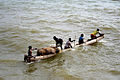 Indian split-log fishing canoe
 -
 Senegalese fishing boats seen in the Gambian coasts.
 -
 Traditional Vietnamese fishing boat
 -
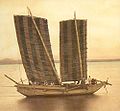 Fishing junk, 1871


Artisan fishing boats are usually small traditional fishing boats, appropriately designed for use on their local inland waters or coasts. Many localities around the world have developed their own traditional types of fishing boats, adapted to use local materials suitable for boat building and to the specific requirements of the fisheries and sea conditions in their area. Artisan boats are often open (undecked). Many have sails, but they do not usually use much, or any mechanised or electronic gear. Large numbers of artisan fishing boats are still in use, particularly in developing countries with long productive marine coastlines. For example, Indonesia has reported about 700,000 fishing boats, 25 percent of which are dugout canoes, and half of which are without motors.[59] The Philippines have reported a similar number of small fishing boats. Many of the boats in this area are double-outrigger craft, consisting of a narrow main hull with two attached outriggers, commonly known as jukung in Indonesia and banca in the Philippines.[60]
-
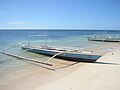 A small Philippine basnigan with the characteristic poles used for anchoring nets and holding gas-powered lamps for attracting fish
 -

-

-
 Indian clinker fishing boats
 -
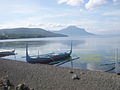 Traditional Philippine fishing outrigger canoes (bangka)


Recreational vessels
[edit]
Recreational fishing is done for leisure or sport, and not for profit or survival. Just about anything that will stay afloat can be called a recreational fishing boat, so long as a fisherman periodically climbs aboard with the intent to catch fish. Usually some form of fishing tackle is brought on board, such as hooks and lines, rods and reels, sinkers or nets, and occasionally high-tech devices such as fishfinders and diving drones. Fish are caught for recreational purposes from boats that range from dugout canoes, kayaks, rafts, pontoon boats and small dinghies to runabouts, cabin cruisers and yachts to large, high-tech and luxurious big game boats sometimes fitted with outriggers.[61] Larger boats, purpose-built with recreational fishing in mind, usually have large, open cockpits at the stern, designed for convenient fishing.
Big game fishing started as a sport after the invention of the motorized boat. Charles Frederick Holder, a marine biologist and early conservationist, is credited with founding the sport in 1898.[62] Purpose-built game fishing boats appeared shortly after. An example is the Crete, in use at Catalina Island, California, in 1915, and shipped to Hawaii the following year. According to a newspaper report at that time, the Crete had "a deep cockpit, a chair fitted for landing big fish and leather pockets for placing the pole."[63]
It is difficult to estimate how many recreational fishing boats there are, although the number is high. The term is fluid, since most recreational boats are also used for fishing from time to time. Unlike most commercial fishing vessels, recreational fishing boats are often not dedicated just to fishing, but also other water sports such as water skiing, parasailing and underwater diving.

- Fishing kayaks have gained popularity in recent years. The kayak has long been a means of accessing fishing grounds.
- Pontoon boats have also become popular in recent years. These boats allow one or two fishermen to get into small rivers or lakes that would have difficulty accommodating larger boats. Typically 8–12 ft in length, these inflatable craft can be assembled quickly and easily. Some feature rigid frames derived from the white water rafting industry.
- Bass boats are small aluminium or fibreglass motorboats used in freshwater lakes and rivers in the United States. for fishing bass and other panfish. They have a flat front deck, swivel chairs for the anglers, storage bins for fishing tackle, and a live well with recirculating water to keep caught fish alive. They are usually fitted with an outboard motor and a slower trolling motor, as well fishfinder and GPS navigation.
- Charter boats are often privately operated, purpose-built fishing boats, and host guided fishing trips for paying clients. Their size can range widely depending on the type of trips run and the geographical location.
- Freshwater fishing boats account for approximately one third of all registered boats in the USA. Most other types of boats end up being used for fishing on occasion.
- Saltwater fishing boats vary widely in size and can be specialized for certain species of fish. Flounder boats, for example, have flat bottoms for a shallow draft and are used in protected, shallow waters. Sport fishing boats range from 25 to 80 feet or more, and can be powered by large outboard engines or inboard diesels. Boats used for fishing in cold climates may have space dedicated to a cuddy cabin or enclosed wheelhouse, while boats in warmer climates are more likely to be open.
-
 Fly fishing from a dinghy
 -

-
 Small sport fishing boat
 -

-


.jpg)

See also
[edit]Notes
[edit]- ^ a b McGrail 2001, page 431
- ^ "Oldest Boat Unearthed". China.org.cn. Archived from the original on 2009-01-02. Retrieved 2008-05-05.
- ^ Lawler, Andrew (June 7, 2002). "Report of Oldest Boat Hints at Early Trade Routes". Science. 296 (5574). AAAS: 1791–1792. doi:10.1126/science.296.5574.1791. PMID 12052936. S2CID 36178755. Retrieved 2008-05-05.
- ^ a b c Ward, Cheryl (May–June 2001). "World's Oldest Planked Boats". Archaeology. 54 (3).
- ^ De Vries & Woude (1977), pages 244–245
- ^ Oxford Companion to Ships and the Sea, p. 256
- ^ a b c Fagan 2008
- ^ Gardner 1987, page 18
- ^ Gardner 1987, page 15
- ^ a b Chapelle, page 85
- ^ Grimsby heyday of the 'three-day millionaire' BBC, 15 November 2012
- ^ "A brief history of Grimsby". localhistories.org. 14 March 2021.
- ^ "Great Grimsby". UK Genealogy Archives.
- ^ "History of a Brixham trawler". JKappeal.org. 2 March 2009. Archived from the original on 2 December 2010. Retrieved 13 September 2010.
- ^ "Pilgrim's restoration under full sail". BBC. Retrieved 2 March 2009.
- ^ Sailing trawlers. Toby Russell. 10 January 2014 – via Issuu.
- ^ a b c "The Steam Trawler".
- ^ a b "HISTORY". Archived from the original on 2013-08-21. Retrieved 2015-07-05.
- ^ Campbell, Jack (1995). The Fairtry Experiment. Edinburgh: B&W Publishing.
- ^ a b c d e FAO 2007
- ^ "2012 Cape Town Agreement to enhance fishing safety". International Maritime Organization. Retrieved 1 November 2022.
- ^ The State of World Fisheries and Aquaculture 2024. FAO. 2024-06-07. doi:10.4060/cd0683en. ISBN 978-92-5-138763-4.
- ^ The State of World Fisheries and Aquaculture 2024. FAO. 2024-06-07. doi:10.4060/cd0683en. ISBN 978-92-5-138763-4.
 This article incorporates text from this source, which is available under the CC BY 4.0 license.
- ^ "Technology Fact Sheets: Fishing Vessel type". FAO.
- ^ "Fishing Vessel type: Trawlers". FAO.
- ^ "Fishing Vessel type: Outrigger trawlers". FAO. "Drawing". FAO. Archived from the original on 2015-09-24. Retrieved 2009-01-31.
- ^ "Fishing Vessel type: Beam trawlers". FAO. "Drawing". FAO. Archived from the original on 2015-09-24. Retrieved 2009-01-31.
- ^ "Fishing Vessel type: Otter trawlers". FAO.
- ^ "Fishing Vessel type: Pair trawlers". FAO.
- ^ "Fishing Vessel type: Side trawlers". FAO."Drawing". FAO. Archived from the original on 2012-10-21. Retrieved 2009-01-31.
- ^ "Fishing Vessel type: Stern trawlers". FAO. "Drawing". FAO. Archived from the original on 2015-09-24. Retrieved 2009-01-31.
- ^ "Fishing Vessel type: Freezer trawlers". FAO. "Drawing". FAO. Archived from the original on 2016-03-03. Retrieved 2009-01-31.
- ^ "Fishing Vessel type: Wet-fish trawlers". FAO. "Drawing". FAO. Archived from the original on 2012-10-21. Retrieved 2009-01-31.
- ^ "Fishing Vessel type: Seiners". FAO.
- ^ a b "Fishing Vessel type: American seiners". FAO. "Drawing". FAO. Archived from the original on 2015-09-24. Retrieved 2009-01-31.
- ^ "Fishing Vessel type: Purse seiner". FAO.
- ^ "Fishery equipment: Tripleroller". FAO.
- ^ "Fishing Vessel type: European seiners". FAO. "Drawing". FAO. Archived from the original on 2015-09-24. Retrieved 2009-01-31.
- ^ "Fishing Vessel type: Drum seiners". FAO. "Drawing". FAO. Archived from the original on 2015-09-24. Retrieved 2009-01-31.
- ^ "Fishing Vessel type: Tuna Purse seiners". FAO. "Drawing". FAO. Archived from the original on 2015-09-24. Retrieved 2009-01-31.
- ^ a b c d "Fishing Vessel type: [Seine netters". FAO. "Drawing". FAO. Archived from the original on 2015-09-24. Retrieved 2009-01-31.
- ^ "Fishing Vessel type: Longliners". FAO. "Drawing". FAO. Archived from the original on 2015-09-24. Retrieved 2009-01-31.
- ^ "Fishing Vessel type: Bottom longliners". FAO.
- ^ "Fishing Vessel type: Midwater longliners". FAO.
- ^ "Fishing Vessel type: Freezer longliners". FAO.
- ^ "Fishing Vessel type: Factory longliners". FAO.
- ^ "Fishing Vessel type: Wet-fish longliners". FAO.
- ^ a b c "Fishing Vessel type: Pole and line vessels". FAO.
- ^ "Fishing Vessel type: Trawler". FAO. "Drawing". FAO. Archived from the original on 2015-09-24. Retrieved 2009-01-31.
- ^ a b c "Fishing Vessel type: Jigger vessels". FAO.
- ^ "Fishing Vessel type: Dredgers". FAO. "Drawing". FAO. Archived from the original on 2015-09-24. Retrieved 2009-01-31.
- ^ "Fishing Vessel type: Gillnetters". FAO. "Drawing". FAO. Archived from the original on 2015-09-24. Retrieved 2009-01-31.
- ^ "Fishing Vessel type: Set netters". FAO.
- ^ "Fishing Vessel type: Lift netters". FAO."Drawing". FAO. Archived from the original on 2012-10-21. Retrieved 2009-01-31.
- ^ "Fishing Vessel type: Trap setters". FAO.
- ^ "Fishing Vessel type: Handliners". FAO.
- ^ "Fishing Vessel type: Multipurpose vessels". FAO.
- ^ "Fishing Vessel type: Trawler-purse seiners". FAO.
- ^ "Country Profile: Indonesia". FAO.
- ^ "Country Profile: Philippines". FAO.
- ^ NOAA: Sport fishing boat
- ^ "The history of game fishing". Boot.de. Archived from the original on 2016-04-03. Retrieved 2009-05-05.
- ^ "First game fishing boat arrives in Hawaii". Honolulu Star-Bulletin. 13 March 1916. Archived from the original on 19 July 2011.

Sources
[edit] This article incorporates text from a free content work. Licensed under CC BY 4.0 (license statement/permission). Text taken from The State of World Fisheries and Aquaculture 2024, FAO.
References
[edit]- Chapelle, Howard L. (1951) American Small Sailing Craft WW Norton Company, New York, ISBN 0-393-03143-8
- Fagan, Brian (2008) The Great Warming. Chapter 10: Bucking the trades Bloomsbury Press. ISBN 978-1-59691-392-9
- FAO: Fisheries technology: Fishing vessels Retrieved 2 February 2009.
- FAO: CWP Handbook of Fishery Statistical Standards : Section L: Fishery Fleet
- FAO (1999) Analysis of the vessels over 100 tons in the global fishing fleet[dead link] FAO Fisheries Circular C949.
- FAO (2007) The status of the fishing fleet Archived 2019-02-18 at the Wayback Machine State of World Fisheries and Aquaculture, Food and Agriculture Organization of the United Nations, Rome. ISBN 978-92-5-105568-7
- Gardner, John (1987) The Dory Book. Mystic Seaport Museum, Mystic Connecticut. ISBN 0-913372-44-7
- McGrail, Sean (2004). Boats of the World: From the Stone Age to Medieval Times. USA: Oxford University Press. ISBN 0-19-927186-0.
- NOAA: Fish Watch: Fisheries Gear
- Vries, J. de, and Woude, A. van der (1997), The First Modern Economy. Success, Failure, and Perseverance of the Dutch Economy, 1500-1815, Cambridge University Press, ISBN 978-0-521-57825-7
Further reading
[edit]- Gerr, Dave (1995) The Nature of Boats: Insights and Esoterica for the Nautically Obsessed McGraw-Hill Professional. ISBN 978-0-07-024233-3
- Smylie, Michael (1999) Traditional Fishing Boats of Britain & Ireland: Design, History and Evolution. Adlard Coles Nautical. ISBN 978-1-84037-035-5
- Traung, Jan-Olaf (1960) Fishing Boats of the World 2 Fishing News (Books) Ltd., Download PDF (99MB)
- Traung, Jan-Olaf (1967) Fishing Boats of the World 3 Kiefer Press. ISBN 978-1-4437-6711-8. Download PDF (56MB)
- Vigor, John (2004) The Practical Encyclopedia of Boating: An A-Z Compendium of Seamanship, Boat Maintenance, Navigation, and Nautical Wisdom McGraw-Hill Professional. ISBN 978-0-07-137885-7
- Fishing vessels History.com Encyclopedia. Retrieved 14 September 2009.
External links
[edit]
- FAO Fishing Vessels Finder Archived 2013-01-31 at the Wayback Machine, FAO public database of fishing vessels, includes data from different sources and allows searching vessel data by many different criteria


Modern merchant ships | ||
|---|---|---|
| Overviews |  | |
| Dry cargo | ||
| Tankers | ||
| Passenger | ||
| Support | ||
| Other types | ||
| Related | ||
| International | |
|---|---|
| National | |
| Artists | |
| Other | |

Fishing vessel
View on GrokipediaA fishing vessel is any vessel used or intended to be used wholly or in part for the purpose of fishing, typically involving the capture of fish, shellfish, or other aquatic organisms for commercial, subsistence, or artisanal purposes.[1] These vessels distinguish themselves from support craft by directly engaging in harvesting operations, ranging from rudimentary rowboats and canoes to sophisticated industrial ships equipped with processing facilities.[2] The global fishing fleet comprised an estimated 4.9 million vessels in 2022, predominantly small-scale units under 10 meters that dominate in developing regions, though larger mechanized fleets operate in industrialized fisheries.[3] Fishing vessels are classified by gear type and operational scale, including trawlers that drag nets along the seabed or midwater, purse seiners that encircle schools with deployable nets, longliners deploying baited hooks over vast distances, and gillnetters using entangling meshes.[4] This diversity reflects adaptations to target species, water depths, and environmental conditions, with innovations like steam-powered trawlers emerging in the 19th century from earlier sailing doggers, enabling scalable commercial operations.[5] Modern advancements, including diesel propulsion, echo sounders, and automated winches, have boosted catch efficiency but also contributed to fleet overcapacity in some areas, prompting international efforts to regulate vessel numbers and practices for stock sustainability.[6]
Definition and Classification
Core Characteristics and Legal Definitions
A fishing vessel is fundamentally a watercraft designed and equipped for the commercial capture of fish, shellfish, or other aquatic organisms, distinguishing it from recreational or research craft through its primary economic purpose and operational features. Core characteristics include robust hull construction to withstand harsh marine conditions, dedicated deck space for deploying and retrieving fishing gear such as nets, lines, or traps, onboard storage or processing facilities to preserve catches like refrigerated holds or icing systems, and propulsion systems optimized for maneuvering in fishing grounds rather than high-speed transit. These vessels range in size from small undecked boats under 10 meters, often used in nearshore fisheries, to large factory ships exceeding 100 meters capable of distant-water operations and onboard processing.[2][7] Legally, definitions emphasize commercial intent and resource exploitation to regulate safety, labor, and conservation. Under the Food and Agriculture Organization (FAO) of the United Nations, a fishing vessel is any craft used or intended for the commercial exploitation of living marine resources, encompassing support vessels like mother ships but excluding those solely for transport or aquaculture. The International Labour Organization's Work in Fishing Convention, 2007 (No. 188), ratified by over 20 countries as of 2023, broadly defines it as any ship or boat equipped for fishing, applicable to operations in marine, inland, or freshwater environments, with provisions for crew welfare on vessels of 24 meters or more.[1][8] The International Maritime Organization's (IMO) Cape Town Agreement of 2012, aimed at enhancing safety for vessels of 24 meters and above, specifies a fishing vessel as one used commercially for catching fish, whales, seals, walrus, or other sea living resources, influencing national implementations like the U.S. Code of Federal Regulations, which aligns for high-seas operations by defining it as a U.S. vessel intended for commercial exploitation of living marine resources. These frameworks exclude non-commercial uses, such as sport fishing or scientific surveys, to focus regulatory oversight on industrial-scale activities, though enforcement varies by jurisdiction due to differing national laws.[9][10]Primary Classifications by Size, Gear, and Purpose
Fishing vessels are classified by size to reflect operational range, capacity, and regulatory requirements; by gear type, which dictates the method of capture and target species; and by purpose, distinguishing commercial harvest from subsistence or leisure activities. These categories overlap, as gear and purpose often influence size, but they provide a framework for global fleet analysis and management. The Food and Agriculture Organization (FAO) emphasizes gear-based typing for industrial and semi-industrial vessels, while size metrics like length overall (LOA) and gross tonnage (GT) inform capacity assessments.[4] Size classifications delineate small-scale vessels, typically under 12 meters LOA or 20 GT, which operate in coastal or inland waters with low endurance and are prevalent in artisanal fisheries; medium vessels from 12 to 24 meters LOA, capable of inshore to moderate offshore trips; and large vessels over 24 meters LOA, including distant-water trawlers and factory ships exceeding 100 meters LOA that process catches onboard for extended voyages. Vessel sizes span from 2-meter dugout canoes in subsistence operations to factory ships over 130 meters LOA in industrial fleets. The global fishing fleet totaled approximately 3.3 million vessels in 2022, with the majority being small-scale units suited for nearshore use.[11][3][2] Gear-based classifications, per FAO standards, group vessels by primary fishing method, as this shapes hull design, deck equipment, and deck machinery. Trawlers tow conical nets (otter trawls or beam trawls) to target demersal fish or shrimp, ranging from small coastal boats to large stern or side trawlers. Purse seiners deploy a deep net around pelagic fish schools, closing it like a drawstring purse, often with power blocks for haulback. Longliners set baited hooks on monofilament lines for species like tuna, deployable mechanically on vessels of varying sizes. Other categories include gillnetters using drift or set nets to entangle fish by gills; dredgers raking seabed for mollusks; and multipurpose vessels switching gear for diverse targets.[4] Purpose classifications separate vessels by end-use of the catch: commercial vessels, the core of capture fisheries, target sale in markets and include industrial fleets for high-volume export and artisanal boats for local trade or processing. Artisanal or subsistence vessels prioritize community supply or self-consumption over profit maximization, often using passive gears in traditional fisheries. Recreational vessels focus on angling for sport, typically smaller and unregulated for commercial sale, comprising a minor share of total effort but significant in developed regions. These distinctions affect catch reporting and sustainability oversight, with commercial purposes accounting for the bulk of global production.[12][5]Historical Development
Pre-Industrial and Traditional Vessels
Pre-industrial fishing vessels originated from simple prehistoric watercraft designed for coastal and riverine exploitation. The earliest known forms included dugout canoes, carved from single logs, with archaeological evidence dating back to the Neolithic period around 7000–9000 years ago, as found in excavations in Kuwait.[5] These evolved from even earlier log rafts and paddled craft, evidenced by petroglyphs and remains from approximately 10,000 BCE, enabling humans to harvest fish and shellfish in inland waters and near shores.[13] Reed boats and skin-covered frames, such as coracles made from hides stretched over wicker, appeared in ancient Mesopotamia and Britain by 6000 BCE, prioritizing lightweight portability over durability for inshore netting and trapping.[14] In ancient and classical eras, plank-built vessels emerged in regions like the Mediterranean, where Egyptians and Phoenicians constructed reed-membrane or wooden boats propelled by oars and square sails for Nile and coastal fisheries by 3000 BCE.[15] Greek and Roman designs featured mortise-and-tenon hulls for stability in seine and trawl operations, limited to near-shore depths due to manual hauling constraints.[16] By the medieval period in northern Europe, Viking-influenced clinker-built boats, such as the knarr—a broad-beamed, sail-assisted cargo vessel adapted for fishing—facilitated cod and herring catches in the North Atlantic, with hulls of overlapping oak planks lashed or riveted for flexibility against rough seas.[17] These oar-and-sail hybrids, crewed by 5–10 men, typified operations from Scandinavia to England, where early medieval records describe riverine smelt fishing with small open boats during spring tides.[18] Traditional vessels persisted into the early modern era with regional specializations, such as Irish currachs of hide over timber frames and Welsh coracles for basket-like maneuverability in tidal waters.[14] In the North Sea, Dutch herring busses—large, beamier sailers introduced around 1415—marked a shift toward offshore capabilities, displacing up to 200 tons and curing catches at sea with crews of 30, though still reliant on wind and manual gear.[15] Propulsion remained human-powered via oars or rudimentary sails, restricting voyages to visual range and calm conditions, with wood as the dominant material for durability against wave impact.[16] These designs emphasized simplicity and repairability, supporting subsistence and local trade until sail refinements in the 15th century enabled deeper-water pursuits.[15]Industrialization and Mechanization (19th-20th Century)
The transition to industrialized fishing vessels accelerated in the mid-19th century with the adoption of steam power, particularly in the United Kingdom, where traditional sailing smacks from ports like Brixham faced limitations in range and weather resilience. The first purpose-built steam trawlers entered service in 1881, equipped with screw propellers and capable of sustaining operations in conditions that grounded sail vessels. These early steamers, often around 100 feet in length with engines producing 50-100 horsepower, enabled fishermen to venture farther into the North Sea and return more frequently, boosting annual catches by factors of up to four times compared to sail-dependent methods.[19][20] Mechanization extended beyond propulsion to fishing gear, exemplified by the otter trawl's development in the 1890s. This net design, patented by Otto Nielsen in Denmark around 1892 and refined in Scottish ports like Granton by 1894, employed weighted doors or "otters" to maintain net mouth aperture through hydrodynamic forces rather than rigid beams, reducing weight and drag. Steam winches, introduced concurrently, allowed crews to haul heavier nets—often exceeding 1 ton in wet weight—without manual labor, increasing efficiency on vessels up to 120 feet. The combination facilitated larger-scale operations, with British steam trawler fleets expanding from dozens in the 1880s to over 1,000 by 1910, centered in hubs like Grimsby.[21][22] In the early 20th century, diesel engines supplanted steam due to superior thermal efficiency—achieving 30-40% versus steam's 10-15%—and simpler maintenance, with the first marine diesel fishing vessels appearing around 1910 in Europe. By the 1920s, adoption surged; for instance, Scandinavian fleets motorized over 50% of vessels by 1930, enabling speeds of 10-12 knots and reduced fuel consumption by half relative to coal-fired steamers. This shift supported steel-hulled designs resistant to corrosion and capable of carrying refrigerated holds, extending fish preservation and market reach, though it intensified pressure on stocks through year-round fishing. Larger diesel trawlers, often 150-200 feet with 500+ horsepower, dominated by mid-century, transforming artisanal pursuits into capital-intensive industries.[20][23]Post-1945 Technological Shifts and Expansion
Following World War II, fishing vessels incorporated wartime technologies such as echo-sounders and radar, enhancing fish detection and operational efficiency in adverse conditions.[24] [25] These adaptations, including ultrasonic devices transitioned from military sonar, allowed vessels to locate schools more precisely and operate continuously.[26] By the late 1940s, European fleets began widespread adoption, contributing to a surge in catch rates.[27] Vessel propulsion advanced with more powerful diesel engines, enabling larger steel-hulled trawlers and factory ships capable of distant-water operations.[28] Post-1950, synthetic materials like nylon revolutionized netting, replacing natural fibers with stronger, lighter, and more durable alternatives that resisted rot and increased haul capacities.[29] Innovations such as the Puretic power block in the 1950s mechanized purse seine retrieval, reducing labor and boosting efficiency for pelagic fisheries.[30] Hydraulic systems and stern chutes for trawlers, developed in the mid-20th century, further streamlined gear handling and vessel design.[31] Global fleet expansion accelerated, with the number of marine fishing vessels roughly doubling from 1.7 million in 1950 to 3.7 million by 2015, driven by motorization and industrialization in Asia and Europe.[28] This growth, supported by national programs like those in post-war China, extended operations to offshore and high-seas areas, amplifying harvesting pressure.[32] Onboard processing facilities proliferated in the 1960s and 1970s, preserving catches at sea via freezing and filleting, which minimized spoilage and expanded market reach.[33] Electronic aids like improved sonar in the 1960s enabled precise tracking of fish schools, compounding the effects of mechanical enhancements.[33] These shifts marked a transition to highly capitalized, technology-intensive fleets, with effective fishing effort rising dramatically—up to 60-fold in some regions—due to compounded efficiencies in power, gear, and navigation.[34] However, such expansions often outpaced stock sustainability, as evidenced by declining yields in overexploited areas by the 1970s.[35]Design and Engineering Principles
Hull Forms, Materials, and Stability
Fishing vessels predominantly utilize displacement hulls, which displace a volume of water equal to the vessel's weight, enabling efficient operation at low speeds suitable for towing gear and carrying heavy catches without excessive power demands.[36] These hulls contrast with planing types by prioritizing load-bearing capacity over speed, as planing hulls lift partially out of the water, which is impractical for sustained fishing operations involving variable weights.[37] Round-bottom or bilge hulls are common in traditional and larger fishing craft for their hydrodynamic efficiency and ability to roll smoothly in waves, reducing structural stress during net hauling.[36] V-shaped hulls, often with deeper deadrise angles, provide enhanced directional stability and wave-cutting performance, particularly in trawlers navigating choppy coastal waters.[38] Hull materials have evolved from wood, favored in pre-industrial vessels for its availability and ease of repair in remote areas, to modern alternatives better suited to industrial demands.[39] Steel dominates construction of vessels over 24 meters, offering high tensile strength to withstand impacts from ice or docks and facilitating modular welding for scalability, though it requires anti-corrosion coatings to mitigate rust in saltwater exposure.[39][40] Aluminum alloys, lighter than steel by about 60% while retaining comparable strength, are preferred for mid-sized vessels to improve fuel efficiency and speed, with natural oxide formation providing inherent corrosion resistance.[39] Fiberglass reinforced plastic (FRP), a composite of resin and glass fibers, prevails in smaller artisanal boats under 12 meters for its moldability into complex shapes, resistance to rot, and minimal maintenance needs compared to wood, which can warp or foul biologically.[39][41] Stability in fishing vessels ensures resistance to capsizing from beam seas, free surfaces like shifting fish holds, or high freeboards increasing windage.[42] Intact stability criteria, as outlined in FAO/ILO/IMO recommendations for decked vessels under 12 meters, mandate a minimum dynamic righting lever (GZ) area of 0.055 meter-radians up to 30 degrees heel, with a maximum GZ of at least 0.20 meters and initial stability (GZ at 30 degrees) not less than 0.15 meters.[43] These metrics, derived from empirical testing of model vessels in wave tanks, account for fishing-specific risks like asymmetric loading from trawl warps, requiring metacentric height (GM) values typically between 0.35 and 0.60 meters for small craft to balance roll period and damping.[43][42] Compliance involves ballast distribution, watertight bulkheads, and deck edge immersion angles limited to 70 degrees, with voluntary guidelines emphasizing crew training to avoid downflooding points that reduce reserve buoyancy. Larger vessels adhere to IMO Resolution A.168(ES.IV) standards, incorporating probabilistic damage stability assessments to simulate flooding scenarios.[44]Propulsion Systems and Power Sources
The propulsion of fishing vessels has evolved from wind and human power to mechanically driven systems, enabling greater range, speed, and operational reliability in diverse sea conditions. Prior to the late 19th century, sails harnessed wind as the primary power source, supplemented by oars for maneuverability in calm waters or nearshore fishing. Steam engines emerged in the mid-19th century, providing consistent thrust via coal-fired boilers connected to propeller shafts, though their high fuel consumption and maintenance demands limited adoption to larger vessels until internal combustion engines displaced them. By the early 20th century, gasoline engines were retrofitted to wooden fishing boats, such as gillnetters on the U.S. West Coast starting in the late 1890s, offering improved portability over steam but with reliability issues in harsh marine environments.[45][46] Diesel engines became the dominant propulsion system for commercial fishing vessels from the 1920s onward, prized for their superior fuel efficiency, torque at low speeds, and durability under continuous heavy loads typical of trawling or longlining. Inboard diesel configurations, where the engine drives a fixed propeller shaft through a gearbox, prevail in mid- to large-sized vessels over 15 meters, with power outputs commonly ranging from 500 to 8,000 kW for Category 1 and 2 marine diesels certified under U.S. EPA standards. Specific models like the Cummins KTA19 deliver high torque for offshore trawlers and shrimp boats, while Detroit Diesel 8V92 engines emphasize longevity in variable-load applications.[47][48] These engines operate on marine diesel fuel, with ratings such as M1 for propulsion up to 24 hours daily at full load factors exceeding 65%, suiting displacement hulls like mid-water trawlers.[49][50] Outboard diesel motors, often 40-300 horsepower, equip smaller inshore boats for their ease of installation and servicing, though they sacrifice some efficiency compared to inboards.[51] Emerging hybrid and electric propulsion systems address diesel's high emissions and fuel costs, particularly for vessels under 20 meters operating in restricted fisheries or near emission-regulated ports. Diesel-electric setups integrate generators to power electric motors driving propellers, allowing variable speed control and auxiliary power for winches or refrigeration without idling the main engine. Series hybrid configurations, as tested in Southeast Alaska, enable short-range electric-only operation on battery banks charged by shore hydroelectricity, reducing diesel use by up to 50% during low-speed fishing.[52][53] Full battery-electric propulsion, powered by lithium-ion packs, suits day-boats with ranges under 50 nautical miles, as demonstrated in Norwegian trials where electric modes cut fuel costs during anchoring or slow steaming.[54] However, adoption remains limited by battery weight, recharge infrastructure, and the need for high-capacity renewables, with hybrids favored for their redundancy in remote operations.[55][56]Navigation and Fishing Equipment Integration
Modern fishing vessels integrate navigation and fishing equipment to enhance operational efficiency, safety, and precision in locating and harvesting fish stocks. This integration typically occurs through centralized bridge systems that interconnect sensors, displays, and control interfaces, allowing crew members to monitor vessel position, environmental conditions, and gear deployment simultaneously. For instance, echosounders provide dual functionality by measuring water depth for safe navigation while detecting fish schools via acoustic echoes, with data fed into electronic chart display and information systems (ECDIS) for real-time overlay on navigational charts.[57] Such systems reduce the need for separate stations, minimizing crew workload during dynamic fishing operations.[58] Key components include global positioning system (GPS) receivers linked with sonar and radar, enabling the plotting of fishing waypoints derived from fish-finding data. Sonar transducers emit sound pulses to identify fish density and seabed structure, with GPS integration allowing vessels to return to proven locations or optimize routes around obstacles, as seen in commercial setups where multifunction displays (MFDs) superimpose sonar returns on electronic charts.[59] Winch and net-handling systems are often automated via hydraulic controls tied to these networks, incorporating sensors that relay tension, depth, and catch data back to the bridge for adjustments without manual intervention. Specialized integrated workstations, such as those designed for fishing vessels, combine maneuvering controls, fish-finding sonars, winch operations, and catch monitoring into a unified interface, supporting gear types like trawls or purse seines.[60] Radar integration further aids collision avoidance during gear deployment, scanning for other vessels or hazards while cross-referencing with automatic identification system (AIS) data.[57] This equipment fusion has evolved with digital advancements, replacing standalone analog tools like compasses and Loran-C with networked GPS and ECDIS by the late 1990s, enabling precise positioning accurate to within meters.[61] In practice, integration supports regulatory compliance through vessel monitoring systems (VMS), which transmit GPS positions alongside fishing activity logs to authorities, reducing illegal practices while optimizing fuel use via route planning informed by fish detection patterns.[62] For smaller vessels, compact systems like BlueBridge provide scaled integration for fish finding and navigation on workboats and trawlers, ensuring reliability in harsh marine environments.[63] Overall, these integrations prioritize causal links between sensor inputs and operational outputs, such as adjusting trawl depth based on real-time sonar feedback correlated with current position, thereby maximizing catch efficiency while mitigating risks like grounding or gear loss.[64]Types of Fishing Vessels
Trawl and Seine Vessels
Trawl vessels deploy conical nets towed through the water column or along the seabed to capture fish and shellfish. These vessels typically feature robust hulls designed for stability during towing, with stern-mounted winches and gantries for net handling. Otter trawls, the most common type, use hydrodynamically shaped doors to maintain the net's horizontal opening, allowing single-vessel operation for bottom or midwater fishing targeting species like groundfish, shrimp, and squid.[65] [5] Beam trawls employ a rigid beam to hold the net mouth open vertically, reducing drag and enabling precise control, often used in shallower waters for flatfish and crustaceans.[66] Pair trawling, involving two vessels, eliminates doors for wider net spreads and higher efficiency in pelagic fisheries.[67] Modern trawlers, including factory models, incorporate onboard processing facilities, freezing holds, and propulsion systems exceeding 2000 horsepower for extended operations.[68] Seine vessels, primarily purse seiners, encircle schools of pelagic fish such as tuna and mackerel using a vertical net wall with floats on the headline and lead weights on the footline. The net is deployed from the stern, often aided by power blocks to haul the purse line that closes the bottom, trapping the catch.[69] [70] These vessels range from smaller coastal types to large ocean-going seiners over 100 meters, equipped with sonar, helicopters for spotting, or fish aggregating devices (FADs) to concentrate schools.[71] Purse seiners account for significant global tuna harvests, with fleets like those in the Seychelles operating vessels designed for high-speed pursuit and rapid net retrieval.[72] Bottom trawling by trawl vessels contributes approximately 25% of global marine fish catch, while midwater variants add 10%, underscoring their dominance in demersal and semi-pelagic fisheries.[73] Purse seine operations, conversely, target surface schools efficiently but require precise navigation to avoid bycatch, with vessel designs emphasizing speed and maneuverability over heavy towing gear.[74] Both types integrate electronic aids like GPS and echo sounders for gear positioning, though trawl vessels often prioritize seabed durability in hull construction compared to the agility of seiners.[75]Longline, Trap, and Pole Vessels
Longline vessels deploy monofilament mainlines extending up to several kilometers, fitted with thousands of baited branch lines and hooks targeting pelagic species such as tuna, swordfish, and halibut, or demersal fish like cod in bottom-set configurations.[76] These vessels incorporate specialized deck machinery, including rail rollers for line deployment, hydraulic haulers for retrieval, dehookers, and hook cleaners to manage operations efficiently and minimize handling time.[77][78] Designs emphasize fuel efficiency, fish handling, and crew safety, with vessel lengths varying from small coastal units under 20 meters to industrial longliners exceeding 60 meters capable of onboard processing and carrying up to 15 tons of chilled catch.[79][80][81] They require high endurance and speeds of 10-15 knots to reach distant grounds, often operating continuously, including at night, in regions like the Pacific Ocean and North Atlantic.[82] Trap vessels, commonly termed potters or trap boats, deploy rigid, three-dimensional wire or wooden enclosures known as pots or traps, which feature cone-shaped funnel entrances baited to lure crustaceans such as crabs, lobsters, and shrimp, while escape-preventing designs retain captures.[83][84] These gears are submerged in strings or trawls, with vessels typically ranging 7.6 to 55 meters in length, suited for nearshore or coastal deployments where pots are buoyed and periodically hauled.[85] A standard metal lobster pot measures approximately 1.2 meters in length and exceeds 18 kilograms empty, requiring robust winches for handling multiple units per trip.[86] Operations focus on selective sizing through escape vents and are prevalent in areas like the U.S. Northeast for American lobster and Alaska for king crab, with minimum trawl requirements of 10-35 pots per string enforced in some regulated fisheries as of May 2022.[87][88] Pole and line vessels target surface-schooling tuna species like skipjack and albacore using manual fiberglass poles, 2-4 meters long, equipped with barbless hooks and live bait such as sardines, aggregated via chumming and water jets simulating prey schools.[89][90] These vessels, optimized for live bait wells and angler platforms, measure 15 to 40 meters overall, with extended bows or stern arrangements to support 20-50 fishers simultaneously during short, intense sets lasting hours.[91][92] Trips endure 4-5 days using techniques like "mancha" drifting, yielding low bycatch rates due to immediate release capabilities, and are concentrated in equatorial regions including the Indian Ocean, Azores, and Maldives as of 2025 assessments.[93][94] This method's selectivity supports younger fish cohorts, typically 40-70 cm, aligning with sustainable management in certified fisheries.[95]Specialized and Multi-Purpose Vessels
Specialized fishing vessels are engineered for targeted capture methods distinct from trawling, seining, or line-based operations, often focusing on bottom-dwelling shellfish or pelagic species responsive to artificial lures or lights. Dredgers employ mechanical or hydraulic dredges towed along the seabed to harvest molluscs such as clams, oysters, and scallops, typically featuring robust winches, derricks, and water jets for dislodging and pumping catch aboard; these vessels range from small coastal boats to larger units up to 22 meters in length with power outputs comparable to small trawlers.[2][96] Jigger vessels specialize in jigging, using automated lines with baited or luminous jigs to catch squid or finfish, often at night with powerful deck lights to aggregate targets; two primary variants exist, including larger squid jiggers prevalent in southern hemisphere fisheries (equipped with multiple jigging machines) and smaller hand-jigging boats for nearshore operations.[97][98] Lift netters deploy expansive stationary nets suspended from outriggers, illuminated by high-intensity lamps to draw schools of fish or squid beneath for rapid hauling; these can reach 45 meters in length and 500 gross tons, with amidships bridges facilitating net management via derricks and winches.[2] Multi-purpose vessels integrate modular deck arrangements and interchangeable gear-handling systems to alternate between two or more methods—such as trawling and purse seining or gillnetting and longlining—without structural alterations, enhancing operational adaptability to seasonal quotas, market demands, or regulatory shifts; examples include 12- to 20-meter hybrids with combined winches for dual-gear use, common in versatile small- to medium-scale fleets where single-method specialization risks underutilization.[2] This flexibility supports economic resilience but demands robust engineering to maintain stability and efficiency across configurations, as evidenced by FAO classifications emphasizing minimal modification requirements for gear swaps.[4]Operational Methods and Gear
Deployment Techniques by Gear Type
Trawling involves deploying a cone-shaped net, known as a trawl, towed behind the vessel to capture fish by herding them into the codend. For bottom trawls, the net is weighted to contact the seafloor and dragged across it, while midwater trawls are suspended in the water column to target pelagic species; the net opens horizontally via otter boards or trawl doors attached to warps winched from the stern, with vertical opening maintained by floats and weights.[99][100] Beam trawls use a rigid beam to hold the net mouth open, deployed similarly but suited for smaller vessels targeting flatfish on the bottom.[101] Purse seining deploys a long wall of netting to encircle schools of pelagic fish like tuna or sardines, forming a deep "purse" via a drawstring along the bottom edge to close the net and trap the school. The vessel locates the school using sonar or spotters, pays out the net from a power block over the side or stern while steaming around the aggregation, then hauls it aboard mechanically, often with skiff assistance for smaller operations.[102][70] Surrounding nets without pursing, such as lampara, are set in a similar encircling motion but brailed directly without closing the bottom.[103] Longlining deploys a mainline, often kilometers long, with baited hooks on branch lines (snoods) spaced at intervals, either surface-set for species like tuna or bottom-set for demersal fish. The vessel pays out the line from stern reels or baskets while steaming, attaching buoys, radio beacons, and weights for positioning; lines soak for hours to days before mechanical hauling and rebaiting.[104][105] Gillnetting sets vertical panels of fine mesh netting, suspended by floats and anchored or drifted, to entangle fish by gills or fins as they swim into it. Deployment involves paying out the net from the vessel's side, often in drifts for pelagic species or anchored for bottom sets, with soaking times varying from hours to overnight before hauling.[106][107] Trap and pot fishing deploys rigid enclosures baited to lure crustaceans or fish inside, where one-way funnels prevent escape. Pots are stacked on deck, baited, and deployed over the side or stern in sets of dozens to hundreds, connected by groundlines and marked by surface buoys; vessels revisit sites after soak times of days to haul via pots' handles or bridles.[108][109]Processing and Preservation Onboard
Immediately after capture, fish undergo initial processing to mitigate spoilage from autolysis and bacterial action, including bleeding by cutting the gills or main blood vessels to remove blood, which reduces oxidation and discoloration; gutting to eviscerate the viscera, preventing enzymatic breakdown from digestive enzymes; and washing with seawater to remove slime, blood, and debris.[110][111] These steps, performed manually or with automated lines on larger vessels, must occur promptly—ideally within hours of hauling—to preserve flesh quality, as delays elevate postmortem pH changes and microbial loads.[112][113] Preservation onboard primarily relies on rapid cooling to near-freezing temperatures, suppressing microbial growth and metabolic activity. Icing remains prevalent on small-scale and artisanal vessels, where catch is layered alternately with crushed or flake ice in insulated boxes or pounds, achieving 0°C storage; FAO guidelines recommend an ice-to-fish ratio of 1:1 by weight for trips up to 5 days, with extra ice against hull sides to counter heat ingress, extending shelf life to 10-15 days for species like cod depending on initial freshness and ambient conditions.[112][114] Chilled seawater (CSW) systems, used on mid-sized vessels, immerse fish in seawater mixed with ice (ratio 1:1 to 1:2) or mechanically chilled to -1.5°C, enabling denser packing at fish-to-water ratios up to 4:1 with agitation for uniform cooling; this method suits pelagic species and maintains quality comparable to icing but requires pumps and filtration to avoid contamination.[115][112] For industrial fleets on extended voyages, freezing predominates, converting fresh catch to frozen blocks or fillets via air-blast freezers (circulating -30°C to -40°C air), contact plate freezers (direct metal-plate conduction at -20°C or below), or immersion in brine/glycol solutions, achieving core temperatures of -18°C within 2-4 hours to form small ice crystals that minimize cellular damage.[116][117] Freezer trawlers integrate conveyor systems for automated gutting, heading, and filleting before freezing, with capacities up to 100-200 tons per day on vessels over 50 meters; post-freezing, products are glazed with water to prevent freezer burn and stored in refrigerated holds at -18°C to -30°C.[113][116] Superchilling, a hybrid technique cooling fish to -1.5°C to -2°C (partial ice formation in tissues), extends iced storage by 50-100% for whitefish, as partial freezing binds water and slows denaturation without full rigidity.[118] Hygiene protocols, including deck disinfection and minimizing bruising during transfer, are integral, as contamination from vessel surfaces or crew handling can introduce pathogens like Vibrio species, underscoring the need for stainless-steel equipment and cold-chain integrity.[119][120]Crew Operations and Efficiency Metrics
Crew operations on fishing vessels involve hierarchical roles tailored to vessel type and gear, with the captain overseeing navigation, fishing decisions, and safety, while deckhands handle gear deployment, hauling, and maintenance. Engineers manage propulsion and auxiliary systems, and on factory trawlers, processors gut, fillet, and freeze catches below deck.[121] Crew sizes vary by vessel scale: small trawlers under 30 meters typically require 3-5 members, while larger 55-59 meter vessels may employ up to 40, including specialists for extended voyages of 35 days.[122] Shifts often follow demanding rotations, such as 12 hours on/12 off or 16+ hours daily for seven days weekly, driven by tidal cycles, weather, and quota pressures, with duties encompassing net mending, baiting lines, and vessel cleaning to sustain operational continuity.[123][124] Efficiency in crew operations is quantified through metrics like catch per unit effort (CPUE), which measures kilograms of fish caught per hour fished or per vessel-day, serving as a proxy for both stock abundance and operational productivity influenced by crew skill and coordination.[125] Labor productivity, expressed as catch per fisherman or per man-hour, accounts for variables like skipper experience and crew training, where inefficiencies from underutilization—ranging 15-32% for crew and fishing time—stem from mismatched skills or downtime in gear handling.[126] Effective fishing effort adjusts nominal effort for catchability changes, incorporating crew-driven factors such as search efficiency and gear deployment speed, with studies showing productivity gains from reduced hours fished via technological aids rather than extended labor.[127][125] Variations arise from vessel-specific adaptations; for instance, longliners emphasize crew precision in line setting to minimize bycatch, boosting CPUE relative to stock size, while trawler crews prioritize hauling speed to cut fuel and time costs.[128] Overall, crew efficiency correlates with net cash flow per vessel, where skilled operations can elevate CPUE by optimizing inputs like hours and personnel against outputs.[129]Global Fleet Dynamics
Current Statistics and Regional Distribution
The global fishing fleet comprised an estimated 4.9 million vessels in 2022, encompassing both decked and undecked types used primarily for capture fisheries.[3] Approximately 3.3 million of these were motorized, accounting for 67 percent of the total, while the remaining 1.6 million were non-motorized, often small-scale artisanal craft.[3] These figures reflect preliminary data compiled by the Food and Agriculture Organization (FAO) from member country submissions, with recent improvements in reporting—such as Indonesia's updated count of 1.1 million vessels—contributing to higher totals compared to prior estimates like the 4.1 million reported for 2020.[3] Asia dominated the fleet's regional distribution, hosting 3.5 million vessels or 71 percent of the global total in 2022, a slight decline in share from previous years due to fleet reductions in countries like China amid capacity management efforts.[3] Africa followed with more than 19 percent (approximately 0.93 million vessels), driven by numerous small, undecked vessels in coastal and inland fisheries.[3] Other regions held smaller proportions: Latin America and the Caribbean at 5 percent, Europe and Northern America each at 2 percent, and Oceania under 1 percent.[3]| Region | Estimated Vessels (millions) | Percentage of Global Total |
|---|---|---|
| Asia | 3.5 | 71% |
| Africa | ~0.93 | >19% |
| Latin America and Caribbean | ~0.245 | 5% |
| Europe | ~0.098 | 2% |
| Northern America | ~0.098 | 2% |
| Oceania | <0.049 | <1% |