


Community hub
Recent from talks
Contribute something
Nothing was collected or created yet.
Vaporwave
View on Wikipedia
| Vaporwave | |
|---|---|
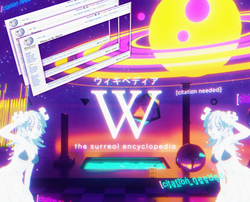
 A vaporwave-style image with Wikipedia as the main theme | |
| Etymology | Vaporware |
| Stylistic origins | |
| Cultural origins | Early 2010s, Internet[2][12] |
| Typical instruments | |
| Derivative forms |
|
| Subgenres | |
| Fusion genres | |
| |
| Other topics | |
Vaporwave is a microgenre of electronic music, a visual art style, and an Internet meme that emerged in the early 2010s[30][31] and became well-known in 2015.[32] It is defined partly by its slowed-down, chopped and screwed samples of smooth jazz, 1970s elevator music,[32] R&B, and lounge music from the 1980s and 1990s; similar to synthwave. The surrounding subculture is sometimes associated with an ambiguous or satirical take on consumer capitalism[33] and pop culture, and tends to be characterized by a nostalgic or surrealist engagement with the popular entertainment, technology and advertising of previous decades. Visually, it incorporates early Internet imagery, late 1990s web design, glitch art, anime, stylized Ancient Greek or Roman sculptures, 3D-rendered objects, and cyberpunk tropes in its cover artwork and music videos.
Vaporwave originated as an ironic variant of chillwave, evolving from hypnagogic pop as well as similar retro-revivalist and post-Internet motifs that had become fashionable in underground digital music and art scenes of the era, such as Tumblr's seapunk. The style was pioneered by producers such as James Ferraro, Daniel Lopatin and Ramona Langley,[34] who each used various pseudonyms.[35] After Langley's album Floral Shoppe (2011) established a blueprint for the genre, the movement built an audience on sites Last.fm, Reddit and 4chan while a flood of new acts, also operating under online pseudonyms, turned to Bandcamp for distribution.
Following the wider exposure of vaporwave in 2012, a wealth of subgenres and offshoots emerged, such as future funk, mallsoft and hardvapour, although most have waned in popularity.[36] The genre also intersected with fashion trends such as streetwear and various political movements. Since the mid-2010s, vaporwave has been frequently described as a "dead" genre.[37] The general public came to view vaporwave as a facetious Internet meme, a notion that frustrated some producers who wished to be recognized as serious artists. Many of the most influential artists and record labels associated with vaporwave have since drifted into other musical styles.[36] Later in the 2010s, the genre spurred a revival of interest in Japanese ambient music and city pop[38] and in the 2020s with the spread of its latest subgenre, Frutiger Aero, sharing its name with the graphical style.
Characteristics
[edit]Vaporwave is a hyper-specific subgenre, or "microgenre",[39] that is both a form of electronic music and an art style; however, it is sometimes suggested to be primarily a visual medium.[40] The genre is defined largely by its surrounding subculture,[41] with its music inextricable from its visual accoutrements.[40] Academic Laura Glitsos writes, "In this way, vaporwave defies traditional music conventions that typically privilege the music over the visual form."[40] Musically, vaporwave reconfigures dance music from the 1980s and early 1990s[4] through the use of chopped and screwed techniques, repetition, and heavy reverb.[40] It is composed almost entirely from slowed-down samples[1] and its creation requires only the knowledge of rudimentary production techniques.[42] However, some artists like Dan Mason create vaporwave music from scratch.[43]
The name derives from "vaporware", a term for commercial software that is announced but never released.[41] It builds upon the satirical tendencies of chillwave and hypnagogic pop, while also being associated with an ambiguous or ironic take on consumer capitalism and technoculture.[1] Critic Adam Trainer writes of the style's predilection for "music made less for enjoyment than for the regulation of mood", such as corporate stock music for infomercials and product demonstrations.[44] Academic Adam Harper described the typical vaporwave track as "a wholly synthesised or heavily processed chunk of corporate mood music, bright and earnest or slow and sultry, often beautiful, either looped out of sync and beyond the point of functionality."[1]

Adding to its dual engagement with musical and visual art forms, vaporwave embraces the Internet as a cultural, social, and aesthetic medium.[41] The visual aesthetic (often stylized as "AESTHETICS", with fullwidth characters)[20] incorporates early Internet imagery, late 1990s web design, glitch art, and cyberpunk tropes,[12] as well as anime, Greco-Roman statues, and 3D-rendered objects.[45] VHS degradation is another common effect seen in vaporwave art. Generally, artists limit the chronology of their source material between Japan's economic flourishing in the 1980s and the September 11 attacks or dot-com bubble burst of 2001 (some albums, including Floral Shoppe, depict the intact Twin Towers on their covers).[46][nb 1]
History and legacy
[edit]Origins and precursors
[edit]Vaporwave originated on the Internet in the early 2010s as an ironic variant of chillwave[48] and as a derivation of the work of hypnagogic pop artists such as Ariel Pink and James Ferraro, who were also characterized by the invocation of retro popular culture.[49] It was one of many Internet microgenres to emerge in this era, alongside witch house, seapunk, shitgaze, cloud rap, and others. Vaporwave coincided with a broader trend involving young artists whose works drew from their childhoods in the 1980s.[50][nb 2]
"Chillwave" and "hypnagogic pop" were coined at virtually the same time, in mid-2009, and were considered interchangeable terms. Like vaporwave, they engaged with notions of nostalgia and cultural memory.[51] Among the earliest hypnagogic acts to anticipate vaporwave was Matrix Metals and his album Flamingo Breeze (2009), which was built on synthesizer loops.[52] Around the same time, Daniel Lopatin (Oneohtrix Point Never) uploaded a collection of plunderphonics loops to YouTube surreptitiously under the alias sunsetcorp.[36] These clips were taken from his audio-visual album Memory Vague (June 2009).[42][nb 3] Washed Out's "Feel It All Around" (June 2009), which slowed down the 1983 Italian dance song "I Want You" by Gary Low, exemplified the "analog nostalgia" of chillwave that vaporwave artists sought to reconfigure.[4]

Vaporwave was subsumed under a larger "Tumblr aesthetic" that had become fashionable in underground digital music and art scenes of the 2010s.[54] In 2010, Lopatin included several of the tracks from Memory Vague, as well as a few new ones, on his album Chuck Person's Eccojams Vol. 1, released in August under the alias "Chuck Person".[55] With packaging that resembled the 1993 video game Ecco the Dolphin, the album inspired a host of suburban teens and young adults to formulate what would become vaporwave.[3] Seapunk followed in mid-2011 as an aquatic-themed Tumblr subculture and Internet meme[56] that presaged vaporwave in its concern for "spacey" electronic music and Geocities web graphics.[12] Like vaporwave, it was defined by its engagement with the Internet, an approach that is sometimes described as post-Internet.[17]
The musical template for vaporwave came from Eccojams and Ferraro's Far Side Virtual (October 2011).[46][16][57] Eccojams featured chopped and screwed variations on popular 1980s pop songs,[3] while Far Side Virtual drew primarily on "the grainy and bombastic beeps" of past media such as Skype and the Nintendo Wii.[46] According to Stereogum's Miles Bowe, vaporwave was a fusion between Lopatin's "chopped and screwed plunderphonics" and the "nihilistic easy-listening of James Ferraro's Muzak-hellscapes".[10] A 2013 post on a music blog presented those albums, along with Skeleton's Holograms (November 2010), as "proto vaporwave".[55]
Early scene
[edit]Vaporwave artists were originally "mysterious and often nameless entities that lurk the internet," Adam Harper noted, "often behind a pseudo-corporate name or web façade, and whose music is typically free to download through MediaFire, Last FM, Soundcloud or Bandcamp."[1] According to Metallic Ghosts (Chaz Allen), the original vaporwave scene came out of an online circle formulated on the site Turntable.fm. This circle included individuals known as Internet Club (Robin Burnett), Veracom, Luxury Elite, Infinity Frequencies, Transmuteo (Jonathan Dean), Coolmemoryz, and Prismcorp.[58]
Numerous producers of this online milieu took inspiration from Ramona Langley's New Dreams Ltd. (credited to "Laserdisc Visions", July 2011).[58] The first reported use of the term "vaporwave" was on an October 2011 blogpost by an anonymous user reviewing the album Surf's Pure Hearts by Girlhood;[41] however, Burnett has been credited with coining the term as a way to tie the circle together.[58] Langley's Floral Shoppe (credited to "Macintosh Plus", December 2011) was the first album to be properly considered of the genre, containing all of the style's core elements.[24]
Vaporwave found wider appeal over the middle of 2012, building an audience on sites like Last.fm, Reddit and 4chan.[58] On Tumblr, it became common for users to decorate their pages with vaporwave imagery.[54] In September, Blank Banshee released his debut album, Blank Banshee 0, which reflected a trend of vaporwave producers who were more influenced by trap music and less concerned with conveying political undertones.[24] Bandwagon called it a "progressive record" that, along with Floral Shoppe, "signaled the end of the first wave of sample-heavy music, and ... reconfigured what it means to make vaporwave music.[3]
After a flood of new vaporwave acts turned to Bandcamp for distribution, various online music publications such as Tiny Mix Tapes, Dummy Mag and Sputnikmusic began covering the movement.[16] However, writers, fans, and artists struggled to differentiate between vaporwave, chillwave, and hypnagogic pop,[59] while Ash Becks of The Essential noted that larger sites like Pitchfork and Drowned in Sound "seemingly refused to touch vaporwave throughout the genre's two-year 'peak'."[16] Common criticisms were that the genre was either "too dumb" or "too intellectual".[60][nb 4]
Wider popularity
[edit]In November 2012, seapunk aesthetics were appropriated in music videos by the pop singers Rihanna and Azealia Banks. The exposure catapulted the subculture to the mainstream, and with it, vaporwave.[61] That same month, a video review of Floral Shoppe, published by the YouTuber Anthony Fantano, helped solidify the album as the representative work of vaporwave,[62] but was also credited as a pivotal moment in the decline of the genre.[63] Soon after vaporwave was spotlighted in the mainstream, it was frequently described as a "dead" genre.[37] Such pronouncements came from the fans themselves.[24]
Following the initial wave, new terms were invented by users on 4chan and Reddit who sought to separate vaporwave into multiple subgenres.[36] Some were created in jest, such as "vaportrap", "vapornoise" and "vaporgoth".[22] Further subgenres included "eccojams", "utopian virtual", "mallsoft", "future funk", "post-Internet", "late-nite lo-fi", "broken transmission" (or "signalwave"), and "hardvapour".[64] Joe Price of Complex reported that "most [of the subgenres] faded away, and many didn't make sense to begin with. ... The visual aspect formed faster than the sound, resulting in releases that look the same but fail to form a sonically cohesive whole."[36] Cloud rap artists like Bones, Black Kray, Xavier Wulf and GothBoiClique drew influence from vaporwave and witch house, with genre boundaries not becoming distinctly defined until later.[65][66]
.jpg)
In 2013, YouTube began allowing its users to host live streams, which resulted in a host of 24-hour "radio stations" dedicated to microgenres such as vaporwave and lo-fi hip hop.[69] The Swedish rapper Yung Lean and his Sad Boys collective inspired a wave of anonymous DJs to create vaporwave mixes, uploaded to YouTube and SoundCloud, that appropriated the music and imagery of Nintendo 64 video games. Titles included "Mariowave", "Nostalgia 64", and "ZELDAWAVE"[70] Dazed Digital's Evelyn Wang credited Lean with "allowing vaporwave to leak IRL [and] encouraging its unholy coupling with streetwear". She cited their associated fashion staples as "frowny faces, Japanese and Arabic as accessories, sportswear brands, Arizona iced tea, and the uncanny ability to simultaneously communicate in and be a meme."[71][nb 5]
At the end of 2013, Thump published an essay headlined "Is Vaporwave the Next Seapunk?".[36] Although the author prophesied that vaporwave would not end "as a joke" the way seapunk did, the genre came to be largely viewed as a facetious Internet meme based predominately on a retro visual style or "vibe", a notion that frustrated some producers who wished to be recognized as serious artists. Many of the most influential artists and record labels associated with the genre later drifted into other musical styles.[36]
In 2015, Rolling Stone published a list that included vaporwave act 2814 as one of "10 artists you need to know", citing their album Birth of a New Day (新しい日の誕生) as "an unparalleled success within a small, passionate pocket of the internet."[73] The album I'll Try Living Like This by Death's Dynamic Shroud.wmv was featured at number fifteen on the Fact list "The 50 Best Albums of 2015",[74] and on the same day MTV International introduced a rebrand heavily inspired by vaporwave and seapunk,[75] Tumblr launched a GIF viewer named Tumblr TV, with an explicitly MTV-styled visual spin.[76] Hip-hop artist Drake's single "Hotline Bling", released on July 31, also became popular with vaporwave producers, inspiring both humorous and serious remixes of the tune.[3]
As of 2016, vaporwave albums, including Floral Shoppe, continued to rank among the best-selling experimental albums on Bandcamp.[19] The scene also maintained a dedicated following on communities such as Reddit.[36] Price reported that, for those outside of these arenas, the genre was generally considered to be "a big joke". He added that "Users of the various vaporwave sub-Reddits will always take it very seriously for the most part, but even there people are discussing whether or not vaporwave is still going strong."[36][nb 6] Despite their objections to the label, serious artists of the movement continued to be tagged as vaporwave.[77]
In 2019, user comments that state "AESTHETIC" remained ubiquitous on YouTube videos concerning the Internet.[78] George Clanton, a prominent figure in the genre, commented that the "vaporwave" banner still functioned well as a marketing tag for music that is not necessarily considered of the genre.[77][79] In September, he organized the first-ever vaporwave festival, 100% ElectroniCON, in New York City, where various artists associated with the genre such as Saint Pepsi, Vaperror, Nmesh, 18 Carat Affair, and Clanton himself performed live, most of them for the first time in their careers.[60][79]
Political appropriations
[edit]In December 2012, Dummy published what was considered the "definitive" article on vaporwave, authored by Adam Harper, in which he equated the genre to accelerationist political theory. The article inspired "a wave of content ambiguously celebrating a dystopian capitalism".[80] In early 2016, the satirical publication Rave News reported that prominent vaporwave producers had scheduled an emergency summit in Montreal to discuss "creeping fascism" in the scene. Although the article was facetious, its comment section attracted many vaporwave fans who defended such political beliefs.[29] In August, Daily Stormer founder Andrew Anglin recommended that alt-right members embrace synthwave instead of the rock genres traditionally associated with far-right movements, as he felt that synthwave represented the "Whitest music ever". His remarks popularized the musical and visual aesthetic dubbed "fashwave", an updating of fascist tropes inspired by vaporwave that was celebrated by many members of the alt-right.[81] (see also Vaporwave § Fashwave)
In 2017, Vice's Penn Bullock and Eli Penn reported on the phenomenon of self-identified fascists and alt-right members appropriating vaporwave music and aesthetics, describing the fashwave movement as "the first fascist music that is easy enough on the ears to have mainstream appeal" and reflective of "a global cybernetic subculture geared towards millennials, propagated by memes like Pepe the Frog, and centered on sites like 4chan".[29][nb 7] The Guardian's Michael Hann noted that the movement is not unprecedented; similar offshoots occurred in punk rock in the 1980s and black metal in the 1990s. Hann believed that, like those genres, there was little chance fashwave would ever "impinge on the mainstream".[82]
By 2019, pink vaporwave-inspired hats that promoted 2020 presidential candidate Andrew Yang became popular among his supporters. National Review commentator Theodore Kopfre reported that it was part of a trend indicating that Yang had "replaced Donald Trump as the meme candidate."[83]
Critical interpretations
[edit]Parody, subversion, and genre
[edit]
Vaporwave was one of several microgenres spawned in the early 2010s that were the brief focus of media attention.[66] Users on various music forums, as quoted by Vice, variously characterized the genre as "chillwave for Marxists", "post-elevator music", and "corporate smooth jazz Windows 95 pop".[12] Its circulation was more akin to an Internet meme than typical music genres of the past, as authors Georgina Born and Christopher Haworth wrote in 2017,
Vaporwave's cultural practices knowingly replicate and parody the addictive, almost compulsory participation that feeds social networks, where the voluntary labor of the user community drives the system and generates value. Anyone with an Internet connection can produce vaporwave ... The uniformity of these memes is encouraged by their rapid imitation among the genre's hyperactive online subculture, fueled by affective contagion.[84]
Pitchfork contributor Jonny Coleman defined vaporwave as residing in "the uncanny genre valley" that lies "between a real genre that sounds fake and a fake genre that could be real."[48] Also from Pitchfork, Patrick St. Michel calls vaporwave a "niche corner of Internet music populated by Westerners goofing around with Japanese music, samples, and language".[85] Vice writer Rob Arcand commented that the "rapid proliferation of subgenres has itself become part of the "vaporwave" punchline, gesturing at the absurdity of the genre itself even as it sees artists using it as a springboard for innovation."[22]
Speaking about the "supposedly subversive or parodic elements" of vaporwave in 2018, cultural critic Simon Reynolds said that the genre had been made redundant, in some respects, by modern trap music and mainstream hip hop. He opined: "What could be more insane or morbid than the subjectivity in a Drake record or a Kanye song? The black Rap n B mainstream is further out sonically and attitudinally than anything the white Internet-Bohemia has come up with. Their role is redundant. Rap and R&B ... is already the Simulacrum, is already decadence."[86]
In a 2018 Rolling Stone article that reported the Monkees' Mike Nesmith's enthusiasm for the genre, author Andy Greene described vaporwave as a "fringe electronic subgenre that few outside irony-soaked meme enthusiasts have even heard of, let alone developed an opinion on."[87] Nesmith praised the genre and attributed its sound to be highly reminiscent of psychedelic trips.[87]
Music critic Scott Beauchamp wrote that vaporwave's stance is more focused on loss, the notion of lassitude, and passive acquiescence, and that "vaporwave was the first musical genre to live its entire life from birth to death completely online".[88] He suggested that expressions of hypermodulation – precisely tuned "micro-experiences" resulting from social media algorithms funneling different people with similar interests into obscure topics – inspired both the development and downfall of vaporwave.[88]
Capitalism and technology
[edit]It initiates a lot of important conversations about power and money in the industry. Or ... everything just sounds good slowed down with reverb?
Vaporwave is cited for espousing an ambiguous or accelerationist relationship to consumer capitalism.[90][1] A popular trend within its audience from 2015 to 2019 was to use vaporwave songs and music videos to escape reality by observing and remixing commercial products and popular trends of the past.[32] Numerous academic books have been published on this subject, a trend that was provoked by Adam Harper's 2012 Dummy article and its attempt to link the genre to punk rock and anti-capitalist gestures.[19] In the article, he wrote that vaporwave producers "can be read as sarcastic anti-capitalists revealing the lies and slippages of modern techno-culture and its representations, or as its willing facilitators, shivering with delight upon each new wave of delicious sound."[1][nb 8] He noted that the name itself was both a nod to vaporware and the idea of libidinal energy being subjected to relentless sublimation under capitalism.[1]
Philosopher Grafton Tanner wrote, "vaporwave is one artistic style that seeks to rearrange our relationship with electronic media by forcing us to recognize the unfamiliarity of ubiquitous technology ... vaporwave is the music of 'non-times' and 'non-places' because it is skeptical of what consumer culture has done to time and space".[93] Commenting on the adoption of a vaporwave- and seapunk-inspired rebrand by MTV International, Jordan Pearson of Motherboard, Vice's technology website, noted how "the cynical impulse that animated vaporwave and its associated Tumblr-based aesthetics is co-opted and erased on both sides—where its source material originates and where it lives".[76] Beauchamp proposed a parallel between punk's "No Future" stance and its active "raw energy of dissatisfaction" deriving from the historical lineage of Dada dystopia, and vaporwave's preoccupation with "political failure and social anomie".[88]
Michelle Lhooq of Vice argued that "parodying commercial taste isn't exactly the goal. Vaporwave doesn't just recreate corporate lounge music – it plumps it up into something sexier and more synthetic."[12] In his 2019 book Hearing the Cloud: Can Music Help Reimagine The Future?, academic Emile Frankel wrote that vaporwave was reduced to "a commercial shell of itself" by those who fetishized the 1980s and "retro synth-pop". He likened the scene to PC Music, a label that "was seen to warp from an ironic affirmation of commercialism, to become just regular pop. ... Anything that uses irony as a method of critique runs the risk of misrecognition."[78]
Offshoots and subgenres
[edit]Future funk
[edit]Future funk is a French house-inspired offshoot[94] that expands upon the disco and house elements of vaporwave.[22] It involves much of the same visual imagery drawn from 1980s and 1990s anime,[95] with reference points including Urusei Yatsura, Super Dimension Fortress Macross, Kimagure Orange Road, and Sailor Moon.[96] Musically, future funk is produced in the same sample-based manner as vaporwave, albeit with a more upbeat approach.[97][98] Most of the music samples are drawn from Japanese city pop records from the 1980s and 1990s, and the genre has led to an increased exposure of city pop music to western audiences.[5][6]
Some of the most popular future funk artists include Macross 82-99, who pioneered the genre with his Sailorwave album series in 2013,[96] Other artists described as being the most popular in future funk include Skylar Spence (aka Saint Pepsi), Tsundere Alley, Ducat,[99] Yung Bae,[100] and Night Tempo.[101]
Hardvapour
[edit]Hardvapour emerged in late 2015[102] as a reimagination of vaporwave with darker themes, faster tempos, and heavier sounds.[22] It is influenced by speedcore and gabber, and defines itself against the utopian moods sometimes attributed to vaporwave. Hardvapour artists include wosX and Subhumanizer.[102]
Mallsoft
[edit]Mallsoft amplifies vaporwave's lounge influences.[22] It may be viewed in connection to "the concept of malls as large, soulless spaces of consumerism ... exploring the social ramifications of capitalism and globalization".[103] Popular mallsoft artists include Disconscious, Groceries, Hantasi, and Cat System Corp.[64]
Fashwave
[edit]Fashwave (from "fascist")[82][104] is a largely instrumental fusion of synthwave and vaporwave that originated on YouTube circa 2015.[105][106] Artists include Cybernazi, Xurious, Andrew Anglin, and Elessar.[107][106] It is also been described as an extremist subset of the non-extremist latter promoted by neo-Nazis.[108][106] With political track titles and occasional soundbites,[29] the genre combines Nazi symbolism with the visuals associated with vaporwave and synthwave.[88] According to Hann, it is musically derived from synthwave,[82] while Heavy contributor Paul Farrell writes that it is "considered to be an offshoot from the harmless vaporwave movement."[104] The visual aesthetic of fashwave, consisting of typical vaporwave elements mixed with fascist symbols like the black sun, odal rune, or crusader imagery,[109] has been associated with the "Dark MAGA" imagery surrounding Trump and Ron DeSantis.[110][111] It has been parodied by anti-fascists, such as with the Dark Brandon meme, a mocking imitation of the "Dark MAGA" imagery surrounding Trump.[112][113][114] In 2023, the DeSantis campaign let go of their campaign director, after it was publicized that a campaign aide had created a DeSantis "fan edit" featuring the black sun symbol.[110][115]
Others
[edit]- Eccojams: an early subgenre that, according to Lopatin, started out as a simple exercise looping up a slowed-down segment of a certain song while adding vibrating echoes.[64]
- Simpsonwave: a YouTube phenomenon popularized by the user Lucien Hughes.[20][19] It mainly consists of videos with scenes from the American animated television series The Simpsons set to various vaporwave tracks. Clips are often put together out of context and edited with VHS-esque distortion effects and surreal visuals, giving them a "hallucinatory and transportive" feel.[21]
- Late night lo-fi (or late-nite lo-fi): slowed down 1980s pop and jazz that mimics recorded programs on old 4:3 televisions.[23] The main progenitor of this subgenre is Luxury Elite, who is known for her music's high-class feel.[116]
- VHS pop: a more positive variant of late night lo-fi with richer sound and vibrant aesthetics.[23]
- Utopian virtual: using Ferraro's concept of a virtual life soundtrack, with crisp and unreal early 3D computer graphics.[23] Its off-shoot is Frutiger Aero music, mixing the usual bubbly and utopistic cues of utopian virtual with samples or sound cues of the 2000s instead. Its album covers heavily feature the visuals of the graphical style of the same name.
- Signalwave (or broken transmission): sampling and distorting radio broadcasts, television programs, and stations, especially The Weather Channel. Representative artists include 猫 シ Corp and CT57.[25]
- Slushwave: the ambient side of vaporwave, creating a musical environment to "get lost in" with tracks longer than 10 minutes. Prominent artists include t e l e p a t h テレパシー能力者, SOARER, and desert sand feels warm at night.[25][117]
- Barber beats: popularized by artists such as Haircuts for Men and Macroblank, the subgenre heavily samples and slows down a wide variety of smooth jazz, lounge music, and R&B from the 1980s to the early 2000s.[118][119][28][26]
See also
[edit]

- Bisexual lighting
- Criticism of capitalism
- Culture jamming
- Dead mall
- Digitality
- Frutiger Aero
- Hyperconsumerism
- Hyperreality
- Internet art
- Japanese asset price bubble
- Lofi hip hop
- Liminal space
- Mashup music
- Massurrealism
- Minimalist music
- Phonk
- Postmodern music
- Production music
- Remix culture
- Sampling
- Scratch video
- Sovietwave
- Yacht rock
Notes
[edit]- ^ One vaporwave album that directly interrogates 9/11 is News at 11 (2016) by Cat System Corp.[47]
- ^ This included the synthwave music genre, also known as "outrun", although the latter term was later used to refer more generally to retro 1980s aesthetics such as VHS tracking artifacts, magenta neon, and gridlines.[50]
- ^ Author Emile Frankel cited the work as "a seminal release" and argued that Lopatin had captured "the affect of vaporwave" even earlier with the "highly influential" electronic album Betrayed in the Octagon (2007).[42]
- ^ Journalist Miles Bowe recalled that when he was an intern at Stereogum in 2013, "vaporwave felt nearly impossible to explain to friends, let alone pitch to an editor."[60]
- ^ Responding to the memes of Lean's music video for "Hurt" (2015), Arizona Beverage Company collaborated with Adidas on a sneaker design based on the turquoise and pink can design of Arizona 99-cent teas that had become "a vaporwave standard".[72]
- ^ Harper wrote in 2017 that the genre's demise was merely a popular talking point, as it is contradicted by the wealth of releases that still appeared on Bandcamp.[37] Price commented that these releases were only observed by those who are "constantly checking the vaporwave charts" and cited "countless parody albums of Floral Shoppe, to the point in which there are even full Bandcamp pages dedicated to these innocuous releases."[36]
- ^ They also wrote that Trumpwave exploits vaporwave's perceived ambivalence towards the corporate culture it engages with, allowing it to recast Trump as "the modern-day inheritor of the mythologized 80s, a decade that is taken to stand for racial purity and unleashed capitalism".[29]
- ^ Langley described her 2012 album Contemporary Sapporo (札幌コンテンポラリー) as "a brief glimpse into the new possibilities of international communication" and "a parody of American hypercontextualization of e-Asia circa 1995".[91] Critic Simon Reynolds characterized Daniel Lopatin's Chuck Person project as "relat[ing] to cultural memory and the buried utopianism within capitalist commodities, especially those related to consumer technology in the computing and audio/video entertainment area".[92]
References
[edit]- ^ a b c d e f g h i Harper, Adam (December 7, 2012). "Comment: Vaporwave and the pop-art of the virtual plaza". Dummy. Archived from the original on April 1, 2015. Retrieved February 8, 2014.
- ^ a b c Harper, Adam (December 5, 2013). "Pattern Recognition Vol. 8.5: The Year in Vaporwave". Electronic Beats. Archived from the original on February 23, 2014. Retrieved February 8, 2014.
- ^ a b c d e f g h i j Han, Sean Francis; Peters, Daniel (May 18, 2016). "Vaporwave: subversive dream music for the post-Internet age". Bandwagon.asia. Archived from the original on December 30, 2016. Retrieved January 7, 2017.
- ^ a b c d Schilling, Dave (September 18, 2015). "Songs of the Week: Skylar Spence, Vampire Weekend's Chris Baio, and the Return of Chillwave". Grantland. Archived from the original on November 19, 2015.
- ^ a b Markowitz, Douglas (October 10, 2018). "5 Vaporwave and Future Funk Tracks to Get You Ready for YUNG BAE". Phoenix New Times. Archived from the original on October 29, 2018. Retrieved October 29, 2018.
- ^ a b "La City Pop, bande-son de vos apéros estivaux". Slate (in French). July 11, 2018. Archived from the original on October 29, 2018. Retrieved October 29, 2018.
- ^ Ward, Christian (January 29, 2014). "Vaporwave: Soundtrack to Austerity". Stylus.com. Archived from the original on June 2, 2017. Retrieved February 8, 2014.
- ^ Tanner 2016, p. 3.
- ^ Aux, Staff. "AUX". Aux. Aux Music Network. Archived from the original on September 23, 2015. Retrieved January 2, 2016.
- ^ a b Bowe, Miles (July 26, 2013). "Band To Watch: Saint Pepsi". Stereogum. Archived from the original on July 21, 2016. Retrieved June 26, 2016.
- ^ a b "What are Barber Beats". Van Paugam. January 9, 2024. Retrieved April 3, 2024.
- ^ a b c d e f g h i Lhooq, Michelle (December 27, 2013). "Is Vaporwave The Next Seapunk?". Vice. Archived from the original on April 26, 2014. Retrieved April 10, 2014.
- ^ Gahil, Leor (February 19, 2013). "Infinity Frequencies: Computer Death". Chicago Reader. Archived from the original on April 6, 2017. Retrieved April 6, 2017.
- ^ Trainer 2016, p. 419.
- ^ The Rise & Fall of Vaporwave - Van Paugam
- ^ a b c d Beks, Ash. "Vaporwave is not dead". The Essential. Archived from the original on December 10, 2015. Retrieved December 8, 2015.
- ^ a b Amarca, Nico (March 1, 2016). "From Bucket Hats to Pokémon: Breaking Down Yung Lean's Style". High Snobiety. Retrieved May 24, 2020.
- ^ Enis, Eli. "The batshit album that explains how 2019 feels". The Outline. Archived from the original on March 30, 2020. Retrieved March 14, 2020.
- ^ a b c d Lozano, Kevin (June 14, 2016). "What the Hell Is Simpsonwave?". Pitchfork Media. Archived from the original on June 22, 2016. Retrieved June 22, 2016.
- ^ a b c Minor, Jordan (June 3, 2016). "Drown yourself beneath the vaporwave". Geek.com. Archived from the original on June 9, 2016. Retrieved June 12, 2016.
- ^ a b Blevins, Joe (June 3, 2016). ""Simpsonwave" is the most wack, tripped-out Simpsons meme ever". The A.V. Club. The Onion. Archived from the original on June 3, 2016. Retrieved June 4, 2016.
- ^ a b c d e f g h Arcand, Rob (July 12, 2016). "Inside Hardvapour, an Aggressive, Wry Rebellion Against Vaporwave". Thump. Vice Media. Archived from the original on December 31, 2016. Retrieved January 30, 2019.
- ^ a b c d e f Vaporwave, the Millennial legacy of Daniel Lopatin – Revista cultural el Hype
- ^ a b c d Beauchamp, Scott (August 18, 2016). "How Vaporwave Was Created Then Destroyed by the Internet". Esquire. Archived from the original on April 3, 2017. Retrieved April 1, 2017.
- ^ a b c d Stevenson, Jake (June 28, 2023). "The Viability of Vaporwave". Moon Lvnding.
- ^ a b "BARBER BEATS: A Controversial Music Genre". Vapor95. Retrieved April 4, 2024.
- ^ "Aloe City Wrld on X: "I hereby name the subgenre Macroblank makes barber beats"". December 26, 2020.
- ^ a b Editorial, YRB (December 21, 2023). "What Are Barber Beats? by Van Paugam – YRB Magazine". Yrb Magazine. Archived from the original on March 23, 2024. Retrieved April 13, 2024.
- ^ a b c d e Bullock, Penn; Kerry, Eli (January 30, 2017). "Trumpwave and Fashwave Are Just the Latest Disturbing Examples of the Far-Right Appropriating Electronic Music". Vice. Archived from the original on February 6, 2017. Retrieved February 6, 2017.
- ^ For early 2010s microgenre of electronic music, see Tanner 2016, p. 3. For definition as both music and visual, see Born & Haworth 2017, pp. 79–81 and Glitsos 2019, p. 109. For definition as both a genre and an Internet meme, see:
- Born & Haworth 2017, pp. 79–81: "Indeed, vaporwave circulates more like a 'meme' than a music genre. ... vaporwave is defined almost entirely by its online subculture. ... it is characterized by an intense material and citational reflexivity in relation to the Internet. ... Vaporwave's "memetic" subculture ... also portrays a profound shift in the material mediation of music online."
- Minor, Jordan (June 3, 2016). "Drown Yourself Beneath the Vaporwave". Geek.com. Archived from the original on April 1, 2017.
If you haven't guessed by now, vaporwave is a bit of a joke, or more accurately, an internet meme. ... Vaporwave, meme music, sounds even lazier since you can just slow down old songs, add a drug haze atmosphere, and laugh at the results
- Goldner, Sam (November 6, 2019). "The 2010s Were the Decade That Genre Collapsed". Vice. Archived from the original on March 10, 2020. Retrieved March 19, 2020.
Founded upon the blueprint of Daniel Lopatin's Chuck Person's Eccojams Vol. 1 tape, which consisted of slowed-down pop hits slathered in delay and spun on an endless loop, vaporwave's meme-patterned aesthetic spread across the internet ...
- ^ The Weeknd’s Dawn FM: A Dirge, a Mirror, and an Echo - Vulture
- ^ a b c Beran, Dale (July 30, 2019). It Came from Something Awful: How a Toxic Troll Army Accidentally Memed Donald Trump into Office (1st ed.). New York: All Points Books. p. 16. ISBN 978-1-250-21947-3.
- ^ "The Terrifying Rise of Post-Vaporwave - Van Paugam". Archived from the original on August 1, 2024. Retrieved April 13, 2024.
- ^ The universal pleasures of pitch shifting – Door Gallery
- ^ Britton, Luke Morgan (September 26, 2016). "Music Genres Are A Joke That You're Not In On". Vice. Archived from the original on March 31, 2017.
- ^ a b c d e f g h i j Price, Joe (August 29, 2016). "Vaporwave's Second Life". Complex.
- ^ a b c Harper 2017, p. 121.
- ^ Sherburne, Philip (October 7, 2021). "25 Microgenres That (Briefly) Defined the Last 25 Years". Pitchfork. Retrieved October 24, 2021.
- ^ Stevens & O'Donnell 2020, p. 1–6.
- ^ a b c d Glitsos 2019, p. 109.
- ^ a b c d Born & Haworth 2017, p. 79.
- ^ a b c Frankel 2019.
- ^ Orlando vaporwave maestro Dan Mason releases crystalline new compilation album|Orlando Music News|Orlando|Orlando Weekly
- ^ Trainer 2016.
- ^ Jurgens, Genista (July 29, 2016). "Why Won't Vaporwave Die?". Format. Archived from the original on January 3, 2018.
- ^ a b c Colton, Stefan (April 15, 2017). "Love in the Time of VHS: Making Sense of Vaporwave". The Politic. Archived from the original on April 29, 2018. Retrieved May 1, 2018.
- ^ Chandler, Simon (March 8, 2017). "The Mall, Nostalgia, and the Loss of Innocence: An Interview With 猫 シ Corp". Bandcamp Daily. Archived from the original on March 3, 2020. Retrieved April 11, 2022.
- ^ a b Coleman, Jonny (May 1, 2015). "Quiz: Is This A Real Genre". Pitchfork. Archived from the original on July 30, 2017.
- ^ Trainer 2016, p. 416.
- ^ a b Wetmore, Kevin J. Jr., ed. (2018). Uncovering Stranger Things: Essays on Eighties Nostalgia, Cynicism and Innocence in the Series. McFarland. p. 31. ISBN 978-1-4766-7186-4.
- ^ Trainer 2016, pp. 409, 416–418.
- ^ Bulut, Selim (July 30, 2018). "Remembering Sam Mehran, one of underground music's most unique talents". Dazed Digital. Archived from the original on August 4, 2018. Retrieved May 23, 2020.
- ^ "Chuck Person: Chuck Person's Eccojams Vol. 1 – Spectrum Culture". Spectrum Culture. December 4, 2016. Archived from the original on June 25, 2018. Retrieved January 8, 2018.
- ^ a b Born & Haworth 2017, p. 81.
- ^ a b Trainer 2016, p. 420.
- ^ Stehlik, Lucy (December 14, 2012). "Seapunk: scenester in-joke or underground art movement?". The Guardian. Archived from the original on October 25, 2019. Retrieved May 25, 2020.
- ^ Bowe, Miles (October 13, 2013). "Q&A: James Ferraro On NYC's Hidden Darkness, Musical Sincerity, And Being Called "The God Of Vaporwave"". Stereogum. Archived from the original on October 16, 2013. Retrieved February 8, 2014.
- ^ a b c d Galil, Leor (February 19, 2013). "Vaporwave and the Observer Effect". Chicago Reader. Archived from the original on January 25, 2014.
- ^ Harper, Adam (2013). "Essay: Invest in Vaporwave Futures!". Dummy Mag. Archived from the original on February 26, 2020. Retrieved May 23, 2020.
- ^ a b c Bowe, Miles (September 3, 2019). "Vaporwave Finally Makes An IRL Connection At 100% ElectroniCON". Stereogum. Archived from the original on December 20, 2019. Retrieved May 23, 2020.
- ^ Amarca, Nico (March 11, 2015). "Cyber Trends: 5 Subcultures Created on the Internet". High Snobiety.
- ^ Harper 2017, p. 122.
- ^ Trainer 2016, p. 422.
- ^ a b c "Genre As Method: The Vaporwave Family Tree, From Eccojams to Hardvapour". Bandcamp Daily. November 21, 2016. Archived from the original on September 24, 2018. Retrieved December 14, 2018.
- ^ Seraydarian, Thomas (October 14, 2015). "Crossfader's Cloud Rap Primer". XFDR. Archived from the original on January 26, 2023.
- ^ a b Marcus, Ezra (May 12, 2017). "Wave Music Is a Marketing Tactic, Not a Microgenre". Vice. Archived from the original on August 4, 2017.
- ^ Parizot, Matthew (May 10, 2018). "Yung Lean Shares Some Of His Favorite Songs With His Fans". HotNewHipHop. Archived from the original on June 14, 2018. Retrieved May 24, 2020.
- ^ Yung Lean's 'Stardust' sees rapper exploring new style – The Miscellany News
- ^ Alemoru, Kemi (June 14, 2018). "Inside YouTube's calming 'Lofi Hip Hop Radio to Relax/Study to' community". Dazed Digital. Archived from the original on February 19, 2020. Retrieved February 16, 2020.
- ^ Winkle, Luke (November 1, 2018). "Nintendo 64 Has Inspired A New Wave Of Surprisingly Sad Music". Kotaku. Archived from the original on March 7, 2020. Retrieved May 24, 2020.
- ^ Wang, Evelyn (August 9, 2016). "A brief history of sad boy fashion". Dazed Digital. Archived from the original on March 21, 2019. Retrieved May 24, 2020.
- ^ Hatfield, Amanda (July 18, 2019). "NYPD shuts down chaotic Adidas pop-up selling 99-cent Arizona tea sneakers". Brooklyn Vegan. Archived from the original on May 12, 2020. Retrieved May 24, 2020.
- ^ "2814". Rolling Stone. 10 New Artists You Need to Know. November 25, 2015. Archived from the original on July 3, 2016. Retrieved June 27, 2016.
- ^ "The 50 Best Albums of 2015". Fact. The Vinyl Factory. December 9, 2015. Archived from the original on January 30, 2016. Retrieved December 11, 2015.
- ^ Lange, Maggie (August 29, 2015). "The Crowd-Sourced Chaos of MTV's Vaporwave VMAs". GQ. Condé Nast. Archived from the original on December 10, 2015. Retrieved December 8, 2015.
- ^ a b Pearson, Jordan (June 26, 2015). "How Tumblr and MTV Killed the Neon Anti-Corporate Aesthetic of Vaporwave". Motherboard (Vice). Vice Media, Inc. Archived from the original on December 6, 2015. Retrieved December 8, 2015.
- ^ a b Adams, Jordan (March 29, 2017). "George Clanton on Vaporwave, Rebranding and His Record Label, 100% Electronica". Seven Days. Archived from the original on December 3, 2018. Retrieved May 23, 2020.
- ^ a b Frankel 2019, pp. 239–241.
- ^ a b Gooding, Sarah (September 4, 2019). "Inside 100% ElectroniCON, the world's first vaporwave festival". The Fader. Archived from the original on April 18, 2020. Retrieved May 23, 2020.
- ^ Born & Haworth 2017, pp. 82–83.
- ^ Hermansson, Patrik; Lawrence, David; Mulhall, Joe; Murdoch, Simon (2020). The International Alt-Right: Fascism for the 21st Century?. Taylor & Francis. pp. 96–97. ISBN 978-0-429-62709-5.
- ^ a b c Hann, Michael (December 14, 2016). "'Fashwave': synth music co-opted by the far right". The Guardian. Archived from the original on December 20, 2016.
- ^ Kupfer, Theodore (March 12, 2019). "Rise of the Pink Hats". National Review. Archived from the original on October 7, 2019. Retrieved February 8, 2020.
- ^ Born & Haworth 2017, pp. 79–80.
- ^ St. Michel, Patrick (December 3, 2014). "10 Essential Japanese Netlabels". Pitchfork. Archived from the original on March 16, 2016.
- ^ Reynolds, Simon; Finauro, Beatrice (December 10, 2018). "A fantasy of a life without constraints". Collectible Dry. Archived from the original on January 8, 2019. Retrieved January 8, 2019.
- ^ a b Greene, Andy (August 22, 2018). "Michael Nesmith of the Monkees Loves Vaporwave. Seriously". Rolling Stone. Archived from the original on January 27, 2020. Retrieved February 8, 2020.
- ^ a b c d Beauchamp, Scott (April 2017). "Attention Online Shoppers ..." The Brooklyn Rail: 23–24. Archived from the original on March 31, 2017. Retrieved April 2, 2017.
- ^ Friedlander, Emilie; McDermott, Patrick D. "A Recent History of Microgenres". The Fader. Archived from the original on April 4, 2017.
- ^ Born & Haworth 2017, p. 83.
- ^ 情報デスクVIRTUAL - 幌コンテンポラリー. Tiny Mix Tapes. Archived from the original on December 25, 2013. Retrieved February 8, 2014.
- ^ Reynolds 2011.
- ^ Tanner 2016, p. 10.
- ^ "The Endless Life Cycle of Japanese City Pop". Pitchfork. February 24, 2021. Retrieved November 9, 2021.
- ^ Yassin, Jilbrit (May 4, 2015). "Tendencies Revamps the 80s with Some Shiny Future Funk". Vice. Retrieved November 9, 2021.
- ^ a b Donahoo, Timothy (October 5, 2020). "Macross 82-99's 'Sailorwave' Should Be Every Retro Anime Fan's Soundtrack". CBR. Retrieved November 9, 2021.
- ^ Victoria, Elisa (August 16, 2017). "Future funk, el género musical que te va a alegrar la vida". El País (in Spanish). Archived from the original on January 15, 2018. Retrieved January 14, 2018.
- ^ Sommet, Moritz (September 30, 2020). "Intermediality and the discursive construction of popular music genres: the case of 'Japanese City Pop'". Journal of Handai Music Studies. 16 (17): 15–42.
- ^ Voice, Rob (May 11, 2020). "Interview: DUCAT & The Retro, Feel-Good World of Future Funk". Magnetic Magazine. Retrieved November 9, 2021.
- ^ Gokhman, Roman (December 3, 2021). "Interview: Yung Bae 'straight up relaxin' yet won't stop creating". Riff Magazine.
- ^ "The Future Is Funked by Future Funk". PopMatters. July 12, 2022. Retrieved February 15, 2024.
- ^ a b Broomfield, Matt (April 28, 2016). "Inside 'hardvapour', the internet's latest microgenre". Dazed. Archived from the original on March 27, 2017. Retrieved March 11, 2017.
- ^ Kilby, Dylan (August 7, 2016). "Disconscious – Hologram Plaza – Sunbleach". Sunbleach Media. Archived from the original on September 1, 2016. Retrieved August 7, 2016.
- ^ a b Farrell, Paul (March 18, 2018). "Fashwave: 5 Fast Facts You Need to Know". Heavy.com. Archived from the original on May 23, 2020. Retrieved March 5, 2020.
- ^ Coleman, Jonny (December 19, 2016). ""Fashwave" Is Fascist Synthesizer Music and Yes, It's an Actual Thing". LA Weekly. Archived from the original on December 20, 2016.
- ^ a b c Ugwu, Reggie (December 13, 2016). "How Electronic Music Made By Neo-Nazis Soundtracks The Alt-Right". BuzzFeed News. Retrieved February 26, 2024.
- ^ Macnair, Logan (June 28, 2023). "Understanding Fashwave: The Alt-Right's Ever-Evolving Media Strategy". GNET. Retrieved February 26, 2024.
- ^ Carless, Will. "Oath Keepers on trial, extremists on Spotify and white supremacists hassling a church". USA TODAY. Retrieved February 26, 2024.
- ^ "Fashwave". Amadeu Antonio Stiftung (in German). June 30, 2021. Retrieved February 26, 2024.
- ^ a b Varkiani, Adrienne Mahsa; Otten, Tori; Otten, Tori; Segers, Grace; Otten, Tori; Otten, Tori; Varkiani, Adrienne Mahsa; Otten, Tori; Varkiani, Adrienne Mahsa (November 1, 2022). "Team DeSantis Created That Weird Meme Video With the Giant Nazi Symbol". The New Republic. ISSN 0028-6583. Retrieved February 26, 2024.
- ^ Friedman, Dan. "Joe Biden made a "Dark Brandon" joke at the White House Correspondent's dinner, killing it for good". Mother Jones. Retrieved February 26, 2024.
- ^ "The "Dark Brandon" Joe Biden Meme Has Made Its Way Into the White House". Vanity Fair. August 8, 2022. Retrieved February 26, 2024.
- ^ Sommer, Sam Brodey,Ursula Perano,Will (August 9, 2022). "'Dark Brandon': How Dems Learned to Love Biden's Alter Ego". The Daily Beast. Retrieved February 26, 2024.
{{cite news}}: CS1 maint: multiple names: authors list (link) - ^ Breland, Ali. "Requiem for a Dark Brandon". Mother Jones. Retrieved February 26, 2024.
- ^ Pengelly, Martin (July 26, 2023). "DeSantis aide fired after sharing video featuring symbol used by Nazis". The Guardian. ISSN 0261-3077. Retrieved February 26, 2024.
- ^ Chandler, Simon (November 21, 2016). "Genre As Method: The Vaporwave Family Tree, From Eccojams to Hardvapour". Bandcamp Daily. sec. Late-nite Lo-fi. Archived from the original on December 21, 2019. Retrieved September 25, 2023.
- ^ "Slushwave? - Van Paugam". Archived from the original on April 3, 2024. Retrieved April 13, 2024.
- ^ "Haircuts for Men, Macroblank, and the new vaporwave aesthetic". The Polytechnic. Retrieved April 4, 2024.
- ^ Barber Beats: A YouTube Rabbit Hole - Your Guide to the Big City
Bibliography
[edit]- Born, Georgina; Haworth, Christopher (2017). "Mixing It: Digital Ethnography and Online Research Methods--A Tale of Two Global Digital Music Genres". In Hjorth, Larissa; Horst, Heather; Galloway, Anne (eds.). The Routledge Companion to Digital Ethnography. Taylor & Francis. ISBN 978-1-317-37778-8.
- Frankel, Emile (2019). Hearing the Cloud: Can Music Help Reimagine The Future?. John Hunt Publishing. ISBN 978-1-78535-839-5.
- Glitsos, Laura (2019). Somatechnics and Popular Music in Digital Contexts. Springer Nature. ISBN 978-3-030-18122-2.
- Harper, Adam (2017). "Personal Take: Vaporwave Is Dead, Long Live Vaporwave!". In Cook, Nicholas; Ingalls, Monique M.; Trippett, David (eds.). The Cambridge Companion to Music in Digital Culture. Cambridge University Press. ISBN 978-1-107-16178-8.
- Reynolds, Simon (2011). Retromania: Pop Culture's Addiction to Its Own Past. Farrar, Straus and Giroux. ISBN 978-1-4299-6858-4. Archived from the original on February 16, 2017. Retrieved April 1, 2017.
- Stevens, Anne H.; O'Donnell, Molly C., eds. (2020). The Microgenre: A Quick Look at Small Culture. Bloomsbury Publishing. ISBN 978-1-5013-4583-8.
- Tanner, Grafton (2016). Babbling Corpse: Vaporwave and the Commodification of Ghosts. John Hunt Publishing. ISBN 978-1-78279-760-9. Archived from the original on April 2, 2017. Retrieved April 1, 2017.
- Trainer, Adam (2016). "From Hypnagogia to Distroid: Postironic Musical Renderings of Personal Memory". The Oxford Handbook of Music and Virtuality. Oxford University Press. ISBN 978-0-19-932128-5.
External links
[edit] Definitions from Wiktionary
 Media from Commons
 Data from Wikidata


- Adam Harper: Indie Goes Hi-Tech: The End of Analogue Warmth and Cosy Nostalgia on YouTube
- What does the internet sound like? on The Irish Times
