



Community hub
Recent from talks
Contribute something
Nothing was collected or created yet.
Capital punishment
View on Wikipedia
| Criminal procedure |
|---|
| Criminal trials and convictions |
| Rights of the accused |
| Rights of the victim |
| Verdict |
| Sentencing |
| Post-sentencing |
| Related areas of law |
| Portals |
|

Capital punishment, also known as the death penalty and formerly called judicial homicide,[1][2] is the state-sanctioned killing of a person as punishment for actual or supposed misconduct.[3] The sentence ordering that an offender be punished in such a manner is called a death sentence, and the act of carrying out the sentence is an execution. A prisoner who has been sentenced to death and awaits execution is condemned and is commonly referred to as being "on death row". Etymologically, the term capital (lit. 'of the head', derived via the Latin capitalis from caput, "head") refers to execution by beheading,[4] but executions are carried out by many methods.
Crimes that are punishable by death are known as capital crimes, capital offences, or capital felonies, and vary depending on the jurisdiction, but commonly include serious crimes against a person, such as murder, assassination, mass murder, child murder, aggravated rape, terrorism, aircraft hijacking, war crimes, crimes against humanity, and genocide, along with crimes against the state such as attempting to overthrow government, treason, espionage, sedition, and piracy. Also, in some cases, acts of recidivism, aggravated robbery, and kidnapping, in addition to drug trafficking, drug dealing, and drug possession, are capital crimes or enhancements. However, states have also imposed punitive executions, for an expansive range of conduct, for political or religious beliefs and practices, for a status beyond one's control, or without employing any significant due process procedures.[3] Judicial murder is the intentional and premeditated killing of an innocent person by means of capital punishment.[5] For example, the executions following the show trials in the Soviet Union during the Great Purge of 1936–1938 were an instrument of political repression.
As of 2021, 56 countries retain capital punishment, 111 countries have taken a position to abolish it de jure for all crimes, 7 have abolished it for ordinary crimes (while maintaining it for special circumstances such as war crimes), and 24 are abolitionist in practice.[6] Although the majority of countries have abolished capital punishment, over half of the world's population live in countries where the death penalty is retained. As of 2023, only 2 out of 38 OECD member countries (the United States and Japan) allow capital punishment.[7]
Capital punishment is controversial, with many people, organisations, religious groups, and states holding differing views on whether it is ethically permissible. Amnesty International declares that the death penalty breaches human rights, specifically "the right to life and the right to live free from torture or cruel, inhuman or degrading treatment or punishment."[8] These rights are protected under the Universal Declaration of Human Rights, adopted by the United Nations in 1948.[8] In the European Union (EU), the Charter of Fundamental Rights of the European Union prohibits the use of capital punishment.[9] The Council of Europe, which has 46 member states, has worked to end the death penalty and no execution has taken place in its current member states since 1997. The United Nations General Assembly has adopted, throughout the years from 2007 to 2020,[10] eight non-binding resolutions calling for a global moratorium on executions, with support for eventual abolition.[11]
History
[edit]
Execution of criminals and dissidents has been used by nearly all societies since the beginning of civilisations on Earth.[12] Until the nineteenth century, without developed prison systems, there was frequently no workable alternative to ensure deterrence and incapacitation of criminals.[13] In pre-modern times the executions themselves often involved torture with painful methods, such as the breaking wheel, keelhauling, sawing, hanging, drawing and quartering, burning at the stake, crucifixion, flaying, slow slicing, boiling alive, impalement, mazzatello, blowing from a gun, schwedentrunk, and scaphism. Other methods which appear only in legend include the blood eagle and brazen bull.[citation needed]
The use of formal execution extends to the beginning of recorded history. Most historical records and various primitive tribal practices indicate that the death penalty was a part of their justice system. Communal punishments for wrongdoing generally included blood money compensation by the wrongdoer, corporal punishment, shunning, banishment and execution. In tribal societies, compensation and shunning were often considered enough as a form of justice.[14] The response to crimes committed by neighbouring tribes, clans or communities included a formal apology, compensation, blood feuds, and tribal warfare.
A blood feud or vendetta occurs when arbitration between families or tribes fails, or an arbitration system is non-existent. This form of justice was common before the emergence of an arbitration system based on state or organized religion. It may result from crime, land disputes or a code of honour. "Acts of retaliation underscore the ability of the social collective to defend itself and demonstrate to enemies (as well as potential allies) that injury to property, rights, or the person will not go unpunished."[15]
In most countries that practice capital punishment, it is now reserved for murder, terrorism, war crimes, espionage, treason, or as part of military justice. In some countries, sexual crimes, such as rape, fornication, adultery, incest, sodomy, and bestiality carry the death penalty, as do religious crimes such as Hudud, Zina, and Qisas crimes, such as apostasy (formal renunciation of the state religion), blasphemy, moharebeh, hirabah, Fasad, Mofsed-e-filarz and witchcraft. In many countries that use the death penalty, drug trafficking and often drug possession is also a capital offence. In China, human trafficking and serious cases of corruption and financial crimes are punished by the death penalty. In militaries around the world, courts-martial have imposed death sentences for offences such as cowardice, desertion, insubordination, and mutiny.[16]
Ancient history
[edit]
Elaborations of tribal arbitration of feuds included peace settlements often done in a religious context and compensation system. Compensation was based on the principle of substitution which might include material (for example, cattle, slaves, land) compensation, exchange of brides or grooms, or payment of the blood debt. Settlement rules could allow for animal blood to replace human blood, or transfers of property or blood money or in some case an offer of a person for execution. The person offered for execution did not have to be an original perpetrator of the crime because the social system was based on tribes and clans, not individuals. Blood feuds could be regulated at meetings, such as the Norsemen things.[17] Systems deriving from blood feuds may survive alongside more advanced legal systems or be given recognition by courts (for example, trial by combat or blood money). One of the more modern refinements of the blood feud is the duel.

In certain parts of the world, nations in the form of ancient republics, monarchies or tribal oligarchies emerged. These nations were often united by common linguistic, religious or family ties. Moreover, expansion of these nations often occurred by conquest of neighbouring tribes or nations. Consequently, various classes of royalty, nobility, various commoners and slaves emerged. Accordingly, the systems of tribal arbitration were submerged into a more unified system of justice which formalized the relation between the different "social classes" rather than "tribes". The earliest and most famous example is Code of Hammurabi which set the different punishment and compensation, according to the different class or group of victims and perpetrators. The Torah/Old Testament lays down the death penalty for murder, kidnapping, practicing magic, violation of the Sabbath, blasphemy, and a range of sexual crimes, although evidence[specify] suggests that actual executions were exceedingly rare, if they occurred at all.[18][page needed]
A Peshotanu was a condemned person in Ancient Persia.
A further example comes from Ancient Greece, where the Athenian legal system replacing customary oral law was first written down by Draco in about 621 BC: the death penalty was applied for a particularly wide range of crimes, though Solon later repealed Draco's code and published new laws, retaining capital punishment only for intentional homicide, and only with victim's family permission.[19] The word draconian derives from Draco's laws. The Romans also used the death penalty for a wide range of offences.[20]
Ancient Greece
[edit]
Protagoras (whose thought is reported by Plato) criticised the principle of revenge, because once the damage is done it cannot be cancelled by any action. So, if the death penalty is to be imposed by society, it is only to protect the latter against the criminal or for a dissuasive purpose.[21] "The only right that Protagoras knows is therefore human right, which, established and sanctioned by a sovereign collectivity, identifies itself with positive or the law in force of the city. In fact, it finds its guarantee in the death penalty which threatens all those who do not respect it."[22][23]
Plato saw the death penalty as a means of purification, because crimes are a "defilement". Thus, in the Laws, he considered necessary the execution of the animal or the destruction of the object which caused the death of a man by accident. For the murderers, he considered that the act of homicide is not natural and is not fully consented by the criminal. Homicide is thus a disease of the soul, which must be reeducated as much as possible, and, as a last resort, sentence to death if no rehabilitation is possible.[24]
According to Aristotle, for whom free will is proper to man, a person is responsible for their actions. If there was a crime, a judge must define the penalty allowing the crime to be annulled by compensating it. This is how pecuniary compensation appeared for criminals the least recalcitrant and whose rehabilitation is deemed possible. However, for others, he argued, the death penalty is necessary.[25]
This philosophy aims on the one hand to protect society and on the other hand to compensate to cancel the consequences of the crime committed. It inspired Western criminal law until the 17th century, a time when the first reflections on the abolition of the death penalty appeared.[26]
Ancient Rome
[edit]The Twelve Tables, the body of laws handed down from archaic Rome, prescribe the death penalty for a variety of crimes including libel, arson and theft.[27] During the Late Republic, there was consensus among the public and legislators to reduce the incidence of capital punishment. This opinion led to voluntary exile being prescribed in place of the death penalty, whereby a convict could either choose to leave in exile or face execution.[28]
A historic debate, followed by a vote, took place in the Roman Senate to decide the fate of Catiline's allies when he attempted to seize power in December, 63 BC. Cicero, then Roman consul, argued in support of the killing of conspirators without judgment by decision of the Senate (Senatus consultum ultimum) and was supported by the majority of senators; among the minority voices opposed to the execution, the most notable was Julius Caesar.[29] The custom was different for foreigners who did not hold rights as Roman citizens, and especially for slaves, who were transferrable property.[citation needed]
Crucifixion was a form of punishment first employed by the Romans against slaves who rebelled, and throughout the Republican era was reserved for slaves, bandits, and traitors. Intended to be a punishment, a humiliation, and a deterrent, the condemned could take up to a few days to die. Corpses of the crucified were typically left on the crosses to decompose and to be eaten by animals.[30]
China
[edit]There was a time in the Tang dynasty (618–907) when the death penalty was abolished.[31] This was in the year 747, enacted by Emperor Xuanzong of Tang (r. 712–756). When abolishing the death penalty, Xuanzong ordered his officials to refer to the nearest regulation by analogy when sentencing those found guilty of crimes for which the prescribed punishment was execution. Thus, depending on the severity of the crime a punishment of severe scourging with the thick rod or of exile to the remote Lingnan region might take the place of capital punishment. However, the death penalty was restored only 12 years later in 759 in response to the An Lushan Rebellion.[32] At this time in the Tang dynasty only the emperor had the authority to sentence criminals to execution. Under Xuanzong capital punishment was relatively infrequent, with only 24 executions in the year 730 and 58 executions in the year 736.[31]
The two most common forms of execution in the Tang dynasty were strangulation and decapitation, which were the prescribed methods of execution for 144 and 89 offences respectively. Strangulation was the prescribed sentence for lodging an accusation against one's parents or grandparents with a magistrate, scheming to kidnap a person and sell them into slavery and opening a coffin while desecrating a tomb. Decapitation was the method of execution prescribed for more serious crimes such as treason and sedition. Despite the great discomfort involved, most of the Tang Chinese preferred strangulation to decapitation, as a result of the traditional Tang Chinese belief that the body is a gift from the parents and that it is, therefore, disrespectful to one's ancestors to die without returning one's body to the grave intact.
Some further forms of capital punishment were practiced in the Tang dynasty, of which the first two that follow at least were extralegal.[clarification needed] The first of these was scourging to death with the thick rod[clarification needed] which was common throughout the Tang dynasty especially in cases of gross corruption. The second was truncation, in which the convicted person was cut in two at the waist with a fodder knife and then left to bleed to death.[33] A further form of execution called Ling Chi (slow slicing), or death by/of a thousand cuts, was used from the close of the Tang dynasty (around 900) to its abolition in 907.
When a minister of the fifth grade or above received a death sentence the emperor might grant him a special dispensation allowing him to commit suicide in lieu of execution. Even when this privilege was not granted, the law required that the condemned minister be provided with food and ale by his keepers and transported to the execution ground in a cart rather than having to walk there.
Nearly all executions under the Tang dynasty took place in public as a warning to the population. The heads of the executed were displayed on poles or spears. When local authorities decapitated a convicted criminal, the head was boxed and sent to the capital as proof of identity and that the execution had taken place.[33]
Middle Ages
[edit]
In medieval and early modern Europe, before the development of modern prison systems, the death penalty was also used as a generalised form of punishment for even minor offences.[34]
In early modern Europe, a mass panic regarding witchcraft swept across Europe and later the European colonies in North America. During this period, there were widespread claims that malevolent Satanic witches were operating as an organised threat to Christendom. As a result, tens of thousands of women were prosecuted for witchcraft and executed through the witch trials of the early modern period (between the 15th and 18th centuries).

The death penalty also targeted sexual offences such as sodomy. In the early history of Islam (7th–11th centuries), there is a number of "purported (but mutually inconsistent) reports" (athar) regarding the punishments of sodomy ordered by some of the early caliphs.[35][36] Abu Bakr, the first caliph of the Rashidun Caliphate, apparently recommended toppling a wall on the culprit, or else burning him alive,[36] while Ali ibn Abi Talib is said to have ordered death by stoning for one sodomite and had another thrown head-first from the top of the highest building in the town; according to Ibn Abbas, the latter punishment must be followed by stoning.[36][37] Other medieval Muslim leaders, such as the Abbasid caliphs in Baghdad (most notably al-Mu'tadid), were often cruel in their punishments.[38][page needed] In early modern England, the Buggery Act 1533 stipulated hanging as punishment for "buggery". James Pratt and John Smith were the last two Englishmen to be executed for sodomy in 1835.[39] In 1636 the laws of Puritan governed Plymouth Colony included a sentence of death for sodomy and buggery.[40] The Massachusetts Bay Colony followed in 1641. Throughout the 19th century, U.S. states repealed death sentences from their sodomy laws, with South Carolina being the last to do so in 1873.[41]
Historians recognise that during the Early Middle Ages, the Christian populations living in the lands invaded by the Arab Muslim armies between the 7th and 10th centuries suffered religious discrimination, religious persecution, religious violence, and martyrdom multiple times at the hands of Arab Muslim officials and rulers.[42][43] As People of the Book, Christians under Muslim rule were subjected to dhimmi status (along with Jews, Samaritans, Gnostics, Mandeans, and Zoroastrians), which was inferior to the status of Muslims.[43][44] Christians and other religious minorities thus faced religious discrimination and religious persecution in that they were banned from proselytising (for Christians, it was forbidden to evangelise or spread Christianity) in the lands invaded by the Arab Muslims on pain of death, they were banned from bearing arms, undertaking certain professions, and were obligated to dress differently in order to distinguish themselves from Arabs.[44] Under sharia, Non-Muslims were obligated to pay jizya and kharaj taxes,[43][44] together with periodic heavy ransom levied upon Christian communities by Muslim rulers in order to fund military campaigns, all of which contributed a significant proportion of income to the Islamic states while conversely reducing many Christians to poverty, and these financial and social hardships forced many Christians to convert to Islam.[44] Christians unable to pay these taxes were forced to surrender their children to the Muslim rulers as payment who would sell them as slaves to Muslim households where they were forced to convert to Islam.[44] Many Christian martyrs were executed under the Islamic death penalty for defending their Christian faith through dramatic acts of resistance such as refusing to convert to Islam, repudiation of the Islamic religion and subsequent reconversion to Christianity, and blasphemy towards Muslim beliefs.[42]
Despite the wide use of the death penalty, calls for reform were not unknown. The 12th-century Jewish legal scholar Moses Maimonides wrote: "It is better and more satisfactory to acquit a thousand guilty persons than to put a single innocent man to death." He argued that executing an accused criminal on anything less than absolute certainty would lead to a slippery slope of decreasing burdens of proof, until we would be convicting merely "according to the judge's caprice". Maimonides's concern was maintaining popular respect for law, and he saw errors of commission as much more threatening than errors of omission.[45]
Enlightenment philosophy
[edit]While during the Middle Ages the expiatory aspect of the death penalty was taken into account, this is no longer the case under the Lumières. These define the place of man within society no longer according to a divine rule, but as a contract established at birth between the citizen and the society, it is the social contract. From that moment on, capital punishment should be seen as useful to society through its dissuasive effect, but also as a means of protection of the latter vis-à-vis criminals.[46]
Modern era
[edit]
In the last several centuries, with the emergence of modern nation states, justice came to be increasingly associated with the concept of natural and legal rights. The period saw an increase in standing police forces and permanent penitential institutions. Rational choice theory, a utilitarian approach to criminology which justifies punishment as a form of deterrence as opposed to retribution, can be traced back to Cesare Beccaria, whose influential treatise On Crimes and Punishments (1764) was the first detailed analysis of capital punishment to demand the abolition of the death penalty.[47] In England, Jeremy Bentham, the founder of modern utilitarianism, called for the abolition of the death penalty.[48] Beccaria, and later Charles Dickens and Karl Marx noted the incidence of increased violent criminality at the times and places of executions. Official recognition of this phenomenon led to executions being carried out inside prisons, away from public view.
In England in the 18th century, when there was no police force, Parliament drastically increased the number of capital offences to more than 200. These were mainly property offences, for example cutting down a cherry tree in an orchard.[49] In 1820, there were 160, including crimes such as shoplifting, petty theft or stealing cattle.[50] The severity of the so-called Bloody Code was often tempered by juries who refused to convict, or judges, in the case of petty theft, who arbitrarily set the value stolen at below the statutory level for a capital crime.[51]
20th century
[edit]
In Nazi Germany, there were three types of capital punishment; hanging, decapitation, and death by shooting.[52] Also, modern military organisations employed capital punishment as a means of maintaining military discipline. In the past, cowardice, absence without leave, desertion, insubordination, shirking under enemy fire and disobeying orders were often crimes punishable by death (see decimation and running the gauntlet). One method of execution, since firearms came into common use, has also been firing squad, although some countries use execution with a single shot to the head or neck.

Various authoritarian states employed the death penalty as a potent means of political oppression.[53] Anti-Soviet author Robert Conquest claimed that more than one million Soviet citizens were executed during the Great Purge of 1936 to 1938, almost all by a bullet to the back of the head.[54][55] Mao Zedong publicly stated that "800,000" people had been executed in China during the Cultural Revolution (1966–1976). Partly as a response to such excesses, civil rights organisations started to place increasing emphasis on the concept of human rights and an abolition of the death penalty.[citation needed]
Contemporary era
[edit]By continent, all European countries but one have abolished capital punishment;[note 1] many Oceanian countries have abolished it;[note 2] most countries in the Americas have abolished its use,[note 3] while a few actively retain it;[note 4] less than half of countries in Africa retain it;[note 5] and the majority of countries in Asia retain it, for example, China, Japan and India.[56]
Abolition was often adopted due to political change, as when countries shifted from authoritarianism to democracy, or when it became an entry condition for the EU. The United States is a notable exception: some states have had bans on capital punishment for decades, the earliest being Michigan, where it was abolished in 1846, while other states still actively use it today. The death penalty in the United States remains a contentious issue which is hotly debated.
In retentionist countries, the debate is sometimes revived when a miscarriage of justice has occurred though this tends to cause legislative efforts to improve the judicial process rather than to abolish the death penalty. In abolitionist countries, the debate is sometimes revived by particularly brutal murders, though few countries have brought it back after abolishing it. However, a spike in serious, violent crimes, such as murders or terrorist attacks, has prompted some countries to effectively end the moratorium on the death penalty. One notable example is Pakistan which in December 2014 lifted a six-year moratorium on executions after the Peshawar school massacre during which 132 students and 9 members of staff of the Army Public School and Degree College Peshawar were killed by Tehrik-i-Taliban Pakistan terrorists, a group distinct from the Afghan Taliban, who condemned the attack.[57] Since then, Pakistan has executed over 400 convicts.[58]
In 2017, two major countries, Turkey and the Philippines, saw their executives making moves to reinstate the death penalty.[59] In the same year, passage of the law in the Philippines failed to obtain the Senate's approval.[60]
On 29 December 2021, after a 20-year moratorium, the Kazakhstan government enacted the 'On Amendments and Additions to Certain Legislative Acts of the Republic of Kazakhstan on the Abolition of the Death Penalty' signed by President Kassym-Jomart Tokayev as part of series of Omnibus reformations of the Kazak legal system 'Listening State' initiative.[61]
Abolition
[edit]
In 724 AD in Japan, the death penalty was banned during the reign of Emperor Shōmu but the abolition only lasted a few years.[62] In 818, Emperor Saga abolished the death penalty under the influence of Shinto and it lasted until 1156.[63][64] In China, the death penalty was banned by Emperor Xuanzong of Tang in 747, replacing it with exile or scourging. However, the ban only lasted 12 years.[62] Following his conversion to Christianity in 988, Vladimir the Great abolished the death penalty in Kievan Rus', along with torture and mutilation; corporal punishment was also seldom used.[65]
In England, a public statement of opposition was included in The Twelve Conclusions of the Lollards, written in 1395. In the post-classical Republic of Poljica, life was ensured as a basic right in its Poljica Statute of 1440. Sir Thomas More's Utopia, published in 1516, debated the benefits of the death penalty in dialogue form, coming to no firm conclusion. More was himself executed for treason in 1535.

More recent opposition to the death penalty stemmed from the book of the Italian Cesare Beccaria Dei Delitti e Delle Pene ("On Crimes and Punishments"), published in 1764. In this book, Beccaria aimed to demonstrate not only the injustice, but even the futility from the point of view of social welfare, of torture and the death penalty. Influenced by the book, Grand Duke Leopold II of Habsburg, the future emperor of the Holy Roman Empire, abolished the death penalty in the then-independent Grand Duchy of Tuscany, the first abolition in modern times. On 30 November 1786, after having de facto blocked executions (the last was in 1769), Leopold promulgated the reform of the penal code that abolished the death penalty and ordered the destruction of all the instruments for capital execution in his land. In 2000, Tuscany's regional authorities instituted an annual holiday on 30 November to commemorate the event. The event is commemorated on this day by 300 cities around the world celebrating Cities for Life Day. Leopold's brother Joseph, the then emperor of the Holy Roman Empire, abolished in his immediate lands in 1787 capital punishment, which though only lasted until 1795, after both had died and Leopold's son Francis abolished it in his immediate lands. In Tuscany it was reintroduced in 1790 after Leopolds departure becoming emperor. Only after 1831 capital punishment was again at times stopped, though it took until 2007 to abolish capital punishment in Italy completely.
The Kingdom of Tahiti was the first legislative assembly in the world to abolish the death penalty in 1824. Tahiti commuted the death penalty to banishment.[66] In the United States, Michigan was the first state to ban the death penalty, in 1846.[67]
The short-lived revolutionary Roman Republic banned capital punishment in 1849. Venezuela followed suit and abolished the death penalty in 1863,[68][69] and San Marino did so too in 1865, however the last execution in San Marino had taken place in 1468. In Portugal, after legislative proposals in 1852 and 1863, the death penalty was abolished in 1867. The last execution in Brazil was 1876; from then on all the condemnations were commuted by the Emperor Pedro II until its abolition for civil offences and military offences in peacetime in 1891. The penalty for crimes committed in peacetime was then reinstated and abolished again twice (1938–1953 and 1969–1978), but on those occasions it was restricted to acts of terrorism or subversion considered "internal warfare" and all sentences were commuted and not carried out.
Many countries have abolished capital punishment either in law or in practice. Since World War II, there has been a trend toward abolishing capital punishment. Capital punishment has been completely abolished by 108 countries, a further seven have done so for all offences except under special circumstances and 26 more have abolished it in practice because they have not used it for at least 10 years and are believed to have a policy or established practice against carrying out executions.[70]
In the United States between 1972 and 1976 the death penalty was declared unconstitutional based on the Furman v. Georgia case, but the 1976 Gregg v. Georgia case once again permitted the death penalty under certain circumstances. Further limitations were placed on the death penalty in Atkins v. Virginia (2002; death penalty unconstitutional for people with an intellectual disability) and Roper v. Simmons (2005; death penalty unconstitutional if defendant was under age 18 at the time the crime was committed). In the United States, 23 of the 50 states and Washington, D.C. ban capital punishment.
In the United Kingdom, it was abolished for murder (leaving only treason, piracy with violence, arson in royal dockyards and a number of wartime military offences as capital crimes) for a five-year experiment in 1965 and permanently in 1969, the last execution having taken place in 1964. It was abolished for all offences in 1998.[71] Protocol 13 to the European Convention on Human Rights, first entering into force in 2003, prohibits the death penalty in all circumstances for those states that are party to it, including the United Kingdom from 2004.
Abolition occurred in Canada in 1976 (except for some military offences, with complete abolition in 1998); in France in 1981; and in Australia in 1973 (although the state of Western Australia retained the penalty until 1984). In South Australia, under the premiership of then-Premier Dunstan, the Criminal Law Consolidation Act 1935 (SA) was modified so that the death sentence was changed to life imprisonment in 1976.
In 1977, the United Nations General Assembly affirmed in a formal resolution that throughout the world, it is desirable to "progressively restrict the number of offences for which the death penalty might be imposed, with a view to the desirability of abolishing this punishment".[72]
Contemporary use
[edit]
By country
[edit]Most nations, including almost all developed countries, have abolished capital punishment either in law or in practice; notable exceptions are the United States, Japan, Taiwan, and Singapore. Additionally, capital punishment is also carried out in China, India, and most Islamic states.[73][74][75][76][77][78]

Since World War II, there has been a trend toward abolishing the death penalty. 54 countries retain the death penalty in active use, 112 countries have abolished capital punishment altogether, 7 have done so for all offences except under special circumstances, and 22 more have abolished it in practice because they have not used it for at least 10 years and are believed to have a policy or established practice against carrying out executions.[79]

According to Amnesty International, 20 countries are known to have performed executions in 2022.[80] There are countries which do not publish information on the use of capital punishment, most significantly China and North Korea. According to Amnesty International, around 1,000 prisoners were executed in 2017.[81] Amnesty reported in 2004 and 2009 that Singapore and Iraq respectively had the world's highest per capita execution rate.[82][83] According to Al Jazeera and UN Special Rapporteur Ahmed Shaheed, Iran has had the world's highest per capita execution rate.[84][85] A 2012 EU report from the Directorate-General for External Relations' policy department pointed to Gaza as having the highest per capita execution rate in the MENA region.[86]
| Country | Total executed (2022) | |
|---|---|---|
| Capital Punishments UK [87] |
Amnesty International [80] | |
 China China |
Unknown | >1,000 |
 Iran Iran |
>596 | >576 |
 Saudi Arabia Saudi Arabia |
146 | 196 |
 Egypt Egypt |
13 | 24 |
 Somalia (including Somalia (including  Somaliland) Somaliland)
|
19 | >6 |
 United States United States |
18 | 18 |
 Singapore Singapore |
11 | 11 |
 Iraq Iraq |
4 | >11 |
 Kuwait Kuwait |
7 | 7 |
 Palestine Palestine |
5 | 5 |
 South Sudan South Sudan |
2 | >5 |
 Bangladesh Bangladesh |
4 | 4 |
 Myanmar Myanmar |
4 | 4 |
 Yemen Yemen |
1 | >4 |
 Belarus Belarus |
0 | 3 |
 Japan Japan |
1 | 1 |
 Syria Syria |
1 | Unknown |
 Jordan Jordan |
1 | 0 |
 Afghanistan Afghanistan |
0 | Unknown |
 North Korea North Korea |
Unknown | Unknown |
 Vietnam Vietnam |
Unknown | Unknown |
The use of the death penalty is becoming increasingly restrained in some retentionist countries including Taiwan and Singapore.[88][better source needed] Indonesia carried out no executions between November 2008 and March 2013.[89] Singapore, Japan and the United States are the only developed countries that are classified by Amnesty International as 'retentionist' (South Korea is classified as 'abolitionist in practice').[90][91] Nearly all retentionist countries are situated in Asia, Africa and the Caribbean.[90] The only retentionist country in Europe is Belarus and in March 2023 Belarusian President Alexander Lukashenko signed a law which allows to use capital punishment against officials and soldiers convicted of high treason.[92] During the 1980s, the democratisation of Latin America swelled the ranks of abolitionist countries.[93]
This was soon followed by the overthrow of the communist states in Europe. Many of these countries aspired to enter the EU, which strictly requires member states not to practice the death penalty, as does the Council of Europe (see Capital punishment in Europe). Public support for the death penalty in the EU varies.[94] The last execution in a member state of the present-day Council of Europe took place in 1997 in Ukraine.[95][96] In contrast, the rapid industrialisation in Asia has seen an increase in the number of developed countries which are also retentionist. In these countries, the death penalty retains strong public support, and the matter receives little attention from the government or the media; in China there is a small but significant and growing movement to abolish the death penalty altogether.[97] This trend has been followed by some African and Middle Eastern countries where support for the death penalty remains high.
Some countries have resumed practising the death penalty after having previously suspended the practice for long periods. The United States suspended executions in 1972 but resumed them in 1976; there was no execution in India between 1995 and 2004; and Sri Lanka declared an end to its moratorium on the death penalty on 20 November 2004,[98] although it has not yet performed any further executions. The Philippines re-introduced the death penalty in 1993 after abolishing it in 1987, but again abolished it in 2006.[99]
The United States and Japan are the only developed countries to have recently carried out executions. The U.S. federal government, the U.S. military, and 27 states have a valid death penalty statute, and over 1,400 executions have been carried out in the United States since it reinstated the death penalty in 1976. In Japan, 98 inmates were executed between January 2000 and July 2022.[100] After the execution of serial killer Takahiro Shiraishi on 27 June 2025, Japan had 105 inmates on death row.[101][102]
As of May 2025,[update] the most recent country to abolish the death penalty was Zimbabwe on 31 December 2024, almost twenty years after the last execution in the country.[103][104]
According to an Amnesty International report released in April 2020, Egypt ranked regionally third and globally fifth among the countries that carried out most executions in 2019. The country increasingly ignored international human rights concerns and criticism. In March 2021, Egypt executed 11 prisoners in a jail, who were convicted in cases of "murder, theft, and shooting".[105]
According to Amnesty International's 2021 report, at least 483 people were executed in 2020 despite the COVID-19 pandemic. The figure excluded the countries that classify death penalty data as state secret. The top five executioners for 2020 were China, Iran, Egypt, Iraq and Saudi Arabia.[106]
Modern-day public opinion
[edit]The public opinion on the death penalty varies considerably by country and by the crime in question. Countries where a majority of people are against execution include Norway, where only 25% support it.[107] Most French, Finns, and Italians also oppose the death penalty.[108] In 2020, 55% of Americans supported the death penalty for an individual convicted of murder, down from 60% in 2016, 64% in 2010, 65% in 2006, and 68% in 2001.[109][110][111][112] In 2020, 43% of Italians expressed support for the death penalty.[113][114][115]
In Taiwan, polls and research have consistently shown strong support for the death penalty at 80%. This includes a survey conducted by the National Development Council of Taiwan in 2016, showing that 88% of Taiwanese people disagree with abolishing the death penalty.[116][117][118] Its continuation of the practice drew criticism from local rights groups.[119]
The support and sentencing of capital punishment has been growing in India in the 2010s[120] due to anger over several recent brutal cases of rape, even though actual executions are comparatively rare.[120] While support for the death penalty for murder is still high in China, executions have dropped precipitously, with 3,000 executed in 2012 versus 12,000 in 2002.[121] A poll in South Africa, where capital punishment is abolished, found that 76% of millennial South Africans support re-introduction of the death penalty due to increasing incidents of rape and murder.[122][123] A 2017 poll found younger Mexicans are more likely to support capital punishment than older ones.[124] 57% of Brazilians support the death penalty. The age group that shows the greatest support for execution of those condemned is the 25 to 34-year-old category, in which 61% say they support it.[125]
A 2023 poll by Research Co. found that 54% of Canadians support reinstating the death penalty for murder in their country.[126] In April 2021 a poll found that 54% of Britons said they would support reinstating the death penalty for those convicted of terrorism in the UK, while 23% of respondents said they would be opposed.[127] In 2020, an Ipsos/Sopra Steria survey showed that 55% of the French people support re-introduction of the death penalty; this was an increase from 44% in 2019.[128]
Juvenile offenders
[edit]The death penalty for juvenile offenders (criminals aged under 18 years at the time of their crime although the legal or accepted definition of juvenile offender may vary from one jurisdiction to another) has become increasingly rare. Considering the age of majority is not 18 in some countries or has not been clearly defined in law, since 1990 ten countries have executed offenders who were considered juveniles at the time of their crimes: China, Bangladesh, Democratic Republic of Congo, Iran, Iraq, Japan, Nigeria, Pakistan, Saudi Arabia, Sudan, the United States, and Yemen.[129] China, Pakistan, the United States, Saudi Arabia, and Yemen have since raised the minimum age to 18.[130] Amnesty International has recorded 61 verified executions since then, in several countries, of both juveniles and adults who had been convicted of committing their offences as juveniles.[131] China does not allow for the execution of those under 18, but child executions have reportedly taken place.[132]
.jpg)
One of the youngest children ever to be executed was the infant son of Perotine Massey on or around 18 July 1556. His mother was one of the Guernsey Martyrs who was executed for heresy, and his father had previously fled the island. At less than one day old, he was ordered to be burned by Bailiff Hellier Gosselin, with the advice of priests nearby who said the boy should burn due to having inherited moral stain from his mother, who had given birth during her execution.[133]
Since 1642 in Colonial America and in the United States, an estimated 365[134] juvenile offenders were executed by various colonial authorities and (after the American Revolution) the federal government.[135] The U.S. Supreme Court abolished capital punishment for offenders under the age of 16 in Thompson v. Oklahoma (1988), and for all juveniles in Roper v. Simmons (2005).
In Prussia, children under the age of 14 were exempted from the death penalty in 1794.[136] Capital punishment was cancelled by the Electorate of Bavaria in 1751 for children under the age of 11[137] and by the Kingdom of Bavaria in 1813 for children and youth under 16 years.[138] In Prussia, the exemption was extended to youth under the age of 16 in 1851.[139] For the first time, all juveniles were excluded for the death penalty by the North German Confederation in 1871,[140] which was continued by the German Empire in 1872.[141] In Nazi Germany, capital punishment was reinstated for juveniles between 16 and 17 years in 1939.[142] This was broadened to children and youth from age 12 to 17 in 1943.[143] The death penalty for juveniles was abolished by West Germany, also generally, in 1949 and by East Germany in 1952.
In the Hereditary Lands, Austrian Silesia, Bohemia and Moravia within the Habsburg monarchy, capital punishment for children under the age of 11 was no longer foreseen by 1770.[144] The death penalty was, also for juveniles, nearly abolished in 1787 except for emergency or military law, which is unclear in regard of those. It was reintroduced for juveniles above 14 years by 1803,[145] and was raised by general criminal law to 20 years in 1852[146] and this exemption[147] and the alike one of military law in 1855,[148] which may have been up to 14 years in wartime,[149] were also introduced into all of the Austrian Empire.
In the Helvetic Republic, the death penalty for children and youth under the age of 16 was abolished in 1799[150] yet the country was already dissolved in 1803 whereas the law could remain in force if it was not replaced on cantonal level. In the canton of Bern, all juveniles were exempted from the death penalty at least in 1866.[151] In Fribourg, capital punishment was generally, including for juveniles, abolished by 1849. In Ticino, it was abolished for youth and young adults under the age of 20 in 1816.[152] In Zurich, the exclusion from the death penalty was extended for juveniles and young adults up to 19 years of age by 1835.[153] In 1942, the death penalty was almost deleted in criminal law, as well for juveniles, but since 1928 persisted in military law during wartime for youth above 14 years.[154] If no earlier change was made in the given subject, by 1979 juveniles could no longer be subject to the death penalty in military law during wartime.[155]
Between 2005 and May 2008, Iran, Pakistan, Saudi Arabia, Sudan and Yemen were reported to have executed child offenders, the largest number occurring in Iran.[156]
During Hassan Rouhani's tenure as president of Iran from 2013 until 2021, at least 3,602 death sentences have been carried out. This includes the executions of 34 juvenile offenders.[157][158]
The United Nations Convention on the Rights of the Child, which forbids capital punishment for juveniles under article 37(a), has been signed by all countries and subsequently ratified by all signatories with the exception of the United States (despite the US Supreme Court decisions abolishing the practice).[159] The UN Sub-Commission on the Promotion and Protection of Human Rights maintains that the death penalty for juveniles has become contrary to a jus cogens of customary international law. A majority of countries are also party to the U.N. International Covenant on Civil and Political Rights (whose Article 6.5 also states that "Sentence of death shall not be imposed for crimes committed by persons below eighteen years of age...").
Iran, despite its ratification of the Convention on the Rights of the Child and International Covenant on Civil and Political Rights, was the world's largest executioner of juvenile offenders, for which it has been the subject of broad international condemnation; the country's record is the focus of the Stop Child Executions Campaign. But on 10 February 2012, Iran's parliament changed controversial laws relating to the execution of juveniles. In the new legislation the age of 18 (solar year) would be applied to accused of both genders and juvenile offenders must be sentenced pursuant to a separate law specifically dealing with juveniles.[160][161] Based on the Islamic law which now seems to have been revised, girls at the age of 9 and boys at 15 of lunar year (11 days shorter than a solar year) are deemed fully responsible for their crimes.[160] Iran accounted for two-thirds of the global total of such executions, and currently[needs update] has approximately 140 people considered as juveniles awaiting execution for crimes committed (up from 71 in 2007).[162][163] The past executions of Mahmoud Asgari, Ayaz Marhoni and Makwan Moloudzadeh became the focus of Iran's child capital punishment policy and the judicial system that hands down such sentences.[164][165] In 2023 Iran executed a minor who had knifed a man that fought him for following a girl in the street.[166]
Saudi Arabia also executes criminals who were minors at the time of the offence.[167][168] In 2013, Saudi Arabia was the center of an international controversy after it executed Rizana Nafeek, a Sri Lankan domestic worker, who was believed to have been 17 years old at the time of the crime.[169] Saudi Arabia banned execution for minors, except for terrorism cases, in April 2020.[170]
Japan has not executed juvenile criminals after August 1997, when they executed Norio Nagayama, a spree killer who had been convicted of shooting four people dead in the late 1960s. Nagayama's case created the eponymously named Nagayama standards, which take into account factors such as the number of victims, brutality and social impact of the crimes. The standards have been used in determining whether to apply the death sentence in murder cases. Teruhiko Seki, convicted of murdering four family members including a 4-year-old daughter and raping a 15-year-old daughter of a family in 1992, became the second inmate to be hanged for a crime committed as a minor in the first such execution in 20 years after Nagayama on 19 December 2017.[171] Takayuki Otsuki, who was convicted of raping and strangling a 23-year-old woman and subsequently strangling her 11-month-old daughter to death on 14 April 1999, when he was 18, is another inmate sentenced to death, and his request for retrial has been rejected by the Supreme Court of Japan.[172]
There is evidence that child executions are taking place in the parts of Somalia controlled by the Islamic Courts Union (ICU). In October 2008, a girl, Aisha Ibrahim Dhuhulow was buried up to her neck at a football stadium, then stoned to death in front of more than 1,000 people. Somalia's established Transitional Federal Government announced in November 2009 (reiterated in 2013)[173] that it plans to ratify the Convention on the Rights of the Child. This move was lauded by UNICEF as a welcome attempt to secure children's rights in the country.[174]
Methods
[edit]
The following methods of execution have been used by various countries:[175][176][177][178][179]
- Hanging (Afghanistan, Iran, Iraq, Japan, South Korea, Malaysia, Nigeria, Sudan, Pakistan, Palestinian National Authority, Israel, Yemen, Egypt, India, Oman, Myanmar, Singapore, Sri Lanka, Syria, Zimbabwe, Malawi, Liberia)
- Shooting (the People's Republic of China, Republic of China, Vietnam (until 2011), Belarus, Ethiopia, Nigeria, Somalia, Somaliland,[180] North Korea, Indonesia, the UAE, Saudi Arabia, Bahrain, Qatar, Oman, Yemen, and in the US states of Oklahoma, Utah, and South Carolina)
- Lethal injection (United States, Guatemala, Thailand, the People's Republic of China, Vietnam (after 2011))
- Beheading (Saudi Arabia)
- Stoning (Nigeria, Sudan)
- Electrocution and gas inhalation (some U.S. states, but only if the prisoner requests it or if lethal injection is unavailable)
- Inert gas asphyxiation (some U.S. states: Alabama, Louisiana)
Public execution
[edit]A public execution is a form of capital punishment which "members of the general public may voluntarily attend". This definition excludes the presence of a small number of witnesses randomly selected to assure executive accountability.[181] While today the great majority of the world considers public executions to be distasteful and most countries have outlawed the practice, throughout much of history executions were performed publicly as a means for the state to demonstrate "its power before those who fell under its jurisdiction be they criminals, enemies, or political opponents". Additionally, it afforded the public a chance to witness "what was considered a great spectacle".[182]
Social historians note that beginning in the 20th century in the U.S. and western Europe, death in general became increasingly shielded from public view, occurring more and more behind the closed doors of the hospital.[183] Executions were likewise moved behind the walls of the penitentiary.[183] The last formal public executions occurred in 1868 in Britain, in 1936 in the U.S. and in 1939 in France.[183]
According to Amnesty International, in 2012, "public executions were known to have been carried out in Iran, North Korea, Saudi Arabia and Somalia".[184] There have been reports of public executions carried out by state and non-state actors in Hamas-controlled Gaza, Syria, Iraq, Afghanistan, and Yemen.[185][186][187] Executions which can be classified as public were also carried out in the U.S. states of Florida and Utah as of 1992[update].[181]
Capital crime
[edit]Atrocity crimes
[edit]Atrocity crimes such as war crimes, crimes against humanity and genocide are usually punishable by death in countries retaining capital punishment.[188] Death sentences for such crimes were handed down and carried out during the Nuremberg Trials in 1946 and the Tokyo Trials in 1948, but starting in the 1990s, ad hoc tribunals such as the International Criminal Tribunal for the former Yugoslavia (ICTY) and the International Criminal Tribunal for Rwanda (ICTR) forbade the death penalty and can only impose life imprisonment as a maximum penalty.[189] This tradition is carried on by the current International Criminal Court.[189][190]
Murder
[edit]Intentional homicide is punishable by death in most countries retaining capital punishment, but generally provided it involves an aggravating factor required by statute or judicial precedents.[citation needed]
Some countries, including Singapore and Malaysia, made the death penalty mandatory for murder, though Singapore later changed its laws since 2013 to reserve the mandatory death sentence for intentional murder while providing an alternative sentence of life imprisonment with/without caning for murder with no intention to cause death, which allowed some convicted murderers on death row in Singapore (including Kho Jabing) to apply for the reduction of their death sentences after the courts in Singapore confirmed that they committed murder without the intention to kill, and are thus eligible for re-sentencing under the new death penalty laws in Singapore.[191][192] In October 2018 the Malaysian Government imposed a moratorium on all executions until the passage of a new law that would abolish the death penalty.[193][194][195] In April 2023, legislation abolishing the mandatory death penalty was passed in Malaysia. The death penalty would be retained, but courts have the discretion to replace it with other punishments, including whipping and imprisonment of 30–40 years.[196]
Drug trafficking
[edit]
In 2018, at least 35 countries retained the death penalty for drug trafficking, drug dealing, drug possession and related offences. People had been regularly sentenced to death and executed for drug-related offences in China, Indonesia, Iran, Malaysia, Saudi Arabia, Singapore and Vietnam. Other countries may retain the death penalty for symbolic purposes.[197]
The death penalty was mandated for drug trafficking in Singapore and Malaysia. Since 2013, Singapore ruled that those who were certified to have diminished responsibility (e.g. major depressive disorder) or acting as drug couriers and had assisted the authorities in tackling drug-related activities, would be sentenced to life imprisonment instead of death, with the offender liable to at least 15 strokes of the cane if he was not sentenced to death and was simultaneously sentenced to caning as well.[191][192] Notably, drug couriers like Yong Vui Kong and Cheong Chun Yin successfully applied to have their death sentences replaced with life imprisonment and 15 strokes of the cane in 2013 and 2015 respectively.[198][199]
In April 2023, legislation abolishing the mandatory death penalty was passed in Malaysia.[196]
Other offences
[edit]Other crimes that are punishable by death in some countries include:
- Firearm offences (e.g. Arms Offences Act of Singapore)
- Terrorism
- Treason (a capital crime in most countries that retain capital punishment)
- Espionage
- Crimes against the state, such as attempting to overthrow government (most countries with the death penalty)
- Political protests (Saudi Arabia)[200]
- Rape (China, India, Pakistan, Bangladesh, Iran, Saudi Arabia, UAE, Qatar, Brunei, etc.)
- Economic crimes (China, Iran)
- Human trafficking (China)
- Corruption (China, Iran)
- Kidnapping (China, Singapore, Bangladesh, the US states of Georgia[201] and Idaho,[202] etc.)
- Separatism (China[note 6])
- Unlawful sexual behaviour (Saudi Arabia, Iran, Qatar, Brunei, Nigeria, etc.)
- Religious Hudud offences such as apostasy (Saudi Arabia, Iran, Afghanistan etc.)
- Blasphemy (Saudi Arabia, Iran, Pakistan, certain states in Nigeria)
- Moharebeh (Iran)
- Drinking alcohol (Iran)
- Witchcraft and sorcery (Saudi Arabia)[204][205]
- Arson (Algeria, Tunisia, Mali, Mauritania, etc.)
- Hirabah; brigandage; armed or aggravated robbery (Algeria, Saudi Arabia, Iran, Kenya, Zambia, Ethiopia, the US state of Georgia[206] etc.)[207]
- Homosexuality (Saudi Arabia, Yemen, Pakistan, Afghanistan, Brunei, Uganda, Nigeria (Northern states), Mauritania, etc.) (Unclear for United Arab Emirates, Qatar, Iran, Libya, Somalia, etc.)
Controversy and debate
[edit]Death penalty opponents regard the death penalty as inhumane[208] and criticize it for its irreversibility.[209] They argue also that capital punishment lacks deterrent effect,[210][211][212] or has a brutalization effect,[213][214] discriminates against minorities and the poor, and that it encourages a "culture of violence".[215] There are many organizations worldwide, such as Amnesty International,[216] and country-specific, such as the American Civil Liberties Union (ACLU), whose main purpose includes abolition of the death penalty.[217][218]
Advocates of the death penalty argue that is a good tool for police and prosecutors in plea bargaining,[219] makes sure that convicted criminals, particularly murderers, do not offend again, and that it ensures justice for crimes such as homicide, where other penalties will not inflict the desired retribution demanded by the crime itself. Capital punishment for non-lethal crimes is usually considerably more controversial, and abolished in many of the countries that retain it.[220][221]
Retribution
[edit]
Supporters of the death penalty argued that death penalty is morally justified when applied in murder especially with aggravating elements such as for murder of police officers, child murder, torture murder, multiple homicide and mass killing such as terrorism, massacre and genocide. This argument is strongly defended by New York Law School's Professor Robert Blecker,[222] who says that the punishment must be painful in proportion to the crime. Eighteenth-century philosopher Immanuel Kant defended a more extreme position, according to which every murderer deserves to die on the grounds that loss of life is incomparable to any penalty that allows them to remain alive, including life imprisonment.[223]
Some abolitionists argue that retribution is simply revenge and cannot be condoned. Others while accepting retribution as an element of criminal justice nonetheless argue that life without parole is a sufficient substitute. It is also argued that the punishing of a killing with another death is a relatively unusual punishment for a violent act, because in general violent crimes are not punished by subjecting the perpetrator to a similar act (e.g. rapists are, typically, not punished by corporal punishment, although it may be inflicted in Singapore, for example).[224]
Human rights
[edit]Abolitionists believe capital punishment is the worst violation of human rights, because the right to life is the most important, and capital punishment violates it without necessity and inflicts to the condemned a psychological torture. Human rights activists oppose the death penalty, calling it "cruel, inhuman and degrading punishment". Amnesty International considers it to be "the ultimate irreversible denial of Human Rights".[225] Albert Camus wrote in a 1956 book called Reflections on the Guillotine, Resistance, Rebellion & Death:
An execution is not simply death. It is just as different from the privation of life as a concentration camp is from prison. [...] For there to be an equivalency, the death penalty would have to punish a criminal who had warned his victim of the date at which he would inflict a horrible death on him and who, from that moment onward, had confined him at his mercy for months. Such a monster is not encountered in private life.[226]
In the classic doctrine of natural rights as expounded by for instance Locke and Blackstone, on the other hand, it is an important idea that the right to life can be forfeited, as most other rights can be given due process is observed, such as the right to property and the right to freedom, including provisionally, in anticipation of an actual verdict.[227] As John Stuart Mill explained in a speech given in Parliament against an amendment to abolish capital punishment for murder in 1868:
And we may imagine somebody asking how we can teach people not to inflict suffering by ourselves inflicting it? But to this I should answer – all of us would answer – that to deter by suffering from inflicting suffering is not only possible, but the very purpose of penal justice. Does fining a criminal show want of respect for property, or imprisoning him, for personal freedom? Just as unreasonable is it to think that to take the life of a man who has taken that of another is to show want of regard for human life. We show, on the contrary, most emphatically our regard for it, by the adoption of a rule that he who violates that right in another forfeits it for himself, and that while no other crime that he can commit deprives him of his right to live, this shall.[228]
In one of the most recent cases relating to the death penalty in Singapore, activists like Jolovan Wham, Kirsten Han and Kokila Annamalai and even the international groups like the United Nations and European Union argued for Malaysian drug trafficker Nagaenthran K. Dharmalingam, who has been on death row at Singapore's Changi Prison since 2010, should not be executed due to an alleged intellectual disability, as they argued that Nagaenthran has low IQ of 69 and a psychiatrist has assessed him to be mentally impaired to an extent that he should not be held liable to his crime and execution. They also cited international law where a country should be prohibiting the execution of mentally and intellectually impaired people in order to push for Singapore to commute Nagaenthran's death penalty to life imprisonment based on protection of human rights. However, the Singapore government and both Singapore's High Court and Court of Appeal maintained their firm stance that despite his certified low IQ, it is confirmed that Nagaenthran is not mentally or intellectually disabled based on the joint opinion of three government psychiatrists as he is able to fully understand the magnitude of his actions and has no problem in his daily functioning of life.[229][230][231] Despite the international outcry, Nagaenthran was executed on 27 April 2022.[232]
Non-painful execution
[edit]
Trends in most of the world have long been to move to private and less painful executions. France adopted the guillotine for this reason in the final years of the 18th century, while Britain banned hanging, drawing, and quartering in the early 19th century. Hanging by turning the victim off a ladder or by kicking a stool or a bucket, which causes death by strangulation, was replaced by long drop "hanging" where the subject is dropped a longer distance to dislocate the neck and sever the spinal cord. Mozaffar ad-Din Shah Qajar, Shah of Persia (1896–1907) introduced throat-cutting and blowing from a gun (close-range cannon fire) as quick and relatively painless alternatives to more torturous methods of executions used at that time.[233] In the United States, electrocution and gas inhalation were introduced as more humane alternatives to hanging, but have been almost entirely superseded by lethal injection. A small number of countries, for example Iran and Saudi Arabia, still employ slow hanging methods, decapitation, and stoning.
A study of executions carried out in the United States between 1977 and 2001 indicated that at least 34 of the 749 executions, or 4.5%, involved "unanticipated problems or delays that caused, at least arguably, unnecessary agony for the prisoner or that reflect gross incompetence of the executioner". The rate of these "botched executions" remained steady over the period of the study.[234] A separate study published in The Lancet in 2005 found that in 43% of cases of lethal injection, the blood level of hypnotics was insufficient to guarantee unconsciousness.[235] However, the U.S. Supreme Court ruled in 2008 (Baze v. Rees) and again in 2015 (Glossip v. Gross) that lethal injection does not constitute cruel and unusual punishment.[236] In Bucklew v. Precythe, the majority verdict – written by Judge Neil Gorsuch – further affirmed this principle, stating that while the ban on cruel and unusual punishment affirmatively bans penalties that deliberately inflict pain and degradation, it does in no sense limit the possible infliction of pain in the execution of a capital verdict.[237]
Wrongful execution
[edit]
It is frequently argued that capital punishment leads to miscarriage of justice through the wrongful execution of innocent persons.[238] Many people have been proclaimed innocent victims of the death penalty.[239][240][241]
Some have claimed that as many as 39 executions have been carried out in the face of compelling evidence of innocence or serious doubt about guilt in the US from 1992 through 2004. Newly available DNA evidence prevented the pending execution of more than 15 death row inmates during the same period in the US,[242] but DNA evidence is only available in a fraction of capital cases.[243] As of 2017[update], 159 prisoners on death row have been exonerated by DNA or other evidence, which is seen as an indication that innocent prisoners have almost certainly been executed.[244][245] The National Coalition to Abolish the Death Penalty claims that between 1976 and 2015, 1,414 prisoners in the United States have been executed while 156 sentenced to death have had their death sentences vacated.[246] It is impossible to assess how many have been wrongly executed, since courts do not generally investigate the innocence of a dead defendant, and defense attorneys tend to concentrate their efforts on clients whose lives can still be saved; however, there is strong evidence of innocence in many cases.[247]
Improper procedure may also result in unfair executions. For example, Amnesty International argues that in Singapore "the Misuse of Drugs Act contains a series of presumptions which shift the burden of proof from the prosecution to the accused. This conflicts with the universally guaranteed right to be presumed innocent until proven guilty".[248] Singapore's Misuse of Drugs Act presumes one is guilty of possession of drugs if, as examples, one is found to be present or escaping from a location "proved or presumed to be used for the purpose of smoking or administering a controlled drug", if one is in possession of a key to a premises where drugs are present, if one is in the company of another person found to be in possession of illegal drugs, or if one tests positive after being given a mandatory urine drug screening. Urine drug screenings can be given at the discretion of police, without requiring a search warrant. The onus is on the accused in all of the above situations to prove that they were not in possession of or consumed illegal drugs.[249]
Volunteers
[edit]Some prisoners have volunteered or attempted to expedite capital punishment, often by waiving all appeals. Prisoners have made requests or committed further crimes in prison as well. In the United States, execution volunteers constitute approximately 11% of prisoners on death row. Volunteers often bypass legal procedures which are designed to designate the death penalty for the "worst of the worst" offenders. Opponents of execution volunteering cited the prevalence of mental illness among volunteers comparing it to suicide. Execution volunteers have received considerably less attention and effort at legal reform than those who were exonerated after execution.[250]
Racial, ethnic, and social class bias
[edit]Opponents of the death penalty argue that this punishment is being used more often against perpetrators from racial and ethnic minorities and from lower socioeconomic backgrounds, than against those criminals who come from a privileged background; and that the background of the victim also influences the outcome.[251][252][253] Researchers have shown that white Americans are more likely to support the death penalty when told that it is mostly applied to black Americans,[254] and that more stereotypically black-looking or dark-skinned defendants are more likely to be sentenced to death if the case involves a white victim.[255] However, a study published in 2018 failed to replicate the findings of earlier studies that had concluded that white Americans are more likely to support the death penalty if informed that it is largely applied to black Americans; according to the authors, their findings "may result from changes since 2001 in the effects of racial stimuli on white attitudes about the death penalty or their willingness to express those attitudes in a survey context."[256]
In Alabama in 2019, a death row inmate named Domineque Ray was denied his imam in the room during his execution, instead only offered a Christian chaplain.[257] After filing a complaint, a federal court of appeals ruled 5–4 against Ray's request. The majority cited the "last-minute" nature of the request, and the dissent stated that the treatment went against the core principle of denominational neutrality.[257]
In July 2019, two Shia men, Ali Hakim al-Arab, 25, and Ahmad al-Malali, 24, were executed in Bahrain, despite the protests from the United Nations and rights group. Amnesty International stated that the executions were being carried out on confessions of "terrorism crimes" that were obtained through torture.[258]
On 30 March 2022, despite the appeals by the United Nations and rights activists, 68-year-old Malay Singaporean Abdul Kahar Othman was hanged at Singapore's Changi Prison for illegally trafficking diamorphine, which marked the first execution in Singapore since 2019 as a result of an informal moratorium caused by the COVID-19 pandemic. Earlier, there were appeals made to advocate for Abdul Kahar's death penalty be commuted to life imprisonment on humanitarian grounds, as Abdul Kahar came from a poor family and has struggled with drug addiction. He was also revealed to have been spending most of his life going in and out of prison, including a ten-year sentence of preventive detention from 1995 to 2005, and has not been given much time for rehabilitation, which made the activists and groups arguing that Abdul Kahar should be given a chance for rehabilitation instead of subjecting him to execution.[259][260][261] Both the European Union (EU) and Amnesty International criticised Singapore for finalizing and carrying out Abdul Kahar's execution, and about 400 Singaporeans protested against the government's use of the death penalty merely days after Abdul Kahar's death sentence was authorised.[262][263][264][230] Still, over 80% of the public supported the use of the death penalty in Singapore.[265]
International views
[edit]

The United Nations introduced a resolution during the General Assembly's 62nd sessions in 2007 calling for a universal ban.[266][267] The approval of a draft resolution by the Assembly's third committee, which deals with human rights issues, voted 99 to 52, with 33 abstentions, in support of the resolution on 15 November 2007 and was put to a vote in the Assembly on 18 December.[268][269][270]
Again in 2008, a large majority of states from all regions adopted, on 20 November in the UN General Assembly (Third Committee), a second resolution calling for a moratorium on the use of the death penalty; 105 countries voted in support of the draft resolution, 48 voted against and 31 abstained.
The moratorium resolution has been presented for a vote each year since 2007. On 15 December 2022, 125 countries voted in support of the moratorium, with 37 countries opposing, and 22 abstentions. The countries voting against the moratorium included the United States, People's Republic of China, North Korea, and Iran.[271]
A range of amendments proposed by a small minority of pro-death penalty countries were overwhelmingly defeated. It had in 2007 passed a non-binding resolution (by 104 to 54, with 29 abstentions) by asking its member states for "a moratorium on executions with a view to abolishing the death penalty".[272]

A number of regional conventions prohibit the death penalty, most notably, the Protocol 6 (abolition in time of peace) and Protocol 13 (abolition in all circumstances) to the European Convention on Human Rights. The same is also stated under Protocol 2 in the American Convention on Human Rights, which, however, has not been ratified by all countries in the Americas, most notably Canada[273] and the United States. Most relevant operative international treaties do not require its prohibition for cases of serious crime, most notably, the International Covenant on Civil and Political Rights. This instead has, in common with several other treaties, an optional protocol prohibiting capital punishment and promoting its wider abolition.[274]
Several international organizations have made abolition of the death penalty (during time of peace, or in all circumstances) a requirement of membership, most notably the EU and the Council of Europe. The Council of Europe are willing to accept a moratorium as an interim measure. Thus, while Russia was a member of the Council of Europe, and the death penalty remains codified in its law, it has not made use of it since becoming a member of the council – Russia has not executed anyone since 1996. With the exception of Russia (abolitionist in practice) and Belarus (retentionist), all European countries are classified as abolitionist.[90]
Latvia abolished de jure the death penalty for war crimes in 2012, becoming the last EU member to do so.[275]
Protocol 13 to the European Convention on Human Rights calls for the abolition of the death penalty in all circumstances (including for war crimes). The majority of European countries have signed and ratified it. Some European countries have not done this, but all of them except Belarus have now abolished the death penalty in all circumstances (de jure, and Russia de facto). Armenia is the most recent country to ratify the protocol, on 19 October 2023.[276]
Protocol 6, which prohibits the death penalty during peacetime, has been ratified by all members of the Council of Europe. It had been signed but not ratified by Russia at the time of its expulsion in 2022.

There are also other international abolitionist instruments, such as the Second Optional Protocol to the International Covenant on Civil and Political Rights, which has 90 parties;[277] and the Protocol to the American Convention on Human Rights to Abolish the Death Penalty (for the Americas; ratified by 13 states).[278]
In Turkey, over 500 people were sentenced to death after the 1980 Turkish coup d'état. About 50 of them were executed, the last one 25 October 1984. Then there was a de facto moratorium on the death penalty in Turkey. As a move towards EU membership, Turkey made some legal changes. The death penalty was removed from peacetime law by the National Assembly in August 2002, and in May 2004 Turkey amended its constitution to remove capital punishment in all circumstances. It ratified Protocol 13 to the European Convention on Human Rights in February 2006.[279] As a result, Europe is a continent free of the death penalty in practice, all states, having ratified Protocol 6 to the European Convention on Human Rights, with the exceptions of Russia (which has entered a moratorium) and Belarus, which are not members of the Council of Europe.[citation needed] The Parliamentary Assembly of the Council of Europe has been lobbying for Council of Europe observer states who practice the death penalty, the U.S. and Japan, to abolish it or lose their observer status. In addition to banning capital punishment for EU member states, the EU has also banned detainee transfers in cases where the receiving party may seek the death penalty.[280]


Sub-Saharan African countries that have recently abolished the death penalty include Burundi, which abolished the death penalty for all crimes in 2009,[281] and Gabon which did the same in 2010.[282] On 5 July 2012, Benin became part of the Second Optional Protocol to the International Covenant on Civil and Political Rights (ICCPR), which prohibits the use of the death penalty.[283]
The newly created South Sudan is among the 111 UN member states that supported the resolution passed by the United Nations General Assembly that called for the removal of the death penalty, therefore affirming its opposition to the practice. South Sudan, however, has not yet abolished the death penalty and stated that it must first amend its Constitution, and until that happens it will continue to use the death penalty.[284]
Among non-governmental organizations (NGOs), Amnesty International and Human Rights Watch are noted for their opposition to capital punishment.[285][286] A number of such NGOs, as well as trade unions, local councils, and bar associations, formed a World Coalition Against the Death Penalty in 2002.[287]
Religious views
[edit]The world's major faiths have differing views depending on the religion, denomination, sect and the individual adherent.[288][289] The Catholic Church considers the death penalty "inadmissible" in any circumstance and denounces it as an "attack" on the "inviolability and dignity of the person."[290][291] Both the Baháʼí and Islamic faiths support capital punishment.[292][293]
See also
[edit]- Capital punishment for homosexuality
- Capital punishment in Judaism
- Death in custody
- Execution chamber
- Executioner
- Judicial dissolution, sometimes referred to as the "corporate death penalty"
- Monopoly on violence
- Shame culture
- The Death Penalty: Opposing Viewpoints (book)
Notes and references
[edit]Notes
[edit]Explanatory notes
[edit]- ^ Belarus
- ^ including Australia and New Zealand.
- ^ Most Latin American countries and Canada have completely abolished capital punishment, while a few such as Brazil and Guatemala allow for it only in exceptional situations (such as treason committed during wartime).
- ^ The United States and some Caribbean countries.
- ^ For example South Africa abolished the death penalty in 1995, while Botswana and Zambia retain it.
- ^ In 2024, China imposed a judicial order based on its Anti-Secession Law that established punishments for those who promote independence of Taiwan, and capital punishment can be used in the worst cases. Reuters indicated that the order will rarely be enforced, since China has no jurisdiction in Taiwan.[203]
References
[edit]- ^ Shipley, Maynard (1906). "The Abolition of Capital Punishment in Italy and San Marino". American Law Review. 40 (2): 240–251 – via HeinOnline.
- ^ Grann, David (2018). Killers of the Flower Moon: The Osage Murders and the Birth of the FBI. Vintage Books. p. 153. ISBN 978-0-307-74248-3. OCLC 993996600.
- ^ a b 'Capital Punishment' in Internet Encyclopedia of Philosophy, access-date: 4 December 2022
- ^ Kronenwetter 2001, p. 202
- ^ Fowler, H. W. (14 October 2010). A Dictionary of Modern English Usage: The Classic First Edition. OUP Oxford. p. 310. ISBN 978-0-19-161511-5.
Capital punishment, or 'the death penalty,' is an institutionalized practice designed to result in deliberately executing persons in response to actual or supposed misconduct and following an authorized, rule-governed process to conclude that the person is responsible for violating norms that warrant execution.
- ^ "Death Penalty 2021: Facts and Figures". Amnesty International. 24 May 2022. Retrieved 18 June 2024.
- ^ "Why Japan retains the death penalty". The Economist. 26 April 2022. ISSN 0013-0613. Retrieved 18 June 2024.
- ^ a b Das, J.K. (2022). Human rights law and practice (2nd ed.). PHI Learning Pvt. Ltd. p. 192. ISBN 978-81-951611-6-4. Retrieved 8 May 2022.
- ^ "Charter of Fundamental Rights of the European Union" (PDF). European Union. Archived (PDF) from the original on 29 May 2010. Retrieved 23 August 2010.
- ^ A Record 120 Nations Adopt UN Death-Penalty Moratorium Resolution, 18 December 2018, Death Penalty Information Center
- ^ "moratorium on the death penalty". United Nations. 15 November 2007. Archived from the original on 27 January 2011. Retrieved 23 August 2010.
- ^ "Criminal Justice: Capital Punishment Focus". criminaljusticedegreeschools.com. Archived from the original on 27 August 2017. Retrieved 27 August 2017.
- ^ "Furman v. Georgia – Mr. Justice Brennan, concurring". law.cornell.edu. Archived from the original on 18 July 2017. Retrieved 19 July 2017.
When this country was founded, memories of the Stuart horrors were fresh and severe corporal punishments were common. Death was not then a unique punishment. The practice of punishing criminals by death, moreover, was widespread and by and large acceptable to society. Indeed, without developed prison systems, there was frequently no workable alternative. Since that time, successive restrictions, imposed against the background of a continuing moral controversy, have drastically curtailed the use of this punishment.
- ^ So common was the practice of compensation that the word murder is derived from the French word mordre (bite) a reference to the heavy compensation one must pay for causing an unjust death. The "bite" one had to pay was used as a term for the crime itself: "Mordre wol out; that se we day by day." – Geoffrey Chaucer (1340–1400), The Canterbury Tales, The Nun's Priest's Tale, l. 4242 (1387–1400), repr. In The Works of Geoffrey Chaucer, ed. Alfred W. Pollard, et al. (1898).
- ^ Translated from Waldmann, op.cit., p. 147.
- ^ "Shot at Dawn, campaign for pardons for British and Commonwealth soldiers executed in World War I". Shot at Dawn Pardons Campaign. Archived from the original on 3 July 2006. Retrieved 20 July 2006.
- ^ Lindow, op.cit. (primarily discusses Icelandic things).
- ^ Schabas, William (2002). The Abolition of the Death Penalty in International Law. Cambridge University Press. ISBN 978-0-521-81491-1.
- ^ Robert. "Greece, A History of Ancient Greece, Draco and Solon Laws". History-world.org. Archived from the original on 21 October 2010. Retrieved 23 August 2010.
- ^ "capital punishment (law) – Britannica Online Encyclopedia". Britannica.com. Archived from the original on 22 November 2012. Retrieved 12 December 2012.
- ^ Jean-Marie Carbasse 2002, p. 15
- ^ Neschke, Ada Babette; Follon, Jacques (1995). Platonisme politique et théorie du droit naturel: Le platonisme politique dans l'antiquité. Peeters Publishers. ISBN 978-90-6831-768-8.
- ^ Neschke, Ada Babette; Follon, Jacques (1995). Platonisme politique et théorie du droit naturel: Le platonisme politique dans l'antiquité. Peeters Publishers. ISBN 978-90-6831-768-8.
- ^ "La peine de mort". Archived from the original on 29 October 2020. Retrieved 26 October 2020.
- ^ "Jean-Marie Carbasse". Archived from the original on 9 July 2023. Retrieved 27 October 2020.
- ^ "1700 BC – 1799". 5 February 2025.
- ^ Melusky, Joseph Anthony; Pesto, Keith A. (2011). Capital punishment. Historical guides to controversial issues in America. Santa Barbara, Calif: Greenwood. p. 8. ISBN 978-1-4408-0057-3.
- ^ Bauman, Richard A. (2002). Crime and Punishment in Ancient Rome. New York: Routledge. pp. 6–7. ISBN 978-1-134-82394-9.
- ^ Shumway, Edgar S. (1901). "Freedom and Slavery in Roman Law". The American Law Register. 49 (11): 636–653. doi:10.2307/3306244. ISSN 1558-3562. JSTOR 3306244.
- ^ Zias, Joseph (1998). "Crucifixion in Antiquity: The Evidence". mercaba.org. Retrieved 25 September 2023.
- ^ a b Benn, Charles D. (2004). China's golden age everyday life in the Tang dynasty. Oxford University Press. ISBN 0-19-517665-0. OCLC 845680499.
- ^ Benn, pp. 209–210
- ^ a b Benn, p. 210
- ^ Ward, Richard (2015), Ward, Richard (ed.), "Introduction: A Global History of Execution and the Criminal Corpse", A Global History of Execution and the Criminal Corpse, Wellcome Trust–Funded Monographs and Book Chapters, Basingstoke (UK): Palgrave Macmillan, ISBN 978-1-137-44401-1, PMID 27559562, retrieved 3 April 2023
- ^ Rowson, Everett K. (2012) [2004]. "Homosexuality in Islamic Law". Encyclopædia Iranica. Vol. XII/4. New York: Columbia University. pp. 441–445. doi:10.1163/2330-4804_EIRO_COM_11037. ISSN 2330-4804. Archived from the original on 17 May 2013. Retrieved 13 April 2021.
- ^ a b c Wafer, Jim (1997). "Muhammad and Male Homosexuality". In Murray, Stephen O.; Roscoe, Will (eds.). Islamic Homosexualities: Culture, History, and Literature. New York and London: NYU Press. pp. 88–96. doi:10.18574/nyu/9780814761083.003.0006. ISBN 978-0-8147-7468-7. JSTOR j.ctt9qfmm4. OCLC 35526232. S2CID 141668547.
- ^ Bosworth, C. E.; van Donzel, E. J.; Heinrichs, W. P.; Lewis, B.; Pellat, Ch., eds. (1986). "Liwāṭ". Encyclopaedia of Islam, Second Edition. Vol. 5. Leiden: Brill Publishers. doi:10.1163/1573-3912_islam_SIM_4677. ISBN 978-90-04-16121-4.
- ^ The Caliphate: Its Rise, Decline, and Fall., William Muir
- ^ Cook, Matt; Mills, Robert; Trumback, Randolph; Cocks, Harry (2007). A Gay History of Britain: Love and Sex Between Men Since the Middle Ages. Greenwood World Publishing. p. 109. ISBN 978-1-84645-002-0.
- ^ Chicago Whispers: A History of LGBT Chicago before Stonewall. University of Wisconsin Press. 2012. p. 248.
- ^ Gay and Lesbian Educators: Personal Freedoms, Public Constraints. Amethyst. 1997. p. 153.
- ^ a b Sahner, Christian C. (2020) [2018]. "Introduction: Christian Martyrs under Islam". Christian Martyrs under Islam: Religious Violence and the Making of the Muslim World. Princeton, New Jersey and Woodstock, Oxfordshire: Princeton University Press. pp. 1–28. ISBN 978-0-691-17910-0. LCCN 2017956010.
- ^ a b c Runciman, Steven (1987) [1951]. "The Reign of Antichrist". A History of the Crusades, Volume 1: The First Crusade and the Foundation of the Kingdom of Jerusalem. Cambridge: Cambridge University Press. pp. 20–37. ISBN 978-0-521-34770-9.
- ^ a b c d e Stillman, Norman A. (1998). "Under the New Order". The Jews of Arab Lands: A History and Source Book. Philadelphia: Jewish Publication Society. pp. 22–28. ISBN 978-0-8276-0198-7.
- ^ Moses Maimonides, The Commandments, Neg. Comm. 290, at 269–71 (Charles B. Chavel trans., 1967).
- ^ Kashiwazaki, Masanori (2021). "Improvement as the Foundation of Liberty: Locke on Labour, Equality, and Civic Membership". Locke Studies. 21: 56–87–56–87. doi:10.5206/ls.2021.11110. ISSN 2561-925X. S2CID 250934172.
- ^ Marcello Maestro, "A pioneer for the abolition of capital punishment: Cesare Beccaria." Journal of the History of Ideas 34.3 (1973): 463–68. online
- ^ Bedau, Hugo Adam (Autumn 1983). "Bentham's Utilitarian Critique of the Death Penalty". The Journal of Criminal Law and Criminology. 74 (3): 1033–65. doi:10.2307/1143143. JSTOR 1143143. Archived from the original on 31 August 2017.
- ^ Mark Jones; Peter Johnstone (22 July 2011). History of Criminal Justice. Routledge. pp. 150–. ISBN 978-1-4377-3491-1.
- ^ Durant, Will and Ariel, The Story of Civilization, Volume IX: The Age of Voltaire New York, 1965, p. 71
- ^ Durant, p. 72,
- ^ Dando Shigemitsu (1999). The criminal law of Japan: the general part. F.B. Rothman. p. 289. ISBN 978-0-8377-0653-5.
- ^ "Internal Workings of the Soviet Union – Revelations from the Russian Archives | Exhibitions – Library of Congress". www.loc.gov. 15 June 1992. Retrieved 3 April 2023.
- ^ Conquest, Robert, The Great Terror: A Reassessment, New York, pp. 485–86
- ^ "The Desperate Plight Behind "Darkness at Noon"". The New Yorker. 19 September 2019. Retrieved 3 April 2023.
- ^ Duggal, Hanna; Ali, Marium. "Map: Which countries still have the death penalty?". Al Jazeera. Retrieved 19 January 2024.
- ^ Sridharan, Vasudevan (17 December 2014). "Afghanistan: Afghan Taliban condemned 'un-Islamic' Pakistan school carnage". International Business Times. Archived from the original on 22 June 2018. Retrieved 17 December 2014.
- ^ "465 prisoners sent to gallows since 2014, says report". tribune.com.pk. 6 July 2017. Archived from the original on 6 July 2017. Retrieved 19 July 2017.
- ^ Villamor, Felipe (1 March 2017). "Philippines Moves Closer to Reinstating Death Penalty". The New York Times. Archived from the original on 2 March 2017.
- ^ Romero, Alexis; Romero, Paolo. "Death penalty dead in Senate – Drilon". philstar.com. Retrieved 10 October 2020.
- ^ "Kazakhstan's President Signs Law Abolishing Death Penalty and Law on Commissioner for Human Rights". Government of Kazakhstan. 29 December 2021. Archived from the original on 22 February 2022. Retrieved 6 March 2023.
- ^ a b Mario Marazziti (2015). 13 ways of looking at the death penalty. Seven Stories Press. p. 5. ISBN 978-1-60980-567-8.
- ^ "Encyclopedia of Shinto". kokugakuin.ac.jp. Archived from the original on 19 May 2011. Retrieved 5 September 2011.
- ^ 死刑制度に関する資料 (PDF) (in Japanese). House of Representatives. p. 6. Archived from the original (PDF) on 20 November 2022. Retrieved 6 April 2023.
- ^ Ware, Timothy (1993). The Orthodox Church: An Introduction to Eastern Christianity. Penguin UK. ISBN 978-0-14-192500-4.
- ^ Alexandre Juster, L'histoire de la Polynésie française en 101 dates : 101 événements marquants qui ont fait l'histoire de Tahiti et ses îles, Les éditions de Moana, 2016 (ISBN 9782955686010), p. 40
- ^ See Caitlin pp. 420–22 Archived 20 May 2011 at the Wayback Machine
- ^ Roger G. Hood. The death penalty: a worldwide perspective, Oxford University Press, 2002. p. 10
- ^ "Capital punishment | Definition, Debate, Examples, & Facts". Britannica. Retrieved 3 April 2023.
- ^ "Death Sentences and Executions Report 2015". Amnesty International. 5 April 2016. Archived from the original on 14 August 2016. Retrieved 10 August 2016.
- ^ Stratford, Stephen. "History of Capital Punishment". Archived from the original on 8 August 2010. Retrieved 19 May 2022.
- ^ "Death Penalty". Newsbatch.com. 1 March 2005. Archived from the original on 24 July 2010. Retrieved 23 August 2010.
- ^ Leigh B. Bienen (2010). Murder and Its Consequences: Essays on Capital Punishment in America (2nd ed.). Northwestern University Press. p. 143. ISBN 978-0-8101-2697-8.
- ^ Michael H. Tonry (2000). The Handbook of Crime & Punishment. Oxford University Press. p. 3. ISBN 978-0-19-514060-6.
- ^ Elisabeth Reichert (2011). Social Work and Human Rights: A Foundation for Policy and Practice. Columbia University Press. p. 89. ISBN 978-0-231-52070-6.
- ^ Russil Durrant (2013). An Introduction to Criminal Psychology. Routledge. p. 268. ISBN 978-1-136-23434-7.
- ^ Clifton D. Bryant; Dennis L. Peck (2009). Encyclopedia of Death & Human Experience. Sage Publications. p. 144. ISBN 978-1-4129-5178-4.
- ^ Cliff Roberson (2015). Constitutional Law and Criminal Justice, Second Edition. CRC Press. p. 188. ISBN 978-1-4987-2120-2.
- ^ "Abolitionist and Retentionist Countries as of July 2018" (PDF). Amnesty International. Archived from the original (PDF) on 8 April 2021. Retrieved 3 December 2018.
- ^ a b "Death sentences and executions 2022". Amnesty International. 16 May 2023. Retrieved 28 July 2023.
- ^ "Amnesty: Almost 1,000 prisoners executed worldwide in 2017". www.aljazeera.com. Retrieved 8 August 2018.
- ^ "Singapore has highest death penalty rate". NBC News, Associated Press. 5 August 2010.
- ^ "death sentences and executions 2009" (PDF). Amnesty International. 2010. p. 8. Archived (PDF) from the original on 30 December 2020.
- ^ "Zarif slams US silence on mass executions in Saudi Arabia". Al Jazeera. 24 April 2019.
- ^ Lynch, Colum (27 October 2015). "Iran Wins World Record for Most Executions Per Capita". Foreign Policy.
- ^ Calvieri, Anastasia; Hakala, Pekka; Bandone, Anete (4 December 2012). "Quick policy insight The death penalty in the Middle East and North Africa (page 6)" (PDF). European Parliament.
- ^ Death sentences and executions 2022. London: Capital Punishments UK. 2022.
- ^ "Heroin smuggler challenges Singapore death sentence". Singapore Democratic Party. 16 March 2010. Archived from the original on 23 March 2012. Retrieved 30 April 2012.
- ^ "Indonesia: First Execution in 4 Years a Major Setback". Human Rights Watch. 21 March 2013. Archived from the original on 28 May 2013. Retrieved 17 May 2013.
- ^ a b c "Abolitionist and retentionist countries". Amnesty International. Archived from the original on 9 February 2014. Retrieved 11 February 2014.
- ^ "Error – Amnesty International". www.amnesty.org. 28 February 2015. Archived from the original on 31 December 2015.
- ^ "Belarus approves death penalty for officials convicted of high treason". Reuters.
- ^ "Why a world day against the death penalty?". Equal Times. 9 October 2015. Retrieved 28 July 2023.
- ^ "International Polls & Studies". The Death Penalty Information Center. Archived from the original on 27 September 2007. Retrieved 1 April 2008.
- ^ "Death Penalty – Council of Europe". Hub.coe.int. Archived from the original on 5 February 2014. Retrieved 11 February 2014.
- ^ "Hands Off Cain HANDS – against death penalty in the world". Handsoffcain.info. Archived from the original on 3 February 2014. Retrieved 11 February 2014.
- ^ "China Against Death Penalty (CADP)". Cadpnet.com. 31 March 2012. Archived from the original on 27 October 2012. Retrieved 12 December 2012.
- ^ "AIUK: Sri Lanka: President urged to prevent return to death penalty after 29-year moratorium". Amnesty.org.uk. Archived from the original on 5 June 2011. Retrieved 23 August 2010.
- ^ Jha, Preeti (16 August 2020). "Philippines death penalty: A fight to stop the return of capital punishment". BBC News. Retrieved 6 September 2021.
- ^ "Capital Punishment in Japan". nippon.com. 27 July 2022. Archived from the original on 1 January 2023. Retrieved 29 January 2023.
- ^ Fackler, Martin (27 June 2025). "Japan hangs man convicted in serial killings of nine people". The New York Times. Archived from the original on 27 June 2025. Retrieved 27 June 2025.
- ^ "Japan executes man convicted of 9 murders, 1st hanging since 2022". Kyodo News. 27 June 2025. Retrieved 27 June 2025.
- ^ Mutsaka, Farai (31 December 2024). "Zimbabwe abolishes death penalty almost 20 years after its last hanging". Associated Press. Retrieved 18 May 2025.
- ^ Chothia, Farouk (31 December 2024). "Zimbabwe abolishes death penalty". BBC News. Retrieved 18 May 2025.
- ^ "Egypt executes 11 prisoners amid criticism". Anadolu Agency. Retrieved 2 March 2021.
- ^ "Death penalty 2020: Despite Covid-19, some countries ruthlessly pursued death sentences and executions". Amnesty International. 21 April 2021. Retrieved 21 April 2021.
- ^ "Can Norwegian punishment fit the crime?". USA Today. Retrieved 9 July 2014.
- ^ "International Polls and Studies | Death Penalty Information Center". Deathpenaltyinfo.org. Archived from the original on 19 May 2014. Retrieved 9 July 2014.
- ^ "Death Penalty". Gallup. 24 October 2006. Archived from the original on 18 September 2017. Retrieved 20 July 2021.
- ^ "U.S. Death Penalty Support at 60%". Gallup.com. Archived from the original on 19 March 2017. Retrieved 20 May 2017.
- ^ "Troy Davis' execution and the limits of Twitter". BBC News. 23 September 2011. Archived from the original on 23 September 2011.
- ^ "In U.S., 64% Support Death Penalty in Cases of Murder". Gallup.com. 8 November 2010. Archived from the original on 29 April 2012. Retrieved 30 April 2012.
- ^ "Il 43% degli italiani vuole la pena di morte: Una conseguenza della crisi e della cultura dell'odio". 15 December 2020.
- ^ "Covid, 2020 anno della paura. 43% degli italiani a favore della pena di morte". Affaritaliani.it. 4 December 2020.
- ^ Di Cesare, Donatella (5 December 2020). "Pena di morte, il 43% degli italiani è a favore: l'odio è diventato quotidiano. Miseria e brutalità nel Paese di Beccaria". La Stampa (in Italian). Archived from the original on 5 December 2020. Retrieved 16 November 2021.
- ^ "八成八民眾不贊成廢除死刑". National Development Council. 21 April 2016. Retrieved 20 April 2021.
- ^ 張, 乃文 (28 December 2019). "ET民調/92.1%民眾支持維持死刑 93%挺政府立即執行". 東森新媒體控股股份有限公司. ETtoday. Retrieved 20 April 2021.
- ^ 蕭, 承訓; 陳, 志賢; 郭, 建伸; 周, 毓翔 (17 July 2018). "本報民調 8成反廢死!8成6促盡速執行死刑". China Times Group. 中國時報. Retrieved 20 April 2021.
- ^ "Taiwan woman faces execution over fire that killed 46". The Times of India. 21 January 2022.
- ^ a b Keating, Joshua (4 April 2014). "Gang rapists sentenced to death in India: Is capital punishment making a global comeback?". Slate.com. Archived from the original on 6 July 2014. Retrieved 9 July 2014.
- ^ "The death penalty: Strike less hard – Most of the world's sharp decline in executions can be credited to China". The Economist. 3 August 2013. Archived from the original on 3 August 2014. Retrieved 9 July 2014.
- ^ "Youth 'want death penalty reinstated'". News24. 22 February 2013. Archived from the original on 19 May 2014. Retrieved 9 July 2014.
- ^ "Why the death penalty won't solve SA's crime problem". BusinessTech. 9 May 2015.
- ^ "Study examines death penalty support in Mexico". 28 March 2017. Archived from the original on 28 December 2017.
- ^ "Folha de S.Paulo: Notícias, Imagens, Vídeos e Entrevistas". Archived from the original on 9 January 2018. Retrieved 10 January 2018.
- ^ Jiang, Kevin (17 March 2023). "Majority of Canadians are in favour of bringing back the death penalty, new poll suggests". Toronto Star. Archived from the original on 27 March 2023.
- ^ "Slight Increase in Support for Death Penalty for Convicted Terrorists". Redfieldandwiltonstrategies.com. 7 April 2021. Retrieved 2 March 2022.
- ^ "Massive jump in number of French people in favour of the death penalty – poll". 17 September 2020.
- ^ "Juvenile executions (except US)". Internationaljusticeproject.org. Archived from the original on 26 July 2011. Retrieved 23 August 2010.
- ^ "Saudi Arabia ends executions for crimes committed by minors, says commission". BBC News. 27 April 2020. Retrieved 19 September 2023.
- ^ "Executions of juveniles since 1990". Amnesty International. Archived from the original on 4 December 2012. Retrieved 12 December 2012.
- ^ "Stop Child Executions! Ending the death penalty for child offenders". Amnesty International. 2004. Retrieved 12 February 2008.
- ^ Butler, Sara M. (21 March 2018). "Pleading the Belly: A Sparing Plea? Pregnant Convicts and the Courts in Medieval England". Crossing Borders: Boundaries and Margins in Medieval and Early Modern Britain: 131–52. doi:10.1163/9789004364950_009. ISBN 978-90-04-36495-0.
- ^ "Execution of Juveniles in the U.S. and other Countries". Deathpenaltyinfo.org. Archived from the original on 13 May 2008. Retrieved 23 August 2010.
- ^ Rob Gallagher,"Table of juvenile executions in British America/United States, 1642–1959". Archived from the original on 15 June 2006. Retrieved 5 February 2006.
- ^ General State Laws for the Prussian States (1794), Part 20, § 17, Part 1, § 25
- ^ Codex Iuris Bavarici Criminalis (1751), § 14
- ^ Bavarian Criminal Law (1813), Art. 99, par. 1 nr. 1
- ^ Prussian Criminal Law (1851), § 43 nr. 1
- ^ North German Confederation Criminal Law (1871), § 57 par. 1 nr. 1
- ^ German Criminal Law (1872), § 57 par. 1 nr. 1
- ^ Kasseckert, Christian (2009), Straftheorie im Dritten Reich – Entwicklung des Strafgedankens im Dritten Reich, Logos: Berlin, pp. 99–100
- ^ Kasseckert, Christian (2009), Straftheorie im Dritten Reich – Entwicklung des Strafgedankens im Dritten Reich, Logos: Berlin, p. 100
- ^ Constitutio Criminalis Theresiana (1770), § 6 par. 1, 2
- ^ Austrian Criminal Law (1803), § 2(d)
- ^ Austrian Criminal Law (1852), §§ 2 d), 53
- ^ Publication Patent of the Austrian Criminal Law (1852), Art. 1
- ^ Austrian Military Criminal Law (1855), § 121
- ^ Austrian Military Criminal Law (1855), § 3 d)
- ^ Helvetic Punishing Law (1799), § 48 par. 2
- ^ Bern Criminal Law (1866), Art. 48
- ^ Ticino Penal Code (1816), Art. 75
- ^ Zurich Criminal Law (1835), §§ 81–82
- ^ Swiss Military Criminal Law (1928), Art. 14 par. 1
- ^ Swiss Military Criminal Law (1979), Art. 14
- ^ "HRW Report" (PDF). Human Rights Watch. Archived (PDF) from the original on 13 November 2008. Retrieved 23 August 2010.
- ^ "Annual report on the death penalty in Iran, October 2018". 8 October 2018.
- ^ "Iran executes female juvenile offender despite grossly unfair legal process". 2 October 2018.
- ^ UNICEF, Convention of the Rights of the Child – FAQ Archived 25 January 2016 at the Wayback Machine: "The Convention on the Rights of the Child is the most widely and rapidly ratified human rights treaty in history. Only the United States has not ratified this celebrated agreement. By signing the Convention, the United States has signaled its intention to ratify but has yet to do so."
- ^ a b "Iran changes law for execution of juveniles". Iranwpd.com. 10 February 2012. Archived from the original on 29 April 2012. Retrieved 30 April 2012.
- ^ "مجازات قصاص برای افراد زیر 18 سال ممنوع شد". Ghanoononline.ir. Archived from the original on 13 February 2012. Retrieved 12 December 2012.
- ^ Iranian activists fight child executions, Ali Akbar Dareini, Associated Press, 17 September 2008. Retrieved 22 September 2008.
- ^ O'Toole, Pam (27 June 2007). "Iran rapped over child executions". BBC News. Archived from the original on 4 December 2012. Retrieved 12 December 2012.
- ^ "Iran Does Far Worse Than Ignore Gays, Critics Say". Foxnews.com. 25 September 2007. Archived from the original on 22 October 2012. Retrieved 12 December 2012.
- ^ Iranian hanged after verdict stay Archived 7 December 2007 at the Wayback Machine; BBCnews.co.uk; 6 December 2007; Retrieved 6 December 2007
- ^ "اختصاصی؛ حمیدرضا آذری، اعدام شده در زندان سبزوار، کمتر از ۱۸ سال داشت". ایران اینترنشنال. 9 December 2023.
- ^ "Juveniles among five men beheaded in Saudi Arabia". Amnesty International. 12 May 2009. Archived from the original on 11 March 2014. Retrieved 11 February 2014.
- ^ "Saudi Arabia executes seven men for armed robbery". BBC News. 13 March 2013. Archived from the original on 27 October 2013. Retrieved 11 February 2014.
- ^ "Sri Lankan maid Rizana Nafeek beheaded in Saudi Arabia". BBC News. 9 January 2013. Archived from the original on 16 January 2017. Retrieved 11 February 2014.
- ^ "Saudi Arabia ends death penalty for minors and floggings". news.yahoo.com. 26 April 2020. Retrieved 26 April 2020.
- ^ "Japan hangs 2 inmates including man who killed 4 as minor". Kyodo News. 19 December 2017. Retrieved 24 July 2018.
- ^ "Man sentenced to death for killing mother, baby daughter in 1999 seeks retrial". Japan Today. 30 October 2012. Retrieved 24 July 2018.
- ^ "Somalia to Ratify UN Child Rights Treaty" Archived 3 December 2013 at the Wayback Machine, allAfrica.com, 20 November 2013.
- ^ "UNICEF lauds move by Somalia to ratify child convention". Xinhua News Agency. 20 November 2009. Archived from the original on 13 January 2010. Retrieved 23 August 2010.
- ^ "Methodes of execution by country". Nutzworld.com. Archived from the original on 14 July 2011. Retrieved 23 February 2011.
- ^ "Methods of execution – Death Penalty Information Center". Deathpenaltyinfo.org. Archived from the original on 25 February 2011. Retrieved 23 February 2011.
- ^ "Death penalty Bulletin No. 4-2010" (in Norwegian). Translate.google.no. Retrieved 23 February 2011.[permanent dead link]
- ^ "Information on Death Penalty" (in Norwegian). Amnesty International. Archived from the original on 3 March 2021. Retrieved 23 February 2011.
- ^ "execution methods by country". Executions.justsickshit.com. Archived from the original on 14 November 2010. Retrieved 23 February 2011.
- ^ Halstead, Chelsea (31 July 2024). "Calling for Somaliland to Release Abshir Saleban Hussein, a Child, from Death Row — Cornell Center on the Death Penalty Worldwide". Retrieved 13 February 2025.
- ^ a b Blum, Steven A. (Winter 1992). "Public Executions: Understand the 'Cruel and Unusual Punishments' Clause" (PDF). Hastings Constitutional Law Quarterly. 19 (2): 415. Archived from the original (PDF) on 26 March 2014.
- ^ Cawthorne, Nigel (2006). Public Executions: From Ancient Rome to the Present Day. Chartwell Books. pp. 6–7. ISBN 978-0-7858-2119-9.
- ^ a b c William J. Chambliss (2011). Corrections. SAGE Publications. pp. 4–5. ISBN 978-1-4522-6643-5.
- ^ "Death penalty statistics, country by country". The Guardian. 12 April 2013. Archived from the original on 31 December 2015.
- ^ "Haunting Images Emerge of Hamas Public Execution of 18 Alleged Collaborators". The Algemeiner. 22 August 2014. Archived from the original on 15 September 2014. Retrieved 14 September 2014.
- ^ "ISIS extremist reportedly kills his mother in public execution in Syria". Fox News. 8 January 2016. Archived from the original on 31 May 2016. Retrieved 30 May 2016.
- ^ "Video: Taliban shoot woman 9 times in public execution as men cheer". CNN. 9 July 2012. Archived from the original on 2 June 2016. Retrieved 30 May 2016.
- ^ Ohlin, Jens David (2005). "Applying the Death Penalty to Crimes of Genocide" (PDF). The American Journal of International Law. 99 (4): 747–777. doi:10.2307/3396668. ISSN 0002-9300. JSTOR 3396668. S2CID 145298403.
- ^ a b "The Practical Guide to Humanitarian Law: Death Penalty". Médecins Sans Frontières.
- ^ "Understanding the International Criminal Court" (PDF). International Criminal Court. Archived (PDF) from the original on 10 October 2022. Retrieved 12 November 2021.
- ^ a b Tang, Louisa (30 November 2018). "The Big Read: Capital punishment – a little more conversation on a matter of life and death". Today Singapore. Retrieved 16 April 2022.
- ^ a b Saad, Imelda; Ramesh, S (9 July 2012). "Singapore completes review of mandatory death penalty". Channel NewsAsia. Retrieved 16 April 2022.
- ^ "Death penalty to be abolished". New Straits Times. 10 October 2018. Retrieved 11 October 2018.
- ^ "Malaysia to abolish death penalty; Bill may be tabled soon". Channel News Asia. 10 October 2018. Archived from the original on 10 October 2018. Retrieved 11 October 2018.
- ^ Shelton, Tracey; Renaldi, Erwin (11 October 2018). "Malaysian Government's plans to abolish death penalty could save Sydney grandmother's life". ABC News. Retrieved 11 October 2018.
- ^ a b "Malaysia passes sweeping legal reforms to remove the mandatory death penalty". ABC News (Australia). 3 April 2023. Retrieved 4 April 2023.
- ^ Girelli, Giada (2019). The Death Penalty for Drug Offences: Global Overview 2018. London: Harm Reduction International. ISBN 978-0-9935434-8-7.
- ^ Lum, Selina (24 November 2013). "A street urchin's journey to Death Row and back". The Straits Times. Archived from the original on 25 October 2021. Retrieved 16 April 2022.
- ^ "Duo who trafficked heroin escape gallows, get life in prison". Today. 20 April 2015.
- ^ "Saudi Arabia executed six people yesterday". Independent.co.uk. 11 July 2017. Archived from the original on 25 August 2017.
- ^ "2019 Georgia Code Title 16 – Crimes and Offenses Chapter 5 – Crimes Against the Person Article 3 – Kidnapping, False Imprisonment, and Related Offenses § 16-5-40. Kidnapping". Justia.com. Archived from the original on 9 December 2020. Retrieved 20 July 2021.
- ^ "Idaho Statutes: Title 18: Crimes and Punishments". Idaho Legislature. Archived from the original on 8 December 2020. Retrieved 20 July 2021.
- ^ "中國發布「懲治台獨分子」司法新規 最高可判死刑". dw.com (in Chinese). Deutsche Welle. 21 June 2024. Retrieved 12 April 2025.
- ^ Jacobs, Ryan (19 August 2013). "Saudi Arabia's War on Witchcraft". The Atlantic. Archived from the original on 18 December 2016.
- ^ "The Anti-Sorcery Squad of Saudi Arabia – Mysterious Universe". mysteriousuniverse.org. Archived from the original on 2 January 2017.
- ^ "2019 Georgia Code Title 16 – Crimes and Offenses Chapter 8 – Offenses Involving Theft Article 2 – Robbery § 16-8-41. Armed robbery; robbery by intimidation; taking controlled substance from pharmacy in course of committing offense". Justia.com. Archived from the original on 12 December 2020. Retrieved 20 July 2021.
- ^ "Death Sentences and Executions in 2012". Amnesty International. 10 April 2013. Archived from the original on 4 July 2015. Retrieved 20 July 2021.
- ^ Dan Malone (Fall 2005). "Cruel and Unusual: Executing the mentally ill". Amnesty International Magazine. Archived from the original on 16 January 2009.
- ^ "Abolish the death penalty". Amnesty International. Archived from the original on 19 January 2008. Retrieved 25 January 2008.
- ^ "The Death Penalty and Deterrence". Amnestyusa.org. 22 February 2008. Archived from the original on 23 August 2017. Retrieved 23 May 2009.
- ^ "John W. Lamperti | Capital Punishment". Math.dartmouth.edu. 10 March 1973. Archived from the original on 13 August 2001. Retrieved 23 May 2009.
- ^ "Discussion of Recent Deterrence Studies | Death Penalty Information Center". Deathpenaltyinfo.org. Archived from the original on 29 April 2009. Retrieved 23 May 2009.
- ^ King, D. R. (1 December 1978). "The Brutalization Effect: Execution Publicity and the Incidence of Homicide in South Carolina". Social Forces. 57 (2): 683–687. doi:10.1093/sf/57.2.683.
- ^ Shepherd, Joanna (14 December 2005). "Why not all executions deter murder". Christian Science Monitor. Retrieved 17 April 2022.
- ^ "The High Cost of the Death Penalty". Death Penalty Focus. Archived from the original on 28 April 2008. Retrieved 27 June 2008.
- ^ "Death Penalty Facts" (PDF). Archived (PDF) from the original on 26 October 2015.
- ^ Brian Evans, "The Death Penalty In 2011: Three Things You Should Know" Archived 31 July 2013 at the Wayback Machine, Amnesty International, 26 March 2012, in particular the map, "Executions and Death Sentences in 2011" Archived 17 February 2013 at the Wayback Machine
- ^ "ACLU Capital Punishment Project (CPP)". Aclu.org. Archived from the original on 12 April 2013. Retrieved 14 April 2013.
- ^ James Pitkin. ""Killing Time" | January 23rd, 2008". Wweek.com. Archived from the original on 24 January 2008. Retrieved 23 August 2010.
- ^ "The Death Penalty Needs to Be an Option for Punishment". The New York Times. Archived from the original on 7 December 2016.
- ^ Schillinger, Ted (2007) Robert Blecker Wants Me Dead, film about retributive justice and capital punishment
- ^ "New York Law School :: Robert Blecker". Nyls.edu. Archived from the original on 2 September 2013. Retrieved 14 April 2013.
- ^ "Immanuel Kant, The Philosophy of Right". American.edu. Archived from the original on 17 February 2014. Retrieved 6 July 2014.
- ^ "Ethics – Capital punishment: Arguments against capital punishment". BBC. 1 January 1970. Archived from the original on 9 February 2014. Retrieved 11 February 2014.
- ^ "Abolish the death penalty". Amnesty International. Archived from the original on 30 August 2010. Retrieved 23 August 2010.
- ^ "Death Penalty News & Updates". People.smu.edu. Archived from the original on 13 April 2013. Retrieved 14 April 2013.
- ^ Joel Feinberg: Voluntary Euthanasia and the Inalienable Right to Life Archived 21 October 2012 at the Wayback Machine The Tanner Lecture on Human Values, 1 April 1977.
- ^ "John Stuart Mill, Speech on Capital Punishment". Sandiego.edu. Archived from the original on 8 May 2013. Retrieved 6 July 2014.
- ^ "High Court found Malaysian drug trafficker did not have mild intellectual disability: Singapore envoy". The Straits Times. 11 November 2021. Retrieved 16 April 2022.
- ^ a b "Death penalty protest at Speakers' Corner as it reopens 2 years after Covid-19 closure". The Straits Times. 3 April 2022. Retrieved 16 April 2022.
- ^ "Nagaenthran son of K Dharmalingam v Attorney-General". Singapore Court of Appeal. 16 April 2022.
[31] In Nagaenthran (CM) (at [71] and [75]), the High Court found that the appellant had borderline intellectual functioning; not that he was suffering from mild intellectual disability.
- ^ "Singapore executes Malaysian on drugs charges after rejecting mental disability appeal". Today. 27 April 2022. Archived from the original on 27 April 2022. Retrieved 27 April 2022.
- ^ "Ispahan – Shiraz". A Ride to India across Persia and Baluchistan. Explorion.net. 1901. Archived from the original on 18 July 2011. Retrieved 23 February 2011.
- ^ Borg and Radelet, pp. 144–47
- ^ Van Norman p. 287
- ^ Paternoster, R. (18 September 2012). Capital Punishment. Oxford Handbooks Online. Retrieved 15 June 2016, from Paternoster, Ray (29 September 2011). Tonry, Michael (ed.). Capital Punishment. The Oxford Handbook of Crime and Criminal Justice. doi:10.1093/oxfordhb/9780195395082.001.0001. ISBN 978-0-19-539508-2..
- ^ Epps, Garrett (4 April 2019). "Unusual Cruelty at the Supreme Court". The Atlantic. Archived from the original on 4 April 2019. Retrieved 20 July 2021.
- ^ "Innocence and the Death Penalty". Deathpenaltyinfo.org. Archived from the original on 1 July 2008. Retrieved 23 August 2010.
- ^ "Thirty Years of Executions with Reasonable Doubts: A Brief Analysis of Some Modern Executions". Capital Defense Weekly. Archived from the original on 4 August 2007.
- ^ "Executed Innocents". Justicedenied.org. Archived from the original on 24 November 2010. Retrieved 23 August 2010.
- ^ "Wrongful executions". Mitglied.lycos.de. Archived from the original on 22 May 2009. Retrieved 23 August 2010.
- ^ "The Innocence Project – News and Information: Press Releases". Innoccenceproject.org. Archived from the original on 2 July 2010. Retrieved 23 August 2010.
- ^ Lundin, Leigh (10 July 2011). "Casey Anthony Trial– Aftermath". Capital Punishment. Orlando: Criminal Brief. Archived from the original on 11 September 2011.
With 400 condemned on death row, Florida is an extremely aggressive death penalty state, a state that will even execute for drug trafficking.
- ^ Van Norman p. 288
- ^ "Facts about the Death Penalty" (PDF). Death Penalty Information Center. 9 December 2015. Archived (PDF) from the original on 12 December 2015. Retrieved 23 December 2015.
- ^ "Innocence". National Coalition to Abolish the Death Penalty. Archived from the original on 18 July 2019. Retrieved 26 July 2019.
- ^ "Executed But Possibly Innocent | Death Penalty Information Center". Deathpenaltyinfo.org. Archived from the original on 13 April 2012. Retrieved 30 April 2012.
- ^ Amnesty International, "Singapore – The death penalty: A hidden toll of executions" (January 2004)
- ^ Misuse of Drugs Act (CHAPTER 185). p. PART III EVIDENCE, ENFORCEMENT AND PUNISHMENT. Archived from the original on 5 March 2016. Retrieved 1 April 2019.
- ^ Rountree, Meredith Martin (2014). "Volunteers for Execution: Directions for Further Research into Grief, Culpability, and Legal Structures" (PDF). Northwestern University School of Law. Retrieved 2 July 2020.
- ^ "Death Penalty and Race | Amnesty International USA". Amnestyusa.org. Archived from the original on 9 February 2014. Retrieved 11 February 2014.
- ^ "Racial Bias | Equal Justice Initiative". Eji.org. Archived from the original on 1 October 2012. Retrieved 11 February 2014.
- ^ "Racial Bias | National Coalition to Abolish the Death Penalty". Ncadp.org. 18 March 1999. Archived from the original on 2 June 2014. Retrieved 9 July 2014.
- ^ Peffley, Mark; Hurwitz, Jon (2007). "Persuasion and Resistance: Race and the Death Penalty in America" (PDF). American Journal of Political Science. 51 (4): 996–1012. doi:10.1111/j.1540-5907.2007.00293.x. Archived (PDF) from the original on 3 May 2014. Retrieved 3 May 2014.
- ^ Eberhardt, J. L.; Davies, P. G.; Purdie-Vaughns, V. J.; Johnson, S. L. (1 May 2006). "Looking Deathworthy: Perceived Stereotypicality of Black Defendants Predicts Capital-Sentencing Outcomes". Psychological Science. 17 (5): 383–386. CiteSeerX 10.1.1.177.3897. doi:10.1111/j.1467-9280.2006.01716.x. PMID 16683924. S2CID 15737940. Archived from the original on 31 August 2017.
- ^ Butler, Ryden; Nyhan, Brendan; Montgomery, Jacob M.; Torres, Michelle (1 January 2018). "Revisiting white backlash: Does race affect death penalty opinion?". Research & Politics. 5 (1) 2053168017751250. doi:10.1177/2053168017751250. ISSN 2053-1680.
- ^ a b Schwartz, Matthew S. (8 February 2019). "Justices Let Alabama Execute Death Row Inmate Who Wanted Imam By His Side". NPR. Retrieved 11 February 2019.
- ^ "Bahrain executes 3 men". Daily Sun Post. 28 July 2019. Archived from the original on 29 July 2019. Retrieved 28 July 2019.
- ^ "When will we stop killing "small people" who need care?". Transformative Justice Collective. 28 March 2022. Retrieved 31 March 2022.
- ^ "Singapore hangs drug trafficker in resumption of executions". Yahoo News. 30 March 2022. Retrieved 16 April 2022.
- ^ "Man hanged in Singapore amid concern over surge of execution notices". The Guardian. 30 March 2022. Retrieved 16 April 2022.
- ^ "Singapore: Shameful resumption of executions after more than two years won't end drug-related crime". Amnesty International. 30 March 2022. Retrieved 16 April 2022.
- ^ "Singapore: Statement by the Spokesperson on the execution of Abdul Kahar bin Othman". European Union. 30 March 2022. Retrieved 16 April 2022.
- ^ "Will 2022 signal sea change in the death penalty for drugs?: Jakarta Post contributor". The Straits Times. 6 April 2022. Retrieved 16 April 2022.
- ^ "Majority of Singapore residents still support death penalty in latest MHA survey: Shanmugam". CNA. 3 March 2022. Retrieved 16 April 2022.
- ^ Thomas Hubert (29 June 2007). "Journée contre la peine de mort: le monde décide!" (in French). Coalition Mondiale. Archived from the original on 15 September 2007.
- ^ "Abolish the death penalty | Amnesty International". Web.amnesty.org. Archived from the original on 11 October 2008. Retrieved 12 December 2012.
- ^ "UN set for key death penalty vote". Amnesty International. 9 December 2007. Archived from the original on 15 February 2008. Retrieved 12 February 2008.
- ^ "Directorate of Communication – The global campaign against the death penalty is gaining momentum – Statement by Terry Davis, Secretary General of the Council of Europe". Wcd.coe.int. 16 November 2007. Archived from the original on 28 October 2012. Retrieved 12 December 2012.
- ^ "UN General Assembly – News Stories". Un.org. Archived from the original on 9 January 2009. Retrieved 12 December 2012.
- ^ Marcus, Josh (15 December 2022). "'Inhumane': Critics slam US vote against UN resolution condemning death penalty". The Independent. Retrieved 30 January 2023.
- ^ "U.N. Assembly calls for moratorium on death penalty". Reuters. 18 December 2007. Archived from the original on 17 April 2009.
- ^ The reason Canada has not ratified the Convention does not appear to be related to capital punishment, but because the Convention's provision on abortion is likely not consistent with the legal position in Canada relating to abortion: Kelly O'Connor, "Abortion in the Americas: Article 4(1) of the American Convention on Human Rights". Archived 2 December 2021 at the Wayback Machine.
- ^ "Second Optional Protocol to the ICCPR". Office of the UN High Commissioner on Human Rights. Archived from the original on 21 November 2007. Retrieved 8 December 2007.
- ^ "The Death Penalty in 2012". Amnesty International. 9 April 2013. Archived from the original on 29 October 2013. Retrieved 11 February 2014.
- ^ "Chart of signatures and ratifications of Treaty 187". Retrieved 14 September 2024.
- ^ "UNTC". Treaties.un.org. Archived from the original on 4 January 2014. Retrieved 11 February 2014.
- ^ Francisco J Montero. "Multilateral Treaties – Department of International Law". OAS. Archived from the original on 7 May 2014. Retrieved 11 February 2014.
- ^ "Death Penalty Cannot be Reinstated in Turkey". International Federation for Human Rights. Retrieved 22 April 2024.
- ^ Droege, Cordula (September 2008). "Transfers of detainees: legal framework, non-refoulement and contemporary challenges" (PDF). International Review of the Red Cross. 90 (871): 669–701. doi:10.1017/S1560775508000102.
- ^ "Burundi abolishes the death penalty but bans homosexuality". Amnesty International. Archived from the original on 18 February 2014. Retrieved 11 February 2014.
- ^ "Death Penalty: Hands Off Cain Announces Abolition in Gabon". Handsoffcain.info. Archived from the original on 25 February 2014. Retrieved 11 February 2014.
- ^ "HANDS OFF CAIN against death penalty in the world". Handsoffcain.info. Archived from the original on 25 February 2014. Retrieved 11 February 2014.
- ^ "South Sudan says death penalty remains until constitution amended – Sudan Tribune: Plural news and views on Sudan". Sudan Tribune. Archived from the original on 28 February 2014. Retrieved 11 February 2014.
- ^ "Death Penalty". Amnesty International. Retrieved 1 September 2021.
- ^ "Lebanon: Don't Resurrect the Death Penalty". Human Rights Watch. 10 October 2010. Archived from the original on 25 September 2015. Retrieved 1 September 2021.
Human Rights Watch opposes the death penalty in all cases as a violation of fundamental rights – the right to life and the right not to be subjected to cruel, inhuman, and degrading punishment.
- ^ "Presentation & History". WCADP. Retrieved 1 September 2021.
- ^ "Death Penalty Development: A Conditional Advance of Justice". catholicmoraltheology.com.
- ^ Slater S.J., Thomas (1925). . A manual of moral theology for English-speaking countries. Burns Oates & Washbourne Ltd.
- ^ Taylor Graham, E. (3 June 2021). "The Death Penalty Is a Failed Sacrifice". Homiletic & Pastoral Review. Retrieved 24 April 2023.
- ^ Povoledo, Elisabetta; Goodstein, Laurie (2 August 2018). "Pope Francis Declares Death Penalty Unacceptable in All Cases". The New York Times. ISSN 0362-4331. Retrieved 24 April 2023.
- ^ "Bahá'í Reference Library – The Kitáb-i-Aqdas, Pages 203–204". reference.bahai.org.
- ^ Greenberg, David F.; West, Valerie (2 May 2008). "Siting the Death Penalty Internationally". Law & Social Inquiry. 33 (2): 295–343. doi:10.1111/j.1747-4469.2008.00105.x. S2CID 142990687.
Bibliography
[edit]- Jean-Marie Carbasse (2002). La peine de mort. Que sais-je ? (in French). Paris: Presses universitaires de France. ISBN 2-13-051660-2.
- Kronenwetter, Michael (2001). Capital Punishment: A Reference Handbook (2 ed.). ABC-CLIO. ISBN 978-1-57607-432-9.
- Marian J. Borg and Michael L. Radelet. (2004). On botched executions. In: Peter Hodgkinson and William A. Schabas (eds.) Capital Punishment. pp. 143–68. [Online]. Cambridge: Cambridge University Press. Available from: Cambridge Books Online doi:10.1017/CBO9780511489273.006.
- Gail A. Van Norman. (2010). Physician participation in executions. In: Gail A. Van Norman et al. (eds.) Clinical Ethics in Anesthesiology. pp. 285–91. [Online]. Cambridge: Cambridge University Press. Available from: Cambridge Books Online doi:10.1017/CBO9780511841361.051.


Further reading
[edit]- Bellarmine, Robert (1902). . Sermons from the Latins. Benziger Brothers.
- Bohm, Robert M. (2016). Death Quest. doi:10.4324/9781315673998. ISBN 978-1-315-67399-8.
- Curry, Tim. "Cutting the Hangman's Noose: African Initiatives to Abolish the Death Penalty Archived 20 July 2012 at the Wayback Machine." American University Washington College of Law.
- Davis, David Brion. "The movement to abolish capital punishment in America, 1787–1861." American Historical Review 63.1 (1957): 23–46. online
- Gaie, Joseph B. R (2004). The ethics of medical involvement in capital punishment: a philosophical discussion. Kluwer Academic. ISBN 978-1-4020-1764-3.
- Hammel, A. Ending the Death Penalty: The European Experience in Global Perspective (2014).
- Hood, Roger (2001). "Capital Punishment". Punishment & Society. 3 (3): 331–354. doi:10.1177/1462474501003003001. S2CID 143875533.
- Johnson, David T.; Zimring, Franklin E. (2009). The Next Frontier: National Development, Political Change, and the Death Penalty in Asia. Oxford University Press. ISBN 978-0-19-533740-2.
- McCafferty, James A (2010). Capital Punishment. AldineTransaction. ISBN 978-0-202-36328-8.
- Mandery, Evan J (2005). Capital punishment: a balanced examination. Jones and Bartlett Publishers. ISBN 978-0-7637-3308-7.
- Marzilli, Alan (2008). Capital Punishment – Point-counterpoint (2nd ed.). Chelsea House. ISBN 978-0-7910-9796-0.
- O'Brien, Doireann. "Investigating the Origin of Europe and America's Diverging Positions on the Issue of Capital Punishment." Social and Political Review (2018): 98+. online Archived 21 December 2019 at the Wayback Machine
- Rakoff, Jed S., "The Last of His Kind" (review of John Paul Stevens, The Making of a Justice: Reflections on My First 94 Years, Little, Brown, 549 pp.), The New York Review of Books, vol. LXVI, no. 14 (26 September 2019), pp. 20, 22, 24. John Paul Stevens, "a throwback to the postwar liberal Republican [U.S. Supreme Court] appointees", questioned the validity of "the doctrine of sovereign immunity, which holds that you cannot sue any state or federal government agency, or any of its officers or employees, for any wrong they may have committed against you, unless the state or federal government consents to being sued" (p. 20); the propriety of "the increasing resistance of the U.S. Supreme Court to most meaningful forms of gun control" (p. 22); and "the constitutionality of the death penalty... because of incontrovertible evidence that innocent people have been sentenced to death." (pp. 22, 24.)
- Sarat, Austin and Juergen Martschukat, eds. Is the Death Penalty Dying?: European and American Perspectives (2011)
- Woolf, Alex (2004). World issues – Capital Punishment. Chrysalis Education. ISBN 978-1-59389-155-8. for middle school students
- Simon, Rita (2007). A comparative analysis of capital punishment: statutes, policies, frequencies, and public attitudes the world over. Lexington Books. ISBN 978-0-7391-2091-0.
- Slater S.J., Thomas (1925). . A manual of moral theology for English-speaking countries. Burns Oates & Washbourne Ltd.
- Steiker, Carol S. "Capital punishment and American exceptionalism." Oregon Law Review. 81 (2002): 97+ online
- Willis, John Wiley (1911). . In Herbermann, Charles (ed.). Catholic Encyclopedia. Vol. 12. New York: Robert Appleton Company.


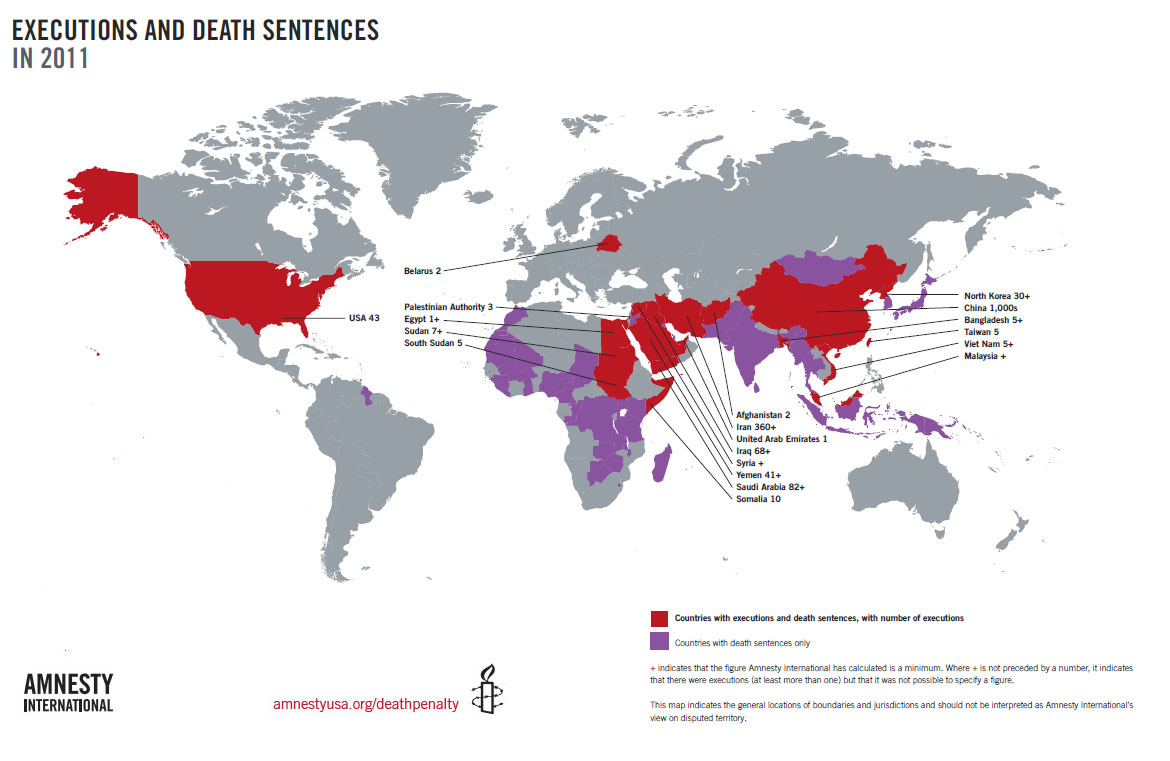
Capital punishment
View on GrokipediaHistorical origins and evolution
Ancient and classical civilizations
The Code of Hammurabi, inscribed around 1750 BCE in ancient Mesopotamia, codified capital punishment for roughly 25 offenses, including false accusation leading to execution, certain forms of theft such as breaking into a house, and adultery under specific circumstances.[16][5] These prescriptions reflected a retributive framework of lex talionis, where death served to restore social equilibrium disrupted by violations against persons or property in a hierarchical agrarian society.[16] In ancient Egypt, spanning from the Old Kingdom (c. 2686–2181 BCE) onward, capital punishment targeted grave threats to Ma'at—the cosmic order—including treason, tomb desecration, murder, and severe theft, with execution methods encompassing impalement on stakes, burning alive, drowning in the Nile, and decapitation.[17][18] Such penalties, often administered publicly by state officials, underscored the pharaoh's role as divine enforcer, deterring disruptions to the rigid social structure essential for Nile-dependent agriculture and monumental projects.[19] The Qin Dynasty in ancient China (221–206 BCE) institutionalized execution as part of the Five Punishments under Legalist doctrine, applying death—via beheading or strangulation—for offenses ranging from rebellion and corruption to minor infractions like tax evasion, often extending to collective family liability to enforce absolute obedience and imperial unity.[20][21] This harsh regime, which reportedly executed tens of thousands annually to consolidate the first centralized empire, prioritized state stability over individual mercy in a vast, fractious territory.[22] In classical Greece, particularly Athens during the 5th century BCE, capital sanctions addressed homicide, impiety, and treason through methods like hemlock poisoning—as administered to Socrates in 399 BCE for corrupting youth and rejecting state gods—or precipitation from heights and execution in the barathron pit.[23][24] Roman practice expanded this with crucifixion reserved for slaves, provincials, and insurgents guilty of rebellion or banditry, a prolonged public torment designed to exemplify imperial dominance and suppress unrest among the lower strata.[25] Across these civilizations, executions were typically spectacles—employing stoning, beheading, or impalement—to affirm communal boundaries and deter deviance, integral to sustaining order in pre-industrial polities where weak institutions demanded visible retribution.[26][27]Medieval and early modern periods
In medieval Christian Europe, capital punishment for heresy was enforced through the integration of canon law and secular authority, with the Papal Inquisition established in 1231 by Pope Gregory IX to combat deviations from orthodoxy. Heretics convicted by inquisitorial courts were handed over to civil authorities for execution, often by burning at the stake, as the Church prohibited clerics from shedding blood directly; this practice peaked between the 12th and 15th centuries amid efforts to suppress movements like Catharism and Waldensianism.[28] Such punishments served to purify society and deter religious nonconformity, reflecting the fusion of spiritual and temporal power in feudal structures. During the early modern period, secular laws expanded capital offenses significantly, as seen in England's "Bloody Code," which from the late 17th century until 1823 prescribed death for over 200 crimes, primarily property-related thefts and forgeries, to maintain social order amid rising urbanization and economic pressures.[29] Public executions, such as hangings at Tyburn, were staged as spectacles to instill fear and deter potential offenders, with approximately 7,000 executions carried out in England and Wales between 1770 and 1830 out of 35,000 death sentences, averaging over 100 annually in the 18th century. In the Islamic world, capital punishment was codified under Sharia law in caliphates like the Abbasid (750–1258) and Ottoman (1299–1922), mandating hudud penalties such as stoning to death for adultery (zina) by married persons and beheading for apostasy or highway robbery (hirabah), derived from Quranic prescriptions and hadith to enforce moral and communal boundaries.[30] These executions, often public, reinforced state and religious authority, with methods varying by offense but emphasizing swift retribution; similar practices continued in some regions into the early modern era under Mughal and Safavid empires. By the late 18th century, shifts toward perceived more humane methods emerged, exemplified by France's adoption of the guillotine on April 25, 1792, for the execution of highwayman Nicolas Jacques Pelletier, replacing varied and often botched decapitations to ensure quicker, less painful deaths amid revolutionary calls for egalitarian justice. This innovation marked a transition from medieval spectacles to mechanized precision, though public viewings persisted for deterrent effect until later reforms.Enlightenment and 19th-century reforms
During the Enlightenment, thinkers challenged the expansive use of capital punishment, advocating for proportionality and deterrence over arbitrary severity. Cesare Beccaria's On Crimes and Punishments (1764) argued that punishments should deter crime through certainty rather than extreme harshness, questioning the death penalty's efficacy while emphasizing that it should be reserved only for cases threatening societal security, such as during civil unrest.[31][32] Beccaria's work influenced legal reforms across Europe and America by promoting the reduction of capital offenses from over 200 in England to fewer than 100 by the early 19th century, shifting focus toward imprisonment as an alternative.[33][34] Practical modifications emerged alongside intellectual critiques, with execution rates declining as penitentiary systems expanded to handle non-capital sentences. In Britain, public hangings persisted until the Capital Punishment Amendment Act of 1868 confined executions to prisons, reflecting concerns over spectacle's limited deterrent value amid urbanization and rising prison capacity.[35][36] Similarly, in the United States, New York legalized electrocution in 1888 as a purportedly more humane method, though its first use in 1890 proved botched, highlighting ongoing tensions between retention and reform.[37][38] France maintained guillotining for murder throughout the 19th century, with annual executions averaging in the dozens post-Napoleonic era, as centralized prisons absorbed lesser offenders, correlating with broader European trends toward fewer per capita capital sentences.[39] Limited abolitions marked early experiments, though retention dominated for aggravated homicide. The Grand Duchy of Tuscany became the first sovereign state to abolish capital punishment in 1786 under Grand Duke Leopold II, replacing it with hard labor in response to Beccarian ideas and low execution frequency since 1769.[40][41] Venezuela followed in 1863, eliminating the death penalty for all crimes via constitutional reform, the first extant nation to do so amid post-colonial instability favoring incarceration over execution.[42][43] European powers exported capital statutes to colonies in the Americas and Asia, sustaining high retention rates there despite metropolitan reforms, as empirical data showed urbanization and institutional alternatives gradually eroding reliance on executions without full abolition.[44]20th-century developments and post-WWII shifts
During the 20th century, capital punishment saw escalations tied to totalitarian regimes and wartime exigencies. In Nazi Germany, the regime conducted millions of executions for political, racial, and ideological crimes, often via firing squads, gas chambers, or mass shootings, as part of a systematic democide totaling approximately 16 million victims beyond combat deaths.[45] The Soviet Union under Stalin similarly employed firing squads extensively, with the Great Terror of 1937–1938 alone resulting in roughly 700,000 executions ordered by NKVD troikas for perceived counter-revolutionary activities, supplementing deaths in the Gulag system.[46] In the United States, executions peaked in the 1930s at an average of 167 annually, reflecting responses to the Great Depression-era crime waves, before declining to 128 per year in the 1940s and 72 in the 1950s amid evolving legal scrutiny.[47] World War II concluded with Allied imposition of capital punishment on Axis leaders, exemplified by the Nuremberg International Military Tribunal, where 12 defendants were sentenced to death by hanging in 1946, with 10 executions carried out on October 16 in the courthouse gymnasium.[48] Postwar shifts were influenced by the 1948 Universal Declaration of Human Rights, which affirmed the right to life without explicit endorsement of abolition, yet spurred early waves: European nations like West Germany (1949) and Italy (1947) abolished it amid denazification and reconstruction, contributing to over 50 countries eliminating capital punishment in law or practice by 2000.[49] However, Cold War dynamics preserved retention in communist states; the Soviet Union continued executions via firing squads until a moratorium in 1989, while China maintained high volumes, estimated at 10,000 annually in the 1990s for crimes like corruption and drug trafficking.[50] In the United States, executions further declined after the 1966 Miranda v. Arizona ruling enhanced suspect protections, contributing to a broader drop from 191 in 1960 to none by 1967, before the Supreme Court's Furman v. Georgia (1972) imposed a de facto moratorium by deeming arbitrary application unconstitutional under the Eighth Amendment, halting nearly 700 sentences.[51] This was reversed in Gregg v. Georgia (1976), which upheld revised statutes with guided discretion, resuming executions in 1977 while requiring bifurcated trials and appellate review.[52] Retention persisted in major powers like the U.S., China, Iran, and Saudi Arabia, underscoring causal persistence: empirical data reveal deterrence claims in high-crime contexts outweighed abolitionist pressures, with global executions ticking upward to 1,518 in 2024—predominantly in Iran (at least 853), Saudi Arabia (172), and Iraq—marking a 32% rise from 2023 and the highest since 2015, excluding unreported Chinese figures.[10]Core rationales and justifications
Retribution as moral desert
Retribution as moral desert posits that capital punishment for premeditated murder fulfills the principle of proportionality by imposing a penalty equivalent to the harm inflicted, namely the irreversible loss of human life. This view holds that the offender, by deliberately extinguishing an innocent life, forfeits their own moral claim to continued existence, thereby restoring a balance disrupted by the crime. Philosophers such as Immanuel Kant articulated this in his retributivist framework, arguing in The Metaphysics of Morals that "even if a civil society resolved to dissolve itself with the consent of all its members... the last murderer lying in prison ought to be executed" to satisfy the demand of justice, independent of consequentialist benefits like deterrence.[5] Kant's categorical imperative underscores treating rational beings as ends, not means, implying that failing to exact life-for-life treats the victim's humanity as lesser.[53] This reciprocity draws from natural law traditions, where the gravity of homicide demands an equivalent response to affirm the equal worth of victims and uphold societal moral order. Unlike mere vengeance, which risks arbitrary or excessive retaliation, retributive execution is administered by the state through codified due process, ensuring deliberation, evidence standards, and appeals to minimize error while channeling collective judgment. Proponents distinguish it as principled desert, not emotional catharsis, though some murder victims' families express a sense of restored equity post-execution, as reflected in public opinion polls where 60% viewed capital punishment as fair for providing closure.[54][55] For irremediable offenders, such as serial killers exhibiting psychopathic traits, retribution acknowledges the absence of viable rehabilitation, as empirical assessments indicate persistent risk and low reform success even under extended incarceration. Psychological analyses reveal that such perpetrators often lack the neural and behavioral plasticity for fundamental change, with many admitting intent to reoffend if released, underscoring retribution's role in assigning desert beyond reformative hopes.[56][57] This counters rehabilitation-centric models by prioritizing the offense's intrinsic wrongness, ensuring punishment matches the moral culpability without presuming offender redeemability.[58]Deterrence through credible threat
The rational actor model of criminal behavior, as developed by economist Gary Becker, posits that potential offenders weigh the expected utility of committing a crime against the expected costs, including the probability of detection and severity of punishment.[59] In this framework, capital punishment elevates the marginal cost of homicide beyond that of life imprisonment by imposing an irreversible penalty, thereby increasing the overall expected disutility and reducing the incidence of capital-eligible crimes among risk-averse actors.[60] This first-principles reasoning implies that the death penalty's deterrent value derives from its credibility as an ultimate sanction, particularly when certainty and celerity of execution enhance perceived risk, distinguishing it from probabilistic or reversible penalties.[61] Empirical analyses applying econometric models to U.S. data have yielded estimates of significant marginal deterrence. Isaac Ehrlich's 1975 time-series study of U.S. executions from 1933 to 1969 concluded that each execution deterred approximately seven to eight additional murders, based on regressions controlling for socioeconomic factors and incarceration rates.[62] Subsequent research, including state-level panel data, has reported ranges of three to eighteen lives saved per execution, with effects concentrated in jurisdictions maintaining active execution practices.[63] [64] These findings align with causal inference from execution resumptions, such as in Texas, where homicide rates declined relative to abolitionist states following policy shifts in the 1980s and 1990s, even after adjusting for confounding variables like policing intensity.[65] Countervailing claims of a "brutalization effect," whereby executions normalize violence and increase homicides, have been advanced but lack robust longitudinal support in net terms. Studies positing brutalization often rely on short-term spikes post-execution, yet aggregate data from high-execution periods, such as 1990s Texas, show overall homicide reductions exceeding any hypothesized offsets.[66] [67] The 2012 National Research Council report deemed post-1976 deterrence research inconclusive due to modeling challenges, including omitted variables and endogeneity, but acknowledged that pro-deterrence econometric specifications withstand sensitivity tests better than null or reverse hypotheses in certainty-focused analyses.[68] [69] Critiques of anti-deterrence conclusions, including those from advocacy-linked sources, highlight selection biases in data aggregation that dilute state-specific effects.[70] Compared to life without parole (LWOP), capital punishment offers superior deterrence through finality, as offenders facing LWOP may discount distant incarceration or anticipate policy changes, parole irregularities, or escape opportunities, reducing the sanction's ex ante credibility.[71] Survey and offender interview data indicate that perceived executability trumps duration in decision calculus, with LWOP often viewed as survivable rather than preclusive.[72] Marginal deterrence thus hinges on maintaining a credible threat regime, where execution rates correlate inversely with capital homicides only under swift, publicized enforcement, underscoring the penalty's role in altering offender expectations beyond incapacitation alone.[73]Incapacitation and protection of society
Capital punishment achieves incapacitation by permanently eliminating the offender's capacity to commit further crimes, thereby ensuring zero recidivism among those executed, in contrast to life imprisonment where risks persist despite containment. This rationale rests on the causal certainty that a deceased individual poses no threat to society, addressing irredeemable actors whose patterns of violence indicate high future dangerousness. Empirical evidence from prison systems underscores the limitations of incarceration: in U.S. state prisons, inmate-on-inmate homicides reached 120 in 2018, the highest recorded level, often involving prior violent offenders who continue predatory behavior behind bars.[74][75] Such incidents highlight that even in maximum-security facilities, high-risk profiles—such as multiple murderers—frequently engage in assaults, with federal data indicating that violent offenders exhibit recidivism patterns extending to institutional violence at rates exceeding 75% for career criminals.[76] Data on prison violence further illustrates the protective value of execution for particularly dangerous subsets. Department of Justice statistics reveal that assaults and homicides within prisons are disproportionately linked to inmates with histories of aggravated offenses, where containment fails to fully neutralize threats due to factors like gang affiliations, mental health issues, or opportunistic predation.[77] For instance, while overall escape rates from secure facilities remain low at approximately 10.5 per 10,000 inmates annually, successful breaches by violent offenders have enabled subsequent crimes, as documented in over 1,100 custody escapes across multiple states from 2018 to 2023.[78][79] Life-without-parole sentences, while restrictive, do not eliminate these residual risks, as evidenced by ongoing violence that claims lives and strains institutional resources, underscoring execution's role in absolute societal protection. Historically, this incapacitative function justified capital punishment for threats like treason, where mere imprisonment could not preclude subversion or collaboration with external actors. In ancient Rome, execution was the prescribed penalty for perduellio (high treason), aimed at decisively removing individuals capable of undermining the state, as seen in cases like the Catilinarian conspirators under Cicero in 63 BCE, who were put to death to avert further plots.[26][80] Similarly, in medieval Europe, traitors faced capital sanctions—often involving drawing and quartering—to ensure no opportunity for continued disloyalty, reflecting a pragmatic recognition that elite offenders retained influence even in custody, as codified in English treason laws by 1352.[81][82] These precedents prioritized causal prevention over reversible confinement, aligning with empirical necessities for protecting communal order from persistent high-stakes risks.Economic and resource allocation efficiency
In the United States, empirical analyses of capital punishment costs reveal that death penalty cases incur significantly higher expenses than alternatives like life without parole, primarily due to extended pre-trial investigations, bifurcated proceedings, specialized legal representation, expert witnesses, and protracted appeals mandated by constitutional safeguards. For instance, a comprehensive review in Maryland found that pursuing a death sentence added nearly $2 million per case compared to non-capital prosecutions seeking life imprisonment. Similarly, in California, the death penalty system has expended approximately $4 billion more than an equivalent life-without-parole regime since 1978, with projections estimating an additional $5-7 billion by 2050, driven by these procedural demands rather than execution itself. Annual housing costs for death row inmates, averaging $50,000 to $90,000 per person due to enhanced security and isolation, further compound totals, often exceeding $1-3 million per case upfront before any long-term incarceration savings materialize.[83][84] These elevated costs reflect systemic commitments to due process and error mitigation, features that enhance judicial integrity but challenge short-term fiscal efficiency; critiques framing capital punishment as inherently wasteful overlook that streamlined alternatives risk eroding public trust in convictions for heinous crimes. Over decades, while life sentences impose ongoing burdens—estimated at 60,000 annually per inmate for 40+ years, totaling $1.2-2.4 million excluding inflation and healthcare escalations—the death penalty's total expense per executed offender remains higher in practice due to average death row tenures exceeding 20 years amid appeals.[85][86][87] In contrast, retentionist systems with expedited procedures, such as China's, demonstrate greater resource efficiency through rapid adjudication and execution, often concluding within months via limited appeals and methods like lethal injection, which reduce prolonged housing demands and associated overhead. This approach avoids the perpetual taxpayer burden of lifelong confinement for capital offenders, shifting fiscal loads toward finite trial expenditures rather than indefinite maintenance, though quantitative data remains opaque due to state secrecy.[88][89] From a broader allocation perspective, capital punishment optimizes prison capacity by permanently incapacitating select offenders, alleviating pressures in overcrowded facilities; the U.S. federal prison system, housing over 141,000 inmates as of recent counts, contends with persistent space constraints that elevate per-inmate costs and necessitate expansions or releases for lesser offenders. Executing even a modest number of death row inmates—amid a national total incarceration exceeding 1 million—frees high-security beds otherwise occupied indefinitely, enabling reallocation to non-capital cases without equivalent safety trade-offs.[90][91]Execution methods and procedures
Traditional and historical techniques
In ancient Rome, crucifixion served as a prolonged public spectacle designed to deter through visible suffering, typically beginning with scourging using whips embedded with metal or bone fragments to lacerate the victim's back and sides before nailing or binding the individual to a wooden cross, leading to death by asphyxiation, hypovolemic shock, or exposure over hours to days.[92] The method emphasized deterrence via the condemned's extended agony, with victims often left on display along roadsides.[93] Stoning, practiced in ancient Jewish communities as prescribed in biblical texts, involved communal participation where witnesses initiated the throwing of stones at the condemned to ensure death through blunt trauma, reinforcing social cohesion and moral enforcement by implicating the community in the execution.[94] This method's reliance on collective action aimed for high lethality via cumulative impact, though variability in stone size and accuracy could prolong the process. Beheading by sword or axe prevailed in medieval Europe for nobles, offering a swift severance of the head from the body when executed skillfully, but frequent botches required multiple strikes, as in the 1587 execution of Mary Queen of Scots which took three blows and a knife finish.[95] The guillotine, introduced in France in 1792, mechanized this with a weighted oblique blade dropping via gravity to cleanly decapitate, minimizing executioner error and intended for egalitarian application during the Revolution.[96] Hanging dominated British executions from the medieval period, initially via short drop causing strangulation over 10-20 minutes, later refined in the mid-19th century with long-drop calculations—factoring body weight and rope length—to induce a "hangman's fracture" at the second cervical vertebra for rapid spinal severance and unconsciousness.[97] Empirical records show high lethality post-reform, yet pre-1868 public hangings suffered botches like decapitation or survival attempts, exemplified by John Lee's 1885 triple failure due to trapdoor malfunctions.[35] In Spain, the garrote employed an iron collar tightened by screw or lever to compress the neck and rupture the trachea or spine, used from the early 19th century for civilians to achieve strangulation in a seated position for controlled, visible punishment.[98] Across Asia, particularly in imperial China, lingchi—death by slow slicing—dismembered the living body in prescribed cuts to vital areas, prolonging death for maximum terror and reserved for treason, with executioners trained to avoid immediate fatality until the finale.[99] These techniques prioritized public visibility and mechanical reliability for deterrence, though inconsistencies in application often led to variable pain durations, contributing to 19th-century shifts toward privatized methods amid crowd disorders and humanitarian critiques.[100]Contemporary methods in practice
Lethal injection remains the predominant method of execution in retentionist jurisdictions such as the United States and China, comprising the majority of procedures where implemented. In the United States, it accounted for approximately 75% of the 40 executions carried out through October 2025, with states like Texas and Florida relying on a three-drug protocol involving a barbiturate for sedation, a paralytic agent, and potassium chloride to induce cardiac arrest.[101] Protocols emphasize intravenous administration to ensure unconsciousness prior to lethality, though pharmaceutical manufacturers' refusals to supply drugs for this purpose have led to persistent shortages and the adoption of compounded alternatives, prompting secrecy laws in multiple states.[102][103] Alternative methods have gained traction in the U.S. amid injection challenges, including nitrogen hypoxia, which debuted in Alabama in January 2024 and was used for seven executions across Alabama and Louisiana by October 2025.[104] This inert gas asphyxiation method delivers pure nitrogen via face mask, aiming for rapid unconsciousness and death within minutes, as demonstrated in Alabama's October 23, 2025, execution of Anthony Boyd.[105] Firing squads, authorized in Utah and revived with Ronnie Lee Gardner's 2010 execution, remain legal but unused in recent years, while electrocution persists as a backup in southern states like South Carolina, though rarely invoked.[106] State reports indicate near-universal fatality rates exceeding 98% across methods, with procedures adjusted mid-execution if needed to achieve death.[107] Internationally, hanging predominates in countries like Iran and Japan, with Iran conducting at least 853 executions by this method in 2024 alone, often via short-drop suspension from cranes or gallows.[11] Japan employed long-drop hanging for its June 27, 2025, execution of Takahiro Shiraishi, utilizing a trapdoor mechanism to fracture the neck.[108] Saudi Arabia favors beheading by sword for its 172 documented executions in 2024, performed publicly or semi-publicly to maximize deterrent effect, while China, responsible for thousands annually, primarily uses lethal injection but provides limited procedural details.[9] Safeguards in these systems vary, with procedural emphasis on swift completion rather than prolonged unconsciousness verification, contrasting U.S. medicalized approaches.[109]Scientific and medical considerations for lethality
In judicial hanging employing a calibrated long-drop mechanism, death typically results from cervical fracture and spinal cord disruption or vascular compression, inducing immediate or near-immediate unconsciousness—often within 1 second via transection or 5-10 seconds via cerebral ischemia from carotid artery occlusion—followed by cardiorespiratory arrest within 5-10 minutes.[110] Autopsy examinations of such cases reveal ligature furrows, hyoid fractures, and hypoxic brain changes consistent with rapid physiological shutdown, without histological indicators of sustained cortical awareness or prolonged nociception.[111] Lethal injection protocols, utilizing barbiturates such as pentobarbital or thiopental followed by paralytics and cardiac agents, leverage pharmacology to achieve unconsciousness in 10-30 seconds through central nervous system depression, with subsequent respiratory and cardiac failure ensuing in 5-18 minutes under standard administration.[112] Forensic pathology from executed cases demonstrates disseminated intravascular coagulation and myocardial necrosis aligning with overdose mechanisms, rather than evidence of extended suffering; claims of awareness during paralysis are contradicted by pharmacokinetics showing anesthetic dominance prior to neuromuscular blockade when doses are adequate.[113] However, procedural challenges, including peripheral vein collapse in approximately 7% of U.S. cases since 1982, have led to delays exceeding 30 minutes in some instances, attributable to anatomical difficulties rather than inherent pharmacological failure.[114] Emerging methods like nitrogen hypoxia, implemented via inhalation of pure inert gas to induce hypoxic hypoxia, exploit chemoreceptor insensitivity to oxygen deprivation without hypercapnic distress, yielding unconsciousness in 10-20 seconds and EEG isoelectricity within 30-60 seconds, akin to general anesthesia induction, with death from anoxia in 4-6 minutes.[115] Empirical data from analogous human exposures and animal models confirm absence of subjective suffocation or pain signaling, as cerebral hypoxia progresses silently; post-execution analyses, including Alabama's 2024 protocol, show agonal convulsions as subcortical reflexes post-unconsciousness, unsupported by biomarkers of persistent sentience.[116] These single-agent or gas-based refinements, adopted in states like Alabama by 2021 legislation, address injection-site variability, prioritizing first-principles respiratory physiology for enhanced predictability over multi-drug cascades.[117]Defining capital offenses
Aggravated homicide and terrorism
Aggravated homicide constitutes the primary category of capital offenses in most retentionist jurisdictions, encompassing intentional killings elevated by specific circumstances that demonstrate heightened culpability, such as premeditation, commission during a felony, multiple victims, exceptional cruelty, or targeting vulnerable individuals.[118] These aggravators distinguish ordinary murder from capital-eligible cases, reflecting statutes that prioritize moral desert and societal protection for the most egregious acts of lethal violence. Terrorism-related killings, often involving mass casualties or ideological motives aimed at instilling fear, are similarly classified as aggravated due to their scale and intent, with post-9/11 U.S. federal law authorizing the death penalty for acts like aircraft hijackings resulting in death under statutes expanded by the USA PATRIOT Act.[119][120] In the United States, the felony murder rule exemplifies aggravation by imputing capital liability for deaths occurring during inherently dangerous felonies like robbery or arson, even absent specific intent to kill the victim, as applied in over 40 states with death penalty provisions.[118][121] This doctrine has sustained capital convictions in cases where accomplices or unintended killings arise amid predicate crimes, though constitutional challenges persist regarding proportionality absent personal intent. Globally, China's Criminal Law prescribes execution for "extremely serious" intentional homicides among 46 capital-eligible offenses, with estimates indicating thousands of such executions annually, far exceeding other nations combined.[122][123] Under Saudi Arabia's application of Sharia, the Qisas principle mandates death for intentional homicide proven by evidence of deliberate killing, often involving beheading, as a form of retributive equality unless pardoned by the victim's heirs.[124][125] Reports from organizations tracking executions indicate that homicide and terrorism account for the predominant share—over 90% in documented cases excluding unreported Chinese figures—of global capital punishments, underscoring their centrality amid debates over non-lethal offenses.[11][126]Non-homicidal crimes in retentionist jurisdictions
In retentionist jurisdictions, capital punishment applies to various non-homicidal offenses deemed to pose severe threats to societal order, public health, or national security, with penalties justified by the scale of indirect harms such as widespread addiction, organized violence, or state subversion.[127][128] Drug trafficking exemplifies this, as governments in Asia cite its role in fueling cartel violence and overdose epidemics; for instance, Mexican cartels linked to trafficking have killed over 150 politicians amid territorial wars, contributing to broader instability.[129] Singapore mandates death by hanging for trafficking specified quantities of controlled substances, including 15 grams of heroin or 30 grams of cocaine, under the Misuse of Drugs Act, with eight such executions recorded in 2024 alone.[130][131] Indonesia similarly imposes capital punishment via firing squad for large-scale drug trafficking under narcotics laws, executing six convicts—including five foreigners—in 2015 and maintaining hundreds on death row as of 2022 despite enforcement challenges.[132][133] China, retaining secrecy on totals, executes hundreds to thousands annually for drug crimes, with state media reporting 160-200 drug-related cases in 2018-2019, reflecting a policy prioritizing deterrence against organized syndicates responsible for indirect societal casualties via dependency and turf conflicts.[134][135] Treason and espionage warrant execution in several retentionist states due to their existential risks to sovereignty; North Korea applies capital punishment for these offenses alongside public executions to enforce loyalty, as seen in the 2015 anti-aircraft firing squad death of Defense Minister Hyon Yong-chol for disloyalty.[136][137] Historically in the United States, federal law authorizes death for treason under 18 U.S.C. § 2381, though applied only twice—during the 1847 Taos Revolt and World War II—highlighting rarity in Western contexts amid evolving legal standards.[138][139] Under Sharia-based systems, non-homicidal sexual offenses like adultery and rape incur death penalties to uphold moral and familial structures; Iran enforces stoning for proven adultery (requiring four witnesses or confession) and execution for rape, with such cases contributing to overall tallies amid broader penal code provisions.[140][141] Trends indicate persistence in Asia and Africa, where non-homicide executions—predominantly drugs—rose globally by 32% to at least 615 in 2024, excluding unreported Chinese cases; Iran's 2025 executions exceeded 1,000 by September, with most for drugs or security offenses, marking a post-1989 peak amid intensified anti-trafficking drives.[142][143] Western retentionists like the U.S. limit such applications to rare statutory exceptions without recent practice.[127]Evolving standards for sentencing
In jurisdictions that retain capital punishment, procedural standards for imposing the death penalty have evolved to require proof of guilt beyond a reasonable doubt in a dedicated guilt phase, distinct from a subsequent sentencing phase that evaluates proportionality through aggravating and mitigating factors. In the United States, the Supreme Court's decision in Gregg v. Georgia (1976) upheld revised statutes mandating such bifurcated trials, where juries first establish factual guilt based on overwhelming evidence before considering statutory aggravators—such as heinousness or multiple victims—to justify capital sentencing over life imprisonment.[52] [144] This structure ensures that death eligibility hinges not merely on conviction but on a demonstrated excess of culpability warranting the ultimate penalty. Reforms have further refined competency thresholds, excluding categories of offenders deemed insufficiently culpable. The U.S. Supreme Court in Atkins v. Virginia (2002) ruled that executing individuals with intellectual disabilities violates the Eighth Amendment, citing national consensus on their diminished personal responsibility and moral culpability, thereby mandating clinical assessments like IQ testing below 70 alongside adaptive deficits.[145] [146] Similar evolutions in other retentionist systems incorporate mental health evaluations to bar imposition where volition or comprehension is impaired, prioritizing evidence of full mens rea. At the international level, the United Nations Economic and Social Council's 1984 Safeguards outline minimum protections, restricting capital punishment to "the most serious crimes" typically involving intentional killing, while requiring exhaustive appeals, no retroactive laws, and opportunities for pardon or commutation.[147] Retentionist governments, however, frequently affirm these as aspirational rather than obligatory, arguing that they encroach on sovereign authority to define domestic penalties aligned with cultural and security needs, as evidenced in rejections of UN moratorium resolutions by states like China and Iran. [148] Empirical analyses of U.S. capital cases reveal stringent guilt-phase scrutiny, with reversals predominantly involving procedural or sentencing errors rather than factual innocence; for instance, among retried death-row inmates, only about 7% are ultimately found not guilty, while over 80% receive non-capital outcomes due to resentencing reevaluations, demonstrating the system's multi-tiered safeguards against unsubstantiated executions.[149] [150] These low innocence exoneration rates amid higher sentencing overturns (e.g., 68% overall error detection) affirm the robustness of evidence-based thresholds in filtering cases.[151]Global patterns of retention and use
Retentionist nations and execution volumes
As of December 2024, 53 countries classify as retentionist, maintaining capital punishment in law and practice for ordinary crimes, with executions occurring in at least 15 nations annually.[152] These jurisdictions span Asia, the Middle East, Africa, and the Americas, though Asia and the Middle East account for over 90% of documented global executions.[9] Retentionist policies persist amid rising execution volumes, driven by national security rationales, deterrence claims, and cultural norms in countries like China, Iran, and Saudi Arabia.[11] In 2024, Amnesty International recorded 1,518 executions worldwide excluding China, marking a 32% increase from 1,153 in 2023 and the highest tally since 2015.[9] China, which does not release official figures, is estimated to execute thousands annually, rendering global totals likely several times higher; Amnesty's data thus underrepresents reality due to state secrecy in the world's most populous nation.[10] Iran led known executions with at least 972, comprising 64% of the recorded total and a 14% rise from prior years, often for drug offenses and dissent-related charges.[153] Saudi Arabia followed with 345 executions, the highest in over three decades per Amnesty monitoring, escalating for drug crimes and terrorism.[154]| Country | Recorded Executions (2024) | Primary Offenses |
|---|---|---|
| Iran | 972+ | Drug trafficking, murder, dissent |
| Saudi Arabia | 345 | Drug offenses, terrorism |
| Iraq | 45+ | Terrorism, homicide |
| Egypt | 107+ | Murder, political violence |
| Yemen | Undisclosed high | Conflict-related crimes |
Regional variations and recent trends (2020s)
In Asia, capital punishment remains entrenched, with high-execution nations like China, Iran (often categorized regionally), and Singapore driving volumes amid security and narcotics concerns; India resumed executions on March 20, 2020, hanging four men convicted in the 2012 Delhi gang rape and murder case, the first such act since 2013.[156] Singapore has executed at least 11 people in 2025, predominantly for drug trafficking under mandatory sentencing laws, reflecting intensified anti-narcotics campaigns despite regional abolition trends.[157] Retention persists for offenses tied to public order, with new or expanded laws in countries including Bangladesh, Maldives, and North Korea during 2020-2025.[158] In the Middle East, executions surged for security threats, exemplified by Iran's over 1,000 in 2025—many for drug crimes, espionage, and suppressing post-conflict unrest following regional tensions—marking a sharp escalation from prior years.[127] Saudi Arabia contributed at least 50 drug-related executions by mid-2025, while nations like Iraq and Egypt apply capital punishment to terrorism and insurgency-linked offenses, underscoring its role in countering perceived existential threats.[11] These patterns resist international pressure, with Middle Eastern states accounting for a disproportionate share of global totals despite UN General Assembly resolutions urging moratoriums since the 2000s.[159] The United States exhibits state-level variation, with Southern states innovating amid federal pauses; Florida enacted laws in 2025 authorizing non-unanimous jury verdicts for death sentences and flexible execution methods beyond lethal injection, leading national execution counts alongside Alabama's nitrogen hypoxia protocols.[160] Ten states conducted executions in 2025, primarily Florida, Texas, Alabama, and South Carolina, totaling a surge from prior years while 23 states and the federal government maintain de facto moratoriums or abolition.[161] Globally, 2020s trends show resilience against abolitionist advocacy, with recorded executions reaching 1,153 in 2023 (31% above 2022) and at least 1,500 in 2024—the highest since 2015—despite UN expert condemnations and pushes for universal moratoriums.[159] [162] This uptick, concentrated in fewer than 20 countries, coincides with no evident link between abolition and homicide declines; retentionist Singapore sustains homicide rates near 0.2 per 100,000—far below neighbors like Malaysia (around 2.1)—attributed in some analyses to credible execution risks deterring serious crime.[163] Factors include terrorism resurgence (e.g., Iran's post-ISIS and regional conflict responses) and drug enforcement, countering claims that international norms erode retention.[164][165]United States: Federal and state dynamics
In the United States, capital punishment operates under a federalist system where both federal and state governments authorize executions for certain offenses, primarily aggravated murder. As of 2025, 27 states retain the death penalty, while 23 states and the District of Columbia have abolished it in law or practice.[166] The federal government maintains authority for capital crimes under its jurisdiction, resuming executions in 2020 after a 17-year hiatus, carrying out 13 executions between August 2020 and January 2021, all via lethal injection at the Federal Correctional Complex in Terre Haute, Indiana. No federal executions have occurred since the imposition of a moratorium by Attorney General Merrick Garland in July 2021. State-level executions have increased in 2025, with 40 carried out across 11 states as of October 24, surpassing the totals of recent prior years and reflecting a post-COVID resurgence after judicial pauses disrupted proceedings.[101] This uptick is concentrated in Southern states such as Florida, Texas, Alabama, and South Carolina, which accounted for 76% of 2025 executions, highlighting regional disparities where Southern jurisdictions impose and carry out death sentences at higher rates than other areas.[161] [167] New death sentences remain low, averaging 20-30 annually since 2020, with 26 imposed in 2024, indicating executions lag behind sentencing trends due to lengthy appeals processes averaging over two decades on death row.[168] [160] Legal challenges continue to shape federal and state dynamics, exemplified by the Supreme Court's February 25, 2025, ruling in Glossip v. Oklahoma, which vacated Richard Glossip's conviction due to prosecutorial failure to disclose exculpatory evidence from key witness Justin Sneed, ordering a new trial and underscoring due process requirements in capital cases.[169] Public opinion, as measured by Gallup in October 2024, shows 53% support for the death penalty in cases of murder, a five-decade low stable amid generational shifts but persistent despite advocacy efforts.[170] These elements illustrate ongoing tensions between retentionist policies in active states and federal oversight amid evolving judicial scrutiny.Empirical assessments of impact
Evidence on deterrent effects
Multiple econometric analyses using state-level panel data from the 1970s to 2000s have estimated that increases in the probability of execution are associated with reductions in homicide rates, with elasticities implying 5 to 10 fewer murders per additional execution or per unit increase in execution risk.[64][171] For instance, studies employing instrumental variables and time-series regressions, such as those by Mocan and Gittings, found each execution deters between 3 and 5 homicides on average across U.S. states.[172] These findings align with rational choice models positing that potential offenders, particularly those responsive to risks, weigh severe, credible punishments; surveys of convicted murderers indicate that 13 to 20 percent cite fear of the death penalty as a factor in avoiding capital crimes, though self-reports may understate instrumental deterrence due to social desirability bias.[173] Critiques highlight methodological challenges, including omitted variables like concurrent sentencing policies and nonlinear brutalization effects where executions might embolden copycat violence in low-execution states.[66] The National Research Council’s 2012 panel review deemed post-Gregg v. Georgia studies inconclusive, citing insufficient attention to confounders such as noncapital sanctions and data aggregation issues that fail to isolate causal impacts from correlated factors like policing intensity.[68] Recent 2020s econometric work, including synthetic control methods on moratorium lifts and panel fixed-effects models, has rejected dominant brutalization claims and provided qualified support for deterrence in high-compliance regimes, though results remain sensitive to specification and do not uniformly exceed statistical thresholds for policy guidance.[174] Globally, Singapore’s mandatory capital sentences for intentional murder and strict execution enforcement—averaging near one per million population annually in peak periods—coincide with homicide rates of 0.2 to 0.4 per 100,000, substantially below comparator jurisdictions like Hong Kong (without executions post-1966) at 0.6 to 2.0 per 100,000, suggesting possible specific deterrence amid broader zero-tolerance policing, though cross-jurisdictional causality is confounded by cultural and socioeconomic differences.[163][175]Data on recidivism prevention and public safety
Capital punishment ensures absolute incapacitation, rendering executed offenders incapable of committing any further crimes, whether against fellow inmates, prison staff, or the public at large. In contrast, offenders sentenced to life without parole (LWOP) retain the capacity to perpetrate violence within correctional facilities, as evidenced by ongoing incidents of assaults and homicides in U.S. prisons. The Bureau of Justice Statistics reported a prison homicide rate of 12 per 100,000 inmates in 2019, up from 10 per 100,000 the prior year, reflecting persistent risks posed by incarcerated individuals, including those serving long terms for violent offenses.[176] Given that nearly half of the U.S. prison population is held for violent crimes, such internal recidivism underscores the non-zero future threat under LWOP, even absent release.[177] Data on in-prison misconduct further quantifies this disparity. Federal Bureau of Prisons statistics for 2025 indicate that homicide, aggravated assault, and kidnapping offenses—categories often linked to capital-eligible prior convictions—account for a notable share of inmate disciplinary violations, with over 5,000 individuals charged for such acts in recent years. Studies of long-term prisoners, including those with LWOP, reveal that a subset continues patterns of aggression, contributing to an estimated 144 annual prison homicides nationwide based on the 2019 rate applied to approximately 1.2 million state and federal inmates. This internal recidivism directly endangers correctional populations, with lifers and capital offenders overrepresented among perpetrators due to their histories of extreme violence. Execution eliminates this residual risk entirely, preventing any additional victimization by the offender. Escape attempts, while infrequent, amplify public safety concerns under life sentences. National data from 2015 show an escape rate of 10.5 per 10,000 prisoners, equivalent to 0.105%, with rates having declined over prior decades but remaining a persistent vulnerability in secure facilities.[78] Among escapes, 19.2% involve violence, often during the breakout, and are more likely from secure custody housing high-risk violent offenders.[179] Though rare, successful escapes by capital-eligible individuals—such as those involving weapons or accomplices—pose acute threats to communities, as seen in historical cases where fugitives recommitted serious crimes. Execution obviates this possibility, providing definitive prevention beyond the low but nonzero escape probability. This incapacitative effect extends to broader public safety metrics in retentionist jurisdictions. Texas, which has conducted 574 executions since 1976, maintains violent crime rates comparable to or below the national average, with its rigorous application of capital punishment correlating to the removal of repeat high-risk offenders from circulation.[180] Similarly, Florida's uptick in executions starting in 2023—reaching 13 in 2025 alone, after a pause from 2020-2022—coincides with declining violent crime trends in the state during the mid-2020s, though multifaceted factors influence overall patterns.[181] By contrast, the absolute certainty of no recidivism under capital punishment offers psychological security to victims' families and communities, unmitigated by even minimal risks of institutional failure or internal violence inherent in lifelong incarceration.Analyses of costs, errors, and disparities
Studies across U.S. jurisdictions consistently demonstrate that capital cases impose higher fiscal burdens than comparable non-capital prosecutions seeking life imprisonment, driven by requirements for bifurcated trials, additional expert witnesses, enhanced investigative resources, and extended appellate reviews. A 2003 Kansas legislative audit calculated death penalty trials at 70% greater cost than non-death cases, while Maryland analyses pegged lifetime expenses per capital sentence at around $3 million.[85] [182] Lifetime incarceration under life without parole averages $1-2 million per inmate over 40-50 years, factoring in housing and medical care, yet pre-execution expenditures in death penalty systems routinely surpass this threshold due to procedural mandates.[183] [83] Documented exonerations from U.S. death rows total 200 since 1973, out of approximately 9,000 death sentences handed down post-Furman v. Georgia, yielding an observed reversal rate of about 2%.[184] DNA testing has exonerated individuals in 15% of these instances, with its routine application since the 1990s correlating to fewer conviction errors in subsequent capital trials.[185] Among the 1,600 executions carried out since 1976, no post-DNA wrongful executions have been conclusively verified, implying an executed error rate under 0.1% based on empirical tracking.[186] Demographic patterns in U.S. capital sentencing reflect offense distributions more than disproportionate targeting, with black defendants comprising 34% of executions from 1976 onward despite constituting roughly 50% of homicide offenders per FBI arrest statistics.[187] [188] A persistent race-of-victim disparity appears, wherein offenders of white victims face elevated death sentencing odds, yet U.S. Department of Justice examinations of federal prosecutions detected no defendant-race bias after adjustments for aggravating factors and jurisdiction.[189] [190] Multivariate controls in state-level studies further indicate socioeconomic status and case severity as stronger predictors of outcomes than race alone.[191]Debates and counterarguments
Claims of irreversibility and wrongful executions
Opponents of capital punishment emphasize its irreversibility, arguing that execution precludes rectification of errors, unlike imprisonment which permits post-conviction exoneration through appeals or new evidence.[186] This claim draws on documented cases of individuals sentenced to death later proven innocent, with organizations tracking 200 such exonerations from U.S. death rows since 1973, primarily via DNA evidence, recanted testimony, or withheld exculpatory material.[184] A 2014 statistical analysis estimated that at least 4.1% of death-sentenced defendants in the U.S. are factually innocent, based on survival modeling of exoneration timelines among over 8,000 cases since reinstatement in 1976.[192] Common causes of these wrongful capital convictions include eyewitness misidentification (contributing to about 70% of DNA-based exonerations), official misconduct such as suppressed evidence, perjured testimony, and flawed forensic analysis predating modern standards.[193] Pre-DNA era convictions, before widespread adoption in the late 1980s, were particularly vulnerable to these errors due to reliance on subjective identifications and rudimentary serology testing with error rates exceeding 20% in some analyses.[194] DNA testing has since exonerated 38 death-row inmates, highlighting systemic vulnerabilities while also enabling post-conviction review unavailable in many non-capital cases.[195] However, exonerations represent a fraction of death sentences, with actual wrongful executions remaining unproven in the modern U.S. era despite intense scrutiny; claims of possibly innocent executed individuals persist but lack conclusive evidence in verified cases.[186] Appellate reversal rates for procedural errors reached 68% in capital cases from 1973 to 1995, but these predominantly involved sentencing flaws rather than factual innocence, with most reversed cases resulting in resentencing to life rather than acquittal.[150] Safeguards like mandatory appeals, habeas corpus review, and Innocence Protection Act provisions for DNA testing have reduced error risks, though proponents note that life without parole sentences—now imposed in over 50,000 U.S. cases—offer no practical remedy for innocents, as parole denials and resource constraints limit post-conviction relief, yielding overturn rates below 7% compared to higher scrutiny in capital appeals.[196] As of 2025, exoneration rates have not spiked amid ongoing reforms, with only three death-row exonerations recorded in 2024, maintaining the cumulative total near 200 despite thousands of executions worldwide; this stability underscores layered judicial protections, though critics from advocacy groups like the Death Penalty Information Center argue undercounting due to lost evidence in executed cases.[184][197]Allegations of bias and arbitrariness
Critics have alleged racial bias in capital sentencing, claiming that black defendants receive death sentences at disproportionate rates compared to white defendants for similar crimes. However, empirical analyses controlling for victim race, crime severity, and statutory aggravators find no evidence of systemic racial discrimination in sentencing outcomes. For instance, when adjusting for the fact that murders of white victims are far more likely to result in capital charging and conviction—reflecting both prosecutorial priorities and public demand for accountability in high-profile cases—racial disparities in death sentences align closely with interracial homicide patterns, where black offenders account for approximately 50% of white victim homicides despite comprising 13% of the population.[198] [199] The influential Baldus study, cited in McCleskey v. Kemp (1987), purported to show that black defendants killing white victims were 4.3 times more likely to receive death sentences, but the U.S. Supreme Court critiqued it for failing to adequately control for non-racial variables such as prosecutorial discretion, plea bargaining, and case-specific aggravators like multiple victims or felony murder circumstances, rendering its statistical disparities insufficient to prove unconstitutional bias in any individual case.[200] [201] Subsequent rigorous reviews, including multivariate regressions incorporating over 200 confounders, confirm that race-of-defendant effects vanish once victim race and aggravator presence are properly accounted for, debunking claims of inherent racial animus in sentencing juries or prosecutors.[198] [199] Allegations of class bias posit that indigent defendants face higher risks of capital sentences due to reliance on overburdened public defenders, yet eligibility for death penalty consideration is statutorily determined by the presence of aggravating factors—such as murder during robbery, killing a law enforcement officer, or heinous brutality—independent of the defendant's socioeconomic status.[202] While poorer defendants may experience suboptimal representation leading to weaker mitigation at sentencing, this reflects systemic issues in indigent defense funding rather than arbitrary application of capital statutes, as charging decisions remain driven by evidentiary strength of aggravators rather than wealth.[198] Geographic variations, with higher execution rates in southern states, are often labeled arbitrary, but these patterns correlate directly with elevated homicide volumes in the region, where the South records the nation's highest average murder rate—approximately 7-8 per 100,000 residents compared to 4-5 in the Northeast—necessitating proportionally robust enforcement of capital laws to address local crime realities rather than regional caprice.[203] Studies from advocacy organizations alleging unchecked bias frequently overlook these offense-adjusted metrics and suffer from methodological flaws or ideological incentives toward abolition, whereas neutral statistical controls reveal sentencing consistency across jurisdictions when normalized for caseload severity.[199][198]Human rights frameworks versus sovereignty
Human rights organizations and international bodies, such as the United Nations, advocate for the abolition of capital punishment under universalist frameworks that frame it as incompatible with the right to life and prohibitions against cruel, inhuman, or degrading treatment, as articulated in instruments like the Second Optional Protocol to the International Covenant on Civil and Political Rights (ICCPR), which commits ratifying states to abolish the death penalty.[204] As of 2024, 91 states have ratified this protocol, representing a subset of the 173 parties to the ICCPR, with the UN General Assembly repeatedly passing non-binding resolutions urging a moratorium on executions.[205] The European Union similarly conditions trade agreements and diplomatic relations on progress toward abolition, exerting pressure on retentionist nations through sanctions or aid restrictions.[206] This universalist approach clashes with assertions of state sovereignty, which prioritize a nation's authority to enact punishments aligned with its legal traditions, cultural norms, and public consent under the social contract, where citizens delegate power to govern retribution for heinous crimes.[207] Retentionist countries argue that international norms infringe on self-determination, as enshrined in UN Charter Article 2(7), which bars interference in domestic jurisdiction.[208] For instance, in India, a 2009 government survey found 86% public support for retaining the death penalty, reflecting democratic legitimacy in a nation of 1.4 billion where sovereignty overrides external abolitionist mandates.[209] Similarly, U.S. polls in 2024 showed 53% favoring capital punishment for murder, underscoring that retention aligns with majority will in federalist systems resistant to supranational dictates.[210] Proponents contend that rights frameworks neglect victims' entitlements to proportional justice, deriving instead from consensual governance rather than imposed global standards. Critics of human rights universalism highlight cultural relativism, positing that definitions of "cruelty" are not absolute but context-dependent; what abolitionist regimes deem inhumane may serve retributive equilibrium in societies valuing swift justice for severe offenses.[208] This perspective views advocacy groups like Amnesty International—whose reports emphasize abolition despite operating from Western-centric viewpoints—as advancing normative imperialism that disregards empirical realities in high-crime or unstable contexts, where retention correlates with order in nations like Singapore, which maintains low homicide rates amid active use of capital punishment.[207] Global execution numbers, reaching 1,518 in 2024—the highest in a decade and up 32% from 2023—defy the abolitionist trajectory, driven by retentionist states exercising sovereign control amid persistent security challenges.[211] Such trends illustrate that while over 70% of countries have abolished capital punishment in law or practice, populous retentionists comprising half the world's population prioritize domestic efficacy over harmonized norms.[152]Religious and cultural dimensions
Scriptural endorsements and interpretations
In the Hebrew Bible, capital punishment is explicitly mandated for murder, as stated in Genesis 9:6: "Whoever sheds the blood of man, by man shall his blood be shed, for God made man in his own image."[212] This principle underscores the sanctity of human life created in God's image, establishing retributive execution as a divine ordinance post-Flood, applicable to all humanity rather than solely Israelites.[213] Similarly, Exodus 21:24 prescribes the lex talionis—"eye for eye, tooth for tooth"—as a framework for proportionate justice, with Exodus 21:12 directly commanding death for intentional killing: "Whoever strikes a man so that he dies shall be put to death."[213] The New Testament retains implicit endorsement of state-administered capital punishment. Romans 13:4 describes governing authorities as "God's servant, an avenger who carries out God's wrath on the wrongdoer," bearing "the sword" as a symbol of lethal retribution against evil, extending the Genesis mandate to civil rulers.[214] This passage affirms the state's role in enforcing justice through deadly force when necessary, without abrogating Old Testament precedents.[215] In Islamic scripture, the Quran prescribes qisas (retaliation) for murder in Surah Al-Baqarah 2:178: "Prescribed for you is legal retribution for the murdered—the free for the free, the slave for the slave, and the female for the female," allowing the victim's heirs to exact equivalent punishment or forgive in exchange for compensation, framed as a means of preserving life through deterrence.[216] Complementing this, hudud punishments—fixed penalties for divinely ordained crimes—include capital sanctions for offenses such as apostasy, adultery by married persons, and highway robbery, derived from verses like Surah Al-Ma'idah 5:33, enforcing societal boundaries through severe retribution.[217] Literal interpretations of these texts sustain support for capital punishment in certain faith communities. Among white evangelical Protestants in the United States, 75% favor the death penalty, reflecting adherence to biblical warrants for retribution and state authority.[218] Historically, the Catholic Church endorsed it as justifiable for public safety, with Thomas Aquinas arguing in the 13th century that it served the common good akin to excising a diseased limb; however, the 1997 revision to the Catechism under Pope John Paul II restricted it to "very rare, if not practically nonexistent" cases of absolute necessity, amid modern incarceration capabilities, marking a doctrinal evolution from prior unqualified acceptance.[219]Variations across major traditions
In Judaism, the Talmud delineates elaborate procedures for capital punishment, including four execution methods—stoning, burning by molten lead, strangling, and decapitation—prescribed for offenses like murder and idolatry under biblical law. However, rigorous safeguards, such as requiring two eyewitnesses who had warned the offender in advance and near-unanimous rabbinic consensus, made convictions exceptionally rare; the Mishnah in tractate Makkot declares a court that imposes capital punishment once every seven (or seventy, per variant opinions) years as "bloodthirsty." Executions effectively ceased around 30 CE, approximately 40 years before the Second Temple's destruction in 70 CE, as the Sanhedrin's judicial authority waned amid Roman occupation and internal reforms prioritizing mercy over strict retribution.[220][221][222] Hindu texts like the Manusmriti outline capital punishment for grave crimes including murder, treason against the king, and violations of caste duties, with methods varying by social status—actual execution for non-Brahmins but symbolic penalties like tonsure for Brahmins to preserve ritual purity. Kings held authority to order such punishments to uphold dharma (cosmic order), reflecting a pragmatic integration of retribution with hierarchical governance rather than universal deterrence. In modern Hindu-majority India, this legacy persists in secular law, where the Supreme Court restricts executions to the "rarest of rare" cases involving exceptional brutality, as articulated in Bachan Singh v. State of Punjab (1980), emphasizing aggravating factors like terrorism or child rape over routine application; only 8 executions occurred between 2000 and 2023.[223][224][225][226] Buddhism's core precept of ahimsa (non-violence) theoretically opposes killing, yet historical practice in Buddhist polities tolerated capital punishment for severe threats to social harmony, viewing the state's role as protecting the sangha (community) from chaos. In Tibet, pre-20th-century theocratic rule under Dalai Lamas included executions for crimes like treason or sacrilege, though texts urged rulers to minimize them to avoid karmic repercussions; formal abolition came around 1913 amid monastic reforms. Thailand, a Theravada stronghold, integrates Buddhist ethics into law but retains the death penalty for drug trafficking and murder, with 142 executions recorded from 1931 to 1986, shifting to lethal injection post-2000 though de facto moratoriums reflect ethical qualms over state-sanctioned killing.[227][228][229] Among indigenous traditions worldwide, pre-colonial systems often incorporated capital punishment as tribal retribution for offenses disrupting communal balance, such as homicide or sorcery, enforced through kin-based vendettas or council decisions rather than centralized courts. North American groups like the Inuit or Plains tribes executed murderers to restore equilibrium via blood feuds or ritual killings, prioritizing restorative deterrence over incarceration; Australian Aboriginal lore similarly invoked lethal sanctions for taboo violations, though exile or shaming predominated to preserve group survival in resource-scarce environments. Colonization supplanted these with European penal codes, eroding customary sovereignty over life-and-death justice.[230][231] Confucian legalism in ancient China endorsed capital punishment as essential for maintaining filial piety and hierarchical order, classifying it among the "five punishments" (tattooing, amputation, beating, exile, and death by strangulation or beheading) for crimes like rebellion or parricide. Texts like the Book of Documents justify executions to exemplify moral governance, with emperors granting amnesties to temper severity; dynastic codes prescribed over 200 capital offenses by the Tang era (618–907 CE), though bureaucratic reviews often commuted sentences to align with Confucian benevolence.[21][232]Secular versus faith-based rationales
Secular rationales for capital punishment center on retribution, deterrence, and incapacitation, positing that execution proportionally restores societal balance disrupted by heinous crimes, prevents recidivism through permanent removal of offenders, and discourages potential criminals via the threat of ultimate penalty.[5] Faith-based arguments, drawing from scriptural mandates such as the lex talionis in Exodus 21:24—"life for life"—frame execution as divine justice, enforcing moral order ordained by God to vindicate victims and affirm the sanctity of life through equivalent retribution.[233] These perspectives converge on the principle of proportionality, where punishment's severity mirrors the offense's gravity to achieve justice; secular deterrence empirically parallels divine retribution by causally linking severe consequences to reduced criminality, as both recognize that unpunished grave harms erode social cohesion.[234] Conflicts arise in application, with predominantly secular societies in Europe—characterized by low religiosity and widespread abolition—prioritizing rehabilitation and human rights over retributive severity, resulting in de facto rejection of capital punishment despite persistent violent crime in some jurisdictions.[235] In contrast, theistic retention persists in the U.S. Bible Belt, where 73% of white evangelical Christians endorse the death penalty, correlating with higher execution rates in states like Texas and Oklahoma, reflecting a fusion of biblical literalism and communal demands for accountability.[236] [237] This divergence underscores tensions between secular humanism's emphasis on state mercy and faith traditions' insistence on transcendent moral imperatives, yet both grapple with the same causal reality: inadequate penalties for capital offenses risk emboldening predators. Empirical outcomes in religious retentionist societies illustrate compatibility, as Saudi Arabia—governed by Sharia-integrated penalties including execution for murder—maintains a homicide rate of 0.80 per 100,000 population as of 2019, markedly below the global average and the U.S. rate of 4.7.[238] [239] Such data affirm that faith-grounded enforcement yields public safety benefits akin to secular deterrence models, where credible threats of irreversible punishment demonstrably curb offenses.[240] Ultimately, religious rationales supply an unyielding moral anchor for justice's absolutes, while secular analysis corroborates their practical efficacy through observed causal chains of prevention and restoration, rendering the frameworks mutually reinforcing rather than oppositional.[241]References
- https://www.bop.gov/about/[statistics](/page/List_of_Arizona_wildfires)/statistics_inmate_offenses.jsp