


Community hub
Recent from talks
Contribute something
Nothing was collected or created yet.
Al-Lat
View on Wikipedia| al-Lat | |
|---|---|
Goddess of war, peace, combat, and prosperity | |
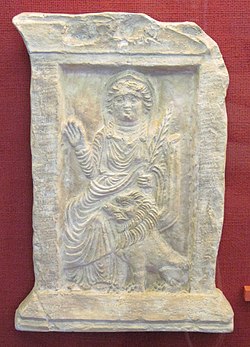
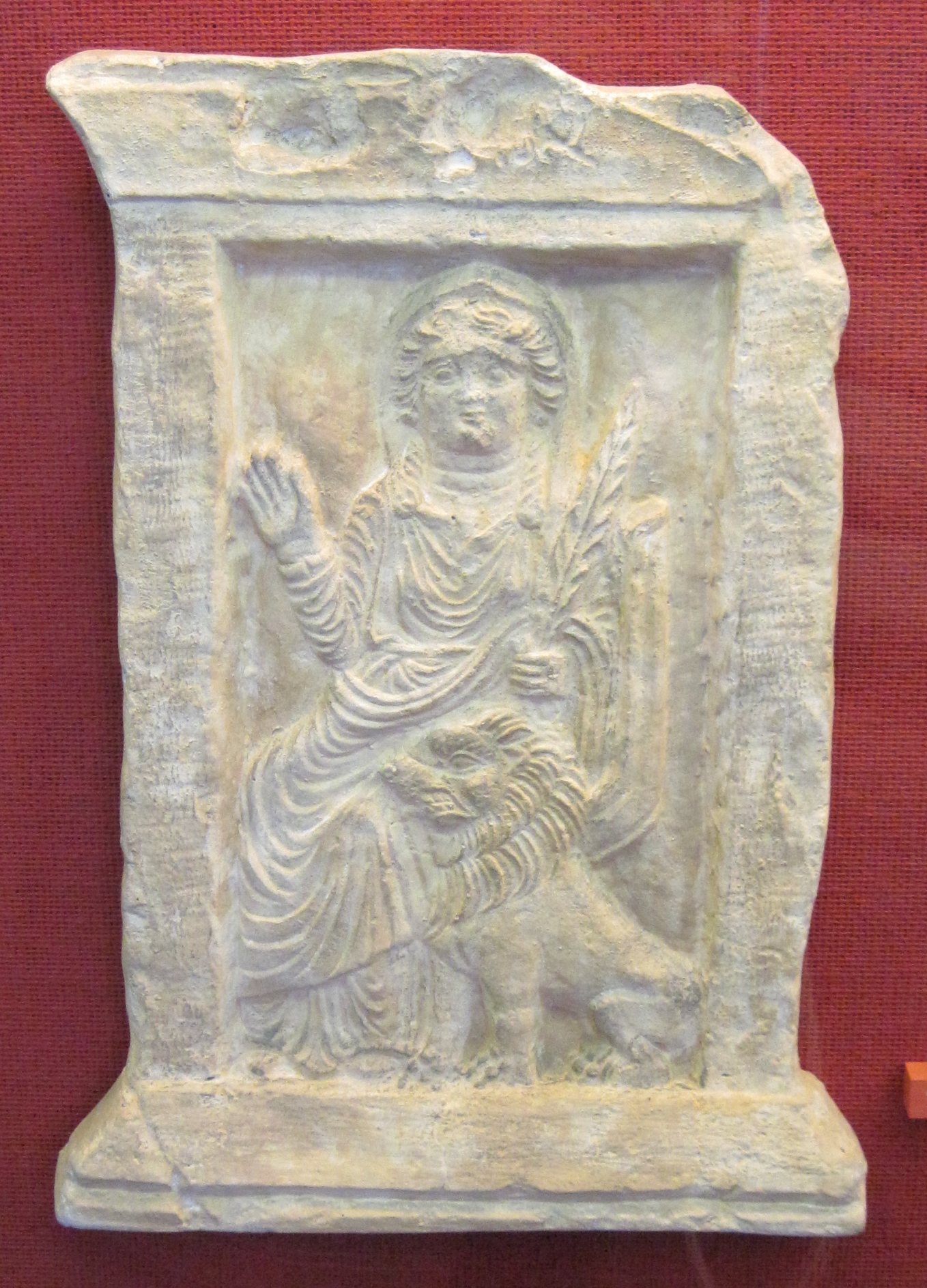
 Al-Lāt with a palm branch and her lion from the Temple of Baalshamin in Palmyra, first century AD, Damascus, Syria | |
| Major cult center | Palmyra, Iram,[1] Ta'if (according to Islamic sources) |
| Symbol | Lion, gazelle, crescent, cubic rock |
| Region | Arabia |
| Genealogy | |
| Siblings | Al-Uzza, Manat |
| Consort |
|
| Children | Dushara (Nabataean tradition) |
| Equivalents | |
| Greek | Athena |
| Roman | Minerva |
| Canaanite | Astarte, Atargatis |
| Carthaginian | Allatu |
| Part of the myth series on Religions of the ancient Near East |
| Pre-Islamic Arabian deities |
|---|
| Arabian deities of other Semitic origins |
Al-Lat (Arabic: اللات, romanized: al-Lāt, pronounced [alːaːt]), also spelled Allat, Allatu, and Alilat, is a pre-Islamic Arabian goddess, at one time worshipped under various associations throughout the entire Arabian Peninsula, including Mecca, where she was worshipped alongside Al-Uzza and Manat as one of the daughters of Allah. The word Allat or Elat has been used to refer to various goddesses in the ancient Near East, including the goddess Asherah-Athirat. She also is associated with the Great Goddess.[3]
The worship of al-Lat is attested in South Arabian inscriptions as Lat and Latan, but she had more prominence in north Arabia and the Hejaz, and her cult reached as far as Syria.[4] The writers of the Safaitic script frequently invoked al-Lat in their inscriptions. She was also worshipped by the Nabataeans and was associated with al-'Uzza. The presence of her cult was attested in both Palmyra and Hatra. Under Greco-Roman influence, her iconography began to show the attributes of Athena, the Greek goddess of war, as well as Athena's Roman equivalent Minerva. According to Islamic sources, the tribe of Banu Thaqif in Ta'if especially held reverence to her.
In Islamic tradition, her worship ended in the seventh century when her temple in Ta'if was demolished on the orders of Muhammad.[5]
Etymology and name
[edit]The most likely and most accepted etymology takes al-Lat to be the feminine form of Allah.[6] She may have been known originally as ʾal-ʾilat, based on Herodotus' attestation of the goddess as Alilat.[7] A folk etymology from Medieval Arab lexicographers derived the name from the verb latta (to mix or knead barley-meal). According to Ibn Abbas, Mujahid, and Ar-Rabi bin Anas, Al-Lat was a man who used to mix Sawiq (a kind of barley mash) with water for the pilgrims during the time of Jahiliyyah. When he died, the people remained next to his grave and worshiped him.[8][9] It has also been associated with the "idol of jealousy" erected in the temple of Jerusalem according to the Book of Ezekiel, which was offered an oblation of barley-meal by the husband who suspected his wife of infidelity. It can be inferred from al-Kalbi's Book of Idols that a similar ritual was practiced in the vicinity of the image of al-Lat.[6]
Al-Lat was used as a title for the goddess Asherah or Athirat.[10] The word is akin to Elat, which was the name of the wife of the Semitic deity El.[11] A western Semitic goddess modeled on the Mesopotamian goddess Ereshkigal was known as Allatum, and she was recognized in Carthage as Allatu.[12]
The goddess Allat's name is recorded as:[13][14]
- 𐡄𐡍𐡀𐡋𐡕 (han-ʾIlat) in Imperial Aramaic;
- 𐢀𐢑𐢞 (Allāt) in Nabataean Arabic;
- 𐡠𐡫𐡶 (Allāt) in Palmyrene Aramaic;
- ʾLT (ʾIlāt), H-LT (ha-Lāt), and LT (Lāt) in Safaitic;
- 𐪁𐪉 (Lāt) in Dadanitic;
- 𐪁𐪉 (Lāt) in Thamudic;
- Ἀλιλάτ (Alilát) in Ancient Greek;
- 𐩡𐩩 (Lāt) and 𐩡𐩩𐩬 (Lātān) in Sabaean;
- أللاَّت ʾal-Lāt in Classical Arabic.
Attestations
[edit]Pre-Islamic era
[edit]Al-Lat was mentioned as Alilat by the Greek historian Herodotus in his fifth-century BC work Histories, and she was considered the equivalent of Aphrodite (Aphrodite Urania):[15]
The Assyrians call Aphrodite Mylitta, the Arabians Alilat [Greek spelling: Ἀλιλάτ], and the Persians Mithra.[16]
According to Herodotus, the ancient Arabians believed in only two deities:


They believe in no other gods except Dionysus and the Heavenly Aphrodite; and they say that they wear their hair as Dionysus does his, cutting it round the head and shaving the temples. They call Dionysus, Orotalt; and Aphrodite, Alilat.[17]
Al-Lat was widely worshipped in north Arabia, but in South Arabia she was not popular and was not the object of an organized cult, with two amulets (inscribed "Lat" on one, "Latan" on the other) being the only indication that this goddess received worship in the area.[18] However, she seems to have been popular among the Arab tribes bordering Yemen.[18] She was also attested in eastern Arabia; the name Taymallat (a theophoric name invoking the goddess)[19] was attested as the name of a man from Gerrha, a city located in the region.[20]
From Safaitic and Hismaic inscriptions, it is probable that she was worshipped as Lat (lt).[4] In Safaitic inscriptions, al-Lat was invoked for solitude and mercy, as well as to provide well-being, ease and prosperity.[21] Travelers would invoke her for good weather and protection.[21] She was also invoked for vengeance, booty from raids, and infliction of blindness, and lameness to anyone who defaces their inscriptions.[21]
The Qedarites, a northern Arabian tribal confederation, seemed to have also worshipped al-Lat, as evidenced by a silver bowl dedicated by a Qedarite king, with the goddess' name inscribed on it.[22]
The Nabataeans and the people of Hatra also worshipped al-Lat, equating her with the Greek goddesses Athena and Tyche and the Roman goddess Minerva.[3] She is frequently called "the Great Goddess" in Greek in multilingual inscriptions.[3] The Nabataeans regarded al-Lat as the mother of the deities, and her family relations vary; sometimes she is regarded as the consort of Dushara and at other times as the mother of Dushara.[4] Nabataean inscriptions call her and al-'Uzza the "brides of Dushara".[23]

A temple was built for al-Lat in Iram of the Pillars, by the tribe of ʿĀd.[24] Al-Lat was referred to as "the goddess who is in Iram" in a Nabataean inscription.[1] She was also referred to as "the goddess who is in Bosra".[1] Perhaps a local Hijazi form of her attested in Hegra alongside Dushara and Manat was "Allat of 'Amnad".[1]
Al-Lat was closely related to al-'Uzza, and in some regions of the Nabataean kingdom, both al-Lat and al-'Uzza were said to be the same goddess.[4] John F. Healey believes that al-Lat and al-'Uzza originated as a single goddess, which parted ways in the pre-Islamic Meccan tradition.[4] Susan Krone suggests that both al-Lat and al-'Uzza were uniquely fused in central Arabia.[25]
,_from_Hatra,_Iraq._2nd_to_3rd_century_CE._Sulaymaniyah_Museum,_Iraq.jpg)
Al-Lat was also venerated in Palmyra, where she was known as the "Lady of the temple".[26] According to an inscription, she was brought into the Arab quarter of the city by a member of the Bene Ma'zin tribe,[27] who were probably an Arab tribe.[28][a] She had a temple in the city, which Teixidor believed to be the cultic center of Palmyrene Arab tribes.[26] The practice of casting divination arrows, a common divination method in Arabia, was attested in her temple; an honorific inscription mentioning "a basin of silver for [casting] lots (lḥlq)".[30]
By the second-century AD, al-Lat in Palmyra began to be portrayed in the style of Athena, and was referred to as "Athena-Allāt", but this assimilation does not extend beyond her iconography.[31] The Palmyrene emperor Vaballathus, whose name is the Latinized form of the theophoric name Wahballāt ("Gift of al-Lat"), began to use Athenodorus as the Greek form of his name.[32]
Islamic tradition
[edit]In Islamic sources discussing pre-Islamic Arabia, al-Lat is attested as the chief goddess of the Banu Thaqif tribe.[33] She was said to be venerated in Ta'if, where she was called ar-Rabba ("The Lady"),[34][35] and she reportedly had a shrine there that was decorated with ornaments and treasure of gold and onyx.[36] There, the goddess was venerated in the form of a cubic granite rock.[33][12] The area around the shrine was considered sacred; no trees could be felled, no animal could be hunted, and no human blood could be shed.[37]
According to al-Kalbi's Book of Idols, her shrine was under the guardianship of the Banū Attāb ibn Mālik of the Banu Thaqif.[19] She was also venerated by other Arab tribes, including the Quraysh, and their children would be named after the goddess, such as Zayd al-Lat and Taym al-Lat.[19]
Al-Lat is also mentioned in pre-Islamic Arab poetry, such as in al-Mutalammis' satire of Amr ibn Hind:[38]
Thou hast banished me for fear of lampoon and satire.
No! By Allat and all the sacred baetyls (ansab)
thou shalt not escape.

A poem by the pre-Islamic monotheist Zayd ibn Amr mentions al-Lat, along with al-'Uzza and Hubal:[39]
Am I to worship one lord or a thousand?
If there are as many as you claim,
I renounce al-Lat and al-Uzza, both of them,
as any strong-minded person would.
I will not worship al-Uzza and her two daughters…
I will not worship Hubal, though he was our lord
in the days when I had little sense.
Al-Lat was also called as a daughter of Allah along with the other two chief goddesses al-'Uzza and Manat.[40][41][42][43] According to the Book of Idols, the Quraysh were to chant the following verses as they circumambulated the Kaaba:[44]
By al-Lat and al-'Uzza,
And Manat, the third idol besides.
Verily they are the gharaniq
Whose intercession is to be sought.
The word gharaniq was translated as "most exalted females" by Faris in his English translation of the Book of Idols, but he annotates this term in a footnote as "lit. Numidean cranes".[44]
According to Islamic tradition, the shrine dedicated to al-Lat in Ta'if was demolished on the orders of Muhammad, during the Expedition of Abu Sufyan ibn Harb, in the same year as the Battle of Tabuk[36] (which occurred in October 630 AD).[45] The destruction of the cult image was a demand by Muhammad before he would allow any reconciliation to take place with the tribes of Ta'if, who were under his siege.[46] According to the Book of Idols, this occurred after the Banu Thaqif converted to Islam, and that her temple was "burnt to the ground".[38]
In the al-Tabari's history the name of the Goodess is used by Abu Bakr. When Urwah ibn Masʽud indirectly insulted him by saying that Mohammeds Companions might desert him in the face of danger, he in turn to insulted him by saying "Go suck the clitoris of al-Lat! Would we flee and leave him?"[47], with clitoris sometimes translated as nipples. It is based on the proverb to suck someones mothers clitoris, also found in other sources of the time.[48]
Quran and Satanic Verses incident
[edit]In the Quran, she is mentioned along with al-‘Uzza and Manat in Quran 53:19–22,[49] which became the subject of the alleged Satanic Verses incident,[50] an occasion on which the Islamic prophet Muhammad had mistaken the words of "satanic suggestion" for divine revelation.[51] Many different versions of the story existed (all traceable to one single narrator Muhammad ibn Ka'b, who was two generations removed from biographer Ibn Ishaq).[50] In its essential form, the story reports that during Muhammad's recitation of Surat An-Najm, when he reached the following verses:
Have you thought of al-Lāt and al-‘Uzzá
and Manāt, the third, the other?
Satan tempted him to utter the following line:[50]
These are the exalted gharāniq, whose intercession is hoped for. (In Arabic تلك الغرانيق العلى وإن شفاعتهن لترتجى.)
Following this, the angel Gabriel chastised Muhammad for uttering that line, and the verses were abrogated with a new revelation:[52]
Are yours the males and His the females? That were indeed an unfair division!
The majority of Muslim scholars have rejected the historicity of the incident on the basis of the theological doctrine of 'isma (prophetic infallibility i.e., divine protection of Muhammad from mistakes) and their weak isnads (chains of transmission).[51] Due to its defective chain of narration, the tradition of the Satanic Verses never made it into any of the canonical hadith compilations,[53] though reference and exegesis about the Verses appear in early histories, such as al-Tabari's Tārīkh ar-Rusul wal-Mulūk and Ibn Ishaq's Sīrat Rasūl Allāh (as reconstructed by Alfred Guillaume).[50]
The "Grinder" legend
[edit]Various legends about her origins were known in medieval Islamic tradition, including one that linked al-Lat's stone with a man who grinds cereal (al-latt, "the grinder").[54] The stone was used as a base for the man (a Jew) to grind cereal for the pilgrims of Mecca.[55] While most versions of this legend place the man at Ta'if, other versions place him at either Mecca or 'Ukaz.[54] After the man's death, the stone, or the man in the form of a stone, was deified,[55] according to some legends after the Khuza'a drove the Jurhum out of Mecca, while other legends report it was Amr ibn Luhayy who deified the grinder.[54]
Michael Cook noticed the oddity of this story, as it would make al-Lat masculine.[56] Gerald Hawting believes the various legends that link al-Lat with that of al-latt, "the grinder", was an attempt to relate al-Lat with Mecca.[54] He also compared the legends to Isaf and Na'ila, who according to legend were a man and a woman who fornicated inside the Kaaba and were petrified.[55] These two stones representing the primordial couple (sic Adam & Eve the so called ancestors of the human race) most likely pre-existed this cautionary tale promulgated by Islam. Furthermore, Isaf and Na'ila played a central role in the Quraish and al-Khuza'a's ritual practice of hierogamy or 'sacred marriage' culminating in a communal wedding feast 'walima'. This joyful event took place every year during the mid-winter month of Dhu'l Hijjah on and around Mt. Arafat until the pair of baetyls were finally removed and placed at Jabal as-Safa'a and Jabal al-Marwah in Mecca.
Mythological role
[edit]F. V. Winnet saw al-Lat as a lunar deity due to association of a crescent with her in 'Ayn esh-Shallāleh and a Lihyanite inscription mentioning the name of Wadd over the title of 'fkl lt.[4] René Dussaud and Gonzague Ryckmans linked her with Venus, while others have thought her to be a solar deity.[4] John F. Healey considers al-Uzza might have been an epithet of al-Lat before becoming a separate deity in the Meccan pantheon.[4] Redefining Dionysos considers she might have been a deity of vegetation or a celestial deity of atmospheric phenomena and a sky deity.[15] According to Wellhausen, the Nabataeans believed al-Lat was the mother of Hubal (and hence the mother-in-law of Manāt).[57]
It has been hypothesized that Allah was the consort of al-Lat, given that it is typical of deities in that area of the world to have consorts.[58]
Iconography
[edit]In Ta'if, al-Lat's primary cult image was a cubic stone,[33] sometimes described as white in color.[59] Waqidi's mention of the 'head' (ra's) of ar-Rabba may imply that the image was perceived in human or animal form, although Julius Wellhausen resisted this implication.[59]

Early Palmyrene depictions of al-Lat share iconographical traits with Atargatis (when seated) and Astarte (when standing).[60] The Lion of Al-Lat that once adorned her temple depicts a lion and a gazelle, the lion representing her consort,[2] and the gazelle representing al-Lat's tender and loving traits, as bloodshed was not permitted under penalty of al-Lat's retaliation.[61]
Al-Lat was associated with the Greek goddess Athena (and by extension, the Roman Minerva) in Nabataea, Hatra, and Palmyra.[31][3] It seems that her identification with Athena was only a mere change in iconography,[31] and al-Lat's character noticeably softened the warlike Athena in places where she was equated with al-Lat.[62] One Nabataean relief of Athena-al-Lat depicts the goddess bearing both Athena and al-Lat's attributes.[62] The relief depicts the goddess in the style of Athena, but having a Nabataean religion stylized eye-betyl in place of the Gorgoneion.[62]
Al-Lat can also be identified with the Babylonian goddess Ishtar, with both of the deities taking part in prosperity, warfare, and later being linked to Aphrodite and Athena. The two's similarities also appeared in their symbols, as both were associated with lions, morning star,[63][64] and crescents.[65] Like Al-Lat, Ishtar's origin was of Semitic roots.
Modern relevance
[edit]The Lion of Al-Lat statue that adorned her temple in Palmyra was damaged by the Islamic State of Iraq and the Levant (ISIL) in 2015 but has been since restored.[66] It now stands in the National Museum of Damascus, but it may be returned to Palmyra in the future.[66]
See also
[edit]Explanatory notes
[edit]- ^ Ma'zin is an Arabic word meaning "goat herders".[29] While Teixidor described the tribe as Arab,[28] Michał Gawlikowski, head of the Polish archaeological expedition in Palmyra between 1980 and 2011, stated that the tribe is best understood as an alliance of pastoralists from different origins who settled in the city.[29]
References
[edit]Citations
[edit]- ^ a b c d Healey 2001, p. 111.
- ^ a b Butcher 2003, p. 309.
- ^ a b c d Healey 2001, p. 136.
- ^ a b c d e f g h Healey 2001, p. 114.
- ^ "Tafsir Ibn Kathir - 53:19 - english". quran.com. Archived from the original on 2021-05-21. Retrieved 2021-05-21.
- ^ a b Fahd, T., "al-Lat", in Bosworth et al. 1986, pp. 692
- ^ Healey 2001, p. 112.
- ^ "Sahih al-Bukhari 4859 - Prophetic Commentary on the Qur'an (Tafseer of the Prophet (pbuh)) - كتاب التفسير - Sunnah.com - Sayings and Teachings of Prophet Muhammad (صلى الله عليه و سلم)". sunnah.com. Retrieved 2025-06-21.
- ^ "Tafsir Surah An-Najm - 19". Quran.com. Retrieved 2025-06-21.
- ^ Monaghan 2014, p. 31.
- ^ Sykes & Turner 2014, p. 7, 8, 63.
- ^ a b Jordan 2014, p. 13.
- ^ Rabinowitz 1956.
- ^ Robin 2005.
- ^ a b Corrente, Paola, "Dushara and Allāt alias Dionysos and Aphrodite in Herodotus 3.8", in Bernabé et al. 2013, pp. 265, 266
- ^ Histories I:131
- ^ Histories III:8
- ^ a b Robin, Christian Julien, "South Arabia, Religions in Pre-Islamic", in McAuliffe 2005, pp. 88
- ^ a b c al-Kalbi 2015, p. 14–15.
- ^ Hoyland 2002, p. 25.
- ^ a b c Hoyland 2002, p. 207.
- ^ Hoyland 2002, p. 63.
- ^ Corrente, Paola, "Dushara and Allāt alias Dionysos and Aphrodite in Herodotus 3.8", in Bernabé et al. 2013, pp. 263
- ^ Zayadine & Farés-Drappeau 1998, p. 256.
- ^ Frank 2006, p. 96.
- ^ a b Teixidor 1979, p. 54.
- ^ Teixidor 1979, p. 53.
- ^ a b Teixidor 1979, p. 36.
- ^ a b Gawlikowski, Michal, "Palmyra: From a Tribal Federation to a City", in Freyberger, Henning & Hesberg 2003, pp. 9
- ^ Hoyland 2002, p. 156.
- ^ a b c Teixidor 1979, p. 62.
- ^ Butcher 2003, p. 284.
- ^ a b c al-Kalbi 2015, p. 14.
- ^ Brockelmann 1960, p. 9.
- ^ Hawting 1999, p. 107.
- ^ a b Tabari 1990, p. 46.
- ^ Eckenstein 2018, p. 24.
- ^ a b al-Kalbi 2015, p. 15.
- ^ Ishaq 1955, p. 100.
- ^ Berkey 2003, p. 42.
- ^ Robinson 2013, p. 75.
- ^ Peters 1994, p. 110.
- ^ Peterson 2007, p. 21.
- ^ a b al-Kalbi 2015, p. 17.
- ^ Muir 1878, p. 207.
- ^ Muir 1878, p. 205.
- ^ Ṭabarī, Muḥammad Ibn-Ǧarīr aṭ- (1997), The history of al-Ṭabarī. vol. 8: The victory of Islam / transl. and annot. by Michael Fishbein, Bibliotheca Persica, translated by Fishbein, Michael, Albany, NY: State Univ. of New York Press, p. 76, ISBN 978-0-7914-3150-4, retrieved 2025-09-04
- ^ Cheema, Waqar (2014). "Abu Bakr's Befitting Response to a Pagan or an Insult to Anothers's Religion?". Journal of Islamic Sciences. 2 (3): 1–5.
- ^ Quran 53:19-22 Archived 2020-09-23 at the Wayback Machine
- ^ a b c d Ishaq 1955, p. 165.
- ^ a b Ahmed, Shahab (1998). "Ibn Taymiyyah and the Satanic Verses". Studia Islamica. 87 (87). Maisonneuve & Larose: 67–124. doi:10.2307/1595926. JSTOR 1595926.
- ^ Ishaq 1955, p. 166.
- ^ Rubin 1997, p. 161.
- ^ a b c d Hawting 1999, p. 143.
- ^ a b c Hawting 1999, p. 102.
- ^ Hawting 1999, p. 142.
- ^ Wellhausen, 1926, p. 717, quoted in translation by Hans Krause Archived 2005-02-16 at the Wayback Machine
- ^ Monaghan 2014, p. 30.
- ^ a b Hawting 1999, p. 138.
- ^ Teixidor 1979, p. 61.
- ^ Baaren 1982, p. 70.
- ^ a b c Taylor 2001, p. 130.
- ^ Coulter, Charles Russell; Turner, Patricia (2013-07-04). Encyclopedia of Ancient Deities. Routledge. ISBN 978-1-135-96390-3. Archived from the original on 2023-04-04. Retrieved 2020-10-15.
- ^ Monaghan, Patricia (2009-12-18). Encyclopedia of Goddesses and Heroines [2 volumes]. ABC-CLIO. ISBN 978-0-313-34990-4. Archived from the original on 2023-04-04. Retrieved 2020-10-15.
- ^ Kanishk Tharoor; Maryam Maruf (2016-03-04). "Museum of Lost Objects: The Lion of al-Lat". BBC News. Archived from the original on 2020-02-14. Retrieved 2020-03-13.
- ^ a b Makieh, Perry & Merriman 2017.
General and cited sources
[edit]- Baaren, Theodorus Petrus van (1982), Commemorative Figures, Brill Archive, ISBN 978-90-04-06779-0
- Berkey, Jonathan Porter (2003), The Formation of Islam: Religion and Society in the Near East, 600-1800, Cambridge University Press, ISBN 978-0-521-58813-3, archived from the original on 2023-04-04, retrieved 2016-12-29
- Bernabé, Alberto; Jáuregui, Miguel Herrero de; Cristóbal, Ana Isabel Jiménez San; Hernández, Raquel Martín, eds. (2013), Redefining Dionysos, Walter de Gruyter, ISBN 978-3-11-030132-8
- Bosworth, C. E.; Donzel, E. van; Lewis, B.; Pellat, Ch., eds. (1986), Encyclopaedia of Islam, vol. 5, Brill Archive, ISBN 978-90-04-07819-2
- Brockelmann, Carl (1960), History of the Islamic Peoples, translated by Perlmann, Moshe; Carmichael, Joel, Capricorn Books
- Butcher, Kevin (2003), Roman Syria and the Near East, Getty Publications, ISBN 978-0-89236-715-3
- Eckenstein, Lina (2018), A History of Sinai, Cambridge University Press, ISBN 978-1-108-08233-4
- Frank, Richard M. (2006), Arabic Theology, Arabic Philosophy: From the Many to the One: Essays in Celebration of Richard M. Frank, Peeters Publishers, ISBN 978-90-429-1778-1, archived from the original on 2023-04-04, retrieved 2020-10-15
- Freyberger, Klaus S.; Henning, Agnes; Hesberg, Henner von (2003), Kulturkonflikte im Vorderen Orient an der Wende vom Hellenismus zur Römischen Kaiserzeit, Leidorf, ISBN 978-3-89646-641-9
- Hawting, G. R. (1999), The Idea of Idolatry and the Emergence of Islam: From Polemic to History, Cambridge University Press, ISBN 978-1-139-42635-0
- Healey, John F. (2001), The Religion of the Nabataeans: A Conspectus., Brill, ISBN 978-90-04-10754-0
- Hoyland, Robert G. (2002), Arabia and the Arabs: From the Bronze Age to the Coming of Islam, Routledge, ISBN 978-1-134-64634-0
- Ishaq, Muhammad Ibn (1955), The Life of Muhammad: A Translation of Ishaq's Sirat Rasul Allah, with Introduction and Notes by A. Guillaume, Oxford University
- Jordan, Michael (2014), Dictionary of Gods and Goddesses, Infobase Publishing, ISBN 978-1-4381-0985-5
- al-Kalbi, Ibn (2015), Book of Idols, translated by Faris, Nabih Amin, Princeton University Press, ISBN 978-1-4008-7679-2
- Makieh, Kinda; Perry, Tom; Merriman, Jane (1 October 2017), Palmyra statue damaged by Islamic State goes on display in Damascus, Reuters, archived from the original on 17 November 2020, retrieved 3 October 2017
- McAuliffe, Jane Dammen (2005), Encyclopaedia of the Qurʼān, vol. 5, Brill, ISBN 978-90-04-12356-4
- Monaghan, Patricia (2014), Encyclopedia of Goddesses and Heroines, New World Library, ISBN 978-1-608-68218-8
- Muir, William (1878), The life of Mahomet (Full free digitized version), Kessinger Publishing Co, p. 207
- Peters, Francis E. (1994), Muhammad and the Origins of Islam, SUNY Press, ISBN 978-0-7914-1875-8[permanent dead link]
- Peterson, Daniel C. (2007), Muhammad, Prophet of God, Wm. B. Eerdmans Publishing, ISBN 978-0-8028-0754-0, archived from the original on 2023-04-04, retrieved 2016-12-29
- Rabinowitz, Isaac (1956). "Aramaic Inscriptions of the Fifth Century B. C. E. from a North-Arab Shrine in Egypt". Journal of Near Eastern Studies. 15 (1). Chicago, United States: University of Chicago Press: 1–9. doi:10.1086/371302. JSTOR 542658. S2CID 161559065. Archived from the original on 1 January 2023. Retrieved 1 January 2023.
- Robin, Christian Julien [in French] (2005). "South Arabia, Religions in Pre-Islamic". In McAuliffe, Jane Dammen (ed.). Encyclopaedia of the Qurʾān. Leiden, Netherlands: Brill Publishers. pp. 84–94. ISBN 978-9-004-12356-4. Retrieved 4 January 2022.
- Rubin, Uri (1997), The eye of the beholder: the life of Muḥammad as viewed by the early Muslims: a textual analysis, Darwin Press, ISBN 978-0-87850-110-6
- Robinson, Neal (2013), Islam: A Concise Introduction, Routledge, ISBN 978-1-136-81773-1, archived from the original on 2023-04-04, retrieved 2016-12-29
- Sykes, Egerton; Turner, Patricia (2014), Encyclopedia of Ancient Deities, Routledge, ISBN 9781136414374
- Tabari, Al (25 Sep 1990), The Last Years of the Prophet, translated by Husayn, Isma'il Qurban, State University of New York Press, ISBN 978-0-88706-691-7
- Taylor, Jane (2001), Petra and the Lost Kingdom of the Nabataeans, I.B.Taurus, ISBN 978-1-86064-508-2
- Teixidor, Javier (1979), The Pantheon of Palmyra, Brill Archive, ISBN 978-90-04-05987-0
- Zayadine, Fawzi; Farés-Drappeau, Saba (1998). "Two North-Arabian inscriptions from the temple of Lāt at Wādī Iram". Annual of the Department of Antiquities of Jordan. 42: 255–258. Archived from the original on 30 November 2021. Retrieved 4 August 2021.
External links
[edit]
- "Herodotus, The Histories, Book 1, chapter 131". www.perseus.tufts.edu. Retrieved 2019-01-26.
- "Herodotus, The Histories, Book 3, chapter 8". www.perseus.tufts.edu. Retrieved 2019-01-26.
- "Lat, al- - Oxford Islamic Studies Online". www.oxfordislamicstudies.com. Archived from the original on February 21, 2013. Retrieved 2019-01-26.
| International | |
|---|---|
| People | |
| Other | |

Al-Lat
View on GrokipediaEtymology and Origins
Linguistic Derivations
The name al-Lāt (اللات) derives from the Arabic al-ʾilāt, a feminine form signifying "the goddess," constructed analogously to Allāh from al-ʾilāh ("the god"), with the definite article al- prefixed to the root ʾil- or ʾilāh denoting divinity.[3] This etymology reflects a contraction common in pre-Islamic Arabic nomenclature for supreme deities, where the feminine ending -āt (or -at) marks gender, as seen in earlier Semitic attestations.[3] In broader Semitic linguistics, al-Lāt connects to the Proto-Semitic feminine ʔil-at-, the counterpart to the masculine ʔil- ("god" or "deity"), evidenced in Ugaritic ʾilt (goddess) and Akkadian iltu (goddess), often denoting a consort or high female divine figure akin to the Canaanite ʾĒlāt, wife of the god ʾĒl. The root ʾil- traces to Proto-Afroasiatic ʔil-, implying "deity" or "power," with feminine derivations emphasizing nurturing or fertile aspects in Northwest Semitic contexts. Ancient Greek sources, such as Herodotus in his Histories (ca. 440 BCE), transliterate the name as Alílatē (Ἀλιλάτη), identifying her with Aphrodite and confirming the Arabian form's antiquity, while later Nabataean and Palmyrene inscriptions render it as Allat or ʾlt, preserving the core ʾil- element without the article in some dialects.[3] Variations like Allatu appear in Mesopotamian texts, linking her to underworld or protective goddesses, though these may represent syncretic adaptations rather than direct derivations. Scholarly consensus favors the "the goddess" interpretation over speculative ties to roots like lṭ ("to be hidden" or "moist"), due to insufficient epigraphic support for alternative etymologies.Comparative Mythological Connections
In regions influenced by Hellenistic culture, such as Palmyra, Nabataea, and Hatra, al-Lat underwent syncretism with the Greek goddess Athena and her Roman counterpart Minerva, reflecting adaptations in iconography and nomenclature amid Greco-Roman expansion into the Near East. Inscriptions from these sites explicitly identify al-Lat with Athena, often depicting her with warrior attributes like a helmet, aegis, and spear, while retaining Semitic cultic elements such as enthroned postures and lion associations.[4][5] This fusion is evident in artifacts from Palmyra, where al-Lat's temple sculptures blend local fertility motifs with Athena's martial symbolism, suggesting a pragmatic merging for cultural interoperability rather than deep theological alignment.[6] Al-Lat's attributes of protection, prosperity, and warfare parallel those of Athena, who embodied strategic wisdom and defense, but al-Lat's emphasis on fertility and maternal benevolence aligns more closely with broader Near Eastern mother goddesses like Atargatis, a Syrian deity of fertility and water venerated in similar caravan cities. Comparative analyses of epigraphic evidence indicate that al-Lat's cult absorbed elements from Mesopotamian Allatu (an underworld consort linked to Nergal), evolving into a more accessible sky and earth goddess in Arabian contexts, though direct lineage remains debated due to regional variations in worship.[7][8] As part of the pre-Islamic Arabian triad with al-Uzza and Manat, al-Lat's role as the "mother" figure evokes triple goddess archetypes in other traditions, such as the Greek Moirai or Roman Parcae, where a senior deity oversees fate and abundance; however, Arabian inscriptions portray her less as a fateful arbiter and more as a patron of civic order and oaths, distinguishing her from purely deterministic parallels.[9] This triad's structure facilitated comparisons to Venus-Aphrodite for al-Uzza's stellar aspects, indirectly framing al-Lat as a stabilizing maternal counterpart in Semitic pantheons.[10]Historical and Archaeological Evidence
Pre-Islamic Inscriptions
Inscriptions mentioning al-Lat appear in multiple pre-Islamic scripts across northern Arabia, the southern Levant, and adjacent regions, dating primarily from the 1st century BCE to the 3rd century CE, reflecting her role in nomadic and settled cults for protection, curses against desecrators, and temple dedications. These texts, often carved on rock faces, stelae, or amulets, invoke her alongside other deities like al-Uzza or Dushara, emphasizing her attributes as a guardian or bestower of prosperity. Safaitic and Thamudic examples predominate in nomadic graffiti from the Syrian and Jordanian deserts, while Aramaic inscriptions from Nabataean, Palmyrene, and Hatrene contexts document urban temple worship.[11][12] Safaitic inscriptions, etched by pastoral nomads in the Ḥarrah volcanic region of southern Syria and northern Jordan between approximately the 1st century BCE and 4th century CE, frequently beseech al-Lat for material gains or safety. One such text pleads: "O Allat, (grant) booty and ransom to [personal name]," pairing her with invocations to other gods for tribal raiding success. These graffiti, numbering in the thousands overall, highlight al-Lat's prominence in Bedouin religious expressions, often as a primary intercessor against misfortune.[13] Thamudic E inscriptions from southern Jordan, such as one from Uraynibah West dated to the early 1st millennium CE, employ optative formulas like "(may) al-Lat [harm] NN," directing her wrath at potential vandals of the carving. This protective curse recurs in North Arabian epigraphy, underscoring al-Lat's judicial aspect in deterring interference with sacred or personal markers.[11] Nabataean Aramaic inscriptions provide evidence of institutionalized worship, including a lengthy dedication from Salkhad in the Ḥawrān (southern Syria, ca. 1st-2nd century CE) recording temple construction: "This is the house which Rwḥw son of Mlkw son of 'klbw son of Rwḥw built for al-Lat, lady of the place, mother of the gods of our lord the king." Here, al-Lat holds titles denoting local sovereignty and divine maternity, linking her to royal patronage in Nabataean frontier cults.[12] At Hatra in northern Iraq, Parthian-era inscriptions (ca. 2nd century CE) associate al-Lat with monumental architecture; H367 credits King Sanatruq I with erecting her temple, integrating her into the city's pantheon of warrior deities. Palmyrene Aramaic texts from her Palmyra sanctuary (1st-3rd centuries CE) include dedicatory reliefs and a lion statue inscription blessing non-violent visitors: "Al-Lat [will bless] whoever does not shed blood [in the sanctuary]." These catalogued epigraphs reveal al-Lat's syncretic identification with Athena or Allat-Belit, evidenced in over a dozen sanctuary finds.[14][15] South Arabian attestations are sparser but confirmatory; a Hadramitic amulet from Shabwa (ca. 1st century CE) invokes "Latan (al-Lat)" alongside al-Uzza for protection, appearing in a formulaic prayer amid mixed divine appeals. Such evidence, drawn from diverse archaeological contexts, attests al-Lat's transversal appeal from nomadic supplications to civic dedications without implying uniform theology.[16]Excavated Sites and Artifacts
Excavations at the sanctuary of al-Lat in Palmyra, Syria, conducted by Polish archaeologists from 1974 to 1980, uncovered architectural fragments in greyish limestone, including capitals and a temenos enclosure, alongside ritual deposits.[17] Further digs in 2005–2006 revealed a hoard of clay lamps, vessels, and coins inside the cella, dating primarily to the Roman period.[18] A prominent artifact is the Lion of al-Lat, a 3.5-meter limestone statue of a lion grasping a gazelle, originally mounted on the temple wall as a protective symbol; it was damaged by ISIS in 2015 but subsequently restored.[19] [20] A marble statue of al-Lat depicted in the guise of Athena, modeled after Phidias's 5th-century BCE original, was excavated from the Palmyra temple in 1975, reflecting Hellenistic influences on local worship.[21] In Hatra, Iraq, the Temple of Allat, a well-preserved 2nd-century CE structure, has yielded limestone reliefs portraying al-Lat centrally with Manat and al-Uzza above a roaring lion, emphasizing her martial and protective roles.[22] [23] Another relief from the site shows al-Lat in military attire, helmeted and spear in hand, beside an elderly male deity, dated to the 2nd–3rd centuries CE.[24] Smaller portable artifacts include semi-circular amulets inscribed with invocations to al-Lat for protection, such as one bearing "Protection of Lat be upon Fari'at," recovered from pre-Islamic contexts in the Arabian Peninsula.[25] These findings, primarily from Parthian and Roman-era strata, attest to al-Lat's widespread cult across trade hubs like Palmyra and Hatra.Worship and Religious Practices
Primary Cult Centers
The principal cult center of al-Lāt in the central Arabian Peninsula was situated in Ṭāʾif, where the goddess was venerated by the Thaqīf tribe through a large uncut block of white granite revered as her aniconic representation.[26] This sanctuary served as a focal point for offerings and pilgrimage until its destruction in 630 CE, ordered by Muḥammad during the Expedition of Ṭāʾif to suppress polytheistic practices.[27] Historical accounts, primarily from early Islamic chronicles, describe the idol as a cubic stone beside which rituals including barley preparation occurred, underscoring al-Lāt's role in local fertility and protection cults among nomadic and settled Arab tribes.[28] In the Syrian desert oasis of Palmyra, al-Lāt maintained a prominent temple sanctuary established around 123–164 CE by the local devotee Taimarsu, positioned at the foot of Jabal al-Ḥusayniyyah within what later became the Diocletianic camp but predating it by centuries.[29] Archaeological excavations reveal a temenos enclosing the temple, accompanied by a monumental lion statue symbolizing guardianship, with the cult statue depicting al-Lāt in Greco-Roman style akin to Athena, reflecting syncretic influences from Nabataean and Hellenistic traditions among Palmyrene Arab traders.[30] Inscriptions and votive reliefs confirm her worship by Bedouin tribes reliant on camel caravans, emphasizing domains of prosperity and warfare.[31] Further evidence of al-Lāt's cult extends to Hatra in northern Iraq, where a 2nd-century CE parthian-style relief portrays her enthroned alongside al-ʿUzzā and Manāt, indicating shared triad worship in Mesopotamian-Arabian border regions.[2] Temples or shrines at peripheral desert sites like Salkhaḍ in southern Syria and Wādī Ramm in Jordan also attest to her veneration in nomadic contexts, often linked to oases and trade routes, though these lack the monumental scale of Ṭāʾif or Palmyra.[14]Rituals, Offerings, and Priesthoods
The primary cult center of al-Lāt in Ṭāʾif featured a cubic block of white granite revered as her idol, maintained by the Banū Thaqīf tribe, who functioned as its hereditary custodians and performed priestly duties associated with the sanctuary.[32] Worshippers from various tribes, including the Quraysh, undertook annual visitations and pilgrimages to the shrine, presenting offerings such as animal sacrifices—including she-camels—and valuable gifts to seek her favor for prosperity, protection, and fertility.[32] These practices aligned with broader pre-Islamic Arabian rituals at idol shrines, where blood sacrifices were common to invoke divine intervention, though direct epigraphic evidence for al-Lāt specifically remains limited to dedicatory inscriptions implying votive gifts.[32] Ancient testimony from Herodotus in the 5th century BCE describes Arabian veneration of Alilāt (equated with al-Lāt) as involving frankincense offerings without animal sacrifice, reserved instead for a war deity; this may reflect earlier nomadic customs before settled temple-based rites evolved. Later accounts indicate integration into Meccan circumambulatory chants during ḥajj-like processions, where al-Lāt was invoked alongside al-ʿUzzā and Manāt as exalted figures, potentially accompanied by barley porridge (sawīq) dedications, though such honors were subordinate to Allah in the pantheon.[32] The Thaqīf's role extended to ritual oversight, prohibiting unauthorized entry or interference with the idol, a function that persisted until the sanctuary's destruction circa 630 CE.[32] No named individual priests are attested for al-Lāt's Arabian cult, but the Thaqīf tribe's collective guardianship—evident in their resistance to iconoclastic campaigns—suggests a tribal priesthood without formalized hierarchy akin to Mesopotamian or Levantine models, emphasizing communal rather than specialized clerical authority.[33] Archaeological parallels from Nabataean and Palmyrene contexts, where al-Lāt received temple dedications and possibly libations, imply similar offerings of incense and votives, but these syncretic sites blend local Arabian practices with Hellenistic influences, limiting direct applicability to the Hejazi core.[1]Role in Pre-Islamic Arabian Theology
Associations with Other Deities
In pre-Islamic Arabian polytheism, al-Lat was primarily associated with al-ʿUzzā and Manāt, forming a triad of goddesses revered by the Quraysh tribe of Mecca as daughters of the high god Allāh. This trinity represented key aspects of fate, protection, and prosperity, with al-Lat often embodying fertility and abundance, al-ʿUzzā linked to war and Venus, and Manāt governing destiny. Archaeological evidence, such as a relief from Hatra depicting the three together, underscores their interconnected worship across northern Arabian sites.[1][27] Regional variations highlighted fluid identifications; in Nabataean territories, al-Lat was sometimes equated with al-ʿUzzā, treated as manifestations of a single mighty feminine divine power. This overlap reflects the syncretic nature of Semitic pantheons, where deities adapted to local emphases on warfare, love, and celestial bodies. Inscriptions from Petra and surrounding areas attest to shared cult practices, including offerings for victory and oaths sworn jointly.[34] Under Hellenistic and Roman influences, particularly in Palmyra and the Syrian steppe, al-Lat underwent syncretism with Athena, the Greek goddess of wisdom and strategic warfare, adopting attributes like the aegis and spear in iconography. Greek inscriptions from the Ḥawrān region explicitly fuse the two, portraying al-Lat-Athena as a protector of cities and caravans. Similarly, Roman equivalents identified her with Minerva, evident in Damascene artifacts blending Arabian block-like statues with classical armored forms, signaling cultural exchange along trade routes by the 1st-3rd centuries CE.[4][6]Domains of Influence and Attributes
Al-Lat functioned primarily as a goddess of war, prosperity, and protection in pre-Islamic Arabian polytheism, with her influence extending across central and northern regions including Ta'if and Palmyra.[35] Inscriptions from Safaitic graffiti and Nabataean dedications frequently invoke her for success in raids, longevity, and well-being, indicating domains over martial victory and communal thriving.[1] Scholarly analysis of these texts portrays her as a mediator between warriors and divine favor, rather than a strictly fertility figure, though some associative links to abundance appear in prosperity-related oaths.[14] Under Hellenistic and Roman influences, particularly in Nabataean Petra and Palmyrene contexts, al-Lat's attributes syncretized with those of Athena and Minerva, incorporating elements of strategic warfare, wisdom, and civic order.[4] Epigraphic evidence from Palmyra equates her with Athena, as seen in bilingual inscriptions where she receives offerings for protection against enemies.[5] Her iconography evolved to include martial symbols such as spears and shields, alongside lions representing ferocity and guardianship, evident in reliefs from Hatra and Palmyra dating to the 1st-3rd centuries CE.[5] This adaptation reflects cultural exchanges rather than core Arabian traits, with primary pre-Islamic sources emphasizing her role in oaths for peace and combat outcomes over intellectual domains.[1] Regional variations highlight al-Lat's attributes as tied to local needs: in Thaqif tribal worship near Ta'if, she embodied territorial sovereignty and economic prosperity through associations with date palm cultivation and trade routes.[35] Archaeological finds, including cubic stone representations possibly symbolizing stability and earth-bound abundance, underscore her foundational influence on agrarian and nomadic life, though direct fertility cults lack robust inscriptional support compared to war and prosperity motifs.[14] These domains positioned her as a high-status intermediary deity, often paired with al-Uzza in invocations for comprehensive safeguarding.[5]