Hubbry Logo
Architecture of BengalArchitecture of BengalMain
Open search
Architecture of Bengal
Community hub
Architecture of Bengal
logo
8 pages, 0 posts
0 subscribers
Be the first to start a discussion here.
Architecture of Bengal
from Wikipedia
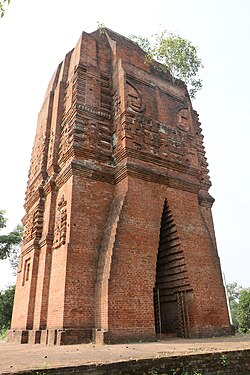
Ramachandra Temple, Guptipara

The architecture of Bengal, which comprises the modern country of Bangladesh and the Indian states of West Bengal and Assam's Karimganj district, has a long and rich history, blending indigenous elements from the Indian subcontinent, with influences from different parts of the world. Bengali architecture includes ancient urban architecture, religious architecture, rural vernacular architecture, colonial townhouses and country houses and modern urban styles. The bungalow style is a notable architectural export of Bengal. The corner towers of Bengali religious buildings were replicated in medieval Southeast Asia. Bengali curved roofs, suitable for the very heavy rains, were adopted into a distinct local style of Indo-Islamic architecture, and used decoratively elsewhere in north India in Mughal architecture.

Bengal is not rich in good stone for building, and traditional Bengali architecture mostly uses brick and wood, often reflecting the styles of the wood, bamboo and thatch styles of local vernacular architecture for houses. Decorative carved or moulded plaques of terracotta (the same material as the brick) are a special feature. The brick is extremely durable and disused ancient buildings were often used as a convenient source of materials by local people, often being stripped to their foundations over the centuries.

Antiquity and Buddhism

[edit]
Ruins of the central Buddhist stupa of the Grand Vihara of Somapura in modern Bangladesh, a Pala royal project of around 800.

Urbanization is recorded in the region since the first millennium BCE. This was part of the second wave of urban civilization in the Indian subcontinent, following the decline of the Indus Valley civilization.[citation needed] Ancient Bengal was part of a network of urban and trading hubs stretching to Ancient Persia.[citation needed] The archaeological sites of Mahasthangarh, Paharpur, Wari-Bateshwar ruins, Chandraketugarh and Mainamati provide evidence of a highly organized urban civilization in the region. Terracotta became a hallmark of Bengali construction, as the region lacked stone reserves. Bricks were produced with the clay of the Bengal delta.[1]

Ancient Bengali architecture reached its pinnacle during the Pala Empire (750–1120); this was Bengali-based and the last Buddhist imperial power in the Indian subcontinent. Most patronage was of Buddhist viharas, temples and stupas. Pala architecture influenced Tibetan and Southeast Asian architecture [citation needed]. The most famous monument built by the Pala emperors was the Grand Vihara of Somapura, now a UNESCO World Heritage Site. Historians believe Somapura was a model for the architects of Angkor Wat in Cambodia.[2]

Medieval and early modern periods

[edit]

Hindu and Jain

[edit]
Terracotta relief at Kantanagar Temple

Bengal was one of the last strongholds of Indian Buddhism in the medieval period, and Hindu temples before the Muslim conquest (starting in 1204) were relatively small. Most of the Hindu temples were built in Gupta era, Shashanka, Pala and Sena dynasty who ruled since the 5th century until the conquest. However, most of the temples are in ruins and relatively small. The Sena dynasty built the relatively modest Dhakeshwari Temple in Dhaka, although this has been greatly rebuilt, which is the national temple of Bangladesh now. The stone temple at Garui in Bardhaman district of West Bengal, was built in the 14th century.[3]

Jor Bangla Temple, Bishnupur with a curved Do-chala style roof

The term deula, deul or deoul is used for a style of Jain and Hindu temple architecture of Bengal, where the temple lacks the usual mandapa beside the main shrine, and the main unit consists only of the shrine and a deul above it. The type arose between the 6th and 10th centuries, and most examples are now ruins; it was revived in the 16th to 19th century.[4] The later representatives of this style were generally smaller and included features influenced by Islamic architecture.[4]

Hindu ritual platform, the Rasmancha, Bishnupur, c. 1600

Most temples surviving in reasonable condition date from about the 17th century onwards, after temple building revived; it had stopped after the Muslim conquest in the 13th century.[5] The roofing style of Bengali Hindu temple architecture is unique and closely related to the paddy roofed traditional building style of rural Bengal.[6] The "extensive improvisation within a local architectural idiom"[5] which the temples exhibit is often ascribed to a local shortage of expert Brahmin priests to provide the rather rigid guidance as to correct forms that governed temple architecture elsewhere. In the same way, the terracotta reliefs often depict secular subjects in a very lively fashion.

Roofing styles include the jor-bangla, do-chala, char-chala, at-chala, and ek-ratna. The do-chala type has only two hanging roof tips on each side of a roof divided in the middle by a ridge-line; in the rare char-chala type, the two roof halves are fused into one unit and have a dome-like shape; the double-storey at-chala type has eight roof corners.[7][4]

Many of these temples are covered on the outer walls with terracotta (carved brick) reliefs. Bishnupur in West Bengal has a remarkable set of 16th and 17th - century temples with a variety of roof styles built by the Malla dynasty.[8][9][10]

In larger, and later, temples, small towers rise up from the centre or corners of the curving roof. These are straight-sided, often with conical roofs. They have little resemblance to a typical north Indian shikara temple tower. The pancharatna ("five towers") and navaratna ("nine towers") styles are varieties of this type.[4]

The temple structures contain gabled roofs which are colloquially called the chala, For example, a gabled roof with an eight sided pyramid structured roof will be called "ath chala" or literally the eight faces of the roof. And frequently there is more than one tower in the temple building. These are built of laterite and brick bringing them at the mercy of severe weather conditions of southern Bengal. Dakshineswar Kali Temple is a nine-spired temple [11] while the additional small temples of Shiva along the river bank are example of southern Bengal roof style though in much smaller dimension.

Islamic

[edit]
Choto Sona Mosque (around 1500)

Indo-Islamic architecture in the Bengali architecture can be seen from the 13th century, but before the Mughals has usually strongly reflected local traditions. The oldest surviving mosque was built during the Delhi Sultanate. The mosque architecture of the independent Bengal Sultanate period (14th, 15 and 16th centuries) represents the most important element of the Islamic architecture of Bengal. This distinctive regional style drew its inspiration from the indigenous vernacular architecture of Bengal, including curved chala roofs, corner towers and complex floral carvings. Sultanate-era mosques featured multiple domes or a single dome, richly designed mihrabs and minbars and an absence of minarets. While clay bricks and terracotta were the most widely used materials, stone was used from mines in the Rarh region. The Sultanate style also includes gateways and bridges. The style is widely scattered across the region.[12]

Mughal Bengal saw the spread of Mughal architecture in the region, including forts, havelis, gardens, caravanserais, hammams and fountains. Mughal Bengali mosques also developed a distinct provincial style. Dhaka and Murshidabad were the hubs of Mughal architecture. The Mughals copied the do-chala roof tradition in North India.[13]

Bengal Sultanate

[edit]
Interior of the hypostyle hall of the Adina Mosque

The Bengal Sultanate (1352–1576) normally used brick as the primary construction material, as pre-Islamic buildings had done.[14] Stone had to be imported to most of Bengal, whereas clay for bricks is plentiful. But stone was used for columns and prominent details, often re-used from Hindu or Buddhist temples.[15] The early 15th century Eklakhi Mausoleum at Pandua, Malda or Adina, is often taken to be the earliest surviving square single-domed Islamic building in Bengal, the standard form of smaller mosques and mausoleums. But there is a small mosque at Molla Simla, Hooghly district, that is probably from 1375, earlier than the mausoleum.[16] The Eklakhi Mausoleum is large and has several features that were to become common in the Bengal style, including a slightly curved cornice, large round decorative buttresses and decoration in carved terracotta brick.[17]

These features are also seen in the Choto Sona Mosque (around 1500), which is in stone, unusually for Bengal, but shares the style and mixes domes and a curving "paddy" roof based on village house roofs made of vegetable thatch. Such roofs feature even more strongly in later Bengal Hindu temple architecture, with types such as the do-chala, Jor-bangla Style, and char-chala.[18] For larger mosques, Bengali architects multiplied the numbers of domes, with a nine-domed formula (three rows of three) being one option, surviving in four examples, all 15th or 16th century and now in Bangladesh,[19] although there were others with larger numbers of domes.[20]

A 17th century haveli in Old Dhaka

Buildings in the style are the Nine Dome Mosque and the Sixty Dome Mosque (completed 1459) and several other buildings in the Mosque City of Bagerhat, an abandoned city in Bangladesh now featured as a UNESCO World Heritage Site. These show other distinctive features, such as a multiplicity of doors and mihrabs; the Sixty Dome Mosque has 26 doors (11 at the front, 7 on each side, and one in the rear). These increased the light and ventilation. Further mosques include the Baro Shona Masjid; the Pathrail Mosque, the Bagha Mosque, the Darasbari Mosque, and the Kusumba Mosque. Single-domed mosques include the Singar Mosque, and the Shankarpasha Shahi Masjid.

Both capitals of the Bengal Sultanate, first Pandua or Adina, then from 1450 Gauda or Gaur, started to be abandoned soon after the conquest of the sultanate by the Mughals in 1576, leaving many grand buildings, mostly religious. The materials from secular buildings were recycled by builders in later periods.[14] While minarets are conspicuously absent in most mosques, the Firoz Minar was built in Gauda to commemorate Bengali military victories.

The ruined Adina Mosque (1374–75) is very large, which is unusual in Bengal, with a barrel vaulted central hall flanked by hypostyle areas. It is said to be the largest mosque in the sub-continent, and modeled after the Ayvan-e Kasra of Ctesiphon, Iraq, as well as the Umayyad Mosque of Damascus.[21] The heavy rainfall in Bengal necessitated large roofed spaces, and the nine-domed mosque, which allowed a large area to be covered, was more popular there than anywhere else.[22] After the Islamic consolidation of Bengal was complete, some local features continued, especially in smaller buildings, but the Mughals used their usual style in imperial commissions.[14]

British Colonial period

[edit]
The facade of a courtyard in a 19th-century Bengali townhouse.[24]
Curzon Hall at University of Dhaka

The period of British rule saw wealthy Bengali families, owners of zamindar estates and wealthy traders, employing European architects to design houses and palaces. The Indo-Saracenic style was strongly prevalent in the region, but versions of European Neo-Classical architecture were also found, especially in or near trading cities. While most rural estates featured an elegant country house, the cities of Calcutta, Dacca, Panam and Chittagong had widespread 19th and early 20th century urban architecture, comparable to London, Sydney or other cities of the British Empire. Art deco influences began in Calcutta in the 1930s.

Neoclassical

[edit]
ahsan manzil dhaka

European influence on architecture.

[edit]

Indo-Saracenic architecture can be seen in the Ahsan Manzil and Curzon Hall in Dhaka, Chittagong Court Building in Chittagong, and Hazarduari Palace in Murshidabad. The Victoria Memorial in Kolkata, designed by Vincent Esch also has Indo-Saracenic features, possibly inspired from the Taj Mahal.

Bungalows

[edit]
A wooden bungalow which serves as Momin Mosque since 1920

The origin of the bungalow has its roots in the vernacular architecture of Bengal.[25] The term baṅgalo, meaning "Bengali" and used elliptically for a "house in the Bengal style".[26] Such houses were traditionally small, only one storey and detached, and had a wide veranda were adapted by the British, who used them as houses for colonial administrators in summer retreats in the Himalayas and in compounds outside Indian cities.[27] The Bungalow style houses are still very popular in the rural Bengal. In the rural areas of Bangladesh, it is often called “Bangla Ghar” (Bengali Style House). The main construction material used in modern time is corrugated steel sheets. Previously they had been constructed from wood, bamboo and a kind of straw called “Khar”. Khar was used in the roof of the Bungalow house and kept the house cold during hot summer days. Another roofing material for Bungalow houses has been red clay tiles.

Art Deco

[edit]

Art deco, which originated after the first World war, became prevalent all over India. Art deco is seen in the bungalows of Kolkata as well, which are being destroyed and replaced by high-rise buildings.[24][28][29] Art Deco influences continued in Chittagong during the 1950s.

Modernist and contemporary styles

[edit]

*

East Pakistan was the center of the Bengali modernist movement started by Muzharul Islam. Many renowned global architects worked in the region during the 1960s, including Louis Kahn, Richard Neutra, Stanley Tigerman, Paul Rudolph, Robert Boughey and Konstantinos Doxiadis. Louis Kahn designed the Jatiyo Sangshad Bhaban, the preeminent symbol of modern Bangladeshi architecture. The cityscapes of modern Bengali cities are dominated by midsized skyscrapers and often called concrete jungles. Architecture services form a significant part of urban economies in the region, with acclaimed architects such as Rafiq Azam.

In 2015, Marina Tabassum and Kashef Mahboob Chowdhury were declared winners of the Aga Khan Award for Architecture for their mosque and community center designs respectively, which were inspired by the region's ancient heritage.[30]

See also

[edit]

Notes

[edit]

References

[edit]

Further reading

[edit]
Revisions and contributorsEdit on WikipediaRead on Wikipedia
from Grokipedia
The architecture of Bengal represents a distinctive synthesis of indigenous traditions and external influences, evolving over in response to the region's deltaic , humid , and cultural shifts from ancient agrarian societies to Islamic sultanates, Mughal rule, and colonial eras. Characterized by the predominant use of brick and terracotta due to the scarcity of stone, Bengali architecture features adaptive elements like raised plinths to combat flooding, curved roofs inspired by rural thatch huts, and intricate decorative motifs depicting mythology, daily life, and . This tradition spans temple complexes, mosques, palaces, and domestic settlements, reflecting Bengal's role as a crossroads of Hindu-Buddhist, Persian, Central Asian, and European aesthetics. Bengal's architectural roots trace back to ancient periods, including the (c. 320–600 CE), with brick construction in Buddhist viharas and early temples adapted to local geo-climatic needs, such as elevated structures on flood-prone plains. Vernacular forms from this time emphasized lightweight materials like , thatch, and mud, with simple rectangular layouts, open courtyards (uthan), and river-integrated settlements that prioritized ventilation and community spaces. By the 9th to 11th centuries, temple architecture drew from Odishan styles, featuring rekha deul (curvilinear spires) and pirha deul (pyramidal roofs), but adapted to Bengal's environment with terracotta embellishments on brick walls. The advent of Muslim rule in the , beginning with the conquest by Ikhtiyar Uddin Muhammad bin Bakhtiyar Khalji, introduced Islamic elements like arches, domes, and minarets, blending them with indigenous techniques to create a uniquely Bengali style during the Sultanate period (1338–1576 CE), as comprehensively explored in Syed Mahmudul Hasan's foundational work Mosque Architecture of Pre-Mughal Bengal (1979). Mosques such as the Sona Masjid (Golden Mosque) in , built under Sultan Husain Shah (r. 1493–1519), exemplify this fusion, with cusped arches derived from Hindu-Buddhist bamboo forms, molded brickwork, and gilded domes on octagonal bases, establishing Bengal as a major brick-building center in northern . Dome architecture evolved through six phases—from rudimentary Sultanate adaptations of pre-Islamic shelters to ornate Mughal designs (1576–1717 CE) influenced by Persian and Central Asian motifs—symbolizing permanence and becoming integral to mosques, palaces, and even later Hindu temples. From the 16th to 19th centuries, flourished under regional patronage, particularly in areas like Bishnupur, transitioning from hut-inspired do-chala and char-chala roofs to multi-tiered ratna (pinnacled) and naba-ratna structures, richly adorned with terracotta plaques illustrating epics like the and . This era saw Islamic influences, such as vaults and arches, incorporated into Hindu designs, alongside the rise of , which spurred ornate brick temples. Colonial British rule from the 18th century onward introduced European elements, evident in flat-roofed terraces and facades, while domestic in provincial towns adapted Indo-Saracenic styles with verandas and courtyards to suit urbanizing Bengali lifestyles.

Ancient Period

Early Settlements and Urban Planning

Archaeological evidence points to the emergence of early settlements in the Bengal delta around 1600 BCE, marked by Black-and-Red Ware sites that indicate village communities adapted to the riverine landscape of the Gangetic plain. These prehistoric habitations featured simple structures likely constructed from local mud and organic materials, with rice cultivation and iron tools reflecting a semi-sedentary lifestyle suited to the flood-prone delta environment. Trade connections with the Indus Valley Civilization influenced early Bengal settlements, as seen in artifacts from sites like , where rouletted ware pottery and semi-precious stone beads suggest cultural exchanges that may have introduced elements of planned urbanism by the 3rd century BCE. The site of , identified as the ancient capital Pundranagara and dating to the 4th–3rd century BCE, exemplifies this transition with its fortified layout, including a rectangular measuring approximately 1.5 km by 1.4 km, enclosed by ramparts initially built from mud walls that evolved into baked-brick fortifications for defense against both invaders and seasonal floods. A surrounding , connected to the nearby , facilitated water management, while internal drainage systems incorporated channels and tanks to handle runoff in the deltaic terrain. During the Mauryan period (4th–2nd century BCE), in Bengal advanced with the widespread use of baked bricks and in constructions at Pundranagara, enabling more durable ramparts and habitational structures that supported administrative functions, as evidenced by an Ashokan Brahmi inscription found at the site directing famine relief efforts. Ashoka's patronage extended to foundational elements like early bases, though no freestanding pillars have been identified in the region, highlighting the integration of imperial architectural standards into local delta adaptations. In rural contexts, vernacular architecture emphasized resilience to the delta's frequent inundations, with dwellings constructed as thatched huts on raised earthen plinths to elevate living spaces above flood levels, a practice corroborated by mound formations and terracotta artifacts from excavations dating to the 3rd century BCE onward. These adaptations, often using compacted earth platforms and lightweight roofing, underscore the practical ingenuity of early communities in harmonizing built environments with the dynamic of the region. Such foundational urban and rural planning principles later informed the development of Buddhist religious complexes.

Buddhist and Early Religious Structures

The architecture of Buddhist and early religious structures in Bengal spans from the 3rd century BCE to the 12th century CE, reflecting the region's pivotal role in under the Pala dynasty (8th–12th centuries) and transitional influences under the . These structures, primarily viharas (monasteries), (reliquary mounds), and chaityas (prayer halls), were integrated into urban grids that facilitated monastic communities, often featuring enclosed quadrangles with central shrines for meditation and education. Built predominantly with locally available bricks and embellished with terracotta, they served as centers for scholarly pursuits, attracting pilgrims and scholars across until their decline with the rise of Islamic rule. A premier example is the at Paharpur, constructed in the late CE by Pala king , showcasing a vast layout that epitomizes Bengali Buddhist monastic design. The complex forms a square enclosure measuring approximately 920 feet on each side, with 177 monastic cells arranged along the outer walls around a central , accessed via a northern main entrance and supported by ancillary buildings for communal functions. At its heart stands the central shrine, elevated on a platform with a terraced superstructure rising in three tiers to about 70 feet, featuring a massive rectangular core block flanked by four protruding arms, each with ante-chambers and mandapas for , and over 60 stone sculptures at the base depicting Buddhist motifs. The walls are adorned with two bands of terracotta plaques—over 2,000 and hundreds more recovered—set in recessed panels, illustrating , divinities, daily life scenes, and floral patterns in clay reliefs up to 40 cm high, crafted with fine detail that influenced regional artistry from the onward. Constructed using well-burnt bricks laid in mud mortar, with carved brick cornices mimicking twisted ropes and lotus petals, the vihara remained active until the , underscoring its role as a major intellectual hub. Further south, the ruins in represent a cluster of –12th century CE Buddhist sites, including and chaityas that highlight evolutionary developments in relic worship and assembly spaces. At Kutila Mura, three principal —hemispherical domes topped with harmika railings and chattras—form a terraced complex enclosed by a massive boundary wall, accompanied by subsidiary chaitya-halls and chapels for votive offerings, initiated in the and expanded through the 13th. The mirrors Paharpur's Paharpur-type layout with a square enclosing a central , while the nearby Itakhola Mura features a grand attached to monastic cells, incorporating toranas (gateways) with arched niches for images. These structures, dating from the 6th–7th centuries in their earliest phases to the 10th–11th in later additions, employed brick construction with terracotta decorations and integrated water management systems via large tanks, as seen at Ananda Vihara's expansive complex of viharas, , and chapels. Monastic cells, typically 10–12 feet square, opened onto courtyards, fostering communal living and ritual practices. Under Sena rule (11th–12th centuries CE), early Hindu influences emerged in religious architecture, marking a shift from Buddhist dominance toward Shaivite and Vaishnavite temples while retaining regional motifs. These innovations bridged Buddhist vihara layouts with emerging , emphasizing verticality and ornamentation.

Medieval Period

Hindu and Jain Temple Architecture

Hindu and Jain temple architecture in Bengal flourished from the 9th to 16th centuries, evolving under the patronage of dynasties like the Palas and Senas, who emphasized indigenous materials and decorative motifs adapted to the region's humid climate. During the Sena period (c. 1070–1230 CE), temples adopted a rekha-deul form with tall curvilinear shikharas—towering roofs that curved gracefully upward—drawing briefly from earlier Buddhist architectural curved forms for structural stability in monsoon conditions. These structures, often built of brick with terracotta plaques, featured intricate reliefs depicting scenes from the and , as well as daily life, showcasing the artisans' skill in narrative storytelling through local clay. The Sena rulers, particularly in eastern Bengal, supported such constructions, integrating multi-tiered platforms and chaitya-like arches in temple entrances to enhance sanctity and visual appeal. Jain influences were prominent in western Bengal sites like Pakbirra in Purulia district, where a cluster of three temples dating to the 9th–10th centuries exemplifies early medieval adaptations. These structures, on low multi-tiered platforms with corbelled chaitya arches, housed sculptures of Tirthankaras such as Rishabhanath and Mahavira, reflecting a blend of regional Jain iconography with Bengali stylistic elements like ridged superstructures. By the 12th century, similar innovations appeared, with temples featuring tri-ratha plans—three projections on the facade—for rhythmic elevation and terracotta adornments that portrayed Jain cosmology alongside Hindu motifs, highlighting religious syncretism before the faith's regional decline. The late medieval period saw the rise of distinctive Bengali styles, particularly the ek-ratna and pancharatna forms, which originated around the 15th–16th centuries as precursors to more elaborate 18th-century examples. Ek-ratna temples, with a single central over a rectangular base, emphasized simplicity and height, often topped by atchala roofs—eight-sloped curvatures that sloped outward like huts for effective rainwater drainage. Pancharatna variants added four corner spires, creating a balanced, jewel-like (ratna meaning "jewel"), as seen in early forms like the Rasmancha at Bishnupur (c. 1587 CE), where terracotta facades illustrated episodes in vivid detail. These innovations, using abundant local clay for durable, weather-resistant reliefs, prioritized aesthetic harmony over grand scale, with porches and pidha tiers (stepped cornices) enhancing accessibility and ornamentation. The Kantaji Temple in Dinajpur, constructed between 1704 and 1752 CE but rooted in 16th-century ratna precedents, exemplifies this with its original (nine-spired) design and over 15,000 terracotta plaques depicting mythological narratives, though later reduced by an 1897 earthquake. This architectural tradition waned from the onward due to the expansion of the after the Muslim conquest of 1204 CE, which curtailed Hindu and Jain patronage and led to the conversion or destruction of several temples in the 13th–14th centuries. Surviving structures, like those at Telkupi (), attest to a period of stylistic decadence marked by reduced scale and hybrid influences, as political shifts prioritized Islamic commissions over indigenous temple building.

Islamic Architecture of the Sultanate and Mughal Eras

The introduction of Islamic architecture to Bengal occurred following the conquest by Muhammad bin Bakhtiyar Khilji in 1204 CE, under the , which established Muslim rule and prompted the construction of early mosques as symbols of authority in the region. Initially patronized by regional governors, these structures adapted imported Persian and elements to local materials and climate, using brick due to the scarcity of stone. The Bengal Sultanate's independence in 1342 CE marked a period of innovation, with rulers like the fostering a distinct provincial style that emphasized halls and communal spaces. During the (1342–1576 CE), mosque architecture evolved with multi-dome layouts suited to large congregations, representing a blend of indigenous Bengali styles and imperial influences from Delhi, thereby developing a unique provincial identity. For a detailed scholarly analysis of these pre-Mughal developments, see Syed Mahmudul Hasan's "Mosque Architecture of Pre-Mughal Bengal" (1979). As exemplified by the in Pandua, commissioned by Sultan between 1364 and 1374 CE, this era featured structures with vast courtyards and terracotta adornments adapted to local climatic conditions. Measuring approximately 159 meters by 96 meters, it remains one of the largest mosques from the pre-Mughal era in the , featuring approximately 360 small domes over a vast courtyard, vaulted bays with small chau-chala roofs, and trefoil-arched mihrabs adorned in terracotta. The in Bagerhat, built by the governor between 1442 and 1459 CE, further illustrates this era's scale and adaptations, with an oblong plan of about 49 meters by 33 meters, 81 low domes arranged in rows (despite its name), thick tapered brick walls, and multiple mihrabs reflecting provisions for collective prayer. These designs incorporated do-chala roofs—curved and segmented like traditional village huts—to withstand heavy monsoons, alongside terracotta decorations on facades and mihrabs. In the Mughal era (1576–18th century), Bengal's architecture transitioned under provincial governors who blended imperial motifs with Sultanate traditions, producing refined with cusped arches, engaged minarets, and glazed tilework. The Chhota Sona Mosque in , constructed between 1493 and 1519 CE during the late Sultanate but influencing early Mughal styles, exemplifies this fusion with its brick core faced in black stone, five multi-cusped arches on the facade, four corner towers, two additional buttressed projections, and 15 domes including hemispherical and chau-chala types, once enhanced by gilded tile decorations. Later Mughal commissions, such as the Jami Mosque in Chatmohar built in 1581–1582 CE under provincial , introduced three-bay plans with plastered surfaces and merlons, while retaining regional curved cornices. Local techniques profoundly shaped these Islamic structures, with bamboo-inspired curved roofs on cornices and do-chala forms providing resilience against Bengal's rainfall, as seen in mosques at Pandua and . featured prominently, including subterranean water channels and reservoirs beneath courtyards for cooling and ritual ablution, evident in complexes at Hazrat Pandua and Bagerhat. Ornamentation often fused Hindu motifs through terracotta plaques depicting floral and geometric patterns, repurposed from pre-existing temple materials to decorate mihrabs and walls. This synthesis, supported by governors like and Mughal subahdars, created a resilient Islamic style enduring into the .

Colonial Period

Neoclassical and Indo-Saracenic Styles

During the late 18th and early 19th centuries, British colonial architecture in adopted the Neoclassical style, drawing from Palladian principles to create symmetrical, orderly public buildings that symbolized administrative authority and European sophistication. This approach emphasized features such as Corinthian and Ionic columns, , and balanced proportions, often using local red brick contrasted with white or imported stone for facades. The in , designed by Thomas Lyon and constructed starting in 1777 (with the main block completed in 1780), stands as a seminal example; its three-story structure spans 150 meters along , featuring a grand with 32-foot Ionic columns supporting a triangular , alongside a central octagonal rotunda crowned by a dome. Originally built as offices for clerks, the building's expansions in the 19th century incorporated additional neoclassical elements, including balustraded domes and ornate sculptures depicting allegorical figures of justice and commerce by artist William Frederic Woodington in 1883. High Court buildings in the region, such as those in associated provincial structures, further exemplified neoclassical influences through their use of grand colonnades and pedimented entrances, though the High Court (completed 1872) adopted Gothic Revival with red facades, vaulted cloisters, and influences from European civic buildings. These structures prioritized functionality for judicial and administrative purposes, with symmetry and classical motifs reinforcing imperial hierarchy in urban centers like . Materials typically included locally sourced for durability in Bengal's humid climate, supplemented by imported marble accents for prestige, reflecting the East India Company's logistical capabilities. The shift to gained prominence after the 1857 Indian Rebellion, as British authorities sought to culturally assimilate by reviving Mughal prototypes—such as chhatris, screens, and bulbous domes—within European frameworks like arches and vaults, creating a hybrid style that evoked pre-colonial grandeur while asserting colonial dominance. The Victoria Memorial in , commissioned in 1906 and completed in 1921 under architect William Emerson (with assistance from Vincent Esch), epitomizes this evolution; its white facade (sourced from the same quarries as the ) integrates Mughal-inspired corner domes and intricate latticework around windows with neoclassical domes and colonnades, measuring 338 feet long by 228 feet wide and rising to a height of 184 feet (56 m) while enclosing 64 acres of gardens. This style drew briefly from medieval Islamic bases in Bengal for its decorative motifs, but reinterpreted them through a Victorian lens to commemorate Queen Victoria's reign. Key figures like Emerson advanced Indo-Saracenic designs through commissions for public institutions, supported by the (PWD), established in 1855 to oversee colonial infrastructure and increasingly promoting hybrid styles from the 1880s onward for government buildings. The 's 1878 Famine Commission Report indirectly influenced architectural policies by emphasizing efficient public works using local labor and materials, including brick and lime in to balance cost and aesthetics. impacts were evident in the 1905 Partition of , which designated as the capital of and , prompting grid-based layouts in new administrative zones like Ramna to accommodate neoclassical and Indo-Saracenic edifices, such as courts and secretariats, thereby imposing orthogonal order on the city's organic morphology.

Bungalows and Vernacular Adaptations

The in colonial originated as a single-story Anglo-Indian residential form, adapted from the indigenous "bangla" hut—a vernacular peasant dwelling in rural characterized by a pent-shaped, thatched roof with two sloping sides and ends, typically measuring 8x6 to 10x8 cubits and constructed from and . British officials first adopted this design in the late 18th century, as seen in ' 1788 estate near , which featured a basic two-room structure with an encircling , evolving it into a spacious, symmetrical layout suited to European lifestyles while retaining the low profile for tropical conditions. By the early , roofs transitioned from thatch to tiled or corrugated tin coverings for durability against monsoons, with verandas expanded to provide shaded outdoor space and support for fans. Urban bungalows in occasionally incorporated neoclassical elements, such as Doric or Tuscan columns on verandas. These structures were ingeniously adapted to Bengal's humid, flood-prone climate, featuring raised plinths of 1 to 3 feet (or higher in vulnerable areas) to elevate living spaces above damp ground and waters, thereby preventing moisture ingress and risks. Cross-ventilation was achieved through high ceilings (often 11 feet), large operable windows, and open-plan interiors that facilitated through-breezes, complemented by systems—cloth-and-beam fans pulled by servants—introduced in the for additional air circulation in stifling interiors. In the hill stations and tea estates of , established from the 1840s onward, planters' bungalows emphasized steep pitched roofs to shed heavy rainfall and incorporated wide verandas for shade, blending these features with local to create self-contained estates amid terraced gardens. Vernacular fusions enriched bungalow designs, particularly in rural colonial outposts, where local materials like bamboo matting for walls, mud plasters reinforced with , and thatch overlays were integrated to reduce costs and enhance . houses, a pre-colonial Bengali tradition, influenced some layouts by providing semi-enclosed spaces for privacy and ventilation, while the railway expansion from the spurred a boom in standardized s along tracks, such as those of the , which combined mud-brick bases with prefabricated iron elements for rapid deployment in remote areas. This hybrid approach not only utilized abundant local resources but also allowed for flexible expansions, like added servant quarters. Socially, these bungalows embodied colonial hierarchies, often situated within segregated compounds spanning 2 to 20 acres that isolated European residents from Indian populations, reinforcing racial divisions through spatial control and health rationales like avoiding "contagious" native quarters. In administrative and plantation contexts, such enclosures symbolized status and authority, with access restricted to maintain and oversee labor, a practice that intensified after the 1857 uprising.

Art Deco and Other European Influences

During the interwar period, emerged as a prominent European influence in Bengal's architecture, particularly in , where it blended streamlined modernism with local adaptations to create vibrant urban and commercial structures. Inspired by the 1925 International of Modern Decorative and Industrial Arts, the style arrived via architectural magazines and gained traction in the 1930s amid and cultural shifts. Key features included geometric motifs, porthole windows, semi-circular balconies, and sunrise emblems on grilles, often executed in to evoke speed and progress, reflecting global influences from automobiles and ocean liners. In , this style rejected earlier neoclassical rigidity, appealing to the emerging through affordable, templated designs facilitated by Bengal's regulatory laws that allowed civil engineers—rather than licensed architects—to submit building plans, enabling widespread "" adaptations. Prominent examples of in commercial and institutional buildings dotted Kolkata's central and southern districts. The Metro Cinema Hall, opened in 1935 on Dharmatala Street (now Road), stands as an iconic case, designed by Scottish-American architect for and featuring a towering facade with vertical fins, floors, and ornate interiors that combined Hollywood glamour with local functionality. Similarly, Victoria House on Chittaranjan Avenue, constructed in the 1930s and serving as the headquarters of the Calcutta Electric Supply Corporation, exemplifies the style's institutional application with its grand, symmetrical entrance, chrome accents, and ziggurat-inspired setbacks that emphasized height and modernity. Reid House, built in 1941 on Red Cross Place, further illustrates this trend in office architecture, incorporating streamlined curves and geometric patterning to house commercial enterprises amid the city's expanding business core. These structures, often in the and areas, influenced subsequent cinemas like Regal and , which served as modernist precursors by prioritizing functional spaces with decorative flair. Beyond , other European styles persisted in religious and institutional contexts, notably Gothic Revival, which infused Bengal's architecture with verticality and intricate detailing. , initially constructed in 1847 in the English style by Major William Forbes—drawing from —underwent significant extensions after damage from earthquakes in 1897 and 1934, including the replacement of its original ~201-foot spire with a shorter Art Deco-influenced tower dedicated in 1938 (current height approximately 150 feet), enhancing its role as a colonial landmark with pointed arches, ribbed vaults, and stained-glass windows that evoked medieval European cathedrals. The Hindustan Building on , dating to the early but adapted in the interwar era, incorporated Gothic elements alongside utilitarian features to serve as a multifunctional hub for postal, radio, and military offices under British administration. The Calcutta Improvement Trust (CIT), established in 1911, played a pivotal role in urban development from the through the , reclaiming marshlands, widening roads, and enabling the construction boom that accommodated and Gothic-infused buildings in planned neighborhoods like and . These projects, including overbridges and market complexes, provided the infrastructure for European styles to flourish in commercial zones, with ziggurat-like towers and metallic accents appearing in trust-sanctioned developments. Residential blocks in southern Kolkata, such as those along Southern Avenue, subtly referenced layouts in their open verandas and low-rise forms while adopting Deco motifs for middle-class homes built by professionals. As approached in , represented the final flourish of colonial European influences, with constructions tapering in the mid-1940s amid wartime disruptions and Partition's upheavals, yet leaving a legacy of hybrid urban forms that bridged imperial aesthetics and nascent . Structures from this era, including 1940s houses with porthole windows and curved railings in Hindustan Park, captured the optimism of a pre-independence society while foreshadowing post-colonial shifts.

Post-Colonial and Modern Period

Modernist Architecture in Divided Bengal

Following the Partition of Bengal in 1947, modernist architecture in the divided regions of West Bengal (India) and East Bengal (later Bangladesh) emerged as a tool for nation-building, drawing on international influences to address rapid urbanization, refugee resettlement, and symbolic expressions of independence. Architects in both areas adopted functionalist principles, emphasizing open plans, exposed materials, and climatic responsiveness, often blending global modernism with local contexts to foster new national identities. This period, spanning the 1950s to the 1980s, marked a departure from colonial styles toward projects that prioritized public institutions, housing, and memorials amid socio-political upheaval. In , modernist influences, including those from Le Corbusier's Chandigarh projects, informed Kolkata's () developments in the , where planners incorporated structures and expansive open plans to accommodate post-Partition . These townships featured raw facades and modular layouts inspired by Corbusian , promoting efficient and community integration in response to refugee influxes. Architect , a pioneer of Indian functionalist modernism, contributed to post-1947 resettlement efforts across through designs emphasizing contextual adaptation and for durable, low-cost housing. Kanvinde's approach, honed during his time at the Council of Scientific and Industrial Research, prioritized structural honesty and environmental harmony, influencing institutional buildings that supported the state's industrial and educational expansion. In , now , modernism gained prominence through collaborations with international figures and local visionaries, exemplified by Louis Kahn's National Parliament Complex () in , designed from 1962 and completed in 1983. The complex features a central surrounded by eight concentrically aligned halls, with cylindrical volumes serving as structural supports and light wells, creating dramatic interior spaces. jalis—perforated screens—cover the facades, filtering while evoking Bengali vernacular traditions, and integrate with poured-in-place to ensure climatic control in the subtropical environment. Local architect , a key figure in post-Partition design, facilitated Kahn's project and led earlier modernist extensions at University in the 1950s, such as the Faculty of Fine Arts (1953–1956) and Central Library (1953), which introduced open-plan layouts and exposed for cultural and educational institutions. Islam's works embodied a postnationalist ethos, rejecting colonial legacies in favor of secular Bengali . Post-Partition refugee housing in both regions adopted modernist efficiency, with West Bengal's crash programs featuring prefabricated units for rapid resettlement, while in Bangladesh, Islam's Azimpur housing (1950s) used modular and to house displaced populations. The 1971 Liberation War further catalyzed memorial architecture, such as the in (designed 1978, with input from a jury including ), which employs abstract geometric forms in to symbolize sacrifice and national resilience. This era witnessed a materials shift from colonial-era dominance to modernist steel, glass, and , evident in University's 1950s extensions where glass fenestration and steel frames enhanced natural ventilation and transparency, signaling progress and openness in the new republics.

Contemporary Developments and Regional Variations

In the , architecture in has increasingly emphasized , particularly in response to the region's vulnerability to and rapid . Eco-resorts in the , such as those developed in the 2010s, incorporate locally sourced for structures, solar panels for , and systems to minimize environmental impact while supporting in the mangrove delta. In , high-rise developments post-1990s have integrated seismic-resistant designs mandated by the Bangladesh National (BNBC) of 1993, with updates in 2020 enhancing provisions for earthquake-prone zones through ductile framing and base isolation techniques to accommodate the city's vertical growth amid seismic risks. Regional variations between and highlight distinct approaches to urbanization shaped by geography and policy. In , contemporary developments focus on metro-integrated projects, such as the Orange Line expansions, with partial commissioning ongoing as of November 2025 despite some delays, which promote transit-oriented designs to reduce congestion and foster mixed-use neighborhoods around stations. In contrast, Dhaka's flood-resilient master plans, including the Detailed Area Plan gazetted in 2010, prioritize elevated structures, permeable surfaces, and wetland preservation to mitigate annual inundations in the low-lying delta, with architects like Kazi Ar Rafiur Rahman contributing to resilient commercial and residential projects through firms such as Kaleek Consultants. Iconic contemporary structures exemplify globalization's influence on Bengali architecture, blending local materials with international starchitectural forms. The Star Cineplex in , with expansions in the late to multiple urban malls, represents modern entertainment architecture through sleek, glass-clad facades and multi-screen auditoriums designed for urban leisure. In , the Ganga Leheri Temple (completed in 2024) serves as an eco-temple model, using local bricks and passive ventilation to create a community spiritual hub that echoes traditional forms while incorporating sustainable features like natural shading. Influences from global figures are evident in works by Bangladeshi architect , whose flood-adaptive structures, such as the 2025 Serpentine Pavilion (exhibited from June to October 2025), respond to Bengal's delta challenges through lightweight, vernacular-inspired designs. Post-2000 urbanization in has addressed climate gaps through adaptive delta architecture and updated codes, tackling issues like rising sea levels and heatwaves. In , the BNBC 2020 introduces standards requiring energy-efficient materials and in new constructions to counter urbanization's 40% contribution to national emissions. West Bengal's Green City Mission, active since the 2010s, promotes similar adaptations via green roofs and in Kolkata's expanding peripheries, enhancing resilience in shared delta ecosystems across borders.

References

Add your contribution
Related Hubs
User Avatar
No comments yet.