


Community hub
Recent from talks
Contribute something
Nothing was collected or created yet.
Butcher
View on Wikipedia| Occupation | |
|---|---|
Occupation type | Vocation |
Activity sectors | Manufacturing |
| Description | |
Fields of employment | Retail |
Related jobs | Animal husbandry |


A butcher is a person who may slaughter animals, dress their flesh, sell their meat, or participate within any combination of these three tasks.[1] They may prepare standard cuts of meat and poultry for sale in retail or wholesale food establishments. A butcher may be employed by supermarkets, grocery stores, butcher shops and fish markets, slaughter houses, or may be self-employed.[2]
Butchery is an ancient trade, whose duties may date back to the domestication of livestock; its practitioners formed guilds in England as far back as 1272.[3] Since the 20th century, many countries and local jurisdictions offer trade certifications for butchers in order to ensure quality, safety, and health standards but not all butchers have formal certification or training. Trade qualification in English-speaking countries is often earned through an apprenticeship although some training organisations also certify their students. In Canada, once a butcher is trade qualified, they can learn to become a master butcher (Fleishmaster).[4][5]
Standards and practices of butchery differ between countries, regions and ethnic groups. Variation with respect to the types of animals that are butchered as well as the cuts and parts of the animal that are sold depends on the types of foods that are prepared by the butcher's customers.
Duties
[edit]

Butchery is a traditional line of work. In the industrialized world, slaughterhouses use butchers to slaughter the animals, performing one or a few of the steps repeatedly as specialists on a semi-automated disassembly line. The steps include stunning (rendering the animal incapacitated), exsanguination (severing the carotid or brachial arteries to facilitate blood removal), skinning (removing the hide or pelt) or scalding and dehairing (pork), evisceration (removing the viscera) and splitting (dividing the carcass in half longitudinally).
After the carcasses are chilled (unless "hot-boned"), primary butchery consists of selecting carcasses, sides, or quarters from which primal cuts can be produced with the minimum of wastage; separating the primal cuts from the carcass; trimming primal cuts and preparing them for secondary butchery or sale; and storing cut meats. Secondary butchery involves boning, trimming and value-adding of primal cuts in preparation for sale. Historically, primary and secondary butchery were performed in the same establishment, but the advent of methods of preservation (vacuum packing) and low cost transportation has largely separated them.
In parts of the world, it is common for butchers to perform many or all of the butcher's duties. Where refrigeration is less common, these skills are required to sell the meat of slaughtered animals.
Butcher shop
[edit]
Butchers sell their goods in specialized stores, commonly termed a butcher shop (American English), butchery (South African English) or butchers (British English). Butchers at a butcher shop may perform primary butchery, but will typically perform secondary butchery to prepare fresh cuts of meat for sale. These shops may also sell related products, such as Charcuterie, hot food (using their own meat products), food preparation supplies, baked goods and grocery items. Butcher shops can have a wider variety of animal types, meat cuts and quality of cuts. Additionally, butcher shops may focus on a particular culture, or nationality, of meat production. Some butcher shops, termed "meat delis", may also include a delicatessen.

.jpg)

In the United States and Canada, butcher shops have become less common because of the increasing popularity of supermarkets and warehouse clubs. Many remaining ones are aimed at Hispanic and other immigrants or, more recently, those looking for organic offerings.[6] Supermarkets employ butchers for secondary butchery, but in the United States even that role is diminished with the advent of "case-ready" meat, where the product is packaged for retail sale at the packinghouse or specialized central processing plants. [citation needed]
Primal cut
[edit]
A primal cut is a piece of meat initially separated from the carcass during butchering. Different countries and cultures make these cuts in different ways, and primal cuts also differ between type of carcass. The British, American and French primal cuts all differ in some respects. One notable example with pork is fatback, which in Europe is an important primal cut of pork, but in North America is regarded as trimmings to be used in sausage or rendered into lard. The primal cuts may be sold complete or cut further.
Metaphorical use
[edit]- See also Butcher (disambiguation)
.jpg)
In various periods and cultures, the term "butcher" has been applied to people who act cruelly to other human beings or slaughter them. For example, Pompey, a prominent Roman general and politician of the first century BC, got the Latin nickname adulescentulus carnifex, translated as "The Teenage Butcher" or "The Butcher Boy", due to brutal treatment of political opponents in the early part of his career. More recently, the Bosnian Serb war criminal Ratko Mladić was nicknamed "the Butcher of the Balkans".
The term can also be used in a semi-humorous or metaphorical way to describe someone whose actions resemble the various skills and methods of a butcher (chopping, cutting, slicing, stabbing etc.) Spanish footballer Andoni Goikoetxea was popularly ascribed the epithet "The Butcher of Bilbao" in recognition of his perceived aggressive style of play and frequent, sometimes injurious, challenges on opposing players.
Gallery
[edit]-
 A butcher's display in Morocco
 -
 Meat sellers at market, Andahuaylas, Peru
 -
 A butcher at work in Aleppo, Syria
 -
 Leg changing system in a slaughterhouse
 -
 A Butcher's Stall, Turkestan, between 1865 and 1872
 -
 Primary butchery in a meat packing plant, 1873
 -
 Butcher in Minneapolis, Minnesota, 1955
 -
 Butcher at Tekka Centre wet market, Singapore
 -
 Butchers cutting chicken in Kenya
 -
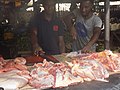 Butcher stall in Nigeria
 -
 Butcher in Mali
 -
 Butcher stall in Shueisian Temple Market, Taiwan
 -
 Butcher in Tunisia


.jpg)
.jpg)

Notable butchers and butcher shops
[edit]See also
[edit]References
[edit]- ^ "Merriam-Webster's Dictionary's definition of "butcher"". Archived from the original on 2013-05-12. Retrieved 2010-04-25.
- ^ "Employment information for butchers". Archived from the original on 2010-04-05. Retrieved 2010-04-25.
- ^ "York Butchers' Guild". Yorkbutchersgild.com. Archived from the original on 2012-03-08. Retrieved 2012-04-04.
- ^ "Job futures statistics". Servicecanada.gc.ca. Archived from the original on 2009-08-07.
- ^ "Master Butcher's Guide". Members.shaw.ca. Archived from the original on 2006-09-23.
- ^ "Small butcher shops are in 'a renaissance.' How did they survive the supermarket offensive?". Star Tribune. Archived from the original on 2019-06-03. Retrieved 2019-06-03.
External links
[edit] Definitions from Wiktionary
 Media from Commons
 Quotations from Wikiquote
 Data from Wikidata


Butcher
View on GrokipediaDefinition and Role
Primary Duties and Responsibilities
Butchers and meat cutters primarily engage in the fabrication of meat products by cutting, trimming, and portioning larger carcasses or primal cuts into retail-ready sizes suitable for consumer purchase. This involves using specialized knives, saws, cleavers, and powered equipment to separate muscle, fat, bone, and connective tissue while minimizing waste and preserving meat quality.[1] They also grind meat for products like sausages or hamburger patties, shape and tie roasts, and prepare custom orders based on specifications such as weight, thickness, or specific cuts requested by customers or wholesalers.[1] [9] Additional core responsibilities include inspecting incoming meat for freshness, quality, and compliance with grading standards—such as USDA Prime, Choice, or Select for beef—before processing, as well as weighing, pricing, labeling, and packaging portions for display or sale.[1] [10] In retail settings, butchers often interact directly with customers to recommend cuts, explain preparation methods, and provide advice on cooking techniques or recipes to optimize flavor and tenderness.[9] [11] Maintaining operational hygiene and safety forms a fundamental duty, requiring butchers to sanitize workstations, tools, and equipment after each use to prevent cross-contamination and bacterial growth, in line with food safety regulations like those from the USDA's Food Safety and Inspection Service.[1] [9] This includes proper storage of meat at controlled temperatures, typically below 40°F (4°C) for raw products, and adherence to protocols that mitigate risks such as slips from wet floors or injuries from sharp blades.[12] While most butchers receive pre-slaughtered meat from packinghouses, those in smaller or traditional operations may perform limited slaughtering, ensuring humane methods and immediate bleeding to preserve meat integrity.[1]- Meat Fabrication: Breaking down carcasses into primal cuts (e.g., loin, rib, chuck for beef) and further into subprimals or retail portions.[1]
- Quality Control: Grading and trimming excess fat or blemishes to meet market standards.[10]
- Inventory Management: Receiving shipments, rotating stock to prioritize fresher meat, and minimizing spoilage through FIFO (first-in, first-out) practices.[9]
- Equipment Operation and Maintenance: Safely using grinders, slicers, and vacuum sealers, followed by cleaning to prevent microbial hazards.[1] [12]
Skills, Training, and Professional Standards
Professional butchers require proficiency in meat cutting techniques, including the precise fabrication of primal and sub-primal cuts to maximize yield and quality, as well as safe knife handling to minimize waste and injury risks.[13] [14] Dexterity and attention to detail are essential for accurate portioning, while knowledge of animal anatomy ensures efficient separation of muscle groups and removal of bones, fat, and connective tissue.[15] Physical stamina supports the demanding manual labor involved, such as standing for extended periods and lifting heavy carcasses, complemented by basic mathematical skills for weighing, pricing, and inventory management.[16] [17] Training pathways emphasize hands-on apprenticeships, often lasting 4,000 hours or more, combining on-the-job experience with structured instruction in meat processing and safety.[18] [19] Programs at institutions like community colleges or extension services, such as Penn State’s five-week foundational course followed by employment, teach fabrication of beef, pork, and poultry alongside yield optimization.[20] [21] In regions with vocational meat cutting curricula, trainees gain 16 or more hours of weekly lab time focusing on processing techniques, with no post-secondary degree strictly required but practical experience prioritized over formal education.[22] [23] Professional standards mandate adherence to food safety protocols, including Hazard Analysis and Critical Control Points (HACCP) principles for sanitation and contamination prevention, enforced through certifications like the American Meat Science Association’s Food Safety & Science credential.[24] [25] Butchers must comply with Occupational Safety and Health Administration (OSHA) regulations on personal protective equipment and injury prevention in meatpacking environments, alongside specialized training in meat hygiene to reduce microbial risks during handling and storage.[12] [26] Certifications such as the UNH Meat Processing & Food Safety Certificate validate skills in precision cutting, packaging, and regulatory compliance, enhancing employability in commercial settings.[27]Historical Development
Origins in Prehistory and Ancient Civilizations
Archaeological evidence indicates that butchery originated in the Paleolithic era, with the earliest confirmed cut marks on animal bones appearing around 2.6 to 2.5 million years ago at sites in East Africa, such as Olduvai Gorge in Tanzania.[28] These marks, made by Oldowan stone tools, demonstrate systematic defleshing and marrow extraction from large mammals like bovids, suggesting intentional scavenging or hunting to obtain nutrient-dense resources critical for early hominin brain expansion and survival.[29] Earlier claims of butchery at 3.4 million years remain debated due to potential natural or trampling marks, but the 2.5 Ma evidence aligns with the emergence of tool-using species like Homo habilis.[30] In ancient Egypt, by the Old Kingdom (c. 2686–2181 BCE), butchery had evolved into a specialized craft, transitioning from stone to copper tools for more efficient carcass processing.[31] Tomb reliefs and wooden models, such as those from the mastaba of Kagemni and the tomb of Meketre (c. 1980 BCE), depict butchers restraining cattle, severing throats, flaying hides, and quartering carcasses in organized slaughter scenes, reflecting both daily provisioning and ritual sacrifices.[32] These practices supported substantial meat consumption, with pyramid builders at Giza requiring approximately 4,000 pounds of beef and pork daily, sourced from cattle, sheep, and goats herded in the Nile Delta.[33] Mesopotamian civilizations, from the Uruk period (c. 4000–3100 BCE), integrated professional butchers into urban economies, as evidenced by cuneiform records of meat distributions during diacritical feasts and temple rituals involving sheep, goats, and cattle.[34] Artifact models from Ur (c. 2500 BCE), including butcher shop scenes, illustrate skilled dismemberment and preparation, with butchers handling offal and fabricating cuts for elite banquets and common markets.[35] This specialization arose from settled agriculture and animal domestication around 9000 BCE in the Fertile Crescent, enabling surplus production and trade, though meat remained a luxury tied to religious offerings rather than daily fare for most.[36]Medieval Guilds, Trade, and Regulations
In medieval Europe, butchers formed craft guilds to regulate the profession, maintain quality standards, and secure monopolies over local meat trade. These organizations emerged prominently in the 13th century, with documented rules for butchers' guilds appearing as early as 1267 in Tulln, Lower Austria, where provisions governed slaughter practices, market sales, and dispute resolution among members.[37] Guilds enforced strict entry requirements, including multi-year apprenticeships—often seven years—followed by journeyman work and a mastery exam demonstrating cutting skills and knowledge of animal anatomy, thereby limiting competition and ensuring competence.[38][39] Regulations focused on product integrity and public welfare, prohibiting the sale of meat from diseased or unfit animals to avert health risks and sustain consumer trust; violations could result in fines, expulsion, or public shaming.[40] Butchers' guilds controlled pricing, weights, and measures to curb fraud, while mandating specific market days and locations for stalls, often segregating them from other trades due to the messiness of offal disposal.[41] In England, butchers organized into guilds by 1272, gaining royal charters that affirmed their authority over urban slaughterhouses, which were frequently relocated outside city walls by the 14th century to address sanitation complaints from residents and authorities.[42] Trade practices under guild oversight involved bulk purchases of live livestock from rural suppliers, on-site slaughtering, and portioning into primal cuts for retail, with guilds negotiating exclusive access to municipal markets and abattoirs.[43] These monopolies extended to raw material sourcing, where guilds lobbied against unregulated itinerant sellers, though tensions arose with town magistrates over price gouging during shortages, leading to occasional interventions like the 1270s London assizes fixing meat tariffs.[43] By the late Middle Ages, guilds in cities like Paris and Florence integrated welfare functions, such as mutual aid funds for widows and the infirm, alongside trade protections, fostering stability amid fluctuating harvests and plagues that disrupted supply chains.[38]Industrialization from the 19th Century Onward
The industrialization of butchery accelerated in the mid-19th century, particularly in the United States, as railroads expanded and enabled centralized processing of livestock far from consumption centers. In Chicago, the Union Stock Yards opened in 1865, established by nine railroad companies on a 320-acre site to consolidate the handling of cattle, hogs, and sheep arriving by rail.[44] This facility processed two million animals annually by 1870, rising to nine million by 1890, transforming the city into the epicenter of the meatpacking industry.[45] Rail transport reduced the need for live animal shipments to eastern markets, allowing slaughter near railheads and shipment of dressed carcasses instead.[46] A pivotal innovation was the development of refrigerated railroad cars, which addressed spoilage during long-distance transport. Meatpacker Gustavus Swift, partnering with engineer Andrew Chase, introduced practical ice-cooled cars in 1878, featuring vents for air circulation over ice bunkers to maintain temperatures around 40°F (4°C).[47] Swift's Swift Refrigerator Car Company deployed these by 1880, enabling the shipment of fresh beef from Chicago to New York without salting or pickling, cutting costs and expanding markets.[48] By the 1880s, firms like Armour and Swift dominated, utilizing byproducts such as blood, bones, and scraps for fertilizers, soaps, and other goods, minimizing waste and boosting profitability.[49] Processing efficiency advanced through the "disassembly line," where carcasses were suspended on overhead rails and conveyed past stationary workers performing repetitive, specialized cuts—a reversal of later automotive assembly principles.[50] This method, refined in Chicago's packing plants from the 1870s onward, increased throughput; a single hog could be processed in minutes by teams of workers, with speed driven by piece-rate pay.[44] However, the system prioritized volume over safety, leading to high injury rates from sharp tools and machinery, as documented in early 20th-century inspections. Upton Sinclair's 1906 novel The Jungle, drawing from observed conditions, highlighted unsanitary practices like contaminated meat and rat infestations, prompting the Federal Meat Inspection Act of 1906 despite the work's ideological bias toward critiquing industrial capitalism.[51] In Europe, similar shifts occurred, with centralized abattoirs in cities like London incorporating steam-powered hoists by the 1870s, though refrigeration lagged behind the U.S. until the 1880s.[52] Overall, these changes de-skilled traditional butchery, replacing artisanal whole-animal breakdown with factory specialization, while enabling unprecedented scale: U.S. meat production tripled between 1870 and 1900.[49]Modern Innovations and Recent Trends
Automation and robotics have transformed butchery practices since the early 2020s, addressing labor shortages and enhancing precision in meat cutting. Robotic systems equipped with artificial intelligence (AI) and machine learning enable automated fabrication of primal and sub-primal cuts, reducing human error and improving yield consistency across operations.[53][54] For instance, dexterous cutting robots integrated with advanced sensing technologies, such as 3D vision systems, perform tasks traditionally requiring skilled manual labor, with implementations noted in meat processing facilities by 2022.[55][54] Recent advancements include precision butchery techniques utilizing smart cutting tools and AI-driven optimization for minimal waste, alongside automated grinders and slicers that boost efficiency and safety in both industrial and smaller-scale settings.[56][57] These innovations stem from causal pressures like rising operational costs and workforce constraints, with the U.S. meat processing industry facing persistent labor gaps that accelerated robotic adoption post-2020.[58][59] Sustainability trends have gained prominence, incorporating waste reduction systems and energy-efficient equipment in butchery lines, driven by regulatory demands and consumer preferences for traceable, ethically sourced meat. Blockchain technology facilitates end-to-end supply chain traceability, allowing verification of animal welfare standards and processing hygiene from slaughter to retail.[60][57] Enhanced packaging methods, such as advanced vacuum-sealing, extend shelf life while maintaining product quality, reflecting a shift toward resource-efficient practices amid environmental concerns.[61] In retail and artisanal contexts, digital tools for inventory management and customer customization have emerged, enabling butchers to offer on-demand cuts and personalized products, though industrial automation dominates volume processing. Market data indicates steady growth in butchery equipment demand, with innovations projected to expand through 2035, underscoring a dual trajectory of high-tech industrialization and niche traditional refinement.[62][63]Butchery Techniques and Practices
Identification and Fabrication of Primal Cuts
Primal cuts constitute the primary subdivisions of a meat carcass, delineated by major anatomical muscle groups, skeletal elements, and fat depots to facilitate efficient processing and yield optimization. Identification entails visual and tactile assessment of bone landmarks—such as rib counts, vertebral shapes, and joint articulations—and muscle separations, enabling butchers to align cuts with natural contours for minimal trim loss. Fabrication proceeds sequentially from the whole or halved carcass, employing straight or curved incisions with breaking knives, boning knives, and carcass saws to isolate primals while adhering to standardized guidelines that ensure uniformity across operations. This process varies by species due to differences in carcass size, conformation, and muscle distribution, with beef carcasses averaging 600 pounds (275 kg) and pork at 270 pounds (125 kg).[64][65] For beef, fabrication begins post-slaughter with evisceration, hide removal, and chilling, yielding a dressed carcass split longitudinally along the chine bone into two sides. Each side divides into forequarter and hindquarter via a perpendicular cut between the 12th and 13th ribs, exposing the kidney knob for further loin separation. Forequarter primals—chuck, rib, brisket, short plate, and shank—are isolated by referencing the first five ribs for chuck-rib demarcation, the elbow joint for shank removal, and a straight cut above the flank for plate-brisket yield. Hindquarter primals—short loin, sirloin, tenderloin, round, and flank—emerge from parallel cuts to the lumbar backbone, a "V-shaped" incision at the hip bone for sirloin tip, and pelvic syndesmotomy for round detachment. These eight primals (chuck, rib, loin, round, flank, short plate, brisket, shank) correspond to specific yield percentages, with chuck comprising about 29% of the carcass.[64][66][65]| Primal Cut | Location | Identification Landmarks | Fabrication Technique |
|---|---|---|---|
| Chuck | Forequarter shoulder | Scapula, first 5 ribs, blade bone | Saw between 5th-6th ribs; seam-bone shoulder clod |
| Rib | Forequarter mid-back | 6th-12th ribs, spinalis muscle | Straight cut post-chuck; ribeye separation |
| Loin (short loin + sirloin) | Hindquarter back | Lumbar vertebrae 13-L6, kidney fat | Parallel backbone cut; tenderloin frenching |
| Round | Hindquarter rear leg | Femur, aitch bone | Pelvic cuts; separate top/bottom rounds |
| Brisket | Forequarter chest | Sternum, dewclaw | Elbow-parallel cut; plate-flank trim |
| Flank | Hindquarter abdomen | Abdominal wall, no ribs | Hindquarter ventral incision |
| Short Plate | Forequarter belly | 6th-8th ribs ventral | Flank-adjacent straight cut |
| Shank/Foreshank | Forequarter lower leg | Radius/ulna, hock joint | Elbow joint disarticulation[64][67] |