Hubbry Logo
Chief SeattleChief SeattleMain
Open search
Chief Seattle
Community hub
Chief Seattle
logo
8 pages, 0 posts
0 subscribers
Be the first to start a discussion here.
Chief Seattle
Chief Seattle
from Wikipedia

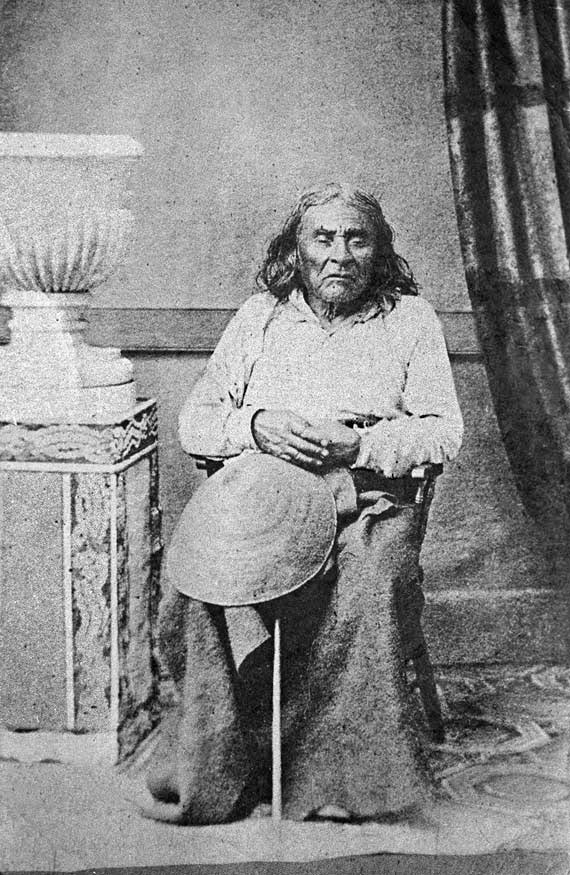
Seattle (c. 1780~86 – June 7, 1866; Lushootseed: siʔaɬ, IPA: [ˈsiʔaːɬ]; usually styled as Chief Seattle) was a leader of the Duwamish and Suquamish peoples. A leading figure among his people, he pursued a path of accommodation to white settlers, forming a personal relationship with Doc Maynard. The city of Seattle, in the U.S. state of Washington, was named after him. A widely publicized speech arguing in favor of ecological responsibility and respect for Native Americans' land rights has been attributed to him.

Key Information

Name

[edit]

The name Seattle is an anglicization of his name in his native Lushootseed language, siʔaɬ.[3] According to Upper Skagit elder Vi Hilbert, his name was traditionally pronounced siʔaƛ̕. After his baptism in 1852, he gained the baptismal name of Noah Seattle.[4]

In English, his name is often also spelled Si'ahl, Sealth, Seathl or See-ahth as an attempt to be more accurate to the Lushootseed pronunciation. There is no "th" sound in the Lushootseed language.[4]

Life

[edit]
Chief Seattle's bust in the city of Seattle

Youth

[edit]

Seattle was born between 1780 and 1786 to Schweabe, a Suquamish leader from dxʷsəq̓ʷəb, the main Suquamish village on Agate Pass,[5][6] and Sholeetsa,[a] a Duwamish woman.[1][2] By some accounts, his mother was born into slavery, while in others, she was a high-born noblewoman.[7] His exact birthplace is also disputed. According to some historians, as well as the tradition of the Suquamish Tribe, Seattle was born on Blake Island (Lushootseed: tatču),[8] and his mother was from the village of stəq on the White River.[b][5][2][7][9] Seattle himself said he was born on Blake Island.[5] According to the Duwamish Tribe, Seattle was born at his mother's village on the Black River, near what is now the city of Kent, Washington.[1] According to one of his contemporaries, an American settler named Emily Inez Denny, he was born at the Old Man House at dxʷsəq̓ʷəb.[10]

Seattle grew up speaking both the Duwamish and Suquamish dialects of Southern Lushootseed.[1] Seattle's Suquamish family was a powerful one, and they dominated parts of Kitsap Peninsula, Vashon Island, Bainbridge Island, and Blake Island. Because power and authority in Coast Salish culture are traditionally not guaranteed through descent, Seattle had to prove his worth to his Coast Salishan society.[2]

In 1792, when Seattle was around six years old, he met HMS Discovery and HMS Chatham under the command of George Vancouver, who had anchored off Restoration Point on Bainbridge Island.[4][11] Seattle and his family, who were occupying nearby Blake Island gathering food, were visited by a party from the Vancouver expedition.[11] Seattle's father, Schweabe, and uncle, Kitsap, may have been the two "chiefs" that Vancouver invited onto his ship.[11] Over several days, Vancouver and the Suquamish (who were soon joined by their Duwamish neighbors) interacted extensively, trading goods and observing each other.[11] Seattle often talked about this experience later in his life.[11] Seattle would also later visit Fort Nisqually to trade with the Hudson's Bay Company.[4] It is likely that these events taking place in his formative years encouraged his fascination with Europeans and their culture.[4][11]

At some time during his youth, Seattle participated in a traditional coming-of-age ceremony called a vision quest (Lushootseed: ʔalacut). His nobility was affirmed by the reception of a powerful spirit power, the thunderbird.[5][2] In the traditional religion of the peoples of southern Puget Sound, having a strong spirit power is a symbol of strength, purity, and prestige.[12]

Seattle married into Duwamish families from t̕uʔəlalʔtxʷ, a significant village at the mouth of the Duwamish River, where he took several wives, as expected from a man of his status. He would go on to have several children, the most famous being Kikisoblu, his first child, born to his first wife, Ladalia. She died after the birth of her daughter, but Seattle had three sons and four more daughters through his second wife, Olahl.[5][10]

A feared Suquamish warrior

[edit]

As Seattle aged, he earned a reputation as a leader and a strong warrior. In his early 20s, Seattle participated in a coalition war against the Cowichan peoples of Vancouver Island led by his uncle Kitsap.[5] Around 1810, Seattle led an ambush against a group of raiders in five canoes coming down the Green River. Seattle's raiding party killed or enslaved the occupants of three canoes and sent the remaining two canoes back as a warning.[5][2] Seattle also led a raid against the S'Klallam people on the Olympic Peninsula and may have also led further raids against the Snoqualmie people as well. Coast Salish peoples historically practiced slavery, and, like many of his contemporaries, Seattle enslaved people whom he had captured during his raids, further increasing his prestige.[5][13]

By 1833, he had become known to the staff of Fort Nisqually as Le Gros, 'the big guy'. He was seen as an intelligent and formidable leader, owing to his strong voice and towering physique, standing nearly six feet (1.8 m) tall. Francis Herron, the Chief Trader at the fort, considered him important and dangerous and requested him to sign a treaty forswearing murder. In 1837, however, Seattle murdered a Skykomish shaman. The new Chief Trader, William Kittson, hoped that the Suquamish would kill him; however, they continued to value him as a leader.[5]

In 1841, Seattle led a raid on the village of ʔilalqʷuʔ, located near modern-day Auburn at the former confluence of the Green and White rivers. The raid was in retaliation for a murder committed by someone from the village, and it crippled the village. Later, in 1847, he was part of the leadership of the Suquamish war against the Chemakum, who were decimated and effectively wiped out following the war. However, one of his sons was killed in battle with the Chemakum, leading Seattle to seek baptism into the Catholic Church around 1848. Seattle was probably baptized by the Missionary Oblates of Mary Immaculate in Olympia, where he chose the baptismal name of Noah after the prophet of the same name.[5]

Friendship with American settlers

[edit]
Statue of Chief Seattle, 1908 by James When, Tilikum Place, Seattle, Washington. The statue is on the National Register of Historic Places.

After the death of his son and his conversion to Christianity, Seattle began to seek cooperation with American settlers, retiring from fighting. He welcomed pioneers, inviting them to settle and trade with his people. Seattle began seeking contacts with businessmen and community leaders and gained a reputation as a "friend of the whites" among settlers.[4][5] Seattle and the Duwamish helped many early American settlers, guiding them along the Duwamish River and its tributaries, providing them with safe transportation, and helped clear forests for the cultivation of crops, and provided labor in early sawmills and farms.[1]

Seattle was eventually contacted by Isaac Stevens, the first Territorial Governor of Washington Territory, who recognized Seattle's prominence among his people. Seattle would go on to be the first signature on the 1855 Treaty of Point Elliot for the Suquamish, and all the peoples of the Duwamish River's watershed, including the Duwamish, Sammamish, Stkamish, Smulkamish, and Skopamish peoples, authorizing the cession of roughly 2.5 million acres of land to the United States.[4][5][14] It has been argued that Seattle had no authority to sign the treaties for the peoples of the upriver Duwamish River according to traditional governance, and that he and others did not realize governor Stevens' desire to alter the indigenous political systems and control the native population.[15]

The unpopular treaties caused many Duwamish to renounce Seattle's leadership. Alongside many other tribes, the Duwamish participated in the Puget Sound War, a part of the broader Yakima Indian War. Despite this, Seattle supported the Americans in the conflict, providing them with valuable military intelligence.[5] Seattle warned the American settlers of the impending attack and brought as many people as he could away from the fighting to the Port Madison reservation.[4] After the war's conclusion with the defeat of Native forces, Seattle tried to help his people regain their footing and sought clemency for the Native leaders in the war, such as Leschi.[5] One reason for the war was the unratified treaty and illegal enforcement, so Seattle continuously advocated for the final ratification of the treaties.[4][5] He also tried to stop slave murder and curtail the influence of alcohol on the Port Madison Reservation; he continued to try to resolve disputes elsewhere.[5]

Seattle continued to seek relationships with American settlers, eventually gaining relationships with Doc Maynard, William De Shaw, and George Meigs, who all helped Seattle further his goals in helping the local Native and Settler populations. Despite his friendships with the Americans, the town forced Seattle to leave the city that bore his name in 1865 after the Town of Seattle Ordinance No. 5 banned all Native Americans from the town unless housed and employed by a white settler. Seattle then moved to the Suquamish Reservation, but continued to visit the city often both to visit his American friends and gather with other Native Americans in temporary waterfront campsites.[5]

The Suquamish people, with whom Seattle eventually settled, continued to take care of Seattle and recognized him as their leader until his death, bringing him food and water to his house.[4] Seattle died June 7, 1866, on the Port Madison Reservation after suffering from a brief yet severe fever.[4][5][16] His funeral was conducted with both Catholic and Suquamish traditions, and he was buried on the Port Madison Reservation. Although he was mourned locally on the reservation and by his friend and sawmill owner George Meigs, no other pioneers of the city of Seattle attended his funeral, and no newspaper covered the event. However, years after his death, in 1890, some early Seattle historians and pioneers visited his gravesite, adding a stone marker to the grave.[4]

Chief Seattle's speech

[edit]

In 1854, Seattle gave a speech, delivered in his native language of Lushootseed, to Isaac Stevens, during a visit to the city of Seattle. A pioneer, Henry A. Smith, had attended the meeting and taken notes of the speech. Thirty-three years later, in 1887, a text was reconstructed from Smith's notes and published in the Seattle Sunday Star. Smith's version of the speech was "necessarily filtered", "embellished", and created from Smith's "incomplete" notes, according to historian Walt Crowley. There is no corroboration for the exact words of the speech, but Smith's reconstruction is plausible, albeit embellished. Smith's speech reconstruction has been lauded as "a powerful, bittersweet plea for respect of Native American rights and environmental values."[17]

In 1929, Clarence C. Bagley printed a version of the speech in his History of King County, adding "Dead -- I say? There is no death. Only a change of worlds" to the end of the speech. Bagley's version became popular, circulating in environmentalist pamphlets and other works. The work was further modified by William Arrowsmith and Ted Perry, who added their own text additions. These versions influenced environmentalists and Native American rights activists in the 1960s.[17]

Legacy

[edit]
Closeup of Chief Seattle's tombstone in Suquamish, Washington
Chief Seattle's gravesite on the Port Madison Indian Reservation in Suquamish, Washington

As Seattle was highly famous to both early pioneers and modern residents, as well as a constant figure in the mythos of Seattle's founding, Chief Seattle's legacy has been preserved in many ways. Seattle's grave site, at the Suquamish Tribal Cemetery,[18] has been turned into a monument to him and his life. In 1890, a group of Seattle pioneers led by Arthur Denny set up the monument over his grave, with the inscription "SEATTLE Chief of the Suqampsh and Allied Tribes, Died June 7, 1866. The Firm Friend of the Whites, and for Him the City of Seattle was Named by Its Founders." On the reverse is the inscription "Baptismal name, Noah Sealth, Age probably 80 years."[10] The site was restored, and a native sculpture was added in 1976 and again in 2011.[citation needed]

Several of Seattle's descendants also gained fame in their own right. Kikisoblu, also known as Angeline, was his most famous child and well-known to the residents of early Seattle, where she lived until her death in 1896. His son Jim became the leader of the Suquamish for a time, but was unpopular and was replaced in favor of a prominent leader of the Catholic Suquamish community, Jacob Wahalchu.[4] A Duwamish grandniece of his, Rebecca Lena Graham, is also notable for her successful inheritance claim following the Graham v. Matthias, 63 F. 523 (1894) case.[19]

Two statues of Seattle were created in his honor by James A. Wehn. A bronze bust, located in Pioneer Square, was made in 1909, and a full statue, located in the Denny Triangle, was made in 1912.[4]

The city of Seattle and numerous other institutions relating to the city are named after him. Other things are named after Seattle as well, including:

Several festivals and holidays are celebrated in his honor. The Suquamish Tribe hosts a festival in the third weekend of August called "Chief Seattle Days."[citation needed] The Evangelical Lutheran Church in America commemorates the life of Seattle on June 7 in its Calendar of Saints. The liturgical color for the day is white.[23]

Soundgarden, a Seattle rock band, covered the Black Sabbath song, "Into the Void" replacing the lyrics with the words from what was alleged to be Chief Seattle's speech.

See also

[edit]

Notes

[edit]

References

[edit]

Further reading

[edit]
[edit]
Revisions and contributorsEdit on WikipediaRead on Wikipedia
from Grokipedia
Chief Seattle (Siʔaɬ or Sealth; c. 1780s – June 7, 1866) was a principal leader of the Suquamish Tribe and a prominent figure among the Duwamish and allied bands inhabiting the shores of Puget Sound in present-day Washington state. Born on the Kitsap Peninsula to a Suquamish father, he emerged as a leader around 1810 amid epidemics and conflicts that decimated indigenous populations, pursuing a strategy of diplomacy and accommodation with European-American settlers rather than warfare. Seattle's most significant historical role involved negotiating with U.S. territorial authorities during the mid-19th-century influx of settlers, culminating in his signing of the on January 22, 1855, as the leading Duwamish representative. This agreement saw the tribes cede millions of acres of ancestral lands in exchange for reservations, payments, and reserved and rights, though implementation disputes later arose. Baptized into the Roman Catholic faith in his later years, he died of inflammatory on the Port Madison Reservation and was buried with both native and Christian rites. A purported 1854 oration attributed to Seattle, emphasizing harmony with nature and critiquing settler impacts, gained widespread fame in the 20th century through environmental advocacy but lacks verifiable contemporary records; reconstructions by pioneers like Henry Smith were embellished over time, rendering popular versions largely fictional. The settlement that became Seattle, Washington, was named for him in by its founders to secure his goodwill amid territorial expansion. Despite romanticized portrayals in modern media and academia—often amplifying unsubstantiated ecological prophecies—primary accounts portray Seattle as a pragmatic chief prioritizing tribal survival through alliance over confrontation.

Personal Background

Name and Titles

Si'ahl, the Lushootseed name of the Native American leader commonly known in English as Chief Seattle, derives from the salish language spoken by the Suquamish and Duwamish peoples of central , with phonetic approximations including "see-athl" or "si?al." This name was anglicized to "Seattle" by early Euro-American settlers in the 1850s, reflecting phonetic adaptations rather than direct , and the nascent settlement of was officially named in his honor on November 29, 1852, by the Washington Territorial Legislature to foster goodwill with local tribes. The original name's etymological meaning remains uncertain in historical records, with no consensus among linguists on a precise beyond its cultural context within nomenclature. Among his own people, Si'ahl held no singular equivalent to the European concept of "chief," but rose to prominence as an influential leader—or tyee—exerting authority over aspects of the Duwamish (dxʷdəwʔabš) and Suquamish tribes through demonstrated prowess in warfare, , and resource management, succeeding his father Schweabe, a noted Suquamish sub-chief. Euro-American accounts, beginning with pioneers like David S. Maynard, bestowed the honorific "Chief Seattle" to denote his role in intertribal coordination and negotiations, portraying him as a head of multiple Puget Sound groups despite the decentralized nature of Salish structures. Following his into circa 1848 by French Catholic missionaries, he adopted the name Noah Sealth, or Chief Noah Seattle, blending indigenous identity with Christian nomenclature while retaining his traditional stature.

Early Life and Family

Siʔaɬ (c. 1780s–1866), known in English as Chief Seattle, was born in the Puget Sound region of what is now Washington state during the 1780s, amid a period of intertribal warfare and early European contact. Historical accounts differ on the exact location, with claims including the Kitsap Peninsula, Blake Island in central Puget Sound, and the dxʷdəwʔabš village of Stukw on the Black River near present-day Kent. His father, Shweabe (also spelled Schweabe), held the position of chief among the Suquamish, a tribe centered around Agate Pass and Old Man House village. His mother, Sholeetsa (or Scholitza), was of the Duwamish (dxʷdəwʔabš) people from the lower Green River area, which linked Siʔaɬ to both tribes through noble lineages and facilitated his later dual leadership role. Details of Siʔaɬ's early years derive primarily from oral traditions recorded by later historians and tribal accounts, as no contemporary written records exist from his childhood. Raised in the noble class (siʔab) within Lushootseed-speaking Salish culture, he would have been immersed in seasonal migrations between summer villages on inland waters and winter longhouses, subsisting on salmon fishing, hunting, and gathering in the resource-rich maritime environment. As a boy, approximately 10 to 12 years old, he witnessed early European incursion when he paddled out with his father to observe Captain George Vancouver's expedition ships in on May 20, 1792, near Bainbridge Island. In his youth, Siʔaɬ undertook a vision quest, attaining the Thunderbird spirit power—a rare and prestigious guardian spirit among Coast Salish peoples that signified his destined prominence.

Military and Leadership Role

Warrior Exploits

In his youth, Sealth (Chief Seattle) distinguished himself as a warrior leader among the Suquamish and Duwamish tribes by organizing and executing against raiding parties from northern tribes, such as the Cowichan and Haida, who frequently attacked villages for slaves and resources. Around 1810, he led a successful near present-day Tukwila against raiders from the lower White River, resulting in a fierce that bolstered his reputation for tactical acumen. A pivotal early exploit occurred along the , where Sealth, overcoming his low social status due to enslaved ancestry, proposed felling a large tree to block the path of five approaching northern raiding canoes; his warriors then attacked with arrows and clubs, securing a decisive victory that enhanced his standing as a fierce . Later, he joined Suquamish leader Kitsap in a large-scale expedition of approximately 200 canoes against Cowichan strongholds on in the late 1810s or early 1820s; though the assault ended in tactical failure with heavy losses, it disrupted northern raiding patterns and paved the way for eventual peace through intermarriage and alliances. Sealth's raids often targeted enemy villages for vengeance and captives, reflecting the prevalent practice of among Coast Salish peoples; he personally conducted slave raids, capturing and trading individuals, and owned as many as eight slaves himself. In 1841, he spearheaded a punitive raid on the Yila'lqo village at the confluence of the and upper White Rivers to avenge a murdered relative, inflicting severe damage on the settlement. By around 1845, he led a devastating assault near Port Townsend against the Chemakum people, from which they never recovered demographically, as noted in contemporary records. These actions, involving the killing of numerous adversaries, established Sealth as a formidable war chief prior to his later emphasis on with American settlers.

Rise to Chieftainship Among Suquamish and Duwamish

Sealth, born in the 1780s on the to a Suquamish father named Schweabe and a Duwamish mother named Scholitza, both of noble lineage, possessed kinship ties that positioned him for influence across the two tribes. These familial connections, rather than strict hereditary succession, facilitated his eventual dual leadership, as tribal authority among peoples emphasized consensus, demonstrated ability, and respected ancestry over rigid inheritance. Early in life, Sealth navigated social challenges, including potential marginalization from his grandmother's enslaved status, but overcame them through personal qualities that earned tribal respect. As a young warrior, Sealth participated in defenses against intertribal raids intensified by population losses from epidemics in the late . By age 20, he joined a organized by his kinsman Kitsap, a prominent Suquamish war leader, which united tribes from central to the to counter northern incursions, convening at the expansive Old Man House on Agate Passage. A pivotal exploit involved proposing the felling of a fir tree across the to block and ambush northern raiders, enabling hidden warriors to achieve a decisive victory and bolstering his reputation for tactical ingenuity and bravery. Similar ingenuity marked his leadership in repelling White River warriors by obstructing their canoes with a felled tree, further solidifying his standing. By the 1830s, records at described him as a formidable figure, reflecting his growing martial prestige. Sealth's ascent to chieftainship combined these warrior achievements with oratorical skill and intelligence, succeeding Calqab as Suquamish headman and inheriting nominal Duwamish authority from his maternal uncle, though effective required ongoing affirmation by tribal councils. By the 1850s, he was acknowledged as principal chief over allied groups from the Cedar River to Port Madison, guiding both Suquamish and Duwamish in responses to encroaching Euro-American settlement. This role emerged organically from his demonstrated capacity to unite and protect kin amid raids, rather than through formal election or conquest, aligning with the fluid, merit-based power structures of Lushootseed-speaking peoples.

Relations with American Settlers

Initial Encounters and Conflicts

Chief Seattle's earliest recorded encounters with Europeans occurred during his childhood, when Captain George Vancouver's expedition entered in 1792, though no direct meeting with the young Seattle (then approximately 6 to 12 years old) is documented. By the , as an adult, he engaged in pelt trading at , a outpost, marking sustained indirect interaction with European fur traders. American settlement began in earnest with exploratory parties in 1850, when Seattle greeted Isaac N. Ebey and B. F. Shaw upon their arrival at , extending invitations to settle and as recorded in Shaw's accounts. In September 1851, scouts David Denny, Lee Terry, and John Low reached the mouth, followed by the full Denny Party's landing at Alki Point on November 13, 1851, aboard the Exact. Seattle and his people welcomed these arrivals, providing guidance along the and its tributaries for safe passage and resource access, which facilitated the s' initial survival amid unfamiliar terrain. By spring 1852, Seattle partnered with Charles Fay to establish a fishery on and later collaborated with David S. "Doc" Maynard on another at the site that became central , urging Maynard to relocate his from Alki to the mainland village of Duwamps (renamed in 1853). These interactions were characterized by pragmatic cooperation rather than hostility, with Seattle positioning himself as a broker between tribes and newcomers, leveraging his influence to mitigate potential disruptions from his people's displacement. Prior to widespread American influx, Seattle had established a reputation as a formidable through raids against northern tribes, such as a successful of raiders at around age 20 and joint operations with Chief Kitsap against Cowichan incursions, which indirectly alarmed early European observers via logs noting the terror of his tactics. However, no verified records indicate Seattle leading or participating in attacks on American settlers; instead, he actively opposed such actions, providing warnings and to allies during the 1855–1857 and remaining at Port Madison during the January 26, 1856, Battle of Seattle—a brief Northern skirmish where other tribes assaulted the town but caused limited damage. This stance stemmed from his assessment that armed resistance would provoke greater retaliation from the numerically and technologically superior settlers, though underlying tensions arose from some Duwamish dissatisfaction with his accommodating approach, contributing to factional rifts.

Pragmatic Cooperation and the Treaty of Point Elliott

Chief Seattle pursued a policy of accommodation with American settlers, recognizing the futility of armed resistance against their growing numbers and technological superiority. From the early , as Euro-American pioneers established claims around , he welcomed arrivals such as the in 1851, facilitating trade in furs and provisions while advising his followers against hostility. This approach contrasted with more militant leaders like Leschi of the Nisqually, who rejected territorial encroachments; Seattle instead viewed cooperation as a means to secure limited concessions for his people amid inevitable displacement. His diplomacy extended to active protection of during rising tensions. Seattle warned white communities of threats from natives and restrained his own kin from raids, effectively preventing attacks that could provoke retaliation. During the 1855–1856 conflicts tied to the , he aligned with U.S. forces, refusing to join uprisings and even aiding in suppressing them, thereby preserving peace in the Seattle vicinity. Such actions stemmed from a realist assessment: opposition would accelerate tribal subjugation without altering settlement's trajectory. This pragmatic orientation informed Seattle's leadership in the negotiations, convened by Governor in late 1854 and early 1855. As a senior chief of the Suquamish and influential among the Duwamish, he acted as a primary native spokesman at the near Mukilteo, leveraging his prestige to advocate acceptance. On , 1855, Seattle affixed his mark as a lead signatory among 81 tribal representatives, formally ceding over 2 million acres of ancestral territory in exchange for reservations (including Tulalip), modest annuities of $2,000 annually for 20 years, schools, and retained rights to hunt, fish, and gather in customary areas. His endorsement swayed hesitant factions, framing the pact as a survival mechanism despite its unequal terms—reservations proved inadequate, and enforcement faltered—but averting immediate war in the central Sound.

The 1854 Speech

Context of Delivery

In late 1854, Isaac I. Stevens, the first governor of (established March 2, 1853) and ex officio Superintendent of Indian Affairs, convened preliminary gatherings with leaders of tribes to advance federal treaty negotiations for land cessions. Appointed by President in March 1853, Stevens arrived in Olympia on November 25, 1853, tasked with extinguishing to facilitate white settlement, military road construction, and surveys for a northern route as authorized by . These efforts aligned with U.S. policy under Commissioner of Indian Affairs George W. Manypenny, emphasizing reservations to consolidate tribes and free land for , amid rapid territorial population growth from fewer than 4,000 non-Natives in 1850 to over 11,000 by 1853. The specific context for Chief Seattle's address was a waterfront assembly near present-day Seattle, likely in December 1854, shortly before formal treaty councils. Stevens, traveling by steamer, met with approximately 1,000 attendees from tribes including the Duwamish and Suquamish, outlining proposals for tribes to relinquish claims to roughly 2.5 million acres in exchange for small reservations, annuities totaling $210,000 over 20 years, agricultural aid, and fishing/hunting rights. This preceded the , signed January 22, 1855, at Mukilteo (then Muckl-te-oh), where Seattle would represent his peoples among 81 signatories. The meeting reflected Stevens' urgent pace—having already secured the on December 26, 1854, with southern groups—driven by pressures for railroad funding and to preempt conflicts as settlers encroached without legal title. Seattle, aged roughly 65-80 and lacking formal English, delivered his remarks through interpreters amid a crowd of canoes and onlookers, responding to Stevens' overtures with themes of land stewardship and inevitable displacement. Stevens replied briefly, deferring detailed talks to a future council, underscoring the governor's view of Seattle as a pragmatic ally amenable to compromise, unlike more resistant leaders. This exchange occurred against a backdrop of tense initial encounters, including Seattle's earlier raids against southern tribes but his avoidance of direct violence with Americans, positioning him as a mediator in an era when unceded lands fueled disputes leading to the Puget Sound War (1855-1856).

Original Accounts and Subsequent Versions

No contemporaneous verbatim record of Chief Seattle's 1854 speech exists, as it was delivered orally in the language to an audience of Native leaders and territorial officials, with informal translation into and English by interpreters present, but without stenographic or written documentation at the event. The gathering occurred on , 1854, in what is now , during Governor ' tour to negotiate land cessions, though the speech's exact content remains unverifiable due to the absence of primary sources from participants like Stevens or interpreters. The first published version emerged on October 29, 1887, in the Seattle Sunday Star, authored by Henry A. Smith, a physician and early who claimed to have attended the speech and taken notes in English at the time. Smith's approximately 400-word reconstruction portrayed Seattle urging pragmatic acceptance of white settlement, emphasizing the superiority of American numbers and technology while expressing resignation over Native displacement, with phrases like "Your is not our God" highlighting cultural divides. Smith admitted the text was a "free rendering" from memory after 33 years, without producing original notes, which has led historians to view it as a influenced by Smith's own Victorian-era perspectives rather than a direct transcript. Subsequent adaptations proliferated in the 20th century, diverging significantly from Smith's account. A 1927 version by poet William Arrowsmith, published in The Pacific Spectator, expanded the text to over 1,000 words, introducing romanticized elements of Native spirituality and harmony with nature not evident in earlier records. Further revisions in the 1960s and 1970s, often unattributed or falsely linked to Ted Perry's 1970 screenplay for an ecological film, added anachronistic environmentalist rhetoric, such as "Man does not weave the web of life, he is merely a strand in it," aligning the speech with mid-20th-century conservation movements rather than 1850s territorial realities. These later iterations, disseminated in textbooks and speeches by figures like Margaret Mead, lacked primary sourcing and reflected adapters' agendas, including anti-colonial and eco-romantic interpretations, rather than fidelity to any historical utterance. At least nine major variants exist, varying in length from Smith's concise prose to expansive poetic forms, with no chain of transmission back to 1854 verifiable documents.

Authenticity Controversies and Scholarly Consensus

The authenticity of Chief Seattle's speech has been contested since its earliest publication, primarily due to the absence of contemporary records and the improbability of verbatim from through to English. Henry A. Smith, a physician who arrived in the in 1853 but was not documented as present at the treaty gathering, claimed in an 1887 article in the Seattle Sunday Star to have provided an on-the-spot of Seattle's words, portraying a speech of resigned accommodation to American , with phrases emphasizing the inevitability of Native displacement and calls for peaceful coexistence. Critics, including historians analyzing Smith's timeline and linguistic fidelity, argue that the account reflects Smith's own Victorian-era interpretations rather than Seattle's original intent, as no other witnesses corroborated the details and Smith's text employs rhetorical flourishes atypical of oral traditions. Subsequent versions amplified these issues, evolving the speech into a poetic on environmental despoliation and Indigenous spirituality, far removed from Smith's prosaic report. By the 1890s, sermonizer John H. Evans and others expanded it with biblical allusions; later adaptations, culminating in Ted Perry's 1971 screenplay for a , introduced iconic lines like "The does not belong to man; man belongs to the ," which linguists and ethnohistorians confirm bear no resemblance to syntax or Coast Salish oratory patterns, such as repetitive parallelism or animistic references grounded in local . These embellishments, often disseminated without attribution, aligned with 20th-century romanticization of Native wisdom, but forensic analysis of textual variants reveals progressive fabrication, with Perry's script admitting fictional elements yet falsely presented as historical. Scholarly consensus, as articulated in works like Albert Furtwangler's Answering Chief Seattle (1997) and analyses in ethnohistorical journals, holds that while Seattle likely delivered a brief address advocating pragmatic alliance with settlers—consistent with his documented role in the —no reliable transcript survives, rendering all versions pseudo-historical constructs shaped by non-Native agendas from assimilationist resignation in the to ecological advocacy post-1970. Linguistic experts note that accurate rendition would require improbable fluency chains, and the lack of Duwamish or Suquamish oral traditions preserving the speech further undermines claims of fidelity; defenders invoking Smith's deathbed affirmation overlook the 33-year delay and evidentiary gaps. This view prioritizes primary treaty documents and archaeological context over anecdotal reconstructions, cautioning against using the speech to project anachronistic onto Seattle's strategic .

Later Years and Death

Religious Conversion

Chief Seattle, known in his Native language as Siʔaɬ or Sealth, converted to Roman Catholicism in the mid-19th century, adopting the baptismal name upon his initiation into the faith. Historical accounts indicate this occurred around 1848 near , administered by Catholic missionaries among the Black Robes, likely French Oblates or who had begun evangelizing in the during the 1840s. His embrace of followed encounters with European settlers and missionaries, during which he reportedly accepted core doctrines, including the eradication of traditional pagan practices such as shamanism, which he had previously tolerated or participated in as a tribal leader. The conversion was not isolated; Seattle's children, including his daughter Kikisoblu (known as ), were also baptized and raised in the Catholic faith, reflecting a familial shift toward Christian observance. This marked a pivotal transition in his leadership, coinciding with the cessation of his earlier warrior activities and a pivot toward pragmatic accommodation with American settlers, as emphasized peace and cooperation over intertribal conflict. Primary evidence derives from missionary records and contemporary settler testimonies, though exact baptismal dates remain approximate due to sparse documentation from the era's frontier conditions. No contradictory accounts from Native oral traditions dispute the event, and his later burial rites aligned with Catholic practices, underscoring the sincerity of his adherence.

Final Years, Death, and Burial

In his later years following the and his relocation to the Port Madison Reservation, Chief Seattle resided at Old Man House, the principal winter village of the Suquamish on Agate Passage in what is now . Baptized Noah Sealth after converting to Catholicism, he lived a more reclusive life among his people, away from the growing American settlements, as tribal leadership dynamics shifted and external pressures mounted on Native communities. His influence waned amid reservation hardships, including resource scarcity and cultural disruptions, though he remained a respected elder until illness struck. Seattle died on June 7, 1866, at Old Man House from a severe fever, at an estimated age of 80. His body was carried along the beach from Old Man House to the Suquamish tribal cemetery overlooking Port Madison Bay, where he was interred with a combination of Catholic and traditional Suquamish rites. The original burial site featured a simple marker, later replaced by a headstone topped with a cross, inscribed with his baptismal name and death date; the gravesite has undergone renovations, including in 2011, to preserve it as a commemorative location. Old Man House itself, central to his final residence, was destroyed by fire in 1870 under orders from Dr. Charles Milton DeShaw to enforce assimilation policies by discouraging communal gatherings.

Historical Legacy

Immediate Impact and Commemorations

Chief Seattle died on June 7, 1866, from an inflammatory fever at the home of his friend George Meigs near Port Madison, Washington, at approximately 80 years of age. His passing elicited respect from both Native and settler communities for his longstanding role in fostering accommodation between tribes and incoming Americans, though no widespread public mourning or policy shifts occurred immediately. He was buried the following day in the existing Suquamish tribal cemetery overlooking Agate Passage, with a combined incorporating Catholic rites—consistent with his in 1848—and traditional Salish elements, underscoring his syncretic influences in later life. Early commemorations reflected settlers' appreciation for Seattle's diplomacy amid Puget Sound tensions. In 1890, Seattle pioneers including Arthur A. Denny commissioned and placed a white marble gravestone at his burial site, inscribed to honor "Seattle, the friend of the white man," marking one of the first formal tributes to a Native leader by American settlers in the region. This monument, which remains in place, symbolized reciprocal regard, as the city of —renamed officially in his honor during his lifetime in 1853—acknowledged his contributions to peaceful settlement. Subsequent but proximate recognitions built on this foundation without immediate romantic embellishments. By 1907, sculptor James A. Wehn created a bronze of Chief Seattle for placement in Seattle's Pioneer Square, depicting him as a dignified figure and further embedding his image in civic memory as a bridge between cultures. These acts, grounded in contemporary accounts of his pragmatic rather than later environmental or prophetic attributions, highlight an initial legacy centered on intertribal and interracial stability in the post-treaty era.

Debunking Romanticized Myths

The popular environmental speech attributed to Chief Seattle, often quoted as a prophetic lament—"The earth does not belong to man; man belongs to the earth"—is a 20th-century fabrication with no basis in historical records. This version originated in a 1971 screenplay by Ted Perry for an , which embellished earlier reconstructions to emphasize ecological and critique industrialization, but Seattle delivered no such oration in or English. Contemporary accounts from the 1854 treaty negotiations, including those by interpreters and witnesses, describe a brief address focused on pragmatic acceptance of white settlement and warnings of tribal decline, without poetic . An 1887 English reconstruction by Henry A. Smith, published decades after the event, introduced interpretive flourishes but omitted core fabricated elements like references to railroads or "rotting buffaloes," which Seattle could not have witnessed in the Pacific Northwest. Scholars, including linguists and historians, have confirmed the speech's inauthenticity through analysis of linguistic anachronisms, absence of corroborating Native oral traditions, and Smith's reliance on faulty memory rather than verbatim transcription. The myth persists due to its alignment with modern environmental narratives, despite Washington State Library clarifications in 1993 affirming no reliable original text exists. A related fabrication is the purported 1855 letter from Seattle to U.S. President , decrying land commodification and urging stewardship; no archival evidence supports its existence, and it echoes the invented speech's themes without historical grounding. Seattle's actual worldview, shaped by Duwamish and Suquamish traditions, emphasized resource use for survival—including slaveholding and warfare—rather than the romanticized or earth-mother reverence later projected onto him. He converted to Catholicism in 1848 and freed his slaves following Lincoln's 1863 , actions inconsistent with the anti-modern sage . These distortions, amplified by 1970s activists, overlook Seattle's role as a strategic negotiator prioritizing tribal continuity over ideological opposition to settlement.

Assessments of Leadership Effectiveness

Chief Seattle demonstrated pragmatic leadership by prioritizing alliance with American settlers to avert immediate warfare, given the vast numerical superiority of Euro-American migrants in the by the early 1850s. He welcomed initial settlers around 1850, providing aid such as guidance to figures like Isaac N. Ebey and facilitating joint fisheries with individuals including David S. Maynard by 1851–1852, which established economic interdependence and reduced hostilities. This approach contrasted with more confrontational native leaders elsewhere, allowing his tribes to maintain relative stability amid rapid colonization. In treaty negotiations, Seattle acted as the primary native spokesman at the Point Elliott Treaty council from December 27, 1854, to January 9, 1855, where tribes ceded approximately 2.5 million acres of land in exchange for reservations, annuities, and fishing rights. Despite reservations about inadequate compensation, he was the first to sign, securing a reservation for the Suquamish at Port Madison but failing to obtain one specifically for the Duwamish, his maternal kin group. His selection for this role stemmed from established loyalty to settlers and personal commercial interests, including trade networks that aligned with American expansion. These provisions preserved off-reservation fishing and hunting access, later upheld in the 1974 Boldt Decision, which affirmed treaty-guaranteed shares of salmon runs and mitigated some long-term resource losses for successor tribes. Seattle's effectiveness was tested during the Yakima Indian War (1855–1857), where he remained a steadfast ally to U.S. forces, supplying intelligence on native movements and restraining his own people from joining hostilities, thereby preventing broader involvement. Post-war, he advocated for clemency for Nisqually leader Leschi, enforced treaty stipulations like freeing enslaved individuals, and limited alcohol's influx on reservations, actions that stabilized his communities amid upheaval. However, dissatisfaction with the treaties' terms—marked by unfulfilled payments and land encroachments—prompted many Duwamish to reject his authority, contributing to internal divisions and the war's regional escalation. Critics, including some contemporaries, accused Seattle of duplicity for sustaining native contacts during the conflict, while broader historical analysis views his diplomacy as a calculated survival strategy in an era of inexorable U.S. dominance, though it yielded mixed results: short-term preservation of lives and alliances at the cost of territorial and cultural for his . Unlike resistant leaders whose tribes suffered near-annihilation, Seattle's cooperation enabled demographic continuity for Suquamish and affiliated groups, but it did not halt the systemic erosion of native , as evidenced by ongoing land disputes and the Duwamish's lack of federal recognition until recent local efforts. His legacy underscores the constraints of indigenous leadership under asymmetric power dynamics, where accommodation delayed but could not forestall subjugation.

References

Add your contribution
Related Hubs
User Avatar
No comments yet.