


Community hub
Recent from talks
Contribute something
Nothing was collected or created yet.
Double Asteroid Redirection Test
View on Wikipedia
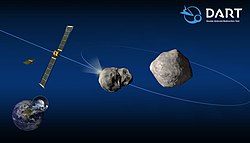
 Diagram of the DART spacecraft striking Dimorphos | |
| Names | DART |
|---|---|
| Mission type | Planetary defense test mission |
| Operator | NASA / APL |
| Website | |
| Mission duration | 10 months, 1 day
|
| Spacecraft properties | |
| Spacecraft |
|
| Manufacturer | Applied Physics Laboratory of Johns Hopkins University |
| Launch mass |
|
| Dimensions |
|
| Power | 6.6 kW |
| Start of mission | |
| Launch date | 24 November 2021, 06:21:02 UTC[1] |
| Rocket | Falcon 9 Block 5 B1063-3 |
| Launch site | Vandenberg, SLC‑4E |
| Contractor | SpaceX |
| Dimorphos impactor | |
| Impact date | 26 September 2022, 23:14 UTC[2][3] |
| Flyby of Didymos system | |
| Spacecraft component | LICIACube (deployed from DART) |
| Closest approach | 26 September 2022, ~23:17 UTC |
| Distance | 56.7 km (35.2 mi) |
| Instruments | |
| Didymos Reconnaissance and Asteroid Camera for Optical navigation (DRACO) | |
 Mission logo | |
The Double Asteroid Redirection Test (DART) was a NASA space mission aimed at testing a method of planetary defense against near-Earth objects (NEOs).[4][5] It was designed to assess how much a spacecraft impact deflects an asteroid through its transfer of momentum when hitting the asteroid head-on.[6] The target asteroid, Dimorphos, is a minor-planet moon of the asteroid Didymos; neither asteroid poses an impact threat to Earth, but their joint characteristics made them an ideal benchmarking target. Launched on 24 November 2021, the DART spacecraft successfully collided with Dimorphos on 26 September 2022 at 23:14 UTC about 11 million kilometers (6.8 million miles; 0.074 astronomical units; 29 lunar distances) from Earth. The collision shortened Dimorphos's orbit by 32 minutes, greatly in excess of the pre-defined success threshold of 73 seconds.[7][8][9] DART's success in deflecting Dimorphos was due to the momentum transfer associated with the recoil of the ejected debris, which was substantially larger than that caused by the impact itself.[10]
DART was a joint project between NASA and the Johns Hopkins University Applied Physics Laboratory. The project was funded through NASA's Planetary Defense Coordination Office, managed by NASA's Planetary Missions Program Office at the Marshall Space Flight Center, and several NASA laboratories and offices provided technical support. The Italian Space Agency contributed LICIACube, a CubeSat which photographed the impact event, and other international partners, such as the European Space Agency (ESA), and Japan Aerospace Exploration Agency (JAXA), are contributing to related or subsequent projects.[11]
Mission history
[edit]NASA and the European Space Agency (ESA) started with individual plans for missions to test asteroid deflection strategies, but by 2015, they struck a collaboration called AIDA (Asteroid Impact and Deflection Assessment) involving two separate spacecraft launches that would work in synergy.[12][13][14] Under that proposal, the European Asteroid Impact Mission (AIM), would have launched in December 2020, and DART in July 2021. AIM would have orbited the larger asteroid to study its composition and that of its moon. DART would then kinetically impact the asteroid's moon on 26 September 2022, during a close approach to Earth.[13]
The AIM orbiter was however canceled, then replaced by Hera which plans to start observing the asteroid four years after the DART impact. Live monitoring of the DART impact thus had to be obtained from ground-based telescopes and radar.[15][14]
In June 2017, NASA approved a move from concept development to the preliminary design phase,[16] and in August 2018 the start of the final design and assembly phase of the mission.[17] On 11 April 2019, NASA announced that a SpaceX Falcon 9 would be used to launch DART.[18]
Satellite impact on a small Solar System body had already been implemented once, by NASA's 372-kilogram (820 lb) Deep Impact space probe's impactor spacecraft and for a completely different purpose (analysis of the structure and composition of a comet). On impact, Deep Impact released 19 gigajoules of energy (the equivalent of 4.8 tons of TNT),[19] and excavated a crater up to 150 metres (490 ft) wide.[20]
Description
[edit]Spacecraft
[edit]The DART spacecraft was an impactor with a mass of 610 kilograms (1,340 lb)[21] that hosted no scientific payload and had sensors only for navigation. The spacecraft cost US$330 million by the time it collided with Dimorphos in 2022.[22]
Camera
[edit]
DART's navigation sensors included a Sun sensor, a star tracker called SMART Nav software (Small-body Maneuvering Autonomous Real Time Navigation),[23] and a 20-centimetre (7.9 in) aperture camera called Didymos Reconnaissance and Asteroid Camera for Optical navigation (DRACO). DRACO was based on the Long Range Reconnaissance Imager (LORRI) onboard New Horizons spacecraft, and supported autonomous navigation to impact the asteroid's moon at its center. The optical part of DRACO was a Ritchey-Chrétien telescope with a field of view of 0.29° and a focal length of 2.6208 m (f/12.60). The spatial resolution of the images taken immediately before the impact was around 20 centimeters per pixel. The instrument had a mass of 8.66 kilograms (19.1 lb).[24]
The detector used in the camera was a CMOS image sensor measuring 2,560 × 2,160 pixels. The detector records the wavelength range from 0.4 to 1 micron (visible and near infrared). A commercial off-the-shelf CMOS detector was used instead of a custom charge-coupled device in LORRI. DRACO's detector performance actually met or exceeded that of LORRI because of the improvements in sensor technology in the decade separating the design of LORRI and DRACO.[25] Fed into an onboard computer with software descended from anti-missile technology, the DRACO images helped DART autonomously guide itself to its crash.[26]
Solar arrays
[edit].png)
Using ROSA as the structure, a small portion of the DART solar array was configured to demonstrate Transformational Solar Array technology, which has very-high-efficiency SolAero Inverted Metamorphic (IMM) solar cells and reflective concentrators providing three times more power than other available solar array technology.[28]
Antenna
[edit]The DART spacecraft was the first spacecraft to use a new type of high-gain communication antenna, a Spiral Radial Line Slot Array (RLSA). The circularly-polarized antenna operated at the (microwave) X-band NASA Deep Space Network (NASA DSN) frequencies of 7.2 and 8.4 GHz, and had a gain of 29.8 dBi on downlink and 23.6 dBi on uplink. The fabricated antenna in a flat and compact shape exceeded the given requirements and was tested through environments resulting in a TRL-6 design.[29]

Ion thruster
[edit]DART demonstrated the NEXT gridded ion thruster, a type of solar electric propulsion.[15][30] It was powered by 22-square-metre (240 sq ft) solar arrays to generate the approximately 3.5 kW needed to power the NASA Evolutionary Xenon Thruster–Commercial (NEXT-C) engine.[31] Early tests of the ion thruster revealed a reset mode that induced higher current (100 A) in the spacecraft structure than expected (25 A). It was decided not to use the ion thruster further as the mission could be accomplished without it, using conventional thrusters fueled by the 50 kilograms (110 lb) of hydrazine onboard.[32] However, the ion thrusters remained available if needed to deal with contingencies, and had DART missed its target, the ion system could have returned DART to Dimorphos two years later.[33]
Secondary spacecraft
[edit]
The Italian Space Agency (ASI) contributed a secondary spacecraft called LICIACube (Light Italian CubeSat for Imaging of Asteroids), a small CubeSat that piggybacked with DART and separated on 11 September 2022, 15 days before impact. It acquired images of the impact and ejecta as it drifted past the asteroid.[34][35] LICIACube communicated directly with Earth, sending back images of the ejecta after the Dimorphos flyby.[36][37] LICIACube is equipped with two optical cameras, dubbed LUKE and LEIA.[38]
Effect of the impact on Dimorphos and Didymos
[edit]
DART · Didymos · Dimorphos
The spacecraft hit Dimorphos in the direction opposite to the asteroid's motion. Following the impact, the instantaneous orbital speed of Dimorphos therefore dropped slightly, which reduced the radius of its orbit around Didymos. The trajectory of Didymos was also modified, but in inverse proportion to the ratio of its mass to the much lower mass of Dimorphos and therefore not much. The actual velocity change and orbital shift depended on the topography and composition of the surface, among other things. The contribution of the recoil momentum from the impact ejecta produces a poorly predictable "momentum enhancement" effect.[39] Before the impact, the momentum transferred by DART to the largest remaining fragment of the asteroid was estimated as up to 3–5 times the incident momentum, depending on how much and how fast material would be ejected from the impact crater. Obtaining accurate measurements of that effect was one of the mission's main goals and will help refine models of future impacts on asteroids.[40]
The DART impact excavated surface/subsurface materials of Dimorphos, leading to the formation of a crater and/or some magnitude of reshaping (i.e., shape change without significant mass loss). Some of the ejecta may eventually hit Didymos's surface. If the kinetic energy delivered to its surface was high enough, reshaping may have also occurred in Didymos, given its near-rotational-breakup spin rate. Reshaping on either body would have modified their mutual gravitational field, leading to a reshaping-induced orbital period change, in addition to the impact-induced orbital period change. If left unaccounted for, this could later have led to an erroneous interpretation of the effect of the kinetic deflection technique.[41]
Observations of the impact
[edit]
.jpg)
DART's companion LICIACube,[42][36] the Hubble Space Telescope, James Webb Space Telescope, and the Earth-based ATLAS observatory all detected the ejecta plume from the DART impact.[43][44] On September 26, SOAR observed the visible impact trail to be over 10,000 kilometres (0.026 LD; 6,200 mi) long.[45] Initial estimates of the change in binary orbit period were expected within a week and with the data released by LICIACube.[46] DART's mission science depends on careful Earth-based monitoring of the orbit of Dimorphos over the subsequent days and months. Dimorphos was too small and too close to Didymos for almost any observer to see directly, but its orbital geometry is such that it transits Didymos once each orbit and then passes behind it half an orbit later. Any observer that can detect the Didymos system therefore sees the system dim and brighten again as the two bodies cross.
The impact was planned for a moment when the distance between Didymos and Earth is at a minimum, permitting many telescopes to make observations from many locations. The asteroid was near opposition and visible high in the night sky well into 2023.[47] The change in Dimorphos's orbit around Didymos was detected by optical telescopes watching mutual eclipses of the two bodies through photometry on the Dimorphos-Didymos pair. In addition to radar observations, they confirmed that the impact shortened Dimorphos's orbital period by 32 minutes.[48] Based on the shortened binary orbital period, the instantaneous reduction in Dimorphos's velocity component along its orbital track was determined, which indicated that substantially more momentum was transferred to Dimorphos from the escaping impact ejecta than from the impact itself. In this way, the DART kinetic impact was highly effective in deflecting Dimorphos.[10]
Follow-up mission
[edit]In a collaborating project, the European Space Agency has developed Hera, a spacecraft that was launched to Didymos in October 2024[34][49][50] and planned to arrive in 2026[51][52] to do a detailed reconnaissance and assessment.[50] Hera carries two CubeSats, Milani and Juventas.[50]
AIDA mission architecture
[edit]| Host spacecraft | Secondary spacecraft | Remarks |
|---|---|---|
| DART | LICIACube[53] |
|
| Hera | Juventas[54][55] | |
| Milani[58] |
|
Mission profile
[edit]Target asteroid
[edit]
The mission's target was Dimorphos in 65803 Didymos system, a binary asteroid system in which one asteroid is orbited by a smaller one. The primary asteroid (Didymos A) is about 780 metres (2,560 ft) in diameter; the asteroid moon Dimorphos (Didymos B) is about 160 metres (520 ft) in diameter in an orbit about 1 kilometre (0.62 mi) from the primary.[15] The mass of the Didymos system is estimated at 528 billion kg, with Dimorphos comprising 4.8 billion kg of that total.[21] Choosing a binary asteroid system is advantageous because changes to Dimorphos's velocity can be measured by observing when Dimorphos subsequently passes in front of its companion, causing a dip in light that can be seen by Earth telescopes. Dimorphos was also chosen due to its appropriate size; it is in the size range of asteroids that one would want to deflect, were they on a collision course with Earth. In addition, the binary system was relatively close to the Earth in 2022, at about 7 million miles (0.075 astronomical units; 29 lunar distances; 11 million kilometers).[59] The Didymos system is not an Earth-crossing asteroid, and there is no possibility that the deflection experiment could create an impact hazard.[60] On 4 October 2022, Didymos made an Earth approach of 10.6 million kilometres (0.071 astronomical units; 28 lunar distances; 6.6 million miles).[61]
Preflight preparations
[edit].jpg)
Launch preparations for DART began on 20 October 2021, as the spacecraft began fueling at Vandenberg Space Force Base (VSFB) in California.[62] The spacecraft arrived at Vandenberg in early October 2021 after a cross-country drive. DART team members prepared the spacecraft for flight, testing the spacecraft's mechanisms and electrical system, wrapping the final parts in multilayer insulation blankets and practicing the launch sequence from both the launch site and the mission operations center at APL. DART headed to the SpaceX Payload Processing Facility on VSFB on 26 October 2021. Two days later, the team received the green light to fill DART's fuel tank with roughly 50 kilograms (110 lb) of hydrazine propellant for spacecraft maneuvers and attitude control. DART also carried about 60 kilograms (130 lb) of xenon for the NEXT-C ion engine. Engineers loaded the xenon before the spacecraft left APL in early October 2021.[63]
Starting on 10 November 2021, engineers mated the spacecraft to the adapter that stacks on top of the SpaceX Falcon 9 launch vehicle. The Falcon 9 rocket without the payload fairing rolled for a static fire and later came back to the processing facility again where technicians with SpaceX installed the two halves of the fairing around the spacecraft over the course of two days, 16 and 17 November, inside the SpaceX Payload Processing Facility at Vandenberg Space Force Base and the ground teams completed a successful Flight Readiness Review later that week with the fairing then attached to the rocket.[64]
A day before launch, the launch vehicle rolled out of the hangar and onto the launch pad at Vandenberg Space Launch Complex 4 (SLC-4E); from there, it lifted off to begin DART's journey to the Didymos system and it propelled the spacecraft into space.[63]
Launch
[edit].jpg)

The DART spacecraft was launched on 24 November 2021, at 06:21:02 UTC.
Early planning suggested that DART was to be deployed into a high-altitude, high-eccentricity Earth orbit designed to avoid the Moon. In such a scenario, DART would use its low-thrust, high-efficiency NEXT ion engine to slowly escape from its high Earth orbit to a slightly inclined near-Earth solar orbit, from which it would maneuver onto a collision trajectory with its target. But because DART was launched as a dedicated Falcon 9 mission, the payload along with Falcon 9's second stage was placed directly on an Earth escape trajectory and into heliocentric orbit when the second stage reignited for a second engine startup or escape burn. Thus, although DART carries a first-of-its-kind electric thruster and plenty of xenon fuel, Falcon 9 did almost all of the work, leaving the spacecraft to perform only a few trajectory-correction burns with simple chemical thrusters as it homed in on Didymos's moon Dimorphos.[65]
Transit
[edit]
DART · 65803 Didymos · Earth · Sun · 2001 CB21 · 3361 Orpheus
The transit phase before impact lasted about 9 months. During its interplanetary travel, the DART spacecraft made a distant flyby of the 578-metre (1,896-foot) diameter near-Earth asteroid (138971) 2001 CB21 in March 2022.[66] DART passed 0.117 astronomical units (46 lunar distances; 17.5 million kilometres; 10.9 million miles) from 2001 CB21 in its closest approach on 2 March 2022.[67]
DART's DRACO camera opened its aperture door and took its first light image of some stars on 7 December 2021, when it was 2 million miles (0.022 astronomical units; 8.4 lunar distances; 3.2 million kilometres) away from Earth.[68] The stars in DRACO's first light image were used as calibration for the camera's pointing before it could be used to image other targets.[68] On 10 December 2021, DRACO imaged the open cluster Messier 38 for further optical and photometric calibration.[68]
On 27 May 2022, DART observed the bright star Vega with DRACO to test the camera's optics with scattered light.[69] On 1 July and 2 August 2022, DART's DRACO imager observed Jupiter and its moon Europa emerging from behind the planet, as a performance test for the SMART Nav tracking system to prepare for the Dimorphos impact.[70]
Course of the impact
[edit]Two months before the impact, on 27 July 2022, the DRACO camera detected the Didymos system from approximately 32 million kilometres (0.21 astronomical units; 83 lunar distances; 20 million miles) away and started refining its trajectory. The LICIACube nanosatellite was released on 11 September 2022, 15 days before the impact.[71] Four hours before impact, some 90,000 kilometres (0.23 LD; 56,000 mi) away, DART began to operate in complete autonomy under control of its SMART Nav guidance system. Three hours before impact, DART performed an inventory of objects near the target. Ninety minutes before the collision, when DART was 38,000 kilometres (0.099 LD; 24,000 mi) away from Dimorphos, the final trajectory was established.[72] When DART was 24,000 kilometres (0.062 LD; 15,000 mi) away Dimorphos became discernible (1.4 pixels) through the DRACO camera which then continued to capture images of the asteroid's surface and transmit them in real-time.[73]
DRACO was the only instrument able to provide a detailed view of Dimorphos's surface. The use of DART's thrusters caused vibrations throughout the spacecraft and solar panels, resulting in blurred images. To ensure sharp images, the last trajectory correction was executed 4 minutes before impact and the thrusters were deactivated afterwards.[73]
The last full image, transmitted two seconds before impact, has a spatial resolution of about 3 centimeters per pixel. The impact took place on 26 September 2022, at 23:14 UTC.[3]
The head-on impact of the 500 kilograms (1,100 lb)[74] DART spacecraft at 6.6 kilometres per second (4.1 mi/s)[75] or 22,530 kilometres per hour (14,000 mph)[76] likely imparted an energy of about 11 gigajoules, the equivalent of about three tonnes of TNT,[77] and was expected to reduce the orbital velocity of Dimorphos between 1.75 cm/s and 2.54 cm/s, depending on numerous factors such as material porosity.[78][failed verification] The reduction in Dimorphos's orbital velocity brings it closer to Didymos, resulting in the moon experiencing greater gravitational acceleration and thus a shorter orbital period.[13][60][79] The orbital period reduction from the head-on impact serves to facilitate ground-based observations of Dimorphos. An impact to the asteroid's trailing side would instead increase its orbital period towards 12 hours and make it coincide with Earth's day and night cycle, which would limit any single ground-based telescope from observing all orbital phases of Dimorphos nightly.[47]

The measured momentum enhancement factor (called beta) of DART's impact of Dimorphos was 3.6, which means that the impact transferred roughly 3.6 times greater momentum than if the asteroid had simply absorbed the spacecraft and produced no ejecta at all – indicating the ejecta contributed more to moving the asteroid than the spacecraft did. This means one could use either a smaller impactor or shorter lead times to produce a certain deflection in an asteroid than previously expected. The value of beta depends on various factors, composition, density, porosity, etc. The goal is to use these results and modeling to infer what beta could be for another asteroid by observing its surface and possibly measuring its bulk density. Scientists estimate that DART's impact displaced over 1,000,000 kilograms (2,200,000 lb) of dusty ejecta into space – enough to fill six or seven rail cars. The tail of ejecta from Dimorphos created by the DART impact is at least 30,000 kilometres (0.078 LD; 19,000 mi) long with a mass of at least 1,000 tonnes (980 long tons; 1,100 short tons), and possibly up to 10 times that much.[80][81]

The DART impact on the center of Dimorphos decreased the orbital period, previously 11 hours and 52 minutes, by 33±1 minutes. This large change indicates the recoil from material excavated from the asteroid and ejected into space by the impact (known as ejecta) contributed significant momentum change to the asteroid, beyond that of the DART spacecraft itself. Researchers found the impact caused an instantaneous slowing in Dimorphos's speed along its orbit of about 2.7 millimeters per second — again indicating the recoil from ejecta played a major role in amplifying the momentum change directly imparted to the asteroid by the spacecraft. That momentum change was amplified by a factor of 2.2 to 4.9 (depending on the mass of Dimorphos), indicating the momentum change transferred because of ejecta production significantly exceeded the momentum change from the DART spacecraft alone.[82] While the orbital change was small, the change is in the velocity and over the course of years will accumulate to a large change in position.[83] For a hypothetical Earth-threatening body, even such a tiny change could be sufficient to mitigate or prevent an impact, if applied early enough. As the diameter of Earth is around 13,000 kilometers, a hypothetical asteroid impact could be avoided with as little of a shift as half of that (6,500 kilometers). A 2 cm/s velocity change accumulates to that distance in approximately 10 years.

By smashing into the asteroid DART made Dimorphos an active asteroid. Scientists had proposed that some active asteroids are the result of impact events, but no one had ever observed the activation of an asteroid. The DART mission activated Dimorphos under precisely known and carefully observed impact conditions, enabling the detailed study of the formation of an active asteroid for the first time.[82][84] Observations show that Dimorphos lost approximately 1 million kilograms of mass as a result of the collision.[22]
Sequence of operations for impact
[edit]| Date (before impact) |
Distance from Dimorphos[85] |
Raw image[a] | Events[2][87] |
|---|---|---|---|
| 27 July 2022 (T-60 days) |
38 million kilometers (0.25 astronomical units; 99 lunar distances; 24 million miles) |  |
The DRACO camera detects the Didymos system. |
| 11 September 2022 23:14 UTC (T-15 days) |
8 million kilometers (0.053 astronomical units; 21 lunar distances; 5.0 million miles) | Ejection of LICIACube, which maneuvers to avoid crashing into the asteroid.[71] | |
| 26 September 2022 19:14 UTC (T-4 hours) |
89,000 kilometers (0.23 lunar distances; 55,000 miles) | Terminal phase—start of autonomous navigation with SMART Nav. DRACO locks onto Didymos since Dimorphos is not visible yet.[3] | |
| 22:14 UTC (T-60 minutes) |
22,000 kilometers (0.057 lunar distances; 14,000 miles) |  |
The DRACO camera detects Dimorphos. |
| 22:54 UTC (T-20 minutes) |
7,500 kilometers (4,700 miles) | SMART Nav enters precision lock onto Dimorphos and DART begins thrusting toward Dimorphos.[3] | |
| 23:10 UTC (T-4 minutes) |
1,500 kilometers (930 miles) |  |
Start of final course correction |
| 23:11 UTC (T-2 minutes 30 seconds) |
920 kilometers (570 miles) |  |
Last image with both Didymos (lower-left) and Dimorphos entirely in frame is taken |
| 23:12 UTC (T-2 minutes) |
740 kilometers (460 miles) | End of final course correction | |
| 23:14 UTC (T-20 seconds) |
130 kilometers (81 miles) | The photos taken reach the expected spatial resolution. | |
| 23:14 UTC (T-11 seconds) |
68 kilometers (42 miles) |  |
Last image showing all of Dimorphos by DART |
| 23:14 UTC (T-3 seconds) |
18 kilometers (11 miles) |  |
|
| 23:14 UTC (T-2 seconds) |
12 kilometers (7.5 miles) |  |
Final complete image of Dimorphos transmitted. Resolution roughly 3 cm per pixel (~ 30m across). |
| 23:14 UTC (T-1 second) |
6 kilometers (3.7 miles) |  |
Last partial image taken by DART before impact, transmission of this image was terminated by the destruction of the transmitter. Resolution roughly 1.5cm per pixel (~ 14.7m across). |
| 23:14 UTC (T-0) |
0 kilometers (0 miles) | Impact Dimorphos (estimated impact velocity 6 kilometers/second)[88] | |
| 23:17 UTC (T+2 min 45 s)[47] |
56.7 kilometers (35.2 miles) |  |
Closest approach to Dimorphos by LICIACube. |
Gallery
[edit]-
DART Mission animated video from launch to impact along with separation of LICIACube
-
 Size comparison of DART and the two Didymos asteroids
 -
 This chart offers insight into data the DART team used to determine the orbit of Dimorphos after impact.
 -
![Images of the impact captured by the Hubble (left) and Webb space telescopes (right).[89]](//upload.wikimedia.org/wikipedia/commons/thumb/d/da/Webb_and_Hubble_Capture_Detailed_Views_of_DART_Impact_%28weic2215a%29.jpeg/500px-Webb_and_Hubble_Capture_Detailed_Views_of_DART_Impact_%28weic2215a%29.jpeg)


![Images of the impact captured by the Hubble (left) and Webb space telescopes (right).[89]](https://en.wikipedia.org/wiki/File:Webb_and_Hubble_Capture_Detailed_Views_of_DART_Impact_(weic2215a).jpeg)
See also
[edit]- Asteroid impact avoidance – Methods to prevent destructive asteroid hits
- B612 Foundation – Planetary defense nonprofit organization
- Deep Impact (spacecraft) – NASA space probe launched in 2005
- Don Quijote (spacecraft) – Space probe concept
- NEO Surveyor – Space-based infrared telescope
- The Spaceguard Foundation – Private organization studying outer-space objects to protect the Earth from possible collision
Notes
[edit]References
[edit]- ^ a b "DART". NASA Space Science Data Coordinated Archive. Retrieved 9 February 2023.
- ^ a b "Double Asteroid Redirection Test Press Kit" (PDF). Johns Hopkins University Applied Physics Laboratory.
- ^ a b c d Malik, Taliq (23 September 2022). "DART asteroid crash: What time will NASA probe hit Dimorphos on Sept. 26?". Space.com. Retrieved 25 September 2022.
- ^ Chang, Kenneth (27 September 2022). "What NASA's Crash into an Asteroid Looks Like – Astronomers on Earth – and a shoebox-size Italian spacecraft called LICIACube – captured the DART mission's successful strike on Dimorphos". The New York Times. Retrieved 28 September 2022.
- ^ Chang, Kenneth (25 September 2022). "NASA Is About to Crash into an Asteroid. Here's How to Watch – The DART mission has been flying to its target since launching last year. On Monday night, it will connect". The New York Times. Retrieved 26 September 2022.
- ^ "NASA's DART Mission Hits Asteroid in First-Ever Planetary Defense Test". NASA. 27 September 2022.
- ^ Chang, Kenneth (26 September 2022). "NASA Smashes into an Asteroid, Completing a Mission to Save a Future Day". The New York Times. Retrieved 27 September 2022.
- ^ Bardan, Roxana (11 October 2022). "NASA Confirms DART Mission Impact Changed Asteroid's Motion in Space". NASA. Retrieved 11 October 2022.
- ^ Strickland, Ashley (11 October 2022). "The DART mission successfully changed the motion of an asteroid". CNN. Retrieved 11 October 2022.
- ^ a b Cheng AF, Agrusa HF, Barbee BW, et al. (1 March 2023). "Momentum transfer from the DART mission kinetic impact on asteroid Dimorphos". Nature. 616 (7957): 457–460. arXiv:2303.03464. Bibcode:2023Natur.616..457C. doi:10.1038/s41586-023-05878-z. PMC 10115652. PMID 36858075. S2CID 257282972.
- ^ Keeter, Bill (7 September 2022). "DART Sets Sights on Asteroid Target". NASA. Retrieved 10 September 2022.; "SpaceX ready for first launch with NASA interplanetary mission". Spaceflight Now. 22 November 2021. Retrieved 24 November 2021.; "DART Launch Moves to Secondary Window". NASA. 17 February 2021. Retrieved 24 November 2021.
 This article incorporates text from this source, which is in the public domain.; "Live: NASA to crash spacecraft into asteroid in trial to protect Earth from collisions". ABC News. 26 September 2022. Retrieved 26 September 2022.
- ^ AIDA DART Home page at APL
- ^ a b c "Asteroid Impact & Deflection Assessment (AIDA) study". Archived from the original on 7 June 2015.
- ^ a b DART at Applied Physics Laboratory Johns Hopkins University
- ^ a b c Planetary Defense: Double Asteroid Redirection Test (DART) Mission NASA 2017 This article incorporates text from this source, which is in the public domain.
- ^ Brown, Geoff; University, Johns Hopkins. "NASA plans to test asteroid deflection technique designed to prevent Earth impact". phys.org.
- ^ Asteroid-deflection mission passes key development milestone 7 September 2018
- ^ "NASA Awards Launch Services Contract for Asteroid Redirect Test Mission". NASA. 12 April 2019. Retrieved 12 April 2019. This article incorporates text from this source, which is in the public domain.
- ^ "NASA – Deep Impact's Impactor". nasa.gov. Archived from the original on 23 June 2016.
- ^ "In Depth - Deep Impact (EPOXI)". NASA Solar System Exploration. 30 November 2017. Retrieved 11 October 2022.
- ^ a b "Double Asteroid Redirection Test (DART)". NASA. 28 October 2021. Retrieved 5 November 2021. This article incorporates text from this source, which is in the public domain.
- ^ a b Witze, Alexandra (1 March 2023). "Asteroid lost 1 million kilograms as a result of the collision with DART spacecraft". Nature. 615 (7951): 195. Bibcode:2023Natur.615..195W. doi:10.1038/d41586-023-00601-4. PMID 36859675. S2CID 257282080. Retrieved 9 March 2023.
- ^ "DART". dart.jhuapl.edu. Retrieved 20 May 2022.
- ^ Fletcher, Zachary; Ryan, Kyle; Maas, Bryan; Dickman, Joseph; Hammond, Randolph; Bekker, Dmitriy; Nelson, Tyler; Mize, James; Greenberg, Jacob; Hunt, Wendy; Smee, Stephen; Chabot, Nancy; Cheng, Andrew (6 July 2018). Design of the Didymos Reconnaissance and Asteroid Camera for OpNav (DRACO) on the double asteroid redirection test (DART). Space Telescopes and Instrumentation 2018: Optical, Infrared, and Millimeter Wave. Vol. 106981X. Austin, TX: Proceedings of SPIE 10698. doi:10.1117/12.2310136.
- ^ Lakdawalla, Emily (22 September 2022). "DART Impact on Monday!". Retrieved 26 September 2022 – via Patreon.
- ^ Lakdawalla, Emily (23 September 2022). "NASA's DART Mission to Impact Asteroid Monday". Sky & Telescope. Retrieved 26 September 2022.
- ^ Talbert, Tricia (30 June 2017). "Double Asteroid Redirection Test (DART) Mission". NASA. Retrieved 21 January 2018. This article incorporates text from this source, which is in the public domain.
- ^ Behind the Scenes: Inspecting DART's Roll-Out Solar Array (ROSA) Technology, 12 August 2021, retrieved 13 August 2021; "DART has a solar array experiment called transformational solar array on its roll out solar array panel". dart.jhuapl.edu. Archived from the original on 23 December 2019. Retrieved 13 August 2021.
- ^ Bray, Matthew (2020). "A Spiral Radial Line Slot Array Antenna for NASA's Double Asteroid Redirection Test (DART)". 2020 IEEE International Symposium on Antennas and Propagation and North American Radio Science Meeting. pp. 379–380. doi:10.1109/IEEECONF35879.2020.9330400. ISBN 978-1-7281-6670-4. S2CID 231975847.
- ^ Kantsiper, Brian (2017). "The Double Asteroid Redirection Test (DART) mission electric propulsion trade". 2017 IEEE Aerospace Conference. pp. 1–7. doi:10.1109/AERO.2017.7943736. ISBN 978-1-5090-1613-6. S2CID 43072949.
- ^ Adams, Elena; Oshaughnessy, Daniel; Reinhart, Matthew; John, Jeremy; Congdon, Elizabeth; Gallagher, Daniel; Abel, Elisabeth; Atchison, Justin; Fletcher, Zachary; Chen, Michelle; Heistand, Christopher; Huang, Philip; Smith, Evan; Sibol, Deane; Bekker, Dmitriy; Carrelli, David (2019). "Double Asteroid Redirection Test: The Earth Strikes Back". 2019 IEEE Aerospace Conference. pp. 1–11. doi:10.1109/AERO.2019.8742007. ISBN 978-1-5386-6854-2. S2CID 195222414.
- ^ "Impactor Spacecraft". DART. The Johns Hopkins University. Retrieved 24 November 2022.
- ^ NASA's DART Mission Post-Asteroid-Impact News Briefing, 26 September 2022, 8pm EDT, at 27 minutes
- ^ a b Asteroids have been hitting the Earth for billions of years. In 2022, we hit back. Archived 31 October 2018 at the Wayback Machine Andy Rivkin, The Johns Hopkins University Applied Physics Laboratory, 27 September 2018
- ^ Kretschmar, Peter; Küppers, Michael (20 December 2018). "The CubeSat Revolution" (PDF). ESA. Retrieved 24 January 2019.
- ^ a b George Dvorsky (27 September 2022). "First Asteroid Impact Images from DART's Companion Show Tentacle-Like Debris Plume". Gizmodo.
- ^ Cheng, Andy (15 November 2018). "DART Mission Update". ESA. Retrieved 14 January 2019.
- ^ "LICIACube". ASI. Retrieved 26 November 2021.
- ^ WATCH: NASA Asteroid Redirection Test Media Briefing – Livestream, 4 November 2021, retrieved 20 May 2022
- ^ Rivkin, Andrew S.; Chabot, Nancy L.; Stickle, Angela M.; Thomas, Cristina A.; Richardson, Derek C.; Barnouin, Olivier; Fahnestock, Eugene G.; Ernst, Carolyn M.; Cheng, Andrew F.; Chesley, Steven; Naidu, Shantanu (25 August 2021). "The Double Asteroid Redirection Test (DART): Planetary Defense Investigations and Requirements". The Planetary Science Journal. 2 (5): 173. Bibcode:2021PSJ.....2..173R. doi:10.3847/PSJ/ac063e. ISSN 2632-3338. S2CID 237301576.
- ^ Nakano, Ryota; Hirabayashi, Masatoshi; Agrusa, Harrison F.; Ferrari, Fabio; Meyer, Alex J.; Michel, Patrick; Raducan, Sabina D.; Sánchez, Paul; Zhang, Yun (5 July 2022). "NASA's Double Asteroid Redirection Test (DART): Mutual Orbital Period Change Due to Reshaping in the Near-Earth Binary Asteroid System (65803) Didymos". The Planetary Science Journal. 3 (7): 148. Bibcode:2022PSJ.....3..148N. doi:10.3847/PSJ/ac7566. hdl:11311/1223308. ISSN 2632-3338. S2CID 250327233.
- ^ LICIACube Twitter feed
- ^ ATLAS twitter feed
- ^ George Dvorsky (27 September 2022). "Ground Telescopes Capture Jaw-Dropping Views of DART Asteroid Impact". Gizmodo.
Telescopes around the world honed in on the historic collision, revealing a surprisingly large and bright impact plume.
- ^ Strickland, Ashley (4 October 2022). "Comet-like debris trail spotted after spacecraft crashes into asteroid". CNN. Retrieved 6 October 2022.
- ^ "DART: Asteroid – eoPortal Directory – Satellite Missions". directory.eoportal.org. Retrieved 24 November 2021.
- ^ a b c Lakdawalla, Emily (22 September 2022). "DART Impact on Monday!". Patreon.
- ^ Nelson, Bill; Saccoccia, Giorgio (11 October 2022). "Update on DART Mission to Asteroid Dimorphos (NASA News Conference)". YouTube. Retrieved 11 October 2022.
- ^ Hera mission is approved as ESA receives biggest ever budget Kerry Hebden Room Space Journal 29 November 2019
- ^ a b c Bergin, Chris (7 January 2019). "Hera adds objectives to planetary defense test mission". NASASpaceflight.com. Retrieved 11 January 2019.
- ^ Michel, Patrick; Küppers, Michael; Bagatin, Adriano Campo; Carry, Benoit; Charnoz, Sébastien; Leon, Julia de; Fitzsimmons, Alan; Gordo, Paulo; Green, Simon F.; Hérique, Alain; Juzi, Martin; Karatekin, Özgür; Kohout, Tomas; Lazzarin, Monica; Murdoch, Naomi; Okada, Tatsuaki; Palomba, Ernesto; Pravec, Petr; Snodgrass, Colin; Tortora, Paolo; Tsiganis, Kleomenis; Ulamec, Stephan; Vincent, Jean-Baptiste; Wünnemann, Kai; Zhang, Yun; Raducan, Sabina D.; Dotto, Elisabetta; Chabot, Nancy; Cheng, Andy F.; Rivkin, Andy; Barnouin, Olivier; Ernst, Carolyn; Stickle, Angela; Richardson, Derek C.; Thomas, Cristina; Arakawa, Masahiko; Miyamoto, Hirdy; Nakamura, Akiko; Sugita, Seiji; Yoshikawa, Makoto; Abell, Paul; Asphaug, Erik; Ballouz, Ronald-Louis; Bottke, William F.; Lauretta, Dante S.; Walsh, Kevin J.; Martino, Paolo; Carnelli, Ian (15 July 2022). "The ESA Hera Mission: Detailed Characterization of the DART Impact Outcome and of the Binary Asteroid (65803) Didymos". The Planetary Science Journal. 3 (7): 160. Bibcode:2022PSJ.....3..160M. doi:10.3847/PSJ/ac6f52. hdl:10045/125568. S2CID 250599919.
- ^ The Juventas CubeSat in Support of ESA's Hera Mission to the Asteroid Didymos. Hannah R. Goldberg, Özgür Karatekin, Birgit Ritter, Alain Herique, Paolo Tortora, Claudiu Prioroc, Borja Garcia Gutierrez, Paolo Martino, Ian Carnelli. 33rd Annual AIAA/USU Conference on Small Satellites.
- ^ Asteroids have been hitting the Earth for billions of years. In 2022, we hit back. Archived 2018-10-31 at the Wayback Machine Andy Rivkin, The Johns Hopkins University Applied Physics Laboratory. September 27, 2018.
- ^ A Low Frequency Radar to Fathom Asteroids from Juventas Cubesat on HERA. Alain Herique, Dirk Plettemeier, Wlodek Kofman, Yves Rogez, Christopher Buck, and Hannah Goldberg. EPSC Abstracts. Vol. 13, EPSC-DPS2019-807-2, 2019. EPSC-DPS Joint Meeting 2019.
- ^ a b The Juventas CubeSat in Support of ESA's Hera Mission to the Asteroid Didymos Hannah R. Goldberg, Özgür Karatekin, Birgit Ritter, Alain Herique, Paolo Tortora, Claudiu Prioroc, Borja Garcia Gutierrez, Paolo Martino, Ian Carnelli. 33rd Annual AIAA/USU Conference on Small Satellites
- ^ JuRa: the Juventas Radar on Hera to fathom Didymoon Alain Herique, Dirk Plettemeier, Hannah Goldberg, Wlodek Kofman, and the JuRa Team. EPSC Abstracts. Vol. 14, EPSC2020-595. doi:10.5194/epsc2020-595.
- ^ a b Exploration of the binary asteroid 65803 Didymos by the Hera mission. EPSC Abstracts. Vol. 13, EPSC-DPS2019-583-1, 2019. EPSC-DPS Joint Meeting 2019. 15–20 September 2019.
- ^ "Industry starts work on Europe's Hera planetary defence mission". 15 September 2020. Retrieved 16 June 2021.
- ^ "Seen the film Armageddon? NASA's aiming to smash an asteroid off course in real life". Australian Broadcasting Corporation (ABC). 23 November 2021. Retrieved 24 September 2022.
- ^ a b Michel, P.; Cheng, A.; Carnelli, I.; Rivkin, A.; Galvez, A.; Ulamec, S.; Reed, C.; AIDA Team (8 January 2015). "AIDA: Asteroid impact and deflection assessment mission under study at ESA and NASA". Spacecraft Reconnaissance of Asteroid and Comet Interiors. 1829: 6008. Bibcode:2015LPICo1829.6008M.
- ^ 65803 Didymos (Report). JPL Small-Body Database Browser. NASA / Jet Propulsion Laboratory. Retrieved 30 December 2021 – via ssd.jpl.nasa.gov.
- ^ "Spacecraft for asteroid deflection experiment ready for fueling at Vandenberg". Spaceflight Now. 20 October 2021. Retrieved 5 November 2021.
- ^ a b "NASA's DART Preps for Launch in First Planetary Defense Test Mission". NASA. 3 November 2021. Retrieved 24 November 2021. This article incorporates text from this source, which is in the public domain.
- ^ "NASA's DART Spacecraft Secured in Payload Fairing, Flight Readiness Review Complete – Double Asteroid Redirection Test (DART) Mission". blogs.nasa.gov. 22 November 2021. Retrieved 24 November 2021. This article incorporates text from this source, which is in the public domain.
- ^ Atchison, Justin A.; Ozimek, Martin T.; Kantsiper, Brian L.; Cheng, Andrew F. (1 June 2016). "Trajectory options for the DART mission". Acta Astronautica. Special Section: Selected Papers from the International Workshop on Satellite Constellations and Formation Flying 2015. 123: 330–339. Bibcode:2016AcAau.123..330A. doi:10.1016/j.actaastro.2016.03.032. ISSN 0094-5765.
- ^ "Double Asteroid Redirection Test (DART)". NASA Space Science Data Coordinated Archive. NASA. Retrieved 25 September 2022.; Rivkin, Andy (27 September 2018). "Asteroids have been hitting the Earth for billions of years. In 2022, we hit back". DART. Johns Hopkins University Applied Physics Laboratory. Retrieved 25 September 2022.
- ^ "JPL Horizons On-Line Ephemeris for 138971 (2001 CB21) on 2022-Mar-01 to 2022-Mar-03". JPL Horizons On-Line Ephemeris System. Jet Propulsion Laboratory. Retrieved 28 September 2022. Ephemeris Type: Observer. Target Body: 138971 (2001 CB21). Observer Location: 500@-135 (DART Spacecraft).
- ^ a b c Talbert, Tricia (22 December 2021). "NASA's DART Captures One of Night Sky's Brightest Stars". NASA. Retrieved 25 September 2022.
- ^ Talbert, Tricia (17 June 2022). "NASA's DART Captures One of Night Sky's Brightest Stars". NASA. Retrieved 25 September 2022.
- ^ a b Keeter, Bill (14 September 2022). "DART's Small Satellite Companion Takes Flight Ahead of Impact". NASA. Retrieved 25 September 2022.
- ^ "NASA's DART Mission Hits Asteroid in First-Ever Planetary Defense Test". 26 September 2022.
- ^ a b Statler, T. "Session 3: DART" (PDF). 7th IAA Planetary Defense Conference. Retrieved 5 November 2022.
- ^ DART: Home page at APL Archived 10 May 2018 at the Wayback Machine DART Spacecraft APL 2017
- ^ "Impactor Spacecraft". NASA. 2021. Retrieved 18 February 2021. This article incorporates text from this source, which is in the public domain.; Andone, Dakin (25 July 2017). "NASA unveils plan to test asteroid defense technique". CNN. Retrieved 25 July 2017.
- ^ "NASA Confirms DART Mission Impact Changed Asteroid's Motion in Space". NASA.
- ^ Soldini, Stefania (21 September 2022). "Can we really deflect an asteroid by crashing into it? Nobody knows, but we are excited to try". The Conversation. Retrieved 23 September 2022.
- ^ Stickle, Angela (2022). "NASA's Double Asteroid Redirection Test Press Kit" (PDF). Johns Hopkins Applied Research Laboratory. Retrieved 5 November 2022.
- ^ "Course corrector". Aerospace America. 28 September 2017. Retrieved 27 September 2022.
- ^ Merzdorf, Jessica (15 December 2022). "Early Results from NASA's DART Mission". NASA. Retrieved 16 December 2022.
- ^ @jeff_foust (15 December 2022). "One other note from the briefing: the tail of ejecta from Dimorphos created by the DART impact is at least 30,000 kilometers long, says Andy Rivkin of JHUAPL, with a mass of at least 1,000 metric tons, and possibly up to 10 times that much" (Tweet) – via Twitter.
- ^ a b Furfaro, Emily (28 February 2023). "NASA's DART Data Validates Kinetic Impact as Planetary Defense Method". NASA. Retrieved 9 March 2023. This article incorporates text from this source, which is in the public domain.
- ^ "NASA Pushes Through With Asteroid Deflection Mission That Could One Day Save Earth – Inquisitr". inquisitr.com. 5 July 2017. Retrieved 27 September 2022.
- ^ Li, Jian-Yang; Hirabayashi, Masatoshi; Farnham, Tony L.; et al. (1 March 2023). "Ejecta from the DART-produced active asteroid Dimorphos". Nature. 616 (7957): 452–456. arXiv:2303.01700. Bibcode:2023Natur.616..452L. doi:10.1038/s41586-023-05811-4. ISSN 1476-4687. PMC 10115637. PMID 36858074. S2CID 257282549.
- ^ "JPL Horizons On-Line Ephemeris for Dimorphos on 2022-Sep-26". JPL Horizons On-Line Ephemeris System. Jet Propulsion Laboratory. Retrieved 25 September 2022. Ephemeris Type: Observer. Target Body: Dimorphos. Observer Location: 500@-135 (DART Spacecraft).
- ^ Talbert, Tricia (26 September 2022). "DART's Final Images Prior to Impact". NASA. Retrieved 17 December 2022.
- ^ Session 3: DART (PDF). 7th IAA Planetary Defense Conference. 26–30 April 2021.
- ^ "NASA's First Asteroid Deflection Mission Enters Next Design Phase at Johns Hopkins APL". Johns Hopkins University Applied Physics Laboratory. 30 June 2017. Retrieved 28 September 2022.
- ^ "Webb and Hubble Capture Detailed Views of DART Impact". 20 October 2023.

External links
[edit]
- Double Asteroid Redirection Test (DART) Mission – NASA's Planetary Defense page on DART
- DART's Mission to Bump an Asteroid – NASA Blog
- NASA's DART Mission Launch, 24 November 2021 – Official Broadcast/Stream
- DART's Impact with Asteroid Dimorphos (Official NASA Broadcast)
| ||||||||||||||||||
| ||||||||||||||||||
| ||||||||||||||||||
| ||||||||||||||||||


| Active |
|    .png) | |||||||||
|---|---|---|---|---|---|---|---|---|---|---|---|
| Past |
| ||||||||||
| Planned |
| ||||||||||
| Proposed |
| ||||||||||
| Cancelled or not developed | |||||||||||
| Related | |||||||||||
| |||||||||||


2022 in space | ||
|---|---|---|
Space probe launches  |
|   |
| Impact events | ||
| Selected NEOs | ||
| Discoveries | ||
| Comets | ||
| Space exploration | ||
