


Community hub
Euclid's Elements
View on Wikipedia
The Elements (Ancient Greek: Στοιχεῖα Stoikheîa) is a mathematical treatise written c. 300 BC by the Ancient Greek mathematician Euclid.
Key Information


The Elements is the oldest extant large-scale deductive treatment of mathematics. Drawing on the works of earlier mathematicians such as Hippocrates of Chios, Eudoxus of Cnidus, and Theaetetus, the Elements is a collection in 13 books of definitions, postulates, geometric constructions, and theorems with their proofs that covers plane and solid Euclidean geometry, elementary number theory, and incommensurability. These include the Pythagorean theorem, Thales' theorem, the Euclidean algorithm for greatest common divisors, Euclid's theorem that there are infinitely many prime numbers, and the construction of regular polygons and polyhedra.
Often referred to as the most successful textbook ever written, the Elements has continued to be used for introductory geometry. It was translated into Arabic and Latin in the medieval period, where it exerted a great deal of influence on mathematics in the medieval Islamic world and in Western Europe, and has proven instrumental in the development of logic and modern science, where its logical rigor was not surpassed until the 19th century.
Background
[edit]Euclid's Elements is the oldest extant large-scale deductive treatment of mathematics.[1] Proclus, a Greek mathematician who lived around seven centuries after Euclid, wrote in his commentary on the Elements: "Euclid, who put together the Elements, collecting many of Eudoxus' theorems, perfecting many of Theaetetus', and also bringing to irrefragable demonstration the things which were only somewhat loosely proved by his predecessors".[a] Scholars believe that the Elements is largely a compilation of propositions based on books by earlier Greek mathematicians,[2] including Eudoxus, Hippocrates of Chios,[b] Thales, and Theaetetus, while other theorems are mentioned by Plato and Aristotle.[3] It is difficult to differentiate the work of Euclid from that of his predecessors, especially because the Elements essentially superseded much earlier and now-lost Greek mathematics.[4] The Elements version available today also includes "post-Euclidean" mathematics, probably added later by later editors such as the mathematician Theon of Alexandria in the 4th century.[3] The classicist Markus Asper concludes that "apparently Euclid's achievement consists of assembling accepted mathematical knowledge into a cogent order and adding new proofs to fill in the gaps" and the historian Serafina Cuomo described it as a "reservoir of results".[5][3] Despite this, historian Michalis Sialaros opines that its "remarkably tight structure" suggests that Euclid wrote the Elements himself rather than merely editing together the works of others.[6]
The detailed attribution of parts of the Elements to specific mathematicians is still the subject of scholarly debate. According to W. W. Rouse Ball, Pythagoras was probably the source for most of books I and II, Hippocrates of Chios for book III, and Eudoxus of Cnidus for book V, while books IV, VI, XI, and XII probably came from other Pythagorean or Athenian mathematicians.[7] The Elements may have been based on an earlier textbook by Hippocrates of Chios, who also may have originated the use of letters to refer to figures.[8] Wilbur Knorr ascribes the origin of the material in Books I, III, and VI of the Elements to the time of Hippocrates of Chios, and of the material in books II, IV, X, and XIII to the later period of Theodorus of Cyrene, Theaetetus, and Eudoxos. However, this suggested history has been criticized by van der Waerden, who believed that books I through IV were largely due to the much earlier Pythagorean school.[9]
Other similar works are also reported to have been written by Hippocrates of Chios, Theudius of Magnesia, and Leon, but are now lost.[10][11]
Contents
[edit]| Book | I | II | III | IV | V | VI | VII | VIII | IX | X | XI | XII | XIII | Totals |
|---|---|---|---|---|---|---|---|---|---|---|---|---|---|---|
| Definitions | 23 | 2 | 11 | 7 | 18 | 4 | 22 | – | – | 16 | 28 | – | – | 131 |
| Postulates | 5 | – | – | – | – | – | – | – | – | – | – | – | – | 5 |
| Common Notions | 5 | – | – | – | – | – | – | – | – | – | – | – | – | 5 |
| Propositions | 48 | 14 | 37 | 16 | 25 | 33 | 39 | 27 | 36 | 115 | 39 | 18 | 18 | 465 |
The Elements does not exclusively discuss geometry as is sometimes believed.[4][12] It is traditionally divided into three topics: plane geometry (books I–VI), basic number theory (books VII–X) and solid geometry (books XI–XIII)—though book V (on proportions) and X (on incommensurability) do not exactly fit this scheme.[13][14] The heart of the text is the theorems scattered throughout.[15] Using Aristotle's terminology, these may be generally separated into two categories: "first principles" and "second principles".[16] The first group includes statements labeled as a "definition" (Ancient Greek: ὅρος or ὁρισμός), "postulate" (αἴτημα), or a "common notion" (κοινὴ ἔννοια).[16][17] The postulates (that is, axioms) and common notions occur only in book I.[4] Close study of Proclus suggests that older versions of the Elements may have followed the same distinctions but with different terminology, instead calling each definition a "hypothesis" (ύπόΘεςιζ) and the common notions "axioms" (άξιώμα).[17] The second group consists of propositions, presented alongside mathematical proofs and diagrams.[16] It is unknown whether Euclid intended the Elements as a textbook,[6] despite its wide subsequent use as one.[18] As a whole, the authorial voice remains general and impersonal.[3]
| No. | Postulates |
|---|---|
| Let the following be postulated: | |
| 1 | To draw a straight line from any point to any point. |
| 2 | To produce a finite straight line continuously in a straight line |
| 3 | To describe a circle with any centre and distance |
| 4 | That all right angles are equal to one another |
| 5 | That, if a straight line falling on two straight lines make the interior angles on the same side less than two right angles, the two straight lines, if produced indefinitely, meet on that side on which are the angles less than the two right angles |
| No. | Common notions |
| 1 | Things which are equal to the same thing are also equal to one another |
| 2 | If equals be added to equals, the wholes are equal |
| 3 | If equals be subtracted from equals, the remainders are equal |
| 4 | Things which coincide with one another are equal to one another |
| 5 | The whole is greater than the part |
Books I to VI: Plane geometry
[edit]Book I
[edit]

Book I of the Elements is foundational for the entire text.[4] It begins with a series of 20 definitions for basic geometric concepts such as points, lines, angles and various regular polygons.[20] Euclid then presents 10 assumptions (see table, right), grouped into five postulates and five common notions.[21] These assumptions are intended to provide the logical basis for every subsequent theorem, i.e. serve as an axiomatic system.[22] The common notions exclusively concern the comparison of magnitudes, the sizes of geometric objects.[23] In modern mathematics these magnitudes would be treated as real numbers measuring arc length, angle, or area, and compared numerically, but Euclid instead found ways of comparing the magnitude of shapes using geometric operations, without interpreting these magnitudes as numbers.[24] While the first four postulates are relatively straightforward, the fifth is not. It is known as the parallel postulate, and the question of its independence from the other four postulates became the focus of a long line of research leading to the development of non-Euclidean geometry.[23]
Book I also includes 48 propositions, which can be loosely divided into: basic theorems and constructions of plane geometry and triangle congruence (1–26), parallel lines (27–34), the area of triangles and parallelograms (35–45), and the Pythagorean theorem and its converse (46–48).[23]
Proposition 5, that the base angles of an isosceles triangle are equal, became known in the Middle Ages as the pons asinorum, or bridge of asses, separating the mathematicians who could prove it from the fools who could not.[25] Papyrus Oxyrhynchus 29, a 3rd-century CE papyrus, contains fragments of propositions 8–11 and 14–25.[c] The last two propositions of Book I comprise the earliest surviving proof of the Pythagorean theorem, described by Sialaros as "remarkably delicate".[16] The figure for the Pythagorean theorem has itself become well known under multiple names: the Bride's Chair, the windmill, or the peacock's tail.[26]
Book II
[edit]
The second book focuses on area, measured through quadrature, meaning the construction of a square of equal area to a given figure. It includes a geometric precursor of the law of cosines, and culminates in the quadrature of arbitrary rectangles.[23] In the late 19th and 20th centuries, Book II was interpreted by some mathematical historians to establish a "geometric algebra", an expression of algebraic manipulation of linear and quadratic equations in terms of geometric concepts of length and area,[27][28] centered on the quadratic case of the binomial theorem.[23] This interpretation has been heavily debated since the 1970s;[28] critics describe the characterization as anachronistic, since the foundations of even nascent algebra occurred many centuries later.[16] Nevertheless, taken as statements about geometry, many of the propositions in this book are superfluous to modern mathematics, as they can be subsumed by the use of algebra.[29]
Proposition 11 of Book II subdivides a given line segment into extreme and mean proportions, now called the golden ratio. It is the first of several propositions involving this ratio: It is later used in Book IV to construct a golden triangle and regular pentagon and in Book XIII to construct the regular dodecahedron and regular icosahedron, and studied as a ratio in Book VI Proposition 30.[30][31]
Book III
[edit]Book III begins with a list of 11 definitions, and follows with 37 propositions that deal with circles and their properties. Proposition 1 is on finding the center of a circle. Propositions 2 through 15 concern chords, and intersecting and tangent circles. Tangent lines to circles are the subjects of propositions 16 through 19. Next are propositions on inscribed angles (20 through 22), and on chords, arcs, and angles (23 through 30), including the inscribed angle theorem relating inscribed to central angles as proposition 20. Propositions 31 through 34 concern angles in circles, including Thales's theorem that an angle inscribed in a semicircle is a right angle (part of proposition 31). The remaining propositions, 35 through 37, concern intersecting chords and tangents; proposition 35 is the intersecting chords theorem, and proposition 36 is the tangent–secant theorem.[32]
Book IV
[edit]Book IV treats four problems systematically for different polygons: inscribing a polygon within a circle, circumscribing a polygon about a circle, inscribing a circle within a polygon, and circumscribing a circle about a polygon.[33] These problems are solved in sequence for triangles and then for constructible regular polygons (i.e., those that have a straightedge and compass construction) with 4, 5, 6, and 15 sides.[4]
Book V
[edit]Book V, which is independent of the previous four books, concerns ratios of magnitudes (intuitively, how much bigger or smaller one shape is relative to another) and the comparison of ratios.[34] Heath and other translators have formulated its first six propositions in symbolic algebra, as forms of the distributive law of multiplication over division and the associative law for multiplication. However, Leo Corry argues that this is anachronistic and misleading, because Euclid did not treat magnitudes as numbers, nor taking a ratio as a binary operation from numbers to numbers.[35]
Much of Book V was probably ascertained from earlier mathematicians, perhaps Eudoxus,[16] although certain propositions, such as V.16, dealing with "alternation" (if a : b :: c : d, then a : c :: b : d) likely predate Eudoxus.[36]
Christopher Zeeman has argued that Book V's focus on the behavior of ratios under the addition of magnitudes, and its consequent failure to define ratios of ratios, was a flaw that prevented the Greeks from finding certain important concepts such as the cross ratio (central to projective geometry).[37]
Book VI
[edit]Book VI uses the theory of ratios from Book V in the context of plane geometry,[4] especially the construction and recognition of similar figures. It is built almost entirely of its first proposition:[38] "Triangles and parallelograms which are under the same height are to one another as their bases". That is, if two triangles have the same height, the ratio of their areas is the same as the ratio of lengths of their two base segments (and analogously for two parallelograms of the same height). This proposition provides a connection between ratios of lengths and ratios of areas.[39] Proposition 25 constructs, from any two polygons, a third polygon similar to the first and with the same area as the second. Plutarch attributes this construction to Pythagoras, calling it "more subtle and more scientific" than the Pythagorean theorem. The famous ancient Greek problem of doubling the cube, now known impossible with compass and straightedge, is a special case of the analogous 3d problem of constructing a figure with a specified shape and volume.[40] The book ends as it begins, by connecting two types of ratios: ratios of angles, and ratios of circular arc lengths, in proposition 33.[41]
Books VII to X: Number theory
[edit]Number theory, the theory of the arithmetic of natural numbers, is covered by books VII to X. Book VII begins with a set of 22 definitions for parity (whether a number is even or odd), prime numbers, and other arithmetic-related concepts.[4] The first of these definitions is for the unit (in modern terms, the number one), while the second states that "a number is a multitude composed of units";[42] this is generally interpreted to mean that, for Euclid, one is not a number, and the natural numbers begin at two.[43]
Book VII
[edit]Book VII deals with elementary number theory, and includes 39 propositions, which can be loosely divided into: the Euclidean algorithm, a method for determining whether numbers are relatively prime and for finding the greatest common divisor (1–4), fractions (5–10), the theory of proportions for numbers (11–19), prime and relatively prime numbers and the theory of greatest common divisors, (20–32), and least common multiples (33–39).[44]
Book VIII
[edit]The topic of Book VIII is geometric progressions.[44] For Euclid, these were defined by the property of being in continued proportion (each two consecutive magnitudes have the same ratio) rather than, as in modern treatments, by exponentiation (the th term of the progression has the form for constants and ). This allowed Euclid to avoid multiplication of more than two values, but led to some awkward proofs of facts that exponential notation would make obvious.[45]


The first part of Book VIII (propositions 1 through 10) deals with the construction and existence of geometric progressions of integers in general, and the divisibility of members of a geometric progression by each other. Propositions 11 to 27 deal with square numbers and cube numbers in geometric progressions, and the relation between these special progressions and the elements two or three steps apart in an arbitrary geometric progression.[44]
Book IX
[edit]After continuing the investigations of Book VIII on squares and cubes in geometric progressions,[44] Book IX applies the results of the preceding two books and gives the infinitude of prime numbers (Euclid's theorem, proposition 20), the formula for the sum of a finite geometric series (proposition 35) and a construction using this sum for even perfect numbers (proposition 36). Here, a number is perfect if it equals the sum of its proper divisors, as for instance 28 = 1 + 2 + 4 + 7 + 14.[4][46] Alhazen conjectured c. 1000, and in the 18th century Leonhard Euler proved, that this construction generates all even perfect numbers. This result is the Euclid–Euler theorem.[47]
Book X
[edit]Of the Elements, book X is by far the largest and most complex, dealing with (in modern terms) irrational numbers in the context of magnitudes.[16][48] Proposition 9 (as restated in modern terms) proves the irrationality of the square roots of all non-square integers such as , the square root of 2.[49] A lemma to Proposition 29 gives Euclid's formula for producing all fundamental Pythagorean triples.[50] Additionally, this book classifies irrational lengths into thirteen disjoint categories, related to their construction by various combinations of other lengths that are integers and their square roots.[51] However, Wilbur Knorr warns that "The student who approaches Euclid's Book X in the hope that its length and obscurity conceal mathematical treasures is likely to be disappointed. ... the mathematical ideas are few."[52]

Rather than treating magnitudes as real numbers and asking whether these are rational numbers, Euclid handles this material in terms of the commensurability of lengths or areas: whether two line segments or two rectangles can both be measured by an integer number of copies of a common subunit.[48] His classification of lengths as rational or irrational differs from the modern meaning: for Euclid, a line segment is rational when the square on its side has a rational area. That is, for Euclid, a length such as that is the square root of a rational area is itself rational.[53]
This book is connected to a short passage in Plato's dialogue Theaetetus among Socrates, Theodorus of Cyrene, and Theaetetus, a younger mathematician. This passage discusses a proof by Theodorus that the non-square integers from 3 to 17 have irrational square roots (after the much earlier discovery of the irrationality of ), the generalization of this result to all non-square integers by Theaetetus, and a partial classification of the irrational numbers (with fewer than 13 classes).[54][55]
Books XI to XIII: Solid geometry
[edit]
The final three books primarily discuss solid geometry.[13] By introducing a list of 37 definitions, Book XI contextualizes the next two.[56] Although its foundational character resembles Book I, unlike Book I it features no axiomatic system or postulates.[56]
Book XI
[edit]Book XI generalizes the results of book VI to solid figures: perpendicularity, parallelism, volumes, and similarity of parallelepipeds (polyhedra with three pairs of parallel faces). The three sections of Book XI include content on: solid geometry (1–19), solid angles (20–23), and parallelepipeds (24–37).[56]
Book XII
[edit]Book XII studies the volumes of cones, pyramids, and cylinders in detail by using the method of exhaustion, a precursor to integration,[56] and shows, for example, that the volume of a cone is a third of the volume of the corresponding cylinder.[57] It concludes by showing that the volume of a sphere is proportional to the cube of its radius (in modern language) by approximating its volume by a union of many pyramids.[58]
Book XIII
[edit]Book XIII constructs the five Platonic solids (regular polyhedra) inscribed in a sphere, compares the ratios of their edges to the radius of the sphere,[59] and concludes the Elements by proving that these are the only regular polyhedra.[60]
Apocryphal books
[edit]Two additional books, that were not written by Euclid, Books XIV and XV, have been transmitted in the manuscripts of the Elements:[61]
- Book XIV was likely written by Hypsicles, following a treatise by Apollonius of Perga. It continues the study in Book XIII of the Platonic solids and their circumscribed spheres. It concludes that, for a dodecahedron and icosahedron inscribed in a common sphere, the ratio of their surface areas and the ratio of their volumes are equal, both being[61]
- Book XV may have been written by a student of Isidore of Miletus. It also studies the Platonic solids; it inscribes some of them within each other, counts their edges and vertices (without however finding Euler's formula relating these counts to each other), and computes the dihedral angles between their faces.[61]
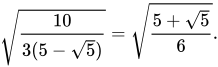

The practice of adding to the works of famous authors, exemplified by these books, was not unusual in ancient Greek mathematics.[61]
Euclid's method and style of presentation
[edit]• To draw a straight line from any point to any point.
• To describe a circle with any center and distance.

Euclid's axiomatic approach and constructive methods were widely influential.[63][64]
Many of Euclid's propositions were constructive, demonstrating the existence of some figure by detailing the steps he used to construct the object using a compass (circle-drawing tool) and straightedge (unmarked ruler). His constructive approach appears even in his geometry's postulates, as the first and third postulates stating the existence of a line and circle are constructive. Instead of stating that lines and circles exist per his prior definitions, he states that it is possible to 'construct' a line and circle. It also appears that, for him to use a figure in one of his proofs, he needs to construct it in an earlier proposition. For example, he proves the Pythagorean theorem by first inscribing a square on the sides of a right triangle, but only after constructing a square on a given line one proposition earlier.[65]
The presentation of each result is given in a stylized form, which, although not invented by Euclid, is recognized as typically classical. It has six different parts: First is the 'enunciation', which states the result in general terms (i.e., the statement of the proposition). Then comes the 'setting-out', which gives the figure and denotes particular geometrical objects by letters. Next comes the 'definition' or 'specification', which restates the enunciation in terms of the particular figure. Then the 'construction' or 'machinery' follows. Here, the original figure is extended to forward the proof. Then, the 'proof' itself follows. Finally, the 'conclusion' connects the proof to the enunciation by stating the specific conclusions drawn in the proof, in the general terms of the enunciation.[66]
No indication is given of the method of reasoning that led to the result, although a different book by Euclid, Data, does provide instruction about how to approach the types of problems encountered in the first four books of the Elements.[67] For proofs involving case analysis, the Elements often includes details only of the most difficult case; some of these case analyses have been filled out by later editors such as Theon.[68]
Euclid's presentation was limited by the mathematical ideas and notations in common currency in his era, and this causes the treatment to seem awkward to the modern reader in some places. For example, there was no notion of an angle greater than two right angles,[69] the number 1 was sometimes treated separately from other positive integers, and, as multiplication was treated geometrically, as the area of a rectangle with given side lengths, he did not use the product of more than 3 different numbers. The geometrical treatment of number theory may have been because the alternative would have been the extremely awkward Alexandrian system of numerals,[70] an alphabetic numeral system in which each Greek letter represented a single-digit multiple of a power of ten.[71]
Reception
[edit]Euclid's Elements has been referred to as the most successful textbook ever written.[18][72] The Elements is often considered after the Bible as the most frequently translated, published, and studied book in history.[73] With Aristotle's Metaphysics, the Elements is perhaps the most successful ancient Greek text, and was the dominant mathematical textbook in the Medieval Islamic world and Western Europe.[73][72] It was one of the very earliest mathematical works to be printed after the invention of the printing press and has been estimated to be second only to the Bible in the number of editions published since the first printing in 1482,[74][75] the number reaching well over one thousand.[75]
Classical antiquity
[edit]The oldest extant evidence for Euclid's Elements are a set of six ostraca (clay fragments with writing scratched onto them) found among the Elephantine papyri and ostraca, from the 3rd century BC, that deal with propositions XIII.10 and XIII.16, on the construction of a dodecahedron.[76] A papyrus recovered from Herculaneum[77] contains an essay by the Epicurean philosopher Demetrius Lacon on Euclid's Elements.[76] The earliest extant papyrus containing the actual text of the Elements is Papyrus Oxyrhynchus 29, a fragment containing the text of Book II, Proposition 5 and an accompanying diagram, dated to c. 75–125 AD.[78]

Copies of the Greek text still exist, some of which can be found in the Vatican Library and the Bodleian Library in Oxford.[d][e] The manuscripts available are of variable quality, and often incomplete.[79] By careful analysis of the translations and originals, hypotheses have been made about the contents of the original text.[80] Also of importance are the scholia, or annotations to the text. These additions, which often distinguished themselves from the main text (depending on the manuscript), gradually accumulated over time as opinions varied upon what was worthy of explanation or further study.[81]
In the 4th century AD, Theon of Alexandria produced an edition of Euclid which was so widely used that it became the only surviving Greek-language source (in multiple manuscripts) until François Peyrard's 1808 discovery at the Vatican of a manuscript not derived from Theon's.[82] This manuscript, MS. Vat.gr.190,[d] was transcribed in the 10th century. It does not include text identifying itself as edited by Theon, and is missing a corollary to Book VI Proposition 33 claimed by Theon to be his own addition. Both Greek versions include many explanations beyond the propositions and their proofs that are missing from the Arabic translations of the Elements. This sparked a 19th-century academic debate between M. Klamroth and J. L. Heiberg over whether the differences between the various versions reflected abridgements or additions to Euclid's text. Revisiting this issue, Wilbur Knorr sides with Klamroth in suggesting that the Arabic sources were closer to the original, but concludes that "We have never had a 'genuine' text of Euclid, and we never will have one."[82]
Although Euclid was known to Cicero, for instance, no record exists of the text having been translated into Latin prior to Boethius in the fifth or sixth century.[83]
Medieval era
[edit]
From classical antiquity until the western invention of printing, texts such as the Elements were preserved and duplicated through the process of copying manuscripts. This was laborious and expensive so manuscripts were often confined to the collections of the wealthy or to institutions such as the House of Wisdom in the medieval Islamic world or the monasteries and early universities of medieval Europe.[84]
The Islamic world received the Elements from the Byzantine Empire around 760. According to sources from that milieu, this version was translated into Arabic under Harun al-Rashid (c. 800),[83] in two versions by Al-Ḥajjāj ibn Yūsuf ibn Maṭar. Another Arabic translation was made later in the 9th century by Ishaq ibn Hunayn and revised by Thābit ibn Qurra.[85][86] Although most Arabic manuscripts have been attributed to one or another of these translations, some mix material from both,[85] and their attributions are not always in accord with the evidence from textual similarities in surviving manuscripts.[86] This mixture was also passed down into medieval translations into Hebrew from the Arabic.[85]
The Byzantine scholar Arethas commissioned the copying of one of the Greek manuscripts of Euclid in the late ninth century;[87] it and another Byzantine manuscript are the two oldest surviving copies of the Greek text.[88] Although known in Byzantium, the Elements was lost to Western Europe until about 1120,[89] except through fragments of a translation into Latin by Boethius (circa 500), quoted in other works.[90][f] In about 1120, the English monk Adelard of Bath translated the Elements into Latin from an Arabic translation.[91] A relatively recent discovery was made of a Greek-to-Latin translation from the 12th century at Palermo, Sicily. The name of the translator is not known other than he was an anonymous medical student from Salerno who was visiting Palermo in order to translate the Almagest to Latin. The Euclid manuscript is extant and quite complete.[89]
After Adelard's translation (which became known as Adelard I), there was a flurry of translations from Arabic. Notable translators in this period include Herman of Carinthia who wrote an edition around 1140, Robert of Chester (his manuscripts are referred to collectively as Adelard II, written on or before 1251), John of Tynemouth[92] (late 12th century; his manuscripts are referred to collectively as Adelard III), and Gerard of Cremona (sometime after 1120 but before 1187). The detailed transmission history of these translations is still an active area of research.[93] Campanus of Novara relied heavily on these Arabic translations to create his edition (sometime before 1260) which ultimately came to dominate Latin editions until the availability of Greek manuscripts in the 16th century. There are more than 100 pre-1482 Campanus manuscripts still available today.[90][g] After its availability in Europe, the first books of the Elements became standard in medieval universities as part of the quadrivium, the second stage of instruction after the trivium of grammar, logic, and rhetoric.[84]
Renaissance and early modern period
[edit]
The first printed edition of the Elements was published by Erhard Ratdolt in 1482, based on Campanus's version,[94] and since then it has been translated into many languages and published in over a thousand different editions.[75] A manuscript descended from Theon's Greek version was recovered and a Latin translation was published in Venice in 1505 by Bartolomeo Zamberti.[95] The Greek text itself was published in 1533.[96] The first to translate the Elements into a modern European language was Nicolo Tartaglia, who published an Italian edition in 1543.[97]
In 1570, John Dee provided a widely respected "Mathematical Preface", along with copious notes and supplementary material, to the first English edition by Henry Billingsley.[98][99][100] In 1607, The Italian Jesuit Matteo Ricci and the Chinese mathematician Xu Guangqi published the first Chinese edition of Euclid's Elements.[101]
The Renaissance also saw the creation of new works about polyhedra, illustrated with perspective drawings, including Piero della Francesca's De quinque corporibus regularibus (late 1400s), its plagiarism by Luca Pacioli as Divina proportione (1498, illustrated by Leonardo da Vinci), and Wenzel Jamnitzer's Perspectiva corporum regularium (1568).[102] The Elements were the main inspiration behind della Francesca's initial work in this direction.[103][104] Pacioli lectured in Venice on Euclid, and his commentary was included in a 1509 edition of the Elements.[105] Jamnitzer, likewise, credits the Elements in the subtitles of his book.[106]
Although this period also saw an explosion in newly published textbooks, teachers often stuck to the classics: a list of recommended readings by 16th century Dutch humanist Joachim Sterck van Ringelbergh, for instance, lists the Elements as its only mathematics book.[107] Even after printed versions existed, a university might expect its students to copy by hand material from the university's copy of the Elements.[108]
Modern mathematics
[edit]In the 19th century the Elements fell out of favor as a geometry textbook, in part supplanted by newer textbooks such as one by Adrien-Marie Legendre,[109][110][111] in part because of the rise of other forms of geometry including non-Euclidean geometry, analytic geometry, and descriptive geometry,[112][113] and in part out of pressure for an approach to mathematics education with more emphasis on intuition and less on memorization.[112][114] Charles Dodgson (better known as Lewis Carroll), in particular, railed against this replacement of Euclid in his book Euclid and His Modern Rivals (1879).[109] Another defender of the Elements, mathematician and historian W. W. Rouse Ball, remarked that "the fact that for two thousand years [the Elements] was the usual text-book on the subject raises a strong presumption that it is not unsuitable for that purpose."[69] Despite falling out of wide use in education, the Elements is still occasionally used as a textbook in experimental education projects.[115]
The Elements remains an object of scholarly study for the history of mathematics, and it has had significant influence on two areas of modern mathematics, the development of non-Euclidean geometry[116][117] and of the axiomatic method.[118][119]
Non-Euclidean geometry
[edit]
The geometrical system established by the Elements long dominated the field; however, today that system is often referred to as 'Euclidean geometry' to distinguish it from other non-Euclidean geometries discovered in the early 19th century.[73]
One of the most notable influences of Euclid on modern mathematics and, beyond mathematics, modern physics and the discovery of general relativity, is the discussion of the parallel postulate.[116][117] In Book I, Euclid lists five postulates, the fifth of which stipulates
If a line segment intersects two straight lines forming two interior angles on the same side that sum to less than two right angles, then the two lines, if extended indefinitely, meet on that side on which the angles sum to less than two right angles.
This postulate plagued mathematicians for centuries due to its apparent complexity compared with the other four postulates. Many attempts were made to prove the fifth postulate based on the other four, but they never succeeded. Eventually in 1829, mathematician Nikolai Lobachevsky published a description of acute geometry (or hyperbolic geometry), a geometry which assumed a different form of the parallel postulate. It is in fact possible to create a valid geometry without the fifth postulate entirely, or with different versions of the fifth postulate (elliptic geometry). If one takes the fifth postulate as a given, the result is Euclidean geometry.[120]
Axiomatics
[edit]The axiomatic reasoning of Euclid's Elements was long considered to set the standard for mathematical rigor,[121] but the issues of the soundness and completeness of Euclid's axioms came to the foreground in the late 19th century, when gaps were found in his reasoning[122] and when David Hilbert began seeking "to revive Euclid's axiomatic point of view", to develop improved axiom systems through which all mathematical and physical questions could be answered by simple calculations.[118] Hilbert's hopes were dashed in the foundational crisis of the early 20th century, in which Kurt Gödel and others discovered that any sound axiom system for set theory must necessarily be incomplete.[123] In the 21st century, a new standard for rigor arose, computer-assisted proofs, and the propositions of the Elements (with some updates to their proofs) have withstood computer checking.[119][124]

Some of the foundational proofs of the Elements use assumptions that Euclid did not state explicitly as axioms. For example, in the first construction of Book 1, of an equilateral triangle, Euclid used a premise that was neither postulated nor proved: that two circles sharing the same line segment as a radius will cross each other in two points, rather than somehow not crossing.[125][126] This example depends only on topological properties of its diagram, which remain evident even if the diagram is drawn inaccurately.[127] However, in other cases, Euclid did not prove that certain objects were distinct or separated from each other, and the possibility that they might coincide (a type of degeneracy) might not be evident from a single diagram. An example occurs in Euclid's bisection of an angle, by constructing an isosceles triangle on the given angle and an equilateral triangle with the same base, and connecting by a line the apexes of the two triangles. This breaks down when the initial angle is 60° and the two apexes coincide.[124]
Later editors of the Elements have included these implicit axiomatic assumptions, such as Pasch's axiom,[128][129] in their editions' lists of formal axioms.[130] Early attempts to construct a more complete set of axioms include Hilbert's geometry axioms[131][132] and Tarski's.[128][133] In 2017, Michael Beeson et al. used computer proof assistants to create and check a set of axioms similar to Euclid's. Beeson et al. chose Tarski's system as their starting point, instead of Hilbert's, because it is closer to Euclid's, and uses only points as the variables in its formulas. They provided computer-verified proofs of all propositions in Book I, using these axioms, and they also proved (using a separate logical formalization of the real numbers) that all of their axioms are valid for the points of the Cartesian coordinate system.[124]
Selected editions
[edit]Over one thousand editions of Euclid's Elements have been published,[75] in Greek, Latin, English, and other languages. Some of the more significant of these include:
- Preclarissimus liber elementorum Euclidis perspicacissimi in artem geometriam incipit quam foelicissime. Venice: Erhard Ratdolt. 1482. The editio princeps (in Latin), based on the 13th century translation and commentary of Campanus.[134]
- Zamberti, Bartolomeo, ed. (1505). Euclidis megarẽsis philosophi platonici. Venice. First full-text Latin translation directly from the Greek.[95] The confusion in the title between Euclid of Alexandria, the author of the Elements, and Euclid of Megara, a philosopher from almost a century earlier, was a common mistake in the Middle Ages and Renaissance.[135]
- Lefèvre d'Étaples, Jacques, ed. (1516). Euclidis Megarensis Geometricorum elementorum liber XV. Paris: Henri Estienne. Based on Campanus and Zamberti, but without some of Zamberti's commentary. The first edition published in France.[136]
- Grynaeus, Simon, ed. (1533). Ευκλείδου Στοιχεῖον. Basel: Johann Herwagen. Editio princeps of the Greek text. Based on two Greek manuscripts, Paris gr. 2343 and Venetus Marcianus 301,[137] both "very inferior ones".[95]
- Tartalea, Nicolo, ed. (1543). Euclide megarense philosopho solo introduttore delle scientie mathematice. Venice: Rossinelli. Tartaglia's translation of the Elements into Italian was the first into any modern European language, and was based on both Campanus and Zamberti. It was revised in 1565 and reprinted in 1569 and 1586.[97]
- Magnien, Jean, ed. (1557). Euclidis Elementorum libri XV grœce et latine. Paris: Cavellat. Greek with Latin translation. Revised posthumously by Stephanus Gracilis; incorporates a translation of Book X by Pierre de Montdoré. Most proofs omitted.[138]
- Billingsley, H., ed. (1570). The Elements of Geometrie. Preface by John Dee. London: John Daye. The first published English-language edition.[100]
- Commandino, Federico, ed. (1572). Euclidis Elementorum Libri XV. Pisauri [Pesaro, Italy]: Apud Camillum Francischinum. In Latin. "The reference edition for the scholarly community up until the early nineteenth century"; Italian translation published in 1575 by Commandino's son-in-law, Valerio Spaccioli.[139]
- Clavius, Christopher, ed. (1574). Euclidis elementorum libri XV. Rome: Apud Vincentium Accoltum. Latin, with added commentary by Clavius. Published in an expanded 2nd edition in 1584. Based on multiple sources, but most closely related to the version of Magnien and Gracilis.[136]
- Nasir al-Din al-Tusi (1594). Kitāb taḥrīr uṣūl li-Uqlīdus [The Recension of Euclid's "Elements"] (in Arabic). Rome: Typographia Medicea. Based on Laurentian Library MS. Or. 20, a copy of MS. Or. 50.[140]
- Ricci, Matteo; Xu, Guangqi, eds. (1607). Jī hé yuán běn 幾何原本 [Source of quantity] (in Chinese). Beijing. Translated from the Latin edition of Clavius, but including only books I-VI.[101] This translation, together with a later translation of the remaining books, can be found on s:zh:幾何原本.
- Briggs, Henry, ed. (1620). Eukleidou Stoicheiōn biblia 13 / Elementorum Euclidis libri tredecim. London: William Jones. Despite the title this includes only the first six books, with parallel columns of Greek from Grynaeus 1533 and Latin corrected from Commandino 1572. The first edition in either language published in England.[100]
- Barrow, Isaac, ed. (1659). Euclidis Elementorum [in Latin]. Euclide's Elements (1660) [in English]. Many later editions.[100]
- Simson, Robert, ed. (1806). The elements of Euclid, viz. the first six books, together with the eleventh and twelfth. London: F. Wingrave.[141] Revised in 1862 by Isaac Todhunter and republished in 1933 by E. P. Dutton, Everyman's Library 891.[142]
- Byrne, Oliver (1847). The first six books of the elements of Euclid, in which coloured diagrams and symbols are used instead of letters for the greater ease of learners. London: William Pickering.[143][144] Facsimile edited by Oechslin, Werner (2010). Taschen. ISBN 3836517752.[144] Euclid's Elements: Completing Oliver Byrne's work, a modern redrawing extended to the rest of the Elements, was published by Kronecker Wallis, 2019.[145]
- Casey, John, ed. (1882). The First Six Books of the Elements of Euclid with Copious Annotations and Numerous Exercises. Dublin: Hodges, Figgis, & Co.[146] Casey produced many subsequent editions; the third edition was republished in a free online edition by Project Gutenberg. Casey's version of the Elements was likely "Casey's frost book of page torn on dirty" of the geometry section of James Joyce's Finnegans Wake.[147] Casey also wrote A Sequel to the First Six Books of the Elements of Euclid (Dublin: Hodges, Figgis, & Co., 1881).
- Heiberg, Johan Ludvig, ed. (1883–1888) Euclidis Opera omnia [Euclid's complete works, in Greek]. Leibzig: Teubner. Volumes 1–5 comprise the Elements. Vol. I, Vol. II, Vol. III, Vol. IV, Vol. V. Heiberg consulted multiple Greek manuscripts for his work, taking the position that the single version not edited by Theon, MS. Vat.gr.190, was the most authentic, but following the others at points where he suspected his primary text to be faulty.[82]
- Heath, Thomas, ed. (1908). The Thirteen Books of Euclid's Elements. Cambridge University Press. 2nd ed., 1926. In three volumes: Vol. I, Vol. II, Vol. III. Reprints include Dover, 1956; Green Lion Press, 2002, ISBN 1-888009-18-7 (single volume, without Heath's commentary);[148] Barnes & Noble, 2006, ISBN 0-7607-6312-7 (single volume).
References
[edit]Notes
[edit]- ^ This translation is from Heath 1908, p. 1; for another translation, see Proclus (1970). A commentary on the first book of Euclid's Elements. Translated by Morrow, Glenn Raymond. Princeton University Press. p. 56.
- ^ Hippocrates of Chios should not be confused with his contemporary Hippocrates of Kos, famous as the "father of medicine".
- ^ "P.Oxy. LXXXII 5299. Euclid, Elements 1.4 (Diagram), 8–11, 14–25 (without Proofs)". University of Oxford. 2022-09-26. Retrieved 2025-07-03. For the discovery and content of this fragment see Henry 2016 and Dorandi 2018.
- ^ a b MS. Vat.gr.190.pt.1 and MS. Vat.gr.190.pt.2. Digital Vatican Library. Retrieved 2025-09-11.
- ^ "MS. D'Orville 301". Bodleian Library. University of Oxford. Retrieved 2025-09-11.
- ^ It was once thought that a complete Latin translation by Boethius remained available in England before Adelard, and was annotated by Alfred the Great. However, there is no evidence of any full translation by Boethius surviving (if it ever existed) and a manuscript found in the Biblioteca Marciana in Venice, holding a marginal note that it was annotated by Alfred, is one of many post-Adelard versions. See Busard 2005, p. 3 and Clagett 1954.
- ^ Campanus. "Manuscript – Pal.lat.1348". Digital Vatican Library. Retrieved 20 November 2023.
Citations
[edit]- ^ Grant 2002.
- ^ Van der Waerden 1975, p. 197.
- ^ a b c d Asper 2010, § para. 6.
- ^ a b c d e f g h Taisbak & Van der Waerden 2021, § "Sources and contents of the Elements".
- ^ Cuomo 2005, p. 131.
- ^ a b Sialaros 2021, § "Works".
- ^ Rouse Ball 1915, p. 15.
- ^ Rouse Ball 1915, p. 38.
- ^ Review of The Evolution of the Euclidean Elements by Bartel Leendert van der Waerden (1976), Historia Mathematica 3 (4): 497–499, doi:10.1016/0315-0860(76)90092-6.
- ^ Unguru 1985.
- ^ Merzbach & Boyer 2011, p. 93.
- ^ Merzbach & Boyer 2011, pp. 93–94.
- ^ a b Artmann 2012, p. 3.
- ^ Asper 2010, § para. 4.
- ^ Asper 2010, § para. 2.
- ^ a b c d e f g Sialaros 2021, § "The Elements".
- ^ a b Jahnke 2010, p. 18.
- ^ a b Merzbach & Boyer 2011, p. 90.
- ^ Heath 1908, pp. 154–155, Vol. I.
- ^ Artmann 2012, p. 3–4.
- ^ Wolfe 1945, p. 4.
- ^ Pickover 2009, p. 56.
- ^ a b c d e Artmann 2012, p. 4.
- ^ Corry 2021, p. 12.
- ^ Reid 1963, p. 20.
- ^ Merzbach & Boyer 2011, p. 97.
- ^ Høyrup, Jens (2017). "What is 'geometric algebra', and what has it been in historiography?". AIMS Mathematics. 2 (1): 128–160. doi:10.3934/Math.2017.1.128.
- ^ a b Corry 2013.
- ^ Merzbach & Boyer 2011, p. 98.
- ^ Fowler 1980.
- ^ Herz-Fischler 1998, pp. 1–3.
- ^ Artmann 2012, p. 79.
- ^ Artmann 2012, p. 5.
- ^ Artmann 2012, pp. 5–6.
- ^ Corry 2021.
- ^ Artmann 2012, p. 5-6.
- ^ Zeeman 2008.
- ^ Artmann 2012, p. 6.
- ^ Artmann 2012, p. 136.
- ^ Artmann 2012, p. 148.
- ^ Fletcher 1938.
- ^ Heath 1908, Vol. II, p. 277.
- ^ Caldwell et al. 2012.
- ^ a b c d Artmann 2012, p. 7.
- ^ Unguru 2018, pp. 26–27.
- ^ Merzbach & Boyer 2011, pp. 103–104.
- ^ O'Connor & Robertson 1999.
- ^ a b Artmann 2012, p. 223.
- ^ Heath 1908, pp. 28–31, Vol. III.
- ^ Knorr 1975, p. 157.
- ^ Roskam 2009.
- ^ Knorr 1983, p. 60.
- ^ See Book X, Definition 4, Heath 1908, pp. 10, 12–13, Vol. III.
- ^ Dyde 1899, pp. 86–87.
- ^ Knorr 1983, p. 42.
- ^ a b c d Artmann 2012, p. 9.
- ^ Edwards 1979, p. 23.
- ^ Edwards 1979, pp. 24–25.
- ^ Artmann 2012, p. 10.
- ^ Merzbach & Boyer 2011, p. 106.
- ^ a b c d Merzbach & Boyer 2011, p. 107, Apocrypha.
- ^ a b Hartshorne 2000, p. 18.
- ^ Mueller 1969.
- ^ Andrade-Molina & Ravn 2016.
- ^ Hartshorne 2000, pp. 18–20.
- ^ Heath 1931, p. 216.
- ^ Rouse Ball 1915, p. 54.
- ^ Heath 1908, p. 59, Vol. I.
- ^ a b Rouse Ball 1915, p. 55.
- ^ Rouse Ball 1915, pp. 54, 58, 127.
- ^ Heath 1931, pp. 15–18.
- ^ a b Hartshorne 2000, p. 1.
- ^ a b c Taisbak & Van der Waerden 2021, § "Legacy".
- ^ Merzbach & Boyer 2011, p. 108.
- ^ a b c d Bunt, Jones & Bedient 1988, p. 142.
- ^ a b Fowler 1999, pp. 209–210.
- ^ P. Herc. 1061
- ^ Fowler 1999, pp. 210–211.
- ^ Heath 1908, pp. 47–51, Vol. I.
- ^ Heath 1908, pp. 51–53, Vol. I.
- ^ Heath 1908, pp. 64–74, Vol. I.
- ^ a b c Knorr 1996.
- ^ a b c Russell 2013, p. 177.
- ^ a b Schubring 2022.
- ^ a b c Elior 2024.
- ^ a b Brentjes 2018.
- ^ Reynolds & Wilson 1991, p. 57.
- ^ Wardhaugh 2023, p. 46.
- ^ a b Murdoch 1967.
- ^ a b Folkerts 1989.
- ^ Rouse Ball 1915, p. 165.
- ^ Knorr 1990.
- ^ Busard 2005, pp. 1–40, Survey of the Arabic–Latin and Greek–Latin translations.
- ^ Furlong 2015.
- ^ a b c Mueller 1970, p. xlvii.
- ^ Swetz 2021.
- ^ a b Elior 2021.
- ^ Alexanderson & Greenwalt 2012.
- ^ Goulding 2009, p. 120.
- ^ a b c d Simpkins 1966.
- ^ a b Siu 2011.
- ^ Wardhaugh 2021, pp. 212–226.
- ^ Field 1997, p. 246.
- ^ Davis 1977, pp. 18–19.
- ^ Damiani 2024.
- ^ Rothstein 2013, p. 101.
- ^ Grafton 2008.
- ^ Wardhaugh 2021.
- ^ a b Moktefi 2005.
- ^ Toumasis 1990.
- ^ Sinclair 2008, pp. 14–18, The geometry curriculum in the United States in the early nineteenth century.
- ^ a b Brock 1975.
- ^ Sinclair 2008, pp. 23–25, 1860s: A mathematical challenge to the dominance of Euclidean geometry.
- ^ Sinclair 2008, pp. 19–22, 1850s: Early pedagogical influences on the geometry curriculum.
- ^ Jameson 2019; Hoppen 2023
- ^ a b Bardi 2008.
- ^ a b Wardhaugh 2023, pp. 267–268.
- ^ a b Majer 2006.
- ^ a b Beeson 2022.
- ^ Laubenbacher & Pengelley 1999.
- ^ Artmann 2012, p. v.
- ^ Jahnke 2003, p. 156.
- ^ Robič 2015.
- ^ a b c Beeson, Narboux & Wiedijk 2019.
- ^ Heath 1908, p. 242, Vol. I.
- ^ Toussaint 1993.
- ^ Panza 2012.
- ^ a b Szmielew 1974.
- ^ Cederberg 2001, pp. 41–43.
- ^ Heath 1908, p. 62, Vol. I.
- ^ Hilbert 1902.
- ^ Baldwin 2018.
- ^ Tarski 1959.
- ^ Baldasso 2013.
- ^ Goulding 2009.
- ^ a b Wardhaugh 2024.
- ^ Heath 1908, p. 101, Vol. I.
- ^ Pantin 2006.
- ^ Gavagna 2014.
- ^ De Young 2012.
- ^ Ackerberg-Hastings 2023.
- ^ Cairns 1934.
- ^ Hawes & Kolpas 2015.
- ^ a b Moriarty 2023.
- ^ Campbell 2017.
- ^ Henrici 1884.
- ^ McCreedy 2011.
- ^ Wardhaugh 2016.
Sources
[edit]- Ackerberg-Hastings, Amy (2023). "Analysis and synthesis in Robert Simson's The Elements of Euclid". In Zack, Maria; Waszek, David (eds.). Research in history and philosophy of mathematics—the CSHPM 2021 volume. Annals of the Canadian Society for History and Philosophy of Mathematics. Cham: Birkhäuser/Springer. pp. 133–147. doi:10.1007/978-3-031-21494-3_8. ISBN 978-3-031-21493-6. MR 4633160.
- Andrade-Molina, Melissa; Ravn, Ole (2016). "The Euclidean tradition as a paradigm for scientific thinking". Philosophy of Mathematics Education Journal. 30: 1–10. EBSCOhost 118987364.
- Asper, Markus (2010). "Euclid". In Gagarin, Michael (ed.). The Oxford Encyclopedia of Ancient Greece and Rome. Oxford: Oxford University Press. ISBN 978-0-19-517072-6.
- Alexanderson, Gerald L.; Greenwalt, William S. (2012). "About the cover: Billingsley's Euclid in English". Bulletin of the American Mathematical Society. New Series. 49 (1): 163–167. doi:10.1090/S0273-0979-2011-01365-9.
- Artmann, Benno (2012) [1999]. Euclid: The Creation of Mathematics. New York: Springer. doi:10.1007/978-1-4612-1412-0. ISBN 978-1-4612-1412-0.
- Baldasso, Renzo (2013). "Printing for the Doge: On the first quire of the first edition of the Liber elementorum Euclidis". La Bibliofilía. 115 (3): 525–552. JSTOR 26202240.
- Baldwin, John T. (2018). "Axiomatizing changing conceptions of the geometric continuum I: Euclid–Hilbert" (PDF). Philosophia Mathematica. Series III. 26 (3): 346–374. doi:10.1093/philmat/nkx030. MR 3867369.
- Rouse Ball, Walter William (1915). A Short Account of the History of Mathematics (6th ed.). MacMillan. 1st ed., 1888.
- Bardi, Jason Socrates (2008). The Fifth Postulate: How Unraveling A Two Thousand Year Old Mystery Unraveled the Universe. Wiley. ISBN 9780470467367.
- Beeson, Michael (2022). "Euclid after computer proof-checking". The American Mathematical Monthly. 129 (7): 623–646. arXiv:2103.09623. doi:10.1080/00029890.2022.2069985. MR 4457736.
- Beeson, Michael; Narboux, Julien; Wiedijk, Freek (2019). "Proof-checking Euclid". Annals of Mathematics and Artificial Intelligence. 85 (2–4): 213–257. arXiv:1710.00787. doi:10.1007/s10472-018-9606-x. MR 3914603.
- Brentjes, Sonja (2018). "Who translated Euclid's Elements into Arabic?". In Hämeen-Anttila, Jaakko; Lindstedt, Ilkka (eds.). Translation and Transmission: Collection of articles. The Intellectual Heritage of the Ancient and Mediaeval Near East. Vol. 3. Münster: Ugarit-Verlag. pp. 21–54.
- Brock, W. H. (January 1975). "Geometry and the universities: Euclid and his modern rivals 1860–1901". History of Education. 4 (2): 21–35. doi:10.1080/0046760750040203.
- Bunt, Lucas Nicolaas Hendrik; Jones, Phillip S.; Bedient, Jack D. (1988). The Historical Roots of Elementary Mathematics. Dover.
- Busard, H. L. L. (2005). "Introduction to the text". Campanus of Novara and Euclid's Elements. Stuttgart: Franz Steiner Verlag. ISBN 978-3-515-08645-5.
- Cairns, W. D. (June–July 1934). "Review of The Elements of Euclid by Isaac Todhunter". The American Mathematical Monthly. 41 (6): 383. doi:10.2307/2301562. JSTOR 2301562.
- Caldwell, Chris K.; Reddick, Angela; Xiong, Yeng; Keller, Wilfrid (2012). "The history of the primality of one: a selection of sources". Journal of Integer Sequences. 15 (9): Article 12.9.8. MR 3005523. Archived from the original on 2018-04-12. Retrieved 2018-01-15.
- Campbell, Paul J. (December 2017). "Reviews: Babylonian trig; crowd-sourcing Euclid; gerrymandering". Mathematics Magazine. 90 (5): 395–396. doi:10.4169/math.mag.90.5.395. JSTOR 10.4169/math.mag.90.5.395.
- Cederberg, Judith N. (2001). A Course in Modern Geometries. Undergraduate Texts in Mathematics (2nd ed.). New York: Springer-Verlag. doi:10.1007/978-1-4757-3490-4. ISBN 0-387-98972-2. MR 1798736.
- Clagett, Marshall (September 1954). "King Alfred and the Elements of Euclid". Isis. 45 (3). University of Chicago Press: 269–277. doi:10.1086/348338. JSTOR 226713.
- Corry, Leo (July 2013). "Geometry and arithmetic in the medieval traditions of Euclid's Elements: a view from Book II". Archive for History of Exact Sciences. 67 (6): 637–705. doi:10.1007/s00407-013-0121-5. See especially p. 637.
- Corry, Leo (2021). "Distributivity-like results in Euclid's Elements". Distributivity-like Results in the Medieval Traditions of Euclid's Elements. SpringerBriefs in History of Science and Technology. Springer International Publishing. pp. 5–25. doi:10.1007/978-3-030-79679-2_2. ISBN 9783030796792.
- Cuomo, Serafina (2005) [2001]. Ancient Mathematics. London and New York: Routledge. ISBN 978-1-134-71019-5.
- Damiani, Giacomo (June 2024). "Form and matter of regular geometrical bodies in Luca Pacioli's Summa (1494) and Compendium de divina proportione (1498)". Early Science and Medicine. 29 (3): 230–270. doi:10.1163/15733823-20240106.
- Davis, Margaret Daly (1977). Piero Della Francesca's Mathematical Treatises: The Trattato D'abaco and Libellus de Quinque Corporibus Regularibus. Longo Editore.
- De Young, Gregg (April 2012). "Further adventures of the Rome 1594 Arabic redaction of Euclid's Elements". Archive for History of Exact Sciences. 66 (3). Springer Science and Business Media LLC: 265–294. doi:10.1007/s00407-012-0094-9. JSTOR 41472233.
- Dorandi, Tiziano (2018). "L'Euclide di P.Oxy. 5299". Zeitschrift für Papyrologie und Epigraphik (in Italian). 205: 92–95. JSTOR 26603972.
- Dyde, Samuel Walters, ed. (1899). The Theaetetus of Plato. J. Maclehose.
- Edwards, C. H. (1979). The Historical Development of the Calculus. New York: Springer. doi:10.1007/978-1-4612-6230-5. ISBN 9781461262305.
- Elior, Ofer (2021). "Niccolò Tartaglia's 1543 edition of Euclid's Elements and the sources of an early Modern Hebrew version of the Elements". Aleph: Historical Studies in Science and Judaism. 21 (1). Indiana University Press: 123–148. doi:10.2979/aleph.21.1.0123. JSTOR 10.2979/aleph.21.1.0123.
- Elior, Ofer (2024). "The Hebrew translation of Euclid's Elements ascribed to Rabbi Jacob: a new analysis following the 'discovery' of the Arabic version in MS Paris, BULAC ARA. 606". Historia Mathematica. 68: 1–21. doi:10.1016/j.hm.2024.02.005. MR 4799290.
- Field, J. V. (1997). "Rediscovering the Archimedean polyhedra: Piero della Francesca, Luca Pacioli, Leonardo da Vinci, Albrecht Dürer, Daniele Barbaro, and Johannes Kepler". Archive for History of Exact Sciences. 50 (3–4): 241–289. doi:10.1007/BF00374595. JSTOR 41134110. MR 1457069. S2CID 118516740.
- Fletcher, W. C. (February 1938). "Euclid". The Mathematical Gazette. 22 (248): 58–65. doi:10.2307/3607447. JSTOR 3607447.
- Folkerts, Menso (1989). Euclid in Medieval Europe (PDF). The Benjamin Catalogue for History of Science. Collected in Folkerts, Menso (2006). The Development of Mathematics in Medieval Europe. Variorum Collected Studies Series. Vol. 811. Aldershot: Ashgate Publishing Limited. ISBN 0-86078-957-8. MR 2229235.
- Fowler, D. H. (1980). "Book II of Euclid's Elements and a pre-Eudoxan theory of ratio". Archive for History of Exact Sciences. 22 (1–2): 5–36. doi:10.1007/bf00327868. JSTOR 41133572.
- Fowler, David (1999). The Mathematics of Plato's Academy (2nd ed.). Oxford: Clarendon Press. ISBN 978-0-19-850258-6.
- Furlong, Gillian (2015). "First printed edition of Euclid's Elements". Treasures from UCL. UCL Press. p. 15. ISBN 9781910634363.
- Gavagna, Veronica (2014). "The Euclidean tradition at the Renaissance courts: the case of Federico Commandino" (PDF). In Katsiampoura, Gianna (ed.). Scientific Cosmopolitanism and Local Cultures: Religions, Ideologies, Societes (Proceedings of 5th International Conference of the ESHS, Athens 2012). Athens: National Hellenic Research Foundation. pp. 291–297. hdl:2158/1037064. ISBN 978-960-98199-3-0.
- Goulding, Robert (2009). "The puzzling lives of Euclid". Defending Hypatia: Ramus, Savile, and the Renaissance Rediscovery of Mathematical History. Archimedes. Vol. 25. Springer Netherlands. pp. 117–142. doi:10.1007/978-90-481-3542-4_5. ISBN 978-90-481-3542-4.
- Grafton, Anthony T. (2008). "Textbooks and the disciplines". In Campi, Emidio; Angelis, Simone De; Goeing, Anja-Silvia; Grafton, Anthony T. (eds.). Scholarly Knowledge: Textbooks in Early Modern Europe. Librairie Droz. pp. 11–38.
- Grant, Hardy (May 2002). "Euclid's Elements in cultural context". Cubo Matemática Educacional. 4 (1).
- Hähl, Hermann; Peters, Hanna (10 June 2022). "A variation of Hilbert's Axioms for Euclidean geometry". Mathematische Semesterberichte. 69 (2): 253–258. doi:10.1007/s00591-022-00320-3. S2CID 249581871.
- Hartshorne, Robin (2000). Geometry: Euclid and Beyond (2nd ed.). New York: Springer]. ISBN 9780387986500.
- Hawes, Susan M.; Kolpas, Sid (August 2015). "Oliver Byrne: The Matisse of mathematics – biography 1810–1829". Convergence. Mathematical Association of America.
- Heath, Thomas L. (1931). A Manual of Greek Mathematics. Clarendon Press. Reprinted 1963. Dover. ISBN 978-0-486-43231-1.
- Henrici, O. (March 1884). "The axioms of geometry". Nature. 29 (750): 453–454. Bibcode:1884Natur..29..453H. doi:10.1038/029453b0.
- Henry, W. B. (2016). Oxyrhynchus Papyri Collection. London: The Egypt Exploration Society. p. 23.
- Herz-Fischler, Roger (1998). A Mathematical History of the Golden Number. Dover Books on Mathematics. Courier Corporation. ISBN 9780486152325.
- Hilbert, David (1902). Foundations of Geometry (PDF). Translated by Townsend, E. J. Open Court.
- Hoppen, Faith K. (2023). Euclid's Elements for High School Classrooms (Thesis). University of Nebraska. ProQuest 2829362062.
- Jahnke, Hans Niels (2003). A History of Analysis. History of mathematics. Vol. 24. American Mathematical Society. ISBN 9780821826232.
- Jahnke, Hans Niels (2010). "The conjoint origin of proof and theoretical physics". In Hanna, Gila; Jahnke, Hans Niels; Pulte, Helmut (eds.). Explanation and Proof in Mathematics: Philosophical and Educational Perspectives. Berlin: Springer US. ISBN 978-1-4419-0576-5.
- Jameson, Tom (2019). Euclid in the Modern Classroom (Thesis). Harvard University. ProQuest 2511164716.
- Knorr, Wilbur R. (1975). The Evolution of the Euclidean Elements: A Study of the Theory of Incommensurable Magnitudes and Its Significance for Early Greek Geometry. Synthese Historical Library. Dordrecht, Netherlands: D. Reidel Publishing Co.
- Knorr, Wilbur (1983). "'La croix des mathématiciens': the Euclidean theory of irrational lines". American Mathematical Society. New Series. 9 (1): 41–69. doi:10.1090/S0273-0979-1983-15155-8. MR 0699316.
- Knorr, Wilbur R. (1990). "John of Tynemouth alias John of London: Emerging portrait of a singular medieval mathematician". The British Journal for the History of Science. 23 (3): 293–330. doi:10.1017/S0007087400044009. JSTOR 4026757.
- Knorr, Wilbur R. (1996). "The wrong text of Euclid: on Heiberg's text and its alternatives". Centaurus. 38 (2–3): 208–276. doi:10.1111/j.1600-0498.1996.tb00610.x. MR 1384401.
- Laubenbacher, Reinhard; Pengelley, David (1999). "Chapter 1: Geometry: The parallel postulate". Mathematical Expeditions. Undergraduate Texts in Mathematics. Springer New York. pp. 1–53. doi:10.1007/978-1-4612-0523-4. ISBN 9781461205234.
- Majer, Ulrich (2006). "Hilbert's axiomatic approach to the foundations of science—A failed research program?". In Hendricks, Vincent F.; Jørgensen, Klaus Frovin; Lützen, Jesper; Pedersen, Stig Andur (eds.). Interactions: Mathematics, Physics and Philosophy, 1860–1930. Boston Studies in the Philosophy of Science. Vol. 251. Springer Netherlands. pp. 155–184. doi:10.1007/978-1-4020-5195-1_5. ISBN 9781402051944.
- McCreedy, Jonathan (Spring 2011). "'Ocone! Ocone!' ALP's 3D Siglum and Dolph's 'Night (Sex-Education) Lessons'" (PDF). Genetic Joyce Studies. 11: 1–24.
- Merzbach, Uta B.; Boyer, Carl B. (2011). "Chapter 5: Euclid of Alexandria". A History of Mathematics (Third ed.). John Wiley & Sons. pp. 90–108. ISBN 978-0470525487.
- Moktefi, Amirouche (November 2005). "Review of Euclid and His Modern Rivals by Charles L. Dodgson". The Mathematical Gazette. 89 (516): 556–558. doi:10.1017/S0025557200178775. JSTOR 3621985.
- Moriarty, Clare Marie (2023). "'Tint and form': The geometric philosophy underlying Oliver Byrne's Elements". Leonardo. 56 (2): 151–158. doi:10.1162/leon_a_02242.
- Mueller, Ian (1970). "Preface". In Glenn R. Morrow (ed.). Proclus: A Commentary on the First Book of Euclid's Elements. Princeton University Press.
- Mueller, Ian (December 1969). "Euclid's Elements and the axiomatic method". The British Journal for the Philosophy of Science. 20 (4). University of Chicago Press: 289–309. doi:10.1093/bjps/20.4.289. JSTOR 686258.
- Murdoch, John E. (1967). "Euclides Graeco-Latinus: A hitherto unknown medieval Latin translation of the Elements made directly from the Greek". Harvard Studies in Classical Philology. 71: 249–302. doi:10.2307/310767. JSTOR 310767.
- O'Connor, John J.; Robertson, Edmund F. (1999). "Abu Ali al-Hasan ibn al-Haytham". MacTutor History of Mathematics Archive. University of St Andrews.
- Pantin, Isabelle (2006). "Teaching mathematics and astronomy in France: The Collège Royal (1550–1650)". Science & Education. 15 (2–4): 189–207. Bibcode:2006Sc&Ed..15..189P. doi:10.1007/s11191-005-1794-1.
- Panza, Marco (2012). "The twofold role of diagrams in Euclid's plane geometry". Synthese. 186 (1): 55–102. doi:10.1007/s11229-012-0074-2. JSTOR 41494923. MR 2935330.
- Pickover, Clifford A. (2009). The Math Book: From Pythagoras to the 57th Dimension, 250 Milestones in the History of Mathematics. New York: Sterling Publishing. ISBN 978-1-4027-5796-9.
- Reid, Constance (1963). A Long Way from Euclid: The intelligent reader's guide to modern mathematics. New York: Thomas Y. Crowell Co. Reprinted by Courier Dover, 2004, ISBN 9780486436135.
- Reynolds, Leighton Durham; Wilson, Nigel Guy (9 May 1991). Scribes and scholars: a guide to the transmission of Greek and Latin literature (2nd ed.). Oxford: Clarendon Press. ISBN 978-0-19-872145-1.
- Robič, Borut (2015). "The foundational crisis of mathematics". The Foundations of Computability Theory. Springer. pp. 9–30. doi:10.1007/978-3-662-44808-3_2. ISBN 9783662448083.
- Roskam, Jade (January 2009). "Book X of The Elements: Ordering irrationals". The Mathematics Enthusiast. 6 (1–2): 277–294. doi:10.54870/1551-3440.1151.
- Rothstein, Bret (2013). "Making Trouble: Strange Wooden Objects and the Early Modern Pursuit of Difficulty". Journal for Early Modern Cultural Studies. 13 (1). Project MUSE: 96–129. doi:10.1353/jem.2013.0000.
- Russell, Bertrand (2013). History of Western Philosophy: Collectors Edition. Routledge. ISBN 978-1-135-69284-1.
- Schubring, Gert (2022). "Textbooks before the invention of the printing press: orality and teaching". Analysing Historical Mathematics Textbooks. International Studies in the History of Mathematics and its Teaching. Springer International Publishing. pp. 15–53. doi:10.1007/978-3-031-17670-8_2. ISBN 9783031176708.
- Sialaros, Michalis (2021) [2015]. "Euclid". In Sialaros, Michalis (ed.). Oxford Classical Dictionary. Oxford: Oxford University Press. doi:10.1093/acrefore/9780199381135.013.2521. ISBN 978-0-19-938113-5. Archived from the original on 2021-08-14.
- Simpkins, Diana M. (December 1966). "Early editions of Euclid in England". Annals of Science. 22 (4): 225–249. doi:10.1080/00033796600203155.
- Sinclair, Nathalie (2008). The History of the Geometry Curriculum in the United States. Information Age Publishing. ISBN 9781607527305.
- Siu, Man-Keung (2011). "1607, a year of (some) significance: Translation of the first European text in mathematics – Elements – into Chinese". History and Epistemology in Mathematics Education: Proceedings of the 6th European Summer University, Wien, Österreich, 19-23 July 2010. Holzhausen Verlag. pp. 573–589. hdl:10722/153396 – via Hong Kong University Scholars Hub.
- Swetz, Frank J. (January 2021). "Mathematical Treasures – Greek edition of Euclid's Elements". Convergence. Mathematical Association of America.
- Szmielew, Wanda (1974). "The role of the Pasch axiom in the foundations of Euclidean geometry". In Henkin, Leon; Addison, John; Chang, Chen Chung; Craig, William; Scott, Dana; Vaught, Robert (eds.). Proceedings of the Tarski Symposium: An international symposium held at the University of California, Berkeley, June 23–30, 1971, to honor Alfred Tarski on the occasion of his seventieth birthday. Proceedings of Symposia in Pure Mathematics. Vol. 25. Providence, Rhode Island: American Mathematical Society. pp. 123–132. doi:10.1090/pspum/025/0373872. ISBN 978-0-8218-1425-3. MR 0373872.
- Taisbak, Christian Marinus; Van der Waerden, Bartel Leendert (5 January 2021). "Euclid". Encyclopædia Britannica. Chicago: Encyclopædia Britannica, Inc.
- Tarski, Alfred (1959). "What is elementary geometry? The axiomatic method, With special reference to geometry and physics". In Henkin, L.; Suppes, P. (eds.). Proceedings of an International Symposium held at the Univ. of Calif., Berkeley, Dec. 26, 1957-Jan. 4, 1958. Studies in Logic and the Foundations of Mathematics. North-Holland, Amsterdam. pp. 16–29. MR 0106185.
- Toumasis, Charalampos (December 1990). "The epos of Euclidean Geometry in Greek secondary education (1836-1985): Pressure for change and resistance". Educational Studies in Mathematics. 21 (6): 491–508. doi:10.1007/BF00315941. JSTOR 3482388.
- Toussaint, Godfried (1993). "A new look at Euclid's second proposition" (PDF). The Mathematical Intelligencer. 15 (3): 12–24. doi:10.1007/BF03024252.
- Unguru, Sabetai (May 1985). "Digging for structure into the Elements: Euclid, Hilbert, and Mueller". Historia Mathematica. 12 (2): 176–184. doi:10.1016/0315-0860(85)90013-8.
- Unguru, Sabetai (2018). "Counter-revolutions in mathematics". In Sialaros, Michalis (ed.). Revolutions and continuity in Greek mathematics. Science, Technology, and Medicine in Ancient Cultures. Vol. 8. De Gruyter, Berlin. pp. 17–34. ISBN 978-3-11-056365-8. MR 3822179.
- Van der Waerden, Bartel Leendert (1975). Science awakening. Noordhoff International. ISBN 978-90-01-93102-5.
- Wardhaugh, Benjamin (2016). "Greek Mathematics in English: The Work of Sir Thomas L. Heath (1861–1940)". In Remmert, Volker R.; Schneider, Martina R.; Sørensen, Henrik Kragh (eds.). Historiography of Mathematics in the 19th and 20th Centuries. Trends in the History of Science. Springer International Publishing. pp. 109–122. doi:10.1007/978-3-319-39649-1_6. ISBN 9783319396491.
- Wardhaugh, Benjamin (2021). "Defacing Euclid: Reading and Annotating the Elements of Geometry in Early Modern Britain". In Goeing, Anja-Silvia; Parry, Glyn; Feingold, Mordechai (eds.). Early Modern Universities: Networks of Higher Learning. BRILL. doi:10.1163/9789004444058_015. ISBN 9789004442412.
- Wardhaugh, Benjamin (2023). Encounters with Euclid: How an Ancient Greek Geometry Text Shaped the World. Princeton University Press. ISBN 9780691235769.
- Wardhaugh, Benjamin (2024). "Euclid's Elements in Latin, 1482–1703: Vocabulary and Classification". Revue d'Histoire des Mathématiques. Société Mathématique de France.
- Wolfe, Harold E. (1945). Introduction To Non-Euclidean Geometry. New York: Dryden Press.
- Zeeman, E. C. (2008). "What's wrong with Euclid Book V" (PDF). Bulletin of the London Mathematical Society. 40 (1): 1–17. doi:10.1112/blms/bdm104. MR 2409172. Archived from the original (PDF) on 2017-08-09.
External links
[edit]


- Elements with highlights by ratherthanpaper
- Multilingual edition of Elementa in the Bibliotheca Polyglotta
- David E. Joyce, ed. (1997). "Euclid's Elements". In HTML with Java-based interactive figures.
| Works | |||||||||
|---|---|---|---|---|---|---|---|---|---|
| Topics | |||||||||
| Scholars |
| ||||||||
| Manuscripts and editions | |||||||||


Euclid's Elements
View on GrokipediaBackground
Historical Context
Greek mathematics emerged in the 6th century BCE with Thales of Miletus, who is regarded as the first Greek mathematician for applying deductive reasoning to geometry, likely influenced by Egyptian and Babylonian practices such as measuring land and constructing right angles.[4] In the following century, Pythagoras of Samos (c. 570–495 BCE) and his school expanded this foundation by integrating arithmetic with geometry, emphasizing the properties of whole numbers, harmonic ratios, and theorems like the one relating the sides of right triangles.[4] By the mid-4th century BCE, Eudoxus of Cnidus (c. 408–355 BCE) advanced these ideas through his method of exhaustion, which approximated areas and volumes of curved figures, and his rigorous theory of proportions that accommodated incommensurable quantities without relying on fractions.[5] The intellectual landscape shifted dramatically after Alexander the Great's conquests, with Alexandria in Egypt emerging as a hub of learning under Ptolemy I Soter (r. 323–283 BCE), who established the Mouseion around 300 BCE as a state-supported research institution modeled on Aristotle's Lyceum and dedicated to the Muses.[6] Attached to the Mouseion was the Great Library, which systematically collected scrolls from across the known world—reportedly up to 700,000 volumes by later estimates—providing scholars with access to diverse texts and fostering collaborative study in mathematics, astronomy, and philosophy during the early Hellenistic era.[7] This environment, sustained by royal patronage including stipends for resident intellectuals, enabled the synthesis of prior Greek achievements into more comprehensive systems.[6] Euclid himself flourished in Alexandria circa 300 BCE, serving as a teacher at the Mouseion during Ptolemy I's reign, though no precise birth or death dates are recorded in ancient sources.[8] Anecdotes from later writers, such as Proclus, describe him interacting with the Ptolemaic court, including a reputed exchange where he advised the king that there was no royal road to geometry.[8] Among his key influences was Hippocrates of Chios (c. 470–410 BCE), a merchant-turned-mathematician who authored the earliest known systematic geometric compilation, often called the Elements of Hippocrates, which organized theorems on circles, lunes, and quadratures in a proto-axiomatic style.[9] This work, surviving only through references in Euclid and others, provided foundational material for later deductive treatments and marked a transition from ad hoc discoveries to structured exposition.[7]Authorship and Composition
The authorship of Euclid's Elements is primarily attributed to Euclid of Alexandria, a Greek mathematician active around 300 BCE, based on the testimony of later ancient commentators. Proclus, in his 5th-century CE Commentary on the First Book of Euclid's Elements, identifies Euclid as the composer of the work, describing him as a member of the Platonic school who flourished under Ptolemy I Soter (r. 323–283 BCE) and who systematically arranged geometric and arithmetic knowledge from earlier sources.[10] Proclus notes that Euclid gathered theorems from predecessors like Eudoxus of Cnidus and Theaetetus of Athens, organizing them into a cohesive deductive system while adding original contributions.[11] This attribution is corroborated by Theon of Alexandria (c. 335–405 CE), who in his recension of the Elements—the version that became the medieval standard—explicitly credits Euclid as the original author, preserving the text with minor emendations for pedagogical clarity.[12] Scholars estimate the Elements was composed in the late 4th to early 3rd century BCE, likely in Alexandria during the early Hellenistic period, as a synthesis of preexisting Greek mathematical traditions rather than wholly original invention.[12] This dating aligns with references in contemporary or near-contemporary works; for instance, Archimedes (c. 287–212 BCE) refers to propositions from the Elements in works such as On the Sphere and Cylinder (e.g., XII.2 on circle areas), indicating the text's circulation by the mid-3rd century BCE, though some citations are subject to scholarly debate regarding authenticity.[12] Debates persist regarding the Elements' unity and potential multiple contributors, given its compilation nature. While Proclus presents it as Euclid's unified opus, modern analysis suggests insertions or heavy reliance on earlier figures: Book V on proportions likely draws substantially from Eudoxus' method of exhaustion for handling irrationals, possibly incorporating his work verbatim, and Book X on the classification of irrationals is attributed mainly to Theaetetus, with Euclid adapting and proving its theorems.[12] These elements reflect a collaborative Hellenistic scholarly environment in Alexandria, where Euclid may have edited and expanded upon a collective body of knowledge rather than authoring every detail single-handedly. Despite such scholarly nuances, the Elements is universally regarded as Euclid's masterwork for its rigorous axiomatic structure.[12]Contents
Book I: Basic Plane Geometry
Book I establishes the foundational principles of plane geometry through a systematic development of definitions, postulates, and propositions, all derived using only an unmarked straightedge and compass for constructions. This approach ensures that all results follow deductively from a minimal set of assumptions, forming the bedrock for the entire Elements. The content focuses on the properties of points, lines, angles, triangles, and parallel lines, culminating in key theorems about areas and right triangles. The book opens with 23 definitions that articulate the basic entities of geometry without assuming prior knowledge. These include definitions for a point as "that which has no part," a line as "breadthless length," the extremities of a line as points, and a straight line as one that "lies evenly with the points on itself." Surfaces are defined as having length and breadth only, with plane surfaces lying evenly with straight lines on themselves. Angles are introduced as the inclination of two lines meeting in a plane but not in a straight line, with rectilinear angles formed by straight lines; complementary definitions cover figures like triangles (bounded by three straight lines), circles (a figure where lines from an interior point to the boundary are equal), and parallel lines (those in the same plane that do not meet when extended indefinitely). Further definitions specify types of triangles (equilateral, isosceles, scalene, right-angled, obtuse-angled, acute-angled) and quadrilaterals (square, oblong, rhombus, rhomboid, trapezium), as well as parallelograms and equal figures on the same base between parallels. These definitions provide the precise terminology essential for unambiguous geometric reasoning.[13] Next come the five postulates, which are unprovable assumptions unique to spatial intuition. Postulate 1 allows drawing a straight line between any two points. Postulate 2 permits extending a finite straight line indefinitely in a straight line. Postulate 3 enables describing a circle with any given center and radius. Postulate 4 asserts that all right angles are equal to one another. Postulate 5, the parallel postulate, states that if a straight line intersecting two others forms interior angles on the same side summing to less than two right angles, then the two lines meet when extended on that side; this is equivalent to Playfair's axiom, which posits that through a point not on a given line, exactly one parallel line can be drawn.[13][14] The 48 propositions build upon these foundations, each proved synthetically and often involving compass-and-straightedge constructions to demonstrate equality or congruence. Early propositions, such as 1–3, 7, and 9–12, focus on elementary constructions: Proposition 1 constructs an equilateral triangle on a given finite straight line by drawing circles centered at the endpoints with radius equal to the line, their intersection forming the third vertex. Propositions 9 and 10 bisect a given angle and a finite straight line at right angles, respectively, using intersecting circles to locate equal points. These tools enable erecting perpendiculars (Propositions 11–12) and other basic figures. Other propositions, like 15 (vertical angles equal) and 23 (complements of parallelograms equal), establish key theorems.[13][15] Central to the book are the congruence theorems for triangles, which allow identifying equal figures: Proposition 4 proves the side-angle-side (SAS) criterion, stating that if two triangles have two sides equal to two sides and the included angle equal, then the triangles are congruent (bases equal, remaining angles equal). Proposition 8 establishes the side-side-side (SSS) criterion, where equal corresponding sides imply congruent triangles. The angle-side-angle (ASA) and angle-angle-side (AAS) criteria appear in Proposition 26, showing that two angles and a non-included side, or two angles and the included side, suffice for congruence. These results, derived from earlier propositions and the postulates, underpin comparisons of geometric shapes. Propositions 5–6 establish that in isosceles triangles the base angles are equal, and the converse.[13] Propositions 13–22 address angle properties: Propositions 13–14 prove that adjacent angles on a straight line sum to two right angles, and the converse. Proposition 15 establishes that vertical angles formed by intersecting lines are equal. Proposition 16 shows that an exterior angle is greater than each interior opposite angle. Propositions 17–19 cover that the sum of any two angles in a triangle is less than two right angles, and greater side opposite greater angle (and converse). Proposition 20 states the triangle inequality: sum of any two sides greater than the third. Propositions 27–34 develop the theory of parallels, proving that alternate interior angles equal implies parallel lines (27), corresponding angles equal implies parallels (28), and transversals create equal alternate angles if lines are parallel (29); the parallel postulate is invoked to show uniqueness and properties like the sum of interior angles on the same side being two right angles (31).[13] Later propositions (35–46) examine areas and parallelograms: triangles on equal bases and same height have equal areas (37), parallelograms on equal bases and heights are equal (43), and the area of a parallelogram equals that of a triangle with same base and height (42). These lead to inequalities like the whole greater than the part applied geometrically. The book concludes with Proposition 47, the Pythagorean theorem, proving that in a right-angled triangle, the square on the hypotenuse equals the sum of the squares on the legs, achieved by constructing squares outward on each side and rearranging areas using congruence and parallelogram equalities from prior propositions. Proposition 48 extends this to show that in acute triangles the square on any side is less than the sum of squares on the others, and in obtuse triangles greater for the side opposite the obtuse angle.[13] This structure not only proves essential theorems but also exemplifies axiomatic deduction, influencing mathematical methodology for centuries.Book II: Geometric Algebra
Book II of Euclid's Elements presents a systematic exploration of geometric techniques that mirror algebraic manipulations, commonly termed "geometric algebra." Building on the foundational constructions and congruence theorems from Book I, it demonstrates how areas of rectangles and squares can represent operations on line segments treated as magnitudes. All propositions avoid numerical computation, relying exclusively on lengths for inputs and areas for products or sums, thereby unifying arithmetic concepts with visual proofs. This approach allows for the geometric resolution of problems equivalent to solving linear and quadratic equations, without symbolic notation. The book's 14 propositions focus on properties of areas when lines are divided in various ratios, culminating in practical applications to polygons and triangles.[16] Central to the book are manipulations involving rectangles and the gnomon, defined as an L-shaped figure that, when added to a parallelogram, forms a rectangle (or vice versa when subtracted). For instance, Proposition 2 states that if a straight line segment is divided arbitrarily into two parts, the square constructed on the entire segment equals the sum of the squares on each part plus twice the area of the rectangle formed by those parts. Geometrically, this identity is proven by completing squares and using gnomons to equate the cross-term rectangle. Similar identities appear in Propositions 3 and 4, which handle rearrangements of areas when segments are subtracted or when lines are cut in specific ways, providing tools for expanding and factoring expressions like . These early propositions establish a geometric framework for addition and subtraction of squares, essential for later algebraic geometry.[16] Propositions 5 through 10 delve deeper into applications, particularly those solvable via the geometric mean. Proposition 5 asserts that if a line is first bisected and then cut unequally, the product of the unequal segments (as a rectangle) plus the square on the segment between the cuts equals the square on half the original line. Algebraically, for segments where the whole is , unequal parts and with , and difference , this yields , a relation used to construct square roots. Proposition 6 complements this by providing a method to attach a rectangle to a given line such that it exceeds by a square equal to another given square, effectively solving equations of the form through iterative application of prior results. These constructions enable the geometric solution of general quadratic equations by transforming them into area equalities, as analyzed in medieval interpretations where such methods prefigure symbolic algebra. Propositions 7 through 10 extend these to cases involving multiple cuts and complements, reinforcing the toolkit for handling products and differences of magnitudes.[16][17][18] The final propositions apply these area manipulations to broader figures. Propositions 12 and 13 address triangles, stating that in an acute-angled triangle, the square on the side opposite the angle equals the sum of the squares on the other two sides minus twice the rectangle formed by one side and the projection of the other; for obtuse angles, it exceeds by a similar term involving the external projection. These are geometric formulations of the law of cosines, with the right-angled case aligning with Book I's Pythagorean theorem via gnomon completions. Proposition 14, the book's capstone problem, instructs how to construct a square equal in area to any given polygon by successively reducing it to equivalent triangles and rectangles using earlier propositions, thus "squaring" the figure geometrically. Overall, Book II's emphasis on area equivalences without numbers underscores Euclid's commitment to rigorous, magnitude-based reasoning, influencing subsequent mathematical traditions.[16]Book III: Circle Theorems
Book III of Euclid's Elements develops the theory of circles through 37 propositions, establishing foundational properties of their elements, chords, tangents, and angles, while building upon the congruence and similarity principles from Book I. This book systematically explores how circles interact with straight lines, providing theorems that clarify relationships between central and peripheral elements, such as the perpendicularity of radii to tangents and the doubling of inscribed angles relative to central ones. These results form a coherent framework for circle geometry, influencing subsequent books and later mathematical developments.[19][20] The book commences with 11 definitions that precisely delineate circle elements and related figures. Equal circles are defined as those with equal radii or diameters, ensuring a measure of equivalence based on distance from the center. The radius is the straight line from the center to any point on the circumference, while the diameter passes through the center and meets the circumference at both ends. A semicircle is the figure bounded by a diameter and the arc connecting its endpoints, dividing the circle into two equal parts. Central to the theory are the segment of a circle, defined as the region enclosed by a chord and the arc it subtends, and the chord itself, the straight line segment joining the endpoints of that arc. Additional definitions address contact between circles—distinguishing cases where they touch without intersecting (externally or internally)—and angles within segments, including the angle of the semicircle (formed by the diameter and arc) and the angle in a segment (formed by the chord and arc), which are specified as rectilinear angles. These definitions equip the propositions with rigorous terminology, avoiding ambiguity in describing arcs as portions of the circumference, chords as their bounding straights, and segments as the enclosed areas.[19][21] The propositions begin by addressing the circle's center and chord properties, progressing to tangents, inscribed angles, and intersecting lines. Early results focus on locating the center: for instance, a line bisecting a chord at right angles passes through the center, and its converse holds. Chords subtending equal arcs are equal, and the longest chord is the diameter. Greater arcs subtend greater central angles, and the diameter exceeds all other chords, with nearer chords to the center being longer. These establish hierarchical properties among circle elements.[19] Tangents receive detailed treatment in Propositions 16–19. A tangent touches the circle at exactly one point, and from any external point, the two tangents to the circle are equal in length (Proposition 17), a result derived from congruent isosceles triangles formed by the center. Critically, the radius to the point of tangency is perpendicular to the tangent line (Proposition 18), confirming the 90-degree angle at contact and enabling derivations of alternate segment theorems, where the angle between a tangent and chord equals the inscribed angle in the opposite segment. These tangent properties underscore the circle's boundary behavior and power relative to external lines.[19][21] Inscribed angles are explored in Propositions 20–22 and 31, revealing angular relationships tied to arcs. The central angle subtended by an arc is twice the inscribed angle at the circumference on the same arc (Proposition 20), a doubling principle that quantifies peripheral perception of arcs. Angles in the same segment are equal (Proposition 21), ensuring uniformity within arc-bounded regions. This leads to cyclic quadrilaterals in Proposition 22, where a quadrilateral inscribed in a circle has opposite angles summing to two right angles, introducing the concept of concyclic points and enabling tests for quadrilateral cyclicity. Proposition 31 specifically proves that an angle inscribed in a semicircle—formed by a diameter and the arc—is a right angle, a theorem linking straight and curved elements directly. These inscribed angle theorems provide conceptual tools for measuring arcs via angles and identifying cyclic figures.[19][22] Later propositions address intersecting lines within and across circles. For chords intersecting inside the circle, the product of one chord's segments equals that of the other (Proposition 35), an early power-of-a-point result. Extended to secants from an external point (Propositions 36–37), the product of a secant's whole length and external part equals that of another secant from the same point, or equals the tangent squared. These equalities generalize tangent and chord interactions, offering quantitative relations among segments without direct measurement. Together, the 37 propositions synthesize circle theorems into a unified theory, emphasizing equality, perpendicularity, and proportionality in circular contexts.[19]Book IV: Regular Polygon Constructions
Book IV of Euclid's Elements focuses on geometric constructions involving the inscription of regular polygons in circles and the circumscription of circles about polygons, building upon the foundational theorems of plane geometry from earlier books. Comprising 16 propositions, the book emphasizes practical problem-solving using compass and straightedge, applying circle properties such as equal arcs subtending equal angles from Book III to achieve these tasks. These constructions demonstrate Euclid's systematic approach to creating equilateral and equiangular figures, particularly triangles, pentagons, hexagons, dodecagons, and a 15-sided polygon, without addressing the impossibility of constructing certain others like the heptagon.[23] The propositions begin with auxiliary constructions essential for positioning and sizing elements within or around circles. Proposition 1 instructs how to fit a chord equal to a given straight line (not exceeding the diameter) into a given circle, achieved by constructing an isosceles triangle with the given line as base and using arc bisection to locate the endpoints. Proposition 2 describes placing a straight line equal to a given line such that one endpoint lies on a given straight line and falls within it, employing parallel lines and equal segments from Book I. Propositions 3 and 4 address circle placement relative to lines and triangles: Proposition 3 constructs two circles each touching a given straight line and touching one another externally or internally, while Proposition 4 inscribes a circle in a given triangle by finding the intersection of angle bisectors as the center. These steps prepare for polygon-specific tasks.[24] Central to the book are the inscriptions of regular polygons, showcasing increasing complexity. Proposition 2 enables the inscription of an equiangular triangle in a given circle by dividing the circumference into three equal parts via equal chords and central angles. Proposition 11 provides the construction of a regular pentagon, using intersections of circles to form the pentagram and derive side lengths based on the golden ratio (approximately 1.618), relying on proportional segments from Books I and II. The regular hexagon follows in Proposition 15, simply constructed by marking points at equal radii around the circle, since each side equals the radius. Propositions 13 and 14 extend this to a regular dodecagon (12 sides), inscribing it by bisecting the arcs of the hexagon and circumscribing it about the circle using tangent properties. Finally, Proposition 16 combines the pentagon and hexagon constructions to inscribe a regular 15-gon, dividing the circle into 15 equal arcs through the greatest common divisor of 3 and 5.[23] Interspersed are theorems affirming constructibility and complementary circumscriptions. Propositions 5 and 6 prove that any triangle or quadrilateral can have an equiangular counterpart inscribed in a given circle, provided the sum of opposite angles in the quadrilateral is less than 360 degrees for the latter. Propositions 9 and 10 mirror this for circumscribing triangles equiangular to given ones about a circle, while Propositions 12 and 14 detail circumscribing regular pentagons and dodecagons about circles using perpendiculars and equal tangents. Proposition 7 constructs an isosceles triangle inscribed in a circle with base angles equal to a given angle, and Proposition 8 inscribes a rectangle in a circle. These elements highlight the book's role in bridging theoretical geometry with applied constructions for regular figures.[24]Book V: Theory of Proportions
Book V of Euclid's Elements develops a general theory of ratios and proportions applicable to any magnitudes, whether continuous like lengths or discrete like numbers, without relying on numerical measurement. This abstract framework allows for rigorous handling of relationships between quantities, forming a cornerstone for later geometric applications. The book consists of 18 definitions followed by 25 propositions that establish properties of ratios and proportions.[25] The definitions begin by addressing parts and wholes among magnitudes. For instance, Definition 1 states that a magnitude is a part of another if it fits into it a finite number of times without remainder, while Definition 3 introduces the concept of a ratio between two magnitudes of the same kind as the antecedent to the consequent when the first can be expressed as a multiple of some magnitude and the second as the corresponding multiple of another. Definitions 4 through 7 refine this using "equimultiples": two magnitudes have a ratio if, for any integers, the equimultiples of the first exceed, equal, or fall short of those of the second in corresponding ways. Definition 5 defines four magnitudes as proportional when the first to the second has the same ratio as the third to the fourth, capturing the essence of equality in ratios through this equimultiple comparison.[26] This theory is attributed to Eudoxus of Cnidus, who devised the method of exhaustion to manage incommensurable magnitudes—those without a common measure—without invoking irrational numbers explicitly. By considering arbitrary multiples and checking inequalities among equimultiples, the approach avoids direct division and instead uses exhaustive approximation: if two ratios differ, there exists a multiple where one equimultiple strictly exceeds the other, establishing separation without assuming commensurability. This innovation resolves paradoxes from earlier Pythagorean treatments of irrationals, such as the discovery of the incommensurability of the diagonal of a square.[27] The propositions build systematically on these definitions. Early ones, like Proposition 1, show that wholes are proportional if parts are, preserving ratios under addition of common multiples. Proposition 5 specifically addresses parts within proportions: if a magnitude is the same multiple of another as a subtracted part is of its corresponding subtracted part, then the remainders are equal multiples of each other, enabling subtraction within proportional relations without disrupting equality. Later propositions introduce manipulation rules; for example, Proposition 16 (alternado) states that if four magnitudes are proportional such that , then alternately . Proposition 17 (invertendo) follows, asserting that under the same proportionality, the reciprocals satisfy . These rules, derived via equimultiples, facilitate algebraic-like operations on ratios.[28][29] Subsequent propositions extend to compositions and permutations, such as Proposition 12 on compounding ratios and Proposition 22 on permuting terms in proportions. The theory culminates in properties like Proposition 25, which handles cases where ratios involve greater or lesser terms, ensuring completeness for magnitude comparisons. Overall, Book V provides a magnitude-based analogue to arithmetic, bridging geometric constructions from earlier books to advanced applications.Book VI: Similar Figures and Applications
Book VI of Euclid's Elements develops the application of proportion theory from Book V to plane geometry, centering on the notion of similar figures. It defines similar rectilinear figures as those with corresponding angles equal and sides about the equal angles proportional, thereby establishing a framework for scaling and comparative properties in triangles, parallelograms, and polygons. Comprising four definitions and thirty-three propositions, the book demonstrates how proportions govern the division of figures and the relationships between their linear dimensions and areas. This work marks a pivotal extension of abstract magnitude theory into concrete geometric applications, emphasizing conceptual scaling without venturing into numerical specifics.[30] The propositions open with foundational results on area proportions: triangles and parallelograms having the same height are to one another as their bases (Proposition 1), a principle extended to show that a line parallel to one side of a triangle divides the other two sides proportionally (Proposition 2). Euclid then addresses similarity directly, proving that equiangular triangles have sides proportional to one another (Proposition 4) and that similar triangles maintain this proportionality regardless of size (Proposition 8). Applications to broader figures follow, including the converse that proportionally sided equiangular triangles are similar (Proposition 9) and that similar polygons can be divided into corresponding similar triangles (Proposition 26). A central theorem is Proposition 19, which asserts that similar triangles are to one another in the duplicate ratio of their corresponding sides, quantifying how areas scale with the square of linear dimensions. This culminates in Proposition 20, establishing that similar and similarly situated plane figures—such as those inscribed in circles—are proportional in area to the squares of their homologous sides, providing a universal rule for comparing scaled rectilinear forms.[31][32] Further propositions explore practical divisions and constructions under proportion. For instance, Proposition 25 outlines a method to divide a given polygon into segments proportional to assigned straight lines, enabling the apportionment of areas according to ratios. Proposition 30 specifically constructs a division of a given finite straight line into extreme and mean ratio, where the whole line relates to its longer segment as that segment does to the shorter, yielding the golden ratio—a relation that recurs in geometric constructions for regular polygons in later books. These results apply particularly to triangles and parallelograms, showing, for example, that parallelograms of equal bases and heights are equal (Proposition 24) and that triangles with equal bases under the same height are equal in area.[33] The book bridges plane geometry to solids in its final propositions, such as Proposition 33, which reaffirms that triangles sharing the same height are proportional to their bases and extends analogous reasoning to parallelepipeds of equal bases and heights, setting the stage for volumetric applications in Book XI. Through these developments, Book VI solidifies similarity as a core tool for geometric analysis, influencing subsequent Euclidean deductions on proportions in both plane and spatial contexts.Book VII: Elementary Number Theory
Book VII of Euclid's Elements presents foundational principles of arithmetic, focusing on the theory of numbers through a series of definitions and 39 propositions that establish key properties of divisors, multiples, and relatively prime numbers. This book shifts from the geometric concerns of earlier volumes to abstract number theory, treating numbers as multitudes of units and developing methods for finding common measures without relying on geometric constructions. The propositions build deductively from basic definitions, laying groundwork for later arithmetic developments in Books VIII and IX. The book begins with 12 definitions that establish terminology for numerical concepts. A unit is defined as "that by virtue of which each of the things that exist is called one," serving as the indivisible building block of quantity. A number is "a multitude composed of units," distinguishing it from continuous magnitudes. Further definitions clarify relations: a number is a "part" of another if it measures it exactly (i.e., the greater is an integer multiple of the less), while "parts" refer to cases where it does not; the greater measures the less if the remainder is zero after repeated subtractions. Even numbers are those measured by two units, odd by one, prime (or "prime to one another") if they have no common measure greater than unity, and composite if decomposable into smaller numbers. These definitions, independent of geometric proportion but adaptable from Book V's theory, enable rigorous treatment of discrete quantities. The first three propositions introduce the Euclidean algorithm for finding the greatest common divisor (GCD) of two or more numbers, a cornerstone of the book's number theory. Proposition 1 states that if two unequal numbers are given and the smaller is repeatedly subtracted from the larger until a unit remains, with no prior remainder measuring the previous, then the original numbers are relatively prime (coprime). Proposition 2 applies this to non-coprime numbers: by successive subtractions (or equivalently, divisions in modern terms), the last non-zero remainder is their GCD. Proposition 3 extends the method to any finite set of numbers, showing the GCD can be found iteratively. This algorithm not only computes the GCD but also demonstrates that it divides any linear combination of the numbers, a principle implicit in later proofs. Subsequent propositions (4–39) explore properties of divisors and multiples, emphasizing divisibility and coprimality. For instance, Proposition 4 proves that if a number divides each of two numbers, it divides their sum and difference. Proposition 10 establishes that if two numbers are coprime, any multiple of one is coprime to the other. Propositions 20–28 address multiples: the least common multiple of coprime numbers is their product (Prop. 21), and more generally, the LCM relates to the GCD via the formula (implicit in Prop. 24). Properties of even and odd numbers follow, such as the product of two odds being odd (Prop. 35) or the sum of even and odd being odd (Prop. 37). Composite numbers are analyzed in Propositions 30–33, showing that if a composite number divides a product, it divides at least one factor if coprime to the other. While the infinitude of prime numbers is not explicitly stated, the exhaustive treatment of primes as irreducible divisors implies their unbounded nature in the context of generating all numbers. These results form a systematic framework for arithmetic, influencing later works on number theory.Book VIII: Proportions in Numbers
Book VIII applies the general theory of proportions developed in Book V to the specific domain of integers, emphasizing continued proportions among numbers, which correspond to finite geometric progressions. This book comprises 27 propositions without introducing new definitions or postulates, focusing on the properties, constructions, and relations of such sequences in number theory. Building briefly on the divisibility concepts from Book VII, it explores how integers can form proportional sequences and the conditions under which they are minimal or possess particular measuring properties.[20][34] The initial propositions establish foundational results for numbers in continued proportion. Proposition 1 states that if there are as many numbers as desired in continued proportion and the extremes are relatively prime, then those numbers form the smallest possible set with that ratio; for instance, the sequence 1, 2, 4 (with common ratio 2) is the least such triple. Proposition 2 proves that if the last number divides the first, then each pair of consecutive terms divides each other reciprocally. These results ensure the existence of minimal integer geometric progressions under coprimality or divisibility conditions. Propositions 3 through 9 further examine inter-term relations in these sequences. Proposition 3 shows that if the first number divides the last, then the extremes divide the means. Proposition 4 extends this by demonstrating that under the same condition, all terms divide each other appropriately. A central result appears in Proposition 6: for three numbers in continued proportion, the square of the middle term equals the product of the extremes, establishing the middle as the mean proportional in the numerical sense (e.g., for 4, 6, 9, we have ). Propositions 7 and 8 address inserting terms into proportions, while Proposition 9 identifies that the least three-term continued proportion with a given ratio has square extremes, and the least four-term has cube extremes. These propositions highlight the arithmetic and geometric means within integer sequences and their scaling properties. Propositions 10 and 11 shift to geometric progressions involving powers of numbers, providing constructions for sequences where terms are successive powers. Proposition 10 asserts that given numbers in continued proportion starting with a power of a base (say, ), the subsequent terms are higher powers of the same base with exponents in arithmetic progression. Proposition 11 generalizes this to cases where the bases lead to incommensurable terms if the powers do not share common measures. These results lay groundwork for understanding powered terms in proportions, offering early insights into expansions akin to the binomial theorem through their handling of exponent relations in sequences. The latter half of the book, Propositions 12 through 27, delves into advanced applications, including the number of terms fitting between given numbers or the unit in continued proportion (Propositions 12–16), and compositions involving similar plane and solid numbers (Propositions 17–25). For example, Proposition 12 proves that the number of terms in a continued proportion between two numbers equals that between the unit and their geometric mean squared. Propositions 26 and 27 conclude with results on composing ratios: if two numbers, when multiplied by terms in continued proportion, yield equal products, the numbers are similar plane numbers; similarly for solid numbers. These propositions unify proportional properties across dimensions, with a sideline application in identifying relations useful for generating Pythagorean triples via proportional squares, though the full treatment appears later. Overall, Book VIII solidifies the proportional structure of integer sequences, bridging arithmetic and geometric insights essential for subsequent books.[20]Book IX: Perfect Numbers and Sums of Powers
Book IX of Euclid's Elements advances the number theory initiated in Books VII and VIII by examining properties of numerical sequences in continued proportion, sums of arithmetic and geometric series, and special classes of numbers such as primes and perfect numbers. Comprising 36 propositions, the book employs geometric analogies to derive arithmetic truths, often interpreting numbers as lengths or areas to leverage prior results on ratios and magnitudes. These propositions build toward profound results on the unbounded nature of primes and the structure of perfect numbers, while also providing tools for summing powers that influenced later mathematics.[13] Early propositions establish relations in proportional sequences, such as Proposition 9, which asserts that if numbers beginning from a unit are in continued proportion and the second number is a square, then every subsequent number in the sequence is also a square. Similarly, Proposition 14 generalizes this to show that in such a sequence starting from a square number, all terms are squares. These results extend the proportional analysis from Book VIII to multiplicative properties, enabling constructions of square numbers in progressions. Later propositions shift to additive properties, including sums in geometric progressions with ratio 2, as in Proposition 35: the sum of the series beginning with 1 and doubling each term up to n terms equals one less than the next power of 2,Book X: Irrational Magnitudes
Book X of Euclid's Elements is the longest of the thirteen books, comprising 115 propositions that systematically address the classification of irrational magnitudes, marking a significant departure from the discrete number theory of Books VII–IX toward continuous quantities. This book establishes a foundational framework for understanding commensurable and incommensurable lines, using the theory of proportions developed in Book V to extend geometric reasoning to cases where direct numerical ratios fail. The propositions build progressively, employing the method of exhaustion to compare magnitudes and prove properties of irrationals, thereby laying groundwork for later developments in algebra through its rigorous categorization of line segments.[36][13] The book begins with four key definitions that distinguish commensurable and incommensurable magnitudes. Definition I states that magnitudes are commensurable if they share a common measure and incommensurable otherwise. Definition II specifies that straight lines are commensurable in length when their ratio equals that of two numbers, while Definition III declares them incommensurable in length if no such ratio exists. Definition IV introduces commensurability in square, where lines are commensurable in square if the ratio of their squares equals that of two square numbers, and incommensurable in square otherwise; this distinction proves crucial for handling square roots and areas without direct length comparisons. These definitions underpin Propositions 1–47, which explore basic properties, such as the exhaustion principle in Proposition 1 (that if two unequal magnitudes have a ratio less than any given ratio, they are incommensurable) and Proposition 2 (an analog of the Euclidean algorithm for magnitudes). Central to Book X is the classification of irrational straight lines into thirteen distinct species, defined across three sets of definitions (I–III) and elaborated in Propositions 36–84. These irrationals arise from combinations of rational lines and medial areas (whose square roots are irrational), ensuring mutual exclusivity among the categories. For instance, the first binomial (Proposition 36) is an irrational line formed by adding two rational straight lines that are commensurable in square only, expressed geometrically as where and are rational but their ratio is irrational. Similarly, the apotome (Proposition 48) is the difference of such lines, yielding . The remaining species include five more binomials (e.g., second binomial from lines incommensurable in length and square) and five more apotomes, plus the minor (a type of bimedial difference), each defined by specific commensurability conditions on their components and proven to be irrational and distinct. Propositions 85–115 then demonstrate that all irrational lines belong to one of these thirteen types or are commensurable with one, providing a complete ordering by magnitude relative to a fixed rational line.[36][37] Beyond classification, Book X applies these concepts to geometric solutions of equations resembling Pell's equation, such as , through constructions involving side and diagonal numbers. For example, Proposition 28 constructs lines satisfying relations like the continued fraction approximations to , where repeated applications yield pairs minimizing geometrically, as seen in the lemma to Proposition 29, which equates certain irrationals via proportions. These methods, rooted in exhaustion and similarity, solve indeterminate problems by generating infinite sequences of solutions without algebraic notation, highlighting the book's utility in approximating irrationals.[38] As the most extensive book, Book X's exhaustive treatment—over three times longer than any other—reflects its ambition to resolve the "scandal of the irrationals" discovered by the Pythagoreans, offering a deductive system that influenced subsequent algebraic explorations by providing a geometric taxonomy of square roots and their combinations.[36][13]Book XI: Solid Geometry Foundations
Book XI of Euclid's Elements establishes the foundational principles of three-dimensional geometry, bridging the plane geometry of earlier books to the study of solids by defining key terms and proving properties of lines, planes, and angles in space. Comprising 39 propositions, the book begins with 28 definitions that introduce concepts such as the solid as a figure with length, breadth, and depth, and the plane surface as one that lies evenly with its straight lines. These definitions extend plane notions to volume, including the solid angle as the inclination formed by three or more plane angles meeting at a point and lying in mutually contiguous planes but not all in the same plane, and the parallelepiped as a solid enclosed by six parallelogram faces in three pairs of equal opposites.[39] Central to the book's structure are the initial propositions addressing the interactions of planes in space. Proposition 3 asserts that when two planes intersect, their common boundary is a straight line, providing the basic rule for how planes meet in three dimensions. Subsequent propositions explore perpendicularity and parallelism extended from two to three dimensions: a straight line is perpendicular to a plane if it forms right angles with every straight line in the plane that passes through its foot (Definition 3 and Proposition 6), while two planes are parallel if they do not intersect, even when extended indefinitely, and a line not lying in a plane is parallel to the plane if it neither meets it nor is contained within it (Definition 5, Propositions 5 and 7). These relations ensure that spatial configurations maintain the rigidity of plane figures, with Proposition 11 demonstrating how to erect a perpendicular from an external point to a given plane, and Proposition 12 showing the construction of a perpendicular from a point on the plane itself. Intersections of planes with lines or other planes are further analyzed, as in Proposition 19, where if two planes are both perpendicular to a third plane, their line of intersection is also perpendicular to that third plane, reinforcing the consistency of right angles across dimensions.[40][39] Propositions 9 through 15 focus on congruence criteria for lines and planes in space, laying groundwork for comparing solids. Proposition 9 states that straight lines parallel to the same straight line, even if not coplanar, are parallel to each other, while Proposition 10 extends this to show that a line parallel to a plane makes equal corresponding angles with parallels drawn in the plane. Proposition 13 proves that planes to which the same straight line is perpendicular are themselves parallel, and Proposition 14 establishes that opposite sides and angles of equal parallelograms in parallel planes are equal. Culminating in Proposition 15, these results show that if two pairs of straight lines, each pair intersecting, are respectively parallel and not coplanar, then the planes determined by each pair are parallel. These propositions ensure that spatial displacements preserve equality and parallelism, analogous to plane congruence but accounting for the third dimension, thereby allowing triangles and polygons in different planes to be superposable if their sides and angles match accordingly. For instance, if two right-angled triangles share equal legs and hypotenuse but lie in skew planes, they coincide under rigid motion in space, building on Book I's criteria but verified in volume.[41][39] Dihedral angles, the angles between intersecting planes, are introduced conceptually through definitions and propositions on plane inclinations, with Proposition 21 proving that equal dihedral angles, when cut by a transversal plane, yield equal plane angles at the intersection, mirroring the alternate interior angles theorem for lines (Book I, Proposition 29). This enables measurement and comparison of angles in three dimensions, essential for solid constructions. Parallelepipeds serve as the primary solid primitives, defined as figures bounded by three pairs of identical parallelograms, with opposite faces equal and parallel (Definition 8). Propositions 22 through 28 develop their properties, including how surfaces of such solids relate to their bounding planes. The book extends similarity from plane figures (as in Book VI) to solids through Propositions 24 to 28, defining similar solids as those bounded by an equal number of similar plane faces with corresponding angles equal. Proposition 24 equates the magnitude of solid angles by comparing their constituent plane angles, while Proposition 25 asserts that solid angles are similar (and thus equal if corresponding sides are proportional) if their plane angles are similar. Proposition 26 provides a construction to create a solid angle equal to a given one using three plane angles whose sums satisfy the triangle inequality. Extending this, Proposition 27 constructs a parallelepiped similar and similarly situated to a given one on a specified base line, scaling all edges proportionally. Proposition 28 fits a parallelogram face to such a parallelepiped to match a given plane figure, ensuring that similarity in planes implies similarity in the enclosing solid. These results generalize Book VI's similar triangles and parallelograms to volumes, where corresponding dimensions scale uniformly without altering angular relations.[39][42][43]Book XII: Pyramids and Cylinders
Book XII of Euclid's Elements extends the principles of solid geometry established in Book XI to compute volumes of pyramids and cylinders through proportional relations and the method of exhaustion. Comprising 18 propositions without new definitions or postulates, the book systematically develops these results, beginning with preparatory lemmas on dividing surfaces of solids of revolution and progressing to core theorems on volume ratios. The method of exhaustion, a technique originating with Eudoxus and refined here, proves volume relationships by approximating the figures with assemblages of simpler polyhedra—such as prisms and pyramids—whose volumes are known from prior books, then demonstrating that any discrepancy can be reduced below an arbitrarily small magnitude, leading to a contradiction if the assumed ratio is incorrect.[44][45] Central to the treatment of pyramids are Propositions 5 through 7, which establish basic proportionalities. Proposition 5 asserts that any two pyramids with equal heights are to one another in the ratio of their bases; the proof reduces general pyramids to those with triangular bases by decomposition, then applies the corresponding result for prisms of equal height from earlier propositions. Proposition 6 extends this by showing that pyramids with equal bases are to one another as their heights, again leveraging prism volumes and parallel slicing to maintain proportionality. Together with Proposition 7—which states that pyramids are to one another in the ratio of the products of their bases and heights when both vary proportionally—these theorems provide the foundational scaling laws for pyramidal volumes, analogous to area proportions in plane geometry but applied to three dimensions. Propositions 9 and 10 mark a culmination in the analysis of pyramids and introduce cones as limiting cases. Proposition 9 demonstrates that the volume of a pyramid equals one-third the volume of a prism sharing the same base and height; this is proved via exhaustion by successively inscribing similar smaller prisms within the pyramid and showing the remaining frustum's volume approaches two-thirds of the original prism, contradicting any other ratio. Proposition 10 applies this to cones, treating a cone as the limit of a pyramidal sequence where the base polygon's sides increase indefinitely while sharing the same height and vertex; thus, the cone's volume is one-third that of the circumscribed cylinder with equal base area and height. These results highlight the exhaustion method's power in handling curved surfaces by polygonal approximation, formalizing the conceptual transition from discrete polyhedra to continuous solids.[46] Cylinders receive focused attention in Propositions 11 and 12, which parallel the pyramid results but exploit the uniformity of cylindrical cross-sections. Proposition 11 proves that cylinders of equal height are to one another as their bases, derived by approximating the bases with polygons and corresponding prisms, then using exhaustion to extend to the full circular bases. Proposition 12 further shows that similar cylinders (and cones) are to one another in the triplicate ratio of their corresponding linear dimensions, meaning volumes scale cubically with similarity factors; this follows from combining base-area duplication (quadratic scaling) with height linearity, again via exhaustive approximation of the generating circles. These propositions solidify the volume formula for cylinders as the product of base area and height, providing a direct analog to rectangular prism volumes while accommodating rotational generation. The 18 propositions collectively formalize the exhaustion method as a rigorous tool for solid mensuration, ensuring all claims derive deductively from Books V (proportions) and XI (solids) without invoking indivisibles or limits explicitly. By repeatedly bisecting figures or inscribing/exscribing polyhedra, Euclid demonstrates that volume ratios hold exactly, influencing later developments in integral calculus precursors.[44][45]Book XIII: Platonic Solids
Book XIII of Euclid's Elements systematically constructs the five regular polyhedra—tetrahedron, cube, octahedron, dodecahedron, and icosahedron—each inscribed in a given sphere, demonstrating their geometric possibility using prior results on plane figures and proportions. Comprising 18 propositions, the book emphasizes the harmonious inscription of these solids, where all vertices lie on the sphere's surface, and culminates in a comparative analysis of their edge lengths relative to the sphere's diameter. This work builds on the regular polygon constructions from Book IV, particularly equilateral triangles and pentagons, to form the faces of the solids.[47] The opening propositions (1–5) provide lemmas centered on lines divided in extreme and mean ratio, corresponding to the golden ratio , which is crucial for the pentagonal faces of the dodecahedron and icosahedron. For instance, Proposition 2 describes how to divide a given line such that the whole to the greater segment equals the greater to the lesser, establishing the ratio . These results enable precise angular divisions and side lengths, as seen in Proposition 5, where the square on the lesser segment plus half the square on the whole equals the square on half the line. Such relations ensure the solids' regularity and spherical inscription. Propositions 6–8 outline the constructions of the simpler solids using equilateral triangular and square faces. Proposition 6 erects equilateral triangles on the ends of a diameter to form the tetrahedron's vertices, ensuring all edges are equal and vertices on the sphere. The cube in Proposition 7 is built by placing squares perpendicular to the sphere's diameters at right angles, while Proposition 8 assembles eight equilateral triangles into the octahedron by bisecting great circles. These rely on the equality of edges and the sphere's symmetry. Propositions 9–14 detail the dodecahedron's construction, involving twelve regular pentagons arranged such that five meet at each vertex. Starting with a pentagonal pyramid in Proposition 9, whose base is a pentagon from Book IV and apex positioned via golden ratio divisions, the subsequent propositions assemble and inscribe the complete solid, confirming its vertices on the sphere in Proposition 14. Propositions 15–17 similarly construct the icosahedron from twenty equilateral triangles, with vertices determined by intersecting planes at angles derived from the golden ratio, achieving inscription in the sphere. The edge lengths here incorporate , as the icosahedron's structure interlinks with the dodecahedron's, where the icosahedron's edge equals the dodecahedron's side times in related configurations. Proposition 18 compares the solids by their edge-to-diameter ratios for the same circumscribed sphere, ordering them by increasing edge length: tetrahedron (shortest), octahedron, cube, dodecahedron, and icosahedron (longest). Specifically, the icosahedron's edge-to-diameter ratio exceeds the others, reflecting its denser vertex distribution. Euclid highlights this culmination by reserving the icosahedron for last, deeming it the most beautiful for most closely approximating the sphere's curvature among the five. This aesthetic judgment, noted in Proclus' commentary, underscores the book's philosophical undertone on geometric perfection.Books XIV and XV: Apocryphal Additions
Books XIV and XV represent apocryphal additions to Euclid's Elements, composed after the original thirteen books and incorporated into some medieval Greek manuscripts, though not considered part of Euclid's authentic work. These extensions build upon the geometric constructions of regular polyhedra from Book XIII but introduce new propositions on their properties when inscribed in spheres and cylinders. Their inclusion in later codices, such as those from the Byzantine era, demonstrates their circulation within mathematical traditions, yet historical analyses confirm they were appended by subsequent authors rather than Euclid himself.[48][49] Book XIV, attributed to Hypsicles of Alexandria in the 2nd century BCE, focuses on inscribed regular polyhedra and their relations to cylinders and spheres. It contains eight main propositions, supported by lemmas, that primarily compare the dodecahedron and icosahedron when both are inscribed in the same sphere, deriving ratios of their side lengths to the sphere's diameter. Hypsicles draws on earlier work by Apollonius of Perga to establish these equalities and differences, emphasizing proportional similarities among the Platonic solids.[50][51][52] Book XV, an anonymous work post-dating Hypsicles, extends these investigations with additional propositions on regular polyhedra, including their inscriptions within spheres and mutual embeddings. It examines configurations such as inscribing one Platonic solid inside another, computes properties like the number of edges and vertices in such arrangements, and incorporates cylinders in constructions related to spherical inscriptions. This book likely originated in the 6th century CE, reflecting ongoing Hellenistic and early Byzantine interests in solid geometry.[49][48]Method and Style
Axiomatic Deduction
Euclid's Elements establishes a hierarchical axiomatic structure for deduction, beginning with definitions that introduce fundamental concepts such as points as "that which has no part," lines as "breadthless length," and surfaces as "that which has length and breadth only," serving as the undefined primitives upon which the system rests.[53] These definitions are followed by five postulates, which are geometry-specific assumptions permitting basic constructions like drawing a straight line between any two points, and five common notions, which are broader logical principles such as "things which are equal to the same thing are also equal to one another."[54] From this foundation, the 465 propositions are derived through successive logical steps, where each theorem or problem is proven using prior propositions, postulates, common notions, and definitions, ensuring a chain of deductive dependency without circular reasoning.[55] The deductive method in the Elements exemplifies synthetic geometry, proceeding without coordinates, algebraic equations, or numerical analysis, and instead depending on geometric constructions and spatial intuition to establish relationships between figures.[3] Proofs typically involve manipulating diagrams through allowed operations, such as extending lines or erecting perpendiculars, to demonstrate equalities or congruences intuitively, with the assumption that visual alignment implies logical equivalence.[3] This approach prioritizes the intrinsic properties of shapes over extrinsic measurements, fostering a pure geometric reasoning that influenced subsequent mathematical traditions.[56] Later scholars have highlighted gaps in Euclid's framework that undermine its full rigor, particularly the absence of explicit axioms for betweenness, which defines the collinear order of points (e.g., point C between A and B) and is presupposed in proofs involving line segments and intersections without formal justification.[57] Such omissions, along with unstated assumptions about continuity and the intersection of circles, allow proofs to proceed on intuitive grounds but fail under strict logical scrutiny, as noted in analyses that reveal reliance on implicit geometric order and separation principles.[58] These deficiencies prompted foundational reforms, including Hilbert's 1899 axiomatization, which incorporated betweenness axioms to close the system while preserving Euclid's synthetic spirit.[57]Definitions, Postulates, and Common Notions
Euclid's Elements establishes its axiomatic foundation primarily in Book I through three distinct sets of principles: definitions, postulates, and common notions. These elements provide the primitive concepts, constructive assumptions, and general logical axioms necessary for the deductive development of geometry and beyond. The definitions articulate basic terms without proof, the postulates authorize specific geometric constructions, and the common notions offer universally applicable equivalences. This structure reflects influences from earlier Greek philosophy, particularly Aristotle's distinction between science-specific principles (postulates) and common axioms applicable across disciplines (common notions).[59] The 23 definitions in Book I introduce fundamental geometric entities and relations, serving to stipulate meanings rather than to assert existence or properties. They begin with abstract primitives and progress to more composite figures:- A point is that which has no part.
- A line is breadthless length.
- The extremities of a line are points.
- A straight line is a line which lies evenly with the points on itself.
- A surface is that which has length and breadth only.
- The extremities of a surface are lines.
- A plane surface is a surface which lies evenly with the straight lines [drawn] upon it.
- A plane angle is the inclination to one another of two lines in a plane which meet one another and do not lie in a straight line.
- When the lines [forming the angle] are straight the angle [is called] rectilineal.
- When a straight line [set up] on a straight line [makes] the adjacent angles equal [to one another], each of the angles is called a [right angle]; and the straight line [so set up] makes right angles.
- And an angle greater than a [right angle] is called obtuse, and the remaining one acute.
- A boundary is that which is an extremity of anything.
- A figure is that which is contained by any boundary or boundaries.
- A plane figure is a figure in a plane.
- Any figure contained by three straight lines is called a triangle.
- Any figure contained by four straight lines is called a quadrilateral.
- Parallel straight lines are straight lines which, being in the same plane and being produced indefinitely in both directions, do not meet one another in either direction.
(Note: Definitions 18–23 address the circle and its properties (center and diameter), rectilineal figures, comparisons of polygons by side lengths, and similar figures, but are omitted here for conciseness as they build directly on the primaries.)
- A straight line segment can be drawn joining any two points.
- Any terminated straight line segment can be extended indefinitely in a straight line.
- A circle can be described with any center and radius.
- All right angles are congruent to one another.
- If two lines are drawn which intersect a third in such a way that the sum of the inner angles on one side is less than two right angles, then the two lines inevitably must intersect each other on that side if extended far enough.
- Things which are equal to the same thing are also equal to one another.
- If equals are added to equals, the wholes are equal.
- If equals are subtracted from equals, the remainders are equal.
- Things which coincide with one another are equal to one another.
- The whole is greater than the part.[59]