


Community hub
Recent from talks
Contribute something
Nothing was collected or created yet.
Indentured servitude
View on Wikipedia
| Part of a series on |
| Forced labour and slavery |
|---|
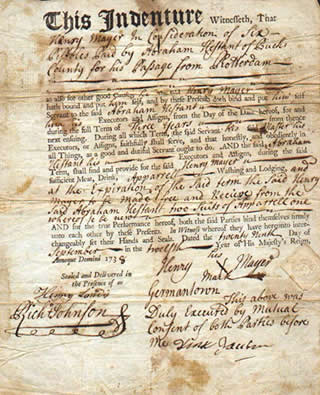
Indentured servitude is a form of labor in which a person is contracted to work without salary for a specific number of years. The contract, called an "indenture", may be entered voluntarily for a prepaid lump sum, as payment for some good or service (e.g. travel), purported eventual compensation, or debt repayment. An indenture may also be imposed involuntarily as a judicial punishment. The practice has been compared to the similar institution of slavery, although there are differences.
Historically, in an apprenticeship, an apprentice worked with no pay for a master tradesman to learn a trade. This was often for a fixed length of time, usually seven years or less. Apprenticeship was not the same as indentureship, although many apprentices were tricked into falling into debt and thus having to indenture themselves for years more to pay off such sums.[citation needed]
Like any loan, an indenture could be sold. Most masters had to depend on middlemen or ships' masters to recruit and transport the workers, so indentureships were commonly sold by such men to planters or others upon the ships' arrival. Like slaves, their prices went up or down, depending on supply and demand. When the indenture (loan) was paid off, the worker was free but not always in good health or of sound body. Sometimes they might be given a plot of land or a small sum to buy it, but the land was usually poor.[citation needed]
Americas
[edit]Until the late 18th century, indentured servitude was common in British America. It was often a way for Europeans to migrate to the American colonies: they signed an indenture in return for a costly passage. However, the system was also used to exploit many of them, as well as Asians (mostly from India and China) who wanted to migrate to the New World. These Asian people were used mainly to construct roads and railway systems. After their indenture expired, the immigrants were free to work for themselves or another employer. At least one economist has suggested that "indentured servitude was an economic arrangement designed to iron out imperfections in the capital market".[1] In some cases, the indenture was made with a ship's master, who sold the indenture to an employer in the colonies. Most indentured servants worked as farm laborers or domestic servants, although some were apprenticed to craftsmen.
The terms of an indenture were not always enforced by American courts, although runaways were usually sought out and returned to their employer.
Between one-half and two-thirds of European immigrants to the American Colonies between the 1630s and the American Revolution came under indentures.[2] However, while almost half the European immigrants to the Thirteen Colonies were indentured servants, at any one time they were outnumbered by workers who had never been indentured, or whose indenture had expired, and thus free wage labor was the more prevalent for Europeans in the colonies.[3] Indentured people were numerically important mostly in the region from Virginia north to New Jersey. Other colonies saw far fewer of them. The total number of European immigrants to all 13 colonies before 1775 was about 500,000; of these 55,000 were involuntary prisoners. Of the 450,000 or so European arrivals who came voluntarily, Tomlins estimates that 48% were indentured.[4] About 75% of these were under the age of 25. The age of adulthood for men was 24 years (not 21); those over 24 generally came on contracts lasting about three years.[5] Regarding the children who came, Gary Nash reports that "many of the servants were nephews, nieces, cousins, and children of friends of emigrating Englishmen, who paid their passage in return for their labor once in America."[6]

Several instances of kidnapping[7] for transportation to the Americas are recorded, such as that of Peter Williamson (1730–1799). Historian Richard Hofstadter pointed out that "Although efforts were made to regulate or check their activities, and they diminished in importance in the eighteenth century, it remains true that a certain small part of the European colonial population of America was brought by force, and a much larger portion came in response to deceit and misrepresentation on the part of the spirits [recruiting agents]."[8] One "spirit" named William Thiene was known to have spirited away[9] 840 people from Britain to the colonies in a single year.[10] Historian Lerone Bennett Jr. notes that "Masters given to flogging often did not care whether their victims were black or white."[11]
Also, during the 18th and early 19th centuries, children from the UK were often kidnapped and sold into indentured labor in the American and Caribbean colonies (often without any indentures).[12][13]
Indentured servitude was also used by governments in Britain for captured prisoners of war in rebellions and civil wars. Oliver Cromwell sent into indentured service thousands of prisoners captured in the 1648 Battle of Preston and the 1651 Battle of Worcester. King James II acted similarly after the Monmouth Rebellion in 1685, and the use of such measures continued into the 18th century.[citation needed]
Indentured servants could not marry without the permission of their master, were frequently subject to physical punishment, and did not receive legal favor from the courts. Female indentured servants in particular might be raped and/or sexually abused by their masters. If children were produced the labour would be extended by two years.[14] Cases of successful prosecution for these crimes were very uncommon, as indentured servants were unlikely to have access to a magistrate, and social pressure to avoid such brutality could vary by geography and cultural norm. The situation was particularly difficult for indentured women, because in both low social class and gender,[citation needed] they were believed to be particularly prone to vice, making legal redress unusual.
The American Revolution severely limited immigration to the United States, but economic historians dispute its long-term impact. Sharon Salinger argues that the economic crisis that followed the war made long-term labor contracts unattractive. Her analysis of Philadelphia's population shows that the percentage of bound citizens fell from 17% to 6.4% throughout the war.[15] William Miller posits a more moderate theory, stating that "the Revolution...wrought disturbances upon white servitude. But these were temporary rather than lasting".[16] David Galenson supports this theory by proposing that the numbers of British indentured servants never recovered, and that Europeans of other nationalities replaced them.[17]
Indentured servitude began its decline after Bacon's Rebellion, a servant uprising against the government of Colonial Virginia.[18] This was due to multiple factors, such as the treatment of servants, the government's refusal to expel native tribes from the surrounding area, refusal to expand the amount of land an indentured servant could work by the colonial government, and inequality between the upper and lower class in colonial society.[18] Indentured servitude was the primary source of labor for early American colonists until the rebellion.[19] Little changed in the immediate aftermath of Bacon's Rebellion; however, the rebellion did cause a general distrust of servant labor and fear of future rebellion.[20] The fear of indentured servitude eventually cemented itself into the hearts of Americans, leading towards the reliance on enslaved Africans.[21] This helped to ingrain the idea of racial segregation and unite white Americans under race rather than economic or social class.[20] Doing so prevented the potential for future rebellion and changed the way that agriculture was approached.
The American and British governments passed several laws that helped foster the decline of indentures. The UK Parliament's Passenger Vessels Act 1803 regulated travel conditions aboard ships to make transportation more expensive, and to hinder landlords' tenants seeking a better life. An American law passed in 1833 abolished the imprisonment of debtors, which made prosecuting runaway servants more difficult, increasing the risk of indenture contract purchases. The Thirteenth Amendment to the United States Constitution, passed in the wake of the American Civil War, made involuntary indentured servitude illegal in the United States, except for imprisonment, such as in for-profit prisons.
Contracts
[edit]Through its introduction, the details regarding indentured labor varied across import and export regions and most overseas contracts were made before the voyage with the understanding that prospective migrants were competent enough to make overseas contracts on their own account and that they preferred to have a contract before the voyage.[22]
Most labor contracts made were in increments of five years, with the opportunity to extend another five years. Many contracts also provided free passage home after the dictated labor was completed. However, there were generally no policies regulating employers once the labor hours were completed, which led to frequent ill-treatment.[22]
Caribbean
[edit]
In 1643, the European population of Barbados was 37,200[23] (86% of the population).[24] During the Wars of the Three Kingdoms, at least 10,000 Irish and some Scottish and English prisoners of war were transported as indentured laborers to the colonies.[25]
A half million Europeans went as indentured servants to the Caribbean (primarily the English-speaking islands of the Caribbean) before 1840.[26][27]
In 1838, with the abolition of slavery at its onset, the British were in the process of transporting a million Indians out of India and into the Caribbean to take the place of the recently freed Africans (freed in 1833) in indentureship. Women, looking for what they believed would be a better life in the colonies, were specifically sought after and recruited at a much higher rate than men due to the high population of men already in the colonies.[citation needed] However, women had to prove their status as single and eligible to emigrate, as married women could not leave without their husbands. Many women seeking escape from abusive relationships were willing to take that chance. The Indian Immigration Act of 1883[28] prevented women from exiting India as widowed or single in order to escape.[29] Arrival in the colonies brought unexpected conditions of poverty, homelessness, and little to no food as the high numbers of emigrants overwhelmed the small villages and flooded the labor market. Many were forced into signing labor contracts that exposed them to the hard field labor on the plantation. Additionally, on arrival to the plantation, single women were 'assigned' a man as they were not allowed to live alone. The subtle difference between slavery and indenture-ship is best seen here as women were still subjected to the control of the plantation owners as well as their newly assigned 'partner'.[30]
Indentured servitude of Irish and other European peoples occurred in seventeenth-century Barbados, and was fundamentally different from enslavement: an enslaved African's body was owned, as were the bodies of their children, while the labour of indentured servants was under contractual ownership of another person.[31][32] Laws and racial hierarchy would allow for the "indentured" and "slaves" to be treated differently, as well as their identities to be defined differently.[33][32]
Barbados is an example of a colony in which the separation between enslaved Africans and "servants" was codified into law.[33] Distinct legal "acts" were created in 1661 treating each party as a separate group.[33]
The British ruling class anxieties over Irish loyalties would lead to harsh policing of Irish servants' movements, for instance, needing "reason" to leave the plantations from which they were employed.[34] Similarly, the laws regarding slavery would prevent enslaved Africans from doing the same.[34][35] While enslaved Africans - and for a period, free Africans - were not allowed to use the court system in any manner, even to act as a witness, Barbados would allow "white servants" to go to court if they felt that they had received poor treatment.[36] Additionally, children of African descent were offered no supplementary protection, while children of English, Irish, Scottish, and Welsh extraction who were sent to Barbados as indentured servants could not work without a parent's consent.[37]
Such differences in social classes would ensure that alliances between the two groups would not lead to revolts towards plantation owners and managers.[38]
As well, during periods of mass indentured servitude of Irish peoples in the Caribbean, certain Irish individuals would use enslaved labour to profit financially and climb the ladder of social class.[39][40] Historians Kristen Block and Jenny Shaw write that: "the Irish — by virtue of their European heritage — gained […] greater social and economic mobility."[39] An example is a former indentured servant in Barbados, Cornelius Bryan, would go on to own land and enslaved people himself, demonstrating the tiers between servant and slave classes.[41]
South Asia
[edit]
The Indian indenture system was a system of indenture by which two million[42] Indians called coolies were transported to various colonies of European powers to provide labour for the (mainly sugar) plantations. It started from the end of slavery in 1833 and continued until 1920. This resulted in the development of a large Indian diaspora, which spread from the Indian Ocean (i.e. Réunion and Mauritius) to Pacific Ocean (i.e. Fiji), as well as the growth of Indo-Caribbean and Indo-African population.
.jpg)
The British wanted local black Africans to work in Natal as workers. But the locals refused, and as a result, the British introduced the Indian indenture system, resulting in a permanent Indian South African presence. On 18 January 1826, the Government of the French Indian Ocean island of Réunion laid down terms for the introduction of Indian labourers to the colony. Each man was required to appear before a magistrate and declare that he was going voluntarily. The contract was for five years with pay of ₹8 (12¢ US)[citation needed] per month and rations provided labourers had been transported from Pondicherry and Karaikal. The first attempt at importing Indian labour into Mauritius, in 1829, ended in failure, but by 1834, with abolition of slavery throughout most of the British Empire, transportation of Indian labour to the island gained pace. By 1838, 25,000 Indian labourers had been transported to Mauritius.

After the end of slavery, the West Indian sugar colonies tried the use of emancipated slaves, families from Ireland, Germany and Malta and Portuguese from Madeira. All these efforts failed to satisfy the labour needs of the colonies due to high mortality of the new arrivals and their reluctance to continue working at the end of their indenture. On 16 November 1844, the British Indian Government legalised emigration to Jamaica, Trinidad and Demerara (Guyana). The first ship, Whitby, sailed from Calcutta for British Guiana on 13 January 1838, and arrived in Berbice on 5 May 1838. Transportation to the Caribbean stopped in 1848 due to problems in the sugar industry and resumed in Demerara and Trinidad in 1851 and Jamaica in 1860.
This system of labour was coined by contemporaries at the time as a "new system of slavery", a term later used by historian Hugh Tinker in his influential book of the same name.[43]
The Indian indenture system was finally banned in 1917.[44] Although the system was officially suspended, those who were serving indentures at that time were required to complete their terms of service, thereby extending the system into the early 1920s.[45] According to The Economist, "When the Imperial Legislative Council finally ended indenture...it did so because of pressure from Indian nationalists and declining profitability, rather than from humanitarian concerns."[44]
China
[edit]During the mid-19th century, thousands of Chinese laborers were contracted, often under deceptive or coercive means by slavers called crimps, to work in plantations across the Caribbean, Peru, and Hawaii. These migrations were a direct consequence of colonial powers seeking cheap labor post-slavery abolition, with Chinese trade docks being forced open by the unequal treaties following the Opium Wars.[46]
These workers endured grueling labor conditions.[46] A Yankee plantation manager in Hawaii is quoted as saying, "They have to work all the time — and no regard is paid to their complaints for food, etc., Slavery is nothing compared to it."[47] These laborers were part of a larger post-abolition system that replaced chattel slavery with contract slavery. Testimonies from Chinese workers in Cuba document abuse, overwork, and limited legal recourse.[48]
Oceania
[edit]Convicts transported to the Australian colonies before the 1840s often found themselves hired out in a form of indentured labor.[49] Indentured servants also emigrated to New South Wales.[50] The Van Diemen's Land Company used skilled indentured labor for periods of seven years or less.[51] A similar scheme for the Swan River area of Western Australia existed between 1829 and 1832.[52]
During the 1860s planters in Australia, Fiji, New Caledonia, and the Samoa Islands, in need of laborers, encouraged a trade in long-term indentured labor called "blackbirding". At the height of the labor trade, more than one-half the adult male population of several of the islands worked abroad.[citation needed]

Over a period of 40 years, from the mid-19th century to the early 20th century, labor for the sugar-cane fields of Queensland, Australia included an element of coercive recruitment and indentured servitude of the 62,000 South Sea Islanders. The workers came mainly from Melanesia – mainly from the Solomon Islands and Vanuatu – with a small number from Polynesian and Micronesian areas such as Samoa, the Gilbert Islands (subsequently known as Kiribati) and the Ellice Islands (subsequently known as Tuvalu). They became collectively known as "Kanakas".[citation needed]
Indentured labour existed in Papua New Guinea.[53]
It remains unknown how many Islanders the trade controversially kidnapped. Whether the system legally recruited Islanders, persuaded, deceived, coerced or forced them to leave their homes and travel by ship to Queensland remains difficult to determine. Official documents and accounts from the period often conflict with the oral tradition passed down to the descendants of workers. Stories of blatantly violent kidnapping tend to relate to the first 10–15 years of the trade.[citation needed]
Australia deported many of these Islanders back to their places of origin in the period 1906–1908 under the provisions of the Pacific Island Labourers Act 1901.[54]
Africa
[edit]A significant number of construction projects in British East Africa and South Africa, required vast quantities of labor, exceeding the availability or willingness of local tribesmen. Indentured Indians from India were imported, for such projects as the Uganda Railway, as farm labor, and as miners. They and their descendants formed a significant portion of the population and economy of Kenya and Uganda, although not without engendering resentment from others. Idi Amin's expulsion of the "Asians" from Uganda in 1972 was an expulsion of Indo-Africans.[55]
The majority of the population of Mauritius are descendants of Indian indentured labourers brought in between 1834 and 1921. Initially brought to work the sugar estates following the abolition of slavery in the British Empire an estimated half a million indentured laborers were present on the island during this period. Aapravasi Ghat, in the bay at Port Louis and now a UNESCO site, was the first British colony to serve as a major reception centre for indentured Indians from India who came to work on plantations following the abolition of slavery.[56]
Legal status
[edit]The Universal Declaration of Human Rights (adopted by the United Nations General Assembly in 1948) declares in Article 4 "No one shall be held in slavery or servitude; slavery and the slave trade shall be prohibited in all their forms".[57] More specifically, it is dealt with by article 1(a) of the United Nations 1956 Supplementary Convention on the Abolition of Slavery.
However, only national legislation can establish the unlawfulness of indentured labor in a specific jurisdiction. In the United States, the Victims of Trafficking and Violence Protection Act (VTVPA) of 2000 extended servitude to cover peonage as well as Involuntary Servitude.[58]
See also
[edit]- Bracero program
- Coolie
- Debt Bondage
- English Poor Laws
- Human trafficking
- Home Children
- Indenture (document)
- Indentured servitude in Pennsylvania
- Involuntary servitude
- Irish indentured servants
- List of indentured servants
- Padrone system
- Penal transportation
- Redemptioner
- Scottish poorhouse
- Slavery
- United States labor law
- Unpaid work
Notes
[edit]- ^ Whaples, Robert (March 1995). "Where Is There Consensus Among American Economic Historians? The Results of a Survey on Forty Propositions". The Journal of Economic History. 55 (1): 139–154. CiteSeerX 10.1.1.482.4975. doi:10.1017/S0022050700040602. JSTOR 2123771. S2CID 145691938.
...[the] vast majority [of economic historians and economists] accept the view that indentured servitude was an economic arrangement designed to iron out imperfections in the capital market.
- ^ Galenson 1984, p. 1.
- ^ Donoghue, John (October 2013). "Indentured Servitude in the 17th Century English Atlantic: A Brief Survey of the Literature: Indentured Servitude in the 17th Century English Atlantic". History Compass. 11 (10): 893–902. doi:10.1111/hic3.12088.
- ^ Tomlins, Christopher (2001). "Reconsidering Indentured Servitude: European Migration and the Early American Labor Force, 1600–1775". Labor History. 42 (1): 5–43. doi:10.1080/00236560123269. S2CID 153628561.
- ^ Tomlins (2001) at notes 31, 42, 66
- ^ Gary Nash, The Urban Crucible: The Northern Seaports and the Origins of the American Revolution (1979) p 15
- ^ "trepan | trapan, n.2". OED Online. June 2017. Oxford University Press
- ^ Richard Hofstadter (1971). America at 1750: A Social Portrait. Knopf Doubleday. p. 36. ISBN 978-0-307-80965-0.
- ^ Bennett Jr., Lerone (November 1969). White Servitude in America. Ebony Magazine. pp. 31–40.
- ^ Calendar of State Papers: Colonial series. Great Britain. Public Record Office. 1893. p. 521.
- ^ Calendar of State Papers: Colonial series. Great Britain. Public Record Office. 1893. p. 36.
- ^ Russell, Judy G. (February 21, 2014). "The transported child".
- ^ Kelly, James (November 10, 2018). "' Horrid' and 'infamous' practices: the kidnapping and stripping of children, c.1730–c.1840". Irish Historical Studies. 42 (162): 265–292. doi:10.1017/ihs.2018.33. S2CID 159797724 – via Cambridge University Press.
- ^ Hill, Anita; Jordan, Emma Coleman, eds. (1995). Race, gender, and power in America: the legacy of the Hill-Thomas hearings. New York: Oxford University Press. ISBN 0-19-508774-7. OCLC 32891709.
- ^ Salinger, Sharon V. (1981). "Colonial Labor in Transition: The Decline of Indentured Servitude in Late Eighteenth-Century Philadelphia". Labor History. 2. 22 (2): 165–191 [181]. doi:10.1080/00236568108584612.
- ^ Miller, William (1940). "The Effects of the American Revolution on Indentured Servitude". Pennsylvania History. 7 (3): 131–141 [137]. JSTOR 27766414.
- ^ Galenson 1984, p. 13.
- ^ a b Schmidt, Ethan (2015). The Divided Dominion: Social Conflict and Indian Hatred in Early Virginia. University Press of Colorado. pp. 149–176. ISBN 978-1-60732-308-2.
- ^ McCurdy, J. G. Bacon's Rebellion [full citation needed]
- ^ a b Riggs, Thomas (2015) Bacon's Rebellion[full citation needed]
- ^ Stevenson, K. Bacon's Rebellion[full citation needed]
- ^ a b Walton, Lai. Indentured Labor, Caribbean Sugar. pp. 50–70.
- ^ Cutler, Cecilia (12 July 2017). Language Contact in Africa and the African Diaspora in the Americas: In honor of John V. Singler. John Benjamins Publishing Company. p. 178. ISBN 978-90-272-5277-7.
- ^ Population, Slavery and Economy in Barbados, BBC.
- ^ Higman 1997, p. 108.
- ^ Michael D. Bordo, Alan M. Taylor, Jeffrey G. Williamson, eds. Globalization in historical perspective (2005) p. 72
- ^ Gordon K. Lewis and Anthony P. Maingot, Main Currents in Caribbean Thought: The Historical Evolution of Caribbean Society in Its Ideological Aspects, 1492–1900 (2004) pp 96–97
- ^ "12 Feb 1883 – THE INDIAN IMMIGRATION ACT. – Trove". South Australian Register. Trove.nla.gov.au. 12 February 1883. Retrieved 2022-03-18.
- ^ Bahadur, Gaiutra (2014). Coolie Woman: The Odyssey of Indenture. United States: Chicago Press. p. 22. ISBN 978-0-226-21138-1.
- ^ Bahadur, Gaiutra (2014). Coolie Woman: The Odyssey of Indenture. United States: University of Chicago Press. p. 123. ISBN 978-0-226-21138-1.
- ^ Handler & Reilly 2017, p. 39.
- ^ a b Hogan, Liam; McAtackney, Laura; Reilly, Matthew (March 2016). "The Irish in the Anglo-Caribbean: Servants or Slaves?". History Ireland. 24 (2): 18–22. doi:10.17613/M61Z41S48.
- ^ a b c Shaw 2013, p. 15.
- ^ a b Shaw 2013, p. 39.
- ^ "Barbados Side-by-Side Transcription - Slavery Law & Power in Early America and the British Empire". 2022-02-08.
- ^ Handler & Reilly 2017, p. 40.
- ^ Handler & Reilly 2017, p. 42.
- ^ Shaw 2013, p. 22.
- ^ a b Block & Shaw 2011, p. 60.
- ^ Shaw 2013, p. 157.
- ^ Shaw 2013, pp. 1–2.
- ^ "Indentured labour from South Asia (1834-1917) | Striking Women". www.striking-women.org.
- ^ Tinker, Hugh (1974). A New System of Slavery: The Export of Indian Labour Overseas 1830–1920. London: Oxford Univ. Press.
- ^ a b "The legacy of Indian migration to European colonies". The Economist. 2 September 2017. Retrieved 2 September 2017.
- ^ Sturman, Rachel (1 December 2014). "Indian Indentured Labor and the History of International Rights Regimes". academic.oup.com. Retrieved 2024-02-09.
- ^ a b Ding, Loni (2001). Ancestors in the Americas (Streaming video) (Documentary). CET Films. Retrieved 2025-02-02 – via Kanopy.
- ^ Takaki, Ronald (1998). Strangers from a Different Shore: A History of Asian Americans. United States: Little, Brown and Company. p. 21.
- ^ Yun, Lisa (2009). The Coolie Speaks: Chinese Indentured Laborers and African Slaves in Cuba. United States: Temple University Press.
- ^
Atkinson, James (1826). An account of the state of agriculture & grazing in New South Wales. London: J. Cross. p. 110. Retrieved 2012-11-14.
On Sir Thomas Brisbane assuming the Government, it was ordered, that all persons should, for every 100 acres of land granted to them, take and keep one convict until the expiration or remission of his sentence.
- ^
Perkins, John (1987), "Convict Labour and the Australian Agricultural Company", in Nicholas, Stephen (ed.), The Convict Workers: Reinterpeting Australia's Past, Studies in Australian History, Cambridge University Press (published 1988), p. 168, ISBN 978-0-521-36126-2, retrieved 2012-11-14,
A feature of the Australian Agricultural Company's operation at Port Stephens was the simultaneous employment [...] of various forms of labour. The original nucleus of the workforce consisted of indentured servants brought out from Europe on seven-year contracts.
- ^ p.15 Duxbury, Jennifer Colonia Servitude: Indentured and Assigned Servants of the Van Diemen's Land Company 1825–1841 Monach Publications in History 1989
- ^ Fitch, Valerie Eager for Labour:The Swan River Indenture Hesperian Press 2003
- ^ Hawthorne, Harry (13 March 1946). "Indentured labour in New Guinea". Institute of Pacific Relations. 15 (5). JStor: 74–78. doi:10.2307/3022147. JSTOR 3022147.
- ^ "Documenting Democracy". Foundingdocs.gov.au. Archived from the original on October 26, 2009. Retrieved 2009-07-04.
- ^ Patel, Hasu H. (1972). "General Amin and the Indian Exodus from Uganda". Issue: A Journal of Opinion. 2 (4): 12–22. doi:10.2307/1166488. JSTOR 1166488.
- ^ "History". Government Portal of Mauritius. Archived from the original on 16 October 2016. Retrieved 22 January 2015.
- ^ "Universal Declaration of Human Rights". United Nations. Retrieved 2011-10-14.
- ^ "US Peonage and involuntary servitude laws". justice.gov. Retrieved 2011-10-14.
References
[edit]- Bahadur, Gaiutra (2014). Coolie Woman: The Odyssey of Indenture. The University of Chicago. ISBN 978-0-226-21138-1.
- "Barbados Side-by-Side Transcription". Slavery Law & Power in Early America and the British Empire.
- Block, Kristen; Shaw, Jenny (2011). "Subjects without Empire: The Irish in the Early Modern Caribbean". Past & Present (210): 33–60. doi:10.1093/pastj/gtq059. JSTOR 23015371.
- Higman, B. W. (1997). Knight, Franklin W. (ed.). General History of the Caribbean: The slave societies of the Caribbean. Vol. 3 (illustrated ed.). UNESCO. p. 108. ISBN 978-0-333-65605-1.
- Galenson, David W. (March 1981). "White Servitude and the Growth of Black Slavery in Colonial America" (PDF). The Journal of Economic History. 41 (1): 39–47. doi:10.1017/s0022050700042728. S2CID 154760626.
- Galenson, David W. (June 1981). "The Market Evaluation of Human Capital: The Case of Indentured Servitude" (PDF). Journal of Political Economy. 89 (3): 446–467. doi:10.1086/260980. S2CID 44248111.
- Galenson, David W. (March 1984). "The Rise and Fall of Indentured Servitude in the Americas: An Economic Analysis". The Journal of Economic History. 44 (1): 1–26. doi:10.1017/s002205070003134x. S2CID 154682898.
- Grubb, Farley (July 1985). "The Incidence of Servitude in Trans-Atlantic Migration, 1771–1804". Explorations in Economic History. 22 (3): 316–39. doi:10.1016/0014-4983(85)90016-6.
- Grubb, Farley (Dec 1985). "The Market for Indentured Immigrants: Evidence on the Efficiency of Forward-Labor Contracting in Philadelphia, 1745–1773". The Journal of Economic History. 45 (4): 855–868. doi:10.1017/s0022050700035130. S2CID 36848963.
- Grubb, Farley (Spring 1994). "The Disappearance of Organized Markets for European Immigrant Servants in the United States: Five Popular Explanations Reexamined". Social Science History. 18 (1): 1–30. doi:10.2307/1171397. JSTOR 1171397.
- Grubb, Farley (Dec 1994). "The End of European Immigrant Servitude in the United States: An Economic Analysis of Market Collapse, 1772–1835". The Journal of Economic History. 54 (4): 794–824. doi:10.1017/s0022050700015497. S2CID 153945665.
- Handler, Jerome S.; Reilly, Matthew C. (2017). "Contesting 'White Slavery' in the Caribbean: Enslaved Africans and European Indentured Servants in Seventeenth-Century Barbados". New West Indian Guide. 91 (1/2): 30–55. doi:10.1163/22134360-09101056. JSTOR 26552068. S2CID 164512540.
- Hogan, Liam; McAtackney, Laura; Reilly, Matthew (March 2016). "The Irish in the Anglo-Caribbean: Servants or Slaves?". History Ireland. 24 (2): 18–22. doi:10.17613/M61Z41S48.
- Shaw, Jenny (2013). Everyday Life in the Early English Caribbean: Irish, Africans, and the Construction of Difference. University of Georgia Press. ISBN 978-0-8203-4634-2. OCLC 864551346.
- Tomlins, Christopher (2001). "Reconsidering Indentured Servitude: European Migration and the Early American Labor Force, 1600–1775". Labor History. 42 (1): 5–43. doi:10.1080/00236560123269. S2CID 153628561.
Further reading
[edit]- Abramitzky, Ran; Braggion, Fabio (2006). "Migration and Human Capital: Self-Selection of Indentured Servants to the Americas". The Journal of Economic History. 66 (4): 882–905. doi:10.1017/S0022050706000362. JSTOR 4501107. S2CID 46777744.
- Ballagh, James Curtis. White Servitude In The Colony Of Virginia: A Study Of The System Of Indentured Labor In The American Colonies (1895) excerpt and text search
- Brown, Kathleen. Goodwives, Nasty Wenches & Anxious Patriachs: gender, race and power in Colonial Virginia, U. of North Carolina Press, 1996.
- Hofstadter, Richard. America at 1750: A Social Portrait (Knopf, 1971) pp 33–65 online
- Jernegan, Marcus Wilson Laboring and Dependent Classes in Colonial America, 1607–1783 (1931)
- Morgan, Edmund S. American Slavery, American Freedom: The Ordeal of Colonial Virginia. (Norton, 1975).
- Nagl, Dominik. No Part of the Mother Country, but Distinct Dominions – Law, State Formation and Governance in England, Massachusetts und South Carolina, 1630–1769 (LIT, 2013): 515–535, 577f., 635–689.online
- Salinger, Sharon V. To serve well and faithfully: Labor and Indentured Servants in Pennsylvania, 1682–1800. (2000)
- Tomlins, Christopher. Freedom Bound: Law, Labor, and Civic Identity in English Colonization, 1580–1865 (2010); influential recent interpretation online review
- Torabully, Khal, and Marina Carter, Coolitude: An Anthology of the Indian Labour Diaspora Anthem Press, London, 2002, ISBN 1-84331-003-1
- Torabully, Khal, Voices from the Aapravasi Ghat – Indentured imaginaries, poetry collection on the coolie route and the fakir's aesthetics, Aapravasi Ghat Trust Fund, AGTF, Mauritius, November 2, 2013.
- Wareing, John. Indentured Migration and the Servant Trade from London to America, 1618–1718. Oxford Oxford University Press, February 2017
- Whitehead, John Frederick, Johann Carl Buttner, Susan E. Klepp, and Farley Grubb. Souls for Sale: Two German Redemptioners Come to Revolutionary America, Max Kade German-American Research Institute Series, ISBN 0-271-02882-3.
- Zipf, Karin L. Labor of Innocents: Forced Apprenticeship in North Carolina, 1715–1919 (2005).
Historiography
[edit]- Donoghue, John (October 2013). "Indentured Servitude in the 17th Century English Atlantic: A Brief Survey of the Literature: Indentured Servitude in the 17th Century English Atlantic". History Compass. 11 (10): 893–902. doi:10.1111/hic3.12088.
External links
[edit] Media related to Indentured servitude at Wikimedia Commons
- GUIANA 1838 – a film about indentured laborers
- Voices from the Aapravasi Ghat, Khal TOrabully, Potomitan - Voices from the Aapravasi Ghat

Indentured servitude
View on GrokipediaDefinition and Core Features
Contractual Basis and Typical Terms
Indentured servitude was predicated on formal written contracts known as indentures, rooted in English common law practices of apprenticeship and personal labor covenants, whereby individuals bound themselves to a master for a defined period of service in exchange for passage to the colonies, provision of necessities, and terminal freedom dues. These agreements, often signed in Europe by the servant or their guardian with a merchant or ship captain who subsequently auctioned the labor contract in the Americas, established a transferable claim on the servant's future productivity to offset transportation costs equivalent to half to a full year's wage in the origin country. In British North American colonies like Virginia, the system was institutionalized from 1619 by the Virginia Company, with headright grants incentivizing importation by awarding 50–100 acres of land per transported person.[6][3] Typical contract durations ranged from four to seven years for adult servants, with extensions for women due to pregnancy or for all due to infractions such as absconding; minors faced longer terms, such as until age 21 or 24, as standardized in Virginia laws by 1643 specifying seven years for those under 12, five years for ages 12–19, and four years for those 20 and older. Servants undertook obligations to labor faithfully, obey commands, maintain secrecy, avoid taverns or unauthorized contracts, and compensate for damages, as exemplified in a 1742 New York indenture binding a youth to mercantile apprenticeship. Masters reciprocated by supplying sufficient meat, drink, apparel, lodging, and, in skilled cases, vocational training, without interim wages.[3][12][6] Upon fulfillment, freedom dues provided compensation, varying by jurisdiction and time: early seventeenth-century Virginia offered land via headrights, while 1705 statutes mandated ten bushels of corn plus 30 shillings for men and 15 bushels plus 40 shillings for women. Contracts were enforceable through colonial courts, where servants retained rights to sue for mistreatment or withheld provisions, though masters held leverage in prosecuting breaches with penalties like extended service or physical correction, underscoring the system's reliance on judicial oversight to balance coerced labor with temporal limits.[3]Key Distinctions from Chattel Slavery
Indentured servitude was fundamentally contractual and temporary, typically involving a fixed term of service—often four to seven years—in exchange for passage to a colony, food, clothing, and shelter, after which the servant gained freedom and sometimes "freedom dues" such as land or tools.[6][11] In contrast, chattel slavery entailed perpetual ownership of individuals as personal property, with no fixed end to bondage and no provision for emancipation through service.[13] This distinction arose from the legal framework of indenture contracts, which were enforceable documents specifying obligations and duration, whereas slaves held no such agreements and were subject to sale, inheritance, or disposal at the owner's discretion without consent.[10] Legally, indentured servants retained certain rights absent in chattel slavery, including the ability to sue masters for excessive abuse or contract violations in colonial courts, limited protections against arbitrary punishment, and the capacity to marry or form families without automatic enslavement of offspring.[11][14] Children born to indentured women during service were generally not bound to the same term and became free upon the mother's release, unlike in chattel slavery where bondage was hereditary, with offspring inheriting slave status matrilineally—a codification increasingly formalized in laws by the mid-17th century, such as Virginia's 1662 statute declaring children of enslaved mothers to be slaves.[13][6] While indenture contracts could be transferred or sold between masters, this affected only the remaining term of service rather than conferring absolute ownership of the person as chattel, and servants were not classified as merchandise in the same absolute sense.[10] Early colonial records, such as those from Virginia and Maryland in the 1620s–1640s, show indentured laborers—predominantly European—integrated into a system expecting eventual freedom, which contrasted with the emerging racialized permanence of African enslavement post-1660s, when statutes distinguished slaves by denying them even basic servant protections.[14][13] These legal demarcations underscored indenture as a form of debt bondage with an exit mechanism, not equivalent to the total alienation of personhood in chattel systems.[5]Historical Origins and Evolution
Medieval and Early Modern European Roots
Indentures, as legal contracts binding parties to service, emerged in medieval England during the 13th century, deriving their name from the practice of duplicating agreements on a single parchment and separating copies along a serrated edge for verification.[15] These documents formalized temporary obligations, distinct from hereditary serfdom, and laid foundational precedents for time-limited bound labor. By the 14th century, following the Black Death's labor shortages, the Statute of Labourers enacted in 1349 compelled able-bodied individuals under 60 to accept work under fixed wages and terms, often enforced through contractual indentures that penalized refusal with penalties like imprisonment.[3] A primary manifestation was apprenticeship, where children as young as 7 were indentured to masters for periods typically lasting 7 years, though terms extended to 10-14 years for younger entrants, in exchange for vocational training, lodging, food, and apparel. Surviving indentures from 1255 to 1500, numbering around 82 in analyzed collections, reveal guilds' oversight in regulating these bindings, with masters obligated to provide instruction while apprentices surrendered freedom of movement and labor.[16] Breaches, such as absconding, invoked legal remedies including fines or extended service, underscoring the contracts' enforceability under common law. This system addressed urban skill shortages and family economic pressures, binding over 50% of London youths by the late medieval period according to guild records. Military indentures similarly structured bound service, as seen in agreements during the Hundred Years' War; for instance, contracts from 1340 onward stipulated captains' obligations to furnish armed retainers for campaigns in return for royal payments and land grants, with terms specifying troop numbers, equipment, and durations like 6 months.[17] Edward III's 1355 indenture with the Black Prince for a Gascony expedition exemplifies this, binding the prince to mobilize 2,000 men-at-arms and 2,000 archers by July 10, with provisions for wages, horses, and forfeiture clauses for non-compliance.[18] Such arrangements extended to individual soldiers, who pledged loyalty and combat service for stipends, fostering a contractual military ethos over feudal levies. In the early modern era (c. 1500-1700), these practices evolved amid enclosure, population growth, and vagrancy, with statutes like the 1495 and 1530 acts authorizing justices to indenture vagrants and paupers into domestic or agricultural service for 1-2 years, repayable via labor for relief costs. Poor Law mechanisms from 1601 formalized parish bindings of orphans and indigents, often to yeomen for terms up to 21 years, providing maintenance without wages but promising freedom dues like tools or cash upon completion. This framework, rooted in medieval precedents, emphasized voluntary or coerced consent to temporary unfreedom, contrasting perpetual bondage and enabling scalability for labor demands, though abuses like excessive extensions eroded distinctions from involuntary servitude.[19]Initial Adoption in Colonial Contexts (17th Century)
Indentured servitude emerged as a critical labor mechanism in the British colony of Virginia during the early 17th century, addressing severe shortages of workers needed to cultivate tobacco, the colony's emerging staple crop following John Rolfe's introduction of commercial strains in 1612. The Virginia Company of London, responsible for the Jamestown settlement established in 1607, began transporting indentured servants from England in the decade thereafter, with formalized recruitment accelerating by 1619 to collateralize passage debts against future labor. These contracts typically bound servants—often impoverished English artisans, farmers, or vagrants—for terms of four to seven years, in exchange for transatlantic voyage costs, basic sustenance, and "freedom dues" upon completion, such as clothing, tools, or small land grants.[11][6] This system adapted English precedents of bound service, such as apprenticeships and vagrancy laws, to colonial imperatives, amplified by the headright policy enacted in 1618, which awarded planters 50 acres of land per imported servant, incentivizing mass recruitment. By the mid-17th century, roughly 75 percent of English arrivals in Virginia had entered as indentured servants, forming the backbone of the colony's expansion amid high settler mortality from famine, conflict, and disease that deterred free migration. The practice quickly extended to neighboring Chesapeake colonies like Maryland, founded in 1634, where similar tobacco-driven economies replicated Virginia's model, though initial adoption remained centered in Virginia due to its pioneering status.[3][20] Conditions under indenture were grueling, with estimates indicating that half of servants perished before contract expiration owing to malnutrition, exposure, epidemic diseases like malaria and dysentery, and relentless field labor; survivors faced exploitation risks, including extended terms for alleged breaches or pregnancies. Despite these perils, the system's temporary nature—contrasting with perpetual hereditary bondage—sustained recruitment from England's surplus labor pools, exacerbated by enclosures, urbanization, and post-Reformation social dislocations, enabling colonial proprietors to amass wealth without upfront capital for wages. Early records from 1619 onward document required registration of servant terms with colonial authorities, enforcing contractual obligations through courts that penalized runaways with additional service years.[3][20]Expansion After Slavery Abolition (19th Century)
The abolition of slavery in the British Empire through the Slavery Abolition Act of 1833, effective from August 1, 1834, created immediate labor shortages on sugar plantations in the Caribbean, Mauritius, and other colonies, as emancipated workers often sought better conditions or migrated. Plantation owners, compensated with £20 million by the British government but facing declining profitability, pressured colonial authorities to import alternative labor sources to sustain production. This led to the systematic expansion of indentured servitude, initially from India under regulated schemes approved in 1837, with the first arrivals in British Guiana numbering 36 Portuguese from Madeira in 1835, followed by Indians in 1836. By 1838, the voyage of the ship Hesperus marked the start of large-scale Indian migration, transporting 165 laborers to Guiana under five-year contracts for sugar work.[21][22][23] Indian indentured labor dominated the post-abolition influx, with over 1 million individuals recruited from regions like Uttar Pradesh and Bihar between 1834 and 1917 for British territories, including approximately 500,000 to the Caribbean colonies such as Trinidad (238,000), British Guiana (240,000), and Jamaica (39,000). Contracts typically lasted five years, offering wages of about 0.25 rupees per day, return passage, and basic provisions, though enforcement varied and abuses like inadequate food and harsh discipline were common. Mauritius received 452,000 Indians from 1829 but peaked post-1834, serving as a model for Caribbean schemes. Similar systems expanded in French colonies after 1848 emancipation, with 72,000 Indians to Réunion by 1880, and Dutch East Indies post-1863, importing 32,000 by century's end.[24][25][26] Chinese "coolie" labor supplemented Indian flows, particularly in Cuba and Peru, where the trade burgeoned after the British slave trade ban in 1807 and amid mid-century demand; from 1847, over 250,000 Chinese were shipped to Cuba alone by 1874 under eight-year contracts often secured through deception or force in ports like Amoy and Macau. The U.S. Congress prohibited the coolie trade in 1862 via legislation signed by President Lincoln, citing its coercive nature akin to slavery, though smuggling persisted. In Peru, around 90,000 arrived between 1849 and 1874 for guano and sugar, with mortality rates exceeding 50% on voyages due to overcrowding and disease.[27][28][29] Pacific Islander recruitment, known as "blackbirding," targeted Queensland's sugar industry from 1863, when 67 Melanesians arrived; over 62,000 contracts were issued by 1904, drawing from Vanuatu, Solomon Islands, and Papua New Guinea for three-year terms at £9 annually plus rations. Fiji imported 29,000 indentured Indians from 1879 under British rule, but earlier Pacific labor filled gaps. These schemes often involved coercion or kidnapping, prompting Royal Commissions in 1885 and leading to bans by 1907 in Australia, reflecting growing scrutiny over exploitative conditions mirroring slavery despite legal voluntariness.[30][31][32]Recruitment, Contracts, and Transportation
Labor Recruitment Methods
Recruitment for indentured servitude in early colonial contexts, particularly in British North America during the 17th century, primarily involved agents known as "crimps" in England and "Newlanders" on the European continent, who were employed by merchants and ship captains to solicit laborers from urban poor, rural vagrants, and inland towns through public drumming and promises of opportunity in the New World.[33] These recruiters targeted impoverished individuals, often exchanging verbal assurances of land ownership, wages, or freedom after service for signed indenture contracts that bound workers to 4-7 years of unpaid labor in exchange for transatlantic passage.[6] By the mid-17th century, in ports like London, the process had commercialized into a profit-driven trade managed by merchants, procurers, and ship masters, who advanced recruitment costs against future labor sales upon arrival.[34] Deception was common, with agents exaggerating prospects of prosperity while downplaying harsh terms, leading many recruits—frequently young, unskilled males from Britain, Ireland, and Germany—to sign under duress or misinformation, though outright kidnapping occurred less systematically than in later systems.[33] Contracts were formalized as written indentures, sometimes registered locally before departure, committing servants to planters who purchased their terms at colonial ports for sums equivalent to passage costs plus a premium.[3] Following the abolition of chattel slavery in the British Empire in 1833, recruitment shifted to Asia and Africa to fill labor shortages on plantations, with Indian workers sourced through licensed recruiters (arkatis) operating under colonial oversight but often relying on unlicensed sub-agents who used deceitful tactics in rural villages, such as false promises of high wages, short-term work, or family reunification to induce signatures on 5-year contracts.[35] Over 1.3 million Indians were recruited between 1834 and 1917, primarily from famine-stricken regions like Bihar and Uttar Pradesh, where economic desperation made populations vulnerable to coercive persuasion, including withholding information about overseas conditions or using alcohol and advances to secure agreements.[36] Regulations mandated medical checks and voluntary assent before a magistrate, but enforcement was lax, resulting in widespread abuse documented in colonial reports.[26] For Chinese "coolie" labor, introduced to Cuba, Peru, and British colonies from the 1840s, recruitment employed local brokers or "crimps" in coastal cities like Amoy and Shanghai, who lured impoverished peasants with offers of lucrative employment abroad, often masking the indenture's punitive clauses through verbal misrepresentations or forged consents.[27] Between 1847 and 1874, approximately 125,000 Chinese were sent to Cuba alone, with many subjected to kidnapping from inland areas or entrapment via debt advances, despite nominal bans on coercion under international treaties.[29] Contracts, typically 8 years in duration, were signed under consular supervision in some cases, but systemic fraud persisted, as recruiters profited from head taxes and bounties, contributing to high mortality during voyages.[37] In both Asian systems, colonial governments licensed emigration depots to centralize processes and mitigate scandals, yet recruiter incentives favored volume over ethics, leading to empirical patterns of regret among migrants upon realization of terms, as evidenced by desertion rates and repatriation demands in the late 19th century.[36][27] These methods, while framed as voluntary migration, relied on informational asymmetries and economic pressures, distinguishing them causally from free wage labor by embedding exit barriers in enforceable contracts backed by penal sanctions.Contract Provisions and Enforcement
Indentured servitude contracts, known as indentures, were formal legal agreements binding individuals to labor for a specified term in exchange for essentials such as passage to the destination, food, clothing, and shelter.[11] These documents typically outlined the duration of service, ranging from four to seven years for adults, with provisions for shorter or longer terms based on age, skills, or circumstances.[3] Masters were obligated to provide adequate maintenance during the term, including room, board, and sometimes medical care, while servants agreed to perform assigned labor diligently without wages.[38] Freedom dues formed a critical provision, entitling servants to compensation upon contract completion, often consisting of clothing, tools, money, or land—such as fifty acres in some colonial statutes—to facilitate transition to independence.[3] Contracts for minors were frequently signed by parents or guardians, incorporating apprenticeships for skills like farming or trades, with explicit clauses prohibiting abuse or excessive punishment.[12] Violations by servants, including unauthorized absence or pregnancy for women, could result in extensions of the service term, calculated at rates like one week added per day's absence.[2] Enforcement relied on colonial courts, which treated indentures as enforceable contracts, routinely upholding them against breaches by either party and fining non-compliant employers.[39] Runaway servants faced recapture through legal notices and rewards, with courts mandating return to masters and additional service penalties; for instance, Virginia laws in the 17th century imposed extensions of ten days per day absconded.[3] While servants retained limited rights to sue for mistreatment, such as excessive corporal punishment, enforcement favored masters due to power imbalances, though statutes in places like Maryland required provision of specified goods at term's end to prevent disputes.[40] This framework ensured contractual stability but often perpetuated harsh conditions, as judicial recourse for servants was inconsistently applied amid labor shortages.[5]Conditions During Transatlantic or Overseas Voyages
The transatlantic voyages of European indentured servants to British North America during the 17th and early 18th centuries typically lasted 6 to 12 weeks, depending on weather and departure ports such as London or Bristol, with passengers confined to dimly lit, low-ceilinged spaces between the ship's decks, often allowing less than 18 inches of headroom per person.[3] Overcrowding was common, with 200 to 400 individuals per vessel of 200 to 300 tons, leading to inadequate ventilation, rampant filth from human waste, and rapid spread of infectious diseases including typhus, smallpox, and scurvy due to deficient diets lacking fresh provisions.[41] Food rations consisted primarily of salted meat, hardtack biscuits, and limited vegetables or citrus, which deteriorated over time, exacerbating nutritional deficiencies; water supplies frequently turned foul, compelling reliance on contaminated sources.[42] Mortality rates on these passages for indentured and redemptioner migrants, such as German passengers between 1709 and 1760, averaged around 3.8 percent across sampled voyages carrying over 1,500 individuals, though spikes occurred during outbreaks or prolonged storms that prevented airing the holds. These figures were substantially lower than contemporaneous slave ship mortality, which often exceeded 10-15 percent, attributable to indentured passengers' relative freedom of movement above decks, lack of restraints, and occasional oversight by merchants interested in delivering live labor for sale upon arrival.[43] Contemporary accounts describe physical hardships including seasickness, beatings for insubordination by crew, and psychological strain from uncertainty about contract terms or survival, yet empirical data indicate that most who embarked reached port alive, unlike the post-arrival "seasoning" phase where disease claimed up to 40-50 percent in the first year.[3] In the 19th century, overseas voyages for Indian and Chinese indentured laborers to destinations like the Caribbean, Fiji, or Peru involved even longer durations—often 3 to 6 months from Calcutta or Amoy—under conditions of extreme overcrowding on purpose-built "coolie ships," with 300 to 500 migrants per vessel enduring chained or segregated holds to prevent mutiny, meager rations of rice and dal prone to spoilage, and minimal sanitation facilities.[44] Dysentery, cholera, and measles epidemics were prevalent, driven by contaminated water and poor hygiene, resulting in mortality rates averaging 5-10 percent but exceeding 17 percent on specific voyages, such as those to the Caribbean in 1856-57.[44] Chinese "coolie" transports faced additional abuses, including opium dosing to subdue passengers and crew violence, with disease compounded by initial debilitation from recruitment holds in southern China ports.[27] Regulatory efforts post-1860s, such as British shipping ordinances mandating more space and medical inspections, marginally reduced fatalities to under 5 percent by the 1890s, though enforcement varied and did not eliminate underlying causal factors like profit-driven overloading.[45]These conditions reflected economic incentives prioritizing volume over welfare, as shipowners recouped costs via head taxes or labor auctions, with higher survivorship directly correlating to voyage profitability; however, systemic underreporting in manifests and bias in colonial records toward minimizing scandals likely understated true tolls.[46]
Regional Variations and Implementations
British North America
Indentured servitude emerged as a primary labor system in British North America during the early 17th century, particularly in the Chesapeake colonies of Virginia and Maryland, where it supplied workforce for tobacco cultivation following the establishment of Jamestown in 1607.[11] Servants, predominantly young English men and women from lower social strata, signed contracts exchanging four to seven years of labor for transatlantic passage, basic sustenance, and "freedom dues" upon completion, such as land, tools, or clothing.[6] This arrangement addressed labor shortages in agrarian settlements while enabling migration for those unable to afford independent travel.[3] By the mid-17th century, indentured servants constituted the majority of European immigrants to the colonies; estimates indicate that between one-half and three-quarters of white settlers arriving in British North America entered under such terms, with up to 75% of transatlantic arrivals in the 1600s classified as indentured.[6] In the Chesapeake region alone, approximately 75,000 immigrants arrived between the 1630s and 1680s, of whom around 50,000 were indentured servants, overwhelmingly male and aged 15 to 25.[3] While most originated from England, later influxes included Irish, Scottish, and German redemptioners who bargained passage for service, especially in Pennsylvania and Maryland after 1680.[38] Contracts were enforced through colonial courts, which permitted servants to seek redress for mistreatment, such as excessive punishment or withheld rations, though masters often held significant leverage via service extensions for infractions like running away or pregnancy.[3] Living conditions mirrored the rigors of frontier agriculture, with servants enduring long hours in disease-prone environments; high mortality rates in early Virginia reached 40-50% during the initial term due to malaria, dysentery, and malnutrition, though survivors frequently achieved modest prosperity post-indenture via land acquisition.[42] Colonial laws, such as Virginia's 1660s statutes, standardized terms—typically five years for adults under 20, four for those older—and mandated minimal provisions like weekly food allotments, while prohibiting arbitrary sale of servants without consent.[3] Despite these frameworks, abuses persisted, including illegal extensions and physical coercion, prompting periodic legislative adjustments to balance recruitment with servant protections.[6] The system's prevalence waned by the late 17th century as European economic conditions improved, reducing voluntary migration, and the transatlantic slave trade expanded, shifting reliance to African chattel labor deemed more controllable and hereditary.[6] In northern colonies like Massachusetts, indenture was less dominant, often limited to apprenticeships or short-term domestic service rather than plantation toil.[7] By the 18th century, while still present—particularly among German and Irish inflows—indentured servitude had transitioned from a foundational mechanism to a supplementary one, influencing colonial demographics and class structures before the American Revolution curtailed it further.[6]Caribbean and Latin American Colonies
Following the abolition of slavery in the British Empire in 1834, plantation owners in the Caribbean colonies faced labor shortages for sugar production, prompting the importation of indentured workers primarily from India beginning in 1838.[24] The first shipment arrived in British Guiana (modern Guyana) that year aboard the ship Hesperus, marking the start of a system that transported approximately 500,000 Indian laborers to the Caribbean by 1917.[22][25] Contracts typically lasted five years initially, providing passage, food, shelter, and medical care in exchange for labor, with options for renewal or repatriation; however, enforcement often favored planters, leading to extensions for infractions.[47] In Trinidad, 143,939 Indian indentured workers arrived between 1845 and 1917, forming a significant portion of the island's labor force for sugar estates.[48] Guyana received 238,909 such immigrants over the same period, while Jamaica imported 37,027, though smaller numbers reflected less intensive recruitment there compared to the Guianas and Trinidad.[48][49] Recruitment occurred mainly in northern India, targeting rural poor through agents who promised improved prospects, though deception and coercion were reported in securing agreements.[44] Plantations provided allotments for rice cultivation to supplement diets, but workers faced field labor under overseers, with wages fixed low to maintain profitability. In Latin American colonies, particularly Spanish Cuba, indentured servitude manifested through the importation of Chinese laborers, known as coolies, starting in 1847 to supplement African slavery on sugar plantations amid international pressures against the transatlantic slave trade.[50] Between 1847 and 1874, approximately 125,000 Chinese, mostly men, were contracted for eight-year terms, with promises of wages, housing, and eventual freedom, though voyages from China endured high mortality from overcrowding and disease.[29] Cuban sugar mills absorbed much of this labor, where workers endured grueling conditions similar to slavery, including physical punishments and debt bondage via company stores, despite nominal legal protections under Spanish colonial law.[51] By the 1870s, as African slavery waned toward abolition in 1886, Chinese indenture declined due to scandals over abusive practices and international criticism, with few laborers repatriating successfully.[52] In Peru, a parallel system brought over 90,000 Chinese coolies by 1874 for guano and sugar work, but Cuba's scale dominated the regional pattern.[53]Indian Ocean, Pacific, and African Colonies
In the Indian Ocean colonies of Mauritius and Réunion, indentured servitude emerged as a primary labor source for sugar plantations following the abolition of slavery. Mauritius, under British control, imported nearly 500,000 Indian laborers between 1834 and 1920, with arrivals peaking after emancipation in 1835 to replace freed slaves on estates producing sugar for export.[54] Contracts typically lasted five to ten years, offering wages of about 5 shillings per week plus rations, though enforcement often favored planters amid high mortality from disease and overwork.[23] In the French colony of Réunion, post-1848 abolition saw the recruitment of over 117,000 Indian workers by the early 20th century, supplemented by Malagasy and other laborers, to sustain rum and sugar production; many were drawn from Tamil regions via ports like Pondichéry, with contracts binding them to fieldwork under overseers who imposed corporal punishments for infractions.[55][56] African colonies, notably Natal in South Africa, relied on Indian indentured labor to develop subtropical agriculture after British annexation in 1843. Between 1860 and 1911, 152,184 Indians arrived in Natal, primarily from Madras and Calcutta, aboard ships like the SS Truro which landed 342 workers on November 16, 1860, to toil on sugar estates amid labor shortages.[57][58] Indentures stipulated ten-year terms with wages starting at 10 shillings monthly for men, reduced for women and children, and included provisions for return passage, but desertion rates soared due to inadequate food and floggings, leading to extensions of service.[59] In East Africa, British efforts like the Uganda Railway (1896–1901) imported around 32,000 Indians under short-term contracts for construction, with severe conditions causing approximately 7% mortality from malaria and accidents, after which most returned to India rather than settling.[44] Pacific colonies adapted indentured systems to diverse island labor pools, often blending voluntary contracts with coercive recruitment known as blackbirding. Queensland, Australia, brought over 62,000 South Sea Islanders—primarily Melanesians termed Kanakas—from islands like the New Hebrides and Solomon Islands between 1863 and 1904 for cotton and sugar harvesting, starting with 67 arrivals in 1863; wages averaged 10 shillings weekly, but deception in recruitment and voyage hardships resulted in high repatriation refusals upon term end.[30][60] In Fiji, British colonial policy from 1879 imported over 60,000 Indians to supplement earlier Pacific Islander labor on sugar plantations ceded by local chiefs, with five-year girmit contracts promising 1 shilling daily plus housing, though planters' control over allotments and penalties for absenteeism perpetuated dependency.[61] Hawaii's plantations, under the Kingdom and later U.S. influence, drew Polynesian and Micronesian indentured workers alongside Asians from the 1850s, but the system waned by the 1880s as Japanese free labor displaced it, highlighting regional shifts toward less bound arrangements.[62] These implementations underscored economic imperatives driving transoceanic labor flows, with contracts nominally protecting return rights yet frequently undermined by isolation and planter influence.[63]Chinese Labor Systems
The Chinese coolie system emerged in the mid-19th century as a mechanism to supply low-cost labor to colonial economies following the abolition of the Atlantic slave trade, drawing primarily from impoverished regions in Guangdong and Fujian provinces amid economic upheaval from the Opium Wars (1839–1842 and 1856–1860) and internal rebellions like the Taiping Rebellion (1850–1864). Recruiters, often operating through depots in Macau and Hong Kong, targeted rural peasants with promises of steady wages and return passage, though deception, debt bondage, and outright kidnapping were rampant, binding laborers to contracts via advance payments or family loans that functioned as indentures. These agreements typically lasted four to eight years, with monthly wages fixed at $3–$7 (equivalent to roughly 4–10 Spanish dollars), offset by deductions for transportation, food, and fees, leaving workers in perpetual indebtedness.[64][27] Principal destinations included Cuba, where approximately 142,000 Chinese arrived between 1847 and 1874 for sugar plantations and railroads, and Peru, receiving about 90,000 from 1849 to 1874 for guano extraction and mining; smaller contingents went to British Malaya for tin mines and rubber estates, Mauritius for sugarcane, and South Africa for gold and diamond mines after 1904. In these settings, laborers faced regimented work regimes of 12–18 hour days under overseers empowered to enforce discipline through corporal punishment, with housing in crowded barracks and rations insufficient to prevent malnutrition. Enforcement of contract terms varied: in Cuba, Spanish colonial regulations nominally required protectors to oversee welfare, but corruption among officials rendered them ineffective, while in Peru, the system devolved into near-slavery with rampant extensions of service for alleged infractions.[29][52] Mortality rates underscored the system's brutality, often reaching 15–25% during transpacific voyages due to overcrowding, dysentery, and scurvy, and 20–40% in the first year onshore from exhaustion, beatings, and tropical diseases like malaria. Documented abuses included routine floggings for low productivity and forced sales of contracts between employers, prompting international scrutiny; U.S. President Abraham Lincoln signed the Anti-Coolie Act of 1862 prohibiting their importation, citing involuntary servitude, though enforcement was inconsistent. Reforms gained traction in the 1870s–1880s via Anglo-Chinese agreements limiting recruitment to voluntary emigration and requiring consular oversight, culminating in the system's phased decline by 1910, as global bans and shifts to Japanese or free Chinese migration supplanted it. Academic analyses, such as those by Cuban historian Juan Pérez de la Riva, highlight how colonial profit motives overrode humanitarian intent, with official records underreporting deaths to sustain the labor flow.[65][29][52]Legal Framework and Servant Rights
Protections and Recourse Under Law
Indentured servants in British North American colonies held limited but enforceable legal rights derived from English common law and colonial statutes, primarily centered on contract enforcement and protection from extreme mistreatment. Courts routinely adjudicated disputes, allowing servants to petition for remedies such as release from service, compensation, or freedom dues—typically provisions of corn, cash, and tools mandated upon contract completion, as stipulated in Virginia's 1705 act requiring men to receive ten bushels of corn, thirty shillings, and a musket valued at twenty shillings, with women entitled to fifteen bushels and forty shillings.[3] [66] Servants could sue masters for breaches including inadequate food, clothing, or "harsh and bad usage," as empowered by Virginia's 1657 law, which also prohibited cruel treatment during transatlantic voyages and required sufficient provisions.[3] Judicial recourse was accessible through county and general courts, where servants often prevailed; historical records show frequent victories in cases of contractual fraud or abuse, with mechanisms like in forma pauperis providing legal representation to ensure due process.[67] [68] For instance, in 1624, the Virginia General Court heard Jane Dickenson's petition against Dr. John Pott for withholding her freedom, ultimately granting relief in similar disputes, while Phillip Gowen secured freedom and three barrels of corn in 1675 after proving deception by his master.[3] Courts also investigated servant deaths from alleged mistreatment, as in 1624 cases involving Elizabeth Abbott and Elias Hinton, and imposed fines or whippings on masters for violations like unauthorized hiring out of pregnant female servants under a 1662 Virginia statute.[3] Contract registration was required by 1619 Virginia laws to prevent disputes over terms, with penalties for non-compliance, and female servants needed master or magisterial consent for marriage to avoid service extensions.[69] In the British Caribbean, statutory protections were comparatively weaker, with servants facing greater vulnerability to arbitrary extensions and less consistent court access, though English law principles nominally applied; continental colonies afforded the strongest safeguards, reflecting settlers' emphasis on integrating former servants into society.[70] Servants at sites like Maryland's Hampton plantation invoked courts to contest overextended terms of four to seven years, sometimes leveraging wartime service in the Continental Army for contract cancellation during the American Revolution.[2] Despite these mechanisms, power imbalances often hindered effective enforcement, as illiterate servants relied on masters' records and faced retaliation risks.[71]Punishments and Extensions of Service
Indentured servants faced corporal punishments and extensions of their service terms for breaches of contract or colonial laws, with practices varying by colony but often codified to enforce labor discipline. Whipping was a common penalty, administered by masters or under judicial warrant, though excessive cruelty could lead to fines against the master; for instance, in Virginia's 1705 act, whipping a white Christian servant without a justice's order incurred a 40-shilling fine.[72] Persistent runaways risked up to 39 lashes and return to service, with rewards offered to captors in tobacco equivalents, such as 200 pounds for those fleeing over 10 miles.[72] Extensions of service were frequently imposed to compensate masters for lost labor, calculated proportionally for infractions like absconding; in one 17th-century Virginia case, two runaway servants received four additional years each alongside whipping.[73] Colonial statutes, such as Virginia's 1669–1670 act on runaways, mandated added time to offset days absent, treating flight as theft of labor value.[74] Resistance to masters or violence toward them warranted an extra year under the 1705 Virginia law, reflecting efforts to maintain hierarchy amid scarce oversight.[72] Female servants encountered gendered penalties, particularly for pregnancy, which extended terms to cover perceived costs to the master; Virginia's 1705 act required an additional year for bearing a bastard child, escalating to five years if fathered by a negro or mulatto, with the child bound to service until age 31.[72] Earlier laws, like Virginia's 1662 provision, fined or whipped women for fornication and bound their offspring to the parish, effectively prolonging servitude through familial obligations.[3] Theft or disobedience similarly triggered extensions, as courts enforced contracts by adding time rather than monetary fines, given servants' lack of assets; a 1696 Virginia act imposed one year or a tobacco fine for fornication-related breaches, prioritizing labor restitution.[3] In British Caribbean colonies, penalties mirrored North American ones but proved harsher due to plantation demands, with runaways facing branding or extended terms beyond proportional loss, though documentation emphasizes enforcement over leniency.[21] Judicial recourse existed, as servants could petition for mistreatment, but masters' economic leverage often favored extensions, underscoring the system's bias toward property rights in labor.[3]Path to Freedom and Land Grants
Indentured servants in the British North American colonies generally obtained freedom by fulfilling the fixed term of their contract, which ranged from four to seven years depending on age, skills, and colony-specific regulations.[3] [11] Upon completion, they received "freedom dues" as compensation, consisting of provisions, tools, clothing, or cash equivalents stipulated by law or contract to aid transition to independence.[3] Failure to provide these could result in legal action, as servants had access to courts for enforcement.[3] In Virginia, the 1705 "Act Concerning Servants and Slaves" standardized freedom dues for those without prior agreements: males were entitled to ten bushels of corn or tobacco, thirty shillings in goods or currency, and a musket worth at least twenty shillings; females received fifteen bushels of corn or tobacco and forty shillings equivalent, often including items like a spinning wheel.[66] Earlier seventeenth-century contracts frequently included negotiated land provisions, such as the 1619 indenture of Robert Coopy, which promised thirty acres after service.[3] Investor initiatives, like the Society of Berkeley Hundred, offered skilled servants twenty-five to fifty acres post-term to encourage settlement.[3] The headright system, originating in Virginia's 1618 charter, granted masters fifty acres per imported servant, incentivizing importation but primarily enriching planters; freed servants could leverage dues or savings to acquire land through subsequent headrights, purchases, or grants.[3] In Maryland and Pennsylvania, similar dues often encompassed land or capital, with Pennsylvania contracts sometimes specifying fifty acres for agricultural laborers, enabling a portion of former servants—estimated at thousands in the seventeenth century—to establish small farms.[75] [76] Legal frameworks ensured these entitlements, though fulfillment varied by master compliance and economic conditions.[3]Abuses, Mortality, and Reforms
Documented Exploitation and Harsh Conditions
Indentured servants in British North American colonies frequently faced exploitation during recruitment, with young individuals, particularly boys, being kidnapped and forcibly bound to contracts against their will, enabling unscrupulous agents to profit from coerced labor arrangements.[77] Primary accounts, such as the 1623 letter from servant Richard Frethorne to his parents in England, detail severe malnutrition and desperation, describing consumption of "horse's dungge" and "pigs dungge" mixed with grain due to inadequate provisions, alongside rampant disease that claimed many lives.[78] In Virginia, deadly diseases and harsh plantation conditions resulted in the majority of newcomers perishing within years of arrival, exacerbating the vulnerability of underfed and overworked laborers.[3] Transatlantic voyages to the colonies imposed brutal conditions, with overcrowding, poor sanitation, and insufficient food contributing to elevated mortality; for instance, among German indentured migrants, passage death rates averaged 3.8% in the 18th century, though rates were higher for vulnerable groups like children.[41] Later systems involving Indian "coolies" to Caribbean plantations saw even deadlier crossings, such as the 1859-1860 season from Calcutta to the West Indies, where 16.5% of children aged 1-12 and 34.5% of infants under one year perished en route due to dysentery, smallpox, and malnutrition.[46] Upon arrival, laborers endured physical abuse, including beatings and sexual exploitation, with colonial records documenting instances of mistreatment by overseers who extended service terms for minor infractions like running away or pregnancy.[79] In Caribbean sugar plantations, Indian indentured workers from the mid-19th century faced systematic overwork, with contracts demanding 10-hour days under the tropical sun, inadequate housing in barracks prone to disease, and rations insufficient for sustenance, leading to widespread reports of violence, homesickness-induced suicides, and coerced labor extensions.[80] Planters often violated agreements by withholding wages or medical care, prompting petitions from laborers against such abuses, though enforcement favored employers due to biased colonial magistracies.[44] Similarly, Pacific Islander "Kanaka" indentured laborers in Queensland sugar fields suffered exploitation through deceptive recruitment promising light work, only to encounter grueling field labor, floggings for resistance, and high desertion rates reflecting intolerable conditions.[81] These patterns of deception, physical coercion, and neglect underscore the gap between contractual promises and lived realities across indentured systems.Health Risks and Death Rates
Indentured servants encountered substantial health hazards throughout the transatlantic or transpacific voyages and during their terms of service, stemming from overcrowding, inadequate sanitation, poor nutrition, and exposure to novel pathogens. Common ailments included scurvy, dysentery, typhus, and smallpox on ships, exacerbated by limited fresh water and provisions, while plantation labor introduced risks of heat exhaustion, tropical fevers like malaria and yellow fever, and injuries from agricultural work. Malnutrition was rampant due to insufficient rations, often consisting primarily of salted meat and starch, leading to weakened immune systems and higher susceptibility to infection.[42][46] For European indentured servants bound for British North America in the 17th and 18th centuries, transatlantic voyage mortality averaged 2.5% for adult women and 3.5% for adult men among samples of over 1,000 passengers, lower than contemporaneous slave trade rates due to better deck space and shorter average durations.[41] However, post-arrival "seasoning" in the Chesapeake colonies— the acclimation period to local diseases—imposed severe tolls, with historical analyses indicating that 30-50% of newcomers perished within the first year from malaria, dysentery, and typhoid, often before completing four- to seven-year contracts.[71] In the Caribbean sugar colonies like Barbados, European servants faced even graver risks from overwork in humid conditions and vector-borne illnesses, contributing to death rates that rivaled those of early enslaved Africans, though exact figures remain debated due to incomplete records.[10] Indian indentured laborers, transported primarily from 1834 to 1917 to Caribbean and Indian Ocean colonies, experienced voyage mortality fluctuating between 4% and 17% overall, with spikes such as 17.3% in 1856-57 to Trinidad and far higher rates among vulnerable groups—16.5% for children aged 1-12 and 34.5% for infants under one during 1859-1860 Calcutta-to-West Indies sailings.[46][82] On plantations, annual mortality exceeded 60 per 1,000 in early French Antilles arrivals (1853-1860), declining to 37 per 1,000 by 1871-1880 as immunity built, but remaining elevated due to dysentery outbreaks, beriberi from rice-heavy diets, and exhaustion from 12-16 hour workdays.[83] Chinese coolies in the mid-19th century trade to Peru and Cuba suffered comparably high shipboard losses from similar infectious diseases and dehydration, with reports of 10-20% mortality on notorious voyages like the Kate Hooper in 1857-1858, compounded by pre-embarkation abuses in barracoons.[84] These elevated death rates reflected causal factors like deficient medical oversight—minimal quarantine or treatment aboard ships—and the economic incentives of recruiters and planters to minimize upfront costs at the expense of laborer welfare, though improvements in shipping regulations post-1860s gradually reduced voyage fatalities across systems.[43][85]Legislative Responses and Gradual Abolition
In colonial British America, legislatures responded to documented mistreatment of European indentured servants by enacting statutes to standardize contract durations, mandate provisions for food, clothing, and shelter, and restrict excessive punishments, as seen in Virginia's laws from the mid-17th century onward.[3] These measures, such as those passed by the Virginia General Assembly, allowed servants limited court recourse for breaches while extending service terms for infractions, reflecting a pragmatic effort to sustain labor supply amid high mortality and desertion rates without fully curtailing planter authority.[3] Enforcement remained uneven, with masters often evading penalties due to local sympathies and weak oversight, yet such laws marked early attempts to mitigate abuses like arbitrary beatings and withheld rations.[3] By the late 18th century, European indentured servitude in the Americas declined not through prohibitive legislation but via market dynamics, including post-Revolutionary War disruptions, falling transatlantic shipping costs favoring free immigrants, and abundant frontier land reducing demand for bound labor; quantitative analyses pinpoint a collapse between 1772 and 1835, with servant inflows dropping to negligible levels by 1800.[86] In the United States, constitutional provisions and state laws post-independence further eroded the system by emphasizing voluntary contracts and wage labor, effectively phasing it out without formal abolition acts.[86] Following the British Empire's Slavery Abolition Act of 1833, which emancipated enslaved Africans and created labor shortages in plantation colonies, renewed indentured imports from India and China elicited regulatory scrutiny due to reports of deception, overcrowding on voyages, and post-arrival exploitation.[35] For Indian laborers, dispatched primarily to Mauritius, the Caribbean, and Fiji from 1838, British authorities imposed the Indian Emigration Act of 1844 and subsequent amendments, requiring protected recruitment depots, medical inspections, and return passage options to address mortality rates exceeding 10% on some ships; further reforms in 1864 and 1870 strengthened oversight of contracts, banning advances exceeding one month's wages and mandating allotments of land or cash upon completion.[35] Despite these, inquiries like the 1870 Royal Commission on Indian Immigration revealed persistent violations, prompting incremental restrictions such as age limits and family migration preferences.[35] The Indian indenture system culminated in gradual abolition amid nationalist opposition and ethical critiques; recruitment ceased in 1917 under pressure from Indian leaders like Mahatma Gandhi, who highlighted coercive elements, though existing contracts were honored until 1922, affecting over 1.5 million emigrants total.[24][47] Similarly, for Chinese "coolie" labor—contracted workers bound for Peru, Cuba, and U.S. railroads—the U.S. Congress enacted the Anti-Coolie Act of February 19, 1862, prohibiting American vessels from transporting laborers under debt bondage or fraudulent inducements, motivated by analogies to slavery and reports of 20-50% voyage mortality.[65] This law, signed by President Lincoln, exempted voluntary free labor but faced evasion through flags of convenience; international pacts, including Britain's 1874 treaty curbs and Peru's 1874 ban, accelerated the trade's demise by the 1880s, supplanted by restricted migration amid racial labor exclusions like the U.S. Chinese Exclusion Act of 1882.[65] These responses underscored a shift toward prohibiting systems prone to abuse, prioritizing verifiable consent and temporariness over perpetual bondage, though economic incentives often delayed full enforcement.[65]Economic Contributions and Social Mobility
Role in Colonial Economic Development
Indentured servitude supplied the bulk of labor for early colonial economies in North America, particularly in the Chesapeake colonies where tobacco cultivation demanded intensive workforce expansion. Between 1607 and 1700, roughly 75,000 Europeans immigrated to the region, with approximately 50,000 arriving as indentured servants who exchanged passage and subsistence for four to seven years of bound labor.[3] This influx addressed severe labor shortages that hindered settlement, enabling planters to clear land, establish plantations, and export tobacco, which comprised over half of Virginia's economy by the 1660s and generated revenues funding colonial infrastructure and governance.[6] Without such coerced migration, the cash-crop model underpinning mercantilist ties to Britain would have stalled, as free wage labor proved cost-prohibitive amid high transatlantic transport expenses and disease risks.[87] By the mid-18th century, declining indentured inflows—driven by improved European wages and colonial land availability—shifted southern economies toward African chattel slavery for its permanence and scalability in staple crops like rice and indigo.[88] Nonetheless, indentured systems persisted in northern colonies for artisan trades and small farms, contributing to diversified economic bases including shipbuilding and milling. Overall, an estimated half to three-quarters of European settlers entered via indenture, fostering population growth from under 5,000 in Virginia in 1625 to over 59,000 by 1700, which sustained export volumes exceeding £100,000 annually in tobacco duties alone by the late 17th century.[6][89] In the 19th century, following the 1834 British emancipation of slaves, indentured labor revived flagging plantation economies in the Caribbean, where freed Africans rejected subsistence wages, causing sugar output to plummet by up to 50% in colonies like Jamaica.[90] Recruitment of over 1.5 million Indians and Chinese workers from 1838 onward—beginning with the first ship to Guyana—replenished field hands for cane harvesting, restoring production levels; Trinidad's sugar exports, for instance, doubled between 1840 and 1860 under this system.[44] Similarly, in Spanish Cuba and Peru, Chinese coolies numbering in the tens of thousands from the 1840s bolstered guano mining and sugar refining, with Cuba importing around 140,000 by 1874 to offset slave shortages and sustain annual sugar exports reaching 20% of global supply.[29] These migrations, often intermediated by colonial agents, ensured continuity in labor-intensive export sectors, preventing deindustrialization and preserving imperial revenues despite abolitionist pressures.[52]Post-Service Achievements and Upward Mobility
Upon completion of their indenture contracts, typically lasting four to seven years, servants received "freedom dues" stipulated in their agreements, which often included provisions such as clothing, tools, corn, or a small parcel of land—usually 50 acres in Virginia under headright customs extended to freed laborers. This mechanism facilitated initial economic independence for survivors, with records indicating that in early 17th-century Virginia, former indentured servants formed a significant portion of small landowners, comprising approximately 30 to 40 percent of property holders by 1666 despite representing 75 percent of white immigrants.[91] Such outcomes were more feasible in the initial settlement phases when abundant frontier land offset high mortality rates, estimated at 40 percent during service, allowing the remainder to leverage dues for subsistence farming or trade.[6] Notable individual successes underscore limited but real pathways to prosperity, particularly for those who navigated post-service challenges like debt or crop failures. Anthony Johnson, an Angolan arrived in Virginia around 1621 and freed by the 1630s, patented 250 acres in 1651 through headright claims and expanded holdings to over 500 acres by employing indentured laborers and slaves in tobacco production, achieving status as a respected planter before his death in 1670.[92] Similarly, in the Caribbean, former servant Cornelius Bryan in Barbados transitioned to landownership and slaveholding by the late 17th century, illustrating tiered advancement within plantation economies where skilled or fortunate ex-servants could accumulate capital. These cases, however, were exceptional; economic analyses reveal that upward mobility declined sharply after 1660 as prime lands were monopolized by elites, leaving most freed servants as tenant farmers or wage laborers with persistent poverty.[93] Regional variations influenced outcomes, with mainland North American colonies offering marginally better prospects than sugar islands due to diverse agriculture and less intensive labor demands. In Pennsylvania and Maryland, Quaker-influenced policies emphasized fair dues, enabling some ex-servants to enter crafts or small-scale commerce, though quantitative studies estimate only a minority—perhaps 20-30 percent—achieved self-sufficiency beyond bare subsistence.[94] Legislative grants, such as Virginia's 1705 provisions for 50 acres to freed servants, aimed to promote stability but often fell short amid inflation and competition from enslaved labor, which displaced many into marginal roles by the 18th century. Overall, while indenture provided a contractual route to freedom absent in chattel systems, systemic barriers like land scarcity and credit access constrained broad mobility, with success correlating to early arrival, skill acquisition, and avoidance of service extensions for infractions.[95]Demographic and Cultural Legacies
In former British colonies, particularly in the Caribbean, Indian indentured laborers transported between 1838 and 1917 formed enduring demographic blocs, with descendants comprising significant shares of national populations due to high retention rates, family reunification policies, and limited repatriation. Over 1 million Indians arrived across destinations including Guyana, Trinidad, Mauritius, and Fiji, often replacing emancipated African slaves on sugar plantations.[24] This migration shifted ethnic compositions permanently: in Guyana, Indo-Guyanese account for 39.9% of the population per the 2012 census, stemming from approximately 238,000 arrivals.[96][97] In Trinidad and Tobago, Indo-Trinidadians represent about 35% of residents, tracing to 143,939 documented migrants between 1845 and 1917. Mauritius saw Indo-Mauritians reach 68% of the populace, built on roughly 450,000 indentured arrivals starting in 1834, while Fiji's Indo-Fijian community stands at 37.5% today from around 60,000 laborers imported from 1879 to 1916.[98][99] These groups maintained distinct identities through endogamy, geographic clustering in rural estates, and resistance to assimilation, contrasting with higher repatriation in other systems. Cultural legacies reflect selective retention and adaptation of South Asian traditions amid isolation and colonial pressures. Hinduism and Islam persisted, with laborers establishing temples and mosques—over 500 mandirs in Trinidad alone by the mid-20th century—sustaining practices like Diwali and Eid despite missionary efforts and material shortages.[100] Cuisine fused Indian staples with local availability: curries using Scotch bonnet peppers, roti wraps with chickpeas (dhalpuri), and doubles street food emerged in Trinidad, influencing national diets across the region.[101][102] Music evolved into hybrid forms, such as chutney soca blending tassa drums with calypso, performed at weddings and festivals like Trinidad's Indian Arrival Day (May 30), which commemorates the 1845 landing of the Fatel Razack.[101] These elements enriched Creole cultures without full syncretism, as Indo-communities prioritized ancestral languages (Bhojpuri dialects) and caste-like hierarchies in early settlements.[103] Earlier European indentured servitude in colonial America (1607–1775) contributed to demographic foundations but left no discrete ethnic legacies, as servants—estimated at 50–75% of white immigrants, totaling 300,000–400,000—integrated into the settler population via freedom dues, intermarriage, and land ownership post-term.[6] High mortality (20–50% during voyages and service) and assimilation diluted origins, with Scotch-Irish and German groups influencing Appalachian dialects and folk traditions rather than forming bounded demographics. Chinese and Pacific Islander indenture yielded smaller imprints: in Australia, Chinese arrivals (peaking 1850s gold rush) number under 5% today, while Kanak laborers to Queensland (1860s–1900s) repatriated extensively, leaving minimal traces.[104] Overall, Indian systems produced the most visible legacies due to scale, religious cohesion, and post-independence politics favoring ethnic pluralism.| Country/Region | Approximate Descendant Share (%) | Key Arrival Numbers (1838–1917) |
|---|---|---|
| Guyana | 40 | 238,000 |
| Trinidad | 35 | 144,000 |
| Mauritius | 68 | ~450,000 (cumulative est.) |
| Fiji | 37.5 | ~60,000 |