

Istanbul
View on Wikipedia
Istanbul[b] is the largest city in Turkey, constituting the country's economic, cultural, and historical heart. With a population over 15 million, it is home to 18% of the population of Turkey.[3] Istanbul is among the largest cities in Europe[c] and in the world by population. It is a city on two continents; about two-thirds of its population live in Europe and the rest in Asia.[9] Istanbul straddles the Bosphorus—one of the world's busiest waterways—in northwestern Turkey, between the Sea of Marmara and the Black Sea. Its area of 5,461 square kilometers (2,109 sq mi) is coterminous with Istanbul Province.[10] Under the Köppen climate classification, Istanbul's climate is considered a form of Mediterranean climate, with aspects of other temperate climate types.[11]
Key Information


.jpg)


The city now known as Istanbul developed to become one of the most significant cities in history. Byzantium was founded on the Sarayburnu promontory by Greek colonists, potentially in the seventh century BC.[12] Over nearly 16 centuries following its reestablishment as Constantinople in 330 AD, it served as the capital of four empires: the Roman Empire (330–395), the Byzantine Empire (395–1204 and 1261–1453), the Latin Empire (1204–1261), and the Ottoman Empire (1453–1922).[13] It was instrumental in the advancement of Christianity during Roman and Byzantine times, before the Ottomans conquered the city in 1453 and transformed it into an Islamic stronghold and the seat of the last caliphate.[14] Although the Republic of Turkey established its capital in Ankara, palaces and imperial mosques still line Istanbul's hills as visible reminders of the city's previous central role. The historic centre of Istanbul is a UNESCO World Heritage Site.
Istanbul's strategic position along the historic Silk Road,[15] rail networks to Europe and West Asia, and the only sea route between the Black Sea and the Mediterranean have helped foster an eclectic populace, although less so since the establishment of the Republic in 1923. Overlooked for the new capital during the interwar period, the city has since regained much of its prominence. The population of the city has increased tenfold since the 1950s, as migrants from across Anatolia have flocked to the metropolis and city limits have expanded to accommodate them.[16][17] Most Turkish citizens in Istanbul are ethnic Turks, while ethnic Kurds are the largest ethnic minority. Arts festivals were established at the end of the 20th century, while infrastructure improvements have produced a complex transportation network.
Considered an alpha global city,[18] Istanbul accounts for about thirty percent of Turkey's economy.[4] The Istanbul-İzmit area is one of the main industrial regions in Turkey.[19] In 2024, Euromonitor International ranked Istanbul as the second most visited city in the world.[20] Istanbul is home to two international airports, multiple ports, and numerous universities.[21] It is among the top 100 science and technology clusters in the world.[22] The city hosts a large part of Turkish football and sports in general, with clubs such as Galatasaray, Fenerbahçe and Beşiktaş. Istanbul is vulnerable to earthquakes as it is in close proximity to the North Anatolian Fault.[23]
Names
[edit]The first known name of the city is Byzantium (Ancient Greek: Βυζάντιον, Byzántion), the name given to it at its foundation by Megarian colonists around 657 BCE.[24][25] Megarian colonists claimed a direct line back to the founders of the city, Byzas, the son of the god Poseidon and the nymph Ceroëssa.[25] Modern excavations have raised the possibility that the name Byzantium might reflect the sites of native Thracian settlements that preceded the fully-fledged town.[26] Constantinople (Greek: Κωνσταντινούπολις, romanized: Kōnstantinoupolis; Latin: Constantinopolis) comes from the Latin name Constantinus, after Constantine the Great, the Roman emperor who refounded the city in 324 CE.[25] Constantine had initially called the city New Rome (Ancient Greek: Νέα Ῥώμη; Nea Rhomē; Latin: Nova Roma).[24] Constantinople remained the most common name for the city in the West until the 1930s, when Turkish authorities began to press for the use of Istanbul in foreign languages. Ḳosṭanṭīnīye (Ottoman Turkish: قسطنطينيه) and İstanbul were the names used alternatively by the Ottomans during their rule.[27]
The name İstanbul (Ottoman Turkish: استانبول; pronounced [ɯsˈtambuɫ] or colloquially [isˈtanbuɫ] ⓘ) is commonly held to derive from the Medieval Greek phrase eis tḕn Pólin (εἰς τὴν Πόλιν, pronounced [is tim ˈbolin]), literally "to the city",[28] and is how Constantinople was referred to by the local Greeks. This reflected its status as the only major city in the vicinity. The importance of Constantinople in the Ottoman world was also reflected by its nickname Dersaadet (Ottoman Turkish: درساعدت) meaning the 'Gate to Prosperity' in Ottoman Turkish.[29] An alternative view is that the name evolved directly from "Constantinople", with the first and third syllables dropped.[25] Some Ottoman sources of the 17th century, such as Evliya Çelebi, describe it as the common Turkish name of the time; between the late 17th and late 18th centuries, it was also in official use. The first use of the word Islambol (Ottoman Turkish: اسلامبول) on coinage was in 1730 during the reign of Sultan Mahmud I.[30] In modern Turkish, the name is written as İstanbul, with a dotted İ, as the Turkish alphabet distinguishes between a dotted and dotless I. In English, the stress is on the first or last syllable, but in Turkish it is on the second syllable.[31] A person from the city is an İstanbullu (plural İstanbullular); Istanbulite is used in English.[32]
History
[edit]Neolithic artifacts, uncovered by archeologists at the beginning of the 21st century, indicate that Istanbul's historic peninsula was settled as far back as the 6th millennium BCE.[33] That early settlement, important in the spread of the Neolithic Revolution from the Near East to Europe, lasted for almost a millennium before being inundated by rising water levels.[34][33][35][36] The first human settlement on the Asian side, the Fikirtepe mound, is from the Copper Age period, with artifacts dating from 5500 to 3500 BCE,[37] On the European side, near the point of the peninsula (Sarayburnu), there was a Thracian settlement during the early 1st millennium BCE. Modern authors have linked it to the Thracian toponym Lygos,[38] mentioned by Pliny the Elder as an earlier name for the site of Byzantium.[39]
The history of the city proper begins around 660 BCE,[24][40][d] when Greek settlers from Megara established Byzantium on the European side of the Bosporus. The settlers built an acropolis adjacent to the Golden Horn on the site of the early Thracian settlements, fueling the nascent city's economy.[46] The city experienced a brief period of Persian rule at the turn of the 5th century BCE, but the Greeks recaptured it during the Greco-Persian Wars.[47] Byzantium then continued as part of the Athenian League and its successor, the Second Athenian League, before gaining independence in 355 BCE.[48] Long allied with the Romans, Byzantium officially became a part of the Roman Empire in 73 CE.[49] Byzantium's decision to side with the Roman usurper Pescennius Niger against Emperor Septimius Severus cost it dearly; by the time it surrendered at the end of 195 CE, two years of siege had left the city devastated.[50] Five years later, Severus began to rebuild Byzantium, and the city regained—and, by some accounts, surpassed—its previous prosperity.[51]
Byzantine era
[edit]
Constantine the Great effectively became the emperor of the whole of the Roman Empire in September 324.[52] Two months later, he laid out the plans for a new, Christian city to replace Byzantium. As the eastern capital of the empire, the city was named Nova Roma; most called it Constantinople, a name that persisted into the 20th century.[53] On 11 May 330, Constantinople was proclaimed the capital of the Roman Empire, which was later permanently divided between the two sons of Theodosius I upon his death on 17 January 395, when the city became the capital of the eastern empire. During the following millennium of Roman history the state was commonly referred to as the "Byzantine Empire".[54]
The establishment of Constantinople was one of Constantine's most lasting accomplishments, shifting Roman power eastward as the city became a center of Greek culture and Christianity.[54][55] Numerous churches were built across the city, including Hagia Sophia which was built during the reign of Justinian I and remained the world's largest cathedral for a thousand years.[56] Constantine also undertook a major renovation and expansion of the Hippodrome of Constantinople; accommodating tens of thousands of spectators, the hippodrome became central to civic life and, in the 5th and 6th centuries, the center of episodes of unrest, including the Nika riots.[57][58] Constantinople's location also ensured its existence would stand the test of time; for many centuries, its walls and seafront protected Europe against invaders from the east and the advance of Islam.[55] During most of the Middle Ages, the latter part of the Byzantine era, Constantinople was the largest and wealthiest city on the European continent and at times the largest in the world.[59][60] Constantinople is generally considered to be the center and the "cradle of Orthodox Christian civilization".[61][62]
.jpg)
Constantinople began to decline continuously after the end of the reign of Basil II in 1025. The Fourth Crusade was diverted from its purpose in 1204, and the city was sacked and pillaged by the crusaders.[63] They established the Latin Empire in place of the Orthodox Byzantine Empire.[64] Hagia Sophia was converted to a Catholic church in 1204. The Byzantine Empire was restored, albeit weakened, in 1261.[65] Constantinople's churches, defenses, and basic services were in disrepair,[66] and its population had dwindled to a hundred thousand from half a million during the 8th century.[e] After the reconquest of 1261, however, some of the city's monuments were restored, and some, like the two Deesis mosaics in Hagia Sophia and Kariye, were created.[67]
Various economic and military policies instituted by Andronikos II Palaiologos, such as the reduction of military forces, weakened the empire and left it vulnerable to attack.[68] In the mid-14th-century, the Ottoman Turks began a strategy of gradually taking smaller towns and cities, cutting off Constantinople's supply routes and strangling it slowly.[69] On 29 May 1453, after an 55-day siege during which the last Roman emperor, Constantine XI, was killed, Sultan Mehmed II "the Conqueror" captured Constantinople.[70]
Ottoman Empire
[edit]Sultan Mehmed declared Constantinople the new capital of the Ottoman Empire. Hours after the fall of the city, the sultan rode to the Hagia Sophia and summoned an imam to proclaim the shahada, converting the grand cathedral into an imperial mosque due to the city's refusal to surrender peacefully.[71] Mehmed declared himself as the new Kayser-i Rûm, the Ottoman Turkish equivalent of the Caesar of Rome, and the Ottoman state was reorganized into an empire.[72][73]

Following the capture of Constantinople, Mehmed II immediately set out to revitalize the city. Cognizant that revitalization would fail without the repopulation of the city, Mehmed II welcomed everyone–foreigners, criminals, and runaways– showing extraordinary openness and willingness to incorporate outsiders that came to define Ottoman political culture.[74] He also invited people from all over Europe to his capital, creating a cosmopolitan society that persisted through much of the Ottoman period.[75] Revitalizing Istanbul also required a massive program of restorations, of everything from roads to aqueducts.[76] Like many monarchs before and since, Mehmed II transformed Istanbul's urban landscape with the wholesale redevelopment of the city center.[77] There was a huge new palace to rival, if not overshadow, the old one, a new covered market (still standing as the Grand Bazaar), porticoes, pavilions, walkways, as well as more than a dozen new mosques.[76] Mehmed II turned the ramshackle old town into something that looked like an imperial capital.[77]
Social hierarchy was ignored by the rampant plague, which killed the rich and the poor alike in the 16th century.[78] Money could not protect the rich from all the discomforts and harsher sides of Istanbul.[78] Although the Sultan lived at a safe remove from the masses, and the wealthy and poor tended to live side by side, for the most part Istanbul was not zoned as modern cities are.[78] Opulent houses shared the same streets and districts with tiny hovels.[78] Those rich enough to have secluded country properties had a chance of escaping the periodic epidemics of sickness that blighted Istanbul.[78]
.jpg)
The Ottoman dynasty claimed the status of caliphate in 1517, with Constantinople remaining the capital of this last caliphate for four centuries.[14] Suleiman the Magnificent's reign from 1520 to 1566 was a period of especially great artistic and architectural achievement; chief architect Mimar Sinan designed several iconic buildings in the city, while Ottoman arts of ceramics, stained glass, calligraphy, and miniature flourished.[79] The population of Constantinople was 570,000 by the end of the 18th century.[80]
A period of rebellion at the start of the 19th century led to the rise of the progressive Sultan Mahmud II and eventually to the Tanzimat period, which produced political reforms and allowed new technology to be introduced to the city.[81] Bridges across the Golden Horn were constructed during this period,[82] and Constantinople was connected to the rest of the European railway network in the 1880s.[83] Modern facilities, such as a water supply network, electricity, telephones, and trams, were gradually introduced to Constantinople over the following decades, although later than to other European cities.[84] The modernization efforts were not enough to forestall the decline of the Ottoman Empire.[85]
.jpg)
With the Young Turk Revolution in 1908, the Ottoman Parliament, closed since 14 February 1878, was reopened 30 years later on 23 July 1908, which marked the beginning of the Second Constitutional Era.[86] The civil strife and political uncertainties in the Ottoman Empire during the months after the revolution encouraged Austria-Hungary to annex Bosnia and Bulgaria to declare its independence in a jointly coordinated move on 5 October 1908. Sultan Abdul Hamid II was deposed in 1909, following the counter-revolution attempt known as the 31 March incident. A series of wars in the early 20th century, such as the Italo-Turkish War (1911–1912) and the Balkan Wars (1912–1913), plagued the ailing empire's capital and resulted in the 1913 Ottoman coup d'état, which brought the regime of the Three Pashas.[87]
The Ottoman Empire joined World War I (1914–1918) on the side of the Central Powers and was ultimately defeated. The deportation of Armenian intellectuals on 24 April 1915 was among the major events which marked the start of the Armenian genocide during WWI.[88] During the WWI, the city suffered several times due to the British bombing.[89][90] Due to Ottoman and Turkish policies of Turkification and ethnic cleansing, the city's Christian population declined from 450,000 to 240,000 between 1914 and 1927.[91] The Armistice of Mudros was signed on 30 October 1918.[92] Less than a month later, on November 13, 1918, a French brigade entered Constantinople, beginning the Occupation of Constantinople. The ship was followed by a fleet consisting of British, Italian, Greek, and French ships deploying soldiers on the ground the next day. Waves of attacks by the Allies took place in the following months.[93] The Ottoman Parliament was dissolved by the Allies on 11 April 1920 and representatives of the Turkish government signed the Treaty of Sèvres on 10 August 1920.[94]
Following the Turkish War of Independence (1919–1922), the Grand National Assembly of Turkey in Ankara abolished the Sultanate on 1 November 1922, and the last Ottoman Sultan, Mehmed VI, was declared persona non grata. Leaving aboard the British warship HMS Malaya on 17 November 1922, he went into exile and died in Sanremo, Italy, on 16 May 1926.

The Treaty of Lausanne was signed on 24 July 1923, and the occupation of Constantinople ended with the departure of the last forces of the Allies from the city on 4 October 1923.[96] Turkish forces of the Ankara government, commanded by Şükrü Naili Pasha (3rd Corps), entered the city with a ceremony on 6 October 1923, which has been marked as the "Liberation Day of Istanbul" (İstanbul'un Kurtuluşu), and has been commemorated annually since.[96]
Turkish Republic
[edit]On 29 October 1923 the Grand National Assembly of Turkey declared the establishment of the Turkish Republic, with Ankara as its capital. Mustafa Kemal Atatürk became the Republic's first President.[97][98]
A 1942 wealth tax assessed mainly on non-Muslims led to the transfer or liquidation of many businesses owned by religious minorities.[99] The US-incited[100] and state-sanctioned 1955 Istanbul pogrom, in which hundreds of Greek men, women and children were attacked and raped and dozens murdered, led to the emigration of most of the remaining Greeks in Istanbul.[101][102] Government persecution of Greeks and religious minorities, especially Christians, intensified through the 1960s as part of the process of Turkification. Further mass expulsions of Greeks took place in 1964–1965.[103] As a result of these policies, the Greek population of Istanbul decreased from 110,000 in 1919 to 2,500 today.[104]
From the late 1940s and early 1950s, Istanbul underwent great structural change, as new public squares, boulevards, and avenues were constructed throughout the city, sometimes at the expense of historical buildings.[105] The overall population of Istanbul began to rapidly increase in the 1970s, as people from Anatolia migrated to the city to find employment in the many new factories that were built on the outskirts of the sprawling metropolis. This sudden, sharp rise in the city's population caused a large demand for housing, and many previously outlying villages and forests became engulfed into the metropolitan area of Istanbul as result of urban sprawl.[106]
Geography and environment
[edit]
Istanbul is in north-western Turkey and straddles the Bosporus Strait, which provides the only passage from the Black Sea to the Mediterranean via the Sea of Marmara.[107] Historically, the city has been ideally situated for trade and defense: The confluence of the Sea of Marmara, the Bosporus, and the Golden Horn provide both ideal defense against enemy attack and a natural toll-gate.[107] Several picturesque islands—Büyükada, Heybeliada, Burgazada, Kınalıada, and five smaller islands—are part of the city.[107] Istanbul's shoreline has grown beyond its natural limits. Large sections of Caddebostan sit on areas of landfill, increasing the total area of the city to 5,343 square kilometers (2,063 sq mi).[107]
Despite the myth that seven hills make up the city, there are, in fact, more than 50 hills within the city limits. Istanbul's tallest hill, Aydos, is 537 meters (1,762 ft) high.[107]
Earthquakes
[edit]The North Anatolian Fault, under the Sea of Marmara, is locked just south of the city.[108] This fault caused the earthquakes in 1766 and 1894,[109] and a quake of at least magnitude 7.0 is very likely in the 21st century,[110] though an earthquake with a magnitude above 7.5 is thought to be impossible.[111] Istanbul Municipality's Directorate of Earthquake and Ground Research is responsible for analysing the methods to reduce the urban seismic risk,[112] whereas the national government-controlled Disaster and Emergency Management Presidency is responsible for earthquake emergency response, and will be helped by NGOs such as İHH.[113]
The threat of major earthquakes plays a large role in the city's infrastructure development, with over 500,000 vulnerable buildings demolished and replaced since 2012.[109] According to ministry statements and geologist comments made in 2023, the city's infrastructure was in reasonably good shape, however, due to very high costs, buildings were not: over half a million flats were still vulnerable to collapse, and casualties largely depend on how many collapse.[114][115][116] As of 2024[update], most buildings in Istanbul were built to a low seismic standard in the 20th century,[117] and residents think the city is not properly prepared for the earthquake.[118] On 23 April 2025 an earthquake with a preliminary magnitude of 6.2 shook the city and other areas. Many people were treated for injuries they suffered while trying to jump from buildings or for panic attacks.[119][120] The earthquake was felt as far as provinces of Tekirdağ, Yalova, Bursa and Balıkesir and in the coastal city of İzmir.[121][122]
Climate
[edit]
Istanbul's climate is temperate; the city's position on the Mediterranean basin and proximity to multiple bodies of water create a moderate, yet locally complicated climate with strong maritime features.[123] According to the Köppen climate classification, the city is generally considered hot-summer Mediterranean (Csa),[124] while Trewartha considers most of the city to be humid subtropical (Cf).[125] Alisov places the entire city into the oceanic (PmSm) zone,[126] meanwhile Bohn, summarizing, describes the city's climate as one of "sub-continental-sub-Mediterranean transition".[127]
The city's summers are warm to hot and moderately dry, with an average daytime temperature of about 28 °C (82 °F), and less than 7 days of precipitation per month.[128][123] Despite the generally acceptable temperature range, mid-summer in Istanbul is considered moderately uncomfortable, due to high dew points and relative humidity.[128][123] Winters, meanwhile, feature daytime temperatures oscillating between 5–10 °C (41–50 °F), with frequent, sometimes intense, precipitation.[123]
Istanbul's precipitation is therefore unevenly distributed, with winter months getting at least twice the level of precipitation of their summerly counterparts. Cloudiness, as with precipitation, varies greatly by season. Winters are quite cloudy, with around 20 percent of days featuring sunshine. Meanwhile, summers experience 60-70 percent of possible sunshine.
Snowfall is sporadic, but accumulates virtually every winter; and when it does, it is highly disruptive to city infrastructure. Sea-effect snowstorms with more than 30 centimetres (1 ft) of snowfall happen almost annually, most recently in 2022.[129][130]
| Climate data for Kireçburnu (normals 1991–2020, precipitation days and sunshine 1981–2010; see the main article for more information) | |||||||||||||
|---|---|---|---|---|---|---|---|---|---|---|---|---|---|
| Month | Jan | Feb | Mar | Apr | May | Jun | Jul | Aug | Sep | Oct | Nov | Dec | Year |
| Mean daily maximum °C (°F) | 8.8 (47.8) |
9.4 (48.9) |
12.0 (53.6) |
16.1 (61.0) |
21.0 (69.8) |
25.7 (78.3) |
28.0 (82.4) |
28.2 (82.8) |
24.6 (76.3) |
19.9 (67.8) |
15.0 (59.0) |
10.7 (51.3) |
18.3 (64.9) |
| Daily mean °C (°F) | 5.9 (42.6) |
6.1 (43.0) |
8.0 (46.4) |
11.5 (52.7) |
16.3 (61.3) |
21.1 (70.0) |
23.7 (74.7) |
24.2 (75.6) |
20.5 (68.9) |
16.2 (61.2) |
11.7 (53.1) |
7.9 (46.2) |
14.4 (58.0) |
| Mean daily minimum °C (°F) | 3.6 (38.5) |
3.5 (38.3) |
4.9 (40.8) |
8.1 (46.6) |
12.8 (55.0) |
17.4 (63.3) |
20.3 (68.5) |
21.2 (70.2) |
17.4 (63.3) |
13.6 (56.5) |
9.2 (48.6) |
5.5 (41.9) |
11.5 (52.6) |
| Average precipitation mm (inches) | 96.1 (3.78) |
87.7 (3.45) |
69.8 (2.75) |
45.1 (1.78) |
37.1 (1.46) |
44.7 (1.76) |
36.3 (1.43) |
43.5 (1.71) |
81.3 (3.20) |
98.3 (3.87) |
100.5 (3.96) |
124.8 (4.91) |
865.2 (34.06) |
| Average precipitation days (≥ 0.1 mm) | 16.9 | 15.2 | 13.2 | 10.0 | 7.4 | 7.0 | 4.7 | 5.1 | 8.1 | 12.3 | 13.9 | 17.5 | 131.3 |
| Average snowy days (≥ 0.1 cm) | 4.5 | 4.7 | 2.9 | 0.1 | 0.0 | 0.0 | 0.0 | 0.0 | 0.0 | 0.0 | 0.3 | 2.7 | 15.2 |
| Average relative humidity (%) | 79.8 | 78.6 | 75.8 | 75.1 | 76.5 | 75.7 | 75.3 | 75.9 | 75.0 | 78.4 | 78.9 | 78.4 | 76.9 |
| Mean monthly sunshine hours | 68.2 | 89.6 | 142.6 | 180.0 | 248.0 | 297.6 | 319.3 | 288.3 | 234.0 | 158.1 | 93.0 | 62.0 | 2,180.7 |
| Percentage possible sunshine | 22 | 29 | 38 | 46 | 57 | 64 | 69 | 66 | 65 | 46 | 31 | 22 | 46 |
| Source: [131][132][133] | |||||||||||||
Climate change
[edit].jpg)
Climate change has caused an increase in Istanbul's heatwaves,[134] droughts,[135] storms,[136] and flooding[137][138] in Istanbul. Furthermore, as Istanbul is a large and rapidly expanding city, its urban heat island has been intensifying the effects of climate change.[139] If trends continue, sea level rise is likely to affect city infrastructure, for example Kadıkoy metro station is threatened with flooding.[140] Xeriscaping of green spaces has been suggested,[141] and Istanbul has a climate-change action plan.[142]
Water
[edit]Flora and fauna
[edit]
The natural vegetation of the province is made up of mixed broadleaf forest and pseudo-maquis, reflecting the city's transitional, Mediterranean-influenced humid temperate climate.[144] Chestnut, oak, elm, linden, ash and locust comprise the most prominent temperate forest genera, while laurel, terebinth, Cercis siliquastrum, broom, red firethorn, and oak species such as Quercus cerris and Quercus coccifera are the most important species of Mediterranean and Submediterranean distribution. Apart from the natural flora, Platanus orentalis, horse chestnut, cypress and stone pine make up the introduced species that got acclimatized to Istanbul.[145] In a study that examined urban flora in Kartal, a total of 576 plant taxa were recorded; of those 477 were natural and 99 were exotic and cultivated. The most prominent native taxa were in the Asteraceae family (50 species), while the most diverse exotic plant family was Rosaceae (16 species).[146]
Turkish Straits and Sea of Marmara play a vital role for migrating fish and other marine animals between Mediterranean, Marmara and Black Sea. Bosporus hosts pelagic, demersal and semipelagic fish species and more than 130 different taxa have been documented in the strait.[147] Bluefish, bonito, sea bass, horse mackerel and anchovies compose the economically important species. Fish diversity in the waters of Istanbul has dwindled in the recent decades. From around 60 different fish species recorded in the 1970s only 20 of them still survive in the Bosporus.[148][dubious – discuss] Common bottlenose dolphin (Turkish: afalina), short-beaked common dolphin (Turkish: tırtak) and harbor porpoise (Turkish: mutur) make up the marine mammals presently found in the Bosporus and surrounding waters, though since the 1950s the number of dolphin observations has become increasingly rare. Mediterranean monk seals were present in Bosporus, and Princes' Islands and Tuzla shores were seal breeding areas during summer, but they have not been observed in Istanbul since the 1960s and thought to be extinct in the region.[149] Water pollution, overfishing and destruction of coastal habitats caused by urbanization are main threats to Istanbul's marine ecology.

Apart from the wild land mammals Istanbul hosts a sizeable stray animal population. The presence of feral cats in Istanbul (Turkish: sokak kedisi) is noted to be very prevalent, with estimates ranging from a hundred thousand to over a million stray cats. The feral cats in the city have gained widespread media and public attention and are considered to be symbols of the city.[150][151] Rose-ringed parakeet colonies are present in urban areas, similar to other European cities as feral parrots, and considered as invasive species.[152]
Pollution
[edit]Air pollution in Turkey is acute in İstanbul with cars, buses and taxis causing frequent urban smog,[153] as it is one of the few European cities without a low-emission zone. As of 2019[update] the city's mean air quality remains at a level so as to affect the heart and lungs of healthy street bystanders during peak traffic hours,[154] and almost 200 days of pollution were measured by the air pollution sensors at Sultangazi, Mecidiyeköy, Alibeyköy and Kağıthane.[155] It is one of the 10 worst cities for NO
2.[156] However a trial of congestion pricing is planned for the historic peninsula.[157]
Algal blooms and red tides were reported in the Sea of Marmara and Bosporus (especially in Golden Horn), and regularly happen in urban lakes such as Lake Büyükçekmece and Küçükçekmece. In June 2021, a marine mucilage wave allegedly caused by water pollution spread to Sea of Marmara.[158]
Cityscape
[edit]Districts and neighborhoods
[edit]European side
[edit]
The Fatih district, which was named after Mehmed II (Turkish: Fatih Sultan Mehmed), corresponds to what was the whole of Constantinople until the Ottoman conquest; today it is the capital district and called the historic peninsula of Istanbul on the southern shore of the Golden Horn, across the medieval Genoese citadel of Galata on the northern shore. The Genoese fortifications in Galata were largely demolished in the 19th century, leaving only the Galata Tower, to make way for the northward expansion of the city.[159] Galata (Karaköy) is today a quarter within the Beyoğlu district, which forms Istanbul's commercial and entertainment center and includes İstiklal Avenue and Taksim Square.[160]

Dolmabahçe Palace, the seat of government during the late Ottoman period, is in the Beşiktaş district on the European shore of the Bosporus, to the north of Beyoğlu. The former village of Ortaköy is within Beşiktaş and gives its name to the Ortaköy Mosque on the Bosporus, near the Bosporus Bridge. Lining both the European and Asian shores of the Bosporus are the historic yalıs, luxurious chalet mansions built by Ottoman aristocrats and elites as summer homes.[161] Inland, north of Taksim Square is the Istanbul Central Business District, a set of corridors lined with office buildings, residential towers, shopping centers, and university campuses, and over 2,000,000 m2 (22,000,000 sq ft) of class-A office space in total. Maslak, Levent, and Bomonti are important nodes within the CBD.[162][163]
The Atatürk Airport corridor is another such edge city-style business, residential and shopping corridor with over 900,000 m2 (9,700,000 sq ft) of class-A office space.[163]
Asian side
[edit]
During the Ottoman period, Üsküdar (then Scutari) and Kadıköy were outside the scope of the urban area, serving as tranquil outposts with seaside yalıs and gardens. But in the second half of the 20th century, the Asian side experienced major urban growth; the late development of this part of the city led to better infrastructure and tidier urban planning when compared with most other residential areas in the city.[164] Much of the Asian side of the Bosporus functions as a suburb of the economic and commercial centers in European Istanbul, accounting for a third of the city's population but only a quarter of its employment.[164] However, Kozyatağı–Ataşehir, Altunizade, Kavacık and Ümraniye, all together having around 1.4 million sqm of class-A office space, are now important "edge cities", i.e. corridors and nodes of business and shopping centers and of tall residential buildings.[163]
Expansion
[edit]As a result of Istanbul's exponential growth in the 20th century, a significant portion of the city is composed of gecekondus (literally "built overnight"), referring to illegally constructed squatter buildings.[165] At present, some gecekondu areas are being gradually demolished and replaced by modern mass-housing compounds.[166] Moreover, large scale gentrification and urban renewal projects have been taking place,[167] such as the one in Tarlabaşı;[168] some of these projects, like the one in Sulukule, have faced criticism.[169] The Turkish government also has ambitious plans for an expansion of the city west and northwards on the European side in conjunction with the new Istanbul Airport, opened in 2019; the new parts of the city will include four different settlements with specified urban functions, housing 1.5 million people.[170]

Parks
[edit]
Istanbul does not have a primary urban park, but it has several green areas. Gülhane Park and Yıldız Park were originally included within the grounds of two of Istanbul's palaces — Topkapı Palace and Yıldız Palace—but they were repurposed as public parks in the early decades of the Turkish Republic.[171] Another park, Fethi Paşa Korusu, is on a hillside adjacent to the Bosphorus Bridge in Anatolia, opposite Yıldız Palace in Europe.
Along the European side, and close to the Fatih Sultan Mehmet Bridge, is Emirgan Park, which was known as the Kyparades ('Cypress Forest') during the Byzantine period. In the Ottoman period, it was first granted to Nişancı Feridun Ahmed Bey in the 16th century, before being granted by Sultan Murad IV to the Safavid emir Gûne Han in the 17th century, hence the name Emirgan. The 47-hectare (120-acre) park was later owned by Khedive Isma'il Pasha of Ottoman Egypt in the 19th century. Emirgan Park is known for its diversity of plants and an annual tulip festival is held there since 2005.[172]
The AKP government's decision to replace Taksim Gezi Park with a replica of the Ottoman era Taksim Military Barracks (which was transformed into the Taksim Stadium in 1921, before being demolished in 1940 for building Gezi Park) sparked a series of nationwide protests in 2013 covering a wide range of issues.
Popular during the summer among Istanbulites is Belgrad Forest, spreading across 5,500 hectares (14,000 acres) at the northern edge of the city. The forest originally supplied water to the city and remnants of reservoirs used during Byzantine and Ottoman times survive.[173][174]
Architecture
[edit]
Istanbul is primarily known for its Byzantine and Ottoman architecture, but its buildings reflect the various peoples and empires that have previously ruled the city. Examples of Genoese and Roman architecture remain visible in Istanbul alongside their Ottoman counterparts. While nothing of the architecture of the classical Greek period has survived, Roman architecture has proved to be more durable. Obelisks from the Hippodrome of Constantinople are still visible in Sultanahmet Square, while a section of the Valens Aqueduct, constructed in the late 4th century, stands relatively intact at the western edge of the Fatih district.[175] The Column of Constantine, erected in 330 AD to mark the new Roman capital, still stands not far from the Hippodrome.[175]
Early Byzantine architecture followed the classical Roman model of domes and arches, but improved upon these elements, as in the Church of the Saints Sergius and Bacchus. The oldest surviving Byzantine church in Istanbul—albeit in ruins—is the Monastery of Stoudios (later converted into the Imrahor Mosque), which was built in 454.[176] After the recapture of Constantinople in 1261, the Byzantines enlarged two of the most important churches still extant, Chora Church and Pammakaristos Church. Still, the pinnacle of Byzantine architecture, and one of Istanbul's most iconic structures, is the Hagia Sophia. Topped by a dome 31 meters (102 ft) in diameter,[177] the Hagia Sophia stood as the world's largest cathedral for more than a thousand years, before being converted into a mosque and, as it stands now, a museum.[56]
Among the oldest surviving examples of Ottoman architecture in Istanbul are the Anadoluhisarı and Rumelihisarı fortresses, which assisted the Ottomans during their siege of the city.[178] Over the next four centuries, the Ottomans proceeded to make an indelible impression on the skyline of Istanbul, building towering mosques and ornate palaces. The largest palace, Topkapı, includes a diverse array of architectural styles, from Baroque inside the Harem, to its Neoclassical Enderûn Library.[179] The imperial mosques include Sultan Ahmed Mosque (the Blue Mosque), Süleymaniye Mosque, and Yeni Mosque, all of which were built at the peak of the Ottoman Empire, in the 16th and 17th centuries. In the following centuries, and especially after the Tanzimat reforms, Ottoman architecture was supplanted by European styles.[180] Areas around İstiklal Avenue were filled with grand European embassies and rows of buildings in Neoclassical and Renaissance Revival styles, which went on to influence the architecture of a variety of structures in Beyoğlu—including churches, stores, and theaters—and official buildings such as Dolmabahçe Palace.[181]
Government and politics
[edit]Istanbul Metropolitan Municipality
[edit]
Established in 1930 and restructured with the Metropolitan Municipalities Law of 2004,[182] the Istanbul Metropolitan Municipality (Turkish: İstanbul Büyükşehir Belediyesi) is the main citywide local government authority responsible for public works, water infrastructure, transportation, cultural services, and such. It is a remarkable employer in Turkey with an accumulated amount of over 80,000 personnel.[183]
The current city structure traces back to the Tanzimat reforms of the 19th century. Prior to that, local administration was held by Qadis, who were appointed by the Grand Vizier. Some religious cults and guilds also provided services for their communities.[184] The Industrial Revolution, though Ottomans were not affected in a great extent, caused influx by foreign merchants as Constantinople was laid between two continents, and the imperial government signed bilateral trade agreements with many European countries, increasing the trade volume, especially with Eastern Mediterranean ports, such as Smyrna, Thessaloniki, Alexandria, and Beirut.[185][186]
In 1854, during the Crimean War, intensfying ties between the Ottoman Empire and other European powers has brought the reformizing Ottoman bureaucracy into implementing local government authority for Constantinople.[187] The first local government authority, Şehremaneti, was inspired from the French commune system.[188] Laws enacted after the Ottoman constitution of 1876 aimed to expand this structure across the city, imitating the twenty arrondissements of Paris, but they were not fully implemented until 1908 when the city was declared a province with nine constituent districts.[189][190] Though Şehremaneti and its successors were disbanded by the Turkish Revolution, the system itself continued with the establishment of Istanbul Municipality in 1930.[191]
The Municipal Council of Istanbul is the legislative organ of the Istanbul Metropolitan Municipality. Every five years, 314 local councillors are elected by popular vote. The council is the sole authority in matters regarding the municipality's jurisdiction,[192] with an exception, UKOME (Transportation Coordination Center), which is partnered with central government agencies.[193]

District municipalities
[edit]District municipalities are chiefly responsible for waste management and construction projectes within their respective districts, yet the law allows basically all services but critical infrastructure, such as public transportation and water management.[194] They are independent from the Istanbul Metropolitan Municipality and have their own budgets and structure with administrative autonomy to some extent. District municipalities and the metropolitan municipality often collaborate for local projects.[195][196]
Muhtar is the lowest-tier elected official in Turkey. Each neighborhood has a Muhtar, tasked with helping citizens in regards of bureaucracy and building a bridge between locals and the central government. They report to the civil administration and are the first authority to represent neighborhoods in public policy process.[197]

Civil administration
[edit]In Turkey, civil administration (Turkish: Mülki idare) refers to appointed officials of the central government to provinces and districts. They handle local affairs of national agencies, such as the General Directorate of Security. Law enforcement in Turkey is mostly centralized, and thus Istanbul does not have a separated armed police force. Vali and their organization are responsible for coordinating public safety efforts throughout a province.[198]
Kaymakam is a representative of the central government in a district. Their nature of duties is similar to a Vali, yet they also handle bureaucratic works regarding the central government organizations in their respective districts. For instance, Kaymakam may audit a school operated by the Ministry of National Education.[199]
Politics
[edit]Politically, Istanbul is seen as the most important administrative region in Turkey. In the run-up to local elections in 2019, Erdoğan claimed 'if we fail in Istanbul, we will fail in Turkey'.[200] The contest in Istanbul carried deep political, economic and symbolic significance for Erdoğan, whose election of mayor of Istanbul in 1994 had served as his launchpad.[201] For Ekrem İmamoğlu, winning the mayoralty of Istanbul was a huge moral victory, but for Erdoğan it had practical ramifications: His party, AKP, lost control of the $4.8 billion municipal budget, which had sustained patronage at the point of delivery of many public services for 25 years.[202]

More recently, Istanbul and many of Turkey's metropolitan cities are following a trend away from the government and their right-wing ideology. In 2013 and 2014, large scale anti-AKP government protests began in İstanbul and spread throughout the nation. This trend first became evident electorally in the 2014 mayoral election where the center-left opposition candidate won an impressive 40% of the vote, despite not winning. The first government defeat in Istanbul occurred in the 2017 constitutional referendum, where Istanbul voted 'No' by 51.4% to 48.6%. The AKP government had supported a 'Yes' vote and won the vote nationally due to high support in rural parts of the country. A major turning point for the government came in the 2019 local elections, where their candidate for Mayor, former Prime Minister Binali Yıldırım, was defeated by a very narrow margin by the Republican People's Party candidate Ekrem İmamoğlu. İmamoğlu won the vote with 48.77% of the vote, against Yıldırım's 48.61%, but the elections were controversially annulled by the Supreme Electoral Council due to AKP's claim of electoral fraud. In the re-run İmamoğlu gathered 54.22% of the total vote and widened his margin of victory.[203]
Following the 2019 election, a trend towards the CHP has persisted across the city. In the 2023 presidential election the CHP candidate, Kemal Kılıçdaroğlu, received 48.56% of the city's vote, while the incumbent president and AKP candidate, Recep Tayyip Erdoğan, received 46.68%.
In the 2024 local elections, Ekrem İmamoğlu was re-elected by a 12-point margin. İmamoğlu won 51.15% of the vote, while the AKP's candidate Murat Kurum received 39.59%. Additionally, the CHP won the mayoralties in 26 of İstanbul's 39 districts.[204]
Administratively, Istanbul is divided into 39 districts, more than any other province in Turkey. Istanbul Province sends 98 Members of Parliament to the Grand National Assembly of Turkey, which has a total of 600 seats. For the purpose of parliamentary elections, Istanbul is divided into three electoral districts; two on the European side and one on the Asian side, electing 28, 35 and 35 MPs respectively.[citation needed]
Demographics
[edit]
|
| |||||||||||||||||||||||||||||||||||||||||||||||||||||||||||||||||||||||||||||||||||||||||||||||||||||||||||||
| Sources: Jan Lahmeyer 2004, Chandler 1987, Morris 2010,Turan 2010[205] Pre-Republic figures estimated[e] | ||||||||||||||||||||||||||||||||||||||||||||||||||||||||||||||||||||||||||||||||||||||||||||||||||||||||||||||
Throughout most of its history, Istanbul has ranked among the largest cities in the world. By 500 CE, Constantinople had somewhere between 400,000 and 500,000 people, edging out its predecessor, Rome, for the world's largest city.[207] Constantinople jostled with other major historical cities, such as Baghdad, Chang'an, Kaifeng and Merv for the position of the world's largest city until the 12th century. It never returned to being the world's largest, but remained the largest city in Europe from 1500 to 1750, when it was surpassed by London.[208]
The Turkish Statistical Institute estimates that the population of Istanbul Metropolitan Municipality was 15,519,267 at the end of 2019, hosting 19 percent of the country's population.[209] 64.4% of the residents live on the European side and 35.6% on the Asian side.[209]
Istanbul ranks as the seventh-largest city proper in the world, and the second-largest urban agglomeration in Europe, after Moscow.[210][211] The city's annual population growth of 1.5 percent ranks as one of the highest among the seventy-eight largest metropolises in the Organisation for Economic Co-operation and Development. The high population growth mirrors an urbanization trend across the country, as the second and third fastest-growing OECD metropolises are the Turkish cities of İzmir and Ankara.[212]
Istanbul experienced especially rapid growth during the second half of the 20th century, with its population increasing tenfold between 1950 and 2000.[16] This growth was fueled by internal and international migration. Istanbul's foreign population with a residence permit increased dramatically, from 43,000 in 2007[213] to 856,377 in 2019.[214][215]
According to 2020 TÜİK data around 2.1 million people in a population of over 15.4 million have been registered[f] in Istanbul, meanwhile the vast majority of the residents ultimately originate from Anatolian provinces, especially those in the Black Sea, Central and Eastern Anatolia regions due to internal migration since the 1950s.[216] People registered in Kastamonu, Ordu, Giresun, Erzurum, Samsun, Malatya, Trabzon, Sinop and Rize provinces represent the biggest population groups in Istanbul, meanwhile people registered in Sivas has the highest percentage with more than 760 thousand residents in the city.[217] A 2019 survey found that only 36% of the Istanbul's population was born in the province.[218]
Ethnic and religious groups
[edit]Istanbul has been a cosmopolitan city throughout much of its history, but it has become more homogenized since the end of the Ottoman era. The dominant ethnic group in the city is Turkish people, which also forms the majority group in Turkey. According to survey data 78% of the voting-age Turkish citizens in Istanbul state "Turkish" as their ethnic identity.[218]
With estimates ranging from 2 to 4 million, Kurds form one of the largest ethnic minorities in Istanbul and are the biggest group after Turks among Turkish citizens.[219][220] According to a 2019 KONDA study, Kurds constituted around 17% of Istanbul's adult total population who were Turkish citizens.[218] Although the initial Kurdish presence in the city dates back to the early Ottoman period,[221] the majority of Kurds in the city originate from villages in eastern and southeastern Turkey.[222] Zazas are also present in the city and constitute around 1% of the total voting-age population.[218]
Arabs form the city's other largest ethnic minority, with an estimated population of more than 2 million.[223] Following Turkey's support for the Arab Spring, Istanbul emerged as a hub for dissidents from across the Arab world, including former presidential candidates from Egypt, Kuwaiti MPs, and former ministers from Jordan, Saudi Arabia (including Jamal Khashoggi), Syria, and Yemen.[224][225][226] As of August 2019, the number of refugees of the Syrian Civil War in Turkey residing in Istanbul was estimated to be around 1 million.[227] Native Arab population in Turkey who are Turkish citizens are found to be making up less than 1% of city's total adult population.[218] As of August 2023, there were more than 530,000 refugees of the Syrian civil war in Istanbul, the highest number in any Turkish city.[228]

A 2019 survey study by KONDA that examined the religiosity of the voting-age adults in Istanbul showed that 57% of the surveyed had a religion and were trying to practise its requirements. This was followed by nonobservant people with 26% who identified with a religion but generally did not practise its requirements. 11% stated they were fully devoted to their religion, meanwhile 6% were non-believers who did not believe the rules and requirements of a religion. 24% of the surveyed also identified themselves as "religious conservatives". Around 90% of Istanbul's population are Sunni Muslims and Alevism forms the second biggest religious group.[218][230]
Into the 19th century, the Christians of Istanbul tended to be either Greek Orthodox, members of the Armenian Apostolic Church or Catholic Levantines.[231] Greeks and Armenians form the largest Christian population in the city. While Istanbul's Greek population was exempted from the 1923 population exchange with Greece, changes in tax status and the 1955 anti-Greek pogrom prompted thousands to leave.[232] Following Greek migration to the city for work in the 2010s, the Greek population rose to nearly 3,000 in 2019, still greatly diminished since 1919, when it stood at 350,000.[232] There are today 50,000 to 70,000 Armenians in Istanbul[233] down from a peak of 164,000 in 1913.[234] As of 2019, an estimated 18,000 of the country's 25,000 Christian Assyrians live in Istanbul.[235]

The majority of the Catholic Levantines (Turkish: Levanten) in Istanbul and İzmir are the descendants of traders/colonists from the Italian maritime republics of the Mediterranean (especially Genoa and Venice) and France, who obtained special rights and privileges called the Capitulations from the Ottoman sultans in the 16th century.[237] The community had more than 15,000 members during Atatürk's presidency in the 1920s and 1930s, but today is reduced to only a few hundreds, according to Italo-Levantine writer Giovanni Scognamillo.[238] They continue to live in Istanbul (mostly in Karaköy, Beyoğlu and Nişantaşı), and İzmir (mostly in Karşıyaka, Bornova and Buca).
Istanbul became one of the world's most important Jewish centers in the 16th and 17th century.[239] Romaniote and Ashkenazi communities existed in Istanbul before the conquest of Istanbul, but it was the arrival of Sephardic Jews that ushered a period of cultural flourishing. Sephardic Jews settled in the city after their expulsion from Spain and Portugal in 1492 and 1497.[239] Sympathetic to the plight of Sephardic Jews, Bayezid II sent out the Ottoman Navy under the command of admiral Kemal Reis to Spain in 1492 in order to evacuate them safely to Ottoman lands.[239] In marked contrast to Jews in Europe, Ottoman Jews were allowed to work in any profession.[240] Ottoman Jews in Istanbul excelled in commerce and came to particularly dominate the medical profession.[240] By 1711, using the printing press, books came to be published in Spanish and Ladino, Yiddish, and Hebrew.[241] In large part due to emigration to Israel, the Jewish population in the city dropped from 100,000 in 1950[242] to 15,000 in 2021.[243][244]
Economy
[edit].jpg)
Istanbul had the eleventh-largest economy among the world's urban areas in 2018, and is responsible for 30 percent of Turkey's industrial output,[245] 31 percent of GDP,[245] and 47 percent of tax revenues.[245] The city's gross domestic product adjusted by PPP stood at US$537.507 billion in 2018,[246] with manufacturing and services accounting for 36 percent and 60 percent of the economic output respectively.[245] Istanbul's productivity is 110 percent higher than the national average.[245] Trade is economically important, accounting for 30 percent of the economic output in the city.[107] In 2019, companies based in Istanbul produced exports worth $83.66 billion and received imports totaling $128.34 billion; these figures were equivalent to 47 percent and 61 percent, respectively, of the national totals.[247]
Istanbul, which straddles the Bosporus strait, houses international ports that link Europe and Asia. The Bosporus, providing the only passage from the Black Sea to the Mediterranean, is the world's busiest and narrowest strait used for international navigation, with more than 200 million tons of oil passing through it each year.[248] International conventions guarantee passage between the Black and the Mediterranean seas,[249] even when tankers carry oil, natural gas, chemicals, and other flammable or explosive materials as cargo. In 2011, as a workaround solution, the then Prime Minister Erdoğan presented Canal Istanbul, a project to open a new strait between the Black and Marmara seas.[249] While the project was still on Turkey's agenda in 2020, there has not been a clear date set for it.[107]

Shipping is a significant part of the city's economy, with 73.9 percent of exports and 92.7 percent of imports in 2018 executed by sea.[107] Istanbul has three major shipping ports – the Port of Haydarpaşa, the Port of Ambarlı, and the Port of Zeytinburnu – as well as several smaller ports and oil terminals along the Bosporus and the Sea of Marmara.[107]
Haydarpaşa, at the southeastern end of the Bosporus, was Istanbul's largest port until the early 2000s.[250] Since then operations were shifted to Ambarlı, with plans to convert Haydarpaşa into a tourism complex.[107] In 2019, Ambarlı, on the western edge of the urban center, had an annual capacity of 3,104,882 TEUs, making it the third-largest cargo terminal in the Mediterranean basin.[250]
Istanbul has been an international banking hub since the 1980s,[107] and is home to the only active stock exchange in Turkey, Borsa Istanbul, which was originally established as the Ottoman Stock Exchange in 1866.[251]

In 1995, keeping up with the financial trends, Borsa Istanbul moved its headquarters (which was originally located on Bankalar Caddesi, the financial center of the Ottoman Empire,[251] and later at the 4th Vakıf Han building in Sirkeci) to İstinye, in the vicinity of Maslak, which hosts the headquarters of numerous Turkish banks.[252]
Since 2023, the Ataşehir district on the Asian side of the city is home to the Istanbul Financial Center (IFC), where the new headquarters of the state-owned Turkish banks, including the Turkish Central Bank, are located.[253][254] As of 2023, the five tallest skyscrapers in Istanbul and Turkey are the 352 m (1,154 ft 10 in) tall CBRT Tower[255][256][257] in the Ataşehir district on the Asian side of the city; Metropol Istanbul Tower A (70 floors / 301 metres including its twin spires)[258][259] also in the Ataşehir district; Skyland Istanbul Towers 1 and 2 (2 × 284 metres)[260] located adjacent to Rams Park in the Huzur neighbourhood of the Sarıyer district on the European side, and Istanbul Sapphire (54 floors / 238 metres; 261 metres including its spire)[261] in Levent on the European side.
13.4 million foreign tourists visited the city in 2018, making Istanbul the world's fifth most-visited city in that year.[262] Istanbul and Antalya are Turkey's two largest international gateways, receiving a quarter of the nation's foreign tourists. Istanbul has more than fifty museums, with the Topkapı Palace, the most visited museum in the city, bringing in more than $30 million in revenue each year.[107] Istanbul expects 1 million tourists from cruise companies after the renovation of its cruise port, also known as Galataport in Karaköy district.[263]

Culture
[edit]
Istanbul was historically known as a cultural hub, but its cultural scene stagnated after the Turkish Republic shifted its focus toward Ankara.[266] The new national government established programs that served to orient Turks toward musical traditions, especially those originating in Europe, but musical institutions and visits by foreign classical artists were primarily centered in the new capital.[267]
Much of Turkey's cultural scene had its roots in Istanbul, and by the 1980s and 1990s Istanbul reemerged globally as a city whose cultural significance is not solely based on its past glory.[268]
By the end of the 19th century, Istanbul had established itself as a regional artistic center, with Turkish, European, and Middle Eastern artists flocking to the city. Despite efforts to make Ankara Turkey's cultural heart, Istanbul had the country's primary institution of art until the 1970s.[269] When additional universities and art journals were founded in Istanbul during the 1980s, artists formerly based in Ankara moved in.[270]

Beyoğlu has been transformed into the artistic center of the city, with young artists and older Turkish artists formerly residing abroad finding footing there. Modern art museums, including İstanbul State Art and Sculpture Museum, National Palaces Painting Museum, İstanbul Modern, the Pera Museum, Sakıp Sabancı Museum, Arter and SantralIstanbul, opened in the 2000s to complement the exhibition spaces and auction houses that have already contributed to the cosmopolitan nature of the city.[272] These museums have yet to attain the popularity of older museums on the historic peninsula, including the Istanbul Archaeology Museums, which ushered in the era of modern museums in Turkey, and the Turkish and Islamic Arts Museum.[271]
_is_now_a_symbol_of_Galataport.jpg)
The first film screening in Turkey was at Yıldız Palace in 1896, a year after the technology publicly debuted in Paris.[273] Movie theaters rapidly cropped up in Beyoğlu, with the greatest concentration of theaters being along the street now known as İstiklal Avenue.[274] Istanbul also became the heart of Turkey's nascent film industry, although Turkish films were not consistently developed until the 1950s.[275] Since then, Istanbul has been the most popular location to film Turkish dramas and comedies.[276] The Turkish film industry ramped up in the second half of the century, and with Uzak (2002) and My Father and My Son (2005), both filmed in Istanbul, the nation's movies began to see substantial international success.[277] Istanbul and its picturesque skyline have also served as a backdrop for several foreign films, including From Russia with Love (1963), Topkapi (1964), The World Is Not Enough (1999), and Mission Istaanbul (2008).[278]
Coinciding with this cultural reemergence was the establishment of the Istanbul Festival, which began showcasing a variety of art from Turkey and around the world in 1973. From this flagship festival came the International Istanbul Film Festival and the Istanbul Jazz Festival in the early 1980s. With its focus now solely on music and dance, the Istanbul Festival has been known as the Istanbul International Music Festival since 1994.[279] The most prominent of the festivals that evolved from the original Istanbul Festival is the Istanbul Biennial, held every two years since 1987. Its early incarnations were aimed at showcasing Turkish visual art, and it has since opened to international artists and risen in prestige to join the elite biennales, alongside the Venice Biennale and the São Paulo Art Biennial.[280]
Leisure and entertainment
[edit]
Abdi İpekçi Street in Nişantaşı, Galataport Shopping Area in Karaköy and Bağdat Avenue on the Anatolian side of the city have evolved into high-end shopping districts.[281][282] Other focal points for shopping, leisure and entertainment include Nişantaşı, Ortaköy, Bebek and Kadıköy.[283] The city has numerous shopping centers, from the historic to the modern. Istanbul also has an active nightlife and historic taverns, a signature characteristic of the city for centuries, if not millennia.
The Grand Bazaar, in operation since 1461, is among the world's oldest and largest covered markets.[284][285] Mahmutpasha Bazaar is an open-air market extending between the Grand Bazaar and the Spice Bazaar, which has been Istanbul's major spice market since 1660.
Galleria Ataköy ushered in the age of modern shopping malls in Turkey when it opened in 1987.[286] Since then, malls have become major shopping centers outside the historic peninsula. Akmerkez was awarded the titles of "Europe's best" and "World's best" shopping mall by the International Council of Shopping Centers in 1995 and 1996; Istanbul Cevahir has been one of the continent's largest since opening in 2005; and Kanyon won the Cityscape Architectural Review Award in the Commercial Built category in 2006.[285] Zorlu Center and İstinye Park are among the other upscale malls in Istanbul which include the stores of the world's top fashion brands.

Along İstiklal Avenue is the Çiçek Pasajı ('Flower Passage'), a 19th-century shopping gallery which is today home to winehouses (known as meyhanes), pubs and restaurants.[287] İstiklal Avenue, originally known for its taverns, has shifted toward shopping, but the nearby Nevizade Street is still lined with winehouses and pubs.[288][289] Some other neighborhoods around İstiklal Avenue have been revamped to cater to Beyoğlu's nightlife, with formerly commercial streets now lined with pubs, cafes, and restaurants playing live music.[290]

Istanbul is known for its historic seafood restaurants. Many of the city's most popular and upscale seafood restaurants line the shores of the Bosporus (particularly in neighborhoods like Ortaköy, Bebek, Arnavutköy, Yeniköy, Beylerbeyi and Çengelköy). Kumkapı along the Sea of Marmara has a pedestrian zone that hosts around fifty fish restaurants.[291]
The Princes' Islands, 15 kilometers (9 mi) from the city center, are also popular for their seafood restaurants. Because of their restaurants, historic summer mansions, and tranquil, car-free streets, the Princes' Islands are a popular vacation destination among Istanbulites and foreign tourists.[292]
Istanbul is also famous for its sophisticated and elaborately cooked dishes of the Ottoman cuisine. Following the influx of immigrants from southeastern and eastern Turkey, which began in the 1960s, the city's foodscape has drastically changed by the end of the century; with influences of Middle Eastern cuisine such as kebab taking an important place in the food scene.
Restaurants featuring foreign cuisines are mainly concentrated in the Beyoğlu, Beşiktaş, Şişli and Kadıköy districts.
Apart from the city's numerous stadiums, sports halls and concert halls, there are several open-air venues for concerts and festivals, such as the Cemil Topuzlu Open-Air Theatre in Harbiye, Paraf Kuruçeşme Open-Air on the Bosphorus shore in Kuruçeşme, and Parkorman in the forest of Maslak. The annual Istanbul Jazz Festival has been held every year since 1994. Organized between 2003 and 2013, Rock'n Coke was the biggest open-air rock festival in Turkey, sponsored by Coca-Cola. It was traditionally held at the Hezarfen Airfield in Istanbul.

The Istanbul International Music Festival has been held annually since 1973, and the International Istanbul Film Festival has been held annually since 1982. The Istanbul Biennial is a contemporary art exhibition that has been held biennially since 1987. The Istanbul Shopping Fest is an annual shopping festival held since 2011, and Teknofest is an annual festival of aviation, aerospace and technology, held since 2018.
When it was held for the first time in 2003, the annual Istanbul Pride became the first gay pride event in a Muslim-majority country.[293] Since 2015, all types of parades at Taksim Square and İstiklal Avenue (where, in 2013, the Gezi Park protests took place) have been denied permission by the AKP government, citing security concerns, but hundreds of people have defied the ban each year. Critics have claimed that the bans were in fact due to ideological reasons.
Sports
[edit]


Istanbul is home to some of Turkey's oldest sports clubs. Beşiktaş J.K., established in 1903, is considered the oldest of these sports clubs. Due to its initial status as Turkey's only club, Beşiktaş occasionally represented the Ottoman Empire and Turkish Republic in international sports competitions, earning the right to place the Turkish flag inside its team logo.[294] Galatasaray S.K. and Fenerbahçe S.K. have fared better in international competitions and have won more Süper Lig titles, at 24 and 19 times, respectively.[295][296][297] Galatasaray and Fenerbahçe have a long-standing rivalry, with Galatasaray based in the European part and Fenerbahçe based in the Anatolian part of the city.[296] Istanbul has seven basketball teams—Anadolu Efes, Beşiktaş, Darüşşafaka, Fenerbahçe, Galatasaray, İstanbul Büyükşehir Belediyespor and Büyükçekmece—that play in the premier-level Basketbol Süper Ligi.[298]
Many of Istanbul's sports facilities have been built or upgraded since 2000 to bolster the city's bids for the Summer Olympic Games. Atatürk Olympic Stadium, the largest multi-purpose stadium in Turkey, was completed in 2002 as an IAAF first-class venue for track and field.[299] The stadium hosted the 2005 UEFA Champions League Final, and was selected by the UEFA to host the CL Final games of 2020 and 2021, which were relocated to Lisbon (2020) and Porto (2021) due to the COVID-19 pandemic.[300] Şükrü Saracoğlu Stadium, Fenerbahçe's home field, hosted the 2009 UEFA Cup Final three years after its completion. Türk Telekom Arena opened in 2011 to replace Ali Sami Yen Stadium as Galatasaray's home turf,[301][302] while Beşiktaş Stadium, opened in 2016 to replace BJK İnönü Stadium as the home turf of Beşiktaş, hosted the 2019 UEFA Super Cup game. All four stadiums are elite Category 4 (formerly five-star) UEFA stadiums.[g]
The Sinan Erdem Dome, among the largest indoor arenas in Europe, hosted the final of the 2010 FIBA World Championship, the 2012 IAAF World Indoor Championships, as well as the 2011–12 Euroleague and 2016–17 EuroLeague Final Fours.[306] Prior to the completion of the Sinan Erdem Dome in 2010, Abdi İpekçi Arena was Istanbul's primary indoor arena, having hosted the finals of EuroBasket 2001.[306] Several other indoor arenas, including the Beşiktaş Akatlar Arena, have also been inaugurated since 2000, serving as the home courts of Istanbul's sports clubs. The most recent of these is the 13,800-seat Ülker Sports Arena, which opened in 2012 as the home court of Fenerbahçe's basketball teams.[307] Despite the construction boom, five bids for the Summer Olympics—in 2000, 2004, 2008, 2012, and 2020—and national bids for UEFA Euro 2012 and UEFA Euro 2016 have ended unsuccessfully.[308] The city will host the 2027 edition of the European Games.[309]
The TVF Burhan Felek Sport Hall is one of the major volleyball arenas in the city and hosts clubs[310] such as Eczacıbaşı,[311] Vakıfbank SK, and Fenerbahçe who have won numerous European and World Championship titles.[citation needed]
Between the 2005–2011 seasons,[312] and in the 2020 season,[313] Istanbul Park racing circuit hosted the Formula One Turkish Grand Prix. The 2021 F1 Turkish Grand Prix was initially cancelled due to the COVID-19 pandemic,[314] but on 25 June 2021, it was announced that the 2021 F1 Turkish Grand Prix will take place on 3 October 2021.[315] Istanbul Park was also a venue of the World Touring Car Championship and the European Le Mans Series in 2005 and 2006, but the track has not seen either of these competitions since then.[316][317] It also hosted the Turkish Motorcycle Grand Prix between 2005 and 2007. Istanbul was occasionally a venue of the F1 Powerboat World Championship, with the last race on the Bosporus strait on 12–13 August 2000.[318][unreliable source?] The last race of the Powerboat P1 World Championship on the Bosporus took place on 19–21 June 2009.[319] Istanbul Sailing Club, established in 1952, hosts races and other sailing events on the waterways in and around Istanbul each year.[320][321]
Media
[edit]
Most state-run radio and television stations are based in Ankara, but Istanbul is the primary hub of Turkish media. The industry has its roots in the former Ottoman capital, where the first Turkish newspaper, Takvim-i Vekayi (Calendar of Affairs), was published in 1831. The Cağaloğlu street on which the newspaper was printed, Bâb-ı Âli Street, rapidly became the center of Turkish print media, alongside Beyoğlu across the Golden Horn.[323]
Istanbul now has a wide variety of periodicals. Most nationwide newspapers are based in Istanbul, with simultaneous Ankara and İzmir editions.[324] Hürriyet, Sabah, Posta and Sözcü, the country's top four papers, are all headquartered in Istanbul, boasting more than 275,000 weekly sales each.[325] Hürriyet's English-language edition, Hürriyet Daily News, has been printed since 1961, but the English-language Daily Sabah, first published by Sabah in 2014, has overtaken it in circulation. Several smaller newspapers, including popular publications like Cumhuriyet, Milliyet and Habertürk are also based in Istanbul.[324] Istanbul also has long-running Armenian language newspapers, notably the dailies Marmara and Jamanak and the bilingual weekly Agos in Armenian and Turkish.[326]

Office in Eminönü. Control of this transmission, and other radio stations established in the following decades, ultimately came under the state-run Turkish Radio and Television Corporation (TRT), which held a monopoly on radio and television broadcasts between its founding in 1964 and 1990.[327] Today, TRT runs four national radio stations; these stations have transmitters across the country so each can reach over 90 percent of the country's population, but only Radio 2 is based in Istanbul. Offering a range of content from educational programming to coverage of sporting events, Radio 2 is the most popular radio station in Turkey.[327] Istanbul's airwaves are the busiest in Turkey, primarily featuring either Turkish-language or English-language content. One of the exceptions, offering both, is Açık Radyo (94.9 FM). Among Turkey's first private stations, and the first featuring foreign popular music, was Istanbul's Metro FM (97.2 FM). The state-run Radio 3, although based in Ankara, also features English-language popular music, and English-language news programming is provided on NTV Radyo (102.8 FM).[328]
TRT-Children is the only TRT television station based in Istanbul.[329] Istanbul is home to the headquarters of several Turkish stations and regional headquarters of international media outlets. Istanbul-based Star TV was the first private television network to be established following the end of the TRT monopoly; Star TV and Show TV (also based in Istanbul) remain highly popular throughout the country, airing Turkish and American series.[330] Kanal D and ATV are other stations in Istanbul that offer a mix of news and series; NTV (partnered with American media outlet MSNBC) and Sky Turk—both based in the city—are mainly just known for their news coverage in Turkish. The BBC has a regional office in Istanbul, assisting its Turkish-language news operations, and the American news channel CNN established the Turkish-language CNN Türk there in 1999.[331]
Education
[edit]
As of 2019, excluding universities more than 3.1 million students attended 7,437 schools in Istanbul, about half of the schools being private schools.[332] The average class size was 30 for primary education institutes, 27 for vocational schools and 23 for general high schools.[332] Of the 842 public high schools, 263 are vocational schools, another 263 are Anatolian high schools, 207 are religiously oriented İmam Hatip schools, and 14 are STEM-oriented science high schools.[333] Galatasaray High School was established in 1481 and is the oldest public high school in Turkey.[334] Kabataş Erkek Lisesi, Istanbul Lisesi and Cağaloğlu Anatolian High School are among other public high schools in the city. Istanbul also contains high schools established by the European and American expatriates and missionaries in the 19th century that currently offer secular, foreign-language education such as Robert College, Deutsche Schule Istanbul, Sankt Georgs-Kolleg, Lycée Saint-Joseph and Liceo Italiano di Istanbul.[335] Furthermore Turkish citizens of Jewish, Armenian, Greek and Assyrian descent are allowed to establish and attend their respective schools as granted in the Treaty of Lausanne, Phanar Greek Orthodox College being an example.[336] Most high schools are highly selective and demand high scores from the national standardized LGS exam [tr] for admission, with Galatasaray and Robert College only accepting the top 0.1% to 0.01% of the exam takers.[337]
Istanbul contains almost a third of all universities in Turkey. As of 2019 Istanbul has 61 colleges and universities, with more than 1.8 million students enrolled according to official figures. Of those, fourteen are state-owned, 44 are "foundation-owned" private universities and three are foundation-owned vocational universities of higher education. There are also military academies, including the Turkish Air Force Academy and Turkish Naval Academy as well as four foundation-owned vocational universities of higher education which are not affiliated with any university.[338]


Some of the most renowned and highly ranked universities in Turkey are in Istanbul. Istanbul University, the nation's oldest institute of higher education, dates back to 1453 and its dental, law, medical schools were founded in the 19th century.The city's largest private universities include Sabancı University, with its main campus in Tuzla, Koç University in Sarıyer, Özyeğin Üniversitesi near Altunizade. Istanbul's first private university, Koç University, was founded as late as 1992, because private universities were not allowed in Turkey before the 1982 amendment to the constitution.[334] Istanbul is also home to several conservatories and art schools, including Mimar Sinan Academy of Fine Arts, founded in 1882.[339]
Public universities with a major presence in the city, such as Istanbul University, Istanbul Technical University (the world's third-oldest university dedicated entirely to engineering, established in 1773), and Boğaziçi University (formerly the higher education section of Robert College until 1971) provide education in English as the primary foreign language, while the primary foreign language of education at Galatasaray University is French.[334]
Public services
[edit]Istanbul's first water supply systems date back to the city's early history, when aqueducts (such as the Valens Aqueduct) deposited the water in the city's numerous cisterns.[340] At the behest of Suleiman the Magnificent, the Kırkçeşme water supply network was constructed; by 1563, the network provided 4,200 cubic meters (150,000 cu ft) of water to 158 sites each day.[340] In later years, in response to increasing public demand, water from various springs was channeled to public fountains, like the Fountain of Ahmed III, by means of supply lines.[341] Today, Istanbul has a chlorinated and filtered water supply and a sewage treatment system managed by the Istanbul Water and Sewerage Administration (İstanbul Su ve Kanalizasyon İdaresi, İSKİ).[342]

The Silahtarağa Power Station, a coal-fired power station along the Golden Horn, was the sole source of Istanbul's electricity between 1914, when its first engine room was completed, and 1952.[343] Following the founding of the Turkish Republic, the plant underwent renovations to accommodate the city's increasing demand; its capacity grew from 23 megawatts in 1923 to a peak of 120 megawatts in 1956.[343][344] Capacity declined until the power station reached the end of its economic life and shut down in 1983.[343] The state-run Turkish Electrical Authority (TEK) briefly—between its founding in 1970 and 1984—held a monopoly on the generation and distribution of electricity, but now the authority—since split between the Turkish Electricity Generation Transmission Company (TEAŞ) and the Turkish Electricity Distribution Company (TEDAŞ)—competes with private electric utilities.[344]
The Ottoman Ministry of Post and Telegraph was established in 1840 and the first post office, the Imperial Post Office, opened near the courtyard of Yeni Mosque. By 1876, the first international mailing network between Istanbul and the lands beyond the Ottoman Empire had been established.[345] Sultan Abdülmecid I issued Samuel Morse his first official honor for the electrical telegraph in 1847, and construction of the first telegraph line—between Istanbul and Edirne—finished in time to announce the end of the Crimean War in 1856.[346]

A nascent telephone system began to emerge in Istanbul in 1881 and after the first manual telephone exchange became operational in Istanbul in 1909, the Ministry of Post and Telegraph became the Ministry of Post, Telegraph, and Telephone.[345][348] GSM cellular networks arrived in Turkey in 1994, with Istanbul among the first cities to receive the service.[349] Today, mobile and landline service is provided by private companies, after Türk Telekom, which split from the Ministry of Post, Telegraph, and Telephone in 1995, was privatized in 2005.[345][349] Postal services remain under the purview of what is now the Post and Telegraph Organization (retaining the acronym PTT).[345]
In 2000, Istanbul had 137 hospitals, of which 100 were private.[350][needs update] Turkish citizens are entitled to subsidized healthcare in the nation's state-run hospitals.[324] As public hospitals tend to be overcrowded or otherwise slow, private hospitals are preferable for those who can afford them. Their prevalence has increased significantly over the last decade, as the percentage of outpatients using private hospitals increased from 6 percent to 23 percent between 2005 and 2009.[324][351] Many of these private hospitals, as well as some of the public hospitals, are equipped with high-tech equipment, including MRI machines, or associated with medical research centers.[352] Turkey has more hospitals accredited by the United States–based Joint Commission than any other country in the world, with most concentrated in its big cities. The high quality of healthcare, especially in private hospitals, has contributed to a recent upsurge in medical tourism to Turkey (with a 40 percent increase between 2007 and 2008).[353] Laser eye surgery and hair transplant surgery is particularly common among medical tourists, as Turkey is known for specializing in the procedure.[354]
Transportation
[edit]
.jpg)
.jpg)
Roads
[edit]Istanbul's motorways network are the O-1, O-2, O-3, O-4 and O-7. The total length of Istanbul Province's network of toll roads is 543 km (337 mi) (2024) and the state highways network (devlet yollari) is 353 km (219 mi) (2024), totaling 896 km (557 mi) of expressway roads (minimum 2x2 lanes), excluding secondary roads and urban streets.[355][356][357] The density of expressway network is 16.8 km/100 km2. The O-1 forms the city's inner ring road, traversing the Bosphorus Bridge, and the O-2 is the city's outer ring road, crossing the Fatih Sultan Mehmet Bridge. The O-2 continues west to Edirne and the O-4 continues east to Ankara. The O-2, O-3, and O-4 are part of European route E80 (the Trans-European Motorway) between Portugal and the Iran–Turkey border.[358] In 2011, the first and second bridges on the Bosphorus carried 400,000 vehicles each day.[359] The O-7[357] or Kuzey Marmara Otoyolu, is a motorway that bypass Istanbul to the north. The O-7 motorway from Kinali Gişeleri to Istanbul Park Service has 139.2 km (86.5 mi), with 8 lanes (4x4), and from Odayeri-K10 to Istanbul Atatürk Airport has 30.4 km (18.9 mi).[357] The completed section of highway crosses the Bosporus via the Yavuz Sultan Selim (Third Bosphorus) Bridge, entered service on 26 August 2016.[360] The O-7(Northen Beltway) 3.Beltway connects Istanbul Atatürk Airport with Istanbul Airport and Sabiha Gökçen Airport.[361] Environmentalist groups worry that the third bridge will endanger the remaining green areas to the north of Istanbul.[362][363] Apart from the three Bosphorus Bridges, the dual-deck, 14.6-kilometer (9.1 mi) Eurasia Tunnel (which entered service on 20 December 2016) under the Bosphorus strait also provides road crossings for motor vehicles between the Asian and European sides of Turkey.[364] Road transport emits significant carbon dioxide, estimated at 7 million tons in 2021.[365]
Public transportation
[edit]Istanbul's local public transportation system is a network of commuter rail, trams, funiculars, metro lines, buses, bus rapid transit, and ferries. Fares across modes are integrated, using the contactless Istanbulkart, introduced in 2009, or the older Akbil electronic ticketing device.[366] Trams in Istanbul date back to 1872, when they were horse-drawn, but even the first electrified trams were decommissioned in the 1960s.[367] Operated by Istanbul Electricity, Tramway and Tunnels General Management (İETT), trams slowly returned to the city in the 1990s with the introduction of the Istanbul nostalgic tram and a faster modern tram line, which now carries 265,000 passengers each day.[367][368] The Tünel opened in 1875 as the world's second-oldest subterranean rail line, after the Metropolitan Railway in London.[367] It still carries passengers between Karaköy and İstiklal Avenue along a steep 573-meter (1,880 ft) track; a more modern funicular between Taksim Square and Kabataş began running in 2006.[369][370]
The Istanbul Metro comprises ten lines (the M1, M2, M3, M6, M7, M9 and M11 on the European side, and the M4, M5 and M8 on the Asian side) with several other lines (M12 and M14) and extensions under construction.[371][372] The two sides of Istanbul's metro are connected under the Bosphorus by the Marmaray Tunnel, inaugurated in 2013 as the first rail connection between Thrace and Anatolia, having 13.5 km (8.4 mi) length.[373] The Marmaray tunnel together with the suburban railways lines along the Sea of Marmara, form the intercontinental commuter rail line in Istanbul, named officially B1, from Halkalı on the European side to Gebze on the Asian side. This rail line has 76.6 km (47.6 mi), and the full line opened on 12 March 2019.[374] Until then, buses provide transportation within and between the two-halves of the city, accommodating 2.2 million passenger trips each day.[375] The Metrobus, a form of bus rapid transit, crosses the Bosphorus Bridge, with dedicated lanes leading to its termini.[376]
-

-

-
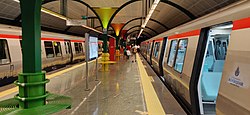 Boğaziçi University station of the Istanbul Metro
 -
 Marmaray commuter rail at Ayrılıkçeşmesi station


Ferries
[edit]

There are three main ferry operators in Istanbul. The municipally owned Şehir Hatları operates the traditional vapur ferries on 891 daily trips between 53 piers across the Bosporus and the Princes' Islands.[377]
The privately owned İDO (Istanbul Sea Buses) runs a combination of high-speed passenger ferries and vehicle ferries within Istanbul and to destinations across the Sea of Marmara.[378] A smaller private company, Turyol also operates services across the Bosphorus. The city's main cruise ship terminal is the Port of Istanbul in Karaköy, with a capacity of 10,000 passengers per hour.[379]
Railroads
[edit]
International rail service from Istanbul launched in 1889, with a line between Bucharest and Istanbul's Sirkeci Terminal, which ultimately became famous as the eastern terminus of the Orient Express from Paris.[83] Regular service to Bucharest and Thessaloniki continued until the early 2010s, when the former was interrupted for Marmaray construction but started running again in 2019 and the latter was halted due to economic problems in Greece.[381][382] After Istanbul's Haydarpaşa Terminal opened in 1908, it served as the western terminus of the Baghdad Railway and an extension of the Hejaz Railway; today, neither service is offered directly from Istanbul.[383][384][385] Service to Ankara and other points across Turkey is normally offered by Turkish State Railways, but the construction of Marmaray and the Ankara-Istanbul high-speed railway forced the station to close in 2012.[386] New stations to replace both the Haydarpaşa and Sirkeci terminals, and connect the city's disjointed railway networks, now the Marmaray second phase opened to the public.[386] Private bus companies still operation to this day. Istanbul's main bus station is the largest in Europe, with a daily capacity of 15,000 buses and 600,000 passengers, serving destinations as distant as Frankfurt.[387][388]
Airports
[edit]Istanbul has had three large international airports, two of which currently serve commercial passenger flights. The largest is the new Istanbul Airport, opened in 2018 in the Arnavutköy district to the northwest of the city center, on the European side, near the Black Sea coast.
All scheduled commercial passenger flights were transferred from Atatürk Airport to Istanbul Airport on 6 April 2019, following the closure of Istanbul Atatürk Airport for scheduled passenger flights.[389] The IATA code IST was also transferred to the new airport.[390] Once all phases are completed in 2025, the airport will have six sets of runways (eight in total), 16 taxiways, and will be able to accommodate 200 million passengers a year.[391][392] The transfer from the airport to the city is via the O-7, and it will eventually be linked by two lines of the Istanbul Metro.
Sabiha Gökçen International Airport, 45 kilometers (28 mi) southeast of the city center, on the Asian side, was opened in 2001 to relieve Atatürk. Dominated by low-cost carriers, Istanbul's second airport has rapidly become popular, especially since the opening of a new international terminal in 2009;[393] the airport handled 14.7 million passengers in 2012, a year after Airports Council International named it the world's fastest-growing airport.[394][395] Atatürk had also experienced rapid growth, as its 20.6 percent rise in passenger traffic between 2011 and 2012 was the highest among the world's top 30 airports.[396]
Istanbul Atatürk Airport, located 24 kilometers (15 mi) west of the city center, on the European side, near the Marmara Sea coast, was formerly the city's largest airport. After its closure to commercial flights in 2019, it was briefly used by cargo aircraft and the official state aircraft owned by the Turkish government, until the demolition of its runway began in 2020. It handled 61.3 million passengers in 2015, which made it the third-busiest airport in Europe and the 18th-busiest in the world in that year.[396]


International relations
[edit]List of notable people
[edit]See also
[edit]

.svg)
Notes
[edit]- ^ İstanbul Province = 5,460.85 km2
- Land area = 5,343.22 km2
- Lake/Dam = 117.63 km2
- Europe (25 districts) = 3,474.35 km2
- Asia (14 districts) = 1,868.87 km2
- Urban (36 districts) = 2,576.85 km2 [Metro (39 districts) – (Çatalca+Silivri+Şile)]
*According to the size of the population and the status of megacity, the limits of the Istanbul city correspond to the limits of the province, and the province is treated like as the metropolitan-city of Istanbul.
- ^ English pronunciation: /ˌɪstænˈbʊl/ IST-an-BUUL,[7][8] US also /ˈɪstænbʊl/ IST-an-buul; Turkish: İstanbul (Turkish pronunciation: [isˈtanbuɫ] ⓘ, colloquial Turkish pronunciation: [ɯsˈtambuɫ])
- ^ Istanbul straddles both Europe and Asia, with its commercial and historical centre and two-thirds of the population in Europe, the rest in Asia. Since Istanbul is a transcontinental city, Moscow is the largest city entirely within Europe.
- ^ The foundation of Byzantion (Byzantium) is sometimes, especially in encyclopedic or other tertiary sources, placed firmly in 667 BCE. Historians have disputed the precise year the city was founded. Commonly cited is the work of 5th-century-BCE historian Herodotus, which says the city was founded seventeen years after Chalcedon,[41] which came into existence around 685 BCE. Eusebius concurs with 685 BCE as the year Chalcedon was founded, but places Byzantion's establishment in 659 BCE.[42] Among more modern historians, Carl Roebuck proposed the 640s BCE[43] and others have suggested even later. The foundation date of Chalcedon is itself subject to some debate; while many sources place it in 685 BC,[44] others put it in 675 BCE[45] or even 639 BCE (with Byzantion's establishment placed in 619 BCE).[42] Some sources refer to Byzantium's foundation as the 7th century BCE.
- ^ a b Historians disagree—sometimes substantially—on population figures of Istanbul (Constantinople), and other world cities, prior to the 20th century. A follow-up to Chandler & Fox 1974,Chandler 1987, pp. 463–505[80] examines different sources' estimates and chooses the most likely based on historical conditions; it is the source of most population figures between 100 and 1914. The ranges of values between 500 and 1000 are due to Morris 2010, which also does a comprehensive analysis of sources, including Chandler (1987); Morris notes that many of Chandler's estimates during that time seem too large for the city's size, and presents smaller estimates. Chandler disagrees with Turan 2010 on the population of the city in the mid-1920s (with the former suggesting 817,000 in 1925), but Turan, p. 224, is used as the source of population figures between 1924 and 2005. Turan's figures, as well as the 2010 figure,[206] come from the Turkish Statistical Institute. The drastic increase in population between 1980 and 1985 is largely due to an enlargement of the city's limits (see the Administration section). Explanations for population changes in pre-Republic times can be inferred from the History section.
- ^ Based on state register data, which is unchangeable and inherited from the family. A married women is also registered to her husband's province.
- ^ UEFA does not apparently keep a list of Category 4 stadiums, but regulations stipulate that only these elite stadiums are eligible to host UEFA Champions League Finals,[303] which Atatürk Olympic Stadium did in 2005, and UEFA Europa League (formerly UEFA Cup) Finals,[304] which Şükrü Saracoğlu Stadium did in 2009. Türk Telekom Arena is noted as an elite UEFA stadium by its architects.[305]
References
[edit]- ^ "YETKİ ALANI". Istanbul Buyuksehir Belediyesi. Archived from the original on 6 April 2020. Retrieved 4 February 2020.
- ^ "İstanbul'un En Yüksek Tepeleri". Hava Forumu. Hava Durumu Forumu. 15 April 2020.
- ^ a b "The Results of Address Based Population Registration System, 2024". www.tuik.gov.tr. Turkish Statistical Institute. 6 February 2025. Retrieved 6 February 2025.
- ^ a b "GDP by Provinces, 2023 - İstanbul had the highest share of GDP with 30.4% (Tables 1 and 3)". www.tuik.gov.tr. Turkish Statistical Institute. 12 December 2024. Retrieved 12 December 2024.
- ^ "Ulusal Hesaplar - Kişi başına GSYH ($)" [National Accounts - GDP per capita ($)]. www.tuik.gov.tr (in Turkish). Turkish Statistical Institute. Retrieved 12 December 2024.
- ^ "Sub-national HDI – Area Database – Global Data Lab". hdi.globaldatalab.org.
- ^ Wells, John C. (2008). Longman Pronunciation Dictionary (3rd ed.). Longman. ISBN 978-1-4058-8118-0.
- ^ Upton, Clive; Kretzschmar, William A. Jr. (2017). The Routledge Dictionary of Pronunciation for Current English (2nd ed.). Routledge. p. 704. ISBN 978-1-138-12566-7.
- ^ Tepe 2019, p. 1
- ^ "Yetki Alanı". İstanbul Büyükşehir Belediyesi. n.d. Retrieved 16 May 2025.
...geçici 2. Madde ile İstanbul ve İzmit illeri için istisnai bir uygulama yapılarak büyükşehir belediye sınırları, Kanunun yürürlüğe girdiği tarihi itibariyle il mülkî sınırı olarak genişletildi. Bu hükümle birlikte İstanbul Büyükşehir Belediyesi'nin yetki alanı 5460,85 km² (5343,22 km² kara alanı + 117,63 km² göl alanı) oldu.
- ^ Şengör & Kındap 2019, p. 250
- ^ Herrin, Judith (28 September 2009). Byzantium: The Surprising Life of a Medieval Empire. Princeton University Press. p. 5. ISBN 978-0-691-14369-9.
- ^ Çelik 1993, p. xv
- ^ a b Masters & Ágoston 2009, pp. 114–5
- ^ Dumper & Stanley 2007, p. 320
- ^ a b Turan 2010, p. 224
- ^ "Population and Demographic Structure". Istanbul 2010: European Capital of Culture. Istanbul Metropolitan Municipality. 2008. Retrieved 27 March 2012.
- ^ "World Cities 2024". Globalization and World Cities Research Network. Retrieved 16 May 2025.
- ^ Bölükbaşı 2012, p. 344
- ^ "Euromonitor International reveals world's Top 100 City Destinations for 2024". Euromonitor International. 4 December 2024. Retrieved 19 May 2025.
- ^
- for airports and ports, see: Tepe 2019, p. 4
- for universities, see: Heper, Öztürk-Tunçel & Criss 2018, p. 268
- ^ World Intellectual Property Organization (WIPO) 2024, pp. 76–77
- ^
- Tepe 2019, p. 1–2
- Şengör & Kındap 2019, p. 256–257
- ^ a b c "Istanbul". Encyclopædia Britannica. 3 October 2023.
- ^ a b c d Room 2006, p. 177
- ^ Georgacas 1947, p. 352ff.
- ^ Necipoğlu 2010, p. 262.
- ^ Necdet Sakaoğlu (1993/94a): "İstanbul'un adları" ["The names of Istanbul"]. In: Dünden bugüne İstanbul ansiklopedisi, ed. Türkiye Kültür Bakanlığı, Istanbul.
- ^ Grosvenor, Edwin Augustus (1895). Constantinople. Vol. 1. Roberts Brothers. p. 69. Retrieved 15 March 2021.
- ^ Finkel 2005, pp. 57, 383.
- ^ Göksel & Kerslake 2005, p. 27.
- ^ Keyder 1999, p. 95.
- ^ a b Rainsford, Sarah (10 January 2009). "Istanbul's ancient past unearthed". www.bbc.com. BBC. Retrieved 29 May 2021.
- ^ Algan, O.; Yalçın, M.N.K.; Özdoğan, M.; Yılmaz, Y.C.; Sarı, E.; Kırcı-Elmas, E.; Yılmaz, İ.; Bulkan, Ö.; Ongan, D.; Gazioğlu, C.; Nazik, A.; Polat, M.A.; Meriç, E. (2011). "Holocene coastal change in the ancient harbor of Yenikapı–İstanbul and its impact on cultural history". Quaternary Research. 76 (1): 30. Bibcode:2011QuRes..76...30A. doi:10.1016/j.yqres.2011.04.002. ISSN 0033-5894. S2CID 129280217.
- ^ "Bu keşif tarihi değiştirir". hurriyet.com.tr. 3 October 2008.
- ^ "Marmaray kazılarında tarih gün ışığına çıktı". fotogaleri.hurriyet.com.tr. Archived from the original on 18 November 2015. Retrieved 21 June 2015.
- ^ "Cultural Details of Istanbul". Republic of Turkey, Minister of Culture and Tourism. Archived from the original on 12 September 2007. Retrieved 2 October 2007.
- ^ Janin, Raymond (1964). Constantinople byzantine. Paris: Institut Français d'Études Byzantines. pp. 10ff.
- ^
"Pliny the Elder, book IV, chapter XI:
"On leaving the Dardanelles we come to the Bay of Casthenes, ... and the promontory of the Golden Horn, on which is the town of Byzantium, a free state, formerly called Lygos; it is 711 miles from Durazzo, ..."". Archived from the original on 1 January 2017. Retrieved 21 June 2015. - ^ Bloom & Blair 2009, p. 1.
- ^ Herodotus Histories 4.144, translated in De Sélincourt 2003, p. 288
- ^ a b Isaac 1986, p. 199.
- ^ Roebuck 1959, p. 119, also as mentioned in Isaac 1986, p. 199
- ^ Lister 1979, p. 35.
- ^ Freely 1996, p. 10.
- ^ Çelik 1993, p. 11.
- ^ De Souza 2003, p. 88.
- ^ Freely 1996, p. 20.
- ^ Freely 1996, p. 22.
- ^ Grant 1996, pp. 8–10.
- ^ Limberis 1994, pp. 11–12.
- ^ Barnes 1981, p. 77
- ^ Barnes 1981, p. 212
- ^ a b Barnes 1981, p. 222
- ^ a b Gregory 2010, p. 63
- ^ a b Klimczuk & Warner 2009, p. 171
- ^ Dash, Mike (2 March 2012). "Blue Versus Green: Rocking the Byzantine Empire". Smithsonian Magazine. The Smithsonian Institution. Archived from the original on 5 August 2012. Retrieved 30 July 2012.
- ^ Dahmus 1995, p. 117
- ^ Cantor 1994, p. 226
- ^ Morris 2010, pp. 109–18
- ^ Parry, Ken (2009). Christianity: Religions of the World. Infobase Publishing. p. 139. ISBN 9781438106397.
- ^ Parry, Ken (2010). The Blackwell Companion to Eastern Christianity. John Wiley & Sons. p. 368. ISBN 9781444333619.
- ^ Gregory 2010, pp. 324–29.
- ^ Gregory 2010, pp. 330–333.
- ^ Gregory 2010, p. 340.
- ^ Gregory 2010, pp. 341–342.
- ^ "Deesis Mosaic". Hagia Sophia. 5 November 2017. Retrieved 31 January 2021.
- ^ Reinert 2002, pp. 258–260.
- ^ Baynes 1949, p. 47.
- ^ "Fall of Constantinople | Facts, Summary, & Significance | Britannica". www.britannica.com. Retrieved 16 May 2025.
- ^ Gregory 2010, pp. 394–399.
- ^ Béhar 1999, p. 38.
- ^ Bideleux & Jeffries 1998, p. 71.
- ^ Inalcik, Halil. "The Policy of Mehmed II toward the Greek Population of Istanbul and the Byzantine Buildings of the City." Dumbarton Oaks Papers 23, (1969): 229–49. p. 236
- ^ Holt, Lambton & Lewis 1977, pp. 306–07
- ^ a b Hughes, Bettany (2018). Istanbul: A Tale of Three Cities. London: Weidenfeld & Nicolson. ISBN 978-1-78022-473-2.
- ^ a b Madden, Thomas F. (7 November 2017). Istanbul: City of Majesty at the Crossroads of the World. New York: Penguin Books. ISBN 978-0-14-312969-1.
- ^ a b c d e Byrne, Joseph Patrick (2012). Encyclopedia of the Black Death. Santa Barbara, CA: ABC-Clio. ISBN 978-1-59884-253-1.
- ^ Holt, Lambton & Lewis 1977, pp. 735–36
- ^ a b Chandler, Tertius; Fox, Gerald (1974). 3000 Years of Urban Growth. London: Academic Press. ISBN 978-0-12-785109-9.
- ^ Shaw & Shaw 1977, pp. 4–6, 55
- ^ Çelik 1993, pp. 87–89
- ^ a b Harter 2005, p. 251
- ^ Shaw & Shaw 1977, pp. 230, 287, 306
- ^ Çelik, Zeynep (1986). The Remaking of Istanbul: Portrait of an Ottoman City in the Nineteenth Century. Berkeley. Los Angeles. London: University of California Press. p. 37.
- ^ "Meclis-i Mebusan (Mebuslar Meclisi)". Tarihi Olaylar. Archived from the original on 25 February 2021. Retrieved 12 July 2018.
- ^ Çelik 1993, p. 31
- ^ Freedman, Jeri (2009). The Armenian genocide (1st ed.). New York: Rosen Pub. Group. pp. 21–22. ISBN 978-1-4042-1825-3.
- ^ Selçuk, Mustafa. "Birinci Dünya Savaşın'da İtilaf Devletleri'nin İstanbul'a Yönelik Hava Taaruzları" [The Allied Powers' Air Attacks on Istanbul in World War I]. Marmara Türkiyat Araştırmaları Dergisi.
- ^ Kurt, Emin; Güvenbaş, Mesut (2018). Birinci Dünya Savaşı'nda İstanbul'a Yapılan Hava Saldırıları [Air Raids on Istanbul in World War I]. Türkiye İş Bankası Kültür Yayınları. ISBN 978-605-295-369-3.
- ^ Globalization, Cosmopolitanism, and the Dönme in Ottoman Salonica and Turkish Istanbul. Marc Baer, University of California, Irvine.
- ^ "World War I | Causes, Years, Combatants, Casualties, Maps, & Facts | Britannica". www.britannica.com. 15 May 2025. Retrieved 15 May 2025.
- ^ "Ataturk and Turkish Independence | History of Western Civilization II". courses.lumenlearning.com. Retrieved 15 May 2025.
- ^ "3. Ottoman Empire (1908-1923)". uca.edu. Retrieved 15 May 2025.
- ^ "Milestones in Borsa Istanbul History". www.borsaistanbul.com. Retrieved 31 January 2021.
- ^ a b "6 Ekim İstanbul'un Kurtuluşu" (in Turkish). Sözcü. 6 October 2017.
- ^ Landau 1984, p. 50
- ^ Dumper & Stanley 2007, p. 39
- ^ Ağır, Seven; Artunç, Cihan (2019). "The Wealth Tax of 1942 and the Disappearance of Non-Muslim Enterprises in Turkey". The Journal of Economic History. 79 (1): 201–243. doi:10.1017/S0022050718000724. hdl:11511/35674. S2CID 159425371.
- ^ "Radikal-çevrimiçi / Türkiye / 6-7 Eylül'ün anlamı". 30 January 2009. Archived from the original on 30 January 2009. Retrieved 7 March 2025.
- ^ Erdemir, Aykan (7 September 2016). "The Turkish Kristallnacht". Politico Europe. Archived from the original on 20 October 2016. Retrieved 6 September 2016.
- ^ de Zayas, Alfred (August 2007). "The Istanbul Pogrom of 6–7 September 1955 in the Light of International Law". Genocide Studies and Prevention. 2 (2): 137–154. ISSN 1911-0359. Archived from the original on 19 May 2022. Retrieved 11 October 2015.
The Septemvriana satisfies the criteria of article 2 of the 1948 Convention on the Prevention and Punishment of the Crime of Genocide (UNCG) because the intent to destroy in whole or in part the Greek minority in Istanbul was demonstrably present, the pogrom having been orchestrated by the government of Turkish Prime Minister Adnan Menderes. Even if the number of deaths (estimated at thirty-seven) among members of the Greek community was relatively low, the result of the pogrom was the flight and emigration of the Greek minority of Istanbul, which once numbered some 100,000 and was subsequently reduced to a few thousand. The vast destruction of Greek property, businesses, and churches provides evidence of the Turkish authorities' intent to terrorize the Greeks in Istanbul into abandoning the territory, thus eliminating the Greek minority. This practice falls within the ambit of the crime of ethnic cleansing, which the UN General Assembly and the International Criminal Tribunal for the former Yugoslavia have interpreted as constituting a form of genocide... Besides the deaths, thousands were injured; some 200 Greek women were raped, and there are reports that Greek boys were raped as well. Many Greek men, including at least one priest, were subjected to forced circumcision. The riots were accompanied by enormous material damage, estimated by Greek authorities at US$500 million, including the burning of churches and the devastation of shops and private homes. As a result of the pogrom, the Greek minority eventually emigrated from Turkey.
- ^ Roudometof, V.; Agadjanian, A.; Pankhurst, J. (2005). Eastern Orthodoxy in a Global Age: Tradition Faces the 21st Century. AltaMira Press. p. 273. ISBN 978-0-7591-1477-7. Retrieved 27 August 2024.
- ^ Whitman, L.; Helsinki Watch (Organization : U.S.); Human Rights Watch (Organization) (1992). Denying Human Rights and Ethnic Identity: The Greeks of Turkey. Helsinki Watch report. Human Rights Watch. ISBN 978-1-56432-056-8. Retrieved 27 August 2024.
- ^ Keyder 1999, pp. 11–12, 34–36
- ^ Efe & Cürebal 2011, pp. 718–719
- ^ a b c d e f g h i j k l m Heper, Metin (2018). "Istanbul". Historical dictionary of Turkey (4th ed.). Lanham, MD: Rowman & Littlefield. ISBN 978-1-5381-0224-4.
- ^ "Locked and creeping fault segments off Istanbul". www.gfz-potsdam.de. 4 August 2023. Retrieved 4 April 2024.
- ^ a b "Turkey recovers from one earthquake and braces for more". The Economist. 5 December 2020. Retrieved 14 December 2020.
- ^ "64 pct chance of Istanbul quake to hit before 2030: Expert". Hürriyet Daily News. 4 March 2022. Retrieved 9 February 2023.
- ^ "Earthquake hazard in Istanbul". www.eskp.de. Retrieved 31 March 2024.
- ^ "Directorate of Earthquake and Geotechnical Investigation". depremzemin.ibb.istanbul. Retrieved 31 March 2024.
- ^ "İHH Humanitarian Relief Foundation". İHH Humanitarian Relief Foundation. Retrieved 31 March 2024.
- ^ "Turkey's earthquake is a warning for Istanbul, which would face even more deaths from a quake".
- ^ "600,000 flats would collapse in major earthquake in Istanbul, says minister". Gazete Duvar (in Turkish). 8 February 2023. Retrieved 31 March 2024.
- ^ "Earthquake fears loom large in Istanbul's mayoral race". The Economist. ISSN 0013-0613. Retrieved 31 March 2024.
- ^ EFE, Agencia (5 February 2024). "Is Istanbul prepared for a big earthquake?". EFE Noticias. Retrieved 31 March 2024.
- ^ "Istanbulites concerned over impending earthquake: Survey - Türkiye News". Hürriyet Daily News. 28 March 2024. Retrieved 31 March 2024.
- ^ "Istanbul residents flood streets after 6.2-magnitude quake". www.bbc.com. 23 April 2025. Retrieved 25 April 2025.
- ^ "Turkey: 151 hurt jumping from buildings amid earthquake, say authorities". The Guardian. Associated Press. 23 April 2025. ISSN 0261-3077. Retrieved 25 April 2025.
- ^ "Turkey earthquake: Powerful 6.2 magnitude quake rattles Istanbul | Watch News Videos Online". Global News. Retrieved 25 April 2025.
- ^ Pietromarchi, Virginia; Kestler-D'Amours, Jillian; Mohamed, Edna. "Turkiye earthquake updates: Istanbul rocked by magnitude 6.2 quake". Al Jazeera. Retrieved 25 April 2025.
- ^ a b c d Yılmaz, Merve; Kara, Yiğitalp; Toros, Hüseyin; İncecik, Selahattin (1 July 2024). "Analysis of the summer thermal comfort indices in İstanbul". International Journal of Biometeorology. 68 (7): 1327–1342. Bibcode:2024IJBm...68.1327Y. doi:10.1007/s00484-024-02669-7. ISSN 1432-1254. PMC 11272817. PMID 38656352.
- ^ Taşoğlu, Enes; Öztürk, Muhammed Zeynel; Yazıcı, Öznur (2024). "High Resolution Köppen-Geiger Climate Zones of Türkiye". International Journal of Climatology. 44 (14): 5248–5265. Bibcode:2024IJCli..44.5248T. doi:10.1002/joc.8635. ISSN 1097-0088.
- ^ Belda, Michal; Holtanová, Eva; Halenka, Tomáš; Kalvová, Jaroslava (2014). "Climate classification revisited: from Köppen to Trewartha". Climate Research. 59 (1): 1–13. Bibcode:2014ClRes..59....1B. doi:10.3354/cr01204. ISSN 0936-577X. JSTOR 24896147.
- ^ Shimabukuro, Ryu; Tomita, Tomohiko; Fukui, Ken-ichi (11 April 2023). "Update of global maps of Alisov's climate classification". Progress in Earth and Planetary Science. 10 (1): 19. Bibcode:2023PEPS...10...19S. doi:10.1186/s40645-023-00547-1. ISSN 2197-4284.
- ^ "Karte der natürlichen Vegetation Europas, Erl.-Text. - Deutsche Digitale Bibliothek". www.deutsche-digitale-bibliothek.de (in German). Retrieved 9 September 2025.
- ^ a b Abbasnia, Mohsen; Toros, Hüseyin; Memarian, Hadi (2019). "Analysis of Climate in the Megacity of Istanbul Based on Human Bioclimatic Comfort Index". Journal of Research in Atmospheric Science. 1 (1). ISSN 0000-0000.
- ^ "La neve sulle coste del Mediterraneo" [Snow on the Mediterranean coasts]. www.nimbus.it (in Italian). Retrieved 28 April 2021.
- ^ "İstanbul'da bazı ilçelerde kar kalınlığı 85 santimetreyi buldu" [In some districts of Istanbul, the snow depth reached 85 centimeters]. www.birgun.net (in Turkish).
- ^ "Resmi İstatistikler". Meteoroloji Genel Müdürlüğü. Archived from the original on 23 December 2020. Retrieved 13 December 2020.
- ^ "Rivista Ligure di Meteorologia 44 - La neve sulle coste del Mediterraneo". www.nimbus.it. Retrieved 3 June 2021.
- ^ "World Meteorological Organization Climate Normals for 1991-2020". National Oceanic and Atmospheric Administration. Retrieved 16 January 2024.
- ^ "Turkey reeling from African heat wave". Daily Sabah. 2 July 2017.
- ^ "Gov't forced to take measures amid below average rainfall across Turkey". Hürriyet Daily News. 21 January 2018.
- ^ "Lightning electrifies Istanbul, northwestern Turkey skies as thunderstorms take over". Daily Sabah. 24 July 2018.
- ^ "Istanbul flood result of Turkey's climate change". Anadolu Agency. 27 July 2017.
- ^ Şen, Ömer Lütfi. "Climate Change in Turkey". Mercator–IPC Fellowship Program=. Retrieved 27 September 2018.
- ^ "Climatologie globale à Istanbul / Ataturk - Infoclimat". www.infoclimat.fr. Retrieved 28 April 2021.
- ^ "Temperature to increase significantly in Turkey in 30 years due to global warming, warns climate expert". Hürriyet Daily News. 19 March 2018.
- ^ Çetin, Nefise; Mansuroğlu, Sibel; Kalaycı Önaç, Ayşe (2018). "Xeriscaping Feasibility as an Urban Adaptation Method for Global Warming: A Case Study from Turkey". Pol. J. Environ. Stud. 27 (3): 1009–18. Bibcode:2018PJES...27.1009C. doi:10.15244/pjoes/76678.
- ^ "İstanbul İklim Değişikliği Eylem Planı" [Istanbul Climate Change Action Plan] (in Turkish). Archived from the original on 17 April 2019. Retrieved 22 April 2019.
- ^ "What happens if Istanbul's water supplies run dry?". www.bbc.com. 21 February 2025. Retrieved 16 March 2025.
- ^ Klimatoloji 2. Çevre ve Orman Bakanlığı.
- ^ "Bosphorus as our cultural heritage" (PDF). Archived from the original (PDF) on 22 July 2011.
- ^ Altay, Volkan; Ouml, Brahim Lker; zyiit; Yarci, Celal (31 January 2010). "Urban flora and ecological characteristics of the Kartal District (Istanbul): A contribution to urban ecology in Turkey".
- ^ Artüz M.L. (1999) Inventory of Existing Species and Their Habitats in the Bosphorus Area. Marine bio abs., 1: 112–023.
- ^ "Deniz Kirliliğini Önlemeye İlişkin Hedefler". İstanbul Su ve Kanalizasyon İdaresi. Archived from the original on 22 July 2011.
- ^ "İstanbul'da balıklar". Dünden Bugüne İstanbul Ansiklopedisi. II. İstanbul: Tarih Vakfı.
- ^ "Why so many stray cats in Istanbul?". BBC News. Retrieved 31 July 2021.
- ^ Brady, Tara. "How the street cats of Istanbul landed on their feet". The Irish Times. Retrieved 31 July 2021.
- ^ "İstanbul'da istilacı yeşil papağan uyarısı: Sayıları 5-6 bini geçti, kent faunası bozulabilir" [Warning about invasive green parrots in Istanbul: Their numbers have exceeded 5–6 thousand, the urban fauna may be disrupted]. birgun.net (in Turkish). Retrieved 31 July 2021.
- ^ "Fed up with Istanbul traffic". 20 February 2017. Retrieved 28 September 2018.
- ^ "Understanding Vehicular Pollution – AQI, Harmful Effects and How to Reduce It?". News18. 1 March 2019.
- ^ Kara Rapor 2020: Hava Kirliliği ve Sağlık Etkileri [Black Report 2020: Air Pollution and Health Effects] (Report) (in Turkish). Right to Clean Air Platform Turkey. August 2020.
- ^ Harvey, Fiona (17 August 2022). "Major cities blighted by nitrogen dioxide pollution, research finds | Air pollution". The Guardian. Retrieved 1 October 2022.
- ^ "Istanbul tops 2024 global traffic congestion rankings - Türkiye News". Hürriyet Daily News. 9 January 2025. Retrieved 16 March 2025.
- ^ "'Sea snot' outbreak off Turkish coast poses threat to marine life". Reuters. 1 June 2021. Retrieved 31 July 2021.
- ^ Çelik 1993, pp. 70, 169
- ^ Çelik 1993, p. 127
- ^ Moonan, Wendy (29 October 1999). "For Turks, Art to Mark 700th Year". The New York Times. Retrieved 4 July 2012.
- ^ Oxford Business Group 2009, p. 105.
- ^ a b c Istanbul Office Market General Overview: Third Quarter 2021 (PDF) (Report). Prop In. pp. 3, 9.
- ^ a b WCTR Society & Unʼyu Seisaku Kenkyū Kikō 2004, p. 281.
- ^ Karpat 1976, pp. 78–96
- ^ Yavuz, Ercan (8 June 2009). "Gov't launches plan to fight illegal construction". Today's Zaman. Archived from the original on 20 January 2012. Retrieved 20 December 2011.
- ^ Atkinson, Rowland; Bridge, Gary (2005). Gentrification in a Global Context: The New Urban Colonialism. Routledge. pp. 123–. ISBN 978-0-415-32951-4. Retrieved 6 May 2013.
- ^ Bourque, Jessica (4 July 2012). "Poor but Proud Istanbul Neighborhood Faces Gentrification". The New York Times. Retrieved 6 May 2013.
- ^ Tait, Robert (22 July 2008). "Forced gentrification plan spells end for old Roma district in Istanbul". The Guardian. Retrieved 6 May 2013.
- ^ "New city construction to begin in six months". Hurriyet Daily News. 22 February 2013. Retrieved 6 May 2013.
- ^ Boyar & Fleet 2010, p. 247
- ^ Taylor 2007, p. 241
- ^ "Water Supply Systems, Reservoirs, Charity and Free Fountains, Turkish Baths". Republic of Turkey Ministry of Culture and Tourism. Archived from the original on 19 November 2010. Retrieved 29 April 2012.
- ^ Time Out Guides 2010, p. 212
- ^ a b Chamber of Architects of Turkey 2006, pp. 80, 118
- ^ Chamber of Architects of Turkey 2006, p. 176
- ^ Gregory 2010, p. 138
- ^ Freely 2000, p. 283
- ^ Necipoğlu 1991, pp. 180, 136–137
- ^ Çelik 1993, p. 159
- ^ Çelik 1993, pp. 133–34, 141
- ^ "Mevzuat Bilgi Sistemi". www.mevzuat.gov.tr. Retrieved 6 March 2025.
- ^ "İBB Başkanı İmamoğlu: Sendikalı sayısı 80 bin kişiye ulaşmıştır" [Mayor of Istanbul İmamoğlu: The number of unionized workers has reached 80,000]. www.ntv.com.tr (in Turkish). Retrieved 6 March 2025.
- ^ Oktay, Tarkan (15 January 2001). "TANZİMAT DÖNEMİ İSTANBUL'DA BİR BELEDİYE ÖRGÜTLENMESİ ÖRNEĞİ "ALTINCI DÂİRE-İ BELEDİYE"". Öneri Dergisi (in Turkish). 4 (15): 157–166. doi:10.14783/maruoneri.735505. hdl:11424/6883. ISSN 1300-0845.
- ^ "Tanzimat'tan XXI. Yüzyıla İstanbul'un Yönetimi" [The administration of Istanbul from the Tanzimat to the 21st century]. istanbultarihi.ist (in Turkish). Retrieved 6 March 2025.
- ^ Önsoy, Rifat (15 December 1984). "Tanzimat Dönemi sanayileşme politikası 1839-1876" [Industrialization policy during the Tanzimat Period (1839–1876)]. Hacettepe Üniversitesi Edebiyat Fakültesi Dergisi (in Turkish). 2 (2): 0. ISSN 1301-5737.
- ^ "TÜRK BELEDİYECİLİĞİNİN GELİŞİM SÜRECİ". www.mevzuatdergisi.com. Retrieved 6 March 2025.
- ^ Çiçek, Yeter (14 June 2014). "Geçmişten Günümüze Türkiye'de Yerel Yönetimler" [Local Governments in Turkey from Past to Present]. Kahramanmaraş Sütçü İmam Üniversitesi Sosyal Bilimler Dergisi (in Turkish). 11 (1): 53–64. ISSN 1304-8120.
- ^ Çelik 1993, pp. 42–48
- ^ Kapucu & Palabiyik 2008, p. 145
- ^ "Belediye Tarihçesi" [Municipal History]. İstanbul Büyükşehir Belediyesi (in Turkish).
- ^ Council, City; Köken, Enes (1 December 2016). "Büyükşehir Belediye Meclisi" [Metropolitan Municipal Council]. Ankara Üniversitesi Hukuk Fakültesi Dergisi (in Turkish). 65 (4): 3511–3528. ISSN 1301-1308.
- ^ "Hükümet, büyükşehir belediyelerinin UKOME'deki çoğunluk yetkisini elinden aldı" [The government took away the majority authority of metropolitan municipalities in UKOME]. Independent Türkçe (in Turkish). 19 February 2020. Retrieved 6 March 2025.
- ^ Ertaş, Handan (1 July 2016). "TÜRKİYE'DE YEREL YÖNETİM BİRİMLERİNİN GÖREV VE SORUMLULUKLARI İLE İLGİLİ MEVZUAT VE KARŞILAŞTIRMALI ANALİZ". Selçuk Üniversitesi Sosyal ve Teknik Araştırmalar Dergisi (in Turkish) (11): 87–113. ISSN 2146-7226.
- ^ "İBB ve KİPTAŞ'ın İlçe Belediyeleri ile Yaptığı İş Birliği Protokollerinden Bir Yenisini Daha Avcılar Belediyesi İle İmzalandı!" [Another of the cooperation protocols between İBB and KİPTAŞ with district municipalities has been signed—this time with Avcılar Municipality!]. kiptas.istanbul (in Turkish). Retrieved 7 March 2025.
- ^ "T.C. Tuzla Belediyesi Resmi Web Sitesi : Tuzla Belediyesi, İBB iş birliği ile ilçenin kronik sorunlarına çözüm üretiyor" [Republic of Turkey Tuzla Municipality Official Website: Tuzla Municipality is producing solutions to the district’s chronic problems in cooperation with İBB]. www.tuzla.bel.tr. Retrieved 7 March 2025.
- ^ Göküş; Bayrakcı; Alptürker (1 June 2013). "MAHALLE YÖNETİMİ VE MAHALLE MUHTARLARININ VATANDAŞLAR TARAFINDAN DEĞERLENDİRİLMESİ". Süleyman Demirel Üniversitesi İktisadi ve İdari Bilimler Fakültesi Dergisi (in Turkish). 18 (2): 31–45. ISSN 1301-0603.
- ^ Mecek, Mehmet (28 December 2020). "Bir Mülki (Taşra) İdare Birimi Olarak Türkiye'de İl Yönetimleri ve Hukuki - Örgütsel Yapıları" [Provincial Administrations in Turkey as a Civil (Provincial) Administrative Unit and Their Legal – Organizational Structures]. Ekonomi İşletme Siyaset ve Uluslararası İlişkiler Dergisi (in Turkish). 6 (2): 296–325. ISSN 2149-0732.
- ^ Parlak, Bekir; Doğan, Kadir Caner (30 August 2018). "Türkiye'de Mevcut İl Yönetimi Ve İlçe Yönetimi: Tarihsel Ve Yapısal Bir İnceleme" [The Current Provincial and District Administration in Turkey: A Historical and Structural Analysis]. Uluslararası Yönetim Akademisi Dergisi (in Turkish). 1 (2): 42–52. ISSN 2636-8048.
- ^ "Erdoğan: 'İstanbul'da teklersek, Türkiye'de tökezleriz'" ["Erdoğan: 'If we stumble in Istanbul, we falter in Turkey.'"]. Tele1. 2 April 2019. Retrieved 4 May 2019.
- ^ Ingleby, Melvyn (14 June 2019). "A Turkish Opposition Leader Is Fighting Erdoğan With 'Radical Love'". The Atlantic. Retrieved 14 December 2020.
- ^ Pitel, Laura (24 June 2019). "Erdoğan's defeat in Istanbul shows opposition's changing tactics". Financial Times. Retrieved 14 December 2020.
- ^ Isil Sariyuce and Ivana Kottasová. "Istanbul election rerun set to be won by opposition, in blow to Erdogan". CNN.
- ^ "Seçim 2024". secim.aa.com.tr. Archived from the original on 14 May 2023. Retrieved 4 April 2024.
- ^ "Population of Istanbul in Turkey from 2007 to 2019". Statista.
- ^ "Address Based Population Registration System Results of 2010" (doc). Turkish Statistical Institute. 28 January 2011. Retrieved 24 December 2011.
- ^ Morris 2010, p. 113
- ^ Chandler 1987, pp. 463–505
- ^ a b "The Results of Address Based Population Registration System, 2019". data.tuik.gov.tr. Istanbul, Turkey: Türkiye İstatistik Kurumu. 4 February 2020. Retrieved 12 December 2020.
- ^ "Frequently Asked Questions". World Urbanization Prospects, the 2011 Revision. The United Nations. 5 April 2012. Archived from the original on 7 September 2012. Retrieved 20 September 2012.
- ^ "File 11a: The 30 Largest Urban Agglomerations Ranked by Population Size at Each Point in Time, 1950–2035" (xls). World Urbanization Prospects, the 2018 Revision. The United Nations. 5 April 2012. Retrieved 21 August 2018.
- ^ OECD Territorial Reviews: Istanbul, Turkey. Policy Briefs. Organisation for Economic Co-operation and Development. March 2008. ISBN 978-92-64-04383-1.
- ^ Kamp, Kristina (17 February 2010). "Starting Up in Turkey: Expats Getting Organized". Today's Zaman. Archived from the original on 9 May 2013. Retrieved 27 March 2012.
- ^ "International Migration Statistics, 2019". data.tuik.gov.tr. Istanbul, Turkey: Türk İstatistik Kurumu. 17 July 2020. Retrieved 12 December 2020.
- ^ Peace, Fergus (29 November 2020). "City stats: Istanbul versus Athens". Financial Times. Retrieved 12 December 2020.
- ^ Murat, Sedat. "Doğum yerlerine göre İstanbul nüfusu ve iç göçler".
- ^ Şafak, Yeni (11 February 2021). "İstanbul'da en çok nereli var: İstanbul'da en çok hangi ilden vatandaş yaşıyor?". Yeni Şafak (in Turkish). Retrieved 22 September 2021.
- ^ a b c d e f "23 Haziran 2019 Sandık Analizi ve Seçmen Kümeleri" (PDF). KONDA.
- ^ Mustafa Mohamed Karadaghi (1995). Handbook of Kurdish Human Rights Watch, Inc: A Non-profit Humanitarian Organization. UN.
- ^ Tirman, John (1997). Spoils of War: The Human Cost of America's Arms Trade. Free Press. ISBN 978-0-684-82726-1.
- ^ Masters & Ágoston 2009, pp. 520–21
- ^ Baser, Bahar; Toivanen, Mari; Zorlu, Begum; Duman, Yasin (6 November 2018). Methodological Approaches in Kurdish Studies: Theoretical and Practical Insights from the Field. Lexington Books. p. 87. ISBN 978-1-4985-7522-5.
- ^ McKernan, Bethan (18 April 2020). "How Istanbul won back its crown as heart of the Muslim world". The Guardian. Retrieved 11 December 2020.
- ^ Lepeska, David (27 December 2013). "Istanbul: An Unlikely Refuge for Exiled Journalists". The Atlantic. Retrieved 11 December 2020.
- ^ Hubbard, Ben (14 April 2019). "Arab Exiles Sound Off Freely in Istanbul Even as Turkey Muffles Its Own Critics". The New York Times. Retrieved 11 December 2020.
- ^ "Why dissidents are gathering in Istanbul". The Economist. 11 October 2018. Retrieved 11 December 2020.
- ^ "Syrian migrants in Turkey face deadline to leave Istanbul". BBC News. 20 August 2019. Retrieved 28 January 2021.
- ^ "Number of Syrians in Turkey July 2023 – Refugees Association". multeciler.org.tr.
- ^ "Sinan, Ottoman architect". Encyclopædia Britannica. 8 April 2024.
- ^ "Sözlük". Konda İnteraktif. Archived from the original on 27 September 2021. Retrieved 22 September 2021.
- ^ Çelik 1993, p. 38
- ^ a b Magra, Iliana (5 November 2020). "Greeks in Istanbul keeping close eye on developments". Ekathimerini. Retrieved 1 December 2020.
- ^ Turay, Anna. "Tarihte Ermeniler". Bolsohays: Istanbul Armenians. Archived from the original on 6 December 2006. Retrieved 4 January 2007.
- ^ Grigoryan, Iliana (2018). "Armenian Labor Migrants in Istanbul: Reality Check" (PDF). Migration Research Center at Koç University. Retrieved 1 December 2020.
- ^ "Assyrian community thrives again in southeastern Turkey". Daily Sabah. 10 January 2019. Retrieved 20 May 2020.
- ^ Heper, Metin (2018). Historical dictionary of Turkey (Fourth ed.). Lanham, ND: Rowman & Littlefield Publishers. p. 211. ISBN 978-1-5381-0224-4.
- ^ Levantine historical heritage
- ^ Interview with Giovanni Scognamillo
- ^ a b c Epstein, Mark Alan (1980). The Ottoman Jewish communities and their role in the fifteenth and sixteenth centuries. Freiburg: K. Schwarz. ISBN 978-3-87997-077-3.
- ^ a b Makovetsky, Leah (1989). The Mediterranean and the Jews. Ramat-Gan: Bar-Ilan University Press. pp. 75–104. ISBN 978-965-226-099-4.
- ^ Nassi, Gad (2010). Jewish journalism and printing houses in the Ottoman Empire and modern Turkey. Piscataway, NJ: Gorgias Press. ISBN 978-1-61719-909-7.
- ^ Solomon, Norman (2015). Historical dictionary of Judaism (Third ed.). Lanham, MD: Rowman & Littlefield Publishers. ISBN 978-1-4422-4141-1.
- ^ "Why Jews in Terror-stricken Turkey Aren't Fleeing to Israel Yet". Haaretz. haaretz.com. Retrieved 9 October 2016.
- ^ Jewish Population by country 2021
- ^ a b c d e OECD Regions and Cities at a Glance 2020. OECD Publishing. 2020. doi:10.1787/959d5ba0-en. ISBN 978-92-64-58785-4. S2CID 240715488. Retrieved 1 December 2020.
- ^ "Regions and Cities in Turkey at a Glance in 2018" (PDF). Organisation for Economic Co-operation and Development. OECD Publishing. Retrieved 2 December 2020.
- ^ "Turkey trade statistics". World Bank. Retrieved 1 December 2020.
- ^ Oxford Business Group 2009, p. 112.
- ^ a b Jones, Sam (27 April 2011). "Istanbul's new Bosphorus canal 'to surpass Suez or Panama". The Guardian. Retrieved 2 December 2020.
- ^ a b "Maritime intelligence on Ambarlı port". Lloyd's List Maritime Intelligence. Lloyd's Insurance Services. 24 August 2020. Retrieved 2 December 2020.
- ^ a b "The Imperial Ottoman Bank Patrimoines Partagés تراث مشترك". heritage.bnf.fr. Bibliothèques d'Orient. Retrieved 2 December 2020.
- ^ "nBorsa Istanbul: A Story of Transformation" (PDF). borsaistanbul.com. Borsa Istanbul. Retrieved 2 December 2020.
- ^ Tuba Ongun (17 April 2023). "Istanbul Finance Center opens with inauguration of banking section". Anadolu Agency.
- ^ "Istanbul Financial Center: Properties". ifm.gov.tr. Retrieved 13 May 2023.
- ^ "Central Bank of the Republic of Turkey". skyscraperpage.com. Retrieved 20 May 2023.
- ^ "Central Bank of the Republic of Turkey". skyscrapercenter.com. Retrieved 20 May 2023.
- ^ "Central Bank of the Republic of Turkey Campus Phase I-II". limak.com.tr. Archived from the original on 16 May 2023. Retrieved 15 May 2023.
- ^ "Metropol İstanbul". gapinsaat.com. Retrieved 16 May 2023.
- ^ "Image of Metropol Istanbul Towers". aremas.net. Retrieved 22 November 2020.
- ^ "Skyland Istanbul".
- ^ Emporis: Sapphire
- ^ "Top city destinations by overnight visitors". Statista. Retrieved 1 December 2020.
- ^ "Turkey expects cruise tourism boom in 2022". Hürriyet. 6 January 2022. Retrieved 22 January 2022.
- ^ "Panoramic view of the modern skyline of Istanbul's European side, with the skyscrapers of Levent at the center and the Bosphorus Bridge (1973) at right". Retrieved 2 December 2020.
- ^ "A view of the skyscrapers in Levent from Sporcular Park". Retrieved 2 December 2020.
- ^ Göktürk, Soysal & Türeli 2010, p. 8
- ^ Reisman 2006, p. 88
- ^ Göktürk, Soysal & Türeli 2010, pp. 2–4
- ^ Göktürk, Soysal & Türeli 2010, pp. 221–23
- ^ Göktürk, Soysal & Türeli 2010, pp. 223–24
- ^ a b "İstanbul – Archaeology Museum". Republic of Turkey Ministry of Culture and Tourism. Archived from the original on 3 February 2012. Retrieved 19 April 2012.
- ^ Hansen, Suzy (10 February 2012). "The Istanbul Art-Boom Bubble". The New York Times. Retrieved 19 April 2012.
- ^ Göktürk, Soysal & Türeli 2010, pp. 130–31
- ^ Göktürk, Soysal & Türeli 2010, pp. 133–34
- ^ Göktürk, Soysal & Türeli 2010, p. 146
- ^ Göktürk, Soysal & Türeli 2010, p. 165
- ^ Nikitin, Nikolaj (6 March 2012). "Golden Age for Turkish Cinema". Credit-Suisse. Archived from the original on 17 December 2012. Retrieved 6 July 2012.
- ^ Köksal 2012, pp. 24–25
- ^ "History". The Istanbul Foundation for Culture and Arts. Archived from the original on 3 May 2011. Retrieved 13 April 2012.
- ^ Gibbons, Fiachra (21 September 2011). "10 of the Best Exhibitions at the Istanbul Biennial". The Guardian. Retrieved 13 April 2012.
- ^ Emeksiz, İpek (3 September 2010). "Abdi İpekçi Avenue to be new Champs Elysee". Hürriyet Daily News. Retrieved 28 April 2012.
- ^ "Shopping in Singapore is Better than Paris". CNN. 6 January 2012. Archived from the original on 17 April 2012. Retrieved 28 April 2012.
- ^ Tomasetti, Kathryn; Rutherford, Tristan (23 March 2012). "A Big Night Out in Istanbul – And a Big Breakfast the Morning After". The Guardian. Retrieved 29 April 2012.
- ^ Hensel, Michael; Sungurogl, Defne; Ertaş, Hülya, eds. (January–February 2010). "Turkey at the Threshold". Architectural Design. 80 (1). London. ISBN 978-0-470-74319-5.
- ^ a b Köse 2009, pp. 91–92
- ^ Taşan-Kok 2004, p. 166
- ^ Freely 2011, p. 429
- ^ Keyder 1999, p. 34
- ^ Kugel, Seth (17 July 2011). "The $100 Istanbul Weekend". The New York Times. Retrieved 29 April 2012.
- ^ Knieling & Othengrafen 2009, pp. 228–34
- ^ Schäfers, Marlene (26 July 2008). "Managing the Difficult Balance Between Tourism and Authenticity". Hürriyet Daily News. Retrieved 29 April 2012.
- ^ Schillinger, Liesl (8 July 2011). "A Turkish Idyll Lost in Time". The New York Times. Retrieved 29 April 2012.
- ^ "Turkey's LGBT community draws hope from Harvey Milk". Al Monitor. 17 June 2016. Retrieved 27 January 2022.
- ^ "Besiktas: The Black Eagles of the Bosporus". FIFA. Archived from the original on 29 June 2009. Retrieved 8 April 2012.
- ^ "Turkey – List of Champions". RSSSF. RSSSF. Retrieved 31 May 2018.
- ^ a b "Galatasaray: The Lions of the Bosporus". FIFA. Archived from the original on 16 January 2011. Retrieved 10 April 2012.
- ^ "UEFA Champions League 2007/08 – History – Fenerbahçe". The Union of European Football Associations. 8 October 2011. Retrieved 10 April 2012.
- ^ "Puan Durumu: 2015–2016 Sezonu 30. Hafta" [League Table: 2015–16 Season, Round 30] (in Turkish). Turkish Basketball Super League. Archived from the original on 14 May 2016. Retrieved 6 June 2016.
- ^ "List of Certified Athletics Facilities". The International Association of Athletics Federations. 1 January 2013. Retrieved 2 January 2013.
- ^ "Istanbul to host 2020 Champions League final, Uefa confirms". The Independent. 24 May 2018. Retrieved 24 May 2018.
- ^ "2008/09: Pitmen strike gold in Istanbul". The Union of European Football Associations. 20 May 2009. Archived from the original on 17 September 2013. Retrieved 10 April 2012.
- ^ Aktaş, İsmail (14 March 2012). "Aşçıoğlu Sues Partners in Joint Project Over Ali Sami Yen Land". Hürriyet Daily News. Retrieved 3 July 2012.
- ^ "Regulations of the UEFA European Football Championship 2010–12" (PDF). The Union of European Football Associations. p. 14. Retrieved 10 April 2012.
- ^ "Regulations of the UEFA Europa League 2010/11" (PDF). The Union of European Football Associations. p. 17. Archived from the original (PDF) on 2 June 2010. Retrieved 10 April 2012.
- ^ "Türk Telekom Arena Istanbul". 'asp' Architekten. Archived from the original on 26 April 2013. Retrieved 5 July 2012.
- ^ a b "Istanbul – Arenas". FIBA. 2010. Archived from the original on 3 June 2013. Retrieved 29 June 2012.
- ^ "Fenerbahce Ulker's new home, Ulker Sports Arena, opens". Euroleague Basketball. 24 January 2012. Retrieved 29 June 2012.
- ^ Wilson, Stephen (2 September 2011). "2020 Olympics: Six cities lodge bids for the games". The Christian Science Monitor. Retrieved 29 June 2012.
- ^ "EOC signs historic MOU with Istanbul Metropolitan Municipality and Turkish Olympic Committee ahead of 2027 European Games". The European Olympic Committees. 16 May 2024. Retrieved 16 May 2025.
- ^ "TVF Burhan Felek Volleyball Hall". Active Planet. Retrieved 16 May 2025.
- ^ "Eczacıbaşı Spor Kulübü | Eczacıbaşı VitrA lost in the Golden Set". www.eczacibasisporkulubu.org.tr. Retrieved 16 May 2025.
- ^ Richards, Giles (22 April 2011). "Turkey Grand Prix Heads for the Scrapyard Over $26m Price Tag". The Guardian. Retrieved 3 July 2012.
- ^ "Turkish Grand Prix 2020 (12-15 November 2020)". formula1.com. Retrieved 2 June 2021.
- ^ "2021 F1 calendar reshuffled as Turkey drops off and extra Austria race added". Formula1.com. 14 May 2021. Retrieved 14 May 2021.
- ^ "Turkish Grand Prix to rejoin 2021 Formula 1 calendar". formula1.com. 25 June 2021.
- ^ "Events" (PDF). FIA World Touring Car Championship. 2012. Archived from the original on 16 June 2012. Retrieved 29 June 2012.
- ^ "The Circuits". European Le Mans Series. 2012. Archived from the original on 7 July 2012. Retrieved 3 July 2012.
- ^ "2000 Race Calendar". F1 Powerboat World Championship. 2000. Retrieved 8 January 2017.
- ^ "Powerboat P1 – 2009 World Championship – Istanbul, Turkey". Supersport. 21 June 2009. Archived from the original on 21 December 2021.
- ^ "2012 Yarış Programı ve Genel Yarış Talimatı" [2012 Race Schedule and General Sailing Instructions] (in Turkish). The Istanbul Sailing Club. 2012. Archived from the original on 4 June 2012. Retrieved 3 July 2012.
- ^ Turkish Daily News (23 August 2008). "Sailing Week Starts in Istanbul". Hürriyet Daily News. Retrieved 3 July 2012.
- ^ "About the Tower". camlicakule.istanbul. Retrieved 11 November 2021.
- ^ Brummett 2000, pp. 11, 35, 385–86
- ^ a b c d "Country Profile: Turkey" (PDF). The Library of Congress Federal Research Division. August 2008. Retrieved 8 May 2012.
- ^ "Tiraj". Medyatava (in Turkish). 25 December 2016. Archived from the original on 28 March 2018. Retrieved 25 December 2016.
- ^ Vercihan Ziflioğlu (17 June 2010). "Young editor to take helm of Turkish-Armenian weekly". Hürriyet Daily News. Retrieved 21 February 2011.
- ^ a b "TRT – Radio". The Turkish Radio and Television Corporation. Archived from the original on 9 June 2011. Retrieved 8 May 2012.
- ^ Time Out Guides 2010, p. 224
- ^ "TRT – Television". The Turkish Radio and Television Corporation. Archived from the original on 14 August 2011. Retrieved 8 May 2012.
- ^ Norris 2010, p. 184
- ^ "Chris Morris". BBC. Retrieved 8 May 2012.
- ^ a b "Milli Eğitim Bakanlığı İstanbul Eğitim İstatistikleri Açıklandı". istanbul.gov.tr. Retrieved 28 July 2023.
- ^ Şafak, Yeni. "İstanbul'daki en iyi liseler hangileri: 2022 İstanbul Anadolu Liseleri, Fen Liseleri, İmam Hatip ve Teknik Liseleri taban puanları ve yüzdelik dilimleri belli oldu mu?". Yeni Şafak (in Turkish). Retrieved 28 July 2023.
- ^ a b c Heper, Metin (2018). Historical dictionary of Turkey (Fourth ed.). Lanham, MD: Scarecrow Press. pp. 155–57. ISBN 978-1-5381-0224-4.
- ^ "Türkiye'de kaç yabancı lise var? Yasaktan neden muaflar?". Gazete İlk Sayfa (in Turkish). 15 June 2023. Retrieved 20 July 2023.
- ^ "Azınlık Okulları Sorunlarla Açılıyor". bianet.org.
- ^ Aydınlık (7 March 2023). "İstanbul'un en iyi liseleri açıklandı! İşte 2023 lise taban puanları". aydinlik.com.tr (in Turkish). Retrieved 28 July 2023.
- ^ "The City of Universities: Istanbul". en.istanbul.gov.tr. Retrieved 28 July 2023.
- ^ Heper, Metin (2018). Historical dictionary of Turkey (Fourth ed.). Lanham, MD: Scarecrow Preess. pp. 183–85. ISBN 978-1-5381-0224-4.
- ^ a b "Istanbul and the History of Water in Istanbul". Istanbul Water and Sewerage Administration. Archived from the original on 29 September 2007. Retrieved 11 March 2006.
- ^ Tigrek & Kibaroğlu 2011, pp. 33–34
- ^ "İSKİ Administration". Istanbul Water and Sewerage Administration. Archived from the original on 29 September 2007. Retrieved 31 March 2012.
- ^ a b c "Silahtarağa Power Plant". SantralIstanbul. Archived from the original on 30 July 2012. Retrieved 31 March 2012.
- ^ a b "Short History of Electrical Energy in Turkey". Turkish Electricity Transmission Company. 2001. Archived from the original on 28 November 2009. Retrieved 5 July 2012.
- ^ a b c d "About Us | Brief History". The Post and Telegraph Organization. Archived from the original on 7 August 2011. Retrieved 31 March 2012.
- ^ Masters & Ágoston 2009, p. 557
- ^ "Central Post Office". Emporis. Archived from the original on 30 April 2013. Retrieved 4 April 2012.
- ^ Shaw & Shaw 1977, p. 230
- ^ a b "About Türk Telekom: History". Türk Telekom. Archived from the original on 6 March 2016. Retrieved 31 March 2012.
- ^ Sanal 2011, p. 85
- ^ Oxford Business Group 2009, p. 197.
- ^ Oxford Business Group 2009, p. 198.
- ^ Connell 2010, pp. 52–53
- ^ Papathanassis 2011, p. 63
- ^ "YILLAR İTİBARIYLA YAPIMI TAMAMLANMIŞ OTOYOLLAR (2024)" (PDF). Kgm.gov.tr (in Turkish). Retrieved 6 February 2025.
- ^ "Lengths of State Highways according to surface types by Provinces (Km)(2024)" (PDF). Kgm.gov.tr. Retrieved 6 February 2025.
- ^ a b c "Otoyollar Istanbul (2024)". Kgm.gov.tr. Retrieved 1 May 2024.
- ^ "Istanbul Overview" (Map). Google Maps. Retrieved 1 April 2012.
- ^ Efe & Cürebal 2011, p. 720
- ^ "3rd Bosphorus bridge opening ceremony". TRT World. 25 August 2016. Archived from the original on 28 August 2016.
- ^ "Güzergah Harita Uygulaması". ysskoprusuveotoyolu.com.tr (in Turkish). Retrieved 4 January 2025.
- ^ ERM Group (Germany and UK) and ELC-Group (Istanbul) (January 2011). "Volume I: Non Technical Summary (NTS)" (PDF). Eurasia Tunnel Environmental and Social Impact Assessment. The European Investment Bank. Retrieved 4 July 2012.
- ^ Letsch, Constanze (8 June 2012). "Plan for New Bosphorus Bridge Sparks Row Over Future of Istanbul". The Guardian. Retrieved 4 July 2012.
- ^ "Istanbul's $1.3BN Eurasia Tunnel prepares to open". Anadolu Agency. 19 December 2016.
- ^ "Emissions Map - Climate TRACE". climatetrace.org. Archived from the original on 12 November 2022. Retrieved 18 December 2022.
- ^ Songün, Sevim (16 July 2010). "Istanbul Commuters Skeptical of Transit Change". Hürriyet Daily News. Retrieved 5 July 2012.
- ^ a b c "Chronological History of IETT" (PDF). Istanbul Electricity, Tramway and Tunnel General Management. Archived from the original on 16 June 2012. Retrieved 1 April 2012.
- ^ "T1 Bağcılar–Kabataş Tramvay Hattı" [T1 Bağcılar–Kabataş Tram Line] (in Turkish). İstanbul Ulaşım A.Ş. (Istanbul Transport Corporation). Archived from the original on 18 April 2014. Retrieved 20 August 2012.
- ^ "Tunnel". Istanbul Electricity, Tramway and Tunnel. Archived from the original on 6 January 2012. Retrieved 3 April 2012. (Note: It is apparent this is a machine translation of the original.)
- ^ "F1 Taksim–Kabataş Füniküler Hattı" [F1 Bağcılar–Kabataş Funicular Line] (in Turkish). İstanbul Ulaşım A.Ş. (Istanbul Transport Corporation). Archived from the original on 26 August 2012. Retrieved 20 August 2012.
- ^ "Raylı Sistemler" [Rail Systems] (in Turkish). İstanbul Ulaşım A.Ş. (Istanbul Transport Corporation). Archived from the original on 9 April 2014. Retrieved 20 August 2012.
- ^ "Ağ Haritaları" [Network Maps] (in Turkish). İstanbul Ulaşım A.Ş. (Istanbul Transport Corporation). Archived from the original on 15 August 2012. Retrieved 20 August 2012.
- ^ "Turkey: Connecting Continents". Economic Updates. Oxford Business Group. 7 March 2012. Archived from the original on 26 April 2013. Retrieved 3 April 2012.
- ^ "GEBZE-HALKALI BANLİYÖ HATTI 2018 SONUNDA HİZMETE GİRİYOR" (in Turkish). Marmaray. 18 November 2018. Archived from the original on 12 March 2019. Retrieved 18 November 2018.
- ^ "Public Transportation in Istanbul". Istanbul Electricity, Tramway and Tunnel General Management. Archived from the original on 4 January 2013. Retrieved 3 April 2012.
- ^ "Metrobus". Istanbul Electricity, Tramway and Tunnel General Management. Archived from the original on 6 October 2011. Retrieved 3 April 2012.
- ^ ."Sehir Hatlari". Retrieved 5 April 2024.
- ^ "İstanbul Deniz Otobüsleri - Online Bilet Al". www.ido.com.tr. Retrieved 5 April 2024.
- ^ "Liman Hizmetleri" [Port Services] (in Turkish). Turkey Maritime Organization. 10 February 2011. Archived from the original on 16 October 2012. Retrieved 28 August 2012.
- ^ "Orient Express". Encyclopædia Britannica. 21 December 2023.
- ^ "Bölgesel Yolcu Trenleri" [Regional Passenger Trains] (in Turkish). Turkish State Railways. Archived from the original on 4 April 2012. Retrieved 3 April 2012.
- ^ Keenan, Steve (22 June 2012). "How Your Greek Summer Holiday Can Help Save Greece". The Guardian. Retrieved 28 September 2012.
- ^ "Haydarpasa Train Station". Emporis. Archived from the original on 23 October 2012. Retrieved 3 April 2012.
- ^ Head, Jonathan (16 February 2010). "Iraq – Turkey railway link re-opens". BBC. Retrieved 3 April 2012.
- ^ "Transports to Middle-Eastern Countries". Turkish National Railways. Archived from the original on 15 April 2012. Retrieved 3 April 2012.
- ^ a b Akay, Latifa (5 February 2012). "2012 Sees End of Line for Haydarpaşa Station". Today's Zaman. Archived from the original on 16 September 2013. Retrieved 3 April 2012.
- ^ "İstanbul Otogarı" [Istanbul Bus Station] (in Turkish). Avrasya Terminal İşletmeleri A.Ş. (Eurasian Terminal Management, Inc.). Archived from the original on 20 April 2012. Retrieved 3 April 2012.
- ^ "Eurolines Germany–Deutsche Touring GmbH–Europabus". Touring. Retrieved 3 April 2012.
- ^ "Last flight leaves Ataturk as Istanbul switches airports". Reuters. 6 April 2019.
- ^ "Turkish Airlines relocates to new Istanbul Airport". ATWOnline. 5 April 2019.
- ^ "Turkish Airlines is switching to a new Istanbul airport – all in 45 hours". The Guardian. 6 April 2019. Retrieved 13 April 2019.
The opening date has been pushed back three times, but authorities insist that the main terminal building and two runways will be fully operational by Sunday, in what critics say it is a rushed and dangerous attempt to stay on schedule.
- ^ Ay, Hasan. "Havalimanı değil zafer anıtı". sabah.com.tr. Sabah. Retrieved 8 June 2014.
- ^ Strauss, Delphine (25 November 2009). "Sabiha Gökçen: New Terminal Lands on Time and Budget". The Financial Times. Retrieved 4 July 2012.
- ^ "Yolcu Trafiği (Gelen-Giden)" [Passenger Traffic (Incoming-Outgoing)] (in Turkish). General Directorate of State Airports Authority. Archived from the original on 4 November 2013. Retrieved 30 March 2013.
- ^ "Sabiha Gökçen Named World's Fastest Growing Airport". Today's Zaman. 18 August 2011. Archived from the original on 16 September 2013. Retrieved 4 April 2012.
- ^ a b "Preliminary 2013 World Airport Traffic and Rankings". Airports Council International. 17 March 2014. Archived from the original on 13 August 2018. Retrieved 25 March 2014.
Bibliography
[edit]- ʻAner, Nadav (2005). Pergola, Sergio Della; Gilboa, Amos; Ṭal, Rami (eds.). The Jewish People Policy Planning Institute Planning Assessment, 2004–2005: The Jewish People Between Thriving and Decline. Jerusalem: Gefen Publishing House Ltd. ISBN 978-965-229-346-6.
- Athanasopulos, Haralambos (2001). Greece, Turkey, and the Aegean Sea: A Case Study in International Law. Jefferson, NC: McFarland & Company, Inc. ISBN 978-0-7864-0943-3.
- Barnes, Timothy David (1981). Constantine and Eusebius. Cambridge, MA: Harvard University Press. ISBN 978-0-674-16531-1.
- Baynes, Norman H. (1949). Baynes, Norman H.; Moss, Henry S. L. B. (eds.). Byzantium: An Introduction to East Roman Civilization. Oxford: Clarendon Press. ISBN 978-0-674-16531-1.
- Béhar, Pierre (1999). Vestiges d'Empires: La Décomposition de l'Europe Centrale et Balkanique. Paris: Éditions Desjonquères. ISBN 978-2-84321-015-0.
- Bideleux, Robert; Jeffries, Ian (1998). A History of Eastern Europe: Crisis and Change. New York and London: Routledge. ISBN 978-0-415-16111-4.
- Boyar, Ebru; Fleet, Kate (2010). A Social History of Ottoman Istanbul. Cambridge: Cambridge University Press. ISBN 978-0-521-13623-5.
- Bloom, Jonathan M.; Blair, Sheila (2009). The Grove Encyclopedia of Islamic Art and Architecture: Delhi to Mosque. Oxford University Press. p. 1. ISBN 978-0-19-530991-1. Retrieved 11 April 2013.
Whatever the prehistoric antecedents of Istanbul, the continuous historical development of the site began with the foundation of a Greek colony from Megara in the mid-7th century BCE...
- Brink-Danan, Marcy (2011). Jewish Life in Twenty-First-Century Turkey: The Other Side of Tolerance. New Anthropologies of Europe. Bloomington, IN: Indiana University Press. ISBN 978-0-253-35690-1.
- Brummett, Palmira Johnson (2000). Image and Imperialism in the Ottoman Revolutionary Press, 1908–1911. Albany, NY: SUNY Press. ISBN 978-0-7914-4463-4.
- Cantor, Norman F. (1994). Civilization of the Middle Ages. New York: HarperCollins. ISBN 978-0-06-092553-6.
- Çelik, Zeynep (1993). The Remaking of Istanbul: Portrait of an Ottoman City in the Nineteenth Century. Berkeley and Los Angeles: University of California Press. ISBN 978-0-520-08239-7.
- Chamber of Architects of Turkey (2006). Architectural Guide to Istanbul: Historic Peninsula. Vol. 1. Istanbul: Chamber of Architects of Turkey, Istanbul Metropolitan Branch. ISBN 978-975-395-899-8.
- Chandler, Tertius (1987). Four Thousand Years of Urban Growth: An Historical Census. Lewiston, NY: St. David's University Press. ISBN 978-0-88946-207-6.
- Connell, John (2010). Medical Tourism. CAB Books. Wallingford, Eng.: CABI. ISBN 978-1-84593-660-0.
- Dahmus, Joseph (1995). A History of the Middle Ages. New York: Barnes & Noble Publishing. ISBN 978-0-7607-0036-5.
- De Sélincourt, Aubery (2003). Marincola, John M. (ed.). The Histories. Penguin Classics. London: Penguin Books. ISBN 978-0-14-044908-2.
- De Souza, Philip (2003). The Greek and Persian Wars, 499–386 B.C. London: Routledge. ISBN 978-0-415-96854-6.
- Dumper, Michael; Stanley, Bruce E., eds. (2007). Cities of the Middle East and North Africa: A Historical Encyclopedia. Santa Barbara, CA: ABC-CLIO. ISBN 978-1-57607-919-5.
- Efe, Recep; Cürebal, Isa (2011). "Impacts of the "Marmaray" Project (Bosphorus Tube Crossing, Tunnels, and Stations) on Transportation and Urban Environment in Istanbul". In Brunn, Stanley D (ed.). Engineering Earth: The Impacts of Megaengineering Projects. London & New York: Springer. pp. 715–734. ISBN 978-90-481-9919-8.
- El-Cheikh, Nadia Maria (2004). Byzantium Viewed by the Arabs. Cambridge, MA: Harvard University Press. ISBN 978-0-932885-30-2.
- Finkel, Caroline (2005). Osman's Dream: The Story of the Ottoman Empire, 1300–1923. New York: Basic Books. ISBN 978-0-465-02396-7.
- Freely, John (1996). Istanbul: The Imperial City. New York: Viking. ISBN 978-0-670-85972-6.
- Freely, John (2000). The Companion Guide to Istanbul and Around the Marmara. Woodbridge, Eng.: Companion Guides. ISBN 978-1-900639-31-6.
- Freely, John (2011). A History of Ottoman Architecture. Southampton, Eng.: WIT Press. ISBN 978-1-84564-506-9.
- Georgacas, Demetrius John (1947). "The Names of Constantinople". Transactions and Proceedings of the American Philological Association. 78: 347–67. doi:10.2307/283503. JSTOR 283503.
- Göksel, Aslı; Kerslake, Celia (2005). Turkish: A Comprehensive Grammar. Comprehensive Grammars. Abingdon, Eng.: Routledge. ISBN 978-0-415-21761-3.
- Göktürk, Deniz; Soysal, Levent; Türeli, İpek, eds. (2010). Orienting Istanbul: Cultural Capital of Europe?. New York: Routledge. ISBN 978-0-415-58011-3.
- Grant, Michael (1996). The Severans: The Changed Roman Empire. London: Routledge. ISBN 978-0-415-12772-1.
- Gregory, Timothy E. (2010). A History of Byzantium. Oxford: John Wiley and Sons. ISBN 978-1-4051-8471-7.
- Gül, Murat (2012). The Emergence of Modern Istanbul: Transformation and Modernisation of a City (Revised Paperback ed.). London: IB.Tauris. ISBN 978-1-78076-374-3.
- Harter, Jim (2005). World Railways of the Nineteenth Century: A Pictorial History in Victorian Engravings (illustrated ed.). Baltimore, MD: Johns Hopkins University Press. ISBN 978-0-8018-8089-6.
- Heper, Metin; Sayarı, Sabri, eds. (2012). The Routledge Handbook of Modern Turkey. Routledge. doi:10.4324/9780203118399. ISBN 978-1-138-11010-6.
- Bölükbaşı, H. Tolga. "Political economy". In Heper & Sayarı (2012), pp. 341–351.
- Heper, Metin; Öztürk-Tunçel, Duygu; Criss, Nur Bilge (2018). Historical Dictionary of Turkey (4th ed.). Rowman & Littlefield. ISBN 978-1-5381-0225-1.
- Holt, Peter M.; Lambton, Ann K.S.; Lewis, Bernard, eds. (1977). The Cambridge History of Islam. Vol. 1A (illustrated, reprint ed.). Cambridge: Cambridge University Press. ISBN 978-0-521-29135-4.
- Isaac, Benjamin H. (1986). The Greek Settlements in Thrace Until the Macedonian Conquest (illustrated ed.). Leiden: BRILL. ISBN 978-90-04-06921-3.
- Kapucu, Naim; Palabiyik, Hamit (2008). Turkish Public Administration: From Tradition to the Modern Age. USAK Publications. Vol. 17. Ankara: USAK. ISBN 978-605-4030-01-9.
- Karpat, Kemal H. (1976). The Gecekondu: Rural Migration and Urbanization (illustrated ed.). Cambridge, Eng.: Cambridge University Press. ISBN 978-0-521-20954-0.
- Keyder, Çağlar, ed. (1999). Istanbul: Between the Global and the Local. Lanham, MD: Rowman & Littlefield. ISBN 978-0-8476-9495-2.
- King, Charles (2014). Midnight at the Pera Palace, The birth of modern Istanbul. Norton & Cy. ISBN 978-0-393-08914-1.
- Klimczuk, Stephen; Warner, Gerald (2009). Secret Places, Hidden Sanctuaries: Uncovering Mysterious Sights, Symbols, and Societies. New York: Sterling Publishing Company. ISBN 978-1-4027-6207-9.
- Knieling, Jörg; Othengrafen, Frank (2009). Planning Cultures in Europe: Decoding Cultural Phenomena in Urban and Regional Planning. Urban and Regional Planning and Development. Surrey, Eng.: Ashgate Publishing. ISBN 978-0-7546-7565-5.
- Köksal, Özlem, ed. (2012). World Film Locations: Istanbul. Bristol, Eng.: Intellect Books. ISBN 978-1-84150-567-1.
- Köse, Yavuz (2009). "Vertical Bazaars of Modernity: Western Department Stores and Their Staff in Istanbul (1889–1921)". In Atabaki, Touraj; Brockett, Gavin (eds.). Ottoman and Republican Turkish Labour History. Cambridge: Cambridge University Press. pp. 91–114. ISBN 978-0-521-12805-6.
- Kuzucuoğlu, Catherine; Çiner, Attila; Kazancı, Nizamettin, eds. (2019). Landscapes and Landforms of Turkey. World Geomorphological Landscapes. Springer Cham. doi:10.1007/978-3-030-03515-0. ISBN 978-3-030-03513-6.
- Şengör, A. M. Celâl; Kındap, Tayfun. "The Geology and Geomorphology of İstanbul". In Kuzucuoğlu, Çiner & Kazancı (2019), pp. 249–263.
- Landau, Jacob M. (1984). Atatürk and the Modernization of Turkey. Leiden: E.J. Brill. ISBN 978-90-04-07070-7.
- Limberis, Vasiliki (1994). Divine Heiress: The Virgin Mary and the Creation of Christian Constantinople. London: Routledge. ISBN 978-0-415-09677-5.
- Lister, Richard P. (1979). The Travels of Herodotus. London: Gordon & Cremonesi. ISBN 978-0-86033-081-3.
- Mansel, Philip. Constantinople: City of the World's Desire, 1453–1924 (2011)
- Masters, Bruce Alan; Ágoston, Gábor (2009). Encyclopedia of the Ottoman Empire. New York: Infobase Publishing. ISBN 978-1-4381-1025-7.
- Morris, Ian (October 2010). Social Development (PDF). Stanford, CA: Stanford University. Archived from the original (PDF) on 15 September 2012. Retrieved 5 July 2012.
- Necipoğlu, Gülru (1991). Architecture, Ceremonial, and Power: The Topkapi Palace in the Fifteenth and Sixteenth Centuries. Cambridge, MA: The MIT Press. ISBN 978-0-262-14050-8.
- Necipoğlu, Gülru (2010). "From Byzantine Constantinople to Ottoman Kostantiniyye". In ölcer, Nazan (ed.). From Byzantion to Istanbul. Istanbul: SSM. ISBN 978-605-4348-04-6.
- Norris, Pippa (2010). Public Sentinel: News Media & Governance Reform. Washington, DC: World Bank Publications. ISBN 978-0-8213-8200-4.
- Organisation for Economic Co-operation and Development (2008). Istanbul, Turkey. OECD Territorial Reviews. Paris: OECD Publishing. ISBN 978-92-64-04371-8.
- Orum, Anthony M., ed. (2019). The Wiley Blackwell Encyclopedia of Urban and Regional Studies. Wiley. doi:10.1002/9781118568446. ISBN 978-1-118-56845-3.
- Tepe, Sultan. "Istanbul". In Orum (2019).
- The Report: Turkey 2009. Oxford: Oxford Business Group. 2009. ISBN 978-1-902339-13-9.
- Papathanassis, Alexis (2011). The Long Tail of Tourism: Holiday Niches and Their Impact on Mainstream Tourism. Berlin: Springer. ISBN 978-3-8349-3062-0.
- Quantic, Roy (2008). Climatology for Airline Pilots. Oxford: John Wiley & Sons. ISBN 978-0-470-69847-1.
- Reinert, Stephen W. (2002). "Fragmentation (1204–1453)". In Mango, Cyril (ed.). The Oxford History of Byzantium. Oxford: Oxford University Press. ISBN 978-0-19-814098-6.
- Reisman, Arnold (2006). Turkey's Modernization: Refugees from Nazism and Atatürk's Vision. Washington, DC: New Academia Publishing, LLC. ISBN 978-0-9777908-8-3.
- Roebuck, Carl (1959). Ionian Trade and Colonization. Monographs on Archaeology and Fine Arts. New York: Archaeological Institute of America. Reprint: ISBN 978-0-89005-528-1.
- Room, Adrian (2006). Placenames of the World: Origins and Meanings of the Names for 6,600 Countries, Cities, Territories, Natural Features, and Historic Sites (2nd ed.). Jefferson, NC: McFarland & Company. ISBN 978-0-7864-2248-7.
- Rôzen, Mînnā (2002). A History of the Jewish Community in Istanbul: The Formative Years, 1453–1566 (illustrated ed.). Leiden: BRILL. ISBN 978-90-04-12530-8.
- Sanal, Aslihan (2011). Fischer, Michael M. J.; Dumit, Joseph (eds.). New Organs Within Us: Transplants and the Moral Economy. Experimental Futures (illustrated ed.). Chapel Hill, NC: Duke University Press. ISBN 978-0-8223-4912-9.
- Schmitt, Oliver Jens (2005). Levantiner: Lebenswelten und Identitäten einer ethnokonfessionellen Gruppe im osmanischen Reich im "langen 19. Jahrhundert" (in German). Munich: Oldenbourg. ISBN 978-3-486-57713-6.
- Shaw, Stanford J.; Shaw, Ezel K. (1977). History of the Ottoman Empire and Modern Turkey. Vol. 2. Cambridge: Cambridge University Press. ISBN 978-0-521-29166-8.
- Tarasov, Oleg; Milner-Gulland, R.R. (2004). Icon and Devotion: Sacred Spaces in Imperial Russia. London: Reaktion. ISBN 978-1-86189-118-1.
- Taşan-Kok, Tuna (2004). Budapest, Istanbul, and Warsaw: Institutional and Spatial Change. Delft, the Neth.: Eburon Uitgeverij B.V. ISBN 978-90-5972-041-1.
- Taylor, Jane (2007). Imperial Istanbul: A Traveller's Guide: Includes Iznik, Bursa and Edirne. New York: Tauris Parke Paperbacks. ISBN 978-1-84511-334-6.
- Tigrek, Sahnaz; Kibaroğlu, Ayșegül (2011). "Strategic Role of Water Resources for Turkey". In Kibaroğlu, Ayșegül; Scheumann, Waltina; Kramer, Annika (eds.). Turkey's Water Policy: National Frameworks and International Cooperation. London & New York: Springer. ISBN 978-3-642-19635-5.
- Time Out Guides, ed. (2010). Time Out Istanbul. London: Time Out Guides. ISBN 978-1-84670-115-3.
- Turan, Neyran (2010). "Towards an Ecological Urbanism for Istanbul". In Sorensen, André; Okata, Junichiro (eds.). Megacities: Urban Form, Governance, and Sustainability. Library for Sustainable Urban Regeneration. London & New York: Springer. pp. 223–42. ISBN 978-4-431-99266-0.
- WCTR Society; Unʼyu Seisaku Kenkyū Kikō (2004). Urban Transport and the Environment: An International Perspective. Amsterdam: Elsevier. ISBN 978-0-08-044512-0.
- Wedel, Heidi (2000). Ibrahim, Ferhad; Gürbey, Gülistan (eds.). The Kurdish Conflict in Turkey. Berlin: LIT Verlag Münster. pp. 181–93. ISBN 978-3-8258-4744-9.
- World Intellectual Property Organization (WIPO) (2024). Global Innovation Index 2024: Unlocking the Promise of Social Entrepreneurship (PDF) (Report). Geneva: WIPO. doi:10.34667/tind.50062.
- Wynn, Martin (1984). Planning and Urban Growth in Southern Europe. Studies in History, Planning, and the Environment. Los Altos, CA: Mansell. ISBN 978-0-7201-1608-3.
External links
[edit] Media from Commons
 News from Wikinews
 Quotations from Wikiquote
 Travel information from Wikivoyage
 Data from Wikidata


- Website of the Istanbul Metropolitan Municipality (Archived 6 September 2019 at the Wayback Machine)
- Website of the Istanbul Governorship Archived 17 December 2023 at the Wayback Machine
- Istanbul Metropolitan Municipality: Interactive aerial photos from 1946, 1966, 1970, 1982, 2006, 2011 and 2013
- Old maps of Istanbul (Archived 18 October 2021 at the Wayback Machine); Eran Laor Cartographic Collection, The National Library of Israel – Historic Cities Research Project (Archived 25 March 2022 at the Wayback Machine)

| ||||||||||||||||||||||||||||||||||||||||||||||||||||||||||||||||||||||||||||||||||||||||||||||||||||||||||||||||||||||||||||||||



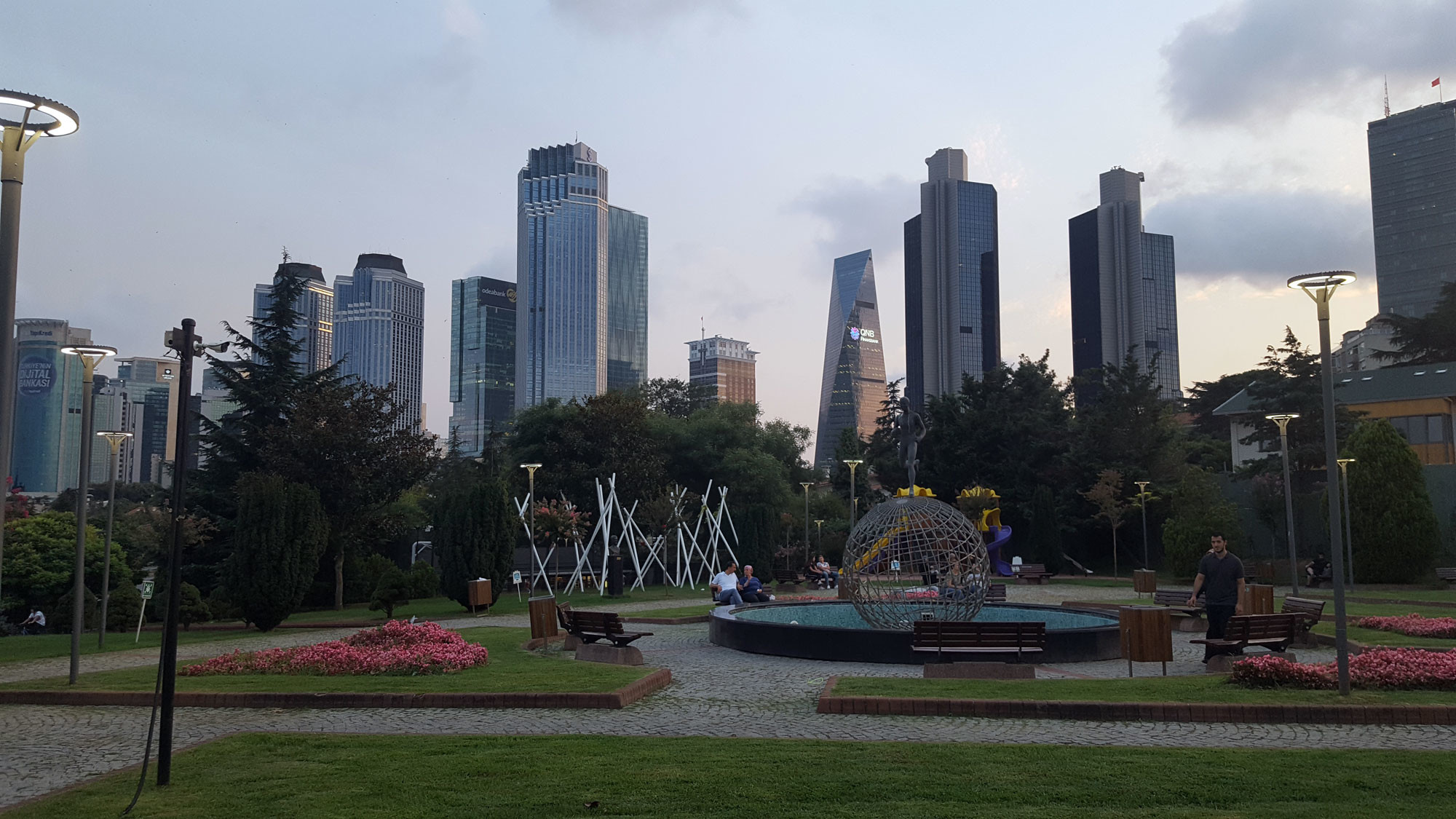
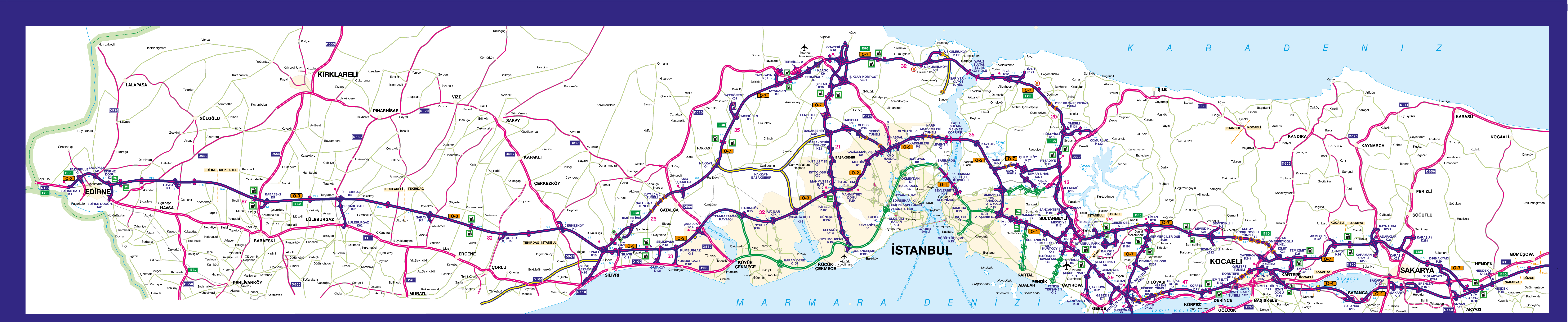
Istanbul
View on GrokipediaNames
Historical Designations
The city was originally founded as Byzantion (Latinized as Byzantium) around 657 BC by Greek colonists from Megara, establishing it as a strategic trading colony on the Bosporus Strait.[8] [9] This name persisted through Hellenistic, Roman, and early Byzantine periods, reflecting its Greek origins and role as a key maritime hub.[8] In 330 AD, Emperor Constantine the Great refounded and expanded the city as the new capital of the Roman Empire, initially designating it Nova Roma ("New Rome") before renaming it Constantinople in his honor, a name that symbolized its imperial status and endured as the primary designation until the 20th century.[9] [10] The shift emphasized its role as the "second Rome," with the name appearing in official Roman and Byzantine records, coins, and inscriptions from that era onward.[8] Following the Ottoman conquest on May 29, 1453, Sultan Mehmed II officially referred to the city as Kostantiniyye (a Turkish adaptation of Constantinople), which became the formal name in Ottoman administrative documents and Islamic scholarship, while variants like Payitaht ("Sublime Porte" or imperial throne) and Asitane ("threshold") denoted its status as the empire's capital.[11] [9] Concurrently, the colloquial Turkish name Istanbul, likely derived from the Medieval Greek phrase eis tēn pólin ("to the city" or "in the city"), gained widespread vernacular use among locals and traders by the 16th century, reflecting the city's enduring centrality without direct reference to its Roman heritage.[12] [13] [14] The Turkish Republic formalized Istanbul as the exclusive name on March 28, 1930, via a decree standardizing place names in the Latin alphabet and promoting Turkish linguistic identity, though Constantinople lingered in Western diplomatic and cultural contexts into the mid-20th century.[9] [10] [15] This change aligned with broader Turkification efforts under Mustafa Kemal Atatürk, ending the dual nomenclature that had persisted since the Ottoman period.[10]Contemporary and Linguistic Variations
In 1930, the Turkish government under Mustafa Kemal Atatürk formalized İstanbul as the official name of the city through the Turkish Postal Service, which on March 28 ceased accepting international mail addressed to "Constantinople" and instructed foreign post offices to use "Istanbul" instead.[16] This policy accelerated the shift in global nomenclature, with entities like the U.S. State Department adopting "Istanbul" by May 1930 to align with Turkish preferences.[17] Although "Constantinople" (or variants like Kostantiniyye in Ottoman Turkish) had persisted in official and diplomatic contexts post-1923 Republic founding, the 1930 directive marked the end of its practical use for the contemporary city, reflecting efforts to Turkify nomenclature amid nation-building.[8] Today, "Istanbul" is the standard international designation for the modern metropolis, employed in English, most European languages, and global institutions, while "Constantinople" is reserved primarily for historical references to the pre-1453 or pre-1930 eras.[18] In Turkish contexts, the name retains cultural resonance from its folk etymology in the Greek phrase eis tēn polin ("to the city"), denoting Constantinople as the city par excellence, though this is a phonetic evolution rather than direct derivation.[16] Some linguistic communities, particularly Greek and certain South Slavic groups, continue informal or cultural use of "Constantinople" (Greek: Κωνσταντινούπολη; Bulgarian/Serbian: Цариград or Carigrad, meaning "Tsar's city") for the site due to Orthodox heritage, but these do not override official Turkish or international conventions.[19] Linguistic variations of "Istanbul" primarily involve orthographic adaptations to non-Latin scripts or phonetic conventions, without substantive semantic differences:| Language | Rendering | Notes |
|---|---|---|
| Turkish | İstanbul | Official form with dotted İ and ş; reflects Latinized Ottoman usage since the 1928 alphabet reform.[16] |
| English/French/German | Istanbul | Undiacriticized standard; adopted post-1930 in Western media and diplomacy.[8] |
| Arabic | إسطنبول (Isṭanbūl) | Common in Middle Eastern contexts, emphasizing long vowels. |
| Russian | Стамбул (Stambul) | Retains older "Stamboul" form from Ottoman-era transliteration, used for the modern city.[20] |
| Greek | Ιστανβούλ (Istanvoúl) | Modern transliteration; Κωνσταντινούπολη used historically or culturally.[19] |
| Spanish | Estambul | Phonetic adaptation with 'e' initial, common in Iberian Romance languages.[20] |
History
Ancient Foundations and Byzantine Era
The city of Byzantium was founded around 657 BCE by Greek colonists from Megara, led by the legendary figure Byzas, who selected the site for its commanding position on the European shore of the Bosporus Strait, enabling oversight of trade routes connecting the Black Sea to the Aegean.[21] [22] This strategic location, fortified by natural harbors and elevated terrain, allowed the colony to thrive amid regional powers, enduring sieges by Persians in 512 BCE and Athenians during the Peloponnesian War, before Roman forces under Emperor Vespasian captured it in 73 CE, integrating it into the empire as a provincial center.[22] In 324 CE, Emperor Constantine I began refashioning Byzantium into a new imperial capital, officially inaugurating it as Constantinople on May 11, 330 CE, with the intent of establishing a defensible hub at the empire's eastern core, bridging continents and distancing from Rome's entrenched pagan institutions following his promotion of Christianity. [23] The city's layout expanded with forums, aqueducts, and palaces patterned on Roman models, while its population swelled through incentives attracting settlers, solidifying its role as the Eastern Roman Empire's political and economic nexus. Under Byzantine rule, Constantinople evolved into a bastion of Orthodox Christianity and classical learning, peaking at an estimated population of 400,000 to 500,000 inhabitants by the mid-6th century during Justinian I's reign (527–565 CE), sustained by grain shipments from Egypt and robust taxation of Silk Road commerce.[24] Justinian's era featured aggressive reconquests of former Roman territories in North Africa, Italy, and Spain, alongside the construction of enduring infrastructure like the Basilica Cistern in the 6th century for water storage and the Hagia Sophia cathedral between 532 and 537 CE, whose massive dome—spanning 31 meters in diameter—exemplified advanced pendentive engineering to support a central space without excessive columns.[25] [26] Defensive enhancements, including the triple-layered Theodosian Walls erected under Theodosius II from 408 to 413 CE, repelled major assaults such as Arab sieges in 674–678 CE and 717–718 CE, preserving the city's autonomy amid cascading empire-wide pressures from Persian, Slavic, and later Seljuk incursions. These fortifications, combined with naval supremacy via Greek fire—a petroleum-based incendiary weapon first deployed in 678 CE—underpinned Constantinople's resilience as the Byzantine capital for over a millennium, fostering a synthesis of Greco-Roman administration, Hellenistic culture, and Christian theology that influenced subsequent Eurasian civilizations.[23]Ottoman Conquest and Imperial Capital
The Ottoman conquest of Constantinople occurred on May 29, 1453, following a siege that began on April 6, led by Sultan Mehmed II with an army numbering between 80,000 and 200,000 troops equipped with advanced artillery, including large bombards capable of firing stone balls weighing up to 500 kilograms.[27][28] These weapons, designed by Hungarian engineer Orban, relentlessly bombarded the Theodosian Walls over 53 days, exploiting weaknesses despite the defenders' use of chains to block the Golden Horn and aid from Genoese forces under Giovanni Giustiniani.[29] The final breach came through a coordinated land assault after naval forces circumvented defenses via a ship portage, overwhelming Emperor Constantine XI's approximately 7,000 defenders and ending the Byzantine Empire.[27][29] In the immediate aftermath, Mehmed II entered the city on horseback, permitted three days of plunder as per custom, but then halted excesses to preserve infrastructure and population.[30] He converted Hagia Sophia to a mosque on the day of conquest, signaling the shift to Muslim rule, and adopted policies of religious tolerance for practical governance, allowing Christians and Jews to remain upon paying jizya tax while prohibiting forced conversions.[30] To counter depopulation—estimated at 40,000 to 50,000 residents pre-siege—Mehmed resettled Muslims from Anatolia, exempted new immigrants from taxes for periods, and invited Greek, Armenian, and Jewish communities, fostering a multi-ethnic revival centered on trade and administration.[30] Mehmed proclaimed himself Kayser-i Rum, asserting Ottoman continuity with Roman imperial legacy to legitimize rule over diverse subjects.[31] Establishing Constantinople—soon known as Istanbul—as the Ottoman capital in 1453, Mehmed II rebuilt it as a fortified imperial seat, constructing Topkapı Palace by 1465 as the sultans' residence and government hub, replacing earlier tents and emphasizing seclusion per Islamic traditions.[32] He razed damaged walls selectively, built the Fatih Mosque complex (completed 1470 after an initial 1459 version fell in earthquake), and developed markets, aqueducts, and arsenals to restore functionality.[33] Population grew to over 100,000 by his death in 1481 through incentives, positioning Istanbul as the empire's political, economic, and cultural core.[31] As imperial capital until 1923, Istanbul under successive sultans like Bayezid II, Selim I, and Suleiman the Magnificent (r. 1520–1566) expanded with monumental architecture, including Mimar Sinan's Süleymaniye Mosque (1550–1557), embodying Ottoman synthesis of Byzantine domes and Islamic minarets while serving as a military base controlling the Bosporus.[32][33] The city's role facilitated empire-wide governance via the divan council, millet system for religious communities, and trade dominance, though later sultans like Abdulmejid I (r. 1839–1861) introduced Westernizing reforms amid decline, including the 1856 Islahat Fermanı granting non-Muslims rights.[31] By the 19th century, population exceeded 1 million, reflecting resilience despite fires, earthquakes, and nationalist pressures.[31]Republican Transition and Modernization
The Ottoman Sultanate was abolished by the Grand National Assembly of Turkey on 1 November 1922, ending over six centuries of monarchical rule and prompting Sultan Mehmed VI to flee Istanbul on 17 November via the back entrance of Dolmabahçe Palace.[34] This act severed the city's imperial political authority, as the nationalist government in Ankara asserted control over the Istanbul-based Ottoman regime, which had collaborated with Allied occupiers during World War I.[35] The Turkish War of Independence (1919–1923) culminated in the Treaty of Lausanne on 24 July 1923, which secured international recognition of Turkish sovereignty and facilitated the departure of foreign troops from the city.[36] The Republic of Turkey was proclaimed on 29 October 1923, with Ankara designated as the new capital on 13 October to symbolize a rupture from Ottoman traditions, enhance defensibility against potential invasions, and promote national unification from a central Anatolian location.[37] [38] This relocation transferred administrative, diplomatic, and bureaucratic functions away from Istanbul, resulting in an initial economic downturn as civil servants and foreign embassies departed, leaving many public buildings underutilized and the city's growth temporarily stalled.[38] Nevertheless, Istanbul preserved its status as the country's primary commercial and cultural hub, with banking districts like Bankalar Caddesi (now Bankalar Street) continuing to thrive amid early republican commerce.[39] Secular reforms accelerated under President Mustafa Kemal Atatürk, including the abolition of the Caliphate on 3 March 1924, which exiled the last caliph, Abdülmecid II, from Istanbul and dismantled religious authority tied to the city.[40] The 1923 population exchange with Greece displaced approximately 1.2 million Greek Orthodox Christians from Turkey, including tens of thousands from Istanbul, reducing the non-Muslim share of the city's population from around 40% in 1914 to under 10% by the late 1920s and fostering ethnic homogenization.[41] [42] Modernization efforts reshaped urban life: the adoption of the Latin alphabet on 1 November 1928 replaced Ottoman script on signage and documents; European-inspired civil and penal codes were enacted in 1926 and 1928; and campaigns promoted western dress, education, and women's public participation, eroding traditional Islamic influences in public spaces.[36] Early urban planning drew on late-Ottoman precedents but incorporated republican visions, with French architect Henri Prost's 1930s master plan advocating wider boulevards, green spaces, and modern infrastructure to align Istanbul with European cities, though implementation was gradual due to economic constraints. Housing initiatives in the 1930s, such as state-sponsored apartments, symbolized secular modernity through functionalist designs emphasizing hygiene, rationality, and national identity.[43] These changes positioned Istanbul as a laboratory for Atatürk's vision of a secular, westernized Turkey, despite resistance from conservative elements and the city's entrenched Ottoman heritage.[44]Post-2000 Developments and Challenges
Istanbul's population expanded from approximately 8.8 million in 2000 to 15.8 million by 2023, driven by internal migration from rural Anatolia and natural growth, though official figures recorded a slight decline to 15.6 million in 2023 amid economic pressures.[45][46] This surge fueled rapid urbanization, with the city absorbing migrants seeking economic opportunities in construction, services, and manufacturing sectors that boomed under the Justice and Development Party (AKP) governments since 2002.[47] Economic growth averaged over 5% annually in the 2000s, supported by EU accession talks and foreign investment, transforming Istanbul into a regional financial hub with developments like the Istanbul Finance Centre.[48][49] Major infrastructure initiatives marked the period, including the Yavuz Sultan Selim Bridge opened in 2016, the Eurasia Tunnel in 2016 connecting Asian and European sides under the Bosphorus, and Istanbul's third airport operational since 2018, handling over 60 million passengers annually by 2023.[50][51] The Canal Istanbul project, announced in 2011 to relieve Bosphorus shipping congestion, has advanced amid debates over environmental impacts and costs exceeding $15 billion, with construction phases underway by 2024.[50] These projects, often criticized for favoring construction-linked growth over sustainability, contributed to a building boom but also strained resources.[52] Challenges intensified with chronic traffic congestion, where private vehicles rose from 19% to 26% of trips over the decade to 2010, exacerbating air pollution—transport now accounts for 45% of emissions—and discouraging public transit use.[53][54] The 2013 Gezi Park protests, sparked by plans to redevelop Taksim's green space into a replica Ottoman barracks, escalated into widespread demonstrations against perceived authoritarianism, resulting in at least eight deaths, thousands injured, and accusations of excessive police force from human rights groups.[55][56] Seismic vulnerabilities persist on the North Anatolian Fault, with the 2023 Kahramanmaraş earthquakes (magnitude 7.8) prompting accelerated urban transformation to retrofit buildings, though experts warn of insufficient progress for Istanbul's expected magnitude 7+ event, potentially affecting millions.[57][58] Uncontrolled sprawl into northern forests and housing shortages, rooted in post-1950s migration, compound flood and ecological risks.[59]Geography
Topography and Setting
Istanbul occupies a strategic position in northwestern Turkey, straddling the Bosphorus strait that connects the Black Sea to the Sea of Marmara and demarcates the continental boundary between Europe and Asia. The metropolitan area spans both the Thracian (European) and Anatolian (Asian) sides, divided by the approximately 31-kilometer-long Bosphorus, which averages 1.2 kilometers in width. The Istanbul Province encompasses 5,343 square kilometers, with the city's core centered around 41°00′N 29°00′E.[60][61][62] The city's topography features a rugged landscape of hills, valleys, and narrow coastal plains, with the historic peninsula forming a triangular promontory bounded by the Sea of Marmara to the south and the Golden Horn estuary to the north. Traditionally likened to Rome, Istanbul is known as the "City of Seven Hills," a designation originating from Byzantine Constantinople, where elevations like those under the Fatih and Sarayburnu districts provided defensive advantages and shaped settlement patterns. Steep gradients, exacerbated by the sinuous Bosphorus and Golden Horn—a 7.5-kilometer inlet reaching depths of 35 meters—create microclimates and visual drama but pose challenges for infrastructure.[63][64][65] Elevations range from sea level along the waterways to higher points inland, with Çamlıca Hill on the Asian side at 276 meters offering panoramic views, while the province's apex is Aydos Hill at 537 meters. This varied terrain, blending alluvial plains near the straits with forested uplands, influences urban density, with denser development hugging the southern shores and sparser habitation on northern heights. The setting's geological dynamism, part of the North Anatolian Fault zone, underscores Istanbul's vulnerability to seismic activity amid its expansive, water-bound contours.[66][67]Climate Patterns
Istanbul experiences a humid subtropical climate with Mediterranean influences, characterized by hot, dry summers and cool, wet winters, moderated by its position between the Black Sea to the north and the Sea of Marmara to the south.[68] The city's coastal location results in relatively mild temperatures year-round compared to inland Turkey, though northerly winds from the Black Sea can bring cooler, wetter conditions to the northern districts, while the southern areas remain somewhat drier.[69] Annual average temperatures hover around 15°C, with precipitation totaling approximately 730 mm, concentrated in the winter months.[70] Summers, from June to August, feature warm to hot conditions with average highs reaching 28–30°C, low humidity in peak heat, and minimal rainfall, often less than 20 mm per month.[68] Winters, spanning December to February, are cooler with average highs of 8–10°C and lows around 3–5°C, accompanied by frequent rain—up to 100 mm in January—and occasional frost or light snow, though accumulation is rare due to urban heat effects.[69] Spring (March–May) and autumn (September–November) serve as transitional seasons with moderate temperatures (10–20°C) and increasing variability, including thunderstorms in autumn.[70] The Köppen-Geiger classification designates Istanbul's climate as Csa, indicating hot summers and dry conditions exceeding 10 times the precipitation of the driest winter month. Microclimatic variations exist across the metropolis: the European side tends to be slightly warmer and drier, while the Asian side and Black Sea coast experience more precipitation and cooler summers due to topographic sheltering and sea breezes.[68]| Month | Avg. High (°C) | Avg. Low (°C) | Precipitation (mm) |
|---|---|---|---|
| January | 9 | 3 | 97 |
| February | 10 | 3 | 80 |
| March | 12 | 5 | 65 |
| April | 16 | 8 | 50 |
| May | 21 | 12 | 40 |
| June | 25 | 16 | 30 |
| July | 27 | 18 | 25 |
| August | 27 | 18 | 30 |
| September | 24 | 15 | 55 |
| October | 20 | 12 | 80 |
| November | 15 | 8 | 90 |
| December | 11 | 5 | 100 |