


Community hub
Recent from talks
Contribute something
Nothing was collected or created yet.
Italian irredentism
View on Wikipedia


Italian irredentism (Italian: irredentismo italiano [irredenˈtizmo itaˈljaːno]) was a political movement during the late 19th and early 20th centuries in the Kingdom of Italy. It originated to promote the annexation of majority Italian-speaking territories which were still retained by the Austrian Empire after three wars of independence (1848-1849, 1859 and 1866); specifically, Trento and Trieste were designated as the main "irredent lands". Both provinces were ultimately annexed as a result of World War I, considered in Italian discourse to be the "fourth war of independence": the conclusion of the conflict on November 4, 1918, is still commemorated in Italy as National Unity Day. Thereafter, Italian irredentism waned in importance; however, Italian nationalists and fascists would use irredentist arguments to justify the Italianization of other territories Italy annexed in World War I (such as South Tyrol and the Slavic parts of Istria) and claim many other lands beyond Trento and Trieste. Those latter policies and claims have been abandoned by the Italian Republic.[1]
Overview
[edit]
Even after the Capture of Rome (1871), the final event of the unification of Italy, many ethnic Italian speakers (Trentino-Alto Adigan Italians, Savoyard Italians, Corfiot Italians, Niçard Italians, Swiss Italians, Corsican Italians, Maltese Italians, Istrian Italians and Dalmatian Italians) remained outside the borders of the Kingdom of Italy and this situation created the Italian irredentism. Up until World War I, the main "irredent lands" (terre irredente) were considered to be the provinces of Trento and Trieste and, in a narrow sense, irredentists referred to the Italian patriots living in these two areas.[1]
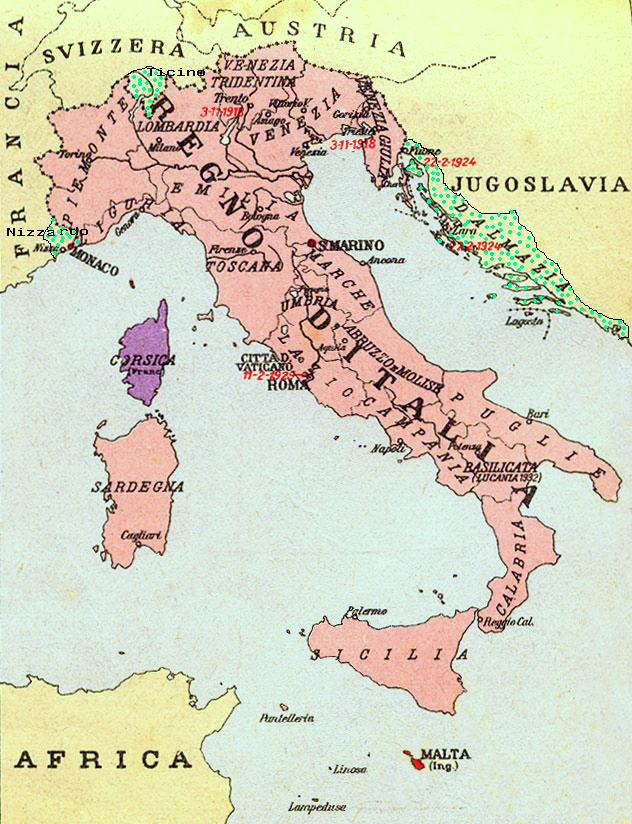
The term was later expanded to also include multilingual and multiethnic areas, where Italians were a relative majority or a substantial minority, within the northern Italian region encompassed by the Alps, with German, Italian, Slovene, Croatian, Ladin and Istro-Romanian population, such as South Tyrol, Istria, Gorizia and Gradisca and part of Dalmatia. The claims were further extended also to the city of Fiume, Corsica, the island of Malta, the County of Nice and Italian Switzerland.[1][2]
After the end of World War I, the Italian irredentist movement largely disappared in its original form, having achieved the goal of annexing Trento and Trieste; it was, however, hegemonised, manipulated and distorted by fascism, which made it an instrument of nationalist propaganda, placed at the center of a policy, conditioned by belated imperial ambitions, which took the form of "forced Italianizations", in the aspiration for the birth of a Great Italy and a vast Italian Empire.[3] After World War II, Italian irredentism disappeared along with the defeated Fascists and the Monarchy of the House of Savoy. After the Treaty of Paris (1947) and the Treaty of Osimo (1975), the territorial claims of Fascist Italy were abandoned by the Italian Republic (see Foreign relations of Italy).[4]

Characteristics
[edit]Italian irredentism was not a formal organization but rather an opinion movement, advocated by several different groups, claiming that Italy had to reach its "natural borders" or unify territories inhabited by Italians.[1] Similar nationalistic ideas were common in Europe in the late 19th century. The term irredentism, coined from the Italian word, came into use in many countries (see List of irredentist claims or disputes). This idea of Italia irredenta is not to be confused with the Risorgimento, the historical events that led to irredentism, nor with nationalism or Imperial Italy, the political philosophy that took the idea further under fascism.
During the 19th century, Italian irredentism fully developed the characteristic of defending the Italian language from other people's languages, such as, for example, German in Switzerland and in the Austro-Hungarian Empire or French in Nice and Corsica.
The liberation of Italia irredenta was perhaps the strongest motive for Italy's entry into World War I and the Treaty of Versailles in 1919 satisfied many irredentist claims.[5]
Italian irredentism has the characteristic of being originally moderate, requesting only the return to Italy of the areas with Italian majority of population,[6] but after World War I it became aggressive – under fascist influence – and claimed to the Kingdom of Italy even areas where Italians were a minority or had been present only in the past. In the first case, there were the Risorgimento claims on Trento, while in the second, there were the fascist claims on the Ionian Islands, Savoy and Malta.
History
[edit]Origins
[edit]
The Corsican revolutionary Pasquale Paoli was called "the precursor of Italian irredentism" by Niccolò Tommaseo because he was the first to promote the Italian language and socio-culture (the main characteristics of Italian irredentism) in his island; Paoli wanted the Italian language to be the official language of the newly founded Corsican Republic.
Pasquale Paoli's appeal in 1768 against the French invader said:
We are Corsicans by birth and sentiment, but first of all we feel Italian by language, origins, customs, traditions; and Italians are all brothers and united in the face of history and in the face of God ... As Corsicans we wish to be neither slaves nor "rebels" and as Italians we have the right to deal as equals with the other Italian brothers ... Either we shall be free or we shall be nothing... Either we shall win or we shall die (against the French), weapons in hand ... The war against France is right and holy as the name of God is holy and right, and here on our mountains will appear for Italy the sun of liberty
— Pasquale Paoli[7]
Paoli's Corsican Constitution of 1755 was written in Italian and the short-lived university he founded in the city of Corte in 1765 used Italian as the official language. Paoli was sympathetic to Italian culture and regarded his own native language as an Italian dialect (Corsican is an Italo-Dalmatian tongue closely related to Tuscan).
After the Italian unification and Third Italian War of Independence in 1866, there were areas with Italian-speaking communities within the borders of several countries around the newly created Kingdom of Italy. The irredentists sought to annex all those areas to the newly unified Italy. The areas targeted were Corsica, Dalmatia, Gorizia, Istria, Malta, County of Nice, Ticino, small parts of Grisons and of Valais, Trentino, Trieste and Fiume.[8]
Different movements or groups founded in this period included the Italian politician Matteo Renato Imbriani inventing the new term terre irredente ("unredeemed lands") in 1877; in the same year the movement Associazione in pro dell'Italia Irredenta ("Association for the Unredeemed Italy") was founded; in 1885 the Pro Patria movement ("For Fatherland") was founded and in 1891 the Lega Nazionale Italiana ("Italian National League") was founded in Trento and Trieste (in the Austrian Empire).[9]
Initially, the movement can be described as part of the more general nation-building process in Europe in the 19th and 20th centuries when the multi-national Austro-Hungarian, Russian and Ottoman Empires were being replaced by nation-states. The Italian nation-building process can be compared to similar movements in Germany (Großdeutschland), Hungary, Serbia and in pre-1914 Poland. Simultaneously, in many parts of 19th-century Europe liberalism and nationalism were ideologies which were coming to the forefront of political culture. In Eastern Europe, where the Habsburg Empire had long asserted control over a variety of ethnic and cultural groups, nationalism appeared in a standard format. The beginning of the 19th century "was the period when the smaller, mostly indigenous nationalities of the empire – Czechs, Slovaks, Slovenes, Croats, Serbs, Ukrainians, Romanians – remembered their historical traditions, revived their native tongues as literary languages, reappropriated their traditions and folklore, in short, reasserted their existence as nations".[10]
19th century
[edit]
In the early 19th century the ideals of unification in a single Nation of all the territories populated by Italian-speaking people created the Italian irredentism.
The current Italian Switzerland belonged to the Duchy of Milan until the 16th century, when it became part of Switzerland. These territories have maintained their native Italian population speaking the Italian language and the Lombard language, specifically the Ticinese dialect. Italian irredentism in Switzerland was based on moderate Risorgimento ideals, and was promoted by Italian-Ticinese such as Adolfo Carmine.[11]
Following a brief French occupation (1798–1800) the British established control over Malta while it was still formally part of the Kingdom of Sicily. During both the French and British periods, Malta officially remained part of the Sicilian Kingdom, although the French refused to recognise the island as such in contrast to the British. Malta became a British Crown Colony in 1813, which was confirmed a year later through the Treaty of Paris (1814).[12] Cultural changes were few even after 1814. In 1842, all literate Maltese learned Italian while only 4.5% could read, write and/or speak English.[13] However, there was a huge increase in the number of Maltese magazines and newspapers in the Italian language during the 1800s and early 1900s,[14] so as a consequence the Italian was understood (but not spoken fluently) by more than half the Maltese people before WW1.


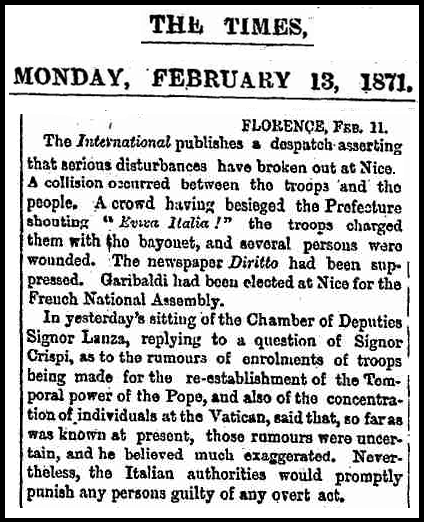
The Kingdom of Sardinia again attacked the Austrian Empire in the Second Italian War of Independence of 1859, with the aid of France, resulting in the liberation of Lombardy. On the basis of the Plombières Agreement, the Kingdom of Sardinia ceded Savoy and Nice to France, an event that caused the Niçard exodus, that was the emigration of a quarter of the Niçard Italians to Italy.[15] Giuseppe Garibaldi was elected in 1871 in Nice at the National Assembly where he tried to promote the annexation of his hometown to the newborn Italian unitary state, but he was prevented from speaking.[16] Because of this denial, between 1871 and 1872 there were riots in Nice, promoted by the Garibaldini and called "Niçard Vespers",[17] which demanded the annexation of the city and its area to Italy.[18] Fifteen Nice people who participated in the rebellion were tried and sentenced.[19]
In the spring of 1860 Savoy was annexed to France after a referendum and the administrative boundaries changed, but a segment of the Savoyard population demonstrated against the annexation. Indeed, the final vote count on the referendum announced by the Court of Appeals was 130,839 in favour of annexation to France, 235 opposed and 71 void, showing questionable complete support for French nationalism (that motivated criticisms about rigged results).[20] At the beginning of 1860, more than 3000 people demonstrated in Chambéry against the annexation to France rumours. On 16 March 1860, the provinces of Northern Savoy (Chablais, Faucigny and Genevois) sent to Victor Emmanuel II, to Napoleon III, and to the Swiss Federal Council a declaration - sent under the presentation of a manifesto together with petitions - where they were saying that they did not wish to become French and shown their preference to remain united to the Kingdom of Sardinia (or be annexed to Switzerland in the case a separation with Sardinia was unavoidable).[21] Giuseppe Garibaldi complained about the referendum that allowed France to annex Savoy and Nice, and a group of his followers (among the Italian Savoyards) took refuge in Italy in the following years.
In 1861, with the proclamation of the Kingdom of Italy, the modern Italian state was born. On 21 July 1878, a noisy public meeting was held at Rome with Menotti Garibaldi, the son of Giuseppe Garibaldi, as chairman of the forum and a clamour was raised for the formation of volunteer battalions to conquer the Trentino. Benedetto Cairoli, then Prime Minister of Italy, treated the agitation with tolerance.[22] However, it was mainly superficial, as most Italians did not wish a dangerous policy against Austria or against Britain for Malta.[22]
Many Istrian Italians and Dalmatian Italians looked with sympathy towards the Risorgimento movement that fought for the unification of Italy.[23] However, after the Third Italian War of Independence (1866), when the Veneto and Friuli regions were ceded by the Austrians to the newly formed Kingdom of Italy, Istria and Dalmatia remained part of the Austro-Hungarian Empire, together with other Italian-speaking areas on the eastern Adriatic. This triggered the gradual rise of Italian irredentism among many Italians in Istria, Kvarner and Dalmatia, who demanded the unification of the Julian March, Kvarner and Dalmatia with Italy. The Austrians saw the Italians as enemies and favored the Slav communities of Istria, Kvarner and Dalmatia.[24] During the meeting of the Council of Ministers of 12 November 1866, Emperor Franz Joseph I of Austria outlined a wide-ranging project aimed at the Germanization or Slavization of the areas of the empire with an Italian presence:[25]

His Majesty expressed the precise order that action be taken decisively against the influence of the Italian elements still present in some regions of the Crown and, appropriately occupying the posts of public, judicial, masters employees as well as with the influence of the press, work in South Tyrol, Dalmatia and Littoral for the Germanization and Slavization of these territories according to the circumstances, with energy and without any regard. His Majesty calls the central offices to the strong duty to proceed in this way to what has been established.
Istrian Italians made up about a third of the population in 1900.[27] Dalmatia, especially its maritime cities, once had a substantial local ethnic Italian population (Dalmatian Italians). According to Austrian census, the Dalmatian Italians formed 12.5% of the population in 1865.[28] In the 1910 Austro-Hungarian census, Istria had a population of 57.8% Slavic-speakers (Croat and Slovene), and 38.1% Italian speakers.[29] For the Austrian Kingdom of Dalmatia, (i.e. Dalmatia), the 1910 numbers were 96.2% Slavic speakers and 2.8% Italian speakers.[30]
Before 1859, Italian was the language of administration, education, the press, and the Austrian navy, and people who wished to acquire higher social standing and separate from the Slav peasantry became Italians.[31] In the years after 1866, Italians lost their privileges in Austria-Hungary, their assimilation of the Slavs came to an end, and they found themselves under growing pressure by other rising nations; with the rising Slav tide after 1890, italianized Slavs reverted to being Croats.[31] Austrian rulers found use of the racial antagonism and financed Slav schools and promoted Croatian as the official language, and many Italians chose voluntary exile.[31] In 1909 the Italian language lost its status as the official language of Dalmatia in favor of Croatian only, and Italian could no longer be used in the public and administrative sphere.[32]

One consequence of irredentist ideas outside of Italy was an assassination plot organized against the Emperor Francis Joseph in Trieste in 1882, which was detected and foiled.[22] Guglielmo Oberdan, a Triestine and thus Austrian citizen, was executed. When the irredentist movement became troublesome to Italy through the activity of Republicans and Socialists, it was subject to effective police control by Agostino Depretis.[22]
Irredentism faced a setback when the French occupation of Tunisia in 1881 started a crisis in French–Italian relations. The government entered into relations with Austria and Germany, which took shape with the formation of the Triple Alliance in 1882. The irredentists' dream of absorbing the targeted areas into Italy made no further progress in the 19th century, as the borders of the Kingdom of Italy remained unchanged and the Rome government began to set up colonies in Eritrea and Somalia in Africa.
World War I
[edit]

Italy entered the World War I in 1915 with the aim of completing national unity: for this reason, the Italian intervention in the World War I is also considered the Fourth Italian War of Independence,[33] in a historiographical perspective that identifies in the latter the conclusion of the unification of Italy, whose military actions began during the revolutions of 1848 with the First Italian War of Independence.[34][35]
Italy signed the Treaty of London (1915) and entered World War I with the intention of gaining those territories perceived by irredentists as being Italian under foreign rule. According to the pact, Italy was to leave the Triple Alliance and join the Entente Powers. Furthermore, Italy was to declare war on Germany and Austria-Hungary within a month. The declaration of war was duly published on 23 May 1915.[36] In exchange, Italy was to obtain various territorial gains at the end of the war. In April 1918, in what he described as an open letter "to the American Nation" Paolo Thaon di Revel, Commander in Chief of the Italian navy, appealed to the people of the United States to support Italian territorial claims over Trento, Trieste, Istria, Dalmatia and the Adriatic, writing that "we are fighting to expel an intruder from our home".[37]

The outcome of the World War I and the consequent settlement of the Treaty of Saint-Germain met some Italian claims, including many (but not all) of the aims of the Italia irredenta party.[38] Italy gained Trieste, Gorizia, Istria and the Dalmatian city of Zara. In Dalmatia, despite the London Pact, only territories with Italian majority as Zara with some Dalmatian islands, such as Cherso, Lussino and Lagosta were annexed by Italy because Woodrow Wilson, supporting Yugoslav claims and not recognizing the treaty, rejected Italian requests on other Dalmatian territories, so this outcome was denounced as a "Mutilated victory". The rhetoric of "Mutilated victory" was adopted by Benito Mussolini and led to the rise of Italian fascism, becoming a key point in the propaganda of Fascist Italy. Historians regard "Mutilated victory" as a "political myth", used by fascists to fuel Italian imperialism and obscure the successes of liberal Italy in the aftermath of World War I.[39]
The city of Fiume in the Kvarner was the subject of claim and counter-claim: Italians claimed it on the principle of self-determination, disregarding its mainly Slavic suburb of Susak.[40] Fiume had not been promised to Italy in the London Pact, though it was to become Italian by 1924 (see Italian Regency of Carnaro, Treaty of Rapallo, 1920 and Treaty of Rome, 1924). The stand taken by the irredentist Gabriele D'Annunzio, which briefly led him to become an enemy of the Italian state,[41] was meant to provoke a nationalist revival through corporatism (first instituted during his rule over Fiume), in front of what was widely perceived as state corruption engineered by governments such as Giovanni Giolitti's. D'Annunzio briefly annexed to this Italian Regency of Carnaro even the Dalmatian islands of Veglia and Arbe, where there was a numerous Italian community.[citation needed]

Fascism and World War II
[edit]
After the end of World War I, the Italian irredentist movement was hegemonised, manipulated and distorted by fascism, which made it an instrument of nationalist propaganda, placed at the centre of a policy, conditioned by belated imperial ambitions, which took the form of "forced Italianizations", in the aspiration for the birth of a Great Italy and a vast Italian Empire.[3]
Fascist Italy strove to be seen as the natural result of war heroism against a "betrayed Italy" that had not been awarded all it "deserved", as well as appropriating the image of Arditi soldiers. In this vein, irredentist claims were expanded and often used in Fascist Italy's desire to control the Mediterranean basin.
To the east of Italy, the Fascists claimed that Dalmatia was a land of Italian culture whose Italians had been driven out of Dalmatia and into exile in Italy, and supported the return of Italians of Dalmatian heritage.[42] Mussolini identified Dalmatia as having strong Italian cultural roots for centuries via the Roman Empire and the Republic of Venice.[43] The Fascists especially focused their claims based on the Venetian cultural heritage of Dalmatia, claiming that Venetian rule had been beneficial for all Dalmatians and had been accepted by the Dalmatian population.[43] The Fascists were outraged after World War I, when the agreement between Italy and the Entente Allies in the Treaty of London of 1915 to have Dalmatia join Italy was revoked in 1919.[43]
To the west of Italy, the Fascists claimed that the territories of Corsica, Nice and Savoy held by France were Italian lands.[44][45] The Fascist regime produced literature on Corsica that presented evidence of the island's italianità.[46] The Fascist regime produced literature on Nice that justified that Nice was an Italian land based on historic, ethnic and linguistic grounds.[46] The Fascists quoted Medieval Italian scholar Petrarch who said: "The border of Italy is the Var; consequently Nice is a part of Italy".[46] The Fascists quoted Italian national hero Giuseppe Garibaldi, a native of Nizza (now called Nice) himself, who said: "Corsica and Nice must not belong to France; there will come the day when an Italy mindful of its true worth will reclaim its provinces now so shamefully languishing under foreign domination".[46] Mussolini initially pursued promoting annexation of Corsica through political and diplomatic means, believing that Corsica could be annexed to Italy through Italy first encouraging the existing autonomist tendencies in Corsica and then the independence of Corsica from France, that would be followed by the annexation of Corsica into Italy.[47]

In 1923, Mussolini temporarily occupied Corfu, using irredentist claims based on minorities of Italians in the island, the Corfiot Italians. Similar tactics may have been used towards the islands around the Kingdom of Italy – through the Maltese Italians, Corfiot Italians and Corsican Italians in order to control the Mediterranean sea (his Mare Nostrum, from the Latin "Our Sea").
In the 1930s Mussolini promoted the development of an initial Italian irredentism in Durrës, in order to occupy all of Albania later. Durrës (called "Durazzo" in Italian) has been for centuries, during the Middle Ages, a city with territory under the control of the Italian states (Naples, Sicily, Venice), and many Italians settled there. The Durazzo section of the Albania Fascist Party was created in 1938, which was formed by some citizens of the city with distant and recent Italian roots (they started the local Italian irredentism). In 1939, all of Albania was occupied and united to the Kingdom of Italy: Italian citizens (more than 11,000) began to settle in Albania as colonists and to own land in 1940 so that they could gradually transform it into Italian territory.[48] The italianization of Albania was one of Mussolini's plans.[49]
During World War II, large parts of Dalmatia were annexed by Italy into the Governorship of Dalmatia from 1941 to 1943. Corsica and Nice were also administratively annexed by Italy in November 1942. Malta was heavily bombed, but was not occupied due to Erwin Rommel's request to divert to North Africa the forces that had been prepared for the invasion of the island.
Dalmatia and the World Wars
[edit]
Dalmatia was a strategic region during World War I that both Italy and Serbia intended to seize from Austria-Hungary. Italy joined the Triple Entente Allies in 1915 upon agreeing to the Treaty of London (1915) that guaranteed Italy the right to annex a large portion of Dalmatia in exchange for Italy's participation on the Allied side. From 5–6 November 1918, Italian forces were reported to have reached Lissa, Lagosta, Sebenico, and other localities on the Dalmatian coast.[50] By the end of hostilities in November 1918, the Italian military had seized control of the entire portion of Dalmatia that had been guaranteed to Italy by the Treaty of London and by 17 November had seized Fiume as well.[51] In 1918, Admiral Enrico Millo declared himself Italy's Governor of Dalmatia.[51] Famous Italian nationalist Gabriele d'Annunzio supported the seizure of Dalmatia and proceeded to Zara in an Italian warship in December 1918.[52]

The last city with a significant Italian presence in Dalmatia was the city of Zara (now called Zadar). In the Austro-Hungarian census of 1910, the city of Zara had an Italian population of 9,318 (or 69.3% out of the total of 13,438 inhabitants).[53] In 1921 the population grew to 17,075 inhabitants, of which 12,075 Italians (corresponding to 70,76%).[54]
In 1941, during the Second World War, Yugoslavia was occupied by Italy and Germany. Dalmatia was divided between Italy, which constituted the Governorate of Dalmatia, and the Independent State of Croatia, which annexed Ragusa and Morlachia. After the Italian surrender (8 September 1943) the Independent State of Croatia annexed the Governorate of Dalmatia, except for the territories that had been Italian before the start of the conflict, such as Zara. In 1943, Josip Broz Tito informed the Allies that Zara was a chief logistic centre for German forces in Yugoslavia. By overstating its importance, he persuaded them of its military significance. Italy surrendered in September 1943 and over the following year, specifically between 2 November 1943 and 31 October 1944, Allied Forces bombarded the town fifty-four times. Nearly 2,000 people were buried beneath rubble: 10–12,000 people escaped and took refuge in Trieste and slightly over 1,000 reached Apulia. Tito's partisans entered Zara on 31 October 1944 and 138 people were killed.[55] With the Peace Treaty of 1947, Italians still living in Zara followed the Italian exodus from Dalmatia and only about 100 Dalmatian Italians now remain in the city.
Post-World War II
[edit]

Under the 1947 Treaty of Peace with Italy, Istria, Kvarner, most of the Julian March as well as the Dalmatian city of Zara were annexed by Yugoslavia. The treaty provided for the right of option of Italian citizens living in the territories that were to be taken over by Greece, France, and Yugoslavia to remain Italian citizens, with the possibility of request by those states that they moved out of the area within a year.[56][57] The ensuing Istrian-Dalmatian exodus led to the emigration of between 230,000 and 350,000 of local ethnic Italians (Istrian Italians and Dalmatian Italians), the others being ethnic Slovenians, ethnic Croatians, and ethnic Istro-Romanians, choosing to maintain Italian citizenship.[58]
The Istrian-Dalmatian exodus started in 1943 and ended completely only in 1960. According to the census organized in Croatia in 2001 and that organized in Slovenia in 2002, there were 2,258 Italians in Slovenia and 19,636 in Croatia.[59][60]
After World War II, Italian irredentism disappeared along with the defeated Fascists and the Monarchy of the House of Savoy. After the Treaty of Paris (1947) and the Treaty of Osimo (1975), all territorial claims were abandoned by the Italian Republic (see Foreign relations of Italy). The Italian irredentist movement thus vanished from Italian politics. Today, Italy, France, Malta, Greece, Croatia and Slovenia are all members of the European Union, while Montenegro and Albania are candidates for accession. The 1947 Constitution of Italy established five autonomous regions (Sardinia, Friuli-Venezia Giulia, Sicily, Aosta Valley and Trentino-Alto Adige/Südtirol), in recognition of their cultural and linguistic distinctiveness.
In the early 1990s, the breakup of Yugoslavia caused nationalistic sentiments to re-emerge in these areas; worthy of note in this regard are the demonstrations in Trieste on 6 October 1991 "for a new Italian irredentism". These were promoted by the Italian Social Movement and inspired by rumours about negotiations for the passage through Trieste of the Yugoslav troops expelled from Slovenia during the Ten-Day War which saw the participation of thousands of people at the political rally in Piazza della Borsa followed by a long procession through the streets of the city, and on 8 November 1992, again in Trieste.[61]
The same Italian Social Movement and National Alliance asked for the review of the peace treaties signed by Italy after World War II, especially with regard to Zone B of the former Free Territory of Trieste, given that the qualification of Slovenia and Croatia as heirs of Yugoslavia was not a given and that the division of Istria between Slovenia and Croatia contradicted the clauses of the peace treaties which guaranteed the unity of the surviving Italian component in Istria (Istrian Italians), assigned to Yugoslavia after World War II, proposing the creation of an Istrian Euro-region also including the city of Rijeka.[62] These claims, which also concerned Dalmatia (including islands such as Pag, Ugljan, Vis, Lastovo, Hvar, Korčula and Mljet) and the coast with the cities of Zadar, Šibenik, Trogir and Split, remained completely unheeded by all the Italian governments that followed one another in that period.[63][64][65]
Claimed territories beyond Trento and Trieste
[edit]Although Trento and Trieste were considered to be the main irredent lands, other territories were variously claimed as such by a part of Italian nationalists and fascists, including:
- Istria


- Dalmatia

- Monaco

- Nice province

- Corsica
- Savoy
- Malta

- Ionian Islands

- Canton Ticino, parts of Canton Vallese and Italian Graubünden

- San Marino
 [example needed]
 - Coastal parts of Vlorë region and Vlorë

- Palagruža


Various points were brought forward as arguments in support of the irredentist theses of claim, such as the geographical belonging of those lands to the Italian peninsula or the presence of more or less numerous communities of Italians or Italian speakers.
After World War I the situation of the claimed lands was as follows:[66]
- Italians and Italian speakers in the County of Nice: around 4,000 (estimate);
- Italian speakers in Ticino and Grisons (Switzerland): approximately 230,000;
- Italians and Italian speakers in Dalmatia: around 20,000;
- Italian speakers in Malta: approximately 200,000 estimated;
- Italian speakers in Corsica: approximately 200,000 estimated.
Italian irredentism by region
[edit]


- Italian irredentism in Dalmatia was the political movement supporting the unification to Italy, during the 19th and 20th centuries, of Adriatic Dalmatia. The Republic of Venice, between the 9th century and 1797, extended its dominion to Istria, the islands of Kvarner and Dalmatia, when it was conquered by Napoleon.[67] After the fall of Napoleon (1814) Istria, the islands of Kvarner and Dalmatia were annexed to the Austrian Empire.[68] Many Dalmatian Italians looked with sympathy towards the Risorgimento movement that fought for the unification of Italy.[23] The first events that involved the Dalmatian Italians in the unification of Italy were the revolutions of 1848, during which they took part in the constitution of the Republic of San Marco in Venice. The most notable Dalmatian Italians exponents who intervened were Niccolò Tommaseo and Federico Seismit-Doda.[69]
- Italian irredentism in Istria was the political movement supporting the unification to Italy, during the 19th and 20th centuries, of the peninsula of Istria. It is considered closely related to the Italian irredentism in Trieste and Fiume, two cities bordering the peninsula. When Napoleon conquered the territory of Istria, he found that Istria was populated by Istrian Italians on the coast and in the main cities, but the interior was populated mainly by Croats and Slovenians: this multi-ethnic population in the same peninsula created a situation of antagonism between Slovenes, Croats and Italians, when started the first nationalisms after Napoleon's fall. Since 1815 Istria was a part of the Austrian monarchy, and Croats, Slovenians and Italians engaged in a nationalistic feud with each other.[70] As a consequence, Istria has been a theater of a nationalistic ethnic struggle between them during the 19th and 20th centuries. Italian irredentism was actively followed by many Italians in Istria, like the Italian sailor and irredentist Nazario Sauro, native to Capodistria.[71]
- Italian irredentism in Corsica was a cultural and historical movement promoted by Italians and by people from Corsica who identified themselves as part of Italy rather than France, and promoted the Italian annexation of the island. Corsica was part of the Republic of Genoa for centuries until 1768, when the Republic ceded the island to France, one year before the birth of Napoleon Bonaparte in the capital city of Ajaccio. Under France, the use of Corsican (a regional tongue which is closely related to Italian) has gradually declined in favour of the standard French language. Giuseppe Garibaldi called for the inclusion of the "Corsican Italians" within Italy when the city of Rome was annexed to the Kingdom of Italy, but Victor Emmanuel II did not agree to it. The course of Italian irredentism did not affect Corsica very much, and only during the Fascist rule of Benito Mussolini were the first organizations strongly promoting the unification of the island to the Kingdom of Italy founded. Italian was the official language of Corsica until 1859.[72]
- Italian irredentism in Nice was the political movement supporting the annexation of the County of Nice to the Kingdom of Italy. According to some Italian nationalists and fascists like Ermanno Amicucci, Italian- and Ligurian-speaking populations of the County of Nice (Italian: Nizza) formed the majority of the county's population until the mid-19th century.[73] However, French nationalists and linguists argue that both Occitan and Ligurian languages were spoken in the County of Nice. During the Italian unification, in 1860, the House of Savoy allowed the Second French Empire to annex Nice from the Kingdom of Sardinia in exchange for French support of its quest to unify Italy. Consequently, the Niçois were excluded from the Italian unification movement and the region has since become primarily French-speaking. The pro-Italian irredentist movement persisted throughout the period 1860–1914, despite the repression carried out since the annexation. The French government implemented a policy of Francization of society, language and culture.[74] The toponyms of the communes of the ancient County have been francized, with the obligation to use French in Nice,[75] as well as certain surnames (for example the Italian surname "Bianchi" was francized into "Leblanc", and the Italian surname "Del Ponte" was francized into "Dupont").[76]
- Italian irredentism in Savoy was the political movement among Savoyards promoting annexation to the Savoy dynasty's Kingdom of Italy. It was active from 1860 to World War II. During the Italian unification, in 1860, the House of Savoy allowed the Second French Empire to annex Savoy from the Kingdom of Sardinia in exchange for French support of its quest to unify Italy. Italian irredentists were citizens of Savoy who considered themselves to have ties with the House of Savoy dynasty. Savoy was the original territory of the duke of Savoy that later became King of Italy. Since the Renaissance the area had ruled over Piedmont and had for regional capital the town of Chambéry.
- Italian irredentism in Malta is the movement that uses an irredentist argument to propose the incorporation of the Maltese islands into Italy, with reference to past support in Malta for Italian territorial claims on the islands. Although Malta had formally ceased to be part of the Kingdom of Sicily only since 1814 following the Treaty of Paris, Italian irredentism in Malta was mainly significant during the Italian Fascist era.[77] Until the end of the 18th century Malta's fortunes—political, economic, religious, cultural—were closely tied with Sicily's. Successive waves of immigration from Sicily and Italy strengthened these ties and increased the demographic similarity. Italian was Malta's language of administration, law, contracts and public records, Malta's culture was similar to Italy's, Malta's nobility was originally composed of Italian families who had moved to Malta mainly in the 13th century and the Maltese Catholic Church was suffragan of the Archdiocese of Palermo. For many centuries and until 1936, Italian was the official language of Malta (see Maltese Italian).[78]
- Italian irredentism in Switzerland was a political movement that promoted the unification to Italy of the Italian-speaking areas of Switzerland during the Risorgimento. The current Italian Switzerland belonged to the Duchy of Milan until the 16th century, when it became part of Switzerland. These territories have maintained their native Italian population speaking the Italian language and the Lombard language, specifically the Ticinese dialect. In the early 19th century the ideals of unification in a single Nation of all the territories populated by Italian speaking people created the Italian irredentism. Italian irredentism in Switzerland was based on moderate Risorgimento ideals, and was promoted by Italian-Ticinese such as Adolfo Carmine.[79]
- Italian irredentism in Corfu was the political movement supporting the unification to Italy, during the 19th and 20th centuries, of the island of Corfu. Corfiot Italians are a population from the Greek island of Corfu (Kerkyra) with ethnic and linguistic ties to the Republic of Venice. Their name was specifically established by Niccolò Tommaseo during the Italian Risorgimento.[80] During the first half of the 20th century, Mussolini (whose fascist regime promoted the ideals of Italian irredentism) successfully used the Corfiot Italians as a pretext to occupy Corfu twice. The Italian Risorgimento was initially concentrated in the Italian peninsula with the surrounding continental areas (Istria, Dalmatia, Corsica, County of Nice, etc.) and did not reach Corfu and the Ionian islands. One of the main heroes of the Italian Risorgimento, the poet Ugo Foscolo, was born in Zante from a noble Venetian family of the island, but only superficially promoted the possible unification of the Ionian islands to Italy. According to historian Ezio Gray, the small communities of Venetian-speaking people in Corfu were mostly assimilated after the island became part of Greece in 1864 and especially after all Italian schools were closed in 1870.[81] After World War I, however, the Kingdom of Italy started to apply a policy of expansionism toward the Adriatic area and saw Corfu as the gate of this sea.
Political figures in Italian irredentism
[edit]See also
[edit]

References
[edit]- ^ a b c d Tamaro, Attilio (1933). "IRREDENTISMO – Enciclopedia Italiana" (in Italian). Treccani. Retrieved 9 September 2023.
- ^ "La frontiera tra Italia e Svizzera" (in Italian). Retrieved 9 September 2023.
- ^ a b Monteleone, Renato (1970). "La politica dei Socialisti e democratici irredenti in Italia nella grande guerra". Studi Storici (in Italian). Anno 11 (2): 313–346..
- ^ "L'Italia per De Gaulle: "Non un paese povero, ma un povero paese"" (in Italian). 8 June 2012. Retrieved 9 September 2023.
- ^ irredentism Archived 2008-05-10 at the Wayback Machine – The Columbia Encyclopedia, Sixth Edition. 2001–07
- ^ NYTimes on Italian irredentism in Istria
- ^ N. Tommaseo. "Lettere di Pasquale de Paoli" (in Archivio storico italiano, 1st series, vol. XI).
- ^ Paci, Deborah (23 January 2013). "Il mito del Risorgimento mediterraneo" (PDF) (in Italian). Retrieved 2 June 2021.
- ^ "Lega Nazionale" (in Italian). Retrieved 2 June 2021.
- ^ Sperber, Jonathan. The European Revolutions, 1848–1851. New York: Cambridge University Press, 2005. page 99.
- ^ "In viaggio con la zia - Firenze del 04/06/2016" (in Italian). Retrieved 4 June 2021.
- ^ "Malta" (in Italian). Retrieved 2 June 2021.
- ^ Brincat, Giuseppe. "Malta. Una storia linguistica".Introduction
- ^ Italian magazines in Malta during the 1800s (in Italian)
- ^ ""Un nizzardo su quattro prese la via dell'esilio" in seguito all'unità d'Italia, dice lo scrittore Casalino Pierluigi" (in Italian). 28 August 2017. Retrieved 14 May 2021.
- ^ "Times article dated February 13, 1871". Retrieved 20 October 2011.
- ^ "I Vespri Nizzardi del 1871: conferenza storica e annullo speciale". Archived from the original on 9 September 2012. Retrieved 20 October 2011.
- ^ J. Woolf Stuart, Il risorgimento italiano, Turin, Einaudi, 1981, p. 44 (In Italian).
- ^ Giuseppe André, Nizza negli ultimi quattro anni, Nice, Editore Gilletta, 1875, pp. 334-335 (In Italian).
- ^ Wambaugh, Sarah & Scott, James Brown (1920), A Monograph on Plebiscites, with a Collection of Official Documents, New York: Oxford University Press, p. 599
- ^ Section: our country, Savoy / History
- ^ a b c d Chisholm, Hugh, ed. (1911). . Encyclopædia Britannica. Vol. 14 (11th ed.). Cambridge University Press. p. 840.
- ^ a b "Trieste, Istria, Fiume e Dalmazia: una terra contesa" (in Italian). Archived from the original on 5 June 2021. Retrieved 2 June 2021.
- ^ a b Die Protokolle des Österreichischen Ministerrates 1848/1867. V Abteilung: Die Ministerien Rainer und Mensdorff. VI Abteilung: Das Ministerium Belcredi, Wien, Österreichischer Bundesverlag für Unterricht, Wissenschaft und Kunst 1971
- ^ Die Protokolle des Österreichischen Ministerrates 1848/1867. V Abteilung: Die Ministerien Rainer und Mensdorff. VI Abteilung: Das Ministerium Belcredi, Wien, Österreichischer Bundesverlag für Unterricht, Wissenschaft und Kunst 1971, vol. 2, p. 297. Citazione completa della fonte e traduzione in Luciano Monzali, Italiani di Dalmazia. Dal Risorgimento alla Grande Guerra, Le Lettere, Firenze 2004, p. 69.)
- ^ Jürgen Baurmann, Hartmut Gunther and Ulrich Knoop (1993). Homo scribens : Perspektiven der Schriftlichkeitsforschung (in German). Walter de Gruyter. p. 279. ISBN 3484311347.
- ^ . Encyclopædia Britannica. Vol. 14 (11th ed.). 1911. pp. 886–887.
- ^ Peričić, Šime (19 September 2003). "O broju Talijana/talijanaša u Dalmaciji XIX. stoljeća". Radovi Zavoda za povijesne znanosti HAZU u Zadru (in Croatian) (45): 342. ISSN 1330-0474.
- ^ "Spezialortsrepertorium der österreichischen Länder I-XII, Wien, 1915–1919". Archived from the original on 29 May 2013. Retrieved 10 May 2021.
- ^ "Spezialortsrepertorium der österreichischen Länder I-XII, Wien, 1915–1919". Archived from the original on 29 May 2013.
- ^ a b c Seton-Watson 1967, pp. 352–357.
- ^ "Dalmazia", Dizionario enciclopedico italiano (in Italian), vol. III, Treccani, 1970, p. 730
- ^ "Il 1861 e le quattro Guerre per l'Indipendenza (1848-1918)" (in Italian). 6 March 2015. Archived from the original on 19 March 2022. Retrieved 12 March 2021.
- ^ "La Grande Guerra nei manifesti italiani dell'epoca" (in Italian). Archived from the original on 23 September 2015. Retrieved 12 March 2021.
- ^ Genovesi, Piergiovanni (11 June 2009). Il Manuale di Storia in Italia, di Piergiovanni Genovesi (in Italian). FrancoAngeli. ISBN 9788856818680. Retrieved 12 March 2021.
- ^ 11 NATIONS NOW INVOLVED IN WAR; Washington Expects Rumania, Bulgaria, and Greece Soon to Join the Allies. TRADE PROBLEMS CREATED Switzerland, Now Isolated, Must Look to Italy for Means to Get in Supplies. 11 NATIONS NOW INVOLVED IN WAR May 24, 1915, Monday Page 1, 749 words – The New York Times
- ^ Italy's Navy Chief Explains Italian Claims; Trent,...(14 April 1918) – The New York Times
- ^ ITALY'S PRICE FOR NEUTRALITY (28 March 1915) – The New York Times
- ^ G.Sabbatucci, La vittoria mutilata, in AA.VV., Miti e storia dell'Italia unita, Il Mulino, Bologna 1999, pp.101-106
- ^ "Fiume question". Encyclopædia Britannica. Retrieved 8 May 2025.
- ^ Stato Libero Di Fiume Archived 2007-12-22 at the Wayback Machine – (English: "Free State Of Fiume")
- ^ Jozo Tomasevich. War and Revolution in Yugoslavia 1941–1945: Occupation and Collaboration. Stanford, California, USA: Stanford University Press, 2001. P. 131.
- ^ a b c Larry Wolff. Venice And the Slavs: The Discovery of Dalmatia in the Age of Enlightenment. Stanford, California, USA: Stanford University Press, P. 355.
- ^ Aristotle A. Kallis. Fascist Ideology: Expansionism in Italy and Germany 1922–1945. London, England; UK; New York, New York, USA: Routledge, 2000. P. 118.
- ^ Mussolini Unleashed, 1939–1941: Politics and Strategy in Fascist Italy's Last War. Cambridge, England, UK: Cambridge University Press, 1986, 1999. P. 38.
- ^ a b c d Davide Rodogno. Fascism's European Empire: Italian Occupation during the Second World War. Cambridge, England, UK: Cambridge University Press, 2006. P. 88.
- ^ John Gooch. Mussolini and his Generals: The Armed Forces and Fascist Foreign Policy, 1922–1940. Cambridge, England, UK: Cambridge University Press, 2007. Pp. 452.
- ^ Vivante Angelo. "Irredentismo Adrtiatico". Introduzione
- ^ Cullhaj, Florian (31 October 2016). Democratization from within: Political Culture and the Consolidation of Democracy in Post-Communist Albania. Edizioni Nuova Cultura. p. 42. ISBN 9788868128258.
- ^ Giuseppe Praga, Franco Luxardo. History of Dalmatia. Giardini, 1993. Pp. 281.
- ^ a b Paul O'Brien. Mussolini in the First World War: the Journalist, the Soldier, the Fascist. Oxford, England, UK; New York, New York, USA: Berg, 2005. Pp. 17.
- ^ A. Rossi. The Rise of Italian Fascism: 1918–1922. New York, New York, USA: Routledge, 2010. Pp. 47.
- ^ Guerrino Perselli, I censimenti della popolazione dell'Istria, con Fiume e Trieste e di alcune città della Dalmazia tra il 1850 e il 1936, Centro di Ricerche Storiche - Rovigno, Unione Italiana - Fiume, Università Popolare di Trieste, Trieste-Rovigno, 1993
- ^ Ministero dell'economia nazionale, Direzione generale della statistica, Ufficio del censimento, Censimento della popolazione del Regno d'Italia al 1º dicembre 1921, vol. III Venezia Giulia Archived 5 March 2022 at the Wayback Machine, Provveditorato generale dello Stato, Roma, 1926, pp. 192-208.
- ^ Lovrovici, don Giovanni Eleuterio. Zara dai bombardamenti all'esodo (1943–1947) Tipografia Santa Lucia – Marino. Roma, 1974. p. 66.
- ^ "Treaty of Peace with Italy" (PDF). Treaties and international agreements registered or filed and recorded with the Secretariat of the United Nations. 10 February 1947.
- ^ Ronen, Yaël (June 2019). "Option of Nationality". Max Planck Encyclopedias of International Law. Oxford Public International Law.
- ^ Tobagi, Benedetta. "La Repubblica italiana | Treccani, il portale del sapere". Treccani.it. Archived from the original on 5 March 2016. Retrieved 28 January 2015.
- ^ "Državni Zavod za Statistiku" (in Croatian). Archived from the original on 27 December 2015. Retrieved 10 June 2017.
- ^ "Popis 2002". Retrieved 10 June 2017.
- ^ Roberto Bianchin (8 November 1992). "Trieste si ribella il MSI è pronto a 'sconfinare'". La Repubblica. Retrieved 31 May 2022.
- ^ La revisione del Trattato di Osimo
- ^ Parola d'ordine: patria
- ^ "A 40 anni dal trattato di Osimo un convegno della Fondazione An". 26 May 2015. Retrieved 7 September 2023.
- ^ "Il revanscismo italiano è poca cosa, ma i Balcani non lo sanno". 29 November 2019. Retrieved 7 September 2023.
- ^ Vignoli, Giulio (2000). Gli Italiani dimenticati. Minoranze italiane in Europa (in Italian). A. Giuffrè. ISBN 978-8814081453..
- ^ Alvise Zorzi, La Repubblica del Leone. Storia di Venezia, Milano, Bompiani, 2001, ISBN 978-88-452-9136-4., pp. 53-55 (in italian)
- ^ "L'ottocento austriaco" (in Italian). 7 March 2016. Retrieved 11 May 2021.
- ^ Dizionario Enciclopedico Italiano (Vol. III, pag. 729-730), Roma, Ed. Istituto dell'Enciclopedia Italiana, founded by Giovanni Treccani, 1970 (In Italian)
- ^ Benussi, Bernardo. L' Istria nei suoi due millenni di storia. p. 63
- ^ Biography of Nazario Sauro
- ^ Abalain, Hervé, (2007) Le français et les langues historiques de la France, Éditions Jean-Paul Gisserot, p.113
- ^ Amicucci, Ermanno. Nizza e l’Italia. p 64
- ^ Paul Gubbins and Mine Holt (2002). Beyond Boundaries: Language and Identity in Contemporary Europe. pp. 91–100.
- ^ "Il Nizzardo" (PDF) (in Italian). Retrieved 17 May 2021.
- ^ "Un'Italia sconfinata" (in Italian). 20 February 2009. Retrieved 17 May 2021.
- ^ Frendo, Henry. "Intra-European Colonial Nationalism: The Case of Malta: 1922-1927" (PDF). Melita Historica. 11 (1): 79–93. Archived from the original on 16 April 2016.
- ^ "L'italiano, lingua ufficiale di Malta per quattro secoli" (in Italian). Retrieved 9 September 2023.
- ^ "In viaggio con la zia - Firenze del 04/06/2016" (in Italian). Retrieved 4 June 2021.
- ^ "La comunità italiota a Corfù negli anni della Serenissima" (in Italian). 24 March 2015. Retrieved 3 June 2023.
- ^ Gray, Ezio. Le terre nostre ritornano... Malta, Corsica, Nizza, p. 118.
Sources
[edit]- Bartoli, Matteo. Le parlate italiane della Venezia Giulia e della Dalmazia. Tipografia italo-orientale. Grottaferrata. 1919.
- Colonel von Haymerle, Italicae res, Vienna, 1879 – the early history of irredentists.
- Lovrovici, don Giovanni Eleuterio. Zara dai bombardamenti all'esodo (1943–1947). Tipografia Santa Lucia – Marino. Roma. 1974.
- Petacco, Arrigo. A tragedy revealed: the story of Italians from Istria, Dalmatia, Venezia Giulia (1943–1953). University of Toronto Press. Toronto. 1998.
- Seton-Watson, Christopher (1967). Italy from Liberalism to Fascism, 1870–1925. Methuen & Co. ISBN 978-0-416-18940-7.
- Večerina, Duško. Talijanski Iredentizam ("Italian Irredentism"). ISBN 953-98456-0-2. Zagreb. 2001.
- Vivante, Angelo. Irredentismo adriatico ("The Adriatic Irredentism"). 1984.
External links
[edit]- Unredeemed Italy (Google Books)
- Articles on the History of Dalmatia
- Articles on the Italians in Dalmatia
- Articles on Zadar, when was a city of the Kingdom of Italy.
- Slovene – Italian relations between 1880–1918 Archived 2007-02-05 at the Wayback Machine
| Africa |  | |
|---|---|---|
| Americas | ||
| Asia | ||
| Europe | ||
| Oceania | ||
| Exodus | ||
| Neighborhoods | ||


Italian irredentism
View on GrokipediaDefinition and Ideology
Core Principles and Motivations
Italian irredentism derived its name from "Italia irredenta," translating to "unredeemed Italy," a phrase denoting Italian-speaking territories excluded from the Kingdom of Italy following unification in 1861, especially those held by the Austrian Empire such as Trentino-Alto Adige and Trieste.[7] The foundational ideology centered on the completion of national unification by annexing lands inhabited predominantly by ethnic Italians, positing that sovereignty over these areas was a logical extension of the Risorgimento's ethnic and cultural imperatives.[8] This principle framed irredentism as a corrective to incomplete nation-building, where borders failed to align with the distribution of Italian populations.[9] At its core, the movement was propelled by Romantic nationalism, which idealized the Italian language, shared historical narratives rooted in Roman antiquity, and cultural continuity as intrinsic unifiers warranting political consolidation.[10] Proponents justified claims through empirical evidence of linguistic majorities in targeted regions, arguing that detachment from Italy perpetuated artificial divisions imposed by foreign powers post-Napoleonic settlements.[8] This ethnic criterion distinguished irredentist aspirations from broader imperial ventures, emphasizing restoration over subjugation. Irredentism's motivations included a defensive orientation against cultural erosion, as Italian communities in Habsburg domains faced policies promoting Germanization in alpine areas or Slavic influences along the Adriatic, threatening linguistic and identitarian survival.[8] By prioritizing verifiable ties of descent and speech—such as Italian dialects spoken by over 80% in Trentino by the late 19th century—advocates positioned annexation as a preservative act grounded in causal links between governance and cultural vitality, rather than opportunistic expansion.[9] This focus on substantive ethnic cohesion underscored irredentism's claim to legitimacy within the era's nationalist paradigms.[10]Linguistic and Cultural Justifications
Italian irredentists substantiated territorial claims in regions like Istria and coastal Dalmatia by highlighting the prevalence of Italian as the primary language in urban centers and ports, drawing on Austro-Hungarian census data to demonstrate ethnic homogeneity amenable to self-determination. The 1910 census recorded Italian speakers at 36.46% in Istria, with concentrations exceeding 80% in coastal cities such as Trieste and Pola, where Italian served as the language of administration, trade, and elite culture until the late 19th century.[11] These figures underscored arguments against Habsburg administrative shifts that increasingly mandated Slavic usage in public offices, particularly after the 1867 Ausgleich, which empowered local Slavic majorities to erode Italian linguistic privileges as a counter to unification sentiments. [12] Cultural rationales framed irredentism as a reclamation of historical continuity, invoking the Adriatic territories' integration into Roman provinces like Dalmatia and Istria, which contributed to imperial Latin civilization, and subsequent ties under the Venetian Republic from the 15th to 18th centuries that disseminated Italian language, art, and governance.[2] Proponents cited Renaissance-era cultural flourishing in these areas—evident in shared architectural styles, literary traditions, and economic networks—as evidence of enduring Italianità, positioning foreign Habsburg rule as an interruption rather than a natural evolution. This narrative rejected assimilation narratives by emphasizing organic ethnic bonds over imposed multilingualism. To sustain linguistic and cultural identity amid rival Slavic national awakenings, irredentist advocates supported Italian-language schools, theaters, and periodicals that preserved dialects like Venetian-Istrian and documented local folklore against official promotion of Croatian or Slovene equivalents. Such institutions countered Habsburg strategies that, by the early 20th century, included ordinances restricting Italian in bureaucracy to foster Slavic loyalty, thereby justifying unification as essential for the vitality of homogeneous communities facing deliberate marginalization.[12]Historical Development
Origins in the Risorgimento
The Risorgimento, spanning the mid-19th century, drove the unification of Italy through wars in 1848–1849, 1859–1860, and 1866, resulting in the Kingdom of Italy's proclamation on March 17, 1861, under King Victor Emmanuel II. However, this process yielded incomplete borders, excluding Italian-speaking regions like Trentino and Trieste under Austrian Habsburg control, despite the annexation of Veneto in 1866 following the Austro-Prussian War.[10] This territorial truncation instilled among nationalists a perception of an unfinished nation, laying groundwork for irredentist aspirations to redeem terre irredente through extension of the Piedmontese unification model via diplomacy or military action.[13] Giuseppe Mazzini's Young Italy, established in 1831, propagated a vision of a republican Italy bounded by natural frontiers—the Alps to the north and the sea—encompassing all areas with Italian linguistic and cultural ties, influencing Risorgimento ideology toward broader territorial claims.[14] The 1848 revolutions, erupting in states like Lombardy-Venetia and Tuscany, featured manifestos demanding expulsion of Austrian forces and unification of Italian lands, reflecting early irredentist undercurrents by framing foreign-held enclaves as integral to national resurrection.[15] Giuseppe Garibaldi's expeditions, pivotal in annexing Sicily and Naples in 1860, embodied the Risorgimento's expansionist momentum, with his advocacy for incorporating unredeemed areas like Nice—ceded to France in 1860—exemplifying the causal extension of unification logic to adjacent Italian populations.[16] By 1870, following Rome's capture on September 20, the persistence of Austrian dominance over Trentino and Friuli-Venetian territories amplified precursors to later "mutilated victory" grievances, as nationalists viewed these exclusions as a betrayal of the movement's foundational ethnic and geographic imperatives.[10]19th-Century Maturation
The irredentist ideology solidified organizationally in the decades following Italian unification, transitioning from Risorgimento-era aspirations to structured advocacy groups. In 1877, the Associazione pro Italia Irredenta was founded in Naples by nationalist intellectual Matteo Imbriani, focusing on cultural propaganda, public campaigns, and petitions to "redeem" territories like Trentino-Alto Adige, Trieste, and Istria through peaceful agitation rather than immediate military action.[17] This organization, comprising republicans and moderates willing to work within the monarchy, complemented more radical secret societies that pursued clandestine networking and infiltration in Austrian-held areas, emphasizing linguistic preservation and ethnic solidarity as justifications for future claims.[18] Italy's entry into the Triple Alliance on May 20, 1882—binding it defensively to Germany and Austria-Hungary—intensified internal debates, as irredentists decried the pact for legitimizing Austrian control over Italian-majority regions like Venezia Giulia and Trentino.[9] Despite vocal opposition from nationalist circles, which argued the alliance contradicted the principle of natural borders, Prime Minister Francesco Crispi and subsequent governments enforced pragmatic restraint, prioritizing continental alliances against French revanchism and avoiding provocation amid Austria's entrenchment post-1878 Congress of Berlin.[8] This tension persisted until the late-century Balkan crises, including Ottoman decline and Austro-Hungarian expansions, exposed potential diplomatic openings without direct confrontation. Demographic realities bolstered irredentist arguments, with Italian-speaking communities in key ports like Trieste—population 144,844 by 1880—serving as economic engines under Habsburg rule, handling over 70% of Austria's Adriatic trade and fostering irredentist sentiments through cultural institutions.[19] Italian emigration from the peninsula, peaking at around 200,000 annually by the 1880s, indirectly reinforced claims by highlighting ethnic diasporas and remittances that sustained ties to "unredeemed" kin, though primary outflows targeted overseas destinations rather than irredenta zones.[20] In 1891, the Lega Nazionale emerged in Austrian Trieste and Trento, merging irredentist propaganda with autonomist demands to evade repression while building grassroots support among local Italians.[8]World War I and Territorial Gains
Italian irredentism played a decisive role in prompting Italy's entry into World War I on the side of the Triple Entente. On April 26, 1915, Italy signed the secret Treaty of London, which pledged territorial concessions from Austria-Hungary—including Trentino, the largely German-speaking South Tyrol (Alto Adige), Istria, and parts of the Dalmatian coast and islands—in exchange for declaring war against its former Triple Alliance partner within one month.[21] Irredentist propaganda framed intervention as the final act of national unification, emphasizing the liberation of Italian-speaking populations under Habsburg rule and portraying neutrality as a betrayal of Risorgimento ideals.[22] This mobilization contributed to Italy's commitment despite the ensuing human cost, with approximately 650,000 military deaths from combat, wounds, and disease by war's end.[23] Following the Armistice of Villa Giusti on November 3, 1918, Italian forces advanced into claimed territories, occupying Trentino, Alto Adige, Istria, and parts of Dalmatia amid the collapse of Austrian authority. The Treaty of Saint-Germain-en-Laye, signed on September 10, 1919, formalized Italy's annexation of Trentino-Alto Adige, extending the frontier northward to the Brenner Pass and incorporating regions with mixed Italian and German-speaking demographics.[24] However, the Paris Peace Conference exposed tensions between Italian ethnic-based demands and U.S. President Woodrow Wilson's advocacy for self-determination through plebiscites, which prioritized Slavic populations in the Adriatic and limited concessions to Italy beyond the Alps.[25] The unresolved status of Fiume (Rijeka), a port with a majority Italian-speaking population not explicitly assigned under prior agreements, ignited further irredentist fervor. On September 12, 1919, poet and nationalist Gabriele D'Annunzio led 2,000 legionaries in seizing the city, establishing the Italian Regency of Carnaro and defying both Allied mandates and the Italian government.[26] This 16-month occupation, marked by theatrical governance and clashes, exemplified irredentist activism before Italian naval bombardment in "Bloody Christmas" (December 1920) forced evacuation.[27] The Treaty of Rapallo, signed November 12, 1920, between Italy and the Kingdom of Serbs, Croats, and Slovenes, resolved Adriatic border disputes by awarding Italy the bulk of Istria (including Trieste) and the Zara (Zadar) enclave—territories with significant coastal Italian-speaking communities—while designating Fiume a free state and ceding most of Dalmatia to Yugoslavia.[28] These acquisitions incorporated regions home to hundreds of thousands of Italian speakers, substantiating irredentist arguments for cultural and linguistic affinity over uniform application of Wilsonian plebiscites, which had favored emerging Slavic states.[29]Fascist Expansion and Interwar Policies
Upon Benito Mussolini's rise to power following the March on Rome in October 1922, the Fascist regime intensified irredentist policies by enforcing aggressive Italianization in the border provinces annexed after World War I, such as Alto Adige (South Tyrol) and Venezia Giulia, aiming to assimilate German- and Slovene-speaking populations into the Italian nation-state.[30] In Alto Adige, where German-speakers comprised approximately 90% of the population, Fascist authorities banned the German language from schools, administration, and courts starting in 1922, while promoting Italian settlement and infrastructure to alter demographics.[31] Ettore Tolomei, a key Fascist ideologue, spearheaded these efforts through his 1923 "Measures for the Nationalization of South Tyrol," which imposed Italian toponyms on German place names via royal decree in November 1923, erasing linguistic markers of prior Austrian rule.[32] In Venezia Giulia, encompassing Trieste and Istria, similar suppression targeted the Slovene minority, with Mussolini explicitly threatening their cultural survival in a November 17, 1922, address, declaring intent to eradicate non-Italian elements.[33] Slovene schools were closed, newspapers suppressed, and public use of the language prohibited, fostering resistance groups like TIGR formed in 1927, which conducted sabotage against Fascist authorities.[34] Trieste, positioned as an economic hub for Adriatic trade and Balkan access, underwent forced integration into Italy's corporatist economy, though discriminatory policies against Slavic workers and damaged port infrastructure hindered growth, benefiting only aligned Fascist elites.[35] These measures, justified by historical Roman precedents and ethnic majorities in core irredentist areas, escalated to violence, arrests, and demographic engineering, prioritizing cultural homogenization over self-determination principles. By the 1930s, Mussolini revived expansive irredentist rhetoric, blending ethnic claims with imperial spazio vitale, asserting in a February 4-5, 1939, speech to the Grand Council of Fascism that the Mediterranean constituted a "prison" for Italy, barred by Corsica, Tunisia, Malta, and Cyprus under foreign control.[36] This propaganda extended to Savoy, Nice, and other peripheral territories, portraying them as integral to a "Greater Italy" despite limited active pursuit beyond border revisions.[37] The 1939 South Tyrol Option Agreement with Nazi Germany, finalized in June amid alliance talks, permitted German-speakers to "opt" for resettlement to the Reich—over 86% initially chose this, though many later rescinded—effectively enabling ethnic cleansing under bilateral accord to resolve minority tensions.[38] Such policies causally intertwined with the Pact of Steel, signed May 22, 1939, which solidified Italo-German partnership, subordinating liberal critiques of irredentism to fascist national unity and expansionist momentum.[39]World War II Outcomes and Immediate Post-War Losses
During World War II, Italy under Fascist rule expanded irredentist claims through occupations in the Balkans, including Dalmatia annexed as the Governorate of Dalmatia on 15 May 1941 and Albania formalized as an Italian protectorate by August 1941, but these efforts encountered significant resistance from local partisan groups. In Dalmatia, Yugoslav Partisans mounted operations from 1941, escalating by early 1942 with sabotage against Italian-held ports like Split, prompting reinforcements but failing to suppress multi-ethnic insurgencies that tied down Italian forces until the 1943 armistice. Albanian occupation similarly faced guerrilla opposition, leaving approximately 100,000 Italian troops vulnerable upon capitulation, as local nationalists and communists disrupted control over resources and territory. These occupations, intended to consolidate irredenta along the Adriatic, instead drained resources amid broader Axis setbacks, contrasting sharply with World War I territorial acquisitions secured through Allied diplomacy.[40][41][42] The Italian armistice with the Allies, signed on 3 September 1943 and announced publicly on 8 September, triggered immediate collapse of control over occupied areas, as German forces rapidly intervened to disarm Italian units and occupy former holdings in the Balkans. In Dalmatia and adjacent regions, this vacuum enabled Partisans to liberate coastal cities like Split by late 1943, expelling remaining Italian garrisons amid reprisals against collaborators, while German reinforcements briefly stabilized Axis lines before their own retreats. Albania saw chaotic disbandment of Italian divisions, with many soldiers interned or joining local resistance, underscoring the fragility of irredentist extensions reliant on Axis cohesion. These events marked the practical defeat of wartime expansionism, as irredentist ambitions yielded to military realities and shifting alliances.[43] Post-war settlements formalized losses through the Paris Peace Treaties signed on 10 February 1947, which required Italy to cede Zara (Zadar), most of Istria, the Quarnero (Kvarner) islands including Cherso (Cres) and Lussino (Lošinj), and Pelagosa (Palagruža) to Yugoslavia, while retaining Trieste under international administration until the 1954 Memorandum of London. These borders, imposed by Allied powers including the Soviet Union, disregarded Italian irredentist arguments for ethnic continuity, prioritizing geopolitical stability and Yugoslav claims amid Cold War alignments. The cessions encompassed areas with substantial Italian populations, estimated at over 300,000 pre-war, leading to the Istrian-Dalmatian exodus from 1945 to 1954, during which 200,000 to 350,000 ethnic Italians fled violence including summary executions and forced expulsions by Yugoslav forces. This mass displacement, peaking after Tito's consolidation, represented the empirical repudiation of interwar gains, as multi-ethnic resistance and superpower vetoes precluded retention of irredenta territories.[44][45][46]Claimed Territories and Demographics
Alpine and Adriatic Core Areas
Italian irredentism primarily targeted the Alpine regions south of the Brenner Pass, encompassing Trentino, where the 1910 Austrian census indicated a predominant Italian-speaking population in the Trient district, comprising approximately 84.5% Italian speakers out of 434,924 inhabitants.[47] These areas, historically part of the Habsburg County of Tyrol, featured Italian majorities that irredentists argued warranted unification with Italy based on linguistic affinity and cultural ties forged during the Risorgimento. North of the Brenner, in what became Alto Adige or South Tyrol, the same census revealed a German-speaking majority, with only about 17,339 Italian speakers amid a predominantly Germanic population, presenting post-annexation demographic challenges that irredentists justified through strategic border security needs rather than ethnic homogeneity.[48] In the Adriatic core, claims centered on Trieste and Istria, where urban centers exhibited strong Italian majorities essential for Italy's maritime dominance. The 1910 census recorded Trieste's population at 229,510, with nearly two-thirds identifying as Italian speakers, underscoring its role as a cosmopolitan port with deep Italian cultural roots.[49] Istria, as a peninsula, showed 38.2% Italian speakers overall in the 1910 data, though higher concentrations in coastal cities like Trieste and Pola reinforced arguments for economic and naval control of the Adriatic Sea.[50] Irredentists emphasized these zones' strategic value for safeguarding Italy's eastern flank against Austro-Hungarian influence. Historical precedents from the Republic of Venice bolstered these claims, as Venetian rule extended over Istria and Adriatic littoral territories from the 15th century until 1797, fostering Italian linguistic and administrative continuity disrupted by Habsburg fragmentation post-Napoleonic era.[51] This legacy framed irredentist rhetoric as a restoration of pre-Habsburg unity, prioritizing verifiable ethnic distributions and geopolitical imperatives over uniform demographic purity across the claimed borderlands.Peripheral and Overseas Claims
Italian irredentist aspirations extended to peripheral territories adjacent to France and Switzerland, including the County of Nice, Savoy, Corsica, and the canton of Ticino. The County of Nice and Savoy were transferred to France in 1860 through the Treaty of Turin to facilitate Italian unification, yet irredentists argued for their reclamation based on predominant Italian dialects and historical governance under the House of Savoy prior to the cession.[52] These regions featured small-scale irredentist activism before World War I, often invoking cultural and linguistic affinities, though organized movements remained marginal compared to core Adriatic claims.[53] Corsica, linguistically tied to Tuscan dialects and under Genoese rule until its sale to France in 1768, attracted irredentist interest through cultural campaigns emphasizing shared heritage. Fascist propaganda in the 1930s revived these arguments, portraying the island as an integral part of a greater Italian Mediterranean domain, though no territorial advances occurred despite Mussolini's expansionist rhetoric.[37] Similarly, the Italian-speaking canton of Ticino in Switzerland prompted occasional revisionist demands, with fascist funding supporting local pro-Italian groups in the interwar period, but these efforts gained limited traction due to entrenched Swiss neutrality and demographic stability.[53] Overseas claims focused on Malta and Tunisia, leveraging Italian settler communities and strategic Mediterranean positioning. Malta, a British colony since 1814 with Italian as a co-official language until 1934, was deemed "unredeemed" by Mussolini in the 1920s, justified by cultural dominance and dialect similarities to Sicilian Italian.[54] In Tunisia, French protectorate since 1881 despite prior Italian economic influence, the settler population exceeded 100,000 by 1926, predominantly from Sicily and southern Italy, fostering irredentist narratives of a "lost colony" that predated fascist rule and persisted as a civilizing pretext for expansion.[55] These peripheral and overseas ambitions, rooted in diaspora networks, intensified under fascism but yielded no enduring gains, constrained by international alliances and military realities.[56]Ethnic Italian Populations: Data and Distributions
According to the 1910 Austro-Hungarian census, the Trentino region—predominantly Italian-speaking—had a population of approximately 413,000, with Italian-speakers forming over 90% of residents, while South Tyrol (Alto Adige) recorded about 258,000 inhabitants, including roughly 20,000 Italian-speakers amid a German-speaking majority of 234,000.[57] In Venezia Giulia, which encompassed Trieste, Istria, and Gorizia, Italians numbered around 300,000–400,000, with Trieste alone showing 62–90% Italian-speakers (about 180,000 individuals) and Istria registering 147,000 Italians (36.5% of 404,000 total).[50][58] Dalmatian Italians, concentrated in coastal cities like Zara (Zadar, 69% Italian or 9,300 of 13,400), totaled under 30,000 amid a population of over 600,000, representing just 2.7–3% overall and declining inland due to earlier Slavic in-migration and urbanization patterns.[59] Post-World War I annexation introduced Italianization measures, including resettlement and the 1939 "options" agreement with Nazi Germany, which boosted Italian proportions in South Tyrol from 4% (about 10,000) in 1910 to 25% (around 81,000) by 1939 through coerced declarations and immigration.[31] In Istria and adjacent areas, pre-World War II Italian numbers hovered near 225,000, sustained by urban concentrations but challenged by interwar Slavic growth.[60] These shifts reflected policy-driven demographics rather than organic growth, as evidenced by the reversal following territorial losses. World War II and its aftermath triggered massive outflows, with 200,000–350,000 ethnic Italians emigrating from Istria, Fiume (Rijeka), and Dalmatia between 1943 and 1956, reducing Italian shares to under 1% in much of former inland Istria by the 1950s through violence, property seizures, and Yugoslav administration.[61] In Slovenian coastal areas, Italian populations fell 92% from 1945 levels by 1956, while Croatian Istria saw similar depopulation, with remaining communities aging rapidly.[62] Migration was propelled by immediate post-war atrocities and long-term economic disparities, as Italian exiles cited better opportunities in Italy over integration into communist Yugoslavia, underscoring viability for pre-war compact urban enclaves (e.g., Trieste, where Italians retained 60–70% locally) versus diffuse rural minorities prone to exodus.[63] Today, residual Italian communities persist in Slovenian Istria (3.3%, about 1,500–2,000) and Croatian Istria (5%, roughly 20,000), with protected minority status, while Dalmatia holds 500–2,000 self-identifying Italians (0.05–0.2%), mostly in enclaves like Zadar.[64] These figures, from post-1991 censuses, indicate stabilization in bilingual zones but near-absence elsewhere, validating irredentist emphasis on contiguous, majority-Italian areas for demographic sustainability over scattered groups susceptible to assimilation or flight.[61]| Territory | 1910 Italians (approx.) | % of Total | Pre-WWII Peak | Post-1945 Decline | Current (2020s) % |
|---|---|---|---|---|---|
| Trentino-Alto Adige | ~420,000 | ~75–80 | ~500,000 (1939) | Stable/minor shifts | ~25–30 (Italians) |
| Istria (Cro/Slo) | ~150,000 | ~36 | ~150,000 | 200k+ exodus | ~4–5 |
| Dalmatia | ~20,000–30,000 | ~3 | ~30,000 | Near-total | <0.2 |