


Community hub
Recent from talks
Contribute something
Nothing was collected or created yet.
World War I
View on Wikipedia
| World War I | |||||||
|---|---|---|---|---|---|---|---|
| |||||||
| |||||||
| Belligerents | |||||||
Allied Powers:
|
Central Powers:
| ||||||
| Commanders and leaders | |||||||
| Casualties and losses | |||||||
|
| ||||||


World War I,[b] or the First World War, (28 July 1914 – 11 November 1918), also known as the Great War, was a global conflict between two coalitions: the Allies (or Entente) and the Central Powers. Main areas of conflict included Europe and the Middle East, as well as parts of Africa and the Asia-Pacific. The war saw important developments in weaponry including tanks, aircraft, artillery, machine guns, and chemical weapons. One of the deadliest conflicts in history, it resulted in an estimated 30 million military casualties, and 8 million civilian deaths from war-related causes and genocide. The movement of large numbers of people was a major factor in the deadly Spanish flu pandemic.
The causes of World War I included the rise of the German Empire and decline of the Ottoman Empire, which disturbed the long-standing balance of power in Europe, the exacerbation of imperial rivalries, and an arms race between the great powers. Growing tensions in the Balkans reached a breaking point on 28 June 1914 when Gavrilo Princip, a Bosnian Serb, assassinated Franz Ferdinand, the heir to the Austro-Hungarian throne. Austria-Hungary blamed Serbia, and declared war on 28 July. After Russia mobilised in Serbia's defence, Germany declared war on Russia and France, who had an alliance. The United Kingdom entered the war after Germany invaded Belgium, and the Ottoman Empire joined the Central Powers in November. Germany's strategy in 1914 was to quickly defeat France before transferring its forces to the east, but its advance was halted in September, and by the end of the year the Western Front consisted of a near-continuous line of trenches from the English Channel to Switzerland. The Eastern Front was more dynamic, but neither side gained a decisive advantage, despite costly offensives. Italy, Bulgaria, Romania, Greece and others entered the war from 1915 onward.
Major battles, including those at Verdun, the Somme, and Passchendaele, failed to break the stalemate on the Western Front. In April 1917, the United States joined the Allies after Germany resumed unrestricted submarine warfare against Atlantic shipping. Later that year, the Bolsheviks seized power in Russia in the October Revolution; Soviet Russia signed an armistice with the Central Powers in December, followed by a separate peace in March 1918. That month, Germany launched a spring offensive in the west, which despite initial successes left the German Army exhausted and demoralised. The Allied Hundred Days Offensive, beginning in August 1918, caused a collapse of the German front line. Following the Vardar Offensive, Bulgaria signed an armistice in late September. By early November, the Allies had signed armistices with the Ottomans and with Austria-Hungary, leaving Germany isolated. Facing a revolution at home, Kaiser Wilhelm II abdicated on 9 November, and the war ended with the Armistice of 11 November 1918.
The Paris Peace Conference of 1919–1920 imposed settlements on the defeated powers. Under the Treaty of Versailles, Germany lost significant territories, was disarmed, and was required to pay large war reparations to the Allies. The dissolution of the Russian, German, Austro-Hungarian, and Ottoman empires led to new national boundaries and the creation of new independent states including Poland, Finland, the Baltic states, Czechoslovakia, and Yugoslavia. The League of Nations was established to maintain world peace, but its failure to manage instability during the interwar period contributed to the outbreak of World War II in 1939.
Names
[edit]Before World War II, the events of 1914–1918 were generally known as the Great War or simply the World War.[1] In August 1914, the magazine The Independent wrote "This is the Great War. It names itself."[2] In October 1914, the Canadian magazine Maclean's similarly wrote, "Some wars name themselves. This is the Great War."[3] Contemporary Europeans also referred to it as "the war to end war" and it was also described as "the war to end all wars" due to their perception of its unparalleled scale, devastation, and loss of life.[4] The first recorded use of the term First World War was in September 1914 by German biologist and philosopher Ernst Haeckel who stated, "There is no doubt that the course and character of the feared 'European War' ... will become the first world war in the full sense of the word."[5]
Background
[edit]Political and military alliances
[edit]
For much of the 19th century, the major European powers maintained a tenuous balance of power, known as the Concert of Europe.[6] After 1848, this was challenged by Britain's withdrawal into so-called splendid isolation, the decline of the Ottoman Empire, New Imperialism, and the rise of Prussia under Otto von Bismarck. Victory in the 1870–1871 Franco-Prussian War allowed Bismarck to consolidate a German Empire. Post-1871, the primary aim of French policy was to avenge this defeat,[7][8] but by the early 1890s, this had switched to the expansion of the French colonial empire.[9]
In 1873, Bismarck negotiated the League of the Three Emperors, which included Austria-Hungary, Russia, and Germany. After the 1877–1878 Russo-Turkish War, the League was dissolved due to Austrian concerns over the expansion of Russian influence in the Balkans, an area they considered to be of vital strategic interest. Germany and Austria-Hungary then formed the 1879 Dual Alliance, which became the Triple Alliance when Italy joined in 1882.[10] For Bismarck, the purpose of these agreements was to isolate France by ensuring the three empires resolved any disputes among themselves. In 1887, Bismarck set up the Reinsurance Treaty, a secret agreement between Germany and Russia to remain neutral if either were attacked by France or Austria-Hungary.[11]

For Bismarck, peace with Russia was the foundation of German foreign policy, but in 1890, he was forced to retire by Wilhelm II. The latter was persuaded not to renew the Reinsurance Treaty by his new Chancellor, Leo von Caprivi.[12] This gave France an opening to agree to the Franco-Russian Alliance in 1894, which was then followed by the 1904 Entente Cordiale with Britain. The Triple Entente was completed by the 1907 Anglo-Russian Convention. While not formal alliances, by settling longstanding colonial disputes in Asia and Africa, British support for France or Russia in any future conflict became a possibility.[13] This was accentuated by British and Russian support for France against Germany during the 1911 Agadir Crisis.[14]
Arms race
[edit]
German economic and industrial strength continued to expand rapidly post-1871. Backed by Wilhelm II, Admiral Alfred von Tirpitz sought to use this growth to build an Imperial German Navy that could compete with the British Royal Navy.[15] This policy was based on the work of US naval author Alfred Thayer Mahan, who argued that possession of a blue-water navy was vital for global power projection; Tirpitz had his books translated into German, while Wilhelm made them required reading for his advisors and senior military personnel.[16]
Bismarck opposed any attempt to compete with the Royal Navy, since he believed Britain would not interfere in Europe as long as its maritime supremacy remained secure. His dismissal in 1890 led to a change in policy and the start of an Anglo-German naval arms race.[17] Despite the vast sums spent by Tirpitz, the launch of HMS Dreadnought in 1906 made every existing battleship obsolete, and gave the British a technological advantage they never relinquished.[15] Ultimately, Germany invested huge resources on creating a navy large enough to antagonise Britain, but not defeat it. In 1911, Chancellor Theobald von Bethmann Hollweg acknowledged defeat, leading to the Rüstungswende or 'armaments turning point', when he switched expenditure from the navy to the army.[18]
This decision was driven by German concerns over the speed of Russia's recovery from defeat in the Russo-Japanese War and the subsequent 1905 Russian Revolution. Economic reforms led to a significant post-1908 expansion of railways and transportation infrastructure, particularly in its western border regions.[19] Since Germany and Austria-Hungary relied on faster mobilisation to compensate for their numerical inferiority compared to Russia, the threat posed by the closing of this gap was more important than competing with the Royal Navy. After Germany expanded its standing army by 170,000 troops in 1913, France extended compulsory military service from two to three years, sparking similar measures from the Balkan powers, Italy, the Ottoman Empire and Austria-Hungary. Absolute figures are difficult to calculate due to differences in categorising expenditure since they often omit civilian infrastructure projects like railways which had logistical importance and military use. However, from 1908 to 1913, military spending by the six major European powers increased by over 50% in real terms.[20]
Conflicts in the Balkans
[edit]
The years before 1914 were marked by a series of crises in the Balkans, as other powers sought to benefit from the Ottoman decline. While Pan-Slavic and Orthodox Russia considered itself the protector of Serbia and other Slav states, they preferred the strategically vital Bosporus straits to be controlled by a weak Ottoman government, rather than an ambitious Slav power like Bulgaria. Russia had ambitions in northeastern Anatolia while its clients had overlapping claims in the Balkans. These competing interests divided Russian policy-makers and added to regional instability.[21]
Austrian statesmen viewed the Balkans as essential for the continued existence of their Empire and saw Serbian expansion as a direct threat. The 1908–1909 Bosnian Crisis began when Austria annexed the former Ottoman territory of Bosnia and Herzegovina, which it had occupied since 1878. Timed to coincide with the Bulgarian Declaration of Independence from the Ottoman Empire, this unilateral action was denounced by the European powers, but accepted as there was no consensus on how to resolve the situation. Some historians see this as a significant escalation, ending any chance of Austria cooperating with Russia in the Balkans, while also damaging diplomatic relations between Serbia and Italy.[22]
Tensions increased after the 1911–1912 Italo-Turkish War demonstrated Ottoman weakness and led to the formation of the Balkan League, an alliance of Serbia, Bulgaria, Montenegro, and Greece.[23] The League quickly overran most of the Ottomans' territory in the Balkans during the 1912–1913 First Balkan War, much to the surprise of outside observers.[24] The Serbian capture of ports on the Adriatic resulted in partial Austrian mobilisation, starting on 21 November 1912, including units along the Russian border in Galicia. The Russian government decided not to mobilise in response, unprepared to precipitate a war.[25]
The Great Powers sought to re-assert control through the 1913 Treaty of London, which had created an independent Albania while enlarging the territories of Bulgaria, Serbia, Montenegro and Greece. However, disputes between the victors sparked the 33-day Second Balkan War, when Bulgaria attacked Serbia and Greece on 16 June 1913; it was defeated, losing most of Macedonia to Serbia and Greece, and Southern Dobruja to Romania.[26] The result was that even countries which benefited from the Balkan Wars, such as Serbia and Greece, felt cheated of their "rightful gains", while for Austria it demonstrated the apparent indifference with which other powers viewed their concerns, including Germany.[27] This complex mix of resentment, nationalism and insecurity helps explain why the pre-1914 Balkans became known as the "powder keg of Europe".[28][29][30][31]
Prelude
[edit]Sarajevo assassination
[edit]
On 28 June 1914, Archduke Franz Ferdinand of Austria, heir presumptive to Emperor Franz Joseph I of Austria, visited Sarajevo, the capital of the recently annexed Bosnia and Herzegovina. Cvjetko Popović, Gavrilo Princip, Nedeljko Čabrinović, Trifko Grabež, Vaso Čubrilović (Bosnian Serbs) and Muhamed Mehmedbašić (from the Bosniaks community),[34] from the movement known as Young Bosnia, took up positions along the Archduke's motorcade route, to assassinate him. Supplied with arms by extremists within the Serbian Black Hand intelligence organisation, they hoped his death would free Bosnia from Austrian rule.[35]
Čabrinović threw a grenade at the Archduke's car and injured two of his aides. The other assassins were also unsuccessful. An hour later, as Ferdinand was returning from visiting the injured officers in hospital, his car took a wrong turn into a street where Gavrilo Princip was standing. He fired two pistol shots, fatally wounding Ferdinand and his wife Sophie.[36]
According to historian Zbyněk Zeman, in Vienna "the event almost failed to make any impression whatsoever. On 28 and 29 June, the crowds listened to music and drank wine, as if nothing had happened."[37] Nevertheless, the impact of the murder of the heir to the throne was significant, and has been described by historian Christopher Clark as a "9/11 effect, a terrorist event charged with historic meaning, transforming the political chemistry in Vienna".[38]
Expansion of violence in Bosnia and Herzegovina
[edit]
Austro-Hungarian authorities encouraged subsequent anti-Serb riots in Sarajevo.[39][40] Violent actions against ethnic Serbs were also organised outside Sarajevo, in other cities in Austro-Hungarian-controlled Bosnia and Herzegovina, Croatia and Slovenia. Austro-Hungarian authorities in Bosnia and Herzegovina imprisoned approximately 5,500 prominent Serbs, 700 to 2,200 of whom died in prison. A further 460 Serbs were sentenced to death. A predominantly Bosniak special militia known as the Schutzkorps was established, and carried out the persecution of Serbs.[41][42][43][44]
July Crisis
[edit]
The assassination initiated the July Crisis, a month of diplomatic manoeuvring among Austria-Hungary, Germany, Russia, France and Britain. Believing that Serbian intelligence helped organise Franz Ferdinand's murder, Austrian officials wanted to use the opportunity to end Serbian interference in Bosnia and saw war as the best way of achieving this.[45] However, the Foreign Ministry had no solid proof of Serbian involvement.[46] On 23 July, Austria delivered an ultimatum to Serbia, listing ten demands made intentionally unacceptable to provide an excuse for starting hostilities.[47]
Serbia ordered general mobilisation on 25 July, but accepted all the terms, except for those empowering Austrian representatives to suppress "subversive elements" inside Serbia, and take part in the investigation and trial of Serbians linked to the assassination.[48][49] Claiming this amounted to rejection, Austria broke off diplomatic relations and ordered partial mobilisation the next day; on 28 July, they declared war on Serbia and began shelling Belgrade. Russia ordered general mobilisation in support of Serbia on 30 July.[50]
Anxious to ensure backing from the SPD political opposition by presenting Russia as the aggressor, German Chancellor Bethmann Hollweg delayed the commencement of war preparations until 31 July.[51] That afternoon, the Russian government were handed a note requiring them to "cease all war measures against Germany and Austria-Hungary" within 12 hours.[52] A further German demand for neutrality was refused by the French who ordered general mobilisation but delayed declaring war.[53] The German General Staff had long assumed they faced a war on two fronts; the Schlieffen Plan envisaged using 80% of the army to defeat France, then switching to Russia. Since this required them to move quickly, mobilisation orders were issued that afternoon.[54] Once the German ultimatum to Russia expired on the morning of 1 August, the two countries were at war.
At a meeting on 29 July, the British cabinet had narrowly decided its obligations to Belgium under the 1839 Treaty of London did not require it to oppose a German invasion with military force; however, Prime Minister Asquith and his senior Cabinet ministers were already committed to supporting France, the Royal Navy had been mobilised, and public opinion was strongly in favour of intervention.[55] On 31 July, Britain sent notes to Germany and France, asking them to respect Belgian neutrality; France pledged to do so, but Germany did not reply.[56] Aware of German plans to attack through Belgium, French Commander-in-Chief Joseph Joffre asked his government for permission to cross the border and pre-empt such a move. To avoid violating Belgian neutrality, he was told any advance could come only after a German invasion.[57] Instead, the French cabinet ordered its Army to withdraw 10 km behind the German frontier, to avoid provoking war. On 2 August, Germany occupied Luxembourg and exchanged fire with French units when German patrols entered French territory; on 3 August, they declared war on France and demanded free passage across Belgium, which was refused. Early on the morning of 4 August, the Germans invaded, and Albert I of Belgium called for assistance under the Treaty of London.[58][59] Britain sent Germany an ultimatum demanding they withdraw from Belgium; when this expired at midnight, without a response, the two empires were at war.[60]
Progress of the war
[edit]Opening hostilities
[edit]Confusion among the Central Powers
[edit]Germany promised to support Austria-Hungary's invasion of Serbia, but interpretations of what this meant differed. Previously tested deployment plans had been replaced early in 1914, but those had never been tested in exercises. Austro-Hungarian leaders believed Germany would cover its northern flank against Russia.[61]
Serbian campaign
[edit]
Beginning on 12 August, the Austrians and Serbs clashed at the battles of the Cer and Kolubara; over the next two weeks, Austrian attacks were repulsed with heavy losses. As a result, Austria had to keep sizeable forces on the Serbian front, weakening their efforts against Russia.[62] Serbia's victory against Austria-Hungary in the 1914 invasion has been called one of the major upset victories of the twentieth century.[63] In 1915, the campaign saw the first use of anti-aircraft warfare after an Austrian plane was shot down with ground-to-air fire, as well as the first medical evacuation by the Serbian army.[64][65]
German offensive in Belgium and France
[edit]
Upon mobilisation, in accordance with the Schlieffen Plan, 80% of the German Army was located on the Western Front, with the remainder acting as a screening force in the East. Rather than a direct attack across their shared frontier, the German right wing would sweep through the Netherlands and Belgium, then swing south, encircling Paris and trapping the French army against the Swiss border. The plan's creator, Alfred von Schlieffen, head of the German General Staff from 1891 to 1906, estimated that this would take six weeks, after which the German army would transfer to the East and defeat the Russians.[66]
The plan was substantially modified by his successor, Helmuth von Moltke the Younger. Under Schlieffen, 85% of German forces in the west were assigned to the right wing, with the remainder holding along the frontier. By keeping his left-wing deliberately weak, he hoped to lure the French into an offensive into the "lost provinces" of Alsace-Lorraine, which was the strategy envisaged by their Plan XVII.[66] However, Moltke grew concerned that the French might push too hard on his left flank and as the German Army increased in size from 1908 to 1914, he changed the allocation of forces between the two wings to 70:30.[67] He also considered Dutch neutrality essential for German trade and cancelled the incursion into the Netherlands, which meant any delays in Belgium threatened the viability of the plan.[68] Historian Richard Holmes argues that these changes meant the right wing was not strong enough to achieve decisive success.[69]

The initial German advance in the West was very successful. By the end of August, the Allied left, which included the British Expeditionary Force (BEF), was in full retreat, and the French offensive in Alsace-Lorraine was a disastrous failure, with casualties exceeding 260,000.[70] German planning provided broad strategic instructions while allowing army commanders considerable freedom in carrying them out at the front, but Alexander von Kluck used this freedom to disobey orders, opening a gap between the German armies as they closed on Paris.[71] The French army, reinforced by the British expeditionary corps, seized this opportunity to counter-attack and pushed the German army 40 to 80 km back. Both armies were then so exhausted that no decisive move could be implemented, so they settled in trenches, with the vain hope of breaking through as soon as they could build local superiority.
In 1911, the Russian Stavka agreed with the French to attack Germany within fifteen days of mobilisation, ten days before the Germans had anticipated, although it meant the two Russian armies that entered East Prussia on 17 August did so without many of their support elements.[72]
By the end of 1914, German troops held strong defensive positions inside France, controlled the bulk of France's domestic coalfields, and inflicted 230,000 more casualties than it lost itself. However, communications problems and questionable command decisions cost Germany the chance of a decisive outcome, while it had failed to achieve the primary objective of avoiding a long, two-front war.[73] As was apparent to several German leaders, this amounted to a strategic defeat; shortly after the First Battle of the Marne, Crown Prince Wilhelm told an American reporter "We have lost the war. It will go on for a long time but lost it is already."[74]
Asia and the Pacific
[edit]
On 30 August 1914, New Zealand occupied German Samoa (now Samoa). On 11 September, the Australian Naval and Military Expeditionary Force landed on the island of New Britain, then part of German New Guinea. On 28 October, the German cruiser SMS Emden sank the Russian cruiser Zhemchug in the Battle of Penang. Japan declared war on Germany before seizing territories in the Pacific, which later became the South Seas Mandate, as well as German Treaty ports on the Chinese Shandong peninsula at Tsingtao. After Vienna refused to withdraw its cruiser SMS Kaiserin Elisabeth from Tsingtao, Japan declared war on Austria-Hungary, and the ship was scuttled in November 1914.[75] Within a few months, Allied forces had seized all German territories in the Pacific, leaving only isolated commerce raiders and a few holdouts in New Guinea.[76][77]
African campaigns
[edit]
Some of the first clashes of the war involved British, French, and German colonial forces in Africa. On 6–7 August, French and British troops invaded the German protectorates of Togoland and Kamerun. On 10 August, German forces in South-West Africa attacked South Africa; sporadic and fierce fighting continued for the rest of the war. The German colonial forces in German East Africa, led by Colonel Paul von Lettow-Vorbeck, fought a guerrilla warfare campaign and only surrendered two weeks after the armistice took effect in Europe.[78]
Indian support for the Allies
[edit]
Before the war, Germany had attempted to use Indian nationalism and pan-Islamism to its advantage, a policy continued post-1914 by instigating uprisings in India, while the Niedermayer–Hentig Expedition urged Afghanistan to join the war on the side of Central Powers. However, contrary to British fears of a revolt in India, the outbreak of the war saw a reduction in nationalist activity.[79][80] Leaders from the Indian National Congress and other groups believed support for the British war effort would hasten Indian Home Rule, a promise allegedly made explicit in 1917 by Edwin Montagu, the Secretary of State for India.[81]
In 1914, the British Indian Army was larger than the British Army itself, and between 1914 and 1918 an estimated 1.3 million Indian soldiers and labourers served in Europe, Africa, and the Middle East. In all, 140,000 soldiers served on the Western Front and nearly 700,000 in the Middle East, with 47,746 killed and 65,126 wounded.[82] The suffering engendered by the war, as well as the failure of the British government to grant self-government to India afterward, bred disillusionment, resulting in the campaign for full independence led by Mahatma Gandhi.[83]
Western Front
[edit]Trench warfare begins
[edit].jpg)
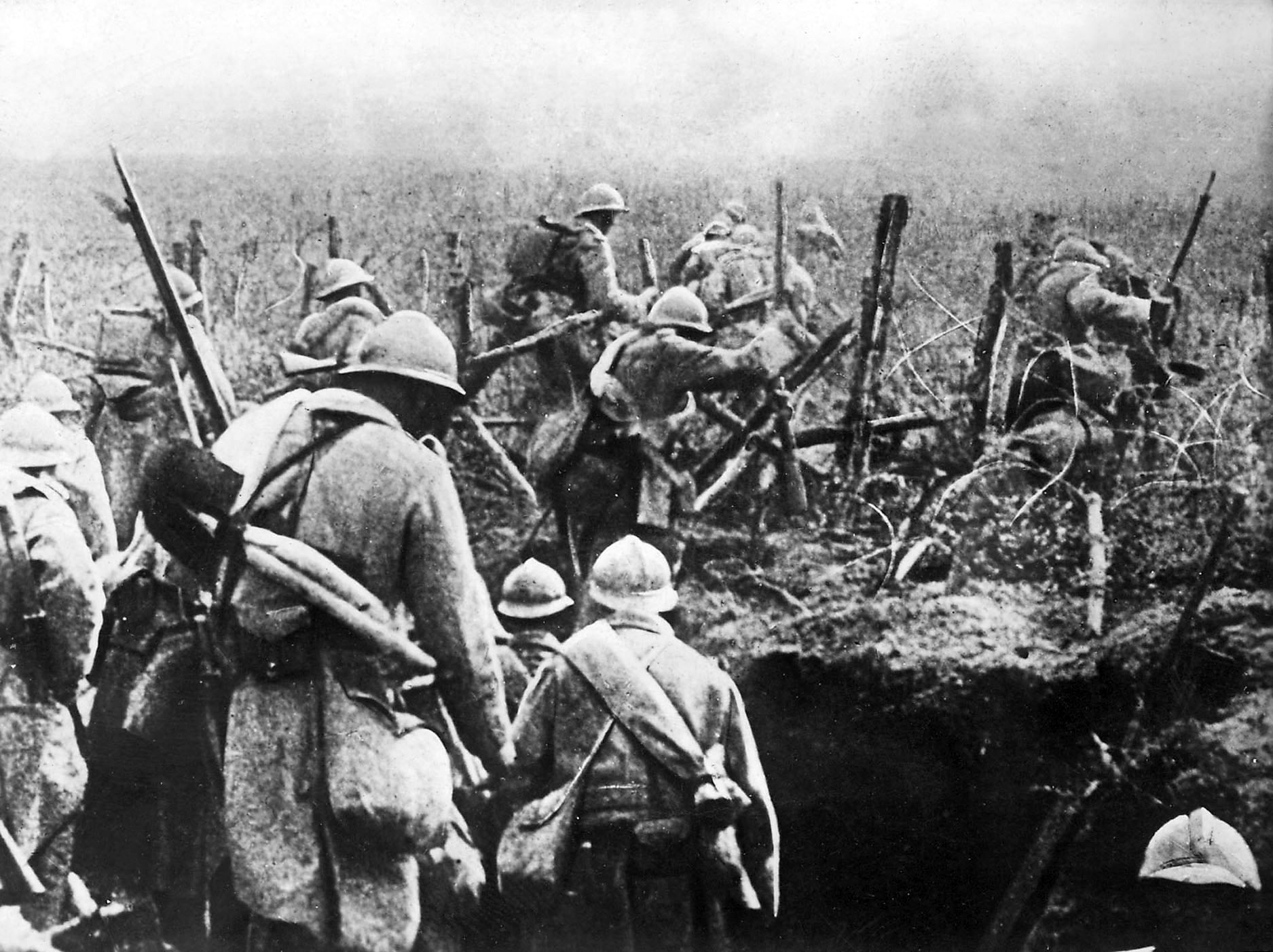
Pre-war military tactics that had emphasised open warfare and individual riflemen proved obsolete when confronted with conditions prevailing in 1914. Technological advances allowed the creation of strong defensive systems largely impervious to massed infantry advances, such as barbed wire, machine guns and above all far more powerful artillery, which dominated the battlefield and made crossing open ground extremely difficult.[84] Both sides struggled to develop tactics for breaching entrenched positions without heavy casualties. In time, technology enabled the production of new offensive weapons, such as gas warfare and the tank.[85]
After the First Battle of the Marne in September 1914, Allied and German forces unsuccessfully tried to outflank each other, a series of manoeuvres later known as the "Race to the Sea". By the end of 1914, the opposing forces confronted each other along an uninterrupted line of entrenched positions from the Channel to the Swiss border.[86] Since the Germans were normally able to choose where to stand, they generally held the high ground, while their trenches tended to be better built; those constructed by the French and English were initially considered "temporary", only needed until an offensive would destroy the German defences.[87] Both sides tried to break the stalemate using scientific and technological advances. On 22 April 1915, at the Second Battle of Ypres, the Germans (violating the Hague Convention) used chlorine gas for the first time on the Western Front. Several types of gas soon became widely used by both sides and though it never proved a decisive, battle-winning weapon, it became one of the most feared and best-remembered horrors of the war.[88][89]
Continuation of trench warfare
[edit]
In February 1916, the Germans attacked French defensive positions at the Battle of Verdun, lasting until December 1916. Casualties were greater for the French, but the Germans bled heavily as well, with anywhere from 700,000[90] to 975,000[91] casualties between the two combatants. Verdun became a symbol of French determination and self-sacrifice.[92]
The Battle of the Somme was an Anglo-French offensive from July to November 1916. The opening day, on 1 July 1916, was the bloodiest single day in the history of the British Army, which suffered 57,500 casualties, including 19,200 dead. As a whole, the Somme offensive led to an estimated 420,000 British casualties, along with 200,000 French and 500,000 Germans.[93] The diseases that emerged in the trenches were a major killer on both sides. The living conditions led to disease and infection, such as trench foot, lice, typhus, trench fever, and the 'Spanish flu'.[94]
Naval war
[edit]
At the start of the war, German cruisers were scattered across the globe, some of which were subsequently used to attack Allied merchant shipping. These were systematically hunted down by the Royal Navy, though not before causing considerable damage. One of the most successful was the SMS Emden, part of the German East Asia Squadron stationed at Qingdao, which seized or sank 15 merchantmen, a Russian cruiser and a French destroyer. Most of the squadron was returning to Germany when it sank two British armoured cruisers at the Battle of Coronel in November 1914, before being virtually destroyed at the Battle of the Falkland Islands in December. The SMS Dresden escaped with a few auxiliaries, but after the Battle of Más a Tierra, these too were either destroyed or interned.[95]
Soon after the outbreak of hostilities, Britain began a naval blockade of Germany. This proved effective in cutting off vital supplies, though it violated accepted international law.[96] Britain also mined international waters which closed off entire sections of the ocean, even to neutral ships.[97] Since there was limited response to this tactic, Germany expected a similar response to its unrestricted submarine warfare.[98]
The Battle of Jutland[d] in May/June 1916 was the only full-scale clash of battleships during the war, and one of the largest in history. The clash was indecisive, though the Germans inflicted more damage than they received; thereafter the bulk of the German High Seas Fleet was confined to port.[99]

German U-boats attempted to cut the supply lines between North America and Britain.[100] The nature of submarine warfare meant that attacks often came without warning, giving the crews of the merchant ships little hope of survival.[100][101] The United States launched a protest, and Germany changed its rules of engagement. After the sinking of the passenger ship RMS Lusitania in 1915, Germany promised not to target passenger liners, while Britain armed its merchant ships, placing them beyond the protection of the "cruiser rules", which demanded warning and movement of crews to "a place of safety" (a standard that lifeboats did not meet).[102] Finally, in early 1917, Germany adopted a policy of unrestricted submarine warfare, realising the Americans would eventually enter the war.[100][103] Germany sought to strangle Allied sea lanes before the United States could transport a large army overseas, but, after initial successes, eventually failed to do so.[100]
The U-boat threat lessened in 1917, when merchant ships began travelling in convoys, escorted by destroyers. This tactic made it difficult for U-boats to find targets, which significantly lessened losses; after the hydrophone and depth charges were introduced, destroyers could potentially successfully attack a submerged submarine. Convoys slowed the flow of supplies since ships had to wait as convoys were assembled; the solution was an extensive program of building new freighters. Troopships were too fast for the submarines and did not travel the North Atlantic in convoys.[104] The U-boats sunk more than 5,000 Allied ships, at the cost of 199 submarines.[105]
World War I also saw the first use of aircraft carriers in combat, with HMS Furious launching Sopwith Camels in a successful raid against the Zeppelin hangars at Tondern in July 1918, as well as blimps for antisubmarine patrol.[106]
Southern theatres
[edit]War in the Balkans
[edit]
Faced with Russia in the east, Austria-Hungary could spare only one-third of its army to attack Serbia. After suffering heavy losses, the Austrians briefly occupied the Serbian capital, Belgrade. A Serbian counter-attack in the Battle of Kolubara succeeded in driving them from the country by the end of 1914. For the first 10 months of 1915, Austria-Hungary used most of its military reserves to fight Italy. German and Austro-Hungarian diplomats scored a coup by persuading Bulgaria to join the attack on Serbia.[107] The Austro-Hungarian provinces of Slovenia, Croatia and Bosnia provided troops for Austria-Hungary. Montenegro allied itself with Serbia.[108]

Bulgaria declared war on Serbia on 14 October 1915, and joined in the attack by the Austro-Hungarian army under Mackensen's army of 250,000 that was already underway. Serbia was conquered in a little more than a month, as the Central Powers, now including Bulgaria, sent in 600,000 troops in total. The Serbian army, fighting on two fronts and facing certain defeat, retreated into northern Albania. The Serbs suffered defeat in the Battle of Kosovo. Montenegro covered the Serbian retreat toward the Adriatic coast in the Battle of Mojkovac on 6–7 January 1916, but ultimately the Austrians also conquered Montenegro. The surviving Serbian soldiers were evacuated to Greece.[109] After the conquest, Serbia was divided between Austro-Hungary and Bulgaria.[110]
In late 1915, a Franco-British force landed at Salonica in Greece to offer assistance and to pressure its government to declare war against the Central Powers. However, the pro-German King Constantine I dismissed the pro-Allied government of Eleftherios Venizelos before the Allied expeditionary force arrived.[111]
The Macedonian front was at first mostly static. French and Serbian forces retook limited areas of Macedonia by recapturing Bitola on 19 November 1916, following the costly Monastir offensive, which brought stabilisation of the front.[112]

Serbian and French troops finally made a breakthrough in September 1918 in the Vardar offensive, after most German and Austro-Hungarian troops had been withdrawn. The Bulgarians were defeated at the Battle of Dobro Pole, and by 25 September British and French troops had crossed the border into Bulgaria proper as the Bulgarian army collapsed. Bulgaria capitulated four days later, on 29 September 1918.[114] The German high command responded by despatching troops to hold the line, but these forces were too weak to re-establish a front.[115]
The Allied breakthrough on the Macedonian front cut communications between the Ottoman Empire and the other Central Powers, and made Vienna vulnerable to attack. Hindenburg and Ludendorff concluded that the strategic and operational balance had now shifted decidedly against the Central Powers and, a day after the Bulgarian collapse, insisted on an immediate peace settlement.[116]
Ottoman Empire
[edit]
The Ottomans threatened Russia's Caucasian territories and Britain's communications with India via the Suez Canal. The Ottoman Empire took advantage of the European powers' preoccupation with the war and conducted large-scale ethnic cleansing of the Armenian, Greek, and Assyrian Christian populations—the Armenian genocide, Greek genocide, and Assyrian genocide respectively.[117][118] [119]
The British and French opened overseas fronts with the Gallipoli (1915) and Mesopotamian campaigns (1914). In Gallipoli, the Ottoman Empire successfully repelled the British, French, and Australian and New Zealand Army Corps (ANZACs). In Mesopotamia, by contrast, after the defeat of the British defenders in the siege of Kut by the Ottomans (1915–1916), British Imperial forces reorganised and captured Baghdad in March 1917. The British were aided in Mesopotamia by local Arab and Assyrian fighters, while the Ottomans employed local Kurdish and Turcoman tribes.[120]
The Suez Canal was defended from Ottoman attacks in 1915 and 1916; in August 1916, a German and Ottoman force was defeated at the Battle of Romani by the ANZAC Mounted Division and the 52nd (Lowland) Infantry Division. Following this victory, an Egyptian Expeditionary Force advanced across the Sinai Peninsula, pushing Ottoman forces back in the Battle of Magdhaba in December and the Battle of Rafa on the border between the Egyptian Sinai and Ottoman Palestine in January 1917.[121]

Russian armies generally had success in the Caucasus campaign. Enver Pasha, supreme commander of the Ottoman armed forces, dreamed of re-conquering central Asia and areas that had been previously lost to Russia. He was, however, a poor commander.[122] He launched an offensive against the Russians in the Caucasus in December 1914 with 100,000 troops, insisting on a frontal attack against mountainous Russian positions in winter. He lost 86% of his force at the Battle of Sarikamish.[123] General Nikolai Yudenich, the Russian commander from 1915 to 1916, drove the Turks out of most of the southern Caucasus.[123]

The Ottoman Empire, with German support, invaded Persia (modern Iran) in December 1914 to cut off British and Russian access to petroleum reservoirs around Baku.[124] Persia, ostensibly neutral, had long been under British and Russian influence. The Ottomans and Germans were aided by Kurdish and Azeri forces, together with a large number of major Iranian tribes, while the Russians and British had the support of Armenian and Assyrian forces. The Persian campaign lasted until 1918 and ended in failure for the Ottomans and their allies. However, the Russian withdrawal from the war in 1917 led Armenian and Assyrian forces to be cut off from supply lines, outnumbered, outgunned and isolated, forcing them to fight and flee towards British lines in northern Mesopotamia.[125]
The Arab Revolt, instigated by the British Foreign Office, started in June 1916 with the Battle of Mecca, led by Sharif Hussein. The Sharif declared the independence of the Kingdom of Hejaz and, with British assistance, conquered much of Ottoman-held Arabia, resulting finally in the Ottoman surrender of Damascus. Fakhri Pasha, the Ottoman commander of Medina, resisted for more than 2+1⁄2 years during the siege of Medina before surrendering in January 1919.[126]
The Senussi tribe, along the border of Italian Libya and British Egypt, incited and armed by the Turks, waged a small-scale guerrilla war against Allied troops. The British were forced to dispatch 12,000 troops to oppose them in the Senussi campaign. Their rebellion was finally crushed in mid-1916.[127]
Total Allied casualties on the Ottoman fronts amounted to 650,000 men. Total Ottoman casualties were 725,000, with 325,000 dead and 400,000 wounded.[128]
Italian Front
[edit]
Though Italy joined the Triple Alliance in 1882, a treaty with its traditional Austrian enemy was so controversial that subsequent governments denied its existence and the terms were only made public in 1915.[129] This arose from nationalist designs on Austro-Hungarian territory in Trentino, the Austrian Littoral, Rijeka and Dalmatia, considered vital to secure the borders established in 1866.[130] In 1902, Rome secretly had agreed with France to remain neutral if the latter was attacked by Germany, effectively nullifying its role in the Triple Alliance.[131]
When the war began in 1914, Italy argued the Triple Alliance was defensive and it was not obliged to support an Austrian attack on Serbia. Opposition to joining the Central Powers increased when Turkey became a member in September, since in 1911 Italy had occupied Ottoman possessions in Libya and the Dodecanese islands.[132] To secure Italian neutrality, the Central Powers offered them Tunisia, while in return for an immediate entry into the war, the Allies agreed to their demands for Austrian territory and sovereignty over the Dodecanese.[133] Although they remained secret, these provisions were incorporated into the April 1915 Treaty of London, and Italy joined the Allies. On 23 May, Italy declared war on Austria-Hungary,[134] and on Germany fifteen months later.

The pre-1914 Italian army was short of officers, trained men, adequate transport and modern weapons; by April 1915, some of these deficiencies had been remedied but it was still unprepared for the major offensive required by the Treaty of London.[135] The advantage of superior numbers was offset by the difficult terrain; much of the fighting took place high in the Alps and Dolomites, where trench lines had to be cut through rock and ice and keeping troops supplied was a major challenge. These issues were exacerbated by unimaginative strategies and tactics.[136] Between 1915 and 1917, the Italian commander, Luigi Cadorna, undertook a series of frontal assaults along the Isonzo, which made little progress and cost many lives; by the end of the war, Italian combat deaths totalled around 548,000.[137]
In the spring of 1916, the Austro-Hungarians counterattacked in Asiago in the Strafexpedition, but made little progress and were pushed by the Italians back to Tyrol.[138] Although Italy occupied southern Albania in May 1916, their main focus was the Isonzo front which, after the capture of Gorizia in August 1916, remained static until October 1917. After a combined Austro-German force won a major victory at Caporetto, Cadorna was replaced by Armando Diaz who retreated more than 100 kilometres (62 mi) before holding positions along the Piave River.[139] A second Austrian offensive was repulsed in June 1918. On 24 October, Diaz launched the Battle of Vittorio Veneto and initially met stubborn resistance,[140] but with Austria-Hungary collapsing, Hungarian divisions in Italy demanded they be sent home.[141] When this was granted, many others followed and the Imperial army disintegrated, the Italians taking over 300,000 prisoners.[142] On 3 November, the Armistice of Villa Giusti ended hostilities between Austria-Hungary and Italy which occupied Trieste and areas along the Adriatic Sea awarded to it in 1915.[143]
Eastern Front
[edit]Initial actions
[edit]
As previously agreed with French president Raymond Poincaré, Russian plans at the start of the war were to simultaneously advance into Austrian Galicia and East Prussia as soon as possible. Although their attack on Galicia was largely successful, and the invasions achieved their aim of forcing Germany to divert troops from the Western Front, the speed of mobilisation meant they did so without much of their heavy equipment and support functions. These weaknesses contributed to Russian defeats at Tannenberg and the Masurian Lakes in August and September 1914, forcing them to withdraw from East Prussia with heavy losses.[144][145] By spring 1915, they had also retreated from Galicia, and the May 1915 Gorlice–Tarnów offensive allowed the Central Powers to invade Russian-occupied Poland.[146]
Despite the successful June 1916 Brusilov offensive against the Austrians in eastern Galicia,[147] shortages of supplies, heavy losses and command failures prevented the Russians from fully exploiting their victory. However, it was one of the most significant offensives of the war, diverting German resources from Verdun, relieving Austro-Hungarian pressure on the Italians, and convincing Romania to enter the war on the side of the Allies on 27 August. It also fatally weakened both the Austrian and Russian armies, whose offensive capabilities were badly affected by their losses and increased disillusion with the war that ultimately led to the Russian revolutions.[148]
Meanwhile, unrest grew in Russia as Tsar Nicholas II remained at the front, with the home front controlled by Empress Alexandra. Her increasingly incompetent rule and food shortages in urban areas led to widespread protests and the murder of her favourite, Grigori Rasputin, at the end of 1916.[149]
Romanian participation
[edit]

Despite secretly agreeing to support the Triple Alliance in 1883, Romania increasingly found itself at odds with the Central Powers over their support for Bulgaria in the Balkan Wars and the status of ethnic Romanian communities in Hungarian-controlled Transylvania,[150] which comprised an estimated 2.8 million of the region's 5.0 million population.[151] With the ruling elite split into pro-German and pro-Entente factions,[152] Romania remained neutral for two years while allowing Germany and Austria to transport military supplies and advisors across Romanian territory.[153]
In September 1914, Russia acknowledged Romanian rights to Austro-Hungarian territories including Transylvania and Banat, whose acquisition had widespread popular support,[151] and Russian success against Austria led Romania to join the Entente in the August 1916 Treaty of Bucharest.[153] Under the strategic plan known as Hypothesis Z, the Romanian army planned an offensive into Transylvania, while defending Southern Dobruja and Giurgiu against a possible Bulgarian counterattack.[154] On 27 August 1916, they attacked Transylvania and occupied substantial parts of the province before being driven back by the recently formed German 9th Army, led by former Chief of Staff Erich von Falkenhayn.[155] A combined German-Bulgarian-Turkish offensive captured Dobruja and Giurgiu, although the bulk of the Romanian army managed to escape encirclement and retreated to Bucharest, which surrendered to the Central Powers on 6 December 1916.[156]
In the summer of 1917, a Central Powers offensive began in Romania under the command of August von Mackensen to knock Romania out of the war, resulting in the battles of Oituz, Mărăști and Mărășești, where up to 1,000,000 Central Powers troops were present. The battles lasted from 22 July to 3 September and eventually the Romanian army was victorious advancing 500 km2. August von Mackensen could not plan for another offensive as he had to transfer troops to the Italian Front.[157] Following the Russian revolution, Romania found itself alone on the Eastern Front and signed the Treaty of Bucharest with the Central Powers, which recognised Romanian sovereignty over Bessarabia in return for ceding control of passes in the Carpathian Mountains to Austria-Hungary and leasing its oil wells to Germany. Although approved by Parliament, King Ferdinand I refused to sign it, hoping for an Allied victory in the west.[158] Romania re-entered the war on 10 November 1918, on the side of the Allies and the Treaty of Bucharest was formally annulled by the Armistice of 11 November 1918.[159][e]
Central Powers peace overtures
[edit]On 12 December 1916, after ten brutal months of the Battle of Verdun and a successful offensive against Romania, Germany attempted to negotiate a peace with the Allies.[161] However, this attempt was rejected out of hand as a "duplicitous war ruse".[161]

US president Woodrow Wilson attempted to intervene as a peacemaker, asking for both sides to state their demands. Lloyd George's War Cabinet considered the German offer to be a ploy to create divisions among the Allies. After initial outrage and much deliberation, they took Wilson's note as a separate effort, signalling that the US was on the verge of entering the war against Germany following the "submarine outrages". While the Allies debated a response to Wilson's offer, the Germans chose to rebuff it in favour of "a direct exchange of views". Learning of the German response, the Allied governments were free to make clear demands in their response of 14 January. They sought restoration of damages, the evacuation of occupied territories, reparations for France, Russia and Romania, and a recognition of the principle of nationalities.[162] The Allies sought guarantees that would prevent or limit future wars.[163] The negotiations failed and the Entente powers rejected the German offer on the grounds of honour, and noted Germany had not put forward any specific proposals.[161]
Final years of the war
[edit]Russian Revolution and withdrawal
[edit]
By the end of 1916, Russian casualties totalled nearly five million killed, wounded or captured, with major urban areas affected by food shortages and high prices. In March 1917, Tsar Nicholas ordered the military to forcibly suppress strikes in Petrograd but the troops refused to fire on the crowds.[164] Revolutionaries set up the Petrograd Soviet and fearing a left-wing takeover, the State Duma forced Nicholas to abdicate and established the Russian Provisional Government, which confirmed Russia's willingness to continue the war. However, the Petrograd Soviet refused to disband, creating competing power centres and causing confusion and chaos, with frontline soldiers becoming increasingly demoralised.[165]
Following the tsar's abdication, Vladimir Lenin—with the help of the German government—was ushered from Switzerland into Russia on 16 April 1917. Discontent and the weaknesses of the Provisional Government led to a rise in the popularity of the Bolshevik Party, led by Lenin, which demanded an immediate end to the war. The Revolution of November was followed in December by an armistice and negotiations with Germany. At first, the Bolsheviks refused the German terms, but when German troops began marching across Ukraine unopposed, they acceded to the Treaty of Brest-Litovsk on 3 March 1918. The treaty ceded vast territories, including Finland, Estonia, Latvia, Lithuania, and parts of Poland and Ukraine to the Central Powers.[166]
With the Russian Empire out of the war, Romania found itself alone on the Eastern Front and signed the Treaty of Bucharest with the Central Powers in May 1918. Under the terms of the treaty, Romania ceded territory to Austria-Hungary and Bulgaria and leased its oil reserves to Germany. However, the terms also included the Central Powers' recognition of the union of Bessarabia with Romania.[167][158]
United States enters the war
[edit]
The United States was a major supplier of war material to the Allies but remained neutral in 1914, in large part due to domestic opposition.[168] The most significant factor in creating the support Wilson needed was the German submarine offensive, which not only cost American lives but paralysed trade as ships were reluctant to put to sea.[169]
On 6 April 1917, Congress declared war on Germany as an "Associated Power" of the Allies.[170] The US Navy sent a battleship group to Scapa Flow to join the Grand Fleet, and provided convoy escorts. In April 1917, the US Army had fewer than 300,000 men, including National Guard units, compared to British and French armies of 4.1 and 8.3 million respectively. The Selective Service Act of 1917 drafted 2.8 million men, though training and equipping such numbers was a huge logistical challenge. By June 1918, over 667,000 members of the American Expeditionary Forces (AEF) were transported to France, a figure which reached 2 million by the end of November.[171]
Despite his conviction that Germany must be defeated, Wilson went to war to ensure the US played a leading role in shaping the peace, which meant preserving the AEF as a separate military force, rather than being absorbed into British or French units as his Allies wanted.[172] He was strongly supported by AEF commander General John J. Pershing, a proponent of pre-1914 "open warfare" who considered the French and British emphasis on artillery misguided and incompatible with American "offensive spirit".[173] Much to the frustration of his Allies, who had suffered heavy losses in 1917, he insisted on retaining control of American troops, and refused to commit them to the front line until able to operate as independent units. As a result, the first significant US involvement was the Meuse–Argonne offensive in late September 1918.[174]
Nivelle Offensive (April–May 1917)
[edit]
In December 1916, Robert Nivelle replaced Pétain as commander of French armies on the Western Front and began planning a spring attack in Champagne, part of a joint Franco-British operation.[175] Poor security meant German intelligence was well informed on tactics and timetables, but despite this, when the attack began on 16 April the French made substantial gains, before being brought to a halt by the newly built and extremely strong defences of the Hindenburg Line. Nivelle persisted with frontal assaults and, by 25 April, the French had suffered nearly 135,000 casualties, including 30,000 dead, most incurred in the first two days.[176]
Concurrent British attacks at Arras were more successful, though ultimately of little strategic value.[177] Operating as a separate unit for the first time, the Canadian Corps' capture of Vimy Ridge is viewed by many Canadians as a defining moment in creating a sense of national identity.[178][179] Though Nivelle continued the offensive, on 3 May the 21st Division, which had been involved in some of the heaviest fighting at Verdun, refused orders to go into battle, initiating the French Army mutinies; within days, "collective indiscipline" had spread to 54 divisions, while over 20,000 deserted.[180]
Sinai and Palestine campaign (1917–1918)
[edit]
In March and April 1917, at the First and Second Battles of Gaza, German and Ottoman forces stopped the advance of the Egyptian Expeditionary Force, which had begun in August 1916 at the Battle of Romani.[181][182] At the end of October 1917, the Sinai and Palestine campaign resumed, when General Edmund Allenby's XXth Corps, XXI Corps and Desert Mounted Corps won the Battle of Beersheba.[183] Two Ottoman armies were defeated a few weeks later at the Battle of Mughar Ridge and, early in December, Jerusalem had been captured following another Ottoman defeat at the Battle of Jerusalem.[184][185][186]
About this time, Friedrich Freiherr Kress von Kressenstein was relieved of his duties as the Eighth Army's commander, replaced by Djevad Pasha, and a few months later the commander of the Ottoman Army in Palestine, Erich von Falkenhayn, was replaced by Otto Liman von Sanders.[187][188]
In early 1918, the front line was extended and the Jordan Valley was occupied, following the First Transjordan and the Second Transjordan attacks by British Empire forces in March and April 1918.[189]
German offensive and Allied counter-offensive (March–November 1918)
[edit]
In December 1917, the Central Powers signed an armistice with Russia, thus freeing large numbers of German troops for use in the West. With German reinforcements and new American troops pouring in, the outcome was to be decided on the Western Front. The Central Powers knew that they could not win a protracted war, but they held high hopes for success in a final quick offensive.[191] Ludendorff drew up plans (Operation Michael) for the 1918 offensive on the Western Front. The operation commenced on 21 March 1918, with an attack on British forces near Saint-Quentin. German forces achieved an unprecedented advance of 60 kilometres (37 mi).[192] The initial offensive was a success; after heavy fighting, however, the offensive was halted. Lacking tanks or motorised artillery, the Germans were unable to consolidate their gains. The problems of re-supply were also exacerbated by increasing distances that now stretched over terrain that was shell-torn and often impassable to traffic.[193] Germany launched Operation Georgette against the northern English Channel ports. The Allies halted the drive after limited territorial gains by Germany. The German Army to the south then conducted Operations Blücher and Yorck, pushing broadly towards Paris. Germany launched Operation Marne (Second Battle of the Marne) on 15 July, in an attempt to encircle Reims. The resulting counter-attack, which started the Hundred Days Offensive on 8 August,[194] led to a marked collapse in German morale.[195][196][197]
Allied advance to the Hindenburg Line
[edit]
By September, the Germans had fallen back to the Hindenburg Line. The Allies had advanced to the Hindenburg Line in the north and centre. German forces launched numerous counterattacks, but positions and outposts of the Line continued falling, with the BEF alone taking 30,441 prisoners in the last week of September. On 24 September, the Supreme Army Command informed the leaders in Berlin that armistice talks were inevitable.[198]
The final assault on the Hindenburg Line began with the Meuse-Argonne offensive, launched by American and French troops on 26 September. Two days later the Belgians, French and British attacked around Ypres, and the day after the British at St Quentin in the centre of the line. The following week, cooperating American and French units broke through in Champagne at the Battle of Blanc Mont Ridge ( 3–27 October), forcing the Germans off the commanding heights, and closing towards the Belgian frontier.[199] On 8 October, the Hindenburg Line was pierced by British and Dominion troops of the First and Third British Armies at the Second Battle of Cambrai.[200]
Breakthrough of Macedonian front (September 1918)
[edit]
Allied forces started the Vardar offensive on 15 September at two key points: Dobro Pole and near Dojran Lake. In the Battle of Dobro Pole, the Serbian and French armies had success after a three-day-long battle with relatively small casualties, and subsequently made a breakthrough in the front, something which was rarely seen in World War I. After the front was broken, Allied forces started to liberate Serbia and reached Skopje at 29 September, after which Bulgaria signed an armistice with the Allies on 30 September.[201][202]
Armistices and capitulations
[edit]
The collapse of the Central Powers came swiftly. Bulgaria was the first to sign an armistice, the Armistice of Salonica on 29 September 1918.[203] Wilhelm II, in a telegram to Tsar Ferdinand I of Bulgaria described the situation thus: "Disgraceful! 62,000 Serbs decided the war!".[204][205] On the same day, the German Supreme Army Command informed Wilhelm II and the Imperial Chancellor Count Georg von Hertling, that the military situation facing Germany was hopeless.[206]
On 24 October, the Italians began a push that rapidly recovered territory lost after the Battle of Caporetto. This culminated in the Battle of Vittorio Veneto, marking the end of the Austro-Hungarian Army as an effective fighting force. The offensive also triggered the disintegration of the Austro-Hungarian Empire. During the last week of October, declarations of independence were made in Budapest, Prague, and Zagreb. On 29 October, the imperial authorities asked Italy for an armistice, but the Italians continued advancing, reaching Trento, Udine, and Trieste. On 3 November, Austria-Hungary sent a flag of truce and accepted the Armistice of Villa Giusti, arranged with the Allied Authorities in Paris. Austria and Hungary signed separate armistices following the overthrow of the Habsburg monarchy. In the following days, the Italian Army occupied Innsbruck and all Tyrol, with over 20,000 soldiers.[207] On 30 October, the Ottoman Empire capitulated, and signed the Armistice of Mudros.[203]
German government surrenders
[edit]
With the military faltering and with widespread loss of confidence in the kaiser, Germany moved towards surrender. Prince Maximilian of Baden took charge on 3 October as Chancellor of Germany. Negotiations with President Wilson began immediately, in the hope that he would offer better terms than the British and French. Wilson demanded a constitutional monarchy and parliamentary control over the German military.[209]
The German Revolution of 1918–1919 began at the end of October 1918. Units of the German Navy refused to set sail for a large-scale operation in a war they believed to be as good as lost. The sailors' revolt, which then ensued in the naval ports of Wilhelmshaven and Kiel, spread across the whole country within days and led to the proclamation of a republic on 9 November 1918, shortly thereafter to the abdication of Wilhelm II, and German surrender.[210][211][212][213][214]
Aftermath
[edit]In the aftermath of the war, the German, Austro-Hungarian, Ottoman, and Russian empires disappeared.[f] Numerous nations regained their former independence, and new ones were created. Four dynasties fell as a result of the war: the Romanovs, the Hohenzollerns, the Habsburgs, and the Ottomans. Belgium and Serbia were badly damaged, as was France, with 1.4 million soldiers dead,[215] not counting other casualties. Germany and Russia were similarly affected.[216]
Formal end of the war
[edit]
A formal state of war between the two sides persisted for another seven months, until the signing of the Treaty of Versailles with Germany on 28 June 1919. The US Senate did not ratify the treaty despite public support for it,[217][218]and did not formally end its involvement in the war until the Knox–Porter Resolution was signed on 2 July 1921 by President Warren G. Harding.[219] For the British Empire, the state of war ceased under the provisions of the Termination of the Present War (Definition) Act 1918 concerning:

Some war memorials date the end of the war as being when the Versailles Treaty was signed in 1919, which was when many of the troops serving abroad finally returned home; by contrast, most commemorations of the war's end concentrate on the armistice of 11 November 1918.[225]
Peace treaties and national boundaries
[edit]
The Paris Peace Conference imposed a series of peace treaties on the Central Powers officially ending the war. The 1919 Treaty of Versailles dealt with Germany and, building on Wilson's 14th point, established the League of Nations on 28 June 1919.[226][227]
The Central Powers had to acknowledge responsibility for "all the loss and damage to which the Allied and Associated Governments and their nationals have been subjected as a consequence of the war imposed upon them by" their aggression. In the Treaty of Versailles, this statement was Article 231. This article became known as the "War Guilt Clause", as the majority of Germans felt humiliated and resentful.[228] The Germans felt they had been unjustly dealt with by what they called the "diktat of Versailles". German historian Hagen Schulze said the Treaty placed Germany "under legal sanctions, deprived of military power, economically ruined, and politically humiliated."[229] Belgian historian Laurence Van Ypersele emphasises the central role played by memory of the war and the Versailles Treaty in German politics in the 1920s and 1930s:
Active denial of war guilt in Germany and German resentment at both reparations and continued Allied occupation of the Rhineland made widespread revision of the meaning and memory of the war problematic. The legend of the "stab in the back" and the wish to revise the "Versailles diktat", and the belief in an international threat aimed at the elimination of the German nation persisted at the heart of German politics. Even a man of peace such as [Gustav] Stresemann publicly rejected German guilt. As for the Nazis, they waved the banners of domestic treason and international conspiracy in an attempt to galvanise the German nation into a spirit of revenge. Like a Fascist Italy, Nazi Germany sought to redirect the memory of the war to the benefit of its policies.[230]
Meanwhile, new nations liberated from German rule viewed the treaty as a recognition of wrongs committed against small nations by much larger aggressive neighbours.[231]

Austria-Hungary was partitioned into several successor states, largely but not entirely along ethnic lines. Apart from Austria and Hungary, Czechoslovakia, Italy, Poland, Romania and Yugoslavia received territories from the Dual Monarchy (the formerly separate and autonomous Kingdom of Croatia-Slavonia was incorporated into Yugoslavia). The details were contained in the treaties of Saint-Germain-en-Laye and Trianon. As a result, Hungary lost 64% of its total population, decreasing from 20.9 million to 7.6 million, and losing 31% (3.3 out of 10.7 million) of its ethnic Hungarians.[232] According to the 1910 census, speakers of the Hungarian language included approximately 54% of the entire population of the Kingdom of Hungary. Within the country, numerous ethnic minorities were present: 16.1% Romanians, 10.5% Slovaks, 10.4% Germans, 2.5% Ruthenians, 2.5% Serbs and 8% others.[233] Between 1920 and 1924, 354,000 Hungarians fled former Hungarian territories attached to Romania, Czechoslovakia, and Yugoslavia.[234]
The Russian Empire lost much of its western frontier as the newly independent nations of Estonia, Finland, Latvia, Lithuania, and Poland were carved from it. Romania took control of Bessarabia in April 1918.[235]
National identities
[edit]After 123 years, Poland re-emerged as an independent country. The Kingdom of Serbia and its dynasty, as a "minor Entente nation" and the country with the most casualties per capita,[236][237][238] became the backbone of a new multinational state, the Kingdom of Serbs, Croats and Slovenes, later renamed Yugoslavia. Czechoslovakia, combining the Kingdom of Bohemia with parts of the Kingdom of Hungary, became a new nation. Romania would unite all Romanian-speaking people under a single state, leading to Greater Romania.[239]
In Australia and New Zealand, the Battle of Gallipoli became known as those nations' "Baptism of Fire". It was the first major war in which the newly established countries fought, and it was one of the first times that Australian troops fought as Australians, not just subjects of the British Crown, and independent national identities for these nations took hold. Anzac Day, named after the Australian and New Zealand Army Corps (ANZAC), commemorates this defining moment.[240][241]
In the aftermath of World War I, Greece fought against Turkish nationalists led by Mustafa Kemal, a war that eventually resulted in a massive population exchange between the two countries under the Treaty of Lausanne.[242] According to various sources,[243] several hundred thousand Greeks died during this period, which was tied in with the Greek genocide.[244]
Casualties
[edit]
The total number of military and civilian casualties in World War I was about 40 million: estimates range from around 15 to 22 million deaths[245] and about 23 million wounded military personnel, ranking it among the deadliest conflicts in human history. The total number of deaths includes between 9 and 11 million military personnel, with an estimated civilian death toll of about 6 to 13 million.[245][246]
Of the 60 million European military personnel who were mobilised from 1914 to 1918, an estimated 8 million were killed, 7 million were permanently disabled, and 15 million were seriously injured. Germany lost 15.1% of its active male population, Austria-Hungary lost 17.1%, and France lost 10.5%.[247] France mobilised 7.8 million men, of which 1.4 million died and 3.2 million were injured.[248] Approximately 15,000 deployed men sustained gruesome facial injuries, causing social stigma and marginalisation; they were called the gueules cassées (broken faces). In Germany, civilian deaths were 474,000 higher than in peacetime, due in large part to food shortages and malnutrition that had weakened disease resistance. These excess deaths are estimated as 271,000 in 1918, plus another 71,000 in the first half of 1919 when the blockade was still in effect.[249] Starvation caused by famine killed approximately 100,000 people in Lebanon.[250]

Diseases flourished in the chaotic wartime conditions. In 1914 alone, louse-borne epidemic typhus killed 200,000 in Serbia.[251] Starting in early 1918, a major influenza epidemic known as Spanish flu spread across the world, accelerated by the movement of large numbers of soldiers, often crammed together in camps and transport ships with poor sanitation. The Spanish flu killed at least 17 to 25 million people,[252][253] including an estimated 2.64 million Europeans and as many as 675,000 Americans.[254] Between 1915 and 1926, an epidemic of encephalitis lethargica affected nearly 5 million people worldwide.[255][256]
Eight million equines, mostly horses, donkeys and mules died, three-quarters of them from the extreme conditions they worked in.[257]
War crimes
[edit]Chemical weapons in warfare
[edit]
The German army was the first to successfully deploy chemical weapons during the Second Battle of Ypres (April–May 1915), after German scientists under the direction of Fritz Haber at the Kaiser Wilhelm Institute developed a method to weaponise chlorine.[g][259] The use of chemical weapons had been sanctioned by the German High Command to force Allied soldiers out of their entrenched positions, complementing rather than supplanting more lethal conventional weapons.[259] Chemical weapons were deployed by all major belligerents throughout the war, inflicting approximately 1.3 million casualties, of which about 90,000 were fatal.[259] The use of chemical weapons in warfare was a direct violation of the 1899 Hague Declaration Concerning Asphyxiating Gases and the 1907 Hague Convention on Land Warfare, which prohibited their use.[260][261]
Genocides by the Ottoman Empire
[edit]
The ethnic cleansing of the Ottoman Empire's Armenian population, including mass deportations and executions, during the final years of the Ottoman Empire is considered genocide.[263] The Ottomans carried out organised and systematic massacres of the Armenian population at the beginning of the war and manipulated acts of Armenian resistance by portraying them as rebellions to justify further extermination.[264] In early 1915, several Armenians volunteered to join the Russian forces and the Ottoman government used this as a pretext to issue the Tehcir Law (Law on Deportation), which authorised the deportation of Armenians from the Empire's eastern provinces to Syria between 1915 and 1918. The Armenians were intentionally marched to death and a number were attacked by Ottoman brigands.[265] While the exact number of deaths is unknown, the International Association of Genocide Scholars estimates around 1.5 million.[263][266] The government of Turkey continues to deny the genocide to the present day, arguing that those who died were victims of inter-ethnic fighting, famine, or disease during World War I; these claims are rejected by most historians.[267]
Other ethnic groups were similarly attacked by the Ottoman Empire during this period, including Assyrians and Greeks, and some scholars consider those events to be part of the same policy of extermination.[268][269][270] At least 250,000 Assyrian Christians, about half of the population, and 350,000–750,000 Anatolian and Pontic Greeks were killed between 1915 and 1922.[271]
Prisoners of war
[edit]
About 8 million soldiers surrendered and were held in POW camps during the war. All nations pledged to follow the Hague Conventions on fair treatment of prisoners of war, and the survival rate for POWs was generally much higher than that of combatants at the front.[272]
Around 25–31% of Russian losses (as a proportion of those captured, wounded, or killed) were to prisoner status; for Austria-Hungary 32%; for Italy 26%; for France 12%; for Germany 9%; for Britain 7%. Prisoners from the Allied armies totalled about 1.4 million (not including Russia, which lost 2.5–3.5 million soldiers as prisoners). From the Central Powers, about 3.3 million soldiers became prisoners; most of them surrendered to Russians.[273]
Soldiers' experiences
[edit]Allied personnel was around 42,928,000, while Central personnel was near 25,248,000.[216] British soldiers of the war were initially volunteers but were increasingly conscripted. Surviving veterans returning home often found they could discuss their experiences only among themselves, so formed "veterans' associations" or "Legions".
Conscription
[edit]
Conscription was common in most European countries, but was controversial in English-speaking countries.[274] It was especially unpopular among minority ethnicities, especially the Irish Catholics in Ireland,[275] Australia,[276][page needed][277] and the French Catholics in Canada.[278][279]
In the US, conscription began in 1917 and was generally well-received, with a few pockets of opposition in isolated rural areas.[280][page needed] The administration decided to rely primarily on conscription, rather than voluntary enlistment, to raise military manpower after only 73,000 volunteers enlisted out of the initial 1 million target in the first six weeks of war.[281]
Military attachés and war correspondents
[edit]Military and civilian observers from every major power closely followed the course of the war.[282] Many were able to report on events from a perspective somewhat akin to modern "embedded" positions within the opposing land and naval forces.[283][284]
Economic effects
[edit]Macro- and micro-economic consequences devolved from the war. Families were altered by the departure of many men. With the death or absence of the primary wage earner, women were forced into the workforce in unprecedented numbers. At the same time, the industry needed to replace the lost labourers sent to war. This aided the struggle for voting rights for women.[285]

In all nations, the government's share of GDP increased, surpassing 50% in both Germany and France and nearly reaching that level in Britain. To pay for purchases in the US, Britain cashed in its extensive investments in American railroads and then began borrowing heavily from Wall Street. President Wilson was on the verge of cutting off the loans in late 1916 but allowed a great increase in US government lending to the Allies. After 1919, the US demanded repayment of these loans. The repayments were, in part, funded by German reparations that, in turn, were supported by American loans to Germany. This circular system collapsed in 1931 and some loans were never repaid. Britain still owed the United States $4.4 billion[h] of World War I debt in 1934; the last installment was finally paid in 2015.[286]
Britain turned to her colonies for help in obtaining essential war materials whose supply from traditional sources had become difficult. Geologists such as Albert Kitson were called on to find new resources of precious minerals in the African colonies. Kitson discovered important new deposits of manganese, used in munitions production, in the Gold Coast.[287]
Article 231 of the Treaty of Versailles (the so-called "war guilt" clause) stated Germany accepted responsibility for "all the loss and damage to which the Allied and Associated Governments and their nationals have been subjected as a consequence of the war imposed upon them by the aggression of Germany and her allies."[288] It was worded as such to lay a legal basis for reparations, and a similar clause was inserted in the treaties with Austria and Hungary. However, neither of them interpreted it as an admission of war guilt.[289] In 1921, the total reparation sum was placed at 132 billion gold marks. However, "Allied experts knew that Germany could not pay" this sum. The total sum was divided into three categories, with the third being "deliberately designed to be chimerical" and its "primary function was to mislead public opinion ... into believing the 'total sum was being maintained.'"[290] Thus, 50 billion gold marks (12.5 billion dollars) "represented the actual Allied assessment of German capacity to pay" and "therefore ... represented the total German reparations" figure that had to be paid.[290]
This figure could be paid in cash or in-kind (coal, timber, chemical dyes, etc.). Some of the territory lost—via the Treaty of Versailles—was credited towards the reparation figure as were other acts such as helping to restore the Library of Louvain.[291] By 1929, the Great Depression caused political chaos throughout the world.[292] In 1932 the payment of reparations was suspended by the international community, by which point Germany had paid only the equivalent of 20.598 billion gold marks.[293] With the rise of Adolf Hitler, all bonds and loans that had been issued and taken out during the 1920s and early 1930s were cancelled. David Andelman notes "Refusing to pay doesn't make an agreement null and void. The bonds, the agreement, still exist." Thus, following the Second World War, at the London Conference in 1953, Germany agreed to resume payment on the money borrowed. On 3 October 2010, Germany made the final payment on these bonds.[i]
The Australian prime minister, Billy Hughes, wrote to the British prime minister, David Lloyd George, "You have assured us that you cannot get better terms. I much regret it, and hope even now that some way may be found of securing agreement for demanding reparation commensurate with the tremendous sacrifices made by the British Empire and her Allies." Australia received £5,571,720 in war reparations, but the direct cost of the war to Australia had been £376,993,052, and, by the mid-1930s, repatriation pensions, war gratuities, interest and sinking fund charges were £831,280,947.[298]
Support and opposition for the war
[edit]Support
[edit]
In the Balkans, Yugoslav nationalists such as the leader, Ante Trumbić, strongly supported the war, desiring the freedom of Yugoslavs from Austria-Hungary and other foreign powers and the creation of an independent Yugoslavia. The Yugoslav Committee, led by Trumbić, was formed in Paris on 30 April 1915, but shortly moved its office to London.[299] In April 1918, the Rome Congress of Oppressed Nationalities met, including Czechoslovak, Italian, Polish, Transylvanian, and Yugoslav representatives who urged the Allies to support national self-determination for the peoples residing within Austria-Hungary.[300]
In the Middle East, Arab nationalism soared in Ottoman territories in response to the rise of Turkish nationalism during the war. Arab nationalist leaders advocated the creation of a pan-Arab state. In 1916, the Arab Revolt began in Ottoman-controlled territories of the Middle East to achieve independence.[301]
In East Africa, Iyasu V of Ethiopia was supporting the Dervish state who were at war with the British in the Somaliland campaign.[302] Von Syburg, the German envoy in Addis Ababa, said, "now the time has come for Ethiopia to regain the coast of the Red Sea driving the Italians home, to restore the Empire to its ancient size." The Ethiopian Empire was on the verge of entering World War I on the side of the Central Powers before Iyasu's overthrow at the Battle of Segale due to Allied pressure on the Ethiopian aristocracy.[303]

Several socialist parties initially supported the war when it began in August 1914.[300] But European socialists split on national lines, with the concept of class conflict held by radical socialists such as Marxists and syndicalists being overborne by their patriotic support for the war.[304] Once the war began, Austrian, British, French, German, and Russian socialists followed the rising nationalist current by supporting their countries' intervention in the war.[305]
Italian nationalism was stirred by the outbreak of the war and was initially strongly supported by a variety of political factions. One of the most prominent and popular Italian nationalist supporters of the war was Gabriele D'Annunzio, who promoted Italian irredentism and helped sway the Italian public to support intervention in the war.[306] The Italian Liberal Party, under the leadership of Paolo Boselli, promoted intervention in the war on the side of the Allies and used the Dante Alighieri Society to promote Italian nationalism.[307] Italian socialists were divided on whether to support the war or oppose it; some were militant supporters of the war, including Benito Mussolini and Leonida Bissolati.[308] However, the Italian Socialist Party decided to oppose the war after anti-militarist protestors were killed, resulting in a general strike called Red Week.[309] The Italian Socialist Party purged itself of pro-war nationalist members, including Mussolini.[309] Mussolini formed the pro-interventionist Il Popolo d'Italia and the Fasci Rivoluzionario d'Azione Internazionalista ("Revolutionary Fasci for International Action") in October 1914 that later developed into the Fasci Italiani di Combattimento in 1919, the origin of fascism.[310] Mussolini's nationalism enabled him to raise funds from Ansaldo (an armaments firm) and other companies to create Il Popolo d'Italia to convince socialists and revolutionaries to support the war.[311]
Patriotic funds
[edit]On both sides, there was large-scale fundraising for soldiers' welfare, their dependents and those injured. The Nail Men were a German example. Around the British Empire, there were many patriotic funds, including the Royal Patriotic Fund Corporation, Canadian Patriotic Fund, Queensland Patriotic Fund and, by 1919, there were 983 funds in New Zealand.[312] At the start of the next world war the New Zealand funds were reformed, having been criticised as overlapping, wasteful and abused,[313] but 11 were still functioning in 2002.[314]
Opposition
[edit]Many countries jailed those who spoke out against the conflict. These included Eugene Debs in the US and Bertrand Russell in Britain. In the US, the Espionage Act of 1917 and Sedition Act of 1918 made it a federal crime to oppose military recruitment or make any statements deemed "disloyal". Publications at all critical of the government were removed from circulation by postal censors,[315] [page needed] and many served long prison sentences for statements of fact deemed unpatriotic.
_after_the_1916_Easter_Rising.JPG)
Several nationalists opposed intervention, particularly within states that the nationalists were hostile to. Although the vast majority of Irish people consented to participate in the war in 1914 and 1915, a minority of advanced Irish nationalists had staunchly opposed taking part.[316][page needed] The war began amid the Home Rule crisis in Ireland that had resurfaced in 1912, and by July 1914 there was a serious possibility of an outbreak of civil war in Ireland. Irish nationalists and Marxists attempted to pursue Irish independence, culminating in the Easter Rising of 1916, with Germany sending 20,000 rifles to Ireland to stir unrest in Britain.[317] The British government placed Ireland under martial law in response to the Easter Rising, though once the immediate threat of revolution had dissipated, the authorities did try to make concessions to nationalist feeling.[318][page needed] However, opposition to involvement in the war increased in Ireland, resulting in the Conscription Crisis of 1918.
Other opposition came from conscientious objectors—some socialist, some religious—who had refused to fight. In Britain, 16,000 people asked for conscientious objector status.[319] Some of them, most notably prominent peace activist Stephen Hobhouse, refused both military and alternative service.[320] Many suffered years of prison, including solitary confinement. Even after the war, in Britain, many job advertisements were marked "No conscientious objectors need to apply".[321]
On 1–4 May 1917, about 100,000 workers and soldiers of Petrograd, and after them, the workers and soldiers of other Russian cities, led by the Bolsheviks, demonstrated under banners reading "Down with the war!" and "all power to the Soviets!". The mass demonstrations resulted in a crisis for the Russian Provisional Government.[322] In Milan, in May 1917, Bolshevik revolutionaries organised and engaged in rioting calling for an end to the war, and managed to close down factories and stop public transportation.[323] The Italian army was forced to enter Milan with tanks and machine guns to face Bolsheviks and anarchists, who fought violently until 23 May when the army gained control of the city. Almost 50 people (including three Italian soldiers) were killed and over 800 people were arrested.[323]
Technology
[edit]
World War I began as a clash of 20th-century technology and 19th-century tactics, with the inevitably large ensuing casualties. By the end of 1917, however, the major armies had modernised and were making use of telephone, wireless communication,[325] armoured cars, tanks (especially with the advent of the prototype tank, Little Willie), and aircraft.[326]

Artillery also underwent a revolution. In 1914, cannons were positioned in the front line and fired directly at their targets. By 1917, indirect fire with guns (as well as mortars and even machine guns) was commonplace, using new techniques for spotting and ranging, notably, aircraft and the field telephone.[327]
Fixed-wing aircraft were initially used for reconnaissance and ground attack. To shoot down enemy planes, anti-aircraft guns and fighter aircraft were developed. Strategic bombers were created, principally by the Germans and British, though the former used Zeppelins as well.[328] Towards the end of the conflict, aircraft carriers were used for the first time, with HMS Furious launching Sopwith Camels in a raid to destroy the Zeppelin hangars at Tønder in 1918.[329]
Diplomacy
[edit]
The non-military diplomatic and propaganda interactions among the nations were designed to build support for the cause or to undermine support for the enemy. For the most part, wartime diplomacy focused on five issues: propaganda campaigns; defining and redefining the war goals, which became harsher as the war went on; luring neutral nations (Italy, Ottoman Empire, Bulgaria, Romania) into the coalition by offering slices of enemy territory; and encouragement by the Allies of nationalistic minority movements inside the Central Powers, especially among Czechs, Poles, and Arabs. In addition, multiple peace proposals were coming from neutrals, or one side or the other; none of them progressed very far.[330][331][page needed][332][page needed]
Legacy and memory
[edit]Memorials
[edit]
Memorials were built in thousands of villages and towns. Close to battlefields, those buried in improvised burial grounds were gradually moved to formal graveyards under the care of organisations such as the Commonwealth War Graves Commission, the American Battle Monuments Commission, the German War Graves Commission, and Le Souvenir français. Many of these graveyards also have monuments to the missing or unidentified dead, such as the Menin Gate Memorial to the Missing and the Thiepval Memorial to the Missing of the Somme.[333][334]
In 1915, John McCrae, a Canadian army doctor, wrote the poem In Flanders Fields as a salute to those who perished in the war. It is still recited today, especially on Remembrance Day and Memorial Day.[335][336]

National World War I Museum and Memorial in Kansas City, Missouri, is a memorial dedicated to all Americans who served in World War I. The Liberty Memorial was dedicated on 1 November 1921.[337]
The British government budgeted substantial resources to the commemoration of the war during the period 2014 to 2018. The lead body is the Imperial War Museum.[338] On 3 August 2014, French President François Hollande and German President Joachim Gauck together marked the centenary of Germany's declaration of war on France by laying the first stone of a memorial in Vieil Armand, known in German as Hartmannswillerkopf, for French and German soldiers killed in the war.[339] As part of commemorations for the centenary of the 1918 Armistice, French President Emmanuel Macron and German Chancellor Angela Merkel visited the site of the signing of the Armistice of Compiègne and unveiled a plaque to reconciliation.[340]
Historiography
[edit]... "Strange, friend," I said, "Here is no cause to mourn."
"None," said the other, "Save the undone years"...
— Wilfred Owen, Strange Meeting, 1918[341]
The first efforts to comprehend the meaning and consequences of modern warfare began during the initial phases of the war and are still underway more than a century later. Teaching World War I has presented special challenges. When compared with World War II, the First World War is often thought to be "a wrong war fought for the wrong reasons"; it lacks the metanarrative of good versus evil that characterises retellings of the Second World War. Lacking recognisable heroes and villains, it is often taught thematically, invoking simplified tropes that obscure the complexity of the conflict.[342]
Historian Heather Jones argues that the historiography has been reinvigorated by a cultural turn in the 21st century. Scholars have raised entirely new questions regarding military occupation, radicalisation of politics, race, medical science, gender and mental health. Among the major subjects that historians have long debated regarding the war include why the war began, why the Allies won, whether generals were responsible for high casualty rates, how soldiers endured the poor conditions of trench warfare, and to what extent the civilian home front accepted and endorsed the war effort.[343][344]
Unexploded ordnance
[edit]As late as 2007, unexploded ordnance at battlefield sites like Verdun and Somme continued to pose a danger. In France and Belgium, locals who discover caches of unexploded munitions are assisted by weapons disposal units. In some places, plant life has still not recovered from the effects of the war.[342]
See also
[edit]- Freemasonry during World War I – History of the fraternal organization, 1914–1918
- Lists of World War I topics
- Outline of World War I – Overview of and topical guide to World War I
- War aims of the First World War – Territorial, political, and economic objectives in the First World War
Footnotes
[edit]- ^ The Russian Empire during 1914–1917, the Russian Republic during 1917. The Bolsheviks signed an armistice followed by a separate peace shortly after their armed seizure of power.
- ^ Often abbreviated as WWI or WW1
- ^ Only the Triple Alliance was a formal "alliance"; the others listed were informal patterns of support.
- ^ German: Skagerrakschlacht, or "Battle of the Skagerrak"
- ^ Bessarabia remained part of Romania until 1940, when it was annexed by Joseph Stalin as the Moldavian Soviet Socialist Republic;[160] following the dissolution of the USSR in 1991, it became the independent Republic of Moldova
- ^ Unlike the others, the successor state to the Russian Empire, the Union of Soviet Socialist Republics, retained similar external borders, via retaining or quickly recovering lost territories.
- ^ A German attempt to use chemical weapons on the Russian front in January 1915 failed to cause casualties.[258]
- ^ 109 in this context – see Long and short scales
- ^ World War I officially ended when Germany paid off the final amount of reparations imposed on it by the Allies.[294][295][296][297]
References
[edit]- ^ Braybon 2004, p. 8.
- ^ "The Great War". The Independent. 17 August 1914. p. 228. Retrieved 17 May 2022.
- ^ "great, adj., adv., and n". Oxford English Dictionary. Archived from the original on 14 May 2019. Retrieved 19 March 2012.
- ^ "The war to end all wars". BBC News. 10 November 1998. Archived from the original on 19 June 2015. Retrieved 15 December 2015.
- ^ Shapiro & Epstein 2006, p. 329.
- ^ Clark 2013, pp. 121–152.
- ^ Zeldin 1977, p. 117.
- ^ Blandin, Bertrand (2017). 1914, la France responsable ?. Enquête & histoire. Paris: l'Artilleur. ISBN 978-2-8100-0759-2.
- ^ Joly 1999, pp. 325–347.
- ^ Keegan 1998, p. 52.
- ^ Medlicott 1945, pp. 66–70.
- ^ Kennan 1986, p. 20.
- ^ Willmott 2003, p. 15.
- ^ Fay 1930, pp. 290–293.
- ^ a b Willmott 2003, p. 21.
- ^ Herwig 1988, pp. 72–73.
- ^ Moll & Luebbert 1980, pp. 153–185.
- ^ Stevenson 2016, p. 45.
- ^ Crisp 1976, pp. 174–196.
- ^ Stevenson 2016, p. 42.
- ^ McMeekin 2015, pp. 66–67.
- ^ Clark 2013, p. 86.
- ^ Clark 2013, pp. 251–252.
- ^ McMeekin 2015, p. 69.
- ^ McMeekin 2015, p. 73.
- ^ Willmott 2003, pp. 2–23.
- ^ Clark 2013, p. 288.
- ^ Keegan 1998, pp. 48–49.
- ^ Bennett 1995, pp. 41–59.
- ^ Stefanova, Radoslava (2001). "Balkan Clutter: American and European Handling of a Powder Keg". Revival: The New Transatlantic Agenda. Routledge. doi:10.4324/9781315186405-8 (inactive 1 July 2025). ISBN 978-1-315-18640-5. Archived from the original on 10 June 2024. Retrieved 10 June 2024.
{{citation}}: CS1 maint: DOI inactive as of July 2025 (link) - ^ Nelson 1983, pp. 717–718.
- ^ Finestone 1981, p. 247.
- ^ Smith 2010, He was photographed on the way to the station and the photograph has been reproduced many times in books and articles, claiming to depict the arrest of Gavrilo Princip. But there is no photograph of Gavro's arrest—this photograph shows the arrest of Behr..
- ^ Butcher 2014, p. 103.
- ^ Butcher 2014, pp. 188–189.
- ^ Gilbert 1994, p. 16.
- ^ Willmott 2003, p. 26.
- ^ Clark, Christopher (25 June 2014). Month of Madness. BBC Radio 4. Archived from the original on 20 April 2017. Retrieved 14 March 2017.
- ^ Djordjević, Dimitrije; Spence, Richard B. (1992). Scholar, patriot, mentor: historical essays in honour of Dimitrije Djordjević. East European Monographs. p. 313. ISBN 978-0-88033-217-0. Archived from the original on 17 February 2024. Retrieved 12 November 2018.
Following the assassination of Franz Ferdinand in June 1914, Croats and Muslims in Sarajevo joined forces in an anti-Serb pogrom.
- ^ Reports Service: Southeast Europe series. American Universities Field Staff. 1964. p. 44. Archived from the original on 6 September 2023. Retrieved 7 December 2013.
... the assassination was followed by officially encouraged anti-Serb riots in Sarajevo ...
- ^ Kröll, Herbert (2008). Austrian-Greek encounters over the centuries: history, diplomacy, politics, arts, economics. Studienverlag. p. 55. ISBN 978-3-7065-4526-6. Archived from the original on 17 February 2024. Retrieved 1 September 2013.
... arrested and interned some 5.500 prominent Serbs and sentenced to death some 460 persons, a new Schutzkorps, an auxiliary militia, widened the anti-Serb repression.
- ^ Tomasevich 2001, p. 485.
- ^ Schindler, John R. (2007). Unholy Terror: Bosnia, Al-Qa'ida, and the Rise of Global Jihad. Zenith Imprint. p. 29. ISBN 978-1-61673-964-5. Archived from the original on 17 February 2024. Retrieved 12 November 2018.
- ^ Velikonja 2003, p. 141.
- ^ Stevenson 1996, p. 12.
- ^ MacMillan 2013, p. 532.
- ^ Willmott 2003, p. 27.
- ^ Fromkin 2004, pp. 196–197.
- ^ MacMillan 2013, p. 536.
- ^ Lieven 2016, p. 326.
- ^ Clark 2013, pp. 526–527.
- ^ Martel 2014, p. 335.
- ^ Gilbert 1994, p. 27.
- ^ Clayton 2003, p. 45.
- ^ Clark 2013, pp. 539–541.
- ^ Gilbert 1994, p. 29.
- ^ MacMillan 2013, pp. 579–580, 585.
- ^ Crowe 2001, pp. 4–5.
- ^ Willmott 2003, p. 29.
- ^ Clark 2013, pp. 550–551.
- ^ Strachan 2003, pp. 292–296, 343–354.
- ^ Tucker & Roberts 2005, p. 172.
- ^ Schindler 2002, pp. 159–195.
- ^ "Veliki rat – Avijacija". rts.rs. RTS, Radio televizija Srbije, Radio Television of Serbia. Archived from the original on 10 July 2017. Retrieved 16 July 2019.
- ^ "How was the first military airplane shot down". National Geographic. Archived from the original on 31 August 2015. Retrieved 5 August 2015.
- ^ a b Stevenson 2004, p. 22.
- ^ Horne 1964, p. 22.
- ^ Stevenson 2004, p. 23.
- ^ Holmes 2014, pp. 194, 211.
- ^ Stevenson 2012, p. 54.
- ^ Jackson 2018, p. 55.
- ^ Lieven 2016, p. 327.
- ^ Tucker & Roberts 2005, pp. 376–378.
- ^ Horne 1964, p. 221.
- ^ Donko 2012, p. 79.
- ^ Keegan 1998, pp. 224–232.
- ^ Falls 1960, pp. 79–80.
- ^ Farwell 1989, p. 353.
- ^ Brown 1994, pp. 197–198.
- ^ Brown 1994, pp. 201–203.
- ^ Kant, Vedica (24 September 2014). "India and WWI: Piecing together the impact of the Great War on the subcontinent". LSE. Archived from the original on 28 September 2022. Retrieved 28 September 2022.
- ^ "Participants from the Indian subcontinent in the First World War". Memorial Gates Trust. Archived from the original on 1 July 2019. Retrieved 12 December 2008.
- ^ Horniman 1984, p. 45.
- ^ Raudzens 1990, p. 424.
- ^ Raudzens 1990, pp. 421–423.
- ^ Gilbert 1994, p. 99.
- ^ Goodspeed 1985, p. 199.
- ^ Duffy, Michael (22 August 2009). "Weapons of War: Poison Gas". Firstworldwar.com. Archived from the original on 21 August 2007. Retrieved 5 July 2012.
- ^ Love 1996.
- ^ Dupuy 1993, p. 1042.
- ^ Grant 2005, p. 276.
- ^ Lichfield, John (21 February 2006). "Verdun: myths and memories of the 'lost villages' of France". The Independent. Archived from the original on 22 October 2017. Retrieved 23 July 2013.
- ^ Harris 2008, p. 271.
- ^ Chorba 2018, pp. 2136–2137.
- ^ Taylor 2007, pp. 39–47.
- ^ Keene 2006, p. 5.
- ^ Halpern 1995, p. 293.
- ^ Zieger 2001, p. 50.
- ^ Black 2016, pp. 16–21.
- ^ a b c d Sheffield, Garry. "The First Battle of the Atlantic". World Wars in Depth. BBC. Archived from the original on 3 June 2019. Retrieved 11 November 2009.
- ^ Gilbert 1994, p. 306.
- ^ von der Porten 1969.
- ^ Jones 2001, p. 80.
- ^ Nova Scotia House of Assembly Committee on Veterans Affairs (9 November 2006). "Committee Hansard". Hansard. Archived from the original on 23 November 2011. Retrieved 12 March 2013.
- ^ Chickering, Roger; Förster, Stig; Greiner, Bernd (2005). A world at total war: global conflict and the politics of destruction, 1937–1945. Publications of the German Historical Institute. Washington, DC: Cambridge University Press. ISBN 978-0-521-83432-2. Archived from the original on 17 February 2024. Retrieved 12 November 2018.
- ^ Price 1980.
- ^ Tucker & Roberts 2005, p. 241–.
- ^ Neiberg 2005, pp. 54–55.
- ^ Tucker & Roberts 2005, pp. 1075–1076.
- ^ DiNardo 2015, p. 102.
- ^ Neiberg 2005, pp. 108–110.
- ^ Hall 2010, p. 11.
- ^ "The Balkan Wars and World War I". p. 28. Library of Congress Country Studies.
- ^ Tucker, Wood & Murphy 1999, pp. 150–152.
- ^ Korsun, N. "The Balkan Front of the World War" (in Russian). militera.lib.ru. Archived from the original on 9 August 2013. Retrieved 27 September 2010.
- ^ Doughty 2005, p. 491.
- ^ Gettleman, Marvin; Schaar, Stuart, eds. (2003). The Middle East and Islamic world reader (4th ed.). New York: Grove Press. pp. 119–120. ISBN 978-0-8021-3936-8.
- ^ January 2007, p. 14.
- ^ Lieberman 2013, p. 80–81.
- ^ Arthur J. Barker, The Neglected War: Mesopotamia, 1914–1918 (London: Faber, 1967)
- ^ Crawford & McGibbon 2007, pp. 219–220.
- ^ Fromkin 2004, p. 119.
- ^ a b Hinterhoff 1984, pp. 499–503.
- ^ The Encyclopedia Americana, 1920, v. 28, p. 403
- ^ Northcote, Dudley S. (1922). "Saving Forty Thousand Armenians". Current History. New York Times Co. Archived from the original on 9 September 2021. Retrieved 9 September 2021.
- ^ Sachar 1970, pp. 122–138.
- ^ Gilbert 1994.
- ^ Hanioglu, M. Sukru (2010). A Brief History of the Late Ottoman Empire. Princeton University Press. pp. 180–181. ISBN 978-0-691-13452-9.
- ^ Thompson 2009, p. 13.
- ^ Thompson 2009, pp. 9–10.
- ^ Gardner 2015, p. 120.
- ^ Thompson 2009, p. 14.
- ^ Thompson 2009, pp. 30–31.
- ^ Gilbert 1994, p. 166.
- ^ Thompson 2009, p. 57.
- ^ Marshall & Josephy 1982, p. 108.
- ^ Fornassin 2017, pp. 39–62.
- ^ Thompson 2009, p. 163.
- ^ Gilbert 1994, p. 317.
- ^ Gilbert 1994, p. 482.
- ^ Gilbert 1994, p. 484.
- ^ Thompson 2009, p. 364.
- ^ Gilbert 1994, p. 491.
- ^ Tucker & Roberts 2005, p. 715.
- ^ Meyer 2006, pp. 152–154, 161, 163, 175, 182.
- ^ Smele 2011.
- ^ Schindler 2003, p. ?.
- ^ Tucker 2002, p. 119.
- ^ Goodrich 2011, p. 376.
- ^ Jelavich 1992, pp. 441–442.
- ^ a b Dumitru 2012, p. 171.
- ^ Dumitru 2012, p. 170.
- ^ a b Gilbert 1994, p. 282.
- ^ Torrie 1978, pp. 7–8.
- ^ Barrett 2013, pp. 96–98.
- ^ România în anii primului război mondial (in Romanian). Vol. 2. p. 831.
- ^ Hitchins, Keith (1994). Rumania 1866–1947. Clarendon Press. p. 269.
- ^ a b Crampton 1994, pp. 24–25.
- ^ Béla 1998, p. 429.
- ^ Rothschild 1975, p. 314.
- ^ a b c Alexander Lanoszka; Michael A. Hunzeker (11 November 2018). "Why the First War lasted so long". The Washington Post. Archived from the original on 12 April 2022. Retrieved 11 November 2018.
- ^ Keegan 1998, p. 345.
- ^ Kernek 1970, pp. 721–766.
- ^ Beckett 2007, p. 523.
- ^ Winter 2014, pp. 110–132.
- ^ Wheeler-Bennett 1938, pp. 36–41.
- ^ Treaty of Bucharest with the Central Powers in May 1918
- ^ Stevenson 2012, pp. 315–316.
- ^ Stevenson 2012, p. 317.
- ^ Gilbert 1994, p. 318.
- ^ Grotelueschen 2006, pp. 14–15.
- ^ Stevenson 2012, p. 318.
- ^ Grotelueschen 2006, pp. 44–46.
- ^ Stevenson 2012, p. 403.
- ^ Clayton 2003, p. 124.
- ^ Clayton 2003, p. 129.
- ^ Strachan 2003, p. 244.
- ^ Inglis 1995, p. 2.
- ^ Humphries 2007, p. 66.
- ^ Horne 1964, p. 323.
- ^ Erickson 2001, p. 163.
- ^ Moore 1920, p. 67.
- ^ Falls 1930, p. 59.
- ^ Wavell, Earl (1968) [1933]. "The Palestine Campaigns". In Sheppard, Eric William (ed.). A Short History of the British Army (4th ed.). London: Constable & Co. pp. 153–155. OCLC 35621223.
- ^ "Text of the Decree of the Surrender of Jerusalem into British Control". First World War.com. Archived from the original on 14 June 2011. Retrieved 13 May 2015.
- ^ Bruce 2002, p. 162.
- ^ "Who's Who – Kress von Kressenstein". First World War.com. Archived from the original on 20 November 2015. Retrieved 13 May 2015.
- ^ "Who's Who – Otto Liman von Sanders". First World War.com. Archived from the original on 27 December 2007. Retrieved 13 May 2015.
- ^ Erickson 2001, p. 195.
- ^ Ayers 1919, p. 104.
- ^ Heyman 1997, pp. 146–147.
- ^ Westwell 2004.
- ^ Gray 1991, p. 86.
- ^ Rickard 2007.
- ^ Schreiber 2004, p. 50.
- ^ Rickard 2001.
- ^ Brown 1999, p. 190.
- ^ Gray & Argyle 1990.
- ^ McLellan, p. 49.
- ^ Christie 1997, p. ?.
- ^ "The Battle of Dobro Polje – The Forgotten Balkan Skirmish That Ended WW1". Militaryhistorynow.com. Archived from the original on 23 September 2017. Retrieved 21 November 2019.
- ^ "The Germans Could no Longer Keep up the Fight". historycollection.co. 22 February 2017. Archived from the original on 23 December 2019. Retrieved 21 November 2019.
- ^ a b "1918 Timeline". League of Nations Photo Archive. Archived from the original on 5 May 2016. Retrieved 20 November 2009.
- ^ "The Battle of Dobro Polje – The Forgotten Balkan Skirmish That Ended WW1". Militaryhistorynow.com. 21 September 2017. Archived from the original on 23 September 2017. Retrieved 21 November 2019.
- ^ "The Germans Could no Longer Keep up the Fight". historycollection.com. 22 February 2017. Archived from the original on 23 December 2019. Retrieved 21 November 2019.
- ^ Axelrod 2018, p. 260.
- ^ di Michele 2014, pp. 436–437.
- ^ "Clairière de l'Armistice" (in French). Ville de Compiègne. Archived from the original on 27 August 2007.
- ^ Stevenson 2004, p. 385.
- ^ K. Kuhl. "Die 14 Kieler Punkte" [The Kiel 14 points] (PDF). Archived (PDF) from the original on 12 April 2019. Retrieved 23 November 2018.
- ^ Dähnhardt 1978, p. 91.
- ^ Wette, Wolfram (2006). "Die Novemberrevolution – Kiel 1918". In Fleischhauer; Turowski (eds.). Kieler Erinnerungsorte. Boyens.
- ^ Stevenson 2004, p. 383.
- ^ Stevenson 2004, Chapter 17.
- ^ "France's oldest WWI veteran dies" Archived 28 October 2016 at the Wayback Machine, BBC News, 20 January 2008.
- ^ a b Tucker & Roberts 2005, p. 273.
- ^ Hastedt 2009, p. 483.
- ^ Murrin et al. 2010, p. 622.
- ^ "Harding Ends War; Signs Peace Decree at Senator's Home. Thirty Persons Witness Momentous Act in Frelinghuysen Living Room at Raritan". The New York Times. 3 July 1921. Archived from the original on 4 December 2013. Retrieved 18 September 2017.
- ^ "No. 31773". The London Gazette. 10 February 1920. p. 1671.
- ^ "No. 31991". The London Gazette. 23 July 1920. pp. 7765–7766.
- ^ "No. 13627". The London Gazette. 27 August 1920. p. 1924.
- ^ "No. 32421". The London Gazette. 12 August 1921. pp. 6371–6372.
- ^ "No. 32964". The London Gazette. 12 August 1924. pp. 6030–6031.
- ^ "Dates on war memorials" (PDF). War Memorials Trust. Archived (PDF) from the original on 12 January 2021. Retrieved 4 January 2021.
- ^ Magliveras 1999, pp. 8–12.
- ^ Northedge 1986, pp. 35–36.
- ^ Morrow 2005, p. 290.
- ^ Schulze, Hagen (1998). Germany: A New History. Harvard University Press. p. 204.
- ^ Ypersele, Laurence Van (2012). "Mourning and Memory, 1919–45". In Horne, John (ed.). A Companion to World War I. Wiley. p. 584.
- ^ "The Surrogate Hegemon in Polish Postcolonial Discourse Ewa Thompson, Rice University" (PDF). Archived (PDF) from the original on 29 October 2013. Retrieved 27 October 2013.
- ^ "Open-Site:Hungary". Archived from the original on 3 January 2022. Retrieved 11 January 2022.
- ^ Frucht, p. 356.
- ^ Kocsis & Hodosi 1998, p. 19.
- ^ Clark 1927.
- ^ "Appeals to Americans to Pray for Serbians" (PDF). The New York Times. 27 July 1918. Archived (PDF) from the original on 16 September 2018. Retrieved 12 June 2018.
- ^ "Serbia Restored" (PDF). The New York Times. 5 November 1918. Archived (PDF) from the original on 16 September 2018. Retrieved 12 June 2018.
- ^ Simpson, Matt (22 August 2009). "The Minor Powers During World War One – Serbia". firstworldwar.com. Archived from the original on 27 April 2010. Retrieved 27 May 2010.
- ^ Cas Mudde. Racist Extremism in Central and Eastern Europe Archived 15 May 2016 at the Wayback Machine
- ^ "'ANZAC Day' in London; King, Queen, and General Birdwood at Services in Abbey". The New York Times. 26 April 1916. Archived from the original on 15 July 2016. Retrieved 25 July 2018.
- ^ Australian War Memorial. "The ANZAC Day tradition". Australian War Memorial. Archived from the original on 1 May 2008. Retrieved 2 May 2008.
- ^ "The Diaspora Welcomes the Pope" Archived 4 June 2012 at the Wayback Machine, Der Spiegel Online. 28 November 2006.
- ^ Rummel, R.J. (1998). "The Holocaust in Comparative and Historical Perspective". Idea Journal of Social Issues. 3 (2).
- ^ Hedges, Chris (17 September 2000). "A Few Words in Greek Tell of a Homeland Lost". The New York Times. Archived from the original on 25 November 2018. Retrieved 23 February 2017.
- ^ a b "World War I: Killed, wounded, and missing". Encyclopædia Britannica. Retrieved 5 December 2021.
- ^ "War Losses". International Encyclopedia of the First World War. Retrieved 5 December 2021.
- ^ Kitchen 2000, p. 22.
- ^ Sévillia 2019, p. 395.
- ^ Howard 1993, p. 166.
- ^ Saadi 2009.
- ^ Tschanz.
- ^ Spreeuwenberg 2018, pp. 2561–2567.
- ^ Knobler et al. 2005.
- ^ Ansart, Séverine; Pelat, Camille; Boelle, Pierre-Yves; Carrat, Fabrice; Flahault, Antoine; Valleron, Alain-Jacques (May 2009). "Mortality burden of the 1918–1919 influenza pandemic in Europe". Influenza and Other Respiratory Viruses. 3 (3). Wiley: 99–106. doi:10.1111/j.1750-2659.2009.00080.x. PMC 4634693. PMID 19453486.
- ^ K. von Economo.Wiener klinische Wochenschrift, 10 May 1917, 30: 581–585. Die Encephalitis lethargica. Leipzig and Vienna, Franz Deuticke, 1918.
- ^ Reid, A. H.; McCall, S.; Henry, J. M.; Taubenberger, J. K. (2001). "Experimenting on the Past: The Enigma of von Economo's Encephalitis Lethargica". J. Neuropathol. Exp. Neurol. 60 (7): 663–670. doi:10.1093/jnen/60.7.663. PMID 11444794. S2CID 40754090.
- ^ "War Horse: The True Story". Alberta Animal Health Source. 10 November 2020. Archived from the original on 8 January 2024. Retrieved 8 January 2024.
- ^ "History of United States' Involvement in Chemical Warfare". www.denix.osd.mil. Archived from the original on 1 March 2024. Retrieved 1 March 2024.
- ^ a b c Fitzgerald, Gerard (April 2008). "Chemical Warfare and Medical Response During World War I". American Journal of Public Health. 98 (4): 611–625. doi:10.2105/AJPH.2007.11930. PMC 2376985. PMID 18356568.
- ^ Taylor, Telford (1993). The Anatomy of the Nuremberg Trials: A Personal Memoir. Little, Brown and Company. p. 34. ISBN 978-0-316-83400-1. Retrieved 20 June 2013 – via Internet Archive.
- ^ Graham, Thomas; Lavera, Damien J. (2003). Cornerstones of Security: Arms Control Treaties in the Nuclear Era. University of Washington Press. pp. 7–9. ISBN 978-0-295-98296-0. Retrieved 5 July 2013.
- ^ Morgenthau, Henry (1918). "XXV: Talaat Tells Why He "Deports" the Armenians". Ambassador Mogenthau's story. Brigham Young University. Archived from the original on 12 June 2012. Retrieved 6 June 2012.
- ^ a b International Association of Genocide Scholars (13 June 2005). "Open Letter to the Prime Minister of Turkey Recep Tayyip Erdoğan". Archived from the original on 6 October 2007.
- ^ Vartparonian, Paul Leverkuehn; Kaiser (2008). A German officer during the Armenian genocide: a biography of Max von Scheubner-Richter. translated by Alasdair Lean; with a preface by Jorge and a historical introduction by Hilmar. London: Taderon Press for the Gomidas Institute. ISBN 978-1-903656-81-5. Archived from the original on 26 March 2017. Retrieved 14 May 2016.
- ^ Ferguson 2006, p. 177.
- ^ "International Association of Genocide Scholars" (PDF). Archived from the original (PDF) on 10 October 2017. Retrieved 12 March 2013.
- ^ Fromkin 1989, pp. 212–215.
- ^ International Association of Genocide Scholars. "Resolution on genocides committed by the Ottoman empire" (PDF). Archived from the original (PDF) on 22 April 2008.
- ^ Gaunt, David (2006). Massacres, Resistance, Protectors: Muslim-Christian Relations in Eastern Anatolia during World War I. Piscataway, New Jersey: Gorgias Press.[permanent dead link]
- ^ Schaller, Dominik J.; Zimmerer, Jürgen (2008). "Late Ottoman genocides: the dissolution of the Ottoman Empire and Young Turkish population and extermination policies – introduction". Journal of Genocide Research. 10 (1): 7–14. doi:10.1080/14623520801950820. S2CID 71515470.
- ^ Whitehorn, Alan (2015). The Armenian Genocide: The Essential Reference Guide: The Essential Reference Guide. ABC-CLIO. pp. 83, 218. ISBN 978-1-61069-688-3. Archived from the original on 1 August 2020. Retrieved 11 November 2018.
- ^ Phillimore & Bellot 1919, pp. 4–64.
- ^ Ferguson 1999, pp. 368–369.
- ^ Havighurst 1985, p. 131.
- ^ Ward, Alan J. (1974). "Lloyd George and the 1918 Irish conscription crisis". Historical Journal. 17 (1): 107–129. doi:10.1017/S0018246X00005689. S2CID 162360809.
- ^ Main, J. M. (1970). Conscription: the Australian debate, 1901–1970. Archived from the original on 7 July 2015.
- ^ "Commonwealth Parliament from 1901 to World War I". Parliament of Australia. 4 May 2015. Archived from the original on 15 December 2018. Retrieved 15 December 2018.
- ^ "The Conscription Crisis". CBC. 2001. Archived from the original on 13 July 2014. Retrieved 14 August 2014.
- ^ Chelmsford, J. E. (15 April 1918). "Clergy and Man-Power". The Times. p. 12.
- ^ Chambers, John Whiteclay (1987). To Raise an Army: The Draft Comes to Modern America. New York: The Free Press. ISBN 978-0-02-905820-6.
- ^ Zinn 2003, p. 134.
- ^ Pedersen, Sarah (1 May 2002). "A Surfeit of Socks? The Impact of the First World War on Women Correspondents to Daily Newspapers". Journal of Scottish Historical Studies. 22 (1): 50–72. doi:10.3366/jshs.2002.22.1.50. hdl:10059/294. ISSN 1748-538X. PMID 19489175. Archived from the original on 10 June 2024. Retrieved 10 June 2024.
- ^ Trumpener, Ulrich (4 November 1987). "The Service Attachés and Military Plenipotentiaries of Imperial Germany, 1871–1918". The International History Review. 9 (4): 621–638. doi:10.1080/07075332.1987.9640462. ISSN 0707-5332. Archived from the original on 1 July 2022. Retrieved 10 June 2024.
- ^ Craig 1949.
- ^ Noakes 2006, p. 48.
- ^ Cosgrave, Jenny (10 March 2015). "UK finally finishes paying for World War I". CNBC. Archived from the original on 20 March 2023. Retrieved 20 March 2023.
- ^ Green 1938, p. cxxvi.
- ^ Kaes & Jay 1994, p. 8.
- ^ Marks 1978, pp. 231–232.
- ^ a b Marks 1978, p. 237.
- ^ Marks 1978, pp. 223–234.
- ^ Stone, Norman (2008). World War One: A Short History. London: Penguin. ISBN 978-0-14-103156-9.
- ^ Marks 1978, p. 233.
- ^ Hall, Allan (28 September 2010). "First World War officially ends". The Telegraph. Berlin. Archived from the original on 10 January 2022. Retrieved 15 March 2017.
- ^ Suddath, Claire (4 October 2010). "Why Did World War I Just End?". Time. Archived from the original on 5 October 2010. Retrieved 1 July 2013.
- ^ "World War I to finally end for Germany this weekend". CNN. 30 September 2010. Archived from the original on 16 March 2017. Retrieved 15 March 2017.
- ^ MacMillan, Margaret (25 December 2010). "Ending the War to End All Wars". The New York Times. Archived from the original on 16 March 2017. Retrieved 15 March 2017.
- ^ Souter 2000, p. 354.
- ^ Tucker & Roberts 2005, p. 1189.
- ^ a b Tucker & Roberts 2005, p. 1001.
- ^ Tucker & Roberts 2005, p. 117.
- ^ Mukhtar 2003, p. 126.
- ^ Plaut, Martin (25 September 2016). "How Ethiopian prince scuppered Germany's WW1 plans". BBC News. Archived from the original on 13 April 2020. Retrieved 22 May 2025.
- ^ Tucker & Roberts 2005, p. 1069.
- ^ Tucker & Roberts 2005, p. 884.
- ^ Tucker & Roberts 2005, p. 335.
- ^ Tucker & Roberts 2005, p. 219.
- ^ Tucker & Roberts 2005, p. 209.
- ^ a b Tucker & Roberts 2005, p. 596.
- ^ Tucker & Roberts 2005, p. 826.
- ^ Mack Smith 1997, p. 284.
- ^ "No Immediate Need. Te Awamutu Courier". paperspast.natlib.govt.nz. 22 September 1939. Archived from the original on 16 June 2022. Retrieved 16 June 2022.
- ^ "Chapter 4 – Response from the Home Front". nzetc.victoria.ac.nz. 1986. Archived from the original on 6 August 2022. Retrieved 16 June 2022.
- ^ "5.2: Provincial patriotic councils". Office of the Auditor-General New Zealand. 2005. Archived from the original on 19 May 2022. Retrieved 22 May 2025.
- ^ Karp 1979.
- ^ Pennell, Catriona (2012). A Kingdom United: Popular Responses to the Outbreak of the First World War in Britain and Ireland. Oxford: Oxford University Press. ISBN 978-0-19-959058-2.
- ^ Tucker & Roberts 2005, p. 584.
- ^ O'Halpin, Eunan, The Decline of the Union: British Government in Ireland, 1892–1920, (Dublin, 1987)
- ^ Lehmann & van der Veer 1999, p. 62.
- ^ Brock 2004, p. 14.
- ^ "Winchester Whisperer: The secret newspaper made by jailed pacifists". BBC News. 24 February 2014. Archived from the original on 7 February 2022. Retrieved 7 February 2022.
- ^ Richard Pipes (1990). The Russian Revolution. Knopf Doubleday. p. 407. ISBN 978-0-307-78857-3. Archived from the original on 1 August 2020. Retrieved 30 July 2019.
- ^ a b Seton-Watson, Christopher. 1967. Italy from Liberalism to Fascism: 1870 to 1925. London: Methuen & Co. Ltd. p. 471
- ^ Lawson & Lawson 2002, p. 123.
- ^ Hartcup 1988, p. 154.
- ^ Hartcup 1988, pp. 82–86.
- ^ Sterling, Christopher H. (2008). Military Communications: From Ancient Times to the 21st Century. Santa Barbara: ABC-CLIO. ISBN 978-1-85109-732-6 p. 444.
- ^ Cross 1991.
- ^ Cross 1991, pp. 56–57.
- ^ Stevenson 1988, p. [page needed].
- ^ Zeman, Z. A. B. (1971). Diplomatic History of the First World War. London: Weidenfeld and Nicolson. ISBN 978-0-297-00300-7.
- ^ See Carnegie Endowment for International Peace (1921). Scott, James Brown (ed.). Official Statements of War Aims and Peace Proposals: December 1916 to November 1918. Washington, D.C., The Endowment.
- ^ "Memorials to the Missing of the First and Second World Wars". Department of Veterans' Affairs. Commonwealth of Australia. 10 October 2023. Archived from the original on 1 March 2024. Retrieved 1 March 2024.
- ^ "Thiepval Anglo-French Cemetery". Commonwealth War Graves Commission. Archived from the original on 14 October 2023. Retrieved 1 March 2024.
- ^ "John McCrae". Nature. 100 (2521). Historica: 487–488. 1918. Bibcode:1918Natur.100..487.. doi:10.1038/100487b0. S2CID 4275807.
- ^ David, Evans (1918). "John McCrae". Nature. 100 (2521): 487–488. Bibcode:1918Natur.100..487.. doi:10.1038/100487b0. S2CID 4275807.
- ^ "Monumental Undertaking". kclibrary.org. 21 September 2015. Archived from the original on 29 May 2015. Retrieved 23 May 2015.
- ^ "Commemoration website". 1914.org. Archived from the original on 8 February 2014. Retrieved 28 February 2014.
- ^ "French, German Presidents Mark World War I Anniversary". France News.Net. Archived from the original on 3 April 2017. Retrieved 3 August 2014.
- ^ "Armistice Day: Macron and Merkel mark end of World War One". BBC News. 10 November 2018. Archived from the original on 10 December 2020. Retrieved 30 March 2021.
- ^ Wilfred Owen: poems, 1917, (Faber and Faber, 2004)
- ^ a b Neiberg, Michael (2007). The World War I Reader. p. 1.
- ^ Jones 2013, p. 858.
- ^ see Christoph Cornelissen, and Arndt Weinrich, eds. Writing the Great War – The Historiography of World War I from 1918 to the Present (2020) free download Archived 29 November 2020 at the Wayback Machine; full coverage for major countries.
Bibliography
[edit]- Axelrod, Alan (2018). How America Won World War I. Rowman & Littlefield. ISBN 978-1-4930-3192-4.
- Ayers, Leonard Porter (1919). The War with Germany: A Statistical Summary. Government Printing Office.
- Ball, Alan M. (1994). And Now My Soul Is Hardened: Abandoned Children in Soviet Russia, 1918–1930. Berkeley: University of California Press. ISBN 0-520-08010-6.
- Barrett, Michael B. (2013). Prelude to Blitzkrieg: The 1916 Austro-German Campaign in Romania. Indiana University Press. ISBN 978-0-253-00865-7.
- Beckett, Ian (2007). The Great War. Longman. ISBN 978-1-4058-1252-8.
- Béla, Köpeczi (1998). History of Transylvania. Akadémiai Kiadó. ISBN 978-84-8371-020-3.
- Bennett, G. H. (1995). "Eastern Europe: Cordon Sanitaire or Powder-Keg?". In Bennett, G. H. (ed.). British Foreign Policy during the Curzon Period, 1919–24. London: Palgrave Macmillan UK. pp. 41–59. doi:10.1057/9780230377356_3. ISBN 978-0-230-37735-6. Archived from the original on 10 June 2024. Retrieved 10 June 2024.
- Black, Jeremy (2016). "Jutland's Place in History". Naval History. 30 (3).
- Braybon, Gail (2004). Evidence, History, and the Great War: Historians and the Impact of 1914–18. Berghahn Books. p. 8. ISBN 978-1-57181-801-0. Archived from the original on 17 February 2024. Retrieved 5 July 2020.
- Brown, Judith M. (1994). Modern India: The Origins of an Asian Democracy. Oxford and New York: Oxford University Press. ISBN 978-0-19-873113-9.
- Brown, Malcolm (1999) [1998]. 1918: Year of Victory. London: Pan. ISBN 978-0-330-37672-3.
- Brock, Peter (2004). These Strange Criminals: An Anthology of Prison Memoirs by Conscientious Objectors to Military Service from the Great War to the Cold War. Toronto: University of Toronto Press. p. 14. ISBN 978-0-8020-8707-2.
- Bruce, Anthony (2002). The Last Crusade: The Palestine Campaign in the First World War. London: John Murray. ISBN 978-0-7195-5432-2.
- Butcher, Tim (2014). The Trigger: Hunting the Assassin Who Brought the World to War (2015 ed.). Vintage. ISBN 978-0-09-958133-8.
- Chorba, Terence (November 2018). "Trench Conflict with Combatants and Infectious Disease". Emerging Infectious Diseases. 24 (11). CDC. doi:10.3201/eid2411.ac2411. ISSN 1080-6040. Archived from the original on 10 June 2024. Retrieved 29 February 2024.
- Christie, Norm M. (1997). The Canadians at Cambrai and the Canal du Nord, August–September 1918. CEF Books. ISBN 978-1-896979-18-2.
- Clayton, Anthony (2003). Paths of Glory; the French Army 1914–1918. Cassell. ISBN 978-0-304-35949-3.
- Clark, Charles Upson (1927). Bessarabia, Russia and Roumania on the Black Sea. New York: Dodd, Mead. OCLC 150789848. Archived from the original on 8 October 2019. Retrieved 6 November 2008.
- Clark, Christopher (2013). The Sleepwalkers: How Europe Went to War in 1914. HarperCollins. ISBN 978-0-06-219922-5.
- Conlon, Joseph M. The historical impact of epidemic typhus (PDF). Montana State University. Archived from the original (PDF) on 11 June 2010. Retrieved 21 April 2009.
- Coogan, Tim (2009). Ireland in the 20th Century. Random House. ISBN 978-0-09-941522-0.
- Craig, Gordon A. (1949). "Military Diplomats in the Prussian and German Service: The Attachés, 1816-1914". Political Science Quarterly. 64 (1): 65–94. doi:10.2307/2144182. ISSN 0032-3195. JSTOR 2144182.
- Crampton, R. J. (1994). Eastern Europe in the twentieth century. Routledge. ISBN 978-0-415-05346-4.
- Crawford, John; McGibbon, Ian (2007). New Zealand's Great War: New Zealand, the Allies and the First World War. Exisle Publishing.
- Crisp, Olga (1976). Studies in the Russian Economy before 1914. Palgrave Macmillan. ISBN 978-0-333-16907-0.
- Cross, Wilbur L. (1991). Zeppelins of World War I. New York: Paragon Press. ISBN 978-1-55778-382-0. OCLC 22860189.
- Dähnhardt, D. (1978). Revolution in Kiel (in German). Neumünster: Karl Wachholtz Verlag. ISBN 978-3-529-02636-2.
- Crowe, David (2001). The Essentials of European History: 1914 to 1935, World War I and Europe in crisis. Research and Education Association. ISBN 978-0-87891-710-5. Archived from the original on 17 February 2024. Retrieved 5 July 2020.
- di Michele, Andrea (2014). "Trento, Bolzano e Innsbruck: l'occupazione militare italiana del Tirolo (1918–1920)" [Trento, Bolzano and Innsbruck: The Italian Military Occupation of Tyrol (1918–1920)] (PDF). Trento e Trieste. Percorsi degli Italiani d'Austria dal '48 all'annessione (in Italian). Archived from the original (PDF) on 2 October 2018.
- DiNardo, Richard (2015). Invasion: The Conquest of Serbia, 1915. Santa Barbara, California: Praeger. ISBN 978-1-4408-0092-4.
- Donko, Wilhelm (2012). A Brief History of the Austrian Navy. epubli GmbH. ISBN 978-3-8442-2129-9.
- Doughty, Robert A. (2005). Pyrrhic victory: French strategy and operations in the Great War. Harvard University Press. ISBN 978-0-674-01880-8. Archived from the original on 17 February 2024. Retrieved 5 July 2020.
- Dumitru, Laurentiu-Cristian (2012). "Preliminaries of Romania's entering the World War I". Bulletin of "Carol I" National Defence University, Bucharest. 1. Archived from the original on 19 March 2022. Retrieved 14 March 2022.
- Dupuy, R. Ernest and Trevor N. (1993). The Harper's Encyclopedia of Military History (4th ed.). Harper Collins Publishers. ISBN 978-0-06-270056-8.
- Erickson, Edward J. (2001). Ordered to Die: A History of the Ottoman Army in the First World War. Contributions in Military Studies. Vol. 201. Westport, Connecticut: Greenwood Press. ISBN 978-0-313-31516-9. OCLC 43481698.
- Falls, Cyril Bentham (1960). The First World War. London: Longmans. ISBN 978-1-84342-272-3. OCLC 460327352.
{{cite book}}: ISBN / Date incompatibility (help) - Falls, Cyril (1930). Military Operations. Part I Egypt & Palestine: From June 1917 to the End of the War. Official History of the Great War Based on Official Documents by Direction of the Historical Section of the Committee of Imperial Defence. Vol. 2. London: HM Stationery Office.
- Farwell, Byron (1989). The Great War in Africa, 1914–1918. W. W. Norton. ISBN 978-0-393-30564-7.
- Fay, Sidney B. (1930). The Origins of the World War. Vol. I (2nd ed.).
- Ferguson, Niall (1999). The Pity of War. New York: Basic Books. ISBN 978-0-465-05711-5. OCLC 41124439.
- Ferguson, Niall (2006). The War of the World: Twentieth-Century Conflict and the Descent of the West. New York: Penguin Press. ISBN 978-1-59420-100-4.
- Finestone, Jeffrey (1981). The last courts of Europe. JM Dent & Sons. ISBN 978-0-460-04519-3.
- Fornassin, Alessio (2017). "The Italian Army's Losses in the First World War". Population. 72 (1): 39–62. doi:10.3917/popu.1701.0039.
- Fromkin, David (1989). A Peace to End All Peace: The Fall of the Ottoman Empire and the Creation of the Modern Middle East. New York: Henry Holt and Co. ISBN 978-0-8050-0857-9.
- Fromkin, David (2004). Europe's Last Summer: Who Started the Great War in 1914?. Alfred A. Knopf. ISBN 978-0-375-41156-4. OCLC 53937943.
- Gardner, Hall (2015). The Failure to Prevent World War I: The Unexpected Armageddon. Routledge. ISBN 978-1-4724-3056-4.
- Goodrich, Lawrence (2011). Cultural Studies. Jones & Bartlett Learning. ISBN 9781449637286. Archived from the original on 20 August 2023. Retrieved 30 July 2023.
- Gilbert, Martin (1994). First World War. Stoddart Publishing. ISBN 978-0-7737-2848-6.
- Goodspeed, Donald James (1985). The German Wars 1914–1945. New York: Random House; Bonanza. ISBN 978-0-517-46790-9.
- Grant, R. G. (2005). Battle: A Visual Journey Through 5,000 Years of Combat. DK Publishing. ISBN 978-0-7566-5578-5.
- Gray, Randal (1991). Kaiserschlacht 1918: the final German offensive. Osprey. ISBN 978-1-85532-157-1.
- Gray, Randal; Argyle, Christopher (1990). Chronicle of the First World War. New York: Facts on File. ISBN 978-0-8160-2595-4. OCLC 19398100.
- Green, John Frederick Norman (1938). "Obituary: Albert Ernest Kitson". Geological Society Quarterly Journal. 94.
- Grotelueschen, Mark Ethan (2006). The AEF Way of War: The American Army and Combat in World War I. Cambridge University Press. ISBN 978-0-521-86434-3.
- Hall, Richard (2010). Balkan Breakthrough: The Battle of Dobro Pole 1918. Indiana University Press. ISBN 978-0-253-35452-5.
- Halpern, Paul G. (1995). A Naval History of World War I. New York: Routledge. ISBN 978-1-85728-498-0. OCLC 60281302.
- Hammond's Frontier Atlas of the World War. C. S. Hammond & Company. 1916.
- Harris, J. P. (2008). Douglas Haig and the First World War (2009 ed.). CUP. ISBN 978-0-521-89802-7.
- Hartcup, Guy (1988). The War of Invention; Scientific Developments, 1914–18. Brassey's Defence Publishers. ISBN 978-0-08-033591-9.
- Hastedt, Glenn P. (2009). Encyclopedia of American Foreign Policy. Infobase Publishing. ISBN 978-1-4381-0989-3.
- Havighurst, Alfred F. (1985). Britain in transition: the twentieth century (4th ed.). University of Chicago Press. ISBN 978-0-226-31971-1.
- Herwig, Holger (1988). "The Failure of German Sea Power, 1914–1945: Mahan, Tirpitz, and Raeder Reconsidered". The International History Review. 10 (1): 68–105. doi:10.1080/07075332.1988.9640469. JSTOR 40107090.
- Heyman, Neil M. (1997). World War I. Guides to historic events of the twentieth century. Westport, Connecticut: Greenwood Press. ISBN 978-0-313-29880-6. OCLC 36292837.
- Hinterhoff, Eugene (1984). "The Campaign in Armenia". In Young, Peter (ed.). Marshall Cavendish Illustrated Encyclopedia of World War I. Vol. ii. New York: Marshall Cavendish. ISBN 978-0-86307-181-2.
- Holmes, T. M. (April 2014). "Absolute Numbers: The Schlieffen Plan as a Critique of German Strategy in 1914". War in History. XXI (2): 194, 211. ISSN 1477-0385.
- Horne, Alistair (1964). The Price of Glory (1993 ed.). Penguin. ISBN 978-0-14-017041-2.
{{cite book}}: ISBN / Date incompatibility (help) - Horniman, Benjamin Guy (1984). British administration and the Amritsar massacre. Mittal Publications.
- Howard, N. P. (1993). "The Social and Political Consequences of the Allied Food Blockade of Germany, 1918–19". German History. 11 (2): 161–188. doi:10.1093/gh/11.2.161.
- Humphries, Mark Osborne (2007). ""Old Wine in New Bottles": A Comparison of British and Canadian Preparations for the Battle of Arras". In Hayes, Geoffrey; Iarocci, Andrew; Bechthold, Mike (eds.). Vimy Ridge: A Canadian Reassessment. Waterloo: Wilfrid Laurier University Press. ISBN 978-0-88920-508-6.
- Inglis, David (1995). Vimy Ridge: 1917–1992, A Canadian Myth over Seventy Five Years (PDF). Burnaby: Simon Fraser University. Archived (PDF) from the original on 16 September 2018. Retrieved 23 July 2013.
- Jackson, Julian (2018). A Certain Idea of France: The Life of Charles de Gaulle. Allen Lane. ISBN 978-1-84614-351-9.
- January, Brendan (2007). Genocide: modern crimes against humanity. Minneapolis, Minn.: Twenty-First Century Books. ISBN 978-0-7613-3421-7.
- Jelavich, Barbara (1992). "Romania in the First World War: The Pre-War Crisis, 1912–1914". The International History Review. 14 (3): 441–451. doi:10.1080/07075332.1992.9640619. JSTOR 40106597.
- Joly, Bertrand (1999). "La France et la Revanche (1871–1914)". Revue d'Histoire Moderne & Contemporaine. 46 (2): 325–347. doi:10.3406/rhmc.1999.1965. JSTOR 20530431. Archived from the original on 27 January 2024.
- Jones, Howard (2001). Crucible of Power: A History of US Foreign Relations Since 1897. Scholarly Resources Books. ISBN 978-0-8420-2918-6. OCLC 46640675.
- Jones, Heather (2013). "As the centenary approaches: the regeneration of First World War historiography". Historical Journal. 56 (3): 857–878. doi:10.1017/S0018246X13000216.
- Anton Kaes; Martin Jay; Edward Dimendberg, eds. (1994). "The Treaty of Versailles: The Reparations Clauses". The Weimar Republic Sourcebook. University of California Press. ISBN 978-0-520-90960-1. Archived from the original on 15 January 2016. Retrieved 11 December 2015.
- Karp, Walter (1979). The Politics of War. Harper & Row. ISBN 978-0-06-012265-2. OCLC 4593327.
- Keegan, John (1998). The First World War. Hutchinson. ISBN 978-0-09-180178-6.
- Kennan, George F. (1986). The Fateful Alliance: France, Russia and the Coming of the First World War. Manchester University Press. ISBN 978-0-7190-1707-0.
- Keene, Jennifer D. (2006). World War I. Daily Life Through History Series. Westport, Connecticut: Greenwood Press. p. 5. ISBN 978-0-313-33181-7. OCLC 70883191.
- Kernek, Sterling (December 1970). "The British Government's Reactions to President Wilson's 'Peace' Note of December 1916". The Historical Journal. 13 (4): 721–766. doi:10.1017/S0018246X00009481. JSTOR 2637713. S2CID 159979098.
- Kitchen, Martin (2000) [1980]. Europe Between the Wars. New York: Longman. ISBN 978-0-582-41869-1. OCLC 247285240.
- Kocsis, Károly; Hodosi, Eszter Kocsisné (1998). Ethnic Geography of the Hungarian Minorities in the Carpathian Basin. Geographical Research Institute, Research Centre and Earth Sciences. ISBN 978-963-7395-84-0.
Lawson, Eric; Lawson, Jane (2002). The First Air Campaign: August 1914 – November 1918. Da Capo Press. ISBN 978-0-306-81213-2.
- Knobler, Stacey L.; Mack, Alison; Mahmoud, Ade; Lemon, Stanley M., eds. (2005). The Threat of Pandemic Influenza: Are We Ready? Workshop Summary. Contributors: Institute of Medicine; Board on Global Health; Forum on Microbial Threats. Washington DC: National Academies Press. doi:10.17226/11150. ISBN 978-0-309-09504-4. OCLC 57422232. PMID 20669448.
- Lehmann, Hartmut; van der Veer, Peter, eds. (1999). Nation and religion: perspectives on Europe and Asia. Princeton, New Jersey: Princeton University Press. ISBN 978-0-691-01232-2. OCLC 39727826.
Lieberman, Benjamin (2013). The Holocaust and Genocides in Europe. New York: Continuum Publishing Corporation. ISBN 978-1-4411-9478-7.
- Lieven, Dominic (2016). Towards the Flame: Empire, War and the End of Tsarist Russia. Penguin. ISBN 978-0-14-139974-4.
- Love, Dave (May 1996). "The Second Battle of Ypres, April 1915". Sabretache. 26 (4). Archived from the original on 16 September 2018. Retrieved 20 November 2009.
- MacMillan, Margaret (2013). The War That Ended Peace: The Road to 1914. Profile Books. ISBN 978-0-8129-9470-4.
- Mack Smith, Denis (1997). Modern Italy: A Political History. Ann Arbor: The University of Michigan Press.
- Magliveras, Konstantinos D. (1999). Exclusion from Participation in International Organisations: The Law and Practice behind Member States' Expulsion and Suspension of Membership. Martinus Nijhoff Publishers. ISBN 978-90-411-1239-2.
- Marks, Sally (1978). "The Myths of Reparations". Central European History. 11 (3): 231–255. doi:10.1017/S0008938900018707. S2CID 144072556.
- Martel, Gordon (2014). The Month that Changed the World: July 1914. OUP. ISBN 978-0-19-966538-9.
- Marshall, S. L. A.; Josephy, Alvin M. (1982). The American heritage history of World War I. American Heritage Pub. Co. : Bonanza Books : Distributed by Crown Publishers. ISBN 978-0-517-38555-5. OCLC 1028047398.
- McLellan, Edwin N. The United States Marine Corps in the World War. Archived from the original on 16 September 2018. Retrieved 26 October 2009.
- McMeekin, Sean (2014). July 1914: Countdown to War. Icon Books. ISBN 978-1-84831-657-7.
- McMeekin, Sean (2015). The Ottoman Endgame: War, Revolution and the Making of the Modern Middle East, 1908–1923 (2016 ed.). Penguin. ISBN 978-0-7181-9971-5.
- Medlicott, W. N. (1945). "Bismarck and the Three Emperors' Alliance, 1881–87". Transactions of the Royal Historical Society. 27: 61–83. doi:10.2307/3678575. JSTOR 3678575. S2CID 154285570.
- Meyer, Gerald J. (2006). A World Undone: The Story of the Great War 1914 to 1918. Random House. ISBN 978-0-553-80354-9.
- Moll, Kendall D.; Luebbert, Gregory M (1980). "Arms Race and Military Expenditure Models: A Review". The Journal of Conflict Resolution. 24 (1): 153–185. doi:10.1177/002200278002400107. JSTOR 173938. S2CID 155405415.
- Moore, A. Briscoe (1920). The Mounted Riflemen in Sinai & Palestine: The Story of New Zealand's Crusaders. Christchurch: Whitcombe & Tombs. OCLC 156767391.
- Morrow, John H. (2005). The Great War: An Imperial History. London: Routledge. ISBN 978-0-415-20440-8.
- Mukhtar, Mohammed (2003). Historical Dictionary of Somalia. Scarecrow Press. ISBN 978-0-8108-6604-1. Archived from the original on 13 April 2021. Retrieved 28 February 2017.
- Murrin, John; Johnson, Paul; McPherson, James; Gerstle, Gary; Fahs, Alice (2010). Liberty, Equality, Power: A History of the American People. Vol. II. Cengage Learning. ISBN 978-0-495-90383-3.
- Neiberg, Michael S. (2005). Fighting the Great War: A Global History. Cambridge, Massachusetts: Harvard University Press. ISBN 978-0-674-01696-5. OCLC 56592292.
- Nelson, Daniel N. (1983). David Carlton; Carlo Schaerf (eds.). "South-Eastern Europe After Tito: A Powder-Keg for the 1980s?". Slavic Review. 43 (4). New York: St. Martin's Press. doi:10.2307/2499359. ISSN 0037-6779. JSTOR 2499359. Archived from the original on 10 June 2024. Retrieved 10 June 2024.
- Noakes, Lucy (2006). Women in the British Army: War and the Gentle Sex, 1907–1948. Abingdon, England: Routledge. ISBN 978-0-415-39056-9.
- Northedge, F. S. (1986). The League of Nations: Its Life and Times, 1920–1946. New York: Holmes & Meier. ISBN 978-0-7185-1316-0.
- Phillimore, George Grenville; Bellot, Hugh H. L. (1919). "Treatment of Prisoners of War". Transactions of the Grotius Society. 5: 47–64. OCLC 43267276.
- Price, Alfred (1980). Aircraft versus Submarine: the Evolution of the Anti-submarine Aircraft, 1912 to 1980. London: Jane's Publishing. ISBN 978-0-7106-0008-0. OCLC 10324173. Deals with technical developments, including the first dipping hydrophones
- Raudzens, George (October 1990). "War-Winning Weapons: The Measurement of Technological Determinism in Military History". The Journal of Military History. 54 (4): 403–434. doi:10.2307/1986064. JSTOR 1986064.
- Rickard, J. (5 March 2001). "Erich von Ludendorff [sic], 1865–1937, German General". Military History Encyclopedia on the Web. Archived from the original on 10 January 2008. Retrieved 6 February 2008.
- Rickard, J. (27 August 2007). "The Ludendorff Offensives, 21 March–18 July 1918". historyofwar.org. Archived from the original on 10 October 2017. Retrieved 12 September 2018.
- Rothschild, Joseph (1975). East-Central Europe between the Two World Wars. University of Washington Press. ISBN 978-0-295-95350-2.
- Saadi, Abdul-Ilah (12 February 2009). "Dreaming of Greater Syria". Al Jazeera. Archived from the original on 13 May 2011. Retrieved 14 August 2014.
- Sachar, Howard Morley (1970). The emergence of the Middle East, 1914–1924. Allen Lane. ISBN 978-0-7139-0158-0. OCLC 153103197.
- Schindler, J. (2003). "Steamrollered in Galicia: The Austro-Hungarian Army and the Brusilov Offensive, 1916". War in History. 10 (1): 27–59. doi:10.1191/0968344503wh260oa. S2CID 143618581.
- Schindler, John R. (2002). "Disaster on the Drina: The Austro-Hungarian Army in Serbia, 1914". War in History. 9 (2): 159–195. doi:10.1191/0968344502wh250oa. S2CID 145488166.
- Schreiber, Shane B. (2004) [1977]. Shock Army of the British Empire: The Canadian Corps in the Last 100 Days of the Great War. St. Catharines, ON: Vanwell. ISBN 978-1-55125-096-0. OCLC 57063659.
- Sévillia, Jean (2019). Histoire Passionnée de la France (in French). Paris: Perrin. ISBN 9782262083250.
- Shapiro, Fred R.; Epstein, Joseph (2006). The Yale Book of Quotations. Yale University Press. ISBN 978-0-300-10798-2.
- Smith, David James (2010). One Morning in Sarajevo. Hachette UK. ISBN 978-0-297-85608-5. Archived from the original on 7 December 2023. Retrieved 5 July 2020.
- Souter, Gavin (2000). Lion & Kangaroo: the initiation of Australia. Melbourne: Text Publishing. OCLC 222801639.
- Smele, Jonathan (10 March 2011). "War and Revolution in Russia 1914–1921". World Wars in-depth. BBC. Archived from the original on 23 October 2011. Retrieved 12 November 2009.
- Spreeuwenberg, P (2018). "Reassessing the Global Mortality Burden of the 1918 Influenza Pandemic". American Journal of Epidemiology. 187 (12): 2561–2567. doi:10.1093/aje/kwy191. PMC 7314216. PMID 30202996.
- Stevenson, David (1988). The First World War and International Politics. Oxford University Press. ISBN 978-0-19-873049-1.
- Stevenson, David (1996). Armaments and the Coming of War: Europe, 1904–1914. New York: Oxford University Press. ISBN 978-0-19-820208-0. OCLC 33079190.
- Stevenson, David (2004). Cataclysm: The First World War as Political Tragedy. New York: Basic Books. p. 560. ISBN 978-0-465-08184-4. OCLC 54001282.
- Stevenson, David (2012). 1914–1918: The History of the First World War. Penguin. ISBN 978-0-7181-9795-7.
- Stevenson, David (2016). Mahnken, Thomas (ed.). Land armaments in Europe, 1866–1914 in Arms Races in International Politics: From the Nineteenth to the Twenty-First Century. Oxford University Press. ISBN 978-0-19-873526-7.
- Strachan, Hew (2003). The First World War. Vol. I: To Arms. New York: Viking. ISBN 978-0-670-03295-2. OCLC 53075929.
- Taliaferro, William Hay (1972) [1944]. Medicine and the War. Books for Libraries Press. ISBN 978-0-8369-2629-3.
- Taylor, John M. (Summer 2007). "Audacious Cruise of the Emden". The Quarterly Journal of Military History. 19 (4): 38–47. ISSN 0899-3718. Archived from the original on 14 August 2021. Retrieved 5 July 2021.
- Thompson, Mark (2009). The White War: Life and Death on the Italian Front, 1915–1919. Faber & Faber. ISBN 978-0-571-22333-6.
- Tomasevich, Jozo (2001). War and Revolution in Yugoslavia: 1941–1945. Stanford University Press. ISBN 978-0-8047-7924-1. Archived from the original on 4 January 2014. Retrieved 4 December 2013.
- Torrie, Glenn E. (1978). "Romania's Entry into the First World War: The Problem of Strategy" (PDF). Emporia State Research Studies. 26 (4). Emporia State University: 7–8. Archived (PDF) from the original on 10 August 2019. Retrieved 12 April 2022.
- Tschanz, David W. Typhus fever on the Eastern front in World War I. Montana State University. Archived from the original on 11 June 2010. Retrieved 12 November 2009.
- Tucker, Spencer C. (2002). The Great War, 1914–1918. Routledge. ISBN 978-1-134-81750-4.
- Tucker, Spencer C.; Roberts, Priscilla Mary (2005). Encyclopedia of World War I. Santa Barbara: ABC-Clio. ISBN 978-1-85109-420-2. OCLC 61247250.
- Tucker, Spencer C.; Wood, Laura Matysek; Murphy, Justin D. (1999). The European powers in the First World War: an encyclopedia. Taylor & Francis. ISBN 978-0-8153-3351-7. Archived from the original on 1 August 2020. Retrieved 6 June 2020.
- Velikonja, Mitja (2003). Religious Separation and Political Intolerance in Bosnia-Herzegovina. Texas A&M University Press. p. 141. ISBN 978-1-58544-226-3.
- von der Porten, Edward P. (1969). German Navy in World War II. New York: T. Y. Crowell. ISBN 978-0-213-17961-8. OCLC 164543865.
- Westwell, Ian (2004). World War I Day by Day. St. Paul, Minnesota: MBI Publishing. pp. 192pp. ISBN 978-0-7603-1937-6. OCLC 57533366.
- Wheeler-Bennett, John W. (1938). Brest-Litovsk:The forgotten peace. Macmillan.
- Willmott, H. P. (2003). World War I. Dorling Kindersley. ISBN 978-0-7894-9627-0. OCLC 52541937.
- Winter, Jay, ed. (2014). The Cambridge History of the First World War (2016 ed.). Cambridge University Press. ISBN 978-1-316-60066-5.
- Zeldin, Theodore (1977). France, 1848–1945. Vol. II: Intellect, Taste, and Anxiety (1986 ed.). Clarendon Press. ISBN 978-0-19-822125-8.
- Zieger, Robert H. (2001). America's Great War: World War I and the American experience. Rowman & Littlefield. ISBN 978-0-8476-9645-1.
- Zinn, Howard (2003). A People's History of the United States. Harper Collins. p. 134. ISBN 978-0-06-052842-3.
External links
[edit] Definitions from Wiktionary
 Media from Commons
 News from Wikinews
 Quotations from Wikiquote
 Texts from Wikisource
 Textbooks from Wikibooks
 Resources from Wikiversity
 Travel information from Wikivoyage


Archival materials
[edit]- Links to other WWI Sites from World War I Document Archive
- The World War One Document Archive, from Brigham Young University
- International Encyclopedia of the First World War
- Records on the outbreak of World War I from the UK Parliamentary Collections
- The Heritage of the Great War: First World War – A website created in 1994, with graphic colour photos, pictures and music related to WWI
- European Newspapers from the start of the First World War Archived 15 January 2016 at the Wayback Machine and the end of the war Archived 5 April 2015 at the Wayback Machine from The European Library
- WWI Films on the European Film Gateway
- The British Pathé WW1 Film Archive Archived 24 March 2019 at the Wayback Machine
- World War I British press photograph collection – A sampling of images distributed by the British government during the war to diplomats overseas, from the University of British Columbia Library Digital Collections
- Personal accounts of American World War I veterans, Veterans History Project, Library of Congress
- WWI Pamphlets 1913-1920 — A collection of WWI Pamphlets 1913-1920 contributed by Columbia University Libraries, available online on Internet Archive
- World War I manuscript collection from The State Historical Society of Missouri Digitised Collections
Library guides
[edit]- The Alexander Turnbull Library and the National Library of New Zealand have significant collections relating to all aspects of New Zealand and New Zealanders during the First World War
- World War I and Australia from State Library of New South Wales
- World War I: A Resource Guide from US Library of Congress
- The Library's collections contain a wide variety of materials related to the First World War (1914-18). This guide provides access to the Library's digital collections, external websites, and a selected print bibliography related to the Great War.
- Indiana University Bloomington Archived 5 June 2015 at the Wayback Machine
- New York University Archived 5 April 2015 at the Wayback Machine
- University of Alberta (archived 2014)
- California State Library, California History Room. Collection: California. State Council of Defense. California War History Committee. Records of Californians who served in World War I, 1918–1922.

World War I
View on GrokipediaNomenclature and Overview
Alternative Names and Designations
The conflict was primarily known during its course and in the immediate postwar years as the Great War, a designation reflecting its unprecedented scope, which mobilized approximately 65 million soldiers across multiple continents and caused an estimated 20 million military and civilian deaths combined. This name emphasized the war's magnitude compared to prior European conflicts, such as the Franco-Prussian War of 1870–1871, which involved far fewer combatants and casualties.[11] In Allied nations, the term evoked a moral struggle against German militarism, akin to an apocalyptic reckoning.[11] Another contemporaneous appellation was the War to End All Wars, popularized by British author H.G. Wells in his August 1914 article anticipating the conflict's resolution of underlying tensions, and later invoked by U.S. President Woodrow Wilson to justify American intervention and the League of Nations.[12] This optimistic framing assumed the war's cataclysmic lessons would preclude future great-power confrontations, though history proved otherwise. Initially dubbed the European War in 1914 due to its outbreak on the continent, the nomenclature evolved as colonial theaters in Africa, the Middle East, and Asia-Pacific underscored its global character.[12] National variations persisted: in France, it was La Grande Guerre, highlighting the devastating Western Front battles like Verdun and the Somme that claimed over 1.4 million French lives; in Germany, Der Große Krieg conveyed similar awe at the total mobilization of 13 million troops.[12] The term World War appeared sporadically in English-language press by 1914, but systematic numbering as the First World War or World War I emerged only after September 1939, when the onset of a second global conflict necessitated retroactive distinction. Central Powers participants, such as Austria-Hungary and the Ottoman Empire, often referenced it simply as the war of 1914–1918 in official documents, without the grandiose epithets favored by the victors.[7]Chronological Scope and Global Extent
The First World War commenced on July 28, 1914, when Austria-Hungary declared war on Serbia in response to the assassination of Archduke Franz Ferdinand on June 28, 1914, in Sarajevo.[1] [13] This declaration triggered a cascade of alliances and mobilizations across Europe, with Germany invading Belgium and France on August 4, 1914, marking the escalation to widespread continental conflict.[14] The war's primary phase concluded on November 11, 1918, with the Armistice of Compiègne, whereby Germany ceased hostilities following Allied advances and internal collapse, though formal peace treaties extended into 1920 and minor operations persisted in peripheral regions until 1919.[15] Though originating from European power rivalries, the conflict assumed a global dimension through imperial networks, spanning Europe, Africa, the Middle East, Asia, and oceanic theaters. Major land campaigns unfolded on the Western Front (France and Belgium), Eastern Front (Russia against Germany and Austria-Hungary), Italian Front (against Austria-Hungary from 1915), and Balkan Front (Serbia and surrounding areas).[16] Extra-European operations included British and Allied assaults on Ottoman territories in Mesopotamia (modern Iraq), Palestine, and Gallipoli (1915–1916); conquests of German colonies in German East Africa, Kamerun, and Togoland by British, French, Belgian, and South African forces; and Japanese seizure of German holdings in China (Qingdao) and Pacific islands.[17] Naval warfare extended to the Atlantic (U-boat campaigns), North Sea (Jutland, 1916), Indian Ocean, and Mediterranean, disrupting global trade and drawing in submarine and surface engagements.[18] The war mobilized forces from over 30 sovereign states and numerous colonial dependencies, totaling approximately 70 million personnel, with empires like Britain and France deploying troops from India, Australia, Canada, New Zealand, South Africa, Senegal, and Egypt.[19] Central Powers comprised Germany, Austria-Hungary, the Ottoman Empire, and Bulgaria, while the Allies included the Triple Entente (Britain, France, Russia) augmented by Italy (1915), Japan (1914), the United States (1917), and others such as Romania, Greece, Portugal, and Brazil.[20] This worldwide scope reflected the interconnectedness of alliances and colonial possessions, transforming a Balkan crisis into a conflict that reshaped global demographics and economies through resource extraction from distant territories.[21]Long-Term Causes
Nationalism, Imperialism, and Ethnic Conflicts
Nationalism in late 19th-century Europe manifested as a drive for cultural, linguistic, and political unity among ethnic groups, often clashing with the multi-ethnic structures of empires like Austria-Hungary and the [Ottoman Empire](/page/Ottoman Empire).[22] This ideology, rooted in earlier romantic movements and intensified by industrialization and mass education, promoted the idea that nations should align with ethnic boundaries, fostering irredentist claims and separatist sentiments.[23] In the Balkans, Serbian nationalism sought to unite South Slavs, viewing Austria-Hungary's Slavic populations as potential allies against Habsburg rule, while pan-Slavism in Russia encouraged solidarity with Slavic peoples under foreign domination, including Serbia.[24] These movements heightened tensions, as empires suppressed ethnic aspirations to maintain territorial integrity, leading to sporadic violence and diplomatic strains.[25] Imperialism exacerbated these national rivalries through competition for overseas territories, which European powers pursued to secure resources, markets, and prestige. By 1914, Britain controlled approximately 12.1 million square miles of territory, France 4.3 million, while Germany's colonial acquisitions, starting later after unification in 1871, totaled about 1 million square miles, fueling resentment over unequal shares.[26] Colonial disputes, such as the First Moroccan Crisis of 1905-1906 and the Agadir Crisis of 1911, pitted Germany against France and Britain, nearly escalating to war and reinforcing alliance divisions.[27] These rivalries intertwined with nationalism, as domestic publics demanded assertive foreign policies to affirm national greatness, while imperial ambitions justified military expansions that strained budgets and heightened mutual suspicions.[26] Ethnic conflicts within empires provided flashpoints for nationalist agitation. Austria-Hungary, encompassing over 50 million people in 1910, was a patchwork of Germans (about 24%), Hungarians (20%), Czechs (13%), Poles (10%), Ukrainians (Ruthenians, 8%), and others, with no ethnic group forming an absolute majority, leading to demands for autonomy or unification elsewhere.[28] Czech and Slovak intellectuals pushed for cultural revival and political rights, while South Slavs (Croats, Serbs, Slovenes) in the empire eyed union with independent Serbia, undermining loyalty to Vienna.[22] In the Ottoman Empire, rising Arab, Greek, and Armenian nationalisms challenged central authority, with the Young Turk Revolution of 1908 initially promising reform but devolving into suppression of ethnic unrest, including Balkan losses in 1912-1913 that displaced Muslim populations and intensified minority grievances.[29] Russia's own ethnic mosaic, including Poles and Ukrainians, faced pan-Slavic policies that prioritized external Slavic support over internal cohesion, creating vulnerabilities exploited by rivals.[25] These internal fractures made empires brittle, as nationalist groups coordinated with external patrons, turning local disputes into international crises.[23]Alliance Systems and Entangling Commitments
The origins of Europe's pre-war alliance systems trace to Otto von Bismarck's diplomatic strategy following German unification in 1871, aimed at isolating France while maintaining balance among the other great powers. In October 1879, Germany and Austria-Hungary concluded the Dual Alliance, a defensive pact committing each to aid the other if attacked by Russia and to maintain neutrality otherwise; this agreement was renewed every five years until 1918.[30] Bismarck expanded this framework in 1882 by incorporating Italy, which sought protection against French expansion in the Mediterranean after losing Tunisia in 1881; the resulting Triple Alliance, signed on May 20, 1882, obligated mutual defense if any member was attacked by France or by two or more great powers, with secret protocols addressing Italian-Austrian tensions over the Balkans and Austria's support for Italy in North Africa.[31] The pact was renewed in 1887, 1891, 1902, and 1912, though Italy's reliability waned due to irredentist claims on Austrian-held territories like Trentino and Trieste. To prevent a Franco-Russian rapprochement, Bismarck negotiated the Reinsurance Treaty with Russia in June 1887, stipulating neutrality if either was attacked by a third power unless it involved Austria; this lapsed in 1890 after Bismarck's dismissal by Kaiser Wilhelm II, freeing Russia to align with France.[32] The collapse of Bismarck's flexible system contributed to the polarization of Europe into opposing blocs. Russia, facing Austrian rivalry in the Balkans and seeking a counterweight to Germany's growing influence, signed a political agreement with France in 1891 and a military convention in August 1892, formalized by 1894, which required simultaneous mobilization against Germany or its allies if either perceived an imminent threat from the Triple Alliance.[33] Britain, traditionally isolationist and focused on naval supremacy, gradually abandoned splendid isolation amid colonial frictions and German naval expansion; the Entente Cordiale with France on April 8, 1904, resolved disputes over Egypt, Morocco, and Newfoundland without formal military guarantees but fostered military staff talks from 1906. This was complemented by the Anglo-Russian Convention of August 31, 1907, settling rivalries in Persia, Afghanistan, and Tibet, effectively forming the Triple Entente as a loose counterweight to the Triple Alliance, though lacking binding mutual defense clauses.[34] These alliances, intended as deterrents, created entangling commitments that amplified risks of escalation. By 1914, the pacts' defensive nature blurred with preemptive mobilizations and honor-based obligations, turning a localized Austro-Serbian crisis into a general war: Austria-Hungary's declaration on Serbia on July 28 invoked German support under the Triple Alliance, prompting Russian mobilization to protect Slavic interests, which triggered Germany's war declaration on Russia (August 1) and France (August 3), and invasion of neutral Belgium, activating Britain's guarantee under the 1839 Treaty of London.[7] The system's rigidity, compounded by secret clauses and rapid railway-enabled mobilizations—Germany's Schlieffen Plan required advance deployment against France—left little room for diplomacy once crises ignited, as states feared disadvantage from hesitation; over 40 million men were mobilized across the blocs by war's end, illustrating how bilateral commitments cascaded into multilateral conflict.[35] While not the sole cause, the alliances' structure causally linked regional flashpoints to continental engagement, as evidenced by the five-week July Crisis where ultimatums and partial mobilizations failed to contain the domino effect.[36]Militarism, Arms Races, and Military Planning
Militarism permeated European great powers in the decades before 1914, manifesting as the prioritization of military strength in national policy, culture, and budgets, often rooted in Prussian traditions of discipline and offensive doctrine. In Germany, the military elite exerted significant influence over civilian leadership, with conscription enabling a standing army of approximately 800,000 men by 1914, expandable to over 4 million through reserves.[37] France responded with its own three-year conscription law in 1913, aiming to match German manpower, while Russia's vast population supported a theoretically massive force, though logistical inefficiencies hampered readiness.[7] This glorification of armed might fostered a mindset where conflict was seen as inevitable and resolvable through decisive battles, contributing to escalating tensions without direct causal intent for war.[38] Parallel arms races intensified these dynamics, particularly on land and sea. Germany's Army Bills of 1912 and 1913 expanded its forces by 136,000 active troops and reserves, prompting allied responses and straining budgets across Europe.[39] The Anglo-German naval race, spurred by Admiral Tirpitz's fleet-building program from 1898, focused on dreadnought battleships after Britain's HMS Dreadnought launch in 1906 rendered older vessels obsolete. By 1914, Germany had commissioned 17 dreadnoughts, while Britain maintained 29, preserving naval supremacy but at the cost of heightened rivalry and public paranoia over invasion threats.[40] [41] These buildups, consuming up to 6% of national incomes in some powers, created a feedback loop of perceived threats, eroding diplomatic flexibility.[42] Military planning further entrenched war's momentum through inflexible timetables tied to mobilization schedules. Germany's Schlieffen Plan, finalized in 1905, mandated a rapid invasion of France via neutral Belgium with 90% of forces to achieve victory in 42 days before pivoting east against Russia, leaving no room for delays amid rail logistics and assumed Russian slowness.[43] France's Plan XVII emphasized offensive à outrance, directing five armies into Alsace-Lorraine for a symbolic reconquest, underestimating German fortifications and exposing flanks.[43] Russia's pre-war plans envisioned partial mobilization against Austria-Hungary, assembling four armies in Galicia and two against Germany, but the 1914 general mobilization—ordered July 30—lacked precision due to poor coordination, accelerating escalations as partial orders proved impossible to isolate.[44] These doctrines, prioritizing speed over adaptability, transformed diplomatic crises into irreversible military actions, as halting mobilization risked strategic disadvantage.[45]Economic Rivalries and Domestic Pressures
Intensifying industrial competition among European powers, particularly between Germany and Britain, underscored economic rivalries that heightened pre-war tensions. By 1913, Germany's steel production had reached 18.6 million tons, surpassing Britain's 6.9 million tons by a factor of nearly three, a stark reversal from 1890 when Britain led with 3.6 million tons to Germany's 2.2 million.[46] Similarly, in pig iron output, Germany produced 14.8 million tons in 1913 compared to Britain's 9.8 million tons, reflecting Germany's rapid adoption of advanced technologies like the Bessemer and open-hearth processes, which enabled it to challenge Britain's longstanding industrial supremacy.[46] France, though growing, lagged with 4.7 million tons of pig iron, its slower industrialization limiting its competitive edge.[46] These shifts fueled perceptions of economic encirclement among British policymakers, who viewed German export surges—particularly in chemicals, machinery, and shipbuilding—as direct threats to global market shares. Trade policies exacerbated these frictions through rising protectionism. France's Méline Tariff of 1892 imposed high duties on agricultural and industrial imports to shield domestic producers from German and other competition, prompting retaliatory measures across the continent.[47] Germany's shift toward higher tariffs in the 1890s, under Bismarck's successors, aimed to protect burgeoning industries while securing colonial raw materials, intensifying "tariff wars" that restricted intra-European commerce despite overall export growth—European exports doubled from 1870 to 1900, with much intra-continental trade.[48] Britain, adhering to free trade, faced asymmetric disadvantages, as German firms undercut prices in neutral markets like the Americas and Asia, breeding resentment over "dumping" and unequal access to empires.[49] Such policies not only strained diplomatic relations but also intertwined economic grievances with imperial ambitions, as powers vied for exclusive overseas markets to sustain domestic growth. Domestic pressures within major states further inclined elites toward external conflict as a means to consolidate internal cohesion. In Germany, the Social Democratic Party's electoral gains—polling over 4 million votes in 1912—threatened the conservative Prussian-dominated system, with demands for electoral reform and universal suffrage creating fears of revolutionary upheaval among the ruling classes.[50] Austrian leaders, grappling with Slavic nationalist agitation and Czech-Austrian frictions, saw aggressive Balkan policy as a diversion from multi-ethnic disintegration, as evidenced by internal memoranda prioritizing war to preserve Habsburg unity.[50] France's polarized politics, marked by instability over the three-year conscription law and progressive taxation, eroded centrist governance, with right-wing nationalists leveraging anti-German sentiment to rally support amid frequent cabinet collapses.[50] Britain confronted acute divisions, including the Ulster crisis that nearly precipitated civil war in 1914, compounded by labor unrest such as the Triple Alliance's threatened general strike, which undermined liberal compromise traditions.[50] In Russia, industrial strikes peaked in early 1914—over 1,000 incidents in the first half-year—alongside minority nationalisms, pressuring the tsarist regime to project strength abroad to suppress reformist currents.[50] These internal strains, while not deterministic causes, fostered a climate where diplomatic gambles promised to unify fractious societies, as elites calculated that short, victorious wars could defer reckoning with socioeconomic dislocations from urbanization and inequality.[50]Immediate Precipitants
Balkan Instability and Pre-War Conflicts
The decline of Ottoman authority in the Balkans during the 19th century created a volatile environment characterized by emerging nationalisms and territorial disputes. The empire, plagued by internal corruption, military obsolescence, and unsuccessful centralization reforms, progressively lost control over its European provinces, with Greece securing independence in 1830 and Serbia achieving autonomy in 1830 followed by full independence in 1878.[51][52] This fragmentation encouraged irredentist movements among Slavic, Greek, and Albanian populations, as Ottoman suzerainty weakened, leaving power vacuums exploited by neighboring great powers like Austria-Hungary and Russia. The Bosnian Crisis of 1908-1909 exemplified escalating regional tensions. Austria-Hungary, which had occupied Bosnia-Herzegovina since 1878 under the Congress of Berlin, formally annexed the provinces on October 6, 1908, capitalizing on the Ottoman Empire's internal upheaval from the Young Turk Revolution. Serbia, viewing the annexation as a barrier to its pan-Slavic ambitions, mobilized its army and sought Russian backing, leading to a near-war situation that highlighted the fragility of Balkan alliances and the rivalry between Vienna and Belgrade. Russia, constrained by its recent defeat in the Russo-Japanese War, ultimately recognized the annexation in March 1909, but the crisis deepened Serbian resentment and bolstered nationalist groups advocating unification of South Slavs.[53][54][52] The Balkan Wars of 1912-1913 intensified instability through rapid territorial upheavals. In the First Balkan War, initiated by Montenegro's declaration on October 8, 1912, and joined by Serbia, Bulgaria, and Greece forming the Balkan League, the allies overwhelmed Ottoman forces, capturing key cities like Thessaloniki and Edirne, and compelling the Treaty of London on May 30, 1913, which stripped the Ottomans of approximately 83% of their European holdings, including Albania's independence. The conflict resulted in heavy casualties, with estimates of around 65,000 Bulgarian dead and widespread displacement of Muslim populations.[55][56][57] Dissatisfaction over the division of Macedonia sparked the Second Balkan War in June 1913, as Bulgaria assaulted Serbian and Greek positions, prompting intervention by Romania and a resurgent Ottoman force. Bulgaria's swift defeat led to the Treaty of Bucharest on August 10, 1913, which awarded Serbia Kosovo and much of Macedonia, nearly doubling its territory and population, while Greece gained southern Macedonia and Romania annexed southern Dobruja. These outcomes amplified Serbian expansionism, fostering Austro-Hungarian apprehensions of encirclement by a hostile Slavic state and perpetuating ethnic animosities in multi-ethnic borderlands.[58][24][59]Assassination of Archduke Franz Ferdinand
On June 28, 1914, Archduke Franz Ferdinand, heir presumptive to the Austro-Hungarian throne, and his wife, Sophie, Duchess of Hohenberg, were assassinated in Sarajevo, the capital of Bosnia-Herzegovina, a territory annexed by Austria-Hungary in 1908.[60][61] The couple's visit coincided with the 525th anniversary of the Battle of Kosovo, a date resonant with Serb nationalist sentiment, and followed military maneuvers in the region, heightening local tensions amid ongoing Slavic irredentism.[62][7] Serbian Prime Minister Nikola Pašić had received intelligence about a potential plot but issued only a vague warning to Austria-Hungary, prioritizing Serbian interests over full disclosure.[62] The assassination was orchestrated by the Black Hand, a secretive Serbian nationalist organization founded in 1911 to promote unification of South Slavs through violence, including sabotage and targeted killings against Austro-Hungarian rule.[63] A cell of seven young Bosnian Serbs, including Gavrilo Princip (aged 19), Nedeljko Čabrinović (aged 19), and Trifko Grabež (aged 18), smuggled arms from Serbia via Black Hand operative Major Vojislav Tankosić and were positioned along the motorcade route by conspirator Danilo Ilić.[62][61] The plotters, motivated by pan-Serb ideology and opposition to Habsburg control, aimed to destabilize Austria-Hungary and provoke conflict that might detach Slavic territories.[64] During the motorcade on the Appel Quay, Čabrinović hurled a bomb at Ferdinand's car around 10:10 a.m., but it bounced off, exploded under a following vehicle, wounding occupants including General Oskar Potiorek's aide.[61] Ferdinand proceeded to Sarajevo City Hall for a scheduled reception, then departed to visit the wounded at the hospital, but his driver took a wrong turn onto Franz Joseph Street, stalling the car near Schiller's Deli where Princip stood dejected after abandoning his post.[61][62] Princip fired two shots from a Browning FN Model 1910 pistol at point-blank range: the first struck Sophie in the abdomen, the second hit Ferdinand in the neck, severing his vertebral artery.[60] Sophie died en route to the residence; Ferdinand succumbed about an hour later at the Konak palace, reportedly murmuring, "Sophie, Sophie! Don't die! Stay alive for our children!"[65] Princip was arrested immediately after bystanders subdued him; he later confessed to the act, viewing it as a blow for Yugoslav unity, though he denied direct Black Hand orders during interrogation.[62] Other conspirators were rounded up, revealing Serbian military complicity, including arms supply from Belgrade depots.[63] The killings eliminated a figure who, despite conservative leanings, had advocated federal reforms potentially accommodating Slavic autonomies within the empire, thus removing a barrier to escalation rather than a provocateur.[7] Austria-Hungary's subsequent investigation confirmed the plot's cross-border ties, fueling demands for Serbian accountability in the ensuing July Crisis.[65]July Crisis: Ultimatums, Mobilizations, and Declarations of War
Following the assassination of Archduke Franz Ferdinand on June 28, 1914, Austria-Hungary, with assurances of support from Germany on July 5–6 known as the "blank cheque," prepared to confront Serbia, which it held responsible for fostering irredentist movements among South Slavs within its borders. On July 23, Austria-Hungary delivered a ten-point ultimatum to Serbia demanding suppression of anti-Austrian propaganda, dissolution of nationalist societies like Narodna Odbrana, dismissal of officials implicated in propaganda, participation in suppressing subversive movements, arrest of suspects including Dragutin Dimitrijević, suppression of anti-Austrian press, inclusion of Austria-Hungary in judicial proceedings related to the assassination, arrest of individuals crossing the border for subversive purposes, explanation of border officials' statements, and prevention of arms smuggling across the border, with a 48-hour deadline for full acceptance.[66] [67] Serbia responded on July 25, accepting nine demands outright, promising to implement the tenth regarding Austrian participation in investigations with reservations to preserve sovereignty, and requesting arbitration on disputed points, but Austria-Hungary, anticipating rejection to justify military action, deemed the reply insufficient and severed diplomatic relations that day.[67] Both nations ordered partial mobilization on July 25; Serbia against Austria-Hungary and Austria-Hungary against Serbia, escalating tensions as military preparations signaled readiness for conflict. On July 28, after the ultimatum expired without full compliance, Austria-Hungary declared war on Serbia and initiated artillery bombardment of Belgrade across the Sava River, prompting immediate Serbian retreats and international alarm over the alliance system's potential to widen the war. [68] Russia, bound by its 1909 commitment to protect Serbia and viewing the conflict as a test of Slavic solidarity against Austro-German dominance, ordered partial mobilization against Austria-Hungary on July 29 in the four western districts facing Galicia. Tsar Nicholas II initially hesitated but, after failed telegraphic appeals to Kaiser Wilhelm II for mediation, authorized general mobilization on July 30, effective July 31, as partial measures proved logistically inadequate under Russia's slower mobilization timelines compared to Germany's. Germany, interpreting Russian mobilization as a direct threat despite its partial nature initially, issued an ultimatum on July 31 demanding demobilization within 12 hours; Russia's refusal led Germany to declare a "state of imminent danger of war" and mobilize on August 1, followed by a formal declaration of war on Russia that afternoon. France, allied with Russia since 1894, began general mobilization on August 1 in response to Germany's actions, though it had taken preparatory steps earlier. Germany declared war on France on August 3, citing preemptive necessity under the Schlieffen Plan, which required rapid invasion through neutral Belgium to avoid a two-front war. German troops entered Luxembourg on August 2 and Belgium on August 4, violating the 1839 Treaty of London guaranteeing Belgian neutrality, which Britain had co-signed.[69] Britain, prioritizing imperial communications through the Channel and fearing German control of Antwerp and coastal regions, issued an ultimatum at 8:00 PM on August 4 demanding Germany withdraw from Belgium by midnight; upon non-compliance, Foreign Secretary Sir Edward Grey announced war at 11:00 PM, framing it as defense of treaty obligations and Belgian independence rather than automatic alliance activation with France.[69] This sequence of mobilizations—irreversible once initiated due to rigid timetables and railway schedules—transformed a Balkan dispute into a continental war, with each power acting on perceived threats amplified by entangling alliances and military doctrines prioritizing first-strike advantages.Course of the War: 1914 Openings
Serbian and Balkan Campaigns
Austria-Hungary declared war on Serbia on July 28, 1914, following the failed ultimatum response to the assassination of Archduke Franz Ferdinand, and initiated artillery bombardment of Belgrade the next day.[68][70] The invasion proper commenced on August 12, with Austro-Hungarian forces crossing the Drina and Sava rivers using two armies totaling approximately 450,000 men against Serbia's mobilized force of around 300,000 under Field Marshal Radomir Putnik.[71] Initial advances captured parts of western Serbia, including the town of Šabac, but encountered stiff resistance in the rugged terrain, exacerbated by supply line issues and underestimation of Serbian resolve.[72][73] The Serbian counteroffensive culminated in the Battle of Cer from August 16 to 20, where Putnik's forces enveloped and defeated the Austro-Hungarian Upper Drina Detachment, forcing a retreat across the Drina River.[74] This engagement, fought amid forested hills and poor roads, resulted in the first Entente victory of the war, with Austro-Hungarian losses estimated at over 20,000 killed or wounded and thousands captured, compared to Serbian casualties of around 13,000.[75] The Serbs recaptured Šabac by August 24, stabilizing the front and compelling Austria-Hungary to pause operations until autumn, though disease and logistics strained both sides, with Serbia reporting over 20,000 losses in the initial phase including killed, wounded, and captured.[76] Emboldened, Austria-Hungary launched a second invasion in mid-November, advancing toward Valjevo and briefly occupying Belgrade on November 2 with the Fifth and Sixth Armies under Oskar Potiorek.[77] Serbian forces, reinforced and repositioned along the Kolubara River, launched a decisive counterattack from November 3 to December 9, exploiting Austro-Hungarian overextension and winter conditions to encircle and rout the invaders.[78] By December 15, the Serbs re-entered Belgrade, expelling Central Powers troops from Serbian soil and inflicting roughly 80,000 Austro-Hungarian casualties against 78,000 Serbian, including significant non-combat losses from typhus epidemics that claimed tens of thousands on both sides by year's end.[79] These successes preserved Serbian independence through 1914 but at enormous cost, foreshadowing vulnerabilities exposed in subsequent campaigns.German Schlieffen Plan: Belgium, France, and the Marne
The Schlieffen Plan, formulated by German Chief of the General Staff Alfred von Schlieffen in 1905 and modified by his successor Helmuth von Moltke the Younger, aimed to achieve a rapid victory over France by directing the bulk of German forces—seven armies totaling about 1.5 million men—through neutral Belgium and Luxembourg to execute a wide enveloping maneuver around Paris, while a smaller force held the line against Russia in the east.[80] This strategy sought to exploit presumed French concentration on the Alsace-Lorraine border, allowing the German right wing to sweep southward and westward, encircling and destroying the French armies within six weeks before pivoting to the Eastern Front.[81] Moltke's alterations, including a reinforced left wing and exclusion of the Netherlands from the invasion route, diluted the original emphasis on overwhelming force on the right flank, contributing to logistical strains during execution.[80] On August 4, 1914, following Germany's ultimatum demanding free passage—which Belgium rejected in defense of its 1839 treaty-guaranteed neutrality—German forces under the 1st, 2nd, and 3rd Armies crossed into Belgium, initiating the Battle of Liège against fortified positions held by approximately 35,000 Belgian troops.[82] Belgian defenders, supported by outdated but stubbornly effective forts, delayed the German advance by 12 days until August 16, when heavy siege artillery breached the defenses, allowing the invaders to press onward amid reports of civilian executions totaling over 5,500 in reprisal for alleged franc-tireur resistance.[80] The incursion prompted Britain's declaration of war that same day, committing the British Expeditionary Force (BEF) of about 100,000 men to the fray, which engaged the Germans at Mons on August 23, inflicting initial setbacks through superior rifle fire before a tactical withdrawal.[81] As German armies under commanders like Alexander von Kluck (1st Army) and Karl von Bülow (2nd Army) surged into northern France, they clashed with French forces executing Plan XVII offensives into Alsace-Lorraine, which suffered heavy losses—over 300,000 casualties—in the Battle of the Frontiers from August 14–25, enabling German exploitation of the open terrain.[83] The right wing advanced to within 30 miles of Paris by early September, but supply lines stretched over 200 miles, troop exhaustion mounted, and a critical gap opened between the 1st and 2nd Armies due to diverging paths and poor reconnaissance, exacerbated by Moltke's decision to detach corps for the Eastern Front after Russia's unexpected invasion of East Prussia.[80] French commander Joseph Joffre reorganized his forces, incorporating the BEF and newly formed 6th Army under Michel-Joseph Manoury, to exploit this vulnerability. The First Battle of the Marne unfolded from September 5–12, 1914, as Allied counterattacks—bolstered by approximately 6,000 Parisian taxi cabs ferrying reinforcements—targeted von Kluck's exposed flank east of Paris, forcing a German retreat of 40 miles to the Aisne River.[84] German casualties exceeded 250,000, matching Allied losses, with the engagement halting the Schlieffen offensive and shattering expectations of a swift knockout blow.[85] [86] Moltke, suffering a breakdown, ordered the withdrawal on September 9, marking the failure of the plan's core premise and initiating mutual entrenchment, as both sides maneuvered northward in the "Race to the Sea" toward positional warfare.[87]Russian Advance and Eastern Front Clashes
The Russian Empire, having declared war on Austria-Hungary on August 6, 1914, and facing German declaration on August 1, initiated offensives on the Eastern Front to relieve pressure on its allies and exploit perceived weaknesses in Central Powers' deployments.[88] Russian forces, numbering over 1.5 million in the relevant armies, advanced into East Prussia with the First Army under General Paul von Rennenkampf crossing the border on August 17, followed by the Second Army under General Alexander Samsonov, aiming to envelop German positions but hampered by poor coordination and outdated communications.[88] [89] In East Prussia, initial Russian probes met German resistance at the Battle of Gumbinnen on August 20, where the German Eighth Army under General Max von Prittwitz suffered setbacks before withdrawing, inflicting around 5,000 Russian casualties while losing similar numbers, prompting German high command to recall retired General Paul von Hindenburg and appoint Erich Ludendorff to reform the army.[90] The subsequent German counteroffensive culminated in the Battle of Tannenberg from August 26 to 30, where intercepted Russian radio messages enabled Ludendorff to concentrate forces against Samsonov's isolated Second Army, resulting in its near annihilation: approximately 50,000 Russian killed or wounded, 92,000 captured, and 500 guns lost, against German casualties of 10,000 to 15,000.[91] [90] The German momentum continued with the First Battle of the Masurian Lakes from September 9 to 14, targeting Rennenkampf's retreating First Army amid the region's lakes and forests, which channeled Russian movements into kill zones; Russian losses reached about 227,000, predominantly prisoners, forcing a withdrawal across the border and securing East Prussia for Germany, though Russian numerical superiority prevented deeper German pursuits.[92] These defeats exposed Russian logistical frailties, including inadequate rail infrastructure and rivalry between commanders, yet diverted only limited German resources from the West due to the front's vast scale.[89] Concurrently, against Austria-Hungary, Russian Southwestern Front under General Nikolai Ivanov achieved greater success in the Battle of Galicia from late August to mid-September, pitting four Russian armies against four Austro-Hungarian ones along the frontier.[93] Austrian invasions faltered at battles like Kraśnik (August 23–25) and Komarów (August 26–September 2), where initial Austrian gains collapsed under Russian counterattacks, leading to the fall of Lemberg (Lviv) on September 3 after the Battle of Gnila Lipa; overall, Austro-Hungarian forces suffered around 360,000 casualties, including 120,000 prisoners and loss of 300 artillery pieces, while Russians incurred about 230,000 losses but captured eastern Galicia, advancing toward Kraków and the Carpathians.[94] This offensive crippled Austria-Hungary's army early, compelling it to seek German aid and highlighting ethnic divisions within its multi-national forces, though Russian overextension invited later counterstrokes.Colonial Theaters: Asia, Africa, and Pacific Engagements
The colonial theaters of World War I encompassed engagements in German overseas possessions across Asia, Africa, and the Pacific, where Allied forces, primarily from Britain, France, Japan, Australia, and New Zealand, sought to neutralize potential threats to imperial communications and seize territory with minimal commitment of European troops. These campaigns involved colonial garrisons totaling around 15,000 German Schutztruppe and auxiliaries facing vastly superior Allied numbers, often exceeding 300,000 in Africa alone, yet resulted in prolonged resistance in some areas due to terrain, disease, and guerrilla tactics.[95][96] In the Pacific and Asia, Japan entered the war on August 23, 1914, under the Anglo-Japanese Alliance of 1902, issuing an ultimatum to Germany on August 15 to withdraw warships and surrender Tsingtao, the fortified German concession in China's Shandong Province.[97] Japanese forces, numbering 23,000 under General Sadakichi Kamio with British support including the Indian 2nd Battalion, initiated a siege on September 2, bombarding defenses with 142 guns and employing seaplanes for reconnaissance—the first such use in naval warfare.[98] The German garrison of about 5,000 under Alfred Meyer-Waldeck capitulated on November 7, 1914, after two months of fighting that inflicted 2,000 Japanese casualties but preserved German naval raiders' freedom elsewhere.[99] Concurrently, Australian Naval and Military Expeditionary Force captured German New Guinea and adjacent islands on September 11-24, 1914, securing wireless stations with minimal resistance, while New Zealand troops occupied German Samoa on August 29, 1914, without combat after the governor yielded to prevent shelling.[100] These actions eliminated German bases threatening Allied shipping lanes to Australia and Asia.[101] African campaigns began swiftly, with the Togoland colony (modern Togo and parts of Ghana) falling in a 20-day operation from August 6-26, 1914. British forces from the Gold Coast Regiment, numbering about 1,500, advanced alongside French columns, overcoming light German resistance at Lome and inland posts, capturing the colony's radio station at Kamina on August 25 to disrupt U-boat communications.[96] In German South West Africa (Namibia), South African forces under Louis Botha invaded in September 1914 despite an initial Boer rebellion led by Manie Maritz, defeating German Schutztruppe of 5,000 at Gibeon on April 24, 1915, and prompting surrender on July 9, 1915, after occupying Windhoek on May 12.[102] The Kamerun campaign, from August 1914 to February 1916, saw British troops from Nigeria (up to 8,000) and French from Equatorial Africa converge on the 6,000-strong German force, capturing Duala on September 27, 1914, via amphibious assault but facing guerrilla retreats; the Germans yielded Yaoundé on January 10, 1916, after losses from disease exceeded combat deaths.[103] The most protracted African theater was German East Africa, where Lieutenant Colonel Paul von Lettow-Vorbeck commanded 3,000 Schutztruppe and 12,000 askari against escalating Allied invasions starting with British India's 8,000 at Tanga on November 3-5, 1914, which failed disastrously with 800 casualties due to poor coordination and German ambushes.[104] Lettow-Vorbeck's mobile strategy, emphasizing interior lines, supply raids, and avoidance of decisive battles, tied down over 300,000 Allied troops by 1918, including Belgian, Portuguese, and South African contingents, while inflicting 10,000 combat deaths but far more from malaria and dysentery—over 100,000 non-combat losses.[95] Key actions included the 1916 Allied push under Jan Smuts, which captured coastal areas but stretched resources, and the 1917 Mahua and Lioma engagements where Germans repelled larger forces; Lettow-Vorbeck surrendered only on November 25, 1918, in Northern Rhodesia, undefeated in the field and having diverted manpower from European fronts.[105] These theaters underscored the asymmetry of imperial warfare, where local knowledge and logistics often offset numerical disparities.[106]Course of the War: 1915-1916 Stalemate
Trench Warfare Entrenchment on the Western Front
Following the failure of the German Schlieffen Plan, the Battle of the Marne from September 6 to 12, 1914, halted the initial German advance toward Paris, prompting both sides to dig initial defensive positions along the Aisne River.[107] Attempts to outflank each other during the "Race to the Sea" in September and October 1914 extended the line northward, culminating in the First Battle of Ypres from October 19 to November 22, 1914, which established a continuous front from the North Sea coast near Nieuwpoort, Belgium, to the Swiss border south of Verdun, spanning approximately 440 miles.[108] By late 1914, these positions had evolved from shallow ditches into more structured fortifications as armies recognized the impossibility of mobile warfare under sustained fire.[109] The entrenchment deepened in 1915, with systems comprising front-line trenches, support lines 50 to 200 yards behind, and reserve trenches further back, connected by communication trenches to facilitate troop movement and supply.[110] Barbed wire entanglements, often 30 yards deep, fronted the trenches to channel attackers into kill zones, while machine gun emplacements provided enfilading fire along the lines.[111] Dugouts burrowed into trench walls offered shelter from artillery, which by mid-1915 included high-explosive shells capable of cratering the landscape and disrupting advances.[109] No man's land between opposing lines varied from 50 yards in salient areas to over 500 yards elsewhere, transformed into a barren waste by constant bombardment.[109] This static configuration arose primarily from the lethal interplay of modern weaponry: machine guns like the German MG08, firing up to 500 rounds per minute, and quick-firing field artillery such as the French 75mm gun, which enabled rapid, accurate barrages that decimated exposed infantry assaults.[112] Rifled breech-loading rifles with effective ranges exceeding 500 yards further discouraged open maneuvers, rendering pre-war tactics of massed charges obsolete and compelling commanders to prioritize defensive depth over offensive breakthroughs.[111] Early attempts to pierce the lines, such as the British attack at Neuve Chapelle on March 10-13, 1915, resulted in over 11,000 British casualties for minimal gains, underscoring the futility of frontal assaults without technological counters.[110] By the end of 1915, the Western Front's trench network had expanded to include second and third-line systems, with the total length of trenches—laid end to end—exceeding 12,000 miles for Allied forces alone, reflecting the scale of fortification required to withstand attritional warfare.[107] German defenses, often on higher ground, incorporated concrete-reinforced positions and pre-sighted artillery, while Allied lines adapted with similar elaborations, perpetuating a stalemate that defined the 1915-1916 period.[109] This entrenchment not only minimized vulnerability to firepower but also enabled sustained logistics, though at the cost of immobilizing millions of troops in a grinding contest of endurance.[112] The attritional stalemate persisted into 1916, exemplified by the Battle of Verdun from February to December, where French defensive efforts against German assaults incurred approximately 714,000 total casualties without territorial resolution, and the Battle of the Somme from July to November, which resulted in over 1 million combined casualties for Allied and German forces amid limited advances, reinforcing the dominance of entrenched positions.[113][114]Naval Warfare: Blockades, Jutland, and Submarine Campaigns
The naval theater of World War I was dominated by Britain's command of the sea through the Grand Fleet, which enforced a distant blockade of German ports and coasts beginning in early August 1914, shortly after the war's outbreak.[115] This strategy leveraged the Royal Navy's superiority in dreadnought battleships—28 to Germany's 15 at the war's start—to isolate the Central Powers economically without risking a premature fleet engagement. Germany's High Seas Fleet, concentrated at Wilhelmshaven, pursued a "fleet in being" approach, aiming to erode British numerical advantages through selective sorties and minefields while preserving its capital ships for a potential decisive battle.[116] The British blockade expanded in scope over time, initially targeting contraband destined for Germany but by March 1916 adopting a total prohibition on trade with Germany, Austria-Hungary, and their allies, including neutral vessels suspected of aiding them.[115] Enforced by cruiser patrols in the North Sea and Dover Patrol operations in the Channel, it drastically curtailed German imports: overseas trade fell from 19.6 million tons in 1913 to 2.4 million tons by 1916, exacerbating raw material shortages for industry and agriculture.[117] Food rationing became necessary by 1915, with caloric intake dropping to about 1,000 per day in urban areas by 1917, contributing to an estimated 424,000 excess civilian deaths from malnutrition and related diseases during and immediately after the war, though direct causation remains debated due to wartime mismanagement of domestic resources.[117] The blockade's persistence post-armistice until July 1919 amplified these effects, underscoring its role as a tool of economic attrition rather than mere tactical denial.[115] The sole major surface fleet clash, the Battle of Jutland (Skagerrak to Germans), occurred on 31 May to 1 June 1916 when Vice Admiral Reinhard Scheer's High Seas Fleet sortied to draw British battlecruisers under David Beatty into a trap, only for the full Grand Fleet under John Jellicoe to intervene from Scapa Flow.[118] The engagement involved 151 British warships against 99 German ones, resulting in British losses of 14 ships sunk (including three battlecruisers) and 6,094 men killed, compared to German losses of 11 ships and 2,551 men killed.[118] [119] Tactically, German gunnery and damage control proved superior, inflicting heavier proportional losses, but Jellicoe's deployment forced Scheer to disengage under the threat of crossing the T, preventing a knockout blow.[120] Strategically, the battle reinforced British dominance: the High Seas Fleet remained bottled up in port for the war's duration, sustaining the blockade without further challenge, while German surface operations shifted to coastal raids and minelaying.[121][122] Germany countered the surface stalemate with submarine (U-boat) warfare, initiating commerce raiding in September 1914 but escalating to unrestricted attacks on all shipping—merchant, passenger, and belligerent—within a war zone around the British Isles starting 4 February 1915.[10] U-boats sank 1,045 Allied and neutral vessels totaling 1.9 million tons in 1915 alone, exemplified by the torpedoing of the RMS Lusitania on 7 May 1915 off Ireland, which killed 1,198 civilians including 128 Americans and carried undeclared munitions, prompting international outrage and a temporary German pledge to spare passenger liners.[123] A similar crisis arose with the SS Sussex sinking in March 1916, leading to the "Sussex Pledge" in May, which restricted U-boats to armed merchantmen and required warning shots; this moderated sinkings to 600,000 tons monthly by late 1916.[10] Desperation to break the blockade prompted resumption of unrestricted warfare on 1 February 1917, sinking over 5,000 ships (13 million tons) in the year's first half, but convoys and depth charges reduced efficacy to 25% of pre-war trade levels by mid-1917; this policy directly catalyzed U.S. entry into the war on 6 April 1917 after provoking neutral shipping losses.[10] [124] By war's end, U-boats had sunk 5,282 merchant ships but failed to starve Britain, as Allied production and imports adapted, while submarine losses exceeded 200 boats.[124]Ottoman and Middle Eastern Fronts: Gallipoli and Mesopotamia
The Ottoman Empire formally entered World War I on the side of the Central Powers after signing a secret alliance with Germany on August 2, 1914, and initiating hostilities by bombarding Russian Black Sea ports on October 29, 1914, prompting declarations of war from Russia and its allies.[125][126] This alignment opened multiple fronts against Britain and Russia in the Middle East, where Ottoman forces leveraged defensive terrain and interior lines to counter Allied amphibious and riverine advances, contributing to the broader 1915-1916 stalemate by diverting significant Entente resources. The Gallipoli Campaign began as a naval effort on February 19, 1915, when Anglo-French warships attempted to force the Dardanelles Strait to secure supply routes to Russia and compel Ottoman exit from the war, but minefields and coastal guns inflicted heavy losses, sinking three battleships and halting progress by March 18.[127] Landings followed on April 25, 1915, with British, Australian, New Zealand, French, and Indian troops targeting the Gallipoli Peninsula under General Sir Ian Hamilton, facing fierce Ottoman resistance led by Mustafa Kemal, whose reinforcements stabilized defenses at Anzac Cove and Sari Bair.[128][129] Stagnant trench warfare ensued amid dysentery, flies, and sniper fire, with Allied forces suffering approximately 250,000 casualties—including over 145,000 British from disease alone—while Ottoman losses reached similar figures, culminating in an orderly evacuation completed by January 9, 1916, that preserved most remaining troops but failed to achieve strategic objectives.[130][128] In Mesopotamia, British Indian Expeditionary Force units secured Basra on November 23, 1914, to protect oil interests and Persian Gulf shipping, advancing northward along the Tigris and Euphrates rivers against Ottoman garrisons.[131] By November 1915, under Major-General Charles Townshend, they captured Kut-al-Amara, but overextended supply lines and the harsh desert climate enabled Ottoman forces under Nur-ud-Din to besiege the town starting December 7, 1915, trapping roughly 8,000-10,000 British and Indian troops.[132] Relief efforts from March to April 1916, involving battles at Dujaila and Sannaiyat, faltered due to logistical failures and superior Ottoman entrenchments, leading to Kut's surrender on April 29, 1916—the largest British capitulation since Burgos in 1812—with nearly 13,000 Allied prisoners, of whom about 6,000 died from starvation, disease, or mistreatment in captivity.[133][134] Overall Mesopotamian casualties for Britain exceeded 85,000 from combat, with non-battle deaths nearing 17,000, underscoring command errors in pursuing offensive operations without adequate reinforcements or medical support.[131] These fronts tied down Ottoman divisions from other theaters while exposing Allied vulnerabilities to attrition in peripheral campaigns.Italian Front and Alpine Struggles
Italy declared war on Austria-Hungary on May 24, 1915, following the secret Treaty of London that promised territorial gains including Trentino, South Tyrol, Istria, and Dalmatia in exchange for joining the Allies.[135] The Italian front stretched approximately 600 kilometers from the Swiss border to the Adriatic Sea, characterized by rugged Alpine terrain that favored defensive positions held by Austria-Hungary.[136] The primary theater involved eleven Battles of the Isonzo from June 1915 to September 1917, fought along the Soča (Isonzo) River valley near the Adriatic coast.[136] Italian forces under General Luigi Cadorna launched repeated offensives against entrenched Austro-Hungarian positions, advancing only about 20 kilometers over two years at the cost of over 1 million casualties, including 300,000 dead, while Austrian losses exceeded 500,000.[137] These engagements exemplified attritional warfare, with Italian assaults often repelled by artillery and machine-gun fire amid karst landscape that limited maneuverability.[136] In the higher Alps, dubbed the "White War," combat occurred at elevations up to 3,900 meters amid extreme conditions including sub-zero temperatures, avalanches, and frostbite that claimed more lives than bullets in some sectors.[138] Soldiers constructed ice tunnels, cableways, and fortifications on sheer cliffs, with both sides employing mountaineers and artillery hauled by mules or human labor; avalanches triggered deliberately as weapons killed thousands, such as over 10,000 in a single December 1916 incident on the Ortler front.[138][139] The Twelfth Battle of the Isonzo, known as the Battle of Caporetto, began on October 24, 1917, when German reinforcements under General Otto von Below exploited Italian exhaustion with stormtrooper infiltration tactics, achieving a breakthrough that routed ten Italian divisions.[140] By November 19, Italian forces retreated 100 kilometers to the Piave River, suffering 40,000 killed or wounded, 280,000 captured, and 350,000 deserters, while Central Powers losses totaled around 20,000 killed or wounded and 5,000 captured.[140][141] This disaster prompted Cadorna's replacement by Armando Diaz and Allied reinforcements, stabilizing the line. Italian recovery culminated in the Battle of Vittorio Veneto from October 24 to November 3, 1918, where 57 divisions under Diaz overwhelmed disintegrating Austro-Hungarian forces, capturing 300,000 prisoners and precipitating the empire's collapse.[142] The offensive crossed the Piave, advanced into Veneto, and forced Austria-Hungary's armistice request on November 3, effective November 4, ending hostilities on the front with Italy annexing promised territories post-war.[142] Total Italian casualties exceeded 2 million, reflecting the front's grueling nature and command decisions prioritizing offensive doctrine over adaptive strategy.[137]Eastern Front: Gorlice-Tarnów and Brusilov Offensives
The Gorlice-Tarnów Offensive began on 2 May 1915, when the German Eleventh Army under General August von Mackensen, supported by Austro-Hungarian forces under Archduke Joseph Ferdinand, assaulted the Russian Third Army commanded by General Radko Dimitriev in the Galicia region south of Kraków.[143] The Central Powers deployed around 220,000 troops across 18 divisions with 900 artillery pieces, achieving surprise through concentrated bombardment and infantry assaults against a Russian force of comparable size but inferior artillery and logistics.[144] This breakthrough at Gorlice shattered Russian lines, leading to rapid advances that captured key positions including the fortress of Przemyśl by late June.[145] Central Powers casualties totaled approximately 90,000 killed, wounded, or missing during the initial phase, while Russians suffered about 100,000 killed or wounded and 250,000 captured as their formations disintegrated.[144] The offensive triggered the Russian Great Retreat, evacuating Galicia and much of Poland by September 1915, neutralizing Russian offensive capabilities for months and enabling Central Powers to redirect forces against Italy.[144] Strategically, it marked the Eastern Front's shift toward Central Powers dominance, though at the cost of exposing Austrian weaknesses that required ongoing German support.[146] The Brusilov Offensive opened on 4 June 1916, directed by General Aleksei Brusilov commanding the Russian Southwestern Front against Austro-Hungarian armies under General Conrad von Hötzendorf in Galicia and Bukovina.[147] Brusilov's forces, comprising four armies with innovative tactics like decentralized assaults and short preparatory barrages, broke through on multiple fronts, advancing 60 to 100 miles and securing over 25,000 square kilometers of territory.[148] By mid-July, Russians captured around 400,000 prisoners, 1,300 machine guns, and 400 artillery pieces, inflicting roughly 1.5 million casualties on Austria-Hungary, nearly collapsing its army.[147] [148] German reinforcements under Field Marshal Paul von Hindenburg stabilized the front by late summer, halting the advance on 20 September 1916 amid Russian exhaustion and logistical failures.[147] Russian casualties exceeded 500,000, with estimates up to 1 million including killed, wounded, and captured, straining manpower and morale to the point of contributing to revolutionary unrest.[147] Though the most effective Russian operation of the war, diverting German divisions from Verdun and the Somme while thwarting Austrian plans against Italy, its Pyrrhic nature underscored the futility of attritional warfare on the Eastern Front.[148]
Course of the War: 1917 Turning Points
Unrestricted Submarine Warfare and American Entry
On 9 January 1917, the German Imperial War Council decided to resume unrestricted submarine warfare, overriding objections from Chancellor Theobald von Bethmann Hollweg, who warned it would provoke American intervention; the policy aimed to sever Britain's supply lines by sinking all merchant vessels in designated war zones without prior warning, calculating that a swift victory could precede substantial U.S. involvement.[149] Germany publicly announced the policy on 31 January 1917, effective 1 February, expanding operational areas to include waters around Britain, France, Italy, and the eastern Atlantic, where U-boats would target not only Allied shipping but also neutral vessels suspected of aiding the Entente.[150] This marked a departure from the restricted campaign of 1916, which had adhered to prize rules requiring warnings and rescues to avoid alienating neutrals, but yielded insufficient tonnage losses—averaging 300,000 tons monthly—to starve Britain.[151] The campaign's early success validated the navy's optimism: in April 1917 alone, U-boats sank over 875,000 gross register tons of shipping, with monthly peaks exceeding 800,000 tons through mid-year, threatening to collapse Allied imports by targeting approximately 30 percent of global merchant tonnage by summer.[152] Between February and June 1917, German submarines operated with up to 30 boats at sea simultaneously, sinking over 3.6 million tons cumulatively in the year's first half, as convoy systems had yet to fully mitigate vulnerabilities.[149] For the United States, the policy directly violated neutral rights established under international law, such as the 1909 London Declaration, by endangering American passengers and cargo; prior incidents like the 1915 sinking of the Lusitania (1,198 deaths, including 128 Americans) had strained relations, but unrestricted attacks now escalated, with U-boats torpedoing U.S.-flagged vessels like the Housatonic on 6 February and the Llewellyn J. Morse on 19 March, prompting President Woodrow Wilson to sever diplomatic ties with Germany on 3 February.[10] Compounding the submarine threat, British intelligence intercepted the Zimmermann Telegram on 17 January 1917—a coded message from German Foreign Secretary Arthur Zimmermann to Mexico proposing an alliance against the U.S. in exchange for territory in Texas, New Mexico, and Arizona, and suggesting outreach to Japan; decrypted and relayed to Wilson on 24 February, its public disclosure on 1 March inflamed American opinion, confirming German belligerence toward neutrality.[153] Zimmermann publicly admitted the telegram's authenticity on 3 March, undermining any denials.[154] Wilson initially pursued "armed neutrality" via executive orders arming merchant ships and authorizing defensive armaments, but escalating sinkings—over 20 U.S. vessels lost by April—and the telegram eroded isolationist support in Congress.[10] On 2 April 1917, Wilson addressed a joint session of Congress, citing submarine warfare's "ruthless" destruction of commerce and lives, alongside the Zimmermann plot, as necessitating war to safeguard democratic principles and sea rights; the Senate approved the declaration 82-6 on 4 April, and the House 373-50 on 6 April, formally entering the United States against Germany.[155] This intervention shifted the war's balance, as American industrial capacity and eventual troop deployments—though delayed until 1918—bolstered Entente resolve against the U-boat peril, which had already forced Britain to ration food and fuel by spring.[156] The policy's causal role in U.S. entry stemmed from its direct economic threat to transatlantic trade, upon which American exports to the Allies depended, rather than abstract ideology alone, though Wilson's framing emphasized moral imperatives.[10]Russian Revolutions, Kerensky Offensive, and Bolshevik Withdrawal
The February Revolution erupted in Petrograd on March 8, 1917 (Gregorian calendar), triggered by widespread strikes, food shortages, and military mutinies amid ongoing war fatigue from World War I, leading to the collapse of the Tsarist autocracy. By March 12, the Duma established a Provisional Government under Prince Georgy Lvov, which committed to continuing Russia's participation in the Entente alliance against the Central Powers, despite growing soldier unrest and demands for peace. Tsar Nicholas II abdicated on March 15, 1917, ending the Romanov dynasty after over 300 years, with power nominally shared between the Provisional Government and the Petrograd Soviet, though the former retained control over military decisions. This dual authority exacerbated command breakdowns on the Eastern Front, where Russian troops, already strained by prior offensives like Brusilov's in 1916, faced increasing desertions estimated at over 1 million by mid-1917.[157] In an effort to restore army morale and demonstrate commitment to the Allies, War Minister Alexander Kerensky ordered a major offensive launched on July 1, 1917, targeting Austro-Hungarian forces in Galicia near Lviv.[158] Initial advances captured territories up to 40 kilometers deep, inflicting some 60,000 casualties on the Austro-Hungarians through July 6, bolstered by tactical surprises and the involvement of about 700,000 Russian troops under Brusilov's successor, Lavr Kornilov.[159] However, the offensive stalled due to logistical failures, poor discipline, and counterattacks by German reinforcements, resulting in a Russian retreat by July 19 that surrendered over 200 kilometers of ground and approximately 400,000 casualties, including 60,000 dead or missing.[158] The debacle triggered mass desertions—reaching 2 million by year's end—and riots in Petrograd (July Days), undermining the Provisional Government and fueling Bolshevik propaganda against the war.[160] The Bolsheviks, led by Vladimir Lenin, capitalized on this collapse, seizing power in the October Revolution on November 7, 1917 (Gregorian), through coordinated actions by Red Guards that overthrew the Provisional Government in Petrograd with minimal resistance, as many soldiers and workers supported their anti-war platform. Lenin's Decree on Peace, issued immediately after, called for an immediate armistice and negotiations to end Russia's involvement in the war, reflecting Bolshevik ideology prioritizing class revolution over imperial commitments. An armistice was signed on December 15, 1917, halting Eastern Front operations and allowing Central Powers forces to demobilize roughly 50 divisions, which were redeployed westward.[161] Negotiations culminated in the Treaty of Brest-Litovsk, signed March 3, 1918, under duress from advancing German armies that exploited Russian disarray, forcing the Bolsheviks to cede vast territories including Finland, the Baltic states, Ukraine, and Poland—totaling about 1 million square miles and 55 million people, or one-third of Russia's pre-war population and arable land.[161] This withdrawal effectively dissolved the Eastern Front, enabling Germany to launch its 1918 Spring Offensives on the Western Front with freed manpower, though the treaty's harsh terms sparked internal Bolshevik opposition and contributed to the Russian Civil War.[162] The Bolshevik decision prioritized regime survival over territorial integrity, as Lenin argued it bought time to consolidate power against White forces and foreign interventions.[161]Nivelle Offensive, French Mutinies, and Western Front Attrition
The Nivelle Offensive commenced on April 16, 1917, with French forces launching a major assault along the Chemin des Dames ridge north of the Aisne River, aiming for a rapid breakthrough against anticipated German elastic defenses by exploiting initial gains with fast-moving reserves.[163] General Robert Nivelle, appointed commander-in-chief in December 1916, promoted the plan as a decisive operation capable of ending the war, coordinating with British attacks at Arras to divert German reserves, but French intelligence failed to detect Germany's shift to defense-in-depth tactics, featuring thinly held forward positions backed by strong counterattack forces on reverse slopes.[164] The assault faltered immediately due to intense German artillery fire, difficult terrain requiring uphill advances through shell craters, and the inability to achieve the projected 10-kilometer penetration on the first day, resulting in heavy French casualties and minimal gains of a few kilometers at exorbitant cost.[163] By April 25, the main effort was suspended amid mounting losses, though sporadic fighting continued into May, exposing the offensive's overreliance on unproven tactical assumptions and inadequate adaptation to German defensive innovations.[165] The offensive's collapse triggered widespread mutinies in the French Army starting in late April and peaking in May 1917, as exhausted troops refused orders to advance, citing years of futile attacks, chronic shortages of leave, poor food and conditions, and disillusionment after promises of victory evaporated.[166] Over 40 divisions were affected, involving collective refusals to attack rather than outright desertion or Bolshevism, with soldiers demanding rotations to quieter sectors, family furloughs, and an end to suicidal offensives; incidents included units singing the Marseillaise while downing tools or marching toward Paris to petition the government.[167] Pétain replaced Nivelle on May 15, implementing a dual approach of repression—courts-martial resulting in 3,427 convictions, including 554 death sentences of which about 50 were executed—and reforms such as improved rations, doubled leave quotas, and defensive tactics emphasizing artillery preparation over infantry assaults, which restored order by June without collapsing the front.[167] [166] These mutinies stemmed causally from cumulative attrition since 1914, exacerbated by the Nivelle debacle's broken morale rather than ideological subversion alone, though German intelligence monitored but did not fully exploit the unrest due to operational caution.[166] With France sidelined offensively, the Western Front devolved into sustained British-led attrition warfare in 1917, marked by the Battle of Arras (April 9–May 16), where initial advances captured Vimy Ridge but yielded no strategic breakthrough amid high casualties from German counterattacks.[168] This shifted burden intensified with the Third Battle of Ypres (Passchendaele), launched July 31 to disrupt German U-boat bases and seize ridges east of Ypres, but relentless rain turned the battlefield into a quagmire, limiting gains to the village of Passchendaele by November 6 at a cost exceeding 240,000 British Empire casualties against comparable German losses.[169] [170] German adoption of elastic defense conserved manpower through withdrawals to fortified lines like the Hindenburg Line, forcing Allies into costly assaults that eroded both sides' reserves without decisive results, underscoring the futility of frontal attacks absent material superiority or technological edges like tanks, which remained unreliable in mud.[169] Overall, 1917's Western Front operations inflicted over 1 million casualties collectively, perpetuating stalemate as Germany prioritized conserving forces for anticipated American intervention while Allies grappled with divided command and resource strains.[169]Palestine and Sinai Advances
![Arab Camel Corps in Sinai or Palestine] The Egyptian Expeditionary Force (EEF), under General Edmund Allenby after his appointment in June 1917, shifted strategy from frontal assaults to maneuver warfare against the Ottoman Gaza-Beersheba defensive line following two failed attempts to capture Gaza.[171] The First Battle of Gaza on 26 March 1917 ended in British withdrawal after initial gains, while the Second Battle of Gaza from 17 to 19 April 1917 inflicted heavy casualties—over 6,000 British wounded or killed—due to Ottoman reinforcements and entrenched positions, prompting a prolonged stalemate.[171] [172] Allenby's plan for the Third Battle of Gaza emphasized deception and a surprise envelopment, with the British XX Corps feinting attacks on Gaza while the Desert Mounted Corps targeted Beersheba to secure its vital water wells.[171] On 31 October 1917, after an artillery bombardment, the 4th Australian Light Horse Brigade executed a famous mounted charge against Ottoman trenches east of Beersheba, covering 3.5 miles under fire to overrun defenses, capturing the town with 1,500 prisoners and 16 guns while suffering only 31 killed and 36 wounded in the brigade.[173] [174] This victory outflanked Gaza, which fell on 7 November after Ottoman evacuation, yielding thousands more prisoners and marking the first significant British advance into Palestine proper.[171] Pursuing retreating Ottoman forces northward, the EEF exploited logistical disruptions and low morale in the Yildirim Army Group, capturing Junction Station on 14 November and advancing despite harsh terrain and weather.[175] Jerusalem surrendered without major fighting on 9 December 1917 to avoid destruction of holy sites, with Allenby entering the city on foot through the Jaffa Gate on 11 December as a gesture of respect.[176] [177] Overall casualties for the EEF in the Third Battle of Gaza operations totaled around 7,615, including 2,696 for XXI Corps and 4,919 for Desert Mounted Corps, contrasted by Ottoman losses exceeding 25,000 including prisoners, decisively weakening their southern front.[178] [179] These advances secured the Sinai-Palestine corridor, facilitated supply lines via captured railheads, and boosted Allied morale amid Western Front setbacks, setting the stage for 1918 offensives into Syria while Ottoman forces struggled with German command changes and Arab Revolt diversions.[171] [180]Course of the War: 1918 Climax and Collapse
German Spring Offensives and High Water Mark
Following the Treaty of Brest-Litovsk on 3 March 1918, which ended hostilities with Soviet Russia and freed approximately 50 German divisions for redeployment to the Western Front, the Imperial German Army achieved a temporary numerical superiority of about 192 divisions against roughly 170 Allied divisions.[181] General Erich Ludendorff, as de facto commander, orchestrated a series of hammer-blow offensives under the overarching "Kaiserschlacht" (Kaiser's Battle) to exploit this advantage, aiming to divide British and French forces, capture key rail junctions like Amiens, and compel a negotiated peace before full American mobilization.[182] The strategy emphasized infiltration tactics by elite Sturmtruppen (stormtroopers), supported by a five-hour artillery barrage from 6,473 guns and 3,532 mortars on the opening day, prioritizing surprise and deep penetration over broad frontal assaults.[182] However, the offensives' shifting objectives—initially focused on the Somme sector, then pivoting northward and southward—reflected Ludendorff's indecision, contributing to logistical overextension as advances outpaced supply lines across shell-cratered terrain.[183] Operation Michael, launched on 21 March 1918 against the British Third and Fifth Armies between Arras and La Fère, marked the offensive's apex in initial gains. German forces, numbering over 1 million men in 65 divisions, overwhelmed thinly held lines, inflicting 38,500 British casualties on the first day alone—including 21,000 prisoners—and advancing up to 65 kilometers (40 miles) in places by early April, recapturing ground lost in the 1916 Somme battle and seizing over 1,000 guns.[184] [185] The assault shattered the British Fifth Army under General Hubert Gough, whose defenses buckled due to manpower shortages and the recent German transfer of divisions, but French reinforcements and tenacious rearguard actions halted the momentum at Villers-Bretonneux, east of Amiens, by 5 April.[181] Operation Michael cost the Germans approximately 240,000 casualties, while Allied losses totaled around 255,000 (178,000 British and 77,000 French), depleting Germany's irreplaceable stormtrooper units and exposing supply vulnerabilities as horse-drawn logistics struggled with disrupted roads and fuel shortages exacerbated by the Allied blockade's effects on German agriculture and industry.[183] [181] Subsequent phases yielded diminishing returns. Operation Georgette (9–29 April), targeting the Lys River sector in Flanders against British and Portuguese divisions, advanced 15–20 kilometers toward Ypres and Hazebrouck, capturing 20,000 prisoners but stalling against Australian and British counterattacks amid heavy rains that bogged down artillery.[181] Blücher-Yorck (27 May–3 June), a diversionary thrust on the Chemin des Dames against French lines, achieved surprise gains of up to 20 kilometers to the Marne River—reaching within 56 kilometers (35 miles) of Paris and prompting civilian evacuations—but exposed German flanks to rapid French and American responses, including the U.S. Marines' stand at Belleau Wood.[182] [184] A final push, Operation Gneisenau (15–17 June) near Reims, collapsed after minimal progress due to Allied air superiority and preemptive withdrawals.[181] The offensives represented the German high water mark on the Western Front, with maximum penetrations recapturing 1916–1917 losses but failing to sever Allied logistics or force capitulation.[185] Total German casualties exceeded 680,000 across the campaigns, including disproportionate losses among assault specialists, while Allied figures reached about 800,000—yet the defenders benefited from unified command under Ferdinand Foch and incoming U.S. troops, who numbered over 1 million by summer.[183] Ludendorff's tactical successes were undermined by strategic flaws: overreliance on offensive momentum without adequate reserves, malnutrition-weakened troops (rationed to 1,000 calories daily by blockade-induced shortages), and inability to consolidate gains before Allied reserves—bolstered by interior lines—countered effectively.[181] By July, German divisions were attrited to 35–50% strength, paving the way for Allied ripostes and accelerating the Central Powers' collapse.[182]Allied Counteroffensives and Hundred Days
Following the exhaustion of German resources during their Spring Offensives of 1918, Allied forces under Supreme Allied Commander Ferdinand Foch initiated a series of coordinated counteroffensives on the Western Front, marking the beginning of the Hundred Days Offensive from August 8 to November 11, 1918.[186] These operations exploited German overextension, manpower shortages, and logistical strains, while leveraging Allied numerical superiority—217 divisions against 197 German—and improved tactics integrating infantry, artillery, tanks, and aircraft.[187] The offensive commenced with the Battle of Amiens on August 8, 1918, where the British Fourth Army, comprising British, Canadian, and Australian corps, alongside French units, launched a surprise assault preceded by minimal artillery preparation to maintain secrecy.[188] On the first day, Allied forces advanced up to 11 kilometers, capturing over 13,000 German prisoners and 400 artillery pieces, with German casualties estimated at 30,000 compared to approximately 6,500 Allied losses.[181] German commander Erich Ludendorff later termed this "the Black Day of the German Army," reflecting the collapse of morale among frontline troops and the onset of widespread surrenders.[189] Subsequent phases included the Second Battle of the Somme in August, advancing the line northward, and operations against the Hindenburg Line, culminating in its breach on September 29, 1918, after a 56-hour bombardment, where Allied forces, including American and British troops, overran fortified positions and captured thousands of prisoners.[190] Concurrently, the American-led Meuse-Argonne Offensive, launched on September 26, 1918, involved over 1.2 million U.S. troops of the First Army under General John Pershing, aiming to sever German supply lines by capturing key terrain between the Meuse River and Argonne Forest.[191] Despite initial setbacks due to inexperience, traffic congestion, and entrenched defenses, the offensive progressed in phases, advancing about 30 kilometers by November 11 at a cost of 122,063 American casualties, including 26,277 killed, while inflicting heavy German losses and taking 16,000 prisoners in early actions.[192][193] The cumulative effect of these counteroffensives forced a German retreat across the Hindenburg Line, with surrenders rising sharply—British estimates indicate 359,000 Germans captured in 1918 alone—as Allied pressure exposed the Central Powers' inability to sustain prolonged defense amid domestic unrest and blockade-induced shortages.[194] By early November, German military leaders sought an armistice, recognizing the futility of continued resistance against Allied material and manpower advantages, thus ending major hostilities on November 11, 1918.[186]Macedonian Breakthrough and Bulgarian Capitulation
The Vardar Offensive, launched on September 15, 1918, by Allied forces under French General Louis Franchet d'Espèrey, targeted the Bulgarian lines on the Macedonian Front, which had remained largely static since 1916 due to terrain challenges and disease.[195] The Allied Army of the Orient comprised approximately 600,000 troops, including Serbian, French, British, Greek, and Italian contingents, with the Serbian 1st and 2nd Armies and French divisions forming the primary assault groups against the Bulgarian 11th Army, reinforced by limited German and Austrian elements totaling around 400,000 defenders whose morale had eroded amid food shortages and the withdrawal of elite German units to the Western Front.[196] [195] The decisive breakthrough occurred at Dobro Pole on September 18–19, where Allied artillery barrages and infantry assaults, supported by sappers who had mined positions over months, overwhelmed Bulgarian defenses on high ground overlooking the Vardar River valley.[197] Serbian and French troops captured key ridges, inflicting heavy casualties and capturing 3,000 Bulgarian prisoners along with 50 guns in the initial clash, while Allied losses numbered about 2,020 killed or wounded among French units alone.[197] Bulgarian forces, numbering roughly 12,000 in the sector, suffered 40–50% attrition through deaths, captures, and desertions, with total Bulgarian fatalities estimated at 2,689; the rapid collapse stemmed from poor leadership, inadequate reserves, and widespread mutinies that fragmented the 2nd Bulgarian Army.[197] [195] Subsequent Allied advances exploited the rupture, with Serbian forces pushing northward to recapture Niš by September 29 and advancing over 100 miles in days, while British and Greek units pressured eastern sectors, capturing Skopje on September 25 and prompting Bulgarian King Ferdinand to seek terms.[195] Bulgaria formally requested an armistice on September 24, leading to the Armistice of Salonica signed at 10:50 p.m. on September 29, 1918, between d'Espèrey and Bulgarian delegates, which mandated immediate cessation of hostilities effective noon on September 30, evacuation of all occupied territories within 15 days, demobilization of most forces, internment of remaining units, and surrender of war matériel including artillery and aircraft.[198] [199] This capitulation, the first by a Central Power, severed German supply lines through the Balkans, accelerated Ottoman and Austro-Hungarian breakdowns, and enabled Allied liberation of Serbia, though overall Vardar casualties remained under 30,000 due to the offensive's swift success.[197] [195]Ottoman and Austrian Dissolutions
The Ottoman Empire's military collapse accelerated in September 1918 with the British Empire's victory at the Battle of Megiddo, launched on September 19 under General Edmund Allenby, which routed the Ottoman Seventh and Eighth Armies through surprise cavalry maneuvers and air support, capturing over 25,000 prisoners in the initial breakthrough and forcing a disorganized retreat northward.[200] This offensive, supported by the ongoing Arab Revolt that diverted Ottoman resources, enabled the rapid seizure of Damascus on October 1 and Aleppo by October 26, severing supply lines and rendering further resistance untenable amid widespread desertions and logistical breakdowns.[200] The cumulative defeats, including prior losses in Mesopotamia and the Caucasus, prompted the Ottoman leadership, facing internal unrest and Allied naval blockades, to authorize negotiations for surrender.[201] On October 30, 1918, Ottoman delegates signed the Armistice of Mudros aboard the British battleship HMS Agamemnon in Mudros harbor, halting all hostilities effective immediately and mandating the demobilization of Ottoman forces, evacuation of garrisons outside Anatolia, surrender of remaining prisoners and war material, and Allied rights to occupy the Dardanelles, Bosphorus, and key forts to secure the Straits.[201] [202] These terms, driven by Britain's dominant position in the armistice talks, exposed the empire to occupation and partition, as Allied forces advanced into Cilicia and the Kurds began localized revolts, eroding central authority and foreshadowing the empire's formal dissolution under the subsequent Treaty of Sèvres.[202] Concurrently, Austria-Hungary disintegrated under military overextension and ethnic nationalism exacerbated by wartime hardships. The Italian offensive at Vittorio Veneto, commencing October 24, 1918, with approximately 600,000 Italian troops supported by British, French, and American contingents, shattered Austro-Hungarian lines along the Piave River, inflicting over 30,000 casualties and capturing 400,000 prisoners amid mutinies and supply failures that caused the front's total collapse by November 4.[203] [204] This rout, following earlier Allied gains at the Battle of the Piave in June, compelled Emperor Charles I to sue for peace, culminating in the Armistice of Villa Giusti signed on November 3, which demanded immediate evacuation of occupied territories, internment of the navy, and withdrawal to pre-1914 borders, effectively dismantling the Dual Monarchy's military structure.[205] Internal pressures hastened the end: the Aster Revolution in Budapest on October 31, 1918, saw soldiers and civilians, bearing asters as symbols of protest, overthrow the pro-war Károlyi government, installing Mihály Károlyi as prime minister and prompting Hungary's declaration of independence from Austria, which severed the personal union binding the empire.[206] [207] Emboldened by these events and Woodrow Wilson's Fourteen Points endorsing self-determination, Czech leaders proclaimed the Republic of Czechoslovakia on October 28, followed by the State of Slovenes, Croats, and Serbs on October 29, and Polish independence declarations, fragmenting the empire into successor states amid strikes, desertions totaling over 1 million troops, and famine that undermined loyalty to Vienna and Budapest.[205] By November 11, 1918, the Habsburg realm had ceased to function as a cohesive entity, its dissolution rooted in prewar ethnic fractures widened by four years of total war.[207]Armistices and Central Powers Surrenders
The first Central Power to capitulate was Bulgaria, following the Allied breakthrough at the Macedonian front; Bulgarian forces requested an armistice on 24 September 1918 and signed the Armistice of Salonica on 29 September 1918 at the Allied headquarters in Thessaloniki, thereby ceasing hostilities and demobilizing its army.[199] The Ottoman Empire followed suit amid collapsing fronts in the Middle East and Caucasus; after negotiations aboard HMS Agamemnon at Mudros harbor, the Armistice of Mudros was signed on 30 October 1918, taking effect the next day and requiring Ottoman evacuation of occupied territories, Allied occupation of strategic forts, and surrender of the fleet.[201] [208] Austria-Hungary's multi-ethnic empire disintegrated rapidly after defeats on the Italian front, prompting armistice talks; the Armistice of Villa Giusti was signed on 3 November 1918 near Padua by Austrian-Hungarian and Italian representatives, mandating immediate cessation of hostilities, demobilization, evacuation of all occupied lands including those in the Balkans and Alps, and Allied occupation of key ports and islands, effective within 24 hours.[209] Germany, facing internal revolution and Allied advances on the Western Front, sought terms after the failure of its spring offensives; delegates met Allied commander Ferdinand Foch in a railway car in the Compiègne Forest, signing the armistice at 5:00 a.m. on 11 November 1918, with hostilities halting at 11:00 a.m. that day across all fronts.[210] The German armistice stipulated evacuation of France, Belgium, and Alsace-Lorraine within 15 days, surrender of artillery, machine guns, submarines, and the surface fleet, Allied occupation of the Rhineland, and the release of Allied prisoners, effectively ending organized resistance by the Central Powers.[211] These sequential surrenders, unaccompanied by formal peace treaties until 1919–1920, dismantled the Central Powers' alliances and facilitated the Allied victory without invasion of their core territories.[212]Home Fronts and Internal Dynamics
Conscription, Manpower Shortages, and Desertions
All major belligerents relied on conscription to sustain their armies after initial volunteer surges proved insufficient against the war's attritional demands. France, maintaining pre-war universal conscription, mobilized approximately 8.4 million men by war's end, drawing from a population of 39 million.[213] Germany, under similar pre-war laws, fielded 11 million troops from a 67 million population, enforcing service for men aged 17-45 with limited exemptions for essential workers.[213] Russia implemented broad conscription from 1914, mobilizing 12 million from 170 million inhabitants, though administrative inefficiencies and ethnic diversity complicated enforcement.[213] The British Empire delayed mandatory service until the Military Service Act of January 1916, initially applying to unmarried men aged 18-41 (later expanded to married men and up to age 50), yielding 2.77 million conscripts alongside 2.67 million volunteers for a total of over 7.5 million mobilized.[214][213] The United States enacted the Selective Service Act on May 18, 1917, registering 24 million men aged 21-30 (later 18-45) and inducting 2.8 million into service by November 1918.[215] Sustained casualties—totaling over 8 million military deaths across all fronts—exacerbated manpower shortages, compelling governments to lower physical and age standards, reassign older reservists, and extract labor from colonies or occupied territories.[213] By mid-1917, French forces faced acute depletion following the Nivelle Offensive's failure (April-May 1917), with over 100,000 casualties in days, prompting extended frontline rotations and restricted leave amid a shortfall of trained replacements; this contributed to widespread mutinies involving up to 49 divisions, where troops refused assaults but largely held defensive positions.[216] Britain's army confronted a crisis in early 1918, with infantry divisions reduced from 12 to 9 battalions to conserve manpower, as total casualties neared 3 million and domestic industries competed for workers.[217] Germany, having lost 3.5 million by 1918, resorted to the "Hindenburg Programme" in late 1916, stripping factories of skilled labor and incorporating foreign auxiliaries, yet frontline strength dwindled to 5.5 million effective troops by spring 1918 due to irreplaceable losses and Allied blockades eroding civilian health pools.[213] Austria-Hungary's multi-ethnic forces suffered disproportionately, with shortages forcing reliance on under-equipped units and contributing to operational collapses on the Italian and Balkan fronts. Desertions surged as war fatigue, inadequate supplies, and domestic upheavals eroded discipline, particularly in armies with poor morale or revolutionary pressures. In Russia, desertions escalated from 34,000 in 1914 to over 195,000 detained by March 1917, with estimates reaching 1-2 million by the Bolshevik Revolution; peasants fled en masse to harvests, undermining the Brusilov Offensive's gains and facilitating the front's disintegration after October 1917.[218] France recorded around 40,000 desertion cases during the 1917 mutinies, often tied to refusal of futile attacks rather than outright flight, leading to 2,200 courts-martial and 554 executions under General Pétain's reforms emphasizing rest and rations.[216] Germany saw minimal early desertions but a spike to 180,000 in summer-autumn 1918 amid starvation and defeatism, though only 18 executions occurred, reflecting judicial leniency to preserve cohesion until collapse.[219] Britain executed 302 soldiers for desertion (out of 20,000 courts-martial), a deterrent amid 250,000 total absence cases, while voluntary surrenders to enemies remained low across Entente forces due to harsh POW treatment fears.[220] These phenomena, driven by causal factors like prolonged stalemate and economic strain rather than ideological uniformity, accelerated Central Powers' breakdowns, as unchecked outflows reduced combat effectiveness without proportional reinforcements.[221]Economic Warfare: Blockades, Rationing, and Industrial Mobilization
The British naval blockade, initiated in August 1914, aimed to sever Germany's access to overseas imports, including food, raw materials, and munitions, as part of a broader strategy to undermine the Central Powers' war effort through economic strangulation.[115] Enforced by the Royal Navy's distant blockade of German ports and neutral shipping routes, it drastically reduced Germany's imports from 1914 levels, with overseas trade falling by over 50 percent by 1916, exacerbating domestic shortages and contributing to industrial slowdowns.[222] The blockade's impact intensified during the severe winter of 1916-1917, known as the "Turnip Winter," when caloric intake in Germany dropped to as low as 1,000 calories per day for many civilians, leading to widespread malnutrition and disease.[223] Estimates of excess civilian deaths attributable to blockade-induced starvation and related illnesses range from 478,500 to 800,000 by war's end, with the German Board of Public Health reporting 763,000 such fatalities through December 1918.[224] [117] In retaliation, Germany pursued unrestricted submarine warfare, declaring the waters around the British Isles a war zone on February 1, 1917, to disrupt Allied supply lines and compel Britain to sue for peace by starving its population and industry.[124] U-boats sank over 5,000 Allied and neutral merchant vessels during the war, with peak monthly losses reaching 860,000 tons in April 1917, threatening Britain's food imports—which constituted 80 percent of its supply—and prompting fears of collapse within months.[225] Allied countermeasures, particularly the convoy system introduced in May 1917, reduced sinkings by concentrating shipping under naval escort, cutting monthly losses to under 100,000 tons by late 1917 and preserving Britain's logistical capacity.[225] This submarine campaign, while initially devastating, ultimately failed to break Britain due to production surges and tactical adaptations, but it accelerated U.S. entry into the war after the sinking of vessels carrying American passengers.[149] Rationing emerged as a direct response to blockade-induced scarcities, with Germany implementing controls earlier and more stringently than its adversaries. German authorities introduced a complex rationing system in January 1915, followed by specific quotas for potatoes in April 1916, butter and sugar in May, meat in June, and eggs, milk, and fats by November, supplemented by public "war kitchens" to distribute minimal nutritional allotments amid hoarding and black markets.[226] Britain's rationing began later, with sugar restricted in January 1918 due to U-boat threats, expanding to meat and other staples by July, enforced via coupons and local committees to prevent urban famines and maintain workforce productivity.[227] These measures, while mitigating immediate collapse, fostered social tensions, including urban riots in Germany over bread prices in 1917, and highlighted the blockade's asymmetric toll on civilian morale and health.[222] Industrial mobilization transformed peacetime economies into war machines, prioritizing munitions, chemicals, and steel over civilian goods, with the Allies ultimately outpacing the Central Powers in output. Germany's War Raw Materials Office, established in 1914 under Walther Rathenau, centralized resource allocation, enabling synthetic nitrate production for explosives despite import losses, though overall output stagnated by 1917 due to labor shortages and raw material deficits.[222] Britain reoriented its economy via the Ministry of Munitions in 1915, boosting shell production from 2 million rounds in 1914 to 200 million by 1918, supported by labor dilution with women and unskilled workers.[228] The United States, entering in April 1917, achieved rapid scaling: industrial production rose 32 percent from 1914 to 1917 pre-entry, then surged further, manufacturing 40 percent of Allied munitions by 1918, including 2.8 million tons of shipping to offset U-boat losses.[229] [230] This mobilization edge, fueled by Allied access to global resources versus Germany's isolation, proved decisive in sustaining prolonged attrition.[231]Propaganda, Public Support, and Anti-War Movements
Governments of the major belligerents employed extensive propaganda campaigns to sustain public support for the war effort, leveraging mass media such as posters, newspapers, films, and pamphlets to recruit volunteers, encourage bond purchases, and demonize enemies. In Britain, the September 1914 "Your Country Needs You" poster featuring Lord Kitchener spurred an initial surge in enlistments, with approximately 2.5 million men volunteering by the end of 1915 before conscription was introduced in January 1916.[232] Similarly, in the United States, the Committee on Public Information, established on April 13, 1917, under George Creel, produced millions of posters and films portraying German actions as barbaric, which shifted public opinion toward intervention despite prior isolationism fueled by reports of the 1915 Lusitania sinking and Belgian atrocities.[233] These efforts framed the conflict as a defense of civilization against aggression, though they often amplified unverified atrocity claims, such as widespread civilian executions in Belgium, to arouse hatred and justify total mobilization.[234] Public enthusiasm was high at the war's outset, manifesting in the "Spirit of 1914" across Europe, where urban crowds in cities like Berlin, Paris, and London cheered mobilization orders on July 31–August 4, 1914, driven by nationalism, jingoism, and expectations of a short conflict.[235] In Germany, support coalesced around the "ideas of 1914" emphasizing cultural superiority, while in France, union sacrée united disparate political factions.[236] However, by mid-1916, morale eroded amid mounting casualties—exceeding 1 million dead on the Western Front alone after the Somme and Verdun offensives—and economic strains like food shortages from Allied blockades, which reduced German caloric intake to 1,000 per day by 1917.[237] Propaganda offices, such as Britain's Wellington House bureau from 1914 and Germany's Fatherland Party founded in 1917, attempted to counter disillusionment by promoting victory narratives and suppressing dissent, but repeated failures like the 1917 Nivelle offensive exposed the limits of state-controlled information against frontline realities.[232] Anti-war movements gained traction as war weariness spread, particularly among socialists, pacifists, and labor groups who viewed the conflict as an imperialist struggle. The Zimmerwald Conference of September 1915, attended by 38 delegates from neutral and belligerent countries, issued a manifesto condemning the war and calling for proletarian solidarity, influencing figures like Vladimir Lenin.[238] In France, the April–May 1917 army mutinies involved up to 49 divisions, with over 2,000 soldiers executed or imprisoned after demands for leave, better food, and peace talks, triggered by the failed Chemin des Dames offensive and Russian Revolution-inspired pacifism.[216] Germany saw mass strikes in January 1918, with 400,000 Berlin workers protesting food rations and war continuation, leading to the formation of the Spartacus League under Karl Liebknecht and Rosa Luxemburg.[239] In the United States, the Espionage Act of June 15, 1917, and Sedition Act of May 16, 1918, targeted opponents like Eugene V. Debs, who received a 10-year sentence for an anti-war speech, resulting in over 2,000 prosecutions to stifle socialist and pacifist dissent.[240] These movements, though repressed, contributed to internal pressures that hastened armistices, as governments prioritized suppressing opposition to maintain cohesion amid declining voluntary support.[237]Social Impacts: Labor Unrest, Women's Contributions, and Civilian Hardships
In 1917, widespread labor unrest erupted across Europe, driven by wartime inflation, food shortages, and deteriorating working conditions amid prolonged mobilization. In France, strikes peaked in May and June, involving over 100,000 munitions workers in Paris alone, as demands for better pay and shorter hours clashed with government suppression under the Clemenceau administration.[241] Similar agitation struck Britain, where engineering and mining sectors saw thousands participate in unauthorized walkouts, fueled by the Shop Stewards' Movement's revolutionary rhetoric, though coordinated efforts by trade unions like the Triple Alliance averted general strikes.[242] In Germany, the April 1917 Berlin metalworkers' strike mobilized nearly 200,000 participants, protesting ration cuts and military conscription of skilled labor, marking an early challenge to the Auxiliary Labor Service Law that enforced industrial discipline.[243] These disturbances, peaking again in 1918 amid military defeats, reflected causal pressures from economic strain and ideological influences like Bolshevik successes, though state repression and patriotic appeals contained most outbreaks short of revolution. Women's entry into the industrial workforce surged to compensate for male conscription, reshaping gender roles and sustaining war production. In Britain, female employment rose from 23.6% of the working-age population in 1914 to 37.7–46.7% by 1918, with over 5 million women by war's end filling munitions factories, shipyards, and agriculture under schemes like the Women's Land Army.[244][245] In Germany, women in factories with at least ten workers increased from 1.59 million in 1913 to 2.32 million in 1918, comprising nearly 30% of munitions labor by 1917 and totaling 1.4 million in war-related roles nationwide.[246] French women similarly dominated textiles and armaments, while in the United States—after 1917 entry—over 9 million mobilized for clerical, nursing, and factory work, though many roles reverted post-armistice due to demobilization pressures rather than inherent unsuitability.[247] These shifts, necessitated by manpower shortages, boosted output but exposed women to hazardous conditions, such as TNT poisoning in shell-filling, and accelerated suffrage gains in Britain (1918 Representation of the People Act) by demonstrating economic indispensability, though pre-war activism provided foundational momentum. Civilian populations endured acute hardships from blockades, submarine warfare, and resource diversion, exacerbating mortality beyond battlefields. The Allied naval blockade of Germany, enforced from 1914 and intensified post-1916, restricted food imports, leading to caloric intakes dropping below subsistence levels by 1917 and contributing to an estimated 763,000 excess civilian deaths from malnutrition, tuberculosis, and related diseases by December 1918, as reported by German health authorities.[226] In Britain, U-boat campaigns prompted rationing of meat, sugar, and butter from early 1918, with agricultural output strained by labor and fertilizer shortages, though voluntary conservation and imports from neutrals mitigated famine-scale suffering.[248] France faced similar rationing and urban queuing, compounded by coal shortages causing winter fuel crises, while aerial bombings killed 60,595 British civilians overall, mostly from Zeppelin raids and Gotha attacks on cities like London.[249] These deprivations, causally linked to total war economics prioritizing military needs, fostered resentment and anti-war sentiment, particularly in blockaded Central Powers territories, where child mortality spiked due to protein deficiencies.[250]Military Innovations and Adaptations
Technological Advances: Weapons, Vehicles, and Aircraft
World War I accelerated the development and deployment of machine guns, which inflicted heavy casualties through sustained fire rates exceeding 500 rounds per minute in models like the British Vickers and German MG 08. Artillery pieces evolved significantly, with innovations such as the German 88 mm high-velocity gun introduced in 1917 for anti-aircraft roles, enabling precise targeting at high altitudes and contributing to the majority of battlefield deaths via massive barrages that could fire thousands of shells daily.[251][252][253] Tanks emerged as a response to trench stalemates, with the British Mark I heavy tank debuting on September 15, 1916, during the Battle of Flers-Courcelette on the Somme front, where 49 tanks crossed no-man's-land despite mechanical unreliability, achieving limited breakthroughs over barbed wire and shell craters. German forces countered with their own A7V tank in 1918, but Allied production scaled to hundreds by war's end, influencing mobile warfare doctrines. Submarines, particularly German U-boats, advanced naval technology, sinking over 5,000 Allied merchant ships through unrestricted campaigns starting February 1917, prompting convoy systems and depth charge developments.[254][255][251] Aircraft transitioned from fragile reconnaissance platforms in 1914, with speeds under 100 mph, to purpose-built fighters and bombers by 1918, producing over 100,000 planes across belligerents. The British Sopwith Camel, introduced in 1917, claimed over 1,200 victories with its rotary engine delivering agile dogfighting capabilities up to 115 mph. Germany's Fokker D.VII, entering service in May 1918, featured superior climb rates and handling, downing numerous Allied aircraft and prompting specific armistice demands for its surrender due to its tactical dominance. Synchronized forward-firing machine guns, perfected by 1915, enabled pilots to strafe trenches and engage foes without propeller interference, while strategic bombing raids targeted infrastructure, foreshadowing interwar air power theories.[256][257][258]Tactical Evolutions: From Mass Assaults to Combined Arms
Early World War I tactics on the Western Front emphasized mass infantry assaults following prolonged artillery bombardments intended to destroy enemy defenses, but these proved devastatingly ineffective against entrenched positions fortified with machine guns and barbed wire. On July 1, 1916, during the Battle of the Somme, British forces advanced in dense formations across no man's land, suffering 57,470 casualties—including 19,240 fatalities—in a single day as German machine guns decimated the waves.[259] Similar failures at Verdun and elsewhere highlighted the causal mismatch: static defenses with rapid-fire weapons neutralized linear advances, yielding attrition rates that strained manpower without decisive gains.[260] Adaptations emerged to mitigate these vulnerabilities, beginning with the creeping barrage, an artillery technique where fire "walked" ahead of advancing infantry at a controlled pace—typically 50-100 meters—to suppress defenders without outrunning the troops. First conceptualized pre-war and refined by 1916, it allowed closer infantry-artillery coordination, reducing exposure time under fire; British implementations at the Somme later that year demonstrated partial success in enabling limited penetrations despite initial mechanical and timing issues.[261] Concurrently, tanks were introduced on September 15, 1916, at the Somme, with 49 British Mark I vehicles deployed to crush wire and provide mobile cover, though mechanical unreliability limited operational units to 25, and terrain bogged many, yielding only tactical surprises rather than breakthroughs.[262] German forces pioneered infiltration tactics through Stoßtruppen (stormtrooper) units by late 1917, emphasizing small, decentralized groups bypassing strongpoints via speed, light machine guns, and grenades to exploit gaps, supported by short, intense Hindenburg bombardments prioritizing counter-battery fire over wire destruction. Employed in the March 1918 Spring Offensive (Operation Michael), these methods achieved rapid advances of up to 40 miles in places, shattering British Fifth Army lines through elastic defense exploitation, though logistical overextension and high elite unit casualties eroded momentum.[263] [264] Allied responses integrated these lessons into combined arms doctrine during the Hundred Days Offensive, commencing August 8, 1918, at Amiens, where synchronized tanks, infantry, aircraft, and creeping barrages under General Rawlinson's Fourth Army overwhelmed German positions, capturing 13,000 prisoners and 400 guns in the first day with minimal initial losses.[265] This evolution—fire support suppressing defenses while maneuver elements flanked and exploited—marked a shift from attrition to decisive maneuver, as seen in subsequent phases like the Meuse-Argonne Offensive, where American Expeditionary Forces, despite inexperience, adapted similar integrations to advance 10 miles by November 1918, compelling German retreat.[266] By war's end, mutual reinforcement across arms had supplanted isolated mass assaults, laying groundwork for modern warfare despite persistent challenges like communication lags and terrain.[181]Logistical Challenges and Medical Responses
The logistical demands of World War I strained transportation infrastructures across fronts, with railways serving as the backbone for moving troops, ammunition, and supplies over vast distances. By 1914, European rail networks, already extensive, faced immediate overload as mobilization drew millions of men and materiel; for instance, the British Expeditionary Force relied on French railways that transported over 1.5 million tons of supplies monthly by 1917, yet sabotage, bombing, and wear led to frequent breakdowns. Horses remained indispensable for the "last mile" from railheads to trenches, numbering around 8 million across Allied and Central Powers armies, but their forage requirements limited operations to roughly 25 miles from depots, exacerbating shortages during offensives like the Somme in 1916, where mud immobilized both equine and early motorized convoys. Mechanization, including trucks and tractors, emerged slowly— the U.S. Army Expeditionary Force deployed over 40,000 vehicles by 1918—but fuel scarcity and poor roads confined their role, while trench warfare's static nature amplified vulnerabilities to artillery disrupting supply lines.[267][268][269] Medical responses evolved rapidly to counter the unprecedented injury patterns from industrialized warfare, particularly infections rampant in contaminated trench environments. The manure-rich soil of the Western Front fostered tetanus and gas gangrene in shell craters and barbed-wire entanglements, with British forces administering prophylactic anti-tetanus serum to over 90% of wounded by 1915, reducing tetanus mortality from 90% in untreated cases to under 5%. Gas gangrene, caused by Clostridium bacteria, necessitated aggressive debridement and the Carrel-Dakin method—developed in 1915 by Alexis Carrel and Henry Dakin—which involved continuous irrigation with diluted sodium hypochlorite to sterilize wounds, halving amputation rates in some field hospitals. Trench foot, affecting up to 20% of troops in static sectors due to prolonged immersion in waterlogged trenches, was mitigated through improved footwear, drying stations, and early evacuation protocols. Chemical agents like chlorine and mustard gas inflicted over 1.3 million casualties, prompting innovations such as sodium thiosulfate neutralization for vesicants and primitive respirators, while blood transfusions advanced with sodium citrate anticoagulation, enabling direct arm-to-arm transfers that saved thousands by 1917. Casualty clearance chains, from regimental aid posts to base hospitals, processed up to 100,000 patients weekly on the Somme, underscoring triage systems that prioritized evacuations via motor ambulances and trains.[270][271][272][273][274][275]Atrocities, War Crimes, and Ethical Violations
Chemical Weapons Deployment and Prohibitions
The first major deployment of chemical weapons in World War I occurred on April 22, 1915, when German forces released chlorine gas from approximately 5,000 cylinders against Allied positions at the Second Battle of Ypres, creating a toxic cloud that drifted toward French, Canadian, and Algerian troops.[276] This attack exploited a loophole in pre-war agreements by dispersing gas directly from ground-based containers rather than artillery projectiles, resulting in thousands of immediate casualties from asphyxiation and lung damage.[277] In response, the British employed chlorine gas for the first time on September 25, 1915, during the Battle of Loos, initiating Allied use and establishing a pattern of retaliatory chemical warfare that both sides expanded throughout the conflict.[278] German forces introduced phosgene in December 1915 near Wieltje, Belgium, a more lethal choking agent that caused delayed pulmonary edema and accounted for the majority of gas fatalities due to its colorless, odorless properties when mixed with chlorine.[279] By July 12, 1917, at the Third Battle of Ypres, Germany deployed mustard gas (dichlorethyl sulfide), a vesicant that inflicted severe blistering, blindness, and long-term respiratory issues, contaminating terrain and complicating troop movements for days.[277] These agents—chlorine for irritant effects, phosgene for lethality, and mustard for persistence—were delivered via cylinders, artillery shells, and later Livens projectors, with production scaling to millions of rounds by war's end as tactical stalemates on the Western Front incentivized their use despite limited decisive breakthroughs.[280] Pre-war prohibitions stemmed from the 1899 Hague Declaration IV,3, which forbade projectiles diffusing asphyxiating or deleterious gases, and the 1907 Hague Convention IV, Article 23, banning poison or poisoned weapons, both ratified by major powers including Germany, France, and Britain.[281] Compliance eroded with the Ypres attack, as belligerents argued that non-projectile release methods fell outside these restrictions, prioritizing military advantage in entrenched warfare over legal restraints.[282] No new multilateral prohibitions emerged during the war; instead, informal retaliatory policies prevailed, with each side accelerating development to match or exceed the other's capabilities, though mutual deterrence failed to halt escalation.[278] Chemical weapons inflicted approximately 1.3 million casualties overall, with fatalities comprising less than 1% of total military deaths—around 90,000—yet generating disproportionate psychological terror and logistical burdens, including rapid evolution of protective masks from urine-soaked cloths to sophisticated respirators.[283][278] The widespread revulsion post-armistice contributed to the 1925 Geneva Protocol, which explicitly banned the use of chemical and bacteriological weapons in international conflicts, though it lacked enforcement mechanisms and permitted retaliatory use.[284] This wartime experience underscored the causal link between technological innovation in total war and the erosion of normative restraints, as initial tactical gains outweighed ethical and humanitarian costs in the calculus of attrition.[280]Ottoman Genocides: Armenians, Assyrians, and Greeks
The Ottoman government, dominated by the Committee of Union and Progress (CUP, or Young Turks), pursued policies of mass deportation, forced marches, and killings targeting Christian minorities in eastern Anatolia and adjacent regions from 1915 onward, motivated by wartime fears of disloyalty and a drive for ethnic homogenization in the empire's Muslim-majority territories.[285] [286] These actions, enabled by the cover of World War I alliance with the Central Powers, involved regular army units, irregular Kurdish and tribal militias, and local officials, resulting in systematic destruction of Armenian, Assyrian, and Greek communities through direct violence, starvation, exposure, and disease during death marches to desert areas.[287] While Ottoman and modern Turkish accounts often frame these as security measures against rebellion amid Russian advances, contemporary eyewitness reports from missionaries, diplomats, and survivors document premeditated extermination intent, including orders for total elimination from CUP leaders like Talaat Pasha.[288] The Armenian phase commenced on April 24, 1915, with the roundup and execution of approximately 250 Armenian intellectuals and leaders in Constantinople, followed by widespread deportations from eastern provinces like Van and Erzurum.[289] By May 1915, temporary laws authorized the removal of Armenians from war zones, but implementation extended nationwide, with convoys subjected to massacres by gendarmes and auxiliaries; an estimated 1 to 1.5 million Armenians perished between 1915 and 1916, representing over half the prewar Ottoman Armenian population of about 2 million.[290] [287] Scholarly analyses of demographic records and survivor testimonies confirm the scale, countering claims of mere wartime collateral by highlighting coordinated telegrams from the interior ministry directing annihilation.[291] Concurrently, the Assyrian (Syriac/Aramaean) Genocide, known as Sayfo ("sword" in Syriac), unfolded from mid-1915 in Hakkari, Urmia, and Tur Abdin regions, where Ottoman forces and Kurdish allies attacked Assyrian villages amid retreats from Russian offensives, killing leaders and driving survivors into marches where most succumbed to violence or privation.[292] Estimates place Assyrian deaths at 250,000 to 300,000 out of a prewar population of around 500,000, with massacres peaking in summer 1915 under orders linking Assyrian resistance to Armenian disloyalty.[293] Evidence from church records and refugee accounts substantiates intent to eradicate these Nestorian, Chaldean, and Syriac Orthodox groups, often overlooked due to smaller diaspora advocacy compared to Armenians, though integrated into the same CUP anti-Christian campaign.[286] Persecutions against Ottoman Greeks, particularly Pontic Greeks along the Black Sea, intensified from 1914 with labor battalions conscripting Greek men into deadly unarmed units, escalating to deportations and massacres by 1916 in Samsun and Trebizond provinces as part of the broader "liquidation" of Christian elements.[294] Between 1914 and 1918, hundreds of thousands of Greeks died—estimates range from 300,000 to 700,000 total for the Ottoman Greek population—via executions, drownings at sea, and famine in relocation camps, with CUP directives framing Greeks as potential allies of Allied invasions.[287] Diplomatic cables and Greek Orthodox records detail organized pogroms, distinguishing these from later Greco-Turkish War violence (1919–1922), though interconnected through the same nationalist policy; Turkish denialism attributes losses to mutual combat, but causal evidence points to unilateral Ottoman initiative.[295]Other Atrocities: Belgian, Serbian, and Eastern Front Massacres
During the German invasion of Belgium in August 1914, Imperial German Army units executed thousands of civilians in reprisal for alleged guerrilla activity by franc-tireurs, though post-war investigations by historians John Horne and Alan Kramer established that such threats were largely illusory and the killings reflected a deliberate policy of terror to secure rear areas. Approximately 6,000 civilians were killed across Belgium and northern France in the initial weeks, with documented massacres including the execution of 674 inhabitants of Dinant on August 23, 1914, where troops under General Max von Beseler herded residents to the Meuse River and shot them en masse.[296][297] Similar reprisals occurred in towns like Tamines (383 killed on August 21) and Andenne (211 killed on August 20), involving summary executions, arson, and rapes, as corroborated by German soldiers' diaries and Allied eyewitness accounts analyzed in scholarly reviews. These acts, while justified by German command as countermeasures, violated emerging Hague Convention norms on civilian protections and fueled Allied propaganda, though core facts withstand revisionist scrutiny.[298] In Serbia, Austro-Hungarian forces during the 1914 invasion perpetrated widespread massacres against civilians suspected of aiding Serbian troops, as detailed in forensic criminologist Rodolphe Archibald Reiss's 1916 report commissioned by the Serbian government, which documented executions, village burnings, and hostage-taking across invaded territories. Victims included non-combatants such as women and children, with incidents like the slaughter of entire families in Šabac and Valjevo provinces; while exact tallies vary due to wartime chaos, contemporary estimates placed direct atrocity deaths in the tens of thousands amid a broader civilian toll exceeding 150,000 from violence, disease, and displacement by 1915.[299] The Bulgarian occupation of eastern Serbia from October 1915 onward compounded these horrors, with systematic deportations, forced labor, and killings in internment camps like Surdulica, where historian Milovan Pisarri's archival research identifies executions and starvation claiming thousands of civilians as part of ethnic cleansing efforts to "Bulgarize" the region.[300] Bulgarian paramilitaries and regular units targeted Serbian intellectuals and villagers, enforcing policies that led to an estimated 20,000 civilian executions or deaths from abuse during the occupation, per Serbian government records presented at the Paris Peace Conference.[301] These actions stemmed from irredentist motives and retaliation for Serbian resistance, breaching neutrality principles and contributing to Serbia's disproportionate per capita losses. On the Eastern Front, Russian Imperial Army incursions into East Prussia in August 1914 triggered atrocities against German civilians, including mass executions, rapes, and village arsons driven by fears of espionage and ethnic German loyalty to the Kaiser. Historian Alexander Watson's analysis of eyewitness testimonies and official inquiries reveals over 200 documented killings in incidents like the Abschwangen massacre on August 29, where Cossack units executed villagers, and broader plunder in border areas displacing tens of thousands.[302] These reprisals mirrored Western Front dynamics but were amplified by Russian command's punitive directives against perceived "internal enemies," including Baltic Germans, though numbers remain lower than Belgian totals due to the front's mobility and Russian retreats after Tannenberg. German forces, in response and during advances into Poland and Lithuania from 1915, conducted deportations and occasional reprisal shootings but fewer large-scale civilian massacres, with violations more tied to scorched-earth tactics than systematic extermination.[303] Austro-Hungarian operations in Galicia involved similar ethnic targeting of Poles and Ukrainians, but evidence points to sporadic rather than orchestrated slaughters, reflecting the front's fluid nature and multi-ethnic tensions.Prisoner Treatment, Forced Labor, and International Law Breaches
The treatment of prisoners of war (POWs) during World War I frequently deviated from the standards established by the Hague Conventions of 1899 and 1907, which mandated humane treatment, adequate food and shelter, and protection from reprisals or unnecessary suffering. Article 4 of Hague Convention IV required that POWs be treated as combatants under arms rather than criminals, while Article 6 permitted non-officer prisoners to perform labor but prohibited assignments in direct service to the captor's armed forces, unhealthy or dangerous work, or excessive hours without compensation. Despite these provisions, systemic shortages, wartime exigencies, and retaliatory policies led to widespread malnutrition, exposure to disease, and overwork, resulting in an estimated mortality rate among POWs exceeding that of combatants on the front lines in several cases.[304] Forced labor was extensively employed by the Central Powers to address manpower shortages in agriculture, mining, and industry, often pushing beyond legal limits. In Germany, over 1 million Russian POWs—captured primarily on the Eastern Front after defeats like Tannenberg in August 1914—were deployed in coal mines and factories, including chemical plants like those of BASF, where they supplemented domestic labor amid the British blockade's impact on food and resources. Productivity analyses indicate these assignments boosted output in critical sectors like Ruhr coal production, but at the cost of hazardous conditions, with workers exposed to toxic gases, cave-ins, and 12-14 hour shifts, contravening Hague prohibitions on unhealthy labor. Austrian-Hungary similarly utilized Serbian and Russian prisoners for railway construction and farming, while Ottoman forces compelled British and Australian captives, such as the 13,000 surrendered at Kut-al-Amara in April 1916, to build extensions of the Baghdad Railway under armed guard, enduring desert marches and inadequate rations that violated requirements for equitable pay and non-military utility.[305][306][307] International law breaches manifested in reprisals, summary executions, and neglectful conditions that prioritized captor needs over detainee welfare. German authorities, citing alleged mistreatment of U-boat crews by the British, relocated 40 Allied officers to frontline areas near Lille in April 1917 as human shields against artillery, a direct contravention of Hague Article 4's ban on reprisals and exposure to danger; this prompted reciprocal British actions but highlighted mutual escalations. In Ottoman captivity, British Empire POWs—numbering around 5,000 Australians and Indians from Gallipoli and Mesopotamia—faced death marches of up to 300 miles without water, forced labor in malaria-infested camps, and rations averaging 1,000 calories daily, leading to mortality rates as high as 25-30% from dysentery, typhus, and starvation by 1918, as documented in post-war Allied inquiries that deemed these practices war crimes under Hague standards for basic sustenance. Russian POWs in German and Austro-Hungarian camps suffered disproportionately, with typhus epidemics in overcrowded barracks claiming tens of thousands, as inadequate medical care and deliberate underfeeding—often limited to ersatz substitutes like turnip soup—breached obligations for equivalent treatment to the captor's own troops. These violations, while not always prosecuted immediately, influenced the 1929 Geneva Convention's expansions on labor protections and neutral inspections.[304][308][307]Casualties and Human Toll
Military Deaths, Wounds, and Missing in Action
Estimates of military deaths during World War I total approximately 8.5 million, including those killed in action, who died of wounds, and non-combat fatalities such as from disease, though contemporary compilations from 1919 reported around 7.8 million with later revisions incorporating additional data.[3][213] Artillery inflicted the greatest share of these losses, followed by small arms fire and poison gas, while disease claimed a notable portion, particularly among armies with poorer sanitation or late entrants like the United States, where non-combat deaths exceeded battle deaths.[3] Wounded soldiers numbered over 21 million, many with life-altering injuries such as amputations or blindness from shrapnel, contributing to total military casualties exceeding 37 million when including prisoners and missing.[3] Missing in action and prisoners reached about 7.8 million, with many missing categorized as presumed dead after failed postwar searches, especially on fluid fronts like the Eastern theater.[3][213] Breakdowns by belligerent reveal disproportionate burdens: Russia mobilized the largest force but suffered immense attrition from both combat and disease, while Germany's disciplined army endured high wound rates from prolonged defensive warfare.[3] The following table, drawn from early postwar aggregates, illustrates mobilized strength alongside deaths, wounds, prisoners or missing, and total casualties for major participants (figures reflect official reports available by 1919 and may exclude some colonial or auxiliary losses):| Nation | Mobilized | Dead | Wounded | Prisoners or Missing | Total Casualties |
|---|---|---|---|---|---|
| Allied Powers | |||||
| Russia | 12,000,000 | 1,700,000 | 4,950,000 | 2,500,000 | 9,150,000 |
| France | 7,500,000 | 1,385,300 | 2,675,000 | 446,300 | 4,506,600 |
| British Empire | 7,500,000 | 692,065 | 2,037,325 | 360,367 | 3,089,757 |
| Italy | 5,500,000 | 460,000 | 947,000 | 1,393,000 | 2,800,000 |
| United States | 4,272,521 | 67,813 | 192,483 | 14,363 | 274,659 |
| Others (e.g., Serbia, Belgium) | ~2M | ~500k | ~200k | ~200k | ~1M |
| Subtotal | ~39M | ~4.8M | ~11M | ~5M | ~21M |
| Central Powers | |||||
| Germany | 11,000,000 | 1,611,104 | 3,683,143 | 772,522 | 6,066,769 |
| Austria-Hungary | 6,500,000 | 800,000 | 3,200,000 | 1,211,000 | 5,211,000 |
| Turkey | 1,600,000 | 300,000 | 570,000 | 130,000 | 1,000,000 |
| Bulgaria | 400,000 | 201,224 | 152,399 | 10,825 | 264,448 |
| Subtotal | ~19.5M | ~2.9M | ~7.6M | ~2.1M | ~12.5M |
| Grand Total | ~59M | ~7.8M | ~18.7M | ~7.1M | ~33.4M |
Civilian Losses, Famines, and the Spanish Flu Pandemic
The Allied naval blockade of Germany, initiated in 1914 and maintained until 1919, restricted food and raw material imports, causing acute shortages that led to widespread malnutrition among civilians. This resulted in excess mortality from starvation-related diseases, with estimates ranging from 478,500 to 800,000 German deaths attributable to blockade-induced hunger by war's end.[222] German official figures from December 1918 reported 763,000 civilian fatalities from starvation and associated illnesses, though some analyses adjust this downward to around 424,000 based on demographic studies excluding influenza.[309] The blockade's effects extended to Austria-Hungary, where agricultural disruptions, failed harvests, and import failures compounded food scarcity, contributing to civilian deaths in the hundreds of thousands across the empire.[310] Famines ravaged other regions entangled in the conflict, particularly the Ottoman Empire, where military requisitions, locust swarms in 1915, and Allied blockades triggered severe shortages. In Mount Lebanon, these factors caused a famine from 1915 to 1918 that halved the population in affected areas through starvation and disease.[311] Wartime mobilization diverted labor from farming, while transportation breakdowns hindered distribution, amplifying vulnerabilities in urban centers and remote provinces. In Eastern Europe, occupied territories like Poland and Serbia faced parallel crises from scorched-earth policies and supply chain collapses, though precise civilian famine tolls remain debated due to incomplete records. These shortages weakened immune systems, elevating mortality from tuberculosis and other infections independent of the influenza pandemic. The Spanish influenza pandemic, erupting in 1918 amid the war's climax, inflicted massive civilian losses globally, with approximately 50 million deaths attributed to the virus and secondary bacterial pneumonias.[312] Initial outbreaks occurred in crowded U.S. military camps, such as Camp Funston, Kansas, on March 4, 1918, where over 50,000 troops facilitated rapid transmission before infected personnel deployed to Europe.[313] Troop movements across fronts and oceans accelerated the virus's spread, with wartime overcrowding in trenches, barracks, and ships creating ideal conditions for mutation and dissemination to civilian populations.[314] In the United States, the flu claimed 675,000 lives, exceeding total combat fatalities from the war.[315] Belligerent nations' press censorship suppressed reporting to maintain morale, contrasting with neutral Spain's open coverage, which popularized the misnomer "Spanish Flu." Pre-existing malnutrition from blockades and rationing heightened civilian susceptibility, as undernourished populations suffered higher case-fatality rates during the pandemic's second, deadlier wave in autumn 1918.[316]Long-Term Health Effects: Shell Shock and Disabilities
Shell shock, initially attributed to physical concussion from artillery explosions, encompassed a range of psychological responses to the unprecedented stresses of industrialized warfare, including prolonged exposure to bombardment, trench conditions, and high-casualty assaults. Coined by British psychologist Charles Samuel Myers in February 1915 following observations of affected soldiers, the condition affected an estimated 80,000 British troops by war's end, with symptoms ranging from acute mutism and paralysis to chronic tremors, nightmares, confusion, and sensory impairments without evident organic cause. These manifestations disrupted military operations, prompting early treatments like rest, hypnosis, and electrical stimulation, though many cases stemmed from cumulative emotional overload rather than solely physical trauma, as evidenced by higher incidence among rear-line personnel exposed to indirect stressors. Long-term psychological sequelae persisted for decades, with survivors exhibiting emotional blunting, detachment, anhedonia, concentration deficits, and heightened suicide risk; interwar British records indicate thousands required institutionalization or pensions for "neurasthenia," a euphemism for enduring trauma effects that foreshadowed modern post-traumatic stress disorder diagnostics. While some veterans reported symptom amelioration through work or time, others faced lifelong social isolation and familial strain, contributing to elevated rates of alcoholism and unemployment among affected cohorts, as documented in pension ledgers revealing ongoing claims into the 1930s. Military authorities' initial punitive responses—treating symptoms as malingering—delayed recognition of combat-induced neuropsychiatric injury, exacerbating veterans' marginalization despite advocacy from figures like Myers for empathetic care. Physical disabilities compounded these burdens, with over 41,000 British soldiers undergoing limb amputations due to gunshot wounds, shrapnel, and gangrene, alongside 272,000 non-amputative injuries causing chronic pain, infections, and reduced mobility. Gas exposure, particularly to mustard agents deployed from 1917, inflicted enduring respiratory ailments like bronchitis and emphysema, as well as blindness in approximately 1,200 British cases, with pulmonary scarring evident in autopsy studies of deceased veterans years later. Trench foot and exposure-related conditions led to thousands of additional amputations and neuropathies, while spinal injuries from blasts resulted in paraplegia for an estimated 10,000 across Allied forces; U.S. Army data alone recorded 224,000 permanent disabilities upon demobilization in 1919, including 4,400 amputees, underscoring the war's role in pioneering prosthetic advancements yet highlighting inadequate prewar preparation for mass rehabilitation. These impairments often yielded secondary health declines, such as cardiovascular strain from immobility and heightened infection susceptibility, burdening national pension systems—British expenditures exceeded £100 million annually by 1921—and reshaping societal views on veteran welfare.Diplomatic Maneuvers and Peace Attempts
Central Powers Initiatives for Negotiation
On December 12, 1916, the Central Powers, led by Germany, issued a formal invitation to the Allied Powers to enter peace negotiations without delay, following military successes including the conquest of Romania.[317] The note, communicated through neutral channels, emphasized the destruction caused by the war and proposed discussions to end hostilities, but omitted specific terms or concessions, framing the conflict as defensive.[318] German Chancellor Theobald von Bethmann Hollweg presented the proposal in the Reichstag, portraying it as a genuine overture amid escalating submarine warfare, though it was timed after the decision to resume unrestricted U-boat campaigns.[319] The Allies rejected the initiative on December 30, 1916, demanding guarantees against future aggression and the evacuation of occupied territories, viewing the vagueness as tactical rather than substantive.[320] In early 1917, Austria-Hungary pursued separate peace feelers under Emperor Charles I, who ascended the throne in November 1916 and sought to extricate the Dual Monarchy from the war due to internal strains and battlefield exhaustion.[321] Through secret channels involving his brother-in-law, Sixtus of Bourbon-Parma, Charles conveyed willingness to negotiate with France, offering recognition of French claims to Alsace-Lorraine, restoration of Belgium, and evacuation of Serbia, but conditioned on maintaining alliance with Germany and no dissolution of the empire.[322] These overtures, exchanged in March and April 1917, collapsed amid mutual distrust and Allied insistence on broader terms; exposure of the affair in April 1918 by Foreign Minister Ottokar Czernin further damaged relations, leading to Charles's resignation of foreign policy control.[323] Subsequent Central Powers efforts remained limited and uncoordinated, with Germany prioritizing eastern gains via the Treaty of Brest-Litovsk in March 1918 over western negotiations, while Austria-Hungary's Foreign Minister Count Georg von Hertling echoed vague calls for talks in December 1917 without concrete proposals.[324] These initiatives largely failed due to the Central Powers' reluctance to concede core war aims, such as territorial adjustments in the West and East, and Allied perceptions of them as propaganda to divide the coalition or buy time for military resurgence.[325]Allied War Aims: Wilsonian Ideals vs. Territorial Demands
United States President Woodrow Wilson articulated the Allied war aims in his [Fourteen Points](/page/Fourteen Points) address to Congress on January 8, 1918, emphasizing principles of open diplomacy, self-determination, and collective security to achieve a lasting peace without annexations or indemnities. The points advocated for no secret treaties, freedom of the seas, removal of economic barriers, reduction of national armaments, and impartial adjustment of colonial claims with consideration for populations involved; they also called for evacuation and restoration of occupied territories in Belgium, France, and elsewhere, autonomy for non-Turkish peoples in the Ottoman Empire, redrawing of European frontiers along national lines including an independent Poland, reconfiguration of the Austro-Hungarian Empire based on self-determination for its peoples, and establishment of a general association of nations, or League of Nations, to guarantee political independence and territorial integrity.[326][327] These ideals positioned the war as a crusade for democracy and aimed to undermine Central Powers' morale by promising a negotiated settlement free from vengeance.[328] In contrast, European Allied powers pursued concrete territorial and strategic gains rooted in prewar grievances and imperial interests, often formalized in secret agreements that directly contradicted Wilson's calls for openness and self-determination. France, having lost Alsace-Lorraine to Germany in 1871, demanded its unconditional return along with potential annexation of the Saar coal basin for economic compensation and a demilitarized Rhineland buffer zone to neutralize the German threat permanently; French leaders like Aristide Briand viewed these as essential for national security, prioritizing the elimination of Prussian militarism over broader ideological reforms.[329][330] Britain sought to preserve the European balance of power, restore Belgian neutrality, and curb German naval and economic rivalry, while expanding its empire through acquisition of Germany's African and Pacific colonies—such as German East Africa and Kamerun—and control over Middle Eastern territories via the secret Sykes-Picot Agreement of May 1916, which divided Ottoman Arab lands into British (southern Mesopotamia, parts of Palestine) and French (Syria, Lebanon) spheres of influence, with international zones like Palestine.[331][332] Italy, enticed by the Treaty of London signed April 26, 1915, demanded territorial concessions from Austria-Hungary including Trentino-Alto Adige, Istria, Dalmatia, and islands in the Adriatic, reflecting opportunistic irredentism rather than alignment with Wilsonian universalism.[333] This divergence highlighted a fundamental tension: Wilson's moralistic framework sought to transcend power politics through international institutions, yet European allies, scarred by invasion and driven by realpolitik, prioritized punitive measures and colonial redistribution to ensure dominance and prevent German resurgence. Secret pacts like Sykes-Picot and the Treaty of London, unknown to Wilson until later, exemplified Allied duplicity, as they partitioned territories without regard for ethnic self-determination, fueling Arab disillusionment and complicating postwar settlements.[334][335] During the war, British and French leaders publicly endorsed Wilson's points for propaganda value but privately resisted concessions, with figures like David Lloyd George advocating for German colonial forfeitures to maintain imperial supremacy.[331] The ideals versus demands rift persisted into armistice talks, where Wilson invoked the Fourteen Points as the basis for negotiations on November 11, 1918, yet Allied insistence on territorial spoils foreshadowed compromises that diluted his vision.[327]Secret Treaties and Shifting Alliances
The pre-war alliance systems, comprising the Triple Alliance of Germany, Austria-Hungary, and Italy (renewed in 1912) and the opposing Triple Entente of France, Russia, and Britain, provided a framework that initially shaped belligerent alignments but proved fluid amid wartime opportunism.[336] Secret bilateral understandings and pacts proliferated to entice neutral powers, often promising territorial concessions that disregarded ethnic self-determination and fueled post-war grievances. These agreements exemplified realpolitik, prioritizing strategic gains over public commitments to open diplomacy.[337] Italy's defection from the Triple Alliance epitomized shifting alignments driven by secret enticements. Despite its 1882 defensive pact with Germany and Austria-Hungary, Italy declared neutrality on August 3, 1914, citing Austria-Hungary's offensive war against Serbia as violating alliance terms. Negotiations ensued, culminating in the Treaty of London signed on April 26, 1915, by Britain, France, Russia, and Italy, which pledged Italy control over Trentino, South Tyrol, Istria, Dalmatian islands, and parts of the Adriatic coast from Austria-Hungary, plus colonial enlargements in Africa and Asia Minor from the Ottoman Empire, in exchange for entering the war against the Central Powers within one month.[338] [333] Italy declared war on Austria-Hungary on May 23, 1915, opening the Alpine front, though it secured only partial gains at war's end due to conflicting Allied promises.[338] Similar covert diplomacy facilitated other realignments. Bulgaria, defeated in the Second Balkan War (1913), signed a secret treaty with Germany and Austria-Hungary on September 6, 1915, receiving pledges of Serbian Macedonia and Dobruja in return for joining the Central Powers; Bulgarian forces invaded Serbia on October 6, 1915, sealing its defeat.[339] Romania, nominally allied with the Central Powers via a 1883 treaty but harboring irredentist claims, secretly negotiated with the Entente and entered the war on August 27, 1916, after assurances of Transylvania and other territories from Austria-Hungary; its campaign collapsed by December 1916 under combined Central Powers assault.[340] The Ottoman Empire formalized a secret alliance with Germany on August 2, 1914, entering the war on October 29 after naval provocations, motivated by promises of territorial restoration including Egypt and support against Russian expansion.[337] Entente powers also employed secrecy against Ottoman domains. The Sykes-Picot Agreement, initialed on May 16, 1916, by British diplomat Mark Sykes and French counterpart François Georges-Picot (with Russian and later Italian assent), delineated spheres of influence in Ottoman Arab provinces: France to dominate coastal Syria and Lebanon, Britain southern Mesopotamia and Transjordan, with Palestine internationalized and Arab areas under indirect control.[334] [335] This contradicted concurrent public pledges to Arab leaders for independence, as in the McMahon-Hussein Correspondence (1915-1916), exacerbating post-war instability. The Constantinople Agreement of March-April 1915 similarly promised Russia control of the Straits and Constantinople in exchange for continued belligerence.[341] Japan, bound by the 1902 Anglo-Japanese Alliance (renewed 1911), declared war on Germany on August 23, 1914, seizing Tsingtao and Pacific islands; secret 1917 understandings with Britain and France recognized Japanese economic privileges in former German Shandong concessions, solidifying its Asian expansion.[339] These pacts underscored the war's opportunistic diplomacy, where neutrality yielded to territorial bribes, often at odds with professed war aims. Russia's Bolshevik Revolution prompted its separate peace via the Treaty of Brest-Litovsk (March 3, 1918), ceding vast territories to Germany and freeing Central Powers resources, while Greece's 1917 Entente entry followed internal political shifts and Allied pressure. Such maneuvers prolonged conflict by undermining negotiated peace prospects until mutual exhaustion.[337]War Termination and Settlement
Armistice Negotiations and Immediate Ceasefires
The collapse of the Bulgarian Army during the Vardar Offensive prompted Sofia to request an armistice from the Allies on September 24, 1918, following heavy losses against French, Serbian, Greek, and British forces.[342] Negotiations occurred at Salonika, where Bulgarian representatives accepted Allied terms on September 29, 1918, including evacuation of occupied territories in Greece, Serbia, and Romania, demobilization of forces, and Allied occupation of strategic points like the Vardar Valley and Black Sea ports.[199] The ceasefire took effect immediately upon signing, halting hostilities on the Macedonian front and marking the first Central Power exit from the war.[343] Ottoman defeats in Mesopotamia, Palestine, and the Caucasus, compounded by internal unrest, led to armistice talks initiated in late October 1918 aboard HMS Agamemnon at Mudros harbor.[201] The Ottoman delegation, headed by Rauf Bey, signed the Armistice of Mudros on October 30, 1918, with British Admiral Somerset Gough-Calthorpe, agreeing to terms that surrendered control of the Dardanelles and Bosphorus, demobilized the army, and allowed Allied occupation of key forts and ports.[344] The ceasefire activated at noon on October 31, 1918, ending Ottoman participation and facilitating Allied advances into Anatolia.[343] Austria-Hungary, facing disintegration from ethnic revolts and the Italian victory at Vittorio Veneto, sought an armistice on October 29, 1918, based on Woodrow Wilson's Fourteen Points.[345] Negotiations at Villa Giusti near Padua resulted in signing on November 3, 1918, by Austrian representatives and Italian General Armando Diaz, with terms requiring evacuation of occupied lands, surrender of war material, and Allied occupation of Trieste, Istria, and Dalmatia.[346] The ceasefire commenced at 1:00 PM on November 4, 1918, though some units continued sporadic resistance until November 6 due to communication breakdowns.[347] Germany's High Command, after the failure of the 1918 Spring Offensives and amid Allied breakthroughs on the Western Front, requested an armistice on October 5, 1918, citing Wilson's points while the Kaiser still ruled.[211] The German delegation, led by Matthias Erzberger, met Marshal Ferdinand Foch in the Compiègne Forest railway car on November 7; Foch presented non-negotiable terms including evacuation of France, Belgium, Alsace-Lorraine, and territories west of the Rhine, surrender of submarines and aircraft, and Allied occupation of bridgeheads on the Rhine.[348] After rejecting initial protests, Germany signed at 5:00 AM on November 11, 1918, with hostilities ceasing at 11:00 AM, though over 2,700 casualties occurred in the final hours as orders reached the front lines variably.[349] These armistices preserved Allied military advantages, deferring full peace settlements while imposing immediate disarmament and territorial concessions on the Central Powers.[212]Paris Peace Conference: Key Negotiators and Conflicts
The Paris Peace Conference convened on January 18, 1919, in Paris, France, with delegates from 27 victorious Allied and associated powers tasked with drafting peace treaties to end World War I.[350][351] Although smaller delegations from nations like Belgium, Serbia, and Japan participated in commissions, substantive decisions were controlled by the "Big Four" leaders: U.S. President Woodrow Wilson, British Prime Minister David Lloyd George, French Premier Georges Clemenceau, and Italian Prime Minister Vittorio Orlando.[350] These principals met frequently in private sessions, often excluding others, which marginalized input from lesser allies and set the stage for tensions rooted in incompatible national priorities.[350] Wilson advocated for his Fourteen Points, emphasizing self-determination, open covenants, free trade, and a League of Nations to prevent future wars, viewing the conference as an opportunity to reconstruct global order on liberal principles.[350] Clemenceau, representing France—which had suffered over 1.4 million military deaths and widespread devastation—prioritized French security through German disarmament, territorial annexations like Alsace-Lorraine, Rhineland demilitarization, and unlimited reparations to cover war damages estimated at 120 billion gold marks.[350] Lloyd George balanced domestic pressures for reparations to offset Britain's 7.5 billion pounds in war debt while seeking to preserve British naval supremacy, imperial trade advantages, and a stable European balance to contain German revival.[350] Orlando focused on fulfilling Italy's secret Treaty of London (1915) promises, demanding the Adriatic territories of Dalmatia, Fiume (Rijeka), and colonies, but grew frustrated as ethnic self-determination principles clashed with these irredentist claims.[350] Central conflicts arose from these divergences, particularly between Wilson's idealistic framework and the vengeful realpolitik of Clemenceau and Orlando. France pushed for Article 231 (the "war guilt" clause) to justify reparations, which Wilson reluctantly accepted after compromises, though he warned it could foster resentment; Clemenceau reportedly quipped that Wilson sought to "save the world" while France aimed merely to save itself.[350] Disputes over German colonies led to a mandate system under the League, allocating former German holdings like Tanganyika to Britain and Togo to France, but this masked Allied imperial retention rather than true trusteeship.[350] Italy's demands escalated when Wilson publicly opposed annexing ethnically mixed Adriatic regions, prompting Orlando to walk out on April 24, 1919, and Italy to sign the Treaty of Versailles separately on June 28 without full satisfaction, fueling Gabriele D'Annunzio's seizure of Fiume.[350] Further tensions involved Japan, which as the fifth power secured Shandong concessions from Germany via the Twenty-One Demands but faced rejection of its racial equality proposal, highlighting Western hypocrisy on self-determination.[350] The exclusion of defeated Central Powers and Bolshevik Russia—due to ideological incompatibility and civil war—prevented balanced input, while secret treaties like Sykes-Picot undermined Arab self-determination promises, assigning mandates in Syria and Iraq to France and Britain.[350] These frictions prolonged negotiations, with the conference effectively concluding its core work by June 1919, though formal sessions extended into 1920, yielding treaties that prioritized punitive measures over sustainable reconciliation.[351]Versailles Treaty: Terms, Reparations, and German Reactions
The Treaty of Versailles, signed on June 28, 1919, in the Hall of Mirrors at the Palace of Versailles, imposed stringent conditions on Germany as the primary defeated power of World War I. It comprised 440 articles dictating territorial concessions, military restrictions, economic penalties, and legal acknowledgments. Germany was compelled to accept these terms under threat of renewed Allied invasion, without negotiation, leading contemporaries to describe it as a Diktat or dictated peace.[352][353] Key territorial provisions stripped Germany of approximately 13% of its pre-war land and 10% of its population. Alsace-Lorraine reverted to France, Eupen-Malmedy ceded to Belgium, the Saar Basin placed under League of Nations administration for 15 years with French coal rights, and northern Schleswig to Denmark via plebiscite. In the east, the Polish Corridor and parts of Posen and West Prussia went to Poland, creating the Free City of Danzig under League oversight, while Memel was transferred to Allied control (later Lithuania). All overseas colonies were surrendered as League mandates, redistributed primarily to Britain, France, Japan, Australia, and New Zealand. The Rhineland and a 50-kilometer buffer zone were demilitarized, barring German troops or fortifications.[352][353] Military clauses aimed to neutralize Germany as a threat by capping its army at 100,000 volunteers with no conscription, prohibiting tanks, heavy artillery, military aircraft, submarines, and chemical weapons, and limiting the navy to six pre-dreadnought battleships, six light cruisers, and 12 destroyers, with the bulk of its High Seas Fleet scuttled or surrendered. The General Staff was dissolved, and Allied commissions supervised enforcement. Article 231, the so-called war guilt clause, required Germany to "accept the responsibility of Germany and her allies for causing all the loss and damage to which the Allied and Associated Governments and their nationals have been subjected as a consequence of the war imposed upon them by the aggression of Germany and her allies," serving as the legal foundation for subsequent demands.[354][352][350] Reparations formed the treaty's most contentious economic element, with Article 231 justifying compensation for civilian damages, estimated by Allied calculations at over 132 billion gold marks (equivalent to roughly $442 billion in 2023 dollars, though exact conversions vary). A Reparations Commission, established in 1920, finalized a schedule in May 1921 dividing payments into bonds: A (12 billion marks, delivered in kind like ships and coal), B (38 billion, cash and goods), and C (82 billion, deferred). Initial deliveries included livestock, machinery, and merchant shipping, but hyperinflation and economic collapse led to defaults; the 1924 Dawes Plan restructured payments with U.S. loans, reducing the total and tying installments to export capacity, while the 1929 Young Plan further cut the principal to 112 billion marks over 59 years. Germany paid about 20-21 billion marks by 1932, when Hitler suspended obligations, arguing the burden crippled recovery and fueled unemployment. Critics, including economist John Maynard Keynes in his 1919 tract The Economic Consequences of the Peace, contended the sums exceeded Germany's capacity, predicting fiscal ruin, though Allied leaders like France's Clemenceau prioritized security over leniency.[355][356][357] German responses were marked by widespread outrage and rejection, viewing the treaty as punitive and unjust. The Weimar delegation, led by Foreign Minister Hermann Müller, protested the terms as a violation of Wilson's Fourteen Points, which promised open covenants and no annexations, and refused to sign initially, but military realities forced acceptance on June 23, 1919. Public sentiment, reflected in petitions with millions of signatures, decried territorial losses as dismemberment and Article 231 as a libelous imposition of sole guilt, despite evidence of mutual escalations like the Schlieffen Plan and pre-war mobilizations. Politicians and veterans, including future Nazis, propagated the Dolchstoßlegende (stab-in-the-back myth), blaming domestic "November criminals" like socialists and Jews for the armistice rather than battlefield defeat, fostering revanchism. Matthias Erzberger, who signed for Germany, faced assassination in 1921 amid national fury, while hyperinflation from reparations printing exacerbated perceptions of Allied vengeance over reconciliation.[358][359][360]Other Treaties: Saint-Germain, Trianon, Neuilly, and Sèvres
The Treaty of Saint-Germain-en-Laye, signed on September 10, 1919, between the Allied Powers and Austria, formally dissolved the Habsburg Empire's Austrian territories and established the Republic of Austria. Austria relinquished Bohemia and Moravia to Czechoslovakia, the Trentino-South Tyrol region and parts of Styria to Italy, Galicia to Poland, and Bukovina to Romania, confining the new state to its German-speaking core areas with a population reduced to about 6.5 million. Military provisions capped the Austrian army at 30,000 volunteers without conscription, prohibited aviation and heavy artillery, and banned Anschluss with Germany; economic clauses mandated reparations scaled to Austria's capacity while incorporating the League of Nations Covenant.[361][362] The Treaty of Trianon, concluded on June 4, 1920, with Hungary, enforced the empire's partition by detaching over 70% of its pre-war territory (about 283,000 square kilometers) and 58% of its 18 million inhabitants. Key losses included Slovakia and Ruthenia (61,633 square kilometers) to Czechoslovakia, Transylvania (102,194 square kilometers) to Romania, and Baranya, Bácska, and Croatia-Slavonia (21,133 square kilometers) to the Kingdom of Serbs, Croats, and Slovenes; these transfers, ostensibly guided by ethnic self-determination, incorporated substantial Hungarian minorities into successor states. Hungary's forces were restricted to 35,000 troops for internal security, with no air force or conscription, and it faced reparations of 2 billion gold crowns alongside navigation rights on the Danube.[363][364] Under the Treaty of Neuilly-sur-Seine, ratified on November 27, 1919, Bulgaria surrendered Western Thrace (providing Greece Aegean access), Southern Dobruja to Romania, and Tsaribrod, Strumitsa, and parts of Macedonia to Yugoslavia, eliminating its sea outlet and reducing its area by roughly 10%. The Bulgarian military shrank to 20,000 effectives without reserves or heavy equipment, and reparations totaled 2.25 billion French francs payable over 37 years for war damages. Minorities clauses protected Greek, Turkish, and other groups, but enforcement favored Allied strategic goals over precise ethnic lines.[365][366] The Treaty of Sèvres, imposed on August 10, 1920, sought to dismantle the Ottoman Empire by allocating Arab territories as League mandates (Syria to France, Iraq and Palestine to Britain—the latter informed by the 1917 Balfour Declaration expressing British support for establishing a national home for the Jewish people in Palestine), mandating an independent Armenia, provisioning Kurdish autonomy with potential independence, ceding Smyrna and environs to Greek administration for five years, and granting Italian and French zones in Anatolia alongside demilitarized Straits under international control. The Ottoman army was limited to 50,000 troops, navy abolished, and capitulations revived for foreign privileges; however, rejection by Turkish nationalists under Mustafa Kemal Atatürk, amid the Greco-Turkish War, prevented ratification, leading to the 1923 Treaty of Lausanne that affirmed Turkish sovereignty over Anatolia and abolished the sultanate.[367][368] These pacts, while advancing national independence for Poles, Czechs, and others, fragmented multi-ethnic regions into unstable borders, fostering irredentism—evident in Hungarian revisionism post-Trianon and Turkish resistance to Sèvres—that eroded the settlements' durability and contributed to interwar tensions.[369]Historiographical Controversies
Debates on Causation: German Guilt vs. Shared Irresponsibility
The Treaty of Versailles, signed on June 28, 1919, included Article 231, which stated that "the Allied and Associated Governments affirm and Germany accepts the responsibility of Germany and her allies for causing all the loss and damage to which the Allied and Associated Governments and their peoples have been subjected as a consequence of the war imposed upon them by the aggression of Germany and her allies."[370] This clause, often termed the "war guilt" provision, served as the legal basis for imposing reparations on Germany totaling 132 billion gold marks (equivalent to about $442 billion in 2023 dollars), though it was not intended by drafters to imply sole moral culpability but rather to justify financial claims.[370] [371] In the interwar period, historians challenged this singular attribution of blame, advancing a view of shared irresponsibility across European powers. American scholars like Sidney B. Fay, in his 1928 book The Origins of the World War, contended that while Germany's "blank check" assurance to Austria-Hungary on July 6, 1914, encouraged aggressive action against Serbia following the assassination of Archduke Franz Ferdinand on June 28, 1914, responsibility was distributed: Austria's harsh ultimatum to Serbia on July 23, Russia's premature general mobilization on July 30, and France's encouragement of Russian belligerence all escalated the crisis.[372] Similarly, Harry Elmer Barnes argued in works like The Genesis of the World War (1926) that Allied propaganda had distorted causes, emphasizing mutual militarism—evidenced by the Anglo-German naval arms race peaking with Britain's 1906 Dreadnought battleship and Germany's subsequent Tirpitz Plan—and the inflexible Triple Entente versus Triple Alliance systems that turned a Balkan dispute into continental war.[373] These revisionists highlighted empirical failures in diplomacy, such as Germany's mishandling of the July crisis by issuing an ultimatum to Russia on July 31 without awaiting British mediation, but framed them as collective miscalculations rather than unique German aggression.[372] The debate intensified in 1961 with Fritz Fischer's Griff nach der Weltmacht (translated as Germany's Aims in the First World War), which, drawing on newly accessible German Foreign Office archives from the Weimar era, posited that Imperial Germany bore primary responsibility through deliberate pursuit of hegemony.[374] Fischer cited pre-war documents, including Chancellor Bethmann Hollweg's September 1914 memorandum outlining annexations in Belgium, Poland, and France, as evidence of expansionist "September Program" aims formulated weeks into the war, and argued that the "blank check" reflected a premeditated bid for dominance before Russia's military modernization threatened German encirclement by 1917.[375] This thesis revived the Versailles-era guilt narrative in West Germany, confronting national taboos amid Holocaust reckonings, but faced criticism for teleological reasoning—projecting wartime opportunism backward as causation—and selective emphasis on German agency while downplaying Russian mobilization's role in prompting Germany's declaration of war on August 1, 1914.[374] Opponents like Gerhard Ritter countered with evidence of defensive German strategy, rooted in the Schlieffen Plan's two-front imperatives against France and Russia, and structural pressures like France's revanchist alliances seeking Alsace-Lorraine recovery since 1871.[375] Subsequent historiography has leaned toward multi-causal explanations, integrating Fischer's archival insights on German contingency plans (e.g., the 1912 "Moltke variant" for preventive war) with broader systemic failures, yet rejecting unilateral guilt.[376] British historian A.J.P. Taylor's War by Timetable (1969) underscored how railway mobilization schedules—Russia's 1.2 million troops activated by July 30—created a "use it or lose it" dynamic, rendering diplomatic off-ramps impossible amid mutual distrust.[376] Empirical data on pre-war arms expenditures reveal shared escalation: Germany's army grew from 545,000 to 881,000 men between 1900 and 1914, but Russia's from 1.1 million to 1.4 million, and France's conscription laws mirrored Germany's two-year service term by 1913.[375] While Fischer's evidence documents German leaders' risk acceptance—Kaiser Wilhelm II's July 28 marginalia urging "immediate action"—causal analysis points to contingency: without Austria's refusal of Serbia's near-total acceptance of the ultimatum on July 25, or Britain's ambiguous signaling until August 4, escalation might have halted, distributing irresponsibility across rigid alliances and nationalist contingencies rather than ascribing premeditated primacy to Berlin.[376] Modern assessments, informed by declassified diplomatic cables, thus favor "shared irresponsibility" as aligning with the July crisis's chain of errors, though acknowledging Germany's central position amplified its errors' consequences.[375]Assessments of Military Leadership and Strategic Blunders
Assessments of World War I military leadership frequently center on the inability of commanders to swiftly adapt prewar doctrines to the defensive dominance enabled by machine guns, artillery, and trenches, resulting in offensives that prioritized territorial gains over sustainable attrition despite high costs. German Chief of Staff Helmuth von Moltke the Younger modified Alfred von Schlieffen's 1905 plan by weakening the right-wing thrust through Belgium to bolster the left against Russia, leading to logistical overstretch and the failure to encircle French forces at the Marne in September 1914, where Allied counterattacks halted the advance and initiated positional warfare.[377] The plan's assumptions of slow Russian mobilization proved erroneous as Russia invaded East Prussia by August 17, 1914, forcing German redeployments that diluted the western offensive.[80] Erich von Falkenhayn, succeeding Moltke in November 1914, pursued an attritional strategy at Verdun in February 1916, aiming to "bleed France white" by targeting a symbolically vital fortress, but the offensive devolved into mutual exhaustion with German casualties exceeding 330,000 against French losses of about 377,000 by December, yielding no decisive breakthrough and diverting resources from other fronts.[378] Falkenhayn's reluctance to commit reserves fully and underestimation of French resilience, bolstered by Joseph Joffre's defensive preparations, transformed the intended limited operation into a resource sink that weakened Germany's position before the Somme and Brusilov offensives.[379] Paul von Hindenburg and Erich Ludendorff, replacing Falkenhayn in August 1916, shifted to unrestricted submarine warfare and defensive tactics like elastic defense in 1917, achieving temporary successes but ultimately overextending resources against growing Allied material superiority. British commander Douglas Haig, appointed to the British Expeditionary Force in December 1915, orchestrated the Somme offensive starting July 1, 1916, to relieve French pressure at Verdun and test combined arms tactics, but the initial bombardment failed to destroy deep German defenses, leading to 57,470 British casualties on the first day alone, the bloodiest in British military history.[380] Haig persisted for 141 days, advancing six miles at a cost of over 420,000 British casualties, though revisionist analyses credit the offensive with inflicting 680,000 German losses and disrupting their Verdun efforts, contributing to long-term attrition of enemy manpower.[381] Critics, including contemporary accounts and postwar memoirs, lambast Haig for rigid adherence to infantry assaults without adequate tank integration until late 1916 and overoptimism about breakthroughs, yet empirical data shows British forces under his command evolved tactics, incorporating creeping barrages and air superiority by 1918, enabling the Hundred Days Offensive that breached the Hindenburg Line.[382] The Gallipoli campaign, championed by Winston Churchill as First Lord of the Admiralty, exemplifies strategic overreach by seeking to force the Dardanelles straits in April 1915 to knock the Ottoman Empire out of the war and aid Russia, but naval bombardment alerted defenders, and amphibious landings at Anzac Cove and Cape Helles on April 25 faced entrenched Ottoman forces under Mustafa Kemal, resulting in Allied evacuation by January 1916 after 250,000 casualties for negligible gains.[383] Execution flaws, including insufficient troop preparations, inter-Allied coordination issues, and underestimation of terrain and Ottoman resolve, compounded the conceptual error of diverting resources from the Western Front, though some historians argue it tied down Ottoman divisions and fostered ANZAC legend without decisively altering the war's trajectory.[384] French General Robert Nivelle's 1917 offensive, succeeding Joffre, promised rapid victory but collapsed into mutinies after 187,000 French casualties for minimal advances, exposing overreliance on surprise against intelligence leaks and entrenched positions.[385] Austro-Hungarian leadership under Conrad von Hötzendorff suffered from dual monarchy constraints, launching uncoordinated offensives like the 1914 invasion of Serbia that incurred 227,000 casualties without conquest, and later defeats against Russia's Brusilov Offensive in 1916, which captured 400,000 prisoners and precipitated imperial collapse.[386] Overall, while early blunders stemmed from outdated mobility assumptions, adaptive leaders like Ferdinand Foch in 1918 coordinated Allied unity of command, leveraging American reinforcements and tank warfare to exploit German exhaustion, underscoring that strategic success hinged on industrial mobilization and coalition coherence rather than individual genius.[385]Interpretations of Total War and Societal Radicalization
The concept of total war emerged as a historiographical lens for interpreting World War I, emphasizing the unprecedented mobilization of entire societies—including economies, industries, labor forces, and civilian populations—toward unrelenting victory, rather than limited military engagements of prior eras.[387] Historians such as Roger Chickering have contended that this required analyzing not just battlefields but the full spectrum of social, cultural, and psychological transformations, arguing for a "total history" to capture how states imposed controls like conscription, rationing, and propaganda to sustain the effort.[387] In practice, this manifested in metrics like Britain's production of over 170 million artillery shells by 1918 under state-directed munitions ministries, reflecting a shift from peacetime markets to centralized war economies that subordinated individual freedoms to collective survival.[388] Such mobilization blurred lines between soldiers and civilians, fostering interpretations that total war eroded traditional distinctions and normalized violence across society.[389] For instance, Germany's Hindenburg Programme of December 1916 aimed to double munitions output through forced labor drafts, drawing in 2.7 million civilians by mid-1917, which strained food supplies and sparked the 1918 German strikes involving over a million workers.[390] French authorities responded similarly with the 1915 loi Dalbiez, conscripting 80% of males aged 20-48, leading to home-front rationing and the 1917 army mutinies where 49 regiments refused orders amid 2,000 desertions monthly.[232] These measures, per analyses in military history, intensified refusal to compromise, as leaders like David Lloyd George equated armistice with national suicide, prolonging the conflict until total exhaustion.[389] Societal radicalization under total war conditions is interpreted as a causal chain where prolonged strain—economic scarcity, mass casualties exceeding 16 million dead, and ideological propaganda—eroded liberal institutions and amplified extremist appeals for systemic overhaul.[391] In Russia, total mobilization contributed to the February 1917 Revolution, with 15 million conscripted soldiers facing supply failures that halved army rations by 1916, enabling the Bolshevik October seizure amid promises to end the war.[392] German historians link the war's home-front crises, such as the 1916-1917 Turnip Winter reducing urban calories to 1,000 daily, to the radicalization of socialists, culminating in the 1918 Kiel mutiny and Spartacist revolts of 1919 that demanded proletarian dictatorship.[391] This pattern extended to Allied states, where British wartime socialism influenced the 1918 Representation of the People Act enfranchising women but also fueled labor unrest, as strikes rose from 3 million days lost in 1913 to 34 million in 1919.[393] Postwar interpretations attribute the rise of totalitarian ideologies partly to total war's legacy of dehumanization and state omnipotence, which accustomed populations to authoritarian efficiency over democratic deliberation.[389] In Italy, Gabriele D'Annunzio's 1919 Fiume occupation radicalized irredentists disillusioned by Versailles' "mutilated victory," paving the way for Fascist squadrismo that suppressed strikes with 3,000 interventions by 1921.[394] Revisionist scholars caution, however, that prewar tensions—like Germany's pre-1914 socialist radicalism, with SPD membership doubling to 1 million by 1914—interacted with war stresses rather than arising solely from them, underscoring causal realism over monocausal narratives.[395] Empirical data on veteran reintegration, such as 2.5 million German disabled by 1919, further illustrate how physical and psychological scars from industrialized killing—trench warfare claiming 10 million casualties—fostered revanchist extremism, as seen in the Freikorps' 1919 suppression of uprisings.[387]Post-Centennial Revisions: Security Dilemmas and Cultural Factors
Following the centennial commemorations of 2014–2018, historians have increasingly applied international relations concepts like the security dilemma to reinterpret the origins of World War I, portraying the conflict as arising from systemic escalatory dynamics rather than premeditated aggression by any single power. The security dilemma posits that measures taken by states to enhance their own defense—such as military buildups or alliances—can be perceived as offensive threats by rivals, prompting countermeasures that heighten overall insecurity and risk inadvertent war. In the European context, this framework explains the pre-war naval arms race between Germany and Britain, where Germany's fleet expansion from 1898 onward, intended to secure maritime access amid encirclement fears, alienated Britain and accelerated its pivot toward the Entente with France and Russia. Similarly, the continental arms race saw German army strength grow from 545,000 men in 1900 to 881,000 by 1914, while France expanded to 714,000 and Russia to over 1.4 million, each side responding to perceived vulnerabilities rather than conquest motives.[396][397] These revisions build on defensive realist theories, emphasizing how rigid alliance systems amplified dilemmas: Austria-Hungary's July 1914 ultimatum to Serbia, backed by Germany's "blank check" on July 5, was defensive against Slavic nationalism but triggered Russian mobilization on July 30 as a safeguard for its Balkan interests, which Germany interpreted as encirclement aggression, leading to its declaration of war on Russia on August 1. Post-centennial works highlight how offense-defense balance perceptions—exacerbated by technologies like quick-firing artillery and railways—fostered spirals, where defensive preparations mimicked offensive postures, eroding diplomatic off-ramps. This perspective challenges earlier Fischer-inspired theses of German unilateralism, attributing escalation to mutual miscalculations in an anarchic multipolar system rather than inherent culpability.[396][398] Cultural factors have also gained prominence in these revisions, underscoring how elite norms, national honor codes, and domestic pressures constrained rational de-escalation. European diplomatic culture, steeped in dueling traditions and prestige hierarchies, prioritized resolve over compromise; for instance, German leaders viewed backing down from the Serbian crisis as a loss of face that could undermine the monarchy's authority amid rising socialist challenges. Symbolic interactions in July 1914—such as Austria's refusal of Serbian mediation offers due to perceived slights—reflected deeper cultural logics where concessions signaled weakness, fostering a "cult of the offensive" that assumed short, decisive wars despite evidence from the Russo-Japanese War of 1904–1905 indicating prolonged stalemates. Recent scholarship integrates these with security dynamics, arguing that public opinion mobilization, fueled by jingoistic presses (e.g., German Pan-German League campaigns), locked leaders into escalatory paths once crises ignited.[399][400] Critics of these cultural emphases note potential overreach, as empirical data on mobilization timetables (e.g., Russia's 19-day partial mobilization delay) reveal logistical rigidities over purely honor-driven choices, yet proponents counter that such factors explain why leaders ignored intelligence of inevitable multi-front wars. Overall, post-centennial analyses converge on shared irresponsibility, with security dilemmas and cultural rigidities forming a causal web that made war probable by 1914, informing contemporary warnings about alliance brittleness and misperception risks.[401][402]Consequences and Legacy
Geopolitical Redrawings: New States, Mandates, and Instabilities
The collapse of the Austro-Hungary, Ottoman, Russian, and German empires following World War I resulted in the creation of numerous new sovereign states in Europe and the establishment of League of Nations mandates for former colonial and Ottoman territories. These redrawings were formalized through the Paris Peace Conference treaties, which aimed to apply principles of national self-determination but often prioritized Allied strategic interests and left significant ethnic minorities stranded across new borders. In Central Europe, the Treaty of Saint-Germain-en-Laye, signed on September 10, 1919, dissolved the Austro-Hungarian Empire by recognizing the independence of Austria as a republic, ceding territories to Czechoslovakia, the Kingdom of Serbs, Croats, and Slovenes (later Yugoslavia), Poland, Italy, and Romania, rendering Austria landlocked and reducing its population by approximately 3 million German-speakers.[361][403] The Treaty of Trianon, signed on June 4, 1920, further dismantled Hungary, stripping it of about two-thirds of its prewar territory—from 125,641 square miles to 35,893 square miles—and one-third of its population, with lands transferred to Romania (including Transylvania), Czechoslovakia, and Yugoslavia. In Eastern Europe, the Russian Empire's fragmentation yielded independent Poland, restored as a state incorporating territories from Germany, Austria-Hungary, and Russia; the Baltic states of Estonia, Latvia, and Lithuania; and Finland, all recognized by 1920 through separate treaties and Bolshevik concessions amid civil war. The Ottoman Empire's dissolution under the Treaty of Sèvres, signed August 10, 1920 (though later superseded by Lausanne in 1923), followed the Allied conquest of Ottoman Arab provinces, after which the Occupied Enemy Territory Administration (OETA), a joint British, French, and Arab military governance, administered these territories using the Sykes-Picot Agreement as a framework for Anglo-French spheres of influence.[404] This transitional setup culminated in the partitioning of Arab provinces into League of Nations Class A mandates: Britain received Iraq (Mesopotamia), Palestine (including Transjordan), and Tanganyika; France obtained Syria and Lebanon, which formalized the divisions under international auspices, portraying them as temporary preparations for self-rule while in effect perpetuating colonial oversight by Britain and France.[405] These new arrangements sowed seeds of instability through mismatched borders and ethnic heterogeneity. In Czechoslovakia and Yugoslavia, substantial German, Hungarian, and other minorities—such as the 3 million Sudeten Germans in Bohemia—fueled irredentist movements and internal tensions, exacerbated by economic disparities and unfulfilled self-determination promises. Hungary's territorial losses under Trianon, leaving 3.3 million ethnic Hungarians outside its borders, bred widespread resentment and revisionist aspirations that persisted into the interwar period. Border disputes proliferated, including Polish-Czechoslovak conflicts over Teschen (Cieszyn) and Hungarian claims on lost regions, while the mandates ignored tribal, religious, and ethnic realities in the Middle East, drawing arbitrary lines that amalgamated Sunni-Shiite divides in Iraq and Arab-Jewish tensions in Palestine, contributing to revolts like the 1920 Iraqi uprising against British rule. German colonies repurposed as Class B and C mandates, such as Cameroon partitioned between France and Britain or South West Africa administered by South Africa, similarly disregarded local demographics, perpetuating administrative challenges and resistance. Overall, the geopolitical reshuffling, while dismantling multi-ethnic empires, created fragile states vulnerable to revanchism, minority unrest, and external interference, setting the stage for future conflicts.[406][407][408]Economic Repercussions: Debts, Hyperinflation, and Great Depression Links
The immense financial burdens imposed by World War I included inter-Allied debts totaling approximately $12.4 billion owed to the United States by 1919, with principal amounts such as $4.7 billion from Britain and $3.8 billion from France, which ballooned to over $31 billion with accrued interest by the interwar period.[409] Germany faced reparations demands under the Treaty of Versailles, initially set at 132 billion gold marks (equivalent to about $33 billion at contemporary exchange rates), justified by Article 231's attribution of war responsibility to Germany and its allies.[410] These obligations formed a precarious triangular structure: American loans enabled Germany to pay reparations to the European Allies, who in turn used those funds to service their debts to the U.S., creating systemic dependency on continuous U.S. credit flows rather than genuine economic productivity.[411] Germany's inability to meet reparations schedules exacerbated domestic fiscal strains, culminating in hyperinflation during 1922–1923. After defaulting on a 1923 coal delivery payment equivalent to 1 billion gold marks, France and Belgium occupied the Ruhr industrial region on January 11, 1923, prompting the German government to finance passive resistance through unchecked money printing by the Reichsbank.[412] This policy, combined with pre-existing war debts and budget deficits, drove monthly inflation rates to 29,500% by November 1923, with the U.S. dollar exchange rate reaching 4.2 trillion paper marks and prices doubling every few days, wiping out middle-class savings and eroding public trust in the Weimar Republic.[413] Hyperinflation subsided only after November 1923 reforms, including a new currency (Rentenmark) backed by land and industrial assets, and the Dawes Plan of 1924, which restructured reparations into annuities funded by $200 million in U.S. loans to Germany, temporarily stabilizing the mark but deepening reliance on foreign capital.[413] Similar though less severe inflationary episodes afflicted Austria and Hungary, where post-war territorial losses and debt overhangs prompted excessive note issuance, with Austrian prices rising 14,000% in 1921 before League of Nations intervention.[414] These debt entanglements and inflationary legacies directly amplified vulnerabilities exposed by the Great Depression starting in 1929. The U.S. stock market crash and credit contraction halted the flow of American loans that had underpinned the reparations-debt cycle, triggering German bank failures in 1931 and a 40% collapse in industrial output by 1932, as foreign withdrawals exceeded $2 billion in short-term credits.[415] Reparations payments, which totaled only about 20 billion gold marks by 1931 (much borrowed anew), were suspended under the Hoover Moratorium of June 1931, but the prior insistence on full debt repayment fostered protectionist policies like the U.S. Smoot-Hawley Tariff of 1930, which raised duties on over 20,000 imports and provoked retaliatory barriers, slashing global trade by 66% between 1929 and 1934.[411] Empirical analyses link this interwar financial fragility—rooted in unresolved WWI fiscal imbalances—to prolonged European deflation and unemployment rates exceeding 30% in Germany, contrasting with more insulated economies and underscoring how reparations-enforced transfers distorted capital allocation away from investment toward debt servicing.[415] By prioritizing creditor claims over reconstruction, these mechanisms delayed balanced growth, contributing causally to the Depression's depth and duration in Europe.[416]| Key Debt Figures (Approximate, in 1919 USD Equivalent) | Amount |
|---|---|
| U.S. Loans to Allies (Total Principal) | $12.4 billion[409] |
| German Reparations Demand (Gold Marks) | 132 billion[410] |
| Actual Reparations Paid by Germany (1919–1932, Gold Marks) | ~20 billion[415] |
| U.S. Loans Under Dawes Plan (Initial to Germany) | $200 million[413] |