


Community hub
Recent from talks
Contribute something
Nothing was collected or created yet.
Mahavira
View on Wikipedia
Key Information


| Part of a series on |
| Jainism |
|---|
 |

Mahavira (Mahāvīra), also known by his birth name Vardhamana (Vardhamāna), was an Indian religious reformer and spiritual leader who is considered by Jains to be the 24th and final Tirthankara (Supreme Preacher) of this age in Jainism. He is believed by historians to have lived in the 6th or 5th century BCE,[17][2][note 1] reviving and reforming an earlier Jain or proto-Jain community[note 3] which had likely been led by Pārśvanātha, whom Jains consider to be Mahavira's predecessor.[18][19][20] Although the dates of Mahavira's life are uncertain and historically reliable information is scarce,[note 4] and traditional accounts vary by sectarian traditions, the historicity of Mahavira is well-established and not in dispute among scholars.[21][2]
According to traditional legends and hagiographies, Mahavira was born in 599 BCE to a ruling royal kshatriya Jain family of the Nāya tribe in what is now Bihar in India.[22][23] According to traditional sources like the Ācārāṅga Sūtra, the Nāyas were followers of Parshvanatha, Mahavira's predecessor.[24][25] Mahavira abandoned all worldly possessions at the age of about 30 and left home in pursuit of spiritual awakening, becoming an ascetic. Mahavira practiced intense meditation and severe austerities for twelve and a half years, after which he attained Kevala Jnana (omniscience). He preached for 30 years and attained moksha (liberation) when he died.
Mahavira taught attainment of samyak darshan or self realization (atma-anubhuti) through the practice of bhedvijnāna, which involves positioning oneself as a pure soul, separate from body, mind and emotions, and being aware of the soul's true nature; and to remain grounded and steadfast in soul's unchanging essence during varying auspicious or inauspicious external circumstances. He also preached that the observance of the vows of ahimsa (non-violence), satya (truth), asteya (non-stealing), brahmacharya (chastity), and aparigraha (non-attachment) are necessary for spiritual liberation. He taught the principles of Anekantavada (many-sided reality): syadvada and nayavada. Mahavira's teachings were compiled by Indrabhuti Gautama (his chief disciple) as the Jain Agamas. The texts, transmitted orally by Jain monks, are believed to have been largely lost by about the 1st century CE.
Mahavira is usually depicted in a sitting or standing meditative posture, with the symbol of a lion beneath him. His earliest iconography is from archaeological sites in the North Indian city of Mathura, and is dated from between the 1st century BCE and the 2nd century CE. His birth is celebrated as Mahavira Janma Kalyanaka while his nirvana (liberation) and attainment of Kevala jnana (omniscience) by Gautama Swami are observed by Jains as Diwali.[26]
Historical Mahavira
[edit].jpg)
Although it is universally accepted by scholars of Jainism that Mahavira lived in ancient India, the year of his birth and additional information of his life are "uncertain and debatable."[27][17]
Dating
[edit]
Traditional Jain-accounts
[edit]The Digambara and Śvetāmbara sects give different accounts of Mahavira's life.[8][1] They agree that Mahavira was born in 599 BCE,[4][28][29] but according to the Śvetāmbaras he died in 527 BCE, while the Digambaras believe that he died in 510 BCE.[8][1][9][10][note 2]
Rapson notes that "The Jains themselves have preserved chronological records concerning Mahavira and the succeeding pontiffs of the Jain church, which may have been begun at a comparatively early date. But it seems quite clear that, at the time when these lists were put into their present form, the real date of Mahavira had already either been forgotten or was at least doubtful."[30]
The Jain-tradition accepts the Vira Nirvana Samvat chronology, which starts in 527 BCE.[1] The Vira Nirvana Samvat is based on the Vikram Samvat, which dates from the medieaval period,[note 5] and starts in 57 or 58 BCE, to which 470 years are added, giving 527 or 528 BCE.[30] According to Rapson, this calculation is based on "a list of kings and dynasties, who are supposed to have reigned between 528 and 58 BC[E]," and is not reliable, "as it confuses rulers of Ujjain, Magadha, and other kingdoms; and some of these may perhaps have been contemporary, and not successive as they are represented."[30][note 6]
The 12th-century Jain scholar Hemachandra placed Mahavira in the 6th-5th century BCE.[31][32]
Scholarly datings
[edit]There has been considerable scholarly debate on Mahavira's dates since th 19th century, and various dates have been proposed.[1] While traditional accounts adhere to the timeline that places his birth in 599 BCE and his nirvana in 527 BCE or 510 BCE, "[s]ome scholars believe this date to be as much as 100 years early."[3]
On the basis of chronologies in Hemachandra's Pariśiṣṭaparvan, some historians have dated Mahavira's birth to 549 BCE, and his death to 477 or ca. 468-467 BCE.[33][34][8][35]
Ultimately, Mahavira's dates depend on the dates for the Buddha, who was a (slightly later) contemporary of Mahavira,[note 7] which is supported by Buddhist texts.[1][37] They both lived during the reigns of the kings Bimbisara and Ajatashatru of Magadha.[note 8] Historians who accept the "Short Chronology" for Gautama Buddha's lifetime (ca. 480-400 BCE), argue that the traditional dates for Mahavira also are too early, by as much as one century, since Mahavira and Buddha were contemporaries.[1][2][3][39] Dundas suggests that Mahavira may have died "around 425 BCE, or a few years after",[1] and Long suggests "c.499-427 BCE" as his approximate lifespan.[40]
Role in Jainism
[edit]Jain-accounts: successor
[edit]Jains believe that the 23 previous tirthankaras also espoused Jainism.[41] Mahavira is placed in Parshvanatha's lineage as his spiritual successor and ultimate leader of shraman sangha.[42] According to Dundas, Jains believe that the lineage of Parshvanatha influenced Mahavira. Parshvanatha, as the one who "removes obstacles and has the capacity to save", is a popular icon; his image is the focus of Jain temple devotion.[42] Of the 24 tirthankaras, Jain iconography has celebrated Mahavira and Parshvanatha the most; sculptures discovered at the Mathura archaeological site have been dated to the 1st century BCE.[42][43][44]
According to Jain tradition, Parshvanatha was a tirthankara born 273 years before Mahavira, which would mean he lived in about the 9th or 8th century BCE.[45][46][47] However, "some scholars have suggested that Pārśvanātha and Mahāvīra were actually closer in time than the tradition claims",[48] and that "Pārśva could not have started his ascetic career before the beginning of the sixth century BC" and "may have passed away only a few decades before Vardhamāna [i.e., Mahāvīra] had started his preaching career".[49]
Scholalrly accounts: reformer
[edit]Mahavira is believed by historians to have revived and reformed an earlier Jain or proto-Jain community[note 3] which had likely been led by Pārśvanātha, whom Jains consider to be Mahavira's predecessor.[18][19][20] According to Moriz Winternitz, Mahavira may be considered a reformer of an existing Jain sect known as Niganthas (fetter-less) which was mentioned in early Buddhist texts.[50]
Birthplace
[edit]According to both secterian text Uttarapurana and Kalpa Sūtra, Mahavira was born in Kundagrama in the Kingdom of the Videhas.[51][6][7] Kundagrama is said to be located in present-day Bihar, India,[citation needed] although the exact location of Kundagrama within Bihar remains a subject of dispute.[6][27][52]
Kundagrama was identified by JP Sharma as a suburb of the city of Vaishali, and because of this, some sources refer to him as Vesālie.[53]
Another potential location of Kundagrāma is the village of Basu Kund, about 60 kilometres (37 miles) north of Patna (the capital of Bihar).[37][54]
Life-course
[edit]Mahavira renounced his material wealth and left home when he was twenty-eight, by some accounts,[which?][4] thirty by others[which?],[55] lived an ascetic life for twelve and a half years in which he did not even sit for a time, attained Kevalgyana and then preached Dharma for thirty years.[4] Where he preached has been a subject of disagreement between the two major traditions of Jainism: Śvētāmbara and Digambara.[6] The place of his nirvana, Pavapuri in present-day Bihar, is a pilgrimage site for Jains.[4]
Life according to Jain tradition
[edit]Sources
[edit]
Yativṛṣabha's Tiloya-paṇṇatti recounts nearly all the events of Mahavira's life in a form convenient for memorisation.[56] Jinasena's Mahapurana (which includes the Ādi purāṇa and Uttara-purāṇa) was completed by his disciple, Gunabhadra, in the 8th century. In the Uttara-purāṇa, Mahavira's life is described in three parvans, or sections, (74–76) and 1,818 verses.[57]
Vardhamacharitra is a Sanskrit kāvya poem, written by Asaga in 853 CE, which narrates the life of Mahavira.[58][59][60] The Kalpa Sūtra is a collection of biographies of tirthankaras, notably Parshvanatha and Mahavira. Samavayanga Sutra is a collection of Mahavira's teachings, and the Ācārāṅga Sūtra recounts his asceticism.
Tirthankaras
[edit]According to Jain cosmology, 24 Tirthankaras have appeared on earth; Mahavira is the last tirthankara of Avasarpiṇī (the present time cycle).[note 9][62] A tirthankara (ford-maker, saviour or spiritual teacher) signifies the founding of a tirtha, a passage across the sea of birth-and-death cycles.[63][64][65]
Previous births
[edit]Mahavira's previous births are recounted in Jain texts such as the Mahapurana and Tri-shashti-shalaka-purusha-charitra. Although a soul undergoes countless reincarnations in the transmigratory cycle of saṃsāra, the birth of a tirthankara is reckoned from the time he determines the causes of karma and pursues ratnatraya. Jain texts describe Mahavira's 26 births before his incarnation as a tirthankara.[66] According to the texts, he was born as Marichi (the son of Bharata Chakravartin) in a previous life.[67]
Birth
[edit]

Tirthankara Mahavira was born in Kundagrāma into the royal Jain family of King Siddhartha of the Nāya tribe and Queen Trishala of the Licchavi republic.[22][68][note 10] The Nāyas were kshatriyas and saw themselves as being related to the Videhas. The Ācārāṅga Sūtra informs us that:[53]
Mahavira was a Naya, the son of a Naya-Khattiya: the moon of the clan of the Nayas: a Videha, the son of Videhadatta, native of Videha (Videha-jacce); a prince of Videha (Videha-kūmāle), who had lived 30 years in Videha when his parents passed away.
According to Jains, Mahavira was born in 599 BCE. His birth date falls on the thirteenth day of the rising moon in the month of Chaitra in the Vira Nirvana Samvat calendar era.[4][28][29] It falls in March or April of the Gregorian calendar, and is celebrated by Jains as Mahavir Janma Kalyanak.[69]
Kshatriyakund (the place of Mahavira's birth) is traditionally believed to be near Vaishali, an ancient town on the Indo-Gangetic Plain. Its location in present-day Bihar is unclear, partly because of migrations from ancient Bihar for economic and political reasons.[6] According to the "Universal History" in Jain texts, Mahavira underwent many rebirths (total 27 births) before his birth in the 6th-century BCE. They included a denizen of hell, a lion, and a god (deva) in a heavenly realm just before his last birth as the 24th tirthankara.[67] Svetambara texts state that his embryo first formed in a Bamana woman before it was transferred by Hari-Naigamesin (the divine commander of Indra's army) to the womb of Trishala, Siddhartha's wife.[70][71][note 11] The embryo-transfer legend is not believed by adherents of the Digambara tradition.[73][74][75]
Jain texts state that after Mahavira was born, the god Indra came from the heavens along with 56 digkumaries, anointed him, and performed his abhisheka (consecration) on Mount Meru.[67] These events, illustrated in a number of Jain temples, play a part in modern Jain temple rituals.[76] Although the Kalpa Sūtra accounts of Mahavira's birth legends are recited by Svetambara Jains during the annual Paryushana festival, the same festival is observed by the Digambaras without the recitation.[77]
Early life
[edit]Mahavira grew up as a prince. According to the second chapter of the Śvētāmbara text Ācārāṅga Sūtra, his parents were lay devotees of Parshvanatha.[24][25] The Handbook of Indian History notes that the Kalpasutra narrates Pārśva’s liberation 250 years before Mahavira, and mentions that Buddhist literature contains reference to disciples of Parsva in the lifetime of the Buddha.[78] Jain traditions differ about whether Mahavira married.[74][79] The Digambara tradition believes that his parents wanted him to marry Yashoda, but he refused to marry.[80][note 12] The Śvētāmbara tradition believes that he was married to Yashoda at a young age and had one daughter, Priyadarshana,[54][67] also called Anojja.[82]
Jain texts portray Mahavira as tall; his height was given as 7 hastas or four cubits (6 feet) in the Aupapatika Sutra.[83][84] According to Jain texts, he was the shortest of the twenty-four tirthankaras; earlier arihants were believed to have been taller, with Neminatha or Aristanemi —the 22nd tirthankara, who lived for 1,000 years—said to have been sixty-five cubits (98 feet) in height.[85]
Renunciation
[edit]
At age thirty, Mahavira abandoned royal life and left his home and family to live an ascetic life in the pursuit of spiritual awakening.[61][86][87] He undertook severe fasts and bodily mortifications,[41] meditated under the Ashoka tree, and discarded his clothes.[61][88] The Ācārāṅga Sūtra has a graphic description of his hardships and self-mortification.[89][90] According to the Kalpa Sūtra, Mahavira spent the first forty-two monsoons of his life in Astikagrama, Champapuri, Prstichampa, Vaishali, Vanijagrama, Nalanda, Mithila, Bhadrika, Alabhika, Panitabhumi, Shravasti, and Pawapuri.[66] He is said to have lived in Rajagriha during the rainy season of the forty-first year of his ascetic life, which is traditionally dated to 491 BCE.[91]
Omniscience
[edit]
According to traditional accounts, Mahavira achieved Kevala Jnana (omniscience, or infinite knowledge) under a Sāla tree on the bank of the River Rijuvalika near Jrimbhikagrama at age 43 after twelve years of rigorous penance.[86][92][93] The details of the event are described in the Jain Uttar-purāņa and Harivamśa-purāņa texts.[94] The Ācārāṅga Sūtra describes Mahavira as all-seeing. The Sutrakritanga expands it to all-knowing, and describes his other qualities.[6] Jains believe that Mahavira had a most auspicious body (paramaudārika śarīra) and was free from eighteen imperfections when he attained omniscience.[95] According to the Śvētāmbara, he traveled throughout India to teach his philosophy for thirty years after attaining omniscience.[86] However, the Digambara believe that he remained in his Samavasarana and delivered sermons to his followers.[96]
Disciples
[edit]
Jain texts document eleven Brahmanas as Mahavira's first disciples, traditionally known as the eleven Ganadharas.[97] Indrabhuti Gautama is believed to have been their leader,[96] the others were named: Agnibhuti, Vayubhuti, Akampita, Arya Vyakta, Sudharman, Manditaputra, Mauryaputra, Acalabhraataa, Metraya, and Prabhasa. The Ganadharas are believed to have remembered and to have verbally transmitted Mahavira's teachings after his death. His teachings became known as Gani-Pidaga, or the Jain Agamas.[98] According to Kalpa Sutra, Mahavira had 14,000 sadhus (male ascetic devotees), 36,000 sadhvis (female ascetics), 159,000 sravakas (male lay followers), and 318,000 sravikas (female lay followers).[20][99][100] Jain tradition mentions Srenika and Kunika of Haryanka dynasty (popularly known as Bimbisara and Ajatashatru) and Chetaka of Videha as his royal followers.[66][101] Mahavira initiated his mendicants with the mahavratas (Five Vows).[97] He delivered fifty-five pravachana (recitations) and a set of lectures (Uttaraadhyayana-sutra).[86] Chandana is believed to be the leader of female monastic order.[102]
Nirvana and moksha
[edit].jpg)

According to Jain texts, Mahavira's nirvana (death)[note 13] occurred in the town of Pawapuri in present-day Bihar.[104][105][106] His life as a spiritual light and the night of his nirvana are commemorated by Jains as Diwali at the same time that Hindus celebrate it.[106][107] His chief disciple, Gautama, is said to have attained omniscience the night that Mahavira achieved nirvana from Pawapuri.[108]
Accounts of Mahavira's nirvana vary among Jain texts, with some describing a simple nirvana and others recounting grandiose celebrations attended by gods and kings. According to the Jinasena's Mahapurana, heavenly beings arrived to perform his funeral rites. The Pravachanasara of Digambara tradition says that only the nails and hair of tirthankaras are left behind; the rest of the body dissolves in the air like camphor.[109] In some texts Mahavira is described, at age 72, as delivering his final preaching over a six-day period to a large group of people.[83] The crowd falls asleep, awakening to find that he has disappeared (leaving only his nails and hair, which his followers cremate).[110]
The Jain Śvētāmbara tradition believes that Mahavira's nirvana occurred in 527 BCE, and the Digambara tradition holds that date of 510 BCE.[1] In both traditions, his jiva (soul) is believed to abide in Siddhashila (the home of liberated souls).[107] Mahavira's Jal Mandir stands at the place where he is said to have attained nirvana (moksha).[111] Artworks in Jain temples and texts depict his final liberation and cremation, sometimes shown symbolically as a small pyre of sandalwood and a piece of burning camphor.[112]
Teachings
[edit]Colonial-era Indologists considered Jainism (and Mahavira's followers) a sect of Buddhism because of superficial similarities in iconography and meditative and ascetic practices.[50] As scholarship progressed, differences between the teachings of Mahavira and the Buddha were found so divergent that the religions were acknowledged as separate.[113] Mahavira, says Moriz Winternitz, taught a "very elaborate belief in the soul" (unlike the Buddhists, who denied such elaboration). His ascetic teachings have a higher order of magnitude than those of Buddhism or Hinduism, and his emphasis on ahimsa (non-violence) is greater than that in other Indian religions.[113]
Agamas
[edit]Mahavira's teachings were compiled by Gautama Swami, his Ganadhara (chief disciple).[114] The canonical scriptures are in twelve parts.[115] Mahavira's teachings were gradually lost after about 300 BCE, according to Jain tradition, when a severe famine in the Magadha kingdom dispersed the Jain monks. Attempts were made by later monks to gather, recite the canon, and re-establish it.[116] These efforts identified differences in recitations of Mahavira's teachings, and an attempt was made in the 5th century CE to reconcile the differences.[116] The reconciliation efforts failed, with Svetambara and Digambara Jain traditions holding their own incomplete, somewhat-different versions of Mahavira's teachings. In the early centuries of the common era, Jain texts containing Mahavira's teachings were written in palm-leaf manuscripts.[98] According to the Digambaras, Āchārya Bhutabali was the last ascetic with partial knowledge of the original canon. Later, some learned achāryas restored, compiled, and wrote down the teachings of Mahavira which were the subjects of the Agamas.[117] Āchārya Dharasena, in the 1st century CE, guided the Āchāryas Pushpadant and Bhutabali as they wrote down the teachings. The two Āchāryas wrote Ṣaṭkhaṅḍāgama, among the oldest-known Digambara texts, on palm leaves.
Five Vows
[edit]
The Jain Agamas enumerate five vratas (vows) which ascetics and householders must observe.[118] These ethical principles were preached by Mahavira:[86][3]
- Ahimsa (Non-violence or non-injury): Mahavira taught that every living being has sanctity and dignity which should be respected as one expects one's own sanctity and dignity to be respected. Ahimsa, Jainism's first and most important vow, applies to actions, speech, and thought.[119] When Mahavira revived the Jain community, ahimsa was already an established, strictly observed rule. The followers of Parshvanatha vowed to observe ahimsa; this obligation was part of their caujjama dhamma (Fourfold Restraint).[46][120]
- Satya (truthfulness): Applies to oneself and others.[119]
- Asteya (non-stealing): Not "taking anything that has not been given"[121]
- Brahmacharya (chastity): Abstinence from sex and sensual pleasures for monks, and faithfulness to one's partner for householders[119][122]
- Aparigraha (non-attachment): For lay people, an attitude of non-attachment to property or worldly possessions; for mendicants, not owning anything[123]
The goal of these principles is to achieve spiritual peace, a better rebirth, or (ultimately) liberation.[124][125][126] According to Chakravarthi, these teachings help improve a person's quality of life.[127] However, Paul Dundas writes that Mahavira's emphasis on non-violence and restraint has been interpreted by some Jain scholars to "not be driven by merit from giving or compassion to other creatures, nor a duty to rescue all creatures" but by "continual self discipline": a cleansing of the soul which leads to spiritual development and release.[128]
Mahavira is best remembered in the Indian traditions for his teaching that ahimsa is the supreme moral virtue.[86][129] He taught that ahimsa covers all living beings,[130] and injuring any being in any form creates bad karma (which affects one's rebirth, future well-being, and suffering).[131] According to Mahatma Gandhi, Mahavira was the greatest authority on ahimsa.[132][133][134]
Soul
[edit]Mahavira taught that the soul exists. There is no soul (or self) in Buddhism, and its teachings are based on the concept of anatta (non-self).[135][136][137] Mahavira taught that the soul is dravya (substantial), eternal, and yet temporary.[138]
To Mahavira, the metaphysical nature of the universe consists of dravya, jiva, and ajiva (inanimate objects).[101] The jiva is bound to saṃsāra (transmigration) because of karma (the effects of one's actions).[101] Karma, in Jainism, includes actions and intent; it colors the soul (lesya), affecting how, where, and as what a soul is reborn after death.[139]
According to Mahavira, there is no creator deity and existence has neither beginning nor end. Deities and demons however exist in Jainism, whose jivas are a part of the same cycle of birth and death.[140] The goal of spiritual practice is to liberate the jiva from its karmic accumulation and enter the realm of the siddhas, souls who are liberated from rebirth.[141] Enlightenment, to Mahavira, is the consequence of self awareness, self-cultivation and restraint from materialism.[128]
Anekantavada
[edit]Mahavira taught the doctrine of anekantavada (many-sided reality).[142][143][144] Although the word does not appear in the earliest Jain literature or the Agamas, the doctrine is illustrated in Mahavira's answers to questions posed by his followers.[142] Truth and reality are complex, and have a number of aspects. Reality can be experienced, but it is impossible to express it fully with language alone; human attempts to communicate are nayas ("partial expression[s] of the truth").[142] Language itself is not truth, but a means of expressing it. From truth, according to Mahavira, language returns—not the other way around.[142][145] One can experience the "truth" of a taste, but cannot fully express that taste through language. Any attempt to express the experience is syāt: valid "in some respect", but still a "perhaps, just one perspective, incomplete".[145] Spiritual truths are also complex, with multiple aspects, and language cannot express their plurality; however, they can be experienced through effort and appropriate karma.[142]
The Jain Agamas suggest that Mahavira's approach to answering metaphysical, philosophical questions was a "qualified yes" (syāt). A version of this doctrine is also found in the Ajivika school of ancient Indian philosophy.[146][147]
According to Dundas, the anekantavada doctrine has been interpreted by many Jains as "promot[ing] a universal religious tolerance ... plurality ... [and a] ... benign attitude to other [ethical, religious] positions"; however, this misreads Jain historical texts and Mahavira's teachings.[148] Mahavira's "many pointedness, multiple perspective" teachings are a doctrine about the nature of reality and human existence, not about tolerating religious positions such as sacrificing animals (or killing them for food) or violence against nonbelievers (or any other living being) as "perhaps right".[148] The five vows for Jain monks and nuns are strict requirements, with no "perhaps".[149] Mahavira's Jainism co-existed with Buddhism and Hinduism beyond the renunciant Jain communities, but each religion was "highly critical of the knowledge systems and ideologies of their rivals".[150]
Gender
[edit]A historically contentious view in Jainism is partially attributed to Mahavira and his ascetic life; he did not wear clothing, as a sign of renunciation (the fifth vow, aparigraha). It was disputed whether a female mendicant (sadhvi) could achieve the spiritual liberation like a male mendicant (sadhu) through asceticism.[151][152]
The digambar sect (the sky-clad, naked mendicant order) believed that a woman is unable to fully practice asceticism and cannot achieve spiritual liberation because of her gender; she can, at best, live an ethical life so she is reborn as a man.[note 14]
Mahavira had preached about men and women equality. The Svetambaras have interpreted Mahavira's teaching as encouraging both sexes to pursue a mendicant, ascetic life with the possibility of moksha (kaivalya, spiritual liberation).[154][152][155]
Rebirth and realms of existence
[edit]Rebirth and realms of existence are fundamental teachings of Mahavira. According to the Acaranga Sutra, Mahavira believed that life existed in myriad forms which included animals, plants, insects, bodies of water, fire, and wind.[131][156] He taught that a monk should avoid touching or disturbing any of them (including plants) and never swim, light (or extinguish) a fire, or wave their arms in the air; such actions might injure other beings living in those states of matter.[131]
Mahavira preached that the nature of existence is cyclic, and the soul is reborn after death in one of the trilok – the heavenly, hellish, or earthly realms of existence and suffering.[157] Humans are reborn, depending on one's karma (actions) as a human, animal, element, microbe, or other form, on earth or in a heavenly (or hellish) realm.[131][158][159] Nothing is permanent; everyone (including gods, demons and earthly beings) dies and is reborn, based on their actions in their previous life. Jinas who have reached Kevala Jnana (omniscience) are not reborn;[131] they enter the siddhaloka, the "realm of the perfected ones".[158]
Iconography and presentations
[edit]Names and epithets
[edit]
Surviving early Jain and Buddhist literature uses several names (or epithets) for Mahavira, including Nayaputta, Muni, Samana, Nigantha, Bamaṇa, and Bhagavan.[6] In early Buddhist sutras, he is referred to as Araha ("worthy") and Veyavi (derived from "Vedas", but meaning "wise").[160] He is known as Sramana in the Kalpa Sūtra, "devoid of love and hate".[161]
According to later Jain texts, Mahavira's childhood name was Vardhamāna ("the one who grows") because of the kingdom's prosperity at the time of his birth.[24] According to the Kalpa Sūtra, he was called Mahavira ("the great hero") by the gods in the Kalpa Sūtra because he remained steadfast in the midst of dangers, fears, hardships and calamities.[161] He is also known as a tirthankara.[162]
Iconography
[edit]
Mahavira is usually depicted in a sitting (or standing) meditative pose, with a lion symbol beneath him;[163] each tīrthankara has a distinct emblem, which allows worshippers to distinguish similar idols.[164] Mahavira's lion emblem is usually carved below his legs. Like all tirthankaras, he is depicted with a Shrivatsa in Shetamber tradition.[note 15] The yoga pose is very common in Buddhism, Hinduism, and Jainism. Each tradition has had a distinctive auspicious chest mark that allows devotees to identify a meditating statue to symbolic icon for their theology. There are several srivasta found in ancient and medieval Jain art works, and these are not found on Buddhist or Hindu art works.[165][166] and downcast eyes in digamber tradition while in Shetamber tradition it is wide open.
Mahavira's earliest iconography is from archaeological sites in the north Indian city of Mathura, dated from the 1st century BCE to the 2nd century CE.[167][168] The srivatsa mark on his chest and his dhyana-mudra posture appears in Kushana Empire-era artwork. Differences in Mahavira's depiction between the Digambara and Svetambara traditions appear in the late 5th century CE.[167] According to John Cort, the earliest archaeological evidence of Jina iconography with inscriptions precedes its datable texts by over 250 years.[169]
Many images of Mahavira have been dated to the 12th century and earlier;[170] an ancient sculpture was found in a cave in Sundarajapuram, Theni district, Tamil Nadu. K. Ajithadoss, a Jain scholar in Chennai, dated it to the 9th century.[171]
Jivantasvami represents Mahavira as a princely state. The Jina is represented as standing in the kayotsarga pose wearing crown and ornaments.[172]
-

-

-
 Rock-cut sculpture of Mahavira in Kalugumalai Jain Beds, 8th century
 -
 Tallest known image of the seated Mahavira, Patnaganj
 -
 Four-sided sculpture of Mahavira in Kankali Tila, Mathura
 -
 Tirthankaras Rishabhanatha (left) and Mahavira, 11th century (British Museum)
 -
 Temple relief of Mahavira, 14th century (Seattle Asian Art Museum)
 -
 Relief of Mahavira in Thirakoil, Tamil Nadu
 -
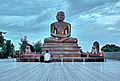
-
 Mahavira statue in Cave 32 of the Ellora Caves


Temples
[edit]Along with Rishabhanath, Parshvanath, Neminath, and Shantinath; Mahavira is one of the five tirthankaras that attract the most devotional worship among the Jains.[174] Various Jain temple complexes across India feature him, and these are important pilgrimage sites in Jainism. Pawapuri, for example, is a hilly part of southern Bihar, which is believed to have been a place where 23 out of 24 tirthankaras preached, along with Rishabha.[175][176] According to John Cort, the Mahavira temple in Osian, Jodhpur, Rajasthan is the oldest surviving Jain temple in western India; it was built in the late 8th century.[177] Important Mahavira temple complexes include Jal Mandir in Pawapuri, Trilokyanatha Temple, Meguti Jain Temple, Kumbharia Mahavira Temple, Sankighatta, Muchhal Mahavir Temple, Bhandavapur Jain Tirth, Dimapur Jain Temple, and Jain temple, Kundalpur
-
 Dharmachakra temple in Gajpanth
 -

-

-
 Jain temple, Potters Bar
 -
 Jain temple in Tirumalai
 -
 Meguti Jain temple, 5th—6th century


.jpg)


.jpg)
Worship
[edit].jpg)
Samantabhadra's Svayambhustotra praises the twenty-four tirthankaras, and its eight shlokas (songs) adore Mahavira.[178] One such shloka reads:
O Lord Jina! Your doctrine that expounds essential attributes required of a potential aspirant to cross over the ocean of worldly existence (Saṃsāra) reigns supreme even in this strife-ridden spoke of time (Pancham Kaal). Accomplished sages who have invalidated the so-called deities that are famous in the world, and have made ineffective the whip of all blemishes, adore your doctrine.[179]
Samantabhadra's Yuktyanusasana is a 64-verse poem which also praises Mahavira.[180]
Festivals
[edit]Two major annual Jain festivals associated with Mahavira are Mahavir Janma Kalyanak and Diwali. During Mahavir Janma Kalyanak, Jains celebrate Mahavira's birth as the 24th and last tirthankara of avasarpiṇī (the current time cycle).[69] During Mahavir Janma Kalyanak, the five auspicious events of Mahavira's life are re-enacted.[181] Diwali commemorates the anniversary of Mahavira's nirvana, and is celebrated at the same time as the Hindu festival. Diwali marks the New Year for Jains.[182] Jains celebrate Mahavir Janma Kalyanak every year on the 13th day of the Indian Calendar month of Chaitra.[183]
Influence
[edit]Michael H. Hart ranked him 100th in his 1978 book, “The 100: A Ranking of the Most Influential Persons in History”, below the Buddha (ranked 4th) and Ashoka (ranked 53rd).[184] According to Pantheon's 2024 Historical Popularity Index (HPI), Mahavira is ranked 19th among the most famous Indian people of all time.[185]
Mahavira's teachings were influential. According to Rabindranath Tagore,
Mahavira proclaimed in India that religion is a reality and not a mere social convention. It is really true that salvation can not be had by merely observing external ceremonies. Religion cannot make any difference between man and man.
An event associated with the 2,500th anniversary of Mahavira's nirvana was held in 1974:[186]
Probably few people in the West are aware that during this Anniversary year for the first time in their long history, the mendicants of the Śvētāmbara, Digambara and Sthānakavāsī sects assembled on the same platform, agreed upon a common flag (Jaina dhvaja) and emblem (pratīka); and resolved to bring about the unity of the community. For the duration of the year four dharma cakras, a wheel mounted on a chariot as an ancient symbol of the samavasaraṇa (Holy Assembly) of tīrthaṅkara Mahavira traversed to all the major cities of India, winning legal sanctions from various state governments against the slaughter of animals for sacrifice or other religious purposes, a campaign which has been a major preoccupation of the Jainas throughout their history.
See also
[edit]
- Jivantasvami
- Parshwanatha
- Arihant (Jainism)
- Jain iconography
- Bardhaman (city named after Mahavir Swami)
Notes
[edit]- ^ a b c A number of historians, who now favor the "Short Chronology" for Gautama Buddha's lifetime (ca. 480-400 BCE), argue that the traditional dates for Mahavira also are too early, by as much as one century, since Mahavira and Buddha were contemporaries (Dundas 2002, p. 24, Kuiper 2010, p. 144, Shah 1999).
- ^ a b
*Brodd, Little & Nystrom (2015, p. 146): "The two sects posit different dates for the death of Mahavira (527 BCE for Shvetambara, 510 BCE for Digambaras)."
Kruger (2024b, p. 278): ""According to Shvetambara calculation Mahavira was born in 599 BCE and died 527 BCE at the age of 72 years. This calculation is based on a statement at the end of the Jina legend in the Kalpasutra, claiming that 980 or 993 had passed since the death of Mahavira. Contrary to Shvetambara tradition, the Digambaras date the salvation of Mahavira to 510 BCE." - ^ a b The traditional Jaina perspective regards Jainism as eternal dharma without a founder, whereas history of religion scholars seek to consider Jainism in historical context as a Śramaṇa movement emerging and gradually evolving during the late Vedic Period and during the Second Urbanisation of the Mahajanapada period (Dundas 2002, pp. 12–13, Long 2009, p. 30). Although some non-Jains have referred to Mahavira as the "founder" of Jainism (Doniger 1999, p. 549), most historians believe that his role likely was part of a much older religious current. Some historians have spoken of Jainism as continuously existing since prior to Mahavira's reforms, (von Glasenapp 1925, p. 24; Zimmer 1953, pp. 182–183: "[T]here must be some truth in the Jaina tradition of the great antiquity of their religion. At least with respect to Pārśva [...] we have grounds for believing that actually lived and taught, and was a Jaina.") while some use the term "proto-Jain" for the earlier period:
- Basham (1951, pp. 108–109): "Jainism [...] was but a development of the older proto-Jainism of Pārśva", with "a looser group of ascetics", "clothed proto-Jainas".
- Long (2020, p. 206): "Jainism [...] is traced, in its current form, to Mahāvīra [...], although [...] there is some evidence that Mahāvīra's teaching is a continuation of an earlier, proto-Jain tradition."
- Moore (1977, p. 137): "[Mahavira's] predecessor Parshvanatha may have been an historical proto-Jain leader about 200 years earlier."
- Dundas (2002, p. 32): "It is impossible to be certain about the relationship between Mahāvīra and Pārśva and in actuality the chronological distance between the two teachers. [...] [E]arly Jainism coalesced out of an interaction between the cosmological ideas of Pārśva and a more rigorous form of orthopraxy advocated by Mahāvīra."
- ^ Uncertain historical details:
- Dundas (2002, pp. 22, 24–25): "It is fruitless to attempt to locate a historical Mahāvīra outside the parameters of the texts which describe him. Even such a basic question as when he lived is not certain. [...] Equally problematic is the question of Mahāvīra's birthplace [...] [His biography] expanded and evolved over a long period of time."
- Long (2009, pp. 31–32): "Our knowledge of the life of Mahāvīra is dependent upon texts written down many years after the events they describe". Although it "can be said with confidence" that Mahāvīra existed, "this still leaves us with relatively little to go on in terms of information that would pass the muster of contemporary historical methods. [...] whatever historical truth may be in these scriptures, they are not 'historical' texts in the modern sense, Nor is this their apparent intent, spiritual instruction being their aim"
- ^ The association of the era beginning in 57 BCE with Vikramaditya is not found in any source before the 9th century CE; earlier sources call the era "Kṛṭa" (343 and 371 CE), "Kritaa" (404), "the era of the Malava tribe" (424), or simply "Samvat" (Agrawal 1989, pp. 174–175, Srinivasachariar 1974, pp. 94–111). The earliest known inscription which calls the era "Vikrama" is from 842. This inscription, from the Chauhana ruler Chandamahasena, was found at Dholpur and is dated "Vikrama Samvat 898, Vaishakha Shukla 2, Chanda" (20 April 842). The earliest known inscription which associates the era with a king called Vikramaditya is dated 971, and the earliest literary work connecting the era to Vikramaditya is Subhashita-Ratna-Sandoha (993–994) by the Jain author Amitagati (Srinivasachariar 1974, pp. 94–111).
- ^ In 1912, historian G.H Ojha discovered an Barli Inscription in Prakrit language. According to him, the inscription contains the line "Viraya Bhagavate chaturasiti vase", interpreted by him as "year 84 of the Vira Nirvana Samvat." Following the Vira Nirvana Samvat, Ojha dated the inscription to 443 BCE (Bharatkalyan, Kailash Chand Jain 1972, p. 152, Goyal 2006, p. 105, Bhandarkar Oriental Research Institute). However, the line could also be a reference to the 84 Mahasiddhas (Bharatkalyan), and palaeographic analysis dates the inscription to the 2nd-1st century BCE. Swarajya Prakash Gupta & K. S. Ramachandran (1979, p. 106): "The Barli inscription, which was placed by Ojha in fifth century B.C., can really be assigned to the first century B.C., on paleographic grounds." See also (Goyala 2006), and (Bhandarkar Oriental Research Institute: "On palaeographic grounds [the Barli inscription] has to be placed after the Besnagar inscription of Heliodorus and is possibly later than the Ghosundi inscription"). D. C. Sircar and S. R. Goyal question the link with the Vira Nirvana Samvat, noting that the desigantion of this era under this name first appeared in the early medieval period, and most probably did not exist in the century following the death of Mahavira (S. R. Goyal 2005, p. 22). S. R. Goyal (2005, p. 3): "The belief that the Barli inscription is dated in the 84th year of the Mahavlra Era and thus belongs to the fifth century B.C. is rightly regarded as baseless, for no such era was in existence in that period."
- ^ The Buddha was younger than Mahavira and "might have attained nirvana a few years later."[36]
- ^ Both Mahavira and the Buddha were proponents of the Śramaṇa movements, which became popular in Greater Magadha at the end of the Vedic Period and during the Second Urbanisation of the Mahajanapada period, greatly impacting the course of Indian religious history.[38]
- ^ Heinrich Zimmer: "The cycle of time continually revolves, according to the Jainas. The present "descending" (avasarpini) period was preceded and will be followed by an "ascending" (utsarpini). Sarpini suggests the creeping movement of a "serpent" (sarpin); ava- means "down" and ut- means up."[61]
- ^ Trishala was the sister of King Chetaka of Vaishali in ancient India.[54]
- ^ This mythology has similarities with those found in the mythical texts of the Vaishnavism tradition of Hinduism.[72]
- ^ On this Champat Rai Jain wrote: ""Of the two versions of Mahavira's life — the Swetambara and the Digambara— it is obvious that only one can be true: either Mahavira married, or he did not marry. If Mahavira married, why should the Digambaras deny it? There is absolutely no reason for such a denial. The Digambaras acknowledge that nineteen out of the twenty-four tirthamkaras married and had children. If Mahavira also married it would make no difference. There is thus no reason whatsoever for the Digambaras to deny a simple incident like this. But there may be a reason for the Swetambaras making the assertion; the desire to ante-date their own origin. As a matter of fact their own books contain clear refutation of the statement that Mahavira had married. In the Samavayanga Sutra (Hyderabad edition) it is definitely stated that nineteen tirthankaras lived as householders, that is, all the twenty-four excepting Shri Mahavira, Parashva, Nemi, Mallinath and Vaspujya."[81]
- ^ Not to be confused with kevalajnana (omniscience).[103]
- ^ According to Melton and Baumann, the Digambaras state that "women's physical and emotional character makes it impossible for them to genuinely engage in the intense [ascetic] path necessary for spiritual purification. (...) Only by being reborn as a man can a woman engage in the ascetic path. Later Digambara secondary arguments appealed to human physiology in order to exclude women from the path: by their very biological basis, women constantly generate and destroy (and therefore harm) life forms within their sexual organs. Svetambara oppose this view by appealing to scriptures."[153]
- ^ A special symbol that marks the chest of a tirthankara.
References
[edit]- ^ a b c d e f g h i j k l Dundas 2002, p. 24.
- ^ a b c d e Kuiper 2010, p. 144.
- ^ a b c d e f Shah 1999.
- ^ a b c d e f Doniger 1999, p. 549.
- ^ Krüger 2024, p. 281.
- ^ a b c d e f g h Dundas 2002, p. 25.
- ^ a b Doniger 1999, p. 682.
- ^ a b c d Bowker.
- ^ a b Brodd, Little & Nystrom 2015, p. 146.
- ^ a b Kruger 2024b, p. 278.
- ^ Davidson & Gitlitz 2002, p. 267.
- ^ Kailash Chand Jain 1991, p. 38.
- ^ Jaini 2000, p. 9.
- ^ Hubbard 1807, p. 310.
- ^ Tandon 2002, p. 45.
- ^ Dundas 2002, p. 276.
- ^ a b Dundas 2002, pp. 24–25.
- ^ a b Dundas 2002, pp. 30–31.
- ^ a b Basham 1951, p. 108.
- ^ a b c Heehs 2002, p. 90.
- ^ Rospatt.
- ^ a b "Jainism: Mahāvīra – early life". BBC. Retrieved 5 October 2025.
- ^ Kailash Chand Jain 1991, p. 32-33.
- ^ a b c Kailash Chand Jain 1991, p. 32.
- ^ a b Dundas 2002, p. 30.
- ^ Singh & Mishra 2005.
- ^ a b Potter 2007, pp. 35–36.
- ^ a b Dowling & Scarlett 2006, p. 225.
- ^ a b Upinder Singh 2016, p. 313.
- ^ a b c Rapson 1922, p. 155.
- ^ Rapson 1922, p. 155–156.
- ^ Cort 2010, pp. 69–70, 587–588.
- ^ Rapson 1922, p. 156.
- ^ Dhaky 1997, p. 11.
- ^ World Religions Reference Library, Mahavira
- ^ Kailash Chand Jain 1991, pp. 84–88.
- ^ a b Taliaferro & Marty 2010, p. 126.
- ^ Dundas 2002, p. 14-16.
- ^ "Mahavira". BBC Religion. BBC.
- ^ Long 2020, p. 206.
- ^ a b Wiley 2009, pp. 5–7.
- ^ a b c Dundas 2002, pp. 30–33.
- ^ Umakant P. Shah 1987, pp. 9–11.
- ^ Cort 2010, pp. 25–32, 120–122, 166–171, 189–192.
- ^ Chatterjee, Asim Kumar (2000). A comprehensive history of Jainism, 1 (2nd rev. ed.). New Delhi: Munshiram Manoharlal Publishers. p. 15. ISBN 81-215-0931-9.
- ^ a b Tähtinen, Unto (1976). Ahimsa. Non-Violence in Indian Tradition. London. p. 132.
{{cite book}}: CS1 maint: location missing publisher (link) - ^ Dundas, Paul (2002) [1992]. The Jains (Second ed.). London and New York City: Routledge. pp. 14, 19, 30. ISBN 0-415-26605-X.
- ^ Long 2009, p. 212.
- ^ Dhaky 1997, pp. 1–9.
- ^ a b Winternitz 1993, p. 408.
- ^ Pannalal Jain 2015, p. 460.
- ^ Chaudhary, Pranava K. (14 October 2003). "Row over Mahavira's birthplace". The Times of India. Patna. Archived from the original on 3 November 2017. Retrieved 3 November 2017.
- ^ a b Sharma, JP (1968). "The Nāyas". Republics in Ancient India. BRILL. pp. 159–166. ISBN 9789004642744.
- ^ a b c von Glasenapp 1925, p. 29.
- ^ Umakant P. Shah 1987, p. 3.
- ^ Jain & Upadhye 2000, p. 45.
- ^ Jain & Upadhye 2000, p. 46.
- ^ Kailash Chand Jain 1991, p. 59.
- ^ Dundas 2002, p. 19.
- ^ Jain & Upadhye 2000, p. 47.
- ^ a b c Zimmer 1953, p. 224.
- ^ Jain & Upadhye 2000, p. 54.
- ^ Zimmer 1953, p. 181.
- ^ Upinder Singh 2016, pp. 312–313.
- ^ "Tirthankara | Definition, Names, & Facts". Encyclopaedia Britannica. Archived from the original on 15 October 2013. Retrieved 15 October 2013.
- ^ a b c von Glasenapp 1925, p. 327.
- ^ a b c d Dundas 2002, p. 21.
- ^ a b Gupta & Gupta 2006, p. 1001.
- ^ Dundas 2002, pp. 21, 26.
- ^ Mills, Claus & Diamond 2003, pp. 320, note: Indra is referred to as Sakra in some Indian texts..
- ^ Olivelle 2006, pp. 397 footnote 4.
- ^ Mills, Claus & Diamond 2003, p. 320.
- ^ a b Dundas 2002, p. 22.
- ^ Vyas 1995, p. 19.
- ^ Jain & Fischer 1978, pp. 5–9.
- ^ Dalal 2010, p. 284.
- ^ Vemsani, Lavanya, ed. (2024). Handbook of Indian History. Springer. pp. 278–281. ISBN 978-981-97-6207-1.
- ^ Umakant P. Shah 1987, pp. 99, Quote: "According to the Digambara sect, Mahavira did not marry, while the Svetambaras hold a contrary belief.".
- ^ Shanti Lal Jain 1998, p. 51.
- ^ Champat Rai Jain 1939, p. 97.
- ^ Umakant P. Shah 1987, p. 188.
- ^ a b Finegan 1952, p. 190.
- ^ Umakant P. Shah 1987, p. 95.
- ^ von Glasenapp 1925, p. 16.
- ^ a b c d e f George 2008, p. 319.
- ^ Jacobi 1964, p. 269.
- ^ von Glasenapp 1925, p. 30.
- ^ Sen 1999, p. 74.
- ^ Dundas 2002, p. 27.
- ^ Kailash Chand Jain 1991, p. 79.
- ^ Jain & Upadhye 2000, p. 30.
- ^ von Glasenapp 1925, pp. 30, 327.
- ^ Jain & Upadhye 2000, p. 31.
- ^ Vijay K. Jain 2016b, p. 5.
- ^ a b Upinder Singh 2016, p. 314.
- ^ a b Wiley 2009, p. 6.
- ^ a b Wiley 2009, pp. 6–8, 26.
- ^ George 2008, p. 326.
- ^ Cort 2001, p. 47.
- ^ a b c Caillat & Balbir 2008, p. 88.
- ^ Natubhai Shah 2004, p. 44.
- ^ von Glasenapp 1925, pp. 29–31, 205–206: "At the end of almost thirty years of preaching, he died in the chancellory of King Hastipala of Pavapuri and attained Nirvana.".
- ^ Zimmer 1953, p. 222.
- ^ Dundas 2002, pp. 22–24.
- ^ a b Melton & Baumann 2010, p. 897.
- ^ a b Doniger 1999, pp. 549–550.
- ^ von Glasenapp 1925, p. 39.
- ^ Pramansagar 2008, pp. 38–39.
- ^ von Glasenapp 1925, p. 328.
- ^ "Destinations : Pawapuri". Bihar State Tourism Development Corporation. Archived from the original on 22 July 2015. Retrieved 23 July 2015.
- ^ Jain & Fischer 1978, pp. 14, 29–30.
- ^ a b Winternitz 1993, pp. 408–409.
- ^ Cort 2010, p. 225.
- ^ Vijay K. Jain 2012, p. xi.
- ^ a b Wiley 2009, pp. 6–8.
- ^ Vijay K. Jain 2012, p. xii.
- ^ Sangave 2006, p. 67.
- ^ a b c Shah, Pravin K. "Five Great Vows (Maha-vratas) of Jainism". Harvard Faculty of Arts and Sciences, Harvard University. Archived from the original on 31 December 2014. Retrieved 31 December 2014.
- ^ Goyal, Śrīrāma (1987). A history of Indian Buddhism. Meerut: Kusumanjali Prakashan. pp. 83, 84, 85, 103.
- ^ Vijay K. Jain 2012, p. 68.
- ^ Long 2009, pp. 101–102.
- ^ Long 2009, p. 109.
- ^ Cort 2001, pp. 26–27.
- ^ Appleton 2014, pp. 20–45.
- ^ Adams 2011, p. 22.
- ^ Chakravarthi 2003, pp. 3–22.
- ^ a b Dundas 2002, pp. 88–89, 257–258.
- ^ Jain & Jain 2002, p. 13.
- ^ Titze 1998, p. 4.
- ^ a b c d e Taylor 2008, pp. 892–894.
- ^ Pandey 1998, p. 50.
- ^ a b Nanda 1997, p. 44.
- ^ a b "Great Men's view on Jainism". Harvard Faculty of Arts and Sciences, Harvard University. Archived from the original on 16 May 2018. Retrieved 16 May 2018.
Jainism Literature Center
- ^ "Anatta | Buddhism". Encyclopædia Britannica. Archived from the original on 10 December 2015. Retrieved 10 December 2015.
Anatta .. in Buddhism, the doctrine that there is in humans no permanent, underlying .. soul. The concept of anatta, or anatman, is a departure from the Hindu belief in atman ("the self").
- ^ Collins 1994, p. 64.
- ^ Nagel 2000, p. 33.
- ^ Charitrapragya 2004, pp. 75–76.
- ^ Dundas 2002, pp. 99–103.
- ^ Dundas 2002, pp. 90–99.
- ^ Dundas 2002, pp. 91–92, 104–105.
- ^ a b c d e Charitrapragya 2004, pp. 75–79.
- ^ Dundas 2002, pp. 229–231.
- ^ Sharma & Khanna 2013, p. 18.
- ^ a b Webb, Mark Owen (14 November 2003). "Jain Philosophy". Internet Encyclopedia of Philosophy. Archived from the original on 28 May 2010. Retrieved 3 November 2017.
- ^ Matilal 1990, pp. 301–305.
- ^ Balcerowicz 2015, pp. 205–218.
- ^ a b Dundas 2002, pp. 232–234.
- ^ Long 2009, pp. 98–106.
- ^ Dundas 2002, p. 233.
- ^ Long 2009, pp. 36–37.
- ^ a b Harvey 2014, pp. 182–183.
- ^ Melton & Baumann 2010, p. 1396.
- ^ Arvind Sharma 1994, pp. 135–138.
- ^ Dundas 2002, pp. 55–59.
- ^ Chapelle 2011, pp. 263–270.
- ^ Dundas 2002, pp. 41–42, 90–93.
- ^ a b Long 2009, pp. 179–181.
- ^ Gorski 2008, pp. 125–128.
- ^ Dundas 2002, pp. 25–26.
- ^ a b Heehs 2002, p. 93.
- ^ Zimmer 1953, p. 223.
- ^ Umakant P. Shah 1987, p. 192.
- ^ Zimmer 1953, p. 225.
- ^ von Glasenapp 1925, pp. 426–428.
- ^ "Jainism: Jinas and Other Deities". Victoria and Albert Museum. Archived from the original on 26 May 2017. Retrieved 26 November 2012.
- ^ a b Vyas 1995, pp. 15–17.
- ^ Cort 2010, pp. 273–275.
- ^ Cort 2010, pp. 48–49.
- ^ Umakant P. Shah 1987, p. 193.
- ^ Saju, M. T. (3 October 2015). "Ancient Mahavira sculpture found in cave near Theni". The Times of India. Chennai. Archived from the original on 22 July 2016. Retrieved 17 May 2017.
- ^ Vyas 1995, p. 15.
- ^ Titze 1998, p. 266.
- ^ Dundas 2002, p. 40.
- ^ Cort 2010, p. 133.
- ^ Titze 1998, p. 207.
- ^ Cort 1998, p. 112.
- ^ Vijay K. Jain 2015, pp. 164–169.
- ^ Vijay K. Jain 2015, p. 165.
- ^ Gokulchandra Jain 2015, p. 84.
- ^ George 2008, p. 394.
- ^ Bhalla 2005, p. 13.
- ^ "Mahavir Jayanti | What, When, Why & How To Celebrate Mahavir Swami Jayanti". 17 April 2021. Retrieved 2 April 2022.
- ^ "The 100: A ranking of the most influential persons in history". Business Horizons. 23 (1): 91–92. 1980. doi:10.1016/0007-6813(80)90119-6. ISSN 0007-6813.
- ^ "Top 30 Most Famous Personalities of India of All Time (2024) – Dhamma Bharat". www.dhammabharat.com. 30 July 2024. Retrieved 2 September 2024.
- ^ Jaini 2000, p. 31.
Sources
[edit]- Adams, Simon (2011), The Story of World Religions, The Rosen Publishing Group, ISBN 978-1-4488-4791-4
- Agrawal, Ashvini (1989). Rise and Fall of the Imperial Guptas. Motilal Banarsidass. ISBN 978-81-208-0592-7.
- Appleton, Naomi (2014), Narrating Karma and Rebirth: Buddhist and Jain Multi-Life Stories, Cambridge University Press, ISBN 978-1-107-03393-1
- Balcerowicz, Piotr (2015), Early Asceticism in India: Ājīvikism and Jainism, Routledge, ISBN 978-1-317-53853-0
- Basham, A.L. (1951). History and Doctrines of the Ājīvikas: A Vanished Indian Religion. Jainism Series. Motilal Banarsidass. ISBN 978-81-208-1204-8.
{{cite book}}: ISBN / Date incompatibility (help) - Bhalla, Kartar Sing (2005), Let's Know Festivals of India, Star Publications, ISBN 9788176501651
- Bhandarkar Oriental Research Institute (1978). Annals of the Bhandarkar Oriental Research Institute.
- Bharatkalyan. "Barli Brāhmī Inscription of ca. 443 BCE". Bharatkalyan97. Retrieved 7 October 2025.
- Bowker, John. "Mahavira". The Concise Oxford Dictionary of World Religions.
- Brodd, Jeffrey; Little, Layne; Nystrom, Brad (2015). Invitation to Asian Religions. Oxford University Press.
- Caillat, Colette; Balbir, Nalini (1 January 2008), Jaina Studies, (in Prakrit), Motilal Banarsidass Publishing House, ISBN 978-81-208-3247-3
- Charitrapragya, Samani (2004), Sethia, Tara (ed.), Ahimsā, Anekānta, and Jaininsm, Motilal Banarsidass Publishing House, ISBN 978-81-208-2036-4
- Chakravarthi, Ram-Prasad (2003), "Non-violence and the other A composite theory of multiplism, heterology and heteronomy drawn from Jainism and Gandhi", Angelaki, 8 (3): 3–22, doi:10.1080/0969725032000154359, S2CID 143842799
- Chapelle, Christopher (2011), Murphy, Andrew R. (ed.), The Blackwell Companion to Religion and Violence, John Wiley & Sons, ISBN 978-1-4443-9573-0
- Collins, Steven (1994), Reynolds, Frank; Tracy, David (eds.), Religion and Practical Reason, State University of New York Press, ISBN 978-0-7914-2217-5
- Cort, John E., ed. (1998), Open Boundaries: Jain Communities and Cultures in Indian History, SUNY Press, ISBN 978-0-7914-3785-8
- Cort, John E. (2001), Jains in the World: Religious Values and Ideology in India, Oxford University Press, ISBN 978-0-19-513234-2
- Cort, John E. (2010), Framing the Jina: Narratives of Icons and Idols in Jain History, Oxford University Press, ISBN 978-0-19-538502-1
- Dalal, Roshen (2010), The Religions of India: A Concise Guide to Nine Major Faiths, Penguin Books, ISBN 978-0-14-341517-6
- Davidson, Linda Kay; Gitlitz, David Martin (2002), Pilgrimage: From the Ganges to Graceland : an Encyclopedia, vol. 1, ABC-CLIO, ISBN 9781576070048
- Dhaky, M.A. (1997). Arhat Pārśva and Dharaṇendra Nexus. Bhogilal Leharchand Institute of Indology, Delhi.
- Doniger, Wendy, ed. (1999), Encyclopedia of World Religions, Merriam-Webster, ISBN 978-0-87779-044-0
- Dowling, Elizabeth M.; Scarlett, W. George, eds. (2006), Encyclopedia of Religious and Spiritual Development, SAGE Publications, ISBN 978-0-7619-2883-6
- Dundas, Paul (2002) [1992], The Jains (Second ed.), Routledge, ISBN 978-0-415-26605-5
- Finegan, Jack (1952), The archeology of world religions, Princeton University Press
- George, Vensus A. (2008), Paths to the Divine: Ancient and Indian, vol. XII, The Council for Research in Values and Philosophy, ISBN 978-1-56518-248-6
- Gorski, Eugene F. (2008), Theology of Religions: A Sourcebook for Interreligious Study, Paulist Press, ISBN 978-0-8091-4533-1
- Goyal, S. R. (2005). Ancient Indian Inscriptions: Recent Finds and New Interpretations. Kusumanjali Book World.
- Goyala, Śrīrāma (2006), Brāhmī Script: An Invention of the Early Maurya Period, Kusumanjali Book World
- Gupta, K. R.; Gupta, Amita (2006), Concise Encyclopaedia of India, vol. 3, Atlantic Publishers & Dis, ISBN 978-81-269-0639-0
- Swarajya Prakash Gupta; K. S. Ramachandran, eds. (1979). The Origin of Brahmi script. D.K.
- Harvey, Graham (2014) [2009], Religions in Focus: New Approaches to Tradition and Contemporary Practices, Routledge, ISBN 978-1-134-93690-8
- Heehs, Peter (2002), Indian Religions: A Historical Reader of Spiritual Expression and Experience, New York University Press, ISBN 978-0-8147-3650-0
- Hubbard, Thomas (1807). Asiatick Researches. Vol. 9. Kolkata: Hindoostanee Press.
- Jacobi, Hermann (1964), Max Muller (ed.), Jaina Sutras (Translation), The Sacred Books of the East, vol. XXII, Motilal Banarsidass Publishing House (original: Oxford University Press)
- Jain, Champat Rai (1939), The Change of Heart
 This article incorporates text from this source, which is in the public domain.
 - Jain, Gokulchandra (2015), Samantabhadrabhāratī (1st ed.), Budhānā, Muzaffarnagar: Achārya Shāntisāgar Chani Smriti Granthmala, ISBN 978-81-90468879
- Jain, Hiralal; Jain, Dharmachandra (1 January 2002), Jaina Tradition in Indian Thought, Sharada Publishing House, ISBN 9788185616841
- Jain, Hiralal; Upadhye, Adinath Neminath (2000) [1974], Mahavira, his times and his philosophy of life, Bharatiya Jnanpith
- Jain, Jyotindra; Fischer, Eberhard (1978), Jaina Iconography, BRILL Academic, ISBN 978-90-04-05259-8
- Jain, Kailash Chand (1972), Malwa Through The Ages, Motilal Banarsidass Publishing House, ISBN 978-81-208-0824-9
- Jain, Kailash Chand (1991), Lord Mahāvīra and His Times, Motilal Banarsidass Publishing House, ISBN 978-81-208-0805-8
- Jain, Pannalal (2015), Uttarapurāṇa of Āchārya Guṇabhadra, Bhartiya Jnanpith, ISBN 978-81-263-1738-7
- Jain, Shanti Lal (1998), ABC of Jainism, Bhopal (M.P.): Jnanodaya Vidyapeeth, ISBN 978-81-7628-000-6
- Jain, Vijay K. (2012), Acharya Amritchandra's Purushartha Siddhyupaya: Realization of the Pure Self, With Hindi and English Translation, Vikalp Printers, ISBN 978-81-903639-4-5 This article incorporates text from this source, which is in the public domain.
- Jain, Vijay K. (2015), Acarya Samantabhadra's Svayambhustotra: Adoration of The Twenty-four Tirthankara, Vikalp Printers, ISBN 978-81-903639-7-6, archived from the original on 16 September 2015 This article incorporates text from this source, which is in the public domain.
- Jain, Vijay K. (2016). Ācārya Samantabhadra's Ratnakarandaka-śrāvakācāra: The Jewel-casket of Householder's Conduct. Vikalp Printers. ISBN 978-81-903639-9-0. This article incorporates text from this source, which is in the public domain.
- Jaini, Padmanabh S. (2000), Collected Papers on Jaina Studies, Delhi: Motilal Banarsidass Publishing House, ISBN 978-81-208-1691-6
- Krüger, P. F. (2024). Vemsani, Lavanya (ed.). Handbook of Indian History. Springer. p. 281.

Kruger, Patrick Felix (2024b). "Jainism in Indian History and Culture". In Vemsani, Lavanya (ed.). Handbook of Indian History. Springer Nature.
- Kuiper, Kathleen (2010). The Culture of India. Understanding India. Britannica Educational Publishing. ISBN 978-1-61530-203-1.
- Long, Jeffery D. (2009), Jainism: An Introduction, I. B. Tauris, ISBN 978-0-8577-3656-7
- Long, Jeffery D. (2020). Historical Dictionary of Hinduism. Bloomsbury Publishing USA. ISBN 979-8-8818-7623-4.
- Matilal, Bimal Krishna (1990), Logic, Language and Reality: Indian Philosophy and Contemporary Issues, Motilal Banarsidass Publishing House, ISBN 978-81-208-0717-4
- Matilal, Bimal Krishna (1998), Ganeri, Jonardon; Tiwari, Heeraman (eds.), The Character of Logic in India, State University of New York Press, ISBN 978-0-7914-3739-1
- Melton, J. Gordon; Baumann, Martin, eds. (2010), Religions of the World: A Comprehensive Encyclopedia of Beliefs and Practices, vol. One: A–B (Second ed.), ABC-CLIO, ISBN 978-1-59884-204-3
- Mills, Margaret A.; Claus, Peter J.; Diamond, Sarah, eds. (2003), Kalpa Sutra (by Jerome Bauer) in South Asian Folklore: An Encyclopedia, Routledge, ISBN 978-0-415-93919-5
- Moore, Albert C. (1977). Iconography of Religions: An Introduction. Fortress Press. p. 137. ISBN 978-0-8006-0488-2.
- Nagel, Bruno (2000), Perrett, Roy (ed.), Philosophy of Religion: Indian Philosophy, Routledge, ISBN 978-0815336112
- Nanda, R. T. (1997), Contemporary Approaches to Value Education in India, Regency Publications, ISBN 978-81-86030-46-2
- Olivelle, Patrick (2006), Between the Empires: Society in India 300 BCE to 400 CE, Oxford University Press, ISBN 978-0-19-977507-1
- Pandey, Janardan (1998), Gandhi and 21st Century, Concept Publishing Company, ISBN 9788170226727
- Potter, Karl H. (2007), Dalsukh Malvania and Jayendra Soni (ed.), Encyclopedia of Indian Philosophies, vol. X: Jain Philosophy, Motilal Banarsidass Publishing House, ISBN 978-81-208-3169-8
- Pramansagar, Muni (2008), Jain Tattvavidya, India: Bhartiya Gyanpeeth, ISBN 978-81-263-1480-5
- Rapson, E. J. (1922), The Cambridge History of India, Cambridge University Press
- Rospatt, Alexander. "Mahāvīra". Religion Past and Present Online. BRILL.
- Sangave, Vilas Adinath (2006) [1990], Aspects of Jaina religion (5 ed.), Bharatiya Jnanpith, ISBN 978-81-263-1273-3
- Sen, Shailendra Nath (1999) [1998], Ancient Indian History and Civilization (2nd ed.), New Age International, ISBN 978-81-224-1198-0
- Shah, Natubhai (2004) [First published in 1998], Jainism: The World of Conquerors, vol. I, Motilal Banarsidass Publishing House, ISBN 978-81-208-1938-2
- Shah, Umakant Premanand (1987), Jaina-rūpa-maṇḍana: Jaina iconography, Abhinav Publications, ISBN 978-81-7017-208-6
- Shah, Umakant Premanand (1999). "Mahavira". Encyclopedia Britannica. Retrieved 12 February 2025.
- Sharma, Arvind (1994), Religion and Women, State University of New York Press, ISBN 978-0-7914-1689-1
- Sharma, Arvind; Khanna, Madhu (2013), Asian Perspectives on the World's Religions, ABC-CLIO, ISBN 978-0-313-37897-3
- Singh, Upinder (2016), A History of Ancient and Early Medieval India: From the Stone Age to the 12th Century, Pearson Education, ISBN 978-93-325-6996-6
- Singh, Nagendra Kr; Mishra, A. P. (2005). Encyclopaedia of Oriental Philosophy and Religion: Christianity. Global Vision Publishing House. ISBN 978-81-8220-071-5.
- Srinivasachariar, M. (1974). History of Classical Sanskrit Literature. Motilal Banarsidass. ISBN 9788120802841.
- Sunavala, A. J. (1934), Adarsha Sadhu: An Ideal Monk (First paperback edition, 2014 ed.), Cambridge University Press, ISBN 978-1-107-62386-6
{{citation}}: ISBN / Date incompatibility (help) - Taliaferro; Marty (2010), A dictionary of philosophy of Religion, A&C Black, ISBN 978-1-4411-1197-5
- Tandon, Om Prakash (2002) [1968], Jaina Shrines in India (1 ed.), New Delhi: Publications Division, Ministry of Information and Broadcasting, Government of India, ISBN 978-81-230-1013-7
- Taylor, Bron (2008), Encyclopedia of Religion and Nature, Bloomsbury Academic, ISBN 978-1-4411-2278-0
- Titze, Kurt (1998), Jainism: A Pictorial Guide to the Religion of Non-Violence (2 ed.), Motilal Banarsidass Publishing House, ISBN 978-81-208-1534-6
- von Glasenapp, Helmuth (1925), Jainism: An Indian Religion of Salvation, Delhi: Motilal Banarsidass Publishing House (Reprinted 1999), ISBN 978-81-208-1376-2
{{citation}}: ISBN / Date incompatibility (help) - Vyas, Dr. R. T., ed. (1995), Studies in Jaina Art and Iconography and Allied Subjects, The Director, Oriental Institute, on behalf of the Registrar, M.S. University of Baroda, Vadodara, ISBN 81-7017-316-7
- Wiley, Kristi L. (2009), The A to Z of Jainism, Scarecrow Press, ISBN 978-0-8108-6821-2
- Winternitz, Moriz (1993), History of Indian Literature: Buddhist & Jain Literature, Motilal Banarsidass Publishing House, ISBN 978-81-208-0265-0
- Zimmer, Heinrich (1953) [April 1952], Campbell, Joseph (ed.), Philosophies Of India, London: Routledge & Kegan Paul Ltd, ISBN 978-81-208-0739-6
{{citation}}: ISBN / Date incompatibility (help) - S. R. Goyal (2005). Ancient Indian Inscriptions: Recent Finds and New Interpretations. Kusumanjali Book World.
External links
[edit] Definitions from Wiktionary
 Media from Commons
 News from Wikinews
 Quotations from Wikiquote
 Texts from Wikisource
 Textbooks from Wikibooks
 Resources from Wikiversity


| Gods | |||||
|---|---|---|---|---|---|
| Philosophy | |||||
| Branches |
| ||||
| Practices | |||||
| Literature | |||||
| Symbols | |||||
| Ascetics | |||||
| Scholars | |||||
| Community |
| ||||
| Jainism in |
| ||||
| Jainism and | |||||
| Dynasties and empires | |||||
| Related | |||||
| Lists | |||||
| Navboxes | |||||

| International | |
|---|---|
| National | |
| People | |
| Other | |

Mahavira
View on GrokipediaHistorical Context
Dating and Chronology
In the Svetambara tradition of Jainism, Mahavira's birth is dated to 599 BCE, his renunciation at age 30 to 569 BCE, attainment of omniscience (kevala jnana) at age 42 to 557 BCE, and nirvana at age 72 to 527 BCE.[3] The Digambara tradition differs slightly, placing his birth in 582 BCE and nirvana in 510 BCE while maintaining the same lifespan of 72 years.[3] These dates derive from Jain canonical texts and later commentaries, which synchronize Mahavira's life with the Kali Yuga calendar and royal genealogies, though they reflect symbolic and doctrinal emphases rather than precise historical records.[6] Modern scholarly estimates adjust these traditional chronologies based on cross-references with contemporary figures and events, ranging from c. 540–468 BCE, with some scholars proposing dates approximately 100 years later (c. 499–427 BCE) to better align with contemporary figures and events.[3][7] This revision aligns Mahavira as a near-contemporary of Gautama Buddha, whose parinirvana is placed around 400 BCE in the median chronology, necessitating later dates for associated Jain figures to fit archaeological and textual evidence.[8] Key methodologies include analysis of Puranic king lists, which provide regnal synchronisms for Magadhan rulers like Bimbisara, and Buddhist texts such as the Pali Canon that reference Mahavira (as Nigantha Nataputta) debating with Buddha's disciples.[9] Epigraphic evidence from Ashokan edicts (c. 268–232 BCE) further anchors the timeline by mentioning early Buddhist assemblies roughly 100–218 years prior, indirectly supporting a 5th-century BCE context for both traditions' founders.[8] Disputes in dating often stem from the lunisolar nature of ancient Indian calendars, which required periodic intercalary months to reconcile lunar cycles (354 days) with the solar year (365 days), leading to potential shifts of decades in retrospective calculations. Jain texts specify durations for Mahavira's key events, including 12.5 years of rigorous asceticism preceding kevala jnana and 30.5 years of preaching thereafter, providing internal consistency to the chronology regardless of absolute placement.[3] These intervals, drawn from Svetambara and Digambara scriptures, underscore the structured progression of his spiritual journey but remain subject to the broader historiographical debates.[6]Birthplace and Family Background
Mahavira, the 24th Tirthankara of Jainism, is traditionally described as having been born in Kundagrama, a village near the ancient city of Vaishali in the region of present-day Bihar, India, during the 6th century BCE.[11] This location is situated within the historical Lichchhavi republic, a prosperous non-monarchical confederacy of Kshatriya clans known for its republican governance and cultural significance in the Gangetic plains.[12] Jain canonical texts, such as the Kalpa Sutra, identify Kundagrama as the primary birthplace, emphasizing its role as a suburb of Vaishali, though some interpretations debate whether it corresponds to an alternative site called Kundapura, potentially due to linguistic variations or geographic shifts in ancient nomenclature.[13] Archaeological evidence for the exact site remains inconclusive, with no definitive excavations confirming the location post-2020, relying instead on textual traditions and the broader context of Iron Age settlements in the Vaishali area.[12] Mahavira was born into the Jnatrika (or Nata) clan, a Kshatriya lineage, as the son of Siddhartha, a local chieftain and head of the clan, and Trishala (also known as Videhadatta or Priyakarini), who was the sister of Chetaka, the prominent ruler of the Lichchhavi confederacy.[11][5] His elder brother, Nandivardhana, succeeded their father as the clan leader, highlighting the familial ties to regional power structures without a centralized monarchy.[14] The family's prosperity is reflected in the socio-political environment of the Lichchhavi republic, where oligarchic assemblies governed trade-rich territories along the Ganges, fostering an atmosphere of relative stability and cultural exchange in 6th-century BCE Magadha.[15] Jain traditions recount that prior to Mahavira's birth, his mother Trishala experienced 14 auspicious dreams, interpreted by sages as omens foretelling the child's future as either a universal monarch or a spiritual liberator who would revive the faith.[11] These dreams, detailed in the Kalpa Sutra, included symbols such as an elephant representing strength, a bull for virtue, and a smokeless fire signifying enlightenment, underscoring the prophetic elements surrounding his conception and birth.[11] Accounts of Mahavira's early family life diverge between the Svetambara and Digambara sects of Jainism. Svetambara texts describe him as marrying Yashoda, a member of the same clan, and fathering a daughter named Priyadarshana (or Anojja), reflecting a householder phase before renunciation.[16] In contrast, Digambara traditions maintain that Mahavira remained celibate throughout his life, rejecting marriage to embody perfect detachment from worldly ties.[16] These differences stem from post-Mahavira schisms in Jain interpretive traditions, with no consensus on resolving the biographical variances.[17]Role as Reformer and Successor
In the traditional Jain perspective, Mahavira is revered as the 24th and final Tirthankara of the current cosmic cycle, serving as the direct spiritual successor to the 23rd Tirthankara, Parshvanatha, who lived approximately 250 years earlier.[18] Rather than founding a new religion, Mahavira is seen as a reviver of the eternal dharma that has existed since time immemorial, propagating the timeless principles of non-violence, truth, and asceticism that were taught by his predecessors.[1] He organized his followers into the fourfold sangha, comprising monks (sadhus), nuns (sadhvis), laymen (shravakas), and laywomen (shravikas), which provided a structured community for practicing and preserving Jain ethics.[19] This establishment marked the culmination of the Tirthankara lineage in this era, emphasizing Mahavira's role in revitalizing the path to liberation for all beings. From a scholarly viewpoint, Mahavira emerges as a key reformer within the broader Shramana movements of ancient India, adapting and systematizing pre-existing ascetic traditions rather than originating them anew. He modified the four vows attributed to Parshvanatha—non-violence (ahimsa), non-possession (aparigraha), non-stealing (asteya), and non-lying (satya)—by introducing a fifth vow of celibacy (brahmacharya), thereby creating the comprehensive pancayama dhamma to address the evolving spiritual needs of his time.[20] Active in the 6th century BCE alongside the emergence of Upanishadic philosophy and early Buddhism, Mahavira's teachings engaged with contemporary debates on the soul, karma, and reality, promoting concepts like anekantavada (multi-sided truth) to counter rival views from figures such as Makkhali Gosala of the Ajivika sect.[3] Canonical texts like the Kalpa Sutra and Acharanga Sutra portray him as a systematizer who compiled and disseminated the core doctrines through his eleven ganadharas (chief disciples), ensuring the coherence and transmission of Jain ascetic practices.[19] Mahavira's reforms held profound historical significance as a deliberate response to the ritualistic excesses of Vedic Brahmanism and the social inequalities prevalent in Iron Age India, where caste hierarchies and animal sacrifices dominated religious life.[21] By codifying ascetic ethics centered on individual effort (purushartha) and non-violence, he offered an alternative path to spiritual liberation that challenged orthodox authority without inventing a novel faith, instead building on indigenous Shramana foundations to foster ethical living amid societal upheaval.[20] Scholarly consensus affirms that there is no archaeological or textual evidence indicating Mahavira founded a new religion; rather, his contributions lay in refining and institutionalizing these traditions for broader accessibility.[3]Life in Jain Tradition
Sources and Previous Births
The primary textual sources for Mahavira's traditional biography in Jainism include the Kalpa Sūtra, attributed to the monk Bhadrabāhu and composed around 300 BCE, which details his life events and previous incarnations as part of the Śvetāmbara canon.[19] The Acharanga Sūtra, the oldest surviving Agama text dating to the 5th-4th century BCE, provides early accounts of Mahavira's ascetic practices and spiritual journey, serving as a foundational source for his conduct and teachings.[22] Sectarian variations exist between the Śvetāmbara and Digambara traditions: the Śvetāmbaras preserve 12 Angas, including the Kalpa Sūtra and Acharanga Sūtra, as authentic compilations of Mahavira's preachings, while the Digambaras hold that the original Agamas were lost during a 12-year famine around 320 BCE and have reconstructed biographical narratives from later texts like the Śatkhaṅḍāgama.[23] Jain cosmology describes Mahavira's soul undergoing 26 previous births before his final incarnation, spanning various realms such as humans, animals, hell-beings, and deities across the ascending time cycle of utsarpini, to illustrate the accumulation of karma that destined him as the 24th Tirthankara. The Kalpa Sūtra outlines these 27 lives in total, emphasizing narrative continuity through stories that highlight virtues leading to liberation; for instance, in one birth as the village elder Nayasāra, the soul practices renunciation by protecting forest animals from hunters, while in another as a deer, it demonstrates compassion by guiding a lost prince to safety.[24] These accounts underscore how positive karmic actions across births progressively purified the soul, culminating in Mahavira's role as successor in the Tirthankara lineage. The Agamas originated from oral transmission by Mahavira's disciples, the Gaṇadharas, and were initially memorized and recited verbatim within 150 years of his nirvāṇa around 527 BCE, with the first compilation occurring at the Pāṭaliputra council circa 320 BCE under Ācārya Sthūlibhadra.[23] Scholarly debates on authenticity note that while Jain texts maintain internal consistency through rigorous mnemonic traditions, there are gaps in contemporaneous non-Jain corroboration, such as from Buddhist or Brahmanical sources, and no significant new textual discoveries related to Mahavira's biography have emerged since 2020.[25]Birth and Early Life
According to the Śvetāmbara Jain tradition, Mahavira was born in 599 BCE in the village of Kuṇḍagrāma, near Vaiśālī in present-day Bihar, India.[3] He was the son of King Siddhārtha, a member of the Jñātṛ Kṣatriya clan from the Kāśyapa gotra, and Queen Triśalā (also known as Videhadattā or Priyakarī), from the Liṣṭhavī (or Vaśiṣṭha) gotra and sister of King Bimbisāra of Magadha.[26] This birth narrative, detailed in the Kalpa Sūtra, portrays Mahavira as the culmination of a karmic journey, briefly referencing his prior existences as a destined tīrthaṅkara destined for spiritual greatness.[27] The conception story in the Kalpa Sūtra emphasizes miraculous elements. Mahavira's soul descended from the Puṣpottarā divine abode into the womb of Devānandā, a Brahmin woman and wife of the sage Rṣabhadatta, on the sixth day of the bright fortnight of the fourth summer month (Āṣāḍha).[27] That night, Devānandā experienced 14 auspicious dreams symbolizing her son's future virtues, including an elephant representing firmness, a bull for virtue, a lion for nobility, and a garland of flowers for sovereignty, among others like the goddess Śrī and a celestial chariot.[27] Divinely ordained, the embryo was transferred to Triśalā's womb to ensure birth into the Kṣatriya lineage suitable for a tīrthaṅkara, a motif paralleling the prophetic births of previous Jinas like Pārśvanātha.[27] Triśalā then witnessed the same 14 dreams, interpreted by soothsayers as foretelling a child who would either become a universal sovereign or a spiritual conqueror of inner enemies.[27] Mahavira was born on the 13th day of the bright fortnight of Chaitra, after a gestation of nine months and seven and a half days, amid celestial portents such as gods showering flowers and the earth trembling.[27] Named Vardhamāna, meaning "the prosperous" or "one who brings prosperity," due to the family's enhanced wealth and status following his birth, he was raised in royal luxury as a prince.[26] Prophecies in the Kalpa Sūtra foretold his early mastery of Vedic knowledge, sciences, philosophy, and arts by age eight, underscoring his innate intellectual and spiritual potential.[27] The birth was celebrated with a 10-day festival in Kuṇḍagrāma, marked by royal festivities and divine attendance, reinforcing the hagiographic theme of tīrthaṅkaras as embodiments of destined enlightenment.[26] In childhood and adolescence, Vardhamāna lived as a householder for 30 years, immersed in princely life yet showing foundational traits aligned with his future path.[26] The family experienced profound loss when Siddhārtha and Triśalā both died through sallekhana (voluntary fast unto death) when Mahavira was 28 years old, ascending to the heavenly realms; this event deepened the family's spiritual inclinations but is noted without extended mourning details in the sources.[26] Sectarian differences emerge in biographical details. While Śvetāmbara accounts, as in the Kalpa Sūtra, describe a conventional royal upbringing, the Digambara tradition asserts Mahavira's lifelong celibacy from birth, rejecting any marriage and emphasizing his innate ascetic purity from infancy.[3] This variance highlights broader doctrinal divergences, with Digambaras viewing such elements as essential to his untainted spiritual status.[3]Renunciation and Ascetic Practices
At the age of 30, in 569 BCE, following the death of his parents, Mahavira renounced his life of luxury as a prince, abandoning all possessions including his clothes and jewelry in a formal initiation ceremony known as Diksha.[28][29] He plucked out his hair in five handfuls as a symbolic act of detachment and fasted for two and a half days, rejecting pleas from his family and loved ones who urged him to reconsider his path.[29] This naked renunciation marked his complete rejection of worldly attachments, contrasting sharply with his earlier privileged upbringing in a royal household.[30] For the next 12 years, six months, and 15 days, Mahavira pursued an extreme ascetic regimen, wandering alone without shelter, possessions, or fixed abode, subsisting on minimal alms begged once daily and often enduring prolonged fasts.[29] He exposed himself to the elements, practicing rigorous meditation while confronting the six calamities of ascetic life: hunger, thirst, cold, heat, nudity, and physical discomfort from hard ground or insects.[31] During this period, he faced physical and verbal abuse, including an incident where a cowherd, mistaking him for a thief hiding cattle, pelted him with stones, hot sand, and sticks, even piercing his ears to disrupt his silence, yet Mahavira remained unmoved and nonviolent.[32] Psychologically, Mahavira focused on deep meditation to confront and eradicate accumulated karma, progressively attaining the four preparatory knowledges: matijnana (sensory perception), srutajnana (scriptural understanding), avadhi (clairvoyance), and manahparyaya (telepathy), all without any disciples accompanying him.[33] These trials served to purify the soul by eradicating karmic bondages, including those from his prior householder existence, establishing Mahavira's practices as the enduring model for Jain monastic discipline and the pursuit of spiritual liberation.[29][1]Attainment of Omniscience
Mahavira attained kevala jnana, the state of omniscience, at the age of 42 in 557 BCE, following twelve and a half years of intense ascetic practices after his renunciation. This pivotal event occurred under a sal tree on the northern bank of the river Rijupalika, outside the village of Jrimbhikagrama in present-day Bihar, India. During a final period of profound meditation, seated in a squatting posture with knees raised and arms resting on them, Mahavira eradicated all four ghati karmas—knowledge-obscuring, perception-obscuring, deluding, and obstructing karmas—that had veiled the innate qualities of his soul. This destruction culminated the progressive unfolding of the three higher forms of knowledge: shrutajnana (scriptural knowledge), avadhi jnana (clairvoyance), and manahparyaya jnana (telepathy), leading to infinite perception and comprehension of all substances across the universe without obstruction.[34][35] The moment of attainment was marked by transcendent sensory experiences, where Mahavira's physical body remained grounded in austerity, yet his mind ascended beyond worldly limitations to encompass universal truths. Divine proclamations echoed through the cosmos, including the resounding blasts of gods' conch shells and celestial drums, signifying the triumph over karmic bondage and alerting the realms of deities to the emergence of a perfected soul. Unlike the enlightenment narratives of contemporaneous figures such as the Buddha, which involve supernatural interventions like the Bodhi tree's boons or Mara’s temptations resolved through external aid, Mahavira's kevala jnana arose solely from self-reliant ascetic exertion, without divine assistance or miraculous phenomena during the meditative climax.[35] In the immediate aftermath, Mahavira rose as a kevalin, initiating his role as a preacher by delivering his first discourse in a samavasarana assembly constructed by the gods, where Indra and other deities gathered alongside the eleven ganadharas—his chief disciples, including Indrabhuti Gautama—who became the initial human recipients of his teachings. This sermon emphasized ahimsa (non-violence) as the foundational principle of ethical conduct, integrating it with the vows of truth, non-stealing, chastity, and non-possession to guide souls toward liberation. The ganadharas, Brahmin scholars drawn by the divine announcements, formally embraced the doctrine, forming the nucleus of the Jain monastic order and disseminating Mahavira's insights.[34][35] Theologically, kevala jnana elevated Mahavira to full Tirthankara status, the 24th and final ford-maker in the current cosmic cycle, granting him unobstructed insight into the entire cosmos, including all realms of existence, past, present, and future modalities of souls and matter. This supreme knowledge not only confirmed his victory over inner enemies like attachment and aversion but also empowered him to reveal the path of soteriological purification, enabling followers to aspire to similar emancipation from the cycle of rebirth. In Jain soteriology, this attainment exemplifies the soul's potential for infinite perception upon karmic dissociation, serving as the archetype for spiritual perfection.[3]Disciples and Preaching Career
Following his attainment of omniscience, Mahavira embarked on a 30-year preaching career from 557 BCE to 527 BCE, wandering barefoot across ancient India to propagate Jain principles. He initially focused for 12 years on the Bihar region, encompassing areas of Magadha and the Vajji confederacy, before extending his travels eastward into regions like Anga and Videha. During the rainy seasons, Mahavira observed viharas, stationary retreats lasting about four months, to avoid harming living beings while continuing to teach assemblies of followers. Mahavira's core group of disciples included 11 ganadharas, or chief male ascetics, all originally Brahmins who became his primary interpreters and organizers of teachings; Indrabhuti Gautama served as the first and most prominent, leading a gana of 500 monks and later attaining omniscience shortly after Mahavira's passing. Among female disciples, Chandanbala (also known as Chandana) emerged as a key figure, becoming the inaugural head of the nun's order after offering alms to Mahavira and taking ordination. Mahavira also engaged in debates with rivals, notably Makkhali Gosala, the founder of the Ajivika sect, with whom he had traveled briefly before their doctrinal split over determinism and karma; these exchanges, often held in public assemblies, highlighted Jain emphases on ethical agency against fatalistic views.[36] In organizational efforts, Mahavira formalized ordination rules, including pravrajya for monks and nuns, emphasizing strict ascetic conduct and the integration of laity into the community. He established the nun's order as a distinct branch of the sangha, promoting gender-inclusive monasticism under leaders like Chandanbala. His travels notably brought him to Rajagriha, the capital of Magadha, where he spent 14 rainy seasons; there, King Bimbisara (Srenika), connected through marriage to Mahavira's aunt Chelana, became a devoted patron, providing protection and facilitating conversions among nobility. By the end of his life, tradition records Mahavira's community as comprising 14,000 monks, 36,000 nuns, 159,000 laymen, and 318,000 laywomen, reflecting widespread adoption. Despite these achievements, Mahavira's era foreshadowed sectarian challenges, as differing interpretations among disciples like Gautama hinted at future divisions, while all teachings remained oral with no written texts composed during his lifetime, relying on ganadharas for memorization and transmission.Nirvana and Moksha
Towards the end of his life, Mahavira undertook his final journey to Pawapuri (also known as Pava or Apapa) in present-day Bihar, where he spent his last rainy season retreat in the seraglio of King Hastipala. There, at the age of 72, he delivered his final sermon, expounding on key doctrines including the Uttaradhyayana Sutra, which encompasses teachings on the stoppage of karma (samvara) and the results of karmic actions over fifty-five lectures and thirty-six unasked questions. This discourse, lasting up to 48 hours in some accounts, was attended by a vast assembly of followers, emphasizing the exhaustion of all karmic bonds as the path to liberation. Mahavira attained nirvana on the night of the new moon in the month of Kartika (corresponding to Diwali), with Svetambara tradition dating this event to 527 BCE and Digambara tradition to 510 BCE.[34][17] Following his physical death, Mahavira's body was cremated in Pawapuri, while his liberated soul ascended to Siddhashila, the eternal realm of perfected beings free from rebirth and suffering. The event was witnessed by 14,000 sramanas (ascetic monks) led by Indrabhuti Gautama, along with tens of thousands of nuns, lay disciples, and divine beings who illuminated the site with their presence. Jain texts describe an ominous sign during the night of nirvana: a great comet known as Kshudratma entered Mahavira's natal asterism (Svati), interpreted in some traditions as an eclipse-like portent signaling the decline in reverence for Jain ascetics after his passing. No physical relics from the cremation are venerated in Jainism, as the focus remains on the soul's eternal liberation rather than material remains.[34] Sectarian traditions diverge on the circumstances of Mahavira's nirvana, particularly regarding ascetic nudity. Svetambara sources depict him attaining moksha while clothed, aligning with their allowance for white garments among monks, whereas Digambara texts insist on complete nudity as essential for final liberation, portraying Mahavira in this state during his passing. These differences stem from broader schisms emerging shortly after his death, yet both sects agree on the soteriological significance: Mahavira exemplifies the complete exhaustion of karma through rigorous austerity, serving as the ultimate model for practitioners seeking moksha and inspiring the annual Diwali celebration of his liberation.[17][34]Teachings and Philosophy
Canonical Texts and Agamas
The Agamas constitute the foundational canonical texts of Jainism, encapsulating the doctrines preached by Mahavira during his lifetime. In the Svetambara tradition, the canon comprises 45 texts, structured primarily around the 12 Angas, which form the core, supplemented by 12 Upangas, 10 Prakirnakas, 6 Chedasutras, 4 Mulasutras, and 2 Chulika Sutras.[37] The Angas, composed in Ardhamagadhi Prakrit, include the Acharanga as the oldest, detailing rules of ascetic conduct and behavior, and the Sutrakritanga, which addresses philosophical debates, ethical codes for monks, and metaphysical principles.[25] The Digambara tradition rejects the Svetambara canon as incomplete and instead recognizes a parallel set of scriptures, with the Shatkhandagama—composed by Pushpadanta and Bhutabali in the 2nd-3rd century CE—serving as a primary equivalent that systematically expounds on karma and spiritual stages in six parts.[38][39] Mahavira's teachings were initially transmitted orally by his 11 chief disciples, known as Ganadharas, who memorized and propagated the sermons without alteration.[23] This oral tradition persisted for centuries until the first written compilation occurred at the Valabhi council in Gujarat, traditionally dated to around 453 CE (though modern estimates place it c. 500–525 CE) under the leadership of Devardhigani Kshamashraman, where over 500 monks systematically recorded the texts to preserve them amid threats of loss.[40] Subsequent historical disruptions, including severe famines and migrations—such as those in the 12th century CE that scattered monastic communities—led to the partial loss of manuscripts, necessitating multiple recensions to safeguard the surviving corpus.[41] The Ganadharas' role in this transmission ensured fidelity to Mahavira's original discourses. Modern scholarship continues to explore reconstructions and interpretations of these lost texts through commentaries and comparative studies. The content of the Agamas primarily consists of didactic sermons, referred to as uvavada, delivered by Mahavira in response to questions from disciples and lay followers, covering ethical conduct, metaphysical realities, and paths to liberation.[42] Mahavira is positioned as the ultimate authority within these texts, his omniscience validating the doctrines as eternal truths rediscovered in each era.[23] The Digambara canon remains incomplete in the sense that its original 14 Purvas and 12 Angas are believed to have been irretrievably lost shortly after Mahavira's time, with extant works like the Shatkhandagama relying on later commentaries rather than direct Agamic sources.[43] As of 2025, no major archaeological or textual discoveries augmenting the Agamas have emerged.[44]Five Great Vows
The five great vows, or mahavratas, constitute the foundational ethical code for Jain ascetics, as systematized and preached by Mahavira to guide the path toward spiritual liberation. These vows—ahimsa (non-violence), satya (truthfulness), asteya (non-stealing), brahmacharya (chastity), and aparigraha (non-possession)—demand absolute adherence from monks and nuns, renouncing all worldly attachments and promoting universal non-harm.[45] They are elaborated in the Jain Agamas, serving as the bedrock of monastic discipline.[46] Ahimsa, the paramount vow, prohibits injury to any living being—whether human, animal, plant, or microscopic organism—through thoughts, words, or deeds, extending to avoiding mental malice, verbal harshness, and physical acts that cause suffering.[45] In practice, this manifests in rigorous rules such as consuming only fruits and above-ground vegetables to prevent killing soil-dwelling microbes, and sweeping paths to avoid stepping on insects.[45] Satya mandates speaking and thinking only beneficial truths, eschewing lies, exaggeration, or silence that deceives, while permitting restraint if truth would incite harm.[45] Asteya forbids taking anything unoffered, including unclaimed objects, with ascetics limiting possessions to essentials like a robe and alms bowl.[45] Brahmacharya requires total celibacy, abstaining from all sensual pleasures across the five senses to eliminate desires.[45] Aparigraha enjoins detachment from wealth, people, and emotions, fostering equanimity by renouncing ownership beyond minimal monastic requisites.[45] Mahavira's formulation of these five vows marked an evolution from the four vows—ahimsa, satya, asteya, and aparigraha—attributed to his predecessor Parshvanatha, with the explicit addition of brahmacharya to underscore complete sexual renunciation for ascetics.[47] This emphasis on non-violence, particularly ahimsa, arose as a counter to the Vedic-era practices of ritual animal sacrifices, offering an alternative ethical framework that rejected priestly violence and promoted compassion across all life forms.[48] For ascetics, the mahavratas are lifelong and uncompromising, binding the entire Jain monastic order and forming the core of daily conduct, from alms-begging to meditation.[49] Lay followers adapt these as anuvratas (lesser vows), observing moderated versions—such as partial fasting, fidelity within marriage, and limited possessions—to align worldly life with ethical purity while supporting the monastic community.[49] This dual structure underscores the vows' role as the unifying discipline of Jainism, accessible yet aspirational for all adherents.[46]Nature of the Soul
In Jain metaphysics, the soul, known as jīva, is defined as an eternal, conscious entity characterized by unobstructed awareness, cognition (jñāna), and perception (darśana).[50] It exists in an infinite number in the liberated state, possessing inherent infinite qualities such as infinite knowledge (ananta jñāna), infinite perception (ananta darśana), infinite bliss (ananta sukha), and infinite energy (ananta vīrya).[50] Bound by karmic matter in its mundane form, the jīva is atomic in size yet capable of expansion and contraction to co-extensive with the body it inhabits, persisting across cycles of embodiment due to this bondage.[50] Central to Mahavira's teachings is bhedavijñāna, the discrimination or discernment between the soul (ātman or jīva) and non-soul (ajīva).[51] This involves recognizing the jīva as the sole conscious, sentient substance, distinct from the five categories of ajīva: matter (pudgala), the medium of motion (dharma), the medium of rest (adharma), space (ākāśa), and time (kāla).[52] The process of bhedavijñāna is cultivated through meditation (dhyāna), particularly virtuous (dharmya) and pure (śukla) forms that focus on the soul's intrinsic purity, combined with the observance of vows to subdue passions and attachments.[51] This discernment leads to right knowledge (samyagjñāna), enabling the soul to realize its independence from transient, unconscious ajīva elements.[52] Karma in Jainism operates as subtle matter that binds to the soul, obscuring its natural qualities through a mechanics involving influx, bondage, stoppage, and shedding.[50] There are eight types of karma, divided into ghāti (obscuring or harming the soul's qualities) and aghāti (non-obscuring, affecting external conditions): the four ghāti types are knowledge-obscuring (jñānāvaraṇīya), perception-obscuring (darśanāvaraṇīya), deluding (mohanīya), and feeling-producing (vedanīya); the four aghāti types are lifespan-determining (āyuṣya), body-determining (nāmā), status-determining (gotra), and obstructing (antarāya).[50] The influx of karmic matter (āsrava) occurs due to activities driven by passions and wrong belief.[53] Bondage (bandha) then attaches this matter to the soul through four factors: wrong belief, lack of restraint, passions, and yogas (vibratory activities).[53] Stoppage (samvara) halts further influx via ethical conduct and restraint, while shedding (nirjarā) releases bound karma through austerities and penance.[53] The path to liberation (mokṣa) from karmic bondage requires the threefold discipline of right faith (samyagd Darśana), right knowledge (samyagjñāna), and right conduct (samyakcāritra), culminating in the complete annihilation of all karma and the soul's ascent to the top of the universe in a state of infinite perfection.[50] Jainism posits no creator god, emphasizing self-reliant effort by the individual soul to achieve this purity through the above mechanisms.[50]Anekantavada and Multiplicity of Views
Anekantavada, or the doctrine of non-one-sidedness, posits that reality is multifaceted (anekānta), possessing infinite aspects that defy absolute or singular descriptions, a principle central to Mahavira's philosophical framework. This teaching underscores the complexity of existence, where entities endure in substance while undergoing constant modal changes, rejecting dogmatic assertions in favor of comprehensive analysis.[54] In the canonical Sutrakritanga, Mahavira articulates this through vibhajya-vada, an exploratory method of dissection and synthesis that addresses indeterminate (avyākata) questions—such as whether the world is eternal or finite—by revealing their plural dimensions without absolutism. This approach, unique to his exposition, laid the groundwork for anekantavada by transforming analytical inquiry into a tool for intellectual non-violence.[55] Integral to anekantavada is syadvada, the theory of conditional predication, which qualifies propositions with "syāt" (somehow or in a certain respect) to affirm the relativity of knowledge. Syadvada employs saptabhaṅgī, a sevenfold scheme of predicates to encapsulate reality's nuances: syāt asti (somehow it is), syāt nāsti (somehow it is not), syāt asti-nāsti (somehow it is and is not), syāt avaktavya (somehow it is inexpressible), syāt asti-avaktavya (somehow it is and inexpressible), syāt nāsti-avaktavya (somehow it is not and inexpressible), and syāt asti-nāsti-avaktavya (somehow it is, is not, and inexpressible). These modes prevent exclusive claims, fostering a relativistic logic that accommodates diverse viewpoints.[56] A classic illustration is the parable of the blind men and the elephant, where each man, perceiving a different part—trunk as a snake, ear as a fan, leg as a pillar—offers a valid yet partial truth, highlighting how limited perspectives yield incomplete but non-contradictory descriptions of the whole. This metaphor, drawn from Jain tradition, exemplifies anekantavada's emphasis on partial truths converging toward fuller understanding.[57] In application, anekantavada elucidates interactions between the soul (jīva) and matter (pudgala): the soul is eternal in its core essence (asti) yet mutable in attributes (nāsti), embodying both unity and diversity without contradiction. Such analyses, rooted in Mahavira's dialogues, extend to cosmological debates, affirming reality's composite nature.[56] The doctrine's implications cultivate tolerance, critiquing monistic absolutism in contemporaneous schools like Buddhism and Vedanta by promoting respectful engagement over rivalry in philosophical disputes. By extending ahimsa to thought and speech, anekantavada discourages intellectual violence, encouraging synthesis of opposing views for harmonious coexistence.[54] Though originating in Mahavira's teachings during his preaching career, anekantavada was systematized in subsequent Jain commentaries, evolving into a cornerstone of the tradition's epistemological pluralism.[56]Gender and Social Ethics
Mahavira's teachings emphasized the genderless nature of the soul (jīva), asserting that spiritual potential is inherent to all beings regardless of biological sex, thereby promoting equality in the pursuit of liberation (mokṣa). In the Śvetāmbara tradition, women are fully capable of attaining kevala jñāna (omniscience) and mokṣa in their current female form, as exemplified by figures like Mallinātha, the 19th Tīrthaṅkara, and Marudevī, the first woman said to achieve liberation after Mahavira's nirvāṇa.[58] This view contrasts with the Digambara sect, which holds that women must be reborn as men to fully renounce and achieve liberation due to the requirement of nudity for complete mendicancy, a position rooted in interpretations of texts like the Tattvārtha Sūtra.[58] Mahavira himself ordained the first order of nuns, appointing Chandanā (also known as Candanabālā) as its leader after her renunciation; originally a princess sold into slavery, she became his foremost female disciple and headed a community that, by the time of his death, numbered significantly more nuns than monks, underscoring women's active role in the monastic saṅgha.[59] Mahavira's social ethics extended ahimsa (non-violence) to critique hierarchical structures, rejecting the Vedic varṇa (caste) system by allowing monastic initiation irrespective of birth, occupation, or social status, which elevated the position of lower castes like Shudras and abolished practices such as untouchability.[60] He advocated for universal equality, stating that one's worth is determined by conduct rather than lineage, and promoted education and respect for women as equals.[60] This rejection of caste barriers aligned with broader reforms against social discrimination, including opposition to exploitative customs that perpetuated inequality.[4] In lay ethics, Mahavira's principles protected women through emphasis on non-violence in familial and societal roles, while extending ahimsa to occupational and dietary choices that avoid harm to life forms, critiquing practices like animal husbandry that involve exploitation or killing.[4] Jain texts under his teachings discourage dowry as a form of possession (parigraha) that fosters greed and inequality, instead promoting marriages based on mutual respect and ethical conduct.[61] Ahimsa thus informed choices against livelihoods involving animal rearing or dairy production, favoring vegetarianism and minimal harm to promote compassionate social structures.[4] The sectarian debate between Śvetāmbaras and Digambaras on female liberation highlights ongoing interpretations of Mahavira's inclusive ethos, with Śvetāmbaras upholding women's direct path to mokṣa and Digambaras imposing rebirth conditions, reflecting patriarchal influences despite the core doctrine of soul equality.[58] Modern Jain scholars draw on these teachings to advance feminist perspectives, viewing anekantavāda (multiplicity of views) as supporting nuanced gender roles that affirm women's agency without essentializing differences.[62]Rebirth and Cosmological Realms
In Jain cosmology, as expounded in the teachings of Mahavira and codified in texts like the Tattvartha Sutra, samsara denotes the perpetual cycle of birth, death, and rebirth that binds the soul to worldly existence through the accumulation of karma. This eternal wheel of transmigration affects all souls until liberation is achieved, with the process involving continuous movement across various realms based on karmic influences. Samsara is characterized by 14 stages of spiritual development known as gunasthanas, which mark the soul's gradual shedding of deluding karma—from initial false beliefs in the first stage (mithyatva) to the final stage of pure omniscience and inactivity leading toward freedom. These stages, detailed in the Tattvartha Sutra, illustrate the soul's internal progress amid the external flux of rebirths, emphasizing right faith, knowledge, and conduct as keys to advancement.[63][64] The cosmological structure of the universe encompasses multiple realms of existence, all transient and devoid of permanence. The lower world (adholoka) consists of seven progressively deeper hells (naraka), realms of intense suffering for souls burdened by severe negative karma. The middle world (madhyaloka), centered on Jambudvipa and surrounding continents, includes the human realm (manushya) and the subhuman realm of animals, plants, and microbes (tiryanch), where souls experience varied degrees of sensory and intellectual capacity. Above lies the upper world (urdhvaloka) with 16 heavenly realms (deva) divided into kalpas and kalpopannas, offering temporary pleasures to meritorious souls but still within samsara's grasp. No realm constitutes an eternal heaven or hell, as all are subject to the inexorable pull of karma.[65][66] Rebirth mechanics operate strictly through karma, which acts as the determining force for the soul's destination in one of the four primary gatis (destinies): naraka, tiryanch, manushya, or deva. For example, souls accruing karma from violence or deceit are propelled into hellish births, while meritorious actions elevate them to heavenly realms; the human realm uniquely allows for the ethical and ascetic practices necessary for karmic eradication. Tirthankaras like Mahavira are invariably born in the human realm, particularly in karmabhumis such as Bharat Kshetra, as only this domain facilitates the attainment of kevala jnana and the potential for ultimate release. Upon complete karmic dissolution, the soul ascends to Siddhashila, the pinnacle of the universe, where it resides in eternal bliss, free from further rebirth.[63][67] Distinctive to Jain thought is the conception of the universe as uncreated and eternal, self-sustaining without divine intervention or origin, encompassing infinite space and matter in a symmetrical, multi-tiered loka. Time manifests as kalachakra, an immense wheel rotating ceaselessly through ascending (utsarpini) and descending (avasarpini) eras, each spanning billions of years and influencing the moral and spiritual conditions of existence without beginning or end.[65][68]Iconography and Worship Practices
Names and Epithets
Mahavira's birth name was Vardhamana, derived from the Sanskrit word meaning "one who grows" or "prosperous," reflecting the prosperity and spiritual growth associated with his arrival.[69] This name was given by his parents from the Jnatri clan, and it appears in both Svetambara and Digambara Jain traditions with minor variations in narrative emphasis.[69] After his renunciation, he became known as Mahavira, a Sanskrit epithet translating to "great hero," symbolizing his valor in overcoming physical and spiritual challenges during ascetic practices.[69] Other primary titles include Jina, meaning "conqueror" in Sanskrit, which denotes victory over inner enemies such as anger, pride, deceit, and greed through rigorous self-discipline.[3] Kevalin signifies "omniscient one," referring to his attainment of infinite knowledge, while Arhant (or Arhan) means "worthy" or "victor over foes," highlighting his purity and enlightenment.[69] As the 24th Tirthankara, or "ford-maker," Mahavira earned this title for establishing a path across the ocean of rebirths, guiding followers to liberation.[3] The epithet Niggantha, from Prakrit (Nirgrantha in Sanskrit), translates to "knotless" or "free from bonds," indicating detachment from worldly attachments and karma.[69] Jnatiputra, meaning "son of the Jnatri," is a clan-based name used in early texts and rituals, often combined as Nigantha Jnatiputta in Prakrit sources.[70] Jain traditions attribute 108 names to Mahavira, recited in devotional rituals to invoke his attributes, with variations appearing in Svetambara and Digambara canonical texts; these encompass descriptors like Sanmati ("right-minded") and Ativira ("supremely heroic").[69] The symbolic meanings of these epithets collectively emphasize heroism in spiritual conquest, portraying Mahavira as an exemplar of conquering internal passions to achieve liberation.[3]Artistic Iconography
Mahavira is typically represented in Jain art in meditative poses, either seated in padmāsana (lotus position) with hands in dhyānamudra (meditation gesture) or standing in kāyotsarga (posture of renunciation), symbolizing his ascetic discipline and attainment of omniscience.[71] A key symbolic element is the śrīvatsa mark, an auspicious emblem resembling a curly knot or diamond shape on his chest, denoting his spiritual purity and status as the 24th Tīrthaṅkara.[72] He is often depicted on a lion throne, with the lion emblem (lañchana) at the base of the pedestal, signifying his royal birth and fearless wisdom; additional attributes include elongated earlobes, a uṣṇīṣa (cranial protuberance), and curly hair knots.[73] In paintings, particularly from medieval manuscripts, Mahavira appears in the samavasaraṇa, a divine preaching pavilion with tiered walls of gold, silver, and jewels, where he delivers sermons to assembled beings from a central lion throne under a tree.[74] Sectarian variations in Mahavira's iconography reflect doctrinal differences between the Digambara and Śvetāmbara traditions. Digambara depictions portray him fully nude, emphasizing complete renunciation of possessions, with downcast or half-closed eyes to convey deep meditation and detachment; these images avoid ornaments to underscore asceticism. In contrast, Śvetāmbara representations show him clothed in simple white robes or sometimes with symbolic ornaments, and the eyes are often depicted as half-closed or fixed in contemplation, aligning with their emphasis on monastic modesty while maintaining meditative focus.[75] Both sects avoid anthropomorphic divine attributes, presenting Mahavira as an idealized human figure liberated from worldly bonds, without the multiple arms or weapons seen in Hindu deities.[72] The historical development of Mahavira's iconography began with the earliest identifiable images from the Kuṣāṇa period (1st–3rd century CE) in Mathura, where red sandstone sculptures featured basic Tīrthaṅkara forms identified by inscriptions and the lion symbol, marking the shift from aniconic representations to anthropomorphic ones.[73] This evolved during the Gupta era (4th–6th century CE), with refined styles in sites like Deogarh and Vidisha, incorporating the śrīvatsa and halo for enhanced symbolism, influencing broader Indian art through shared motifs like the lion and chakra.[76] By the medieval period (9th–13th century CE), under patronage from dynasties like the Candellas at Khajuraho, images became more elaborate, with examples such as 10th-century bronzes from Dhar district in Madhya Pradesh showing seated padmāsana figures on lion thrones, and 15th-century Gujarat paintings in Kalpasūtra manuscripts vividly illustrating the samavasaraṇa.[71] These developments assimilated regional styles, such as Chola bronzes in South India, while preserving core Jaina principles of non-violence and equanimity in visual form.[72]Temples and Sacred Sites
Pawapuri, located in Bihar's Nalanda district, serves as the site of Mahavira's nirvana, dated to 527 BCE in Svetambara tradition and 510 BCE in Digambara tradition, and features the Jal Mandir, a marble temple situated in a lotus-filled pond that symbolizes the emergence of lotuses at the moment of his passing.[77][78] The temple complex, including the surrounding Samosharan area where Mahavira is believed to have delivered his final sermon, draws pilgrims seeking to meditate on his liberation from the cycle of rebirth.[79] Rajgir, also in Bihar, holds significance as a major preaching center for Mahavira, where he spent considerable time expounding his doctrines, and includes the Maniyar Math, an ancient circular shrine possibly linked to early Jain worship practices from the 3rd century BCE.[80] Nearby, the Son Bhandar caves are associated with his teachings, underscoring the site's role in the propagation of ahimsa and asceticism.[81] Vaishali, in Bihar's Vaishali district, marks the area of Mahavira's birth around 599 BCE and preserves relics such as the shelter where his mother Trishala resided during pregnancy, along with the Ashtan ka Tila mound containing ancient Jain artifacts from the 6th century BCE.[80] The site's archaeological remains, including stupa-like structures, highlight its foundational importance in Jain history. Among notable temples, the Mahavira Temple at Osian in Rajasthan, constructed in 783 CE by Pratihara king Vatsaraja, exemplifies early medieval Jain architecture with its mukhya-mandapa featuring ornate pillars and a sanctum housing a black marble idol of Mahavira in meditative pose.[82] The structure's survival through renovations reflects its enduring role as a pilgrimage hub.[83] In Delhi, the modern Ahimsa Sthal features a colossal 14-foot granite statue of Mahavira in padmasana posture atop a hill overlooking Mehrauli, erected in 2000 CE to promote non-violence and serving as a serene urban contemplative site.[84][85] Jain diaspora communities maintain temples dedicated to Mahavira worldwide, such as the Jain Centre in Leicester, UK, established in 1980 CE as the first Western temple uniting Svetambara and Digambara sects, with a shikhara-crowned derasar containing Mahavira's idol amid multicultural adaptations.[86][87] Architectural hallmarks in Mahavira-dedicated temples include chaumukha idols, four-faced representations symbolizing omniscience and often carved from marble or schist to depict Mahavira gazing in all directions, as seen in restored sanctums blending with natural landscapes like ponds or hills for symbolic purity.[82] Preservation efforts face ongoing challenges from historical iconoclasm, particularly during medieval Muslim invasions from the 12th to 18th centuries, when idols were damaged or temples repurposed for political or economic gain, necessitating repeated restorations by Jain communities.[88] These sites form integral parts of annual Jain pilgrimage circuits, such as Bihar's Jain Trail connecting Pawapuri, Rajgir, and Vaishali for sequential visits retracing Mahavira's life events. In August 2025, the Indian government allocated ₹33.96 crore for developing the Jain Tirthankar Circuit in Bihar under the Swadesh Darshan Yojana to boost religious tourism.[81][89]Rituals and Festivals
Jain devotees engage in daily rituals to honor Mahavira, often centered on puja performed at home shrines or temples, involving offerings of rice, flowers, and incense to symbolize devotion and purity.[90] A key practice is the recitation of the 108 auspicious names or attributes of Mahavira during Astotari puja, which fosters spiritual reflection and connection to his virtues.[91] Many observe fasting on the 13th lunar day (tithi), particularly during Mahavira Jayanti, to commemorate significant events in his life and practice self-discipline.[92] Major festivals dedicated to Mahavira include Mahavira Jayanti, celebrated in April on the 13th day of the bright half of Caitra, marking his birth with temple gatherings, processions, and charitable acts.[93] Devotees perform snatra puja, a ritual bathing of Mahavira's idol with perfumed water to reenact the divine bathing at his birth, followed by applying sandalwood paste, singing hymns, and distributing alms to the needy.[94] Diwali holds special significance for Jains as the anniversary of Mahavira's nirvana in 527 BCE at Pavapuri, observed with deepavali lighting of lamps to symbolize the soul's eternal illumination, alongside mantra chanting and meditation.[94] Paryushana, an 8- to 10-day period of penance in August or September, emphasizes ethical renewal through fasting, scripture recitation, and ends with Pratikraman, a communal confession seeking forgiveness via phrases like "Micchami Dukkadam."[95] Additional practices during these observances include alms distribution to promote charity and non-attachment, often integrated into festival activities like temple auctions for ritual honors.[96] In modern contexts, Jains adapt celebrations to eco-friendly formats, such as using biodegradable decorations and tree-planting drives during Mahavira Jayanti, aligning with principles of non-violence toward the environment.[97] Sectarian variations exist: Svetambara Jains incorporate elaborate idol processions and bathing rituals during festivals like Mahavira Jayanti, while Digambara emphasize meditative austerity and observe Daśa-lakṣaṇa-parvan with a focus on ten virtues rather than extensive iconography.[93][95]Legacy and Influence
Establishment of the Jain Community
Mahavira formalized the structure of the Jain community by establishing the Chaturvidha Sangha, a fourfold order comprising sadhus (male ascetics or monks), sadhvis (female ascetics or nuns), shravakas (laymen), and shravikas (laywomen). This organization provided a comprehensive framework for spiritual practice, with ascetics adhering to strict vows of non-violence, truth, non-stealing, celibacy, and non-possession, while lay followers observed modified versions of these principles in daily life. The rules governing conduct within this sangha, particularly for ascetics and their interactions with the laity, are outlined in canonical texts such as the Dashavaikalika Sutra, which emphasizes ethical behavior, self-restraint, and communal harmony to support the path to liberation.[98][99] Following Mahavira's nirvana in 527 BCE, leadership of the sangha passed to his chief disciple Indrabhuti Gautama, who, though attaining omniscience shortly after, deferred active teaching due to grief and passed away the same day. Gautama was succeeded by Sudharman, another prominent disciple, who guided the community for twelve years until his own attainment of kevala jnana and nirvana. To preserve Mahavira's teachings amid growing numbers of followers, early councils were convened; notably, the first such assembly at Pataliputra around 300 BCE, under Sthulabhadra during a famine, addressed doctrinal disputes and canon compilation, marking a key step in institutionalizing the tradition.[100][101] The Jain community expanded significantly through royal patronage and adaptation to societal needs. Contemporary king Bimbisara of Magadha provided support to Mahavira and his followers, granting land and protection that facilitated preaching and monastic establishment. Later, Kharavela, the 2nd-century BCE ruler of Kalinga, as a devout Jain, excavated caves at Udayagiri and Khandagiri for ascetics and promoted the faith through inscriptions detailing his contributions. Jainism's emphasis on ahimsa and ethical commerce resonated with urban trading communities, allowing the sangha to integrate with merchant guilds while maintaining ascetic ideals.[102] Over time, the formalized sangha ensured Jainism's endurance despite internal divisions, such as the major schism around the 1st century CE that gave rise to the Digambara and Śvetāmbara sects, differing primarily on monastic nudity and scriptural authority. These schisms arose from debates during migrations and councils but did not fracture the core monastic lineage, which continued to uphold the fourfold order and preserve teachings through successive leaders. This institutional resilience allowed Jainism to thrive as a distinct tradition beyond Mahavira's lifetime.[17]Philosophical and Cultural Impact
Mahavira's teachings on ahimsa (non-violence) profoundly shaped Mahatma Gandhi's philosophy of satyagraha, where non-violent resistance became a cornerstone of India's independence movement, drawing directly from Jain principles of ethical restraint and compassion toward all life forms.[5] Gandhi himself acknowledged Mahavira as the supreme authority on ahimsa, integrating it into his political and social strategies as a means to achieve moral victory without harm.[103] Similarly, the doctrine of anekantavada—positing the multiplicity of viewpoints in understanding reality—has influenced contemporary debates on philosophical pluralism in India, promoting tolerance and dialogic approaches to diverse truths in interfaith and intellectual discourse.[104] This concept has been applied in modern conflict resolution models, where anekantavada fosters non-absolutist perspectives to bridge religious divides.[105] Jain philosophy, as articulated by Mahavira, also elicited critiques from orthodox schools like Nyaya, which challenged the relativism of syadvada (a corollary to anekantavada) as undermining certain knowledge through direct perception and inference, and Mimamsa, which rejected Jain atomism and ethical absolutism in favor of ritualistic interpretations of Vedic dharma.[106] Culturally, Mahavira's emphasis on ahimsa contributed to the widespread adoption of vegetarianism across Indian society, influencing dietary practices that prioritize minimal harm to living beings and extending to regional cuisines that avoid root vegetables to preserve microbial life.[107] This ethical stance has informed animal welfare laws in India, such as prohibitions on cow slaughter in many states, reflecting Jain advocacy for the sanctity of all animal life and paralleling broader legal protections against cruelty.[108] In architecture, Mahavira's legacy is evident in masterpieces like the Dilwara Temples in Mount Abu, constructed between the 11th and 13th centuries, where intricate marble carvings depict Jain cosmology and tirthankaras, including Mahavira, symbolizing spiritual purity and non-violence through their serene iconography.[109] Literary contributions, such as those by the 12th-century scholar Hemachandra, further propagated Mahavira's teachings through works like Trishashti-Shalakapurusha-Charita, a mahakavya that narrates the lives of 63 illustrious Jain figures, blending ethics, history, and poetics to inspire moral conduct.[110] On a global scale, Mahavira's principles resonate with deep ecology, particularly in their shared view of interconnected life forms and the intrinsic value of all existence, as seen in parallels between Jain ahimsa and Arne Naess's emphasis on ecological self-realization beyond anthropocentrism.[111] According to the 2024 Pantheon Historical Popularity Index, Mahavira ranks 19th among the most influential historical figures from India, underscoring his enduring cross-cultural relevance in discussions of ethics and sustainability.[112] Despite these connections, recent scholarship on Jain environmental ethics, including Mahavira's role in fostering ecological awareness through vows of non-harm, remains under-explored, with studies often prioritizing textual analysis over practical applications in contemporary conservation.[113]Relations with Other Religions
Mahavira, the 24th Tirthankara of Jainism, was a contemporary of Gautama Buddha, the founder of Buddhism, with both figures active in the 6th century BCE in ancient India. Traditional accounts in both Jain and Buddhist texts describe shared royal patrons, notably King Bimbisara of Magadha, who supported Mahavira's teachings and is depicted as a devoted lay follower in Jain scriptures like the Uttaradhyayana Sutra, while Buddhist sources such as the Pali Canon portray him as an early convert to Buddhism after meeting the Buddha. This overlap in patronage highlights the competitive yet interconnected religious landscape of the time, where both traditions vied for influence among the emerging urban elites and rulers.[114][115] Despite these interactions, profound doctrinal differences emerged between Jainism and Buddhism, particularly regarding the nature of the soul and ascetic practices. Jainism posits the existence of an eternal jiva (soul), bound by karma and liberated through rigorous self-discipline, in contrast to Buddhism's doctrine of anatman (no-self), which rejects a permanent soul and emphasizes impermanence and dependent origination. Monastic vows also diverged: Jain ascetics observe extreme austerity, including absolute non-possession and nudity for some Digambara monks, while Buddhist monks follow the Vinaya code, allowing moderate possessions and focusing on the Middle Way to avoid self-mortification. Mutual critiques appear in later texts; for instance, the 5th-century CE Buddhist scholar Buddhaghosa, in his Visuddhimagga, derides Jain practices as overly ritualistic and karmically misguided, portraying them as inferior to Buddhist insight meditation.[116] Jainism under Mahavira rejected the authority of the Vedas and Vedic rituals, critiquing animal sacrifices and caste-based hierarchies as violations of ahimsa (non-violence), a core principle that profoundly influenced later Hindu thought. Elements of yoga and meditation, central to Mahavira's ascetic path, were absorbed into Hindu traditions, evident in Patanjali's Yoga Sutras, while ahimsa's emphasis permeated texts like the Bhagavad Gita, where Krishna advocates non-violence toward all beings as aligned with dharma. Worship of Tirthankaras, revered as perfected souls crossing the ford of samsara, paralleled Hindu veneration of avatars like Vishnu's incarnations, fostering conceptual overlaps in devotional iconography.[116][117] Mahavira's tradition also engaged in rivalries with the Ajivika school, led by Makkhali Gosala, a former associate who broke away to propagate absolute fatalism (niyati), denying free will and asserting that all actions are predestined. Jain texts, such as the Bhagavai Sutra, recount heated debates and personal conflicts between Mahavira and Gosala, underscoring Jainism's insistence on karma as modifiable through ethical effort and free will against Ajivika determinism. Later, Jainism exhibited syncretism with the medieval Bhakti movements, where shared themes of devotion and non-sectarian ethics allowed Jains to integrate into broader Hindu devotional currents, as seen in regional saints blending ahimsa with bhakti poetry. Scholarly analyses suggest possible mutual borrowings, such as in monastic codes where both traditions adapted shared sramana rules on communal living and discipline, though no major comparative studies on these interfaith dynamics have emerged since 2020.[36][118]Modern Recognition and Commemoration
In the 20th and 21st centuries, scholarly interest in Mahavira has been revitalized through biographical works and translations of ancient texts, beginning with Hermann Jacobi's 1884 translation of key Jaina Sutras in the Sacred Books of the East series, which provided Western scholars with accessible accounts of Mahavira's life and teachings. Updated editions and commentaries, such as those in the 2000s by the Prakrit Bharati Academy, have incorporated archaeological findings and comparative religious studies to refine understandings of his historical context. Additionally, UNESCO's inclusion of several Jain pilgrimage sites on its World Heritage Tentative List during the 2010s, including the temples at Palitana and Girnar associated with Mahavira's legacy, underscores the global acknowledgment of his influence on non-violent cultural heritage. Interfaith events, such as the 2023 Parliament of the World's Religions in Chicago, featured dedicated sessions on Mahavira's teachings, fostering dialogues on pluralism and drawing participants from over 200 traditions. Modern social movements have invoked Mahavira's principles to address contemporary issues, with Jain ahimsa forming a foundational link to the global veganism surge, as seen in campaigns by organizations like the Vegan Society that cite his strict non-violence toward all life forms since the 2010s. Similarly, women's rights advocates in India and the diaspora have drawn on Mahavira's establishment of female monastic orders to champion gender equality, with initiatives like the 2021 All India Jain Women's Conference emphasizing his egalitarian reforms in ongoing empowerment programs. Despite these advancements, challenges persist in preserving Mahavira's teachings digitally, with limited comprehensive archiving of the Agamas and partial digitization efforts by institutions like the L.D. Institute in Ahmedabad. Emerging discussions in AI ethics have begun to reference anekantavada, Mahavira's doctrine of multifaceted reality, in frameworks for reducing algorithmic bias.References
- https://www.[researchgate](/page/ResearchGate).net/publication/338925163_Mahavira_and_Gautama_Buddha_were_not_contemporaries_as_we_thought