


Community hub
Recent from talks
Contribute something
Nothing was collected or created yet.
History of India
View on Wikipedia
| History of India |
|---|
 |
| Timeline |
| History of South Asia |
|---|
_without_national_boundaries.svg) |
.png)
Anatomically modern humans first arrived on the Indian subcontinent between 73,000 and 55,000 years ago.[1] The earliest known human remains in South Asia date to 30,000 years ago. Sedentariness began in South Asia around 7000 BCE; by 4500 BCE, settled life had spread,[2] and gradually evolved into the Indus Valley Civilisation, one of three early cradles of civilisation in the Old World,[3][4] which flourished between 2500 BCE and 1900 BCE in present-day Pakistan and north-western India. Early in the second millennium BCE, persistent drought caused the population of the Indus Valley to scatter from large urban centres to villages. Indo-Aryan tribes moved into the Punjab from Central Asia in several waves of migration. The Vedic Period of the Vedic people in northern India (1500–500 BCE) was marked by the composition of their extensive collections of hymns (Vedas). The social structure was loosely stratified via the varna system, incorporated into the highly evolved present-day Jāti system. The pastoral and nomadic Indo-Aryans spread from the Punjab into the Gangetic plain. Around 600 BCE, a new, interregional culture arose; then, small chieftaincies (janapadas) were consolidated into larger states (mahajanapadas). Second urbanization took place, which came with the rise of new ascetic movements and religious concepts,[5] including the rise of Jainism and Buddhism. The latter was synthesized with the preexisting religious cultures of the subcontinent, giving rise to Hinduism.


Chandragupta Maurya overthrew the Nanda Empire and established the first great empire in ancient India, the Maurya Empire. India's Mauryan king Ashoka is widely recognised for the violent kalinga war and his historical acceptance of Buddhism and his attempts to spread nonviolence and peace across his empire. The Maurya Empire would collapse in 185 BCE, on the assassination of the then-emperor Brihadratha by his general Pushyamitra Shunga. Shunga would form the Shunga Empire in the north and north-east of the subcontinent, while the Greco-Bactrian Kingdom would claim the north-west and found the Indo-Greek Kingdom. Various parts of India were ruled by numerous dynasties, including the Gupta Empire, in the 4th to 6th centuries CE. This period, witnessing a Hindu religious and intellectual resurgence is known as the Classical or Golden Age of India. Aspects of Indian civilisation, administration, culture, and religion spread to much of Asia, which led to the establishment of Indianised kingdoms in the region, forming Greater India.[6][5] The most significant event between the 7th and 11th centuries was the Tripartite struggle centred on Kannauj. Southern India saw the rise of multiple imperial powers from the middle of the fifth century. The Chola dynasty conquered southern India in the 11th century. In the early medieval period, Indian mathematics, including Hindu numerals, influenced the development of mathematics and astronomy in the Arab world, including the creation of the Hindu-Arabic numeral system.[7]
Islamic conquests made limited inroads into modern Afghanistan and Sindh as early as the 8th century,[8] followed by the invasions of Mahmud Ghazni.[9] The Delhi Sultanate, established in 1206 by Central Asian Turks, ruled much of northern India in the 14th century. It was governed by various Turkic and Afghan dynasties, including the Indo-Turkic Tughlaqs.[10][11] The empire declined in the late 14th century following the invasions of Timur[12] and saw the advent of the Malwa, Gujarat, and Bahmani sultanates, the last of which split in 1518 into the five Deccan sultanates. The wealthy Bengal Sultanate also emerged as a major power, lasting over three centuries.[13] During this period, multiple strong Hindu kingdoms, notably the Vijayanagara Empire and Rajput states under the Kingdom of Mewar emerged and played significant roles in shaping the cultural and political landscape of India.[14][15]
The early modern period began in the 16th century, when the Mughal Empire conquered most of the Indian subcontinent,[16] signaling the proto-industrialisation, becoming the biggest global economy and manufacturing power.[17][18][19] The Mughals suffered a gradual decline in the early 18th century, largely due to the rising power of the Marathas, who took control of extensive regions of the Indian subcontinent, and numerous Afghan invasions.[20][21][22] The East India Company, acting as a sovereign force on behalf of the British government, gradually acquired control of huge areas of India between the middle of the 18th and the middle of the 19th centuries. Policies of company rule in India led to the Indian Rebellion of 1857. India was afterwards ruled directly by the British Crown, in the British Raj. After World War I, a nationwide struggle for independence was launched by the Indian National Congress, led by Mahatma Gandhi. Later, the All-India Muslim League would advocate for a separate Muslim-majority nation state. The British Indian Empire was partitioned in August 1947 into the Dominion of India and Dominion of Pakistan, each gaining its independence.
Prehistoric era (before c. 3300 BCE)
[edit] | This section contains too many or overly lengthy quotations. (July 2021) |


Paleolithic
[edit]Hominin expansion from Africa is estimated to have reached the Indian subcontinent approximately two million years ago, and possibly as early as 2.2 million years ago.[26][27][28] This dating is based on the known presence of Homo erectus in Indonesia by 1.8 million years ago and in East Asia by 1.36 million years ago, as well as the discovery of stone tools at Riwat in Pakistan.[27][29] Although some older discoveries have been claimed, the suggested dates, based on the dating of fluvial sediments, have not been independently verified.[28][30]
The oldest hominin fossil remains in the Indian subcontinent are those of Homo erectus or Homo heidelbergensis, from the Narmada Valley in central India, and are dated to approximately half a million years ago.[27][30] Older fossil finds have been claimed, but are considered unreliable.[30] Reviews of archaeological evidence have suggested that occupation of the Indian subcontinent by hominins was sporadic until approximately 700,000 years ago, and was geographically widespread by approximately 250,000 years ago.[30][28]
According to a historical demographer of South Asia, Tim Dyson:
Modern human beings—Homo sapiens—originated in Africa. Then, intermittently, sometime between 60,000 and 80,000 years ago, tiny groups of them began to enter the north-west of the Indian subcontinent. It seems likely that initially they came by way of the coast. It is virtually certain that there were Homo sapiens in the subcontinent 55,000 years ago, even though the earliest fossils that have been found of them date to only about 30,000 years before the present.[31]
According to Michael D. Petraglia and Bridget Allchin:
Y-Chromosome and Mt-DNA data support the colonisation of South Asia by modern humans originating in Africa. ... Coalescence dates for most non-European populations average to between 73–55 ka.[32]
Historian of South Asia, Michael H. Fisher, states:
Scholars estimate that the first successful expansion of the Homo sapiens range beyond Africa and across the Arabian Peninsula occurred from as early as 80,000 years ago to as late as 40,000 years ago, although there may have been prior unsuccessful emigrations. Some of their descendants extended the human range ever further in each generation, spreading into each habitable land they encountered. One human channel was along the warm and productive coastal lands of the Persian Gulf and northern Indian Ocean. Eventually, various bands entered India between 75,000 years ago and 35,000 years ago.[33]
Archaeological evidence has been interpreted to suggest the presence of anatomically modern humans in the Indian subcontinent 78,000–74,000 years ago,[34] although this interpretation is disputed.[35][36] The occupation of South Asia by modern humans, initially in varying forms of isolation as hunter-gatherers, has turned it into a highly diverse one, second only to Africa in human genetic diversity.[37]
According to Tim Dyson:
Genetic research has contributed to knowledge of the prehistory of the subcontinent's people in other respects. In particular, the level of genetic diversity in the region is extremely high. Indeed, only Africa's population is genetically more diverse. Related to this, there is strong evidence of 'founder' events in the subcontinent. By this is meant circumstances where a subgroup—such as a tribe—derives from a tiny number of 'original' individuals. Further, compared to most world regions, the subcontinent's people are relatively distinct in having practised comparatively high levels of endogamy.[37]
Neolithic
[edit]

Settled life emerged on the subcontinent in the western margins of the Indus River alluvium approximately 9,000 years ago, evolving gradually into the Indus Valley Civilisation of the third millennium BCE.[2][39] According to Tim Dyson: "By 7,000 years ago agriculture was firmly established in Baluchistan... [and] slowly spread eastwards into the Indus valley." Michael Fisher adds:[40]
The earliest discovered instance ... of well-established, settled agricultural society is at Mehrgarh in the hills between the Bolan Pass and the Indus plain (today in Pakistan) (see Map 3.1). From as early as 7000 BCE, communities there started investing increased labor in preparing the land and selecting, planting, tending, and harvesting particular grain-producing plants. They also domesticated animals, including sheep, goats, pigs, and oxen (both humped zebu [Bos indicus] and unhumped [Bos taurus]). Castrating oxen, for instance, turned them from mainly meat sources into domesticated draft-animals as well.[40]
Bronze Age (c. 3300 – 1800 BCE)
[edit]Indus Valley Civilisation
[edit]The Bronze Age in the Indian subcontinent began around 3300 BCE.[citation needed] The Indus Valley region was one of three early cradles of civilisation in the Old World; the Indus Valley civilisation was the most expansive,[3] and at its peak, may have had a population of over five million.[4]
The civilisation was primarily centred in modern-day Pakistan, in the Indus river basin, and secondarily in the Ghaggar-Hakra River basin. The mature Indus civilisation flourished from about 2600 to 1900 BCE, marking the beginning of urban civilisation on the Indian subcontinent. It included cities such as Harappa, Ganweriwal, and Mohenjo-daro in modern-day Pakistan, and Dholavira, Kalibangan, Rakhigarhi, and Lothal in modern-day India.

.jpg)

Inhabitants of the ancient Indus River valley, the Harappans, developed new techniques in metallurgy and handicraft, and produced copper, bronze, lead, and tin.[42] The civilisation is noted for its cities built of brick, and its roadside drainage systems, and is thought to have had some kind of municipal organisation. The civilisation also developed an Indus script, the earliest of the ancient Indian scripts, which is presently undeciphered.[43] This is the reason why Harappan language is not directly attested, and its affiliation is uncertain.[44]

After the collapse of Indus Valley civilisation, the inhabitants migrated from the river valleys of Indus and Ghaggar-Hakra, towards the Himalayan foothills of Ganga-Yamuna basin.[45]
Ochre Coloured Pottery culture
[edit]
During the 2nd millennium BCE, Ochre Coloured Pottery culture was in Ganga Yamuna Doab region. These were rural settlements with agriculture and hunting. They were using copper tools such as axes, spears, arrows, and swords, and had domesticated animals.[47]
Iron Age (c. 1800 – 200 BCE)
[edit]Vedic period (c. 1500 – 600 BCE)
[edit]Starting c. 1900 BCE, Indo-Aryan tribes moved into the Punjab from Central Asia in several waves of migration.[48][49] The Vedic period is when the Vedas were composed of liturgical hymns from the Indo-Aryan people. The Vedic culture was located in part of north-west India, while other parts of India had a distinct cultural identity. Many regions of the Indian subcontinent transitioned from the Chalcolithic to the Iron Age in this period.[50]
The Vedic culture is described in the texts of Vedas, still sacred to Hindus, which were orally composed and transmitted in Vedic Sanskrit. The Vedas are some of the oldest extant texts in India.[51] The Vedic period, lasting from about 1500 to 500 BCE,[52][53] contributed to the foundations of several cultural aspects of the Indian subcontinent.
Vedic society
[edit]
Historians have analysed the Vedas to posit a Vedic culture in the Punjab, and the upper Gangetic Plain.[50] The Peepal tree and cow were sanctified by the time of the Atharva Veda.[55] Many of the concepts of Indian philosophy espoused later, like dharma, trace their roots to Vedic antecedents.[56]
Early Vedic society is described in the Rigveda, the oldest Vedic text, believed to have been compiled during the 2nd millennium BCE,[57][58] in the north-western region of the Indian subcontinent.[59] At this time, Aryan society consisted of predominantly tribal and pastoral groups, distinct from the Harappan urbanisation which had been abandoned.[60] The early Indo-Aryan presence probably corresponds, in part, to the Ochre Coloured Pottery culture in archaeological contexts.[61][62]
At the end of the Rigvedic period, the Aryan society expanded from the north-western region of the Indian subcontinent into the western Ganges plain. It became increasingly agricultural and was socially organised around the hierarchy of the four varnas, or social classes.[63] This social structure was characterised by the exclusion of some indigenous peoples by labelling their occupations impure.[64] During this period, many of the previous small tribal units and chiefdoms began to coalesce into Janapadas (monarchical, state-level polities).[65]
Sanskrit epics
[edit]
The Sanskrit epics Ramayana and Mahabharata were composed during this period.[66] The Mahabharata remains the longest single poem in the world.[67] Historians formerly postulated an "epic age" as the milieu of these two epic poems, but now recognise that the texts went through multiple stages of development over centuries.[68] The existing texts of these epics are believed to belong to the post-Vedic age, between c. 400 BCE and 400 CE.[68][69]
Janapadas
[edit].png)
The Iron Age in the Indian subcontinent from about 1200 BCE to the 6th century BCE is defined by the rise of Janapadas, which are realms, republics and kingdoms—notably the Iron Age Kingdoms of Kuru, Panchala, Kosala and Videha.[70][71]
The Kuru Kingdom (c. 1200–450 BCE) was the first state-level society of the Vedic period, corresponding to the beginning of the Iron Age in north-western India, around 1200–800 BCE,[72] as well as with the composition of the Atharvaveda.[73] The Kuru state organised the Vedic hymns into collections and developed the srauta ritual to uphold the social order.[73] Two key figures of the Kuru state were king Parikshit and his successor Janamejaya, who transformed this realm into the dominant political, social, and cultural power of northern India.[73] When the Kuru kingdom declined, the centre of Vedic culture shifted to their eastern neighbours, the Panchala kingdom.[73] The archaeological PGW (Painted Grey Ware) culture, which flourished in north-eastern India's Haryana and western Uttar Pradesh regions from about 1100 to 600 BCE,[61] is believed to correspond to the Kuru and Panchala kingdoms.[73][74]
During the Late Vedic Period, the kingdom of Videha emerged as a new centre of Vedic culture, situated even farther to the East (in what is today Nepal and Bihar state);[62] reaching its prominence under the king Janaka, whose court provided patronage for Brahmin sages and philosophers such as Yajnavalkya, Aruni, and Gārgī Vāchaknavī.[75] The later part of this period corresponds with a consolidation of increasingly large states and kingdoms, called Mahajanapadas, across Northern India.
Second urbanisation (c. 600 – 200 BCE)
[edit]
The period between 800 and 200 BCE saw the formation of the Śramaṇa movement, from which Jainism and Buddhism originated. The first Upanishads were written during this period. After 500 BCE, the so-called "second urbanisation"[note 1] started, with new urban settlements arising at the Ganges plain.[77] The foundations for the "second urbanisation" were laid prior to 600 BCE, in the Painted Grey Ware culture of the Ghaggar-Hakra and Upper Ganges Plain; although most PGW sites were small farming villages, "several dozen" PGW sites eventually emerged as relatively large settlements that can be characterised as towns, the largest of which were fortified by ditches or moats and embankments made of piled earth with wooden palisades.[78]
The Central Ganges Plain, where Magadha gained prominence, forming the base of the Maurya Empire, was a distinct cultural area,[79] with new states arising after 500 BCE.[80][81] It was influenced by the Vedic culture,[82] but differed markedly from the Kuru-Panchala region.[83] It "was the area of the earliest known cultivation of rice in South Asia and by 1800 BCE was the location of an advanced Neolithic population associated with the sites of Chirand and Chechar".[84] In this region, the Śramaṇic movements flourished, and Jainism and Buddhism originated.[74]
Buddhism and Jainism
[edit]


The time between 800 BCE and 400 BCE witnessed the composition of the earliest Upanishads,[85][86][87] which form the theoretical basis of classical Hinduism, and are also known as the Vedanta (conclusion of the Vedas).[88]
The increasing urbanisation of India in the 7th and 6th centuries BCE led to the rise of new ascetic or "Śramaṇa movements" which challenged the orthodoxy of rituals.[85] Mahavira (c. 599–527 BCE), proponent of Jainism, and Gautama Buddha (c. 563–483 BCE), founder of Buddhism, were the most prominent icons of this movement. Śramaṇa gave rise to the concept of the cycle of birth and death, the concept of samsara, and the concept of liberation.[89] Buddha found a Middle Way that ameliorated the extreme asceticism found in the Śramaṇa religions.[90]
Around the same time, Mahavira (the 24th Tirthankara in Jainism) propagated a theology that was to later become Jainism.[91] However, Jain orthodoxy believes the teachings of the Tirthankaras predates all known time and scholars believe Parshvanatha (c. 872 – c. 772 BCE), accorded status as the 23rd Tirthankara, was a historical figure. The Vedas are believed to have documented a few Tirthankaras and an ascetic order similar to the Śramaṇa movement.[92]
Mahajanapadas
[edit].png)
The period from c. 600 BCE to c. 300 BCE featured the rise of the Mahajanapadas, sixteen powerful kingdoms and oligarchic republics in a belt stretching from Gandhara in the north-west to Bengal in the eastern part of the Indian subcontinent—including parts of the trans-Vindhyan region.[93] Ancient Buddhist texts, like the Aṅguttara Nikāya,[94] make frequent reference to these sixteen great kingdoms and republics—Anga, Assaka, Avanti, Chedi, Gandhara, Kashi, Kamboja, Kosala, Kuru, Magadha, Malla, Matsya (or Machcha), Panchala, Surasena, Vṛji, and Vatsa. This period saw the second major rise of urbanism in India after the Indus Valley Civilisation.[95]

Early "republics" or gaṇasaṅgha,[96] such as Shakyas, Koliyas, Mallakas, and Licchavis had republican governments. Gaṇasaṅghas,[96] such as the Mallakas, centered in the city of Kusinagara, and the Vajjika League, centred in the city of Vaishali, existed as early as the 6th century BCE and persisted in some areas until the 4th century CE.[97] The most famous clan amongst the ruling confederate clans of the Vajji Mahajanapada were the Licchavis.[98]
This period corresponds in an archaeological context to the Northern Black Polished Ware culture. Especially focused in the Central Ganges plain but also spreading across vast areas of the northern and central Indian subcontinent, this culture is characterised by the emergence of large cities with massive fortifications, significant population growth, increased social stratification, wide-ranging trade networks, construction of public architecture and water channels, specialised craft industries, a system of weights, punch-marked coins, and the introduction of writing in the form of Brahmi and Kharosthi scripts.[99][100] The language of the gentry at that time was Sanskrit, while the languages of the general population of northern India are referred to as Prakrits.
Many of the sixteen kingdoms had merged into four major ones by the time of Gautama Buddha. These four were Vatsa, Avanti, Kosala, and Magadha.[95]
Early Magadha dynasties
[edit].png)
Magadha formed one of the sixteen Mahajanapadas (Sanskrit: "Great Realms") or kingdoms in ancient India. The core of the kingdom was the area of Bihar south of the Ganges; its first capital was Rajagriha (modern Rajgir) then Pataliputra (modern Patna). Magadha expanded to include most of Bihar and Bengal with the conquest of Licchavi and Anga respectively,[101] followed by much of eastern Uttar Pradesh and Orissa. The ancient kingdom of Magadha is heavily mentioned in Jain and Buddhist texts. It is also mentioned in the Ramayana, Mahabharata and Puranas.[102] The earliest reference to the Magadha people occurs in the Atharva-Veda where they are found listed along with the Angas, Gandharis, and Mujavats. Magadha played an important role in the development of Jainism and Buddhism. Republican communities (such as the community of Rajakumara) are merged into Magadha kingdom. Villages had their own assemblies under their local chiefs called Gramakas. Their administrations were divided into executive, judicial, and military functions.
Early sources, from the Buddhist Pāli Canon, the Jain Agamas and the Hindu Puranas, mention Magadha being ruled by the Pradyota dynasty and Haryanka dynasty (c. 544–413 BCE) for some 200 years, c. 600–413 BCE. King Bimbisara of the Haryanka dynasty led an active and expansive policy, conquering Anga in what is now eastern Bihar and West Bengal. King Bimbisara was overthrown and killed by his son, Prince Ajatashatru, who continued the expansionist policy of Magadha. During this period, Gautama Buddha, the founder of Buddhism, lived much of his life in the Magadha kingdom. He attained enlightenment in Bodh Gaya, gave his first sermon in Sarnath and the first Buddhist council was held in Rajgriha.[103] The Haryanka dynasty was overthrown by the Shaishunaga dynasty (c. 413–345 BCE). The last Shishunaga ruler, Kalasoka, was assassinated by Mahapadma Nanda in 345 BCE, the first of the so-called Nine Nandas (Mahapadma Nanda and his eight sons).
Nanda Empire and Alexander's campaign
[edit]The Nanda Empire (c. 345–322 BCE), at its peak, extended from Bengal in the east, to the Punjab in the west and as far south as the Vindhya Range.[104] The Nanda dynasty built on the foundations laid by their Haryanka and Shishunaga predecessors.[105] Nanda empire have built a vast army, consisting of 200,000 infantry, 20,000 cavalry, 2,000 war chariots and 3,000 war elephants (at the lowest estimates).[106][107]
Maurya Empire
[edit]

The Maurya Empire (322–185 BCE) unified most of the Indian subcontinent into one state, and was the largest empire ever to exist on the Indian subcontinent.[108] At its greatest extent, the Mauryan Empire stretched to the north up to the natural boundaries of the Himalayas and to the east into what is now Assam. To the west, it reached beyond modern Pakistan, to the Hindu Kush mountains in what is now Afghanistan. The empire was established by Chandragupta Maurya assisted by Chanakya (Kautilya) in Magadha (in modern Bihar) when he overthrew the Nanda Empire.[109]
Chandragupta rapidly expanded his power westwards across central and western India, and by 317 BCE the empire had fully occupied north-western India. The Mauryan Empire defeated Seleucus I, founder of the Seleucid Empire, during the Seleucid–Mauryan war, thus gained additional territory west of the Indus River. Chandragupta's son Bindusara succeeded to the throne around 297 BCE. By the time he died in c. 272 BCE, a large part of the Indian subcontinent was under Mauryan suzerainty. However, the region of Kalinga (around modern day Odisha) remained outside Mauryan control, perhaps interfering with trade with the south.[110]

Bindusara was succeeded by Ashoka, whose reign lasted until his death in about 232 BCE.[111] His campaign against the Kalingans in about 260 BCE, though successful, led to immense loss of life and misery. This led Ashoka to shun violence, and subsequently to embrace Buddhism.[110] The empire began to decline after his death and the last Mauryan ruler, Brihadratha, was assassinated by Pushyamitra Shunga to establish the Shunga Empire.[111]
Under Chandragupta Maurya and his successors, internal and external trade, agriculture, and economic activities all thrived and expanded across India thanks to the creation of a single efficient system of finance, administration, and security. The Mauryans built the Grand Trunk Road, one of Asia's oldest and longest major roads connecting the Indian subcontinent with Central Asia.[112] After the Kalinga War, the Empire experienced nearly half a century of peace and security under Ashoka. Mauryan India also enjoyed an era of social harmony, religious transformation, and expansion of scientific knowledge. Chandragupta Maurya's embrace of Jainism increased social and religious renewal and reform across his society, while Ashoka's embrace of Buddhism has been said to have been the foundation of the reign of social and political peace and non-violence across India.[citation needed] Ashoka sponsored Buddhist missions across the Indo-Mediterranean, into Sri Lanka, Southeast Asia, West Asia, North Africa, and Mediterranean Europe.[113]
The Arthashastra written by Chanakya and the Edicts of Ashoka are the primary written records of the Mauryan times. Archaeologically, this period falls in the era of Northern Black Polished Ware. The Mauryan Empire was based on a modern and efficient economy and society in which the sale of merchandise was closely regulated by the government.[114] Although there was no banking in the Mauryan society, usury was customary. A significant amount of written records on slavery are found, suggesting a prevalence thereof.[115] During this period, a high-quality steel called Wootz steel was developed in south India and was later exported to China and Arabia.[116]
Sangam period
[edit]

During the Sangam period Tamil literature flourished from the 3rd century BCE to the 4th century CE. Three Tamil dynasties, collectively known as the Three Crowned Kings of Tamilakam: Chera dynasty, Chola dynasty, and the Pandya dynasty ruled parts of southern India.[118]
The Sangam literature deals with the history, politics, wars, and culture of the Tamil people of this period.[119] Unlike Sanskrit writers who were mostly Brahmins, Sangam writers came from diverse classes and social backgrounds and were mostly non-Brahmins.[120]
Around c. 300 BCE – c. 200 CE, Pathupattu, an anthology of ten mid-length book collections, which is considered part of Sangam Literature, were composed; the composition of eight anthologies of poetic works Ettuthogai as well as the composition of eighteen minor poetic works Patiṉeṇkīḻkaṇakku; while Tolkāppiyam, the earliest grammarian work in the Tamil language was developed.[121] Also, during Sangam period, two of the Five Great Epics of Tamil Literature were composed. Ilango Adigal composed Silappatikaram, which is a non-religious work, that revolves around Kannagi,[122] and Manimekalai, composed by Chithalai Chathanar, is a sequel to Silappatikaram, and tells the story of the daughter of Kovalan and Madhavi, who became a Buddhist Bhikkhuni.[123][124]
Classical period (c. 200 BCE – 650 CE)
[edit]-
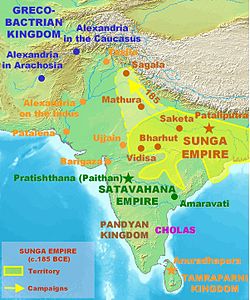 Ancient India during the rise of the Shunga Empire from the North, Satavahana dynasty from the Deccan, and Pandyan dynasty and Chola dynasty from the southern part of India.
 -
 Great Chaitya in the Karla Caves. The shrines were developed over the period from the 2nd century BCE to the 5th century CE.
 -
 Udayagiri and Khandagiri Caves is home to the Hathigumpha inscription, which was inscribed under Kharavela, then Emperor of Kalinga of the Mahameghavahana dynasty.
 -


The time between the Maurya Empire in the 3rd century BCE and the end of the Gupta Empire in the 6th century CE is referred to as the "Classical" period of India.[127] The Gupta Empire (4th–6th century) is regarded as the Golden Age of India, although a host of kingdoms ruled over India in these centuries. Also, the Sangam literature flourished from the 3rd century BCE to the 3rd century CE in southern India.[128] During this period, India's economy is estimated to have been the largest in the world, having between one-third and one-quarter of the world's wealth, from 1 CE to 1000 CE.[129][130]
Early classical period (c. 200 BCE – 320 CE)
[edit]Shunga Empire
[edit]


The Shungas originated from Magadha, and controlled large areas of the central and eastern Indian subcontinent from around 187 to 78 BCE. The dynasty was established by Pushyamitra Shunga, who overthrew the last Maurya emperor. Its capital was Pataliputra, but later emperors, such as Bhagabhadra, also held court at Vidisha, modern Besnagar.[131]
Pushyamitra Shunga ruled for 36 years and was succeeded by his son Agnimitra. There were ten Shunga rulers. However, after the death of Agnimitra, the empire rapidly disintegrated;[132] inscriptions and coins indicate that much of northern and central India consisted of small kingdoms and city-states that were independent of any Shunga hegemony.[133] The empire is noted for its numerous wars with both foreign and indigenous powers. They fought with the Mahameghavahana dynasty of Kalinga, Satavahana dynasty of Deccan, the Indo-Greeks, and possibly the Panchalas and Mitras of Mathura.
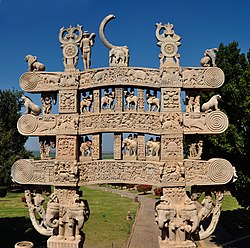
Art, education, philosophy, and other forms of learning flowered during this period including architectural monuments such as the Stupa at Bharhut and the renowned Great Stupa at Sanchi. The Shunga rulers helped to establish the tradition of royal sponsorship of learning and art. The script used by the empire was a variant of Brahmi and was used to write the Sanskrit language. The Shunga Empire played an imperative role in patronising Indian culture at a time when some of the most important developments in Hindu thought were taking place.
Satavahana Empire
[edit]

The Śātavāhanas were based from Amaravati in Andhra Pradesh as well as Junnar (Pune) and Prathisthan (Paithan) in Maharashtra. The territory of the empire covered large parts of India from the 1st century BCE onward. The Sātavāhanas started out as feudatories to the Mauryan dynasty, but declared independence with its decline.
The Sātavāhanas are known for their patronage of Hinduism and Buddhism, which resulted in Buddhist monuments from Ellora (a UNESCO World Heritage Site) to Amaravati. They were one of the first Indian states to issue coins with their rulers embossed. They formed a cultural bridge and played a vital role in trade as well as the transfer of ideas and culture to and from the Indo-Gangetic Plain to the southern tip of India.
They had to compete with the Shunga Empire and then the Kanva dynasty of Magadha to establish their rule. Later, they played a crucial role to protect large part of India against foreign invaders like the Sakas, Yavanas and Pahlavas. In particular, their struggles with the Western Kshatrapas went on for a long time. The notable rulers of the Satavahana Dynasty Gautamiputra Satakarni and Sri Yajna Sātakarni were able to defeat the foreign invaders like the Western Kshatrapas and to stop their expansion. In the 3rd century CE, the empire was split into smaller states.[134]
Trade and travels to India
[edit]
The spice trade in Kerala attracted traders from all over the Old World to India. India's Southwest coastal port Muziris had established itself as a major spice trade centre from as early as 3,000 BCE, according to Sumerian records. Jewish traders arrived in Kochi, Kerala, India as early as 562 BCE.[135] The Greco-Roman world followed by trading along the incense route and the Roman-India routes.[136] During the 2nd century BCE Greek and Indian ships met to trade at Arabian ports such as Aden.[137] During the first millennium, the sea routes to India were controlled by the Indians and Ethiopians that became the maritime trading power of the Red Sea.
Indian merchants involved in spice trade took Indian cuisine to Southeast Asia, where spice mixtures and curries became popular with the native inhabitants.[138] Buddhism entered China through the Silk Road in the 1st or 2nd century CE.[139] Hindu and Buddhist religious establishments of South and Southeast Asia came to be centres of production and commerce as they accumulated capital donated by patrons. They engaged in estate management, craftsmanship, and trade. Buddhism in particular travelled alongside the maritime trade, promoting literacy, art, and the use of coinage.[140]
Kushan Empire
[edit]

The Kushan Empire expanded out of what is now Afghanistan into the northwest of the Indian subcontinent under the leadership of their first emperor, Kujula Kadphises, about the middle of the 1st century CE. The Kushans were possibly a Tocharian speaking tribe,[141] one of five branches of the Yuezhi confederation.[142][143] By the time of his grandson, Kanishka the Great, the empire spread to encompass much of Afghanistan,[144] and then the northern parts of the Indian subcontinent.[145]
Emperor Kanishka was a great patron of Buddhism; however, as Kushans expanded southward, the deities of their later coinage came to reflect its new Hindu majority.[146][147] Historian Vincent Smith said about Kanishka:
He played the part of a second Ashoka in the history of Buddhism.[148]
The empire linked the Indian Ocean maritime trade with the commerce of the Silk Road through the Indus valley, encouraging long-distance trade, particularly between China and Rome. The Kushans brought new trends to the budding and blossoming Gandhara art and Mathura art, which reached its peak during Kushan rule.[149] The period of peace under Kushan rule is known as Pax Kushana. By the 3rd century, their empire in India was disintegrating and their last known great emperor was Vasudeva I.[150][151]
Classical period (c. 320 – 650 CE)
[edit]Gupta Empire
[edit]

The Gupta period was noted for cultural creativity, especially in literature, architecture, sculpture, and painting.[152] The Gupta period produced scholars such as Kalidasa, Aryabhata, Varahamihira, Vishnu Sharma, and Vatsyayana. The Gupta period marked a watershed of Indian culture: the Guptas performed Vedic sacrifices to legitimise their rule, but they also patronised Buddhism, an alternative to Brahmanical orthodoxy. The military exploits of the first three rulers – Chandragupta I, Samudragupta, and Chandragupta II – brought much of India under their leadership.[153] Science and political administration reached new heights during the Gupta era. Strong trade ties also made the region an important cultural centre and established it as a base that would influence nearby kingdoms and regions.[154][155] The period of peace under Gupta rule is known as Pax Gupta.
The latter Guptas successfully resisted the northwestern kingdoms until the arrival of the Alchon Huns, who established themselves in Afghanistan by the first half of the 5th century CE, with their capital at Bamiyan.[156] However, much of the southern India including Deccan were largely unaffected by these events.[157][158]
Vakataka Empire
[edit]The Vākāṭaka Empire originated from the Deccan in the mid-third century CE. Their state is believed to have extended from the southern edges of Malwa and Gujarat in the north to the Tungabhadra River in the south as well as from the Arabian Sea in the western to the edges of Chhattisgarh in the east. They were the most important successors of the Satavahanas in the Deccan, contemporaneous with the Guptas in northern India and succeeded by the Vishnukundina dynasty.
The Vakatakas are noted for having been patrons of the arts, architecture and literature. The rock-cut Buddhist viharas and chaityas of Ajanta Caves (a UNESCO World Heritage Site) were built under the patronage of Vakataka emperor, Harishena.[159][160]
-

-
 Buddhist monks praying in front of the Dagoba of Chaitya Cave 26 of the Ajanta Caves.
 -
 Buddhist "Chaitya Griha" or prayer hall, with a seated Buddha, Cave 26 of the Ajanta Caves.
 -
 Many foreign ambassadors, representatives, and travelers are included as devotees attending the Buddha's descent from Trayastrimsa Heaven; painting from Cave 17 of the Ajanta Caves.
.jpg)


Kamarupa Kingdom
[edit]
Samudragupta's 4th-century Allahabad pillar inscription mentions Kamarupa (Western Assam)[161] and Davaka (Central Assam)[162] as frontier kingdoms of the Gupta Empire. Davaka was later absorbed by Kamarupa, which grew into a large kingdom that spanned from Karatoya river to near present Sadiya and covered the entire Brahmaputra valley, North Bengal, parts of Bangladesh and, at times Purnea and parts of West Bengal.[163]
Ruled by three dynasties Varmanas (c. 350–650 CE), Mlechchha dynasty (c. 655–900 CE) and Kamarupa-Palas (c. 900–1100 CE), from their capitals in present-day Guwahati (Pragjyotishpura), Tezpur (Haruppeswara) and North Gauhati (Durjaya) respectively. All three dynasties claimed their descent from Narakasura.[citation needed] In the reign of the Varman king, Bhaskar Varman (c. 600–650 CE), the Chinese traveller Xuanzang visited the region and recorded his travels. Later, after weakening and disintegration (after the Kamarupa-Palas), the Kamarupa tradition was somewhat extended until c. 1255 CE by the Lunar I (c. 1120–1185 CE) and Lunar II (c. 1155–1255 CE) dynasties.[164] The Kamarupa kingdom came to an end in the middle of the 13th century when the Khen dynasty under Sandhya of Kamarupanagara (North Guwahati), moved his capital to Kamatapur (North Bengal) after the invasion of Muslim Turks, and established the Kamata kingdom.[165]
Pallava Empire
[edit]
The Pallavas, during the 4th to 9th centuries were, alongside the Guptas of the North, great patronisers of Sanskrit development in the South of the Indian subcontinent. The Pallava reign saw the first Sanskrit inscriptions in a script called Grantha.[166] Early Pallavas had different connexions to Southeast Asian countries. The Pallavas used Dravidian architecture to build some very important Hindu temples and academies in Mamallapuram, Kanchipuram and other places; their rule saw the rise of great poets. The practice of dedicating temples to different deities came into vogue followed by fine artistic temple architecture and sculpture style of Vastu Shastra.[167]
Pallavas reached the height of power during the reign of Mahendravarman I (571–630 CE) and Narasimhavarman I (630–668 CE) and dominated the Telugu and northern parts of the Tamil region until the end of the 9th century.[168]
Kadamba Empire
[edit]
Kadambas originated from Karnataka, was founded by Mayurasharma in 345 CE which at later times showed the potential of developing into imperial proportions. King Mayurasharma defeated the armies of Pallavas of Kanchi possibly with help of some native tribes. The Kadamba fame reached its peak during the rule of Kakusthavarma, a notable ruler with whom the kings of Gupta Dynasty of northern India cultivated marital alliances. The Kadambas were contemporaries of the Western Ganga Dynasty and together they formed the earliest native kingdoms to rule the land with absolute autonomy. The dynasty later continued to rule as a feudatory of larger Kannada empires, the Chalukya and the Rashtrakuta empires, for over five hundred years during which time they branched into minor dynasties (Kadambas of Goa, Kadambas of Halasi and Kadambas of Hangal).
Empire of Harsha
[edit]Harsha ruled northern India from 606 to 647 CE. He was the son of Prabhakarvardhana and the younger brother of Rajyavardhana, who were members of the Vardhana dynasty and ruled Thanesar, in present-day Haryana.

After the downfall of the prior Gupta Empire in the middle of the 6th century, North India reverted to smaller republics and monarchical states. The power vacuum resulted in the rise of the Vardhanas of Thanesar, who began uniting the republics and monarchies from the Punjab to central India. After the death of Harsha's father and brother, representatives of the empire crowned Harsha emperor in April 606 CE, giving him the title of Maharaja.[170] At the peak, his Empire covered much of North and Northwestern India, extended East until Kamarupa, and South until Narmada River; and eventually made Kannauj (in present Uttar Pradesh) his capital, and ruled until 647 CE.[171]
The peace and prosperity that prevailed made his court a centre of cosmopolitanism, attracting scholars, artists and religious visitors.[171] During this time, Harsha converted to Buddhism from Surya worship.[172] The Chinese traveller Xuanzang visited the court of Harsha and wrote a very favourable account of him, praising his justice and generosity.[171] His biography Harshacharita ("Deeds of Harsha") written by Sanskrit poet Banabhatta, describes his association with Thanesar and the palace with a two-storied Dhavalagriha (White Mansion).[173][174]
Early medieval period (c. 650 – 1200)
[edit]Early medieval India began after the end of the Gupta Empire in the 6th century CE.[127] This period also covers the "Late Classical Age" of Hinduism, which began after the collapse of the Empire of Harsha in the 7th century,[175] and ended in the 13th century with the rise of the Delhi Sultanate in Northern India;[176] the beginning of Imperial Kannauj, leading to the Tripartite struggle; and the end of the Later Cholas with the death of Rajendra Chola III in 1279 in Southern India; however some aspects of the Classical period continued until the fall of the Vijayanagara Empire in the south around the 17th century.
From the fifth century to the thirteenth, Śrauta sacrifices declined, and support for Shaivism, Vaishnavism and Shaktism expanded in royal courts, while the support for Buddhism declined.[177] Lack of appeal among the rural masses, who instead embraced Brahmanical Hinduism formed in the Hindu synthesis, and dwindling financial support from trading communities and royal elites, were major factors in the decline of Buddhism.[178]
In the 7th century, Kumārila Bhaṭṭa formulated his school of Mimamsa philosophy and defended the position on Vedic rituals.[179]
From the 8th to the 10th century, three dynasties contested for control of northern India: the Gurjara Pratiharas of Malwa, the Palas of Bengal, and the Rashtrakutas of the Deccan. The Sena dynasty would later assume control of the Pala Empire; the Gurjara Pratiharas fragmented into various states, notably the Kingdom of Malwa, the Kingdom of Bundelkhand, the Kingdom of Dahala, the Tomaras of Haryana, and the Kingdom of Sambhar, these states were some of the earliest Rajput kingdoms;[180] while the Rashtrakutas were annexed by the Western Chalukyas.[181] During this period, the Chaulukya dynasty emerged; the Chaulukyas constructed the Dilwara Temples, Modhera Sun Temple, Rani ki vav[182] in the style of Māru-Gurjara architecture, and their capital Anhilwara (modern Patan, Gujarat) was one of the largest cities in the Indian subcontinent, with the population estimated at 100,000 in c. 1000. Patan's rise also marked the revival of Jainism in Gujarat during the times of Hemchandracharya. It became renowned for its collection of ancient Jain manuscripts and an important centre of Jain learning,[183] which drew the admiration of many scholars. British Indologist and Sanskritist Peter Peterson described the collection as follows:
I know of no town in India and only a few in the world which can boast of so great a store documents of venerable antiquity. They would be the pride and jealously guarded treasure of any University Library in Europe.[184]
The Chola Empire emerged as a major power during the reign of Raja Raja Chola I and Rajendra Chola I who successfully invaded parts of Southeast Asia and Sri Lanka in the 11th century.[185] Lalitaditya Muktapida (r. 724–760) was an emperor of the Kashmiri Karkoṭa dynasty, which exercised influence in northwestern India from 625 until 1003, and was followed by Lohara dynasty. Kalhana in his Rajatarangini credits king Lalitaditya with leading an aggressive military campaign in Northern India and Central Asia.[186][187][188]
The Hindu Shahi dynasty ruled portions of eastern Afghanistan, northern Pakistan, and Kashmir from the mid-7th century to the early 11th century. While in Odisha, the Eastern Ganga Empire rose to power; noted for the advancement of Hindu architecture, most notable being Jagannath Temple and Konark Sun Temple, as well as being patrons of art and literature.
-
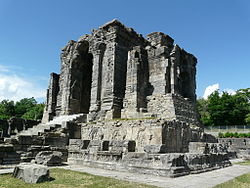 Martand Sun Temple Central shrine, dedicated to the deity Surya, and built by the third ruler of the Karkota dynasty, Lalitaditya Muktapida, in the 8th century
 -
 Konark Sun Temple at Konark, Orissa, built by Narasimhadeva I (1238–1264) of the Eastern Ganga dynasty
 -

-

.jpg)


Later Gupta dynasty
[edit]
The Later Gupta dynasty ruled the Magadha region in eastern India between the 6th and 7th centuries AD. The Later Guptas succeeded the imperial Guptas as the rulers of Magadha, but there is no evidence connecting the two dynasties; these appear to be two distinct families.[189] The Later Guptas are so-called because the names of their rulers ended with the suffix "-gupta", which they might have adopted to portray themselves as the legitimate successors of the imperial Guptas.[190]
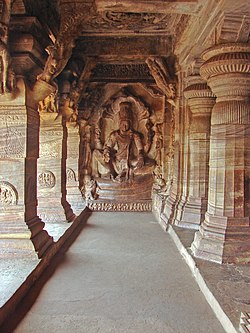
Chalukya Empire
[edit]The Chalukya Empire ruled large parts of southern and central India between the 6th and the 12th centuries, as three related yet individual dynasties. The earliest dynasty, known as the "Badami Chalukyas", ruled from Vatapi (modern Badami) from the middle of the 6th century. The Badami Chalukyas began to assert their independence at the decline of the Kadamba kingdom of Banavasi and rapidly rose to prominence during the reign of Pulakeshin II. The rule of the Chalukyas marks an important milestone in the history of South India and a golden age in the history of Karnataka. The political atmosphere in South India shifted from smaller kingdoms to large empires with the ascendancy of Badami Chalukyas. A Southern India-based kingdom took control and consolidated the entire region between the Kaveri and the Narmada Rivers. The rise of this empire saw the birth of efficient administration, overseas trade and commerce and the development of new style of architecture called "Chalukyan architecture". The Chalukya dynasty ruled parts of southern and central India from Badami in Karnataka between 550 and 750, and then again from Kalyani between 970 and 1190.
-
 Galaganatha Temple at Pattadakal complex (UNESCO World Heritage) is an example of Badami Chalukya architecture
 -

-
-
 8th century Durga temple exterior view at Aihole complex. It includes Hindu, Buddhist and Jain temples and monuments


Rashtrakuta Empire
[edit]Founded by Dantidurga around 753,[191] the Rashtrakuta Empire ruled from its capital at Manyakheta for almost two centuries.[192] At its peak, the Rashtrakutas ruled from the Ganges-Yamuna Doab in the north to Cape Comorin in the south, a fruitful time of architectural and literary achievements.[193][194]
The early rulers of this dynasty were Hindu, but the later rulers were strongly influenced by Jainism.[195] Govinda III and Amoghavarsha were the most famous of the long line of able administrators produced by the dynasty. Amoghavarsha was also an author and wrote Kavirajamarga, the earliest known Kannada work on poetics.[192][196] Architecture reached a milestone in the Dravidian style, the finest example of which is seen in the Kailasanath Temple at Ellora. Other important contributions are the Kashivishvanatha temple and the Jain Narayana temple at Pattadakal in Karnataka.
The Arab traveller Suleiman described the Rashtrakuta Empire as one of the four great Empires of the world.[197] The Rashtrakuta period marked the beginning of the golden age of southern Indian mathematics. The great south Indian mathematician Mahāvīra had a huge impact on medieval south Indian mathematicians.[198] The Rashtrakuta rulers also patronised men of letters in a variety of languages.[192]


Gurjara-Pratihara Empire
[edit]The Gurjara-Pratiharas were instrumental in containing Arab armies moving east of the Indus River. Nagabhata I defeated the Arab army under Junaid and Tamin during the Umayyad campaigns in India.[199] Under Nagabhata II, the Gurjara-Pratiharas became the most powerful dynasty in northern India. He was succeeded by his son Ramabhadra, who ruled briefly before being succeeded by his son, Mihira Bhoja. Under Bhoja and his successor Mahendrapala I, the Pratihara Empire reached its peak of prosperity and power. By the time of Mahendrapala, its territory stretched from the border of Sindh in the west to Bihar in the east and from the Himalayas in the north to around the Narmada River in the south.[200] The expansion triggered a tripartite power struggle with the Rashtrakuta and Pala empires for control of the Indian subcontinent.
By the end of the 10th century, several feudatories of the empire took advantage of the temporary weakness of the Gurjara-Pratiharas to declare their independence, notably the Kingdom of Malwa, the Kingdom of Bundelkhand, the Tomaras of Haryana, and the Kingdom of Sambhar[201] and the Kingdom of Dahala.[citation needed]
-

-
 Sculptures near Teli ka Mandir, Gwalior Fort
 -
 Jainism-related cave monuments and statues carved into the rock face inside Siddhachal Caves, Gwalior Fort
 -
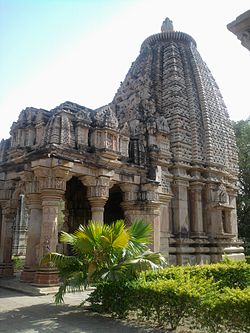 Ghateshwara Mahadeva temple at Baroli Temples complex. Complex of eight temples, built by the Gurjara-Pratiharas, within a walled enclosure
.jpg)


Gahadavala dynasty
[edit]Gahadavala dynasty ruled parts of the present-day Indian states of Uttar Pradesh and Bihar, during 11th and 12th centuries. Their capital was located at Varanasi.[203]
Karnat dynasty
[edit]
In 1097 AD, the Karnat dynasty of Mithila emerged on the Bihar/Nepal border area and maintained capitals in Darbhanga and Simraongadh. The dynasty was established by Nanyadeva, a military commander of Karnataka origin. Under this dynasty, the Maithili language started to develop with the first piece of Maithili literature, the Varna Ratnakara being produced in the 14th century by Jyotirishwar Thakur. The Karnats also carried out raids into Nepal. They fell in 1324 following the invasion of Ghiyasuddin Tughlaq.[204][205]
Pala Empire
[edit]
The Pala Empire was founded by Gopala I.[206][207][208] It was ruled by a Buddhist dynasty from Bengal. The Palas reunified Bengal after the fall of Shashanka's Gauda Kingdom.[209]
The Palas were followers of the Mahayana and Tantric schools of Buddhism,[210] they also patronised Shaivism and Vaishnavism.[211] The empire reached its peak under Dharmapala and Devapala. Dharmapala is believed to have conquered Kanauj and extended his sway up to the farthest limits of India in the north-west.[211]
The Pala Empire can be considered as the golden era of Bengal.[212] Dharmapala founded the Vikramashila and revived Nalanda,[211] considered one of the first great universities in recorded history. Nalanda reached its height under the patronage of the Pala Empire.[212][213] The Palas also built many viharas. They maintained close cultural and commercial ties with countries of Southeast Asia and Tibet. Sea trade added greatly to the prosperity of the Pala Empire.
Cholas
[edit]
Medieval Cholas rose to prominence during the middle of the 9th century and established the greatest empire South India had seen.[214] They successfully united the South India under their rule and through their naval strength extended their influence in the Southeast Asian countries such as Srivijaya.[185] Under Rajaraja Chola I and his successors Rajendra Chola I, Rajadhiraja Chola, Virarajendra Chola and Kulothunga Chola I the dynasty became a military, economic and cultural power in South Asia and South-East Asia.[215][216] Rajendra Chola I's navies occupied the sea coasts from Burma to Vietnam,[217] the Andaman and Nicobar Islands, the Lakshadweep (Laccadive) islands, Sumatra, and the Malay Peninsula. The power of the new empire was proclaimed to the eastern world by the expedition to the Ganges which Rajendra Chola I undertook and by the occupation of cities of the maritime empire of Srivijaya in Southeast Asia, as well as by the repeated embassies to China.[218]
They dominated the political affairs of Sri Lanka for over two centuries through repeated invasions and occupation. They also had continuing trade contacts with the Arabs and the Chinese empire.[219] Rajaraja Chola I and his son Rajendra Chola I gave political unity to the whole of Southern India and established the Chola Empire as a respected sea power.[220] Under the Cholas, the South India reached new heights of excellence in art, religion and literature. In all of these spheres, the Chola period marked the culmination of movements that had begun in an earlier age under the Pallavas. Monumental architecture in the form of majestic temples and sculpture in stone and bronze reached a finesse never before achieved in India.[221]

-
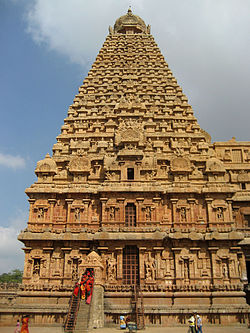 The granite gopuram (tower) of Brihadeeswarar Temple, 1010
 -
 Chariot detail at Airavatesvara Temple built by Rajaraja Chola II in the 12th century
 -
 The pyramidal structure above the sanctum at Brihadisvara Temple.
 -
 Brihadeeswara Temple Entrance Gopurams at Thanjavur


Western Chalukya Empire
[edit]The Western Chalukya Empire ruled most of the western Deccan, South India, between the 10th and 12th centuries.[223] Vast areas between the Narmada River in the north and Kaveri River in the south came under Chalukya control.[223] During this period the other major ruling families of the Deccan, the Hoysalas, the Seuna Yadavas of Devagiri, the Kakatiya dynasty and the Southern Kalachuris, were subordinates of the Western Chalukyas and gained their independence only when the power of the Chalukya waned during the latter half of the 12th century.[224]
The Western Chalukyas developed an architectural style known today as a transitional style, an architectural link between the style of the early Chalukya dynasty and that of the later Hoysala empire. Most of its monuments are in the districts bordering the Tungabhadra River in central Karnataka. Well known examples are the Kasivisvesvara Temple at Lakkundi, the Mallikarjuna Temple at Kuruvatti, the Kallesvara Temple at Bagali, Siddhesvara Temple at Haveri, and the Mahadeva Temple at Itagi.[225] This was an important period in the development of fine arts in Southern India, especially in literature as the Western Chalukya kings encouraged writers in the native language of Kannada, and Sanskrit like the philosopher and statesman Basava and the great mathematician Bhāskara II.[226][227]
-

-
 Ornate entrance to the closed hall from the south at Kalleshvara Temple at Bagali
 -
 Shrine wall relief, molding frieze and miniature decorative tower in Mallikarjuna Temple at Kuruvatti
 -
 Rear view showing lateral entrances of the Mahadeva Temple at Itagi
_of_the_Siddhesvara_temple_at_Haveri_2.JPG)


Late medieval period (c. 1200 – 1526)
[edit]The late medieval period is marked by repeated invasions by Muslim Central Asian nomadic clans,[228][229] the rule of the Delhi Sultanate, and by the growth of other states, built upon military technology of the sultanate.[230]
Delhi Sultanate
[edit]The Delhi Sultanate was a series of successive Islamic states based in Delhi, ruled by several dynasties of varying origins. The polity ruled over large parts of the Indian subcontinent from the 13th to early 16th centuries.[231] The sultanate was founded in the 12th and 13th centuries by Central Asian Turks, who invaded parts of northern India and established the state atop former Hindu holdings.[232] The subsequent Mamluk dynasty of Delhi managed to conquer large areas of northern India. The Khalji dynasty conquered much of central India while forcing the principal Hindu kingdoms of South India to become vassal states.[231]
The sultanate ushered in a period of Indian cultural renaissance. The resulting "Indo-Muslim" fusion of cultures left lasting syncretic monuments in architecture, music, literature, religion, and clothing. It is surmised that the language of Urdu was born during the period of the Delhi Sultanate. The sultanate was the only Indo-Islamic state to enthrone one of the few female rulers in India, Razia Sultana (r. 1236–1240).
While initially disruptive due to the passing of power from native Indian elites to Turkic Muslim elites, the Delhi Sultanate was responsible for integrating the Indian subcontinent into a growing world system, drawing India into a wider international network, which had a significant impact on Indian culture and society.[233] However, the Delhi Sultanate also caused large-scale destruction and desecration of temples in the Indian subcontinent.[234]
The Mongol invasions of India were successfully repelled by the Delhi Sultanate during the rule of Alauddin Khalji. A major factor in their success was their Turkic Mamluk slave army, who were highly skilled in the same style of nomadic cavalry warfare as the Mongols. It is possible that the Mongol Empire may have expanded into India were it not for the Delhi Sultanate's role in repelling them.[235] By repeatedly repulsing the Mongol raiders,[236] the sultanate saved India from the devastation waged on West and Central Asia. Soldiers from that region and learned men and administrators fleeing Mongol invasions of Iran migrated into the subcontinent, thereby creating a syncretic Indo-Islamic culture in the north.[235]
A Turco-Mongol conqueror from Central Asia, Timur (Tamerlane), attacked the reigning sultan Nasir-u Din Mehmud of the Tughlaq dynasty in Delhi.[237] The sultan's army was defeated on 17 December 1398. Timur entered Delhi and the city was sacked, destroyed, and left in ruins after Timur's army had killed and plundered for three days and nights. He ordered the whole city to be sacked except for the sayyids, scholars, and the "other Muslims" (artists); 100,000 war prisoners were said to have been put to death in one day.[238] The sultanate suffered significantly from the sacking of Delhi. Though revived briefly under the Sayyid and Lodi dynasties, it was but a shadow of the former. Lodi rule lasted in Delhi until the defeat of the last sultan, Ibrahim Khan Lodi, in 1526 to the forces of Babur.[239]
-
 Qutb Minar, a UNESCO World Heritage Site, whose construction was begun by Qutb ud-Din Aibak, the first Sultan of Delhi.
 -


Vijayanagara Empire
[edit]
The Vijayanagara Empire was established in 1336 by Harihara I and his brother Bukka Raya I of Sangama Dynasty,[240] which originated as a political heir of the Hoysala Empire, Kakatiya Empire,[241] and the Pandyan Empire.[242] The empire rose to prominence as a culmination of attempts by the south Indian powers to ward off Islamic invasions by the end of the 13th century. It lasted until 1646, although its power declined after a major military defeat in 1565 by the combined armies of the Deccan sultanates. The empire is named after its capital city of Vijayanagara, whose ruins surround present day Hampi, now a World Heritage Site in Karnataka, India.[243]
In the first two decades after the founding of the empire, Harihara I gained control over most of the area south of the Tungabhadra river and earned the title of Purvapaschima Samudradhishavara ("master of the eastern and western seas"). By 1374 Bukka Raya I, successor to Harihara I, had defeated the chiefdom of Arcot, the Reddys of Kondavidu, and the Sultan of Madurai and had gained control over Goa in the west and the Tungabhadra-Krishna doab in the north.[244][245]
Harihara II, the second son of Bukka Raya I, further consolidated the kingdom beyond the Krishna River and brought the whole of South India under the Vijayanagara umbrella.[246] The next ruler, Deva Raya I, emerged successful against the Gajapatis of Odisha and undertook important works of fortification and irrigation.[247] Italian traveller Niccolo de Conti wrote of him as the most powerful ruler of India.[248] Deva Raya II succeeded to the throne in 1424 and was possibly the most capable of the Sangama Dynasty rulers.[249] He quelled rebelling feudal lords as well as the Zamorin of Calicut and Quilon in the south. He invaded the island of Sri Lanka and became overlord of the kings of Burma at Pegu and Tanasserim.[250][251][252]
The Vijayanagara Emperors were tolerant of all religions and sects, as writings by foreign visitors show.[253] The kings used titles such as Gobrahamana Pratipalanacharya (literally, "protector of cows and Brahmins") and Hindurayasuratrana (lit, "upholder of Hindu faith") that testified to their intention of protecting Hinduism and yet were at the same time staunchly Islamicate in their court ceremonials and dress.[254] The empire's founders, Harihara I and Bukka Raya I, were devout Shaivas (worshippers of Shiva), but made grants to the Vaishnava order of Sringeri with Vidyaranya as their patron saint, and designated Varaha (an avatar of Vishnu) as their emblem.[255] Nobles from Central Asia's Timurid kingdoms also came to Vijayanagara.[256] The later Saluva and Tuluva kings were Vaishnava by faith, but worshipped at the feet of Lord Virupaksha (Shiva) at Hampi as well as Lord Venkateshwara (Vishnu) at Tirupati.[257] A Sanskrit work, Jambavati Kalyanam by King Krishnadevaraya, called Lord Virupaksha Karnata Rajya Raksha Mani ("protective jewel of Karnata Empire").[258] The kings patronised the saints of the dvaita order (philosophy of dualism) of Madhvacharya at Udupi.[259]
-
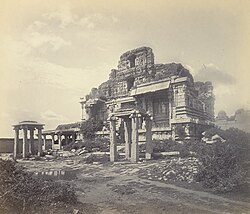 Photograph of the ruins of the Vijayanagara Empire at Hampi, now a UNESCO World Heritage Site in 1868[260]
 -
 Gajashaala, or elephant's stable, was built by the Vijayanagar rulers for their war elephants.[261]
 -
 Vijayanagara marketplace at Hampi, along with the sacred tank located on the side of Krishna temple.
 -
 Stone temple car in Vitthala Temple at Hampi


The empire's legacy includes many monuments spread over South India, the best known of which is the group at Hampi. The previous temple building traditions in South India came together in the Vijayanagara Architecture style. The mingling of all faiths and vernaculars inspired architectural innovation of Hindu temple construction. South Indian mathematics flourished under the protection of the Vijayanagara Empire in Kerala. The south Indian mathematician Madhava of Sangamagrama founded the famous Kerala School of Astronomy and Mathematics in the 14th century which produced a lot of great south Indian mathematicians like Parameshvara, Nilakantha Somayaji and Jyeṣṭhadeva.[262] Efficient administration and vigorous overseas trade brought new technologies such as water management systems for irrigation.[263] The empire's patronage enabled fine arts and literature to reach new heights in Kannada, Telugu, Tamil, and Sanskrit, while Carnatic music evolved into its current form.[264]
Vijayanagara went into decline after the defeat in the Battle of Talikota (1565). After the death of Aliya Rama Raya in the Battle of Talikota, Tirumala Deva Raya started the Aravidu dynasty, moved and founded a new capital of Penukonda to replace the destroyed Hampi, and attempted to reconstitute the remains of Vijayanagara Empire.[265] Tirumala abdicated in 1572, dividing the remains of his kingdom to his three sons, and pursued a religious life until his death in 1578. The Aravidu dynasty successors ruled the region but the empire collapsed in 1614, and the final remains ended in 1646, from continued wars with the Bijapur sultanate and others.[266][267][268] During this period, more kingdoms in South India became independent and separate from Vijayanagara. These include the Mysore Kingdom, Keladi Nayaka, Nayaks of Madurai, Nayaks of Tanjore, Nayakas of Chitradurga and Nayak Kingdom of Gingee – all of which declared independence and went on to have a significant impact on the history of South India in the coming centuries.[266]
Other kingdoms
[edit]-
 Vijaya Stambha (Tower of Victory).
 -
 Temple inside Chittorgarh fort
 -
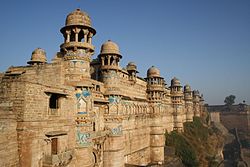 Man Singh (Manasimha) palace at the Gwalior fort
 -
 Chinese manuscript Tribute Giraffe with Attendant, depicting a giraffe presented by Bengali envoys in the name of Sultan Saifuddin Hamza Shah of Bengal to the Yongle Emperor of Ming China
 -
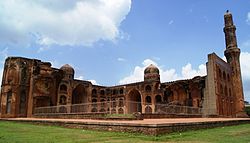 Mahmud Gawan Madrasa was built by Mahmud Gawan, the Wazir of the Bahmani Sultanate as the centre of religious as well as secular education


For two and a half centuries from the mid-13th century, politics in Northern India was dominated by the Delhi Sultanate, and in Southern India by the Vijayanagar Empire. However, there were other regional powers present as well. After fall of Pala Empire, the Chero dynasty ruled much of Eastern Uttar Pradesh, Bihar and Jharkhand from the 12th to the 18th centuries.[269][270][271] The Reddy dynasty successfully defeated the Delhi Sultanate and extended their rule from Cuttack in the north to Kanchi in the south, eventually being absorbed into the expanding Vijayanagara Empire.[272]
In the north, the Rajput kingdoms remained the dominant force in Western and Central India. The Mewar dynasty under Maharana Hammir defeated and captured Muhammad Tughlaq with the Bargujars as his main allies. Tughlaq had to pay a huge ransom and relinquish all of Mewar's lands. After this event, the Delhi Sultanate did not attack Chittor for a few hundred years. The Rajputs re-established their independence, and Rajput states were established as far east as Bengal and north into the Punjab. The Tomaras established themselves at Gwalior, and Man Singh Tomar reconstructed the Gwalior Fort.[273] During this period, Mewar emerged as the leading Rajput state; and Rana Kumbha expanded his kingdom at the expense of the Sultanates of Malwa and Gujarat.[273][274] The next great Rajput ruler, Rana Sanga of Mewar, became the principal player in Northern India. His objectives grew in scope – he planned to conquer Delhi. But, his defeat in the Battle of Khanwa consolidated the new Mughal dynasty in India.[273] The Mewar dynasty under Maharana Udai Singh II faced further defeat by Mughal emperor Akbar, with their capital Chittor being captured. Due to this event, Udai Singh II founded Udaipur, which became the new capital of the Mewar kingdom. His son, Maharana Pratap of Mewar, firmly resisted the Mughals. Akbar sent many missions against him. He survived to ultimately gain control of all of Mewar, excluding the Chittor Fort.[275]
In the south, the Bahmani Sultanate in the Deccan, born from a rebellion in 1347 against the Tughlaq dynasty,[276] was the chief rival of Vijayanagara, and frequently created difficulties for them.[277] Starting in 1490, the Bahmani Sultanate's governors revolted, their independent states composing the five Deccan sultanates; Ahmadnagar declared independence, followed by Bijapur and Berar in the same year; Golkonda became independent in 1518 and Bidar in 1528.[278] Although generally rivals, they allied against the Vijayanagara Empire in 1565, permanently weakening Vijayanagar in the Battle of Talikota.[279][280]
In the East, the Gajapati Kingdom remained a strong regional power to reckon with, associated with a high point in the growth of regional culture and architecture. Under Kapilendradeva, Gajapatis became an empire stretching from the lower Ganga in the north to the Kaveri in the south.[281] In Northeast India, the Ahom Kingdom was a major power for six centuries;[282][283] led by Lachit Borphukan, the Ahoms decisively defeated the Mughal army at the Battle of Saraighat during the Ahom-Mughal conflicts.[284] Further east in Northeastern India was the Kingdom of Manipur, which ruled from their seat of power at Kangla Fort and developed a sophisticated Hindu Gaudiya Vaishnavite culture.[285][286][287]
The Sultanate of Bengal was the dominant power of the Ganges–Brahmaputra Delta, with a network of mint towns spread across the region. It was a Sunni Muslim monarchy with Indo-Turkic, Arab, Abyssinian and Bengali Muslim elites. The sultanate was known for its religious pluralism where non-Muslim communities co-existed peacefully. The Bengal Sultanate had a circle of vassal states, including Odisha in the southwest, Arakan in the southeast, and Tripura in the east. In the early 16th century, the Bengal Sultanate reached the peak of its territorial growth with control over Kamrup and Kamata in the northeast and Jaunpur and Bihar in the west. It was reputed as a thriving trading nation and one of Asia's strongest states. The Bengal Sultanate was described by contemporary European and Chinese visitors as a relatively prosperous kingdom and the "richest country to trade with". The Bengal Sultanate left a strong architectural legacy. Buildings from the period show foreign influences merged into a distinct Bengali style. The Bengal Sultanate was also the largest and most prestigious authority among the independent medieval Muslim-ruled states in the history of Bengal. Its decline began with an interregnum by the Suri Empire, followed by Mughal conquest and disintegration into petty kingdoms.
Bhakti movement and Sikhism
[edit]The Bhakti movement refers to the theistic devotional trend that emerged in medieval Hinduism[288] and later revolutionised in Sikhism.[289] It originated in the seventh-century south India (now parts of Tamil Nadu and Kerala), and spread northwards.[288] It swept over east and north India from the 15th century onwards, reaching its zenith between the 15th and 17th century.[290]
- The Bhakti movement regionally developed around different gods and goddesses, such as Vaishnavism (Vishnu), Shaivism (Shiva), Shaktism (Shakti goddesses), and Smartism.[291][292][293] The movement was inspired by many poet-saints, who championed a wide range of philosophical positions ranging from theistic dualism of Dvaita to absolute monism of Advaita Vedanta.[294][295]
- Sikhism is a monotheistic and panentheistic religion based on the spiritual teachings of Guru Nanak, the first Guru,[296] and the ten successive Sikh gurus. After the death of the tenth Guru, Guru Gobind Singh, the Sikh scripture, Guru Granth Sahib, became the literal embodiment of the eternal, impersonal Guru, where the scripture's word serves as the spiritual guide for Sikhs.[297][298][299]
- Buddhism in India flourished in the Himalayan kingdoms of Namgyal Kingdom in Ladakh, Sikkim Kingdom in Sikkim, and Chutia Kingdom in Arunachal Pradesh of the Late medieval period.
-
 Rang Ghar, built by Pramatta Singha in Ahom kingdom's capital Rangpur, is one of the earliest pavilions of outdoor stadia in the Indian subcontinent
 -
 Chittor Fort is the largest fort on the Indian subcontinent; it is one of the six Hill Forts of Rajasthan
 -
 Ranakpur Jain temple was built in the 15th century with the support of the Rajput state of Mewar
 -
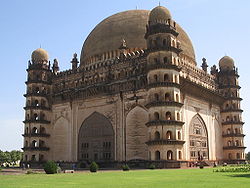 Gol Gumbaz built by the Bijapur Sultanate, has the second largest pre-modern dome in the world after the Byzantine Hagia Sophia


Early modern period (1526–1858)
[edit]The early modern period of Indian history is dated from 1526 to 1858, corresponding to the rise and fall of the Mughal Empire, which inherited from the Timurid Renaissance. During this age India's economy expanded, relative peace was maintained and arts were patronised. This period witnessed the further development of Indo-Islamic architecture;[300][301] the growth of Marathas and Sikhs enabled them to rule significant regions of India in the waning days of the Mughal empire.[16] With the discovery of the Cape route in the 1500s, the first Europeans to arrive by sea and establish themselves, were the Portuguese in Goa and Bombay.[302]
Mughal Empire
[edit]
.jpeg)
In 1526, Babur swept across the Khyber Pass and established the Mughal Empire, which at its zenith covered much of South Asia.[304] However, his son Humayun was defeated by the Afghan warrior Sher Shah Suri in 1540, and Humayun was forced to retreat to Kabul. After Sher Shah's death, his son Islam Shah Suri and his Hindu general Hemu Vikramaditya established secular rule in North India from Delhi until 1556, when Akbar (r. 1556–1605), grandson of Babur, defeated Hemu in the Second Battle of Panipat on 6 November 1556 after winning Battle of Delhi. Akbar tried to establish a good relationship with the Hindus. Akbar declared "Amari" or non-killing of animals in the holy days of Jainism. He rolled back the jizya tax for non-Muslims. The Mughal emperors married local royalty, allied themselves with local maharajas, and attempted to fuse their Turko-Persian culture with ancient Indian styles, creating a unique Indo-Persian culture and Indo-Saracenic architecture.
Akbar married a Rajput princess, Mariam-uz-Zamani, and they had a son, Jahangir (r. 1605–1627).[305] Jahangir followed his father's policy. The Mughal dynasty ruled most of the Indian subcontinent by 1600. The reign of Shah Jahan (r. 1628–1658) was the golden age of Mughal architecture. He erected several large monuments, the most famous of which is the Taj Mahal at Agra.
It was one of the largest empires to have existed in the Indian subcontinent,[306] and surpassed China to become the world's largest economic power, controlling 24.4% of the world economy,[307] and the world leader in manufacturing,[308] producing 25% of global industrial output.[309] The economic and demographic upsurge was stimulated by Mughal agrarian reforms that intensified agricultural production,[310] and a relatively high degree of urbanisation.[311]
-

-
 Fatehpur Sikri, near Agra, showing Buland Darwaza, the complex built by Akbar, the third Mughal emperor
 -
 Red Fort, Delhi, constructed in the year 1648


The Mughal Empire reached the zenith of its territorial expanse during the reign of Aurangzeb (r. 1658–1707), under whose reign India surpassed Qing China as the world's largest economy.[312][313] Aurangzeb was less tolerant than his predecessors, reintroducing the jizya tax and destroying several historical temples, while at the same time building more Hindu temples than he destroyed,[314] employing significantly more Hindus in his imperial bureaucracy than his predecessors, and advancing administrators based on ability rather than religion.[315] However, he is often blamed for the erosion of the tolerant syncretic tradition of his predecessors, as well as increasing religious controversy and centralisation. The English East India Company suffered a defeat in the Anglo-Mughal War.[316][317]

The Mughals suffered several blows due to invasions from Marathas, Rajputs, Jats and Afghans. In 1737, the Maratha general Bajirao of the Maratha Empire invaded and plundered Delhi. Under the general Amir Khan Umrao Al Udat, the Mughal Emperor sent 8,000 troops to drive away the 5,000 Maratha cavalry soldiers. Baji Rao easily routed the novice Mughal general. In 1737, in the final defeat of Mughal Empire, the commander-in-chief of the Mughal Army, Nizam-ul-mulk, was routed at Bhopal by the Maratha army. This essentially brought an end to the Mughal Empire.[citation needed] While Bharatpur State under Jat ruler Suraj Mal, overran the Mughal garrison at Agra and plundered the city.[318] In 1739, Nader Shah, emperor of Iran, defeated the Mughal army at the Battle of Karnal.[319] After this victory, Nader captured and sacked Delhi, carrying away treasures including the Peacock Throne.[320] Ahmad Shah Durrani commenced his own invasions as ruler of the Durrani Empire, eventually sacking Delhi in 1757.[321] Mughal rule was further weakened by constant native Indian resistance; Banda Singh Bahadur led the Sikh Khalsa against Mughal religious oppression; Hindu Rajas of Bengal, Pratapaditya and Raja Sitaram Ray revolted; and Maharaja Chhatrasal, of Bundela Rajputs, fought the Mughals and established the Panna State.[322] The Mughal dynasty was reduced to puppet rulers by 1757. Vadda Ghalughara took place under the Muslim provincial government based at Lahore to wipe out the Sikhs, with 30,000 Sikhs being killed, an offensive that had begun with the Mughals, with the Chhota Ghallughara,[323] and lasted several decades under its Muslim successor states.[324]
Maratha Empire
[edit]

The Maratha kingdom was founded and consolidated by Chatrapati Shivaji.[325] However, the credit for making the Marathas formidable power nationally goes to Peshwa (chief minister) Bajirao I. Historian K.K. Datta wrote that Bajirao I "may very well be regarded as the second founder of the Maratha Empire".[326]
In the early 18th century, under the Peshwas, the Marathas consolidated and ruled over much of South Asia. The Marathas are credited to a large extent for ending Mughal rule in India.[327][328][329] In 1737, the Marathas defeated a Mughal army in their capital, in the Battle of Delhi. The Marathas continued their military campaigns against the Mughals, Nizam, Nawab of Bengal and the Durrani Empire to further extend their boundaries. At its peak, the domain of the Marathas encompassed most of the Indian subcontinent.[330] The Marathas even attempted to capture Delhi and discussed putting Vishwasrao Peshwa on the throne there in place of the Mughal emperor.[331]
The Maratha empire at its peak stretched from Tamil Nadu in the south,[332] to Peshawar (modern-day Khyber Pakhtunkhwa, Pakistan[333] [note 2]) in the north, and Bengal in the east. The Northwestern expansion of the Marathas was stopped after the Third Battle of Panipat (1761). However, the Maratha authority in the north was re-established within a decade under Peshwa Madhavrao I.[335]
Under Madhavrao I, the strongest knights were granted semi-autonomy, creating a confederacy of United Maratha states under the Gaekwads of Baroda, the Holkars of Indore and Malwa, the Scindias of Gwalior and Ujjain, the Bhonsales of Nagpur and the Puars of Dhar and Dewas. In 1775, the East India Company intervened in a Peshwa family succession struggle in Pune, which led to the First Anglo-Maratha War, resulting in a Maratha victory.[336] The Marathas remained a major power in India until their defeat in the Second and Third Anglo-Maratha Wars (1805–1818).
Sikh Empire
[edit]The Sikh Empire was a political entity that governed the Northwestern regions of the Indian subcontinent, based around the Punjab, from 1799 to 1849. It was forged, on the foundations of the Khalsa, under the leadership of Maharaja Ranjit Singh (1780–1839).[citation needed]
Maharaja Ranjit Singh consolidated much of northern India into an empire using his Sikh Khalsa Army, trained in European military techniques and equipped with modern military technologies. Ranjit Singh proved himself to be a master strategist and selected well-qualified generals for his army. He successfully ended the Afghan-Sikh Wars. In stages, he added central Punjab, the provinces of Multan and Kashmir, and the Peshawar Valley to his empire.[337][338]
At its peak in the 19th century, the empire extended from the Khyber Pass in the west, to Kashmir in the north, to Sindh in the south, running along Sutlej river to Himachal in the east. After the death of Ranjit Singh, the empire weakened, leading to conflict with the British East India Company. The First Anglo-Sikh War and Second Anglo-Sikh War marked the downfall of the Sikh Empire, making it among the last areas of the Indian subcontinent to be conquered by the British.
Other kingdoms
[edit]
The Kingdom of Mysore in southern India expanded to its greatest extent under Hyder Ali and his son Tipu Sultan in the later half of the 18th century. Under their rule, Mysore fought series of wars against the Marathas and British or their combined forces. The Maratha–Mysore War ended in April 1787, following the finalising of treaty of Gajendragad, in which Tipu Sultan was obligated to pay tribute to the Marathas. Concurrently, the Anglo-Mysore Wars took place, where the Mysoreans used the Mysorean rockets. The Fourth Anglo-Mysore War (1798–1799) saw the death of Tipu. Mysore's alliance with the French was seen as a threat to the British East India Company, and Mysore was attacked from all four sides. The Nizam of Hyderabad and the Marathas launched an invasion from the north. The British won a decisive victory at the Siege of Seringapatam (1799).
Hyderabad was founded by the Qutb Shahi dynasty of Golconda in 1591. Following a brief Mughal rule, Asif Jah, a Mughal official, seized control of Hyderabad and declared himself Nizam-al-Mulk of Hyderabad in 1724. The Nizams lost considerable territory and paid tribute to the Maratha Empire after being routed in multiple battles, such as the Battle of Palkhed.[339] However, the Nizams maintained their sovereignty from 1724 until 1948 through paying tributes to the Marathas, and later, being vassals of the British. Hyderabad State became a princely state in British India in 1798.
The Nawabs of Bengal had become the de facto rulers of Bengal following the decline of Mughal Empire. However, their rule was interrupted by Marathas who carried out six expeditions in Bengal from 1741 to 1748, as a result of which Bengal became a tributary state of Marathas. On 23 June 1757, Siraj ud-Daulah, the last independent Nawab of Bengal was betrayed in the Battle of Plassey by Mir Jafar. He lost to the British, who took over the charge of Bengal in 1757, installed Mir Jafar on the Masnad (throne) and established itself to a political power in Bengal.[340] In 1765 the system of Dual Government was established, in which the Nawabs ruled on behalf of the British and were mere puppets to the British. In 1772 the system was abolished and Bengal was brought under the direct control of the British. In 1793, when the Nizamat (governorship) of the Nawab was also taken away, they remained as mere pensioners of the British East India Company.[341][342]
In the 18th century, the whole of Rajputana was virtually subdued by the Marathas. The Second Anglo-Maratha War distracted the Marathas from 1807 to 1809, but afterward Maratha domination of Rajputana resumed. In 1817, the British went to war with the Pindaris, raiders who were fled in Maratha territory, which quickly became the Third Anglo-Maratha War, and the British government offered its protection to the Rajput rulers from the Pindaris and the Marathas. By the end of 1818 similar treaties had been executed between the other Rajput states and Britain. The Maratha Sindhia ruler of Gwalior gave up the district of Ajmer-Merwara to the British, and Maratha influence in Rajasthan came to an end.[343] Most of the Rajput princes remained loyal to Britain in the Revolt of 1857, and few political changes were made in Rajputana until Indian independence in 1947. The Rajputana Agency contained more than 20 princely states, most notable being Udaipur State, Jaipur State, Bikaner State and Jodhpur State.
After the fall of the Maratha Empire, many Maratha dynasties and states became vassals in a subsidiary alliance with the British. With the decline of the Sikh Empire, after the First Anglo-Sikh War in 1846, under the terms of the Treaty of Amritsar, the British government sold Kashmir to Maharaja Gulab Singh and the princely state of Jammu and Kashmir, the second-largest princely state in British India, was created by the Dogra dynasty.[344][345] While in eastern and north-eastern India, the Hindu and Buddhist states of Cooch Behar Kingdom, Twipra Kingdom and Kingdom of Sikkim were annexed by the British and made vassal princely state.
After the fall of the Vijayanagara Empire, Polygar states emerged in Southern India; and managed to weather invasions and flourished until the Polygar Wars, where they were defeated by the British East India Company forces.[346] Around the 18th century, the Kingdom of Nepal was formed by Rajput rulers.[347]
European exploration
[edit]
In 1498, a Portuguese fleet under Vasco da Gama discovered a new sea route from Europe to India, which paved the way for direct Indo-European commerce. The Portuguese soon set up trading posts in Velha Goa, Damaon, Dio island, and Bombay. The Portuguese instituted the Goa Inquisition, where new Indian converts were punished for suspected heresy against Christianity and non-Christians were condemned.[348] Goa remained the main Portuguese territory until it was annexed by India in 1961.[349]
The next to arrive were the Dutch, with their main base in Ceylon. They established ports in Malabar. However, their expansion into India was halted after their defeat in the Battle of Colachel by the Kingdom of Travancore during the Travancore-Dutch War. The Dutch never recovered from the defeat and no longer posed a large colonial threat to India.[350][351]
The internal conflicts among Indian kingdoms gave opportunities to the European traders to gradually establish political influence and appropriate lands. Following the Dutch, the British — who set up in the west coast port of Surat in 1619 — and the French both established trading outposts in India. Although continental European powers controlled various coastal regions of southern and eastern India during the ensuing century, they eventually lost all their territories in India to the British, with the exception of the French outposts of Pondichéry and Chandernagore, and the Portuguese colonies of Goa, Daman and Diu.[352][353]
East India Company rule in India
[edit]

The English East India Company was founded in 1600. It gained a foothold in India with the establishment of a factory in Masulipatnam on the Eastern coast of India in 1611 and a grant of rights by the Mughal emperor Jahangir to establish a factory in Surat in 1612. In 1640, after receiving similar permission from the Vijayanagara ruler farther south, a second factory was established in Madras on the southeastern coast. The islet of Bom Bahia in present-day Mumbai (Bombay) was a Portuguese outpost not far from Surat. It was presented to Charles II of England as dowry in his marriage to Catherine of Braganza. Charles in turn leased Bombay to the Company in 1668. Two decades later, the company established a trade post in the River Ganges delta. During this time other companies established by the Portuguese, Dutch, French, and Danish were similarly expanding in the subcontinent.
The company's victory under Robert Clive in the 1757 Battle of Plassey and another victory in the 1764 Battle of Buxar (in Bihar), consolidated the company's power, and forced emperor Shah Alam II to appoint it the diwan, or revenue collector, of Bengal, Bihar, and Orissa. The company thus became the de facto ruler of large areas of the lower Gangetic plain by 1773. It also proceeded by degrees to expand its dominions around Bombay and Madras. The Anglo-Mysore Wars (1766–99) and the Anglo-Maratha Wars (1772–1818) left it in control of large areas of India south of the Sutlej River. With the defeat of the Marathas, no native power represented a threat for the company any longer.[354]
The expansion of the company's power chiefly took two forms. The first of these was the outright annexation of Indian states and subsequent direct governance of the underlying regions that collectively came to comprise British India. The annexed regions included the North-Western Provinces (comprising Rohilkhand, Gorakhpur, and the Doab) (1801), Delhi (1803), Assam (Ahom Kingdom 1828) and Sindh (1843). Punjab, North-West Frontier Province, and Kashmir were annexed after the Anglo-Sikh Wars in 1849–56 (Period of tenure of Marquess of Dalhousie Governor General). However, Kashmir was immediately sold under the Treaty of Amritsar (1850) to the Dogra Dynasty of Jammu and thereby became a princely state. In 1854, Berar was annexed along with the state of Oudh two years later.[citation needed]
-
 Warren Hastings, the first governor-general of Fort William (Bengal) who oversaw the company's territories in India
 -
 Gold coin, minted 1835, with obverse showing the bust of William IV, king of United Kingdom from 26 June 1830 to 20 June 1837, and reverse marked "Two mohurs" in English (do ashrafi in Urdu) issued during Company rule in India
 -
 Photograph (1855) showing the construction of the Bhor Ghaut incline bridge, Bombay; the incline was conceived by George Clark, the Chief Engineer in the East India Company's Government of Bombay


The second form of asserting power involved treaties in which Indian rulers acknowledged the company's hegemony in return for limited internal autonomy. Since the company operated under financial constraints, it had to set up political underpinnings for its rule.[355] The most important such support came from the subsidiary alliances with Indian princes.[355] In the early 19th century, the territories of these princes accounted for two-thirds of India.[355] When an Indian ruler who was able to secure his territory wanted to enter such an alliance, the company welcomed it as an economical method of indirect rule that did not involve the economic costs of direct administration or the political costs of gaining the support of alien subjects.[356]
In return, the company undertook the "defense of these subordinate allies and treated them with traditional respect and marks of honor."[356] Subsidiary alliances created the Princely States of the Hindu maharajas and the Muslim nawabs. Prominent among the princely states were Cochin (1791), Jaipur (1794), Travancore (1795), Hyderabad (1798), Mysore (1799), Cis-Sutlej Hill States (1815), Central India Agency (1819), Cutch and Gujarat Gaikwad territories (1819), Rajputana (1818),[357] and Bahawalpur (1833).
Indian indenture system
[edit]The Indian indenture system was an ongoing system of indenture, a form of debt bondage, by which 3.5 million Indians were transported to colonies of European powers to provide labour for the (mainly sugar) plantations. It started from the end of slavery in 1833 and continued until 1920. This resulted in the development of a large Indian diaspora that spread from the Caribbean to the Pacific Ocean and the growth of large Indo-Caribbean and Indo-African populations.
Late modern period and contemporary history (1857–1947)
[edit]Rebellion of 1857 and its consequences
[edit]-
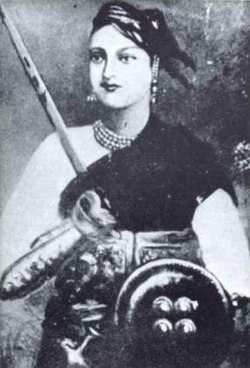 Lakshmibai, the Rani of Jhansi, one of the principal leaders of the rebellion who earlier had lost her kingdom as a result of the Doctrine of lapse.
 -
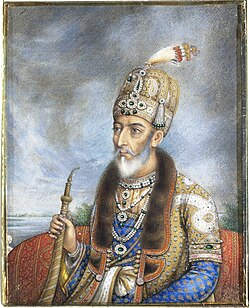 Bahadur Shah Zafar, the last Mughal Emperor. Crowned Emperor of India by the rebels, he was deposed by the British and died in exile in Burma.
 -
 Charles Canning, the Governor-General of India during the rebellion.
 -
 Lord Dalhousie, the Governor-General of India from 1848 to 1856, who devised the Doctrine of Lapse.


The Indian rebellion of 1857 was a large-scale rebellion by soldiers employed by the British East India Company in northern and central India against the company's rule. The spark that led to the mutiny was the issue of new gunpowder cartridges for the Enfield rifle, which was insensitive to local religious prohibition. The key mutineer was Mangal Pandey.[358] In addition, the underlying grievances over British taxation, the ethnic gulf between the British officers and their Indian troops and land annexations played a significant role in the rebellion. Within weeks after Pandey's mutiny, dozens of units of the Indian army joined peasant armies in widespread rebellion. The rebel soldiers were later joined by Indian nobility, many of whom had lost titles and domains under the Doctrine of Lapse and felt that the company had interfered with a traditional system of inheritance. Rebel leaders such as Nana Sahib and the Rani of Jhansi belonged to this group.[359]
After the outbreak of the mutiny in Meerut, the rebels very quickly reached Delhi. The rebels had also captured large tracts of the North-Western Provinces and Awadh (Oudh). Most notably, in Awadh, the rebellion took on the attributes of a patriotic revolt against British presence.[360] However, the British East India Company mobilised rapidly with the assistance of friendly Princely states, but it took the British the better part of 1858 to suppress the rebellion. Due to the rebels being poorly equipped and having no outside support or funding, they were brutally subdued.[361]
In the aftermath, all power was transferred from the British East India Company to the British Crown, which began to administer most of India as provinces. The Crown controlled the company's lands directly and had considerable indirect influence over the rest of India, which consisted of the Princely states ruled by local royal families. There were officially 565 princely states in 1947, but only 21 had actual state governments, and only three were large (Mysore, Hyderabad, and Kashmir). They were absorbed into the independent nation in 1947–48.[362]
British Raj (1858–1947)
[edit]

After 1857, the colonial government strengthened and expanded its infrastructure via the court system, legal procedures, and statutes. The Indian Penal Code came into being.[363] In education, Thomas Babington Macaulay had made schooling a priority for the Raj in 1835 and succeeded in implementing the use of English for instruction. By 1890 some 60,000 Indians had matriculated.[364] The Indian economy grew at about 1% per year from 1880 to 1920, and the population also grew at 1%. However, from 1910s Indian private industry began to grow significantly. India built a modern railway system in the late 19th century which was the fourth largest in the world.[365] Historians have been divided on issues of economic history, with the Nationalist school arguing that India was poorer due to British rule.[366]
In 1905, Lord Curzon split the large province of Bengal into a largely Hindu western half and "Eastern Bengal and Assam", a largely Muslim eastern half. The British goal was said to be efficient administration but the people of Bengal were outraged at the apparent "divide and rule" strategy. It also marked the beginning of the organised anti-colonial movement. When the Liberal party in Britain came to power in 1906, he was removed. Bengal was reunified in 1911. The new Viceroy Gilbert Minto and the new Secretary of State for India John Morley consulted with Congress leaders on political reforms. The Morley-Minto reforms of 1909 provided for Indian membership of the provincial executive councils as well as the Viceroy's executive council. The Imperial Legislative Council was enlarged from 25 to 60 members and separate communal representation for Muslims was established in a dramatic step towards representative and responsible government.[367] Several socio-religious organisations came into being at that time. Muslims set up the All India Muslim League in 1906 to protect the interests of the aristocratic Muslims. The Hindu Mahasabha sought to represent Hindu interests.[citation needed] The Hindu nationalist Rashtriya Swayamsevak Sangh (RSS) was formed in 1925–1926.[368] Sikhs founded the Shiromani Akali Dal in 1920.[369] However, the largest and oldest political party Indian National Congress, founded in 1885, attempted to keep a distance from the socio-religious movements and identity politics.[370]
-
 Two silver rupee coins issued by the British Raj in 1862 and 1886 respectively, the first in obverse showing a bust of Victoria, Queen, the second of Victoria, Empress. Victoria became Empress of India in 1876.
 -
 Ronald Ross, left, at Cunningham's laboratory of Presidency Hospital in Calcutta, where the transmission of malaria by mosquitoes was discovered, winning Ross the second Nobel Prize for Physiology or Medicine in 1902.
 -
 A Darjeeling Himalayan Railway train shown in 1870. The railway became a UNESCO World Heritage Site in 1999.
 -
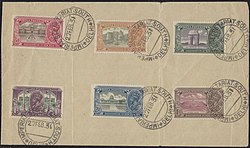


Indian Renaissance
[edit]-
 Sir Syed Ahmad Khan (1817–1898), the author of Causes of the Indian Mutiny, was the founder of Muhammadan Anglo-Oriental College, later the Aligarh Muslim University
 -
 Pandita Ramabai (1858–1922) was a social reformer, and a pioneer in the education and emancipation of women in India
 -
 Rabindranath Tagore (1861–1941) was a Bengali language poet, short-story writer, and playwright, and in addition a music composer and painter, who won the Nobel prize for Literature in 1913
 -
 Srinivasa Ramanujan (1887–1920) was an Indian mathematician who made seminal contributions to number theory


.jpg)
The Bengali Renaissance refers to a social reform movement, dominated by Bengali Hindus, in the Bengal region of the Indian subcontinent during the nineteenth and early twentieth centuries, a period of British rule. Historian Nitish Sengupta describes the renaissance as having started with reformer and humanitarian Raja Ram Mohan Roy (1775–1833), and ended with Asia's first Nobel laureate Rabindranath Tagore (1861–1941).[371] This flowering of religious and social reformers, scholars, and writers is described by historian David Kopf as "one of the most creative periods in Indian history."[372]
During this period, Bengal witnessed an intellectual awakening that is in some way similar to the Renaissance. This movement questioned existing orthodoxies, particularly with respect to women, marriage, the dowry system, the caste system, and religion. One of the earliest social movements that emerged during this time was the Young Bengal movement, which espoused rationalism and atheism as the common denominators of civil conduct among upper caste educated Hindus.[373] It played an important role in reawakening Indian minds and intellect across the Indian subcontinent.
Famines
[edit]-
 Map of famines in India during British Empire in year 1800–1885.
 -
 Engraving from The Graphic, October 1877, showing the plight of animals as well as humans in Bellary district, Madras Presidency, British India during the Great Famine of 1876–1878
 -
 Government famine relief, Ahmedabad, India, during the Indian famine of 1899–1900
 -
 A picture of orphans who survived the Bengal famine of 1943, a man-made disaster by the British government


During British East India Company and British Crown rule, India experienced some of deadliest ever recorded famines. These famines, usually resulting from crop failures and often exacerbated by policies of the colonial government,[374] included the Great Famine of 1876–1878 in which 6.1 million to 10.3 million people died,[375] the Great Bengal famine of 1770 where between 1 and 10 million people died,[376][377] the Indian famine of 1899–1900 in which 1.25 to 10 million people died,[374] and the Bengal famine of 1943 where between 2.1 and 3.8 million people died.[378] The Third plague pandemic in the mid-19th century killed 10 million people in India.[379] Despite persistent diseases and famines, the population of the Indian subcontinent, which stood at up to 200 million in 1750,[380] had reached 389 million by 1941.[381]
World War I
[edit]-
 Indian Cavalry on the Western front 1914
 -
 Indian cavalry from the Deccan Horse during the Battle of Bazentin Ridge in 1916.
 -
 Indian Army gunners (probably 39th Battery) with 3.7-inch mountain howitzers, Jerusalem 1917
 -
 India Gate is a memorial to 70,000 soldiers of the British Indian Army who died in the period 1914–21 in the First World War


During World War I, over 800,000 volunteered for the army, and more than 400,000 volunteered for non-combat roles, compared with the pre-war annual recruitment of about 15,000 men.[382] The Army saw early action on the Western Front at the First Battle of Ypres. After a year of front-line duty, sickness and casualties had reduced the Indian Corps to the point where it had to be withdrawn. Nearly 700,000 Indians fought the Turks in the Mesopotamian campaign. Indian formations were also sent to East Africa, Egypt, and Gallipoli.[383]
Indian Army and Imperial Service Troops fought during the Sinai and Palestine Campaign's defence of the Suez Canal in 1915, at Romani in 1916 and to Jerusalem in 1917. India units occupied the Jordan Valley and after the German spring offensive they became the major force in the Egyptian Expeditionary Force during the Battle of Megiddo and in the Desert Mounted Corps' advance to Damascus and on to Aleppo. Other divisions remained in India guarding the North-West Frontier and fulfilling internal security obligations.
One million Indian troops served abroad during the war. In total, 74,187 died,[384] and another 67,000 were wounded.[385] The roughly 90,000 soldiers who died fighting in World War I and the Afghan Wars are commemorated by the India Gate.
World War II
[edit]-
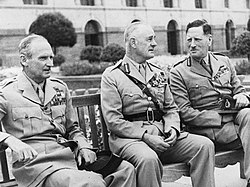 General Claude Auchinleck (right), Commander-in-Chief of the Indian Army, with the then Viceroy Wavell (centre) and General Montgomery (left)
 -
 Indian women training for Air Raid Precautions (ARP) duties in Bombay in 1942
 -
 Indian infantrymen of the 7th Rajput Regiment about to go on patrol on the Arakan front in Burma, 1944
 -
 The stamp series "Victory" issued by the Government of British India to commemorate allied victory in World War II

_duties_in_Bombay,_1942._IND1492.jpg)


British India officially declared war on Nazi Germany in September 1939.[386] The British Raj, as part of the Allied Nations, sent over two and a half million volunteer soldiers to fight under British command against the Axis powers. Additionally, several Princely States provided large donations to support the Allied campaign. India also provided the base for American operations in support of China in the China Burma India Theatre.
Indians fought throughout the world, including in the European theatre against Germany, in North Africa against Germany and Italy, against the Italians in East Africa, in the Middle East against the Vichy French, in the South Asian region defending India against the Japanese and fighting the Japanese in Burma. Indians also aided in liberating British colonies such as Singapore and Hong Kong after the Japanese surrender in August 1945. Over 87,000 soldiers from the subcontinent died in World War II.
The Indian National Congress denounced Nazi Germany but would not fight it or anyone else until India was independent. Congress launched the Quit India Movement in August 1942, refusing to co-operate in any way with the government until independence was granted. The government immediately arrested over 60,000 national and local Congress leaders. The Muslim League rejected the Quit India movement and worked closely with the Raj authorities.
Subhas Chandra Bose (also called Netaji) broke with Congress and tried to form a military alliance with Germany or Japan to gain independence. The Germans assisted Bose in the formation of the Indian Legion;[387] however, it was Japan that helped him revamp the Indian National Army (INA), after the First Indian National Army under Mohan Singh was dissolved. The INA fought under Japanese direction, mostly in Burma.[388] Bose also headed the Provisional Government of Free India (or Azad Hind), a government-in-exile based in Singapore.[389][390]
By 1942, neighbouring Burma was invaded by Japan, which by then had already captured the Indian territory of Andaman and Nicobar Islands. Japan gave nominal control of the islands to the Provisional Government of Free India on 21 October 1943, and in the following March, the Indian National Army with the help of Japan crossed into India and advanced as far as Kohima in Nagaland. This advance on the mainland of the Indian subcontinent reached its farthest point on Indian territory, retreating from the Battle of Kohima in June and from that of Imphal on 3 July 1944.
The region of Bengal in British India suffered a devastating famine during 1940–1943. An estimated 2.1–3 million died from the famine, frequently characterised as "man-made",[391] with most sources asserting that wartime colonial policies exacerbated the crisis.[392]
Indian independence movement (1885–1947)
[edit]-
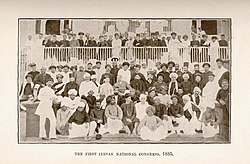 The first session of the Indian National Congress in 1885. A. O. Hume, the founder, is shown in the middle (third row from the front). The Congress was the first modern nationalist movement to emerge in the British Empire in Asia and Africa.[393]
 -
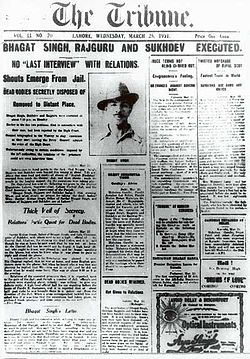 Front page of the Tribune (25 March 1931), reporting the execution of Bhagat Singh, Rajguru and Sukhdev by the British for the murder of 21-year-old police officer J. P. Saunders. Bhagat Singh quickly became a folk hero of the Indian independence movement.
 -
 From the late 19th century, and especially after 1920, under the leadership of Mahatma Gandhi (right), the Congress became the principal leader of the Indian independence movement.[394] Gandhi is shown here with Jawaharlal Nehru, later the first prime minister of India.


.jpg)
The numbers of British in India were small,[395] yet they were able to rule 52% of the Indian subcontinent directly and exercise considerable leverage over the princely states that accounted for 48% of the area.[396]
One of the most important events of the 19th century was the rise of Indian nationalism,[397] leading Indians to seek first "self-rule" and later "complete independence". However, historians are divided over the causes of its rise. Probable reasons include a "clash of interests of the Indian people with British interests",[397] "racial discriminations",[398] and "the revelation of India's past".[399]
The first step toward Indian self-rule was the appointment of councillors to advise the British viceroy in 1861 and the first Indian was appointed in 1909. Provincial Councils with Indian members were also set up. The councillors' participation was subsequently widened into legislative councils. The British built a large British Indian Army, with the senior officers all British and many of the troops from small minority groups such as Gurkhas from Nepal and Sikhs.[400] The civil service was increasingly filled with natives at the lower levels, with the British holding the more senior positions.[401]
Bal Gangadhar Tilak, an Indian nationalist leader, declared Swaraj (home rule) as the destiny of the nation. His popular sentence "Swaraj is my birthright, and I shall have it"[402] became the source of inspiration. Tilak was backed by rising public leaders like Bipin Chandra Pal and Lala Lajpat Rai, who held the same point of view, notably they advocated the Swadeshi movement involving the boycott of imported items and the use of Indian-made goods;[403] the triumvirate were popularly known as Lal Bal Pal. In 1907, the Congress was split into two factions: The radicals, led by Tilak, advocated civil agitation and direct revolution to overthrow the British Empire and the abandonment of all things British. The moderates, led by leaders like Dadabhai Naoroji and Gopal Krishna Gokhale, on the other hand, wanted reform within the framework of British rule.[403]
The partition of Bengal in 1905 further increased the revolutionary movement for Indian independence. The disenfranchisement lead some to take violent action.
The British themselves adopted a "carrot and stick" approach in response to renewed nationalist demands. The means of achieving the proposed measure were later enshrined in the Government of India Act 1919, which introduced the principle of a dual mode of administration, or diarchy, in which elected Indian legislators and appointed British officials shared power.[404] In 1919, Colonel Reginald Dyer ordered his troops to fire their weapons on peaceful protestors, including unarmed women and children, resulting in the Jallianwala Bagh massacre; which led to the Non-cooperation Movement of 1920–1922. The massacre was a decisive episode towards the end of British rule in India.[405]
From 1920 leaders such as Mahatma Gandhi began highly popular mass movements to campaign against the British Raj using largely peaceful methods. The Gandhi-led independence movement opposed the British rule using non-violent methods like non-co-operation, civil disobedience and economic resistance. However, revolutionary activities against the British rule took place throughout the Indian subcontinent and some others adopted a militant approach like the Hindustan Republican Association, that sought to overthrow British rule by armed struggle.
The All India Azad Muslim Conference gathered in Delhi in April 1940 to voice its support for an independent and united India.[406] Its members included several Islamic organisations in India, as well as 1,400 nationalist Muslim delegates.[407][408][409] The pro-separatist All-India Muslim League worked to try to silence those nationalist Muslims who stood against the partition of India, often using "intimidation and coercion".[408][409] The murder of the All India Azad Muslim Conference leader Allah Bakhsh Soomro also made it easier for the pro-separatist All-India Muslim League to demand the creation of a Pakistan.[409]
After World War II (c. 1946–1947)
[edit]"A moment comes, which comes but rarely in history, when we step out from the old to the new; when an age ends; and when the soul of a nation long suppressed finds utterance."
In January 1946, several mutinies broke out in the armed services, starting with that of RAF servicemen frustrated with their slow repatriation. The mutinies came to a head with mutiny of the Royal Indian Navy in Bombay in February 1946, followed by others in Calcutta, Madras, and Karachi. The mutinies were rapidly suppressed. In early 1946, new elections were called and Congress candidates won in eight of the eleven provinces. [citation needed]
Late in 1946, the Labour government decided to end British rule of India, and in early 1947 it announced its intention of transferring power no later than June 1948 and participating in the formation of an interim government. [citation needed]
Along with the desire for independence, tensions between Hindus and Muslims had also been developing over the years. Muslim League leader Muhammad Ali Jinnah proclaimed 16 August 1946 as Direct Action Day, with the stated goal of highlighting, peacefully, the demand for a Muslim homeland in British India, which resulted in the outbreak of the cycle of violence that would be later called the "Great Calcutta Killing of August 1946". The communal violence spread to Bihar, Noakhali in Bengal, Garhmukteshwar in the United Provinces, and on to Rawalpindi in March 1947 in which Sikhs and Hindus were attacked or driven out by Muslims. [citation needed]

Independence and partition (1947–present)
[edit]-
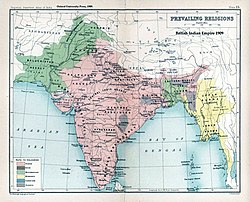 A map of the prevailing religions of the British Indian empire based on district-wise majorities based on the Indian census of 1909, and published in the Imperial Gazetteer of India. The partition of the Punjab and Bengal was based on such majorities.
 -
 Gandhi touring Bela, Bihar, a village struck by religious rioting in March 1947. On the right is Khan Abdul Gaffar Khan.
 -
 Jawaharlal Nehru being sworn in as the first prime minister of independent India by viceroy Lord Louis Mountbatten at 8:30 AM 15 August 1947.


In August 1947, the British Indian Empire was partitioned into the Union of India and Dominion of Pakistan. In particular, the partition of the Punjab and Bengal led to rioting between Hindus, Muslims, and Sikhs in these provinces and spread to other nearby regions, leaving some 500,000 dead. The police and army units were largely ineffective. The British officers were gone, and the units were beginning to tolerate if not actually indulge in violence against their religious enemies.[411][412][413] Also, this period saw one of the largest mass migrations anywhere in modern history, with a total of 12 million Hindus, Sikhs and Muslims moving between the newly created nations of India and Pakistan (which gained independence on 15 and 14 August 1947 respectively).[412] In 1971, Bangladesh, formerly East Pakistan and East Bengal, seceded from Pakistan.[414]
See also
[edit]References
[edit]Notes
[edit]Citations
[edit]- ^ Michael D. Petraglia; Bridget Allchin (22 May 2007). The Evolution and History of Human Populations in South Asia: Inter-disciplinary Studies in Archaeology, Biological Anthropology, Linguistics and Genetics. Springer Science & Business Media. p. 6. ISBN 978-1-4020-5562-1. Quote: "Y-Chromosome and Mt-DNA data support the colonization of South Asia by modern humans originating in Africa. ... Coalescence dates for most non-European populations average to between 73–55 ka."
- ^ a b Wright 2010, pp. 44, 51.
- ^ a b Wright 2010, p. 1.
- ^ a b McIntosh, Jane (2008). The Ancient Indus Valley: New Perspectives. ABC-Clio. p. 387. ISBN 978-1-57607-907-2.
- ^ a b Flood, Gavin. Olivelle, Patrick. 2003. The Blackwell Companion to Hinduism. Malden: Blackwell. pp. 273–274
- ^ The Cambridge History of Southeast Asia: From Early Times to c. 1800, Band 1 by Nicholas Tarling, p. 281
- ^ Essays on Ancient India by Raj Kumar p. 199
- ^ Al Baldiah wal nahaiyah vol: 7 p. 141 "Conquest of Makran"
- ^ Meri 2005, p. 146.
- ^ Dr. K. S. Lal (1967). History of the Khaljis, A.D. 1290-1320. p. 14.
The khalji revolt is essentially a revolt of the Indian Muslims against the Turkish hegemony, of those who looked to Delhi, against those who sought inspiration from Ghaur and Ghazna.
- ^ Radhey Shyam Chaurasia (2002). History of Medieval India:From 1000 A.D. to 1707 A.D. Atlantic. p. 30. ISBN 978-81-269-0123-4.
In spite of all this, capturing the throne for Khilji was a revolution, as instead of Turks, Indian Muslims gained power
- ^ Kumar, Sunil (2013). "Delhi Sultanate (1206-1526)". In Bowering, Gerhard (ed.). The Princeton Encyclopedia of Islamic Political Thought. Princeton University Press. pp. 127–128. ISBN 978-0-691-13484-0.
- ^ Eaton, Richard M. (31 July 1996). The Rise of Islam and the Bengal Frontier, 1204–1760. University of California Press. pp. 64–. ISBN 978-0-520-20507-9.
- ^ Darwin, John (2008). After Tamerlane: The Rise and Fall of Global Empires, 1400-2000. Penguin Books Limited. pp. Only in Mewar and in Vijaynagar had Hindu states withstood the deluge". ISBN 978-0-14-101022-9.
- ^ Majumdar, R.C (1960). History and Culture of the Indian People, Volume 06,The Delhi Sultanate (3rd ed.). Bhartiya Vidya Bhavan. pp. 70 "It is also quite clear from contemporary chronicles that Muhammad Tughluq and the later Sultans practically left Rajputana severely alone, and the various Rajput principalities recognised Mewar as the paramount power at least in name".
- ^ a b "India before the British: The Mughal Empire and its Rivals, 1526–1857". University of Exeter.
- ^ Parthasarathi, Prasannan (11 August 2011). Why Europe Grew Rich and Asia Did Not: Global Economic Divergence, 1600–1850. Cambridge University Press. pp. 39–45. ISBN 978-1-139-49889-0.
- ^ Maddison, Angus (25 September 2003). Development Centre Studies The World Economy Historical Statistics: Historical Statistics. OECD Publishing. pp. 259–261. ISBN 92-64-10414-3.
- ^ Harrison, Lawrence E.; Berger, Peter L. (2006). Developing cultures: case studies. Routledge. p. 158. ISBN 978-0-415-95279-8.
- ^ MacDonald, Myra (1 January 2017). Defeat is an Orphan: How Pakistan Lost the Great South Asian War. Oxford University Press. p. 85. ISBN 978-1-84904-858-3.
- ^ Ian Copland; Ian Mabbett; Asim Roy; et al. (2012). A History of State and Religion in India. Routledge. p. 161.
- ^ Michaud, Joseph (1926). History of Mysore Under Hyder Ali and Tippoo Sultan. p. 143.
- ^ Taçon, Paul S.C. (17 October 2018). "The Rock Art of South and East Asia". In David, Bruno; McNiven, Ian J. (eds.). The Oxford Handbook of the Archaeology and Anthropology of Rock Art. Oxford University Press. pp. 181–. ISBN 978-0-19-084495-0.
- ^ Mithen, Steven J. (2006). After the Ice: A Global Human History, 20,000–5000 BC. Harvard University Press. pp. 411–. ISBN 978-0-674-01999-7.
- ^ Dubey-Pathak, Meenakshi (2014). "The Rock Art of the Bhimbetka Area in India" (PDF). Adoranten: 16, 19. Archived (PDF) from the original on 13 September 2021.
- ^ Chauhan 2010, p. 147.
- ^ a b c Petraglia & Allchin 2007, p. 5.
- ^ a b c Petraglia 2010, pp. 167–170.
- ^ Mishra, Sheila (1999). "Developing an Indian stone age chronology". In Murray, Tim (ed.). Time and Archaeology. Routledge. p. 84. ISBN 978-0-415-11762-3.
- ^ a b c d Chauhan 2010, pp. 147–160.
- ^ Dyson 2018, p. 1.
- ^ Petraglia & Allchin 2007, p. 6.
- ^ Fisher 2018, p. 23.
- ^ Tuniz, Claudio; Gillespie, Richard; Jones, Cheryl (16 June 2016). The Bone Readers: Science and Politics in Human Origins Research. Routledge. pp. 163–. ISBN 978-1-315-41888-9.
- ^ Petraglia, Michael D.; Haslam, Michael; Fuller, Dorian Q.; Boivin, Nicole; Clarkson, Chris (25 March 2010). "Out of Africa: new hypotheses and evidence for the dispersal of Homo sapiens along the Indian Ocean rim" (PDF). Annals of Human Biology. 37 (3): 288–311. doi:10.3109/03014461003639249. ISSN 0301-4460. PMID 20334598. S2CID 6421383.
- ^ Mellars, Paul; Gori, Kevin C.; Carr, Martin; Soares, Pedro A.; Richards, Martin B. (25 June 2013). "Genetic and archaeological perspectives on the initial modern human colonization of southern Asia". Proceedings of the National Academy of Sciences. 110 (26): 10699–10704. Bibcode:2013PNAS..11010699M. doi:10.1073/pnas.1306043110. PMC 3696785. PMID 23754394.
- ^ a b Dyson 2018, p. 28.
- ^ "Metropolitan Museum of Art". www.metmuseum.org. Archived from the original on 16 March 2022. Retrieved 21 April 2019.
- ^ Dyson 2018, p. 4-5.
- ^ a b Fisher 2018, p. 33.
- ^ Shuichi Takezawa (August 2002). "Stepwells – Cosmology of Subterranean Architecture As Seen in Adalaj" (PDF). Journal of Architecture and Building Science. 117 (1492): 24. Retrieved 18 November 2009.
- ^ Kenoyer, J. M., Miller, H. M.-L. "Metal technologies of the Indus Valley tradition in Pakistan and western India." The Archaeometallurgy of the Asian Old World, MASCA research papers in science and archaeology. 1999, Vol 16, pp 107-151; ref : 7 p.1/4. ISSN 1048-5325
- ^ Early India: A Concise History, D.N. Jha, 2004, p. 31
- ^ Menon, Sunil; Mishra, Siddhartha (13 August 2018). "We Are All Harappans". Outlook. Archived from the original on 3 August 2018.
- ^ Sarkar, Anindya; Mukherjee, Arati Deshpande; Bera, M. K.; Das, B.; Juyal, Navin; Morthekai, P.; Deshpande, R. D.; Shinde, V. S.; Rao, L. S. (May 2016). "Oxygen isotope in archaeological bioapatites from India: Implications to climate change and decline of Bronze Age Harappan civilization". Scientific Reports. 6 (1) 26555. Bibcode:2016NatSR...626555S. doi:10.1038/srep26555. PMC 4879637. PMID 27222033.
- ^ Kumar, Vijay. "A note on Chariot Burials found at Sinauli district Baghpat U.P" (PDF). Indian Journal of Archaeology.
- ^ Singh, Upinder (2008). A History of Ancient and Early Medieval India: From the Stone Age to the 12th Century. Pearson Education India. pp. 216–219. ISBN 978-81-317-1120-0. Retrieved 8 September 2018.
- ^ Stein, Burton (2010). Arnold, David (ed.). A History of India (2nd ed.). Oxford: Wiley-Blackwell. p. 47. ISBN 978-1-4051-9509-6.
- ^ Kulke & Rothermund 2004, p. 31.
- ^ a b Upinder Singh 2008, p. 255.
- ^ Antonova, Bongard-Levin & Kotovsky 1979, p. 51.
- ^ MacKenzie, Lynn (1995). Non-Western Art: A Brief Guide. Prentice Hall. p. 151. ISBN 978-0-13-104894-2.
- ^ Romila Thapar, A History of India: Part 1, pp. 29–30.
- ^ Staal, Frits (1986). The Fidelity of Oral Tradition and the Origins of Science. North Holland Publishing Company.
- ^ Singhal, K. C.; Gupta, Roshan (2003). The Ancient History of India, Vedic Period: A New Interpretation. New Delhi: Atlantic Publishers & Distributors. pp. 150–151. ISBN 81-269-0286-8. OCLC 53360586.
- ^ Day, Terence P. (1982). The Conception of Punishment in Early Indian Literature. Ontario: Wilfrid Laurier University Press. pp. 42–45. ISBN 978-0-919812-15-4.
- ^ Duiker, William J.; Spielvogel, Jackson J. (2018) [First published 1994]. World History (9th ed.). Cengage. pp. 44, 59. ISBN 978-1-337-40104-3.
- ^ Nelson, James Melvin (2009). Psychology, Religion, and Spirituality. Springer. p. 77.
- ^ Flood, Gavin Dennis (13 July 1996). An Introduction to Hinduism. Cambridge University Press. p. 37. ISBN 978-0-521-43878-0.
- ^ "India: The Late 2nd Millennium and the Reemergence of Urbanism". Encyclopædia Britannica. Retrieved 12 May 2007.
- ^ a b Reddy 2003, p. A11.
- ^ a b Michael Witzel (1989), Tracing the Vedic dialects in Dialectes dans les litteratures Indo-Aryennes ed. Caillat, Paris, 97–265.
- ^ Samuel 2008, p. 43, 48, 51, 86–87.
- ^ Kulke & Rothermund 2004, pp. 41–43.
- ^ Upinder Singh 2008, p. 200.
- ^ Valmiki (10 April 1990). Goldman, Robert P.; Pollock, Sheldon (eds.). The Ramayana of Valmiki: An Epic of Ancient India, Volume 1: Balakanda. Princeton, New Jersey: Princeton University Press. p. 23. ISBN 978-0-691-01485-2.
- ^ Romila Thapar, A History of India Part 1, p. 31.
- ^ a b Upinder Singh 2008, pp. 18–19.
- ^ Brockington, J. L. (1998). The Sanskrit epics, Part 2. Vol. 12. Brill. p. 21. ISBN 978-90-04-10260-6.
- ^ Lanman, Charles Rockwell (1912) [First published 1884]. A Sanskrit reader: with vocabulary and notes. Boston: Ginn & Co. OCLC 633836.
... jána, m. creature; man; person; in plural, and collectively in singular, folks; a people or race or tribe ... cf. γένος, Lat. genus, Eng. kin, 'race' ...
- ^ Potter, Stephen; Sargent, Laurens Christopher (1974). Pedigree: The Origins of Words from Nature. Taplinger Publishing Company. ISBN 978-0-8008-6248-0.
... *gen-, found in Skt. jana, 'a man', and Gk. genos and L. genus, 'a race' ...
- ^ Basu, Abhijit (2013). Marvels and Mysteries of the Mahabharata. Leadstart publishing. p. 153. ISBN 978-93-84027-47-6.
- ^ a b c d e Witzel, Michael (1995). "Early Sanskritization. Origins and Development of the Kuru State". Electronic Journal of Vedic Studies. 1 (4): 1–26. doi:10.11588/ejvs.1995.4.823. Archived from the original on 7 April 2022. Retrieved 20 November 2018.
- ^ a b Samuel 2008, p. 48.
- ^ H.C. Raychaudhuri (1950), Political History of Ancient India and Nepal, Calcutta: University of Calcutta, p. 58
- ^ Samuel 2008, p. 41.
- ^ Samuel 2008, p. 47.
- ^ Heitzman, James (31 March 2008). The City in South Asia. Routledge. pp. 12–13. ISBN 978-1-134-28963-9.
- ^ Samuel 2008, pp. 47–48.
- ^ "The beginning of the historical period, c. 500–150 BCE". Encyclopædia Britannica. 2015.
- ^ Samuel 2008, pp. 41, 43.
- ^ Samuel 2008, p. 61.
- ^ Samuel 2008, pp. 48–51.
- ^ Samuel 2008, p. 49.
- ^ a b Flood, Gavin Dennis (1996). An Introduction to Hinduism. Cambridge University Press. p. 82. ISBN 978-0-521-43878-0.
- ^ Mascaró, Juan (1965). The Upanishads. Penguin Books. pp. 7–. ISBN 978-0-14-044163-5.
- ^ Olivelle, Patrick (2008). Upaniṣads. Oxford University Press. pp. xxiv–xxix. ISBN 978-0-19-954025-9.
- ^ Baumann, Martin (2010). "Hinduism". In Melton, J. Gordon; Baumann, Martin (eds.). Religions of the World. Vol. 3 (2nd ed.). ABC-Clio. p. 1324. ISBN 978-1-59884-204-3.
- ^ Olivelle, Patrick (2003). "The Renouncer Tradition". In Flood, Gavin (ed.). The Blackwell Companion to Hinduism. Blackwell. pp. 273–274. ISBN 978-0-631-21535-6.
The second half of the first millennium BC was the period that created many of the ideological and institutional elements that characterise later Indian religions. The renouncer tradition played a central role during this formative period of Indian religious history. ... Some of the fundamental values and beliefs that we generally associate with Indian religions in general and Hinduism, in particular, were in part the creation of the renouncer tradition. These include the two pillars of Indian theologies: samsara—the belief that life in this world is one of suffering and subject to repeated deaths and births (rebirth); moksa/nirvana—the goal of human existence ...
- ^ Laumakis, Stephen (2008). An Introduction to Buddhist Philosophy. Cambridge University Press. p. 4. ISBN 978-0-511-38589-6.
- ^ Fisher, Mary Pat (2011) [First published 1991]. Living Religions: An Encyclopedia of the World's Faiths (8th ed.). Prentice Hall. p. 121. ISBN 978-0-205-83585-0.
Jainism's major teacher for this age is Mahavira ... was a contemporary of the Buddha and died approximately 527 BCE.
- ^ Fisher, Mary Pat (2011) [First published 1991]. Living Religions: An Encyclopedia of the World's Faiths (8th ed.). Prentice Hall. p. 122. ISBN 978-0-205-83585-0.
The extreme antiquity of Jainism as a non-Vedic, indigenous Indian religion is well documented. Ancient Hindu and Buddhist scriptures refer to Jainism as an existing tradition which began long before Mahavira.
- ^ Upinder Singh 2008, pp. 260–261.
- ^ Anguttara Nikaya I. p. 213; IV. pp. 252, 256, 261.
- ^ a b Reddy 2003, p. A107.
- ^ a b Thapar, Romila (2002). Early India: From the Origins to AD 1300. University of California Press. pp. 146–150. ISBN 978-0-520-24225-8. Retrieved 28 October 2013.
- ^ Raychaudhuri Hemchandra (1972), Political History of Ancient India, Calcutta: University of Calcutta, p. 107
- ^ Republics in ancient India. Brill Archive. pp. 93–. GGKEY:HYY6LT5CFT0.
- ^ J.M. Kenoyer (2006), "Cultures and Societies of the Indus Tradition. In Historical Roots" in the Making of 'the Aryan, R. Thapar (ed.), pp. 21–49. New Delhi, National Book Trust.
- ^ Shaffer, Jim (1993). "Reurbanization: The eastern Punjab and beyond". Urban Form and Meaning in South Asia: The Shaping of Cities from Prehistoric to Precolonial Times. Symposium Papers XV. Vol. 31. National Gallery of Art. pp. 53–67. JSTOR 42620472.
- ^ Majumdar, Ramesh Chandra (1977). Ancient India (8th ed.). Motilal Banarsidass Publishers. ISBN 978-81-208-0436-4.
- ^ "Magadha Empire – Magadha Empire in India, History of Magadh Empire". iloveindia.com.
- ^ "Lumbini Development Trust: Restoring the Lumbini Garden". lumbinitrust.org. Archived from the original on 6 March 2014. Retrieved 6 January 2017.
- ^ Mookerji 1988, pp. 28–33.
- ^ Upinder Singh 2008, p. 273.
- ^ Mookerji 1988, p. 34.
- ^ Raychaudhuri, Hem Chandra; Mukherjee, Bratindra Nath (1996) [First published 1923]. Political History of Ancient India: From the Accession of Parikshit to the Extinction of the Gupta Dynasty (8th ed.). Oxford University Press. pp. 208–209. ISBN 978-0-19-563789-2.
- ^ Turchin, Peter; Adams, Jonathan M.; Hall, Thomas D. (December 2006). "East–West Orientation of Historical Empires". Journal of World-Systems Research. 12 (2): 223. ISSN 1076-156X. Retrieved 12 September 2016.
- ^ Romila Thapar. A History of India: Volume 1. p. 70.
- ^ a b Thapar 2003, pp. 178–180.
- ^ a b Thapar 2003, pp. 204–206.
- ^ Bhandari, Shirin (5 January 2016). "Dinner on the Grand Trunk Road". Roads & Kingdoms. Retrieved 19 July 2016.
- ^ Kulke & Rothermund 2004, p. 67.
- ^ Romila Thapar. A History of India: Volume 1. p. 78.
- ^ Antonova, Bongard-Levin & Kotovsky 1979, p. 91.
- ^ Technology and Society by Menon, R.V.G. p. 15
- ^ Rosen, Elizabeth S. (1975). "Prince ILango Adigal, Shilappadikaram (The anklet Bracelet), translated by Alain Damelou. Review". Artibus Asiae. 37 (1/2): 148–150. doi:10.2307/3250226. JSTOR 3250226.
- ^ Sen 1999, pp. 204–205.
- ^ Essays on Indian Renaissance by Raj Kumar p. 260
- ^ The First Spring: The Golden Age of India by Abraham Eraly p. 655
- ^ * Zvelebil, Kamil. 1973. The smile of Murugan on Tamil literature of South India. Leiden: Brill. Zvelebil dates the Ur-Tholkappiyam to the 1st or 2nd century BCE
- ^ "Silappathikaram Tamil Literature". Tamilnadu.com. 22 January 2013. Archived from the original on 11 April 2013.
- ^ Mukherjee 1999, p. 277
- ^ "Cittalaiccattanar (c. 500): Manimekalai". gretil.sub.uni-goettingen.de.
- ^ Hardy, Adam (1995). Indian Temple Architecture: Form and Transformation: the Karṇāṭa Drāviḍa Tradition, 7th to 13th Centuries. Abhinav Publications. p. 39. ISBN 978-81-7017-312-0.
- ^ Le, Huu Phuoc (2010). Buddhist Architecture. Grafikol. p. 238. ISBN 978-0-9844043-0-8.
- ^ a b Stein, B. (27 April 2010), Arnold, D. (ed.), A History of India (2nd ed.), Oxford: Wiley-Blackwell, p. 105, ISBN 978-1-4051-9509-6
- ^ A Social History of Early India by Brajadulal Chattopadhyaya p. 259
- ^ "The World Economy (GDP): Historical Statistics by Professor Angus Maddison" (PDF). World Economy. 17 September 2006. Retrieved 21 May 2013.
- ^ Maddison, Angus (2006). The World Economy – Volume 1: A Millennial Perspective and Volume 2: Historical Statistics. OECD Publishing by Organisation for Economic Co-operation and Development. p. 656. ISBN 978-92-64-02262-1.
- ^ Stadtner, Donald (1975). "A Śuṅga Capital from Vidiśā". Artibus Asiae. 37 (1/2): 101–104. doi:10.2307/3250214. ISSN 0004-3648. JSTOR 3250214.
- ^ K. A. Nilkantha Shastri (1970), A Comprehensive History of India: Volume 2, p. 108: "Soon after Agnimitra there was no 'Sunga empire'".
- ^ Bhandare, Shailendra. "Numismatics and History: The Maurya-Gupta Interlude in the Gangetic Plain" in Between the Empires: Society in India, 300 to 400 ed. Patrick Olivelle (2006), p. 96
- ^ Sircar, D. C. (2008). Studies in Indian Coins. Motilal Banarsidass Publishers. ISBN 978-81-208-2973-2.
- ^ Schreiber, Mordecai (2003). The Shengold Jewish Encyclopedia. Rockville, MD: Schreiber Publishing. p. 125. ISBN 978-1-887563-77-2.
- ^ Law 1978, p. 164.
- ^ Greatest emporium in the world, CSI, UNESCO.
- ^ Collingham 2006, p. 245.
- ^ The Medical Times and Gazette, Volume 1. London: John Churchill. 1867. p. 506.
- ^ Donkin 2003, pp. 67, 60–70.
- ^ Loewe, Michael; Shaughnessy, Edward L. (1999). The Cambridge History of Ancient China: From the Origins of Civilization to 221 BC. Cambridge University Press. pp. 87–88. ISBN 978-0-521-47030-8. Retrieved 1 November 2013.
- ^ Runion, Meredith L. (2007). The history of Afghanistan. Westport: Greenwood Press. p. 46. ISBN 978-0-313-33798-7.
The Yuezhi people conquered Bactria in the second century BCE. and divided the country into five chiefdoms, one of which would become the Kushan Empire. Recognizing the importance of unification, these five tribes combined under the one dominate Kushan tribe, and the primary rulers descended from the Yuezhi.
- ^ Liu, Xinrui (2001). Adas, Michael (ed.). Agricultural and pastoral societies in ancient and classical history. Philadelphia: Temple University Press. p. 156. ISBN 978-1-56639-832-9.
- ^ Buddhist Records of the Western World Si-Yu-Ki, (Tr. Samuel Beal: Travels of Fa-Hian, The Mission of Sung-Yun and Hwei-Sing, Books 1–5), Kegan Paul, Trench, Trubner & Co. Ltd. London. 1906 and Hill (2009), pp. 29, 318–350
- ^ which began about 127 CE. "Falk 2001, pp. 121–136", Falk (2001), pp. 121–136, Falk, Harry (2004), pp. 167–176 and Hill (2009), pp. 29, 33, 368–371.
- ^ Grégoire Frumkin (1970). Archaeology in Soviet Central Asia. Brill Archive. pp. 51–. GGKEY:4NPLATFACBB.
- ^ Rafi U. Samad (2011). The Grandeur of Gandhara: The Ancient Buddhist Civilization of the Swat, Peshawar, Kabul and Indus Valleys. Algora Publishing. pp. 93–. ISBN 978-0-87586-859-2.
- ^ Oxford History of India – Vincent Smith
- ^ Los Angeles County Museum of Art; Pratapaditya Pal (1986). Indian Sculpture: Circa 500 B.C.–A.D. 700. University of California Press. pp. 151–. ISBN 978-0-520-05991-7.
- ^ "The History of Pakistan: The Kushans". kushan.org. Archived from the original on 7 July 2015. Retrieved 6 January 2017.
- ^ Si-Yu-Ki, Buddhist Records of the Western World, (Tr. Samuel Beal: Travels of Fa-Hian, The Mission of Sung-Yun and Hwei-Sing, Books 1–5), Kegan Paul, Trench, Trubner & Co. Ltd. London. 1906
- ^ "Gupta dynasty: empire in 4th century". Encyclopædia Britannica. Archived from the original on 30 March 2010. Retrieved 16 May 2010.
- ^ "The Story of India – Photo Gallery". PBS. Retrieved 16 May 2010.
- ^ Coedes, G. (1968) The Indianized States of Southeast Asia Edited by Walter F. Vella. Translated by Susan Brown Cowing. Canberra: Australian National University Press. Introduction... The geographic area here called Farther India consists of Indonesia, or island Southeast Asia....
- ^ Bernard Philippe Groslier (1962). The art of Indochina: including Thailand, Vietnam, Laos and Cambodia. Crown Publishers.
- ^ Iaroslav Lebedynsky, Les Nomades, p. 172.
- ^ Early History of India, p. 339, Dr V.A. Smith; See also Early Empire of Central Asia (1939), W.M. McGovern.
- ^ Ancient India, 2003, p. 650, Dr V.D. Mahajan; History and Culture of Indian People, The Age of Imperial Kanauj, p. 50, Dr R.C. Majumdar, Dr A.D. Pusalkar.
- ^ Gopal, Madan (1990). K.S. Gautam (ed.). India through the ages. Publication Division, Ministry of Information and Broadcasting, Government of India. p. 173.
- ^ The precise number varies according to whether or not some barely started excavations, such as cave 15A, are counted. The ASI say "In all, total 30 excavations were hewn out of rock which also include an unfinished one", UNESCO and Spink "about 30". The controversies over the end date of excavation is covered below.
- ^ Tej Ram Sharma, 1978, "Personal and geographical names in the Gupta inscriptions. (1.publ.)", p. 254, Kamarupa consisted of the Western districts of the Brahmaputra valley which being the most powerful state.
- ^ Suresh Kant Sharma, Usha Sharma – 2005, "Discovery of North-East India: Geography, History, Culture, ... – Volume 3", p. 248, Davaka (Nowgong) and Kamarupa as separate and submissive friendly kingdoms.
- ^ The eastern border of Kamarupa is given by the temple of the goddess Tamreshvari (Pūrvāte Kāmarūpasya devī Dikkaravasini in Kalika Purana) near present-day Sadiya. "...the temple of the goddess Tameshwari (Dikkaravasini) is now located at modern Sadiya about 100 miles to the northeast of Sibsagar" (Sircar 1990, pp. 63–68).
- ^ Barpujari, H.K., ed. (1990). The Comprehensive History of Assam (1st ed.). Guwahati, India: Assam Publication Board. OCLC 499315420.
- ^ Sarkar, J.N. (1992), "Chapter II The Turko-Afghan Invasions", in Barpujari, H.K., The Comprehensive History of Assam, 2, Guwahati: Assam Publication Board, pp. 35–48
- ^ "Pallava script". SkyKnowledge.com. 30 December 2010.
- ^ Nilakanta Sastri, pp. 412–413
- ^ Hall, John Whitney, ed. (2005) [1988]. "India". History of the World: Earliest Times to the Present Day. John Grayson Kirk. North Dighton, MA: World Publications Group. p. 246. ISBN 978-1-57215-421-6.
- ^ "CNG: eAuction 329. India, Post-Gupta (Ganges Valley). Vardhanas of Thanesar and Kanauj. Harshavardhana. Circa AD 606–647. AR Drachm (13 mm, 2.28 g, 1h)". cngcoins.com.
- ^ RN Kundra & SS Bawa, History of Ancient and Medieval India
- ^ a b c International Dictionary of Historic Places: Asia and Oceania by Trudy Ring, Robert M. Salkin, Sharon La Boda p. 507
- ^ "Harsha". Encyclopædia Britannica. 2015.
- ^ "Sthanvishvara (historical region, India)". Encyclopædia Britannica. Retrieved 9 August 2014.
- ^ "Harsha (Indian emperor)". Encyclopædia Britannica. Retrieved 9 August 2014.
- ^ Michaels 2004, p. 41.
- ^ Michaels 2004, p. 43.
- ^ Sanderson, Alexis (2009). "The Śaiva Age: The Rise and Dominance of Śaivism during the Early Medieval Period". In Einoo, Shingo (ed.). Genesis and Development of Tantrism. Institute of Oriental Culture Special Series. Vol. 23. Tokyo: Institute of Oriental Culture, University of Tokyo. pp. 41–43. ISBN 978-4-7963-0188-6.
- ^ Sarao, Decline of Buddhism in India
- ^ Sheridan, Daniel P. "Kumarila Bhatta", in Great Thinkers of the Eastern World, ed. Ian McGready, New York: HarperCollins, 1995, pp. 198–201. ISBN 0-06-270085-5.
- ^ Avari, Burjor (2007). India: The Ancient Past. A History of the Indian-Subcontinent from 7000 BC to AD 1200. New York: Routledge. pp. 204–205. ISBN 978-0-203-08850-0.
Madhyadesha became the ambition of two particular clans among a tribal people in Rajasthan, known as Gurjara and Pratihara. They were both parts of a larger federation of tribes, some of which later came to be known as the Rajputs
- ^ Kamath 1980, p. 93.
- ^ Vinod Chandra Srivastava (2008). History of Agriculture in India, Up to C. 1200 A.D. Concept. p. 857. ISBN 978-81-8069-521-6.
- ^ Kudalk, J. S. (1920). "The Jain Manuscript-Bhandars at Patan a Final Word on Their Search". Annals of the Bhandarkar Oriental Research Institute. 3: 35–52. JSTOR 44526773.
- ^ "Proceedings and Transactions of the All-India Oriental Conference — General President's Address by A. N. Upadhye (1969)". Gurukul Kangri University. 1969. p. 19. Retrieved 25 September 2025.
- ^ a b The Dancing Girl: A History of Early India by Balaji Sadasivan p. 129
- ^ Pollock, Sheldon (2006). The Language of the Gods in the World of Men: Sanskrit, Culture, and Power in Premodern India. University of California Press. pp. 241–242. ISBN 978-0-520-93202-9.
- ^ Sunil Fotedar (June 1984). The Kashmir Series: Glimpses of Kashmiri Culture – Vivekananda Kendra, Kanyakumari (p. 57).
- ^ R. C. Mazumdar, Ancient India, p. 383
- ^ Karl J. Schmidt (2015). An Atlas and Survey of South Asian History. Routledge. p. 26. ISBN 978-1-317-47681-8.
- ^ Sailendra Nath Sen (1999). Ancient Indian History and Civilization. New Age. p. 246. ISBN 978-81-224-1198-0.
- ^ Thapar 2003, p. 334.
- ^ a b c Chandra, Satish (2009). History of Medieval India. New Delhi: Orient Blackswan. pp. 19–20. ISBN 978-81-250-3226-7.
- ^ Kamath 1980, pp. 83, 85, 97.
- ^ Puttaswamy, T.K. (2012). "Mahavira". Mathematical Achievements of Pre-modern Indian Mathematicians. London: Elsevier Publications. p. 231. ISBN 978-0-12-397913-1.
- ^ Sen 1999, p. 380.
- ^ Sen 1999, pp. 380–381.
- ^ Daniélou 2003, p. 170.
- ^ The Britannica Guide to Algebra and Trigonometry by William L. Hosch p. 105
- ^ Wink, André (2002) [First published 1990]. Al-Hind: The making of the Indo-Islamic World. Vol. I. Brill Academic Publishers. pp. 283–284. ISBN 978-0-391-04173-8.
- ^ Avari 2007, p. 204.
- ^ Wink, André (2002) [First published 1990]. Al-Hind: The making of the Indo-Islamic World. Vol. I. Brill Academic Publishers. pp. 285–286. ISBN 978-0-391-04173-8.
- ^ K.D. Bajpai (2006). History of Gopāchala. Bharatiya Jnanpith. p. 31. ISBN 978-81-263-1155-2.
- ^ Niyogi 1959, p. 38.
- ^ Sinha, CPN (1969). "Origin of the Karnatas of Mithila - A Fresh Appraisal". Proceedings of the Indian History Congress. 31: 66–72. JSTOR 44138330.
- ^ Chakrabarty, Dilip (2010). The Geopolitical Orbits of Ancient India: The Geographical Frames of the Ancient Indian Dynasties. Oxford University Press. pp. 47–48. ISBN 978-0-19-908832-4.
- ^ Epigraphia Indica, XXIV, p. 43, Dr N.G. Majumdar
- ^ Nitish K. Sengupta (2011). Land of Two Rivers: A History of Bengal from the Mahabharata to Mujib. Penguin Books India. pp. 43–45. ISBN 978-0-14-341678-4.
- ^ Biplab Dasgupta (2005). European Trade and Colonial Conquest. Anthem Press. pp. 341–. ISBN 978-1-84331-029-7.
- ^ Kulke & Rothermund 2004, pp. 112, 119.
- ^ History of Buddhism in India, Translation by A Shiefner
- ^ a b c Chandra, Satish (2009). History of Medieval India. New Delhi: Orient Blackswan. pp. 13–15. ISBN 978-81-250-3226-7.
- ^ a b Sen 1999, p. 278.
- ^ PN Chopra; BN Puri; MN Das; AC Pradhan, eds. (2003). A Comprehensive History Of Ancient India (3 Vol. Set). Sterling. pp. 200–202. ISBN 978-81-207-2503-4.
- ^ History of Ancient India: Earliest Times to 1000 A.D. by Radhey Shyam Chaurasia p. 237
- ^ Kulke & Rothermund 2004, p. 116.
- ^ Keay 2000, p. 215: The Cholas were in fact the most successful dynasty since the Guptas ... The classic expansion of Chola power began anew with the accession of Rajaraja I in 985.
- ^ "The Last Years of Cholas: The decline and fall of a dynasty". En.articlesgratuits.com. 22 August 2007. Archived from the original on 20 January 2010. Retrieved 23 September 2009.
- ^ K. A. Nilakanta Sastri, A History of South India, p. 158
- ^ Buddhism, Diplomacy, and Trade: The Realignment of Sino-Indian Relations by Tansen Sen p. 229
- ^ History of Asia by B.V. Rao p. 297
- ^ Indian Civilization and Culture by Suhas Chatterjee p. 417
- ^ "Sri Ranganathaswamy Temple, Srirangam".
- ^ a b A Comprehensive History of Medieval India: by Farooqui Salma Ahmed, Salma Ahmed Farooqui p. 24
- ^ Ancient Indian History and Civilization by Sailendra Nath Sen pp. 403–405
- ^ World Heritage Monuments and Related Edifices in India, Band 1 by ʻAlī Jāvīd pp. 132–134
- ^ History of Kannada Literature by E.P. Rice p. 32
- ^ Bilhana by Prabhakar Narayan Kawthekar, p. 29
- ^ Asher & Talbot 2006, p. 47.
- ^ Metcalf & Metcalf 2006, p. 6.
- ^ Asher & Talbot 2006, p. 53.
- ^ a b Delhi Sultanate, Encyclopædia Britannica
- ^ Bartel, Nick (1999). "Battuta's Travels: Delhi, capital of Muslim India". The Travels of Ibn Battuta – A Virtual Tour with the 14th Century Traveler. Archived from the original on 12 June 2010.
- ^ Asher & Talbot 2006, pp. 50–52.
- ^ Richard Eaton (2000), Temple Desecration and Indo-Muslim States, Journal of Islamic Studies, 11(3), pp. 283–319
- ^ a b Asher & Talbot 2006, pp. 50–51.
- ^ Ludden 2002, p. 67.
- ^ "Timur – conquest of India". Gardenvisit. Archived from the original on 12 October 2007.
- ^ Elliot & Dawson. The History of India As told By Its Own Historians Vol III. pp. 445–446.
- ^ Hussein-zadeh, Huda Seyyed; Miller, Isabel (2018). "Delhi Sultanate". In Madelung, Wilferd; Daftary, Farhad (eds.). Encyclopaedia Islamica Online. Translated by Asatryan, Mushegh. Brill Online. ISSN 1875-9831.
- ^ History of Classical Sanskrit Literature: by M. Srinivasachariar p. 211
- ^ Eaton 2005, pp. 28–29.
- ^ Sastri 2002, p. 239.
- ^ South India by Amy Karafin, Anirban Mahapatra p. 32
- ^ Kamath 1980, pp. 170–171.
- ^ Sastri 1955, p. 317.
- ^ The success was probably also due to the peaceful nature of Muhammad II Bahmani, according to Sastri 1955, p. 242
- ^ From the notes of Portuguese Nuniz. Robert Sewell notes that a big dam across was built the Tungabhadra and an aqueduct 15 miles (24 km) long was cut out of rock (Sastri 1955, p. 243).
- ^ Bowman, John Stewart, ed. (2000). Columbia Chronologies of Asian History and Culture. Columbia University Press. p. 271. ISBN 0-231-11004-9.
- ^ Sastri 1955, p. 244.
- ^ From the notes of Persian Abdur Razzak. Writings of Nuniz confirms that the kings of Burma paid tributes to Vijayanagara empire. (Sastri 1955, p. 245)
- ^ Kamath 1980, p. 173.
- ^ From the notes of Abdur Razzak about Vijayanagara: a city like this had not been seen by the pupil of the eye nor had an ear heard of anything equal to it in the world (Hampi, A Travel Guide 2003, p. 11)
- ^ From the notes of Duarte Barbosa. (Kamath 1980, p. 189)
- ^ Wagoner, Phillip B. (November 1996). "Sultan among Hindu Kings: Dress, Titles, and the Islamicization of Hindu Culture at Vijayanagara". The Journal of Asian Studies. 55 (4): 851–880. doi:10.2307/2646526. JSTOR 2646526. S2CID 163090404.
- ^ Kamath 1980, pp. 188–189.
- ^ Fritz, John M.; Michell, George (2015) [First published 2011]. Hampi Vijayanagara. Jaico Publishing House. p. 50. ISBN 978-8 1-8495-602-3.
- ^ Fritz, John M.; Michell, George (2015) [First published 2011]. Hampi Vijayanagara. Jaico Publishing House. pp. 41, 43. ISBN 978-8 1-8495-602-3.
- ^ Wagoner, Phillip B. (2001). "Architecture and Royal Authority under the Early Sangamas". In Fritz, John. M.; Michell, George (eds.). New Light on Hampi: Recent Research at Vijayanagara. Marg Publications. p. 14. ISBN 81-85026-53-X.
- ^ Kamath 1980, p. 189.
- ^ "The austere, grandiose site of Hampi was the last capital of the last great Hindu Kingdom of Vijayanagar. Its fabulously rich princes built Dravidian temples and palaces which won the admiration of travellers between the 14th and 16th centuries. Conquered by the Deccan Muslim confederacy in 1565, the city was pillaged over a period of six months before being abandoned." From the brief description UNESCO World Heritage List.
- ^ "Vijayanagara Research Project::Elephant Stables". Vijayanagara.org. 9 February 2014. Archived from the original on 17 May 2017. Retrieved 21 May 2018.
- ^ History of Science and Philosophy of Science by Pradip Kumar Sengupta p. 91
- ^ Medieval India: From Sultanat to the Mughals-Delhi Sultanat (1206–1526) by Satish Chandra pp. 188–189
- ^ Art History, Volume II: 1400–present by Boundless p. 243
- ^ Eaton 2005, pp. 100–101.
- ^ a b Kamath 1980, p. 185.
- ^ Vijaya Ramaswamy (2007). Historical Dictionary of the Tamils. Scarecrow Press. pp. li–lii. ISBN 978-0-8108-6445-0.
- ^ Eaton 2005, pp. 101–115.
- ^ Singh, Pradyuman (19 January 2021). Bihar General Knowledge Digest. Prabhat Prakashan. ISBN 978-93-5266-769-7.
- ^ Surendra Gopal (2017). Mapping Bihar: From Medieval to Modern Times. Taylor & Francis. pp. 289–295. ISBN 978-1-351-03416-6.
- ^ Surinder Singh; I. D. Gaur (2008). Popular Literature and Pre-modern Societies in South Asia. Pearson Education India. pp. 77–. ISBN 978-81-317-1358-7.
- ^ Gordon Mackenzie (1990) [First published 1883]. A manual of the Kistna district in the presidency of Madras. Asian Educational Services. pp. 9–10, 224–. ISBN 978-81-206-0544-2.
- ^ a b c Sen, Sailendra (2013). A Textbook of Medieval Indian History. Primus Books. pp. 116–117. ISBN 978-93-80607-34-4.
- ^ Lectures on Rajput history and culture by Dr. Dasharatha Sharma. Publisher: Motilal Banarsidass, Jawahar Nagar, Delhi 1970. ISBN 0-8426-0262-3.
- ^ John Merci, Kim Smith; James Leuck (1922). "Muslim conquest and the Rajputs". The Medieval History of India pg 67–115
- ^ Eaton 2005, pp. 41–42.
- ^ Farooqui Salma Ahmed, A Comprehensive History of Medieval India: From Twelfth to the Mid-Eighteenth Century, (Dorling Kindersley Pvt. Ltd., 2011)
- ^ Majumdar, R. C., ed. (1974). The Mughul Empire. The History and Culture of the Indian People. Vol. VII. Bombay: Bharatiya Vidya Bhavan. p. 412.
- ^ Mitchell, George; Zebrowski, Mark (1999). Architecture and Art of the Deccan Sultanates (The New Cambridge History of India Vol. I:7). Cambridge: Cambridge University Press. p. 10. ISBN 0-521-56321-6.
- ^ Eaton 2005, p. 98.
- ^ Majumdar, R. C.; Pusalker, A. D.; Majumdar, A. K., eds. (1980) [First published 1960]. The Delhi Sultanate. The History and Culture of the Indian People. Vol. VI (3rd ed.). Bombay: Bharatiya Vidya Bhavan. p. 367. OCLC 664485.
[Describing the Gajapati kings of Orissa] Kapilendra was the most powerful Hindu king of his time, and under him Orissa became an empire stretching from the lower Ganga in the north to the Kaveri in the south.
- ^ Sailendra Nath Sen (1999). Ancient Indian History and Civilization. New Age International. p. 305. ISBN 978-81-224-1198-0.
- ^ Yasmin Saikia (2004). Fragmented Memories: Struggling to be Tai-Ahom in India. Duke University Press. p. 8. ISBN 978-0-8223-8616-2.
- ^ Sarkar, J.N. (1992), "Chapter VIII Assam-Mughal Relations", in Barpujari, H.K. (ed.), The Comprehensive History of Assam, vol. 2, Guwahati: Assam Publication Board, p. 213
- ^ Williams 2004, pp. 83–84, the other major classical Indian dances are: Bharatanatyam, Kathak, Odissi, Kathakali, Kuchipudi, Cchau, Satriya, Yaksagana and Bhagavata Mela.
- ^ Massey 2004, p. 177.
- ^ Devi 1990, pp. 175–180.
- ^ a b Schomer & McLeod (1987), p. 1.
- ^ Johar, Surinder (1999). Guru Gobind Singh: A Multi-faceted Personality. MD Publications. p. 89. ISBN 978-81-7533-093-1.
- ^ Schomer & McLeod (1987), pp. 1–2.
- ^ Lance Nelson (2007), An Introductory Dictionary of Theology and Religious Studies (Editors: Orlando O. Espín, James B. Nickoloff), Liturgical Press, ISBN 978-0-8146-5856-7, pp. 562–563
- ^ SS Kumar (2010), Bhakti – the Yoga of Love, LIT Verlag Münster, ISBN 978-3-643-50130-1, pp. 35–36
- ^ Wendy Doniger (2009), Bhakti, Encyclopædia Britannica; The Four Denomination of Hinduism Archived 13 January 2020 at the Wayback Machine Himalayan Academy (2013)
- ^ Schomer & McLeod (1987), p. 2.
- ^ Novetzke, Christian (2007). "Bhakti and Its Public". International Journal of Hindu Studies. 11 (3): 255–272. doi:10.1007/s11407-008-9049-9. JSTOR 25691067. S2CID 144065168.
- ^ Singh, Patwant (2000). The Sikhs. Alfred A Knopf Publishing. p. 17. ISBN 0-375-40728-6.
- ^ Louis Fenech and WH McLeod (2014), Historical Dictionary of Sikhism, 3rd Edition, Rowman & Littlefield, ISBN 978-1-4422-3600-4, p. 17
- ^ William James (2011), God's Plenty: Religious Diversity in Kingston, McGill Queens University Press, ISBN 978-0-7735-3889-4, pp. 241–242
- ^ Mann, Gurinder Singh (2001). The Making of Sikh Scripture. United States: Oxford University Press. p. 21. ISBN 978-0-19-513024-9.
- ^ Asher & Talbot 2006, p. 115.
- ^ Robb 2001, pp. 90–91.
- ^ Flores, Jorge (5 June 2018). Unwanted Neighbours: The Mughals, the Portuguese, and Their Frontier Zones. Oxford University Press. ISBN 978-0-19-909368-7.
- ^ Centre, UNESCO World Heritage. "Taj Mahal". UNESCO World Heritage Centre.
- ^ "The Islamic World to 1600: Rise of the Great Islamic Empires (The Mughal Empire)". University of Calgary. Archived from the original on 27 September 2013.
- ^ Jeroen Duindam (2015), Dynasties: A Global History of Power, 1300–1800, p. 105, Cambridge University Press
- ^ Turchin, Peter; Adams, Jonathan M.; Hall, Thomas D (December 2006). "East-West Orientation of Historical Empires" (PDF). Journal of World-Systems Research. 12 (2): 223. ISSN 1076-156X. Archived from the original (PDF) on 14 September 2021. Retrieved 2 October 2021.
- ^ Maddison, Angus (2003): Development Centre Studies The World Economy Historical Statistics: Historical Statistics, OECD Publishing, ISBN 92-64-10414-3, p. 261
- ^ Parthasarathi, Prasannan (2011), Why Europe Grew Rich and Asia Did Not: Global Economic Divergence, 1600–1850, Cambridge University Press, p. 2, ISBN 978-1-139-49889-0
- ^ Jeffrey G. Williamson, David Clingingsmith (August 2005). "India's Deindustrialization in the 18th and 19th Centuries" (PDF). Harvard University. Retrieved 18 May 2017.
- ^ Richards, John F. (1995) [First published 1993]. The Mughal Empire. Cambridge University Press. p. 190. ISBN 978-0-521-56603-2.
- ^ Abraham Eraly (2007). The Mughal World: Life in India's Last Golden Age. Penguin Books. p. 5. ISBN 978-0-14-310262-5.
- ^ Maddison, Angus (2003): Development Centre Studies The World Economy Historical Statistics: Historical Statistics, OECD Publishing, ISBN 9264104143, pages 259–261
- ^ Giorgio Riello, Tirthankar Roy (2009). How India Clothed the World: The World of South Asian Textiles, 1500–1850. Brill Publishers. p. 174. ISBN 978-90-474-2997-5.
- ^ Ian Copland; Ian Mabbett; Asim Roy; et al. (2012). A History of State and Religion in India. Routledge. p. 119. ISBN 978-1-136-45950-4.
- ^ Audrey Truschke (2017). Aurangzeb: The Life and Legacy of India's Most Controversial King. Stanford University Press. pp. 56, 58. ISBN 978-1-5036-0259-5.
- ^ Hasan, Farhat (1991). "Conflict and Cooperation in Anglo-Mughal Trade Relations during the Reign of Aurangzeb". Journal of the Economic and Social History of the Orient. 34 (4): 351–360. doi:10.1163/156852091X00058. JSTOR 3632456.
- ^ Vaugn, James (September 2017). "John Company Armed: The English East India Company, the Anglo-Mughal War and Absolutist Imperialism, c. 1675–1690". Britain and the World. 11 (1).
- ^ Royina Grewal (2007). In the Shadow of the Taj: A Portrait of Agra. Penguin Books. p. 220. ISBN 978-0-14-310265-6.
- ^ Dupuy, R. Ernest and Trevor N. Dupuy (1993). The Harper Encyclopedia of Military History (4th ed.). Harper Collins Publishers. p. 711.
- ^ "Iran in the Age of the Raj". avalanchepress.com. Retrieved 6 January 2017.
- ^ Gupta, Hari Ram (1961). Marathas and Panipat. Panjab University. p. 326.
- ^ Asher & Talbot 2006, p. 265.
- ^ A Popular Dictionary of Sikhism: Sikh Religion and Philosophy, p. 86, Routledge, W. Owen Cole, Piara Singh Sambhi, 2005
- ^ Khushwant Singh, A History of the Sikhs, Volume I: 1469–1839, Delhi, Oxford University Press, 1978, pp. 127–129
- ^ Shivaji and his Times (1919) – J.N. Sarkar
- ^ An Advanced History of India, Dr. K.K. Datta, p. 546
- ^ Pearson, M.N. (February 1976). "Shivaji and the Decline of the Mughal Empire". The Journal of Asian Studies. 35 (2): 221–235. doi:10.2307/2053980. JSTOR 2053980. S2CID 162482005.
- ^ Capper, J. (1918). Delhi, the Capital of India. Asian Educational Services. p. 28. ISBN 978-81-206-1282-2. Retrieved 6 January 2017.
{{cite book}}: ISBN / Date incompatibility (help) - ^ Sen, S.N. (2010). An Advanced History of Modern India. Macmillan India. p. 1941. ISBN 978-0-230-32885-3. Retrieved 6 January 2017.
- ^ "Maratha empire | History, Definition, Map, & Facts | Britannica". www.britannica.com. 1 December 2023. Retrieved 21 January 2024.
- ^ Ghazi, Mahmood Ahmad (2002). Islamic Renaissance in South Asia 1707–1867: The Role of Shāh Walī Allāh and His Successors. Islamic Research Institute. pp. 129–130. ISBN 969-408-232-3.
- ^ Mehta, Jaswant Lal (2005). Advanced Study in the History of Modern India, 1707–1813. New Dawn Press. p. 204. ISBN 978-1-932705-54-6.
The Maratha Governor of Trichinopoly
- ^ Sailendra Nath Sen (2010). An Advanced History of Modern India. Macmillan India. p. 16. ISBN 978-0-230-32885-3.
- ^ Bharatiya Vidya Bhavan, Bharatiya Itihasa Samiti, Ramesh Chandra Majumdar – The History and Culture of the Indian People: The Maratha supremacy
- ^ N.G. Rathod (1994). The Great Maratha Mahadaji Scindia. Sarup & Sons. p. 8. ISBN 978-81-85431-52-9.
- ^ Naravane, M.S. (2014). Battles of the Honorourable East India Company. A.P.H. Publishing Corporation. p. 63. ISBN 978-81-313-0034-3.
- ^ Singh, Gulcharan (July 1981). "Maharaja Ranjit Singh and the Principles of War". USI Journal. 111 (465): 184–192.
- ^ Grewal, J.S. (1990). The Sikhs of the Punjab. The New Cambridge History of India. Vol. II.3. Cambridge University Press. pp. 101, 103–104. ISBN 978-0-521-26884-4.
Aggrandisement which made him the master of an empire ... the British recognized Ranjit Singh as the sole sovereign ruler of the Punjab and left him free to ... oust the Afghans from Multan and Kashmir ... Peshawar was taken over ... The real strength of Ranjit Singh's army lay in its infantry and artillery ... these new wings played an increasingly decisive role ... possessed 200 guns. Horse artillery was added in the 1820s ... nearly half of his army in terms of numbers consisted of men and officers trained on European lines ... In the expansion of Ranjit Singh's dominions ... vassalage proved to be nearly as important as the westernized wings of his army.
- ^ Sen, S. N. (15 August 2006). History Modern India. New Age International. ISBN 978-81-224-1774-6 – via Google Books.
- ^ Chaudhury, Sushil; Mohsin, KM (2012). "Sirajuddaula". In Islam, Sirajul; Jamal, Ahmed A. (eds.). Banglapedia: National Encyclopedia of Bangladesh (Second ed.). Asiatic Society of Bangladesh. Archived from the original on 14 June 2015. Retrieved 15 August 2018.
- ^ Singh, Vipul (2009). Longman History & Civics (Dual Government in Bengal). Pearson Education India. pp. 29–. ISBN 978-81-317-2888-8.
- ^ Madhya Pradesh National Means-Cum-Merit Scholarship Exam (Warren Hasting's system of Dual Government). Upkar Prakashan. 2009. pp. 11–. ISBN 978-81-7482-744-9.
- ^ Black, Jeremy (2006), A Military History of Britain: from 1775 to the Present, Westport, Conn.: Greenwood Publishing Group, p. 78, ISBN 978-0-275-99039-8
- ^ "Treaty of Amritsar" (PDF). Archived from the original (PDF) on 26 August 2014. Retrieved 25 August 2014.
- ^ Rai, Mridu (2004). Hindu Rulers, Muslim Subjects: Islam, Rights, and the History of Kashmir. Princeton University Press. pp. 27, 133. ISBN 978-0-691-11688-4.
- ^ Indian History. Allied Publishers. 1988. pp. C-114. ISBN 978-81-8424-568-4.
- ^ Karl J. Schmidt (20 May 2015). An Atlas and Survey of South Asian History. Routledge. pp. 138–. ISBN 978-1-317-47681-8.
- ^ Glenn Ames (2012). Ivana Elbl (ed.). Portugal and its Empire, 1250–1800 (Collected Essays in Memory of Glenn J. Ames).: Portuguese Studies Review, Vol. 17, No. 1. Trent University Press. pp. 12–15 with footnotes, context: 11–32.
- ^ Praval, K. C. (2009) [First published 1987]. Indian Army after Independence. New Delhi: Lancer. p. 214. ISBN 978-1-935501-10-7.
- ^ Koshy, M.O. (1989). The Dutch Power in Kerala, 1729–1758. Mittal Publications. p. 61. ISBN 978-81-7099-136-6.
- ^ http://mod.nic.in Archived 12 March 2016 at the Wayback Machine 9th Madras Regiment
- ^ "The British in India – The Map Archive". themaparchive.com. 18 February 2022. Retrieved 16 November 2024.
- ^ Magedera, Ian H. (November 2010). "Arrested Development: The Shape of 'French India' after the Treaties of Paris of 1763 and 1814". Interventions. 12 (3): 331–343. doi:10.1080/1369801X.2010.516092. ISSN 1369-801X.
- ^ Markovits, Claude, ed. (2004) [First published 1994 as Histoire de l'Inde Moderne]. A History of Modern India, 1480–1950 (2nd ed.). London: Anthem Press. pp. 271–. ISBN 978-1-84331-004-4.
- ^ a b c Brown 1994, p. 67
- ^ a b Brown 1994, p. 68
- ^ Ludden 2002, p. 133
- ^ Saul David, p. 70, The Indian Mutiny, Penguin Books 2003
- ^ Bandyopadhyay 2004, p. 172, Bose & Jalal 2003, p. 91, Brown 1994, p. 92
- ^ Bandyopadhyay 2004, p. 177, Bayly 2000, p. 357
- ^ Christopher Hibbert, The Great Mutiny: India 1857 (1980)
- ^ Pochhammer, Wilhelm von (1981), India's road to nationhood: a political history of the subcontinent, Allied Publishers, ISBN 978-81-7764-715-0
- ^ "Law Commission of India – Early Beginnings"
- ^ Suresh Chandra Ghosh (1995). "Bentinck, Macaulay and the introduction of English education in India". History of Education. 24 (1): 17–25. doi:10.1080/0046760950240102.
- ^ I.D. Derbyshire (1987). "Economic Change and the Railways in North India, 1860–1914". Modern Asian Studies. 21 (3): 521–545. doi:10.1017/S0026749X00009197. JSTOR 312641. S2CID 146480332.
- ^ Robb, Peter (November 1981). "British Rule and Indian 'Improvement'". Economic History Review. 34 (4): 507–523. doi:10.2307/2595587. JSTOR 2595587.
- ^ S.A. Wolpert, Morley and India, 1906–1910, (1967)
- ^ Bhatt, Chetan (August 2004). "Democracy and Hindu nationalism". Democratization. 11 (4): 133–154. doi:10.1080/1351034042000234567.
- ^ Harjinder Singh Dilgeer. Shiromani Akali Dal (1920–2000). Sikh University Press, Belgium, 2001.
- ^ The History of the Indian National Congress, B. Pattabhi Sitaramayya (1935)
- ^ Nitish Sengupta (2001). History of the Bengali-speaking People. UBS Publishers' Distributors. pp. 210–213. ISBN 978-81-7476-355-6.
Producing in about three quarters of a century so many creative stalwarts in literature, art, music, social and religious reform and also trading and industry ... The Bengal Renaissance can be said to have started with Raja Ram Mohan Roy (1775–1833) and ended with Rabindranath Tagore (1861–1941) ... On the whole, it remained an elitist movement restricted to Hindu bhadralok (gentry) and zamindars.
- ^ Kopf, David (December 1994). "Amiya P. Sen. Hindu Revivalism in Bengal 1872". American Historical Review (Book review). 99 (5): 1741–1742. doi:10.2307/2168519. JSTOR 2168519.
- ^ Sharma, Mayank (January 2012). "Essay on 'Derozio and the Young Bengal Movement'". Archived from the original on 14 November 2018. Retrieved 9 August 2017.
- ^ a b Davis, Mike. Late Victorian Holocausts. 1. Verso, 2000. ISBN 1-85984-739-0 p. 173
- ^ Davis, Mike. Late Victorian Holocausts. 1. Verso, 2000. ISBN 1-85984-739-0 p. 7
- ^ Datta, Rajat (2000). Society, economy, and the market: commercialization in rural Bengal, c. 1760-1800. New Delhi: Manohar Publishers & Distributors. pp. 262, 266. ISBN 81-7304-341-8. OCLC 44927255.
- ^ Amartya Sen (1981). Poverty and Famines: An Essay on Entitlement and Deprivation. Oxford University Press. p. 39. ISBN 978-0-19-828463-5.
- ^ Greenough, Paul Robert (1982). Prosperity and Misery in Modern Bengal: The Famine of 1943–1944. Oxford University Press. ISBN 978-0-19-503082-2.
- ^ "Plague". Archived from the original on 17 February 2009. Retrieved 5 July 2014.. World Health Organisation.
- ^ Colin Clark (1977). Population Growth and Land Use. Springer Science+Business Media. p. 64. ISBN 978-1-349-15775-4.
- ^ "Reintegrating India with the World Economy". Peterson Institute for International Economics.
- ^ Pati 1996, p. 31
- ^ "Participants from the Indian subcontinent in the First World War". Memorial Gates Trust. Retrieved 12 September 2009.
- ^ "Commonwealth War Graves Commission Annual Report 2007–2008 Online". Archived from the original on 26 September 2007.
- ^ Sumner 2001, p. 7.
- ^ Kux, Dennis (1992). India and the United States: estranged democracies, 1941–1991. Diane Publishing. ISBN 978-1-4289-8189-8.
- ^ Müller 2009, p. 55.
- ^ Fay 1993, p. viii
- ^ Sarkar 1989, p. 410
- ^ Bandyopadhyay 2004, p. 426
- ^ Arnold 1991, pp. 97–98
- ^ Devereux (2000, p. 6)
- ^ Marshall, P. J. (2001), The Cambridge Illustrated History of the British Empire, Cambridge University Press, p. 179, ISBN 978-0-521-00254-7 Quote: "The first modern nationalist movement to arise in the non-European empire, and one that became an inspiration for many others, was the Indian Congress."
- ^ "Information about the Indian National Congress". open.ac.uk. Arts & Humanities Research council. Retrieved 29 July 2015.
- ^ "Census Of India 1931". archive.org. 1933.
- ^ Markovits, Claude (2004). A history of modern India, 1480–1950. Anthem Press. pp. 386–409. ISBN 978-1-84331-004-4.
- ^ a b Modern India, Bipin Chandra, p. 76
- ^ India Awakening and Bengal, N.S. Bose, 1976, p. 237
- ^ British Paramountcy and Indian Renaissance, Part–II, Dr. R.C. Majumdar, p. 466
- ^ "'India's well-timed diversification of army helped democracy' | Business Standard News". Business Standard. Retrieved 6 January 2017.
- ^ Anil Chandra Banerjee, A Constitutional History of India 1600–1935 (1978) pp. 171–173
- ^ R, B.S.; Bakshi, S.R. (1990). Bal Gangadhar Tilak: Struggle for Swaraj. Anmol Publications Pvt. Ltd. ISBN 978-81-7041-262-5. Retrieved 6 January 2017.
- ^ a b Chandra, Bipan; Mukherjee, Mridula; Mukherjee, Aditya; Mahajan, Sucheta; Panikkar, K.N. (2016) [First published 1987]. India's Struggle for Independence (Revised and updated ed.). Penguin Books. p. 128. ISBN 978-0-14-010781-4.
- ^ Albert, Sir Courtenay Peregrine. The Government of India. Clarendon Press, 1922. p. 125
- ^ Bond, Brian (October 1963). "Amritsar 1919". History Today. Vol. 13, no. 10. pp. 666–676.
- ^ Qasmi, Ali Usman; Robb, Megan Eaton (2017). Muslims against the Muslim League: Critiques of the Idea of Pakistan. Cambridge University Press. p. 2. ISBN 978-1-108-62123-6.
- ^ Haq, Mushir U. (1970). Muslim politics in modern India, 1857–1947. Meenakshi Prakashan. p. 114.
This was also reflected in one of the resolutions of the Azad Muslim Conference, an organization which attempted to be representative of all the various nationalist Muslim parties and groups in India.
- ^ a b Ahmed, Ishtiaq (27 May 2016). "The dissenters". The Friday Times.
However, the book is a tribute to the role of one Muslim leader who steadfastly opposed the Partition of India: the Sindhi leader Allah Bakhsh Soomro. Allah Bakhsh belonged to a landed family. He founded the Sindh People's Party in 1934, which later came to be known as 'Ittehad' or 'Unity Party'. ... Allah Bakhsh was totally opposed to the Muslim League's demand for the creation of Pakistan through a division of India on a religious basis. Consequently, he established the Azad Muslim Conference. In its Delhi session held during April 27–30, 1940 some 1,400 delegates took part. They belonged mainly to the lower castes and working class. The famous scholar of Indian Islam, Wilfred Cantwell Smith, feels that the delegates represented a 'majority of India's Muslims'. Among those who attended the conference were representatives of many Islamic theologians and women also took part in the deliberations ... Shamsul Islam argues that the All-India Muslim League at times used intimidation and coercion to silence any opposition among Muslims to its demand for Partition. He calls such tactics of the Muslim League as a 'Reign of Terror'. He gives examples from all over India including the NWFP where the Khudai Khidmatgars remain opposed to the Partition of India.
- ^ a b c Ali, Afsar (17 July 2017). "Partition of India and Patriotism of Indian Muslims". The Milli Gazette.
- ^ "Great speeches of the 20th century". The Guardian. 8 February 2008.
- ^ Philip Ziegler, Mountbatten(1985) p. 401.
- ^ a b Symonds, Richard (1950). The Making of Pakistan. London: Faber and Faber. p. 74. OCLC 1462689.
At the lowest estimate, half a million people perished and twelve millions became homeless.
- ^ Abid, Abdul Majeed (29 December 2014). "The forgotten massacre". The Nation.
On the same dates [4 and 5 March 1947], Muslim League-led mobs fell with determination and full preparations on the helpless Hindus and Sikhs scattered in the villages of Multan, Rawalpindi, Campbellpur, Jhelum and Sargodha. The murderous mobs were well supplied with arms, such as daggers, swords, spears and fire-arms. (A former civil servant mentioned in his autobiography that weapon supplies had been sent from NWFP and money was supplied by Delhi-based politicians.)
- ^ Srinath Raghavan (2013). 1971. Harvard University Press. ISBN 978-0-674-73129-5.
Sources
[edit]Printed sources
[edit]- Antonova, K.A.; Bongard-Levin, G.; Kotovsky, G. (1979). История Индии [History of India] (in Russian). Moscow: Progress.
- Arnold, David (1991), Famine: Social Crisis and Historical Change, Wiley-Blackwell, ISBN 978-0-631-15119-7
- Asher, C.B.; Talbot, C (2006), India Before Europe (1st ed.), Cambridge University Press, ISBN 978-0-521-51750-8
- Bandyopadhyay, Sekhar (2004), From Plassey to Partition: A History of Modern India, Orient Longman, ISBN 978-81-250-2596-2
- Bayly, Christopher Alan (2000) [1996], Empire and Information: Intelligence Gathering and Social Communication in India, 1780–1870, Cambridge University Press, ISBN 978-0-521-57085-5
- Bose, Sugata; Jalal, Ayesha (2003), Modern South Asia: History, Culture, Political Economy (2nd ed.), Routledge, ISBN 0-415-30787-2
- Brown, Judith M. (1994), Modern India: The Origins of an Asian Democracy (2nd ed.), Oxford University Press, ISBN 978-0-19-873113-9, archived from the original on 12 December 2011, retrieved 29 August 2017
- Bentley, Jerry H. (June 1996), "Cross-Cultural Interaction and Periodization in World History", The American Historical Review, 101 (3): 749–770, doi:10.2307/2169422, JSTOR 2169422
- Chauhan, Partha R. (2010). "The Indian Subcontinent and 'Out of Africa 1'". In Fleagle, John G.; Shea, John J.; Grine, Frederick E.; Baden, Andrea L.; Leakey, Richard E. (eds.). Out of Africa I: The First Hominin Colonization of Eurasia. Springer Science & Business Media. pp. 145–164. ISBN 978-90-481-9036-2.
- Collingham, Lizzie (2006), Curry: A Tale of Cooks and Conquerors, Oxford University Press, ISBN 978-0-19-532001-5
- Daniélou, Alain (2003), A Brief History of India, Rochester, VT: Inner Traditions, ISBN 978-0-89281-923-2
- Datt, Ruddar; Sundharam, K.P.M. (2009), Indian Economy, New Delhi: S. Chand Group, ISBN 978-81-219-0298-4
- Devereux, Stephen (2000). Famine in the twentieth century (PDF) (Technical report). IDS Working Paper. Vol. 105. Brighton: Institute of Development Studies. Archived from the original (PDF) on 16 May 2017.
- Devi, Ragini (1990). Dance Dialects of India. Motilal Banarsidass. ISBN 978-81-208-0674-0.
- Doniger, Wendy, ed. (1999). Merriam-Webster's Encyclopedia of World Religions. Merriam-Webster. ISBN 978-0-87779-044-0.
- Donkin, Robin A. (2003), Between East and West: The Moluccas and the Traffic in Spices Up to the Arrival of Europeans, Diane Publishing Company, ISBN 978-0-87169-248-1
- Dyson, Tim (2018). A Population History of India: From the First Modern People to the Present Day. Oxford University Press. ISBN 978-0-19-882905-8.
- Eaton, Richard M. (2005), A Social History of the Deccan: 1300–1761: Eight Indian Lives, The new Cambridge history of India, vol. I.8, Cambridge University Press, ISBN 978-0-521-25484-7
- Fay, Peter Ward (1993), The forgotten army: India's armed struggle for independence, 1942–1945, University of Michigan Press, ISBN 978-0-472-10126-9
- Fisher, Michael H. (18 October 2018). An Environmental History of India: From Earliest Times to the Twenty-First Century. Cambridge University Press. ISBN 978-1-107-11162-2.
- Fritz, John M.; Michell, George, eds. (2001). New Light on Hampi: Recent Research at Vijayanagara. Marg. ISBN 978-81-85026-53-4.
- Fritz, John M.; Michell, George (2016). Hampi Vijayanagara. Jaico. ISBN 978-81-8495-602-3.
- Guha, Arun Chandra (1971), First Spark of Revolution, Orient Longman, OCLC 254043308
- Gupta, S.P.; Ramachandran, K.S., eds. (1976), Mahabharata, Myth and Reality – Differing Views, Delhi: Agam prakashan
- Gupta, S.P.; Ramachandra, K.S. (2007). "Mahabharata, Myth and Reality". In Singh, Upinder (ed.). Delhi – Ancient History. Social Science Press. pp. 77–116. ISBN 978-81-87358-29-9.
- Kamath, Suryanath U. (1980), A concise history of Karnataka: From pre-historic times to the present, Bangalore: Archana Prakashana, OCLC 7796041
- Keay, John (2000), India: A History, Atlantic Monthly Press, ISBN 978-0-87113-800-2
- Kenoyer, J. Mark (1998). The Ancient Cities of the Indus Valley Civilisation. Oxford University Press. ISBN 978-0-19-577940-0.
- Kulke, Hermann; Rothermund, Dietmar (2004) [First published 1986], A History of India (4th ed.), Routledge, ISBN 978-0-415-15481-9
- Law, R. C. C. (1978), "North Africa in the Hellenistic and Roman periods, 323 BC to AD 305", in Fage, J.D.; Oliver, Roland (eds.), The Cambridge History of Africa, vol. 2, Cambridge University Press, ISBN 978-0-521-20413-2
- Ludden, D. (2002), India and South Asia: A Short History, One World, ISBN 978-1-85168-237-9
- Massey, Reginald (2004). India's Dances: Their History, Technique, and Repertoire. Abhinav Publications. ISBN 978-81-7017-434-9.
- Metcalf, B.; Metcalf, T.R. (9 October 2006), A Concise History of Modern India (2nd ed.), Cambridge University Press, ISBN 978-0-521-68225-1
- Meri, Josef W. (2005), Medieval Islamic Civilization: An Encyclopedia, Routledge, ISBN 978-1-135-45596-5
- Michaels, Axel (2004), Hinduism. Past and present, Princeton, New Jersey: Princeton University Press
- Mookerji, Radha Kumud (1988) [First published 1966], Chandragupta Maurya and his times (4th ed.), Motilal Banarsidass, ISBN 81-208-0433-3
- Mukerjee, Madhusree (2010). Churchill's Secret War: The British Empire and the Ravaging of India During World War II. Basic Books. ISBN 978-0-465-00201-6.
- Mukherjee, Sujit (1999). A Dictionary of Indian Literature: Beginnings-1850. Vol. 1. Orient blackswan. ISBN 978-81-250-1453-9.
- Müller, Rolf-Dieter (2009). "Afghanistan als militärisches Ziel deutscher Außenpolitik im Zeitalter der Weltkriege". In Chiari, Bernhard (ed.). Wegweiser zur Geschichte Afghanistans. Paderborn: Auftrag des MGFA. ISBN 978-3-506-76761-5.
- Niyogi, Roma (1959). The History of the Gāhaḍavāla Dynasty. Oriental. OCLC 5386449.
- Pati, Budheswar (1996). India and the First World War. Atlantic Publishers & Distributors. ISBN 81-7156-581-6.
- Petraglia, Michael D.; Allchin, Bridget (2007). The Evolution and History of Human Populations in South Asia: Inter-disciplinary Studies in Archaeology, Biological Anthropology, Linguistics and Genetics. Springer Science & Business Media. ISBN 978-1-4020-5562-1.
- Petraglia, Michael D. (2010). "The Early Paleolithic of the Indian Subcontinent: Hominin Colonization, Dispersals and Occupation History". In Fleagle, John G.; Shea, John J.; Grine, Frederick E.; Baden, Andrea L.; Leakey, Richard E. (eds.). Out of Africa I: The First Hominin Colonization of Eurasia. Springer Science & Business Media. pp. 165–179. ISBN 978-90-481-9036-2.
- Pochhammer, Wilhelm von (1981). India's Road to Nationhood: A Political History of the Subcontinent. Allied Publishers. ISBN 978-81-7764-715-0.
- Ratnagar, Shereen (2006a). Trading Encounters: From the Euphrates to the Indus in the Bronze Age (2nd ed.). Oxford University Press. ISBN 978-0-19-566603-8.
- Raychaudhuri, Tapan; Habib, Irfan, eds. (1982). The Cambridge Economic History of India, Volume 1: c. 1200 – c. 1750. Cambridge University Press. ISBN 978-0-521-22692-9.
- Reddy, Krishna (2003). Indian History. New Delhi: Tata McGraw Hill. ISBN 978-0-07-048369-9.
- Robb, P (2001). A History of India. London: Palgrave.
- Samuel, Geoffrey (2008). The Origins of Yoga and Tantra. Cambridge University Press. ISBN 978-0-521-87351-2.
- Sarkar, Sumit (1989) [First published 1983]. Modern India, 1885–1947. MacMillan Press. ISBN 0-333-43805-1.
- Sastri, K. A. Nilakanta (1955). A history of South India from prehistoric times to the fall of Vijayanagar. New Delhi: Oxford University Press. ISBN 978-0-19-560686-7.
{{cite book}}: ISBN / Date incompatibility (help) - Sastri, K. A. Nilakanta (2002) [1955]. A history of South India from prehistoric times to the fall of Vijayanagar. New Delhi: Oxford University Press. ISBN 978-0-19-560686-7.
- Schomer, Karine; McLeod, W.H., eds. (1987). The Sants: Studies in a Devotional Tradition of India. Motilal Banarsidass. ISBN 978-81-208-0277-3.
- Sen, Sailendra Nath (1 January 1999). Ancient Indian History and Civilization. New Age International. ISBN 978-81-224-1198-0.
- Singh, Upinder (2008), A History of Ancient and Early Medieval India: From the Stone Age to the 12th Century, Pearson, ISBN 978-81-317-1120-0
- Sircar, D C (1990), "Pragjyotisha-Kamarupa", in Barpujari, H K (ed.), The Comprehensive History of Assam, vol. I, Guwahati: Publication Board, Assam, pp. 59–78
- Sumner, Ian (2001), The Indian Army, 1914–1947, Osprey Publishing, ISBN 1-84176-196-6
- Thapar, Romila (1977), A History of India. Volume One, Penguin Books
- Thapar, Romila (1978), Ancient Indian Social History: Some Interpretations (PDF), Orient Blackswan, archived from the original (PDF) on 14 February 2015
- Thapar, Romila (2003). The Penguin History of Early India (First ed.). Penguin Books India. ISBN 978-0-14-302989-2.
- Williams, Drid (2004). "In the Shadow of Hollywood Orientalism: Authentic East Indian Dancing" (PDF). Visual Anthropology. 17 (1). Routledge: 69–98. doi:10.1080/08949460490274013. S2CID 29065670. Archived from the original (PDF) on 4 March 2016. Retrieved 1 July 2020.
- Wright, Rita P. (2010). The Ancient Indus: Urbanism, Economy, and Society. Cambridge University Press. p. 1. ISBN 978-0-521-57652-9.
Further reading
[edit]General
[edit]- Basham, A.L., ed. The Illustrated Cultural History of India (Oxford University Press, 2007)
- Buckland, C.E. Dictionary of Indian Biography (1906) 495pp full text
- Chakrabarti D.K. 2009. India, an archaeological history : palaeolithic beginnings to early historic foundations.
- Chattopadhyaya, D. P. (ed.). History of Science, Philosophy and Culture in Indian Civilization. Vol. 15-volum + parts Set. Delhi: Centre for Studies in Civilizations.
- Dharma Kumar and Meghnad Desai, eds. The Cambridge Economic History of India: Volume 2, c. 1751–1970 (2nd ed. 2010), 1114pp of scholarly articles
- Guha, Ramachandra. India After Gandhi: The History of the World's Largest Democracy (2007), 890pp; since 1947
- James, Lawrence. Raj: The Making and Unmaking of British India (2000) online
- Khan, Yasmin. The Raj At War: A People's History Of India's Second World War (2015); also published as India At War: The Subcontinent and the Second World War India At War: The Subcontinent and the Second World War.
- Khan, Yasmin. The Great Partition: The Making of India and Pakistan (2n d ed. Yale UP 2017) excerpt
- Mcleod, John. The History of India (2002) excerpt and text search
- Majumdar, R.C. : An Advanced History of India. London, 1960. ISBN 0-333-90298-X
- Majumdar, R.C. (ed.) : The History and Culture of the Indian People, Bombay, 1977 (in eleven volumes).
- Mansingh, Surjit The A to Z of India (2010), a concise historical encyclopedia
- Markovits, Claude, ed. A History of Modern India, 1480–1950 (2002) by a team of French scholars
- Metcalf, Barbara D. and Thomas R. Metcalf. A Concise History of Modern India (2006)
- Peers, Douglas M. India under Colonial Rule: 1700–1885 (2006), 192pp
- Riddick, John F. The History of British India: A Chronology (2006) excerpt
- Riddick, John F. Who Was Who in British India (1998); 5000 entries excerpt
- Rothermund, Dietmar. An Economic History of India: From Pre-Colonial Times to 1991 (1993)
- Sharma, R.S., India's Ancient Past, (Oxford University Press, 2005)
- Sarkar, Sumit. Modern India, 1885–1947 (2002)
- Senior, R.C. (2006). Indo-Scythian coins and history. Volume IV. Classical Numismatic Group, Inc. ISBN 978-0-9709268-6-9.
- Singhal, D.P. A History of the Indian People (1983)
- Smith, Vincent. The Oxford History of India (3rd ed. 1958), old-fashioned
- Spear, Percival. A History of India. Volume 2. Penguin Books. (1990) [First published 1965]
- Stein, Burton. A History of India (1998)
- Thapar, Romila. Early India: From the Origins to AD 1300 (2004) excerpt and text search
- Thompson, Edward, and G.T. Garratt. Rise and Fulfilment of British Rule in India (1934) 690 pages; scholarly survey, 1599–1933 excerpt and text search
- Tomlinson, B.R. The Economy of Modern India, 1860–1970 (The New Cambridge History of India) (1996)
- Tomlinson, B.R. The political economy of the Raj, 1914–1947 (1979) online
- Wolpert, Stanley. A New History of India (8th ed. 2008) online 7th edition
Historiography
[edit]- Bannerjee, Gauranganath (1921). India as known to the ancient world. London: Humphrey Milford, Oxford University Press.
- Bayly, C.A. (November 1985). "State and Economy in India over Seven Hundred Years". The Economic History Review. 38 (4): 583–596. doi:10.1111/j.1468-0289.1985.tb00391.x. JSTOR 2597191.
- Bose, Mihir. "India's Missing Historians: Mihir Bose Discusses the Paradox That India, a Land of History, Has a Surprisingly Weak Tradition of Historiography", History Today 57#9 (2007) pp. 34–. online Archived 15 September 2011 at the Wayback Machine
- Elliot, Henry Miers; Dowson, John (1867). The History of India, as told by its own historians. The Muhammadan Period. London: Trübner and Co. Archived from the original on 25 August 2009.
- Kahn, Yasmin (2011). "Remembering and Forgetting: South Asia and the Second World War". In Martin Gegner; Bart Ziino (eds.). The Heritage of War. Routledge. pp. 177–193.
- Jain, M. (2011). "4". The India They Saw: Foreign Accounts. Delhi: Ocean Books.
{{cite book}}: CS1 maint: publisher location (link) - Lal, Vinay (2003). The History of History: Politics and Scholarship in Modern India.
- Palit, Chittabrata (2008). Indian Historiography.
- Sharma, Arvind (2003). Hinduism and Its Sense of History. Oxford University Press. ISBN 978-0-19-566531-4.
- Sreedharan, E. (2004). A Textbook of Historiography, 500 B.C. to A.D. 2000.
- Warder, A.K. (1972). An introduction to Indian historiography.
Primary
[edit]- The Imperial Gazetteer of India. 1908–1931. Highly detailed description of all of India in 1901.


| National | |
|---|---|
| Other | |


History of India
View on GrokipediaPrehistoric Era (c. 2.5 million years ago – c. 3300 BCE)
Paleolithic and Mesolithic Periods
In parallel to the Acheulean tradition in peninsular India, the Soanian techno-complex in the northwestern Siwalik Hills features a non-biface Lower Paleolithic industry characterized by chopper and chopping tools made from quartzite pebbles and cobbles, with assemblages at sites such as the Bam locality in the Siwalik frontal range and Toka.[62][63] This contrasts with the bifacial handaxe-dominated Acheulean, reflecting diverse technological adaptations in sub-Himalayan environments.[63] The Paleolithic period in India represents the earliest phase of hominin occupation, with Lower Paleolithic Acheulean industries dated to the Early Pleistocene. Excavations at Attirampakkam in Tamil Nadu have yielded handaxes, cleavers, and scrapers stratigraphically associated with paleomagnetic reversals and cosmogenic burial dating, confirming ages around 1.5 million years ago.[64] Similar Acheulean toolkits, including bifacial handaxes and chopping tools, occur at open-air sites in the Hunsgi-Baichbal valleys of Karnataka, with uranium-series dating indicating occupation circa 1.2 million years ago.[65] These assemblages reflect opportunistic exploitation of quartzite outcrops for tool manufacture, adapted to savanna-like environments near water sources.[66] Middle Paleolithic evidence, featuring prepared-core Levallois reduction techniques for flake production, emerges around 385,000 years ago at Attirampakkam, signaling technological refinement possibly linked to Homo heidelbergensis or early Neanderthal-like populations.[67] Coastal sites like Sandhav in Gujarat preserve Middle Paleolithic occupation dated to approximately 114,000 years ago, with tools and fauna indicating near-shore adaptation during interglacial periods.[68] Upper Paleolithic phases, from about 40,000 years ago, introduce blade-and-burin technologies and ostrich eggshell beads, as seen in Son Valley sites, coinciding with modern Homo sapiens dispersal into the Indian subcontinent.[69] Occupation persisted through climatic perturbations, including the Toba supereruption circa 74,000 years ago, with ash layers overlying artifacts in the Middle Son Valley.[69] The Mesolithic period, spanning roughly 12,000 to 4,000 BCE, is defined by microlithic tool industries comprising small, retouched blades and geometrics hafted into arrows, spears, and sickles for intensified foraging and hunting.[70] Sites such as Bagor in Rajasthan reveal stratified deposits with over 10,000 microliths, faunal remains of blackbuck and chinkara, and evidence of semi-sedentary camps exploiting arid grasslands.[71] Microlith production begins earlier in some regions, with dates of 42,000–25,000 years ago from eastern Indian sites like Mahadebbera, indicating gradual technological continuity from Late Paleolithic traditions.[72] Rock shelters at Bhimbetka in Madhya Pradesh document Mesolithic lifeways through over 700 caves containing paintings of hunting scenes, animals, and communal dances, executed in red ochre and white clay, with some motifs dated to 30,000 years ago via associated stratigraphy and stylistic seriation.[73] These artworks, alongside microliths and hearths, illustrate adaptation to forested Vindhyan hills, with depictions of bows, traps, and wild bovids reflecting a hunter-gatherer economy.[74] Additionally, petroglyphs at over 10 sites along the Konkan coast in Maharashtra and Goa feature carvings of animals, human figures, and abstract motifs incised on laterite platforms with stone tools, dating to the Mesolithic period from circa 12,000 to 2,000 BCE, offering insights into hunter-gatherer artistic expressions and transitions toward settled societies.[75] Rock paintings at Marayur in Kerala, estimated at around 9,000–10,000 years ago, depict human figures and cultural motifs, exemplifying Mesolithic artistic expression in southern India.[76] The Edakkal Caves in Wayanad district, Kerala, are natural rock shelters featuring petroglyphs dated to c. 6000 BCE, spanning the late Mesolithic and early Neolithic periods. These engravings include human and animal figures, tools, symbols, and scenes of daily life, suggesting repeated habitations over millennia; some motifs exhibit similarities to those of the Indus Valley Civilization, indicating possible cultural interactions.[77] Burials at sites like Langhnaj in Gujarat, interred with microlithic grave goods and red ochre, suggest emerging ritual practices amid post-glacial environmental stabilization.[78] Transition to Neolithic is evident in later Mesolithic layers with ground stone tools and pottery precursors, bridging foraging societies to early agriculture.[73]Neolithic Revolution and Early Settlements
The Neolithic Revolution in the Indian subcontinent involved a gradual transition to agriculture and sedentism across diverse regions, beginning with evidence of early farming communities around 5200 BCE. Recent radiocarbon dating of human tooth enamel from Mehrgarh, located in present-day Balochistan (Pakistan), establishes this site as the earliest known Neolithic farming settlement in northwest Indian subcontinent, with occupation starting between 5223 and 4914 BCE and lasting 200 to 500 years.[79] [80] Excavations reveal mud-brick houses, storage facilities, and the cultivation of emmer wheat and barley, likely introduced from the Near East, alongside local domestication of zebu cattle and management of sheep and goats.[81] The aceramic phase at Mehrgarh also includes burials with evidence of proto-dentistry, such as drilled molars using flint tools.[82] Further north, in the Kashmir Valley, the Burzahom settlement (c. 3000–1000 BCE) featured distinctive pit dwellings and later ground-level houses, evidencing early sedentism. Finds include cultivation of wheat and barley, domestication of sheep, goats, and dogs, polished stone tools, and burials with artifacts such as beads and antler implements.[83] In the Middle Ganges Valley, the site of Lahuradewa yields charred rice grains indicating exploitation of wild or proto-domesticated Oryza sativa as early as 6409 BCE, marking one of the potential centers for independent rice cultivation in Indian subcontinent.[84] [85] Morphometric analysis of grains suggests a prolonged process of domestication, with no significant size increase until later periods, reflecting dry-farming practices in the region.[86] These findings challenge linear diffusion models, pointing to multiple indigenous trajectories for cereal domestication before interactions with exogenous crops.[87] Peninsular India's Neolithic phase, emerging around 3000 BCE, featured pastoral-agrarian communities with polished celts, millet-based farming, and cattle husbandry, evidenced by ash mounds—accumulations of burnt dung—from sites like Budihal and Utnur.[88] [89] These mounds, dated primarily from 2800 to 1200 BCE, indicate periodic burning of cattle pens, underscoring a semi-nomadic herding economy supplemented by small-scale cultivation of pulses and millets.[90] Polished stone tools and early pottery, including black-and-red ware, characterize these settlements, which show continuity into the Iron Age without large-scale urbanization.[91] Regional variations highlight that the subcontinent's Neolithic was not a singular event but a mosaic of adaptations, with northwest sites like Mehrgarh and northern sites like Burzahom bridging foraging and Bronze Age urbanism, while eastern and southern developments emphasized local staples like rice and millets.[92] This diversity in domestication—wheat and barley in the west, rice in the east, and millets in the south—reflects ecological responses rather than uniform diffusion, setting the stage for later cultural integrations.[93]Bronze Age (c. 3300 – 1300 BCE)
Chalcolithic Cultures
Regional Chalcolithic cultures overlapping with the Bronze Age include the Ochre Coloured Pottery (OCP) culture, exemplified by the Sinauli site in Uttar Pradesh (c. 2000–1800 BCE), where burials yielded chariots, copper antenna swords, daggers, helmets, and shields, indicating a warrior class in a technologically advanced society.[94] The Ahar-Banas culture (c. 3000–1500 BCE) in southeastern Rajasthan, the Kayatha culture (c. 2400–1800 BCE) in Madhya Pradesh, and the Jorwe culture (c. 1400–700 BCE) in Maharashtra also flourished during this period.[95][96][97] The Copper Hoard Culture, dating broadly to the second millennium BCE during the Chalcolithic period, is known for its distinctive copper implements found across northern and central India.[98] The culture is named after the numerous hoards of copper artifacts discovered accidentally during agricultural work or scrap metal collection, which include items like harpoons, celts (chisel-edged tools), antennae swords, axes, ingots, and anthropomorphic figures. These artifacts indicate a sophisticated knowledge of metallurgy and artistry. The Copper Hoard Culture is often linked with the Ochre Coloured Pottery (OCP) culture and is considered either contemporary with or following the late Harappan phase.[99] Its distribution and artifact types reveal complex social practices, possibly involving ritual use and trade networks, bridging the Bronze Age and Iron Age in the Indian subcontinent.Indus Valley Civilization: Origins and Urban Centers
The Indus Valley Civilization, also known as the Harappan Civilization, evolved from Neolithic farming communities in the greater Indus region, with origins traceable to settlements dating back to around 7000 BCE.[100] Early precursors such as Mehrgarh in present-day Balochistan, Pakistan, and Bhirrana in modern-day Haryana, India—where archaeological layers date to approximately 7570–6200 BCE—demonstrate this early development. Later sites like Farmana in Haryana, India, dating to about 3500 BCE during the Early Harappan or Hakra phase, further reflect this progression. These settlements featured mud-brick houses, cultivation of wheat and barley, and evidence of animal husbandry involving cattle, sheep, and goats, marking the gradual transition from hunter-gatherer societies to sedentary agricultural communities.[101][102] Radiocarbon dating of artifacts from Mehrgarh Period I supports occupation from around 7000 to 5500 BCE, with the development of pottery and early metallurgy by the 6th millennium BCE.[103] This Neolithic foundation laid the groundwork for the Early Harappan phase around 3300 BCE, marked by increased sedentism, craft specialization, and proto-urban agglomerations in the Indus and Ghaggar-Hakra river basins.[104] By the Mature Harappan phase, commencing circa 2600 BCE, these developments culminated in the formation of sophisticated urban centers characterized by standardized brick construction, grid-based planning, and advanced drainage systems.[105] The civilization's core area spanned over 1 million square kilometers, extending from the Arabian Sea coast in the south to the Himalayan foothills in the north, and from outposts in eastern Afghanistan to sites in western Uttar Pradesh in India, primarily along the Indus River and its tributaries.[2] In India, sites range from the northernmost at Manda in Jammu and Kashmir, the easternmost at Alamgirpur in Uttar Pradesh, to the southernmost at Daimabad in Maharashtra. With approximately 925 sites in India out of over 1,400 across the Indian subcontinent, per 2008 count, major urban sites emerged as administrative, economic, and cultural hubs, with populations estimated at 40,000 to 60,000 per large city, supporting a total regional populace possibly exceeding 5 million through intensive agriculture and trade networks.[106] Archaeological evidence from these centers reveals uniform weights and measures, fired brick architecture without evident palaces or temples, and citadel mounds suggesting organized governance.[107] Key urban centers included Harappa, located in Punjab, Pakistan, excavated in the 1920s and featuring a fortified citadel and granaries indicative of surplus storage.[108] Mohenjo-daro, in Sindh, Pakistan, similarly planned with a Great Bath structure and extensive residential quarters divided by a main north-south street, evidencing civic engineering prowess.[107] Among Indian sites, Bhirrana in Haryana represents the oldest, dated to around 7500 BCE.[109] Rakhigarhi in Haryana, India, the largest at around 350 hectares with sophisticated drainage system, has yielded burial sites and ancient DNA analysis confirming indigenous ancestry without Steppe or Zagrosian farmer components.[110][111] Farmana in Haryana, India, dating to around 3500 BCE during the Early Harappan or Hakra phase, features early dwellings and pottery similar to Bhirrana.[102] Kalibangan in Rajasthan features a fortified citadel, fire altars suggesting ritualistic practices, the world’s earliest attested ploughed fields, and underground mud ovens resembling modern tandoors, tracing the origins of this cooking technology.[112][113] Banawali in Haryana exhibits pre-Harappan and mature phases, with pottery, seals, mustard oil, and evidence of economic activities.[114][115] Surkotada in Gujarat features a fortified citadel and organized layout.[116] Rupnagar in Punjab has yielded a steatite seal with Indus script, faience bangles, copper pins and antimony rods, terracotta animal figurines, chert blades, standardized cubical weights, and characteristic pottery such as dish-on-stand vessels and pointed-base goblets.[117] The UNESCO-listed Dholavira in Gujarat showcased advanced water management reservoirs, a Great Bath, and a signboard with the longest known Indus script inscription,[118] while Lothal, also in Gujarat and on UNESCO's tentative list, functioned as a dockyard port with the world's earliest known dockyard, grid-patterned streets, multi-story baked-brick buildings, and sophisticated drainage and water management systems indicating advanced engineering capabilities.[119][120] These centers, interconnected by standardized artifacts like seals and pottery, underscore a cohesive urban network that thrived on riverine fertility and commerce until approximately 1900 BCE.[121]Indus Society, Economy, and Undeciphered Script
Archaeological evidence from major Indus sites such as Mohenjo-daro and Harappa (in modern-day Pakistan) and key Indian sites like Dholavira (Gujarat), Lothal (Gujarat), Surkotada (Gujarat), Banawali (Haryana), Rakhigarhi (Haryana), Kalibangan (Rajasthan), and Rupnagar (Punjab) indicates a society characterized by uniform urban planning and standardized construction, with baked brick houses of similar sizes suggesting limited social stratification.[122] No palaces, royal tombs, or monumental temples have been identified, contrasting with contemporaneous civilizations like Mesopotamia and Egypt, where elite structures dominate the landscape.[123] This absence of clear markers for a centralized ruling class or kings supports interpretations of a relatively egalitarian social organization, potentially managed through collective governance or decentralized authority rather than hereditary monarchy.[124] The economy of the Indus Valley Civilization during its mature phase (c. 2600–1900 BCE) relied primarily on agriculture, with crops including wheat, barley, peas, and sesame cultivated using irrigation from the Indus River and its tributaries.[107] Domesticated animals such as cattle, sheep, goats, and elephants provided additional resources, while early evidence of cotton cultivation highlights advanced textile production.[125] Craft specialization was evident in the mass production of beads, pottery, and seals, with metallurgy involving copper, bronze, and tin for tools and ornaments.[126] Trade networks extended internally across the Indus region and externally to Mesopotamia, Central Asia, and the Arabian Peninsula, exchanging goods like carnelian beads, lapis lazuli, and cotton textiles for raw materials such as metals and precious stones.[127] Standardized chert weights in a binary system (powers of 2, from 0.05g to 20kg) and cubical measures facilitated precise transactions, indicating a sophisticated administrative framework for commerce without coined currency.[107] Seals impressed with animal motifs and script served as markers of ownership or authentication, underscoring the role of bureaucracy in economic activities.[128] The Indus script, consisting of 400–600 distinct signs, appears on seals, tablets, and pottery, typically in short inscriptions averaging five symbols, often arranged right-to-left or boustrophedonally.[129] Over 100 documented decipherment attempts since the 19th century, proposing links to Dravidian, Indo-Aryan, or other languages, have failed to gain consensus due to the brevity of texts, lack of bilingual artifacts, and uncertainty over whether the script encodes a full language or proto-writing for names and titles.[130] Recent claims, such as cryptographic analyses suggesting Sanskrit connections, remain unverified and contested by linguists.[131] The undeciphered nature limits insights into administration, religion, or daily life, though iconography on seals—depicting animals, yogic figures, and mythical scenes—hints at symbolic or ritual functions.[132]Decline of the Indus Valley and Post-Harappan Cultures
The decline of the Indus Valley Civilization (IVC), also known as the Harappan Civilization, commenced around 1900 BCE following the mature urban phase (c. 2600–1900 BCE), marked by the gradual abandonment of major cities such as Mohenjo-daro and Harappa (in modern-day Pakistan) alongside key Indian sites like Dholavira, Surkotada, and Lothal (Gujarat), Rakhigarhi and Banawali (Haryana), Rupnagar (Punjab), and Kalibangan (Rajasthan) by approximately 1700 BCE.[133] [134] Archaeological strata reveal a shift from large-scale urban planning, standardized weights, and brick architecture to smaller, dispersed rural settlements lacking these features, with evidence of silt accumulation from periodic floods at sites like Mohenjo-daro (on the Indus in Pakistan) and Kalibangan (on the ancient Ghaggar-Hakra in Rajasthan, India), alongside gradual abandonment at Dholavira, Lothal and Surkotada (Gujarat, India), Rakhigarhi (Haryana, India), Rupnagar (Punjab, India on the Sutlej), and Banawali (Haryana, India), but no uniform destruction layers indicative of widespread violence.[135] [136] Trade networks, including those with Mesopotamia, ceased around this period, contributing to economic contraction, while population redistribution occurred eastward toward the Ganga plains and Gujarat.[136] Primary causal factors appear environmental, driven by a weakening of the Indian summer monsoon starting around 2100 BCE, leading to prolonged droughts and reduced fluvial dynamics in monsoon-dependent rivers like the Ghaggar-Hakra (paleochannel of the Sarasvati).[137] Speleothem records from Kotla Dahar cave in northwest India document an abrupt 2 mm/year drop in monsoon precipitation, corroborated by pollen and sediment cores showing aridification and vegetation shifts from savanna to desert scrub, which disrupted rain-fed agriculture and prompted migration from core regions in Punjab and Sindh.[138] [139] This climatic stress, possibly exacerbated by El Niño variability and southward migration of the Intertropical Convergence Zone, aligns with the timing of urban decay rather than socio-political collapse or overpopulation alone.[140] Theories positing an Indo-Aryan invasion as the trigger, initially proposed by Mortimer Wheeler based on limited skeletal evidence misinterpreted as battle casualties, lack substantiation from broader archaeology, which shows no mass graves, weapon proliferation, or fortified defenses predating the decline.[141] Genetic analyses of ancient DNA from sites like Rakhigarhi indicate genetic continuity between Harappan populations and modern South Asians, with Steppe pastoralist admixture (associated with Indo-Aryan speakers) emerging later, around 2000–1500 BCE, through gradual integration rather than conquest-linked disruption.[142] [143] This supports deurbanization as an endogenous response to ecological pressures, not exogenous invasion. Post-Harappan cultures, encompassing the Late Harappan phase (c. 1900–1300 BCE), represent regional adaptations with attenuated IVC traits such as pottery styles and subsistence patterns, evident at sites like Cemetery H in Harappa (featuring transitional burial practices), Jhukar in Sindh (with distinct ceramics replacing Mature Harappan seals), and Rangpur-Lothal in Gujarat (Sorath Harappan variant showing continuity in bead-making but simplified architecture).[144] These settlements, numbering over 200 smaller locales, shifted toward agro-pastoral economies with increased reliance on winter crops like barley, facilitating dispersal into the Deccan and Ganga-Yamuna doab.[145] Successor assemblages, including Ochre Coloured Pottery (OCP) culture (c. 2000–1500 BCE) in Haryana and Uttar Pradesh with copper tools and black-and-red ware, bridge to Iron Age developments, reflecting cultural hybridization without abrupt rupture.[146]Iron Age and Vedic Formations (c. 1500 – 500 BCE)
The Vedic period (c. 1500–500 BCE) encompassed the early Iron Age in India, characterized by the oral composition and transmission of the four Vedas—Rigveda, Yajurveda, Samaveda, and Atharvaveda—as the foundational canonical texts of Hinduism, the formation of Indo-Aryan societies, the composition of Vedic texts, and the evolution of rituals and social structures. The late Vedic phase featured the emergence of the Upanishads, philosophical texts presented through dialogues between gurus (teachers) and shishyas (disciples), addressing meditation, philosophy, consciousness, introspective wisdom, and ontological knowledge. The Rigveda, the earliest Vedic text, features the Nasadiya Sukta in its 10th mandala, a hymn that speculates on the origins of the universe and the nature of creation, reflecting philosophical inquiries into cosmology, noting: "Whence was it produced? Whence is this creation? The gods came afterwards, with the creation of this universe. Who then knows whence it has arisen?"[147] Vedic rituals emphasized sacrificial altars requiring precise geometric designs, with contributions from texts like the Baudhayana Sulba Sutra, composed in the late Vedic period (c. 800–500 BCE), which provided rules for constructing altars and included approximations of geometric theorems essential for these practices.[148] In the late Vedic period, the emergence of Janapadas, which consolidated into the 16 Mahajanapadas, was marked by economic advancements including the minting of punch-marked coins, the earliest form of coinage in India, issued from around the 7th–6th century BCE; these coins initiated a monetary economy that facilitated internal and long-distance trade along overland routes, the formation of guilds (shrenis) for organized commerce and production, and the accumulation of economic surplus contributing to proto-urbanization around 600 BCE.[149][150]Notable Vedic Sages
Notable sages contributed to Vedic literature, hymns, philosophy, and related sciences:- Panini: Developed the grammar of Sanskrit, foundational to linguistic science.[151]
- Kanva Rishi: Known for contributions to early Vedic hymns and philosophical ideas.[152]
- Bharadvaja: Ancient seer credited with early works on Ayurveda and mechanical sciences.[153]
- Garga: Known for contributions in astronomy and astrology.[154]
- Vishvamitra: Composed many hymns in the Rigveda and advanced Vedic cosmology.[152]
- Atri: Credited with hymns and contributions to medical knowledge.[152]
- Angiras: Early Vedic sage associated with philosophical hymns on cosmology.[152]
- Shvetaketu: Important figure in Upanishadic philosophy emphasizing knowledge and consciousness.[155]
- Yajnavalkya: Philosopher and early systematizer of Upanishadic thought, placed in the late Vedic period by some texts.[155]
- Gargi Vachaknavi: Female philosopher known for her profound metaphysical debates in Vedic literature.[155]
Indo-Aryan Origins: Migration Theories, Genetic Evidence, and Debates
The Indo-Aryan migration theory posits that speakers of Indo-Aryan languages, ancestors of those composing the Rigveda, entered the Indian subcontinent from the Pontic-Caspian steppe via Central Asia around 2000–1500 BCE, following the decline of the Indus Valley Civilization (IVC). This framework, rooted in comparative linguistics identifying Indo-European (IE) language family connections between Sanskrit and languages like Avestan and Greek, suggests a dispersal from a Proto-Indo-European (PIE) homeland, with Indo-Aryans branching off after interactions in the Andronovo and Bactria-Margiana Archaeological Complex cultures.[156] Archaeological correlates include the introduction of horse-drawn chariots and fire-altar rituals, absent in mature IVC phases but evident in post-Harappan sites like those linked to Painted Grey Ware culture around 1200 BCE.[157] Genetic studies of ancient DNA provide empirical support for this influx. A genome from Rakhigarhi, dated to circa 2600 BCE during the IVC's mature phase, shows no detectable steppe pastoralist ancestry, instead reflecting a mixture of ancestry related to ancient Zagrosian farmers and indigenous Ancient Ancestral South Indians, or AASI. In contrast, samples from the Swat Valley in northern Pakistan, dated 1200–800 BCE, exhibit steppe-related male-biased ancestry derived from Bronze Age steppe populations akin to Yamnaya and Sintashta cultures, integrated after an initial Central Asian phase.[156] This steppe component, characterized by Y-chromosome haplogroup R1a-Z93, appears in modern Indian populations at higher frequencies among northern and upper-caste groups, consistent with endogamous expansion post-migration.[157] The timing aligns with linguistic estimates for Proto-Indo-Iranian divergence around 2000 BCE and Indo-Aryan separation thereafter.[158] Debates center on the scale, nature, and cultural impact of this movement, with evidence favoring gradual elite dominance or cultural diffusion over mass invasion. Proponents of the Out of India Theory (OIT) argue for indigenous origins of IE languages within the subcontinent, citing chronological overlaps between Vedic texts and IVC, and dismissing migration due to purported archaeological continuity like horse remains at Sinauli (circa 2000 BCE). However, OIT lacks genetic backing, as steppe ancestry postdates IVC and IVC genomes show no IE linguistic signals; moreover, linguistic phylogenies place PIE outside the Indian subcontinent, with no substrate in Rigvedic Sanskrit matching Dravidian or lost IVC languages as expected under OIT.[156] [157] Critics of migration theory, often invoking nationalist interpretations, highlight biases in colonial-era formulations but overlook converging multidisciplinary data; recent analyses refute OIT by demonstrating unidirectional gene flow from steppes, not reverse migration.[158] While some academic sources exhibit interpretive caution due to limited Indian ancient DNA, the absence of steppe signals in pre-2000 BCE samples and their subsequent rise compel acceptance of external admixture shaping Indo-Aryan ethnogenesis.[159]Vedic Society, Rituals, and Textual Composition
The Vedic society, as depicted in the earliest texts like the Rigveda, was organized into tribal units called janas, led by a chief (rajan) selected for prowess in battle and cattle raids, with assemblies (sabha and samiti) providing counsel.[160] The economy emphasized pastoralism, with cattle serving as primary wealth and frequent conflicts (gavishti, or "seeking cows") underscoring their value, alongside emerging agriculture and metallurgy using copper and bronze. The Battle of the Ten Kings (Dāśarājña Yuddha), described in Rigveda Mandala 7, exemplifies such inter-jana warfare, where the Bharata tribe under King Sudas defeated a confederacy of ten rival kings along the Parushni River, highlighting tribal rivalries for resources and chiefly leadership.[161] Social structure showed patriarchal families (griha), joint households, and an embryonic division of labor, with the Purusha Sukta (Rigveda 10.90) describing four varnas—Brahmana (priests), Kshatriya (warriors), Vaishya (producers), and Shudra (servants)—emerging from the cosmic being Purusha, though early evidence suggests functional roles rather than rigid heredity.[162] Women participated in rituals and composed some hymns, but status varied, declining in later Vedic phases toward stricter patrilineality.[163] Vedic rituals (yajna) formed the core of religious practice, involving oblations of ghee, grains, and animals into consecrated fires (agnihotra) to invoke deities, ensuring cosmic order (rita) and prosperity.[164] The Soma sacrifice, prominent in the Rigveda, entailed pressing juice from the Soma plant (likely ephedra or a hallucinogen) for offering to Indra, the warrior god, in elaborate ceremonies requiring priests (hotri, adhvaryu) and fees (dakshina).[165] These evolved from simple domestic rites to complex public sacrifices in later texts, reflecting societal shifts toward settled villages and iron use, corroborated by Ochre Coloured Pottery (OCP, c. 2000–1500 BCE) sites for early Vedic phases and Painted Grey Ware (PGW, c. 1200–600 BCE) for later, with PGW sites yielding iron tools, horse remains, and ritual altars in the Gangetic plains.[166] Textual composition occurred orally over centuries, with the Rigveda—comprising 1,028 hymns in 10 mandalas praising gods like Indra (250 hymns), Agni, and Soma—dated to c. 1500–1200 BCE by linguistic, astronomical, and comparative philology, preserved through mnemonic techniques (pada, krama pathas) by Brahmin families.[167][160] Subsequent Samhitas (Yajurveda c. 1200–1000 BCE, Samaveda and Atharvaveda c. 1000–800 BCE) adapted hymns for rituals, while Brahmanas (c. 900–700 BCE) prose texts explicated sacrificial procedures, indicating a shift from poetic invocation to ritual exegesis. This corpus, attributed to seer-poets (rishis), reflects Indo-European linguistic roots but indigenized cosmology, with no written manuscripts until c. 1000 CE, relying on unbroken oral transmission. Archaeological correlations remain tentative, as Vedic texts lack urban references, aligning with post-Harappan rural expansions rather than assuming direct material equivalence.[168] The time between 800 BCE and 400 BCE witnessed the composition of the earliest Upanishads, which form the theoretical basis of classical Hinduism, and are also known as the Vedanta (conclusion of the Vedas).[169]Transition to Janapadas and Proto-Urbanization
The transition from the tribal Vedic society to janapadas occurred during the late Vedic period, approximately 1000–600 BCE, marked by a shift from kinship-based janas to territorial states defined by land control or rashtra.[170] This evolution was driven by advancements in iron technology, which facilitated forest clearance and intensified agriculture in the Gangetic plains, enabling surplus production and population growth.[171] Archaeological evidence from the Painted Grey Ware (PGW) culture, dated to circa 1200–600 BCE, supports this phase, with sites like Hastinapur and Ahichchhatra (Bareilly district) showing iron implements, pottery, and larger settlements in the western Gangetic region and upper Ganga-Yamuna doab. Proto-urbanization emerged as Vedic communities settled into fortified villages and proto-towns, precursors to the second urbanization wave around the 6th century BCE, characterized by mud-brick structures, drainage systems, and evidence of craft specialization.[172] The PGW sites indicate a move toward sedentary agrarian life, with riverine locations aiding trade and resource access, though full urbanism with monumental architecture remained absent until later Northern Black Polished Ware phases. The formation of Janapadas into more consolidated territorial states (mahājanapadas) during the later Vedic period (c. 1000–600 BCE) is vividly illustrated in the cases of Kuru, Panchala, Kosala, Videha, and later Vanga. The Kuru realm, centered in the Haryana–western Uttar Pradesh region, emerged as the earliest and most powerful “state” entity, achieving political unification under kings like Parikshit and Janamejaya; its elaborate śrauta rituals (especially the Rājasūya and Aśvamedha) and the compilation of the earliest Vedic texts in the upper Doab mark it as the pioneer of monarchical centralization and Brahmanical orthodoxy. Closely linked yet distinct, Panchala (split into northern and southern branches around Kampila and Ahichchhatra) evolved from a confederacy of five tribes (Kuru-Panchala being a common designation in texts) into two rival kingdoms noted for sophisticated theology (the “Panchala version” of the Yajurveda) and powerful kings such as Keśin Dālbhya and Pravāhana Jaivali. Further east, Kosala, with its capital first at Ayodhya and later shifting to Śrāvastī, absorbed the neighboring Śākya and Koliya clans and expanded northward into the Tarai; its kings like Mahākosala and Prasenajit (contemporary of the Buddha) presided over a prosperous rice-based agrarian economy and early urban centers.[173] Adjacent Videha, originally settled by Indo-Aryan migrants crossing the Gandak river, transformed under the legendary dynasty of Janaka (notably the philosopher-king Janaka of the Bṛhadāraṇyaka Upaniṣad); its capital Mithilā became a major center of learning and marked the furthest eastward extension of Vedic culture in the Early Iron Age. Much later, by the 6th century BCE, Vanga (Bengal) began coalescing as a monarchical janapada out of earlier tribal societies, appearing in texts like the Aitareya Brāhmaṇa only marginally but gaining prominence in Baudhāyana sources; its wet-rice ecology and maritime contacts distinguished it from the Gangetic core kingdoms.[174] Together, these five polities exemplify the transition from segmentary, clan-based janapadas to centralized, ritually legitimated monarchical states sustained by iron technology, surplus agriculture, and Brahmanical-Kshatriya alliance that set the stage for the sixteen mahājanapadas of the Buddha’s time. By the 8th–6th centuries BCE, numerous janapadas dotted northern India, encompassing both monarchies and republics such as the Lichchhavi of Vaishali (within the Vajji confederacy) and Malla of Pava and Kushinara gana-sanghas, with stronger ones evolving into mahajanapadas through conquest and amalgamation, laying groundwork for centralized polities.[175][176][177] This period's economic base, reliant on wet-rice cultivation and iron plowshares, fostered social stratification, including the rise of vis (commoners) and dasyu (subjugated groups), alongside emerging urban centers in fertile alluvial zones and the introduction of punch-marked coins, the earliest documented coinage in ancient India emerging around the 6th century BCE with the mahajanapadas to facilitate trade.[178] While textual sources like the Satapatha Brahmana describe janapada formation, archaeological correlations with PGW remain tentative, as no direct inscriptions confirm Vedic Aryan exclusivity, though pottery styles and iron use align with textual depictions of expansion eastward.Mahajanapadas and Imperial Foundations (c. 600 BCE – 200 CE)
The Mahajanapadas were sixteen ancient kingdoms and oligarchic republics—Anga, Magadha, Kasi, Kosala, Vajji, Malla, Chedi, Vatsa, Kuru, Panchala, Matsya, Surasena, Assaka, Avanti, Gandhara, and Kamboja—that arose in the northern Indian subcontinent around 600 BCE, marking a shift from tribal societies to more organized polities that laid the groundwork for imperial structures.[7] In the kingdom of Kashi, the physician and surgeon Sushruta, active circa 600 BCE, composed the Sushruta Samhita, a foundational text on surgery that described procedures such as rhinoplasty, cataract extraction, and anatomical dissection techniques.[179] Among these, governance structures diverged: most operated as hereditary monarchies ruled by Kshatriya dynasties, but entities like the Vajji confederacy—encompassing clans such as the Licchavis—and the Malla formed oligarchic republics known as ganasanghas, where power resided in assemblies of elite families rather than a singular sovereign, enabling collective decision-making through debate and consensus.[180] This political diversity reflected adaptations to local ecologies and social dynamics, with monarchies often centralizing authority for military mobilization and republics fostering deliberative traditions that influenced subsequent constitutional thought in the region.[181] Urbanization accelerated in the Gangetic plains during this era, as mahajanapadas developed fortified capitals like Kaushambi for Vatsa and Ujjain for Avanti, featuring advanced town planning with brick walls, drainage systems, and markets that supported growing populations sustained by intensified agriculture via iron tools.[182] Economically, the widespread adoption of punch-marked silver coins (karshapanas) from the 7th–6th centuries BCE standardized exchange, bolstering internal trade guilds (shrenis) for crafts and commerce, while external networks linked Gandhara's Taxila to Achaemenid Persia, facilitating the flow of goods like textiles and spices.[183] These advancements underscored the mahajanapadas' role in transitioning from subsistence economies to monetized systems primed for imperial integration.[184] Select mahajanapadas exemplified regional prominence without preempting Magadha's dominance: Kosala, with its capital at Shravasti, expanded under kings like Prasenajit through strategic marriages and conquests, patronizing early Buddhist assemblies; Avanti, under the Pradyota dynasty, controlled vital trade corridors from the Malwa plateau, amassing wealth and military prowess to rival eastern powers.[185] These states, alongside others, played causal roles in nurturing heterodox religions, as rulers provided patronage—land grants, protection, and audiences—to figures like the Buddha and Mahavira, enabling the spread of doctrines emphasizing ethical conduct over Vedic rituals and thereby diversifying intellectual landscapes amid political competition.[186]Religious Innovations: Buddhism, Jainism, and Heterodox Challenges to Vedic Orthodoxy
During the 6th to 5th centuries BCE, in the Gangetic plains of the emerging Mahajanapadas, the Shramana movement arose as a collection of ascetic traditions that directly contested Vedic Brahmanism's ritual-centric worldview and hierarchical social order. Shramanas, meaning "strivers" or wanderers, prioritized individual spiritual effort through renunciation, meditation, and ethical discipline over dependence on priestly mediation or animal sacrifices prescribed in the Vedas. This heterodox surge reflected broader societal shifts, including urbanization, trade expansion, and skepticism among Kshatriya elites and merchant classes toward Brahminical dominance, which emphasized costly yajnas for cosmic maintenance and varna duties fixed by birth.[187][188] Buddhism, founded by Siddhartha Gautama—known as the Buddha—emerged within this Shramana milieu around the 5th century BCE, with Gautama's lifespan estimated by many scholars at approximately 480–400 BCE based on textual analysis and correlations with contemporary rulers like Bimbisara of Magadha. Born into the Shakya clan near the Nepal-India border, Gautama renounced princely life after encountering human suffering, pursued extreme asceticism, then adopted a "middle way" rejecting both indulgence and self-mortification, and attained enlightenment beneath a Bodhi tree in Bodh Gaya, India. He then taught across the Gangetic plain of northern India for decades, delivering his first sermon at Sarnath (near Varanasi, Uttar Pradesh, India) to his initial disciples, thereby establishing the monastic community (sangha), until his death in Kushinagar, Uttar Pradesh, India. His core doctrines, articulated in the Four Noble Truths—suffering's universality, its origin in craving, its cessation, and the Eightfold Path of ethical and mental cultivation—challenged Vedic orthodoxy by denying a permanent self (anatta), the primacy of Vedic gods, and ritual salvation, instead stressing impermanence (anicca) and dependent origination as causal mechanisms for liberation via personal insight. Archaeological evidence for early Buddhism remains limited before Ashoka's 3rd-century BCE edicts, relying primarily on later stupas and monastic ruins, though Pali Canon texts preserve oral traditions of Gautama's teachings rejecting caste as irrelevant to enlightenment and critiquing Brahminical sacrifices as futile.[188][189][190] Jainism, contemporaneous with Buddhism, traces its organized form to Vardhamana Mahavira (c. 599–527 BCE per traditional dating, though scholarly estimates vary similarly to Buddhism's), a Kshatriya from the Licchavi clan who attained kevala jnana (omniscience) after 12 years of rigorous asceticism and taught for 30 years in Magadha and Videha. Mahavira reformed the proto-Jain ascetic community founded by his predecessor Parshva (c. 877–777 BCE), the 23rd Tirthankara, as the 24th Tirthankara in a lineage claimed to extend millennia, emphasizing extreme non-violence (ahimsa), non-possession (aparigraha), and multi-perspectival truth (anekantavada) to purify karma-bound souls toward moksha. Unlike Vedic emphasis on dharma via rituals and social roles, Jainism posited jiva (soul) liberation through self-conquest, rejecting Vedas as authoritative scripture and animal killing in rites as accumulators of karmic bondage, while prescribing nudity and fasting for monks to embody detachment. Early evidence includes textual references in Buddhist works and later cave inscriptions, but direct 6th-century BCE artifacts are absent, underscoring reliance on agamic traditions for historical reconstruction.[191][192][193][194] These innovations posed causal challenges to Vedic hegemony by democratizing soteriology—offering paths to nirvana or moksha independent of birth or sacrifice—and fostering monastic communities (sanghas) that transcended varna, drawing support from rulers like Bimbisara, who patronized both traditions alongside Vedic cults. Buddhism's rejection of a creator deity and focus on empirical causality in suffering contrasted with Brahmanical theism, while Jainism's atomistic physics and ethical absolutism critiqued Vedic cosmology's ritual interdependence. Though neither eradicated Vedic practices, their rise prompted Upanishadic reforms toward internalized philosophy, evidencing a dialectic where heterodoxy spurred orthodoxy's evolution amid 16 Mahajanapadas' political flux.[188][195]Rise of Magadha, Nanda Empire, and Alexander's Incursion
Magadha emerged as the dominant power among the sixteen Mahajanapadas around the 6th century BCE, owing to its strategic geographical position in the fertile Gangetic plain, access to rich iron ore deposits near Rajgir for advanced weaponry, and abundant timber and elephants from surrounding forests that bolstered military capabilities.[196][197] The kingdom's rulers capitalized on these resources during the Haryanka dynasty, with Bimbisara (c. 544–491 BCE) initiating expansion through conquest of Anga for its ports and marriage alliances with neighboring states like Kosala and Vaishali, establishing a centralized administration and patronizing religious figures such as the Buddha.[198] His son Ajatashatru (c. 492–460 BCE) further consolidated power by defeating the Vajji confederacy using innovative siege technologies like catapults and covered wagons, annexing Licchavi territories, and initiating the fortification of Pataliputra at the confluence of the Ganges and Son rivers, which his son Udayin (c. 461–444 BCE) later established as the permanent capital.[199][200] The Shaishunaga dynasty (c. 413–345 BCE) succeeded the Haryankas after a period of internal strife, with founder Shaishunaga (c. 413–395 BCE), initially a viceroy of Kashi, overthrowing the last Haryanka ruler and destroying the Pradyota dynasty of Avanti to secure Magadha's western flank.[201] Under Kalasoka, Shaishunaga's son, the Second Buddhist Council convened at Vaishali in c. 383 BCE to address monastic schisms, reflecting Magadha's growing influence on heterodox movements while maintaining Vedic ritual patronage.[201] This dynasty focused on internal consolidation rather than aggressive expansion, setting the stage for the Nandas by stabilizing the realm amid rising military professionalism driven by iron technology.[202] The Nanda Empire (c. 345–321 BCE) marked Magadha's transition to imperial scale under Mahapadma Nanda (c. 345–329 BCE), a ruler of non-Kshatriya origins who overthrew the Shaishunaga and conquered Kalinga, Anga, and other eastern realms, amassing vast wealth through taxation and a standing army estimated at 200,000 infantry, 20,000 cavalry, 2,000 chariots, and 3,000–6,000 war elephants.[203][204] This military might, funded by aggressive revenue collection, deterred invasions but bred resentment due to the dynasty's perceived tyranny, culminating in its overthrow by Chandragupta Maurya with Chanakya's aid in 321 BCE.[203] Alexander the Great's incursion into northwestern India in 326 BCE occurred independently of Magadha's core, as his forces, after subduing Persian satrapies, crossed the Hydaspes (Jhelum) River and defeated King Porus of Paurava in a hard-fought battle amid monsoon rains, where Macedonian phalanxes overcame Indian elephants through tactical flanking.[205] Impressed by Porus's valor, Alexander reinstated him as a vassal, but his exhausted army mutinied at the Hyphasis (Beas) River upon hearing Greek reports of the formidable armies of the Nanda Empire and the Gangaridai of Bengal, including vast numbers of war elephants, further east, prompting a retreat to Babylon where Alexander died in 323 BCE.[205][206] This campaign established temporary Hellenistic outposts in the Indus region but failed to penetrate the Ganges valley, leaving Magadha's Nanda rulers unchallenged and facilitating subsequent Mauryan unification of the Indian subcontinent.[207]Maurya Empire: Centralized Administration and Ashoka's Policies
The Maurya Empire, established by Chandragupta Maurya around 321 BCE after defeating the Nanda dynasty, implemented a highly centralized administrative system influenced by the principles outlined in Kautilya's Arthashastra.[208] This framework divided the empire into provinces governed by royal princes or appointed officials, with Pataliputra serving as the administrative capital featuring a fortified palace complex.[209] The bureaucracy included specialized roles such as revenue collectors who imposed a land tax of approximately one-sixth of agricultural produce, state-controlled monopolies on mines and forests, and a vast network of spies to monitor officials and prevent corruption.[210] Military organization was rigorous, with the army divided into infantry, cavalry, elephants, and chariots, supported by arsenals and training academies to maintain internal order and expand territory.[211] Under Chandragupta's successors, Bindusara and Ashoka, this system persisted but evolved to emphasize ethical governance. Ashoka, reigning from approximately 268 to 232 BCE, expanded the empire to its zenith before the conquest of Kalinga around 261 BCE, where over 100,000 were killed and 150,000 deported, prompting his remorse and shift toward non-violent policies.[212] In his rock and pillar edicts, inscribed across the empire in Prakrit using Brahmi script on rock surfaces and highly polished sandstone pillars—characterized by the distinctive Mauryan polish, a hallmark of Mauryan art that signified the transition from wood to durable stone sculpture under Ashoka's royal patronage—Ashoka promoted dhamma—a policy of moral conduct encompassing respect for parents, elders, and ascetics; non-violence toward living beings; and restraint in spending—without mandating adherence to Buddhism specifically, though he supported Buddhist institutions like the original stupa and temple structures at the Mahabodhi Temple in Bodh Gaya, as well as stupas and monasteries.[213][214][215][216][217] The Pillars of Ashoka are a series of monolithic stone columns erected across the Indian subcontinent by Emperor Ashoka of the Mauryan Dynasty during the 3rd century BCE. These pillars served as both symbols and instruments of Ashoka’s transformative rule after his conversion to Buddhism following the Kalinga War. The pillars, often topped with intricately carved animal capitals like the famous lion from Sarnath, were inscribed with the Major Ashokan Edicts, which conveyed Ashoka’s principles of dhamma (moral law), non-violence, religious tolerance, social welfare, and ethical governance. These edicts addressed duties of officials, protection of animals, humane treatment of subjects, and the promotion of Buddhist teachings. The Pillars of Ashoka not only mark key locations throughout the Mauryan Empire but also represent one of the earliest examples of written governance aiming to unify a diverse population under shared moral codes and compassion, leaving a lasting legacy in Indian culture and history.[218][219] Ashoka's dhamma integrated into administration through the appointment of dhamma-mahamatras, special officers tasked with promoting ethical behavior, overseeing welfare measures like medical facilities for humans and animals, and ensuring religious tolerance across diverse sects, including Brahmins, Ajivikas—as exemplified by the dedication of the Barabar Caves, rock-cut monasteries in Bihar, to Ajivika ascetics via inscriptions in his edicts—and Buddhists. The carved door of Lomas Rishi, one of the Barabar Caves, c. 250 BCE, exemplifies Mauryan rock-cut architecture with an entrance imitating timber construction.[220][221][222] These edicts, such as Major Rock Edict XIII, explicitly rejected further military conquests in favor of "conquest by dhamma," prioritizing moral influence over territorial expansion, which contributed to administrative stability but may have strained resources due to emphasis on public works like improvements to the ancient Uttarapatha (precursor to the Grand Trunk Road) connecting eastern Afghanistan to Pataliputra, other roads linking the Ganges basin to the Arabian Sea coast in the west and precious metal-rich mines in the south to promote movement and trade, wells, and shade trees for travelers, as evidenced by Ashoka's edicts.[212][223] While dhamma aimed at unifying a multicultural empire through shared ethical norms rather than coercive centralization, its implementation relied on the existing bureaucratic infrastructure, blending realpolitik from Arthashastra with Ashoka's personal ethical transformation post-Kalinga.[214]Post-Mauryan Dynasties: Shunga, Satavahana, Mahameghavahana, Indo-Greeks, and Kushanas
The assassination of Mauryan emperor Brihadratha by his Brahmin general Pushyamitra Shunga in 185 BCE marked the end of centralized Mauryan rule and initiated a period of political fragmentation across the subcontinent.[224] The Shunga dynasty, controlling Magadha and parts of northern and central India from Pataliputra, endured until approximately 73 BCE, with nine rulers listed in Puranic texts.[225] Pushyamitra (r. 185–149 BCE) consolidated power through military campaigns against lingering Mauryan loyalists and regional foes, performing two Ashvamedha sacrifices to revive Vedic rituals and assert imperial legitimacy.[226] Shunga patronage extended to Buddhist sites, including expansions at Sanchi and Bharhut stupas, though later Buddhist texts like the Divyavadana allege persecution, claims contested due to archaeological evidence of continued Buddhist support under their rule.[227] In the northwest, Indo-Greek kingdoms emerged from Greco-Bactrian expansions following Alexander's campaigns, ruling territories in modern Afghanistan, Pakistan, and Punjab from circa 180 BCE to 10 CE.[228] King Menander I (r. c. 165–130 BCE), based at Sakala (Sialkot), expanded Indo-Greek influence deepest into the subcontinent, minting bilingual coins that blended Hellenistic and Indian motifs and facilitated trade.[229] Numismatic and literary evidence, including the Milindapanha dialogue portraying Menander's engagement with Buddhism and the Heliodorus pillar erected around 113 BCE by ambassador Heliodorus of King Antialcidas declaring devotion to Vāsudeva (Vishnu), indicate broader religious syncretism beyond Buddhism, with Indo-Greek art influencing later Gandharan styles despite their eventual displacement by Scythian and Parthian incursions.[230][231] The Satavahana dynasty, originating in the Deccan plateau, rose around the late 2nd century BCE, establishing control over Maharashtra, Andhra, and parts of Karnataka by defeating Kanva interlopers and checking Shunga influence southward.[232] Simuka founded the line, followed by Satakarni I (r. 70–60 BCE), who performed Vedic sacrifices and conquered Kalinga, extending the realm to the Godavari valley.[232] The peak came under Gautamiputra Satakarni (r. c. 106–130 CE), who repelled Western Satrap (Shaka) invasions, restoring territories from Gujarat to the eastern coast, as evidenced by the Nasik inscription praising his victories.[232] Satavahanas issued portrait coins in silver and lead, including depictions of ships on lead coins issued by Vasisthiputra Sri Pulamavi, testifying to their naval, seafaring, and trading capabilities in the 1st–2nd centuries CE, facilitating commerce with the Indian Ocean and Mediterranean world through key ports and reflecting the subcontinent’s growing economic dynamism and urban craft networks.[233][232] They promoted Prakrit literature like the Gatha Saptashati, and supported both Brahmanical and Buddhist institutions, constructing rock-cut chaityas such as the Great Chaitya at Karla Caves (c. 120 CE) through grants and viharas at Nasik, as well as patronizing the Amaravati Stupa with its marbles depicting Buddhist iconography.[232] Their decline by the 3rd century CE fragmented the Deccan amid feudatory revolts and successor states.[228] In eastern India, Kharavela of the Mahameghavahana dynasty (Chedi dynasty) ruled Kalinga in the 2nd century BCE, restoring its power and glory following Ashoka's conquest, as detailed in the Hathigumpha inscription at Udayagiri.[234] He led military campaigns against the Shungas in Magadha, Satavahanas, Indo-Greeks, and Tamil confederacies, expanding Kalinga's regional dominance. Kharavela patronized Jainism by excavating caves at Udayagiri and Khandagiri for monks, constructing temples and facilities, while undertaking administrative initiatives including infrastructure like dams and canals, beautification of the capital Kalinganagari, and tax exemptions for Brahmans, fostering economic and cultural renaissance.[234] Central Asian Yuezhi tribes, evolving into the Kushana confederacy, migrated southward, establishing an empire spanning from Bactria to the Ganges plain by the 1st century CE.[235] Kujula Kadphises unified early Kushana holdings around 30 CE, but Kanishka I (r. c. 127–150 CE) achieved zenith, inaugurating the Saka era in 78 CE and commanding realms including Gandhara, Mathura, and Pataliputra, promoting Buddhism, Silk Road trade, and further developing Buddhist iconography.[236][228] His Rabatak inscription details conquests in Arachosia, Kashmir, and northern India, while gold coinage standardized weights for Silk Road commerce.[237] Kanishka convened a Buddhist council at Kundalvana, advancing Mahayana doctrines, and fostered Greco-Buddhist sculpture in Gandhara, blending Hellenistic realism with Indian iconography, as seen in Mathura and Bamiyan relics.[228] His successor, Huvishka (r. c. 150–180 CE), promoted Shaivism (a sect of Hinduism), as evidenced by coins featuring Shiva and other Hindu deities, highlighting the empire's religious diversity.[238] The empire's multicultural administration integrated Zoroastrian, Buddhist, and Shaivite elements until fragmentation after Vasudeva I (c. 190–230 CE).[235] This period saw artistic innovations flourishing across the subcontinent, including monumental stupas at Nagarjunakonda, Jaggayyapeta, and Satdhara; expansions in rock-cut architecture at Bhaja, Karla, and early Ajanta; advancements in Gandhara and Mathura art schools; and in southern Tamilakam, Sangam literature under the Chera, Chola, and Pandya kingdoms.[228]Classical Period (c. 200 BCE – 650 CE)
Gupta Empire: Scientific Advancements, Art, and Administrative Innovations
The Gupta Empire, spanning approximately 320 to 550 CE, marked a period of notable progress in intellectual and cultural domains, often regarded as the classical golden age of India, with innovations driven by royal patronage and scholarly activity under rulers like Chandragupta II (r. 375–415 CE). During this era, Indian culture and religions such as Hinduism and Buddhism were exported throughout Asia via trade, diplomacy, and cultural influence.[30] During his reign, the Chinese Buddhist monk Faxian visited India to acquire Buddhist scriptures, documenting the empire's prosperity and religious tolerance.[239] Scientific endeavors built on prior Indian traditions, emphasizing empirical observation and mathematical rigor, while art evolved toward idealized forms reflecting Hindu and Buddhist iconography. Administrative practices shifted toward decentralization, incorporating land grants that influenced long-term feudal structures.[240][241][242] In mathematics and astronomy, the Gupta period witnessed the development of the Hindu numeral system, featuring decimal place-value notation and the concept of zero as a placeholder digit.[243] Scholars like Aryabhata (476–550 CE) advanced place-value notation and the decimal system, with his Aryabhatiya (c. 499 CE) providing an approximation of π as 3.1416 and proposing that the Earth rotates on its axis, explaining diurnal motion without contradicting observable phenomena.[244] Varahamihira's Brihat Samhita (c. 505–587 CE) integrated astronomy with meteorology and architecture, compiling trigonometric tables and eclipse predictions based on sidereal periods.[241] Metallurgical achievements included the Iron Pillar at Mehrauli (erected c. 400 CE under Chandragupta II), a 7-meter structure weighing over 6 tons that has resisted corrosion for 1,600 years due to high phosphorus content in the iron, demonstrating advanced forging techniques at temperatures exceeding 1,000°C.[245] Medical texts like the Sushruta Samhita detailed over 300 surgical procedures, including cataract operations with curved needles, and emphasized anatomy through dissection, while Charaka's Charaka Samhita focused on pharmacology with 500 drug compounds derived from minerals and plants.[241] Gupta art emphasized graceful proportions and spiritual serenity, departing from earlier narrative styles toward symbolic representation. Sculpture flourished in stone and metal, exemplified by the standing Buddha image from Sarnath (c. 5th century CE), featuring translucent drapery folds, almond-shaped eyes, and a subtle smile that conveyed enlightenment through idealized human form rather than rigid symbolism. Notable Hindu examples include the Shiva mukhalinga (ekamukha lingam) from the Bhumara Temple (5th–6th century CE), a faced lingam dedicated to Shiva that highlights sculptural precision and religious symbolism in Gupta temple contexts.[246][247] Temple architecture transitioned from rock-cut caves, such as those at Dhamnar (5th–7th centuries CE) with Buddhist caves, a Hindu temple, stupas, and chaityas, to free-standing structures, with the Dashavatara Temple at Deogarh (c. 500 CE) introducing a square sanctum (garbhagriha) topped by a proto-shikhara tower and intricate Vishnu reliefs depicting cosmic narratives.[248][249] Paintings in the Ajanta Caves (c. 5th century CE, under Gupta-influenced patronage) showcased fresco techniques with vibrant mineral pigments, illustrating Jataka tales in dynamic compositions that captured emotion and perspective, influencing later Indian aesthetics.[246] Terracotta plaques and bronze icons, such as the Sultanganj Buddha (c. 6th century CE, over 2 meters tall and weighing 500 kg), highlighted casting precision and alloy compositions blending copper, tin, and lead.[250] Gupta literature is often regarded as a golden age of classical Sanskrit literature. This period witnessed a rich output of poetry, drama, religious texts, and scientific writings, including the invention of chaturanga, the earliest precursor to modern chess, around the 6th century CE.[251] The renowned poet and dramatist Kalidasa, a prominent figure in Gupta literature, composed masterpieces such as Abhijnanasakuntalam and Meghaduta, which exemplify the era’s literary excellence. Additionally, the Panchatantra, a collection of fables and stories conveying moral lessons, gained wide popularity and influenced literature far beyond India. Overall, Gupta literature played a pivotal role in shaping Indian cultural and literary traditions through its refined style and lasting legacy.[252] Administratively, the Guptas implemented a hierarchical yet flexible system, dividing the empire into provinces (bhuktis) overseen by uparikas, districts (vishayas) managed by vishayapatis, and villages (gramas) led by headmen, allowing local autonomy while central oversight ensured revenue collection.[242] Innovations included extensive land grants (agrahara and brahmadeya), documented in over 1,000 copper-plate inscriptions from the 4th–6th centuries CE, which transferred tax rights and judicial powers to Brahmins, temples, and officials, fostering agrarian expansion but contributing to military decentralization by reducing reliance on standing armies.[242] Coinage featured high-purity gold dinars (c. 120 grains) issued by rulers like Samudragupta (r. 335–375 CE), bearing portrait images, Garuda emblems, and legends in Sanskrit, standardizing trade and symbolizing sovereignty across a monetized economy.[253] Specialized officials, such as sandhivigrahikas for diplomacy and mahashabda-dhikarins for intelligence, supported efficient governance, with inscriptions evidencing low taxation rates (e.g., one-sixth of produce) that promoted prosperity without excessive centralization.[254]Regional Southern Powers: Satavahanas, Sangam Literature, and Early Cholas
The Satavahana dynasty ruled the Deccan plateau and parts of central India from the mid-1st century BCE to the early 3rd century CE, succeeding Mauryan authority in the region after its fragmentation.[232] Their core territories encompassed modern-day Maharashtra, Andhra Pradesh, and northern Karnataka, with capitals shifting between Pratishthana (Paithan) and Amaravati, as indicated by inscriptions and coin hoards.[255] Founded by Simuka around 230 BCE according to Puranic lists cross-verified with numismatic evidence, the dynasty expanded under rulers like Satakarni I (c. 180–170 BCE), who consolidated control over trade routes linking the western Deccan to coastal ports.[256] Gautamiputra Satakarni (c. 106–130 CE) marked the peak of expansion, defeating the Western Kshatrapas (Sakas) and restoring Brahmanical patronage while supporting Buddhist establishments, evidenced by Nashik cave inscriptions recording land grants to Brahmins and monks.[257] Satavahana administration emphasized feudal elements with amatyas (ministers) and senapatis (generals), as detailed in Prakrit inscriptions, alongside a lead coinage system featuring ship motifs symbolizing maritime trade and portraits of kings with symbols of sovereignty like the chakra and tree.[255] They fostered cultural synthesis, commissioning rock-cut architecture at Karla and Bhaja caves and stupas at Sanchi extensions, blending Vedic rituals with Mahayana Buddhist iconography. Decline set in by the late 2nd century CE due to internal feuds and incursions from the Western Satraps and Ikshvakus, fragmenting the realm into successor states.[258] Concurrent with Satavahana dominance in the Deccan, the Tamilakam region (modern Tamil Nadu and Kerala) produced Sangam literature, a collection of over 2,000 poems in Old Tamil composed circa 300 BCE to 300 CE by poet assemblies (sangams) purportedly held in Madurai under Pandya patronage.[259] Anthologies like Ettuttokai (Eight Anthologies) and Pattuppattu (Ten Idylls) delineate two poetic conventions: akam (interior, focusing on erotic love and domestic ethics across five tinais or eco-zones) and puram (exterior, praising kings' valor, cattle raids, and philanthropy).[260] Historical reliability stems from correlations with archaeological finds, such as roulette-wared pottery at Arikamedu (linked to Roman trade described in poems) and megalithic burials with iron weapons matching puram warfare motifs, though later interpolations complicate precise dating.[261] Sangam texts illuminate the socio-political landscape of three ventar (crowned) kingdoms—Chera, Chola, and Pandya—ruling semi-autonomous chiefdoms amid monsoon agriculture, pastoralism, and Indo-Roman commerce in spices, pearls, and textiles via Muziris and Korkai ports.[259] Furthermore, the Ay dynasty of Kerala, during this period, held strategic control of maritime trading hubs. References to northern intruders like the "Yavanas" (Greeks/Romans) and "Moriyar" (Mauryas) suggest episodic interactions, but Tamilakam maintained cultural autonomy, with velir clans functioning as feudatories or rivals to royal houses. Preservation occurred through palm-leaf manuscripts in monastic traditions until 19th-century rediscovery by scholars like U. V. Swaminatha Iyer, whose editions underpin modern philological analysis.[262] Among these, the Early Cholas controlled the Kaveri delta from circa 300 BCE, with historical attestation from Sangam poems crediting rulers like Ilanjetchenni (c. 1st century BCE) for victories over Cheras and Pandyas, consolidating fertile agrarian territories.[263] Karikala Chola (c. 190 CE) exemplifies peak early influence, engineering the Kallanai barrage—spanning 1,079 feet across the Kaveri—to irrigate 69,000 acres, a hydraulic innovation verified by hydrological studies and inscriptions praising flood control for rice yields supporting 500,000 troops.[263] Expeditions extended to Sri Lanka under Elara (c. 205–161 BCE), a Chola prince who ruled Anuradhapura justly per Tamil and Sinhalese accounts, fostering pearl fisheries and cavalry-based warfare.[264] Early Chola governance featured sabhas (assemblies) for local arbitration and temple-centric economy, with Sangam odes lauding vanigar merchants and arivar artisans, though power waned by the 3rd century CE amid Pandya ascendancy and Kalabhra interregnum, paving the way for medieval revival under Vijayalaya in 848 CE.[264] Following this fragmentation, regional powers emerged in the Deccan and south from the 4th to 6th centuries CE, including the Kadambas (c. 345–525 CE), founded by Mayurasharma with capital at Banavasi, known for early temple construction such as the Madhukeshwara Temple, and the Talagunda pillar inscription documenting their genealogy and history; early Pallavas (c. 275–550 CE) in Tondaimandalam, promoting Brahmanical revival via Prakrit inscriptions; Vishnukundins (c. 420–624 CE) in eastern Deccan, patrons of Shaivism with feudal coinage; Kalachuris of Mahishmati (c. 550–625 CE) controlling western Deccan territories; and Badami Chalukyas, rising under Pulakeshin I (543–566 CE) at Vatapi with cave temples and expansionist policies.[265][266][267][268][269] These polities featured feudal structures, temple patronage, and regional conflicts amid cultural synthesis. These entities—Satavahanas in the north-south buffer, Tamil polities in the peninsula, and successor Deccan kingdoms—sustained regional autonomy through adaptive trade and agrarian surplus, resisting full northern integration while exchanging motifs in art and religion.[270]Northern and Central Dynasties: Vakatakas, Harsha, and Cultural Synthesis
The Vakataka dynasty emerged in central India around 250 CE, succeeding the Satavahanas in the Deccan region, with its nucleus in Vidarbha (present-day Maharashtra). Founded by Vindhyashakti (c. 250–270 CE), the dynasty expanded significantly under Pravarasena I (c. 270–330 CE), who consolidated power across the Deccan and divided the realm into four branches: the main line at Vatsagulma, Pravarapura-Nandivardhana, Vnishnipura, and Bastar.[271][272] Later rulers, including Rudrasena II (c. 380–385 CE) and Harishena (c. 475–500 CE), maintained alliances with the Gupta Empire through strategic marriages, such as that of Gupta emperor Chandragupta II to Vakataka princess Prabhavatigupta, which facilitated political stability and cultural exchange.[273] The Vakatakas issued numerous copper-plate grants documenting land donations to Brahmins and temples, reflecting a Brahmanical patronage system that supported agrarian expansion and temple construction, though their inscriptions also indicate tolerance for Buddhism.[274] Vakataka rulers fostered artistic achievements, particularly in rock-cut architecture and painting, with Harishena's era marking the peak of patronage for the Ajanta Caves, where caves 1, 2, 16, and 17 were excavated and adorned with frescoes depicting Jataka tales and Mahayana Buddhist themes.[275][276] These works, executed by skilled artisans under royal and ministerial donors like Varahadeva (Harishena's prime minister), blended indigenous Indian motifs with influences from Gupta-style realism, showcasing narrative complexity in murals that portrayed royal courts, elephants, and divine figures. The dynasty's decline by c. 500 CE stemmed from internal fragmentation, Chalukya incursions from the south, and Huna pressures from the northwest, leading to absorption into successor states.[273] In western Malwa (central India), the Aulikara dynasty ruled from c. 350–550 CE, emerging as a regional power amid the post-Gupta fragmentation. Key rulers included Prakashadharma, who defeated the Huna king Toramana around 515 CE as recorded in the Risthal inscription, and Yashodharman of the Second Aulikara dynasty, who overcame Mihirakula circa 528 CE according to the Mandasor inscription, thereby halting further Huna incursions into Malwa and contributing to the containment of invasions that threatened neighboring dynasties like the Vakatakas.[277][278] In the early 7th century, following the post-Gupta power vacuum, Harshavardhana (c. 590–647 CE) of the Pushyabhuti dynasty rose to prominence, initially ruling from Thanesar, where the Harsh ka Tila mound preserves palace ruins spreading over approximately 1 km, before shifting to Kannauj in 606 CE after avenging his brother Rajyavardhana's death.[279][280][281] Harsha's conquests unified much of northern India, extending from Punjab to Bengal and the Narmada River, through victories over the Maukharis and Valabhis, and extension into the Gauda kingdom following prolonged conflicts with its ruler King Shashanka (c. 600–625 CE), who had unified Bengal by incorporating regions like Vanga and Samatata, overthrown Later Gupta influence, established his capital at Karnasuvarna, and expanded into Odisha, Bihar, and the Central Provinces, though his expansion southward halted after defeat by Chalukya king Pulakeshin II at the Narmada in c. 620 CE.[282][283][284] His administration featured a decentralized structure with feudatory maharajas, revenue from crown lands and villages, and officials like mahasandhivigrahikas for diplomacy and warfare, emphasizing justice and espionage networks; Harsha personally toured provinces every five years for oversight, amassing a standing army of 60,000 cavalry, 100,000 infantry, and war elephants.[280] Harsha's reign exemplified cultural synthesis, initially rooted in Shaivism but evolving toward Mahayana Buddhism under influences like his sister Rajyashri's devotion, while maintaining Hindu rituals.[285] He authored three Sanskrit dramas—Nagananda, Ratnavali, and Priyadarsika—and patronized scholars at his Kannauj assembly of 643 CE, where Chinese traveler Xuanzang presented texts and debated doctrines, describing Harsha's court as a hub of learning with libraries rivaling Nalanda University, which received endowments of 200 villages.[286] Court poet Banabhatta's Harshacharita (c. 640 CE), a Sanskrit prose biography blending history and romance, details Harsha's life and era, highlighting administrative efficiency, religious assemblies at Prayag (distributing wealth to Brahmins and ascetics), and a syncretic ethos integrating Vedic, Buddhist, and Jain elements amid flourishing Sanskrit kavya literature.[287] This period bridged Gupta classical traditions with medieval developments, fostering artistic patronage in sculpture and poetry while Xuanzang's accounts note urban prosperity, irrigation works, and interfaith harmony, though empire fragmented post-Harsha due to lacking heirs and regional revolts.[280]Post-Gupta Regional Dynasties and Scientific Advancements
The Vishnukundina dynasty ruled over parts of the Deccan, including Andhra Pradesh and Telangana, from approximately the 5th to 7th centuries CE. Known for reviving Hinduism in the region after periods of Buddhist and Jain influence, they contributed to rock-cut architecture, notably transforming the Undavalli Caves near Vijayawada into a Hindu shrine complex featuring a large reclining Vishnu statue.[288] In central India, King Yashodharman of the Aulikara dynasty, based in Malwa, defeated the Alchon Huna ruler Mihirakula around 528 CE; the Mandsaur pillar inscription claims that, after this triumph over the Alchon Huns, he conquered much of the Indian subcontinent between c. 530–540 CE, halting further Huna incursions into the region following the weakening of the Gupta Empire.[289][290] Significant advancements in mathematics and astronomy occurred during this period. Aryabhata (476–550 CE) made contributions to astronomy, utilized the place-value system, and approximated the value of pi as 3.1416.[291] Brahmagupta (598–668 CE) formalized the concept of zero as a number and established arithmetic rules for operations involving zero and negative numbers.[292][293] Bhaskara I (c. 600–680 CE) advanced the Hindu decimal system and developed an approximation formula for the sine function.[294] Prominent educational centers included Nalanda and Vallabhi universities, fostering Buddhist scholarship alongside these mathematical advancements.[295][296]Early Medieval Period (c. 650 – 1200 CE)
Following the end of centralized imperial rule, the early medieval period saw the emergence of numerous regional powers and schools across India. In the 7th century CE, Kumārila Bhaṭṭa developed the Bhāṭṭa school of Mīmāṃsā philosophy, defending Vedic rituals against Buddhist critiques through debates and writings; scholars attribute his efforts to contributing to Buddhism's intellectual decline in India.[297] In the 8th century CE, Ādi Śaṅkara traveled the subcontinent to propagate Advaita Vedānta, synthesizing key strands of Hindu philosophy; critiquing both Buddhism and Mīmāṃsā, he established mathas at its four corners to institutionalize the doctrine.[298] Muhammad ibn al-Qāsim's Umayyad invasion of Sindh in 711 CE further diminished Buddhism in the northwest, with the Chach Nāma documenting conversions of stupas to mosques, including at Nerun. In the northwest Indian subcontinent, regional rulers including Nagabhata I of the Gurjara-Pratihara dynasty allied to repel Umayyad Arab invasions in the Battle of Rajasthan (c. 738 CE), defeating the invaders and preventing further penetration into the subcontinent's interior.[299] Later, the Hindu Shahi dynasty (c. 843–1026 CE) maintained Hindu rule in regions like Kabul and Punjab, serving as the last Hindu dynasty in the farthest northwest of the Indian subcontinent and resisting Ghaznavid invasions until its fall.[300] In western India, the Maitraka dynasty (c. 475–776 CE) functioned as a key regional power in Gujarat and Saurashtra, supporting trade, administration, and religious institutions; the Solanki (Chaulukya) dynasty (c. 942–1244 CE) ruled Gujarat, patronizing Māru-Gurjara architecture, constructing stepwells such as Rani ki Vav with intricate Vaishnava carvings and temples such as the Modhera Sun Temple and Kirti Toran in Vadnagar, and maintaining defenses against invasions.[301][302][303] In northern India, the Karkota dynasty (c. 625–855 CE) ruled Kashmir, with Lalitaditya Muktapida (r. c. 724–760 CE) expanding its influence across northern India, including campaigns reaching Kannauj, and commissioning significant Hindu temples such as the Martand Sun Temple.[304] In northern India, the Katyuri dynasty (c. 800–1100 CE) ruled the Kumaon region of present-day Uttarakhand, with their capital at Baijnath (ancient Kartikeyapura); the kingdom extended from Tibetan borders in the north to Uttarakhand foothills in the south, and from the Sutlej River in the west to Nepal in the east. Renowned for pioneering stone temple architecture in the region, they constructed the Baijnath Temple dedicated to Shiva and patronized the Jageshwar Temples Complex, a cluster of over 100 Nagara-style temples mainly from the 7th to 11th centuries featuring exquisite carvings and dedicated primarily to Shiva, reflecting Shaivite dominance.[305][306] In central India, the Kalachuri dynasty of Tripuri (claiming Haihaya descent) emerged as a key regional power; its king Gangeyadeva assumed imperial titles after achieving military successes at his eastern and northern frontiers, and the kingdom reached its zenith during the reign of his son Lakshmikarna, who assumed the title ''Chakravartin'' after military campaigns against several neighbouring kingdoms. The dynasty patronized temple architecture, including the Karna Temple at Amarkantak built by Lakshmikarna.[307] In southern India, the Chalukya dynasty and its branches ruled the Deccan, with the Badami Chalukyas (c. 543–753 CE) under Pulakeshin II (r. 610–642 CE) expanding the empire through victories over Harsha and the Pallavas, and patronizing rock-cut caves at Badami alongside structural temples at Aihole and Pattadakal; the Western Chalukyas (Chalukyas of Kalyani) (c. 973–1189 CE), under King Someshvara III of whom composed Manasollasa, one of the earliest detailed non-medical Sanskrit texts on Indian cuisine, and pioneered the Vesara style of architecture, blending North Indian Nagara and South Indian Dravida elements, established later by descendants of the Badami Chalukyas under Tailapa II, with prominent kings including Satyashraya and Vikramaditya VI (one of the most illustrious Western Chalukya rulers known for military conquests and patronage of art and literature), controlled large parts of Karnataka and profoundly influenced ornate Vesara-style temple architecture, such as Kalleshvara Temple at Bagali, Siddhesvara Temple at Haveri, Mallikarjuna Temple at Kuruvatti, and Mahadeva Temple at Itagi.[308][309][37] The Eastern Chalukyas (Chalukyas of Vengi) (c. 624–1070 CE), founded by Kubja Vishnuvardhana, brother of Pulakeshin II, who established rule in Vengi after its conquest, with notable rulers including Bhima I (r. c. 892–921 CE) and Rajaraja Narendra (r. 1018–1061 CE), known for cultural contributions bridging northern and southern cultures and influencing Telugu culture and architecture, controlled the Vengi region, contributing to Dravidian-style temples and regional expansions;[310][311] the Western Ganga dynasty (c. 350–1000 CE) ruled over Karnataka, fostering developments in art, architecture, and Jainism while engaging in conflicts and alliances with neighboring kingdoms; the Hoysala dynasty (c. 1026–1200 CE) expanded across Karnataka, renowned for their Vesara-style architecture featuring star-shaped platforms and intricate soapstone carvings in temples, including UNESCO World Heritage-listed ensembles at Belur (Chennakeshava Temple, 1117 CE), Halebidu (Hoysaleswara Temple, 1121 CE), and Somanathapura (Keshava Temple, 1268 CE), attesting to their structural resilience from soapstone's durability and inland locations that limited exposure to coastal raids.[312][313] The Chola dynasty rose to prominence under Raja Raja Chola I (r. 985–1014 CE), who consolidated power through military conquests against the Cheras, Pandyas, and northern Sri Lanka, along with naval expeditions extending influence toward Southeast Asia, while organizing the empire into provinces (valanadus), implementing efficient revenue administration through land assessments and village self-governance via assemblies (sabhas and urs), and patronizing grand temple architecture exemplified by the Brihadeeswarar Temple in Thanjavur;[314] the Pandya dynasty expanded in Tamil Nadu and Sri Lanka, advancing temple architecture and art, including the rock-cut Kalugumalai Jain Beds constructed c. 768–800 CE under king Parantaka Nedunjadaiya, while conducting maritime trade that extended influence to Southeast Asia.[315][316] The Yadava (Seuna) dynasty (c. 850–1200 CE) grew from the Deccan, contributing to architecture, art, forts such as Devagiri, and commemorative hero stones such as Hero stone (Virgal) with Old Kannada inscription dated 1286 CE from the rule of Yadava King Ramachandra in Kedareshvara Temple, Balligavi;[313][317] the Kakatiya dynasty (c. 1163–1200 CE) extended control in the eastern Deccan, known for ornate architecture such as the Thousand Pillar Temple and Ramappa Temple, art, and forts including Warangal Fort, with sites like Kota Gullu exemplifying their style, and the dynasty later featuring Rudrama Devi as one of India's earliest prominent female rulers.[313]Southern and Northern Struggles: Chalukyas, Pallavas, Rashtrakutas, Pratiharas, and Palas
The period following the decline of centralized northern powers like Harsha’s empire witnessed the rise of regional dynasties competing for supremacy, marked by prolonged military contests over strategic centers such as Kannauj. This era included the Tripartite Struggle among the Rashtrakutas, Pratiharas, and Palas, for whom control of Kannauj functioned both as a gateway to the Gangetic plains and as a potent symbol of imperial legitimacy. In the Deccan, the Chalukya dynasty flourished through several main branches—the Badami Chalukyas (Early Western Chalukyas, c. 543–753 CE), the Eastern Chalukyas of Vengi (c. 624–1070 CE), and the Later Western Chalukyas of Kalyani (c. 975–1189 CE)—with the Badami Chalukyas, from Badami, Aihole, and Pattadakal in Karnataka, whose territory covered much of the Deccan plateau, developing the Vesara style blending northern and southern features in temples marked by spatial experiments, epic carvings, and ornate pillared halls; the Eastern Chalukyas of Vengi contributing to Dravidian temple architecture while fostering Telugu literary development and irrigation systems that enhanced agrarian prosperity; and the Later Western Chalukyas of Kalyani further advancing Vesara architecture through soapstone temples at Lakkundi and Gadag, celebrated for geometric plans and detailed friezes—along with collateral or feudatory branches such as the Chalukyas of Lata (Navasari) in southern Gujarat, Chalukyas of Vemulavada in Telangana, and Konkan Chalukyas on the coast—which collectively advanced Dravidian and Vesara architecture, including temple complexes at Badami and Pattadakal, and patronized Shaivism and Vaishnavism.[318][319] Successors to the Kadamba dynasty, one of South India’s earliest Kannada royal families originating around 345–540 CE under Mayurasharma in Banavasi, later splintered into four key branches that served as feudatories to powers like the Chalukyas and Rashtrakutas while preserving regional Kannada culture and architecture. These include the Kadambas of Goa (c. 960–1346 CE or later), dominating the coastal region into the 14th century; the Kadambas of Hangal (c. 10th–13th centuries CE), a prominent Western Chalukya vassal line in Haveri district; the Kadambas of Halasi (c. 5th–10th centuries CE), centered in Belgaum with Halsi as their base during early medieval times; and the Kadambas of Chandavar (c. 10th–12th centuries CE), operating in northern Karnataka under Chalukya overlordship. The Badami Chalukyas initially consolidated control over much of southern and central India, with Pulakesin I establishing the dynasty's foundation at Vatapi (modern Badami) around 543 CE and his successor Pulakesin II (r. 609–642 CE) achieving a notable victory against Harsha's forces at the Narmada River in 618–619 CE, halting northern expansion southward.[320] The Badami Chalukyas engaged in recurrent wars with the Pallavas of Kanchi in the south, exemplified by Pulakesin II's campaigns and the subsequent sack of Vatapi by Pallava king Narasimhavarman I in 642 CE, which temporarily disrupted Chalukya hegemony but did not end their rule. Vikramaditya I (r. 655–680 CE), successor to Pulakesin II, restored Chalukya power through campaigns against the Pallavas, including the capture of Kanchipuram around 670 CE.[318] The Chalukyas also patronized rock-cut Shaivite architecture, including the primary construction of the Elephanta Caves (c. 6th century CE) in the western Deccan.[321] The Pallavas pioneered Dravidian rock-cut caves and structural temples, such as those at the Group of Monuments at Mahabalipuram (Mamallapuram), including rock-cut temples, the Shore Temple, Pancha Rathas, and narrative reliefs like the Descent of the Ganges (also known as Arjuna's Penance), one of the largest rock reliefs in the world depicting a story from Hindu mythology involving the descent of the Ganges, as well as the Kailasanatha Temple at Kanchipuram featuring vimanas, mandapas, and gopurams; these architectural innovations influenced Khmer traditions, including temple designs such as Angkor Wat in Cambodia. They also propagated their Grantha script, which formed the basis for numerous Southeast Asian writing systems, and disseminated Dravidian art and architectural styles through maritime trade and diplomatic networks extending to Southeast Asia and beyond.[322][323][324][325][326] Internal strife and feudal fragmentation weakened the Chalukyas, culminating in their overthrow by the Rashtrakuta feudatory Dantidurga (r. c. 735–756 CE) in 753 CE, who capitalized on Kirtivarman II's vulnerabilities to seize power and found the Rashtrakuta dynasty.[327][34] In the Deccan, the Rashtrakutas reached their greatest expanse from the northern Ganges-Yamuna Doab to southern Tamil regions, originating as Chalukya subordinates in the western Deccan and rapidly expanding under Krishna I (r. c. 756–774 CE), who consolidated power and built the magnificent monolithic Kailasanatha Temple at Ellora—a feat of advanced rock-cut engineering and artistic innovation—while encouraging Sanskrit and early Kannada literature and metallurgical craftsmanship that fostered a synthesis among Hindu, Jain, and Buddhist traditions, and then under Dhruva Dharavarsha (r. 780–793 CE), who conducted raids into northern India around 785–786 CE, defeating both Pratihara and Pala forces and extracting tribute from Kannauj without permanent occupation.[34][328] This intervention marked the onset of the tripartite struggle, a protracted conflict spanning the late 8th to 10th centuries among the Rashtrakutas (south), Gurjara-Pratiharas (west/north), and Palas (east), driven by ambitions to control Kannauj's fertile lands and trade routes, though logistical strains from vast distances often prevented decisive conquests. Govinda III (r. 793–814 CE) further exemplified Rashtrakuta northern incursions, defeating the Gangas and Eastern Chalukyas, temporarily occupying Kanauj, and subduing Pratihara king Nagabhata II with his empire stretching from Kannauj in the north to Kanchi in the south, while forcing Pala ruler Dharmapala into submission by c. 800 CE, yet the dynasty's focus remained on Deccan consolidation against revived Chalukya branches and Cholas, limiting sustained northern hold.[34][329] Amoghavarsha I (r. 814–878 CE), the longest-reigning ruler and a great patron of literature who authored Kavirajamarga, the earliest Kannada work on poetics, shifted the capital to Manyakheta, and maintained a vast empire peacefully for decades through internal administration and cultural patronage, including Jainism and rock-cut architecture at Ellora, but successors like Indra III sacked Kannauj in 916 CE and Krishna III (r. 939–967 CE), the last great ruler, temporarily conquered the Cholas by defeating them at Takkolam, capturing Kanchi and Tanjore, and extending influence up to Rameshwaram, before Rashtrakuta decline set in by the mid-10th century due to Kalachuri and Chola pressures.[34][330] In the north and east, the Gurjara-Pratiharas rose under Nagabhata I (r. c. 730–760 CE), who repelled Arab invasions from Sindh, notably defeating them at Ujjain around 738 CE, thereby securing Rajasthan and Malwa as a buffer against Islamic incursions, preserving India's political independence and cultural continuity.[331] Vatsaraja (r. 775–800 CE) extended Pratihara influence to Kannauj by c. 785 CE, clashing with Pala advances, but Dhruva's Rashtrakuta raid forced a retreat; Nagabhata II (r. c. 800–833 CE) recaptured Kannauj from the Palas, temporarily defeated the Rashtrakutas, and established Pratihara dominance in northern India.[332] Mihira Bhoja (r. 836–885 CE) restored Pratihara supremacy, ruling an empire from Gujarat to Bihar with over 800 subordinate feudatories and constructing grand temples like those at Khajuraho's precursors, notable examples include the Teli ka Mandir, built during his reign[333], and the Ghateshwara Mahadeva temple at the Baroli Temples complex, constructed by the Gurjara-Pratiharas; the Pratiharas, whose power extended at their zenith across northern and western India with Kannauj as their capital, propelled the growth of Nagara-style temple architecture characterized by tall shikharas, carved mandapas, and intricate ornamentation, seen in the temples at Osian (Rajasthan), while strengthening Sanskrit scholarship in temple-based urban culture; his son Mahendrapala I (r. c. 885–910 CE) maintained the vast empire at its zenith and patronized the poet Rajashekhara, though chronic wars eroded resources.[334][335] Concurrently, the Palas, elected under Gopala (r. c. 750–770 CE) to end the period of anarchy (Matsyanyaya) in Bengal and Bihar, peaked under Dharmapala (r. c. 770–810 CE), the greatest Pala ruler, who vastly expanded the empire from Bengal to Kanauj, founded Vikramashila University, temporarily captured Kanauj, held a grand imperial assembly, and fought in the tripartite struggle with Rashtrakutas and Pratiharas; he captured Kannauj c. 786 CE, installed a puppet ruler Chakradhvaja, and extended sway to Punjab and Assam, fostering Buddhist centers like Vikramashila, Odantapuri, and Nalanda with imperial grants, revitalizing Buddhist learning at these monastic universities, which became major centers of Mahayana and Vajrayana Buddhism; the Palas also encouraged the development of stone sculpture, Pala-style bronze casting, and Sanskrit Buddhist manuscripts.[336][337] Devapala (r. c. 810–850 CE), son of Dharmapala, further expanded the empire into Assam, Odisha, and parts of northern India, defeated the Rashtrakutas and Utkalas, and was the longest-reigning and most militarily successful Pala king, also conquering Kamarupa, defeating Rashtrakuta Amoghavarsha, and dispatching missions to Sri Lanka and Southeast Asia, with their patronage playing a pivotal role in spreading Buddhism to East Asia and Southeast Asia, influencing art and scholastic traditions in regions such as Tibet and Java.[338][339] After a period of decline, Pala power revived under Mahipala I (r. c. 988–1038 CE), who recovered Bengal from successors of Pratiharas and Rashtrakutas and restored Buddhist monasteries, though overall Pala control over Kannauj waned amid tripartite counteroffensives, leading to internal fragmentation by the 11th century, with Ramapala (r. c. 1077–1130 CE), the last powerful ruler, reconsolidating the kingdom after the Kaivarta rebellion and being associated with the Sanskrit work Ramacharitam.[337] These struggles, while militarily indecisive—with Kannauj changing hands multiple times without stable hegemony—fostered feudalism through land grants to warriors, decentralized administration, and cultural pluralism, as Pratiharas emphasized Shaivism, Palas Buddhism, and Rashtrakutas Jainism alongside Hinduism, but collectively exhausted resources, paving the way for later Rajput fragmentation and vulnerability to Ghaznavid raids by the 11th century.[340] The absence of a singular victor underscored the geographic and logistical challenges of uniting the subcontinent, with southern powers like Rashtrakutas prioritizing Deccan stability over northern overextension.[328]Chola Maritime Empire: Trade Networks and Temple Architecture
The Chola Empire, reaching its zenith between 985 and 1070 CE under rulers Rajaraja I and Rajendra I, transformed southern India into a thalassocratic power dominating Indian Ocean trade routes through naval expeditions and commercial expansion.[341] This maritime orientation enabled control over key ports like Nagapattinam and Kaveripattinam, facilitating exchanges with Southeast Asia, China, and the Maldives, where Chola ships transported goods and enforced tribute.[342] Revenue from these networks, bolstered by merchant guilds such as the Ainnurruvar and Manigramam, funded monumental temple constructions that symbolized imperial legitimacy and religious devotion to Shaivism.[343] Chola trade networks emphasized maritime commerce over land routes, exporting textiles, spices, pearls, ivory, and precious metals while importing luxury items like Arabian horses, Chinese silk, and raw materials for artisanal production.[341] In 1015 CE, Rajaraja I dispatched a trade mission to China laden with pearls and ivory, establishing diplomatic and economic ties documented in Chinese records.[342] These exchanges were secured by a formidable navy; Rajendra I's 1025 CE expedition targeted the Srivijaya Empire, sacking 13 ports including Kadaram (modern Kedah, Malaysia) and extracting tribute to eliminate piracy and monopolistic controls on spice trade routes.[344] Such campaigns extended Chola influence to the Nicobar Islands and Sumatra, integrating local polities into a tributary system that enhanced access to Southeast Asian markets for areca nuts, camphor, and cloves.[345] Temple architecture under the Cholas evolved from rock-cut prototypes to towering structural temples in the Dravidian style, characterized by massive vimanas (sanctum towers), mandapas (pillared halls), and subsidiary shrines, all executed in granite with precise stone-cutting techniques.[346] The Brihadeeswarar Temple in Thanjavur, commissioned by Rajaraja I and completed in 1010 CE, exemplifies this pinnacle: its 216-foot vimana, the tallest in its era, caps a 13-tiered pyramid supporting a monolithic granite cupola weighing 80 tons, hoisted without modern machinery via earthen ramps.[347] Intricate bas-reliefs and frescoes adorn walls depicting Shiva iconography, royal donors, and dancers, while the colossal Nandi bull statue—16 feet tall and 13 feet long—faces the sanctum, underscoring the temple's role as a state-sponsored economic hub with attached settlements for artisans and pilgrims.[348] Rajendra I perpetuated this tradition at Gangaikonda Cholapuram Temple (c. 1030 CE), a scaled replica of Brihadeeswarar but oriented eastward to commemorate his Ganges conquests, featuring advanced water management via moats and channels reflective of Chola hydraulic engineering.[349] The Brihadeeswarar Temple in Thanjavur, the Gangaikonda Cholapuram Temple, and the Airavatesvara Temple at Darasuram—built by Rajaraja Chola II in the 12th century CE and featuring a mandapa shaped like a chariot with wheels—exemplars of Chola architectural achievement, form part of the Great Living Chola Temples, designated a UNESCO World Heritage Site.[38] These structures not only channeled trade wealth into devotional infrastructure—evidenced by inscriptions recording endowments of gold, jewels, and villages—but also served as administrative centers, granaries, and cultural repositories, fostering bronze casting innovations like the Nataraja icons.[350] The architectural emphasis on verticality and symmetry, devoid of the later gopuram dominance, prioritized the deity's abode over public gateways, aligning with Chola theology that viewed kings as divine agents.[346]Eastern and Western Regional Kingdoms: Kamarupa, Gahadavalas, and Feudalization Trends
In the eastern periphery of the Indian subcontinent, the Kamarupa kingdom maintained autonomy amid post-Gupta fragmentation, ruling over the Brahmaputra Valley from approximately 350 to 1100 CE.[351] Archaeological evidence, including Gupta-influenced artifacts and inscriptions, indicates cultural continuity with northern India, such as terracotta plaques and structural remains at sites like Ambari in Guwahati dating to the 7th-8th centuries CE, and massive rock-cut sculptures and reliefs at Unakoti in Tripura (7th-9th centuries CE) exemplifying Shaivite artistic patronage in the kingdom's eastern extent.[352][353] The Mlechchha dynasty, which succeeded the Varman rulers around 650 CE and governed until circa 900 CE, is attested by 21 monarchs in epigraphic records, though their non-Indo-Aryan origins—possibly Tibeto-Burman—remain debated based on the term "Mlechchha" in copper-plate grants like the Doobi plate, which detail land endowments to Brahmins for ritual purposes.[354] [355] This dynasty's rule saw the introduction of copper coinage inscribed in proto-Assamese script, evidencing administrative centralization through fiscal mechanisms, while rock edicts and seals from rulers like Ratna Pala (c. 900-935 CE) of the subsequent Pala line reflect Tantric Buddhist patronage alongside Shaivism, exemplified by the Madan Kamdev archaeological site in Baihata Chariali, Kamrup district, dating to the 9th-12th centuries CE, with ruins of Shiva-dedicated temples featuring intricate erotic sculptures akin to Khajuraho, depicting gods, goddesses, and mythical creatures, and linked to the legend of Kamadeva's resurrection.[356][357] The kingdom extended influence into parts of modern Bangladesh until its eclipse by Sena incursions around 1100 CE.[358] Further west, in the Gangetic plains of northern India, the Gahadavala dynasty emerged as a regional power centered on Kannauj and Varanasi from the late 11th century CE, filling the vacuum left by earlier Pratihara decline.[359] Founded by Chandradeva around 1080-1090 CE, who conquered territories including Badaun by 1054 CE as per copper-plate inscriptions, the dynasty expanded through military campaigns against local chieftains, with Govindachandra (r. c. 1114-1155 CE) issuing gold coins depicting Lakshmi in Kalachuri style, weighing about 4.5 mashas, which facilitated trade and symbolized sovereignty.[360] [361] Epigraphic evidence from over a dozen grants, such as those from 1093 and 1100 CE donating revenue from entire districts to Brahmins, underscores their Vaishnava orthodoxy and efforts to revive Vedic learning at centers like Varanasi, while a dedicated tax called Turuṣkadaṇḍa—levied explicitly for defense against Turkic raids—highlights pragmatic fiscal responses to Ghaznavid threats.[362] [363] The dynasty's apex under Jayachandra (r. c. 1170-1193 CE) ended with defeat by Muhammad of Ghor in 1194 CE near Chandawar, as corroborated by contemporary Persian chronicles and the absence of later Gahadavala inscriptions, marking the onset of sustained Islamic incursions in the Doab.[359] Parallel to these regional consolidations, early medieval India (c. 650-1200 CE) exhibited feudalization trends characterized by decentralizing land grants (agrahara and brahmadeya), which empowered local intermediaries and eroded central fiscal control.[364] Inscriptions from Kamarupa's Mlechchha and Pala rulers, numbering over a dozen copper plates, record perpetual land alienations to temples and Brahmins, fostering hereditary tenures (bhoga) in exchange for ritual and military services, a pattern echoed in Gahadavala grants alienating up to 100 villages per endowment.[365] [362] This sub-infeudation, substantiated by epigraphic proliferation—rising from sporadic Gupta-era records to hundreds post-650 CE—correlated with urban contraction, as evidenced by diminished coin hoards and fortified village clusters replacing trade hubs, driven causally by invasions disrupting monetized exchange and incentivizing self-sufficient agrarian polities under samanta vassals obligated for tribute and troops.[366] While scholars like R.S. Sharma interpret this as "Indian feudalism" akin to European manorialism, evidenced by terms like bhumi for fiefs in charters, critics note distinctions in the absence of serfdom and persistent royal overlordship, yet the trend undeniably fragmented authority, with regional kingdoms like Kamarupa and Gahadavalas relying on such hierarchies for stability amid Pala-Pratihara rivalries.[367] [368]Late Medieval Period (c. 1200 – 1526 CE)
Several regional Hindu dynasties persisted or overlapped with the onset of this period, resisting Turkic invasions or maintaining autonomy amid the rise of the Delhi Sultanate. The Seuna (Yadava) dynasty ruled Devagiri in the Deccan from c. 1187 to 1317 CE, reaching its peak under Simhana II, before conquest by Delhi forces.[369] Under Vakpati Munja, the Paramara dynasty made the Malwa region its core territory, with Dhara (now Dhar) as capital, controlling it until c. 1305 CE.[370] The dynasty reached its zenith under Munja's nephew Bhoja, whose kingdom extended from Chittorgarh Fort in the north to Konkan in the south, and from the Sabarmati River in the west to Vidisha in the east, and who also commissioned major constructions such as the Bhojeshwar Temple and the dams of Bhojtal lake at Bhojpur.[371][372] The Chandela dynasty held Bundelkhand until c. 1202 CE, with influence lingering into the 13th century, renowned for constructing the Khajuraho Group of Monuments, including the Kandariya Mahadeva Temple—the largest and most ornate in the group—a UNESCO World Heritage Site.[373][374] The Chauhan dynasty, under Prithviraj III (r. 1178–1192 CE), resisted Ghurid incursions in northern India.[375] In Bengal, the Sena dynasty endured from c. 1070 to 1230 CE under Lakshmana Sena until defeated by Khalji forces, at its peak under Ballala Sena controlling much of Bengal (including modern West Bengal and Bangladesh) and parts of Bihar; later, around 1414–1415 CE, Raja Ganesha, a Hindu zamindar from northern Bengal, usurped power during a period of weak Ilyas Shahi rule, establishing the short-lived Ganesha dynasty (c. 1415–1435 CE) that briefly restored Hindu dominance before his son converted to Islam and ruled as Sultan Jalaluddin Muhammad Shah.[376][377][378][379] The Kamata dynasty ruled western Assam and parts of north Bengal from c. 1185 to 1498 CE, establishing Kamatapur as a fortified capital and contributing to regional stability, culture, and literature. Kings like Sandhya repelled Muslim invasions, driving out Uzbek forces and assuming the title “Gouresvar.” Rulers such as Durlabhnarayan and Indranarayan patronized Assamese poets including Hema Saraswati, Harivara Vipra, and Hem Sarasvati, producing early examples of Assamese literature and fostering scholarly Brahmin communities. Under Nilambar, the kingdom expanded territorially to include Koch Bihar, Darrang, and northern Mymensingh, upholding Hindu administrative practices amid threats from the Bengal Sultanate until its conquest in 1498 by Alauddin Husain Shah.[380][381] Additional dynasties included the Kalachuris of central India (branches active until the 12th century),[382] the Solankis (Chaulukyas) of Gujarat (c. 942–1244 CE),[383] the Eastern Gangas of eastern India (prominent into the 15th century, who commissioned the Konark Sun Temple, a UNESCO World Heritage Site);[384][385] succeeding them, the Gajapati Empire in Odisha, founded by Kapilendra Deva in 1434 CE, expanded under rulers like Kapilendra and Prataparudra Deva through conflicts with the Bahmani Sultanate and Vijayanagara Empire, with Cuttack as capital, patronized Vaishnavism particularly at the Jagannath Temple in Puri including promotion of the Rath Yatra, supported renovations of temples such as Konark (originally built by the Eastern Gangas) and Lingaraja, fostered the Bhakti movement with Chaitanya Mahaprabhu, advanced Odia literature through poets like Sarala Dasa, and developed distinctive Odishan architecture.[386][387] In the north, Rathores of Marwar, where Rao Jodha, the founder of Jodhpur, built the Mehrangarh Fort in 1459 to defend his Rajput kingdom and the Rathore dynasty against external threats, including the Delhi Sultanate,[388] and in the south, the Reddy dynasty, which ruled coastal and central Andhra Pradesh from 1325 to 1448 CE, established by Prolaya Vema Reddy after the fall of the Kakatiya empire and Turkic invasions, with successors like Anavema Reddy expanding the kingdom and Veerabhadra Reddy allying with Vijayanagara rulers; the Reddys patronized Hinduism through grants to Brahmins and restorations at temples such as Srisailam, Ahobilam, and Tirumala, constructed and repaired many Shiva temples, and supported Telugu literature including Errana's translation of the Mahabharata.[389]Delhi Sultanate: Turkic Invasions, Slave Dynasties, and Islamic Expansion
The Turkic invasions of the Indian subcontinent intensified in the 11th and 12th centuries, beginning with Mahmud of Ghazni's raids from 1001 to 1026 CE, which targeted wealthy Hindu temples in the northern Indian subcontinent for plunder and the enslavement of thousands of Hindus, weakening local defenses and familiarizing Muslim armies with the terrain. These invasions were substantiated by Persian chronicles such as those of Ferishta and al-Utbi, which describe systematic targeting of temples as centers of wealth and idolatry, often framing the campaigns as jihad against non-Muslims to reflect religious motivations alongside economic plunder.[390][391] These were followed by the more conquest-oriented campaigns of Muhammad of Ghor, a Ghurid ruler whose Turkic slave generals, including Qutb-ud-din Aibak and Muhammad Bakhtiyar Khilji, defeated Prithviraj Chauhan of Ajmer in the Second Battle of Tarain on September 18, 1192 CE, near present-day Taraori, Haryana. Khilji's subsequent expeditions into Bihar around 1193 CE resulted in the destruction of the Buddhist university of Nalanda, a major center of learning, and the overthrow of the Sena dynasty in Bengal after overcoming their resistance.[392][393] This battle, involving an estimated 50,000 Ghurid troops against a larger Rajput confederacy, marked a decisive shift from raiding to territorial control, as Ghori's forces employed tactical feigned retreats to lure and rout the Hindu cavalry.[394] By 1193, Aibak had captured Delhi, establishing it as the base for Muslim rule in the Indo-Gangetic plain, though initial consolidations faced continued resistance from Hindu kingdoms such as the Gahadavalas, Paramaras, and Chandelas.[390] These invasions, often framed as jihad against non-Muslims, with historians like Will Durant describing the Islamic conquest of India as "probably the bloodiest story in history."[395] Upon Muhammad of Ghor's assassination in 1206 CE, Qutb-ud-din Aibak, a former Turkic slave purchased by Ghori, proclaimed himself Sultan of Delhi, inaugurating the Mamluk Dynasty (also known as the Slave Dynasty) that ruled from 1206 to 1290 CE.[396] Aibak (r. 1206–1210 CE) focused on consolidating power through conquests in Punjab, Bihar, and parts of Rajasthan, while initiating architectural projects like the Quwwat-ul-Islam Mosque and the incomplete Qutb Minar, the latter incorporating materials from demolished Hindu and Jain temples to symbolize Islamic supremacy.[397] His brief reign ended in 1210 CE from injuries sustained in a polo accident, succeeded by his son Aram Shah, whose ineffectiveness led to Shams-ud-din Iltutmish (r. 1211–1236 CE), another former slave, seizing the throne with noble support. Iltutmish expanded the Sultanate's territory by subduing rebellious governors, conquering Bengal and Bihar by 1225 CE, and repelling Mongol incursions, while securing legitimacy through caliphal recognition in 1229 CE.[398] He introduced the silver tanka coinage and a centralized iqta land-grant system to sustain military elites.[399] Iltutmish's daughter, Razia Sultana (r. 1236–1240 CE), became the first female Muslim ruler in India, but her rejection of purdah and favoritism toward the Abyssinian slave Jamal-ud-din Yaqut provoked Turkic noble revolts, leading to her deposition and death.[396] Subsequent weak rulers like Rukn-ud-din Firuz and Muiz-ud-din Bahram gave way to the "Forty" (Chahalgani) group of Turkic slaves, until Ghiyas-ud-din Balban (r. 1266–1287 CE) dismantled this oligarchy, restoring monarchical authority through ruthless suppression of rebellions, espionage networks, and a scorched-earth policy against the Mewatis. Balban emphasized divine kingship, adopting Persian court rituals and excluding non-Turks from high office to maintain ethnic cohesion among the ruling class.[398] His successor, Muiz-ud-din Kaiqubad, was overthrown in 1290 CE by Jalal-ud-din Khilji, ending the dynasty.[397] Islamic expansion under the Sultanate proceeded through relentless military campaigns against Hindu kingdoms, integrating vast territories via conquest and administrative assimilation, with the core Doab region under direct control by 1236 CE and suzerainty extending to Multan, Sindh, and parts of the Deccan.[399] A prominent example was under Alauddin Khilji (r. 1296–1316 CE), whose general Malik Kafur—a eunuch slave of Hindu origin from Gujarat who converted to Islam after capture—led expeditions into southern India from 1309 to 1311 CE, overcoming resistance to subdue the Yadava kingdom of Devagiri, the Kakatiya kingdom of Warangal, the Hoysala kingdom of Dwarasamudra, and Pandya territories around Madurai, securing tribute and extending Delhi's influence southward.[400] After Alauddin's death in January 1316 CE, Kafur sought to manipulate the succession but was assassinated later that year. The Khilji dynasty concluded in 1320 CE, giving way to the Tughlaq dynasty (1320–1414 CE), which featured ambitious but often disastrous expansions. Ghiyas-ud-din Tughlaq founded Tughlaqabad fort, while Muhammad bin Tughlaq's experiments, such as shifting the capital to Daulatabad and introducing token currency, led to economic disruption and weakened central authority. Firoz Shah Tughlaq pursued welfare measures amid orthodox policies, but the dynasty's decline accelerated with Timur's invasion in 1398 CE, which sacked Delhi and fragmented the sultanate.[401] The subsequent Sayyid dynasty (1414–1451 CE), founded by Khizr Khan as a vassal of Timur, was weak and short-lived, marked by revolts, nominal provincial control, and ending with Alam Shah's abdication.[402] The Afghan Lodi dynasty (1451–1526 CE) began with Bahlul Lodi's consolidation against regional powers. Sikandar Lodi shifted the capital to Agra and improved administration, but internal conflicts culminated in Ibrahim Lodi's defeat by Babur at the First Battle of Panipat in 1526 CE, ending the Sultanate.[402] During this era of Delhi Sultanate's weakening, provincial sultanates gained independence: the Bengal Sultanate flourished from 1352 under Ilyas Shahi rulers; the Gujarat Sultanate (1407–1573) dominated western trade; the Malwa Sultanate (1392–1562) held central India; the Jaunpur Sultanate (1394–1479), dubbed the "Shiraz of the East," rivaled Delhi culturally; and the Bahmani Sultanate (1347–1527) emerged in the Deccan before fragmenting.[403] Sultans imposed the jizya poll tax on non-Muslims, incentivizing conversions to avoid fiscal burdens and gain social mobility, which gradually increased the Muslim population from negligible levels to an estimated 15-20% in northern India by the 14th century, though mass forced conversions were rarer than economic and coercive pressures.[404] Iconoclastic policies drove the destruction of Hindu and Jain temples—over 80 documented cases across the Sultanate period—to eliminate polytheistic symbols, fund mosques, and demoralize resistors, as seen in Aibak's repurposing of 27 temples for the Delhi mosque complex and desecrations including the Somnath Temple primarily by Mahmud of Ghazni with later Khilji-era attacks.[404] These actions, rooted in Islamic injunctions against idolatry, facilitated cultural shifts, including the introduction of Arabic-Persian administrative terms and Sufi missionary networks that blended with local bhakti traditions to aid proselytization, though resistance persisted via Rajput alliances and guerrilla warfare, with kingdoms of Mewar and Marwar engaging in prolonged resistance, notable examples include Rana Hammir Singh's victories over Tughlaq forces in the Battle of Singoli (1336 CE) and Rana Kumbha, who was also a patron of large defensive building projects, including the Kumbhalgarh Fort—one of the longest in the world by wall length—and the Vijay Stambha, commemorating victories over sultanate forces, while peripheral Hindu polities such as Vijayanagara Empire in the south, Gajapati Empire in the east, Garhwal kingdom in the north, and Kamata Kingdom in the northeast maintained independence, preserving Hindu governance amid broader subjugation.[405][406][407][408]Vijayanagara Empire and Deccan Sultanates: Hindu Resistance and Indo-Islamic Syncretism
The Vijayanagara Empire was established in 1336 CE by brothers Harihara I and Bukka Raya I of the Sangama dynasty in the region of modern Karnataka, amid the political vacuum created by rebellions against the Delhi Sultanate's rule under Muhammad bin Tughlaq, with the explicit aim of resisting further Muslim incursions into southern India following earlier raids by Alauddin Khalji.[409] [410] The founders, initially governors under the Hoysala kingdom, consolidated power by annexing Hoysala territories by 1346 and, guided by the sage Vidyaranya as their spiritual advisor, positioned the empire as a defender of Hindu dharma; Vidyaranya authored the Sarva-Darsana-Sangraha, a compendium surveying sixteen Indian philosophical systems from an Advaita Vedanta perspective, fostering temple construction, Vedic scholarship, and military reforms including the recruitment of Portuguese gunners for artillery.[409] [411] Under Harihara I (r. 1336–1356) and Bukka Raya I (r. 1356–1377), the empire expanded eastward to the Krishna River and southward to Madurai, establishing Vijayanagara (modern Hampi) as its fortified capital with irrigation systems supporting agriculture.[412] This era marked a deliberate cultural revival, countering the iconoclastic destructions in northern and central India by previous sultanate campaigns.[413] During the reign of Deva Raya II (r. 1424–1446), a later Sangama ruler, the empire's military influence extended overseas, with commander Lakkanna invading northern Sri Lanka to collect tributes and the kings of Pegu and Tanasserim in present-day Myanmar acknowledging overlordship.[414] [415] The empire reached its zenith under Krishnadevaraya of the Tuluva dynasty (r. 1509–1529), who defeated the Bijapur Sultanate at the Battle of Raichur Doab in 1520, subdued the Gajapatis of Odisha, and extracted tribute from regional powers, thereby securing the Tungabhadra-Krishna frontier against Deccan threats.[409] [416] Krishnadevaraya's administration emphasized centralized revenue collection via land assessments (often one-sixth of produce), provincial governors (nayakas) with semi-autonomous military duties, and patronage of Telugu, Kannada, and Sanskrit literature, including works by poet laureate Allasani Peddana; he also built key temples like the Hazara Rama at Hampi, contributed to key parts of the Ranganathaswamy Temple in Srirangam including expansions and donations during his southern campaigns, along with other notable structures such as the Virupaksha Temple dedicated to Shiva (one of the oldest and expanded during the Vijayanagara period), the Vittala Temple renowned for its architectural grandeur and musical pillars dedicated to a form of Vishnu, the Achyutaraya Temple built in the early 16th century dedicated to Vishnu as Tiruvengalanatha, and the Sasivekalu Ganesha and Kadalekalu Ganesha temples famous for their large monolithic statues of Ganesha.[409] [412] [417] [418] Economically, the empire thrived on diamond mines at Kollur, spice exports to Portugal and Arabia, and internal trade in textiles, though incessant wars with northern rivals strained resources.[409] Contemporaneously, the Bahmani Sultanate emerged in 1347 CE under Alauddin Hasan Bahman Shah in the northern Deccan, seceding from Delhi amid Tughlaq weaknesses, and engaged in near-constant border conflicts with Vijayanagara over the fertile Raichur Doab, including raids that destroyed temples and demanded tribute.[419] [409] By the late 15th century, internal divisions between Deccani (local Muslim) and Afaqi (immigrant Persian-Turkic) factions, coupled with weak sultans, led to fragmentation around 1490–1512 into five independent sultanates: Ahmadnagar (Nizam Shahi, founded 1490), Bijapur (Adil Shahi, 1490), Berar (Imad Shahi, 1490; annexed 1574), Bidar (Barid Shahi, 1492), and Golconda (Qutb Shahi, 1512).[420] These Shia-leaning states, ruling over predominantly Hindu populations, maintained Islamic legal frameworks like jizya taxation but pragmatically incorporated local elements for stability, engaging in inter-sultanate wars (e.g., Bijapur vs. Ahmadnagar) while occasionally allying against Vijayanagara.[420] Indo-Islamic syncretism manifested in the Deccan sultanates through administrative adaptations, such as retaining Hindu revenue collectors and village assemblies (similar to pre-Islamic systems) alongside Persianate iqta land grants, and cultural fusions like Dakhni Urdu poetry blending Persian meters with Telugu idioms under patrons like Burhan Nizam Shah I of Ahmadnagar.[419] [421] Architecturally, structures like Bijapur's Gol Gumbaz (1656, under Adil Shahi) combined Persian domes and minarets with Hindu motifs such as lotus finials and local stonework techniques, while Golconda's Charminar (1591) integrated Qutb Shahi Islamic geometry with Dravidian bases.[420] Socially, rulers like Firoz Shah Bahmani (r. 1397–1422) intermarried with Vijayanagara royalty, and Sufi shrines hosted hybrid rituals incorporating Hindu conch shells and floral offerings during Urs festivals, fostering a cosmopolitan ethos amid Shia-Sunni-Hindu interactions, though underlying religious hierarchies persisted.[419] Music and dance evolved with court patronage of forms like the Dhrupad, influenced by both Persian and Carnatic traditions.[421] The rivalry culminated in the Battle of Talikota (also Raksha Tangadi) on January 23, 1565, where an alliance of the four major sultanates (excluding Berar) under Ahmadnagar's Hussain Nizam Shah decisively defeated Vijayanagara's forces led by regent Aliya Rama Raya, whose reliance on Muslim mercenaries backfired amid betrayals.[412] [420] The subsequent sack of Hampi by combined armies destroyed irrigation works, libraries, and palaces, accelerating Vijayanagara's fragmentation under the Aravidu dynasty, which relocated south and persisted nominally until 1646 amid nayaka revolts.[409] The Deccan sultanates, despite their victory, remained divided and vulnerable to Mughal incursions from the north starting in the 1590s, with Bijapur and Golconda falling by 1686–1687.[420] This period underscored Vijayanagara's role in preserving Hindu polities and temple economies against expansionist Islamic states, while the sultanates exemplified pragmatic cultural accommodations driven by demographic realities and mutual hostilities.[413]Bhakti Movement, Sikhism Emergence, and Social Reforms
The Bhakti movement originated in South India during the 6th to 9th centuries CE, spearheaded by the Alvars—12 Vaishnava poet-saints devoted to Vishnu—and the Nayanars—63 Shaiva saints devoted to Shiva—who composed over 4,000 Tamil hymns emphasizing intense personal devotion (bhakti) to a chosen deity, direct emotional union with the divine, and rejection of elaborate Vedic rituals and priestly intermediaries.[422] These works, such as the Divya Prabandham (Alvars) and Tevaram (Nayanars), were sung by temple performers and promoted accessibility to salvation for devotees irrespective of caste or gender, with saints like Andal (an Alvar) exemplifying female participation.[423] The movement's early phase coincided with Pallava and Chola patronage of temples, fostering a vernacular devotional culture that contrasted with Sanskrit-dominated Brahmanical orthodoxy. By the 14th–16th centuries CE, Bhakti proliferated northward amid Delhi Sultanate expansions, adapting to regional languages and syncretic influences. Ramananda (c. 14th century), a Ramanuja-influenced Vaishnava teacher, propagated Rama devotion in Hindi, explicitly admitting disciples from all varnas, including the low-born Kabir and leatherworker Ravidas, thereby extending South Indian egalitarianism.[424] Kabir (c. 1440–1518), born to a Muslim weaver family in Varanasi, composed approximately 500 surviving dohas (couplets) in sadhukkadi dialect, decrying caste (jati) divisions as illusory, idol worship as futile, and ritualism in both Hindu and Islamic practices as hypocritical barriers to realizing the formless absolute (nirguna).[425] His teachings, preserved in the Bijak and Guru Granth Sahib, asserted spiritual equality through ethical conduct and inner purity, attracting followers across religious lines despite orthodox backlash.[426] Sikhism emerged concurrently in Punjab as Guru Nanak (1469–1539) synthesized nirguna Bhakti elements with monotheistic critique of prevailing dogmas. Born into a Hindu Khatri family near Lahore, Nanak underwent a transformative vision around 1499 CE during a river bath, prompting four udasis (travels spanning 25 years) across India, Arabia, and Persia, where he debated pandits and qazis.[427] His core tenets—affirmed in 974 shabads (hymns)—proclaimed one transcendent God (Ik Onkar), rejected caste hierarchies, pilgrimages, asceticism, and idolatry, and prescribed kirat karna (honest labor), vand chakna (sharing earnings), and naam japna (meditation on divine name) for liberation.[428] Nanak's initiation under Ramananda's disciple tradition and establishment of sangats (congregations) with langar (communal egalitarian meals) institutionalized these principles, drawing adherents from Jats, artisans, and Muslims amid Lodi Sultanate instability. Successive Gurus, up to Angad (1539–1552), formalized scripture and community structures before Mughal ascendancy. Both movements drove social reforms by empirically eroding caste exclusivity through inclusive participation: Bhakti saints' satsangs enabled low-caste access to devotion, as seen in Ravidas's leather-tanning background and Mirabai's (c. 1498–1546) Rajput defiance of norms via Krishna bhakti; Sikhism mandated caste-blind initiation (amrit) and service, with langar serving thousands daily by the 16th century, evidenced by contemporary janamsakhis (biographies).[429] These reforms challenged varnashrama's causal role in social stratification—rooted in ritual purity over merit—yet faced resistance from entrenched elites, limiting systemic overhaul; lower-caste adoption rates, inferred from bhagat inclusions in Sikh texts (15 of 36 non-Nanak contributors from shudra/untouchable origins), underscore appeal to the marginalized.[430][426]Mughal Empire and Contemporaries (1526 – 1707 CE)
Foundation and Expansion: Babur, Akbar, and Centralized Despotism
Babur, a Chagatai Turkic prince and descendant of Timur, invaded northern India from his base in Kabul, defeating the Delhi Sultanate's Ibrahim Lodi at the First Battle of Panipat on April 21, 1526.[431] Armed with an estimated 12,000 to 15,000 troops leveraging tulughma flanking tactics, matchlock firearms, and field artillery—innovations rare in Indian warfare at the time—Babur overcame Lodi's force of up to 100,000 men and 1,000 war elephants, capturing Delhi and Agra.[432] [433] This decisive victory ended Lodi rule and established the Mughal dynasty, marking the introduction of gunpowder empires' military superiority to the subcontinent, though Babur's control remained precarious amid Rajput and Afghan resistances.[434] Babur further subdued Rana Sanga's Rajput confederacy at Khanwa in 1527, using similar artillery advantages to prevent immediate reconquest, but his short reign until 1530 focused more on survival than institutionalization.[435] Humayun inherited a fragile empire in 1530 but lost it to the Afghan Sher Shah Suri at Chausa in 1539 and Kanauj in 1540, exiling him until Persian Safavid aid enabled his return and recapture of Delhi in 1555.[436] Akbar, ascending the throne in 1556 at age 13 under regent Bairam Khan, secured the dynasty through the Second Battle of Panipat on November 5, 1556, where Mughal forces defeated the Hindu king Hemu Vikramaditya, whose army included war elephants but lacked effective artillery countermeasures.[437] This victory reasserted Mughal primacy over the Indo-Gangetic plain, enabling Akbar's subsequent expansions: Malwa in 1561, Gondwana in 1564 following resistance led by Rani Durgavati,[438] Chittor in 1568 after a prolonged siege claiming 30,000 Rajput lives, Gujarat in 1573, Bengal in 1576, and Kabul's reintegration by 1581, extending control over roughly 1 million square miles by 1600.[439] Military success stemmed from a professional cavalry core, subsidized by land grants, and alliances via marriage with Rajput clans, though conquests involved massacres and forced submissions to enforce loyalty.[440] Akbar's centralization transformed the empire into an absolutist monarchy, countering feudal fragmentation through the mansabdari system, where nobles (mansabdars) held ranks (mansabs) from 10 to 10,000 denoting zat (personal status) and sawar (cavalry maintenance) obligations, totaling over 1,600 mansabdars by his death.[437] Jagirs—temporary revenue assignments—replaced hereditary fiefs, with the emperor retaining oversight via transfers and audits to prevent autonomy, while direct imperial control over key provinces like Agra and Lahore ensured fiscal centralization.[441] Revenue reforms under Raja Todar Mal introduced the zabt system from 1574, assessing taxes on measured land and average crop yields (one-third to half share), standardizing collection across diverse regions and generating an estimated annual revenue of 100 million rupees by 1600, funding a standing army of 200,000-300,000.[441] [442] This bureaucracy, blending Persianate and indigenous elements, subordinated provincial governors (subahdars) and revenue officials (amils) to imperial fiat, embodying despotism wherein the padshah's arbitrary will—framed as divine shadow (zill-i-ilahi)—overrode customary laws or noble privileges.[443] Religious policies reinforced central authority via pragmatic integration rather than theological uniformity, reflecting both state consolidation and Akbar's personal spiritual commitment; he abolished the jizya poll tax on non-Muslims in 1564 and pilgrimage duties, convened interfaith debates at Fatehpur Sikri leading him to conclude no single religion held a monopoly on truth, adopted vegetarianism under Jain influence, and promulgated the syncretic Din-i-Ilahi in 1582 for a select elite, emphasizing loyalty to the emperor over sectarian divides.[437] [444] Yet this tolerance served state consolidation, as evidenced by coerced conversions among nobles and the empire's Islamic framework persisting in courts and conquests, with Hindu subjects comprising 80-90% of the population under a Muslim ruling class of foreign-origin elites, though personal dimensions appeared in Akbar's anguish over Birbal's unrecovered body preventing cremation.[445] [446] Despotic elements manifested in Akbar's suppression of ulema influence, execution of disloyal kin like his son Salim's allies, and monopolization of justice through the emperor's farman decrees, creating a patrimonial state where power derived from personal control rather than institutional consent, setting precedents for successors amid underlying tensions from non-hereditary land tenure and ethnic diversity in the nobility.[439]Jahangir, Shah Jahan, and Aurangzeb: Cultural Peaks, Wars, and Religious Intolerance
Jahangir ascended the Mughal throne in 1605 following Akbar's death, ruling until 1627 amid internal rebellions and external conflicts. His reign saw continued patronage of miniature painting and Persian literature, fostering a cultural synthesis that blended Persian, Indian, and European influences, as evidenced by the illustrated Jahangirnama chronicles. Militarily, he subdued Rana Amar Singh of Mewar in 1615, integrating the Rajput state into the empire after a prolonged siege, though peace was achieved through submission rather than conquest. Religiously, Jahangir maintained Akbar's tolerance toward Hindus but executed Jesuit priests and Sufi saints perceived as threats, while prohibiting practices like sati selectively; his policy reflected pragmatic coexistence rather than strict orthodoxy, exemplified by the Chain of Justice—a golden chain with bells installed near Agra Fort allowing subjects to ring for direct imperial hearings on grievances—and discussions of fairness and moral governance in his Jahangirnama memoirs.[447][448] Shah Jahan, who ruled from 1628 to 1658, marked the zenith of Mughal architecture with commissions like the Taj Mahal, constructed between 1632 and 1653 in Agra as a mausoleum for his wife Mumtaz Mahal, employing over 20,000 workers and incorporating white marble inlays symbolizing imperial grandeur. Other projects included the Red Fort in Delhi and the Jama Masjid, reflecting a fusion of Persian and Indian styles that peaked Mughal cultural output. His military campaigns focused on the Deccan, annexing Ahmednagar in 1636 and forcing tribute from Bijapur and Golconda, though these efforts strained resources without full subjugation. Shah Jahan exhibited relative religious tolerance, avoiding widespread persecution of Hindus and continuing appointments of non-Muslims to high office, though he demolished some Hindu structures in Lahore.[449][450] Aurangzeb ascended the throne in 1658 after a war of succession that culminated in the execution of his brother Dara Shikoh in 1659, whom he accused of apostasy with the support of the ulema, citing Dara's syncretic treatise Majma-ul-Bahrain—which reconciled Sufi Islam and Vedanta—as evidence of heresy.[451] Dara Shikoh is regarded in historical scholarship as an exemplar of religious syncretism and pluralism in India.[452] His reign from 1658 to 1707 shifted toward religious orthodoxy, reimposing the jizya tax on non-Muslims in 1679 to enforce Islamic dominance and funding endless wars, which reversed prior tolerance and alienated Hindu and Sikh subjects. He ordered the destruction of Hindu temples, including the Keshava Rai temple in Mathura in 1670 and over 200 others documented in imperial records, often replacing them with mosques to assert caliphal authority. Militarily, Aurangzeb's 25-year Deccan campaigns against Bijapur (1686) and Golconda (1687) initially succeeded but devolved into guerrilla warfare with Marathas under Shivaji and successors, costing an estimated 100,000 troops annually and bankrupting the treasury through sustained attrition. His execution of Sikh Guru Tegh Bahadur in 1675 for refusing conversion fueled Sikh militarization under Guru Gobind Singh, while Rajput revolts, such as Mewar's under Rana Raj Singh, compounded imperial overextension. These policies of intolerance, prioritizing religious conformity over administrative pragmatism, exacerbated ethnic fissures and economic collapse, setting the stage for Mughal fragmentation.[453][454][455][456][457]Economic Systems, Agrarian Policies, and Architectural Legacy
The Mughal economy was predominantly agrarian, with land revenue accounting for the bulk of state income, estimated at around 80-90% of total collections during Akbar's reign (1556-1605 CE), derived primarily from taxation on agricultural produce.[458] This system supported a centralized fiscal apparatus that funded military campaigns, imperial courts, and infrastructure, while fostering trade in textiles, spices, and metals through networks extending to Europe and Asia. Urban centers like Agra and Lahore thrived on artisanal production and commerce, but rural agriculture remained the foundation, employing the vast majority of the population and generating surpluses that underpinned imperial expansion.[459] Agrarian policies evolved significantly under Akbar, who implemented the zabt system around 1570-1580 CE, involving systematic land surveys (zamin-bandi) conducted by officials like Todar Mal to measure cultivated areas and assess average crop yields over a decade.[460] Revenue was fixed as a share of the estimated produce—typically one-third for cash crops like wheat and cotton, payable in cash or kind—replacing earlier arbitrary tribute demands and aiming to ensure peasant viability amid variable monsoons.[458] The zamindari intermediary layer, where local hereditary collectors (zamindars) managed assessment and remitted fixed quotas to the state, provided administrative efficiency but often led to over-extraction, as zamindars retained surpluses.[461] Under successors like Aurangzeb (1658-1707 CE), escalating demands—sometimes reaching half or more of output in war-torn regions—strained cultivators, contributing to agrarian unrest and reduced investment in irrigation or soil maintenance, as evidenced by declining yields in Bengal by the late 17th century.[458] The architectural legacy of the Mughals, enabled by agrarian surpluses channeled into monumental projects, exemplifies Indo-Persian synthesis through grand-scale engineering and aesthetic refinement. Shah Jahan's era (1628-1658 CE) marked the peak, with the Taj Mahal in Agra—commissioned in 1632 CE and completed by 1653 CE—featuring a central white marble dome flanked by minarets, intricate pietra dura inlays of semi-precious stones, and symmetrical gardens symbolizing paradise, constructed at a cost equivalent to millions in contemporary silver rupees.[462] Akbar's earlier Fatehpur Sikri (1571-1585 CE) utilized red sandstone for bulbous domes and secular complexes like the Buland Darwaza, blending Islamic arches with Hindu motifs, while Shah Jahan's Red Fort in Delhi (1639-1648 CE) integrated defensive bastions with luxurious palaces using marble jaalis and water channels.[463] These structures, often employing thousands of laborers and artisans from across Eurasia, endured as symbols of imperial power but reflected resource extraction's limits, with maintenance faltering post-Aurangzeb amid fiscal decay.[462]Regional Resistances and Powers
During the expansion and consolidation of the Mughal Empire, several regional kingdoms mounted resistances against imperial authority, and several regional powers remained independent from Mughal rule in the Indian subcontinent. In Rajasthan, the Kingdom of Mewar, or Udaipur State, resisted Akbar's campaigns under rulers like Udai Singh II, who defended Chittorgarh Fort against Mughal sieges, and Maharana Pratap, engaging in the Battle of Haldighati in 1576 where Mewar forces confronted Mughal troops led by Man Singh I.[464] In contrast, the Kachwaha Rajputs of the Kingdom of Amber (later became Jaipur State) allied with the Mughals; Raja Man Singh I constructed Amber Fort in 1592, renowned for its Rajput-Mughal architectural fusion symbolizing this alliance, and similarly, the Kingdom of Bikaner, or Bikaner State, whose rulers were seated at Bikaner Fort and Kingdom of Jaisalmer, or Jaisalmer State, whose rulers were seated at Jaisalmer Fort, formed matrimonial alliances with Mughals.[465] Also, the Rathore dynasty of the Kingdom of Marwar, or Jodhpur State, fiercely resisted Mughal domination, using fortifications such as Mehrangarh Fort and Mandore Fort, and exemplified by the prolonged Rathore rebellion from 1679 to 1707, when nobles under Durgadas Rathore fought to defend the succession of Ajit Singh and expel imperial forces from Jodhpur. In the Indian Himalayas, longstanding Hindu kingdoms such as the Chand dynasty of Kumaon (modern Uttarakhand, c. 10th–18th centuries) and the Garhwal Kingdom (Uttarakhand) maintained significant autonomy amid Mughal dominance through rugged terrain, occasional resistance to incursions, and— in the case of Garhwal—formal tributary status around 1655 without full subjugation, while patronizing temples, arts, and Brahmanical practices.[466] The Katoch dynasty of Kangra (Himachal Pradesh), one of India's oldest Hindu dynasties, maintained autonomy through resistance to Mughal incursions and saw rulers like Sansar Chand (r. 1775–1823) promote temple culture, Pahari arts with Hindu themes, and the upholding of traditions amid regional challenges.[467] In Bengal, the Baro-Bhuyans—a confederacy of twelve local chieftains, including Pratapaditya of Jessore—resisted Mughal expansion from the late 16th to the early 17th century, delaying full imperial control until their defeat in 1612.[468] Meanwhile, in Bengal and Assam, the Koch rulers Biswa Singha and Nara Narayan reorganized the former Kamata kingdom, which by the late 16th century divided into the realms of Koch Bihar and Koch Hajo—a split that roughly anticipated the modern boundary between West Bengal and Assam.[469] Further east, regional powers such as Cooch Behar and the surviving Sena lineages in Bengal supported Hindu revivalism through temple architecture and bhakti movements. The 16th-century Gaudiya Vaishnavism of Chaitanya Mahaprabhu (1486–1534) inspired extensive temple construction, exemplified by the Malla kings of Bishnupur (c. 1580–1800), who commissioned terracotta temples depicting scenes from the Ramayana and Mahabharata; between 1600 and 1800, over two hundred such temples rose across Bankura and Birbhum.[470] In Odisha, post-Gajapati rulers continued to uphold the Jagannath cult at Puri, integrating tribal devotional elements into Vaishnavism while preserving enduring tantric traditions. In Northeast India, the Ahom kingdom of Assam successfully repelled multiple Mughal incursions, culminating in a decisive victory at the naval Battle of Saraighat in 1671 under General Lachit Borphukan, which effectively halted Mughal expansion into the northeast.[471] Further east, in the Kingdom of Manipur, King Pamheiba (r. 1709–1751), also known as Gharib Niwaz, embraced Vaishnavism around 1717, establishing it as the state religion and leading the Hinduization of Meitei culture through scriptural translations and extensive temple building.[472] In the Twipra Kingdom of Tripura (modern Tripura state), the Manikya dynasty (c. 1400–1949) ruled as Hindu monarchs, adopting Sanskrit names and titles derived from Brahmanical tradition. They patronized major temples, notably the Tripura Sundari Temple built by Dhanya Manikya in 1501—one of the 51 Shakti Peethas—and integrated Brahmanical rituals with local customs. Despite periodic invasions by Mughal and regional powers, the Manikya rulers displayed strong resilience while promoting Shaivism and Shaktism through enduring cultural and architectural patronage.[473]Decline: Maratha Ascendancy, Sikh Militarization, and Regional Fragmentation
Aurangzeb's death in 1707 precipitated a series of succession wars among his sons and grandsons, severely depleting the Mughal treasury and military cohesion, with emperors like Bahadur Shah I, Jahandar Shah, and Farrukhsiyar facing rapid overthrows and reliance on kingmakers such as the Sayyid brothers.[474] This internal instability allowed regional governors to withhold revenues and assert autonomy, transforming Mughal provinces into semi-independent states.[475] The Marathas, initially confined to the Deccan under Shivaji's successors, capitalized on Mughal disarray through systematic raids and expansion northward. Peshwa Balaji Vishwanath secured a 1719 treaty with the Sayyid brothers, legitimizing Maratha collection of chauth (one-quarter tribute) and sardeshmukhi (additional levy) from Deccan territories, which by 1720 generated annual revenues exceeding 10 million rupees.[476] Under Baji Rao I (1720–1740), Maratha cavalry forces, numbering up to 50,000 horsemen, conducted lightning campaigns, defeating Mughal armies at the Battle of Bhopal in 1737 and annexing Malwa, thereby controlling key trade routes and reducing Mughal fiscal intake from central India to nominal levels.[476] By the 1750s, under Peshwa Balaji Baji Rao, Maratha influence extended to Bengal and Punjab, extracting tribute that undermined Delhi's authority, including the occupation of Delhi in 1757 following victory over Afghan forces, though checked temporarily by the Third Battle of Panipat in 1761 against Afghan forces.[477] Sikh militarization intensified in response to Mughal persecution following Guru Gobind Singh's death in 1708, with Banda Singh Bahadur leading peasant uprisings that captured Sirhind in 1710 after defeating a Mughal force of 15,000 at the Battle of Samana, establishing the first Sikh administrative state with coinage and land reforms abolishing feudal dues.[478] Captured and executed in 1716, Banda's campaigns inspired decentralized guerrilla warfare, evolving into the misls—sovereign warrior bands formalized under the Dal Khalsa in 1748, comprising 12 confederacies controlling Punjab territories through fortified villages and revenues from agrarian taxes.[478] These misls, such as the Bhangi and Sukerchakia, repelled Mughal and Afghan incursions, with combined forces reaching 70,000 by mid-century, fragmenting Punjab into autonomous zones that rendered Mughal governors powerless beyond Lahore; Sikh forces also launched repeated raids on Delhi from the 1760s onward, underscoring the capital's vulnerability.[479] Regional fragmentation manifested in the devolution of Mughal subahs into hereditary principalities, as governors (nawabs) prioritized local alliances over Delhi's suzerainty. In Bengal, Murshid Quli Khan, appointed diwan in 1700, consolidated power by 1717, transferring the capital to Murshidabad and remitting only token tribute while amassing a personal army of 40,000, fostering economic prosperity through enhanced revenue farming that bypassed imperial jagirdars.[480] Similarly, in Awadh, Saadat Khan (appointed 1722) founded an independent nawabi at Faizabad, integrating Shia landholders and reducing Mughal revenue shares through efficient taluqdari systems.[475] The Nizam of Hyderabad, Asaf Jah I (from 1713), defeated rivals at the Battle of Shakarkheda in 1724, establishing a Deccan state with 100,000 troops that ignored Delhi's calls for aid, prioritizing Persianate court culture and local taxation.[481] Jat ruler of Bharatpur kingdom, Suraj Mal further exemplified this by capturing Delhi in 1753, defeating Mughal forces and briefly occupying the city.[482] This pattern of fiscal autonomy and military self-reliance across Bengal, Awadh, and Hyderabad—collecting over 50% of India's total revenue by 1750—eroded the Mughal core, leaving the emperor a pensioner in a fragmented polity vulnerable to external invasions like Nadir Shah's sack of Delhi in 1739.[481]Post-Mughal Regional Empires (c. 1707–1857 CE)
Maratha Empire
The Maratha Empire rose from peasant warrior groups in the Deccan, gaining prominence against the sultans of Bijapur and Ahmadnagar, with Shivaji establishing an independent kingdom and founding a navy in the 1650s in the mid-17th century. Post-Aurangzeb's death in 1707, Maratha power surged under Peshwa Balaji Vishwanath, who negotiated tribute rights from the Mughals in 1719.[46] Expansion accelerated under Peshwa Baji Rao I (1720–1740), with cavalry forces conquering Malwa, Gujarat, and parts of central India by the 1730s, including the Scindia dynasty's capture of Gwalior Fort in 1755–1756, extending influence from Attock (near the Afghan border) in the northwest to Odisha in the east by the 1750s, though checked by defeat at the Third Battle of Panipat in 1761 against Afghan forces. Recovery and resurrection followed under Peshwa Madhavrao I, but Anglo-Maratha Wars (1775–1818), despite initial Maratha successes in the First War such as the victory at the Battle of Wadgaon (1779) leading to the Treaty of Salbai (1782), progressively reduced Maratha sovereignty.[46] Administration operated as a loose confederacy led by the Peshwa from Shaniwar Wada Palace, a fortified residence constructed by Baji Rao I in 1732 and serving as their seat until 1818, in Pune, with semi-autonomous sardars governing provinces, including the Bhonsle kingdom in Thanjavur in the south; a notable example was Ahilya Bai Holkar, female ruler of the Holkar sardari who governed Indore effectively from 1767 to 1795 and commissioned temples across the Indian subcontinent, contributing to enduring cultural and religious patronage.[483] Revenue derived from chauth (25% tribute) and sardeshmukhi (10% additional), supporting a mobile cavalry army estimated at 100,000–200,000 horsemen and a significant navy, emphasizing guerrilla tactics over fixed garrisons. The Maratha military prowess is exemplified by the Maratha Military Landscapes of India, a UNESCO World Heritage Site inscribed in 2024 comprising 12 forts—11 in Maharashtra and 1 in Tamil Nadu—that highlight strategic architecture and defenses from the 17th to 19th centuries.[484][46] Major conflicts included prolonged wars with the Mughals and Deccan sultanates, rivalries with the Nizam of Hyderabad, confrontations with Mysore under Hyder Ali, and three wars with the British East India Company, culminating in the empire's dissolution by 1818.[46]Sikh Empire
The Sikh Empire formed under Maharaja Ranjit Singh, who in 1799 captured Lahore from Afghan rulers and unified the Sikh misls (confederacies) or Sikh Confederacy by 1813, establishing a centralized secular empire encompassing Punjab and surrounding territories, illustrated by his patronage of various religious sites, including donations of precious gold ornaments to the Hindu Jagannath Temple in Puri, one tonne of pure gold in 1835 for plating the dome of the Hindu Kashi Vishwanath Temple, and commissioning extensive renovations to the Harmandir Sahib (Golden Temple) in Amritsar, rebuilding parts in marble and copper around 1809 and overlaying the sanctum with gold leaf in 1830.[485][486][487] Military strength derived from a modernized force of approximately 100,000 troops, including European-trained infantry, artillery, and irregular cavalry; foreign officers like French general Jean-Baptiste Ventura and Italian Ventura brothers reformed tactics, with key commanders such as Hari Singh Nalwa leading conquests in the northwest, enabling conquests of Multan (1818), Kashmir (1819), and Peshawar (1834).[485][488] Following Ranjit Singh's death in 1839, court intrigues and succession disputes weakened the empire, leading to the First Anglo-Sikh War (1845–1846) and Second (1848–1849), resulting in British annexation of Punjab in 1849 under the Doctrine of Lapse and military superiority.[485]European Incursion and British Domination (c. 1500 – 1857 CE)
Early European Trade: Portuguese, Dutch, Danish, French, and British Footholds
The Portuguese initiated sustained European maritime engagement with India when explorer Vasco da Gama arrived at Calicut (Kozhikode) on May 20, 1498, after navigating around the Cape of Good Hope, thereby bypassing Ottoman-controlled land routes and Arab intermediaries in the spice trade.[489][490] This voyage, sponsored by the Portuguese crown, enabled direct access to Indian pepper, textiles, and other goods, prompting the establishment of coastal factories and fortified enclaves to secure monopolistic control.[491] Under Afonso de Albuquerque, Portugal captured Goa in 1510, transforming it into the administrative headquarters of Portuguese India and a naval base for enforcing the cartaz system, whereby non-Portuguese vessels paid fees or faced seizure to protect trade lanes.[492] Portuguese dominance relied on superior galleon armaments and aggressive tactics, yielding annual pepper imports exceeding 20,000 quintals by the 1520s, though religious impositions and inquisitorial policies alienated local rulers like the Zamorin of Calicut, sparking intermittent conflicts.[493] To enforce Catholic orthodoxy and consolidate colonial control, the Goa Inquisition was established in 1560 and operated until 1812, prosecuting approximately 16,000 individuals, particularly relapsed Christian converts of Hindu origin suspected of crypto-Hindu practices such as reverting to idolatry and gentilidade. It employed trials, including public autos-da-fé resulting in approximately 57 executions (and 64 in effigy), destruction of non-Catholic scriptures and books, bans on Hindu rituals and festivals, temple demolitions, and forced conversions, which alienated local Hindu populations and rulers.[494][495][496] As part of these evangelization efforts, the Portuguese constructed numerous churches and convents in Goa to support missionary activities and colonial administration, with structures in Old Goa—such as the Sé Cathedral and Basilica of Bom Jesus—exemplifying their 16th- to 18th-century architectural and religious influence and now recognized as UNESCO World Heritage sites.[497] The Dutch challenged Portuguese hegemony through the United East India Company (VOC), chartered in 1602 as a joint-stock entity with monopoly privileges and quasi-sovereign powers, including the right to wage war.[498] VOC agents established initial trading posts in India by 1605, focusing on Coromandel Coast textiles and indigo rather than spices, with key settlements at Masulipatnam (1605), Pulicat (1610, fortified as a capital), and Surat (1616).[499] Dutch operations emphasized fortified loges (warehouses) and alliances with local polities against Portuguese forts, capturing key sites like Nagapattinam in 1660 after prolonged naval engagements; by the mid-17th century, they exported over 1 million guilders annually in Indian calicoes, though intra-European wars and corruption eroded gains, leading to cessions like Ceylon back to Portugal temporarily; a major setback occurred in the Battle of Colachel in 1741, where the Hindu Kingdom of Travancore decisively defeated Dutch forces, halting their territorial expansion on the Indian mainland, marking one of the earliest Asian victories over a European colonial power, and reinforcing their concentration on Indonesia.[500][501] Denmark participated via the Danish East India Company, chartered in 1616 by King Christian IV, which secured Tranquebar (Tharangambadi) on the Coromandel Coast in 1620 through a treaty with the Nayak of Tanjore, establishing it as a fortified trading post focused on textiles, indigo, and spices.[502] The company later acquired Serampore in Bengal in 1755, operating intermittently on a smaller scale with joint-stock financing and local alliances, contributing to early European competition despite limited territorial ambitions compared to larger powers.[503] France entered the fray with the French East India Company, founded in 1664 under Jean-Baptiste Colbert's mercantilist directives to rival Dutch and English ventures.[504] The company secured Pondicherry in 1673 through negotiations with the Sultan of Bijapur, developing it as the primary base with a population exceeding 50,000 by the 1690s, alongside outposts at Surat (1667) and Masulipatnam (1669) for cotton and silk procurement.[505] French efforts, hampered by royal mismanagement and fewer resources—exporting modest volumes like 2,000 bales of cloth yearly—pivoted toward privateering during Anglo-French wars, but initial footholds facilitated later military exploits under governors like Joseph François Dupleix.[506] The English East India Company (EIC), incorporated in 1600, initially traded sporadically before gaining Mughal Emperor Jahangir's firman in 1613, permitting a permanent factory at Surat with customs exemptions, following naval victories over Portuguese fleets at the Battle of Swally (1612).[507] This outpost, handling indigo and cotton worth £70,000 annually by 1620, expanded to Madras (Fort St. George, 1639) and Bombay (1668, ceded by Portugal via dowry), leveraging ambassador Sir Thomas Roe's 1615-1619 diplomacy for broader inland access.[508] English advantages stemmed from disciplined joint-stock financing and adaptability to Mughal jagirdari systems, outpacing rivals through volume over fortification; by 1700, EIC exports surpassed Dutch figures, setting the stage for territorial ambitions amid European interstate conflicts that weakened Portuguese naval primacy.[509]East India Company Expansion: Military Conquests and Monopoly Capitalism
The British East India Company, established by royal charter on December 31, 1600, initially focused on commercial ventures but increasingly relied on military force to secure trading privileges and territorial control in India.[45][510] The company's monopoly status, enforced by the British Crown, prohibited other English subjects from trading in the region, enabling it to dominate spice, textile, and later opium commerce while amassing private armies exceeding 260,000 soldiers by the mid-19th century.[45][511] This armed monopoly evolved into conquest as European rivalries and local power vacuums post-Mughal decline provided opportunities for expansion, with military victories shifting the company from trader to de facto sovereign.[45] A pivotal turning point came with the Battle of Plassey on June 23, 1757, where Company forces under Robert Clive, numbering about 3,000 including allies, routed the 50,000-strong army of Bengal's Nawab Siraj-ud-Daulah through betrayal by Mir Jafar and superior artillery.[512][513] The decisive yet lopsided engagement, lasting mere hours amid a thunderstorm that neutralized the nawab's forces, resulted in minimal British casualties (around 22 dead) and the installation of Mir Jafar as a puppet ruler, granting the Company effective control over Bengal's lucrative revenues estimated at £3 million annually.[512][514] This victory, followed by the Battle of Buxar in 1764 and the acquisition of diwani rights in 1765, enabled monopoly capitalism through trade privileges and land revenue systems, transforming trade outposts into administrative bases with zamindari rights and fortified factories at Calcutta. Consolidation followed with the Battle of Buxar on October 22, 1764, where Major Hector Munro's 7,000 Company troops defeated a coalition of 40,000 comprising ex-Nawab Mir Qasim, Awadh's Shuja-ud-Daula, and Mughal Emperor Shah Alam II.[515] The rout, inflicting heavy losses on the allies (over 6,000 dead versus 847 British), compelled the Treaty of Allahabad in 1765, whereby Shah Alam II ceded diwani rights—the authority to collect land revenue in Bengal, Bihar, and Orissa—to the Company, yielding an annual income of approximately 2.6 million rupees while nominally retaining nizamat (military administration).[516] This fiscal monopoly funded further campaigns, as revenue extraction supplanted trade profits, enabling the Company to finance armies and bribe local elites, though it precipitated famines like Bengal's 1770 disaster killing up to 10 million due to exploitative tax farming.[511] The opium trade, the second-largest source of revenue after land taxes, emerged as a major revenue source, with the Company enforcing a monopoly on cultivation in Bengal and Bihar, compelling millions of peasants—often coercively through local agents, landowners, and threats of punishment—to grow opium poppies for export primarily to China via advances to peasants that trapped them in debt cycles, as cultivation costs including rent, manure, irrigation, and labor frequently exceeded income, distorting local agriculture by diverting land and labor from food production, thereby harming rural economies, food security, and contributing to social issues like addiction.[45][517][518][519] The Permanent Settlement of 1793 under Lord Cornwallis transformed Mughal-era zamindars into hereditary proprietors responsible for fixed revenue payments to the Company, facilitating economic extraction while preserving local elite structures; this system often resulted in sub-infeudation, where zamindars leased lands to intermediaries who imposed high rents on peasants, entrenching exploitation and hindering agricultural improvements in Bengal. Major zamindari families maintained significant influence during this transition, as did influential banking elites such as the Jagat Seth family, a Bengali-Jain dynasty based in Murshidabad that financed the Company's military campaigns, including the Battle of Plassey, and acted as guarantors for zamindars' revenue payments while controlling minting operations.[512] The Tagore family of Jorasanko, prominent from the late 17th century, acted as patrons of culture and politics. The Burdwan Raj family originated with Krishna Ram Rai, who received a farman from Mughal Emperor Aurangzeb in 1689, establishing control over the Burdwan estate. The Raj family of Natore and Singranatore (Singha) family of Rajshahi dominated extensive lands in northern Bengal. Maharajas of Nadia, such as Raja Krishnachandra (r. 1728–1783), and the Cossimbazar Raj families upheld territorial authority, collaborating with the Company in revenue administration. Subsequent decades saw systematic conquests via subsidiary alliances and direct warfare, exemplified by the four Anglo-Mysore Wars (1767–1799), where the Company overcame the de facto rulers Haider Ali and Tipu Sultan (under the nominal Wadiyar kings) and their rocket artillery innovations, culminating in Tipu's death and Mysore's partition in 1799 after the Siege of Seringapatam.[520] Parallel Anglo-Maratha Wars (1775–1818) eroded the confederacy's power: the First (1775–1782) ended inconclusively via the Treaty of Salbai; the Second (1803–1805) saw British victories at Assaye and Laswari, annexing territories; and the Third (1817–1819) shattered Maratha resistance, incorporating vast lands under doctrines like lapse.[521] The Anglo-Sikh Wars (1845–1846 and 1848–1849) culminated in the defeat of the Sikh Empire under Maharaja Ranjit Singh's successors, annexing Punjab and consolidating Company dominance in the northwest.[522] Governor-General Wellesley's subsidiary system compelled princely states to disband armies, host British garrisons at their expense, and cede foreign policy control, effectively subordinating over 100 rulers by 1805 and funding expansion through coerced subsidies.[511] The Company's monopoly capitalism manifested in ruthless economic extraction, blending joint-stock financing with sovereign prerogatives: post-diwani, it controlled 60% of global trade by 1800, exporting Indian textiles while importing opium from Bengal to China, generating £5 million annually by 1830 despite ethical prohibitions.[523] This model prioritized shareholder dividends—peaking at 10%—over local welfare, enforcing one-sided contracts that stifled Indian merchants and artisans; British policies promoted exports of raw cotton and imports of cheap manufactured textiles, contributing to deindustrialization as Indian handicraft sectors, particularly textiles, declined due to loss of competitiveness and market flooding.[524] Revenue extraction and unequal trade terms facilitated a drain of wealth, with Indian revenues funding Company operations and remittances to Britain rather than local reinvestment.[525] By 1850, the Company governed over 200 million subjects across 1.3 million square miles, its private army of 250,000 Sepoys dwarfing Britain's home forces, until the 1857 rebellion prompted Crown assumption.[510] Such expansion, driven by profit imperatives rather than ideology, dismantled indigenous polities through divide-and-rule tactics, vesting unchecked power in a commercial entity accountable primarily to London directors.1857 Rebellion: Sepoy Mutiny, Widespread Uprisings, and British Retaliation
The Indian Rebellion of 1857, also termed the Sepoy Mutiny, erupted as a widespread uprising against British East India Company authority, triggered by sepoy grievances over Enfield rifle cartridges greased with animal fats offensive to Hindu and Muslim soldiers.[526] The cartridges, designed for the new Pattern 1853 Enfield rifle-musket issued to sepoy units earlier that year, required soldiers to bite off the paper casing, amplifying fears of ritual pollution amid broader grievances over pay disparities, overseas service postings, and British cultural insensitivity.[527][528][529] Broader causes encompassed annexation doctrines like the Doctrine of Lapse, economic exploitation through high land revenues, and cultural impositions eroding traditional authority.[530] The revolt commenced on May 10, 1857, with a mutiny in Meerut, where approximately 85 sepoys of the Bengal Army's 3rd Light Cavalry refused orders, prompting comrades to release imprisoned rebels, kill several British officers and civilians, and march 40 miles to Delhi.[526] Upon arriving on May 11, the mutineers proclaimed the aging Mughal emperor Bahadur Shah II as symbolic leader, drawing reinforcements from local discontented elites and sepoys, though coordination remained fragmented due to lacking unified command.[531] It proliferated across northern and central India, involving sieges at Kanpur under Nana Sahib, adopted heir to the Peshwa whose pension claims were denied by the British; Lucknow led by Begum Hazrat Mahal, regent of Awadh annexed in 1856 via the Doctrine of Lapse; Jhansi commanded by Rani Lakshmibai, whose realm was similarly seized after her husband's death without natural heirs; and Bihar under Kunwar Singh, a zamindar in his seventies who led rebellion through guerrilla tactics.[532][533] In Kanpur, Nana Sahib's forces besieged British entrenchments from June 5 to 27, resulting in heavy casualties including the deaths of over 200 British women and children in the Bibighar Massacre on July 15, which rebels justified as retaliation for prior British aggressions but which fueled British resolve.[531] Lucknow saw prolonged sieges through 1857–58, while Rani Lakshmibai's defense of Jhansi in March 1858 exemplified fierce resistance before her death in combat at Gwalior on June 17.[531] These localized revolts, involving taluqdars, peasants, and princely remnants aggrieved by land revenue impositions and annexation policies, exposed the fragility of Company rule but faltered from inadequate artillery, supply lines, and inter-group rivalries, such as Hindu-Muslim tensions exploited by British divide-and-rule tactics. Tantia Tope, as military strategist, allied with Rani Lakshmibai and Nana Sahib in guerrilla warfare.[527] British forces, reinforced by Sikh and Gurkha troops loyal to the Crown, mounted a counteroffensive marked by systematic reconquest and severe reprisals to deter future defiance. Delhi fell after a bloody siege ending September 21, 1857, with British troops executing thousands of captured rebels, including Bahadur Shah II's sons, and razing mosques in punitive actions.[534] At Kanpur's recapture in July, General Henry Havelock and officers like General Neill ordered mass executions infamous for their severity against civilians and combatants, while broader retaliation included "blowing from guns"—strapping rebels to cannon mouths and firing—as a public spectacle to instill terror, alongside village burnings and collective punishments affecting civilian populations suspected of aiding mutineers.[535][534] These measures, driven by outrage over sepoy atrocities like the Cawnpore massacre and reports of mutilations, resulted in an estimated 100,000 to 120,000 Indian deaths from combat, famine, and reprisals, dwarfing British losses of around 6,000.[534] By mid-1858, with the relief of Lucknow in March and Tantia Tope's guerrilla campaigns suppressed, the rebellion collapsed, prompting the Government of India Act 1858, which transferred administration from the East India Company to direct Crown control under a viceroy, abolished the Doctrine of Lapse, and restructured the army to favor martial races like Sikhs over high-caste Hindus.[536][47] This shift prioritized stability through alliances with native princes and curtailed aggressive annexations, though it entrenched racial segregation and deepened administrative centralization.[530]British Raj and Nationalist Stirrings (1858 – 1947 CE)
The British Raj, established after the Government of India Act 1858 transferred control from the East India Company to the British Crown, governed British India through direct administration in provinces covering about 60% of the subcontinent's area and 75% of its population. Parallel to this, approximately 565 princely states, encompassing roughly two-fifths of the landmass and over a quarter of the population, operated under indirect rule, where local rulers—ranging from Maharajas to Nawabs—maintained internal autonomy in exchange for British suzerainty over defense and foreign affairs.[537][538] These states, formalized through treaties, supported British interests by providing troops during rebellions like the 1857 uprising and contributing to imperial wars, while their rulers enjoyed privileges such as gun salutes denoting status. Notable examples include the Nizam of Hyderabad, whose domain under rulers like Mir Osman Ali Khan (r. 1911–1948) was among the largest and wealthiest, and the Maharaja of Mysore, exemplified by Krishnaraja Wodeyar IV (r. 1894–1940), known for progressive governance including public works and education. Involvement in nationalist movements varied; while many princes remained loyal to the Raj, Praja Mandal organizations emerged in states like Mysore and Hyderabad to advocate for reforms and integration, reflecting tensions between autocratic rule and growing demands for responsible government.Direct Crown Rule: Railways, Famines, and Drain of Wealth
Following the Indian Rebellion of 1857, the Government of India Act 1858 transferred administrative authority over British India from the East India Company to the British Crown, establishing direct rule through a Secretary of State for India accountable to Parliament and a Viceroy serving as Governor-General.[539][540] This shift centralized control in London while maintaining a bureaucratic structure in India, with the Viceroy wielding executive powers supported by the Indian Civil Service, predominantly British until the early 20th century. The era emphasized fiscal extraction to fund imperial administration, military presence, and metropolitan interests, often prioritizing revenue over local welfare. Railway construction accelerated under Crown rule, expanding from approximately 838 miles in 1860 to over 15,000 miles by 1880 and reaching about 41,000 miles by 1947.[541] Initially promoted for military logistics to suppress unrest and facilitate troop movements, the network also enabled the export of raw materials like cotton and indigo to Britain while importing manufactured goods, aligning with mercantilist goals.[542][543] Construction relied on guaranteed returns to British investors via Indian taxpayer funds, leading to high debt burdens; for instance, annual interest payments on railway loans consumed a significant portion of provincial budgets. While fostering some market integration and agricultural commercialization, the system disrupted artisanal industries and local trade by favoring port-oriented exports, contributing to deindustrialization in regions like Bengal.[544] Recurrent famines marked the period, with at least 25 major events from 1765 to 1947, several post-1858 causing excess mortality exceeding one million each. The Great Famine of 1876–1878 killed an estimated 5.5 million across southern and central India amid drought, exacerbated by high land revenue demands—often 50–60% of produce, with legacies of systems like the Permanent Settlement imposing fixed high rents that impoverished peasants and limited agricultural improvements—and promotion of cash crops such as indigo, cotton, and opium over food crops, reducing local availability, alongside export of grain for profit despite shortages.[545][546] Subsequent crises included the 1896–1897 and 1899–1900 famines (over 4 million deaths combined) in northern provinces, where British adherence to laissez-faire policies under Viceroy Lord Lytton, influenced by Malthusian beliefs that famines served as natural checks on population growth, prioritized minimal and delayed relief to avoid dependency, enforcing harsh labor requirements in camps with inadequate rations that contributed to high mortality.[545][546] The 1943 Bengal Famine resulted in 3 million deaths, triggered by wartime rice shortages, cyclone damage, and inflation, but worsened by colonial hoarding, boat confiscations for military use, and continued rice exports to Ceylon and the Middle East.[547] Responses evolved with the 1880 Famine Commission recommending codes for relief works and grain reserves, yet implementation remained underfunded, with critics like economist Amartya Sen later attributing deaths to entitlement failures rather than absolute shortages, rooted in unequal market access and policy neglect.[548] The "drain of wealth" theory, articulated by Dadabhai Naoroji in his 1867 work Poverty and Un-British Rule in India, quantified India's economic hemorrhage to Britain through unrequited transfers estimated at £200–300 million annually by the late 19th century, comprising "home charges" for debt interest, military pensions, and salaries remitted abroad without productive reinvestment.[54][549] These outflows—totaling £597 million from 1837–1901—included payments for British officials' high salaries (e.g., £20,000 annually for the Viceroy) and covenanted civil service perquisites, financed by Indian land taxes and customs duties, which Naoroji calculated as 14.3% of national income in 1886 versus 6.9% in Britain.[550] Evidence from budget ledgers showed minimal capital recirculation, correlating with stagnant per capita income (around 20 rupees yearly) and widespread poverty, as railways and irrigation primarily serviced export crops rather than food security. Critics, including some British economists, contended the drain overstated net losses by ignoring infrastructure returns, but Naoroji countered that such investments yielded profits repatriated to Britain, substantiating causal links to underdevelopment via first-hand revenue data analysis.[551][552]Indian Renaissance: Social Reforms, Education, and Intellectual Awakening
The Indian Renaissance, emerging in the early 19th century amid British colonial exposure to Western ideas and internal Hindu critique of ritual excesses, marked a surge in social reforms targeting practices such as sati, child marriage, and caste rigidity, alongside efforts to modernize education and revive philosophical inquiry rooted in Vedic texts.[553] This awakening, centered initially in Bengal but spreading across regions, was driven by indigenous intellectuals who blended rationalism with indigenous traditions, challenging orthodoxies without wholesale rejection of cultural heritage.[554] British policies, including the 1835 English Education Act following Thomas Babington Macaulay's Minute—which prioritized English-medium instruction in Western sciences and literature over Oriental learning—facilitated the creation of an English-educated elite that fueled these reforms, though Macaulay's intent was to produce administrative intermediaries rather than foster nationalism.[555] Social reforms gained momentum with Raja Ram Mohan Roy's campaigns (considered the beginning of the Bengal Renaissance); he petitioned against sati (widow immolation), contributing to its legal abolition via the Bengal Sati Regulation on December 4, 1829, under Governor-General Lord William Bentinck, after Roy documented over 500 cases in Bengal Presidency alone and argued its incompatibility with scriptural monotheism.[556] Roy founded the Brahmo Samaj in 1828 to promote unitarian theism, rational worship sans idolatry, and women's education, influencing subsequent groups by emphasizing ethical Hinduism over superstition.[557] Ishwar Chandra Vidyasagar advanced widow rights, citing ancient texts to advocate remarriage; his efforts culminated in the Hindu Widows' Remarriage Act of July 26, 1856, which legalized such unions among Hindus, removing legal disabilities for offspring and marking the first major British-Indian legislative reform on Hindu personal law, though social stigma limited uptake to fewer than 100 cases by 1860.[558] Pandita Ramabai furthered women's rights by founding the Arya Mahila Samaj in 1882 to promote female education and oppose child marriage, establishing homes for widows and child brides.[559] Swami Dayananda Saraswati's Arya Samaj, established April 10, 1875, in Bombay, rejected later Puranic accretions for Vedic primacy, condemning child marriage, untouchability, and cow slaughter while promoting shuddhi (reconversion) rites; it established over 300 schools by 1883, enforcing gender-neutral Vedic education.[560] Educational initiatives expanded access amid colonial frameworks; post-1835, institutions like Calcutta's Hindu College (1817, later Presidency University) and Elphinstone College in Bombay integrated Western curricula, producing reformers who numbered around 10,000 English-literate Indians by 1850, per census estimates. Roy's Atmiya Sabha (1815) and Brahmo efforts pioneered girls' schools, with Bethune School opening in 1849 under British-Indian collaboration, enrolling 50 students initially.[556] Arya Samaj's Dayanand Anglo-Vedic (DAV) schools, starting 1886, emphasized scientific temper alongside Sanskrit, growing to 800 institutions by 1947, countering missionary conversions by asserting Hindu scriptural rationality.[560] These reforms faced orthodox backlash, as seen in Vidyasagar's petitions gathering 1,000 signatures versus 987 opposing signatures for the 1856 Act, highlighting tensions between progressives and tradition-bound elites.[561] Intellectual awakening revived Vedanta and nationalism; Swami Vivekananda, disciple of Ramakrishna Paramahamsa, founded the Ramakrishna Mission on May 1, 1897, in Calcutta, institutionalizing service-oriented Vedanta with 182 branches by 1947, emphasizing karma yoga (selfless action) over ritualism and establishing over 100 educational centers blending Eastern spirituality with Western science.[562] Vivekananda's 1893 address at the Parliament of the World's Religions in Chicago introduced Neo-Vedanta globally, asserting Hinduism's universalism and critiquing caste as a corrupted social division rather than scriptural mandate, inspiring figures like Mahatma Gandhi.[562] Scientific contributions also emerged during this period, with Jagadish Chandra Bose pioneering research in plant physiology and wireless communication, and Satyendra Nath Bose laying the groundwork for quantum statistics through his work on Bose-Einstein statistics; Srinivasa Ramanujan pioneered work in number theory, infinite series, mathematical analysis, and continued fractions, bringing significant global recognition to Indian mathematics through collaboration with British mathematicians; P.C. Mahalanobis developed the Mahalanobis distance and contributed foundational work to statistical inference and multivariate analysis; and C.R. Rao made major contributions to statistics, including the Cramér–Rao inequality and Rao–Blackwell theorem, influencing global statistical sciences.[563][564][565][566][567][568] Literary and philosophical contributions included Bankim Chandra Chatterjee's nationalist novels, such as Anandamath featuring Vande Mataram, fostering cultural identity; Rabindranath Tagore's establishment of Visva-Bharati University in 1921 in Santiniketan, originally founded as a Brahmo Samaj ashram by his father Debendranath Tagore in 1863, to integrate holistic education with cultural revival; and Sri Aurobindo's synthesis of spiritual nationalism emphasizing rediscovery of Indian heritage.[569][570][571] This period's syncretism—evident in Roy's Unitarian influences and Dayananda's Vedic purism—laid groundwork for swadeshi self-reliance, though reforms unevenly impacted lower castes and Muslims, with parallel efforts like Sir Syed Ahmad Khan's 1875 Muhammadan Anglo-Oriental College (later Aligarh Muslim University) addressing Islamic educational lag.[572] Overall, these movements reduced social ills incrementally—sati cases dropped to near zero post-1829—but entrenched practices like purdah persisted, underscoring reforms' elite-driven nature amid colonial economic extraction.[553]Independence Movement: Congress Formation, Gandhian Non-Violence, and Militant Alternatives
The Indian National Congress (INC) was established on December 28, 1885, in Bombay, with Allan Octavian Hume, a retired British civil servant, playing a key role in its organization as a platform for educated Indians to articulate grievances and seek administrative reforms within the British framework.[573] The inaugural session, presided over by Womesh Chunder Bonnerjee, attracted 72 delegates primarily from professional classes, focusing on demands such as greater Indian representation in civil services, legislative councils, and reductions in military expenditure, while professing loyalty to the British Crown to avoid perceptions of sedition.[574] Early leaders like Dadabhai Naoroji and Surendranath Banerjee emphasized constitutional methods, including petitions and resolutions, reflecting a moderate approach aimed at incremental inclusion rather than outright separation from British rule.[575] By the early 20th century, internal divisions emerged between moderates advocating dialogue and extremists such as Bal Gangadhar Tilak, Lala Lajpat Rai, Bipin Chandra Pal, and Aurobindo Ghosh pushing for swaraj (self-rule) through boycotts and swadeshi (domestic goods) campaigns, particularly after the 1905 Partition of Bengal, which galvanized broader nationalist sentiment. These leaders advocated swaraj using forceful means, including boycotts of foreign goods, public gatherings, and cultural revival events like Ganapati and Shivaji festivals to mobilize mass support, alongside formation of corps of volunteers (samitis) that trained people in physical and moral preparedness, social work, and promotion of swadeshi.[576][577][578] Mohandas Karamchand Gandhi, returning to India in 1915 after developing satyagraha (truth-force) in South Africa, transformed the INC by integrating mass mobilization with non-violent resistance, starting with the 1917 Champaran satyagraha against indigo planters' exploitation of Bihar peasants, which compelled British authorities to appoint an inquiry and grant relief.[579] Subsequent campaigns included the 1918 Kheda satyagraha for revenue suspension amid famine and the Ahmedabad mill strike for wage parity, both yielding concessions and demonstrating non-cooperation's potential to disrupt economic levers without arms.[580] Gandhi's strategy peaked with the 1920-1922 Non-Cooperation Movement, launched post-Jallianwala Bagh massacre (April 13, 1919, where British troops killed 379-1,000 unarmed protesters in Amritsar), urging boycotts of British institutions, courts, and goods, which swelled INC membership from 50,000 to 5 million but was suspended after the February 1922 Chauri Chaura violence, where rioters burned a police station killing 22 officers.[581] The 1930 Salt March, a 240-mile trek to Dandi to defy the salt tax monopoly, sparked nationwide civil disobedience, leading to over 60,000 arrests and the Gandhi-Irwin Pact (March 5, 1931), which released prisoners and allowed salt production, though it fell short of dominion status.[582] The 1942 Quit India Movement demanded immediate British withdrawal, resulting in mass arrests including Gandhi's, yet it coincided with World War II strains that eroded colonial resolve, contributing to post-war negotiations amid Britain's 1945-1946 military mutinies and economic bankruptcy.[583] Parallel to Gandhian methods, militant nationalists pursued armed resistance, viewing non-violence as insufficient against entrenched imperial power. In Maharashtra, Vinayak Damodar Savarkar founded the Abhinav Bharat Society in 1904 to organize armed resistance, authored "The Indian War of Independence" (1909) portraying the 1857 uprising as India's first national revolt against British rule, and engaged in revolutionary networks in London such as India House that inspired actions like Madan Lal Dhingra's assassination of a British official; arrested in 1910, he was sentenced to 50 years in Cellular Jail.[584] Groups like the Anushilan Samiti (founded 1902 in Bengal) and Jugantar, founded by Barindra Kumar Ghosh and led by Bagha Jatin,[585] emphasized physical training and secret operations, engaging in actions such as bombings, assassinations, and raids (e.g., Surya Sen’s Chittagong Armoury Raid in 1930), conducting assassinations such as the 1908 Muzaffarpur bombing by Khudiram Bose and Prafulla Chaki targeting British officials, which killed two British women, and the 1912 Delhi Conspiracy bomb attack on Viceroy Lord Hardinge organized by Rash Behari Bose,[586] spurring repressive laws like the 1910 Press Act.[587][588] The militant nationalist movement aimed not only to challenge British rule but also to cultivate national pride and unity through radical mobilization and cultural resurgence. Sachindra Nath Sanyal founded the Hindustan Republican Association in 1924, precursor to the HSRA,[589] with Bhagat Singh, influenced by socialist ideals, co-founding the HSRA in 1928 alongside associates like Chandrashekhar Azad; the group executed the Lahore Conspiracy Case, killing Assistant Superintendent John Saunders (intended for J.P. Saunders) on December 17, 1928, to avenge Lala Lajpat Rai's death, followed by the April 8, 1929, Central Legislative Assembly bombing with non-lethal bombs to protest repressive bills, after which Singh and Batukeshwar Dutt were arrested.[590] Singh's execution on March 23, 1931, alongside Rajguru and Sukhdev, galvanized public outrage but failed to ignite widespread revolt, as British intelligence infiltration limited revolutionary scale to sporadic acts rather than sustained insurgency. Many revolutionaries, including Sanyal, faced severe repression through transportation to Cellular Jail (Kala Pani) in the Andaman Islands, enduring solitary confinement, forced labor, and brutal punishments designed to break their spirit.[591] Subhas Chandra Bose, elected INC president in 1938 and 1939, dissented from Gandhi's pacifism, resigning to form the Forward Bloc and later escaping to Germany in 1941, where he formed the Indian Legion from Indian prisoners of war held by Germany,[592] then allying with Imperial Japan to assume leadership from Rash Behari Bose of the Indian Independence League and revive the Indian National Army (INA) in 1943 from captured Indian POWs, launching campaigns in Burma and Imphal (1944) that penetrated northeast India before Japanese defeats.[586][593] INA trials (1945-1946) of officers like Prem Sahgal triggered Royal Indian Navy mutinies (February 1946) across 78 ships and 20,000 personnel, signaling colonial fragility and pressuring Britain toward transfer of power by August 1947.[594] Historical assessments attribute Gandhi's non-violence to mass participation and moral leverage, eroding British legitimacy internationally, yet militants like Bose and Singh imposed psychological costs, with empirical evidence suggesting World War II's drain—Britain's 1945 debt at 250% of GDP and troop shortages—causally outweighed either in prompting withdrawal, as non-violent campaigns alone had not dislodged empires elsewhere without external pressures.[595] Gandhi critiqued militancy as counterproductive, potentially alienating allies, while revolutionaries argued satyagraha prolonged subjugation by forgoing force against a violent oppressor.[596]World Wars, Economic Strain, and Partition Negotiations
India's participation in World War I involved the mobilization of approximately 1.3 million soldiers, with over 74,000 fatalities, primarily on fronts in Europe, the Middle East, and Africa.[597] Concurrently, Indian nationalist activities included the 1915 Singapore Mutiny by troops of the 5th Light Infantry, the Hindu–German Conspiracy linking revolutionaries with German agents, the Ghadar Conspiracy's efforts to incite army mutinies with German support, and the Niedermayer–Hentig Expedition to secure Afghan alliance against British India.[598][599] This effort included a direct cash contribution of £229 million from Indian revenues, alongside supplies of food and materials, which strained local resources amid wartime taxation and recruitment drives.[600] Despite these sacrifices, British promises of post-war reforms, such as expanded self-governance under the Montagu-Chelmsford Reforms of 1919, fell short of Indian National Congress expectations, leading to disillusionment; the Rowlatt Act of February 1919, enabling indefinite detention without trial, provoked widespread protests, culminating in the Jallianwala Bagh massacre on April 13, 1919, where British troops killed at least 379 unarmed civilians in Amritsar.[601] In World War II, over 2.5 million Indian troops served under British command, contributing to campaigns in North Africa, Italy, and Southeast Asia, though the Indian National Congress, led by Mahatma Gandhi, rejected participation without immediate independence, launching the Quit India Movement on August 8, 1942, which British authorities suppressed with mass arrests and over 1,000 deaths.[547] Economic mobilization for the war exacerbated inflation—rising over 300% in some sectors by 1943—and disrupted supply chains, as the loss of rice imports from Japanese-occupied Burma shifted demand to domestic markets already hit by a 1942 cyclone damaging Bengal's crops.[602] The Bengal Famine of 1943 resulted in 2 to 3 million deaths, attributed to wartime policies including rice denial schemes to thwart potential Japanese invasion, hoarding by speculators, inadequate relief distribution, and diversion of shipping resources to Allied priorities over Indian needs, with British Prime Minister Winston Churchill's administration prioritizing supplies for British stockpiles and other theaters.[603][604] The ongoing drain of wealth—estimated at £596 million from 1837–1901 through unrequited exports, remittances, and pension payments to Britain—intensified during the wars via forced contributions and monetized taxation, contributing to deindustrialization and agrarian distress, as Indian textile production, once supplying 25% of global markets, collapsed to under 2% by the 1940s under British import preferences.[54] Post-war exhaustion accelerated demands for exit from empire; the Cripps Mission of March 1942 offered dominion status and provincial opt-outs after victory but was rejected by Congress for lacking immediate power transfer and by the Muslim League for insufficient safeguards for Muslim-majority areas.[605] The Cabinet Mission of March 1946 proposed a federal union with grouped provinces but collapsed amid League insistence on partition following the disputed 1946 elections, where the League won most Muslim seats advocating Pakistan as per the 1940 Lahore Resolution. On 23 March 1940, at the All-India Muslim League's Lahore session, the League passed a resolution demanding autonomous states in Muslim-majority regions, articulating the two-nation theory and rejecting a united India under Congress-led terms. Jinnah's speech during the Lahore session claimed: “The Hindus and Muslims belong to two different religious philosophies, social customs, and literatures. They neither intermarry nor interdine together, and, indeed, they belong to two different civilizations which are based mainly on conflicting ideas and conceptions of life.”[606][607] Communal violence, including the Great Calcutta Killings on August 16, 1946, during the Muslim League's Direct Action Day—called by Muhammad Ali Jinnah, leader of the All India Muslim League, who stated that he saw only two possibilities, "either a divided India or a destroyed India"—broke out after Muslim League processions in Calcutta turned violent, with Muslim mobs launching the first attacks; historical accounts allege that Bengal's Muslim Chief Minister H.S. Suhrawardy enabled organized violence by Muslim League-affiliated goonda gangs, who used trucks to transport armed Muslim League men for targeted attacks, looting, arson, and killings in Hindu and Sikh neighborhoods, and the riots quickly escalated into large-scale communal bloodshed, resulting in over 4,000 deaths, followed by the Noakhali riots in October-November 1946, where Islamic mobs targeted Hindu communities with massacres, village burnings, abductions, and assaults on thousands of non-Muslim women and children—underscored irreconcilable divisions under the Two-Nation theory, prompting Viceroy Lord Mountbatten's June 3, 1947, plan for partition into Hindu-majority India and Muslim-majority Pakistan (including East Pakistan), with princely states choosing accession and British withdrawal by August 15, 1947.[608] This rushed timeline, compressing negotiations from years to months, facilitated independence but unleashed mass migrations displacing 14–18 million people and riots killing up to 2 million, as boundaries drawn by Cyril Radcliffe ignored demographic complexities in Punjab and Bengal.[609] The British transfer of assets, including military supplies valued at billions, to the new dominions mitigated some economic voids but left India with partitioned infrastructure and unresolved princely integrations.[610]Post-Independence Republic (1947 – Present)
India's post-independence period involved further territorial consolidation beyond the integration of princely states. In December 1961, through Operation Vijay, Indian forces ended Portuguese colonial rule in Goa, Daman, and Diu after over 450 years, incorporating these territories as union territories of India. Goa later became a full state in 1987.[611] The French establishments of Pondichéry, Karikal, Mahé, and Yanaon were de jure ceded to India on August 16, 1962, via a negotiated treaty ratified by the French Parliament, and incorporated as the union territory of Pondicherry.[612] Sikkim, previously a protectorate under Indian influence, integrated as India's 22nd state on May 16, 1975, following the abolition of its monarchy via a popular resolution and a referendum approving the merger, accompanied by constitutional amendments.[613]Partition Trauma, State Integration, and Constitutional Framework
Jawaharlal Nehru, in his "Tryst with Destiny" speech to the Constituent Assembly on August 14, 1947, proclaimed: "A moment comes, which comes but rarely in history, when we step out from the old to the new; when an age ends; and when the soul of a nation long suppressed finds utterance."[614] The partition of British India into the independent dominions of India and Pakistan on August 15, 1947, triggered one of the largest mass migrations in history, displacing approximately 14 million people across religious lines amid widespread communal violence.[615] Hindu and Sikh refugees fled from newly formed Pakistan into India, while Muslims migrated in the opposite direction, leading to estimates of 1 to 2 million deaths from killings, disease, and starvation in the ensuing months.[616] The violence peaked in Punjab and Bengal, where train massacres and village pogroms became emblematic, with rioting exacerbated by pre-existing tensions inflamed by the Muslim League's demand for a separate homeland and Congress's acceptance of partition under pressure from British haste and internal divisions. This trauma left deep psychological scars, contributing to enduring Indo-Pakistani enmity and shaping India's early policies on secularism and minority rights, though implementation often favored Hindu majorities in practice. The strife persisted into early 1948, culminating in the assassination of Mahatma Gandhi on January 30 by Nathuram Godse, a Hindu nationalist who opposed Gandhi's advocacy for Hindu-Muslim unity and concessions to Muslims amid partition negotiations. The killing, occurring at a prayer meeting in New Delhi, provoked nationwide shock and mourning, reinforcing secular commitments while prompting a temporary government ban on the Rashtriya Swayamsevak Sangh (RSS) amid suspicions of Hindu extremist involvement.[617] Sardar Vallabhbhai Patel, as Minister of Home Affairs, orchestrated the integration of over 560 princely states—covering 40% of pre-partition India's territory—into the Indian Union between 1947 and 1949, employing a mix of diplomacy, economic incentives, and military force where necessary.[618] Rulers of states like Jodhpur, Hyderabad, Junagadh, Manipur, and Kashmir initially resisted accession or full merger[619]; Junagadh's Muslim Nawab acceded to Pakistan despite a Hindu-majority population, prompting India's intervention via a plebiscite in February 1948 that favored integration. Hyderabad's Nizam, backed by the overwhelmingly Muslim Razakar militia, faced "Operation Polo" in September 1948, a swift police action that annexed it after reports of communal atrocities against Hindus. Kashmir's Maharaja Hari Singh signed the Instrument of Accession to India on October 26, 1947, following tribal invasions from Pakistan, though the subsequent war ended in a UN-mediated ceasefire in 1949, leaving the region divided and contested. Patel's efforts, supported by V.P. Menon, unified the subcontinent territorially by August 1949, averting balkanization but relying on pragmatic realpolitik over strict legalism. India's Constituent Assembly, elected in 1946, adopted the Constitution on November 26, 1949, effective January 26, 1950, establishing a sovereign, democratic republic with a federal structure blending parliamentary sovereignty and provincial autonomy. Drafted under B.R. Ambedkar's chairmanship,[620] the document—spanning 395 articles and drawing from sources like the Government of India Act 1935, Irish directives, and U.S. amendments—guaranteed fundamental rights, including equality before the law (Article 14) and freedom of religion (Article 25), while imposing a directive principles framework for social welfare without justiciability. It created a strong center with powers to reorganize states (Article 3), reflecting lessons from partition's chaos and princely fragmentation, and enshrined a secular state apparatus amid Hindu-majority demographics. The Constitution's length and amendability (over 100 amendments by 2025) allowed adaptation, though critics note its centralizing tendencies enabled later emergencies and linguistic state formations.Nehruvian Socialism: Five-Year Plans, Non-Alignment, and Kashmir Conflict
Jawaharlal Nehru, India's first prime minister from 1947 to 1964, pursued a socialist economic framework emphasizing state intervention, public sector dominance, and centralized planning to achieve self-reliance and industrial growth. Influenced by Fabian socialism and Soviet models, this approach prioritized heavy industry over agriculture in later plans, establishing institutions like the Planning Commission in 1950 to oversee development.[621] The Indian National Congress formally adopted the socialist pattern of society as its goal at the 1955 Avadi session, with Nehru presenting the resolution.[622] The policy framework, often termed Nehruvian socialism, enacted land reforms, nationalized key sectors such as banking precursors, and promoted import substitution, though industrial licensing and controls sowed seeds of inefficiency, but it fostered bureaucratic controls that later evolved into the "license-permit raj," constraining private enterprise.[623] The First Five-Year Plan (1951–1956) allocated 44.6% of resources to agriculture and irrigation, addressing post-partition food shortages and refugee influxes through projects like the Bhakra Nangal Dam and community development programs. It targeted 2.1% annual GDP growth but achieved 3.6%, with food grain production rising from 51 million tonnes in 1950–1951 to 65.8 million tonnes by 1956, supported by expanded irrigation covering an additional 2.5 million hectares.[624] [625] The Second Five-Year Plan (1956–1961), based on the Mahalanobis model, shifted focus to capital goods industries, investing ₹4,800 crore in steel plants at Bhilai, Durgapur, and Rourkela with Soviet and Western aid, aiming for rapid industrialization. Subsequent plans under Nehru continued this trajectory, with the Third Five-Year Plan (1961–1966) seeking self-sustaining growth amid droughts and wars.[621] Despite initial successes in infrastructure, Nehruvian planning yielded an average GDP growth of approximately 3.5% annually from 1950 to 1965—termed the "Hindu rate of growth" by economist Raj Krishna—lagging global averages and per capita income expansion at 1.3%, attributable to overemphasis on public investment, inefficient resource allocation, and neglect of agricultural productivity amid population pressures. Critics, drawing on empirical data, argue that state monopolies stifled competition and innovation, leading to chronic shortages and fiscal strains, as evidenced by industrial licensing that favored large firms while small enterprises faced barriers, with the License Raj's bureaucratic controls creating bottlenecks that fostered rent-seeking and corruption; poverty alleviation was limited, with headcount ratios remaining around 45% in the early 1950s and declining only modestly by the mid-1960s, the neglect of primary education—as critiqued by Amartya Sen for its lamentable approach—contributed to persistent inequality, the focus on capital-intensive heavy industries diverted scarce resources from labor-intensive sectors and agriculture, resulting in insufficient job creation for unskilled workers amid rigid labor laws and excessive regulations that hindered employment growth and deterred foreign investment, and regulatory controls bred inefficiencies in the emerging License Raj framework, with policy misallocations exacerbating food shortages that necessitated imports and contributed to inflationary pressures in the 1950s and 1960s.[626] [623][627][628][629][630] This era's outcomes contrasted with higher agricultural yields in market-oriented reforms post-1991, underscoring causal links between dirigiste policies and subdued dynamism.[631] In foreign policy, Nehru championed non-alignment to preserve India's strategic autonomy amid Cold War bipolarity, rejecting military pacts with the United States or Soviet Union while engaging both for economic and technical aid. This stance materialized at the 1955 Bandung Conference, co-founding Afro-Asian solidarity, and culminated in the Non-Aligned Movement's formalization at the 1961 Belgrade Summit with leaders like Tito and Nasser. India critiqued Western interventions, such as in Korea and Suez, yet pragmatically accepted Soviet assistance for steel projects and avoided binding commitments, though closer ties with Moscow emerged by the 1960s due to shared anti-colonial rhetoric and border tensions with China.[632] [633] The border tensions with China culminated in the Sino-Indian War of 1962, stemming from disputes over Aksai Chin and the McMahon Line. India's forward policy of advancing outposts into contested territory from 1959 provoked a Chinese offensive launched on October 20, 1962, in both western and eastern sectors, exploiting Indian military unpreparedness to seize significant ground. China advanced rapidly before issuing a unilateral ceasefire on November 21, withdrawing from Arunachal Pradesh but holding Aksai Chin. India incurred heavy casualties—around 1,400 killed and 4,000 captured—prompting Nehru to urgently request U.S. air support and fighter squadrons from President Kennedy, leading to American arms deliveries despite the Cuban Missile Crisis. The war compromised non-alignment's viability against regional threats, hastened Soviet military cooperation including MiG-21 supplies, and spurred Indian defense reforms and policy reassessment.[634][635] The Kashmir conflict defined Nehru's tenure, originating from the 1947 partition when Pakistani-backed tribal militias invaded the princely state of Jammu and Kashmir on October 22, prompting Maharaja Hari Singh's accession to India on October 26 via the Instrument of Accession, which ceded defense and foreign affairs to New Delhi. Indian forces airlifted to Srinagar halted the advance, sparking the first Indo-Pakistani War (1947–1948), where India regained two-thirds of the territory before Nehru referred the dispute to the United Nations on January 1, 1948, alleging Pakistani aggression. The UN-mediated ceasefire on January 1, 1949, established the Line of Control, dividing Kashmir, with UN Resolution 47 calling for demilitarization and a plebiscite contingent on Pakistan's troop withdrawal—a condition unmet, rendering the vote unfeasible. Nehru's internationalization, influenced by Gandhian ideals and domestic Muslim appeasement concerns, is critiqued for forgoing military resolution when Indian forces held advantage, perpetuating the unresolved conflict and enabling Pakistan's claims.[636] [637]Indira Era: Green Revolution, 1971 Bangladesh War, and Emergency Authoritarianism
Indira Gandhi assumed the office of Prime Minister on January 24, 1966, succeeding Lal Bahadur Shastri, amid economic challenges including food shortages and foreign aid dependency. Early in her tenure, border tensions with China led to skirmishes at Nathu La in September 1967 and Cho La in October 1967 along the Sikkim-Tibet border; Indian forces achieved tactical victories through artillery dominance and high-ground advantages, repelling incursions, securing the passes under Indian control, and boosting military morale following the 1962 defeat.[638] Her early policies emphasized self-reliance, including the nationalization of 14 major commercial banks on July 19, 1969, which aimed to redirect credit toward agriculture and small industries but expanded state control over finance, leading to inefficiencies in lending practices. This move, justified as promoting social justice, coincided with her "Garibi Hatao" (Remove Poverty) campaign, which secured her a landslide victory in the 1971 elections.[639] The Green Revolution, accelerated under Gandhi's administration from 1966 onward, introduced high-yielding variety (HYV) seeds, chemical fertilizers, and expanded irrigation to combat chronic famines. Initiated with Mexican dwarf wheat varieties developed by Norman Borlaug and adapted by Indian scientists like M.S. Swaminathan, it focused initially on wheat in Punjab, Haryana, and Uttar Pradesh; wheat production surged from approximately 11 million metric tons in 1960–61 to 26.4 million metric tons by 1971–72, enabling India to achieve food grain self-sufficiency by the mid-1970s and export surpluses. While this reduced reliance on U.S. PL-480 aid, it concentrated benefits in irrigated regions, exacerbating regional inequalities and groundwater depletion due to intensive farming practices. Tensions with Pakistan escalated in 1971 due to the crisis in East Pakistan (now Bangladesh), where Bengali nationalists sought independence amid Pakistani military crackdowns that displaced over 10 million refugees into India, straining resources. On December 3, 1971, Pakistan launched preemptive air strikes on Indian airfields, prompting India to intervene militarily in support of Mukti Bahini guerrillas; the 13-day Indo-Pakistani War of 1971 ended with Pakistan's surrender in the east on December 16, 1971, resulting in Bangladesh's independence and the capture of 93,000 Pakistani prisoners of war. India's decisive victory reshaped geopolitics of the Indian subcontinent, weakening Pakistan but inviting international criticism, including from the U.S., which tilted toward Islamabad via naval deployments, reflecting Cold War alignments wherein India—a founder and leader of the Non-Aligned Movement maintaining official neutrality—had signed the Indo-Soviet Treaty of Peace, Friendship, and Cooperation on August 9, 1971, establishing a loose strategic alliance, while Pakistan maintained alliances with the United States and China.[640][641][642][643] Facing opposition challenges from the Swatantra Party—founded by C. Rajagopalachari—and figures such as Gayatri Devi, and a June 12, 1975, Allahabad High Court ruling invalidating her 1971 election on electoral malpractice grounds, Gandhi advised President Fakhruddin Ali Ahmed to declare a national Emergency on June 25, 1975, invoking Article 352 of the Constitution citing "internal disturbance." This 21-month period suspended fundamental rights, imposed press censorship, and enabled mass arrests of over 100,000 political opponents, including leaders like Jayaprakash Narayan, without trial. Her son Sanjay Gandhi drove aggressive population control, resulting in approximately 6.2 million sterilizations in 1976 alone, often coerced through quotas, incentives, or threats, leading to widespread abuses and deaths from botched procedures. These measures, framed as necessary for stability, eroded democratic institutions and fueled public resentment, culminating in Gandhi's electoral defeat in March 1977.[644][645][646][647] Gandhi returned to power following the January 1980 general elections, where Congress (I) secured a landslide victory with 353 seats in the Lok Sabha. Her second term continued interventionist socialist policies, with annual GDP growth averaging around 3.5%, consistent with the "Hindu rate of growth" observed during much of the post-independence period.[648] Amid rising Sikh militancy and separatist demands in Punjab, she authorized Operation Blue Star, a military operation conducted by the Indian Army from June 1 to 10, 1984, to remove armed militants led by Jarnail Singh Bhindranwale from the Golden Temple complex in Amritsar, resulting in hundreds of deaths and damage to the site.[649] On October 31, 1984, Gandhi was assassinated at her official residence in New Delhi by two of her Sikh bodyguards, Satwant Singh and Beant Singh, in retaliation for the operation, which triggered widespread anti-Sikh riots in 1984.[650]Liberalization and Economic Boom: 1991 Reforms, IT Revolution, and Nuclear Assertiveness
In June 1991, India confronted a dire balance-of-payments crisis, with foreign exchange reserves sufficient for merely two weeks of essential imports, exacerbated by fiscal deficits, high oil prices following the Gulf War, and the collapse of Soviet trade support.[651] Prime Minister P. V. Narasimha Rao, leading a minority Congress government, appointed economist Manmohan Singh as Finance Minister, who on July 24, 1991, unveiled sweeping reforms in his budget speech, declaring that "no power on earth can stop an idea whose time has come."[652] These measures dismantled much of the "License Raj" by abolishing industrial licensing for all but 18 sectors, slashing import tariffs from over 300% to around 50%, devaluing the rupee by 19-23% in two stages, and easing restrictions on foreign direct investment (FDI) to up to 51% in high-priority industries.[651] [652] Privatization of state-owned enterprises began tentatively, with disinvestment targets set at 20% of equity in select public sector units, while fiscal discipline was enforced through reduced subsidies and deficit control.[653] The reforms catalyzed accelerated GDP growth, shifting from an average of 3.5% annually in 1950-1980 and 5.5% in 1980-1992—the so-called "Hindu rate of growth" under socialist policies—to 6% in the 1990s and an average of 8% from 2003 onward, driven by services sector expansion and private investment.[654] Foreign exchange reserves surged from $1.1 billion in 1991 to over $5 billion by 1994, stabilizing the economy and enabling sustained current account deficits below 2% of GDP.[654] Poverty rates declined from 45.3% in 1993 to 37.2% by 2004, attributable to job creation in emerging sectors rather than direct redistribution, though rural distress persisted due to uneven agricultural reforms.[654] Parallel to macroeconomic stabilization, the information technology (IT) sector ignited an export-led boom, leveraging India's English-speaking engineering talent and low labor costs. Software exports, negligible at around $150 million in 1990, ballooned to $4 billion by 2000 and $47 billion by 2007, fueled by global Y2K remediation demands and business process outsourcing (BPO) from U.S. firms.[655] Bangalore emerged as the epicenter, hosting over 1,500 IT firms by the early 2000s after Texas Instruments established India's first multinational R&D center there in 1985, supported by state incentives like tax exemptions on software exports dating to 1980s policies.[656] Companies such as Infosys (founded 1981) and Tata Consultancy Services scaled globally, with the sector employing 2.5 million by 2008 and contributing 7% to GDP, though growth masked vulnerabilities like skill mismatches and infrastructure bottlenecks.[655] Nuclear assertiveness marked a strategic pivot under Prime Minister Atal Bihari Vajpayee's BJP-led coalition, which on May 11, 1998, conducted three underground tests at Pokhran, followed by two more on May 13, comprising fission, fusion, and low-yield devices with yields up to 45 kilotons.[657] [658] Vajpayee announced the "Operation Shakti" success in Parliament, affirming no atmospheric radioactivity release and positioning India as a de facto nuclear weapons state amid perceived threats from Pakistan's program and China's arsenal.[657] The tests prompted international sanctions, including from the U.S., but bolstered domestic confidence and deterrence posture, paving the way for the 2008 Indo-U.S. civil nuclear deal that granted India Nuclear Suppliers Group waivers despite its non-signatory status to the NPT.[658] This episode intertwined economic liberalization with security realism, as post-test FDI inflows resumed amid global recognition of India's rising power.[654]21st-Century Shifts: BJP Governance, Hindutva Revival, and Global Power Projection
The Bharatiya Janata Party (BJP) secured a parliamentary majority in the 2014 general elections, marking the first single-party majority government in India since 1984, with Narendra Modi assuming office as prime minister on May 26, 2014.[659] This victory enabled the implementation of long-standing BJP policies, including economic liberalization measures such as the launch of the Make in India initiative on September 25, 2014, aimed at boosting manufacturing and easing business regulations.[660] Subsequent reforms included the Goods and Services Tax (GST) rollout on July 1, 2017, unifying India's indirect tax system, and the 2016 demonetization of high-value currency notes, intended to curb black money but which temporarily slowed GDP growth from 6.98% in 2016 to 5.56% in 2017.[660] Under BJP governance, India's nominal GDP tripled from approximately ₹106.57 lakh crore in 2014-15 to over ₹300 lakh crore by 2024-25, with average annual real GDP growth of 6.5%, driven by infrastructure investments and digital initiatives like the Pradhan Mantri Jan Dhan Yojana, which opened over 500 million bank accounts by 2024 to enhance financial inclusion.[661][659] Key legislative actions included the abrogation of Article 370 on August 5, 2019, revoking Jammu and Kashmir's special status and reorganizing it into two union territories, a move justified by the government as promoting national integration but criticized in some international reports for potential human rights implications.[662] The Citizenship Amendment Act (CAA), enacted on December 12, 2019, fast-tracked citizenship for non-Muslim refugees from Pakistan, Bangladesh, and Afghanistan who entered India before December 31, 2014, aligning with BJP's emphasis on protecting persecuted minorities while sparking protests over perceived discrimination against Muslims.[663] The revival of Hindutva, the BJP's ideological framework emphasizing Hindu cultural and national identity, manifested in cultural and legal assertions such as the Supreme Court's 2019 verdict allowing the construction of the Ram Temple in Ayodhya on the site of the demolished Babri Masjid, with the temple's consecration ceremony occurring on January 22, 2024.[664] This event, rooted in the BJP's 1980s mobilization around the Ayodhya dispute, symbolized a reclamation of Hindu heritage and fulfilled a core party promise, boosting BJP's electoral appeal among Hindu voters despite opposition claims of majoritarianism from sources often aligned with secularist perspectives.[663] Other measures, including the criminalization of triple talaq in 2019 and new criminal laws effective July 1, 2024, replacing colonial-era codes, were framed as modernizing reforms protective of Hindu and women's rights, though critiqued by some academics for advancing a Hindu-centric legal order. India's global power projection intensified during this period, with the economy rising from the world's 13th-largest in 2014 to the fourth-largest by 2025, exceeding $4 trillion in GDP amid projections for $30 trillion by 2047.[665][666] Militarily, defense spending tripled over the decade to rank among the top ten globally, supporting modernization efforts like indigenous aircraft carriers and border infrastructure amid tensions with China, including the 2020 Galwan clash.[667] Diplomatically, India pursued strategic autonomy through deepened QUAD engagement with the US, Japan, and Australia since 2017, vaccine diplomacy exporting over 200 million COVID-19 doses by 2022, and balanced ties with Russia despite Western pressures, exemplified by increased oil imports post-2022 Ukraine conflict.[665] These shifts positioned India as a counterweight in Indo-Pacific dynamics, with GDP growth reaching 7.8% in early 2025, outpacing major economies.[668]Contemporary Challenges and Achievements: Digital Economy, Space Missions, and Geopolitical Tensions (to 2025)
India's digital economy has expanded rapidly, contributing 11.74% to national income in 2022-23 and projected to reach 13.42% by 2024-25, growing at twice the rate of the overall economy.[669][670] Key drivers include the Unified Payments Interface (UPI), which processed 16.58 billion transactions in October 2024 alone, and Aadhaar, with over 1.4 billion enrollments by the end of 2024, enabling widespread digital identity and financial inclusion.[671][672] The startup ecosystem has flourished under initiatives like Startup India, registering over 159,000 startups by January 2025 and producing more than 100 unicorns, fostering innovation in fintech, e-commerce, and AI while creating over 1.66 million direct jobs as of October 2024.[673][674] IT services exports reached approximately US$224 billion in FY 2025, supporting an IT-BPM sector employing about 5.8 million people, while Global Capability Centers (GCCs) expanded to over 1,900 centers employing nearly 2 million professionals, bolstering contributions to the digital and knowledge economy.[675][676] Challenges persist, including a digital divide affecting rural access and concerns over data privacy in scaling digital public infrastructure beyond Aadhaar and Unified Payments Interface (UPI) successes.[672] In space exploration, the Indian Space Research Organisation (ISRO) achieved milestones with Chandrayaan-3's successful soft landing on the Moon's south pole on August 23, 2023, making India the first nation to reach that uncharted region and enabling experiments on lunar soil composition.[677] Aditya-L1, launched in September 2023, became India's inaugural solar observatory, positioned at the L1 Lagrange point to study coronal mass ejections and solar winds, enhancing space weather forecasting capabilities.[678] By 2025, Gaganyaan preparations advanced to 90% completion, paving the way for India's first human spaceflight mission, with unmanned test flights demonstrating crew module recovery and life support systems.[679] These low-cost missions, exemplified by the 2014 Mars Orbiter Mission and the 2017 PSLV-C37 launch of a record 104 satellites, underscore Indian Space Research Organisation (ISRO)'s efficiency, with India's space economy projected to reach $44 billion by 2033, though funding constraints and technological dependencies on foreign components pose hurdles to sustained manned and interplanetary ambitions.[680] Geopolitically, India navigated tensions with China, culminating in a October 2024 border agreement to disengage troops along the Line of Actual Control in Ladakh, following the 2020 Galwan clash that killed 20 Indian soldiers, though mutual mistrust lingers amid China's infrastructure buildup in disputed areas.[681][682] Relations with Pakistan remain strained over Kashmir terrorism, with India attributing cross-border attacks to state-sponsored groups, prompting enhanced border security and diplomatic isolation efforts.[683] India bolstered its strategic posture through the Quadrilateral Security Dialogue (QUAD) with the US, Japan, and Australia, conducting joint exercises in 2024-2025 to counter Chinese assertiveness in the Indo-Pacific, while balancing ties with Russia despite the Ukraine conflict's supply disruptions.[684] These dynamics highlight achievements in multilateral alliances and defense modernization, contrasted by challenges from two-front threats and economic coercion risks from Beijing.[685]References
- https://commons.wikimedia.org/wiki/File:Virgal_(hero_stone)_in_Kedareshvara_temple_at_Balligavi_3.JPG
- Article detailing the Bhumara Shiva Temple as a Gupta-era structure with architectural features and artifacts, confirming its 5th-century attribution and Shiva dedication.
- Official Indian government tourism description of the Madan Kamdev site, confirming its 9th-10th century dating under Pala rule, Shiva dedication, and sculptural features.
- Assam government site detailing the site's history, legends, and archaeological significance during the Pala period in Kamarupa.